Surface Modification Techniques for Conductivity Enhancement: A Comparative Guide for Biomedical Researchers
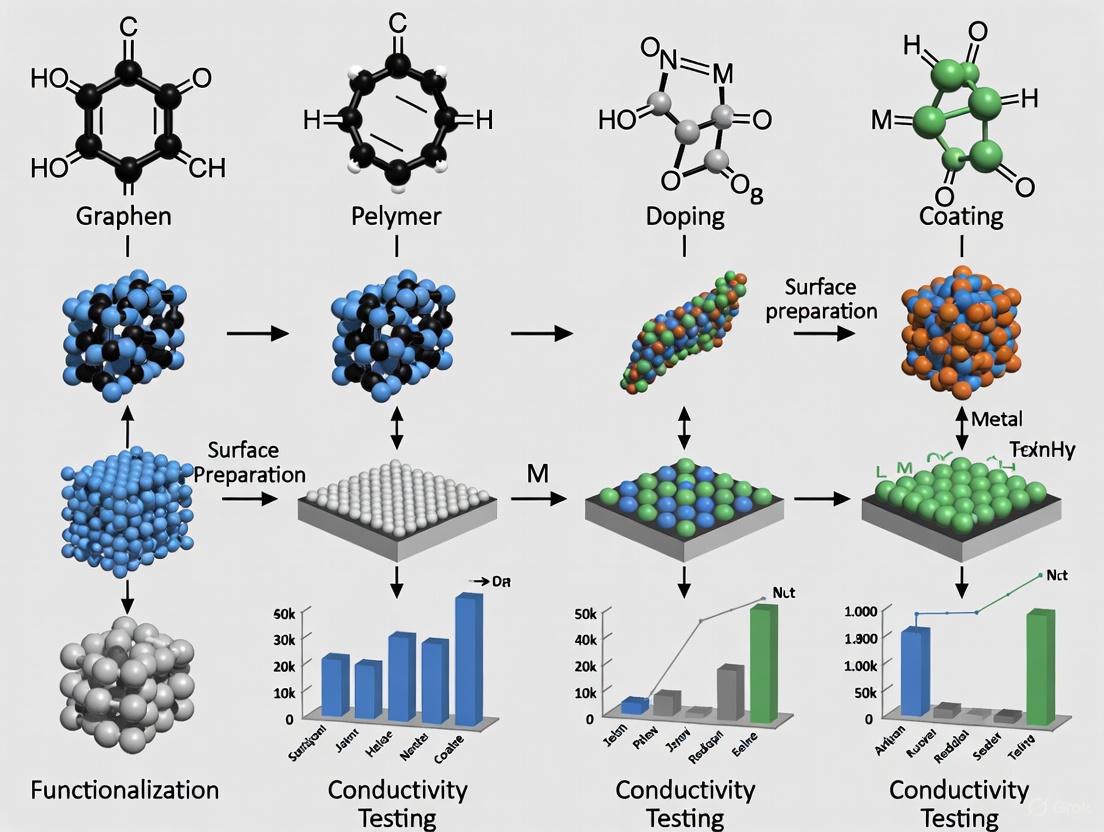
This article provides a comprehensive analysis of surface modification strategies engineered to enhance the electrical conductivity of materials, with a specific focus on applications in drug delivery and biomedical devices.
Surface Modification Techniques for Conductivity Enhancement: A Comparative Guide for Biomedical Researchers
Abstract
This article provides a comprehensive analysis of surface modification strategies engineered to enhance the electrical conductivity of materials, with a specific focus on applications in drug delivery and biomedical devices. It explores the fundamental principles governing conductivity in materials like conductive polymers and metallic nanoparticles, detailing key methodologies from carbon coating to chemical grafting. The content offers practical guidance for troubleshooting common issues such as stability and biocompatibility, and presents rigorous validation and comparative frameworks to evaluate performance. Aimed at researchers and drug development professionals, this review serves as a strategic resource for selecting and optimizing surface modification techniques to advance next-generation conductive biomaterials.
The Principles of Electrically Conductive Materials and Why Surface Modification Matters
The integration of electrical functionality into biomaterials represents a paradigm shift in regenerative medicine and bioelectronics. Moving beyond traditionally inert scaffolds, contemporary biomaterial design leverages electrical conductivity to direct cell fate, deliver therapeutic stimuli, and create seamless interfaces between biological tissues and electronic devices. This class of materials encompasses a broad spectrum, from semiconducting biomaterials of biological origin to synthetic metallic polymers, each defined by their unique charge transport mechanisms and tailored for specific biomedical applications. The fundamental property uniting them is electrical conductivity, a measure of a material's ability to facilitate the movement of electrical charge.
Electrical conductivity (σ), typically measured in Siemens per meter (S/m), categorizes materials: insulators (σ < 10⁻⁸ S/m), semiconductors (σ = 10⁻⁸ to 10³ S/m), and conductors (σ > 10³ S/m). In biomaterials, this property is no longer a passive characteristic but an active design parameter. Conductivity enables biomaterials to mimic the native electrophysiological environment of tissues like nerves (0.03–0.6 S/m) and cardiac muscle, to deliver electrical stimulation (ES) for enhancing neuronal growth or bone formation, and to function as sensitive biosensors or actuatable drug delivery systems [1] [2] [3]. The following sections provide a comparative analysis of major conductive biomaterial classes, their performance metrics, enhancement strategies, and the experimental workflows that define their application in cutting-edge biomedical research.
Comparative Analysis of Conductive Biomaterial Classes
The landscape of conductive biomaterials is diverse, comprising materials with intrinsic conductivity, those made conductive through additives, and hybrid systems. Table 1 provides a quantitative comparison of the key material classes, their conductive mechanisms, and their primary biomedical applications.
Table 1: Comparison of Major Conductive Biomaterial Classes
| Material Class | Example Materials | Typical Conductivity Range (S/m) | Conduction Mechanism | Key Biomedical Applications |
|---|---|---|---|---|
| Conductive Polymers | PEDOT, PPy, PANi | 10 - 10⁴ (Doped) [2] | Electron/hole transport via conjugated π-bond backbone; doping enhances charge carriers [1]. | Neural interfaces, biosensors, drug-eluting scaffolds, wearable electronics [1] [4]. |
| Carbon-Based Materials | Graphene, CNTs, CNFs | 10² - 10⁵ [1] | Electron delocalization across sp²-hybridized carbon networks [1]. | Neural guidance conduits, mechanically reinforced composites, biosensors [3] [5]. |
| Semiconducting Biomaterials | Amorphous Kenaf Cellulose Fibre (AKCF) | Exhibits negative resistance & switching behavior [6] | Voltage-induced formation of strong field domains and electric double layers [6]. | Flexible/biodegradable electronics, switching devices [6]. |
| Liquid Metals | Eutectic GaIn (EGaIn) | ~3.4 × 10⁶ [7] | Mobile electrons in a liquid phase; surface oxide enables patterning [7]. | Stretchable electrodes, soft robotics, energy storage, bioelectronics [7]. |
| Ion-Modified Polymers | Graphite Ion-Implanted CR-39 | 10⁻⁹ to 10⁻⁷ (Post-implantation) [8] | Ion implantation creates defects and conductive pathways within the polymer matrix. | Surface-modified substrates for bioelectronics. |
As shown, conductive polymers like poly(3,4-ethylenedioxythiophene) (PEDOT) and polypyrrole (PPy) are prized for their tunable conductivity and biocompatibility, functioning as "synthetic metals" [1] [2]. Their conductivity relies on a π-conjugated polymer backbone, where loosely held electrons form a pathway for charge carriers, a state significantly enhanced through chemical or electrochemical doping [1]. In contrast, carbon-based materials like graphene and carbon nanotubes (CNTs) offer superior conductivity and mechanical strength, often used to create conductive composites or inks [1] [5].
Emerging categories are pushing the boundaries of functionality. Semiconducting biomaterials, such as amorphous kenaf cellulose fibre (AKCF), demonstrate that naturally derived substances can exhibit complex electronic behaviors like negative resistance and DC-to-AC conversion, opening avenues for biodegradable electronics [6]. Liquid metals like eutectic gallium-indium (EGaIn) provide unparalleled stretchability due to their liquid core and solid oxide skin, which can be chemically modified for better integration [7]. Finally, ion implantation techniques can render typically insulating polymers (e.g., CR-39) measurably conductive by physically embedding graphitic carbon pathways, showcasing a direct surface modification approach to control conductivity [8].
Surface Modification Techniques for Enhanced Conductivity
Surface modification is a critical strategy for enhancing the performance and integration of conductive biomaterials. These techniques improve not only conductivity but also biocompatibility, stability, and interfacial interactions. Table 2 summarizes prominent surface modification methods and their impacts.
Table 2: Surface Modification Techniques for Conductivity Enhancement
| Modification Technique | Target Material | Methodology Summary | Effect on Conductivity & Performance |
|---|---|---|---|
| Chemical Doping | Conductive Polymers (e.g., PPy, PEDOT) | Introduction of anions (e.g., Cl⁻, Tosylate) or cations during polymer synthesis to oxidize or reduce the polymer backbone [1] [2]. | Increases charge carrier density, enhancing electrical conductivity by orders of magnitude. Dopant choice also affects cell growth and biocompatibility [2]. |
| Chemical Functionalization | Carbon Nanotubes (CNTs) & Liquid Metals | Treatment with functional molecules (e.g., 1-dodecanethiol, carboxyl groups, silane coupling agents like KH550) to form self-assembled monolayers or covalent bonds [7] [5]. | Improves dispersion in polymer matrices, reducing interfacial thermal/electrical resistance. Can build interconnected networks for enhanced through-plane conductivity [5]. |
| Ion Implantation | Polymers (e.g., CR-39) | Using a high-energy laser to produce graphite plasma, which is accelerated and implanted into the polymer substrate at controlled fluences [8]. | Creates conductive dendritic structures and defects within the polymer, significantly increasing electrical conductivity (e.g., from 10⁻⁹ to 10⁻⁷ S/cm) [8]. |
| Oxide Layer Manipulation | Gallium-based Liquid Metals | Controlled growth or removal (via acid/base or electric field) of the native Ga₂O₃ layer (0.7-3 nm) on the liquid metal surface [7]. | The oxide layer stabilizes particles for patterning and composite formation. Its manipulation is key to creating conductive, stretchable electrodes. |
| Galvanic Replacement | Liquid Metals | Immersion in metal ion (e.g., Pt⁺, Ag⁺) solutions to drive a redox reaction that decorates the surface with a bimetallic layer (e.g., PtGa) [7]. | Creates a functional, conductive shell for specific applications like catalysis or soft robotics, altering surface adhesion and reactivity. |
A key application of surface modification is in creating conductive composites. For instance, functionalizing carbon nanotubes with silane coupling agents like 3-aminopropyl triethoxysilane (KH550) allows them to form covalent bonds with each other and the polymer matrix. This constructs a locally interconnected network that enhances thermal and electrical conductivity pathways while simultaneously improving electrical insulation by preventing the formation of a direct conductive pathway that could cause leakage currents [5]. Similarly, surface modification of liquid metals is essential for their application. The natural oxide skin on EGaIn can be exploited to create stable micro- and nanoparticles via sonication, which can then be further functionalized with thiol or carboxyl-group molecules for better dispersion in polymers, enabling the printing of stretchable conductive traces [7].
Experimental Protocols and Key Research Findings
Protocol 1: Creating a Semiconducting Biomaterial from Kenaf Cellulose
This protocol outlines the process for characterizing the novel semiconducting properties of amorphous kenaf cellulose fibre (AKCF), which exhibits voltage-controlled negative resistance [6].
- Materials Preparation: AKCF paper is prepared as the bulk semiconductor specimen.
- Electrical Characterization (I-V Curves): The voltage-current (I-V) characteristics are measured using a DC method. The voltage is swept from -200 V to +100 V at a constant temperature of 293 K (20 °C), and the resulting current is recorded. This reveals non-linear behaviors, including negative resistance regions and hysteresis.
- Switching Effect & Resistance Measurement: The resistance (R) is calculated from I-V data and plotted on a logarithmic scale against voltage (R-V curve) to visualize the switching effect, where resistance can change by several orders of magnitude at a threshold voltage.
- DC-to-AC Conversion Analysis: Under a constant applied bias beyond the threshold (e.g., -65 V), the current output is monitored over time. A Fast Fourier Transform (FFT) is applied to the output signal to identify the frequency of the generated oscillations, which was found to be 40.6 MHz for AKCF.
- Structural Analysis: Wide-field X-ray diffraction (XRD), atomic force microscopy (AFM), and transmission electron microscopy (TEM) with selected-area electron diffraction (SAED) are used to confirm the amorphous nature and morphology of the cellulose fibers.
- Impedance Spectroscopy: AC impedance is measured from 1 mHz to 1 MHz to model the electrochemical interface using a Nyquist plot, identifying Warburg diffusion and interfacial polarization phenomena.
The experimental workflow for this protocol is systematized in the diagram below.
Protocol 2: Enhancing Nerve Regeneration with Conductive NGCs
This protocol describes the methodology for developing and evaluating conductive nerve guidance conduits (NGCs) for peripheral nerve injury repair [3].
- Conduit Fabrication: A base polymer (e.g., biodegradable polycaprolactone, PCL) is combined with conductive elements. This can be achieved via:
- Conductive Coating/Composite: Coating the conduit interior with carbon nanotubes or polypyrrole, or creating a composite matrix (e.g., graphene/PCL).
- In-Situ Hydrogel Formation: Incorporating a conductive hydrogel (e.g., graphene oxide/silk fibroin) into the conduit lumen.
- In Vitro Characterization:
- Electrical Properties: Conductivity of the composite material is measured.
- Cell Culture Studies: Schwann cells or neuronal cells are seeded on the material. Their proliferation, differentiation, and alignment are assessed with and without applied electrical stimulation (ES).
- In Vivo Animal Modeling:
- A peripheral nerve injury model (e.g., sciatic nerve gap in a rodent) is created.
- The experimental conductive NGC is implanted to bridge the nerve gap. Control groups receive non-conductive NGCs or autografts.
- Functional & Histological Assessment:
- Functional Recovery: Muscle re-innervation and functional recovery are tracked over weeks.
- Histological Analysis: After sacrifice, the regenerated nerve is examined for axon density, myelination thickness, and presence of Schwann cells.
The following diagram illustrates the logical pathway through which conductive materials facilitate nerve repair.
The Scientist's Toolkit: Essential Reagents and Materials
Successful research and application in conductive biomaterials rely on a core set of reagents and materials. This toolkit, detailed in Table 3, covers key components for synthesis, modification, and experimental testing.
Table 3: Essential Research Reagent Solutions for Conductive Biomaterial Development
| Reagent/Material | Function and Application | Key Characteristics |
|---|---|---|
| Poly(3,4-ethylenedioxythiophene): Polystyrene sulfonate (PEDOT:PSS) | A stable, commercially available conductive polymer dispersion used for neural interfaces, sensors, and transparent electrodes [1]. | High conductivity, excellent film-forming properties, good stability in aqueous environments. |
| Polypyrrole (PPy) & Dopants (e.g., Tosylate, Cl⁻) | A widely used conductive polymer synthesized via oxidative polymerization; dopants are incorporated to control conductivity and biocompatibility [2]. | High conductivity, ease of synthesis; dopant choice critically influences cellular response. |
| Carboxylated/Aminated Carbon Nanotubes (CNTs) | Surface-functionalized CNTs for creating conductive polymer composites. Functional groups improve dispersion and interfacial bonding [5]. | High aspect ratio and conductivity; -COOH or -NH₂ groups enable covalent coupling to polymer matrices. |
| Eutectic Gallium-Indium (EGaIn) | A liquid metal for creating ultra-stretchable and reconfigurable conductive circuits, electrodes, and soft robotics [7]. | Liquid at room temperature, low toxicity, high conductivity; surface oxide allows particle formation. |
| 3-Aminopropyltriethoxysilane (KH550) | A silane coupling agent used to surface-modify fillers like CNTs or ZnO, creating covalent bridges between the filler and polymer matrix [5]. | Reduces interfacial thermal/electrical resistance, enhances filler dispersion, and improves composite mechanical properties. |
| Polycaprolactone (PCL) | A biodegradable polyester often used as a base material for fabricating nerve guidance conduits and bone scaffolds via 3D printing [3]. | Biocompatible, biodegradable, easy to process, FDA-approved for certain medical devices. |
The field of conductive biomaterials has evolved from foundational discoveries like intrinsically conductive polymers to sophisticated, application-driven material systems. This comparison guide delineates a clear taxonomy: conductive polymers offer tunability and biofunctionality, carbon-based materials provide structural and electrical superiority, liquid metals introduce fluidic and highly stretchable properties, and emergent semiconductors from biological sources promise a new era of biodegradable electronics. The critical role of surface modification—through doping, chemical functionalization, and ion implantation—is a universal theme for enhancing conductivity, biocompatibility, and system integration. As the field progresses, the convergence of these material classes with advanced manufacturing like 3D printing and AI-guided design will unlock next-generation smart implants and precise therapeutic systems, ultimately bridging the functional gap between synthetic materials and native human tissue.
The performance of materials in advanced applications, from high-power electronics to next-generation batteries, is fundamentally governed by a set of key physical parameters. Understanding band gaps, charge carrier mobility, and the distinction between ionic and electronic conductivity is crucial for researchers developing new materials with enhanced functionality. These metrics collectively determine how efficiently a material can transport charge—whether through electrons, ions, or both—and directly influence the design and efficiency of devices ranging from semiconductors to battery electrodes.
This guide provides a comparative analysis of these essential metrics, supported by experimental data and methodologies. We place particular emphasis on how different surface modification and doping strategies can be employed to tune these properties, thereby enhancing material performance for specific applications. The objective data and protocols presented herein are designed to assist researchers in selecting and optimizing materials for their specific conductivity requirements.
Band Gap: The Fundamental Energy Barrier
The band gap is the energy difference between the top of the valence band (filled with electrons) and the bottom of the conduction band (empty orbitals where electrons can move freely). It fundamentally determines whether a material is a conductor, semiconductor, or insulator. While materials with band gaps greater than 3 eV were traditionally classified as insulators, the emergence of ultra-wide-band-gap (UWBG) semiconductors has challenged this paradigm [9].
- Narrow Band Gap (< 1.5 eV): Materials exhibit inherent high electronic conductivity. Examples include silicon (Si, ~1.1 eV) and germanium (Ge, ~0.67 eV).
- Moderate Band Gap (1.5 - 3.0 eV): These semiconductors are the workhorses of many optoelectronic devices. Gallium arsenide (GaAs, ~1.43 eV) is a key example.
- Wide Band Gap (3.0 - 4.5 eV): Materials like silicon carbide (SiC, ~3.3 eV) and gallium nitride (GaN, ~3.4 eV) are essential for high-power, high-temperature electronics.
- Ultra-Wide Band Gap (> 4.5 eV): This category includes materials such as diamond (~5.5 eV), gallium oxide (β-Ga₂O₃, ~4.5-4.9 eV), and aluminum nitride (AlN, ~6.2 eV). Recent computational discovery has identified UWBG semiconductors with gaps as high as 9.5 eV that still demonstrate semiconducting behavior, such as shallow dopants and mobile carriers [9].
Table 1: Band Gap Classification and Material Properties
| Band Gap Category | Example Materials | Band Gap (eV) | Primary Applications |
|---|---|---|---|
| Narrow | Silicon (Si), Germanium (Ge) | < 1.5 | Microprocessors, transistors |
| Moderate | Gallium Arsenide (GaAs) | 1.5 - 3.0 | LEDs, laser diodes, high-frequency chips |
| Wide (WBG) | Silicon Carbide (SiC), Gallium Nitride (GaN) | 3.0 - 4.5 | Power electronics, RF devices |
| Ultra-Wide (UWBG) | β-Ga₂O₃, Diamond, AlN, BN | > 4.5 | Extreme-power electronics, deep-UV optoelectronics |
Experimental Band Gap Determination Protocols
Researchers employ several techniques to determine the band gap of a material experimentally.
- UV-Vis Absorption Spectroscopy: This is a common optical method. The absorption spectrum of a material is measured, and the band gap is determined by plotting (αhν)ⁿ vs. hν (the Tauc plot), where α is the absorption coefficient, hν is the photon energy, and n depends on the type of electronic transition (direct or indirect). The extrapolation of the linear region to the x-axis gives the band gap energy [10].
- Photoelectron Spectroscopy: Techniques like X-ray Photoelectron Spectroscopy (XPS) and Ultraviolet Photoelectron Spectroscopy (UPS) are used to measure the ionization potential and valence band maximum. When combined with the optical band gap from absorption measurements, a complete band energy diagram relative to the vacuum level can be constructed [10].
Charge Carrier Mobility: The Velocity of Charge Transport
Charge carrier mobility (μ) quantifies how quickly an electron or hole can move through a material when pulled by an electric field. It is a critical parameter for determining the speed and switching efficiency of electronic devices. High mobility is essential for high-frequency transistors and efficient power conversion systems. Mobility is limited by various scattering mechanisms, including phonon scattering (lattice vibrations) and impurity scattering (from dopants or defects) [11].
The electron mobility is calculated by solving the Boltzmann transport equation, which accounts for these scattering mechanisms:
Where e is the electron charge, nₑ is the electron concentration, vₙₖ is the group velocity, τₙₖ is the electron lifetime, and f⁰ₙₖ is the Fermi-Dirac distribution function [11].
Table 2: Comparative Electron Mobilities of Wide Band Gap Semiconductors
| Material | Band Gap (eV) | Electron Mobility at Room Temp. (cm² V⁻¹ s⁻¹) | Dominant Scattering Mechanism |
|---|---|---|---|
| β-Ga₂O₃ (Pure) | ~4.9 | 151.5 | Polar Optical Phonon (POP) |
| Al-doped Ga₂O₃ | > ~4.9 | 137.8 | POP & Ionized Impurity |
| In-doped Ga₂O₃ | < ~4.9 | 184.9 | Polar Optical Phonon (POP) |
| SiC (4H) | ~3.3 | ~900 - 1000 | Phonon & Defect Scattering |
| GaN | ~3.4 | ~1200 - 2000 | Polar Optical Phonon (POP) |
Data in table is for an electron concentration of 1.0 × 10¹⁷ cm⁻³ [11].
Enhancing Mobility via Doping: A Case Study on Ga₂O₃
Doping is a primary strategy for enhancing charge carrier mobility. First-principles investigations reveal that indium (In) doping can enhance the electron mobility of β-Ga₂O₃, while aluminum (Al) doping reduces it [11].
Experimental and Computational Protocol:
- Modeling: First-principles calculations using density functional theory (DFT) with hybrid functionals (e.g., HSE06) are performed to accurately model the electronic band structure of pure and doped systems.
- Defect Energy Calculation: The formation energy of dopants (In, Al) substituting for Ga atoms in different lattice sites is computed to identify the most stable configuration.
- Scattering Rate Calculation: The electron scattering rates due to Acoustic Deformation Potential (ADP), Polar Optical Phonon (POP), and Ionized Impurity (IMP) scattering are calculated using packages like AMSET.
- Mobility Calculation: The linearized Boltzmann transport equation is solved, incorporating all significant scattering mechanisms to obtain the electron mobility as a function of temperature and doping concentration [11].
Mechanism of Enhancement: The mobility enhancement in In-doped Ga₂O₃ is attributed to a smaller effective mass of electrons caused by the contribution of the In 5s state, despite a slight increase in electron-phonon coupling strength. In contrast, Al doping does not provide this beneficial electronic structure modification [11].
Ionic vs. Electronic Conductivity: Distinct Charge Transport Mechanisms
A critical distinction in materials science is between ionic conductivity and electronic conductivity. These are two fundamentally different mechanisms of charge transport.
- Electronic Conductivity: This is the movement of electrons (e⁻) or holes through a material's electronic band structure. It is the primary conduction mechanism in metals and semiconductors. The charge carriers are electrons/holes, and the process is typically very fast.
- Ionic Conductivity: This is the movement of ions (atoms or molecules with a net charge) through a material. It is the dominant conduction mechanism in electrolytes (liquid or solid). The charge carriers are ions (e.g., Li⁺, Na⁺, Cl⁻), and the process is generally slower than electronic conduction due to the larger mass of ions [12].
In a typical liquid electrolyte, ionic conductivity dominates. The motion of ions to different locations moves much more charge per unit time than the movement of electrons between molecules. The primary function of an electrode is to convert between an electronic current (in the metal wire) and an ionic current (in the electrolyte) via electrochemical reactions at the interface [12].
Table 3: Ionic vs. Electronic Conductivity Comparison
| Feature | Electronic Conductivity | Ionic Conductivity |
|---|---|---|
| Charge Carrier | Electrons / Holes | Ions (e.g., Li⁺, Na⁺) |
| Dominant in | Metals, Semiconductors | Electrolytes, Ionic Solids |
| Speed | Very Fast (high mobility) | Slower (lower mobility) |
| Measurement | DC or AC methods, 4-point probe | Electrochemical Impedance Spectroscopy (EIS) |
| Example Material | Copper (Cu): ~ 6.0 × 10⁷ S/m | Pure Li₂S: ~ 1 × 10⁻⁸ S/m (ionic) |
Enhancing Both Conductivities in Battery Materials: The Case of Li₂S
Lithium sulfide (Li₂S) is a promising high-capacity cathode material, but it suffers from intrinsically poor both electronic and ionic conductivity, which leads to high activation potentials and sluggish kinetics [13].
Doping Strategy and Experimental Protocol: Doping is a versatile strategy to enhance both electronic and ionic conductivity simultaneously in materials like Li₂S.
- Dopant Selection: Cationic (e.g., Al³⁺, Mg²⁺, Fe³⁺, Ca²⁺) or anionic (e.g., F⁻, Cl⁻) dopants are selected.
- Material Synthesis: Doped Li₂S is synthesized via methods like solid-state reaction or ball milling with precursor compounds containing the dopant elements.
- Conductivity Measurement:
- Electronic Conductivity: Can be measured using a four-point probe method on pressed pellets of the material.
- Ionic Conductivity: Typically measured by fabricating a symmetric cell (e.g., Li | electrolyte | doped-Li₂S | electrolyte | Li) and performing Electrochemical Impedance Spectroscopy (EIS). The bulk resistance obtained from the Nyquist plot is used to calculate the ionic conductivity.
- Performance Validation: The doped material is assembled into a battery cell to measure performance metrics like capacity, rate capability, and cycle life [13].
Enhancement Mechanisms:
- Electronic Conductivity: Doping can reduce the band gap of Li₂S or create metal-induced gap states, facilitating easier electron excitation into the conduction band.
- Ionic Conductivity: Doping introduces point defects (e.g., vacancies) that increase charge carrier concentration. It can also expand Li⁺ diffusion channels and reduce interface resistance between particles, accelerating Li⁺ diffusion [13].
Table 4: Conductivity Enhancement of Li₂S via Doping [13]
| Material | Electronic Conductivity (S/m) | Ionic Conductivity (S/m) |
|---|---|---|
| Pure Li₂S | 1.17 × 10⁻⁷ | 1 × 10⁻⁸ |
| Li₂S/W Nanocomposite | 0.548 | 5.44 × 10⁻² |
| Li₂S/Mo Nanocomposite | 0.343 | 3.62 × 10⁻² |
The Scientist's Toolkit: Essential Reagents and Materials
Table 5: Key Research Reagents and Materials for Conductivity Studies
| Reagent / Material | Function & Application | Example Use Case |
|---|---|---|
| HSE06 Hybrid Functional | A computational parameter in DFT that provides more accurate electronic band structure and band gap calculations compared to standard GGA. | Validating band gaps of UWBG semiconductors [11]. |
| Indium (In) Dopant | A cationic dopant used to modify the electronic band structure of host materials, potentially reducing electron effective mass. | Enhancing electron mobility in β-Ga₂O₃ [11]. |
| Electrochemical Impedance Spectroscopy (EIS) | An experimental technique used to characterize materials and interfaces by measuring their impedance over a range of frequencies. | Determining the ionic conductivity of solid electrolytes like doped Li₂S [13]. |
| Acoustic Deformation Potential (ADP) | A parameter calculated to quantify electron scattering from acoustic phonons, which is a key factor limiting mobility in semiconductors. | Modeling electron mobility in wide-bandgap semiconductors like Ga₂O₃ [11]. |
| Catechol-based Coatings | A class of surface modifiers inspired by mussel adhesion proteins. They can enhance adhesion and introduce functional groups. | Improving the interface between electrodes and biological tissues or other components [14]. |
In the realms of biomedicine and energy materials, unmodified materials consistently face two fundamental limitations that restrict their application: intrinsically low conductivity and insufficient biocompatibility. These native shortcomings present significant barriers to developing advanced medical implants, efficient energy storage systems, and high-performance sensors. Low electrical and thermal conductivity hinders the efficient transfer of energy and information, while poor biocompatibility triggers adverse biological responses that compromise device functionality and patient safety [15] [16].
The pursuit of overcoming these inherent limitations has catalyzed extensive research into surface modification techniques. These methodologies aim to transform material interfaces without altering bulk properties, thereby enhancing surface-specific characteristics while maintaining desirable core attributes. This guide provides a comprehensive comparison of surface modification strategies designed to address these native limitations, with a particular focus on their applications in biomedical implants and thermal energy storage. The analysis systematically evaluates experimental data across multiple modification approaches, offering researchers evidence-based guidance for selecting appropriate techniques for specific material challenges.
Comparative Analysis of Surface Modification Techniques
Table 1: Comprehensive Comparison of Surface Modification Techniques for Conductivity Enhancement
| Modification Technique | Base Material | Modified Material/Coating | Conductivity Type | Performance Improvement | Key Findings |
|---|---|---|---|---|---|
| Graphite Ion Implantation [8] | CR-39 Polymer | Graphite-implanted CR-39 | Electrical | Increased from 10⁻⁹ to 10⁻⁷ S/cm | Dendritic and island structures formed; optical transmittance decreased from 90% to 68% |
| Metal Nanoparticle Addition [17] | D-Mannitol PCM | Cu-nanoparticle enhanced PCM | Thermal | 0.42 W/mK (from baseline ~0.2-0.3 W/mK) | 1.5% weight ratio Cu nanoparticles; heat transfer rate of 3956.40 kJ |
| Metal Nanoparticle Addition [17] | Myristic Acid PCM | Cu-nanoparticle enhanced PCM | Thermal | 0.36 W/mK (from baseline ~0.2 W/mK) | 1.5% weight ratio Cu nanoparticles; heat transfer rate of 1451.51 kJ |
| Carbon Nanomaterial Integration [16] | Paraffin PCM | Carbon-enhanced paraffin | Thermal | Up to 67% improvement | Latent heat capacity decreased at higher nanoparticle loadings |
| Conductive Polymer Hydrogels [18] | Polymer Hydrogels | Nanomaterial-integrated hydrogels | Electrical | Resistance: 1.35-4.1 Ω | Gauge factor 1.5-5.13; stretchability up to 3168% |
Table 2: Surface Modification Techniques for Enhanced Biocompatibility
| Modification Technique | Base Material | Target Application | Biological Response | Performance Outcomes | Limitations |
|---|---|---|---|---|---|
| Conversion & Passive Coating [19] | Titanium/Co-Cr alloys | Orthopedic/Dental Implants | Reduced biofouling and metal ion release | Improved tribo-corrosion performance | Stress shielding effects persist |
| Ion Implantation [19] | Permanent Implants | Orthopedic/Dental Implants | Enhanced biocompatibility | Improved tribo-corrosion resistance | Limited to surface layer |
| Acid Etching [20] | Zirconia Implants | Dental Prosthetics | Altered surface texture for bone integration | Increased surface roughness for osseointegration | Potential for over-etching |
| UV Light Treatment [20] | Y-PSZ Zirconia | Dental Implants | Enhanced osteoblast attachment/proliferation | Hydrophilic surface, reduced surface carbon | Requires specialized equipment |
| Laser Treatment [20] | Zirconia | Dental Implants | Improved bioactivity and osseointegration | Precise surface patterning | Thermal stress concerns |
| Sandblasting [20] | Y-TZP Zirconia | Dental Implants | Increased osteoblast differentiation | Improved bone morphogenetic protein response | Potential surface contamination |
Experimental Protocols and Methodologies
Conductivity Enhancement Protocols
Graphite Ion Implantation on CR-39 Polymer: The experimental protocol involves utilizing a KrF Excimer laser (248 nm, 18 ns, 120 mJ) at an irradiance of 2.5 × 10⁸ W cm⁻² for laser-induced graphite plasma production [8]. The Thomson parabola technique estimates graphite ion energy and fluence. Targets are implanted with 710 KeV graphite ions across fluences ranging from 26 × 10¹² to 92 × 10¹⁵ ions/cm², with a magnetic field strength of 90 mT. Characterization includes digital optical analysis, confocal microscopy, Raman spectroscopy, and UV-Vis spectral analysis to evaluate structural and property changes. Electrical conductivity measurements are performed using standard four-point probe methods.
Nanoparticle-Enhanced Phase Change Materials (PCMs): The synthesis follows a two-step method incorporating copper (Cu), aluminum (Al), and zinc (Zn) nanoparticles at a 1.5% weight ratio into D-Mannitol and Myristic acid PCMs [17]. Therminol-66 serves as the temperature conduction fluid during testing. Thermophysical characterization measures thermal conductivity coefficients, heat transfer rates, and thermal diffusivity. The experimental setup typically involves a temperature-controlled bath with precision sensors to monitor charging and discharging behavior.
Biocompatibility Enhancement Protocols
Zirconia Surface Modification for Dental Implants: Standard protocols include acid etching with hydrofluoric or nitric acid solutions for specific durations, UV treatment using ultraviolet light sources for surface activation, and laser treatment with controlled parameters for surface patterning [20]. Sandblasting employs alumina particles of specific sizes at controlled pressures. Biofunctionalization methods involve immobilizing bioactive molecules like peptides or proteins to enhance cellular response. Characterization includes scanning electron microscopy for surface topography, contact angle measurements for wettability, and in vitro cell culture studies with osteoblast-like cells to assess biocompatibility and osseointegration potential.
Implantable Electrode Surface Modifications: Protocols focus on creating anti-biofouling surfaces through coating with biocompatible polymers, surface texturing to reduce microbial colonization, and biofunctionalization to mitigate foreign body response [15]. Experimental evaluation includes in vitro protein adsorption studies, bacterial adhesion assays, and in vivo implantation with histological analysis of tissue integration and inflammatory response.
Visualization of Surface Modification Strategies
Surface Modification Strategies for Material Enhancement
The Scientist's Toolkit: Essential Research Reagents and Materials
Table 3: Essential Research Reagents and Materials for Surface Modification Studies
| Material/Reagent | Function in Research | Application Examples | Key Characteristics |
|---|---|---|---|
| Copper Nanoparticles (Cu) | Thermal conductivity enhancement | Nano-enhanced PCMs [17] | High thermal conductivity (~398 W/m·K) |
| Graphite Ions | Electrical conductivity modification | Ion implantation in polymers [8] | 710 KeV energy; fluence 26×10¹²-92×10¹⁵ ions/cm² |
| Yttria-Stabilized Zirconia (YSZ) | Biocompatible substrate | Dental implants [20] | High fracture toughness, stability |
| Conductive Hydrogels | Flexible conductive substrates | Wearable sensors [18] | Strain tolerance (up to 3168%), self-healing |
| Aluminum Nanoparticles (Al) | Thermal conductivity enhancement | Nano-enhanced PCMs [17] | Moderate thermal conductivity (~237 W/m·K), low cost |
| Zinc Nanoparticles (Zn) | Thermal conductivity enhancement | Nano-enhanced PCMs [17] | Moderate thermal conductivity (~116 W/m·K) |
| Carbon Nanotubes (CNTs) | Electrical conductivity enhancement | Conductive hydrogels [18] | High aspect ratio, conductivity |
| Ionic Liquids | Surface modification for electrocatalysis | CO2 reduction reactions [21] | Increase local CO2 concentration, stabilize intermediates |
| Therminol-66 | Heat transfer fluid | PCM testing [17] | Temperature conduction medium |
| Lithium Chloride (LiCl) | Hydrogel conductivity enhancement | Conductive hydrogels [18] | Frost resistance, elastic recoverability |
The comprehensive comparison of surface modification techniques reveals that strategic selection depends fundamentally on the targeted material property and application requirements. For enhancing electrical conductivity in polymer-based systems, graphite ion implantation demonstrates significant improvements, while metal nanoparticle integration provides substantial gains in thermal conductivity for energy storage applications. In biomedical contexts, zirconia surface modifications through physical and chemical methods substantially improve biocompatibility and osseointegration.
Critical considerations for researchers include the trade-offs between enhancement magnitude and potential compromises in other material properties. Nanoparticle addition improves thermal conductivity but may reduce latent heat capacity in PCMs [16] [17]. Surface texturing enhances biological integration but may introduce stress concentration points in structural applications [19] [20]. Future development should focus on hybrid approaches that combine multiple modification strategies to address both conductivity and biocompatibility simultaneously while maintaining other critical material properties essential for specific applications.
The experimental protocols and data summarized in this guide provide a foundation for evidence-based selection of surface modification techniques, enabling researchers to strategically overcome the native limitations of unmodified materials across diverse technological domains.
Surface modification has emerged as a powerful strategy for fine-tuning the properties of materials to achieve enhanced performance in applications ranging from energy storage to biomedicine. The core of these enhancements lies in the ability of surface modifications to deliberately alter a material's electronic structure and interfacial characteristics. These alterations can significantly impact conductivity, catalytic activity, and interfacial interactions, ultimately determining the functional efficacy of the material in its intended application. This guide provides a comparative analysis of major surface modification techniques, focusing on their mechanistic pathways for enhancing material performance, supported by experimental data and protocols. Understanding these core mechanisms is essential for researchers and scientists seeking to optimize materials for specific applications, particularly in the rapidly advancing field of conductivity enhancement research.
Comparative Analysis of Surface Modification Techniques
The table below compares the primary surface modification techniques, their mechanisms of action, and their impact on electronic structure and interfacial properties.
Table 1: Comparison of Surface Modification Techniques for Electronic and Interfacial Enhancement
| Modification Technique | Core Mechanism of Electronic Structure Alteration | Key Interfacial Properties Modified | Primary Applications | Reported Conductivity Enhancement |
|---|---|---|---|---|
| Polymer Functionalization [21] [22] | Introduction of conjugated electron systems and doping; charge transfer complexes | Hydrophilicity/hydrophobicity, biocompatibility, charge transfer resistance | Electrocatalysis, drug delivery, biosensors | Conductive polymers: up to 105 S cm-1 [22] |
| Ion Intercalation [23] | Electron donation/acceptance, inducing electron density redistribution, creating defects | Interlayer spacing, ion transport kinetics, active site exposure | Energy storage (batteries, supercapacitors) | Specific capacitance increase from 61.3 to 113.4 F g-1 in Ti3C2Tx [23] |
| Surface Coating (PVD) [24] | Formation of protective, conductive ceramic layers (e.g., Ti nitride); surface passivation | Hardness, corrosion resistance, bio-inertness, tribological properties | Biomedical implants, cutting tools | 26.2% improvement in cutting efficiency for Ni-Ti tools [24] |
| Elemental Doping [25] [23] | Creation of donor/acceptor energy levels, modification of charge distribution, defect engineering | Surface energy, catalytic active sites, chemical stability | Photocatalysis, energy storage, sensors | VOx/Mn-V2C capacity of 530 mAh g-1 [23] |
| Biomolecule Functionalization [25] [26] | Often indirect; enables targeted localization for therapeutic activation | Biocompatibility, specific cell targeting, reduced immune clearance | Targeted drug delivery, theranostics | Enables targeted delivery to folate receptor-positive cancer cells [26] |
Fundamental Mechanisms of Electronic Structure Alteration
Charge Transfer and Doping Effects
Surface modifications induce charge transfer at the interface between the modifier and the host material, fundamentally altering its electronic population and density of states. Conductive polymers like polypyrrole (Ppy) and polyaniline (PANI) exemplify this mechanism through their conjugated backbones, which contain alternating single and double bonds. This structure allows for π-electron delocalization along the polymer chain. The electrical conductivity, which can be tuned up to 105 S cm-1, is achieved through "doping" – a process that involves oxidizing (p-doping) or reducing (n-doping) the polymer to introduce charge carriers [22]. This is often accomplished using chemical agents like I2 or electrochemical methods, which inject or remove electrons, creating polarons or bipolarons that act as charge carriers along the polymer chain.
Similarly, in metallic nanoparticles and two-dimensional materials like MXenes, surface modifiers can act as electron donors or acceptors. For instance, the modification of CeO2 with Fe2O3 can induce charge transfer from CeO2 to Fe2O3, redistributing interfacial electron density and enhancing electrochemical water oxidation activity [27]. X-ray Photoelectron Spectroscopy (XPS) is a crucial technique for verifying these electronic changes by detecting chemical shifts in core-level binding energies [27].
Band Engineering through Defect Creation and Functionalization
Introducing defects or heteroatoms is a powerful strategy for engineering the band structure of materials. Doping MXenes with foreign atoms (e.g., N, S, P) or creating oxygen vacancies introduces new energy states within the band gap. This can narrow the effective band gap, facilitate carrier excitation at lower energies, and significantly enhance electrical conductivity and catalytic activity [23]. For example, the presence of oxygen vacancies in CeO2-based systems, as confirmed by XPS analysis, creates localized states that modify the electronic structure and promote charge transfer processes [27].
Surface functional groups inherently present on nanomaterials also play a critical role. MXenes are typically terminated with mixed functional groups (–O, –OH, –F), which influence their electronic properties. Strategic replacement of these groups (e.g., replacing –F with –O) can fine-tune the work function and electronic structure, optimizing the material for specific electrochemical applications [23].
Interfacial Stabilization and Interlayer Engineering
A critical function of surface modification is to stabilize materials against degradation and improve interfacial interactions. MXenes are prone of restacking of their two-dimensional layers, which reduces surface area and impedes ion transport, and are susceptible to oxidation [23]. Intercalation engineering addresses this by inserting ions (e.g., K+, Na+, Li+) or organic molecules (e.g., DMSO, urea) between the MXene layers. This not only physically expands the interlayer spacing—for instance, from 0.73 nm to 0.95 nm in V2CTx via Mn2+ intercalation—but also stabilizes the structure and facilitates rapid ion diffusion, thereby enhancing conductivity and capacitance [23].
In biomedical applications, surface coatings such as Physical Vapor Deposition (PVD) of Ti or Ti nitride are used to create a bio-inert, corrosion-resistant barrier on implants. This layer prevents the release of harmful metallic ions into the body, thereby improving biocompatibility and the long-term stability of the implant [24].
Experimental Protocols for Key Surface Modification Techniques
Protocol: Ion Intercalation in MXene Materials for Energy Storage
Objective: To expand the interlayer spacing of Ti3C2Tx MXene using Na+ intercalation to enhance its electrochemical capacitance [23].
Synthesis of Pristine Ti3C2Tx MXene:
- Etching: Immerse 1 g of the MAX phase precursor (Ti3AlC2) in 20 mL of a 50% concentrated hydrofluoric acid (HF) solution. Stir continuously for 24 hours at room temperature to selectively remove the Al layer.
- Washing: Centrifuge the resulting mixture and repeatedly wash the sediment with deionized water until the supernatant reaches a neutral pH (~6-7).
- Delamination: Subject the sediment to sonication in an ice bath for 1 hour under an inert atmosphere (e.g., N2 or Ar) to obtain a colloidal suspension of few-layer Ti3C2Tx nanosheets.
Na+ Intercalation Modification:
- Alkali Treatment: Add 10 mL of the delaminated Ti3C2Tx suspension (5 mg/mL) dropwise into 100 mL of a 1 M sodium hydroxide (NaOH) solution under vigorous stirring. Continue stirring for 12 hours at 35°C.
- Isolation: Collect the Na+-intercalated Ti3C2Tx by centrifugation and wash with copious amounts of deionized water to remove excess NaOH.
- Drying: Lyophilize the final product to obtain a powder of Na+-intercalated Ti3C2Tx.
Characterization and Performance Validation:
- X-Ray Diffraction (XRD): Confirm the increase in c-lattice parameter (interlayer spacing) by observing the shift of the (002) peak to a lower angle.
- Electrochemical Testing: Fabricate electrodes and test in a three-electrode system with 1 M H2SO4 electrolyte. Measure cyclic voltammetry at a scan rate of 1 mV s-1. The specific capacitance of NaOH-treated Ti3C2Tx is significantly higher (113.4 F g-1) compared to untreated MXene (61.3 F g-1) [23].
Protocol: Conductive Polymer Coating for Electrocatalysis
Objective: To apply a conductive polymer coating on an electrocatalyst to enhance local CO2 concentration and regulate the electronic structure for improved CO2 reduction reaction (CO2RR) performance [21].
Electropolymerization of Polypyrrole (Ppy):
- Electrode Preparation: Clean and polish the working electrode (e.g., Cu foil for CO2RR).
- Electrolyte Preparation: Prepare a 0.1 M monomer solution of pyrrole in a 0.1 M KCl supporting electrolyte. Deoxygenate the solution by bubbling N2 for 20 minutes.
- Polymer Deposition: Use a standard three-electrode setup (working electrode, Pt counter electrode, and Ag/AgCl reference electrode). Perform cyclic voltammetry between -0.2 V and 0.8 V for 10-15 cycles at a scan rate of 50 mV s-1 to electropolymerize pyrrole onto the working electrode surface.
- Post-treatment: Rinse the modified electrode thoroughly with deionized water and dry under a N2 stream.
Characterization and Performance Validation:
- Surface Analysis: Use XPS to confirm successful polymerization and analyze the chemical state of nitrogen in the Ppy layer, which provides insights into the doping level.
- Electrochemical CO2RR Testing: Evaluate the modified electrode in a CO2-saturated electrolyte (e.g., 0.1 M KHCO3). Measure the Faradaic Efficiency (FE) for target products (e.g., formate, ethylene) and compare it to the unmodified electrode. The polymer layer is known to increase local CO2 concentration and suppress the competing hydrogen evolution reaction (HER) [21].
Protocol: Physical Vapor Deposition (PVD) for Biomedical Implants
Objective: To deposit a thin, wear-resistant Ti nitride coating on a Ni-Ti alloy (K-file) to enhance its cutting efficiency and durability [24].
Substrate Preparation:
- Clean the Ni-Ti K-files ultrasonically in acetone, followed by ethanol, for 10 minutes each to remove surface contaminants.
- Dry the files in an oven at 60°C.
PVD Coating Process:
- Loading: Place the cleaned K-files into the PVD vacuum chamber.
- Evacuation: Pump down the chamber to a base pressure of at least 5.0 × 10⁻⁶ Torr.
- Pre-treatment: Perform argon ion etching to sputter-clean the substrate surface for 10-15 minutes, enhancing coating adhesion.
- Deposition: Introduce high-purity nitrogen gas and a Ti target. Initiate the arc or sputtering process. Maintain the substrate temperature between 200-400°C, with a bias voltage applied to the substrates. Deposit the TiN coating to a desired thickness (e.g., 1–3 µm).
Characterization and Performance Validation:
- Coating Quality: Analyze coating thickness, uniformity, and composition using scanning electron microscopy (SEM) and XPS.
- Performance Testing: Evaluate the cutting efficiency of the coated files compared to uncoated ones using a computer-driven measuring apparatus. A study reported that PVD TiN-coated Ni-Ti files showed up to a 26.2% improvement in cutting depth compared to uncoated tools [24].
Visualization of Modification Pathways and Workflows
The following diagrams illustrate the core mechanisms and experimental workflows for key surface modification techniques.
Ion Intercalation Mechanism in MXenes
Conductive Polymer Modification Workflow
The Scientist's Toolkit: Essential Reagents and Materials
The table below lists key reagents, materials, and instruments essential for conducting research in surface modification for conductivity enhancement.
Table 2: Essential Research Reagent Solutions and Materials for Surface Modification Studies
| Reagent/Material | Function/Application | Specific Example Use Case |
|---|---|---|
| Hydrofluoric Acid (HF) | Selective etching agent for synthesis of MXenes from MAX phases. | Etching of Al layer from Ti3AlC2 to produce Ti3C2Tx MXene [23]. |
| Pyrrole Monomer | Precursor for electrophysiologicalization of conductive polymer polypyrrole (Ppy). | Formation of conductive coatings for electrocatalytic CO2 reduction [21] [22]. |
| Sodium Hydroxide (NaOH) | Alkali agent for ion intercalation and surface functionalization. | Na+ intercalation into Ti3C2Tx to expand interlayer spacing [23]. |
| Dimethyl Sulfoxide (DMSO) | Organic solvent and intercalant for layer expansion and exfoliation. | Intercalation between MXene layers to facilitate delamination and prevent restacking [23]. |
| Titanium Target | Source material for physical vapor deposition (PVD) of coatings. | Deposition of Ti or Ti nitride coatings on biomedical implants for enhanced wear and corrosion resistance [24]. |
| XPS Instrumentation | Surface-sensitive technique for analyzing chemical composition and electronic states. | Determination of oxidation states (e.g., Ni2+/Ni3+ in electrocatalysts) and confirmation of doping [28] [27]. |
Surface modification techniques offer a versatile and powerful toolbox for precisely engineering the electronic structure and interfacial properties of materials. As demonstrated in this guide, strategies ranging from conductive polymer functionalization and ion intercalation to PVD coatings and elemental doping operate through distinct yet complementary mechanisms—charge transfer, band engineering, and interfacial stabilization. The selection of an appropriate technique is highly application-dependent. The continued advancement of surface modification strategies, coupled with robust characterization methods like XPS and ISS, is pivotal for the rational design of next-generation materials with tailored properties for energy storage, biomedicine, and beyond.
A Toolkit of Surface Modification Techniques for Biomedical Conductivity
Electrically conductive polymers have emerged as a cornerstone material for developing advanced electroactive interfaces, offering a unique combination of tunable electronic properties, excellent mechanical characteristics, and simple synthesis pathways. Unlike traditional inorganic conductors, these organic materials provide mixed ionic-electronic conductivity, biocompatibility, and the ability to be integrated into various fabrication processes, making them ideal for applications spanning from biosensors and neural interfaces to energy storage and flexible electronics [29] [30]. Among the extensive library of conducting polymers, poly(3,4-ethylenedioxythiophene) (PEDOT), polypyrrole (PPy), and polyaniline (PANI) represent three of the most extensively studied and implemented systems. Their appeal stems from a range of desirable properties, including dual electronic-ionic electrical conductivity, tunable physicochemical properties, and significant environmental stability compared to traditional inorganic materials [31] [29].
The fundamental structure of these polymers consists of conjugated carbon chains with alternating single and double bonds, where highly delocalized, polarized, and electron-dense π bonds are responsible for their electrical and optical behavior [30]. When these conjugated polymers undergo doping or photoexcitation, the π bond becomes self-localized to undergo nonlinear excitation as polarons, solitons, or bipolarons, transforming the polymer from a nonlinear excitation state to a metallic state [30]. This unique charge transport mechanism enables researchers to precisely tailor the electrical properties through chemical modifications, doping strategies, and composite formation. The following sections provide a comprehensive comparison of these three prominent conducting polymers, detailing their synthesis methodologies, key performance metrics across various applications, and experimental protocols for implementing them as functional electroactive interfaces.
Comparative Performance Analysis of PEDOT, PPy, and PANi
Electrical and Electrochemical Properties
The electrical and electrochemical properties of PEDOT, PPy, and PANi vary significantly, making each polymer uniquely suited for specific applications. PEDOT, particularly when complexed with poly(styrene sulfonate) (PSS) as PEDOT:PSS, demonstrates superior conductivity values that can be enhanced dramatically through various processing techniques. Recent studies have shown that simple additive incorporation like hydroquinone (HQ) can increase PEDOT:PSS thin film conductivity from 0.7 S/cm to 1394 S/cm without removing the insulating PSS component [32]. This enhancement originates from promoted phase separation between conductive PEDOT and insulating PSS after HQ addition, which acts as a proton (H+) donor for PEDOT:PSS [32].
When compared directly in organic electrochemical transistors (OECTs), PEDOT:PSS-based devices significantly outperform their PANi counterparts in terms of conductivity and transconductance [33]. However, PANi demonstrates excellence in film thickness control and surface smoothness, leading to good reproducibility of OECT performances [33]. The optimal fabrication conditions for PEDOT:PSS thin films were identified as a spin-coating rate of 3000 rpm and a DI water immersion time of 18 hours, while for PANi, the optimal conditions were a spin-coating rate of 3000 rpm and DI water immersion time of only 5 seconds, with the addition of dodecylbenzenesulfonic acid (DBSA) providing better OECT performances [33].
In supercapacitor applications, composites of these polymers with activated carbon (AC) demonstrate interesting performance characteristics. PANI:PEDOT/AC composites exhibited a specific capacitance of 611 Fg⁻¹ at a current density of 1 Ag⁻¹, slightly outperforming PANI:PPy/AC composites which showed a specific capacitance of 586 Fg⁻¹ [34]. Additionally, the PANI:PEDOT/AC composite demonstrated superior energy density (44 Whkg⁻¹) and power density (2160 Wkg⁻¹) compared to the PANI:PPy/AC composite [34].
Table 1: Comparison of Electrical and Electrochemical Properties
| Property | PEDOT | PPy | PANi |
|---|---|---|---|
| Typical Conductivity Range | 10⁻² to 10⁵ S/cm [35]; Up to 1394 S/cm with HQ enhancement [32] | 10-50 S/cm (pristine) [36] | ~10 S/cm at room temperature with SPAA template [35] |
| Specific Capacitance | 611 Fg⁻¹ (in PANI:PEDOT/AC composite) [34] | 586 Fg⁻¹ (in PANI:PPy/AC composite) [34]; 150-500 Fg⁻¹ (doped state) [34] | 200-550 Fg⁻¹ in H₂SO₄ electrolytes [34] |
| Energy Density | 44 Whkg⁻¹ (PANI:PEDOT/AC composite) [34] | 40 Whkg⁻¹ (PANI:PPy/AC composite) [34] | Information not available in search results |
| Cyclic Stability | 90% (PANI:PEDOT/AC composite) [34] | 92% (PANI:PPy/AC composite) [34] | Poor cyclic stability due to swelling/cracking during doping/de-doping [34] |
Optical, Thermal, and Mechanical Properties
The optical properties of conducting polymers play a crucial role in their application, particularly in optoelectronics and sensing. PEDOT:PSS maintains its high work function property (98% of pristine) even after conductivity enhancement through HQ addition, making it particularly valuable for transparent electrode applications where work function matching is critical [32]. This preservation of work function occurs because the conductivity improvement is induced by contiguous conductive PEDOT channel formation within the PEDOT:PSS thin film, not by removing PSS which is known to be the work function tunable polymer for high work function PEDOT:PSS [32].
Thermal stability represents another critical differentiator among these conducting polymers. Comparative studies using sulfonated poly(imide) templates have revealed that PEDOT-based systems demonstrate superior thermal stability compared to both PANi and PPy [35]. While PANi-SPAA composites initially show higher conductivity at room temperature (approximately 10 S/cm), they cannot maintain this conductivity after annealing at 300°C [35]. In contrast, PEDOT-SPAA systems retain their conductivity after high-temperature treatment, making them more suitable for applications requiring thermal processing or high-temperature operation [35].
The mechanical properties of these polymers, particularly when applied as coatings, significantly influence their performance in various applications. PANi demonstrates advantages in forming smooth, uniform films with good reproducibility [33]. When used as bioelectrode coatings, adhesion to the substrate represents a critical mechanical property. Recent developments in PEDOT:polydopamine (PDA) composites have demonstrated superior adhesion compared to conventional PEDOT:PSS coatings, addressing a significant limitation in bioelectronic applications [31].
Table 2: Thermal, Optical, and Physical Properties
| Property | PEDOT | PPy | PANi |
|---|---|---|---|
| Thermal Stability | High; maintains conductivity after 300°C annealing [35] | Moderate; more thermally stable than PANi but less than PEDOT [35] | Lower; conductivity not measurable after 300°C annealing [35] |
| Work Function | High; well-preserved after conductivity enhancement [32] | Information not available in search results | Information not available in search results |
| Film Quality | Dependent on processing parameters [33] | Information not available in search results | Excellent surface smoothness and reproducibility [33] |
| Adhesion | Improved with PDA dopant [31] | Information not available in search results | Information not available in search results |
Application-Specific Performance
The performance of PEDOT, PPy, and PANi varies significantly across different application domains, with each polymer demonstrating distinct advantages in specific use cases. In bioelectronic applications such as organic electrochemical transistors (OECTs) for biosensing, PEDOT:PSS-based devices show superior performance in terms of conductivity and transconductance [33]. However, PANi-based OECTs demonstrate better reproducibility due to superior film thickness control and surface smoothness [33]. For bioelectrode coatings, PEDOT:PDA composites offer significant advantages with charge storage capacity of approximately 42 mC cm⁻² and effective interface capacitance of about 17.8 mF cm⁻², coupled with enhanced adhesion properties critical for chronic implantation [31].
In energy storage applications, composites of these polymers with activated carbon have been extensively studied for supercapacitor electrodes. PANI:PEDOT/AC composites demonstrate slightly higher specific capacitance (611 Fg⁻¹) compared to PANI:PPy/AC composites (586 Fg⁻¹) at a current density of 1 Ag⁻¹ [34]. Both composites showed excellent cyclic stability, retaining 90% and 92% of their capacity, respectively [34].
For photocatalytic applications, particularly hydrogen production, these polymers have been incorporated with TiO₂ to form heterostructure photocatalysts. The highest H₂ evolution rate (HER) was observed for TiO₂@5PAn composites (3.1 mmol h⁻¹ g⁻¹), followed by TiO₂@2PPy (2.09 mmol h⁻¹ g⁻¹) and TiO₂@2PEDOT (1.37 mmol h⁻¹ g⁻¹) [37]. Compared to bare TiO₂, the HER was significantly enhanced by 36-fold, 24-fold, and 16-fold for PAn, PPy, and PEDOT-based composites, respectively [37].
In textile applications, research has shown that a layered cotton/PPy/PANI composition prepared via dip-coating reduced the fabric's electrical resistance from 10¹³-10⁶ kΩ/□ to 0.05 kΩ/□, achieving significantly lower resistance than PPy alone [36]. The PPy+PANI blend also imparted a unique thermal response, alternating between metallic and semiconducting behaviors, while increasing the fabric's thermal resistance [36].
Experimental Protocols and Methodologies
Synthesis and Fabrication Techniques
PEDOT:PSS Thin Film Fabrication for OECTs
The fabrication of high-performance PEDOT:PSS thin films for organic electrochemical transistors requires careful control of processing parameters. The optimal procedure identified through comparative studies involves several critical steps [33]:
Solution Preparation: Begin with a commercial PEDOT:PSS dispersion (0.5-1 wt% in water). To 5 mL of this dispersion, add 150 μL (3%) of ethylene glycol, 12 μL (approximately 0.25%) of DBSA, and 50 μL (1%) of GOPS as a cross-linker. First, ethylene glycol and DBSA are added to PEDOT:PSS and stirred for 10 minutes with sonication. Then, GOPS is added and stirred for 1 minute while being sonicated again.
Substrate Preparation: Clean the electrode substrate surface with DI water and make it hydrophilic by irradiating with ozone plasma for 20 minutes.
Spin-Coating: The rotation speed should be set to 4000 rpm initially, with DI water dropped and rotated for 30 seconds to briefly clean the surface. After that, 75 μL of the PEDOT:PSS solution is dropped and held without rotation for 100 seconds. Spin-coating is then performed at a constant rotation speed of 3000 rpm for 40 seconds.
Annealing and Treatment: After spin-coating, anneal at 135°C for 1 hour to form a PEDOT:PSS film on the electrode. Immerse the electrode in DI water for 18 hours to remove impurities such as low-molecular-weight PEDOT and form a smooth film surface.
This optimized protocol results in PEDOT:PSS films with superior OECT performance in terms of conductivity and transconductance [33].
PANI and PANI:DBSA Thin Film Fabrication
The fabrication of PANI-based thin films for OECT applications follows a similar but distinct procedure optimized for this polymer system [33]:
Solution Preparation: For pristine PANI solutions, use as received or mix with dopants. For PANI:DBSA, add approximately 12 μL of DBSA to 5 mL of PANI and stir with sonication.
Substrate Preparation: Unlike PEDOT:PSS, ozone plasma irradiation is not performed for PANI substrates. Instead, chloroform is used to clean the electrodes instead of DI water.
Spin-Coating: Apply the same procedure as for PEDOT:PSS with a spin-coating rate of 3000 rpm.
Annealing and Treatment: Anneal at 135°C for 30 minutes. Immersing in DI water is performed for only 5 seconds (compared to 18 hours for PEDOT:PSS).
The addition of DBSA significantly improves the OECT performance of PANi films, while the shorter immersion time reflects the different morphological properties and stability of PANi compared to PEDOT:PSS [33].
Electrochemical Polymerization of PEDOT:PDA
For bioelectrode coatings with enhanced adhesion, electrochemical polymerization of PEDOT with polydopamine (PDA) as a co-dopant has been developed [31]:
Electrode Preparation: Use round test electrodes fabricated using thin-film Au sputter-deposited on thermally oxidized silicon wafers, insulated with Kapton tape.
Electropolymerization: Perform potentiostatic deposition in phosphate-buffered saline solution (PBS) at pH 7.2 containing both EDOT and dopamine monomers.
Process Control: Apply a constant potential between the substrate (working electrode) and a counter electrode. Record the resulting current flow and corresponding charge as a function of time, stopping the electropolymerization process at a set charge (50 mC in the reported protocol).
This approach produces PEDOT:PDA coatings with performance metrics comparable to PEDOT:PSS, including charge storage capacity of approximately 42 mC cm⁻² and effective interface capacitance of about 17.8 mF cm⁻², but with significantly improved adhesion properties [31].
Conductivity Enhancement Methods
PEDOT:PSS Conductivity Enhancement with Hydroquinone
A facile method for dramatically enhancing the conductivity of PEDOT:PSS involves the addition of hydroquinone (HQ) [32]:
Solution Preparation: Add simple hydroquinone (HQ) to pristine PEDOT:PSS aqueous solution.
Mechanism: The HQ addition promotes phase separation between conductive PEDOT and insulating PSS. HQ acts as a proton (H+) donor for PEDOT:PSS, leading to the formation of contiguous conductive PEDOT channels within the PEDOT:PSS thin film.
Performance: This treatment can increase the conductivity of PEDOT:PSS thin film from 0.7 S/cm to 1394 S/cm without removing the insulator-like PSS from the coated PEDOT:PSS thin film.
Advantage: Unlike conventional approaches that remove PSS to enhance conductivity, this method preserves the high work-function property of PEDOT:PSS, which is crucial for optoelectronic device applications.
Composite Formation for Specific Applications
PANI:PPy/AC and PANI:PEDOT/AC Composite Preparation for Supercapacitors
The preparation of composite electrodes for supercapacitor applications involves electrochemical deposition [34]:
Electrochemical Setup: Use a standard three-electrode system with ITO glass (1 cm²) as the working electrode, platinum wire as the counter electrode, and Ag/AgCl as the reference electrode.
Solution Preparation: For PANI:PPy/AC composites, utilize aqueous solutions of 10 mM of both monomers in 1:1 ratio (Py and ANI) plus 0.1 M LiClO₄ with AC particles dispersed in the solution at a concentration of 50 g·L⁻¹.
Deposition: Perform electrochemical polymerization by applying LSV intercept potential 0.85 V for PANI:PPy/AC and 1.07 V for PANI:PEDOT/AC for 600 seconds.
Process Control: To avoid sedimentation of the AC particles during the electrochemical process, agitate the solutions by purging purified nitrogen at 120 bubbles min⁻¹.
These composites demonstrate excellent specific capacitance (586 Fg⁻¹ for PANI:PPy/AC and 611 Fg⁻¹ for PANI:PEDOT/AC) and good cyclic stability (92% and 90% retention, respectively) [34].
The Scientist's Toolkit: Essential Research Reagents and Materials
Table 3: Essential Research Reagents and Materials for Conductive Polymer Research
| Reagent/Material | Function/Application | Key Details |
|---|---|---|
| PEDOT:PSS Dispersion | Primary conductive polymer for thin films and coatings | 0.5-1 wt% dispersion in water; requires additives like ethylene glycol for enhanced conductivity [33] |
| Polyaniline (PANI) | Conducting polymer for various electrochemical applications | Available in emeraldine base form; molecular weight ~50,000 g/mol; requires doping for optimal conductivity [36] |
| Polypyrrole (PPy) | Conducting polymer for composites and coatings | Conductivity range 10-50 S/cm; often used in composite structures [36] |
| Ethylene Glycol | Conductivity enhancer for PEDOT:PSS | Typically added at 3% concentration to PEDOT:PSS dispersions [33] |
| GOPS | Cross-linker for PEDOT:PSS | (3-glycidyloxypropyl)trimethoxysilane; added at 1% concentration to make PEDOT:PSS insoluble in aqueous solutions [33] |
| DBSA | Dopant for conductivity enhancement | Dodecylbenzenesulfonic acid; improves performance of both PEDOT:PSS and PANI [33] |
| Hydroquinone (HQ) | Conductivity enhancer for PEDOT:PSS | Promotes phase separation between PEDOT and PSS; can enhance conductivity from 0.7 S/cm to 1394 S/cm [32] |
| Dimethyl Sulfoxide (DMSO) | Solvent for conductive polymers | Enhances conductivity of polymers; used in preparation of polymer solutions for coating [36] |
| Ammonium Persulfate (APS) | Oxidizing agent for chemical polymerization | Used in conventional chemical oxidative polymerization of aniline and pyrrole monomers [37] |
Decision Framework and Research Pathways
The selection of an appropriate conducting polymer system depends on multiple factors, including target application, performance requirements, and processing constraints. The following diagram illustrates the key decision factors and their relationships when selecting and optimizing conductive polymer coatings for electroactive interfaces:
This decision framework highlights the multidimensional nature of conductive polymer selection, where performance metrics, processing constraints, and stability requirements must be balanced to achieve optimal results for specific electroactive interfaces.
PEDOT, PPy, and PANi each offer distinct advantages and limitations for electroactive interfaces, making them suitable for different applications within the broader field of conductive polymer coatings. PEDOT-based systems, particularly PEDOT:PSS, demonstrate superior electrical conductivity and thermal stability, with recent enhancement methods pushing conductivity values to over 1300 S/cm while maintaining beneficial mechanical and optical properties. PANi offers excellent film-forming capabilities with superior surface smoothness and reproducibility, though with more modest conductivity and thermal stability. PPy occupies an intermediate position, with good environmental stability and processability, often excelling in composite formations.
The optimal selection of conducting polymer coatings depends critically on the specific application requirements, whether for high-performance OECTs, stable supercapacitor electrodes, adherent bioelectronic interfaces, or efficient photocatalytic systems. Future research directions will likely focus on developing more sophisticated composite materials that leverage the synergistic effects of multiple polymer systems, advanced doping strategies for enhanced performance, and processing techniques that enable more precise control over film morphology and interface properties. As the field continues to evolve, these fundamental conducting polymer systems will undoubtedly remain at the forefront of electroactive interface development, enabling increasingly sophisticated applications across electronics, energy, and biomedical domains.
Advanced materials engineering increasingly relies on carbon-based modifications to overcome intrinsic limitations in electrical conductivity, a critical property for applications ranging from structural composites to energy storage and conversion. Among the most prominent strategies are graphene coating, carbon nanotube (CNT) integration, and the application of in-situ carbon layers. These techniques leverage the exceptional properties of carbon allotropes—such as high intrinsic electrical conductivity, mechanical strength, and thermal stability—to create tailored interfaces and composite materials with enhanced performance. The selection of a specific modification strategy is often dictated by the nature of the host material, the desired functional outcome, and processing constraints. This guide provides a comparative analysis of these three prominent approaches, examining their underlying mechanisms, experimental implementation, and resultant performance data to inform researchers and development professionals in selecting the optimal technique for their specific conductivity enhancement challenges.
Graphene, a two-dimensional (2D) monolayer of sp²-hybridized carbon atoms, exhibits an exceptional in-plane electrical conductivity of approximately 10⁶ S/m, while one-dimensional (1D) carbon nanotubes can achieve conductivities ranging from 10⁵ to 10⁶ S/m, varying with their chiral structure [38]. In-situ carbon layers, conversely, are typically formed directly on particle surfaces during synthesis, creating a conformal conductive network. The fundamental distinction between these approaches lies in their dimensionality and interaction with the host material: 2D graphene provides planar conductive pathways, 1D CNTs offer axial conduction and bridging effects, and in-situ layers maximize particle-to-particle contact. Understanding these differences is essential for rational design of materials with customized electrical properties for demanding applications in aerospace, automotive, electronics, and energy storage sectors.
The following table summarizes the core characteristics, conductive mechanisms, and primary applications of the three carbon-based modification techniques, providing a foundational comparison for researchers evaluating these approaches.
Table 1: Core Characteristics of Carbon-Based Modification Techniques
| Feature | Graphene Coating | Carbon Nanotube Integration | In-Situ Carbon Layers |
|---|---|---|---|
| Dimensionality | 2D | 1D | 3D (conformal coating) |
| Primary Conductive Mechanism | In-plane electron transport | Axial electron transport; "nano-bridging" | Particle-to-particle electron hopping |
| Typical Host Materials | Carbon fibers, metal substrates, polymer composites | Polymer matrices, ceramics, carbon fiber composites | Battery cathode/anode materials (e.g., LiFePO₄), powders |
| Key Advantage | High specific surface area, planar conductivity | Excellent aspect ratio, prevents agglomeration | Intimate contact with active material, inhibits particle growth |
| Major Challenge | Restacking of sheets, dispersion stability | Aggregation due to van der Waals forces | Precise control over coating uniformity and thickness |
Graphene Coating
Mechanism and Experimental Data
Graphene coating enhances conductivity by establishing a continuous, two-dimensional conductive pathway on material surfaces. Its large specific surface area (theoretically ~2630 m²/g) and high electron mobility facilitate efficient in-plane charge transport [39]. When applied as an interlayer or surface coating, it forms a seamless conductive network that can significantly reduce interfacial resistance. For instance, spray-deposited graphene films on carbon-fiber/PEEK composites resulted in a remarkable ~1100% enhancement in in-plane electrical conductivity [39]. The 2D nature of graphene also allows it to block crack propagation and reduce stress intensity at crack tips, contributing to both mechanical and functional integrity [40].
Experimental data from various studies demonstrates the efficacy of graphene coatings. The table below quantifies the performance enhancements achieved in different material systems.
Table 2: Experimental Performance Data for Graphene Coating
| Host Material/Application | Coating Method | Key Performance Improvement | Reference |
|---|---|---|---|
| CF/PEEK Composite | Spray deposition from liquid suspension | 1100% increase in in-plane electrical conductivity; 67.5% increase in through-thickness conductivity | [39] |
| Carbon Fiber/Epoxy Composite | Fiber sizing with GnPs/epoxy | Improved interfacial adhesion and electrical properties | [40] |
| LiFePO₄ Cathode | In-situ growth on monolayer graphene | Initial discharge capacity of 166.2 mAh g⁻¹ (98% of theoretical value) | [41] |
Detailed Experimental Protocol: Spray Deposition on CF-PEEK Composites
The following workflow details the spray deposition of graphene coatings onto CF-PEEK tapes, a method successfully used to create conductive interlayers [39].
Key Materials and Reagents:
- Aqueous Graphene Suspension: Synthesized via liquid-phase exfoliation of graphite using a Pluronic F108 non-ionic surfactant, achieving concentrations of ~1.5 wt% [39].
- CF-PEEK Tapes: Unidirectional tapes (e.g., Toray Cetex) with a fiber volume fraction of 59%.
- Spray System: Flat fan air-atomizing nozzle (e.g., SUE15), NE-300 syringe pump, and air supply.
- Hot Press: Capable of maintaining 385°C and 1 MPa pressure.
This protocol produces a smooth, conductive graphene thin film with a mass of 38.4 ± 3.2 mg per ply, which corresponds to ~1.3 wt% in the final composite [39].
Carbon Nanotube Integration
Mechanism and Experimental Data
Carbon nanotube integration leverages their 1D structure and high aspect ratio to create conductive "nano-bridges" within a material. Their effectiveness stems from two primary mechanisms: providing long-range conductive pathways along their axis and mechanically interlocking with the matrix or other fibers to enhance stress transfer and reduce interfacial resistance [40] [42]. The chirality of CNTs dictates their electrical properties, with armchair configurations being metallic and others semiconducting, allowing for property customization [38]. A significant advantage of CNTs is their ability to act as spacers between graphene sheets in hybrid structures, preventing restacking and creating a more robust 3D conductive network [42] [43].
However, a major challenge is their tendency to aggregate due to strong van der Waals forces, which can limit dispersion quality and, consequently, property enhancement [40]. The performance of CNT-integrated composites is highly dependent on achieving a homogeneous distribution and strong interfacial bonding. Experimental results, as summarized in the table below, demonstrate the potential of this approach.
Table 3: Experimental Performance Data for Carbon Nanotube Integration
| Host Material/Application | Integration Method | Key Performance Improvement | Reference |
|---|---|---|---|
| Carbon Fiber/Epoxy Composite | Fiber sizing with CNTs | 13% increase in interlaminar shear strength; 20% increase in flexural strength | [40] |
| Conductive Networks | Hybridization with graphene | Formation of 3D conductive networks; prevention of graphene restacking | [42] [43] |
| General Composites | Dispersion in polymer, metal, or ceramic matrices | Enhanced strength and electrical conductivity (highly dependent on dispersion quality) | [42] |
Detailed Experimental Protocol: Fiber Sizing for CFRP Composites
This protocol details the application of CNTs onto carbon fiber surfaces via a sizing process to enhance the properties of carbon fiber reinforced polymer (CFRP) composites [40].
Key Materials and Reagents:
- Carbon Fibers: e.g., T300B with ~7 μm diameter.
- Carbon Nanotubes: e.g., multi-walled CNTs (10–30 μm length, <8 nm diameter).
- Sizing Matrix: Epoxy resin (e.g., E51), curing agent (e.g., Triethylene tetramine, TETA), and solvent (e.g., N, N-Dimethylformamide, DMF).
- Dispersion Equipment: Ultrasonic bath or probe sonicator with an output power of 200 W.
This method results in CNTs healing surface flaws on the carbon fiber and acting as bridges between the fiber and the matrix, facilitating efficient stress transfer and improving electrical connectivity [40].
In-Situ Carbon Layers
Mechanism and Experimental Data
In-situ carbon layer formation involves the direct growth or synthesis of a carbonaceous coating on active material particles during their production. This strategy is predominant in lithium-ion battery technology, particularly for insulating cathode materials like LiFePO₄ (LFP). The carbon layer serves as an essential electronic wiring network, drastically improving the inter-particle electron transport and stabilizing the electrode-electrolyte interface [41]. Unlike ex-situ mixing, in-situ processes often lead to a more uniform and intimate contact between the active material and the conductive carbon, which is crucial for high-rate performance. Furthermore, the carbon layer can inhibit excessive particle growth during high-temperature sintering, preserving electrochemical activity [41].
The conductive mechanism involves electron hopping across the carbon-coated particle surfaces. The effectiveness is highly dependent on the graphitic quality, thickness, and continuity of the carbon layer. Heteroatom doping (e.g., with N, S) of the carbon layer can further enhance conductivity by providing additional charge carriers [41]. The performance of materials modified with in-situ carbon layers is quantified in the table below.
Table 4: Experimental Performance Data for In-Situ Carbon Layers
| Host Material/Application | Coating/Synthesis Method | Key Performance Improvement | Reference |
|---|---|---|---|
| LiFePO₄ Cathode | In-situ growth on graphene | Discharge capacity: 166.2 mAh g⁻¹ (98% theoretical); superior rate capability | [41] |
| LiFePO₄ Cathode | Coating with ZIF-8 derived carbon | Formation of graphitic carbon with high free electron density | [41] |
| LiFePO₄ Cathode | Graphene Oxide (GO) coating | Chemical Fe-O-C bonding enhances interface conductivity | [41] |
Detailed Experimental Protocol: In-Situ Growth on Graphene for LFP
This protocol describes an in-situ method for growing LiFePO₄ nanoparticles directly on monolayer graphene, creating a highly conductive composite [41].
Key Materials and Reagents:
- Graphene Substrate: High-quality monolayer graphene.
- Precursors: Lithium source (e.g., LiOH), iron source (e.g., FeSO₄), and phosphate source (e.g., NH₄H₂PO₄).
- Synthesis Reactor: Hydrothermal autoclave or high-temperature furnace.
- Electrode Components: Conductive carbon additive (e.g., Super P), binder (e.g., PVDF), and solvent (e.g., NMP).
This method ensures that each LiFePO₄ particle is directly attached to the conductive graphene layer, which provides a high-quality 3D conductive network and facilitates rapid electron transfer during battery cycling [41].
Hybrid and Advanced Architectures
The integration of multiple carbon allotropes can create synergistic effects that overcome the limitations of individual components. A prominent example is the hybrid structure of graphene and carbon nanotubes. In such a design, the 2D graphene sheets provide a large surface area platform and planar conductive pathways, while the 1D CNTs act as spacers to prevent graphene restacking and as conductive pillars to bridge different graphene layers, enhancing through-thickness conductivity [42]. Research has demonstrated that a graphene/CNT hybrid coating on carbon fiber can lead to dramatic improvements, with reported interlaminar shear strength increasing by 90%, flexural strength by 52%, and tensile strength by 70% compared to non-coated composites [40].
More advanced architectures push this concept further. For instance, a "skeletal-capillary" CNT network can be combined with in-situ grown porous graphene to create a flexible, all-carbon nanoarchitecture [44]. In this design, long "skeletal" CNTs provide long-range conductivity, while short "capillary" CNTs entangle with the graphene, forming an integrated structure with a high specific surface area (up to 959.3 m²/g) and good mechanical strength (5.4 MPa tensile strength) [44]. Another innovative approach involves directing carbon nanofibers (CNFs) to vertically penetrate through graphene sheets, constructing a robust 3D conductive network that offers exceptional mechanical integrity and efficient pathways for ion and electron transport [43]. These hybrid strategies represent the cutting edge in the design of conductive nanocomposites.
The Scientist's Toolkit: Essential Research Reagents and Materials
Table 5: Key Reagents and Materials for Carbon-Based Modifications
| Reagent/Material | Typical Function in Research | Application Examples |
|---|---|---|
| Graphene Oxide (GO) | Water-dispersible precursor; can be reduced to conductive rGO; functional groups aid bonding. | Coating for LiFePO₄ [41]; component in hybrid aerogels [43]. |
| Multiwalled Carbon Nanotubes (MWCNTs) | Provide 1D conductivity; act as nano-bridges and reinforcement agents. | Fiber sizing for CFRPs [40]; hybrid filler with graphene [42]. |
| Pluronic F108 Surfactant | Non-ionic surfactant for stabilizing graphene dispersions in aqueous media via liquid-phase exfoliation. | Production of sprayable graphene inks [39]. |
| N, N-Dimethylformamide (DMF) | Polar aprotic solvent for dispersing carbon nanomaterials and dissolving epoxy resins. | Solvent for CNT/Graphene sizing solutions [40]. |
| Poly(amic acid) (PAA) | Precursor to polyimide; used as a cross-linking agent and carbon source in 3D architectures. | Binder in the formation of CNF-interpenetrated graphene architectures [43]. |
| Magnesium Hydroxide (Mg(OH)₂) | Acts as a catalyst and template for the in-situ chemical vapor deposition (CVD) of porous graphene. | Used in the growth of graphene within CNT networks [44]. |
The strategic application of graphene coatings, carbon nanotube integration, and in-situ carbon layers offers powerful pathways to significantly enhance the electrical conductivity of diverse materials. Graphene excels at creating 2D conductive planes, CNTs provide 1D bridging and network formation, and in-situ carbon layers offer intimate, conformal contact for particle-based systems. The choice of technique is not mutually exclusive, as evidenced by the superior performance often achieved through hybrid approaches that leverage synergistic effects between different carbon allotropes. The ongoing refinement of these methods, particularly in overcoming challenges related to dispersion, interfacial bonding, and scalable processing, will continue to unlock new possibilities in the development of advanced conductive composites for high-performance applications across multiple technological fields.
The functionalization of metallic nanoparticles (MNPs) with polymers and biological ligands represents a cornerstone of modern nanomedicine, directly influencing the efficacy of targeted drug delivery systems [26]. This surface engineering is paramount for overcoming inherent limitations of bare MNPs, such as rapid agglomeration, oxidation, and protein corona formation, which can lead to premature clearance by the immune system and significant off-target effects [45] [26] [46]. Within the broader context of conductivity enhancement research, these surface modifications are not merely passive coatings but active matrices that enhance colloidal stability, modulate biological interactions, and introduce stimuli-responsive capabilities [41] [47]. This guide objectively compares the leading strategies for MNP functionalization, providing a detailed analysis of their performance metrics, experimental protocols, and applicability for targeted therapeutic delivery to aid researchers in selecting the optimal technique for their specific application.
Comparison of Functionalization Strategies
The strategic design of MNP surfaces involves a choice between covalent coupling, non-covalent interactions, and a hybrid of both. The selection dictates the stability, density, and functionality of the resulting nanoconjugate. The following workflows and tables provide a comparative analysis of these core strategies.
The following diagram illustrates the primary decision pathways and techniques for functionalizing metallic nanoparticles.
Comparison of Covalent Coupling Methods
Covalent strategies form stable, irreversible bonds between the MNP surface and the functionalizing polymer or ligand, offering high stability under physiological conditions [48] [49].
Table 1: Comparison of Covalent Coupling Techniques
| Method | Mechanism | Functionalization Density | Stability | Experimental Complexity | Key Applications |
|---|---|---|---|---|---|
| Click Chemistry [48] | Bioorthogonal cycloaddition (e.g., azide-alkyne) | Very High (>90%) | Excellent | Moderate to High | Precosite-specific protein conjugation, biosensing |
| Amide Bond Formation [49] | Carboxyl-amine coupling via NHS-ester | High (up to 80%) [49] | Excellent | Moderate | Peptide coupling, antibody conjugation |
| 'Grafting From' [49] [47] | Surface-initiated polymerization (e.g., ATRP, RAFT) | High (controlled density) | Excellent | High | Dense polymer brushes, stimuli-responsive coatings |
| 'Grafting To' [47] | Coupling of end-functionalized pre-formed polymers | Moderate (limited by steric hindrance) | Good | Low to Moderate | Rapid coating with well-defined polymers |
Comparison of Non-Covalent and Hybrid Methods
Non-covalent methods rely on physical or affinity interactions and are often simpler to perform, though they may offer lower stability [47]. Hybrid approaches combine the advantages of both.
Table 2: Non-Covalent, Hybrid, and Supporting Techniques
| Method | Mechanism | Functionalization Density | Stability | Experimental Complexity | Key Applications |
|---|---|---|---|---|---|
| Electrostatic Adsorption [47] | Charge-charge interaction between MNP and polymer | Variable | Moderate (pH/salt sensitive) | Low | Layer-by-layer assembly, rapid prototyping |
| Affinity Binding (e.g., Streptavidin-Biotin) [49] | High-affinity biological interaction | High | Good | Low | Sequential ligand assembly, biosensing |
| Polymer Coating + Bioconjugation (Hybrid) [45] [26] | Non-covalent coating followed by covalent ligand attachment | High on polymer layer | Excellent | Moderate to High | Targeted drug delivery, theranostics |
| Silica Coating [46] | Formation of an inorganic silica shell on MNP | N/A (creates a new surface) | Excellent | Moderate | Improved biocompatibility, mesoporous carriers for drug loading |
Experimental Protocols for Key Functionalization Strategies
Protocol 1: 'Grafting From' Polymer Brush via Surface-Initiated ATRP
This protocol describes the growth of a dense polymer brush from the MNP surface using Atom Transfer Radical Polymerization (ATRP), allowing for precise control over brush thickness and density [49] [47].
Synthesis of ATRP Initiator-Modified Gold Nanoparticles (AuNPs):
- Synthesize or purchase citrate-stabilized AuNPs (e.g., 20 nm diameter).
- Functionalize the AuNP surface by incubating with a thiolated ATRP initiator (e.g., 2-bromo-2-methylpropionic acid (BIBB)-functionalized alkane thiol) at a 10:1 molar ratio (initiator:AuNP) in ethanol for 24 hours under inert atmosphere [49].
- Purify the initiator-functionalized AuNPs (AuNP-Br) via repeated centrifugation (14,000 rpm, 20 min) and redispersion in anhydrous toluene.
Surface-Initiated ATRP of Poly(OEGMA):
- In a Schlenk flask, dissolve the macroinitiator AuNP-Br (1 mg), monomer oligo(ethylene glycol) methyl ether methacrylate (OEGMA, 100 equiv.), and free initiator ethyl α-bromophenylacetate (1 equiv.) in a 1:1 (v/v) mixture of methanol and water.
- Add the catalyst system: Cu(I)Br and ligand (e.g., N,N,N',N'',N''-pentamethyldiethylenetriamine, PMDETA).
- Degas the reaction mixture via three freeze-pump-thaw cycles.
- Allow polymerization to proceed at 30°C for 4-8 hours with constant stirring.
- Terminate the reaction by exposing to air and diluting with tetrahydrofuran (THF).
- Purify the POEGMA-grafted AuNPs by repeated centrifugation and washing with methanol to remove copper catalyst and unreacted monomer. Characterize the resulting nanoparticles via Dynamic Light Scattering (DLS) for hydrodynamic size and Thermogravimetric Analysis (TGA) for grafting density calculation [49].
Protocol 2: Bioconjugation via Click Chemistry
This protocol describes a bioorthogonal copper-catalyzed azide-alkyne cycloaddition (CuAAC) for site-specific coupling of proteins to polymer-coated MNPs [48] [49].
Azide-Functionalization of Polymer-Coated Iron Oxide Nanoparticles (IONPs):
- Start with IONPs coated with a polymer containing pendant carboxyl groups (e.g., poly(acrylic acid)).
- Activate the carboxyl groups by reacting with N-hydroxysuccinimide (NHS) and N-(3-Dimethylaminopropyl)-N'-ethylcarbodiimide (EDC) in MES buffer (pH 6.0) for 15 minutes.
- React the activated esters with an excess of 5-azidopentylamine (or similar azide-linker-amine) for 4 hours at room temperature to form amide bonds, introducing azide groups onto the nanoparticle surface.
- Purify the azide-functionalized IONPs (IONP-N3) using magnetic separation and dialysis against PBS.
Alkyne-Functionalization of Targeting Ligand:
- Dissolve the targeting ligand (e.g., an anti-EGFR antibody) in PBS (pH 7.4).
- React the antibody with a 20-fold molar excess of N-succinimidyl S-acetylthioacetate (SATA) for 1 hour at 4°C, which introduces protected thiol groups.
- De-protect the thiols using hydroxylamine hydrochloride for 2 hours.
- React the thiolated antibody with a 10-fold molar excess of maleimide-PEG4-alkyne for 2 hours at 4°C.
- Purify the alkyne-functionalized antibody using a desalting column.
Click Conjugation:
- Mix IONP-N3 with the alkyne-functionalized antibody in PBS.
- Add the catalyst: CuSO4 (1 mM final concentration) and the reducing agent sodium ascorbate (5 mM final concentration).
- Allow the reaction to proceed for 2-4 hours at room temperature with gentle shaking.
- Purify the antibody-conjugated IONPs (IONP-Ab) using size exclusion chromatography (e.g., Sephadex G-25) or magnetic separation. Verify conjugation success through SDS-PAGE and a Bradford assay for protein quantification [48] [49].
The Scientist's Toolkit: Essential Research Reagents
Successful execution of functionalization protocols requires specific, high-quality reagents. The following table details essential materials and their functions.
Table 3: Essential Reagents for MNP Functionalization
| Reagent/Category | Specific Examples | Function in Functionalization |
|---|---|---|
| Metallic Nanoparticles | Gold NPs (AuNPs), Iron Oxide NPs (IONPs), Silver NPs (AgNPs) | Core material providing plasmonic, magnetic, or therapeutic properties. |
| Polymers for Coating | Poly(ethylene glycol) (PEG), Poly(oxazolines) (POX), Poly(acrylic acid) (PAA), Poly(N-isopropylacrylamide) (pNIPAM) | Confer stealth properties, colloidal stability, biocompatibility, and reactive groups for further conjugation [45] [26] [47]. |
| Coupling Agents | N-Hydroxysuccinimide (NHS), N-(3-Dimethylaminopropyl)-N'-ethylcarbodiimide (EDC), Sulfo-SMCC | Activate carboxyl or amine groups for amide bond formation or heterobifunctional crosslinking [49]. |
| Click Chemistry Reagents | Azide-containing linkers (e.g., 5-azidopentylamine), Alkyne-containing linkers (e.g., maleimide-PEG4-alkyne), Cu(I)Br/CuSO4, Sodium Ascorbate | Enable high-yield, bioorthogonal conjugation between nanoparticles and biomolecules [48] [49]. |
| Polymerization Reagents | ATRP Initiators (e.g., BIBB-derivatized thiols), Cu(I)Br, Ligands (PMDETA, bipyridine), Monomers (OEGMA, HEMA) | Facilitate surface-initiated "grafting from" polymerization to form dense polymer brushes [49] [47]. |
| Targeting Ligands | Folic Acid, Peptides (e.g., RGD), Monoclonal Antibodies, Transferrin | Mediate active targeting to overexpressed receptors on specific cells (e.g., cancer cells) [26]. |
The strategic selection of polymer functionalization and bioconjugation methods is a critical determinant in the performance of metallic nanoparticles for targeted delivery. As evidenced by the comparative data, covalent methods like "grafting from" ATRP and click chemistry provide superior stability and functional density, which are essential for in vivo applications where nanoparticle integrity is paramount. In contrast, non-covalent strategies offer simplicity and are highly useful for proof-of-concept studies. The emerging trend leans towards sophisticated hybrid systems that integrate a stable, stealth-promoting polymer base coating with site-specific bioconjugation of targeting ligands. This approach successfully merges the enhanced stability and biocompatibility offered by advanced polymers with the precise biological targeting required for efficient drug delivery. As the field progresses, the focus will undoubtedly intensify on developing more reproducible, scalable, and smart functionalization strategies that respond to the specific microenvironment of diseased tissues, thereby pushing the frontiers of personalized nanomedicine.
Surface modification techniques are pivotal in tailoring the interfacial properties of materials to meet specific application demands, particularly in fields requiring enhanced thermal conductivity or precise biological interactions. Chemical grafting and irradiation-induced cross-linking represent two foundational approaches for engineering surface networks. Chemical grafting involves the covalent attachment of functional molecules or polymer chains to a material's surface, significantly altering its surface energy, compatibility, and functionality [50]. Conversely, irradiation techniques—utilizing plasma, UV, and gamma sources—induce the formation of cross-linked networks by generating active sites and radicals on polymer chains, leading to enhanced mechanical properties, thermal stability, and environmental resistance without the need for chemical initiators [51] [52].
The selection of an appropriate modification strategy is critically dependent on the base material and the intended application. For polymer matrices in electronics, enhancing thermal conductivity is often the primary goal, achieved by reducing interfacial phonon scattering through surface-modified fillers [53]. In biomedical applications, the focus shifts to improving biocompatibility and cell adhesion by introducing specific surface functional groups [54] [55]. This guide provides a comparative analysis of these techniques, supported by experimental data, to inform researchers and development professionals in selecting and optimizing surface modification protocols for advanced material design.
Comparative Analysis of Modification Techniques
The efficacy of surface modification is highly technique-dependent, influencing key performance metrics such as thermal conductivity enhancement, mechanical properties, and biocompatibility. The following table summarizes the comparative performance of chemical grafting and various irradiation methods, based on experimental findings from recent literature.
Table 1: Performance Comparison of Surface Modification Techniques
| Modification Technique | Key Materials Involved | Performance Enhancement Achieved | Experimental Conditions |
|---|---|---|---|
| Chemical Grafting (Silane) | Boron Nitride (BN)/Epoxy Resin [53] | Thermal conductivity up to 1.52 W/m·K (7.6x pure epoxy) at 26 wt% filler load [53]. | BN modified with KH570 silane coupling agent [53]. |
| Chemical Grafting ('grafting to') | PMMA-grafted MWCNTs/PMMA-PS Blend [56] | Thermal conductivity enhanced by ~13% compared to un-grafted MWCNTs [56]. | MWCNTs functionalized with PMMA via 'grafting to' method [56]. |
| Plasma Treatment | Cellulose Fibers/PLA & PHBV Biopolymers [51] | Improved interfacial adhesion, thermal stability, and mechanical properties of biocomposites [51]. | Low-pressure and atmospheric dielectric barrier discharge (DBD) plasma [51]. |
| UV Irradiation | Polymer Hydrogels [52] | Enables cross-linking of polymers with photoactive groups for forming hydrogel networks [52]. | Requires photoactive groups (e.g., cinnamic acid, coumarin) [52]. |
| Gamma Irradiation | Polymer Hydrogels (PVA, PAA, PVP) [52] | High-energy cross-linking; achieves sterilization concurrently; controls crosslink density via radiation dose [52]. | Gamma rays from Co-60 source; typical doses from kGy to >50 kGy for contraction [52]. |
Chemical grafting, particularly with silane agents, demonstrates superior performance in enhancing thermal conductivity in composite materials. The structural attributes of the grafted molecules—such as shorter chain length and fewer cross-linked branches—are identified as critical factors for minimizing phonon scattering and facilitating efficient thermal transport [53]. Similarly, polymer grafting onto nanofillers like CNTs improves dispersion and reduces interfacial thermal resistance within the polymer matrix [56].
Irradiation methods offer a initiator-free pathway for modification. Gamma irradiation is a potent tool for creating sterile, cross-linked hydrogels, with the crosslink density directly controlled by the radiation dose [52]. Plasma treatment, a physical surface modification, effectively enhances the adhesion between hydrophilic natural fibers and hydrophobic polymer matrices by increasing surface energy and introducing functional groups [51]. UV irradiation is highly effective but requires polymers to possess specific photoactive moieties, limiting its universal applicability [52].
Detailed Experimental Protocols
To ensure reproducibility and provide a practical toolkit for researchers, this section outlines standardized protocols for key surface modification techniques, based on published methodologies.
Chemical Grafting of Boron Nitride with Silane
Objective: To enhance the interfacial compatibility and thermal conductivity of BN/epoxy composites.
- Materials: Boron nitride (h-BN, 500 nm), silane coupling agent (e.g., KH570), epoxy resin (E51), curing agent [53].
- Procedure:
- BN Pretreatment: h-BN particles may be hydroxylated to increase surface reactive sites.
- Grafting Reaction: Disperse h-BN in an appropriate solvent (e.g., anhydrous ethanol). Add the silane coupling agent (e.g., KH570) dropwise under continuous stirring. The typical mass ratio of BN to KH570 can range from 10:1 to 5:1.
- Reaction Conditions: Maintain the reaction mixture at a specific temperature (e.g., 70-80°C) for several hours (e.g., 4-6 h) to ensure complete reaction.
- Washing and Drying: After the reaction, collect the modified BN (BN-KH570) by centrifugation or filtration. Wash repeatedly with solvent to remove unreacted silane. Dry the final product in a vacuum oven at 60-80°C overnight [53].
- Composite Fabrication: The modified BN is then mixed with epoxy resin and cured using standard procedures.
Plasma Modification of Natural Fibers
Objective: To improve the adhesion between hydrophilic natural fibers and hydrophobic biopolymer matrices.
- Materials: Cellulose fibers (e.g., flax, hemp), biopolymer matrix (e.g., PLA, PHBV) [51].
- Procedure:
- Fiber Preparation: Clean and dry the natural fibers to remove surface contaminants.
- Plasma Treatment: Place fibers in a plasma chamber. Evacuate the chamber to low pressure (for low-pressure plasma) or use at atmospheric pressure (for DBD plasma). Introduce the process gas (e.g., oxygen, air, argon).
- Treatment Parameters: Apply plasma using a specific power (e.g., 100-500 W), exposure time (e.g., 30 seconds to 10 minutes), and gas flow rate. The distance from the plasma source to the sample is also a critical parameter [51].
- Post-treatment: Immediately after treatment, use the fibers in composite fabrication to maximize the activity of the newly created functional groups.
Gamma Radiation-Induced Hydrogel Synthesis
Objective: To synthesize sterile, cross-linked hydrogels without chemical initiators.
- Materials: Water-soluble polymer (e.g., Polyvinyl Alcohol - PVA, Polyacrylic Acid - PAA), deionized water [52].
- Procedure:
- Solution Preparation: Prepare an aqueous solution of the polymer (e.g., 5-15% w/v PVA).
- Irradiation: Transfer the solution to suitable containers and expose to a gamma radiation source (e.g., Co-60).
- Dosage Control: Apply a controlled radiation dose (kGy to tens of kGy). The dose rate and total dose determine the crosslink density, swelling capacity, and mechanical strength of the resulting hydrogel [52].
- Post-processing: After irradiation, wash the hydrogel to remove any soluble fractions and hydrate in water or buffer solution.
The Scientist's Toolkit: Essential Research Reagents
The following table catalogs key reagents and materials essential for conducting research in surface modification via grafting and irradiation.
Table 2: Essential Reagents and Materials for Surface Modification Research
| Reagent/Material | Function in Research | Application Context |
|---|---|---|
| Silane Coupling Agents (e.g., KH550, KH570) | Forms a covalent bridge between inorganic fillers and organic polymer matrices, improving interfacial adhesion [53]. | Thermal conductivity enhancement of composites [53]. |
| Boron Nitride (h-BN) | Acts as a thermally conductive but electrically insulating filler material [53]. | Heat dissipation in microelectronic packaging [53]. |
| Multi-Walled Carbon Nanotubes (MWCNTs) | High-aspect-ratio conductive filler for creating thermal and electrical pathways [56]. | Polymer nanocomposites for electronics [56]. |
| Polylactic Acid (PLA) & PHBV | Biodegradable and biocompatible polymer matrices [51]. | Sustainable "green" composites and biomedical applications [51]. |
| Triethylenetetramine (TETA) | Alkylamine used in aminolysis to introduce -NH₂ groups onto polymer surfaces [54]. | Biomaterial surface functionalization for improved cell interaction [54]. |
| Polyvinyl Alcohol (PVA) | Water-soluble polymer for forming hydrogels [52]. | Radiation-induced cross-linking for biomedical hydrogels [52]. |
Decision Workflow for Technique Selection
Selecting an optimal surface modification strategy requires careful consideration of the material system, desired properties, and practical constraints. The following workflow diagram visualizes the key decision points and logical pathway for researchers.
This guide has objectively compared the performance of chemical grafting, plasma, UV, and gamma irradiation for surface modification, underpinned by experimental data and detailed protocols. The choice of technique is not universal but must be aligned with the specific material system and performance objectives.
For thermal conductivity enhancement in composite materials, chemical grafting of fillers like BN and CNTs with silanes or polymers is the most effective strategy, directly addressing interfacial phonon scattering [53] [56]. For biomedical applications requiring sterile, cross-linked hydrogels, gamma irradiation offers a unique combination of deep penetration and sterilization capability [52]. Plasma treatment excels as a dry, solvent-free method for rapidly activating surfaces and improving adhesion in biocomposites [51] [55], while UV irradiation provides precision for polymers engineered with specific photoactive functionalities [52].
Future advancements will likely involve hybrid approaches that combine the strengths of these techniques, such as using plasma to create active sites for subsequent chemical grafting, or employing gamma irradiation to cross-link pre-assembled grafted networks. The ongoing development of more sustainable and bio-based modification agents will also be a significant driver of innovation in the field.
The field of bioengineering is witnessing a paradigm shift driven by advanced materials and precision engineering. Three technologies—enhanced neural interfaces, drug-loaded nanocarriers, and conductive tissue scaffolds—stand out for their transformative potential in medicine. Each represents a unique approach to interfacing with biological systems, from recording and stimulating neural activity to delivering therapeutics with cellular precision and providing a structural and functional template for tissue regeneration. This guide provides a comparative analysis of these platforms, focusing on their performance metrics, underlying material properties, and experimental methodologies. The content is framed within the broader thesis that surface modification and conductivity enhancement are central to advancing these technologies, enabling improved biointegration, targeted functionality, and long-term stability.
Technology Performance Comparison
The following tables provide a direct comparison of the key performance metrics and material characteristics for each technology platform.
Table 1: Key Performance Metrics and Experimental Evidence
| Technology | Key Performance Metrics | Typical Experimental Values | Experimental Context (Cell/Animal Model) | Key Outcome |
|---|---|---|---|---|
| Neural Interfaces | Impedance (@1 kHz), Signal-to-Noise Ratio (SNR), Foreign Body Response (FBR) | PEDOT:PSS: ~0.2-1 kΩ [57]CNT: ~250 kΩ [58]Graphene: Detects single-cell action potentials [57] | Rat cortex; recording for up to 10 days [57] | Stable, high-fidelity neural recording with reduced glial scarring. |
| Drug-Loaded Nanocarriers | Encapsulation Efficiency, Drug Loading Capacity, Release Profile (half-life) | Varies widely by system.Liposomes/Polymersomes: Sustained release over days to weeks. | In vitro models (PBS, simulated body fluid); in vivo models for biodistribution [59] | Enhanced drug bioavailability; reduced off-target toxicity. |
| Conductive Tissue Scaffolds | Conductivity (S cm⁻¹), Elastic Modulus (kPa), Porosity, Cell Viability/Differentiation | PEDOT:PSS: 2–231 S cm⁻¹ [58]Brain-mimetic modulus: 0.1–0.3 kPa [60] | In vitro culture of neural stem/progenitor cells (NS/PCs) [61] | Supports neural cell attachment, proliferation, and neurite outgrowth. |
Table 2: Material Composition and Key Characteristics
| Technology | Core Material Classes | Key Characteristics | Advantages | Limitations/Challenges |
|---|---|---|---|---|
| Neural Interfaces | Conductive Polymers (PEDOT:PSS), Carbon-based (CNT, Graphene), Metal Nanomaterials [58] [57] | High electrical conductivity, low impedance, mechanical flexibility (<5 times lower bending stiffness than other flexible implants) [57] | High spatial/temporal resolution, bidirectional communication, minimal tissue damage [62] | Long-term FBR, mechanical mismatch, potential toxicity of carbon derivatives [60] [62] |
| Drug-Loaded Nanocarriers | Liposomes, Polymeric Nanoparticles, Dendrimers, Solid Lipid Nanoparticles [59] [63] | Tunable size (1 nm - 10 μm), surface charge (zeta potential), and hydrophobicity [63] | High drug payload, targeted delivery, controlled release, improved drug stability [59] | Complex characterization, stability issues, scalability in manufacturing [63] |
| Conductive Tissue Scaffolds | "Smart" Hydrogels, Conductive Polymers (PPy, PANI, PEDOT), Carbon Nanomaterials (CNT, Graphene) [60] [61] [64] | Biomimetic mechanical properties (matching brain softness), biocompatibility, often biodegradable [60] | Provides 3D structural support, enhances cell-cell communication, allows controlled drug release [60] [61] | Poor mechanical strength of pure hydrogels, potential cytotoxicity of conductive fillers [60] |
Experimental Protocols for Characterization and Validation
Robust and standardized experimental protocols are essential for the objective comparison of these technologies.
Protocol: In Vitro Characterization of Conductive Biomaterials
This protocol is used to evaluate the electrical and cellular compatibility of materials for neural interfaces and conductive scaffolds.
- Material Synthesis and Fabrication: Conductive polymers like PEDOT:PSS are often deposited as coatings on flexible substrates (e.g., polyimide) via electrochemical deposition or spin-coating [64] [57]. Conductive hydrogels are typically synthesized by incorporating conductive elements (e.g., carbon nanotubes, graphene) into natural polymer networks like hyaluronic acid or collagen [60].
- Electrochemical Impedance Spectroscopy (EIS):
- Procedure: Immerse the coated electrode or material in a phosphate-buffered saline (PBS) solution at 37°C. Use a standard three-electrode setup (working, counter, reference electrode) connected to a potentiostat. Apply a sinusoidal voltage signal (e.g., 10 mV amplitude) across a frequency range of 1 Hz to 100 kHz.
- Data Analysis: Plot the impedance magnitude versus frequency. Lower impedance values at 1 kHz, the characteristic frequency of neural signals, indicate better performance for recording and stimulation [57].
- Mechanical Testing:
- Procedure: For soft scaffolds and flexible electrodes, atomic force microscopy (AFM) with a modified Hertz model for thin films is used to determine the elastic modulus [60]. Macroscopic tensile tests can also be performed.
- Data Analysis: Calculate the Young's (Elastic) Modulus. The goal is to match the softness of neural tissue (0.1–0.3 kPa for brain) to minimize mechanical mismatch [60] [62].
- In Vitro Biocompatibility and Differentiation:
- Cell Culture: Seed neural stem/progenitor cells (NS/PCs) or relevant cell lines onto the material surface [61].
- Viability Assay: Perform a Live/Dead assay after 1, 3, and 7 days to quantify cell survival.
- Immunocytochemistry: After a differentiation period, fix cells and stain for neuronal (e.g., β-III-tubulin), astrocytic (GFAP), and oligodendrocytic markers to assess lineage-specific differentiation [61].
- Electrical Stimulation (Optional): Place the material in a custom setup and apply a controlled electric field (e.g., 100 mV/mm) to study its effect on neurite outgrowth and cell maturation [61].
Protocol: Characterization of Drug-Loaded Nanocarriers
This protocol outlines the standard methodology for characterizing the physicochemical and drug release properties of nanocarriers.
- Nanocarrier Synthesis: Formulate nanocarriers such as liposomes via thin-film hydration or polymeric nanoparticles via nanoprecipitation [59] [63].
- Physicochemical Characterization:
- Size and Dispersity: Analyze the nanocarrier suspension via Dynamic Light Scattering (DLS). The polydispersity index (PDI) indicates the homogeneity of the sample; a PDI < 0.2 is considered monodisperse [63].
- Surface Charge: Measure the Zeta Potential using laser Doppler velocimetry. A high positive or negative value (e.g., > |30| mV) suggests good colloidal stability due to electrostatic repulsion [63].
- Morphology: Image the nanocarriers using Transmission Electron Microscopy (TEM) or Atomic Force Microscopy (AFM) to confirm size and shape [63].
- Drug Loading and Release:
- Encapsulation Efficiency (EE): Separate unencapsulated drug via dialysis or centrifugation. Calculate EE% = (Amount of drug in nanocarrier / Total amount of drug used) × 100 [59].
- In Vitro Release Study: Place the drug-loaded nanocarriers in a dialysis membrane and immerse it in a release medium (e.g., PBS at 37°C). Take samples at predetermined time points and analyze the drug concentration via HPLC or UV-Vis spectroscopy. Plot the cumulative drug release over time [59].
Interrelationships and Technology Synergies
The following diagram illustrates the logical relationships and synergistic potential between the three featured technologies, centered on the core goals of surface modification and conductivity enhancement.
Diagram 1: Technology synergies centered on surface and conductivity. This diagram maps the logical relationships between the core engineering objectives (Surface Modification and Conductivity Enhancement) and the three application technologies. It highlights how combining these technologies creates synergistic platforms for advanced therapies.
The Scientist's Toolkit: Essential Research Reagents and Materials
Table 3: Key Research Reagent Solutions for Technology Development
| Category | Item | Function in Research | Example Application |
|---|---|---|---|
| Conductive Materials | PEDOT:PSS | Conductive polymer for coating electrodes; reduces impedance and improves signal quality [57]. | Flexible neural probes and surface coatings for scaffolds [64] [57]. |
| Carbon Nanotubes (CNTs) | Nanomaterial used to enhance electrical conductivity and mechanical strength of composite scaffolds [60] [58]. | Reinforcing hydrogels for neural tissue engineering [60]. | |
| Hyaluronic Acid (HA) | Natural polymer used as a base for hydrogels; increases dopaminergic neuron survival [60]. | Bioink for 3D-printed scaffolds targeting Parkinson's disease [60]. | |
| Characterization Tools | Dynamic Light Scattering (DLS) Instrument | Measures particle size distribution and polydispersity of nanocarriers [63]. | Quality control for liposome and polymer nanoparticle formulations [63]. |
| Atomic Force Microscope (AFM) | Provides high-resolution topographic imaging and mechanical property mapping [63]. | Characterizing nanocarrier morphology and scaffold surface roughness [63]. | |
| Potentiostat/Galvanostat | Used for electrochemical deposition of conductive polymers and impedance spectroscopy [64]. | Coating neural electrodes with PEDOT:PSS and evaluating their electrical performance [64]. | |
| Biological Reagents | Neural Stem/Progenitor Cells (NS/PCs) | Primary cells used to evaluate the bioactivity of scaffolds and interfaces in vitro [61]. | Testing the differentiation capacity on conductive biomaterials [61]. |
| β-III-Tubulin & GFAP Antibodies | Markers for neurons and astrocytes, respectively, used in immunocytochemistry [61]. | Quantifying the differentiation efficiency of NS/PCs on engineered scaffolds [61]. | |
| Live/Dead Viability Assay Kit | Fluorescent dyes (e.g., Calcein-AM / Ethidium homodimer-1) to assess cell survival on materials [61]. | Biocompatibility testing of new conductive polymers or nanocarriers [61]. |
Solving Real-World Challenges: Stability, Scalability, and Biocompatibility
Mitigating Inflammatory Responses and Ensuring Long-Term Biostability of Modified Surfaces
The long-term success of biomedical implants—from neural electrodes to orthopedic screws—hinges on their seamless integration with host tissue. The central challenge lies in the inherent foreign body response, where implanted materials trigger inflammatory reactions that can lead to fibrosis, device encapsulation, and ultimate failure [65] [66]. Surface modification technologies have emerged as a powerful strategy to mitigate these responses by engineering the interface between synthetic materials and biological systems. Rather than merely providing a passive barrier, contemporary approaches aim to create "immune-interactive" surfaces that actively modulate the host immune response to support healing and integration [65]. This guide provides a comparative analysis of surface modification techniques, evaluating their efficacy in reducing inflammatory responses and enhancing long-term biostability through direct comparison of experimental data and methodologies.
Comparative Analysis of Surface Modification Techniques
The following section objectively compares major surface modification strategies based on their mechanisms, performance outcomes, and implementation requirements.
Table 1: Comparison of Surface Modification Techniques for Inflammatory Mitigation
| Technique | Mechanism of Action | Key Performance Metrics | Reduction in Inflammatory Markers | Longevity in vivo | Implementation Complexity |
|---|---|---|---|---|---|
| Physical Topographical Modification | Alters surface nanotopography to guide immune cell response [65] | Surface roughness (Ra), pore size, feature dimension | ∼40-60% reduction in TNF-α, IL-1β [65] | 6-12 months demonstrated [65] | Medium-High |
| Bioactive Coatings (HA/ZIF-8) | Provides biologically active interface for tissue integration [65] [41] | Coating thickness, adhesion strength, dissolution rate | ∼50-70% reduction in pro-inflammatory cytokines [65] [41] | 8+ months with maintained integrity [41] | Medium |
| Plasma Surface Functionalization | Introduces functional groups to modify surface chemistry and energy [67] | Surface energy, functional group density, wettability | ∼30-50% reduction in inflammatory cell adhesion [67] | 3-6 months with some degradation [67] | Low-Medium |
| Conductive Polymer Nanocomposites | Modulates immune response through electrical signaling [68] | Conductivity, charge transfer capacity, swelling ratio | ∼60-80% reduction in NF-κB signaling; promotes M2 macrophage polarization [68] | 4-8 weeks demonstrated in SCI models [68] | High |
Table 2: Quantitative Performance Data for Modified Surfaces in Preclinical Models
| Material System | Implantation Model | Fibrous Capsule Thickness (µm) | Macrophage Density (cells/mm²) | M1/M2 Macrophage Ratio | Tissue Integration Strength |
|---|---|---|---|---|---|
| Unmodified Titanium | Rat subcutaneous | 125.4 ± 18.2 [65] | 385.6 ± 42.3 [65] | 3.8:1 [65] | Low |
| Nanotextured Ti (Ra = 2µm) | Rat subcutaneous | 62.3 ± 9.7 [65] | 214.2 ± 28.6 [65] | 1.6:1 [65] | Medium-High |
| HA-Coated Ti Implant | Rabbit femoral | 45.8 ± 7.2 [65] | 156.7 ± 21.4 [65] | 1.2:1 [65] | High |
| FCFe@PAT Nanofiber Felt | Rat spinal cord | 28.3 ± 5.1 [68] | 98.5 ± 12.8 [68] | 0.7:1 [68] | High (neural tissue) |
| Oxygen Plasma-treated Polymer | Mouse subcutaneous | 75.6 ± 11.3 [67] | 245.3 ± 31.7 [67] | 2.1:1 [67] | Medium |
Experimental Protocols for Key Methodologies
Plasma Surface Modification of Natural Polymers
Objective: To enhance surface wettability and introduce functional groups that reduce protein fouling and inflammatory cell adhesion [67].
Materials: Natural polymer substrate (chitosan, alginate, or cellulose), plasma generator (RF or microwave source), process gases (oxygen, argon, nitrogen).
Procedure:
- Cut substrate into 1×1 cm samples and clean with ethanol in ultrasonic bath for 15 minutes
- Mount samples in plasma chamber ensuring uniform exposure
- Evacuate chamber to base pressure of 0.1-1.0 Pa
- Introduce process gas at flow rate of 10-50 sccm, maintaining pressure of 10-100 Pa
- Ignite plasma at power density of 0.1-1.0 W/cm²
- Treat samples for 30-300 seconds with continuous rotation
- Characterize using water contact angle measurement, XPS, and AFM
Key Parameters: Exposure time directly correlates with modification depth; power density affects functional group incorporation; gas composition determines surface chemistry [67].
In Situ Carbon Coating for Enhanced Biocompatibility
Objective: To create a conductive, bioinert carbon layer on implant surfaces that reduces foreign body response [41].
Materials: LiFePO4 particles or metal substrate, carbon source (graphene oxide, glucose, or citric acid), inert atmosphere furnace.
Procedure:
- Disperse substrate material in carbon precursor solution (e.g., 5% glucose solution)
- Ultrasonicate for 30 minutes to ensure uniform coating
- Spray-dry or vacuum evaporate to obtain precursor-coated powder
- Heat treat at 600-800°C for 2-8 hours under argon atmosphere
- Characterize coating thickness and uniformity using TEM, Raman spectroscopy
- Evaluate electrochemical performance and corrosion resistance [41]
Validation: Coating thickness should be 5-20 nm; Raman spectroscopy should show characteristic D and G bands with ID/IG ratio of 0.8-1.0 indicating appropriate graphitization [41].
Nanotopographical Surface Patterning
Objective: To create physical surface cues that direct immune cell phenotype toward anti-inflammatory states [65].
Materials: Titanium or polymer substrates, photolithography or electron beam lithography system, etching solutions.
Procedure:
- Clean substrate thoroughly with sequential acetone, isopropanol, and DI water rinses
- Apply photoresist via spin coating at 2000-3000 rpm for 30 seconds
- Soft bake at 95°C for 60 seconds
- Expose through photomask with desired pattern (gratings, pillars, or pits)
- Develop in appropriate developer solution
- Etch using reactive ion etching or chemical etching to create topographical features
- Remove residual photoresist and characterize feature dimensions using SEM and AFM [65]
Design Considerations: Feature dimensions should be optimized for target cell response—nanopillars of 5-10 μm diameter preferentially drive macrophage attachment, while nanogratings of 250 nm-2 μm influence polarization toward M2 phenotype [65].
Signaling Pathways in Immune Response to Biomaterials
Surface modifications influence the immune response through specific molecular pathways. The following diagram illustrates key signaling mechanisms through which modified surfaces modulate inflammatory responses.
Figure 1: Signaling pathways modulated by surface modifications. Surface physical nanotopography influences cell behavior through mechanotransduction pathways, while surface chemistry affects protein adsorption and subsequent NF-κB mediated inflammation. Bioactive coatings actively promote anti-inflammatory M2 macrophage polarization through STAT6 activation and NF-κB inhibition [65] [68].
The Scientist's Toolkit: Essential Research Reagents and Materials
Table 3: Essential Research Reagents for Surface Modification Studies
| Reagent/Material | Function | Example Application | Key Characteristics |
|---|---|---|---|
| Hydroxyapatite (HA) Nanoparticles | Osteoconductive coating to enhance bone integration [65] | Dental and orthopedic implants | Ca/P ratio of 1.67; crystallinity >70%; particle size 20-100 nm |
| Titanium (Ti) Substrates | Biomedical implant base material [65] [24] | Orthopedic and neural interfaces | Grade 2 or 5; surface roughness (Ra) 0.5-5.0 μm; purity >99.5% |
| Polydopamine (PDA) Coating | Universal surface primer for secondary functionalization [68] | Neural interfaces and drug delivery | Coating thickness 10-50 nm; enables immobilization of biomolecules |
| Graphene Oxide (GO) | Conductive coating and reinforcement [41] | Cardiovascular and neural electrodes | Sheet resistance <100 Ω/sq; transparency >85%; 1-5 layers |
| Chitosan | Natural polymer for biodegradable coatings [67] [69] | Drug-eluting implants and wound healing | Degree of deacetylation >75%; molecular weight 50-500 kDa |
| RF Plasma System | Surface functionalization and cleaning [67] | Polymer and metal treatment | Frequency 13.56 MHz; power 50-500 W; vacuum to 10⁻³ mbar |
| Silane Coupling Agents | Molecular bridges between inorganic and organic materials [24] | Composite biomaterials | APTES, GPTMS; forms covalent bonds with surface OH groups |
The comparative analysis presented demonstrates that surface modification strategies must be strategically selected based on specific application requirements. Physical topographical approaches offer sustained anti-inflammatory effects but require sophisticated fabrication infrastructure [65]. Bioactive coatings provide excellent tissue integration but may face challenges with long-term stability [65] [41]. Plasma modification offers versatility and scalability with moderate performance enhancements [67], while conductive polymer systems show exceptional immunomodulatory potential in neurological applications despite implementation complexity [68]. Future directions point toward combinatorial approaches that leverage multiple mechanisms—for example, creating nanostructured surfaces with bioactive molecular functionalization—to achieve synergistic effects in mitigating inflammatory responses and ensuring long-term biostability of medical implants.
The pursuit of enhanced electrical conductivity through surface modification represents a critical frontier in materials science, with profound implications for applications ranging from flexible electronics to energy storage and biomedical devices. While laboratory research continues to yield innovative techniques demonstrating remarkable conductivity improvements, the transition from promising bench-scale results to robust, commercially viable manufacturing processes presents formidable challenges. This guide objectively compares leading surface modification techniques for conductivity enhancement through the dual lenses of scientific efficacy and manufacturing scalability, with particular emphasis on the rigorous process control requirements of current Good Manufacturing Practice (cGMP) environments.
The fundamental challenge lies in bridging the gap between scientifically validated conductivity enhancement and industrially practicable manufacturing. Techniques that demonstrate exceptional performance in controlled laboratory settings often encounter significant barriers when translated to production scale, including batch-to-batch variability, equipment limitations, and stringent quality control requirements for regulated industries such as medical devices and pharmaceuticals. This analysis systematically evaluates surface modification strategies based not only on their conductivity enhancement capabilities but also on their compatibility with scalable, controlled manufacturing paradigms.
Comparative Analysis of Surface Modification Techniques
Technical Approaches and Conductivity Performance
Surface modification techniques employ diverse physical and chemical mechanisms to enhance material conductivity, each with distinct advantages and limitations for industrial implementation. The following analysis compares four prominent approaches based on their operational principles, demonstrated efficacy, and scalability considerations.
Table 1: Comparison of Surface Modification Techniques for Conductivity Enhancement
| Technique | Mechanism of Action | Conductivity Enhancement | Key Advantages | Technical Limitations |
|---|---|---|---|---|
| Electrical Discharge Coating (EDC) | Uses electrical discharges to deposit thin layers of materials onto a substrate through vaporization and transfer of electrode material [70] [71]. | Titanium deposition on copper achieved 44.20% Ti content with TiC formation up to 84.17% [70]. | Adaptable to conventional EDM equipment; capable of applying diverse materials including metals, ceramics, and polymers [70]. | Process parameter sensitivity; potential micro-cracks and voids; limited deposition uniformity across large areas [70]. |
| Ion Implantation | Accelerated ions penetrate substrate surface, modifying crystalline structure and chemical composition through lattice displacement [8]. | Increased electrical conductivity of CR-39 polymer from 10⁻⁹ to 10⁻⁷ S·cm⁻¹ using 710 keV graphite ions [8]. | Precise dose control; minimal dimensional changes; versatile material compatibility [8]. | High equipment costs; shallow penetration depth; potential substrate damage at high fluences [8]. |
| Magnetron Sputtering | Physical vapor deposition process where target material is ejected by plasma bombardment and deposited as thin film on substrate [72]. | Achieved interfacial contact resistance of 2.4 mΩ·cm² for Ti/TiCN/C coatings on SS316L [72]. | Excellent thickness control; high coating density and uniformity; compatible with temperature-sensitive substrates [72]. | Line-of-sight limitation; target utilization efficiency; capital investment for batch processing [72]. |
| Nanoparticle Integration | Incorporation of conductive nanofillers (CNTs, graphene, metallic nanoparticles) into polymer matrices or surface coatings [16] [73] [74]. | Conductivity enhancement in CWPU/PEDOT:PSS nanocomposites via RCNs-induced structural reorganization [73]. | Tunable conductivity through filler loading; applicable to complex geometries; potential for multifunctional composites [74]. | Nanoparticle aggregation; viscosity increases; potential reduction in latent heat capacity [16]. |
Quantitative Performance Metrics
The comparative efficacy of surface modification techniques can be further evaluated through standardized performance metrics relevant to industrial applications.
Table 2: Quantitative Performance Metrics of Coating Techniques
| Technique | Coating Thickness Range | Hardness Enhancement | Process Temperature | Adhesion Strength |
|---|---|---|---|---|
| EDC with 3D Printed Electrodes | 61.20 μm (uniform deposition) [70] | Enhanced microhardness with TiC formation (84.17%) [70] | Localized high temperature confined to discharge area [70] | Robust adhesion and bonding confirmed [70] |
| Magnetron Sputtering | <500 nm multilayer coatings [72] | Up to 21.36 GPa for Ti/TiCN/C coatings [72] | Moderate (typically 100-400°C); compatible with SS316L substrates [72] | Excellent adhesion (20.3 mN) with intermediate layers [72] |
| Ion Implantation | Superficial layer (micrometer scale) [8] | Modified surface mechanical properties | Ambient substrate temperature with cooling | Intrinsic adhesion without delamination risk |
| Screen Printing | 20-100 μm depending on paste viscosity [75] | Limited improvement | Low temperature curing (typically <200°C) [75] | Dependent on polymer binders in conductive paste |
Experimental Protocols for Conductivity Enhancement
Electrical Discharge Coating (EDC) with 3D Printed Electrodes
Principle: This technique transforms a conventional electrical discharge machine into a coating system by utilizing electrical discharges to vaporize electrode material and transfer it to the workpiece substrate through a plasma channel [70] [71].
Materials and Equipment:
- CHMER CM-323C EDM machine or equivalent
- 3D printed Ti6Al4V electrodes (10×10×10 mm) manufactured by selective laser melting
- Copper substrates (52×10×10 mm)
- Hydrocarbon dielectric fluid (EDM oil)
- Dedicated 3D-printed tank for powder suspension
Methodology:
- Substrate Preparation: Clean copper substrates ultrasonically in acetone followed by ethanol to remove surface contaminants
- Parameter Optimization: Set EDC parameters to predetermined optimal conditions:
- Current: 10 A
- Pulse duration: Specific duty factor optimized for material transfer
- Electrode polarity: Reverse polarity for enhanced coating deposition
- Coating Process:
- Submerge workpiece in dielectric fluid
- Maintain precise electrode-workpiece gap (typically 10-50 μm)
- Initiate discharges under controlled parameters to facilitate material transfer
- Quality Assessment:
- Analyze coating thickness uniformity using scanning electron microscopy (SEM)
- Determine elemental composition via energy dispersive X-ray spectroscopy (EDS)
- Evaluate phase formation through X-ray diffraction (XRD)
- Measure surface roughness using 3D profilometry [70]
Critical Process Parameters:
- Discharge current and duration directly influence coating thickness and uniformity
- Electrode material composition determines coating chemistry
- Dielectric fluid properties affect discharge characteristics and coating quality
Pulsed DC Magnetron Sputtering for Nanocomposite Coatings
Principle: This physical vapor deposition technique uses pulsed DC power to create plasma that ejects atoms from a target material, which then deposit as a thin, uniform coating on the substrate surface [72].
Materials and Equipment:
- Pulsed DC magnetron sputtering (PDCMS) system
- AISI SS316L substrates (60×60×0.1 mm)
- High-purity titanium and chromium targets
- Ultra-high purity argon and nitrogen gases
Methodology:
- Substrate Preparation:
- Ultrasonic cleaning in denatured acetone for 15 minutes
- Followed by absolute ethanol cleaning in dust-free environment
- Drying with N₂ gas flow to minimize moisture residue
- Coating Deposition:
- Evacuate chamber to base pressure below 5.0×10⁻⁴ Pa
- Introduce argon gas at controlled flow rates
- Implement multi-layer deposition strategy:
- Deposit adhesion layer (Ti or Cr)
- Apply intermediate transition layer (TiCN or CrCN)
- Deposit top carbon layer
- Process Optimization:
- Control substrate bias voltage to regulate coating density
- Adjust gas flow ratios to control coating stoichiometry
- Monitor deposition rate for thickness control
- Performance Validation:
- Evaluate corrosion resistance in acidic conditions (pH=3, H₂SO₄ + 0.1 ppm HF, 80°C)
- Measure interfacial contact resistance at 1.4 MPa compaction force
- Determine mechanical properties through nanoindentation [72]
Critical Process Parameters:
- Sputtering power and pressure determine deposition rate and coating density
- Substrate bias voltage influences coating adhesion and residual stress
- Gas flow ratios control coating composition and microstructure
Diagram 1: Process Development Workflow for Surface Modification Techniques
Process Control Considerations for Manufacturing Scale-Up
Critical Process Parameters and Quality Attributes
The transition from laboratory synthesis to cGMP manufacturing requires rigorous identification and control of Critical Process Parameters (CPPs) that directly impact Critical Quality Attributes (CQAs) of the modified surfaces.
Table 3: Critical Process Parameters and Their Impact on Quality Attributes
| Technique | Critical Process Parameters | Critical Quality Attributes | Control Strategy |
|---|---|---|---|
| EDC | Discharge current, pulse duration, electrode composition, dielectric fluid properties [70] | Coating thickness uniformity, elemental composition, adhesion strength, surface roughness [70] [71] | Real-time monitoring of discharge characteristics; electrode wear compensation; dielectric fluid filtration and maintenance |
| Magnetron Sputtering | Sputtering power, chamber pressure, substrate bias, gas flow ratios, target purity [72] | Coating density, interfacial contact resistance, corrosion resistance, hardness, adhesion [72] | Statistical process control of power and pressure; advanced gas flow controllers; substrate rotation for uniformity |
| Ion Implantation | Ion energy, fluence, beam current, implantation temperature, vacuum quality [8] | Electrical conductivity, optical transmittance, structural modifications, surface morphology [8] | Precise beam current control; temperature monitoring; in-situ dosimetry |
| Nanoparticle Integration | Filler loading percentage, dispersion methodology, interfacial modification, curing conditions [16] [73] [74] | Electrical conductivity, viscosity, nanoparticle distribution, aggregation behavior [16] | High-shear mixing protocols; surface modification of nanoparticles; rheological monitoring |
Scalability Assessment and Technology Transfer
The path to cGMP manufacturing necessitates careful evaluation of scalability challenges specific to each surface modification technique. Process scalability must be assessed during early development stages to avoid costly technology transfer failures.
For Electrical Discharge Coating, scalability is constrained by the relatively slow deposition rates and the need for specialized electrodes. However, the compatibility with conventional EDM equipment provides manufacturing infrastructure advantages [70]. The development of 3D printed electrodes presents opportunities for customization but introduces additional validation requirements for the electrode manufacturing process.
Magnetron Sputtering offers excellent scalability through larger chamber sizes and multiple substrate holders, though uniform coating deposition across large areas requires sophisticated fixturing and rotation mechanisms [72]. The technique benefits from extensive semiconductor industry experience with similar processes, facilitating technology transfer to regulated environments.
Ion Implantation faces significant scalability challenges due to line-of-sight limitations and relatively slow processing speeds, making it most suitable for high-value components where superior performance justifies higher processing costs [8]. Batch processing with specialized fixturing can partially mitigate throughput limitations.
Nanoparticle Integration techniques demonstrate favorable scalability through adaptation of existing mixing and coating equipment, though maintaining nanoparticle dispersion at production scale requires carefully designed agitation systems and process controls [16] [74]. The potential for continuous processing rather than batch operations offers significant manufacturing advantages.
The Scientist's Toolkit: Essential Research Reagent Solutions
Successful development and scaling of surface modification processes requires specialized materials and reagents with precisely controlled properties. The following table outlines essential research reagent solutions for conductivity enhancement applications.
Table 4: Essential Research Reagent Solutions for Conductivity Enhancement
| Reagent/Material | Function | Key Characteristics | Representative Examples |
|---|---|---|---|
| Conductive Inks/Pastes | Forming electrically conductive paths on substrates | Nanoparticle content (20-40%), corrosion inhibitors, appropriate viscosity [75] | Carbon Conductive Assembly Paste MG CHEMICALS 847; NANO INK AX JP-60n with silver nanoparticles [75] |
| Carbon Nanotubes (CNTs) | Conductive nanofillers for composite materials | High aspect ratio, excellent electrical conductivity, tendency to aggregate [74] | NC7000 pure carbon nanotubes; elastomeric concentrates; water dispersions [75] |
| Graphene Derivatives | Thermal and electrical conductivity enhancement | Two-dimensional structure, high intrinsic conductivity, large surface area [74] [76] | Graphene nanoplatelets (GNPs); expanded graphite (EG) nanoparticles [74] |
| Metallic Nanoparticles | Enhancing electrical conductivity in composites | High conductivity, surface functionalization capability, controlled oxidation resistance [74] | Silver, gold, copper nanoparticles; metal nanowires [74] |
| Polymer Matrices | Host materials for conductive fillers | Processability, compatibility with fillers, appropriate mechanical properties [73] [74] | Castor oil-based waterborne polyurethane (CWPU); PEDOT:PSS; thermoplastic homopolymers [73] [74] |
| Surface Modification Agents | Improving filler-matrix compatibility | Functional groups for specific interactions, reduction of interfacial resistance [16] [73] | Regenerated cellulose nanoparticles (RCNs); compatibilizers like PP-g-MAH [73] [74] |
Diagram 2: cGMP Control Strategy Framework for Surface Modification Processes
The journey from laboratory demonstration to robust cGMP manufacturing of surface modification processes for conductivity enhancement requires careful technique selection based on both performance attributes and scalability considerations. Electrical Discharge Coating offers equipment compatibility advantages, while Magnetron Sputtering provides superior control and uniformity. Ion Implantation delivers precise modification but with scalability limitations, and Nanoparticle Integration balances performance with processing flexibility.
Successful implementation in regulated manufacturing environments demands early attention to process control strategy development, including identification of Critical Process Parameters and their relationship to Critical Quality Attributes. Technology transfer activities must address equipment qualification, process validation, and establishment of appropriate quality control measures specific to each technique's failure modes. By adopting a systematic approach to process development and scale-up that integrates scientific understanding with manufacturing practicality, researchers can successfully translate promising conductivity enhancement techniques from laboratory innovations to commercially viable, reliably manufactured products.
The long-term performance and reliability of advanced materials, from biomedical implants to energy storage devices, are critically dependent on the stability of their surfaces and interfaces. Two of the most pervasive challenges facing researchers are ion migration—the undesirable movement of ions through materials—and coating delamination—the detachment of protective layers from substrates. These phenomena represent significant failure modes that can compromise functionality across pharmaceutical, energy, and electronic applications. This guide provides a comparative analysis of contemporary strategies to inhibit these degradation pathways, with a specific focus on how these approaches enhance electrical conductivity and interfacial stability. The following sections synthesize recent advances in surface modification techniques, barrier technologies, and self-healing systems, providing researchers with experimental data and methodologies to inform material selection and development.
Comparative Analysis of Inhibition Strategies
Surface Engineering to Inhibit Ion Migration
Ion migration in materials such as perovskites and battery electrodes accelerates performance degradation by facilitating undesirable side reactions, dendritic growth, and interfacial instability. Modern suppression strategies focus on strengthening the material lattice and introducing migration barriers.
Tin-Lead Alloying in Perovskites: Research demonstrates that incorporating small-sized Sn²⁺ cations into all-inorganic mixed halide perovskite lattices effectively suppresses halide ion migration. This approach functions through two primary mechanisms: tightening the lattice structure to enhance Pb/Sn-X (X=I and Br) ionic bonds, thereby immobilizing halide ions, and significantly reducing anti-site defects (e.g., ICs and IPb) that act as pathways for ion migration. Devices utilizing this strategy exhibit reduced hysteresis and improved operational stability [77].
Inorganic Boric Acid Stabilizers: The introduction of inorganic stabilizers like boric acid (BA) into perovskite films presents a promising alternative to organic passivation molecules. As a Lewis acid, boric acid features an sp² hybridized boron atom with a vacant p orbital that can accept electrons from iodide ions, thereby restricting their mobility. Furthermore, the formation of Pb-O bonds increases the iodide migration barrier at grain boundaries. This dual action results in PSCs achieving a power conversion efficiency (PCE) of 25.52% while maintaining 80% of their initial efficiency after 1000 hours at 85 °C [78].
Superhydrophobic Nanochannels for Zinc Batteries: In aqueous zinc batteries (AZBs), ion migration is managed by creating tailored nanochannels within covalent organic frameworks (COFs) decorated with superhydrophobic perfluoro chains (SPCOFs). These nanochannels reduce interactions between the electrolyte and channel walls, facilitating rapid ion dehydration and migration. This engineered environment promotes dense zinc deposition and suppresses dendritic growth, enabling Zn anodes to achieve an exceptional stability of over 5000 hours at a high current density of 10 mA cm⁻² [79].
Table 1: Comparative Performance of Ion Migration Suppression Strategies
| Strategy | Material System | Key Mechanism | Performance Improvement | Stability Enhancement |
|---|---|---|---|---|
| Tin-Lead Alloying [77] | All-inorganic Perovskites | Lattice tightening & defect reduction | Reduced hysteresis | Improved operational stability |
| Boric Acid Stabilizer [78] | Organic-inorganic Perovskites | Lewis acid-base interaction & bond formation | PCE up to 25.52% | 80% initial efficiency after 1000h at 85°C |
| SPCOF Nanochannels [79] | Aqueous Zinc Battery Anodes | Reduced electrolyte-channel interaction | Stable cycling at high current density | >5000 hours runtime at 10 mA cm⁻² |
Surface Modification to Prevent Coating Delamination
Coating delamination exposes underlying substrates to corrosive environments and mechanical damage. Preventing this failure requires enhancing interfacial adhesion and cohesion through surface activation and the use of functional polymers.
Plasma Activation and Chemical Grafting: A foundational approach for polymeric substrates like PEEK involves a two-step process of surface activation using low-pressure oxygen plasma followed by biofunctionalization with phosphate and calcium ions. Plasma treatment increases surface energy and creates functional groups for stronger bonding, while ionic incorporation enhances bioactivity. This method significantly improves cell adhesion and proliferation [80]. For PVC and other polymers, oxygen plasma and UV irradiation can induce cross-linking in the outer microns, creating a densified network that reduces free volume and inhibits the migration of plasticizers, which is a precursor to embrittlement and delamination [81].
Adhesive Polymer Dopants: The choice of dopants in conductive polymer coatings directly impacts adhesion. A comparative study between poly(3,4-ethylenedioxythiophene) doped with polystyrene sulfonate (PEDOT:PSS) and PEDOT doped with polydopamine (PEDOT:PDA) demonstrated a clear adhesion advantage for the latter. Sonication tests verified that the adhesive properties of PDA significantly improved coating retention on gold substrates. PEDOT:PDA coatings also maintained high performance, with a charge storage capacity of approximately 42 mC cm⁻² and an effective interface capacitance of ~17.8 mF cm⁻² [31].
Multifunctional Epoxy Composite Coatings: For steel protection, epoxy resins are modified with various additives to enhance adhesion and corrosion resistance. These include:
- Metal-based compounds (e.g., ZnO, TiO₂) that improve barrier properties and active corrosion protection [82].
- Organic compounds like polyaniline (PANI) which enhance adhesion and self-healing capabilities [82].
- Silane compounds that act as adhesion promoters, forming strong bonds with the metal substrate and the polymer matrix. A multilayer silane-doped epoxy coating on carbon steel exhibited remarkable anti-corrosion and adhesion performance [82].
Table 2: Comparison of Coating Delamination Prevention Strategies
| Strategy | Substrate | Key Mechanism | Primary Outcome | Experimental Validation |
|---|---|---|---|---|
| Plasma + Ion Grafting [80] | PEEK Implants | Surface activation & chemical functionalization | Enhanced bioactivity & integration | Improved fibroblast & osteoblast cell adhesion |
| PEDOT:Polydopamine Coating [31] | Gold Bioelectrodes | Leveraging intrinsic adhesive property of PDA | Superior adhesion & charge storage | Sonication tests; Capacitance ~17.8 mF cm⁻² |
| Silane-doped Epoxy [82] | Carbon Steel | Formation of strong chemical bonds with substrate | Enhanced corrosion resistance & adhesion | Electrochemical impedance spectroscopy (EIS) |
Experimental Protocols for Key Techniques
Protocol: Electropolymerization of PEDOT:Polydopamine Coatings
This protocol details the creation of highly adhesive conductive polymer coatings on gold electrodes for bioelectronic interfaces [31].
Materials Preparation:
- Monomer Solution: Prepare a 0.1 M solution of 3,4-ethylenedioxythiophene (EDOT) monomer in a phosphate-buffered saline (PBS) solution at pH 7.2.
- Dopant Incorporation: Add dopamine (DA) hydrochloride to the monomer solution to function as a co-ion dopant.
- Substrate Preparation: Use sputter-deposited gold thin-film electrodes, insulated with a layer (e.g., Kapton tape) patterned with via openings to define the electrode geometry.
Electropolymerization Procedure:
- Set up a standard three-electrode electrochemical cell with the gold test electrode as the working electrode, a platinum wire or coil as the counter electrode, and a suitable reference electrode (e.g., Ag/AgCl).
- Connect the electrodes to a potentiostat and immerse them in the prepared EDOT/DA solution.
- Apply a constant potential (Potentiostatic Deposition) to the working electrode to induce the oxidation and polymerization of the monomers. A typical deposition charge used is 50 mC.
- Monitor the current flow as a function of time; the process is stopped once the target charge is passed.
Characterization and Validation:
- Adhesion Testing: Perform sonication tests in a water bath to compare the adhesion of PEDOT:PDA against control coatings like PEDOT:PSS.
- Electrochemical Performance: Use Cyclic Voltammetry (CV) and Electrochemical Impedance Spectroscopy (EIS) to determine charge storage capacity and interface capacitance.
- Surface Analysis: Employ optical microscopy and scanning electron microscopy (SEM) to inspect coating uniformity and coverage.
Protocol: Incorporating Boric Acid Stabilizer in Perovskite Films
This methodology outlines the use of an inorganic stabilizer to suppress ion migration in perovskite solar cells for enhanced thermal and light stability [78].
Materials Preparation:
- Precursor Solution: Prepare the perovskite precursor solution (e.g., FA₀.₉₉₂MA₀.₀₀₈PbI₃) in a suitable solvent.
- Stabilizer Addition: Dissolve a precise quantity of boric acid (BA) directly into the perovskite precursor solution.
Film Deposition and Processing:
- Deposit the BA-modified perovskite precursor solution onto the substrate via a standard film-forming technique (e.g., spin-coating).
- Proceed with the standard annealing process to crystallize the perovskite film.
Characterization and Validation:
- Chemical Interaction Analysis:
- Use X-ray photoelectron spectroscopy (XPS) to monitor shifts in the binding energy of Pb 4f signals, indicating chemical interaction between Pb²⁺ and BA.
- Use Fourier-transform infrared (FTIR) spectroscopy to confirm the interaction between BA and iodide ions.
- Ion Migration Assessment:
- Evaluate the phase stability of the perovskite film under an applied electric field.
- Test the stability of films under strong ultraviolet light exposure.
- Device Performance and Stability:
- Fabricate complete PSCs and measure power conversion efficiency (PCE).
- Conduct accelerated aging tests at 85 °C and under maximum power point (MPP) tracking to assess long-term operational stability.
- Chemical Interaction Analysis:
Visualization of Mechanisms and Workflows
Ion Migration Suppression via Boric Acid
The following diagram illustrates the mechanism by which boric acid suppresses ion migration in perovskite films by interacting with both iodide ions and lead ions at the grain boundaries [78].
Diagram 1: Boric acid suppresses ion migration in perovskites by interacting with iodide ions and forming Pb-O bonds, which increases the overall ion migration barrier.
Adhesive Coating Development Workflow
This workflow outlines the experimental process for developing and validating a high-adhesion PEDOT:Polydopamine coating for bioelectrodes [31].
Diagram 2: The experimental workflow for developing PEDOT:Polydopamine coatings involves substrate preparation, electropolymerization, and rigorous characterization to validate performance and adhesion.
The Scientist's Toolkit: Essential Research Reagents & Materials
Table 3: Key Reagents and Materials for Featured Experiments
| Item Name | Function/Application | Key Experimental Note |
|---|---|---|
| Boric Acid (H₃BO₃) [78] | Inorganic Lewis acid stabilizer for perovskite films. Accepts electrons from I⁻, increasing its migration barrier. | Use in precursor solution; validated by XPS binding energy shift in Pb 4f signal. |
| Dopamine Hydrochloride [31] | Co-ion dopant for PEDOT electropolymerization. Imparts strong adhesive and biocompatible properties. | Dissolve in PBS with EDOT monomer for potentiostatic deposition on gold. |
| Oxygen Plasma [81] [80] | Surface activation technique. Creates functional groups and increases surface energy for improved coating adhesion. | Used prior to chemical grafting on polymers like PEEK and PVC. |
| Tin(II) Halide Salts (e.g., SnI₂) [77] | Source of Sn²⁺ cations for perovskite alloying. Tightens crystal lattice to immobilize halide ions. | Alloy with lead-based perovskite precursors to reduce anti-site defects. |
| Perfluoroalkyl Chains [79] | Functional group for creating superhydrophobic nanochannels in COFs. Reduces electrolyte-channel interaction. | Decorated on COFs (SPCOFs) to facilitate rapid ion dehydration and migration in Zn batteries. |
| Silane Coupling Agents [82] | Adhesion promoter in epoxy coatings for metals. Forms chemical bridges between inorganic substrates and organic polymers. | Dope into epoxy resin to enhance corrosion resistance and interfacial bonding on steel. |
Optimizing Dopants and Functional Groups to Fine-Tune Conductivity and Cellular Response
Surface modification techniques are pivotal in advanced materials science, enabling the fine-tuning of material properties for specific technological and biological applications. A central challenge in fields ranging from organic electronics to biomedical implants is the optimization of two critical and often interdependent parameters: electrical conductivity and cellular response. This guide provides a comparative analysis of how dopants and functional groups can be strategically employed to modulate these properties. By examining experimental data across different material systems, from organic semiconductors to carbon-based structures, this article serves as a reference for researchers and development professionals seeking to design next-generation materials for bioelectronics, implantable devices, and other advanced technologies.
Fundamental Mechanisms of Conductivity Enhancement
The Process of Electrical Doping in Organic Semiconductors
Molecular doping is an established method for controlling the electronic properties of organic semiconductors, crucial for devices like OLEDs and organic photovoltaics [83]. The process is fundamentally a two-step mechanism:
- Step 1: Integer Charge Transfer (ICT): An electron is transferred from a donor molecule (e.g., a host polymer) to an acceptor molecule (the dopant), resulting in a ground-state integer-charge transfer complex (ICTC) [83] [84]. For efficient p-doping, the ionization energy (IE) of the host must be greater than the electron affinity (EA) of the dopant.
- Step 2: Coulomb Complex Dissociation: The generated charge carrier (e.g., a hole) dissociates from the oppositely charged dopant ion within the ICTC to become a free, mobile carrier that contributes to electrical conductivity [83] [84].
A key quantity in both steps is the Coulomb binding energy (V¬C) between the host cation and dopant anion in the ICTC. While V¬C stabilizes the initial charge transfer, it also creates a significant barrier that must be overcome for carrier release [84]. The efficiency of this dissociation step, and thus the overall doping efficiency (ηdop), is thermally activated and is the primary factor limiting free carrier density in many organic systems [83].
The Role of Functional Groups and Heteroatom Doping
In carbon-based materials, conductivity and surface properties can be tuned not by molecular doping, but by incorporating heteroatoms like nitrogen into the carbon lattice. This introduces pseudocapacitance and alters electronic and chemical characteristics [85].
- Nitrogen Functional Groups: The type of nitrogen bonding configuration is critical.
- Pyridinic-N (N-6): Nitrogen at the edge of graphene layers that contributes one p-electron to the π system. It enhances pseudocapacitance via Faradaic reactions [85].
- Pyrrolic-N (N-5): Nitrogen integrated into a five-membered ring, donating two p-electrons to the π system. It provides active sites for Faradaic reactions, significantly boosting pseudocapacitance [85].
- Graphitic/Quaternary-N (N-Q): Nitrogen substituted for carbon within the graphene layer. It improves electron transfer through the carbon matrix, enhancing overall electrical conductivity [85].
- Synergistic Effects: The combined presence of a well-developed porous structure and specific nitrogen functional groups enhances charge accumulation at the electrode/electrolyte interface and facilitates ion transport, thereby improving performance in electrochemical applications [85].
Comparative Analysis of Doping and Functionalization Strategies
Table 1: Comparison of conductivity enhancement strategies across material systems.
| Material System | Dopant/Functional Group | Key Mechanism | Impact on Conductivity/Performance | Notable Experimental Findings |
|---|---|---|---|---|
| Organic Semiconductor (MeO-TPD) [83] | F6-TCNNQ (p-dopant) | Integer charge transfer & subsequent dissociation of the Coulomb complex. | Low activation energy for hole release (9.1 meV); high conductivity enhancement. | Free carrier density follows Arrhenius-type activation; degree of dopant ionization itself is temperature-independent. |
| Organic Semiconductor (NPB) [84] | F6TCNNQ (p-dopant) | ICT complex formation with overscreening effect from dopant quadrupole moment. | Potential for conductivity tuning over several orders of magnitude. | Short-range "overscreening" deviates from classical Coulomb interaction, flattening the electrostatic potential at short host-dopant distances. |
| Nitrogen-Doped Porous Carbons [85] | Pyridinic-N (N-6) & Pyrrolic-N (N-5) | Pseudocapacitance from Faradaic reactions and improved electron transfer. | High capacitance (231 F g⁻¹ at 0.1 A g⁻¹) in supercapacitors. | An optimal nitrogen content of 5.74–7.09 wt.% was identified for high electrochemical capacitance. |
| Nitrogen-Doped Hierarchical Porous Carbon Spheres (C@HCS-11N) [86] | Pyridinic-N & Pyrrolic-N | Enhanced polarity and π-π dispersive interaction with adsorbates; optimized pore structure. | Improved performance as adsorbent (898 mg/g toluene capacity); indirect indicator of surface chemistry tuning. | Pyrrolic-N and Pyridinic-N showed the strongest adsorption energy for toluene, indicating strong surface affinity. |
| Carbon-Based Nanocomposite Coating (Ti/TiCN/C) [72] | sp²-hybridized Carbon (C-C bonds) | Formation of conductive pathways through graphitic carbon. | Low interfacial contact resistance (2.4 mΩ·cm² at 1.4 MPa). | The high sp²/sp³ carbon ratio and microstructural uniformity were key to achieving high conductivity and corrosion resistance. |
Table 2: Impact of nitrogen functional groups on material properties and applications.
| Nitrogen Functional Group | Atomic Structure | Primary Electronic Effect | Influence on Surface Properties | Most Relevant Applications |
|---|---|---|---|---|
| Pyridinic-N (N-6) | N at edge of graphitic plane, bonded to two C atoms. | Contributes one p-electron to aromatic system; induces electron deficiency. | Increases Lewis basicity and provides active sites for chemical binding. | Supercapacitors (pseudocapacitance), catalysis, adsorption [85]. |
| Pyrrolic-N (N-5) | N integrated into a five-membered ring, bonded to two C atoms. | Donates two p-electrons to the aromatic system. | Enhances surface polarity and facilitates strong physisorption/chemisorption. | Adsorption of VOCs (e.g., toluene), supercapacitors [86] [85]. |
| Graphitic-N (N-Q) | N substituted for C in the graphitic lattice, bonded to three C atoms. | Dopes electrons into the conduction band; enhances charge carrier density. | Improves overall electron conductivity through the bulk material; less impact on surface polarity. | Any application requiring high electrical conductivity, including conductive composites and electrodes [85]. |
Experimental Protocols for Key Measurements
Quantifying Doping Efficiency and Free Carrier Activation
To accurately assess the effectiveness of a dopant in an organic semiconductor, the temperature-dependent behavior of free charge carriers must be measured.
- Experimental Setup: Schottky diodes with a structure of ITO/host:dopant (50 nm)/Al are fabricated [83].
- Methodology:
- Mott-Schottky Analysis: The capacitance of the diode is measured as a function of applied voltage (C-V profiling) at various temperatures (e.g., 150 K to 290 K) [83].
- Data Analysis: The depletion capacitance (Cₐ) is used in the Mott-Schottky equation (d(1/Cₐ²)/dV = 2/(eε₀εᵣA²Nₐ⁻)) to determine the density of ionized acceptors (Nₐ⁻), which equals the free hole density (p) [83].
- Activation Energy Calculation: The free carrier density is plotted in an Arrhenius format (ln(p) vs. 1/T). The slope of the linear fit yields the activation energy for carrier release according to the equation p ∝ exp(-Eₐcₜ/(kΒT)) [83].
- Key Insight: This protocol distinguishes the temperature-independent integer charge transfer from the thermally activated dissociation step, revealing the true bottleneck in carrier generation [83].
Characterizing Nitrogen Functional Groups
Understanding the chemical composition of nitrogen-doped carbons is essential for linking structure to function.
- Material Synthesis: Nitrogen-doped porous carbons are synthesized from nitrogen-rich precursors (e.g., chitosan, gelatine, algae) via carbonization at high temperatures (800-900°C) [85].
- Characterization Techniques:
- X-ray Photoelectron Spectroscopy (XPS):
- Purpose: To identify and quantify the types and amounts of nitrogen functional groups on the material's surface.
- Protocol: High-resolution N1s spectra are deconvoluted into peaks corresponding to pyridinic-N (~398.3 eV), pyrrolic-N (~400.4 eV), and graphitic-N (~402.5 eV) [85].
- Electrochemical Performance Testing:
- Purpose: To evaluate the effect of functional groups on supercapacitor performance.
- Protocol: A three-electrode cell is set up with the N-doped carbon as the working electrode, Ag/AgCl as a reference, and Pt mesh as the counter electrode. Cyclic voltammetry (CV) and galvanostatic charge-discharge (GCD) are performed in a 0.2 mol L⁻¹ K₂SO₄ electrolyte [85].
- Data Use: The specific capacitance is calculated from the GCD curves. The contribution of different N-groups to pseudocapacitance is inferred by correlating XPS data with electrochemical performance [85].
- X-ray Photoelectron Spectroscopy (XPS):
Visualization of Workflows and Relationships
Doping and Functionalization Logic
Diagram 1: Logical pathways for tuning material properties. The diagram illustrates the two primary strategies for material optimization: the Doping Pathway, common in organic semiconductors, leads to enhanced electrical conductivity through the generation of free charge carriers. The Functionalization Pathway, often used for carbon materials and biomaterials, modifies surface properties to directly influence cellular response.
Host-Dopant Interaction and Overscreening
Diagram 2: The doping process and overscreening effect. This workflow details the two-step doping process in organic semiconductors. The key challenge is the dissociation of the Coulomb-bound ICTC. The "overscreening effect," mediated by the molecular quadrupole moment of the dopant, can flatten the electrostatic potential at short distances, thereby significantly lowering the activation energy required for carrier release and enhancing conductivity.
The Scientist's Toolkit: Essential Research Reagents and Materials
Table 3: Key materials and reagents for doping and functionalization research.
| Item Name | Function/Application | Specific Examples / Properties |
|---|---|---|
| F6-TCNNQ | Strong p-type molecular dopant for organic semiconductors. | High electron affinity enables efficient integer charge transfer with hosts like MeO-TPD and NPB [83] [84]. |
| Chitosan, Gelatine, Green Algae | Nitrogen-rich biological precursors for N-doped carbon materials. | Provide inherent nitrogen content, facilitating in-situ creation of pyridinic, pyrrolic, and graphitic nitrogen during carbonization [85]. |
| Urea | Common nitrogen-doping agent used during carbon material synthesis. | Decomposes to release nitrogen, which incorporates into the carbon lattice; also generates gases that help modulate pore size distribution [86]. |
| K₂SO₄ Electrolyte | Neutral aqueous electrolyte for electrochemical testing. | Stable potential window, environmentally friendly, and shows strong pseudocapacitive interaction with N-functional groups [85]. |
| Titanium Isopropoxide (TTIP) | Precursor for creating TiO₂-based coatings via sol-gel or EDC. | Forms biocompatible titanium dioxide coatings; can be used in surface modification of implants [70]. |
| 3D-Printed Ti6Al4V Electrodes | Tool electrodes for advanced Electrical Discharge Coating (EDC). | Enable uniform, efficient material deposition onto complex substrates for surface modification [70]. |
This comparison guide demonstrates that the strategic selection of dopants and functional groups is a powerful method for tailoring material properties. In organic semiconductors, molecular dopants like F6-TCNNQ control conductivity through a nuanced process of charge transfer and complex dissociation, where molecular quadrupole moments and energetic disorder are critical design parameters. In carbon-based and biomaterials, nitrogen functional groups—specifically pyridinic-N, pyrrolic-N, and graphitic-N—serve as multifunctional tools to enhance conductivity, introduce pseudocapacitance, and modify surface energy. While the experimental data presented here robustly details the optimization of conductivity and surface chemistry, a comprehensive quantitative framework linking specific chemical motifs to predictable cellular responses remains a vibrant and essential area of future research. The continued refinement of these surface modification techniques will undoubtedly accelerate the development of advanced materials for healthcare, energy, and electronics.
Benchmarking Performance: Analytical Techniques and Head-to-Head Comparisons
In the pursuit of enhancing electrical conductivity in materials for advanced applications in electronics, energy storage, and biomedicine, surface modification techniques have become paramount. The performance of these functional materials is inherently dictated by the properties of their surfaces and interfaces. Consequently, accurate and comprehensive interface analysis is a critical step in research and development. This guide objectively compares four essential characterization techniques—Electrochemical Impedance Spectroscopy (EIS), X-ray Photoelectron Spectroscopy (XPS), Atomic Force Microscopy (AFM), and Photoluminescence (PL) spectroscopy. Framed within conductivity enhancement research, this article provides a detailed comparison of their operating principles, applications, and limitations, supported by experimental data and protocols, to guide researchers in selecting the optimal methodology for their specific interface analysis challenges.
Method Fundamentals and Comparison
The following table summarizes the core principles, primary applications, and key advantages of each characterization technique.
Table 1: Fundamental comparison of the four characterization techniques.
| Technique | Core Principle | Primary Information Obtained | Key Advantages | Main Limitations |
|---|---|---|---|---|
| EIS | Applies a small AC potential and measures the current response across a frequency range. | Electrical properties: charge transfer resistance, film resistance, capacitance, and conductivity [87]. | Probing electrical properties directly; non-destructive for linear systems. | Requires electrical contact; complex data fitting; results can be influenced by the chosen equivalent circuit model. |
| XPS | Irradiates a surface with X-rays and measures the kinetic energy of ejected core-level electrons. | Surface elemental composition, chemical bonding states, and oxidation states (typically top < 10 nm) [88]. | Quantitative chemical state analysis; high surface sensitivity. | Ultra-high vacuum required; poor sensitivity to hydrogen; potential for X-ray induced sample damage [89]. |
| AFM | Scans a sharp tip attached to a cantilever across a surface, measuring tip-sample interactions. | 3D surface topography, nanoscale roughness, and mechanical properties (e.g., adhesion, modulus) [90]. | Atomic-scale resolution; operates in liquid, air, or vacuum; does not require conductive samples. | Slow scan speed; small scan area; data can be influenced by tip geometry and sharpness. |
| Photoluminescence (PL) | Excites a material with photons and measures the energy and intensity of the emitted light. | Electronic band structure, defect states, recombination mechanisms, and quantum efficiency. | Highly sensitive to electronic structure and defects; non-contact measurement. | Generally qualitative; interpretation can be complex; requires optical access to the sample. |
Quantitative Performance Data
The effectiveness of these techniques in conductivity research is demonstrated by their ability to provide quantitative data. The following table compiles exemplary data from recent studies on modified materials.
Table 2: Exemplary quantitative data from conductivity enhancement studies using different characterization methods.
| Material System | Characterization Technique | Key Measured Parameters | Reported Values | Reference & Context |
|---|---|---|---|---|
| N, S-functionalized Graphene (G-EDA) | EIS | Charge Transfer Resistance (Rct), Film Resistance (Rs) | Rct = 7.26 Ω·cm²; Rs = 0.51 Ω·cm² | [87] |
| Graphite Ions Implanted CR-39 Polymer | Electrical Conductivity Measurement | Bulk Electrical Conductivity | Increased from 10⁻⁹ to 10⁻⁷ S·cm⁻¹ | [8] |
| N, S-functionalized Graphene | Photoluminescence (PL) | Bandgap Energy | G-EDA: 3.5 eV | [87] |
| Recycled CFRP Sandwich Panel | Electrical Conductivity Measurement | Through-Thickness Electrical Conductivity | 0.045 S/cm | [91] |
Experimental Protocols
To ensure reproducibility and support experimental design, this section outlines standard protocols for each technique, with a focus on sample preparation and critical measurement parameters.
Electrochemical Impedance Spectroscopy (EIS)
- Sample Preparation: For a typical three-electrode setup, the material of interest is fabricated as the working electrode. This often involves drop-casting a slurry of the active material, conductive agent (e.g., carbon black), and binder (e.g., PVDF or Nafion) onto a current collector like ITO (Indium Tin Oxide) glass or a metal foil [87]. The electrode is then dried thoroughly.
- Measurement Setup: The measurement is conducted in an electrochemical cell containing a suitable electrolyte (e.g., 0.5 M H₂SO₄ for aqueous systems). A Pt mesh and an Ag/AgCl electrode are commonly used as the counter and reference electrodes, respectively.
- Data Acquisition: A small AC perturbation potential (typically 5-10 mV amplitude to maintain system linearity) is applied over a wide frequency range (e.g., 100 kHz to 0.1 Hz) at the open-circuit potential. The impedance (Z) and phase shift (θ) are recorded.
- Data Analysis: The data is fitted to an equivalent electrical circuit (EEC) model using specialized software. For a simple system, a Randles circuit (including solution resistance Rs, charge transfer resistance Rct, constant phase element CPE, and Warburg diffusion element W) is often used [87].
X-ray Photoelectron Spectroscopy (XPS)
- Sample Preparation: Samples must be solid and dry to maintain ultra-high vacuum (UHV). Powdered samples are typically pressed into an indium foil or mounted on double-sided adhesive carbon tape. The sample should be cleaned (e.g., by solvent washing or argon sputtering) to remove atmospheric contaminants [88].
- Measurement Setup: The sample is loaded into the UHV chamber (pressure < 10⁻⁸ mbar). For insulating samples, a low-energy electron flood gun is used in combination with the X-ray source to neutralize surface charging [92] [89].
- Data Acquisition: Survey scans (0-1100 eV) are first acquired to identify all elements present. High-resolution scans of relevant core-level peaks (e.g., C 1s, O 1s, N 1s) are then collected with a higher energy resolution (lower pass energy) [88].
- Data Analysis: Background subtraction (e.g., Shirley or Tougaard) is performed. Peaks are deconvoluted using mixed Gaussian-Lorentzian curves, with binding energies referenced to a known peak (e.g., adventitious C 1s at 284.8 eV). The area under each peak is used for quantitative analysis [92].
Atomic Force Microscopy (AFM)
- Sample Preparation: Samples should have a relatively smooth surface for high-resolution imaging. They are typically mounted on a metal stub using adhesive. For powders, they can be dispersed in a solvent, drop-casted onto a silicon wafer, and dried [90].
- Measurement Setup: An appropriate AFM mode is selected. Contact Mode maintains a constant force between the tip and sample, suitable for hard, flat surfaces. Tapping Mode oscillates the tip near its resonance frequency to minimize lateral forces, ideal for soft or adhesive samples [90]. A sharp tip (e.g., silicon, with a nominal radius of <10 nm) is chosen.
- Data Acquisition: The tip is engaged with the surface. The scan size, resolution (number of pixels per line), and scan rate are set. Parameters like setpoint and feedback gains are optimized in real-time to achieve stable imaging.
- Data Analysis: Images are processed by flattening to remove tilt and may undergo low-pass filtering to reduce noise. Software is used to extract quantitative parameters like root-mean-square (RMS) roughness, grain size, and step heights [90].
Photoluminescence (PL) Spectroscopy
- Sample Preparation: Samples can be in the form of thin films on substrates, powders, or solutions. For solid samples, they are mounted to ensure a flat surface for the excitation beam. For solutions, quartz cuvettes are used.
- Measurement Setup: The sample is placed in the spectrometer. An appropriate excitation wavelength is selected based on the material's absorption. The power of the excitation source (e.g., laser or Xenon lamp) is set to avoid damaging the sample or causing non-linear effects.
- Data Acquisition: The emitted light is collected and dispersed by a monochromator onto a detector (e.g., a photomultiplier tube or CCD camera). A spectrum of emission intensity versus wavelength is recorded. Time-resolved PL may be used to study recombination dynamics.
- Data Analysis: The bandgap energy can be estimated from the emission peak's onset. Peak positions and intensities reveal information about emissive states and quantum efficiency. The presence of multiple peaks can indicate different defect states or chemical environments.
Complementary Workflow and Data Correlation
The true power of these techniques is realized when they are used in a complementary manner. The following diagram illustrates a logical workflow for comprehensive interface analysis in conductivity research.
Diagram 1: A workflow for complementary use of characterization techniques to achieve a comprehensive understanding of a modified material's interface.
For instance, a researcher modifying a graphene surface to enhance its conductivity might:
- Use XPS to confirm the successful incorporation of nitrogen dopants and quantify the concentration of specific N-bonding types (e.g., pyrrolic, graphitic) [87].
- Employ AFM to verify that the modification process did not induce undesirable agglomeration or surface roughness that could hinder charge transport.
- Utilize PL spectroscopy to observe how the electronic band structure and defect states of the graphene have been altered by the functionalization, which correlates with the changes seen in XPS [87].
- Finally, measure with EIS to directly quantify the improvement in electrical conductivity and charge transfer resistance, thereby linking the chemical and structural changes to the final functional performance [87].
Essential Research Reagent Solutions
The following table lists key materials and reagents commonly used in the preparation and characterization of surfaces and interfaces for conductivity research.
Table 3: Key research reagents and materials for surface modification and characterization experiments.
| Reagent/Material | Function/Application | Example Use Case |
|---|---|---|
| Indium Tin Oxide (ITO) Glass | Transparent conducting substrate for electrodes. | Used as a working electrode substrate for EIS measurements of functionalized graphene films [87]. |
| Electrolytes (e.g., H₂SO₄, KCl) | Conducting medium for electrochemical measurements. | Essential for EIS and other electrochemical experiments in a three-electrode setup [87]. |
| Ethylenediamine (EDA) | Nitrogen-containing functionalization agent. | Used as a precursor to nitrogen-dope graphene oxide, resulting in improved electrical conductivity (G-EDA) [87]. |
| Silicon Wafers | Atomically flat, standard substrate for AFM. | Used as a flat, clean substrate for mounting powder samples or for imaging thin films [90]. |
| Adventitious Carbon Reference | Internal standard for charge correction in XPS. | The C 1s peak at 284.8 eV is used to calibrate and correct binding energies for insulating samples [92]. |
| Gold or HOPG Substrates | Standard calibration samples for SPM. | Used for verifying the resolution and calibration of AFM scanners and tips [90]. |
The development of advanced conductive composites is critical for numerous technological applications, including flexible electronics, thermal management systems, and energy storage devices. The electrical and thermal performance of these materials hinges on the strategic selection of fillers and the methodologies employed to enhance conductivity within insulating polymer matrices. This guide provides a comparative analysis of conductivity enhancement ranges achieved through polymer, carbon, and metallic filler systems, framing the discussion within the context of surface modification techniques. By examining quantitative data and detailed experimental protocols, this article serves as a reference for researchers and scientists engaged in the design and development of next-generation conductive composites. The systematic comparison underscores how different filler materials and structural configurations—from carbon nanofibers and nanotubes to metallic particles and hybrid systems—lead to orders-of-magnitude differences in composite conductivity, providing a foundation for material selection based on application-specific requirements.
Comparative Conductivity Performance Data
The electrical and thermal conductivity of composite materials varies significantly based on the filler type, concentration, and composite structure. The following tables summarize experimental data across different material systems.
Table 1: Electrical Conductivity Performance of Composite Materials
| Material System | Filler Type & Concentration | Matrix Material | Baseline Conductivity (S/m) | Enhanced Conductivity (S/m) | Enhancement Factor | Key Modification Strategy |
|---|---|---|---|---|---|---|
| Carbon Nanofiber (CNF) | CNF (3 wt%) | Polycarbonate | 1.00 × 10⁻¹⁴ | 1.00 × 10² | 10¹⁶ | Use of oxidized CNFs [93] |
| Carbon Nanotube (CNT) | MWCNTs | Epoxy Resin | Insulating Matrix | ~10⁻¹ to ~10¹ | Varies with wt% | Uniform dispersion; Algorithm-based network optimization [94] |
| Metal/Polymer | Ag Flakes (35 vol%) | Various Polymers | Insulating Matrix | 1.60 × 10⁴ to 3.65 × 10⁴ | N/A | Filler-polymer surface energy matching [95] |
| Metal Nanoparticle/CNT Hybrid | Ni, Cu, Au, or AuCu/CNT | Polydimethylsiloxane (PDMS) | ~10⁻² (CNT/PDMS only) | ~1 (Metal/CNT/PDMS) | ~100 | Decorating CNT surface with metal nanoparticles to reduce contact resistance [96] |
| Ion-Implanted Polymer | Graphite Ions (Fluence: 26×10¹² ions/cm²) | CR-39 Polymer | 1.00 × 10⁻⁷ | 1.00 × 10⁻⁵ | 100 | Ion implantation creating conductive clusters [97] |
Table 2: Thermal Conductivity Performance of Composite Materials
| Material System | Filler Type & Concentration | Matrix Material | Baseline Thermal Conductivity (W/(m·K)) | Enhanced Thermal Conductivity (W/(m·K)) | Enhancement Factor | Key Modification Strategy |
|---|---|---|---|---|---|---|
| Carbon Fiber | Carbon Fibers (20 wt%), oriented | Phase Change Material (PCM) | ~2.56 (Random) | 6.31 (Axial Direction) | ~2.5 | Fiber orientation to create continuous conductive skeleton [98] |
| Liquid Metal/Fiber | UHMWPE Fibers + EGaIn Liquid Metal | Epoxy | ~0.20 (Base Epoxy) | 1.20 (Cross-plane); 2.40 (In-plane) | 6 (In-plane) | 3D fiber mat scaffold with liquid metal inclusions [99] |
| Nano-PCM (NePCM) | Carbon-based Nanoparticles | Phase Change Material | Low intrinsic PCM conductivity | Significant improvement (exact value varies) | Varies | Use of highly conductive nanoparticles; Surface modifications to prevent aggregation [16] |
Experimental Protocols for Key Studies
Development of Polymer/Carbon Nanofiber (PCNF) Composites
The experimental and theoretical protocol for PCNF composites involves several key steps focused on controlling the effective resistance. The process begins with the advanced modeling of composite conductivity using refined versions of the Jang-Yin and Weber-Kamal models, which incorporate tunneling properties and interphase size [100]. The composite fabrication typically involves dispersing a specific concentration of CNFs (e.g., 3 wt%) into a polymer like polycarbonate. A critical step is the surface modification of CNFs, such as oxidation, to improve interfacial adhesion and dispersion within the matrix [93]. The key parameters quantified include the contact number (m) between nanofibers, the tunneling diameter (d), and the waviness (u) of the CNFs. Experimental results are validated against model predictions, showing that effective resistance can be minimized by maximizing contact number and diameter, reducing CNF waviness, and using thinner, longer CNFs to optimize composite electrical conductivity [100] [93].
Synthesis of Metal/CNT/PDMS Flexible Films
This protocol details the creation of highly conductive flexible films by combining metal nanoparticles with CNTs. The first step is the functionalization of CNTs. For Au/CNT synthesis, purified CNTs are mixed with chloroauric acid and Polyethyleneimine (PEI) in a water bath, where PEI adsorption via electrostatic interaction provides nucleation sites for metal particles [96]. The next step is electroless deposition of metal nanoparticles. The functionalized CNTs are introduced to metal salt solutions (e.g., Ni(NO₃)₂·6H₂O for Ni, copper salts for Cu). Reducing agents like NaBH₄ are added to precipitate metal nanoparticles (Ni, Cu) onto the CNT surface. For AuCu alloy particles, a further annealing step in a tube furnace at 250 °C in a hydrogen-argon atmosphere is performed to achieve full alloying [96]. The composite film fabrication involves dispersing the resulting Metal/CNT powder into a PDMS/curing agent mixture dissolved in toluene. After ultrasound dispersion and vacuum defoaming, the mixture is spin-coated onto a prefabricated PDMS substrate to control film thickness (e.g., 120 ± 5 μm) and cured at 40 °C for 24 hours [96]. The four-point probe method is used to measure the final film conductivity.
Fabrication of CF-Oriented Phase Change Materials (PCMs)
This methodology enhances thermal conductivity by structurally aligning fillers. The process starts by creating the composite blend. A Phase Change Material (e.g., paraffin PA), a polymeric skeleton (e.g., hydrogenated styrene butadiene block copolymer, SEBS), and thermal conductive fillers (e.g., 20 wt% Carbon Fibers, CFs) are combined [98]. The crucial fiber orientation step is achieved by processing the mixture through a single screw extruder. The radial velocity gradient within the extruder forces the CFs to align along the extrusion (axial) direction, forming a continuous thermal conductive skeleton. This oriented structure is key to the secondary enhancement of thermal conductivity. Finally, the material is characterized for thermal performance using techniques that measure thermal conductivity in both axial and cross-plane directions, latent heat via Differential Scanning Calorimetry (DSC), and leakage-proof properties [98].
Ion Implantation for Polymer Surface Modification
This technique modifies the surface properties of polymers to enhance conductivity. The process utilizes a laser-ablated plasma ion source. An Excimer laser (e.g., KrF, 248 nm, 120 mJ) is focused on a high-purity graphite target under high vacuum to generate graphite plasma [97]. The ion acceleration and implantation are performed by applying a magnetic field (e.g., 90 mT) to direct and control the flow of ions. The energy and fluence of the ions are estimated using a Thomson parabola technique. Polymer samples (e.g., CR-39) are implanted with these energetic ions (e.g., 710 keV) at specific fluences ranging from 26 × 10¹² to 92 × 10¹⁵ ions/cm². The post-implantation analysis involves using confocal microscopy to study the formation of nano/micro-sized surface features, Raman spectroscopy to analyze structural changes (e.g., bond dissociation and carbon cluster formation), and a four-probe method to measure the improved electrical conductivity of the implanted surface [97].
Signaling Pathways and Workflow Diagrams
The following diagram illustrates the logical decision pathway for selecting and optimizing a conductivity enhancement strategy, based on the target application requirements and material constraints.
Research Strategy Selection Pathway
This workflow outlines the logical decision process for selecting a conductivity enhancement strategy. The process begins by defining the primary application need, which leads to a fundamental choice between optimizing for electrical or thermal conductivity. For electrical conductivity, the required performance level dictates the choice between high-conductivity metal fillers and more processable carbon-based systems, with hybrid solutions offering a middle ground. For thermal management, the choice hinges on whether the application requires anisotropic or isotropic heat dissipation. Finally, the pathway confirms that surface modification techniques are a critical, cross-cutting step applicable to nearly all material systems for maximizing performance.
Research Reagent Solutions
Table 3: Essential Materials for Conductivity Enhancement Research
| Reagent/Material | Function in Research | Exemplar Use-Case |
|---|---|---|
| Silver Flakes (AgFLs) | High-conductivity metallic filler for creating percolation networks. | Dispersed in various polymers (SR, PU, Epoxy) at 35 vol% to achieve conductivities of 10³–10⁴ S/cm [95]. |
| Multi-Walled Carbon Nanotubes (MWCNTs) | Carbon-based filler with high aspect ratio for forming conductive networks at low loadings. | Used in epoxy resins for piezoresistive sensors and in PDMS for flexible E-heaters [94] [101]. |
| Carbon Nanofibers (CNFs) | Carbon filler used to enhance both electrical and thermal properties of composites. | Incorporated into polycarbonate at 3-5 wt% to drastically increase electrical conductivity and storage modulus [100] [93]. |
| Eutectic Gallium-Indium (EGaIn) | Liquid metal filler providing high thermal conductivity and deformability. | Combined with UHMWPE fiber mats in epoxy to enhance both in-plane and cross-plane thermal conductivity without sacrificing stiffness [99]. |
| Polyethyleneimine (PEI) | Polymer electrolyte used for surface functionalization of carbon materials. | Adsorbed onto CNTs to create nucleation sites for uniform deposition of metal nanoparticles (e.g., Au) [96]. |
| Ultra-High Molecular Weight Polyethylene (UHMWPE) Fibers | High-thermal-conductivity polymer scaffold for supporting other fillers. | Formed into a 3D mat to prevent settling of Liquid Metal droplets and create continuous thermal pathways in an epoxy matrix [99]. |
The advancement of modern technology in materials science and drug development hinges on the precise evaluation of key functional outcomes. This guide provides a comparative analysis of critical methodologies across three domains: drug release kinetics from advanced delivery systems, cellular proliferation and health, and electrochemical stability for energy storage. Each section details experimental protocols, compares data from recent studies, and provides visual workflows to standardize assessment techniques. For researchers and scientists, this serves as a reference for selecting appropriate methods and interpreting complex functional data, facilitating cross-disciplinary innovation and the development of optimized materials and therapeutic agents.
Comparative Analysis of Drug Release Kinetics
Drug release kinetics are fundamental for developing effective drug delivery systems, predicting in vivo performance, and ensuring therapeutic efficacy. The following section compares different carrier systems and mathematical modeling approaches.
Experimental Protocols for Release Kinetics
1. Standard In Vitro Dissolution Testing: This foundational protocol involves placing the drug delivery system in a dissolution apparatus containing a suitable medium at controlled pH and temperature (e.g., 37°C, pH 6.8 for intestinal release). Samples are withdrawn at predetermined time points and analyzed via HPLC or UV-Vis spectroscopy to determine the cumulative drug release [102] [103].
2. Encapsulation Efficiency (EE) Analysis: After preparation of the drug-loaded system (e.g., extracellular vesicles, polymeric matrices), the unencapsulated drug is separated via centrifugation or dialysis. The amount of encapsulated drug is calculated indirectly by measuring the free drug in the supernatant or directly by lysing the carrier. EE is expressed as a percentage: (mass of encapsulated drug / total mass of drug used) × 100% [104].
3. Kinetic Model Fitting: The cumulative release data is fitted to various mathematical models to determine the underlying release mechanism. Common models include:
- Zero-Order: ( Mt = M0 + k_0 t ) (describes constant release independent of drug concentration).
- Higuchi: ( Mt = kH \sqrt{t} ) (describes drug release based on Fickian diffusion).
- Korsmeyer-Peppas: ( Mt / M\infty = k t^n ) (distinguishes between Fickian diffusion (n ≤ 0.45) and non-Fickian, erosion-controlled transport (0.45 < n < 0.89)) [102] [104].
Comparative Performance Data of Drug Delivery Systems
The choice of carrier material and loading technique significantly impacts release profiles, as shown by comparative studies.
Table 1: Comparison of Drug Release Kinetics from Polymeric Matrices
| Polymer System | Excipient & Ratio (w/w) | Dissolution Efficiency (DE) | Mean Dissolution Time (MDT) | Best-Fit Kinetic Model |
|---|---|---|---|---|
| Polyethylene Oxide (PEO) | Lactose (1:3) | 64 ± 8% | 77 ± 10 min | Peppas (Erosion-driven) |
| Polyethylene Oxide (PEO) | Microcrystalline Cellulose (1:3) | Similar to pure polymer [102] | Higher than 1:3 Lactose [102] | Peppas (Erosion-driven) |
| Xanthan Gum (XG) | Lactose (1:3) | 61 ± 2% | Information Not Specified | Higuchi (Diffusion-driven) |
| Xanthan Gum (XG) | Microcrystalline Cellulose (1:3) | High similarity to pure polymer profile [102] | Information Not Specified | Higuchi (Diffusion-driven) |
Table 2: Comparison of Extracellular Vesicle (EV) Drug Loading Methods
| Loading Method | Encapsulation Efficiency (EE) | Time for ~95% Release | Release Kinetics | Key Characteristics |
|---|---|---|---|---|
| Co-incubation (Passive) | 58.08 ± 0.060% | 8.5 hours | Zero-Order (Sustained) | Preserves EV membrane integrity; sustained release [104] |
| Freeze-Thaw (Active) | 55.80 ± 0.060% | 6.5 hours | Zero-Order (Faster) | Causes membrane disruption; faster, less controlled release [104] |
Workflow for Drug Release Kinetics Evaluation
The following diagram illustrates the standard experimental workflow for formulating a drug delivery system and evaluating its release kinetics.
Assessing Cellular Proliferation and Metabolic State
Understanding cellular responses to treatments is critical in drug discovery and toxicology. Multi-parametric assays provide a comprehensive view of cell health, proliferation, and death.
Experimental Protocol: Multiparametric Flow Cytometry
This integrated protocol allows for the simultaneous assessment of eight key parameters from a single sample of approximately 500,000 cells within 5 hours [105].
- Cell Staining and Treatment: Cells are first stained with CellTrace Violet, a fluorescent dye that dilutes with each cell division, allowing proliferation tracking. They are then treated with the compound of interest.
- Pulse Labelling: During the final 30-60 minutes of treatment, BrdU (bromodeoxyuridine) is added to the culture. BrdU is a thymidine analog incorporated into newly synthesized DNA, labeling cells in the S-phase.
- Cell Harvesting and Fixation: Cells are harvested, washed, and fixed.
- DNA Denaturation and BrdU Staining: Fixed cells are treated with DNase to expose the incorporated BrdU, which is then stained with a fluorescent anti-BrdU antibody.
- Multiplexed Staining: Cells are simultaneously stained with:
- JC-1 dye: To measure mitochondrial membrane potential (ΔΨm). Depolarization is indicated by a shift from red (J-aggregates) to green (J-monomers) fluorescence.
- Annexin V-FITC: Binds to phosphatidylserine (PS) externalized on the outer membrane of apoptotic cells.
- Propidium Iodide (PI): A DNA dye that penetrates cells with compromised plasma membranes, indicating late apoptosis or necrosis.
- Flow Cytometry Analysis: Cells are analyzed using a flow cytometer. The data allows for discrimination of:
- Cell cycle phases (G1, S, G2/M) via BrdU/PI staining.
- Proliferation rate via CellTrace Violet dilution.
- Apoptotic status (Annexin V+/PI- for early, Annexin V+/PI+ for late apoptosis).
- Mitochondrial health via JC-1 fluorescence.
- Necrotic cells (Annexin V-/PI+) [105].
Key Cellular Metrics and Interpretation
This multiparametric approach reveals interconnected cellular states. For instance, T-cell activation triggers a transition from a quiescent to a high-growth state, reflected by a measurable decrease in cell density from ~1.08 g/mL to ~1.06 g/mL due to increased water and molecular uptake [106]. Similarly, mitochondrial depolarization (detected by JC-1) can precede apoptosis (detected by Annexin V/PI) and lead to reduced proliferation (detected by CellTrace Violet and BrdU), providing a mechanistic understanding of treatment effects [105].
Workflow for Multiparametric Cellular Analysis
The integrated flow cytometry workflow for simultaneous analysis of proliferation, cell death, and metabolic state is outlined below.
Evaluating Electrochemical Stability for Energy Storage
Electrochemical stability is a cornerstone for developing next-generation batteries, dictating energy density, cycle life, and safety. This section compares liquid and solid-state electrolytes.
Experimental Protocols for Stability Assessment
1. Cyclic Voltammetry (CV): This technique evaluates the electrochemical stability window (ESW) by sweeping the voltage of a working electrode against a reference electrode and measuring the resulting current. The onset of a rapid increase in current indicates electrolyte decomposition. A wider ESW allows for the use of high-voltage electrodes, increasing energy density [107] [108].
2. Linear Sweep Voltammetry (LSV): Similar to CV, LSV measures current response over a linearly scanned voltage range but is often used specifically to assess an electrolyte's anodic (oxidation) stability at the cathode interface [108].
3. Galvanostatic Cycling: This long-term test involves repeatedly charging and discharging a full cell. The capacity retention over hundreds of cycles reflects interfacial stability, while coulombic efficiency (ratio of discharge to charge capacity) indicates the reversibility of reactions, with values close to 100% being ideal [108].
4. In-Situ Mass Spectrometry: Advanced techniques like this are used to quantify gassing (e.g., hydrogen evolution) at the anode during cycling, which is a critical failure mechanism in aqueous and metal batteries [107].
Comparative Performance of Electrolyte Systems
The pursuit of higher energy density and safety has driven the development of solid-state electrolytes, with halide-based materials emerging as a promising candidate.
Table 3: Comparison of Electrolyte Systems for Lithium-based Batteries
| Electrolyte System | Typical Ionic Conductivity (S cm⁻¹) | Electrochemical Stability Window | Key Stability Challenges | Enhancement Strategies |
|---|---|---|---|---|
| Conventional Liquid | ~10⁻² | Limited (~4.5 V) | Flammable, forms dendrites, narrow ESW [108] | Additive engineering [107] |
| Self-Adaptive Liquid | Information Not Specified | Dynamically Expanded | Information Not Specified | Phase separation enriches resistant solvents at electrodes [107] |
| Sulfide Solid-State | High (10⁻³ to 10⁻²) | Moderate | Poor oxidative stability, moisture sensitivity (H₂S release) [108] | Elemental doping, interface coatings [108] |
| Halide Solid-State (Li₃YCl₆) | ~5.1 × 10⁻⁴ [108] | Wide (> 4 V) [108] | Chemical instability with anodes (Li-metal) [108] | Surface coating on cathode particles [108], fluoride ion doping [108] |
Workflow for Electrolyte Stability Evaluation
A standard workflow for characterizing and validating new electrolyte materials involves a combination of physical, electrochemical, and long-term testing.
The Scientist's Toolkit: Essential Research Reagents and Materials
This section catalogs key reagents, materials, and instruments essential for conducting the experiments described in this guide.
Table 4: Essential Research Reagents and Solutions
| Item | Function/Application | Key Characteristics |
|---|---|---|
| Polyethylene Oxide (PEO) & Xanthan Gum (XG) | Polymer matrices for extended-release tablets [102] | Swellable polymers; PEO is erosion-driven, XG is diffusion-driven [102] |
| Extracellular Vesicles (EVs) | Natural nanocarriers for drug delivery [104] | Isolated from plasma via PEG precipitation; contain targeting markers [104] |
| CellTrace Violet | Fluorescent dye for tracking cell proliferation [105] | Dilutes with each cell division; allows generation counting |
| BrdU (Bromodeoxyuridine) | Thymidine analog for labeling S-phase cells [105] | Incorporated into new DNA; detected with fluorescent antibody |
| JC-1 Dye | Probing mitochondrial membrane potential (ΔΨm) [105] | Shifts fluorescence from red (high ΔΨm) to green (low ΔΨm) |
| Annexin V / Propidium Iodide (PI) | Distinguishing live, early/late apoptotic, and necrotic cells [105] | Annexin V binds externalized PS; PI stains DNA in dead cells |
| Halide Solid-State Electrolytes (e.g., Li₃YCl₆) | Enabling high-voltage, safe all-solid-state batteries [108] | High ionic conductivity & wide electrochemical stability window [108] |
| Suspended Microchannel Resonator (SMR) | Measuring single-cell mass and density [106] | Detects changes in cantilever vibration frequency as cells pass through |
Lithium iron phosphate (LiFePO4, LFP) is widely recognized as a cathode material for lithium-ion batteries (LIBs) owing to its excellent high-temperature stability, environmental compatibility, and impressive cycle retention [109]. However, its commercial application is limited by intrinsically poor electronic conductivity and slow lithium-ion diffusion rates [41] [110]. Surface modification strategies have emerged as crucial technological solutions to overcome these limitations. This case study provides a direct performance comparison between unmodified and coated LFP cathodes, synthesizing experimental data to quantify the enhancement effects of various coating strategies.
Performance Data: Coated vs. Unmodified LiFePO4
The tables below summarize key performance metrics for unmodified and coated LFP cathodes, highlighting the substantial improvements achieved through different modification strategies.
Table 1: Electrochemical Performance of Carbon-Coated LFP vs. Unmodified LFP
| Material Type | Specific Capacity (mAh/g) | Capacity Retention | Test Conditions | Key Findings |
|---|---|---|---|---|
| Unmodified LFP [111] | ~55 (Theoretical capacity % not specified) | Not specified | -10°C, C/5 rate | Incomplete phase transformation due to large polarization |
| C-coated LFP (3 wt%) [111] | ~55.6% of theoretical | Not specified | -20°C, C/5 rate | Complete phase transformation at -10°C; significant low-temperature improvement |
| Unmodified LFP [111] | Lower than C-coated at 1C | Not specified | Room Temperature, 1C rate | C-coated LFP delivered larger capacities than uncoated at all rates tested |
| LFP with 30 wt% Graphene [112] | 103.1 / 68 | >80% after 1000 cycles | 30C / 50C rate | Excellent high-rate performance and cycle stability |
| 3D Carbon-coated LFP [113] | 159.8 / 97.3 | ~84.2% after 500 cycles | 2C / 5C rate | Simple water bath and sintering process with CTAB |
Table 2: Performance of Advanced Coating and Doping Strategies
| Modification Strategy | Specific Capacity (mAh/g) | Cycle Performance | Key Mechanism | Reference |
|---|---|---|---|---|
| Li₄SiO₄ Wrapping Layer [114] | 171.8 (0.1C) / 121.2 (10C) | 99.76% after 150 cycles (0.1C) | Enhanced Li⁺ mobility, HF scavenger, protective layer | |
| MXene (Ti₃C₂Tₓ) Additive [110] | 163.1 (0.1C) | 97.4% after 100 cycles (0.1C) / 53.5% after 500 cycles (5C) | "Plane-to-point" conductive network | |
| Oxygen Vacancies (GATS) [115] | Not specified | 93.8% after 1000 cycles (10C) | 8× ionic conductivity, 12× electronic conductivity vs. conventional LFP | |
| Cu/Mg Co-doping [116] | 142.4 | Not specified | Band gap reduction (3.66 eV → 0.4 eV), lower Li⁺ diffusion barrier (1.08 eV → 0.75 eV) |
Experimental Protocols and Methodologies
Coating Synthesis Techniques
- In Situ Carbon Coating: Carbon source is introduced before particle formation during high-temperature sintering. This prevents particle growth, controls size, and enhances electrochemical activity. Monolayer graphene can provide a 3D conductive network, enabling each LFP particle to attach to the conductive layer [41].
- Mechanochemical Method with Carbon Coating: LFP samples prepared by mechanochemical method with carbon content nominally at 3 wt%. Cathodes prepared by slurrying active material with PVDF binder and acetylene black in NMP solvent, then coating onto Al foil [111].
- Li₄SiO₄ Wrapping Layer: Composite synthesized via low-temperature in-situ solution-phase method. Amorphous Li₄SiO₄ layer covers bulk LFP nanoparticles, enhancing Li⁺ transport and acting as protective layer [114].
- CTAB-based 3D Carbon Coating: Simple water bath and sintering process where CTAB modification creates 3D carbon-coated LFP without adding external carbon source during LFP synthesis [113].
- MXene Additive Integration: Lamellar Ti₃C₂Tₓ MXene prepared using LiF/HCl etching method. LFP@MX composite prepared via facile mechanical wet-mixing method to form effective conductive network [110].
Performance Testing Protocols
- In Situ XRD Analysis: Synchrotron-based in situ X-ray diffraction techniques used to study phase transformation of uncoated and C-coated LFP at various charging rates and temperatures. Patterns collected during cycling show structural evidence of positive effects of carbon coating [111].
- Electrochemical Measurements: 2016 coin batteries assembled in argon glove box with lithium metal as anode, LiPF₆ in EC/DMC as electrolyte, and glass fiber as separator. Working electrodes prepared by mixing synthesized samples with carbon black and PVDF (70:20:10 weight ratio). Galvanostatic charge/discharge measurements performed at 2.5-4.2 V potential window [113].
- DFT Calculations: First-principles density functional theory calculations within DFT+U framework used to investigate electronic structure. Band structure and density of states calculations reveal conductive mechanisms [41] [116].
Conductive Mechanisms and Signaling Pathways
The enhancement mechanisms of coated LFP materials involve multiple interconnected pathways that improve both electronic and ionic conductivity.
The conductive enhancement mechanism diagram illustrates three primary modification approaches: (1) External conductive networks using carbon coatings, MXenes, or conductive polymers that provide direct electron transport pathways; (2) Surface modification layers with Li⁺ conductors or protective coatings that enhance ionic transport and prevent side reactions; and (3) Bulk modification through doping and defect engineering that improves intrinsic conductivity. These approaches collectively enhance electronic conductivity, improve Li⁺ diffusion, and provide surface protection, ultimately leading to superior electrochemical performance.
The Scientist's Toolkit: Essential Research Reagents and Materials
Table 3: Key Research Reagent Solutions for LFP Modification Studies
| Material/Reagent | Function in Research | Application Examples |
|---|---|---|
| Carbon Sources (Sucrose, CTAB, Graphene) | Electronic conductivity enhancement, particle size control | 3D carbon coating with CTAB [113]; Graphene conductive networks [112] |
| MXene (Ti₃C₂Tₓ) | Multifunctional conductive additive, "plane-to-point" network | LFP@MX composite for enhanced rate performance [110] |
| Lithium-Ion Conductors (Li₄SiO₄) | Surface wrapping layer for enhanced Li⁺ mobility | LiFePO₄@Li₄SiO₄ composite for high power density [114] |
| Doping Precursors (CuO, MgC₂O₄) | Cation sources for bulk modification, band structure engineering | Cu/Mg co-doping for reduced band gap and Li⁺ diffusion barrier [116] |
| HF Scavengers (ZnO, Al₂O₃) | Surface protection from electrolyte decomposition | Protective coatings that react with HF to form stable fluorides [109] |
This direct performance comparison demonstrates that surface modification and coating strategies substantially enhance the electrochemical properties of LiFePO₄ cathodes. Carbon coating remains a fundamental improvement strategy, while emerging approaches including MXene additives, Li⁺ conductor wrapping layers, and multi-element doping show synergistic effects that address both electronic and ionic conductivity limitations. The experimental data confirm that appropriate coating strategies can transform LFP from a material hampered by intrinsic limitations to one capable of meeting the demands of high-power applications including electric vehicles and grid energy storage. Future research directions should focus on optimizing coating uniformity, exploring multi-functional coating systems, and developing scalable synthesis methods to bridge laboratory achievements with commercial application.
Conclusion
Surface modification is a transformative strategy for tailoring the electrical properties of biomaterials, enabling breakthroughs in targeted drug delivery, neural probes, and tissue engineering. The success of any technique hinges on a balanced approach that considers not only the magnitude of conductivity enhancement but also critical factors like biocompatibility, process scalability, and long-term stability. Future research must focus on developing biodegradable conductive systems, smart coatings that respond to physiological stimuli, and standardized testing protocols to bridge the gap between laboratory innovation and clinical application. By leveraging the comparative frameworks and troubleshooting insights outlined herein, researchers can strategically advance the development of safe and effective conductive interfaces for modern medicine.
References
- 1. Electrically Conductive Materials: Opportunities and ... [https://www.sciencedirect.com/science/article/abs/pii/S2352492825023347]
- 2. Electrically Conductive Materials: Opportunities and ... [https://pmc.ncbi.nlm.nih.gov/articles/PMC6770812/]
- 3. Advanced development of conductive biomaterials for ... [https://pubs.rsc.org/en/content/articlehtml/2025/ra/d5ra01107h]
- 4. Electrically conductive "SMART" hydrogels for on-demand ... [https://pubmed.ncbi.nlm.nih.gov/39935975/]
- 5. Enhancement of thermal conductivity and insulation of silicone thermal interface material through surface modification and synergistic effects of nanofillers for thermal management of electronic devices - ScienceDirect [https://www.sciencedirect.com/science/article/abs/pii/S0925963524002772]
- 6. A novel n-type semiconducting biomaterial [https://www.nature.com/articles/s41598-022-26582-4]
- 7. Surface modification of liquid metal as an effective ... [https://pmc.ncbi.nlm.nih.gov/articles/PMC8179365/]
- 8. Modification in electrical conductivity correlated with ... [https://www.sciencedirect.com/science/article/pii/S2405844024105841]
- 9. Extreme-Band-Gap Semiconductors with Shallow Dopants ... [https://arxiv.org/abs/2506.07284]
- 10. Experimental and theoretical band alignment study of MPS ... [https://www.nature.com/articles/s41699-025-00578-w]
- 11. First principles investigation of electron mobility ... [https://pubs.rsc.org/en/content/articlehtml/2025/cp/d4cp04220d]
- 12. What is the difference between ionic conductivity and ... [https://physics.stackexchange.com/questions/746942/what-is-the-difference-between-ionic-conductivity-and-electrical-conductivity-in]
- 13. Review Enhanced electronic conductivity and ionic ... [https://www.sciencedirect.com/science/article/abs/pii/S2590238524006039]
- 14. Nature-inspired surface modification strategies for ... [https://pmc.ncbi.nlm.nih.gov/articles/PMC11925587/]
- 15. Clinical challenges and opportunities related to the ... [https://www.sciencedirect.com/science/article/pii/S1742706124007566]
- 16. A review on assessment of thermal conductivity ... [https://www.sciencedirect.com/science/article/pii/S073519332501070X]
- 17. Improving the efficiency of thermal energy storage through ... [https://www.nature.com/articles/s41598-025-09214-5]
- 18. Recent Progress in Flexible Wearable Sensors Utilizing ... [https://pmc.ncbi.nlm.nih.gov/articles/PMC12385343/]
- 19. Recent advancement in surface modification techniques for ... [https://www.sciencedirect.com/science/article/pii/S2590123025012666]
- 20. A comprehensive review: surface modification strategies to ... [https://jmsg.springeropen.com/articles/10.1186/s40712-025-00294-9]
- 21. Recent advances in surface modification for enhanced ... [https://pubs.rsc.org/en/content/articlehtml/2025/ta/d5ta00927h]
- 22. The Biomedical Applications of Conductive Polymers and ... [https://pmc.ncbi.nlm.nih.gov/articles/PMC10145001/]
- 23. Progress in Surface and Interface Modification Strategies of ... [https://www.mdpi.com/1996-1944/18/15/3576]
- 24. Recent Advancements in Surface Modification ... [https://www.mdpi.com/2079-6412/12/10/1459]
- 25. Recent advancements in the surface modification and ... [https://www.sciencedirect.com/science/article/pii/S2666523924000369]
- 26. Surface Modification of Metallic Nanoparticles for Targeting ... [https://www.mdpi.com/2079-6412/13/9/1660]
- 27. Advanced XPS-Based Techniques in the Characterization ... [https://www.mdpi.com/2073-4344/14/9/595]
- 28. Surface Sensitive Techniques for Advanced ... [https://pmc.ncbi.nlm.nih.gov/articles/PMC5578272/]
- 29. A Comprehensive Review on Conducting Polymers for ... [https://link.springer.com/article/10.1007/s10904-025-04105-8]
- 30. Conducting polymers: a comprehensive review on recent ... [https://pubs.rsc.org/en/content/articlehtml/2021/ra/d0ra07800j]
- 31. Electropolymerised PEDOT:Polydopamine enables high- ... [https://www.nature.com/articles/s41598-025-19124-1]
- 32. Conductive channel formation for enhanced electrical ... [https://www.sciencedirect.com/science/article/pii/S0169433220319334]
- 33. PEDOT:PSS versus Polyaniline: A Comparative Study of ... [https://pmc.ncbi.nlm.nih.gov/articles/PMC10747145/]
- 34. Electrochemical Investigation of PANI:PPy/AC and ... [https://www.mdpi.com/2073-4360/14/10/1976]
- 35. Comparison of the thermally stable conducting polymers ... [https://www.sciencedirect.com/science/article/abs/pii/S0032386110006828]
- 36. Enhancing the conductivity of cotton fabrics: A novel approach ... [https://arabjchem.org/enhancing-the-conductivity-of-cotton-fabrics-a-novel-approach-through-the-synergistic-effects-of-ppy-and-pani/]
- 37. comparative study between polyaniline, polypyrrole and PEDOT [https://pubs.rsc.org/en/content/articlehtml/2021/ra/d1ra01218e]
- 38. Carbon Nanotubes vs. Graphene: Structure, Properties, and Uses | Ossila [https://www.ossila.com/pages/carbon-nanotubes-vs-graphene]
- 39. A graphene film interlayer for enhanced electrical conductivity in... [https://jmscomposites.springeropen.com/articles/10.1186/s42252-020-00015-9]
- 40. Synergistic Effects of Graphene/Carbon Nanotubes Hybrid Coating on the Interfacial and Mechanical Properties of Fiber Composites - PMC [https://pmc.ncbi.nlm.nih.gov/articles/PMC7142604/]
- 41. Research Progress in Strategies for Enhancing the ... [https://www.mdpi.com/1420-3049/29/22/5250]
- 42. Hybrid graphene and carbon –reinforced composites... nanotube [https://link.springer.com/article/10.1007/s42114-024-01074-3]
- 43. nanofiber interpenetrated Conductive architecture... carbon graphene [https://www.nature.com/articles/s41467-019-11925-z?error=cookies_not_supported&code=9a71d679-6492-47b2-ada2-74c23aec2250]
- 44. Flexible All-Carbon Nanoarchitecture Built from In Situ Formation of Nanoporous Graphene Within “Skeletal-Capillary” Carbon Nanotube Networks for Supercapacitors - PMC [https://pmc.ncbi.nlm.nih.gov/articles/PMC11510038/]
- 45. Metal-Polymer Nanoconjugates Application in Cancer ... [https://pmc.ncbi.nlm.nih.gov/articles/PMC9503975/]
- 46. Surface Modification of Magnetic Iron Oxide Nanoparticles [https://pmc.ncbi.nlm.nih.gov/articles/PMC6215286/]
- 47. Recent Advances in Polymer-Coated Metal and ... [https://www.mdpi.com/2079-4991/15/22/1744]
- 48. Protein-functionalized nanoparticles: Emerging strategies ... [https://www.sciencedirect.com/science/article/pii/S0753332225005311]
- 49. A guide to functionalisation and bioconjugation strategies ... [https://pmc.ncbi.nlm.nih.gov/articles/PMC10270241/]
- 50. Conducting Polymer Grafting: Recent and Key Developments [https://pmc.ncbi.nlm.nih.gov/articles/PMC7182814/]
- 51. Effect of Radiation Crosslinking and Surface Modification of ... [https://pmc.ncbi.nlm.nih.gov/articles/PMC7767223/]
- 52. A Comprehensive Review of Radiation-Induced Hydrogels [https://www.mdpi.com/2310-2861/10/6/381]
- 53. Surface grafting modification of BN significantly enhanced ... [https://www.sciencedirect.com/science/article/abs/pii/S027288422404433X]
- 54. Surface Functionalities of Polymers for Biomaterial ... [https://pmc.ncbi.nlm.nih.gov/articles/PMC9229900/]
- 55. Comparative Study of Surface Modification Techniques for ... [https://www.mdpi.com/2076-3417/14/23/10904]
- 56. Grafted Carbon Nanotubes in Poly(Methyl Methacrylate)/ ... [https://www.mdpi.com/2073-4360/11/8/1347]
- 57. Bio-inspired electronics: Soft, biohybrid, and “living” neural ... [https://www.nature.com/articles/s41467-025-57016-0]
- 58. Emerging fiber-based neural interfaces with conductive ... [https://pubs.rsc.org/en/content/articlehtml/2025/mh/d4mh01854k]
- 59. Nano-based drug delivery systems: Conventional ... [https://www.sciencedirect.com/science/article/pii/S259009862200015X]
- 60. Toward a New Generation of Bio-Scaffolds for Neural Tissue ... [https://pmc.ncbi.nlm.nih.gov/articles/PMC10302050/]
- 61. Interfacing Conductive Biomaterials with Neural Stem ... [https://pmc.ncbi.nlm.nih.gov/articles/PMC8986557/]
- 62. Revolutionizing brain‒computer interfaces - PubMed Central [https://pmc.ncbi.nlm.nih.gov/articles/PMC12243264/]
- 63. Nanocarrier Drug Delivery Systems: Characterization ... [https://pmc.ncbi.nlm.nih.gov/articles/PMC9026217/]
- 64. Electrically conductive coatings in tissue engineering [https://www.sciencedirect.com/science/article/abs/pii/S1742706124004501]
- 65. Modulation of immune-inflammatory responses through ... [https://pmc.ncbi.nlm.nih.gov/articles/PMC8554547/]
- 66. Long-term stability strategies of deep brain flexible neural ... [https://www.nature.com/articles/s41528-025-00410-x]
- 67. Plasma Modification Techniques for Natural Polymer-Based Drug ... [https://pmc.ncbi.nlm.nih.gov/articles/PMC10459779/]
- 68. Bioinspired conductive oriented nanofiber felt with efficient ... [https://www.sciencedirect.com/science/article/pii/S2452199X24005450]
- 69. Biobased Nanomaterials in Drug System: Current Trends and... Delivery [https://sciencepublishinggroup.com/article/10.11648/j.nano.20251302.12]
- 70. A comparative characterization analysis of electrode ... [https://www.nature.com/articles/s41598-024-73481-x]
- 71. A review on the performance of the materials by surface ... [https://www.sciencedirect.com/science/article/pii/S2588840420300597]
- 72. The enhanced conductivity and corrosion resistance of ... [https://www.sciencedirect.com/science/article/abs/pii/S0378775325009607]
- 73. Mechanistic insight into RCNs-induced conductivity ... [https://pubs.rsc.org/en/content/articlelanding/2025/nr/d5nr02934a]
- 74. Development of energy-efficient polymers by using ... [https://link.springer.com/article/10.1007/s42114-025-01330-0]
- 75. Assessment of Impact of the Surface Modification ... [https://pmc.ncbi.nlm.nih.gov/articles/PMC10934369/]
- 76. High-Thermal-Conductivity Graphene/Epoxy Resin ... [https://pubmed.ncbi.nlm.nih.gov/40942259/]
- 77. Understanding ion migration suppression in all-inorganic ... [https://www.sciopen.com/article/10.26599/NRE.2025.9120166]
- 78. Suppressing ion migration by inorganic boric acid stabilizer [https://www.sciencedirect.com/science/article/abs/pii/S2211285524012254]
- 79. Developing low-resistance ion migration pathways using ... [https://pubs.rsc.org/en/content/articlehtml/2025/ee/d5ee00132c]
- 80. Coatings, Volume 15, Issue 11 (November 2025) [https://www.mdpi.com/2079-6412/15/11]
- 81. Surface Modification Strategies to Inhibit Plasticizer Migration [https://www.plasticsengineering.org/2025/11/surface-modification-strategies-to-inhibit-plasticizer-migration-010083/]
- 82. Overview of Recent Developments in Composite Epoxy ... [https://pmc.ncbi.nlm.nih.gov/articles/PMC11990607/]
- 83. Elementary steps in electrical doping of organic ... [https://www.nature.com/articles/s41467-018-03302-z]
- 84. Controlling doping efficiency in organic semiconductors by ... [https://pmc.ncbi.nlm.nih.gov/articles/PMC10008838/]
- 85. Combined effect of nitrogen-doped functional groups and ... [https://www.nature.com/articles/s41598-021-97932-x]
- 86. Nitrogen-doped optimizing the pore structure and ... [https://www.sciencedirect.com/science/article/abs/pii/S221334372500301X]
- 87. Enhanced optical and electrical characteristics of N, S ... [https://www.sciencedirect.com/science/article/abs/pii/S0925963525007460]
- 88. Review on surface-characterization applications of X-ray ... [https://www.sciencedirect.com/science/article/pii/S2666523922001222]
- 89. Electrical XPS meets biology: in situ chemo ... [https://pubs.rsc.org/en/content/articlehtml/2025/cp/d4cp03762f]
- 90. Atomic Force Microscopy for Cross‐Disciplinary Materials ... [https://pmc.ncbi.nlm.nih.gov/articles/PMC12641378/]
- 91. Enhancing Through-Thickness Electrical Conductivity in ... [https://www.mdpi.com/2504-477X/9/8/451]
- 92. XPS-based multi-technique analyses for comprehensive ... [https://pubs.rsc.org/en/content/articlehtml/2021/qm/d1qm00969a]
- 93. Simulation of electrical conductivity for polymer carbon ... [https://www.nature.com/articles/s41598-025-17613-x]
- 94. Conductivity in carbon nanotube polymer composites [https://www.sciencedirect.com/science/article/pii/S1359835X16301208]
- 95. Surface energy governs the electrical conductivity of ... [https://link.springer.com/article/10.1007/s42114-025-01313-1]
- 96. Modeling and characterization of the electrical conductivity ... [https://www.nature.com/articles/s41598-022-14596-x]
- 97. Modification in electrical conductivity correlated with surface ... [https://pmc.ncbi.nlm.nih.gov/articles/PMC11315195/]
- 98. High thermal-conductive phase change material by carbon ... [https://www.sciencedirect.com/science/article/abs/pii/S1359431125001577]
- 99. Liquid Metal Containing Fiber-Reinforced Composites for ... [https://link.springer.com/article/10.1007/s10443-025-10339-z]
- 100. An applicable approach to regulate the electrical conductivity [https://www.sciencedirect.com/science/article/pii/S2238785425020216]
- 101. Functional Characteristics of Conductive Polymer ... [https://www.mdpi.com/2504-477X/9/8/429]
- 102. Comparative analysis of drug release kinetics in ... [https://pubs.rsc.org/en/content/articlelanding/2025/pm/d4pm00296b]
- 103. An investigation of the drug release kinetics of 3D-Printed ... [https://www.sciencedirect.com/science/article/pii/S0378517325000547]
- 104. Comparative study on drug encapsulation and release ... [https://bmcpharmacoltoxicol.biomedcentral.com/articles/10.1186/s40360-025-00938-8]
- 105. Comprehensive analysis of cellular metrics [https://www.nature.com/articles/s41420-025-02391-2]
- 106. Technique rapidly measures cells' density, reflecting health ... [https://news.mit.edu/2025/technique-rapidly-measures-cells-density-reflecting-health-developmental-state-0520]
- 107. Dynamically expanding the electrochemical stability ... [https://www.nature.com/articles/s41560-025-01802-z]
- 108. Targeting stability: Recent progress and perspectives on ... [https://www.sciencedirect.com/science/article/abs/pii/S2095495625004668]
- 109. Recent progress in carbon coating and surface modification of ... [https://pubs.rsc.org/en/content/articlehtml/2025/ra/d5ra05833c]
- 110. Enhanced high-rate LiFePO4 cathode enabled by a ... [https://www.sciencedirect.com/science/article/abs/pii/S0925838825061614]
- 111. Comparative studies on C-coated and uncoated LiFePO 4 ... [https://www.sciencedirect.com/science/article/abs/pii/S0013468610014982]
- 112. Improvement on high rate performance of LiFePO4 cathodes ... [https://digitalcommons.pittstate.edu/rcolloquium_event/2025/Posters/98/]
- 113. Three-Dimensional Carbon-Coated LiFePO4 Cathode with ... [https://www.mdpi.com/2079-6412/11/9/1137]
- 114. Surface modification of LiFePO 4 cathode enabled by ... [https://www.sciencedirect.com/science/article/abs/pii/S2352940724003688]
- 115. Kinetically tunable O vacancies in LiFePO 4 for improved Li ... [https://www.sciopen.com/article/10.26599/NR.2025.94907598]
- 116. Theory and experimental study on electrochemical ... [https://www.sciencedirect.com/science/article/abs/pii/S0013468625008953]