Surface Ligands as the Key to Perovskite Quantum Dot Stability: From Fundamental Chemistry to Advanced Applications
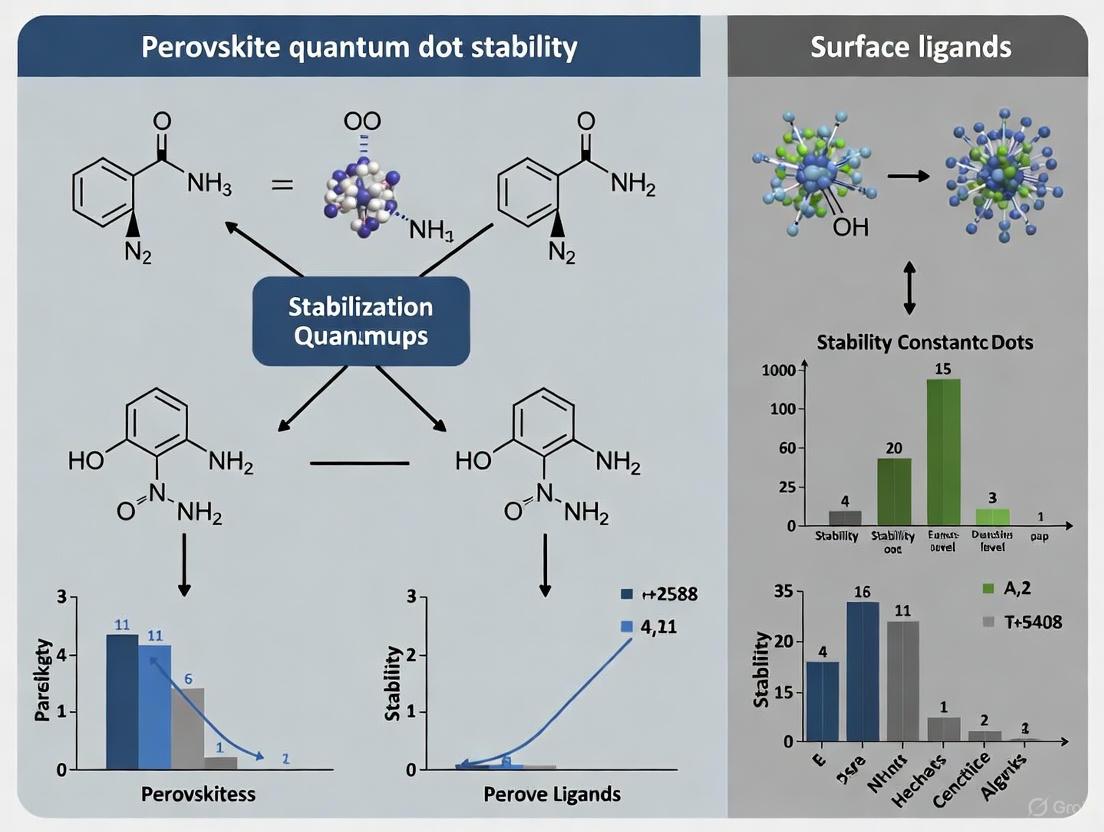
This article provides a comprehensive analysis of the critical role surface ligands play in determining the stability and optoelectronic performance of perovskite quantum dots (PQDs).
Surface Ligands as the Key to Perovskite Quantum Dot Stability: From Fundamental Chemistry to Advanced Applications
Abstract
This article provides a comprehensive analysis of the critical role surface ligands play in determining the stability and optoelectronic performance of perovskite quantum dots (PQDs). Tailored for researchers and scientists, we explore the foundational chemistry of ligand-QD interactions, including passivation mechanisms and defect dynamics. The review systematically covers advanced ligand engineering strategies, from dual-ligand systems to novel functional groups, that enhance resilience against moisture, heat, and light. We present comparative analyses of ligand performance across different perovskite compositions and outline rigorous characterization methodologies for validating stability improvements. The synthesized knowledge provides a roadmap for developing highly stable PQD systems with implications for biomedical imaging, sensing, and diagnostic applications.
Understanding Ligand-Perovskite Quantum Dot Interactions: The Foundation of Stability
Perovskite quantum dots (PQDs) represent a class of materials that has rapidly advanced to the forefront of optoelectronic applications owing to their unique size-, composition-, surface-, and process-dependent optoelectronic properties [1]. More broadly known as nanocrystals, QDs constitute a new class of materials that differ from both molecular and bulk materials, with their ultrahigh surface-area-to-volume ratio enabling various surface chemistry engineering strategies to tune and optimize their optoelectronic properties [1]. The discovery and synthesis of colloidal QDs was recognized with the Nobel Prize in Chemistry in 2023, underscoring the transformative potential of this technology. The development of surface chemistry has become a critical platform for improving the performance of PQD-based devices, particularly in photovoltaics where the record power conversion efficiency (PCE) has been boosted to 19.1% within a five-year period, surpassing all other colloidal QD photovoltaics [1]. This technical guide examines the structural fundamentals and surface chemistry engineering of PQDs within the broader context of stabilizing these materials for practical applications.
Structural Fundamentals of Perovskite Quantum Dots
Crystal Structure and Composition
Perovskite quantum dots typically adopt the crystal structure of their bulk counterparts, characterized by the general formula ABX₃, where:
- 'A' represents a monovalent cation (e.g., Cs⁺, CH₃NH₃⁺, or CH(NH₂)₂⁺)
- 'B' represents a divalent metal cation (typically Pb²⁺, but also Sn²⁺ or Ge²⁺)
- 'X' represents a halide anion (Cl⁻, Br⁻, or I⁻) [2]
This structure forms a three-dimensional network of corner-sharing BX₆ octahedra with A-site cations occupying the interstitial spaces. In quantum-confined systems, this structural arrangement gives rise to exceptional optoelectronic properties including high photoluminescence quantum yields (PLQYs), size-dependent bandgaps, and high defect tolerance [3]. The quantum confinement effect becomes significant when the particle size approaches the Bohr exciton diameter, typically below 10-20 nm, enabling precise tuning of optical properties through control of QD dimensions [4].
Lead-Free Alternatives: Double Perovskites
Addressing toxicity concerns associated with lead-based perovskites, double perovskites with the formula A₂B'(I)B″(III)X₆ have emerged as promising alternatives [5]. In these structures, two Pb²⁺ ions are replaced by a combination of monovalent (e.g., Na⁺, Ag⁺) and trivalent (e.g., In³⁺, Bi³⁺) cations. Cs₂NaInCl₆ represents one such double perovskite system that has gained attention for its excellent photoelectric conversion properties and lead-free composition [5]. These materials often suffer from optically forbidden transitions, but this limitation can be addressed through chemical doping—for instance, doping Cs₂NaInCl₆ with Sb³⁺ breaks the parity-forbidden condition and transforms dark self-trapped excitons (STEs) into bright STEs, significantly improving PLQY [5].
Figure 1: Core-shell structure of a perovskite quantum dot showing the ABX₃ crystal core and dynamic surface ligand environment
The Critical Role of Surface Chemistry
Surface Defects and Their Implications
The ultrahigh surface-area-to-volume ratio of PQDs means that a significant portion of atoms resides on the surface, making these materials particularly susceptible to surface defects that act as non-radiative recombination centers [2]. The "soft" ionic nature of perovskites and their dynamic surface equilibrium lead to difficulties in large-scale synthesis of monodispersed PQDs and conductive inks for high-throughput printing techniques [1]. Common surface defects in PQDs include:
- Halide vacancies: Most common defects due to their low formation energy
- Metal cation vacancies: Create charge imbalance and trap states
- Interstitial defects: Disrupt crystalline order and carrier transport
- Surface dangling bonds: Unpassivated sites that promote non-radiative recombination [6]
These surface defects not only deteriorate optical properties by reducing PLQY but also compromise material stability by creating pathways for ion migration and facilitating degradation under environmental stressors such as moisture, oxygen, and heat [3].
Ligand Functions and Classification
Surface ligands perform multiple critical functions in PQD systems, serving not only as steric stabilizers to prevent aggregation but also as electronic modifiers and defect passivators [6]. The polarity, conductivity, stability, and interaction effects of these ligands with QD surfaces create complicated ligand-QD relationships that greatly influence successful synthesis of QDs and their subsequent performance in devices [6].
Table 1: Major Functions of Surface Ligands in Perovskite Quantum Dots
| Function | Mechanism | Impact on PQD Properties |
|---|---|---|
| Colloidal Stability | Steric hindrance preventing aggregation | Enables processing from solution, maintains monodispersity |
| Defect Passivation | Coordination with unsaturated surface sites | Increases PLQY, reduces non-radiative recombination |
| Charge Transport Modulation | Tuning inter-dot distance and coupling | Enhances mobility in films for device applications |
| Environmental Protection | Hydrophobic barrier against moisture/oxygen | Improves stability under operating conditions |
| Quantum Confinement Maintenance | 抑制Ostwald ripening | Preserves size-dependent optical properties [4] |
Surface Chemistry Engineering Strategies
Ligand Selection and Functional Group Considerations
Surface ligands for PQDs can be systematically classified based on their functional groups, which determine binding affinity and passivation efficacy [6]. Different functional groups exhibit varying binding energies with surface atoms—for example, sulfonic acid groups in 2-naphthalene sulfonic acid (NSA) demonstrate stronger binding energy with Pb atoms (1.45 eV) compared to conventional oleylamine (OAm) ligands (1.23 eV) [4]. This stronger binding enhances surface stability and inhibits Ostwald ripening, the process whereby larger particles grow at the expense of smaller ones due to solubility differences [4].
Advanced Ligand Engineering Approaches
Layer-by-Layer Solid-State Ligand Exchange
Conventional PQD synthesis employs long-chain organic ligands like oleic acid (OA) and oleylamine (OAm) to ensure good monodispersity in non-polar solvents, but these insulated ligands impede carrier transport between adjacent QDs in solid films [3]. A layer-by-layer (LBL) solid-state exchange strategy using short-chain ligands like phenethylammonium iodide (PEAI) has been developed to address this limitation [3]. This approach enables enhanced inter-dot coupling and defect passivation compared to conventional post-treatments, with studies demonstrating CsPbI₃ PQD solar cells achieving champion power conversion efficiency of 14.18% with high open-circuit voltage of 1.23 V [3].
Strong-Binding Ligand Systems
The introduction of strong-binding ligands during synthesis represents another strategic approach. 2-naphthalene sulfonic acid (NSA) ligands injected after nucleation can suppress Ostwald ripening by replacing weak-binding OAm ligands [4]. The naphthalene ring of NSA provides substantial steric hindrance, further inhibiting overgrowth of QDs. Following synthesis, additional ligand exchange with ammonium hexafluorophosphate (NH₄PF₆) during purification further enhances stability and optoelectronic properties, with density functional theory (DFT) calculations showing PF₆ anions exhibit exceptionally high binding energy of 3.92 eV [4].
Dual Ligand Systems and Their Synergistic Effects
Research on Cs₂NaInCl₆ double perovskite QDs has revealed that oleic acid (OA) and oleylamine (OAm) play distinct yet complementary roles [5]. FTIR and NMR analyses show that only OAm binds directly to QD surfaces, significantly affecting PLQY improvement through surface defect passivation, while OA plays a crucial role in maintaining colloidal stability despite not binding directly to the surface [5]. This understanding enables optimization of the OA/OAm ratio to maximize both optical properties and stability.
Figure 2: Ligand exchange strategies implemented at different stages of perovskite quantum dot processing
Experimental Methodologies and Characterization
Synthesis Protocols
CsPbI₃ PQD Synthesis with NSA Ligand Engineering
Materials: Cesium carbonate (Cs₂CO₃), 1-octadecene (ODE), Oleic acid (OA), Oleylamine (OAm), Lead iodide (PbI₂), 2-Naphthalene sulfonic acid (NSA), Ammonium hexafluorophosphate (NH₄PF₆) [4].
Procedure:
- Prepare cesium oleate by reacting Cs₂CO₃ with OA in ODE at 150°C under nitrogen atmosphere
- Mix PbI₂, ODE, OA, and OAm in a flask and degas at 110°C for 60 minutes
- Heat to 170°C under N₂ atmosphere and swiftly inject cesium oleate precursor
- Immediately after nucleation, inject NSA ligand solution (0.6 M concentration determined optimal)
- Maintain temperature for 5 minutes then rapidly cool using ice bath
- Purify QDs using NH₄PF₆ solution in methyl acetate instead of conventional antisolvents
- Centrifuge and redisperse in non-polar solvents for further processing [4]
Key Insight: The introduction of NSA after nucleation suppresses Ostwald ripening by replacing weakly-bound OAm ligands, with DFT calculations confirming higher binding energy (1.45 eV for NSA vs. 1.23 eV for OAm) [4].
Layer-by-Layer Solid-State Ligand Exchange
Materials: Pre-synthesized CsPbI₃ PQDs, Phenethylammonium iodide (PEAI), Methyl acetate (MeOAc), Ethyl acetate (EtOAc) [3].
Procedure:
- Deposit initial layer of CsPbI₃ PQDs via spin-coating
- Treat with methyl acetate to remove native long-chain ligands
- Immediately treat with PEAI solution (5 mg/mL in EtOAc) for in-situ ligand exchange
- Repeat steps 1-3 for 3-5 cycles to build desired film thickness
- Final post-treatment with concentrated PEAI solution optional for additional passivation [3]
Key Insight: This LBL approach with PEAI enables enhanced inter-dot coupling and improved charge transport while maintaining effective surface passivation, addressing the trade-off between conductivity and defect reduction [3].
Characterization Techniques for Surface Analysis
Table 2: Key Characterization Methods for Evaluating PQD Surface Chemistry
| Technique | Information Obtained | Application Example |
|---|---|---|
| Fourier-Transform Infrared Spectroscopy (FTIR) | Ligand binding modes, chemical identity | Confirming NSA ligand binding to CsPbI₃ QD surfaces [4] |
| Nuclear Magnetic Resonance (NMR) | Quantitative ligand analysis, binding states | Determining only OAm binds to Cs₂NaInCl₆ QD surfaces [5] |
| X-ray Photoelectron Spectroscopy (XPS) | Surface composition, elemental states | Binding energy shifts in Pb 4f peaks indicating stronger NSA interaction [4] |
| Transmission Electron Microscopy (TEM) | Morphology, size distribution, crystallinity | Demonstrating inhibited Ostwald ripening in NSA-treated QDs [4] |
| X-ray Diffraction (XRD) | Crystal structure, phase purity | Confirming cubic phase stability in CsPbI₃ PQDs [3] |
Quantitative Performance Metrics
The efficacy of surface chemistry engineering strategies can be quantitatively evaluated through key performance indicators in both optical properties and device performance.
Table 3: Performance Metrics of Surface-Engineered Perovskite Quantum Dots
| Material System | Surface Treatment | PLQY (%) | Device Performance | Stability Metrics |
|---|---|---|---|---|
| CsPbI₃ PQDs [4] | NSA + NH₄PF₆ | 94% | LED EQE: 26.04% @ 628 nm | >80% PLQY retention after 50 days |
| CsPbI₃ PQDs [3] | PEAI-LBL | N/A | PV PCE: 14.18%, VOC: 1.23 V | Excellent humidity stability (30-50% RH) |
| Cs₂NaInCl₆ PQDs [5] | Optimized OA/OAm ratio | ~30-40% (varies with Sb³⁺ doping) | N/A | Improved colloidal stability |
| PQD Photovoltaics [1] | Advanced surface chemistry | N/A | Record PCE: 19.1% | N/A |
The Scientist's Toolkit: Essential Research Reagents
Table 4: Key Research Reagents for Perovskite Quantum Dot Surface Chemistry Studies
| Reagent | Function | Application Notes |
|---|---|---|
| Oleic Acid (OA) | Long-chain carboxylic acid ligand | Provides colloidal stability but impedes charge transport; dynamic binding [3] |
| Oleylamine (OAm) | Long-chain amine ligand | Critical for defect passivation in some systems; protonated form (OAmH⁺) interacts with OA⁻ [5] [4] |
| Phenethylammonium Iodide (PEAI) | Short-chain aromatic ammonium salt | LBL solid-state exchange; enhances inter-dot coupling and passivation [3] |
| 2-Naphthalene Sulfonic Acid (NSA) | Strong-binding sulfonic acid ligand | Suppresses Ostwald ripening; higher binding energy with Pb (1.45 eV) [4] |
| Ammonium Hexafluorophosphate (NH₄PF₆) | Inorganic ligand | Post-synthesis exchange; dramatically improves charge transport (3.92 eV binding energy) [4] |
| Formamidinium Iodide (FAI) | Cesium site ligand | Conventional post-treatment agent; risks phase transformation to FA₁₋ₓCsₓPbI₃ [3] |
Surface chemistry engineering has emerged as a decisive factor in harnessing the exceptional intrinsic properties of perovskite quantum dots for practical applications. The strategic design of ligand systems—from strong-binding organic molecules during synthesis to short-chain conjugated ligands during film formation—addresses the fundamental challenges posed by the dynamic ionic surfaces of PQDs. As research progresses, the integration of artificial intelligence promises to accelerate the optimization of surface chemistries and facilitate mass production of PQDs for large-area, low-cost technologies [1]. Future developments will likely focus on enhancing the environmental sustainability of PQD technologies through green synthesis approaches that reduce hazardous solvent usage by up to 50% while maintaining performance metrics [7]. The continued refinement of surface ligand engineering represents a critical pathway toward overcoming the current limitations in PQD stability and efficiency, ultimately enabling their translation from laboratory breakthroughs to commercial technologies that address significant energy and display challenges.
Common Surface Defects in PQDs and Their Impact on Degradation Pathways
Perovskite quantum dots (PQDs), particularly all-inorganic CsPbX3 (X = Cl, Br, I) nanocrystals, have emerged as frontrunner materials for next-generation optoelectronic devices due to their exceptional photoluminescence quantum yields (PLQYs), tunable bandgaps, and narrow emission linewidths [8]. However, their commercial application is severely hampered by insufficient structural stability under operational conditions. The degradation pathways of PQDs are predominantly initiated and propagated by surface and intrinsic defects within their crystal structure [8]. The ionic nature of perovskites facilitates the formation of these defects, which act as non-radiative recombination centers, quench luminescence, and serve as entry points for environmental degradation agents [8].
Understanding the nature of these defects, their formation mechanisms, and their direct link to specific degradation pathways is paramount for developing robust stabilization strategies. This whitepaper provides an in-depth technical analysis of common surface defects in PQDs, detailing their atomic-scale origin and consequent impact on material degradation. Furthermore, it examines cutting-edge defect-passivation techniques, with a particular focus on the pivotal role of surface ligand engineering in mitigating these defects and enhancing the operational stability of PQD-based devices.
Classification and Atomic-Scale Origins of Surface Defects
The surface of PQDs is a complex landscape where the periodic lattice terminates, inevitably giving rise to undercoordinated ions and broken bonds. These imperfections are the primary sources of surface defects, which can be systematically categorized as follows:
- Undercoordinated Pb²⁺ Ions: At the nanocrystal surface, Pb²⁺ ions may not be fully coordinated by the requisite six halide ions (in a perfect octahedron). These undercoordinated sites function as electron traps and are a dominant source of non-radiative recombination, significantly reducing the PLQY [8] [9].
- Halide Ion Vacancies (Vₓ): Due to the low formation energy and high migration barrier of halide ions (especially I⁻ and Br⁻), vacancies are the most common and mobile intrinsic defects in PQDs [8]. These vacancies create states within the bandgap that facilitate non-radiative Auger recombination and initiate ionic migration, leading to phase segregation and accelerated degradation.
- Dangling Bonds from Cesium (Cs⁺) Sites: Although less mobile, undercoordinated A-site cations (e.g., Cs⁺) also contribute to surface disorder and can destabilize the crystal lattice [10].
- Surface Disorder and Ligand Desorption: The dynamic binding of organic ligands, such as oleic acid (OA) and oleylamine (OAm), used in synthesis is a critical source of instability. These ligands, particularly long-chain ones with steric hindrance (e.g., a bent structure from double bonds), can readily detach during purification or under thermal/environmental stress [8]. This detachment exposes fresh undercoordinated ions, leading to increased defect density and providing pathways for corrosive agents like moisture and oxygen to penetrate the structure.
The following diagram illustrates the primary surface defects and their initiation of degradation pathways in PQDs.
Figure 1: Primary surface defects in perovskite quantum dots (PQDs) and their direct links to major degradation pathways. Undercoordinated Pb²⁺ ions and halide vacancies primarily drive non-radiative recombination and ion migration, while ligand desorption enables aggregation and environmental degradation.
Quantitative Impact of Defects on Optical and Structural Properties
Surface defects directly manifest as measurable deteriorations in the optoelectronic properties and structural integrity of PQDs. The following table summarizes the quantitative impact of specific defects and the performance recovery achieved through targeted passivation strategies, as demonstrated in recent studies.
Table 1: Quantitative Impact of Surface Defects on CsPbBr₃ PQD Properties and Recovery via Passivation
| Defect Type | Impact on Property | Measured Performance Loss | Passivation Strategy | Performance Recovery | Ref. |
|---|---|---|---|---|---|
| Undercoordinated Pb²⁺ & Halide Vacancies | Photoluminescence Quantum Yield (PLQY) | PLQY ~22% (untreated) | 2-aminoethanethiol (AET) ligand exchange | PLQY increased to 51% | [8] |
| Surface Defects & Poor Ligand Packing | Thermal Stability (for LDS films) | Absolute efficiency decrease of 0.23% after 90°C/3h annealing | APTES capping agent in EVA film | Maintained 0.81% absolute efficiency improvement after annealing | [11] |
| Pb²⁺ & Br⁻ Vacancies (Bulk & Surface) | Photoluminescence Quantum Yield (PLQY) | Not explicitly stated (Low initial PLQY implied) | Dual-ligand (Eu(acac)₃ & Benzamide) passivation | Near-unity PLQY of 98.56% | [10] |
| Surface Defects | Photoluminescence Intensity | Fluorescence intensity of 2852 a.u. (without DES) | Deep Eutectic Solvent (DES) ligand engineering | Fluorescence intensity enhanced to 6675 a.u. (144% increase) | [12] |
| Surface Defects | Phase Stability under UV/Water | Rapid decomposition & phase transition | AET ligand exchange | >95% initial PL intensity retained after 60 min water/120 min UV | [8] |
The data demonstrates that defects cause significant losses in PLQY and thermal/environmental stability. Effective passivation, particularly via ligand engineering, can not only recover but substantially enhance these properties, achieving near-unity PLQY and exceptional stability.
Advanced Defect Passivation Strategies and Experimental Protocols
To combat the detrimental effects of surface defects, researchers have developed sophisticated passivation strategies. The following section details key methodologies, including specific experimental protocols.
Ligand Engineering and Exchange Protocols
Ligand engineering is the most direct approach to passivate surface defects. It involves replacing weakly bound native ligands (OA/OAm) with molecules that have stronger binding affinity or provide additional functionality.
- Strongly Coordinating Short Ligands: Replacing long-chain OA/OAm with short, bidentate ligands like 2-aminoethanethiol (AET) provides a dense passivation layer. The thiol (-SH) group in AET has a much stronger affinity for Pb²⁺ ions compared to carboxylates or amines from OA/OAm [8].
- Experimental Protocol: The ligand exchange is typically performed as a post-synthesis treatment. Purified PQDs are dispersed in a non-polar solvent (e.g., toluene) and added to a solution of AET in a polar solvent (e.g., isopropanol). The mixture is stirred for several minutes, inducing the transfer of QDs to the polar phase and concurrent ligand exchange. The passivated QDs are then purified by centrifugation and redispersed [8].
- Silane-Based Ligands for Composite Stability: 3-aminopropyltriethoxysilane (APTES) has been used as a direct capping agent for CsPbBr₃ QDs destined for luminescence down-shifting (LDS) films in solar cells. The amine group coordinates with the QD surface, while the ethoxysilane groups can form strong bonds with the ethylene-vinyl acetate (EVA) polymer matrix. This "interface engineering" suppresses QD aggregation and degradation under heating (85°C) [11].
- Dual-Ligand Synergistic Passivation: A powerful approach uses two ligands to target different defects simultaneously. For instance, a study used europium acetylacetonate (Eu(acac)₃) and benzamide [10]. The Eu³⁺ ions dope the lattice and compensate for Pb²⁺ vacancies (bulk defects), while the benzamide, via its amide group, passivates undercoordinated halide ions on the surface. Density Functional Theory (DFT) calculations confirmed strong binding to Pb²⁺ and Br⁻ vacancies.
- Experimental Protocol: The Eu(acac)₃ is added to the PbBr₂ precursor before the QD synthesis (hot-injection). The benzamide ligand exchange is conducted post-synthesis. This combination achieved a near-unity PLQY of 98.56% and enabled compatibility with polar photolithography solvents [10].
Inorganic Shelling and Doping Strategies
Beyond organic ligands, inorganic species can be used to create more robust protective layers or modify the core lattice.
- Dual-Shell Engineering via Post-Treatment: A ZnF₂ post-treatment of CsPbBr₃ QDs induces the formation of a dual-shell structure: a CsPbBr₃:F inner shell and a zinc-rich outer shell [13]. The inner F⁻-doped shell suppresses thermal degradation, while both shells collaboratively mitigate surface defects. This strategy provided remarkable thermal stability, maintaining optical properties after heating at 120°C for 60 minutes.
- Metal Ion Doping: Doping the B-site (Pb²⁺) with metal ions like Zn²⁺ or Mn²⁺ can improve structural stability by altering the Pb-X bond lengths and enhancing the formation energy of defects, making the lattice more resistant to ion migration and degradation [8].
The workflow below integrates these advanced defect characterization and passivation strategies into a coherent research pipeline.
Figure 2: A strategic workflow for identifying dominant defect types in perovskite quantum dots (PQDs) and selecting appropriate passivation pathways, integrating characterization, decision-making, and validation steps.
The Scientist's Toolkit: Key Research Reagents for PQD Defect Passivation
The following table compiles essential reagents and materials used in the advanced passivation strategies discussed in this whitepaper, serving as a reference for researchers designing experiments.
Table 2: Essential Research Reagents for PQD Surface Defect Passivation
| Reagent/Material | Chemical Function | Role in Defect Passivation | Key Application Note |
|---|---|---|---|
| 2-Aminoethanethiol (AET) | Short-chain, thiol-terminated ligand | Strong Pb²⁺ coordination via thiol group; heals surface defects, improves charge transport. | Used in post-synthesis ligand exchange; enhances water/UV stability [8]. |
| APTES (3-Aminopropyltriethoxysilane) | Amine-functionalized silane | Amine group coordinates QD surface; ethoxysilane forms bonds with polymer matrix. | Suppresses thermal aggregation in composite films (e.g., EVA for LDS) [11]. |
| Benzamide | Short-chain ligand with amide group | Passivates undercoordinated halide ions via amide group; π-conjugation enhances binding. | Part of a dual-ligand system for high-resolution photolithography [10]. |
| Europium Acetylacetonate (Eu(acac)₃) | Source of Eu³⁺ ions and acac ligands | Eu³⁺ dopes lattice, compensating Pb²⁺ vacancies; acac ligands assist in surface binding. | Used in precursor solution for synergistic bulk/surface passivation [10]. |
| Zinc Fluoride (ZnF₂) | Inorganic salt for post-treatment | Forms a CsPbBr₃:F / Zn-rich dual-shell; F⁻ passivates inner defects, Zn-shell passivates surface. | Post-synthesis treatment for ultra-high thermal stability (>120°C) [13]. |
| Deep Eutectic Solvent (DES) | Eutectic mixture of caprolactam & acetamide | Unique hydrogen-bonding network strongly passivates surface defects. | Serves as both solvent and ligand, boosting photoluminescence intensity [12]. |
The pathway to commercializing perovskite quantum dot technologies is inextricably linked to overcoming the challenge of surface defects. These defects—primarily undercoordinated Pb²⁺ ions, halide vacancies, and the instability of native ligand coatings—act as nucleation points for non-radiative recombination and catastrophic degradation. As detailed in this whitepaper, the relationship between specific defects and their resulting degradation pathways is now well-defined. The field is rapidly moving beyond simple ligand exchange to sophisticated, multi-pronged strategies. The emergence of dual-ligand synergism, which simultaneously heals bulk and surface defects, and inorganic shelling techniques, which confer exceptional thermal resilience, demonstrates the growing sophistication of this research area. These advanced ligand engineering protocols provide a robust toolkit for rationally designing PQDs with near-unity quantum efficiency and the operational stability required for viable optoelectronic devices, paving the way for their eventual market adoption.
The interface between a quantum dot (QD) and its surface ligands represents a critical frontier in nanoscience, governing key optoelectronic properties and stability. Surface ligands are organic or inorganic molecules that passivate the highly reactive surface of QDs, preventing aggregation and degradation while influencing electronic behavior. In perovskite quantum dots (PQDs), this ligand-shell relationship is particularly crucial, as it directly dictates both the operational stability and photovoltaic performance of the resulting materials and devices. The fundamental binding mechanisms at this hybrid organic-inorganic interface involve complex coordination chemistry, intermolecular interactions, and structural dynamics that researchers are only beginning to fully unravel.
Understanding these interface mechanisms is not merely academic; it provides the foundational knowledge required to rationally design next-generation QD materials with enhanced photostability, reduced blinking, and improved charge transport properties. This technical guide examines the current state of knowledge regarding ligand-QD binding mechanisms, with particular emphasis on PQD systems, synthesizing recent experimental and computational advances to provide researchers with a comprehensive framework for surface engineering.
Core Binding Mechanisms and Coordination Chemistry
Anchoring Group Interactions with QD Surfaces
The primary binding interaction between ligands and QDs occurs through specific anchoring groups that coordinate with surface atoms. These functional groups determine binding strength, orientation, and subsequent electronic coupling.
Table: Common Anchoring Groups and Their Binding Characteristics to Quantum Dot Surfaces
| Anchoring Group | Binding Strength | Binding Geometry | Key Applications | Effect on Orientation |
|---|---|---|---|---|
| Carboxylate (-COO⁻) | Moderate | Various configurations | Photon upconversion, general passivation | Variable π-system orientation |
| Thiol (-SH) | Strong | Parallel to surface | Triplet energy transfer | Parallel π-orientation |
| Dithiol | Very Strong | Chelating, parallel | Enhanced energy transfer | Enforced parallel orientation |
| Phosphonate | Strong | Multiple binding modes | Perovskite QD stabilization | Dependent on ligand structure |
| Ammonium (-NH₃⁺) | Moderate to Strong | Electrostatic/cation exchange | Perovskite QD synthesis | Varies with tail structure |
The anchoring group's chemical nature directly determines the binding affinity and molecular orientation on the QD surface. Research comparing anthracene ligands with different anchoring groups demonstrates that replacing carboxylate with thiol or dithiol groups enhances triplet energy transfer efficiency by factors of 3 and 4.5, respectively [14]. This enhancement is attributed to the stronger coordination of thiol groups to the QD surface, which enforces a parallel orientation of the π-system relative to the QD surface, enabling larger orbital overlap that leads to faster energy transfer rates via the Dexter mechanism [14] [15].
For perovskite quantum dots, ammonium-based ligands (such as phenethylammonium and oleylammonium) are particularly significant, as they participate in both surface passivation and crystal stabilization through ionic interactions with the halide-rich surface. These ligands balance the surface charge while providing steric stabilization [16] [17].
Secondary Intermolecular Interactions
Beyond primary coordination bonds, intermolecular interactions between ligand tails significantly influence surface coverage and stability. In the solid state, these interactions become particularly important for maintaining a stable ligand shell:
π-π stacking between aromatic ligand tails (e.g., phenethylammonium) promotes the formation of a nearly epitaxial ligand layer that significantly reduces QD surface energy [16]. Density functional theory (DFT) calculations show that ligands with π-π stacking capabilities enable complete surface passivation, whereas bulky aliphatic ligands create steric hindrance that limits optimal coverage [16].
Van der Waals interactions between aliphatic chains provide additional stabilization in colloidal solutions but may become repulsive in solid-state films due to entropy reduction and steric crowding [16].
Electrostatic interactions can be engineered through zwitterionic ligands that contain both positive and negative charges, enhancing binding affinity through multipoint attachment [6].
The interplay between these interactions explains why small ligands with stacking capability (like phenethylammonium) can outperform bulkier ligands in solid-state applications, despite providing less colloidal stability in solution [16].
Experimental Methodologies for Investigating Ligand-QD Interfaces
Spectroscopic Analysis of Binding
Advanced spectroscopic techniques enable researchers to quantitatively analyze ligand binding and its effects on QD properties:
Modified Stern-Volmer Analysis: Researchers have developed a modified Stern-Volmer equation that accounts for the Poisson distribution of ligand binding to extract reliable quenching rates from photoluminescence data [14]. This methodology involves:
Sample Preparation: CdSe QDs (2.7 nm diameter) coated with oleic acid are dispersed in toluene, with anthracene-based ligands (carboxylic acid, thiol, or dithiol derivatives) added in controlled equivalents relative to QD concentration [14].
Absorption Spectroscopy: Measurement of bathochromic shifts in ligand absorption spectra upon binding, including analysis of vibronic progression changes and spectral broadening [14].
Photoluminescence Quenching: Precise measurement of QD photoluminescence intensity as a function of ligand concentration [14].
Data Fitting: Application of the modified Stern-Volmer model incorporating accurate ligand binding stoichiometry to extract per-ligand quenching rates [14].
This approach revealed that bound anthracene ligands exhibit distinct spectral changes, including ligand-dependent bathochromic shifts (33 meV for carboxylate, 50 meV for thiol, 63 meV for dithiol) with modified vibronic progression and broadened spectral width [14]. These changes relate to deprotonation of anchoring groups upon binding and the confined environment on the QD surface.
FTIR and NMR Characterization: Fourier-transform infrared spectroscopy and nuclear magnetic resonance provide complementary information about ligand binding states and conformational dynamics:
- FTIR identifies chemical changes in anchoring groups upon coordination to the QD surface [18].
- ¹H NMR quantifies ligand density and characterizes dynamic processes such as ligand exchange [19].
Computational Modeling Approaches
Computational methods provide atomic-level insights into binding mechanisms that are challenging to obtain experimentally:
Density Functional Theory (DFT) Calculations: DFT modeling of ligand-QD interfaces reveals binding energies, orbital overlaps, and the influence of ligand structure on surface energy [16]. Standard protocols include:
Surface Modeling: Construction of slab models representing dominant QD crystal facets (e.g., (100) facet for CsPbBr3) [16].
Ligand Placement: Systematic addition of ligands to surface sites with geometry optimization at each coverage level [16].
Energy Calculations: Determination of binding energies and surface energies as a function of ligand coverage [16].
Electronic Structure Analysis: Calculation of projected density of states, charge transfer, and orbital overlaps at the interface [14].
DFT calculations have demonstrated that for CsPbBr3 QDs, phenethylammonium ligands with π-π stacking interactions enable lower surface energies compared to bulkier aliphatic ligands like didodecyldimethylammonium bromide (DDAB) [16]. This computational insight explains the experimental observation of enhanced photostability in π-stacked ligand systems.
Diagram Title: Integrated Experimental-Computational Methodology
Impact of Ligand Binding on Perovskite Quantum Dot Stability
Thermal and Environmental Stability
Ligand binding energy directly correlates with PQD thermal stability, with distinct degradation mechanisms observed for different compositions:
Table: Thermal Degradation Mechanisms of CsxFA1-xPbI3 PQDs with Different Ligand Systems
| PQD Composition | Ligand Binding Strength | Degradation Temperature | Primary Degradation Pathway | Stabilization Strategy |
|---|---|---|---|---|
| FA-rich PQDs | Stronger (higher binding energy) | ~150-300°C | Direct decomposition to PbI2 | Enhanced ligand binding via ammonium coordination |
| Cs-rich PQDs | Weaker (lower binding energy) | ~100-250°C | Phase transition (γ to δ-phase) | Strain engineering via mixed ligands |
| CsPbBr3 with DDA | Moderate | Variable | Ligand detachment & defect formation | Bulky ligand replacement |
| CsPbBr3 with PEA | Strong (π-π stacking) | Significantly improved | Suppressed degradation | π-π stacking ligand tails |
In situ X-ray diffraction studies combined with thermal analysis reveal that FA-rich PQDs with stronger ligand binding directly decompose into PbI2 at elevated temperatures, while Cs-rich PQDs with weaker ligand binding undergo a phase transition from black γ-phase to yellow δ-phase before decomposition [17]. This fundamental difference highlights the critical role of A-site composition in modulating ligand binding energy and subsequent thermal stability.
DFT calculations confirm that the bond strength of ligands (e.g., oleylamine and oleic acid) to FA-rich PQDs is larger than for Cs-rich PQDs, illustrating the strong correlation between stability and ligand bond strength [17]. This binding energy differential explains the counterintuitive observation that hybrid organic-inorganic FA-rich PQDs can exhibit better thermal stability than all-inorganic Cs-rich PQDs.
Photostability and Blinking Suppression
Surface ligand engineering directly impacts photostability by determining surface defect density and charge trapping dynamics:
Non-blinking behavior achieved through nearly epitaxial ligand coverage with phenethylammonium ligands featuring π-π stacking interactions [16]. This configuration creates a stable surface lattice that resists photoionization and defect formation.
Photodarkening resistance enabled by complete surface passivation that prevents defect-induced charge trapping and non-radiative recombination [16].
Trion suppression through efficient passivation of halide vacancies, the primary source of charged excitons that lead to Auger recombination and blinking [16].
Single-particle studies demonstrate that CsPbBr3 QDs covered by stacked phenethylammonium ligands exhibit nearly non-blinking single photon emission with high purity (~98%) and extraordinary photostability (12 hours continuous operation under saturated excitations) [16]. This represents a dramatic improvement over traditional ligand systems and enables accurate determination of size-dependent exciton properties previously obscured by instability.
Research Reagent Solutions and Experimental Materials
Table: Essential Research Reagents for Quantum Dot Ligand Binding Studies
| Reagent/Chemical | Function in Research | Specific Application Examples |
|---|---|---|
| Anthracene carboxylic acid (ACA) | Reference ligand for triplet energy transfer studies | Benchmark molecule for QD-molecule hybrid systems [14] |
| Anthracene thiol (AT) and dithiol (ADT) | Enhanced-binding ligands for orbital overlap studies | Investigating orientation effects on Dexter energy transfer [14] |
| Phenethylammonium bromide (PEABr) | π-stacking ligand for photostability enhancement | Achieving non-blinking perovskite QDs [16] |
| Didodecyldimethylammonium bromide (DDAB) | Bulky ligand for colloidal stabilization | Comparative studies of steric effects in solid state [19] [16] |
| Nitrosonium tetrafluoroborate (NOBF4) | Universal ligand exchange agent | Phase transfer and sequential functionalization [18] |
| Dihydrolipoic acid (DHLA) | Water-solubilizing ligand | Bioconjugation and biomedical applications [18] [20] |
| Oleic acid/Oleylamine | Standard synthesis ligands | Reference compounds for binding strength comparisons [17] |
Future Directions and Design Principles
The evolving understanding of ligand-QD interfaces points toward several promising research directions and practical design principles:
Multimodal Ligand Systems: Future ligand designs should incorporate multiple functional elements: strong anchoring groups, stacking-capable aromatic tails, and potentially stimuli-responsive elements for dynamic control. Such multimodal ligands could simultaneously address binding strength, intermolecular stabilization, and application-specific functionality.
Computationally Guided Design: The integration of machine learning with quantum mechanical calculations will enable rapid screening of candidate ligand structures for specific PQD compositions and applications [21]. This approach could dramatically accelerate the optimization of binding affinity while minimizing synthetic effort.
Dynamic Binding Studies: Most current research provides static snapshots of ligand-QD interfaces, but real-world applications involve dynamic processes under operational conditions. Advanced in situ techniques that monitor binding stability during photoexcitation, thermal cycling, and electrical bias will provide crucial insights for practical device design.
Based on current evidence, effective ligand design for stable PQDs should incorporate: (1) strong anchoring groups matched to the surface chemistry, (2) ligand tails with attractive intermolecular interactions (e.g., π-π stacking) to promote dense packing, (3) appropriate steric bulk to balance colloidal stability with solid-state packing, and (4) consideration of the binding energy composition dependence for mixed-cation systems.
The fundamental binding mechanisms between ligands and quantum dot surfaces represent a rich interdisciplinary research frontier with significant implications for perovskite quantum dot stability and performance. As these interfaces become better understood and more precisely engineered, they will unlock new generations of QD-based technologies with enhanced efficiency, stability, and functionality.
Classification of Ligand Functional Groups and Their Passivation Capabilities
Surface ligands are indispensable components in the colloidal synthesis and application of perovskite quantum dots (PQDs). Their role extends beyond stabilizing nanocrystals in solution to directly influencing the optoelectronic properties and environmental stability of the resulting materials. The ionic nature and high surface-to-volume ratio of PQDs make them particularly susceptible to surface defects that act as non-radiative recombination centers, diminishing photoluminescence quantum yield (PLQY) and accelerating degradation. Within the context of a broader thesis on the role of surface ligands in perovskite quantum dot stability research, this review systematically classifies ligand functional groups based on their binding mechanisms and electronic effects. A fundamental understanding of how specific functional groups passivate different surface defect types provides critical design principles for developing next-generation perovskite optoelectronics with commercial viability. The precise engineering of ligand chemistry enables targeted defect passivation, enhanced charge transport, and improved resistance to environmental stressors such as moisture, heat, and light.
Surface Defects in Perovskite Quantum Dots
The surface of lead halide PQDs (typically CsPbX₃, where X = Cl, Br, I) is characterized by dynamic ionic bonds that readily generate defects during synthesis and processing. The most prevalent surface defects originate from:
- Lead Vacancies (Vₚ₈): Create deep trap states that significantly promote non-radiative recombination [22].
- Halide Vacancies (Vₓ): Exhibit low formation energy and act as shallow traps, facilitating ion migration and degrading spectral stability [22] [23].
- Uncoordinated Lead Ions (Pb²⁺): Result from halide vacancies or detached ligands, serving as electron-accepting defect sites [24] [23].
- Uncoordinated Halide Ions (X⁻): Form when Lewis acidic sites on the surface lack proper passivation [24].
These defects not only deteriorate luminescence efficiency but also serve as entry points for environmental degradation. Effective passivation requires ligands with functional groups that specifically target these defect sites through strong and stable chemical interactions.
Classification of Ligand Functional Groups
Ligands can be categorized according to the Lewis basicity of their functional groups and their binding motifs to the perovskite surface. The following classification outlines the primary functional groups employed in ligand engineering, their binding mechanisms, and their effectiveness in defect passivation.
Table 1: Classification of Ligand Functional Groups and Their Passivation Capabilities
| Functional Group | Ligand Type | Binding Mechanism | Primary Defects Passivated | Key Performance Impacts |
|---|---|---|---|---|
| Ammonium (-NH₃⁺) | L-type (Lewis base) | Electrostatic interaction with surface halides; Hydrogen bonding [24] [25] | Halide vacancies | Enhances colloidal stability; improves PLQY [5] |
| Carboxylate (-COO⁻) | L-type (Lewis base) | Coordination bonding with uncoordinated Pb²⁺ [23] | Lead vacancies | Controls nanocrystal growth; improves film morphology [23] |
| Amidinium | L-type (Lewis base) | Multiple hydrogen bonds to surface halides [24] | Halide vacancies, Crystal strain | Reduces crystal strain; suppresses non-radiative recombination [24] |
| Amino Acids (Zwitterionic) | L-type & X-type | -NH₂ coordinates with Pb²⁺; -COO⁻ interacts with Cs⁺/FA⁺ [26] | Uncoordinated Pb²⁺, Cation vacancies | Simultaneously passivates anion and cation defects; enables >87% PLQY [26] |
| Thiol (-SH) | X-type (Covalent) | Covalent bond with surface Pb²⁺ [22] | Uncoordinated Pb²⁺ | Strong covalent binding enhances thermal stability [22] |
| Phosphine Oxide | L-type (Lewis base) | Coordination with Lewis acidic Pb²⁺ sites [22] | Uncoordinated Pb²⁺ | Reduces exciton trapping; improves charge transport [22] |
Binding Mechanism Analysis
The effectiveness of a functional group is governed by its binding strength and stability on the dynamic PQD surface. The schematic below illustrates the logical pathway for selecting functional groups based on target defects and desired material properties.
L-Type Ligands (Lewis Bases) donate electron pairs to Lewis acidic sites on the PQD surface, primarily uncoordinated Pb²⁺ ions. The binding strength is influenced by the electron-donating capability of the functional group. For instance, amidinium groups form multiple hydrogen bonds with surface halides, providing exceptional passivation of halide vacancies and simultaneously relieving crystal strain, which is a common issue in nanomaterials [24]. Similarly, the electron-donating character of substituents on aromatic ammonium ligands (e.g., phenethylammonium) directly correlates with chiral imprinting strength, indicating that functional groups which push electron density toward the binding headgroup strengthen the ligand-perovskite interaction [25].
X-Type Ligands form covalent bonds with surface atoms. Thiols (-SH) represent this class, creating robust Pb-S bonds that demonstrate superior stability compared to the more dynamic coordination bonds of L-type ligands [22].
Zwitterionic Ligands, such as amino acids, possess both cationic and anionic functional groups within the same molecule. This unique structure enables comprehensive passivation; the protonated amino group (-NH₃⁺) electrostatically interacts with surface halides, while the deprotonated carboxylate group (-COO⁻) coordinates with uncoordinated Pb²⁺. This dual functionality effectively passivates both anion and cation vacancies simultaneously, leading to very high PLQY values exceeding 87% [26].
Experimental Protocols for Ligand Exchange and Analysis
Post-Synthesis Ligand Exchange Methodology
The following protocol, adapted from recent literature, details a robust method for replacing native oleic acid/oleylamine ligands with custom-designed molecules [24].
1. Reagents and Materials:
- Purified CsPbBr₃ PQDs: Synthesized via standard hot-injection method.
- New Ligand (e.g., AmdBr-C2Ph): Target ligand for exchange.
- Anhydrous Tert-Butanol: Polar solvent for ligand dissolution.
- Anhydrous Toluene: Non-polar solvent for PQD dispersion.
- Antisolvent (e.g., Methyl Acetate): For PQD precipitation.
2. Procedure:
- Step 1: Preparation. Purify pristine PQDs via centrifugation (12,000 rpm, 5 min) to remove excess native ligands and reaction byproducts. Redisperse the purified PQD pellet in anhydrous toluene.
- Step 2: Ligand Solution Preparation. Dissolve the new, custom-designed ligand in anhydrous tert-butanol at a concentration of 10 mg/mL.
- Step 3: Ligand Exchange. Inject the ligand solution into the PQD dispersion under vigorous stirring at room temperature. The typical ligand:QD molar ratio is 1000:1. Allow the reaction to proceed for 30 minutes.
- Step 4: Purification. Add an antisolvent (methyl acetate) to the mixture to precipitate the ligand-exchanged PQDs. Recover the PQDs via centrifugation (12,000 rpm, 5 min).
- Step 5: Washing. Redisperse the pellet in toluene and repeat the precipitation/centrifugation cycle twice to remove any unbound ligands.
- Step 6: Storage. Finally, disperse the purified, ligand-exchanged PQDs in an anhydrous non-polar solvent (e.g., hexane or toluene) for storage and further characterization.
3. Critical Parameters for Success:
- Solvent Polarity: The exchange solvent (tert-butanol) must be polar enough to dissolve the new ligand but not so polar as to instantly degrade the ionic PQD core.
- Reaction Time: Insufficient time leads to incomplete exchange, while excessive time may damage the PQDs.
- Purification Rigor: Incomplete removal of unbound ligands and original ligands can lead to inaccurate characterization results and poor device performance.
Characterization Techniques for Verification
Confirming successful ligand attachment and quantifying passivation efficacy requires a combination of techniques:
- Nuclear Magnetic Resonance (NMR) Spectroscopy: ¹H NMR of PQDs dissolved in deuterated DMSO directly identifies and quantifies organic ligands on the QD surface. The appearance of proton signals corresponding to the new ligand confirms successful exchange [24] [5].
- Fourier-Transform Infrared (FTIR) Spectroscopy: Shifts in the absorption peaks of key functional groups (e.g., N-H stretch, C=O stretch) provide evidence of binding to the PQD surface [24] [5].
- Photoluminescence Quantum Yield (PLQY) Measurement: A direct measure of passivation effectiveness. A significant increase in PLQY indicates a reduction in non-radiative recombination centers (defects) [24] [26].
- X-ray Photoelectron Spectroscopy (XPS): Detects changes in the elemental composition and chemical states on the PQD surface, providing evidence of ligand binding [5].
Advanced Ligand Design and Synergistic Passivation
Recent research has progressed from using single-functional ligands to designing sophisticated molecules and hybrid strategies for comprehensive surface passivation.
Multi-Functional and Short-Chain Ligand Design
Advanced ligand design involves creating molecules with distinct structural components that address multiple instability factors simultaneously. A notable example is the design of amidinium-based ligands where:
- The amidinium head group provides strong, multi-dentate hydrogen bonding to surface halides.
- A short alkyl chain (e.g., C2 or C4) reduces the insulating barrier between QDs, enhancing charge transport in films.
- An aromatic tail group (e.g., phenyl) introduces electron delocalization, further improving electrical conductivity [24].
This targeted design, which assigns specific roles to different parts of the ligand, has led to light-emitting diodes (LEDs) with an external quantum efficiency (EQE) of 17.6%, a significant improvement over devices using conventional long-chain ligands [24].
Hybrid Organic-Inorganic Passivation
For applications demanding extreme stability, a combination of organic ligands and inorganic coatings has proven highly effective. A demonstrated strategy involves:
- Primary Organic Passivation: Treating lead-free Cs₃Bi₂Br₉ PQDs with didodecyldimethylammonium bromide (DDAB) to passivate surface defects.
- Inorganic Encapsulation: Coating the organically passivated PQDs with a protective shell of SiO₂ derived from tetraethyl orthosilicate (TEOS) [27].
This hybrid approach synergistically combines the defect-passivating capability of organic molecules with the robust environmental barrier provided by the inorganic shell. The resulting PQDs exhibit dramatically enhanced stability, enabling their use in functional electroluminescent devices and as down-conversion layers to improve the power conversion efficiency of silicon solar cells [27].
Table 2: The Scientist's Toolkit: Essential Research Reagents for Ligand Engineering
| Reagent / Material | Function in Research | Application Example |
|---|---|---|
| Oleic Acid (OA) / Oleylamine (OAm) | Standard L-type ligands for initial PQD synthesis; provide basic colloidal stability [23]. | Used in the hot-injection synthesis of CsPbX₃ QDs as the primary ligand system. |
| Didodecyldimethylammonium Bromide (DDAB) | Ammonium-based ligand for strong electrostatic passivation of halide vacancies [27]. | Passivation of Cs₃Bi₂Br₉ PQDs in a hybrid organic-inorganic stabilization strategy [27]. |
| Amidinium Bromide Salts (e.g., AmdBr-C2Ph) | Designed ligands with strong hydrogen-bonding heads for enhanced passivation and reduced insulation [24]. | Ligand exchange to improve the efficiency of PeLEDs (Achieving ~17.6% EQE) [24]. |
| Amino Acids (e.g., Glycine, Alanine derivatives) | Zwitterionic ligands for dual passivation of both cationic and anionic surface defects [26]. | Surface repair of FAPbBr₃ QDs to achieve high PLQY (>87%) for efficient LEDs [26]. |
| Tetraethyl Orthosilicate (TEOS) | Precursor for forming an inorganic SiO₂ coating matrix around PQDs [27]. | Formation of a protective shell in a hybrid passivation strategy to enhance environmental stability [27]. |
| Anhydrous Tert-Butanol | Polar solvent for post-synthesis ligand exchange reactions. | Dissolving new ammonium or amidinium salts for ligand exchange on pre-synthesized PQDs [24]. |
The systematic classification of ligand functional groups reveals a clear structure-property relationship governing the passivation of perovskite quantum dots. The binding mechanism—whether L-type coordination, X-type covalent bonding, or zwitterionic dual passivation—directly dictates the specificity and strength of the interaction with surface defects. The trend in ligand engineering is moving beyond simple, single-moiety ligands toward sophisticated, multi-component designs that simultaneously address defect passivation, charge transport, and environmental resilience. The integration of short, conjugated ligands with robust inorganic matrices represents a particularly promising path for the development of commercially viable perovskite quantum dot technologies for applications in lighting, displays, and photovoltaics. Future research will likely focus on deepening the atomic-level understanding of the ligand-perovskite interface and exploiting dynamic binding processes to create self-healing structures capable of withstanding prolonged operational stresses.
The Critical Balance Between Surface Passivation and Quantum Dot Dispersion
Surface ligands play a dualistic role in the stability and performance of perovskite quantum dot (PQD) devices. While they are essential for passivating surface defects and preventing non-radiative recombination, the very same organic ligands can simultaneously impede charge carrier transport and compromise dispersion stability through aggregation. This whitepaper examines the critical balance between achieving optimal surface passivation and maintaining quantum dot dispersion within the broader context of advancing perovskite quantum dot stability research. The strategic management of this balance is paramount for developing commercially viable optoelectronic devices, including solar cells and quantum light sources.
Recent research has demonstrated that surface states are inherent limiting factors that degrade the performance of solid-state semiconductor devices, including both classical and quantum systems. This is particularly crucial for quantum devices, as source regions are often closer to the surface, making them more vulnerable to surface effects [28]. The following sections provide a comprehensive technical analysis of passivation strategies, dispersion challenges, and methodological protocols for achieving this critical balance.
Surface Passivation Mechanisms and Quantitative Outcomes
Iodide-Based Ligand Exchange Strategies
Highly trap-passivated PbS CQDs have been developed using novel iodide-based ligands, particularly 1-propyl-2,3-dimethylimidazolium iodide (PDMII). Research demonstrates that PDMII provides improved surface passivation with reduced sub-bandgap trap-states compared to conventional tetrabutylammonium iodide (TBAI). The improved surface passivation effectively reduces the sub-bandgap trap-states, which is the major obstacle for charge collection and energy loss in CQD devices [29].
The dual-exchange method (solution-phase treatment followed by solid-state exchange) with PDMII enables near quantitative exchange from oleate-ligand to iodide. This approach specifically targets the removal of OH groups on the (111) surface facet of PbS-CQDs, which are identified as the major cause of trap states. Solar cell devices utilizing dual-PDMII-exchanged CQDs achieved certified power conversion efficiencies (PCE) of 10.89% and maintained 90% of initial PCE after 210 days of air storage, demonstrating unprecedented air stability [29].
Epitaxial Core-Shell Quantum Dot Passivation
A dual-functional passivation strategy for perovskite solar cells using in situ epitaxially integrated core-shell perovskite quantum dots (MAPbBr₃@TOAPbBr₃ PQDs) has shown remarkable photovoltaic performance with a PCE of 22.85% (Vₒc of 1.137 V, Jₛc of 26.1 mA/cm², FF of 77%) alongside notable long-term stability [30]. This approach enables the PQDs to interact with trap states at grain boundaries via favorable ion exchange and interfacial bonding, particularly through halide migration compensation and Pb-halide coordination, effectively "healing" these defects [30].
The mechanism involves epitaxial compatibility between the MAPbBr₃ PQDs and the host perovskite, where the PQDs reside at grain boundaries that are typically rich in halide vacancies, under-coordinated lead ions (Pb²⁺), and other trap sites that act as non-radiative recombination centres [30].
Optimized sulfur-based passivation techniques have demonstrated significant improvements for near-surface quantum dots in quantum light applications. Using a customized passivation system with a two-step process involving filtered (NH₄)₂S aqueous solution and subsequent ALD deposition of 10 nm Al₂O₃, researchers achieved substantial reduction in surface state density and electric field fluctuations [28].
Table 1: Performance Metrics of Different Passivation Strategies
| Passivation Method | Device Type | Efficiency/PCE | Stability Performance | Key Improvement |
|---|---|---|---|---|
| PDMII Iodide Exchange [29] | PbS CQD Solar Cell | 10.99% (certified 10.89%) | 90% PCE retained after 210 days air storage | Reduced energy loss (0.447 eV), diminished trap-states |
| Epitaxial Core-Shell PQDs [30] | Perovskite Solar Cell | 22.85% | Notable long-term stability | Defect "healing" at grain boundaries |
| Sulfur-Based Passivation [28] | Quantum Light Sources | N/A | Revived previously disappeared RF signals | 39.88% PL linewidth reduction, reduced noise |
The Dispersion Challenge: Ligand Chemistry and Aggregation Control
The dispersion stability of quantum dots in various matrices represents a significant challenge that directly impacts device performance and manufacturing reproducibility. The surface ligands that provide passivation also determine the colloidal stability and interaction between quantum dots, influencing their tendency to aggregate.
Research indicates that the organic ligands capping PQDs require careful evaluation regarding whether these ligands impede or facilitate charge carrier transport [30]. This creates a fundamental tension: longer ligands often provide better steric hindrance against aggregation but increase inter-dot spacing, thereby reducing charge transport efficiency. Conversely, shorter ligands improve electronic coupling but may offer insufficient protection against aggregation and environmental degradation.
For scalable deposition techniques like blade coating or slot-die printing, the integration of PQDs dispersed in antisolvent during spin-coating presents potential process compatibility challenges [30]. The dispersion behavior must remain consistent across different processing conditions and time scales to enable commercial manufacturing.
Experimental Protocols and Methodologies
Dual Ligand Exchange Protocol for PbS CQDs
Materials: Oleate-capped PbS CQDs (o-PbS), PDMII (1-propyl-2,3-dimethylimidazolium iodide), tetrabutylammonium iodide (TBAI) for comparison, octane, oleic amine, toluene [29].
Solution-Phase Treatment (SPT) Procedure:
- Dissolve as-synthesized oleate-capped PbS-CQDs (o-PbS) in toluene
- Treat with PDMII solution in oleic amine (concentration: 20 mg/mL)
- Precipitate using methanol and centrifuge
- Redisperse treated CQDs (PDMII-PbS) in octane
Solid-State Exchange (SSE) Procedure:
- Spin-coat PDMII-PbS film onto substrate
- Treat with PDMII solution (10 mg/mL in methanol)
- Wash thoroughly with methanol to remove excess ligands
- Repeat layering process to build desired thickness
Quality Control: The success of ligand exchange can be verified through FTIR spectroscopy showing reduction in OH groups on (111) surface facets [29].
Optimized Sulfur-Based Passivation Protocol
Customized System Requirements: Glove box connected to an ALD system providing inert atmosphere (H₂O and O₂ < 1 ppm) [28].
Two-Step Passivation Process:
- Filtering: Filter (NH₄)₂S aqueous solution with 0.02-μm syringe filters in glove box to remove polysulfide particles
- Immersion: Immerse sample in 20% (NH₄)₂S solution for 10 minutes
- Transfer: Transfer sample to load-lock chamber of ALD under inert atmosphere
- ALD Deposition: Deposit 10 nm Al₂O₃ at 150°C
Validation Methods:
- Non-resonant photoluminescence (PL) linewidth measurement
- Pulsed-resonance fluorescence (RF) linewidth assessment
- X-ray Photoelectron Spectroscopy (XPS) for surface chemistry analysis
- Raman spectroscopy for structural characterization [28]
In Situ Epitaxial QD Integration Method
Materials: MAPbBr₃@TOAPbBr₃ core-shell perovskite quantum dots, perovskite precursors, appropriate solvents [30].
Integration Process:
- Synthesize core-shell PQDs with controlled shell thickness
- Disperse PQDs in antisolvent at optimized concentration
- Apply PQD-containing antisolvent during perovskite spin-coating process
- Control crystallization kinetics to enable epitaxial alignment
- Anneal to promote interfacial bonding
Characterization Requirements:
- High-resolution TEM (HRTEM) for lattice matching verification
- Selected area electron diffraction (SAED) for crystallographic orientation
- Time-resolved photoluminescence (TRPL) for carrier dynamics
- Statistical device analysis (minimum 10-20 devices) [30]
Visualization of Passivation Mechanisms and Workflows
Diagram 1: Surface Passivation Process and Dispersion Balance
The Scientist's Toolkit: Essential Research Reagents and Materials
Table 2: Key Research Reagents for Quantum Dot Passivation Studies
| Reagent/Material | Function/Application | Key Characteristics | Research Context |
|---|---|---|---|
| PDMII (1-propyl-2,3-dimethylimidazolium iodide) [29] | Iodide-based ligand for surface passivation | Novel iodide source providing improved surface passivation vs. TBAI | PbS CQD solar cells, reduced trap-states |
| TBAI (Tetrabutylammonium iodide) [29] | Conventional iodide-based ligand reference | Best-selling iodide ligand for comparison studies | Baseline for novel ligand evaluation |
| (NH₄)₂S (Ammonium Sulfide) [28] | Sulfur-based passivation solution | Eliminates surface dangling bonds, requires filtering | Near-surface QDs for quantum light sources |
| Al₂O₃ (Aluminum Oxide) [28] | Protective capping layer | ALD-deposited, 10nm thickness, prevents reoxidation | Sulfur-passivated QD stabilization |
| MAPbBr₃@TOAPbBr₃ PQDs [30] | Core-shell passivation agents | Epitaxial compatibility with host perovskite | In situ defect passivation in PSCs |
| Oleic Acid/Oleate [29] | Initial synthesis ligand | Long-chain, provides dispersibility | Standard as-synthesized QD capping |
| 3-Mercaptopropionic Acid (MPA) [29] | Short organic bidentate ligand | Charge transport enhancement | Reference short ligand system |
The critical balance between surface passivation and quantum dot dispersion represents a fundamental challenge in perovskite quantum dot research that necessitates sophisticated ligand engineering strategies. The development of novel passivation materials like PDMII, combined with advanced processing techniques such as the dual-exchange method and epitaxial core-shell growth, demonstrates promising pathways toward achieving both exceptional device performance and long-term operational stability.
Future research directions should focus on ligand architecture design that decouples the passivation and dispersion functions, potentially through multi-component ligand systems or stimuli-responsive ligands that optimize each property independently. Additionally, the development of in situ characterization techniques to monitor both passivation quality and dispersion state during processing will enable more precise control of this critical balance. As the field advances, the integration of computational materials design with high-throughput experimental validation will accelerate the discovery of optimal ligand chemistries for specific application requirements, ultimately enabling the commercial realization of high-performance quantum dot devices.
Advanced Ligand Engineering Strategies for Enhanced PQD Performance
Surface ligands are indispensable components in the synthesis and application of perovskite quantum dots (PQDs), serving as critical mediators between the inorganic nanocrystal surface and its external environment. These molecules directly influence key material properties including colloidal stability, photoluminescence quantum yield (PLQY), charge transport characteristics, and environmental resilience [31]. Traditional ligand systems, predominantly comprising oleic acid (OA) and oleylamine (OAm), have become the conventional choice for synthesizing high-quality CsPbX3 (X = Cl, Br, I) PQDs since their initial development [31] [32]. Their widespread adoption stems from their effectiveness in facilitating nanocrystal nucleation and growth during synthesis, preventing aggregation, and providing initial surface passivation [31]. However, the intrinsic dynamic nature of OA and OAm binding, coupled with their insulating long alkyl chains, presents significant challenges for advanced optoelectronic applications where stability and efficient charge transport are paramount [33] [31] [4]. Understanding the precise strengths and limitations of this traditional ligand system is fundamental to advancing PQD research and developing next-generation ligand strategies.
The Role of OA and OAm in PQD Synthesis and Stabilization
Synthesis and Binding Mechanisms
The hot-injection method, a standard technique for PQD synthesis, relies heavily on OA and OAm to dissolve inorganic precursors in non-polar solvents like 1-octadecene [31]. During crystal formation, these ligands coordinate with the perovskite surface through distinct mechanisms. OA, typically acting as an X-type ligand, chelates with lead atoms (B-site) on the PQD surface, while OAm binds to halide ions primarily through hydrogen bonding [31]. The ratio of OA to OAm represents a critical synthetic parameter, as it exerts direct influence on the resulting PQDs' structural and optoelectronic properties [31].
Nuclear magnetic resonance (NMR) studies have revealed that ligand binding on CsPbBr3 QDs is highly dynamic. Oleylamine can selectively bind to the surface as oleylammonium bromide, and oleic acid binds in the form of oleylammonium oleate, especially when excess oleylamine is present post-purification [34]. Quantitative 1H NMR analysis has determined that both OA and OAm native ligands dynamically interact with the CsPbBr3 QD surface, with individual surface densities ranging between 1.2–1.7 nm⁻² [34]. This dynamic equilibrium between bound and free ligand states is a defining characteristic of the OA/OAm system and underpins both its utility and limitations.
Strengths of the OA/OAm System
The widespread adoption of OA and OAm in PQD research is justified by several key advantages:
- Effective Size and Morphology Control: OA and OAm enable the production of monodisperse PQDs with controlled shapes and sizes by modulating crystal growth rates during synthesis [31].
- Initial Surface Passivation: These ligands effectively coordinate with surface atoms, reducing defect density and facilitating high initial photoluminescence quantum yields (PLQYs) [31].
- Colloidal Stability: The long hydrocarbon chains (C18) of both OA and OAm provide steric hindrance that prevents nanocrystal aggregation in non-polar solvents, ensuring stable colloidal dispersions essential for processing [33] [31].
- Synthetic Versatility: The ability to adjust the OA:OAm ratio allows fine-tuning of crystal growth kinetics and final PQD characteristics, making this system adaptable to various synthetic goals [31].
Table 1: Key Properties of Traditional OA and OAm Ligands
| Property | Oleic Acid (OA) | Oleylamine (OAm) |
|---|---|---|
| Ligand Type | X-type (carboxylate) | L-type (amine) |
| Primary Binding Mode | Chelation with Pb atoms | Hydrogen bonding with halide ions |
| Typical Surface Density | 1.2–1.5 nm⁻² [34] | 1.2–1.7 nm⁻² [34] |
| Chain Length | C18 (with cis-double bond) | C18 (with cis-double bond) |
| Key Function | Precursor solubilization, surface passivation | Crystal growth modulation, charge balancing |
Limitations and Challenges of OA/OAM Systems
Dynamic Binding and Instability
The relatively weak binding affinity of OA and OAm to the ionic PQD surface constitutes a fundamental limitation. This dynamic binding leads to easy ligand desorption when PQDs are exposed to environmental stresses or polar solvents, resulting in surface defect formation and subsequent degradation of optical properties [31] [4]. This instability is particularly problematic for mixed-halide perovskites, where ligand loss can accelerate deleterious phase separation phenomena [4].
The 1H NMR studies have quantitatively demonstrated this dynamic behavior, showing that only 20-30% of the total oleic acid present in a CsPbBr3 QD system remains bound to the surface at any given time, with the remainder existing in free or physisorbed states [34]. This constant exchange between bound and free ligands manifests as an intermediate diffusion coefficient in DOSY NMR measurements—faster than expected for fully bound ligands but slower than free ligands—confirming the highly fluxional nature of the OA/OAm ligand shell [34].
Impaired Charge Transport
The long alkyl chains of OA and OAm create inherent insulating barriers between adjacent QDs. While beneficial for maintaining colloidal separation in solution, these barriers severely impede inter-dot charge transport in solid films [33]. This limitation becomes particularly critical in photovoltaic devices and light-emitting diodes (LEDs), where efficient carrier injection and extraction are essential for high performance. Device engineers must therefore navigate the challenging trade-off between colloidal stability (requiring long chains) and electronic performance (requiring short conductive linkages).
Incomplete Surface Passivation
The fluctuating ligand coverage resulting from dynamic binding inevitably leaves surface defects unpassivated for significant periods. These defects act as non-radiative recombination centers, reducing PLQY and ultimately limiting device efficiency [33] [4]. Common defects include unsaturated lead atoms (Lewis acids) and halide vacancies, which require strong, persistent coordination for effective passivation—a condition not reliably met by the OA/OAm system.
Environmental Sensitivity
PQDs stabilized with traditional ligands exhibit particular vulnerability to humidity, heat, and light exposure [31]. The propensity for ligand desorption under these conditions exposes the ionic perovskite lattice to degradation, leading to irreversible loss of optical properties and structural integrity. This environmental sensitivity presents significant challenges for manufacturing processes and long-term device operation, particularly for commercial applications requiring extended operational lifetimes.
Table 2: Key Limitations of Traditional OA/OAm Ligand Systems
| Limitation | Impact on PQD Properties | Consequence for Devices |
|---|---|---|
| Dynamic Binding | Variable surface coverage, defect formation | Reduced performance reproducibility |
| Insulating Chains | Poor inter-dot charge transport | Limited efficiency in solar cells and LEDs |
| Environmental Sensitivity | Rapid degradation under humidity/heat | Short operational lifetime, manufacturing challenges |
| Ostwald Ripening | Crystal growth during storage | Unstable optical properties, broadened emission |
Experimental Approaches for Studying OA/OAM Interactions
Quantitative NMR Methods
Solution 1H NMR spectroscopy has emerged as a powerful technique for quantifying ligand binding thermodynamics on PQD surfaces. The method employs ligands with terminal vinyl groups that produce spectroscopically distinct signatures from the internal alkenyl protons of native OA and OAm, enabling simultaneous tracking of both native and incoming ligand fractions [34].
Detailed Protocol for Ligand Exchange Thermodynamics:
- QD Preparation: Synthesize CsPbBr3 QDs using modified hot-injection with dodecylamine instead of oleylamine to eliminate spectral overlap in the alkenyl region (δ = 5.4–5.9 ppm) [34].
- NMR Sample Preparation: Purify QDs and suspend in toluene-d8 for analysis. Include an internal standard (e.g., ferrocene) for quantitative integration [34].
- Titration Experiment: Titrate 10-undecenoic acid (for carboxylic acid exchange) or undec-10-en-1-amine (for amine exchange) into the QD suspension [34].
- Spectral Acquisition: Monitor bound (δ = 5.73 ppm) and free (δ = 5.54 ppm) states of oleic acid, along with corresponding signals from incoming ligands [34].
- Quantitative Analysis: Integrate bound and free fractions throughout the titration series. Calculate equilibrium constant (Keq) using standard thermodynamic relationships [34].
This approach has revealed that 10-undecenoic acid undergoes exergonic exchange with bound oleate (Keq = 1.97 at 25°C), while undec-10-en-1-amine exergonically exchanges with oleylamine (Keq = 2.52 at 25°C) [34].
Ligand Exchange and Binding Strength Assessment
Diffusion-Ordered NMR Spectroscopy (DOSY) provides complementary information about ligand binding states by measuring diffusion coefficients:
- Procedure: Perform DOSY measurements on purified QD suspensions in toluene-d8 [34].
- Interpretation: Compare diffusion coefficients of ligands in presence of QDs versus free ligands. Bound species exhibit significantly slower diffusion. Intermediate values indicate fluxional behavior [34].
- Application: This technique confirmed the dynamic nature of OA binding to CsPbBr3 QDs, showing an average diffusion coefficient of 327 μm²/s versus 610 μm²/s for free OA [34].
Selective Presaturation NMR probes exchange kinetics between different binding states:
- Methodology: Selectively saturate specific NMR resonances (bound, physisorbed, or free) and observe intensity changes in other peaks [34].
- Finding: Exchange between bound and physisorbed oleic acid occurs within a 2-second timeframe, while exchange with free ligands is significantly slower [34].
The Scientist's Toolkit: Research Reagent Solutions
Table 3: Essential Research Reagents for PQD Ligand Studies
| Reagent | Function/Application | Key Characteristics |
|---|---|---|
| Oleic Acid (OA) | Primary X-type ligand for synthesis | Carboxyl head group, C18 chain, dynamic binding |
| Oleylamine (OAm) | Primary L-type ligand for synthesis | Amine head group, C18 chain, hydrogen bonding capability |
| 10-Undecenoic Acid | Model ligand for exchange studies | Terminal vinyl group for distinct NMR signature [34] |
| 2-Naphthalene Sulfonic Acid | Strong-binding alternative ligand | Sulfonic acid group with higher binding energy (1.45 eV) [4] |
| Phenethylammonium Iodide | Short-chain ligand for exchange | Conjugated structure enhances charge transport [33] |
| Ammonium Hexafluorophosphate | Inorganic ligand for exchange | Very high binding energy (3.92 eV) [4] |
| 2-Hexyldecanoic Acid | Branched carboxylic acid ligand | Steric hindrance improves stability [35] |
While OA and OAm have been instrumental in the development of perovskite quantum dots, their limitations have motivated research into next-generation ligand systems. Emerging strategies focus on addressing the fundamental weaknesses of traditional approaches through several key innovations: stronger-binding ligands like sulfonic acids and phosphonic acids that resist desorption [4], multidentate ligands that coordinate through multiple anchoring groups for enhanced binding [31], short conjugated ligands that maintain stability while improving charge transport [33], and inorganic ligands that offer exceptional stability and conductivity [4]. These advanced ligand systems represent the future of surface engineering in PQDs, enabling the transition from laboratory curiosities to commercially viable optoelectronic technologies. The quantitative understanding of traditional OA/OAm systems provides the essential foundation upon which these next-generation ligand strategies are being built.
Perovskite quantum dots (PQDs), particularly all-inorganic CsPbX₃ (X = Cl, Br, I), have emerged as transformative materials in optoelectronics due to their exceptional properties including high photoluminescence quantum yield (PLQY), narrow emission linewidths, and tunable bandgaps across the visible spectrum [23]. However, their path to commercialization has been hindered by intrinsic structural instability, predominantly driven by surface defects and ligand dynamics. The ionic crystal nature of PQDs makes them susceptible to degradation from environmental factors such as humidity, oxygen, and light [36] [23]. Surface ligands, traditionally long-chain molecules like oleic acid (OA) and oleylamine (OAm), are essential for stabilizing PQDs during synthesis and preventing aggregation. Unfortunately, these conventional ligands exhibit weak binding affinity and dynamic binding behavior, leading to facile desorption that triggers nanoparticle aggregation and severe luminescence degradation [36].
Ligand engineering has consequently evolved as a cornerstone strategy for enhancing PQD stability and performance. This technical guide examines recent breakthroughs in ligand design, focusing specifically on short-chain and bidentate ligands that address the fundamental limitations of traditional approaches. These innovative ligands simultaneously enhance optoelectronic properties through superior defect passivation while improving charge transport characteristics that are crucial for device applications [36] [37] [24]. By framing this progress within the broader context of perovskite quantum dot stability research, this review provides researchers with both theoretical foundations and practical methodologies for implementing these advanced passivation strategies.
The Limitation of Traditional Long-Chain Ligands
Traditional PQD synthesis relies heavily on long-chain ligands, primarily OA and OAm, which serve dual roles during synthesis: facilitating precursor dissolution and passivating surface defects [23]. These ligands coordinate with surface atoms through carboxylate (from OA) and amine (from OAm) groups, providing steric stabilization that prevents QD aggregation in colloidal solutions [38]. However, their weak binding energies—calculated to be merely -0.22 eV for OA and -0.18 eV for OAm [37]—result in facile detachment from PQD surfaces during purification, film formation, or device operation.
This ligand desorption creates significant challenges: it exposes under-coordinated surface atoms (particularly Pb²⁺ ions), generating trap states that promote non-radiative recombination and quench photoluminescence [24] [39]. Furthermore, the long alkyl chains (C18) of OA and OAm create insulating barriers between quantum dots in solid films, severely impeding inter-dot charge transport and limiting device performance in light-emitting diodes (LEDs) and photodetectors [36] [37]. The inherent instability of these ligand-QD bonds also creates channels for ion migration and environmental degradation, fundamentally restricting the practical application of PQDs [39].
Short-Chain Ligands: Enhancing Passivation and Conductivity
Design Principles and Mechanisms
Short-chain ligands address the dual challenges of poor stability and limited charge transport by incorporating molecular structures with reduced alkyl chain lengths while maintaining strong binding functional groups. The fundamental design principle centers on replacing long insulating chains (typically C18) with shorter analogues (C8 or less) to enhance inter-dot electronic coupling, while incorporating complementary functional groups that provide enhanced surface passivation through multiple binding modes [36] [24].
The strategic advantage of short-chain ligands manifests through several mechanisms: (1) reduced steric hindrance enables higher surface coverage and more effective defect passivation; (2) shorter inter-dot spacing significantly improves charge transport between adjacent QDs; and (3) strengthened binding affinity through complementary functional groups decreases ligand desorption rates, enhancing environmental and operational stability [36]. These principles are exemplified in the octylammonium fluoride (OTAmF) ligand, which combines a C8 alkyl chain with complementary fluoride ions that specifically passivate bromine vacancies [36].
Exemplary Short-Chain Ligand Systems
OTAmF (Octylammonium Fluoride): This bifunctional short-chain ligand represents a significant advancement in passivation strategy. The OTAmF molecule incorporates two distinct functional components: fluoride ions (F⁻) that effectively passivate bromine vacancies, and short-chain ammonium cations that enhance surface binding and carrier transport [36]. When implemented as a post-synthesis treatment for CsPbBr₃ QDs, this ligand system dramatically improved PLQY from 56.8% to 96.4%, while simultaneously doubling thin-film conductivity. The enhanced binding capability of OTAmF was confirmed through density functional theory (DFT) calculations, revealing a substantially higher binding energy (1.74 eV) compared to conventional OA (0.73 eV) and OAm (0.27 eV) ligands [36].
AmdBr-C2Ph: This tailored ligand design incorporates three critical elements: an amidinium head group for strong passivation via multiple hydrogen bonds to halide ions, a bromide counter anion to compensate for halogen defects, and a short alkyl chain (C2) terminated with an electron-delocalized aromatic ring to reduce insulating properties [24]. The aromatic phenylene group enhances carrier injection into nanocrystals by providing π-conjugation pathways, while the short chain length ensures minimal inter-dot spacing. When applied to PeNC-based LEDs, this ligand system achieved a maximum external quantum efficiency (EQE) of 17.6%, representing a 2.3-fold enhancement over control devices using conventional ligands [24].
Table 1: Performance Metrics of Short-Chain Ligand Systems
| Ligand System | Chain Length | Binding Energy (eV) | PLQY Improvement | Conductivity Enhancement | Key Features |
|---|---|---|---|---|---|
| OTAmF | C8 | 1.74 [36] | 56.8% → 96.4% [36] | 2× higher [36] | Bifunctional F⁻ passivation |
| AmdBr-C2Ph | C2 | N/A | Significant [24] | Enhanced carrier injection [24] | Amidinuim head, aromatic tail |
| FASCN | -0.91 [37] | Most notable [37] | 8× higher [37] | Bidentate, liquid state |
Experimental Protocol: OTAmF Post-Treatment
Materials:
- CsPbX₃ QDs synthesized via standard hot-injection method
- OTAmF ligand synthesized through reaction of octylamine with hydrofluoric acid
- Toluene or hexane for solvent processing
- Ethyl acetate for purification
Procedure:
- Synthesize CsPbX₃ QDs using conventional hot-injection method with OA/OAm ligands [36].
- Purify crude QD solution by centrifugation with ethyl acetate to remove excess precursors and solvents.
- Synthesize OTAmF ligand by reacting octylamine with hydrofluoric acid in controlled stoichiometry [36].
- Redisperse purified QDs in toluene to create a concentrated stock solution.
- Add OTAmF ligand solution to QD stock solution with typical ligand:QD molar ratio of 10:1.
- Stir the mixture for 2-4 hours at room temperature to allow complete ligand exchange.
- Precipitate and purify the OTAmF-capped QDs using appropriate antisolvent.
- Characterize optical properties through UV-vis absorption and photoluminescence spectroscopy.
- Confirm surface passivation through FTIR spectroscopy and X-ray photoelectron spectroscopy (XPS) [36].
Characterization Data:
- FTIR spectroscopy confirms binding modes through characteristic vibrational shifts
- XPS shows binding energy shifts for Pb 4f and Br 3d peaks, indicating effective passivation
- Time-resolved photoluminescence (TRPL) demonstrates prolonged carrier lifetime
- DFT calculations verify enhanced binding energy and defect passivation capability [36]
Bidentate Ligands: Superior Binding and Stability
Fundamental Design Principles
Bidentate ligands represent a sophisticated approach to surface passivation by employing two complementary binding groups that coordinate simultaneously with surface atoms, creating significantly enhanced binding affinity compared to monodentate analogues. The fundamental design incorporates two key principles: (1) utilization of complementary functional groups that target different surface缺陷 (e.g., both metal cations and halide anions), and (2) molecular geometry that enables simultaneous coordination without excessive steric strain [37] [24].
The enhanced performance of bidentate ligands stems from the chelate effect, where the binding constant of a multidentate ligand is significantly higher than that of corresponding monodentate ligands due to entropic advantages and the increased energy required to break multiple simultaneous bonds [37]. This robust binding minimizes ligand desorption during processing and device operation, effectively suppressing defect regeneration and maintaining optimal optoelectronic properties.
Exemplary Bidentate Ligand Systems
FASCN (Formamidine Thiocyanate): This liquid bidentate ligand exemplifies the dual-coordination approach, utilizing both soft sulfur and nitrogen atoms from the thiocyanate group to coordinate with surface lead atoms [37]. The liquid character of FASCN at room temperature enables effective processing without requiring high-polarity solvents that could damage PQDs. DFT calculations reveal a binding energy of -0.91 eV for FASCN, substantially higher than conventional OA (-0.22 eV) and OAm (-0.18 eV) ligands [37]. This robust binding enables near-complete surface coverage, effectively suppressing the formation of interfacial quenching sites. FASCN-treated QD films exhibit eightfold higher conductivity (3.95 × 10⁻⁷ S m⁻¹) compared to controls, and enable near-infrared (NIR) QLEDs with record-low voltage of 1.6 V at 776 nm and champion external quantum efficiency (EQE) of approximately 23% [37].
Phosphine Oxide-Based Ligands (TSPO1): The bilateral passivation strategy employing diphenylphosphine oxide-4-(triphenylsilyl)phenyl (TSPO1) demonstrates how bidentate-inspired coordination can enhance device performance [39]. The phosphorus oxygen group (P=O) exhibits strong interaction with surface Pb atoms, with a calculated bond order of 0.2—significantly higher than carboxyl and amine groups [39]. When evaporated as a thin layer on both top and bottom interfaces of QD films in LED devices, TSPO1 passivation dramatically improved EQE from 7.7% to 18.7% and enhanced operational lifetime by 20-fold (from 0.8 h to 15.8 h) [39]. This approach highlights the importance of comprehensive interface passivation for maximizing device performance and stability.
Table 2: Performance Metrics of Bidentate Ligand Systems
| Ligand System | Binding Groups | Binding Energy (eV) | Device Performance | Stability Enhancement | Key Features |
|---|---|---|---|---|---|
| FASCN | Thiocyanate (S, N) | -0.91 [37] | 23% EQE in NIR QLEDs [37] | Superior thermal/humidity stability [37] | Liquid state, short chain |
| TSPO1 | Phosphine oxide (P=O) | -1.1 (formation energy) [39] | 18.7% EQE in green QLEDs [39] | 20× operational lifetime [39] | Bilateral passivation |
| AmdBr-C2Ph | Amidinium, Br⁻ | N/A | 17.6% EQE [24] | Enhanced operational stability [24] | Multiple hydrogen bonding |
Experimental Protocol: FASCN Treatment for NIR QLEDs
Materials:
- FAPbI₃ QDs synthesized with oleate capping ligands
- Formamidine thiocyanate (FASCN) powder
- Anhydrous solvents (toluene, hexane, octane)
- Substrates for device fabrication (ITO, ZnO, etc.)
Procedure:
- Synthesize FAPbI₃ QDs via standard hot-injection method with OA/OAm ligands [37].
- Purify QDs through standard precipitation/redispersion cycles.
- Prepare FASCN solution in anhydrous toluene at appropriate concentration (typical 10-20 mg/mL).
- Mix purified QD solution with FASCN solution at optimized ratio (typically 1:1-1:2 v/v).
- Stir the mixture for 1-2 hours at 40-50°C to facilitate complete ligand exchange.
- Precipitate treated QDs by adding antisolvent (e.g., methyl acetate) and centrifuge.
- Redisperse QDs in anhydrous octane for film deposition.
- For device fabrication, spin-call QD layers followed by appropriate charge transport layers.
- Complete device fabrication with electrode evaporation.
Characterization and Analysis:
- Temperature-dependent PL measurements reveal exciton binding energy (76.3 meV for FASCN-treated vs. 39.1 meV for control) [37]
- Transient absorption spectroscopy shows accelerated bleaching recovery, indicating additional carrier transfer pathways
- XPS confirms binding energy shifts for Pb 4f and I 3d peaks, indicating passivation of surface defects
- Space-charge-limited current (SCLC) measurements demonstrate reduced trap density in treated films
- Stability tests under continuous heating (100°C) and high humidity (>99%) show dramatic improvements for FASCN-treated QDs [37]
The Scientist's Toolkit: Essential Research Reagents and Materials
Table 3: Research Reagent Solutions for Ligand Engineering Studies
| Reagent/Material | Function/Application | Key Characteristics | Representative Examples |
|---|---|---|---|
| Octylammonium Fluoride (OTAmF) | Short-chain bifunctional passivation | Combines F⁻ for vacancy passivation and short alkyl chain for conductivity | CsPbBr₃ QDs with 96.4% PLQY [36] |
| Formamidine Thiocyanate (FASCN) | Bidentate liquid ligand | Short carbon chain (<3), strong binding via S and N atoms | NIR QLEDs with 23% EQE [37] |
| AmdBr-C2Ph | Tailored short-chain ligand | Amidinuim head, bromide anion, aromatic tail | 17.6% EQE in PeLEDs [24] |
| TSPO1 | Bilateral interface passivation | Phosphine oxide group strongly coordinates with Pb | 20× enhanced operational lifetime in QLEDs [39] |
| BODIPY-OH | Short-chain conjugated ligand | High conjugated system, enhances carrier separation | Photocatalytic antibacterial applications [40] |
Comparative Analysis and Implementation Guidelines
The comparative analysis of short-chain and bidentate ligand systems reveals distinct advantages and implementation considerations for different application scenarios. Short-chain ligands typically offer superior improvements in charge transport and are ideal for applications requiring high conductivity, such as LED and solar cell devices. The OTAmF system demonstrates particular effectiveness for visible-spectrum applications, with exceptional PLQY values achieved for green-emitting CsPbBr₃ QDs [36]. Bidentate ligands, particularly FASCN, excel in applications demanding extreme stability and robust surface passivation, as evidenced by their exceptional performance in NIR QLEDs [37].
For researchers selecting appropriate ligand strategies, several key considerations emerge:
- Application requirements: High-conductivity applications benefit most from short-chain ligands, while extreme stability demands may favor bidentate systems.
- Spectral region: Different ligand systems may exhibit wavelength-dependent efficacy, with some performing better in specific spectral regions.
- Processing constraints: Liquid ligands like FASCN offer advantages for solution processing without requiring high-polarity solvents.
- Device architecture: Bilateral passivation approaches like TSPO1 are particularly effective in layered device structures like QLEDs [39].
Implementation success depends critically on precise control of ligand:QD ratios, appropriate solvent selection, and optimized processing timelines to ensure complete ligand exchange while maintaining QD structural integrity.
Innovative ligand design, particularly through short-chain and bidentate architectures, has fundamentally advanced the stability and performance of perovskite quantum dots. By addressing the critical limitations of traditional long-chain ligands—specifically weak binding affinity and insulating character—these advanced ligand systems enable unprecedented improvements in both optoelectronic properties and environmental resilience. The continued refinement of ligand engineering strategies, including the development of multifunctional ligands that combine complementary passivation mechanisms, promises to further bridge the gap between laboratory demonstration and commercial application.
Future research directions will likely focus on several key areas: (1) developing ligands with dynamic self-healing capabilities to autonomously repair surface defects during operation; (2) creating multi-functional ligand systems that simultaneously address multiple degradation pathways; and (3) designing ligands compatible with scalable manufacturing processes. As these innovations mature, ligand engineering will continue to serve as a cornerstone strategy in the ongoing effort to realize the full potential of perovskite quantum dots in optoelectronic devices and other advanced applications.
Complementary Dual-Ligand Systems for Comprehensive Surface Coverage
In the field of perovskite quantum dot (PQD) research, surface ligand engineering has emerged as a pivotal strategy for enhancing material stability and optoelectronic performance. The inherent instability of PQDs, primarily driven by dynamic surface ligands and resulting defects, has long been a critical bottleneck limiting their practical application in photovoltaics and other optoelectronic devices [41]. This whitepaper examines the breakthrough development of complementary dual-ligand systems, a sophisticated surface management approach that enables comprehensive surface coverage through synergistic molecular interactions.
Perovskite quantum dots, particularly inorganic CsPbI3 variants, represent promising materials for next-generation photovoltaics due to their ideal bandgap, high photoluminescence quantum yields, and excellent solution processability [41]. However, the conventional long-chain ligands used in PQD synthesis, such as oleylamine (OAm) and oleic acid (OA), create a fundamental performance trade-off. While necessary for colloidal stability during synthesis, these insulating ligands introduce numerous surface defects and hinder inter-dot charge transport in solid films [6] [42]. This limitation has propelled research into advanced ligand engineering strategies that can simultaneously address both stability and conductivity requirements.
The concept of complementary dual-ligand systems represents a paradigm shift in surface chemistry management for PQDs. By strategically employing ligands with complementary functional groups and binding characteristics, researchers have demonstrated unprecedented control over PQD surface properties, enabling simultaneous defect passivation, enhanced electronic coupling, and improved environmental resistance [41]. This technical guide explores the fundamental principles, experimental implementations, and performance outcomes of this transformative approach within the broader context of surface ligand research for perovskite quantum dot stability.
Results and Discussion
Principles of Complementary Dual-Ligand Interaction
The complementary dual-ligand strategy operates on the principle of creating synergistic molecular partnerships that address multiple surface requirements simultaneously. In conventional PQD systems, monodentate ligands with limited binding affinity lead to incomplete surface coverage and vulnerability to detachment during processing. The complementary approach utilizes molecular pairs that exhibit:
- Hydrogen bonding networks between adjacent ligands that enhance overall binding stability
- Steric complementarity that maximizes surface coverage without molecular competition
- Functional group diversity that addresses different types of surface defects
- Electronic compatibility that maintains favorable energy level alignment for charge transport
This multi-faceted interaction creates a robust ligand shell that effectively passivates undercoordinated lead atoms and halide vacancies while facilitating improved electronic coupling between quantum dots in solid-state films [41].
Performance Comparison of Ligand Strategies
Table 1: Quantitative comparison of different ligand engineering approaches for CsPbI3 PQD solar cells
| Ligand Strategy | PCE (%) | Stability Improvement | Key Mechanism | Reference |
|---|---|---|---|---|
| Conventional long-chain ligands (OAm/OA) | <14 | Baseline | Colloidal stability only | [42] |
| Solvent-mediated ligand exchange | 16.53 | Moderate | Insulating ligand removal | [42] |
| Complementary dual-ligand (TMO/BF4 + PEAI) | 17.61 | Substantial | Hydrogen bonding, surface lattice stabilization | [41] |
The data presented in Table 1 demonstrates the superior performance achieved through complementary dual-ligand systems. The record-breaking power conversion efficiency (PCE) of 17.61% for inorganic PQD solar cells highlights the effectiveness of this approach in optimizing both surface passivation and charge transport simultaneously [41].
Structural and Morphological Advantages
The implementation of complementary dual-ligands induces significant improvements in PQD film morphology and structural characteristics:
- Enhanced crystallographic orientation: PQDs treated with complementary ligands demonstrate more uniform stacking orientation in solid films, facilitating improved charge transport pathways [41]
- Reduced defect density: The comprehensive surface coverage significantly decreases trap state density, as evidenced by increased photoluminescence quantum yield and reduced non-radiative recombination
- Improved inter-dot coupling: The optimized ligand shell enables tighter inter-dot spacing while maintaining colloidal stability, leading to enhanced electronic coupling between quantum dots [41]
These morphological advantages directly translate to the observed improvements in device performance and operational stability, addressing key challenges that have previously limited the commercial viability of PQD photovoltaics.
Experimental Protocols
Complementary Dual-Ligand Resurfacing Methodology
Table 2: Key research reagents for complementary dual-ligand resurfacing
| Reagent | Function | Role in System |
|---|---|---|
| Trimethyloxonium tetrafluoroborate (TMO/BF4) | Primary surface binding agent | Forms stable interactions with perovskite surface, participates in hydrogen bonding network |
| Phenylethyl ammonium iodide (PEAI) | Co-ligand | Creates complementary ligand pair, enhances surface coverage via hydrogen bonding |
| 2-pentanol | Solvent medium | Appropriate dielectric constant and acidity for controlled ligand exchange without defect introduction |
| CsPbI3 PQDs | Base material | Photovoltaic-active component requiring surface stabilization |
| Oleylamine/Oleic acid | Synthesis ligands | Initial surface ligands replaced during resurfacing process |
The experimental workflow for implementing complementary dual-ligand resurfacing involves a meticulously optimized multi-step process:
Critical Protocol Parameters:
- Solvent selection: 2-pentanol is preferred due to its appropriate dielectric constant and acidity, which maximizes insulating ligand removal without introducing halogen vacancy defects [42]
- Ligand ratio optimization: The molar ratio between TMO/BF4 and PEAI must be precisely controlled to achieve optimal complementary interactions, typically ranging from 1:1 to 1:2
- Processing timing: Incubation period must be carefully controlled to allow complete ligand exchange while preventing quantum dot degradation or aggregation
- Centrifugation parameters: Speed and duration must be optimized to recover resurfaced PQDs without excessive compaction or damage
Material Characterization Techniques
Comprehensive characterization is essential for verifying successful dual-ligand implementation and understanding structure-property relationships:
- Fourier-Transform Infrared Spectroscopy (FTIR): Confirms ligand binding to PQD surfaces and identifies hydrogen bonding formation between complementary ligands [5]
- Nuclear Magnetic Resonance (NMR): Quantifies ligand density and evaluates ligand binding states on PQD surfaces [5]
- X-ray Photoelectron Spectroscopy (XPS): Analyzes surface elemental composition and identifies defect passivation efficacy
- Transmission Electron Microscopy (TEM): Evaluates morphological changes, quantum dot size distribution, and inter-dot spacing
- X-ray Diffraction (XRD): Assesses crystallographic structure and phase purity following ligand resurfacing [5]
Molecular Interaction Mechanisms
Hydrogen Bonding Network Formation
The fundamental advancement of the complementary dual-ligand approach lies in the creation of an interconnected hydrogen bonding network between adjacent ligand molecules. This network significantly enhances the binding stability beyond conventional coordinate bonding alone:
This diagram illustrates how TMO/BF4 and PEAI form a complementary system on the PQD surface through hydrogen bonds, creating a stable ligand matrix that protects the underlying perovskite lattice while allowing enhanced electronic interaction between quantum dots [41].
Defect Passivation Mechanisms
The complementary dual-ligand system addresses multiple surface defect types simultaneously:
- Lead-based defects: Undercoordinated Pb²⁺ sites are effectively passivated by strong coordinate bonds with ligand functional groups
- Halide vacancies: The ligand matrix reduces halide migration and vacancy formation through steric hindrance and electrostatic interactions
- Surface strain reduction: The balanced ligand interactions minimize imbalanced surface stress that typically leads to defect formation in conventional PQDs [41]
This multi-mechanism approach results in significantly reduced trap state density, which directly correlates with observed improvements in open-circuit voltage and fill factor in photovoltaic devices.
The development of complementary dual-ligand systems represents a significant milestone in perovskite quantum dot surface engineering, directly addressing the core stability-performance tradeoff that has limited this material system. Through the strategic implementation of ligand pairs capable of forming synergistic interactions, researchers have demonstrated unprecedented control over PQD surface properties, enabling record-performing devices with enhanced operational stability.
This whitepaper has detailed the fundamental principles, experimental methodologies, and characterization techniques essential for implementing this advanced surface management approach. The complementary dual-ligand strategy establishes a new paradigm in PQD research—one that moves beyond simple ligand exchange toward sophisticated surface molecular engineering. As research in this field progresses, further refinement of ligand complementarity, binding dynamics, and processing parameters will undoubtedly unlock additional performance enhancements, potentially bridging the gap between laboratory demonstration and commercial application for perovskite quantum dot photovoltaics.
The principles outlined herein for CsPbI3 PQDs provide a framework that can be adapted to other perovskite compositions and quantum dot materials, offering a versatile strategy for surface optimization across a broad spectrum of optoelectronic applications.
Ligand-Assisted Reprecipitation (LARP) and Hot-Injection Synthesis Techniques
The synthesis of high-quality perovskite quantum dots (PQDs) is a cornerstone of modern nanotechnology and materials science, with significant implications for optoelectronics, photovoltaics, and biomedical applications. Among the various synthesis strategies, Ligand-Assisted Reprecipitation (LARP) and Hot-Injection have emerged as two predominant techniques for producing PQDs with precise control over their structural and optical properties. The effectiveness of these methods is intrinsically linked to the chemistry of surface ligands—organic molecules that coordinate with the nanocrystal surface during and after synthesis. These ligands not only govern nanocrystal growth and stabilization but also critically influence the defect states, optical performance, and long-term stability of the resulting quantum dots. This technical guide provides a comprehensive examination of both synthesis techniques, with particular emphasis on the pivotal role of surface ligands within the broader context of PQD stability research.
Synthesis Techniques: Core Principles and Methodologies
Ligand-Assisted Reprecipitation (LARP) Synthesis
The LARP technique is a room-temperature method that relies on a solubility shift to induce the rapid nucleation and growth of perovskite quantum dots. The process involves dissolving perovskite precursors in a polar solvent, which is then introduced into a non-polar anti-solvent, causing instantaneous supersaturation and the formation of nanocrystals. Surface-active ligands present in the anti-solvent mixture immediately coordinate to the emerging nanocrystal surfaces, controlling their growth and providing colloidal stability [43] [44].
Detailed Experimental Protocol for CsPbBr3 NC Synthesis via LARP [43]:
- Precursor Solution Preparation: Dissolve stoichiometric quantities of CsX and PbX2 (X = Cl, Br, I) in a polar aprotic solvent such as dimethyl sulfoxide (DMSO) or N,N-dimethylformamide (DMF). Typical concentrations range from 0.1 to 0.5 M.
- Ligand/Anti-solvent Preparation: Prepare the anti-solvent medium by combining a non-polar solvent (e.g., toluene or chloroform) with a mixture of ligands. Oleic acid (OA) and oleylamine (OAm) are most commonly used, with typical volumes ranging from 50-500 µL per 10 mL of toluene.
- Reprecipitation and Nucleation: Rapidly inject a specified volume (e.g., 100-500 µL) of the precursor solution into the vigorously stirred ligand/anti-solvent mixture. The immediate change in solvent polarity triggers supersaturation and the formation of perovskite nanocrystals, evident by the rapid appearance of bright photoluminescence.
- Purification: After the reaction proceeds for a predetermined time (seconds to minutes), centrifuge the colloidal suspension at high speed (e.g., 8000-12,000 rpm for 5-10 minutes) to separate the NCs from the supernatant. The pellet is then redispersed in a non-polar solvent like hexane or octane for further characterization or storage.
The key advantage of LARP is its simplicity and scalability under ambient conditions, making it suitable for mass production [43]. However, its susceptibility to subtle variations in parameters like ligand ratios, injection volume, and stirring speed necessitates precise control.
Hot-Injection Synthesis
The hot-injection method is a high-temperature approach performed under inert atmosphere that enables superior control over the size, size distribution, and morphology of PQDs. This technique involves the rapid injection of a room-temperature precursor into a hot solution containing other precursors and ligands, leading to a sudden burst of nucleation followed by controlled growth [45].
Detailed Experimental Protocol for CsPbX3 QD Synthesis via Hot-Injection [46] [45]:
- Cs-oleate Precursor Preparation: Load Cs2CO3 into a flask with 1-octadecene (ODE) and OA. Heat the mixture to 150°C under inert gas (N2/Ar) with stirring until all Cs2CO3 has reacted, resulting in a clear solution. This precursor must be used while hot to prevent precipitation.
- Lead Halide Precursor Preparation: In a separate multi-neck flask, combine PbX2 with ODE and dry under vacuum at 100-120°C for 30-60 minutes to remove residual water and oxygen.
- Ligand Addition: To the hot PbX2/ODE mixture, add precise quantities of OA and OAm. The temperature is then raised to the desired reaction temperature, typically between 140-200°C, depending on the target nanocrystal size and composition.
- Precursor Injection and Reaction: Swiftly inject the preheated Cs-oleate solution into the hot lead halide/ligand mixture. The reaction proceeds for a short duration (5-60 seconds) before being rapidly cooled by placing the reaction flask in an ice-water bath.
- Purification: Centrifuge the cooled crude solution to separate the nanocrystals. The supernatant is discarded, and the pellet is redispersed in an anhydrous non-polar solvent.
This method is renowned for producing PQDs with excellent crystallinity, high photoluminescence quantum yields (PLQYs), and narrow emission linewidths [45]. The trade-off is its operational complexity, requiring high temperatures, inert atmosphere, and meticulous timing.
Synthesis Workflows for LARP and Hot-Injection Techniques
Comparative Analysis of LARP and Hot-Injection Methods
A direct comparison of the LARP and Hot-Injection techniques reveals distinct advantages, limitations, and optimal use cases for each method, largely influenced by the dynamics of ligand interaction.
Table 1: Quantitative Comparison of LARP and Hot-Injection Synthesis Techniques
| Parameter | LARP Technique | Hot-Injection Technique |
|---|---|---|
| Synthesis Temperature | Room Temperature [46] | High Temperature (140–200 °C) [45] [9] |
| Atmosphere | Ambient Atmosphere [44] | Inert Atmosphere (N₂/Ar) [45] |
| Reaction Kinetics | Very Fast (Seconds) [44] | Fast (Seconds to Minutes) [45] |
| Typical PLQY | High (Can approach ~100%) [44] | Very High (Can approach ~100%) [45] |
| Size Distribution | Moderate to Broad [43] | Narrow (Superior size control) [45] |
| Scalability | High (Suitable for mass production) [43] | Moderate (Limited by inert gas & high temp) [45] |
| Key Ligand Challenge | Sensitive to ligand ratio & antisolvent polarity [43] | Ligand loss at high temperatures [47] |
| Primary Cost Factor | Ligands & Solvents | High-purity precursors, Inert gas, Energy |
The choice of ligands is critical in both methods but operates under different constraints. In LARP, the diffusion and binding kinetics of ligands during the rapid reprecipitation process are crucial for determining the final NC size, morphology, and stability. Short-chain ligands often fail to produce functional NCs, while long-chain ligands like oleic acid and oleylamine facilitate the formation of homogeneous and stable NCs [43]. Excessive amines or highly polar antisolvents can induce a phase transformation to non-perovskite structures with poor emission properties [43].
In the hot-injection method, the primary challenge is thermal desorption of ligands. The high synthesis temperatures increase the lability of ligand binding, leading to their loss during growth, purification, and storage. This loss results in unsaturated surface atoms, promoting aggregation, Ostwald ripening, and the formation of surface defects that quench luminescence and degrade performance [47]. Advanced ligand strategies, such as using bidentate molecules like 2-(1H-pyrazol-1-yl)pyridine (PZPY), have been developed to create stronger coordination with the QD surface, inhibiting ripening and significantly enhancing stability [47].
The Scientist's Toolkit: Essential Research Reagents
Successful synthesis and stabilization of PQDs require a carefully selected set of chemical reagents. The following table catalogs the essential materials and their functions in typical LARP and hot-injection protocols.
Table 2: Key Research Reagents for Perovskite Quantum Dot Synthesis
| Reagent Category | Example Compounds | Primary Function |
|---|---|---|
| Cesium Precursors | Cs₂CO₃, CsOAc, Cs-oleate | Source of 'A-site' Cs⁺ cations in the ABX₃ perovskite structure [46] [9]. |
| Lead Precursors | PbI₂, PbBr₂, PbCl₂ | Source of 'B-site' Pb²⁺ cations [9]. |
| Halide Sources | PbX₂, CsX, GeCl₄ | Provide halide anions (X = Cl⁻, Br⁻, I⁻) for the crystal lattice [5]. |
| Solvents | 1-Octadecene (ODE), Toluene | High-boiling non-polar reaction media; ODE for hot-injection, Toluene as antisolvent for LARP [46] [9]. |
| Primary Ligands | Oleic Acid (OA), Oleylamine (OAm) | Passivate surface defects, control nanocrystal growth, and provide colloidal stability [43] [5]. |
| Advanced Ligands | Trioctylphosphine Oxide (TOPO), L-Phenylalanine (L-PHE), Bidentate Molecules (e.g., PZPY) | Enhance passivation and stability via stronger coordination (e.g., TOPO, PZPY) or novel functional groups (L-PHE) [47] [9]. |
Ligand Engineering for Enhanced Stability and Performance
Surface ligands are the primary interface between the PQD and its environment, making ligand engineering a central strategy for improving stability. The functional groups of the ligand determine its binding affinity and passivation efficacy.
- Passivation Mechanisms: Surface defects, particularly undercoordinated Pb²⁺ ions, act as traps for charge carriers, leading to non-radiative recombination and reduced PLQY. Ligands with electron-donating functional groups, such as carboxylate (-COOH) from OA, phosphine oxide (-P=O) from TOPO, and amine (-NH₂) from OAm, coordinate with these Pb sites, suppressing non-radiative recombination [6] [9]. For instance, passivation with TOPO and other specific ligands has been shown to increase PL intensity by up to 18% [9].
- Multidentate Ligands for Ripening Control: Monodentate ligands like OA and OAm have a highly dynamic binding to the ionic perovskite surface. The use of bidentate or multidentate ligands, which coordinate with two or more surface sites, dramatically enhances stability. A prominent example is PZPY, whose bidentate structure creates a strong interaction with uncoordinated Pb²⁺, effectively inhibiting Oswald ripening and secondary growth of QDs during purification, storage, and film formation [47]. This approach has led to QLEDs with an exceptional operating half-life exceeding 10,500 hours [47].
- Ligand Classification by Functional Group: Analyzing ligands based on their functional groups (e.g., carboxylic acids, amines, phosphines, phosphine oxides) provides a systematic framework for understanding their passivation potential and designing new, more effective ligands [6].
The following diagram illustrates the critical relationship between ligand dynamics and quantum dot stability, highlighting the mechanisms of degradation and stabilization.
Ligand Dynamics and PQD Stability Pathways
Both LARP and hot-injection synthesis techniques provide robust pathways for the fabrication of high-quality perovskite quantum dots, each with its own set of advantages tailored to different research and application needs. The hot-injection method offers superior control over nanocrystal size and morphology, producing materials with excellent optoelectronic properties, albeit with more complex infrastructure requirements. The LARP method, with its ambient-condition operation and scalability, presents a compelling route for cost-effective mass production. Across both techniques, the role of surface ligands is undeniably central. Ligands are not mere spectators but active determinants of nucleation, growth, and ultimately, the functional stability of the quantum dots. Future advancements in PQD technology will heavily rely on continued innovation in ligand engineering—particularly the development of multidentate and rationally designed ligands with high binding affinity—to solve the persistent challenge of stability and unlock the full commercial potential of these remarkable materials.
Post-Synthesis Ligand Exchange Protocols for Defect Healing and Stability Enhancement
The exceptional optoelectronic properties of inorganic halide perovskite quantum dots (PQDs), particularly CsPbX3 (X = Cl, Br, I), have positioned them as leading materials for next-generation photovoltaics, light-emitting diodes, and other optoelectronic technologies. [7] [23] Their defect-tolerant structures, high photoluminescence quantum yields (PLQY), and tunable bandgaps make them superior to many conventional semiconductor nanocrystals. However, the ionic nature of perovskite crystals and their dynamic surface chemistry pose significant challenges to practical application, primarily manifested through susceptibility to environmental factors such as moisture, oxygen, heat, and light. [23]
Within the broader thesis on surface ligand roles in perovskite quantum dot stability research, post-synthesis ligand exchange emerges as a critical strategy for overcoming these instability barriers. While in-situ ligand engineering during synthesis provides initial surface passivation, these native ligands (typically oleic acid and oleylamine) bind dynamically and reversibly to the PQD surface, creating an inherently unstable ligand shell that readily desorbs in polar environments. [34] [23] This desorption creates unpassivated surface sites that act as traps for charge carriers, accelerating non-radiative recombination and degrading optoelectronic performance. Furthermore, ligand loss facilitates PQD aggregation and phase transformation.
Post-synthesis ligand exchange protocols directly address these limitations by replacing weakly-bound native ligands with strategically designed alternatives that exhibit stronger coordination, enhanced passivation capabilities, and improved charge transport properties. This technical guide comprehensively details the mechanistic principles, experimental methodologies, and material considerations for implementing these defect-healing protocols, providing researchers with a practical framework for enhancing PQD stability and performance through advanced surface chemistry manipulation.
Fundamental Principles of Ligand Exchange Thermodynamics and Binding Mechanisms
The effectiveness of any post-synthesis ligand exchange protocol hinges on understanding the fundamental thermodynamics and binding motifs that govern ligand interactions with PQD surfaces. Research has revealed that native oleate and oleylamine ligands dynamically interact with CsPbBr3 QD surfaces with individual surface densities of 1.2–1.7 nm−2. [34] This dynamic equilibrium means ligands constantly adsorb and desorb, creating opportunities for strategic intervention.
Quantitative NMR studies have quantified the thermodynamics of ligand exchange, revealing that carboxylic acids undergo exergonic exchange equilibria with bound oleates. For instance, 10-undecenoic acid exchanges with native oleate ligands with an equilibrium constant (Keq) of 1.97 at 25°C, while amine-based ligands like undec-10-en-1-amine exergonically exchange with oleylamine (Keq = 2.52). [34] In contrast, phosphonic acids often undergo irreversible ligand exchange due to their stronger binding affinity, highlighting the importance of functional group selection in exchange protocol design. [34]
The binding strength and coordination mode vary significantly by ligand functional group. Carboxylic acids and amines exhibit dynamic binding, while phosphonic acids form more stable bonds. Multidentate ligands can further enhance binding through chelation effects. These thermodynamic principles provide the scientific foundation for designing effective exchange protocols that shift equilibrium toward strongly-bound ligand shells.
Table 1: Thermodynamic Parameters for Ligand Exchange on CsPbBr3 QD Surfaces
| Ligand Type | Example Compound | Exchange Equilibrium Constant (Keq) | Binding Character | Primary Binding Site |
|---|---|---|---|---|
| Carboxylic Acid | 10-Undecenoic acid | 1.97 ± 0.10 | Reversible, dynamic | Pb²⁺ sites |
| Amine | Undec-10-en-1-amine | 2.52 ± 0.10 | Reversible, dynamic | Halide sites |
| Phosphonic Acid | 10-Undecenylphosphonic acid | Irreversible | Strong, less dynamic | Pb²⁺ sites |
Figure 1: Fundamental ligand exchange thermodynamics showing the transition from weakly-bound native ligands to a strongly-bound ligand shell through dynamic exchange equilibrium.
Experimental Methodologies for Post-Synthesis Ligand Exchange
Solution-Phase Ligand Exchange Protocols
Solution-phase exchange occurs when PQDs are dispersed in a solution containing excess incoming ligands. This method allows for thorough ligand interaction with all available surface sites but requires careful solvent selection to maintain PQD colloidal stability while promoting effective exchange.
Standard Protocol for Solution-Phase Exchange:
- Purification: Pre-purify synthesized PQDs to remove excess native ligands and reaction byproducts through precipitation (typically using antisolvents like methyl acetate) and centrifugation at 9500 rpm for 5-10 minutes. [5]
- Redispersion: Redisperse the purified PQD pellet in a minimal amount of non-polar solvent (hexane or octane).
- Ligand Solution Preparation: Prepare a separate solution of incoming ligands (e.g., trioctylphosphine oxide, l-phenylalanine) in a compatible solvent at concentrations ranging from 0.1-10 mM, depending on ligand solubility and desired exchange ratio. [9]
- Incubation: Combine the PQD dispersion with the ligand solution at controlled ratios (typically 1:1 to 1:10 PQD:ligand molar ratio) and incubate with stirring for 1-24 hours at room temperature or elevated temperatures (up to 60°C) to accelerate exchange kinetics.
- Purification: Remove excess ligands and exchange byproducts through repeated precipitation and centrifugation cycles.
- Characterization: Analyze successful exchange through NMR spectroscopy to quantify bound ligand fractions, FTIR to confirm binding modes, and optical spectroscopy to assess PLQY improvements. [34] [5]
Solid-State Ligand Exchange and Antisolvent Engineering
For PQD solar cell applications, solid-state ligand exchange enables direct modification of films without redispersion, preserving film morphology and enabling layer-by-layer construction of devices. [42] [48] This approach is particularly valuable for creating conductive PQD solids where inter-dot charge transport is crucial.
Alkali-Augmented Antisolvent Hydrolysis (AAAH) Protocol:
- PQD Film Deposition: Spin-coat purified PQD solution onto the target substrate to form an initial solid film.
- Antisolvent Preparation: Prepare antisolvent solution containing methyl benzoate with added potassium hydroxide (typically 0.1-1 mM) to create an alkaline environment that facilitates ester hydrolysis. [48]
- Interlayer Rinsing: During spin-coating, apply the alkaline antisolvent solution to the PQD film for 10-30 seconds to initiate ligand exchange, followed by spin-off to remove the solution.
- Solvent-Mediated Exchange: The alkaline environment renders ester hydrolysis thermodynamically spontaneous and lowers the reaction activation energy by approximately 9-fold, enabling rapid substitution of pristine insulating oleate ligands with hydrolyzed conductive counterparts. [48]
- Layer Buildup: Repeat the deposition and rinsing steps in a layer-by-layer fashion until the desired film thickness is achieved.
- Post-Treatment: Optionally treat the final film with short cationic ligands (e.g., choline, formamidinium) in 2-pentanol to complete the A-site ligand exchange. [42]
This AAAH strategy has demonstrated remarkable success, enabling the conventional 2-fold number of densely conductive short ligands capping on the PQD surface and yielding solar cells with certified efficiency of 18.3%. [48]
Advanced Solvent-Mediated Exchange with Protic Solvents
Protic solvents with appropriate dielectric constants and acidity can maximize insulating ligand removal without introducing halogen vacancy defects. A tailored protocol using 2-pentanol as the solvent for short choline ligands has demonstrated exceptional results for CsPbI3 PQD solar cells, achieving efficiencies exceeding 16.5%. [42]
Key Protocol Parameters:
- Solvent Selection: 2-pentanol with dielectric constant ~14 and moderate acidity provides optimal balance between ligand solubility and PQD stability.
- Ligand Concentration: 0.5-2 mg/mL choline chloride in 2-pentanol.
- Exposure Time: 30-60 seconds during spin-coating.
- Processing Environment: Ambient conditions with controlled humidity (<30% RH).
Table 2: Quantitative Performance Metrics from Representative Ligand Exchange Protocols
| Exchange Protocol | PQD Material | Ligand System | PLQY Improvement | Stability Retention | Device Performance |
|---|---|---|---|---|---|
| Alkali-Augmented Antisolvent [48] | FA0.47Cs0.53PbI3 | Methyl benzoate + KOH | >95% initial | >90% after 30 days | 18.3% certified PCE |
| Protic Solvent-Mediated [42] | CsPbI3 | Choline chloride in 2-pentanol | Not specified | Significant phase stability | 16.53% PCE |
| Ligand Passivation [9] | CsPbI3 | TOPO | 18% enhancement | >70% PL after 20 days UV | Enhanced LED performance |
| Solid-State Exchange [49] | PbS CQDs | EDT/BDT | Not specified | 63 hours air stability | 3% PCE |
Figure 2: Integrated workflow for combined solution-phase and solid-state ligand exchange protocols, enabling comprehensive surface modification for optimal PQD performance.
Material Considerations: Ligand Chemistry and Solvent Systems
Ligand Functional Groups and Passivation Efficacy
The functional group chemistry of exchange ligands fundamentally determines their passivation efficacy and stability enhancement capabilities. Different functional groups target specific surface defects and exhibit varying binding strengths.
X-type Ligands (anionic donors like carboxylates, phosphonates): These bind to undercoordinated Pb²⁺ sites on the PQD surface, effectively passivating lead-related defects that act as traps for charge carriers. Phosphonic acids like TOPO demonstrate particularly strong binding, with studies showing 18% PL enhancement in CsPbI3 PQDs. [9]
L-type Ligands (neutral donors like amines, phosphines): These coordinate through electron pair donation, primarily interacting with halide vacancy sites. Amines can exergonically exchange with native oleylamine ligands (Keq = 2.52), [34] while aromatic amines like phenethylamine provide enhanced steric stabilization.
Multidentate Ligands: Molecules containing multiple functional groups (e.g., amino acids like l-phenylalanine) can simultaneously coordinate multiple surface sites, creating more robust passivation. l-phenylalanine-modified CsPbI3 PQDs demonstrated superior photostability, retaining over 70% of initial PL intensity after 20 days of continuous UV exposure. [9]
Zwitterionic Ligands: These contain both positive and negative charges in the same molecule, enabling strong electrostatic interactions with the ionic PQD surface. Zwitterionic polymers have been used as both ligands and matrices, enabling photolithographic patterning of PQD films. [23]
Solvent Selection Criteria
Solvent choice critically influences exchange efficiency and PQD stability during processing. Key considerations include:
- Polarity: Moderate polarity balances ligand solubility with PQD stability. 2-pentanol (ε~14) has been identified as optimal for many exchange protocols. [42]
- Acidity/Basicity: Protic solvents with appropriate acidity facilitate ligand exchange without degrading the perovskite crystal. Alkaline environments can enhance ester antisolvent hydrolysis. [48]
- Boiling Point: Lower boiling points enable rapid drying after processing, minimizing solvent-induced degradation.
- Coordination Ability: Non-coordinating solvents prevent unintended ligand interactions that might interfere with targeted exchange.
The Scientist's Toolkit: Essential Research Reagents and Materials
Table 3: Key Research Reagents for Post-Synthesis Ligand Exchange Protocols
| Reagent Category | Specific Examples | Function/Application | Key Considerations |
|---|---|---|---|
| Short-Chain Ligands | Choline chloride, Ethylenediamine, Amino acids (l-phenylalanine) | Replace long-chain insulating ligands to enhance inter-dot charge transport | Water content must be controlled; concentration optimization critical |
| Phosphorus-Based Ligands | Trioctylphosphine (TOP), Trioctylphosphine oxide (TOPO) | Strong binding to Pb²⁺ sites; effective defect passivation | TOP provides 16% PL enhancement; TOPO provides 18% PL enhancement [9] |
| Antisolvents | Methyl benzoate, Methyl acetate, 2-Pentanol | Mediate ligand exchange during solid-state processing | Dielectric constant and acidity must be optimized; methyl benzoate with KOH enables AAAH strategy [48] |
| Alkaline Additives | Potassium hydroxide (KOH), Tetraalkylammonium hydroxides | Facilitate ester hydrolysis in AAAH strategy | Concentration must balance exchange efficiency with PQD stability; KOH lowers activation energy by ~9x [48] |
| Purification Solvents | Hexane, Octane, Chlorobenzene, Ethyl acetate | Remove excess ligands and exchange byproducts | Polarity must be tailored to ligand solubility; multiple cycles often required |
Characterization and Validation Methods for Ligand Exchange
Comprehensive characterization is essential to validate successful ligand exchange and quantify its impact on PQD properties.
Spectroscopic Techniques:
- 1H NMR Spectroscopy: Quantifies bound versus free ligand ratios and determines surface ligand densities (typically 1.2–1.7 nm−2 for CsPbBr3 QDs). [34] Selective presaturation experiments can probe exchange dynamics between bound, physisorbed, and free states.
- FTIR Spectroscopy: Identifies specific functional groups bound to the PQD surface and characterizes binding modes. [5]
- UV-Vis and PL Spectroscopy: Measures optical properties, including PLQY enhancements, emission linewidth narrowing, and stability under illumination.
Structural and Morphological Analysis:
- X-ray Diffraction (XRD): Confirms phase purity and crystal structure preservation after exchange.
- Transmission Electron Microscopy (TEM): Visualizes PQD size, shape, and aggregation state post-exchange.
- X-ray Photoelectron Spectroscopy (XPS): Identifies elemental composition and chemical states at the PQD surface.
Device Performance Metrics:
- For solar cells: Power conversion efficiency, open-circuit voltage, short-circuit current, and fill factor.
- For LEDs: External quantum efficiency, luminance, and operational lifetime.
- Stability tests under controlled humidity, temperature, and illumination conditions.
Post-synthesis ligand exchange represents a powerful strategy for overcoming the intrinsic stability limitations of perovskite quantum dots while enhancing their optoelectronic performance. By replacing dynamically-bound native ligands with carefully selected alternatives exhibiting stronger coordination and improved passivation, researchers can effectively heal surface defects and create robust PQD materials capable of withstanding environmental stressors.
The protocols detailed in this technical guide—from solution-phase exchanges to advanced solid-state methodologies like alkali-augmented antisolvent hydrolysis—provide a comprehensive toolkit for implementing these strategies across various PQD compositions and target applications. The quantitative data presented demonstrates the significant improvements achievable in photoluminescence quantum yield, environmental stability, and device performance.
As research progresses, future developments will likely focus on designing novel multifunctional ligands that combine strong binding with additional capabilities such as self-healing properties, enhanced charge transport, and environmental barrier functions. Additionally, standardization of exchange protocols and their adaptation to scalable manufacturing processes will be crucial for translating laboratory breakthroughs into commercial technologies. Through continued refinement of these surface engineering approaches, the full potential of perovskite quantum dots can be realized across optoelectronic and photovoltaic applications.
Solving Stability Challenges: Optimization Strategies for Real-World Conditions
Addressing Thermal Degradation Through High-Binding-Energy Ligands
The pursuit of commercializing perovskite quantum dots (PQDs) for optoelectronic devices is fundamentally challenged by their susceptibility to thermal degradation. This instability is particularly critical during device fabrication and operation, which often involve elevated temperatures. Within this context, the role of surface ligands extends beyond mere steric stabilization; they are pivotal chemical agents whose binding energy to the PQD surface directly dictates the thermal resilience of the nanomaterial. This whitepaper synthesizes recent advanced research to establish a definitive technical guide on leveraging high-binding-energy ligands to mitigate thermal degradation. It explores the underlying degradation mechanisms, quantifies the relationship between ligand structure and binding strength, and provides detailed experimental protocols for synthesizing and characterizing stable PQDs, thereby offering a scientific toolkit to enhance the durability of next-generation PQD-based devices.
Unraveling the Mechanisms of Thermal Degradation
A comprehensive understanding of thermal degradation pathways is a prerequisite for developing effective countermeasures. Recent in-situ studies have illuminated that the degradation mechanism is not universal but depends critically on the A-site cation composition of the PQD.
- Composition-Dependent Degradation Pathways: For Cs-rich Cs(x)FA({1-x})PbI(3) PQDs, thermal degradation is primarily induced by a phase transition from the black γ-phase (photoactive) to a yellow δ-phase (non-photoactive). In contrast, FA-rich PQDs with the same structure bypass this phase transition and directly decompose into PbI(2) upon heating [50].
- The Universal Challenge of Grain Growth: Regardless of the A-site composition, all Cs(x)FA({1-x})PbI(_3) PQDs undergo quantum dot growth at elevated temperatures, leading to the formation of large, bulk-sized grains. This process, known as Oswald ripening, detrimentally affects the size-dependent quantum confinement properties of the material [50].
- The Ligand Binding Energy Linkage: The divergence in thermal behavior is not solely dictated by the internal perovskite lattice. Research has established a strong correlation between the exact chemical composition and the surface ligand binding energy. The thermal stability of a PQD is thus a synergistic property of its bulk crystal structure and its surface chemistry [50].
Table 1: Thermal Degradation Mechanisms of CsxFA1-xPbI3 PQDs
| PQD Composition | Primary Degradation Mechanism | Secondary Process | Key Observation |
|---|---|---|---|
| Cs-Rich | Phase transition (γ-phase to δ-phase) | Subsequent decomposition | Loss of photoactivity before full decomposition [50] |
| FA-Rich | Direct decomposition to PbI₂ | Grain growth and merging | Higher ligand binding energy can delay onset [50] |
Ligand Engineering: A Data-Driven Approach to Enhanced Thermal Stability
The strategic selection and optimization of surface ligands is the most potent tool for combating thermal degradation. Exploratory data analysis (EDA) methodologies have proven highly effective in navigating the complex synthesis parameter space to identify optimal ligand combinations.
Identifying Critical Ligand Parameters
A data-driven interrogation of PQD synthesis revealed that the oleic acid (OA) and oleylamine (OLAm) ligand pair is a critical factor determining photoluminescence quantum yield (PLQY) and stability. By employing regression models and permutation importance analysis, researchers were able to pinpoint this pair and subsequently refine its ratio through a multi-stage optimization sequence. This EDA-guided process, which integrates domain knowledge with data analysis, successfully identifies significant synthesis parameters and their ideal values with minimal experimental resources [51].
The Impact of High-Binding-Energy Ligands
Theoretical and experimental studies consistently demonstrate that ligands with higher binding energy confer superior stability.
- Binding Energy and Cation Correlation: Density Functional Theory (DFT) calculations show that the binding strength of common ligands (e.g., oleylamine, oleic acid) is stronger on the surface of FA-rich PQDs compared to Cs-rich ones. This explains the observed slightly better thermal stability of hybrid organic-inorganic FA-rich PQDs over all-inorganic CsPbI(_3) PQDs, despite the organic nature of the FA cation [50].
- Ligand Structure Optimization: Replacing traditional oleic acid with 2-hexyldecanoic acid (2-HA), a short-branched-chain ligand, results in a stronger binding affinity toward the QD surface. This stronger binding more effectively passivates surface defects and improves the stability of the resulting PQD film [52].
- Multi-Anchoring Ligand Strategies: An in-situ reacted multiple-anchoring ligands strategy has been shown to dramatically improve photo-thermal stability. This approach effectively extends the high-temperature reaction time window for synthesis from a mere 5 seconds to 200 seconds, enabling large-scale production and resulting in PQD patterned films that exhibit reversible fluorescence even when subjected to temperatures as high as 100°C [53].
Table 2: Impact of Ligand Engineering on PQD Properties
| Ligand Strategy | Key Advantage | Quantitative Improvement | Function |
|---|---|---|---|
| OA/OLAm Ratio Optimization [51] | Enhanced PLQY & stability | Identified as a critical synthesis parameter | Passivation, colloidal stability |
| 2-Hexyldecanoic Acid (2-HA) [52] | Stronger binding affinity | High PLQY of 99% | Defect passivation, suppresses Auger recombination |
| Acetate (AcO⁻) Anion [52] | Surface ligand & precursor purity | Boosts precursor purity from 70.26% to 98.59% | Passivates dangling bonds, improves reproducibility |
| Multiple-Anchoring Ligands [53] | Extraordinarily extended reaction time | Synthesis time: 5s → 200s | Enhances photo-thermal stability, enables large-scale synthesis |
Experimental Protocols: Synthesis and Characterization
This section provides detailed methodologies for key experiments cited in this guide, enabling researchers to replicate and build upon these findings.
- Dataset Assembly: Compile a targeted dataset from existing literature and experimental records, encompassing both categorical (e.g., ligand type, precursor identity) and continuous (e.g., reaction temperature, ligand ratio) synthesis features.
- Feature Correlation Evaluation: Employ statistical software (e.g., Python with Pandas, Scikit-learn) to evaluate correlations between all synthesis parameters and output performance metrics (e.g., PLQY, stability).
- Model Training and Parameter Identification: Train regression models (e.g., Random Forest, Gradient Boosting) to predict PQD performance. Use permutation importance analysis on the trained model to identify the most critical synthesis parameters.
- Ligand Ratio Refinement: Based on the identified critical parameters (e.g., OA/OLAm ratio), design a three-stage sequential optimization experiment to fine-tune the values.
- Stage 1: Screening: Broadly vary the ratio over a wide range to identify a region of high performance.
- Stage 2: Optimization: Use a narrower range and higher data density to pinpoint the optimal value.
- Stage 3: Validation: Synthesize PQDs at the optimal ratio and rigorously characterize them to confirm high PLQY and stability.
- Sample Preparation: Synthesize Cs(x)FA({1-x})PbI(_3) PQDs across the entire compositional range (x = 0 to 1) using standard hot-injection methods. Deposit purified PQD films on appropriate substrates (e.g., Pt for in-situ XRD).
- In-Situ XRD Measurement:
- Utilize a high-temperature X-ray diffractometer equipped with an environmental chamber.
- Place the PQD sample on the stage and purge the chamber with an inert gas (e.g., argon).
- Ramp the temperature from 30°C to 500°C at a controlled rate (e.g., 5°C/min).
- Continuously collect XRD patterns (e.g., 2θ range from 10° to 50°) at set temperature intervals.
- Data Analysis:
- Monitor the intensity, position, and full-width-at-half-maximum (FWHM) of key perovskite peaks (e.g., ~27.7°).
- Identify the emergence and growth of new peaks corresponding to degradation products (δ-phase or PbI(_2)).
- Correlate the onset temperature of phase changes or decomposition with the PQD's A-site composition.
- Precursor Preparation:
- Cesium Precursor: Combine Cs(2)CO(3) with 2-hexyldecanoic acid (2-HA) and acetate (e.g., Pb(OAc)(_2)) in a non-coordinating solvent (e.g., 1-octadecene). Heat under vacuum until the solution becomes clear, indicating complete conversion and a high-purity precursor (~98.59%).
- Quantum Dot Synthesis:
- Use a standard hot-injection technique. Heat a mixture of PbBr(2) (or other PbX(2)), 2-HA, and oleylamine in 1-octadecene to the desired reaction temperature (e.g., 160-180°C) under an inert atmosphere.
- Rapidly inject the pre-prepared cesium precursor into the reaction flask.
- Let the reaction proceed for 5-10 seconds before immediately cooling the mixture in an ice-water bath.
- Purification and Ligand Post-Treatment:
- Precipitate the QDs by adding a polar solvent (e.g., methyl acetate), then separate via centrifugation.
- Re-disperse the pellet in a minimal amount of non-polar solvent (e.g., hexane, toluene).
- For sequential ligand post-treatment, add a solution of the desired high-binding-energy ligand (e.g., a solution of 2-HA) to the purified QDs, stir, and then re-purify.
The Scientist's Toolkit: Essential Research Reagents
This table details key materials and their functions for research focused on high-binding-energy ligands for PQDs.
Table 3: Research Reagent Solutions for Ligand Engineering
| Reagent / Material | Function / Role | Technical Notes |
|---|---|---|
| 2-Hexyldecanoic Acid (2-HA) | Short-branched-chain ligand with stronger binding affinity than oleic acid [52]. | Improves defect passivation and suppresses Auger recombination; enhances PLQY and ASE performance. |
| Oleylamine (OLAm) | Common long-chain amine ligand; often paired with acids [51]. | Critical parameter in synthesis optimization; ratio to OA is a key factor for high PLQY. |
| Oleic Acid (OA) | Common long-chain carboxylic acid ligand [51] [50]. | Part of the critical OA/OLAm pair; binding energy is composition-dependent. |
| Acetate Salts (e.g., CH₃COO⁻) | Anionic ligand and precursor additive [52]. | Passivates dangling bonds and improves precursor purity, leading to superior reproducibility. |
| Multiple-Anchoring Ligands | Custom ligands with several functional groups [53]. | Dramatically extend synthesis time window and improve thermal stability of patterned films. |
| Cesium Carbonate (Cs₂CO₃) | Standard cesium precursor. | Purity and complete conversion are vital for batch-to-batch reproducibility [52]. |
| Lead Halides (PbX₂) | Lead source (X = I, Br, Cl). | — |
| 1-Octadecene | Common non-coordinating solvent for high-temperature synthesis. | — |
| Methyl Acetate / Ethyl Acetate | Anti-solvents for PQD purification. | Used to precipitate QDs from crude synthesis solutions. |
Advanced Characterization and Theoretical Validation
Rigorous characterization is essential to validate the efficacy of ligand engineering strategies.
Quantifying Ligand Binding Strength
- DFT Calculations: Density Functional Theory calculations are indispensable for quantifying ligand binding energy. The process involves optimizing the geometry of a hydrated metal ion complex (e.g., [Pb(H₂O)₆]²⁺) and the ligand molecule separately, then computing the binding energy when the ligand replaces a water molecule in the complex. This approach, utilizing functionals like TPSSH with DFT-D3 correction and def2tzvp basis sets, allows for the comparative analysis of different ligands' binding strengths [54].
- In-Situ Spectroscopic and Structural Techniques: As detailed in Section 4.2, in-situ XRD, TGA, and PL measurements during heating provide direct evidence of the improved thermal stability conferred by high-binding-energy ligands, such as a delayed onset temperature for phase transition or decomposition [50].
Performance Metrics for Optoelectronic Quality
The success of a ligand strategy is ultimately judged by the performance of the resulting PQDs.
- Photoluminescence Quantum Yield (PLQY): A primary metric of optical quality, with values exceeding 99% reported for CsPbBr₃ QDs using optimized acetate and 2-HA ligands [52].
- Amplified Spontaneous Emission (ASE) Threshold: A key figure of merit for lasing applications. The use of 2-HA ligands reduced the ASE threshold by 70%, from 1.8 μJ·cm⁻² to 0.54 μJ·cm⁻², indicating suppressed non-radiative recombination and Auger effects [52].
- Stability Under Thermal Stress: Long-term stability is assessed by monitoring PLQY or film structure over time at elevated temperatures (e.g., 80-100°C). PQDs with multiple-anchoring ligands demonstrate reversible fluorescence after heating to 100°C, a critical milestone for device integration [53].
The integration of data-driven synthesis optimization with a fundamental understanding of ligand binding energetics presents a powerful pathway to overcoming the thermal degradation challenge in perovskite quantum dots. The strategies outlined in this guide—from the precise optimization of traditional ligand pairs to the introduction of novel, high-binding-energy alternatives like 2-hexyldecanoic acid and multiple-anchoring ligands—provide a robust experimental framework. The correlation between stronger ligand binding, suppressed ion migration, inhibited grain growth, and ultimately enhanced thermal stability is clear. As research progresses, the development of even more robust ligand systems and their seamless integration into scalable manufacturing processes, such as the large-area inkjet printing of microarray patterns [53], will be crucial for realizing the full commercial potential of perovskite quantum dots in displays, lighting, and other advanced optoelectronic devices.
Mitigating Moisture-Induced Degradation with Hydrophobic Ligand Shells
The exceptional optoelectronic properties of metal halide perovskite quantum dots (PQDs), including tunable band gaps and high photoluminescence quantum yield (PLQY), make them prime candidates for next-generation light-emitting devices [55] [56]. Despite their promising characteristics, the commercial application of PQDs is severely hampered by their susceptibility to degradation under environmental stressors, with moisture being a primary instigator of failure [57] [56]. Within the broader research on surface ligands and PQD stability, the strategy of engineering hydrophobic ligand shells has emerged as a critical defense mechanism. This technical guide explores the fundamental mechanisms of moisture-induced degradation and details how rational ligand design can form effective hydrophobic barriers, significantly enhancing the operational lifetime of perovskite-based devices.
Understanding Moisture-Induced Degradation in Perovskites
The Degradation Pathway
The degradation of perovskite structures upon water ingress is a complex multi-step process that ultimately leads to complete structural decomposition. For three-dimensional (3D) organometal halide perovskites (e.g., MAPbX₃), the reaction begins with the hydration of the perovskite crystal structure, forming a hydrate intermediate. This intermediate is unstable and subsequently decomposes into soluble salts and lead iodide (PbI₂) [55] [57]. The process can be summarized as:
2.2 Degradation in 2D and Quasi-2D Perovskites
While 2D and quasi-2D Ruddlesden-Popper perovskites exhibit improved moisture resistance due to the incorporation of hydrophobic organic cations, they are not immune to degradation. Studies on (PEA)₂(MA)ₙ₋₁PbₙI₃ₙ₊₁ single crystals reveal a distinct degradation mechanism. Under high humidity (~85% RH), larger-n phases do not simply revert to 3D MAPbI₃. Instead, they directly degrade into the more stable n=1 phase along with methylammonium iodide (MAI) and PbI₂ [57]. The n=1 phase, while relatively stable, eventually decomposes into non-fluorescent products like PbI₂ and phenylethylammonium iodide (PEAI). This degradation is often heterogeneous, initiating at localized sites with potentially weaker crystalline quality [57].
Hydrophobic Ligand Shells as a Protective Strategy
The Protective Mechanism
Hydrophobic ligand shells function as a molecular barrier, mitigating moisture-induced degradation through two primary mechanisms:
- Preventing Water Ingress: A dense shell of hydrophobic molecules creates a low-energy surface that repels polar water molecules, thereby reducing the direct contact between the water and the moisture-sensitive perovskite core [55] [58].
- Enhancing Dispersibility: In many processing and application contexts, PQDs must be suspended in solvents. Hydrophobic ligands improve colloidal stability in non-polar media, preventing agglomeration that could create defects and expose fresh surface area to attack [55].
The efficacy of this protection is governed by the properties of the functional groups on the ligand. Hydrophobic functionalities, such as methyl (-CH₃) or long alkyl chains, decrease the material's interaction with water. In contrast, hydrophilic groups like hydroxyls (-OH) can attract water molecules, facilitating competitive adsorption and potentially accelerating degradation [58].
Advanced Ligand Systems and Synthesis Protocols
Recent research has advanced beyond simple alkyl-chain ligands to develop sophisticated ligand systems and synthetic routes that enhance stability without compromising optical performance.
One-Step Formation of Core/Shell Structures
A significant breakthrough is the one-step synthesis of MAPbBr₃ QDs@SiO₂ core/shell structures using hydrophobic silane ligands, avoiding the need for post-synthetic ligand exchange [55].
Experimental Protocol:
- Chemicals: MABr, PbBr₂, n-octylamine, 3-aminopropyl(diethoxy)methylsilane (APDEMS), oleic acid (OA), DMF, toluene.
- Synthesis: MABr, PbBr₂, and the silica precursor APDEMS are first dissolved in DMF. This mixture is then rapidly injected into toluene containing 1.7 mL of OA under vigorous stirring at room temperature.
- Reaction: The solution is stirred for a specific duration to allow the simultaneous formation of the perovskite core and the condensation of the silica shell via hydrolysis.
- Purification: The resulting core/shell QDs are purified by centrifugation and redispersion in a non-polar solvent [55].
Mechanism: The amine group of APDEMS coordinates with the Pb ions on the QD surface, while the hydrolysable ethoxy groups undergo condensation to form a protective SiO₂ shell. The terminal methyl groups confer strong hydrophobicity [55].
Deep Eutectic Solvent (DES) Ligand Engineering
Another innovative approach uses a DES composed of caprolactam and acetamide as a ligand to synthesize stable and high-luminance PQDs [12].
Experimental Protocol:
- DES Preparation: The deep eutectic solvent is prepared by mixing caprolactam and acetamide in a specific molar ratio with gentle heating until a clear liquid forms.
- QD Synthesis: The DES is introduced as an organic ligand during the standard ligand-assisted reprecipitation (LARP) synthesis of PQDs.
- Binding Mechanism: The DES ligands form a unique hydrogen-bonding network with the PQD surface, resulting in stronger binding and more effective passivation compared to conventional ligands [12].
Quantitative Performance of Hydrophobic Ligand Systems
The following table summarizes key performance metrics for different hydrophobic ligand strategies, demonstrating their effectiveness in enhancing PQD stability.
Table 1: Performance Comparison of Hydrophobic Ligand Strategies for Perovskite QDs
| Ligand Strategy | PLQY (%) | Stability Enhancement | Key Findings | Reference |
|---|---|---|---|---|
| APDEMS Silica Shell | 96.5% | Good stability in polar solvents, thermal, and photo environments; superior dispersibility. | Hydrophobic CH₃ groups prevent decay via silanization; suppresses heavy metal release. | [55] |
| DES Ligands | 31.85% (from 18.7%) | Retained 50% initial fluorescence after 5 days in ambient storage. | 144% fluorescence intensity increase (to 6675 a.u.); strong binding via H-bond network. | [12] |
| General Green Synthesis | >95% retention after 30 days | 30-day stability under 60% RH and 100 W cm⁻² UV light. | Advanced stabilization via compositional engineering, surface passivation, and matrix encapsulation. | [7] |
The Scientist's Toolkit: Essential Research Reagents
Successful research into hydrophobic ligands for PQDs requires a specific set of reagents and materials. The table below details essential components and their functions.
Table 2: Key Research Reagent Solutions for Hydrophobic Ligand Studies
| Reagent / Material | Function / Role | Specific Examples |
|---|---|---|
| Silane Precursors | Forms hydrophobic silica shell around QD core; provides surface for functionalization. | APDEMS, APTMS [55] |
| Hydrophobic Ligands | Passivates surface defects; provides primary hydrophobic barrier. | Oleic acid (OA), n-octylamine [55] |
| Deep Eutectic Solvents (DES) | Serves as a green, multifunctional ligand for enhanced passivation and stability. | Caprolactam/Acetamide mixture [12] |
| Perovskite Precursors | Forms the core quantum dot material. | MABr, PbBr₂, FAI, CsI [55] [50] |
| Solvents | Medium for synthesis and purification; dispersant for final QDs. | DMF, toluene, acetonitrile, n-hexane [55] |
Experimental Workflow and Ligand Function Mechanism
The following diagrams illustrate the standard experimental workflow for synthesizing core/shell QDs and the functional mechanism of a hydrophobic silane ligand.
Diagram 1: Core/Shell QD Synthesis Workflow
Diagram 2: Hydrophobic Silane Ligand Binding Mechanism
The integration of hydrophobic ligand shells represents a cornerstone strategy for mitigating moisture-induced degradation in perovskite quantum dots. Techniques ranging from one-step silane-based encapsulation to innovative deep eutectic solvent ligands have demonstrated remarkable efficacy in enhancing both environmental stability and optoelectronic performance. The formation of a dense, hydrophobic barrier, often through a covalently bonded network, effectively shields the moisture-sensitive perovskite core while maintaining high luminescence. As research progresses, the synergy between advanced ligand engineering, compositional tuning, and robust encapsulation will be paramount in translating laboratory-scale breakthroughs into commercially viable and durable perovskite-based technologies.
Preventing Ligand Dissociation During Purification and Processing
The stability and optoelectronic properties of perovskite quantum dots (PQDs) are critically dependent on their surface chemistry, with surface ligands playing a paramount role. These ligand molecules passivate surface defects, prevent aggregation, and protect the ionic perovskite crystal from environmental degradation [6]. However, the purification and processing stages present significant challenges for maintaining this protective ligand shell. Ligand dissociation during these steps can lead to irreversible damage, including increased defect states, quantum yield loss, and eventual material degradation [59] [50]. Therefore, developing strategies to prevent ligand dissociation is fundamental to advancing PQD research and applications, forming a core thesis in stability studies. This guide synthesizes current scientific knowledge to provide robust methodologies for preserving ligand integrity throughout the PQD lifecycle.
Understanding Ligand Dissociation Challenges
Ligand dissociation during purification primarily occurs due to the inherent labile binding between ligand functional groups and the PQD surface. This binding is highly sensitive to the chemical environment, particularly solvent polarity [59]. The primary consequences of ligand dissociation include:
- Increased Surface Defects: Loss of passivation exposes under-coordinated lead atoms, creating trap states that non-radiatively recombine excitons and diminish photoluminescence quantum yield (PLQY) [6].
- Aggregation and Ostwald Ripening: Reduced steric hindrance allows PQDs to approach each other closely, leading to fusion and growth into larger, non-luminescent bulk crystals [59] [50].
- Environmental Instability: A compromised ligand shell allows moisture and oxygen to penetrate and degrade the perovskite crystal structure [50].
- Altered Electronic Properties: Ligands influence the electronic coupling between PQDs; their loss can disrupt charge transport and energy transfer, which is detrimental to device performance [60].
Table 1: Key Ligand Functions and Consequences of Their Dissociation
| Ligand Function | Consequence of Dissociation | Impact on PQD Properties |
|---|---|---|
| Surface Passivation | Creation of trap states | ↓ Photoluminescence Quantum Yield (PLQY), ↓ charge carrier lifetime |
| Steric Stabilization | Particle aggregation & growth | ↓ Colloidal stability, broadened emission profile |
| Environmental Barrier | Permeation by H₂O/O₂ | Phase segregation, decomposition to PbI₂ |
| Electronic Coupling Mediation | Disrupted energy/charge transfer | ↓ Charge separation, ↓ photocatalytic/device efficiency [60] |
Experimental Protocols for Ligand-Stable Processing
Solvent Selection and Differential Separation
The choice of solvent during purification is perhaps the most critical factor in preventing ligand desorption. Highly polar solvents compete effectively with ligands for binding sites on the PQD surface, stripping them away. A robust protocol for size-selective purification via differential centrifugation that minimizes ligand loss is detailed below [59].
Detailed Protocol:
- Synthesis & Initial Suspension: Synthesize PQDs (e.g., CsPbBr₃, MAPbI₃) via a ligand-assisted reprecipitation method, ensuring surface termination with long-chain alkyl ligands like oleic acid and oleylamine [59].
- Solvent Exchange (Crucial Step): Re-disperse the crude PQD product in a non-polar solvent, ideally hexane (polarity index 0.06). This low-polarity environment helps maintain the ligand-shell equilibrium on the PQD surface [59].
- Low-Speed Centrifugation: Subject the hexane suspension to an initial low-speed spin (e.g., 1000-2000 rpm for 5-10 minutes). This pellets larger aggregates and unreacted precursors.
- Supernatant Collection: Decant the supernatant, which contains the desired, smaller PQDs with intact ligands.
- High-Speed Centrifugation: Centrifuge the collected supernatant at a higher speed (e.g., 5000-7000 rpm for 10 minutes) to gently pellet the monodisperse PQDs.
- Redispersion: Carefully decant the supernatant and re-disperse the pellet in fresh, clean non-polar solvent (e.g., hexane or octane) via mild vortexing or sonication.
This method, using hexane, has been shown to yield size-selected PQDs with spectrally narrow photoluminescence (FWHM of 12–50 nm) and high quantum yields (up to 92%), indicating successful preservation of the nanocrystal surface [59].
Ligand Engineering and Binding Energy Optimization
A proactive strategy involves designing ligands with higher binding affinities to the PQD surface. The binding energy is influenced by the functional group (e.g., -COOH, -NH₂, -SH, -PO₃H₂) and the overall molecular structure [6].
Key Design Principles:
- Bidentate Ligands: Ligands featuring multiple binding groups (e.g., dicarboxylates) can chelate to the surface, significantly enhancing binding energy compared to monodentate ligands [6].
- Functional Group Selection: Phosphonate and sulfonate groups often demonstrate stronger binding to lead atoms on the PQD surface compared to conventional carboxylates and amines [6].
- Computational Screening: Employ Density Functional Theory (DFT) calculations to screen and predict the binding energy of novel ligand molecules before synthesis. This approach has revealed that formamidinium (FA)-rich PQDs can exhibit higher ligand binding energy than cesium (Cs)-rich counterparts, correlating with improved thermal stability [50].
Table 2: Research Reagent Solutions for Ligand-Stable Processing
| Reagent/Material | Function/Explanation | Key Consideration |
|---|---|---|
| Oleic Acid / Oleylamine | Primary surface ligands for synthesis providing passivation and colloidal stability. | Labile binding; susceptible to displacement by polar solvents. |
| n-Hexane | Low-polarity solvent for purification steps. | Polarity of 0.06 minimizes ligand desorption during centrifugation [59]. |
| Octane | Low-polarity solvent for long-term storage and film processing. | High boiling point prevents "coffee-ring" effect in depositions. |
| Bidentate Ligand (e.g., Octylphosphonic acid) | Engineered ligand for enhanced surface binding. | Provides superior stability against heat and polar solvents [6]. |
| Centrifuge | Instrument for differential size-selective separation. | Allows gentle, step-wise pelleting of PQDs to avoid aggressive processing. |
Characterization and Validation Techniques
Confirming the integrity of the ligand shell post-processing is essential. The following techniques provide a multi-faceted validation:
- Fourier-Transform Infrared (FTIR) Spectroscopy: Directly probes the chemical bonds present on the PQD surface. The persistence of characteristic vibrational modes (e.g., C=O stretch from oleate) after purification confirms ligand retention [59].
- Nuclear Magnetic Resonance (NMR) Spectroscopy: ¹H NMR can quantify the amount and type of organic ligands bound to the PQDs, providing a quantitative measure of ligand density [60] [50].
- Kelvin Probe Force Microscopy (KPFM): Measures the surface potential, which is influenced by the ligand shell. A consistent surface potential across processing steps indicates a stable ligand-mediated interface [60].
- Thermogravimetric Analysis (TGA): Quantifies the weight loss associated with ligand decomposition upon heating. A higher retained organic content post-purification points to successful ligand preservation [50].
- Photoluminescence Quantum Yield (PLQY) and Lifetime: A high and stable PLQY with a long exciton lifetime is an indirect but crucial indicator of effective surface passivation and minimal trap states created by ligand loss [59].
Preventing ligand dissociation during the purification and processing of perovskite quantum dots is not merely a procedural detail but a central tenet in the pursuit of stable, high-performance materials. The strategies outlined herein—centered on the judicious use of non-polar solvents, the implementation of gentle differential separation protocols, and the forward-looking design of high-affinity ligand molecules—provide a comprehensive toolkit for researchers. By meticulously controlling the surface chemistry through these methods, the field can overcome a significant bottleneck, unlocking the full potential of PQDs in optoelectronics, catalysis, and beyond.
Diagrams
DOT Script for Ligand-Stable Purification Workflow
Ligand Binding and Dissociation Pathways
Optimizing Ligand Ratios for Maximum Surface Coverage and Defect Passivation
Surface ligands are indispensable components in the architecture of perovskite quantum dots (PQDs), serving as the primary interface between the nanocrystal and its environment. Their role extends far beyond colloidal stabilization to encompass critical functions in defect passivation, charge transport modulation, and environmental resilience. This technical guide examines the sophisticated thermodynamic principles and experimental methodologies governing ligand interactions with PQD surfaces. Through quantitative analysis of binding equilibria, surface density measurements, and systematic ratio optimization, researchers can achieve unprecedented control over photoluminescence quantum yield (PLQY) and operational stability. The strategic manipulation of ligand ratios represents a fundamental advancement in perovskite nanotechnology, enabling the transition from laboratory curiosities to robust, commercially viable optoelectronic devices.
Perovskite quantum dots, particularly lead halide perovskites (CsPbX₃, X = Cl, Br, I) and their lead-free counterparts, have emerged as transformative semiconductor nanomaterials for optoelectronic applications. Their exceptional properties include size-tunable bandgaps, high absorption coefficients, and defect-tolerant electronic structures [7] [61]. However, the high surface-to-volume ratio inherent to quantum dot systems presents both a challenge and opportunity. Unpassivated surface atoms create electronic defect states that act as centers for non-radiative recombination, significantly diminishing photoluminescence efficiency and quantum yield [61].
The ionic crystal structure of perovskites distinguishes their surface chemistry from conventional II-VI or III-V quantum dots. Ligands interact with perovskite surfaces through dynamic ionic bonding, which while necessary for colloidal stability, introduces susceptibility to polar solvents and environmental stressors [34]. This technical guide establishes a comprehensive framework for understanding, quantifying, and optimizing ligand ratios to maximize surface coverage and defect passivation, thereby unlocking the full potential of PQD technologies.
Fundamental Ligand Binding Thermodynamics and Mechanisms
Quantitative Analysis of Ligand Exchange Equilibria
The binding of organic ligands to PQD surfaces is a reversible process governed by well-defined thermodynamic principles. Groundbreaking research utilizing ¹H NMR spectroscopy has quantified the exchange equilibria for various ligand classes on CsPbBr₃ QD surfaces [34]. These studies reveal that ligand binding is highly dynamic, with constant exchange between bound and free states in solution.
Table 1: Experimentally Determined Ligand Exchange Equilibrium Constants (K_eq) on CsPbBr₃ QDs
| Native Ligand | Incoming Ligand | Equilibrium Constant (K_eq) | Temperature | Binding Characteristic |
|---|---|---|---|---|
| Oleate | 10-Undecenoic acid | 1.97 ± 0.10 | 25°C | Exergonic, reversible exchange |
| Oleylamine | Undec-10-en-1-amine | 2.52 ± 0.15 | 25°C | Exergonic, reversible exchange |
| Oleate | 10-Undecenylphosphonic acid | Irreversible | 25°C | Irreversible binding |
The thermodynamic data demonstrates that phosphonic acids exhibit exceptionally strong, virtually irreversible binding to PQD surfaces, while carboxylic acids and amines participate in dynamic exchange equilibria with moderate exergonic character [34]. This hierarchy of binding strengths provides a scientific basis for strategic ligand selection in passivation schemes.
Surface Binding Motifs and Density Calculations
The native ligand shell on CsPbBr₃ QDs consists of both oleic acid (as oleate) and oleylamine (as oleylammonium) in a coordinated binding motif. Quantitative ¹H NMR analysis has determined individual surface densities of 1.2–1.7 nm⁻² for each ligand, resulting in a combined ligand density of 2.4–3.0 nm⁻² [34]. This approaches the theoretical monolayer coverage of approximately 2.9 ligands nm⁻², indicating near-complete surface passivation under optimal conditions.
The binding mechanism differs significantly between ligand classes. Oleylammonium binds to the PQD surface by replacing surface A-site cations with its ammonium head group in an NC(X)₂ binding motif [34]. In contrast, carboxylic acids bind as carboxylate anions, often in concert with ammonium counterions. This complementary binding to different surface sites enables the formation of dense, well-organized ligand shells when both ligand types are present in optimal ratios.
Diagram 1: Ligand Binding Mechanisms on Perovskite Quantum Dot Surfaces
Experimental Methodologies for Ligand Analysis and Quantification
Nuclear Magnetic Resonance (NMR) Spectroscopy Protocols
Solution ¹H NMR for Ligand Quantification
- Sample Preparation: Purify PQDs via standard centrifugation protocols and redisperse in deuterated toluene (toluene-d₈) at concentrations of 1.6–6.1 mM based on UV-vis absorption measurements. Add an internal standard (ferrocene) for quantitative integration [34].
- Spectral Acquisition: Collect ¹H NMR spectra with specific attention to the diagnostic alkenyl region (δ = 5.4–5.9 ppm). Bound ligands exhibit characteristic downfield shifts and line broadening compared to free ligands [34].
- Quantitative Analysis: Integrate resonances corresponding to bound (δ = 5.73 ppm), physisorbed (δ = 5.65 ppm), and free (δ = 5.54 ppm) oleic acid states. Calculate surface densities using UV-vis concentration data and internal standard integration.
Diffusion Ordered Spectroscopy (DOSY)
- Experimental Parameters: Implement pulsed-field gradient NMR sequences to measure diffusion coefficients.
- Data Interpretation: Bound ligands display significantly reduced diffusion coefficients (∼327 μm²/s) compared to free ligands (∼610 μm²/s in toluene-d₈). Intermediate values indicate dynamic exchange between bound and free states [34].
Selective Presaturation Experiments
- Methodology: Apply selective presaturation to individual ligand resonances to investigate exchange dynamics on timescales of approximately 2 seconds.
- Interpretation: Exchange between bound and physisorbed states occurs within the 2-second timescale, while exchange with free ligands is significantly slower [34].
Ligand Exchange Titration Methodology
Equilibrium Constant Determination
- Titration Protocol: Systematically titrate incoming ligands (e.g., 10-undecenoic acid) into purified PQD suspensions in toluene-d₈.
- NMR Monitoring: Track changes in bound and free fractions of both native and incoming ligands throughout the titration series.
- Calculation: Determine equilibrium constants (K_eq) from the quantified bound and free fractions using standard thermodynamic relationships [34].
Table 2: Key Characterization Techniques for Ligand Analysis
| Technique | Information Obtained | Experimental Parameters | Key Observations |
|---|---|---|---|
| ¹H NMR Spectroscopy | Ligand identity, bound/free ratios, surface density | Deuterated solvents, internal standards, alkenyl region focus | Downfield shift (0.19 ppm) and broadening for bound ligands |
| DOSY NMR | Diffusion coefficients, binding dynamics | Pulsed-field gradient sequences | Bound: 327 μm²/s, Free: 610 μm²/s in toluene-d₈ |
| FTIR Spectroscopy | Ligand binding modes, chemical states | Transmission mode, spectral range 4000-400 cm⁻¹ | Identification of carboxylate vs. carboxylic acid forms |
| XPS | Surface composition, elemental states | Monochromatic Al Kα source, charge compensation | Detection of unpassivated surface sites and ligand coverage |
FTIR and XPS Analysis Protocols
Fourier Transform Infrared (FTIR) Spectroscopy
- Sample Preparation: Prepare thin films of PQDs on IR-transparent substrates via drop-casting or spin-coating.
- Spectral Analysis: Identify characteristic vibrations of coordinating functional groups (carboxylate stretching ∼1400-1550 cm⁻¹, amine deformation ∼1600 cm⁻¹) [5].
X-ray Photoelectron Spectroscopy (XPS)
- Measurement Conditions: Use monochromatic Al Kα source with charge compensation for insulating samples.
- Data Interpretation: Quantify surface elemental ratios and identify chemical states indicative of complete or incomplete surface passivation [5].
Optimization Strategies for Ligand Ratios and Combinations
Systematic Ratio Screening Methodology
Controlled Synthesis Approach
- Experimental Design: Synthesize Cs₂NaInCl₆ double perovskite QDs with fixed precursor concentrations while systematically varying the [OA]/[OAm] ratio from 4.0 to 0.25, maintaining a constant total ligand volume [5].
- Performance Correlation: Measure PLQY, absorption spectra, and temporal stability for each ratio condition to identify optimal formulations.
- Advanced Characterization: Employ TEM, XRD, and XPS to correlate optical properties with morphological and structural characteristics [5].
Stability Assessment Protocol
- Accelerated Aging: Subject optimized PQD samples to stress conditions (60% relative humidity, 100 W cm⁻² UV illumination, ambient temperature) while monitoring PLQY retention over 30 days [7].
- Colloidal Stability: Quantify precipitation rates and morphological changes under storage conditions.
Complementary Ligand Functions and Synergistic Effects
Research consistently demonstrates that oleylamine (OAm) and oleic acid (OA) play distinct but complementary roles in PQD systems. In Cs₂NaInCl₆ double perovskite QDs, OAm primarily functions as a surface passivant, directly binding to surface sites and significantly enhancing PLQY [5]. In contrast, OA contributes predominantly to colloidal stability, preventing aggregation and precipitation without substantial direct binding to the QD surface [5].
This functional specialization informs rational ligand design: OAm-rich formulations maximize luminescence efficiency, while balanced OAm:OA ratios optimize both efficiency and solution stability. The optimal [OA]/[OAm] ratio is system-dependent but typically falls within the 0.5-2.0 range for most lead halide and double perovskite systems [5].
Diagram 2: Experimental Workflow for Ligand Ratio Optimization
Advanced Ligand Engineering Strategies
Multifunctional Ligand Systems
Pseudohalogen Incorporation Recent advances demonstrate that pseudohalogen ligands (e.g., SCN⁻) can simultaneously address multiple challenges in PQD systems. These ligands etch lead-rich surfaces while passivating undercoordinated sites, suppressing halide migration and enhancing film conductivity [62].
Binary Ligand Systems Innovative approaches combine organic pseudohalogens (e.g., dodecyl dimethylthioacetamide, DDASCN) with photosensitive cross-linkers (e.g., pentaerythritol tetrakis(3-mercaptopropionate), PTMP) in CsPbBr₃ PQD inks. This dual-ligand strategy provides excellent passivation while enabling solution-processed charge transport layers without damaging the emissive PQD layer [62].
Thermodynamically-Driven Ligand Selection
The quantitative understanding of ligand binding thermodynamics enables rational ligand design based on predicted binding strengths. The established hierarchy—phosphonic acids > carboxylic acids ≈ amines—informs selection for specific applications [34]. For permanent passivation in encapsulated devices, strongly-bound phosphonic acids are ideal. For dynamically responsive systems or further processing steps, moderately-bound carboxylic acids and amines provide the necessary surface adaptability.
Research Reagent Solutions: Essential Materials for Ligand Studies
Table 3: Essential Research Reagents for Perovskite Quantum Dot Ligand Studies
| Reagent Category | Specific Examples | Function | Technical Notes |
|---|---|---|---|
| Native Ligands | Oleic acid (OA), Oleylamine (OAm) | Colloidal stabilization, basic passivation | Use high purity (≥90%); store under inert atmosphere; acts as both ligand and reaction medium |
| Carboxylic Acids | 10-Undecenoic acid | Ligand exchange studies, thermodynamic quantification | Terminal vinyl group provides distinct NMR signature for quantification |
| Phosphonic Acids | 10-Undecenylphosphonic acid | Strong surface binding, permanent passivation | Irreversible binding characteristic; enables robust passivation |
| Amines | Undec-10-en-1-amine, Dodecylamine | Cationic surface binding, hole transport modulation | Alternative to OAm for reduced NMR spectral overlap |
| Perovskite Precursors | Cs(OAc), Pb(OAc)₂, GeCl₄, Sb(OAc)₃ | Quantum dot synthesis | Acetate salts commonly used for enhanced solubility; antimony for doping |
| Solvents | 1-Octadecene (ODE), Toluene-d₈, Chlorobenzene | Reaction medium, purification, NMR analysis | ODE: high-boiling solvent for synthesis; toluene-d₈ for NMR studies |
The strategic optimization of ligand ratios represents a cornerstone in perovskite quantum dot research, enabling simultaneous control over electronic properties, optical performance, and environmental stability. The quantitative methodologies outlined in this guide—particularly NMR-based thermodynamic analysis and systematic ratio screening—provide researchers with powerful tools to advance PQD technology. Future developments will likely focus on multifunctional ligand systems that combine complementary passivation mechanisms, stimuli-responsive ligands for adaptive interfaces, and industrially scalable ligand exchange protocols. As the field progresses toward commercial applications, the precise engineering of the quantum dot-ligand interface will remain essential for realizing the full potential of these remarkable nanomaterials.
Combating Phase Instability in Mixed-Cation and Mixed-Halide Perovskite Systems
Phase instability remains a significant bottleneck in the commercialization of perovskite photovoltaics, particularly in mixed-cation and mixed-halide systems that offer optimal bandgap tunability for tandem solar cells. This instability manifests primarily as photoinduced halide segregation and temperature-driven phase transitions, leading to detrimental performance losses in devices. Within the research context of surface ligands' role in perovskite quantum dot stability, this technical guide synthesizes recent advances in understanding and mitigating these degradation pathways. The fundamental challenge stems from the inherent ionic softness of perovskite lattices, which makes them particularly susceptible to halide ion migration under operational stressors like illumination, heat, and environmental exposure. This guide provides a comprehensive overview of stabilization mechanisms, quantitative performance data, and detailed experimental protocols essential for researchers developing stable perovskite-based optoelectronics.
Fundamental Mechanisms of Phase Instability
Halide Segregation in Mixed-Halide Perovskites
Under continuous illumination, mixed halide perovskites (Br/I) undergo photoinduced halide segregation with the formation of Br-rich and I-rich domains [63]. This process creates a charge carrier cascade where carriers funnel into lower bandgap I-rich regions, reducing power conversion efficiency in solar cells and causing red-shifted emission in LEDs [63]. The segregation mechanism proceeds through defect-mediated processes involving initial iodide (I⁻) oxidation to neutral iodine (I˙), trapping of iodine at interstitial sites, and corresponding iodide vacancy (IV⁺) formation [63].
The segregation kinetics are influenced by multiple factors including lattice strain, A-site cation composition, and dimensional confinement. Reduced-dimensional perovskites demonstrate markedly different segregation behavior compared to their 3D counterparts due to structural confinement effects [63].
Thermal Phase Transitions
Perovskite quantum dots face thermal degradation pathways that vary with A-site composition. Cs-rich PQDs typically undergo a crystal phase transition from black γ-phase to yellow orthorhombic δ-phase, while FA-rich PQDs with higher ligand binding energy directly decompose into PbI₂ at elevated temperatures [50]. This degradation is accelerated by weakened ligand binding and subsequent loss of surface tensile strain that normally stabilizes the black perovskite phase at room temperature [50].
Table 1: Thermal Degradation Pathways of CsxFA1-xPbI3 PQDs
| Composition | Primary Degradation Pathway | Onset Temperature | Secondary Processes |
|---|---|---|---|
| Cs-rich (x > 0.5) | γ-phase to δ-phase transition | ~150°C | Grain growth, limited PbI₂ formation |
| FA-rich (x < 0.5) | Direct decomposition to PbI₂ | ~150°C | Significant grain growth before decomposition |
| Intermediate (x ≈ 0.5) | Combined transition and decomposition | ~150°C | Phase transition followed by decomposition |
Stabilization Strategies and Quantitative Analysis
Spacer Cation Engineering in 2D Perovskites
Incorporating two-dimensional (2D) perovskite structures or forming quasi-2D phases on 3D perovskites effectively suppresses ion migration through structural confinement [63]. The molecular structure and binding configuration of spacer cations significantly influence photoinduced halide segregation rates in 2D mixed halide perovskites.
Table 2: Halide Segregation Rates with Different Spacer Cations in 2D Perovskites (Br:I = 50:50)
| Spacer Cation | Perovskite Type | Binding Configuration | Segregation Rate (s⁻¹) | Interlayer Spacing (nm) |
|---|---|---|---|---|
| BA (Butylammonium) | Ruddlesden-Popper (RP) | Monodentate | 6.1 × 10⁻³ | 1.4 |
| BzA (Benzylammonium) | Ruddlesden-Popper (RP) | Monodentate | Not reported | 1.5 |
| BDA (1,4-Butylenediammonium) | Dion-Jacobson (DJ) | Bidentate | Not reported | 1.0 |
| PDMA (1,4-Phenylenedimethanammonium) | Dion-Jacobson (DJ) | Bidentate | 9.3 × 10⁻⁴ | 1.2 |
Aromatic spacer cations within the Dion-Jacobson (DJ) perovskite configuration suppress segregation most effectively, with PDMA reducing the segregation rate by an order of magnitude compared to linear BA spacers in RP perovskites [63]. The enhanced stability arises from the bidentate binding of divalent DJ cations, which eliminates van der Waals gaps between inorganic slabs and creates more rigid lattice frameworks [63].
Multi-Site Anchoring Ligands
Conventional passivating ligands bind to perovskite surfaces through only a single active site, creating resistive barriers due to dense ligand packing. Multi-site anchoring ligands represent a breakthrough in simultaneous defect passivation and stability enhancement.
The antimony chloride-N,N-dimethyl selenourea complex (Sb(SU)₂Cl₃) demonstrates quadruple-site binding to undercoordinated Pb²⁺ defects via two Se and two Cl atoms, forming an extended hydrogen-bonding network through three NH-Cl bonds and dual intramolecular/intermolecular hydrogen bonds [64]. This multi-anchoring approach significantly enhances perovskite crystallinity and moisture resistance, enabling fully air-processed PSCs with PCE of 25.03% and extraordinary stability (T₈₀ lifetime of 23,325 hours during dark storage) [64].
Similarly, 2-thiophenemethylammonium iodide (ThMAI) functions as a multifaceted anchoring ligand where the electron-rich thiophene ring binds to uncoordinated Pb²⁺ sites while the ammonium group occupies cationic Cs⁺ vacancies [65]. This coordinated binding passivates surface defects, restores tensile strain, and improves carrier lifetime in CsPbI₃ PQD solar cells, achieving PCE of 15.3% compared to 13.6% for control devices [65].
Strain Engineering and Alloying Strategies
Lattice strain directly influences phase stability in mixed-halide perovskites, with both compressive and tensile strain affecting ion migration pathways and segregation kinetics [66]. Targeted strain engineering through compositional adjustments provides a powerful strategy for stabilizing metastable perovskite phases.
Simultaneous alloying of trivalent Sb³⁺ and divalent S²⁻ ions into FAPbI₃ enhances ionic binding energy and alleviates lattice strain, promoting α(200)c crystal growth and minimizing humidity- and thermal-induced degradation [67]. Optimized PSCs based on this approach achieve PCE of 25.07% fabricated in ambient air and retain approximately 94.9% of initial PCE after 1080 hours of storage in dark conditions [67].
The mutual stabilization approach using co-evaporated CsPbI₃ capping layers on FAPbI₃ leverages favorable crystal lattice matching, where cubic-phase CsPbI₃ spontaneously forms on FAPbI₃ surfaces, establishing mutual phase stabilization [68]. This bilayer structure suppresses ion diffusion between perovskite layers and has achieved a certified efficiency of 27.17% with 94.2% PCE retention after 1,185 hours at 85°C under maximum power point tracking [68].
Experimental Protocols
Synthesis of 2D Mixed Halide Perovskites with Spacer Cations
Objective: Prepare phase-stable 2D mixed halide perovskite films with controlled spacer cations for suppressed halide segregation.
Materials:
- Lead(II) iodide (PbI₂, 99.99%)
- Methylammonium bromide (MABr)
- Spacer cations: butylammonium iodide (BAI), 1,4-phenylenedimethanammonium iodide (PDMAI)
- Dimethylformamide (DMF, anhydrous)
- Dimethyl sulfoxide (DMSO, anhydrous)
- Chlorobenzene
Procedure:
- Prepare precursor solutions by dissolving PbI₂, MABr, and spacer cations (BAI or PDMAI) in DMF:DMSO (4:1 v/v) mixture with stirring at 60°C for 12 hours
- For RP perovskites, use molar ratio S₂Pb(I₀.₅Br₀.₅)₄ where S is monovalent spacer (BA)
- For DJ perovskites, use molar ratio S'Pb(I₀.₅Br₀.₅)₄ where S' is divalent spacer (PDMA)
- Spin-coat solutions onto cleaned substrates at 4000 rpm for 30 seconds
- During spin-coating, add chlorobenzene as anti-solvent 10 seconds before completion
- Anneal films at 100°C for 10 minutes in nitrogen atmosphere
- Characterize films using XRD to confirm 2D structure and interlayer spacing [63]
Characterization:
- XRD analysis for interlayer spacing calculation using Bragg's equation (nλ = 2dsinθ)
- PL spectroscopy to monitor halide segregation under continuous illumination
- UV-Vis absorption to track bandgap changes
Multi-Site Ligand Passivation with Sb(SU)₂Cl₃
Objective: Implement multi-site binding ligand passivation for enhanced perovskite stability and defect reduction.
Materials:
- Antimony chloride (SbCl₃, 99.99%)
- N,N-dimethylselenourea (SU, 98%)
- Dichloromethane (anhydrous)
- FAPbI₃ perovskite precursor solution
- PbI₂ (99.999%)
- Formamidinium iodide (FAI, 99.99%)
Procedure:
- Synthesize Sb(SU)₂Cl₃ complex by reacting SbCl₃ with SU in dichloromethane (molar ratio 1:2) under nitrogen atmosphere with stirring for 6 hours at room temperature [64]
- Purify complex by precipitation and washing with hexane
- Prepare PbI₂ solution in DMF:DMSO (9:1 v/v)
- Add Sb(SU)₂Cl₃ complex to PbI₂ solution at optimal concentration (0.5-2.0 mol%)
- Spin-coat the solution onto substrates at 3000 rpm for 30 seconds
- Anneal at 70°C for 1 minute to form intermediate phase
- Deposit FAI solution in isopropanol (60 mg/mL) via spin-coating at 2000 rpm for 30 seconds
- Anneal at 150°C for 20 minutes to form perovskite phase
- For control samples, follow same procedure without Sb(SU)₂Cl₃ addition
Characterization:
- FTIR spectroscopy to confirm ligand binding (characteristic Se-Sb vibrational band at 350-300 cm⁻¹)
- XPS analysis to verify presence of Sb³⁺ and Se²⁻ in perovskite films
- Time-resolved PL to measure carrier lifetime improvements
- Defect density analysis via space-charge-limited current measurements [64]
In Situ XRD for Thermal Stability Assessment
Objective: Evaluate thermal degradation mechanisms of perovskite quantum dots across temperature ranges.
Materials:
- CsxFA1-xPbI₃ PQD solutions in hexane
- Quartz substrates for high-temperature XRD
- Argon gas for inert atmosphere
Procedure:
- Drop-cast PQD solutions onto quartz substrates to form thin films
- Load sample into high-temperature XRD chamber with argon flow
- Heat sample from 30°C to 500°C with controlled ramp rate (5°C/min)
- Collect XRD patterns at regular temperature intervals (every 25°C)
- Monitor characteristic peaks: perovskite (∼27.7°), PbI₂ (25.2°, 29.0°, 41.2°), δ-phase (25.4°, 25.8°, 30.7°)
- Analyze peak intensity changes and phase evolution with temperature [50]
Data Analysis:
- Track phase transition temperatures by normalized peak intensity
- Calculate crystallite size using Williamson-Hall method
- Identify degradation onset temperature for different compositions
The Scientist's Toolkit: Research Reagent Solutions
Table 3: Essential Research Reagents for Perovskite Phase Stability Studies
| Reagent Category | Specific Compounds | Function | Key Applications |
|---|---|---|---|
| Spacer Cations | 1,4-Phenylenedimethanammonium (PDMA), Butylammonium (BA), Phenethylammonium (PEA) | Dimensional confinement, segregation suppression | 2D/3D heterostructures, RP and DJ phase perovskites [63] |
| Multi-Site Ligands | Sb(SU)₂Cl₃, ThMAI (2-thiophenemethylammonium iodide) | Defect passivation, surface binding, strain modulation | PQD surface engineering, grain boundary passivation [65] [64] |
| Alloying Agents | SbCl₃, Thiourea, Sb(TU) complexes | Ionic binding enhancement, lattice strain relaxation | Mixed-cation mixed-halide stabilization [67] |
| Precursor Salts | PbI₂, FAI, CsI, MABr, SbI₃ | Perovskite matrix formation | Compositional engineering, bandgap tuning |
| Stabilizing Additives | Guanidinium thiocyanate, Formamidinium acetate | Surface defect passivation, electronic coupling | PQD solar cells, ligand exchange processes [22] |
The strategic implementation of spacer cation engineering, multi-site anchoring ligands, and targeted strain manipulation provides effective pathways to combat phase instability in mixed-cation and mixed-halide perovskite systems. The quantitative data presented demonstrates that aromatic spacer cations in DJ-phase perovskites reduce halide segregation rates by an order of magnitude, while innovative multi-site binding ligands like Sb(SU)₂Cl₃ enable unprecedented device stability through quadruple-site coordination to undercoordinated Pb²⁺ defects. These approaches, combined with advanced characterization methodologies, form a comprehensive toolkit for researchers developing stable, high-performance perovskite optoelectronics. Future research directions should focus on further elucidating the atomistic mechanisms of ligand-perovskite interactions and developing standardized stability testing protocols to accelerate the commercialization of perovskite-based technologies.
Quantifying Success: Analytical Methods and Performance Benchmarking
The stability and optoelectronic performance of perovskite quantum dots (PQDs) are critically determined by their surface chemistry. The dynamic and labile nature of surface ligands often leads to defect formation and subsequent degradation. Therefore, advanced surface characterization techniques are indispensable for understanding and optimizing the ligand-PQD interface. This whitepaper provides an in-depth technical guide on applying Fourier-Transform Infrared (FTIR) spectroscopy, Nuclear Magnetic Resonance (NMR) spectroscopy, and X-ray Photoelectron Spectroscopy (XPS) to analyze surface ligands on PQDs, framed within the context of perovskite quantum dot stability research.
Technique Fundamentals and Applications in PQD Research
X-ray Photoelectron Spectroscopy (XPS)
Principle and Methodology: XPS operates on the photoelectric effect, where X-ray irradiation causes the emission of core-level electrons from the sample surface. The binding energy (BE) of these electrons is calculated as BE = hν - KE, where hν is the incident X-ray energy and KE is the measured kinetic energy of the emitted electron. Each element produces characteristic photoelectron peaks, and chemical state information is derived from "chemical shifts" in binding energies due to variations in the electrostatic screening of core electrons [69].
Application to PQD Surface Analysis: XPS effectively identifies elemental composition and characterizes the chemical environment of atoms at the PQD surface. When the lattice-matched anchoring molecule tris(4-methoxyphenyl)phosphine oxide (TMeOPPO-p) was used to passivate CsPbI₃ QDs, the Pb 4f peaks shifted to lower binding energies. This shift indicates enhanced electron shielding around the Pb nucleus, confirming a strong interaction between the P=O groups of the ligand and uncoordinated Pb²⁺ on the QD surface [70]. This interaction is crucial for defect passivation and stability enhancement.
Experimental Protocol:
- Sample Preparation: Deposit a thin film of PQDs onto a conductive substrate (e.g., silicon wafer). For powder samples, gently press them into an indium foil or a specific sample stub to ensure good electrical contact.
- Instrument Setup: Use an Al Kα (1486.6 eV) or Mg Kα (1253.6 eV) X-ray source. Set the pass energy to 20 eV for high-resolution scans to ensure optimal energy resolution [71].
- Data Acquisition: First, acquire a survey spectrum (e.g., 0-1100 eV) to identify all elements present. Then, perform high-resolution regional scans for core levels of interest (e.g., Pb 4f, I 3d, Cs 3d, O 1s, N 1s, P 2p).
- Data Analysis: Calibrate the spectra using the C 1s peak (adventitious carbon) at 284.8 eV. Perform non-linear background subtraction (e.g., Shirley or Tougaard background) and curve fitting of the core-level peaks to quantify chemical states.
Nuclear Magnetic Resonance (NMR) Spectroscopy
Principle and Methodology: NMR characterizes molecules by detecting the magnetic resonance of atomic nuclei (e.g., ¹H, ³¹P) in a strong magnetic field. For solid-phase samples like PQDs, standard solution-state NMR yields broad signals due to restricted molecular motion. High-Resolution Magic-Angle Spinning (HRMAS) NMR overcomes this by spinning the sample at the "magic angle" of 54.7°, significantly reducing line broadening and enabling near solution-like quality spectra for structural characterization of surface-bound ligands [72].
Application to PQD Surface Analysis: NMR is used to verify the successful binding of ligands to the PQD surface and study their conformation. In the study of TMeOPPO-p, solution ¹H NMR showed a sharp peak for the methoxy group (-OCH₃) at δ 3.81. This peak was also observed in the ¹H HRMAS NMR spectrum of the TMeOPPO-p-treated QDs, confirming the presence of the ligand on the QD surface. Furthermore, ³¹P NMR detected the phosphorus from the P=O group in the treated QDs, and a shift in the ³¹P signal indicated coordination with the perovskite surface [70]. NMR has also been used to monitor the ligand exchange process indirectly by cleaving the ligands from the nanoparticle surface (e.g., using iodine oxidation for thiols on Au NPs) and analyzing the cleaved products in solution [72].
Experimental Protocol (HRMAS NMR for PQDs):
- Sample Preparation: Concentrate the PQD solution and transfer ~10-20 mg of the solid into a MAS rotor (e.g., 4 mm outer diameter).
- Instrument Setup: Use a NMR spectrometer equipped with a MAS probe. Set the spinning speed typically between 4-15 kHz to minimize anisotropic interactions.
- Data Acquisition: For ¹H NMR, standard single-pulse or water-suppression sequences can be applied. For nuclei like ³¹P or ¹³C, proton decoupling is necessary during acquisition. Utilize 2D techniques (e.g., COSY, TOCSY, HSQC) for full structural elucidation of complex ligands [72].
- Data Analysis: Identify peaks corresponding to ligand functional groups and compare their chemical shifts and linewidths with those of the free ligands. Changes indicate binding and the nature of the interaction.
Fourier-Transform Infrared (FTIR) Spectroscopy
Principle and Methodology: FTIR identifies functional groups in molecules by measuring their absorption of infrared light at specific wavelengths, which correspond to vibrational frequencies of chemical bonds.
Application to PQD Surface Analysis: FTIR confirms ligand binding by observing the disappearance, appearance, or shift of characteristic vibrational bands. For instance, when gold nanoparticles were functionalized with 6-mercapto-1-hexanol (MCH), the S-H stretch at 2550 cm⁻¹ disappeared, confirming thiol binding to gold. Subsequent esterification introduced a new C=O stretch at 1787 cm⁻¹ [72]. In PQD research, FTIR of TMeOPPO-p-treated QDs showed a weakening of the C-H stretching modes (2700-3000 cm⁻¹) from the native oleylamine/oleic acid ligands, suggesting partial replacement or coordination by the TMeOPPO-p molecule [70].
Experimental Protocol:
- Sample Preparation: For PQD powders, mix the sample with KBr and press into a pellet. For colloidal solutions, deposit a drop onto an ATR (Attenuated Total Reflectance) crystal and allow the solvent to evaporate, forming a thin film.
- Instrument Setup: Use a FTIR spectrometer with a DTGS or MCT detector. Collect a background spectrum (empty cell or clean ATR crystal). For transmission mode, use a resolution of 4 cm⁻¹ and accumulate 64-128 scans.
- Data Acquisition: Acquire the sample spectrum over a mid-IR range (e.g., 4000-400 cm⁻¹).
- Data Analysis: Subtract the background spectrum. Identify key functional group vibrations (e.g., P=O stretch ~1150-1200 cm⁻¹, C=O stretch ~1700-1750 cm⁻¹) and compare with reference spectra of free ligands to identify binding-induced shifts.
Comparative Data from PQD Ligand Studies
The following tables summarize quantitative data from key studies on ligand engineering for PQDs, characterized using the discussed techniques.
Table 1: Performance Enhancement of CsPbI₃ QDs with Lattice-Matched Anchor Molecules (Characterized by NMR, XPS, and FTIR)
| Anchoring Molecule | Site Spacing (Å) | PLQY (%) | Key Characterization Findings |
|---|---|---|---|
| Pristine QDs | --- | 59% | Pb 4f peaks at reference BE; Strong OA/OAM C-H stretches in FTIR [70] |
| TPPO | 5.3 | 70% | Single-site passivation; reduced trap states in PDOS [70] |
| TMeOPPO-p | 6.5 | 96% | Pb 4f XPS shift to lower BE; ¹H/³¹P NMR confirmation of binding; Weakened OA/OAM FTIR signals [70] |
| TFPPO | 6.6 | 92% | Lower PLQY than TMeOPPO-p due to lower nucleophilicity and lattice mismatch [70] |
Table 2: Emission Recovery and Stability of CsPb(Br,I)₃ PQDs with Trioctylphosphine (TOP) Treatment
| Sample Condition | Relative PL Intensity | PL Lifetime (ns) | Stability Findings |
|---|---|---|---|
| Fresh PQDs | 1.00 | 41.5 | PL decreases with heating to 90°C; Poor stability in ethanol [73] |
| Aged PQDs (15 days) | 0.021 | 32.5 | --- |
| Aged PQDs + 20μL TOP | 0.548 | 51.9 | Enhanced long-term, thermal, and UV stability; Resistant to polar solvents [73] |
| Aged PQDs + 80μL TOP | 1.10 | --- |
Experimental Workflows for PQD Surface Characterization
The following diagram illustrates a generalized, integrated workflow for characterizing ligand-modified PQDs, synthesizing the protocols for XPS, NMR, and FTIR.
Essential Research Reagent Solutions
The following table lists key reagents and materials used in the featured PQD surface studies for stability research.
Table 3: Key Research Reagents for PQD Surface Ligand Studies
| Reagent/Material | Function in Research | Example Application |
|---|---|---|
| Trioctylphosphine (TOP) | Phosphine-based ligand; recovers emission in aged PQDs and enhances stability against heat, UV, and polar solvents [73]. | Emission recovery of aged CsPbBr₁.₂I₁.₈ QDs [73]. |
| Tris(4-methoxyphenyl)phosphine oxide (TMeOPPO-p) | Lattice-matched multi-site anchor; P=O and -OCH₃ groups passivate uncoordinated Pb²⁺, boosting PLQY and device stability [70]. | Surface passivation of CsPbI₃ QDs for high-efficiency LEDs [70]. |
| Oleylamine (OLA) / Dodecylamine (DDA) | Common alkylamine ligands for CsPbX₃ synthesis; passivate surface defects, improving photoluminescence quantum yield (PLQY) [74]. | Standard ligands in perovskite quantum dot synthesis [74]. |
| Deep Eutectic Solvent (DES) | Serves as a ligand with a unique hydrogen-bonding network; enhances fluorescence intensity and stability of PQDs [12]. | Caprolactam/acetamide DES for synthesizing green-emitting PQDs [12]. |
| Acetate (AcO⁻) / 2-Hexyldecanoic Acid (2-HA) | Short-branched-chain ligand; stronger binding to QD surface than oleic acid, suppresses Auger recombination [52]. | Improving reproducibility and ASE performance of CsPbBr₃ QDs [52]. |
FTIR, NMR, and XPS form a powerful, complementary toolkit for unraveling the complex surface chemistry of perovskite quantum dots. FTIR identifies binding via vibrational shifts, NMR confirms ligand identity and binding conformation, and XPS provides quantitative elemental and chemical state information. The synergistic application of these techniques, as demonstrated in studies involving TOP and TMeOPPO-p, is pivotal for establishing structure-property relationships. This deep understanding of ligand-surface interactions is the cornerstone of rational ligand design, directly addressing the critical challenge of stability in perovskite quantum dot research and accelerating their commercial viability in optoelectronic devices.
The journey of perovskite quantum dots (PQDs) from laboratory curiosities to commercially viable optoelectronic materials hinges on resolving their stability issues. The intrinsic ionic crystal structure of PQDs makes them susceptible to degradation from environmental factors such as humidity, oxygen, heat, and light [23]. Within this challenge lies a powerful solution: surface ligand engineering. Ligands are not merely passive spectators in PQD systems; they are dynamic molecules that directly dictate nucleation, growth, defect passivation, and ultimately, the operational lifetime of the materials [22] [23]. This whitepaper provides an in-depth technical guide for researchers on quantifying the stability of ligand-engineered PQDs through three cornerstone metrics: Photoluminescence Quantum Yield (PLQY) retention, lifetime analysis, and rigorous environmental testing. By establishing standardized measurement protocols, we can systematically evaluate how different ligand strategies—from multidentate binding to ionic liquid treatments—fortify PQDs against degradation, thereby accelerating the development of robust applications in displays, solar cells, and biomedical sensors.
Quantitative Stability Metrics for Ligand-Engineered PQDs
The efficacy of any ligand engineering strategy must be validated through quantitative and reproducible stability metrics. The table below summarizes the key performance indicators and the state-of-the-art values achieved through advanced ligand passivation.
Table 1: Key Stability Metrics and Performance of Ligand-Engineered PQDs
| Metric | Definition & Significance | Representative Values from Ligand Engineering |
|---|---|---|
| Photoluminescence Quantum Yield (PLQY) | Ratio of emitted to absorbed photons; indicates radiative recombination efficiency and surface defect density. | • 99% achieved using acetate (AcO⁻) and 2-hexyldecanoic acid (2-HA) ligands [52].• 97.1% achieved via ionic liquid [BMIM]OTF treatment [75]. |
| PLQY Retention | Percentage of initial PLQY maintained over time under specific stress conditions; a direct measure of operational stability. | Crucial for assessing long-term performance under thermal, moisture, and optical stresses [22] [23]. |
| Lifetime (τavg) | Average exciton recombination lifetime from TRPL; longer lifetimes suggest reduced trap-assisted non-radiative recombination. | Increased from 14.26 ns to 29.84 ns after [BMIM]OTF treatment, indicating superior defect passivation [75]. |
| Thermal Degradation Temperature | Temperature at which irreversible structural decomposition or phase transition occurs. | FA-rich CsxFA1-xPbI3 PQDs with strong ligand binding directly decompose into PbI2 at ~150 °C [17] [76]. |
| ASE Threshold | Minimum pump energy density required to achieve Amplified Spontaneous Emission; indicates optical gain and material robustness. | Reduced by 70% (from 1.8 μJ·cm⁻² to 0.54 μJ·cm⁻²) with AcO⁻ and 2-HA ligand systems [52]. |
Experimental Protocols for Measuring Stability
Protocol for PLQY and PLQY Retention Measurement
Principle: PLQY quantifies the efficiency of a material to convert absorbed light into emitted light. Tracking PLQY retention over time under controlled stress conditions provides the most direct measure of a ligand's ability to preserve the PQD's optoelectronic function.
Materials:
- Instrumentation: Integrating sphere coupled to a calibrated spectrometer and a stable excitation source (e.g., a continuous-wave laser or LED) [52].
- Sample Preparation: Thin films of ligand-engineered PQDs spin-coated onto clean substrates (e.g., quartz, glass) or stable dispersions in inert solvents (e.g., hexane, toluene) sealed in quartz cuvettes.
Procedure:
- Initial Measurement: Place the fresh PQD sample inside the integrating sphere. Measure the emission spectrum (Iem(λ)) and the excitation spectrum (Iex(λ)) following standard absolute PLQY measurement protocols. Calculate the initial PLQY.
- Application of Stress: Subject duplicate samples to controlled environmental stress:
- Thermal Stress: Anneal samples on a hotplate at a defined temperature (e.g., 80°C, 100°C) in an inert atmosphere glovebox [17].
- Ambient/Aqueous Stress: Expose samples to a controlled humidity level (e.g., 50% RH) or immerse them in aqueous buffers for biosensing studies [77] [78].
- Optical Stress: Continuously illuminate samples with a high-intensity light source (e.g., UV lamp) [23].
- Periodic Measurement: At predetermined time intervals (e.g., 1 h, 24 h, 1 week), remove samples from stress conditions and promptly measure their PLQY using the same initial conditions.
- Data Analysis: Plot PLQY versus time or stressor dose. Calculate the half-life (T50) or the time taken to reach 80% retention (T80) for a quantitative comparison between ligand systems [75].
Protocol for Time-Resolved Photoluminescence (TRPL) Lifetime Analysis
Principle: TRPL measures the rate at which photoexcited carriers recombine. A multi-exponential decay model can deconvolute the contributions from radiative recombination, trap-state-assisted recombination, and energy transfer, providing deep insight into surface passivation quality.
Materials:
- Instrumentation: Time-correlated single photon counting (TCSPC) or streak camera system equipped with a pulsed laser source (e.g., picosecond or femtosecond pulsed diode laser).
- Sample Preparation: Identical to PLQY samples, ensuring uniform film thickness to avoid scattering artifacts.
Procedure:
- Measurement: Excite the PQD sample with a pulsed laser and record the temporal decay of the photoluminescence intensity at the peak emission wavelength.
- Fitting: Fit the decay curve to a multi-exponential model: I(t) = A + Σi Bi exp(-t/τi) where τi are the decay lifetimes and Bi are their relative amplitudes [75].
- Calculation: Calculate the average lifetime (τavg) using: τavg = Σi (Biτi²) / Σi (Biτi)
- Interpretation: An increase in τavg after ligand engineering (e.g., from 14 ns to 30 ns) indicates a significant reduction in non-radiative trap states, directly attributable to effective surface passivation by the ligand [75]. The relative amplitude of the long-lived component is a key indicator of passivation efficacy.
Protocol for Thermal and Environmental Stability Testing
Principle: These tests probe the structural and chemical resilience of ligand-PQD systems under harsh conditions that mimic real-world operation or accelerated aging.
Materials:
- Instrumentation: In-situ/operando X-ray Diffractometer (XRD), Thermogravimetric Analyzer (TGA), environmental chamber, UV-Vis-NIR spectrophotometer.
- Sample Preparation: Powdered PQD samples or thick, uniform films for XRD and TGA.
Procedure:
- In-situ Thermal XRD:
- Mount the PQD sample in the XRD stage with a heating attachment.
- Under an inert atmosphere (e.g., argon flow), ramp the temperature from room temperature to ~500 °C at a controlled rate (e.g., 5 °C/min) while continuously collecting XRD patterns [17].
- Analysis: Identify the onset temperature of phase transitions (e.g., from black γ-phase to yellow δ-phase in Cs-rich PQDs) or decomposition to PbI2 (in FA-rich PQDs). Ligands with higher binding energy shift these transitions to higher temperatures [17] [76].
- Controlled Environmental Testing:
- Place PQD films in an environmental chamber and expose them to constant temperature and humidity (e.g., 85°C/85% RH, per common industrial standards).
- Periodically remove samples to measure PLQY, absorption spectra, and record visual or microscopic images to observe morphological changes like aggregation or halide segregation [23].
- Polar Solvent Stability:
- Centrifuge a PQD dispersion and re-disperse the pellet in a polar solvent (e.g., ethanol, chlorobenzene).
- Monitor the PL intensity and colloidal stability (absence of precipitation) over time. This test is critical for assessing the ligand's binding strength and its utility in solution-based device fabrication [22] [23].
The Scientist's Toolkit: Key Research Reagent Solutions
Successful ligand engineering requires a curated set of reagents and tools. The following table details essential items for synthesizing and stabilizing high-performance PQDs.
Table 2: Essential Research Reagents for PQD Ligand Engineering
| Reagent / Material | Function / Role in Stability | Technical Notes & Examples |
|---|---|---|
| Oleic Acid (OA) & Oleylamine (OAm) | Standard L-type and X-type ligands for classical synthesis; control nucleation and growth but exhibit dynamic binding and poor stability [22] [23]. | The OA/OAm ratio is critical for shape and size control. Used as a baseline for comparison with advanced ligands. |
| Ionic Liquids (e.g., [BMIM]OTF) | Enhance crystallinity, reduce surface defects, and improve charge injection. Anions (OTF⁻) and cations ([BMIM]⁺) strongly coordinate to the QD surface [75]. | Binding energy of OTF⁻ to Pb²⁺ (-1.49 eV) is stronger than that of standard OA (-0.95 eV), leading to superior passivation [75]. |
| Short-Chain/Branched Ligands (e.g., 2-Hexyldecanoic Acid) | Reduce inter-dot distance, enhance charge transport, and provide a denser ligand shell. Lower steric hindrance can improve binding affinity [52]. | Replacing long-chain OA with 2-HA helps suppress Auger recombination and improves PLQY and ASE performance [52]. |
| Multidentate Ligands / Polymers | Provide multiple anchoring points to the PQD surface, drastically reducing ligand desorption and protecting against moisture/oxygen ingress [23]. | Examples include zwitterionic polymers or dicarboxylic acids. Essential for applications requiring aqueous stability, such as biosensing [77]. |
| Metal Acetate Salts (e.g., Cesium Acetate) | Act as precursors and surface ligands (AcO⁻). Passivate dangling bonds and suppress the formation of non-emissive by-products, enhancing batch reproducibility [52]. | Acetate is a key component in high-purity, high-performance CsPbI3 QD synthesis for pure-red LEDs [52]. |
| Lead-Free Precursors (e.g., Cs3Bi2Br9) | Offer an eco-friendly alternative to lead-based PQDs with inherent aqueous stability and compliance with safety regulations [77] [78]. | Bismuth-based PQDs already meet current safety standards without additional coating, making them suitable for biomedical applications [77]. |
Ligand Engineering and Stability Pathway
The relationship between ligand properties, the resulting modifications to the PQD surface, and the final stability outcomes follows a logical pathway that can be engineered for optimal performance. The following diagram visualizes this critical relationship, from ligand selection to the final measured stability metrics.
This framework illustrates how fundamental ligand properties directly influence the PQD surface condition, which in turn dictates the quantitative stability metrics measured in the laboratory.
Comparative Analysis of Ligand Performance Across Different Perovskite Compositions
Surface ligand engineering has emerged as a pivotal strategy for enhancing the stability and optoelectronic properties of metal halide perovskites. The dynamic binding nature of traditional ligands and their susceptibility to desorption during processing create surface defects that act as non-radiative recombination centers, ultimately compromising device performance and longevity. [79] [80] This review provides a systematic analysis of ligand engineering strategies across diverse perovskite compositions, with a particular focus on quantum dot (QD) systems where surface-to-volume ratios are exceptionally high. We examine how ligand chemical structure, binding configuration, and chain length influence critical parameters including photoluminescence quantum yield (PLQY), environmental stability, and charge transport properties. The insights gathered aim to establish design principles for next-generation ligands capable of meeting the stringent requirements for commercial perovskite-based optoelectronics.
Ligand Classification and Binding Mechanisms
Conventional Ligand Architectures
Traditional ligand designs can be categorized based on their binding coordination and molecular structure. Monodentate ligands, such as oleylamine (OLA) and oleic acid (OA), feature a single anchoring group that coordinates with undercoordinated Pb²⁺ sites on the perovskite surface. [79] [81] While these ligands effectively passivate surface defects and sterically hinder nanoparticle aggregation, their binding is inherently dynamic and readily reversible during purification processes. This instability leads to significant ligand loss and increased surface defect density. [79] Furthermore, the long aliphatic chains (typically C18) of conventional ligands create substantial inter-dot distances, imposing significant charge transport barriers that limit device performance. [79]
Advanced Multi-Site Binding Ligands
Recent advances have focused on developing multidentate ligands with multiple anchoring groups that provide enhanced binding stability through cooperative effects. The Sb(SU)₂Cl₃ complex represents a breakthrough in multi-site binding, capable of coordinating with four adjacent undercoordinated Pb²⁺ sites through two Se and two Cl atoms. [64] This configuration demonstrates substantially stronger adsorption energy (-2.62 eV) compared to single-site binding modes (-0.61 to -0.91 eV), effectively suppressing defect formation and increasing the formation energy of iodine vacancies from 0.82 eV to 1.47 eV. [64] The complex further stabilizes the perovskite interface through an extended hydrogen-bonding network involving three NH-Cl bonds and dual intramolecular/intermolecular hydrogen bonds. [64]
Table 1: Classification of Ligand Architectures and Their Characteristics
| Ligand Type | Representative Examples | Binding Sites | Binding Energy | Key Advantages | Limitations |
|---|---|---|---|---|---|
| Monodentate | Oleylamine (OLA), Oleic Acid (OA) | Single | -0.61 eV to -0.91 eV | Simple synthesis, effective steric hindrance | Dynamic binding, facile desorption |
| Short-chain Monodentate | n-Amylamine (ALA) | Single | N/A | Reduced inter-dot distance, improved charge transport | Limited steric bulk compared to long-chain ligands |
| Multidentate | Sb(SU)₂Cl₃ | Quadruple (2Se + 2Cl) | -2.62 eV | Enhanced coordination, defect suppression | Complex synthesis, potential for excessive binding |
Figure 1: Ligand Binding Mechanisms to Perovskite Surfaces. Different ligand architectures employ distinct coordination strategies with undercoordinated Pb²⁺ sites on the perovskite surface, resulting in varying binding strengths and material properties.
Composition-Dependent Ligand Performance
CsPbBr₃ Quantum Dot Systems
The composition of the perovskite matrix significantly influences ligand effectiveness and stability outcomes. In CsPbBr₃ QD systems, replacing conventional oleylamine (OLA) with short-chain n-amylamine (ALA) has demonstrated remarkable improvements in both optical properties and environmental stability. [79] ALA-capped CsPbBr₃ QDs achieved a PLQY of 91.3% compared to 70.42% for OLA-capped QDs, attributed to more effective passivation of surface defects including Pb²⁺ dangling bonds and halide vacancies. [79] The compact ligand shell of ALA (C5 chain) versus OLA (C18 chain) reduces the average inter-dot distance, facilitating improved charge transport while maintaining sufficient steric protection.
Accelerated stability testing revealed that ALA-CsPbBr₃ QDs retained 44% of initial PL intensity after 72 hours of air exposure, significantly outperforming OLA-capped QDs which retained only 25% under identical conditions. [79] Thermal stability analysis further demonstrated the superiority of ALA modification, with activation energy increasing from 495.4 meV (OLA-CsPbBr₃) to 570.8 meV (ALA-CsPbBr₃), indicating enhanced resistance to thermal degradation. [79]
Formamidinium-Cesium Lead Iodide (FACsPbI₃) Systems
In hybrid organic-inorganic perovskite systems for photovoltaic applications, multi-site binding ligands have demonstrated exceptional stabilization capabilities. The Sb(SU)₂Cl₃ complex incorporated into FACsPbI₃ films enabled two-step fully air-processed perovskite solar cells achieving a champion power conversion efficiency of 25.03%. [64] Unencapsulated devices exhibited extraordinary stability with extrapolated T₈₀ lifetimes of 23,325 hours during dark storage, 5,004 hours at 85°C thermal stress, and 5,209 hours under continuous 1-sun illumination. [64]
The quadruple-site binding mechanism effectively suppressed iodine vacancy formation while creating a hydrophobic barrier against moisture ingress. The strong coordination between the Se/Cl atoms and undercoordinated Pb²⁺ sites also mitigated ion migration, a primary degradation pathway in hybrid perovskite devices. [64]
Tin-Lead (Sn-Pb) Mixed Perovskites
Sn-Pb mixed low-bandgap perovskites present unique stabilization challenges due to the rapid oxidation of Sn²⁺ to Sn⁴⁺ upon exposure to oxygen and moisture. [82] Ligand engineering strategies for these systems focus on creating dense, hydrophobic ligand shells that physically block oxygen penetration while simultaneously passivating surface defects. Hybrid 2D/3D architectures incorporating long-chain ammonium ligands have shown promise in enhancing environmental robustness while maintaining efficient charge transport. [83] [82] The 2D perovskite layers formed by these ligands act as natural barriers against oxygen and moisture diffusion, significantly retarding Sn²⁺ oxidation. [83]
Table 2: Performance Metrics of Ligand-Modified Perovskite Systems
| Perovskite Composition | Ligand System | Key Performance Metrics | Stability Improvements |
|---|---|---|---|
| CsPbBr₃ QDs | n-Amylamine (ALA) | PLQY: 91.3% (vs. 70.42% for OLA) | 44% PL retention after 72h air exposure (vs. 25% for OLA) |
| FACsPbI₃ | Sb(SU)₂Cl₃ multidentate | PCE: 25.03% (air-processed) | T₈₀: 23,325h (dark), 5,004h (85°C) |
| Sn-Pb Mixed | Hybrid 2D/3D ligands | Bandgap tunability (1.2-1.4eV) | Suppressed Sn²⁺ oxidation, reduced phase segregation |
| CsPbBr₃ QDs | Electrospunned polymer | Emission peak: 507-517 nm | Stable luminescence for up to 2.5 years |
Experimental Protocols and Methodologies
Hot-Injection Synthesis of ALA-Capped CsPbBr₃ QDs
The synthesis of short-chain ligand-modified perovskite QDs requires careful optimization of reaction parameters to control nucleation and growth dynamics. [79]
Materials Preparation:
- Cesium precursor: 0.08 g Cs₂CO₃ dissolved in 0.25 mL OA and 3 mL 1-octadecene (ODE) at 150°C under N₂ atmosphere until complete dissolution.
- Lead precursor: 0.069 g PbBr₂ dissolved in 5 mL ODE with varying ALA content (0.1-0.8 mL) and 0.5 mL OA, heated to 120°C until clear.
Reaction Procedure:
- Transfer the lead precursor solution to a three-neck flask and heat to 180°C under nitrogen flow with vigorous stirring.
- Rapidly inject the preheated cesium precursor solution into the reaction flask.
- Maintain temperature at 180°C for 5-10 seconds to allow quantum dot nucleation and growth.
- Immediately cool the reaction mixture in an ice-water bath to terminate growth.
- Purify the crude solution by centrifugation at 10,000 rpm for 5 minutes.
- Redisperse the pellet in toluene for further characterization and application.
Critical Parameters: ALA volume optimization is essential, with 0.5 mL identified as optimal for maximizing PLQY while maintaining monodisperse size distribution (∼10 nm edge lengths). [79]
In Situ Electrospinning Encapsulation of PQDs
Electrospinning provides a scalable approach for integrating perovskite QDs into protective polymer matrices, significantly enhancing long-term stability. [84]
Procedure:
- Prepare equimolar solutions of cesium and lead (Ⅱ) bromide precursors.
- Mix perovskite precursors with fluoropolymer solution (e.g., PVDF-HFP) in appropriate solvent system.
- Load the mixture into a syringe equipped with a metallic needle connected to high-voltage power supply.
- Apply voltage (typically 10-20 kV) to create a Taylor cone and initiate fiber formation.
- Collect composite fibers on a grounded rotating collector drum.
- Control processing parameters (voltage, flow rate, collector distance) to optimize fiber morphology and QD distribution.
Performance Outcomes: This approach yields flexible nonwoven mats containing CsPbBr₃ QDs with emission peaks tunable between 507-517 nm under 365-nm excitation and stable luminescent properties maintained for up to 2.5 years. [84]
Multi-Site Ligand Integration in Thin Films
Incorporating complex multidentate ligands like Sb(SU)₂Cl₃ into perovskite films requires precise control over crystallization kinetics. [64]
Synthesis of Sb(SU)₂Cl₃ Complex:
- React antimony chloride with N,N-dimethylselenourea (SU) in dichloromethane solvent.
- Purify the crystalline product through recrystallization.
- Characterize complex formation through FTIR (N-H stretching at ~3300 cm⁻¹, C-Se stretching at 1000-800 cm⁻¹) and XRD (prominent peaks at 15° and 30°).
Film Fabrication:
- Prepare perovskite precursor solution (e.g., FAPbI₃) in appropriate solvents.
- Add Sb(SU)₂Cl₃ complex at optimized molar ratio (typically 0.5-2 mol%).
- Deposit films via two-step sequential processing or one-step antisolvent quenching.
- Anneal at appropriate temperature (100-150°C) to facilitate complex migration to surfaces and grain boundaries.
Characterization: FTIR spectroscopy confirms the retention of hydrogen-bond donor characteristics within the complex, while DFT calculations reveal electron-deficient regions around amino and methyl groups favorable for hydrogen bonding with I⁻ anions. [64]
The Scientist's Toolkit: Essential Research Reagents
Table 3: Key Research Reagents for Ligand Engineering Studies
| Reagent/Category | Representative Examples | Primary Function | Application Notes |
|---|---|---|---|
| Long-chain ligands | Oleylamine (OLA), Oleic Acid (OA) | Surface passivation, colloidal stability | Reference ligands; dynamic binding requires stabilization strategies |
| Short-chain amines | n-Amylamine (ALA) | Enhanced charge transport, defect passivation | Optimal carbon chain length (C5) balances stability and transport |
| Multidentate complexes | Sb(SU)₂Cl₃ | Multi-site binding, defect suppression | Exceptional stability enhancement; requires synthetic expertise |
| Polymer matrices | Fluoropolymers, PMMA | Physical encapsulation, environmental protection | Electrospinning compatibility crucial for fiber formation |
| Precursor salts | Cs₂CO₃, PbBr₂, PbI₂, SnI₂ | Perovskite crystal formation | purity >99.9% recommended for high-performance devices |
| Solvents | Octadecene (ODE), DMF, DMSO | Reaction medium, precursor dissolution | Anhydrous conditions critical for Sn-containing perovskites |
This comparative analysis demonstrates that ligand performance is intimately tied to perovskite composition, with optimal ligand architectures varying significantly across material systems. Short-chain ligands like ALA offer distinct advantages for all-inorganic CsPbBr₃ QDs by reducing inter-dot distances and improving charge transport, while multidentate complexes like Sb(SU)₂Cl₃ provide exceptional stabilization for hybrid organic-inorganic perovskite films through multi-site binding and defect suppression. For oxidation-sensitive Sn-Pb mixed perovskites, hybrid 2D/3D ligand structures that form protective barriers represent the most promising stabilization strategy.
Future research directions should focus on developing adaptive ligand systems capable of self-healing surface defects under operational stressors, as well as computationally guided ligand design leveraging machine learning to predict binding affinities and stability outcomes. The integration of in situ characterization techniques will further elucidate dynamic ligand-perovskite interactions during synthesis and device operation. As perovskite optoelectronics progress toward commercialization, rational ligand design will continue to play a crucial role in bridging the stability gap between laboratory prototypes and commercially viable devices.
The commercialization of perovskite quantum dots (PQDs) in optoelectronic devices is critically dependent on their thermal stability, as device processing and operation invariably generate heat. A pivotal, yet often underexplored, factor governing this thermal tolerance is the intricate interplay between the A-site cation composition and the surface ligand chemistry. This whitepaper provides an in-depth technical guide, situated within a broader thesis on surface ligand research, to systematically benchmark the thermal tolerance of Cs-rich and FA-rich (Formamidinium) PQDs. We synthesize recent scientific findings to delineate the distinct degradation mechanisms, supported by quantitative data and detailed experimental protocols, offering researchers a framework to engineer more robust PQD materials.
Experimental Background and Fundamental Concepts
Material Systems and Ligand Functions
Perovskite quantum dots, with the general formula ABX₃ (where A = Cs⁺, FA⁺; B = Pb²⁺; X = I⁻), are characterized by their nanoscale dimensions and high surface-to-volume ratio. This makes their optical and stability properties profoundly sensitive to surface chemistry.
- A-site Cation Role: The A-site cation, cesium (Cs⁺) or formamidinium (FA⁺), influences the crystal structure, bandgap, and the strength of interaction with surface-bound ligands. FA⁺ is a larger organic cation compared to the inorganic Cs⁺, leading to different lattice strain and bonding dynamics [50].
- Surface Ligand Role: Organic ligands like oleic acid (OA) and oleylamine (OAm) are not merely synthetic aids; they are integral to passivating surface defects, preventing QD aggregation, and critically, stabilizing the perovskite crystal structure against thermal and environmental stress [85] [5]. The binding energy of these ligands to the PQD surface is a key determinant of thermal resilience [50].
Table 1: Key Research Reagent Solutions and Their Functions in PQD Thermal Stability Studies
| Research Reagent | Primary Function | Impact on Thermal Stability |
|---|---|---|
| Oleylamine (OAm) | Surface ligand; Passivates surface defects [5] | Stronger binding to FA-rich surfaces enhances thermal tolerance [50]. |
| Oleic Acid (OA) | Surface ligand; Stabilizes colloidal solution [5] | Prevents aggregation; crucial for maintaining stability over time [5]. |
| Cesium Acetate (Cs(OAc)) | Cs-precursor for Cs-rich PQDs [5] | Enables synthesis of Cs-rich PQDs, which degrade via phase transition [50]. |
| Formamidinium Precursors | FA-precursor for FA-rich PQDs (e.g., FAI) | Enables synthesis of FA-rich PQDs, which degrade directly to PbI₂ [50]. |
| Antimony Acetate (Sb(OAc)₃) | Dopant in lead-free double perovskites [5] | Improves photoluminescence quantum yield (PLQY) by creating bright STEs [5]. |
Comparative Thermal Degradation Mechanisms
In-situ spectroscopic and structural studies reveal that the thermal degradation pathway of CsₓFA₁₋ₓPbI₃ PQDs is not universal but is dictated by the A-site cation composition and the associated ligand binding energy [50].
Cs-rich PQDs (x > 0.5)
- Primary Mechanism: Phase Transition.
- Pathway: Upon heating, Cs-rich PQDs undergo a crystal structure transition from the photoactive black γ-phase (perovskite) to a non-photoactive yellow δ-phase (non-perovskite). This phase transition is the initial and defining step in their thermal degradation [50].
- Ligand Role: The binding energy of ligands like oleylamine to the Cs-rich surface is comparatively lower, making the structure more susceptible to this phase transition before ultimate decomposition [50].
FA-rich PQDs (x < 0.5)
- Primary Mechanism: Direct Decomposition.
- Pathway: FA-rich PQDs bypass the δ-phase entirely. They decompose directly into lead iodide (PbI₂) and presumably gaseous decomposition products from the organic FA⁺ cation [50].
- Ligand Role: FA-rich PQDs exhibit a higher ligand binding energy. This stronger interaction enhances the energy barrier for degradation, leading to slightly better thermal stability despite the organic nature of the A-site cation. However, FA-rich PQDs also exhibit stronger electron-longitudinal optical (LO) phonon coupling, which can facilitate the dissociation of photogenerated excitons under thermal stress [50].
The following diagram illustrates the distinct thermal degradation pathways for Cs-rich and FA-rich PQDs, highlighting the role of ligand binding energy.
Quantitative Data and Analysis
The distinct degradation mechanisms manifest in measurable differences in optical and structural properties. The table below summarizes key quantitative benchmarks for Cs-rich and FA-rich PQDs.
Table 2: Quantitative Benchmarking of Cs-rich vs. FA-rich PQD Thermal Properties
| Property | Cs-rich PQDs | FA-rich PQDs | Measurement Technique |
|---|---|---|---|
| Primary Degradation Pathway | Phase transition (γ- to δ-phase) | Direct decomposition to PbI₂ | In-situ XRD [50] |
| Onset Temperature of Major Change | Observable phase transition begins at elevated temperatures | Direct decomposition begins around ~150 °C | In-situ XRD/TGA [50] |
| Ligand Binding Energy | Lower | Higher | DFT Calculations [50] |
| Electron-LO Phonon Coupling | Weaker | Stronger | In-situ PL Spectroscopy [50] |
| Typical PL Emission Range | ~650 nm (for CsPbI₃) | ~800 nm (for FAPbI₃) | PL Spectroscopy [50] |
| Photoluminescence Quantum Yield (PLQY) | Lower | Higher | Integrating sphere measurement [50] |
| PL Lifetime | Shorter | Longer | Time-Resolved PL (TRPL) [50] |
Detailed Experimental Protocols for Key Measurements
To obtain the benchmark data presented, the following experimental methodologies are essential.
In-situ XRD for Structural Analysis of Thermal Degradation
Objective: To monitor crystal structure evolution in real-time under thermal stress. Materials: Powdered PQD sample, Pt substrate for high-temperature stability, argon gas flow. Procedure:
- Deposit a uniform film of PQDs on a Pt substrate.
- Load the sample into a high-temperature X-ray diffractometer chamber with an argon atmosphere.
- Ramp the temperature from 30 °C to 500 °C at a controlled rate (e.g., 5-10 °C/min).
- Continuously collect XRD patterns at regular temperature intervals.
- Data Analysis: Identify the appearance, shift, or disappearance of diffraction peaks. Specifically, monitor the emergence of the δ-phase peaks (~25.4°, 25.8°) for Cs-rich QDs and PbI₂ peaks (25.2°, 29.0°) for FA-rich QDs [50].
In-situ PL Spectroscopy for Optoelectronic Stability
Objective: To correlate structural changes with optoelectronic property degradation. Materials: Solid PQD film, Linkam or similar temperature stage, spectrophotometer. Procedure:
- Place the PQD film in a temperature-controlled stage under an inert atmosphere.
- Excite the sample with a constant-wavelength laser (e.g., 405 nm).
- Heat the sample progressively while collecting full PL spectra at each temperature step.
- Data Analysis: Track changes in the PL intensity, peak position, and full width at half maximum (FWHM). The quenching of PL intensity and a shift in peak wavelength provide direct evidence of thermal degradation and phase changes [50].
Ligand Binding Energy Calculation via DFT
Objective: To quantify the interaction strength between surface ligands (OA, OAm) and the PQD surface. Software: Density Functional Theory (DFT) codes (e.g., VASP, Quantum ESPRESSO). Procedure:
- Model the surface of CsPbI₃ and FAPbI₃ PQDs, ensuring an appropriate system size for accuracy [86].
- Geometry optimize the structure with the ligand (e.g., oleylamine) bound to the surface.
- Calculate the total energy of the system (E_PQD+ligand).
- Calculate the energy of the isolated, optimized PQD surface (EPQD) and the isolated ligand (Eligand).
- Calculation: Binding Energy (Ebind) = EPQD+ligand - (EPQD + Eligand). A more negative E_bind indicates stronger binding [50].
The workflow for a comprehensive thermal tolerance study, integrating these techniques, is depicted below.
This benchmarking study conclusively demonstrates that the thermal tolerance of perovskite quantum dots is a function of both intrinsic A-site cation composition and extrinsic surface ligand engineering. While FA-rich PQDs can exhibit superior thermal stability due to stronger ligand binding, their propensity for strong electron-phonon coupling presents a trade-off. The future of stable PQDs lies in the rational design of A-site compositions hybrid organic-inorganic mixed cations) coupled with the development of novel ligand systems with higher binding energies and enhanced passivation capabilities. Advanced encapsulation strategies and a deeper fundamental understanding of surface chemistry will be crucial to translating these research insights into commercially viable and thermally robust optoelectronic devices.
Correlating Ligand Binding Energy with Operational Stability in Device Environments
The operational stability of perovskite quantum dots (PQDs) in functional devices is a pivotal determinant of their commercial viability. Surface ligands, organic molecules bound to the nanocrystal surface, are not mere passive stabilizers but active components that dictate key material properties. The binding energy of these ligands—the strength with which they adhere to the PQD surface—directly influences the intrinsic stability of the nanocrystal against environmental stressors such as heat, light, and moisture [22] [50]. Within device environments, where PQDs are integrated into heterojunctions and subjected to electrical fields and current flow, this relationship becomes critically important. Stronger ligand binding mitigates ligand desorption, a primary degradation pathway that exposes the ionic perovskite core to deleterious chemical reactions and phase transitions [2]. Consequently, engineering ligands for high binding energy is a fundamental strategy for extending the lifetime and maintaining the performance of PQD-based optoelectronic devices, from solar cells to light-emitting diodes and photonic synapses [19] [22].
Fundamentals of Ligand Binding and Quantification
The Nature of Ligand Binding on PQD Surfaces
The surface of lead halide perovskite quantum dots (CsPbX3, FAPbX3, etc.) is a dynamic interface where organic ligands interact with the ionic crystal lattice. Unlike covalent II-VI QDs, ligand binding in perovskites is often characterized by ionic interactions and coordination to lead ions. Common native ligands include oleic acid (OA) and oleylamine (OAm), which can exist in complex equilibrium states on the surface [34] [22]. A key insight is that oleylamine often binds as oleylammonium bromide, engaging in an NC(X)2 binding motif, while oleic acid may be present as an ion pair with ammonium ions [34]. The binding is highly dynamic, meaning ligands are in constant exchange between the surface and the surrounding solution, a property that is both a challenge for stability and an opportunity for post-synthetic ligand exchange.
Quantifying Binding Thermodynamics
The thermodynamics of ligand binding can be quantitatively assessed using solution ¹H Nuclear Magnetic Resonance (NMR) spectroscopy [34]. This method exploits the fact that the chemical shifts and line widths of ligand protons are sensitive to their binding status. By using ligands with distinct spectroscopic signatures, such as those with terminal vinyl groups (e.g., 10-undecenoic acid), researchers can simultaneously track the free and bound fractions of both native and incoming ligands. From titration experiments, the equilibrium constant (Keq) for the ligand exchange process can be calculated. For instance, the exchange of oleate with 10-undecenoate has a Keq of 1.97, indicating an exergonic (favored) reaction [34]. Furthermore, Diffusion Ordered NMR Spectroscopy (DOSY) can corroborate binding by measuring the diffusion coefficient of molecules, which decreases upon interaction with the larger QD [34].
Table 1: Experimentally Determined Ligand Exchange Thermodynamics on CsPbBr3 QDs [34]
| Native Ligand | Incoming Ligand | Equilibrium Constant (Keq) at 25°C | Nature of Exchange |
|---|---|---|---|
| Oleate | 10-Undecenoic Acid | 1.97 ± 0.10 | Exergonic, Reversible |
| Oleylamine | Undec-10-en-1-amine | 2.52 ± 0.08 | Exergonic, Reversible |
| Oleate | 10-Undecenylphosphonic Acid | N/A | Irreversible |
Direct Correlations: Binding Energy and Device Stability
Thermal Stability in Alloyed PQDs
The correlation between ligand binding energy and thermal tolerance was decisively demonstrated in a study on CsxFA1-xPbI3 PQDs across the entire compositional range [50]. Using a combination of in situ spectroscopic/structural measurements and theoretical calculations, the study established that the A-site cation composition influences the ligand binding energy, which in turn dictates the thermal degradation mechanism.
- Degradation Pathways: Cs-rich PQDs underwent a phase transition from the black γ-phase to a yellow δ-phase upon heating. In contrast, FA-rich PQDs, which possess stronger calculated ligand binding energy, directly decomposed into PbI2 without transitioning through the yellow phase [50].
- Binding Energy and Stability: First-principle density functional theory (DFT) calculations revealed that the bond strength of ligands (oleylamine and oleic acid) to FA-rich PQDs was larger than that to Cs-rich PQDs. This stronger binding was directly linked to the observed thermal stability, illustrating a clear composition-binding-stability relationship [50].
Operational Stability in Optoelectronic Devices
In functional devices, the benefits of strong ligand binding translate directly into enhanced performance and longevity.
- Solar Cells: In perovskite quantum dot solar cells (QDSCs), the native long-chain insulating ligands (OA/OAm) impede charge transport. Ligand engineering strategies that replace these with shorter or more conductive ligands while maintaining strong surface binding have led to significant improvements in power conversion efficiency (PCE) and device stability. Passivation of surface defects via strong-binding ligands reduces non-radiative recombination, a key loss mechanism in solar cells [22].
- Photosynaptic Transistors: Recent research on n-type photosynaptic transistors showcased how ligand engineering optimizes the heterojunction between PQDs and a conjugated polymer (PNDI2T) [19]. A series of quaternary ammonium bromide ligands with varying chain lengths and steric bulk were tested. Didodecyldimethylammonium bromide (DDAB) was identified as the optimal ligand, providing superior defect passivation and an optimal balance of interaction strength and steric hindrance. This resulted in a device with ultrafast response (1 ms), high current contrast (3.2 × 10⁶), and most notably, ultralow energy consumption (0.16 aJ) [19]. The strong, stable binding of DDAB was crucial for maintaining this performance under a 50% tensile strain, highlighting the role of ligands in operational stability under mechanical stress.
Table 2: Impact of Ligand Engineering on Device Performance and Stability [19] [22] [50]
| Device Type | Ligand Strategy | Key Performance Metric | Stability Outcome |
|---|---|---|---|
| CsxFA1-xPbI3 PQDs (General) | Strong ligand binding (FA-rich) | Thermal Degradation Temperature | Enhanced thermal tolerance; altered degradation pathway [50] |
| Perovskite QD Solar Cell (QDSC) | Post-synthesis ligand exchange with conductive ligands | Power Conversion Efficiency (PCE) | Improved efficiency & stability via better charge transport & defect passivation [22] |
| N-type Photosynaptic Transistor | Ligand exchange with DDAB | Energy Consumption: 0.16 aJ | Stable operation under 50% tensile strain; high photoresponse retention [19] |
Experimental Protocols for Binding and Stability Analysis
Protocol 1: Quantifying Ligand Exchange Equilibrium via ¹H NMR
This protocol allows for the quantitative determination of ligand binding thermodynamics [34].
- QD Preparation: Synthesize and purify CsPbBr3 QDs using a standard hot-injection method. Redisperse the purified QDs in deuterated toluene.
- Titration Setup: Place a known volume of the QD suspension in an NMR tube. Record an initial ¹H NMR spectrum, focusing on the diagnostic alkenyl region (δ = 5.4–5.9 ppm).
- Titration Series: Incrementally titrate a solution of the incoming ligand (e.g., 10-undecenoic acid in toluene-d8) into the NMR tube. After each addition, mix thoroughly and record a new ¹H NMR spectrum.
- Data Analysis:
- Identify and integrate the peaks corresponding to the bound and free states of both the native and incoming ligands.
- For each titration point, calculate the concentration of all species.
- Determine the equilibrium constant (Keq) for the exchange reaction using the concentrations of bound and free ligands at equilibrium.
- Advanced Technique: To probe exchange dynamics on a different timescale, selective presaturation NMR experiments can be performed by saturating a specific peak (e.g., bound) and observing the intensity changes in other peaks (e.g., physisorbed) to determine exchange rates.
Protocol 2: Correlating Ligand Binding with Thermal Stability
This methodology combines in situ characterization with computational analysis to link binding energy to material stability [50].
- Sample Preparation: Prepare a series of CsxFA1-xPbI3 PQDs with varying A-site compositions (x from 0 to 1). Ensure consistent synthetic and purification conditions to isolate the effect of composition.
- In Situ Characterization:
- X-ray Diffraction (XRD): Place a PQD film on a heating stage under an inert atmosphere. Heat the sample from room temperature to ~500 °C while continuously collecting XRD patterns. Monitor for phase transitions (e.g., γ- to δ-phase) or decomposition (appearance of PbI2 peaks).
- Photoluminescence (PL): Perform temperature-dependent PL spectroscopy on the same samples to track changes in the emission intensity and peak position, which indicate phase stability and defect formation.
- Computational Analysis:
- Density Functional Theory (DFT) Calculation: Build model surfaces of the different PQD compositions (e.g., CsPbI3, FAPbI3).
- Calculate the binding energy (Eb) of a ligand (e.g., oleylamine) to the surface using the formula: ( Eb = E{(\text{surface + ligand})} - E{\text{surface}} - E{\text{ligand}} ), where ( E ) represents the total energy of each system. A more negative Eb indicates stronger binding.
- Correlation: Plot the experimentally observed degradation onset temperature against the computationally derived ligand binding energy for each composition to establish a direct correlation.
Diagram 1: Workflow for correlating ligand binding energy with thermal stability.
The Scientist's Toolkit: Essential Reagents and Materials
Table 3: Key Research Reagents for Ligand Binding and Stability Studies
| Reagent/Material | Function in Research | Specific Example |
|---|---|---|
| Native Ligands | Provide initial colloidal stability during synthesis; dynamic surface layer for exchange. | Oleic Acid (OA), Oleylamine (OAm) [34] [22] |
| Short-Chain Alkyl Amines | Used in ligand exchange to reduce insulating barrier; enhance charge transport. | Octylamine (OTA), Butylamine (BTA) [19] |
| Quaternary Ammonium Salts | Bulky ligands for defect passivation and interface optimization in complex composites. | Didodecyldimethylammonium bromide (DDAB) [19] |
| Vinyl-Functionalized Ligands | Enable quantitative NMR analysis due to spectroscopically distinct terminal vinyl protons. | 10-Undecenoic Acid, Undec-10-en-1-amine [34] |
| Conductive Ligands/ Salts | Replace insulating ligands in optoelectronic devices to improve inter-dot coupling and mobility. | Formamidinium Iodide, Cesium Acetate, Guanidinium Thiocyanate [22] |
| Deuterated Solvents | Solvent for ¹H NMR analysis of ligand binding thermodynamics and dynamics. | Toluene-d8 [34] |
Ligand Engineering Strategies for Enhanced Stability
Several strategic approaches have been developed to engineer the PQD surface for maximum binding strength and operational stability.
- Post-Synthesis Ligand Exchange: This is the most common method, where native long-chain ligands are replaced with more suitable alternatives after purification. This can involve short-chain ligands (e.g., butylamine) to improve charge transport or multidentate ligands that bind more strongly to the surface [19] [22]. The exchange is typically performed in solution or on solid-state films.
- In-Situ Ligand Engineering: Ligands are introduced or modified during the QD synthesis process itself. This can lead to a more uniform and stable initial ligand shell, minimizing the need for harsh post-processing [22].
- Interfacial Passivation: After film formation, additional ligand-like molecules can be applied to the surface of the QD solid to passivate any defects left by the initial ligand exchange, further enhancing stability and performance [22].
- Ligand Bulkiness Tuning: As demonstrated in photosynaptic transistors, tuning the steric bulk of the ligand (e.g., using DDAB over DTAB) can optimize the interaction with surrounding materials in a heterojunction, improving charge transfer and mechanical stability without compromising passivation [19].
Diagram 2: Ligand engineering strategies for stability.
The direct correlation between ligand binding energy and the operational stability of perovskite quantum dots in device environments is a foundational principle guiding the advancement of this technology. Quantitative studies confirm that stronger ligand binding enhances thermal tolerance and retards degradation pathways [50]. Furthermore, strategic ligand engineering is the key to unlocking high performance in real-world devices, enabling record efficiencies in solar cells and ultralow energy consumption in neuromorphic devices [19] [22]. Future research will likely focus on the design of novel multifunctional ligands that combine strong, stable binding with high charge mobility and specific chemical functionalities. A deeper atomic-level understanding of the ligand-surface interaction, particularly under operational stressors like electric fields and continuous illumination, will be crucial for rationally designing the next generation of robust PQD devices destined for commercial application.
Conclusion
Surface ligand engineering emerges as the cornerstone for unlocking the full potential of perovskite quantum dots, transforming them from laboratory curiosities into viable materials for advanced applications. The synthesis of knowledge across foundational chemistry, methodological innovations, troubleshooting protocols, and validation techniques reveals that strategic ligand design—particularly through complementary dual-ligand systems and functional group optimization—can simultaneously address multiple degradation pathways. These advances enable unprecedented stability, with research demonstrating photoluminescence quantum yield retention above 95% after prolonged stress exposure. For biomedical and clinical research, these stability enhancements open new frontiers in bioimaging, sensing, and diagnostic applications where consistent performance in physiological environments is paramount. Future directions should focus on developing intelligent ligand systems with self-healing capabilities, establishing standardized stability testing protocols, and exploring the biocompatibility of engineered PQD systems for therapeutic applications. The continued convergence of surface chemistry and materials science will ultimately enable the translation of stable perovskite quantum dots from controlled laboratory settings to real-world biomedical technologies.
References
- 1. Surface chemistry-engineered perovskite quantum dot ... [https://pubs.rsc.org/en/content/articlelanding/2025/cs/d4cs01107d]
- 2. Surface Chemistry Engineering of Perovskite Quantum Dots [https://pubmed.ncbi.nlm.nih.gov/34643300/]
- 3. Modified surface ligand management of CsPbI 3 perovskite ... [https://www.sciencedirect.com/science/article/pii/S1566119924000570]
- 4. Stable and efficient CsPbI3 quantum-dot light-emitting ... [https://www.nature.com/articles/s41467-024-50022-8]
- 5. Classifying the Role of Surface Ligands on the Passivation ... [https://www.mdpi.com/2079-4991/14/4/376]
- 6. Surface Ligands for Perovskite Quantum Dots [https://pubmed.ncbi.nlm.nih.gov/39354813/]
- 7. Advancing Inorganic Halide Perovskite Quantum Dots [https://www.sciencedirect.com/science/article/pii/S1872204025001884]
- 8. How to improve the structural stabilities of halide perovskite ... [https://pmc.ncbi.nlm.nih.gov/articles/PMC10821855/]
- 9. Effect of Surface Ligand Modification on the Optical ... [https://www.sciencedirect.com/science/article/abs/pii/S2468023025023211]
- 10. Interface–bulk defect engineering via dual ligands for ... [https://www.sciencedirect.com/science/article/pii/S1385894725094288?dgcid=rss_sd_all]
- 11. Suppressing thermal degradation of CsPbBr 3 quantum /EVA... dot [https://pubs.rsc.org/en/content/articlehtml/2025/mh/d5mh00578g]
- 12. Deep eutectic solvent-mediated ligand engineering for ... [https://www.sciencedirect.com/science/article/pii/S2590123025028142]
- 13. Inhibited thermal degradation of CsPbBr3 perovskite ... quantum dots [https://pubmed.ncbi.nlm.nih.gov/40633366/]
- 14. insights into binding and anchoring group effects [https://pubs.rsc.org/en/content/articlehtml/2025/nh/d5nh00319a]
- 15. Unravelling quantum dot–molecule interactions for π- ... [https://ui.adsabs.harvard.edu/abs/2025NanoH..10.1997D/abstract]
- 16. Towards non-blinking and photostable perovskite quantum ... [https://www.nature.com/articles/s41467-024-55619-7]
- 17. Thermal tolerance of perovskite quantum dots dependent ... [https://pmc.ncbi.nlm.nih.gov/articles/PMC10113222/]
- 18. A facile and universal ligand exchange strategy enables ... [https://www.sciencedirect.com/science/article/abs/pii/S1385894725104932]
- 19. Surface ligand engineering of perovskite quantum dots for ... [https://www.sciencedirect.com/science/article/abs/pii/S1385894724043845]
- 20. Surface Ligand Effects on Metal-Affinity Coordination to ... [https://pmc.ncbi.nlm.nih.gov/articles/PMC2917641/]
- 21. Advancing Quantum Dot Technology: Surface Interactions and ... [https://www.eurohpc-ju.europa.eu/advancing-quantum-dot-technology-surface-interactions-and-stability_en]
- 22. Ligand engineering of perovskite quantum dots for efficient ... [https://www.sciencedirect.com/science/article/abs/pii/S2095495622000730]
- 23. Ligand Engineering of Inorganic Lead Halide Perovskite ... [https://www.mdpi.com/2079-4991/14/14/1201]
- 24. Tailored ligand design enabling comprehensive passivation of ... [https://pubs.rsc.org/en/content/articlehtml/2025/tc/d5tc01455g]
- 25. Electron-donating functional groups strengthen ligand ... [https://www.nature.com/articles/s41598-023-50595-2]
- 26. Rational Design of Amino Acid-Modified Halide ... [https://pubmed.ncbi.nlm.nih.gov/41227938/]
- 27. Synergistic defect passivation in lead-free perovskite ... [https://www.sciencedirect.com/science/article/abs/pii/S1010603025006598]
- 28. Deterministic resonance fluorescence improvement of ... [https://www.nature.com/articles/s41377-025-01838-6]
- 29. Highly efficient air-stable colloidal quantum dot solar cells ... [https://www.sciencedirect.com/science/article/abs/pii/S2211285517303944]
- 30. In Situ Epitaxial Quantum Dot Passivation Enables Highly ... [https://www.mdpi.com/2079-4991/15/13/978/review_report]
- 31. Ligand Engineering of Inorganic Lead Halide Perovskite ... [https://pmc.ncbi.nlm.nih.gov/articles/PMC11280295/]
- 32. Review article Perovskite quantum dots: What's next? [https://www.sciencedirect.com/science/article/pii/S2949821X24000577]
- 33. Modified surface ligand management of CsPbI 3 perovskite ... [https://www.sciencedirect.com/science/article/abs/pii/S1566119924000570]
- 34. Quantifying the Thermodynamics of Ligand Binding to ... [https://pmc.ncbi.nlm.nih.gov/articles/PMC6467082/]
- 35. Suppressed surface defect via ligand engineering with 2- ... [https://pubs.rsc.org/en/content/articlelanding/2025/ce/d5ce00063g]
- 36. A novel bifunctional short-chain fluoroammonium ligand ... [https://www.sciencedirect.com/science/article/abs/pii/S016943322502776X]
- 37. Liquid bidentate ligand for full ligand coverage towards ... [https://www.nature.com/articles/s41377-024-01704-x]
- 38. Classifying the Role of Surface Ligands on the Passivation ... [https://pmc.ncbi.nlm.nih.gov/articles/PMC10892567/]
- 39. A bilateral interfacial passivation strategy promoting ... [https://www.nature.com/articles/s41467-020-17633-3]
- 40. In situ ligand passivated organic–inorganic hybrid ... [https://www.sciencedirect.com/science/article/abs/pii/S0021979725005314]
- 41. Complementary Dual-Ligands Resurfacing CsPbI3 ... [https://pubmed.ncbi.nlm.nih.gov/40465317/]
- 42. Tailoring solvent-mediated ligand exchange for CsPbI3 ... [https://www.sciencedirect.com/science/article/pii/S2542435122002343]
- 43. Article Understanding the ligand-assisted reprecipitation of ... [https://www.sciencedirect.com/science/article/pii/S2590238523002412]
- 44. Review Stability strategies of perovskite quantum dots and ... [https://www.sciencedirect.com/science/article/abs/pii/S0025540822002586]
- 45. Inorganic Halide Perovskite Quantum Dots: A Versatile ... [https://pmc.ncbi.nlm.nih.gov/articles/PMC9800676/]
- 46. Synthesising Perovskite Quantum Dots for Display ... [https://avantama.com/synthesising-perovskite-quantum-dots-display-applications/]
- 47. Molecule-induced ripening control in perovskite quantum ... [https://pmc.ncbi.nlm.nih.gov/articles/PMC11908481/]
- 48. Enriching conductive capping by alkaline treatment of ... [https://www.nature.com/articles/s41467-025-63618-5]
- 49. Recent Research Progress in Surface Ligand Exchange of ... [https://www.mdpi.com/2076-3417/10/3/975]
- 50. Thermal tolerance of perovskite quantum dots dependent ... [https://www.nature.com/articles/s41467-023-37943-6]
- 51. High-performance perovskite quantum dot synthesis ... [https://pubs.rsc.org/en/content/articlelanding/2025/nr/d4nr04942j]
- 52. High-quality perovskite quantum dots with excellent ... [https://www.light-am.com/article/doi/10.37188/lam.2025.012]
- 53. Large-Scale Synthesis of Perovskite Quantum Dots and ... [https://pubmed.ncbi.nlm.nih.gov/40042253/]
- 54. DFT Exploration of Metal Ion–Ligand Binding [https://www.mdpi.com/1420-3049/29/2/308]
- 55. One-step formation of core/shell structure based on ... [https://www.sciencedirect.com/science/article/abs/pii/S0925838821027560]
- 56. Recent advances in stability enhancement of metal halide ... [https://pubs.rsc.org/en/content/articlehtml/2025/cc/d5cc05017k]
- 57. Imaging the Moisture-Induced Degradation Process of 2D ... [https://pmc.ncbi.nlm.nih.gov/articles/PMC8973051/]
- 58. Hydrophobic and hydrophilic functional groups and their ... [https://www.sciencedirect.com/science/article/pii/S2212982024002439]
- 59. Rapid separation and purification of lead halide perovskite ... [https://pmc.ncbi.nlm.nih.gov/articles/PMC9038089/]
- 60. Ligand-mediated exciton dissociation and interparticle ... [https://www.sciencedirect.com/science/article/abs/pii/S2095927324000549]
- 61. Surface manipulation and engineering strategies for high ... [https://www.sciencedirect.com/science/article/abs/pii/S1385894724071651]
- 62. Perovskite Quantum Dots (PQDs) [https://www.perovskite-info.com/perovskite-quantum-dots-pqds]
- 63. Design principles of spacer cations for suppressing phase ... [https://pubs.rsc.org/en/content/articlehtml/2025/sc/d5sc06511a]
- 64. Enhanced coordination interaction with multi-site binding ... [https://www.nature.com/articles/s41467-025-61563-x]
- 65. Multifaceted anchoring ligands for uniform orientation and ... [https://www.sciencedirect.com/science/article/abs/pii/S1385894724058017]
- 66. The influence of strain on phase stability in mixed-halide ... [https://www.sciencedirect.com/science/article/pii/S254243512200352X]
- 67. Enhanced stability and efficiency in perovskite solar cells ... [https://www.nature.com/articles/s41467-025-62125-x]
- 68. Mutual stabilization of hybrid and inorganic perovskites for ... [https://www.sciencedirect.com/science/article/pii/S2667141725000795]
- 69. XPS surface analysis: imaging and spectroscopy of metal ... [https://www.spectroscopyeurope.com/article/xps-surface-analysis-imaging-and-spectroscopy-metal-and-polymer-surfaces]
- 70. Lattice-matched molecular-anchor design for high ... [https://www.nature.com/articles/s41467-025-63684-9]
- 71. XPS, NMR and FTIR structural characterization of ... [https://www.sciencedirect.com/science/article/abs/pii/S002230930000243X]
- 72. Analytical Strategies for Characterizing Nanoparticle's ... [https://pmc.ncbi.nlm.nih.gov/articles/PMC2814314/]
- 73. Emission Recovery and Stability Enhancement of Inorganic ... [https://pmc.ncbi.nlm.nih.gov/articles/PMC6265047/]
- 74. Effect of aging on perovskite quantum dots [https://www.spiedigitallibrary.org/conference-proceedings-of-spie/13582/135820C/Effect-of-aging-on-perovskite-quantum-dots--mechanistic-insights/10.1117/12.3064465.full]
- 75. Nanosecond response perovskite quantum dot light ... [https://www.nature.com/articles/s41377-025-01959-y]
- 76. Thermal tolerance of perovskite quantum dots dependent ... [https://www.osti.gov/pages/biblio/1973219]
- 77. Next-Generation Biosensing with Perovskite Quantum Dots [https://www.sciencedirect.com/science/article/pii/S1872204025001860]
- 78. Pioneering perovskite quantum dot nanosensors for heavy ... [https://pubs.rsc.org/en/content/articlehtml/2025/ra/d5ra06200d?page=search]
- 79. CsPbBr3 perovskite quantum dots with enhanced stability ... [https://www.sciencedirect.com/science/article/abs/pii/S0022231325003734]
- 80. Recent Advances in Ligand Engineering for Stable Halide ... [https://ui.adsabs.harvard.edu/abs/2025EML....21..633L/abstract]
- 81. Advancing perovskite light-emitting diodes: Multifunctional ... [https://www.sciencedirect.com/science/article/abs/pii/S2211285525006317]
- 82. Recent advances in the stability of Sn–Pb mixed perovskite ... [https://pubs.rsc.org/en/content/articlelanding/2025/tc/d5tc02757h]
- 83. The role of perovskite composition, dimensionality, and ... [https://pubs.rsc.org/en/content/articlehtml/2025/se/d5se00738k]
- 84. In situ synthesis and stabilization of perovskite ... quantum dots [https://www.jos.ac.cn/en/article/doi/10.1088/1674-4926/25060014]
- 85. Surface Ligands for Perovskite Quantum Dots [https://ui.adsabs.harvard.edu/abs/2025ChSCh..18E1875P/abstract]
- 86. Nanoscale size effects in α-FAPbI 3 evinced by large-scale ... [https://www.nature.com/articles/s41467-025-61351-7]