Surface Chemistry vs. Bulk Properties: A Critical Determinant of Electronic Transport in Advanced Materials and Biomedical Applications
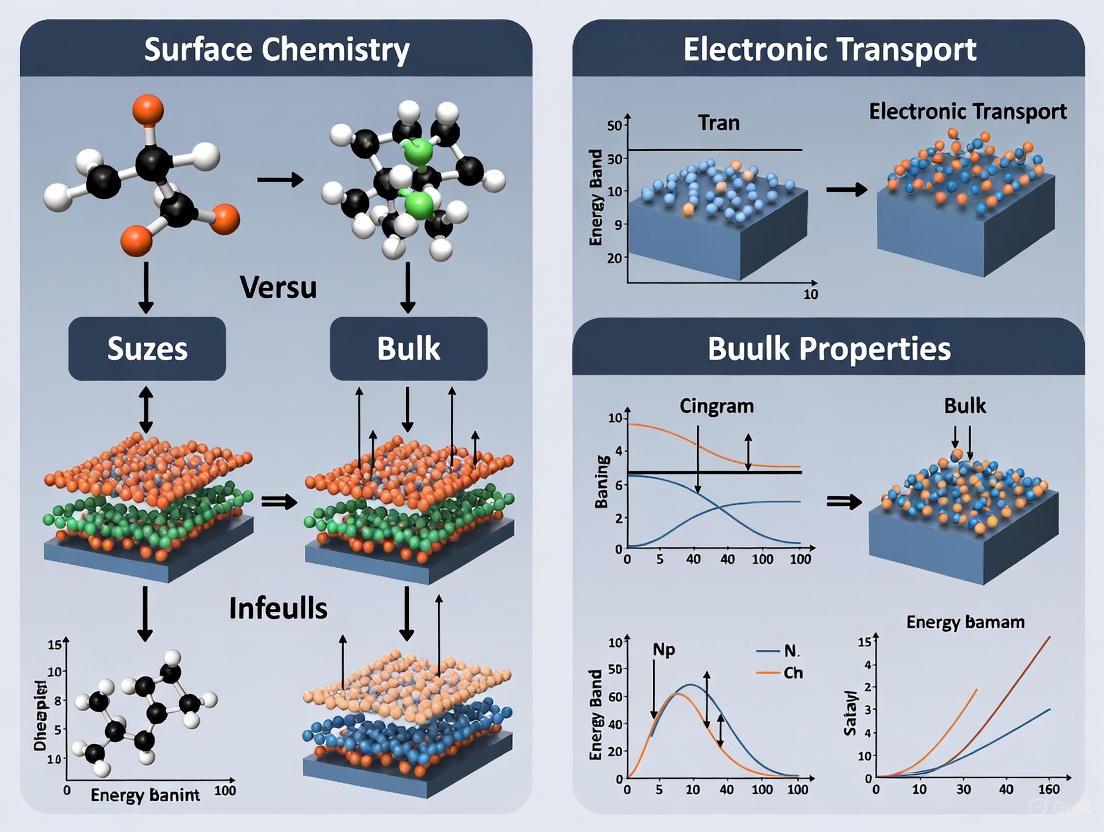
This article provides a comprehensive analysis of how surface chemistry and bulk properties independently and synergistically govern electronic transport in functional materials.
Surface Chemistry vs. Bulk Properties: A Critical Determinant of Electronic Transport in Advanced Materials and Biomedical Applications
Abstract
This article provides a comprehensive analysis of how surface chemistry and bulk properties independently and synergistically govern electronic transport in functional materials. Tailored for researchers, scientists, and drug development professionals, it explores fundamental concepts, advanced characterization methodologies, and optimization strategies critical for troubleshooting device performance. By integrating foundational theory with practical applications—spanning thermoelectrics, photovoltaics, organic electronics, and pharmaceutical solid-state materials—the content offers a validated, comparative framework for leveraging surface-bulk interplay to enhance the efficiency, stability, and functionality of next-generation devices and therapeutics.
Core Principles: How Surface Chemistry and Bulk Properties Govern Electronic Transport
In the fields of surface chemistry and materials science, the electronic structure of a material is paramount in governing its properties and functionality. However, a material's electronic character is not monolithic; a fundamental divide exists between the bulk and the surface. The bulk electronic structure describes the energy levels of electrons within the interior of a material, where atoms are surrounded by a perfectly periodic potential. In stark contrast, the surface electronic structure emerges from the abrupt termination of the crystal lattice, leading to symmetry breaking and a reshuffling of electronic states at the outermost layers [1] [2]. This comparison guide objectively examines the key differences between these two distinct electronic regimes, underpinning their critical roles in electronic transport and surface-specific phenomena.
Fundamental Theoretical Origins
The electronic structure of a solid is traditionally described by band theory, which derives from solutions to the Schrödinger equation for electrons in a periodic potential. The resulting wave functions, known as Bloch waves, are characterized by their energy and crystal momentum, defining the material's band structure [3]. This picture holds perfectly for the infinite, periodic bulk of a crystal.
The surface, however, represents a drastic disruption of this periodicity. The sharp transition from the condensed material to the vacuum creates a weakened and asymmetric potential [2]. This termination gives rise to two qualitatively different types of electronic solutions [2]:
- Bulk-like states that extend into the crystal but terminate in an exponentially decaying tail into the vacuum.
- Surface states, which are electronically localized at the crystal surface and decay exponentially in both directions—into the vacuum and the bulk crystal. These states exist within forbidden energy gaps of the bulk band structure [2].
Two primary models describe these surface states, each providing unique insights into the surface-bulk divide, as summarized in the table below.
Table 1: Theoretical Models of Surface States
| Model | Theoretical Approach | Physical Origin | Typical Applicability |
|---|---|---|---|
| Shockley States [2] | Nearly-free electron approximation | Arises from the change in electron potential due solely to crystal termination. | Normal metals, narrow-gap semiconductors. |
| Tamm States [2] | Tight-binding model (LCAO) | Resembles localized atomic or molecular orbitals at the surface. | Transition metals, wide-gap semiconductors. |
A particularly consequential class of surface states is found in topological insulators. In these materials, the bulk is insulating, but the surface is necessarily metallic, hosting conducting states [2]. These topological surface states are characterized by linear Dirac-cone-like dispersions and have spin-polarized electrons where the spin is locked to the crystal momentum [4] [5]. Their existence is dictated by the topological invariant of the bulk band structure, demonstrating an intimate, albeit distinct, relationship between bulk and surface electronic properties [2].
Comparative Analysis: Surface vs. Bulk Electronic Structures
The following diagram illustrates the fundamental formation and key characteristics of surface electronic structures in contrast to the bulk.
The theoretical origins lead to tangible differences in observable properties. The table below provides a direct comparison based on key electronic parameters.
Table 2: Key Property Comparison Between Bulk and Surface
| Property | Bulk Electronic Structure | Surface Electronic Structure |
|---|---|---|
| Dimensionality | Three-dimensional (3D) [4] | Two-dimensional (2D) [4] [5] |
| Spatial Localization | Extended throughout the crystal | Localized at the top few atomic layers [1] [2] |
| State Type | Bloch waves [3] | Surface states (exponentially decaying) [2] |
| Symmetry | Full crystallographic periodicity | Broken periodicity perpendicular to the surface [1] |
| Band Gap | Defined bulk band gap | Surface states can appear within the bulk band gap [2] |
| Impact of Contamination | Largely unaffected | Highly sensitive, leading to adsorption and surface dipole formation [1] |
Experimental Protocols and Methodologies
Probing the distinct electronic structures of the bulk and surface requires specialized experimental techniques designed to have different sampling depths and sensitivities.
Angle-Resolved Photoemission Spectroscopy (ARPES)
ARPES is a powerful technique for directly measuring the electronic band structure. The key to separating surface from bulk signals lies in using different photon energies.
- Protocol for Probing Bulk States: Soft X-ray ARPES (SX-ARPES) uses high-energy photons (e.g., 500-1500 eV). These photons have a longer inelastic mean free path for the ejected electrons, allowing them to escape from deeper within the crystal. This results in a bulk-sensitive measurement that reveals the three-dimensional electronic structure [4].
- Protocol for Probing Surface States: Vacuum-Ultraviolet ARPES (VUV-ARPES) uses lower-energy photons (e.g., 20-150 eV). This results in a very short escape depth for the photoelectrons, making the technique exquisitely surface-sensitive. It can reveal two-dimensional surface states, such as the Dirac-cone-like dispersions found on the (100) surface of YbB6 [4] [5].
- Advanced Application – Spin-Resolved ARPES: This variant adds a spin detector to the ARPES setup. It is critical for confirming the spin-polarized nature of topological surface states, providing evidence that the electron's spin is locked to its momentum [4].
Computational and Theoretical Frameworks
First-principles calculations are indispensable for interpreting experimental data and predicting new properties.
Standard Methodology – Slab-based Density Functional Theory (DFT): This is the workhorse for simulating surface electronic structures. A "slab" model is used, which is a finite number of atomic layers repeated periodically in 3D space, with a large vacuum gap separating the slabs to model the surface.
- Workflow: The surface structure is first optimized (allowing for atomic relaxation and reconstruction). The electronic structure is then calculated for this optimized geometry to obtain properties like the surface density of states (DOS) and band structure [1] [6].
- Limitation: Standard DFT functionals can be inconsistent, leading to debates on adsorption configurations, as seen with NO on MgO(001) [7].
High-Accuracy Framework – Correlated Wavefunction Theory (cWFT): To address DFT's limitations, advanced frameworks like the autoSKZCAM framework have been developed. This method leverages multilevel embedding approaches to apply highly accurate coupled cluster theory (CCSD(T)) to surface chemistry problems at a computational cost approaching that of DFT. It has been used to reproduce experimental adsorption enthalpies for 19 diverse adsorbate-surface systems and resolve debates on stable adsorption configurations [7].
High-Throughput Screening Framework: For rapid exploration, a data-driven framework has been proposed to predict the surface DOS directly from bulk DOS. This method uses principal component analysis (PCA) to find a linear transformation mapping bulk electronic features to their surface counterparts, bypassing the need for expensive slab-based DFT for every new composition [6].
The Scientist's Toolkit: Essential Research Reagents and Materials
The following table details key solutions, materials, and computational tools essential for research in surface and bulk electronic structure analysis.
Table 3: Essential Research Reagents and Materials
| Item / Solution | Function / Relevance |
|---|---|
| High-Purity Single Crystals (e.g., YbB6, MgO, TiO2) [4] [7] | Serve as well-defined model systems for fundamental studies. Essential for clean surface preparation via cleaving in ultra-high vacuum (UHV). |
| Ultra-High Vacuum (UHV) System | Provides a clean environment (pressure < 10⁻¹⁰ mbar) to prevent surface contamination by gases, enabling the study of intrinsic surface electronic structure. |
| Synchrotron Light Source | Provides a tunable, high-flux beam of photons for ARPES, allowing researchers to select specific energies for bulk- or surface-sensitive measurements [4]. |
| Density Functional Theory (DFT) Codes (e.g., VASP, Quantum ESPRESSO) | Standard computational tools for performing slab-based calculations to predict and analyze surface relaxation, reconstruction, and electronic states [6]. |
| Correlated Wavefunction Theory (cWFT) Framework (e.g., autoSKZCAM) [7] | Open-source framework for achieving CCSD(T)-level accuracy for adsorption energies on ionic surfaces, resolving debates where DFT fails. |
| Particle Swarm Optimization (PSO) Code (e.g., CALYPSO) [8] | Global structural prediction algorithm used for discovering stable atomic configurations of complex systems, such as hydrogenated amorphous silicon (a-Si:H). |
Implications for Electronic Transport and Surface Chemistry
The surface-bulk electronic divide has profound functional consequences.
In semiconductors, the severed covalent bonds at the surface create localized surface states that can trap electrons or holes. This leads to the formation of a space charge region where the energy bands bend near the surface [1]. This band bending is critical as it creates an internal electric field that governs rectifying action in p-n junctions and significantly influences charge transport in electronic devices [1]. In metals, the smoothing of the electron density at the surface creates a dipole layer that directly determines the work function, the energy required to remove an electron from the solid [1].
The surface electronic structure is the primary actor in surface chemistry and catalysis. The DOS at the Fermi level and the spatial distribution of surface orbitals dictate a material's adsorption characteristics and reactivity [6] [7]. For instance, the unique reactivity of different III-V semiconductor surfaces (e.g., As-terminated vs. Ga-terminated) is a direct result of their distinct surface electronic configurations [1]. Furthermore, the presence of topological surface states, with their spin-polarized Dirac cones, opens avenues for novel spintronic devices and enhanced catalytic performance [4] [2].
Native Defects and Their Anomalous Impact on Surface vs. Bulk Conductivity
In the development of modern electronic and quantum materials, a profound disconnect often exists between theoretical predictions of material properties and their actual experimental performance. A critical factor underlying this discrepancy is the role of native defects—vacancies, interstitials, and antisites that inevitably form during material synthesis. These defects can create radically different electronic environments at surfaces compared to bulk regions, leading to unexpected conductive behaviors that either enhance or degrade device functionality. Understanding this surface-bulk dichotomy is particularly crucial for low-dimensional materials where surface-to-volume ratios are extremely high. This guide systematically compares the anomalous effects of native defects on surface versus bulk conductivity across prominent material systems, providing researchers with experimental methodologies and fundamental insights to control electronic properties in next-generation devices.
Comparative Analysis of Defect-Induced Conductivity Anomalies
Table 1: Quantitative Comparison of Surface vs. Bulk Conductivity Across Material Systems
| Material | Bulk Conductivity | Surface Conductivity | Key Defects Identified | Experimental Techniques | Impact on Electronic Properties |
|---|---|---|---|---|---|
| SnS | Semiconductor behavior | Semi-metallic behavior [9] | Surface vacancies (VSn, VS), interstitials (Sni, Si), antisites (SnS, SSn) [9] | RF sputtering, STS, DFT calculations [9] | Altered transport properties in heterostructures; potential recombination centers [9] |
| MoS2 | 0.1 Ω-1cm-1 (bulk crystals) [10] | 11-360 Ω-1cm-1 (nanoflakes) [10] | Surface electron accumulation (SEA) from desulfurization [10] | TLM, STM/STS, ARPES [10] | Heavy n-doping; thickness-dependent conductivity (σ ∝ t-1.1) [10] |
| Bi4I4 | Thermally dependent resistivity profiles [11] | Defect-modulated surface states [11] | Bi and I antisites, Bi vacancies, Hg impurities [11] | CVT growth, EDX, DFT with vdW-DF [11] | n-type and p-type doping; modified carrier concentration and scattering [11] |
| Mn3GaC | Metallic with RRR ~1.8 [12] | - | Interstitial Mn atoms [12] | XRD, magnetotransport, DFT [12] | Kondo effect (TK = 16 K) from magnetic scattering [12] |
Table 2: Defect Formation Energy and Electronic Impact
| Material | Dominant Defect Types | Formation Energy Dependence | Doping Behavior | Band Structure Modification |
|---|---|---|---|---|
| SnS | Vacancies, interstitials, antisites [9] | Temperature-dependent during fabrication [9] | Determined by specific defect chemistry [9] | Semi-metallic surface states [9] |
| Bi4I4 | Bi antisites (dominant), I antisites, Bi vacancies [11] | Chemical potential environment [11] | I antisites (n-type), Bi vacancies (p-type) [11] | Resonant states in band edges [11] |
| Bi2O2Se | O and Se vacancies, Bi interstitials, antisites [13] | Fermi energy and atomic chemical potentials [13] | Anion deficiency leads to n-type characteristics [13] | Surface states explanation for n-type FETs [13] |
Experimental Methodologies for Defect Characterization
Thin Film Fabrication and Defect Engineering
Precise control over native defect formation begins with optimized fabrication protocols. For SnS studies, researchers employed RF magnetron sputtering under carefully controlled parameters: substrate temperatures ranging from 303-623 K, constant RF power of 50 W, chamber pressure of 11.0 × 10⁻³ mbar with 40 SCCM argon gas flow, and deposition duration of 60 minutes [9]. These parameters directly influence defect formation energies and concentrations, enabling systematic comparison of defect populations across different synthesis conditions. For Bi4I4, chemical vapor transport (CVT) growth followed by thermal annealing at 50°C and 100°C for 24 hours allowed controlled defect formation and phase stabilization [11]. MoS2 crystals were similarly grown via CVT, with their pristine surfaces exhibiting nearly intrinsic states before developing characteristic surface electron accumulation through desulfurization at room temperature [10].
Advanced Characterization Techniques
Table 3: Experimental Methods for Probing Defect-Related Properties
| Characterization Method | Physical Property Measured | Defect Information Obtained | Material Examples |
|---|---|---|---|
| Scanning Tunneling Spectroscopy (STS) | Local density of states [9] [10] | Surface electronic structure; defect-induced gap states [9] [10] | SnS, MoS2 |
| Hall Effect Measurements | Bulk carrier concentration, mobility [9] | Defect doping efficiency; scattering mechanisms [9] | SnS |
| Angle-Resolved Photoemission Spectroscopy (ARPES) | Band structure, surface states [10] | Defect-modified surface electronic dispersion [10] | MoS2 |
| X-ray Photoelectron Spectroscopy (XPS) | Surface chemical states [9] | Defect identity and oxidation states [9] | SnS |
| Transfer Length Method (TLM) | Dimensionality of charge transport [10] | Surface-dominated versus bulk-dominated conduction [10] | MoS2 |
| First-Principles DFT Calculations | Defect formation energies; electronic structure [9] [11] | Thermodynamic stability; dopant energy levels [9] [11] | SnS, Bi4I4 |
Computational Approaches for Defect Modeling
First-principles density functional theory (DFT) calculations provide crucial theoretical support for interpreting experimental observations. For SnS, researchers employed the Vienna Ab initio Simulation Package (VASP) with the Perdew-Burke-Ernzerhof (PBE) functional within the generalized gradient approximation, applying it to both bulk and surface slab models with vacuum layers [9]. Defective surfaces were constructed by introducing neutral defects of tin and sulfur (vacancies, interstitials, and antisites) into the SnS (111) surface supercell [9]. Similarly, Bi4I4 studies utilized DFT with van der Waals corrections (vdW-DF) to account for interlayer interactions, incorporating spin-orbit coupling and employing a 400 eV energy cutoff with k-point meshes of 4×3×4 for the α-phase [11]. These computational methods enable prediction of defect formation energies, charge transition levels, and the resulting modifications to electronic band structures.
Visualization of Defect Impact Pathways
The Scientist's Toolkit: Essential Research Materials
Table 4: Key Research Reagents and Solutions for Defect Studies
| Reagent/Material | Function in Research | Application Examples |
|---|---|---|
| RF Magnetron Sputtering System | High-quality thin film fabrication with controlled stoichiometry [9] | SnS film deposition at various substrate temperatures [9] |
| CVT-Grown Single Crystals | Production of high-purity layered materials for fundamental studies [10] [11] | MoS2, Bi4I4 crystal growth [10] [11] |
| Pt/Ir STM Tips | Nanoscale surface topography and electronic structure mapping [9] [10] | STS I-V characteristics of SnS and MoS2 surfaces [9] [10] |
| Van der Pauw Configuration | Accurate bulk electrical property measurements [9] | Hall effect measurements of carrier concentration in SnS [9] |
| DFT Simulation Packages (VASP) | First-principles calculation of defect formation energies and electronic structures [9] [11] | SnS and Bi4I4 defect property computation [9] [11] |
| Ultrasonically Cleaned Substrates | Contamination-free surface for reproducible film growth [9] | SnS deposition on soda lime glass [9] |
The systematic investigation of native defects reveals their profound and often divergent impacts on surface versus bulk conductivity across material systems. In SnS, native surface defects induce semi-metallic behavior distinct from its bulk semiconductor character [9]. MoS2 exhibits surface electron accumulation nearly four orders of magnitude higher than its bulk concentration [10]. Bi4I4 shows defect-dependent doping that can be either n-type or p-type based on specific antisite defects and vacancies [11]. These findings underscore that comprehensive electronic property assessment requires combined surface and bulk characterization techniques, as traditional bulk measurements alone may overlook crucial surface-dominated phenomena. Future materials design must incorporate defect engineering strategies that either suppress undesirable defects or exploit them for tailored functionality, particularly in nanoscale devices where surface effects dominate electronic behavior.
The Role of Surface States, Band Bending, and Recombination Centers
In semiconductor research, the surface chemistry of a material can often dominate its electronic behavior, creating a stark contrast with its bulk properties. This guide provides a comparative overview of how surface states, band bending, and recombination centers influence electronic transport across different material systems and synthetic routes. While bulk properties like composition and crystal structure define the foundational capabilities of a semiconductor, surface phenomena frequently determine the practical efficiency and performance of electronic and optoelectronic devices. This is particularly critical in nanostructured materials, where the high surface-to-volume ratio amplifies the impact of surface chemistry. Through a comparison of experimental data from key studies, this guide will demonstrate that careful management of surface states is not merely a supplementary consideration but a central factor in the design of next-generation electronic materials, from thermoelectrics to topological insulators.
Comparative Analysis of Material Systems and Performance
The following tables summarize quantitative data from recent studies, highlighting how different surface treatments and material syntheses impact key electronic transport properties.
Table 1: Comparison of Synthesis Methods and Their Impact on Surface Chemistry & Electronic Transport
| Material System | Synthesis Method | Key Surface Chemistry Finding | Primary Experimental Evidence |
|---|---|---|---|
| Bi₂Te₃ [14] | Hydrothermal (Water-based) | Higher surface metal oxide content forms a resistive layer. | XPS analysis; 8x lower electrical conductivity than thermolysis sample. |
| Bi₂Te₃ [14] | Thermolysis (Oil-based) | Lower oxide content leads to less resistive surfaces. | XPS analysis; Higher electrical conductivity. |
| GaN Nanowires [15] | Chemical Vapor Deposition | Surface Band Bending (SBB) increases as nanowire diameter decreases. | Kelvin Probe Force Microscopy (KPFM) & DFT calculations. |
| (Bi₀.₄₅Sb₀.₆₀)₂Te₃ [16] | Modified Bridgman Method | Upward band bending causes depletion of bulk carriers at the surface. | Shubnikov-de Haas (SdH) oscillations & Hall resistivity analysis. |
| CuInSe₂ (CISe) Nanocrystals [17] | Ligand Exchange (Matrix-type) | Amorphous MoSₓ matrix passivates trap states, reduces Fermi-level pinning. | Capacitance analysis; Detectivity of 6.28 × 10⁶ cm Hz¹ᐟ² W⁻¹. |
Table 2: Quantitative Performance Data Across Different Material Systems
| Material System | Electrical Conductivity | Seebeck Coefficient (mV/K) | Carrier Mobility | Key Measured Outcome |
|---|---|---|---|---|
| Bi₂Te₃ (Hydrothermal) [14] | Low (Baseline) | ~ -160 to -170 | Not Specified | Higher activation energy for conduction. |
| Bi₂Te₃ (Thermolysis) [14] | 8x Higher than Hydrothermal | ~ -160 to -170 | Not Specified | Recommended for optimal thermoelectric performance. |
| GaN Nanowires [15] | Not Specified | Not Specified | Not Specified | SBB increases from ~0.6 eV to ~0.9 eV as diameter decreases from 120 nm to 70 nm. |
| (Bi₀.₄₅Sb₀.₆₀)₂Te₃ [16] | High Resistivity (~0.1 Ω·cm) | Not Specified | Surface: High; Bulk: Low | Surface hole density: 1.30 × 10¹² cm⁻²; Large MR (~347%). |
| CISe NCs (Matrix Ligand) [17] | Low Dark Current | Not Specified | High (Band-like) | Responsivity: 0.146 A/W; Superior charge carrier management. |
Experimental Protocols for Key Characterization Techniques
Probing Surface Band Bending with Kelvin Probe Force Microscopy (KPFM)
Objective: To measure the contact potential difference (CPD) and calculate the surface band bending (SBB) on individual semiconductor nanostructures, such as GaN nanowires (NWs), with high spatial resolution [15].
Methodology:
- Sample Preparation: GaN NWs are synthesized on a crystalline Si (100) substrate via chemical vapor deposition (CVD) using Au nanoparticles as a catalyst (vapor-liquid-solid growth). The as-grown NWs are mechanically transferred to an Au-coated Si substrate for KPFM measurements [15].
- KPFM Measurement: The CPD between a conductive AFM tip (e.g., Pt/Ir-coated) and the sample surface is measured. This is achieved by applying a DC bias (VDC) and an AC bias (VAC) to the tip and using a feedback loop to nullify the electrostatic force between the tip and the sample. The nullifying DC bias is equal to the CPD [15].
- SBB Calculation: The surface band bending is calculated from the measured CPD value. For an n-type semiconductor, the SBB is the difference between the bulk Fermi level and the conduction band minimum at the surface. This requires knowledge of the bulk Fermi level position, which can be estimated from bulk doping concentrations [15].
- Correlation with Theory: The experimentally obtained SBB values are corroborated with the electronic density of states of surface atoms calculated using ab initio density functional theory (DFT) for different NW diameters [15].
Linking Surface Chemistry to Transport via Electrophoretic Deposition (EPD)
Objective: To fabricate thick films of nanoparticles for electronic transport measurements, enabling a direct comparison of how different synthetic routes and their resultant surface chemistries affect electrical properties [14].
Methodology:
- Nanoparticle Synthesis: Bi₂Te₃ nanoparticles are synthesized via two distinct wet-chemical routes: hydrothermal (in water) and thermolysis (in oil) [14].
- Suspension Preparation: The synthesized nanoparticles are dispersed in a suitable solvent to create a stable, colloidally stabilized suspension. The surface chemistry of the nanoparticles determines the stability of this suspension [14].
- EPD Film Fabrication: The suspension is placed in a cell with two parallel electrodes. A DC electric field is applied, causing the charged nanoparticles to move toward and deposit onto the oppositely charged electrode, forming a dense, thick film [14].
- Transport Property Measurement: The electrical conductivity and Seebeck coefficient of the EPD film are measured. The power factor (PF = σS²) can then be calculated to assess thermoelectric performance [14].
- Surface Analysis: X-ray Photoelectron Spectroscopy (XPS) is performed on the powders to determine the elemental composition and chemical state of the surface, such as the presence of metal oxides [14].
Identifying Topological Surface States with Magneto-Transport
Objective: To separate the contribution of topological surface states (TSS) from bulk conduction in topological insulators (TIs) using high magnetic field measurements [16].
Methodology:
- Single Crystal Growth: (Bi₀.₄₅Sb₀.₆₀)₂Te₃ single crystals are grown using a modified Bridgman method, involving sealing high-purity elements in a quartz tube under vacuum and a specific heating/cooling profile [16].
- Low-Temperature Transport: Resistivity, magneto-resistance (MR), and Hall resistivity are measured as a function of temperature and under high magnetic fields (e.g., up to 14 T) [16].
- Shubnikov-de Haas (SdH) Oscillation Analysis: The oscillatory component of the magneto-resistance is analyzed. The frequency of oscillations is related to the cross-sectional area of the Fermi surface. A π-Berry phase, extracted from a Landau fan plot, is a signature of topological Dirac fermions [16].
- Two-Band Model Fitting: The nonlinear Hall resistivity is fitted using a two-band model to extract carrier density and mobility for both the surface and bulk bands independently. The presence of high-mobility, low-density carriers is indicative of TSS [16].
- Band Bending Assessment: The direction of band bending (upward or downward) is inferred from the type of surface carriers (electrons or holes) and their density relative to the bulk, suggesting either depletion or accumulation of carriers at the surface [16].
Essential Concepts and Workflows Visualized
Band Bending Fundamentals at Semiconductor Surfaces
Experimental Workflow for Surface State Analysis
The Scientist's Toolkit: Key Research Reagents and Materials
Table 3: Essential Materials and Reagents for Surface-State-Centric Research
| Reagent/Material | Function in Research | Example Application |
|---|---|---|
| High-Purity Elements (Bi, Sb, Te, Ga) [14] [16] | Starting materials for synthesizing high-quality, phase-pure semiconductor crystals with minimal unintentional dopants. | Growth of Bi₂Te₃ and (Bi,Sb)₂Te₃ topological insulators [14] [16]. |
| Metal-Organic Precursors (e.g., Cu, In salts) [17] | Used in colloidal synthesis of nanocrystals, allowing precise control over composition and size. | Fabrication of CuInSe₂ (CISe) NIR colloidal nanocrystals [17]. |
| Surface Ligands (Oleylamine, MPA, MoS₄²⁻) [14] [17] | Control surface passivation, interparticle distance, and electronic coupling in nanostructured materials. | Ligand exchange on Bi₂Te3 and CISe NCs to modify transport properties [14] [17]. |
| Au Nanoparticles [15] | Act as a catalyst in the Vapor-Liquid-Solid (VLS) growth mechanism for nanowires. | Growth of GaN nanowires for KPFM studies [15]. |
| Conductive AFM Tips (Pt/Ir-coated) [15] | Enable nanoscale electrical measurements, specifically for KPFM to measure contact potential difference (CPD). | Mapping surface potential on individual GaN nanowires [15]. |
In the field of semiconductor research, a fundamental tension exists between the influence of surface chemistry and the intrinsic bulk properties of a material on its overall electronic character. While surface effects can dominate in low-dimensional nanostructures, the performance of most solid-state electronic and thermoelectric devices is ultimately governed by the core bulk properties of their constituent materials. This guide provides a detailed comparison of these essential bulk properties—crystallinity, carrier concentration, and mobility—across key semiconductor materials, framing them within the critical context of surface-versus-bulk research.
The electronic transport properties of a material, including its electrical conductivity and Seebeck coefficient, are largely determined by these three fundamental bulk characteristics. Crystallinity defines the periodic potential through which charge carriers move, carrier concentration determines the number of available charge transporters, and mobility describes how easily these carriers can move under an electric field. Understanding their interplay is crucial for selecting materials for specific applications, from high-power electronics to energy harvesting devices.
Fundamental Property Definitions and Relationships
Crystallinity and Crystal Structure
Crystallinity refers to the degree of structural order in a solid, extending from atomic arrangements to macroscopic crystal dimensions. A perfect single crystal possesses uninterrupted periodic atomic arrangement, while polycrystalline materials comprise multiple crystalline grains with disordered interfaces, and amorphous materials lack long-range order entirely. The crystal structure defines the specific geometric arrangement of atoms, which directly determines the electronic band structure and anisotropic properties.
For example, β-Ga₂O₃ (beta gallium oxide) possesses a monoclinic crystal structure, while silicon has a diamond cubic structure and GaAs has a zinc blende structure [18] [19]. These fundamental structural differences create distinct electronic environments that govern how charge carriers behave in each material.
Carrier Concentration
Carrier concentration (n for electrons, p for holes) represents the number of mobile charge carriers per unit volume in a material, typically measured in cm⁻³. In semiconductors, carrier concentration is exquisitely sensitive to dopant impurities introduced during crystal growth or through subsequent processing.
- n-type doping introduces donor atoms that contribute additional electrons to the conduction band
- p-type doping introduces acceptor atoms that create holes in the valence band
- Unintentional doping often occurs through native defects like oxygen vacancies in oxide semiconductors
The conductivity (σ) of a material depends directly on carrier concentration according to the relationship: σ = e(nμₑ + pμₕ), where e is electron charge, and μₑ and μₕ are electron and hole mobilities respectively [20].
Electron Mobility
Electron mobility (μ) characterizes how quickly an electron moves through a material when subjected to an electric field [20]. It is defined by the equation vd = μE, where vd is the drift velocity and E is the electric field strength. Mobility is typically expressed in units of cm²/(V·s).
Mobility is primarily limited by scattering mechanisms including:
- Phonon scattering (interactions with lattice vibrations)
- Impurity scattering (interactions with dopant atoms and defects)
- Surface scattering (particularly important in thin films and nanostructures)
Mobility directly influences device speed and switching frequency, with higher mobility generally enabling better performance in high-frequency and power electronics [20].
Material Systems Comparison
Table 1: Fundamental Properties of Key Semiconductor Materials
| Material | Crystal Structure | Band Gap (eV) | Typical Electron Mobility (cm²/V·s) | Typical Hole Mobility (cm²/V·s) |
|---|---|---|---|---|
| Si (Silicon) | Diamond cubic | 1.12 | ~1,400 | ~450 [20] |
| Ge (Germanium) | Diamond cubic | 0.67 | ~4,000 | ~2,000 [20] |
| GaAs | Zinc blende | 1.43 | ~8,500 | ~400 [20] |
| β-Ga₂O₃ | Monoclinic | ~4.9 | ~100-300 | Extremely low [18] |
| MoS₂ | Layered hexagonal | ~1.8 (indirect, bulk) | 10-50 (thickness-dependent) | - [21] |
Table 2: Performance Metrics for Power Electronics Applications
| Material | Breakdown Field (MV/cm) | Baliga's Figure of Merit (relative to Si) | Thermal Conductivity (W/m·K) |
|---|---|---|---|
| Si | 0.3 | 1 | 150 |
| 4H-SiC | 2.5 | 10 | 490 |
| GaN | 3.3 | 30 | 253 |
| β-Ga₂O₃ | 8 | 44 | 10-27 [18] |
Silicon: The Conventional Workhorse
Silicon's diamond cubic structure consists of two interpenetrating face-centered cubic lattices, with each atom tetrahedrally bonded to four neighbors [19]. This highly symmetric structure contributes to silicon's excellent carrier mobility, particularly for electrons (1,400 cm²/V·s). However, silicon's relatively narrow bandgap (1.12 eV) and moderate breakdown field limit its performance in high-power and high-temperature applications.
Gallium Arsenide and III-V Compounds
GaAs possesses a zinc blende structure with Ga and As atoms alternating on the two interpenetrating face-centered cubic lattices [19]. Its direct bandgap (1.43 eV) makes it superior to silicon for optoelectronic applications. The high electron mobility (8,500 cm²/V·s) also makes it valuable for high-frequency electronics, though lower hole mobility (~400 cm²/V·s) and higher cost limit its applications.
Beta Gallium Oxide: Emerging Ultra-Wide Bandgap Semiconductor
β-Ga₂O₃ has attracted significant interest for power device applications due to its very large bandgap (~4.9 eV) and high estimated breakdown field (8 MV/cm) [18]. The crystal structure is monoclinic, with a density functional theory (DFT) calculated electronic band structure showing significant anisotropy [18]. A major challenge for β-Ga₂O₃ is its extremely low hole mobility, which has prevented the realization of p-type conductivity and consequently, conventional p-n homojunctions.
Bismuth Telluride: Thermoelectric Applications
Bi₂Te₃ is a highly efficient thermoelectric material near room temperature, typically crystallizing in a layered hexagonal structure [14]. The material exhibits significant anisotropy in transport properties between in-plane and cross-plane directions due to its layered structure. Synthesis method dramatically affects transport properties, with thermolysis-synthesized Bi₂Te₃ showing approximately 8 times higher electrical conductivity than hydrothermally synthesized material due to differences in surface oxide content [14].
Molybdenum Disulfide: Layered Semiconductor
MoS₂ belongs to the transition metal dichalcogenide family with a layered structure where individual layers are bonded by weak van der Waals forces [21]. Bulk MoS₂ has an indirect bandgap of approximately 1.8 eV. Research has revealed strong thickness-dependent conductivity in MoS₂ nanoflakes, with conductivity increasing from 11 to 360 Ω⁻¹ cm⁻¹ as thickness decreased from 385 to 33 nm [21]. This unusual inverse relationship highlights the complex interplay between bulk and surface effects in low-dimensional materials.
Experimental Methodologies
Crystal Growth Techniques
Table 3: Bulk Crystal Growth Methods for β-Ga₂O₃
| Growth Method | Maximum Crystal Size | Key Advantages | Limitations/Defects |
|---|---|---|---|
| Czochralski (CZ) | ~2 inch diameter | Large crystal size, high purity | Interface fluctuations, thermal stress |
| Edge-defined Film-fed Growth (EFG) | 6-inch width | Mass production capability, large area substrates | Potential for line-shaped defects |
| Floating Zone (FZ) | Limited by melt stability | Crucible-free, high purity, controlled atmosphere | Crystal cracking from thermal gradients |
| Bridgman | Limited by crucible size | Simplicity, compositional control | Crucible contamination potential |
Different growth methods yield crystals with varying defect concentrations and impurity levels. For β-Ga₂O₃, the EFG method is considered optimal for mass production of substrates with large area, low defect density, and high crystal quality [18]. The Verneuil method (flame fusion) is primarily used for gem varieties but has been applied to Ga₂O₃, utilizing an oxyhydrogen flame to melt powder material which then crystallizes into boules [18].
Structural Characterization Protocols
X-ray Diffraction (XRD) provides essential information about crystal structure, phase purity, and orientation. For MoS₂, XRD patterns show characteristic (00l) peaks (002, 004, 006, 008) corresponding to the c-plane orientation of the 2H polytype [21]. Rocking curve measurements can quantify crystal perfection through the full width at half maximum of diffraction peaks.
Raman spectroscopy complements XRD for assessing crystal quality. For MoS₂, the E₁₂g and A₁g modes at approximately 383.1 and 408.2 cm⁻¹ respectively provide information about layer number, strain, and defect density [21]. Narrow peak widths (3.1-3.7 cm⁻¹) indicate high crystalline quality.
Electrical Transport Measurement
Temperature-dependent conductivity measurements reveal fundamental carrier transport mechanisms. Arrhenius plots of conductivity versus inverse temperature (1000/T) enable calculation of activation energy for conduction. For MoS₂, bulk crystals exhibit much higher activation energy (68 meV) compared to nanoflakes (6 meV), indicating different conduction mechanisms [21].
Hall effect measurements provide quantitative data on carrier concentration and mobility simultaneously using the van der Pauw method. This technique applies perpendicular magnetic and electric fields to a sample and measures the resulting Hall voltage.
Transfer length method (TLM) determines contact resistance and differentiates between 2D and 3D transport behavior. In MoS₂, TLM revealed predominantly two-dimensional electronic transport rather than conventional three-dimensional behavior [21].
The Scientist's Toolkit
Table 4: Essential Research Reagent Solutions and Materials
| Item | Function/Application | Key Characteristics |
|---|---|---|
| High-Purity Ga₂O₃ powder (5N-6N) | Starting material for bulk crystal growth | Determines initial impurity levels in grown crystals |
| Pt/Rh (70%/30%) crucible | Container for melt growth techniques (Bridgman) | High melting point, chemical inertness to oxide melts |
| SnO₂/SiCl₄ doping sources | Intentional n-type doping for β-Ga₂O₃ | Controls electron concentration from 10¹⁶-10¹⁹ cm⁻³ [18] |
| Hydride/Vapor Phase Epitaxy precursors | Thin film deposition of semiconductor heterostructures | Enables controlled doping and heterointerface formation |
| Photolithography reagents (AZ5214, developer) | Electrode patterning for transport measurements | Defines precise device geometries for property characterization |
| Ohmic contact metals (Ti/Au, In) | Formation of low-resistance electrical contacts | Essential for accurate transport property measurement |
Property Interrelationships and Device Implications
The relationship between crystallinity, carrier concentration, and mobility is complex and interdependent. High crystallinity (low defect density) generally enables higher carrier mobility by reducing scattering centers. However, optimizing one property often comes at the expense of another, requiring careful balancing for specific applications.
For power electronics, materials like β-Ga₂O₃ leverage their wide bandgap (resulting from crystal structure and bonding) to achieve high breakdown fields, while maintained reasonable electron mobility enables low on-resistance [18]. The Baliga's figure of merit (BFOM ∝ εμEc³) quantitatively captures this trade-off, with β-Ga₂O₃ theoretically outperforming SiC and GaN by at least 4× [18].
For thermoelectric applications, the interplay between electrical conductivity (dependent on both carrier concentration and mobility) and the Seebeck coefficient creates an optimization challenge. Bi₂Te₃ achieves optimal performance through heavy doping to balance these parameters, with additional enhancement through texture control during crystal growth to exploit anisotropic transport [14].
Current Research Challenges and Future Directions
Despite significant progress, several fundamental challenges remain in understanding and controlling bulk semiconductor properties:
Defect and impurity control requires further study, particularly for emerging materials like β-Ga₂O₃ where "the published data are still incomplete and controversial to some extent" [18]. The dominant defects in bulk crystals and their specific effects on device performance need identification and quantification.
The p-type conductivity challenge in wide bandgap semiconductors like β-Ga₂O₃ remains a significant obstacle. While n-type doping is readily achievable, "a major challenge for β-Ga₂O₃ is its lack of an adequate method for fabricating p-type β-Ga₂O₃ crystals" [18], limiting device architecture options.
Thermal management is particularly crucial for materials with low thermal conductivity. β-Ga₂O₃ has relatively poor thermal conductivity (10-27 W/m·K) compared to SiC (490 W/m·K) or GaN (253 W/m·K), creating challenges for power density and reliability [18]. Novel concepts and designs for improving thermal management are needed to realize the full potential of these materials.
Future research directions will likely focus on hybrid material systems that combine the advantageous properties of different semiconductors, advanced doping techniques including modulation doping and delta doping, and defect engineering approaches to simultaneously optimize electrical and thermal properties.
Tin sulfide (SnS) has emerged as a pivotal material in the development of next-generation electronic and energy conversion devices. Its significance stems from a unique combination of being earth-abundant, low-toxicity, and exhibiting exceptional electronic and optical properties [22] [23]. A comprehensive understanding of SnS requires disentangling the often divergent electronic behaviors of its bulk and surface regions. This case study delves into the anomalies between these properties, a phenomenon highlighted by recent experimental and theoretical investigations [24]. The inherent structural anisotropy of SnS and the influence of native defects are critical factors governing this complex behavior, with direct implications for transport mechanisms and ultimate device performance [24] [23]. Framed within a broader thesis on condensed matter physics, this analysis underscores the critical role of surface chemistry in modulating electronic transport, which can diverge significantly from the properties of the bulk material.
Comparative Analysis of Bulk vs. Surface Properties
The electronic character of SnS varies dramatically between its bulk and surface forms, and is further tunable through dimensional confinement and structural phase. The table below summarizes key electronic properties from experimental and theoretical studies.
Table 1: Electronic Properties of SnS Across Different Dimensions and Phases
| Material Form | Band Gap (eV) | Carrier Type | Carrier Concentration (cm⁻³) | Carrier Mobility (cm²/V·s) | Key Characteristics |
|---|---|---|---|---|---|
| Bulk α-SnS [24] [25] | 1.0 - 1.1 (indirect) | p-type | 10¹⁵ - 10¹⁷ | Up to 90 | Anomalous bulk-surface properties; semi-metallic surface states observed [24]. |
| Bulk γ-SnS [22] | Ultranarrow (e.g., 0.095 for γ-SnSe) | p-type | N/A | N/A | Unconventional metastable phase; distinct electronic structure. |
| Monolayer SnS [22] [26] | 1.96 (indirect) | p-type | N/A | 10,000 - 38,000 (theoretical) | Band gap expansion; high in-plane anisotropy; strong spin-orbit coupling [22]. |
| Bilayer SnS [26] | Tunable (stacking-dependent) | p-type | N/A | N/A | Stacking-dependent band gap transitions; suppressed thermal conductivity. |
| Colloidal SnS Nanocrystals [25] | Size-tunable | p-type | ~10¹⁷ | ~1.4 (film) | Scalable synthesis; properties tunable via morphology and capping agents. |
A central anomaly in SnS is the frequent observation of semi-metallic behavior at the surface, even though the bulk material is a semiconductor. This has been probed experimentally using techniques like scanning tunnelling spectroscopy (STS). First-principles Density Functional Theory (DFT) calculations attribute this to the formation of native surface defects, which create electronic states within the band gap, fundamentally altering the surface electronic structure compared to the bulk [24].
Furthermore, reducing the dimensionality of SnS to a 2D monolayer induces a significant band gap expansion due to quantum confinement effects. Theoretical studies on both conventional (α) and unconventional (γ) phases show that the band gap in 2D monolayers can be 4 to 20 times larger than in their bulk counterparts [22]. This is coupled with predicted extremely high carrier mobilities, superior to those of black phosphorus, making 2D SnS highly attractive for high-speed electronics [26].
Table 2: Thermal and Transport Properties of SnS Structures
| Property | Monolayer SnS | Bilayer SnS (AA'-stacking) | Bulk SnS | References |
|---|---|---|---|---|
| In-plane Lattice Thermal Conductivity at 300 K | ~1.5 W/m·K | < 0.5 W/m·K (per layer) | Higher than bilayer | [26] |
| Thermoelectric Power Factor | Large, comparable to α-phases | High | High in α-SnSe (ZT > 2) | [22] [26] |
| Anisotropic Transport | Strong (Armchair vs. Zigzag) | Stacking-dependent | Present | [26] [23] |
The thermal transport properties also exhibit a strong dependence on dimensionality. Bilayer SnS, in its most stable AA'-stacking configuration, exhibits a dramatically suppressed lattice thermal conductivity compared to both the monolayer and bulk forms. This suppression is attributed to enhanced interlayer anharmonic phonon scattering, which reduces phonon relaxation times. This property is highly desirable for thermoelectric applications, as a low thermal conductivity helps maintain a temperature gradient for voltage generation [26].
Experimental Protocols and Methodologies
Synthesis and Fabrication Techniques
- RF Magnetron Sputtering: Used for fabricating single-phase polycrystalline SnS films for fundamental property studies. This method allows for precise control over film stoichiometry and microstructure [24].
- Chemical Vapor Deposition (CVD): A prominent method for growing high-quality, large-area monolayer and few-layer SnS crystals. Selective growth of phase-pure SnS over SnS₂ is achieved by carefully controlling the sulfur vapor concentration relative to tin using high-purity elemental precursors in a CVD setup [27].
- Hydrothermal Synthesis: A scalable, solution-based method for producing nanostructured SnS (e.g., nanosheets, nanoribbons). This approach is cost-effective and allows for morphological control, often using precursors like stannous chloride and thioacetamide in an autoclave [28].
- Liquid-Phase Exfoliation (LPE): Involves the use of solvents and ultrasonication to mechanically exfoliate bulk SnS crystals into monolayers and few-layer flakes. The thermally assisted LPE (T-LPE) process has been successfully demonstrated for isolating monolayer SnS [23].
- Metal-Assisted Mechanical Exfoliation (M-ME): An advanced exfoliation technique that improves the yield and size of thin SnS flakes [23].
Characterization and Measurement Techniques
- Scanning Tunneling Spectroscopy (STS): A key technique for directly probing the local electronic density of states on material surfaces. It was instrumental in identifying the semi-metallic behavior of the SnS surface, which contrasts with its bulk semiconductor properties [24].
- Time-Resolved Terahertz Spectroscopy (TRTS): A non-contact method used to measure the intrinsic electronic transport properties of individual colloidal nanocrystals, such as carrier mobility and conductivity, without the confounding effects of inter-crystalline charge transfer in films [25].
- Multi-Point Contact Probe Measurements: Used in conjunction with non-contact spectroscopy to measure the electrical conductivity, carrier concentration, and hall mobility of single crystals and fabricated devices, confirming the p-type semiconducting behavior of SnS [25] [28].
- Raman Spectroscopy: Used to identify crystal phases and probe in-plane anisotropy. The angle dependence of Raman peak intensities for SnS reveals its structural orientation, with Ag modes displaying 2-fold symmetry [27].
- Second-Harmonic Generation (SHG) Microscopy: A powerful nonlinear optical technique used to characterize the crystal symmetry and orientation of non-centrosymmetric 2D materials like monolayer SnS, and to probe phenomena like ferroelectricity [23].
The following workflow illustrates the integrated experimental approach for synthesizing and characterizing SnS, from bulk to monolayer.
The Scientist's Toolkit: Key Research Reagents and Materials
Table 3: Essential Reagents and Materials for SnS Research
| Reagent/Material | Function in Research | Example Application | References |
|---|---|---|---|
| Tin Powder (Sn) | High-purity elemental precursor for crystal growth. | CVD growth of monolayer and bulk SnS crystals. | [27] |
| Sulfur Powder (S) | Chalcogen source for synthesis. | CVD and hydrothermal synthesis; controls phase (SnS vs. SnS₂). | [28] [27] |
| Stannous Chloride Dihydrate (SnCl₂·2H₂O) | Common Sn²⁺ ion source in solution-based synthesis. | Hydrothermal synthesis of SnS nanosheets and nanoribbons. | [28] |
| Thioacetamide (C₂H₅NS) | Sulfur source in solution-based synthesis; decomposes to release S²⁻. | Hydrothermal and colloidal synthesis of SnS nanostructures. | [28] [29] |
| Polyvinylpyrrolidone (PVP) | Capping agent and surfactant. | Controls morphology and stabilizes nanoparticles during hydrothermal synthesis. | [28] |
| Lithium Acetate / Sodium Acetate | Dopant precursors for modulating electronic properties. | Co-doping to enhance electrical conductivity and carrier concentration. | [28] |
Implications for Device Applications
The distinct bulk and surface electronic properties of SnS make it suitable for a wide range of technological applications.
- Photovoltaics and Optoelectronics: SnS is a promising photovoltaic absorber due to its high optical absorption coefficient (>10⁴ cm⁻¹) and an ideal band gap (1.0-1.3 eV). The bulk semiconductor property is key for light absorption, while understanding surface defects is crucial for optimizing charge extraction at interfaces [24] [25].
- Thermoelectrics: The very low thermal conductivity of bilayer SnS, combined with a high power factor (S²σ) in both bulk and 2D forms, makes it an excellent candidate for thermoelectric energy conversion. The figure of merit (ZT) for conventional α-SnSe is exceptionally high (>2.6), and similar potential exists for SnS [22] [26].
- Gas Sensing: The large surface-to-volume ratio of 2D SnS and its sensitivity to surface adsorbates enable high-performance gas sensors. Constructing heterojunctions (e.g., SnS/GeSe, Ti₃C₂Tₓ/SnS₂) can significantly enhance sensitivity and selectivity, for example, toward SO₂ or trimethylamine (TMA), by modulating electron transport at the interface [30] [29].
- Neuromorphic Computing and Spintronics: The in-plane ferroelectricity in monolayer SnS at room temperature, coupled with its persistent spin helix state, opens avenues for low-energy neuromorphic devices and spin logic devices [23].
- Nonlinear Photonics: The strong second- and third-order optical nonlinearity in mono- and few-layer SnS holds promise for generating entangled photon pairs and applications in integrated nonlinear photonics [23].
The relationship between fundamental properties and device applications is driven by several key physical mechanisms, as summarized below.
This case study elucidates the profound anomalies between the bulk and surface electronic properties of SnS. The semiconducting nature of bulk SnS can coexist with semi-metallic surface states, primarily induced by native defects [24]. These properties are further enriched and tunable through dimensional control, as evidenced by the layer-dependent band gap expansion and the dramatic suppression of thermal conductivity in bilayer structures [22] [26]. The intrinsic p-type character, strong in-plane anisotropy, and the emergence of properties like ferroelectricity in the 2D limit underscore the versatility of this material [23]. The interplay between surface chemistry and bulk properties is not merely a subject of fundamental interest but is the very cornerstone that dictates performance in applications ranging from photovoltaics and thermoelectrics to neuromorphic computing and quantum technologies. Future research focused on precise defect engineering, controlled doping, and the formation of advanced heterostructures will be crucial for harnessing the full potential of SnS in next-generation electronic and energy conversion devices.
Analytical Techniques and Material Design for Targeted Electronic Performance
Surface-sensitive characterization techniques are indispensable tools in modern materials science, heterogeneous catalysis, and electronics development. These methods enable researchers to probe the topmost atomic layers of a material, where critical processes such as catalytic reactions, adsorption, and electronic interactions occur. Unlike bulk analysis techniques, surface-sensitive spectroscopy provides information exclusive to the outer 0.5-10 nanometers of a sample, which often exhibits chemical and electronic properties dramatically different from the bulk material [31] [32]. This capability is particularly valuable for understanding interface phenomena in electrochemical systems, semiconductor devices, and catalyst design, where surface composition and structure dictate functional performance [33] [34].
The fundamental challenge in surface science lies in detecting signals exclusively from this minute fraction of material—approximately 10^15 atoms per square centimeter at the surface compared to 10^23 atoms per cubic centimeter in the bulk [31]. This review comprehensively compares three powerful surface analysis techniques: X-ray Photoelectron Spectroscopy (XPS), X-ray Absorption Spectroscopy (XAS), and Scanning Tunneling Microscopy/ Spectroscopy (STM/STS). By examining their operating principles, applications, and experimental requirements, this guide provides researchers with the information necessary to select the optimal technique for specific characterization challenges in surface chemistry research, particularly those investigating relationships between surface properties and electronic transport mechanisms.
Technical Comparison of Surface-Sensitive Techniques
The following table summarizes the fundamental characteristics, capabilities, and requirements of XPS, XAS, and STM/STS for surface-sensitive analysis:
Table 1: Comparison of Key Surface-Sensitive Characterization Techniques
| Parameter | XPS (X-ray Photoelectron Spectroscopy) | XAS (X-ray Absorption Spectroscopy) | STM/STS (Scanning Tunneling Microscopy/Spectroscopy) |
|---|---|---|---|
| Primary Information | Elemental composition, chemical states, empirical formula [35] | Element-specific electronic structure, oxidation state, local coordination [36] | Real-space surface topography with atomic resolution, local density of states [32] |
| Information Depth | 1-10 nm (typically 5-8 nm) [32] [35] | >10 nm (bulk-sensitive), but surface-sensitive variants exist (e.g., TEY) | 0.5-1 nm (extremely surface-sensitive) [32] |
| Spatial Resolution | ~10 µm (lab sources); <100 nm (synchrotron) [36] | ~1 µm (synchrotron microbeams) [36] | Atomic-scale (0.1 nm lateral) [32] |
| Key Measured Signal | Kinetic energy of ejected photoelectrons [35] | X-ray absorption coefficient (via electron yield or fluorescence) | Tunneling current between tip and sample [32] |
| Vacuum Requirements | Ultra-high vacuum (UHV, 10−7–10−10 mbar) [32] [35] | UHV for surface-sensitive measurements | Ultra-high vacuum (UHV) essential [37] [32] |
| Sample Requirements | UHV-compatible, minimal outgassing; solids | UHV-compatible; can study buried interfaces | Electrically conductive surfaces; atomically clean surfaces required [32] |
| Chemical State Sensitivity | Excellent (chemical shifts ~0.1 eV detectable) [34] [35] | Excellent for oxidation state and coordination chemistry | Indirect via electronic structure in STS |
| Quantitative Capability | Excellent (±5-10% with standards) [35] | Semi-quantitative | Qualitative to semi-quantitative (STS) |
| Key Limitations | Requires UHV; small analysis area; possible beam damage | Limited spatial resolution (conventional); complex data interpretation | Requires conductive samples; sensitive to vibrations; small scan areas |
A critical parameter distinguishing these techniques is their surface sensitivity, which arises from different physical principles. XPS achieves surface sensitivity through the short inelastic mean free path (IMFP) of low-energy electrons (10-1000 eV) in solids, which limits the escape depth of photoelectrons to the top 1-10 nm [31] [32]. Similarly, STM's exceptional surface sensitivity originates from the exponential dependence of tunneling current on tip-sample distance, confining measurements to the outermost atomic layer [32]. While conventional XAS is generally more bulk-sensitive, surface-sensitive variants like Total Electron Yield (TEY) detection probe the near-surface region by detecting secondary electrons generated by the X-ray absorption process.
Table 2: Applications and Strengths for Specific Research Areas
| Research Area | Optimal Technique | Key Application Examples | Data Output |
|---|---|---|---|
| Heterogeneous Catalysis | XPS [34] | Identifying active sites on catalyst surfaces; studying oxidation states and surface segregation [34] | Chemical state spectra quantifying surface species |
| 2D Materials & Interfaces | STM/STS [37] [36] | Mapping atomic structure and electronic states in van der Waals materials; observing charge density waves [37] | Atomically-resolved topographs and local density of states spectra |
| Electrochemical Interfaces | XAS [32] | Probing oxidation state changes and local structure during electrochemical reactions | Element-specific absorption edges and fine structure |
| Magnetic Intercalated Systems | XAS + STM/STS [36] | Determining hybridization between intercalant and host electronic states (e.g., in CrxNbS2) [36] | Resonant photoemission and element-specific density of states |
| Surface Contamination | XPS [35] | Detecting and quantifying adventitious carbon, lubricants, or processing residues on surfaces | Quantitative elemental composition with chemical state identification |
Experimental Protocols and Methodologies
X-ray Photoelectron Spectroscopy (XPS)
Sample Preparation Protocol: Samples for XPS analysis must be UHV-compatible and appropriately sized for the instrument's sample holder (typically ≤1×1 cm). Conductive samples can be mounted directly, while insulating materials may require specialized mounting to mitigate charging effects. For powder samples, pressing into indium foil or mounting on double-sided adhesive carbon tape are common approaches. Prior to insertion into the UHV system, samples are typically cleaned with solvents (e.g., alcohols, acetone) to remove surface contaminants, though final surface cleaning often occurs in situ via argon ion sputtering or thermal annealing [34] [35].
Data Acquisition Parameters: XPS measurements are performed in UHV (typically ≤10−8 mbar) to minimize surface contamination and allow electron detection without scattering. Standard laboratory instruments use monochromatic Al Kα (1486.6 eV) or Mg Kα (1253.6 eV) X-ray sources. Survey scans are first acquired at pass energies of 50-100 eV to identify all elements present, followed by high-resolution regional scans at pass energies of 10-50 eV for chemical state analysis. Charge neutralization using low-energy electrons is essential for insulating samples to maintain consistent energy referencing, typically by referencing to adventitious carbon (C 1s at 284.8 eV) [35].
Data Processing and Interpretation: Elemental quantification involves integrating peak areas after background subtraction (typically Shirley or Tougaard background) and applying instrument-specific sensitivity factors. Chemical state identification relies on detecting small shifts in binding energy (chemical shifts) caused by variations in the local chemical environment. For example, the difference between elemental silicon, silicon dioxide, and organosilicon compounds can be distinguished through Si 2p chemical shifts of up to 4 eV [35]. Advanced analysis may include peak fitting of chemical states, line shape analysis, and calculation of the Auger parameter for additional chemical state information [34].
Figure 1: XPS Experimental Workflow. The diagram outlines the standard procedure from sample preparation to data interpretation in XPS analysis.
X-ray Absorption Spectroscopy (XAS)
Sample Preparation Considerations: XAS experiments, particularly at synchrotron facilities, require careful sample preparation dependent on the detection mode. For transmission measurements, samples must be sufficiently thin to avoid complete X-ray absorption (optimal edge jump ~0.5-1), often requiring powdered samples dispersed on low-absorption tape or mixed with boron nitride for pressing into pellets. For surface-sensitive electron yield detection, samples must be UHV-compatible with clean, smooth surfaces. For in situ or operando studies, specialized cells with X-ray transparent windows (e.g., Kapton, silicon nitride) are employed [36].
Measurement Configuration: XAS spectra are collected by scanning the incident X-ray energy across the absorption edge of the element of interest. The energy range typically spans from ~200 eV below to ~1000 eV above the absorption edge. Bulk-sensitive transmission detection measures the intensity decrease of the X-ray beam through the sample (I/I₀). Surface-sensitive Total Electron Yield (TEY) detection measures the sample drain current, which is proportional to the absorption coefficient. Fluorescence Yield (FY) detection uses an energy-dispersive detector to measure emitted fluorescent X-rays and is particularly useful for dilute systems. For bulk electronic structure measurements, ResPES (Resonant Photoemission Spectroscopy) combines XAS with photoemission by tuning the photon energy to specific absorption edges and detecting emitted electrons, providing element-specific density of states information [36].
Data Analysis Workflow: Primary data processing involves energy calibration (often using metal foils for reference), background subtraction using pre-edge regions, and normalization of the post-edge region. For EXAFS (Extended X-ray Absorption Fine Structure) analysis, the oscillatory fine structure above the edge is isolated and transformed to R-space to determine interatomic distances, coordination numbers, and disorder parameters. For XANES (X-ray Absorption Near Edge Structure) analysis, the edge position and shape provide oxidation state and coordination chemistry information, typically through linear combination fitting with reference compounds or theoretical calculations [36].
Scanning Tunneling Microscopy/Spectroscopy (STM/STS)
Critical Sample Preparation: Successful STM/STS requires atomically clean and smooth conductive surfaces. For metal single crystals, this typically involves repeated cycles of argon ion sputtering (1-5 keV, 10-30 minutes) followed by annealing at high temperatures (often >70% of melting point) in UHV to restore crystallinity. For semiconductor surfaces, thermal flashing or resistive heating is commonly employed. For complex materials like van der Waals crystals, in situ cleaving is essential—this can be achieved using a commercial cleaver, custom anvil, or simply peeling with adhesive tape in UHV [37]. The gold-assisted exfoliation method has proven particularly effective for preparing clean surfaces of transition metal dichalcogenides, leveraging the strong interaction between freshly evaporated Au and chalcogen atoms to produce large-area monolayer flakes with pristine surfaces [37].
Microscopy and Spectroscopy Acquisition: STM imaging is performed with electrochemically etched metal tips (typically W or PtIr), which are cleaned in UHV via electron bombardment or resistive heating. Constant current topographs are acquired by scanning the tip across the surface while using a feedback loop to maintain constant tunneling current, with the resulting height variations mapping the surface topography. For STS measurements, the feedback loop is temporarily disabled at each measurement point, and current-voltage (I-V) curves are acquired by sweeping the bias voltage. These I-V curves are numerically differentiated (dI/dV) to obtain the local density of states (LDOS), providing electronic structure information with atomic-scale spatial resolution [37] [32].
Data Processing and Interpretation: Raw STM topographs typically require flattening to remove tilt and background curvature, followed by noise reduction filters if necessary. STS data processing involves numerical differentiation of I-V curves, often using a lock-in amplifier technique for improved signal-to-noise ratio. Interpretation of STM images must consider that contrast represents a combination of topographic and electronic effects, particularly on heterogeneous surfaces. STS spectra are interpreted by correlating features in the dI/dV signal with electronic states, band edges, and gap features, often complemented by density functional theory (DFT) calculations for definitive assignment [36].
Essential Research Reagents and Materials
Table 3: Essential Research Materials for Surface-Sensitive Characterization
| Material/Reagent | Technical Function | Application Examples |
|---|---|---|
| Indium Foil | Conductive mounting substrate | XPS analysis of powder samples [34] |
| Monatomic Argon Ion Source | In situ surface cleaning | Sputter cleaning of single crystal surfaces in UHV [34] |
| Reference Materials (Au, Cu, Graphite) | Energy calibration and alignment | STM tip calibration and XPS binding energy reference [37] |
| Polydimethylsiloxane (PDMS) Stamps | Dry transfer of 2D materials | Fabrication of van der Waals heterostructures [37] |
| High-Purity Single Crystals | Model catalyst substrates | Pt(111), Cu(100) for fundamental surface studies [32] [34] |
| Electrochemically Etched Metal Tips | Nanoscale probing | STM/STS measurements (W, PtIr tips) [32] |
| UHV-Compatible Adhesives | Sample mounting | Carbon tape, silver epoxy for secure mounting in vacuum |
| Calibration Gases | Surface reactivity studies | CO, H₂, O₂ for adsorption experiments on model catalysts [32] |
Figure 2: Information Flow from Techniques to Applications. The diagram illustrates how different surface-sensitive techniques provide specific types of information that enable various research applications.
XPS, XAS, and STM/STS offer complementary capabilities for surface characterization, each with distinct strengths and optimal application domains. XPS provides quantitative chemical state information with excellent sensitivity for surface composition. XAS delivers detailed electronic structure and local coordination data, particularly for specific elements of interest. STM/STS offers unparalleled spatial resolution for direct visualization of atomic structure and local electronic properties. The choice between these techniques depends critically on the specific research question, required information depth, spatial resolution needs, and sample characteristics.
For comprehensive surface characterization, these techniques are increasingly used in combination, either sequentially on the same system or through correlative approaches. For instance, combining STM's atomic-scale structural information with XPS's chemical state analysis and XAS's electronic structure data provides a complete picture of surface properties and their relationship to functionality. This multi-technique approach is particularly powerful for studying complex phenomena in heterogeneous catalysis, energy materials, and nanoscale electronics, where surface properties ultimately determine device performance and efficiency [33] [34] [36].
In the study of advanced materials, from organic semiconductors to layered inorganic systems, a fundamental challenge is accurately distinguishing bulk transport properties from surface-dominated conduction. The electrical performance of a material is a composite of its intrinsic bulk characteristics and the often-dominant influence of its surface chemistry and interface states. For researchers and drug development professionals working with materials for flexible electronics, biosensors, or energy applications, this distinction is critical for rational material design and device optimization. This guide provides an objective comparison of two powerful techniques for probing these properties: the Hall Effect and Space-Charge-Limited Current (SCLC) measurements. The Hall Effect provides direct measurement of bulk carrier concentration and mobility, offering insights into the fundamental material properties. In contrast, SCLC is highly sensitive to bulk trap states and charge injection efficiency, making it ideal for characterizing material purity and defect density. Understanding the strengths and limitations of each method enables scientists to select the optimal characterization strategy for their specific material system and research goals.
Fundamental Principles and Comparison
The Hall Effect and SCLC operate on distinct physical principles, making them sensitive to different aspects of charge transport. The table below summarizes their core characteristics and primary applications.
Table 1: Fundamental Comparison of Hall Effect and SCLC Measurements
| Feature | Hall Effect | Space-Charge-Limited Current (SCLC) |
|---|---|---|
| Core Principle | Measures voltage transverse to current flow under a magnetic field [38]. | Analyzes current governed by injected charge in an insulator/semiconductor [39]. |
| Primary Outputs | Carrier type (n/p), concentration, mobility [38]. | Charge carrier mobility, trap density and distribution [39]. |
| Transport Dimension | Probes bulk transport properties [39]. | Primarily probes bulk transport under injection-limited conditions. |
| Key Strength | Directly measures carrier concentration and distinguishes carrier type. | Highly sensitive to bulk trap states and defect profiles. |
| Material Suitability | Common semiconductors (Si, GaAs) [38]; organic semiconductors [39]. | Organic semiconductors, insulating films [39]. |
| Sample Requirements | Requires customized sample shape and ohmic contacts [38]. | Requires charge-blocking contacts for "hole-only" or "electron-only" devices [39]. |
The following diagram illustrates the logical decision-making process for selecting the appropriate characterization technique based on specific research questions.
Experimental Protocols and Data Interpretation
Hall Effect Measurement
The Hall Effect measurement protocol involves precise sample preparation and a multi-step process to extract key parameters.
Table 2: Key Research Reagent Solutions for Hall Effect Measurements
| Item | Function/Description | Example/Note |
|---|---|---|
| Hall Probe & Gauss Meter | Measures the strength of the applied magnetic field. | Critical for accurate Hall voltage calculation [38]. |
| Electromagnet & Power Supply | Generates a stable, known magnetic field (Bz). | Model DXWD-50 used in some systems [38]. |
| Constant Current Source | Provides a precise, known current (I) through the sample. | Ensures stable carrier drift velocity [38]. |
| Ohmic Contacts | Low-resistance electrical contacts to the sample. | Essential for preventing parasitic voltage drops; often Ti/Au [21]. |
Detailed Protocol:
- Sample Fabrication: Pattern the material into a standardized Hall bar geometry to ensure uniform current flow. Deposit ohmic contacts (e.g., Ti/Au) at precise locations for current injection and voltage sensing [21].
- System Setup: Place the sample within the electromagnet's pole gap. Connect the current source to the outer contacts and the voltmeter to the transverse inner contacts.
- Data Acquisition: Apply a constant magnetic field (Bz) and measure the resulting Hall voltage (Uhall). To eliminate thermoelectric and offset voltages, modern systems employ Reverse-Magnetic-Field Reciprocity (RMFR). This technique swaps the current source and voltmeter positions electronically instead of physically flipping the magnet, reducing measurement time and error [38].
- Data Analysis: Calculate the carrier concentration (n) and Hall mobility (μH) using the fundamental equations:
For materials with multiple carrier types, an improved mobility spectrum analysis algorithm can be used, which introduces constraints like the partition function (K) multiplied by probability (P) to enhance peak resolution and anti-interference ability [38].
Space-Charge-Limited Current (SCLC) Measurement
The SCLC measurement focuses on analyzing current-voltage characteristics in a diode structure to extract mobility and trap information.
Table 3: Key Research Reagent Solutions for SCLC Measurements
| Item | Function/Description | Example/Note |
|---|---|---|
| Charge-Blocking Contacts | Electrodes that inject only one type of charge carrier. | Enables creation of "hole-only" or "electron-only" devices [39]. |
| Stable Semiconductor Layer | The material under test, free from pinholes. | High-quality, thick films (>100 nm) are often used [39]. |
| Parameter Analyzer | Instrument to apply voltage and measure current precisely. | Capable of sourcing voltage and measuring low currents accurately. |
Detailed Protocol:
- Device Fabrication: Prepare a "hole-only" or "electron-only" device architecture. This requires a semiconductor layer sandwiched between two electrodes that selectively inject one carrier type (e.g., high-work-function anodes like ITO/PEDOT:PSS for holes and low-work-function cathodes like Al for electrons). The contacts must block the injection of the opposite carrier [39].
- Current-Voltage (I-V) Measurement: Sweep the voltage applied to the device and record the resulting current. This is typically done in the dark to avoid photogenerated carriers.
- Data Analysis: Plot the I-V curve on a log-log scale to identify distinct transport regimes:
- Ohmic Region: At low voltages, current (I) is proportional to voltage (V), where the slope is ~1. This regime is dominated by intrinsic thermal carriers.
- SCLC Region: As voltage increases, the current becomes dominated by injected carriers, leading to a sharp rise where I ∝ V² (Mott-Gurney law). The transition voltage (VTFL) between these regimes marks the trap-filled limit.
- Trap-Filled Limit: The voltage at which all trap states are filled. The trap density (Ntrap) can be calculated from VTFL using:
( N{trap} = \frac{2 \epsilon \epsilon0 V{TFL}}{e L^2} )
where
εis the dielectric constant,ε₀is the vacuum permittivity,eis the electron charge, andLis the film thickness. - Charge carrier mobility (μ) can be extracted from the SCLC region using the Mott-Gurney law: ( J = \frac{9}{8} \epsilon \epsilon0 \mu \frac{V^2}{L^3} ), where
Jis the current density.
Comparative Experimental Data and Analysis
The following table synthesizes quantitative findings from the literature, illustrating how these techniques are applied to different material systems to extract bulk properties.
Table 4: Comparative Experimental Data from Different Material Systems
| Material System | Measurement Technique | Key Quantitative Findings | Implication for Bulk Properties |
|---|---|---|---|
| Conjugated Polymer (PCDTPT) [40] | Film-depth-dependent mobility profiling (comparison to SCLC logic) | Mobility at top surface: ~1 order magnitude higher than buried region [40]. | Reveals significant vertical inhomogeneity in bulk transport, not detectable by standard SCLC [40]. |
| MoS₂ Nanoflakes [21] | Thickness-dependent conductivity | Conductivity (σ) increases as thickness (t) decreases: ( \sigma \propto t^{-1.1} ) [21]. Bulk crystal Eₐ = 68 meV vs. Nanoflake Eₐ = 6 meV [21]. | Indicates surface-dominated transport overwhelms intrinsic bulk properties in thin films [21]. |
| PEDOT:PSS [41] | HET kinetics & conductivity correlation | Conductivity tuned from ~1 S/cm to ~10³ S/cm via morphology change [41]. | Bulk percolation paths dictate electron transfer rate at the interface, linking bulk and surface phenomena [41]. |
| Organic Diodes [39] | Numerical Simulation of Hall effect & SCLC | Charge carrier concentration in Langevin system 7-14x less than in non-Langevin systems [39]. | Highlights how bulk recombination mechanics directly impact measurable Hall parameters [39]. |
The choice between Hall Effect and SCLC measurements is not a matter of which is superior, but which is most appropriate for the specific scientific inquiry. The Hall Effect is the definitive tool for uncovering the fundamental nature of charge carriers in a material's bulk—their density, type, and intrinsic mobility. Conversely, SCLC is a highly sensitive probe for diagnosing the "health" of the bulk, revealing the density and energy distribution of trap states that limit device performance. As evidenced by studies on materials from conjugated polymers to 2D MoS₂, a comprehensive understanding of electronic transport often requires correlating data from both techniques. This multi-faceted approach allows researchers to deconvolute the complex interplay between a material's inherent bulk properties and the profound influence of its surface chemistry, ultimately guiding the development of next-generation electronic and biomedical devices.
Density Functional Theory (DFT) stands as a cornerstone in computational materials science, enabling the prediction of electronic structures for diverse systems. A critical challenge, however, lies in its varied accuracy when applied to the distinct chemical environments of bulk materials versus material surfaces. This guide provides a comparative assessment of DFT performance, focusing on its application in predicting electronic properties across these domains, a distinction crucial for research in surface chemistry, electronic transport, and the development of new materials and catalysts.
Performance Comparison of DFT Methods
The accuracy of DFT predictions is highly dependent on the choice of the exchange-correlation functional and the application of necessary corrections. The tables below summarize the performance of different methodological approaches for bulk and surface properties.
Table 1: Comparison of DFT Methods for Bulk Electronic Structure Prediction
| Material System | Computational Method | Key Predicted Property | Accuracy / Performance Note | Experimental Reference | Citation |
|---|---|---|---|---|---|
| Metal Oxides (e.g., TiO₂, ZnO, CeO₂) | DFT+U (PBE) with optimal (Ud/f, Up) | Band Gap, Lattice Parameters | Significant enhancement in band gap accuracy; reproduces experimental values closely. | Experimental band gaps & lattice parameters | [42] |
| β-NiOOH Bulk Models | PBE, r²SCAN, HSE06 (with +U & dispersion) | Structural Properties, Energetic Pathway | PBE and r²SCAN are sufficient for structural properties and reaction energetics. | Not explicitly listed | [43] |
| β-NiOOH Bulk Models | PBE, r²SCAN, HSE06 (with +U & dispersion) | Electronic Properties (e.g., Band Gap) | Computationally intensive HSE06 functional is required for accurate electronic properties. | Not explicitly listed | [43] |
| γ-SnSe / γ-SnS (Bulk) | GGA-PBE, PBE0, vdW-DF3-opt1 | Band Gap, Thermoelectric Properties | PBE0/hybrid functionals improve electronic structure accuracy; reveals ultranarrow band gap in γ-SnSe (0.095 eV). | Experimental band gaps | [22] |
Table 2: Comparison of DFT Methods for Surface Electronic Structure Prediction
| Material System | Computational Method | Key Predicted Property | Accuracy / Performance Note | Experimental Reference | Citation |
|---|---|---|---|---|---|
| O on Transition Metals (Ag, Pt, Pd, etc.) | PBE with TS dispersion correction | O 1s Core-Level Binding Energies | Accurate for nucleophilic O species (BE < 530 eV); accuracy declines for higher BEs (>530 eV). | Experimental XPS binding energies | [44] |
| High-Entropy Alloys (HEAs) | Alchemical Perturbation DFT (APDFT) | Adsorbate Binding Energies (CO, O, H) | Accurate for isoelectronic swaps far from binding site; large errors for binding site permutations. | Benchmark brute-force DFT calculations | [45] |
| High-Entropy Alloys (HEAs) | GAPF-DFT (APDFT + Graph-Based GPR) | Adsorbate Binding Energies (CO, O, H) | Corrects APDFT errors; predicts binding energies with Mean Average Error of ~30 meV. | Benchmark brute-force DFT calculations | [45] |
| ZCS-NR-EDA (Photocatalyst) | DFT (Method not specified) | Bulk & Surface Electric Fields, Charge Migration | Confirmed polarization-induced bulk electric field and localized surface electric field. | Material synthesis & performance tests | [46] |
Experimental and Computational Protocols
DFT+U with Machine Learning for Bulk Metal Oxides
This protocol aims to accurately predict the band gaps and lattice parameters of strongly correlated metal oxides by combining DFT+U calculations with machine learning regression [42].
- Computational Software: Vienna Ab initio Simulation Package (VASP) within the MedeA environment.
- Exchange-Correlation Functional: Generalized Gradient Approximation (GGA), specifically the Perdew-Burke-Ernzerhof (PBE) and revised PBE (rPBE) functionals.
- Pseudopotentials: Projector-augmented-wave (PAW) method.
- Key Methodology:
- Systematic DFT+U Calculations: Perform extensive calculations on metal oxides (e.g., rutile/anatase TiO₂, c-ZnO, c-CeO₂), applying Hubbard U corrections to both the metal's d/f orbitals (Ud/f) and the oxygen's p orbitals (Up).
- Parameter Optimization: Identify the optimal integer (Up, Ud/f) pair for each oxide that yields the closest match to experimentally measured band gaps and lattice parameters. For example, (8 eV, 8 eV) for rutile TiO₂ and (7 eV, 12 eV) for c-CeO₂.
- Machine Learning Integration: Train simple supervised machine learning models (e.g., regression algorithms) using the results from the DFT+U calculations. The models learn to predict material properties based on the U parameters.
- Validation: The ML model's predictions for band gaps and lattice parameters are validated against the DFT+U data and experimental values.
Benchmarking DFT for Surface O 1s Binding Energies
This protocol evaluates the accuracy of DFT in predicting O 1s core-level binding energies for oxygen species on metal and metal oxide surfaces, which is critical for interpreting XPS data in surface science [44].
- Computational Software: VASP.
- Exchange-Correlation Functional: PBE.
- Dispersion Correction: Tkatchenko-Scheffler (TS) method.
- Core-Level Shift Method: The primary method used is the Janak-Slater transition state method, which involves calculating the core-level eigenvalue after removing 0.5 electrons from the relevant orbital.
- Key Methodology:
- Data Compilation: Compile a large dataset of experimental O 1s binding energies from well-characterized systems, including adsorbed oxygen atoms, surface oxides, and bulk oxides on various transition metals (e.g., Au, Pt, Ag, Pd).
- DFT Structure Relaxation: For each system in the dataset, relax the atomic structure using DFT until forces are below 0.03 eV/Å.
- Core-Level BE Calculation: Perform DFT calculations to compute the O 1s binding energy for the relaxed structures using the Janak-Slater method.
- Calibration: Apply a universal shift to all calculated BEs to align with experimental values. This shift is determined based on systems where DFT is known to be accurate (e.g., average of O/Ag(111) and O/Pd(111) structures).
- Accuracy Assessment: Compare the shifted DFT-predicted BEs against the experimental dataset across the entire range of binding energies and for different oxygen species (atomic vs. molecular).
The Scientist's Toolkit: Key Research Reagents & Materials
Table 3: Essential Computational Tools for Electronic Structure Prediction
| Tool / Solution | Function in Research | Relevant Context | Citation |
|---|---|---|---|
| Vienna Ab initio Simulation Package (VASP) | A widely used software package for performing DFT calculations using a plane-wave basis set and pseudopotentials. | Bulk metal oxides [42], Surface O BEs [44], NiOOH models [43]. | |
| Hubbard U Correction (DFT+U) | A corrective term added to standard DFT to better describe strongly correlated electrons in localized d/f orbitals, improving band gap prediction. | Metal oxides (applied to metal d/f and oxygen p orbitals) [42], β-NiOOH systems [43]. | |
| Hybrid Functionals (e.g., HSE06, PBE0) | Functionals that mix a portion of exact Hartree-Fock exchange with DFT exchange, offering improved accuracy for electronic properties at high computational cost. | Required for accurate electronic properties of β-NiOOH [43], used for SnSe/SnS electronic structure [22]. | |
| Machine Learning Interatomic Potentials (MLIPs) | Surrogate models trained on DFT data that enable highly efficient molecular dynamics simulations with near-DFT accuracy for large systems. | Unified force fields for molecules, surfaces, and materials [47], prediction of electron density [48]. | |
| Alchemical Perturbation DFT (APDFT) | A method to estimate properties of a target chemical system by perturbing a reference DFT calculation, drastically reducing the number of full DFT runs needed. | Rapid screening of binding energies on High-Entropy Alloy (HEA) surfaces [45]. | |
| Quantum Espresso | An open-source software package for DFT calculations using a plane-wave basis set and pseudopotentials. | Electronic structure and transport properties of SnSe/SnS [22]. | |
| BoltzTraP2 | A software tool that uses the Boltzmann transport theory to calculate electronic transport properties from a DFT band structure. | Calculation of Seebeck coefficient and power factor for thermoelectric materials [22]. |
The pursuit of advanced functional materials is increasingly focused on harnessing distinct physical properties for specialized applications. In this landscape, bismuth telluride (Bi₂Te₃) and titanium sub-oxides (TiOₓ) have emerged as prominent candidates for thermoelectric energy conversion and photocatalytic processes, respectively. This guide provides an objective comparison of these material systems, framing their performance within a central thesis of modern materials science: that surface and interfacial chemistry often exert a more profound influence on functional performance than bulk properties alone. While bulk characteristics such as crystal structure define inherent potential, engineered interfaces, defects, and nanoscale composites are the primary levers for optimizing real-world device efficiency. This comparison synthesizes experimental data to illustrate how rational material design at the nanoscale tailors these systems for their specific energy conversion roles.
Performance Comparison and Experimental Data
The performance of Bi₂Te₃ and TiOₓ is quantified using distinct figures of merit relevant to their application domains. The tables below summarize key metrics from recent experimental studies.
Table 1: Thermoelectric Performance of Bi₂Te₃-Based Composites
| Material System | Synthesis Method | Key Performance Metrics | Ref |
|---|---|---|---|
| Bi₂Te₃ / CuO NPs | Solid-state reaction & Hot-pressing | ZT = 0.99 at 483 K; 21% reduction in κ_lat | [49] |
| Bi₂Te₃ / Sb₂Te₃ Thin Film | RF Sputtering & Annealing (200°C) | Peak power output: 0.84 μW at ΔT ~120°C | [50] |
| Te/Bi₂Te₃ Hierarchical | Microwave-assisted solvothermal | Enhanced ZT via optimized Fermi level & phonon scattering | [51] |
Table 2: Photocatalytic Performance of TiO₂-Based Composites
| Material System | Synthesis Method | Key Performance Metrics | Ref |
|---|---|---|---|
| Bi₂Te₃ / TiO₂ (pBT/P25) | Hydrothermal | CO evolution: 19.2 μmol·g⁻¹·h⁻¹ (~5.5x enhancement vs. P25) | [52] |
| Bi₂Te₃ / AgBiTe₂ | Hydrothermal (Ion-exchange) | RhB decomposition: ~90% after 60 min (vs. ~5% for pure Bi₂Te₃) | [53] |
| TiO₂ (Reference P25) | Commercial | CO evolution: ~3.5 μmol·g⁻¹·h⁻¹ | [52] |
Experimental Protocols and Synthesis Methodologies
Synthesis of Bi₂Te₃-Based Thermoelectric Composites
Protocol: Incorporating CuO Nanoparticles into Bi₂Te₃ Matrix [49]
- Mechanical Alloying: High-purity Bismuth (99.99%) and Tellurium (99.99%) powders are weighed in a 2:3 molar ratio and transferred to a ball mill. The mixture is alloyed at 200 rpm for 4 hours at room temperature.
- Sealing and Reaction: The mixed powder is sealed in a quartz tube under vacuum. The sealed tube is heated to 1100 K (827 °C) and held at this temperature for 3 hours to form the Bi₂Te₃ alloy.
- Nanocomposite Formation: The synthesized Bi₂Te₃ powder is mechanically mixed with CuO nanoparticles in three different weight percentages (1%, 2%, and 3%).
- Consolidation: The final nanocomposite powders are consolidated into dense pellets using a hot-pressing technique at 200 °C.
Protocol: Fabrication of Bi₂Te₃/Sb₂Te₃ Thin-Film TEG [50]
- Substrate Preparation: Soda lime glass (SLG) substrates are ultrasonically cleaned with methanol, acetone, ethanol, and deionized water for 10 minutes each, followed by UV-ozone cleaning.
- Sputtering Deposition:
- Bi₂Te₃ (n-type): Deposited using RF magnetron sputtering at an optimized power of 75 W for 60 minutes.
- Sb₂Te₃ (p-type): Deposited using RF magnetron sputtering at an optimized power of 30 W for 120 minutes.
- Patterning: Kapton masks are used to define the pattern for n-type and p-type legs sequentially.
- Post-Deposition Annealing: The fabricated thin-film TEG is annealed at 200 °C to enhance crystallinity and improve thermoelectric performance.
Synthesis of TiO₂-Based Photocatalytic Composites
Protocol: Constructing Bi₂Te₃/TiO₂ (pBT/P25) Nanocomposite [52]
- Material Mixing: Commercial TiO₂ (P25) nanoparticles are mixed with p-type Bi₂Te₃ (pBT) nanoparticles in a desired mass ratio.
- Hydrothermal Treatment: The mixture is subjected to a hydrothermal process to form an intimate heterojunction between the pBT nanoparticles and the P25 substrate.
- Characterization: The successful formation of the pBT/P25 nanocomposite is confirmed by X-ray diffraction (XRD), high-resolution transmission electron microscopy (HRTEM), and energy-dispersive X-ray spectroscopy (EDS) analysis.
Protocol: Preparing Bi₂Te₃/AgBiTe₂ Heterostructures [53]
- Template Formation: Bi₂S₃ nanorods (NRs) are first synthesized as a template via a hydrothermal method.
- Ion-Exchange Reaction: The Bi₂S₃ NRs, tellurium powder (with a molar ratio of 1:2.5), and a specific molar percentage of AgNO₃ (5% or 10%) are subjected to a second hydrothermal process at 180 °C for 6 hours.
- Product Formation: During this step, an ion-exchange reaction occurs, leading to the formation of Bi₂Te₃/AgBiTe₂ heterostructure powders.
Visualizing Synthesis and Charge Transport Pathways
The following diagrams illustrate the key synthesis workflows and the fundamental charge transport mechanisms that underpin the performance of these materials.
Synthesis of a Thermoelectric Nanocomposite
Proposed Charge Transfer in a Photocatalytic System
The Scientist's Toolkit: Key Reagents and Materials
Table 3: Essential Research Reagents and Materials
| Item | Function in Research | Application Context |
|---|---|---|
| Bismuth (Bi) Powder | High-purity precursor for Bi₂Te₃ synthesis. | Thermoelectric Materials [49] |
| Tellurium (Te) Powder | High-purity precursor for Bi₂Te₃ synthesis. | Thermoelectric Materials [49] |
| Copper Oxide (CuO) Nanoparticles | Ceramic dispersoid for phonon scattering & energy filtering. | Thermoelectric Composites [49] |
| Silver Nitrate (AgNO₃) | Source of Ag⁺ for forming AgBiTe₂ heterostructures. | Photocatalytic Heterostructures [53] |
| Hydrazine (N₂H₄) | Strong reductant in hydrothermal synthesis. | Nanostructure Synthesis [53] |
| Titanium Dioxide (P25) | Benchmark semiconductor photocatalyst. | Photocatalysis [52] |
| Rhodamine B (RhB) | Model organic pollutant for photocatalytic degradation tests. | Photocatalyst Evaluation [53] |
Discussion: Interfacial Chemistry as the Performance Lever
The experimental data confirms that pure, bulk properties are merely a starting point. The dramatic performance enhancements in both material systems are engineered through surface and interfacial chemistry.
In Bi₂Te₃ thermoelectrics, the incorporation of a second phase, such as CuO nanoparticles, creates interfaces that act as phonon scattering centers to reduce lattice thermal conductivity. Furthermore, these interfaces introduce energy barriers that filter low-energy charge carriers, enhancing the Seebeck coefficient without a severe penalty to electrical conductivity—a classic example of surface-driven electronic transport optimization [49]. Similarly, in thin-film devices, the interfaces between the material and the substrate, and the grain boundaries themselves, become critical domains for controlling charge and heat flow [50].
In TiOₓ-based photocatalysts, the surface is the very stage where reactions occur. The presence of charged oxygen vacancies (e.g., F⁺ centers) on TiO₂ surfaces has been shown to dramatically alter reaction pathways, favoring the production of water over hydrogen peroxide upon interaction with O₂, a finding that overturns previous models based on neutral vacancies [54]. When composited with a narrow-bandgap material like Bi₂Te₃, the resulting heterojunction interface is paramount. It facilitates the separation of photogenerated electrons and holes, while the thermoelectric component's surface provides a hot spot for CO₂ molecule activation via the photothermal effect [52]. This synergy between interfacial charge transfer and surface chemistry is the cornerstone of enhanced photocatalytic activity.
The comparative analysis of thermoelectric Bi₂Te₃ and photocatalytic TiOₓ validates the thesis that surface and interface properties are decisive for high performance. For Bi₂Te₃, strategic interface engineering through nanocompositing and thin-film design successfully decouples the interrelated thermoelectric parameters to enhance the figure of merit. For TiOₓ, controlling surface defects and constructing heterojunctions are essential for managing charge carrier dynamics and surface reaction pathways. The convergence of these principles—where material synthesis is precisely guided to manipulate interfaces at the nanoscale—defines the cutting edge of functional material engineering. Future breakthroughs in both fields will undoubtedly rely on an ever-deeper understanding and control of surface chemistry.
The pursuit of commercializing organic solar cells (OSCs) brings the critical challenge of long-term device stability to the forefront [55]. While power conversion efficiencies have seen remarkable progress, operational lifespan remains a significant barrier. Within this context, the connectivity of the electron transport network within the bulk heterojunction active layer emerges as a pivotal, yet often underexplored, factor dictating device longevity [55] [56]. This analysis spotlights the direct influence of acceptor material design—specifically, the choice between small molecular acceptors (SMAs), oligomers, and polymeric acceptors (PAs)—on electron transport connectivity and, consequently, operational stability. By comparing quantitative performance data and detailing key experimental protocols, this guide provides a framework for evaluating material choices from the perspective of robust charge transport.
Performance & Stability Comparison
The stability of the electron transport network under stress conditions, such as compositional variation or impurity inclusion, reveals fundamental differences between acceptor types. Research indicates that the larger-size polymeric acceptors (PAs) are predisposed to form electron transport networks with superior connectivity compared to their small molecular counterparts [55] [56]. This structural advantage translates directly to more robust performance during device degradation.
Quantitative Performance Data
Table 1: Key Electron Transport Properties of Different Acceptor Types
| Acceptor Type | Percolation Threshold (Acceptor Weight Fraction) | Electron Mobility (Pristine Device) | Electron Mobility (with 20 wt.% Impurity) | Stability Under Light Soaking |
|---|---|---|---|---|
| Small Molecular Acceptor (Y6) | Highest | ~2.1 × 10⁻⁴ cm² V⁻¹ s⁻¹ [55] | ~4 × 10⁻⁵ cm² V⁻¹ s⁻¹ [55] | Significant degradation [55] |
| Oligomeric Acceptor (QM1) | Intermediate | Information Missing | ~1.1 × 10⁻⁴ cm² V⁻¹ s⁻¹ [55] | Information Missing |
| Polymeric Acceptor (PY-V-γ) | Lowest | Information Missing | Maintains high mobility, smooth variation [55] | Superior stability [55] |
Table 2: Device Architecture Stability Comparison
| Device Architecture | Power Conversion Efficiency (PCE) | Thermal Stability | Light Stability (After 800 hours) |
|---|---|---|---|
| Conventional BHJ | 15.24% [57] | Performance loss primarily from interface degradation [57] | Information Missing |
| Inverted BHJ | Information Missing | Significantly better than conventional [57] | Nearly full performance retained [57] |
| All-Polymer BHJ (PA-based) | Information Missing | High tolerance to composition variations [55] | Superior electron transport connectivity [55] |
Critical Stability Insights from Experimental Data
- Robustness Against Impurities: The introduction of polystyrene (PS) insulators as simulated impurities highlights the resilience of PA-based systems. While SMA-based devices suffer a severe drop in electron mobility with high PS content, PA-based devices show a much smoother, less severe decline. This suggests that the long-chain covalent bonds in polymers remain conductive even when local π-π interactions are disrupted by impurities [55].
- Lower Percolation Threshold: The all-polymer system PM6:PY-V-γ exhibits the lowest percolation threshold—the minimum acceptor content needed to form a continuous charge transport pathway [55]. This means that even if a portion of the acceptor material degrades or is lost over time, a PA-based device is more likely to retain a connected network and remain functional, a critical advantage for long-term stability.
Experimental Protocols for Evaluation
To objectively compare the electron transport properties and stability of different OSCs, researchers employ a set of standardized experiments. The following protocols detail key methodologies cited in the literature.
Electron-Only Device Fabrication and SCLC Measurement
This protocol is used to determine the electron mobility in the photoactive blend, a direct indicator of transport quality [55].
- Device Fabrication: Electron-only devices are typically fabricated with a structure of ITO/ZnO/Active Layer/PFN-Br/Ag. The ZnO and PFN-Br layers serve as electron injection and extraction layers, respectively, while blocking holes.
- J-V Characterization: The current density-voltage (J-V) characteristics of the devices are measured in the dark.
- Data Analysis: The electron mobility (( \mue )) is extracted by fitting the J-V curve to the space-charge-limited current (SCLC) model, described by the equation: ( J = \frac{9}{8} \epsilonr \epsilon0 \mue \frac{V^2}{L^3} ) where ( J ) is the current density, ( \epsilonr ) is the relative dielectric constant of the material, ( \epsilon0 ) is the vacuum permittivity, ( V ) is the applied voltage, and ( L ) is the thickness of the active layer.
Percolation Threshold Analysis
This experiment determines the minimum acceptor content required to form a continuous pathway for electrons [55].
- Sample Preparation: A series of devices with systematically varied donor:acceptor (D:A) weight ratios are fabricated.
- Mobility Measurement: The electron mobility of each device is measured using the SCLC method described above.
- Threshold Identification: The logarithm of electron mobility is plotted against the acceptor weight fraction. The plot typically shows two regions: a sharp increase followed by a gradual rise. The intersection point of these two regions is identified as the percolation threshold.
Impurity Tolerance Test
This test evaluates the robustness of the electron transport network by introducing artificial impurities [55].
- Blend Preparation: The pristine active layer blend (e.g., PM6:Y6, PM6:PY-V-γ) is mixed with a specific weight percentage of an insulating polymer, such as polystyrene (PS).
- Device Fabrication and Measurement: Electron-only devices incorporating the impurity-blended active layers are fabricated, and their electron mobilities are measured.
- Robustness Evaluation: The evolution of electron mobility as a function of impurity content is analyzed. A system that shows a smaller decline in mobility at high impurity content is considered to have a more robust and well-connected electron transport network.
Visualizing Concepts and Workflows
Diagram Title: Electron Transport Network Connectivity
Diagram Title: Key Experimental Workflow
The Scientist's Toolkit: Research Reagent Solutions
Table 3: Essential Materials for OSC Electron Transport Research
| Material / Reagent | Function / Role in Research | Example from Literature |
|---|---|---|
| Polymeric Acceptor (PA) | Serves as the electron-accepting and transporting component; forms robust, interconnected networks for stable charge transport. | PY-V-γ [55] |
| Small Molecular Acceptor (SMA) | Acts as an electron acceptor; high efficiency but can form more fragile transport networks susceptible to degradation. | Y6 [55] |
| Oligomeric Acceptor | Intermediate between SMAs and PAs; often designed with linkers to enhance connectivity between acceptor units. | QM1 [55] |
| Polystyrene (PS) | Used as an insulating additive in impurity tolerance tests to simulate the effect of defects or degradation on charge transport. | N/A [55] |
| Donor Polymer | The electron-donating component in the bulk-heterojunction blend, responsible for hole transport. | PM6 [55] [57] |
| Green Solvents | Environmentally friendly solvents used in solution processing to align with sustainable fabrication practices. | o-Xylene [57] |
Integrating Surface Chemistry with MALDI-MS for High-Throughput Drug Screening
High-throughput screening (HTS) remains a cornerstone methodology in early drug discovery, enabling the evaluation of thousands to millions of compounds to identify active chemical matter [58]. Traditional HTS assays often rely on fluorescence and chemiluminescence-based detection modalities, which, despite their throughput, are susceptible to compound-dependent screening artefacts that lead to false positives or negatives [58]. In this landscape, mass spectrometry (MS) presents itself as a powerful, versatile, and label-free alternative. Matrix-assisted laser desorption/ionization time-of-flight (MALDI-TOF) mass spectrometry, in particular, has emerged as an HTS-compatible readout for biochemical test systems, capable of directly quantifying reaction products without the need for labeling [59] [60]. This article explores the integration of advanced surface chemistry with MALDI-MS platforms, comparing its performance against other MS techniques and highlighting its critical role in modern drug discovery pipelines.
Technical Foundations: MALDI-MS and Competing MS Platforms
Principles of MALDI-TOF MS and Surface Chemistry
MALDI-TOF MS operates on the principle of co-crystallizing the analyte with a small, UV-absorbing organic matrix molecule. Upon irradiation with a pulsed laser, the matrix absorbs the energy, leading to desorption and ionization of the analyte with minimal fragmentation [61]. The resulting ions are accelerated through a time-of-flight tube, where their mass-to-charge ratio (m/z) is determined by the time taken to reach the detector [62]. The success of MALDI analysis is heavily dependent on sample preparation and the choice of matrix, which must be tailored to the analyte's properties, including its charge, ionization potential, solubility, and molecular weight [62].
Surface chemistry plays a pivotal role in enhancing MALDI applications. Techniques such as Surface-MALDI-MS, where analyte molecules are pre-adsorbed onto a solid surface before matrix application, have opened new avenues for analyzing adsorbed biomolecule layers, studying competitive protein adsorption, and investigating surface associations [61]. Furthermore, organic matrix-free LDI MS systems, which utilize nanostructured surfaces and inorganic nanoparticles, have been developed to overcome limitations associated with traditional organic matrices, such as interference in the low-mass region and poor shot-to-shot reproducibility [63]. These surface-assisted LDI (SALDI) methods, including desorption/ionization on porous silicon (DIOS) and nanostructure initiator mass spectrometry (NIMS), are particularly effective for small molecule analysis and imaging [63].
Comparative MS Platforms for Drug Screening
While MALDI-TOF is a prominent tool, other mass spectrometry techniques are also employed in high-throughput drug discovery. The table below provides a structured comparison of these platforms.
Table 1: Comparison of Mass Spectrometry Platforms for High-Throughput Drug Screening
| Platform | Ionization Method | Typical Throughput | Key Advantages | Primary Applications in Drug Screening |
|---|---|---|---|---|
| MALDI-TOF MS | Matrix-Assisted Laser Desorption/Ionization [58] | High (e.g., 1536-well format) [60] | Label-free, direct product quantification, low reagent costs, amenability to automation [58] [59] | Biochemical enzyme assays (e.g., cGAS inhibition) [59], multiplexed cellular phenotypic assays [58] |
| ESI-MS (e.g., RapidFire) | Electrospray Ionization [58] | High (cycling times of ~2.5 s per sample in "BLAZE" mode) [58] | Direct, label-free measurement of substrates and products from complex matrices (e.g., blood, plasma, cell lysates) [58] | Enzymatic assays for peptides, lipids, and metabolites [58], hit confirmation [59] |
| Acoustic Droplet Ejection (ADE) MS | Electrospray Ionization via an Open Port Interface [58] | Very High | Extremely rapid sample introduction | HT biochemical screening |
| Desorption Electrospray Ionization (DESI) MS | Desorption Electrospray Ionization [58] | High (approaching 10,000 reactions per hour) [58] | Minimal sample preparation, high salt tolerance, ambient conditions [58] | HT analysis of enzymatic reactions [58] |
Experimental Data and Performance Comparison
The quantitative performance of MALDI-TOF MS in a real-world HTS campaign is demonstrated by a screen for inhibitors of the cytosolic DNA sensor cyclic GMP-AMP synthase (cGAS) [59] [60]. This study serves as an excellent benchmark for evaluating the platform's capabilities.
Table 2: Performance Metrics of MALDI-TOF MS in a cGAS Inhibitor HTS Campaign
| Performance Parameter | Result / Value | Experimental Context |
|---|---|---|
| Library Size Screened | >1 million small molecules | Diverse chemical library [60] |
| Assay Format | 1536-well plate | Standard high-density format for HTS [59] |
| Assay Performance (Data Quality) | Excellent | Robust and accurate detection of cGAMP product [59] |
| Hit Confirmation Method | RapidFire-MS | Orthogonal validation using an alternative ESI-MS technique [59] |
| Key Outcome | Successful identification of inhibitors | Proof of applicability for large-scale drug discovery HTS [60] |
Experimental Protocol: A Representative MALDI-TOF HTS Workflow
The following workflow details the key steps from the cGAS inhibitor screen, which can be adapted for other enzymatic targets [59] [60]:
- Assay Principle: The assay directly quantifies the physiological reaction product, cyclic GMP-ATP (cGAMP), produced by the cGAS enzyme. Inhibitor compounds reduce cGAMP production.
- Reaction Setup: Biochemical reactions are set up in a 1536-well plate format, containing the cGAS enzyme, its substrate, and compounds from the screening library.
- Incubation & Termination: The reaction mixture is incubated for a set period to allow for enzymatic conversion, after which the reaction is stopped.
- Sample Spotting: An aliquot from each well is transferred and spotted onto a MALDI target plate alongside the matrix solution (e.g., α-cyano-4-hydroxycinnamic acid, CHCA) [62] for co-crystallization.
- MALDI-TOF MS Analysis: The target plate is loaded into the mass spectrometer. The instrument automatically acquires spectra from each sample spot.
- Data Processing: The intensity of the cGAMP peak (or the ratio of product to substrate) is quantified for each well. Data is processed using specialized HTS software to calculate inhibition values and identify active compounds (hits).
- Hit Validation: Primary hits are re-tested in dose-response experiments and confirmed using an orthogonal method, such as RapidFire-MS [59].
The diagram below illustrates the core logical and experimental workflow for a MALDI-TOF MS-based screening campaign.
The Scientist's Toolkit: Essential Reagents and Materials
Successful implementation of a MALDI-TOF MS screening assay requires careful selection of reagents and materials. The following table lists key solutions and their functions.
Table 3: Key Research Reagent Solutions for MALDI-TOF HTS
| Reagent / Material | Function / Purpose | Application Notes |
|---|---|---|
| Organic Matrix (e.g., CHCA, DHB) | Absorbs laser energy and facilitates "soft" desorption/ionization of the analyte with minimal fragmentation [61] [62]. | Choice depends on analyte polarity and mass; CHCA is common for peptides and low MW analytes [62]. |
| Ionization Agents ("Salts") | Enhances ionization efficiency for polymers or compounds with low innate ionization potential [62]. | e.g., Sodium or potassium trifluoroacetate. |
| MALDI Target Plate | The sample substrate where the analyte-matrix mixture is spotted for analysis. | Can be standard stainless steel or specialized surfaces for Surface-MALDI [61]. |
| Buffers and Solvents | To prepare enzyme, substrate, and compound solutions. Must be MS-compatible. | Volatile buffers (e.g., ammonium salts) are preferred to avoid ion suppression [61]. |
| Recombinant Enzyme / Protein Target | The biological target of interest for the screening campaign. | Requires high purity and functional activity. |
| Small Molecule Library | The collection of compounds screened for activity against the target. | Diversity and quality of the library are critical for success. |
Signaling Pathways and Mechanistic Workflows
For enzymatic targets like cGAS, understanding the signaling pathway is crucial for contextualizing the screening assay. The cGAS enzyme is a key mediator of the innate immune response. It is activated upon binding to cytosolic DNA, leading to the synthesis of the second messenger cGAMP from ATP and GTP. cGAMP then binds to and activates STING, ultimately triggering the production of type I interferons and inflammatory cytokines [59] [60]. The MALDI-TOF assay directly measures the product of the cGAS-catalyzed reaction, cGAMP, as readout for enzyme activity and inhibition.
The following diagram illustrates the cGAS-STING signaling pathway and the specific step targeted by the MALDI-TOF MS assay.
The integration of sophisticated surface chemistry with MALDI-TOF MS has firmly established this technology as a powerful and reliable platform for high-throughput drug screening. Its label-free nature, which minimizes false positives, combined with its robustness and ability to be fully automated, makes it an indispensable tool for identifying novel chemical matter in complex biochemical assays like the cGAS inhibitor screen. As surface chemistries continue to evolve—through matrix-free LDI techniques, functionalized nanomaterials, and optimized surface modifications—the sensitivity, reproducibility, and application range of MALDI-MS in drug discovery are poised for further expansion. When objectively compared to other MS-based platforms, MALDI-TOF MS offers a compelling balance of throughput, specificity, and operational efficiency, solidifying its role in the modern drug discovery toolkit.
Solving Performance Issues by Manipulating Surface-Bulk Interplay
Within the field of perovskite photovoltaics, understanding device degradation is paramount for advancing commercial viability. Two critical failure modes often underpin performance loss: surface recombination and bulk resistance degradation. While both lead to efficiency drops, their physical origins, diagnostic signatures, and mitigation strategies differ significantly. This guide provides a structured comparison of these failure modes, focusing on diagnostic experimental techniques and data interpretation to empower researchers in developing more stable, high-performance perovskite solar cells (PSCs). The role of surface chemistry in governing electronic transport is contrasted with the influence of bulk material properties on resistance, providing a framework for targeted device optimization.
Comparative Analysis of Failure Modes
Table 1: Characteristics of Surface Recombination and Bulk Resistance Degradation
| Feature | Surface Recombination | Bulk Resistance Degradation |
|---|---|---|
| Primary Location | Interfaces between perovskite and charge transport layers (e.g., HTL/ETL) [64] [65]. | Bulk of the perovskite absorber layer [66] [64]. |
| Key Physical Cause | Defects at buried or top interfaces acting as non-radiative recombination centers [65] [67]. | Increase in bulk Shockley-Read-Hall (SRH) recombination rate, often linked to rising defect density (e.g., vacancies) [66] [68]. |
| Impact on J-V Parameters | Significant reduction in open-circuit voltage (VOC) and fill factor (FF) [65]. | Reduction in both short-circuit current (JSC) and VOC [66]. |
| Influence on Hysteresis | Can contribute to anomalous hysteresis features depending on interface properties [64]. | Increased hysteresis due to coupling with ionic migration and enhanced recombination [66] [64]. |
| Sensitive Diagnostic Technique | Bias-dependent photoluminescence imaging [65]; Selection of selective contacts (e.g., MeO-2PACz vs PEDOT:PSS) [65]. | Impedance Spectroscopy (IS) monitoring low-frequency arc resistance [66]. |
Table 2: Diagnostic Signatures in Key Experiments
| Experimental Method | Surface Recombination Signatures | Bulk Resistance Degradation Signatures |
|---|---|---|
| Current-Voltage (J-V) Analysis | Low VOC that is insensitive to charge extraction improvements; S-shaped J-V curves in severe cases [64] [65]. | Reduction in JSC and VOC; Increased hysteresis in forward/reverse scans [66] [64]. |
| Impedance Spectroscopy (IS) | Coupling of transport and recombination resistances in the IS response, making Rrec difficult to isolate [65]. | Decrease in the radii of both high and low-frequency arcs in the Nyquist plot; Formation of loops above the x-axis at high degradation rates [66]. |
| Hysteresis Analysis | Hysteresis features are strongly influenced by the quality of the interfacial contact and its interaction with ion migration [64]. | Hysteresis is governed by the interaction between evolving ion-induced electric fields and carrier recombination in the bulk [64]. |
Experimental Protocols for Identification
Probing Surface Recombination via Selective Contacts
Objective: To isolate and quantify the impact of surface recombination at the interface between the perovskite and a charge transport layer.
Methodology:
- Device Fabrication: Fabricate a series of p-i-n structured PSCs using an optimized perovskite absorber (e.g., CsMAFA) [65]. Systematically vary the hole-transport material (HTM) while keeping other layers constant.
- J-V Characterization: Measure current density-voltage (J-V) curves under standard illumination (e.g., 1 Sun AM 1.5G). Key parameters to record are VOC, JSC, FF, and PCE.
- Impedance Spectroscopy (IS): Perform IS measurements across a range of frequencies (typically 1 MHz to 0.1 Hz) at open-circuit voltage under illumination.
- J-V Curve Reconstruction: Use the recombination resistance (Rrec) parameter extracted from fitting the IS data with an appropriate equivalent circuit model to reconstruct the J-V curve [65]. In devices with unhindered charge extraction, Rrec is the dominant resistive parameter, and the reconstructed curve will match the measured J-V characteristic. A failed reconstruction indicates that the IS response is coupled with transport or extraction losses, often related to poor interfaces [65].
Data Interpretation:
- A significantly lower VOC in Case 2 (PEDOT:PSS) compared to Case 1 (MeO-2PACz), with similar JSC, is a strong indicator of dominant surface recombination [65].
- If the Rrec from IS allows for accurate J-V reconstruction in Case 1 but not in Case 2, it confirms that the interfacial properties have hampered charge extraction and coupled with the recombination signal [65].
Monitoring Bulk Degradation via Impedance Spectroscopy
Objective: To sensitively detect and quantify the early stages of bulk degradation, manifested as an increase in bulk recombination.
Methodology:
- Device Stabilization: Begin with a pristine, stabilized PSC.
- Operational Stress: Subject the device to a constant operational stress, such as maximum power point (MPP) tracking under illumination for a set period (e.g., 4 hours) [66].
- Intermittent Impedance Measurement: Periodically pause the stress to measure a full impedance spectrum at a fixed bias (e.g., open-circuit or near MPP) [66]. The measurement must be performed rapidly to minimize additional degradation during the characterization itself.
- Nyquist Plot Analysis: Plot the collected spectra as Nyquist plots (negative imaginary impedance vs. real impedance). Monitor the evolution of the two characteristic arcs, particularly their resistances (RHF and RLF).
Data Interpretation:
- A progressive shrinkage in the sizes of both the high-frequency and low-frequency arcs indicates a decrease in RHF and RLF, which are interpreted as recombination resistances inversely proportional to the DC recombination current [66].
- For very fast degradation rates (e.g., T90 ≤ 2 hours), the degradation during the IS measurement itself can cause a distinct loop to form above the x-axis between the high and low-frequency arcs, a key signature of ongoing bulk degradation [66].
- The sensitivity of IS is remarkable, capable of detecting a PCE drop as small as 0.06% over 4 hours, which is undetectable by standard J-V analysis [66].
Diagram 1: Impedance diagnostics workflow for bulk degradation.
The Scientist's Toolkit: Research Reagent Solutions
Table 3: Key Materials for Investigating Failure Modes
| Reagent / Material | Function in Research | Relevance to Failure Modes |
|---|---|---|
| MeO-2PACz ([2-(3,6-dimethoxy-9H-carbazol-9-yl)ethyl]phosphonic acid) | A self-assembled monolayer (SAM) used as a hole-selective contact. Promotes fast hole extraction and reduces non-radiative recombination at the interface [65]. | Surface Recombination Control: Creates an optimized interface for studying and mitigating surface-induced VOC losses. |
| PEDOT:PSS (Poly(3,4-ethylenedioxythiophene) polystyrene sulfonate) | A conductive polymer complex used as a hole transport layer. Its highly doped nature can induce strong interfacial recombination [65]. | Surface Replication: Used to intentionally create a high-recombination interface for comparative studies of surface defects. |
| TPTA (Triphenyltriamine thiophosphate) | A multifunctional polyamine ligand additive for perovskite precursors. Establishes an I-Sn-N coordination network to stabilize the lattice and suppress bulk defect formation [69]. | Bulk Degradation Mitigation: Aids in stabilizing the bulk perovskite, particularly in Sn-Pb systems, against photothermal-mechanical degradation cycles. |
| P(VDF-TrFE) (Poly(vinylidene-fluoride-trifluoroethylene)) | A dielectric/ferroelectric polymer used for interface engineering. Modifies bulk interfaces and electron transport junctions, reducing trap states and ion defect impact [67]. | Interface & Bulk Passivation: Used to modify interfaces and bulk heterojunctions, reducing non-radiative recombination and improving charge transport. |
Distinguishing between surface recombination and bulk resistance degradation is critical for targeted improvements in perovskite solar cell stability. Surface recombination primarily governed by interface chemistry and electronic transport, is best diagnosed through careful J-V analysis and interface-sensitive techniques like photoluminescence or selective contact engineering. In contrast, bulk resistance degradation, a reflection of evolving bulk properties, is most sensitively detected by monitoring recombination resistances via impedance spectroscopy. The experimental protocols and diagnostic signatures outlined in this guide provide a clear pathway for researchers to identify the root cause of performance loss, enabling the rational design of more stable and efficient perovskite optoelectronic devices.
Strategies for Defect Passivation and Surface Functionalization
In the fields of materials science and drug delivery, the surface properties of a material often dictate its ultimate functionality and performance. The interplay between surface chemistry and electronic transport properties is a critical area of research, particularly when compared to the role of bulk material properties [14]. Defect passivation and surface functionalization are two powerful strategies employed to control this interface. Defect passivation aims to heal imperfections on surfaces or within grain boundaries that trap charge carriers and promote non-radiative recombination, thereby enhancing electronic performance [70] [71]. Surface functionalization involves modifying a surface with various molecules or polymers to achieve desired characteristics, such as improved biocompatibility for drug delivery, enhanced electrostatic adsorption of biomolecules, or better charge extraction in electronic devices [72] [73]. This guide provides a comparative overview of these strategies, highlighting their methodologies, impacts on performance, and applications across different material systems.
Comparative Analysis of Defect Passivation Strategies
Defect passivation techniques are pivotal for improving the efficiency and stability of electronic and optoelectronic devices. The table below compares prominent passivation strategies documented in recent literature.
Table 1: Comparison of Defect Passivation Strategies
| Passivation Strategy | Target Material | Key Passivation Mechanism | Impact on Electronic Transport & Performance | Experimental Evidence |
|---|---|---|---|---|
| Lewis Acid-Base Adduct Formation [70] | Inverted Perovskite Solar Cells | Coordination between Y6 molecule (Lewis base) and undercoordinated Pb²⁺ ions (Lewis acid) [70]. | Suppressed non-radiative recombination; Increased Power Conversion Efficiency (PCE) to 20.6%; Enhanced electron extraction [70]. | XPS analysis confirmed Lewis adduct formation; Arrhenius plots showed reduced activation energy for conduction [70]. |
| Dual-Site Passivation with Organic Cations [71] | Inverted Perovskite Solar Cells | Functionalized amidinium cations (e.g., APCl) simultaneously passivate anionic (I⁻ vacancies) and cationic (FA⁺ vacancies) defects [71]. | Champion PCE of 26.83%; Improved operational stability (95.8% performance retained after 2000 hours) [71]. | Theoretical DFT calculations confirmed dual-site binding; Certified steady-state PCE measurements [71]. |
| Heterojunction Engineering & Surface Passivation [74] | Cs₃Cu₂I₅ Perovskite Gas Sensors | TiO₂ passivation suppresses iodine vacancies and modulates bandgap; enhances H₂S adsorption [74]. | Bandgap narrowed from 2.260 eV to 1.296 eV; Increased iodine vacancy formation energy from 4.11 eV to 6.60 eV; Room-temperature gas sensing sensitivity of 0.29 @1 ppm [74]. | DFT calculations of formation energy and band structure; Experimental measurement of sensor response and recovery times [74]. |
| Hydrogen/Halogen Passivation [75] | 2D Gallium Antimonide (GaSb) | Saturation of surface dangling bonds with H, F, Cl, or Br atoms [75]. | Elimination of Fermi-level pinning; Conversion from indirect to direct bandgap; Systematic tuning of bandgap and electron affinity [75]. | First-principles DFT calculations of band structure, charge transfer, and optical absorption spectra [75]. |
The effectiveness of a passivation strategy is highly dependent on the specific defects present in the material. For perovskites, undercoordinated lead ions (Pb²⁺) and halide vacancies are common defects, effectively passivated by molecular agents containing donor atoms like nitrogen or sulfur [70] [71]. In contrast, for 2D semiconductors like GaSb, the primary issue is surface dangling bonds, which are best addressed by atomic passivation using hydrogen or halogens [75].
Comparative Analysis of Surface Functionalization Strategies
Surface functionalization is primarily used to tailor the interface of nanoparticles for biomedical applications or to control electronic properties. The following table compares different functionalization approaches.
Table 2: Comparison of Surface Functionalization Strategies
| Functionalization Strategy | Target Nanomaterial | Key Functionalization Mechanism | Impact on Properties & Function | Experimental Evidence |
|---|---|---|---|---|
| Polymer Wrapping/Coating [73] | Various Nanoparticles (NPs) | Coating with charged polymers (e.g., PEI, Chitosan, PAA) to modify surface potential [73]. | Enhances electrostatic adsorption of biomolecules; improves colloidal stability and biocompatibility; enables reversible, stimuli-responsive loading [73]. | Zeta potential measurements confirm surface charge reversal; DLS shows improved stability; in vitro assays demonstrate enhanced cellular uptake [76]. |
| Click Chemistry Bioorthogonal Reactions [77] | Protein-Functionalized NPs | Covalent, site-specific attachment of proteins/ligands via reactions like azide-alkyne cycloaddition [77]. | High selectivity and efficiency; improved targeting capability for drug delivery and biosensing; enhanced stability of the bioconjugate [77]. | FTIR and XPS verify bond formation; fluorescence microscopy and flow cytometry show specific cellular targeting [77] [76]. |
| Direct Chemical Functionalization [73] | Silica, Metal Oxides, Carbon NPs | Covalent grafting of small charged molecules (e.g., aminosilanes, thiols) to introduce -NH₂, -COOH, or -SH groups [73]. | Precise control over surface charge and functionality; enhances electrostatic interactions for biomolecule adsorption [73]. | FTIR spectroscopy confirms the presence of new functional groups; titration methods quantify group density [73]. |
| Synthesis-Determined Surface Chemistry [14] | Bi₂Te₃ Nanoparticles | Inherent surface chemistry resulting from hydrothermal (water) vs. thermolysis (oil) synthesis routes [14]. | Thermolysis route yields surfaces with lower oxide content, leading to ~8x higher electrical conductivity than hydrothermal route [14]. | XPS analysis identifies higher metal oxide content on hydrothermally synthesized samples; electronic transport measurements show conductivity differences [14]. |
A key consideration is the choice between covalent and non-covalent functionalization. Covalent bonds, such as those formed via click chemistry, provide stable and long-lasting attachment [77] [73]. In contrast, non-covalent interactions, like electrostatic adsorption, are simpler to achieve and offer reversible, stimuli-responsive loading, which is advantageous for controlled drug release [73].
Detailed Experimental Protocols
To ensure reproducibility, this section outlines detailed methodologies for key experiments cited in this guide.
Protocol: Anti-Solvent Assisted Defect Passivation for Perovskite Solar Cells
- Objective: To introduce the nonfullerene molecule Y6 into a perovskite film for defect passivation and performance enhancement [70].
- Materials: Perovskite precursor solution (e.g., MAPbI₃), Dimethyl sulfoxide (DMSO), Chlorobenzene antisolvent, Y6 additive.
- Methodology:
- Spin-coat the perovskite precursor solution onto the substrate.
- During the spin-coating process, swiftly drop-cast the chlorobenzene antisolvent, which contains the dissolved Y6 additive, onto the rotating film.
- The antisolvent rapidly extracts the DMSO solvent, triggering perovskite crystallization while simultaneously allowing the Y6 molecules to infiltrate the film and coordinate with undercoordinated Pb²⁺ ions.
- Anneal the film to remove residual solvent and complete crystallization [70].
- Characterization Techniques:
- X-ray Photoelectron Spectroscopy (XPS): To confirm the chemical interaction and formation of Lewis adducts between Y6 and Pb²⁺.
- Scanning Electron Microscopy (SEM): To analyze film morphology and grain size.
- Current-Voltage (I-V) Measurements: To determine photovoltaic parameters (PCE, VOC, JSC, FF).
- Arrhenius Plot Analysis: Of temperature-dependent conductivity to estimate activation energy for conduction [70].
Protocol: Surface Functionalization of Nanoparticles for Electrostatic Adsorption
- Objective: To functionalize nanoparticle surfaces with charged polymers to enhance the adsorption of biomolecules [73].
- Materials: Nanoparticles (e.g., silica, gold), charged polymer (e.g., Polyethyleneimine (PEI) for positive charge, Poly(acrylic acid) (PAA) for negative charge), buffer solutions.
- Methodology:
- Activation: For some NPs (e.g., silica), pre-treat the surface with a cross-linker like (3-aminopropyl)triethoxysilane (APTES) to introduce amine groups [73].
- Polymer Adsorption: Incubate the nanoparticles with an excess of the chosen polymer solution under gentle agitation. The polymer will physically adsorb or chemically graft onto the NP surface.
- Purification: Remove excess, unbound polymer through repeated centrifugation and washing cycles.
- Biomolecule Loading: Resuspend the functionalized NPs in a buffer and incubate with the target biomolecule (e.g., a protein or drug). The electrostatic attraction will facilitate adsorption [73].
- Characterization Techniques:
- Dynamic Light Scattering (DLS) and Zeta Potential: To measure the hydrodynamic size and surface charge of NPs before and after functionalization.
- Fourier Transform Infrared Spectroscopy (FTIR): To identify the characteristic chemical bonds of the polymer on the NP surface.
- UV-Vis Spectroscopy or Bradford Assay: To quantify the amount of biomolecule adsorbed onto the NPs [73].
Visualization of Strategies and Workflows
The following diagram illustrates the logical relationship between the core strategies of defect passivation and surface functionalization, their mechanisms, and their resulting impacts on material properties.
Diagram 1: A conceptual map showing how different strategies of defect passivation and surface functionalization, through distinct mechanisms, lead to targeted improvements in material and device performance.
The Scientist's Toolkit: Essential Research Reagents and Materials
This section lists key reagents and materials commonly used in experiments related to defect passivation and surface functionalization.
Table 3: Essential Research Reagents and Their Functions
| Reagent/Material | Function/Application | Key Characteristics |
|---|---|---|
| Nonfullerene Y6 [70] | Lewis base defect passivator for perovskite films. | Contains thiophene units and C–N side chains that coordinate with undercoordinated Pb²⁺ ions. |
| Amidinium Salts (e.g., APCl) [71] | Dual-site passivator for anionic and cationic defects in perovskites. | Cationic structure passivates FA⁺ vacancies; functional groups (e.g., pyridine) passivate I⁻ vacancies. |
| Titanium Dioxide (TiO₂) [74] | Passivation layer and heterojunction component for metal halide perovskites. | Modulates bandgap, suppresses defect migration, and enhances specific gas adsorption. |
| Polyethyleneimine (PEI) [73] | Cationic polymer for nanoparticle surface functionalization. | Imparts a strong positive surface charge, enhancing adsorption of negatively charged biomolecules (DNA, RNA). |
| Chitosan [73] | Natural cationic polysaccharide for nanoparticle coating. | Biocompatible and biodegradable polymer used to create positively charged surfaces for drug delivery. |
| Click Chemistry Reagents (e.g., Azides, Alkynes) [77] | For covalent, site-specific bioconjugation on nanoparticles. | Enable highly efficient and selective coupling reactions under mild conditions, ideal for attaching proteins. |
| (3-Aminopropyl)triethoxysilane (APTES) [73] | Silane coupling agent for surface functionalization of silica and metal oxides. | Introduces primary amine (-NH₂) groups onto surfaces for subsequent covalent bonding. |
Defect passivation and surface functionalization are two distinct yet equally critical strategies for engineering material interfaces. The choice between them depends entirely on the application's primary goal. For optoelectronic and electronic devices like solar cells and sensors, where performance is limited by charge carrier loss, defect passivation is the paramount strategy. Techniques like Lewis acid-base coordination and dual-site passivation directly target electronic defects, leading to dramatic improvements in efficiency and stability [70] [71]. Conversely, for biomedical applications such as drug delivery and biosensing, surface functionalization takes precedence. Methods like polymer coating and click chemistry are indispensable for controlling interactions with biological environments, ensuring targeted delivery, minimizing toxicity, and enhancing cellular uptake [72] [73] [76]. A deep understanding of the inherent surface chemistry, which can even be influenced by the synthesis route [14], is the foundation for selecting and optimizing the right strategy to unlock the full potential of any material system.
Enhancing Electron Transport Network Connectivity to Resist Impurities and Aging
The performance and longevity of electronic and biological systems are fundamentally governed by the efficiency of their electron transport networks. Within this domain, a critical scientific dialogue exists between the role of surface chemistry and bulk properties in determining electronic transport characteristics. Surface chemistry governs interface phenomena, dictating how materials interact with their environment and resist degradative processes like oxidation or impurity intrusion. In contrast, bulk properties determine the inherent capacity for charge migration through the material's core structure. Research reveals that enhanced connectivity within these transport networks confers remarkable robustness against both impurities and aging-induced degradation.
This comparative analysis examines electron transport connectivity across diverse systems—from organic photovoltaics to inorganic thermoelectrics and biological mitochondrial networks. Each system demonstrates that a well-interconnected architecture maintains functional integrity even as compositional homogeneity deteriorates during operation or exposure to stressors. The following sections present experimental data, methodological protocols, and comparative analyses that objectively quantify how strategic enhancement of transport network connectivity sustains performance under degrading conditions.
Comparative Analysis of Electron Transport Systems
Table 1: Comparative Electron Transport Properties Across Material Systems
| System Category | Specific Material/System | Key Connectivity Metric | Performance with Impurities/Aging | Experimental Support |
|---|---|---|---|---|
| Organic Solar Cells | PM6:PY-V-γ (Polymer Acceptor) | Low percolation threshold; Superior algebraic connectivity | Maintains ~10⁻⁴ cm²/V·s mobility with 20 wt% PS; Smooth mobility variation [55] | SCLC mobility; SSH model validation |
| Organic Solar Cells | PM6:Y6 (Small Molecule Acceptor) | Higher percolation threshold; Fragile network | Mobility drops from 2.1×10⁻⁴ to 4×10⁻⁵ cm²/V·s with 20 wt% PS [55] | SCLC mobility; Light soaking tests |
| Thermoelectric Materials | Thermolysis-synthesized Bi₂Te₃ | Reduced surface oxide barrier | 8× higher electrical conductivity than hydrothermal sample [14] | EPD films; XPS analysis; Arrhenius plots |
| Thermoelectric Materials | Hydrothermal-synthesized Bi₂Te₃ | Higher surface oxide content | Higher activation energy for conduction [14] | EPD films; XPS analysis |
| Biological Systems | Healthy Mitochondria | Efficient electron flux (f) | Low energy resistance (éR); minimal ROS [78] [79] | NAD+/NADH ratio; ROS measurements |
| Biological Systems | Aged/Dysfunctional Mitochondria | Impaired electron transport chain | High éR; reductive stress; elevated ROS [78] [79] | GDF15 biomarkers; NADH/NAD+ ratio |
Experimental Protocols for Assessing Transport Connectivity
Electron Transport Measurements in Organic Solar Cells
Methodology Overview: The connectivity of electron transport networks in organic solar cells (OSCs) was quantified using space-charge-limited current (SCLC) measurements in electron-only devices. This approach enables precise determination of electron mobility under controlled degradation conditions simulating aging [55].
Detailed Experimental Procedure:
- Device Fabrication: Fabricate electron-only devices with structure ITO/ZnO/Active-layer/PFN-Br/Ag. Use PM6 as donor polymer with varied acceptors: polymeric PY-V-γ, oligomeric QM1, and small-molecule Y6 [55].
- Controlled Degradation:
- Compositional Variation: Prepare active layers with donor:acceptor (D:A) ratios from 20:80 to 80:20 to determine percolation thresholds.
- Impurity Introduction: Dope active layers with polystyrene (PS) insulator at concentrations from 0-20 wt% to simulate impurity accumulation during aging.
- Measurement Protocol:
- Current density-voltage (J-V) characteristics measured under dark conditions.
- Electron mobility (μₑ) extracted by fitting J-V curves to SCLC model: [ J = \frac{9}{8}ε₀ε_rμₑ\frac{V^2}{L^3} ] where ε₀ is vacuum permittivity, εᵣ is material dielectric constant, V is applied voltage, and L is active layer thickness [55].
- Connectivity Validation:
- Employ Su-Schrieffer-Heeger (SSH) tight-binding model to simulate electron transfer integrals.
- Perform random electron passing tests and algebraic connectivity analysis of molecular configurations to mathematically verify network connectivity [55].
Surface Chemistry Analysis in Thermoelectric Materials
Methodology Overview: The influence of surface chemistry on electronic transport properties was investigated through comparative analysis of Bi₂Te₃ synthesized via hydrothermal (Hydro-Bi₂Te₃) and thermolysis (Thermo-Bi₂Te₃) routes, with particular focus on surface oxide formation and its impact on electrical conductivity [14].
Detailed Experimental Procedure:
- Material Synthesis:
- Hydrothermal Route: Synthesize in aqueous environment under controlled pressure and temperature.
- Thermolysis Route: Synthesize in organic solvent environment at elevated temperatures.
- Film Fabrication: Utilize electrophoretic deposition (EPD) to create thick films from colloidal nanoparticle suspensions, preserving intrinsic surface properties of synthesized materials [14].
- Surface Characterization:
- X-ray Photoelectron Spectroscopy (XPS): Analyze surface chemical composition and oxidation states at varying depths using different photon energies (200 eV and 1200 eV).
- Quantify relative percentage of metal oxides (Bi₂O₃, TeO₂) on particle surfaces.
- Transport Measurements:
- Measure temperature-dependent electrical conductivity (σ) from 300-500 K.
- Construct Arrhenius plots (lnσ vs. 1/T) to determine activation energy (Eₐ) for conduction: [ σ = σ₀exp(-Eₐ/kT) ] where k is Boltzmann constant and T is absolute temperature [14].
- Seebeck Coefficient Measurement: Quantify thermoelectric potential using temperature gradient method.
Mitochondrial Electron Transport Assessment
Methodology Overview: Electron transport efficiency in biological systems was evaluated through integrated measurement of bioenergetic parameters in mitochondrial networks, with particular focus on responses to aging stressors [78] [79].
Detailed Experimental Procedure:
- Mitochondrial Isolation: Purify intact mitochondria from target tissues/cells using differential centrifugation.
- Respiratory Chain Analysis:
- Measure oxygen consumption rates using Clark-type electrode in isolated mitochondria.
- Quantify electron flux (f) through complexes I-IV with substrate-uncoupler-inhibitor titration protocols.
- Redox State Assessment:
- Determine NADH/NAD+ ratio using fluorescence spectrometry or enzymatic cycling assays.
- Calculate energy resistance (éR) using the relationship: éR = EP/f², where EP is energy potential [78].
- Oxidative Stress Markers:
- Quantify reactive oxygen species (ROS) production using fluorescent probes (e.g., DCFDA, MitoSOX).
- Measure lipid peroxidation products (MDA, 4-HNE) as indicators of electron leakage.
- Inflammatory Signaling:
Signaling Pathways and Network Relationships
Electron Transport Network Connectivity in Organic Solar Cells
Diagram 1: Electron transport network connectivity pathways in organic solar cells, showing how material selection dictates network architecture and degradation resistance.
Mitochondrial Energy Resistance Pathway in Aging
Diagram 2: Mitochondrial energy resistance pathway showing how impaired electron flux increases energy resistance, leading to reductive stress and aging phenotypes.
The Scientist's Toolkit: Essential Research Reagents
Table 2: Key Research Reagents for Electron Transport Studies
| Reagent/Material | Function/Application | Experimental Context |
|---|---|---|
| Polystyrene (PS) | Insulating impurity to simulate degradation | Doped into organic semiconductor films to test electron transport tolerance [55] |
| PY-V-γ | Polymeric acceptor with superior connectivity | Forms robust 3D electron transport networks in organic solar cells [55] |
| Y6 | Small-molecule acceptor with fragile network | Forms transport networks susceptible to impurity-induced degradation [55] |
| NAD+ Precursors (NR, NMN) | Enhance mitochondrial electron flux | Boost NAD+ levels to reduce energy resistance (éR) in aging studies [78] |
| Metformin | Complex I inhibitor modulating electron flow | Reduces reverse electron transfer-induced ROS in mitochondrial studies [80] |
| Elamipretide | Mitochondria-targeting compound | Modulates electron transport system function for longevity enhancement [80] |
| SLC25A39 Inhibitors | Mitochondrial GSH transport manipulation | Tools for studying redox balance in electron transport chain [79] |
The comparative analysis of electron transport systems reveals that network connectivity serves as a universal determinant of robustness against impurities and aging across materials science and biological contexts. In organic photovoltaics, polymeric acceptors demonstrate superior performance retention through interconnected architectures that maintain percolation pathways despite compositional degradation. In thermoelectric materials, synthetic control of surface chemistry minimizes resistive barriers that would otherwise impede electron flow. In biological systems, mitochondrial integrity preserves electron flux efficiency, preventing the cascade of reductive stress, inflammation, and cellular senescence characteristic of aging.
These parallels suggest fundamental principles of electron transport connectivity that transcend specific implementations: (1) Interconnected networks tolerate local failures without systemic collapse; (2) Surface-bulk continuity ensures efficient charge transfer across interfaces; and (3) Dynamic regulation maintains electron flux against time-dependent degradative processes. The experimental methodologies and analytical frameworks presented provide researchers with standardized approaches for quantifying and optimizing electron transport connectivity in diverse applications, from energy technologies to therapeutic interventions targeting age-related decline.
Optimization of Surface/Subsurface Defect Concentrations for Improved Photoelectrochemical Performance
The strategic management of surface and subsurface defects has emerged as a critical frontier in advancing photoelectrochemical (PEC) technologies for solar energy conversion. Defects, often perceived as performance-limiting imperfections, can be transformed into functional entities that enhance light absorption, charge separation, and catalytic activity when precisely controlled. This guide provides a comparative analysis of defect engineering approaches across material systems, examining how tailored defect configurations can optimize PEC performance beyond intrinsic material limitations. The fundamental challenge lies in balancing the beneficial and detrimental roles of defects: while surface defects can serve as active sites for catalytic reactions, excessive or improperly configured defects can act as charge recombination centers that diminish overall efficiency [81]. The emerging paradigm recognizes that defect location, concentration, and electronic structure must be optimized rather than simply maximized, with particular emphasis on the distinct yet interconnected roles of surface and subsurface defects in the PEC process.
Comparative Performance Analysis of Defect-Engineered Photoelectrodes
Quantitative Performance Metrics
Table 1: Comparative PEC Performance of Defect-Engineered Photoanodes
| Material System | Defect Type/Engineering Strategy | Performance Metric | Reference System | Enhancement Factor | Key Findings |
|---|---|---|---|---|---|
| Al: CdSe/ZnO/FTO | Al doping creating polar -OH groups & Al+++ ions [82] | Bandgap energy | CdSe/ZnO/FTO | 1.84 eV → 1.72 eV (6.5% reduction) | Extended spectral response to longer wavelengths; improved donor concentration & reduced recombination |
| Al: CdSe/ZnO/FTO | Aluminum doping for surface energy modification [82] | Surface free energy/ Wettability | CdSe/ZnO/FTO | Significant water contact angle reduction | Improved electrolyte absorption & photoanode-electrolyte interaction |
| Co-MOF/Ti:Fe₂O₃ | Polynuclear Co-MOF as OER cocatalyst [83] | Photocurrent density @ 1.23 V | Ti:Fe₂O₃ | 1.53 → 1.80 mA·cm⁻² (17.6% increase) | Enhanced charge injection/separation; exceptional stability (5% decay over 10h) |
| In-Em In₂O₃ | Metallic In embedded for subsurface defect electronic interaction [84] | CO₂ reduction TOF | In₂O₃ | 866× increase (7615 h⁻¹ vs. reference) | Electron extraction from subsurface defects; stabilized reaction intermediates |
| Mo₀.₀₅W₀.₉₅O₃ | Molybdenum substitution in WO3 matrix [85] | Bandgap narrowing | WO₃ | ~2.6 eV → Narrowest in series | Optimal Mo content crucial; higher contents decrease performance |
Defect Location and Functionality Comparison
Table 2: Defect Location-Specific Roles and Engineering Approaches
| Defect Location | Primary Functions | Characterization Techniques | Optimal Concentration Factors | Engineering Methods |
|---|---|---|---|---|
| Surface Defects | - Direct interaction with reactants [84]- Adsorption/activation sites [81]- Catalytic activity centers | - XPS (surface-sensitive) [86]- Water contact angle [82]- CO₂-TPD [84] | - Sufficient for substrate activation- Below recombination threshold [81] | - Chemical bath deposition [82]- Surface functionalization [81]- Cocatalyst modification [83] |
| Subsurface Defects | - Electronic interaction with surface [84]- Charge delocalization- Band structure modification | - XAS TFY mode (bulk-sensitive) [86]- XRD analysis [85]- Electrical resistivity [86] | - Balanced to avoid charge trapping- Compatible with charge transport | - Controlled H₂ reduction [84]- Doping strategies [82]- Spray pyrolysis [82] |
| Bulk Defects | - Light absorption enhancement- Charge carrier generation- Electrical conductivity modification | - UV-Vis spectroscopy [87] [85]- Impedance spectroscopy [86]- Photocurrent density [83] | - Maximized light absorption- Minimized recombination | - Elemental doping [82] [85]- Synthesis condition control [86] |
Experimental Protocols for Defect Engineering and Analysis
Defect Creation and Modification Methods
Chemical Bath Deposition with Doping (for CdSe/ZnO systems): Prepare equal molar solutions of cadmium acetate ((CH₃COO)₂Cd·2H₂O) and selenourea (CdSe(NH₂)₂). For aluminum doping, incorporate aluminum precursor at optimized ratios. Spray the solution onto preheated ZnO rods/FTO substrates at temperatures ranging from 200-300°C using spray pyrolysis. Control the doping concentration by varying the Al precursor concentration in the spraying solution. The deposited films should be annealed in controlled atmosphere to optimize defect formation and crystallinity [82].
Controlled Reduction for Subsurface Defect Engineering (for In₂O₃ systems): Subject cubic bixbyite In₂O₃ nanoflakes to annealing in mixed H₂/Ar atmosphere (VH₂/VAr = 1/9) at carefully controlled temperatures. Surface reduction occurs below 300°C, while surface/subsurface simultaneous reduction forming metallic In embedded structures occurs above 450°C. Regulate temperature and duration to control the density and distribution of subsurface defects without excessive surface reduction [84].
MOF-Based Cocatalyst Modification (for Fe₂O₃ systems): Disperse synthesized polynuclear Co-MOF (2 mg) in 1 mL of ethanol and Nafion solution (v/v: 1:100) via sonication. Immerse Ti-doped Fe₂O₃ photoanodes in the suspension for 5 minutes, followed by drying at 60°C. Repeat the process to achieve uniform coating. The {Co₅} cluster nodes in the MOF enhance stability and create interfacial defect structures that facilitate charge transfer [83].
Defect Characterization Techniques
Surface-Sensitive XPS Analysis: Collect X-ray photoelectron spectra at different photon energies (200 eV and 1200 eV above the O 1s and Ti 2p core levels) to differentiate between surface and subsurface states. Higher photon energies probe deeper regions, enabling depth distribution analysis of defect states. Identify oxidation states and defect concentrations through careful deconvolution of core-level spectra [86].
Surface Photovoltage (SPV) Measurements: Correlate SPV values with PEC performance to assess the effectiveness of defect engineering. Systems with optimal defect concentrations typically exhibit higher SPV values (e.g., ~270 mV for high-performance TiO₂ photoanodes), indicating improved charge separation efficiency. SPV provides direct insight into the built-in field and band bending modified by defect states [86].
Electrochemical and Photoelectrochemical Evaluation: Perform electrochemical impedance spectroscopy to determine donor densities and charge transfer resistances. Conduct Mott-Schottky analysis at specific frequencies (e.g., 15 kHz) to determine flat band potentials and donor densities. Measure photocurrent density under standard illumination conditions (AM 1.5G, 100 mW/cm²) to quantify PEC performance enhancements resulting from defect engineering [83] [85].
Visualization of Defect Engineering Concepts and Workflows
Defect Engineering Workflow: This diagram illustrates the integrated approach to optimizing surface and subsurface defects for enhanced PEC performance, showing the relationship between different engineering strategies and evaluation stages.
Defect-Mediated Charge Transfer: This diagram shows the electronic interaction between subsurface and surface defects during photoelectrochemical processes, highlighting how subsurface defects can enhance surface catalytic activity.
The Scientist's Toolkit: Essential Research Reagents and Materials
Table 3: Key Research Reagents for Defect Engineering Studies
| Reagent/Material | Function in Defect Engineering | Application Example | Considerations |
|---|---|---|---|
| Cadmium Acetate | Cd precursor for CdSe nanoparticle sensitization | CdSe/ZnO photoanodes [82] | Controls nucleation and growth of sensitizer particles |
| Selenourea | Se source for chalcogenide nanoparticle formation | CdSe/ZnO systems [82] | Enables visible light absorption extension |
| Aluminum Dopants | Creates polar surface groups and modifies surface energy | Al: CdSe for enhanced wettability [82] | Optimizes electrolyte interaction and charge transfer |
| Cobalt-Based MOFs | Oxygen evolution cocatalysts with defined active sites | Co-MOF/Ti:Fe₂O₃ composites [83] | Polynuclear clusters enhance stability and activity |
| Ammonium Molybdate | Mo source for bandgap engineering in WO₃ | MoₓW₁₋ₓO₃ mixed oxides [85] | Fine composition control critical for performance |
| H₂/Ar Reduction Mixtures | Controlled creation of oxygen defects | In₂O₃ reduction for metallic In formation [84] | Temperature determines surface vs. subsurface defects |
| Nafion Solution | Binder for electrode preparation | Composite photoelectrode fabrication [87] [85] | Provides stability without blocking active sites |
The comparative analysis presented in this guide demonstrates that optimal PEC performance emerges from a balanced integration of surface, subsurface, and bulk defect engineering, rather than maximizing defect concentrations indiscriminately. The most successful systems share common characteristics: precise spatial control of defects, electronic communication between subsurface and surface regions, and tailored chemical environments that transform defects from recombination centers to functional active sites. Future advancements will likely focus on increasingly sophisticated defect architectures that mimic natural photosynthetic systems, with hierarchical organization and compartmentalized functions. As characterization techniques continue to improve, particularly in situ and operando methods, researchers will gain unprecedented insight into defect dynamics during operation, enabling the rational design of next-generation photoelectrodes where every defect serves a purpose in the energy conversion process.
Tailoring Solid-State Properties of Pharmaceutical Materials for Improved Bioavailability
For researchers and drug development professionals, the challenge of improving the bioavailability of poorly soluble active pharmaceutical ingredients (APIs) remains a central focus in pharmaceutical sciences. The solid-state properties of pharmaceutical materials—including crystalline form, surface chemistry, and particle morphology—exert a profound influence on dissolution behavior, stability, and ultimately, therapeutic efficacy. Within the broader context of surface chemistry's role in electronic transport versus bulk properties comparison research, principles from materials science provide valuable insights for pharmaceutical development. Just as surface chemistry dictates electronic transport in materials like Bi₂Te₃ and MoS₂, creating resistive oxide layers that impede conductivity, the surface characteristics of pharmaceutical particles can create barriers to dissolution or, conversely, facilitate rapid drug release [14] [21]. This article examines how tailored solid-state properties, particularly through amorphous solid dispersion (ASD) technology, can overcome solubility limitations to achieve improved bioavailability, with direct comparisons to alternative formulation strategies.
Fundamental Principles: Surface vs. Bulk Properties in Material Design
Parallels Between Electronic and Pharmaceutical Materials
In both electronic and pharmaceutical materials, the surface interface plays a critical role in determining functional properties. Research on Bi₂Te₃ nanoparticles has demonstrated that surface chemistry arising from different synthetic routes can dramatically impact electronic transport properties, with hydrothermal methods yielding materials exhibiting 8 times lower electrical conductivity than those produced via thermolysis due to surface oxide formation [14]. Similarly, studies on MoS₂ have revealed substantial surface electron accumulation that creates thickness-dependent conductivity not observed in bulk crystals [21].
These phenomena have direct parallels in pharmaceutical materials, where:
- Surface chemistry influences wetting, dissolution initiation, and interfacial transport
- Bulk solid-state properties determine thermodynamic stability, mechanical behavior, and diffusion pathways
- The surface-to-volume ratio becomes critically important as particle size decreases
The Bioavailability Challenge
The Biopharmaceutics Classification System (BCS) categorizes drugs based on solubility and permeability characteristics. BCS Class II compounds, with high permeability but poor solubility, represent prime candidates for solid-state engineering approaches. For these compounds, dissolution rate often serves as the rate-limiting step for oral absorption, making surface properties and solid form critical determinants of bioavailability [88].
Amorphous Solid Dispersions: A Deep Dive
Amorphous solid dispersions (ASDs) represent one of the most successful approaches for enhancing the bioavailability of poorly soluble drugs. By dispersing an API molecularly within a polymer matrix, ASDs create a high-energy amorphous state that bypasses the crystal lattice energy responsible for low solubility. This system can generate supersaturated solutions that significantly enhance intestinal absorption and bioavailability [88].
The stability and performance of ASDs depend on multiple factors:
- Drug-polymer interactions that inhibit recrystallization
- Glass transition temperature (Tg) and molecular mobility
- Polymer selection based on dissolution and inhibition capabilities
High-Loading ASD Formulations
Recent advancements have pushed the boundaries of drug loading in ASD systems. A 2025 study demonstrated a 70% itraconazole ASD using hydroxypropyl methylcellulose acetate succinate (HPMCAS-LMP) that maintained stability and performance despite the high drug load [88]. This formulation achieved several critical milestones:
- Zero-order drug release across different 3D-printed infill patterns
- No recrystallization after six months of storage
- Tailored release kinetics through geometric modifications
Table 1: Key Excipients for High-Loaded ASDs and Their Functions
| Research Reagent | Function in Formulation | Application Example |
|---|---|---|
| HPMCAS-LMP (Shin-Etsu) | Polymer carrier for ASD; inhibits recrystallization in solid state and during dissolution | 70% itraconazole ASD system [88] |
| Itraconazole (API) | Model BCS Class II compound with poor solubility | Poorly soluble antifungal drug [88] |
| Eudragit polymers | Controlled release polymers with high Tg to immobilize drug molecules | Alternative polymer for high drug-loading ASDs [88] |
Experimental Protocols for ASD Development
Formulation and Processing
The development of high-loaded ASDs follows a rigorous experimental workflow:
Material Selection: Identify compatible polymer systems based on drug-polymer interaction potential, glass transition temperature, and recrystallization inhibition capability. HPMCAS is particularly valuable for its amphiphilic structure that enables both hydrophobic drug interactions and hydrophilic aqueous-phase interactions [88].
Hot Melt Extrusion (HME):
- Process drug-polymer physical mixture using twin-screw extruder
- Typical temperature range: 10-20°C above polymer Tg but below drug melting point
- Parameters: screw speed, feed rate, temperature profile
- Output: amorphous filament for characterization or further processing
Fused Deposition Modeling (FDM) 3D-Printing:
- Extrude HME-produced filament through heated nozzle
- Layer-by-layer deposition to build structure
- Critical parameters: nozzle temperature, build plate temperature, printing speed
- Utilize variable infill patterns to modify release kinetics [88]
Characterization Methods
Comprehensive ASD characterization employs multiple analytical techniques:
- Solid-State Analysis: X-ray diffraction (XRD) to confirm amorphous nature; differential scanning calorimetry (DSC) for Tg measurement
- Dissolution Testing: USP apparatus to evaluate drug release profiles under physiologically relevant conditions
- Stability Studies: Accelerated stability testing (40°C/75% RH) for at least 6 months to monitor recrystallization tendency
- Mechanical Testing: Texture analysis to ensure filament suitability for FDM processing
- Rheological Analysis: Melt viscosity measurements to optimize processing parameters [88]
Diagram 1: Experimental workflow for developing high-loaded amorphous solid dispersions (ASDs) via hot melt extrusion (HME) and fused deposition modeling (FDM) 3D-printing.
Comparative Analysis of Formulation Technologies
Quantitative Comparison of Bioavailability Enhancement Strategies
Table 2: Performance Comparison of Pharmaceutical Formulation Technologies
| Formulation Technology | Maximum Drug Loading Achieved | Stability Performance | Bioavailability Enhancement | Manufacturing Complexity |
|---|---|---|---|---|
| Amorphous Solid Dispersions | Up to 70% (itraconazole/HPMCAS) [88] | 6-month stability demonstrated [88] | Zero-order release achievable [88] | High (requires specialized equipment) |
| Lipid-Based Systems | Typically 10-40% | Precipitation risk upon dilution | Moderate to high enhancement | Medium to high |
| Nanocrystals | Up to 100% (pure API) | Physical stability challenges | Moderate enhancement (surface area limited) | Medium (milling/homogenization) |
| Cyclodextrin Complexation | Usually 5-20% | Generally good | Low to moderate enhancement | Low to medium |
| Spray-Dried Dispersions | Up to 50% reported | Varies with polymer system | High enhancement possible | High (scale-up challenges) |
Surface vs. Bulk: Experimental Evidence
The critical role of surface properties in pharmaceutical performance finds parallel evidence in materials science research. In Bi₂Te₃, surface oxide layers significantly impact electronic transport properties, with hydrothermal synthesis creating more resistive interfaces compared to thermolysis routes [14]. Similarly, MoS₂ exhibits thickness-dependent conductivity due to surface electron accumulation effects not present in bulk materials [21].
In pharmaceutical systems, analogous surface-dominated behaviors occur:
- Surface accumulation of hydrophobic components can create barriers to dissolution
- Polymer-rich surface layers in ASDs can modulate drug release
- Surface crystallization can initiate and propagate throughout the bulk material
Emerging Technologies and Future Directions
Additive Manufacturing for Personalized Pharmaceutics
The integration of HME with FDM 3D-printing enables unprecedented personalization of solid dosage forms. This approach allows for:
- Dose customization through digital design modifications
- Tailored release profiles using geometric infill patterns (e.g., 0°, 45°, 90° orientations)
- Small-batch production for clinical trials or specialized populations
- Complex release systems unachievable with conventional compression [88]
The 70% itraconazole ASD system demonstrated that different infill patterns could produce distinct release kinetics from the same formulation, enabling precision dosing without reformulation [88].
Artificial Intelligence in Formulation Design
Artificial intelligence (AI) and machine learning (ML) are revolutionizing pharmaceutical development by:
- Predicting optimal drug-polymer combinations for ASD stability
- Accelerating formulation optimization through predictive modeling
- Enabling in silico screening of solid-state properties
- Facilitating quality-by-design approaches through pattern recognition [89]
AI-driven approaches can potentially reduce the experimental burden of ASD development by identifying promising formulation spaces based on molecular descriptors and historical data [89].
Advanced Characterization Techniques
Cutting-edge characterization methods provide deeper insights into solid-state properties:
- Surface analysis techniques (XPS, ToF-SIMS) to map component distribution
- Solid-state NMR for quantifying molecular mobility
- Atomic force microscopy for nanoscale mechanical properties
- Microscopy methods with chemical imaging (Raman, IR) to detect phase separation
The Scientist's Toolkit: Essential Materials and Methods
Key Research Reagents and Instruments
Table 3: Essential Tools for Solid-State Pharmaceutical Research
| Tool/Category | Specific Examples | Research Application |
|---|---|---|
| Polymer Carriers | HPMCAS, HPMC, PVPVA, Eudragit | Matrix formation for amorphous stabilization |
| Surface Analysis | XPS, SEM, AFM | Characterizing surface composition and morphology |
| Solid-State Characterization | XRD, DSC, TGA, DVS | Determining crystallinity, Tg, and stability |
| Processing Equipment | Hot Melt Extruder, Spray Dryer, 3D Printer | ASD formation and dosage form manufacturing |
| Dissolution Testing | USP Apparatus II, μDiss Profiler | Evaluating drug release performance |
| Stability Chambers | ICH-compliant storage conditions | Assessing physical and chemical stability |
Tailoring the solid-state properties of pharmaceutical materials represents a powerful strategy for overcoming bioavailability challenges. The development of highly loaded ASDs exemplifies how deep understanding of surface and bulk properties can lead to breakthrough formulations. The 70% itraconazole in HPMCAS system demonstrates that proper polymer selection and advanced manufacturing can achieve both high drug loading and excellent stability [88].
For researchers, the strategic approach should include:
- Comprehensive API characterization to identify the root cause of solubility limitations
- Rational polymer selection based on molecular interactions and stabilization mechanisms
- Integrated process development that considers both stability and manufacturability
- Advanced characterization throughout development to understand surface and bulk phenomena
As the field advances, the integration of AI-driven formulation [89], continuous manufacturing, and personalized medicine approaches will further expand opportunities to tailor solid-state properties for optimized therapeutic outcomes. The parallels with electronic materials research highlight the universal importance of surface and bulk properties in determining functional performance across diverse material systems.
Benchmarking Performance: A Cross-Material Analysis of Surface and Bulk Efficacy
The predictive accuracy of Density Functional Theory (DFT) is fundamentally constrained by the approximation used for the exchange-correlation (XC) functional. This universal, yet unknown, component determines the reliability of DFT for predicting material and molecular properties, from band gaps to reaction energies [90]. Selecting an appropriate functional is paramount, as no single approximation performs optimally across all chemical spaces and properties. This guide provides a structured framework for comparing the performance of diverse DFT functionals, enabling researchers to make informed choices based on quantitative benchmarks and specific application needs, particularly at the intersection of surface chemistry and bulk property analysis.
Functional Classification and Theoretical Foundations
DFT functionals are systematically classified via Jacob's Ladder, a hierarchy ascending from local to increasingly non-local descriptions of electron exchange and correlation. This progression generally improves accuracy at the expense of computational cost.
- Generalized Gradient Approximation (GGA): Functionals like PBE and PBEsol incorporate the electron density and its gradient, offering a good balance of efficiency and accuracy for geometries and phonons. However, they notoriously underestimate band gaps and struggle with localized states in transition-metal oxides [91] [42].
- Meta-GGA: Functionals such as SCAN include the kinetic energy density, providing a more detailed description without a drastic increase in computational cost compared to GGA [91].
- Hybrid Functionals: These mix a portion of exact Hartree-Fock (HF) exchange with GGA or meta-GGA exchange. HSE06 is a prominent range-separated hybrid that uses HF exchange only at short-range, improving scalability for solids. B3LYP is another widely used hybrid, especially in quantum chemistry. They offer significantly improved electronic properties but are computationally intensive [91] [92].
- DFT+U: An empirical corrective scheme for systems with strongly correlated electrons (e.g., transition metal oxides). A Hubbard U parameter is applied to localized d or f orbitals to counteract delocalization error. Accuracy is highly dependent on the chosen U value, and recent studies show that applying U to oxygen p-orbitals (Up) alongside metal d/f-orbitals (Ud/f) can further enhance the accuracy of band gaps and lattice parameters [42].
- Machine-Learned Functionals: Emerging paradigms, like Microsoft's Skala functional, use deep learning to model the XC functional directly from vast, high-accuracy wavefunction data. This approach aims to bypass the limitations of hand-designed functionals, potentially offering hybrid-level accuracy at a fraction of the cost [90].
Quantitative Performance Comparison of DFT Functionals
The following tables summarize the performance of various functionals across key material properties, based on benchmark studies.
Table 1: Performance of DFT Functionals for Bulk and Electronic Properties
| Functional | Functional Type | Property | Performance Metric | Key Findings |
|---|---|---|---|---|
| PBE/PBEsol | GGA | Formation Energy | MAD*: 0.15 eV/atom vs HSE06 [91] | Systematically overestimates vs hybrids. |
| PBE/PBEsol | GGA | Band Gap | MAE: 1.35 eV (Expt.); MAD: 0.77 eV vs HSE06 [91] | Severe underestimation, poor for electronic properties. |
| HSE06 | Hybrid | Band Gap | MAE: 0.62 eV (Expt.) [91] | >50% improvement over PBE for binaries. |
| HSE06 | Hybrid | Formation Energy | Lower than PBE [91] | Improves thermodynamic stability assessment. |
| DFT+U (Optimal Ud/Up) | GGA+U | Band Gap (Metal Oxides) | Close to experimental values [42] | Critical for strongly correlated systems; Up vital for accuracy. |
| Range-Separated Hybrids (e.g., HSE) | Hybrid | Magnetic Coupling (J) | Outperforms B3LYP for di-nuclear TM complexes [92] | Superior for magnetic properties of transition metals. |
| Skala | Machine-Learned | Atomization Energy | Reaches ~1 kcal/mol accuracy on W4-17 [90] | Aims for "chemical accuracy" on main-group molecules. |
MAD: Mean Absolute Deviation *MAE: Mean Absolute Error
Table 2: Optimal Hubbard U Parameters for Selected Metal Oxides (PBE Functional) [42]
| Material | Materials Project ID | Optimal Ud/f (eV) | Optimal Up (eV) | Resulting Band Gap (eV) |
|---|---|---|---|---|
| Rutile TiO2 | mp-2657 | 8 | 8 | Matches experimental value |
| Anatase TiO2 | mp-390 | 6 | 3 | Matches experimental value |
| c-ZnO | mp-1986 | 12 | 6 | Matches experimental value |
| c-CeO2 | mp-20194 | 12 | 7 | Matches experimental value |
Experimental Protocols for Functional Benchmarking
High-Throughput Hybrid Functional Database Construction
A rigorous protocol for generating a benchmark database using hybrid functionals is detailed by [91].
- Source Structures: Initial crystal structures are queried from the Inorganic Crystal Structure Database (ICSD). For compositions with multiple entries, the structure with the lowest energy/atom according to the Materials Project (GGA) data is selected.
- Geometry Optimization: All structures are first optimized using the PBEsol functional, which provides accurate lattice constants for solids [91].
- Single-Point Energy & Electronic Structure: Using the PBEsol-optimized geometries, HSE06 calculations are performed to obtain more accurate energies and electronic properties. This two-step process is efficient as HSE06 offers minimal lattice constant improvement over GGA but major electronic property gains [91].
- Computational Settings: Calculations are performed with an all-electron code (FHI-aims) using "light" numerical atomic orbital basis sets. A force convergence criterion of 10-3 eV/Å is used, and spin-polarized calculations are conducted for potentially magnetic materials [91].
Machine Learning for DFT Enthalpy Correction
A methodology for correcting systematic errors in DFT-calculated formation enthalpies using machine learning is presented by [93].
- Data Curation: A training dataset of reliable experimental formation enthalpies for binary and ternary alloys is curated.
- Feature Engineering: Each material is characterized by a feature set including elemental concentrations, weighted atomic numbers, and their interaction terms to capture chemical effects [93].
- Model Training: A Multi-Layer Perceptron (MLP) regressor with three hidden layers is trained to predict the discrepancy between DFT-calculated and experimental enthalpies. The model is optimized using leave-one-out and k-fold cross-validation to prevent overfitting [93].
- Application: The trained model predicts corrections, which are then applied to raw DFT formation enthalpies, significantly improving the accuracy of phase stability predictions for systems like Al-Ni-Pd and Al-Ni-Ti [93].
Combined DFT+U and Machine Learning Workflow
A hybrid workflow for efficiently predicting metal oxide properties is demonstrated by [42].
- High-Dimensional Parameter Scanning: Extensive DFT+U calculations are performed, scanning a wide grid of integer (Up, Ud/f) pairs (e.g., 0 to 14 eV in 1 eV steps) for oxides like TiO2, ZnO, and CeO2.
- Target Properties: For each (Up, Ud/f) pair, the lattice parameters and electronic band gap are computed.
- Optimal Pair Identification: The (Up, Ud/f) pair that yields results closest to experimental measurements is identified.
- ML Model Training: Simple supervised ML models (e.g., regression algorithms) are trained on the generated DFT+U data. The models use (Up, Ud/f) as input to predict band gaps and lattice parameters, achieving high accuracy at a fraction of the computational cost and generalizing to related polymorphs [42].
The Scientist's Toolkit: Essential Research Reagents and Computational Solutions
Table 3: Key Computational Tools and Datasets for DFT Functional Evaluation
| Tool / Resource | Type | Primary Function | Relevance to Functional Benchmarking |
|---|---|---|---|
| FHI-aims | Software Package | All-electron DFT code with NAO basis sets. | Enables high-accuracy hybrid functional calculations for solids [91]. |
| VASP | Software Package | Plane-wave DFT code with PAW pseudopotentials. | Industry standard for periodic systems; supports DFT+U & hybrid calculations [42]. |
| Materials Project | Online Database | Repository of computed material properties (mostly GGA). | Source for initial structures and comparative GGA data [91] [42]. |
| ICSD | Online Database | Inorganic Crystal Structure Database. | Source of experimental crystal structures for calculations [91]. |
| Hubbard U (Up, Ud/f) | Computational Parameter | Corrects for electron self-interaction error in localized orbitals. | Essential for accurate band gaps and lattice parameters in metal oxides [42]. |
| SISSO | AI Method | Sure-Independence Screening and Sparsifying Operator. | Trains interpretable AI models for material properties from DFT databases [91]. |
| Skala Functional | Machine-Learned XC Functional | Deep-learning-based exchange-correlation functional. | Aims to achieve chemical accuracy (~1 kcal/mol) for molecular atomization energies [90]. |
This comparative framework demonstrates that the choice of DFT functional is a critical, property-dependent decision. While GGA functionals offer computational efficiency for structural properties, hybrid functionals (HSE06) and DFT+U with optimized parameters are necessary for reliable electronic structure and thermodynamic stability predictions, especially for challenging systems like transition metal oxides. The integration of machine learning, both for correcting DFT energies and as a novel approach to constructing the XC functional itself, represents the forefront of computational materials science. These advanced tools are progressively closing the gap between theoretical prediction and experimental reality, empowering researchers to conduct more reliable in silico design across surface science and drug development.
In the pursuit of efficient solar energy conversion, titanium oxide (TiOx) photoanodes represent a cornerstone material for photoelectrochemical (PEC) applications such as water splitting for green hydrogen generation. The performance of these photoanodes is governed by a complex interplay between their bulk properties, determined by material stoichiometry and crystallinity, and their surface characteristics, which regulate interfacial reactions. [94] This guide objectively compares the performance of black (TiO), blue (Ti2O3), and transparent (TiO2) TiOx photoanodes, focusing on how stoichiometry and processing conditions tune their optoelectronic properties and functional efficacy. Within the broader thesis of surface chemistry versus bulk properties, the data analyzed herein reveals that while bulk composition establishes foundational light absorption and charge transport capabilities, strategic surface engineering is often paramount for optimizing ultimate device performance.
Performance Comparison of TiOx Photoanodes
The properties and performance of TiOx thin films are profoundly influenced by their oxygen content, which can be controlled during synthesis. The following table summarizes key characteristics and performance metrics for black, blue, and transparent TiOx variants, primarily based on reactive sputtering deposition studies. [94]
Table 1: Comparative Performance of Black, Blue, and Transparent TiOx Photoanodes
| Property | Black TiO (O₂-deficient) | Blue Ti₂O₃ (Intermediate) | Transparent TiO₂ (Stoichiometric) |
|---|---|---|---|
| Primary Stoichiometry | TiO | Ti₂O₃ | TiO₂ (Anatase/Rutile) |
| Oxygen Flow Rate (ηO₂) | 5% | Not Specified | 30% |
| Electrical Resistivity | 5.2 × 10⁻² ohm·cm | Intermediate | 9 × 10⁴ ohm·cm |
| Ti³⁺ State Concentration | ~20% | Intermediate | ~10% |
| Crystal Field Splitting | 1.7 – 2.1 eV | Intermediate | 2.2 – 2.3 eV |
| Surface Photovoltage (SPV) | Lower | Intermediate | ~270 mV (Highest) |
| Flat Band Potential (Eₚb) | Less Negative | Intermediate | -650 mV (Most Negative) |
| Photocurrent Density | Lower | Intermediate | 350 μA cm⁻² (at 0 V vs. Ag/AgCl) |
| Key Strengths | High electrical conductivity, strong visible light absorption | Intermediate properties | Superior charge separation, high photovoltage, best PEC performance |
The data indicates a clear performance- stoichiometry relationship. Black TiO, characterized by a high concentration of oxygen vacancies and Ti³+ states (~20%), exhibits high electrical conductivity but lower photoelectrochemical performance. [94] In contrast, transparent TiO₂ (anatase/rutile), with a lower Ti³+ concentration (~10%), demonstrates superior PEC performance due to its high surface photovoltage and negative flat band potential, which enhances charge separation and injection efficiency. [94] This underscores that while defect-rich sub-oxides favor bulk conductivity, the optimized surface and electronic structure of stoichiometric TiO₂ is more critical for overall PEC efficiency.
Essential Research Reagent Solutions
The following table details key materials and reagents used in the fabrication and testing of TiOx photoanodes, as referenced in the comparative studies. [94] [95]
Table 2: Key Research Reagent Solutions for TiOx Photoanode Development
| Reagent/Material | Function in Research | Application Context |
|---|---|---|
| Titanium Target (for Sputtering) | Source material for TiOx film deposition | Reactive RF magnetron sputtering of TiOx thin films. [94] |
| Argon + Oxygen Gas Mixture | Reactive atmosphere for sputtering; controls film stoichiometry | Varying oxygen flow rate (ηO₂) to synthesize TiO, Ti₂O₃, and TiO₂. [94] |
| Fluorine-Doped Tin Oxide (FTO) Glass | Transparent conductive substrate for photoanodes | Serves as the base electrode for growing TiO₂ nanorods and TiOx thin films. [96] [95] |
| Tetrabutyl Titanate (C₁₆H₃₆O₄Ti) | Titanium precursor for solution-based synthesis | Hydrothermal growth of TiO₂ nanorod (NR) arrays on FTO. [95] |
| Nickel(II) Chloride (NiCl₂) | Precursor for NiO coating solutions | Facile spin-coating deposition of NiO layers for surface passivation of TiO₂. [97] |
| Cobalt Oxide (CoOₓ) Nanoparticles | Interlayer material for surface tuning | Spin-coated onto TiO₂ NRs to enhance photocurrent and serve as a foundation for cocatalysts. [98] |
| NiFe-Layered Double Hydroxide (LDH) | Oxygen evolution cocatalyst (OEC) | Electrodeposited on photoanodes to accelerate surface water oxidation kinetics. [98] |
| Sodium Hydroxide (NaOH) Electrolyte | High-pH electrolyte for PEC testing | Standard electrolyte medium (e.g., 1 M NaOH) for evaluating water-splitting performance. [95] |
Experimental Protocols for TiOx Photoanode Analysis
Thin-Film Deposition and Structural Characterization
The foundational data for comparing TiOx photoanodes was obtained through a controlled synthesis and multi-faceted characterization workflow. [94]
- Reactive RF Magnetron Sputtering: TiOx thin films were deposited by sputtering a titanium metal target in a variable mixture of Ar and O₂. The oxygen flow rate (ηO₂) was precisely controlled (e.g., 5% for black TiO, 30% for transparent TiO₂) to dictate the film's phase and stoichiometry. [94]
- Structural & Bulk Analysis: The crystallographic phase (TiO, Ti₂O₃, or TiO₂) of the as-deposited films was confirmed by X-ray diffraction (XRD). The optical absorption coefficient across different wavelengths was measured to understand light absorption and color evolution. [94]
- Surface & Subsurface Spectroscopy: X-ray photoelectron spectroscopy (XPS) was performed at different energies (200 eV and 1200 eV) to separately probe the chemical states of oxygen (O 1s) and titanium (Ti 2p) at the surface versus the subsurface region. This allowed for mapping the depth distribution of critical defects like OH groups and Ti³+ ions. [94]
- Electronic Structure Analysis: X-ray absorption spectroscopy (XAS) was employed to determine key electronic parameters, including the crystal field splitting energy and the relative concentration of Ti³+ states in the different films. [94]
Photoelectrochemical Performance Evaluation
The functional performance of the photoanodes was evaluated in a standard three-electrode PEC cell for water splitting. [94] [95]
- Electrode Configuration: The TiOx film serves as the working photoanode, with a Pt foil counter electrode and an Ag/AgCl reference electrode.
- Photocurrent Measurement: Linear sweep voltammetry (LSV) is conducted under simulated sunlight (e.g., from a Xe lamp) in a 1 M NaOH electrolyte. The photocurrent density is recorded at key potentials, such as 0 V versus Ag/AgCl, to quantify water oxidation activity. [94]
- Impedance Analysis: Electrochemical impedance spectroscopy (EIS) measures the electrical resistivity of the films and charge transfer resistance at the interface. Mott-Schottky analysis derived from impedance data is used to determine the flat band potential, a critical parameter for understanding band alignment and charge separation efficiency. [94] [95]
- Surface Photovoltage (SPV) Measurement: The SPV, which indicates the material's ability to separate photogenerated charges, is directly correlated with the measured photoelectrochemical performance. [94]
Synthesis and Charge Transfer Pathways
The fabrication of high-performance TiOx photoanodes involves a series of controlled steps from bulk material synthesis to surface functionalization. The process can be visualized in the following workflow, which integrates methodologies for creating pristine and surface-engineered photoanodes. [94] [95] [98]
Figure 1: TiOx Photoanode Fabrication and Tuning Workflow. The oxygen flow rate during sputtering dictates the bulk stoichiometry. The resulting film can then be further modified with surface coatings to enhance performance. [94] [98]
The efficacy of a surface coating, such as NiO on TiO₂, hinges on the establishment of a beneficial energy level alignment at the interface. The following diagram illustrates the charge transfer mechanism within a NiO-coated TiO₂ photoanode, as used in devices like DSSCs. [97]
Figure 2: Charge Separation Mechanism in a NiO-Coated TiO₂ Photoanode. The NiO coating forms a p-n heterojunction with the n-type TiO₂, creating a built-in electric field that drives charge separation and suppresses electron-hole recombination. [97]
Within the field of organic solar cells (OSCs), the quest for high efficiency and long-term stability is fundamentally a question of surface and interface chemistry. The active layer, a bulk heterojunction, is a complex network of interfaces where electron donors and acceptors meet. At these nanoscale boundaries, the processes of exciton dissociation, charge generation, and charge transport are governed by the subtle interplay of molecular structure, energy levels, and intermolecular forces [99]. This review examines the central dichotomy in the selection of acceptor materials: the use of polymer acceptors (PAs) versus small-molecule acceptors (SMAs). The choice between these two is not merely a matter of synthetic convenience but a strategic decision that profoundly impacts the morphological, electronic, and bulk properties of the photovoltaic device. By framing this comparison within the context of surface chemistry and bulk properties, we provide a benchmark for researchers to navigate the trade-offs between photovoltaic performance, thermal stability, and mechanical robustness, which are critical for the development of commercially viable and durable organic photovoltaic technologies.
Material Systems at a Glance: A Quantitative Comparison
The following table summarizes the core characteristics, advantages, and documented performance of polymer and small-molecule acceptors, providing a high-level benchmark for material selection.
Table 1: Benchmark Comparison of Polymer and Small-Molecule Acceptors
| Feature | Polymer Acceptors (PAs) | Small-Molecule Acceptors (SMAs) |
|---|---|---|
| General Structure | Long polymer chains, often based on the polymerized small-molecule acceptor (PSMA) strategy [100] [101]. | Discrete, relatively low molecular weight molecules, often with A-D-A or A-DA'D-A structures (e.g., Y6) [102]. |
| Typical Efficiency (PCE) | Ranging from ~15% to over 19% in all-polymer solar cells (all-PSCs) [103] [101]. | Exceeding 18% in PD/SA-type OSCs [102] [104]. |
| Key Advantage | Superior thermal stability and mechanical flexibility [104] [103] [101]. | High charge carrier mobility and easier tunability of energy levels & absorption [102] [104]. |
| Primary Challenge | Potential for batch-to-batch variation and achieving high molecular weight [103]. | Morphological instability under thermal stress; prone to over-large phase separation [105] [104]. |
| Morphology Control | Strong intermolecular interactions and chain entanglement promote a stable, bicontinuous network that resists degradation [101]. | High crystallinity and diffusion coefficients can lead to undesirable phase separation under operation [104]. |
| Representative Performance Data | PM6:PN-Se all-PSC: 16.16% PCE [101]PM6:PG-IT2F all-PSC: 17.24% PCE [100]PM6:4Y-BO (Tetramer): 19.75% PCE [103] | SD/PA-type OSC (DR3TBDTC:PBN-11): 8.0% PCE, but retained 89% of initial PCE after 7 days at 180°C [105]. |
Experimental Insights: Probing Stability and Performance
Thermal Stability: A Defining Strength of Polymer Acceptors
Experimental Protocol: A key experiment to assess thermal stability involves subjecting complete OSC devices or their active layers to elevated temperatures (e.g., 80°C to 180°C) for extended periods. The device's power conversion efficiency (PCE) is measured at the beginning and at regular intervals throughout the aging process. The results are typically reported as the time or number of heating cycles required for the PCE to drop to 80% of its initial value (T₈₀) or the percentage of initial PCE retained after a fixed duration [105] [103].
Key Findings:
- In a landmark study, an OSC based on a small-molecule donor (DR3TBDTC) and a polymer acceptor (PBN-11) demonstrated exceptional thermal stability, maintaining 89% of its initial efficiency after the active layer was thermally annealed at 180°C for 7 days [105]. This performance starkly contrasts with many polymer donor/small molecule acceptor (PD/SA) systems, which can show significant degradation under similar conditions.
- The origin of this stability was linked to the suppressed π-π stacking of the designed small molecule donor and the intrinsic phase stability of the polymer acceptor, which together prevented large-scale, deleterious phase separation in the blend film [105].
- More recently, a tetramer acceptor (4Y-BO), which bridges the gap between small molecules and polymers, demonstrated a T₈₀ lifetime of 2125 hours when operated continuously at 80°C, significantly surpassing the stability of comparable SMA-based devices [103]. This was attributed to the oligomer's high glass transition temperature (T𝑔) and low diffusion coefficient, which act to delay morphology degradation.
Morphological Control and Electronic Coupling
Experimental Protocol: Understanding morphology requires a multi-faceted experimental approach. Key techniques include:
- Grazing Incidence Wide-Angle X-Ray Scattering (GIWAXS): Used to characterize the molecular packing and crystallinity within the film, providing parameters like π-π stacking distance [105].
- Cryogenic Transmission Electron Microscopy (Cryo-TEM): Allows for the direct visualization of aggregation behavior in frozen precursor solutions, revealing the pre-aggregation state that dictates final film morphology [101].
- Photo-induced Force Microscopy (PiFM): A powerful technique to map the nanoscale phase separation in blend films, distinguishing donor and acceptor domains without the need for chemical staining [101].
Key Findings:
- The linkage strategy in dimerized or polymerized SMAs is critical. End-group engineering and the choice of π-bridge linker can effectively modulate the Lowest Unoccupied Molecular Orbital (LUMO) electron density, influencing both intramolecular (through-bond) and intermolecular (through-space) electronic couplings. This, in turn, tunes the electron transport properties and the blend's miscibility with the donor material [100] [106].
- For instance, replacing a thiophene π-bridge with a difluorothiophene linker in a PSMA (creating PG-IT2F) resulted in down-shifted HOMO/LUMO energy levels, increased electron mobility, and more suitable phase separation with the polymer donor PM6. This synergistic optimization led to a high PCE of 17.24% [100].
- Direct observation via Cryo-TEM and PiFM of a PSMA (PN-Se) blend with a polymer donor revealed a bicontinuous-interpenetrating network with ideal domain sizes of 10-20 nm, which is conducive to efficient exciton dissociation and charge transport [101].
The Scientist's Toolkit: Essential Research Reagents & Materials
Table 2: Key Research Reagents and Materials for OSC Acceptor Research
| Reagent/Material | Function & Application in Research |
|---|---|
| PM6 Polymer Donor | A widely used and high-performance wide-bandgap polymer donor; serves as a standard benchmark for evaluating new acceptor materials in both PD/SA and all-PSC device configurations [100] [102] [103]. |
| Y6 and its Derivatives | A foundational A-DA'D-A type small-molecule acceptor (SMA) unit; its strong light absorption and tunable energy levels make it the basis for numerous high-efficiency SMAs and polymerized SMAs (PSMAs) [102] [101]. |
| PBN-series Polymer Acceptors | A class of polymer acceptors based on boron-nitrogen (B←N) coordination bonds; known for high electron mobility and used in demonstrating highly thermally stable SD/PA-type OSCs [105] [104]. |
| Chloroform / Chlorobenzene | Common organic solvents used for dissolving organic semiconductors and processing the active layer thin films via solution-based techniques like spin-coating [105] [101]. |
| 1,8-Diiodooctane (DIO) | A common solvent additive used in the film-processing step to optimize the nanoscale morphology of the bulk heterojunction by selectively solubilizing certain components and controlling crystallization kinetics [104]. |
Logical Workflows and Structural Relationships
The following diagrams illustrate the key decision pathways and structural relationships discussed in this review.
Acceptor Selection Logic
Molecular Structure & Performance Linkage
The benchmark between polymer and small-molecule acceptors clearly delineates a pathway of performance-stability trade-offs. Small-molecule acceptors, particularly the Y6 family and its derivatives, currently lead in achieving peak power conversion efficiencies, benefiting from stronger light absorption and highly tunable energy levels. However, polymer acceptors, especially those designed using the polymerized small-molecule acceptor (PSMA) strategy, demonstrate a decisive advantage in thermal and morphological stability, which is a critical requirement for the practical application and commercialization of OSCs.
The emerging frontier in this field is the development of structurally definite oligomer acceptors, such as tetramers, which aim to combine the best of both worlds. These materials offer defined molecular structures to eliminate batch-to-batch variation, while their extended π-conjugation and higher molecular weight impart polymer-like stability and mechanical properties. As evidenced by the remarkable 19.75% efficiency and enhanced stability of the tetramer 4Y-BO, this class of materials presents a highly promising direction for future research [103]. Ultimately, the choice of acceptor is guided by the application. For fundamental research pushing the limits of efficiency, SMAs remain powerful tools. For applications demanding durability and flexibility, polymer and oligomer acceptors are the superior choice, paving the way for the next generation of stable and efficient organic photovoltaics.
Hydrothermal vs. Thermolysis Synthesis Routes for Bi2Te3 Thermoelectrics
Bismuth telluride (Bi₂Te₃) stands as the most promising material for harvesting thermal energy near room temperature. The synthesis route—the process by which this material is created—is not merely a preliminary step but a critical determinant of its final performance. Numerous studies report significantly different electronic transport properties for Bi₂Te₃, yet the profound connection to the synthetic pathway and its resultant surface chemistry has often been overlooked. Controlling this surface chemistry is paramount, as it directly influences electron and phonon transport at the constituent particle interfaces, which in turn dictates the efficiency of the thermoelectric material. This guide provides a objective comparison between two prevalent wet-chemical synthesis methods—hydrothermal and thermolysis routes—focusing on their experimental protocols, resultant material properties, and performance. The analysis is framed within a broader research context that investigates the complex interplay between surface-dominated effects and intrinsic bulk properties.
Experimental Protocols: A Side-by-Side Comparison
A clear understanding of the fundamental differences between hydrothermal and thermolysis synthesis begins with a detailed examination of their experimental methodologies.
Hydrothermal Synthesis Protocol
The hydrothermal method is an aqueous-based process that relies on high pressure and temperature to facilitate crystal growth within a sealed vessel [14] [107].
- Reaction Medium: Deionized water serves as the solvent.
- Precursors: Typically, bismuth salts (e.g., BiCl₃) and tellurium sources (e.g., Na₂TeO₃ or elemental Te) are used. The precise precursors vary but are often water-soluble or reactive in an aqueous environment.
- Reducing Agents: To achieve the correct oxidation state for tellurium, strong reducing agents like hydrazine (N₂H₄) or sodium borohydride (NaBH₄) are frequently introduced into the autoclave.
- Reaction Conditions: The precursor solution is sealed in a Teflon-lined stainless-steel autoclave. The reaction proceeds at elevated temperatures, typically between 160°C and 200°C, for a duration ranging from several hours to a full day. The pressure is autogenous, generated by the heating of the sealed system.
- Post-synthesis Processing: After the reaction is complete and the system has cooled, the resulting powder is collected via centrifugation or filtration. It is then washed repeatedly with water and organic solvents like acetone or ethanol to remove impurities and by-products, before finally being dried.
Thermolysis Synthesis Protocol
The thermolysis route is an oil-based, colloidal synthesis performed under inert atmosphere [14] [108].
- Reaction Medium: Non-polar organic solvents, such as 1-Octadecene (ODE), are used.
- Surface Ligands: Coordinating ligands, most commonly Oleic Acid, are essential to control nanoparticle growth, prevent agglomeration, and provide colloidal stability.
- Precursors: Metal salts like BiCl₃ and SbCl₃ are used. Tellurium is often prepared by complexing elemental Te powder with Tri-butylphosphine (TBP) to form a reactive precursor solution.
- Reaction Conditions: The synthesis is conducted under an inert gas blanket (e.g., Argon or Nitrogen) to prevent oxidation. The reaction mixture is heated to a specific temperature, often between 220°C and 280°C, with precise control over heating rate and dwell time. Microwave-assisted thermolysis is a modern, energy-efficient adaptation that provides rapid and uniform volumetric heating [108].
- Post-synthesis Processing: The synthesized nanoparticles are precipitated by adding a polar anti-solvent like ethanol or acetone. Purification involves multiple cycles of centrifugation and re-dispersion in a non-polar solvent. The final product is typically a stable colloidal suspension or a dried powder.
Table 1: Comparison of Experimental Protocols for Hydrothermal and Thermolysis Synthesis.
| Parameter | Hydrothermal Route | Thermolysis Route |
|---|---|---|
| Reaction Medium | Water (polar, protic) | Organic solvent (e.g., ODE, non-polar) |
| Key Reagents | Bismuth salts, Tellurium source, Reducing agent | Bismuth salts, Tellurium-TBP complex, Oleic Acid |
| Ligand/Stabilizer | Not typically used | Oleic Acid (critical for nanoparticle stability) |
| Atmosphere | Air (sealed autoclave) | Inert (Argon/Nitrogen) |
| Typical Temperature | 160–200 °C | 220–280 °C |
| Pressure | High (Autogenous) | Ambient (or low in sealed vessels) |
| Primary Energy Input | Conductive heating | Conductive or Microwave irradiation |
The following workflow diagram visualizes the key stages and decision points in these two synthesis pathways, highlighting their fundamental differences.
Performance and Property Comparison
The choice of synthesis route directly translates to significant differences in the material's surface chemistry and, consequently, its electronic transport properties.
Surface Chemistry and Electrical Transport
X-ray photoelectron spectroscopy (XPS) analysis reveals a stark contrast in surface oxide content between materials from the two routes. Hydrothermal-Bi₂Te₃ possesses a significantly higher concentration of bismuth and tellurium oxides on its surface [14] [107]. This oxide layer acts as a resistive barrier, impeding the flow of electrons between nanoparticles. In contrast, Thermolysis-Bi₂Te₃, protected by organic ligands and synthesized in an oxygen-free environment, has a much lower oxide content, leading to more direct electrical contact between particles.
This fundamental difference in surface chemistry manifests directly in electronic transport measurements. Electrophoretic deposition (EPD) is a powerful technique for fabricating thick films from nanoparticle suspensions, allowing for a direct comparison of these intrinsic properties. Studies show that Bi₂Te₃ films fabricated from thermolysis-synthesized nanoparticles exhibit an electrical conductivity approximately 8 times higher than their hydrothermal counterparts [14] [107]. The resistive oxide layer in hydrothermal samples also necessitates a higher activation energy for conduction, as confirmed by Arrhenius plots.
Thermoelectric Performance Metrics
While surface oxides severely impact conductivity, their effect on the Seebeck coefficient is more nuanced. Both hydrothermal and thermolysis-derived Bi₂Te₃ typically exhibit n-type behavior with Seebeck coefficient values in the range of -160 to -170 µV/K, with the difference between them being relatively small [14]. Effective medium theory suggests the magnitude of the Seebeck coefficient is linearly correlated with surface oxide content, which can slightly enhance the value, but this minor benefit is far outweighed by the massive detrimental effect on conductivity.
The ultimate measure of thermoelectric performance is the power factor (PF = S²σ). Given that the Seebeck coefficients are comparable, the dramatically higher electrical conductivity of the thermolysis-synthesized material results in a superior power factor.
Table 2: Comparison of Electronic Transport Properties and Performance of Hydrothermal vs. Thermolysis Bi₂Te₃.
| Property | Hydrothermal Bi₂Te₃ | Thermolysis Bi₂Te₃ |
|---|---|---|
| Surface Oxide Content | High (forms a resistive layer) | Low |
| Electrical Conductivity (σ) | Base value (1x) | ~8x higher [14] |
| Activation Energy for Conduction | Higher | Lower |
| Seebeck Coefficient (S) | ≈ -160 to -170 µV/K | ≈ -160 to -170 µV/K [14] |
| Power Factor (S²σ) | Lower | Significantly Higher |
| Recommended Use | Studies where surface oxidation is a key variable | Applications requiring high electrical conductivity |
The following diagram illustrates how the different synthesis environments lead to distinct surface states and ultimately govern electronic transport.
The Scientist's Toolkit: Key Research Reagents
The experimental protocols hinge on specific reagents, each playing a critical role in determining the outcome of the synthesis.
Table 3: Essential Reagents for Bi₂Te₃ Synthesis and Their Functions.
| Reagent | Function | Synthesis Route |
|---|---|---|
| Oleic Acid | Surface ligand; controls nanoparticle growth, prevents agglomeration, provides colloidal stability. | Thermolysis |
| 1-Octadecene (ODE) | High-boiling-point, non-polar organic solvent; provides reaction medium. | Thermolysis |
| Tri-butylphosphine (TBP) | Complexing agent for Tellurium powder; enhances its reactivity in organic solvents. | Thermolysis |
| Hydrazine / Sodium Borohydride | Strong reducing agent; reduces tellurium precursors to the appropriate oxidation state. | Hydrothermal |
| Bismuth Chloride (BiCl₃) | Common source of Bismuth ions. | Both |
| Tellurium Dioxide (TeO₂) / Sodium Tellurite (Na₂TeO₃) | Common sources of Tellurium in aqueous systems. | Hydrothermal |
Advanced Considerations and Composite Strategies
The principles of surface and interface control extend beyond simple binary materials into the design of advanced composites. For instance, incorporating ceramic nanoparticles like CuO into a Bi₂Te�matrix introduces a new type of interface. These interfaces can selectively scatter low-energy charge carriers (the energy filtering effect), thereby enhancing the Seebeck coefficient. Simultaneously, they act as potent phonon scattering centers, reducing the lattice thermal conductivity. This synergistic effect was demonstrated in a Bi₂Te₃ composite with 3 wt% CuO, which achieved a figure of merit (ZT) of 0.99 at 483 K [49].
Similarly, creative material architectures like Bi₂Te₃/Bi₂S₃@Bi nanocomposites, which combine nanoparticles and nanowires into a network structure, have achieved a peak ZT of 1.2 at 450 K [109]. These examples underscore that the strategic management of interfaces—whether through synthesis-dependent surface chemistry or deliberate compositing—is a powerful, universal tool for advancing thermoelectric performance.
Correlating Surface Photovoltage (SPV) with Photoelectrochemical Output
In photoelectrochemical (PEC) water splitting, the semiconductor surface directly interacts with the electrolyte, making its properties a critical determinant of the overall efficiency. Key processes—including surface reaction kinetics, charge transfer, and stability—are governed by the photoelectrode surface [110]. Surface photovoltage (SPV), defined as the light-induced change in the surface potential, serves as a powerful, non-invasive probe of these surface phenomena [111] [112]. It directly measures the modification of band bending at the semiconductor-liquid junction under illumination, providing a direct link to the internal electric fields that drive charge separation and ultimately, PEC output [113] [114]. This guide objectively compares the efficacy of SPV analysis against other characterization techniques for predicting and understanding PEC performance, presenting correlated experimental data to establish its value in the broader research context of surface chemistry's role in electronic transport.
SPV Fundamentals and Measurement Techniques
Theoretical Principles of Surface Photovoltage
The Surface Photovoltage (SPV) effect occurs when illumination of a semiconductor surface transiently modifies the surface potential. In a PEC system, an intrinsic electric field and band bending exist at the semiconductor-electrolyte interface, forming a space charge region (SCR) [113]. Under illumination, photogenerated electron-hole pairs are separated by this built-in electric field; electrons and holes move in opposite directions, creating a voltage difference that counteracts the initial band bending [111] [112] [114]. The magnitude of the SPV signal is therefore a direct measure of the efficiency of charge separation at the junction—a fundamental process governing PEC performance [112].
Experimental Methods for SPV Measurement
Kelvin Probe Force Microscopy (KPFM) is a widely used, non-contact method for SPV measurement. It operates by measuring the contact potential difference between a vibrating probe and the semiconductor surface. Under illumination, the change in this potential is the SPV [111] [112]. This technique can be extended to Surface Photovoltage Spectroscopy (SPS), where the SPV is measured as a function of incident photon energy, enabling the identification of bandgap energies and sub-bandgap defect states [112].
Time-Resolved X-Ray Photoemission Spectroscopy (TR-PES) is an element-sensitive technique that provides a real-time picture of photoexcited carrier dynamics at interfaces. It can distinguish between contributions from the substrate and overlayers, making it ideal for studying complex heterojunctions [114].
Photoconductive Atomic Force Microscopy (pcAFM) can be combined with Kelvin probe measurements under different atmospheric conditions (e.g., dry N₂, humid N₂, O₂) to elucidate the effects of specific surface adsorbates on charge transport and trapping [115].
Table 1: Comparison of Primary SPV Measurement Techniques.
| Technique | Key Principle | Advantages | Common Applications in PEC |
|---|---|---|---|
| Kelvin Probe | Measures contact potential difference via a vibrating capacitor. | Contactless; industry-standard; can determine minority carrier diffusion length [111] [112]. | Bulk material screening; mapping carrier lifetime [111] [112]. |
| TR-PES | Uses X-ray pulses to probe core-level shifts after optical excitation. | Element-specific; high surface sensitivity; direct measurement of band bending dynamics [114]. | Studying charge transfer pathways in heterostructures and molecule-substrate interfaces [114]. |
| pcAFM & KPFM | Combines photocurrent mapping with surface potential measurement. | Nanoscale spatial resolution; correlates electronic and morphological properties [115]. | Probing local effects of surface adsorbates and defects on charge transport [115]. |
Correlating SPV with PEC Performance: Experimental Data
The correlation between SPV and PEC output is rooted in their shared dependence on efficient charge separation. A higher SPV generally indicates stronger band bending and more effective separation of photogenerated carriers, which should translate to higher photocurrent densities in PEC water splitting [112]. The following experimental data from recent studies on key photoanode materials illustrates this critical relationship.
Table 2: Correlated SPV and PEC Performance Data for Selected Photoelectrodes.
| Photoelectrode Material | Surface Modification / Condition | SPV Signal | PEC Photocurrent Density | Key Correlation Finding |
|---|---|---|---|---|
| TiOx Thin Films [86] | Anatase/Rutile mixture, high OH–/Ti³⁺ surface defects | ~270 mV | 350 μA cm⁻² (at 0 V vs. Ag/AgCl) | Films with the highest SPV demonstrated the best PEC performance and most negative flat band potential (-650 mV) [86]. |
| BiVO₄ [116] | In contact with fast electron donors (KI, Na₂SO₃) | Varies with irradiance | N/A (Model System) | SPV under illumination matched the open-circuit potential; plots of SPV vs. irradiance predicted oxidizing power at zero bias [116]. |
| p-Si(100) [114] | Clean SiO₂/p-Si substrate | Measurable transient signal | N/A (Model System) | The relaxation dynamics of the SPV, fittable to a thermionic model, directly report on surface recombination velocity [114]. |
| BiVO₄ [115] | Oxygen-adsorbed surface | Surface potential variation due to electron trapping | Implied reduction | Adsorbed oxygen acts as an electron-trap state, increasing surface recombination and reducing charge transfer efficiency [115]. |
Detailed Experimental Protocols
Protocol 1: SPV Measurement of BiVO₄ Photoanodes Using a Kelvin Probe [116]
- Sample Preparation: BiVO₄ photoelectrodes are synthesized and characterized to ensure phase purity and known morphology.
- SPV Measurement: The electrode is placed on a grounded stage. A Kelvin probe is positioned a small distance above the sample surface. The surface is illuminated with a chopped and/or wavelength-tunable light source.
- Data Acquisition: The change in surface potential (SPV) is recorded as a function of light wavelength and intensity. The open-circuit potential of the electrode is also measured electrochemically for comparison.
- Correlation Analysis: Plots of photovoltage versus irradiance are constructed and used to predict the electrode's oxidizing power at operating conditions (zero applied bias).
Protocol 2: Disentangling Surface Adsorbate Effects via KPFM and pcAFM [115]
- Environmental Control: Bismuth vanadate samples are analyzed under controlled atmospheres: dry nitrogen, humid nitrogen, and oxygen.
- Surface Potential Mapping: KPFM is used to measure variations in surface potential (work function) in the dark and under illumination in each environment. This identifies electron transfer and dipole formation from adsorbates.
- Charge Transport Measurement: pcAFM is used concurrently to measure local photoconductivity and charge-carrier transport properties under the same environmental conditions.
- Data Correlation: The apparent change in trap state density under different atmospheres is derived, directly linking specific surface chemistries (O₂ vs. H₂O adsorption) to changes in charge transport efficiency.
The Scientist's Toolkit: Essential Research Reagents and Materials
Table 3: Key Reagents and Materials for SPV and PEC Research.
| Item | Function / Role in Research |
|---|---|
| Single Crystal Substrates (e.g., p-Si(100)) | Provides a well-defined, reproducible platform for building model heterojunctions and studying fundamental interface properties [114]. |
| Metal Oxide Targets (e.g., Ti, Bi, V precursors) | Source materials for depositing photoelectrode thin films via methods like reactive RF magnetron sputtering [86]. |
| Fast Electron Donors (e.g., KI, Na₂SO₃, H₂O₂) | Used in electrolyte solutions to study surface charge transfer kinetics without the kinetic limitations of the water oxidation reaction [116]. |
| Organic Semiconductors (e.g., CuPc powder) | Used to create organic/inorganic heterojunctions for studying interfacial charge transfer and molecule-substrate interactions [114]. |
| Controlled Atmosphere Cells | Enables the study of photoelectrode surface properties under specific environments (O₂, H₂O, inert gas), crucial for isolating surface chemical effects [115]. |
Signaling Pathways and Workflows
The relationship between surface properties, SPV response, and final PEC output can be conceptualized as a causal pathway. The following diagram visualizes this pathway and the associated experimental workflow for its investigation.
Diagram 1: SPV-PEC Correlation Pathway. This diagram illustrates the logical relationship where a photoelectrode's surface properties determine its Surface Photovoltage (SPV) response, which in turn predicts its Photoelectrochemical (PEC) output. A suite of experimental techniques is used to characterize, measure, and quantify each stage of this pathway.
Surface Photovoltage (SPV) measurement stands as a powerful and versatile tool for the development of efficient photoelectrodes. As the presented data and protocols demonstrate, SPV provides a direct, non-invasive window into the critical surface and interface processes—such as charge separation efficiency, band bending, and the impact of specific surface chemistries—that govern PEC water-splitting performance. Its ability to probe model systems and complex heterostructures alike makes it indispensable for linking fundamental surface chemistry to electronic transport properties. For researchers aiming to move beyond bulk property optimization and delve into the surface-limited kinetics of photoelectrochemical reactions, integrating SPV analysis into the standard materials characterization workflow is not just beneficial, but essential.
Bulk vs. Surface Analysis of Thermally Processed Biomass
The thermal processing of biomass through techniques such as pyrolysis and torrefaction transforms raw biomass into value-added products including biochar, bio-oil, and syngas. The efficiency and application potential of these products are dictated by their physicochemical properties, which can vary significantly between the bulk material and its surface. The surface properties of thermally processed biomass govern interfacial processes like adsorption, catalysis, and reactivity, while bulk properties determine overall material characteristics such as energy content, structural integrity, and thermal stability [117] [118]. This guide provides a comparative analysis of bulk and surface characterization techniques, their underlying principles, experimental findings, and relevance to research on electronic transport and surface chemistry in thermally processed biomass.
Comparative Analysis: Bulk vs. Surface Properties
Fundamental Differences and Analytical Approaches
Thermally processed biomass exhibits distinct property gradients between its surface and bulk regions due to diffusion limitations, thermal gradients, and differential decomposition rates during processing. These differences significantly impact material performance across various applications.
- Decomposition Dynamics: Studies on Miscanthus rhizomes reveal more intense decomposition of lignocellulose on the surface than in the bulk, particularly at low temperatures (200–300°C). Surface decomposition typically concludes at lower temperatures (~500°C), while lignocellulose in the bulk continues to react at higher temperatures [117].
- Elemental Migration: Thermal treatment facilitates the mobility of inorganic elements (e.g., K, Na, Ca, Si) toward the biochar surface, which can influence subsequent reactivity, catalytic behavior, and ash-related issues during combustion [117].
- Functional Group Distribution: Surface chemistry, characterized by oxygen-containing functional groups (carboxyl, hydroxyl), plays a critical role in applications like CO₂ adsorption. Molecular dynamics simulations indicate that adding carboxyl groups to the carbon matrix enhances CO₂ capture by approximately 10% [118] [119].
Analytical Techniques for Characterization
A diverse suite of analytical techniques is required to fully characterize both bulk and surface properties of thermally processed biomass. The table below summarizes the primary methods, their applications, and the type of information they provide.
Table 1: Analytical Techniques for Bulk and Surface Characterization of Thermally Processed Biomass
| Analysis Type | Technique | Primary Information Obtained | Information Depth |
|---|---|---|---|
| Bulk Analysis | Ultimate Analysis [117] | Bulk elemental composition (C, H, O, N, S) | Entire sample volume |
| Proximate Analysis [117] | Moisture, volatile matter, ash, fixed carbon content | Entire sample volume | |
| Thermogravimetric Analysis (TGA) [117] [120] | Thermal stability and decomposition kinetics | Entire sample mass | |
| Calorimetry [121] | Higher Heating Value (HHV) / energy content | Entire sample | |
| Mechanical Testing [121] | Compressive strength, mechanical durability | Macro-scale (pellet) | |
| Surface Analysis | Time-of-Flight Secondary Ion Mass Spectrometry (ToF-SIMS) [117] | Elemental/molecular composition of outermost layers; functional groups | Uppermost monolayers (1-2 nm) |
| Fourier Transform Infrared Spectroscopy (FTIR) [117] [118] | Identification of chemical bonds/functional groups | Micrometers (transmission) to nanometers (ATR) | |
| X-ray Photoelectron Spectroscopy (XPS) [118] | Elemental composition, chemical state, empirical formula of surface | Top 5-10 nm | |
| Bridging Techniques | Scanning Electron Microscopy (SEM) [117] | Surface morphology and topography | Surface and near-surface |
| NIR Spectroscopy [122] | Rapid prediction of lignocellulosic composition | Near-surface (diffuse reflection) |
Experimental Data and Comparative Performance
Property-Specific Comparative Data
Experimental data consistently reveals measurable differences between surface and bulk properties, which are critical for optimizing biomass for specific applications.
Table 2: Comparative Experimental Data: Surface vs. Bulk Properties
| Property | Surface Characteristics | Bulk Characteristics | Experimental Support |
|---|---|---|---|
| Lignocellulose Decomposition | Ends at ~500°C; more intense at low temperatures (200-300°C) [117] | Continues at temperatures >500°C [117] | Miscanthus rhizomes pyrolysis (200-700°C) [117] |
| CO₂ Adsorption | Governed by functional groups (e.g., carboxyl enhances by ~10%) and N-doping (pyridinic N > graphitic N) [118] [119] | Primarily influenced by micropore volume and specific surface area [118] | Celery-derived porous carbons, MD simulations [118] [119] |
| Mechanical Durability | --- | Pellets with density >1100 kg/m³ achieve durability >99.4% [121] | Biomass wood pellets compression testing [121] |
| Ash Behavior/Inorganics | Enrichment of metals (K, Ca, Si) and inorganic contaminants [117] | More homogeneous initial distribution | ToF-SIMS and other bulk analysis [117] |
| Optimal Moisture Content | --- | 6-7% for max density/strength; 7-8% for max HHV; 14-15% for lowest CO₂ emission [121] | Wood pellet analysis for power generation [121] |
Impact on Application Performance
The divergence between surface and bulk properties directly influences biomass performance in key applications:
- Adsorption and Catalysis: Surface chemistry is paramount. In CO₂ capture, the presence of specific nitrogen types (e.g., pyridinic) and oxygen functional groups on the surface of porous carbons enhances adsorption capacity beyond the contribution from the bulk porous structure alone [118].
- Combustion and Bioenergy: Bulk properties like Higher Heating Value (HHV) and moisture content are primary determinants of energy output [121]. However, surface properties and subsurface inorganic content significantly influence slagging, fouling, and emissions due to the migration of alkali metals to the surface [117] [121].
- Soil Amendment and Carbon Sequestration: For biochar used in agriculture, surface functional groups control nutrient retention and microbial interactions, while bulk properties such as fixed carbon content and stable carbon structure determine long-term carbon sequestration potential [117].
Detailed Experimental Protocols
Protocol: Comparative Surface-Bulk Decomposition Analysis
This protocol is designed to systematically investigate the differential decomposition of surface and bulk regions during the thermal treatment of biomass [117].
Sample Preparation:
- Obtain biomass feedstock (e.g., Miscanthus rhizomes, wood pellets).
- Air-dry and crush to a uniform particle size fraction (e.g., 3-5 mm).
- Divide into representative aliquots for processing at different temperatures.
Thermal Treatment:
- Use a fixed-bed or tubular reactor equipped with an external electrical furnace.
- Purge the reactor with an inert gas (e.g., N₂) before and during the process.
- Process 100 g samples over a wide temperature range (e.g., 200-700°C) to cover both torrefaction and pyrolysis regimes.
- Maintain consistent heating rates and residence times across all runs.
Surface Analysis (ToF-SIMS):
- Mount the biochar samples on appropriate stubs.
- Use a pulsed primary ion beam (e.g., from a liquid metal ion gun) to bombard the sample surface.
- Analyze the emitted secondary ions using a time-of-flight mass analyzer.
- Focus on ions in the low mass range (elements, small fragments) and high mass range (>100 m/z for specific CxHyOz⁺ ions related to lignocellulose components).
Bulk Analysis:
- TGA: Subject a small portion of the ground biochar to thermogravimetric analysis from ambient temperature to 800°C in an inert atmosphere to determine bulk thermal stability and residual mass.
- Ultimate/Proximate Analysis: Perform standard tests to determine bulk C, H, O, N, S content, volatile matter, fixed carbon, and ash.
- FTIR: Use KBr pellets or ATR-FTIR to identify bulk functional groups. Compare the intensity of bands corresponding to O-H, C=O, C-O, and aromatic C=C bonds.
Data Integration:
- Compare the ToF-SIMS spectra (surface-sensitive) with FTIR and TGA data (bulk-sensitive) for samples treated at the same temperature.
- Track the disappearance of specific lignin-derived ions (e.g., from guaiacyl or syringyl units) on the surface versus their persistence in the bulk FTIR spectrum.
Protocol: Evaluating Surface Chemistry Role in CO₂ Adsorption
This protocol combines experimental synthesis with molecular dynamics simulations to elucidate the role of surface functional groups in CO₂ capture by biomass-derived porous carbons [118].
Synthesis of Porous Carbon:
- Employ a one-step self-activating method using biomass waste (e.g., celery).
- Carbonize the biomass in a tubular furnace at a target temperature (e.g., 700°C) for a set duration (e.g., 3 hours) under an inert gas flow.
- Post-process the resulting carbon: pickle with 1 M HCl to remove impurities, wash with deionized water to neutral pH, and dry at 90°C.
Material Characterization:
- Textural Analysis: Obtain N₂ adsorption-desorption isotherms at 77 K to determine specific surface area (BET), pore volume, and pore size distribution.
- Surface Chemistry:
- Use FTIR to identify oxygen-containing functional groups.
- Perform XPS to quantify elemental composition and specific nitrogen types (e.g., pyridinic, graphitic) on the surface.
- Structure: Use XRD and Raman spectroscopy to determine phase structure and carbon ordering.
CO₂ Adsorption Experiments:
- Use a fixed-bed adsorption reactor.
- Pre-treat the adsorbent (porous carbon) at 180°C under vacuum to remove contaminants.
- Conduct adsorption experiments at various temperatures (e.g., 298, 308, 318 K) and pressures (e.g., 2-9 bar) for a set time (e.g., 60 min).
Molecular Dynamics (MD) Simulations:
- Use software like LAMMPS (Large-scale Atomic/Molecular Massively Parallel Simulator).
- Construct model carbon structures with defined pore architectures.
- Introduce specific surface functional groups (e.g., carboxyl, hydroxyl) and nitrogen dopants (pyridinic, graphitic) into the model.
- Simulate the adsorption process of CO₂ molecules under conditions mirroring the experiments.
- Calculate the adsorption capacity and interaction energies.
Validation and Analysis:
- Compare the experimentally measured CO₂ uptake with the simulation results.
- Quantify the individual contribution of specific surface functional groups (e.g., carboxyl) to the overall adsorption capacity.
Visualization of Analysis Workflows
Workflow for Surface vs. Bulk Characterization
The diagram below illustrates the integrated experimental workflow for the comparative analysis of surface and bulk properties of thermally processed biomass.
Technique Depth and Application Mapping
This diagram maps the analytical techniques based on their information depth and primary application focus, highlighting the complementary nature of surface and bulk analysis methods.
The Scientist's Toolkit: Essential Reagents and Materials
Table 3: Key Research Reagents and Materials for Biomass Analysis
| Item | Function/Application | Key Characteristics |
|---|---|---|
| Fixed-Bed Reactor | Conducting controlled pyrolysis/torrefaction experiments under inert atmosphere. | Allows precise temperature control (200-1000°C); equipped with gas supply and cooling systems [117]. |
| ToF-SIMS Instrument | Analyzing the elemental and molecular composition of the outermost surface layer. | High surface sensitivity (1-2 nm); provides mass spectra of secondary ions; maps inorganic and organic species [117]. |
| TGA/DTA Analyzer | Studying bulk thermal decomposition kinetics and stability. | Measures mass loss as a function of temperature; used for kinetic analysis and proximate analysis [117] [120]. |
| FTIR Spectrometer | Identifying functional groups in bulk samples (transmission) or surfaces (ATR). | Detects characteristic vibrational bands for O-H, C=O, C-O, C=C, etc. [117] [118]. |
| Calorimeter | Determining the Higher Heating Value (HHV) or calorific value of the bulk material. | Essential for evaluating the bioenergy potential of biomass and biochar [121]. |
| Instron/Tensile Tester | Measuring mechanical properties like diametral compressive strength of pellets. | Determines mechanical durability and resistance to fracture during handling and transport [121]. |
| Porous Carbon Model | Molecular Dynamics (MD) simulations for predicting adsorption behavior. | Atomistic model used in software like LAMMPS to study the role of surface chemistry on CO₂ capture [118]. |
Conclusion
The distinct yet interconnected roles of surface chemistry and bulk properties are paramount in dictating electronic transport behavior. A synergistic approach, combining advanced surface-sensitive characterization with robust bulk analysis, is essential for designing high-performance materials. Future directions point toward the deliberate engineering of surface defects and bulk connectivity networks to enhance device stability and efficiency, particularly in organic photovoltaics and photocatalytic systems. For biomedical research, the precise control of solid-state surface properties presents a critical pathway for improving the delivery and efficacy of next-generation therapeutics, including peptides and RNA-based medicines. Closing the loop between predictive computational modeling, targeted synthesis, and multi-scale validation will be the cornerstone of future innovation across both electronic and biomedical fields.
References
- 1. Surface Electronic Property - an overview [https://www.sciencedirect.com/topics/materials-science/surface-electronic-property]
- 2. Surface states [https://en.wikipedia.org/wiki/Surface_states]
- 3. Electronic band structure [https://en.wikipedia.org/wiki/Electronic_band_structure]
- 4. [1405.0165] Surface of a moderately... vs bulk electronic structures [https://arxiv.org/abs/1405.0165]
- 5. (Open Access) Surface of a moderately... vs bulk electronic structures [https://scispace.com/papers/surface-vs-bulk-electronic-structures-of-a-moderately-3ud15hv54h]
- 6. A High-Throughput Framework for Predicting Surface ... [https://www.sciencedirect.com/science/article/abs/pii/S0921452625011160]
- 7. An accurate and efficient framework for modelling the ... [https://www.nature.com/articles/s41557-025-01884-y]
- 8. Roles of hydrogen in structural stability and electronic ... [https://www.sciencedirect.com/science/article/pii/S0927025622005572]
- 9. Anomalies in the bulk and surface electronic properties of SnS [https://pubs.rsc.org/en/content/articlehtml/2022/tc/d1tc04738h]
- 10. Two-dimensional electronic transport and surface ... [https://pmc.ncbi.nlm.nih.gov/articles/PMC5897365/]
- 11. Role of native point defects and Hg impurities in the ... [https://arxiv.org/html/2410.18305v1]
- 12. Evidences of topological nodal line semimetal in Mn 3 GaC [https://www.nature.com/articles/s41598-025-10563-4]
- 13. Native point defects of semiconducting layered Bi 2 O 2 Se [https://www.nature.com/articles/s41598-018-29385-8]
- 14. A comparative study on the surface chemistry and ... [https://www.sciencedirect.com/science/article/pii/S0927775723019829]
- 15. Role of the surface density of states in understanding size- ... [https://www.sciencedirect.com/science/article/abs/pii/S0169433220302580]
- 16. Evidence of topological surface states with upward band ... [https://www.sciencedirect.com/science/article/abs/pii/S1359645424003136]
- 17. Designing multiple charge carrier separation pathways in core ... [https://pubs.rsc.org/en/content/articlehtml/2025/ra/d4ra08792e]
- 18. Growth and fundamentals of bulk β-Ga2O3 single crystals [https://www.researching.cn/articles/OJ185bbf2683eec147]
- 19. Semiconductor Property - an overview [https://www.sciencedirect.com/topics/engineering/semiconductor-property]
- 20. Electron mobility [https://en.wikipedia.org/wiki/Electron_mobility]
- 21. Two-dimensional electronic transport and surface ... [https://www.nature.com/articles/s41467-018-03824-6]
- 22. Theoretical study of electronic structure, lone pair localization ... [https://pubs.rsc.org/en/content/articlehtml/2025/ra/d5ra01965f]
- 23. Future prospect of anisotropic 2D tin sulfide (SnS) for ... [https://www.frontiersin.org/journals/electronics/articles/10.3389/felec.2025.1651937/full]
- 24. Anomalies in the bulk and surface electronic properties ... [https://pubs.rsc.org/en/content/articlelanding/2022/tc/d1tc04738h]
- 25. Contact and Non-Contact Measurement of Electronic ... [https://pmc.ncbi.nlm.nih.gov/articles/PMC6348888/]
- 26. Suppressed thermal conductivity of bilayer SnS [https://www.sciencedirect.com/science/article/abs/pii/S1386947722003447]
- 27. Selective Synthesis of Large-Area Monolayer Tin Sulfide ... [https://pmc.ncbi.nlm.nih.gov/articles/PMC12203643/]
- 28. Exploring the Physical and Electrical Properties of Li ... [https://www.sciencedirect.com/science/article/abs/pii/S0019452225002791]
- 29. Enhanced Electron Transport in 2D–2D Interface of Ti 3 C ... [https://www.sciencedirect.com/science/article/abs/pii/S0925400525016181]
- 30. Adsorption and gas-sensing performance of sulfur gases ... [https://www.sciencedirect.com/science/article/abs/pii/S2210271X25000155]
- 31. 5.1: Surface Sensitivity and Surface Specificity [https://chem.libretexts.org/Bookshelves/Physical_and_Theoretical_Chemistry_Textbook_Maps/Surface_Science_(Nix)/05%3A_Surface_Analytical_Techniques/5.01%3A_Surface_Sensitivity_and_Surface_Specificity]
- 32. Surface Chemistry [https://xpsanalysis.com/surface-chemistry/]
- 33. Exploring the properties, types, and performance of atomic site ... [https://pubs.rsc.org/en/content/articlehtml/2025/cs/d4cs00333k]
- 34. X-ray photoelectron spectroscopy as a useful tool to study ... [https://www.sciencedirect.com/science/article/pii/S0039602824000220]
- 35. Comprehensive Guide to Understanding X-ray ... [https://www.brighton-science.com/blog/using-an-xps-to-understand-surfaces-critical-to-adhesion]
- 36. Chemical Trends of the Bulk and Surface Termination ... [https://pmc.ncbi.nlm.nih.gov/articles/PMC11325556/]
- 37. van der Waals devices for surface-sensitive experiments [https://pubs.rsc.org/en/content/articlehtml/2025/nr/d5nr02125a]
- 38. Semiconductor electrical parameter measurement based ... [https://www.sciencedirect.com/science/article/abs/pii/S0263224124011424]
- 39. Time-Dependent Charge Carrier Transport with Hall Effect ... [https://pmc.ncbi.nlm.nih.gov/articles/PMC9782042/]
- 40. Film-Depth-Dependent Charge Mobilities in Organic ... [https://www.sciencedirect.com/science/article/abs/pii/S1385894724016887]
- 41. Bulk electronic transport impacts on electron transfer at ... - PMC [https://pmc.ncbi.nlm.nih.gov/articles/PMC6255154/]
- 42. Integrating density functional theory with machine learning ... [https://pubs.rsc.org/en/content/articlehtml/2025/cp/d4cp03397c]
- 43. Density Functional Theory VI: Performance Assessment and ... [https://schedule.aps.org/smt/2025/events/MAR-W67/8]
- 44. Benchmarking DFT Accuracy in Predicting O 1s Binding ... [https://pmc.ncbi.nlm.nih.gov/articles/PMC12557369/]
- 45. GAPF-DFT: A graph-based alchemical perturbation density ... [https://www.nature.com/articles/s41524-025-01567-9]
- 46. Coupled tri-electric fields synergy promotes migration of bulk- ... [https://ui.adsabs.harvard.edu/abs/2025ChEnJ.52066203H/abstract]
- 47. Cross Learning between Electronic Structure Theories for ... [https://arxiv.org/html/2510.25380v1]
- 48. Electronic structure prediction of multi-million atom systems ... [https://www.nature.com/articles/s41524-024-01305-7]
- 49. Synergistic enhancement of thermoelectric performance in ... [https://www.sciencedirect.com/science/article/abs/pii/S0921452625005757]
- 50. Performance improvement of a thin film thermoelectric ... [https://pubs.rsc.org/en/content/articlehtml/2025/ma/d5ma00823a]
- 51. Enhancing thermoelectric performance of Bi2Te3-based ... [https://research.usq.edu.au/item/q414w/enhancing-thermoelectric-performance-of-bi2te3-based-nanostructures-through-rational-structure-design]
- 52. Enhanced CO 2 Photoreduction over Bi 2 Te 3 /TiO ... [https://www.mdpi.com/2073-4344/12/11/1323]
- 53. Facile Synthesis Bi2Te3 Based Nanocomposites [https://pmc.ncbi.nlm.nih.gov/articles/PMC8706007/]
- 54. Electron traps and their effect on the surface chemistry of ... [https://pmc.ncbi.nlm.nih.gov/articles/PMC2823884/]
- 55. Revealing electron transport connectivity as an important ... [https://www.nature.com/articles/s41467-025-60599-3]
- 56. Revealing electron transport connectivity as an important ... [https://pubmed.ncbi.nlm.nih.gov/40670335/]
- 57. Breakthrough in Organic Solar Cells: Devices Hit 15% ... [https://www.infinitypv.com/news/breakthrough-in-organic-solar-cells-devices-hit-15-efficiency-and-high-performance-for-800-hours-using-slot-die-coating]
- 58. Advances in high‐throughput mass spectrometry in drug ... [https://pmc.ncbi.nlm.nih.gov/articles/PMC9832828/]
- 59. MALDI-TOF Mass Spectrometry-Based High-Throughput ... [https://pubmed.ncbi.nlm.nih.gov/31583948/]
- 60. MALDI-TOF Mass Spectrometry-Based High-Throughput ... [https://www.sciencedirect.com/science/article/pii/S2472555222065534]
- 61. Surface-MALDI mass spectrometry in biomaterials research [https://www.sciencedirect.com/science/article/abs/pii/S0142961204000900]
- 62. (#MS2) An Optimization Strategy for Successful MALDI- ... [https://smcore.unc.edu/2024/08/14/ms2/]
- 63. Organic matrix-free imaging mass spectrometry - PMC [https://pmc.ncbi.nlm.nih.gov/articles/PMC7396913/]
- 64. Device deficiency and degradation diagnosis model of ... [https://www.nature.com/articles/s41467-024-53162-z]
- 65. Recombination resistance identification through current ... [https://pubs.rsc.org/en/content/articlehtml/2024/cp/d4cp04143g]
- 66. Insights from Modeling Degradation in Perovskite Solar ... [https://pmc.ncbi.nlm.nih.gov/articles/PMC11613613/]
- 67. Improvement of the perovskite photodiodes performance ... [https://www.light-am.com/article/doi/10.37188/lam.2025.024]
- 68. Key degradation mechanisms of perovskite solar cells and ... [https://pubs.rsc.org/en/content/articlehtml/2025/ra/d4ra07942f]
- 69. Decoupling photothermal-mechanical degradation through ... [https://www.nature.com/articles/s41467-025-64274-5]
- 70. Simultaneous bulk defect passivation and enhanced ... [https://www.sciencedirect.com/science/article/abs/pii/S0378775321010338]
- 71. Dual-site passivation by heterocycle functionalized amidinium ... [https://pubs.rsc.org/en/content/articlehtml/2025/ee/d5ee00524h]
- 72. Coating and Functionalization Strategies for Nanogels and ... [https://pmc.ncbi.nlm.nih.gov/articles/PMC7151136/]
- 73. Surface Functionalization of Nanoparticles for Enhanced ... [https://www.mdpi.com/1420-3049/30/15/3206]
- 74. Surface defect passivation and charge redistribution ... [https://www.sciencedirect.com/science/article/abs/pii/S2468519425005804]
- 75. Surface-Passivation-Enabled Electronic and Optical ... [https://pmc.ncbi.nlm.nih.gov/articles/PMC12268731/]
- 76. Nanoparticle Surface Functionalization: How to Improve ... [https://www.frontiersin.org/journals/molecular-biosciences/articles/10.3389/fmolb.2020.587012/full]
- 77. Protein-functionalized nanoparticles: Emerging strategies ... [https://www.sciencedirect.com/science/article/pii/S0753332225005311]
- 78. Boosting NAD+ May Defy Aging by Enhancing Energy ... [https://www.nad.com/news/boosting-nad-may-defy-aging-by-enhancing-energy-flow-according-to-a-new-theory]
- 79. Mitochondria in oxidative stress, inflammation and aging [https://www.nature.com/articles/s41392-025-02253-4]
- 80. Targeting the Electron Transport System for Enhanced ... [https://pubmed.ncbi.nlm.nih.gov/40427507/]
- 81. Surface engineering strategies for selectivity tuning and ... [https://pmc.ncbi.nlm.nih.gov/articles/PMC12394900/]
- 82. Enhancing photoelectrochemical performance through ... [https://www.sciencedirect.com/science/article/abs/pii/S0360319923044920]
- 83. Enhancing photoelectrochemical performance and stability ... [https://www.frontiersin.org/journals/chemistry/articles/10.3389/fchem.2024.1454524/full]
- 84. Subsurface oxygen defects electronically interacting with ... [https://www.nature.com/articles/s41467-022-30958-5]
- 85. The Impact of Composition on the Photoelectrochemical ... [https://link.springer.com/article/10.1007/s12678-025-00931-z]
- 86. Surface and bulk properties of black, blue and transparent TiO ... [https://pubs.rsc.org/en/content/articlehtml/2025/ta/d5ta03441h]
- 87. Experimental and theoretical insights into LDH based on ... [https://www.nature.com/articles/s41598-025-17648-0]
- 88. the release of highly loaded amorphous... - Tailoring Excipients Pharma [https://www.pharmaexcipients.com/news/asd-additive-manufacturing/]
- 89. The future of pharmaceuticals: Artificial intelligence in drug ... [https://www.sciencedirect.com/science/article/pii/S2095177925000656]
- 90. Breaking bonds, breaking ground: Advancing the accuracy ... [https://www.microsoft.com/en-us/research/blog/breaking-bonds-breaking-ground-advancing-the-accuracy-of-computational-chemistry-with-deep-learning/]
- 91. Materials Database from All-electron Hybrid Functional ... [https://www.nature.com/articles/s41597-025-05867-z]
- 92. The performance and efficiency of twelve range-separated ... [https://www.sciencedirect.com/science/article/pii/S2210271X2400080X]
- 93. Machine learning for improved density functional theory ... [https://www.nature.com/articles/s41598-025-02088-7]
- 94. Surface and bulk properties of black, blue and transparent TiO ... [https://pubs.rsc.org/zh-hans/content/articlelanding/2025/ta/d5ta03441h]
- 95. Enhancing the photoelectrochemical performance of TiO2 ... [https://pmc.ncbi.nlm.nih.gov/articles/PMC11458437/]
- 96. Enhancing large-area photoelectrochemical cells ... [https://www.sciencedirect.com/science/article/pii/S0378775325016246]
- 97. Tailoring surface state dynamics of TiO2 photoanode via ... [https://www.sciencedirect.com/science/article/abs/pii/S0169433225027321]
- 98. Surface-tuning TiO2 NR photoanodes using CoOx ... [https://pubmed.ncbi.nlm.nih.gov/38851502/]
- 99. Impact of surface chemistry - PMC [https://pmc.ncbi.nlm.nih.gov/articles/PMC3024684/]
- 100. High performance polymerized small molecule acceptor by ... [https://www.nature.com/articles/s41467-022-32964-z]
- 101. Polymerized small molecular acceptor based all-polymer ... [https://pmc.ncbi.nlm.nih.gov/articles/PMC8421507/]
- 102. Recent advances in polymeric and small molecule donor ... [https://www.sciencedirect.com/science/article/pii/S2949821X23000856]
- 103. Polymer-like tetramer acceptor enables stable and 19.75 ... [https://pmc.ncbi.nlm.nih.gov/articles/PMC11840019/]
- 104. Organic solar cells based on small molecule donor and ... [https://www.sciencedirect.com/science/article/abs/pii/S1001841721005283]
- 105. Efficient and thermally stable organic solar cells based on ... [https://www.nature.com/articles/s41467-019-10984-6]
- 106. the role of end-group engineering | Science China Materials [https://link.springer.com/article/10.1007/s40843-024-3183-6]
- 107. A comparative study on the surface chemistry and electronic ... [http://kth.diva-portal.org/smash/record.jsf?pid=diva2:1822621]
- 108. Scalable solution chemical synthesis and comprehensive ... [https://www.oaepublish.com/articles/energymater.2024.204]
- 109. Excellent thermoelectric performance achieved in Bi 2 Te 3 ... [https://pubs.rsc.org/en/content/articlelanding/2021/cc/d1cc00119a]
- 110. Recent advances in surface regulation and engineering ... [https://www.sciencedirect.com/science/article/abs/pii/S001085452300351X]
- 111. Surface photovoltage [https://en.wikipedia.org/wiki/Surface_photovoltage]
- 112. Surface photovoltage phenomena: theory, experiment, and ... [https://www.sciencedirect.com/science/article/abs/pii/S0167572999000023]
- 113. Engineering internal electric fields in photoelectrochemical ... [https://pubs.rsc.org/en/content/articlehtml/2025/im/d5im00112a]
- 114. Interfacial Charge Transfer Enhances Transient Surface ... [https://www.mdpi.com/2079-4991/15/3/154]
- 115. Disentangling the Role of Surface Chemical Interactions on ... [https://pubmed.ncbi.nlm.nih.gov/30230810/]
- 116. Contactless measurement of the photovoltage in BiVO4 ... [https://pubs.rsc.org/en/content/articlelanding/2023/ee/d3ee02087h]
- 117. Surface vs. bulk - how do the properties of Miscanthus ... [https://www.sciencedirect.com/science/article/abs/pii/S0165237024003978]
- 118. The role of surface chemistry on CO2 adsorption in ... [https://www.nature.com/articles/s41598-022-12596-5]
- 119. The role of surface chemistry on CO2 adsorption in ... [https://pubmed.ncbi.nlm.nih.gov/35618757/]
- 120. Thermal decomposition characteristics and kinetic analysis ... [https://www.sciencedirect.com/science/article/abs/pii/S036054422502465X]
- 121. Impact of Physical and Mechanical Properties of Biomass ... [https://link.springer.com/article/10.1007/s12649-024-02669-z]
- 122. Biomass Analysis Services [https://www.celignis.com/biomass-analysis.php]