Strategies for Reducing Auger Recombination in Perovskite Quantum Dots: From Fundamentals to Biomedical Applications
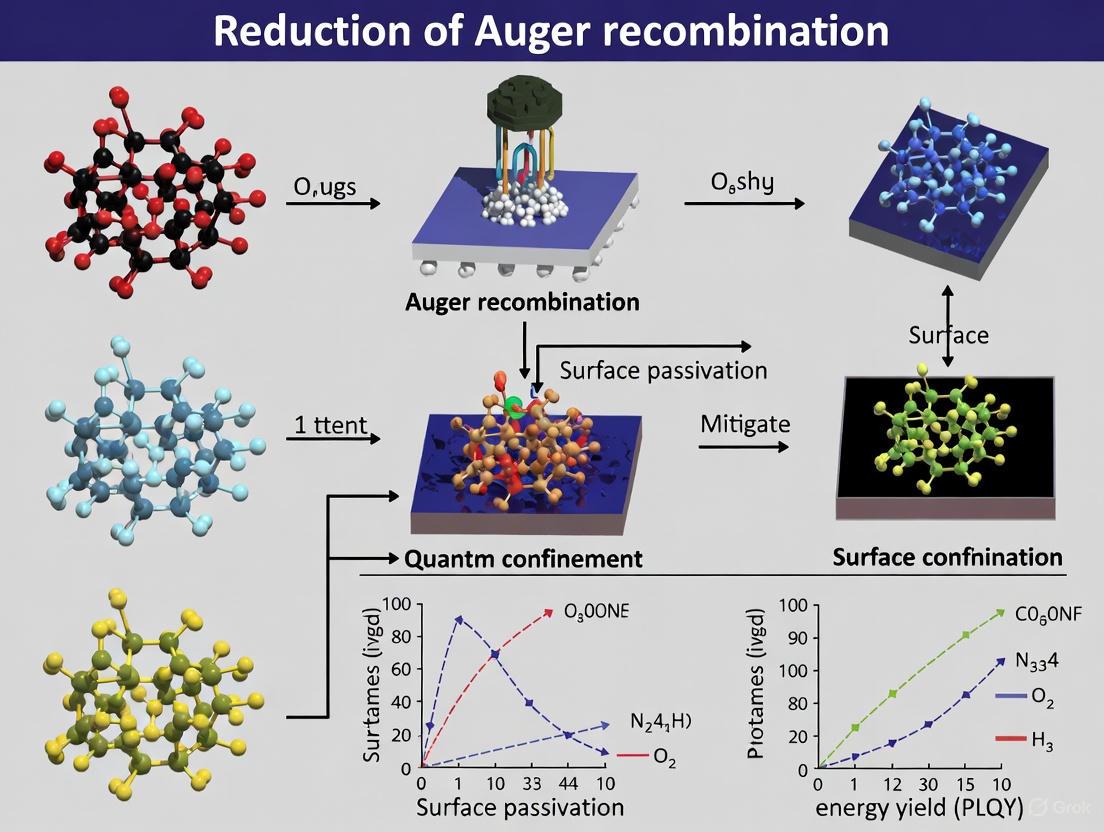
Auger recombination is a critical non-radiative process that plagues perovskite quantum dots (QDs), leading to efficiency roll-off in light-emitting devices and limiting their performance in biomedical applications.
Strategies for Reducing Auger Recombination in Perovskite Quantum Dots: From Fundamentals to Biomedical Applications
Abstract
Auger recombination is a critical non-radiative process that plagues perovskite quantum dots (QDs), leading to efficiency roll-off in light-emitting devices and limiting their performance in biomedical applications. This article provides a comprehensive analysis of the mechanisms and impacts of Auger recombination, exploring advanced suppression strategies including compositional engineering, surface passivation, and dielectric confinement manipulation. We examine methodological breakthroughs that enhance photoluminescence quantum yield and operational stability, while addressing troubleshooting approaches for defect management and synthesis optimization. Furthermore, we present a comparative evaluation of perovskite QDs against other nanomaterials, discussing validation techniques and the ongoing challenges for clinical translation in drug delivery and bioimaging.
Understanding Auger Recombination: Fundamentals and Challenges in Perovskite QDs
Troubleshooting Guide: Auger Recombination in Quantum-Confined Systems
Symptom: Efficiency Droop in Light-Emitting Devices
Problem: Device efficiency decreases significantly at high current densities or excitation levels.
- Underlying Cause: Auger recombination becomes the dominant decay pathway at high carrier densities, outcompeting radiative recombination. Its rate scales with the cube of the carrier density (R~n³), making it severely impact performance under high injection conditions [1] [2].
- Diagnostic Check: Measure external quantum efficiency (EQE) as a function of injection current. A distinct peak at low current followed by a rapid decrease indicates efficiency droop.
- Solution: Implement band structure engineering to reduce the Auger coefficient. For quasi-2D perovskites, using polar organic cations like p-fluorophenethylammonium (p-FPEA+) can reduce exciton binding energy, suppressing Auger rates by more than an order of magnitude [3].
Symptom: Photoluminescence Blinking in Single Quantum Dot Studies
Problem: Random switching between bright and dim emission states in single-particle tracking.
- Underlying Cause: Random charging/discharging events create charged excitons (trions) that undergo rapid non-radiative Auger recombination [4] [5].
- Diagnostic Check: Perform single-dot fluorescence correlation spectroscopy to identify characteristic "on" and "off" times.
- Solution: Use heterostructured quantum dots with alloyed interfacial layers (e.g., CdSe/CdSeS/CdS core/alloy/shell). The smoothed confinement potential suppresses Auger recombination by reducing wavefunction overlap [6] [4].
Symptom: Reduced Open-Circuit Voltage in Solar Cells
Problem: Lower-than-expected open-circuit voltage (VOC) under concentrated sunlight.
- Underlying Cause: Auger recombination in heavily doped regions or at high carrier concentrations reduces charge carrier lifetimes [2].
- Diagnostic Check: Measure carrier lifetime as a function of injection level; cubic dependence indicates Auger dominance.
- Solution: Optimize doping profiles and implement passivation techniques to reduce the intrinsic Auger coefficient. For conductive quantum-dot solids, minimize energy disorder to prevent carrier congregation in "Auger hot spots" [7].
Frequently Asked Questions (FAQs)
Q1: What exactly is Auger recombination and why is it problematic for quantum-confined systems?
Auger recombination is a non-radiative process where an electron and hole recombine, but instead of emitting a photon, the energy is transferred to a third carrier (electron or hole) which is excited to a higher energy state [1] [8]. This process is particularly efficient in quantum-confined systems due to enhanced Coulomb interactions and spatial confinement, leading to significant efficiency losses in optoelectronic devices at operational carrier densities [2] [4].
Q2: How does Auger recombination cause efficiency droop in LEDs?
In LEDs, as current density increases, carrier concentration in the active region rises. Since the Auger recombination rate scales with the cube of carrier density (R~n³), it becomes dominant at high injection levels, causing a sublinear increase in light output power and decreasing overall efficiency—a phenomenon known as "efficiency droop" [2]. This is especially problematic in blue and green LEDs where Auger coefficients are typically higher.
Q3: What experimental techniques can detect and quantify Auger recombination?
- Time-resolved photoluminescence (TRPL): Measures carrier decay dynamics; fast components at high excitation indicate Auger processes [6].
- Transient absorption (TA) spectroscopy: Monitors bleach recovery dynamics; accelerated decay at high fluences reveals Auger recombination [7].
- Electron emission spectroscopy: Directly detects energetic Auger electrons emitted from devices under electrical injection [1].
- Photoconductance decay: Higher-order dependence on carrier density indicates Auger dominance [7].
Q4: What strategies effectively suppress Auger recombination in perovskite quantum dots?
- Dielectric constant engineering: Using polar organic cations (e.g., p-FPEA+) to reduce dielectric confinement and exciton binding energy [3].
- Surface passivation: Strong-binding ligands like 2-hexyldecanoic acid (2-HA) passivate surface defects and suppress biexciton Auger recombination [9].
- Interface alloying: Creating graded core/alloy/shell structures to smooth confinement potentials and reduce wavefunction overlaps [6] [4].
- Charge balance engineering: Modifying shell composition to impede unbalanced carrier injection and reduce trion formation [6].
Quantitative Data on Auger Recombination
Table 1: Experimentally Determined Auger Coefficients for Various Materials
| Material System | Auger Coefficient (cm⁶/s) | Measurement Method | Reference |
|---|---|---|---|
| Quasi-2D Perovskite (p-FPEA⁺) | ~1-2 × 10⁻³¹ | TRPL & recombination kinetics | [3] |
| In₀.₁₀Ga₀.₉₀N/GaN | 1.5 × 10⁻³⁰ | Device performance modeling | [1] |
| InGaN/GaN | 3.5 × 10⁻³¹ | Electro-optical characterization | [1] |
| CdSe/CdS Core/Shell QDs | Varies with geometry: 10⁸-10⁹ s⁻¹ (rate) | Single-dot spectroscopy | [4] |
Table 2: Biexciton Lifetimes in Engineered Quantum Dots
| Quantum Dot Structure | Biexciton Lifetime (τXX) | Auger Rate Enhancement | Reference |
|---|---|---|---|
| InP/1CdS (1.6 ML shell) | 58 ± 12 ps | Baseline | [5] |
| InP/4CdS (5.6 ML shell) | 99 ± 5 ps | 1.7× slower | [5] |
| InP/7CdS (8.2 ML shell) | 612 ± 49 ps | 10.6× slower | [5] |
| InP/10CdS (11.4 ML shell) | 7,212 ± 1,073 ps | 124× slower | [5] |
Experimental Protocols for Auger Characterization
Protocol 1: Time-Resolved Photoluminescence for Auger Coefficient Extraction
- Sample Preparation: Deposit quantum dot films on quartz substrates using spin-coating to create optically smooth surfaces.
- Excitation Source: Use a pulsed laser system (e.g., Ti:Sapphire) with tunable wavelength and pulse width <100 fs.
- Excitation Density Variation: Systematically vary laser fluence from 10⁻³ to >1 excitons per QD, carefully measuring absorbed photons.
- Lifetime Analysis: Fit decay traces with multi-exponential models; extract fast components attributed to Auger processes.
- Auger Coefficient Calculation: Plot decay rate vs. carrier density squared; slope yields Auger coefficient using Rᴬᵘᵍᵉʳ = C·n³ [3] [4].
Protocol 2: Single Quantum Dot Blinking Suppression Assessment
- Sample Preparation: Dilute QD solution and spin-coat on cover slides for single-particle isolation.
- Microscopy Setup: Use confocal microscope with high-NA objective and sensitive single-photon detectors.
- Data Acquisition: Record fluorescence time traces (typically 5-10 minutes) with 10-100 ms time bins.
- Blinking Analysis: Calculate probability density functions of "on" and "off" times from intensity trajectories.
- Auger Suppression Validation: Compare trion lifetimes from blinking dynamics; longer "off" times indicate suppressed Auger recombination [4] [5].
Visualization of Auger Processes and Suppression Strategies
Diagram 1: Auger Recombination Process and Mitigation Strategies. The flowchart illustrates the multi-step nature of Auger recombination and how specific engineering strategies target different stages of the process to suppress non-radiative losses.
Research Reagent Solutions for Auger Suppression
Table 3: Key Reagents for Suppressing Auger Recombination in Perovskite Quantum Dots
| Reagent/Chemical | Function in Auger Suppression | Application Protocol | Key Benefit |
|---|---|---|---|
| p-Fluorophenethylammonium (p-FPEA⁺) | Reduces dielectric confinement and exciton binding energy | Incorporate as A-site cation in quasi-2D perovskite synthesis | Lowers Auger rate by >10× [3] |
| 2-Hexyldecanoic Acid (2-HA) | Surface ligand with strong binding affinity | Replace oleic acid during QD synthesis or post-treatment | Suppresses biexciton Auger recombination [9] |
| Acetate (AcO⁻) anions | Dual-function: complete precursor conversion & surface passivation | Add to cesium precursor solution during QD synthesis | Enhances reproducibility and reduces trap states [9] |
| CdSe₀.₅S₀.₅ alloy interfacial layer | Smoothes core/shell confinement potential | Grow intermediate layer between core and shell in QD synthesis | Reduces wavefunction overlap for Auger processes [6] |
Core Concepts FAQ
What are efficiency roll-off and limited brightness in the context of perovskite quantum dot (QD) light-emitting devices?
Efficiency roll-off is the undesirable decrease in a device's external quantum efficiency (EQE) as the driving current or brightness increases. Limited brightness refers to the challenge in achieving high luminance levels before this efficiency drop becomes severe or the device degrades. In perovskite QD light-emitting diodes (PeLEDs), these phenomena are primarily driven by Auger recombination, a non-radiative process where the energy from recombining an electron and hole is transferred to a third carrier (another electron or hole) instead of being emitted as light [3] [10]. This process becomes dominant at high excitation densities, quenching light output and limiting performance.
Why is Auger recombination particularly problematic in quantum-confined systems like perovskite QDs?
Quantum confinement in nanocrystals exacerbates Auger recombination through two main mechanisms:
- Enhanced Coulomb Interaction: The strong spatial confinement of electrons and holes within a small volume increases their Coulomb interaction, directly accelerating the Auger recombination rate [10].
- Defect-Mediated Auger Recombination: Deep-level defects, common in mixed-halide perovskites, can trap charge carriers. These trapped charges facilitate the formation of charged excitons (trions), which undergo very fast Auger recombination, often within picoseconds [10]. This defect-mediated pathway significantly contributes to high Auger recombination rates, even under modest excitation.
Troubleshooting Guides
Diagnosing Efficiency Roll-Off
Problem: Your PeLED shows high efficiency at low current densities but suffers a severe efficiency drop as current increases.
| Observation | Possible Cause | Experimental Investigation |
|---|---|---|
| Rapid roll-off at low to medium brightness | High defect density leading to defect-mediated Auger recombination [10] | Time-resolved PL (TRPL) and transient absorption (TA) to measure carrier trapping dynamics (trapping often occurs in 10 ps) [10]. |
| Severe roll-off and reduced operational stability | Significant triplet-polaron annihilation (TPA) and triplet-triplet annihilation (TTA) due to long-lived triplet states [11]. | Transient electroluminescence measurement to analyze exciton lifetime and identify long-delay tails [12] [13]. |
| Roll-off accompanied by reduced photoluminescence quantum yield (PLQY) | Incomplete surface passivation, leading to non-radiative recombination and charging of QDs [14]. | Measure PLQY under varying excitation densities; single-dot microscopy to observe PL blinking [14]. |
Achieving High Brightness
Problem: You are unable to achieve high brightness levels without significant efficiency loss or device degradation.
| Challenge | Root Cause | Validation Method |
|---|---|---|
| Threshold for amplified spontaneous emission (ASE) is too high | Auger recombination outcompetes radiative recombination, preventing population inversion [15] [10]. | Measure ASE threshold; fs-transient absorption to directly track Auger recombination rates [10]. |
| Brightness is limited by rapid degradation at high current | Joule heating induced by non-radiative Auger processes and exciton annihilation [3]. | Monitor device temperature and EQE stability under constant high current operation. |
| Emission color instability at high drive currents | Electric-field-induced dissociation of excitons or ion migration exacerbated by heat [12]. | Time-resolved emission spectra under electric field; measure spectral shift versus current density [12]. |
Experimental Protocols for Mitigation
Protocol: Surface Passivation to Suppress Defect-Mediated Auger Recombination
Objective: Passivate surface defects to reduce non-radiative recombination and suppress the formation of charged excitons that drive Auger recombination [15] [14].
Materials:
- CsPbBr₃ QDs synthesized via hot-injection or room-temperature method.
- Precursor: 2-Hexyldecanoic Acid (2-HA), a short-branched-chain ligand with strong binding affinity [15].
- Precursor: Acetate (AcO⁻) ions, which act as a co-passivator for dangling bonds [15].
- Solvents: Toluene, hexane, ethyl acetate.
- Phenethylammonium Bromide (PEABr) for solid-state ligand exchange to promote π-π stacking [14].
Methodology:
- QD Synthesis: Synthesize CsPbBr₃ QDs using a novel cesium precursor recipe combining AcO⁻ and 2-HA. The AcO⁻ improves precursor purity and passivates surface defects, while 2-HA provides a stable ligand coat [15].
- Purification: Purify the QDs by precipitation with anti-solvent (ethyl acetate) and centrifugation. Redisperse in toluene.
- Solid-State Ligand Engineering: a. Prepare a saturated solution of PEABr in a solvent like isopropanol. b. Mix the QD film with the PEABr solution and anneal at a mild temperature (e.g., 60-80°C) for 10-15 minutes. c. Rinse with pure solvent to remove excess ligands [14].
- Characterization:
Protocol: Reducing Exciton Binding Energy to Suppress Auger Recombination
Objective: Lower the exciton binding energy (Eb) to weaken electron-hole Coulomb interaction, thereby directly reducing the Auger recombination rate [3].
Materials:
- p-Fluorophenethylammonium (p-FPEA): A polar organic cation with a high dipole moment.
- PbBr₂, MABr, CsBr.
- Common solvents (DMF, DMSO, isopropanol).
Methodology:
- Solution Preparation: Prepare a precursor solution for quasi-2D perovskite (p-FPEA)₂MAn₋₁PbnBr₃n₊₁. The polar p-FPEA cation increases the dielectric constant of the organic barrier, weakening dielectric confinement and reducing Eb [3].
- Film Fabrication: Deposit the perovskite film via spin-coating onto the substrate. Use an anti-solvent drip to induce crystallization.
- Annealing: Anneal the film at an appropriate temperature (e.g., 90°C for 10 minutes) to form the crystalline phase.
- Characterization:
- Temperature-Dependent PL: Measure PL spectra at different temperatures to quantitatively extract the reduced Eb [3].
- Transient Absorption Spectroscopy: Confirm the reduction in Auger recombination rate, which can be one order of magnitude lower than PEA-based analogues [3].
- Device Performance: Fabricate PeLEDs and measure EQE and luminance. Devices should show a high peak EQE (>20%) and a record luminance (>80,000 cd m⁻²) due to suppressed roll-off [3].
Table 1: Impact of Different Strategies on Auger Recombination and Device Performance
| Strategy | Material System | Key Metric | Reported Performance | Reference |
|---|---|---|---|---|
| Ligand & Surface Engineering | CsPbBr₃ QDs with AcO⁻/2-HA | PLQYASE Threshold | 99%Reduced from 1.8 μJ·cm⁻² to 0.54 μJ·cm⁻² (70% decrease) | [15] |
| Reducing Eb with Polar Cations | (p-FPEA)₂MAn₋₁PbnBr₃n₊₁ | Auger Recombination RatePeak EQEMax Luminance | One-order-of-magnitude decrease vs. PEA+20.36%82,480 cd m⁻² | [3] |
| Deep-Level Defect Control | CsPb(Br/Cl)₃ NCs (Low defect) | ASE Threshold (Blue) | 25 μJ·cm⁻² | [10] |
| Ligand Tail Stacking | CsPbBr₃/I₃ QDs with PEA | Photostability | Nearly non-blinking for 12 hours under continuous laser excitation | [14] |
Table 2: Research Reagent Solutions for Advanced PeLED Development
| Reagent | Function | Key Property / Application |
|---|---|---|
| 2-Hexyldecanoic Acid (2-HA) | Surface ligand | Short-branched-chain ligand providing stronger binding affinity than oleic acid, improving passivation and suppressing Auger recombination [15]. |
| Acetate (AcO⁻) ions | Co-passivator & precursor additive | Dual-function: passivates dangling surface bonds and improves cesium precursor purity to enhance batch reproducibility [15]. |
| p-Fluorophenethylammonium (p-FPEA) | Polar organic cation | High dipole moment reduces dielectric confinement and exciton binding energy (Eb) in quasi-2D perovskites, suppressing Auger recombination [3]. |
| Phenethylammonium Bromide (PEABr) | Small-sized ligand for solid-state treatment | Promotes attractive π-π stacking between ligand tails, enabling near-epitaxial surface coverage and exceptional photostability in single QDs [14]. |
| Didodecyldimethylammonium Bromide (DDAB) | Surface ligand (colloidal stability) | Provides halide ions and passivates Pb²⁺ sites; effective for initial colloidal synthesis but may limit solid-state passivation due to bulky tails [14]. |
Mechanism and Workflow Visualizations
Diagram 1: Primary causes and effects of Auger recombination in PeLEDs.
Diagram 2: Multi-strategy workflow for high-performance PeLED development.
Frequently Asked Questions (FAQs)
What are the primary factors that influence Auger recombination rates in quantum-confined systems? Auger recombination rates are predominantly influenced by two key factors: the exciton binding energy (Eₕ) and the degree of quantum confinement. A higher exciton binding energy strengthens the Coulomb electron-hole interaction, which accelerates the Auger process [3]. Simultaneously, strong quantum confinement, typically in nanoparticles smaller than the exciton Bohr radius, increases the probability of carrier interactions, further enhancing Auger recombination rates [16] [10].
How can we experimentally reduce Auger recombination in quasi-2D perovskite films? Research demonstrates that Auger recombination can be suppressed by reducing the material's exciton binding energy. One effective method involves incorporating polar organic cations, such as p-fluorophenethylammonium (p-FPEA⁺), into the perovskite "A-site". This reduces the dielectric constant mismatch, weakening dielectric confinement and thus the binding energy. This approach has been shown to decrease the Auger recombination rate by more than an order of magnitude compared to non-polar analogues [3].
Does the "universal volume scaling law" for Auger recombination always apply? No, recent studies on high-quality, large perovskite nanocrystals in the weak confinement regime (where the nanocrystal size is larger than the exciton Bohr radius) have shown a significant deviation from the universal volume scaling law. In this regime, the Auger recombination lifetime increases exponentially with volume, rather than linearly, due to the emergence of nonlocal effects [16].
What is the role of deep-level defects in Auger recombination? Deep-level defects, particularly those associated with chlorine vacancies in mixed-halide perovskites, can profoundly enhance Auger recombination. These defects can capture electrons within 10 picoseconds, leading to the formation of charged separation states. Under quantum confinement, these excess charges bind with excitons to form trions (charged excitons), which provides a pathway for significantly enhanced Auger recombination, thereby increasing the threshold for achieving optical gain [10].
Troubleshooting Guides
Problem: Severe Efficiency Roll-Off in Perovskite Light-Emitting Diodes (PeLEDs)
Potential Cause: Rapid Auger recombination, often triggered by high exciton binding energy and amplified carrier density at recombination centers [3]. Solutions:
- Material Engineering: Replace standard organic cations (e.g., PEA⁺) with polar alternatives like p-FPEA⁺. This reduces the dielectric confinement and lowers the exciton binding energy, directly suppressing the Auger rate [3].
- Passivation: Implement a robust molecular passivation strategy post-Eb reduction. While lowering Eₕ also reduces the first-order exciton recombination rate, effective passivation suppresses trap-assisted nonradiative recombination, allowing high photoluminescence quantum yields (PLQYs) to be maintained across a broad range of excitation densities [3].
Problem: Low Amplified Spontaneous Emission (ASE) Performance and High Lasing Threshold
Potential Cause: Significant Auger recombination outcompeting radiative processes, exacerbated by either strong quantum confinement or deep-level defects [9] [10]. Solutions:
- Surface Ligand Engineering: Use ligands with strong binding affinity, such as 2-hexyldecanoic acid (2-HA), to effectively passivate surface dangling bonds. This suppresses non-radiative defect-assisted recombination and biexciton Auger recombination [9].
- Defect Density Management: For mixed-halide blue emitters, optimize the synthesis to minimize deep-level defects, particularly chlorine vacancies. A hot-injection method may yield lower defect density compared to room-temperature synthesis [10].
- Core/Shell Interface Alloying: Engineering an alloyed layer at the core/shell interface of quantum dots can smooth the confinement potential, which has been shown to effectively suppress Auger recombination [17].
Problem: Inconsistent Batch-to-Batch Performance of Perovskite Quantum Dots
Potential Cause: Poor reproducibility in nanocrystal synthesis, leading to variable defect densities and size distributions that affect Auger dynamics [9]. Solutions:
- Precursor Purity Control: Employ a dual-functional acetate (AcO⁻) in the cesium precursor recipe. The AcO⁻ anion aids in the more complete conversion of cesium salt, enhancing precursor purity from ~70% to over 98% and improving the homogeneity and reproducibility of the resulting quantum dots [9].
The following table summarizes key quantitative relationships and experimental data related to Auger recombination control.
Table 1: Experimental Data on Auger Recombination Suppression Strategies
| Factor & Strategy | Material System | Key Measurable Outcome | Quantitative Result | Citation |
|---|---|---|---|---|
| Reducing Exciton Binding Energy (Eₕ) | Quasi-2D Perovskite: p-FPEA₂MAₙ₋₁PbₙBr₃ₙ₊₁ | Auger Recombination Rate | Decreased by >10x vs. PEA⁺ analogue [3] | |
| Device Luminance | Record 82,480 cd m⁻² [3] | |||
| Peak External Quantum Efficiency | 20.36% [3] | |||
| Surface Ligand Passivation | CsPbBr₃ QDs with 2-hexyldecanoic acid (2-HA) | Photoluminescence Quantum Yield (PLQY) | 99% [9] | |
| Amplified Spontaneous Emission (ASE) Threshold | Reduced by 70% (1.8 μJ·cm⁻² to 0.54 μJ·cm⁻²) [9] | |||
| Weak Quantum Confinement | Large CsPbBr₃ Nanocrystals (1000 - 10000 nm³) | Biexciton Efficiency | Up to 80% [16] | |
| Auger Lifetime Scaling | Exponential increase with volume, deviating from universal volume scaling [16] | |||
| Deep-Level Defect Control | CsPb(BrₓCl₁₋ₓ)₃ Nanocrystals | Blue ASE Threshold | 25 μJ·cm⁻² (achieved under low defect density) [10] |
Experimental Protocols
Protocol A: Reducing Auger Recombination via Exciton Binding Energy Engineering in Quasi-2D Perovskites
This protocol is based on the work by Jiang et al. (2021) [3].
- Solution Preparation: Prepare precursor solutions using standard methods for quasi-2D PEA₂MAₙ₋₁PbₙBr₃ₙ₊₁ perovskites.
- Cation Substitution: Synthesize the polar organic cation p-fluorophenethylammonium (p-FPEA⁺). Substitute the standard PEA⁺ cation with p-FPEA⁺ in the precursor solution to form p-FPEA₂MAₙ₋₁PbₙBr₃ₙ₊₁.
- Film Deposition: Deposit the perovskite film onto your substrate using a suitable method (e.g., spin-coating).
- Post-Treatment/Passivation: Immediately after film deposition, apply a suitable passivation agent (specifics may vary) to suppress trap-assisted nonradiative recombination that becomes more impactful after Eₕ is reduced.
- Characterization:
- Use temperature-dependent photoluminescence (PL) to quantitatively measure the reduction in exciton binding energy.
- Perform time-resolved PL or ultrafast spectroscopy to measure recombination kinetics and confirm the suppression of the Auger recombination rate.
Protocol B: Suppressing Auger Recombination in Quantum Dots via Ligand Engineering
This protocol synthesizes methods from Bi et al. (2025) and Cai et al. [9] [10].
- Precursor Optimization: For CsPbBr₃ QD synthesis, use a cesium precursor recipe combining cesium carbonate (Cs₂CO₃) with a dual-functional acetate (AcO⁻) source and 2-hexyldecanoic acid (2-HA) as a short-branched-chain ligand instead of oleic acid.
- Synthesis: Execute the synthesis via the hot-injection method to ensure higher crystallinity and lower defect density compared to room-temperature methods.
- Purification: Purify the resulting QDs using standard solvents like ethyl acetate or methyl acetate.
- Characterization:
- Measure the PLQY to confirm high emission efficiency (~99%).
- Perform femtosecond transient absorption (TA) spectroscopy to directly probe multi-exciton dynamics and quantify the Auger recombination rate.
- Test ASE performance by measuring the excitation threshold required to achieve optical gain.
Conceptual Diagrams
Diagram 1: Strategies to Suppress Auger Recombination
The Scientist's Toolkit: Research Reagent Solutions
Table 2: Essential Materials for Controlling Auger Recombination
| Reagent / Material | Function in Experiment | Key Property / Rationale |
|---|---|---|
| p-Fluorophenethylammonium (p-FPEA⁺) Iodide/Bromide | Polar organic A-site cation in quasi-2D perovskites. | High dipole moment (~2.39 D) reduces dielectric confinement and exciton binding energy, suppressing Auger recombination [3]. |
| 2-Hexyldecanoic Acid (2-HA) | Short-branched-chain surface ligand for QDs. | Stronger binding affinity to QD surface than oleic acid, providing superior passivation of surface defects and suppression of biexciton Auger recombination [9]. |
| Acetate (AcO⁻) Salts | Additive in cesium precursor or surface ligand. | Dual-function: improves cesium precursor purity and completeness of reaction, and acts as a surface passivant for dangling bonds [9]. |
| Lead Acetate Trihydrate (Pb(AC)₂·3H₂O) | Lead precursor for nanocrystal synthesis. | High-purity precursor that can help reduce the formation of lead-based by-products, improving batch reproducibility [10]. |
Troubleshooting Guide: Identifying and Mitigating Defect-Auger Recombination
This guide helps diagnose and resolve the issue of accelerated non-radiative losses in perovskite quantum dots (QDs) caused by deep-level defects.
Problem: My perovskite quantum dot films show a rapid drop in photoluminescence quantum yield (PLQY) under moderate excitation, and my devices suffer from severe efficiency roll-off.
Question 1: How can I confirm that deep-level defects are accelerating Auger recombination in my samples?
Answer: Deep-level defects act as ultrafast trapping centers, creating a pathway for enhanced Auger recombination. To confirm their role, perform the following diagnostic experiments:
- Perform Time-Resolved Optical Characterization: Use time-resolved photoluminescence (TRPL) and femtosecond transient absorption (fs-TA) spectroscopy. A very fast carrier trapping component (often within 10 ps) is a key signature of deep-level defect activity [10]. These measurements track how quickly photogenerated excitons are captured by defect states.
- Conduct Temperature-Dependent PL Measurements: Analyze how the PL intensity and decay dynamics change with temperature. Deep-level defects often exhibit distinct thermal activation energies. An increase in non-radiative losses at higher temperatures can indicate the involvement of these defects [10].
- Look for Signature Dynamics in Pump-Probe Signals: In transient absorption or reflection measurements, a rapid signal decay followed by a slow component can indicate the capture and subsequent slow release of carriers from trap states. The saturation of this trapping effect at high excitation densities can be used to estimate the defect density itself [18].
Question 2: What specific chemical defects should I look for in mixed-halide perovskite nanocrystals?
Answer: In mixed chlorine-bromine systems, the primary culprit is often the chlorine-related deep-level defect, such as a vacancy (V₍Cl₎) or an antisite defect [10]. These defects are characterized by:
- Rapid charge carrier capture (on the timescale of picoseconds).
- Preferential electron trapping, which leads to the formation of charge-separated states [10].
- Under quantum confinement, these trapped charges can bind with excitons to form charged excitons (trions), providing a pathway for efficient, non-radiative Auger recombination [10].
Question 3: What practical strategies can I use to suppress defect-mediated Auger recombination?
Answer: The most effective strategy is a combination of defect passivation and material engineering.
- Implement Robust Surface Passivation: This is the most direct method. Use ligands with strong binding affinity to the QD surface to tie up "dangling bonds" that cause deep-level defects.
- Recommended Reagents: Short-branched-chain ligands like 2-hexyldecanoic acid (2-HA) demonstrate stronger binding than traditional oleic acid, effectively suppressing non-radiative recombination and biexciton Auger recombination [9]. Acetate ions (AcO⁻) can also function as effective surface ligands, enhancing passivation [9].
- Reduce Dielectric Confinement: The strong electron-hole interaction in quasi-2D perovskites exacerbates Auger rates. You can reduce the exciton binding energy (E₆), which is proportional to the Auger rate, by using polar organic cations.
- Example: Replacing phenethylammonium (PEA+) with p-fluorophenethylammonium (p-FPEA+) creates a high-polarity environment, weakening dielectric confinement. This has been shown to reduce the Auger recombination rate by more than an order of magnitude [3].
- Optimize Precursor Synthesis and Purity: Inconsistent precursor quality introduces defects. Employ synthesis recipes that ensure high precursor purity and complete conversion. For example, using acetate-assisted synthesis for cesium precursors can increase purity from ~70% to over 98%, leading to superior homogeneity and fewer defects in the final QDs [9].
Frequently Asked Questions (FAQs)
FAQ 1: What is the fundamental mechanism linking deep-level defects to Auger recombination?
Answer: Deep-level defects do not typically cause a direct, band-to-band Auger process. Instead, they act as a critical intermediate. The mechanism involves three key steps [10]:
- Ultrafast Trapping: A deep-level defect (e.g., a chlorine vacancy) preferentially captures an electron on an ultrafast timescale (~10 ps).
- Charge Separation: This trapping event creates a long-lived, charge-separated state (a trapped electron and a free hole).
- Trion-Driven Auger Recombination: Under quantum confinement, this charged defect site can bind a neutral exciton, forming a trion (a three-particle complex). The recombination of this trion is an Auger process, where the energy is transferred to the third carrier, which is then excited to a higher energy state within the band.
FAQ 2: My perovskite films have high PLQY at low excitation, but it drops sharply. Is this a sign of defect-Auger problems?
Answer: Yes, this is a classic symptom. A high PLQY at low excitation indicates that shallow defects are effectively passivated or saturated. The sharp drop at higher excitation is a direct result of Auger recombination becoming the dominant loss channel. When deep-level defects are present, this threshold for "efficiency droop" occurs at even lower carrier densities because the defects actively facilitate the Auger process [10] [3].
FAQ 3: Are there quantitative benchmarks for Auger coefficients in perovskites?
Answer: Yes, experimental measurements have provided the following ranges for Auger coefficients (C) in various perovskite materials. This table can help you benchmark your own findings.
| Material System | Auger Coefficient (cm⁶/s) | Measurement Context |
|---|---|---|
| Quasi-2D Perovskite (p-FPEA+) | ~ 1 x 10⁻³¹ (estimated) | One-order lower than PEA+ analogue; low droop [3]. |
| InGaN/GaN (for comparison) | ~ 1.5 x 10⁻³⁰ to 3.5 x 10⁻³¹ [1] | Common in high-performance LEDs. |
| CsPb(Br/Cl)₃ NCs (with defects) | Significantly enhanced | Defect-mediated process [10]. |
FAQ 4: Can I distinguish defect-assisted Auger recombination from other non-radiative pathways?
Answer: Absolutely. The key differentiator is the carrier density dependence of the recombination rate.
- Shockley-Read-Hall (Trap) Recombination: Rate is proportional to carrier density (n).
- Radiative Recombination: Rate is proportional to n².
- Band-to-Band Auger Recombination: Rate is proportional to n³.
- Defect-Assisted Auger Recombination: In the "saturation regime" where the defect states are filled, the rate can be proportional to n², mimicking bimolecular recombination. This quadratic dependence under high injection can be a tell-tale sign of this specific mechanism [19].
The Scientist's Toolkit: Research Reagent Solutions
This table lists key materials used in advanced perovskite QD research to suppress defect-mediated Auger recombination.
| Research Reagent / Material | Function / Role in Suppressing Defect-Auger Recombination |
|---|---|
| p-Fluorophenethylammonium (p-FPEA+) Iodide/Bromide | A polar organic cation that reduces dielectric confinement and exciton binding energy, directly lowering the Auger recombination rate [3]. |
| 2-Hexyldecanoic Acid (2-HA) | A short-branched-chain ligand with stronger binding affinity to QD surfaces than oleic acid, providing superior surface passivation and suppressing biexciton Auger recombination [9]. |
| Acetate Salts (e.g., Cesium Acetate) | Serves a dual role: improves precursor purity and completeness of reaction to reduce defect formation, and acts as a surface passivant for dangling bonds [9]. |
| Lead Acetate Trihydrate | A high-purity lead precursor often used in combination with acetate salts to create a "clean" reaction environment with fewer intrinsic defects [10]. |
Experimental Protocol: Time-Resolved Characterization of Defect and Auger Dynamics
Objective: To measure the carrier trapping time by deep-level defects and the subsequent Auger recombination rate in perovskite quantum dot films.
Materials:
- Synthesized perovskite QD film sample (e.g., CsPb(BrxCl1-x)3).
- Femtosecond laser system (e.g., Ti:Sapphire amplifier).
- Transient absorption spectrometer or time-resolved photoluminescence setup.
- Cryostat for temperature-dependent measurements.
Methodology:
- Sample Preparation: Spin-coat your QD solution onto a clean substrate (e.g., quartz) to form a smooth, solid film. Ensure the film is encapsulated if sensitive to ambient conditions.
- Transient Absorption Measurement:
- Set the pump laser wavelength to above the bandgap to generate electron-hole pairs.
- Use a white-light continuum probe to monitor the differential transmission (ΔT/T) or absorption (ΔA) over a broad spectral range.
- Collect data at multiple pump fluences, from low (where trap-filling is minimal) to high (where Auger dominates).
- Data Analysis Workflow:
- Identify the Bleach Peak: Locate the ground-state bleach (GSB) feature of the exciton in the transient spectra.
- Fit the Kinetics: Fit the decay kinetics of the GSB at various pump fluences with a multi-exponential or physical model.
- The fastest component (1-30 ps) is typically assigned to carrier trapping by deep-level defects [10] [18].
- The fluence-dependent decay component at higher excitation is attributed to Auger recombination. Its cubic dependence (for band-to-band) or quadratic dependence (for defect-assisted) on carrier density can be used to extract the Auger coefficient.
The following diagram visualizes this experimental workflow and the physical processes it reveals:
Troubleshooting Guides
Transient Absorption Spectroscopy Troubleshooting Guide
| Problem | Possible Causes | Recommended Solutions | Relevant to Auger Recombination Studies |
|---|---|---|---|
| Poor Signal-to-Noise Ratio (SNR) [20] | Low repetition rate lasers, electronic noise, probe light intensity drift, low pump fluence. | Use noise suppression technologies (NSTs); Average multiple measurements; Ensure laser stability. [20] | Essential for detecting weak signals from suppressed Auger processes. |
| Scattered Excitation Light in Data [21] | Pump laser wavelength within optical detection window. | Use software's "Subtract Scattered Light" function; Average multiple background spectra for correction. [21] | Cleans data for accurate kinetic fitting of Auger components. |
| Sample Degradation [20] | High pump fluence causing non-linear effects and photodegradation. | Reduce pump fluence; Use flow cells or raster scanning for sensitive samples (e.g., Perovskite QDs). [20] | Prevents misleading recombination kinetics from altered samples. |
| Incorrect Interpretation of ΔA Features [21] | Misassignment of positive (ESA) and negative (GSB, SE) signals. | Correlate GSB with steady-state absorption; Note SE matches fluorescence shape. [21] | Critical for identifying band-filling from high carrier densities in Auger analysis. |
Time-Resolved Photoluminescence Troubleshooting Guide
| Problem | Possible Causes | Recommended Solutions | Relevant to Auger Recombination Studies |
|---|---|---|---|
| Measuring Fast Decay Processes [22] | Fluorescence lifetimes too short for conventional photodetectors (e.g., picosecond, femtosecond scales). | Use pump-probe techniques instead of direct detection. [22] | Necessary for resolving fast Auger recombination lifetimes. |
| Deviation from Quadratic IPL0 vs. Density [23] | Dominance of Auger recombination at high carrier densities. | Perform fluence-dependent TRPL; Fit data with rate equations including n³ term. [23] | Directly quantifies Auger recombination coefficient. |
| Low Photoluminescence Quantum Yield (PLQY) [9] | Defect-assisted non-radiative recombination, Auger recombination. | Passivate surface defects with appropriate ligands (e.g., 2-hexyldecanoic acid, acetate). [9] | Enhancing PLQY is directly linked to suppressing non-radiative Auger pathways. |
Frequently Asked Questions (FAQs)
Q1: What is the fundamental difference between Transient Absorption (TA) and Time-Resolved PL (TRPL) spectroscopy? TA measures time-dependent changes in a sample's absorption (ΔA) following photoexcitation, allowing observation of both emissive and non-emissive (dark) states like triplets and charge-separated states [20]. TRPL measures the time-dependent emission of light from a sample, providing information about the population of radiative excited states [22]. For perovskite quantum dot studies, TA can track charge carriers and excited-state absorption, while TRPL directly probes the decay of luminescent states, together offering a complete picture of recombination pathways, including Auger recombination [23].
Q2: How can I determine if Auger recombination is significant in my perovskite quantum dot sample? The key indicator is a superlinear decay in the TRPL traces at high excitation fluences. Specifically, plot the initial PL intensity (IPL₀) against the carrier density. A transition from a quadratic dependence (indicative of bimolecular recombination) to a sub-quadratic dependence signals the growing dominance of Auger recombination, a three-body non-radiative process [23]. Additionally, a rapid drop in relative PLQY with increasing carrier density is a characteristic signature of Auger recombination [23].
Q3: My TA data shows a sharp, negative feature that doesn't change with time. What is this likely to be? This is a classic sign of scattered excitation light [21]. It appears as a sharp, non-decaying negative (bleach-like) feature at the wavelength of your pump laser or its diffraction orders. Most TA analysis software (e.g., Surface Xplorer) includes a "Subtract Scattered Light" function to correct for this artifact [21].
Q4: What are some material design strategies to suppress Auger recombination in perovskite QDs, and how can I verify them spectroscopically? Recent advances include:
- Surface Passivation: Using ligands with stronger binding affinity (e.g., 2-hexyldecanoic acid over oleic acid) to passivate surface defects that facilitate Auger recombination [9].
- Anion Engineering: Incorporating electron-withdrawing anions like trifluoroacetate (TFA⁻) to decouple electron-hole wavefunctions, thereby retarding Auger recombination [23].
- Cation Doping: Doping with ions like Indium (In³⁺) to passivate defects and modify crystal structure, suppressing defect-mediated and phonon-assisted Auger recombination [24].
- Verification: Success is verified by a reduced Auger recombination constant extracted from fluence-dependent TRPL, a higher carrier density tolerance in PLQY measurements, and in TA, a reduced amplitude of decay components associated with many-body interactions [23] [24].
Experimental Protocols
Protocol for TA Spectroscopy to Probe Auger Recombination
This protocol is adapted from established methodologies for processing and fitting TA data [21] [23].
1. Sample Preparation:
- Prepare perovskite QD films or solutions with optimized surface chemistry to minimize extrinsic defects [9].
- For solutions, use a stirred flow cell to prevent local heating and degradation during high-repetition-rate measurements [20].
2. Data Collection:
- Collect a "blank" dataset (solvent only) under identical experimental conditions for later artifact correction [21].
- Perform measurements at a range of pump fluences to vary the initial photoexcited carrier density (N). This is crucial for isolating the N³-dependent Auger recombination.
3. Data Processing:
- Load Data: Import the SAMPLE dataset into your analysis software (e.g., Surface Xplorer, Glotaran) [21].
- Subtract Scattered Light: If a sharp, static negative feature is present at the pump wavelength, use the "Subtract Scattered Light" function, averaging ~10 background spectra for a stable correction [21].
- Chirp Correction: Correct for temporal chirp if using a broadband white-light probe to ensure kinetics are aligned across all wavelengths.
4. Global Lifetime Analysis (GLA):
- GLA fits the entire dataset (wavelength and time) simultaneously to a model of decaying components.
- The output is a set of Decay-Associated Difference Spectra (DADS) which show the spectral signature of each decay component.
- A component with a positive DADS that decays faster at higher fluences may be associated with Auger recombination.
Protocol for Fluence-Dependent TRPL
This protocol is used to extract recombination constants, including the Auger coefficient [23].
1. Data Collection:
- Measure TRPL decays at multiple, carefully controlled excitation fluences.
- Ensure the carrier density (N) spans from the low regime (where monomolecular decay may dominate) to the high regime (where bimolecular and Auger recombination are prominent).
2. Data Fitting and Analysis:
- Fit the TRPL decay curves, I(t), to a kinetic model. The simplest form is a rate equation where the decay rate is the derivative of the carrier density:
dn/dt = -k₁n - k₂n² - k₃n³Here,k₁is the monomolecular (defect) recombination constant,k₂is the bimolecular recombination constant, andk₃is the Auger recombination constant. - Plot the initial PL intensity (Iₚₗ₀) as a function of N. The power-law exponent reveals the dominant process: ~1 for monomolecular, ~2 for bimolecular, and a roll-off to <2 for Auger-dominated decay at high N [23].
Experimental Workflow and Data Interpretation
Experimental Workflow for Auger Recombination Study
Data Interpretation Pathway for TA Spectroscopy
The Scientist's Toolkit: Research Reagent Solutions
Key Materials for Optimizing Perovskite QDs to Suppress Auger Recombination
| Material / Reagent | Function in Reducing Auger Recombination | Example from Literature |
|---|---|---|
| 2-Hexyldecanoic Acid (2-HA) [9] | A short-branched-chain ligand with stronger binding affinity than oleic acid, effectively passivating surface defects and suppressing biexciton Auger recombination. [9] | Use in CsPbBr₃ QD synthesis led to a high PLQY of 99% and a 70% reduction in ASE threshold. [9] |
| Acetate (AcO⁻) Anions [9] | Acts as a dual-functional surface ligand, passivating dangling surface bonds and improving precursor purity, leading to enhanced homogeneity and reduced defect density. [9] | Improved cesium precursor purity from 70.26% to 98.59%, enhancing batch-to-batch reproducibility. [9] |
| Trifluoroacetate (TFA⁻) Anions [23] | Electron-withdrawing anion that incorporates into 3D perovskites, decoupling electron-hole wavefunctions and thereby directly retarding Auger recombination. Also inhibits halide migration. [23] | In FAPbI₃ films, reduced Auger constant by an order of magnitude, enabling PeLEDs with negligible efficiency roll-off at high current densities. [23] |
| Indium (In³⁺) Dopant [24] | Dopant that passifies defects and modifies the bond angle in mixed-cation perovskites, diminishing phonon resonance intensity and suppressing defect-mediated and phonon-assisted Auger recombination. [24] | In SnO₂/M:In³⁺ heterostructures, positive electron extraction efficiency was maintained at high carrier densities, unlike undoped samples. [24] |
Advanced Suppression Strategies and Emerging Biomedical Applications
Troubleshooting Guides & FAQs
Frequently Asked Questions
Q1: How can I improve the batch-to-batch reproducibility of my perovskite quantum dot synthesis? A1: Low reproducibility often stems from incomplete precursor conversion and variable ligand binding. Implement a novel cesium precursor recipe combining dual-functional acetate (AcO⁻) and 2-hexyldecanoic acid (2-HA). AcO⁻ enhances precursor purity from ~70% to over 98%, while the short-branched-chain 2-HA provides stronger, more consistent binding to QD surfaces compared to oleic acid, yielding a photoluminescence quantum yield (PLQY) of 99% with a narrow emission linewidth of 22 nm [15].
Q2: What compositional strategies can suppress Auger recombination in blue-emitting perovskite nanocrystals? A2: Auger recombination is severe in blue emitters due to quantum confinement and deep-level defects. For mixed Cl/Br systems, deep-level defects associated with V˅Cl can capture carriers within 10 ps, enhancing Auger processes. Focus on synthesis methods that minimize these defects. Using a hot-injection method over room-temperature synthesis can yield nanocrystals with lower deep-level defect density, enabling pure blue amplified spontaneous emission (ASE) with a low threshold of 25 μJ cm⁻² [10].
Q3: How can I tune the bandgap of my perovskite film to the ideal range for single-junction solar cells? A3: Employ Pb-Sn mixed-halide compositional engineering. Formamidinium-based FAPb₁₋ₓSnₓ(I₀.₈Br₀.₂)₃ perovskites can target near-optimal bandgaps of ~1.4 eV. A Sn content of x = 0.4 has been shown to provide optimal photovoltaic performance, stabilizing the photoactive phase and promoting dense film formation [25].
Q4: What is a high-throughput method to screen perovskite compositions for stability? A4: Utilize automated platforms like HITSTA (High-Throughput Stability Testing Apparatus). This system can optically characterize and accelerate the aging of up to 49 thin-film samples simultaneously under controlled heat (up to 110 °C) and light intensity (2.2 suns), continuously monitoring absorptance and photoluminescence to assess stability and performance [26].
Troubleshooting Common Experimental Issues
Issue 1: Low Photoluminescence Quantum Yield (PLQY) and Poor Color Purity
- Potential Cause: High density of non-radiative defect states and inefficient surface passivation.
- Solution: Optimize surface ligand chemistry. A combination of acetate (AcO⁻) for passivating dangling bonds and 2-hexyldecanoic acid (2-HA) for strong binding affinity effectively suppresses non-radiative recombination and Auger recombination, leading to PLQY values up to 99% [15].
Issue 2: Rapid Efficiency Roll-off in Light-Emitting Diodes (PeLEDs)
- Potential Cause: Strong Auger recombination, prevalent in quasi-2D perovskites with high exciton binding energy (E˅b).
- Solution: Reduce the E˅b to suppress Auger rates. Incorporate polar organic cations like p-fluorophenethylammonium (p-FPEA⁺) into quasi-2D perovskites. This weakens dielectric confinement, reducing E˅b and thereby decreasing the Auger recombination rate by more than an order of magnitude, which mitigates efficiency roll-off at high brightness [3].
Issue 3: Phase Instability in Wide-Bandgap Perovskites
- Potential Cause: Halide segregation under stress, leading to phase impurities.
- Solution: Implement a bi-solvent engineering approach. For Cs₀.₁₇FA₀.₈₃PbI₁.₈Br₁.₂, using a binary solvent system (e.g., DMF with additives like DMSO or acetonitrile) improves film quality, suppresses halide segregation, enhances efficiency, and stability. The optimal ratio is unique for each secondary solvent [27].
Issue 4: Poor Environmental and Thermal Stability of Solar Cells
- Potential Cause: Intrinsic lattice instability and susceptibility to moisture/heat.
- Solution: Use mixed-metal chalcohalide alloying. Incorporating trivalent Sb³⁺ and divalent S²⁻ into FAPbI₃ enhances ionic binding energy and alleviates lattice strain. This promotes stable crystal growth, yielding PSCs with a PCE of 25.07% and excellent shelf-life stability (94.9% of initial PCE after 1080 hours in ambient conditions) [28].
Key Data Presentation
Auger Recombination Suppression & ASE Performance
Table 1: Strategies for Suppressing Auger Recombination in Perovskite Nanocrystals and Quasi-2D Films
| Material System | Engineering Strategy | Key Mechanism | Performance Improvement |
|---|---|---|---|
| CsPbBr₃ QDs [15] | AcO⁻ & 2-HA ligand combination | Enhanced precursor purity & surface defect passivation | ASE threshold reduced by 70% (from 1.8 μJ·cm⁻² to 0.54 μJ·cm⁻²) |
| Blue CsPb(BrₓCl₁₋ₓ)₃ NCs [10] | Suppression of Cl-related deep-level defects | Reduced defect-mediated charged exciton formation | Pure blue ASE achieved with a threshold of 25 μJ·cm⁻² |
| Quasi-2D PEA₂MAₙ₋₁PbₙBr₃ₙ₊₁ [3] | p-FPEA⁺ cation substitution | Reduced exciton binding energy (E˅b) | Auger recombination rate reduced by one order of magnitude |
Compositional Engineering for Solar Cells
Table 2: Performance of Compositionally Engineered Perovskite Solar Cells
| Perovskite Composition | Engineering Approach | Key Achievement | Stability Performance |
|---|---|---|---|
| FAPb₁₋ₓSnₓ(I₀.₈Br₀.₂)₃ [25] | Pb-Sn alloying; mixed halide | Near-optimal bandgap (~1.4 eV) for single-junction cells | Optimal performance at x=0.4 under ambient conditions |
| Sb³⁺/S²⁻ alloyed FAPbI₃ [28] | Mixed-metal chalcohalide alloying | PCE of 25.07% fabricated in ambient air | ~94.9% of initial PCE retained after 1080 h (unencapsulated, dark, 20-40% RH) |
| CsPbI₂Br [29] | Inorganic perovskite; transport layer optimization | Simulated PCE of 21.13% (FTO/MZO/CsPbI₂Br/CNTS/Au) | Enhanced thermal stability inherent to all-inorganic composition |
Experimental Protocols
Protocol 1: Synthesis of High-Quality CsPbBr₃ QDs with Low ASE Threshold
This protocol is adapted from the novel cesium precursor recipe for producing highly reproducible, high-PLQY QDs with excellent ASE performance [15].
1. Reagents:
- Cs₂CO₃, Lead bromide (PbBr₂), 1-Octadecene (ODE), Oleylamine (OAm), Oleic acid (OA), 2-Hexyldecanoic acid (2-HA), Acetate source (e.g., lead acetate trihydrate or ammonium acetate).
2. Synthesis Steps:
- Cesium Precursor Preparation: In a 50 mL flask, combine Cs₂CO₃, 2-HA, and ODE. Heat under vacuum at 120 °C for 60 minutes. Then, under N₂ atmosphere, heat to 150 °C until a clear solution is obtained. The use of 2-HA and acetate is critical for high-purity precursor.
- Perovskite QD Synthesis: In a separate 100 mL three-neck flask, mix PbBr₂, the acetate ligand, ODE, OA, and OAm. Heat under vacuum at 120 °C for 60 minutes. Under N₂, raise the temperature to 180 °C. Swiftly inject the pre-heated cesium precursor solution.
- Reaction and Purification: Allow the reaction to proceed for 5-10 seconds before cooling the mixture in an ice-water bath. Add ethyl acetate to precipitate the QDs. Centrifuge the mixture and redisperse the precipitate in hexane or toluene for further characterization.
3. Characterization:
- PLQY: Use an integrating sphere to measure absolute PLQY, targeting values near 99%.
- ASE Measurement: Spin-coat a dense film of QDs onto a clean substrate. Use a pulsed laser source (e.g., femtosecond, 400 nm) for excitation. Focus the beam to a stripe on the film using a cylindrical lens. Measure the output emission from the edge of the film as a function of pump fluence. The ASE threshold is identified as the point where the output intensity superlinearly increases.
Protocol 2: Fabrication of Stable, Mixed-Metal Chalcohalide FAPbI₃ Solar Cells
This protocol outlines a sequential ambient-air process for fabricating efficient and stable PSCs [28].
1. Reagents:
- Lead iodide (PbI₂), Formamidinium iodide (FAI), Antimony chloride (SbCl₃), Thiourea (TU), Dimethyl sulfoxide (DMSO), Solvent (DMF/NMP).
2. Fabrication Steps:
- Precursor Solution Preparation:
- PbI₂ + Sb-TU Solution: Dissolve PbI₂ and the SbCl₃-Thiourea complex (e.g., 1.0 mol%) in a mixed solvent of DMF and NMP.
- FAI Solution: Dissolve FAI in isopropanol.
- Film Deposition (Sequential Process):
- Spin-coat the PbI₂ + Sb-TU solution onto the pre-cleaned substrate (e.g., FTO/c-TiO₂/mp-TiO₂).
- Anneal the deposited film at 150 °C for 10 minutes.
- While the film is still hot, dynamically spin-coat the FAI solution onto it. This step facilitates the conversion to the perovskite phase.
- Anneal the final film again at 150 °C for 30-60 minutes to crystallize the Sb³⁺/S²⁻ alloyed FAPbI₃.
- Device Completion: Subsequently, deposit the hole transport layer (e.g., Spiro-OMeTAD) and metal electrode (e.g., Au) by thermal evaporation.
3. Characterization:
- XRD: Confirm the formation of the α-FAPbI₃ phase and check for the presence of residual PbI₂.
- J-V Characterization: Perform current density-voltage (J-V) measurements under standard AM 1.5G illumination to determine PCE, V˅OC, J˅SC, and FF.
- Stability Testing: Monitor the unencapsulated device performance over time when stored in the dark under controlled humidity (20-40% RH) at room temperature.
Visualization: Auger Recombination Suppression Pathways
The Scientist's Toolkit: Research Reagent Solutions
Table 3: Essential Reagents for Compositional Engineering and Defect Management
| Reagent / Material | Function / Role | Application Example |
|---|---|---|
| Acetate Salts (e.g., CH₃COO⁻) | Dual-functional: improves precursor conversion & passivates surface dangling bonds [15]. | Enhancing reproducibility & PLQY of CsPbBr₃ QDs. |
| 2-Hexyldecanoic Acid (2-HA) | Short-branched-chain ligand with stronger binding affinity than OA; suppresses Auger recombination [15]. | Surface ligand engineering for low-threshold ASE. |
| p-Fluorophenethylammonium (p-FPEA⁺) | Polar organic cation; reduces dielectric confinement and exciton binding energy (E˅b) [3]. | Suppressing Auger recombination in quasi-2D PeLEDs. |
| Antimony Chloride (SbCl₃) & Thiourea | Source of Sb³⁺ and S²⁻ for mixed-metal chalcohalide alloying; enhances lattice stability [28]. | Fabricating stable, high-efficiency FAPbI₃ solar cells in air. |
| Dimethyl Sulfoxide (DMSO) | Co-solvent in precursor ink; influences crystallization kinetics and final film morphology [27]. | Solvent engineering for high-quality wide-bandgap perovskite films. |
Surface passivation is a critical technology in the development of perovskite quantum dots (PQDs), directly addressing the challenges of stability and performance efficiency. For researchers and scientists focused on reducing Auger recombination—a dominant non-radiative loss process at high carrier densities—mastering these techniques is essential. This technical support center provides a practical guide to implementing these strategies, complete with troubleshooting advice and essential resources for your experimental work.
FAQs: Core Concepts and Problem Solving
1. How does surface passivation specifically help in reducing Auger recombination in PQDs?
Auger recombination is a non-radiative process where an electron and hole recombine, transferring their energy to another charge carrier. This process is particularly detrimental in devices like lasers and light-emitting diodes (LEDs) operating at high currents, as it causes efficiency roll-off. Surface passivation mitigates this by:
- Reducing Trap-Assisted Auger Processes: Unpassivated surface defects (dangling bonds) act as traps that promote Auger recombination. Effective passivation eliminates these trap states, thereby suppressing this loss pathway [30] [15].
- Engineering Core-Shell Structures: Applying a perovskite shell with a small band offset to the core quantum dot has been shown to increase the Auger lifetime by up to an order of magnitude. This specific band alignment suppresses the Auger rate without hindering charge confinement [31].
- Decreasing Exciton Binding Energy: In quasi-2D perovskites, introducing polar organic cations (e.g., p-fluorophenethylammonium) can reduce the dielectric confinement and lower the exciton binding energy (Eb). Since the Auger recombination rate is proportional to Eb, this reduction directly leads to a slower Auger process [3].
2. We are experiencing rapid fluorescence quenching in our CsPbBr3 QD films. What is a likely cause and solution?
Likely Cause: The problem often lies with the native long-chain insulating ligands (e.g., oleic acid, oleylamine) used in synthesis. These ligands create barriers that inhibit efficient charge transport between QDs in a solid film, leading to energy loss and quenching [32].
Solution: Implement a ligand exchange strategy.
- Detailed Protocol: A proven method involves a two-step ligand exchange to replace long carbon chain ligands with halide ion-pair ligands like di-dodecyl dimethyl ammonium bromide (DDAB) [32].
- Preparation: Synthesize CsPbBr3 QDs using standard hot-injection or room-temperature methods, resulting in QDs capped with oleic acid/oleylamine.
- Intermediate Desorption: Add a polar solvent (like ethyl acetate) to the QD solution to desorb the protonated oleylamine ligands partially. Centrifuge the mixture to obtain a pellet.
- Ligand Exchange: Redisperse the pellet in a non-polar solvent (e.g., toluene) containing the new short ligand (DDAB). Stir for several hours to allow the exchange.
- Purification: Precipitate and centrifuge the QDs to remove excess ligands and by-products.
- Troubleshooting Tip: Attempting direct ligand exchange without the intermediate desorption step can cause severe photoluminescence degradation. The intermediate step is crucial for maintaining high photoluminescence quantum yield (PLQY) [32].
3. Our PQD-based devices fail quickly when exposed to ambient air. How can we improve their operational stability?
Solution: Employ a shell encapsulation approach to create a physical barrier against environmental factors.
- Encapsulation in Hollow Silica Spheres: A highly effective method is encapsulating CsPbBr3 QDs within dual-shell hollow SiO₂ spheres via a successive ionic layer adsorption and reaction (SILAR) method [33].
- Synthesis of Silica Spheres: Prepare monodisperse silica spheres as a template.
- QD Loading: Infuse the perovskite precursors into the hollow spheres. The QDs form and are anchored on the interior shell surface.
- Sealing: A second silica shell is grown to seal the QDs inside.
- Performance Data: This encapsulation dramatically enhances stability, with the material retaining 89% of its PL intensity after 72 hours of continuous UV light exposure and 65% after heat treatment at 100°C [33].
- Alternative: Self-Encapsulation: Another strategy is to grow a protective laurionite-type PbX(OH) (X=Cl, Br) shell directly on the CsPbX3 QDs during room-temperature crystallization. This shell acts as a water-blocking layer, significantly improving stability in polar solvents [34].
4. Our QD synthesis results in inconsistent batch-to-batch quality and poor reproducibility. How can we address this?
Root Cause: Incomplete conversion of precursors and the formation of by-products during synthesis lead to inhomogeneity and defects [15].
Solution: Optimize the precursor recipe for higher purity and more robust ligand binding.
- Protocol for a Novel Cesium Precursor: Design a cesium precursor using a combination of dual-functional acetate (AcO⁻) and 2-hexyldecanoic acid (2-HA) as a short-branched-chain ligand [15].
- Function of AcO⁻: Acetate aids in the complete conversion of cesium salt, boosting precursor purity from ~70% to over 98%. It also acts as a surface ligand to passivate dangling bonds.
- Function of 2-HA: This ligand has a stronger binding affinity to the QD surface than oleic acid, leading to better passivation of surface defects and suppression of Auger recombination.
- Outcome: This recipe yields CsPbBr3 QDs with a narrow size distribution, a high PLQY of 99%, and an amplified spontaneous emission (ASE) threshold reduced by 70%, indicating suppressed non-radiative recombination [15].
Troubleshooting Guides
Table: Common Experimental Challenges and Solutions
| Problem Symptom | Possible Cause | Recommended Solution | Reference |
|---|---|---|---|
| Low PLQY in films | Long, insulating ligands hindering charge transport | Perform a two-step ligand exchange with short, conductive ligands (e.g., DDAB) | [32] |
| Efficiency drop (roll-off) in LEDs at high current | Severe Auger recombination | Reduce exciton binding energy using polar organic cations (e.g., p-FPEA+); Apply core-shell structures with small band offsets | [3] [31] |
| Degradation in polar solvents/ambient air | Lack of protective barrier | Encapsulate QDs in inorganic matrices (e.g., hollow SiO₂ spheres) or grow a self-encapsulating PbX(OH) shell | [34] [33] |
| High ASE/lasing threshold | Defect-assisted and Auger recombination | Use optimized precursors (AcO⁻, 2-HA) for defect passivation and Auger suppression | [15] |
| Poor batch-to-batch reproducibility | Impure precursors and inconsistent ligand binding | Employ a novel cesium precursor recipe with acetate and 2-HA to improve purity and binding | [15] |
Table: Quantitative Impact of Different Passivation Strategies
| Passivation Strategy | Material System | Key Performance Improvement | Reference |
|---|---|---|---|
| Reduction of Eb via polar cation | Quasi-2D (p-FPEA+) | Auger recombination rate decreased by one order of magnitude; LED luminance of 82,480 cd m⁻² | [3] |
| Halide ion-pair ligand exchange | CsPbBr₃ QDs | Achieved LED external quantum efficiency (EQE) of 3.9% for green emission | [32] |
| Dual-shell SiO₂ encapsulation | CsPbBr₃ QDs | 89% PL intensity retained after 72h UV light; PLQY of 89% | [33] |
| Self-encapsulating PbBr(OH) shell | CsPbBr₃@PbBr(OH) | Greatly improved stability in polar solvents; Enhanced PLQY and fluorescence lifetime | [34] |
| Optimized precursor (AcO⁻, 2-HA) | CsPbBr₃ QDs | PLQY of 99%; ASE threshold reduced by 70% (from 1.8 to 0.54 μJ·cm⁻²) | [15] |
Essential Experimental Workflows
The following diagram illustrates a generalized workflow for developing high-performance, stable perovskite quantum dots, integrating the key passivation strategies discussed.
Diagram: Troubleshooting and Passivation Workflow for PQDs.
The Scientist's Toolkit: Research Reagent Solutions
Table: Key Reagents for Surface Passivation Experiments
| Reagent | Function / Role in Passivation | Application Example |
|---|---|---|
| p-Fluorophenethylammonium (p-FPEA+) Iodide/Bromide | Polar organic cation to reduce dielectric confinement and exciton binding energy, suppressing Auger recombination. | Used in quasi-2D perovskite films for high-efficiency, high-brightness LEDs with reduced efficiency roll-off [3]. |
| Di-dodecyl dimethyl ammonium bromide (DDAB) | Halide ion-pair ligand for exchanging long native ligands; improves charge transport in QD films. | Two-step ligand exchange on CsPbBr₃ QDs to create conductive films for efficient LEDs [32]. |
| Acetate (e.g., Cesium Acetate) | Dual-functional agent in precursor: improves cesium salt conversion purity and passivates surface defects as a ligand. | Key component in a novel precursor recipe for highly reproducible, high-PLQY CsPbBr₃ QDs with low ASE threshold [15]. |
| 2-Hexyldecanoic Acid (2-HA) | Short-branched-chain ligand with strong binding affinity to QD surface; suppresses non-radiative and Auger recombination. | Used with acetate in an optimized precursor system for superior surface passivation and stability [15]. |
| Tetraethyl orthosilicate (TEOS) | Precursor for forming silica (SiO₂) encapsulation shells via sol-gel chemistry. | Encapsulating CsPbBr₃ QDs in dual-shell hollow silica spheres for extreme stability against light, heat, and moisture [33]. |
Core Concepts: Dielectric Confinement and Exciton Binding Energy
What is the fundamental relationship between dielectric confinement and exciton binding energy (E₆)?
Dielectric confinement arises from the mismatch in dielectric constants between the inorganic semiconductor layer (high dielectric constant) and the surrounding organic layers (low dielectric constant) in low-dimensional materials like 2D perovskites [35] [3]. This mismatch reduces the screening of the Coulomb interaction between an electron and a hole. The unscreened Coulomb force strengthens the bond holding the exciton together, leading to a significantly larger exciton binding energy (E₆) [35] [3]. A large E₆ makes it difficult for excitons to dissociate into free carriers, which is detrimental for devices like solar cells and LEDs where free carriers are needed [35].
How do polar molecules help to reduce this effect?
Polar molecules possess a high dielectric constant due to their intrinsic molecular dipole moment [3]. When used as the organic component in 2D materials, they increase the average dielectric constant of the organic layer. This reduces the dielectric mismatch with the inorganic layer, enhancing the screening of the electron-hole Coulomb interaction [35]. The improved screening weakens the force binding the exciton, resulting in a dramatically reduced exciton binding energy, which facilitates exciton dissociation into free carriers at room temperature [35] [36].
What is the connection to reducing Auger recombination in perovskite quantum dots?
Auger recombination is a non-radiative process where an exciton recombines and transfers its energy to a third carrier. Its rate is strongly correlated with E₆; a higher E₆ leads to a higher Auger recombination rate because it enhances the Coulomb interaction and increases the probability of three carriers meeting at the same location [3]. Therefore, reducing E₆ via dielectric confinement manipulation is an effective strategy to suppress Auger recombination. This has been successfully demonstrated in quasi-2D perovskite light-emitting diodes (PeLEDs), where reducing E₆ led to a more than one-order-of-magnitude decrease in the Auger recombination rate [3]. For quantum dots, surface ligand engineering with molecules that provide better dielectric screening is a key method to achieve similar suppression [9].
Table 1: Quantitative Impact of Polar Molecules on Material Properties
| Material System | Organic Molecule Used | Dielectric Constant of Organic Layer | Exciton Binding Energy (E₆) | Key Experimental Findings |
|---|---|---|---|---|
| 2D Perovskite [35] | Ethanolamine (EA) | ~37.7 | ~13 meV | 20x smaller E₆ than PEA-based perovskites; efficient exciton dissociation at room temperature. |
| 2D Perovskite [35] | Phenethylamine (PEA) | ~3.3 | ~250 meV | Strong dielectric confinement; prominent exciton peak in absorption spectra. |
| Quasi-2D Perovskite [3] | p-fluorophenethylammonium (p-FPEA+) | Higher than PEA+ | Several times smaller than PEA+ analog | >10x lower Auger recombination constant; record LED brightness of 82,480 cd m⁻². |
| Ionic Covalent Organic Nanosheets [36] | Hydroxyl-functionalized linker | Significantly increased | Greatly reduced | Promoted exciton dissociation and enhanced photocatalytic hydrogen evolution. |
Experimental Approaches & Methodologies
What are the primary molecular engineering strategies for creating high-dielectric organic components?
The main strategy is to introduce functional groups that enhance the molecular dipole moment and polarizability. Effective approaches include:
- Incorporating Hydroxyl Groups (-OH): The hydroxy group in ethanolamine (HOCH₂CH₂NH₃⁺) is a key reason for its high dielectric constant (ε=37.7) [35]. Similarly, integrating -OH groups into the ionic moieties of covalent organic nanosheets significantly boosted orientational polarizability and the material's dielectric constant [36].
- Using Halogenated Aromatic Groups: Substituting a hydrogen atom on an aromatic ring with an electron-withdrawing atom like fluorine (e.g., in p-fluorophenethylammonium) polarizes the electronic state, creating a strong molecular dipole moment (2.39 D for p-FPEA⁺ vs. 1.28 D for PEA⁺) [3].
What are the key experimental protocols for synthesizing and characterizing these materials?
Synthesis of 2D Perovskites with Polar Molecules:
- Crystal Preparation: Bulk single crystals of 2D perovskites like (HOCH₂CH₂NH₃)₂PbI₄ (2D_EA) can be grown using standard single crystal X-ray diffraction (SCXRD) methods [35]. For thin films and quasi-2D structures, solution-processing techniques are common [3].
- Microwave-Assisted Synthesis (for Covalent Organic Nanosheets): Ionic covalent organic nanosheets (iCONs) can be synthesized via a Schiff base condensation reaction in a mixture of dioxane and deionized water under microwave irradiation at 100 °C for 60 minutes [36].
Characterization of Exciton Binding Energy (E₆):
- Temperature-Dependent Photoluminescence (PL): This is a standard method for determining E₆.
- Procedure: Measure the PL intensity of the material over a temperature range (e.g., from 10 K to 300 K).
- Data Analysis: Fit the integrated PL intensity as a function of temperature using the Arrhenius equation: ( I(T) = I0 / [1 + A \exp(-Eb / kB T)] ), where ( I(T) ) is the intensity at temperature T, ( I0 ) is the intensity at 0 K, A is a constant, and ( k_B ) is the Boltzmann constant. The activation energy obtained from the fit corresponds to E₆ [35] [3].
- Optical Absorption Spectroscopy:
- Procedure: Measure the absorption spectrum at room temperature.
- Data Interpretation: The presence of a sharp, prominent exciton peak indicates a large E₆. In materials with successfully reduced dielectric confinement, the exciton peak is greatly diminished or absent, showing a more continuum-like absorption, similar to 3D perovskites [35].
How is the reduction of Auger recombination experimentally verified?
- Time-Resolved Spectroscopy: Use techniques like femtosecond transient absorption (fs-TA) to track carrier dynamics.
- Procedure: Excite the material with an ultrafast laser pulse and probe the differential absorption changes over time.
- Interpretation: The decay kinetics of the photo-induced absorption signal associated with free carriers can be modeled. A slower decay component in materials with reduced E₆ indicates a longer carrier lifetime and suppressed non-radiative recombination pathways, including Auger recombination [35] [3].
- Power-Dependent Photoluminescence Quantum Yield (PLQY):
- Procedure: Measure the PLQY of the film under a broad range of excitation densities.
- Interpretation: A high and invariant PLQY across a wide range of excitation densities indicates that non-radiative losses, such as Auger recombination, have been effectively suppressed [3].
Diagram 1: Experimental workflow for dielectric confinement manipulation.
Troubleshooting Guide & FAQs
Frequently Asked Questions
Q: I've incorporated a polar molecule, but my E₆ is not decreasing as expected. What could be wrong? A: Common issues include:
- Insufficient Dipole Moment: The chosen molecule may not be polar enough. Verify its calculated dipole moment and consider molecules with stronger electron-withdrawing groups (e.g., -F, -CN) or hydroxyl groups [35] [3].
- Poor Crystallinity or Orientation: The polar molecules might not be properly aligned within the crystal lattice to maximize the dielectric screening effect. Check the crystal structure and quality via XRD [36].
- Incomplete Conversion or Purity: In covalent organic frameworks, ensure the synthesis reaction has a high conversion rate and purity to achieve the desired functional group density [36].
Q: After reducing E₆, my material's photoluminescence quantum yield (PLQY) has dropped. Is this normal? A: Yes, this can be an initial side effect. Reducing E₆ decreases the first-order exciton recombination rate. If non-radiative trap-assisted recombination is still present, it can dominate, lowering the PLQY [3]. The solution is to combine your dielectric engineering with a robust passivation strategy. Use Lewis base molecules or other surface ligands to passivate dangling bonds and defects, which suppresses non-radiative pathways and allows the full benefit of a low E₆ to be realized [3] [9].
Q: How can I be sure that the observed improvements in my device performance are due to reduced Auger recombination? A: You need to correlate device metrics with spectroscopic data. For LEDs, a suppressed efficiency roll-off (i.e., the efficiency remains high at high current densities) is a key indicator of reduced Auger recombination [3]. This device-level observation should be supported by time-resolved spectroscopy (e.g., transient absorption) showing slower decay kinetics at high excitation densities, which directly points to a lower Auger recombination rate [35] [3].
Troubleshooting Table
Table 2: Common Experimental Challenges and Solutions
| Problem | Potential Causes | Recommended Solutions |
|---|---|---|
| Low PLQY after E₆ reduction | High density of non-radiative defects; dominant trap-assisted recombination. | Implement surface passivation with Lewis base ligands (e.g., acetate) [3] [9]. Optimize synthesis to improve crystallinity and reduce defects [36]. |
| Inconsistent results between batches | Variations in precursor purity, reaction conditions, or ligand binding. | Use high-purity precursors. For QDs, design precursor recipes with additives (e.g., acetate) to ensure complete conversion and high reproducibility [9]. Standardize synthesis protocols. |
| Minimal change in absorption spectrum | Dielectric constant of organic component is still too low; weak screening. | Select a molecule with a higher intrinsic dielectric constant (e.g., ethanolamine ε~37.7) [35] or a stronger dipole moment (e.g., p-FPEA⁺) [3]. |
| Severe efficiency roll-off in PeLEDs | Strong Auger recombination has not been sufficiently suppressed. | Ensure E₆ has been effectively reduced. Alternatively, use a composition engineering approach to increase the density of recombination centers, thereby lowering the local carrier density and slowing the Auger process [3]. |
The Scientist's Toolkit: Research Reagent Solutions
Table 3: Essential Materials for Dielectric Confinement Manipulation
| Reagent / Material | Function / Role | Example & Key Feature |
|---|---|---|
| High-Dielectric Organic Cations | Serves as the organic spacer in 2D perovskites; reduces dielectric mismatch via its high polarizability. | Ethanolamine (EA) [35]: Features a hydroxy group, giving a high dielectric constant of ~37.7. p-Fluorophenethylammonium (p-FPEA⁺) [3]: Fluorine substitution creates a large dipole moment (2.39 D). |
| Polar Aldehyde Monomers | Building blocks for covalent organic frameworks; functional groups enhance framework polarizability. | 2,5-dihydroxyterephthalaldehyde (DHPA) [36]: Hydroxyl groups boost orientational polarizability, increasing the dielectric constant of the ionic framework. |
| Passivation Ligands | Binds to surface defects on perovskites or QDs to suppress non-radiative recombination. | Acetate (AcO⁻) [9]: Acts as a surface ligand to passivate dangling bonds. 2-hexyldecanoic acid (2-HA) [9]: A short-branched-chain ligand with strong binding affinity to QDs for effective defect passivation. |
| High-Purity Cesium Precursor | Source of cesium for high-quality, reproducible perovskite quantum dot synthesis. | Cesium Oleate with Acetate [9]: Acetate additive improves precursor purity to 98.59% and reduces batch-to-batch inconsistencies. |
Diagram 2: Logical relationship between strategies, physical effects, and the final goal of achieving low E₆ and reduced Auger recombination.
This technical support document provides a structured guide for researchers developing alloyed core-shell quantum dots (QDs) with smoothed confinement potentials to suppress Auger recombination. Auger recombination is a non-radiative process that plagues perovskite QDs, causing efficiency droop in light-emitting diodes (LEDs) and hindering performance in other optoelectronic devices. It involves the energy from an electron-hole recombination event being transferred to a third carrier (either another electron or hole), which is then excited to a higher energy state. The energy is subsequently lost as heat, reducing the overall light output and efficiency of the device, particularly at high excitation densities.
Core-shell heterostructures offer a powerful strategy to mitigate this loss mechanism. By encapsulating a QD core within a semiconductor shell, the electronic wavefunctions of the charge carriers can be engineered. An alloyed interface at the core-shell boundary creates a smoothed confinement potential, which reduces the sharp potential step that confines the carriers. This gradual transition spatially delocalizes the electron and hole wavefunctions, effectively decreasing the probability of three carriers meeting at the same point in space and time—the fundamental requirement for an Auger recombination event.
The following sections provide troubleshooting guidance and detailed protocols for synthesizing and characterizing these advanced nanostructures.
Troubleshooting Guides & FAQs
Frequently Asked Questions (FAQs)
Q1: What is the fundamental connection between a smoothed confinement potential and reduced Auger recombination? A1: A smoothed potential, achieved through an alloyed graded interface, reduces the dielectric confinement and the strength of the electron-hole Coulomb interaction. This leads to a lower probability of finding two electrons and one hole at the same position, which is the condition required for Auger recombination. Studies have shown that reducing the exciton binding energy (Eb), a consequence of weakened dielectric confinement, can lower the Auger recombination rate by more than an order of magnitude [3].
Q2: My core-shell QDs have low Photoluminescence Quantum Yield (PLQY). What could be the issue? A2: Low PLQY often indicates dominant non-radiative recombination pathways. Common causes and solutions include:
- Poor Surface Passivation: The shell may not be fully passivating surface defects on the core. Ensure complete conversion of precursors and consider using ligands with stronger binding affinity, such as 2-hexyldecanoic acid (2-HA) over oleic acid [9].
- Ligand Instability: Dynamic binding of ligands can create dangling bonds. Implementing a sequential ligand post-treatment can improve surface coverage and stability [9].
- Interfacial Defects: A sharp, lattice-mismatched core-shell interface can create traps. Employing an alloyed or graded shell can create a smoother transition, reducing interfacial defects [37].
Q3: My core-shell structures suffer from poor batch-to-batch reproducibility. How can I improve this? A3: Inconsistent synthesis is often linked to precursor impurities and incomplete conversion.
- Precursor Purity: Use high-purity cesium precursors. Designing a precursor with dual-functional acetate (AcO−) can improve the conversion degree of cesium salt from ~70% to over 98%, drastically enhancing homogeneity [9].
- Standardized Protocols: Strictly control reaction temperatures, injection speeds, and ligand ratios. Using a novel cesium precursor recipe with AcO− and 2-HA has been shown to achieve a low relative standard deviation in size distribution (9.02%) and PLQY (0.82%) [9].
Q4: The amplified spontaneous emission (ASE) threshold of my QD films is too high. How can I reduce it? A4: A high ASE threshold is a direct signature of strong Auger recombination.
- Suppress Auger Recombination: Implement the core-shell strategy with a graded alloy interface. One study demonstrated a 70% reduction in ASE threshold (from 1.8 μJ·cm⁻² to 0.54 μJ·cm⁻²) by effectively suppressing biexciton Auger recombination through advanced surface passivation [9].
- Improve Shell Quality: A high-quality, epitaxial shell with a smoothed potential is crucial. CsPbBr₃/CdS core/shell QDs have shown enhanced ASE performance due to suppressed non-radiative biexciton Auger recombination [37].
Troubleshooting Guide: Common Experimental Issues
| Problem Phenomenon | Potential Root Cause | Recommended Solution |
|---|---|---|
| Low PLQY & Strong Blinking | Incomplete shell coverage; unpassivated surface traps leading to non-radiative recombination. | - Optimize shell growth kinetics for monolayer-by-monolayer coverage.- Use mixed ligands (e.g., AcO− and 2-HA) for more robust surface passivation [9]. |
| Poor Material Stability | Chemically unstable shell; permeable shell structure; labile ligand binding. | - Employ a stable semiconductor shell (e.g., CdS) [37].- Perform post-synthesis ligand exchange to bind stronger chelating ligands. |
| Broad Size Distribution | Uncontrolled nucleation and growth during core synthesis. | - Implement a "hot injection" method with precise temperature control.- Use a microfluidic reactor for more uniform mixing and heating [38]. |
| High ASE Threshold | Dominant Auger recombination processes. | - Engineer a core-shell structure with a graded alloy interface to smooth the confinement potential [3].- Ensure high PLQY at high excitation densities. |
| Low Synthesis Reproducibility | Inconsistent precursor quality and conversion; fluctuating reaction conditions. | - Use a novel cesium precursor recipe to achieve >98% purity [9].- Automate reagent injection for precise timing and dosing. |
Summarized Experimental Data
Table 1: Performance Metrics of Core-Shell Strategies for Auger Suppression
| Core-Shell Material System | Key Engineering Strategy | Auger-Related Performance Improvement | Reference |
|---|---|---|---|
| CsPbBr₃ / CdS | Core/Shell with abrupt interface | Enhanced ASE performance; Non-blinking behavior; Ultastability. | [37] |
| CsPbBr₃ (AcO⁻ & 2-HA ligands) | Surface ligand engineering for defect passivation | ASE threshold reduced by 70% (from 1.8 μJ·cm⁻² to 0.54 μJ·cm⁻²). | [9] |
| p-FPEA₂MAₙ₋₁PbₙBr₃ₙ₊₁ | Polar organic cation to reduce dielectric confinement | Auger recombination rate decreased by >1 order of magnitude vs. PEA⁺ analogue. | [3] |
| CsPbBr₃ / Spatially Separated Charge Density Interface | Atomic interface structure reducing carrier wavefunction overlap | DFT calculations revealed spatially separated charge density, contributing to suppressed Auger recombination. | [37] |
Table 2: Research Reagent Solutions for Core-Shell QD Synthesis
| Reagent / Material | Function in Experiment | Specific Example & Rationale |
|---|---|---|
| Cesium Precursor (Cs-Oleate) | Provides Cs⁺ ions for perovskite lattice. | A recipe with AcO⁻ and 2-Hexyldecanoic acid (2-HA) increases precursor purity to 98.59%, drastically improving reproducibility [9]. |
| Lead Bromide (PbBr₂) | Provides Pb²⁺ and Br⁻ ions for the CsPbBr₃ lattice. | Standard source for lead; often combined with oleylamine and oleic acid in organic solvents. |
| Cadmium Oleate / Sulfur Precursors | Shell precursors for growing a protective layer. | Used to grow a CdS shell on a CsPbBr₃ core, providing stability and suppressing blinking/Auger recombination [37]. |
| 2-Hexyldecanoic Acid (2-HA) | Surface ligand (shorter branched chain). | Exhibits stronger binding affinity to QD surface than oleic acid, better passivating surface defects and suppressing Auger recombination [9]. |
| Acetate (AcO⁻) ions | Dual-functional ligand/precursor additive. | Aids in complete conversion of cesium salt (improving purity) and acts as a surface ligand to passivate dangling bonds [9]. |
| p-Fluorophenethylammonium (p-FPEA) Iodide/Bromide | Polar organic cation for quasi-2D perovskites. | High dipole moment (2.39 D) reduces dielectric confinement and exciton binding energy, thereby suppressing Auger recombination [3]. |
Detailed Experimental Protocols
Protocol 1: Synthesis of High-Quality CsPbBr₃ Core QDs with Enhanced Reproducibility
This protocol is adapted from the "novel cesium precursor recipe" to ensure high batch-to-batch reproducibility [9].
Materials:
- Cesium carbonate (Cs₂CO₃), Lead bromide (PbBr₂), 1-Octadecene (ODE), Oleic acid (OA), Oleylamine (OAm), 2-Hexyldecanoic acid (2-HA), Acetate salt (e.g., Zinc acetate).
Procedure:
- Cs-precursor Synthesis: In a 50 mL flask, mix 0.4 mmol Cs₂CO₃, 1.5 mL OA, 1.5 mL 2-HA, and 10 mL ODE. Heat at 120°C under vacuum for 60 minutes until the salt is fully dissolved, then maintain under N₂ atmosphere. The use of 2-HA and Acetate is critical for high purity.
- Pb-precursor Preparation: In a 25 mL three-neck flask, add 0.2 mmol PbBr₂, 10 mL ODE, and appropriate amounts of OA, OAm, and acetate ligand. Dry under vacuum at 120°C for 30 minutes.
- Core QD Synthesis: Under a N₂ flow, rapidly raise the temperature of the Pb-precursor to 180°C. Quickly inject 1.5 mL of the preheated Cs-precursor and stir vigorously.
- Reaction Quench: After 5-10 seconds, cool the reaction flask immediately using an ice-water bath to terminate growth.
- Purification: Centrifuge the crude solution at high speed (e.g., 10,000 rpm for 10 min). Discard the supernatant and re-disperse the pellet in a non-polar solvent like toluene or hexane. Repeat this process 2-3 times.
Protocol 2: Constructing a CsPbBr₃/CdS Core/Shell Structure
This protocol outlines a general method for growing an inorganic shell to enhance stability and suppress Auger recombination [37].
Materials:
- Purified CsPbBr₃ core QDs, Cadmium Oleate, Sulfur (S) in ODE, ODE, OA, OAm.
Procedure:
- Shell Precursor Preparation:
- Cadmium Oleate Stock: Heat 1 mmol CdO with 2.5 mmol OA in 10 mL ODE at 250°C until a clear solution is obtained.
- Sulfur Stock: Dissolve 0.1 mmol S in 5 mL ODE by sonication and mild heating.
- Shell Growth:
- Disperse the purified core QDs in 10 mL ODE in a three-neck flask along with 1 mL OA and 1 mL OAm.
- Degas the mixture at 80°C for 20 minutes, then switch to N₂ atmosphere.
- Using a syringe pump, simultaneously and slowly inject the Cadmium Oleate and Sulfur stock solutions at a controlled rate (e.g., 0.5 mL/hour) while maintaining the temperature at 100-140°C. This slow, controlled addition is key to promoting epitaxial shell growth and potentially forming a graded alloy interface.
- Annealing and Purification: After injection is complete, anneal the reaction at the growth temperature for 30-60 minutes. Allow the solution to cool naturally and purify the core/shell QDs following a centrifugation process similar to Step 5 in Protocol 1.
Key Concepts & Workflow Visualization
Diagram 1: Smoothed Potential Reducing Auger Recombination
Diagram 2: Experimental Workflow for Core-Shell QDs
Troubleshooting Guides and FAQs
Frequently Asked Questions (FAQs)
Q1: Why do my perovskite quantum dots (PQDs) rapidly degrade in aqueous biological buffers, and how can I prevent this?
A: The degradation occurs due to the intrinsic ionic crystal structure of perovskites, which is highly susceptible to hydrolysis by water and dissolution in polar solvents [39]. This is a primary challenge for their biomedical application. To prevent this, employ advanced encapsulation strategies:
- Polymer Encapsulation: Embed PQDs within hydrophobic polymer matrices like polydimethylsiloxane (PDMS) or polyacrylamide (PAM) hydrogels. This creates a physical barrier against water and ions. For instance, encapsulating CsPbBr3 QDs in PDMS microspheres has been shown to significantly improve their water stability and acid-base tolerance [40].
- Inorganic Shelling: A protective inorganic shell, such as PbBr(OH), can form on PQDs (e.g., CsPbBr3@PbBr(OH)) after ethanol immersion, conferring water stability and allowing subsequent embedding into hydrogel matrices [40].
- Hydrogel Integration: Incorporate pre-stabilized PQDs into a three-dimensional hydrogel network. The hydrogel's high transparency preserves optical properties while its aqueous environment compatibility provides excellent biocompatibility [40].
Q2: We observe a rapid drop in photoluminescence quantum yield (PLQY) and device efficiency at high excitation densities. What is the cause and solution?
A: This phenomenon, known as "efficiency roll-off," is primarily driven by Auger recombination [3]. In quasi-2D perovskites, strong quantum and dielectric confinement lead to high exciton binding energy (Eb) and amplified local carrier density due to energy transfer. This creates ideal conditions for rapid, non-radiative Auger recombination, where the energy from one recombining exciton is transferred to another carrier instead of emitting light [3].
- Solution: Reduce the exciton binding energy (Eb) to suppress Auger recombination. Research demonstrates that using polar organic cations like p-fluorophenethylammonium (p-FPEA+) instead of PEA+ can weaken the dielectric confinement in quasi-2D perovskites. This reduces the Eb, subsequently decreasing the Auger recombination rate by more than an order of magnitude. Combined with effective surface passivation to suppress other non-radiative pathways, this strategy enables high PLQY retention across a broad range of excitation densities and leads to brighter, more efficient devices [3].
Q3: The lead (Pb) content in common PQDs raises toxicity concerns for biomedical use. What are the available mitigation strategies?
A: Pb toxicity is a significant challenge for the clinical translation of PQDs [39]. Current strategies include:
- Advanced Encapsulation: As mentioned in A1, robust encapsulation (e.g., with polymers, silica, or hydrogel matrices) not only improves stability but also prevents the leakage of Pb²⁺ ions into the biological environment [39] [40].
- Ion Doping: Doping the perovskite lattice with other metal ions, such as Mn²⁺, can help reduce the effective Pb content and mitigate toxicity [39].
- Developing Lead-Free Perovskites: A long-term solution involves exploring perovskites based on less toxic metals like tin (Sn), bismuth (Bi), or antimony (Sb). However, these often require further optimization of their optical properties [39].
Q4: How can I achieve targeted drug delivery to specific cancer cells using QD-based systems?
A: Targeted delivery leverages the functionalizable surface of QDs.
- Active Targeting: Conjugate targeting ligands (e.g., antibodies, peptides, aptamers, or transferrin) to the QD surface. These ligands bind to receptors overexpressed on specific cancer cells [41]. For example, carbon QDs designed to mimic large amino acids (LAAM CQDs) can exploit the L-type amino acid transporter-1 (LAT1), which is overexpressed in many tumor cells, for specific targeting [42].
- Passive Targeting: Utilize the Enhanced Permeability and Retention (EPR) effect. The leaky vasculature and poor lymphatic drainage in tumor tissues allow nanoscale QDs (typically 2-10 nm) to passively accumulate in the tumor microenvironment [41] [43].
Troubleshooting Guide: Common Experimental Issues
| Problem | Possible Cause | Recommended Solution |
|---|---|---|
| Rapid fluorescence quenching in buffer | PQD degradation by water/ions [39] | Pre-encapsulate PQDs (e.g., with PDMS) before aqueous dispersion [40]. Use hydrophobic polymer coatings. |
| Low PLQY in synthesized PQDs | Surface defects acting as non-radiative recombination centers [3] | Implement surface passivation strategies via ligand engineering (e.g., using long-chain ammonium bromides) [39]. |
| Severe efficiency roll-off in PeLEDs | Dominant Auger recombination at high carrier densities [3] | Engineer quasi-2D perovskites with reduced Eb using polar molecules (e.g., p-FPEA+) [3]. Optimize the density of recombination centers. |
| Cytotoxicity in cell culture assays | Leaching of heavy metal ions (e.g., Pb²⁺) [39] | Employ robust core-shell structures or full encapsulation in hydrogels [40]. Consider Mn-doping or developing Pb-free perovskites [39]. |
| Non-specific cellular uptake | Lack of targeting moeties; protein corona formation [43] | Functionalize QD surface with specific targeting ligands (antibodies, peptides). Use stealth coatings like PEG to reduce opsonization [41] [42]. |
| Aggregation in biological media | Screening of surface charge by electrolytes; hydrophobic surfaces [42] | Use QDs with inherent high water solubility (e.g., LAAM GSH-CQDs) or coat with hydrophilic polymers/zwitterionic ligands [42]. |
Experimental Protocols for Key Methodologies
Objective: To create water-stable, luminescent CsPbBr3 QD microspheres suitable for integration into hydrogels or aqueous biological environments.
Materials:
- CsPbBr3 QDs (synthesized via hot-injection or ligand-assisted reprecipitation)
- Polydimethylsiloxane (PDMS) base and curing agent
- Surfactant (e.g., Triton X-100)
- Solvents (Toluene, Hexane)
- Deionized Water
Methodology:
- QD Preparation: Synthesize and purify CsPbBr3 QDs, dispersing them in a non-polar solvent like toluene.
- PDMS Prepolymer Mixture: Mix the PDMS base and curing agent at a recommended ratio (e.g., 10:1 w/w) in toluene.
- Emulsion Formation: Combine the QD solution and PDMS prepolymer mixture. Slowly add this organic solution into an aqueous surfactant solution (e.g., Triton X-100 in water) under vigorous stirring to form a stable oil-in-water emulsion.
- Solvent Evaporation and Curing: Heat the emulsion to ~70°C with continuous stirring to evaporate the organic solvent and cure the PDMS. This solidifies the PDMS, entrapping the QDs within solid microspheres.
- Purification: Collect the resulting CsPbBr3@PDMS microspheres by centrifugation and wash several times with water and hexane to remove residual surfactant and solvent.
Validation:
- Measure the PLQY before and after encapsulation. A minimal reduction indicates successful encapsulation.
- Test stability by immersing microspheres in aqueous buffer (e.g., PBS, pH 7.4) and monitoring the PL intensity over time. Encapsulated QDs should retain >80% of initial intensity for significantly longer than bare QDs.
Objective: To synthesize quasi-2D perovskite films with low exciton binding energy for suppressed Auger recombination and reduced efficiency roll-off in light-emitting devices.
Materials:
- Lead(II) bromide (PbBr₂)
- Methylammonium bromide (MABr)
- p-fluorophenethylammonium bromide (p-FPEABr)
- Dimethylformamide (DMF), Dimethyl sulfoxide (DMSO)
- Chlorobenzene
Methodology:
- Precursor Solution Preparation: Dissolve PbBr₂, MABr, and p-FPEABr in a mixture of DMF and DMSO. The molar ratio of p-FPEABr to MABr determines the dimensionality (n-value) of the quasi-2D perovskite. A typical ratio for green emission is PEA₂MAₙ₋₁PbₙBr₃ₙ₊₁.
- Film Deposition: Spin-coat the precursor solution onto a cleaned substrate (e.g., ITO/glass).
- Antisolvent Crystallization: During the spin-coating process, at the last 10 seconds, drop-cast chlorobenzene (antisolvent) onto the spinning film to induce rapid crystallization.
- Annealing: Thermally anneal the film on a hotplate at 60-100°C for 10-20 minutes to remove residual solvent and improve crystallinity.
- Surface Passivation: (Optional but recommended) To further suppress non-radiative recombination, a passivating agent (e.g., a long-chain alkyl ammonium bromide) can be spin-coated on top of the annealed film.
Validation:
- Time-Resolved Photoluminescence (TRPL): Analyze the recombination kinetics. A reduced Auger recombination constant (extracted from the third-order decay component) confirms suppression.
- Efficiency vs. Current Density: Characterize the completed PeLED device. A device with suppressed Auger recombination will show a higher roll-off onset current density and maintain high external quantum efficiency (EQE) at high brightness.
Signaling Pathways and Workflows
The Scientist's Toolkit: Research Reagent Solutions
Essential Materials for Perovskite QD Biomedical Research
| Reagent / Material | Function & Application | Key Considerations |
|---|---|---|
| p-FPEABr (p-fluorophenethylammonium bromide) | Organic cation for quasi-2D perovskites. Reduces dielectric confinement and exciton binding energy (Eb), suppressing Auger recombination [3]. | High polarity is key. Compare performance against PEA+ analogues. |
| PDMS (Polydimethylsiloxane) | Encapsulation matrix. Provides hydrophobic, water-resistant coating for PQDs, enhancing stability in aqueous media [40]. | Biocompatible and transparent. Use emulsion methods for microsphere formation. |
| Polyacrylamide (PAM) Hydrogel | Biocompatible 3D network for embedding pre-stabilized PQDs. Enables flexible, water-compatible composite materials for biosensing [40]. | High transparency and mechanical flexibility. Ensure PQDs are stable before incorporation. |
| Reduced Glutathione (GSH) | Precursor for synthesizing highly water-soluble, tumor-targeting carbon QDs (LAAM GSH-CQDs) [42]. | Enables gram-scale production. Imparts high water solubility and active targeting via amino acid transporters. |
| Heteroatom Dopants (N, S, P) | Modifies the electronic and optical properties of graphene QDs (GQDs). Enhances quantum yield, stability, and enables tunable fluorescence for bioimaging [44]. | Doping method (in-situ vs. post-synthesis) affects outcome. |
| Targeting Ligands (e.g., Transferrin, Peptides) | Conjugated to QD surface for active targeting of overexpressed receptors on cancer cells. Improves specificity of drug delivery and imaging [41]. | Choice of ligand depends on target cell type. Conjugation chemistry must not affect QD fluorescence or drug loading. |
| PEG-based Ligands | "Stealth" coating. Reduces opsonization and non-specific uptake by the mononuclear phagocyte system, prolonging blood circulation time [43]. | Can hinder target ligand accessibility. Potential for anti-PEG antibodies with repeated dosing. |
Troubleshooting Synthesis and Optimization for Reproducible Performance
Addressing Batch-to-Batch Inconsistencies in Perovskite QD Synthesis
Frequently Asked Questions (FAQs)
Q1: What are the primary causes of batch-to-batch inconsistencies in perovskite quantum dot synthesis? Batch-to-batch variations primarily stem from the incomplete conversion of cesium precursors and the formation of by-products, leading to impurities in the precursor solution. One study quantified that traditional methods achieve only about 70.26% purity in the cesium precursor, which directly impacts the reproducibility of nucleation and growth, resulting in variable QD sizes and optical properties [9]. Furthermore, the use of ligands with weak binding affinity, like oleic acid, can lead to insufficient surface passivation and variable surface defect densities between batches [9].
Q2: How do batch inconsistencies relate to Auger recombination? Inconsistent surface passivation from batch to batch creates a variable density of surface defects. These defects act as non-radiative recombination centers and can enhance Auger recombination rates, particularly under higher excitation densities (e.g., in lasers or bright LEDs) [9]. Auger recombination is a three-carrier process that becomes dominant at high carrier densities and is detrimental to device performance, causing efficiency roll-off in light-emitting diodes (PeLEDs) [3]. Therefore, achieving reproducible, well-passivated QDs is a critical step toward suppressing Auger effects.
Q3: What specific precursor modifications can improve reproducibility? Employing a dual-functional acetate (AcO⁻) anion in the cesium precursor recipe has been shown to significantly improve the completeness of the chemical reaction. This approach enhances cesium precursor purity from 70.26% to 98.59% by minimizing by-product formation. The acetate ion also acts as a surface ligand, helping to passivate dangling bonds on the QD surface [9]. This leads to significantly improved homogeneity, reflected in a low relative standard deviation for size distribution and photoluminescence quantum yield [9].
Q4: Can ligand engineering help with both reproducibility and Auger recombination? Yes. Replacing conventional oleic acid with a short-branched-chain ligand like 2-hexyldecanoic acid (2-HA) can improve reproducibility through more consistent interactions with the QD surface. 2-HA has been demonstrated to have a stronger binding affinity toward the QDs, which provides more robust surface defect passivation. This stronger binding not only improves batch-to-batch consistency but also effectively suppresses biexciton Auger recombination, thereby improving the spontaneous emission rate [9].
Q5: Are there strategies beyond precursor and ligand chemistry to reduce Auger recombination? Absolutely. For quasi-2D perovskites, a powerful strategy involves reducing the exciton binding energy (Eb). Since the Auger recombination rate is proportional to the material's Eb, using polar organic cations like p-fluorophenethylammonium (p-FPEA⁺) can weaken the dielectric confinement and lower E_b. This approach has been shown to decrease the Auger recombination rate by more than an order of magnitude compared to its PEA⁺ analogues [3]. Postsynthetic treatments with ligands like didodecyldimethylammonium bromide (DDAB) have also proven effective in stabilizing strongly confined QDs, yielding high size monodispersity and minimizing blinking, which is linked to suppressed Auger processes [45].
Troubleshooting Guides
Common Synthesis Issues & Solutions
Table 1: Troubleshooting Common Problems in Perovskite QD Synthesis
| Problem | Possible Cause | Solution | Impact on Auger Recombination |
|---|---|---|---|
| Broad size distribution | Rapid nucleation & growth kinetics; impure precursors. | Optimize cesium precursor purity using acetate-based recipes [9]. Implement a postsynthetic treatment with DDAB for high monodispersity (e.g., 7.5% ± 2.0%) [45]. | A uniform size distribution ensures consistent quantum confinement, minimizing variable Auger rates across an ensemble. |
| Low Photoluminescence Quantum Yield (PLQY) | High density of surface defects acting as non-radiative traps. | Use ligands with strong binding affinity (e.g., 2-HA over oleic acid) [9]. Apply molecular passivation to suppress trap-assisted recombination [3]. | Directly reduces non-radiative pathways. Effective passivation also pacifies traps that would otherwise contribute to Auger processes. |
| Unstable & blinking emitters | Poor surface stability and ligand desorption in strongly confined QDs. | Perform postsynthetic surface treatment with DDAB ligands, which has been shown to increase the 'on' fraction of single QDs to 78% at room temperature [45]. | Blinking is often associated with charged states that enhance Auger recombination. Stabilizing the surface suppresses this effect. |
| Severe efficiency roll-off in devices | Dominant Auger recombination at high carrier injection densities. | Reduce the exciton binding energy by incorporating polar molecules like p-FPEA⁺ in quasi-2D perovskites [3]. Ensure complete surface passivation to remove defect-mediated Auger channels [9]. | Directly targets and suppresses the Auger recombination rate, enabling high-performance devices at high brightness. |
Quantitative Impact of Optimized Protocols
Table 2: Performance Metrics Before and After Optimization
| Parameter | Standard Synthesis | Optimized Synthesis | Improvement & Citation |
|---|---|---|---|
| Cesium Precursor Purity | 70.26% | 98.59% | Enhanced reaction completeness & reproducibility [9] |
| PLQY (CsPbBr3 QDs) | Not specified (Baseline) | ~99% | Near-unity radiative efficiency [9] |
| ASE Threshold | 1.8 μJ·cm⁻² | 0.54 μJ·cm⁻² | 70% reduction, indicating suppressed Auger loss [9] |
| Size Dispersity | High (Baseline) | 7.5% ± 2.0% | Excellent uniformity for self-assembly [45] |
| Auger Recombination Rate | Baseline (PEA⁺ analogue) | >10x lower | Achieved via reduced exciton binding energy with p-FPEA⁺ [3] |
Experimental Protocols for Reproducibility and Low Auger Recombination
Protocol: High-Reproducibility CsPbBr3 QD Synthesis with Acetate/2-HA Ligands
This protocol is adapted from a study that achieved high-purity precursors and near-unity PLQY [9].
- Objective: To synthesize CsPbBr3 QDs with minimal batch-to-batch variation and suppressed Auger recombination.
- Materials: See "Research Reagent Solutions" table below.
- Method:
- Cesium Precursor Preparation: Design a novel cesium precursor recipe combining a cesium salt with a dual-functional acetate (AcO⁻) and 2-hexyldecanoic acid (2-HA). The AcO⁻ acts to chelate and ensure near-complete conversion (98.59% purity) of the cesium salt, drastically reducing by-products.
- Reaction: Inject the optimized cesium precursor into a prepared lead bromide (PbBr₂) precursor solution at a controlled temperature (e.g., 160-180°C).
- Ligand Engineering: Utilize 2-HA as the primary carboxylic acid ligand instead of oleic acid. Its stronger binding affinity provides superior and more consistent surface passivation.
- Purification: After a few seconds of reaction, cool the mixture rapidly using an ice bath. Purify the QDs by centrifugation with an anti-solvent (e.g., methyl acetate).
- Validation: The resulting QDs should exhibit a narrow emission linewidth (~22 nm), a PL peak at ~512 nm, and a PLQY approaching 99%. The amplified spontaneous emission (ASE) threshold should be as low as 0.54 μJ·cm⁻², indicating suppressed Auger recombination.
Protocol: Postsynthetic Treatment for Stable, Strongly Confined QDs
This protocol is for stabilizing small (<7 nm) QDs, which are prone to instability and blinking [45].
- Objective: To enhance the chemical stability and optical properties of strongly confined CsPbBr3 QDs.
- Materials: Synthesized oleylammonium-capped 5 nm CsPbBr3 QDs, didodecyldimethylammonium bromide (DDAB), toluene.
- Method:
- Synthesis: Synthesize 5 nm CsPbBr3 QDs using a hot-injection approach with conventional ligands.
- Surface Treatment: Redisperse the purified QDs in toluene. Add a solution of DDAB in toluene and stir for a period (e.g., 10-30 minutes).
- Purification: Precipitate and centrifuge the QDs to remove excess ligands.
- Validation: The treated QDs should show high size monodispersity (enabling superlattice formation), narrow-band cyan emission, minimal blinking at the single-dot level, and a high single-photon purity (73% demonstrated at room temperature).
Workflow: Strategic Approach to Reduce Auger Recombination
The following diagram illustrates a logical workflow for tackling Auger recombination through improved synthesis and material design, integrating the strategies discussed above.
The Scientist's Toolkit: Research Reagent Solutions
Table 3: Essential Reagents for Reproducible, Low-Auger Perovskite QDs
| Reagent | Function | Rationale & Impact |
|---|---|---|
| Acetate-based Cesium Salt | High-purity cesium precursor | Dual-functional acetate (AcO⁻) improves precursor conversion to 98.59% purity, drastically reducing batch inconsistencies and providing initial surface passivation [9]. |
| 2-Hexyldecanoic Acid (2-HA) | Short-branched-chain ligand | Stronger binding affinity than oleic acid ensures consistent and effective surface passivation across batches, directly suppressing defect-assisted and Auger recombination [9]. |
| Didodecyldimethylammonium Bromide (DDAB) | Postsynthetic passivation ligand | Stabilizes strongly confined QDs (<7 nm), enabling high monodispersity (7.5%) and reducing single-dot blinking (78% 'on' fraction), which is linked to suppressed Auger processes [45]. |
| p-Fluorophenethylammonium (p-FPEA⁺) | Polar organic cation for quasi-2D perovskites | Reduces the exciton binding energy (E_b) due to its high dipole moment, leading to a more than 10x decrease in Auger recombination rate compared to PEA⁺ analogues [3]. |
Deep-Level Defect Management in Mixed-Halide Systems for Blue Emission
Frequently Asked Questions (FAQs)
Q1: Why is achieving efficient and stable blue emission from mixed-halide perovskites particularly challenging? Blue-emissive mixed-halide perovskites face two main challenges. First, using strong quantum confinement to achieve blue light leads to significant Auger recombination, a non-radiative process that dissipates energy as heat and rapidly quenches light emission [10]. Second, an alternative strategy of introducing chlorine to tune the bandgap inevitably introduces deep-level defects, which act as non-radiative recombination centers and further reduce efficiency [10]. These defects, such as halide vacancies and lead-chloride antisites, also promote ion migration and phase separation, degrading the blue emission over time [46] [47].
Q2: What is the specific connection between deep-level defects and Auger recombination? Deep-level defects, particularly those associated with chlorine vacancies (VCl), do not just cause single-carrier trapping. Research shows they can trigger a cascade that enhances multi-carrier Auger recombination [10]. The process involves:
- Defects preferentially and rapidly trap electrons (within 10 ps).
- This leaves behind localized holes, creating charge-separated states.
- Under quantum confinement, these separated charges can bind with a new exciton to form a charged exciton (trion).
- Trions have a high probability of decaying via the non-radiative Auger process, thereby increasing the rate of Auger recombination and raising the threshold needed for light amplification [10].
Q3: How can we experimentally distinguish the influence of defects from strong quantum confinement on Auger recombination? You can use a combination of time-resolved and temperature-dependent spectroscopic techniques:
- Femtosecond Transient Absorption (fs-TA): Tracks ultrafast carrier dynamics, including the rapid sub-10 ps carrier capture by deep-level defects and the decay of multiexcitons via Auger recombination [10].
- Time-Resolved Photoluminescence (TRPL): Measures carrier lifetimes. A prolonged average carrier lifetime (
τ_avg) after treatment indicates successful suppression of non-radiative recombination [46]. - Temperature-Dependent PL: Helps quantify the exciton binding energy (Eb) and can reveal the presence and nature of defect states within the bandgap [10] [3]. A lower Eb is often correlated with a reduced Auger recombination rate [3].
Q4: What are some effective material strategies to suppress defect-induced Auger recombination? Several material-level strategies have proven effective:
- Reducing Exciton Binding Energy (Eb): Using polar organic cations like p-fluorophenethylammonium (p-FPEA+) can weaken dielectric confinement, reducing Eb and the associated Auger recombination rate by more than an order of magnitude [3].
- In-Situ Defect Passivation: Post-treatment with molecules like p-fluorocinnamoyl chloride (p-FCACl) can renovate both shallow-state (halide vacancies) and deep-state (lead-chloride antisites) defects simultaneously via coordination and hydrogen bonds, suppressing non-radiative channels [46].
- Matrix Encapsulation: Growing mixed-halide perovskite quantum dots within a mesoporous Metal-Organic Framework (MOF-5) confines and stabilizes the nanocrystals, physically suppressing ion migration and phase separation under stress [47].
Troubleshooting Guide
Issue 1: Low Photoluminescence Quantum Yield (PLQY) in Blue-Emissive Films
Problem: Your mixed-halide perovskite film exhibits low PLQY, indicating severe non-radiative recombination.
| Possible Cause | Diagnostic Experiments | Recommended Solutions |
|---|---|---|
| High density of deep-level defects (e.g., VCl, Pb-Cl antisites) | - Perform TRPL: A short τ_avg and fast non-radiative decay rate (~10^8 s⁻¹) indicate defect dominance [46].- Use fs-TA to observe ultrafast electron trapping (<10 ps) [10]. |
- Implement an in-situ chlorination (isCl) passivation strategy using p-FCACl to renovate multiple defects [46].- Optimize synthesis to lower deep-level defect density, e.g., by tuning nucleation temperature [10]. |
| Severe Auger recombination | - Power-dependent PL: Observe PLQY quenching at high excitation densities.- Ultrafast spectroscopy: Directly measure multiexciton Auger lifetimes [10]. | - Introduce polar organic cations (e.g., p-FPEA+) to reduce Eb and suppress the Auger rate [3].- Defect passivation to break the defect-to-Auger cascade [10] [46]. |
Issue 2: Unstable Electroluminescence (EL) Spectrum in Blue PeLEDs
Problem: The EL peak of your device shifts to longer wavelengths (red-shift) during operation or under electrical bias.
| Possible Cause | Diagnostic Experiments | Recommended Solutions |
|---|---|---|
| Photo-induced phase separation | - Characterize the film under continuous illumination; observe the emergence of a low-energy (red-shifted) PL peak over time [47]. | - Encapsulate PeQDs within a MOF matrix (e.g., MOF-5) to restrict ion migration and prevent phase separation [47].- Use compositional engineering (e.g., with Rb+ incorporation) to improve phase stability [47]. |
| Electric-field-driven ion migration | - Measure EL spectra at different driving voltages. A progressive red-shift and widening FWHM indicate ion migration [46]. | - Apply a multi-defect passivation layer (e.g., via isCl) to renovate halide vacancies, the primary channels for ion migration [46]. |
Issue 3: Severe Efficiency Roll-off in Blue PeLEDs
Problem: The device's External Quantum Efficiency (EQE) drops sharply as the current density (brightness) increases.
| Possible Cause | Diagnostic Experiments | Recommended Solutions |
|---|---|---|
| Dominant Auger recombination at high carrier densities | - Measure the device's EQE as a function of current density. A rapid drop-off is characteristic of Auger dominance [3]. | - Focus on strategies to reduce the Auger recombination rate, such as using p-FPEA+ to lower Eb [3].- Manage defect densities to prevent the defect-mediated Auger pathway [10]. |
| Inefficient energy transfer in quasi-2D perovskites | - Analyze the PL emission of different n-phase domains. Inefficient energy funneling to the target n-phase can lead to localized high carrier density [46]. | - Employ phase reconstruction strategies to achieve a more homogeneous phase distribution and faster energy transfer, for example, using fluorine-derived hydrogen bonds to suppress small-n phases [46]. |
The following table summarizes key performance metrics achieved through deep-level defect management in mixed-halide systems for blue emission, as reported in the search results.
| Defect Management Strategy | Material System | Key Performance Metric | Reported Value | Reference |
|---|---|---|---|---|
| Lowering Defect Density via Synthesis | CsPb(BrxCl1-x)_3 NC film | Amplified Spontaneous Emission (ASE) Threshold | 25 μJ cm⁻² (record low for blue ASE) | [10] |
| Reducing Eb with Polar Cations | p-FPEA-based quasi-2D perovskite film | Auger Recombination Rate | One-order-of-magnitude lower than PEA+ analogue | [3] |
| In-Situ Chlorination (isCl) Passivation | PEA2(CsxEA1-xPbBryCl3-y)2 RDP film | Photoluminescence Quantum Yield (PLQY) | 60.9% (vs. 38.6% for control) | [46] |
| In-Situ Chlorination (isCl) Passivation | Deep-blue PeLED (454 nm) | Maximum External Quantum Efficiency (EQE) | 6.17% (record for RDP-based deep-blue) | [46] |
| Reducing Eb with Polar Cations | p-FPEA-based quasi-2D PeLED | Maximum Luminance | 82,480 cd m⁻² (record brightness) | [3] |
Experimental Protocols
Protocol 1: In-Situ Chlorination (isCl) Passivation for Reduced-Dimensional Perovskites
This protocol is adapted from a study that achieved a record PLQY of 60.9% and a record EQE of 6.17% for deep-blue emission [46].
Objective: To renovate multiple defects (shallow and deep) and regulate phase distribution in mixed-halide RDP films for stable deep-blue emission.
Materials:
- Perovskite Precursors: PEA2(CsxEA1-xPbBryCl3-y)2 (synthesized via one-step crystal-pinning method).
- Passivation Agent:
p-Fluorocinnamoyl chloride (p-FCACl). - Antisolvent: Anhydrous toluene or chlorobenzene.
Methodology:
- Solution Preparation: Dissolve
p-FCAClin the antisolvent at an optimized concentration of 3 mg mL⁻¹. - Film Fabrication: Deposit the RDP precursor solution onto the substrate by spin-coating.
- Post-Treatment: During the spin-coating process, at the final stage, dynamically drop-cast the
p-FCACl/antisolvent solution onto the rotating film as an anti-solvent wash. - Annealing: Thermally anneal the film to remove residual solvent and promote the passivation reaction. During this process,
p-FCAClreacts to release chloride ions (filling halide vacancies) and transforms intop-fluorocinnamic acid (p-FCA). Thep-FCAthen interacts with the perovskite via C=O coordination bonds with under-coordinated Pb²⁺ and hydrogen bonds with organic cations, renovating deep-state defects and regulating phase distribution [46].
Key Characterization:
- Steady-State PL: Confirm blue-shifted and intensified emission.
- TRPL: Measure the increase in
τ_avgto confirm suppressed non-radiative recombination. - UPS: Check for the reduction of midgap states related to deep-level defects [46].
Protocol 2: Auger Recombination Kinetics Measurement via Transient Absorption
This protocol is based on methods used to unravel the impact of deep-level defects on Auger recombination [10].
Objective: To quantify the Auger recombination rate and its correlation with defect density in mixed-halide nanocrystals.
Materials:
- Femtosecond (fs) laser system (e.g., Ti:Sapphire amplifier).
- Transient absorption spectrometer.
- Samples: Mixed-halide perovskite NC films with varying defect densities.
Methodology:
- Pump-Probe Setup: Use a pump pulse (e.g., 400 nm) to photoexcite the sample and create charge carriers. A delayed, broad-band white-light continuum probe pulse then monitors the resulting changes in absorption (ΔA).
- High-Injection Experiment: Use a high pump fluence to create a multi-exciton state (biexciton) in the NCs.
- Kinetics Tracing: Monitor the decay of the biexciton population by tracking the ground-state bleach (GSB) recovery of the band-edge transition. The initial, very fast (<100 ps) component of the decay is attributed to Auger recombination [10].
- Comparative Analysis: Fit the decay kinetics to extract the Auger lifetime (
τ_A) and rate (k_A). Compare these values between samples with high and low defect densities to isolate the defect-mediated contribution.
Key Analysis:
- The Auger recombination rate is proportional to the cube of the carrier density. The faster
k_Ain defective samples provides direct evidence of defect-enhanced Auger processes [10].
The Scientist's Toolkit: Research Reagent Solutions
| Research Reagent | Function / Role in Defect Management | Key Outcome / Rationale |
|---|---|---|
| p-Fluorocinnamoyl chloride (p-FCACl) | Multi-defect passivator via in-situ chlorination. Releases Cl⁻ ions and transforms into p-FCA, which coordinates with Pb²⁺ and forms H-bonds [46]. | Renovates both shallow (halide vacancies) and deep-level (Pb-Cl antisites) defects; regulates phase distribution; enhances PLQY and operational stability [46]. |
| p-Fluorophenethylammonium (p-FPEA+) | Polar organic cation to reduce dielectric confinement and exciton binding energy (Eb) [3]. | Suppresses Auger recombination rate by one order of magnitude; enables high-luminance PeLEDs with suppressed efficiency roll-off [3]. |
| Metal-Organic Framework (MOF-5) | Mesoporous host matrix for the restrictive growth and encapsulation of mixed-halide PeQDs [47]. | Suppresses phase separation under light/thermal stress by physically restricting ion migration; enhances environmental and operational stability [47]. |
| Lead Acetate Trihydrate (Pb(AC)₂·3H₂O) | Alternative Pb²⁺ precursor used in optimized synthesis [10]. | Can help in reducing the density of deep-level defects (e.g., lead-based antisites) during crystal growth, leading to lower ASE thresholds [10]. |
Experimental Workflow and Carrier Dynamics Diagrams
Defect-Mediated Auger Recombination Pathway
In-Situ Chlorination Passivation Workflow
Troubleshooting Guides & FAQs
Common Problem 1: Batch-to-Batch Inconsistencies in Quantum Dot Synthesis
Q: My synthesized perovskite quantum dots (QDs) show significant variations in size, photoluminescence quantum yield (PLQY), and optical properties between different batches. What could be causing this poor reproducibility and how can I resolve it?
A: Batch-to-batch inconsistencies often stem from incomplete conversion of cesium salt and formation of by-products during precursor synthesis. This problem directly exacerbates Auger recombination by creating non-uniform quantum dots with surface defects.
Solution: Implement a novel cesium precursor recipe using dual-functional acetate (AcO⁻) and 2-hexyldecanoic acid (2-HA) as a short-branched-chain ligand [15] [48].
- Acetate (AcO⁻) Functionality: Serves a dual role by significantly improving the complete conversion degree of cesium salt and acting as a surface ligand to passivate dangling surface bonds [15] [48]. This enhances precursor purity from 70.26% to 98.59% and reduces by-product formation [15].
- 2-Hexyldecanoic Acid (2-HA) Advantage: Compared to conventional oleic acid, 2-HA exhibits stronger binding affinity toward QDs, further passivating surface defects and effectively suppressing biexciton Auger recombination [15].
Experimental Protocol: Optimized Cesium Precursor Synthesis
- Reagent Preparation: Combine cesium salt with acetate ions and 2-hexyldecanoic acid in an appropriate solvent system.
- Reaction Control: Maintain reaction at room temperature to enhance homogeneity and reproducibility.
- Purification: Implement standard purification steps to isolate the high-purity cesium precursor.
- QD Synthesis: Utilize the optimized precursor in your standard hot-injection or ligand-assisted reprecipitation method for CsPbBr₃ QD synthesis.
Expected Outcomes: This optimized precursor recipe yields CsPbBr₃ QDs with a uniform size distribution, green emission peak at 512 nm, narrow emission linewidth of 22 nm, and a high PLQY of up to 99% [15].
Common Problem 2: Low PLQY and Severe Auger Recombination
Q: The photoluminescence quantum yield of my perovskite QDs is lower than theoretical expectations, and characterization suggests significant Auger recombination. What strategies can suppress this?
A: Low PLQY and pronounced Auger recombination typically indicate abundant surface defects and inefficient charge carrier management. Auger recombination becomes particularly problematic under high carrier densities, such as in laser diodes or high-brightness LEDs [49] [23].
Solution: Employ advanced surface passivation and ligand engineering to suppress non-radiative decay pathways.
- Multi-Site Anchoring Molecules: Design lattice-matched anchoring molecules like Tris(4-methoxyphenyl)phosphine oxide (TMeOPPO-p). The electron-donating P=O and -OCH₃ groups strongly interact with uncoordinated Pb²⁺. The interatomic distance of the O atoms (6.5 Å) should match the QD lattice spacing for multi-site anchoring, effectively eliminating trap states [50].
- Retarding Auger Recombination in Films: For perovskite films, incorporate additives like trifluoroacetate anions (TFA⁻) into 3D perovskite emitters. This decouples electron-hole wavefunctions, altering crystallization dynamics and inhibiting halide migration. This approach can reduce the Auger recombination constant by an order of magnitude [23].
Experimental Protocol: Surface Passivation with Lattice-Matched Anchors
- Molecule Selection: Choose a multi-site anchoring molecule like TMeOPPO-p with appropriate group spacing (6.5 Å for CsPbI₃ QDs) and strong nucleophilicity [50].
- QD Treatment: Introduce the anchoring molecule during or after QD synthesis.
- Purification: Carefully purify passivated QDs to remove weakly bound ligands while preserving the strongly anchored passivators.
- Characterization: Verify passivation effectiveness through increased PLQY, XPS analysis showing Pb 4f peak shifts to lower binding energies, and NMR spectroscopy confirming ligand presence on the QD surface [50].
Expected Outcomes: Target QDs exhibit high exciton recombination features with PLQYs up to 97%, and fabricated QLEDs show maximum external quantum efficiency (EQE) up to 27% with significantly reduced efficiency roll-off [50].
Performance Data of Optimized Perovskite Quantum Dots
Table 1: Quantitative Performance Enhancement through Precursor Optimization
| Performance Parameter | Conventional Method | Optimized Method | Improvement | Citation |
|---|---|---|---|---|
| Cesium Precursor Purity | 70.26% | 98.59% | +28.33% | [15] |
| Photoluminescence Quantum Yield (PLQY) | ~59% (pristine) | 97%-99% | ~+40% (absolute) | [15] [50] |
| Amplified Spontaneous Emission (ASE) Threshold | 1.8 μJ·cm⁻² | 0.54 μJ·cm⁻² | Reduced by 70% | [15] |
| Emission Linewidth (FWHM) | Not specified | 22 nm | Narrow, high color purity | [15] |
| Relative Standard Deviation (Size & PLQY) | Not specified | 9.02%, 0.82% | High reproducibility | [15] |
The Scientist's Toolkit: Key Research Reagent Solutions
Table 2: Essential Reagents for Precursor Optimization and Auger Suppression
| Reagent / Material | Function / Role in Optimization | Key Property / Mechanism |
|---|---|---|
| Acetate (AcO⁻) ions | Dual-functional precursor ligand | Improves cesium salt conversion; passivates surface bonds [15]. |
| 2-Hexyldecanoic Acid (2-HA) | Short-branched-chain ligand | Stronger QD binding vs. oleic acid; suppresses biexciton Auger recombination [15]. |
| Tris(4-methoxyphenyl)phosphine Oxide (TMeOPPO-p) | Lattice-matched anchoring molecule | Multi-site defect passivation; P=O and -OCH₃ coordinate uncoordinated Pb²⁺ [50]. |
| Trifluoroacetate Anions (TFA⁻) | Additive for 3D perovskite emitters | Decouples electron-hole wavefunction; retards Auger recombination; suppresses ion migration [23]. |
| Volatile Ammonium Salts | Additive for perovskite film annealing | Triggers phase reconstruction; removes low-dimensional phases; reduces Auger channels [49]. |
Experimental Workflow for Enhanced Precursor and QD Synthesis
Diagram 1: Integrated workflow for synthesizing high-quality perovskite QDs with suppressed Auger recombination, covering precursor optimization to final characterization.
Troubleshooting Guides
Guide 1: Addressing Efficiency Roll-Off in Perovskite Light-Emitting Diodes (PeLEDs)
Problem: My PeLED devices show a significant drop in external quantum efficiency (EQE) as the current density increases, limiting their achievable brightness.
Explanation: This "efficiency roll-off" is frequently caused by Auger recombination, a non-radiative process where an electron and hole recombine by transferring their energy to a third carrier [3]. This process is particularly severe in quasi-2D perovskites due to their high exciton binding energy and the amplified carrier density at recombination centers [3].
Solution Steps:
- Weaken Dielectric Confinement: Reduce the exciton binding energy (Eb) to suppress Auger recombination. This can be achieved by using organic cations with high dipole moments.
- Protocol: Synthesize quasi-2D perovskites using
p-fluorophenethylammonium (p-FPEA+)instead of the commonphenethylammonium (PEA+). The polarized p-FPEA+ cation has a higher dielectric constant, which reduces the dielectric constant mismatch with the inorganic slabs, thereby lowering Eb [3]. - Verification: Characterize the Eb of your films via temperature-dependent photoluminescence (PL) measurements. The p-FPEA2MAn-1PbnBr3n+1 perovskite showed several times smaller Eb than its PEA+ analog [3].
- Protocol: Synthesize quasi-2D perovskites using
- Mitigate Side Effects of Lower Eb: Reducing Eb can also decrease the first-order exciton recombination rate, potentially lowering photoluminescence quantum yield (PLQY). Counteract this with robust defect passivation [3].
- Protocol: Apply molecular passivation to the film to suppress trap-assisted nonradiative recombination. This helps maintain high PLQY across a broad range of excitation densities [3].
- Validation: Perform recombination kinetics measurements. The target should be an Auger recombination rate more than one-order-of-magnitude lower than in PEA+ analogues [3].
Expected Outcome: Implementing this approach has demonstrated a peak EQE of 20.36% and a record luminance of 82,480 cd m⁻² in green PeLEDs, with significantly suppressed efficiency roll-off [3].
Guide 2: Managing Deep-Level Defects in Blue-Emissive Perovskite Nanocrystals
Problem: My films of blue-emissive mixed-halide perovskite nanocrystals show high thresholds for amplified spontaneous emission (ASE), hindering lasing applications.
Explanation: Deep-level defects, particularly those associated with chlorine vacancies (VCl) in mixed chlorine-bromine systems, can dramatically enhance Auger recombination [10]. These defects capture charge carriers ultrafast (within ~10 ps), leading to the formation of charged exciton states (trions) that facilitate Auger processes under quantum confinement [10].
Solution Steps:
- Control Synthesis to Minimize Defects: The deep-level defect density is highly dependent on the synthesis method and temperature [10].
- Protocol: For CsPb(BrxCl1-x)3 nanocrystals, prefer a hot-injection method (at 180–200 °C) over room-temperature saturation crystallization. The high-temperature method produces nanocrystals with a lower density of deep-level defects [10].
- Characterization: Use time-resolved PL and femtosecond transient absorption (TA) spectroscopy. Nanocrystals with fewer deep-level defects will exhibit slower carrier trapping and reduced non-radiative losses [10].
- Select Ligands that Passivate Specific Defects: Understand which ligands bind to the surface and passivate which types of defects.
- Protocol: For Cs2NaInCl6 double-perovskite QDs, use Oleylamine (OAm) as it directly binds to the QD surface and passivates surface defects, which is crucial for achieving high PLQY [51]. Oleic Acid (OA) plays a supporting role in stabilizing the colloidal solution but does not bind directly to this specific double-perovskite surface [51].
Expected Outcome: Using CsPb(BrxCl1-x)3 nanocrystals with lower deep-level defect density achieved via optimized synthesis, pure blue ASE has been realized with a low threshold of 25 μJ cm⁻² [10].
Guide 3: Choosing Between Single and Multi-Site Ligands for Solar Cells
Problem: My perovskite solar cells have high open-circuit voltage losses and poor operational stability, which I suspect is due to inadequate surface passivation.
Explanation: Uncoordinated Pb²⁺ ions at surfaces and grain boundaries act as nonradiative recombination centers. Conventional single-site ligands can passivate these defects but often form a dense, insulating barrier that hampers charge transport. They also offer limited stability enhancement [52].
Solution Steps:
- Upgrade to Multi-Site Binding Ligands: Ligands with multiple anchoring points can simultaneously passivate multiple defect sites, creating a stronger and more stable binding.
- Protocol: Employ the Sb(SU)₂Cl₃ complex (antimony chloride-N,N-dimethyl selenourea) as a passivator. This ligand can bind to four adjacent undercoordinated Pb²⁺ sites on the perovskite surface via two Se and two Cl atoms [52].
- Mechanism: The multi-site binding leads to stronger adsorption energy and greater charge transfer compared to single-site binding, resulting in superior defect passivation without sacrificing charge extraction [52].
- Apply in Two-Step Air Processing: This ligand is effective for fabrication in ambient air.
- Protocol: Incorporate the Sb(SU)₂Cl₃ complex during the standard two-step fabrication of perovskite films under ambient conditions [52].
- Characterize Defect Formation Energy: Calculate the defect formation energies. Treatment with a multi-site ligand like Sb(SU)₂Cl₃ significantly increases the formation energy of iodine vacancies (VI), lead vacancies (VPb), and anti-site defects (IPb), effectively suppressing their formation [52].
Expected Outcome: This strategy has yielded a power conversion efficiency (PCE) of 25.03% for fully air-processed devices. Unencapsulated cells showed exceptional stability with extrapolated T80 lifetimes of over 23,000 hours during shelf storage and over 5,000 hours under thermal stress (85 °C) or continuous illumination [52].
Frequently Asked Questions (FAQs)
FAQ 1: What is the fundamental connection between ligand passivation and Auger recombination? Auger recombination is a three-carrier process that becomes dominant at high carrier densities. Effective ligand passivation reduces the overall defect density that can trap charge carriers. When defects are minimized, the local carrier concentration can become high enough to initiate Auger processes. Furthermore, certain ligands can directly influence the Coulombic interactions that drive Auger recombination by modifying the exciton binding energy and dielectric environment [3] [10].
FAQ 2: I'm using oleic acid (OA) and oleylamine (OAm) for my lead-free double-perovskite QDs. Which one is more critical for high PLQY? For Cs2NaInCl6 double-perovskite QDs, Oleylamine (OAm) is directly bound to the QD surface and is primarily responsible for passivating surface defects, which leads to a significant improvement in PLQY. Oleic Acid (OA) plays a more important role in maintaining the colloidal stability of the QDs in solution but does not bind directly to the surface in this specific system [51].
FAQ 3: Why should I consider multi-site binding ligands over conventional single-site ligands? Single-site ligands (e.g., many ammonium salts) bind with a single anchor point. This can create a resistive barrier to charge extraction and provides limited stability. Multi-site binding ligands (e.g., bidentate or complex ligands) offer several advantages:
- Stronger Binding: Multiple anchoring points create a more stable chelate with uncoordinated metal ions (e.g., Pb²⁺), enhancing passivation [53] [52].
- Improved Charge Transport: The binding is more robust but can be less dense, potentially reducing resistive losses [52].
- Superior Stability: The strong, multi-point binding and the ability to form protective networks significantly improve thermal and moisture resistance [53] [52].
Data Presentation
Table 1: Performance of Selected Ligands in Perovskite Optoelectronics
| Ligand Name | Type / Binding Mode | Material / Device Type | Key Performance Metrics | Function & Mechanism |
|---|---|---|---|---|
| p-Fluorophenethylammonium (p-FPEA+) [3] | Polar organic cation | Quasi-2D PeLEDs (PEA2MAn−1PbnBr3n+1) | - EQE: 20.36%- Luminance: 82,480 cd m⁻²- Reduced Eb & Auger rate | Weakens dielectric confinement; reduces exciton binding energy (Eb) to suppress Auger recombination. |
| Sb(SU)₂Cl₃ [52] | Multi-site (Quadruple) | FAPbI3 Solar Cells (Air-Processed) | - PCE: 25.03%- T80 (85°C): 5,004 h- T80 (1-sun): 5,209 h | Binds via 2Se & 2Cl atoms; passivates multiple Pb²⁺ sites; increases defect formation energy; enhances moisture resistance. |
| Nicotinimidamide [53] | Bidentate Ligand | Perovskite Solar Cells | - PCE: 25.30%- Stability: >99% PCE after 5000h at 80°C | Forms a stable chelate with uncoordinated Pb²⁺ ions, passivating surface defects. |
| N,N-diethyldithiocarbamate [53] | Bidentate Ligand | FAPbI3 Solar Cells | - PCE: 24.52% | Passivates surface defects via bidentate coordination, improving efficiency and stability. |
| Oleylamine (OAm) [51] | Surface Ligand | Cs2NaInCl6 Double-Perovskite QDs | - Critical for high PLQY | Binds directly to QD surface; passivates surface defects to reduce non-radiative recombination. |
Table 2: Research Reagent Solutions
| Reagent / Material | Function / Explanation | Example Use Case |
|---|---|---|
| p-Fluorophenethylammonium (p-FPEA+) iodide/bromide | High-polarity organic cation used to reduce the exciton binding energy (Eb) in quasi-2D perovskites, thereby suppressing Auger recombination [3]. | Synthesizing high-efficiency, high-brightness perovskite light-emitting diodes (PeLEDs) [3]. |
| Antimony Chloride (SbCl₃) & N,N-Dimethylselenourea (SU) | Precursors for synthesizing the multi-site passivating ligand complex Sb(SU)₂Cl₃ [52]. | Creating a multi-anchoring ligand for highly efficient and stable, fully air-processed perovskite solar cells [52]. |
| Oleylamine (OAm) | Common surface ligand that binds directly to perovskite quantum dot surfaces, passivating defects and significantly improving photoluminescence quantum yield (PLQY) [51]. | Colloidal synthesis of high-PLQY Cs2NaInCl6 double-perovskite quantum dots [51]. |
| Oleic Acid (OA) | Common ligand and surfactant that primarily acts to stabilize the colloidal solution of quantum dots, preventing aggregation [51]. | Synthesis and long-term storage of perovskite quantum dot solutions [51]. |
| GeCl₄ | Chlorine-source precursor used in the hot-injection synthesis of mixed-halide (Br/Cl) perovskite nanocrystals [51]. | Preparing blue-emissive CsPb(BrxCl1-x)3 nanocrystals for low-threshold amplified spontaneous emission (ASE) [51] [10]. |
Experimental Protocols
Protocol 1: Passivation of Quasi-2D Perovskites with p-FPEA+ for Suppressing Auger Recombination
Objective: Integrate p-fluorophenethylammonium (p-FPEA+) into quasi-2D perovskite films to reduce exciton binding energy and suppress efficiency roll-off in PeLEDs [3].
Materials: Lead bromide (PbBr₂), methylammonium bromide (MABr), p-fluorophenethylammonium bromide (p-FPEABr), dimethylformamide (DMF), dimethyl sulfoxide (DMSO).
Workflow:
- Solution Preparation: Prepare the perovskite precursor solution by dissolving PbBr₂, MABr, and p-FPEABr in a mixture of DMF and DMSO. The molar ratio of p-FPEABr to MABr should be optimized (e.g., corresponding to a target n-value in the PEA2MAn−1PbnBr3n+1 structure) [3].
- Film Deposition: Spin-coat the precursor solution onto a cleaned substrate in a controlled atmosphere.
- Annealing: Anneal the film on a hotplate at 90-100 °C for 10-20 minutes to crystallize the perovskite.
- Molecular Passivation (Optional but Recommended): To counteract the reduced exciton recombination rate from lower Eb, apply a separate molecular passivation agent (e.g., via spin-coating a solution of the passivator in an orthogonal solvent) to suppress trap-assisted recombination [3].
- Device Fabrication: Complete the device by sequentially depositing hole-transporting and electron-transporting layers, followed by metal electrodes.
Characterization:
- Temperature-Dependent PL: Measure PL intensity and spectral width at different temperatures to quantitatively extract the exciton binding energy (Eb). Expect a several-fold reduction in Eb for p-FPEA+ samples compared to PEA+ analogues [3].
- Recombination Kinetics: Use time-resolved or power-dependent PL to measure the Auger recombination rate constant, which should be over one-order-of-magnitude lower [3].
- Device Testing: Measure the current density-voltage-luminance (J-V-L) characteristics of the PeLED to confirm high EQE and suppressed efficiency roll-off at high brightness [3].
Protocol 2: Applying a Multi-Site Ligand for Air-Processed High-Stability Solar Cells
Objective: Use the Sb(SU)₂Cl₃ complex to passivate defects in a formamidinium lead iodide (FAPbI3) perovskite film fabricated fully in air via a two-step method [52].
Materials: PbI₂, formamidinium iodide (FAI), Sb(SU)₂Cl₃ complex, solvents (isopropanol, dichloromethane).
Workflow:
- Ligand Complex Synthesis: Synthesize the Sb(SU)₂Cl₃ complex by reacting antimony chloride with N,N-dimethylselenourea (SU) in dichloromethane, following reported procedures [52].
- PbI₂ Layer Deposition: Deposit a layer of PbI₂ onto the substrate by spin-coating a PbI₂ solution in DMF.
- Ligand Incorporation: Dissolve the Sb(SU)₂Cl₃ complex in isopropanol. Introduce this solution during the second step of the two-step method, either by mixing with the FAI solution or as a separate treatment step on the as-deposited PbI₂ layer [52].
- Perovskite Crystallization: Anneal the film to convert the PbI₂/FAI/ligand intermediate into the crystalline FAPbI3 perovskite phase.
Characterization:
- FTIR Spectroscopy: Confirm the presence and binding of the ligand on the perovskite surface.
- Defect Formation Energy Calculations: Use computational methods (e.g., DFT) to show that the ligand increases the formation energy of key defects like iodine vacancies (VI) [52].
- Device Performance & Stability: Measure the PCE of the completed solar cell. Perform stability tests under dark storage (20-40% RH, 25°C), continuous heating (85 °C), and 1-sun illumination to demonstrate extended T80 lifetimes [52].
Mechanism Visualization
This technical support center provides troubleshooting guides and FAQs for researchers using Autonomous Synthesis Platforms in the field of reducing Auger recombination in perovskite quantum dots (PQDs). Auger recombination is a non-radiative process that dissipates excited carriers as heat, significantly impacting the performance and stability of PQD-based devices such as lasers and light-emitting diodes (LEDs) [3] [10]. AI-driven robotic platforms now integrate artificial intelligence (AI) decision modules with automated experiments to accelerate the discovery and optimization of novel materials, including PQDs, while enhancing experimental reproducibility [54] [55]. This guide addresses specific issues you might encounter during these experiments.
FAQs & Troubleshooting Guides
Q1: Our perovskite quantum dot (PQD) films exhibit rapid photoluminescence quenching and low quantum yields. Could Auger recombination be the cause, and how can we diagnose it?
A: Yes, rapid Auger recombination is a likely cause, especially under high excitation densities or in strongly confined quantum dots. To diagnose it [3] [10]:
- Perform Time-Resolved Spectroscopy: Use transient absorption (TA) spectroscopy and time-resolved photoluminescence (TRPL) to measure carrier recombination kinetics. A dominant sub-100 ps decay component is a strong indicator of rapid Auger recombination [10].
- Analyze Excitation Density Dependence: Measure photoluminescence quantum yield (PLQY) as a function of excitation density. A sharp drop in PLQY at higher excitation densities is a characteristic signature of efficiency roll-off caused by Auger recombination [3].
- Check for Deep-Level Defects: Deep-level defects, particularly those associated with chlorine vacancies (VCl) in mixed halide perovskites, can trap charge carriers within 10 ps. These trapped charges can lead to the formation of charged excitons (trions), which subsequently enhance Auger recombination processes. Use temperature-dependent PL measurements to identify deep-level defect states [10].
Q2: Our autonomous platform's AI model suggests synthesis parameters that lead to inconsistent PQD results. How can we improve reproducibility?
A: Inconsistent results often stem from irreproducibility in experimental execution or insufficient AI guidance [56] [54] [57].
- Verify Robotic Operation Consistency: Ensure your liquid-handling robots and agitators are correctly calibrated. Use the platform's integrated computer vision systems to monitor for deviations in sample position or pipetting accuracy. Perform regular maintenance on fluidic pathways to prevent clogging [54].
- Implement a Workflow Management System (WMS): Use a WMS based on Directed Acyclic Graphs (DAGs) to automate and standardize computational and experimental workflows. This ensures every step, from parameter generation to material synthesis and characterization, is executed identically, fostering FAIR (Findable, Accessible, Interoperable, Reusable) data generation [56].
- Enhance the AI's Knowledge Base: Feed experimental failures and "negative" data back into the AI's model. This allows the system to learn from irreproducible outcomes. Platforms like CRESt use multimodal feedback (literature, experimental data, human input) to refine their search space and suggestions [54].
- Control the Synthesis Environment: Ensure the synthesis is performed in a controlled, inert atmosphere (e.g., nitrogen glovebox) as perovskite precursors and QDs are often sensitive to oxygen and moisture [58] [59].
Q3: We observe a white precipitate in our quantum dot solutions during storage. What is this, and can the solution be saved?
A: A white precipitate in certain quantum dot solutions can occur during storage.
- Immediate Action: Centrifuge the vial at approximately 2,000 x g for 1-5 minutes to pellet the aggregate. Carefully pipette only the supernatant for use. Note that once aggregated, the nanocrystals cannot be re-dispersed [60].
- Prevention: Avoid freezing the QD solutions, as this will cause irreversible aggregation. For long-term storage, follow the manufacturer's guidelines strictly regarding temperature, solvent, and concentration [60].
Q4: How can we suppress Auger recombination in quasi-2D perovskite light-emitting diodes (PeLEDs) to achieve higher brightness and efficiency?
A: Suppressing Auger recombination is key to improving device performance [3].
- Reduce Exciton Binding Energy (Eb): Employ polar organic cations, such as p-fluorophenethylammonium (p-FPEA+), in the perovskite structure. The high dipole moment of these cations increases the dielectric constant of the organic layer, weakening dielectric confinement and reducing Eb. This leads to a more than one-order-of-magnitude decrease in the Auger recombination rate [3].
- Apply Molecular Passivation: Combine Eb reduction with robust molecular passivation to suppress non-radiative trap-assisted recombination. This ensures high PLQY is maintained even with a reduced Eb [3].
- Minimize Deep-Level Defects: As outlined in Q1, carefully control synthesis to minimize deep-level defects, which are known to exacerbate Auger recombination. Using synthesis methods that produce fewer chlorine-related defects (e.g., hot-injection vs. room-temperature saturation crystallization) can be beneficial [10].
Q5: The AI-driven optimization seems to get stuck, cycling through similar parameters without significant performance improvement. What can we do?
A: This is a common challenge in experimental optimization.
- Switch the Optimization Algorithm: If using a standard Bayesian Optimization (BO), consider that it can get lost in a high-dimensional parameter space [54]. Alternative algorithms like the A* algorithm have demonstrated higher search efficiency for discrete parameter spaces in nanomaterial synthesis, requiring significantly fewer experiments to reach a target compared to BO or Optuna [55].
- Expand the Search Space: The AI might be confined to a local optimum. Instruct the system to incorporate a wider range of precursor molecules or substrates (platforms like CRESt can handle up to 20). Use the AI's literature mining module to import knowledge about new, promising element combinations from recent papers [54] [55].
- Incorporate Human Feedback: Use the natural language interface of your platform to guide the AI. Human intuition and expertise can provide hypotheses or rule out unproductive search directions, giving the system a "boost" [54].
Experimental Protocols & Methodologies
Protocol: AI-Guided Workflow for Reproducible PQD Synthesis
This protocol details the operation of an autonomous platform for optimizing and synthesizing PQDs [55].
AI-Driven Experimental Workflow
Step-by-Step Procedure:
- Define Target: Input the desired PQD properties (e.g., target photoluminescence peak, full width at half maxima (FWHM), high PLQY) into the platform's interface [55].
- Literature Mining: The platform's GPT-based module processes academic literature to retrieve established synthesis methods and parameters for related nanomaterials, providing a knowledge-informed starting point [55].
- Parameter Generation & Robotic Synthesis: The AI decision module (e.g., based on A* algorithm) generates an initial set of synthesis parameters. A liquid-handling robot executes the synthesis script, handling precursor injection, mixing, and reaction quenching [55].
- Automated Characterization: The robotic arm transfers the product for in-line characterization, typically starting with UV-Vis spectroscopy. For validation, targeted sampling can be performed for Transmission Electron Microscopy (TEM) to analyze morphology and size [55].
- Data Integration & AI Optimization: The characterization data (e.g., LSPR peak, FWHM) and synthesis parameters are uploaded to a central database. The AI algorithm evaluates the outcome against the target and uses the result to heuristically determine the next best experiment, updating the synthesis parameters [55].
- Iteration: Steps 3-5 are repeated in a closed-loop until the synthesized PQDs meet the target specifications [55].
Protocol: Measuring and Mitigating Auger Recombination
Objective: Quantify Auger recombination in synthesized PQD films and link it to material properties [3] [10].
Materials:
- Femtosecond Transient Absorption (fs-TA) Spectrometer
- Time-Resolved Photoluminescence (TRPL) Spectrometer
- Continuous-wave laser source for PLQY excitation
- Integrating sphere for absolute PLQY measurement
- Temperature-controlled stage
Procedure:
- Film Preparation: Spin-coat your PQD solution onto a clean substrate to form a uniform film. Use consistent parameters for all comparative samples.
- Excitation-Density-Dependent PLQY:
- Measure the absolute PLQY of the film using an integrating sphere.
- Repeat the measurement across a wide range of excitation densities (from low to high power).
- Calculation: Plot PLQY vs. Excitation Density. A sharp drop at higher densities indicates dominant Auger recombination.
- Carrier Recombination Kinetics:
- Use TRPL or fs-TA to track the decay of photo-excited carriers.
- Fit the decay curves to extract recombination lifetimes. A fast, non-exponential decay component (often < 100 ps) is assigned to Auger recombination [10].
- Correlation with Defect Density:
- Perform temperature-dependent PL measurements. An increase in PL intensity at lower temperatures suggests the presence of trap states that are frozen out.
- Correlate the severity of Auger recombination (from steps 2 & 3) with the density of deep-level defects inferred from the temperature-dependent PL [10].
Data Presentation: Key Parameters for Auger Recombination Suppression
The following table summarizes key parameters and their impact on Auger recombination, as identified in recent studies.
Table 1: Key Parameters for Managing Auger Recombination in Perovskite Nanocrystals
| Parameter | Impact on Auger Recombination | Experimental Tuning Method | Target Value / Observation for Suppression |
|---|---|---|---|
| Exciton Binding Energy (E₆) | Proportional to Auger rate; higher E₆ leads to faster Auger recombination [3]. | Use polar organic cations (e.g., p-FPEA+) to weaken dielectric confinement [3]. | Reduction from ~347 meV (PEA+) to ~112 meV (p-FPEA+), leading to >10x lower Auger rate [3]. |
| Deep-Level Defect Density | Deep-level defects (e.g., VCl) trap charges, leading to charged excitons that enhance Auger recombination [10]. | Optimize synthesis temperature & ligands; use passivation strategies [58] [10]. | Lower defect density achieved via hot-injection method resulted in a low ASE threshold of 25 μJ cm⁻² [10]. |
| Chlorine-Bromine Ratio | Influences defect chemistry; chlorine-rich surfaces prone to deep-level defects [10]. | Precise control of halide precursor ratios during synthesis [58]. | Maintain optimal ratio to minimize VCl formation while achieving target bandgap. |
| Nanocrystal Size/Volume | Auger recombination rate generally decreases with increasing volume in quantum-confined systems [10]. | Control reaction time, temperature, and ligand concentration during synthesis. | Use larger nanocrystals where possible, balancing against other quantum confinement effects. |
| Ligand Passivation | Ineffective passivation leaves surface traps, leading to non-radiative losses and charged excitons [58] [3]. | Post-synthesis treatment with pseudohalides (e.g., SCN-) or other passivating molecules [58]. | High PLQY maintained over a broad range of excitation densities after passivation [3]. |
The Scientist's Toolkit: Research Reagent Solutions
Table 2: Essential Research Reagents for PQD Synthesis and Optimization
| Reagent / Material | Function / Role | Example in Context |
|---|---|---|
| p-Fluorophenethylammonium (p-FPEA) Iodide/Bromide | Polar organic cation used to reduce exciton binding energy (E₆) in quasi-2D perovskites, thereby suppressing Auger recombination [3]. | Generating quasi-2D perovskite films (e.g., p-FPEA₂MAₙ₋₁PbₙBr₃ₙ₊₁) for highly efficient, bright PeLEDs [3]. |
| Lead Bromide (PbBr₂) & Lead Chloride (PbCl₂) | Halide precursors for forming the perovskite crystal structure (APbX₃). The Br/Cl ratio tunes the bandgap and influences defect formation [10]. | Synthesis of blue-emissive CsPb(BrₓCl₁₋ₓ)₃ nanocrystals. Cl inclusion is necessary for blue shift but must be managed to avoid deep-level defects [10]. |
| Cesium Precursor (e.g., Cs₂CO₃) | Source of Cs⁺ ions for all-inorganic CsPbX₃ perovskite quantum dots [10]. | Forming the inorganic framework of the PQDs via hot-injection or room-temperature methods [10]. |
| Pseudohalide Ligands (e.g., Dodecyl dimethylthioacetamide - DDASCN) | Surface passivants that etch lead-rich surfaces and passivate halogen vacancy defects in situ, improving PLQY and stability [58]. | Post-treatment of mixed-halide CsPb(Br/I)₃ PQDs for red LEDs, suppressing halide migration and non-radiative recombination [58]. |
| Phase-Change Material (e.g., Sb₂Te₃) | Nanostructured material used in a hybrid system to control the emission wavelength of quantum light sources at room temperature [58]. | Enabling substantial, low-voltage tuning of the emission wavelength from nearby PQDs for quantum communication applications [58]. |
Validation Techniques and Comparative Analysis with Alternative Materials
Core Concepts and Their Importance in PQD Research
What are the key performance metrics for evaluating perovskite quantum dots (PQDs) in light-emitting applications?
For perovskite quantum dots (PQDs) used in light-emitting devices like LEDs and lasers, three key performance metrics are critical for assessing their quality and potential for application:
- Photoluminescence Quantum Yield (PLQY): This is a measure of the efficiency of photoluminescence in a material. It compares the number of photons emitted to the number of photons absorbed. PLQY essentially judges how well a PQD converts absorbed light energy into emitted light [61]. It is a key indicator of a material's suitability for light-emitting applications and provides insights into the extent of non-radiative recombination processes [61].
- Amplified Spontaneous Emission (ASE) Threshold: This is the minimum pump energy or carrier density required to achieve optical gain in a material, a precursor to lasing. A lower ASE threshold indicates a material is more efficient at achieving stimulated emission, which is desirable for laser applications [62].
- External Quantum Efficiency (EQE): For light-emitting diodes (LEDs), EQE measures the ratio of the number of photons emitted from the device to the number of electrons injected. It is a comprehensive metric that reflects the overall device performance, including charge injection, transport, and light outcoupling efficiency [3].
The table below summarizes these metrics and their significance.
| Metric | Definition | Significance in PQD Research |
|---|---|---|
| PLQY | Number of photons emitted per photon absorbed [61]. | Quantifies intrinsic luminescence efficiency; high PLQY (>70%) is essential for efficient light-emitting devices [63]. |
| ASE Threshold | Minimum energy required to achieve optical gain (amplified spontaneous emission) [62]. | Indicates potential for laser applications; lower thresholds are better and signify efficient light amplification [62]. |
| EQE (for LEDs) | Number of photons emitted from the device per electron injected [3]. | Benchmarks overall device performance; high EQE is the ultimate goal for display and lighting applications (e.g., over 20% achieved in green PeLEDs) [3]. |
Why is reducing Auger recombination a primary focus in quasi-2D perovskite research for LEDs?
Reducing Auger recombination is critical because it is a primary cause of efficiency roll-off in perovskite light-emitting diodes (PeLEDs). Efficiency roll-off is the undesirable drop in a device's EQE as the driving current (and thus brightness) increases [3].
- The Problem: Auger recombination is a non-radiative process where the energy from one recombining electron-hole pair is transferred to a third carrier (electron or hole), which loses its energy as heat. The rate of Auger recombination is proportional to the cube of the carrier density [3].
- The Link to Quasi-2D Perovskites: Quasi-2D perovskites have a naturally high carrier density at recombination centers due to efficient energy transfer. Combined with their large exciton binding energy (E~b~), which enhances electron-hole interactions, this makes them particularly susceptible to rapid Auger recombination. In strongly confined systems, the Auger recombination rate is proportional to the third power of E~b~ [3].
- The Solution Strategy: Therefore, research focuses on strategies to suppress Auger recombination, such as reducing the exciton binding energy (E~b~) by manipulating the dielectric confinement with polar organic cations. A lower E~b~ leads to a more than one-order-of-magnitude reduction in the Auger recombination rate, which directly mitigates efficiency roll-off and enables brighter, more stable LEDs [3].
Experimental Protocols & Measurement Guides
What is the standard method for measuring the PLQY of a PQD solution?
The most reliable method for measuring PLQY is the absolute method using an integrating sphere coupled to a spectrometer [61].
Detailed Protocol:
- Equipment Setup: An integrating sphere is a hollow sphere whose interior is coated with a diffuse white reflective coating (e.g., Spectralon) to distribute light uniformly. The sphere is fiber-coupled to a spectrometer. The light source is typically a monochromatic laser or LED with photon energy higher than the PQD's bandgap [61].
- Sample Preparation: The PQD solution is placed in a transparent cuvette (e.g., quartz). For accurate measurement, a control sample of the pure solvent alone in an identical cuvette is required [61].
- Measurement Procedure:
- The cuvette containing only the solvent is placed inside the integrating sphere and irradiated. The emission spectrum (E~solvent~(λ)) is recorded.
- The cuvette containing the PQD solution is then placed in the same position and irradiated with the same source. Its emission spectrum (E~sample~(λ)) is recorded.
- Data Analysis and Calculation: The PLQY (Φ) is calculated from the spectra using the formula: Φ = [Number of Photons Emitted] / [Number of Photons Absorbed] In practice, this is determined from the integrated areas of the emission and absorption peaks in the spectra from the sphere. The PLQY is given by the area of the sample's emission peak divided by the area of the absorbed excitation light [61].
Diagram 1: Workflow for absolute PLQY measurement using an integrating sphere.
How do I characterize the ASE Threshold of a CsPbBr₃ PQD film?
Characterizing the ASE threshold involves measuring the light output from the PQD film as a function of increasing pump laser energy.
Detailed Protocol:
- Sample Preparation: A thin, smooth film of CsPbBr₃ PQDs is deposited on a suitable substrate (e.g., glass). Using a high-quality compact layer (e.g., TiO₂ grown by atomic-layer deposition) as a substrate can improve film morphology and lower the ASE threshold [62].
- Equipment Setup: A pulsed laser system (e.g., a picosecond Nd:YAG laser) is used as the pump source. The laser beam is focused into a stripe on the sample using a cylindrical lens. The output signal from the edge of the sample is collected by an optical fiber connected to a spectrometer [62].
- Measurement Procedure:
- The energy of the pump laser is gradually increased using neutral density filters.
- At each pump energy level, the photoluminescence (PL) spectrum is recorded.
- Data Analysis:
- The integrated PL intensity and the full width at half maximum (FWHM) of the emission peak are plotted against the pump energy density.
- The ASE threshold is identified as the pump energy density at which a sudden, super-linear increase in the PL intensity occurs, accompanied by a dramatic narrowing of the FWHM. This signifies the transition from spontaneous to stimulated emission.
What are the standard conditions for measuring the EQE of a PeLED device?
EQE measurement for a Light-Emitting Diode (LED) requires precise characterization of the device's light output relative to the electrical input.
Detailed Protocol:
- Device Operation: The PeLED device is placed in an integrating sphere to capture all emitted light, including waveguided modes. The device is driven by a source meter that supplies a known injection current while measuring the voltage [3].
- Measurement Procedure:
- The current is swept through a range, and the voltage is recorded to ensure the device is operating correctly.
- Simultaneously, the spectrometer coupled to the integrating sphere collects the electroluminescence (EL) spectrum at each operating point.
- Data Analysis and Calculation: The EQE is calculated using the following formula: EQE = (Number of photons emitted from the device) / (Number of electrons injected) This is derived from the measured data. The number of injected electrons is known from the current. The number of emitted photons is calculated from the integrated EL spectrum, corrected for the spectral response of the detection system [3]. The peak EQE is often reported, which typically occurs at a low current density.
Troubleshooting Common Experimental Issues
My PQD film shows a low PLQY. What are the main causes and potential solutions?
A low PLQY indicates dominant non-radiative recombination. Common causes and fixes are outlined below.
| Problem | Possible Root Cause | Potential Solutions & Reagent Options |
|---|---|---|
| Surface Defects | Incomplete surface passivation leads to trap states that cause non-radiative recombination [58] [64]. | - Post-treatment with passivating ligands: Use pseudohalogen salts like ammonium thiocyanate (NH₄SCN) or organic molecules like dodecyl dimethylthioacetamide (DDASCN) to bind to unsaturated lead sites [58].- In-situ passivation: Add passivating agents (e.g., pentaerythritol tetrakis(3-mercaptopropionate) - PTMP) directly into the QD ink [58]. |
| Material Impurities | Unwanted impurities or unreacted precursors introduce quenching centers [61]. | - Purification: Implement rigorous purification steps (e.g., repeated precipitation/centrifugation/redispersion cycles) for colloidal QDs.- Use high-purity precursors: Ensure all starting materials (e.g., Cs₂CO₃, PbBr₂) are of high purity (≥99.99%). |
| Aggregation / Concentration Quenching | High concentration in films or solutions leads to energy transfer to quenchers or Aggregation-Caused Quenching (ACQ) [61]. | - Optimize film formation: Adjust spin-coating speed, solvent engineering, or use anti-solvent dripping to create a dense but non-aggregated film.- Dilute the solution: For solution PLQY, ensure measurements are taken in the dilute regime to avoid re-absorption and ACQ. |
The ASE threshold of my film is too high. How can I reduce it?
A high ASE threshold suggests inefficient optical gain. Improving film quality and morphology is key.
- Problem: Poor Film Morphology. Rough or porous films scatter light and increase losses.
- Solution: Use a High-Quality Substrate. Deposit the PQD film on a smooth, pinhole-free compact layer. Research has shown that using a 50 nm TiO₂ compact layer grown by atomic-layer deposition (ALD) can reduce the ASE threshold in CsPbBr₃ films by improving morphology and reducing roughness to less than 5 nm [62].
- Problem: Intrinsic Material Defects. Defects within the PQDs or at their surfaces act as non-radiative recombination centers, competing with the stimulated emission process.
- Solution: Enhance Surface Passivation. Implement the surface passivation strategies listed in the PLQY troubleshooting section above. A higher PLQY directly correlates with a lower ASE threshold.
My PeLED device has high PLQY but low EQE. Where should I look for the problem?
This is a common issue indicating that while the emissive layer itself is efficient, the device architecture is flawed. The problem lies in an imbalance in charge injection and transport.
Diagram 2: Troubleshooting low EQE in devices with high PLQY emissive layers.
- Troubleshooting Steps:
- Check Charge Transport Layers (CTLs): Ensure the thickness and energy levels of the Hole Transport Layer (HTL) and Electron Transport Layer (ETL) are optimized to provide balanced electron and hole currents into the perovskite layer [64].
- Inspect Solution-Processing Compatibility: If the CTLs are deposited from solution onto the PQD layer, the solvent may damage or dissolve the underlying perovskite, quenching luminescence. Use orthogonal solvents (solvents that do not dissolve the underlying layer) for sequential deposition [58].
- Introduce Buffer Layers: Insert a thin, protective buffer layer. For example, a thin atomic layer deposited Al₂O₃ between the HTL and the perovskite layer has been shown to improve interface quality and boost EQE [64].
Research Reagent Solutions
The following table lists key reagents and materials used in advanced PQD research, particularly for enhancing performance metrics and suppressing Auger recombination.
| Reagent/Material | Function/Application | Key Benefit |
|---|---|---|
| p-Fluorophenethylammonium (p-FPEA+) Iodide/Bromide | Organic cation for quasi-2D perovskite synthesis [3]. | Reduces dielectric confinement and exciton binding energy (E~b~), directly suppressing Auger recombination [3]. |
| Dodecyl dimethylthioacetamide (DDASCN) | Organic pseudohalide additive for PQD inks [58]. | Passivates surface defects and suppresses halide migration, enhancing PLQY and film conductivity [58]. |
| Pentaerythritol tetrakis(3-mercaptopropionate) (PTMP) | Photosensitive cross-linking ligand for PQD inks [58]. | Passivates surface defects and improves the robustness of the PQD film, preventing dissolution by subsequent solvent processing [58]. |
| TiO₂ Compact Layer (by ALD) | Substrate for PQD film deposition [62]. | Creates an ultra-smooth, pinhole-free surface that improves PQD film morphology, leading to a lower ASE threshold [62]. |
| Atomic Layer Deposited Al₂O₃ | Thin buffer layer at the HTL/Perovskite interface [64]. | Improves interface quality, balances charge injection, and can block non-radiative recombination pathways, thereby increasing EQE [64]. |
Quantitative Data Comparison
The table below summarizes the key characteristics of Perovskite Quantum Dots (PQDs), Graphene Quantum Dots (GQDs), and Carbon Dots (CDs) relevant to optoelectronic applications and Auger recombination.
| Property | Perovskite QDs (e.g., CsPbBr₃, CsPbI₃) | Graphene Quantum Dots (GQDs) | Carbon Dots (CDs) |
|---|---|---|---|
| Typical Composition | CsPbX₃ (X = Cl, Br, I) [65] [9] | Fragments of graphene; sp² carbon [66] | Carbon-based core with functional groups [67] |
| Bandgap Nature | Direct, tunable [9] | Size-dependent [66] | Tunable [67] |
| Photoluminescence Quantum Yield (PLQY) | Up to 99% [9] | Information Missing | High [67] |
| ASE Threshold | 0.54 μJ·cm⁻² [9] | Information Missing | Information Missing |
| Key Advantage for Lasers | High gain, color purity [9] | Information Missing | Non-toxicity, biocompatibility [67] |
| Primary Challenge | Auger recombination, batch-to-batch inconsistency [9] | Information Missing | Information Missing |
| Common Auger Recombination Mitigation Strategies | Surface ligand engineering [9] | Information Missing | Information Missing |
Frequently Asked Questions (FAQs)
Q1: What are the most effective strategies to reduce Auger recombination in perovskite quantum dots? Auger recombination is a significant loss mechanism in PQDs. Effective suppression strategies include:
- Surface Ligand Engineering: Replacing traditional oleic acid (OA) with ligands that have a stronger binding affinity to the QD surface. For example, using 2-hexyldecanoic acid (2-HA) effectively passivates surface defects and suppresses biexciton Auger recombination, significantly lowering the amplified spontaneous emission (ASE) threshold [9].
- Anion Passivation: Incorporating short-chain anions like acetate (AcO⁻) during synthesis. AcO⁻ acts as a surface ligand, helping to passivate dangling bonds and reduce non-radiative recombination pathways [9].
Q2: How can I improve the batch-to-batch reproducibility of high-quality CsPbBr₃ quantum dots? Poor reproducibility often stems from incomplete conversion and impurities in the cesium precursor.
- High-Purity Precursor Recipe: Design a cesium precursor using a combination of acetate (AcO⁻) and 2-hexyldecanoic acid (2-HA). This method has been shown to increase cesium precursor purity from 70.26% to 98.59%, leading to enhanced homogeneity and reproducibility across batches [9].
Q3: Can quantum dots be used to improve the performance and stability of larger-area devices like solar modules? Yes, QDs can function as multifunctional interfacial modulators.
- Composite Interlayers: Creating a crosslinked composite of CsPbBr₃ QDs and Graphene Oxide (GO) forms a GO/QD layer. This layer improves charge transport, passivates surface defects at the perovskite interface, and acts as a robust barrier against moisture and ion diffusion. This strategy has been used to achieve high-efficiency, stable perovskite solar modules [68].
Q4: Are there less-toxic alternatives to lead-based perovskite QDs for gain media or laser applications? Yes, Carbon Dots (CDs) are a promising, non-toxic alternative.
- Carbon Dots (CDs): CDs are zero-dimensional nanomaterials known for their low toxicity, high biocompatibility, and excellent solution processability. They exhibit high photostability and tunable emission, making them suitable as gain media in miniaturized lasers across the visible to near-infrared spectrum [67].
Q5: How can I enhance the charge extraction in a quantum dot-based solar cell to reduce resistive losses? Integrating QDs with conductive carbon materials is an effective strategy.
- Conductive Network Formation: Using composites like Cu-Sn quantum dots anchored on nitrogen-doped graphene oxide (Cu-Sn-NGO) in the active layer can suppress charge recombination and provide fast hole conduction paths. Similarly, crosslinking CsPbBr₃ QDs with GO creates a charge transport network that decreases series resistance [69] [68].
Experimental Protocols
Protocol 1: Synthesis of High-Reproducibility, Low-Auger CsPbBr₃ QDs
This protocol is adapted from research achieving near-unity PLQY and a low ASE threshold [9].
1. Objectives
- To synthesize high-quality CsPbBr₃ QDs with minimal batch-to-batch variation.
- To suppress Auger recombination through effective surface passivation.
2. Materials
- Cesium Carbonate (Cs₂CO₃): Primary cesium source.
- 2-Hexyldecanoic Acid (2-HA): A short-branched-chain ligand for strong surface binding.
- Acetate (e.g., Lead Acetate): Serves as a dual-functional source for lead and the passivating AcO⁻ anion.
- 1-Octadecene (ODE): Solvent.
- Oleylamine (OAm): Co-ligand (Note: partially replaced by 2-HA).
3. Step-by-Step Procedure
- Step 1: Precursor Preparation. Prepare the cesium precursor by reacting Cs₂CO₃ with 2-HA in ODE. This combination yields a high-purity (98.59%) cesium-2-hexyldecanoate solution.
- Step 2: Hot-Injection Synthesis. In a standard air-free schlenk line setup, inject the prepared cesium precursor into a hot (e.g., 160-180°C) solution of lead acetate and OAm in ODE.
- Step 3: Reaction Quenching. Immediately cool the reaction mixture in an ice-water bath to terminate QD growth.
- Step 4: Purification. Purify the synthesized QDs by centrifuging with a anti-solvent like methyl acetate or n-hexane. Re-disperse the final pellet in a non-polar solvent like toluene or n-hexane.
4. Critical Notes for Troubleshooting
- Precursor Purity: The key to reproducibility is the high conversion and purity of the cesium precursor. Ensure complete reaction of Cs₂CO₃.
- Ligand Ratio: Optimizing the ratio of 2-HA to OAm is critical for effective surface passivation and colloidal stability.
Protocol 2: Fabrication of a GO/QD Composite Interlayer for Solar Cells
This protocol details the creation of a crosslinked Graphene Oxide/CsPbBr₃ QD composite for interface modulation [68].
1. Objectives
- To create a multifunctional interlayer that improves charge transport and device stability.
- To passivate interface defects and act as a barrier against ion/moisture diffusion.
2. Materials
- Pre-synthesized CsPbBr₃ QDs: Synthesized via methods like hot-injection.
- Graphene Oxide (GO) Sheets: Solvent-exfoliated, single-layer GO.
- Substrate: Perovskite film on a suitable electrode (e.g., ITO or FTO).
3. Step-by-Step Procedure
- Step 1: Composite Synthesis. Mix the as-synthesized CsPbBr₃ QD colloid solution with a dispersion of GO sheets. Allow the QDs to anchor onto the GO surfaces, forming a crosslinked network via Pb–O bonds.
- Step 2: Deposition. Deposit the GO/QD composite solution onto the surface of the perovskite active layer using a solution-processing method like spin-coating.
- Step 3: Film Formation. The process results in a thin (~25 nm), dense, and uniform GO/QD interlayer on top of the perovskite.
4. Verification and Analysis
- TEM & EDX Mapping: Confirm the uniform dispersion of CsPbBr₃ QDs on the GO sheets.
- FT-IR Spectroscopy: Verify the crosslinking by observing changes in ligand-related peaks.
- Conductivity Test: Compare the I-V characteristics of a pure QD film and a GO/QD film to demonstrate improved charge transport.
The Scientist's Toolkit: Key Research Reagent Solutions
The table below lists essential materials used in advanced QD experiments and their specific functions.
| Reagent / Material | Function / Role | Key Experimental Insight |
|---|---|---|
| 2-Hexyldecanoic Acid (2-HA) | Short-branched-chain surface ligand for PQDs [9] | Stronger binding affinity than OA; suppresses Auger recombination [9] |
| Acetate (AcO⁻) anions | Additive in cesium precursor for PQD synthesis [9] | Dual role: improves precursor purity and passivates surface defects [9] |
| Graphene Oxide (GO) Sheets | 2D platform for composite formation [69] [68] | Crosslinks with QDs (via Pb–O bonds) to enhance charge transport and stability [68] |
| Nitrogen-Doped Graphene Oxide (NGO) | Host matrix for metal QDs (e.g., Cu, Sn) [69] | Suppresses Sn²⁺ oxidation in Sn-perovskites; provides hole conduction paths [69] |
| Cu-Sn Quantum Dots | Metallic additive in perovskite active layer [69] | Creates an electron-rich environment that suppresses oxidation of Sn²⁺ [69] |
Experimental Workflow and Signaling Pathways
PQD Optimization for Reduced Auger Recombination
GO/QD Composite Interlayer Function
Welcome to the Perovskite QD Stability Technical Support Center
This resource is designed for researchers and scientists to help troubleshoot common challenges in assessing and improving the stability of perovskite quantum dots (QDs), with a special focus on methodologies that also reduce Auger recombination. Use the questions and detailed guides below to enhance the rigor and reproducibility of your experiments.
Frequently Asked Questions & Troubleshooting
Q1: What are the primary mechanisms causing performance degradation in perovskite QDs under operational stress?
The degradation is a result of combined intrinsic and extrinsic factors. The primary mechanisms are:
- Defect Formation and Ion Migration: The ionic nature of perovskite QDs means they have low activation energy for ion migration. Halide vacancies can easily form and migrate through the lattice, leading to deep-level defects that act as non-radiative recombination centers [70] [10]. These defects not only quench photoluminescence but also enhance Auger recombination, which is a critical loss mechanism for light-emitting devices [10].
- Ligand Instability: Surface ligands like oleic acid (OA) and oleylamine (OAm) are often weakly bound and can detach during purification or under stress. This leads to surface defects, increased non-radiative recombination, and aggregation of QDs [71] [70].
- Environmental Attack: Exposure to moisture, oxygen, heat, and light can accelerate chemical decomposition. For instance, humidity can directly decompose the perovskite crystal structure [72] [73].
Q2: How can we design a stability test that reliably predicts outdoor performance?
Research indicates that applying stressors in combination is key to predictive testing. While single-stress tests (e.g., heat-only or light-only) provide some insight, they often fail to capture real-world degradation [74].
- Critical Stressor Combination: Studies from NREL highlight that high temperature combined with illumination is the most critical combination for accelerating degradation in a way that correlates well with outdoor performance [74].
- Standardized Protocols: The research community has developed a consensus on using adapted ISOS (International Summit on Organic PV Stability) protocols for perovskite photovoltaics [73]. These provide a unified framework for dark storage, light soaking, and thermal cycling tests at different levels of sophistication.
Q3: Our perovskite QD films suffer from rapid photoluminescence quenching under continuous excitation. What strategies can mitigate this?
This is often linked to accelerated non-radiative pathways, including Auger recombination, which becomes dominant at high carrier densities.
- Reduce Exciton Binding Energy: A key strategy to suppress Auger recombination is to reduce the exciton binding energy (Eb). This weakens the Coulomb electron-hole interaction, which drives Auger processes. This can be achieved by using polar organic cations (e.g., p-fluorophenethylammonium, p-FPEA+) in quasi-2D perovskites to weaken dielectric confinement, which has been shown to reduce the Auger recombination rate by an order of magnitude [3].
- Suppress Deep-Level Defects: Deep-level defects, particularly those associated with chlorine vacancies in mixed-halide QDs, can rapidly capture charge carriers. This leads to the formation of charged excitons (trions) that significantly enhance Auger recombination. Synthesizing QDs with lower deep-level defect densities is crucial for suppressing this pathway [10].
- Improve Surface Passivation: Ensure strong binding ligands to minimize surface defects. Ligand engineering, such as using short-chain acids and bases (e.g., octanoic acid and octylamine), can create more uniform QDs with fewer traps and better stability [71].
Standardized Stability Assessment Protocols
The following table summarizes the core ISOS-based testing protocols recommended for a comprehensive stability assessment. These protocols help distinguish between intrinsic and extrinsic failure modes [73].
| Test Category | Protocol Level | Key Conditions | Purpose & Insights |
|---|---|---|---|
| Dark Storage (ISOS-D) | ISOS-D-1 (Basic) | Room temp. (~23°C), ambient atmosphere. | Shelf-life stability; impact of ambient air (O₂, moisture). |
| ISOS-D-2 (Intermediate) | Controlled elevated temp. (65°C or 85°C). | Thermal stability; acceleration of chemical degradation. | |
| ISOS-D-3 (Advanced) | 85°C, 85% Relative Humidity (Damp Heat). | Resistance to combined heat and humidity. | |
| Light Soaking (ISOS-L) | ISOS-L-1 (Basic) | Continuous 1 Sun illumination, room temp. | Stability under operational light stress. |
| ISOS-L-2 (Intermediate) | Controlled temp. (e.g., 65°C), 1 Sun illumination. | Critical for predictive data [74]. Tests combined light and heat stress. | |
| ISOS-L-3 (Advanced) | MPPT tracking, controlled environment (N₂). | Intrinsic stability under maximum power output. | |
| Thermal Cycling (ISOS-T) | ISOS-T-1 (Basic) | Cycled between -40°C and 85°C. | Mechanical and structural stability against thermal expansion. |
Experimental Protocol: ISOS-L-2 Light Soaking Test
This intermediate-level test is highly recommended for assessing operational stability under accelerated conditions [73] [74].
- Device Preparation: Encapsulate your perovskite QD film or device in a controlled, inert atmosphere (e.g., a nitrogen glovebox) to isolate the effects of light and heat from ambient degradation.
- Stress Setup: Place the encapsulated device in a temperature-controlled chamber. Use a solar simulator (or appropriate LED/laser source) to provide a stable 1 Sun (100 mW/cm²) illumination. Set the chamber temperature to a constant 65°C.
- Monitoring: Periodically remove the device from the stress environment to measure the key performance metrics (e.g., Photoluminescence Quantum Yield (PLQY), emission spectrum, absorption).
- Data Reporting: Report the evolution of the normalized performance metric (e.g., normalized PLQY) over time. Record and report the ambient relative humidity of the lab environment during non-stress periods.
The workflow for this testing procedure is outlined below.
The Scientist's Toolkit: Research Reagent Solutions
This table lists key reagents and their functions for synthesizing stable perovskite QDs with suppressed Auger recombination, as cited in the literature.
| Reagent / Material | Function / Role in Stability & Auger Reduction | Key Research Findings |
|---|---|---|
| p-Fluorophenethylammonium (p-FPEA+) | Polar organic cation to reduce dielectric confinement and exciton binding energy (Eb) [3]. | Reducing Eb decreases Auger recombination rate by over an order of magnitude, suppressing efficiency roll-off in LEDs [3]. |
| Octanoic Acid (OTAc) / Octylamine (OTAm) | Short-chain, high-dissociation-constant ligands for controlled nucleation [71]. | Eliminates cluster intermediates, yielding uniform QDs with high PLQY (>95% retention after 16h in 80% humidity) and narrow FWHM (16 nm) [71]. |
| 2-Aminoethanethiol (AET) | Post-synthesis passivating ligand with strong Pb²⁺ affinity [70]. | Forms a dense passivation layer, healing surface defects and maintaining >95% PL intensity after water/UV exposure [70]. |
| Ferrocene–Cyclodextrin Supramolecules | Host-guest complex used as a floating gate dielectric in phototransistors [75]. | Enhances charge transport, minimizes accumulation, and improves current stability (up to 10⁹ s extrapolated) in QD-based photodetectors [75]. |
Experimental Protocol: Synthesis of Stable Green-Emitting PQDs
This protocol is adapted from a study that achieved high-efficiency, stable QLEDs by controlling nucleation kinetics [71].
- Precursor Preparation: In a three-neck flask, dissolve PbBr₂ in a mixture of the ligands octanoic acid (OTAc) and octylamine (OTAm) in a non-polar solvent. The use of these short-chain ligands prevents the formation of PbBr₂ cluster intermediates, ensuring a homogeneous nucleation pathway.
- Nucleation and Growth: Under inert atmosphere and stirring, swiftly inject Cs-oleate solution into the hot precursor solution (e.g., 180°C). The high temperature triggers instantaneous nucleation.
- Kinetic Control: The OTAc/OTAm ligand system provides a sufficient monomer supply and establishes a thermodynamic equilibrium that suppresses Ostwald ripening, leading to a narrow size distribution.
- Purification and Passivation: Cool the reaction mixture and purify the nanocrystals by adding a polar solvent (e.g., methyl acetate) and centrifuging. For enhanced stability, a post-synthesis ligand exchange with a strongly binding ligand like 2-Aminoethanethiol (AET) can be performed [70].
The following diagram illustrates the strategic approach to designing stable QDs with low Auger recombination.
Toxicity and Biocompatibility Profiles for Biomedical Applications
Technical Support Center: FAQs & Troubleshooting Guides
This technical support center is designed for researchers working on the integration of perovskite quantum dots (QDs), specifically in the context of reducing Auger recombination for biomedical applications. The following guides address common experimental challenges in evaluating and ensuring the safety and biocompatibility of these novel materials.
Frequently Asked Questions (FAQs)
FAQ 1: What are the standard in vitro tests I should perform to initially screen the cytotoxicity of my perovskite QDs? The minimum testing recommended for an initial cytotoxicity screening follows the International Organization for Standardization (ISO) 10993-5 guidelines, which define three primary test types: extract, direct contact, and indirect contact tests [76]. The MTT assay is a widely used, standardized colorimetric method for this purpose. It measures cell viability by quantifying the activity of mitochondrial enzymes, which convert yellow MTT into purple formazan crystals; the amount of formazan produced is proportional to the number of viable cells [76].
FAQ 2: My high-efficiency perovskite QDs show low cytotoxicity in initial tests, but their brightness dims rapidly in a biological environment. What could be causing this? This is a classic symptom of rapid Auger recombination, a non-radiative process that becomes dominant under the high carrier densities present in confined systems like QDs. While your QDs may be biocompatible, their structural and electronic properties are prone to Auger recombination. This process converts recombination energy into heat instead of light, causing the luminescence to quench, especially at high excitation densities. Strategies to suppress this include reducing the exciton binding energy (E₆) and implementing effective surface passivation to minimize trap states that exacerbate Auger losses [3].
FAQ 3: I've successfully reduced Auger recombination in my QDs, but my cytotoxicity results have worsened. Why? The materials and strategies used to suppress Auger recombination can directly impact toxicity. For instance:
- Organic Ligands: Introducing high-polarity organic cations (like p-fluorophenethylammonium) to reduce E₆ and suppress Auger recombination might introduce new organic molecules with unknown toxicological profiles [3].
- Surface Passivators: Chemical agents used for surface passivation could leach into the surrounding biological medium, causing cytotoxic effects [77] [3]. It is crucial to characterize not just the optical properties but also the chemical stability and degradation products of your modified QDs. A full biocompatibility assessment is required after any material modification.
FAQ 4: How can I determine if a drop in cell viability is due to ion leakage from the QD core or from surface ligands? A systematic experimental approach is needed to isolate the cause:
- Test the Core Components: Assess the cytotoxicity of precursor salts (e.g., lead iodide, cesium bromide) individually at concentrations relevant to your QD formulations.
- Test the Ligands Alone: Culture cells with the isolated organic ligands (e.g., p-FPEA⁺, oleic acid) at various concentrations.
- Use Controlled Leaching Studies: Place your QDs in the cell culture medium for different durations, then filter them out. Expose fresh cells to the "leached" medium and run an MTT assay. This helps determine if the toxicity is from soluble components.
- Characterize Surface Stability: Use techniques like X-ray photoelectron spectroscopy (XPS) to monitor the integrity of the surface ligand shell before and after exposure to biological buffers.
Troubleshooting Guides
Problem: Inconsistent results between different cytotoxicity assays (e.g., MTT vs. ATP assay).
| Potential Cause | Explanation & Solution |
|---|---|
| Assay Interference | The QDs may optically interfere with colorimetric assays (like MTT) by absorbing at the measurement wavelength. Solution: Use a fluorometric or luminometric assay (like the ATP assay) as a cross-reference, as these are less prone to optical interference [76]. |
| Different Readouts | Different assays measure different aspects of cell health. MTT measures metabolic activity, while the ATP assay measures viable cell biomass. A discrepancy suggests the QDs may be affecting cell metabolism without immediately causing death. Solution: Use a combination of assays and include a direct cell counting method (e.g., dye exclusion test) to get a comprehensive view [76]. |
Problem: High batch-to-batch variation in the cytotoxicity of synthesized QDs.
| Potential Cause | Explanation & Solution |
|---|---|
| Inconsistent Surface Chemistry | Slight variations in synthesis or purification can lead to incomplete surface passivation or varying ligand density, drastically altering stability and ion leaching. Solution: Standardize your synthesis and washing protocols. Use consistent techniques like NMR or FTIR to quantitatively monitor surface ligand coverage for each batch. |
| Uncontrolled Defect States | Defects act as non-radiative recombination centers and can accelerate Auger recombination and material degradation. Solution: Implement rigorous post-synthetic purification to remove poorly formed QDs. Use spectroscopic techniques to characterize defect states and focus on improving passivation methods [3]. |
Quantitative Data on Cytotoxicity and Biocompatibility
The table below summarizes key quantitative data from cytotoxicity assessments, providing a benchmark for evaluating your own perovskite QD formulations.
Table 1: Cytotoxicity Assessment of a Mg-Based Composite via MTT Assay [76]
| Extract Concentration | Cell Viability (%) | Cytotoxicity Classification (Based on ISO 10993-5) |
|---|---|---|
| 100% | 71.51% | Non-cytotoxic |
| 50% | 84.93% | Non-cytotoxic |
| 25% | 93.20% | Non-cytotoxic |
| 12.5% | 96.52% | Non-cytotoxic |
Note: This data, derived from a metallic composite, illustrates the standard format for presenting dilution-dependent cytotoxicity results. Your QD experiments should follow a similar dilution-series model.
Table 2: Key Performance Indicators of High-Efficiency Perovskite Light-Emitting Diodes (PeLEDs) with Suppressed Auger Recombination [3]
| Performance Metric | Value Achieved | Significance for Biocompatibility & Applicability |
|---|---|---|
| Peak External Quantum Efficiency (EQE) | 20.36% | Indicates high optoelectronic quality and efficient radiative recombination. |
| Maximum Luminance | 82,480 cd m⁻² | Suppressed efficiency roll-off allows high brightness, crucial for bio-imaging. |
| Auger Recombination Rate | >1 order of magnitude lower than PEA⁺ analogues | Reduced non-radiative losses and associated heat generation, potentially lowering thermal stress on cells. |
Experimental Protocols for Toxicity and Performance Evaluation
This protocol is adapted from ISO 10993-5 for testing nanomaterials like perovskite QDs.
1. Sample Extract Preparation (Elution Method):
- Sterilization: Sterilize your perovskite QD sample (e.g., in powder or film form) under UV light for 30 minutes per side.
- Extraction: Incubate the sterile sample in Dulbecco's Modified Eagle Medium (DMEM) supplemented with fetal bovine serum (FBS). The standard surface area-to-volume ratio is 3 cm²/mL (for solids) or 0.1 g/mL (for powders).
- Conditions: Maintain the extraction mixture at 37°C in a 5% CO₂ atmosphere for 24 hours.
- Preparation: After incubation, centrifuge the mixture and filter the supernatant (the extract) through a 0.22 µm filter to ensure sterility. Prepare a serial dilution of this extract (100%, 50%, 25%, 12.5%) for dose-response assessment.
2. Cell Seeding and Exposure:
- Seed L-929 mouse fibroblast cells (or another relevant mammalian cell line) in a 96-well plate at a density of 1 x 10⁴ cells per well.
- Culture the cells in a CO₂ incubator at 37°C for 24 hours to allow for cell attachment.
- Replace the growth medium in each well with 100 µL of the prepared extract dilutions. Include a control group with culture medium only.
3. MTT Assay and Measurement:
- After 24 hours of exposure, carefully remove the extract-containing medium.
- Add 100 µL of fresh medium containing 0.5 mg/mL MTT reagent to each well.
- Incubate the plate for 2-4 hours at 37°C to allow for formazan crystal formation.
- Carefully remove the MTT solution and dissolve the formed purple formazan crystals in 100 µL of an organic solvent like dimethyl sulfoxide (DMSO).
- Measure the absorbance of each well at a wavelength of 492 nm using a microplate reader.
4. Data Analysis:
Calculate cell viability as a percentage using the formula:
Cell Viability (%) = (Absorbance of Test Sample / Absorbance of Control Group) x 100
A cell viability of greater than 70% for the 100% extract is typically classified as non-cytotoxic according to ISO standards [76].
This protocol outlines how to measure the Auger recombination rate, a key factor in the performance and thermal stability of QDs for bio-applications.
1. Time-Resolved Photoluminescence (TRPL) Spectroscopy:
- Excitation: Use a pulsed laser source (e.g., a Ti:Sapphire laser) to excite the perovskite QD sample at various excitation fluences.
- Measurement: Record the photoluminescence (PL) decay traces at each fluence level using a time-correlated single photon counting (TCSPC) system. Focus on the high-excitation regime where Auger recombination is dominant.
2. Data Fitting and Analysis:
- The PL decay dynamics in QDs are governed by the rate equation containing single-carrier, bimolecular, and Auger recombination terms.
- Fit the PL decay traces to a triple-exponential function or a kinetic model to extract the decay lifetimes.
- The Auger recombination rate (
k_Auger) can be determined from the excitation-density-dependent shortening of the PL lifetime. A significant reduction in the measured lifetime with increasing excitation density is a hallmark of dominant Auger recombination. A lowerk_Augerindicates successful suppression of the process [3].
The Scientist's Toolkit: Research Reagent Solutions
Table 3: Essential Materials for Cytotoxicity and Biocompatibility Testing [76]
| Reagent / Material | Function in the Experiment |
|---|---|
| L-929 Mouse Fibroblast Cells | A standardized mammalian cell line used for in vitro cytotoxicity testing according to ISO 10993-5. |
| Dulbecco’s Modified Eagle Medium (DMEM) | A nutrient medium used to culture cells and as the base for preparing sample extracts. |
| Fetal Bovine Serum (FBS) | Supplement added to DMEM to provide essential growth factors and hormones for cell survival and proliferation. |
| MTT Reagent (3-(4,5-Dimethylthiazol-2-yl)-2,5-diphenyltetrazolium bromide) | A yellow tetrazole that is reduced to purple formazan by metabolically active cells, serving as an indicator of cell viability. |
| Dimethyl Sulfoxide (DMSO) | A solvent used to dissolve the insoluble purple formazan crystals prior to absorbance measurement. |
Workflow and Pathway Visualizations
The following diagram illustrates the logical workflow for developing biocompatible perovskite QDs with suppressed Auger recombination, integrating both performance optimization and safety assessment.
The diagram below outlines the experimental pathway for the standard MTT assay, a core methodology for evaluating material cytotoxicity.
Techno-economic Feasibility and Life-Cycle Assessment for Commercial Viability
Frequently Asked Questions (FAQs)
Q1: What are the primary factors that lead to rapid Auger recombination in perovskite quantum dots (PQDs), and why is it a critical issue?
Auger recombination in PQDs is primarily exacerbated by two factors: strong quantum confinement and the presence of deep-level defects. The confined dimensions of quantum dots intensify electron-hole interactions, facilitating non-radiative Auger processes that dissipate energy as heat [3] [10]. Furthermore, deep-level defects, often associated with chlorine vacancies or surface imperfections, can rapidly capture charge carriers. This leads to the formation of charged exciton states (trions), which significantly enhance the rate of Auger recombination [10]. This is a critical issue because it causes severe efficiency roll-off in light-emitting diodes (PeLEDs) at high currents, limits the achievable brightness, and increases the lasing threshold for amplified spontaneous emission (ASE), hindering commercial applications in displays and lasers [3] [9].
Q2: During purification, my PQDs lose their luminescence and stability. What is happening and how can I prevent it?
This is a common problem caused by ligand detachment during the purification process. The standard ligands like oleic acid (OA) and oleylamine (OAm) are only weakly bound to the PQD surface. When exposed to polar anti-solvents, these ligands detach, creating unpassivated surface sites [78]. These sites act as defects, triggering non-radiative recombination and making the QDs susceptible to degradation from moisture and oxygen [78]. To prevent this, consider these strategies:
- Post-synthesis Ligand Exchange: Implement a post-treatment process with ligands that have a stronger binding affinity to the PQD surface. For example, 2-aminoethanethiol (AET) bonds strongly with Pb²⁺ ions, forming a dense passivation layer that prevents degradation and can even heal existing defects, maintaining over 95% PL intensity after water exposure [78].
- Use Short-Chain/Branched Ligands: Replace OA with ligands like 2-hexyldecanoic acid (2-HA). These have stronger binding affinity and better passivate surface defects, which effectively suppresses Auger recombination [9].
Q3: My mixed halide (Br/Cl) blue-emitting PQDs show poor optical gain and a high ASE threshold. What strategies can I use to improve this?
A high ASE threshold in blue-emitting mixed-halide PQDs is frequently linked to defect-mediated Auger recombination. The introduction of chlorine often creates deep-level defects that capture charge carriers and enhance non-radiative pathways [10]. To improve performance:
- Defect Density Control: Optimize your synthesis to minimize deep-level defects. Research shows that reducing these defects can lower the ASE threshold dramatically, for instance, from 1.8 μJ·cm⁻² to 0.54 μJ·cm⁻² [9] or achieving a record low of 25 μJ·cm⁻² for pure blue ASE [10].
- Ligand Engineering: Employ a dual-functional acetate (AcO⁻) precursor. AcO⁻ can act as a surface ligand to passivate dangling bonds, improving reproducibility and homogeneity of the QDs, which is crucial for achieving low-threshold ASE [9].
- Reduce Exciton Binding Energy: For quasi-2D perovskites, using polar organic cations like p-fluorophenethylammonium (p-FPEA⁺) can reduce the dielectric confinement and lower the exciton binding energy (Eb). A lower Eb is directly correlated with a reduced Auger recombination rate [3].
Q4: Beyond device performance, what are the key environmental and economic considerations for the commercial viability of PQD technologies?
The commercial viability of PQD technologies extends beyond lab-scale performance to environmental impact and manufacturing cost.
- Life-Cycle Assessment (LCA): Studies on perovskite solar cells highlight that the production phase, particularly the use of precious metal electrodes like gold, contributes significantly to the environmental footprint. Replacing gold with carbon-based electrodes can reduce the global warming potential by over 86% and enhance device stability [79]. While focused on solar cells, this principle of choosing abundant, low-impact materials is critical for all PQD applications.
- Techno-economic Feasibility: Scaling up production with consistency is a major hurdle. Batch-to-batch inconsistencies in PQD synthesis increase costs and hinder commercialization [9]. Advances like the spray-drying fabrication of PQD-embedded polymer microspheres at a scale of 2000 kg per year demonstrate a path toward low-cost, high-volume production for display applications [80]. Furthermore, simplified fabrication processes, such as low-temperature, solution-based deposition of materials, reduce energy consumption and are more amenable to industrial manufacturing [78] [79].
Experimental Protocols & Methodologies
Protocol: Surface Passivation via Ligand Exchange to Suppress Auger Recombination
Objective: To replace weakly bound native ligands (OA/OAm) with strongly coordinating ligands to passivate surface defects, reduce non-radiative recombination, and inhibit Auger processes.
Materials:
- As-synthesized CsPbX₃ PQDs (e.g., in hexane or toluene).
- New Ligand Solution: 2-aminoethanethiol (AET) or Didodecyldimethylammonium chloride (DDAC) in a suitable solvent [78] [10].
- Anti-solvent: Methyl acetate or ethyl acetate.
- Centrifuge.
Procedure:
- Purification: Add a predetermined volume of anti-solvent (e.g., methyl acetate) to the pristine PQD solution to precipitate the QDs. Centrifuge the mixture (e.g., at 8000 rpm for 5-10 minutes) and discard the supernatant to remove excess OA and OAm [78].
- Re-dispersion: Re-disperse the PQD pellet in a small amount of a solvent like hexane.
- Ligand Exchange: Introduce a controlled molar excess of the new ligand (e.g., AET) to the PQD solution. Stir the mixture for a specific duration (e.g., 30-60 minutes) to allow the new ligands to bind to the QD surface [78].
- Purification (Post-exchange): Re-precipitate the PQDs using an anti-solvent and centrifuge. Discard the supernatant containing the displaced original ligands and reaction by-products.
- Final Dispersion: Re-disperse the final, surface-passivated PQDs in an anhydrous solvent for storage and further characterization.
Troubleshooting Tip: If the PQDs fail to disperse after ligand exchange, the new ligand packing density may be too high or the ligand chain is too short, hampering colloidal stability. Slight optimization of the ligand concentration or using a ligand with a slightly longer alkyl chain can resolve this.
Protocol: Metal Ion Doping to Enhance Intrinsic Lattice Stability
Objective: To incorporate metal ions into the perovskite lattice (A- or B-site) to improve formation energy, suppress ion migration, and enhance optoelectronic properties.
Materials:
- Cesium precursor (e.g., Cs₂CO₃).
- Lead precursor (e.g., PbBr₂).
- Doping Precursor: Metal halide salt of the dopant ion (e.g., MnBr₂, ZnBr₂, SnI₂).
- Solvents (e.g., 1-Octadecene, Oleic Acid, Oleylamine).
Procedure (using Hot-Injection for B-site doping):
- Precursor Preparation: Dissolve the lead precursor and the calculated stoichiometric amount of the doping precursor in a mixture of coordinating solvents (OA, OAm) and non-coordinating solvent (ODE) at 120-150 °C under inert atmosphere [81].
- Reaction Initiation: Rapidly inject the pre-formed Cs-oleate precursor into the hot reaction flask containing the metal cation mixture.
- Crystallization: Allow the reaction to proceed for 5-30 seconds for QD growth.
- Quenching and Purification: Quickly cool the reaction vial in an ice-water bath. Purify the doped PQDs following standard centrifugation and re-dispersion steps.
Key Consideration: The ionic radius and charge of the dopant must be compatible with the host lattice. The Goldschmidt tolerance factor should be maintained close to the ideal value (0.8-1.0) to ensure stable perovskite crystal formation [78] [81].
Data Presentation
Table 1: Quantitative Impact of Different Stabilization Strategies on PQD Performance
This table summarizes data from recent research on methods to improve PQD properties relevant to commercial viability.
| Strategy | Specific Method | Key Performance Improvement | Reported Values | Effect on Auger Recombination & Stability |
|---|---|---|---|---|
| Ligand Engineering [78] [9] | Exchange with 2-aminoethanethiol (AET) | PLQY Increase, Stability | PLQY: 22% → 51%; >95% PL after 60 min water exposure [78] | Stronger binding passivates surface defects, reducing non-radiative channels. |
| Ligand Engineering [9] | Dual-functional AcO⁻ & 2-HA ligand | ASE Threshold Reduction | ASE threshold reduced by 70% (1.8 to 0.54 μJ·cm⁻²) [9] | Suppresses biexciton Auger recombination. |
| Doping Engineering [81] | B-site doping (e.g., Mn²⁺, Zn²⁺) | Lattice Stability, PLQY | Improved formation energy; reduced trap density [81] | Suppresses halide migration and vacancy formation, enhancing intrinsic stability. |
| Exciton Binding Control [3] | Use of p-FPEA⁺ cation in quasi-2D films | Auger Reduction, Luminance | Auger rate ↓ by >10x; Luminance: 82,480 cd m⁻² [3] | Lower Eb weakens electron-hole interaction, directly suppressing Auger. |
| Defect Control [10] | Minimizing deep-level Cl-related defects | ASE Threshold Reduction | Blue ASE threshold: 25 μJ·cm⁻² [10] | Reduces defect-mediated charged exciton formation that fuels Auger. |
Table 2: Life-Cycle and Economic Considerations for PQD Commercialization
This table contrasts environmental and scalability aspects of different technology choices.
| Assessment Area | Conventional Approach | Improved Approach | Impact on Commercial Viability |
|---|---|---|---|
| Electrode Material [79] | Gold (Au) electrode | Carbon (C) electrode | LCA: >86% reduction in Global Warming Potential (GWP). Economics: Lower material cost and better stability [79]. |
| Scalability & Reproducibility [9] [80] | Standard hot-injection, batch processing | Optimized precursor (AcO⁻); Spray-drying into polymer microspheres | Economics: High reproducibility (98.59% precursor purity); Demonstrated scale: 2000 kg/year, enabling low-cost mass production [9] [80]. |
| Material Toxicity [81] | Lead-based (Pb²⁺) PQDs | Partial Pb substitution with Sn²⁺, Mn²⁺, etc. | LCA/Regulatory: Reduces environmental and health concerns, easing regulatory pathways. Performance remains a challenge [81]. |
The Scientist's Toolkit: Research Reagent Solutions
Table 3: Essential Materials for Advanced PQD Research
| Research Reagent | Function / Rationale |
|---|---|
| 2-aminoethanethiol (AET) [78] | Short-chain, bidentate ligand for strong surface passivation via Pb-S bond, healing defects and boosting stability against water/UV. |
| p-fluorophenethylammonium (p-FPEA⁺) [3] | Polar organic cation for quasi-2D perovskites that lowers exciton binding energy (Eb), directly suppressing Auger recombination. |
| Acetate (AcO⁻) precursors [9] | Dual-functional agent that improves precursor conversion purity (for reproducibility) and acts as a surface passivant. |
| 2-hexyldecanoic acid (2-HA) [9] | Short-branched-chain ligand with stronger binding affinity than OA, effectively suppressing Auger recombination. |
| Didodecyldimethylammonium chloride (DDAC) [10] | Ammonium-based ligand used in synthesis to help control defect density in mixed-halide nanocrystals. |
| MnBr₂ / ZnBr₂ [81] | Precursors for B-site doping to enhance lattice stability, modify band structure, and reduce toxicity. |
Visualization of Workflows and Relationships
Auger Reduction Pathways
PQD Synthesis & Passivation Workflow
Conclusion
The systematic suppression of Auger recombination in perovskite quantum dots represents a pivotal advancement toward realizing their full potential in optoelectronics and biomedical applications. Through foundational understanding of recombination mechanisms, implementation of sophisticated suppression strategies including compositional engineering and surface passivation, and rigorous optimization of synthesis protocols, researchers have achieved remarkable improvements in photoluminescence quantum yields, device efficiency, and operational stability. The comparative analysis with alternative quantum dot materials highlights both the exceptional properties and remaining challenges for perovskite systems. Future research directions should prioritize the development of heavy-metal-free compositions, enhanced stabilization strategies for long-term biomedical use, and scalable manufacturing processes that maintain optimal performance characteristics. As these challenges are addressed, perovskite quantum dots with suppressed Auger recombination are poised to enable transformative applications in high-efficiency lighting, precise bioimaging, and targeted drug delivery systems, ultimately bridging the gap between laboratory innovation and clinical implementation.
References
- 1. Auger Recombination - an overview [https://www.sciencedirect.com/topics/engineering/auger-recombination]
- 2. Auger recombination | Semiconductor Physics Class Notes [https://fiveable.me/physics-models-semiconductor-devices/unit-4/auger-recombination/study-guide/2DKrnQHtFMpU0Xa3]
- 3. Reducing the impact of Auger recombination in quasi-2D ... [https://www.nature.com/articles/s41467-020-20555-9]
- 4. Engineering Auger recombination in colloidal quantum ... [https://pmc.ncbi.nlm.nih.gov/articles/PMC6465357/]
- 5. Suppressed Blinking and Auger Recombination in Near ... [https://pmc.ncbi.nlm.nih.gov/articles/PMC3498532/]
- 6. Controlling the influence of Auger recombination on ... [https://www.nature.com/articles/ncomms3661]
- 7. Disorder strongly enhances Auger recombination in ... [https://www.nature.com/articles/ncomms3329]
- 8. Auger Recombination - an overview [https://www.sciencedirect.com/topics/chemistry/auger-recombination]
- 9. High-quality perovskite quantum dots with excellent ... [https://www.light-am.com/article/doi/10.37188/lam.2025.012]
- 10. Unravel the impacts of deep-level defects on auger ... [https://www.sciencedirect.com/science/article/abs/pii/S138589472510692X]
- 11. A figure of merit for efficiency roll-off in TADF-based ... [https://www.nature.com/articles/s41586-024-07149-x]
- 12. Investigation on OLEDs efficiency roll-off with interfacial ... [https://www.sciencedirect.com/science/article/abs/pii/S1566119920301427]
- 13. Highly efficient and nearly roll-off–free electrofluorescent ... [https://pmc.ncbi.nlm.nih.gov/articles/PMC9328673/]
- 14. Towards non-blinking and photostable perovskite quantum ... [https://www.nature.com/articles/s41467-024-55619-7]
- 15. High-quality perovskite quantum dots with excellent ... [https://www.light-am.com/en/article/doi/10.37188/lam.2025.012]
- 16. Auger effect in weakly confined nanocrystals - PMC [https://pmc.ncbi.nlm.nih.gov/articles/PMC10363528/]
- 17. Förster resonance energy transfer outpaces Auger ... [https://opg.optica.org/oe/fulltext.cfm?uri=oe-29-17-27171]
- 18. Experimental evidence of exciton capture by mid-gap ... [https://www.nature.com/articles/s41699-017-0019-1]
- 19. Statistics of the Auger Recombination of Electrons and ... [https://pmc.ncbi.nlm.nih.gov/articles/PMC6644414/]
- 20. Advancements in Transient Absorption Spectroscopy ... [https://magnitudeinstruments.com/blog/advancements-in-transient-absorption-spectroscopy-technology]
- 21. An Introduction to Processing, Fitting, and Interpreting ... [https://www.jove.com/t/65519/an-introduction-to-processing-fitting-interpreting-transient]
- 22. Time-resolved Spectroscopy [https://www.rp-photonics.com/time_resolved_spectroscopy.html]
- 23. Highly bright perovskite light-emitting diodes enabled by ... [https://www.nature.com/articles/s41467-025-56001-x]
- 24. Improvement of interfacial electron extraction efficiency by ... [https://www.sciencedirect.com/science/article/abs/pii/S0169433224025352]
- 25. Formamidinium-based Pb–Sn mixed-halide perovskite ... [https://pubs.rsc.org/en/content/articlelanding/2025/nr/d5nr02776d]
- 26. Accelerating optimization of halide perovskites - RSC Publishing [https://pubs.rsc.org/en/content/articlehtml/2025/dd/d5dd00110b]
- 27. Enhancing the MA-free mixed halide perovskite efficiency ... [https://www.light-am.com/article/doi/10.37188/lam.2025.039]
- 28. Enhanced stability and efficiency in perovskite solar cells ... [https://www.nature.com/articles/s41467-025-62125-x]
- 29. An in-Depth Investigation of CsPbI2Br-based Mixed Halide ... [https://www.sciencedirect.com/science/article/abs/pii/S0022369725006444]
- 30. in CsPbX3 Surface : from materials to... engineering quantum dots [https://pubs.rsc.org/en/content/articlelanding/2024/qm/d3qm00911d]
- 31. Small-Band-Offset Perovskite Shells Increase Auger ... [https://pubmed.ncbi.nlm.nih.gov/29227680/]
- 32. nanoGe - NFM17 - Surface of passivation ... perovskite quantum dots [https://www.nanoge.org/proceedings/NFM17/59353ad4d75f29335ab52dbc]
- 33. Highly efficient and stable CsPbBr 3 perovskite quantum ... [https://pubs.rsc.org/en/content/articlelanding/2020/qi/d0qi00208a]
- 34. Stability of self-encapsulated CsPbX3@PbX(OH)(X=Cl,Br) ... [https://www.sciencedirect.com/science/article/abs/pii/S0925346723005037]
- 35. Extremely reduced dielectric confinement in two ... - Nature [https://www.nature.com/articles/s42005-018-0082-8]
- 36. Reducing dielectric confinement effect in ionic covalent ... [https://www.sciencedirect.com/science/article/abs/pii/S209549562300147X]
- 37. Single Halide Perovskite/Semiconductor Core/Shell Quantum Dots with Ultrastability and Nonblinking Properties - PubMed [https://pubmed.ncbi.nlm.nih.gov/31559125/]
- 38. Core–Shell Particles: From Fabrication Methods to Diverse ... [https://www.mdpi.com/2072-666X/14/3/497]
- 39. Review Metal halide perovskite quantum dots for Biological ... [https://www.sciencedirect.com/science/article/abs/pii/S0925838825024673]
- 40. Recent Advances and Challenges in Metal Halide ... [https://www.mdpi.com/1420-3049/30/3/643]
- 41. Advancing Cancer Therapy with Quantum Dots and Other ... [https://pmc.ncbi.nlm.nih.gov/articles/PMC11898779/]
- 42. Sterically chained amino acid-rich water-soluble carbon ... [https://www.nature.com/articles/s41467-025-57531-0]
- 43. Biomedical Applications of Quantum Dots [https://pmc.ncbi.nlm.nih.gov/articles/PMC9076002/]
- 44. Recent Advancements in Graphene Quantum Dot‐Based ... [https://pmc.ncbi.nlm.nih.gov/articles/PMC12457731/]
- 45. Strongly Confined CsPbBr3 Quantum Dots as ... [https://pmc.ncbi.nlm.nih.gov/articles/PMC9933619/]
- 46. Multiple defects renovation and phase reconstruction of ... [https://www.nature.com/articles/s41377-025-01768-3]
- 47. Suppressed Phase Separation of Mixed-Halide Perovskite ... [https://pmc.ncbi.nlm.nih.gov/articles/PMC10222501/]
- 48. High-quality perovskite quantum dots with excellent ... [https://eprints.whiterose.ac.uk/id/eprint/226392/]
- 49. A simple trick just made tiny lasers more powerful than ever [https://www.sciencedaily.com/releases/2025/08/250822073809.htm]
- 50. Lattice-matched molecular-anchor design for high ... [https://www.nature.com/articles/s41467-025-63684-9]
- 51. Classifying the Role of Surface Ligands on the Passivation ... [https://pmc.ncbi.nlm.nih.gov/articles/PMC10892567/]
- 52. Enhanced coordination interaction with multi-site binding ... [https://www.nature.com/articles/s41467-025-61563-x]
- 53. Bidentate ligand application for perovskites passivation [https://www.sciencedirect.com/science/article/pii/S2772427124000275]
- 54. AI system learns from many types of scientific information ... [https://news.mit.edu/2025/ai-system-learns-many-types-scientific-information-and-runs-experiments-discovering-new-materials-0925]
- 55. A chemical autonomous robotic platform for end-to- ... [https://www.nature.com/articles/s41467-025-62994-2]
- 56. A workflow management system for reproducible and ... [https://www.sciencedirect.com/science/article/pii/S0098135424001388]
- 57. Reproducibility in Machine Learning-based Research [https://arxiv.org/html/2406.14325v3]
- 58. Perovskite Quantum Dots (PQDs) [https://www.perovskite-info.com/perovskite-quantum-dots-pqds]
- 59. Solving the Stability Issues of Perovskite QDs [https://avantama.com/solving-stability-issues-perovskite-qds/]
- 60. Quantum Dots Support—Troubleshooting [https://www.thermofisher.com/ca/en/home/technical-resources/technical-reference-library/cell-analysis-support-center/quantum-dots-support/quantum-dots-support-troubleshooting.html]
- 61. An Introduction to Photoluminescence Quantum Yield (PLQY) [https://www.ossila.com/pages/plqy]
- 62. Reducing Amplified Spontaneous Emission Threshold in ... [https://pmc.ncbi.nlm.nih.gov/articles/PMC7466662/]
- 63. What are perovskite quantum dots? - Articles & Publications - Blog | Quantum Solutions [https://quantum-solutions.com/blog/what-are-perovskite-quantum-dots/]
- 64. Perovskite Quantum Dot - an overview | ScienceDirect Topics [https://www.sciencedirect.com/topics/materials-science/perovskite-quantum-dot]
- 65. Ultrasimple and Ultrafast Method of Optical Modulation by Perovskite ... [https://pmc.ncbi.nlm.nih.gov/articles/PMC9202059/]
- 66. Design and numerical simulation of CuBi 2 O 4 solar cells ... [https://www.nature.com/articles/s41598-024-83700-0]
- 67. Current status and future prospects of non-toxicity carbon-dot ... [https://pmc.ncbi.nlm.nih.gov/articles/PMC12598612/]
- 68. Improved performance and stability of perovskite solar modules by... [https://pubs.rsc.org/en/content/articlehtml/2022/ee/d1ee01778k]
- 69. Improvement of stability and efficiency of tin-based ... [https://www.sciencedirect.com/science/article/pii/S2468606925000747]
- 70. How to improve the structural stabilities of halide perovskite ... [https://nanoconvergencejournal.springeropen.com/articles/10.1186/s40580-024-00412-x]
- 71. Stable Perovskite Quantum Dots Light‐Emitting Diodes ... [https://pmc.ncbi.nlm.nih.gov/articles/PMC10754115/]
- 72. Advancing Inorganic Halide Perovskite Quantum Dots [https://www.sciencedirect.com/science/article/pii/S1872204025001884]
- 73. Consensus statement for stability assessment and ... [https://www.nature.com/articles/s41560-019-0529-5]
- 74. Combination of Stressors Key to Testing Perovskite Solar ... [https://www.nrel.gov/manufacturing/news/press/2023/news-release-combination-of-stressors-key-to-testing-perovskite-solar-cells]
- 75. Improving the current stability of perovskite quantum dot ... [https://pubs.rsc.org/en/content/articlehtml/2025/tc/d5tc01629k]
- 76. A review of cytotoxicity testing methods and in vitro study of ... [https://pmc.ncbi.nlm.nih.gov/articles/PMC12534221/]
- 77. Synthesis, toxicity, biocompatibility, and biomedical ... [https://pmc.ncbi.nlm.nih.gov/articles/PMC4863686/]
- 78. How to improve the structural stabilities of halide perovskite ... [https://pmc.ncbi.nlm.nih.gov/articles/PMC10821855/]
- 79. Life cycle assessment of perovskite solar cells with ... [https://www.sciencedirect.com/science/article/pii/S0195925524000490?dgcid=rss_sd_all]
- 80. Perovskite Quantum Dots (PQDs) - Page 2 [https://www.perovskite-info.com/perovskite-quantum-dots-pqds?page=1]
- 81. Strategies of Improving CsPbX 3 Perovskite Quantum Dots ... [https://www.frontiersin.org/journals/materials/articles/10.3389/fmats.2022.845977/full]