SPR Surface Preconditioning: A Foundational Guide to Reliable Biomolecular Interaction Data
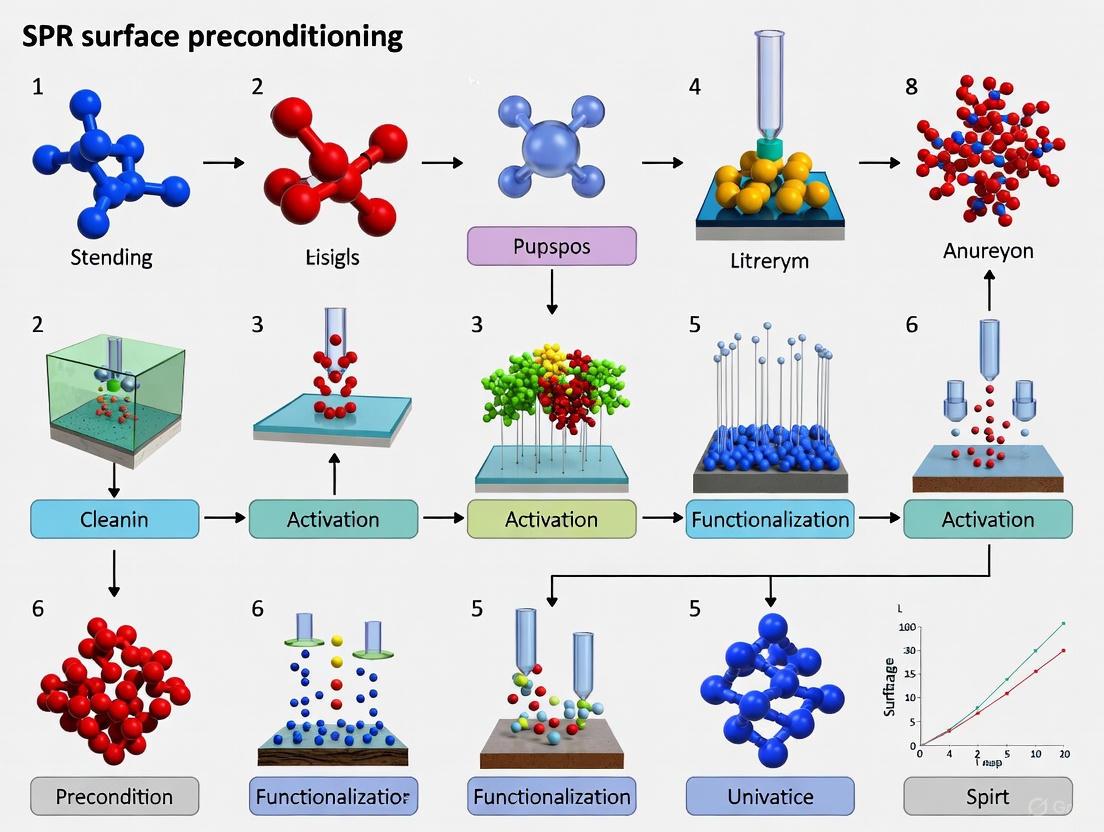
This article provides a comprehensive guide to Surface Plasmon Resonance (SPR) surface preconditioning, a critical step for obtaining high-quality, reproducible binding data.
SPR Surface Preconditioning: A Foundational Guide to Reliable Biomolecular Interaction Data
Abstract
This article provides a comprehensive guide to Surface Plasmon Resonance (SPR) surface preconditioning, a critical step for obtaining high-quality, reproducible binding data. Tailored for researchers, scientists, and drug development professionals, it covers the fundamental principles of why preconditioning is essential for minimizing noise and maximizing sensitivity, especially in demanding applications like fragment-based screening. The content details step-by-step methodological protocols, advanced troubleshooting for common pitfalls like baseline drift and non-specific binding, and a validation framework comparing SPR data with other biophysical methods. By synthesizing foundational knowledge with practical optimization strategies, this guide aims to empower users to enhance the reliability and throughput of their SPR-based analyses in drug discovery and diagnostic development.
The Critical Role of Preconditioning in SPR Assay Success
Surface preconditioning is a critical preparatory step in Surface Plasmon Resonance (SPR) experiments, encompassing the series of cleaning, stabilizing, and conditioning treatments applied to the sensor chip surface before ligand immobilization. This process is foundational to the entire experimental workflow, directly determining the reliability and quality of the subsequent biomolecular interaction data. In the context of a broader thesis on SPR surface preconditioning methods, this article establishes that proper preconditioning is not merely a preliminary step but a fundamental determinant of data integrity. It ensures that the sensor surface achieves optimal chemical stability, uniform binding capacity, and minimal non-specific interactions, thereby enabling the collection of kinetically accurate and reproducible binding data essential for drug discovery and development [1].
The absence of or inadequacy in surface preconditioning introduces significant systematic errors, including baseline drift, poor immobilization efficiency, and unreliable kinetic constants. For challenging targets such as G Protein-Coupled Receptors (GPCRs), which exhibit intrinsic instability outside their native membrane environment, rigorous and tailored preconditioning protocols are indispensable for maintaining receptor stability and function on the sensor chip [2]. This document provides detailed protocols and a scientific framework for implementing surface preconditioning to uphold the highest standards of data quality.
The Critical Role of Surface Preconditioning
The primary purpose of surface preconditioning is to create a pristine, reactive, and stable surface on the sensor chip that is ready for the efficient and oriented immobilization of ligands. Its impact on data quality is profound and multi-faceted.
Purpose and Scientific Rationale
A newly unpacked or stored sensor chip surface can contain microscopic contaminants, manufacturing residues, or adsorbed atmospheric particles. Preconditioning addresses this by:
- Cleaning the Surface: Removing any contaminants that could block activation sites or contribute to non-specific binding, ensuring that the maximum number of functional groups are available for ligand coupling [1].
- Hydrating and Stabilizing the Matrix: For hydrogel-based chips (e.g., CM5), the dextran matrix must be fully hydrated and swollen to its operational state. Preconditioning with aqueous buffers achieves this, preventing baseline shifts and ensuring consistent analyte diffusion.
- Standardizing Surface Chemistry: It brings the sensor chip to a known, reproducible chemical state. This standardization is crucial for achieving consistent ligand immobilization levels across different experiments, days, and even different operators, which is a prerequisite for comparing kinetic data across screening campaigns [1].
Impact on Key Data Quality Metrics
The direct consequences of surface preconditioning on data are quantifiable. The table below summarizes its impact on critical data quality parameters.
Table 1: Impact of Surface Preconditioning on Data Quality Parameters
| Data Quality Parameter | Effect without Proper Preconditioning | Effect with Proper Preconditioning | Primary Cause |
|---|---|---|---|
| Baseline Stability | Significant drift and instability [1] | Stable, flat baseline | Removal of loosely bound contaminants; surface equilibration. |
| Ligand Immobilization Efficiency | Low, variable density; incomplete coupling | High, consistent, and reproducible density | Maximized availability of active ester groups for coupling. |
| Non-Specific Binding (NSB) | Elevated, inconsistent background signal | Minimized and consistent background | Blocking of non-specific adsorption sites on the gold film/matrix. |
| Binding Signal Reproducibility | High variability between replicate runs | High inter- and intra-assay reproducibility | Standardized and uniform surface properties. |
| Accuracy of Kinetic Constants | Inaccurate ka (association) and kd (dissociation) rates due to mass transport or surface heterogeneity | Accurate determination of ka and kd | A homogeneous and accessible ligand layer. |
For sensitive applications like GPCR drug discovery, where the receptor must be stabilized in a lipid bilayer or nanodiscs, preconditioning the surface to properly anchor these membrane mimetics is especially critical. An improperly prepared surface can lead to receptor denaturation or inadequate orientation, completely compromising the binding assay [2].
Experimental Protocols for Surface Preconditioning
The following section provides detailed, step-by-step methodologies for preconditioning different types of sensor chips. These protocols are designed to be integrated directly into experimental documentation.
General Preconditioning Workflow for Carboxymethylated Dextran Chips
This protocol is optimized for common chips like CM5, CMS, or C1, which utilize a carboxymethylated dextran matrix and are activated via EDC/NHS chemistry.
Table 2: Key Reagent Solutions for Preconditioning
| Reagent/Solution | Function / Purpose | Typical Composition / Example |
|---|---|---|
| Running Buffer | Establishes a stable baseline and serves as the solvent for all other solutions. | HEPES Buffered Saline (HBS): 10 mM HEPES, 150 mM NaCl, pH 7.4. |
| Gly-HCl Regeneration Solution | A strong, low-pH solution that strips non-covalently bound material from the surface for cleaning. | 10-100 mM Glycine-HCl, pH 1.5-3.0. |
| NaOH/SDS Solution | A strong, high-pH solution and detergent that removes hydrophobic contaminants and deeply cleans the surface. | 10-50 mM Sodium Hydroxide, sometimes with 0.1% SDS. |
| EDC/NHS Activation Mix | Chemically activates the carboxyl groups on the dextran matrix for covalent ligand immobilization. | 0.4 M EDC + 0.1 M NHS, mixed 1:1 (v/v). |
Step-by-Step Protocol:
- Initial System Prime: Prime the SPR instrument (e.g., Biacore systems) with the designated, filtered, and degassed running buffer at least three times to ensure the entire fluidics system is equilibrated.
- Chip Docking and Initial Baseline: Dock the new sensor chip and initiate a continuous flow of running buffer (e.g., 10-30 µL/min). Allow the baseline to stabilize for 10-20 minutes. A large initial drop followed by a slow stabilization is normal.
- Pulsed Regeneration Cleaning:
- Inject a series of short pulses (e.g., 30-60 seconds each) of regeneration solutions across all flow cells.
- A typical sequence is: 2-3 pulses of Gly-HCl (pH 1.5-2.0) followed by 1-2 pulses of NaOH (50 mM).
- A final pulse of a mild acid (e.g., 10 mM HCl) can be used.
- After each pulse, wash extensively with running buffer for 1-2 minutes to re-equilibrate the pH and surface.
- Surface Activation (Optional but Recommended for a Fresh Chip): To test the surface reactivity and ensure it is primed for immobilization, perform a test activation and deactivation.
- Inject the EDC/NHS mixture for 5-7 minutes.
- Immediately follow with an injection of a blocking agent, such as 1 M Ethanolamine-HCl (pH 8.5), for 5-7 minutes.
- Final Stabilization: After the final cleaning or deactivation step, allow the baseline to stabilize under a continuous flow of running buffer for a final 15-30 minutes. The surface is now preconditioned and ready for ligand immobilization.
The following workflow diagram illustrates this multi-stage process and its role in the complete SPR experiment.
Diagram 1: SPR Surface Preconditioning Workflow
Specialized Preconditioning for GPCR and Membrane Protein Studies
Preconditioning surfaces for GPCR analyses requires additional steps to ensure the stable incorporation of the target into a membrane-mimetic environment on the chip. The strategy depends on the immobilization method [2].
Protocol 1: Preconditioning for Liposome or Nanodisc Capture
- Surface Cleaning: Follow the general protocol (Steps 1-3) to ensure the underlying sensor chip (e.g., an L1 chip with lipophilic anchors) is clean.
- Lipid Surface Preparation: Inject a solution of small, sonicated liposomes (e.g., POPC:POPG mixtures) to form a uniform lipid bilayer on the surface. This may require multiple injections.
- Surface Stabilization: Wash extensively with running buffer containing a low concentration of a mild, GPCR-compatible detergent (e.g., 0.01% DDM) to stabilize the layer and remove poorly associated material.
- Receptor Loading: The preconditioned lipid surface is now ready for the injection of GPCRs reconstituted in liposomes, nanodiscs, or proteoliposomes.
Protocol 2: Preconditioning for Direct Receptor Immobilization via Tags
- Surface Cleaning: Precondition a NTA or SA sensor chip using the general protocol. For NTA chips, include a pulse injection of a chelator (e.g., EDTA) to remove any bound metal ions, followed by a recharge with fresh NiCl₂.
- Receptor Stabilization: The running buffer must be optimized with specific lipids (e.g., cholesterol) and detergents to maintain GPCR stability during the immobilization process [2].
- Receptor Capture: Inject the His-tagged or biotinylated GPCR sample. The preconditioned surface will ensure oriented capture and maximal retention of functional receptor.
Data Validation and Troubleshooting
Even with a standardized protocol, researchers must validate the success of preconditioning through data inspection.
Quantifying Preconditioning Success
A successfully preconditioned surface should exhibit the following in the sensorgram before any ligand immobilization:
- A Flat and Stable Baseline: The response signal (RU) should show minimal drift (< 5-10 RU over 5 minutes) after the stabilization period.
- Low Noise Level: The signal noise should be minimal, typically < 0.5-1 RU peak-to-peak.
- Appropriate Activation Response: If a test activation is performed, a large, sharp increase in RU upon EDC/NHS injection confirms high surface reactivity.
Common Preconditioning Issues and Resolutions
Table 3: Troubleshooting Preconditioning Problems
| Problem | Potential Cause | Recommended Solution |
|---|---|---|
| High Baseline Drift | Buffer incompatibility; contaminated buffer; improperly cleaned surface. | Filter and degass buffers; increase number and duration of regeneration pulses; ensure buffer and chip chemistry are compatible [1]. |
| Low Immobilization Level | Inactive surface; insufficient preconditioning; old EDC/NHS. | Perform a fresh test activation/deactivation cycle to verify surface reactivity; use freshly prepared EDC/NHS reagents. |
| High Non-Specific Binding | Incomplete blocking of non-specific sites on the gold surface. | Incorporate a blocking step with an inert protein (e.g., BSA, casein) after preconditioning but before immobilization [1]. |
| Poor Reproducibility | Inconsistent preconditioning protocol between runs or users. | Strictly adhere to a documented Standard Operating Procedure (SOP) for preconditioning, specifying exact solution concentrations, pulse times, and flow rates. |
Surface preconditioning is a scientifically rigorous and non-negotiable practice in SPR. It transforms a variable sensor chip into a reliable scientific platform. As outlined in these application notes, a meticulously executed preconditioning protocol, tailored to the specific sensor chip and biological target, is the most effective strategy to mitigate experimental artifacts at their source. For the ongoing research into SPR preconditioning methods, this establishes a foundational protocol from which further innovations—such as preconditioning for novel two-dimensional nanomaterial sensor surfaces or automated high-throughput preconditioning routines—can be developed and validated. By mastering surface preconditioning, researchers ensure that the high-quality data driving critical decisions in drug development is built upon a solid and dependable foundation.
Surface Plasmon Resonance (SPR) is a powerful, label-free technique used to study biomolecular interactions in real-time, providing critical insights into kinetics, affinity, and specificity. Achieving reliable and reproducible data, however, demands meticulous experimental preparation, with surface preconditioning standing as a critical foundational step. This process directly determines the success of subsequent immobilization and binding steps. Within the context of a broader thesis on SPR surface preconditioning methods, this application note details how a rigorous and optimized preconditioning protocol serves as a core principle to minimize experimental noise and maximize system sensitivity. By ensuring a clean, stable, and reactive sensor surface from the outset, researchers can significantly enhance data quality, improve detection limits for low-abundance analytes, and obtain more accurate kinetic parameters [1].
The necessity for preconditioning arises from the need to create a uniform and predictable surface chemistry on the sensor chip. A poorly prepared surface can lead to high baseline drift, non-specific binding, and low immobilization efficiency, all of which introduce noise and obscure true binding signals. Furthermore, an inconsistent surface can cause variations in ligand density, directly impacting the measured binding affinity and kinetics. Preconditioning protocols are therefore not merely routine cleaning steps but are instrumental in activating the sensor surface's full potential, ensuring that the immobilized ligand is biologically active and that the resulting data is a true reflection of the molecular interaction under investigation [1].
Core Principles Linking Preconditioning to Performance
The relationship between preconditioning and enhanced SPR performance is governed by several core principles. Understanding these mechanisms allows for the intelligent optimization of protocols for specific experimental needs.
Minimization of Non-Specific Binding
Non-specific binding (NSB) is a primary source of noise in SPR experiments, occurring when molecules interact with the sensor surface through means other than the specific interaction of interest. Preconditioning combats NSB by removing adsorbed contaminants and deactivating promiscuous binding sites on the sensor chip surface. A clean surface ensures that the subsequent immobilization chemistry targets only the intended functional groups. Furthermore, a key part of the preconditioning workflow involves the use of blocking agents, such as ethanolamine, to cap any remaining activated sites after ligand coupling, which prevents random attachment of analytes during the binding phase [1].
Enhancement of Surface Stability and Baseline Flatness
Baseline drift is a common issue that compromises the accuracy of binding response measurements. Drift can originate from several sources, including the slow release of contaminants from the sensor chip matrix or instability in the surface chemistry itself. Preconditioning directly addresses this by stabilizing the sensor surface through rigorous cleaning and conditioning cycles. By subjecting the chip to controlled pulses of buffer, sometimes at extreme pH, the dextran matrix and its chemical modifications are stabilized before the actual experiment begins. This results in a flatter, more stable baseline, which is crucial for accurately quantifying both high-affinity interactions with slow dissociation rates and low-affinity interactions with weak signals [1].
Optimization of Ligand Immobilization Efficiency
The efficiency and homogeneity of ligand immobilization are paramount for obtaining high-quality kinetic data. Preconditioning prepares the surface for optimal ligand attachment by ensuring uniform surface activation and by facilitating pre-concentration. Pre-concentration is an electrostatic process where the ligand is attracted to the sensor surface prior to covalent coupling. This is achieved by using a low ionic strength buffer with a pH slightly below the isoelectric point (pI) of the ligand, which creates opposing charges on the ligand and the carboxymethylated dextran surface. This process results in a high local concentration of the ligand at the surface, leading to a more efficient and dense immobilization, which directly boosts the final signal intensity [3]. A well-preconditioned surface provides a consistent foundation for this process, leading to highly reproducible immobilization levels across multiple sensor chips or flow cells.
Table 1: Quantitative Impact of Preconditioning on Key SPR Performance Metrics
| Performance Metric | Without Preconditioning | With Preconditioning | Impact on Data Quality |
|---|---|---|---|
| Baseline Drift | High (e.g., >5 RU/min) | Low (e.g., <1 RU/min) | Enables accurate measurement of slow dissociation rates |
| Immobilization Level Variation | High (>10% RSD) | Low (<5% RSD) | Essential for reproducible affinity and kinetics measurements |
| Non-Specific Binding Signal | Can be significant | Minimized | Improves signal-to-noise ratio, crucial for low-abundance analytes |
| Ligand Activity | Unpredictable, potentially low | High and consistent | Ensures measured kinetics reflect true biological interaction |
Experimental Protocols for Surface Preconditioning
A comprehensive preconditioning protocol is tailored to the specific sensor chip type and the ligand to be immobilized. The following section provides a generalized step-by-step protocol for carboxymethylated dextran chips (e.g., CM5), which are among the most commonly used.
Preconditioning Protocol for CM5 Sensor Chips
This protocol is designed to be performed on the SPR instrument immediately prior to ligand immobilization.
Research Reagent Solutions
- Flow Buffer: 10 mM HEPES, 150 mM NaCl, 3.4 mM EDTA, 0.005% surfactant P20, pH 7.4 [3]. This is the standard running buffer for the experiment.
- Activation Solutions: 0.4 M EDC (N-Ethyl-N'-(3-dimethylaminopropyl)carbodiimide) and 0.1 M NHS (N-hydroxysuccinimide). These are used for covalent coupling [3].
- Pre-concentration Buffers: A series of low ionic strength (10 mM) buffers, such as acetate (pH 4.0-5.5), formate (pH 3.5-4.5), or maleate (pH 5.5-6.5). The appropriate buffer is selected based on the ligand's pI [3].
- Blocking Solution: 1 M ethanolamine hydrochloride, pH 8.5 [3].
- Regeneration Solutions: Solutions like 10 mM glycine-HCl (pH 1.5-3.0) or NaOH (10-50 mM) are used for preconditioning cycles and later for regenerating the surface between analyte injections.
Table 2: Essential Reagents for SPR Preconditioning and Immobilization
| Reagent | Function / Explanation |
|---|---|
| EDC / NHS | Cross-linking agents that activate carboxyl groups on the sensor chip surface for covalent ligand immobilization. |
| Ethanolamine | A blocking agent that deactivates any remaining ester groups on the surface after ligand coupling, preventing non-specific binding. |
| Acetate Buffer (10 mM, pH 4.0-5.5) | A low-ionic-strength buffer used to create a favorable electrostatic environment for pre-concentration of positively charged ligands. |
| Glycine-HCl (10 mM, pH 2.0) | A mild regeneration solution used to remove non-covalently bound material during preconditioning cycles and between analyte injections. |
| Surfactant P20 | A detergent added to the running buffer to reduce non-specific hydrophobic interactions with the sensor chip surface. |
Step-by-Step Methodology
Initial Surface Sanitization: Dock the sensor chip and prime the system with the desired flow buffer at the standard operating flow rate (e.g., 10-30 µL/min). Allow the baseline to stabilize for at least 10-15 minutes. A stable baseline is an initial indicator of a clean system.
Preconditioning Cycles: Inject a series of short pulses (e.g., 30-60 seconds) of regeneration solutions. A typical regimen might include 2-3 injections of 10-50 mM NaOH followed by 2-3 injections of 10 mM glycine-HCl (pH 2.0). This process serves to remove any non-specifically adsorbed contaminants and stabilizes the dextran matrix.
Surface Activation: Inject a 1:1 mixture of EDC and NHS for 7-10 minutes. This reaction activates the carboxyl groups on the dextran matrix, forming reactive NHS esters.
Ligand Pre-concentration and Immobilization: a. pH Scouting: To identify the optimal condition for pre-concentration, inject the ligand diluted in a series of pre-concentration buffers at different pH values. A strong, rapid increase in signal indicates successful pre-concentration. b. Immobilization: Using the optimal buffer identified, inject the ligand for a sufficient duration to achieve the desired immobilization level (Response Units, RU). The ligand is covalently attached to the activated esters.
Surface Blocking: Inject ethanolamine hydrochloride for 5-7 minutes to block any remaining activated ester groups. This critical step minimizes future non-specific binding.
Post-Conditioning Stability Check: Wash the surface with flow buffer and monitor the baseline for stability. A minimal and rapidly stabilizing drift indicates a successful preconditioning and immobilization procedure. The surface is now ready for analyte binding experiments.
The diagram below illustrates the logical workflow and decision points in this protocol.
Data Analysis and Validation
The success of the preconditioning protocol must be validated through quantitative data analysis both during and after the process.
Quantitative Benchmarks for Success
A well-preconditioned surface should meet several key benchmarks, which can be directly measured from the sensorgram data:
- Low Baseline Drift: After the final blocking step and a return to flow buffer, the baseline drift should be minimal. A common benchmark is a drift of less than 1-2 RU per minute over a 10-minute period. High drift suggests incomplete surface stabilization or contamination [1].
- Stable Immobilization Level: The immobilization level of the ligand, measured in RU, should remain stable after the final wash. A significant drop in RU indicates that the ligand was not properly covalently coupled and was washed away, pointing to a failure in the activation or pre-concentration steps.
- High Signal-to-Noise Ratio in Reference Flow Cell: The signal from a reference flow cell (which should have no ligand or an irrelevant ligand) during analyte injection should be flat, indicating minimal non-specific binding. The ratio of the specific binding signal to the reference signal should be high.
Table 3: Troubleshooting Common Preconditioning and Immobilization Issues
| Observed Problem | Potential Root Cause | Corrective Action |
|---|---|---|
| High Baseline Drift | Inefficient surface regeneration; buffer incompatibility; contaminated sensor chip. | Extend preconditioning cycles; ensure buffer compatibility with chip chemistry; use fresh, filtered buffers. |
| Low Immobilization Level | Incorrect pre-concentration pH; low ligand activity or concentration; expired EDC/NHS. | Perform a comprehensive pH scouting experiment; check ligand integrity and concentration; prepare fresh activation solutions. |
| High Non-Specific Binding | Incomplete surface blocking; suboptimal buffer conditions. | Ensure fresh, pH-adjusted ethanolamine is used; add a non-ionic detergent (e.g., 0.005% P20) to the running buffer. |
| Poor Reproducibility | Inconsistent preconditioning protocol; variation in ligand stock solutions. | Standardize the preconditioning cycle regimen across all experiments; use highly concentrated ligand stocks and consistent dilution methods. |
Surface preconditioning is far more than a preliminary step in SPR experimentation; it is a fundamental practice that directly dictates data quality and reliability. By adhering to the core principles and detailed protocols outlined in this application note, researchers can systematically minimize noise and maximize the sensitivity of their SPR systems. A rigorously preconditioned surface ensures a stable, homogeneous, and reactive foundation for ligand immobilization, which in turn leads to more accurate and reproducible measurements of biomolecular interactions. As SPR technology continues to evolve, playing a critical role in drug discovery and basic research, mastering these foundational techniques remains essential for any scientist seeking to generate robust, publication-quality data [1] [4] [5].
Within the framework of research on Surface Plasmon Resonance (SPR) surface preconditioning methods, achieving a stable, low-noise baseline is not merely a preliminary step but a critical determinant for successful kinetic and affinity analyses. SPR biosensors detect biomolecular interactions in real-time by monitoring changes in the refractive index at a sensor surface [6]. A drifting baseline or excessive noise can obscure the detection of weak binding events, compromise data quality, and lead to erroneous interpretation of kinetic parameters [7] [1]. This application note details the essential goals and provides validated protocols for surface preconditioning, enabling researchers to establish a robust foundation for reliable data acquisition.
The process of preconditioning equilibrates the sensor chip, the fluidic system, and the immobilized ligand with the running buffer, minimizing inherent signal instabilities. Instabilities often arise from factors such as sensor chip rehydration, wash-out of immobilization chemicals, temperature fluctuations, and buffer mismatches [7] [8]. Proper preconditioning directly addresses these sources of drift and noise, which is especially crucial for sensitive applications like fragment-based drug discovery where binding signals are minimal [9].
Core Principles of Baseline Stability
A stable baseline is characterized by minimal drift and low noise, forming a reliable horizontal line from which binding responses can be accurately measured. Drift is a gradual, monotonic change in the baseline signal over time, while noise constitutes rapid, stochastic signal fluctuations [7].
Minimizing Drift: Baseline drift is frequently a sign of a non-optimally equilibrated sensor surface [7]. It is commonly observed immediately after docking a new sensor chip or following ligand immobilization, largely due to the rehydration of the surface and the wash-out of chemicals used during the immobilization procedure [7]. Furthermore, a change in running buffer composition can cause significant drift until the system is fully equilibrated. In systems where temperature control is imperfect, fluctuations in the temperature of the instrument or the buffer can induce drift because the SPR signal is sensitive to the refractive index of the bulk solution, which is temperature-dependent [8] [6].
Reducing Noise: A high noise level can mask small binding responses, effectively raising the detection limit of the assay. Noise can originate from multiple sources, including air bubbles in the fluidic path, particulate matter in the buffer or samples, mechanical pump vibrations, and electronic instabilities in the optical detection system [7] [1]. Impurities in the sample or buffer can also contribute to non-specific binding and stochastic signal spikes.
The Role of Preconditioning: Preconditioning is the systematic process of addressing these issues before data collection begins. It involves preparing the buffer, priming the fluidic system, and conditioning the sensor surface to a state of equilibrium with the experimental conditions. A well-preconditioned system exhibits a flat, stable baseline, which is the ultimate goal and a prerequisite for high-quality SPR data.
Preconditioning Protocols
The following protocols provide a step-by-step guide to achieving a stable, low-noise baseline. Adherence to these procedures is essential for generating publication-quality data.
Protocol 1: Buffer Preparation and System Priming
Objective: To eliminate buffer-related causes of drift and noise by ensuring the use of clean, compatible, and degassed buffers and by thoroughly equilibrating the fluidic system.
Materials:
- Running buffer (e.g., HBS-EP, PBS)
- High-purity water
- 0.22 µm membrane filter unit
- Buffer degassing apparatus (or a vacuum degasser integrated into some SPR instruments)
- Clean, sterile glassware or bottles
Method:
- Prepare Fresh Buffer: Ideally, prepare running buffer fresh daily using high-purity reagents and water [7].
- Filter and Degas: Pass the buffer through a 0.22 µm filter to remove particulate matter. Subsequently, degas the buffer thoroughly to prevent the formation of air bubbles during the experiment, which can cause spikes and noise in the sensorgram [7].
- Buffer Hygiene: Store filtered and degassed buffer in clean, sterile bottles. Avoid adding fresh buffer to old stock, as microbial growth or contaminants can introduce noise and drift [7].
- Prime the System: After a buffer change or at the start of a new experiment, prime the fluidic system according to the instrument manufacturer's guidelines. This process flushes out the previous buffer and ensures the entire flow path is filled with the new, degassed running buffer [7]. Failing to equilibrate the system can result in a "waviness" in the baseline corresponding to pump strokes as the old and new buffers mix.
- Flow Stabilization: Flow running buffer at the experimental flow rate until a stable baseline is observed. This may take 5–30 minutes or longer, depending on the system and the nature of the sensor surface [7].
Protocol 2: Sensor Surface Equilibration
Objective: To stabilize the sensor chip surface and the immobilized ligand, minimizing initial drift.
Materials:
- Docked sensor chip
- Running buffer
- Regeneration solution (if applicable)
Method:
- Initial Docking Drift: After docking a new sensor chip, expect and allow for an initial period of drift. This is often due to the rehydration of the dextran matrix on the sensor chip and thermal equilibration [7] [9].
- Post-Immobilization Equilibration: Following ligand immobilization, flow running buffer over the surface for an extended period. For surfaces with significant drift, it "can be necessary to run the running buffer overnight to equilibrate the surfaces" [7].
- Start-up Cycles and Blank Injections: Incorporate at least three start-up cycles into the experimental method. These cycles should mimic the analyte injection cycles but inject only running buffer. If a regeneration step is used, it should also be included. These cycles serve to "prime" the surface, stabilizing it before actual analyte injections begin, and should not be used in data analysis [7]. Additionally, intersperse blank (buffer) injections evenly throughout the experiment to facilitate double referencing.
Protocol 3: Establishing a Low-Noise Baseline
Objective: To characterize and minimize the system's noise level, ensuring optimal detection sensitivity.
Materials:
- Equilibrated SPR system with buffer flowing
Method:
- System Equilibration: Ensure the system is fully equilibrated using Protocols 1 and 2 to minimize drift, which can interfere with noise assessment.
- Buffer Injection Test: Perform several consecutive injections of running buffer and observe the baseline response [7]. A system with a low noise level will show a flat baseline with random variations of less than <1 RU [7].
- Noise Diagnosis: If the noise level is high (>1 RU), investigate potential sources. Check for air bubbles in the fluidic path, ensure buffers are properly filtered and degassed, verify that the instrument is placed on a stable surface free from vibrations, and confirm that the detector is properly calibrated [7] [1].
Table 1: Quantitative Baseline Performance Targets
| Parameter | Ideal Performance | Acceptable Performance | Diagnostic Action if Unacceptable |
|---|---|---|---|
| Baseline Drift | < 5 RU/hour | < 10 RU/hour | Extend surface equilibration; check for buffer mismatch or temperature fluctuations [7]. |
| Static Noise | < 0.3 RU (RMS) | < 1 RU (RMS) | Check for air bubbles, particulate contamination, or electronic issues [7]. |
| Bulk Refractive Index Noise | Minimal shift upon buffer switch | < 10 RU shift | Ensure thorough system priming with new buffer; verify buffer degassing [7]. |
Experimental Workflow and Data Analysis
A standardized workflow is crucial for consistent success in achieving a stable baseline. The following diagram and table outline the logical sequence of operations and the key reagents required.
Diagram 1: Preconditioning workflow for baseline stability.
Table 2: Research Reagent Solutions for SPR Preconditioning
| Reagent / Material | Function in Preconditioning | Key Considerations |
|---|---|---|
| Running Buffer | Creates the solvent environment for interactions; defines pH and ionic strength. | Must be fresh, filtered, and degassed to minimize noise and drift [7] [1]. |
| Detergent (e.g., Tween-20) | Additive to reduce non-specific binding and prevent bubble formation. | Add after filtering and degassing to avoid foam [7]. |
| Regeneration Solution | Remains bound analyte from the ligand between cycles. | Must effectively regenerate without damaging the immobilized ligand to prevent baseline drift over multiple cycles [1]. |
| 0.22 µm Filter | Removes particulate matter from buffers to prevent clogging and noise. | Essential for all buffers and samples introduced into the fluidic system [7]. |
| Sensor Chip | The platform where biomolecular interactions occur. | Requires time for rehydration and chemical equilibration after docking and immobilization [7] [9]. |
Data Analysis and Referencing
Once a stable baseline is secured, proper data referencing is vital to isolate the specific binding signal from residual drift and bulk effects.
Double Referencing: This is the recommended procedure to compensate for drift, bulk refractive index effects, and channel differences [7].
- Step 1: Reference Surface Subtraction: First, subtract the signal from a reference flow cell (which lacks the ligand or has an irrelevant ligand) from the signal of the active flow cell. This compensates for the majority of the bulk effect and system drift.
- Step 2: Blank Injection Subtraction: Second, subtract the response from injections of running buffer (blank injections) from the analyte injections. This corrects for any residual differences between the reference and active surfaces that are not due to specific binding.
Baseline Validation in Analysis: Before fitting kinetic models, ensure the pre-injection baseline is flat and the post-dissociation phase returns to a stable baseline. Persistent drift after dissociation can indicate incomplete regeneration or surface heterogeneity.
Achieving a stable, low-noise baseline through meticulous preconditioning is a non-negotiable foundation for any rigorous SPR study. The protocols outlined herein—focusing on impeccable buffer preparation, systematic fluidic priming, and thorough sensor surface equilibration—provide a reliable roadmap for researchers. By investing time in this essential preparatory phase, scientists can significantly enhance data quality, improve the reliability of kinetic and affinity parameters, and ultimately accelerate drug discovery and biomolecular research.
The Link Between Preconditioning and Immobilization Efficiency
In Surface Plasmon Resonance (SPR) technology, the precise immobilization of a ligand to the sensor chip is a foundational step that directly dictates the success and reliability of subsequent biomolecular interaction analyses. Immobilization efficiency affects everything from the signal-to-noise ratio to the accuracy of determined kinetic parameters. Preconditioning, often manifested as a "pre-concentration" step, is a critical preparatory procedure designed to enhance this efficiency by optimizing the local environment at the sensor chip surface. This application note, framed within a broader thesis on SPR surface preconditioning methods, details the intrinsic link between preconditioning and immobilization efficiency. It provides researchers, scientists, and drug development professionals with structured data, detailed protocols, and visual guides to implement these methods effectively, thereby improving the sensitivity and robustness of their SPR assays.
The Principle and Importance of Preconditioning
Preconditioning, specifically in the form of electrostatic pre-concentration, is the process of accumulating ligand molecules at the sensor chip surface prior to their covalent attachment. This is a standard and recommended procedure for carboxyl-group-based sensor chips (such as CM4 or CM5 chips) where immobilization relies on amine coupling [3].
The fundamental goal is to increase the local concentration of the ligand at the dextran matrix of the sensor chip. This is achieved by carefully manipulating the electrostatic interactions between the charged ligand and the charged sensor surface. A successful pre-concentration step results in a rapidly increasing SPR signal as the ligand accumulates at the surface, followed by a stable signal plateau. This process makes the subsequent covalent immobilization more efficient, uniform, and controllable [3].
The absence of a pre-concentration step can lead to suboptimal immobilization levels, wasted precious ligand, and surfaces with heterogeneous activity. The procedure is particularly crucial when working with low-abundance or valuable ligands, as it maximizes the immobilization yield from a limited sample.
Key Factors Governing Preconditioning Efficiency
The efficacy of the pre-concentration step is governed by a interplay of several chemical and physical factors. Understanding and optimizing these parameters is key to achieving high immobilization efficiency.
Buffer pH and Ionic Strength
The pH of the immobilization buffer is the most critical variable, as it determines the net charge of both the ligand and the carboxymethylated dextran matrix.
- pH Relative to Ligand pI: For effective pre-concentration, the ligand must carry a net positive charge to be attracted to the negatively charged dextran surface. This is achieved by using a buffer with a pH slightly below the isoelectric point (pI) of the protein ligand. General guidelines suggest [3]:
- For pI 3.5–5.5, use a buffer 0.5 pH units below the pI.
- For pI 5.5–7, use a buffer 1.0 pH unit below the pI.
- For pI >7, a buffer at approximately pH 6.0 is often suitable.
- Low Ionic Strength: The buffer must have a low ionic strength (e.g., 10 mM). High salt concentrations mask the electrostatic charges on both the ligand and the surface, effectively nullifying the attractive forces and diminishing the pre-concentration effect [3].
Ligand Concentration and Buffer Composition
- Ligand Concentration: A ligand concentration between 5 and 25 µg/mL is typically sufficient for effective pre-concentration. Using highly concentrated stock solutions is advised to avoid diluting the coupling buffer and altering its pH and ionic strength. Alternative buffer exchange methods like gel filtration or dialysis can also be used [3].
- Buffer Additives: Additives such as sodium azide must be avoided during immobilization as they can react with the activated surface and lower immobilization efficiency. Detergents may be necessary for solubilizing membrane proteins or other hydrophobic ligands, but their impact on surface chemistry must be considered [10] [11].
Table 1: Summary of Key Preconditioning Parameters and Their Optimal Ranges
| Parameter | Optimal Condition | Impact on Preconditioning |
|---|---|---|
| Buffer pH | 0.5–1.0 units below ligand pI | Determines net charge of ligand; positive charge enables attraction to surface. |
| Ionic Strength | Low (e.g., 10 mM) | Prevents masking of electrostatic charges, enabling strong attraction. |
| Ligand Concentration | 5–25 µg/mL | Provides sufficient molecules for surface accumulation without rapid saturation. |
| Ligand Stock Solution | Highly concentrated | Prevents dilution and alteration of the coupling buffer's properties. |
| Additives | Avoid azide; use compatible detergents | Prevents unintended reactions with activated surface; maintains ligand solubility. |
Experimental Protocol: Preconditioning and Immobilization via Amine Coupling
The following protocol provides a step-by-step methodology for immobilizing a protein ligand onto a CM-series sensor chip, incorporating a pre-concentration step. The example of immobilizing the cannabinoid receptor CB2 is used to illustrate a real-world application [10].
Materials and Reagents
Table 2: Essential Research Reagent Solutions for Immobilization
| Reagent/Solution | Function/Description |
|---|---|
| HBS-N Buffer (10 mM HEPES, 150 mM NaCl, 3.4 mM EDTA, 0.005% surfactant P20, pH 7.4) | Standard running buffer for SPR; used for equilibration and dilution. |
| Sodium Acetate Buffer (10 mM, pH 4.0-5.5) | Low-ionic-strength buffer for pre-concentration and ligand dilution. |
| EDC (N-ethyl-N'-(dimethylaminopropyl)carbodiimide) | Activates carboxyl groups on the sensor chip surface. |
| NHS (N-Hydroxysuccinimide) | Works with EDC to form an amine-reactive NHS ester on the surface. |
| Ethanolamine-HCl (1 M, pH 8.5) | Quenches unreacted NHS esters after ligand immobilization. |
| Ligand Solution | The protein of interest, solubilized in a compatible, low-ionic-strength buffer. |
Step-by-Step Procedure
System and Sensor Chip Preparation
- Dock a new CM4 or CM5 sensor chip into the SPR instrument.
- Prime the system with HBS-N running buffer to equilibrate the fluidics and establish a stable baseline.
- Perform a brief surface conditioning with a gentle regeneration solution if recommended by the manufacturer.
Surface Activation
- Inject a 1:1 mixture of EDC and NHS (e.g., for 7 minutes) over the target flow cell. This creates reactive NHS esters on the dextran matrix. A significant bulk shift in the SPR signal will be observed.
Pre-concentration and Ligand Immobilization
- Dilute the ligand to a concentration of 5–25 µg/mL in a low-ionic-strength buffer (e.g., 10 mM sodium acetate) at a predetermined optimal pH (see Table 1).
- Inject the diluted ligand solution for 2-7 minutes at a low flow rate (e.g., 5-10 µL/min).
- Monitor the SPR signal in real-time:
- A rapid increase followed by a plateau indicates successful pre-concentration.
- A flat line indicates no accumulation, requiring adjustment of pH.
- Once a stable pre-concentration level is achieved, proceed with the injection. The ligand will covalently attach to the activated surface during this period.
Quenching
- Inject 1 M ethanolamine-HCl (pH 8.5) for 5-7 minutes to block any remaining unreacted NHS esters.
Post-Immobilization Wash
- Wash the surface with running buffer to remove any non-covalently bound ligand. The final, stable SPR signal level (in Resonance Units, RU) indicates the total amount of immobilized ligand.
Diagram 1: Workflow for preconditioning and immobilization.
Case Study and Data Analysis
Immobilization of Cannabinoid Receptor CB2
A study on the human cannabinoid receptor CB2, a G protein-coupled receptor (GPCR), highlights the importance of controlled immobilization. The researchers utilized a Rho-tag/1D4 antibody system for capture. While not a classic pre-concentration, this method achieves a similar goal: it concentrates the receptor on the sensor surface in a uniform orientation, maximizing the availability of active binding sites [10].
- Method: The 1D4 antibody was first immobilized on a CM4 chip. Subsequently, a cell lysate or purified preparation containing the Rho-tagged CB2 receptor was injected over the surface.
- Result: The CB2 receptor was captured quantitatively and in a uniform orientation, as demonstrated by the SPR signal. This efficient "pre-positioning" enabled high-quality binding studies with a monoclonal antibody (NAA-1) targeting CB2, confirming the accessibility and functionality of the immobilized receptor [10].
Data Interpretation and Optimization
Analyzing the pre-concentration sensorgram is vital for diagnostics and optimization.
Diagram 2: Idealized SPR sensorgram during pre-concentration and immobilization.
Table 3: Troubleshooting Preconditioning and Immobilization
| Observation | Potential Cause | Solution |
|---|---|---|
| No pre-concentration signal | Buffer pH is at or above protein pI; high ionic strength; ligand concentration too low. | Lower buffer pH relative to pI; ensure buffer is 10 mM; increase ligand concentration. |
| Very fast, massive signal jump | Ligand concentration is too high; very strong electrostatic attraction. | Lower ligand concentration; consider a buffer with a slightly higher pH (closer to pI). |
| Signal decreases after quenching/wash | Insufficient covalent coupling; non-specific binding. | Ensure fresh EDC/NHS; check that pre-concentration pH is not too low, which can hinder covalent chemistry. |
| High non-specific binding | Inadequate surface blocking or quenching. | Extend quenching time with ethanolamine; include a non-ionic surfactant in the buffer. |
Advanced Considerations and Future Outlook
Beyond standard amine coupling, preconditioning principles apply to advanced immobilization strategies. The development of Molecularly Imprinted Bio-Polymers (MIBPs) as antibody substitutes offers a new paradigm. These polymers, such as polynorepinephrine (PNE), can be grown directly on bare gold chips and, crucially, can be completely removed using a mild oxidizing treatment (e.g., 3.5% NaOCl), allowing for the reconditioning and reuse of the gold chip itself for multiple cycles without performance loss [12]. This represents a sustainable extension of the preconditioning concept to the entire sensor chip lifecycle.
Furthermore, for membrane proteins like GPCRs, preconditioning also involves maintaining the protein in a functional state throughout the process. This often requires the use of specific detergents (e.g., DDM, CHAPS) and lipids (e.g., CHS) in all buffers to stabilize the protein and prevent denaturation during surface capture [10] [11].
Preconditioning is an indispensable strategy for maximizing immobilization efficiency in SPR biosensing. By strategically controlling the pH and ionic strength of the ligand solution, researchers can electrostatically pre-concentrate the target molecule at the sensor surface, leading to higher and more consistent immobilization levels. The implementation of the protocols and guidelines outlined in this application note will enable scientists to standardize and optimize this critical step, thereby enhancing the data quality of kinetic and affinity analyses, accelerating drug discovery pipelines, and contributing to more reliable and reproducible biosensor research.
Instrument and Sensor Chip Preparation as a Preconditioning Prerequisite
Within the framework of advanced Surface Plasmon Resonance (SPR) research, the preparatory steps of instrument and sensor chip preconditioning are not merely preliminary tasks; they are foundational prerequisites that dictate the success and reliability of the entire biomolecular interaction analysis. Preconditioning encompasses the systematic procedures required to stabilize the SPR instrument, activate the sensor chip surface, and optimize the chemical environment to ensure that the collected data on binding kinetics and affinity is both accurate and reproducible. For researchers and drug development professionals, mastering these protocols is essential for studying even the most challenging interactions, from high-throughput drug candidate screening to the detailed analysis of low-abundance protein complexes. This application note provides detailed methodologies and structured data, contextualized within broader thesis research on SPR surface preconditioning methods, to serve as a definitive laboratory guide.
Instrument Preparation and System Calibration
A stable and well-calibrated SPR instrument is the first non-negotiable prerequisite for any binding experiment. Before engaging with precious samples, the system must be prepared to minimize operational variability.
System Sanitization and Fluidic Priming: Begin by flushing the fluidic system with recommended sanitization solutions (e.g., 50 mM NaOH or 6 M guanidine hydrochloride) to remove any residual biomolecules or contaminants from previous experiments [1]. Following sanitization, the system must be thoroughly primed with the designated running buffer—absent of any additives like azide that could interfere with surface chemistry—to establish a stable refractive index baseline and remove air bubbles from the microfluidics [3] [1].
Baseline Stabilization and Calibration: Allow the instrument and buffer to reach thermal equilibrium, as temperature fluctuations are a primary cause of signal drift. Monitor the baseline signal for a sufficient period to confirm stability. Subsequently, perform any instrument-specific calibration routines as mandated by the manufacturer to ensure the optical detection unit and liquid handling system are operating within specified tolerances [1]. A drifting baseline often indicates unresolved air bubbles, buffer incompatibility, or insufficient thermal equilibration, necessitating troubleshooting before proceeding [1].
Sensor Chip Selection and Surface Chemistry
The sensor chip is the heart of the SPR experiment, and its selection must be a deliberate choice based on the biochemical properties of the ligand and the experimental goals. The surface chemistry directly influences ligand activity, immobilization capacity, and the propensity for non-specific binding.
Table 1: Guide to Sensor Chip Selection for Common Experimental Goals
| Sensor Chip Type | Surface Chemistry | Key Applications | Immobilization Method |
|---|---|---|---|
| Carboxylated Dextran (e.g., CM5) | 3D hydrogel matrix (carboxymethylated dextran) | General purpose; protein-protein interactions; small molecule analytes [13] [14] | Covalent coupling (e.g., amine) |
| NTA | Immobilized Nitrilotriacetic Acid | Capture of poly-histidine tagged ligands [13] [14] | Affinity capture |
| Streptavidin (SA) | Immobilized Streptavidin | Capture of biotinylated ligands [13] [14] | Affinity capture |
| Protein A | Immobilized Protein A | Capture of IgG antibodies [13] [14] | Affinity capture |
| Planar / C1 | Short-chain or self-assembled monolayer (SAM) | Large analytes (viruses, cells); lipid monolayer studies [13] [14] | Covalent or adsorptive |
The choice between a 3D hydrogel surface (e.g., CM5 dextran) and a 2D planar surface is critical. The 3D matrix offers a high surface area, ideal for immobilizing a large number of ligands and for enhancing sensitivity towards small molecules [13] [14]. Conversely, planar surfaces are better suited for studying large analytes like vesicles or whole cells, where steric hindrance within a dextran matrix can become prohibitive [14].
Detailed Preconditioning and Immobilization Protocols
Sensor Chip Preconditioning and Activation
Once a chip is selected and loaded, a universal preconditioning and activation cycle is required to prepare the surface for ligand attachment.
Table 2: Essential Reagents for Sensor Chip Preconditioning and Immobilization
| Research Reagent | Function / Purpose | Example Formulation/Notes |
|---|---|---|
| Running Buffer | Establishes a stable baseline and sample solvent | 10 mM HEPES, 150 mM NaCl, 0.005% surfactant P20, pH 7.4 [3] |
| Regeneration Solution | Removes bound analyte while preserving ligand activity | 10 mM HCl; or 10 mM Glycine, pH 2.0-3.0 [15] [16] |
| Low pH Buffer | For surface conditioning and pH scouting | 10-50 mM Acetate, Formate, or Maleate buffer (pH 3.5-5.5) [3] |
| EDC / NHS Mix | Activates carboxyl groups on the sensor surface for covalent coupling | 0.4 M EDC mixed with 0.1 M NHS (freshly prepared or from aliquots) [3] |
| Ethanolamine | Blocks unreacted NHS-esters after ligand immobilization | 1 M ethanolamine-HCl, pH 8.5 [3] |
The following workflow details the core steps for surface activation and ligand immobilization.
Diagram 1: Core preconditioning and immobilization workflow.
Advanced Preconcentration Screening Protocol
For covalent immobilization on carboxylated surfaces, preconcentration is a powerful preconditioning technique that electrostatically concentrates the ligand onto the sensor surface prior to covalent coupling, dramatically improving immobilization efficiency and conserving precious protein samples [15] [3].
Principle: By using a low ionic strength immobilization buffer with a pH slightly below the isoelectric point (pI) of the ligand, the ligand acquires a net positive charge. This is attracted to the negatively charged carboxylated dextran matrix, leading to a high local concentration at the surface [15] [3]. Starting with a ligand concentration of 5-25 µg/mL, the local concentration at the surface can exceed 100 mg/mL [15].
Step-by-Step Preconcentration Screening to Determine Optimal pH:
This protocol uses a single, non-activated carboxyl sensor chip that can be regenerated between tests [15].
- Prepare Ligand Solutions: Dissolve the ligand to a low concentration (e.g., 5-25 µg/mL) in a series of 10 mM acetate buffers (or other suitable low ionic strength buffers) covering a pH range from 4.0 to 5.5, or more broadly depending on the protein's pI. Ensure the ligand concentration is identical in all buffers [15] [3].
- Prepare Regeneration Solution: A solution of 10 mM HCl is typically effective for regenerating the non-activated surface between tests [15].
- Initial Surface Wash: Load the carboxyl sensor and wash with the regeneration solution to ensure a clean starting state [15].
- pH Screening Cycle: For each acetate buffer pH, perform the following cycle:
- Inject Ligand: Inject the ligand solution in the current acetate buffer at a low flow rate (e.g., 10 µL/min) and monitor the response [15].
- Regenerate Surface: Inject the 10 mM HCl regeneration solution at a high flow rate (e.g., 100 µL/min) to remove the electrostatically bound ligand, resetting the surface for the next test [15].
- Data Analysis: Plot the response units (RU) from each ligand injection. The optimal immobilization buffer is the one with the highest pH that still produces a large signal increase during the injection phase. This balances efficient electrostatic preconcentration with the more favorable conditions for subsequent covalent coupling at a higher pH [15].
Diagram 2: Preconcentration screening to determine optimal pH.
Troubleshooting Common Preconditioning Challenges
Even with meticulous preparation, challenges can arise. The following table addresses common issues linked to inadequate preconditioning.
Table 3: Troubleshooting Preconditioning and Immobilization Issues
| Problem | Potential Root Cause | Corrective Action |
|---|---|---|
| High Non-Specific Binding (NSB) | Inactive surface sites or incompatible buffer [16] [1] | Optimize surface blocking with BSA or casein; add non-ionic surfactant (e.g., 0.05% Tween-20) to running buffer [16] [1]. |
| Low Immobilization Level | Suboptimal pH for preconcentration; inefficient surface activation [15] [1] | Perform preconcentration screening; ensure fresh EDC/NHS aliquots are used; extend activation time [15] [3]. |
| Unstable Baseline (Drift) | Buffer mismatch; residual contaminants on chip or in system; temperature fluctuations [1] | Ensure buffer compatibility; perform system and chip sanitization; allow more time for temperature equilibration [1]. |
| Poor Reproducibility | Inconsistent surface regeneration; variable ligand activity [16] [1] | Establish a robust regeneration protocol between analyte cycles; always include control samples; standardize ligand purification and storage [1]. |
| Unexpected Negative SPR Shifts | Complex interfacial phenomena, bulk refractive index changes, or charge effects [8] [17] | Include appropriate reference surfaces; ensure careful buffer matching between sample and running buffer [8] [17]. |
Instrument and sensor chip preconditioning is a sophisticated and multi-faceted prerequisite that transforms an SPR system from a mere optical instrument into a precise tool for biomolecular analytics. The protocols detailed herein—from systematic instrument priming and strategic chip selection to the advanced optimization of immobilization conditions via preconcentration—provide a robust foundation for generating publication-quality data. As SPR technology continues to evolve, integrating with electrochemical methods and other novel sensing modalities [8] [17], the principles of rigorous surface preparation will remain a constant cornerstone of reliable research and drug development.
Step-by-Step Protocols for Effective SPR Surface Preconditioning
Standard Preconditioning Procedure for Dextran-Based Sensor Chips
Surface Plasmon Resonance (SPR) is a powerful, label-free technology used extensively in biomedical research and drug development to study biomolecular interactions in real-time [6]. The sensor chip is the core of this technology, and among the various available surfaces, dextran-based sensor chips are one of the most prevalent for general-purpose applications [14]. These chips feature a hydrophilic carboxymethylated dextran matrix that provides a three-dimensional structure ideal for immobilizing ligands, ranging from proteins to small molecules [14].
A critical, yet often overlooked, step in ensuring the success and reproducibility of SPR experiments is the standardized preconditioning of these dextran-based chips. Proper preconditioning prepares the sensor surface by removing any preservatives, stabilizing the matrix, and ensuring consistent and efficient ligand immobilization. This protocol details a robust preconditioning procedure for dextran-based sensor chips, framed within broader research on SPR surface preconditioning methods. Implementing this protocol minimizes baseline drift, reduces non-specific binding, and enhances the reliability of the kinetic and affinity data obtained [1].
Technical Background
A typical dextran-based SPR biosensor chip consists of a glass substrate coated with a thin gold layer. An adhesive linker layer anchors the dextran-based immobilization matrix [14]. For chips with a gold surface, this linker often comprises self-assembled monolayers (SAMs) of alkylthiol compounds [14]. The carboxymethylated dextran matrix is a hydrophilic polymer that extends 100-200 nm from the surface, forming a flexible, non-cross-linked, brush-like structure [14]. This three-dimensional hydrogel is particularly suitable for studying interactions involving small molecular weight analytes, as it offers a large surface area for ligand binding [14].
The surface chemistry of these chips allows for the covalent immobilization of ligands, most commonly via amine coupling [14]. The preconditioning process is designed to hydrate and swell this dextran matrix, ensuring it is chemically uniform and reactive for subsequent activation steps. A well-preconditioned surface is fundamental for achieving a stable baseline, which is crucial for accurate measurement of binding responses [1].
Materials and Equipment
Research Reagent Solutions
The following table lists the essential reagents and equipment required for the preconditioning protocol.
Table 1: Key Research Reagent Solutions and Equipment
| Item | Function/Description |
|---|---|
| Dextran-based Sensor Chips | e.g., CM5 (Cytiva). The protocol is optimized for carboxymethylated dextran surfaces. |
| Running Buffer | HBS-EP (10 mM HEPES, 150 mM NaCl, 3 mM EDTA, 0.05% surfactant P20, pH 7.4) is recommended for its ability to minimize non-specific binding [1]. |
| SPR Instrument | Any commercial SPR system (e.g., from Cytiva, Reichert Technologies, or OpenSPR) [18]. |
| Regeneration Solutions | Mild acidic (e.g., 10 mM Glycine-HCl, pH 2.0-3.0) or basic (e.g., 10 mM Glycine-NaOH, pH 9.0) solutions, or surfactants (e.g., 0.05% SDS). Choice depends on ligand stability [1]. |
Preconditioning Workflow
The diagram below illustrates the logical flow of the standard preconditioning procedure, from initial setup to final ligand immobilization.
Preconditioning Protocol: A Step-by-Step Guide
This section provides a detailed methodology for preconditioning a dextran-based sensor chip prior to ligand immobilization. The entire process is designed to be completed within approximately 30-45 minutes.
Table 2: Detailed Preconditioning Steps and Parameters
| Step | Procedure | Parameters & Notes |
|---|---|---|
| 1. System Preparation | 1. Power on the SPR instrument and software. 2. Diligently flush the microfluidic system with filtered, degassed running buffer (e.g., HBS-EP) to remove air bubbles and particulates. | Critical: Use filtered (0.22 µm) and degassed buffers to prevent system blockages and signal artifacts. |
| 2. Chip Loading | 1. Carefully remove the sensor chip from its storage case. 2. Gently dry the surrounding glass and contacts, if necessary, ensuring the dextran surface is not touched or scratched. 3. Load the chip according to the manufacturer's instructions. | Handle the chip only by its edges to avoid contaminating or damaging the sensitive dextran surface. |
| 3. Initial Hydration & Stabilization | 1. Initiate a continuous flow of running buffer over the sensor surface at the recommended operational flow rate (e.g., 10-30 µL/min). 2. Allow the baseline to stabilize for 10-15 minutes. | A stable baseline is characterized by a drift of less than 5-10 Response Units (RU) per minute [1]. |
| 4. Surface Activation & Regeneration Cycles | 1. Inject a series of short pulses (30-60 seconds) of a regeneration solution. A common choice is Glycine-HCl (pH 1.5-2.0). 2. Follow each pulse with a 2-3 minute stabilization period with running buffer. | Typically, 2 to 4 cycles are sufficient. This step removes any loosely adsorbed contaminants and conditions the dextran matrix. |
| 5. Final Baseline Check | After the final regeneration cycle, observe the baseline in running buffer for 5-10 minutes to confirm stability. | The baseline should be flat and stable, with minimal drift, before proceeding to ligand coupling. |
Results and Data Interpretation
A successful preconditioning procedure yields a sensor chip with a stable baseline and low non-specific binding properties.
- Successful Preconditioning: The sensorgram will show a flat and stable baseline after the regeneration cycles, with minimal drift when the running buffer is flowing. The response during the glycine pulses will be consistent across cycles, indicating a clean and uniform surface.
- Incomplete Preconditioning: A drifting or "noisy" baseline after the procedure suggests residual contaminants or an improperly conditioned surface. This can lead to poor ligand immobilization efficiency and unreliable binding data in subsequent assays.
This preconditioning protocol directly enhances data quality by improving the signal-to-noise ratio. A stable baseline allows for the precise measurement of small binding responses, which is especially critical for detecting interactions involving low molecular weight analytes or characterizing weak affinity interactions [1] [6].
Troubleshooting and Optimization
Even with a standard protocol, challenges may arise. The table below lists common issues and recommended solutions.
Table 3: Troubleshooting Guide for Preconditioning
| Problem | Potential Cause | Solution |
|---|---|---|
| High Baseline Drift | Buffer incompatibility; air bubbles; contaminated buffer or system. | Ensure buffer is fresh, filtered, and degassed. Perform a more thorough system prime. Check for air bubbles in the flow cell. |
| Low Ligand Binding After Immobilization | Deactivated ligand; insufficient preconditioning; poor surface chemistry choice. | Ensure the preconditioning regeneration solution does not denature the ligand. Verify ligand activity off-line. |
| High Non-Specific Binding (NSB) | Inadequate blocking after immobilization; sample impurities. | After immobilization, use blocking agents like ethanolamine or BSA [1]. Optimize buffer additives (e.g., 0.005% Tween-20) to minimize NSB [17]. |
| Poor Reproducibility | Inconsistent preconditioning between runs; variable sample quality. | Strictly adhere to the preconditioning timeline and reagent concentrations. Ensure consistent sample preparation and purification. |
The implementation of a standardized preconditioning protocol for dextran-based sensor chips is a fundamental component of robust SPR biosensing. This document has outlined a detailed procedure that serves as a reliable foundation for researchers. The broader context of SPR surface preconditioning research points to several advanced considerations.
Future developments in this field are likely to integrate machine learning algorithms for the automated evaluation of surface quality and preconditioning efficacy [12]. Furthermore, the drive towards more sustainable and cost-effective biosensing has spurred research into regenerable sensor surfaces. For instance, innovative approaches using polynorepinephrine-based Molecularly Imprinted BioPolymers (MIBPs) have demonstrated the potential for up to 10 reconditioning and reuse cycles of the same gold chip without compromising analytical performance [12]. Similarly, the use of a regenerable biotin–SwitchAvidin–biotin bridging system has been shown to enable high-throughput determination of kinetic parameters for irreversible covalent inhibitors, significantly reducing cost and time [19].
In conclusion, meticulous preconditioning is not merely a preparatory step but a critical determinant of the success of an entire SPR experiment. By following this standardized protocol, researchers in drug development and related fields can enhance the reliability, reproducibility, and quality of their biomolecular interaction data, thereby accelerating research outcomes.
Surface Plasmon Resonance (SPR) is a powerful, label-free technique for real-time analysis of biomolecular interactions. The reliability of the data generated, however, is profoundly dependent on the integrity of the liquid handling system and the stability of the molecular layer on the sensor chip. Two of the most critical, yet often overlooked, aspects of a robust SPR assay are appropriate buffer selection and thorough buffer degassing. This application note details the protocols for selecting compatible running buffers and effective degassing procedures, framing them as essential components of surface preconditioning within a comprehensive SPR research methodology. Proper execution of these steps minimizes system artifacts, prevents air bubble formation, and ensures the generation of high-quality, publication-ready binding kinetics data.
The Critical Role of Buffer Selection
The running buffer serves as the liquid environment for the analyte and the medium through which all interactions are monitored. Its composition and pH are therefore paramount, influencing not only the biomolecular interaction itself but also the stability of the baseline and the efficiency of ligand immobilization.
Key Considerations for Buffer Choice
- Refractive Index Matching: The running buffer should ideally be identical to the buffer in which the analyte is stored. Even minor differences in salt concentration, pH, or other components can cause significant refractive index changes, leading to bulk effect shifts in the sensorgram that can obscure true binding signals [20].
- Biomolecular Compatibility: The buffer must maintain the stability and native conformation of both the immobilized ligand and the flowing analyte. This often requires the inclusion of stabilizing agents like glycerol (at 5% for glycerol-stocked proteins) or mild detergents to prevent non-specific binding [20].
- Immobilization Efficiency: For covalent coupling, the pH of the immobilization buffer must be optimized to promote electrostatic preconcentration of the ligand onto the sensor surface. A buffer pH just below the isoelectric point (pI) of the protein ligand encourages attraction to the negatively charged carboxylated sensor surface, dramatically increasing the local ligand concentration and final immobilization level [15].
Table 1: Common Buffers and Their Applications in SPR
| Buffer Type | Typial pH Range | Key Characteristics | Ideal for Ligand/Analyte | Compatibility Notes |
|---|---|---|---|---|
| HEPES-based (HBS-N, HBS-EP) | 7.2 - 7.4 | Physiologically relevant, common for protein interactions. | Antibodies, soluble proteins, protein-lipid interactions [20] [21]. | Often includes surfactants (P20) and EDTA to reduce non-specific binding [21]. |
| Acetate | 4.0 - 5.5 | Acidic; used for electrostatic preconcentration during amine coupling. | Proteins with pI > 5; ideal for covalent immobilization pH scouting [15] [21]. | Not suitable as a running buffer for most biological analytes. |
| Phosphate (PBS) | 7.0 - 7.4 | Another physiologically relevant buffer. | General protein interactions, serological samples [22] [21]. | Can form precipitates; ensure filtration and compatibility with system components. |
| Borate | 8.5 - 9.0 | Basic; used for immobilization of ligands stable at high pH. | Ligands with very low pI. | Less common; requires verification of ligand activity post-immobilization. |
Experimental Protocol: Buffer pH Scouting for Optimal Immobilization
This protocol allows for the rapid determination of the optimal pH for ligand immobilization using a single sensor chip, saving time and precious sample [15].
Principle: By testing a series of low-pH acetate buffers, the condition that provides the strongest electrostatic attraction between the ligand and the sensor surface can be identified, maximizing immobilization density.
Materials:
- OpenSPR Immobilization Buffer Optimization Kit (or self-prepared 10 mM acetate buffers at pH 4.0, 4.5, 5.0, 5.5) [15].
- Ligand protein (dissolved at 5-25 µg/mL in each acetate buffer) [15].
- Regeneration solution (e.g., 10 mM HCl) [15].
- Standard Carboxyl Sensor chip [15].
- SPR instrument (e.g., OpenSPR or equivalent).
Method:
- Surface Preparation: Load a carboxyl sensor chip into the instrument. Wash the surface with regeneration solution to ensure it is clean [15].
- Ligand Injection: Inject the ligand solution prepared in pH 5.5 acetate buffer over the sensor surface at a low flow rate (e.g., 10 µL/min) [15].
- Surface Regeneration: Inject the regeneration solution at a high flow rate (e.g., 100 µL/min) to remove the electrostatically concentrated, but not covalently bound, ligand [15].
- Iterative Testing: Repeat steps 2 and 3 for each acetate buffer pH (e.g., 5.0, 4.5, 4.0). Each pH condition should be tested in duplicate for reliability [15].
- Data Analysis: Plot the resulting response curves. The optimal immobilization buffer is the one with the highest pH that produced a large signal increase during the injection phase. This balances efficient preconcentration with favorable conditions for the subsequent covalent coupling reaction [15].
The following workflow summarizes the key steps for SPR surface preconditioning, from initial buffer preparation to final system readiness:
Figure 1: SPR Surface Preconditioning and Buffer Preparation Workflow
The Necessity of Buffer Degassing
The formation of air bubbles within the microfluidic path of an SPR instrument is a major operational hazard. Bubbles can obstruct flow cells, create severe air-liquid interfaces that denature proteins, and cause massive, irreversible signal spikes and baseline drift. Efficient degassing is a non-negotiable step to prevent these issues.
Consequences of Inadequate Degassing
Air bubbles introduced into the system can disrupt measurements by blocking the flow cell, leading to sudden drops in response and unstable baselines. The technical director of BioNavis confirms that efficient degassing techniques are critical for eliminating bubbles and preserving sample stability, which in turn ensures reliable data [23].
Recommended Degassing Protocols
- Vacuum Degassing: This is the most effective and common method. It involves pulling a vacuum on the buffer solution for approximately 20-30 minutes while stirring. Commercially available in-line degassers on many SPR instruments automate this process, ensuring that buffer is degassed immediately before entering the fluidics system [23].
- Sparging with Inert Gas: Bubbling an inert gas like helium or argon through the buffer can help displace dissolved air. However, this method is generally less effective than vacuum degassing.
- Sonication: While useful for removing gas from small sample volumes, sonication is impractical for the large volumes of running buffer required for most SPR experiments.
Best Practice: All buffers and aqueous solutions injected into the SPR instrument must be thoroughly degassed and 0.2 µm filtered to remove particulates and microorganisms [20]. This should be performed as a routine part of buffer preparation before starting the instrument.
The Scientist's Toolkit: Essential Research Reagent Solutions
Table 2: Key Reagents for SPR Buffer and Surface Preconditioning
| Reagent / Solution | Function / Purpose | Example Use Case / Note |
|---|---|---|
| Acetate Buffers (10 mM, pH 4.0-5.5) | pH scouting for amine coupling; enables electrostatic preconcentration of protein ligands on carboxylated surfaces [15]. | Used to determine optimal ligand immobilization pH before covalent coupling [15]. |
| HEPES Buffered Saline (HBS-N/EP) | A standard, physiologically compatible running buffer for biomolecular interaction analysis. | HBS-EP includes EDTA and surfactant P20 to reduce non-specific binding and chelate metal ions [21]. |
| EDC & NHS | Amine-coupling reagents that activate carboxyl groups on the sensor chip surface to form reactive esters [22] [21]. | Always prepared fresh or from frozen aliquots to ensure efficient surface activation [21]. |
| Ethanolamine-HCl | A blocking agent used to deactivate and quench remaining activated ester groups after ligand immobilization [21]. | Prevents non-specific binding of analyte to the activated sensor surface [21]. |
| Regeneration Solutions (e.g., Glycine-HCl, NaOH) | Solutions of low or high pH used to disrupt the ligand-analyte complex without damaging the immobilized ligand [22] [21]. | Allows for repeated use of the same ligand surface; condition must be empirically determined [22]. |
| BIAdesorb / Sanitize Solutions | Specialized cleaning solutions (e.g., 0.5% SDS, 50 mM glycine-NaOH, 10% bleach) for rigorous maintenance of the instrument's fluidics [20] [21]. | Used for routine maintenance or if system contamination is suspected [20]. |
The relationship between buffer conditions, surface chemistry, and the resulting assay performance can be conceptualized as follows:
Figure 2: Impact of Buffer and Fluidics Management on Key Assay Outcomes
Buffer selection and degassing are not mere preparatory chores but are foundational to the success of any SPR experiment. They are integral components of a surface preconditioning strategy that ensures system compatibility and operational stability. By meticulously selecting running buffers that match the analyte's storage conditions and support the biological interaction, by optimizing immobilization buffers through systematic pH scouting, and by rigorously degassing all solutions, researchers can eliminate major sources of experimental artifact. Adherence to the protocols outlined in this application note will significantly enhance data quality, improve reproducibility, and increase the overall efficiency of SPR-based research and drug development programs.
Surface Plasmon Resonance (SPR) is a powerful, label-free technique for the real-time analysis of biomolecular interactions, playing a critical role in drug discovery and development. The reliability of SPR data is fundamentally dependent on the stability of the sensor chip baseline, which is achieved through rigorous preconditioning. This application note provides a detailed framework for optimizing the key parameters of preconditioning cycles—flow rate, temperature, and stabilization time—within the broader context of advanced SPR surface preparation methods. By establishing standardized protocols for these critical steps, we aim to enhance experimental reproducibility, minimize baseline drift, and ensure the accurate determination of kinetic and affinity constants.
The preparation of the sensor chip surface is a pivotal step in any SPR experiment. Preconditioning refers to the process of stabilizing the sensor chip surface through repeated injections of running buffer or specific solutions before ligand immobilization or the start of binding experiments. A poorly conditioned surface exhibits baseline drift and instability, leading to inaccurate measurement of binding responses and compromised kinetic data [1].
Effective preconditioning mitigates several common issues:
- Minimizing Non-Specific Binding: By ensuring the surface is fully hydrated and any potential non-specific binding sites are blocked.
- Stabilizing Refractive Index: Allowing the system to reach thermal and chemical equilibrium, which is crucial as the SPR signal is sensitive to changes in the bulk refractive index [8].
- Ensuring Reproducibility: Providing a consistent starting point for every experimental cycle, which is essential for reliable kinetic analysis [1] [24].
This protocol outlines a systematic approach to preconditioning, focusing on the trifecta of controllable parameters: flow rate, temperature, and stabilization time.
Experimental Parameters and Optimization
Optimizing preconditioning requires a careful balance of interacting physical parameters. The following table summarizes the core parameters and their optimization targets.
Table 1: Key Parameters for Preconditioning Cycle Optimization
| Parameter | Recommended Range | Optimization Goal | Impact on Preconditioning |
|---|---|---|---|
| Flow Rate | 20–100 µL/min [1] [25] | Moderate to high flow rate | Ensures efficient delivery of buffer across the sensor surface, removing air bubbles and contaminants; high flow can cause turbulence. |
| Temperature | 4–45°C (instrument dependent) [26]; Multi-temperature studies (e.g., 12–24°C) [25] | System equilibrium | Allows the system to reach a stable bulk refractive index; different temperatures can be used to probe thermodynamic parameters. |
| Stabilization Time | Variable (≥10 min recommended) | Stable baseline signal | The time required for the signal (in RU) to stabilize, indicating thermal and chemical equilibrium has been achieved. |
| Buffer Composition | HBS-EP or similar with additives [26] | Consistency with main experiment | Prevents introducing refractive index shifts during the switch from preconditioning to sample analysis. |
The relationships between these parameters during a preconditioning cycle can be visualized in the following workflow:
Detailed Preconditioning Protocols
General Preconditioning and Surface Activation Protocol
This protocol is designed for a covalently functionalized sensor chip like the popular CM5 series, prior to ligand immobilization.
Research Reagent Solutions & Essential Materials
| Item | Function / Specification |
|---|---|
| SPR Instrument | Biacore T200 or equivalent, with temperature control [26]. |
| Sensor Chip | CM5 or other dextran-based chip [26] [27]. |
| Running Buffer | HBS-EP (10 mM HEPES, 150 mM NaCl, 3 mM EDTA, 0.05% v/v surfactant P20), pH 7.4 [25] [26]. |
| Desorb Solution 1 | 0.5% (w/v) Sodium Dodecyl Sulfate (SDS) for cleaning [26]. |
| Desorb Solution 2 | 50 mM Glycine, pH 9.5 for cleaning [26]. |
| Activation Mix | Freshly prepared 0.4 M EDC (N-ethyl-N'-(3-dimethylaminopropyl) carbodiimide) and 0.1 M NHS (N-hydroxysuccinimide) [25]. |
Step-by-Step Methodology:
- System Priming: Prime the entire fluidic system of the SPR instrument with a minimum of three volumes of filtered and degassed running buffer. This removes air bubbles and ensures the system is filled with the correct buffer [26].
- Chip Docking and Initial Baseline: Dock a new sensor chip and perform an initial sensorgram to record the starting baseline.
- Preconditioning Cycles: Initiate a minimum of three sequential 1-minute injections of running buffer at a flow rate of 50-100 µL/min. Monitor the baseline response units (RU) for stability.
- Surface Activation (Optional): If proceeding directly to immobilization, inject the activation mix (EDC/NHS) for 7 minutes at a flow rate of 10-20 µL/min to activate the carboxyl groups on the sensor surface [25].
- Stabilization: After activation and before ligand coupling, allow the buffer to flow over the chip for at least 10 minutes at the experimental flow rate while monitoring for a stable baseline. The system is now ready for ligand immobilization.
Advanced Multi-Temperature Preconditioning Protocol
For experiments conducted at non-ambient temperatures or those comparing kinetics across temperatures, an extended preconditioning protocol is essential.
Step-by-Step Methodology:
- Temperature Selection: Set the instrument and sample compartment to the desired experimental temperature (e.g., 12°C, 16°C, 20°C, 24°C) [25]. Allow the system a minimum of 30 minutes to equilibrate after the temperature has been reached.
- Temperature-Specific Equilibration: Prime the fluidic system with buffer that has been pre-equilibrated to the same temperature. This prevents the introduction of temperature gradients that cause severe baseline drift.
- Extended Stabilization Flow: Initiate a continuous flow of buffer. The required stabilization time can be significantly longer than at standard temperatures. Monitor the baseline until the drift is less than 1-2 RU per minute for a period of at least 5-10 minutes.
- Inter-Temperature Transition: When changing temperatures between experiments, repeat steps 1-3. Do not assume stabilization is instantaneous.
Data Interpretation and Troubleshooting
A successfully preconditioned surface will demonstrate a flat and stable baseline with minimal drift before the first analyte injection. The following diagram and table aid in diagnosing and resolving common preconditioning issues.
Table 2: Troubleshooting Guide for Preconditioning
| Problem | Potential Cause | Solution |
|---|---|---|
| High Baseline Noise | Particulate matter in buffer or air bubbles in the fluidics. | Filter all buffers through a 0.22 µm filter and degas thoroughly before use. Prime the system extensively [1]. |
| Continuous Baseline Drift | Temperature mismatch between buffer and instrument, or inefficient surface regeneration in previous cycles. | Pre-warm/cool buffers to the experimental temperature. Extend the stabilization time. Use stronger regeneration solutions if carryover is suspected [1] [8]. |
| Low Signal Intensity Post-Conditioning | Inadequate surface activation or loss of ligand activity during preconditioning flow. | Optimize activation chemistry (EDC/NHS concentration, time). Ensure the flow rate during preconditioning is not excessively high for the immobilized ligand [1]. |
| Poor Reproducibility Between Cycles | Inconsistent preconditioning parameters or environmental fluctuations. | Standardize the exact preconditioning protocol (flow rate, time, number of cycles). Perform experiments in a temperature-controlled environment [1]. |
The optimization of preconditioning cycles is not a mere preliminary step but a foundational practice for generating robust and reliable SPR data. By systematically controlling and documenting flow rates, temperatures, and stabilization times, researchers can significantly reduce experimental artifacts such as baseline drift and non-specific binding. The protocols and guidelines provided here offer a path toward standardizing this critical process, thereby enhancing the quality of data in drug discovery campaigns, particularly for challenging targets like GPCRs [2], and facilitating the transition of SPR toward a more prominent role in bioprocess monitoring [25]. A meticulously preconditioned sensor surface is the first and most critical step toward obtaining kinetic and affinity constants that truly reflect the biology under investigation.
Surface Activation and Cleaning Protocols for Different Chip Chemistries (CM5, NTA, SA)
Surface Plasmon Resonance (SPR) biosensors have emerged as powerful analytical tools for the label-free, real-time monitoring of biomolecular interactions in pharmaceutical research and drug development [28]. The performance of these biosensors is profoundly influenced by the meticulous preparation and maintenance of the sensor chip surface. The sensor chip, often considered the heart of the SPR instrument, must be meticulously designed to immobilize an adequate density of bio-recognition molecules while concurrently minimizing non-specific interactions to ensure data reliability and accuracy [28].
This application note provides detailed protocols for the surface activation and cleaning of three prevalent SPR chip types: CM5 (carboxymethylated dextran), NTA (nitrilotriacetic acid), and SA (streptavidin-coated). Proper surface preconditioning is a critical prerequisite for obtaining high-quality, reproducible binding data, forming the foundation for robust kinetic and affinity analyses in biotherapeutic development.
SPR Chip Chemistries and Applications
The choice of sensor chip is a foundational element in SPR experiment design, dictating the available immobilization chemistry and suitable applications [1]. Each chip type possesses distinct characteristics tailored for specific experimental needs.
Table 1: Key Characteristics and Applications of Common SPR Sensor Chips
| Chip Type | Surface Chemistry | Immobilization Mechanism | Optimal Application Examples |
|---|---|---|---|
| CM5 | Carboxymethylated dextran matrix [28] | Covalent coupling via amine groups (EDC/NHS chemistry) [29] | General protein immobilization [1]; antibody-antigen kinetics [28] |
| NTA | Nitrilotriacetic acid functionalized [28] | Affinity capture of His-tagged proteins via Ni²⁺ ions | Purification and capture of recombinant His-tagged proteins [28] |
| SA | Streptavidin-coated [1] | High-affinity capture of biotinylated ligands | Immobilization of biotinylated DNA, antibodies, or other biomolecules [1] |
Surface Activation and Cleaning Protocols
A standardized immobilization procedure typically consists of three distinct parts: activation, coupling, and deactivation or regeneration [29]. The following sections provide detailed methodologies for each chip type.
CM5 Chip Protocols
CM5 chips, with their carboxymethylated dextran matrix, are the most versatile for general ligand immobilization via covalent coupling.
3.1.1 Surface Activation and Ligand Coupling
The activation primes the sensor chip to form covalent bonds with the ligand molecule [29].
- Activation: Inject a mixture of 0.05 M NHS and 0.2 M EDC at a flow rate of 5 µl/min for 7 minutes to activate the carboxyl groups on the dextran matrix, creating reactive N-hydroxysuccinimide esters [29]. The activation level can be controlled by varying the activation time or the concentration of the NHS/EDC mixture.
- Coupling: Dilute the ligand in a suitable coupling buffer (e.g., 10 mM sodium acetate, pH 4.0-5.0, is commonly used for proteins) and inject it over the activated surface. The ligand concentration and the pH of the immobilization solution directly control the rate of pre-concentration on the surface [29].
- Deactivation/Blocking: Inject 1 M ethanolamine-HCl (pH 8.5) to deactivate and block any remaining activated esters on the surface [29]. This step is critical for making the surface as inert as possible and removing electrostatically bound ligand. For analytes prone to non-specific binding, alternatives like BSA or casein can be used [29].
3.1.2 Surface Cleaning and Regeneration
Regeneration involves removing the bound analyte while retaining the activity of the immobilized ligand. The optimal reagent must be determined empirically for each interaction.
- Common Regeneration Solutions: 10 mM Glycine-HCl (pH 1.5-3.0), acidic buffers (e.g., 10-100 mM phosphoric acid), high-salt solutions (e.g., 1-3 M magnesium chloride), or mild surfactants [1].
- Cleaning Procedure: Inject the regeneration solution for a contact time of 15-60 seconds. Multiple short pulses are often more effective than a single long injection. The goal is to fully dissociate the complex and return the sensorgram baseline to the pre-injection level without causing a gradual loss of ligand activity over multiple cycles [1].
NTA Chip Protocols
NTA chips are designed for the reversible capture of His-tagged proteins, allowing for sample purification and surface regeneration.
3.2.1 Surface Preparation and Ligand Capture
- Conditioning: If the surface is new or requires recharging, inject 350 mM EDTA for 1-2 minutes to remove any residual metal ions and prepare the NTA surface.
- Loading: Inject a solution of 0.5-1.0 mM NiCl₂ or other divalent cations for 1-2 minutes to charge the NTA surface with Ni²⁺ ions.
- Capture: Inject the His-tagged protein at a slow flow rate (e.g., 5-10 µl/min) in a suitable running buffer (commonly HBS-EP or PBS) to achieve the desired capture level. The density can be controlled by varying the injection time and protein concentration.
3.2.2 Surface Cleaning and Regeneration
- Soft Regeneration: A brief pulse of 350 mM EDTA can be used to strip the His-tagged protein along with the Ni²⁺ ions from the surface. This is a strong regeneration that also removes the metal, requiring reloading with Ni²⁺ before the next capture cycle [28].
- Mild Regeneration: For less stable interactions, 10-100 mM imidazole in running buffer can be used to competitively elute the captured protein while leaving the Ni²⁺ on the NTA surface intact.
- Cleaning Procedure: For a full clean, inject 350 mM EDTA followed by a series of washes with running buffer. The surface can then be recharged with Ni²⁺ for the next experiment.
SA Chip Protocols
SA chips provide a surface coated with streptavidin for the highly specific and stable capture of biotinylated ligands.
3.3.1 Surface Preparation and Ligand Capture
- Conditioning: A brief injection of a high-salt buffer (e.g., 1 M NaCl) can help to condition the surface and remove any loosely bound material.
- Capture: Dilute the biotinylated ligand in the running buffer. Inject the solution over the SA surface. Due to the high affinity of the streptavidin-biotin interaction, a short injection (1-5 minutes) is often sufficient to achieve a high and stable immobilization level. The surface should not be activated with EDC/NHS.
3.3.2 Surface Cleaning and Regeneration
Regeneration on SA chips is challenging due to the extreme stability of the streptavidin-biotin bond. Harsh conditions risk denaturing the streptavidin itself.
- Regeneration Solutions: A solution of 1-2% SDS or 10-100 mM HCl or NaOH can be attempted for some robust biotinylated ligands [1].
- Cleaning Procedure: Inject the regeneration solution in a single, short pulse (30-60 seconds) and monitor for baseline recovery. Given the risk of permanently damaging the surface, SA surfaces are often treated as single-use for a particular ligand. If regeneration is unsuccessful, the surface can be "stripped" with multiple pulses of 1-2% SDS and 50 mM NaOH, but this will likely degrade the chip's performance for future captures.
Table 2: Summary of Activation and Regeneration Reagents for Different Chip Types
| Chip Type | Primary Activation/ Capture Reagent | Typical Deactivation/ Blocking Reagent | Common Regeneration Reagents | Key Consider |
|---|---|---|---|---|
| CM5 | 0.05 M NHS / 0.2 M EDC [29] | 1 M Ethanolamine (pH 8.5) [29] | 10-100 mM Glycine-HCl (low pH); 1-3 M MgCl₂ | Avoid excessive activation to prevent steric hindrance [29] |
| NTA | 0.5-1.0 mM NiCl₂ | Not typically required | 10-100 mM Imidazole; 350 mM EDTA | EDTA removes metal; requires recharging [28] |
| SA | None (direct capture) | Not typically required | 1-2% SDS; 10-100 mM NaOH or HCl | Harsh regeneration can denature streptavidin [1] |
The Scientist's Toolkit: Essential Research Reagents
A successful SPR experiment relies on a suite of essential reagents and materials. The table below lists key solutions used in the featured protocols.
Table 3: Key Research Reagent Solutions for SPR Chip Preconditioning
| Reagent/Solution | Function/Application | Example Usage in Protocols |
|---|---|---|
| NHS/EDC Mixture | Activates carboxyl groups on CM chips for covalent ligand coupling [29] | Injected for 7 min at 5 µl/min to create reactive esters on CM5 surface [29] |
| Ethanolamine-HCl | Blocks remaining activated esters after coupling, reducing non-specific binding [29] | Injected post-ligand coupling to quench the reaction and create an inert surface [29] |
| Nickel Chloride (NiCl₂) | Charges NTA chips with Ni²⁺ ions for His-tagged protein capture [28] | Injected at 0.5-1.0 mM to load the NTA surface before protein injection |
| EDTA Solution | Chelates and removes metal ions from NTA surface, providing a strong regeneration [28] | Injected at 350 mM to strip captured protein and metal from NTA chip |
| Glycine-HCl Buffer | Low-pH regeneration solution for disrupting antibody-antigen and protein-protein interactions [1] | Injected as a short pulse (15-60 sec) at pH 1.5-3.0 to dissociate analyte from CM5 surface |
| Sodium Dodecyl Sulfate (SDS) | Ionic detergent for harsh regeneration of surfaces, particularly SA chips [1] | Used at 1-2% concentration to disrupt high-affinity bonds on SA chips |
Experimental Workflow and Visualization
The following diagram illustrates the generalized logical workflow for surface activation, coupling, and regeneration across the different SPR chip chemistries, highlighting the key decision points and parallel paths for CM5, NTA, and SA chips.
Concluding Remarks
Mastering surface activation and cleaning protocols is not a mere technical exercise but a fundamental requirement for generating reliable, high-quality SPR data. The protocols outlined herein for CM5, NTA, and SA chips provide a standardized starting point for researchers. However, optimal performance often requires empirical optimization of parameters such as ligand density, contact time, and specific regeneration conditions for each unique molecular interaction. Adherence to these detailed methodologies, combined with rigorous experimental design and appropriate controls, will significantly enhance the robustness and reproducibility of SPR-based analyses, thereby accelerating drug discovery and development workflows.
Surface Plasmon Resonance (SPR) is a powerful, label-free technique for the real-time study of biomolecular interactions, providing critical data on binding affinity and kinetics. A pivotal element determining the success of any SPR experiment is the proper preparation of the sensor surface. Immobilizing a ligand in a manner that preserves its biological activity and minimizes non-specific binding is a multi-step process requiring careful planning and execution. This application note provides a detailed, step-by-step protocol for transforming an unopened sensor chip into a robust, ready-to-use immobilized surface, framed within the broader research context of optimizing SPR surface preconditioning methods.
Surface Preconditioning: Principles and Activation
Initial Surface Cleaning and Activation
Before any functionalization, the sensor surface must be meticulously cleaned and activated to remove contaminants and ensure uniform reactivity. Gold, the most common SPR substrate due to its chemical stability, requires this pretreatment for consistent results [30].
Detailed Protocol:
- Piranha Treatment: Immerse the gold sensor chip in a freshly prepared piranha solution (a 3:1 mixture of concentrated sulfuric acid (H₂SO₄) and hydrogen peroxide (H₂O₂)) for 5-10 minutes. Caution: Piranha solution is highly corrosive and exothermic. Handle with extreme care using appropriate personal protective equipment. This treatment effectively removes organic residues but may increase surface hydrophilicity and roughness with repeated use [30].
- Alternative: Oxygen Plasma: Treat the chip with oxygen plasma for 2-5 minutes. This method removes organic contaminants effectively and results in a smoother surface morphology compared to piranha treatment. It is also suitable for repeated cleaning cycles [30].
- Rinsing: Following either activation method, rinse the chip thoroughly with high-purity water and ethanol, then dry under a stream of inert gas (e.g., nitrogen).
Table 1: Comparison of Surface Activation Methods
| Method | Key Advantage | Key Disadvantage | Resulting Surface Morphology |
|---|---|---|---|
| Piranha Solution | Highly effective organic contaminant removal | Increases surface hydrophilicity and roughness; defects with repeated use | Rougher surface |
| Oxygen Plasma | Effective cleaning; suitable for repeated use; smoother surface | Requires specialized equipment | Smoother, uniform structure |
Selection of Immobilization Strategy
The choice of immobilization strategy depends on the ligand's properties and the desired experimental outcome. The primary goal is to achieve a uniform, oriented presentation of active ligands while minimizing steric hindrance.
Table 2: Overview of Common SPR Sensor Surfaces and Immobilization Chemistries
| Sensor Type | Immobilization Chemistry | Ligand Requirement | Advantages | Disadvantages |
|---|---|---|---|---|
| Carboxyl | Covalent (EDC/NHS) | Primary amines (e.g., lysine) | Straightforward, consistent, stable | Random orientation |
| Amine | Covalent (EDC/NHS) | Carboxyl groups | Suitable for acid-tagged ligands | Less common for proteins |
| NTA | Capture Coupling | Polyhistidine-tag (His-tag) | Controlled orientation; surface reusable | Ligand dissociation over time |
| Biotin/ Streptavidin | Capture Coupling | Biotin tag | High-affinity, stable, oriented | Requires biotinylation |
| Protein A | Capture Coupling | IgG antibodies | Oriented capture via Fc region | Limited to antibodies |
| Liposome | Hydrophobic Capture | Liposomes/membrane proteins | Models lipid bilayer environment | Specific to lipid systems |
| Gold (Plain) | Thiol Coupling | Thiol groups | Custom chemistry possible | Requires blocking to prevent NSA |
Experimental Protocols
Covalent Immobilization via Amine Coupling
Amine coupling is the most prevalent covalent method, utilizing EDC (1-Ethyl-3-(3-dimethylaminopropyl)carbodiimide) and NHS (N-hydroxysuccinimide) to activate carboxyl groups on the sensor surface, which then form stable amide bonds with primary amines on the ligand [30] [31].
Detailed Protocol:
- System Setup: Dock the preconditioned sensor chip into the SPR instrument. Prime the system with running buffer (e.g., HBS-EP: 10 mM HEPES, 150 mM NaCl, 3 mM EDTA, 0.005% surfactant P20, pH 7.4) to establish a stable baseline.
- Surface Activation: Inject a 1:1 mixture of 0.4 M EDC and 0.1 M NHS over the sensor surface for 5-10 minutes. A significant increase in Resonance Units (RU) will confirm activation.
- Ligand Immobilization: Dilute the ligand to 10-100 µg/mL in a low-salt buffer with a pH slightly below its isoelectric point (e.g., 10 mM sodium acetate, pH 4.0-5.5). This ensures a positive charge, facilitating attraction to the negatively charged activated surface. Inject the ligand solution for 5-15 minutes to achieve the desired immobilization level.
- Quenching: Inject 1 M ethanolamine-HCl (pH 8.5) for 5-7 minutes to deactivate and block any remaining activated ester groups.
- Washing: Perform several wash cycles with running buffer to stabilize the baseline. The surface is now ready for analyte binding studies.
Capture Coupling for Oriented Immobilization
Capture methods, such as using a pre-immobilized antibody or Protein A, are ideal for achieving a uniform, oriented presentation of the ligand, which can enhance activity and reproducibility [32] [31].
Detailed Protocol (for Antibody Capture):
- Immobilize Capture Molecule: Covalently immobilize a high-affinity anti-ligand antibody or Protein A onto a carboxyl sensor chip using the standard amine coupling protocol described in 3.1.
- Ligand Capture: Dilute the ligand in running buffer. Inject the ligand solution over the capture surface for a sufficient time to achieve the desired capture level. The orientation is controlled by the capture molecule (e.g., Protein A binds the Fc region of antibodies).
- Regeneration Scouting: After a binding experiment, inject a series of regeneration solutions (e.g., 10 mM Glycine-HCl, pH 1.5-3.0; or 3-5 mM NaOH) to identify a condition that fully removes the bound ligand without damaging the capture molecule. This allows for repeated use of the surface.
The Scientist's Toolkit: Essential Reagents and Materials
Table 3: Key Research Reagent Solutions for SPR Immobilization
| Reagent/Material | Function in Workflow | Example & Notes |
|---|---|---|
| Sensor Chips | Foundation for immobilization | Carboxyl (CM5), NTA, Streptavidin. Choice dictates chemistry [31]. |
| EDC & NHS | Activate carboxyl groups for amine coupling | Forms reactive NHS esters. Prepare fresh mixture [30] [16]. |
| Ethanolamine | Quenches unused esters post-coupling | 1 M, pH 8.5. Reduces non-specific binding [16]. |
| Running Buffer | Maintains stable baseline & sample transport | HBS-EP. Surfactant (P20) minimizes NSA [32] [17]. |
| Regeneration Solution | Removes analyte for surface reuse | Glycine pH 2.0-3.0, NaOH. Must be scouted for each interaction [16]. |
| Bovine Serum Albumin (BSA) | Blocks non-specific binding sites | Often used at 0.1-1% in buffer or as a post-immobilization block [17]. |
Workflow Visualization
The following diagram summarizes the complete workflow from chip unboxing to a ready-to-use surface, highlighting key decision points and steps for different immobilization strategies.
Troubleshooting and Optimization
Even with a meticulous protocol, challenges can arise. The following table addresses common issues and provides potential solutions.
Table 4: Troubleshooting Common Immobilization Problems
| Problem | Potential Causes | Recommended Solutions |
|---|---|---|
| Low Binding Activity | Ligand denaturation; improper orientation; steric hindrance. | Check ligand purity/stability; switch to a capture coupling method for orientation; use a mixed SAM with short-chain thiols to reduce steric effects [30] [16]. |
| High Non-Specific Binding (NSA) | Inadequate surface blocking; charge interactions; hydrophobic patches. | Add surfactants (e.g., P20) or BSA to running buffer; use a reference flow cell with a non-reactive ligand; consider alternative surface chemistries [16] [17]. |
| Unstable Baseline / Drift | Slow ligand dissociation (capture coupling); improper surface cleaning; buffer mismatch. | For capture surfaces, ensure capture molecule is stable; verify thorough surface preconditioning; match buffer composition between sample and running buffer [16]. |
| Negative Binding Signals | Bulk refractive index mismatch between sample and running buffer. | Test and correct reference channel suitability; ensure sample is diluted in running buffer [16]. |
| Surface Heterogeneity | Rugosity and microheterogeneity of the surface environment; random immobilization. | Use affinity distribution analysis to assess surface sites; employ oriented capture methods to create a more uniform site population [32]. |
A robust and reproducible SPR assay is fundamentally dependent on the quality of the prepared sensor surface. This detailed protocol, from the critical preconditioning step through to the final blocking procedure, provides a reliable roadmap for creating high-performance immobilized surfaces. By carefully selecting the appropriate immobilization chemistry and diligently executing each step, researchers can minimize experimental artifacts such as non-specific binding and surface heterogeneity. Mastering this practical workflow is essential for generating high-quality, kinetically and thermodynamically sound data in fundamental research and drug development applications.
Troubleshooting Common Preconditioning and Surface Issues
Diagnosing and Resolving Baseline Drift and Instability
Baseline drift and instability are among the most frequently encountered challenges in Surface Plasmon Resonance (SPR) experiments, potentially compromising data quality and reliability. A stable baseline—the sensor response recorded under constant conditions before analyte injection—is fundamental for obtaining accurate kinetic parameters and affinity measurements. Baseline drift manifests as a gradual shift in the response signal over time, while instability often appears as excessive noise or fluctuations [1] [7]. Within the broader research on SPR surface preconditioning methods, understanding the root causes of these phenomena is essential for developing robust experimental protocols. The sensitivity of SPR instruments to minute changes in the interfacial environment means that even subtle variations in surface properties, buffer composition, or instrumental factors can manifest as significant baseline perturbations [30] [6]. This application note provides a systematic framework for diagnosing the sources of baseline irregularities and details validated protocols for establishing stable, reproducible sensor surfaces.
Successful troubleshooting requires a methodical approach to identify the specific factor causing baseline anomalies. The table below categorizes common issues, their characteristic signatures, and initial diagnostic steps.
Table 1: Troubleshooting Guide for Baseline Drift and Instability
| Problem Category | Specific Issue | Observed Signature | Diagnostic Steps |
|---|---|---|---|
| Sensor Surface & Immobilization | Insufficient Surface Equilibration | Gradual downward drift immediately after docking chip or immobilization [7]. | Monitor baseline for 30-60 minutes; extend equilibration time. |
| Non-specific Binding | Unexplained positive signal increases, high noise [1] [33]. | Inject a negative control analyte; check for response. | |
| Ligand Leaching or Surface Degradation | Gradual, continuous downward drift over multiple cycles [33]. | Perform repeated buffer injections; observe signal decay. | |
| Buffer & Solvent Effects | Improper Buffer Degassing | Sharp spikes (air bubbles) and irregular noise [33]. | Visually inspect buffer for bubbles; degass fresh buffer. |
| Buffer Contamination or Evaporation | Sustained drift, increased noise, or baseline steps [7]. | Prepare fresh buffer; avoid adding new buffer to old stock. | |
| Mismatched Solvent Composition | Bulk effect shift during injection start/stop, followed by drift [9]. | Ensure running buffer and sample buffer are identical. | |
| Instrumental Factors | Microfluidic Leaks | Sudden, large drops in signal or unstable baseline [33]. | Check tubing and connections; perform prime command. |
| Temperature Fluctuations | Slow, cyclical drift correlated with room temperature changes [1]. | Monitor lab temperature; use instrument temperature control. | |
| Improper Calibration | Consistent drift across all flow cells and experiments [1]. | Perform instrument-specific calibration routines. |
The following workflow diagram outlines a systematic procedure for diagnosing the root cause of baseline issues, moving from initial checks to more specific investigations.
Experimental Protocols for Surface Preconditioning and Stabilization
A proactive approach centered on surface preconditioning is the most effective strategy for preventing baseline drift. The following protocols detail critical steps for preparing a stable sensor surface.
Protocol: Comprehensive Sensor Chip Preconditioning
This protocol is designed to fully hydrate and clean the sensor surface, removing preservatives and contaminants that contribute to drift [7] [9].
- Initial Dock and Prime: Dock the new sensor chip and perform at least three (3) initial prime cycles with the designated running buffer. For a new bottle of buffer, degas for at least 30 minutes and 0.22 µm filter.
- Start-up Cycles: Program a method with a minimum of three (3) "start-up cycles." These are identical to experimental cycles but inject running buffer instead of analyte. Include a regeneration injection if it will be used in the actual experiment [7].
- Extended Equilibration: After the start-up cycles, initiate a continuous flow of running buffer at the experimental flow rate (e.g., 10-30 µL/min). Monitor the baseline for a minimum of 30 minutes, or until the drift rate falls below a pre-defined threshold (e.g., < 5 RU/min) [7].
- Surface Activation (Optional): For covalent immobilization chips (e.g., CM5), a brief activation with EDC/NHS followed by deactivation with ethanolamine can help block non-specific sites and stabilize the surface before ligand immobilization [1] [30].
Protocol: In-Run Monitoring and Data Correction
Even with careful preconditioning, some drift may occur. This protocol integrates corrective measures directly into the experimental run.
- Incorporate Blank Injections: Throughout the experimental sequence, schedule blank injections (running buffer only) evenly. It is recommended to include one blank cycle for every five to six analyte cycles [7].
- Utilize a Reference Flow Cell: Always use a reference surface. This should be a flow cell treated identically to the active surface, including any immobilization chemistry, but without the specific ligand (e.g., immobilized with a non-functional protein or deactivated only) [1].
- Employ Double Referencing: During data processing, perform double referencing. First, subtract the reference flow cell signal from the active flow cell signal. Second, subtract the averaged response from the blank injections [7]. This corrects for bulk refractive index shifts, instrument drift, and systematic noise.
- Baseline Stabilization Post-Regeneration: If a regeneration step is used, allow an extended dissociation period (e.g., 5-10 minutes) afterward for the baseline to re-stabilize before the next sample injection [7].
The Scientist's Toolkit: Essential Research Reagents and Materials
The following table lists key reagents and materials critical for implementing the preconditioning and stabilization protocols described in this document.
Table 2: Essential Research Reagent Solutions for SPR Surface Preconditioning
| Item Name | Function/Application | Key Considerations |
|---|---|---|
| High-Purity Buffers (e.g., HBS-EP, PBS) | Running buffer for hydration, equilibration, and sample dilution. | Prepare fresh daily; 0.22 µm filter and degas thoroughly before use [7] [33]. |
| Ethanolamine-HCl | Blocking agent for deactivating remaining active esters on covalent chips after immobilization. | Reduces non-specific binding and stabilizes the baseline by occupying reactive sites [1] [33]. |
| Regeneration Solutions (e.g., Glycine pH 1.5-3.0, NaOH) | Removes bound analyte from the ligand between cycles. | Must be optimized for each specific interaction to be effective without damaging the immobilized ligand [1] [33]. |
| Surfactants (e.g., Tween-20) | Additive to running buffer (typically 0.005-0.01%) to minimize non-specific binding. | Add after filtering and degassing the buffer to prevent foam formation [1] [7]. |
| Sensor Chips (e.g., CM5, NTA, SA) | Platform for ligand immobilization. | Selection (dextran, flat surface, chemistry) depends on ligand properties and immobilization strategy [1] [30]. |
| EDC/NHS Chemistry | Activates carboxylated surfaces for covalent coupling of ligands via primary amines. | Fresh preparation is critical for efficient coupling and a stable surface [30]. |
Baseline drift and instability in SPR are not inevitable but are manageable through a combination of rigorous surface preconditioning, meticulous experimental design, and systematic troubleshooting. The protocols and diagnostic guidelines provided here, centered on proper surface equilibration, buffer management, and the mandatory use of reference surfaces and double referencing, form a solid foundation for obtaining high-quality, reproducible SPR data. By integrating these methods into standard practice, researchers can significantly enhance the reliability of their interaction analyses, thereby advancing the broader objectives of their research in drug development and molecular diagnostics.
Addressing Non-Specific Binding Through Surface Blocking and Buffer Optimization
Surface Plasmon Resonance (SPR) has emerged as a powerful label-free technology for real-time biomolecular interaction analysis, enabling researchers to determine specificity, affinity, and kinetic parameters during binding events between macromolecules [6]. The technique measures refractive index changes in the vicinity of thin metal layers in response to molecular interactions, providing valuable data on association and dissociation rates without requiring specialized tags or dyes [6]. However, a significant challenge in SPR biosensing is non-specific binding (NSB), where molecules interact with the sensor surface through mechanisms unrelated to the specific biological interaction of interest. This phenomenon can obscure accurate data interpretation, reduce signal-to-noise ratios, and compromise the reliability of kinetic parameters.
Within the broader context of SPR surface preconditioning methods research, addressing NSB requires a multifaceted approach centered on two critical strategies: surface blocking to create a bio-inert interface, and buffer optimization to create solution conditions that minimize undesirable interactions. The exponential decay of the evanescent field strength with distance from the sensor chip means that interactions occurring even nanometers away from the intended binding interface can significantly impact data quality [14]. This application note provides detailed methodologies and structured data to guide researchers in implementing effective surface blocking and buffer optimization protocols, with particular emphasis on practical implementation for drug development applications.
Understanding and Addressing Non-Specific Binding
Fundamental Principles of SPR Biosensing
In SPR biosensing, probe molecules are first immobilized onto the sensor surface. When target molecules in solution flow across this surface, binding occurs via affinity interactions, inducing an increase in the refractive index at the sensor interface [6]. This change is tracked through the coupling of incident light into a propagating surface plasmon on a gold surface in real-time, typically measured in resonance units (RU) where 1 RU corresponds to a critical angle shift of 10⁻⁴ degree [6]. The detection limit of a typical SPR biosensor is on the order of 10 pg/mL, making it exceptionally sensitive to both specific and non-specific interactions [6].
Non-specific binding manifests in SPR sensorgrams as an elevated baseline signal, unusual binding curves, or high response levels in reference flow cells. These artifacts can arise from multiple sources, including electrostatic interactions between charged residues on proteins and the sensor surface, hydrophobic interactions, or specific but undesired binding to surface functional groups. For researchers in drug development, these artifacts are particularly problematic when characterizing low-affinity interactions or working with complex matrices such as serum-containing samples.
Surface Chemistry Fundamentals
A typical SPR biosensor chip consists of a glass substrate coated with a thin layer of chemically inert metal, usually gold, which is further functionalized with an immobilization matrix attached via an adhesive linker layer [14]. This matrix minimizes non-specific binding while providing a platform for ligand attachment. The linker layer, typically 2-5 nm thick, anchors the hydrophilic immobilization matrix to the surface, while thicker layers (>10 nm) significantly reduce chip sensitivity due to the exponential decay of the evanescent field strength [14].
Table 1: Biosensor Chip Surface Chemistries and Applications
| Surface Chemistry | Applications | NSB Potential |
|---|---|---|
| Long chain dextran/carboxymethyl dextran/alginate | General purpose; protein-protein interactions and small molecule analytes | Moderate |
| Short chain dextran/carboxymethyl dextran/alginate or planar SAMs | Protein-protein interactions and large analyte molecules | Low |
| Immobilized streptavidin | Capture of biotinylated ligands | Low to Moderate |
| Immobilized NTA | Capture of poly-histidine tagged ligands | Moderate |
| Immobilized Protein A | Capture of IgG | Low |
| Lipophilic modification | Capture of liposomes and supported lipid bilayers | Variable |
| Hydrophobic surface | Capture of lipid monolayers | High |
| Plain gold surface | Surface interaction studies and custom surface chemistry | High |
The immobilization matrix typically consists of hydrophilic polymers such as dextran, alginic acid, polyethylene glycol, or polyacrylic acid, which form highly flexible, non-cross-linked, brush-like structures extending 100-200 nm from the surface [14]. These three-dimensional hydrogels offer the largest surface area for ligand binding, making them particularly valuable for studying low molecular weight analytes, though they may present higher NSB potential without proper blocking. Planar or two-dimensional immobilization matrices provide lower binding capacity but are often preferable for large molecules like viruses, whole cells, or lipid bilayers where depth penetration might be problematic [14].
Surface Blocking Strategies
Surface Chemistries and Their Properties
Selecting an appropriate sensor chip surface constitutes the first critical decision in minimizing NSB. Different surface chemistries present varying propensities for non-specific interactions based on their composition, charge, and hydrophobicity. Carboxymethylated dextran surfaces, among the most common in SPR applications, offer high binding capacity but can exhibit significant NSB with positively charged proteins at low ionic strengths due to their negative charge density. Surfaces functionalized with hydrophilic polymers like polyethylene glycol demonstrate markedly reduced protein adsorption across a wide range of conditions.
The selection of an appropriate surface chemistry must align with both the ligand properties and the experimental objectives. For instance, while hydrophobic surfaces excel at capturing lipid monolayers, they typically demonstrate high NSB potential with many protein analytes without adequate blocking strategies [14]. Similarly, plain gold surfaces, while customizable, present the highest risk of non-specific interactions and require extensive preconditioning and blocking procedures.
Blocking Agents and Protocols
Effective surface blocking employs reagents that passivate unused binding sites on the sensor surface after ligand immobilization. The following blocking protocols have demonstrated efficacy across diverse experimental systems:
BSA-Based Blocking Protocol: Bovine Serum Albumin (BSA) serves as a versatile blocking agent across numerous applications. Following ligand immobilization, inject 1-5 mg/mL BSA in suitable buffer (typically PBS, pH 7.4) for 300-600 seconds at 5-10 μL/min. Following blocking, perform extensive washing with running buffer to remove unbound BSA. BSA works primarily by covering hydrophobic patches and providing a steric barrier to non-specific interactions. This method is particularly effective for protein-based ligands and immunoassays.
Casein-Based Blocking: Casein, derived from milk, provides an effective alternative to BSA, particularly for reducing NSB in nucleic acid and lectin studies. Prepare 1-3% casein in phosphate or Tris buffer, heating gently to dissolve while avoiding denaturation. Inject for 400-800 seconds at 5 μL/min. Casein's phosphorylated structure lends particular efficacy for reducing ionic interactions.
Surfactant-Based Passivation: Non-ionic surfactants such as Tween-20 effectively reduce hydrophobic interactions at concentrations below their critical micelle concentration. Incorporate 0.005-0.1% Tween-20 in running buffer or use as a separate blocking injection. This method is particularly valuable when working with membrane proteins or in hybrid approaches combined with protein-based blockers.
Ethanolamine Quenching: Following amine-based covalent coupling, residual active NHS esters must be quenched to prevent nonspecific binding to the surface itself. Prepare 1M ethanolamine hydrochloride solution at pH 8.5 and inject for 300-420 seconds. This critical step specifically addresses covalent rather than adsorptive NSB but is essential for accurate data interpretation.
Table 2: Comparison of Surface Blocking Reagents
| Blocking Reagent | Optimal Concentration | Mechanism of Action | Ideal Applications |
|---|---|---|---|
| Bovine Serum Albumin (BSA) | 1-5 mg/mL | Steric hindrance, hydrophobic site coverage | Protein-protein interactions, immunoassays |
| Casein | 1-3% | Electrostatic and hydrophobic shielding | Nucleic acid studies, lectin binding, glycosylation studies |
| Tween-20 | 0.005-0.1% | Hydrophobic interaction reduction | Membrane protein studies, complex matrices |
| Ethanolamine | 0.5-1.0 M | Active group quenching | Post-amine coupling quenching |
| Polyethylene Glycol Derivatives | 0.1-1.0% | Formation of bio-inert hydration layer | High-sensitivity small molecule work |
The following workflow diagram illustrates the strategic decision process for selecting and implementing surface blocking methods:
Buffer Optimization Strategies
Buffer Composition and Additives
Buffer optimization represents the complementary approach to surface blocking for addressing NSB, working from the solution phase rather than the solid phase. The core buffer system should maintain physiological conditions (typically pH 7.0-7.4) unless specific experimental requirements dictate otherwise, with additional components targeting specific interaction mechanisms:
Ionic Strength Optimization: Sodium chloride concentrations between 150-500 mM effectively shield electrostatic interactions without precipitating most proteins. For strongly cationic analytes, systematically increasing NaCl concentration from 0 to 500 mM while monitoring reference cell response provides an effective NSB reduction strategy.
Detergent Screening: Non-ionic detergents including Tween-20 (0.005-0.02%), Triton X-100 (0.01-0.1%), and CHAPS (0.1-0.5%) disrupt hydrophobic interactions. When working with membrane proteins, consider milder detergents such as n-dodecyl-β-D-maltoside (DDM) at 0.01-0.2%.
Competitive Agents: Inert proteins or polymers including BSA (0.1-1 mg/mL), carboxymethyl cellulose (0.1-0.5%), or heparin (0.1-1 mg/mL) compete for non-specific binding sites. These are particularly valuable when working with complex biological samples such as serum or cell lysates.
Charge Screening Reagents: Magnesium chloride (1-10 mM) or other divalent cations more effectively screen charge-based interactions than monovalent ions at equivalent concentrations. For nucleic acid systems, consider spermidine (0.1-1 mM) as a specific competitor for non-specific RNA/DNA binding.
Systematic Optimization Approach
Buffer optimization follows a logical screening sequence to efficiently identify optimal conditions. The process begins with pH scouting across the theoretical isoelectric point (pI) of both interaction partners, as buffer pH significantly impacts immobilization efficiency and binding activity [34]. Low pH conditions often facilitate covalent linkage but may compromise protein folding and binding capability [34]. The following diagram illustrates this systematic optimization workflow:
Modern approaches to buffer optimization can significantly reduce the time required for this process. Advanced screening methods can identify optimal SPR immobilization buffers in as little as three minutes, dramatically accelerating assay development while conserving precious sample material [34]. This high-throughput capability enables researchers to efficiently scan multiple conditions in parallel, ensuring identification of buffer parameters that maintain structural integrity while maximizing immobilization efficiency.
Table 3: Buffer Additives for NSB Reduction
| Additive Category | Specific Examples | Concentration Range | Primary Mechanism | Considerations |
|---|---|---|---|---|
| Salts | NaCl, KCl | 0-500 mM | Electrostatic shielding | High concentrations may cause precipitation |
| Non-ionic detergents | Tween-20, Triton X-100 | 0.005-0.1% | Hydrophobic disruption | Avoid above CMC; may interfere with some interactions |
| Inert proteins | BSA, casein | 0.1-1 mg/mL | Competitive binding | May bind some analytes; requires purity verification |
| Polymers | PEG, CM-cellulose | 0.1-0.5% | Steric hindrance | Viscosity effects on binding kinetics |
| Charge competitors | Heparin, spermine | 0.1-1 mg/mL | Charge-based competition | Specific interactions with certain protein classes |
| Reducing agents | DTT, TCEP | 0.5-5 mM | Disulfide bond reduction | Mainly for cysteine-mediated NSB |
Integrated Experimental Protocols
Comprehensive Surface Blocking and Buffer Optimization Protocol
This integrated protocol combines surface blocking and buffer optimization strategies for maximum NSB reduction in SPR studies. The procedure assumes preliminary ligand immobilization has been performed using standard amine coupling chemistry.
Materials Required:
- SPR instrument with continuous flow capability
- Sensor chips appropriate for your application
- Running buffer (typically HBS-EP: 10 mM HEPES, 150 mM NaCl, 3 mM EDTA, 0.05% surfactant P20, pH 7.4)
- Blocking solutions: BSA (1-5 mg/mL in running buffer), casein (1-3% in appropriate buffer)
- Buffer additives for optimization: NaCl stock (5M), detergent stocks (10% Tween-20), competitive agents
- Regeneration solution (typically 10 mM glycine-HCl, pH 2.0-3.0)
- Analytical software for kinetic analysis
Procedure:
Initial Surface Preparation: Following ligand immobilization, quench residual active esters with 1M ethanolamine-HCl pH 8.5 for 7 minutes at 10 μL/min.
Primary Blocking Implementation: Inject primary blocking solution (BSA or casein based on preliminary screening) for 10 minutes at 5 μL/min. Monitor response units to ensure stable layer formation.
Buffer Conditioning: Equilibrate system with optimized running buffer containing identified additives (salts, detergents) for minimum 30 minutes at continuous flow.
NSB Assessment: Inject analyte-free sample buffer across both test and reference surfaces. Response difference should be <5% of expected specific signal. If higher, proceed to secondary blocking.
Secondary Blocking (if required): Implement alternative blocking strategy to address residual NSB. For persistent electrostatic NSB, consider increasing ionic strength or adding charge competitors.
Validation Experiments: Perform control injections with known non-binders to confirm NSB reduction. Compare signals before and after optimization.
Final Protocol Establishment: Document optimal blocking and buffer conditions for experimental replication.
Troubleshooting Persistent Non-Specific Binding
When NSB persists despite standard blocking and optimization approaches, consider these advanced strategies:
Surface Chemistry Alternatives: If dextran-based surfaces show persistent NSB, switch to short-chain or planar surfaces that limit three-dimensional NSB. Lipophilic modifications or specialized hydrophobic surfaces may be appropriate for membrane protein systems [14].
Ligand Immobilization Method Evaluation: Consider alternative coupling strategies. Covalent amine coupling often presents higher NSB than capture methods such as streptavidin-biotin or Protein A-IgG systems that provide more specific orientation [14]. While covalent coupling creates stable surfaces with lower ligand consumption, it often results in random orientation that may expose hydrophobic patches [14].
Competitive Regimen Implementation: Pre-incubate analyte with soluble inert competitors (0.1-0.5% BSA, 0.1 mg/mL heparin) for 30 minutes before injection to saturate non-specific binding sites in solution.
Reference Surface Optimization: Create a more appropriate reference surface by immobilizing a structurally similar but functionally inert protein rather than relying on blank surfaces for subtraction.
The Scientist's Toolkit: Essential Research Reagents
Table 4: Key Research Reagent Solutions for NSB Reduction
| Reagent Category | Specific Products | Function | Usage Notes |
|---|---|---|---|
| Surface blocking agents | BSA (protease-free), casein, SuperBlock | Passivate unused binding sites | Select grade based on application; protease-free for sensitive studies |
| Non-ionic detergents | Tween-20, Triton X-100, NP-40 | Reduce hydrophobic interactions | Use below critical micelle concentration; prepare fresh solutions |
| Charge screening reagents | NaCl, MgCl₂, heparin | Electrostatic interaction shielding | Divalent cations more effective at lower concentrations |
| Surface chemistries | CM5 (carboxymethyl dextran), HPA (hydrophobic), NTA (histidine capture) | Provide optimized immobilization platforms | Select based on ligand properties and study objectives [14] |
| Quenching reagents | Ethanolamine, cysteine | Deactivate residual coupling groups | Essential step after covalent immobilization |
| Stabilizing additives | PEG, glycerol, trehalose | Maintain protein stability | Reduce surface-induced denaturation |
| Regeneration solutions | Glycine-HCl (low pH), NaOH (high pH), SDS (denaturing) | Remove bound analyte without damaging ligand | Require extensive optimization for each system |
Effective management of non-specific binding through strategic surface blocking and comprehensive buffer optimization is essential for generating high-quality SPR data, particularly in drug development applications where accurate kinetic parameters directly impact decision-making. The integrated approach presented in this application note—combining appropriate surface selection, targeted blocking strategies, and systematic buffer optimization—provides researchers with a methodological framework for addressing NSB challenges across diverse experimental systems. Implementation of these protocols within the broader context of SPR surface preconditioning methods research enables more reliable characterization of biomolecular interactions, ultimately enhancing the value of SPR data in therapeutic development pipelines. As SPR technology continues to evolve toward higher sensitivity and throughput, robust NSB mitigation strategies will remain fundamental to exploiting the full potential of this powerful analytical platform.
Optimizing Preconditioning to Overcome Low Signal Intensity and Poor Reproducibility
Within the broader scope of research on Surface Plasmon Resonance (SPR) surface preconditioning methods, this application note addresses two of the most persistent challenges in the laboratory: low signal intensity and poor reproducibility. These issues often stem from suboptimal sensor chip surface preparation, leading to unstable baselines, inconsistent ligand immobilization, and variable experimental outcomes. Preconditioning—the process of preparing and stabilizing the sensor surface before ligand immobilization—is a critical, yet frequently overlooked, step that directly impacts data quality. This document provides detailed protocols and quantitative data to standardize preconditioning procedures, ensuring robust and reliable SPR results for researchers, scientists, and drug development professionals.
The Critical Role of Systematic Preconditioning
A poorly prepared sensor surface is a primary source of experimental variance. Inconsistent surface activation and inadequate cleaning can lead to low ligand density, which directly causes weak signal intensity [1]. Furthermore, contaminants or residual material on the chip surface contribute to baseline drift and poor reproducibility across multiple binding cycles or between different experimenters [1].
A systematic preconditioning protocol serves to:
- Maximize Ligand Activity: Ensures a clean and consistent surface for immobilization, promoting optimal ligand orientation and function.
- Stabilize the Baseline: Removes contaminants that cause gradual signal shifts (drift), providing a stable foundation for accurate binding measurement.
- Enhance Reproducibility: Standardizes the initial state of the sensor chip, minimizing run-to-run and operator-to-operator variability.
The following sections translate these principles into actionable, detailed protocols.
Preconditioning Methodologies and Quantitative Outcomes
The optimal preconditioning strategy can vary depending on the sensor chip type and the intended immobilization chemistry. The table below summarizes key preconditioning regimens documented in recent literature for various applications.
Table 1: Quantified Preconditioning Protocols and Their Outcomes
| Sensor Chip Type / Application | Preconditioning Protocol | Key Parameters & Observed Outcomes | Primary Citation |
|---|---|---|---|
| 2D Planar Lipophilic (2D LP) for membrane studies | 1. System clean with 0.5% SDS2. System clean with 50 mM Glycine, pH 9.53. Surface regeneration: 2x 20s injection of 50 mM NaOH, 1x 20s injection of 40 mM CHAPS, 1x 20s injection of 50 mM NaOH | • Flow Rate: 20 µL/min• Outcome: Reproducible and stable liposome capture for studying LOX enzyme-membrane interactions. Enabled detailed characterization of calcium-dependent binding. | [35] |
| CM5 for small-molecule detection in blood | Pre-concentration testing using four 10 mM sodium acetate buffers (pH 4.0, 4.5, 5.0, 5.5) to determine optimal ligand immobilization conditions. | • Ligand: CAP antibody• Outcome: Successful development of a highly sensitive biosensor for Chloramphenicol (CAP) in rat blood with a LOD of 0.099 ng/mL, demonstrating high precision and accuracy. | [36] |
| General SPR Instrument Maintenance | Desorb Routine: Sequential washing with Desorb 1 (0.5% SDS), Desorb 2 (50 mM Glycine, pH 9.5), and ddH₂O.Sanitize Routine: Sequential washing with Sanitize (0.5% sodium hypochlorite), ddH₂O, and running buffer/ddH₂O. | • Contact Time: ~41 minutes per solution• Total Time: ~2 hours per routine• Outcome: Recommended for system cleaning prior to long-term standby or shutdown to maintain instrument performance. | [37] |
Detailed Experimental Protocols
Protocol 1: Preconditioning a 2D LP Sensor Chip for Lipid Bilayer Formation
This protocol is adapted from research investigating lipoxygenase-membrane interactions [35].
1. Principle To create a stable, planar lipid bilayer on a 2D LP sensor chip by capturing liposomes, providing a biomimetic membrane surface for studying protein-membrane interactions.
2. Reagents and Equipment
- SPR Instrument: Biacore T200 system or equivalent.
- Sensor Chip: XanTec 2D LP chip.
- Running Buffer: 10 mM HEPES pH 7.3, 140 mM NaCl, 0.5 mM EDTA (with or without 2 mM CaCl₂, as required).
- Cleaning Solutions: 0.5% (w/v) SDS, 50 mM Glycine (pH 9.5), 50 mM NaOH, 40 mM CHAPS.
- Liposome Solution: 1 mM solution of the desired phospholipids (e.g., PC, or 2:1 PC:PS) in 50 mM Tris pH 8 buffer, extruded to a uniform size.
3. Step-by-Step Procedure 1. System Cleaning: Prime the entire fluidic system with 0.5% SDS followed by 50 mM glycine (pH 9.5). 2. System Equilibration: Place the system in standby mode overnight with double-distilled water flowing through the lines. 3. Surface Regeneration (Pre-Capture): - Inject 50 mM NaOH for 20 seconds. - Inject 40 mM CHAPS for 20 seconds. - Inject 50 mM NaOH for 20 seconds. 4. Liposome Capture: - Inject the freshly prepared 1 mM liposome solution over the sensor surface for 8 minutes at a flow rate of 20 µL/min. 5. Surface Stabilization: - Perform a final 20-second injection of 50 mM NaOH to remove loosely bound lipids and stabilize the baseline.
4. Notes
- All steps should be performed at 25°C.
- The running buffer must be compatible with the experimental conditions (e.g., include Ca²⁺ if studying calcium-dependent binding).
Protocol 2: Pre-Concentration for Optimal Ligand Immobilization on CM5 Chips
This protocol is critical for achieving efficient covalent immobilization of ligands, such as antibodies, on carboxylated dextran chips [3] [36].
1. Principle To enhance the local concentration of the ligand at the sensor chip surface by exploiting electrostatic attraction, thereby increasing the efficiency of subsequent covalent coupling.
2. Reagents and Equipment
- SPR Instrument: Biacore T200 or equivalent.
- Sensor Chip: CM5.
- Buffers: 10 mM sodium acetate buffers at pH 4.0, 4.5, 5.0, and 5.5.
- Ligand Solution: Protein/antibody at two concentrations (e.g., 50 µg/mL and 100 µg/mL) in each of the sodium acetate buffers.
3. Step-by-Step Procedure 1. Buffer Preparation: Prepare a series of 10 mM sodium acetate buffers, differing by 0.5 pH units (e.g., pH 4.0, 4.5, 5.0, 5.5). Use low ionic strength. 2. Ligand Dilution: Dilute the ligand into each of the sodium acetate buffers at multiple concentrations. 3. Pre-Concentration Test: - Using a pre-activated flow cell (e.g., with a short pulse of EDC/NHS), inject the different ligand/buffer solutions. - Monitor the SPR signal for a rapid increase, indicating electrostatic accumulation of the ligand on the surface. - Do not proceed to covalent coupling in this test. 4. Optimal Condition Selection: The optimal buffer is the one that provides the fastest and highest pre-concentration signal at the highest possible pH. This balances efficient capture with maintaining protein stability.
4. Notes
- A general rule is to use a buffer with a pH 0.5-1.0 units below the protein's pI [3].
- Avoid buffers containing amines (e.g., Tris) or additives like azide during immobilization, as they can react with the activated surface.
Workflow Visualization for SPR Preconditioning
The following diagram illustrates the logical decision-making pathway for selecting and applying the appropriate preconditioning protocol based on the experimental goal.
The Scientist's Toolkit: Essential Reagents for Preconditioning
Table 2: Key Research Reagent Solutions for SPR Preconditioning
| Reagent / Material | Function in Preconditioning | Example Usage & Notes |
|---|---|---|
| SDS (Sodium Dodecyl Sulfate) | A strong ionic detergent used for deep cleaning of the fluidic system and sensor surface to remove hydrophobic contaminants and proteins. | Used in "Desorb 1" solution at 0.5% (w/v) [37]. Effective for removing residual lipids and denatured proteins. |
| Glycine Buffer (Low pH) | A mild regeneration solution that disrupts electrostatic and polar interactions without damaging the sensor chip matrix. | Used at 50 mM, pH 9.5, in "Desorb 2" solution [37] [35]. Also effective at lower pH for antibody regeneration. |
| Sodium Hydroxide (NaOH) | A strong base used for surface regeneration and sterilization. Effective at removing tightly bound molecules and sanitizing the system. | Used at 10-50 mM for regeneration [37] [35]. Useful for removing non-covalently bound material and cleaning flow cells. |
| CHAPS | A zwitterionic detergent used for milder surface cleaning, particularly effective for disrupting protein-lipid interactions. | Injected at 40 mM as part of a surface regeneration protocol for 2D LP chips [35]. |
| Sodium Acetate Buffer (Low Ionic Strength) | Facilitates pre-concentration of proteins on negatively charged carboxymethyl dextran chips (e.g., CM5) via electrostatic attraction. | Used at 10 mM concentration with a pH 0.5-1.0 units below the protein's pI to optimize immobilization efficiency [3] [36]. |
Solving Regeneration Problems and Surface Degradation Over Time
In Surface Plasmon Resonance (SPR) biosensing, the regeneration process—removing bound analyte from the immobilized ligand to reuse the sensor surface—is fundamental for obtaining reliable, reproducible binding data across multiple analysis cycles. Effective regeneration directly addresses the dual challenges of surface degradation over time and maintaining data quality, which are critical for cost-effective and robust assay development in pharmaceutical research and drug discovery [38]. Failure to establish an optimal regeneration strategy leads to cumulative surface fouling, ligand denaturation, and irreversible loss of binding activity, ultimately compromising kinetic and affinity measurements.
This application note provides a structured framework for developing and optimizing regeneration protocols, with a focus on mitigating surface degradation to extend sensor chip lifespan and ensure data integrity.
Systematic Strategy for Regeneration Scouting and Optimization
Principles of Regeneration
The goal of regeneration is to disrupt ligand-analyte interactions without permanently damaging the immobilized ligand. The necessity for a regeneration step is dictated by the dissociation kinetics of the complex. For complexes with slow off-rates (taking hours to fully dissociate), regeneration is essential to make multiple analyte injections within a practical timeframe [38]. An ideal regeneration buffer is harsh enough to completely remove all analyte yet mild enough to preserve ligand functionality over numerous cycles [38].
A Structured Scouting Workflow
Initiate scouting with mild conditions and progressively increase stringency. The following workflow ensures systematic identification of optimal conditions:
- Start Mild: Begin scouting with buffers of low pH (e.g., 10 mM glycine-HCl, pH 2.0-3.0) or low concentration of a denaturant.
- Inject and Monitor: Perform a short injection (e.g., 15-60 seconds) of the candidate regeneration buffer after a complete analyte binding cycle.
- Assess Regeneration Efficiency: The response should return to the original baseline. A persistent upward drift in baseline indicates incomplete regeneration, where residual analyte remains on the surface.
- Assess Ligand Stability: Inject the same concentration of analyte again. A consistent binding response level indicates successful regeneration. A declining response indicates the regeneration buffer is too harsh and is damaging the ligand.
- Escalate Stringency: If mild conditions fail, gradually increase buffer harshness (e.g., lower pH, higher ionic strength, or adding mild detergents like 0.05% SDS).
- Test Cocktails: For stubborn interactions, a cocktail combining different mechanisms (e.g., low pH with a chaotrope) may be required.
Table 1: Common Regeneration Buffers and Their Typical Applications
| Regeneration Buffer | Common Concentration Range | Typical Applications | Mechanism of Action |
|---|---|---|---|
| Acids (Glycine-HCl) | 5 - 150 mM (pH 1.5-3.0) | Proteins, Antibodies [38] | Disrupts electrostatic and hydrogen bonding by protonating carboxylates and amines. |
| Bases (NaOH) | 10 - 50 mM | Nucleic Acid Complexes [38] | Deprotonates functional groups, disrupting hydrogen bonding and causing mild denaturation. |
| Detergents (SDS) | 0.01% - 0.5% | Peptides, Protein-Nucleic Acid Complexes [38] | Disrupts hydrophobic interactions and solubilizes proteins. |
| Salt Solutions (MgCl₂) | 1 - 4 M | Weaker electrostatic complexes, some protein-nucleic acid interactions | High ionic strength disrupts electrostatic interactions by shielding opposite charges. |
| Chaotropes (Guanidine HCl) | 0.5 - 6 M [39] | Strong or multipoint interactions, aggregated analytes | Disrupts the native structure of water, weakening hydrophobic interactions and denaturing proteins. |
Diagnosing Regeneration Problems from Sensorgrams
Real-time sensorgram analysis is crucial for diagnosing regeneration issues.
Beyond baseline shifts, a steady decline in the maximum binding response (Rmax) over multiple cycles is a primary indicator of cumulative surface degradation due to harsh regeneration or non-specific adsorption (NSA) [17] [38]. To mitigate this, surface preconditioning by performing 1-3 initial regeneration cycles before data collection can help stabilize the surface [38].
Understanding and Mitigating Surface Degradation
Surface degradation manifests as a loss of binding capacity over time and can stem from multiple factors.
Mechanisms of Surface Degradation
- Ligand Denaturation: Overly harsh regeneration conditions can unfold the ligand, destroying its binding site. This is often irreversible [38].
- Nonspecific Adsorption (NSA): Accumulation of sample matrix components, aggregates, or impurities on the sensor surface passivates the ligand and promotes further fouling [17].
- Covalent Surface Damage: Extreme pH or solvents can hydrolyze or degrade the sensor chip matrix (e.g., the dextran layer on a CM5 chip).
- Oxidation or Contamination: Improper storage or buffer contaminants can modify the gold surface or ligand.
Quantitative Assessment of Surface Stability
To objectively evaluate surface health, track these parameters throughout an experiment:
Table 2: Key Metrics for Monitoring Surface Degradation
| Metric | Definition | Acceptance Criterion | Indication of Problem |
|---|---|---|---|
| Response Drift | The rate of baseline change during buffer flow. | < 0.5-1 RU/min [40] | High drift indicates ongoing NSA or improper system equilibration. |
| Ligand Activity Loss | Percent decrease in Rmax for a control analyte injection. |
< 5-10% loss over 100 cycles (assay-dependent) | Irreversible ligand denaturation or loss from the surface. |
| Bulk Refractive Index Shift | Change in buffer signal after regeneration. | Minimal and consistent shift. | Incomplete analyte removal or buffer mismatch. |
Strategies to Minimize Degradation
- Antifouling Coatings: For analysis in complex matrices like serum, immobilize the ligand on a surface coated with antifouling materials such as cross-linked protein films, specific peptides, or hydrophilic polymers (e.g., PEG) to reduce NSA [17].
- Ligand Orientation: Use directed immobilization strategies (e.g., via His-tag/NTA, biotin/streptavidin) to ensure the binding site is exposed and less susceptible to damage during regeneration [39].
- Analyte Quality: Ensure analyte samples are pure, monomeric, and free of aggregates to prevent surface contamination [17].
Experimental Protocol: Regeneration Scouting for a GPCR-Antibody Interaction
This detailed protocol outlines regeneration scouting for a model system: an immobilized G Protein-Coupled Receptor (GPCR) binding a monoclonal antibody.
Materials and Reagents
Table 3: Research Reagent Solutions for Regeneration Scouting
| Reagent / Material | Function / Role in the Experiment |
|---|---|
| Sensor Chip with Immobilized GPCR | The sensing surface; ligand stabilized in a membrane mimetic [2]. |
| Purified Anti-GPCR Antibody (Analyte) | The binding partner used to test binding activity and regeneration. |
| HBS-EP+ Running Buffer | Standard buffer for SPR; provides a stable baseline and minimizes NSA. |
| Glycine-HCl (pH 1.5-3.0) | Acidic regeneration buffer; disrupts electrostatic interactions. |
| Phosphoric Acid / Citric Acid (pH 1.0-2.0) | Stronger acidic buffer for more stubborn interactions. |
| NaOH (10-50 mM) | Basic regeneration buffer; disrupts different interaction types. |
| SDS (0.01%-0.5%) | Ionic detergent; disrupts hydrophobic interactions and solubilizes proteins. |
Step-by-Step Workflow
Data Analysis and Next Steps
- If the binding response is stable and the baseline is maintained → Proceed to full kinetic analysis using this regeneration condition.
- If the response decreases → The buffer is too harsh. Test a milder condition (e.g., higher pH glycine, shorter contact time).
- If the baseline remains elevated → The buffer is too weak. Test a stronger condition (e.g., lower pH, addition of 0.01-0.05% SDS to glycine buffer).
The Scientist's Toolkit: Essential Reagents and Materials
This table summarizes critical reagents and materials for successful SPR regeneration and surface maintenance.
Table 4: Essential Research Reagent Solutions for SPR Surface Regeneration
| Category | Item | Critical Function |
|---|---|---|
| Regeneration Buffers | Glycine-HCl (pH 1.5-3.0), Citric/Phosphoric Acid (pH 1.0-2.5), NaOH (10-50 mM) | Disrupt specific non-covalent interactions (electrostatic, hydrogen bonds). |
| Detergents & Chaotropes | SDS (0.01-0.5%), Guanidine Hydrochloride (0.5-6 M) | Disrupt hydrophobic interactions and denature tightly bound analytes. |
| Sensor Chips & Chemistry | CM5 (dextran), NTA (His-tag capture), Streptavidin | Provide a versatile matrix for ligand immobilization. NTA/Streptavidin allow for oriented capture, often improving stability [39]. |
| Running Buffers & Additives | HBS-EP+ (with surfactant), PBS-P | Maintain system stability and minimize NSA. Surfactants like Tween-0.05% are critical [39]. |
| Surface Protection | Biotinylated-BSA, PEG-based Cross-linkers | Form antifouling layers to shield the surface from NSA in complex samples [17]. |
Surface Plasmon Resonance (SPR) has established itself as a cornerstone technology in modern drug discovery for characterizing biomolecular interactions in real-time without labels. The emergence of high-throughput screening (HTS) and fragment-based drug discovery has placed unprecedented demands on SPR instrumentation and methodology, requiring robust and reproducible surface preparation techniques. Preconditioning of SPR sensor surfaces represents a critical yet often underestimated step in ensuring data quality and reliability across large-scale screening campaigns. This process involves the systematic preparation and stabilization of the sensor interface before ligand immobilization, optimizing it for the specific physicochemical demands of either HTS or fragment screening.
Within HTS contexts, where thousands of compounds are evaluated for binding against a therapeutic target, surface preconditioning minimizes well-to-well variability and reduces false positives caused by non-specific binding. For fragment screens, which identify weak-binding starting points for drug development, effective preconditioning enhances the ability to detect low-affinity interactions by creating a consistently responsive biosensor surface. The strategic implementation of preconditioning protocols directly addresses key challenges in both applications, including baseline stability, regeneration consistency, and minimized nonspecific adsorption [17]. As SPR systems continue to evolve toward higher throughput and increased sensitivity [41], the development of standardized, optimized preconditioning strategies becomes increasingly vital for generating pharmacologically relevant data in drug development pipelines.
Theoretical Foundations
The Role of Preconditioning in SPR Assay Performance
Preconditioning fundamentally enhances SPR assay performance by establishing a stable, reproducible, and functionally active sensor surface before ligand immobilization. This process encompasses both physical conditioning of the sensor chip and chemical conditioning of the immobilized ligand layer. The primary objective is to create a uniform surface environment that minimizes analytical noise and maximizes specific detection signals, which is particularly crucial when screening large compound libraries or detecting weak fragment-binding events.
From a theoretical perspective, effective preconditioning mitigates several sources of experimental variance. It eliminates baseline drift caused by slow surface reorganization or dehydration, reduces nonspecific binding (NSA) of analytes to exposed surface areas, and ensures consistent ligand activity across all flow cells or spots in an array [17]. For HTS applications, this translates to improved data uniformity and reduced false positive rates. In fragment screening, where molecules with low molecular weight inherently generate small binding signals, proper preconditioning enhances signal-to-noise ratios, enabling reliable detection of interactions with low affinity and fast kinetics. The process also stabilizes surfaces against the repeated regeneration cycles required in screening environments, extending sensor chip lifetime and reducing operational costs [16].
Key Challenges in HTS and Fragment Screening
Table 1: Key Challenges in SPR-Based Screening and the Role of Preconditioning
| Screening Type | Primary Challenges | Impact of Inadequate Preconditioning |
|---|---|---|
| High-Throughput Screening | • High compound diversity• Non-specific binding variations• Automated regeneration requirements• Signal stability over long runs | • Increased false positive rates• Inconsistent data quality across plates• Baseline drift requiring frequent recalibration• Reduced chip lifetime |
| Fragment Screening | • Small signal amplitudes (low ligand efficiency)• High solvent concentration (DMSO tolerance)• Detection of weak, transient interactions• Low molecular weight compounds | • Masking of specific binding by noise• Surface denaturation or inactivation• Inaccurate kinetic measurements• Failure to identify valid hits |
HTS and fragment screening present distinct but overlapping challenges that preconditioning strategies must address. HTS campaigns involve testing extensive compound libraries against a target, creating substantial assay robustness demands. The primary challenges include maintaining signal stability across hundreds or thousands of injections, ensuring consistent surface responsiveness throughout extended experimental timelines, and managing the diverse physicochemical properties of screening compounds that contribute to nonspecific binding [42]. Without proper preconditioning, these factors compound to produce unreliable datasets requiring extensive follow-up validation.
Fragment screening operates at the extreme sensitivity limits of SPR technology, where the minimal signal responses from low-molecular-weight fragments (typically 150-300 Da) necessitate exceptionally clean backgrounds [17]. The high DMSO concentrations used to solubilize fragment libraries can adversely affect surface chemistry if not properly accommodated in preconditioning protocols. Additionally, the weak affinities (μM to mM range) characteristic of fragment binding require surfaces with minimal analytical noise to distinguish specific interactions from background fluctuations. These technical demands make comprehensive preconditioning not merely beneficial but essential for successful fragment screening outcomes.
Preconditioning Methodologies
Standard Preconditioning Protocols
Table 2: Comprehensive Preconditioning Protocol for Screening Applications
| Step | Solution/Reagent | Conditions | Purpose | Performance Indicator |
|---|---|---|---|---|
| Surface Cleaning | 0.5-1% (v/v) SDS in DI water | 5-10 injections, 30-60 sec contact time | Remove manufacturing residues and contaminants | Stable baseline in running buffer |
| Solvent Conditioning | 5-20% DMSO in running buffer | 3-5 injections, 60 sec contact time | Equilibrate surface to screening solvent conditions | <±0.5 RU shift after final injection |
| Activation/Deactivation | 50-100 mM HCl or NaOH (varies by chip type) | 2-3 injections, 30 sec contact time | Activate functional groups or block non-specific sites | Consistent immobilization levels across channels |
| Ligand Stabilization | 2-5 injections of running buffer | High flow rate (50-100 μL/min) | Remove loosely associated ligand | <±1 RU/min baseline drift |
| Regeneration Scouting | Varied pH and ionic strength solutions | Short injections (15-30 sec) | Identify optimal regeneration conditions | >95% analyte removal with <2% ligand activity loss |
A robust preconditioning protocol begins with surface cleaning to remove any particulate matter or chemical contaminants introduced during manufacturing or handling. This typically involves multiple injections of a mild surfactant solution such as 0.5-1% SDS, followed by extensive washing with the running buffer to be used in the screening assay [16]. The cleaning efficiency should be verified by establishing a stable baseline with minimal drift (<±1 RU/min) in running buffer before proceeding to subsequent steps.
For fragment screening applications, solvent conditioning is particularly critical. This involves exposing the surface to the DMSO concentration that will be present in the screening samples, typically through 3-5 sequential injections of running buffer containing 5-20% DMSO. This step equilibrates the sensor surface to the solvent conditions, minimizing baseline shifts during the actual screening phase. The ligand stabilization phase involves multiple rapid injections of running buffer at high flow rates to remove loosely associated ligand molecules that could dissociate during screening and contribute to background noise. Finally, regeneration scouting identifies optimal conditions for removing bound analytes between screening cycles without damaging the immobilized ligand, which is essential for both HTS and fragment screening where multiple binding cycles are performed on each surface [15] [16].
Advanced and Specialized Techniques
Beyond standard protocols, several advanced preconditioning techniques address specific challenges in screening applications. Electrostatic preconcentration enhances immobilization efficiency when working with dilute ligand solutions, a common scenario with precious or difficult-to-express targets. By adjusting the pH of the immobilization buffer to just below the isoelectric point (pI) of the protein ligand, the molecule acquires a net positive charge that promotes electrostatic accumulation onto negatively charged carboxylized sensor surfaces [15]. This technique can achieve local ligand concentrations at the sensor surface exceeding 100 mg/mL from initial solution concentrations of just 10-25 μg/mL, dramatically reducing protein sample consumption while achieving optimal immobilization levels for screening.
For challenging screening targets such as membrane proteins or unstable enzymes, stabilizing preconditioning incorporates specific ligands, cofactors, or allosteric modifiers into the running buffer during surface preparation to maintain the target in its native conformation. This approach significantly enhances data quality by ensuring the immobilized target remains functional throughout the screening campaign. Additionally, orthogonal preconditioning methods using dual-mode detection systems such as electrochemical-SPR (EC-SPR) provide enhanced monitoring of preconditioning efficacy. These hybrid systems can detect interfacial changes beyond refractive index, offering improved assessment of surface cleanliness and ligand integrity before commencing large-scale screening [8] [17].
Preconditioning Workflow for SPR Screening
Experimental Protocols
Comprehensive Preconditioning for HTS Applications
This protocol describes a standardized preconditioning procedure optimized for high-throughput screening campaigns where surface stability and reproducibility across multiple plates are paramount.
Materials Required:
- HTS-compatible SPR instrument (e.g., Biacore 8K, OpenSPR HT)
- Carboxyl sensor chips (CM5 or equivalent)
- Running buffer: HBS-EP+ (10 mM HEPES, 150 mM NaCl, 3 mM EDTA, 0.05% v/v surfactant P20, pH 7.4)
- Preconditioning solutions: 0.5% SDS, 50 mM NaOH, 10 mM HCl, 5% DMSO in running buffer
- Regeneration scouting solutions: 10 mM Glycine-HCl (pH 2.0-3.0), 10 mM NaOH, 1-3 M MgCl₂
Procedure:
- Initial Surface Cleaning
- Prime the SPR system with running buffer until a stable baseline is achieved (±1 RU/min drift).
- Inject 0.5% SDS solution for 60 seconds at a flow rate of 30 μL/min.
- Repeat SDS injection for a total of 5 cycles.
- Perform 5 injection cycles of running buffer to remove all traces of SDS.
Solvent Conditioning
- Prepare running buffer containing 5% DMSO.
- Inject 5% DMSO solution for 120 seconds at 50 μL/min.
- Monitor baseline stability; continue until drift is <±0.5 RU after injection.
- Return to standard running buffer without DMSO.
Surface Activation and Ligand Immobilization
- Activate carboxyl groups using standard EDC/NHS chemistry per manufacturer instructions.
- Dilute ligand in appropriate immobilization buffer (typically 10 mM acetate, pH 4.0-5.5).
- Inject ligand solution until desired immobilization level is achieved (typically 5-10,000 RU for HTS).
- Deactivate remaining active esters with 1 M ethanolamine-HCl, pH 8.5.
Post-Immobilization Stabilization
- Inject running buffer at high flow rate (100 μL/min) for 300 seconds.
- Perform 5 rapid injection cycles (30 seconds each) of running buffer.
- Monitor baseline for stabilization; continue washing until drift is <±1 RU/min.
Regeneration Optimization
- Inject a known binding analyte at saturating concentration.
- Test various regeneration solutions with 15-30 second contact times.
- Identify the mildest condition that returns signal to within ±1 RU of pre-injection baseline.
- Verify ligand activity remains after 5 regeneration cycles with reference analyte.
Quality Control Measures:
- Baseline stability must be <±1 RU/min over 10 minutes before screening.
- Reference surface responses should be consistent across all flow cells (<±5 RU variation).
- Positive control binding responses should vary by <±3% across sequential cycles [15] [16].
Optimized Preconditioning for Fragment Screening
This specialized protocol addresses the unique requirements of fragment screening, prioritizing maximum signal-to-noise ratio and detection of weak interactions.
Materials Required:
- High-sensitivity SPR instrument (e.g., Biacore S200, OpenSPR XT)
- Low-noise sensor chips (e.g., carboxymethyl dextran with short matrix)
- Running buffer: HBS-EP+ with 2-5% DMSO
- Preconditioning solutions: 10 mM HCl, 0.1% SDS, 1 M NaCl, 5% DMSO
- Stabilization buffer: running buffer with 0.1 mg/mL BSA
Procedure:
- Ultra-Cleaning Protocol
- Prime system with 5 column volumes of 0.1% SDS at 50 μL/min.
- Perform 3 alternating injections of 10 mM HCl and 1 M NaCl (60 seconds each).
- Equilibrate with 10 column volumes of running buffer until baseline stabilizes.
DMSO Grading
- Inject running buffer with 2% DMSO for 120 seconds at 30 μL/min.
- Increase to 5% DMSO for 120 seconds.
- For DMSO-sensitive targets, include intermediate 3.5% DMSO step.
- Final equilibration with screening buffer (typically 2-5% DMSO).
Low-Density Immobilization
- Immobilize ligand to relatively low density (1,000-3,000 RU) to minimize mass transport limitations.
- Use extended injection times at low ligand concentrations rather than preconcentration.
- For precious ligands, consider capture-based immobilization methods.
Surface Passivation
- After immobilization, inject 0.1 mg/mL BSA in running buffer for 180 seconds.
- Follow with 5 rapid injections of running buffer to remove unbound BSA.
- This step reduces non-specific fragment binding without compromising specific signals.
Miniaturized Regeneration Testing
- Test regeneration solutions with minimal ligand exposure (10-15 second injections).
- Use single-cycle kinetics with low-concentration analyte to verify ligand activity post-regeneration.
- Focus on mild regeneration conditions (e.g., 1-2 M NaCl, low pH glycine) to preserve fragile targets.
Fragment-Specific Quality Controls:
- Baseline noise should be <±0.3 RU after conditioning.
- Solvent correction cycles should show <±0.5 RU correction values.
- Positive control with weak binder (Kᴅ ~ 10-100 μM) should give reproducible responses with CV < 5% [17].
Research Reagent Solutions
Table 3: Essential Research Reagents for SPR Preconditioning and Screening
| Reagent Category | Specific Examples | Function in Preconditioning | Application Notes |
|---|---|---|---|
| Surface Cleaners | 0.1-1% SDS, 0.5% Tween-20 | Remove manufacturing residues and contaminants | SDS more aggressive; Tween-20 for delicate surfaces |
| Activation Buffers | 10 mM acetate pH 4.0-5.5, 10 mM borate pH 8.5-9.0 | Optimize electrostatic preconcentration | pH selected based on ligand pI [15] |
| Regeneration Solutions | 10 mM glycine pH 2.0-3.0, 1-3 M MgCl₂, 10 mM NaOH | Remove bound analyte without damaging ligand | Specific choice depends on ligand-analyte pair stability |
| Stabilization Additives | BSA (0.1 mg/mL), dextran, polyethylene glycol (PEG) | Reduce non-specific binding | Particularly valuable in fragment screening [17] |
| Solvent Compatibility | 2-10% DMSO in running buffer | Match screening conditions during preconditioning | Critical for fragment screening with DMSO-solubilized libraries |
The selection of appropriate research reagents is fundamental to successful SPR preconditioning. Surface cleaners must effectively remove contaminants without damaging the sensor surface chemistry or the immobilized ligand. SDS provides robust cleaning for resistant contaminants but should be used at minimal effective concentrations to preserve surface functionality. For more delicate surfaces or protein ligands, milder detergents like Tween-20 may be preferable.
Activation buffers for preconcentration are selected based on the isoelectric point of the protein ligand, with pH typically 0.5-1.0 units below the pI to ensure net positive charge while maintaining protein stability [15]. Regeneration solutions must be empirically determined for each ligand-analyte pair, balancing complete analyte removal with preservation of ligand activity across multiple cycles. A systematic approach to regeneration scouting is essential for both HTS and fragment screening applications. Finally, stabilization additives like BSA and PEG effectively reduce nonspecific binding, particularly for fragment screening where signal-to-noise ratio is paramount [17].
Data Analysis and Interpretation
Proper analysis of preconditioning efficacy is essential for validating screening readiness. Several quantitative metrics should be evaluated before commencing full-scale screening campaigns. Baseline stability is the fundamental parameter, with drift rates <±1 RU/min acceptable for HTS and <±0.3 RU/min desirable for fragment screening. The baseline should be monitored for at least 10 minutes after preconditioning to identify any slow stabilization processes.
Ligand activity assessment using a known binder provides critical validation of preconditioning success. The binding response should be reproducible across multiple cycles with coefficient of variation (CV) < 5% for HTS and < 3% for fragment screening. Significant deviation suggests inconsistent surface activity or regeneration issues that must be addressed before screening. Additionally, reference surface responses should show minimal deviation during preconditioning, indicating absence of non-specific binding or surface fouling.
For fragment screening specifically, solvent correction cycles should be incorporated during preconditioning validation. The response from buffer with varying DMSO concentrations should be minimal and consistent after proper preconditioning. Large solvent correction values suggest incomplete surface equilibration that will compromise fragment binding data. Similarly, blank injections should generate negligible responses (<±1 RU) when the surface has been properly preconditioned, indicating minimal non-specific binding or matrix effects [16] [17].
Systematic monitoring of these parameters throughout the preconditioning process ensures surfaces are optimally prepared for the demanding requirements of high-throughput and fragment screening applications, maximizing data quality and screening efficiency while minimizing false positives and resource waste on invalidized hits.
Validating Preconditioning Efficacy and Data Reliability
Within the broader context of developing robust surface preconditioning methods for Surface Plasmon Resonance (SPR), the validation of sensor surface functionality and consistency is a critical prerequisite for generating reliable, reproducible data. Sensor surfaces, particularly those functionalized with specific ligands, are subject to variability arising from fabrication processes, storage conditions, and repeated regeneration cycles. This application note details a standardized framework for benchmarking SPR surface performance using well-characterized control compounds. By implementing this protocol, researchers and drug development professionals can quantitatively assess binding capacity, activity, and stability of prepared sensor surfaces, thereby ensuring data quality and accelerating preclinical development of therapeutics, including the small-molecule immunomodulators highlighted in recent literature [43].
Experimental Design and Control Compounds
The core principle of this benchmarking method is to use a set of control compounds with established binding kinetics to interrogate the functionality of a newly prepared or regenerated sensor surface. The measured binding parameters (e.g., association rate constant, k_a, dissociation rate constant, k_d, and equilibrium dissociation constant, K_D) for these controls are compared against validated reference ranges. Significant deviations indicate potential issues with surface activity, orientation, or stability that must be addressed before analyzing novel compounds.
Selection of Control Compounds
The choice of control compounds should reflect the intended application. The table below summarizes common model systems suitable for benchmarking, derived from established SPR benchmark studies [44].
Table 1: Recommended Control Compounds for SPR Surface Benchmarking
| Interaction System | Ligand Immobilized | Analyte in Solution | Typical Affinity Range (K_D) | Application Context |
|---|---|---|---|---|
| Antibody-Antigen [44] | Anti-β-lactamase mAb | β-lactamase | High affinity (~nM) | Validates surfaces for high-sensitivity protein-protein interaction studies. |
| Small Molecule-Protein [44] | Carbonic Anhydrase II | 4-Carboxybenzenesulfonamide | Low micromolar (μM) | Benchmarks surfaces for small-molecule screening, as used in drug discovery [43]. |
| Three-Component System [44] | Varied | Varied | Multiple affinities | Tests complex binding models and surface stability under repeated regeneration. |
For a broader benchmarking scope, a panel of sulfonamide inhibitors with varying affinities for Carbonic Anyzase II has been used across multiple laboratories and instrument types to establish performance benchmarks [44].
Detailed Experimental Protocols
Surface Preconditioning and Ligand Immobilization
This protocol assumes a CM5 sensor chip or its equivalent. The goal is to establish a stable, active ligand surface.
- Surface Cleaning: Dock the sensor chip and prime the system with running buffer (e.g., 1X PBS with 3 mM EDTA, 0.05% Tween-20, and 363 mM NaCl) [45]. Execute a series of 1-minute injections of regeneration solutions (e.g., 10 mM Glycine-HCl, pH 1.5-3.0) to cleanse the surface, followed by a 2-minute stabilization period in running buffer.
- Ligand Immobilization: Select an appropriate immobilization chemistry (e.g., amine coupling, capture coupling).
- Amine Coupling Example:
- Activation: Inject a 1:1 mixture of 0.4 M EDC and 0.1 M NHS for 7 minutes.
- Ligand Injection: Dilute the ligand in a suitable low-salt buffer (e.g., 10 mM sodium acetate, pH 5.0, as used for GZMK coupling [45]) and inject over the activated surface until the desired immobilization level (Response Units, RU) is achieved.
- Blocking: Inject 1 M ethanolamine-HCl, pH 8.5, for 7 minutes to deactivate excess reactive groups.
- Amine Coupling Example:
- Initial Conditioning: Perform 3-5 cycles of buffer injection followed by a regeneration solution injection to condition the surface before collecting benchmark data.
Benchmarking Kinetics Assay with Control Compounds
This protocol outlines the steps for characterizing control compound binding to validate the prepared surface.
- Sample Preparation:
- Prepare a dilution series of the control analyte (e.g., 4-Carboxybenzenesulfonamide) in running buffer. A typical series includes six concentrations prepared in a 2- or 3-fold serial dilution, spanning a range above and below the expected K_D [44] [45].
- Include a zero-concentration sample (running buffer only) for double-referencing.
- Instrument Setup:
- Use a high-quality running buffer, optimized to minimize nonspecific binding. A proven formulation is 1X PBS with 3 mM EDTA, 0.05% Tween-20, and 363 mmol NaCl [45].
- Set the flow rate to 30 µL/min or higher for efficient mass transport.
- Set the system temperature to 25°C (or as required by the assay).
- Binding Cycle:
- Baseline: Establish a stable baseline with running buffer for 60 seconds.
- Association: Inject the control analyte for 60-180 seconds (contact time) to monitor binding.
- Dissociation: Discontinue analyte injection and monitor dissociation in running buffer for 120-600 seconds (dissociation time).
- Regeneration: Inject a regeneration solution (e.g., the one used in step 3.1) for 30-60 seconds to fully remove the bound analyte. Ensure the surface returns to the original baseline.
- Execution:
- Run the concentration series from lowest to highest concentration, including periodic zero-concentration injections for solvent correction.
- Perform all measurements in duplicate or triplicate.
Data Analysis and Acceptance Criteria
- Reference Subtraction: Double-reference the sensorgrams by subtracting both the signal from a reference flow cell (without ligand) and the zero-concentration analyte injection.
- Kinetic Fitting: Fit the processed sensorgrams to a suitable interaction model (e.g., 1:1 Langmuir binding model) using the SPR instrument's software to extract the kinetic rate constants (
k_a,k_d) and the equilibrium constant (K_D = k_d / k_a). - Benchmarking against standards: Compare the obtained kinetic constants and Rmax (maximum binding capacity) values to the established reference ranges from prior benchmark studies or internal historical data [44]. Acceptance criteria should be defined a priori. For example:
- The measured
K_Dfor the control compound must be within ±20% of the historical median value. - The RSD for replicate
K_Dmeasurements must be <10%. - The baseline stability after regeneration must be <1 RU drift per cycle.
- The measured
The Scientist's Toolkit: Key Research Reagent Solutions
The following table details essential materials and reagents required for the successful implementation of this benchmarking protocol.
Table 2: Essential Reagents for SPR Surface Benchmarking
| Item | Function / Description | Example / Specification |
|---|---|---|
| Sensor Chip | Platform for ligand immobilization. | CM5 chip (carboxymethylated dextran) or equivalent gold-coated chip for MPG structures [8]. |
| Control Compounds | Well-characterized interactors for surface validation. | Carbonic Anhydrase II and 4-Carboxybenzenesulfonamide [44]; or other benchmarked pairs from Table 1. |
| Coupling Reagents | For covalent ligand immobilization. | EDC (0.4 M) and NHS (0.1 M) for standard amine coupling. |
| Running Buffer | Liquid phase for analyte dilution and system operation. | 1X PBS with 3 mM EDTA, 0.05% Tween-20, and 363 mM NaCl [45]. Must be degassed and filtered. |
| Regeneration Solution | Removes bound analyte without damaging the ligand. | 10 mM Glycine-HCl, pH 1.5-3.0; conditions must be optimized for each ligand-analyte pair. |
| Organic Solvents | For cleaning validation and recovery studies in lab equipment [46]. | Acetonitrile and Acetone, used for dissolving residual APIs during cleaning verification. |
Data Presentation and Interpretation
The following table provides a hypothetical example of benchmark data output and its interpretation, based on the principles of established benchmark studies [44].
Table 3: Example Benchmark Data from a Carbonic Anhydrase II Surface
| Control Analyte | Expected K_D (nM) | Measured K_D (nM) | % Deviation | Rmax (RU) | Baseline Stability (RU) | Status |
|---|---|---|---|---|---|---|
| 4-Carboxybenzenesulfonamide | 1200 | 1180 | -1.7% | 105 | < 0.5 | Pass |
| Sulfonamide Inhibitor A | 50 | 62 | +24% | 98 | < 0.5 | Fail |
| Sulfonamide Inhibitor B | 5000 | 5100 | +2.0% | 102 | < 0.5 | Pass |
Interpreting Results:
- A surface that passes for all controls, as in the first and third rows, is considered validated for use in screening and characterization.
- A failure, as in the second row where the measured
K_Ddeviates by more than 20%, indicates a potential problem. This could be due to partial ligand denaturation during immobilization, incorrect surface density leading to mass transport limitations, or inadequate regeneration. In such cases, the immobilization protocol and surface conditioning should be investigated and optimized.
Integrating a rigorous benchmarking protocol using control compounds is indispensable for validating SPR sensor surfaces as part of a comprehensive surface preconditioning strategy. This application note provides a detailed, actionable framework that enables scientists to confirm surface functionality, ensure the reproducibility of kinetic data, and maintain high-quality standards in drug discovery research. By adopting this standardized approach, laboratories can minimize experimental variability, enhance the reliability of interaction data for programs such as small-molecule immunomodulator development [43], and build a strong foundation for successful translational research.
Surface Plasmon Resonance (SPR) has established itself as a cornerstone technology for the real-time, label-free analysis of biomolecular interactions, providing critical insights into binding kinetics and affinity [41] [47]. Its position as a gold standard is particularly evident in pharmaceutical development, where regulatory authorities such as the FDA and EMA often require binding data for characterizing therapeutic products [47]. However, the reliability of any single analytical technique can be influenced by experimental artifacts. For SPR, these can potentially include effects from immobilizing one interactant on a sensor surface [48].
Therefore, cross-method validation—correlating SPR data with solution-based techniques like Isothermal Titration Calorimetry (ITC) and Stopped-Flow Fluorescence (SFF)—is an essential practice for generating robust and unequivocal binding data. ITC provides a label-free measurement of thermodynamic parameters in solution by directly measuring the heat changes during a binding event [47] [49]. In contrast, SFF offers high-temporal resolution for monitoring binding kinetics in a fully homogeneous environment [50]. When results from these independent methods converge, it provides compelling evidence for the accuracy of the determined constants and bolsters confidence in the mechanistic conclusions drawn from SPR experiments, which is a central theme of research on SPR surface preconditioning methods [48] [51].
This application note provides a detailed framework for this multi-technique approach, featuring a direct case study and comprehensive protocols for correlating data across SPR, ITC, and SFF.
Comparative Analysis of Techniques
A strategic combination of biophysical techniques provides a more complete picture of a molecular interaction than any single method could alone. The following table summarizes the core parameters and capabilities of SPR, ITC, and Stopped-Flow Fluorescence.
Table 1: Core Capabilities of SPR, ITC, and Stopped-Flow Fluorescence
| Parameter | Surface Plasmon Resonance (SPR) | Isothermal Titration Calorimetry (ITC) | Stopped-Flow Fluorescence (SFF) |
|---|---|---|---|
| Primary Output | Binding affinity (KD), kinetics (ka, kd), concentration [47] | Binding affinity (KD), enthalpy (ΔH), entropy (ΔS), stoichiometry (n) [47] [49] | Binding kinetics (ka, kd) and affinity (KD) [48] [50] |
| Sample Preparation | One partner must be immobilized on a sensor chip [48] | Both partners free in solution; no immobilization or labeling required [47] | Typically requires a fluorescent label or intrinsic chromophore on one partner [50] |
| Key Advantage | Real-time, label-free kinetic analysis; low sample consumption; high throughput [47] | Provides complete thermodynamic profile in a single experiment; truly label-free [47] [49] | Very high temporal resolution for studying fast reaction kinetics in solution [50] |
| Throughput | Moderately high [47] | Low [47] [49] | Moderate |
| Information Content | High (kinetics & affinity) [47] | High (thermodynamics) [49] | Medium (kinetics & affinity) |
The synergy between these techniques is clear. SPR excels at determining association and dissociation rates, while ITC directly measures the enthalpic and entropic driving forces behind the interaction. Stopped-Flow Fluorescence acts as a powerful orthogonal method to validate the kinetics observed by SPR in a surface-free, solution-based environment. The following diagram illustrates the logical workflow for integrating these methods to validate an interaction fully.
Diagram 1: A workflow for cross-method validation of biomolecular interactions.
Case Study: Validating Small Molecule Binding to Carbonic Anhydrase II
A seminal study directly compared SPR, ITC, and SFF for analyzing the binding of two small-molecule arylsulfonamide inhibitors, CBS and DNSA, to the enzyme Carbonic Anhydrase II (CA II) [48]. This work serves as an excellent model for cross-validation.
Experimental Findings and Data Correlation
The researchers took meticulous care in their SPR experiments, optimizing surface density and flow rates to minimize mass transport limitations. The resulting binding constants, kinetics, and thermodynamics were then directly compared with those derived from ITC and SFF. The data showed remarkable consistency across all three techniques.
Table 2: Direct comparison of binding parameters for CBS and DNSA binding to CA II determined by SPR, ITC, and SFF (adapted from [48])
| Analysis Method | Sulfonamide Compound | ka (M⁻¹s⁻¹) | kd (s⁻¹) | KD (nM) | ΔG° (kcal/mol) | ΔH° (kcal/mol) | ΔS° [cal/(mol K)] |
|---|---|---|---|---|---|---|---|
| SPR | CBS | (4.8 ± 0.2) × 10⁴ | 0.0365 ± 0.0006 | 760 ± 30 | -8.3 ± 0.3 | -11.6 ± 0.4 | -11 ± 1 |
| ITC | CBS | — | — | 730 ± 20 | -8.4 ± 0.2 | -11.9 ± 0.4 | -12 ± 1 |
| SPR | DNSA | (3.9 ± 0.5) × 10⁵ | 0.13 ± 0.01 | 340 ± 40 | -8.8 ± 0.9 | -5.7 ± 0.4 | 11 ± 1 |
| ITC | DNSA | — | — | 360 ± 40 | -8.8 ± 0.9 | -4.8 ± 0.4 | 13 ± 1 |
| SFF | DNSA | (3.8 ± 0.9) × 10⁵ | 0.16 ± 0.03 | 420 ± 100 | — | — | — |
The key finding was that the equilibrium, thermodynamic, and kinetic constants determined from the surface-based SPR technique matched those acquired from the solution-based methods (ITC and SFF) within experimental error [48]. For DNSA, the kinetic rate constants (ka and kd) obtained by SPR and SFF were nearly identical, and the derived KD values from all techniques were consistent. This concordance validates the use of carefully performed biosensor experiments to collect reliable data on small molecules binding to immobilized targets.
Detailed Experimental Protocols
SPR Protocol for Kinetic Analysis
This protocol is optimized for the study of small molecule-protein interactions on a carboxymethylated dextran (CM5) sensor chip, based on the methodology used in the CA II case study [48] and modern best practices [1].
Table 3: Key research reagents and solutions for SPR
| Reagent/Solution | Function in the Experiment |
|---|---|
| CM5 Sensor Chip | A gold sensor chip coated with a carboxymethylated dextran matrix that enables covalent immobilization of the ligand (e.g., protein) [1]. |
| HBS-EP+ Buffer | A common running buffer (10 mM HEPES, 150 mM NaCl, 3 mM EDTA, 0.05% v/v Surfactant P20, pH 7.4) for maintaining sample stability and reducing non-specific binding. |
| EDC/NHS Mixture | Cross-linking agents used to activate the carboxyl groups on the dextran matrix for covalent amine coupling [1]. |
| Ethanolamine | A blocking agent used to deactivate and quench any remaining activated ester groups on the sensor surface after ligand immobilization [1]. |
| Glycine HCl (pH 1.5-3.0) | A regeneration solution used to break the binding interaction between the ligand and analyte, allowing the sensor surface to be reused for multiple analysis cycles. |
Procedure:
- System Preparation: Dock a new CM5 sensor chip and prime the system with HBS-EP+ buffer until a stable baseline is achieved.
- Ligand Immobilization:
- Activate the dextran matrix on flow cell 2 (Fc2) with a 7-minute injection of a 1:1 mixture of 0.4 M EDC and 0.1 M NHS.
- Dilute the target protein (e.g., CA II) to 10-50 µg/mL in sodium acetate buffer (pH 5.0) and inject it over Fc2 for 2-10 minutes to achieve a immobilization level of ~5000-8000 Response Units (RU). The optimal pH for immobilization should be ~1 unit below the protein's pI [48].
- Block any remaining active esters with a 7-minute injection of 1 M ethanolamine-HCl (pH 8.5). Use flow cell 1 (Fc1) as a reference surface, undergoing activation and blocking without ligand immobilization.
- Binding Kinetics Assay:
- Serially dilute the small molecule analyte (e.g., CBS, DNSA) in HBS-EP+ buffer. A concentration range spanning 0.1-10x the expected KD is ideal.
- Inject each analyte concentration over both flow cells (Fc1 and Fc2) for a 1-2 minute association phase, followed by a 2-5 minute dissociation phase with buffer flow. Use a high flow rate (e.g., 100 µL/min) to minimize mass transport effects [48]. All injections should be performed in triplicate and randomized.
- No surface regeneration is required if complete dissociation occurs within a reasonable time frame [48].
- Data Analysis:
- Subtract the sensorgram from the reference flow cell (Fc1) from the ligand flow cell (Fc2).
- Fit the subtracted, double-referenced data globally to a 1:1 binding model with mass transport included if necessary. The reported kinetic constants (ka, kd) should be the mean of multiple replicates over different sensor surfaces [48].
ITC Protocol for Thermodynamic Validation
ITC is used to validate the affinity and obtain thermodynamics in solution [48] [49].
Procedure:
- Sample Preparation: Dialyze both the protein and the small molecule analyte into an identical, degassed buffer (e.g., PBS, pH 7.4). This step is critical to prevent heat effects from buffer mismatch.
- Experiment Setup: Load the cell with the protein solution (e.g., 20-50 µM CA II) and the syringe with the analyte solution (e.g., 200-500 µM CBS/DNSA). The optimal concentration ratio is determined by the c-value (c = n[Macrocell]∙KD) [49].
- Titration:
- Set the cell temperature to 25°C.
- Program an initial 0.4 µL injection followed by 18-19 subsequent injections of 2.0 µL each, spaced 150-180 seconds apart.
- Ensure thorough stirring (750 rpm) throughout the experiment to ensure rapid mixing.
- Data Analysis:
- Integrate the raw heat peaks to obtain a plot of heat released or absorbed per mole of injectant versus the molar ratio.
- Fit the binding isotherm to a single-site binding model to obtain the association constant (KA = 1/KD), the enthalpy change (ΔH°), and the stoichiometry (n).
- Calculate the free energy change (ΔG° = -RTlnKA) and the entropic contribution (TΔS° = ΔH° - ΔG°).
Stopped-Flow Fluorescence Protocol for Kinetic Validation
This protocol is adapted from studies on nucleic acid kinetics [50] and protein-ligand interactions [48].
Procedure:
- Sample Preparation: One binding partner (typically the protein) must possess or be engineered to have a fluorescent reporter. This can be an intrinsic tryptophan residue or an extrinsic fluorophore. The fluorescence signal should change upon binding.
- Experiment Setup: Load one syringe with the protein solution and the other with the analyte solution. Use the same buffer as in the SPR and ITC experiments.
- Data Collection:
- Rapidly mix equal volumes (~50-100 µL) from both syringes into the observation chamber.
- Monitor the fluorescence emission intensity (or anisotropy) over time (typically milliseconds to seconds) using an appropriate excitation wavelength and emission filter.
- Repeat the process for at least 5-7 different analyte concentrations, performing 3-5 shots per concentration to average.
- Data Analysis:
- Fit the averaged fluorescence trace for each concentration to an appropriate kinetic model (e.g., a single exponential for a simple 1:1 binding event).
- Plot the observed rate constants (kobs) against the analyte concentration. The slope of the linear fit provides the association rate constant (ka), and the y-intercept provides the dissociation rate constant (kd). The ratio kd/ka gives the KD.
The multi-technique approach, correlating SPR with ITC and Stopped-Flow Fluorescence, provides an uncompromising standard for validating biomolecular interaction data. The case of carbonic anhydrase II inhibitor binding demonstrates that when SPR experiments are performed with meticulous attention to surface preconditioning, immobilization chemistry, and fluidics, the derived constants are in excellent agreement with solution-based methods [48]. This correlation not only validates the specific findings but also builds a foundation of confidence for using SPR data in critical decision-making processes, such as drug candidate selection. Integrating these complementary methods provides a holistic view of the interaction, revealing both the kinetic pathway and the thermodynamic driving forces, which is indispensable for advanced research in biophysics and rational drug design.
Assessing Preconditioning Success via Kinetic Parameter Consistency and Low Scatter
Surface Plasmon Resonance (SPR) is a label-free technique widely used for real-time analysis of biomolecular interactions, providing critical data on binding kinetics and affinity [1]. The reliability of this data is highly dependent on the proper preparation and preconditioning of the sensor surface prior to interaction analysis. Surface preconditioning, which includes optimal ligand immobilization through methods such as preconcentration, establishes a uniform and stable surface that minimizes non-specific binding and baseline drift [3] [15]. This application note details protocols for assessing the success of surface preconditioning by evaluating the consistency of derived kinetic parameters and the level of scatter in binding data, within the broader context of research on SPR surface preconditioning methods.
Key Principles of Surface Preconditioning
Successful surface preconditioning is foundational for high-quality SPR data. The core principle involves creating a homogeneous and reactive surface that maximizes the covalent coupling efficiency of the ligand while preserving its biological activity.
- Preconcentration: This is an electrostatically driven process that accumulates ligand molecules onto the sensor chip surface before covalent immobilization [3] [15]. It is performed by adjusting the pH of the low-ionic-strength immobilization buffer to a value slightly below the isoelectric point (pI) of the ligand. This gives the ligand a net positive charge, which is attracted to the negatively charged carboxylated dextran matrix of common sensor chips (e.g., CM5) [15]. This process results in a high local concentration of the ligand at the surface, enabling efficient coupling and higher immobilization levels even when using dilute ligand samples.
- Impact on Data Quality: A well-preconditioned surface ensures that immobilized ligands are uniformly oriented and accessible, which directly leads to consistent kinetic measurements and low data scatter across replicate analyses [52] [53]. Conversely, poor preconditioning can cause issues such as mass transport limitations, steric hindrance, and heterogeneous binding sites, manifesting as high variability in binding responses and unreliable kinetic parameter estimation.
Experimental Protocols
Preconcentration and Ligand Immobilization
The following protocol is adapted from established methodologies for carboxyl-based sensor chips [3] [15].
Materials:
- SPR instrument (e.g., OpenSPR, Biacore series)
- Carboxyl sensor chip (e.g., CM5)
- Ligand protein in a purified, buffer-exchanged solution
- Amine Coupling Kit (typically containing EDC, NHS, and Ethanolamine-HCl) [3]
- Immobilization buffers at varying pH (e.g., 10 mM acetate buffers, pH 4.0 - 5.5)
- Regeneration solution (e.g., 10 mM HCl)
- Running buffer (e.g., HEPES Buffered Saline, HBS)
Procedure:
- Determine Optimal Immobilization pH:
- Dilute the ligand to a concentration of 5-25 µg/mL in each of the different pH immobilization buffers.
- Without activating the sensor surface, inject each ligand solution over separate flow cells or channels at a low flow rate (e.g., 10 µL/min).
- Monitor the response signal. A sharp increase indicates successful electrostatic preconcentration.
- Select the buffer with the highest pH that still produces a strong pre-concentration signal for the covalent coupling step. This balances efficient electrostatic capture with effective covalent reaction [15].
- Activate the Sensor Surface:
- Inject a mixture of EDC and NHS (e.g., 0.4 M EDC and 0.1 M NHS) to activate the carboxyl groups on the sensor surface, forming reactive esters.
- Immobilize the Ligand:
- Inject the ligand solution, prepared in the optimal pH buffer identified in Step 1, over the activated surface. The pre-concentrated ligand will covalently couple to the surface.
- Block Unreacted Groups:
An example of successful immobilization, such as the coupling of CB1 receptor protein achieving a stable immobilization level of approximately 2500 Response Units (RU), demonstrates an adequate coupling density for subsequent affinity assays [52].
Kinetic Analysis to Assess Preconditioning Quality
After immobilization, a standard kinetic analysis is performed to evaluate the quality of the preconditioned surface.
Materials:
- SPR instrument with the immobilized ligand from Protocol 3.1
- Analyte at a minimum of five concentrations (e.g., serial dilutions)
- Running buffer
Procedure:
- Binding Cycle:
- Inject a series of analyte concentrations over the ligand surface and a reference surface.
- Allow for an association phase, followed by a dissociation phase with running buffer.
- Surface Regeneration (if needed):
- Data Analysis:
- Subtract the signal from the reference flow cell and a blank injection to account for bulk refractive index changes and non-specific binding.
- Fit the processed sensorgrams to a suitable interaction model (e.g., 1:1 Langmuir binding model) using the instrument's software to determine the kinetic rate constants—association rate (
kaorkon) and dissociation rate (kdorkoff). The equilibrium dissociation constant (KD) is calculated asKD = kd/ka[54] [53]. - Perform at least three replicate analyses for each analyte concentration.
Data Assessment and Interpretation
The success of surface preconditioning is quantitatively assessed by the consistency of the kinetic parameters and the quality of the curve fits.
Key Metrics for Success
Table 1: Key Quantitative Metrics for Assessing Preconditioning Success
| Metric | Description | Target Outcome |
|---|---|---|
| Parameter Consistency | The reproducibility of ka, kd, and KD values across replicate measurements [53]. |
Low coefficient of variation (e.g., < 10-15%) across replicates. |
| Binding Response Scatter | The deviation of individual binding data points from the global fit curve. | Low residual scatter in the fitted sensorgrams. |
| Theoretical vs. Experimental Rmax | Comparison of the calculated maximum response with the experimentally observed value [54]. | Close agreement, indicating proper ligand activity and orientation. |
| Baseline Stability | The drift of the baseline signal before analyte injection and after surface regeneration [1]. | Minimal drift (e.g., < 5 RU over several minutes), indicating a stable surface. |
Representative Data from Preconditioned Surfaces
High-quality, low-scatter data from a well-preconditioned surface enables precise determination of kinetic parameters, as demonstrated in studies with synthetic cannabinoids and antibody-antigen interactions.
Table 2: Exemplary Low-Scatter Kinetic Data from a Preconditioned SPR Surface [52]
| Substance | KD Value (M) | Classification |
|---|---|---|
| JWH-018 | 4.346 × 10⁻⁵ | Indole-based |
| AMB-4en-PICA | 3.295 × 10⁻⁵ | Indole-based |
| MAM-2201 | 2.293 × 10⁻⁵ | Indole-based |
| FDU-PB-22 | 1.844 × 10⁻⁵ | Indole-based |
| STS-135 | 1.770 × 10⁻⁵ | Indole-based |
| 5F-MDMB-PINACA | 1.502 × 10⁻⁵ | Indazole-based |
| 5F-AKB-48 | 8.287 × 10⁻⁶ | Indazole-based |
| AB-CHMINACA | 7.641 × 10⁻⁶ | Indazole-based |
| MDMB-4en-PINACA | 5.786 × 10⁻⁶ | Indazole-based |
| FUB-AKB-48 | 1.571 × 10⁻⁶ | Indazole-based |
Furthermore, high-throughput antibody screening has shown that with proper surface preparation, the interquartile range of KD values for a single construct measured across multiple spots can be within a twofold range, demonstrating exceptional reproducibility and low data scatter [53].
The Scientist's Toolkit
Table 3: Essential Research Reagent Solutions for SPR Preconditioning
| Item | Function in Preconditioning |
|---|---|
| Carboxyl Sensor Chip (e.g., CM5) | A versatile sensor chip with a carboxymethylated dextran matrix that provides the surface chemistry for electrostatic preconcentration and subsequent covalent ligand immobilization [52] [15]. |
| Amine Coupling Kit | Contains the reagents (EDC, NHS) for activating the carboxylated surface to create reactive esters for covalent coupling, and ethanolamine for blocking remaining groups [3]. |
| pH Scouting Buffers | A set of low-ionic-strength buffers (e.g., 10 mM acetate, pH 4.0-5.5) used to identify the optimal pH for electrostatic preconcentration of the target ligand [15]. |
| Regeneration Solutions | Solutions (e.g., low pH, high salt, mild detergent) used to remove bound analyte from the ligand surface without denaturing it, allowing for repeated kinetic measurements on the same preconditioned spot [54] [1]. |
Workflow Visualization
The following diagram illustrates the logical workflow for performing and assessing surface preconditioning in an SPR experiment.
Figure 1: SPR Surface Preconditioning and Assessment Workflow
Rigorous assessment of surface preconditioning through the evaluation of kinetic parameter consistency and data scatter is critical for generating reliable and publication-quality SPR data. The protocols outlined herein, centered on the optimization of preconcentration and immobilization, provide a robust framework for researchers to standardize their surface preparation methods. Employing these practices ensures that subsequent kinetic analyses are built upon a stable and homogeneous foundation, thereby enhancing the accuracy and reproducibility of interaction data in drug discovery and basic research.
Surface Plasmon Resonance (SPR) is a powerful, label-free technique for characterizing biomolecular interactions in real-time, providing crucial data on binding kinetics and affinity. Surface preconditioning is a critical preparatory step that ensures the fluidic system and sensor chip are clean and the baseline is stable, thereby enhancing data quality and instrument performance [55] [1]. For the discovery of small-molecule therapeutics, which often bind with low affinity and are susceptible to nonspecific binding, rigorous preconditioning is indispensable for obtaining reliable measurements [56] [1].
This application note details a case study within a broader thesis on SPR surface preconditioning methods. We demonstrate a standardized workflow for measuring the affinity of a novel small-molecule inhibitor, DDS5, targeting the CD28 costimulatory receptor, following an optimized preconditioning protocol. The methods and data presented herein provide researchers with a validated framework for generating high-quality, reproducible small-molecule binding data.
Experimental Design and Workflow
The experimental design was centered on a high-throughput screening (HTS) workflow to identify small-molecule binders of CD28, an immune checkpoint receptor [56]. The key to this workflow is a robust preconditioning and immobilization strategy that ensures a stable and reproducible sensor surface.
Key Research Reagent Solutions
The table below catalogues the essential materials and reagents used in this study.
Table 1: Key Research Reagent Solutions
| Item | Function/Description | Source/Reference |
|---|---|---|
| Biacore SPR Instrument | Label-free analysis of binding kinetics and affinity. | Biacore T200/4000/S200 [56] [57] |
| Sensor Chip CAP | Reversible capture of biotinylated ligands via streptavidin. Ensures stable immobilization. | Cytiva [56] |
| His/Avitag human CD28 protein | Biotinylated, homodimeric target ligand for immobilization. | Recombinant production [56] |
| Discovery Diversity Set (DDS) Library | A 1,056-compound chemical library for high-throughput screening. | Enamine [56] |
| Anti-CD28 Antibody | Positive control for assay validation and buffer optimization. | Commercial [56] |
| PBS-P+ Buffer | Standard running buffer for SPR assays, supplemented with 2% DMSO for small-molecule screening. | Cytiva (Cat # 28995084) [56] |
| EDC/NHS Chemistry | Reagents for covalent amine-coupling immobilization on sensor chips like CM5. | Standard SPR reagent kit [58] |
Core Experimental Workflow
The overall process, from surface preparation to data analysis, is visualized in the following workflow diagram.
Diagram 1: Overall SPR Experimental Workflow.
Detailed Preconditioning and Immobilization Protocol
This section details the critical steps for surface preparation, which form the foundation of the thesis research on preconditioning methods.
1. Instrument and Sensor Chip Preconditioning [55] [1]
- Objective: To clean the fluidic system and stabilize the sensor surface, minimizing baseline drift and non-specific binding.
- Procedure:
- System Cleanse: Prime the instrument with 0.5% (w/v) sodium dodecyl sulfate (SDS) solution for five cycles.
- Surface Wash: Prime the instrument with 50 mM glycine, pH 9.5, for five cycles.
- Final Rinse: Prime the instrument with deionized water for five cycles.
- Chip Conditioning: For a new Sensor Chip CAP, condition the surface with three 30-second injections of the running buffer (PBS-P+) at a flow rate of 30 µL/min.
2. Ligand Immobilization [56]
- Objective: To achieve stable and functional immobilization of the CD28 target protein.
- Procedure:
- Ligand Preparation: Dilute the biotinylated His/Avitag human CD28 protein to 50 µg/mL in PBS-P+ buffer.
- Surface Capture: Inject the ligand solution over the Sensor Chip CAP surface for 600 seconds at a flow rate of 10 µL/min.
- Stability Check: Aim for a final immobilization level of approximately 1750 Response Units (RU). Monitor the baseline for stability post-immobilization.
Results and Data Analysis
Small-Molecule Screening and Hit Identification
The primary screen of 1,056 compounds identified 12 primary hits, yielding a hit rate of 1.14% [56]. These hits were selected based on their Level of Occupancy (LO) and binding response. The top three hits were advanced to dose-response SPR screening for affinity confirmation.
The binding interaction between the lead compound DDS5 and immobilized CD28 is illustrated below, showing the real-time association and dissociation.
Diagram 2: Small-Molecule Binding Interaction Model.
Quantitative Kinetic and Affinity Data
The affinity of the confirmed hits was determined through steady-state affinity fitting of dose-response data. The following table summarizes the kinetic and affinity parameters for the lead compound DDS5 compared to a positive control.
Table 2: Binding Kinetics and Affinity of Top Confirmed Hit [56]
| Compound | Type | kon (1/Ms) | koff (1/s) | KD (µM) |
|---|---|---|---|---|
| DDS5 | Small Molecule | Not specified in detail | Not specified in detail | Micromolar-range (confirmed by dose-response) |
| Anti-CD28 Antibody | Positive Control | Not applicable (steady-state) | Not applicable (steady-state) | IC50 ≈ 50 ng/mL (cell-based assay) |
Data Analysis Workflow: [59] [57]
- Preprocessing: Sensorgrams were processed using baseline adjustment, time alignment, and reference subtraction (blank injection).
- Steady-State Fit: For each analyte concentration, a report point at equilibrium was taken. These values were plotted against the concentration, and a Langmuir binding isotherm was fitted to determine the equilibrium dissociation constant (KD).
Discussion
Impact of Preconditioning on Data Reliability
The implemented preconditioning protocol was critical for the success of the HTS campaign. By rigorously cleaning the fluidics and conditioning the sensor chip, the study achieved a stable baseline with minimal drift. This is essential for accurately measuring the weak signals typical of small-molecule interactions, where signal-to-noise ratio is a major concern [1]. The high level of reproducibility observed across the screening replicates and subsequent dose-response experiments can be directly attributed to the consistent surface state achieved through preconditioning, minimizing experimental variability [55].
Orthogonal Validation and Functional Assay
To confirm the biological relevance of the binding interaction, the top hit DDS5 was validated in a competitive ELISA. DDS5 successfully inhibited the CD28-CD80 protein-protein interaction, confirming it as a functional blocker [56]. This orthogonal validation is a crucial step in verifying that binding observed in SPR translates to meaningful biological activity.
This section provides a concise, step-by-step protocol for reliable small-molecule affinity measurement post-preconditioning.
Title: Reliable Small-Molecule Affinity Measurement Post-Preconditioning. Objective: To characterize the binding affinity of a small molecule to an immobilized target protein using SPR after system preconditioning. Materials:
- SPR instrument (e.g., Biacore series)
- Sensor Chip CAP
- Running buffer: PBS-P+ + 2% DMSO
- Biotinylated target protein
- Small molecule analyte (serial dilutions in running buffer)
Procedure:
- Preconditioning: Execute the fluidic system cleanse with SDS, glycine, and water as described in section 2.2.1.
- Ligand Immobilization: Capture the biotinylated target protein on a Sensor Chip CAP to a level of ~1750 RU.
- Equilibrium Binding Assay:
- Sample Injection: Inject a series of small-molecule analyte concentrations (e.g., from 0 to 100 µM) over the active and reference surfaces. Use a contact time of 180 seconds and a dissociation time of 600 seconds.
- Surface Regeneration: If needed, regenerate the surface with a short pulse (e.g., 30 seconds) of regeneration buffer (e.g., 10 mM glycine, pH 2.0) to remove bound analyte.
- Data Analysis:
- Process sensorgrams by subtracting the reference cell signal and blank injections.
- Extract response values at equilibrium (steady-state) for each analyte concentration.
- Plot response versus concentration and fit the data to a 1:1 Langmuir binding model to calculate the KD.
This case study establishes that a rigorous surface preconditioning method is a foundational prerequisite for obtaining reliable and reproducible affinity measurements for small molecules using SPR. The optimized workflow, from system cleaning to hit validation, enabled the successful identification and characterization of DDS5, a novel small-molecule inhibitor of CD28. Adherence to such standardized protocols ensures high data quality, which is paramount for accelerating drug discovery pipelines.
Establishing Quality Control Metrics for Robust and Reproducible Assays
Surface Plasmon Resonance (SPR) has established itself as a powerful, label-free technique for the real-time analysis of biomolecular interactions, providing critical insights into kinetics, affinity, and specificity for applications ranging from drug discovery to diagnostic development [41] [60]. However, the technique's sensitivity and the complexity of biomolecular interactions make it particularly vulnerable to reproducibility challenges. The increasing concern about a "reproducibility crisis" in bioanalysis underscores that without stringent quality assurance measures, a significant proportion of scientific discoveries may not withstand scientific scrutiny [61]. Robust Quality Control (QC) metrics are therefore not merely beneficial but essential for generating reliable, publication-quality data.
The foundation of quality in SPR analysis rests on a comprehensive framework that includes Analytical Instrument Qualification (AIQ), method validation, and system suitability tests. AIQ serves as the fundamental prerequisite for all subsequent analytical steps, consisting of four critical components: Design Qualification (DQ), Installation Qualification (IQ), Operational Qualification (OQ), and Performance Qualification (PQ) [61]. Performance Qualification, executed regularly under actual running conditions, provides continuous verification of instrument performance and forms the cornerstone of reproducible SPR analysis. This application note establishes detailed QC metrics and protocols to ensure robust and reproducible SPR assays, with particular emphasis on surface preconditioning methods within a broader thesis research context.
Essential Quality Control Metrics and Parameters
Implementing a effective QC system for SPR requires defining, monitoring, and controlling specific parameters that critically influence data quality. The parameters outlined in Table 1 serve as key indicators of system performance and assay robustness, enabling researchers to identify drift, inconsistency, or deviation from expected performance early in the experimental process.
Table 1: Essential QC Parameters for SPR Assays and Their Acceptance Criteria
| QC Parameter | Description | Measurement Frequency | Typical Acceptance Criterion |
|---|---|---|---|
| Rmax | Theoretical maximum binding capacity of the surface | Each immobilization | ± 10% of historical average [61] |
| Binding Response (RU) | Response for a specific analyte concentration | Each run | ± 15% of reference value [61] |
| Association Rate (kₐ) | Kinetic rate constant for complex formation | Each full kinetic run | ± 20% of historical average [61] |
| Dissociation Rate (kₑ) | Kinetic rate constant for complex breakdown | Each full kinetic run | ± 20% of historical average [61] |
| Chi² (χ²) | Goodness-of-fit for the kinetic model | Each full kinetic run | < 10% of Rmax value [61] |
| Baseline Noise | Short-term variation in baseline signal (RU) | Daily | < 0.1 RU [1] |
| Baseline Drift | Long-term directional change in baseline (RU/min) | Daily | < 1.0 RU/min [1] |
| Specific Binding Signal | Response from specific interaction | Each analyte injection | Significantly > negative control signal [62] |
Control charts are strongly recommended for monitoring these parameters over time. These statistical tools provide a visual representation of system performance and help distinguish between common-cause variation and significant deviations that require corrective action [61]. By plotting key parameters like Rmax, kₐ, and kₑ against sequential experiments, researchers can establish a historical performance envelope and readily identify out-of-trend results that might indicate surface degradation, reagent instability, or instrument malfunction.
Experimental Protocol: Performance Qualification for SPR
This detailed protocol outlines a Performance Qualification procedure using a well-characterized antibody-antigen system, adapted from the Biacore "Getting Started" kit and established PQ methodologies [61]. This system provides a reliable benchmark for instrument and surface performance.
Research Reagent Solutions
Table 2: Essential Materials and Reagents for SPR Performance Qualification
| Item | Specification/Function |
|---|---|
| SPR Instrument | Biacore X100, T200, or equivalent, properly calibrated |
| Sensor Chip | CM5 (carboxymethylated dextran) or equivalent [61] |
| Ligand | Mouse monoclonal antibody vs. human β2-microglobulin (Clone B2M-02) [61] |
| Analyte | Human β2-microglobulin from urine (11.8 kDa) [61] |
| Running Buffer | HBS-EP (10 mM HEPES, 150 mM NaCl, 3 mM EDTA, 0.05% v/v Surfactant P20, pH 7.4) |
| Immobilization Buffers | 10 mM Acetate buffers at pH 4.0, 4.5, 5.0, 5.5 for pH scouting [15] |
| Activation Solutions | EDC (N-ethyl-N'-(dimethylaminopropyl)carbodiimide) and NHS (N-hydroxysuccinimide) fresh mixture [1] |
| Regeneration Solution | 10 mM Glycine-HCl, pH 2.0-2.5 (or as determined for the specific ligand) |
| Blocking Solution | 1 M Ethanolamine-HCl, pH 8.5 |
Step-by-Step Procedure
Step 1: System Startup and Baseline Stabilization
- Prime the SPR instrument with filtered (0.22 µm) and degassed running buffer according to the manufacturer's instructions.
- Dock a new or thoroughly cleaned sensor chip.
- Allow the baseline to stabilize for at least 30 minutes at a continuous flow rate (e.g., 10 µL/min).
- Record the baseline stability: Baseline drift should be less than 1.0 RU/min, and noise should be below 0.1 RU [1].
Step 2: Surface Preconditioning and Activation
- Perform a series of short injections (1-2 minutes) of the regeneration solution to precondition the surface. This step is critical for removing any non-specifically adsorbed contaminants and stabilizing the surface for ligand immobilization.
- Activate the specific flow cell(s) for ligand immobilization with a 1:1 mixture of EDC and NHS (e.g., 7-minute injection at 5 µL/min) [1] [61].
Step 3: Ligand Immobilization via pH Scouting and Preconcentration
- Determine optimal immobilization pH: Dissolve the antibody ligand at a low concentration (5-25 µg/mL) in a series of acetate buffers ranging from pH 4.0 to 5.5 [15]. Inject each solution over the activated surface and monitor the pre-concentration binding level. The optimal pH is the highest pH that produces a large signal increase, balancing electrostatic pre-concentration with efficient covalent coupling.
- Immobilize the ligand: Inject the antibody solution at the determined optimal pH and concentration to achieve the desired immobilization level (e.g., 5000-10000 RU for an antibody). The immobilization level should be recorded as a key QC parameter.
- Deactivate and block: Inject Ethanolamine-HCl solution to block any remaining activated ester groups.
- Prepare a reference surface: Activate and deactivate a separate flow cell without immobilizing the ligand to serve as a reference for non-specific binding and bulk refractive index changes.
Step 4: Kinetic QC Experiment and Data Collection
- Create a four-point, two-fold dilution series of the β2-microglobulin analyte in running buffer, covering a concentration range from 0.1x to 10x the expected KD.
- Program an automated method to inject each analyte concentration in duplicate over both the ligand and reference surfaces using a high flow rate (e.g., 30 µL/min) to minimize mass transport effects [62] [60].
- Include a zero-concentration (buffer) injection as a double-referencing control.
- After each analyte injection, regenerate the surface with a short pulse (30-60 seconds) of the regeneration solution to remove all bound analyte without damaging the immobilized ligand.
Step 5: Data Analysis and QC Assessment
- Subtract the reference surface and buffer injection signals from the binding data.
- Fit the processed sensorgrams to a 1:1 Langmuir binding model.
- Extract the kinetic rate constants (kₐ, kₑ), the equilibrium dissociation constant (KD = kₑ/kₐ), and the Rmax value from the fit.
- Assess the quality of the fit by examining the chi² (χ²) value and the residuals, which should be randomly distributed.
- Compare all calculated parameters against the established historical control limits (e.g., kₐ and kₑ within ±20% of the mean) [61]. The experiment is considered valid only if all key parameters fall within the predefined acceptance criteria.
The following workflow diagram illustrates the comprehensive Performance Qualification process:
Advanced Considerations for Robust Assay Design
Managing Non-Specific Binding (NSB)
Non-specific binding (NSB) represents a major challenge in SPR, potentially leading to false positives and inaccurate kinetic measurements. NSB occurs when analytes interact with the sensor surface through hydrophobic, ionic, or other non-specific forces [17]. Effective strategies to minimize NSB include:
- Surface Blocking: Use blocking agents like BSA (1%), casein, or ethanolamine to occupy remaining active sites on the sensor surface after ligand immobilization [1].
- Buffer Optimization: Add non-ionic detergents such as Tween-20 (0.005-0.01%) to reduce hydrophobic interactions, or adjust salt concentration to disrupt charge-based NSB [62].
- Surface Chemistry Selection: Choose sensor chips with low propensity for NSB. For nanoparticles or large analytes, consider flat surfaces like C1 chips to minimize steric issues, while being aware they may offer less passivation than dextran-based chips [60].
Addressing Mass Transport Limitation
Mass transport limitation occurs when the rate of analyte diffusion to the sensor surface is slower than its rate of association with the ligand, leading to distorted kinetic measurements. This is particularly relevant for large analytes like nanoparticles with low diffusion coefficients [60]. To identify and mitigate mass transport effects:
- Diagnostic Test: Inject the same analyte concentration at multiple flow rates (e.g., 10, 30, and 50 µL/min). If the observed association rate increases with higher flow rates, the system is mass transport limited [62].
- Mitigation Strategies: Reduce ligand density to lower the analyte capture rate and/or increase the flow rate to decrease the diffusion boundary layer [62] [60].
Sensor Surface Regeneration
Developing a robust regeneration protocol is essential for reusing sensor chips and maintaining data consistency across multiple cycles. The ideal regeneration solution completely removes bound analyte while preserving ligand activity.
- Development Strategy: Screen different solutions (e.g., low pH glycine, high pH, high salt, mild detergents) at short contact times (15-60 seconds).
- Validation Criterion: After multiple regeneration cycles, the binding level upon injecting a standard analyte concentration should remain within ±10% of the initial binding response [63].
Implementing the Quality Control metrics and protocols detailed in this document provides a systematic approach to overcoming the reproducibility challenges in SPR analysis. The cornerstone of this framework is a rigorous Performance Qualification routine using a well-characterized model system, monitored via control charts to establish a performance baseline and track system stability over time. By integrating these practices with robust experimental design—including careful surface preconditioning, management of non-specific binding, and validation of regeneration conditions—researchers can generate highly reproducible, publication-quality SPR data with high confidence. These QC measures are particularly critical in pharmaceutical development and regulatory applications, where data integrity and reliability are paramount.
Conclusion
Effective SPR surface preconditioning is not a mere preliminary step but a foundational practice that dictates the success of entire binding assays. This synthesis of intents demonstrates that a meticulous preconditioning protocol, grounded in fundamental principles and tailored to specific experimental needs, is paramount for achieving low-noise, stable baselines, high immobilization efficiency, and ultimately, reliable kinetic and affinity data. The methodologies and troubleshooting strategies outlined empower researchers to overcome common challenges, enhancing data quality and reproducibility. Looking forward, the integration of robust preconditioning and validation standards will be crucial as SPR technology advances towards higher throughput, more sensitive detection of low-affinity interactions, and its expanded role in diagnostic biosensor development and complex biomolecular characterization. Mastering these surface preparation techniques ensures that SPR remains a gold-standard, trustworthy tool in drug discovery and clinical research.
References
- 1. Troubleshooting and Optimization Tips for SPR Experiments [https://www.creative-proteomics.com/resource/troubleshooting-optimization-tips-for-spr-experiments.htm]
- 2. Latest surface plasmon resonance advances for G protein- ... [https://www.sciencedirect.com/science/article/pii/S2095177925001984]
- 3. pre-concentration [https://www.sprpages.nl/immobilization/pre-concentration]
- 4. SPR Life Science Applications from ... [https://biosensingusa.com/solutions/life-science/]
- 5. Carterra Announces its 2025 Symposia Series on ... [https://carterra-bio.com/news/carterra-announces-its-2025-symposia-series-on-speeding-drug-discovery-with-ai-ml-and-other-new-technologies/]
- 6. Surface Plasmon Resonance: A Versatile Technique for ... [https://pmc.ncbi.nlm.nih.gov/articles/PMC4481982/]
- 7. Baseline drift [https://www.sprpages.nl/troubleshooting/baseline-drift]
- 8. A hybrid OTFT-SPR system for simultaneous electronic and ... [https://www.nature.com/articles/s41598-025-99656-8]
- 9. From Experimental Design to Validated Hits: A ... [https://www.sciencedirect.com/science/article/abs/pii/B978012381274200008X]
- 10. Expression, surface immobilization, and characterization of ... [https://pmc.ncbi.nlm.nih.gov/articles/PMC3779079/]
- 11. Surface plasmon resonance spectroscopy for ... [https://www.sciencedirect.com/science/article/pii/S0005273613001466]
- 12. Sustainable and effective reconditioning of SPR gold chips ... [https://www.sciencedirect.com/science/article/abs/pii/S0003267024008389]
- 13. Sensor chips [https://www.sprpages.nl/sensor-chips]
- 14. Explained: Sensor Chips for Surface Plasmon Resonance ... [https://bitesizebio.com/34644/biosensor-chips-surface-plasmon-resonance/]
- 15. How Preconcentration can save your Protein Samples in ... [https://nicoyalife.com/blog/spr-tips/save-protein-samples-preconcentration-surface-plasmon-resonance/]
- 16. Surface Plasmon Resonance Protocol & Troubleshooting [https://www.creativebiolabs.net/surface-plasmon-resonance.htm]
- 17. Promising Solutions to Address the Non-Specific ... [https://www.mdpi.com/2227-9040/13/3/92]
- 18. Comparison Study of SPR Instruments - OpenSPR [https://nicoyalife.com/blog/comparison-study-spr-instruments/]
- 19. Application and Cross-Validation of a High-Throughput ... [https://pmc.ncbi.nlm.nih.gov/articles/PMC12268728/]
- 20. Using Surface Plasmon Resonance to Quantitatively ... [https://pmc.ncbi.nlm.nih.gov/articles/PMC5964981/]
- 21. Surface Plasmon Resonance (SPR) Analysis of Binding ... [https://pmc.ncbi.nlm.nih.gov/articles/PMC2864718/]
- 22. Gold nanoparticle-assisted SPR immunosensor for ... [https://www.sciencedirect.com/science/article/abs/pii/S0925400525002400]
- 23. Improved fluidic design and efficient degassing enhance ... [https://www.labbulletin.com/articles/improved-fluidic-design-and-efficient-degassing-enhance]
- 24. Comparison of biosensor platforms in the evaluation ... [https://www.sciencedirect.com/science/article/pii/S0003269716301592]
- 25. Multi-temperature experiments to ease analysis of ... [https://www.nature.com/articles/s41598-022-18450-y]
- 26. Surface Plasmon Resonance (SPR) [https://cmi.hms.harvard.edu/surface-plasmon-resonance]
- 27. Principle and Protocol of Surface Plasmon Resonance (SPR) [https://www.creativebiomart.net/resource/principle-protocol-principle-and-protocol-of-surface-plasmon-resonance-spr-361.htm]
- 28. Review Surface plasmon resonance biosensor chips [https://www.sciencedirect.com/science/article/abs/pii/S0731708525003590]
- 29. Ligand coupling - Immobilization procedures [https://www.sprpages.nl/immobilization/ligand-coupling]
- 30. Strategies for Surface Design in Surface Plasmon ... [https://pmc.ncbi.nlm.nih.gov/articles/PMC10136606/]
- 31. Surface Plasmon Resonance Sensors: A Guide for Scientists [https://nicoyalife.com/blog/spr-sensor-guide/]
- 32. A comparison of binding surfaces for SPR biosensing ... [https://pmc.ncbi.nlm.nih.gov/articles/PMC3840496/]
- 33. Surface Plasmon Resonance (SPR) Troubleshooting Guide [https://knowledge.kactusbio.com/trouble-shooting-guide-for-surface-plasmon-resonance-spr]
- 34. Speed up your SPR immobilization buffer selection process [https://nanotempertech.com/blog/speed-up-your-spr-immobilization-buffer-selection-process/]
- 35. Investigating membrane-binding properties of ... [https://pmc.ncbi.nlm.nih.gov/articles/PMC10330842/]
- 36. Development of a surface plasmon resonance biosensor ... [https://pmc.ncbi.nlm.nih.gov/articles/PMC9805936/]
- 37. 2 – Tips on Sample Preparation and Experimental Setup [https://support.brukerspr.com/2-tips-on-sample-preparation-and-experimental-setup/]
- 38. Master the Art of Regeneration in SPR Experiments [https://nicoyalife.com/blog/regeneration-buffer-spr-experiment/]
- 39. SPR experiments - Capsid Constructors [https://capsidconstructors.github.io/lab-book/kinetics/spr.html]
- 40. Comparison of methods for quantitative biomolecular ... [https://pmc.ncbi.nlm.nih.gov/articles/PMC8748344/]
- 41. Advancements in surface plasmon resonance sensors for ... [https://pubs.rsc.org/en/content/articlelanding/2025/tc/d4tc04890c]
- 42. Introduction to High Throughput Screening [https://www.biologic.net/topics/introduction-to-high-throughput-screening/]
- 43. Integrating artificial intelligence into small molecule ... [https://www.nature.com/articles/s44386-025-00029-y]
- 44. Benchmarks [https://www.sprpages.nl/reviews/benchmarks]
- 45. Measurement | ShanghaiTech-China - iGEM 2025 [https://2025.igem.wiki/shanghaitech-china/measurement]
- 46. Cleaning validation in pharmaceutical quality control ... [https://pmc.ncbi.nlm.nih.gov/articles/PMC12229404/]
- 47. Comparison of Biomolecular Interaction Techniques — SPR ... [https://www.reichertspr.com/insights/white-papers/comparison-of-biomolecular-interaction-techniques---white-paper]
- 48. Direct comparison of binding equilibrium, thermodynamic, ... [https://pmc.ncbi.nlm.nih.gov/articles/PMC2373566/]
- 49. Current Experimental Methods for Characterizing Protein ... [https://pmc.ncbi.nlm.nih.gov/articles/PMC7162211/]
- 50. Is it possible to study the kinetic parameters of interaction ... [https://www.sciencedirect.com/science/article/pii/S1011134416302950]
- 51. Biophysical and structural analysis of KRAS switch-II ... [https://pmc.ncbi.nlm.nih.gov/articles/PMC12270674/]
- 52. Surface Plasmon Resonance (SPR) for the Binding ... [https://pmc.ncbi.nlm.nih.gov/articles/PMC12027443/]
- 53. High-throughput analysis system of interaction kinetics for ... [https://www.nature.com/articles/s41598-023-46756-y]
- 54. CHARACTERIZATION OF RECEPTOR BINDING ... [https://pmc.ncbi.nlm.nih.gov/articles/PMC6262836/]
- 55. Kinetic analysis of a high-affinity antibody/antigen ... [https://www.sciencedirect.com/science/article/abs/pii/S0003269706000704]
- 56. Surface Plasmon Resonance (SPR)-Based Workflow for High ... [https://pmc.ncbi.nlm.nih.gov/articles/PMC12612902/]
- 57. Unified Software Solution for Efficient SPR Data Analysis in ... [https://pmc.ncbi.nlm.nih.gov/articles/PMC5302086/]
- 58. Determination of High-affinity Antibody-antigen Binding ... [https://pmc.ncbi.nlm.nih.gov/articles/PMC5564993/]
- 59. SPR Software [https://www.sprpages.nl/spr-software]
- 60. Surface plasmon resonance as a high throughput method ... [https://pmc.ncbi.nlm.nih.gov/articles/PMC4656072/]
- 61. Performance qualification for reproducible Surface ... [https://www.sciencedirect.com/science/article/abs/pii/S0003269717305389]
- 62. Improving SPR Data Quality: Controls, Design and ... [https://nicoyalife.com/blog/improving-spr-data-quality/]
- 63. Q&A of Surface Plasmon Resonance (SPR) [https://www.creative-proteomics.com/resource/qa-of-surface-plasmon-resonance-spr.htm]