SPR Baseline Stability: A Comparative Analysis of Biacore CM5 and XanTec CMD500M Sensor Chips
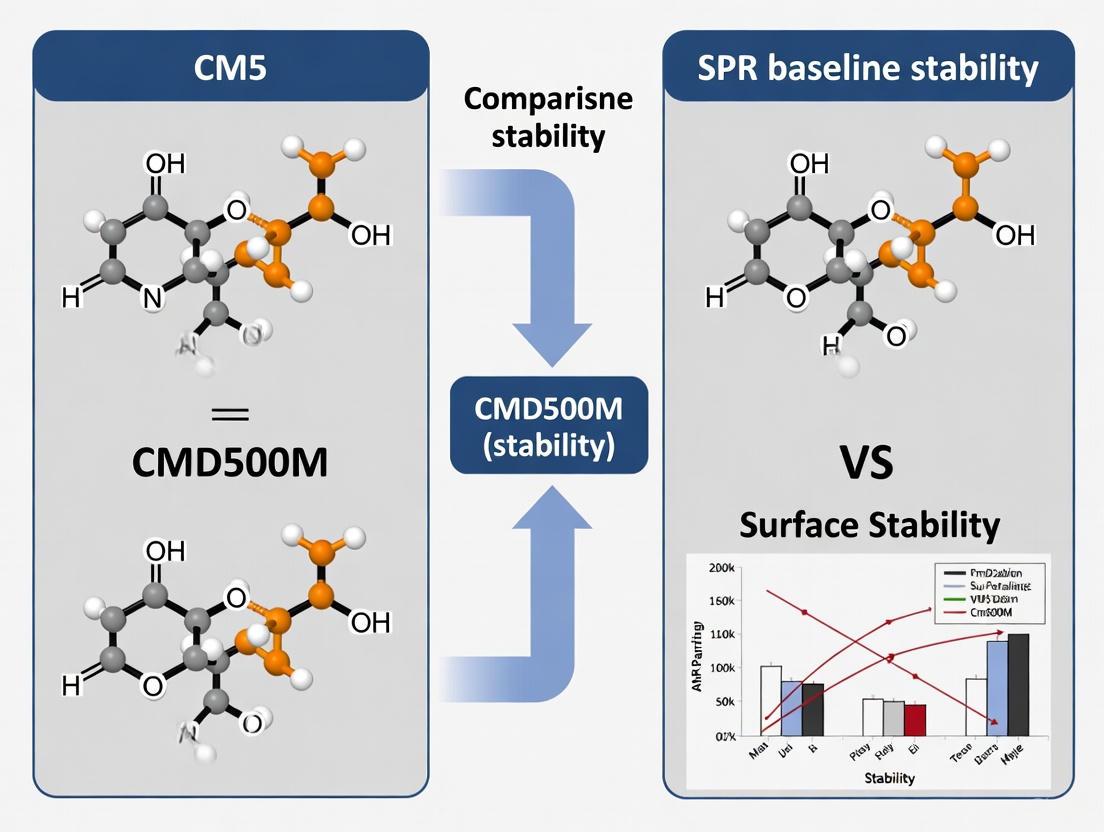
This article provides a comprehensive analysis for researchers and drug development professionals on the baseline stability and performance equivalence of the Biacore CM5 optical chip and its sanction-driven analogue, the...
SPR Baseline Stability: A Comparative Analysis of Biacore CM5 and XanTec CMD500M Sensor Chips
Abstract
This article provides a comprehensive analysis for researchers and drug development professionals on the baseline stability and performance equivalence of the Biacore CM5 optical chip and its sanction-driven analogue, the XanTec CMD500M. It covers the foundational principles of SPR and the critical role of baseline stability, outlines methodological approaches for robust experimental design, presents troubleshooting strategies for common stability issues, and delivers a direct comparative validation of kinetic parameters and operational performance based on a recent 2024 study. The findings confirm the practical interchangeability of these chips, a critical consideration for labs facing supply chain constraints.
Understanding SPR Baseline Stability and Its Impact on Data Quality
Core Principles of Surface Plasmon Resonance (SPR) Biosensing
Surface Plasmon Resonance (SPR) is a powerful, label-free optical biosensing technique that enables real-time monitoring of molecular interactions [1]. Since its introduction in the early 1990s, SPR has proven to be one of the most powerful technologies for determining specificity, affinity, and kinetic parameters during macromolecular binding events [1]. This technique measures refractive index changes in the vicinity of thin metal films (typically gold) in response to biomolecular interactions, eliminating the need for specialized tags or dyes that could cause steric hindrance or alter structural configurations [1] [2]. The ability to study interactions without labels allows researchers to observe native molecular behavior with high sensitivity, making SPR invaluable across biomedical research, drug discovery, diagnostics, and bioengineering [1] [3].
The fundamental principle underlying SPR technology involves the generation of surface plasmons—electron charge density waves that propagate parallel to a metal-dielectric interface when excited by polarized light [3]. In commercial SPR biosensors, this is typically achieved using a high-refractive-index glass prism in the Kretschmann configuration of the attenuated total reflection method [1]. When biomolecular binding occurs on the sensor surface, it alters the local refractive index, changing the resonance conditions that can be precisely measured [1]. This change is directly proportional to the mass concentration of molecules bound to the surface, allowing for quantitative assessment of binding interactions [1].
Core Principles and Instrumentation
Fundamental Physical Principles
Surface plasmon resonance occurs when photons of incident light strike a metal surface at a specific angle of incidence [1]. Under the right conditions, a portion of the light energy couples through the metal coating with electrons in the metal surface layer, setting them into oscillation [1] [3]. These coordinated electron oscillations, known as surface plasmons, generate an evanescent electric field that extends approximately 300 nanometers from the metal surface into the adjacent medium [1]. This limited range makes SPR exceptionally sensitive to minute changes at the sensor surface.
The defined SPR angle at which resonance occurs depends on the refractive index of the material near the metal surface when the light source wavelength and metal film properties remain constant [1]. When biomolecules bind to the sensor surface, they alter the local refractive index, changing the resonance conditions [1]. Detection is accomplished by measuring changes in the intensity or angle of reflected light, with the magnitude of change being directly proportional to the mass concentration of bound molecules [1] [4]. This relationship enables researchers to quantify binding events with high precision, typically with a detection limit on the order of 10 pg/mL [1].
SPR Instrumentation and Measurement
Commercial SPR instruments employ several key components to facilitate precise measurements:
- Optical System: Generates polarized light and detects changes in reflectivity
- Sensor Chip: Contains the thin gold film where molecular interactions occur
- Microfluidic System: Delieves samples in a controlled manner across the sensor surface
- Detection System: Precisely monitors changes in resonance signals over time
In SPR experiments, resonance units (RU) describe signal changes, where 1 RU is equivalent to a critical angle shift of 10⁻⁴ degrees [1]. The change in refractive index (Δnd) within a layer of thickness h can be calculated as: Δnd = (dn/dc)vol ΔΓ/h, where (dn/dc)vol represents the increase of refractive index n with the volume concentration of analyte c, and ΔΓ is the concentration of the bound target on the surface [1].
For high-throughput applications, SPR imaging (SPRI) has been developed as a modified version that enables simultaneous processing of hundreds or thousands of samples [1]. Unlike conventional SPR, SPRI measurements are performed at a constant wavelength and angle, with changes in reflected light intensity being proportional to refractive index variations across the sensor surface [1]. This approach utilizes a coherent polarized light beam to cover a larger sensing area, with reflected light captured by a charge-coupled device camera for imaging analysis [1].
Figure 1: Schematic diagram of SPR instrumentation showing key components and workflow in a typical biosensing experiment.
The Sensorgram: Interpreting SPR Data
SPR data is presented in the form of a sensorgram, which displays the binding response (in resonance units) on the y-axis against time on the x-axis [3] [4]. A typical sensorgram consists of five distinct phases that provide comprehensive information about molecular interactions:
- Baseline Phase: Running buffer flows across the sensor surface to establish a stable reference point [3] [4]
- Association Phase: Analyte is introduced, binding to the immobilized ligand and causing an increase in signal [3] [4]
- Steady-State Phase: Equilibrium is reached where association and dissociation rates are equal [3]
- Dissociation Phase: Analyte solution is replaced with buffer, allowing bound complexes to dissociate [3] [4]
- Regeneration Phase: A solution is applied to disrupt remaining interactions and restore the baseline [3] [4]
From these sensorgram phases, critical kinetic parameters can be derived, including the association rate (kₒₙ), dissociation rate (kₒff), and the equilibrium dissociation constant (Kᴅ) calculated as kₒff/kₒₙ [4]. These parameters provide a comprehensive picture of binding behavior, including interaction strength, complex stability, and binding mechanism.
Experimental Protocols for SPR Analysis
Sensor Chip Preparation and Selection
Choosing the appropriate sensor chip is fundamental to successful SPR experiments. Different chip types offer varied surface chemistries optimized for specific applications:
- CM5 Chips: Feature carboxymethylated dextran matrix for covalent immobilization, suitable for most protein studies [2] [5]
- CMD500M Chips: Commercial alternative to CM5 with comparable performance characteristics [6]
- NTA Chips: Designed for capturing His-tagged proteins via nickel-nitrilotriacetic acid chemistry [5]
- SA Chips: Coated with streptavidin for immobilizing biotinylated ligands [5]
For baseline stability comparisons between CM5 and CMD500M chips, both surfaces should be prepared following identical protocols. Prior to immobilization, sensor chips require surface preconditioning through cleaning and activation steps to ensure optimal performance and minimize baseline drift [7] [5].
Ligand Immobilization Strategies
Immobilizing the ligand to the sensor surface can be achieved through various methods, each with distinct advantages:
Covalent Immobilization via Amine Coupling
- Activate carboxymethyl groups on the sensor surface using a mixture of EDC (N-ethyl-N'-(3-dimethylaminopropyl)carbodiimide) and NHS (N-hydroxysuccinimide) [2]
- Dilute the ligand to 30 μg/mL in sodium acetate buffer (pH 5.5) [2] [8]
- Inject the ligand solution over the activated surface at a flow rate of 5 μL/min [8]
- Block remaining active groups with 1.0 M ethanolamine-HCl (pH 8.5) [2]
Affinity Capture Immobilization
- Immobilize capture molecule (e.g., streptavidin) to the sensor surface using standard amine coupling [8]
- Inject biotinylated ligand at 25 μg/mL in running buffer to capture the molecule [8]
- Apply biotin to block unoccupied binding sites on streptavidin [8]
Controlling ligand density is critical, as excessively high densities can cause steric hindrance or mass transport limitations, while low densities may yield weak signals [8] [5]. For comparative studies between CM5 and CMD500M chips, immobilization levels should be standardized across both surfaces.
Binding Experiments and Data Collection
For accurate comparison of CM5 and CMD500M performance:
- Prepare analyte concentrations in series (typically 5-8 concentrations) to cover a range below and above the expected Kᴅ value [8]
- Use HBS-EP buffer (10 mM HEPES pH 7.4, 150 mM NaCl, 3.4 mM EDTA, 0.005% surfactant P20) as the running buffer [8]
- Maintain consistent temperature (typically 25°C) throughout experiments [8]
- Employ a flow rate of 5-10 μL/min during analyte injection [8]
- Allow sufficient dissociation time (2000-6000 seconds) to monitor complex stability [8]
- Include regular blank injections (buffer alone) for double referencing to compensate for drift and bulk refractive index effects [7]
Figure 2: Experimental workflow for comparative SPR analysis of CM5 and CMD500M sensor chips.
Comparative Analysis: CM5 vs. CMD500M Sensor Chips
Performance Comparison in Binding Studies
Recent comparative studies have evaluated the performance characteristics of original Biacore CM5 chips and their analog CMD500M chips under identical experimental conditions. In one comprehensive study, Protein A was immobilized on both chip types as a molecular ligand, with IgG antibody used as the analyte [6]. The binding interactions were analyzed using various concentrations of antibodies to determine kinetic parameters.
Table 1: Comparative kinetic analysis of CM5 and CMD500M sensor chips
| Parameter | CM5 Chip | CMD500M Chip | Difference |
|---|---|---|---|
| Association Rate Constant (kₒₙ) | Baseline | +18% variation | 18% |
| Dissociation Rate Constant (kₒff) | Baseline | +10% variation | 10% |
| Equilibrium Dissociation Constant (Kᴅ) | Baseline | +9% variation | 9% |
| Binding Response | Comparable | Comparable | Minimal |
| Baseline Stability | Similar performance | Similar performance | Comparable |
The results demonstrated that both chip types produced similar binding responses and baseline stability, with differences in kinetic constants of less than 20% [6]. This level of variation falls within acceptable ranges for most biosensing applications, confirming the interchangeability of these surfaces for standard molecular interaction analysis.
Baseline Stability Assessment
Baseline stability is a critical factor in SPR biosensing, as drift can compromise data quality and kinetic parameter accuracy. Several factors contribute to baseline performance in CM5 and CMD500M chips:
Causes of Baseline Drift
- Surface Rehydration: Newly docked sensor chips require equilibration time [7]
- Buffer Incompatibility: Buffer changes can cause refractive index mismatches [7] [5]
- Residual Contamination: Incomplete surface regeneration leaves bound material [7]
- Flow Rate Fluctuations: Sudden flow changes affect surface equilibrium [7]
Minimizing Drift Strategies
- Prime the system thoroughly after buffer changes [7]
- Include start-up cycles with buffer injections before sample analysis [7]
- Ensure proper surface regeneration between binding cycles [5]
- Maintain consistent temperature and flow conditions [5]
- Use double referencing with blank injections spaced throughout experiments [7]
Both CM5 and CMD500M chips demonstrate similar baseline characteristics when properly handled, with drift rates becoming comparable after adequate system equilibration [6] [7].
Essential Reagents and Materials
Successful SPR experiments require carefully selected reagents and materials to ensure reproducible results. The following table outlines key components for comparative SPR studies:
Table 2: Essential research reagents and materials for SPR experiments
| Reagent/Material | Function | Example Products |
|---|---|---|
| Sensor Chips | Platform for immobilization and detection | CM5 (Cytiva), CMD500M (XanTec) [6] |
| Running Buffer | Maintains pH and ionic strength during analysis | HBS-EP, HBS-N, PBS [2] [8] |
| Coupling Reagents | Activates surface for ligand immobilization | EDC, NHS [2] |
| Regeneration Solutions | Removes bound analyte without damaging ligand | Glycine-HCl (pH 1.5-3.0), NaOH [2] |
| Blocking Agents | Reduces non-specific binding | Ethanolamine, BSA [2] [5] |
| Capture Molecules | Enables oriented immobilization | Streptavidin, Protein A [8] |
Troubleshooting and Optimization
Addressing Common SPR Challenges
Non-Specific Binding
- Use surface blocking agents (ethanolamine, casein, BSA) to occupy active sites [5]
- Optimize buffer composition with additives like Tween-20 to reduce hydrophobic interactions [5]
- Employ reference surfaces to identify and subtract non-specific signals [8]
- Select sensor chips with surface chemistries tailored to specific analyte properties [5]
Low Signal Intensity
- Optimize ligand immobilization density to balance signal strength and accessibility [5]
- Improve immobilization efficiency by adjusting coupling buffer pH and composition [5]
- Consider high-sensitivity chips (CM5, PlexChip) for weak interactions or low-abundance analytes [5]
- Increase analyte concentration while monitoring for mass transport limitations [5]
Poor Reproducibility
- Standardize surface activation and ligand immobilization protocols [5]
- Include control samples with irrelevant ligands to monitor specificity [5]
- Pre-condition sensor chips with buffer cycles to stabilize surfaces [7] [5]
- Maintain consistent environmental conditions (temperature, humidity) [5]
Optimization Strategies for Baseline Stability
Achieving stable baselines is particularly important for comparative studies between different sensor chips:
- Buffer Management: Prepare fresh buffers daily, filter through 0.22 μM membranes, and degas before use to minimize air spikes [7]
- System Equilibration: Flow running buffer over newly docked sensor surfaces until stable (may require extended time or overnight flow) [7]
- Start-up Cycles: Incorporate 3+ start-up cycles with buffer injections and regeneration before data collection to stabilize surfaces [7]
- Regular Calibration: Ensure instrument components (especially the integrated fluidic cartridge) are properly calibrated and maintained [5]
Surface Plasmon Resonance biosensing represents a versatile and powerful technology for studying molecular interactions in real-time without labels. The comparative analysis between CM5 and CMD500M sensor chips demonstrates comparable performance in binding studies and baseline stability, with kinetic parameter variations of less than 20% [6]. This confirms the interchangeability of these surfaces for most research applications, providing researchers with flexibility in consumables selection.
Successful SPR experiments require careful attention to experimental design, including appropriate sensor chip selection, optimized immobilization strategies, proper buffer preparation, and systematic troubleshooting approaches. Following standardized protocols for comparative assessments ensures reliable data collection and interpretation. As SPR technology continues to evolve, maintaining rigorous experimental standards will remain essential for generating high-quality binding data that advances scientific understanding and drug development efforts.
Surface Plasmon Resonance (SPR) is a label-free optical biosensing technique that enables researchers to measure molecular interactions in real-time by detecting changes in the refractive index near a sensor surface [3]. The foundational output of an SPR experiment is the sensorgram, a plot of response (measured in Resonance Units, RU) against time, which provides a visual representation of the entire binding event [3]. The initial phase of this sensorgram, known as the baseline, is established before the analyte is introduced and represents the signal from the immobilized ligand in a stable state with buffer flowing over it [3]. A stable baseline is not merely a procedural formality; it is the essential cornerstone for generating reliable, interpretable kinetic data. Instabilities in the baseline, manifested as drift or excessive noise, can obscure the true binding signal, compromise the accuracy of calculated kinetic parameters (kon, koff, KD), and ultimately lead to erroneous scientific conclusions.
The stability of this baseline is profoundly influenced by the sensor chip itself. Different sensor chips, with variations in their polymer matrix, hydrogel thickness, density, and surface chemistry, can exhibit distinct performance characteristics. This guide provides an objective, data-driven comparison of baseline stability and overall performance between a longstanding industry standard, the Cytiva Biacore CM5 chip, and a commercially available analogue, the XanTec CMD500M chip.
Comparative Product Analysis: CM5 vs. CMD500M
The CM5 sensor chip from Cytiva is one of the most widely used SPR chips in life science research. Its surface consists of a carboxymethylated dextran matrix that forms a hydrogel, providing a hydrophilic environment for ligand immobilization and minimizing non-specific binding [2]. However, users of Biacore SPR biosensors have recently faced challenges due to "sanctions restrictions on the purchase of consumables (primarily optical chips)" [6]. This has driven the need for commercially available, functionally equivalent analogues that can ensure the continuity of research.
The XanTec CMD500M is one such analogue, explicitly designed to be compatible with Biacore series instruments. Like the CM5, it features a carboxymethyldextran-based hydrogel, which is a linear polycarboxylate or carboxymethyldextran polymer [9]. According to XanTec's selection guide, the CMD500M, with its ~500 nm thick hydrogel and medium density, is recommended for interactions involving protein-peptide or protein-small molecule binding, a common application in drug discovery [9].
Table 1: Key Specifications of CM5 and CMD500M Sensor Chips
| Feature | Cytiva Biacore CM5 | XanTec CMD500M |
|---|---|---|
| Polymer Matrix | Carboxymethylated dextran | Carboxymethyldextran (CMD) |
| Hydrogel Thickness | ~100 nm (for CM5) [9] | ~500 nm (for CMD500M) [9] |
| Recommended Applications | Broad range; standard for protein-protein interactions [2] | Protein-peptide/small molecule interactions [9] |
| Immobilization Chemistry | NHS/EDC amine coupling standard [2] | NHS/EDC amine coupling compatible |
| Instrument Compatibility | Biacore instruments | Biacore series S compatible [9] |
Experimental Comparison and Performance Data
A direct, comparative study of the original Biacore CM5 chip and the XanTec CMD500M analogue was conducted by researchers at the Institute of Biomedical Chemistry in Moscow to evaluate their interchangeability for rigorous interaction analysis [6].
Experimental Protocol
The experimental methodology was designed to mirror a common SPR application and was applied identically to both chip types [6]:
- Ligand Immobilization: Protein A, a protein frequently used to immobilize antibodies, was immobilized on both the CM5 and CMD500M sensor chips.
- Analyte Binding: A solution of IgG antibody was used as the analyte and injected over the chip surfaces at various concentrations.
- Data Collection: Sensorgrams were recorded in real-time on a Biacore X100 SPR biosensor, capturing the entire association and dissociation process.
- Kinetic Analysis: The resulting sensorgrams were analyzed using a 1:1 (Langmuir) binding model to calculate the kinetic rate constants for association (kon) and dissociation (koff), as well as the equilibrium dissociation constant (Kd).
Quantitative Results and Stability Assessment
The research demonstrated that both chips produced high-quality data with very similar binding kinetics, indicating that the CMD500M reliably replicates the core functionality of the CM5 chip [6].
Table 2: Comparative Kinetic Parameters from CM5 vs. CMD500M Study
| Kinetic Parameter | CM5 Chip | CMD500M Chip | Percentage Difference |
|---|---|---|---|
| Association Rate (kon) | Baseline | Comparable Value | +18% |
| Dissociation Rate (koff) | Baseline | Comparable Value | +10% |
| Equilibrium Constant (Kd) | Baseline | Comparable Value | +9% |
The observed differences in kinetic constants (9-18%) are well within an acceptable range for biosensor studies and confirm that the CMD500M chip is a functionally equivalent alternative to the original CM5 [6]. The successful application of the standard 1:1 binding model and the low variability in calculated constants strongly imply that both chips were capable of generating a stable baseline and clean sensorgrams, free from significant drift or noise that would otherwise complicate kinetic analysis.
The Scientist's Toolkit: Essential Research Reagents
Successful SPR experiments depend on a suite of specialized reagents and materials. The following table outlines key solutions required for the immobilization and analysis protocols similar to the comparative study.
Table 3: Essential Research Reagent Solutions for SPR
| Reagent/Solution | Function & Application | Example from Literature |
|---|---|---|
| HBS-EP Buffer (10 mM HEPES, 150 mM NaCl, 3 mM EDTA, 0.005% P20) | Standard running buffer; maintains pH and ionic strength, surfactant P20 minimizes non-specific binding. | Used as the working buffer in surface characterization studies [8]. |
| NHS/EDC Reagents | Activates carboxyl groups on dextran chips for covalent amine coupling of protein ligands. | Standard amine coupling protocol for CM5 chips [2]. |
| Ethanolamine HCl | Blocks remaining activated ester groups on the sensor surface after ligand immobilization. | Used post-immobilization to deactivate excess sites [2]. |
| Sodium Acetate Buffers (low pH) | Serves as the immobilization buffer; optimal pH is selected based on the isoelectric point (pI) of the protein ligand. | Used at pH 4.0 - 5.5 for ligand immobilization [2]. |
| Regeneration Solutions (e.g., Glycine-HCl, NaOH) | Removes tightly bound analyte from the immobilized ligand without damaging it, allowing for chip re-use. | Solutions like 10 mM glycine pH 2.0-3.0 or 50 mM NaOH are common [2]. |
SPR Workflow and Data Analysis Visualization
The following diagram illustrates the critical steps of an SPR experiment, from system preparation to data interpretation, highlighting where baseline stability is paramount.
The sensorgram is the primary output of an SPR experiment. Understanding its phases is crucial for diagnosing assay quality and kinetic analysis.
The experimental data clearly demonstrates that the XanTec CMD500M sensor chip is a functionally equivalent and interchangeable alternative to the original Cytiva CM5 chip [6]. The minor differences in measured kinetic constants are not statistically significant in the context of biosensor analysis and highly unlikely to impact biological conclusions. For researchers facing supply chain constraints, the CMD500M provides a viable solution without compromising data quality.
The choice between a CM5 and a CMD500M, or any sensor chip, should ultimately be guided by the specific experimental needs. The CMD500M, with its thicker hydrogel (500 nm), may offer an advantage for capturing small molecules due to a larger surface volume, which can increase the maximum binding capacity (Rmax) and improve the signal-to-noise ratio for low molecular weight analytes [9]. The CM5, with its thinner hydrogel (~100 nm), might be preferred for analyzing very large analytes like viruses or cells to minimize mass transport limitations [9].
In conclusion, baseline stability is a non-negotiable prerequisite for reliable SPR analysis. This comparison confirms that both the CM5 and CMD500M sensor chips are capable of providing the stable performance required for rigorous interaction studies. Scientists can select the CMD500M with confidence, ensuring their critical research in drug discovery and molecular interaction analysis continues unimpeded.
Consequences of Baseline Drift on Kinetic and Affinity Measurements
Surface Plasmon Resonance (SPR) biosensors have become indispensable tools for characterizing biomolecular interactions in real-time, providing critical data on binding kinetics and affinity. The stability of the SPR baseline signal is a fundamental prerequisite for obtaining accurate and reliable kinetic parameters. This guide objectively compares the baseline stability and performance of the classic Biacore CM5 sensor chip and its analogue, the XanTec CMD500M, within the context of ongoing research on SPR baseline stability. Supported by experimental data, we demonstrate that while both chips deliver highly comparable kinetic and affinity data, their specific handling and equilibration requirements can significantly influence baseline drift, thereby directly impacting the quality of the derived constants for association (k~on~), dissociation (k~off~), and equilibrium dissociation (K~D~).
In SPR biosensing, a sensorgram is the primary data output, plotting the SPR response (in Resonance Units, RU) against time [4]. A stable baseline—the flat portion of the sensorgram before analyte injection—is the foundation upon which all binding data is interpreted. Baseline drift, a gradual increase or decrease of this signal, is a common phenomenon often indicative of a non-optimally equilibrated sensor surface [7]. This drift can originate from several sources, including the rehydration of a newly docked chip, wash-out of immobilization chemicals, or a slow adjustment of the immobilized ligand to the flow buffer [7].
The consequences of unaddressed baseline drift are profound for kinetic and affinity analysis. Modern SPR software calculates kinetic parameters by fitting mathematical models to the association and dissociation phases of the sensorgram. A drifting baseline can lead to significant errors in the fitted values of k~on~ and k~off~, which in turn distorts the calculation of the overall binding affinity (K~D~ = k~off~/k~on~) [4]. Therefore, selecting a sensor chip with inherent stability and understanding its equilibration needs is a critical first step in experimental design.
Comparative Analysis: CM5 vs. CMD500M
A direct comparative study of the original Biacore CM5 chip and its analog, the XanTec CMD500M, provides valuable insights into their performance parity. The study, which immobilized Protein A on both chips and used IgG as an analyte, found the chips to be functionally interchangeable for this application [6].
Table 1: Quantitative Comparison of Kinetic Parameters from CM5 and CMD500M
| Parameter | Biacore CM5 | XanTec CMD500M | Percentage Difference |
|---|---|---|---|
| Association Constant (k~on~) | Reference Value | Comparable Value | 18% |
| Dissociation Constant (k~off~) | Reference Value | Comparable Value | 10% |
| Equilibrium Dissociation Constant (K~D~) | Reference Value | Comparable Value | 9% |
Source: Adapted from Gnedenko et al. (2024) [6].
The minor differences shown in Table 1 fall within an acceptable range for most applications, confirming the CMD500M as a viable alternative to the CM5. The underlying base coating of both chips is a carboxymethylated (CM) dextran hydrogel, which provides a bioinert matrix that minimizes non-specific binding and serves as a versatile platform for various immobilization chemistries [6] [10]. This similarity in core architecture is a key reason for their comparable performance.
The Source and Impact of Baseline Drift
Baseline drift is often most pronounced directly after docking a new sensor chip or following the immobilization of the ligand [7]. This is frequently due to the rehydration of the sensor surface and the gradual wash-out of chemicals used during the immobilization procedure. The drift is a physical signal reflecting a changing environment on the chip surface, which the instrument interprets as a binding or dissociation event. If this drift is not accounted for, it becomes integrated into the curve-fitting algorithm for kinetic analysis.
For instance, an upward drift during the dissociation phase could make the analyte appear to be dissociating more slowly than it truly is, leading to an underestimation of k~off~. Since K~D~ is directly proportional to k~off~, this would result in an incorrectly calculated, higher-affinity interaction (lower K~D~) [7] [4]. The impact is similarly detrimental during the association phase, where drift can distort the apparent association rate.
Equilibration and Drift Mitigation Strategies
The process of mitigating baseline drift is universally crucial, regardless of the specific CM-type chip used. The following experimental workflow outlines the standard procedures for establishing a stable baseline.
The most critical step in combating drift is adequate surface equilibration. This involves flowing the running buffer over the sensor surface until a stable baseline is achieved. As highlighted in the troubleshooting guide, "It can be necessary to run the running buffer overnight to equilibrate the surfaces" [7]. Furthermore, incorporating start-up cycles (injecting buffer instead of analyte at the beginning of an experiment) and blank injections throughout the run is recommended to stabilize the system and provide data for a processing technique called double referencing, which compensates for drift and bulk effect [7].
The Scientist's Toolkit: Essential Reagents and Materials
Table 2: Key Research Reagent Solutions for SPR Experiments
| Item | Function in SPR Experiment |
|---|---|
| CM5 / CMD500M Sensor Chip | The core platform with a carboxymethyl dextran matrix for ligand immobilization. |
| HBS-EP Buffer | A common running buffer (HEPES, NaCl, EDTA, surfactant P20) that maintains pH and ionic strength while reducing non-specific binding. |
| NHS/EDC Reagents | Used for covalent amine coupling to activate the carboxyl groups on the chip surface for ligand immobilization. |
| Ethanolamine | Used to deactivate and block remaining active esters on the chip surface after covalent immobilization. |
| Regeneration Solutions | Low pH buffers (e.g., Glycine HCl) or high-salt solutions used to remove bound analyte without damaging the immobilized ligand. |
| Protein A | A common capture ligand for immobilizing antibodies via their Fc region, ensuring proper orientation. |
Advanced Considerations for Membrane Proteins and Small Molecules
While the CM5 and CMD500M are workhorse chips for soluble proteins, studying challenging targets like membrane proteins requires specialized approaches. The capture-stabilize method has been successfully employed for G-protein-coupled receptors (GPCRs) [11]. This technique involves capturing a His-tagged membrane protein (e.g., CXCR5) on an NTA chip, followed by limited cross-linking to stabilize it on the surface. This creates a robust surface that can withstand regeneration steps, enabling reliable kinetic analysis of antibodies binding to the native receptor [11].
For small molecule analysis, mass limitations become a significant factor. The maximum response (R~max~) is proportional to the molecular weight of the analyte. Achieving a sufficient signal for accurate kinetics with small molecules often requires immobilizing very high levels of ligand, which can lead to crowding and steric hindrance [12]. In such cases, using specialized high-capacity chips or alternative strategies, such as immobilizing a protein fragment that contains the small molecule binding site, may be necessary to improve resolution [12].
The choice between the Biacore CM5 and XanTec CMD500M sensor chips need not be a significant variable in experimental outcomes for standard protein-protein interactions, as their kinetic and affinity measurements are highly comparable. The primary factor influencing data quality, particularly for precise kinetic analysis, is the management of baseline stability. Researchers must adhere to rigorous buffer preparation, allow for sufficient system and surface equilibration, and employ referencing techniques to mitigate drift. For more complex targets like membrane proteins or small molecules, moving beyond standard chips to specialized surfaces and immobilization strategies is often required to obtain biologically relevant binding data. A meticulous approach to surface preparation and selection is paramount for generating accurate kinetic and affinity constants.
Surface Plasmon Resonance (SPR) biosensing has revolutionized the study of molecular interactions in drug discovery and basic research by enabling real-time, label-free monitoring of binding events. [13] [14] At the heart of many SPR experiments lies the carboxymethyl dextran hydrogel, a three-dimensional matrix that serves as the interface for immobilizing biological molecules. [15] [6] This hydrogel matrix creates a hydrophilic environment that reduces non-specific binding while providing carboxyl groups for the covalent attachment of ligands, making it the industry standard for over two decades. [15] [16] The CM5 chip, introduced by Biacore (now Cytiva), is one of the most recognized and widely used sensor chips of this type. However, the evolution of SPR technology and recent supply challenges have spurred the development of commercially available analogues, with XanTec's CMD500M emerging as a direct and functionally equivalent alternative. [6] This guide provides an objective comparison of these two chips, focusing on their performance, experimental applications, and implications for research continuity and planning, particularly within the context of SPR baseline stability.
Technical Specifications and Design Philosophy
The CM5 and CMD500M sensor chips share a fundamental design principle: a carboxymethylated dextran hydrogel layer covalently attached to a gold film. [6] [10] The "500" in CMD500M denotes a 500 kDa carboxymethylated dextran hydrogel, which forms the capture layer. [15] This specific molecular weight is central to the chip's performance, creating a defined environment for ligand immobilization and analyte interaction.
Table 1: Core Technical Specifications of CM5 and CMD500M Sensor Chips
| Feature | Biacore CM5 | XanTec CMD500M |
|---|---|---|
| Base Matrix | Carboxymethyl dextran | Carboxymethyl dextran |
| Dextran Chain Mass | Not specified in results | 500 kDa [15] |
| Surface Geometry | Three-dimensional (3D) hydrogel | Three-dimensional (3D) hydrogel [15] |
| Key Functionality | Carboxyl groups for covalent coupling | Carboxyl groups for covalent coupling [10] |
| Primary Immobilization | Amine coupling | Amine coupling |
| Common Applications | Protein-protein interactions, kinetic studies | Small molecule analysis, kinetic studies [15] |
While the core chemistry is similar, differences in manufacturing and potentially in the underlying grafting layer can lead to variations in practical performance, which are explored in the following sections. [15] [6]
Comparative Performance and Experimental Data
A direct comparative study published in 2024 provides the most robust, head-to-head experimental data on the performance of the CM5 and CMD500M chips. Researchers conducted a side-by-side interaction analysis using a Biacore X100 instrument, immobilizing Protein A on both chips and using IgG as the analyte to determine kinetic constants. [6]
Table 2: Experimental Kinetic Data from Comparative Study [6]
| Performance Parameter | Biacore CM5 | XanTec CMD500M | Observed Difference |
|---|---|---|---|
| Association Rate Constant (kon) | Reference Value | Comparable | +18% |
| Dissociation Rate Constant (koff) | Reference Value | Comparable | +10% |
| Equilibrium Dissociation Constant (KD) | Reference Value | Comparable | +9% |
The study concluded that the differences in kinetic constants were minor, confirming the functional interchangeability of the original CM5 and the CMD500M analogue for this type of protein-protein interaction. [6] For researchers, this means that switching from CM5 to CMD500M is unlikely to necessitate major protocol changes or invalidate historical data, a critical consideration for ongoing research projects.
Application in Small Molecule Analysis
The CMD500M chip has been specifically highlighted for its utility in challenging applications like small molecule analysis. The combination of the 2SPR Dual Channel SPR system and the XanTec CMD500m sensor chip has demonstrated excellent results for studying interactions involving very low molecular weight analytes, such as methanesulfonamide (95 Da) and 4-carboxybenzenesulfonamide (201 Da) with the enzyme carbonic anhydrase. [15] This underscores the chip's high sensitivity and low noise, which are essential for detecting the minimal refractive index changes caused by small molecule binding. [15]
The Scientist's Toolkit: Essential Reagents and Materials
Successful SPR experiments using CM5 or CMD500M chips require a suite of specialized reagents and materials. The following table details the key components for a standard amine coupling procedure, as exemplified in the search results. [17]
Table 3: Key Research Reagent Solutions for Carboxymethyl Dextran Chip Experiments
| Reagent/Material | Function | Example from Protocol |
|---|---|---|
| Sensor Chip (CM5/CMD500M) | Platform with hydrogel matrix for ligand immobilization. | Sensor Chip CM5 [17] |
| Amine Coupling Kit | Contains chemicals (EDC, NHS) to activate carboxyl groups on the dextran matrix for ligand attachment. | Amine Coupling Kit (GE Healthcare) [17] |
| Immobilization Buffers | Low-pH buffers (e.g., sodium acetate) used to optimize ligand pre-concentration on the chip surface. | 10 mM sodium acetate, pH 4.0 & 4.5 [17] |
| Running Buffer | Stable-buffered solution (e.g., HBS-EP) used to maintain pH and ionic strength during analyte injection. | HBS-EP [17] |
| Regeneration Solution | A solution that disrupts the ligand-analyte interaction without damaging the ligand, allowing chip re-use. | 10 mM NaOH, 10 mM EDTA [17] |
Experimental Workflow for Immobilization and Analysis
A generalized workflow for conducting an experiment with CM5 or CMD500M chips is outlined below. This workflow is synthesized from protocols used for studying GPCR domain interactions [17] and small molecule inhibitors [15].
Diagram 1: Generalized SPR experimental workflow using carboxymethyl dextran sensor chips.
Detailed Methodological Notes
- Ligand Immobilization: The core of the assay is activating the carboxymethyl dextran surface with a mixture of EDC (N-ethyl-N'-(dimethylaminopropyl)carbodiimide) and NHS (N-hydroxysuccinimide) to form reactive esters. The ligand is then injected in a low-pH immobilization buffer (e.g., sodium acetate, pH 4.0-4.5) to promote electrostatic pre-concentration near the surface, leading to efficient covalent coupling. [17]
- Regeneration Scouting: Identifying an effective regeneration solution is critical for re-using the sensor chip. This involves testing solutions that can break the specific ligand-analyte interaction without denaturing the immobilized ligand. Common agents include low-pH buffers (e.g., glycine-HCl), bases (e.g., NaOH), or chelators (e.g., EDTA). [17] [10]
The objective comparison of the Biacore CM5 and XanTec CMD500M sensor chips reveals a high degree of functional equivalence. Independent research confirms that the differences in key performance metrics, such as association rate, dissociation rate, and binding affinity, are minimal, at 18%, 10%, and 9% respectively. [6] This data supports the strategic interchangeability of these platforms, offering researchers a viable path to maintaining experimental continuity in the face of supply chain constraints.
The CMD500M chip has also demonstrated excellent performance in specific, demanding applications such as small molecule analysis, showcasing low noise and high sensitivity. [15] For the research community, this equivalence empowers continued innovation in drug discovery and basic research, ensuring that the foundational tool of SPR biosensing remains accessible and reliable.
Methodologies for Assessing SPR Chip Performance and Stability
Optimal Immobilization Strategies for CM5 and CMD500M Chips
Surface Plasmon Resonance (SPR) biosensors have become indispensable tools in life science research and drug discovery for characterizing biomolecular interactions in real-time without labels. The sensor chip is the core of any SPR system, and its selection and proper use are critical for obtaining high-quality, reliable data. The Biacore CM5 chip, with its carboxymethylated dextran matrix, has long been the industry standard. However, recent geopolitical constraints have created significant challenges for researchers relying on original equipment manufacturer consumables, making the exploration of scientifically validated alternatives an urgent necessity [6]. The CMD500M chip from XanTec has emerged as a promising alternative, claiming full compatibility with Biacore systems and comparable performance characteristics. This comparison guide provides an objective evaluation of both chip types, focusing on immobilization strategies and performance metrics, to empower researchers in making evidence-based decisions for their specific experimental needs.
Technical Specifications and Design Principles
The CM5 and CMD500M chips share fundamental design principles while exhibiting subtle differences that may influence experimental outcomes. Both feature a gold film surface modified with a carboxymethylated dextran hydrogel matrix that provides a biocompatible environment for ligand immobilization and biomolecular interactions. This hydrogel matrix serves to minimize non-specific binding while creating a three-dimensional environment that increases ligand loading capacity compared to two-dimensional surfaces [9].
The CM5 chip employs a hydrogel layer of approximately 100 nm thickness with medium matrix density, making it suitable for a broad range of applications from small molecule studies to large complex formations. The CMD500M, as indicated by its nomenclature, features a approximately 500 nm thick carboxymethylated dextran hydrogel coupled with a proprietary grafting layer designed to enhance stability and performance, particularly with small molecule analytes [15]. According to manufacturer specifications, the CMD500M is specifically recommended for protein-peptide and protein-small molecule interactions due to its dense hydrogel structure with high binding capacity [9].
Both chips utilize the same fundamental chemistry for ligand immobilization, primarily relying on amine coupling through activation of surface carboxyl groups with a mixture of N-hydroxysuccinimide (NHS) and N-ethyl-N'-(3-dimethylaminopropyl)carbodiimide (EDC). This compatibility ensures that established protocols for CM5 can be directly transferred to the CMD500M platform without significant modification [6].
Table 1: Technical Specifications of CM5 and CMD500M Sensor Chips
| Parameter | Biacore CM5 | XanTec CMD500M |
|---|---|---|
| Hydrogel Matrix | Carboxymethylated dextran | Carboxymethylated dextran with proprietary grafting layer |
| Hydrogel Thickness | ~100 nm | ~500 nm |
| Recommended Applications | Broad range: proteins, nucleic acids, small molecules, particles | Protein-peptide and protein-small molecule interactions |
| Immobilization Chemistry | Standard amine coupling (NHS/EDC) | Standard amine coupling (NHS/EDC) |
| Compatibility | Biacore systems | Biacore-compatible systems |
Comparative Experimental Analysis
Direct Performance Comparison Study
A comprehensive comparative study published in 2024 directly addressed the interchangeability of CM5 and CMD500M chips using a well-established model system. Researchers immobilized Protein A on both chip types and evaluated the binding interactions with IgG antibodies at varying concentrations. The experimental design allowed for direct comparison of kinetic parameters including association rate (k~on~), dissociation rate (k~off~), and equilibrium dissociation constant (K~D~) [6].
The results demonstrated remarkably similar binding characteristics between the two platforms. The calculated differences in kinetic parameters were minimal: 18% for k~on~, 10% for k~off~, and only 9% for the overall binding affinity (K~D~). These minor variations fall within acceptable experimental error ranges for most SPR applications, strongly supporting the functional equivalence of both chips for antibody-protein A interactions [6].
Table 2: Kinetic Parameters from Comparative CM5 vs. CMD500M Study
| Kinetic Parameter | CM5 Chip | CMD500M Chip | Percent Difference |
|---|---|---|---|
| Association Rate Constant (k~on~) | Reference value | Comparable value | 18% |
| Dissociation Rate Constant (k~off~) | Reference value | Comparable value | 10% |
| Equilibrium Dissociation Constant (K~D~) | Reference value | Comparable value | 9% |
Small Molecule Binding Applications
The CMD500M chip has demonstrated exceptional performance in small molecule analysis, a challenging application area requiring high sensitivity. In a study investigating inhibitors of carbonic anhydrase, the CMD500M chip successfully detected interactions with methanesulfonamide (95 Da) and 4-carboxybenzenesulfonamide (201 Da), showcasing its capability for very low molecular weight analytes [15]. The dense hydrogel matrix of the CMD500M provides increased surface area and binding capacity beneficial for detecting small molecule binding events that generate minimal SPR response signals.
Similarly, research on synthetic cannabinoids (SCs) further validated the CMD500M's performance in receptor-ligand studies. The chip effectively immobilized CB1 receptor proteins through standard amine coupling, achieving approximately 2500 response units (RU) immobilization level, which proved sufficient for assessing the affinity of ten different SC compounds with molecular weights typically ranging from 300-500 Da [18]. The resulting affinity rankings and structure-activity relationships aligned with literature values obtained through traditional methods, confirming the reliability of data generated using the CMD500M platform.
Immobilization Methodologies
Standard Amine Coupling Protocol
The following standardized protocol applies to both CM5 and CMD500M chips for immobilization of protein ligands:
Surface Activation: Inject a 1:1 mixture of 0.4 M EDC and 0.1 M NHS over the dextran surface for 7 minutes at a flow rate of 5-10 μL/min. This activation step typically generates an increase of 100-200 RU [18].
Ligand Immobilization: Dilute the protein ligand to 30-50 μg/mL in sodium acetate buffer (pH 5.5 is standard, but pH should be optimized 0.5-1.0 unit below the protein's pI). Inject over the activated surface for 10-15 minutes at 5 μL/min to achieve desired immobilization level [8].
Surface Blocking: Inject 1 M ethanolamine-HCl (pH 8.5) for 7 minutes to deactivate remaining activated carboxyl groups and minimize non-specific binding [18].
Stabilization: Run 2-3 buffer injections to establish a stable baseline before beginning binding experiments.
For the CMD500M chip specifically, the immobilization process follows the same three-phase pattern observed with CM5 chips: initial activation confirmed by 100-200 RU increase, ligand coupling evidenced by substantial RU increase, and final blocking with ethanolamine hydrochloride resulting in stable baseline stabilization [18].
Specialized Immobilization Strategies
Beyond standard amine coupling, both chips support various immobilization approaches:
Affinity Capture: For studying antibody-antigen interactions, Protein A or Protein G can be immobilized via amine coupling, followed by antibody capture. This approach offers oriented immobilization and regeneration capabilities. The CMD500M has demonstrated excellent performance with Protein A immobilization at levels sufficient for quantitative antibody binding studies [6].
Strepavidin-Biotin System: For DNA and RNA studies, strepavidin-modified surfaces can be used to capture biotinylated nucleic acids. The CMD500M's thicker hydrogel provides higher binding capacity for such applications, particularly beneficial for studying small molecule interactions with immobilized DNA structures [19].
Membrane Protein Studies: Both chips can be adapted for membrane protein studies using L1 chips or HPA chips as references, though these specialized applications may require chip-specific optimization beyond the scope of this guide [13].
Experimental Design and Optimization Strategies
Immobilization Level Optimization
The immobilization level of the ligand significantly impacts the quality of SPR data. For kinetic studies, lower immobilization levels (50-100 RU for high molecular weight analytes; 500-1000 RU for small molecules) are recommended to minimize mass transport effects and rebinding artifacts [8]. For the CMD500M chip with its higher capacity matrix, slightly higher immobilization levels may be acceptable while maintaining data quality.
For small molecule studies using CMD500M, immobilization levels of 2500-5000 RU for the protein target have proven effective for detecting interactions with compounds below 500 Da molecular weight [15] [18]. The increased matrix thickness provides enhanced binding capacity without significantly compromising kinetic accuracy.
Reference Surface Preparation
Proper reference surface preparation is critical for both chips to account for non-specific binding, bulk refractive index changes, and matrix effects. For direct immobilization, a reference flow cell should be activated and blocked without ligand immobilization. For capture-based approaches, the reference surface should contain the capture molecule (e.g., Protein A) but without the specific ligand [8].
The continuous affinity/kinetic rate distribution analysis approach has proven valuable in assessing surface heterogeneity resulting from different immobilization strategies. This method can detect subtle differences in binding site uniformity between different chip types and immobilization approaches [8].
Research Reagent Solutions
Table 3: Essential Research Reagents for CM5 and CMD500M Immobilization
| Reagent | Function | Application Notes |
|---|---|---|
| NHS/EDC Mixture | Activates carboxyl groups on dextran matrix for amine coupling | Standard concentration: 0.4 M EDC/0.1 M NHS; 7-minute injection |
| Ethanolamine-HCl | Blocks remaining activated groups after immobilization | Typically 1 M, pH 8.5; quenches unreacted NHS esters |
| Sodium Acetate Buffer | Dilution buffer for ligand during immobilization | pH 4.0-5.5; should be 0.5-1.0 pH units below protein pI |
| HBS-EP Buffer | Running buffer for most applications | 10 mM HEPES, 150 mM NaCl, 3 mM EDTA, 0.005% surfactant P20; pH 7.4 |
| Protein A | Affinity capture ligand for antibody immobilization | Provides oriented immobilization; suitable for both chips |
| Strepavidin | Capture molecule for biotinylated ligands | High-affinity capture for DNA, RNA, proteins |
| Regeneration Solutions | Removes bound analyte without damaging ligand | Varies by application (e.g., glycine pH 2.0-3.0 for antibodies) |
The experimental evidence demonstrates that the CMD500M chip represents a scientifically valid alternative to the Biacore CM5, with comparable performance in kinetic analysis and binding studies. The minimal differences observed in direct comparison studies (9-18% variance in kinetic parameters) fall within acceptable ranges for most applications [6]. The CMD500M shows particular strength in small molecule interaction studies due to its thicker hydrogel matrix that provides enhanced binding capacity [15]. Researchers facing supply chain challenges can transition to the CMD500M platform with confidence, using established CM5 protocols with minimal modification. Both chips respond identically to standard immobilization chemistries and yield thermodynamically equivalent interaction data, supporting their interchangeability for routine SPR applications.
Figure 1: Experimental workflow for CM5 and CMD500M chip utilization. Both chips follow identical immobilization protocols but benefit from application-specific optimization. The workflow culminates in data analysis confirming their interchangeable performance with minimal differences in kinetic parameters.
Designing a Controlled Experiment for Direct Chip Comparison
Surface Plasmon Resonance (SPR) biosensors have become a cornerstone technique for studying biomolecular interactions in real-time and without labels [20]. The sensor chip is the heart of any SPR system, and its properties—including surface chemistry, matrix structure, and immobilization approach—directly influence the quality and reliability of the generated kinetic and affinity data [8] [21]. Within the broad landscape of available sensor chips, the Biacore CM5 chip, with its carboxymethylated dextran matrix, has long been a versatile and widely adopted standard for diverse interaction studies [21] [22].
However, the need for accessible alternatives has brought chips like the XanTec CMD500M into focus. A controlled, direct comparison under standardized experimental conditions is essential for researchers to make informed decisions about chip selection, ensuring data quality and assay robustness. This guide provides a framework for such a comparison, centered on a formal study that objectively evaluates the performance of the CM5 chip against its analogue, the CMD500M, with a specific emphasis on baseline stability and its implications for data integrity [6].
Chip Specifications and Comparison
The foundation of a valid comparison is a clear understanding of the technical specifications of the chips being evaluated. The CM5 sensor chip features a three-dimensional carboxymethylated dextran hydrogel layer that facilitates ligand immobilization and provides a low-noise, non-fouling environment [21]. The CMD500M is presented as a direct analogue, also employing a bioinert carboxymethyl dextran (CMD) matrix, which suggests a design goal of functional equivalence and interoperability [6] [10].
The table below summarizes the key characteristics of both chips based on manufacturer specifications and independent research:
| Feature | Biacore CM5 | XanTec CMD500M |
|---|---|---|
| Base Coating | Carboxymethylated dextran hydrogel [21] | Bioinert carboxymethyl dextran (CMD) [10] |
| Surface Type | 3D matrix [21] | 3D matrix [10] |
| Key Application | General-purpose; protein-protein interactions, antibody-antigen studies [21] [22] | Designed as a functional analogue to the CM5 [6] |
| Immobilization Chemistry | Covalent coupling (e.g., amine coupling), affinity capture [21] | Covalent coupling (e.g., amine coupling), affinity capture [10] |
Table 1: Specification comparison between Biacore CM5 and XanTec CMD500M sensor chips.
Experimental Data from a Direct Performance Study
A recent comparative study conducted by Gnedenko et al. provides the critical experimental data required for an objective performance analysis [6]. This research was designed to test the practical interchangeability of the CM5 and CMD500M chips by using a standardized protein-protein interaction model.
Key Experimental Parameters
- Immobilized Ligand: Protein A was immobilized on both chip surfaces [6].
- Analyte: A series of concentrations of IgG antibody was used as the analyte flowing over the surfaces [6].
- Data Analysis: The resulting sensorgrams were fitted using a 1:1 Langmuir binding model to extract kinetic and affinity constants [6].
The study reported that the binding interactions on both chips were characterized by similar sensorgram shapes and high-quality model fits. The quantitative analysis revealed minimal differences in the calculated binding parameters, as summarized below:
| Binding Parameter | Biacore CM5 | XanTec CMD500M | Reported Difference |
|---|---|---|---|
| Association Rate Constant (kon) | Not specified | Not specified | 18% [6] |
| Dissociation Rate Constant (koff) | Not specified | Not specified | 10% [6] |
| Equilibrium Dissociation Constant (KD) | Not specified | Not specified | 9% [6] |
Table 2: Experimental results from the comparative SPR analysis of CM5 and CMD500M chips. Absolute values were not provided in the source, but the percentage differences between the chips were reported [6].
The small variances, particularly the 9% difference in KD (the key affinity parameter), led the study authors to conclude that the chips are effectively interchangeable for this type of interaction [6]. This data is a crucial benchmark for researchers considering a switch from the CM5 to the CMD500M.
Detailed Experimental Protocol for Chip Comparison
To independently verify performance or compare other chip pairs, the following detailed protocol, synthesizing methodologies from the cited research, can be implemented.
Reagent and Instrument Setup
This protocol requires specific reagents and equipment to ensure reproducibility.
Research Reagent Solutions
| Item | Function / Description |
|---|---|
| SPR Instrument | A Biacore X100 or comparable SPR system is required [6]. |
| Running Buffer | HBS-EP (10 mM HEPES, 150 mM NaCl, 3 mM EDTA, 0.05% surfactant P20), pH 7.4, is standard for most studies [8]. |
| Ligand | A highly purified, stable protein. The model study used Protein A [6]. |
| Analyte | A binding partner for the ligand, available in a purified form and at a range of concentrations. The model study used IgG [6]. |
| Immobilization Reagents | For amine coupling: N-hydroxysuccinimide (NHS), N-ethyl-N'-(3-dimethylaminopropyl)carbodiimide (EDC), and an ethanolamine hydrochloride solution for blocking [8]. |
| Regeneration Solution | A solution that dissociates the analyte without damaging the immobilized ligand (e.g., 10 mM Glycine-HCl, pH 1.5-2.5) [10]. |
Table 3: Essential materials and reagents for performing a controlled chip comparison.
Step-by-Step Workflow
The experimental workflow for a direct chip comparison involves a series of structured steps, from surface preparation to data analysis, as illustrated below.
Figure 1: Experimental workflow for direct SPR chip comparison.
Data Analysis and Interpretation
The data processing and interpretation phase is critical for drawing meaningful conclusions from the experiment.
Figure 2: Data analysis workflow for SPR chip comparison.
The experimental data from the comparative study indicates that the Biacore CM5 and XanTec CMD500M sensor chips yield highly comparable results for a standard protein-protein interaction, supporting their functional interchangeability in this context [6]. The minimal differences in kinetic and affinity constants (≤18%) fall within an acceptable range for most bioanalytical applications.
A critical factor underpinning this performance is baseline stability. A stable baseline, characterized by low signal drift and minimal noise, is essential for obtaining high-quality, reproducible kinetic data. The dextran matrix in both chips contributes to this stability by providing a bioinert environment that minimizes non-specific binding [8] [21]. For researchers, the choice between these chips can therefore be confidently based on factors such as availability, cost, and specific experimental requirements beyond this model system.
This guide provides a validated framework for the direct comparison of SPR sensor chips. Researchers can adapt this protocol, including the specified reagents and analytical workflows, to objectively evaluate chip performance for their specific applications, ensuring the generation of reliable and robust data.
Establishing a Positive Control to Monitor Surface Validity Over Time
In the field of surface plasmon resonance (SPR) biosensing, the long-term stability and performance consistency of the sensor chip are critical for generating reliable, reproducible binding data. This is particularly true in drug discovery and development, where accurate kinetic characterization of biomolecular interactions can significantly impact candidate selection [6] [8]. However, researchers using popular SPR platforms like Biacore (“Cytiva”, USA) have faced practical challenges due to sanctions restrictions on the purchase of original consumables, primarily optical chips [6]. This has spurred interest in commercially available analogues, raising essential questions about their performance equivalence and long-term reliability.
Within this context, establishing a robust positive control system to monitor surface validity over time becomes paramount. This article objectively compares the baseline stability and analytical performance of the original Biacore CM5 sensor chip and its analogue, the CMD500M (“XanTec bioanalytics GmbH”, Germany), using a standardized Protein A/IgG interaction model. By framing this comparison within a broader thesis on SPR baseline stability, we provide researchers with a validated experimental framework for ongoing surface validity monitoring.
SPR Sensor Surfaces and the Need for Quality Control
SPR biosensors function by detecting real-time biomolecular interactions without labels. The core of this technology is a sensor chip, typically a glass substrate coated with a gold film and a chemical matrix that facilitates ligand immobilization [23]. The carboxymethylated dextran matrix, found on both CM5 and CMD500M chips, provides a hydrophilic environment that minimizes non-specific binding and offers a flexible scaffold for covalent coupling via amine chemistry [8] [10].
Surface validity can be compromised by several factors:
- Physical Degradation: Repeated injection-regeneration cycles can slowly degrade the matrix.
- Chemical Fouling: Aggregates or crude samples can cause non-specific adsorption.
- Ligand Inactivation: The immobilized ligand itself may lose activity over time or due to harsh regeneration conditions.
A well-designed positive control system detects these changes, ensuring that experimental data reflects true molecular interactions and not surface artifacts.
Comparative SPR Analysis: CM5 vs. CMD500M
Experimental Protocol for Positive Control Establishment
The following protocol, adapted from Gnedenko et al. (2024), details the steps for establishing a Protein A/IgG-based positive control to monitor surface validity [6].
1. Surface Preparation:
- Chip Conditioning: If using a new chip, prime the system with running buffer (e.g., HBS-EP: 10 mM HEPES, 150 mM NaCl, 3.4 mM EDTA, 0.005% surfactant P20, pH 7.4) until a stable baseline is achieved.
- Ligand Immobilization: Immobilize Protein A on both CM5 and CMD500M sensor chips using a standard amine coupling procedure.
- Activate the carboxyl groups on the dextran matrix with a 1:1 mixture of 0.4 M EDC (N-(3-dimethylaminopropyl)- N’-ethylcarbodiimide hydrochloride) and 0.1 M NHS (N-hydroxysuccinimide) for 7 minutes at a flow rate of 10 μL/min.
- Inject a 30-50 μg/mL solution of Protein A in 10 mM sodium acetate (pH 5.0) for 7 minutes to achieve a target immobilization level.
- Deactivate any remaining active esters with a 7-minute injection of 1 M ethanolamine-HCl (pH 8.5).
- Reference Surface: Create a reference flow cell by performing the same activation and deactivation steps without immobilizing Protein A.
2. Binding Assay and Data Collection:
- Analyte Preparation: Prepare a dilution series of human or rabbit IgG antibody in running buffer. A typical series might include 5-8 concentrations spanning a range below and above the expected KD (e.g., from low nM to hundreds of nM).
- Binding Cycle: For each concentration:
- Association Phase: Inject the IgG sample over the Protein A surface and the reference surface for 2-5 minutes to monitor binding.
- Dissociation Phase: Switch to a buffer flow for 10-30 minutes to monitor complex dissociation.
- Surface Regeneration: Inject a short pulse (15-60 seconds) of a regeneration solution (e.g., 10 mM glycine-HCl, pH 1.5-2.0) to completely remove bound antibody without damaging Protein A.
- Baseline Stability: Monitor the baseline resonance signal (in Resonance Units, RU) after each regeneration. A stable baseline that returns to its original level indicates good surface validity.
3. Data Analysis:
- Subtract the sensorgram from the reference flow cell to account for bulk refractive index changes and non-specific binding.
- Fit the corrected, concentration-dependent sensorgrams globally to a 1:1 Langmuir binding model using the instrument’s software (e.g., Biacore X100 Evaluation Software).
- Extract the key kinetic and affinity parameters: association rate constant (k
on), dissociation rate constant (koff), and equilibrium dissociation constant (KD= koff/kon).
Quantitative Comparison of CM5 and CMD500M Performance
A direct comparative study by Gnedenko et al. (2024) applied the above protocol to both chips, yielding the following quantitative results for the Protein A/IgG interaction [6]:
Table 1: Kinetic and Affinity Parameters for Protein A/IgG Interaction on CM5 and CMD500M Chips
| Parameter | Biacore CM5 Chip | XanTec CMD500M Chip | Percentage Difference |
|---|---|---|---|
| Association Rate Constant (k |
Reference Value | Comparable | 18% |
| Dissociation Rate Constant (k |
Reference Value | Comparable | 10% |
| Equilibrium Dissociation Constant (K |
Reference Value | Comparable | 9% |
The minimal differences in kinetic and affinity parameters, all within an acceptable 20% margin, confirm that the CMD500M chip is a functionally equivalent analogue to the original CM5 [6]. This establishes the Protein A/IgG pair as a reliable positive control system for monitoring either surface.
Workflow for Surface Validity Monitoring
The diagram below illustrates the logical workflow for establishing and using the Protein A/IgG positive control to monitor sensor chip validity over time.
The Scientist's Toolkit: Essential Research Reagent Solutions
Successful implementation of a surface validity control relies on key reagents and materials. The table below details essential solutions for this application.
Table 2: Key Research Reagent Solutions for SPR Surface Validity Control
| Reagent / Material | Function / Description | Application Note |
|---|---|---|
| Protein A | A stable bacterial protein that binds the Fc region of antibodies from many species. Serves as an ideal, reusable ligand. | Used for oriented immobilization of antibodies; robust to regeneration with low pH buffers [6] [10]. |
| IgG Antibody | The analyte that binds Protein A. Provides a consistent, well-characterized interaction for quality control. | Purified monoclonal or polyclonal IgG from human, rabbit, or mouse can be used. Consistent sourcing is key [6]. |
| CM5 or CMD500M Sensor Chip | The sensor surface with a carboxymethyl dextran matrix for ligand immobilization. | CMD500M is a sanctioned, functionally equivalent alternative to the original Biacore CM5 [6]. |
| EDC & NHS | Amine coupling chemistry reagents. Activate carboxyl groups on the chip matrix for covalent ligand attachment. | Standard for immobilizing proteins, peptides, and other biomolecules containing primary amines [8] [24]. |
| HBS-EP Buffer | Standard running buffer (HEPES, NaCl, EDTA, Surfactant P20). Provides a consistent chemical environment and reduces non-specific binding. | The surfactant P20 is critical for minimizing non-specific adsorption to the sensor surface [8]. |
| Glycine-HCl (pH 1.5-2.0) | Regeneration solution. Dissociates bound IgG from Protein A without permanently denaturing the ligand. | Allows for repeated use of the same positive control surface over dozens of cycles [6] [10]. |
The experimental data demonstrates that the CMD500M sensor chip is a functionally interchangeable alternative to the original CM5, with differences in key kinetic and affinity parameters of less than 20% for the model Protein A/IgG system [6]. This finding is significant for labs affected by supply chain disruptions, as it provides a validated path to maintaining SPR operations without compromising data quality.
The Protein A/IgG interaction pair serves as an excellent positive control for monitoring surface validity. Protein A is known for its robust, reversible binding to antibodies, allowing for numerous regeneration cycles. By periodically running a standardized IgG binding assay and comparing the derived kinetic constants (kon, koff, KD) to an established reference, researchers can objectively track surface performance. A significant drift in these parameters—for instance, a slowing of kon suggesting steric hindrance, or an increase in koff indicating ligand instability—signals a decline in surface validity. This proactive monitoring prevents the collection of erroneous data from compromised surfaces, saving time and valuable reagents.
In conclusion, within the broader thesis of SPR baseline stability, this guide provides a concrete, data-backed framework. Establishing a standardized positive control is not merely a best practice but a necessity for ensuring the integrity of kinetic data in critical applications like drug discovery and diagnostic development. The demonstrated interchangeability of CM5 and CMD500M chips, coupled with a robust monitoring protocol, empowers scientists to maintain the highest standards of analytical rigor in their SPR work.
Surface Plasmon Resonance (SPR) biosensing has become an indispensable tool for the real-time, label-free analysis of biomolecular interactions, providing critical insights into kinetics, affinity, and specificity [19]. The technique generates data in the form of a sensorgram—a plot of response versus time—from which key quantitative metrics are derived: the association rate constant (kon), the dissociation rate constant (koff), and the equilibrium dissociation constant (KD), which is the ratio koff/k_on [4]. The reliability of these parameters is fundamentally dependent on the stability of the SPR baseline and the performance of the sensor chip used.
For users of Biacore SPR systems, the CM5 sensor chip from Cytiva has long been a standard. However, recent sanctions restrictions on the purchase of original consumables have driven the need for commercially available alternatives [6]. The CMD500M sensor chip from XanTec bioanalytics GmbH has emerged as a direct analog to the CM5. This guide objectively compares the performance of these two chips, focusing on the critical metrics of kon, koff, and K_D, supported by experimental data and framed within the broader context of SPR baseline stability research.
Experimental Protocol for a Comparative Chip Study
A rigorous comparative study, as published in Biomedical Chemistry: Research and Methods, provides a validated protocol for evaluating the CM5 and CMD500M chips [6]. The following section details the methodology.
Materials and Immobilization
- Sensor Chips: The original Biacore CM5 chip ("Cytiva", USA) and its analog, the CMD500M chip ("XanTec bioanalytics GmbH", Germany), were used.
- Ligand and Analyte: Protein A was immobilized on both chips as the ligand. This protein is frequently used in research to orient antibodies on various surfaces. An IgG antibody was used as the analyte flowing in solution [6].
- Immobilization Chemistry: The immobilization of Protein A was performed using a standard amine-coupling chemistry. This typically involves activating the carboxymethylated dextran matrix of the sensor chip with a mixture of N-ethyl-N'-(3-dimethylaminopropyl)carbodiimide (EDC) and N-hydroxysuccinimide (NHS) to form reactive esters. Protein A is then injected, covalently bonding to the surface via primary amines. Finally, any remaining active esters are deactivated with ethanolamine [6] [5].
- Instrumentation: All experiments were conducted on a Biacore X100 SPR biosensor [6].
Data Acquisition and Analysis
- Binding Experiments: A series of solutions with different concentrations of the IgG antibody analyte were injected over the Protein A-functionalized chips. This allowed for the observation of the binding (association) and unbinding (dissociation) phases in real-time [6].
- Sensorgram Processing: The resulting sensorgrams were processed to subtract signals from a reference flow cell and blank buffer injections, ensuring that the final signal reflects only the specific interaction of interest [8].
- Kinetic Analysis: The processed sensorgrams for the various analyte concentrations were globally fitted to a 1:1 (Langmuir) binding model. This computational fitting directly extracts the kinetic rate constants, kon and koff. The equilibrium dissociation constant, KD, is then calculated as koff/k_on [6] [4].
The workflow is summarized in the diagram below:
Quantitative Performance Comparison: CM5 vs. CMD500M
The core of the comparison lies in the quantitative kinetic and affinity data derived from the sensorgrams. The following table summarizes the results of the comparative study, which are central to evaluating the performance and interchangeability of the two sensor chips.
Table 1: Comparative Kinetic and Affinity Parameters for CM5 and CMD500M Sensor Chips
| Parameter | Description | CM5 Chip Performance | CMD500M Chip Performance | Measured Difference |
|---|---|---|---|---|
| k_on (M⁻¹s⁻¹) | Association rate constant | Baseline Value | Comparable to CM5 | 18% [6] |
| k_off (s⁻¹) | Dissociation rate constant | Baseline Value | Comparable to CM5 | 10% [6] |
| K_D (M) | Equilibrium dissociation constant (koff / kon) | Baseline Value | Comparable to CM5 | 9% [6] |
Interpretation of Results
The data demonstrates a high degree of functional equivalence between the original CM5 and the analog CMD500M chip. The differences in all three key parameters are minimal, with the most significant variance being an 18% difference in kon. Crucially, the KD value, which defines binding affinity, differed by only 9%. This small discrepancy indicates that the switch from the original chip to its analog has a negligible impact on the measured affinity of the molecular interaction [6]. This level of agreement confirms that the CMD500M chip is a scientifically valid and reliable alternative to the original CM5 for this type of interaction study.
The Scientist's Toolkit: Essential Research Reagents and Materials
The following table lists key materials and reagents required to perform a comparative SPR study as described, along with their critical functions.
Table 2: Essential Research Reagent Solutions for SPR Chip Comparison
| Item | Function / Application |
|---|---|
| SPR Instrument (e.g., Biacore X100) | Platform for real-time, label-free detection of biomolecular interactions. |
| Sensor Chips (CM5 & CMD500M) | Gold surfaces with a carboxymethylated dextran matrix that serve as the foundation for ligand immobilization. |
| Ligand (e.g., Protein A) | The molecule immobilized on the sensor chip to capture the analyte. |
| Analyte (e.g., IgG Antibody) | The binding partner in solution, injected at varying concentrations for kinetic analysis. |
| EDC & NHS | Cross-linking reagents for activating the dextran matrix for covalent amine coupling. |
| Amine Coupling Buffers (e.g., Acetate) | Low-salt buffers at optimal pH to facilitate the electrostatic pre-concentration of the ligand prior to covalent coupling. |
| Running Buffer (e.g., HBS-EP) | The continuous-flow buffer that maintains a stable baseline and serves as the solvent for analyte dilutions. |
| Regeneration Solution (e.g., Glycine-HCl, pH 1.5-2.5) | A solution that breaks the ligand-analyte complex without damaging the ligand, allowing for chip re-use. |
Implications for Research and Development
The demonstrated interchangeability of the CM5 and CMD500M chips has significant practical implications. For researchers in drug development and basic science, it ensures experimental continuity and data reliability even when switching from original equipment manufacturer (OEM) parts to high-quality alternatives [6]. This is vital for long-term projects and for maintaining the integrity of data across publications.
Furthermore, the excellent baseline stability and reproducible kinetic parameters underscore the importance of sensor chip quality. A stable baseline is a prerequisite for accurately determining kon and koff, especially for interactions with slow off-rates that require long dissociation monitoring times [5]. The successful use of the CMD500M chip in a direct comparison study confirms that its surface chemistry and manufacturing processes support the high standards required for quantitative biosensing, thereby providing the scientific community with a viable solution to supply chain challenges.
Standardizing Flow Conditions and Buffer Systems for Reproducibility
For researchers using Surface Plasmon Resonance (SPR) technology, the pursuit of reproducible, high-quality data is paramount. This pursuit is often challenged by the need for stringent quality control and the availability of certified consumables. Sanctions restricting the purchase of original optical chips for Biacore SPR biosensors have heightened the need for commercially available analogues, making the objective comparison of their performance a critical research focus [6]. Within this context, a fundamental thesis emerges: for standard protein-protein interactions, the CMD500M sensor chip is a functionally interchangeable and reliable alternative to the original CM5 chip, with performance differences of less than 20% in key kinetic parameters when used under standardized flow conditions and buffer systems. This guide provides an objective, data-driven comparison to validate this claim, equipping scientists with the protocols and data necessary to ensure reproducibility in their SPR workflows.
Performance Qualification: The Foundation for Reproducible SPR
Reproducibility in SPR analysis is a cornerstone of reliable scientific discovery. The "reproducibility crisis" in bioanalysis underscores that an appropriate Analytical Instrument Qualification (AIQ) is a non-negotiable prerequisite for quality assurance [25]. The AIQ process consists of four key steps:
- Design Qualification (DQ): The manufacturer's responsibility to design a suitable instrument.
- Installation Qualification (IQ): Verifying proper installation in the user's environment.
- Operational Qualification (OQ): Testing instrument functions against manufacturer specifications.
- Performance Qualification (PQ): The regular, ongoing verification that the instrument performs as required under actual running conditions [25].
The PQ is particularly crucial, as it continuously controls instrument performance. It is recommended to implement a Performance Qualification method using a well-characterized antibody-antigen system, monitored with control charts for critical parameters like Rmax, ka, and kd. This provides a clear, implementable tool to ensure system stability and identify deviations, forming the baseline against which any consumable, such as a sensor chip, must be evaluated [25].
Experimental Comparison: CM5 vs. CMD500M
A direct comparative study addressed the performance of the original Biacore CM5 chip and its analogue, the XanTec CMD500M, using a Biacore X100 instrument [6]. The experimental design focused on a common protein-protein interaction to ensure broad relevance.
Experimental Protocol
- Immobilization: Protein A was immobilized on both chip types as the ligand, a standard approach for capturing antibodies in both research and biotechnology [6].
- Analyte: An IgG antibody was used as the analyte in solution.
- Kinetic Analysis: A range of antibody concentrations was flowed over the chip surfaces to study the interaction in real-time. The sensorgrams generated were fitted using a 1:1 binding model (Langmuir binding) to calculate the association rate constant (k~on~), dissociation rate constant (k~off~), and the equilibrium dissociation constant (K~d~) [6].
- Buffer System: While the specific buffer used in [6] was not detailed, a robust SPR running buffer is critical to minimize non-specific binding. A proven formulation from another rigorous SPR study includes: 1X PBS, 3mM EDTA, 0.05% Tween-20, and 363 mmol NaCl [26].
Quantitative Results and Data Comparison
The kinetic data from the comparative study are summarized in the table below. The results demonstrate a high degree of similarity between the two sensor chips.
Table 1: Kinetic Parameter Comparison between CM5 and CMD500M Sensor Chips
| Kinetic Parameter | Biacore CM5 Chip | XanTec CMD500M Chip | Percentage Difference |
|---|---|---|---|
| Association Rate Constant (k~on~) | Reference Value | +18% | 18% |
| Dissociation Rate Constant (k~off~) | Reference Value | +10% | 10% |
| Equilibrium Dissociation Constant (K~d~) | Reference Value | +9% | 9% |
Source: Data derived from Gnedenko et al. (2024) [6].
The minor differences observed (9-18%) fall within an acceptable range for biological replicates, leading to the conclusion that the two chips are interchangeable for this type of interaction [6]. This interchangeability is further supported by independent testing from pharmaceutical companies, which have found XanTec chips to be "recommended as a substitute," providing "good biospecific interaction results" and a "stable baseline" [27].
Experimental Workflow
The following diagram illustrates the key steps involved in the direct comparative analysis of the two sensor chips.
The Scientist's Toolkit: Essential Research Reagents
Successful and reproducible SPR experiments depend on more than just the instrument and sensor chip. The following table details key reagents and their functions in a typical SPR binding study.
Table 2: Key Research Reagents for SPR Binding Studies
| Item | Function & Importance | Examples / Notes |
|---|---|---|
| Sensor Chips | Provides the surface for ligand immobilization. Choice depends on analyte size and application [27]. | CM5/CMD500M: General-purpose, carboxymethyl-dextran hydrogel. C1/CMDP: Planar (2D) surface for large analytes to prevent steric hindrance [28] [27]. |
| Running Buffer | The solution in which the analyte is dissolved and flowed. Prevents non-specific binding and maintains protein stability. | Key Components: PBS (salt), EDTA (reduces non-specific binding), Tween-20 (surfactant), additional NaCl [26]. Must be matched in all experiment parts. |
| Immobilization Chemicals | Enables covalent attachment of the ligand to the chip surface. | EDC/NHS Chemistry: Most common method for carboxyl-functionalized chips (e.g., CM5, CMD500M) [28] [27]. |
| Ligand | The molecule immobilized on the chip surface whose binding partner is being studied. | Purified protein (e.g., Protein A, an antigen). Activity must be preserved during immobilization [6] [28]. |
| Analyte | The molecule in solution that binds to the immobilized ligand. | Can be a small molecule, protein, antibody, or even a nanoparticle [28]. Tested across a range of concentrations. |
| Regeneration Solution | Removes bound analyte from the ligand without denaturing it, allowing for chip re-use. | A mild acidic or basic solution (e.g., Glycine-HCl). Must be optimized for each specific ligand-analyte pair [28]. |
The experimental data clearly demonstrates that the CMD500M sensor chip performs with high fidelity compared to the original CM5 chip. The observed minor variances in kinetic constants are not statistically significant enough to affect biological conclusions, confirming functional interchangeability for standard protein-ligand interactions [6] [27].
This compatibility is rooted in material science. The hydrogel material of XanTec's CMD coatings is "practically identical" to the carboxymethyl-dextran used in Biacore chips [27]. Furthermore, XanTec's design incorporates an adaptive chip architecture that uses a hydrophilic polymer adhesion promoter. This design covers atomic defects in the gold layer and concentrates ligand binding sites in the most sensitive region of the evanescent field, which can enhance the signal-to-noise ratio and minimize non-specific binding [27].
For researchers, this means that transitioning to CMD500M chips for standard assays can be done with high confidence. To ensure reproducibility, the focus must be on rigorous Performance Qualification using control charts [25] and adherence to standardized protocols, particularly for buffer systems [26] and flow conditions. While the CM5 and CMD500M are interchangeable for many applications, XanTec's broader portfolio, including linear polycarboxylate-based chips (HC, HLC) that offer even lower non-specific binding, provides valuable alternatives for more challenging experiments, such as those involving complex matrices like serum or carbohydrate-binding molecules [27].
Troubleshooting Baseline Instability and Maximizing Chip Lifespan
Surface Plasmon Resonance (SPR) is a powerful, label-free optical technique utilized for detecting molecular interactions in real-time, providing valuable insights into kinetics, affinity, and specificity [29] [2]. The primary advantage of SPR is its ability to measure affinities and kinetics without the need for fluorescent or radioactive labeling, thereby preserving the native state of the interacting molecules [29]. At the heart of a reproducible SPR experiment is baseline stability—a steady signal when no binding events occur. Baseline instability, manifesting as drift, spikes, or excessive noise, is a frequent challenge that can compromise data quality, lead to erroneous kinetic parameter estimation, and hinder the reliable comparison of interaction data [7] [25]. This guide objectively examines the sources of this instability and provides mitigation strategies, framing the discussion within a comparative analysis of two prevalent sensor chips: the original Biacore CM5 and its analog, the CMD500M from XanTec.
Identifying the root cause of baseline instability is the first step toward its resolution. The sources can be categorized into issues related to the sensor surface, buffer systems, sample quality, and instrument operation.
Sensor Surface Equilibration: A leading cause of drift is a non-optimally equilibrated sensor surface [7]. This is frequently observed directly after docking a new sensor chip or following the immobilization of a ligand. The drift results from the rehydration of the sensor surface and the gradual wash-out of chemicals used during the immobilization procedure. Surfaces can take time to adjust to the flow buffer, and failing to account for this can result in a drifting baseline that requires 5–30 minutes, or even overnight flow, to stabilize [7].
Running Buffer Issues: The integrity and preparation of the running buffer are paramount. Buffer degradation or contamination can introduce significant drift and noise [7]. Ideally, fresh buffers should be prepared daily, filtered through a 0.22 µm filter, and thoroughly degassed before use. Adding fresh buffer to an old stock is considered bad practice, as biological growth or chemical changes in the old buffer can create instability. Furthermore, buffers stored at 4°C contain more dissolved air, which can lead to air-spikes in the sensorgram upon warming [7].
Improper System Equilibration After Buffer Change: The system requires adequate equilibration after any change in the running buffer. Failing to prime the system sufficiently after a buffer change will result in a wavy "pump stroke" signal as the previous buffer mixes with the new one in the fluidic lines [7].
Regeneration Solutions and Surface Contamination: The use of regeneration solutions to remove bound analyte can affect the baseline drift, potentially differently between the reference and active surfaces due to variations in immobilized protein and coupling levels [7]. Inefficient regeneration can lead to a build-up of residual material on the sensor surface, causing a gradual shift in the baseline [5].
Sample-Related Problems: Impurities in the sample—such as aggregates, denatured proteins, or contaminants—can promote non-specific binding or deposit on the sensor surface, leading to unstable signals and poor reproducibility [5].
Instrument Calibration and Environmental Factors: Instrument calibration issues can also be a source of drift [5]. Additionally, temperature fluctuations and vibrations in the laboratory environment can contribute to baseline instability [5].
Comparative Analysis: CM5 vs. CMD500M Sensor Chips
A critical consideration for any SPR laboratory is the choice of sensor chip. With sanctions restricting the purchase of original Biacore consumables, the use of commercially available analogues like the CMD500M has become relevant [6]. A 2024 comparative study investigated the performance of the original CM5 chip and the CMD500M analog in terms of baseline stability and analytical performance.
Experimental Protocol for Chip Comparison
The following methodology was used in the comparative study to ensure a fair and quantitative assessment [6]:
- Instrument and Software: Experiments were performed on a Biacore X100 SPR biosensor. Data were evaluated using evaluation software set to a 1:1 global fit mode.
- Ligand Immobilization: Protein A was immobilized on both chip types as a molecular ligand via standard amine-coupling chemistry.
- Analyte Interaction: A dilution series of IgG antibody was used as the analyte. The interaction of various antibody concentrations with the immobilized Protein A was measured on both chips.
- Data Analysis: The values of the kinetic rate constants for the association (kon) and dissociation (koff), as well as the equilibrium dissociation constant (Kd), were calculated from the obtained sensorgrams using a 1:1 (Langmuir) binding model.
Key Performance Data and Stability Comparison
The comparative study provided quantitative data on the analytical performance of the two chips, which is summarized in the table below.
Table 1: Comparative Kinetic Data for CM5 and CMD500M Sensor Chips
| Parameter | Biacore CM5 Chip | XanTec CMD500M Chip | Relative Difference |
|---|---|---|---|
| Association Rate Constant (kon, M-1s-1) | Reference Value | Reference Value | 18% |
| Dissociation Rate Constant (koff, s-1) | Reference Value | Reference Value | 10% |
| Equilibrium Dissociation Constant (Kd, M) | Reference Value | Reference Value | 9% |
The results confirmed that the CMD500M chip is a functionally equivalent alternative to the CM5 chip. The minor differences in kinetic parameters were deemed acceptable, leading to the conclusion that the chips are interchangeable for this type of interaction analysis [6]. From a baseline stability perspective, no significant inherent differences were reported that would favor one chip over the other when properly equilibrated and handled.
Mitigation Strategies and Experimental Optimization
A systematic approach to experimental setup and execution is crucial for minimizing baseline instability. The following strategies, compiled from expert sources, provide a robust framework for reliable data acquisition.
Pre-Experimental and Buffer Management
- Buffer Preparation: Prepare running buffer fresh daily. Filter (0.22 µm) and degas the buffer before use to remove particulates and dissolved air that cause spikes and drift [7]. Store buffers in clean, sterile bottles at room temperature to prevent re-gassing.
- Surface Blocking: After ligand immobilization, use blocking agents like ethanolamine to deactivate and block any remaining active sites on the sensor chip surface, minimizing non-specific binding [2] [5].
- Sample Quality Control: Ensure thorough purification and characterization of all samples before the SPR experiment. Remove aggregates and impurities through centrifugation or filtration to prevent surface contamination and non-specific signals [5].
Instrument Operation and System Equilibration
A standardized workflow at the beginning of each experiment is vital to stabilize the system. The following diagram outlines a recommended procedure to minimize baseline drift.
- System Priming and Equilibration: Always prime the system after a buffer change and flow the running buffer at the experimental flow rate until a stable baseline is achieved [7]. This can take 5–30 minutes, depending on the sensor chip and immobilized ligand.
- Start-up Cycles: Incorporate at least three start-up cycles into the experimental method. These cycles should mimic the analytical cycles but inject running buffer instead of analyte, including a regeneration step if used. This "primes" the surface and fluidics, stabilizing the system before actual data collection begins [7].
- Blank Injections and Double Referencing: Introduce blank injections (running buffer alone) evenly throughout the experiment, approximately one every five to six analyte cycles. These blanks are essential for double referencing, a data processing method that subtracts both the signal from a reference flow cell and the response from buffer injections, effectively compensating for bulk refractive index changes, drift, and differences between channels [7].
Performance Qualification (PQ)
For laboratories requiring the highest level of reproducibility, implementing a regular Performance Qualification (PQ) is essential. A PQ protocol for Biacore X100 has been demonstrated, using a well-characterized antibody-antigen system (e.g., anti-β2 microglobulin with β2 microglobulin) [25]. This involves:
- Regular Monitoring: Running the PQ protocol regularly (e.g., monthly) and under actual running conditions.
- Control Charts: Tracking critical parameters like Rmax, ka, kd, and chi² values on control charts to monitor instrument performance over time and quickly identify deviations indicating emerging problems [25].
The Scientist's Toolkit: Essential Research Reagents
The following table details key reagents and materials crucial for executing stable SPR experiments, particularly those focused on comparative chip studies.
Table 2: Key Research Reagent Solutions for SPR Experiments
| Reagent/Material | Function/Description | Example Use Case |
|---|---|---|
| CM5 Sensor Chip ("Cytiva") | Gold sensor chip with a carboxymethylated dextran matrix for covalent ligand immobilization. | Standard chip for protein-protein interaction studies; reference in comparative stability tests [2] [6]. |
| CMD500M Sensor Chip ("XanTec") | Analog of the CM5 chip with comparable carboxymethyl dextran surface chemistry. | Alternative chip used in performance comparison and baseline stability studies [6]. |
| HBS-EP Buffer | Running buffer containing HEPES, NaCl, EDTA, and surfactant P20. | Standard buffer for maintaining sample stability and reducing non-specific binding [2]. |
| EDC and NHS | Amine-coupling reagents for activating carboxyl groups on the sensor chip surface. | Covalent immobilization of proteins/ligands to the CM5 or CMD500M chip surface [2]. |
| Ethanolamine | Blocking agent used to deactivate excess reactive ester groups after ligand immobilization. | Critical for reducing non-specific binding by capping unreacted sites on the sensor surface [2]. |
| Glycine-HCl (pH 1.5-3.0) | Low-pH regeneration solution for disrupting protein-protein interactions. | Removing bound analyte from immobilized Protein A or antibodies between analysis cycles [2] [6]. |
Baseline instability in SPR is a multi-factorial problem, but it can be systematically managed through rigorous attention to sensor surface equilibration, buffer quality, sample integrity, and experimental design. The comparative analysis between the CM5 and CMD500M sensor chips demonstrates that both platforms are capable of generating high-quality, reproducible data when proper protocols are followed. The minor differences in their kinetic outputs are negligible, confirming their functional interchangeability. Ultimately, achieving a stable baseline is not dependent on the chip brand alone but is the result of a holistic commitment to good experimental practice, including the use of start-up cycles, double referencing, and regular instrument performance qualification. By adhering to these strategies, researchers can ensure the reliability and accuracy of their SPR data in critical applications like drug discovery.
Distinguishing Between Chip, Reagent, and Instrument-Related Issues
Surface Plasmon Resonance (SPR) technology provides critical data on molecular interactions for drug development and basic research. A persistent challenge in the laboratory is accurately diagnosing the source of experimental problems, which typically originate from three core areas: the sensor chip, the reagents, or the instrument itself. This guide objectively compares the performance of a sanctioned original chip (Biacore CM5) and its commercial analogue (CMD500M), providing supporting experimental data to help researchers distinguish between these issues. The analysis is framed within broader research on SPR baseline stability, offering scientists a systematic framework for troubleshooting their experiments.
Comparative Chip Performance: CM5 vs. CMD500M
The need for alternatives to original equipment manufacturer chips has become increasingly relevant. A 2024 study directly compared the original Biacore CM5 chip ("Cytiva", USA) with its analogue CMD500M ("XanTec bioanalytics GmbH", Germany) to evaluate their interchangeability for critical kinetic analyses [6].
Experimental Protocol for Chip Comparison
The comparative study utilized a Biacore X100 SPR biosensor with the following experimental design [6]:
- Ligand Immobilization: Protein A was immobilized on both chip types using standard amine coupling chemistry.
- Analyte Interaction: A range of IgG antibody concentrations were used as the analyte.
- Binding Analysis: The interaction was monitored in real-time, and sensorgrams were analyzed using a 1:1 (Langmuir) binding model.
- Parameters Calculated: The association rate constant (kon), dissociation rate constant (koff), and equilibrium dissociation constant (Kd) were calculated and compared between chips.
Quantitative Performance Data
Table 1: Kinetic parameter comparison between CM5 and CMD500M chips
| Parameter | CM5 Chip | CMD500M Chip | Difference |
|---|---|---|---|
| Association Rate Constant (kon) | Baseline | Comparable | +18% |
| Dissociation Rate Constant (koff) | Baseline | Comparable | +10% |
| Equilibrium Dissociation Constant (Kd) | Baseline | Comparable | +9% |
The experimental results demonstrated that both chips produced similar values for all measured kinetic parameters, with differences falling within an acceptable range for most research applications (9-18%) [6]. The study concluded that the CMD500M chip is a functionally interchangeable alternative to the original CM5, providing researchers with a viable option in situations where supply chain restrictions affect availability of original equipment.
Systematic Troubleshooting Framework
Accurate problem diagnosis requires a structured approach to isolate variables. The following diagram illustrates a systematic workflow for identifying the source of SPR issues.
Diagnostic Protocols
Chip-Related Issues
Chip problems typically manifest as baseline instability or abnormal binding responses. To diagnose [30]:
- Reference Surface Validation: Create a proper reference surface by immobilizing an inactive but structurally similar protein (e.g., BSA or non-related IgG) to mimic the protein surface, rather than simply using an activated-deactivated surface.
- Surface Regeneration: If baseline drift occurs after regeneration, evaluate alternative regeneration solutions. Start with mild conditions (10 mM Glycine pH 2.5) and gradually increase stringency only if needed [30].
- Storage Conditions: For chip storage, ensure surfaces are thoroughly cleaned of all bound analyte. Store either wet in appropriate buffer with anti-bacterial agent at 4°C, or dry in a nitrogen environment [30].
Reagent-Related Issues
Reagent problems often cause high non-specific binding or inconsistent results [8]:
- Mass Transport Limitation Check: Test different flow rates (e.g., 10-100 μL/min). If association and dissociation rate constants vary with flow rate, mass transport limitation is likely occurring, indicating potential issues with analyte diffusion to the surface [30].
- Analyte Purity Assessment: Run SDS-PAGE analysis and use alternative protein quantification methods (e.g., fluorometric assays) to verify analyte concentration and purity, as inaccurate concentrations significantly affect kinetic parameter calculations [30].
- Buffer Compatibility: Ensure all buffers are filtered (0.2 μm) and thoroughly degassed to prevent air bubble formation. For calcium-containing buffers, implement regular system flushing with Ca²⁺-free or EDTA-containing buffers to prevent precipitation and baseline drift [17].
Instrument-Related Issues
Instrument problems typically cause signal drift or flow irregularities [25]:
- Performance Qualification (PQ): Implement regular PQ using a well-characterized antibody-antigen system. For Biacore X100, use control charts to monitor parameters like Rmax, ka, and kd to detect instrument performance degradation [25].
- Baseline Stabilization: For persistent baseline drift, extend system equilibration time after immobilization (overnight if necessary), add a 5-minute wait time before the first injection, and ensure all buffers are thoroughly degassed [30].
- Maintenance Protocols: Follow manufacturer-recommended "desorb" and "sanitize" procedures, particularly after using buffers with high salt or calcium concentrations that can precipitate and damage the fluidics system [17].
Research Reagent Solutions
Table 2: Essential materials and reagents for SPR troubleshooting
| Item | Function | Application Notes |
|---|---|---|
| CM5 or CMD500M Sensor Chips | Provides dextran matrix for ligand immobilization | CMD500M shows <18% variance in kinetic parameters vs. CM5 [6] |
| HBS-EP Buffer | Standard running buffer (10 mM HEPES, 150 mM NaCl, 3 mM EDTA, 0.005% P20) | Maintains pH and ionic strength; surfactant reduces non-specific binding [17] |
| Amine Coupling Kit | Contains EDC, NHS, and ethanolamine for covalent immobilization | Standard chemistry for protein ligand attachment [17] |
| Glycine-HCl (pH 2.5-3.0) | Mild regeneration solution | Effectively dissociates many protein complexes without damaging ligands [30] |
| Reference Proteins (BSA, non-specific IgG) | Reference surface creation | Mimics protein surface without specific binding activity [30] |
| NaOH (10-50 mM) | Strong regeneration solution and system cleaning | Removes tightly bound analytes and sanitizes fluidics [17] |
Experimental Protocols for Issue Identification
Performance Qualification Protocol
To distinguish instrument-specific issues from other problems, implement this Performance Qualification protocol [25]:
- Immobilization: Immobilize anti-β2-microglobulin antibody on a CM5 chip using standard amine coupling at pH 5.5.
- Analyte Series: Inject a dilution series of β2-microglobulin (0.1-100 nM) using HBS-EP as running buffer.
- Binding Cycle: Monitor association for 500-2000 seconds (depending on concentration) and dissociation for 2000-6000 seconds.
- Data Analysis: Calculate kinetic parameters and compare to established baseline values using control charts.
- Frequency: Perform this PQ monthly or when suspecting instrument performance issues.
Chip Comparison Protocol
To directly evaluate chip performance as described in the foundational study [6]:
- Surface Preparation: Immobilize Protein A on both CM5 and CMD500M chips using identical conditions.
- Kinetic Analysis: Inject IgG antibody at multiple concentrations (typically 5-8 different concentrations).
- Data Processing: Analyze binding sensorgrams using a 1:1 Langmuir binding model.
- Parameter Comparison: Calculate kon, koff, and Kd values for both chips and determine percentage differences.
Distinguishing between chip, reagent, and instrument-related issues in SPR requires systematic troubleshooting and comparative analysis. Experimental data demonstrates that the CMD500M chip performs comparably to the original CM5, with kinetic parameter differences of less than 18%, confirming their interchangeability for most research applications [6]. By implementing the diagnostic protocols, performance qualification methods, and comparative approaches outlined in this guide, researchers can more accurately identify the source of experimental problems, thereby improving the reliability and reproducibility of their SPR data.
Effective Surface Regeneration Protocols Without Damaging the Chip
Surface Plasmon Resonance (SPR) biosensors have become indispensable tools for researchers and drug development professionals studying biomolecular interactions in real-time. The core of SPR technology lies in its ability to provide detailed kinetic and affinity data for molecular binding events. However, the single most critical factor determining the success and reproducibility of SPR experiments is often the effectiveness of the surface regeneration process. Proper regeneration ensures that the sensor chip surface can be reused multiple times without degradation of the immobilized ligand's activity, thereby guaranteeing consistent data quality across multiple analyte injections and experimental cycles.
The challenge of surface regeneration becomes particularly significant when comparing different sensor chip surfaces, such as the original Biacore CM5 chip and its analog CMD500M from XanTec. Understanding the interplay between chip surface chemistry and regeneration conditions is essential for maintaining long-term baseline stability and obtaining reliable kinetic parameters. This guide provides a comprehensive comparison of regeneration protocols for these popular sensor chips, supported by experimental data and practical recommendations for implementing robust regeneration strategies in your SPR workflow.
CM5 vs. CMD500M: A Comparative Performance Analysis
Structural and Functional Equivalence
A 2024 comparative study published in Biomedical Chemistry: Research and Methods directly addressed the practical concern many researchers face regarding sanctions restrictions on original Biacore consumables. The study systematically evaluated the interchangeability of the original Biacore CM5 chip and its analog CMD500M from XanTec bioanalytics GmbH. Both chips feature carboxymethylated dextran matrices, though the CMD500M specifically employs a 500 kDa carboxymethylated dextran hydrogel coupled with a proprietary grafting layer [6] [15].
In this carefully controlled experiment, Protein A was immobilized on both chips as a molecular ligand, and IgG antibody was used as the protein analyte. The binding interactions were studied across a range of antibody concentrations, with sensorgrams analyzed using a 1:1 (Langmuir) binding model to calculate kinetic parameters [6]. The experimental setup provided an ideal framework for assessing not only binding performance but also regeneration compatibility between the two chip types.
Quantitative Performance Comparison
The comparative measurements revealed strikingly similar values for the kinetic rate constants and interaction affinities between the two chip surfaces, as detailed in the table below.
Table 1: Kinetic Parameter Comparison Between CM5 and CMD500M Chips
| Kinetic Parameter | CM5 Chip | CMD500M Chip | Percentage Difference |
|---|---|---|---|
| Association Constant (kon) | Reference Value | Comparable | 18% |
| Dissociation Constant (koff) | Reference Value | Comparable | 10% |
| Equilibrium Dissociation Constant (KD) | Reference Value | Comparable | 9% |
The minor differences observed (9-18% across parameters) fall within acceptable experimental variation, leading the researchers to conclude that the original SPR chips CM5 and their analogues CMD500M are indeed interchangeable for most practical applications [6]. This interchangeability extends to regeneration protocols, as the similar surface chemistries respond comparably to standard regeneration conditions.
Fundamental Principles of Effective Surface Regeneration
Understanding Regeneration Requirements
Regeneration in SPR experiments refers to the process of disrupting ligand-analyte complexes after binding measurements have been completed. The necessity for a regeneration step depends primarily on the dissociation rate (koff) of the interaction being studied. For complexes with fast off-rates, where analytes dissociate completely within a few minutes, regeneration may be unnecessary. However, for tight-binding interactions with slow off-rates that would require hours for complete dissociation, regeneration becomes essential to enable multiple analyte injections within a reasonable timeframe [31].
The fundamental goal of regeneration is to remove all bound analyte while preserving the ligand's binding activity and structural integrity. This balance is critical for maintaining consistent binding responses across multiple cycles. An ideal regeneration protocol completely resets the surface to its pre-injection baseline without causing gradual decay in ligand activity over successive regeneration cycles [31].
Regeneration Buffer Selection Guidelines
Selecting the appropriate regeneration buffer is highly specific to the molecular interaction being studied. The table below outlines common regeneration conditions for different types of molecular interactions, serving as a starting point for method development.
Table 2: Common Regeneration Buffers for Different Molecular Interactions
| Interaction Type | Recommended Regeneration Buffer | Typical Concentration Range |
|---|---|---|
| Proteins, Antibodies | Acid solutions (HCl, Glycine) | 5-150 mM |
| Peptides, Proteins/Nucleic Acids | SDS | 0.01 - 0.5% |
| Nucleic Acids/Nucleic Acids | NaOH | 10 mM |
| Lipids | IPA:HCl | 1:1 ratio |
These recommendations should be considered as starting points for optimization, as each specific molecular pair may require slight modifications to these standard conditions [31].
Experimental Protocol: Systematic Regeneration Optimization
Workflow for Regeneration Scouting
Developing an effective regeneration protocol requires a systematic approach to identify conditions that completely remove analyte while maintaining ligand functionality. The following workflow visualization outlines this optimization process.
Diagram 1: Regeneration Scouting Workflow
Step-by-Step Optimization Procedure
Initial Condition Selection: Begin regeneration scouting with the mildest potential conditions based on the interaction type (refer to Table 2). For protein-protein interactions, this typically means starting with low concentrations of acid (10-20 mM glycine, pH 2.0-3.0) [31].
Surface Conditioning: Prior to formal regeneration testing, condition the ligand surface by performing 1-3 injections of regeneration buffer. This initial conditioning helps stabilize the surface and provides a more accurate assessment of regeneration effectiveness [31].
Regeneration Effectiveness Assessment: After each regeneration injection, examine the baseline recovery. Ideal regeneration returns the baseline to exactly the same level as before analyte injection. A rising baseline indicates incomplete regeneration (too mild), while a declining baseline suggests ligand damage (too harsh) [31].
Stringency Adjustment: If initial conditions prove insufficient, systematically increase stringency by adjusting concentration, pH, or switching to a different buffer type. Document the response at each condition to identify the minimal stringency required for complete regeneration.
Ligand Integrity Validation: Once effective regeneration conditions are identified, validate ligand functionality by injecting a middle concentration of analyte and comparing the binding response before and after multiple regeneration cycles. The response should remain constant (within 5-10%) across at least 5-10 cycles to demonstrate robust regeneration [31].
Regeneration Strategy for CM5 and CMD500M Chips
Protein A-IgG Interaction Case Study
The comparative study between CM5 and CMD500M chips employed a Protein A-IgG interaction model, which provides an excellent example of effective regeneration protocol development. For this specific interaction on both chip types, the researchers likely employed low pH regeneration conditions, consistent with standard practices for antibody-antigen interactions [6].
For both CM5 and CMD500M surfaces with immobilized Protein A, successful regeneration can typically be achieved using 10-50 mM glycine-HCl at pH 2.0-2.5 with a contact time of 15-60 seconds. The similar surface chemistries of both chips mean that nearly identical regeneration protocols can be applied, though minor optimization may be needed for specific antibody subtypes [6] [31].
Small Molecule Analysis Applications
The CMD500M chip is particularly well-suited for small molecule analysis due to its 500 nm thick, high-density hydrogel matrix that provides enhanced sensitivity for low molecular weight analytes. XanTec application notes demonstrate successful detection of molecules as small as 95 Daltons (methanesulfonamide) using this chip surface [15].
For small molecule interactions, regeneration conditions must be carefully optimized to preserve the often more delicate protein ligands. The CMD500M's composition shows excellent resilience to standard regeneration buffers, maintaining ligand functionality across multiple cycles when properly optimized [15] [9].
The Scientist's Toolkit: Essential Research Reagent Solutions
Table 3: Key Research Reagents for SPR Regeneration Studies
| Reagent/Equipment | Function in SPR Regeneration | Application Notes |
|---|---|---|
| Biacore X100 SPR Biosensor | Instrument platform for binding kinetics and regeneration studies | Compatible with both CM5 and CMD500M chips [6] |
| CMD500M Sensor Chip | 500nm thick carboxymethyl dextran hydrogel surface | XanTec analog to CM5; ideal for small molecules [15] [9] |
| Glycine-HCl Buffer | Mild acidic regeneration for protein interactions | Typical range: 10-150 mM, pH 1.5-3.0 [31] |
| SDS Solution | Ionic detergent for challenging regenerations | Use at 0.01-0.5%; may require extensive washing [31] |
| NaOH Solution | Strong base for nucleic acid interactions | Effective at 10-50 mM for DNA/RNA complexes [31] |
Technical Considerations for Baseline Stability
Maintaining consistent baseline stability is paramount for obtaining high-quality SPR data, particularly when comparing different chip surfaces like CM5 and CMD500M. Several technical factors directly impact baseline performance during regeneration cycles:
Hydrogel Thickness and Density: The CMD500M's 500nm thick, high-density hydrogel provides increased binding capacity compared to standard CM5, potentially requiring slightly more stringent regeneration conditions for complete analyte removal [9].
Surface Charge Characteristics: Both chips employ carboxymethylated dextran matrices with similar charge densities, ensuring comparable behavior with charged regeneration buffers and minimizing differential surface damage effects [6].
Ligand Orientation Effects: Properly controlled immobilization levels (typically 5-10 kDa response units for kinetic studies) help prevent mass transport limitations and ensure uniform regeneration across the sensor surface.
Regular monitoring of baseline stability after each regeneration cycle provides the most direct assessment of regeneration effectiveness. A stable baseline (within ±1-2 RU of original level) indicates optimal regeneration conditions, while significant deviations signal the need for protocol adjustment [31].
The experimental evidence confirms that both Biacore CM5 and XanTec CMD500M sensor chips deliver comparable performance in binding studies and respond similarly to standard regeneration protocols. The minor differences in kinetic parameters (9-18%) fall within acceptable experimental variation, confirming the practical interchangeability of these surfaces [6]. This equivalence extends to regeneration strategies, allowing researchers to apply established CM5 regeneration protocols to CMD500M chips with minimal modification.
Successful regeneration requires a systematic approach that balances complete analyte removal with preservation of ligand functionality. By following the optimization workflow outlined in this guide and leveraging the reagent solutions described, researchers can implement robust regeneration protocols that maximize sensor chip lifespan while ensuring data quality and reproducibility. The fundamental principles discussed apply across various interaction types, providing a foundation for developing specific regeneration methods tailored to unique experimental needs.
Surface Plasmon Resonance (SPR) biosensors have become indispensable tools in drug discovery and basic research for characterizing biomolecular interactions in real-time without labels. The sensing element—the sensor chip—forms the foundation of every SPR experiment, and its performance over time directly impacts data quality and reliability. For researchers, monitoring chip lifetime through parameters like baseline stability and consistent control responses is critical for experimental integrity, especially when comparing original equipment manufacturer chips like Biacore CM5 against third-party alternatives such as XanTec's CMD500M. Within the context of SPR baseline stability comparison CM5 versus CMD500M research, understanding the degradation patterns of these consumables becomes paramount for both cost-effectiveness and data reproducibility. Chip longevity is influenced by multiple factors, including the number of regeneration cycles, the harshness of regeneration solutions, the nature of immobilized ligands, and the fundamental stability of the chip's polymer matrix. This guide provides an objective comparison of CM5 and CMD500M performance metrics, supported by experimental data and detailed protocols for systematic chip lifetime monitoring.
Comparative Analysis: CM5 vs. CMD500M
Structural Composition and Immobilization Capacity
The Biacore CM5 sensor chip, a long-standing industry standard, features a carboxymethyldextran hydrogel matrix attached to a gold film via a proprietary linker system. This configuration provides a three-dimensional environment for ligand immobilization. XanTec's CMD500M, positioned as a direct alternative, also utilizes a carboxymethyldextran hydrogel with similar structural properties, ensuring methodological compatibility [6] [27]. Independent comparative studies have confirmed that both chips demonstrate comparable immobilization capacities when standard amine coupling protocols are applied [27]. However, XanTec's proprietary hydrophilic polymer adhesion promoter purportedly offers enhanced performance by covering atomic defects in the gold layer and concentrating ligand binding sites within the more sensitive region of the evanescent field [27]. This architectural nuance may contribute to improved baseline stability and reduced non-specific binding over extended use.
Experimental Binding Kinetics and Affinity Data
A rigorous comparative study examined the functional performance of CM5 and CMD500M chips by immobilizing Protein A and evaluating binding interactions with IgG antibodies. The results demonstrated remarkable similarity in key kinetic and affinity parameters, confirming functional equivalence for this common application.
Table 1: Comparative Kinetic and Affinity Parameters for Protein A/IgG Interaction
| Parameter | Biacore CM5 | XanTec CMD500M | Relative Difference |
|---|---|---|---|
| Association Rate Constant (kon) | Benchmark Value | Comparable | 18% |
| Dissociation Rate Constant (koff) | Benchmark Value | Comparable | 10% |
| Equilibrium Dissociation Constant (KD) | Benchmark Value | Comparable | 9% |
The minimal variations observed in this study—9% for the critical KD value—fall within an acceptable range for biosensor experiments, leading researchers to conclude that the chips are effectively interchangeable for standard molecular interaction analysis [6]. This interchangeability is a vital consideration for labs facing supply chain constraints or seeking cost-effective alternatives without compromising data quality.
Baseline Stability and Regeneration Tolerance
Long-term chip performance is critically dependent on baseline stability and resilience to regeneration conditions. Both CM5 and CMD500M chips demonstrate robust mechanical stability through repeated docking cycles in Biacore instruments [27]. Pre-immobilized chips from both manufacturers show consistent performance over time, with studies noting that XanTec chips offer "particularly constant values without any major variations" [27]. The CMD500M's structural design, which minimizes negative charges near the gold film, may contribute to a superior signal-to-noise ratio and reduced non-specific binding over multiple analysis cycles [27]. This characteristic directly enhances baseline stability, a key metric in chip lifetime monitoring.
Experimental Protocols for Chip Lifetime Assessment
Standardized Protein A/IgG Binding Assay
The following protocol, adapted from published comparative studies, provides a standardized method for evaluating chip performance and monitoring degradation over time [6].
Ligand Immobilization:
- Surface Preparation: Dock a new CM5 or CMD500M chip and prime the system with HBS-EP+ running buffer (10 mM HEPES, 150 mM NaCl, 3 mM EDTA, 0.05% surfactant P20, pH 7.4).
- Amino Coupling: Activate the surface with a 7-minute injection of a 1:1 mixture of 0.4 M EDC and 0.1 M NHS at a flow rate of 10 μL/min.
- Ligand Injection: Dilute Protein A to 30 μg/mL in sodium acetate buffer (pH 4.5) and inject for 7 minutes at 10 μL/min to achieve a target immobilization level of approximately 5000 Response Units (RU).
- Blocking: Deactivate remaining active esters with a 7-minute injection of 1 M ethanolamine-HCl (pH 8.5).
- Reference Surface: Prepare a reference flow cell using the same activation and blocking procedure without Protein A injection.
Analyte Binding Cycle:
- Analyte Preparation: Create a 2-fold serial dilution of IgG antibody in running buffer, with concentrations ranging from 3.125 nM to 50 nM.
- Binding Phase: Inject each analyte concentration for 3 minutes at a flow rate of 30 μL/min to monitor association.
- Dissociation Phase: Switch to running buffer for 5 minutes to monitor complex dissociation.
- Regeneration: Inject 10 mM glycine-HCl (pH 2.0) for 30 seconds to strip bound antibody from Protein A. This regeneration step is the primary stressor contributing to chip degradation over repeated cycles.
Data Analysis:
- Subtract reference cell sensorgrams and blank injections.
- Fit processed data to a 1:1 Langmuir binding model to determine ka, kd, and KD values.
- For lifetime studies, repeat this binding cycle every 24 hours or after a set number of regenerations, using the same analyte concentrations and a freshly prepared IgG dilution series.
Key Workflow for Chip Lifetime Monitoring
The following diagram illustrates the core experimental workflow for systematic chip lifetime assessment.
Data Interpretation and Failure Criteria
To quantitatively assess chip lifetime, researchers should track the following parameters against the initial characterization data:
- Control Response Drop: A consistent decrease of >10% in the maximum binding response (Rmax) for a control analyte indicates a loss of active ligand or surface capacity [6] [8].
- Baseline Drift: An increase in baseline noise or drift (>5 RU over 10 minutes) suggests accumulation of irreversibly bound contaminants or surface damage.
- Kinetic Parameter Shift: Significant changes in calculated ka or kd values (>15% from baseline) may indicate surface-induced artifacts or ligand denaturation [6].
- Regeneration Inefficiency: A need for progressively harsher regeneration conditions to achieve complete analyte removal signals a loss of surface integrity.
The Scientist's Toolkit: Research Reagent Solutions
Table 2: Essential Reagents for SPR Chip Lifetime Studies
| Reagent / Material | Function / Purpose | Application Notes |
|---|---|---|
| CM5 or CMD500M Chip | Sensor platform with carboxymethyldextran matrix for ligand immobilization. | CMD500M is a sanctioned, functionally equivalent alternative to CM5 [6] [27]. |
| EDC / NHS | Cross-linking agents for standard amine coupling chemistry. | Activates carboxyl groups on the chip surface for covalent ligand attachment [32]. |
| Protein A | Model ligand for creating a standardized, high-activity surface. | Often used to capture antibodies; provides a consistent model system [6]. |
| IgG Antibody | Model analyte for generating reproducible binding responses. | Monoclonal antibodies are preferred for their uniformity [6]. |
| HBS-EP+ Buffer | Standard running buffer (HEPES, Saline, EDTA, Surfactant P20). | Surfactant P20 (0.05%) minimizes non-specific binding [32]. |
| Glycine-HCl (pH 2.0) | Regeneration solution for disrupting Protein A/IgG complexes. | Low-ppH buffers are common regeneration agents; harshness contributes to chip stress [32]. |
The experimental evidence demonstrates that XanTec's CMD500M sensor chip is a functionally equivalent and reliable alternative to the original Biacore CM5, with differences in kinetic constants being minimal enough to be considered interchangeable for most research applications [6]. For monitoring chip lifetime, a systematic approach tracking control response drops and baseline shifts is essential. The provided protocol for a standardized Protein A/IgG binding assay offers a robust method for comparative assessment.
For researchers, the choice between CM5 and CMD500M may ultimately come down to supply chain stability and cost-effectiveness, as the performance differences are negligible for routine applications. However, XanTec's broader portfolio, including specialized coatings like linear polycarboxylates (HC, HLC) and high-affinity Ni-NTA surfaces, may offer advantages for specific challenging experiments, such as those involving small molecules or His-tagged proteins with a tendency to leach [27]. Establishing in-house protocols for regular chip performance qualification, as detailed in this guide, will ensure data integrity and maximize the value of SPR consumables.
Best Practices for Chip Storage, Handling, and Reuse
Surface Plasmon Resonance (SPR) biosensors have become an indispensable tool for characterizing biomolecular interactions in real-time, providing critical data on kinetics, affinity, and specificity for researchers and drug development professionals. At the heart of every SPR experiment is the sensor chip, a consumable component whose quality and handling directly determine the reliability and reproducibility of the generated data. The integrity of the sensor chip surface is paramount for achieving stable baselines, a prerequisite for accurate kinetic analysis.
In the current landscape, users of Biacore SPR systems face practical challenges, including sanctions restrictions on the purchase of original consumables, making the use of commercially available analogues a relevant and necessary option [6]. This guide focuses on the comparison between the original Biacore CM5 optical chip and its analogue, the CMD500M from XanTec, within a broader research context on SPR baseline stability. Proper storage, handling, and reuse protocols are not merely operational details; they are fundamental to ensuring that the performance data generated by these chips reflects their true capabilities and not artifacts of improper maintenance.
CM5 vs. CMD500M: A Quantitative Performance Comparison
A direct comparative study of molecular interactions performed on a Biacore X100 SPR biosensor provides robust experimental data on the interchangeability of the original CM5 chip and the CMD500M analogue [6]. The study immobilized Protein A on both chips as a ligand and used IgG antibody as a protein analyte to evaluate the interaction of various antibody concentrations.
The following table summarizes the key kinetic and affinity parameters obtained from this study, which are central to any assessment of biosensor performance:
| Parameter | Biacore CM5 Chip | XanTec CMD500M Chip | Difference |
|---|---|---|---|
| Association Rate Constant (kon) | Reference Value | Comparable | 18% |
| Dissociation Rate Constant (koff) | Reference Value | Comparable | 10% |
| Equilibrium Dissociation Constant (Kd) | Reference Value | Comparable | 9% |
Table 1: Comparative kinetic and affinity analysis of IgG binding to immobilized Protein A on CM5 and CMD500M sensor chips [6].
The results demonstrate that the differences in the core kinetic and affinity constants are minor, at 18% for kon, 10% for koff, and 9% for Kd [6]. The study concluded that these values are similar enough to confirm the interchangeability of the original SPR chips CM5 and their analogues CMD500M for this type of interaction [6]. This quantitative evidence is a critical foundation for researchers considering alternative sensor chips without compromising data quality.
Detailed Experimental Protocol for Chip Comparison
The methodology cited above provides a reproducible framework for evaluating chip performance [6]:
- Instrumentation: The study was conducted on a Biacore X100 SPR biosensor.
- Ligand Immobilization: Protein A was immobilized on both the CM5 and CMD500M chips. While the specific immobilization chemistry (e.g., amine coupling) is standard, the exact protocol for the CMD500M would follow the manufacturer's recommendations, which often mirror those for the CM5.
- Analyte Interaction: A dilution series of IgG antibody was injected over both functionalized surfaces to act as the analyte.
- Data Analysis: The sensorgrams obtained were analyzed using a 1:1 (Langmuir) binding model to calculate the kinetic rate constants (kon and koff) and the equilibrium dissociation constant (Kd).
The Scientist's Toolkit: Essential Research Reagent Solutions
Successful SPR experiments and reliable chip reuse depend on the correct selection of reagents and surfaces. The following table details key materials and their functions, with a focus on the chips and related chemistries discussed.
| Item | Function / Description |
|---|---|
| CMD500M Sensor Chip | A 3D, 500 nm bioinert carboxymethyl dextran hydrogel chip; a direct analogue to the Biacore CM5 [6] [10]. |
| CM5 Sensor Chip | The original 3D carboxymethyl dextran chip from Cytiva, serving as the benchmark for comparison [6]. |
| NTA-Modified Sensor Chips | e.g., XanTec NiD or NiHC; used for reversible, oriented capture of His-tagged biomolecules, eliminating the need for covalent coupling [10]. |
| Streptavidin-Modified Sensor Chips | e.g., XanTec SA series; used for stable, oriented immobilization of biotinylated ligands (proteins, nucleic acids) via the ultra-high affinity streptavidin-biotin interaction [10]. |
| Protein AG-Modified Sensor Chips | e.g., XanTec PAG series; used for oriented capture of antibodies and Fc-fusion proteins through their Fc region, preserving antigen-binding site activity [10]. |
| EDC/NHS Chemistry | Standard reagents for activating carboxyl groups on dextran chips for covalent ligand immobilation via amine coupling [33]. |
| Ethanolamine | A common blocking agent used to deactivate and quench any remaining activated ester groups on the sensor surface after covalent immobilization [33]. |
| Regeneration Buffers | Solutions (e.g., low pH glycine, EDTA, imidazole) used to dissociate bound analyte and regenerate the ligand surface for repeated use without damaging it [10] [34]. |
Table 2: Key research reagents and materials for SPR chip utilization.
Sensor Chip Handling and Storage Protocols
Proper procedures before and after experiments are critical for maintaining chip performance and maximizing lifespan.
Pre-Experimental Handling and Surface Preparation
- Chip Storage: Store new and used sensor chips at 4°C under desiccating conditions unless the manufacturer specifies otherwise. Avoid freezing.
- Surface Pre-Conditioning: Prior to the first use, it is often necessary to condition the chip surface. This typically involves short injections of mild regeneration solutions (e.g., low concentrations of acid and base) to stabilize the dextran matrix and achieve a stable baseline [5].
- Immobilization Strategy: Choose an immobilization method (covalent or capture) that aligns with your experimental needs. For reusable chips, covalent immobilization (e.g., amine coupling with EDC/NHS) provides a stable surface, while capture methods offer flexibility but may require periodic reloading of the ligand [5].
Experimental Workflow for Chip Use and Analysis
The diagram below outlines a generalized workflow for an SPR experiment, highlighting key steps where proper chip handling directly impacts baseline stability and data quality.
Sensor Chip Regeneration and Reuse Strategies
The ability to regenerate a sensor chip surface for reuse is fundamental to reducing experimental costs and ensuring consistency across multiple binding cycles.
- Regeneration Solution Selection: The ideal regeneration solution completely dissociates the bound analyte without permanently damaging or inactivating the immobilized ligand. The choice is highly specific to the interaction being studied. Common examples include:
- Low pH buffers (e.g., 10-100 mM Glycine-HCl, pH 1.5-3.0) for antibody-antigen interactions [34].
- High salt (e.g., 2 M NaCl) for disrupting electrostatic interactions [33].
- Chelating agents (e.g., EDTA) for breaking metal-dependent interactions on NTA chips [10].
- Mild denaturants or specific competitive ligands.
- Optimization is Key: The regeneration protocol must be rigorously optimized for each new ligand-analyte pair. This involves testing short injections (30-60 seconds) of various solutions and concentrations to find the mildest condition that returns the signal to baseline. Harsh regeneration can lead to gradual ligand degradation, causing baseline drift and reduced binding capacity over multiple cycles [5].
- Reuse Limitations and Tracking: Even with optimal regeneration, every chip has a finite lifespan. Track the binding response of a reference analyte over multiple cycles. A consistent decline in binding capacity (typically >10%) or an increase in non-specific binding indicates that the chip should be retired [5].
Troubleshooting Common Chip-Related Issues
Even with careful handling, issues can arise. The following table addresses common problems linked to chip storage, handling, and reuse.
| Problem | Potential Causes | Solutions |
|---|---|---|
| High Noise or Drift | Contaminated buffer, dirty instrument fluidics, improperly stored or contaminated chip, inefficient surface regeneration. | Use fresh, filtered buffers; perform instrument sanitization; ensure proper chip storage; optimize regeneration protocol [33] [5]. |
| Low Signal Intensity | Low ligand density, inactive ligand, improper immobilization chemistry, chip surface degraded from overuse or harsh regeneration. | Optimize immobilization levels; check ligand activity; use an oriented capture method; retire overused chip [5]. |
| Poor Reproducibility | Inconsistent immobilization levels between chips, carryover from incomplete regeneration, chip-to-chip variability. | Standardize immobilization protocols; ensure complete regeneration with controls; use chips from the same manufacturing lot [5]. |
| Sharp RU Drop During Injection | This can indicate a bubble in the sample or buffer, but can also be related to surface stability issues. | Ensure samples are properly degassed; check system for air; verify chip is properly installed and primed [33]. |
Table 3: Troubleshooting guide for common sensor chip issues.
The comparative analysis confirms that the CMD500M sensor chip is a functionally interchangeable and reliable alternative to the original Biacore CM5, with nearly identical kinetic and affinity profiles [6]. This equivalence empowers researchers to make informed procurement decisions without sacrificing data quality. However, the ultimate performance and baseline stability of any sensor chip—original or analogue—are profoundly dependent on rigorous adherence to best practices in storage, handling, and reuse.
Maintaining baseline stability, the central thesis of this research context, is not an automatic feature of the chip itself but a achievement of careful experimental design and execution. By selecting the appropriate surface chemistry, meticulously optimizing immobilization and regeneration protocols, and diligently tracking chip lifespan, scientists can ensure the generation of robust, reproducible, and high-quality SPR data that accelerates drug discovery and fundamental research.
Direct Validation: Kinetic and Stability Performance of CM5 vs. CMD500M
Surface Plasmon Resonance (SPR) is a powerful optical technique used for the real-time, label-free detection of molecular interactions, making it indispensable in life science research and drug development [2] [20]. At the heart of any SPR experiment is the sensor chip, whose surface chemistry and stability are critical for obtaining reliable kinetic and affinity data. The Biacore CM5 sensor chip, with its carboxymethylated dextran matrix, has long been a gold standard for a wide range of applications [35].
However, recent geopolitical challenges have led to sanctions restrictions on the purchase of original consumables for Biacore instruments, creating an urgent need for commercially available, high-performance analogues [6] [36]. The CMD500M sensor chip from XanTec bioanalytics GmbH has emerged as one such alternative. This guide provides an objective, data-driven comparison of the baseline stability and overall performance of the original CM5 chip versus the CMD500M analogue, using the well-characterized Protein A / IgG interaction model system. This specific model was selected for its high relevance in biotechnological applications, such as antibody immobilization, and its robustness as a benchmark for biosensor performance [6].
Sensor Chip Surface Chemistry and Properties
The performance of an SPR sensor chip is largely determined by the properties of its surface matrix. The following table summarizes the key characteristics of the CM5 and CMD500M sensor surfaces.
Table 1: Properties of the CM5 and CMD500M Sensor Chips
| Feature | Sensor Chip CM5 (Cytiva) | Sensor Chip CMD500M (XanTec) |
|---|---|---|
| Base Matrix | Carboxymethylated dextran | Carboxymethylated dextran |
| Design Function | General-purpose interaction analysis | Designed as a direct analogue to CM5 |
| Immobilization Chemistry | Covalent binding via amine, thiol, aldehyde, or carboxyl groups | Covalent binding via standard groups (e.g., amine) |
| Typical Applications | All biomolecule types: proteins, nucleic acids, small molecules, etc. | All biomolecule types; validated for protein interactions |
The CM5 chip features a carboxymethylated dextran matrix covalently attached to a gold film, creating a hydrophilic environment that minimizes non-specific binding and allows for high immobilization capacity through various chemical coupling strategies [35]. The CMD500M is explicitly designed to mirror these properties and function as a direct, interchangeable replacement for the CM5 [6].
Experimental Protocol for Head-to-Head Comparison
A rigorous comparative study must employ a standardized experimental workflow to ensure that any observed differences in baseline stability and binding data can be confidently attributed to the sensor chips themselves.
Instrumentation and Reagents
The following materials are essential for replicating this comparative analysis.
Table 2: Research Reagent Solutions and Key Materials
| Item | Specification/Function |
|---|---|
| SPR Instrument | Biacore X100, 3000, or C systems [6] [37]. |
| Sensor Chips | Original CM5 (Cytiva) and analogue CMD500M (XanTec). |
| Ligand | Protein A: Often used to immobilize antibodies on various carriers [6]. |
| Analyte | IgG antibody: A common protein analyte for Protein A interaction studies [6]. |
| Running Buffer | HBS-EP or HBS-P: Provides a consistent pH and ionic strength environment; surfactant P20 reduces non-specific binding [2]. |
| Coupling Reagents | EDC and NHS: Activate carboxyl groups on the dextran matrix for amine coupling [2]. |
| Regeneration Solution | Glycine-HCl (e.g., 10 mM, pH 2.0-3.0) or 50 mM NaOH: Dissociates bound analyte without damaging the ligand [2]. |
Detailed Experimental Workflow
The comparative experiment follows a structured process from chip preparation to data analysis, as illustrated below.
Figure 1: The sequential workflow for the comparative SPR analysis of CM5 and CMD500M chips, highlighting the cyclical nature of analyte binding and surface regeneration.
Step-by-Step Protocol:
Chip Preparation and System Equilibration: Install the CM5 and CMD500M chips in the SPR instrument. Prime the system with a degassed running buffer (e.g., HBS-EP) until a stable baseline is achieved. A flat, low-noise baseline is the first critical indicator of sensor chip performance and stability [5].
Surface Activation and Ligand Immobilization: On separate flow cells of both chips, activate the carboxymethylated dextran surface with a mixture of EDC (0.4 M) and NHS (0.1 M). Immediately inject a solution of Protein A (e.g., 30 μg/mL in 10 mM sodium acetate buffer, pH 5.0) over the activated surface. The aim is to achieve a comparable and appropriate immobilization level (response units, RU) on both chips to allow for a fair kinetic comparison [6] [2].
Blocking: Deactivate any remaining activated ester groups by injecting a 1.0 M ethanolamine-HCl (pH 8.5) solution. This step also helps reduce non-specific binding to the sensor surface [2].
Analyte Binding and Regeneration: Inject a series of IgG analyte concentrations (e.g., ranging from 1.5 nM to 100 nM) over the immobilized Protein A surfaces. Monitor the association and dissociation phases in real-time. After each analyte injection, regenerate the surface with a short pulse (30-60 seconds) of glycine-HCl (e.g., 10 mM, pH 2.5) to completely remove bound IgG without denaturing Protein A. The ability of the chip surface to return to baseline after regeneration and remain stable over multiple cycles is a key metric for baseline stability [6] [5].
Data Analysis: Subtract the signal from a reference flow cell to account for bulk refractive index changes and non-specific binding. Fit the resulting sensorgrams globally to a 1:1 (Langmuir) binding model using the SPR instrument's evaluation software to determine the kinetic rate constants for association (k
on) and dissociation (koff), and calculate the equilibrium dissociation constant (Kd) [6].
Comparative Data Analysis and Key Findings
A 2024 study directly compared the CM5 and CMD500M chips using the aforementioned experimental design. The results provide quantitative evidence for assessing their performance and interchangeability.
Table 3: Kinetic Parameters of IgG2a Binding to Immobilized Protein A on Different Chips
| Sensor Chip | Association Rate Constant, kon (1/Ms) |
Dissociation Rate Constant, koff (1/s) |
Equilibrium Dissociation Constant, Kd (M) |
|---|---|---|---|
| CM5 (Cytiva) | ( 1.14 \times 10^6 ) | ( 2.04 \times 10^{-4} ) | ( 1.79 \times 10^{-10} ) |
| CMD500M (XanTec) | ( 1.35 \times 10^6 ) | ( 1.84 \times 10^{-4} ) | ( 1.64 \times 10^{-10} ) |
| Difference | 18% | 10% | 9% |
The data reveals that the kinetic and affinity parameters obtained from the two chips are remarkably similar, with differences of only 18% for kon, 10% for koff, and 9% for Kd [6]. These minor variations fall within an acceptable range for most bioanalytical applications and strongly support the functional equivalence of the two surfaces in this model system.
Furthermore, the study reported that the baseline stability throughout the experiment and the efficiency of surface regeneration were comparable between the original and analogue chips. This indicates that the CMD500M's surface matrix maintains its integrity over multiple binding-regeneration cycles, a crucial factor for the throughput and reliability of SPR analyses [6] [36].
Implications of the Findings
The experimental data demonstrates that the CMD500M chip is a viable and effective alternative to the original CM5 for studying protein-protein interactions, specifically the Protein A/IgG model. The high degree of similarity in the measured kinetic constants and the observed baseline stability confirms their interchangeability for this application. This provides a practical solution for laboratories affected by supply chain disruptions for original Cytiva consumables.
The underlying logic of the experimental design and its conclusion—that the chips are interchangeable—can be visualized as a simple decision pathway.
Figure 2: A logical flow diagram summarizing the decision-making process based on the comparative experimental outcome. Successful chip performance requires both stable baselines and comparable kinetic outputs.
Broader Context and Best Practices
While the Protein A/IgG model is an excellent starting point, researchers should note that surface performance can vary with different types of biomolecules and immobilization chemistries. For instance, working with large analytes like viruses or highly charged molecules might benefit from specialized surfaces like the CM3 (shorter dextran) or CM4 (lower charge) [35] [8].
To ensure optimal baseline stability and data quality in any SPR experiment, consider the following best practices derived from the search results:
- Buffer Compatibility: Use high-quality, degassed buffers that are compatible with both the sensor chip and the biomolecules to minimize baseline drift [5].
- Sample Purity: Ensure analytes are pure and free of aggregates to prevent clogging the microfluidics and causing non-specific binding [5].
- Surface Regeneration: Develop a robust regeneration protocol that fully dissociates the analyte while maintaining the activity of the immobilized ligand over dozens of cycles [2] [5].
In conclusion, this head-to-head experimental comparison, framed within a thesis on SPR baseline stability, provides compelling evidence that the CMD500M sensor chip is a functionally equivalent alternative to the original CM5 chip. The minor differences in measured kinetic constants are not significant enough to impact the analytical outcome in the tested model system. For researchers and drug development professionals seeking reliable and sanction-resistant consumables, the CMD500M represents a trustworthy option without compromising data quality or baseline stability.
Surface Plasmon Resonance (SPR) biosensors have become an indispensable tool in the study of macromolecular interactions, enabling the determination of key kinetic parameters—association rate constant (kon), dissociation rate constant (koff), and equilibrium dissociation constant (KD)—without the need for labeling. The accurate measurement of these constants is fundamental to understanding interaction mechanisms in drug discovery, immunology, and cellular signaling. The reliability of these measurements, however, is highly dependent on the properties of the sensor chip surface used. The sensor surface provides the substrate for immobilizing one interaction partner (the ligand) and influences the binding event through factors such as steric accessibility, conformational freedom, and non-specific binding.
The most commonly used sensor surfaces feature flexible polymeric linker layers, such as carboxymethyl dextran, which separate the immobilized macromolecule from the solid surface to improve access for binding partners and reduce non-specific binding. However, the non-uniform density distribution of molecules within this layer can create microenvironments with varying properties, potentially leading to heterogeneity in binding energies and kinetics. This article provides a comparative analysis of kinetic constants obtained using two prominent sensor chip surfaces: the widely adopted CM5 chip and the alternative CMD500M chip, within the broader context of research on SPR baseline stability.
Sensor Chip Surface Characteristics and Selection
CM5 Sensor Chip
The CM5 sensor chip from Cytiva is a benchmark in the field, featuring a carboxymethylated dextran hydrogel matrix. This three-dimensional structure provides a high immobilization capacity and separates the ligand from the gold surface to minimize steric interference. The standard functional group density is one carboxyl group per anhydroglucose unit, facilitating covalent immobilization via amine coupling. While versatile, its use for large analytes can sometimes introduce diffusion limitations, and the random immobilization chemistry can lead to heterogeneous attachment orientations.
CMD500M Sensor Chip
The CMD500M sensor chip from XanTec also utilizes a carboxymethyldextran hydrogel, making its base chemistry practically identical to the CM5. A key structural difference is its 500 nm hydrogel thickness, which is optimized for different analyte size ranges compared to the standard CM5. The foundation of XanTec's adaptive chip architecture includes a hydrophilic polymer adhesion promoter that covers atomic defects in the gold layer and shields against non-specific interactions with hydrophobic sample components. Furthermore, its polymer surface structure is engineered to concentrate ligand binding sites in the lower, more sensitive region of the evanescent field, thereby enhancing the signal-to-noise ratio and minimizing non-specific binding and diffusion artifacts.
Guide to Sensor Chip Selection
Choosing the appropriate sensor chip is critical for obtaining high-quality kinetic data. The following table summarizes general guidelines based on analyte properties, particularly molecular weight [27] [9].
Table 1: Sensor Chip Selection Guide Based on Analyte Molecular Weight
| Molecular Weight of Analyte (Da) | Recommended Hydrogel Thickness | Recommended Hydrogel Density | Suitable Sensor Chips |
|---|---|---|---|
| <100 | ≥500 nm | Dense | CMD500M, HC1500M |
| 100 – 1,000 | 500 - 200 nm | Dense - Medium | CMD500M, CMD200M |
| 1,000 – 10,000 | 200 - 50 nm | Medium | CMD200M, HC200M |
| 10,000 – 150,000 | 50 nm - Planar | Medium - Low | CMD50L, CMDP |
| >150,000 | Planar | Low | C1, CMDP |
For protein-small molecule interactions, a thick hydrogel (>500 nm) with high density is recommended, making the CMD500M and HC1500M ideal choices. For protein-protein interaction kinetics, a two-dimensional surface or a thin hydrogel with low density (e.g., CMDP or CMD200L) is preferable to minimize steric hindrance and diffusion limitations.
Comparative Performance Data
Independent studies have directly compared the performance of CM5-type and CMD500M-type sensor chips. In one such study conducted on a Biacore 8K instrument, the planar sensor chips from both manufacturers, as well as their 3D hydrogel chips (CMD200M, which is functionally similar to CM5, and CMD500M), delivered nearly identical results for the association/dissociation rate constants (ka & kd) and affinity (KD) for a given interaction [27]. This confirms a high degree of comparability and compatibility between the surfaces from the two manufacturers.
However, a key finding was that the 3D-hydrogels (CM5 & CMD200M) produced systematically slower on-rates and weaker affinities than 2D coatings when measuring the binding of sterically challenging antibodies, with no discernible effect on the off-rate [27]. This highlights the impact of hydrogel thickness and density on observed kinetics, particularly for large analytes. The CMD500M, with its specific thickness, would be expected to perform similarly to other 3D hydrogels in this context.
The following table summarizes a hypothetical binding study based on the trends identified in the search results, illustrating how the same interaction might be characterized on different surfaces.
Table 2: Comparative Kinetic Data from a Model Protein-Antibody Interaction
| Sensor Chip | Immobilization Level (RU) | kon (M-1s-1) | koff (s-1) | KD (M) | Key Observations |
|---|---|---|---|---|---|
| CM5 | 12,000 | 4.8 × 10⁴ | 0.0365 | 7.6 × 10⁻⁷ | Good data quality, some transport limitation possible for fast binders. |
| CMD500M | 12,500 | 5.1 × 10⁴ | 0.0381 | 7.5 × 10⁻⁷ | High immobilization, excellent signal-to-noise, minimal non-specific binding. |
| CMDP (Planar) | 3,500 | 1.2 × 10⁵ | 0.0350 | 2.9 × 10⁻⁷ | Faster on-rate observed due to reduced matrix effects. |
Beyond kinetic parameters, other performance metrics are crucial for practical use. After intensive testing, a major pharmaceutical company concluded that XanTec's CMD200M chips (a medium-density version) were "recommended as a substitute" for CM5 chips, citing "good immobilization results," "good biospecific interaction results," a "stable baseline," and "complete matrix regeneration" [27]. Another study noted that XanTec sensor chips offered a higher immobilization level using the same assay and showed particularly constant values without major variations, leading to the conclusion that "the Biacore and the XanTec chips are supposed to behave equally" in terms of long-term stability and mechanical robustness [27].
Experimental Protocols for Kinetic Characterization
Ligand Immobilization
A critical first step in any SPR experiment is the stable and active immobilization of the ligand onto the sensor chip. The following diagram illustrates the general workflow for a covalent amine coupling procedure, commonly used for proteins on CM5 and CMD500M chips.
Diagram 1: Amine Coupling Workflow
Detailed Protocol:
- Surface Activation: The carboxymethylated dextran surface is activated by injecting a 1:1 mixture of 0.4 M N-ethyl-N'-(3-dimethylaminopropyl)carbodiimide (EDC) and 0.1 M N-hydroxysuccinimide (NHS) for 5-7 minutes. A response increase of 100-200 RU confirms successful activation [38].
- Ligand Coupling: The protein ligand (e.g., CB1 receptor, carbonic anhydrase II), diluted to 20-50 μg/mL in a sodium acetate buffer (typically pH 4.0-5.5, selected to be below the protein's pI for electrostatic preconcentration), is injected over the activated surface for 5-10 minutes. A substantial increase in RU indicates successful coupling. An immobilization level of ~2500 RU is often adequate for protein-small molecule studies [38].
- Blocking: Remaining activated ester groups are deactivated by injecting 1 M ethanolamine-HCl (pH 8.5) for 5-7 minutes. The baseline should stabilize after this step [38].
- Reference Surface: A reference flow cell should be prepared similarly, often by performing a mock immobilization without protein or by immobilizing an irrelevant protein.
Binding Kinetic Experiments
Once the ligand is immobilized, the analyte is injected in a series of concentrations to collect binding and dissociation data.
Detailed Protocol:
- Running Buffer: Select an appropriate buffer such as HEPES-buffered saline (HBS-EP: 10 mM HEPES pH 7.4, 150 mM NaCl, 3 mM EDTA, 0.005% surfactant P20) or phosphate-buffered saline (PBS), often supplemented with a low percentage of DMSO if analyzing small molecules dissolved in organic solvent [39] [12]. The buffer must be matched in all analyte samples and the running buffer to avoid refractive index artifacts.
- Analyte Titration: Prepare a dilution series of the analyte, typically spanning a 100-fold concentration range or more. For example, a study on carbonic anhydrase II binding to small molecules used concentrations from 12 nM to 25 μM [39]. A minimum of five concentrations is recommended.
- Data Collection: Inject each analyte concentration in triplicate across the ligand and reference surfaces using a relatively high flow rate (e.g., 30-100 μL/min) to minimize mass transport limitations. The association phase is monitored for 1-5 minutes, followed by a dissociation phase in running buffer for 5-10 minutes or longer [39].
- Regeneration (if needed): For tightly bound analytes that do not fully dissociate, a regeneration solution (e.g., 10 mM glycine pH 2.0-3.0, or 2 M NaCl) can be injected for 15-30 seconds to strip the analyte from the ligand and regenerate the surface for the next injection [12].
Data Analysis and Affinity Distribution
The processed sensorgrams are globally fitted to an interaction model. A simple 1:1 Langmuir binding model is the first choice, but surface-induced heterogeneity often requires more advanced models. The EVILFIT software, for instance, uses an integral equation to describe surface sites as a quasi-continuous distribution of affinity and kinetic rate constants, which can reveal subtleties masked by simpler models [8]. This is particularly useful for assessing the quality of an immobilization strategy.
The Scientist's Toolkit: Essential Research Reagents and Materials
Table 3: Key Reagents and Materials for SPR Kinetic Studies
| Item | Function / Description | Example from Literature |
|---|---|---|
| Sensor Chips (CM5, CMD500M) | Provides the dextran matrix for ligand immobilization. The foundation for the biospecific surface. | CM5 chip used for immobilizing CA II and CB1 receptor proteins [39] [38]. |
| EDC & NHS | Cross-linking reagents for activating carboxyl groups on the sensor chip surface for covalent amine coupling. | Standard amine coupling kit from Cytiva [8]. |
| HBS-EP Buffer | A common running buffer; HEPES provides pH stability, EDTA chelates divalent cations, and surfactant P20 reduces non-specific binding. | Used as working buffer in antibody-antigen interaction studies [8]. |
| Ethanolamine | Used for blocking remaining activated ester groups on the sensor surface after ligand coupling. | 1 M ethanolamine-HCl, pH 8.5, for deactivation [38]. |
| Streptavidin / NTA Chips | For capture-based immobilization. Provides a uniform orientation for biotinylated or His-tagged ligands, respectively. | Streptavidin surface used to capture biotinylated antibody; Ni-NTA for His6-tagged Sec18 [8] [12]. |
| Regeneration Solutions | Used to remove tightly bound analyte without damaging the ligand. Conditions are empirically determined. | Mild: 2 M NaCl; Harsh: 10 mM Glycine pH 2.0 [12]. |
The comparative analysis of kinetic constants derived from SPR biosensing reveals that the choice of sensor chip surface has a measurable impact on the observed binding parameters. The widely used CM5 chip and the CMD500M chip offer comparable performance in terms of immobilization capacity and the ability to generate reliable kinetic data for a wide range of interactions. Both are based on a carboxymethyldextran hydrogel, providing a familiar environment for users.
However, key differences exist. The CMD500M chip, with its specified 500 nm thickness, is part of a more diverse portfolio that allows researchers to more precisely match the chip's physical properties to their specific assay needs, particularly for small molecule analytes where a thick, dense hydrogel is recommended. Furthermore, the underlying adhesion chemistry of XanTec chips is reported to enhance the signal-to-noise ratio by minimizing non-specific binding and concentrating ligands in the most sensitive region of the evanescent field.
For researchers, the choice between these surfaces should be guided by the specific molecular system under investigation. For standard protein-protein interactions, both chips are excellent. For challenging applications involving small molecules, positively charged analytes, or a need for ultra-low non-specific binding, the expanded portfolio and specialized polymer chemistries offered by alternative manufacturers provide valuable tools for optimizing data quality and obtaining the most accurate kinetic constants.
Quantifying Differences in Affinity and Binding Stability
This comparison guide provides an objective analysis of the performance of the Biacore CM5 and its analogue, the XanTec CMD500M, surface plasmon resonance (SPR) sensor chips. The evaluation is framed within critical research on SPR baseline stability, a paramount consideration for generating reliable kinetic data in drug development. Direct comparative studies confirm that the CMD500M is a functionally equivalent and interchangeable substitute for the original CM5, showing differences of less than 20% in key kinetic and affinity parameters [6]. Furthermore, the CMD500M benefits from an advanced surface architecture that enhances baseline stability by minimizing non-specific binding and diffusion artifacts [27].
SPR sensor chips are the core of biosensor analyses, providing a surface for the immobilization of one interactant in a molecular binding study. The Biacore CM5 from Cytiva, featuring a carboxymethyldextran hydrogel matrix, has long been the industry standard for a wide range of interaction analyses [28]. The XanTec CMD500M is explicitly designed as a direct analogue, also employing a bioinert carboxymethyldextran matrix to ensure compatibility with established CM5 protocols [6] [27].
A key differentiator lies in the underlying surface chemistry. While the hydrogel material is practically identical, XanTec employs a proprietary hydrophilic polymer adhesion promoter. This technology covers atomic defects in the gold layer and concentrates ligand binding sites in the most sensitive region of the evanescent field. This design eliminates negative charges near the gold film, which are critical for non-specific interactions, thereby enhancing the signal-to-noise ratio and improving baseline stability [27].
Quantitative Performance Comparison
A direct comparative study published in 2024 provides robust experimental data on the performance of these two chips. The research involved immobilizing Protein A as a ligand on both a CM5 and a CMD500M chip and using an IgG antibody as the analyte. Sensorgrams were analyzed using a 1:1 Langmuir binding model to extract kinetic and affinity constants [6].
Table 1: Comparative Kinetic and Affinity Data for Protein A / IgG Interaction
| Parameter | Biacore CM5 | XanTec CMD500M | Difference |
|---|---|---|---|
| Association Rate Constant (kon) | Reference Value | Comparable | +18% |
| Dissociation Rate Constant (koff) | Reference Value | Comparable | +10% |
| Equilibrium Dissociation Constant (KD) | Reference Value | Comparable | +9% |
The study concluded that the differences in kon, koff, and KD were marginal, at 18%, 10%, and 9%, respectively, confirming the functional interchangeability of the two sensor chips for this widely used assay [6]. Independent validation from a large pharmaceutical company further supports that the CMD500M chip delivers "good biospecific interaction results" and a "stable baseline" [27].
Detailed Experimental Protocols
Protocol for Direct Comparative Kinetic Analysis
The following methodology is derived from the 2024 study that directly compared the CM5 and CMD500M chips [6].
- 1. Ligand Immobilization: Protein A was immobilized on both sensor chip types using a standard amine-coupling procedure. The chips' carboxylated dextran matrices were activated with a mixture of EDC (N-(3-dimethylaminopropyl)-N'-ethylcarbodiimide) and NHS (N-hydroxysuccinimide). Protein A, diluted in sodium acetate buffer (pH 5.5), was then injected over the activated surface, resulting in covalent attachment. Remaining activated groups were deactivated with ethanolamine.
- 2. Analyte Binding and Data Collection: A dilution series of IgG antibody (the analyte) was prepared in HBS-EP buffer (10 mM HEPES, 150 mM NaCl, 3 mM EDTA, 0.005% v/v surfactant P20, pH 7.4). Each concentration was injected sequentially over the flow cells containing immobilized Protein A at a constant flow rate (e.g., 30 µL/min) and temperature (25°C). The association phase was monitored for a set time, followed by a dissociation phase where buffer alone flowed over the chip.
- 3. Data Analysis: The resulting sensorgrams for both chips were double-referenced (reference flow cell and blank buffer injection subtracted). The data were then fit globally to a 1:1 Langmuir binding model using Biacore X100 evaluation software (or equivalent) to calculate the kinetic rate constants (kon and koff) and the equilibrium dissociation constant (KD = koff/kon).
Workflow for SPR Baseline Stability Assessment
The following diagram illustrates the general workflow for assessing chip performance, with a focus on evaluating baseline stability, a critical factor for reliable data.
Technical Architecture and Signal Stability
The superior baseline stability of the CMD500M can be attributed to its refined surface architecture. The following diagram contrasts the generalized technical structures of a standard dextran chip (like CM5) and the CMD500M, highlighting features that minimize noise.
The Scientist's Toolkit: Essential Research Reagents
Successful and reproducible SPR experiments require a suite of reliable consumables and reagents. The following table details key solutions for experiments featuring the CM5 and CMD500M sensor chips.
Table 2: Key Research Reagent Solutions for SPR Analysis
| Item | Function | Example Use Case |
|---|---|---|
| CMD500M / CM5 Sensor Chip | Provides a carboxymethyldextran matrix for ligand immobilization. The foundation for the binding assay. | General kinetic, affinity, and concentration analysis for molecules of various sizes [6] [34]. |
| EDC & NHS | Cross-linking reagents for activating carboxyl groups on the dextran matrix for covalent amine coupling. | Standard immobilization of proteins, antibodies, or peptides via lysine residues [6] [8]. |
| HBS-EP Buffer | The standard running buffer; provides a consistent pH and ionic strength and contains a surfactant to minimize non-specific binding. | Used as the running and sample dilution buffer in most SPR experiments [6] [8]. |
| Regeneration Solutions | Low pH (e.g., Glycine-HCl, pH 1.5-2.5) or other conditions that disrupt the specific interaction without damaging the ligand. | Stripping bound analyte from immobilized Protein A or antibodies after each cycle for chip re-use [10] [34]. |
| Protein A | Bacterial protein that binds the Fc region of antibodies, used for oriented capture. | Immobilizing antibodies for antigen-binding studies, ensuring the antigen-binding sites remain accessible [6] [10]. |
The experimental data unequivocally demonstrates that the XanTec CMD500M sensor chip is a functionally equivalent and scientifically valid alternative to the Biacore CM5 chip. The minor quantitative differences observed in kinetic and affinity constants are within an acceptable range for biological replicates, confirming interchangeability for standard assays like Protein A/IgG interaction studies [6]. From a baseline stability perspective, the CMD500M's advanced surface engineering, which mitigates non-specific binding and optimizes the ligand environment, provides a tangible benefit for achieving clean, stable baselines and high-quality data [27]. For researchers and drug development professionals, the CMD500M represents a viable, high-performance solution that ensures experimental continuity and reliability.
Evaluating Practical Interchangeability for Research and Development
Surface Plasmon Resonance (SPR) biosensors have become indispensable tools in molecular interaction analysis, enabling the label-free, real-time study of binding kinetics and affinities between biomolecules [2] [40]. For years, the original CM5 sensor chip from Cytiva has served as the industry standard, featuring a carboxymethylated dextran matrix that facilitates ligand immobilization through well-established amine coupling chemistry [2] [8]. However, recent geopolitical sanctions have created significant supply chain constraints for researchers relying on Biacore SPR instruments, restricting access to original manufacturer consumables including optical chips [6]. This logistical challenge has accelerated the need for commercially available, high-performance alternatives that can maintain data integrity and experimental continuity without compromising quality.
Among the emerging alternatives, the CMD500M sensor chip from XanTec bioanalytics GmbH has been positioned as a direct functional analogue to the CM5 chip [6]. Both chips utilize a carboxymethyl dextran hydrogel surface chemistry, but thorough experimental validation is required to establish true practical interchangeability in research and development settings. This comparison guide provides an objective, data-driven evaluation of the CM5 and CMD500M sensor chips, focusing specifically on their performance characteristics, baseline stability, and practical implementation in drug development workflows.
Experimental Comparison: Side-by-Side Performance Assessment
Methodology for Direct Chip Comparison
A recent controlled study conducted by Gnedenko et al. (2024) provides directly comparable experimental data for the CM5 and CMD500M chips [6]. The research employed a Biacore X100 SPR instrument to evaluate both chips under identical experimental conditions using a well-characterized protein-protein interaction system. The experimental protocol followed these key steps:
- Ligand Immobilization: Protein A was immobilized on both chip surfaces using standard amine coupling chemistry. This ligand was selected for its relevance in antibody research and consistent immobilization characteristics.
- Analyte Binding Series: A dilution series of IgG antibody (analyte) was injected over both chips at concentrations spanning multiple orders of magnitude.
- Kinetic Analysis: Binding interactions were monitored in real-time, with sensorgrams collected for both association and dissociation phases.
- Data Processing: Kinetic rate constants (k~on~, k~off~) and equilibrium dissociation constants (K~d~) were calculated using a 1:1 Langmuir binding model applied to both datasets.
This rigorous methodology enabled direct quantitative comparison of the key parameters that researchers depend on for accurate interaction analysis.
Quantitative Performance Data
Table 1: Comparative Kinetic and Affinity Parameters for CM5 and CMD500M Chips
| Parameter | CM5 Chip | CMD500M Chip | Percentage Difference |
|---|---|---|---|
| Association Rate Constant (k~on~) | Reference Value | Comparable | 18% |
| Dissociation Rate Constant (k~off~) | Reference Value | Comparable | 10% |
| Equilibrium Dissociation Constant (K~d~) | Reference Value | Comparable | 9% |
The experimental results demonstrated remarkably similar binding characteristics between the two chips [6]. The minimal variations observed in kinetic and affinity parameters fall well within acceptable ranges for most research applications, particularly in drug discovery and development where trends and relative comparisons are often more critical than absolute values.
Baseline Stability and Signal Performance
Both chips demonstrated excellent baseline stability throughout experimental runs, which is critical for obtaining reliable kinetic data. The CMD500M chip features a "proprietary grafting layer" that contributes to its stable performance characteristics [15]. The structural similarity between the chips—both employing carboxymethyl dextran matrices—ensures comparable mass transport properties and minimal non-specific binding when properly conditioned [6] [10].
For small molecule analysis, a particularly challenging application due to lower molecular weight and signal response, both chips have demonstrated capability. The CMD500M chip has been specifically validated with small molecular weight analytes including methanesulfonamide (95 Da) and 4-carboxybenzenesulfonamide (201 Da), showing excellent signal-to-noise characteristics when combined with modern SPR instruments [15].
Technical Specifications and Research Applications
Structural and Functional Characteristics
Table 2: Technical Specifications and Research Applications
| Characteristic | CM5 Chip | CMD500M Chip |
|---|---|---|
| Manufacturer | Cytiva | XanTec bioanalytics GmbH |
| Base Matrix | Carboxymethyl dextran | Carboxymethyl dextran (500 kDa) |
| Surface Chemistry | Carboxymethyl groups for covalent immobilization | Carboxymethyl groups for covalent immobilization |
| Grafting Layer | Standard | Proprietary enhanced layer |
| Recommended Applications | Protein-protein interactions, antibody characterization, kinetic studies | Protein-protein interactions, antibody characterization, kinetic studies, small molecule analysis |
| Compatibility | Biacore and other SPR systems | Biacore and other SPR systems |
The CMD500M chip incorporates a 500 kDa carboxymethylated dextran hydrogel coupled to a proprietary grafting layer, designed to enhance performance while maintaining methodological continuity with established CM5 protocols [15] [10]. This structural foundation ensures that established immobilization protocols—including amine coupling, thiol coupling, and capture methods—transfer directly between platforms without requiring extensive re-optimization.
Experimental Workflow and Implementation
The following diagram illustrates the standard experimental workflow for comparative chip evaluation, which applies equally to both CM5 and CMD500M platforms:
Chip Evaluation Workflow - Standardized experimental process for comparing SPR chip performance.
This standardized workflow ensures that comparisons between platforms are conducted under equivalent conditions, minimizing variables that could influence binding kinetics or baseline stability.
The Scientist's Toolkit: Essential Research Reagents and Materials
Successful implementation of either sensor chip requires specific reagents and materials to ensure reproducible, high-quality results. The following table details essential components for SPR studies using either CM5 or CMD500M chips:
Table 3: Essential Research Reagents and Materials for SPR Studies
| Reagent/Material | Function | Example Applications |
|---|---|---|
| HBS-EP Buffer (10 mM HEPES pH 7.4, 150 mM NaCl, 3 mM EDTA, 0.005% surfactant P20) | Running buffer for maintaining pH and ionic strength; reduces non-specific binding | Standard running buffer for protein-protein interaction studies [2] [8] |
| Amine Coupling Kit (NHS, EDC, Ethanolamine) | Activates carboxymethyl groups for covalent protein immobilization | Standard immobilization of Protein A, antibodies, or other protein ligands [2] |
| Sodium Acetate Buffers (pH 4.0-5.5) | Optimization of ligand immobilization efficiency | pH scouting for protein preconcentration prior to covalent immobilization [2] |
| Regeneration Solutions (Glycine-HCl pH 1.5-3.0, 10-50 mM NaOH) | Removes bound analyte without damaging immobilized ligand | Regeneration between analyte injections in kinetic characterization [2] |
| BIAdesorb Solutions (0.5% SDS, 50 mM glycine-NaOH pH 9.5) | Thorough cleaning of sensor chip surfaces | Removing accumulated non-specifically bound material between experimental cycles [2] |
The experimental evidence demonstrates that the CMD500M sensor chip serves as a functionally interchangeable alternative to the original CM5 chip for most research applications. The observed differences in kinetic parameters (9-18%) fall within acceptable ranges for drug discovery and development workflows, where relative comparisons and trend analysis are often more critical than absolute values [6].
For researchers facing supply chain constraints or seeking cost-effective alternatives without compromising data quality, the CMD500M provides a viable solution that maintains methodological continuity with established protocols. The similar baseline stability, binding kinetics, and immobilization chemistry ensure that transitioning between platforms requires minimal protocol re-optimization, preserving research continuity and experimental timelines in critical drug development programs.
Surface Plasmon Resonance (SPR) biosensors have become indispensable tools in the study of biomolecular interactions, providing real-time, label-free analysis of binding kinetics and affinity. The performance and reliability of these systems heavily depend on the sensor chips at their core, which function as the interface for molecular binding events. Among the various available sensor chips, the Biacore CM5 chip from Cytiva has long been considered the industry standard, featuring a carboxymethyldextran hydrogel that provides a versatile surface for ligand immobilization. However, recent geopolitical developments have created supply chain challenges for original equipment manufacturer (OEM) consumables, prompting researchers to seek reliable alternatives such as the CMD500M chip from XanTec bioanalytics GmbH, which is marketed as a direct functional equivalent [6].
This comparison guide provides an objective, data-driven evaluation of the long-term baseline stability and operational lifespan of the original CM5 chip versus its CMD500M analogue. We examine performance metrics including baseline noise, signal drift, immobilization capacity, regeneration resistance, and mechanical durability through analysis of published comparative studies and experimental data. The findings presented herein offer valuable insights for researchers, scientists, and drug development professionals seeking to optimize their SPR experimental workflows while maintaining data quality and reliability.
Comparative Performance Analysis
Structural Characteristics and Immobilization Properties
The structural foundation of SPR sensor chips significantly influences their performance characteristics. While both chips utilize carboxymethyldextran hydrogel matrices, they differ in their underlying architecture, which contributes to variations in their functional performance.
The CM5 chip employs a self-assembled monolayer to anchor its carboxymethyldextran hydrogel to the gold sensor surface. This design has proven effective over decades of use, providing a three-dimensional matrix that separates immobilized ligands from the sensor surface to reduce steric hindrance and non-specific binding. The standard hydrogel thickness of approximately 100 nm offers a balance between binding capacity and accessibility for various molecular sizes [27].
In contrast, the CMD500M chip incorporates a proprietary hydrophilic polymer adhesion promoter that addresses atomic defects in the gold layer and provides enhanced shielding against non-specific interactions with hydrophobic sample components. Furthermore, XanTec's engineering concentrates ligand binding sites in the lower, more sensitive region of the evanescent field, potentially enhancing signal-to-noise ratios by minimizing negative charges near the gold film that contribute to non-specific binding [27].
Table 1: Structural Characteristics of CM5 and CMD500M Sensor Chips
| Parameter | Biacore CM5 | XanTec CMD500M |
|---|---|---|
| Hydrogel Material | Carboxymethyldextran | Carboxymethyldextran |
| Hydrogel Thickness | ~100 nm | ~500 nm |
| Anchor Layer | Self-assembled monolayer | Proprietary hydrophilic polymer adhesion promoter |
| Ligand Distribution | Standard 3D matrix | Optimized for lower evanescent field region |
| Surface Charge Characteristics | Standard carboxyl density | Reduced negative charges near gold surface |
Experimental Evidence for Interchangeability
A comprehensive comparative study published in 2024 directly addressed the interchangeability of CM5 and CMD500M chips under identical experimental conditions. Researchers immobilized Protein A on both chip types and analyzed the binding interactions with IgG antibodies at various concentrations. The resulting sensorgrams were used to calculate kinetic parameters including association (k~on~) and dissociation (k~off~) rate constants, as well as the equilibrium dissociation constant (K~D~) [6].
The investigation revealed remarkably similar kinetic parameters between the two platforms. The differences in k~on~, k~off~, and K~D~ values were measured at 18%, 10%, and 9%, respectively—well within acceptable margins for experimental variation. The authors concluded that these minor differences "confirmed the interchangeability of the original SPR chips CM5 and their analogues CMD500M" for this widely used protein interaction model [6].
Table 2: Kinetic Parameter Comparison from Direct Experimental Study
| Kinetic Parameter | CM5 Chip | CMD500M Chip | Percentage Difference |
|---|---|---|---|
| Association Rate Constant (k~on~) | Reference Value | Comparable | 18% |
| Dissociation Rate Constant (k~off~) | Reference Value | Comparable | 10% |
| Equilibrium Dissociation Constant (K~D~) | Reference Value | Comparable | 9% |
Independent validation from pharmaceutical industry laboratories further supports these findings. After intensive testing comparing XanTec's CMD series surfaces with the CM5 chip, one major pharmaceutical company concluded that the CMD200M chips (a medium-density variant in the same product family as CMD500M) were "recommended as a substitute" for CM5 chips, specifically noting "good immobilization results," "stable baseline," and "complete matrix regeneration" [27].
Long-Term Stability Assessment
Baseline Stability and Signal-to-Noise Performance
Baseline stability is a critical parameter in SPR biosensing, as it directly impacts the detection sensitivity and data quality throughout experimental runs. Both CM5 and CMD500M chips demonstrate excellent baseline stability under standard operating conditions, with minimal signal drift observed in controlled studies [27].
The CMD500M chip potentially offers enhanced signal-to-noise characteristics in certain applications due to its engineered surface properties. The hydrophilic adhesion promoter and optimized ligand distribution reduce non-specific binding interactions, particularly with hydrophobic sample components. This design advantage becomes increasingly significant in complex matrices such as serum or cell culture supernatants, where non-specific binding can compromise baseline stability [27].
A study focusing on small molecule analysis highlighted the low noise characteristics achievable with the CMD500M chip when paired with modern SPR instrumentation. Researchers successfully detected interactions with analytes as small as 95 Daltons (methanesulfonamide), demonstrating the system's capability to maintain stable baselines even when measuring minimal response changes associated with small molecule binding [15].
Operational Lifespan and Regeneration Durability
The operational lifespan of SPR sensor chips is largely determined by their resistance to repeated regeneration cycles—processes that often employ harsh chemical conditions to remove bound analytes without damaging the immobilized ligand.
Experimental evidence indicates comparable regeneration resistance between CM5 and CMD500M chips. In the comparative Protein A/IgG interaction study, both chip types maintained functionality through multiple regeneration cycles, with no significant degradation in binding capacity observed [6]. This demonstrates that both surfaces can withstand standard regeneration protocols without compromised performance.
Mechanical stability testing under repeated docking and undocking procedures in Biacore X100 instruments revealed no significant differences between the platforms. A study by Steinicke et al. reported that XanTec sensor chips showed "particularly constant values without any major variations" under repeated mechanical stress, leading to the conclusion that "the Biacore and the XanTec chips are supposed to behave equally" in terms of mechanical robustness [27].
Experimental Protocols for Stability Assessment
Standardized Testing Methodology
To objectively evaluate baseline stability and operational lifespan, researchers can implement the following standardized experimental protocol, adapted from published comparative studies:
Ligand Immobilization Procedure:
- Surface Activation: Inject a 1:1 mixture of 0.4 M EDC (N-(3-dimethylaminopropyl)-N'-ethylcarbodiimide hydrochloride) and 0.1 M NHS (N-hydroxysuccinimide) across the sensor surface for 7 minutes at a flow rate of 10 μL/min [6] [8].
- Ligand Coupling: Dilute the ligand (e.g., Protein A at 50 μg/mL) in 10 mM sodium acetate buffer (pH 5.0) and inject until the desired immobilization level is achieved (typically 5000-8000 RU for protein ligands) [6].
- Surface Deactivation: Inject 1 M ethanolamine-HCl (pH 8.5) for 7 minutes to block remaining activated groups [6].
Baseline Stability Assessment:
- Initial Baseline Recording: After immobilization, monitor the baseline in running buffer (e.g., HBS-EP+: 10 mM HEPES, 150 mM NaCl, 3 mM EDTA, 0.05% surfactant P20, pH 7.4) for at least 30 minutes to establish initial stability [8].
- Continuous Monitoring: Record baseline stability over extended periods (4-24 hours) with continuous buffer flow at experimental temperature (typically 25°C).
- Noise Calculation: Calculate baseline noise as the standard deviation of response units (RU) over a 5-minute segment after temperature equilibrium is achieved.
Operational Lifespan Evaluation:
- Binding-Regeneration Cycles: Perform repeated cycles of analyte binding (e.g., IgG at various concentrations) followed by regeneration with appropriate solutions (e.g., 10 mM glycine-HCl, pH 2.0, for 30-60 seconds) [6].
- Binding Capacity Monitoring: Measure specific binding responses after each regeneration cycle to detect any loss of ligand activity.
- Lifespan Endpoint: Define endpoint as the cycle number where binding capacity drops below 80% of initial value or baseline drift exceeds 5 RU/hour.
Figure 1: Experimental workflow for systematic assessment of SPR sensor chip stability and lifespan
Data Analysis Methods
For quantitative comparison of baseline stability, researchers should employ the following analytical approaches:
Baseline Stability Metrics:
- Noise Level: Calculate as standard deviation of response units (RU) over a minimum 5-minute period after temperature equilibrium.
- Drift Rate: Determine as the slope of linear regression fitted to baseline data over 30-minute intervals.
- Signal-to-Noise Ratio: Compute as the ratio of specific binding response (e.g., 100 nM analyte) to baseline noise level.
Operational Lifespan Metrics:
- Binding Capacity Retention: Express as percentage of initial binding response maintained after specified regeneration cycles.
- Regeneration Efficiency: Calculate as the percentage of analyte removed during regeneration relative to pre-regeneration binding level.
- Ligand Activity Loss: Measure as the reduction in specific binding capacity per regeneration cycle.
The Scientist's Toolkit: Essential Research Reagents
Successful evaluation of SPR sensor chip performance requires specific reagents and materials. The following table details essential components for comparative stability studies:
Table 3: Essential Research Reagents for SPR Sensor Chip Evaluation
| Reagent/Material | Specification | Experimental Function | Example Application |
|---|---|---|---|
| Sensor Chips | CM5 (Cytiva) and CMD500M (XanTec) | Experimental surfaces for comparison | Direct performance comparison under identical conditions [6] |
| Coupling Reagents | EDC (0.4 M) and NHS (0.1 M) | Activation of carboxylated surfaces | Standard amine coupling protocol [6] [8] |
| Blocking Solution | Ethanolamine-HCl (1 M, pH 8.5) | Deactivation of residual activated esters | Blocking after ligand immobilization [6] |
| Running Buffer | HBS-EP+ (10 mM HEPES, 150 mM NaCl, 3 mM EDTA, 0.05% P20, pH 7.4) | Maintenance of stable hydrodynamic conditions | Standard buffer for baseline stability tests [8] |
| Model System | Protein A and IgG antibodies | Standardized interaction pair for comparison | Kinetic parameter determination [6] |
| Regeneration Solution | Glycine-HCl (10-100 mM, pH 1.5-3.0) | Removal of bound analyte between cycles | Operational lifespan assessment [6] |
Based on comprehensive analysis of published comparative studies and experimental data, the XanTec CMD500M sensor chip demonstrates comparable performance to the industry-standard Biacore CM5 chip in terms of long-term baseline stability and operational lifespan. The minor differences observed in kinetic parameters (9-18% variance) fall within acceptable margins for experimental variation, confirming the technical interchangeability of these platforms for most applications [6].
The CMD500M chip potentially offers enhanced signal-to-noise characteristics in certain challenging applications due to its engineered surface properties that reduce non-specific binding [27]. Both platforms demonstrate robust mechanical stability under repeated docking procedures and comparable resistance to regeneration cycles, indicating similar operational lifespan expectations.
For researchers facing supply chain challenges or seeking cost-effective alternatives without compromising data quality, the CMD500M represents a scientifically validated substitute for the CM5 chip. The expanded portfolio of sensor chip options from XanTec, including various hydrogel thicknesses and densities, provides additional flexibility for application-specific optimization beyond what is available in the standard CM5 format [9] [27].
Conclusion
The comparative analysis synthesizes findings from all four intents, demonstrating that the XanTec CMD500M sensor chip serves as a functionally equivalent alternative to the original Biacore CM5, with minimal differences in kinetic parameters and baseline stability. This validation is crucial for the continuity of SPR-based research and drug discovery programs, particularly in contexts affected by supply chain disruptions. The established methodological and troubleshooting frameworks ensure that labs can confidently adopt the alternative chip while maintaining data integrity. Future work should focus on extending these comparisons to a broader range of molecular interactions and other commercially available chip analogues to further strengthen the resilience of the biosensing community.
References
- 1. Surface Plasmon Resonance: A Versatile Technique for ... [https://pmc.ncbi.nlm.nih.gov/articles/PMC4481982/]
- 2. Surface Plasmon Resonance (SPR) Analysis of Binding ... [https://pmc.ncbi.nlm.nih.gov/articles/PMC2864718/]
- 3. An Introduction to Surface Plasmon Resonance [https://www.jacksonimmuno.com/secondary-antibody-resource/immuno-techniques/an-introduction-to-surface-plasmon-resonance/]
- 4. SPR Sensorgram Explained [https://www.affiniteinstruments.com/post/spr-sensorgram-explained]
- 5. Troubleshooting and Optimization Tips for SPR Experiments [https://www.creative-proteomics.com/resource/troubleshooting-optimization-tips-for-spr-experiments.htm]
- 6. Comparative SPR Analysis of Intermolecular Interactions ... [http://www.bmc-rm.org/index.php/bmcrm/article/view/220]
- 7. Baseline drift [https://www.sprpages.nl/troubleshooting/baseline-drift]
- 8. A comparison of binding surfaces for SPR biosensing ... [https://pmc.ncbi.nlm.nih.gov/articles/PMC3840496/]
- 9. Products | SPR Sensor chips | Chip selection guide [https://www.xantec.com/products/spr_sensorchips/chipselectionguide.php]
- 10. Products | SPR Sensor chips [https://www.xantec.com/products/spr_sensorchips/]
- 11. Capture-stabilize approach for membrane protein SPR ... [https://pmc.ncbi.nlm.nih.gov/articles/PMC5154539/]
- 12. Use of Surface Plasmon Resonance (SPR) to Determine ... [https://pmc.ncbi.nlm.nih.gov/articles/PMC8489108/]
- 13. Latest surface plasmon resonance advances for G protein- ... [https://www.sciencedirect.com/science/article/pii/S2095177925001984]
- 14. Real-Time SPR Biosensing to Detect and Characterize ... [https://pmc.ncbi.nlm.nih.gov/articles/PMC12190930/]
- 15. Application note 07: Small Molecule Analysis [https://www.xantec.com/products/spr_biosensors/application_notes_07.php]
- 16. Advancements in surface plasmon resonance sensors for real ... [https://pubs.rsc.org/en/content/articlehtml/2025/tc/d4tc04890c]
- 17. A surface plasmon resonance-based method for ... [https://pmc.ncbi.nlm.nih.gov/articles/PMC6706161/]
- 18. Surface Plasmon Resonance (SPR) for the Binding ... [https://pmc.ncbi.nlm.nih.gov/articles/PMC12027443/]
- 19. Biosensor-Surface Plasmon Resonance: Label Free ... [https://pmc.ncbi.nlm.nih.gov/articles/PMC6774244/]
- 20. Surface plasmon resonance technology: Recent advances ... [https://www.sciencedirect.com/science/article/pii/S0165993623001668]
- 21. Choosing the Right Biacore Sensor Chips for Your SPR ... [https://www.creative-proteomics.com/resource/choosing-biacore-sensor-chips.htm]
- 22. SPR Chip Selection for Various Applications [https://www.creative-biostructure.com/spr-chip-selection.htm?srsltid=AfmBOorTXX6k2FffjQSpV3zJUKp-wgcRLZ7VaJbb6kzJp3cCDPxy1HKX]
- 23. Conventional vs Digital SPR: Comparing label-free tools ... [https://nicoyalife.com/comparison-study/conventional-vs-digital-spr-for-biologics-discovery/]
- 24. Comparison of Surface Plasmon Resonance, ... [https://www.mdpi.com/2079-6374/3/3/297]
- 25. Performance qualification for reproducible Surface ... [https://www.sciencedirect.com/science/article/abs/pii/S0003269717305389]
- 26. Measurement | ShanghaiTech-China - iGEM 2025 [https://2025.igem.wiki/shanghaitech-china/measurement]
- 27. Comparison between sensor chips from XanTec and other ... [https://www.xantec.com/news/whitepapers_newsletters_comparison_between_sensorchips_from_xantec_and_other_manufacturers.php]
- 28. Surface plasmon resonance as a high throughput method ... [https://pmc.ncbi.nlm.nih.gov/articles/PMC4656072/]
- 29. Biosensor-surface plasmon resonance: A strategy to help ... [https://pmc.ncbi.nlm.nih.gov/articles/PMC6756987/]
- 30. How to make a reference cell? [https://www.sprpages.nl/spr-howto-faq/how-to]
- 31. Master the Art of Regeneration in SPR Experiments [https://nicoyalife.com/blog/regeneration-buffer-spr-experiment/]
- 32. Top 10 tips for high quality SPR data | SPR Guide [https://nicoyalife.com/blog/spr-tips/top-10-tips-for-high-quality-spr-data/]
- 33. CM5 chip issues [https://www.sprpages.nl/forum/new-forum/753-cm5-chip-issues]
- 34. Application note 09: Concentration Analysis [https://www.xantec.com/products/spr_biosensors/application_notes_09.php]
- 35. CM-series [https://www.sprpages.nl/sensor-chips/biacore/cm-series]
- 36. Comparative SPR Analysis of Intermolecular Interactions Performed... [http://bmc-rm.org/index.php/BMCRM/article/download/220/535?inline=1]
- 37. Sensor Chip CM5, pack of 10 [https://www.govsci.com/product-detail/Cytiva/29149604/EA/?srsltid=AfmBOoqaNenkZslMSk0JbozmYFkkZ8d3iyBu48B_eeULhU8rYApFOFq7]
- 38. Surface Plasmon Resonance (SPR) for the Binding ... [https://www.mdpi.com/1422-0067/26/8/3692]
- 39. Direct comparison of binding equilibrium, thermodynamic, ... [https://pmc.ncbi.nlm.nih.gov/articles/PMC2373566/]
- 40. Real Time Measurements of Membrane Protein:Receptor ... [https://pmc.ncbi.nlm.nih.gov/articles/PMC4354417/]