Solving SCF Convergence Problems in Surface Calculations: A Comprehensive Guide for Pd and Fe Slabs
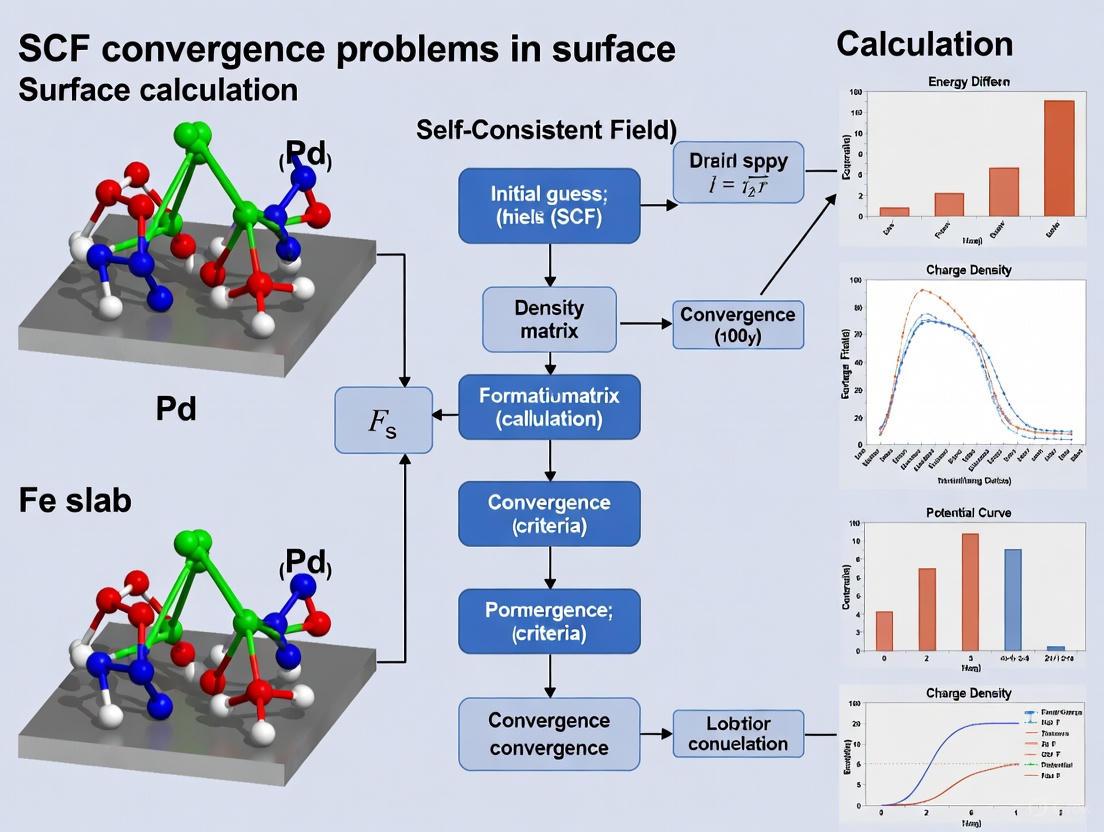
This article provides a systematic guide for researchers and computational chemists tackling self-consistent field (SCF) convergence challenges in metallic surface calculations, particularly focusing on Palladium (Pd) and Iron (Fe) slabs.
Solving SCF Convergence Problems in Surface Calculations: A Comprehensive Guide for Pd and Fe Slabs
Abstract
This article provides a systematic guide for researchers and computational chemists tackling self-consistent field (SCF) convergence challenges in metallic surface calculations, particularly focusing on Palladium (Pd) and Iron (Fe) slabs. Drawing from current documentation and community knowledge, we explore the foundational causes of convergence difficulties, present methodological approaches across multiple computational packages (ADF, ORCA, Quantum ESPRESSO), detail advanced troubleshooting and optimization techniques, and establish validation protocols to ensure physical reliability. The content is specifically tailored to assist scientists in obtaining robust, converged results for these notoriously challenging systems, which are crucial in catalysis and materials science applications.
Understanding SCF Convergence Challenges in Metallic Slab Systems
Frequently Asked Questions (FAQs)
What is SCF convergence and why does it fail for metallic slabs like Pd and Fe?
The Self-Consistent Field (SCF) method is an iterative procedure for finding electronic structure configurations in density functional theory calculations. Convergence failures occur when successive iterations fail to reach a consistent electronic structure. This is particularly problematic for metallic slabs like Pd and Fe due to their small HOMO-LUMO gaps, localized open-shell configurations (especially in Fe), and the presence of many near-degenerate electronic states at surfaces. These factors cause charge sloshing and oscillations in the electron density during iterations [1] [2].
Why are Fe slabs typically more challenging than Pd slabs for SCF convergence?
Fe slabs often present greater convergence difficulties due to their localized 3d-electrons and significant spin polarization. The presence of unpaired electrons in open-shell configurations creates complex potential energy surfaces with multiple local minima, making it harder for the SCF procedure to find a stable solution. Pd, while also a transition metal, generally has a more delocalized electron density [3] [1].
How does slab thickness affect SCF convergence?
Increasing slab thickness introduces more electronic states and can exacerbate convergence problems due to quantum size effects. The surface formation energy calculated as the difference between slab and bulk energies may diverge linearly with slab thickness if not properly handled. Using established linear fitting procedures helps achieve convergent surface energies [4].
What are the most effective initial strategies for improving SCF convergence?
Begin with these conservative adjustments to increase stability:
- Reduce mixing parameters (e.g.,
SCF%Mixing 0.05) - Increase DIIS subspace size (e.g.,
DIIS%Dimix 0.1orN 25) - Implement electron smearing with a small value to occupy near-degenerate states
- Ensure accurate initial guess and proper spin multiplicity [3] [1] [2]
Troubleshooting Guides
Guide 1: Addressing Non-Converging SCF Cycles
SCF convergence problems manifest as continuous oscillation of energies or failure to meet convergence criteria within the maximum cycle limit. The following workflow provides a systematic approach to resolve these issues:
Step-by-Step Implementation:
Foundation Checks
Adjust SCF Acceleration Parameters
Improve Numerical Accuracy
Advanced Techniques
Guide 2: Resolving Geometry Optimization Failures Caused by SCF Issues
When geometry optimizations fail due to underlying SCF convergence problems:
Prerequisite: Ensure SCF convergence at each geometry step using the techniques in Guide 1.
Accuracy Enhancements:
- Increase radial grid points (
RadialDefaults NR 10000) [3] - Improve overall numerical quality (
NumericalQuality Good) [3] - Tighten geometry convergence criteria (
GeoOpt%Converge) once SCF is stable [3]
Step Size Considerations:
- For phonon calculations with negative frequencies, reduce step size (
PhononConfig%StepSize) [3] - Ensure geometry is truly at minimum before frequency analysis [3]
Guide 3: Overcoming Basis Set Dependency Errors
Basis set dependency errors occur when Bloch functions become nearly linearly dependent, particularly problematic in periodic slab calculations.
Symptoms:
- Program termination with "dependent basis" message [3]
- Small eigenvalues of the overlap matrix below threshold [3]
Resolution Strategies:
Table: Basis Set Dependency Solutions
| Approach | Implementation | Use Case |
|---|---|---|
| Confinement | Apply Confinement to diffuse functions |
Inner slab layers where diffuseness isn't needed [3] |
| Basis Function Removal | Remove STOs with large dependency coefficients | When one eigenvalue is below threshold [3] |
| Function Modification | Replace two problematic functions with an averaged one | When multiple coefficients are large [3] |
Systematic Resolution:
- Examine dependency coefficients printed after error message [3]
- Identify basis functions with largest coefficients as most problematic [3]
- Apply confinement to inner layer atoms while preserving surface atom basis quality [3]
- Iteratively test modified basis sets until all k-points pass dependency checks [3]
Research Reagent Solutions
Table: Essential Computational Tools for Surface Science SCF Convergence
| Tool Category | Specific Examples | Function |
|---|---|---|
| SCF Algorithms | DIIS, LISTi, GDM, QC, MESA | Provide alternative convergence pathways for difficult systems [3] [1] [5] |
| Mixing Schemes | Plain, local-TF, Anderson | Control how electron density is updated between cycles [2] |
| Smearing Methods | Fermi, Gaussian | Broaden electron occupation to handle small HOMO-LUMO gaps [2] [6] |
| Numerical Grids | BeckeGrid, Integration grids | Determine accuracy of numerical integration [3] [7] |
| Basis Sets | STOs, Numerical orbitals | Represent electron wavefunctions throughout the slab [3] |
| k-point Sampling | Monkhorst-Pack, Gamma-centered | Sample the Brillouin Zone of periodic systems [3] |
Advanced Protocols
Protocol: Surface Energy Convergence for Pd and Fe Slabs
Background: Surface energy calculation requires comparing slab energies with independently determined bulk energies, which can diverge linearly with slab thickness if not properly handled [4].
Procedure:
- Compute bulk energy with high k-point sampling and tight SCF convergence
- Create slabs of increasing thickness (3-7 layers)
- For each slab thickness:
- Use SCF convergence techniques from Guide 1
- Employ
SCF=Tightor equivalent convergence criteria - Ensure forces are converged to < 0.01 eV/Å
- Calculate surface energy as: γ = (Eslab - N × Ebulk) / (2 × A)
- Plot surface energy versus 1/N (inverse slab thickness)
- Extract convergent surface energy from linear fit [4]
Validation:
- Compare results with different mixing parameters and k-point sets
- Achieve surface energy convergence within 0.08 eV or better [4]
Protocol: DeltaSCF for Excited States at Surfaces
Application: Calculating excited states at surfaces using single-reference wavefunctions [8].
Implementation (ORCA):
Key Considerations:
- Use
ALPHACONForBETACONFto specify desired electron configuration [8] - Start from converged ground-state orbitals [8]
- Employ L-SR1 Hessian update (not L-BFGS) for saddle point convergence [8]
- Use MOM or PMOM to maintain reference state during optimization [8]
Validation:
- Check for imaginary frequencies in vibrational analysis [8]
- Verify spin contamination values for open-shell singlets [8]
FAQ: Core Concepts and Troubleshooting
What are the most common causes of SCF convergence problems in Pd and Fe slab calculations? SCF convergence issues in transition metal slabs like Pd and Fe primarily arise from their complex electronic structures. Palladium (Pd) slabs are generally easier to converge than Iron (Fe) slabs [3]. Key difficulties include:
- Localized Open-Shell Configurations: Iron, in particular, often has localized d-electrons and can exhibit open-shell configurations, leading to challenging convergence [1] [9].
- Small HOMO-LUMO Gaps: Metallic systems or those with many near-degenerate electronic levels around the Fermi energy have a very small or vanishing HOMO-LUMO gap. This can cause oscillations between different orbital occupancies during the SCF procedure [1] [10].
- Insufficient Numerical Accuracy: Problems can be caused by inadequate quality in the numerical integration grid, an insufficient number of k-points for sampling the Brillouin zone, or a poor-quality density fit [3].
Why are Fe slabs typically more difficult to converge than Pd slabs? The core difference lies in the nature of their d-electrons. Fe slabs are more problematic due to the presence of localized open-shell configurations and more complex magnetic behavior [3] [1]. These localized electrons lead to challenging potential energy surfaces and can cause strong oscillations in the spin density and magnetic moments during the SCF cycle, making it difficult for the algorithm to find a stable solution [11].
What are the primary SCF algorithms and when should I use them? Different SCF algorithms offer a trade-off between speed and robustness. The table below summarizes the key options.
Table 1: Overview of SCF Convergence Algorithms
| Algorithm | Description | Best Use Case |
|---|---|---|
| DIIS (Direct Inversion in Iterative Subspace) | Default in many codes; fast but can be unstable for difficult systems [12]. | Standard systems with a good initial guess and no near-degeneracies [12]. |
| GDM (Geometric Direct Minimization) | Robust method that accounts for the spherical geometry of orbital rotation space [12]. | Recommended fallback when DIIS fails; default for restricted open-shell calculations in some codes [12]. |
| DIISGDM / DIISDM | Hybrid approach; uses DIIS initially then switches to (G)DM [12]. | Combines DIIS speed in early cycles with GDM robustness for final convergence [12]. |
| LIST / LISTi | An alternative DIIS variant that may reduce the number of SCF cycles [3]. | When standard DIIS shows slow convergence or oscillations [3]. |
| TRAH (Trust Region Augmented Hessian) | A robust second-order converger, more expensive but reliable [9]. | Pathological cases where other methods struggle; can activate automatically in some modern codes [9]. |
How does the initial guess impact convergence, and how can I improve it? The initial guess for the electron density is critical. A poor guess can lead to convergence on an incorrect electronic state or failure to converge [13]. For difficult slabs:
- Use a Restart: A moderately converged density from a previous calculation is often the best guess [1].
- Converge a Simpler System: First converge a calculation with a simpler functional (e.g., BP86) or smaller basis set, then read the resulting orbitals as a guess for the target calculation [9].
- Manually Alter Orbitals: For open-shell systems, the initial orbital occupancy can be manually altered to guide the calculation towards the desired electronic state (e.g., a specific spin configuration) [13].
Experimental Protocols for Reliable Convergence
Standard Protocol for Troubleshooting SCF Convergence
This workflow provides a systematic approach to diagnosing and resolving SCF convergence issues in surface slab calculations. The process is illustrated in the diagram below.
Phase 1: Foundational Checks
- Verify Geometry and Spin: Ensure the slab geometry is physically realistic (correct bond lengths, angles) and that the vacuum spacing is sufficient to prevent interaction between periodic images [1] [14]. Confirm the correct spin multiplicity and initial magnetic moments are set, especially for Fe [1] [11].
- Adjust SCF Control Parameters:
- Decrease Mixing: Reduce the mixing parameter (e.g., to 0.05 or lower) to take more conservative steps between SCF cycles. This is a primary recommendation for problematic cases like Fe slabs [3].
- Increase DIIS Subspace: Using more previous Fock matrices (e.g.,
DIIS%DimixorDIIS_SUBSPACE_SIZEof 20-25) can stabilize the extrapolation [3] [1] [15].
Phase 2: Systematic Adjustments
- Improve the Initial Guess: As outlined in the FAQ, use a restart file or orbitals from a converged calculation of a simpler system [1] [9].
- Increase Numerical Accuracy:
- k-points: Ensure the Brillouin zone is sampled with a sufficient k-point grid. Using only the Γ-point can cause problems [3] [10] [14]. For slabs, use a grid like k1 × k2 × 1.
- Density Fitting and Grids: Improve the quality of the numerical integration (Becke grid) and density fit (ZlmFit) from 'Basic' to 'Normal' or 'Good' [3].
- Switch the SCF Algorithm: If DIIS fails, switch to a more robust algorithm like Geometric Direct Minimization (GDM) or a hybrid DIIS_GDM approach [12]. Alternatively, try the LISTi method [3].
Phase 3: Advanced Techniques
- Employ Electron Smearing: Apply a small amount of electron smearing (e.g., a finite electronic temperature) to occupy orbitals around the Fermi level fractionally. This is particularly helpful for metallic systems with small gaps. Keep the smearing value as low as possible to avoid altering the total energy significantly [1].
- Use Level Shifting: Artificially raising the energy of unoccupied orbitals can help break oscillations. Note that this may invalidate properties that depend on virtual orbitals, such as excitation energies [1].
Protocol for Handling Linear Dependency and Basis Set Issues
A calculation aborting due to a "dependent basis" error indicates that the basis set is too diffuse or large, leading to near-linear-dependent Bloch functions. This is common in slabs with highly coordinated atoms [3].
- Diagnose: The program output will list "Dependency Coefficients" – basis functions with large coefficients are the most problematic [3].
- Apply Confinement: Use a confinement potential to reduce the diffuseness of basis functions, particularly on atoms in the inner layers of the slab [3].
- Remove Functions: Manually remove one or more of the most diffuse basis functions identified in the output [3].
The Scientist's Toolkit: Research Reagent Solutions
Table 2: Essential Computational Materials for Surface Slab Calculations
| Item / Reagent | Function / Role |
|---|---|
| High-Quality Basis Set | Provides the atomic orbital functions to construct Bloch waves. Must balance accuracy and computational cost to avoid linear dependence [3]. |
| k-point Grid | Samples the Brillouin zone of the slab. Critical for accuracy in periodic systems; a dense grid in the slab plane (e.g., k1 x k2) with 1 point in the vacuum direction is typical [10] [14]. |
| SCF Converger (DIIS, GDM, TRAH) | The algorithm that drives the SCF cycle to a self-consistent solution. Choice is crucial for robustness and efficiency [12] [9]. |
| Mixing Parameter | Controls the fraction of the new Fock matrix used to update the density. A key parameter to stabilize difficult calculations [3] [1]. |
| Electron Smearing | A numerical "reagent" that fractionally occupies orbitals near the Fermi level, smoothing energy landscapes and aiding convergence in metallic systems [1]. |
| Initial Orbital Guess | The starting point for the SCF procedure. A good guess (e.g., from a restart) is essential for complex electronic structures [13] [9]. |
Frequently Asked Questions
What are the most common symptoms of a non-converging SCF calculation? The most common symptoms include oscillating energy values instead of a steady approach to a minimum, a complete stall where the energy change between iterations becomes negligible or zero, and dependency errors where the program aborts due to a linearly dependent basis set [3] [15] [16].
Why does my calculation of an Fe slab show more convergence problems than a Pd slab? Some systems are intrinsically more difficult to converge than others. For example, an Fe slab is known to be more challenging than a Pd slab [3]. This can be due to the electronic structure, requiring more conservative SCF settings and higher numerical accuracy.
What should I check first if my geometry optimization does not converge? First, ensure that the SCF (single-point energy) calculation itself converges correctly. If it does, the problem likely lies in the forces. You can improve the situation by increasing the accuracy of the gradient calculation using more radial points and higher numerical quality [3].
I get 'negative frequencies' in my phonon calculation. Is this related to convergence? Yes, unphysical negative frequencies can stem from two primary convergence-related issues: the geometry was not fully optimized to a minimum, or the step size used in the phonon calculation is too large [3].
Troubleshooting Guide: SCF Convergence Failures
Oscillating Energy Values
Oscillations in the total energy during the self-consistent field (SCF) procedure indicate that the iterative process is unstable and unable to find a steady solution [16].
- Primary Solution: Conservative Mixing Adjust the parameters that control how the electron density is mixed between SCF cycles to dampen the oscillations.
- Alternative Solution: Change Algorithm
Switching to a different algorithm like
LISTican sometimes resolve oscillations that DIIS cannot handle, though it may increase the cost per iteration [3].
Stalled or Stagnated Convergence
The SCF process stalls when the energy change between iterations becomes extremely small but the convergence criteria are not met, often seen in large or complex systems like a 500-atom Fe5C2 slab [15].
- Primary Solution: Improve Numerical Accuracy Stalls can be caused by insufficient numerical precision in integrals or k-point sampling.
- System-Specific Tuning: For challenging systems like iron slabs, you may need to experiment with recommended settings for
mixing_beta,mixing_ndim, andmixing_gg0[15].
Basis Set Dependency Errors
The calculation aborts with a "dependent basis" error when the set of Bloch functions is nearly linearly dependent, threatening numerical accuracy [3].
- Diagnosis: The program prints dependency coefficients and eigenvalues of the overlap matrix. Basis functions with the largest coefficients are the most suspicious [3].
- Solution 1: Use Confinement Apply spatial confinement to diffuse basis functions, particularly on atoms in the inner layers of a slab, to reduce their range and overlap [3].
- Solution 2: Modify the Basis Set Remove one or more problematic basis functions identified by the large dependency coefficients. If both STO and numerical orbitals are problematic, prioritize removing the STO [3].
Geometry Optimization Does Not Converge
The process of finding the energy-minimum structure fails to converge even when forces seem small.
- Solution: Increase Gradient Accuracy The gradients (forces) may be calculated with insufficient accuracy. To improve this:
Negative Frequencies in Phonon Calculations
The appearance of unphysical negative frequencies in an otherwise stable system's phonon spectrum.
- Solution 1: Verify Geometry Convergence
Ensure the geometry optimization has truly reached a minimum by tightening its convergence criteria (
GeoOpt%Converge) [3]. - Solution 2: Adjust Phonon Calculation Settings
Reduce the
PhononConfig%StepSizeused for the numerical differentiation of forces [3].
The Scientist's Toolkit: Research Reagent Solutions
The following table details key computational parameters and their functions for troubleshooting SCF convergence problems in surface calculations.
| Research Reagent | Function & Purpose |
|---|---|
| SCF%Mixing | Controls the fraction of the new electron density mixed with the old. Lower, more conservative values (e.g., 0.05) stabilize oscillating calculations [3]. |
| DIIS%Dimix | Parameter for the Direct Inversion in the Iterative Subspace (DIIS) algorithm. Reducing it (e.g., to 0.1) provides a more conservative convergence strategy [3]. |
| K-Space Quality | Defines the fineness of k-point sampling. Upgrading from Basic to Normal ensures adequate Brillouin Zone integration, crucial for metallic slabs [3]. |
| ZlmFit Quality | Determines the accuracy of the density fit. Using Normal or Good quality can resolve precision-related stalls [3]. |
| BeckeGrid Quality | Specifies the quality of the numerical integration grid. Normal or Good setting is vital for accurate integration near heavy nuclei [3]. |
| Basis Set Confinement | A technique to make diffuse basis functions more localized, reducing linear dependency issues in slabs and highly coordinated systems [3]. |
Workflow for Diagnosing SCF Convergence
The following diagram outlines a logical workflow for diagnosing and treating common SCF convergence problems.
The Role of HOMO-LUMO Gaps, Near-Degenerate States, and Metallic Character
Troubleshooting Guides
SCF Convergence Failure in Metallic Slab Systems
Problem Description The Self-Consistent Field (SCF) procedure fails to converge during electronic structure calculations of metallic slabs, particularly in challenging systems like iron (Fe) slabs compared to more straightforward systems like palladium (Pd) slabs [3]. This manifests as continuous oscillation of energies or a complete stall in the convergence cycle, especially problematic in large systems (e.g., ~500 atoms) [15].
Root Causes
- Near-Degenerate States and Small HOMO-LUMO Gaps: Metallic systems are characterized by vanishing band gaps and high densities of near-degenerate states near the Fermi level. This electronic structure leads to rapid charge sloshing during the SCF cycle, where small changes in the electron density cause large shifts in the Kohn-Sham orbitals, preventing convergence [17].
- Insufficient Numerical Precision: Low-quality numerical integration grids (Becke grid), insufficient k-point sampling, or a poor-quality density fit can prevent the accurate resolution of these near-degenerate states, exacerbating convergence problems [3].
- Overly Aggressive Mixing Parameters: Standard mixing parameters for insulators or molecules can be too aggressive for metallic systems, failing to dampen the oscillations caused by charge sloshing [3] [15].
Solutions and Protocols
Table 1: Parameter Adjustments for SCF Convergence
| Parameter/Block | Recommended Setting | Function | Rationale |
|---|---|---|---|
SCF%Mixing |
0.05 (reduced) | Controls the fraction of the new density mixed with the old. | More conservative mixing dampens oscillations from charge sloshing [3]. |
DIIS%Dimix |
0.1 (reduced) | Weight for the DIIS error vector in the density update. | A more conservative DIIS strategy stabilizes convergence [3]. |
DIIS%Variant |
LISTi |
Switches to the LISTi algorithm for the SCF solver. | Can reduce the number of SCF cycles in difficult cases [3]. |
NumericalQuality |
Good |
Improves the general accuracy of numerical integration. | Ensures sufficient precision to handle near-degenerate states [3]. |
KSpace%Quality |
Normal or Good |
Increases the number of k-points for Brillouin zone sampling. | Critical for metals; better samples the Fermi surface [3]. |
ZlmFit%Quality |
Normal or Good |
Improves the quality of the density fit. | Prevents errors from propagating into the SCF cycle [3]. |
BeckeGrid%Quality |
Normal or Good |
Uses a more accurate grid for numerical integration. | Essential for systems with heavy elements [3]. |
Experimental Protocol
- Initial Assessment: Confirm the system is metallic and check the k-point grid. A single k-point is often insufficient [3].
- Apply Conservative Parameters: Begin by applying the reduced
MixingandDimixparameters from Table 1. - Increase Numerical Accuracy: If convergence issues persist (e.g., many iterations after the "HALFWAY" message), systematically increase the quality of the numerical settings (
NumericalQuality,KSpace,ZlmFit,BeckeGrid) [3]. - Advanced Solver: For systems resistant to the above steps, switch the DIIS variant to
LISTi[3]. - Validation: Always compare the total energy of a converged calculation with previous attempts to ensure physical consistency.
Geometry Optimization Failure
Problem Description Geometry optimization (GeoOpt) does not converge, even when the SCF procedure is stable.
Root Causes Inaccurate forces and stresses due to poor SCF convergence or low-quality gradient evaluation [3].
Solutions and Protocols Table 2: Parameters for Geometry Convergence
| Parameter | Recommended Setting | Function |
|---|---|---|
NumericalQuality |
Good |
Improves the general accuracy of all numerical integrations, including gradients [3]. |
RadialDefaults%NR |
10000 | Increases the number of radial points in the atomic integration grids [3]. |
Experimental Protocol
- Ensure the SCF is fully converged at each geometry step using the guidelines above.
- Implement the higher-accuracy settings for force calculations shown in Table 2.
Basis Set Dependency Error
Problem Description Calculation aborts with a "dependent basis" error. This occurs when the set of Bloch basis functions for a k-point is nearly linearly dependent, threatening numerical accuracy [3].
Root Causes Overly diffuse basis functions on highly coordinated atoms (common in slabs) leading to excessive overlap between functions on neighboring atoms [3].
Solutions and Protocols
- Confinement: Apply the
Confinementkeyword to reduce the range of diffuse basis functions. In a slab, consider applying confinement only to atoms in the inner layers, leaving surface atom basis functions unmodified to describe vacuum decay [3]. - Basis Set Modification: Remove one or more problematic diffuse basis functions. The program output provides "Dependency Coefficients" to identify the most suspicious functions [3].
Experimental Protocol
- Analyze the "Dependency Coefficients" in the output file. Functions with large coefficients are suspects.
- Prefer removing a numerical Slater-type orbital (STO) over a Dirac valence function.
- If two coefficients are large, remove one function and consider modifying the other.
- Repeat the process until all k-points pass the dependency check [3].
Frequently Asked Questions (FAQs)
Q1: Why is an Fe slab much harder to converge than a Pd slab? The difference originates from the electronic structure. Iron, with its more complex and spatially localized d-electrons near the Fermi level, has a higher density of near-degenerate states compared to palladium. This leads to more pronounced charge sloshing and greater sensitivity to the initial guess and SCF mixing parameters [3] [15].
Q2: What is the connection between the HOMO-LUMO gap and SCF convergence? A small or zero HOMO-LUMO gap (a hallmark of metallic character) directly challenges SCF convergence. The HOMO-LUMO gap represents the energy cost for electron excitation; a small gap means many low-energy electronic excitations are possible. During the SCF cycle, this results in instability, as the electron density can easily fluctuate between many near-degenerate configurations [17]. In the limit of a large gap (as in insulators), these fluctuations are suppressed, leading to robust convergence.
Q3: My phonon calculation shows negative frequencies, but my geometry is optimized. What is wrong? Unphysical negative frequencies in a phonon spectrum typically indicate one of two issues:
- The geometry is not a true minimum: Ensure your geometry optimization has converged tightly (check
GeoOpt%Convergecriteria). - Insufficient numerical accuracy in the phonon calculation: The numerical step size used to calculate the force constants (
PhononConfig%StepSize) may be too large, or there could be underlying errors from numerical integration or k-space sampling [3].
Q4: The calculation aborts due to a "frozen core too large" error. What should I do?
The program checks the overlap of the frozen core orbitals, and if it deviates too much from the unit matrix (default criterion >0.02), it stops. The safest solution is to use a smaller frozen core. If performance is critical, you can loosen the dependency criterion (e.g., to 0.8 via the Dependency keyword), but you must validate the results against a calculation with a smaller core on a test system [3].
The Scientist's Toolkit: Research Reagent Solutions
Table 3: Essential Computational Parameters and Methods
| Item | Function in Calculation | Notes |
|---|---|---|
| SCF Mixing (SCF%Mixing) | Controls the damping of the new electron density guess. Lower values (0.05) are more stable for metals [3]. | Primary knob for combating charge sloshing. |
| DIIS Solver (DIIS%Variant) | An algorithm to accelerate SCF convergence. The LISTi variant can be more robust for difficult cases [3]. |
Alternative to standard Pulay DIIS. |
| k-point Grid (KSpace) | Samples the Brillouin zone. Crucial for metallic systems to describe the Fermi surface accurately [3]. | A single k-point is often a cause of failure. |
| Numerical Grid (BeckeGrid) | Defines the points for numerical integration. Higher quality is needed for heavy elements and accurate gradients [3]. | Affects all integrated quantities. |
| Density Fitting (ZlmFit) | Approximates the electron density with an auxiliary basis set for computational efficiency [3]. | Poor quality can introduce SCF errors. |
| Basis Set Confinement | Limits the spatial extent of diffuse basis functions to avoid linear dependency in periodic systems [3]. | Key for avoiding "dependent basis" errors in slabs. |
Impact of Basis Set Diffusiveness and Linear Dependency in Slab Models
Frequently Asked Questions (FAQs)
1. What are the signs of a linear dependency problem in a slab calculation? The calculation may abort with an explicit error message stating "dependent basis". This occurs when the program detects that the set of Bloch functions constructed from your basis set is numerically too close to being linearly dependent, threatening the numerical accuracy of the results. The program performs an internal check by computing and diagonalizing the overlap matrix of the basis; if the smallest eigenvalue is below a critical threshold, the calculation stops [18].
2. Why are slab models particularly susceptible to SCF convergence and basis set issues? Slab models, especially those with symmetric terminations and vacuum layers, can be challenging for several reasons. Systems with metallic character or complex electronic structures, like Fe slabs, are inherently more difficult to converge than simpler systems like Pd slabs [18]. Furthermore, the inclusion of vacuum in the model often necessitates diffuse basis functions to describe the decay of the electron density correctly. The diffuseness of these functions, particularly on highly coordinated atoms in the inner layers of the slab, can lead to significant overlap and linear dependency problems [18].
3. My SCF calculation oscillates and won't converge, even for a simple Pd slab. What are the first steps I should take?
Before investigating more complex causes, you should first try to use more conservative electronic minimization settings. A primary strategy is to decrease the mixing parameter (often called Mixing or mixing_beta) to a value like 0.05 or 0.1 to stabilize the convergence [18] [19]. You can also try switching from the default DIIS algorithm to a MultiSecant method, which can be more robust for difficult systems without a significant increase in cost per iteration [18].
4. How can I fix a linear dependency error without compromising the physical accuracy of my calculation? The two most effective strategies are using confinement or removing overly diffuse basis functions [18].
- Confinement: This technique reduces the spatial range of basis functions, mitigating their unwanted overlap. In a slab, you can apply stronger confinement to atoms in the inner layers, as their wavefunctions do not need to be as diffuse as those on the surface atoms, which must describe the decay into the vacuum [18].
- Basis Set Adjustment: Manually removing the most diffuse basis functions from your set is a direct way to eliminate the source of the linear dependency. It is strongly recommended to adjust the basis set rather than simply lowering the internal dependency criterion to bypass the error [18].
5. Are there any advanced automation strategies for difficult geometry optimizations?
Yes, you can configure the calculation to use a higher electronic temperature and looser SCF convergence criteria during the initial optimization steps when atomic forces are large. As the geometry converges and forces become smaller, the automation can gradually tighten these parameters. This approach prevents the calculation from getting stuck in the early stages while ensuring high accuracy in the final structure [18]. For example, you can automate the ElectronicTemperature to decrease from 0.01 Ha to 0.001 Ha as the gradient norm falls below a certain threshold [18].
Troubleshooting Guides
Guide 1: Resolving SCF Convergence Failure
Problem: The self-consistent field (SCF) calculation oscillates, exceeds the maximum number of iterations, or shows a non-monotonic change in total energy [19] [20].
Diagnosis: This is a common issue for systems with complex electronic structures. It can be caused by an inaccurate initial guess, overly tight convergence criteria, or a problematic charge density from a previous calculation step [20] [19].
Resolution Protocol:
Stabilize the SCF Procedure:
- Decrease the mixing parameter (
Mixingormixing_beta) to a value between0.05and0.1to reduce oscillations [18] [19]. - For DIIS-based methods, reduce the
DiMixparameter (e.g., to0.1) and consider settingAdaptabletofalseto disable automatic adjustments [18]. - Alternatively, change the SCF method to
MultiSecantor a LIST variant (e.g.,LISTi), which can be more stable for difficult cases [18].
- Decrease the mixing parameter (
Employ a Sequential Restart Strategy:
- If the calculation stalls, do not simply continue it. Restart the entire calculation from scratch using the latest atomic structure and charge density from the previous, nearly-converged calculation. This can sometimes reset a "stuck" charge density and lead to convergence [19].
Use a Finite Electronic Temperature:
- Applying a small electronic temperature (e.g.,
kT = 0.001to0.01Ha) can smear the Fermi surface and help convergence in metallic systems. This can be automated to be higher at the start of a geometry optimization and lower at the end [18].
- Applying a small electronic temperature (e.g.,
Simplify and Rebuild:
- Start the convergence process with a minimal basis set (e.g., SZ). Once the SCF is converged, use the resulting wavefunctions as a starting point for a restart calculation with the full, desired basis set [18].
The following workflow outlines the systematic troubleshooting process for SCF convergence failure.
Guide 2: Resolving Linear Dependency in the Basis Set
Problem: The calculation terminates immediately with a "dependent basis" error.
Diagnosis: The basis functions on adjacent atoms are too diffuse, leading to an overlap that makes the resulting Bloch functions numerically linearly dependent in reciprocal space [18].
Resolution Protocol:
Apply Spatial Confinement:
- Use the
Confinementkeyword to reduce the range of basis functions. This is often the most physically justified approach for slab systems. - Implement a stratified confinement scheme: Apply strong confinement to atoms in the inner layers of the slab, while using the normal, more diffuse basis for surface atoms. This ensures the surface electronic tail into the vacuum is described correctly while preventing numerical issues in the bulk-like region [18].
- Use the
Modify the Basis Set:
- Manually remove the most diffuse basis functions from the basis set. This is a direct solution but requires careful consideration to ensure the remaining basis set is still sufficient for the desired accuracy [18].
Increase Numerical Precision (Use with Caution):
- While not recommended as a first solution, you can try increasing the
NumericalAccuracyto improve the quality of the integrals, which might alleviate mild dependency issues caused by numerical noise. However, adjusting the basis set itself is a more robust solution [18].
- While not recommended as a first solution, you can try increasing the
The logical flow for diagnosing and resolving a linear dependency error is summarized in the following diagram.
Experimental Protocols & Data Presentation
Protocol: Stratified Confinement for Slab Models
Objective: To eliminate linear dependency while maintaining an accurate description of the surface electronic structure.
Methodology:
- Identify Atom Layers: Classify atoms in your slab model into "surface" and "inner" layers.
- Apply Differential Confinement: In the computational input, apply a standard (or no) confinement potential to the atoms in the surface layers. Apply a stronger confinement potential (e.g., with a smaller radius) to all atoms in the inner layers.
- Convergence Test: Systematically test the total energy and key properties (e.g., work function, surface energy) as a function of the inner-layer confinement radius to ensure the results are physically meaningful.
The following table lists common parameters in quantum chemistry codes that can be adjusted to improve SCF convergence, based on strategies found in the literature [19] [18].
| Parameter | Default (Typical) | Troubleshooting Value | Function |
|---|---|---|---|
Mixing / mixing_beta |
0.2 - 0.4 | 0.05 - 0.1 | Controls the fraction of new density mixed with the old; lower values stabilize convergence [18] [19]. |
SCF Method |
DIIS | MultiSecant or LIST | Alternative algorithms that can be more robust for difficult systems [18]. |
Electronic Temperature (kT) |
0 Ha | 0.001 - 0.01 Ha | Smears orbital occupations, aiding convergence in metallic or small-gap systems [18]. |
DIIS %DiMix |
Varies | 0.1 | A more conservative mixing parameter within the DIIS algorithm itself [18]. |
The Scientist's Toolkit: Research Reagent Solutions
This table outlines essential computational "reagents" and their functions for managing basis set diffusiveness and linear dependency.
| Item | Function in Research |
|---|---|
| Confinement Potential | A computational tool that restricts the spatial extent of atomic orbital basis functions, directly mitigating excessive overlap and linear dependency between nearby atoms [18]. |
| MultiSecant / LIST SCF Solver | Advanced algorithms for converging the SCF equations. They serve as alternatives to the standard DIIS method and can often achieve convergence where DIIS fails, without a significant computational overhead [18]. |
| Stratified Confinement Scheme | A methodology where different confinement strengths are applied to different regions of a model (e.g., strong in slab interior, weak on surface). It is key to maintaining accuracy while solving numerical issues [18]. |
| Automation Scripts for Geometry Optimization | Scripts or input parameters that dynamically adjust SCF criteria (like electronic temperature and convergence threshold) based on the optimization step, preventing early termination and improving efficiency [18]. |
| Minimal Basis Set (e.g., SZ) | A simplified basis set used as a starting point to generate a stable initial wavefunction and charge density, which is then used to restart the calculation with a larger, target basis set [18]. |
Initial Guess Quality and Its Critical Role in Starting the SCF Procedure
FAQs on SCF Initial Guesses
What is the primary goal of a good SCF initial guess? A good initial guess serves two critical purposes: it ensures the Self-Consistent Field (SCF) procedure converges to the appropriate electronic ground state rather than a local minimum, and it significantly reduces computational time by providing a starting point close to the final solution, thereby decreasing the number of SCF iterations required [21].
Why do my slab calculations (e.g., Pd, Fe) have particular difficulty converging? Systems such as Fe slabs are notably more difficult to converge than Pd slabs. This is often due to the complex electronic structure of transition metals, including closely spaced orbitals and the presence of unpaired electrons. A poor initial guess can exacerbate these convergence problems [18] [15].
What are the common initial guess methods available? Different computational packages offer various initial guess procedures. The most common include [21]:
- SAD (Superposition of Atomic Densities): Constructs a trial density matrix from spherically averaged atomic densities. It is generally superior for large molecules and basis sets.
- Core Hamiltonian: Diagonalizes the core Hamiltonian matrix. Its quality degrades with increasing system and basis set size.
- GWH (Generalized Wolfsberg-Helmholtz): Uses a combination of overlap and core Hamiltonian matrix elements, satisfactory mainly for small molecules in small basis sets.
- READ: Reads molecular orbitals from a previous calculation's disk file.
How can I manipulate the initial guess to converge to a specific electronic state? You can modify the occupied guess orbitals to break spatial or spin symmetry, which is crucial for converging to states of different symmetry or for unrestricted calculations on molecules with an even number of electrons. This can be achieved by [21]:
- Explicitly listing the orbitals to be occupied in the alpha and beta spaces.
- Swapping specific occupied and virtual orbitals in the initial guess.
- Using options like
SCF_GUESS_MIXto add a percentage of the LUMO into the HOMO to break symmetry.
My calculation failed with a "dependent basis" error. Is this related to the initial guess? While a "dependent basis" error is directly related to the basis set itself (indicating near-linear dependency), the strategies to resolve it can influence the SCF procedure. Using confinement to reduce the range of diffuse basis functions or removing specific functions can alleviate this problem. A more stable basis often makes obtaining a good initial guess easier and improves overall SCF convergence [18].
Troubleshooting Guides
Problem: SCF Does Not Converge for a Difficult System (e.g., Fe Slab)
Diagnosis: The default SCF settings and initial guess are insufficient for systems with complex electronic structures, leading to oscillatory behavior or divergence in the energy.
Solutions:
- Use a Conservative Mixing Scheme: In the BAND code, decreasing the mixing parameters can stabilize convergence [18].
- Employ Alternative SCF Algorithms: If the standard DIIS method fails, consider switching to the MultiSecant method, which has a similar computational cost per cycle, or a LIST method [18].
- Implement a Two-Stage Strategy:
- Leverage Basis Set Projection (Q-Chem): Use the
BASIS2$rem variable to automatically perform a calculation in a small basis set and project the resulting density into your large target basis, providing an excellent initial guess [21].
Problem: SCF Converges to the Wrong Electronic State
Diagnosis: The initial guess has incorrect orbital occupancy or symmetry, causing convergence to an excited state or a state with unintended symmetry (e.g., ^2A₁ instead of ^2B₁ for the NH₂ radical) [13].
Solutions:
- Manually Alter Orbital Occupancy: After a standard initial guess, swap the intended SOMO (Singly Occupied Molecular Orbital) with a virtual orbital. In Gaussian, this is done with the
guess=alterkeyword and specifying the orbitals to swap after the molecular specification [13]. - Specify Occupied Orbitals Directly: In Q-Chem, use the
$occupiedor$swap_occupied_virtualinput groups to explicitly define the orbitals considered occupied in the initial guess [21]. - Enforce Symmetry: Use options like
SCF=Symmin Gaussian to retain the orbital symmetry of the initial guess throughout the SCF process, which can help in maintaining a specific state [13].
Problem: SCF is Slow to Converge in Geometry Optimizations
Diagnosis: Using an inappropriately tight SCF convergence criterion in the early stages of a geometry optimization, when the nuclear gradients are still large, wastes computational resources.
Solutions:
- Use Loose Initial SCF Convergence: Implement "automations" (e.g., in the BAND code) that tighten the SCF convergence criterion as the geometry optimization progresses [18].
- Employ Finite Electronic Temperature: A finite electronic temperature can smear orbital occupations and aid convergence when far from the minimum. This temperature can be automated to decrease as the geometry converges [18].
- Reuse the Previous Guess: By default, most programs use the wavefunction from the previous geometry step as the guess for the next. Ensure this is active and not overridden by settings like
SCF_GUESS_ALWAYS = TRUEin Q-Chem, which forces a new guess for every point [21].
Initial Guess Methods: A Comparative Table
Table 1: Common SCF initial guess methods, their principles, and best-use contexts.
| Method | Principle | Advantages | Limitations | Ideal Use Case |
|---|---|---|---|---|
| SAD [21] | Superposition of atomic densities | Robust; excellent for large systems and basis sets | Not orbital-based; not available for general basis sets | Default for standard basis sets |
| Core Hamiltonian [21] | Diagonalization of the core Hamiltonian | Simple | Quality degrades with system/basis set size | Small molecules and basis sets |
| GWH [21] | Approximation using overlap & core Hamiltonian | Better than core guess for small systems | Less effective for large systems | Small molecules where SAD is unavailable |
| READ [21] [13] | Read MOs from a previous calculation | Can be very accurate if system is similar | Requires a previous calculation; basis sets must be compatible | Restarting or modifying a previous calculation |
| Basis Projection [21] | Projects density from small to large basis | High-quality guess for large basis sets | Requires an automated two-step process | Bootstrapping a calculation in a large basis set |
Experimental Protocols for Challenging Systems
Protocol 1: Converging a Difficult Fe Slab System
This protocol is designed for systems where standard SCF procedures fail, as reported for a large Fe~5~C~2~ slab system [15].
Preliminary Minimal Basis Calculation:
- Basis Set: Start with a minimal basis set (e.g., SZ in ADF/BAND).
- SCF Settings: Use default settings or conservative mixing (
mixing_beta=0.1). - Goal: Achieve SCF convergence in this reduced space. The resulting density and orbitals will be used as the initial guess for the next stage [18].
Target Calculation with Large Basis:
- Initial Guess: Use
guess=read(Gaussian) orSCF_GUESS=READ(Q-Chem) to import the wavefunction from the preliminary calculation [21] [13]. - SCF Algorithm: If convergence struggles persist, switch to a more robust algorithm:
- Damping/CDIIS: For systems with severe oscillations, using
SCF=FermiorSCF=CDIISin Gaussian, which implies damping, can help stabilize the early iterations [6].
- Initial Guess: Use
Protocol 2: Targeting a Specific Electronic State in a Radical
This protocol uses the NH₂ radical example to demonstrate how to converge to the ^2A₁ state instead of the default ^2B₁ state [13].
Perform a Standard Calculation:
- Run a standard SCF calculation (e.g.,
#ROHF/STO-3G scf=(symm,tight)in Gaussian) to generate a baseline wavefunction.
- Run a standard SCF calculation (e.g.,
Analyze the Initial Guess Orbitals:
- Use
guess=onlyto run the initial guess without proceeding to the full SCF. Examine the output to identify the orbital symmetries and the order of occupied and virtual orbitals [13].
- Use
Alter the Orbital Occupancy:
- In the input for the new calculation, specify
guess=alter. - After the molecular specification, list the pairs of orbitals to be swapped. For example, to make the 6th orbital (virtual, A1 symmetry) occupied and the 5th orbital (occupied, B1 symmetry) virtual, you would add the line:
5 6[13]. - Execute the job. The SCF procedure will now start from the altered guess and converge to the ^2A₁ state.
- In the input for the new calculation, specify
Verify the Result:
- Check the final output to confirm the electronic state and the orbital occupancy match the target.
The Scientist's Toolkit: Key Research Reagent Solutions
Table 2: Essential computational "reagents" and their functions in managing SCF convergence.
| Research Reagent | Function & Purpose | Example Usage |
|---|---|---|
| SAD Initial Guess [21] | Provides a high-quality, physically motivated starting density from atomic fragments. | Default guess in Q-Chem for standard basis sets; excellent for large molecules. |
| DIIS/EDIIS Algorithms [6] | Extrapolates the Fock matrix to accelerate SCF convergence. | Default in many codes (Gaussian, BAND). Conservative Dimix or Mixing parameters help difficult cases [18]. |
| Quadratic Convergence (QC) [6] | A robust, non-Pulay algorithm that guarantees convergence close to a minimum. | SCF=QC in Gaussian for systems where DIIS fails completely. Not available for ROHF. |
| Orbital Swapping Tools [21] [13] | Allows manual reordering of orbital occupancy in the initial guess. | guess=alter in Gaussian or $occupied in Q-Chem to converge to a specific electronic state. |
| Finite Electronic Temperature [18] | Smears orbital occupations, aiding convergence by preventing oscillatory behavior between near-degenerate states. | Useful in the early stages of geometry optimization of metals or systems with small band gaps. |
| Basis Set Projection [21] | Generates a superior initial guess for a large basis set by leveraging a pre-converged calculation in a smaller basis. | Using the BASIS2 $rem variable in Q-Chem to automate the process. |
Workflow Diagram: Initial Guess Selection and Troubleshooting
The following diagram provides a logical roadmap for diagnosing SCF convergence issues and selecting the appropriate initial guess strategy.
Systematic Methodologies and Computational Approaches for Stable SCF
Frequently Asked Questions
Q1: My SCF calculation for a metallic Fe slab is oscillating and won't converge. What is the first parameter I should adjust?
The two most effective initial parameters to adjust for a problematic metallic slab are reducing the SCF mixing parameter and/or the DIIS mixing parameter (Dimix). Using more conservative (lower) mixing values stabilizes the SCF iteration. For an Fe slab, you might start with:
Guide 2: System-Specific Protocol: Fe and Pd Slabs
Converging SCF for transition metal slabs like Fe and Pd is a common challenge in surface science research. Fe slabs, in particular, are noted to be more difficult to converge than Pd slabs. [3] [18] [22] The table below summarizes a recommended step-by-step protocol.
| Step | Action | Example Parameters / Code | Rationale |
|---|---|---|---|
| 1. Initial Check | Verify spin polarization and use a reasonable k-point grid. | scf.SpinPolarization on scf.Kgrid 24 24 1 [22] |
Fe is magnetic; a dense k-grid is crucial for metallic states. [22] |
| 2. Stable Guess | Begin with a conservative DIIS setup. | SCF{Mixing 0.05} Diis{Dimix 0.1 Adaptable false} [3] [18] |
Low mixing prevents large, unstable density updates. |
| 3. Method Switch | If DIIS fails, switch to MultiSecant or LISTi. | SCF{Method MultiSecant} or Diis{Variant LISTi} [18] |
These methods can be more robust for difficult cases. [1] [18] |
| 4. Smearing | Apply a small electronic temperature. | scf.ElectronicTemperature 1500.0 [22] or Convergence%ElectronicTemperature 0.001 [18] |
Smearing fractional occupancies helps overcome small gap issues. [1] |
| 5. Final Touch | For a hard failure, use a slow-and-steady DIIS. | SCF{DIIS{N 25 Cyc 30} Mixing 0.015 Mixing1 0.09} [1] |
Uses many DIIS vectors and very low mixing for maximum stability. [1] |
Accelerator Comparison and Selection Table
The table below summarizes the key characteristics, advantages, and disadvantages of the major SCF convergence accelerators.
| Method | Key Principle | Best For | Pros | Cons | Key Tuning Parameters |
|---|---|---|---|---|---|
| DIIS (Direct Inversion in Iterative Subspace) [1] | Extrapolates new Fock matrix by minimizing the commutator [F, PS] from previous iterations. |
Standard systems with reasonable HOMO-LUMO gap. | Well-established, fast for "well-behaved" systems. | Can diverge for difficult cases (e.g., small-gap, open-shell). | Mixing (aggresiveness), N (number of history vectors), Cyc (start cycle). [1] |
| EDIIS + DIIS (Energy-DIIS) [23] [24] | Combines energy minimization (EDIIS) with standard DIIS commutator minimization. | Robust general-purpose use; considered top-tier in method comparisons. [23] | More robust than DIIS alone; less likely to diverge. | (Implementation dependent) | |
| LISTi (Linear Expansion Shooting Technique) [1] | Uses a direct minimization of the total energy with respect to the density matrix. | Problematic systems where DIIS fails (e.g., Fe slabs). [1] [18] | Can converge cases where DIIS oscillates or diverges. | Higher computational cost per SCF iteration. [1] [18] | Diis{Variant LISTi} [18] |
| MultiSecant [18] | A quasi-Newton method that satisfies multiple previous secant conditions simultaneously. | Difficult systems like slabs; a good first alternative to try. | Robust performance at a cost per cycle similar to DIIS. [18] | SCF{Method MultiSecant} [18] |
|
| MESA [1] | Not detailed in results, but presented as an alternative convergence acceleration method. | Systems where other methods fail. | Can achieve convergence where others cannot. | Performance is system-dependent. | (Implementation dependent) |
The Scientist's Toolkit: Research Reagent Solutions
In computational chemistry, the "reagents" are the key input parameters and numerical settings that determine the quality and success of a calculation.
| Reagent (Parameter) | Function / Purpose | Recommended Values / Notes |
|---|---|---|
| SCF Mixing (mixing_beta) [1] [3] | Controls the fraction of the new Fock/Density matrix used in the next iteration. Lower values are more stable. | Default: ~0.2-0.3. Problematic systems: 0.015 - 0.05. [1] [3] |
| DIIS History (mixing_ndim) [1] [15] | Number of previous Fock/Density matrices used for extrapolation. More vectors can increase stability. | Default: ~10-20. Problematic systems: Up to 25-35. [1] [15] |
| Electronic Temperature (degauss) [1] [22] | Applies fractional occupations via smearing to help converge metallic/small-gap systems. | Keep as low as possible (e.g., 0.001-0.01 Ha, or 300-1500 K). Successively reduce it in restarts. [1] [22] |
| Level Shift [1] | Artificially increases the energy of virtual orbitals to stabilize the SCF procedure. | Helpful for small-gap systems but invalidates properties relying on virtual orbitals (e.g., excitation energies). [1] |
| Numerical Quality [3] [18] | Controls the accuracy of numerical integration (grid) and density fitting. | If SCF has many cycles after "HALFWAY" message, try NumericalQuality Good and better BeckeGrid/ZlmFit quality. [3] [18] |
Why are some systems, like Fe slabs, more difficult to converge than Pd slabs?
The inherent electronic structure of the system dictates the difficulty of achieving Self-Consistent Field (SCF) convergence. Systems with complex electronic configurations, such as those containing iron (Fe), are generally more challenging than others, like palladium (Pd) [18]. This is often due to the presence of closely spaced orbitals, localized d-electrons, or multiple possible spin states in transition metal complexes like Fe, which can lead to multiple locally stable wavefunctions and oscillations in the SCF cycle [25] [26]. For problematic cases, a move to more conservative settings is the primary strategy [18].
Optimal Mixing Parameters for Pd and Fe Slabs
The core conservative strategy involves reducing the mixing parameters to dampen oscillations between iterations. The following table summarizes the recommended starting ranges for Fe systems, with Pd typically being less sensitive [18].
Table 1: Key SCF Mixing Parameters for Difficult Convergence
| Parameter | Function | Typical "Easy" System Range | Recommended "Fe-like" Conservative Range |
|---|---|---|---|
| SCF%Mixing / SCF.Mixer.Weight | Damping factor for new density/potential in the next SCF cycle. | Higher values (e.g., 0.2 - 0.5) | 0.05 - 0.1 [18] |
| DIIS%Dimix | Weight for the DIIS (Pulay) error vector in the mixing scheme. | Higher values (e.g., >0.2) | ~0.1 [18] |
| SCF.Mixer.History | Number of previous steps used for Pulay/Broyden extrapolation. | Default (e.g., 2-5) | Can be reduced for stability or slightly increased (e.g., 4-6) to provide more history [27]. |
Advanced Mixing Strategies
Beyond basic damping, you can employ more sophisticated algorithms:
- Alternative Methods: If standard DIIS (Pulay) fails, consider switching to the MultiSecant method, which has a similar computational cost, or the LIST method, which may reduce the number of SCF cycles at a higher cost per iteration [18].
- Mixing Variable: The system can be set to mix either the Hamiltonian (H) or the Density Matrix (DM). The default in some codes, like SIESTA, is to mix the Hamiltonian, which often provides better results and stability [27].
Troubleshooting Workflow for SCF Convergence
For a structured approach to resolving SCF convergence issues, follow this workflow:
Experimental Protocol: Converging a Difficult Fe Slab System
This protocol provides a detailed methodology for applying the troubleshooting workflow.
1. Initial System Preparation:
- Construct Slab Model: Ensure your Fe slab model has a sufficient number of atomic layers (e.g., 5-8 layers) and adequate vacuum spacing (e.g., 10-20 Å) to avoid spurious interactions with periodic images [28].
- Set Convergence Criteria: Define appropriate tolerances. For high accuracy, consider using
TightSCFcriteria, which may include a total energy change (TolE) below 1e-8 Hartree and a maximum density change (TolMaxP) below 1e-7 [26].
2. Multi-Stage SCF Procedure:
- Stage 1: Conservative Mixing
- Set the primary mixing parameter (
SCF%MixingorSCF.Mixer.Weight) to 0.05 [18]. - Set the DIIS mixing parameter (
DIIS%Dimix) to 0.1 and, if available, setAdaptabletofalseto prevent automatic adjustments [18]. - Run the SCF calculation. If it converges, proceed to geometry optimization. If not, move to Stage 2.
- Set the primary mixing parameter (
Stage 2: Two-Step Initial Guess with Basis Set Reduction
Stage 3: Application of Finite Electronic Temperature
- Introduce a finite electronic temperature (e.g.,
Convergence%ElectronicTemperature= 0.01 Hartree) to smear the orbital occupations. This can help escape metastable states in the initial stages of optimization [18]. - This can be automated in a geometry optimization to use a higher temperature initially and a lower value (e.g., 0.001 Hartree) as the geometry nears convergence [18].
- Introduce a finite electronic temperature (e.g.,
3. Validation:
- Once the SCF has converged, perform an SCF stability analysis to ensure the solution found is a true local minimum and not a saddle point [26].
The Scientist's Toolkit: Research Reagent Solutions
Table 2: Essential Computational Tools for SCF Convergence
| Item | Function | Example Use Case |
|---|---|---|
| Conservative Mixing Parameters | Stabilizes the SCF cycle by damping updates. | First response for oscillating or diverging systems like Fe slabs [18]. |
| Minimal Basis Set (e.g., SZ) | Provides a simpler, more stable initial wavefunction. | Generating a good initial guess for a subsequent calculation with a larger basis set [18]. |
| Finite Electronic Temperature | Smears orbital occupancy, preventing oscillations between near-degenerate states. | Aiding convergence in metallic systems or complexes with small band gaps [18]. |
| Advanced Mixing Algorithms (MultiSecant, LIST) | Alternative convergence acceleration methods. | When standard DIIS/Pulay mixing fails to converge or is inefficient [18]. |
| Fragmentation Methods (FLMO) | Divides a large system into smaller, manageable fragments. | Enabling SCF calculations for very large systems (>300 atoms) that are otherwise intractable [25]. |
Frequently Asked Questions (FAQs)
What should I check if my geometry optimization does not converge, even with a converged SCF?
Ensure the gradients (forces) are calculated with sufficient accuracy. You can improve this by increasing the number of radial points in the numerical integration (RadialDefaults NR 10000) and setting the general numerical quality to Good [18].
How can I manage SCF convergence in large systems where calculations become prohibitively expensive?
For large systems (e.g., >300 atoms), traditional SCF methods can fail. Consider using fragmentation approaches like the Fragment Localized Molecular Orbital (FLMO) method. This technique divides the system into smaller fragments, converges the SCF for each fragment individually, and uses these localized orbitals to construct an accurate initial guess for the entire system, often leading to much faster and more robust convergence [25].
My calculation failed due to a "dependent basis" error. What does this mean and how can I fix it?
This error indicates near-linear dependence in your basis set, often caused by overly diffuse functions in highly coordinated atoms. Do not simply loosen the dependency criterion. Instead, adjust the basis set itself by using confinement to reduce the range of diffuse functions or by manually removing the most diffuse basis functions [18].
Leveraging Finite Electronic Temperature and Electron Smearing for Metallic Systems
FAQ 1: Why does my Pd or Fe slab calculation fail to converge, and how can smearing help?
Answer: SCF convergence problems in metallic systems like Pd or Fe slabs are primarily due to the vanishing HOMO-LUMO gap and the presence of many near-degenerate electronic states around the Fermi level. This leads to level-crossing instabilities, where electrons abruptly jump between energy levels during the iterative SCF process, causing oscillations in the total energy [1] [29].
Electron smearing is a crucial technique to overcome this. It works by assigning fractional occupation numbers to electronic states near the Fermi energy, effectively smoothing the discrete occupation of levels. This creates a more continuous charge density update between SCF cycles, which dampens oscillations and stabilizes convergence [1] [29]. For metallic systems, this is not just a convergence trick; it is essential for achieving physically meaningful results and accurate k-point integration [29] [30].
Table: Common Smearing Methods for Metallic Systems
| Smearing Method | ISMEAR (VASP) | Key Characteristics | Recommended For |
|---|---|---|---|
| Methfessel-Paxton [31] [30] | 1 (First-order) | High accuracy for total energy in metals; not recommended for insulators [30]. | Force and phonon calculations in metals [30]. |
| Gaussian [31] [30] | 0 | Stable and reliable; requires extrapolation to SIGMA→0 for exact energy [30]. | General-purpose, safe for unknown systems [30]. |
| Fermi-Dirac [31] [30] | -1 | Smearing width corresponds to physical electronic temperature [30]. | Properties dependent on physical electron temperature [30]. |
| Tetrahedron (Blöchl) [31] [30] | -5 | Very precise total energies and DOS; forces can be inaccurate for metals [30]. | Accurate DOS and total energy calculations (no relaxation) [30]. |
The following workflow can guide your choice and application of smearing for slab calculations:
FAQ 2: What are the best practices for selecting smearing parameters for my transition metal slab?
Answer:
Selecting optimal parameters involves a trade-off between numerical stability and physical accuracy. The key is to use the smallest smearing width (SIGMA) that ensures stable convergence.
1. Initial Setup and Convergence:
For an unknown system, start with Gaussian smearing (ISMEAR = 0) and a small SIGMA value between 0.03 and 0.1 eV [30]. This provides a safe starting point. For production relaxations of metals, switch to Methfessel-Paxton (ISMEAR = 1) with a SIGMA that keeps the entropy term (T*S) in the OUTCAR file below 1 meV/atom [30].
2. Systematic Parameter Testing:
Convergence testing is essential. You should plot the force on a symmetrically unique atom in your slab (from a slightly distorted structure) against the smearing width for increasingly dense k-point meshes. The correct SIGMA and k-point density are achieved when the forces no longer change significantly with either parameter [29].
Table: Parameter Selection and Troubleshooting Guide
| Parameter | Recommended Value | Purpose & Effect |
|---|---|---|
| SIGMA | 0.1 - 0.2 eV (Metals) [30] | Smearing width. Larger values stabilize SCF but can unphysically raise energy. |
| ISMEAR | 1 (Metals, relaxation), -5 (Metals, static DOS) [30] | Selects the smearing method. |
| KSPACING | Smaller than default (e.g., 0.15) | Ensures sufficient k-point sampling to integrate smoothed occupations [29]. |
| EDIFF | 1E-5 (default) | SCF energy convergence threshold. |
| NEDOS | 1000 or higher | Number of points for DOS, important for accurate Fermi level finding. |
FAQ 3: What other SCF settings can I adjust for a stubbornly non-converging Fe/Pd slab?
Answer: If smearing alone does not resolve convergence, combine it with other SCF accelerator settings. For difficult systems, a "slow and steady" approach often works best.
1. DIIS and Mixing Parameters: You can make the DIIS algorithm more stable by increasing the number of previous cycles it considers and reducing the mixing parameter. This is less aggressive but helps dampen oscillations [1]. A sample input block for such a setup is:
This configuration uses more DIIS vectors (N) and starts DIIS after more cycles (Cyc), combined with a low mixing fraction for stability [1].
2. Advanced Techniques:
- Level Shifting (VASP): Using
SCF=vshift=300in Gaussian artificially increases the HOMO-LUMO gap by raising the energy of virtual orbitals, reducing state mixing. This only affects the convergence process, not the final results [7]. - Alternative Algorithms: Switch to more robust but potentially more expensive SCF convergence accelerators like the Augmented Roothaan-Hall (ARH) method, which directly minimizes the total energy [1].
Table: Essential "Research Reagent Solutions" for Metallic Slab Simulations
| Tool / Parameter | Function / Purpose | Example Use-Case |
|---|---|---|
| Methfessel-Paxton Smearing | Smoothens orbital occupations for integration in metals; minimizes finite-T error [29] [30]. | Structural relaxation of a Pd(111) slab. |
| Tetrahedron Method (Blöchl) | Provides high-fidelity k-point integration for DOS and accurate total energies [30]. | Calculating the electronic DOS of an Fe slab for analysis. |
| Fermi-Dirac Smearing | Uses physical temperature for electron occupations [30]. | Studying properties at finite electronic temperatures. |
| K-Point Convergence Test | Determines the minimal k-mesh for energetically converged results. | Ensuring calculated surface energy of a slab is converged. |
| DIIS & Mixing Parameters | Controls the SCF extrapolation process; critical for damping oscillations [1]. | Stabilizing SCF in a magnetic Fe slab with convergence issues. |
Frequently Asked Questions
1. Why is SCF convergence more difficult for my Fe slab compared to a Pd slab? Some systems, like Fe slabs, are inherently more difficult to converge than others, such as Pd slabs, due to their electronic structure. For problematic cases, using more conservative SCF settings is recommended. This includes decreasing the mixing parameter and using a more conservative DIIS strategy [3] [18].
2. My calculation fails with a "dependent basis" error. What should I do? This error indicates that your basis set is nearly linearly dependent, which threatens numerical accuracy. Instead of loosening the dependency criterion, you should adjust the basis set itself. The two primary methods are:
- Using Confinement: This reduces the range of diffuse basis functions, which are often the cause of the problem, especially in highly coordinated atoms or slabs [3] [18].
- Removing Basis Functions: The program prints "Dependency Coefficients" that help identify the most problematic functions. Those with the largest coefficients should be removed or modified first [3].
3. How can I manage disk space for large systems with many k-points?
For systems with many basis functions or k-points, disk space demands can grow significantly. You can change how temporary matrices are stored by setting the KMIOSTORAGEMODE. Using Programmer Kmiostoragemode=1 enables a fully distributed storage mode, which can help mitigate this issue [18].
4. What can I do if my geometry optimization does not converge? First, ensure that the SCF cycle is converging. If it is, the problem may be inaccurate gradients. You can improve gradient accuracy by increasing the number of radial points and setting a higher numerical quality [3] [18]:
5. How can a finite electronic temperature help with convergence? Applying a finite electronic temperature can make systems easier to converge. This is particularly useful during the initial steps of a geometry optimization when gradients are still large. You can automate this process so that the temperature is higher at the start and decreases as the geometry converges [18].
Troubleshooting Guides
SCF Convergence Failure
The self-consistent field (SCF) procedure is iterative and may not converge for challenging systems.
Symptoms:
- The SCF cycle exceeds the maximum number of iterations without reaching the specified energy criterion.
- Large oscillations in the energy or density are observed between cycles.
Solutions: Implement the following strategies systematically.
- Strategy 1: Conservative SCF Settings Begin with more stable, though potentially slower-converging, mixing parameters.
- Strategy 2: Alternative SCF Solvers If the DIIS method fails, try switching to the MultiSecant or LIST methods [18].
- Strategy 3: Improved Numerical Accuracy Convergence problems after the "HALFWAY" message often indicate insufficient numerical precision. Improve the quality of critical integrations [3].
- Strategy 4: Two-Step Restart Procedure
This is a robust method to obtain a good initial density for a difficult calculation.
- Initialization with a Small Basis: Perform a calculation with a minimal (e.g., SZ) basis set, which is often easier to converge [18].
- Restart with Target Basis: Use the electron density from the SZ calculation as the starting point for a new calculation with your desired larger basis set (e.g., TZP). This leverages the checkpoint/restart capability found in many electronic structure codes [18] [32].
The following workflow outlines this systematic troubleshooting process.
Basis Set Dependency Error
This error arises when the overlap matrix of the basis functions is nearly singular, jeopardizing the numerical stability of the calculation.
Symptoms:
- Calculation aborts with a "dependent basis" message.
- The program outputs a list of very small eigenvalues of the overlap matrix and large "Dependency Coefficients."
Solutions:
- Solution 1: Apply Confinement Diffuse functions are a common cause. Apply a confinement potential to reduce their range, particularly for atoms in the inner layers of a slab while leaving surface atoms unconfined to describe vacuum decay [3] [18].
- Solution 2: Remove Problematic Functions
Use the "Dependency Coefficients" from the output to identify which basis functions contribute most to the linear dependency. Functions with the largest coefficients are the best candidates for removal. The procedure for identifying functions is:
- Loop over all atom types in your input order.
- For each atom of a type, list all its basis functions (first Dirac/valence, then STOs).
- Each L-quantum number corresponds to 2L+1 functions [3].
The logic for resolving basis set dependency issues is summarized below.
Research Reagent Solutions
The following table details key computational "reagents" and parameters essential for managing basis sets and SCF convergence in slab calculations.
| Item/Reagent | Function & Purpose | Example Usage / Notes |
|---|---|---|
| Small (SZ) Basis Set | Provides a quick-to-converge initial electron density; used as a starting point for more accurate calculations [18]. | PAO.BasisSize SZ (Siesta) or basis-set SZ (other codes). |
Mixing Parameter (Mixing) |
Controls how much of the new density is mixed with the old in each SCF step. Lower values are more stable but slower [3] [18]. | SCF { Mixing 0.05 } (more conservative). |
DIIS History (Dimix) |
Determines how many previous steps are used to extrapolate the next density. A smaller history can improve stability [3]. | Diis { DiMix 0.1 }. |
| Confinement Potential | Reduces the spatial range of diffuse basis functions, mitigating linear dependency issues in periodic systems [3] [18]. | Typically applied per atom type, especially to inner slab layers. |
| Numerical Quality Settings | Governs the accuracy of numerical integrations (k-points, density fitting, grids). Poor quality can cause convergence failure [3] [18]. | NumericalQuality Good, KSpace { Quality Normal }. |
Electronic Temperature (ElectronicTemperature) |
Smears electronic occupations, helping to converge metallic systems and initial geometry steps [18]. | Convergence { ElectronicTemperature 0.01 } (in Hartree). |
| Checkpoint File | Saves the state of a calculation (density, orbitals) to allow for restarts and as an initial guess for subsequent jobs [32]. | %chk=caffeine.chk (Gaussian). Essential for the SZ-to-TZP restart strategy. |
Experimental Protocols
Protocol 1: Systematic SCF Convergence for Challenging Slabs
This protocol is designed for systems like an Fe slab where standard SCF settings fail.
- Initial Attempt: Start with the default SCF parameters for your code.
- Stabilize Mixing: If the default fails, reduce the
SCF%Mixingparameter (e.g., to 0.05) and/or theDIIS%Dimixparameter (e.g., to 0.1). Disable adaptable DIIS if oscillations persist [3] [18]. - Change Solver: If conservative mixing fails, switch the SCF method to
MultiSecantorLISTi[18]. - Increase Precision: If many iterations occur after the "HALFWAY" point, systematically increase the
NumericalQualityand the quality of the k-space sampling, density fit (ZlmFit), and integration grid (BeckeGrid) [3]. - Final Restart Strategy: If the above steps fail, converge the system using a minimal SZ basis set. Then, restart the calculation using the obtained density as the initial guess for a larger, target basis set (e.g., DZP or TZP) [18].
Protocol 2: Basis Set Optimization and Dependency Resolution
This protocol guides the process of refining a basis set to avoid linear dependency.
- Identify the Problem: When a "dependent basis" error occurs, examine the output file for the smallest eigenvalue of the overlap matrix and the list of "Dependency Coefficients" [3].
- Apply Confinement: As a first remedy, add a
Confinementpotential to the basis sets of atoms identified as having diffuse functions (often those with the largest dependency coefficients). In a slab, prioritize atoms in the inner layers [3]. - Remove Functions: If confinement is insufficient or undesirable, remove the basis function(s) with the largest dependency coefficient(s). If two functions have similarly large coefficients, consider replacing them with a single, averaged function [3].
- Iterate: Repeat steps 1-3. Solving the dependency for one k-point may reveal problems at another k-point. Continue the process until all k-points pass the dependency check [3].
Essential Code Snippets and Input Parameters
Conservative SCF and DIIS Settings:
Improved Numerical Quality:
Automation for Geometry Optimization: This automation relaxes SCF criteria in the early stages of optimization for faster convergence, tightening them as the geometry improves [18].
Frequently Asked Questions
Why does my geometry optimization for a metallic slab (like Fe) fail to converge, while simpler systems succeed? Metallic systems, particularly those with transition metals like iron slabs, often exhibit closely spaced orbitals and a small HOMO-LUMO gap, which makes the SCF procedure inherently more difficult to converge than for systems like palladium slabs [18] [7]. During a geometry optimization, the problem is compounded as the nuclear coordinates change, potentially leading to different convergence behaviors at each step.
How can I prevent my geometry optimization from failing in the early stages when forces are large? When the geometry is far from the minimum and forces are large, achieving tight SCF convergence is computationally expensive and often unnecessary. A robust strategy is to start the optimization with looser SCF settings and a higher electronic temperature, then progressively tighten these criteria as the geometry converges [18]. This approach prevents the optimization from getting stuck on SCF convergence for high-energy, non-equilibrium structures.
What are the most effective SCF adjustments to automate during an optimization?
The most impactful settings to automate are the Convergence%Criterion (directly controlling the SCF accuracy), the SCF%Iterations limit (preventing premature termination), and the Convergence%ElectronicTemperature (smearing the electron occupation to aid convergence) [18]. Starting with relaxed values and progressively making them more conservative (e.g., lower temperature, tighter criterion) significantly improves stability.
Troubleshooting Guide: SCF-Driven Geometry Optimization Failures
Problem: SCF Convergence Failure During Optimization
The self-consistent field (SCF) procedure fails to find a solution for the electronic structure at one or more geometry steps.
Diagnosis and Solutions:
Employ Adaptive SCF Settings: Use an automation framework to dynamically adjust key parameters. The following table summarizes a proven methodology for the BAND engine, which can be adapted to other computational chemistry software [18].
Table: Engine Automation Parameters for Adaptive SCF Control
Automation Trigger Controlled Variable Initial Value (Loose) Final Value (Tight) Purpose GradientConvergence%ElectronicTemperature0.01 Hartree (~300 K) 0.001 Hartree (~30 K) Smears occupation to aid convergence; reduced as geometry stabilizes. IterationConvergence%Criterion1.0e-3 1.0e-6 Relaxes SCF energy/density convergence at the start. IterationSCF%Iterations30 300 Prevents SCF from stopping too early before convergence. Tweak the SCF Algorithm Directly: If built-in automations are unavailable, manually adjust mixing and convergence acceleration parameters.
- Decrease the DIIS mixing parameter (
DIIS%DiMix 0.1) or use more conservative direct mixing (SCF%Mixing 0.05) [18]. - Try alternative algorithms like the MultiSecant method (
SCF%Method MultiSecant), which can be more stable than standard DIIS at a similar computational cost [18]. - Apply an energy level shift (e.g.,
SCF=vshift=400) to artificially increase the HOMO-LUMO gap, reducing orbital mixing and stabilizing convergence [7].
- Decrease the DIIS mixing parameter (
Improve Initial Guess and Numerical Accuracy:
- Start from a converged guess: Perform an initial SCF calculation with a minimal basis set (e.g., SZ) and restart the optimization using this converged density with your target basis set [18] [7].
- Increase integration grid accuracy, especially when using diffuse functions or Minnesota density functionals (e.g., M06-2X) [7].
- Ensure high-quality k-point sampling, as a single k-point is often insufficient and can be a source of convergence problems in periodic systems [18].
Problem: Optimization Fails Due to Inaccurate Gradients
The SCF converges, but the resulting atomic forces (gradients) are not accurate enough for the geometry optimization algorithm to find a lower-energy structure.
Diagnosis and Solutions:
- Increase Numerical Precision: Set the
NumericalQualitytoGoodor higher to improve the accuracy of integrals, including those needed for force calculations [18]. - Use More Radial Points: Increase the number of radial points in the numerical integration grid (e.g.,
RadialDefaults%NR 10000), which is critical for accurately describing core regions and, consequently, forces [18].
Problem: Optimization is Unstable with Large Initial Steps
The initial steps in the optimization lead to drastic geometry changes that cause SCF failure.
Diagnosis and Solutions:
- Limit the Step Size: Enforce a strict limit on the maximum step size allowed by the optimizer. For example, in Psi4, you can set
intrafrag_step_limit 0.1(in atomic units) to prevent overly large displacements [33]. - Use a Better Initial Hessian: The quality of the initial guess for the second derivatives (Hessian) greatly influences early optimization steps. Using a model Hessian (e.g.,
InHess Almloef) is recommended over a simple unit matrix for faster and more stable convergence [34].
The Scientist's Toolkit: Research Reagent Solutions
Table: Essential Computational Parameters for Surface Slab Calculations
| Item / Keyword | Function / Purpose | Example Application |
|---|---|---|
Convergence%ElectronicTemperature |
Applies Fermi smearing to fractional orbital occupation. | Essential for converging SCF in metallic systems like Fe slabs. |
SCF%Method MultiSecant |
An alternative to DIIS for accelerating SCF convergence. | Can resolve persistent oscillation in SCF cycles at no extra cost per cycle [18]. |
EngineAutomations Block |
Defines rules to dynamically change SCF parameters based on optimization progress. | Implements the core strategy of starting loose and finishing tight [18]. |
NumericalQuality |
Controls the overall accuracy of numerical integration. | Setting to Good or VeryGood improves gradient and stress tensor reliability [18]. |
KSpace%Quality |
Defines the density of k-point sampling in the Brillouin Zone. | A Good or VeryGood setting is crucial for converged total energies in metals and surfaces [35]. |
Experimental Protocol: Automated SCF Relaxation for a Pd/Fe Slab System
This protocol outlines a step-by-step methodology for setting up a robust geometry optimization for challenging surface systems, incorporating adaptive SCF controls.
1. System Preparation and Initial Setup:
- Build the Slab: Construct your Pd or Fe slab model, ensuring an appropriate number of layers and vacuum thickness.
- Generate Initial Guess: Perform a single-point energy calculation with a minimal basis set (e.g., SZ) and low
KSpace%Quality(e.g.,Basic) to generate a rough but converged electron density. This density will serve as the initial guess (guess=read) for the main optimization [18] [7].
2. Optimization Input Configuration:
- Define the Main Calculator Settings: Select your preferred exchange-correlation functional (e.g., PBE) and a high-quality basis set. Set the
TasktoGeometryOptimization. - Implement Adaptive SCF Controls: In the geometry optimization block, implement the automation rules as shown in the troubleshooting guide. The following diagram illustrates the logical workflow of this automation process.
- Configure Conservative SCF Core Settings: In the SCF block, pre-emptively use stable settings.
- Set Force and Energy Convergence Criteria: Define tight thresholds for the geometry optimization itself to ensure a well-converged final structure.
3. Execution and Analysis:
- Run the Calculation: Submit the job, ensuring that trajectory information is saved for analysis.
- Monitor the Log File: Verify that the automation triggers are working correctly—observe the SCF convergence criteria and electronic temperature changing as the geometry optimization progresses and the forces become smaller.
- Validate the Result: Confirm that both the geometry (forces and displacements) and the SCF procedure are fully converged in the final step.
Guidelines for ADF, ORCA, and Quantum ESPRESSO
Within the broader research on SCF convergence problems in surface calculations for Pd and Fe slabs, this guide addresses a common challenge in computational materials science and surface chemistry. The self-consistent field (SCF) method is the standard algorithm in electronic structure calculations, but convergence can be difficult for systems like metallic slabs, which often feature localized open-shell configurations and small HOMO-LUMO gaps [1]. This technical support center provides package-specific troubleshooting guides and FAQs to help researchers diagnose and resolve these persistent issues.
Troubleshooting Guides
Quantum ESPRESSO Guide for Pd and Fe Slabs
Quantum ESPRESSO (QE) is a common choice for periodic slab calculations. Fe and Pd slabs can be particularly challenging due to their magnetic and metallic properties.
Common Error Messages:
Root Causes:
- Incorrect Magnetic Ordering: A poor initial guess for the magnetic moments, especially for anti-ferromagnetic systems, can prevent convergence [36].
- Aggressive Mixing: The default
mixing_betacan be too high for difficult slabs, causing oscillation [36]. - Insufficient k-points: Metallic systems like Pd slabs require dense k-point grids [35] [37].
Resolution Steps:
- Provide a Physical Magnetic Guess: For magnetic slabs (like Fe), do not start with zero initial magnetization. Use the
starting_magnetizationtag to provide a reasonable guess (e.g.,starting_magnetization(1)=0.2for a weak ferromagnetic guess) [36]. - Stabilize the SCF Iteration:
- Improve Initial State and Sampling:
- Provide a Physical Magnetic Guess: For magnetic slabs (like Fe), do not start with zero initial magnetization. Use the
ADF Guide for Metallic Slabs
The ADF engine is also used for surface studies. Its SCF convergence can be controlled via various acceleration algorithms.
Common Error Messages:
- SCF energy oscillates or increases.
- Calculation fails with no specific error, indicating a non-physical setup [1].
Root Causes:
Resolution Steps:
- Change the SCF Acceleration Method: The default DIIS may not be optimal. Try more robust methods like MESA, LISTi, or EDIIS [1].
- Use a "Slow and Steady" DIIS Configuration: If using DIIS, use more conservative parameters. The following configuration can be a starting point [1]:
- Apply Electron Smearing: Use a small finite electron temperature (
ElectronicTemperature) to fractionalize orbital occupations, which helps overcome issues with near-degenerate levels. Restart with successively smaller values to approach the ground state [1].
ORCA Guide for Surface Cluster Models
While ORCA is typically for molecular systems, it can model surfaces using finite cluster models. These can suffer from convergence issues at the edges where passivation is critical.
Common Error Messages:
Root Causes:
- Unrealistic Initial Geometry: Bad bond lengths or a mix-up between Angstrom and Bohr units [38].
- Incorrect Spin Multiplicity: An wrong spin setting for an open-shell system like a Fe cluster [38].
- Use of Diffuse Basis Sets: Basis sets like aug-cc-pVTZ can cause linear dependence problems, especially in larger models [38].
Resolution Steps:
- Check Fundamental Inputs:
- Manage Memory and Resources:
- Tighten Numerical Grids: If small imaginary frequencies (< 100 cm⁻¹) appear in subsequent frequency calculations, increase the integration grid from
!DefGrid2to!DefGrid3or tighten the COSX grid to reduce numerical noise [38]. - Use a Robust Optimizer: If the geometry optimization behaves erratically, switch from the default internal coordinate optimizer (
!Opt) to a Cartesian optimizer (!COpt) [38].
Frequently Asked Questions (FAQs)
Q1: My Pd slab calculation in Quantum ESPRESSO oscillates without converging. What is the first parameter I should change?
A1: The most effective first step is to lower the mixing_beta parameter, for example, from 0.7 to 0.2 or 0.1. This makes the SCF iteration more stable and is often sufficient to achieve convergence [36].
Q2: How can I conserve computational resources when a geometry optimization is stuck due to SCF issues? A2: You can use automation to relax SCF convergence criteria at the start of the optimization. For example, in BAND (relevant for ADF users), you can start with a higher electronic temperature and a looser convergence criterion when forces are large, and automatically tighten them as the geometry refines [18]. This avoids wasting cycles on tight convergence for an unrefined geometry.
Q3: I passivated my III-V slab surface with hydrogen, but many surface states remain in the band gap. Why? A3: Standard hydrogen passivation with a +1 charge may not fully neutralize the dangling bonds in III-V materials. A more effective method is to use pseudo-hydrogen atoms with fractional charges (e.g., Z=3.25 for passivating In and Z=0.75 for passivating As), which better simulate the bulk electronic environment [39].
Q4: My ORCA calculation for a large cluster model aborted with a "dependent basis" error. What does this mean and how can I fix it? A4: This error indicates near-linear dependency in your basis set, often caused by overly diffuse basis functions on highly coordinated atoms. Instead of loosening the dependency criterion, you should adjust the basis set. Using confinement potentials on atoms in the inner layers of the slab model can reduce the range of their basis functions, curing the linear dependency while allowing surface atoms to keep their diffuse functions to describe the vacuum interface properly [18].
Essential Materials and Reagents
The table below lists key computational "reagents" and their functions for managing SCF convergence in surface calculations.
| Material/Reagent | Function in Experiment |
|---|---|
| Pseudo-Hydrogen Atoms | Passivates dangling bonds on III-V semiconductor slabs with fractional nuclear charge to correctly saturate the surface electronically [39]. |
| Electron Smearing | Applies a finite electronic temperature to fractionalize orbital occupations, crucial for converging metallic systems with near-degenerate levels around the Fermi level [1]. |
| DIIS/LISTi/MESA Accelerators | Algorithms that accelerate SCF convergence by extrapolating from previous steps. Switching between them can resolve oscillation or stagnation [1]. |
| Confinement Potentials | Restricts the spatial extent of diffuse basis functions in inner slab layers to avoid numerical linear dependency issues without compromising the surface description [18]. |
Experimental Protocols
Protocol: K-point Convergence Study for a Pd(111) Slab
Purpose: To determine the k-point sampling density at which the total energy of the slab system is converged, a prerequisite for reliable and efficient SCF calculations [35].
Procedure:
- Construct a relaxed Pd(111) slab model with your chosen vacuum thickness.
- Select a series of k-point grids, for example, starting from a coarse
6x6x1grid and systematically increasing to12x12x1,15x15x1, etc. - Run single-point SCF calculations for each k-point grid in the series, using identical other parameters (cutoff energy, pseudopotential, smearing).
- Plot the total energy of the system against the inverse of the k-point grid density (or the number of k-points).
- Identify the convergence point where the energy change with increasing k-points becomes smaller than your desired accuracy threshold (e.g., 1 meV/atom).
Protocol: Systematic SCF Recovery for a Non-converging Fe Slab
Purpose: To methodically diagnose and solve SCF convergence failures in a magnetic Fe slab system.
Procedure:
- Verify Inputs: Confirm the geometry is realistic, units are correct, and the slab dipole correction is initially disabled [38] [36].
- Initialize Magnetism: Set a physical
starting_magnetizationfor Fe atoms (e.g., a small positive value) instead of starting from zero [36]. - Stabilize the SCF Cycle:
- Restart from a Partial Solution: If a calculation fails after many iterations but produces a reasonable-looking electron density, use that density as the starting point for a new calculation with the stabilized settings from step 3 [1] [37].
Troubleshooting Workflow
The following diagram outlines a logical decision-making process for diagnosing and resolving SCF convergence issues.
Advanced Troubleshooting and Optimization Protocols for Stubborn Cases
A guide for computational researchers struggling with self-consistent field calculations in surface science
Self-Consistent Field (SCF) convergence failures are among the most frequent and frustrating challenges in computational materials science and chemistry, particularly when working with complex systems like transition metal slabs. This guide provides a systematic diagnostic approach to help you identify the specific root cause of SCF convergence problems in your calculations, with special attention to the challenges posed by surface systems such as Pd and Fe slabs.
The troubleshooting process begins with understanding the nature of the convergence failure, followed by methodical investigation of potential causes. The flowchart below outlines this diagnostic pathway.
Diagnostic Questions and Solutions
Initial Guess Assessment
Question: Is your initial density matrix guess sufficiently accurate for your system?
Diagnostic Steps:
- Check initial energy behavior: Does the energy diverge dramatically in the first few iterations? This strongly indicates a poor initial guess [40].
- Verify guess methodology: Simple one-electron (core Hamiltonian) guesses often perform poorly for complex systems like transition metal slabs [40].
- Assess system charge/spin: Open-shell systems and those with unusual charge states are particularly susceptible to guess problems.
Solutions:
- Employ advanced guess algorithms: Use superposition of atomic densities (
minaooratomin PySCF) or the parameter-free Hückel guess instead of simple one-electron guesses [40]. - Leverage previous calculations: For challenging systems like Fe slabs, first converge a simpler calculation (e.g., with a smaller basis set or different charge state) and use those orbitals as your starting point via MORead (
! MOReadin ORCA) or checkpoint file restart functionality [9] [40]. - Exploit chemical intuition: For difficult open-shell transition metal systems, try converging a closed-shell analog (e.g., 1- or 2-electron oxidized state) first, then use those orbitals as a starting point [9].
Mixing and Damping Analysis
Question: Are charge oscillations preventing convergence?
Diagnostic Steps:
- Plot energy by iteration: Look for oscillatory behavior between values, indicating two orbitals close in energy [37].
- Check DIIS behavior: Monitor the DIIS error vector; large fluctuations suggest mixing problems.
- Assess system electronic structure: Metallic systems and those with small HOMO-LUMO gaps are particularly prone to oscillation issues.
Solutions:
- Adjust mixing parameters: Decrease mixing parameters (e.g.,
SCF%Mixing 0.05instead of default values) for more conservative updating [18]. - Implement damping: Apply damping (e.g.,
mf.damp = 0.5in PySCF) where the next iteration is a blend of old and new densities [37] [40]. - Modify DIIS subspace size: Reduce the DIIS subspace size (
DIIS%Dimixin BAND,DIIS_SUBSPACE_SIZEin Q-Chem) for more stable convergence [18] [5]. - Try alternative mixers: For pathological cases, consider switching to the MultiSecant method or LIST methods [18].
Numerical Accuracy Verification
Question: Could numerical integration errors be preventing convergence?
Diagnostic Steps:
- Check for "trailing" convergence: Many iterations after the "HALFWAY" message suggests precision issues [18].
- Verify integration grids: Insufficient grid quality, particularly for heavy elements, can cause convergence failures.
- Assess k-point sampling: Using only one k-point may cause problems for metallic systems [18].
Solutions:
- Increase integration accuracy: Set
NumericalQuality Goodor equivalent in your computational code [18]. - Enhance grid density: For DFT calculations, increase the grid quality (especially for systems with heavy elements) [9].
- Improve k-space sampling: Ensure adequate k-point sampling; try increasing
KSpace%Qualityparameter [18]. - Upgrade basis set quality: For heavy elements, ensure sufficient basis set flexibility and consider using no frozen core [18].
System-Specific Challenges
Question: Are you dealing with a particularly challenging system type?
Diagnostic Steps:
- Identify system characteristics: Transition metals, open-shell systems, metallic systems, and slabs with large surface areas present distinct challenges.
- Check for small HOMO-LUMO gaps: Metallic systems or those with near-degenerate frontier orbitals are inherently difficult to converge.
- Assess basis set quality: Large, diffuse basis sets can lead to linear dependence issues [18].
Solutions for Specific Systems:
- Transition metal complexes: Use built-in convergence aids like
! SlowConvin ORCA or employ finite electronic temperature smearing [9]. - Metallic/small-gap systems: Implement fractional occupations or smearing to improve convergence [40].
- Linear dependence issues: Apply confinement to reduce diffuse function range or remove problematic basis functions [18].
- Magnetic slabs (e.g., Fe): Consider using geometric direct minimization (GDM) algorithms as an alternative to DIIS [5].
SCF Algorithm Selection
Question: Is your SCF algorithm appropriate for your system?
Diagnostic Steps:
- Review current algorithm: Determine if you're using DIIS, direct minimization, or second-order methods.
- Check convergence history: DIIS may converge quickly initially then stall, suggesting need for algorithm switching.
- Assess computational resources: More advanced algorithms like Newton-type methods require more memory and computation per iteration.
Alternative Algorithms:
- Geometric Direct Minimization (GDM): Extremely robust, recommended when DIIS fails [5].
- Second-order methods: Methods like SOSCF or Newton-type solvers can provide quadratic convergence once close to solution [40].
- TRAH methods: Trust Radius Augmented Hessian approaches are robust second-order convergers implemented in ORCA [9].
- Algorithm switching: Use DIIS initially, then switch to direct minimization (DIIS_GDM in Q-Chem) for final convergence [5].
Research Reagent Solutions: SCF Convergence Toolkit
Table: Essential computational parameters for addressing SCF convergence challenges
| Parameter Category | Specific Parameters | Function | Example Settings |
|---|---|---|---|
| Mixing Parameters | Mixing_beta, SCF%Mixing, damp |
Controls how much of the new density is mixed with the old | 0.05 (conservative) to 0.2 (aggressive) [18] |
| DIIS Settings | DIIS%Dimix, DIIS_SUBSPACE_SIZE, DIISMaxEq |
Size of DIIS extrapolation subspace | 8-10 (standard), 15-40 (difficult cases) [18] [9] |
| Initial Guess Methods | init_guess, Guess |
Algorithm for initial molecular orbitals | minao, atom, chkfile (PySCF) [40] |
| SCF Algorithms | SCF_ALGORITHM, SCF%Method |
Core SCF convergence algorithm | DIIS, GDM, MultiSecant [18] [5] |
| Numerical Quality | NumericalQuality, Grid |
Controls accuracy of numerical integration | Good, VeryGood [18] |
| Convergence Aids | LevelShift, ElectronicTemperature |
Stabilizes convergence | Level_shift 0.1-0.5 [40] |
Advanced Protocol: Adaptive Convergence Strategy for Slab Systems
For particularly challenging systems like the Fe₅C₂(510) slab mentioned in the search results [15], a single static set of parameters is often insufficient. Instead, implement an adaptive strategy that evolves with your calculation:
Geometry Optimization with Progressive Tightening:
Implementation of adaptive convergence parameters during geometry optimization [18]
This approach uses higher electronic temperature and looser convergence criteria during initial optimization steps when forces are large, then progressively tightens the criteria as the geometry refines. This is particularly valuable for slab systems where the initial geometry may be far from the minimum.
Diagnostic Checklist for Rapid Assessment
Before embarking on extensive troubleshooting, quickly verify these common issues:
- Geometry sanity check: Are interatomic distances reasonable? Are there artificial close contacts?
- Spin/charge state: Are the specified spin and charge states physically reasonable for your system?
- Basis set limitations: Is your basis set appropriate for your system type (e.g., sufficiently diffuse for surfaces)?
- Pseudopotential/functional issues: Are your pseudopotentials and functional appropriate for transition metals?
- Symmetry constraints: Are symmetry constraints artificially restricting orbital relaxation?
- Memory/disk issues: Are resource limitations causing numerical instabilities?
Successfully diagnosing SCF convergence failures requires a systematic approach that moves from general assessment to system-specific solutions. Begin by characterizing the nature of the convergence failure, then methodically address the most likely causes, starting with initial guess quality and proceeding through mixing parameters, numerical settings, and finally algorithm selection. For challenging slab systems, implement adaptive strategies that evolve with your calculation rather than relying on static parameter sets.
The most effective troubleshooting approach combines technical understanding of the SCF process with chemical intuition about your specific system - recognizing that transition metal slabs like Pd and Fe surfaces present distinct challenges that require tailored solutions.
Frequently Asked Questions
1. Why is my SCF calculation not converging, especially for my Fe slab system?
Some systems, like an Fe slab, are inherently more difficult to converge than others, such as a Pd slab [3]. Convergence failure is often due to the SCF process being trapped in oscillations or unable to find a stable solution. This can be addressed by using more conservative algorithmic settings. The primary parameters to adjust are the mixing factor and the DIIS dimensions. Decreasing the SCF%Mixing parameter to a value like 0.05 and reducing the DIIS%Dimix to 0.1 can significantly improve stability [3]. Furthermore, enabling the Convergence%Degenerate option is generally recommended for problematic cases [3].
2. How do I troubleshoot geometry optimization that fails even when the SCF seems converged?
If the SCF converges but the geometry does not, the issue likely lies in the accuracy of the calculated forces (gradients) [3]. To resolve this, you should increase the numerical precision of the gradient calculation. This can be achieved by using more radial points in the basis set integration (e.g., RadialDefaults NR 10000) and setting the overall NumericalQuality to Good [3]. Ensuring the SCF is tightly converged (e.g., using TightSCF in ORCA) is also a critical first step, as noisy gradients from a loose SCF can prevent geometry convergence [41].
3. What should I do if I encounter a "dependent basis" error? A "dependent basis" error indicates that the set of basis functions for at least one k-point is numerically too close to being linearly dependent, which jeopardizes the accuracy of the results [3]. Do not simply loosen the dependency criterion. Instead, you must adjust your basis set. The two main strategies are:
- Using Confinement: Apply a
Confinementkeyword to reduce the diffuseness of basis functions, particularly for atoms in the inner layers of a slab [3]. - Removing Basis Functions: Examine the "Dependency Coefficients" printed in the output to identify the most problematic basis functions and remove them from your set [3].
4. My phonon calculation shows unphysical negative frequencies. What is the cause? Unphysical negative frequencies typically stem from two sources [3]:
- The geometry is not fully optimized: Ensure your geometry optimization has reached a true minimum by using strict convergence criteria (e.g.,
GeoOpt%Converge). - The numerical step size is too large: Reduce the
PhononConfig%StepSizeused in the phonon calculation. General numerical inaccuracies, such as those from integration grids or k-space sampling, can also be the culprit [3].
5. What is the function of the DIIS subspace size, and how should I set it?
The DIIS (Direct Inversion in the Iterative Subspace) method accelerates SCF convergence by constructing a new Fock matrix from a linear combination of previous matrices [42]. The subspace size (DIIS_SUBSPACE_SIZE or max_diis_dimension) determines the maximum number of previous Fock matrices used in this extrapolation [43] [42]. A larger subspace can speed up convergence, but if set too large, it can become ill-conditioned. A typical default value is 15 [42]. For difficult cases, reducing this size can sometimes improve stability [3].
Parameter Tables for Convergence Control
Table 1: Key SCF and DIIS Parameters for Troubleshooting
| Parameter | Description | Conservative Value | Effect |
|---|---|---|---|
SCF%Mixing |
Mixing parameter for the new density/Fock matrix [3] | 0.05 |
Reduces oscillations for stable but slower convergence [3] |
DIIS%Dimix |
Mixing parameter specific to the DIIS procedure [3] | 0.1 |
Uses a more conservative DIIS extrapolation [3] |
DIIS%Variant |
Algorithm variant for DIIS [3] | LISTi |
May reduce the number of SCF cycles for some systems [3] |
max_diis_dimension |
Max number of previous steps in DIIS subspace [43] | 15 (default) |
Balances convergence speed and numerical stability [42] |
Table 2: Numerical Quality Settings for Accuracy
| Setting | Purpose | Improved Quality Value |
|---|---|---|
NumericalQuality |
Overall control of numerical integration precision [3] | Good [3] |
KSpace%Quality |
Controls k-space sampling (number of k-points) [3] | Normal (if Basic gives only one k-point) [3] |
ZlmFit%Quality |
Controls the quality of the density fit [3] | Normal or Good [3] |
BeckeGrid%Quality |
Controls the grid for numerical integration in DFT [3] | Normal or Good (for heavy elements) [3] |
| SCF Convergence | Tolerance for the self-consistent field energy change [41] | TightSCF (1.0e-08 au) for geometries [41] |
Experimental Protocols: A Methodology for Robust Convergence
This protocol provides a step-by-step guide to diagnose and resolve SCF convergence issues, specifically tailored for challenging systems like transition metal slabs.
Protocol 1: Systematic SCF Convergence for Fe and Pd Slabs
Initial Diagnostic:
- Run a single-point energy calculation with default settings.
- Monitor the SCF energy output to determine if the energy oscillates without decaying or gets stuck.
Implement Conservative Algorithmic Settings:
- In the input file, decrease the primary mixing parameter. For example, set
SCF%Mixing 0.05[3]. - Reduce the DIIS-specific mixing parameter, e.g.,
DIIS%DiMix 0.1. It can also be helpful to disable adaptable DIIS withDIIS%Adaptable false[3]. - Enable handling of degenerate states with
Convergence%Degenerate Default[3].
- In the input file, decrease the primary mixing parameter. For example, set
Improve Numerical Precision:
- If convergence issues persist (e.g., many iterations after a "HALFWAY" message), increase the overall numerical accuracy [3].
- Set
NumericalQuality Good[3]. - Ensure sufficient k-point sampling by setting
KSpace%Quality Normal[3]. - Improve the density fitting quality with
ZlmFit%Quality Normal[3]. - For systems with heavy elements, use a better integration grid:
BeckeGrid%Quality Normal[3].
Advanced DIIS Strategies:
Protocol 2: Ensuring Accurate Geometry and Vibrational Frequencies
- Verify SCF Convergence: Before starting a geometry optimization, ensure the SCF for the initial structure is stable. Use
TightSCFor equivalent criteria [41]. - Increase Gradient Accuracy: Geometry optimizations require highly accurate forces.
- Tighten Optimization Tolerances: Use strict convergence criteria for the geometry (e.g.,
GeoOpt%Converge) [3] to ensure a true minimum is found, which is critical for subsequent phonon calculations. - Phonon Calculation Setup: When performing phonon calculations, use a sufficiently small
PhononConfig%StepSizeto avoid introducing unphysical negative frequencies [3].
Workflow Visualization
The following diagram illustrates the logical decision process for troubleshooting SCF convergence problems, integrating the parameters and strategies discussed above.
The Scientist's Toolkit: Research Reagent Solutions
Table 3: Essential Computational Parameters and Their Functions
| Item | Function in the "Experiment" |
|---|---|
Mixing Parameter (SCF%Mixing) |
Controls how much of the new density matrix is mixed with the old one from the previous iteration. A lower value stabilizes difficult SCF cycles [3]. |
DIIS Subspace (max_diis_dimension) |
Stores a history of previous Fock matrices and error vectors. Used to extrapolate a better initial guess for the next SCF cycle, accelerating convergence [43] [42]. |
Integration Grid (BeckeGrid%Quality) |
Defines the set of points in space where the electron density is numerically integrated for DFT calculations. A finer grid is needed for accuracy, especially with heavy elements [3]. |
Density Fitting (ZlmFit%Quality) |
Improves the accuracy of the fit for the electron density, which can be a source of error that prevents SCF convergence [3]. |
k-Space Grid (KSpace%Quality) |
Determines the number of k-points used to sample the Brillouin Zone. Using only one k-point can cause problems; a finer grid is often essential [3]. |
| Frozen Core Approximation | Treats the core electrons as inert, reducing computational cost. However, an overly large frozen core can cause convergence issues and may need to be reduced [3]. |
Why do my slab calculations for Pd or Fe surfaces show poor SCF convergence or inaccurate energies?
Poor convergence and inaccurate energies in slab calculations, particularly for transition metals like Pd and Fe, often stem from inadequate k-space sampling and suboptimal SCF (Self-Consistent Field) algorithm settings. These systems can have complex electronic structures with small band gaps or localized d-electrons, making them sensitive to numerical parameters. Incorrect settings can lead to slow convergence, unphysical oscillations in the SCF procedure, or energies that fail to converge with increasing slab thickness [9] [1] [44].
Troubleshooting SCF Convergence Problems
The SCF procedure is iterative and can be unstable for open-shell systems and transition metal compounds like Fe and Pd slabs [9].
Table 1: SCF Convergence Algorithms and Keywords
| Algorithm/Method | Description | Typical Use Case | Implementation Example |
|---|---|---|---|
| DIIS with Damping | Default in many codes; combines extrapolation with damping for stability [6]. | General purpose; slow convergence [1]. | SCF { DIIS { N 25 Cyc 30 } Mixing 0.015 } (ADF) [1] |
| TRAH (Trust Radius Augmented Hessian) | Robust second-order converger; activates automatically if DIIS struggles (ORCA) [9]. | Difficult systems (e.g., open-shell transition metals) [9]. | %scf AutoTRAH true AutoTRAHIter 20 end (ORCA) [9] |
| Quadratic Convergence (QC) | Direct energy minimization; slower but more reliable [6]. | Pathological cases where DIIS fails [6]. | SCF=QC (Gaussian) [6] |
| Fermi Smearing | Uses fractional occupancies to smear electrons over levels [1] [6]. | Metallic systems, small-gap semiconductors [1]. | SCF=Fermi (Gaussian) [6] |
| KDIIS with SOSCF | Alternative algorithm that can offer faster convergence [9]. | When standard DIIS is trailing off [9]. | ! KDIIS SOSCF (ORCA) [9] |
Experimental Protocol: A Systematic Approach to SCF Convergence
- Initial Checks: Verify your slab geometry is realistic (reasonable bond lengths/angles) and that the correct spin multiplicity is set for your Pd or Fe slab [1].
- Start Simple: Begin with a coarse k-point grid and a simple functional (e.g., BP86/def2-SVP) to generate an initial wavefunction [9].
- Use a Good Guess: Read the pre-converged orbitals from the simple calculation into your production run using a
MOReadorGuess=Restartkeyword [9] [6]. - Enable Robust Convergers: For difficult cases, activate specialized algorithms like
TRAHin ORCA orSCF=QCin Gaussian [9] [6]. - Adjust DIIS Parameters: Increase the number of DIIS expansion vectors (e.g.,
N 25) and use a lowerMixingparameter (e.g.,0.015) for stability [9] [1]. - Increase Iterations: Set
MaxIterto a high value (e.g., 500-1500) to allow trailing convergence to complete [9].
Optimizing k-Space Sampling for Metallic Slabs
Accurate k-space sampling is critical for slab calculations, especially for metals like Pd and Fe, which require dense sampling to capture Fermi surface effects [45].
Table 2: K-Space Quality Settings and Their Effects
| Quality Setting | Typical K-Points per Vector (0-5 Bohr) | Energy Error / Atom (eV) (Example) | CPU Time Ratio | Recommended Use |
|---|---|---|---|---|
| GammaOnly | 1 | 3.3 (High) | 1 | Quick tests, large supercells |
| Basic | 5 | 0.6 | 2 | Insulators, preliminary scans |
| Normal | 9 | 0.03 | 6 | Insulators, wide-gap semiconductors |
| Good | 13 | 0.002 | 16 | Metals, narrow-gap semiconductors, geometry under pressure |
| VeryGood | 17 | 0.0001 | 35 | High-precision metal studies |
| Excellent | 21 | Reference | 64 | Benchmark calculations |
Experimental Protocol: Converging k-Space for Slab Calculations
- Start with a Normal Grid: Begin your convergence tests with a "Normal" quality setting.
- Systematic Increase: Perform single-point energy calculations on your Pd or Fe slab, progressively increasing the k-space quality to "Good," "VeryGood," etc.
- Monitor Convergence: Plot the total energy per atom against the k-space quality. The goal is to find the setting where the energy change is below your desired threshold (e.g., 1 meV/atom).
- Use a Symmetric Grid for High-Symmetry Systems: If your slab possesses high symmetry and you are studying properties like band structure, use a
Symmetricgrid type to ensure important high-symmetry points (e.g., K-points in graphene) are included [45]. - Manual Control: For fine-tuning, you can manually specify the number of k-points along each reciprocal lattice vector using a
NumberOfPointsparameter [45].
Frequently Asked Questions (FAQs)
Q1: My calculation is failing with "HUGE, UNRELIABLE STEP" in SOSCF. What should I do?
This is a common issue with the SOSCF algorithm for open-shell systems. You can disable SOSCF with !NOSOSCF or, more effectively, delay its startup by setting a lower orbital gradient threshold (e.g., %scf SOSCFStart 0.00033 end) [9].
Q2: How do I know if my slab is thick enough for a surface energy calculation? You must perform a convergence test with respect to slab thickness. For materials with spontaneous polarization (e.g., ZnO), conventional passivation schemes can lead to very slow (1/d) energy convergence. A modified passivation method that accounts for spontaneous polarization may be necessary [44]. Always plot your target property (e.g., surface energy) against the inverse slab thickness to find the converged value.
Q3: What is the simplest first step if my SCF is oscillating wildly?
Try increasing the damping. Using keywords like !SlowConv or !VerySlowConv often helps by applying stronger damping to control large fluctuations in the initial SCF iterations [9].
The Scientist's Toolkit: Research Reagent Solutions
Table 3: Essential Computational Materials and Their Functions
| Item / Keyword | Function |
|---|---|
!SlowConv / !VerySlowConv |
Applies damping to stabilize oscillatory SCF behavior in difficult systems [9]. |
SCF=QC (Quadratic Convergence) |
A robust, last-resort SCF algorithm that directly minimizes the energy [6]. |
Guess=Read or MORead |
Reads orbitals from a previous calculation, providing a high-quality starting point for the SCF [9] [6]. |
| Pseudo Hydrogen (psH) | Used to passivate dangling bonds on slab surfaces; valence is set (e.g., 1.5 for O-termination) to achieve charge neutrality [44]. |
| Dipole Correction | Corrects for spurious electric fields in asymmetric slabs by applying a decoupling potential in the vacuum region [44]. |
| Electron Smearing | Uses fractional occupancies (e.g., Fermi smearing) to help converge metallic systems by avoiding charge sloshing [1] [6]. |
FAQs: Addressing Common SCF Convergence Challenges
This section provides answers to frequently asked questions regarding SCF convergence issues in slab calculations, specifically within the context of Pd and Fe slab research.
Q1: Why are my surface energy calculations diverging with increasing slab thickness?
This is a known issue in slab calculations. The surface energy will diverge linearly with slab thickness if there is any error in the independently determined bulk energy per atom, even when using state-of-the-art computational methods that treat bulk and slab systems identically. Specialized methodologies are required to eliminate this divergence and obtain rapidly convergent, accurate surface energies [46].
Q2: Why is my Fe slab much more difficult to converge than my Pd slab?
Different materials present inherently different challenges for SCF convergence. Fe systems, particularly large slabs, are empirically known to be more problematic than Pd slabs [15]. This can be due to a combination of factors, including the presence of heavier elements, more complex electronic structures, and the use of a small or no frozen core, which can complicate convergence [18].
Q3: What does a "dependent basis" error mean, and how can I resolve it?
A "dependent basis" error indicates that the set of Bloch functions for at least one k-point is numerically so close to linear dependency that result accuracy is compromised. This is often caused by diffuse basis functions in highly coordinated atoms [18].
- Primary Solution: Apply Confinement. Reducing the range of basis functions using the
Confinementkey is an effective strategy. For slabs, consider applying confinement only to inner layer atoms, allowing surface atoms to retain their diffuse functions to properly describe decay into the vacuum [18]. - Alternative Solution: Remove overly diffuse basis functions from your set.
Q4: I see two different band gaps in my output. Which one is correct?
The band gap is the difference between the bottom of the conduction band (BOCB) and the top of the valence band (TOVB). Two common methods yield different results [18]:
- The "Interpolation Method": Used for k-space integration and determining the Fermi level. This is the gap printed in the main output file.
- The "Band Structure Method": A post-SCF method that calculates bands along a specific path with high k-point density.
The "band structure" method often provides a better estimate, but it assumes both critical points (TOVB and BOCB) lie on your chosen path. The "interpolation" method samples the entire Brillouin Zone but typically with a coarser grid [18].
Troubleshooting Guide: SCF Does Not Converge
This guide outlines a systematic approach to diagnosing and resolving persistent SCF convergence problems.
Issue Statement The Self-Consistent Field (SCF) procedure fails to reach the desired energy convergence criterion within the allowed number of iterations during a slab calculation.
Symptoms & Indicators
- The total energy oscillates wildly or fails to decrease steadily.
- The calculation aborts after exceeding
SCF%Iterations. - Many iterations occur after the "HALFWAY" message, indicating potential precision issues [18].
Step-by-Step Resolution Process
Implement Conservative SCF Settings Start by decreasing the mixing parameters to stabilize the convergence behavior [18].
Change the SCF Algorithm If DIIS fails, alternative algorithms can be more effective. The MultiSecant method is a good first alternative as it comes at no extra cost per iteration [18].
Alternatively, try the LIST method, which may reduce the number of cycles despite a higher cost per iteration [18].
Improve Numerical Accuracy If problems persist, especially after the "HALFWAY" point, increase the overall numerical precision [18].
This improves the quality of the density fit and the Becke grid, which is crucial for systems with heavy elements.
Use a Finite Electronic Temperature For geometry optimizations, a finite electronic temperature can smear the Fermi surface and aid convergence when gradients are still large. This can be automated to be reduced as the geometry converges [18].
Employ a Sequential Basis Set Strategy First, run the calculation with a minimal basis set (e.g., SZ), which is often easier to converge. Then, restart the SCF calculation with a larger basis set using the previous result as the initial guess [18].
Escalation Path
If the above steps fail, the problem may be related to the k-point sampling. Check if using only one k-point is causing issues and consider increasing the k-space quality [18]. For large systems (>500 atoms), even recommended settings may require significant SCF iterations, and further tuning of mixing_beta, mixing_ndim, and mixing_gg0 might be necessary [15].
Experimental Protocols & Data
Quantitative SCF Convergence Parameters
The following table summarizes key parameters for advanced SCF convergence techniques.
Table 1: SCF Convergence Parameters for Advanced Techniques
| Technique | Input Parameter | Recommended Value | Effect & Purpose |
|---|---|---|---|
| Level Shifting | Convergence%Degenerate |
Default |
Stabilizes convergence by shifting orbital energies [18]. |
| Confinement Potentials | Confinement |
User-defined (e.g., Radius=10.0) |
Reduces range of diffuse basis functions to resolve linear dependency [18]. |
| DIIS Algorithm | Diis%Dimix |
0.1 (more conservative) |
Mixing parameter for the DIIS accelerator; lower values improve stability [18]. |
| Density Mixing | SCF%Mixing |
0.05 (more conservative) |
Mixing parameter for the electron density; lower values improve stability [18]. |
| Finite Temperature | Convergence%ElectronicTemperature |
InitialValue=0.01, FinalValue=0.001 |
Smears electronic occupancy to aid initial convergence [18]. |
The Scientist's Toolkit: Research Reagent Solutions
Table 2: Essential Computational Materials for Slab Calculations
| Item / Software Component | Function / Purpose |
|---|---|
| Confinement Potential | Applies a radial potential to limit the spatial extent of atomic basis functions, crucial for preventing linear dependence in slab and surface calculations [18]. |
| DIIS & MultiSecant Algorithms | Extrapolation methods to accelerate SCF convergence. DIIS is standard; MultiSecant is a powerful alternative at no extra cost per iteration [18]. |
| Finite Electronic Temperature | Introduces fractional orbital occupations via a smearing function (e.g., Fermi-Dirac), stabilizing initial SCF cycles in difficult metallic systems [18]. |
| Analytical Stress & Strain Derivatives | Enables efficient lattice parameter optimization for GGAs by providing exact derivatives of energy with respect to strain, avoiding numerical inaccuracies [18]. |
| libxc Library | Provides a standardized implementation of exchange-correlation functionals (e.g., PBE), required for enabling analytical stress calculations [18]. |
Workflow and Relationship Diagrams
SCF Troubleshooting Logic
Surface Energy Calculation Protocol
Frequently Asked Questions (FAQs)
What is the fundamental difference between spin-restricted and spin-unrestricted calculations?
In spin-restricted calculations, the spatial parts of the spin-alpha and spin-beta orbitals are identical. This is suitable for closed-shell systems where all electrons are paired. In contrast, spin-unrestricted calculations allow the spatial parts of the spin-alpha and spin-beta orbitals to differ independently. This is crucial for correctly describing open-shell systems, such as radicals or magnetic materials like Fe and Pd slabs, as it properly accounts for spin polarization, where the electron densities for different spins are not the same. The unrestricted approach roughly doubles the computational effort but is necessary for obtaining accurate results for systems with unpaired electrons [47].
My SCF calculation for a magnetic Fe slab oscillates and fails to converge. What are the primary strategies to fix this?
SCF convergence failures in magnetic slab systems are a common problem. The primary strategies to address this include [22] [48]:
- Adjusting SCF Mixing Parameters: Oscillations often indicate that the SCF cycle is jumping between two states. Using damping (mixing a portion of the old density with the new one) or employing more advanced algorithms like DIIS (Direct Inversion in the Iterative Subspace) can stabilize convergence. Tweaking parameters like the mixing weight and the number of previous steps kept in the history (Mixing.History) is often necessary [22].
- Modifying the Initial Guess and Electronic Temperature: A poor initial guess for the electron density can lead to slow convergence or failure. Using a spin-polarized start-up potential can help guide the calculation. Additionally, temporarily increasing the electronic temperature can smear the orbital occupations, helping the system escape from metastable states in the initial cycles [22] [47].
- Verifying the Electronic Configuration: It is good practice to always verify which electronic configuration you have actually computed. The program may sometimes converge to an excited state or fail to converge at all if the specified configuration is not physically meaningful for your system [47].
When should I use restricted open-shell calculations instead of unrestricted ones?
Restricted open-shell calculations are a specific method where the spatial orbitals for alpha and beta spins are forced to be the same (preserving spin symmetry), but the occupations are allowed to differ to account for unpaired electrons. This method is typically valid for high-spin open-shell molecules and has the advantage that the resulting wavefunction is an eigenfunction of the S² operator. In contrast, unrestricted calculations generally do not yield pure spin states. The restricted open-shell method cannot be used with spin-orbit coupling and is currently limited in the properties it can compute (e.g., primarily single-point energy calculations in its current implementation) [47].
How do I handle spin polarization in calculations that include spin-orbit coupling?
For spin-polarized calculations with spin-orbit coupling, the standard SpinPolarization keyword is not used because electrons are not directly associated with pure alpha and beta spins. Instead, you must use the Unrestricted Yes keyword in combination with Symmetry NOSYM and the SpinOrbitMagnetization subkey within the Relativity block. You can choose between the collinear approximation, where the spin polarization has a uniform direction in space (default is z-axis), or the noncollinear approximation, where the spin polarization can point in different directions at different points in space [47].
Troubleshooting Guides
Diagnosis of SCF Convergence Failures
The first step in resolving SCF problems is to diagnose the behavior of your calculation by examining the output file. The table below classifies common symptoms and their likely causes.
| Symptom | Possible Cause | Further Diagnostic Checks | ||
|---|---|---|---|---|
| Slow, steady convergence | Poor initial guess, insufficient SCF iterations. | Check if the energy change (Delta E) is decreasing monotonically but very slowly. | ||
| Large oscillations in energy / density | Underlying electronic instability, often in magnetic or metallic systems. | Check the behavior of the RMS density change or the commutator | [F,P] | . |
| Convergence stalls at a high value | Inadequate k-point sampling, insufficient basis set (plane-wave cutoff). | Perform convergence tests for k-points and ecutwfc [49]. | ||
| Calculation converges to a physically unrealistic state | Incorrect initial spin configuration or electronic configuration. | Verify the final magnetic moments and total spin polarization. |
Step-by-Step Resolution Protocol
Follow this logical workflow to systematically address SCF convergence issues in your surface calculations.
Step 1: Perform Initial Checks
First, ensure you have not simply hit the maximum number of SCF iterations. Increase scf.maxIter (or equivalent) to a higher value (e.g., 200). Double-check that the net charge and spin polarization (multiplicity) of your system are correctly specified in the input file [22] [47].
Step 2: Improve the Initial Electron Density Guess A good starting point is crucial. Instead of using a simple superposition of atomic densities, use a guess generated from a converged calculation of individual atomic fragments. For magnetic slabs, using a spin-polarized start-up potential can be essential to break symmetry and guide the system toward the correct magnetic ground state [47].
Step 3: Adjust the SCF Algorithm and Mixing Parameters If oscillations are observed, the SCF mixing needs tuning.
- Enable Damping: Start with a simple damping (mixing) technique, where the new density is a linear combination of the old and new (e.g.,
mixing_beta = 0.2to0.4) [48]. - Tune Advanced Mixers: If using DIIS or RMM-DIIS, adjust parameters like the initial mixing weight (
scf.Init.Mixing.Weight), the history length (scf.Mixing.History), and the iteration at which the advanced algorithm starts (scf.Mixing.StartPulay). For a challenging Fe slab, parameters likescf.Mixing.History 35andscf.Mixing.StartPulay 40have been used [22].
Step 4: Verify Basis Set and k-Point Sampling Non-convergence can stem from an inadequate basis. For plane-wave codes, you must perform a cutoff energy (ecutwfc) convergence test. Similarly, perform a k-point convergence test. The required k-point grid for a slab model will be dense in the surface plane but can often be just 1 point in the perpendicular (vacuum) direction [49] [50].
Step 5: Apply Electronic Smearing
For metallic systems or systems with small band gaps, smearing the orbital occupations around the Fermi level can greatly improve convergence. This is achieved by setting an electronic temperature (scf.ElectronicTemperature). Values of 1000-1500 K are common starting points, as used in a problematic Fe slab calculation [22].
Step 6: Advanced Strategies
If the problem persists, consider more advanced changes. The Kerker factor can be modified to screen long-range charge slosing. In extreme cases, switching the eigenvalue solver (e.g., from band to davidson or vice versa) might help [22].
Experimental Protocols & Methodologies
Protocol: Surface Energy Calculation for Magnetic Slabs
This protocol is essential for determining the stability of different surfaces, such as in Pd or Fe slab research.
Bulk Energy Calculation:
- Model: Build a crystal model of the bulk material using its known crystal structure (e.g., FCC for Pd).
- Convergence: Perform a convergence test for the plane-wave cutoff energy (
ecutwfc) and k-point grid to determine well-converged parameters. The total energy of the bulk, Ebulk, is the final output [49] [50]. - Formula: The bulk energy per atom is used later: Ebulk/atom = Ebulk / N, where N is the number of atoms in the bulk unit cell.
Slab Model Preparation:
- Cleaving: Cleave the bulk crystal along the desired Miller indices (e.g., (001) or (111)) to create a slab.
- Thickness: Use a slab thick enough to reproduce bulk-like properties in its central layers. A convergence test with increasing layers is recommended.
- Vacuum: Add a vacuum layer along the z-direction (at least 10-15 Å) to separate the slab from its periodic images [50].
- Constraints: Fix the atomic positions of the central layers of the slab to their bulk coordinates, allowing only the surface layers to relax [50].
Slab Energy Calculation:
Surface Energy Calculation:
The surface energy γ is calculated using the formula:
γ = (Eslab - n × E bulk/atom) / (2 × A)
where n is the number of atoms in the slab, E bulk/atom is the bulk energy per atom, and A is the cross-sectional area of the slab surface. The factor of 2 accounts for the two surfaces of the slab [50].
Protocol: k-Point Convergence Test
This is a critical step to ensure your calculation's accuracy and reliability.
- Setup: Choose a representative system (e.g., a bulk unit cell or a thin slab).
- Initial Run: Start with a coarse k-point grid (e.g., 4x4x4 for bulk, 6x6x1 for a slab).
- Iterate: Run a series of single-point energy calculations, progressively increasing the density of the k-point grid (e.g., 8x8x8, 12x12x12, etc.) [49].
- Analysis: Plot the total energy of the system against the number of k-points (or the grid density).
- Selection: Choose the k-point grid where the total energy change between consecutive grids is smaller than your desired convergence threshold (e.g., 1 meV/atom). For a slab, this grid can often be 1 in the direction of the vacuum [50].
The Scientist's Toolkit: Key Research Reagent Solutions
This table details essential "reagents" or parameters for successfully simulating open-shell systems.
| Research Reagent (Parameter) | Function / Purpose | Example / Typical Value |
|---|---|---|
| SpinPolarization | Defines the net spin (Na - Nb) of the system, essential for initializing the correct magnetic state. | For an Fe²⁺ system, a value of 4.0 might be used. |
| Unrestricted Yes/No | Switches between unrestricted (different α/β orbitals) and restricted (same α/β orbitals) formalisms. | Must be Yes for open-shell and magnetic systems [47]. |
| Electronic Temperature | Smears orbital occupations to aid SCF convergence in metallic/small-gap systems. | 1000 - 1500 K [22]. |
| Mixing Beta (β) | The linear mixing parameter controlling the fraction of new density mixed into the old. A lower value damps oscillations. | 0.1 - 0.4 [48]. |
| DIIS History | Number of previous steps used in the DIIS algorithm to extrapolate a better density. A longer history can speed up convergence but may lead to instability. | 5 - 40 [22]. |
| ecutwfc (Cutoff Energy) | The kinetic energy cutoff for the plane-wave basis set. Determines the quality and size of the basis. | Must be converged; e.g., 900 eV for Ag [50]. |
| k-point grid | Specifies the sampling of the Brillouin Zone. Critical for accuracy in periodic systems. | Must be converged; e.g., 24x24x1 for an Fe(001) slab [22]. |
Troubleshooting Guide: Resolving Basis Set Dependency Errors
This guide provides step-by-step instructions for diagnosing and resolving "dependent basis" errors in electronic structure calculations, particularly within the context of SCF convergence problems for surface calculations such as Pd and Fe slabs.
Problem Statement
The calculation aborts with a "dependent basis" error message. This indicates that for at least one k-point, the set of Bloch functions constructed from the elementary basis functions is so close to linear dependency that numerical accuracy is compromised [3].
Symptoms or Error Indicators
- Program termination with "dependent basis" error
- Small eigenvalues of the overlap matrix (close to or below the default dependency criterion)
- Multiple very small eigenvalues in the overlap matrix diagonalization
- Error may occur at different k-points during basis set construction [3]
Step-by-Step Resolution Process
Step 1: Diagnose the Problem
- Check the error output for the list of eigenvalues of the overlap matrix after the error message.
- Identify how many eigenvalues are smaller than the threshold - this indicates how many basis functions likely need modification/removal [3].
- Examine the "Dependency Coefficients" - a list of numbers, one for each basis function. Functions with significantly larger coefficients are the most suspicious [3].
Step 2: Choose a Resolution Strategy
Table 1: Basis Set Dependency Resolution Methods
| Method | Best For | Key Advantage | Key Disadvantage |
|---|---|---|---|
| Confinement | Systems with diffuse basis functions, especially highly coordinated atoms [3] | Preserves complete basis set; modifies range without removing functions [3] | May require creating separate atom types for different regions [3] |
| Function Removal | When specific problematic functions can be identified [3] | Directly eliminates source of linear dependency | Reduces basis set size and potentially accuracy |
| Basis Set Modification | When you need to replace multiple problematic functions [3] | Can create more optimal basis representation | Requires careful adjustment of exponential factors and radial powers |
Step 3: Implement Confinement Strategy
- Apply confinement to diffuse basis functions, particularly for inner layer atoms in slab systems [3].
- Create separate atom types for surface and inner layer atoms if all atoms are the same element [3].
- Specify confinement per atom type in your input file.
Example implementation for a slab system:
Step 4: Implement Function Removal Strategy
- Identify which functions to remove using the dependency coefficients from the error output [3].
- Remove the function with the largest coefficient first if only one eigenvalue is problematic [3].
- For multiple problematic functions, consider replacing two functions with one averaged function, particularly if both are STOs [3].
- Preference order for removal: Remove STOs over numerical Dirac orbitals when possible [3].
Step 5: Iterate Until Stable
- Run the calculation again with your modified basis set.
- Be prepared to repeat the process as the dependency problem may appear for different k-points after fixing the first issue [3].
- Continue adjusting until all k-points pass without dependency errors.
Experimental Protocols
Protocol 1: Mapping Basis Function Identification
Table 2: Basis Function Identification Protocol
| Step | Action | Purpose | Expected Outcome |
|---|---|---|---|
| 1 | Loop over all atom TYPES in input order [3] | Establish the sequence of basis functions | Proper mapping of dependency coefficients to specific functions |
| 2 | For each type, loop over all atoms of that type [3] | Account for all instances of each basis function | Complete inventory of basis functions in the system |
| 3 | For each atom, list DIRAC basis functions first, then STOs [3] | Maintain consistent ordering | Accurate correlation between coefficients and functions |
| 4 | Include only valence Dirac functions (skip Core functions) [3] | Focus on relevant basis functions | Proper identification of problematic valence functions |
Protocol 2: Systematic Basis Set Adjustment for Slab Calculations
Start with conservative settings for Pd and Fe slabs:
Address numerical quality issues:
If SCF convergence remains problematic, consider alternative DIIS methods:
The Scientist's Toolkit
Table 3: Essential Computational Resources for Basis Set Troubleshooting
| Resource | Function/Purpose | Application Context |
|---|---|---|
| Confinement Keywords | Reduces range of diffuse basis functions [3] | Slab systems where surface atoms need diffuse functions but inner atoms do not |
| Dependency Coefficient Analysis | Identifies which specific basis functions cause linear dependence [3] | All systems with dependency errors |
| Separate Atom Type Definition | Allows different basis sets/confinement for chemically similar atoms in different environments [3] | Slab systems with surface and bulk atoms of the same element |
| Numerical Quality Settings | Improves integration accuracy for difficult systems [3] | Systems with heavy elements or challenging convergence |
| Basis Set Projection (BASIS2) | Alternative basis set handling for difficult cases [51] | Systems where standard basis set approaches fail |
Frequently Asked Questions
What exactly does the "dependent basis" error mean?
The program computes the overlap matrix of the Bloch basis (normalized functions) and diagonalizes it. If the smallest eigenvalue is zero, the basis is linearly dependent. Due to limited numerical precision, trouble occurs when the smallest eigenvalue is very small, even if not exactly zero [3].
Why shouldn't I just adjust the dependency criterion to bypass the error?
Adjusting the criterion to pass the internal test is strongly discouraged because there were good reasons to implement the test with its default criterion. Instead, you should properly adjust your basis set to ensure numerical stability and reliable results [3].
Why do I get different dependency problems at different k-points?
Different k-points may be sensitive to different types of basis functions. The first k-point might have dependency problems from too many s-type functions, while other k-points may be more sensitive to p-functions in your basis. This is normal, and you should repeat the adjustment procedure until all k-points pass [3].
How do diffuse functions in basis sets like def2-TZVPD cause convergence problems?
Diffuse functions have extended radial distributions that create large overlaps with similar functions on neighboring atoms. This can lead to near-linear dependencies in the basis set, manifesting as noisy SCF convergence behavior and eventual failure to converge [51].
What's the relationship between basis set dependency and SCF convergence in transition metal slabs?
Basis set dependency creates numerical instability in the Hamiltonian matrix construction, which prevents the SCF process from finding a stable solution. For challenging systems like Fe slabs (typically more difficult than Pd slabs), addressing basis set dependency is often a prerequisite to achieving SCF convergence [3].
Workflow Visualization
Basis set dependency resolution workflow for SCF calculations.
Validation, Verification, and Comparative Analysis of Converged Results
Troubleshooting Guide: SCF Convergence
Q: The Self-Consistent Field (SCF) procedure for my metallic slab system (e.g., Fe) is not converging. What are the primary conservative settings I should adjust?
A: For difficult-to-converge systems like an Fe slab, the primary approach is to use more conservative settings for the convergence algorithms. The two main options are to decrease the mixing parameter and/or the DIIS parameter (Dimix) [18].
| Parameter | Conservative Setting | Purpose |
|---|---|---|
SCF%Mixing |
0.05 | Reduces the amount of new density mixed into the old density in each SCF cycle, leading to more stable but potentially slower convergence [18]. |
DIIS%Dimix |
0.1 | A more conservative strategy for the DIIS (Direct Inversion in the Iterative Subspace) extrapolation procedure [18]. |
DIIS%Adaptable |
false | Disables the automatic changing of Dimix, ensuring consistent behavior [18]. |
Additionally, using the Degenerate Default convergence setting is often beneficial [18].
Q: Beyond the basic mixing parameters, what other strategies can I employ to achieve SCF convergence?
A: If adjusting the primary mixing parameters is insufficient, several alternative strategies and checks can be employed.
| Strategy | Key Configuration | Use Case / Note |
|---|---|---|
| Alternative SCF Method | SCF Method MultiSecant [18] |
The MultiSecant method can be more robust than DIIS and comes at no extra cost per SCF cycle [18]. |
| LIST Method | Diis Variant LISTi [18] |
The LISTi method may reduce the number of SCF cycles, though it increases the cost of a single iteration [18]. |
| Check Numerical Accuracy | Increase NumericalAccuracy; Improve density fit and Becke grid quality [18]. |
Use when many iterations occur after the "HALFWAY" message, potentially caused by insufficient integral quality [18]. |
| Two-Step Basis Set | First run with a minimal SZ basis, then restart SCF with the target larger basis [18]. | A smaller basis set can be easier to converge, providing a better initial guess [18]. |
| Finite Electronic Temperature | Use automations in the GeometryOptimization block to set a higher Convergence%ElectronicTemperature (e.g., 0.01 Ha) initially, lowering it as the geometry converges [18]. |
Useful for geometry optimizations where exact ground state energy is less critical in early steps [18]. |
Q: After achieving SCF convergence, how can I verify that the wavefunction represents a true physical minimum and not a stable saddle point?
A: Performing an internal stability analysis is crucial to verify that the converged wavefunction is at a minimum and not an unstable saddle point. An unstable solution can lead to flawed results, even for single atoms with some density functionals [52].
Stability analysis checks for lower-energy wavefunctions by perturbing the molecular orbitals along the eigenvectors of the orbital Hessian (second derivative) matrix [52]. If a solution is unstable, the molecular orbitals can be displaced along the direction of the lowest-energy eigenvector, and a new SCF calculation can be automatically started to locate the true minimum [52].
Recommended Job Control Settings for Stability Analysis (Q-Chem):
| Setting | Recommended Value | Purpose |
|---|---|---|
INTERNAL_STABILITY |
true |
Turns on stability analysis after SCF convergence [52]. |
INTERNAL_STABILITY_ITER |
1 (or higher) |
Permits new SCF calculations to be launched automatically from the corrected orbitals if instability is found [52]. |
FD_MAT_VEC_PROD |
false (for standard functionals) |
Uses analytical Hessian-vector products. Set to true if an analytical Hessian is unavailable (e.g., for NLC functionals like VV10) [52]. |
Experimental Protocols and Workflows
Protocol 1: Systematic SCF Convergence for Challenging Slabs
- Initial Attempt: Use default SCF settings.
- First Intervention: If convergence fails, implement conservative mixing parameters: set
SCF%Mixing = 0.05andDIIS%Dimix = 0.1[18]. - Algorithm Change: If the system remains unstable, switch the SCF method to
MultiSecantor the DIIS variant toLISTi[18]. - Preconverge with Small Basis: If problems persist, run the calculation with a minimal SZ basis set. Use the resulting density and orbitals as a restart for the final calculation with the desired larger basis set [18].
- Final Check: Once the SCF converges, perform an internal stability analysis to ensure the solution is physically valid and not an unstable state [52].
Protocol 2: Geometry Optimization with Adaptive Convergence Criteria
For geometry optimizations where the initial structure is far from the minimum, it is efficient to use loose convergence criteria initially and tighten them as the geometry improves. This can be achieved using engine automations [18].
Example Automation Block:
This setup uses a higher electronic temperature and looser SCF convergence when atomic gradients are large, automatically transitioning to stricter, more accurate settings as the optimization progresses [18].
Workflow Diagram
The following diagram illustrates the logical workflow for troubleshooting SCF convergence and ensuring the physical validity of the result.
Troubleshooting SCF Convergence and Stability
The Scientist's Toolkit: Research Reagent Solutions
This table details key computational "reagents" and their functions for ensuring SCF convergence and valid results.
| Item | Function / Purpose |
|---|---|
Conservative Mixing (SCF%Mixing) |
Stabilizes the SCF cycle by reducing the weight of the new potential/density in each iteration [18]. |
| DIIS Procedure | Accelerates SCF convergence by extrapolating to a better solution using information from previous iterations [18]. |
| MultiSecant / LIST Methods | Alternative, potentially more robust, algorithms for updating the density or Fock matrix during the SCF procedure [18]. |
| Minimal Basis Set (e.g., SZ) | Provides a coarse but rapidly-converging initial guess for the wavefunction, which can be used to restart a more accurate calculation [18]. |
| Internal Stability Analysis | A post-convergence check to determine if the wavefunction is at a true energy minimum or an unstable saddle point, ensuring physical validity [52]. |
| Numerical Accuracy Settings | Controls the precision of integrals (e.g., density fit) and grid quality (e.g., Becke grid), which is critical for systems with heavy elements [18]. |
| Finite Electronic Temperature | Smears electronic occupations around the Fermi level, which can help converge metallic systems and initial geometry steps [18]. |
| Automation Scripts | Allows dynamic adjustment of convergence criteria (e.g., electronic temperature, SCF cycles) during a multi-step process like geometry optimization [18]. |
Frequently Asked Questions
Why do I see two different band gap values in my output? The band gap is the difference between the bottom of the conduction band (BOCB) and the top of the valence band (TOVB). Two different methods can produce this information, leading to different values [18]:
- Interpolation Method: This is the default method, used for k-space integration to determine the Fermi level and occupations. It performs a quadratic interpolation of the bands over the entire Brillouin Zone. The value from this method is printed in the main output file (*.kf).
- Band Structure Method: This is a post-SCF method that calculates bands along a specified high-symmetry path in the Brillouin Zone, assuming a fixed potential. It uses a much denser k-point sampling along that path (DeltaK) but does not sample the entire zone.
The band gap from my band structure plot does not match the value in my DOS. Why? The Density of States (DOS) and band structure plot use different sampling methods, which can lead to discrepancies [18].
- The DOS is derived from the "interpolation method," which samples the entire Brillouin Zone. If the DOS is not converged with respect to the
KSpace%Qualityparameter, it may not reflect the true band structure. - The band structure is calculated along a single, specific path. It is possible that this chosen path misses the actual points where the valence band maximum or conduction band minimum occur.
My band structure appears accurate, but I am missing core bands or DOS peaks. What should I do? To see deep core levels in your band structure or DOS, you need to adjust two key settings [18]:
- Frozen Core: Set the frozen core approximation to
None. - Energy Range: Increase the
BandStructure%EnergyBelowFermiparameter (the default is ~300 eV). To see levels at -1500 eV, set this value to a much larger number (e.g., 10000). For the DOS peak to be visible, you may also need to adjust theDOS%DeltaEparameter and ensure the plot's y-axis is appropriately zoomed.
How can I decide which band gap value to use? Each method has its advantages [18]. The table below summarizes the key differences to help you choose.
| Method | Key Advantage | Key Limitation | When to Use |
|---|---|---|---|
| Band Structure Method | Uses a very dense k-point sampling along a specific path. | Assumes the band extrema (TOVB & BOCB) lie on the chosen path. | When you are confident the path contains the band extrema; for generating publication-quality band dispersions. |
| Interpolation Method | Samples the entire Brillouin Zone, so it does not miss band extrema. | Typically uses a coarser k-point grid than a band structure plot. | For a more robust, zone-averaged estimate of the band gap; the value is used for occupation and Fermi level determination. |
Troubleshooting Guides
SCF Convergence Problems in Surface Slab Calculations
Problem: The Self-Consistent Field (SCF) procedure fails to converge during a calculation on a surface slab, such as a Pd or Fe slab. Fe slabs are generally more difficult to converge than Pd slabs [3].
Solution: Apply more conservative SCF settings and improve numerical accuracy [3] [18].
Detailed Protocol:
- Use Conservative Mixing Parameters: In the input file, decrease the mixing parameters to stabilize the SCF cycle.
- Try Alternative SCF Methods: The MultiSecant method can be a good alternative to DIIS at no extra cost per cycle [18]. Alternatively, the LISTi method can reduce the number of SCF cycles, though it increases the cost of each iteration [3] [18].
- Improve Numerical Quality: If you see many iterations after the "HALFWAY" message, increase the overall numerical accuracy [3].
- Automate Settings for Geometry Optimization: For difficult geometry optimizations, use automations to start with loose (high electronic temperature) and end with tight (low electronic temperature) convergence criteria [18].
Divergent Surface Energies from Slab Calculations
Problem: The calculated surface formation energy diverges linearly as the thickness of the slab model increases.
Solution: This is a known issue where an error in the bulk energy per atom propagates through the slab calculation. A specific linear fitting procedure is required to extract convergent surface energies [4] [53].
Detailed Protocol: The core of the solution is to avoid using a single, independently calculated bulk energy. Instead, the surface energy ( \sigma ) is determined by calculating the total energy ( E{\text{slab}}(N) ) for slabs of varying number of atomic layers ( N ) and fitting the data to the following equation [53]: [ E{\text{slab}}(N) = 2A\sigma + N e_{\text{bulk}} + \delta E(N) ] where:
- ( A ) is the surface area.
- ( e_{\text{bulk}} ) is the bulk energy per atom.
- ( \delta E(N) ) represents corrections from surface relaxations and electronic effects, which decay with ( N ).
By performing a linear fit of ( E{\text{slab}}(N) ) versus ( N ), the slope yields an accurate ( e{\text{bulk}} ), and the intercept gives the surface energy ( \sigma ). This method has been shown to achieve high precision, for example, to within 0.08 eV for Al films [4].
Experimental Protocols for Band Gap Calculations
Protocol 1: Band Gap Calculation with the GLLB-sc Functional
This protocol uses the GLLB-sc functional, which corrects the Kohn-Sham band gap with a derivative discontinuity to provide a more accurate fundamental band gap [54].
Workflow Diagram
Step-by-Step Guide:
- Ground State Calculation: Perform a DFT ground-state calculation using the GLLB-sc functional. It is critical to use a k-point grid that correctly samples the Brillouin Zone and includes both the Valence Band Maximum (VBM) and Conduction Band Minimum (CBM) [54].
- Band Structure Calculation: Run a non-self-consistent band structure calculation along a high-symmetry path to accurately locate the VBM and CBM [54].
- Extract Band Edges and Discontinuity: Use the ground-state and band structure calculators to compute the derivative discontinuity [54].
Protocol 2: Accurate Band Gaps with Wavefunction-Based Methods
For the highest accuracy, wavefunction-based methods like coupled-cluster theory can be used. The bt-PNO-STEOM-CCSD method, for instance, has been shown to achieve errors of less than 0.2 eV compared to experiment for both organic and inorganic semiconductors [55].
Key Steps:
- Cluster Model Selection: Use an embedded cluster model calibrated against periodic DFT calculations. The cluster size is increased until its results agree closely with the periodic benchmark [55].
- Wavefunction Calculation: Perform the bt-PNO-STEOM-CCSD calculation on the calibrated cluster model. This method provides a balanced description of various electronic excitations [55].
The Scientist's Toolkit
Research Reagent Solutions for Electronic Structure Calculations
| Item / "Reagent" | Function / Purpose |
|---|---|
| GLLB-sc Functional | A density functional that includes a derivative discontinuity correction, enabling more accurate prediction of fundamental band gaps compared to standard GGAs [54]. |
| bt-PNO-STEOM-CCSD Method | A wavefunction-based coupled-cluster method that provides "gold standard" accuracy for band gap predictions, often achieving errors below 0.2 eV [55]. |
| SCF Stabilization "Reagents" | A set of numerical parameters (e.g., Mixing=0.05, DiMix=0.1) used to tame difficult SCF convergence, especially in metallic systems or slabs like Fe [3] [18]. |
| Confinement Potential | A computational tool used to reduce the range of diffuse basis functions, thereby solving linear dependency issues in slab and bulk calculations [3] [18]. |
| GW Approximation | A many-body perturbation theory that is one of the most accurate methods for calculating excited-state properties (quasiparticle band gaps) of materials [56]. |
| k-point Convergence Protocol | A systematic procedure for increasing the density of k-point sampling to ensure that calculated properties (like band gaps and DOS) are converged and reliable [18] [54]. |
FAQ: Why don't my density of states (DOS) and band structure plots match?
This is a common issue that typically stems from fundamental differences in how these two properties are calculated, rather than an error in your setup.
- Different Sampling Methods: The DOS is calculated by sampling the entire Brillouin Zone (BZ) using a dense, uniform grid of k-points (e.g., a Monkhorst-Pack grid). This provides an average picture of the electronic levels across all directions in k-space [18] [57]. In contrast, a band structure plot is calculated by tracing the energy levels along a specific, high-symmetry path between high-symmetry points in the BZ. It is a one-dimensional cut that may miss features present in other parts of the BZ [18].
- Different Purposes: The DOS tells you "how many" states exist at a specific energy. The band structure shows "where" in k-space those states are located and their dispersion. A peak in the DOS means many states exist at that energy, but they might be distributed over a large area of the BZ and not necessarily appear as a flat band on your band structure plot [18].
Troubleshooting Guide: Diagnosing Mismatches Between DOS and Band Structure
Follow this workflow to systematically identify and resolve discrepancies between your DOS and band structure calculations.
Verify k-point Convergence for DOS
A poorly converged DOS is a primary suspect. If the k-point grid used for the self-consistent charge (SCC) calculation is too sparse, the DOS will be inaccurate and cannot match the band structure, even if the latter is calculated on a dense path.
- Protocol: Perform a series of SCC calculations with progressively denser k-point grids (e.g., 4x4x4, 8x8x8, 12x12x12). Monitor the total energy and the position of key features in the DOS (e.g., band edges, prominent peaks). Convergence is achieved when these values change less than a desired threshold (e.g., 1-5 meV) [57].
- Solution: In the input for your DOS calculation, increase the
KSpace%Qualityparameter or manually specify a denser Monkhorst-Pack grid [18].
Ensure a Valid Band Structure Path
The band structure plot is only as good as the path you choose. If a critical electronic feature (like the top of the valence band or the bottom of the conduction band) is not located on your chosen high-symmetry path, it will be absent from the band structure plot but will still contribute to the DOS.
- Protocol: Consult the literature or reference materials for your specific crystal structure to confirm the standard high-symmetry path used for band structure calculations. Key points might include Γ, X, L, W, and K. The feature visible in the DOS may reside between these points [18].
- Solution: Recalculate the band structure using a different or more comprehensive k-path. For complex systems, the "interpolation method" used for the DOS might be a more reliable way to find the true band gap, as it samples the entire BZ [18].
Confirm Self-Consistency Between Calculations
The band structure is a non-self-consistent calculation. It takes the fixed, self-consistent charge density from a previous SCC calculation and diagonalizes the Hamiltonian for k-points along the new path. A mismatch is guaranteed if the band structure calculation does not start from the same converged charge density as the DOS calculation.
- Protocol:
- First, run a converged SCC calculation with a dense k-point grid to obtain the
charges.bin(or equivalent) file. - For the subsequent DOS calculation, use this converged charge file to ensure consistency.
- For the band structure calculation, you must read the initial charges from the same converged SCC calculation by setting
ReadInitialCharges = Yesand typically settingMaxSCCIterations = 1, as no further self-consistency is needed [57].
- First, run a converged SCC calculation with a dense k-point grid to obtain the
- Solution: Always use a single, well-converged SCC calculation as the starting point for both your DOS and band structure analysis.
Check Smearing and Occupancy Settings
The methods used to determine orbital occupancy, particularly near the Fermi level, can affect the apparent position and shape of bands and DOS peaks.
- Protocol: Metallic systems or those with small band gaps often require smearing (e.g., Fermi-Dirac, Gaussian) to help SCF convergence. However, this artificially broadens the DOS and can shift orbital energies. Compare results with and without smearing, or using different smearing widths, to isolate its effect [1] [18].
- Solution: For final production calculations, use the smallest smearing width that ensures stable SCF convergence. Be aware that level-shifting techniques, sometimes used to aid convergence, can give incorrect values for properties involving virtual orbitals and should be avoided for these types of analyses [1].
Research Reagent Solutions: Essential Computational Parameters
The table below details key "computational reagents" – the parameters and files crucial for performing consistent and valid electronic structure analysis.
| Item Name | Function & Purpose | Technical Specification |
|---|---|---|
Converged Charge File (charges.bin) |
Serves as the fixed electron density for non-self-consistent calculations (band structure, DOS). Ensures results are based on the same ground state [57]. | Generated from a prior SCC calculation with Scc = Yes and a tight SccTolerance (e.g., 1e-5) [57]. |
| High-Quality k-Grid | Provides a dense sampling of the Brillouin Zone for an accurate, converged DOS and total energy [18] [57]. | Defined via KSpace%Quality or SupercellFolding. A grid equivalent to Monkhorst-Pack 8x8x8 or denser is often a good start [57]. |
| High-Symmetry k-Path | Defines the trajectory through the Brillouin Zone along which the electronic band energies are plotted [57]. | Specified in the input using a Klines block, listing the sequence of high-symmetry points and the number of k-points between them [57]. |
| Smearing Function | Aids SCF convergence in metallic systems or those with small gaps by assigning fractional occupations to states near the Fermi level [1] [18]. | Parameters like ElectronicTemperature (kT) in Hartree. A value of 0.01 (Ha) is a typical starting point [18]. |
| Projected DOS (PDOS) | Decomposes the total DOS into contributions from specific atoms or atomic orbitals, revealing the chemical nature of electronic states [57]. | Set up in an Analysis block using ProjectStates and Region to select atoms and ShellResolved = Yes for orbital resolution [57]. |
Why is a Pd slab easier to converge than an Fe slab?
The core difference in convergence behavior between Palladium (Pd) and Iron (Fe) slabs stems from their distinct electronic structures.
Palladium (Pd): Pd slabs are generally easier to converge because their electronic structure is less complex, often involving a closed-shell configuration or a smaller number of unpaired electrons. This results in a more stable and predictable initial guess for the self-consistent field (SCF) procedure and fewer fluctuations during the iterative process [18] [9].
Iron (Fe): Fe is a transition metal that frequently exhibits localized open-shell configurations [1]. These systems, especially with d-elements, are notorious troublemakers for SCF convergence [9]. The presence of multiple unpaired electrons and potentially near-degenerate electronic states leads to a very small HOMO-LUMO gap. This makes the SCF process highly sensitive to the initial guess and prone to oscillations, making it difficult to find a stable stationary point [1].
Table: Key Electronic Factors Influencing Convergence
| Factor | Palladium (Pd) Slab | Iron (Fe) Slab |
|---|---|---|
| Electronic Configuration | Less complex; often closed-shell | Localized open-shell configurations [1] |
| Unpaired Electrons | Fewer | Multiple |
| HOMO-LUMO Gap | Larger | Very small [1] |
| Initial Guess Quality | More stable and predictable | Highly sensitive; poor guess leads to oscillations |
What are the best SCF algorithms for difficult slabs?
For challenging systems like Fe slabs, the default SCF algorithms may fail. The following alternative methods are recommended, often used in combination.
Initial Strategy: Conservative DIIS For problematic cases, a more stable, conservative DIIS (Direct Inversion in the Iterative Subspace) approach is recommended. This involves decreasing the mixing parameter and potentially increasing the number of DIIS expansion vectors [18] [1].
Advanced Algorithms
- MultiSecant Method: A robust alternative to DIIS that comes at no extra cost per SCF cycle [18].
- Geometric Direct Minimization (GDM): An extremely robust fall-back option when DIIS fails. It is highly recommended for difficult cases [5] [12].
- LIST/LISTi Method: Can reduce the number of SCF cycles, though it increases the cost of a single iteration [18].
- Trust Radius Augmented Hessian (TRAH): A robust second-order converger automatically activated in some programs (e.g., ORCA) when the default algorithm struggles [9].
What specific parameter adjustments improve convergence for Fe slabs?
Troubleshooting a non-converging Fe slab requires a systematic approach to parameter adjustment.
Table: SCF Parameter Adjustments for Problematic Slabs
| Parameter | Standard Value | Conservative Value for Fe Slabs | Purpose & Effect |
|---|---|---|---|
| SCF Mixing | 0.2 [1] | 0.015 - 0.05 [18] [1] | Reduces the influence of the new Fock matrix, stabilizing iteration. |
| DIIS Subspace Size (N) | 5-10 [1] | 15-40 [9] [1] | Uses more historical data for extrapolation, improving stability. |
| DIIS Start Cycle (Cyc) | 5 [1] | 30 [1] | Allows for initial equilibration with simpler mixing before aggressive DIIS. |
| Level Shifting | Off | 0.1 Hartree [9] | Artificially raises virtual orbital energies to prevent oscillation [1]. |
| Electron Smearing | 0.0 | 0.001 - 0.01 Ha [18] | Uses fractional occupations to handle near-degenerate levels; keep as low as possible [1]. |
Experimental Protocol for Converging a Difficult Fe Slab
The following workflow provides a detailed methodology for achieving SCF convergence. This protocol synthesizes recommendations from multiple sources and should be followed sequentially.
Step-by-Step Explanation:
Simplify the Calculation: Begin by reducing the computational complexity. Run the system with a minimal basis set (e.g., SZ), which is often easier to converge. The resulting orbitals can then be used as a restart guess for a calculation with a larger basis set [18]. Simultaneously, use a faster exchange-correlation functional and a relaxed SCF convergence criterion.
Apply Conservative DIIS: If the simple calculation converges but the target calculation does not, implement a stable DIIS setup. Decrease the
Mixingparameter to 0.05 and increase the number of DIIS vectors (N) to 25. This uses more historical data for a more stable extrapolation [18] [1].Introduce Electron Smearing: For systems with a very small HOMO-LUMO gap (common in Fe), apply a finite electronic temperature (smearing). This uses fractional occupation numbers to distribute electrons over near-degenerate levels, which can dramatically improve convergence. The value should be kept as low as possible (e.g., kT = 0.01 Hartree) to minimize the impact on the total energy [18] [1].
Switch SCF Algorithm: If the above steps fail, change the core SCF algorithm. The MultiSecant method is a good first alternative as it costs no more than DIIS [18]. For persistent cases, switch to a highly robust algorithm like Geometric Direct Minimization (GDM) [5] [12] or a second-order converger like TRAH [9].
Restart with Refined Setup: Once convergence is achieved with a stable method, use the resulting orbitals as the initial guess for a final calculation. In this final step, you can increase the basis set to your target quality and tighten the SCF convergence criteria, using the previously successful SCF settings [18] [9].
How can geometry optimization settings help with initial SCF convergence?
For geometry optimizations, it is possible and often beneficial to use looser SCF convergence criteria in the initial stages when the nuclear gradients are still large. This saves significant computational time.
- Automation Protocol: Use "automations" within the geometry optimization block to dynamically tighten SCF criteria as the geometry approaches a minimum [18].
This automation performs three key functions:
- Reduces the electronic temperature (smearing) as the geometry improves.
- Tightens the energy convergence criterion over the first 10 iterations.
- Increases the maximum allowed SCF iterations as the calculation becomes more precise.
The Scientist's Toolkit: Research Reagent Solutions
Table: Essential Computational Parameters and Their Functions
| Item / Parameter | Function in Slab Calculations | Notes for Fe Slabs |
|---|---|---|
| Conservative Mixing (0.05) | Reduces step size in Fock matrix update, preventing oscillations [18]. | Critical for stability in early iterations. |
| Electron Smearing (kT) | Smears occupation over orbitals, aiding convergence of metallic/small-gap systems [18] [1]. | Start with kT=0.01 Ha; reduce in final calculations. |
| DIIS Vectors (N=25) | Increases history for extrapolation, improving stability [1]. | More expensive but often necessary. |
| Geometric Direct Minimization (GDM) | Robust algorithm that minimizes energy directly on orbital rotation manifold [5] [12]. | Recommended fallback when DIIS fails. |
| SZ Basis Set | Minimal basis for initial convergence test and guess generation [18]. | Use for preliminary convergence, then restart with larger basis. |
Frequently Asked Questions (FAQs)
1. What is the stress tensor in periodic DFT calculations, and why is it important for lattice optimization? The clamped-ion stress tensor is a key property for periodic systems (bulk, slabs, chains) that measures the derivative of the energy with respect to strain deformations applied to the unit cell, while keeping atomic fractional coordinates constant. It is defined as σₐ = (1/V₀) * (∂E/∂εₐ), where V₀ is the original unit cell volume (or area/length for 2D/1D systems) and εₐ is the strain component [58]. It is crucial for lattice optimization as it allows for the direct optimization of unit cell parameters by minimizing the internal stress, which is more efficient than repeatedly computing energy-volume curves, especially for complex cells with multiple lattice parameters [59] [60].
2. Why does my SCF calculation fail to converge for my Fe slab, and how can I fix it? Some systems, like Fe slabs, are inherently more difficult to converge than others (e.g., Pd slabs) [3]. Convergence failure can be due to various factors, including:
- Insufficient numerical precision: This can be caused by a low-quality integration grid or density fit [3].
- Aggressive mixing schemes: The default SCF mixing parameters may be too aggressive for the system [3].
- Problematic k-point sampling: Using only one k-point can sometimes cause issues [3].
- Large frozen core: For heavy elements, a large frozen core can complicate convergence [3].
3. My geometry optimization completes, but my subsequent phonon calculation shows negative frequencies. What went wrong? Unphysical negative frequencies in a phonon spectrum typically indicate that the geometry was not fully optimized to a minimum, or the step size used in the phonon calculation was too large [3]. General accuracy issues related to numerical integration, k-space integration, or fit error can also be the cause. Ensure your geometry optimization has converged tightly with respect to both energy and forces.
4. What does a "dependent basis" error mean, and how should I address it? This error means the set of basis functions used for a particular k-point is nearly linearly dependent, threatening numerical accuracy [3]. Do not simply loosen the convergence criterion. The solution is to adjust the basis set itself by either:
- Using confinement: Apply a confinement potential to diffuse basis functions, particularly on atoms in the inner layers of a slab [3].
- Removing basis functions: Use the "Dependency Coefficients" listed in the output to identify and remove the most problematic, diffuse basis functions [3].
Troubleshooting Guides
Guide 1: Resolving SCF Convergence Failures in Fe and Pd Slabs
SCF convergence problems are common in challenging systems like transition metal slabs. Follow this systematic procedure [3].
Table: SCF Convergence Troubleshooting Parameters and Their Effects
| Parameter/Setting | Purpose | Conservative Value | Effect |
|---|---|---|---|
SCF%Mixing |
Controls the mixing of densities between cycles. | 0.05 |
Reduces step size, stabilizes convergence. |
DIIS%Dimix |
Governs the DIIS convergence accelerator. | 0.1 |
Uses a more conservative DIIS strategy. |
DIIS%Variant |
Switches to a different algorithm. | LISTi |
May reduce the number of SCF cycles. |
NumericalQuality |
Improves global numerical precision. | Good |
Uses better grids and integration accuracy. |
ZlmFit%Quality |
Enhances the precision of the density fit. | Normal/Good |
Addresses issues from a poor density fit. |
BeckeGrid%Quality |
Improves the quality of the numerical grid. | Normal/Good |
Crucial for heavy elements. |
KSpace%Quality |
Ensures adequate k-point sampling. | Normal |
Prevents issues from using only one k-point. |
Recommended Step-by-Step Protocol:
- Start with basic settings: Begin with the recommended settings for your system (e.g.,
mixing_beta=0.1for Fe systems [15]). - Apply conservative mixing: If the SCF oscillates or diverges, decrease the mixing parameters as shown in the table above [3].
- Improve numerical quality: If convergence is slow or stalls (e.g., many iterations after the "HALFWAY" message), systematically increase the quality of the numerical integration, density fitting, and k-point grid [3].
- Change the algorithm: If the above fails, try switching the
DIIS%VarianttoLISTi[3]. - Check the frozen core: For systems with heavy elements, consider using a smaller frozen core [3].
Guide 2: Optimizing Lattice Constants Using the Stress Tensor
This guide outlines the methodology for finding the optimized lattice parameters for a crystal using the stress tensor, as implemented in codes like ASE and GPAW [59] [60].
Table: Key Settings for Stress Tensor-Based Cell Optimization
| Setting | Description | Example Value / Command |
|---|---|---|
| Plane-Wave Cutoff | Basis set quality. Must be converged. | PW(400) (for Si) [60] |
| k-point Grid | Brillouin zone sampling. | (4, 4, 4) [60] |
| Optimization Filter | Applies strain to minimize stress. | StrainFilter(atoms), UnitCellFilter(atoms) [59] [60] |
| Force/Stress Threshold | Convergence criterion for optimization. | fmax=0.05 (eV/Å) or 0.005 (eV/ų) [59] |
| Calculator Engine | The DFT code used. | GPAW [60] |
Step-by-Step Protocol for HCP Lattice (e.g., Ni):
- Initial Setup: Create an initial bulk structure with a guess for the lattice constants (e.g.,
a=3.0, c=5.0for HCP Ni). - Attach Calculator: Assign a DFT calculator (e.g., GPAW with plane-wave mode and stress tensor enabled) to the atoms object.
- Apply Strain Filter: Wrap the atoms object in a
StrainFilterto allow the optimizer to modify the cell. - Run Optimization: Use a minimizer (e.g., BFGS) to relax the cell until the stress is below a target threshold.
- Extract Results: The optimized lattice constants
aandccan be read from the final cell vectors:ni.cell[0, 0]andni.cell[2, 2][59].
Workflow for Lattice Constant Optimization via Stress Tensor
Guide 3: Managing Basis Set Dependency and Frozen Core Errors
Problem: Calculation aborts with a "dependent basis" or "frozen core too large" error.
Solutions:
- For dependent basis:
- Identify problematic functions using the "Dependency Coefficients" in the output [3].
- Apply
Confinementto make diffuse basis functions more localized, especially on atoms in the inner layers of a slab [3]. - Manually remove the basis functions with the largest dependency coefficients and test again [3].
- For frozen core too large:
The Scientist's Toolkit: Essential Materials & Reagents
Table: Key Computational Reagents for Stress Tensor & Lattice Optimization
| Item / Software | Function / Purpose | Example Use Case |
|---|---|---|
| AMS Driver | A platform for exploring potential energy surfaces and calculating properties [58]. | Requesting stress tensor, gradients, and Hessian calculations for periodic systems [58]. |
| ASE (Atomic Simulation Environment) | A Python library for setting up, controlling, and analyzing atomistic simulations [59] [60]. | Using StrainFilter with a BFGS optimizer to relax cell parameters based on stress [59]. |
| GPAW | A DFT Python code based on the projector-augmented wave (PAW) method [60]. | Performing plane-wave calculations with stress tensor support for bulk Si and metals [60]. |
| Plane-Wave Basis (PW) | A basis set where electron orbitals are expanded as a sum of plane waves [60]. | Representing wavefunctions in periodic systems; convergence controlled by the plane-wave cutoff energy [60]. |
| StrainFilter | An ASE filter that allows an optimizer to vary unit cell components by applying strain [59]. | Optimizing both a and c lattice parameters simultaneously in an HCP crystal [59]. |
| SCF Mixing Parameters | Numerical parameters controlling the convergence of the self-consistent field procedure [3]. | Stabilizing SCF convergence in difficult metallic slabs (e.g., setting SCF%Mixing 0.05) [3]. |
Troubleshooting Guides
SCF Convergence Problems in Surface Calculations
Why does my SCF calculation not converge for Pd and Fe slab systems?
Some systems, like Pd and Fe slabs, are inherently more difficult to converge than others. Convergence failure often manifests as oscillations in the estimated SCF accuracy value [61]. For Fe slab systems with hundreds of atoms, the first ionic relaxation step can require an exceptionally high number of SCF iterations, indicating underlying convergence problems [15].
Solution Strategies:
- Use Conservative Mixing Parameters: Decrease the mixing parameters to stabilize the convergence process [18].
- Employ Alternative SCF Methods: The MultiSecant method can be a robust alternative to DIIS at no extra cost per SCF cycle [18].
- Start with a Smaller Basis Set: Converge the system initially with a minimal basis set (e.g., SZ), then restart the SCF calculation with the target larger basis set using the previous result as a starting point [18].
- Adjust Electronic Temperature: For geometry optimizations, using a finite electronic temperature in the initial steps can aid convergence. This can be automated to reduce the temperature as the geometry converges [18].
Table 1: SCF Convergence Parameters for Problematic Slab Systems
| Parameter | Standard Value | Troubleshooting Value | Function |
|---|---|---|---|
SCF%Mixing |
Varies | 0.05 | Controls the amount of new density mixed into the old in each SCF cycle [18]. |
DIIS%Dimix |
Varies | 0.1 | Adjusts the mixing parameter within the DIIS acceleration algorithm [18]. |
SCF%Method |
DIIS |
MultiSecant |
Uses the MultiSecant root-finding method instead of DIIS [18]. |
Mixing_beta (Other Codes) |
e.g., 0.1 | 0.05 | Similar to SCF%Mixing; a lower value can cure oscillations [61]. |
Convergence%ElectronicTemperature |
0.0 | 0.01 (initial) | Smears occupational states; higher initial values can help early convergence [18]. |
Why does my geometry or lattice optimization fail to converge?
If the SCF is converging but the geometry or lattice optimization does not, the forces or stresses may be inaccurate.
Solution Strategies:
- Improve Numerical Accuracy: Increase the number of radial points and set the numerical quality to a higher standard [18].
- Use Analytical Stress for Lattice Optimizations (GGA): For GGA functionals, numerical stresses can be a source of failure. Switch to analytical stress [18].
How can I ensure my research is reproducible?
Reproducibility is a cornerstone of scientific integrity, ensuring that other researchers can verify and build upon your findings using the same methods and data [62].
Solution Strategies:
- Maintain Clear and Comprehensive Documentation: Document all experimental procedures, including precise equipment specifications, material sources, and detailed computational parameters [62].
- Implement Version Control: Use systems like Git to track changes in your analysis scripts, input files, and documentation, preserving a complete project history [62].
- Share Data and Analysis Scripts Publicly: Use accessible data-sharing platforms (e.g., Zenodo, Figshare) and provide reproducible analysis scripts with clear coding standards and comments [62].
- Adopt Pre-registration: Submit a detailed study plan, including the research question, hypothesis, methodology, and analysis plan, to a registry before conducting the research to prevent selective reporting [62].
Table 2: Essential Documentation for Reproducible Slab Calculations
| Documentation Category | Specific Parameters to Report | Example from SCF Troubleshooting |
|---|---|---|
| System Definition | Slab geometry (layers, vacuum), atomic positions, lattice vectors, element-specific settings. | Pd slab with 14 atoms, celldm(3)=4.5 [61]. |
| Computational Parameters | Basis set, SCF convergence criteria, mixing parameters, K-point grid, functional. | mixing_beta=0.05, mixing_ndim=12 [61]. |
| Numerical Settings | Basis set confinement, numerical integration grid (RadialDefaults), frozen core settings. | RadialDefaults NR 10000 [18], SoftConfinement Radius=10.0 [18]. |
| Method & Algorithm | SCF method (DIIS, MultiSecant), geometry optimization algorithm, stress method. | SCF Method MultiSecant [18], StrainDerivatives Analytical=yes [18]. |
FAQs on General Computational Issues
I see two different band gaps in my output. Which one is correct?
The band gap is the difference between the top of the valence band (TOVB) and the bottom of the conduction band (BOCB). Two common methods are used:
- Interpolation Method: Used during k-space integration to determine the Fermi level. This is the gap printed in the main output file and is based on a (quadratically interpolated) search across the entire Brillouin Zone [18].
- Band Structure Method: A post-SCF calculation along a specific high-symmetry path in the Brillouin Zone. It can use a very dense k-point sampling along that path [18].
The "band structure" method is often more accurate if the path is known to contain both the TOVB and BOCB. However, the "interpolation method" is more robust as it scans the entire zone. The gap printed in the main output file typically comes from the interpolation method [18].
Why is my disk space usage too high during the calculation?
For large systems (many basis functions or k-points), temporary matrices can consume significant scratch disk space.
Solution Strategy: Change the storage mode to a fully distributed scheme [18].
The Scientist's Toolkit: Research Reagent Solutions
Table 3: Essential Computational Materials and Tools
| Item / Software | Function / Purpose | Application Example |
|---|---|---|
| Standardized Pseudopotentials | Defines the effective interaction between ions and valence electrons. | Using consistent, high-quality pseudopotentials (e.g., Pd.pz-nd-rrkjus.UPF) for all atoms in the system [61]. |
| libxc Library | Provides a standardized, wide-ranging library of exchange-correlation functionals. | Essential for using analytical stress in GGA lattice optimizations [18]. |
| Version Control (Git) | Tracks changes in input files, scripts, and documentation to ensure full provenance. | Maintaining a history of all parameter changes made during SCF troubleshooting. |
| Data Repository (e.g., Zenodo) | Provides a permanent, citable repository for sharing final input/output files and data. | Archiving the converged charge density and wavefunctions for a published Pd slab study. |
| REMY Toolbox | A standalone software that facilitates methodological transparency and standardized reporting by automatically populating key parameters from output files [63]. | Generating a standardized methods section for a manuscript detailing an MRS study. |
Experimental Workflow and Signaling Diagrams
Conclusion
Successfully converging SCF calculations for Pd and Fe slabs requires a systematic, multi-faceted approach that combines foundational understanding of their electronic structure with sophisticated methodological adjustments. Key takeaways include the necessity of conservative mixing parameters for problematic systems, the strategic use of finite temperature and basis set management, and the importance of comprehensive validation to ensure physical meaningfulness. Future directions should focus on developing more robust automated convergence algorithms specifically tailored for metallic and magnetic slab systems, potentially leveraging machine learning for initial guess generation. For biomedical and clinical research, particularly in catalyst design for pharmaceutical applications and biomaterial surface interactions, reliable surface calculations are foundational. Mastering these convergence techniques enables more accurate prediction of adsorption energies, reaction pathways, and surface properties critical for rational drug development and biomedical device design.
References
- 1. SCF Convergence Guidelines for ADF — ADF 2025.1 documentation [https://www.scm.com/doc/ADF/Rec_problems_questions/SCF.html]
- 2. Convergence Tips | SUNCAT - Center for Interface Science and Catalysis [https://suncat.stanford.edu/wiki/convergence-tips]
- 3. Documentation - SCM [https://www.scm.com/doc.2016/BAND/Rec_problems_questions/Trouble_Shooting.html]
- 4. (PDF) Extracting convergent formation energies from surface ... slab [https://www.academia.edu/1155026/Extracting_convergent_surface_formation_energies_from_slab_calculations]
- 5. Q-Chem 5.1 User’s Manual : Converging SCF Calculations [https://manual.q-chem.com/5.1/sect-convergence.html]
- 6. SCF | Gaussian.com [https://gaussian.com/scf/]
- 7. Methods to Solve the SCF not Converged | Zhe WANG, Ph.D. [https://wongzit.github.io/method-to-solve-the-scf-not-converged/]
- 8. 7.9. DeltaSCF: Converging to Arbitrary Single-Reference Wavefunctions - ORCA 6.0 Manual [https://www.faccts.de/docs/orca/6.0/manual/contents/detailed/deltascf.html]
- 9. ORCA Input Library - SCF Convergence Issues [https://sites.google.com/site/orcainputlibrary/scf-convergence-issues]
- 10. Frontiers | The Basics of Electronic Structure Theory for Periodic Systems [https://www.frontiersin.org/journals/chemistry/articles/10.3389/fchem.2019.00106/full]
- 11. Convergence problem in electronic relaxation of surface slab - My Community [https://www.vasp.at/forum/viewtopic.php?t=3942]
- 12. Q-Chem 4.3 User’s Manual : Converging SCF Calculations [https://manual.q-chem.com/4.3/sect-convergence.html]
- 13. Convergence in Hartree-Fock Calculations [https://www.cup.uni-muenchen.de/ch/compchem/energy/hf2.html]
- 14. Efficient creation and convergence of surface slabs - ScienceDirect [https://www.sciencedirect.com/science/article/abs/pii/S003960281300160X]
- 15. hard to SCF in a large converge 5C2(510) Fe system · slab ... Issue [https://github.com/deepmodeling/abacus-develop/issues/3821]
- 16. behaviour - No Oscillating of convergence -linear problem non [https://forums.autodesk.com/t5/robot-structural-analysis-forum/oscillating-behaviour-no-convergence-of-non-linear-problem/td-p/6200854]
- 17. sciencedirect.com/topics/chemistry/ homo - lumo - gap [https://www.sciencedirect.com/topics/chemistry/homo-lumo-gap]
- 18. — BAND Troubleshooting .1 documentation 2025 [https://www.scm.com/doc/BAND/Troubleshooting/Trouble_Shooting.html]
- 19. [QE-users] YBCO (001) slabs : " convergence " problem [https://lists.quantum-espresso.org/pipermail/users/2025-May/052435.html]
- 20. in Problem in Quantum espresso • Physics Forums convergence [https://www.physicsforums.com/threads/problem-in-convergence-in-quantum-espresso.684001/]
- 21. Q-Chem 4.3 User’s Manual : SCF Initial Guess [https://manual.q-chem.com/4.3/sect-initialguess.html]
- 22. Convergence problem in magnetic slab calculation [https://www.openmx-square.org/forum/patio.cgi?mode=view&no=2312]
- 23. Comparison of self - consistent ... field convergence acceleration [https://pubmed.ncbi.nlm.nih.gov/22894335/]
- 24. Comparison of self - consistent ... field convergence acceleration [https://www.semanticscholar.org/paper/Comparison-of-self-consistent-field-convergence-Garza-Scuseria/2aebb6f9a09cd83296af1530299a1a44b7a0a2dd]
- 25. iOI-SCF calculation for large systems and the FLMO method — BDF-Manual documentation [https://bdf-manual.readthedocs.io/en/latest/guide/FLMOMethod.html]
- 26. 7.7. SCF - ORCA 6.0 Manual Convergence [https://www.faccts.de/docs/orca/6.0/manual/contents/detailed/scfconv.html]
- 27. The self-consistent-field cycle — Siesta Documentation [https://docs.siesta-project.org/projects/siesta/en/latest/tutorials/basic/scf-convergence/]
- 28. Evaluating Surface Energy Calculations of Pt(111) for Different Slab Model Parameters. | Density Functional Theory and Practice Course [https://sites.psu.edu/dftap/2019/03/25/evaluating-surface-energy-calculations-of-pt111-for-different-slab-model-parameters/]
- 29. ElectronicTemperature | THEOS [https://theos-wiki.epfl.ch/Main/ElectronicTemperature]
- 30. Smearing technique - VASP Wiki [https://vasp.at/wiki/Smearing_technique]
- 31. ISMEAR - VASP Wiki [https://www.vasp.at/wiki/index.php/ISMEAR]
- 32. Gaussian - HPC Wiki [https://hpc-wiki.info/hpc/Gaussian]
- 33. Geometry Optimization [https://psicode.org/psi4manual/1.8.x/optking.html]
- 34. 6.3. Geometry , Surface Scans, Transition States... Optimizations [https://www.faccts.de/docs/orca/6.0/manual/contents/typical/optimizations.html]
- 35. Crystals and Surfaces — Tutorials 2025.1 documentation [https://www.scm.com/doc/Tutorials/StructureAndReactivity/Crystals_Surfaces.html]
- 36. [Pw_forum] Convergence of relax of slab calculation [https://lists.quantum-espresso.org/pipermail/users/2015-August/032965.html]
- 37. How to solve SCF issues when running... - BragitOff.com convergence [https://www.bragitoff.com/2023/03/how-to-solve-scf-convergence-issues-when-running-a-dft-hf-calculation-solved/]
- 38. Input Library - ORCA Common Errors and ORCA Problems [https://sites.google.com/site/orcainputlibrary/orca-common-errors-and-problems]
- 39. [Pw_forum] Surface Passivation in slabs of III-V material using pseudo... [https://lists.quantum-espresso.org/pipermail/users/2015-August/033115.html]
- 40. Self-consistent field ( SCF ) methods — PySCF [https://pyscf.org/user/scf.html]
- 41. ORCA Input Library - Numerical precision [https://sites.google.com/site/orcainputlibrary/numerical-precision]
- 42. 4.5.3 Direct Inversion in the Iterative Subspace ( DIIS )‣ 4.5 Converging... [https://manual.q-chem.com/5.2/Ch4.S5.SS3.html]
- 43. The Newopt DIIS optimiser [https://chemshell.org/static_files/tcl-chemshell/manual/newopt_diis.html]
- 44. Finite-size correction for slab supercell calculations of materials with... [https://www.nature.com/articles/s41524-021-00529-1?error=cookies_not_supported&code=282ba4c1-8378-4597-9a21-481acc7d2e66]
- 45. - K — BAND 2025.1 documentation Space [https://www.scm.com/doc/BAND/Accuracy_and_Efficiency/K-Space_Integration.html]
- 46. (PDF) Extracting convergent surface energies from slab calculations [https://www.academia.edu/1154990/Extracting_convergent_surface_energies_from_slab_calculations]
- 47. Electronic Configuration — ADF 2025.1 documentation [https://www.scm.com/doc/ADF/Input/Electronic_Configuration.html]
- 48. - How can you manage quantum ... chemistry SCF convergence [https://chemistry.stackexchange.com/questions/27008/how-can-you-manage-scf-convergence-problems]
- 49. Convergence testing • Quantum Espresso Tutorial [https://pranabdas.github.io/espresso/hands-on/convergence/]
- 50. 2nd Post 2020 | Density Functional Theory and Practice Course [https://sites.psu.edu/dftap/category/2nd-post-2020/]
- 51. issue with diffuse functions on SCF - Questions convergence basis set [https://talk.q-chem.com/t/scf-convergence-issue-with-diffuse-functions-on-basis-set/2925]
- 52. 4.5.9 Internal Stability and Automated Correction for Analysis ... Energy [https://manual.q-chem.com/5.2/Ch4.S5.SS9.html]
- 53. Extracting convergent energies from surface slab calculations [https://arxiv.org/abs/cond-mat/9610046]
- 54. Calculating band gap using the GLLB-sc functional — GPAW [https://gpaw.readthedocs.io/tutorialsexercises/electronic/band_gap/band_gap.html]
- 55. Accurate Band Gap Predictions of Semiconductors in the Framework of the Similarity Transformed Equation of Motion Coupled Cluster Theory - PMC [https://pmc.ncbi.nlm.nih.gov/articles/PMC6750750/]
- 56. Speeding up GW Calculations to Meet the Challenge of Large Scale Quasiparticle Predictions | Scientific Reports [https://www.nature.com/articles/srep36849]
- 57. , Band and PDOS — DFTB+ Recipes... structure DOS [https://dftbplus-recipes.readthedocs.io/en/stable/basics/bandstruct.html]
- 58. Gradients, Hessian, Stress , Elasticity — AMS... tensor [https://www.scm.com/doc/AMS/Gradients_Stress_Elasticity.html]
- 59. Finding lattice constants using EOS and the stress — ASE... tensor [https://ase-lib.org/examples_generated/tutorials/04-lattice.html]
- 60. Plane wave mode and Stress — GPAW tensor [https://gpaw.readthedocs.io/tutorialsexercises/structureoptimization/stress/stress.html]
- 61. [Pw_forum] Convergence Problem [https://lists.quantum-espresso.org/pipermail/users/2009-April/012367.html]
- 62. Research: 10 Reproducible That Make... Documentation Standards [https://editverse.com/reproducible-research-10-documentation-standards-that-make-your-study-replicable/]
- 63. Made Easy: A Tool for Methodological Transparency... Reproducibility [https://pubmed.ncbi.nlm.nih.gov/40318177/]