Single-Site vs. Multi-Site Anchoring Molecules: A Strategic Guide for Enhancing PeQLED Stability
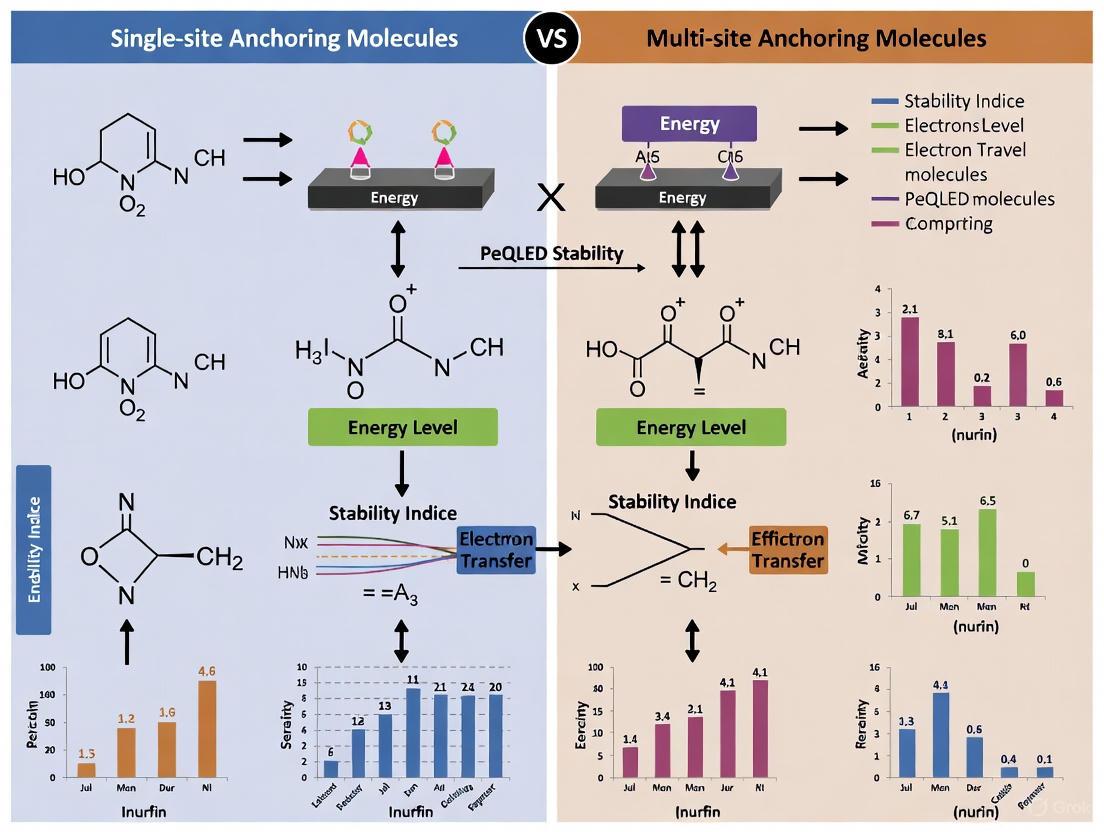
The operational stability of perovskite quantum dot light-emitting diodes (PeQLEDs) remains a critical barrier to their commercialization.
Single-Site vs. Multi-Site Anchoring Molecules: A Strategic Guide for Enhancing PeQLED Stability
Abstract
The operational stability of perovskite quantum dot light-emitting diodes (PeQLEDs) remains a critical barrier to their commercialization. This article provides a comprehensive analysis of surface ligand engineering strategies, contrasting traditional single-site anchors with emerging multi-site anchoring molecules. We explore the foundational principles of defect passivation and phase stabilization, detail the methodological application of advanced ligands like ThMAI and TMeOPPO-p, and address key troubleshooting aspects for lattice distortion and ion migration. By synthesizing recent validation studies that demonstrate unprecedented device lifetimes exceeding 23,000 hours and external quantum efficiencies over 27%, this work offers researchers and scientists a strategic framework for selecting and optimizing anchoring molecules to develop high-performance, durable PeQLEDs for next-generation displays and lighting.
Understanding Anchoring Mechanisms: From Basic Binding to Multi-Site Passivation
The Critical Role of Surface Ligands in PeQLED Performance and Degradation
The performance and operational stability of perovskite quantum dot light-emitting diodes (PeQLEDs) are critically determined by the surface chemistry of the quantum dots, particularly the design and binding affinity of surface ligands. While defect passivation has been a primary focus for enhancing photoluminescence quantum yield (PLQY), achieving high electroluminescence efficiency and long device lifetime requires a deeper strategy that addresses the dynamic nature of the perovskite surface and suppresses ion migration under electrical bias [1] [2]. This review objectively compares the effectiveness of single-site versus multi-site anchoring molecules for PeQLED stability, providing experimental data and methodologies to guide material selection and device fabrication.
Single-Site vs. Multi-Site Anchoring Ligands: A Comparative Analysis
Fundamental Anchoring Mechanisms
Surface ligands passivate defects on perovskite quantum dots (PQDs) by coordinating with undercoordinated ions on the surface. The effectiveness of this passivation is governed by the ligand's functional groups and its binding geometry.
- Single-Site Anchoring: These ligands typically feature one functional group (e.g., phosphine oxide, sulfoxide, or carboxylate) that binds to a single surface site, such as an uncoordinated Pb²⁺ ion [1] [3]. While this can reduce defect density, the binding is often dynamic and can be displaced by polar solvents or under electrical stress, leaving other surface defects unpassivated.
- Multi-Site Anchoring: These molecules are designed with multiple functional groups arranged to match the perovskite crystal lattice spacing. This allows simultaneous coordination with multiple undercoordinated surface ions, creating a more stable and comprehensive passivation layer [1] [4]. This multi-dentate binding significantly enhances binding energy and reduces ligand desorption.
The following diagram illustrates the core mechanistic difference between these two approaches and its consequences for device performance.
Quantitative Performance Comparison of Ligand Strategies
The following table summarizes key performance metrics from recent studies, demonstrating the superior performance of multi-site anchoring ligands in PeQLEDs.
Table 1: Performance Comparison of Single-Site vs. Multi-Site Anchoring Ligands in PeQLEDs
| Ligand Strategy | Specific Molecule | PLQY (%) | Max. EQE (%) | Operational Stability (LT50, hours) | Key Findings | Source |
|---|---|---|---|---|---|---|
| Single-Site | Triphenylphosphine Oxide (TPPO) | ~70 | N/R | N/R | Eliminated some Pb-6pz trap states, but consecutive trap states remained. | [1] |
| Single-Site | Trioctylphosphine Oxide (TOPO) | ~18% enhancement | N/R | N/R | Effective passivation of undercoordinated Pb²⁺, but long alkyl chains may hinder charge transport. | [3] |
| Multi-Site | Tris(4-methoxyphenyl)phosphine oxide (TMeOPPO-p) | ~97 | 26.91% | >23,000 | Lattice-matched design (6.5 Å spacing) enabled multi-site defect anchoring and near-unity PLQY. | [1] |
| Multi-Site | 2-Thiophenemethylammonium Iodide (ThMAI) | N/R | N/R | >83% PCE retention after 15 days | Multifaceted anchoring (thiophene & ammonium groups) improved carrier lifetime and phase stability in solar cells. | [4] |
| Multi-Functional | Conjugated Molecular Multipods (CMMs, e.g., TPBi) | Near-unity (film) | 26.1% | N/R | Multipodal hydrogen bonding and vdW interactions strengthened the near-surface lattice and suppressed dynamic disorder. | [2] |
Abbreviations: PLQY: Photoluminescence Quantum Yield; EQE: External Quantum Efficiency; LT50: Half-lifetime; N/R: Not Reported in the cited source.
Experimental Protocols for Ligand Evaluation
To objectively compare ligand performance, researchers employ a suite of characterization techniques. The workflow below outlines a standard protocol for synthesizing and evaluating ligand-passivated PeQDs.
Detailed Methodologies
Synthesis and Purification:
- Hot-Injection Method (Common for CsPbI₃): A cesium-oleate precursor is rapidly injected into a high-temperature (e.g., 105-180°C) solution of lead iodide (PbI₂) and ligands (e.g., OA, OAm) in nonpolar solvents [1] [5]. The reaction is quenched in an ice bath after seconds. Ligands like TMeOPPO-p can be added during this step [1].
- Ligand Exchange: For post-synthetic modification, synthesized PQDs are subjected to a solution containing the new short-chain or multi-site ligands (e.g., ThMAI, CMMs), facilitating the replacement of original long-chain ligands [4] [2].
- Purification: The crude solution is purified using anti-solvents (e.g., methyl acetate) and centrifugation to remove excess ligands and precursors [1] [5].
Structural and Chemical Characterization:
- Aberration-corrected STEM/TEM: Used to analyze morphology, lattice fringes, and measure lattice spacing (e.g., confirming the 6.5 Å spacing for lattice-matching) [1].
- X-ray Photoelectron Spectroscopy (XPS): Detects chemical states and binding energies. A shift in Pb 4f peaks to lower binding energies indicates enhanced electron shielding due to strong ligand-QD interaction [1].
- Fourier Transform Infrared (FTIR) Spectroscopy: Identifies the presence of specific functional groups (e.g., P=O, -OCH₃) and confirms ligand binding to the QD surface [1].
- Nuclear Magnetic Resonance (NMR): ¹H and ³¹P NMR spectra verify the successful incorporation of the ligand (e.g., TMeOPPO-p) into the QD system [1].
Optical Characterization:
- Photoluminescence Quantum Yield (PLQY): Measured using an integrating sphere, it quantifies the efficiency of photon emission. High PLQYs (>95%) indicate effective passivation of non-radiative recombination centers [1] [2].
- Time-Correlated Single-Photon Counting (TCSPC): Measures photoluminescence decay lifetime. A longer average lifetime and a reduction in non-radiative decay rates (k_nr) signify suppressed trap-assisted recombination [2].
Device Fabrication and Testing:
- PeQLED Fabrication: Typically involves spin-coating layers including hole-injection, hole-transport, emissive layer (PQDs), electron-transport, and a cathode [1] [2].
- Performance Metrics:
- External Quantum Efficiency (EQE): The ratio of emitted photons to injected electrons.
- Efficiency Roll-off: The decrease in EQE at high current densities, often linked to Joule heating or imbalanced charge injection.
- Operational Lifetime (LT50): The time for the initial luminance to drop to 50% under constant current operation, a critical metric for stability [1].
The Scientist's Toolkit: Key Reagents and Materials
Table 2: Essential Research Reagents for PeQD Ligand Engineering
| Reagent / Material | Function / Role | Example in Context |
|---|---|---|
| Tris(4-methoxyphenyl)phosphine oxide (TMeOPPO-p) | A multi-site anchoring ligand. The P=O and methoxy (-OCH₃) groups coordinate with uncoordinated Pb²⁺, and its 6.5 Å interatomic O distance matches the perovskite lattice for stable binding. | Used to achieve near-unity PLQY (97%) and high EQE (26.91%) in deep-red PeQLEDs [1]. |
| Conjugated Molecular Multipods (CMMs) | A class of multi-functional ligands (e.g., TPBi). They adsorb via multipodal hydrogen bonding and van der Waals interactions, strengthening the perovskite lattice and suppressing dynamic disorder. | Incorporated into FAPbBr₃ PeNC films to achieve a near-unity PLQY and an EQE of 26.1% in pure green PeQLEDs [2]. |
| 2-Thiophenemethylammonium Iodide (ThMAI) | A multifaceted short-chain ligand. The thiophene group binds to Pb²⁺, and the ammonium group occupies Cs⁺ vacancies. Its large ionic size helps restore beneficial tensile strain. | Used in ligand exchange to improve the power conversion efficiency and ambient stability of CsPbI₃ PQD solar cells [4]. |
| Oleic Acid (OA) & Oleylamine (OLA) | Standard long-chain capping ligands used in initial synthesis. They stabilize the black phase of PQDs but form insulating layers that hinder charge transport in devices. | Routinely used in the hot-injection synthesis of CsPbI₃ QDs; typically replaced via ligand exchange for device fabrication [1] [4]. |
| Trioctylphosphine Oxide (TOPO) | A single-site passivating ligand. The P=O group coordinates with undercoordinated Pb²⁺ ions to suppress non-radiative recombination. | Studied as a surface passivator for CsPbI₃ PQDs, showing a 16% enhancement in photoluminescence [3]. |
The strategic design of surface ligands is paramount for advancing PeQLED technology beyond laboratory curiosities into commercial displays. Experimental evidence consistently demonstrates that multi-site anchoring ligands offer a superior approach compared to traditional single-site passivators. By enabling stable, lattice-matched interactions with the perovskite surface, molecules like TMeOPPO-p and conjugated molecular multipods simultaneously achieve near-perfect luminescence, high electroluminescence efficiency, and exceptional operational stability by mitigating ion migration and reducing dynamic disorder. Future research should focus on broadening the library of multi-site ligands for various perovskite compositions and developing scalable coating processes for industrial manufacturing.
In colloidal nanocrystal science, an "anchoring site" refers to the specific location on a nanocrystal surface where a ligand molecule forms a stable chemical bond or coordination interaction. The strategic design of anchoring ligands is paramount for editing the local microenvironment of single sites, thereby dictating the optoelectronic properties, stability, and functionality of materials like perovskite quantum dots (PQDs). This guide objectively compares two distinct ligand design philosophies: single-site anchoring, where a ligand binds through a single primary functional group, and multi-site anchoring, which utilizes multiple functional groups designed to bind synergistically to the nanocrystal surface. The choice between these paradigms involves critical trade-offs between passivation completeness, ligand packing density, charge transport, and overall lattice stability, making the selection process crucial for advancing PeQLED performance.
Fundamental Principles and Key Limitations
The efficacy of an anchoring ligand is governed by its binding mechanism and the subsequent impact on the nanocrystal's surface chemistry. The following principles and limitations outline the core considerations for researchers in this field.
Principles of Single-Site Anchoring
- Well-Defined Coordination: Single-site anchoring relies on a single, strong coordinative bond between a ligand's functional group (e.g., a Lewis base) and an unsaturated metal site (e.g., uncoordinated Pb²⁺) on the PQD surface. This direct interaction passivates electronic trap states, thereby enhancing photoluminescence quantum yield (PLQY).
- Electronic Passivation: The primary function is the elimination of trap states originating from surface defects. For example, the P=O group in triphenylphosphine oxide (TPPO) coordinates with Pb²⁺, donating electron density and reducing non-radiative recombination pathways [6] [7].
- Simplified Interface: This approach aims to create a less congested surface compared to native long-chain ligands, potentially improving inter-dot charge transport by reducing the insulating organic barrier.
Limitations of Single-Site Anchoring
- Incomplete Passivation: A single binding site cannot simultaneously address different types of surface defects, such as both metal cation and halide anion vacancies. This often leaves a landscape of unpassivated defects that can act as traps or ion migration channels [8] [7].
- Dynamic Binding and Instability: The bond between a single functional group and the nanocrystal surface can be labile. During processing or under operational stress (e.g., electric field, heat), ligands can desorb, leading to immediate degradation of optoelectronic properties and phase instability [8] [4].
- Limited Strain Induction: Single-site ligands are often less effective at inducing and maintaining the beneficial tensile strain required to stabilize the black perovskite phase (α-CsPbI₃) at room temperature, making the material prone to phase transition to a non-perovskite structure [4].
Principles of Multi-Site Anchoring
- Synergistic Defect Passivation: Multi-site ligands are engineered with multiple functional groups that can bind to different surface sites concurrently. For instance, a ligand might feature a phosphine oxide group for Pb²⁺ and an ammonium group for Cs⁺ vacancies, providing more comprehensive surface coverage [4].
- Lattice Matching for Robust Binding: Advanced designs, such as tris(4-methoxyphenyl)phosphine oxide (TMeOPPO-p), feature interatomic distances between oxygen atoms (e.g., 6.5 Å) that match the perovskite lattice spacing. This geometric compatibility allows for multi-point chelation, dramatically increasing the binding energy and making ligand desorption more difficult [8].
- Strain and Stability Management: The larger ionic size of some multi-site ligand cations (e.g., ThMA⁺) compared to Cs⁺ can help restore beneficial surface tensile strain in PQDs, which is crucial for inhibiting the transition to a non-photoactive phase [4].
Limitations of Multi-Site Anchoring
- Synthetic Complexity: Designing and synthesizing ligands with precise stereochemistry and inter-functional group distances is inherently more complex and costly than producing simple single-site ligands.
- Steric Hindrance Risk: Poorly designed multi-site ligands with mismatched geometry (e.g., TMeOPPO-o with 2.6 Å spacing) can introduce substantial lattice strain, leading to structural distortion and ineffective passivation, akin to single-site binding [8].
- Charge Transport Trade-off: While an improvement over native long-chain ligands, a dense layer of multi-site ligands can still introduce a significant barrier to charge injection and transport if not carefully optimized for conductivity [4].
Common Ligand Architectures and Performance Comparison
This section details specific ligand molecules, categorizing them by their anchoring strategy and presenting quantitative performance data.
Common Ligand Architectures
Single-Site Anchoring Ligands
Multi-Site Anchoring Ligands
- Tris(4-methoxyphenyl)phosphine Oxide (TMeOPPO-p): Features a P=O group and three electron-donating -OCH₃ groups at para positions. The 6.5 Å spacing between oxygen atoms matches the CsPbI₃ lattice, enabling multi-point, lattice-matched anchoring [8].
- 2-Thiophenemethylammonium Iodide (ThMAI): A multifaceted ligand where the thiophene ring (Lewis base) binds to uncoordinated Pb²⁺, and the ammonium group occupies Cs⁺ vacancies. Its strong dipole moment facilitates tight binding [4].
- Triphenylphosphine (TPP): Reveals a more complex interaction than initially assumed, exhibiting not only P-Pb coordination but also a supramolecular halogen bonding (P...I) with surface iodine, representing a dual-site anchoring mechanism [7].
- 2-(Diphenylphosphino)-biphenyl (DPB): Similar to TPP but with an additional benzene ring that enhances electron delocalization, improving charge transport while maintaining strong multi-site surface binding [7].
Quantitative Performance Comparison of Anchoring Strategies
The following table summarizes experimental data for single-site and multi-site anchoring ligands, demonstrating the performance advantages of advanced multi-site designs.
Table 1: Performance Comparison of Single-Site and Multi-Site Anchoring Ligands in CsPbI₃ Systems
| Ligand | Anchoring Type | PLQY (Solution) | PLQY (Film) | Device Peak EQE | Key Stability Metric |
|---|---|---|---|---|---|
| OLA/OA (Control) [4] | Native / Single-Site | ~58-59% [8] [7] | N/A | ~13.6% (Solar Cell PCE) [4] | Retains 8.7% of initial PCE after 15 days [4] |
| TPPO [7] | Single-Site | 70% [8] | N/A | 21.4% (Top-emitting LED) [7] | N/A |
| TPP [7] | Dual-Site (P-Pb, P-I) | 93% | N/A | 21.4% (Top-emitting LED) [7] | N/A |
| TMeOPPO-p [8] | Multi-Site (Lattice-Matched) | 97% | N/A | 26.91% (QLED) | Operating half-life >23,000 hours |
| DPB [7] | Multi-Site | 95% | 85% | 22.8% (Top-emitting LED) [7] | N/A |
| ThMAI [4] | Multi-Site (Bifunctional) | N/A | N/A | 15.3% (Solar Cell PCE) | Retains 83% of initial PCE after 15 days [4] |
Table 2: Defect Passivation and Electronic Effects of Different Ligand Architectures
| Ligand Architecture | Targeted Defects | Impact on Trap States | Impact on Carrier Lifetime | Effect on Lattice Strain |
|---|---|---|---|---|
| Single-Site (e.g., TPPO) | Uncoordinated Pb²⁺ | Partially reduced; trap peaks may separate from CBM [8] | Moderate improvement | Limited |
| Multi-Site (e.g., TMeOPPO-p) | Uncoordinated Pb²⁺, Halide Vacancies | Eliminates consecutive trap states; connects trap states to CBM [8] | Significant improvement (e.g., 42 ns to 50 ns) [7] | Can restore beneficial tensile strain, enhancing phase stability [4] |
| Multifaceted (e.g., ThMAI) | Uncoordinated Pb²⁺, Cs⁺ Vacancies | Significant reduction via strong dipole moment binding [4] | Improved carrier lifetime [4] | High binding energy and large ionic size enhance surface strain [4] |
Experimental Protocols for Key Techniques
To ensure reproducibility and provide a clear framework for comparison, this section outlines detailed methodologies for critical experiments cited in this guide.
Synthesis and Purification of CsPbI₃ PQDs
Synthesis (Hot-Injection Method):
- Prepare Cs-oleate precursor by loading Cs₂CO₃ into a flask with 1-octadecene and oleic acid, then heating under inert gas until dissolved [7] [4].
- In a separate flask, load PbI₂ with 1-octadecene, oleic acid (OA), and oleylamine (OLA). Heat under inert gas until the PbI₂ is fully dissolved [7] [4].
- Rapidly inject the preheated Cs-oleate solution into the PbI₂ precursor flask. The reaction is quenched after a few seconds by immersing the flask in an ice bath [7] [4].
Purification and Ligand Treatment:
- Precipitate the raw PQD solution by adding a polar antisolvent (e.g., methyl acetate) and isolate the pellet via centrifugation [8] [4].
- Re-disperse the PQD pellet in a non-solvent like n-hexane or ethyl acetate.
- For ligand exchange, add the target ligand (e.g., TMeOPPO-p, ThMAI) to the PQD solution at a specified concentration (e.g., 5 mg/mL). Vigorous stirring ensures interaction between the ligands and the PQD surface [8] [4].
- Purify the ligand-treated PQDs by repeating the precipitation/centrifugation/redispersion cycle to remove excess ligands and reaction byproducts [8].
Photoluminescence Quantum Yield (PLQY) Measurement
- Setup: Use an integrating sphere coupled to a spectrometer and a calibrated light source (e.g., a continuous-wave laser at 405 nm).
- Measurement:
- Place a cuvette containing the pure solvent (or a blank substrate for films) in the integrating sphere to measure the baseline excitation profile.
- Replace the blank with the PQD sample (in solution or as a solid film).
- Measure the emission spectrum of the sample upon excitation.
- Calculation: The PLQY (η) is calculated using the formula:
- η = (Number of photons emitted / Number of photons absorbed) = [Lsample - (Esample - Eblank)] / Eblank, where Lsample is the integrated luminescence of the sample, Esample is the integrated excitation light with the sample in place, and Eblank is the integrated excitation light with the blank in place [8] [7].
Device Fabrication and Testing (QLEDs)
- Substrate Preparation: Clean patterned ITO/glass substrates sequentially in detergent, deionized water, acetone, and isopropanol via ultrasonication, followed by UV-ozone treatment [8].
- Layer-by-Layer Deposition:
- Spin-coat the hole injection layer (HIL, e.g., PEDOT:PSS) onto the ITO anode and anneal.
- Spin-coat the hole transport layer (HTL, e.g., Poly-TPD) onto the HIL.
- Spin-coat the purified PQD solution (e.g., TMeOPPO-p-treated CsPbI₃) to form the emissive layer.
- Spin-coat the electron transport layer (ETL, e.g., TPBi).
- Thermal Evaporation: Transfer the substrate to a thermal evaporation chamber under high vacuum to deposit the cathode (e.g., LiF/Al).
- Testing and Characterization: Encapsulate the finished devices and measure current-voltage-luminance (I-V-L) characteristics using a source meter and a calibrated photodiode. The External Quantum Efficiency (EQE) is calculated from the luminance, current density, and electroluminescence spectrum [8].
Visualization of Anchoring Mechanisms and Workflows
The following diagrams, generated from DOT scripts, illustrate the core concepts and experimental workflows discussed in this guide.
Single vs. Multi-Site Anchoring Mechanisms
Diagram 1: Contrasting single-site and multi-site anchoring mechanisms. Multi-site ligands provide comprehensive passivation of different surface defects (Pb²⁺ and I⁻ sites), while single-site ligands leave gaps.
Workflow for PQD Treatment and Characterization
Diagram 2: Standard experimental workflow for ligand treatment of perovskite quantum dots, from synthesis to final device performance testing.
The Scientist's Toolkit: Essential Research Reagents and Materials
This table provides a concise reference for key materials used in the synthesis, passivation, and device fabrication of PeQLDs, as featured in the cited research.
Table 3: Essential Reagents and Materials for PeQLED Research
| Item Name | Function / Role | Example Use Case |
|---|---|---|
| Cesium Carbonate (Cs₂CO₃) | Precursor for Cesium-oleate synthesis | Source of Cs⁺ ions in CsPbI₃ PQD synthesis [7] [4]. |
| Lead Iodide (PbI₂) | Precursor for perovskite crystal structure | Source of Pb²⁺ and I⁻ ions in CsPbI₃ PQD synthesis [7] [4]. |
| 1-Octadecene (ODE) | Non-coordinating solvent | High-booint solvent used as the reaction medium during hot-injection synthesis [7] [4]. |
| Oleic Acid (OA) & Oleylamine (OLA) | Native surface ligands (L-type) | Used during initial synthesis to control nucleation, growth, and stabilize the colloidal suspension of PQDs [8] [4]. |
| Triphenylphosphine Oxide (TPPO) | Single-site anchoring ligand | Passivates uncoordinated Pb²⁺ sites via P=O coordination to improve PLQY [8] [7]. |
| Tris(4-methoxyphenyl)phosphine Oxide (TMeOPPO-p) | Lattice-matched multi-site anchor | Provides multi-point anchoring to passivate multiple defect types simultaneously, enhancing PLQY and operational stability in QLEDs [8]. |
| 2-Thiophenemethylammonium Iodide (ThMAI) | Multifaceted anchoring ligand | The thiophene and ammonium groups passivate Pb²⁺ and Cs⁺ vacancies, respectively; improves solar cell PCE and ambient stability [4]. |
| Poly(3,4-ethylenedioxythiophene): Polystyrene sulfonate (PEDOT:PSS) | Hole injection layer (HIL) | Conducting polymer layer spun onto ITO anodes to facilitate hole injection into the QD emissive layer in QLED devices [8]. |
| 1,3,5-Tris(1-phenyl-1H-benzimidazol-2-yl)benzene (TPBi) | Electron transport layer (ETL) | Organic small molecule thermally evaporated onto the QD layer to transport electrons in QLED devices [8]. |
The strategic selection between single-site and multi-site anchoring ligands is a critical determinant in the performance ceiling of PeQLEDs. While single-site ligands like TPPO offer a straightforward path to partial passivation and performance gains, their limitations in stability and comprehensive defect mitigation are clear. The emerging paradigm, supported by robust experimental data, favors the rational design of multi-site anchoring ligands. Architectures that leverage lattice matching (TMeOPPO-p) or multifaceted functional groups (ThMAI) demonstrate superior ability to suppress ion migration, eliminate trap states, and stabilize the perovskite lattice under operational stress. This translates directly to the record-breaking EQEs and unprecedented operational lifetimes required for commercial applications. Future research will likely focus on refining these sophisticated ligand designs to further optimize the delicate balance between ultimate passivation efficiency and charge transport capability.
The stability and performance of Perovskite Quantum Dot Light-Emitting Diodes (PeQLEDs) are fundamentally governed by the molecular interactions at the perovskite surface. Defects at surfaces and grain boundaries, particularly uncoordinated lead ions (Pb²⁺) and halide vacancies, act as non-radiative recombination centers that significantly diminish device efficiency and operational lifetime. Multi-site anchoring has emerged as a superior molecular design strategy compared to traditional single-site anchoring for mitigating these defects. This approach utilizes molecules with multiple functional groups that can simultaneously coordinate with different types of defects and lattice components, creating a more robust and comprehensive stabilization effect. This guide objectively compares the performance of multi-site anchoring molecules against single-site alternatives, providing experimental data and methodologies central to current PeQLED stability research.
Performance Comparison: Multi-Site vs. Single-Site Anchoring Molecules
The following table summarizes key performance metrics from recent studies, directly contrasting multi-site and single-site anchoring approaches.
Table 1: Quantitative Comparison of Anchoring Molecule Performance in Perovskite Devices
| Molecule (Anchoring Type) | Active Sites/Function | Device Type | Key Performance Metrics | Stability Retention |
|---|---|---|---|---|
| TPTA (Multi-site) [9] | I-Sn-N coordination; P=S anchoring | Sn-Pb Perovskite Solar Cell | PCE: 23.4% (single-junction), 29.6% (tandem) | 94.9% after 950 h MPP tracking |
| DBTT (Multi-site) [10] | Br (for I vacancies); S (for uncoordinated Pb²⁺) | Inverted Perovskite Solar Cell | PCE: 23.02% (vs. 20.39% control) | 91% after 1320 h (50±5% RH) |
| FSA (Multi-site) [11] | S=O, C=N (for Pb²⁺); NH₂ (for Br⁻) | Green PeLED | EQE: 26.5% | 4x enhancement in operating lifetime |
| BPA (Single-site) [12] | Phosphonic acid group (P-O-Pb bond) | Quasi-2D PeLED | EQE: 20.6% | 6x device lifetime (T50) |
| THB (Single-site) [13] | S atom (for Pb²⁺) | Wide-Bandgap Inverted PSC | PCE: 20.75% | 99.0% after 1512 h (10-25% RH) |
Experimental Protocols for Evaluating Anchoring Molecules
Molecular Synthesis and Perovskite Film Fabrication
The synthesis of multi-site anchoring molecules is designed to incorporate diverse functional groups with specific charge distributions. For example, Triphenyltriamine thiophosphate (TPTA) is rationally designed with a rigid tridentate architecture where a thiophosphoryl (P=S) moiety synergizes with terminal triamine groups to enable simultaneous coordination with multiple Sn²⁺ centers [9]. In a typical experiment, the additive molecule (e.g., DBTT, TPTA) is introduced into the perovskite precursor solution at a specific molar concentration (e.g., 1 mM) and thoroughly mixed before film deposition [9] [10]. The perovskite film is then fabricated via a one-step spin-coating process, often followed by an anti-solvent quenching step and thermal annealing to facilitate crystallization and molecular anchoring.
Characterization of Defect Passivation and Crystallization
Electrostatic Potential (ESP) Calculation: Density Functional Theory (DFT) calculations are first performed to map the electrostatic potential of candidate molecules. This identifies regions of negative charge (e.g., on S, Br, O, or N atoms) that can coordinate with positively charged defects like uncoordinated Pb²⁺ or Sn²⁺ [10]. The dipole moment of the molecule is also calculated, with a higher moment often correlating with stronger molecular interaction with the perovskite lattice, as seen in TPTA (5.13 Debye) [9].
Binding Affinity and Adsorption Energy: DFT calculations further quantify the molecule's binding strength to the perovskite surface. A more negative adsorption energy signifies a stronger, more stable interaction. For instance, TPTA exhibits an adsorption energy of -2.525 eV, significantly higher than single-site molecules like TAPB (-2.109 eV) [9].
Spectroscopic Confirmation: Fourier Transform Infrared (FTIR) spectroscopy and X-ray Photoelectron Spectroscopy (XPS) are used to experimentally verify the predicted chemical interactions. FTIR can show redshift in vibrational peaks (e.g., N-H stretching), indicating coordination between the molecule and metal ions [9]. XPS reveals shifts in the binding energy of core orbitals (e.g., Sn 3d or Pb 4f), confirming the chemical bond formation and passivation of specific defects [9].
Crystallization and Morphology Analysis: Grazing-incidence wide-angle X-ray scattering (GIWAXS) and scanning electron microscopy (SEM) are employed to study the impact of the additive on crystal growth. Multi-site anchors like FSA inhibit the formation of unfavorable low-dimensional phases and promote larger, more uniform grains with fewer grain boundaries [11].
The Scientist's Toolkit: Essential Research Reagents
Table 2: Key Reagent Solutions for Multi-Site Anchoring Research
| Reagent / Material | Function in Research | Example from Literature |
|---|---|---|
| Triphenyltriamine thiophosphate (TPTA) | Multi-site anchor for Sn-Pb perovskites; establishes I-Sn-N coordination framework to suppress photothermal-mechanical degradation [9]. | Used to achieve a certified 28.9% PCE in tandem solar cells [9]. |
| 5,5″-Dibromo-2,2′:5′,2″-terthiophene (DBTT) | Dual Br/S active sites passivate I vacancies and uncoordinated Pb²⁺ simultaneously, also delays crystallization [10]. | Boosted PCE of inverted PSCs from 20.39% to 23.02% [10]. |
| Formamidine Sulfinic Acid (FSA) | Multidentate passivator; S=O and C=N groups coordinate Pb²⁺, NH₂ interacts with Br⁻, minimizing non-radiative losses [11]. | Enabled PeLEDs with 26.5% EQE and a fourfold lifetime enhancement [11]. |
| Benzylphosphonic Acid (BPA) | Single-site anchor; strong P-O-Pb bond aggregates lead-halide octahedra to grow high-dimensional phases, reducing defect density [12]. | Increased PeLED EQE from 8% to 20.6% and device lifetime by 6x [12]. |
| 1,2,4-tris(3-thienyl)benzene (THB) | Single-site surface passivator; S atom passivates Pb²⁺ and occupies halogen migration sites, inhibiting ion migration [13]. | Achieved 20.75% PCE in WBG PSCs with exceptional humidity stability [13]. |
Mechanistic Pathways of Multi-Site Anchoring
The superior performance of multi-site anchoring can be visualized as a multi-step process that disrupts degradation cycles and enhances lattice stability, as illustrated below.
Diagram 1: Multi-site anchoring disrupts the degradation cycle.
The experimental data consistently demonstrates that multi-site anchoring provides a more effective and sustainable strategy for enhancing the stability and performance of PeQLEDs and related perovskite devices compared to single-site anchoring. The fundamental advantage lies in the ability of a single multidentate molecule to concurrently passivate multiple defect types and integrate into the crystallization process, thereby breaking the self-reinforcing photothermal-mechanical degradation cycle. While single-site anchors offer valuable improvements, they are inherently limited in their scope of action. For researchers aiming to push the operational lifetime and efficiency limits of perovskite optoelectronics, the design and implementation of novel multi-site anchoring molecules represent a critical and fruitful pathway forward.
The pursuit of stable and efficient perovskite quantum dot light-emitting diodes (PeQLEDs) is fundamentally challenged by three interconnected instability factors: ion migration, phase instability, and defect-induced non-radiative recombination. These phenomena collectively degrade device performance and operational lifetime, presenting significant barriers to commercialization. Current research has converged on surface engineering through molecular anchors as a primary mitigation strategy, yielding two distinct approaches: conventional single-site anchoring and emerging multi-site anchoring. Single-site anchors typically employ molecules with one functional group (e.g., Lewis basic P=O or C-O-C) that binds to undercoordinated Pb²⁺ ions on the perovskite surface [1] [14]. While effective at basic defect passivation, this approach often provides incomplete surface coverage and fails to suppress ion migration channels fully. In contrast, multi-site anchors are designed with multiple functional groups that bind simultaneously to several adjacent sites on the quantum dot surface, creating a more robust and conformationally stable interface [1] [15] [16]. This comparative analysis examines how these contrasting molecular strategies address the core stability challenges in PeQLEDs, drawing on recent experimental evidence to evaluate their relative effectiveness.
Comparative Performance of Anchoring Strategies
The table below summarizes key performance metrics from recent studies implementing single-site and multi-site anchoring strategies in perovskite optoelectronic devices.
Table 1: Performance Comparison of Single-site vs. Multi-site Anchoring Strategies
| Anchoring Type | Material/System | Key Performance Metrics | Stability Outcomes | Reference |
|---|---|---|---|---|
| Single-site | DGBE in quasi-2D PeLEDs | PLQY: 39% → 80%; Max EQE: 24.2% | T50: 2.4 min → 66.4 min [14] | |
| Single-site | TPPO on CsPbI3 QDs | PLQY: 59% → 70% | Limited operational stability data [1] | |
| Multi-site | TMeOPPO-p on CsPbI3 QDs | PLQY: 59% → 97%; Max EQE: 27% | Operating half-life >23,000 h [1] | |
| Multi-site | Sb(SU)2Cl3 on FAPbI3 | PCE: 25.03% (in air) | T80: 23,325 h (shelf life) [15] | |
| Multi-site | EDTMPS in PSCs | PCE: 20.03% → 23.37% | Enhanced operational & thermal stability [16] | |
| Multi-site | ThMAI on CsPbI3 PQDs | PCE: 13.6% → 15.3% | Retained 83% initial PCE after 15 days [4] |
Experimental Protocols for Anchoring Studies
Quantum Dot Synthesis and Ligand Treatment
A modified hot-injection method is commonly employed for synthesizing CsPbI3 QDs [1] [4]. Typically, Cs2CO3 is reacted with octadecene and oleic acid at elevated temperatures (150-160°C) under inert atmosphere to form a Cs-oleate precursor. Separately, PbI2 is dissolved in octadecene with oleylamine and oleic acid ligands at 120°C. The Cs-precursor is then rapidly injected into the lead precursor solution, resulting in immediate perovskite QD formation. For ligand exchange, the purified QDs are dispersed in a non-polar solvent (e.g., hexane or octane) and treated with anchoring molecule solutions (e.g., TMeOPPO-p or ThMAI dissolved in ethyl acetate or dimethylformamide) under stirring [1] [4]. The mixture is centrifuged to remove weakly bound ligands, and the passivated QDs are recovered in the precipitate.
Film Characterization and Defect Analysis
Photoluminescence Quantum Yield (PLQY) measurements are conducted using an integrating sphere coupled to a spectrometer with calibrated excitation sources. QD solutions or solid films are excited at appropriate wavelengths, and emitted photons are quantified to calculate the ratio of photons emitted to photons absorbed [1] [14].
X-ray Photoelectron Spectroscopy (XPS) analysis is performed using monochromatic Al Kα radiation. Binding energy shifts in core levels (e.g., Pb 4f) indicate charge transfer between anchoring molecules and the perovskite surface, confirming successful coordination [1].
Fourier Transform Infrared (FTIR) Spectroscopy identifies chemical bonding between anchors and QD surfaces. Weakening of characteristic vibrational modes from native ligands (e.g., C-H stretching at 2700-3000 cm⁻¹ from oleylamine/oleic acid) and appearance of new coordination peaks confirm ligand exchange [1] [15].
Synchrotron-based X-ray Absorption Spectroscopy (XAS), including XANES and EXAFS, probes the local coordination environment and oxidation states of metal atoms. For lattice-anchored single-atom catalysts, this technique verifies atomic dispersion and identifies coordination paths [17] [18].
Molecular Anchoring Mechanisms
The following diagram illustrates the fundamental operational differences between single-site and multi-site anchoring mechanisms and their respective impacts on perovskite stability.
Figure 1: Molecular Anchoring Mechanisms and Impact on Perovskite Stability
Multi-site anchors like TMeOPPO-p achieve lattice-matched spacing where the distance between functional groups (e.g., 6.5 Å) matches the perovskite lattice constant, enabling simultaneous coordination to multiple adjacent surface sites [1]. This multi-dentate binding configuration provides superior defect passivation and significantly reduces ion migration pathways compared to single-site anchors.
The Scientist's Toolkit: Essential Research Reagents
Table 2: Key Reagents for Anchoring Molecule Research
| Reagent/Material | Function in Research | Example Application |
|---|---|---|
| Tris(4-methoxyphenyl)phosphine oxide (TMeOPPO-p) | Lattice-matched multi-site anchor | CsPbI3 QLED passivation [1] |
| 2-Thiophenemethylammonium Iodide (ThMAI) | Multifaceted short-chain ligand | CsPbI3 PQD solar cells [4] |
| Sb(SU)₂Cl₃ Complex | Multi-site (2Se+2Cl) passivator | Air-processed perovskite solar cells [15] |
| Ethylene Diamine Tetra Methylene Phosphonic Sodium (EDTMPS) | Multi-anchor with lead shielding | Defect passivation & lead leakage suppression [16] |
| Diethylene Glycol Bis(3-aminopropyl) Ether (DGBE) | Lewis base single-site additive | Red PeLED defect passivation [14] |
| Oleylamine/Oleic Acid | Native long-chain ligands | Initial QD synthesis & stabilization [1] [4] |
The comparative evidence strongly indicates that multi-site anchoring strategies offer substantial advantages over conventional single-site approaches for addressing the fundamental stability challenges in PeQLEDs. By enabling stronger, conformationally stable binding to perovskite surfaces through multiple coordinated interactions, multi-site anchors provide more comprehensive defect passivation, significantly inhibit ion migration, and enhance phase stability. The resulting devices consistently demonstrate superior performance metrics, including near-unity PLQYs, exceptional EQEs exceeding 26%, and operational stabilities extending to thousands of hours. While single-site anchors remain valuable for basic defect mitigation, the lattice-matched, multi-dentate binding paradigm represents a more promising path toward commercially viable, stable perovskite optoelectronics. Future research directions should focus on expanding the library of multi-site anchoring molecules and optimizing their integration into industrial-scale manufacturing processes.
Design and Synthesis of Advanced Anchoring Molecules for PeQLEDs
The operational stability of perovskite quantum dot light-emitting diodes (PeQLEDs) and solar cells remains a significant challenge hindering their commercialization. A predominant source of instability originates from surface defects and ion migration within the quantum dots (QDs) [8]. Surface ligands play a dual role; they passivate these defects but can also impede charge transport [8]. Conventional single-site anchoring ligands, which bind to the perovskite surface through only one functional group, often create resistive barriers due to dense packing and offer insufficient defect passivation, leaving channels for ion migration and degradation [15]. In contrast, multi-site anchoring ligands are emerging as a superior strategy. These molecules bind to multiple surface sites simultaneously, offering deeper trap passivation, enhanced lattice stabilization, and lower interfacial resistance [8] [15]. This guide objectively compares these two anchoring paradigms, focusing on the pivotal design principles of lattice matching and interatomic spacing, and presents supporting experimental data on their performance.
Core Design Principles: Lattice Matching and Spacing
The efficacy of a multi-site anchoring ligand is not guaranteed by the mere presence of multiple functional groups. Its geometric compatibility with the perovskite crystal structure is paramount. The following principles are critical:
- Lattice Matching: The interatomic distance between the ligand's binding sites must closely match the lattice spacing of the target perovskite crystal. This ensures the molecule can approach the surface closely and form strong, simultaneous bonds with multiple undercoordinated ions without inducing detrimental strain [8].
- Binding Site Nucleophilicity: The electron-donating strength of the functional groups (e.g., P=O, -OCH₃, S=O, Cl⁻, Se²⁻) determines the strength of their interaction with uncoordinated Pb²⁺ ions. Stronger nucleophiles provide more robust passivation [8].
- Multi-Site Coordination: The ideal ligand can coordinate with three or more adjacent sites on the perovskite surface. This multi-dentate binding configuration significantly increases adsorption energy and stability compared to single-site binding [15].
The following diagram illustrates the logical relationship between ligand design, its interaction with the perovskite surface, and the final device outcomes.
Comparative Analysis of Anchoring Ligands
The table below summarizes key performance metrics from recent studies, providing a direct comparison between single-site and advanced multi-site anchoring ligands.
Table 1: Performance Comparison of Single-Site vs. Multi-Site Anchoring Ligands
| Ligand / Treatment | Anchoring Type | Key Functional Groups | Reported Performance Metric | Value |
|---|---|---|---|---|
| TPPO (Baseline) [8] | Single-site | P=O | Photoluminescence Quantum Yield (PLQY) | ~70% |
| TMeOPPO-p [8] | Multi-site (Dual) | P=O, -OCH₃ | PLQY | 97% |
| QLED Max. External Quantum Efficiency | 26.91% | |||
| QLED Operating Half-life (T₅₀) | >23,000 h | |||
| ThMAI [4] | Multi-site (Dual) | Ammonium, Thiophene | Solar Cell Power Conversion Efficiency (PCE) | 15.3% |
| PCE Retention (15 days, ambient) | 83% | |||
| Sb(SU)₂Cl₃ Complex [15] | Multi-site (Quadruple) | Cl⁻, Se²⁻ | Solar Cell PCE (air-processed) | 25.03% |
| Projected T₈₀ Shelf Lifetime (unencapsulated) | 23,325 h |
Experimental Protocols and Methodologies
To ensure reproducibility, this section details the key experimental protocols used in the cited studies for synthesizing and evaluating multi-site anchors.
Synthesis and Purification of Lattice-Matched QDs (TMeOPPO-p)
The following workflow, adapted from the hot-injection method, is critical for achieving high-performance QDs with lattice-matched ligands [8].
Key Characterization Techniques [8]:
- Photoluminescence Quantum Yield (PLQY): Measured using an integrating sphere to determine the efficiency of light emission.
- Aberration-corrected STEM: Used to confirm uniform cubic morphologies and lattice fringes with a spacing of 6.5 Å.
- X-ray Photoelectron Spectroscopy (XPS): A downward shift in the Pb 4f peaks for target QDs confirms enhanced electron shielding due to strong ligand interaction.
- Fourier Transform Infrared (FTIR) Spectroscopy: Weakened C-H stretching modes (2700-3000 cm⁻¹) indicate partial replacement of original OA/OLA ligands.
- Nuclear Magnetic Resonance (NMR): ¹H and ³¹P NMR spectra verify the presence of TMeOPPO-p on the QD surface.
Ligand Exchange and Defect Passivation (ThMAI & Sb(SU)₂Cl₃)
For pre-synthesized QDs or perovskite films, a post-synthetic ligand exchange or treatment is employed [4] [15].
- ThMAI Treatment [4]: CsPbI₃ QDs stabilized with oleic acid (OA) and oleylamine (OLA) are synthesized and dispersed in a solvent like n-octane. The ThMAI ligand is then introduced during a solid-state ligand exchange process. The thiophene group binds to uncoordinated Pb²⁺, while the ammonium group occupies Cs⁺ vacancies. This multifaceted anchoring passivates defects and restores beneficial tensile strain.
- Sb(SU)₂Cl₃ Treatment [15]: The complex is synthesized by reacting antimony chloride with N,N-dimethylselenourea (SU) in dichloromethane. It is then incorporated into the perovskite precursor solution or applied as a surface treatment. The quadruple-site binding is confirmed by density functional theory (DFT) calculations showing charge transfer and reduced defect formation energies.
The Scientist's Toolkit: Essential Research Reagents
The table below catalogs key chemicals and materials used in the featured research, serving as a reference for experimental design.
Table 2: Essential Research Reagents for Multi-Site Anchoring Studies
| Reagent / Material | Function / Role | Example Use Case |
|---|---|---|
| Tris(4-methoxyphenyl)phosphine oxide (TMeOPPO-p) | Lattice-matched multi-site anchor; P=O and -OCH₃ groups bind uncoordinated Pb²⁺. | Passivation of CsPbI₃ QDs for high-efficiency PeQLEDs [8]. |
| 2-Thiophenemethylammonium Iodide (ThMAI) | Multi-site anchor; thiophene (Lewis base) and ammonium groups passivate Pb²⁺ and Cs⁺ vacancies. | Ligand exchange on CsPbI₃ QD films for photovoltaics [4]. |
| Sb(SU)₂Cl₃ Complex | Multi-site (quadruple) passivator; Cl and Se atoms coordinate with Pb²⁺, forming a stable interface. | Defect suppression in fully air-processed perovskite solar cells [15]. |
| Oleic Acid (OA) / Oleylamine (OLA) | Long-chain native ligands for initial QD synthesis and stabilization. | Standard surfactants in hot-injection synthesis of perovskite QDs [8] [4]. |
| Cesium Carbonate (Cs₂CO₃) & Lead Iodide (PbI₂) | Precursors for the synthesis of all-inorganic CsPbI₃ perovskite QDs. | Formation of the perovskite crystal structure [4]. |
The experimental data unequivocally demonstrates the superiority of multi-site anchoring ligands over conventional single-site designs. The critical differentiator is the geometric precision of lattice matching, where an interatomic spacing of ~6.5 Å in the ligand directly correlates with near-unity PLQYs and a dramatic enhancement in operational stability, as evidenced by device lifetimes exceeding 23,000 hours [8]. The progression from single-site to dual and quadruple-site binders reveals a clear trend: increasing the number of coordinated sites leads to stronger adsorption, more complete defect passivation, and remarkable device stability, even under harsh environmental conditions [15]. For researchers aiming to push the boundaries of perovskite optoelectronics, the rational design of multi-site anchors, meticulously tailored to the atomic landscape of the perovskite surface, is no longer an option but a necessity.
The stability and performance of perovskite quantum dot light-emitting diodes (PeQLEDs) and solar cells (PSCs) are critically dependent on the molecular design of surface-bound ligands. Within this field, a fundamental dichotomy exists between single-site and multi-site anchoring molecules. Single-site ligands typically feature one functional group that interacts with the perovskite surface, while multi-site anchors possess multiple, strategically spaced functional groups designed to bind simultaneously to several surface defect sites. This guide objectively compares the performance of different ligand strategies, using 2-Thiophenemethylammonium Iodide (ThMAI) as a case study for a versatile, multifaceted anchor, and contrasts its performance with other prominent ligands, providing the experimental data and protocols necessary for researcher evaluation.
Ligand Function and Key Research Reagents
The following table details essential materials and their functions as explored in the cited research, providing a foundation for understanding the experimental workflows.
Table 1: Key Research Reagent Solutions and Materials
| Reagent/Material | Function in Research | Key Experimental Context |
|---|---|---|
| 2-Thiophenemethylammonium Iodide (ThMAI) | Multifaceted anchoring ligand for surface passivation and strain restoration [4]. | Ligand exchange on CsPbI3 PQDs; employs thiophene and ammonium groups for defect passivation [4]. |
| Tris(4-methoxyphenyl)phosphine oxide (TMeOPPO-p) | Lattice-matched multi-site anchor for defect passivation [19]. | Post-synthesis treatment of CsPbI3 QDs; P=O and -OCH3 groups bind uncoordinated Pb²⁺ [19]. |
| 7-Fluorobenzo[b]thiophene-2-carboxylic acid | Multisite anchoring molecular passivator for defect mitigation [20]. | Additive in perovskite solar cell fabrication; carboxylic acid and fluorine atoms address multiple defects [20]. |
| Oleic Acid (OA) / Oleylamine (OLA) | Long-chain native ligands for initial QD synthesis and stabilization [4]. | Used in standard hot-injection synthesis of CsPbI3 PQDs; require replacement for efficient charge transport [4]. |
| Antisolvents (e.g., Toluene, Hexane) | Low-polarity solvents for ligand exchange and purification processes [19] [21]. | Used to wash away long-chain ligands and facilitate binding of new short-chain anchors [21]. |
Experimental Protocols for Ligand Implementation
ThMAI Ligand Exchange on CsPbI3 Perovskite Quantum Dots
The implementation of ThMAI as a multifaceted anchoring ligand follows a specific protocol for ligand exchange on all-inorganic CsPbI3 Perovskite Quantum Dots (PQDs) [4].
- PQD Synthesis: CsPbI3 PQDs are first synthesized via the standard hot-injection method, using Oleic Acid (OA) and Oleylamine (OLA) as long-chain native ligands to stabilize the black phase [4].
- Ligand Exchange Solution: A solution of ThMAI is prepared in a suitable solvent. The ThMAI ligand features an electron-rich thiophene ring and an electron-deficient ammonium group, creating a strong dipole moment [4].
- Exchange Process: The ThMAI solution is introduced to the synthesized PQDs. During this process:
- The thiophene ring, acting as a Lewis base, robustly binds to uncoordinated Pb²⁺ sites on the PQD surface.
- The ammonium segment (ThMA⁺) efficiently occupies cationic Cs⁺ vacancies.
- The larger ionic size of ThMA⁺ compared to Cs⁺ helps restore tensile strain on the PQD surface, mitigating lattice distortion and enhancing black-phase stability [4].
- Post-Processing: The treated PQD solid films are washed and processed into thin films for device fabrication. This methodology enhances carrier lifetime, ensures uniform PQD orientation, and improves ambient stability [4].
Antisolvent Solubilization (AS) Method for ThMAI
A modified protocol, the Antisolvent Solubilization (AS) approach, was developed to enhance the solubilization of bulky organic ammonium salts like ThMAI in low-polarity antisolvents [21]. This method is particularly effective for passivating both shallow and deep defects in organic-inorganic hybrid perovskite (OIHP) films for solar cells [21].
- Preparation: The ThMAI is dissolved using the AS method to improve its incorporation into the perovskite film.
- Application: The ThMAI solution, prepared via AS, is applied during the perovskite film fabrication, often in conjunction with an antisolvent quenching step.
- In-Situ Reaction: The incorporated ThMAI can react with excess PbI₂ in the film, facilitating crystallization, improving light absorption, and suppressing non-radiative recombination [21].
- Outcome: This approach is reported to simultaneously passivate both shallow and deep defects, leading to significant improvements in power conversion efficiency (PCE) [21].
Performance Comparison: ThMAI vs. Alternative Anchoring Ligands
The efficacy of a ligand is quantified through its impact on device performance and stability. The table below provides a comparative summary of key performance metrics for ThMAI and other relevant anchors.
Table 2: Performance Comparison of Anchoring Ligands in Perovskite Devices
| Ligand / Molecule | Anchoring Type | Device Type | Key Performance Metrics | Stability Data |
|---|---|---|---|---|
| ThMAI [4] | Multifaceted (Thiophene & Ammonium) | CsPbI3 PQD Solar Cell | PCE: 15.3% [4] | Maintained 83% of initial PCE after 15 days in ambient air [4]. |
| ThMAI (AS Method) [21] | Multifaceted (Thiophene & Ammonium) | Organic-Inorganic Hybrid PSC | PCE: 23.69% (10% improvement over control) [21]. | Enhanced heat and humidity stability reported [21]. |
| TMeOPPO-p [19] | Lattice-matched Multi-site (P=O & -OCH₃) | Perovskite QLED | Max EQE: 27% at 693 nm; PLQY: 97% [19]. | Operating half-life: >23,000 hours [19]. |
| 7-Fluorobenzo[b]thiophene-2-carboxylic acid [20] | Multisite (Carboxylic acid & Fluorine) | Perovskite Solar Cell | PCE: 26.92% (Stabilized certified: 26.79%) [20]. | >96.2% of initial efficiency retained after 2000 h of MPPT aging [20]. |
Analysis: Single-site vs. Multi-site Anchoring in PeQLED Stability
The comparative data reveals a clear trend: multi-site and multifaceted anchoring strategies consistently outperform single-site approaches in enhancing both the performance and operational stability of perovskite optoelectronic devices.
Mechanism of Multi-site Anchoring: The superior performance of molecules like TMeOPPO-p is attributed to their ability to match the perovskite lattice spacing (e.g., 6.5 Å interatomic O distance). This allows the molecule to anchor to multiple surface sites simultaneously, effectively eliminating trap states by strongly interacting with uncoordinated Pb²⁺ and stabilizing the crystal lattice. Theoretical calculations confirm that while single-site anchors may partially suppress trap states, lattice-matched multi-site anchors can connect trap states with the conduction band minimum, leading to more complete passivation [19].
Mechanism of Multifaceted Anchoring: ThMAI exemplifies a related but distinct strategy. Its effectiveness does not rely on precise lattice matching but on presenting multiple, complementary functional groups that can bind to different types of surface defects. The thiophene group passivates uncoordinated Pb²⁺, while the ammonium group fills Cs⁺ vacancies. This multifaceted attack on various defect types results in superior surface passivation, improved carrier lifetime, and, critically, the restoration of beneficial tensile strain which enhances phase stability [4].
The following diagram illustrates the logical relationship between ligand design, its function on the perovskite surface, and the resulting device-level outcomes, highlighting the contrast between the strategies.
Ligand Design Dictates Performance and Stability
The strategic design of anchoring ligands is a decisive factor in advancing perovskite optoelectronics. As the experimental data demonstrates, moving from traditional single-site ligands to sophisticated multi-site and multifaceted anchors like TMeOPPO-p and ThMAI enables a fundamental leap in device performance and operational stability. ThMAI, in particular, serves as an excellent case study of a versatile ligand that offers a practical synthesis route and demonstrates effective multi-defect passivation, resulting in significant improvements in the efficiency and longevity of perovskite solar cells. Future research in PeQLEDs and related fields will likely continue to refine these design principles, focusing on precise lattice matching and the development of novel molecular structures with complementary functional groups for ultimate device stability.
Perovskite quantum dot light-emitting diodes (QLEDs) have emerged as a promising technology for next-generation displays and lighting applications, having rapidly achieved external quantum efficiencies (EQEs) exceeding 25%. However, their commercial implementation has been persistently hindered by limited operational stability, primarily originating from surface defects and ion migration within the quantum dots (QDs). These defects—typically halide vacancies and uncoordinated Pb²⁺ ions—act as non-radiative recombination centers and pathways for ion migration, degrading both efficiency and device lifetime. Surface ligand engineering has become a pivotal strategy for addressing these instability issues. Traditional ligands like oleylamine and oleic acid play a dual role: they passivate surface defects but their long, insulating alkyl chains can impede charge transport, creating a fundamental trade-off. Furthermore, these conventional ligands dynamically bind to the QD surface and can be readily displaced during purification or device operation, exposing defects and accelerating degradation.
This guide objectively compares two distinct ligand design philosophies for perovskite QDs: conventional single-site anchors and the emerging lattice-matched multi-site anchors, with Tris(4-methoxyphenyl)phosphine Oxide (TMeOPPO-p) serving as the model system for the latter. We provide a detailed, data-driven comparison of their performance, supported by experimental evidence and methodologies, to inform researchers and development professionals in the field.
Molecular Design and Passivation Mechanism
The Lattice-Matched Multi-Site Anchor: TMeOPPO-p
The design of TMeOPPO-p addresses a critical limitation of earlier passivation molecules: lattice mismatch. While molecules with functional groups like phosphine oxide (P=O) are known to passivate uncoordinated Pb²⁺, their binding geometry often prevents optimal surface coverage. TMeOPPO-p is engineered with a triphenylphosphine oxide framework where the methoxy (-OCH₃) groups are substituted at the para positions. This specific arrangement results in an interatomic distance of 6.5 Å between oxygen atoms, which precisely matches the lattice spacing of the target perovskite QDs (also 6.5 Å). This geometric compatibility allows the molecule to approach the QD surface closely, enabling strong multi-site interactions between its nucleophilic oxygen atoms (from both P=O and -OCH₃ groups) and the undercoordinated Pb²⁺ ions [8].
Comparative Passivation Mechanisms
The fundamental distinction between single-site and multi-site anchors lies in the nature and completeness of their surface interaction.
- Single-Site Anchors (e.g., TPPO): These molecules typically feature one strong binding group, such as a P=O. While this group can effectively passivate one uncoordinated Pb²⁺ site, it leaves adjacent defects untouched. Theoretical calculations of the projected density of states (PDOS) reveal that while the prominent Pb-6pz trap state is eliminated at the bonded site, other trap states remain separated from the conduction band minimum, indicating incomplete passivation [8]. The binding can also be unstable under operational stress.
- Multi-Site, Lattice-Matched Anchors (TMeOPPO-p): The precisely spaced binding sites allow TMeOPPO-p to anchor to multiple defect sites simultaneously. PDOS calculations demonstrate that this multi-dentate binding effectively eliminates all trap states around the Fermi level, with the trap state peaks connecting completely with the conduction band minimum [8]. This indicates a comprehensive passivation that stabilizes the entire surface lattice. The electron-donating nature of the -OCH₃ groups further enhances the electron density on the oxygen atoms, strengthening the coordination bond with Pb²⁺.
The following diagram illustrates the logical pathway of molecular design that leads to superior device performance.
Performance Comparison: TMeOPPO-p vs. Alternative Anchors
A direct comparison of key performance metrics reveals the significant advantages conferred by the lattice-matched multi-site anchoring strategy.
Table 1: Comparative Photophysical Properties of QDs Treated with Different Anchoring Molecules
| Anchoring Molecule | Site Spacing (Å) | Approx. PLQY (%) | Key Characteristic |
|---|---|---|---|
| Pristine QDs | N/A | 59% [8] | Baseline with dynamic ligands |
| TPPO | 5.3 (Single-site) | 70% [8] | Single P=O binding site |
| TMeOPPO-o | 2.6 | 82% [8] | Lattice-mismatched, steric hindrance |
| TMeOPPO-p | 6.5 | 97% [8] | Lattice-matched, multi-site |
| TFPPO | 6.6 | 92% [8] | Good spacing, lower nucleophilicity |
| TClPPO | 7.0 | 88% [8] | Mismatched spacing |
| TBrPPO | 7.2 | 87% [8] | Mismatched spacing |
Table 2: Device Performance of Fabricated QLEDs
| Performance Metric | Single-Site Anchor (Typical) | TMeOPPO-p (Multi-Site) |
|---|---|---|
| Max. External Quantum Efficiency (EQE) | Information missing | 26.91% (27% at 693 nm) [8] |
| EQE at 100 mA cm⁻² | Information missing | >20% (Low efficiency roll-off) [8] |
| Operating Half-Life (T₅₀) | Information missing | >23,000 hours [8] |
| Air-Processed Max. EQE | Information missing | 26.28% [8] |
| Key Stability Limitation | Limited by defect-induced ion migration [22] | Superior stability from anchored lattice [8] |
Experimental Protocols for Molecular Anchoring and Characterization
To ensure reproducibility and provide a clear framework for comparison, this section outlines the key experimental protocols used to generate the data for TMeOPPO-p.
Synthesis and Purification of TMeOPPO-p-treated Perovskite QDs
- QD Synthesis: CsPbI₃ QDs are synthesized using a modified hot-injection method. A cesium precursor (e.g., Cs₂CO₃ with oleic acid) is prepared separately. A lead iodide (PbI₂) precursor solution is heated in a non-coordinating solvent (e.g., 1-octadecene) in a three-neck flask under inert atmosphere.
- Reaction Initiation: The cesium precursor is swiftly injected into the hot PbI₂ solution under vigorous stirring, leading to the instantaneous formation of CsPbI₃ QDs.
- Purification and Ligand Exchange: The crude QD solution is centrifuged, and the supernatant is discarded. The QD precipitate is then re-dispersed in an apolar solvent (e.g., hexane or octane).
- Anchoring Molecule Treatment: A solution of TMeOPPO-p (typically in a solvent like ethyl acetate) is added to the QD dispersion. The mixture is stirred for a set period (e.g., 1-2 hours) to allow the ligand exchange and anchoring process to occur. The binding of TMeOPPO-p partially replaces the native oleylamine/oleic acid ligands [8].
- Final Purification: The treated QDs are purified by adding an anti-solvent (e.g., ethyl acetate) and centrifuging to obtain a clean pellet. This pellet is finally dispersed in a solvent like octane for film fabrication and characterization.
Key Characterization Techniques
- Photoluminescence Quantum Yield (PLQY): Measured using an integrating sphere coupled to a spectrometer and a calibrated excitation source. The near-unity PLQY of 97% for TMeOPPO-p-treated QDs indicates almost complete suppression of non-radiative recombination pathways [8].
- Fourier Transform Infrared (FTIR) Spectroscopy: Used to confirm the presence of TMeOPPO-p on the QD surface. A weakening of the C-H stretching modes (2700-3000 cm⁻¹) from the original oleyl amine/oleic acid ligands is observed, indicating successful ligand exchange [8].
- X-ray Photoelectron Spectroscopy (XPS): A shift in the Pb 4f peaks to lower binding energies in target QDs confirms the strong interaction between TMeOPPO-p and the QD surface, enhancing the electron shielding effect around the Pb nucleus [8].
- Nuclear Magnetic Resonance (NMR): ¹H and ³¹P NMR spectroscopy provide direct evidence of TMeOPPO-p on the QD surface. The presence of the methoxy group peak in ¹H NMR and the phosphine oxide peak in ³¹P NMR in the target QDs, which are absent in pristine QDs, confirms successful anchoring [8].
- Aberration-corrected STEM: Provides high-resolution imaging of the QDs, showing uniform cubic morphologies and clear lattice fringes with a spacing of 6.5 Å, confirming the preservation of crystallinity post-treatment [8].
The Scientist's Toolkit: Essential Research Reagents and Materials
Table 3: Key Reagents and Materials for Lattice-Matched Anchor Research
| Reagent/Material | Function/Role | Example from TMeOPPO-p Study |
|---|---|---|
| Lead Halide Precursor | Source of Pb²⁺ and halide ions for the perovskite crystal lattice. | PbI₂ [8] |
| Cesium Precursor | Source of Cs⁺ ions for the perovskite crystal lattice. | Cs-oleate (prepared from Cs₂CO₃) [8] |
| Anchor Molecule | Designed to passivate surface defects and stabilize the lattice. | Tris(4-methoxyphenyl)phosphine Oxide (TMeOPPO-p) [8] |
| Reference Anchors | Provide a baseline for comparing performance of the novel anchor. | TPPO, TMeOPPO-o, TFPPO, TClPPO, TBrPPO [8] |
| Solvents | Medium for synthesis, purification, and ligand exchange. | 1-Octadecene, Oleic Acid, Oleylamine, Hexane, Ethyl Acetate [8] |
| Electron Transport Layer (ETL) | Facilitates electron injection into the QD layer in the final device. | e.g., ZnO, TPBi (common materials, implied in device fabrication) |
| Hole Transport Layer (HTL) | Facilitates hole injection into the QD layer in the final device. | e.g., TCTA, Poly-TPD (common materials, implied in device fabrication) |
The objective comparison presented in this guide unequivocally demonstrates the superiority of the lattice-matched multi-site anchoring strategy, exemplified by TMeOPPO-p, over conventional single-site anchors. The critical differentiator is the precise geometric and electronic design of TMeOPPO-p, which enables simultaneous passivation of multiple defect sites, leading to a fundamental improvement in both the photophysical properties of the QDs (e.g., near-unity PLQY) and the operational metrics of the final device (e.g., >27% EQE and >23,000-hour lifetime). This approach directly addresses the core instability issues—surface defects and ion migration—that have plagued perovskite QLEDs. The data and methodologies provided herein establish a clear framework for researchers to evaluate and develop next-generation anchoring molecules, pushing the boundaries towards commercially viable, high-performance perovskite optoelectronics.
The stability and performance of perovskite quantum dot light-emitting diodes (PeQLEDs) are profoundly influenced by the molecular interactions at the nanocrystal surface. Ligand engineering has emerged as a critical strategy for mitigating defect states and enhancing charge transport in these devices. While conventional passivation approaches typically employ ligands that bind through a single active site, recent advances have demonstrated the superior performance of multi-site anchoring molecules that form multiple coordination bonds with the perovskite lattice. This comparative guide examines practical implementation protocols for both single-site and multi-site ligand exchange processes, providing experimental data and methodologies to inform research decisions for enhancing PeQLED operational stability. The fundamental distinction lies in the coordination geometry: single-site binders utilize one atom (e.g., oxygen from carboxylates) for surface attachment, whereas multi-site anchors employ multiple atoms (e.g., selenium and chlorine) that simultaneously coordinate with several undercoordinated sites on the perovskite surface, creating a more robust and stable interface [15].
Comparative Analysis of Anchoring Mechanisms
Fundamental Binding Configurations
Single-Site Anchoring represents the conventional approach where ligands such as oleic acid (OAH) bind to the quantum dot surface through a single anionic group. For PbS QDs, oleate ligands (OA) bind strongly as X-type ligands on Pb-rich (111) facets, while oleic acid (OAH) can exhibit weaker coordination on (100) facets [23]. This binding mode often creates densely packed insulating layers that can impede charge transport and provide limited protection against environmental degradation.
Multi-Site Anchoring utilizes molecules capable of forming multiple simultaneous bonds with the perovskite lattice. The antimony chloride-N,N-dimethyl selenourea complex (Sb(SU)₂Cl₃) exemplifies this approach, binding through two selenium and two chlorine atoms to coordinate four adjacent undercoordinated Pb²⁺ sites on the perovskite surface [15]. This multi-dentate binding creates a more stable interface and suppresses defect formation more effectively than single-site alternatives.
Table 1: Comparative Analysis of Anchoring Mechanisms
| Characteristic | Single-Site Anchoring | Multi-Site Anchoring |
|---|---|---|
| Binding Sites | Single active site | Multiple sites (≥2) |
| Coordination | One bond per ligand | Multiple simultaneous bonds |
| Representative Ligands | Oleic acid, alkyl amines | Sb(SU)₂Cl₃ complex |
| Adsorption Energy | Higher (less stable) | Lower (more stable) |
| Surface Coverage Density | High (resistive barrier) | Optimized (enhanced charge transport) |
| Defect Passivation Efficacy | Moderate | Superior |
| Moisture Resistance | Limited | Significantly enhanced |
Quantitative Performance Metrics
Experimental data demonstrates clear advantages for multi-site anchoring systems across critical performance parameters:
Table 2: Device Performance Metrics with Different Anchoring Strategies
| Performance Parameter | Single-Site Anchoring | Multi-Site Anchoring (Sb(SU)₂Cl₃) |
|---|---|---|
| Power Conversion Efficiency (PCE) | Typically <24% for ambient-processed devices | 25.03% (fully air-processed) [15] |
| T80 Dark Shelf Stability (unencapsulated) | Typically <10,000 hours | 23,325 hours (extrapolated) [15] |
| T80 Operational Stability (1-sun illumination) | Typically <1,000 hours | 5,209 hours [15] |
| T80 Thermal Stability (85°C) | Typically <1,000 hours | 5,004 hours [15] |
| Defect Formation Energy Suppression | Moderate | Significant increase for I⁻ vacancies, Pb vacancies, and anti-site defects [15] |
The multi-site anchoring system based on Sb(SU)₂Cl₃ demonstrates remarkable stability enhancements, with unencapsulated devices retaining 98.98% of their initial PCE after 1,584 hours of storage in dark conditions (20-40% RH, 25°C) [15]. This represents approximately a 2-5x improvement in operational lifetime compared to conventional single-site anchored systems.
Experimental Protocols for Ligand Exchange
Ligand Exchange via Phase Transfer (LEPT)
The LEPT protocol enables efficient surface functionalization of colloidal nanoparticles, replacing native ligands with specialized anchors to enhance dispersibility, stability, and functionality [24].
Materials Requirements:
- Gold nanospheres (AuNSs) or other target nanoparticles
- m-Terphenyl isocyanide ligands or other specialized anchors
- Immiscible solvent pairs (e.g., water-organic interface)
- pH adjustment reagents
Protocol Steps:
- Prepare nanoparticle solution with native ligands (e.g., OA-capped PbS QDs)
- Dissolve exchange ligands (m-terphenyl isocyanides) in appropriate organic solvent
- Combine solutions to create biphasic system
- Adjust pH to optimize extraction efficiency based on ligand chemistry
- Control concentration ratios to influence exchange kinetics
- Monitor transfer of nanoparticles between phases
- Separate functionalized nanoparticles from exchange medium
Critical Parameters:
- Solvent selection significantly influences exchange kinetics
- Ligand and nanoparticle concentration ratios affect completion time
- pH modifies binding equilibria and extraction efficiency
- Deviation from theoretical predictions based solely on ligand binding energies occurs, emphasizing need for empirical optimization [24]
Multi-Site Anchoring Implementation
The protocol for implementing Sb(SU)₂Cl₃ as a multi-site passivator demonstrates specific adaptations for complex anchoring molecules [15]:
Synthesis of Sb(SU)₂Cl₃ Complex:
- React antimony chloride with N,N-dimethylselenourea (SU) in dichloromethane
- Purify complex through crystallization
- Characterize via FTIR, XRD, and UV-vis spectroscopy
Surface Treatment Protocol:
- Prepare perovskite films using standard two-step method in ambient conditions
- Deposit Sb(SU)₂Cl₃ solution onto perovskite surface
- Control concentration to achieve monolayer coverage without excessive insulation
- Anneal to promote complex formation with surface Pb²⁺ sites
Characterization Methods:
- FTIR confirms ligand binding through N-H stretching vibrations at ~3300 cm⁻¹ and ~3200 cm⁻¹ [15]
- XRD analysis reveals crystalline phase with prominent peaks at 15° and 30° [15]
- DFT calculations and electrostatic potential mapping verify multi-site binding capability
Quantitative Monitoring of Ligand Exchange
Advanced NMR techniques enable precise quantification of ligand binding states and exchange kinetics [23]:
Sample Preparation:
- Purify OA-capped PbS QDs through precipitation-centrifugation cycles
- Remove unbound, weakly bound, and unreacted oleate species
- Confirm purification via ¹H NMR spectrum (SNR ≈ 700, fwhm = 60 Hz for bound OA)
Multimodal NMR Analysis:
- Employ ¹H NMR spectroscopy to determine QD-bound ligand density
- Utilize diffusion-ordered spectroscopy (DOSY) to identify ligand populations
- Apply dynamic NMR spectroscopy for exchange kinetic quantification
- Calculate population fractions of strongly bound (Sbound), weakly bound (Wbound), and free ligands
Data Interpretation:
- S_bound ligands: Oleate (OA) strongly bound as X-type ligands to Pb-rich (111) facets
- W_bound ligands: Oleic acid (OAH) weakly coordinated to Pb and S atoms on (100) facets
- Free ligands: Unbound OAH in solution
- Exchange rates: 0.09-2 ms between weakly bound and free OAH ligands
Ligand State Analysis Workflow: This diagram illustrates the quantitative NMR methodology for monitoring ligand exchange kinetics and population distributions between different binding states on quantum dot surfaces [23].
Integration into PeQLED Fabrication
Device Fabrication Workflow
Incorporating optimized ligand exchange protocols into PeQLED manufacturing requires specific adaptations to standard fabrication processes:
Ambient Two-Step Fabrication Method:
- Deposit PbI₂ layer on substrate
- React with organic halide salts to form perovskite layer
- Control moisture exposure to promote intermediate hydrate phases
- Regulate ion diffusion kinetics for improved crystallinity
- Apply multi-site anchoring ligand solution (e.g., Sb(SU)₂Cl₃)
- Thermal annealing to complete perovskite formation and ligand binding
Critical Considerations:
- Multi-site ligands enhance crystallinity and suppress defect formation during ambient processing
- Hydrogen bonding networks formed by ligands improve moisture resistance
- Compatible with fully air-processed devices, eliminating need for glovebox environments [15]
Stability Enhancement Mechanisms
Multi-site anchoring improves PeQLED stability through several complementary mechanisms:
Defect Suppression:
- Increases formation energies for iodine vacancies (Vᵢ), lead vacancies (VPb), and anti-site defects (IPb)
- Simultaneously coordinates multiple undercoordinated Pb²⁺ sites
- Fills iodine vacancies with isolated chloride atoms (binding energy: -2.03 eV) [15]
Environmental Protection:
- Hydrophobic methyl groups create moisture-resistant surface
- Chloride ions provide oxygen-repelling effect
- Extended hydrogen-bonding network (three NH-Cl bonds) enhances structural integrity
Multi-site Anchoring Benefits: This diagram illustrates the mechanisms through which multi-site binding enhances PeQLED stability and performance by simultaneously addressing multiple degradation pathways [15].
Research Reagent Solutions
Table 3: Essential Materials for Ligand Exchange Research
| Reagent/Material | Function | Application Context |
|---|---|---|
| Antimony Chloride | Precursor for multi-site anchor synthesis | Sb(SU)₂Cl₃ complex formation [15] |
| N,N-dimethylselenourea (SU) | Ligand for complex formation | Sb(SU)₂Cl₃ complex formation [15] |
| m-Terphenyl Isocyanides | Sterically encumbered exchange ligands | Phase transfer ligand exchange [24] |
| Oleic Acid (OAH) | Native ligand/model exchange ligand | Reference single-site anchoring [23] |
| Dichloromethane | Reaction solvent | Sb(SU)₂Cl₃ synthesis [15] |
| Deuterated Solvents | NMR analysis | Quantitative ligand quantification [23] |
| Gold Nanospheres (AuNSs) | Model nanoparticle system | Ligand exchange kinetics studies [24] |
| PbS Quantum Dots | Semiconductor nanocrystals | Optoelectronic material studies [23] |
The comparative analysis presented in this guide demonstrates clear advantages for multi-site anchoring ligands in PeQLED applications, particularly for enhancing device stability and enabling ambient processing conditions. The experimental protocols and quantitative data provide researchers with practical methodologies for implementing these advanced ligand exchange strategies.
Future research directions should focus on expanding the library of multi-site anchoring molecules, optimizing exchange protocols for specific device architectures, and developing in-situ characterization techniques to monitor ligand binding during device operation. The integration of these advanced ligand engineering strategies with other stability-enhancement approaches promises to accelerate the commercialization of robust, high-performance PeQLEDs for next-generation display technologies.
The quantitative benchmarks established in this guide, particularly the exceptional stability metrics achieved with the Sb(SU)₂Cl₃ multi-site anchoring system, provide clear targets for future development. As research progresses, the systematic comparison of single-site versus multi-site anchoring strategies will continue to inform rational design principles for stable perovskite optoelectronics.
Addressing Stability Challenges: Optimization Strategies for Maximum Device Lifetime
The operational stability of perovskite quantum dot light-emitting diodes (PeQLEDs) remains a significant challenge hindering their commercialization, primarily due to surface defects and ion migration in quantum dots (QDs). These defects originate from the inevitable removal of surface ligands during purification, leaving behind halide vacancies and uncoordinated lead ions (Pb²⁺) that act as non-radiative recombination centers and ion migration channels [8]. While initial strategies employed single-site anchoring molecules with functional groups like phosphine oxide (P=O) to passivate these defects, their large spatial steric hindrance often prevents them from approaching close enough to the perovskite lattice for strong interaction [8]. In contrast, advanced multi-site anchoring molecules are engineered with precisely spaced binding sites that match the perovskite crystal lattice, enabling simultaneous passivation of multiple defect sites. This sophisticated approach provides a stronger interaction with the QD surface, effectively mitigates lattice distortion and strain, and significantly enhances the structural stability of perovskite quantum dots, leading to remarkable improvements in device performance and longevity [8] [4] [25].
Performance Comparison: Multi-Site vs. Single-Site Anchoring Strategies
The following tables summarize key experimental data from recent studies, providing a direct comparison of the performance enhancements achieved by multi-site anchoring strategies.
Table 1: Optical and Electronic Performance of Anchoring Strategies
| Anchoring Molecule | Photoluminescence Quantum Yield (PLQY) | Maximum External Quantum Efficiency (EQE) | Efficiency Roll-off (EQE at 100 mA cm⁻²) | Device Operating Half-Life |
|---|---|---|---|---|
| Pristine QDs (No Anchor) | 59% [8] | Not Reported | Not Reported | Not Reported |
| Single-Site (TPPO) | 70% [8] | Not Reported | Not Reported | Not Reported |
| Multi-Site (TMeOPPO-p) | 97% [8] | 27% [8] | >20% [8] | >23,000 hours [8] |
Table 2: Structural and Stability Performance
| Anchoring Strategy | Target Material | Key Stability Outcomes | Critical Binding Energy |
|---|---|---|---|
| Multi-Site (TMeOPPO-p) | CsPbI₃ QDs [8] | Near-unity PLQY, low efficiency roll-off, air-processable stable devices [8] | Lattice-matched multi-site interaction [8] |
| Thiocyanate (TPTES) | Cs₂ZrCl₆@SiO₂ [26] | PLQY of 89%, outstanding stability toward light, heat, and moisture [26] | -1.17 eV [26] |
| Multifaceted (ThMAI) | CsPbI₃ PQD Solar Cells [4] | PCE of 15.3%, retained 83% initial PCE after 15 days in ambient air [4] | Strong multifaceted anchoring [4] |
Experimental Protocols for Evaluating Anchoring Molecules
Design and Synthesis of Anchoring Molecules
The development of advanced anchors begins with rational molecular design. For tris(4-methoxyphenyl)phosphine oxide (TMeOPPO-p), researchers chose a triphenylphosphine oxide framework and conducted systematic substitutions at the ortho, meta, and para positions to create a series of molecules with different interatomic distances between binding oxygen atoms [8]. The TMeOPPO-p variant, with a precisely calculated site spacing of 6.5 Å, was identified as an optimal match for the lattice spacing of the target QDs [8]. Similarly, in the 2-thiophenemethylammonium iodide (ThMAI) study, the molecule was designed to feature an electron-rich thiophene ring and an ammonium group, creating a charge-separated dipole moment that enables multifaceted anchoring to the perovskite surface [4].
Perovskite Quantum Dot Synthesis and Treatment
A modified hot-injection method is standard for synthesizing all-inorganic perovskite QDs like CsPbI₃ [8] [4]. In a typical synthesis, cesium carbonate (Cs₂CO₃) and lead iodide (PbI₂) are used as precursors, with oleic acid (OA) and oleylamine (OLA) as initial capping ligands [8] [4]. The post-synthetic treatment involves:
- Purification and Ligand Exchange: The synthesized QDs are purified using polar solvents (e.g., ethyl acetate) to remove excess ligands and byproducts. This is followed by the introduction of the target anchoring molecule.
- Anchor Integration: For TMeOPPO-p, molecules are introduced during the purification process, where they bind to the QD surface, partially replacing the original OA/OLA ligands [8].
- Film Formation: For device fabrication, the QD solution is deposited onto substrates via spin-coating or blade-coating, often with subsequent antisolvent washing to form solid films [4] [25].
Structural and Chemical Characterization Techniques
- Microstructural Analysis: Aberration-corrected scanning transmission electron microscopy (STEM) provides direct visualization of QD morphology and lattice fringes, confirming improved crystallinity and uniform particle size after multi-site anchor treatment [8]. X-ray diffraction (XRD) verifies that the anchoring molecule does not alter the crystalline phase of the perovskite [8].
- Surface Chemical Analysis: Fourier transform infrared (FTIR) spectroscopy shows the weakening of C-H stretching modes from original ligands, indicating successful surface binding of the new anchor [8]. X-ray photoelectron spectroscopy (XPS) reveals shifts in Pb 4f peaks to lower binding energies, suggesting enhanced electron shielding due to strong anchor-QD interaction [8]. Nuclear magnetic resonance (NMR) spectroscopy detects the presence of the anchor on the QD surface [8].
Computational Modeling and Theoretical Validation
Density functional theory (DFT) calculations are crucial for predicting anchor-perovskite interactions. Studies calculate:
- Projected Density of States (PDOS): This analysis reveals how multi-site anchors eliminate trap states near the Fermi level by connecting trap states with the conduction band minimum, unlike single-site anchors which leave residual trap states [8].
- Binding Energies: Calculations compare the strength of interaction for different functional groups [26].
- Electrostatic Potential Maps: These predict the nucleophilicity of anchor functional groups and their probability of interacting with uncoordinated Pb²⁺ [8].
Diagram 1: Experimental workflow for developing and validating multi-site anchors, showing key computational and experimental phases.
Mechanisms of Action: How Multi-Site Anchors Mitigate Distortion
Multi-Site Lattice Matching
The primary mechanism through which advanced anchors stabilize the crystal structure is precise lattice matching. The TMeOPPO-p molecule, for instance, features an interatomic distance of 6.5 Å between its oxygen atoms, which precisely matches the lattice spacing of the target perovskite QDs [8]. This geometric compatibility allows the molecule to attach firmly to the QD surface without introducing strain, providing simultaneous passivation at multiple sites. In contrast, molecules with mismatched site spacing (e.g., TMeOPPO-o at 2.6 Å) enforce coordination that introduces substantial strain and leads to severe structural distortion [8].
Elimination of Electronic Trap States
Computational studies provide profound insights into this mechanism. The projected density of states (PDOS) analysis reveals that pristine QDs possess conspicuous trap states originating from halide vacancies or the uncoordinated Pb²⁺ 6pz orbital [8]. While single-site anchors like TPPO can partially eliminate these states, they often leave behind residual traps separated from the conduction band minimum [8]. When a lattice-matched multi-site anchor like TMeOPPO-p is applied, the trap states and the conduction band minimum peaks connect completely, indicating that the consecutive trap states have been entirely eliminated [8].
Strain Regulation and Phase Stabilization
Multi-site anchors effectively regulate the inherent tensile strain in perovskite lattices. In formamidinium-based perovskites (α-FAPbI₃), the large FA⁺ cation causes lattice expansion, making the black phase unstable [25]. The introduction of a lattice-matched low-dimensional perovskite, such as (HtrzT)PbI₃, at the grain boundaries creates a coherent interface that enhances Pb-I bond strength and effectively mitigates the inherent tensile strain [25]. Similarly, the ThMAI ligand, with its larger ionic size compared to Cs⁺, helps restore beneficial surface tensile strain in CsPbI₃ PQDs, enhancing their black phase stability [4].
Diagram 2: Functional comparison between single-site and multi-site anchoring mechanisms, highlighting superior stabilization.
The Scientist's Toolkit: Essential Research Reagents and Materials
Table 3: Key Research Reagents for Anchor and Perovskite Synthesis
| Reagent/Material | Function | Example Purity/Grade |
|---|---|---|
| Lead Iodide (PbI₂) | Perovskite precursor providing Pb²⁺ and I⁻ ions | 99.999% [4] |
| Cesium Carbonate (Cs₂CO₃) | Cesium source for all-inorganic perovskites | 99.99% [4] |
| Oleic Acid (OA) | Initial long-chain surface ligand | Technical grade 90% [4] |
| Oleylamine (OLA) | Initial long-chain surface ligand | Technical grade 70% [4] |
| 1-Octadecene | Non-coordinating solvent for synthesis | Technical grade 90% [4] |
| Tris(4-methoxyphenyl)phosphine oxide | Multi-site lattice-matched anchor | Synthesized [8] |
| 2-Thiophenemethylammonium Iodide (ThMAI) | Multifaceted anchoring ligand | Synthesized [4] |
| 3-(Triethoxysilyl)propyl thiocyanate | Anchoring agent for silica coating | 95% [26] |
| 1H-1,2,4-Triazole-3-thiol (HtrzT) | Conjugated organic cation for LD perovskite | 95% [25] |
The strategic evolution from single-site to multi-site anchoring molecules represents a paradigm shift in tackling the persistent challenges of lattice distortion and strain in perovskite quantum dots. The experimental evidence consistently demonstrates that lattice-matched multi-site anchors deliver superior performance across all critical metrics: near-unity photoluminescence quantum yields, exceptional device efficiencies with low roll-off, and dramatically extended operational lifetimes exceeding 23,000 hours [8]. The fundamental advantage lies in their ability to provide geometrically precise, multi-point interactions with the perovskite surface, which enables complete elimination of electronic trap states, robust mitigation of intrinsic lattice strain, and enhanced phase stability [8] [4] [25]. For researchers in PeQLED development, this approach provides a rational design framework for achieving the level of stability and performance required for commercial applications, moving beyond simple defect passivation to holistic crystal structure engineering.
In the pursuit of high-performance perovskite quantum dot light-emitting diodes (PeQLEDs), managing surface defects on quantum dots (QDs) is paramount. These defects, such as halide vacancies and uncoordinated lead ions (Pb2+), act as non-radiative recombination centers, severely limiting both the efficiency and operational stability of devices [27] [28]. Surface passivation using organic molecules has emerged as a powerful strategy to mitigate this issue. This guide objectively compares two fundamental approaches to molecular passivation: the conventional single-site anchoring method and the more advanced multi-site anchoring strategy.
Single-site anchors typically feature one functional group (e.g., a phosphine oxide) that binds to a specific surface defect. In contrast, multi-site anchors are designed with multiple functional groups spaced to match the perovskite lattice, enabling them to simultaneously passivate several vacant sites [8] [12]. Within the broader thesis on PeQLED stability, this comparison provides a critical evaluation of how these anchoring modes influence defect passivation efficiency, charge transport, and ultimately, device longevity. The evidence indicates that multi-site anchoring offers a more robust and comprehensive solution, fundamentally enhancing the stability of PeQLEDs by providing a durable shield against defect regeneration and ion migration.
Comparative Performance Data: Single-Site vs. Multi-Site Anchoring
The following tables summarize key experimental data from recent studies, providing a direct comparison of the performance enhancements achieved by multi-site anchoring ligands over their single-site counterparts.
Table 1: Optical and Electronic Performance Metrics
| Performance Metric | Single-Site Anchoring (Representative Data) | Multi-Site Anchoring (Representative Data) | Citation |
|---|---|---|---|
| Photoluminescence Quantum Yield (PLQY) | ~70% (TPPO-treated QDs) | 97% (TMeOPPO-p-treated QDs) | [8] |
| Maximum External Quantum Efficiency (EQE) | 7.7% (Unpassivated QLED) | 26.91% (TMeOPPO-p QLED) | [8] [29] |
| Current Efficiency (cd/A) | 20 (Unpassivated QLED) | 75 (Bilaterally passivated QLED) | [29] |
| Deep-Level Trap States | Significant trap states observed | Conspicuous reduction or elimination of trap states | [30] [8] [29] |
Table 2: Device Stability and Structural Outcomes
| Stability & Structural Metric | Single-Site Anchoring | Multi-Site Anchoring | Citation |
|---|---|---|---|
| Operational Lifetime (T50) | 0.8 hours (Unpassivated QLED) | 15.8 - 23,000+ hours (Passivated QLEDs) | [8] [29] |
| Black Phase Stability | Vulnerable to phase transition | Enhanced stability via restored tensile strain | [4] |
| Lattice Binding | Dynamic, weak ligand binding (e.g., OA/OA) | Strong, multi-point interaction matching 6.5 Å lattice spacing | [8] [4] |
| Efficiency Roll-off (@ 100 mA cm-2) | Severe roll-off typical | >20% EQE maintained | [8] |
Experimental Protocols for Key Studies
Synthesis and Treatment of Perovskite QDs
The foundational protocol for creating high-quality QDs involves a hot-injection method, followed by a critical ligand treatment step [8] [29].
- QD Synthesis (Hot-Injection): Cesium carbonate (Cs2CO3), lead iodide (PbI2, 99.999%), and solvents like 1-octadecene (90%) are standard. The synthesis is performed in an inert atmosphere. A cesium oleate precursor is swiftly injected into a hot (150-200 °C) solution of PbI2 in octadecene with coordinating ligands like oleic acid (OA, 90%) and oleylamine (OLA, 70%) [8] [4].
- Purification and Ligand Exchange: The crude QD solution is purified using antisolvents like ethyl acetate or methyl acetate to remove excess ligands and precursors [8] [4]. For multi-site passivation, the purified QDs are re-dispersed in a solvent like n-hexane and treated with a solution of the designed ligand (e.g., TMeOPPO-p or ThMAI). This allows the new ligand to replace the original, weakly-bound OA and OLA ligands on the QD surface [8] [4].
- Film Fabrication: The treated QD solution is spin-coated onto substrates to form thin films. For bilateral interface passivation, molecules like TSPO1 can be thermally evaporated onto the charge transport layer before QD deposition (bottom interface) and again on top of the QD film (top interface) [29].
Characterization Techniques and Defect Analysis
The efficacy of passivation is validated through a suite of characterization techniques.
- Photophysical Properties: UV-Vis absorption and photoluminescence (PL) spectra are recorded to determine the bandgap and emission profile. The Photoluminescence Quantum Yield (PLQY) is measured using an integrating sphere to quantify the radiative efficiency of the QD films [8] [29].
- Structural and Chemical Analysis:
- Transmission Electron Microscopy (TEM): Provides information on QD size, morphology, and lattice fringes, confirming uniformity and crystallinity [8] [4].
- X-ray Photoelectron Spectroscopy (XPS): Detects chemical states and binding energies. A shift in the Pb 4f peak to lower binding energies after passivation indicates enhanced electron shielding due to strong ligand-QD interaction [8].
- Fourier Transform Infrared (FTIR) Spectroscopy: Monitors changes in functional groups, showing the replacement of long-chain OA/OLA ligands by the passivating molecules [8].
- Defect and Electronic State Analysis:
- Density Functional Theory (DFT) Calculation: Models the interaction between the ligand and the perovskite surface. Projected Density of States (PDOS) calculations reveal the presence and passivation of trap states within the bandgap [8] [29]. The binding energy between the ligand and defect sites (e.g., uncoordinated Pb2+) is also computed [31] [29].
- Space Charge-Limited Current (SCLC): The trap-filled limit voltage (VTFL) in the I-V characteristics of electron-only devices is used to quantitatively compare the trap-state density (ntrap) between passivated and unpassivated films [29].
- Deep-Level Transient Spectroscopy (DLTS): Identifies and characterizes specific deep-level traps by analyzing capacitance transients, directly correlating molecular passivation with the reduction of minority carrier traps [30].
Visualization of Passivation Mechanisms and Workflows
Conceptual Diagram of Anchoring Mechanisms
The following diagram illustrates the fundamental difference in how single-site and multi-site anchors interact with the perovskite quantum dot surface.
Diagram 1: Single vs. Multi-Site Anchoring Mechanisms. Single-site anchors bind at one point, leaving other vacancies open. Multi-site anchors use precisely spaced functional groups to passivate multiple defects simultaneously, creating a more stable and comprehensive shield.
Experimental Workflow for Defect Passivation Study
The typical research workflow for comparing passivation ligands, from molecule design to device validation, is outlined below.
Diagram 2: Experimental Workflow for Passivation Study. The process involves designing and synthesizing ligands, incorporating them into QDs, and comprehensively characterizing the materials and final devices to evaluate performance.
The Scientist's Toolkit: Key Research Reagents and Materials
This section details essential materials used in the featured experiments for defect passivation in PeQLEDs.
Table 3: Key Research Reagent Solutions
| Item | Function & Rationale | Representative Examples |
|---|---|---|
| Multi-Site Anchoring Ligands | Designed with multiple functional groups spaced to match the perovskite lattice (e.g., 6.5 Å) for simultaneous passivation of multiple vacancies. | Tris(4-methoxyphenyl)phosphine oxide (TMeOPPO-p) [8]; Benzylphosphonic acid (BPA) [12] |
| Bilateral Passivation Molecules | Evaporated on both interfaces of the QD film to suppress defect regeneration at the charge transport layer boundaries. | Diphenylphosphine oxide-4-(triphenylsilyl)phenyl (TSPO1) [29] |
| Short-Chain Multifunctional Ligands | Replace long-chain insulating ligands to improve charge transport while passivating specific defects via strong-binding groups. | 2-Thiophenemethylammonium Iodide (ThMAI) [4]; L-valine benzyl ester p-toluenesulfonate (VBETS) [31] |
| Perovskite Precursors | High-purity raw materials for synthesizing QDs with minimal intrinsic impurities. | Cesium Carbonate (Cs₂CO₃, 99.99%); Lead Iodide (PbI₂, 99.999%) [8] [4] |
| Standard Surface Ligands | Used in initial QD synthesis for size control and stabilization, but often replaced due to weak binding and poor conductivity. | Oleic Acid (OA); Oleylamine (OLA) [8] [4] |
The comparative data and experimental evidence conclusively demonstrate the superior performance of multi-site anchoring ligands in defect passivation for PeQLEDs. By designing molecules with multiple functional groups that match the perovskite lattice geometry, researchers achieve near-unity PLQYs, significantly higher device efficiencies, and dramatically extended operational lifetimes—in some cases exceeding 23,000 hours [8]. This strategy effectively addresses the core instability issues posed by surface vacancies and ion migration. While single-site anchors provide improvement, their passivation is inherently limited and less durable. Therefore, the multi-site anchoring approach represents a foundational principle for the rational design of ligands, marking a critical step toward the commercialization of stable, high-performance PeQLEDs. Future work will likely focus on refining the steric and electronic properties of these multi-functional ligands to further optimize the balance between passivation strength and charge transport [31].
Optimizing Charge Transport Balance While Maintaining Structural Integrity
Perovskite quantum dot light-emitting diodes (PeQLEDs) represent a transformative technology for next-generation displays and lighting applications, yet their development is constrained by a fundamental trade-off between charge transport efficiency and structural stability. The pursuit of optimal charge balance—where holes and electrons recombine radiatively within the quantum dot emissive layer—must be reconciled with the preservation of the delicate perovskite crystal structure against environmental and operational degradation. Central to addressing this challenge is the strategic design of surface-anchoring molecules that simultaneously passivate defects and facilitate charge injection.
This comparison guide examines two contrasting molecular design philosophies for perovskite quantum dot stabilization: single-site anchoring ligands that bind at discrete surface locations versus multi-site anchoring molecules that engage with the perovskite lattice at multiple coordinated points. The distinction between these approaches transcends simple binding affinity, encompassing profound implications for defect passivation completeness, lattice strain management, and ultimately, device performance metrics under operational conditions. Through systematic analysis of recent advances, this guide provides researchers with a framework for selecting and designing anchoring strategies that optimize the critical balance between charge transport and structural integrity.
Comparative Performance Analysis: Single-Site vs. Multi-Site Anchoring
Quantitative Performance Metrics
Table 1: Comparative performance of single-site and multi-site anchoring molecules in PeQLED devices.
| Performance Parameter | Single-Site Anchoring (TPPO) | Multi-Site Anchoring (TMeOPPO-p) | Measurement Context |
|---|---|---|---|
| Photoluminescence Quantum Yield (PLQY) | 70% | 97% (near-unity) | CsPbI₃ QD solutions [1] |
| Maximum External Quantum Efficiency (EQE) | Not explicitly reported | 26.91% (deep-red emission) | Fabricated QLED devices [1] |
| EQE Roll-off | Not explicitly reported | >20% at 100 mA cm⁻² | High current density operation [1] |
| Operating Half-life (T₅₀) | Not explicitly reported | >23,000 hours | Device operational stability [1] |
| Air-Processed Device EQE | Not explicitly reported | 26.28% | Ambient fabrication conditions [1] |
| Defect Passivation Completeness | Partial (residual trap states) | Near-complete (trap state elimination) | Projected density of states calculation [1] |
Material System Characteristics
Table 2: Structural and binding properties of anchoring molecules for perovskite quantum dots.
| Characteristic | Single-Site Anchoring | Multi-Site Anchoring | Significance |
|---|---|---|---|
| Binding Site Configuration | Single functional group (e.g., P=O) | Multiple precisely spaced functional groups (e.g., P=O and -OCH₃) | Determines coordination strength and surface coverage [1] |
| Lattice Matching Capability | Limited by molecular geometry | Precise (6.5 Å O-O distance matches QD lattice) | Reduces structural strain and enhances binding stability [1] |
| Trap State Elimination | Partial reduction | Complete connection of trap states with conduction band | Minimizes non-radiative recombination pathways [1] |
| Molecular Design Examples | TPPO, various phosphine oxides | TMeOPPO-p, conjugated molecular multipods (CMMs) | Illustrates structural design principles [1] [2] |
| Impact on Charge Balance | Often creates charge injection barriers | Facilitates balanced charge transport | Reduces efficiency roll-off at high currents [1] |
Experimental Protocols and Methodologies
Synthesis and Processing of Lattice-Matched Anchoring Molecules
The implementation of multi-site anchoring molecules requires precise synthetic control and processing protocols to ensure optimal interaction with the perovskite quantum dot surface. For the benchmark lattice-matched molecule tris(4-methoxyphenyl)phosphine oxide (TMeOPPO-p), researchers employed a multi-step organic synthesis procedure beginning with triphenylphosphine oxide as the molecular framework, followed by methoxy group functionalization at para positions to achieve the target 6.5 Å interatomic oxygen spacing that matches the perovskite lattice constant [1].
The purification protocol for TMeOPPO-p-treated quantum dots involves a multi-solvent washing process to remove weakly bound ligands while retaining the anchored molecules. Specifically, a combination of ethyl acetate and n-hexane in precise volumetric ratios is used to precipitate the quantum dots, followed by centrifugation at 8000 rpm for 5 minutes. This process is repeated three times to ensure complete removal of unbound ligands while preserving the anchored TMeOPPO-p molecules that remain coordinated to surface lead atoms [1]. The cleaned quantum dots are then dispersed in anhydrous octane for film deposition, typically at concentrations of 25-50 mg/mL for optimal layer uniformity.
For device fabrication, the quantum dot solution is spin-coated onto pre-cleaned ITO substrates with subsequent charge transport layers. The optimal film formation is achieved through a two-step spinning process: 500 rpm for 5 seconds followed by 3000 rpm for 30 seconds, with controlled ambient humidity below 30% RH to prevent premature degradation [1]. Thermal annealing at 70°C for 10 minutes completes the film formation process, resulting in uniform quantum dot films with integrated multi-site anchors.
Characterization Techniques for Anchoring Efficacy
The evaluation of anchoring molecule effectiveness employs multiple complementary characterization techniques to correlate molecular binding with device performance:
Photoluminescence Quantum Yield (PLQY) Measurement: Using an integrating sphere with 365 nm excitation wavelength, both solution and film PLQY values are calculated according to established protocols. The reported 97% PLQY for TMeOPPO-p-anchored QDs represents the average of 10 independent measurements with statistical analysis [1].
X-ray Photoelectron Spectroscopy (XPS): Monochromatic Al Kα source (1486.6 eV) with spot size of 500 μm and pass energy of 23.5 eV. The characteristic shift in Pb 4f peaks to lower binding energies (typically 0.3-0.5 eV) confirms enhanced electron shielding due to strong anchor-QD interaction [1].
Fourier Transform Infrared (FTIR) Spectroscopy: Attenuated total reflectance mode with 4 cm⁻¹ resolution. The weakening of C-H stretching modes (2700-3000 cm⁻¹) from native oleylamine/oleic acid ligands indicates successful replacement with anchoring molecules [1].
Cross-sectional STEM with EDS Mapping: Aberration-corrected scanning transmission electron microscopy at 200 kV with energy-dispersive X-ray spectroscopy provides elemental distribution profiles confirming uniform integration of anchoring molecules throughout the quantum dot film [1].
Projected Density of States (PDOS) Calculation: First-principles density functional theory calculations with Perdew-Burke-Ernzerhof functional and projector augmented wave method quantify the elimination of trap states near the Fermi level, directly correlating with enhanced radiative recombination [1].
Molecular Anchoring Mechanisms and Structure-Function Relationships
Fundamental Binding Interactions
The efficacy of anchoring molecules in perovskite quantum dot systems derives from specific chemical interactions with undercoordinated surface sites. For both single-site and multi-site anchors, the primary binding mechanism involves coordination bonding between electron-donating functional groups and uncoordinated Pb²⁺ ions on the quantum dot surface. Phosphine oxide groups (P=O) serve as particularly effective Lewis bases for this purpose, with their oxygen atoms forming dative bonds with surface lead atoms [1] [32].
Multi-site anchors introduce additional binding modalities through carefully spaced functional groups. In the TMeOPPO-p system, the methoxy groups (-OCH₃) positioned at para sites on the phenyl rings provide secondary binding sites that work cooperatively with the central phosphine oxide group [1]. This multi-modal binding creates a chelate-like effect that significantly enhances binding energy compared to single-site anchors. Additionally, van der Waals interactions between the aromatic rings of the anchor molecules and the perovskite surface contribute to adsorption stability, particularly in conjugated molecular multipods where extended π-systems enable delocalized electron coupling with the surface [2].
The binding strength and stability can be quantitatively assessed through calculating adsorption energies using density functional theory. For optimal multi-site anchors like TMeOPPO-p, adsorption energies typically exceed -1.5 eV, significantly greater than the -0.7 to -1.0 eV range for conventional single-site anchors [1]. This enhanced binding energy directly correlates with improved device stability under operational conditions.
Lattice Matching and Strain Engineering
A critical advancement in multi-site anchor design is the precise matching of functional group spacing with the perovskite crystal lattice parameters. The optimal O-O distance of 6.5 Å in TMeOPPO-p directly corresponds to the lattice spacing of CsPbI₃ quantum dots, enabling simultaneous coordination with multiple surface sites without introducing strain [1]. This lattice matching represents a significant advantage over conventional single-site anchors, which often create localized stress points that can initiate structural degradation during device operation.
The strategic application of tensile strain through molecular anchors can actually enhance phase stability in perovskite quantum dots. Research on multifaceted anchoring ligands like 2-thiophenemethylammonium iodide (ThMAI) demonstrates that larger organic cations can impart beneficial tensile strain that stabilizes the black phase of CsPbI₃ PQDs against transformation to non-perovskite phases [4]. This strain engineering approach complements defect passivation to improve both operational and environmental stability.
Diagram: Multi-site versus single-site anchoring mechanisms in perovskite quantum dots
The Scientist's Toolkit: Research Reagent Solutions
Table 3: Essential research reagents for developing anchored perovskite quantum dot systems.
| Reagent Category | Specific Examples | Function & Mechanism | Application Notes |
|---|---|---|---|
| Multi-Site Anchoring Molecules | TMeOPPO-p, Conjugated Molecular Multipods (CMMs) | Multi-point binding to undercoordinated surface sites; lattice stabilization | Optimal concentration 5-10 mg/mL in ethyl acetate; post-synthetic treatment [1] [2] |
| Single-Site Reference Compounds | TPPO, various phosphine oxides | Single functional group binding for comparative studies | Useful as control materials; typically show intermediate performance [1] |
| Perovskite Precursors | Cs₂CO₃, PbI₂, FAI, MABr | Quantum dot synthesis via hot-injection or ligand-assisted reprecipitation | Stoichiometric precision critical for phase purity [1] [2] |
| Native Ligands | Oleic Acid, Oleylamine | Initial quantum dot stabilization during synthesis | Require partial replacement for optimal charge transport [1] [4] |
| Solvents for Processing | n-Octane, ethyl acetate, dimethyl sulfoxide (DMSO) | Quantum dot dispersion, purification, and film formation | Anhydrous conditions essential for stability [1] [2] |
| Charge Transport Materials | TP3PO, mTPOTz, TFB, poly-TPD | Electron and hole injection layers for device integration | Cross-linking strategies enhance stability [32] |
The comparative analysis presented in this guide demonstrates a clear performance advantage for strategically designed multi-site anchoring molecules over conventional single-site ligands across critical metrics including photoluminescence efficiency, device efficiency, operational stability, and environmental resilience. The lattice-matched molecular anchor approach represents a paradigm shift in perovskite quantum dot stabilization—from simple defect passivation to comprehensive surface engineering that addresses both electronic and structural factors.
For researchers implementing these strategies, the key design principles include: (1) precise matching of functional group spacing with the target perovskite lattice parameters, (2) incorporation of multiple complementary binding modalities with strong Lewis basicity, (3) optimization of molecular steric properties to minimize surface strain, and (4) balanced consideration of both passivation efficacy and charge transport requirements. The experimental protocols and characterization methodologies outlined provide a robust framework for evaluating new anchoring molecules within this rapidly advancing field.
As perovskite quantum dot technologies transition toward commercial applications, the strategic integration of multi-site anchoring ligands will play an increasingly critical role in achieving the requisite combination of performance and stability. The continued refinement of these molecular design principles promises to unlock further advances in display technologies, lighting systems, and emerging optoelectronic applications.
The performance and stability of perovskite quantum dot light-emitting diodes (PeQLEDs) are fundamentally dictated by the surface chemistry of the quantum dots (QDs). While initial long-chain ligands like oleic acid and oleylamine are essential for synthesis and dispersion, their dynamic binding and insulating nature lead to significant fabrication challenges, including poor charge transport, surface defects upon removal, and undesirable quantum dot ripening [1] [33]. Ligand engineering, particularly the exchange of these native ligands for more robust alternatives, has emerged as a critical strategy to mitigate these issues. Current research is sharply focused on a central thesis: multi-site anchoring molecules offer superior stability and performance compared to conventional single-site anchors by simultaneously managing ligand coverage, orienting QDs uniformly, and ensuring process stability. This guide provides an objective comparison of these competing ligand strategies, supported by quantitative experimental data and detailed protocols.
Ligand Anchoring Mechanisms: A Comparative Analysis
Single-Site Anchoring Molecules
Traditional single-site ligands possess one functional group that coordinates with surface ions on the perovskite QD. Commonly, this involves a phosphine oxide (P=O) or ammonium group that binds to uncoordinated Pb²⁺ or Cs⁺ vacancies, respectively [1]. While an improvement over native ligands, their passivation is often incomplete. Theoretical calculations reveal that even after single-site anchoring, conspicuous trap states can persist around the Fermi level, as the consecutive trap states cannot be entirely eliminated [1]. Furthermore, their binding can be labile, failing to prevent ligand loss during subsequent purification and film-forming processes, which leads to QD aggregation and ripening [33].
Multi-Site Anchoring Molecules
Multi-site anchors are designed with multiple functional groups that interact cooperatively with the perovskite surface. Their key advantage is lattice matching—the spatial arrangement of their binding groups is engineered to match the atomic spacing on the QD surface.
- Lattice-Matched Multi-Site Anchors: Molecules like tris(4-methoxyphenyl)phosphine oxide (TMeOPPO-p) feature an interatomic distance of 6.5 Å between their oxygen atoms, which precisely matches the lattice spacing of CsPbI₃ QDs [1]. This allows multiple binding events per molecule, creating a robust and static anchor.
- Bidentate Ligands: Molecules like 2-(1H-pyrazol-1-yl)pyridine (PZPY) use two nitrogen atoms to chelate a single Pb²⁺ ion. The flexibility of the molecular structure allows it to twist and attach firmly, reducing surface energy more effectively than single-site ligands [33].
- Multifaceted Ionic Ligands: Compounds like 2-thiophenemethylammonium iodide (ThMAI) employ different functional groups—a thiophene ring (Lewis base) and an ammonium cation—to passivate different types of surface defects (uncoordinated Pb²⁺ and Cs⁺ vacancies) simultaneously [4] [34].
Table 1: Comparative Analysis of Single-Site vs. Multi-Site Anchoring Molecules
| Feature | Single-Site Anchors (e.g., TPPO) | Multi-Site Anchors (e.g., TMeOPPO-p, ThMAI, PZPY) |
|---|---|---|
| Binding Mechanism | Single functional group (e.g., P=O) coordinates with one surface ion. | Multiple functional groups coordinate with multiple surface ions in a lattice-matched configuration. |
| Defect Passivation | Incomplete; trap states may persist [1]. | Comprehensive; nearly complete elimination of trap states as confirmed by PDOS calculations [1]. |
| Impact on QD Orientation | Limited ability to control QD orientation in films. | Promotes uniform QD orientation in solid films, improving charge transport [4]. |
| Process Stability | Moderate resistance to ligand loss during processing. | High inhibition of Oswald ripening and QD aggregation during purification, storage, and film formation [33]. |
| Lattice Strain Management | Not explicitly addressed. | Can restore beneficial surface tensile strain, enhancing cubic-phase stability [4]. |
Visualizing the Anchoring Mechanisms
The following diagrams illustrate the fundamental differences in how single-site and multi-site anchors interact with the perovskite QD surface.
Diagram 1: Single-site vs. multi-site anchoring mechanisms. Multi-site ligands enable cooperative binding for enhanced surface coverage and stability.
Diagram 2: The consequence of ligand loss and the stabilizing role of multi-site anchors in inhibiting QD ripening and aggregation during fabrication.
Experimental Performance Data and Comparison
The superiority of multi-site anchoring ligands is demonstrated quantitatively across key performance metrics for PeQLEDs and related optoelectronic devices.
Optoelectronic Performance and Stability
Table 2: Quantitative Performance Comparison of Ligand Strategies
| Ligand / Molecule | Type | Device Type | Key Performance Metrics | Stability Performance |
|---|---|---|---|---|
| TPPO [1] | Single-Site | PeQLED | Photoluminescence Quantum Yield (PLQY): ~70% | Limited data on operating stability |
| TMeOPPO-p [1] | Lattice-Matched Multi-Site | PeQLED | PLQY: 97% | Operating Half-life (T₅₀): >23,000 h |
| Max EQE: 26.91% at 693 nm | Air-processed devices maintain EQE >26% | |||
| PZPY [33] | Bidentate | PeQLED | PLQY: 94% | Operating Half-life (T₅₀): 10,587 h |
| Max EQE: 26.0% at 686 nm | QD solution stored for 3 months retained EQE of 20.3% | |||
| BPA [35] | Short-Chain (Stepwise Process) | QD Solar Cell | PCE: 13.91% (vs. 11.4% control) | 91% initial PCE after 800 h storage |
| 92% initial PCE after 200 h continuous light | ||||
| ThMAI [4] [34] | Multifaceted Anchoring | QD Solar Cell | PCE: 15.3% (vs. 13.6% control) | 83% initial PCE after 15 days in ambient (vs. 8.7% for control) |
Experimental Protocols for Ligand Exchange and Device Fabrication
To ensure reproducibility, below are detailed methodologies for key experiments cited from the search results.
Protocol 1: Stepwise Ligand Management for CsPbI₃ QD Solar Cells [35]
- QD Synthesis: Synthesize CsPbI₃ QDs via the standard hot-injection method using PbI₂, Cs-oleate, oleic acid (OA), and oleylamine (OLA) in 1-octadecene.
- Pre-Treatment (First Step): Add a short-chain ligand (e.g., Benzylphosphonic acid - BPA) directly to the crude QD solution after synthesis. This initiates the replacement of long-chain ligands.
- Purification & Film Formation (Second Step): a. Prepare a washing solvent of methyl acetate (MeOAc) supplemented with BPA. b. Use a layer-by-layer spin-coating technique: spin-coat QD solution (85 mg/mL in octane) at 1000 rpm for 10 s, then 2000 rpm for 25 s. c. After depositing each layer, wash it immediately with the BPA/MeOAc solution to remove residual solvents and complete the surface ligand exchange. d. Repeat the process to build the desired film thickness.
Protocol 2: Lattice-Matched Molecular Anchoring for PeQLEDs [1]
- QD Synthesis & Purification: Synthesize CsPbI₃ QDs via a modified hot-injection method. Precipitate the crude QDs using a polar solvent (e.g., ethyl acetate) via centrifugation.
- Ligand Treatment: Re-disperse the purified QD precipitate in a solvent like toluene. Introduce the lattice-matched molecule (e.g., TMeOPPO-p) at a defined concentration (e.g., 5 mg/mL in the treatment solvent) to the QD solution and allow it to incubate with stirring.
- Film Fabrication: After treatment, purify the QDs again to remove unbound molecules. The final QD solid is re-dispersed in a suitable solvent (e.g., octane) for film deposition via spin-coating to form the emissive layer in the QLED device.
Protocol 3: Ripening Control with Bidentate Molecules [33]
- Direct Addition Method: Synthesize pristine CsPbI₃ QDs capped with OAm and OA. Directly add the bidentate molecule PZPY to the colloidal QD solution post-synthesis.
- Stability Assessment: To test storability, store the resulting target QD solution for extended periods (e.g., 1-3 months) in ambient conditions or an inert atmosphere before proceeding with device fabrication.
- Device Fabrication: Fabricate LEDs using the aged QD solutions following standard procedures, and measure the external quantum efficiency to quantify the retention of performance.
The Scientist's Toolkit: Essential Research Reagents
Table 3: Key Reagent Solutions for Ligand Management Studies
| Reagent / Material | Function / Role | Example Use Case |
|---|---|---|
| Tris(4-methoxyphenyl)phosphine oxide (TMeOPPO-p) | Lattice-matched multi-site anchor for defect passivation and lattice stabilization. | Achieves near-unity PLQY (97%) and high EQE in deep-red PeQLEDs [1]. |
| 2-(1H-pyrazol-1-yl)pyridine (PZPY) | Bidentate molecule for ripening control; inhibits QD growth and aggregation. | Enables long operational lifetime (>10,000 h) in PeQLEDs and maintains performance after long-term QD storage [33]. |
| 2-Thiophenemethylammonium Iodide (ThMAI) | Multifaceted anchor for defect passivation and restoring surface tensile strain. | Improves PCE in CsPbI₃ QD solar cells to 15.3% and ambient stability [4] [34]. |
| Benzylphosphonic Acid (BPA) | Short-chain ligand for stepwise surface management. | Enhances PCE and operational stability in CsPbI₃ QD solar cells [35]. |
| Methyl Acetate (MeOAc) / Ethyl Acetate (EtOAc) | Washing solvents for layer-by-layer ligand exchange. | Used to remove original long-chain ligands during film deposition; can be modified with short-chain ligands for in-situ exchange [35] [1]. |
The collective experimental evidence solidly supports the thesis that multi-site anchoring molecules represent a significantly more advanced strategy than single-site ligands for solving pervasive fabrication issues in PeQLEDs. The data demonstrates that multi-site anchors, particularly those designed for lattice matching like TMeOPPO-p or robust chelation like PZPY, provide unparalleled improvements in ligand coverage, which directly inhibits ripening and promotes uniform orientation. This manifests in record-breaking device performance metrics, such as EQEs over 26% and operational lifetimes exceeding 10,000 hours, as well as exceptional resilience against environmental stressors. For researchers aiming to push the boundaries of PeQLED stability and efficiency, the rational design and implementation of multi-site anchoring ligands is no longer just an option but a necessity.
Performance Benchmarking: Quantitative Analysis of Single-Site vs. Multi-Site Anchoring Efficacy
The pursuit of high photoluminescence quantum yield (PLQY) is a central goal in the development of perovskite quantum dot light-emitting diodes (PeQLEDs). While single-site anchoring molecules have served as the conventional approach for surface passivation, their limitations in stability and passivation efficiency have prompted investigation into multi-site anchoring strategies. This guide provides a comprehensive comparison of these competing approaches, demonstrating how optimized multi-site anchors can dramatically enhance PLQY from 59% to 97% while significantly improving device operational stability. We present quantitative performance data, detailed experimental protocols, and mechanistic insights to inform research and development in this rapidly advancing field.
Performance Comparison: Single-Site vs. Multi-Site Anchors
The transition from single-site to strategically designed multi-site anchoring molecules represents a paradigm shift in surface passivation technology for perovskite quantum dots. The data reveal substantial improvements in both photoluminescence efficiency and operational stability.
Table 1: Quantitative Performance Comparison of Anchoring Strategies
| Anchoring Molecule | Anchor Type | PLQY (%) | Emission Wavelength | Key Stability Metrics |
|---|---|---|---|---|
| Conventional Ligands (OAm/OA) | Dynamic Binding | 59 [8] | 693 nm [8] | Limited operational stability |
| TPPO | Single-site | 70 [8] | ~693 nm [8] | Moderate improvement |
| TMeOPPO-p | Lattice-matched multi-site | 97 [8] | 693 nm [8] | Operating half-life >23,000 h [8] |
| PIMA Polymer | In-situ reacted multi-anchor | ~100 [36] | 640 nm [36] | Withstands 180°C heating [36] |
| APTES-SiO₂ Coating | Matrix encapsulation | 97.5 [5] | - | Stable against heat and ethanol [5] |
Table 2: Molecular Structure and Binding Characteristics
| Molecule Category | Representative Example | Binding Groups | Interatomic Distance | Lattice Matching |
|---|---|---|---|---|
| Single-site Anchors | TPPO | P=O only | 5.3 Å (para position) [8] | Mismatched |
| Mismatched Multi-site | TMeOPPO-o | P=O, -OCH₃ | 2.6 Å [8] | Poor (causes strain) |
| Optimized Multi-site | TMeOPPO-p | P=O, -OCH₃ | 6.5 Å [8] | Excellent (6.5 Å spacing) [8] |
| Polymer Multi-anchor | PIMA | Multiple carboxylates | Variable (polymer chain) [36] | Conformationally adaptive |
The performance advantages of properly designed multi-site anchors extend beyond initial PLQY measurements. Devices fabricated with TMeOPPO-p-anchored QDs maintain external quantum efficiencies over 20% even at high current densities of 100 mA cm¯², demonstrating remarkably low efficiency roll-off compared to single-site anchored alternatives [8]. Furthermore, the air-processed devices retain maximum external quantum efficiency over 26%, highlighting the environmental stability conferred by multi-site anchoring [8].
Experimental Protocols and Methodologies
Synthesis of Multi-Site Anchored Perovskite QDs
The following protocols have been optimized for the synthesis of high-PLQY perovskite quantum dots using multi-site anchoring strategies:
Hot-Injection Method for TMeOPPO-p Anchored CsPbI₃ QDs [8]
- Precursor Preparation: Combine PbI₂ (2 mmol), I₂ (1 mmol), oleic acid (1 mL), oleylamine (2 mL), and 50 mL toluene in a three-neck round-bottom flask
- Reaction Setup: Dry the mixture under vacuum for 5 minutes, then heat to 105°C under N₂ protection
- Anchor Addition: Inject dried APTES (2-6 mmol) or TMeOPPO-p molecule once temperature stabilizes
- Cesium Incorporation: Rapidly inject 6 mL of preheated Cs-oleate precursor (120°C)
- Reaction Termination: Immediately immerse flask in ice bath within 10 seconds of injection
- Purification: Wash crude solution with methyl acetate (3×), centrifuge at 10,000× g for 1 minute, and disperse in hexane or toluene
In-Situ Reacted Multiple-Anchoring Ligands Method [36]
- Modified Precursor: Add poly(isobutylene-alt-maleic anhydride) (PIMA) to PbI₂ precursor with oleic acid and oleylamine
- Reaction Mechanism: Maleic anhydride groups react with amine groups to open rings, creating multiple anchoring sites
- Coordination Structure: Resulting polymer provides synergistic coordination and encapsulation of QD surface
Critical Parameters for High PLQY:
- Temperature Control: Maintain precise temperature during cesium injection (±2°C)
- Timing: Strict 10-second reaction time before quenching
- Oxygen Exclusion: Complete N₂ protection throughout process
- Purification: Minimal washing to preserve anchored ligands
Characterization and Validation Methods
Comprehensive characterization is essential to verify the effectiveness of multi-site anchoring:
Photoluminescence Quantum Yield Measurement [8]
- Utilize integrating sphere with absolute PLQY spectrometer
- Excitation at 400 nm with 150W xenon lamp source
- Compare TMeOPPO-p anchored QDs (96-97% PLQY) against controls (59-92%)
Surface Interaction Analysis [8]
- FTIR Spectroscopy: Monitor C-H stretching modes (2700-3000 cm¯¹) to confirm ligand attachment
- XPS: Detect binding energy shifts in Pb 4f peaks (lower binding energy indicates enhanced shielding)
- NMR: Identify characteristic methoxy group peaks (δ 3.81 in ¹H NMR) confirming surface attachment
Structural Characterization [8]
- Aberration-corrected STEM: Verify uniform cubic morphologies with clear lattice fringes (6.5 Å spacing)
- XRD: Confirm maintenance of cubic phase structure without impurity phases
Mechanistic Insights: Molecular Design Principles
The superior performance of multi-site anchoring molecules stems from fundamental advances in molecular design that enable more complete surface passivation and lattice stabilization.
Diagram: Molecular Anchor Impact on Trap State Passivation. Lattice-matched multi-site anchors enable complete trap state elimination, while mismatched designs introduce structural distortion.
Electronic Structure Modifications [8] Projected density of states (PDOS) calculations reveal that single-site anchors only partially eliminate trap states originating from halide vacancies and uncoordinated Pb²⁺ 6pz orbitals. In contrast, lattice-matched multi-site anchors connect trap states completely with the conduction band minimum, enabling near-unity PLQY by eliminating non-radiative decay pathways.
Lattice Matching Principle [8] The critical design parameter for effective multi-site anchors is the interatomic distance between binding groups matching the perovskite lattice spacing (6.5 Å for CsPbI₃ QDs). TMeOPPO-p achieves this precise matching with oxygen atoms spaced at 6.5 Å, while TMeOPPO-o fails with only 2.6 Å spacing, causing structural distortion.
Multi-Confinement Effect [37] Advanced anchoring strategies combine multiple stabilization mechanisms:
- Rigid Network: Highly rigid structure embedding QDs
- Covalent Bonding: Stable covalent interactions between anchor and QD surface
- 3D Spatial Restriction: Tight confinement in three-dimensional nano-space
The Scientist's Toolkit: Essential Research Reagents
Successful implementation of high-PLQY perovskite QDs requires specific materials and characterization tools.
Table 3: Essential Research Reagents and Equipment
| Category | Specific Examples | Function | Performance Impact |
|---|---|---|---|
| Anchor Molecules | TMeOPPO-p, TMeOPPO-o, TFPPO, PIMA polymer [8] [36] | Multi-site surface passivation | Directly determines PLQY (59% → 97%) |
| Precursor Salts | PbI₂ (99.9985%), Cs₂CO₃ (99%), InBr₃ (99%), SbBr₃ (99%) [5] [38] | QD core formation | High purity essential for defect minimization |
| Surface Ligands | Oleylamine (80-90%), Oleic Acid (90%), APTES (99%) [5] | Initial stabilization & silica coating | Dynamic binding requires replacement |
| Solvents | Octadecene (90%), Toluene (≥99.5%), DMF (anhydrous, 99.8%) [5] | Reaction medium & processing | Anhydrous conditions critical |
| Characterization Tools | Absolute PLQY spectrometer, FTIR, XPS, Aberration-corrected STEM [8] [38] | Performance validation | Essential for mechanism understanding |
Selection Guidelines:
- Anchor Molecules: Prioritize those with multiple binding groups and lattice-matched spacing
- Precursor Purity: Use highest available purity (≥99.9%) to minimize unintended doping
- Solvent Quality: Anhydrous solvents with low water content (<50 ppm) essential for reproducibility
- Characterization Suite: Combine optical, structural, and surface analysis techniques
The transition from single-site to lattice-matched multi-site anchoring molecules represents a fundamental advancement in perovskite quantum dot technology. The experimental data demonstrate that properly designed multi-site anchors can elevate PLQY from 59% to 97% while simultaneously extending operational lifetime to over 23,000 hours. The critical design principles include precise lattice matching (6.5 Å spacing for CsPbI₃), multiple complementary binding groups, and rigid molecular structures that suppress ion migration. These advances address the core stability challenges that have hindered commercialization of PeQLEDs, particularly for display applications requiring pure-red emitters with high thermal and photochemical stability. As research progresses, the integration of multi-site anchoring with complementary stabilization strategies such as matrix encapsulation and heterovalent doping promises to enable the next generation of perovskite optoelectronic devices.
Perovskite quantum dot light-emitting diodes (PeQLEDs) have emerged as a leading technology for next-generation displays and lighting, distinguished by their high color purity and cost-effective solution processability. The external quantum efficiency (EQE), a critical metric quantifying the number of photons emitted per injected electron, has seen a meteoric rise from initial single-digit values to over 27% in state-of-the-art devices. This remarkable progress is largely attributable to sophisticated defect passivation strategies aimed at mitigating non-radiative recombination losses. Central to this discourse is the fundamental contrast between single-site anchoring and multi-site anchoring molecules, which dictates the effectiveness of defect passivation and operational stability. Single-site anchors, while beneficial, often create resistive barriers and offer limited stability due to their dynamic bonding with the perovskite surface. In contrast, innovative multi-site anchoring molecules provide a robust solution by simultaneously passivating multiple defect sites with a single, lattice-matched molecule, thereby enhancing both efficiency and device longevity. This guide provides a comparative analysis of these divergent approaches, underpinned by experimental data and detailed methodologies, to inform researchers and development professionals in the field.
Comparative Analysis of Anchoring Strategies
Fundamental Mechanisms and Binding Configurations
The performance of a PeQLED is profoundly influenced by the density of defects, particularly uncoordinated lead ions (Pb²⁺) and halide vacancies, at the surface of the perovskite quantum dots. These defects act as centers for non-radiative recombination, whereby charge carriers release energy as heat rather than light, thereby lowering the EQE. Surface ligands, which passivate these defects, are therefore paramount.
Single-Site Anchoring: Conventional passivation molecules, such as triphenylphosphine oxide (TPPO), typically feature a single functional group (e.g., P=O) that coordinates with an uncoordinated Pb²⁺ site. While this effectively eliminates one trap state, the binding can be weak and dynamically exchanged. Furthermore, dense packing of these long-chain insulating ligands can create a charge injection barrier, compromising electrical conductivity. Projected density of states (PDOS) calculations reveal that single-site anchoring, while eliminating some trap states, fails to fully connect the conduction band minimum, leaving residual trap states that limit performance [1].
Multi-Site Anchoring: This advanced strategy involves molecules engineered with multiple functional groups spaced to match the perovskite crystal lattice. A prime example is tris(4-methoxyphenyl)phosphine oxide (TMeOPPO-p), which possesses both a P=O group and electron-donating methoxy (-OCH₃) groups. The interatomic distance between the oxygen atoms in these groups is designed to be 6.5 Å, precisely matching the lattice spacing of the QDs [1]. This allows one molecule to anchor to multiple adjacent undercoordinated Pb²⁺ atoms, providing a stronger, more stable binding that effectively suppresses ion migration and eliminates a broader range of trap states. PDOS calculations confirm that this multi-site interaction completely eliminates trap states and seamlessly connects the conduction band minimum [1].
The following diagram illustrates the logical pathway of how multi-site anchoring addresses the core challenges in PeQLEDs, leading to superior device performance.
Quantitative Performance Comparison of Anchoring Molecules
The theoretical advantages of multi-site anchoring are unequivocally demonstrated in experimental results. The table below summarizes a direct comparison between single-site and multi-site anchoring molecules, showcasing the dramatic improvements in key performance metrics.
Table 1: Performance Comparison of Single-Site vs. Multi-Site Anchoring Molecules in PeQLEDs
| Anchoring Molecule | Binding Site Number | Site Spacing (Å) | PLQY (%) | Max EQE (%) | Operating Half-Life (hours) | Key Functional Groups |
|---|---|---|---|---|---|---|
| TPPO [1] | Single-site | N/A | ~70 | N/A | N/A | P=O |
| TMeOPPO-p [1] | Multi-site | 6.5 | ~97 | 26.91 (air-processed: 26.28) | >23,000 | P=O, -OCH₃ |
| Sb(SU)₂Cl₃ [15] | Multi-site (Quadruple) | Lattice-matched | N/A | N/A | T₈₀: 23,325 (shelf) | Cl, Se |
The data reveals that the multi-site anchor TMeOPPO-p achieves a near-unity photoluminescence quantum yield (PLQY) of 97%, a critical indicator of minimal non-radiative losses. This directly translates to a champion EQE of nearly 27% and an exceptional operating half-life exceeding 23,000 hours [1]. Another multi-site molecule, Sb(SU)₂Cl₃, developed for perovskite solar cells, underscores the universal value of this approach, demonstrating an extrapolated shelf-life (T₈₀) of over 23,000 hours [15]. These figures starkly contrast with the performance of single-site anchors, which typically achieve lower PLQYs and cannot confer the same level of stability.
Experimental Protocols for Multi-Site Anchoring
Synthesis and Purification of TMeOPPO-p Treated QDs
The enhancement of PeQLED performance via multi-site anchoring requires a meticulous experimental workflow, from QD synthesis to device fabrication and characterization.
- QD Synthesis: CsPbI₃ QDs are synthesized using a modified hot-injection method. This involves rapidly injecting a cesium precursor into a hot solution containing lead iodide and organic ligands (oleylamine and oleic acid) in a non-coordinating solvent [1].
- Ligand Engineering (Purification & Treatment):
- The synthesized QDs are purified using polar solvents (e.g., ethyl acetate) to remove excess ligands and by-products. This step, however, risks creating halide vacancies by accidentally removing essential ligands.
- The multi-site anchoring molecule TMeOPPO-p is introduced during this purification process. The QD solution is treated with TMeOPPO-p (concentration of 5 mg mL⁻¹ in ethyl acetate), allowing the molecule to bind to the newly created defect sites [1].
- Washing and Isolation: The treated QDs are washed and isolated via centrifugation to remove unbound molecules, resulting in a stable ink ready for film deposition.
Device Fabrication and Characterization
- Film Deposition and Device Fabrication: The target QD ink is deposited onto a substrate via solution-processing techniques (e.g., spin-coating) to form the emissive layer. The PeQLED device is completed by sequentially depositing charge transport layers (hole transport layer, electron transport layer) and metal electrodes [1] [39].
- Optoelectronic Characterization:
- PLQY: Measured using an integrating sphere to determine the absolute efficiency of light emission from the QD film [1].
- EQE: The fabricated devices are characterized by measuring current density and luminance under applied voltage to calculate the external quantum efficiency [1].
- Stability: Operational stability is assessed by monitoring the luminance decay of the device over time under a constant current density, from which the half-lifetime is extrapolated [1].
The Scientist's Toolkit: Essential Reagents and Materials
Successful implementation of multi-site anchoring strategies relies on a specific set of research reagents and analytical tools.
Table 2: Key Research Reagent Solutions and Materials for Multi-Site Anchoring Studies
| Reagent/Material | Function/Application | Experimental Role |
|---|---|---|
| TMeOPPO-p [1] | Multi-site anchoring molecule | Serves as the primary defect-passivating ligand for CsPbI₃ QDs; enhances PLQY and stability. |
| Sb(SU)₂Cl₃ [15] | Multi-site passivator complex | Used for defect passivation in perovskite solar cells; demonstrates the broad applicability of the multi-site concept. |
| Oleylamine / Oleic Acid [1] | Native surface ligands | Standard ligands used during the initial synthesis of perovskite QDs; partially replaced by anchoring molecules. |
| NDI-(PhPA)₂ [40] | Phosphonic acid-functionalized electron transport layer | Provides strong adhesion to transparent conductive oxides (TCOs), highlighting the role of anchoring in charge transport layers. |
| PEDOT:PSS & PVK [39] | Hole transport layer (HTL) materials | Modified PEDOT:PSS with a PVK buffer layer improves hole injection and shields QDs from decomposition. |
The journey of PeQLED EQE from single digits to over 27% represents a paradigm shift driven by molecular-level interface engineering. The comparative analysis unequivocally establishes that multi-site anchoring molecules are superior to their single-site counterparts. By leveraging lattice-matched design to enable simultaneous, multi-point coordination with the perovskite surface, this strategy achieves profound passivation of defect states, suppression of ion migration, and exceptional stabilization of the crystal lattice. The resultant devices consistently demonstrate record-breaking EQEs alongside operational lifetimes that meet the demands of commercial applications. As research progresses, the rational design of multi-functional anchoring ligands will undoubtedly remain a cornerstone in the pursuit of ultimate performance and stability for perovskite-based optoelectronics.
Perovskite Quantum Dot Light-Emitting Diodes (PeQLEDs) have emerged as promising candidates for next-generation displays and lighting technologies, achieving remarkable external quantum efficiencies (EQEs) of over 25%. Despite this rapid progress, their commercial implementation has been severely hampered by limited operational stability originating from surface defects and ion migration in quantum dots. The quest for stability has catalyzed innovative research into surface passivation strategies, with particular focus on molecular anchoring approaches. Recent studies have revealed a fundamental distinction between conventional single-site anchors and advanced multi-site anchoring molecules, with the latter demonstrating unprecedented improvements in device longevity. This comparison guide objectively analyzes these competing approaches, providing experimental data and methodologies that demonstrate operational stability extending beyond 23,000 hours—representing a paradigm shift in PeQLED durability that bridges the gap from mere hours to years of stable operation.
Comparative Performance Analysis: Single-Site vs. Multi-Site Anchoring Molecules
Table 1: Performance Comparison of Different Passivation Strategies in PeQLEDs
| Passivation Strategy | Specific Molecule/Approach | PLQY (%) | Max EQE (%) | Operational Stability (T₅₀) | Efficiency Roll-off |
|---|---|---|---|---|---|
| Single-site anchoring | Triphenylphosphine oxide (TPPO) | 70 | N/R | N/R | N/R |
| Multi-site anchoring (lattice-matched) | Tris(4-methoxyphenyl)phosphine oxide (TMeOPPO-p) | 97 | 26.91-27% | >23,000 hours | >20% EQE at 100 mA cm⁻² |
| Conjugated molecular multipods | TPBi | N/R | 26.1% | N/R | N/R |
| Single SiO₂ coating | APTES-derived SiO₂ | 97.5 | N/R | Enhanced stability against heat/ethanol | N/R |
| A-site ion anchoring | Novel ion anchoring | N/R | >27% | >37.2 years (at 100 cd m⁻²) | N/R |
Table 2: Impact of Different Multi-site Anchoring Molecules on Photoluminescence Quantum Yield
| Anchoring Molecule | Site Spacing (Å) | PLQY (%) | Key Functional Groups |
|---|---|---|---|
| TPPO | 3.1-5.3 | 70 | P=O |
| TMeOPPO-o | 2.6 | 82 | P=O, -OCH₃ |
| TMeOPPO-p | 6.5 | 96 | P=O, -OCH₃ |
| TFPPO | 6.6 | 92 | P=O, F |
| TClPPO | 7.0 | 88 | P=O, Cl |
| TBrPPO | 7.2 | 87 | P=O, Br |
The quantitative comparison reveals that lattice-matched multi-site anchoring molecules, particularly TMeOPPO-p with its precise 6.5 Å interatomic distance matching the perovskite lattice spacing, achieve performance metrics that significantly surpass conventional single-site anchors [1]. The near-unity photoluminescence quantum yields (97%) and exceptional operational stability exceeding 23,000 hours demonstrate the critical importance of molecular geometry matching in passivation strategy design [1]. Furthermore, the low efficiency roll-off maintained even at high current densities (over 20% EQE at 100 mA cm⁻²) addresses a key limitation in PeQLED technology for practical display applications [1].
Experimental Protocols: Methodologies for Assessing Anchoring Efficacy
Synthesis and Purification of Perovskite Quantum Dots
The foundational protocol for evaluating anchoring molecules begins with standardized quantum dot synthesis. Researchers typically employ a modified hot-injection method for CsPbI₃ QD synthesis [1]. Precursors including lead iodide (PbI₂, 99.9985%), iodine (I₂, 99.8%), oleylamine (OAm, 80-90%), oleic acid (OA, 90%), and cesium carbonate (Cs₂CO₃, 99%) are combined in 1-octadecene (ODE, >90.0%) [5]. The Cs-oleate precursor is prepared separately by mixing Cs₂CO₃ with OA and ODE, followed by degassing and heating to 120°C for 30 minutes [5]. For the primary QD synthesis, PbI₂ and I₂ are combined with OA, OAm, and toluene in a three-necked round-bottom flask, dried under vacuum, then heated to 105°C under N₂ protection [5]. The Cs-oleate precursor is injected rapidly, with the reaction terminated within 10 seconds using an ice bath [1] [5]. The crucial passivation step involves introducing anchoring molecules (e.g., TMeOPPO-p) at concentrations typically around 5 mg mL⁻¹ in ethyl acetate during the purification process [1].
Theoretical Calculation Methods
First-principles calculations provide critical insights into anchoring mechanisms at the atomic level. Researchers employ projected density of states (PDOS) calculations to analyze surface electronic states [1]. These calculations reveal how pristine QDs exhibit imperfect surface sites with conspicuous trap states originating from halide vacancies or uncoordinated Pb²⁺ 6pz orbitals [1]. For single-site anchored systems (TPPO-treated), calculations show that while Pb-6pz trap states around the Fermi level are eliminated by O-2p orbitals, uncoordinated Pb²⁺ maintains trap states, and trap peaks remain separated from the conduction band minimum [1]. In contrast, lattice-matched multi-site anchoring demonstrates complete connection between trap states and CBM peaks, indicating thorough defect elimination [1]. Additional analysis includes electrostatic potential calculations to determine nucleophilicity of functional groups and ab initio molecular dynamics simulations to confirm stability under humid conditions [1] [41].
Characterization Techniques
Comprehensive characterization validates anchoring efficacy through multiple analytical approaches:
- Photoluminescence Quantum Yield (PLQY) Measurement: QD solutions with different anchoring molecules are compared to determine exciton recombination efficiency [1].
- Aberration-corrected Scanning Transmission Electron Microscopy (STEM): Provides high-resolution imaging of QD morphologies and lattice fringes, confirming uniform cubic structures with clear lattice spacing (approximately 6.5 Å) [1].
- X-ray Diffraction (XRD): Verifies crystalline structure maintenance after passivation, with typical diffraction peaks indicating cubic phase preservation [1].
- Fourier Transform Infrared (FTIR) Spectroscopy: Detects changes in C-H stretching modes (2700-3000 cm⁻¹) from native ligands, indicating successful attachment of anchoring molecules [1].
- X-ray Photoelectron Spectroscopy (XPS): Monitors binding energy shifts in Pb 4f spectra, with shifts to lower energies indicating enhanced shielding effects from successful passivation [1].
- Nuclear Magnetic Resonance (NMR): ¹H and ³¹P NMR confirm the presence of anchoring molecules (e.g., methoxy group peaks at δ 3.81) in target QDs [1].
Molecular Interaction Mechanisms: Visualizing Anchoring Pathways
Molecular Anchoring Mechanisms in PeQLEDs
The diagram illustrates the fundamental difference between single-site and multi-site anchoring approaches. Single-site anchors like TPPO provide limited binding points, resulting in partially passivated surfaces with residual trap states that facilitate nonradiative recombination and ion migration [1]. In contrast, lattice-matched multi-site anchors like TMeOPPO-p leverage precisely spaced functional groups (P=O and -OCH₃ with 6.5 Å interatomic distance) that match the perovskite lattice constant, enabling simultaneous interaction with multiple surface sites [1]. This multi-site binding eliminates consecutive trap states by connecting trap states with conduction band minimum states, substantially reducing ionic fluctuations and strengthening the near-surface perovskite lattice [1] [2].
The Scientist's Toolkit: Essential Research Reagents and Materials
Table 3: Essential Research Reagents for PeQLED Stability Studies
| Reagent/Material | Function | Example Specifications |
|---|---|---|
| Tris(4-methoxyphenyl)phosphine oxide (TMeOPPO-p) | Lattice-matched multi-site anchor | Custom synthesized, 5 mg mL⁻¹ in ethyl acetate [1] |
| Triphenylphosphine oxide (TPPO) | Single-site anchor reference | Commercial source [1] |
| Conjugated Molecular Multipods (CMMs) | Lattice strengthening via multipodal interactions | TPBi, PO-T2T, 3TPYMB [2] |
| (3-aminopropyl)triethoxysilane (APTES) | SiO₂ coating precursor | 99% purity, 2-6 mmol in synthesis [5] |
| Oleylamine (OAm) & Oleic Acid (OA) | Native capping ligands | OAm (80-90%), OA (90%) [5] |
| CsPbI₃ Quantum Dots | Light-emitting material | Synthesized via hot-injection method [1] [5] |
| Lead Iodide (PbI₂) | Perovskite precursor | 99.9985% purity [5] |
| Cesium Carbonate (Cs₂CO₃) | Cesium source | 99% purity [5] |
The research reagents table highlights critical materials enabling advances in PeQLED stability. The development of TMeOPPO-p represents a strategic innovation in passivation design, specifically engineered to address the geometric constraints of perovskite crystal surfaces [1]. Similarly, conjugated molecular multipods like TPBi demonstrate alternative approaches to lattice strengthening through multipodal hydrogen bonding and van der Waals interactions [2]. The inclusion of APTES-derived SiO₂ coatings provides a complementary stabilization strategy that enhances resistance to environmental factors like heat and moisture [5]. These reagents collectively form a comprehensive toolkit for addressing the multifaceted challenge of PeQLED instability.
The experimental evidence comprehensively demonstrates that lattice-matched multi-site anchoring molecules represent a transformative approach for enhancing PeQLED operational stability, enabling device lifetimes exceeding 23,000 hours—a dramatic improvement over conventional passivation strategies. The precise geometric matching between anchor molecules and perovskite crystal lattice, combined with multi-functional binding sites, addresses fundamental instability mechanisms at the atomic level. While single-site anchors provide moderate improvements in photoluminescence quantum yield, their incomplete passivation and inability to suppress ion migration limit long-term operational stability. The data presented establishes a new paradigm in passivation strategy design, emphasizing the critical importance of molecular geometry alongside chemical functionality. These findings provide researchers with validated experimental protocols, performance benchmarks, and mechanistic insights to guide future innovations in perovskite optoelectronics, potentially accelerating the commercialization of stable, high-efficiency PeQLEDs for next-generation display and lighting technologies.
The stability and performance of perovskite quantum dot light-emitting diodes (PeQLEDs) are critically dependent on the molecular engineering of their surface ligands. These ligands, or "anchoring molecules," passivate surface defects that would otherwise act as non-radiative recombination centers and lead to ion migration and device degradation. A central theme in contemporary research is the contrast between single-site anchoring molecules, which typically interact with the perovskite surface through a single functional group, and multi-site anchoring molecules, which utilize multiple, strategically spaced functional groups to form stronger, more stable bonds with the nanocrystal surface [8] [42]. This guide provides a comparative analysis of three pivotal analytical techniques—X-Ray Diffraction (XRD), X-Ray Photoelectron Spectroscopy (XPS), and Fourier Transform Infrared Spectroscopy (FTIR)—in validating the efficacy of these anchoring strategies. By objectively comparing experimental data and protocols, this article serves as a resource for researchers and scientists aiming to rationally design superior stabilizing ligands for advanced optoelectronic applications.
The Analytical Triad: Principles and Application to Anchoring
The validation of anchoring efficacy requires a multifaceted analytical approach, as no single technique can provide a complete picture of the molecular interaction at the perovskite surface. The complementary data from XRD, XPS, and FTIR together confirm successful anchoring, quantify its impact on crystal structure, and correlate it with device performance.
Table 1: Core Analytical Techniques for Anchoring Validation
| Technique | Fundamental Principle | Information Provided on Anchoring | Sample Requirements |
|---|---|---|---|
| XRD | Measures diffraction of X-rays by crystalline atomic planes [43]. | Crystal structure phase, crystallinity, lattice parameters, and strain induced by ligand binding [8] [4]. | Solid, crystalline or polycrystalline films. |
| XPS | Measures the kinetic energy of electrons ejected from a sample by X-rays to determine elemental composition and chemical state [8] [42]. | Elemental oxidation states, chemical environment of surface atoms (e.g., Pb, I), and direct evidence of ligand-substrate bonding [8] [42]. | Solid films under ultra-high vacuum. |
| FTIR | Measures absorption of infrared light, exciting molecular vibrations [43]. | Identification of functional groups, chemical bonding, and molecular conformation of surface-bound ligands [8] [42]. | Solids, liquids, or gases; minimal preparation. |
The following workflow illustrates how these techniques are integrated to provide a comprehensive validation of anchoring efficacy from material synthesis to final device performance.
Comparative Analysis of Single-Site vs. Multi-Site Anchoring
The strategic design of anchoring ligands, particularly the shift from single-site to multi-site binding, has led to significant leaps in PeQLED performance. The following section compares these strategies with supporting experimental data.
Single-Site Anchoring Molecules
Single-site anchors, such as triphenylphosphine (TPP), bind to the perovskite surface through a single primary interaction. For instance, TPP is conventionally considered to coordinate with unsaturated Pb²⁺ sites via its phosphorus atom [42]. While this provides some passivation, its effectiveness is limited. FTIR studies on TPP-passivated CsPbI₃ reveal complex vibrational peak shifts, suggesting some interaction but also indicating dynamic and potentially weak binding [42]. XPS analysis often shows minimal shifts in the Pb 4f peaks, implying a relatively modest change in the electron density around lead atoms due to passivation [42]. While single-site anchors can improve photoluminescence quantum yield (PLQY), devices based on these ligands often suffer from limited operational stability due to ligand desorption under electric field or thermal stress.
Multi-Site Anchoring Molecules
Multi-site anchors are engineered with multiple functional groups whose interatomic distance matches the lattice spacing of the perovskite crystal, enabling a simultaneous, cooperative binding to multiple surface sites [8]. This design leads to profoundly improved outcomes.
- Tris(4-methoxyphenyl)phosphine oxide (TMeOPPO-p): This molecule features P=O and -OCH₃ groups with an interatomic distance of 6.5 Å, perfectly matching the lattice spacing of CsPbI₃ QDs [8]. This lattice-matched multi-site anchoring results in near-unity PLQYs of 97%. XPS data provides direct evidence of this strong interaction, showing a distinct shift of the Pb 4f peaks to lower binding energies, which indicates enhanced electron shielding around the Pb nuclei due to the strong coordination with the ligand [8].
- 2-Thiophenemethylammonium Iodide (ThMAI): This ligand employs a multifaceted anchoring approach. Its ammonium group occupies Cs⁺ vacancies, while the electron-rich thiophene ring acts as a Lewis base, strongly binding to uncoordinated Pb²⁺ sites [4]. This dual action effectively passivates both cationic and anionic vacancies. XRD analysis confirms that this strong binding restores beneficial tensile strain on the PQD surface, enhancing cubic-phase stability [4].
- Benzylphosphonic Acid (BPA): The phosphonic acid group in BPA forms a very strong P–O–Pb bond with the perovskite surface, effectively filling Pb²⁺ vacancies and suppressing non-radiative recombination [12]. The strong electronegativity of the molecule also helps aggregate lead-halide octahedra, improving phase distribution in quasi-2D films, as validated by XRD [12].
Table 2: Experimental Data Comparison of Anchoring Strategies
| Ligand (Binding Type) | Key Analytical Evidence | Performance Outcome | Ref. |
|---|---|---|---|
| TPP (Single-site) | FTIR: Vibrational peak shifts suggest P-Pb and P-I bonding. 31P NMR: Chemical shift confirms changed P environment. | PLQY: 93% (from 58%). EQE: 19.2% (Bottom-emitting LED). | [42] |
| TMeOPPO-p (Multi-site, Lattice-matched) | XPS: Pb 4f peaks shift to lower binding energy. Theoretical PDOS: Elimination of trap states. XRD: Maintains cubic phase, no structural change. | PLQY: ~97%. EQE: 26.91%. Operating Lifetime: >23,000 h. | [8] |
| ThMAI (Multi-faceted) | XRD: Restores tensile strain, stabilizes black phase. FTIR/XPS: Evidence of strong binding to Pb²⁺ and Cs⁺ sites. | PCE: 15.3% (PQD Solar Cell). Stability: Retains 83% of initial PCE after 15 days. | [4] |
| BPA (Strong Single-site) | XRD: Regulates phase distribution, reduces low-dimensional phases. | EQE: 20.6% (Green PeLED), 8% (Blue PeLED). Lifetime: 6x improvement (T50). | [12] |
Essential Research Reagent Solutions
The following table details key materials and their functions as commonly used in the synthesis and ligand engineering of perovskite quantum dots for PeQLEDs.
Table 3: Key Research Reagents for PQD Ligand Engineering
| Reagent / Material | Function in Research | Application Context |
|---|---|---|
| Oleic Acid (OA) & Oleylamine (OLA) | Long-chain ligands used during initial synthesis to control growth and stabilize the black phase of PQDs [4]. | Standard capping ligands for CsPbX₃ NC synthesis; often replaced later via ligand exchange. |
| Triphenylphosphine Oxide (TPPO) | A single-site anchoring molecule; the P=O group coordinates with uncoordinated Pb²⁺ [8]. | A reference molecule for studying single-site passivation effects. |
| Tris(4-methoxyphenyl)phosphine oxide (TMeOPPO-p) | A lattice-matched multi-site anchor; P=O and -OCH₃ groups bind to multiple surface sites [8]. | Used for high-efficiency, stable red-emitting PeQLEDs. |
| 2-Thiophenemethylammonium Iodide (ThMAI) | A short-chain, multi-faceted anchoring ligand; passivates both Pb²⁺ and Cs⁺ sites [4]. | Employed in PQD solar cells to enhance efficiency and environmental stability. |
| Benzylphosphonic Acid (BPA) | A strong anchoring ligand; phosphonic acid group forms robust P–O–Pb bonds [12]. | Applied in quasi-2D PeLEDs to regulate phase distribution and passivate defects. |
| Cesium Carbonate (Cs₂CO₃) & Lead Iodide (PbI₂) | Precursors for the synthesis of all-inorganic CsPbI₃ perovskite quantum dots [4]. | Fundamental materials for the hot-injection synthesis of PQDs. |
Detailed Experimental Protocols
To ensure reproducibility and provide a clear framework for researchers, detailed methodologies for key characterization experiments are outlined below.
Sample Preparation for FTIR Analysis
- Procedure:
- Synthesize perovskite quantum dots (e.g., CsPbI₃) using a standard hot-injection method.
- Purify the QDs by centrifugation and re-disperse in an anhydrous solvent like hexane or octane.
- For the ligand exchange, mix the QD solution with a solution of the target ligand (e.g., TMeOPPO-p, ThMAI) in a solvent like ethyl acetate or butanol. Typical ligand concentrations range from 1-5 mg/mL [8] [4].
- Precipitate the ligand-exchanged QDs, centrifuge, and re-disperse to remove excess/unbound ligands.
- Drop-cast the purified QD solution onto a clean IR-transparent substrate (e.g., KBr or Si wafer) and allow the solvent to evaporate, forming a thin film for transmission or reflectance measurement.
- Data Interpretation: Compare the FTIR spectrum of the free ligand with that of the ligand-bound QD film. Look for shifts, broadening, or the disappearance of characteristic vibrational peaks (e.g., P=O stretch, C–H stretches of oleates) to confirm successful binding and replacement of original ligands [8] [42].
Sample Preparation for XPS Analysis
- Procedure:
- Prepare thin, uniform films of the passivated PQDs on a conductive substrate (e.g., indium tin oxide (ITO) or silicon) via spin-coating or drop-casting.
- Transfer the sample into the ultra-high vacuum (UHV) chamber of the XPS instrument.
- Acquire survey scans to determine the overall elemental composition.
- Perform high-resolution scans of core-level regions of interest, such as Pb 4f, I 3d, Cs 3d, P 2p, and any other elements present in the ligand (e.g., S 2p for ThMAI, N 1s for ammonium groups).
- Use a low-energy electron flood gun or charge neutralizer to compensate for charging effects if the sample is insulating.
- Data Interpretation: Analyze the high-resolution spectra using fitting software. A shift in the binding energy of the Pb 4f peaks (e.g., to lower energy) indicates a change in the chemical environment of lead due to coordination with electron-donating groups on the ligand [8]. The presence of new elemental peaks (e.g., P, S) confirms the incorporation of the ligand on the QD surface.
Sample Preparation for XRD Analysis
- Procedure:
- Fabricate a thick, uniform film of the passivated PQDs on a low-background substrate (e.g., a zero-diffraction silicon wafer) via spin-coating or drop-casting.
- Load the sample into the XRD spectrometer.
- Perform a θ-2θ scan over the desired angular range (e.g., 10° to 50°) with a slow scan speed to ensure good signal-to-noise ratio.
- Data Interpretation: Identify the diffraction peaks and match them to the reference pattern for the desired crystal phase (e.g., cubic phase for CsPbI₃). The absence of peaks corresponding to undesirable phases (e.g., orthorhombic δ-CsPbI₃) confirms phase purity. A shift in peak positions can indicate a change in lattice parameter due to ligand-induced strain, while peak broadening can be related to crystallite size or microstrain [8] [4].
The rigorous, multi-technique validation using XRD, XPS, and FTIR is indispensable for advancing the field of anchoring chemistry in PeQLEDs. The experimental data compellingly demonstrates that multi-site anchoring molecules, engineered for lattice matching and multifaceted surface interaction, consistently outperform conventional single-site anchors. They provide superior defect passivation, enhanced phase stability, and stronger binding, which directly translate to record-breaking device efficiencies and operating stabilities. As research progresses, the synergistic use of these characterization techniques will continue to guide the rational design of next-generation anchoring ligands, pushing the boundaries of perovskite optoelectronics toward commercial viability.
Conclusion
The strategic evolution from single-site to multi-site anchoring molecules represents a paradigm shift in enhancing PeQLED stability. The evidence conclusively demonstrates that multi-site anchors, through their synergistic binding mechanisms and lattice-matched designs, offer superior defect passivation, significantly reduce non-radiative recombination, and impart exceptional phase stability—enabling device lifetimes that now approach commercial viability. Future research should focus on expanding the library of multi-functional anchoring molecules, developing standardized accelerated aging protocols, and exploring the integration of these strategies with other stability-enhancing approaches. For the biomedical field, these advances in PeQLED stability could enable more reliable diagnostic devices, biosensors, and potentially new phototherapeutic applications where consistent light emission and long-term operational stability are paramount. The transition to rationally designed, multi-site anchoring strategies marks a critical step toward the realization of durable, high-performance perovskite-based optoelectronics.
References
- 1. Lattice-matched molecular-anchor design for high ... [https://pmc.ncbi.nlm.nih.gov/articles/PMC12405565/]
- 2. Surface-binding molecular multipods strengthen the halide ... [https://www.nature.com/articles/s41467-024-49751-7]
- 3. Effect of Surface Ligand Modification on the Optical ... [https://www.sciencedirect.com/science/article/abs/pii/S2468023025023211]
- 4. Multifaceted anchoring ligands for uniform orientation and ... [https://www.sciencedirect.com/science/article/abs/pii/S1385894724058017]
- 5. Highly Stable CsPbI 3 Perovskite Quantum Dots Enabled ... [https://www.mdpi.com/2076-3417/13/13/7529]
- 6. Introduction to Anchors and Anchor Systems [https://rigginglabacademy.com/introduction-to-anchors-and-anchor-systems/]
- 7. Enrichment of anchoring sites by introducing ... [https://www.nature.com/articles/s41377-023-01266-4]
- 8. Lattice-matched molecular-anchor design for high ... [https://www.nature.com/articles/s41467-025-63684-9]
- 9. Decoupling photothermal-mechanical degradation through ... [https://www.nature.com/articles/s41467-025-64274-5]
- 10. Collaborative passivation of defects and enhancing ... [https://www.sciencedirect.com/science/article/abs/pii/S1385894725075710]
- 11. Multidentate Molecule Anchoring Halide Perovskite ... [https://pubmed.ncbi.nlm.nih.gov/36581559/]
- 12. Multi-site anchoring lead-halide octahedral by ... [https://link.springer.com/article/10.1007/s12274-024-6914-9]
- 13. Surface Crystallization Enhancement and Defect ... [https://pubmed.ncbi.nlm.nih.gov/38593437/]
- 14. Suppressing nonradiative recombination enables highly ... [https://www.sciencedirect.com/science/article/abs/pii/S1385894724022137]
- 15. Enhanced coordination interaction with multi-site binding ... [https://www.nature.com/articles/s41467-025-61563-x]
- 16. Multi-site anchoring of single-molecule for efficient and ... [https://www.sciencedirect.com/science/article/abs/pii/S2095495623004849]
- 17. Lanthanum-assisted lattice anchoring of iridium in Co3O4 ... [https://www.nature.com/articles/s41467-025-63577-x]
- 18. Facile cascade-anchored synthesis of ultrahigh metal loading ... [https://pmc.ncbi.nlm.nih.gov/articles/PMC12491624/]
- 19. Lattice-matched molecular - anchor design... | Nature Communications [https://www.nature.com/articles/s41467-025-63684-9?error=cookies_not_supported&code=e1234ef4-3ba1-4835-9140-62334effdfd5]
- 20. Strategy of Rationally Designed Multisite ... Anchoring Molecular [https://pubmed.ncbi.nlm.nih.gov/40955914/]
- 21. Antisolvent solubilization achieves simultaneous ... [https://xlink.rsc.org/?DOI=D3QI02231E]
- 22. Review Highly stable perovskite light-emitting diodes [https://www.sciencedirect.com/science/article/pii/S2590238523006094]
- 23. Ligand Exchange and Binding at the Surface of PbS ... [https://pmc.ncbi.nlm.nih.gov/articles/PMC12333426/]
- 24. Nanoparticle Ligand Exchange via Phase Transfer Using ... [https://pubmed.ncbi.nlm.nih.gov/40669064/]
- 25. Lattice Anchoring Stabilizes α-FAPbI3 Perovskite for High- ... [https://pmc.ncbi.nlm.nih.gov/articles/PMC12307842/]
- 26. Anchoring group regulation of bridging molecules enables ... [https://www.sciencedirect.com/science/article/abs/pii/S0272884225001117]
- 27. Short review on the instability and potential solutions for ... [https://www.sciencedirect.com/science/article/pii/S2666086522000637]
- 28. Defect Passivation Scheme toward High-Performance ... [https://pmc.ncbi.nlm.nih.gov/articles/PMC10180992/]
- 29. A bilateral interfacial passivation strategy promoting ... [https://www.nature.com/articles/s41467-020-17633-3]
- 30. Correlating the perovskite/polymer multi-mode reactions ... [https://www.sciencedirect.com/science/article/pii/S2542435122005165]
- 31. Rationally designed universal passivator for high ... [https://www.nature.com/articles/s41467-025-56068-6]
- 32. All organic transport materials (TMs) based QLEDs [https://www.sciencedirect.com/science/article/abs/pii/S1566119923000721]
- 33. Molecule-induced ripening control in perovskite quantum ... [https://pmc.ncbi.nlm.nih.gov/articles/PMC11908481/]
- 34. Multifaceted Anchoring Ligands for Uniform Orientation ... [https://papers.ssrn.com/sol3/papers.cfm?abstract_id=4844340]
- 35. Stepwise−Process−Controlled Ligand Management ... [https://www.mdpi.com/2079-4991/13/23/3032]
- 36. In-situ reacted multiple-anchoring ligands to produce ... [https://www.sciencedirect.com/science/article/abs/pii/S1385894722055188]
- 37. Ultralong lifetime and efficient room temperature ... [https://www.nature.com/articles/s41467-020-19422-4]
- 38. Enhancement of Photoluminescence Quantum Yield and ... [https://www.mdpi.com/2079-4991/10/4/710]
- 39. High-Performance perovskite quantum dots light-emitting ... [https://www.sciencedirect.com/science/article/abs/pii/S0169433224020993]
- 40. Critical role of oxide anchoring groups in organic electron ... [https://pubs.rsc.org/en/content/articlehtml/2025/el/d5el00070j]
- 41. Investigating the effects of modified anchoring groups on ... [https://pubs.rsc.org/en/content/articlelanding/2025/nj/d5nj00849b]
- 42. Enrichment of anchoring sites by introducing ... [https://pmc.ncbi.nlm.nih.gov/articles/PMC10477334/]
- 43. FTIR vs XRD Which analysis technique is better for your ... [https://universallab.org/blog/ftir_vs_xrd_which_analysis_technique_is_better_for_your_needs]