Sequential Ligand Post-Treatment: A Strategy for Spectrally Stable and Efficient Pure-Red CsPbI3 Quantum Dot LEDs
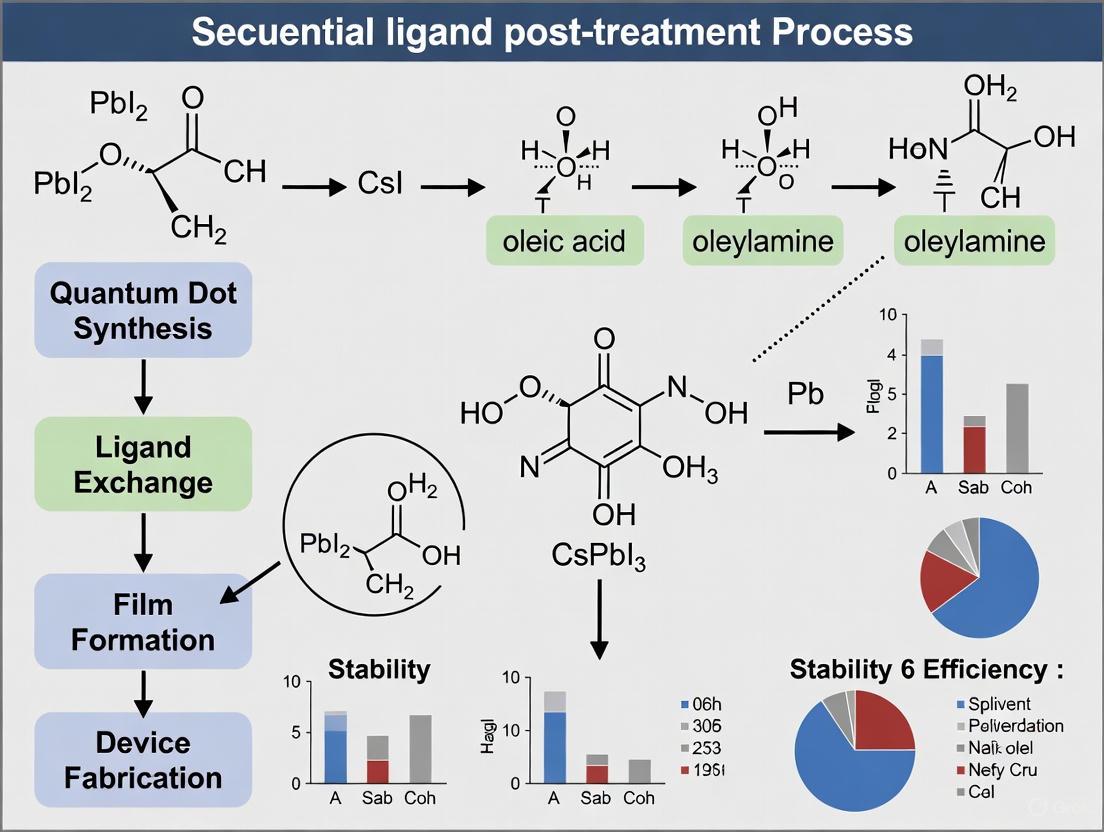
Achieving high-efficiency and spectrally stable pure-red emission from CsPbI3 quantum dots (QDs) is a critical challenge for next-generation displays and lighting technologies.
Sequential Ligand Post-Treatment: A Strategy for Spectrally Stable and Efficient Pure-Red CsPbI3 Quantum Dot LEDs
Abstract
Achieving high-efficiency and spectrally stable pure-red emission from CsPbI3 quantum dots (QDs) is a critical challenge for next-generation displays and lighting technologies. This article explores the sequential ligand post-treatment strategy as a groundbreaking method to overcome instability issues in CsPbI3 QDs, such as phase separation and ligand loss. We examine the foundational science behind quantum dot instability, detail various ligand engineering methodologies including the use of sulfonic acid-based ligands and inorganic passivators, address key troubleshooting aspects for performance optimization, and provide a comparative validation of different ligand systems. Recent breakthroughs demonstrating external quantum efficiencies exceeding 26% with significantly improved operational stability highlight the transformative potential of these approaches for researchers and engineers developing advanced optoelectronic devices.
The Challenge of Pure-Red CsPbI3 QDs: Understanding Quantum Confinement and Phase Instability
The Critical Need for Pure-Red Emission in Display Technologies
Metal halide perovskites have emerged as a leading class of semiconductor materials for next-generation display technologies, offering exceptional color purity, high photoluminescence quantum yield (PLQY), and tunable bandgaps. However, achieving spectrally stable pure-red emission within the stringent requirements of Rec. 2020 standard (approximately 630-635 nm) has remained a significant scientific challenge. Conventional approaches utilizing mixed halide compositions (CsPbI₃₋ₓBrₓ) suffer from halide segregation under electrical bias, leading to spectral shifts and device instability. Similarly, weakly quantum-confined CsPbI₃ quantum dots (QDs) typically emit in the crimson region (670-690 nm), failing to meet the pure-red specification. This application note examines recent breakthroughs in sequential ligand post-treatment strategies that enable spectrally stable, high-efficiency pure-red CsPbI₃ QD light-emitting diodes (QLEDs), providing detailed protocols and analytical frameworks for research implementation.
Key Advances in Pure-Red CsPbI₃ QLED Performance
Recent research has demonstrated remarkable progress in overcoming the historical limitations of pure-red perovskite LEDs. The table below summarizes quantitative performance metrics from pioneering studies:
Table 1: Performance Metrics of Advanced Pure-Red CsPbI₃ QLEDs
| Material Strategy | Emission Wavelength (nm) | External Quantum Efficiency (%) | PLQY (%) | Operational Stability (T₅₀ at 1000 cd/m²) | Reference |
|---|---|---|---|---|---|
| EA⁺ doping with ethylammonium oleate | 630-650 | 26.10 | N/A | N/A | [1] |
| NSA & NH₄PF₆ ligand exchange | 628 | 26.04 | 94 | 729 min | [2] |
| Strong electrostatic potential solvent & ligand post-treatment | 630 | 25.20 | 97 | 120 min (at 107 cd/m²) | [3] |
| Sequential treatment with HPAI & TBSI | 630 | 6.40 | N/A | N/A | [4] |
| DMSO/DMPU stabilized nanoplatelets | N/A | 12.00 | N/A | 360 min | [5] |
These advances share a common fundamental principle: strategic surface engineering through advanced ligand systems that simultaneously address quantum dot stability, defect passivation, and charge transport properties.
Experimental Protocols
Sequential Ligand Post-Treatment Workflow
The following diagram illustrates the comprehensive sequential ligand post-treatment workflow for achieving spectrally stable pure-red CsPbI₃ QLEDs:
Protocol 1: Synthesis of Strongly Confined CsPbI₃ QDs with NSA Treatment
Objective: To synthesize monodisperse, strongly confined CsPbI₃ QDs (∼4.3 nm) emitting at 623 nm through Ostwald ripening suppression.
Materials:
- Cs₂CO₃ (99.9%), PbI₂ (99.999%), ZnI₂ (99.99%)
- Oleylamine (OAm, 80-90%), oleic acid (OA, 90%)
- 2-Naphthalene sulfonic acid (NSA, 0.6 M in octane)
- Octadecene (ODE, 90%), methyl acetate (MeOAc, 99%)
- Note: All materials should be stored under inert atmosphere and protected from moisture.
Procedure:
- Cesium Oleate Precursor: Load 0.4 g Cs₂CO₃, 1.25 mL OA, and 15 mL ODE into a 50 mL 3-neck flask. Dry under vacuum at 120°C for 1 hour, then heat under N₂ at 150°C until complete dissolution.
- Lead Precursor Preparation: In a separate 100 mL 3-neck flask, combine 0.69 g PbI₂, 50 mL ODE, and 5 mL OA. Dry under vacuum at 120°C for 1 hour, then switch to N₂ atmosphere.
- Hot-Injection Synthesis: Raise the temperature of the lead precursor to 180°C. Rapidly inject 4 mL cesium oleate precursor with vigorous stirring (1000-1200 rpm).
- NSA Treatment: After 5 seconds of reaction, quickly inject 4 mL NSA solution (0.6 M in octane) to suppress Ostwald ripening.
- Reaction Quenching: Cool the reaction mixture to room temperature using an ice bath 10 seconds after NSA injection.
- Purification: Centrifuge the crude solution at 8000 rpm for 5 minutes, then redisperse in n-octane for further ligand exchange.
Critical Parameters:
- Temperature Control: Maintain precise temperature at 180°C during hot-injection (±2°C)
- Timing: NSA injection must occur within 5 seconds of cesium precursor addition
- Atmosphere: Strict oxygen-free and moisture-free conditions throughout
Protocol 2: Sequential Ligand Exchange with NH₄PF₆
Objective: To replace weakly bound surface ligands with strongly coordinating inorganic ligands for enhanced charge transport and defect passivation.
Materials:
- NSA-treated CsPbI₃ QDs in n-octane
- Ammonium hexafluorophosphate (NH₄PF₆, 99.99%)
- Methyl acetate (MeOAc, anhydrous)
- N,N-dimethylformamide (DMF, anhydrous)
Procedure:
- Primary Ligand Exchange:
- Concentrate NSA-treated QDs to 10 mg/mL in n-octane
- Add NH₄PF₆ solution (25 mg/mL in MeOAc) dropwise with stirring (QD:NH₄PF₆ molar ratio 1:5)
- Stir for 10 minutes at room temperature under N₂ atmosphere
- Purification:
- Precipitate QDs by adding 2 volumes of methyl acetate
- Centrifuge at 8000 rpm for 5 minutes
- Carefully decant supernatant
- Redispersion:
- Redisperse QD pellet in minimal anhydrous DMF (∼2 mL)
- Centrifuge at 3000 rpm for 3 minutes to remove aggregates
- Collect supernatant containing monodisperse, ligand-exchanged QDs
Validation Metrics:
- PLQY Measurement: Should exceed 94% using integrating sphere
- FTIR Analysis: Confirm replacement of organic ligands with PF₆⁻
- TEM Imaging: Verify monodispersity (size distribution <5%)
Research Reagent Solutions
Table 2: Essential Research Reagents for Sequential Ligand Post-Treatment
| Reagent Category | Specific Compounds | Function | Mechanism of Action |
|---|---|---|---|
| Strong Acidic Ligands | 2-Naphthalene sulfonic acid (NSA) | Ostwald ripening suppression | Higher dissociation constant promotes proton transfer, displaces weak ligands, strong Pb coordination (1.45 eV binding energy) |
| Inorganic Anionic Ligands | Ammonium hexafluorophosphate (NH₄PF₆) | Surface defect passivation | Extremely strong Pb coordination (3.92 eV binding energy), enhances charge transport, improves stability |
| Stabilizing Solvents | Benzene-series electrostatic potential solvents | Precursor solubility improvement | Prevents PbI₂ intermediate formation, promotes [PbI₃]⁻ dissolution, enables precise size control |
| Multi-functional Organic Ligands | 1-hydroxy-3-phenylpropan-2-aminium iodide (HPAI), Tributylsulfonium iodide (TBSI) | Sequential surface treatment | Dual-passivation of anion and cation vacancies, reduces non-radiative recombination |
| Phase-Stabilizing Coordinants | DMSO, DMPU | γ-phase stabilization at room temperature | Selective coordination with undercoordinated Pb²⁺ sites, induces lattice distortion, prevents phase transition |
The development of sequential ligand post-treatment strategies represents a paradigm shift in pure-red CsPbI₃ QLED research. By moving beyond traditional weak ligand systems (OA/OAm) to engineered strong-binding ligands, researchers have achieved unprecedented combinations of high efficiency (EQE >26%), spectral stability (emission at 628-630 nm), and operational lifetime (T₅₀ >700 minutes). The fundamental mechanisms involve precise control of quantum confinement through Ostwald ripening suppression, comprehensive surface defect passivation, and enhanced charge transport through inorganic ligand systems.
Future research directions should focus on:
- Accelerated stability testing protocols for predicting operational lifetimes
- Lead-free alternatives meeting RoHS compliance while maintaining performance
- Scalable manufacturing processes compatible with existing display production infrastructure
- Multi-functional ligand systems that simultaneously address chemical, thermal, and operational stability
These advances establish sequential ligand post-treatment as a foundational methodology for realizing commercial-grade pure-red perovskite QLEDs that meet the stringent requirements of next-generation displays.
Cesium lead iodide (CsPbI3) quantum dots (QDs) have emerged as a premier material for next-generation optoelectronics, particularly for pure red light-emitting diodes (LEDs) and photovoltaics, due to their high photoluminescence quantum yield (PLQY), tunable bandgap, and excellent color purity [2] [6]. However, their path to commercial viability is hindered by two fundamental, interlinked challenges: phase instability and spectral shifts [7] [6]. This application note, framed within broader research on sequential ligand post-treatment for stable red QLEDs, delineates these limitations and provides detailed protocols for researchers to characterize and mitigate these issues. The inherent thermodynamic instability of the photoactive black perovskite phase (α-CsPbI3) causes it to readily transition into a non-perovskite, photoinactive yellow phase (δ-CsPbI3) at room temperature, severely compromising device performance [8] [6]. Concurrently, spectral shifts, often manifested as a redshift in electroluminescence, result from Ostwald ripening—the irreversible growth of larger QDs at the expense of smaller ones—and ligand desorption during device operation [2]. Understanding and controlling these phenomena is paramount for advancing spectrally stable, efficient CsPbI3 QD-based devices.
Fundamental Limitations and Key Characterization Data
Phase Instability
The phase stability of CsPbI3 QDs is governed by their crystal structure and surface chemistry. The Goldschmidt tolerance factor (t) and octahedral factor (μ) are critical indicators for predicting perovskite stability [7] [6]. For CsPbI3, the tolerance factor often places it in a metastable zone, where the cubic α-phase is only thermodynamically favorable at high temperatures [6]. In QDs, high surface energy can stabilize the α-phase at room temperature, but this stability is tenuous. The phase transition is primarily driven by the susceptibility of the ionic crystal lattice to moisture and the dynamic binding of surface ligands [8] [6]. Ligands like oleic acid (OA) and oleylamine (OAm) commonly used in synthesis are weakly bound and can desorb, creating surface defects and ionic vacancies that initiate the transformation to the δ-phase [2].
Table 1: Characteristics of CsPbI3 Perovskite Phases
| Phase Name | Crystal Structure | Bandgap (eV) | Optical Property | Stability |
|---|---|---|---|---|
| α-CsPbI3 (Black) | Cubic | ~1.73 [6] | Photoactive | Metastable at room temperature; stabilized by nanoconfinement [6] |
| δ-CsPbI3 (Yellow) | Orthorhombic | ~2.82 [6] | Photoinactive | Thermodynamically stable at room temperature [6] |
Spectral Shifts
Spectral instability, particularly a redshift in emission wavelength, is a major obstacle for pure red LEDs, which require emission between 620-635 nm to meet Rec.2020 standards [2]. This shift is largely attributed to Ostwald ripening, a process where smaller QDs (with higher surface energy) dissolve and re-deposit onto larger QDs, leading to an increase in average particle size and a consequent redshift in emission [2]. This process is exacerbated during device operation by electric fields and heat. Furthermore, the purification process with polar antisolvents can trigger ligand loss, creating surface traps and defects that act as non-radiative recombination centers, reducing PLQY and accelerating degradation [2] [8].
Table 2: Quantitative Impact of Ligand Engineering on CsPbI3 QD Properties
| Treatment Method | PLQY (%) | Emission Peak (nm) | FWHM (nm) | Average QD Size (nm) | Key Outcome |
|---|---|---|---|---|---|
| No NSA Treatment | N/A | 635 | 41 | N/A | Baseline, weak confinement [2] |
| NSA (0.6 M) | 89 | 626 | N/A | ~4.3 | Inhibited ripening, blue shift [2] |
| NSA + NH₄PF₆ | 94 | 623 | 32 | ~4.3 | Highest PLQY, pure red emission [2] |
| Conventional MeOAc Rinsing | N/A | N/A | N/A | N/A | Ligand loss, surface defects [9] |
| Alkaline-Augmented Hydrolysis | N/A | N/A | N/A | N/A | Dense conductive capping, PCE 18.3% [9] |
Experimental Protocols
Protocol: Sequential Ligand Post-Treatment for Stable Pure-Red CsPbI3 QDs
This protocol outlines a strategy to simultaneously enhance phase stability and suppress spectral shifts by replacing weakly bound native ligands with strongly bound alternatives [2].
1. Synthesis of CsPbI3 QDs (Hot-Injection Method):
- Preparation of Cs-oleate: Load 0.610 g Cs₂CO₃, 2.5 mL OA, and 30 mL 1-octadecene (ODE) into a 50 mL three-neck flask. Dry under vacuum at 120°C for 1 hour. Then, heat to 150°C under N₂ atmosphere until all Cs₂CO₃ dissolves. Maintain at 120°C for injection [8].
- Reaction Mixture: In a 100 mL three-neck flask, mix 1 g PbI₂ and 50 mL ODE. Dry under vacuum at 120°C for 1 hour with vigorous stirring.
- Injection: Add a preheated mixture of OA and oleylamine (5 mL each) to the PbI₂ flask under N₂. Rapidly raise the temperature to 170°C. Quickly inject 4 mL of the preheated Cs-oleate solution. Immediately cool the bath to terminate the reaction upon color change [8].
- Purification: Precipitate the QDs by adding methyl acetate (MeOAc) to the crude solution (e.g., 60 mL MeOAc to 32 mL liquor) and centrifuge at 4700 RPM for 5 min. Discard the supernatant and re-disperse the pellet in hexane. Repeat the purification step once more [8].
2. Inhibition of Ostwald Ripening with NSA Ligand:
- After the initial nucleation of QDs (post-injection), introduce a 0.6 M solution of 2-naphthalene sulfonic acid (NSA) in ODE [2].
- Stir the reaction mixture for 5-10 minutes. The sulfonic acid group of NSA has a stronger binding energy with Pb (1.45 eV) than native OAm (1.23 eV), displacing weak ligands and suppressing QD regrowth [2].
3. Ligand Exchange with NH₄PF₆:
- During the standard purification process, introduce ammonium hexafluorophosphate (NH₄PF₆).
- NH₄PF₆ exchanges the long-chain OA/OAm ligands. The PF₆⁻ anion has a very high binding energy (3.92 eV) with the QD surface, effectively passivating defects and preventing regrowth during purification. This step enhances charge transport and stabilizes the optical properties [2].
4. Film Formation and UV Treatment (Optional for Phase Stability):
- Deposit the treated QDs into a solid film using a layer-by-layer spin-coating method. After each layer deposition, rinse with an antisolvent like MeOAc to remove excess ligands and promote close packing [8].
- To further enhance phase stability, expose the film to controlled UV light (e.g., 365 nm wavelength). Critical: Limit exposure time and power to facilitate ion migration and vacancy passivation without inducing degradation (e.g., 7W lamp power, short duration). Over-exposure (e.g., 100W) will degrade the α-phase to the δ-phase [8].
Diagram 1: Sequential Ligand Post-Treatment Workflow for Stable Pure-Red CsPbI3 QDs. This workflow outlines the key steps from synthesis to final film formation, highlighting critical treatment stages.
Protocol: Characterization of Phase Purity and Spectral Stability
1. In-situ Photoluminescence (PL) Spectroscopy:
- Purpose: To monitor the evolution of PL emission during QD synthesis and growth in real-time, assessing Ostwald ripening and phase formation [2].
- Procedure: Set up a fluorescence spectrometer with a fiber optic probe directed into the reaction flask. After precursor injection, continuously record PL spectra (e.g., every 10-30 seconds). Track the PL peak position and intensity over time. A blue shift and intensity increase after NSA injection indicates suppressed Ostwald ripening [2].
2. X-ray Diffraction (XRD) for Phase Identification:
- Purpose: To unambiguously identify the crystalline phase (α-phase vs. δ-phase) of the synthesized QD film [6].
- Procedure: Prepare a solid film of the QDs on a glass or silicon substrate. Use a diffractometer with Cu Kα radiation. Scan a 2θ range from 10° to 50°. Compare the obtained diffraction pattern with standard reference patterns for cubic α-CsPbI3 (e.g., peaks at ~14.5°, 20.5°, 29°, etc.) and orthorhombic δ-CsPbI3 [6].
3. Transmission Electron Microscopy (TEM) for Size Analysis:
- Purpose: To determine the average QD size, size distribution, and morphology, and to confirm the absence of fused or overly large particles [2].
- Procedure: Drop-cast a dilute hexane dispersion of QDs onto a carbon-coated copper grid. Image using an accelerating voltage of 100-200 kV. Measure the diameter of at least 100 QDs from different areas of the grid to calculate the average size and standard deviation. A narrow size distribution confirms successful suppression of Ostwald ripening [2].
The Scientist's Toolkit: Essential Research Reagents
Table 3: Key Reagents for CsPbI3 QD Synthesis and Stabilization
| Reagent | Function/Role | Key Property | Considerations for Use |
|---|---|---|---|
| 2-Naphthalene Sulfonic Acid (NSA) | Strong-binding anionic ligand | High dissociation constant; sulfonic acid group binds strongly to Pb (1.45 eV) [2] | Replaces weak OAm ligands; inhibits Ostwald ripening and narrows size distribution. Optimize concentration (e.g., 0.6 M) [2]. |
| Ammonium Hexafluorophosphate (NH₄PF₆) | Inorganic ligand for exchange | PF₆⁻ anion has very high binding energy (3.92 eV) with QD surface [2] | Used during purification to replace OA/OAm; enhances charge transport and passivates surface defects [2]. |
| Methyl Acetate (MeOAc) | Antisolvent for purification | Polarity induces QD precipitation; hydrolyzes to acetate for ligand exchange [9] [8] | Removes excess ligands and promotes QD coupling in films. Ambient hydrolysis is inefficient without alkaline augmentation [9]. |
| Potassium Hydroxide (KOH) | Alkaline catalyst | Creates alkaline environment for ester antisolvent hydrolysis [9] | Used with ester antisolvents (e.g., Methyl Benzoate) to make hydrolysis spontaneous and rapid, enabling dense conductive capping [9]. |
| Oleic Acid (OA) / Oleylamine (OAm) | Native capping ligands | Dynamic binding to QD surface; control growth during synthesis [2] | Weak binding leads to desorption and defect formation. Typically replaced or supplemented by stronger ligands in post-treatment [2]. |
Mechanism of Sequential Ligand Action
The efficacy of the sequential ligand treatment lies in the complementary action of the ligands on the QD surface. The CsPbI3 QD surface is terminated by Cs-I and Pb-I2 facets, with Pb-I2 being particularly susceptible to ligand binding and defect formation [6]. Weakly bound oleate ligands (OA⁻) are prone to desorption, creating negatively charged iodine vacancies that act as trap states [2].
- NSA Binding: The sulfonic acid group (-SO₃H) of NSA has a higher dissociation constant and is more polar than OA. It protonates the surface, facilitating the removal of weakly bound OA/OAm pairs and strongly coordinating to the exposed Pb atoms. This suppresses the ionic activity that drives Ostwald ripening and passivates surface defects, leading to higher PLQY [2].
- PF₆⁻ Binding: The small, inorganic PF₆⁻ anion from NH₄PF₆ exchanges with any remaining long-chain anionic ligands. Its exceptionally high binding energy creates a stable, strongly bound inorganic shell around the QD. This shell is resistant to desorption during purification and film processing, locking in the small QD size and enhancing electronic coupling between QDs in the solid film [2].
Diagram 2: Mechanism of Sequential Ligand Post-Treatment for QD Stabilization. This diagram illustrates the transition from a dynamically bound, unstable surface to a fully passivated and spectrally stable one.
The fundamental limitations of phase instability and spectral shifts in CsPbI3 QDs are significant, but not insurmountable. As detailed in these protocols, sequential ligand post-treatment strategies that employ strongly binding molecules like NSA and NH₄PF₆ offer a powerful and rational approach to decoupling these problems. By proactively engineering the QD surface chemistry to inhibit Ostwald ripening and passivate ionic defects, researchers can successfully stabilize the black perovskite phase and lock in the pure red emission required for high-performance QLEDs. The methodologies and data summaries provided here serve as a practical guide for advancing the development of robust CsPbI3 QD-based optoelectronic devices.
Ostwald ripening is a fundamental thermodynamic process that presents a significant challenge in the synthesis and long-term stability of quantum dots (QDs), particularly in advanced optoelectronic applications. This phenomenon describes the spontaneous growth of larger nanoparticles at the expense of smaller ones in a dispersion or solid matrix, driven by the system's tendency to minimize its total surface energy [10]. In the context of quantum dot technology, Ostwald ripening represents a primary degradation mechanism that adversely affects particle size distribution, optical properties, and operational stability, especially in perovskite QD-based devices such as light-emitting diodes (LEDs).
The fundamental mechanism of Ostwald ripening stems from the higher solubility of smaller particles due to their greater surface curvature according to the Gibbs-Thomson equation [10]. This creates a concentration gradient in the solution, where molecular species detach from smaller particles, diffuse through the medium, and redeposit onto larger particles. The consequence is a progressive increase in average particle size and broadening of size distribution over time, which directly impacts the quantum confinement effects that give QDs their desirable size-tunable optical properties. For CsPbI3 QDs targeted for pure-red emission (approximately 630 nm), controlling this ripening process is particularly crucial as it dictates the ability to maintain strong quantum confinement in sub-5 nm crystallites necessary for achieving the desired emission wavelength [2].
Theoretical Framework and Mechanisms
Thermodynamic Driving Forces
The underlying thermodynamics of Ostwald ripening can be understood through the relationship between particle size and solubility, as described by the Kelvin equation:
Where Ceq(r) represents the solubility of particles of radius r, Ceq(∞) is the solubility of infinitely large particles, σ is the surface tension, νat is the molar volume, kB is Boltzmann's constant, and T is the absolute temperature [10]. This equation demonstrates that smaller particles exhibit higher solubility than their larger counterparts, establishing a concentration gradient that drives the ripening process as the system moves toward thermodynamic equilibrium with minimized total surface energy.
The driving force for Ostwald ripening is the difference in chemical potential between particles of different sizes, which arises from the varying surface-to-volume ratios. Molecules on the surface of nanoparticles are energetically less stable than those in the interior, as they have fewer neighboring atoms for bonding [10]. Consequently, small particles with their high surface-to-volume ratio possess greater surface energy per unit mass, making them dissolve preferentially and provide material for the growth of larger, more thermodynamically stable particles.
Kinetic Models: LSW Theory
The kinetics of Ostwald ripening are quantitatively described by the Lifshitz-Slyozov-Wagner (LSW) theory, which predicts the temporal evolution of particle size distribution. For diffusion-controlled systems, the LSW theory establishes that the cube of the average particle radius increases linearly with time:
Where ⟨R⟩ is the average particle radius at time t, ⟨R⟩₀ is the initial radius, γ is the surface energy, c∞ is the solubility of the bulk material, v is the molar volume, D is the diffusion coefficient, Rg is the gas constant, and T is temperature [10].
For interface-controlled systems where attachment and detachment kinetics are rate-limiting, Wagner derived a different relationship where the square of the average radius grows linearly with time [10]. In both cases, the theory predicts a narrowing of the size distribution relative to the average particle size as the system evolves, which has been experimentally observed in numerous nanocrystal systems.
Table 1: Key Parameters in Ostwald Ripening Kinetics According to LSW Theory
| Parameter | Symbol | Role in Ostwald Ripening | Units |
|---|---|---|---|
| Surface energy | γ | Driving force for ripening | J/m² |
| Solubility | c∞ | Determines molecular concentration | mol/m³ |
| Diffusion coefficient | D | Controls mass transport rate | m²/s |
| Molar volume | v | Relates molecular to macroscopic scale | m³/mol |
| Temperature | T | Affects all kinetic parameters | K |
Experimental Evidence in Quantum Dot Systems
Ostwald Ripening in CdS Quantum Dot Synthesis
Early evidence of Ostwald ripening in quantum dot systems comes from studies of CdS nanocrystals synthesized in reverse micelles. Research demonstrated that the growth kinetics of CdS QDs significantly differed depending on their micellar environment. In "pure micelles" containing only Cd²⁺ and S²⁻ precursors, growth occurred through a relatively fast process completed within several tens of minutes. However, when monomer and cross-linker molecules were loaded into the micelles, the growth mechanism shifted to Ostwald ripening characterized by a much slower process taking several hours [11].
This transition in growth behavior highlighted how environmental factors can influence the dominant growth mechanism. The presence of additional molecules in the micellar system appeared to modify the interfacial properties and diffusion kinetics, favoring the dissolution of smaller crystallites and their recrystallization onto larger particles—the hallmark of Ostwald ripening. These findings established that Ostwald ripening is not an inevitable consequence of nanocrystal synthesis but rather a process that can be modulated by controlling the reaction environment.
Ostwald Ripening in Perovskite Quantum Dots
In CsPbI₃ QD systems, Ostwald ripening presents a particularly significant challenge for maintaining strong quantum confinement necessary for pure-red emission. Traditional synthesis methods using weak-binding ligands like oleic acid (OA) and oleylamine (OAm) result in rapid Ostwald ripening due to the highly dynamic nature of these ligand systems [2]. The debonding of weak ligands exposes active ionic sites on the perovskite surface, accelerating the dissolution of smaller QDs and growth of larger ones.
In-situ photoluminescence studies during CsPbI₃ QD synthesis vividly demonstrate this phenomenon. Following nucleation, OA/OAm-capped QDs exhibit continuous red-shifting of emission wavelength, indicating particle growth over time. This progression occurs because "after the monomer in the reaction is exhausted, those active sites accelerate the dissolution of small QDs and the growth of large QDs, increasing the average size of the system and the defocusing of the size distribution" [2]. This uncontrolled growth ultimately shifts the emission away from the desired pure-red region toward longer wavelengths, compromising color purity and device performance.
Table 2: Impact of Ostwald Ripening on CsPbI₃ QD Properties
| Property | Before Ostwald Ripening | After Ostwald Ripening | Consequence for QLEDs |
|---|---|---|---|
| Emission wavelength | 623 nm | 635-640 nm | Shift from pure-red to crimson |
| Size distribution | Narrow (FWHM ~32 nm) | Broad (FWHM ~41 nm) | Reduced color purity |
| Particle size | ~4.3 nm | >5 nm | Weakened quantum confinement |
| PLQY | 94% | Reduced | Lower device efficiency |
Sequential Ligand Strategy to Suppress Ostwald Ripening
Ligand Engineering Principles
The strategic application of strong-binding ligands represents the most effective approach to suppress Ostwald ripening in quantum dot systems. This method operates on the principle that ligands with higher binding affinity to the QD surface reduce the detachment rate of surface atoms, thereby limiting the dissolution step that initiates Ostwald ripening [2]. Additionally, bulky ligand groups can create steric hindrance that physically impedes the addition of new material to the crystal surface.
The effectiveness of a ligand in suppressing Ostwald ripening is quantified by its binding energy to the QD surface. Density functional theory (DFT) calculations reveal that conventional OAm ligands exhibit a binding energy of approximately 1.23 eV, while specially designed alternatives like 2-naphthalene sulfonic acid (NSA) show stronger binding at 1.45 eV [2]. Even more effective are inorganic ligands such as PF₆⁻ anions, which demonstrate remarkably high binding energies of 3.92 eV, making them exceptionally effective at stabilizing QD surfaces against ripening.
Sequential Ligand Post-Treatment Protocol
The following diagram illustrates the sequential ligand treatment workflow for suppressing Ostwald ripening in CsPbI₃ QD synthesis:
Figure 1: Sequential ligand treatment workflow for suppressing Ostwald ripening during CsPbI₃ QD synthesis.
Materials and Equipment
- Precursor Solutions: Cesium carbonate (Cs₂CO₃, 99.9%), lead iodide (PbI₂, 99.99%), 1-octadecene (ODE, 90%), oleic acid (OA, 90%), oleylamine (OAm, 70%)
- Ligand Solutions: 2-naphthalene sulfonic acid (NSA, 0.6 M in toluene), ammonium hexafluorophosphate (NH₄PF₆, 0.1 M in isopropanol)
- Solvents: Toluene (anhydrous, 99.8%), isopropanol (anhydrous, 99.5%)
- Equipment: Three-neck round-bottom flask, Schlenk line with nitrogen/vacuum capability, heating mantle with temperature control, syringe pumps, UV-Vis spectrophotometer, fluorometer, transmission electron microscope
Step-by-Step Procedure
CsPbI₃ QD Nucleation:
- Synthesize CsPbI₃ QDs using standard hot-injection methods at 170°C under nitrogen atmosphere
- Monitor reaction progress through aliquot sampling and UV-Vis spectroscopy
- Proceed to ligand treatment immediately after nucleation completion
Primary NSA Ligand Treatment:
- Cool reaction mixture to 100°C
- Inject 0.6 M NSA solution in toluene (optimal concentration determined experimentally)
- Maintain temperature at 100°C for 10 minutes with vigorous stirring
- NSA facilitates proton transfer between OA⁻ and OAmH⁺, promoting debonding of weak ligands
- Sulfonic acid groups strongly bind to Pb atoms on QD surface (1.45 eV binding energy)
- Naphthalene rings provide steric hindrance to inhibit Ostwald ripening
Secondary NH₄PF₆ Ligand Exchange:
- Cool mixture to room temperature
- Add 0.1 M NH₄PF₆ solution in isopropanol dropwise under stirring
- Continue stirring for 30 minutes to ensure complete ligand exchange
- PF₆⁻ anions exhibit extremely strong binding (3.92 eV) to QD surface
- Inorganic ligands enhance charge transport while maintaining stability
Purification and Characterization:
- Precipitate QDs with anti-solvent (ethyl acetate) and centrifuge at 8000 rpm for 5 minutes
- Redisperse in anhydrous toluene and repeat precipitation cycle twice
- Characterize final QDs through TEM, UV-Vis, PL, and XRD analysis
Research Reagent Solutions for Ostwald Ripening Control
Table 3: Essential Research Reagents for Suppressing Ostwald Ripening in QD Synthesis
| Reagent | Function | Key Properties | Experimental Considerations |
|---|---|---|---|
| 2-Naphthalene sulfonic acid (NSA) | Primary growth suppressor | Strong Pb binding (1.45 eV), steric hindrance | Optimal at 0.6 M concentration; induces blue shift in emission |
| Ammonium hexafluorophosphate (NH₄PF₆) | Secondary stabilizer | Very strong binding (3.92 eV), enhances conductivity | Post-synthesis treatment; maintains PLQY through purification |
| 2-Thiophenethylamine chloride (TEAC) | Alternative multifunctional ligand | S-Pb coordination, halogen compensation, π-conjugation | Maintains 92.5% PLQY after purification; improves charge transport |
| 1-Hydroxy-3-phenylpropan-2-aminium iodide (HPAI) | Sequential treatment ligand | Combines hydroxyl, ammonium, and aromatic groups | Used with TBSI in sequential treatment for PeLED improvement |
| Tributylsulfonium iodide (TBSI) | Sequential treatment ligand | Sulfonium-based ligand with strong interaction | Combined with HPAI enables 6.4% EQE in pure-red PeLEDs |
Quantitative Analysis of Ligand Efficacy
The effectiveness of sequential ligand treatments in suppressing Ostwald ripening can be quantified through multiple characterization techniques. Comparative studies between conventional OA/OAm-capped QDs and those treated with sequential ligand strategies reveal dramatic improvements in stability and optical properties.
Table 4: Quantitative Comparison of QD Properties With and Without Ligand Treatment
| Parameter | OA/OAm QDs (Control) | NSA-Treated QDs | NSA+NH₄PF₆ Treated QDs |
|---|---|---|---|
| PL emission peak | 635 nm | 626 nm | 623 nm |
| FWHM | 41 nm | 35 nm | 32 nm |
| Average particle size | 5.8 nm | 4.6 nm | 4.3 nm |
| PLQY | 75% | 89% | 94% |
| Stability (50 days) | <50% PLQY retention | ~70% PLQY retention | >80% PLQY retention |
| EQE in LEDs | <10% | 17.3% | 26.04% |
The suppression of Ostwald ripening through sequential ligand treatment directly correlates with enhanced device performance in QLEDs. The stability of emission wavelength is particularly crucial for pure-red devices targeting the Rec. 2020 standard. Treated QDs maintain emission at 623-628 nm, while untreated controls undergo redshift beyond 635 nm due to ripening-induced particle growth [2]. This spectral stability, combined with improved PLQY and charge transport properties, enables the realization of high-performance pure-red PeLEDs with external quantum efficiencies exceeding 26% [2].
Ostwald ripening represents a critical challenge in quantum dot technology that directly impacts optical properties, stability, and device performance. The sequential ligand post-treatment strategy outlined in this application note provides a robust methodology for suppressing this detrimental process through the rational design of ligand systems with strong binding affinity and appropriate steric properties. By implementing this approach, researchers can achieve precise control over QD size distribution, maintain desired emission wavelengths, and enhance the operational stability of resulting optoelectronic devices.
The successful application of this strategy to CsPbI₃ QD systems demonstrates its potential for enabling high-performance pure-red QLEDs that meet the stringent requirements of next-generation displays. Future research directions should focus on expanding this ligand engineering approach to other perovskite compositions, developing novel multifunctional ligands with enhanced binding and charge transport properties, and optimizing treatment protocols for scalable manufacturing processes.
Metal halide perovskite quantum dots (PQDs), particularly cesium lead iodide (CsPbI3) QDs, have emerged as promising semiconductors for next-generation light-emitting diodes (LEDs) and display technologies due to their excellent color purity, high photoluminescence quantum yield (PLQY), and easily tunable band gap [2] [12]. Despite their impressive optoelectronic properties, the commercial application of CsPbI3 QDs has been severely hampered by their poor structural stability under ambient conditions. A significant factor contributing to this instability originates from the surface chemistry of the QDs, specifically the use of conventional ligands oleic acid (OA) and oleylamine (OAm) during synthesis [2] [12]. These weakly bound ligands create vulnerable points for degradation initiation, ultimately compromising both the material's integrity and device performance. This Application Note examines the mechanisms through which OA and OAm ligands contribute to instability in CsPbI3 QDs and outlines validated sequential ligand post-treatment strategies to overcome these limitations, with a specific focus on achieving spectrally stable pure-red emission for perovskite QD light-emitting diodes (QLEDs).
Mechanisms of OA and OAM-Induced Instability
The instability facilitated by OA and OAm ligands manifests through several interconnected mechanisms, which are summarized in the table below.
Table 1: Mechanisms of Instability Induced by OA and OAm Ligands
| Mechanism | Chemical Process | Consequence on QDs |
|---|---|---|
| Dynamic Proton Exchange | Proton transfer between OA⁻ (deprotonated OA) and OAmH⁺ (protonated OAm) leads to ligand desorption [2] [13]. | Creates unprotected surface ionic sites, accelerating Ostwald ripening and formation of non-radiative recombination defects [2]. |
| Weak Binding Affinity | OA and OAm coordinate with the QD surface with relatively low binding energy (e.g., DFT-calculated OAm binding energy: ~1.23 eV) [2]. | Ineffective passivation of surface lead and halide sites, leading to high defect density and reduced PLQY [2] [12]. |
| Steric Hindrance | The molecular structures of OA and OAm feature bent chains with double bonds, reducing ligand packing density on the QD surface [12]. | Creates unprotected surface patches vulnerable to attack by moisture and oxygen, facilitating ionic migration and QD degradation [12]. |
| Ligand Detachment During Purification | Polar antisolvents used in purification amplify the proton transfer process, causing massive ligand loss from the QD surface [2] [12]. | Leads to QD aggregation, increased surface traps, and deterioration of optical properties and colloidal stability [2] [12]. |
The following diagram illustrates the logical relationship between the use of OA/OAm ligands and the ultimate failure of the QD film.
Quantitative Data: Comparing Ligand Performance
The limitations of OA/OAm become evident when comparing their performance metrics against those of stronger, engineered ligands. The following table summarizes quantitative data from key studies, highlighting the dramatic improvements achievable through ligand engineering.
Table 2: Quantitative Comparison of Ligand Performance in CsPbI3 QDs
| Ligand System | PL Peak (nm) | PLQY (%) | FWHM (nm) | Binding Energy (eV) | Key Stability Metric | Source |
|---|---|---|---|---|---|---|
| OA / OAm (Standard) | 635-639 | < 80 (Often lower) | 41 | OAm: 1.23 | Rapid Ostwald ripening; PLQY drops significantly after purification. | [2] |
| 2-Naphthalene Sulfonic Acid (NSA) | 623-628 | 89 | 32 | 1.45 | Maintained >80% PLQY after 50 days; inhibited ripening. | [2] |
| Ammonium Hexafluorophosphate (NH₄PF₆) | 623 | 94 | 32 | PF₆⁻: 3.92 | High charge transport; operational device T₅₀: 729 min at 1000 cd/m². | [2] |
| Sequential (HPAI + TBSI) | 630 | N/A | N/A | N/A | Stable EL at 630 nm; peak EQE of 6.4%. | [4] |
| Oleylammonium Iodide (OLAI) / Protonated-OAm | N/A | N/A | N/A | N/A | QD solar cell PCE: 13.8%; 80% initial efficiency retained after 3000 h in air. | [13] |
Sequential Ligand Post-Treatment: A Solution to Instability
Sequential ligand post-treatment has emerged as a powerful strategy to displace unstable OA/OAm ligands and permanently lock the QD surface with strongly bound, passivating molecules. The core principle involves a multi-step purification and ligand exchange process designed to first remove weakly bound native ligands and then introduce new ligands with higher binding affinity and superior passivation capabilities.
Experimental Protocol: Sequential Treatment with NSA and NH₄PF₆
This protocol is adapted from a study that achieved a record 26.04% external quantum efficiency in pure-red CsPbI3 QLEDs [2].
Principle: Initial treatment with 2-naphthalene sulfonic acid (NSA) suppresses Ostwald ripening and replaces weak OAm ligands. A subsequent treatment with ammonium hexafluorophosphate (NH₄PF₆) passivates defects and enhances charge transport by introducing inorganic ligands.
Materials:
- CsPbI3 QDs: Synthesized via hot-injection method with standard OA/OAm ligands.
- NSA Solution: 0.6 M NSA in toluene.
- NH₄PF₆ Solution: 10 mg/mL NH₄PF₆ in anhydrous N,N-Dimethylformamide (DMF).
- Solvents: Anhydrous toluene, methyl acetate (MeOAc), DMF.
- Equipment: Centrifuge, Schlenk line, ultrasonic bath, inert atmosphere glovebox.
Procedure:
- NSA Treatment: a. Transfer the crude CsPbI3 QD solution (in octadecene) to a centrifuge tube. b. Add a pre-optimized volume of 0.6 M NSA solution (e.g., a molar ratio of 0.6 M relative to Pb). Vortex for 30 seconds. c. Add methyl acetate (as an anti-solvent) in a volume ratio of 1:1 to the mixture and centrifuge at 8,000 rpm for 5 minutes. Discard the supernatant. d. Redisperse the QD pellet in anhydrous toluene.
- NH₄PF₆ Treatment: a. To the NSA-treated QD solution, add the NH₄PF₆ solution in DMF (e.g., a volume ratio of 1:1 QD solution to NH₄PF₆ solution). Shake vigorously for 2 minutes. b. Centrifuge the mixture at 8,000 rpm for 5 minutes. A brightly luminescent pellet will form. c. Carefully discard the supernatant and redisperse the final QD pellet in anhydrous toluene or hexane for film fabrication.
Critical Step Note: The entire process, especially after NSA treatment, should be performed in an inert atmosphere (glovebox or under N₂) to prevent degradation by moisture and oxygen.
The workflow for this sequential ligand post-treatment strategy is illustrated below.
The Scientist's Toolkit: Key Research Reagent Solutions
The following table catalogues essential ligands used in advanced post-treatment strategies to overcome OA/OAm instability.
Table 3: Key Reagents for Ligand Post-Treatment of CsPbI3 QDs
| Reagent | Chemical Class | Primary Function | Mechanism of Action |
|---|---|---|---|
| 2-Naphthalene Sulfonic Acid (NSA) | Sulfonic Acid | Ripening Inhibitor & Surface Binder | Stronger Pb-binding sulfonic acid group displaces OAm; large naphthalene ring provides steric hindrance to suppress QD overgrowth [2]. |
| Ammonium Hexafluorophosphate (NH₄PF₆) | Inorganic Salt | Defect Passivator & Charge Transport Enhancer | PF₆⁻ anions have very high binding energy (3.92 eV) to surface sites, passivating defects and replacing insulating organic ligands [2]. |
| Oleylammonium Iodide (OLAI) | Protonated Amine | In-situ Stabilizing Precursor | Directly provides protonated-OAm, suppressing proton exchange equilibrium and reducing defective free-OAm on the surface [13]. |
| Tributylsulfonium Iodide (TBSI) | Sulfonium Salt | Halide Vacancy Passivator | Provides halide ions to fill iodine vacancies, a common defect, thereby reducing non-radiative recombination pathways [4]. |
The inherent instability of CsPbI3 QDs capped with traditional OA and OAm ligands presents a significant roadblock for their practical application in optoelectronic devices. The weak binding, dynamic ligand shell, and propensity for detachment of OA/OAm are the root causes of rapid degradation and poor device performance. However, as detailed in this Application Note, sequential ligand post-treatment strategies offer a robust and effective solution. By systematically replacing these weak ligands with strongly binding, passivating molecules such as NSA and NH₄PF₆, researchers can simultaneously inhibit Ostwald ripening, suppress defect formation, and enhance charge transport. This methodology directly addresses the core instability issues, enabling the realization of spectrally stable, high-efficiency, pure-red CsPbI3 QLEDs, and paves the way for their future commercial adoption.
The pursuit of pure-red emission for next-generation displays, compliant with the Rec. 2020 standard, has positioned cesium lead iodide (CsPbI3) quantum dots (QDs) as a leading material candidate. The phenomenon of quantum confinement serves as the fundamental principle enabling precise spectral tuning in these nanomaterials. When the physical size of CsPbI3 nanocrystals is reduced below the Bohr exciton diameter (typically below 5-6 nm), the resulting quantum confinement effect significantly alters their electronic structure, leading to a widening of the bandgap and a consequential blue shift in emission wavelength. This size-dependent property provides a crucial advantage over alternative approaches for achieving red emission, as it circumvents the inherent instability issues associated with mixed-halide compositions, which suffer from phase segregation under electrical bias [2] [14].
For all-inorganic CsPbI3 perovskite, the bulk cubic phase (α-CsPbI3) possesses a narrow band gap of approximately 1.73 eV, corresponding to emission in the deep-red or crimson region (around 670-690 nm). However, through precise synthetic control producing strongly confined QDs with diameters smaller than 5 nm, the emission can be systematically shifted to the pure-red region (620-635 nm) while maintaining excellent color purity and spectral stability [2]. The relationship between particle size and emission wavelength establishes quantum confinement as an indispensable tool for bandgap engineering in perovskite optoelectronics, providing a reliable pathway to achieving the precise color coordinates required for high-definition displays.
Theoretical Framework of Quantum Confinement
Fundamental Principles
Quantum confinement effects manifest when the dimensions of a semiconductor nanocrystal approach the exciton Bohr radius, leading to discrete energy levels and size-tunable optical properties. In CsPbI3 QDs, this phenomenon enables researchers to precisely engineer the emission wavelength by controlling the nanocrystal size during synthesis. The strong quantum confinement regime, achieved when the QD radius is significantly smaller than the Bohr exciton diameter, results in a dramatic increase in bandgap energy and exciton binding energy, both essential for efficient pure-red emission at room temperature [15]. The enhanced exciton binding energy in strongly confined QDs directly improves radiative recombination efficiency, thereby boosting the photoluminescence quantum yield (PLQY)—a critical parameter for light-emitting applications.
The electronic structure of CsPbI3 perovskite is primarily governed by lead and iodine atoms, with the conduction band minimum originating from Pb p-orbitals and the valence band maximum arising from the interaction between Pb p-orbitals and I s-orbitals. Although the A-site cesium cations do not directly contribute to band edge states, they influence the electronic properties indirectly through lattice distortion effects. In quantum-confined CsPbI3 structures, the reduced dimensionality amplifies these quantum effects, resulting in discrete energy states and a size-dependent increase in the bandgap that follows the "particle-in-a-box" model, where the emission energy inversely correlates with the square of the QD size [1] [15].
Size-Wavelength Relationship
The following table summarizes the direct relationship between CsPbI3 quantum dot size and the resulting emission characteristics:
Table 1: Size-Dependent Emission Properties of CsPbI3 Quantum Dots
| QD Diameter (nm) | Emission Wavelength (nm) | Emission Color Region | Bandgap (eV) | Key Characteristics |
|---|---|---|---|---|
| >10 | 670-690 | Deep-red/Crimson | ~1.73 | Weak or no confinement; near bulk properties |
| ~6 | 630-650 | Red | ~1.96-2.00 | Moderate confinement; balanced properties |
| ~4.3-4.4 | 623-630 | Pure-red | ~2.00-2.10 | Strong confinement; high color purity |
| <4 | <620 | Orange-red | >2.10 | Very strong confinement; challenging stability |
This size-wavelength relationship demonstrates that achieving pure-red emission specifically in the 620-635 nm range requires precise synthesis of CsPbI3 QDs with diameters typically between 4-6 nm, placing them firmly in the strong quantum confinement regime [2] [3]. The narrow size distribution (typically with a standard deviation of ±0.1 nm) is equally crucial for maintaining narrow emission line widths (full width at half maximum of 32-41 nm), which directly correlates with the color purity essential for meeting Rec. 2020 standards [2].
Synthesis Strategies for Strongly Confined CsPbI3 Quantum Dots
Ligand Engineering Approaches
The synthesis of stable, strongly confined CsPbI3 QDs presents significant challenges due to the high surface energy of small nanocrystals, which drives Ostwald ripening and crystal growth. Ligand engineering strategies have emerged as the most effective approach to抑制 Ostwald ripening and stabilize these structurally sensitive nanomaterials.
Suppressing Ostwald Ripening with Strong-Binding Ligands: Traditional weak-binding ligands like oleic acid (OA) and oleylamine (OAm) readily desorb from QD surfaces, exposing highly active ionic sites that accelerate the dissolution of small QDs and growth of larger crystals. Introducing strong-binding ligands such as 2-naphthalene sulfonic acid (NSA) after nucleation effectively suppresses this detrimental process. With a binding energy of 1.45 eV (compared to 1.23 eV for OAm), NSA demonstrates stronger interaction with Pb atoms on the QD surface, reducing active sites and providing substantial steric hindrance through its naphthalene ring structure that physically inhibits QD overgrowth. This approach enables the synthesis of monodisperse CsPbI3 QDs with an average size of approximately 4.3 nm emitting at 623 nm with photoluminescence quantum yield (PLQY) of 94% [2].
Sequential Ligand Post-Treatment: A sequential ligand treatment strategy combining NSA with ammonium hexafluorophosphate (NH4PF6) during purification has demonstrated remarkable effectiveness. The PF6 anions exhibit an exceptionally strong binding energy of 3.92 eV with the QD surface, effectively passivating defects and enhancing charge transport properties. This dual-ligand approach maintains the quantum confinement effect while significantly improving both optical properties and environmental stability, with QDs retaining over 80% of their initial PLQY after 50 days of storage [2].
Proton-Prompted Ligand Exchange: An innovative proton-promoted in-situ ligand exchange strategy utilizes hydroiodic acid (HI) to facilitate the replacement of long-chain OA/OAm ligands with short-chain 5-aminopentanoic acid (5AVA). The introduction of protons triggers desorption of long-chain ligands while promoting binding of bifunctional 5AVA ligands, maintaining small QD size while significantly improving charge transport between QDs. This approach yields high-efficiency red QD-based light-emitting diodes (QLEDs) with maximum external quantum efficiency (EQE) of 24.45% and operational half-life of 10.79 hours—70 times longer than control devices [16].
Doping and Additive Strategies
Ethylammonium (EA+) Doping: Incorporating A-site cations like ethylammonium (EA+) represents an innovative bandgap engineering strategy for achieving pure-red emission. EA+ doping induces lattice distortions through octahedral tilting, indirectly modulating the bandgap without directly contributing to band edge states. By leveraging the acid-base equilibrium between ethylammonium salts and oleic acid in the cesium precursor, researchers have developed thermally stable ethylammonium oleate that survives high-temperature synthesis conditions. This approach enables precise tuning of emission wavelength within the 630-650 nm range by controlling EA+ doping levels, resulting in PeLEDs with exceptional EQE up to 26.1% [1].
Zinc Iodide Co-Precursor: Introducing ZnI2 as a co-precursor and passivating agent during synthesis produces size-confined CsPbI3 nanocrystals approximately 6 nm in diameter with reduced surface defects. The smaller ionic radius of Zn2+ (74 pm) compared to Pb2+ (119 pm) contributes to lattice contraction, while the additional iodide ions create an iodine-rich environment that suppresses iodide vacancy formation. Subsequent gradient purification techniques enable isolation of size-selected fractions with precisely adjusted emission colors, yielding QDs with pure-red emission at 629 nm and PLQY of 88% [14].
Experimental Protocols
Synthesis of Strongly Confined CsPbI3 QDs Using NSA and NH4PF6 Ligands
Materials:
- Lead iodide (PbI2, 99.999%)
- Cesium carbonate (Cs2CO3, 99.995%)
- Octadecene (ODE, 90%)
- Oleic acid (OA, 90%)
- Oleylamine (OAm, 80-90%)
- 2-Naphthalene sulfonic acid (NSA)
- Ammonium hexafluorophosphate (NH4PF6)
- Methyl acetate (MeOAc, 98%)
- n-Hexane (AR)
- n-Octane (99%)
Procedure:
- Cesium-Oleate Precursor Preparation: Load 202.8 mg Cs2CO3 and 10 mL ODE into a 100 mL three-neck flask. Degas and dry under vacuum at 120°C for 30 minutes. Add 0.63 mL OA and degas for an additional 30 minutes. Heat to 160°C under N2 until complete dissolution to obtain a clear solution. Maintain at 100°C under N2 for subsequent use [2] [17].
Lead Precursor Preparation: In a separate three-neck flask, load 0.3 mg PbI2 and 20 mL ODE. Degas and dry under vacuum at 120°C for 1 hour. Add a mixture of 1.5 mL OA and 1.5 mL OAm at 120°C under continuous N2 flow [2].
Quantum Dot Nucleation: Heat the lead precursor to 170°C under N2 with vigorous stirring. Rapidly inject 1.5 mL of preheated cesium-oleate solution (from step 1). Allow the reaction to proceed for 5 seconds to initiate nucleation [2].
NSA Ligand Treatment: Immediately after nucleation, inject NSA ligand solution (0.6 M concentration in ODE) into the reaction mixture. Maintain temperature at 170°C for an additional 10 minutes to allow complete ligand binding [2].
Reaction Quenching: Rapidly cool the reaction flask in an ice-water bath to room temperature to terminate QD growth.
NH4PF6 Purification and Ligand Exchange:
- Add 25 mL methyl acetate to the crude solution to precipitate the QDs.
- Centrifuge at 10,000 rpm for 10 minutes and discard the supernatant.
- Redisperse the pellet in 10 mL n-hexane.
- Add NH4PF6 solution (0.1 M in methanol) at a 1:2 volume ratio to the QD solution.
- Stir for 30 minutes to allow complete ligand exchange.
- Precipitate with methyl acetate and centrifuge at 8,000 rpm for 5 minutes.
- Redisperse the final product in n-octane for storage and further characterization [2].
Gradient Purification for Size-Selected Fractions
Materials:
- CsPbI3 QD crude solution
- Methyl acetate (MeOAc)
- Ethyl acetate (EtOAc)
- n-Hexane
- n-Octane
Procedure:
- Prepare the crude CsPbI3 QD solution in hexane (20 mg/mL concentration).
Primary Precipitation: Add methyl acetate to the QD solution at a 1:3 volume ratio (QD solution:MeOAc). Centrifuge at 5,000 rpm for 1 minute to remove unreacted precursors and large aggregates [14].
Gradient Fractionation:
- Transfer the supernatant to a new centrifuge tube.
- Gradually add ethyl acetate dropwise (1:1 volume ratio relative to QD solution) while gently stirring.
- Centrifuge at 4,000 rpm for 5 minutes to collect the first fraction (smallest QDs).
- Continue adding ethyl acetate in increments (0.5:1 volume ratio each time) with subsequent centrifugation steps to collect intermediate size fractions.
- The final precipitation with 2:1 ethyl acetate:QD solution ratio yields the largest QD fraction [14].
Final Processing: Redisperse each size fraction separately in n-octane. Centrifuge at 5,000 rpm for 1 minute to remove any residual aggregates. Filter through a 0.22 μm PTFE membrane for device fabrication [14].
Characterization and Performance Metrics
Optical and Structural Properties
The successful synthesis of strongly confined CsPbI3 QDs can be verified through comprehensive characterization of their optical and structural properties:
Table 2: Performance Comparison of Strongly Confined CsPbI3 Quantum Dots
| Synthesis Method | QD Size (nm) | PL Peak (nm) | FWHM (nm) | PLQY (%) | Stability (PLQY Retention) | Key Advantages |
|---|---|---|---|---|---|---|
| NSA + NH4PF6 [2] | 4.3 ± 0.1 | 623 | 32 | 94 | >80% (50 days) | Inhibits Ostwald ripening, enhances charge transport |
| ZnI2 + Gradient Purification [14] | ~6 | 629 | <35 | 88 | High ambient stability | Oriented attachment, improved charge transport |
| EA+ Doping [1] | 4.5 ± 0.2 | 630-650 | 34-38 | >90 | Enhanced thermal stability | Lattice distortion, defect suppression |
| Proton-Prompted 5AVA [16] | 4.4 ± 0.1 | 645 | 36 | 95 | 10.79h operational lifetime | Improved inter-dot charge transport |
| Strong Electrostatic Solvent [3] | 4.4 ± 0.1 | 630 | 31 | 97 | T50=120min @107cd/m² | Prevents PbI2 intermediates, narrow size distribution |
Photoluminescence Analysis: Measure the photoluminescence quantum yield using an integrating sphere, with optimized QDs typically exhibiting values exceeding 90%. The emission spectrum should show a narrow full width at half maximum (FWHM) of 32-36 nm, indicating a monodisperse size distribution. Time-resolved photoluminescence should reveal a multi-exponential decay with an average lifetime typically between 10-50 nanoseconds, influenced by surface passivation quality [2] [3].
Structural Characterization: Transmission electron microscopy (TEM) confirms QD size and morphology, with optimized samples showing spherical particles with diameters of 4.3±0.3 nm. High-resolution TEM should reveal clear lattice fringes with interplanar spacing of approximately 0.31 nm corresponding to the (222) plane of cubic CsPbI3. X-ray diffraction patterns should match the cubic perovskite phase (α-CsPbI3) without detectable yellow phase impurities [2].
Surface Analysis: Fourier-transform infrared spectroscopy (FTIR) verifies ligand binding through characteristic vibrational modes. X-ray photoelectron spectroscopy (XPS) confirms the presence of surface-bound ligands and reveals binding energy shifts indicating strong interaction with the QD surface [2].
Device Performance in Light-Emitting Diodes
The ultimate validation of strongly confined CsPbI3 QDs comes from their performance in light-emitting diodes. Devices fabricated with optimized QDs demonstrate exceptional characteristics:
Table 3: Device Performance of Pure-Red QLEDs Based on Strongly Confined CsPbI3 QDs
| Device Fabrication Strategy | EL Peak (nm) | CIE Coordinates | Max EQE (%) | Max Luminance (cd/m²) | Operational Lifetime (T50) | Reference |
|---|---|---|---|---|---|---|
| NSA + NH4PF6 Treatment | 628 | (0.700, 0.290) | 26.04 | 4,203 | 729min @1000cd/m² | [2] |
| EA+ Doping | 630-650 | Rec. 2020 compliant | 26.1 | >4,000 | Not specified | [1] |
| ZnI2 + Gradient Purification | 633 | Pure-red | 14.7 | >1,000 | Moderate | [14] |
| Proton-Prompted 5AVA | 645 | Red | 24.45 | 7,494 | 10.79h | [16] |
| Strong Electrostatic Solvent | 630 | (0.700, 0.290) | 25.2 | Not specified | 120min @107cd/m² | [3] |
The external quantum efficiency (EQE) represents the most critical performance metric, with state-of-the-art devices now exceeding 26%. The Commission Internationale de l'Eclairage (CIE) color coordinates should approach (0.700, 0.290) to meet Rec. 2020 standards for pure-red emission. Operational stability, typically reported as T50 (time until 50% initial luminance degradation) under constant current density, has shown significant improvement with advanced ligand strategies, now reaching hundreds of hours at practical brightness levels [2] [1].
The Scientist's Toolkit: Essential Research Reagents
Table 4: Essential Research Reagents for Strongly Confined CsPbI3 QD Synthesis
| Reagent Category | Specific Examples | Function | Critical Considerations |
|---|---|---|---|
| Cesium Precursors | Cs2CO3, Cs-Oleate | Provides Cs+ ions for perovskite formation | High purity (>99.9%) essential for optimal performance |
| Lead Precursors | PbI2, PbI2/ZnI2 mixture | Provides Pb2+ ions and I- anions | ZnI2 addition reduces size and improves passivation |
| Solvents | Octadecene (ODE), Benzene-series | Reaction medium | Strong electrostatic potential solvents prevent PbI2 intermediates |
| Long-Chain Ligands | Oleic Acid (OA), Oleylamine (OAm) | Surface stabilization during synthesis | Precise ratio controls growth kinetics |
| Strong-Binding Ligands | 2-Naphthalene Sulfonic Acid (NSA) | Suppresses Ostwald ripening | Optimal concentration ~0.6M for 4.3nm QDs |
| Inorganic Ligands | NH4PF6, KI, ZnI2 | Enhances charge transport, passivates defects | Strong binding energy (3.92eV for PF6) |
| Short-Chain Ligands | 5-Aminopentanoic Acid (5AVA) | Replaces long-chain ligands, improves conductivity | Proton-promoted exchange prevents QD degradation |
| Doping Agents | Ethylammonium Salts, GuI | Bandgap tuning, defect passivation | Thermal stability crucial for high-temperature synthesis |
| Antisolvents | Methyl Acetate, Ethyl Acetate | QD purification and precipitation | Gradient methods enable size-selected fractions |
Methodological Visualizations
Diagram 1: Sequential Ligand Treatment Workflow
Diagram 2: Quantum Confinement Mechanism
The strategic application of quantum confinement effects through precise size control, complemented by advanced ligand engineering strategies, has transformed the landscape of pure-red perovskite light-emitting diodes. The methodologies detailed in this application note—particularly sequential ligand post-treatment with strong-binding molecules like NSA and NH4PF6—represent the current state-of-the-art in achieving high-efficiency, spectrally stable pure-red emission from CsPbI3 quantum dots. The consistent achievement of external quantum efficiencies exceeding 26% across multiple research groups demonstrates the remarkable maturity of this technological approach.
Future developments in this field will likely focus on further enhancing operational stability under high brightness conditions, scaling synthesis protocols for commercial production, and integrating these optimized quantum dots into full-color display architectures. The continued refinement of ligand chemistry, coupled with deeper fundamental understanding of quantum confinement effects at the extreme nanoscale, will undoubtedly unlock further performance improvements in quantum-confined CsPbI3 materials systems.
Ligand Engineering Methodologies: Practical Approaches for Stable CsPbI3 QDs
The pursuit of spectrally stable and efficient pure-red perovskite light-emitting diodes (PeLEDs) represents a critical challenge in advancing next-generation display technologies. CsPbI3 quantum dots (QDs) are promising candidates for pure-red emitters but are plagued by intrinsic instability, uncontrolled crystal growth, and surface defects that degrade performance. This Application Note details a sequential ligand post-treatment strategy, a multi-step surface reconstruction approach that systematically enhances the optoelectronic properties and stability of CsPbI3 QDs. By employing a series of strategically chosen ligands that supplant weak native surfactants, this protocol effectively suppresses Ostwald ripening, minimizes surface trap states, and improves charge transport within QD films. The documented methodologies and data herein provide researchers with a reproducible framework for fabricating high-performance, pure-red CsPbI3 QLEDs, contributing significantly to the broader thesis on surface engineering in perovskite nanocrystals.
All-inorganic CsPbI3 perovskite quantum dots have garnered substantial interest for their potential in optoelectronics, characterized by their narrow emission linewidths, high photoluminescence quantum yield (PLQY), and tunable bandgap [18]. However, the practical application of CsPbI3 QDs in light-emitting diodes (LEDs), particularly in the pure-red region (approximately 620-635 nm), is hindered by two fundamental issues: phase instability and defect-mediated non-radiative recombination. The metastable optically active black phase (α-phase) of CsPbI3 readily transforms into a non-perovskite, non-luminescent yellow phase (δ-phase) at room temperature, a process driven by its low formation energy and the high surface energy of nanoscale crystals [18]. Furthermore, traditional synthesis routes rely on weakly bound ligands like oleic acid (OA) and oleylamine (OAm). These ligands readily desorb from the QD surface, especially during purification with polar antisolvents, creating a high density of uncoordinated lead ions that act as trap states [2]. This leads to reduced PLQY and compromises the efficiency of resultant devices.
Sequential ligand post-treatment emerges as a powerful surface reconstruction strategy to overcome these limitations. Unlike single-step ligand exchange, this multi-step approach allows for the precise management of different surface interactions at various stages of QD processing. The core principle involves the sequential application of specialized ligands to first control crystal growth kinetics and then to passivate surface defects permanently, thereby enhancing both the material's stability and its optoelectronic performance [19] [2]. This protocol is contextualized within a broader research thesis that posits that multi-step, chemically orthogonal surface treatments are indispensable for achieving the high-efficiency and spectrally stable PeLEDs required for commercial applications.
Experimental Workflows and Protocols
This section provides detailed, actionable protocols for the synthesis and sequential ligand post-treatment of CsPbI3 QDs, culminating in device fabrication. The workflow is designed to be followed sequentially to ensure reproducibility.
The following diagram illustrates the comprehensive experimental journey from initial QD synthesis to final device testing, highlighting the critical stages of ligand treatment and purification.
Protocol 1: Synthesis and NSA Ligand Treatment
This protocol focuses on the initial synthesis of CsPbI3 QDs and the first critical step of surface reconstruction using 2-Naphthalenesulfonic acid (NSA).
- Objective: To synthesize strongly confined CsPbI3 QDs and inhibit Ostwald ripening by introducing a strong-binding ligand immediately after nucleation.
- Materials:
- Cesium carbonate (Cs2CO3), Lead iodide (PbI2)
- 1-Octadecene (ODE), Oleic Acid (OA), Oleylamine (OAm)
- 2-Naphthalenesulfonic Acid (NSA), dissolved in ODE at 0.6 M concentration.
- Equipment: Three-neck flask, Schlenk line, Syringes, Heating mantle, Thermostat.
- Procedure:
- Cs-oleate Precursor: Load 0.2 g Cs2CO3, 1.25 mL OA, and 10 mL ODE into a flask. Heat at 150 °C under N2 until all Cs2CO3 dissolves.
- PbI2 Precursor: In a separate three-neck flask, load 0.173 g PbI2, 10 mL ODE, 1 mL OA, and 1 mL OAm. Heat to 120 °C under N2 until the solution becomes clear.
- Nucleation: Rapidly inject 1 mL of the Cs-oleate precursor into the PbI2 flask maintained at 170 °C. The solution will turn red immediately, indicating QD formation.
- NSA Treatment: Precisely 10 seconds after nucleation, swiftly inject 1 mL of the 0.6 M NSA solution.
- Reaction Quench: After 5 minutes of reaction, cool the flask rapidly by placing it in an ice-water bath.
- Key Considerations:
- The timing of the NSA injection is critical. Delayed injection can lead to uncontrolled QD growth.
- The sulfonic acid group in NSA has a higher binding energy with Pb (1.45 eV) than OAm (1.23 eV), facilitating the displacement of weak ligands and stabilizing the surface [2].
- The naphthalene ring provides steric hindrance, physically inhibiting the fusion and overgrowth of QDs.
Protocol 2: NH4PF6 Ligand Exchange during Purification
This protocol describes the second ligand treatment step, which occurs during the purification process to lock in surface passivation and enhance conductivity.
- Objective: To replace remaining weak ligands with strongly bound inorganic ligands, thereby passivating defects and improving inter-dot charge transport.
- Materials:
- Crude NSA-treated CsPbI3 QD solution.
- Methyl acetate (MeOAc), as an anti-solvent.
- Ammonium Hexafluorophosphate (NH4PF6), dissolved in N,N-Dimethylformamide (DMF) at 10 mg/mL.
- Hexane, Toluene.
- Equipment: Centrifuge, Centrifuge tubes, Ultrasonic bath.
- Procedure:
- Precipitation: Transfer the crude QD solution to centrifuge tubes. Add an equal volume of MeOAc and mix gently. Centrifuge at 10,000 rpm for 5 minutes. Discard the supernatant.
- NH4PF6 Treatment: Redisperse the QD pellet in 5 mL of hexane. Add 1 mL of the NH4PF6/DMF solution and stir vigorously for 2 minutes.
- Phase Separation: Allow the mixture to separate into two phases. The QDs will transfer to the upper (hexane) phase.
- Washing: Carefully collect the upper phase. Add an equal volume of MeOAc and centrifuge again at 10,000 rpm for 5 minutes.
- Final Dispersion: Discard the supernatant and redisperse the final QD pellet in 3-5 mL of toluene for film fabrication.
- Key Considerations:
- NH4PF6 provides PF6- anions, which have an extremely high calculated binding energy (3.92 eV) with surface Pb sites, ensuring robust and durable passivation [2].
- This step removes protonated amine/carboxylate pairs that cause ligand loss, thereby significantly enhancing the stability of the QDs during processing and storage.
- The use of inorganic ligands improves the electrical conductivity of the QD film, which is crucial for efficient charge injection in LED devices.
Protocol 3: Alternative Sequential Treatment with HPAI and TBSI
An alternative ligand system for sequential post-treatment has also been reported, offering researchers a complementary approach.
- Objective: To achieve spectral stability and high efficiency in pure-red QLEDs using a different set of organic ligands.
- Materials:
- Synthesized CsPbI3 QDs (~5 nm).
- 1-hydroxy-3-phenylpropan-2-aminium iodide (HPAI)
- Tributylsulfonium iodide (TBSI)
- Procedure:
- First Treatment: Treat the synthesized QDs with HPAI ligand.
- Second Treatment: In a subsequent, separate step, treat the QDs with TBSI ligand [19].
- Key Considerations:
- This strategy demonstrates the versatility of the sequential treatment concept, showing that different ligand pairs can be engineered to address the same surface challenges.
- Devices fabricated from QDs treated with HPAI and TBSI achieved a peak external quantum efficiency (EQE) of 6.4% with stable electroluminescence at 630 nm [19].
Data Presentation and Analysis
The efficacy of the sequential ligand treatment strategy is quantifiable through significant improvements in key optical and electronic metrics. The data below summarize the performance enhancements achieved.
Table 1: Optical Performance Metrics of Sequentially Treated CsPbI3 QDs
| Treatment Protocol | PL Peak (nm) | FWHM (nm) | PLQY (%) | Average QD Size (nm) | Citation |
|---|---|---|---|---|---|
| Standard OA/OAm (Control) | 635 - 639 | 41 | Not Specified | >5.0 (Polydisperse) | [2] |
| NSA (0.6 M) Treatment | 626 - 630 | ~32 | 89% | ~4.3 (Narrow dist.) | [2] |
| NSA + NH₄PF₆ Treatment | 623 | 32 | 94% | 4.3 | [2] |
| HPAI + TBSI Treatment | ~630 | Not Specified | Not Specified | ~5.0 | [19] |
Table 2: Device Performance of Pure-Red QLEDs from Treated CsPbI3 QDs
| Treatment Protocol | EL Peak (nm) | Max. EQE (%) | Luminance (cd/m²) | Operational Stability (T50 @1000 cd/m²) | Citation |
|---|---|---|---|---|---|
| NSA + NH₄PF₆ Treatment | 628 | 26.04% | 4,203 | 729 minutes | [2] |
| HPAI + TBSI Treatment | 630 | 6.4% | Not Specified | Not Specified | [19] |
The data unequivocally demonstrates that the sequential ligand treatment, particularly the NSA/NH4PF6 protocol, results in superior material and device properties. The blue shift in the photoluminescence (PL) peak to 623 nm confirms the achievement of strong quantum confinement necessary for pure-red emission. The narrow Full Width at Half Maximum (FWHM) indicates a monodisperse size distribution, a direct consequence of suppressed Ostwald ripening. Most notably, the near-unity PLQY of 94% signifies almost complete suppression of non-radiative recombination pathways, which directly translates to the record-high device EQE of 26.04% [2].
The Scientist's Toolkit: Essential Research Reagents
Successful implementation of this sequential ligand strategy requires a set of specific chemical reagents, each serving a distinct function in surface reconstruction.
Table 3: Essential Research Reagents for Sequential Ligand Treatment
| Reagent | Function in the Protocol | Key Property / Rationale |
|---|---|---|
| 2-Naphthalenesulfonic Acid (NSA) | Growth Regulator & Initial Passivator: Injected post-nucleation to control QD size. | Strong Pb-binding sulfonic acid group; large steric hindrance from naphthalene ring inhibits Ostwald ripening. |
| Ammonium Hexafluorophosphate (NH₄PF₆) | Final Surface Passivator & Conductivity Enhancer: Used during purification for final ligand exchange. | PF6- anion has extremely high binding energy with Pb sites; inorganic nature improves inter-dot charge transport. |
| HPAI (1-hydroxy-3-phenylpropan-2-aminium iodide) | First-step Passivating Ligand: Used in an alternative sequential treatment. | Multifunctional organic cation providing surface binding and passivation. |
| TBSI (Tributylsulfonium iodide) | Second-step Passivating Ligand: Used in conjunction with HPAI. | Sulfonium-based ligand contributing to overall surface stability and defect reduction. |
| Methyl Acetate (MeOAc) | Anti-solvent: Used to precipitate QDs from colloidal suspension during purification. | Polar solvent that decreases colloidal stability without damaging the perovskite crystal. |
Mechanism: How Sequential Ligand Treatment Enables Surface Reconstruction
The remarkable improvement in performance is underpinned by a coherent mechanistic model where each ligand treatment step addresses a specific instability or loss pathway. The sequential action systematically reconstructs a robust, low-defect surface.
The mechanism can be broken down as follows:
- Initial State & Problem: The as-synthesized QDs are capped with dynamically bound OA and OAm ligands. These ligands are prone to desorption, creating vacant sites that are traps for charge carriers and act as initiation points for Ostwald ripening (the dissolution of small crystals and growth of larger ones) and phase transformation [2].
- First Reconstruction (NSA): The introduction of NSA, a stronger acid than OA, promotes a proton transfer reaction that displaces the native OAmH+ ligands. The NSA anion, with its higher binding energy to Pb, chemisorbs onto the surface. This not only passivates defects but also, due to its bulky naphthalene group, creates a steric barrier that physically impedes the atomic exchange between QDs, effectively "locking" their size [2].
- Second Reconstruction (NH4PF6): The purification step, typically a source of further ligand loss, is leveraged for a second exchange. The small, inorganic PF6- anions from NH4PF6 bind to the QD surface with exceptional strength, filling any remaining coordination vacancies and creating a stable, inorganic-like passivation layer. This layer is less susceptible to desorption and significantly reduces trap-assisted recombination [2]. Furthermore, by replacing the long, insulating organic chains, this treatment facilitates better wavefunction overlap between neighboring QDs, enhancing the charge transport in the solid film—a critical factor for high-efficiency LEDs.
The sequential ligand post-treatment strategy outlined in this application note represents a paradigm shift in the surface management of CsPbI3 quantum dots. Moving beyond single-step ligand exchanges, this multi-step surface reconstruction protocol directly addresses the core instability issues that have hindered the progress of pure-red PeLEDs. The documented results—94% PLQY and 26.04% EQE—set a new benchmark for the field [2].
The implications for the broader thesis on sequential treatments are profound. This approach demonstrates that superior optoelectronic materials are engineered not just by controlling bulk composition, but by meticulously designing and executing multi-faceted surface chemistries. Each step in the sequence can be independently optimized to address a specific challenge: growth control, initial passivation, defect curing, and conductivity enhancement.
Future research directions will likely focus on the exploration of novel ligand pairs with even stronger binding affinities and enhanced charge transport properties. Extending this sequential philosophy to other unstable perovskite compositions, such as pure-blue emitters or narrow-bandgap materials, presents a fertile ground for discovery. Furthermore, developing scalable and solvent-compatible versions of these protocols will be essential for transitioning these high-performance materials from the laboratory to industrial manufacturing. The sequential ligand treatment strategy has unequivocally established itself as an indispensable tool in the quest for stable, efficient, and commercially viable perovskite optoelectronics.
Within the broader research on sequential ligand post-treatment strategies for spectrally stable red CsPbI₃ quantum dot light-emitting diodes (QLEDs), the management of nanocrystal surface chemistry is paramount. A significant challenge in synthesizing strong-confined, pure-red emitting CsPbI₃ quantum dots (QDs) is the uncontrolled growth via Ostwald ripening, a process where larger crystals grow at the expense of smaller ones due to their higher thermodynamic stability. This phenomenon impedes the attainment of small nanocrystal sizes necessary for pure-red emission and introduces structural defects that compromise both performance and operational stability [2].
This Application Note details the use of 2-Naphthalene Sulfonic Acid (2-NSA) as a robust ligand to suppress Ostwald ripening effectively. Sulfonic acid-based ligands, characterized by their strongly ionic nature and high dissociation constants, exhibit a superior binding affinity to the lead atoms on the perovskite QD surface compared to conventional aliphatic ligands [2]. The implementation of 2-NSA within a sequential ligand post-treatment framework facilitates the synthesis of monodisperse, strong-confined CsPbI₃ QDs, enabling the fabrication of high-performance, spectrally stable pure-red QLEDs.
Mechanism of Action
The primary function of 2-NSA is to stabilize the QD surface and inhibit spontaneous growth through two synergistic mechanisms: strong electrostatic binding and steric hindrance.
- Strong Electrostatic Binding: The sulfonic acid group (-SO₃H) in 2-NSA has a higher dissociation constant and is more polar than commonly used oleic acid [2]. This property enables it to participate effectively in a proton transfer process, displacing weakly bound native ligands like oleylamine (OAm) and oleic acid (OA). Density Functional Theory (DFT) calculations confirm that the binding energy of NSA to surface Pb atoms is approximately 1.45 eV, which is significantly stronger than that of OAm (1.23 eV) [2]. This strong binding passivates surface sites, reducing the availability of highly active ionic sites that otherwise facilitate Ostwald ripening.
- Steric Hindrance: The bulky, planar naphthalene ring of the 2-NSA ligand introduces considerable steric hindrance around the QD. This physical barrier impedes the overgrowth of crystals and the fusion of adjacent QDs, further contributing to size distribution control and long-term colloidal stability [2].
The following diagram illustrates the sequential ligand post-treatment workflow and the role of 2-NSA in suppressing Ostwald ripening:
Diagram: Sequential Ligand Post-Treatment Workflow with 2-NSA. The injection of 2-NSA after initial QD nucleation triggers a proton transfer and ligand exchange process, replacing weak native ligands and suppressing the Ostwald ripening pathway to yield monodisperse, pure-red QDs.
Quantitative Efficacy Data
The effectiveness of 2-NSA treatment is quantitatively demonstrated through key optical and physical characteristics of the resulting QDs.
Table 1: Impact of 2-NSA Ligand Treatment on CsPbI₃ QD Properties [2]
| Parameter | Without 2-NSA Treatment | With 0.6 M 2-NSA Treatment | Measurement/Observation |
|---|---|---|---|
| PL Emission Peak | 635 nm | 623 nm | Blue shift confirms stronger quantum confinement |
| Full Width at Half Maximum (FWHM) | 41 nm | 32 nm | Narrower distribution indicates improved monodispersity |
| Photoluminescence Quantum Yield (PLQY) | Lower baseline | 94% | Near-unity efficiency signifies superior defect passivation |
| Average QD Size | Larger, broad distribution | 4.3 nm | Direct evidence of ripening suppression and size control |
| Phase & Colloidal Stability | Transforms to non-perovskite phase in 3 days | Maintains cubic phase and dispersion for >50 days | Enhanced structural and colloidal integrity |
Treatment with 2-NSA induces a significant blue shift in the photoluminescence (PL) emission peak from 635 nm to 623 nm, confirming the successful synthesis of smaller QDs with stronger quantum confinement [2]. The concomitant narrowing of the FWHM from 41 nm to 32 nm reflects a more uniform particle size distribution. The achieved high PLQY of 94% underscores the ligand's role in passivating non-radiative recombination defects [2].
Experimental Protocol
This protocol describes the post-synthesis treatment of CsPbI₃ QDs with 2-NSA to suppress Ostwald ripening, based on a validated sequential ligand post-treatment strategy [2].
Materials and Equipment
Research Reagent Solutions
| Item | Function/Brief Explanation |
|---|---|
| CsPbI₃ QDs in Toluene | Core material synthesized via standard hot-injection method. |
| 2-Naphthalenesulfonic Acid (2-NSA) | Strong-binding sulfonic acid ligand for ripening suppression. |
| Oleic Acid (OA) & Oleylamine (OAm) | Native long-chain ligands on QDs, replaced by 2-NSA. |
| Toluene | Organic solvent for QD dispersion and reaction medium. |
| Ethyl Acetate | Anti-solvent for purification steps. |
| Centrifuge | Equipment for precipitating and collecting QDs. |
Step-by-Step Procedure
- Synthesis & Preparation: Synthesize CsPbI₃ QDs using a standard hot-injection method. After the nucleation reaction is complete and the reaction mixture has cooled to room temperature (25°C), isolate the crude QDs via centrifugation and re-disperse them in anhydrous toluene to create a stable stock solution.
- Ligand Post-Treatment:
- Under an inert atmosphere, take 10 mL of the QD stock solution in a three-neck flask.
- Vigorously stir the solution and inject a pre-determined volume of a 2-NSA solution in toluene (e.g., 0.6 M concentration) into the QD dispersion.
- Allow the reaction to proceed for 10-15 minutes. Monitor the reaction mixture; a rapid blue shift in the PL emission wavelength may be observed, indicating successful ligand binding and suppression of further growth.
- Purification:
- Add ethyl acetate (a non-solvent) to the reaction mixture in a 1:1 volume ratio to precipitate the surface-modified QDs.
- Centrifuge the mixture at 8000 rpm for 5 minutes to form a pellet. Carefully decant the supernatant.
- Re-disperse the QD pellet in toluene and repeat the precipitation and centrifugation step once more to remove excess, unbound ligands and reaction byproducts.
- Storage: After the final centrifugation step, re-disperse the purified 2-NSA-treated QDs in anhydrous toluene or hexane. Store the final dispersion in a sealed vial, protected from light and moisture, at 4°C for future use.
Application in Pure-Red QLEDs
Integrating 2-NSA-treated CsPbI₃ QDs as the emissive layer in a QLED device structure enables the achievement of high-performance, spectrally stable pure-red emission.
The exceptional performance stems directly from the 2-NSA ligand's dual role. The suppression of Ostwald ripening ensures the synthesis of small, monodisperse QDs that emit at a target pure-red wavelength of 623-628 nm, effectively avoiding the spectral instability issues common in mixed-halide perovskices [2]. Concurrently, the strong surface binding passivates defect sites, leading to high PLQY, and the conjugated naphthalene ring can facilitate improved charge transport compared to insulating native ligands [2].
Devices fabricated with such QDs have been reported to achieve a maximum external quantum efficiency (EQE) of 26.04% with an electroluminescence (EL) peak stabilized at 628 nm, meeting the requirement for Rec. 2020 pure-red standard [2]. Furthermore, these devices exhibit a high maximum luminance of 4203 cd m⁻² and significantly improved operational stability [2].
The pursuit of spectrally stable red quantum-dot light-emitting diodes (QLEDs) based on CsPbI3 has highlighted a fundamental challenge: the inherent trade-off between optoelectronic performance and material stability. CsPbI3 quantum dots (QDs) are prone to surface defects and instability, primarily due to the dynamic binding of traditional long-chain insulating ligands like oleic acid (OA) and oleylamine (OAm) used in their synthesis [20] [2]. These ligands, while stabilizing the nanocrystals in solution, create significant charge transport barriers in solid films, limiting device efficiency and operational lifetime [21].
Sequential ligand post-treatment has emerged as a powerful strategy to overcome this limitation. This approach involves the controlled replacement of native long-chain ligands with shorter, more conductive counterparts after QD synthesis and purification. The core thesis of this methodology is that a multi-step, surface-specific engineering process can independently address the various surface defect types while progressively enhancing inter-dot electronic coupling, thereby enabling high-performance, stable devices [21]. Within this framework, the final treatment with inorganic ligands, specifically ammonium hexafluorophosphate (NH4PF6), serves as a critical step for achieving superior charge transport and defect passivation [2].
The NH4PF6 treatment functions through a potent dual mechanism:
- Enhanced Surface Binding: The
PF6-anion exhibits an exceptionally strong binding energy (calculated to be 3.92 eV) to the perovskite surface, significantly higher than that of standard organic ligands like OAm (1.23 eV) [2]. This strong binding ensures effective and stable passivation of surface sites. - Improved Charge Transport: Replacing bulky, insulating organic ligands with the compact, inorganic
PF6-anion drastically reduces the inter-dot spacing in the QD solid film. This facilitates wavefunction overlap between adjacent QDs, leading to a marked increase in film conductivity and charge injection efficiency in fabricated devices [2].
Experimental Protocol: NH4PF6 Ligand Exchange
This protocol details the post-synthesis, purification-phase ligand exchange with NH4PF6, designed to follow an initial surface treatment with a strong-binding organic ligand (e.g., 2-Naphthalenesulfonic acid, NSA).
Materials and Reagent Solutions
- Starting Material: Colloidal solution of CsPbI3 QDs, pre-treated with a primary ligand (e.g., NSA).
- Antisolvent Mixture: Methyl Acetate (MeOAc) and Ethyl Acetate (EtOAc).
- Dispersing Solvent: n-Octane.
- Target Ligand Solution: Ammonium Hexafluorophosphate (NH4PF6). Prepare a stock solution in a suitable anhydrous solvent (e.g., Dimethylformamide, DMF) at a recommended concentration of 10-20 mg/mL. Note: The amount of polar solvent introduced must be carefully minimized to prevent degradation of the QDs.
Step-by-Step Procedure
Precipitation and Initial Washing:
- To the crude CsPbI3 QD solution (e.g., 1 mL volume), add a mixture of anti-solvents (e.g., 6 mL methyl acetate and 6 mL ethyl acetate) to precipitate the QDs.
- Centrifuge the mixture at 4000-7000 rpm for 2-5 minutes. Discard the supernatant containing excess ligands and reaction by-products.
NH4PF6 Ligand Exchange:
- Redisperse the QD pellet in a minimal volume (e.g., 1 mL) of n-octane.
- Add the NH4PF6 stock solution dropwise under vigorous stirring. The typical mass ratio of NH4PF6 to QDs can range from 1:10 to 1:5, which requires optimization for each synthesis batch.
- Continue stirring the mixture for 10-20 minutes at room temperature to allow for ligand exchange.
Purification and Isolation:
- Precipitate the exchanged QDs by adding a small volume of methyl acetate.
- Centrifuge the solution (e.g., 4000 rpm for 5 minutes) to collect the QDs.
- Redisperse the final pellet in 1 mL of n-octane.
- Centrifuge at 5000 rpm for 1 minute to remove any non-perovskite aggregates.
- Filter the purified QD solution through a 0.22 μm polytetrafluoroethylene (PTFE) syringe filter to obtain a clear, monodisperse ink ready for film deposition [20] [2].
Workflow Visualization
The diagram below illustrates the sequential ligand post-treatment workflow, culminating in the NH4PF6 exchange.
Performance Data and Characterization
The efficacy of the NH4PF6 treatment is quantified through key optical and electrical metrics, as summarized in the table below.
Table 1: Quantitative performance enhancement of CsPbI3 QDs after NH4PF6 ligand exchange. [2]
| Performance Parameter | With OA/OAm Ligands Only | After NSA + NH4PF6 Treatment | Measurement Notes |
|---|---|---|---|
| PLQY (Photoluminescence Quantum Yield) | ~89% | 94% | Measured on purified film |
| Emission Peak (Photoluminescence) | 639 nm | 623 nm | Indicates strong quantum confinement |
| FWHM (Full Width at Half Maximum) | 41 nm | 32 nm | Indicates narrow size distribution |
| Average QD Size | Not Reported | ~4.3 nm | Confirmed by TEM |
| LED External Quantum Efficiency (EQE) | Not Reported | 26.04% | Device performance |
| LED Operational Half-Lifetime (T~50~) | Not Reported | 729 min | At 1000 cd m⁻² |
The Scientist's Toolkit: Essential Research Reagents
Table 2: Key reagents for the sequential ligand exchange process in CsPbI3 QD research. [20] [2] [21]
| Reagent / Material | Function / Role in Experiment |
|---|---|
| Ammonium Hexafluorophosphate (NH4PF6) | Final inorganic ligand for defect passivation and enhanced charge transport. |
| 2-Naphthalenesulfonic Acid (NSA) | Primary strong-binding organic ligand to inhibit Ostwald ripening and replace OA/OAm. |
| Oleic Acid (OA) / Oleylamine (OAm) | Native long-chain ligands for initial colloidal synthesis and stabilization. |
| Methyl Acetate / Ethyl Acetate | Antisolvents used to precipitate QDs during purification steps. |
| n-Octane / n-Hexane | Non-polar solvents for dispersing and storing purified QD inks. |
| Lead Iodide (PbI₂) | Primary lead and iodine source for the perovskite crystal structure. |
| Cesium Carbonate (Cs₂CO₃) | Cesium precursor for synthesizing Cs-oleate. |
| Zinc Iodide (ZnI₂) | Additive used in synthesis to aid in forming small-sized QDs. |
Mechanism of Action
The following diagram illustrates the proposed mechanism by which sequential ligand treatment, culminating with NH4PF6, modifies the QD surface and enhances device performance.
All-inorganic CsPbI₃ perovskite quantum dots (QDs) have emerged as a leading semiconductor material for next-generation optoelectronics, offering an ideal optical bandgap (~1.73 eV), high photoluminescence quantum yield (PLQY), and superior phase stability compared to their bulk counterparts [22] [23]. Despite these advantages, their practical application in quantum dot light-emitting diodes (QLEDs) and photovoltaics remains constrained by surface defect-mediated degradation. These defects, primarily lead and halide vacancies, act as non-radiative recombination centers that diminish device performance and operational stability [24] [23].
Surface passivation has consequently become a critical strategy for stabilizing the black perovskite phase (α-CsPbI₃) at room temperature against transformation into the undesirable non-perovskite yellow phase (δ-CsPbI₃) [22] [25]. This application note details a sophisticated sequential ligand post-treatment strategy, culminating in the use of a novel zwitterionic and bidentate molecule, PZPY, for comprehensive surface passivation. This protocol, framed within broader thesis research on spectrally stable red CsPbI₃ QLEDs, enables enhanced charge transport, reduced non-radiative recombination, and significantly improved electroluminescent device stability.
Theoretical Foundation and Mechanism of PZPY Passivation
The efficacy of PZPY stems from its unique molecular structure, which combines zwitterionic character with bidentate coordination sites. This design directly addresses the bipolar surface sites on CsPbI₃ QDs, where under-coordinated Pb²⁺ sites (Lewis acids) and halide vacancies (Vₓ, Lewis bases) coexist [24].
- Zwitterionic Nature: The molecule possesses both positive and negative charges, creating a strong electrostatic interaction with the perovskite surface. This mimics the stabilization effect observed with other organic molecules like p-phenylenediamine (PPD), where covalent-dominating bonds with the substrate impart superior resistance to structural distortion compared to purely ionic interactions [22].
- Bidentate Coordination: The molecule's two coordination sites allow it to bind simultaneously to two surface sites. This chelate effect results in a more stable and robust attachment compared to monodentate ligands, effectively filling iodide vacancies and suppressing ion migration [24]. This mechanism is analogous to the passivation achieved by short-chain aminothiols or conjugated ligands like p-mercaptopyridine, which replace long-chain insulating ligands and improve charge transport [24] [26].
Table 1: Key Defects in CsPbI₃ QDs and Proposed PZPY Passivation Mechanisms
| Defect Type | Chemical Nature | Impact on QDs | PZPY Passivation Mechanism |
|---|---|---|---|
| Iodide Vacancy (Vₓ) | Lewis Base | Non-radiative recombination; Phase instability | Bidentate head group fills vacancy sites |
| Under-coordinated Pb²⁺ | Lewis Acid | Trap states; Reduced PLQY | Coordination with electron-donating groups |
| Surface Cs⁺ Sites | Ionic | Structural disorder | Electrostatic interaction with zwitterion |
The sequential ligand treatment approach is critical. Initial treatments with ligands like HPAI (1-hydroxy-3-phenylpropan-2-aminium iodide) and TBSI (tributylsulfonium iodide) precondition the surface by partially replacing native long-chain ligands (oleic acid/OA and oleylamine/OAm) and reducing defect density [19] [24]. The final PZPY treatment provides a dense, cross-linked, and thermally stable passivation layer that shields the QD from environmental stressors and maintains the quantum confinement effect necessary for pure red emission [19].
Experimental Protocol: Sequential Ligand Post-Treatment with PZPY
Materials and Reagent Solutions
Table 2: Essential Research Reagent Solutions for Sequential Passivation
| Reagent | Function/Description | Role in the Protocol |
|---|---|---|
| CsPbI₃ QDs in n-hexane | Synthesized via hot-injection method [23]; ~5 nm cubic phase | Core material for passivation and device fabrication. |
| Methyl Acetate (MeOAc) | Anhydrous polar solvent | Washing agent to precipitate and purify QDs. |
| HPAI Solution | 1-hydroxy-3-phenylpropan-2-aminium iodide in ethyl acetate | First passivation ligand; replaces long-chain ligands and reduces initial defect density. |
| TBSI Solution | Tributylsulfonium iodide in ethyl acetate | Second passivation ligand; further stabilizes the surface and enhances ligand binding. |
| PZPY Solution | Custom zwitterionic bidentate molecule in isopropanol | Final comprehensive passivator; forms a stable, cross-linked layer on the QD surface. |
| n-octane | Anhydrous non-polar solvent | Solvent for preparing final QD ink for film deposition. |
Step-by-Step Procedure
Important: All procedures must be conducted in an inert atmosphere (e.g., N₂ glovebox) with controlled humidity below 10% to prevent perovskite degradation [26].
QDs Synthesis and Purification: Synthesize CsPbI₃ QDs using the standard hot-injection method with PbI₂, Cs-oleate, and ligands (OA/OAm) in 1-octadecene [23] [26]. Purify the crude solution by precipitation with MeOAc (3:1 volume ratio to crude solution) followed by centrifugation at 8000 rpm for 5 minutes. Discard the supernatant and redisperse the precipitate in n-hexane [23].
First-Stage Ligand Exchange (HPAI):
- Prepare a solution of HPAI (0.1 mM) in anhydrous ethyl acetate.
- To the purified CsPbI₃ QD dispersion in n-hexane, add the HPAI solution dropwise under vigorous stirring (volume ratio 1:2 HPAI solution to QD dispersion).
- Continue stirring for 10 minutes. The QDs will precipitate.
- Centrifuge at 8000 rpm for 5 min and discard the supernatant.
Second-Stage Ligand Exchange (TBSI):
- Redisperse the pellet from Step 2 in a minimal amount of n-hexane.
- Add a solution of TBSI (0.1 mM in ethyl acetate) dropwise under stirring (volume ratio 1:2).
- Stir for 10 minutes. Centrifuge the mixture at 8000 rpm for 5 min and discard the supernatant.
Final Passivation (PZPY Treatment) and Film Fabrication:
- Redisperse the pellet from Step 3 in n-octane to create a concentrated ink (~70 mg mL⁻¹).
- For layer-by-layer (LBL) film deposition, spin-coat the QD ink onto a substrate at 2000 rpm for 15 s.
- Immediately after deposition, while the film is still wet, drop-cast 120 µL of PZPY solution (0.05 mM in isopropanol) onto the spinning film for 5 seconds to initiate the solid-state ligand exchange.
- Rinse with 200 µL of methyl acetate to remove byproducts and excess ligand, followed by drying under a N₂ stream.
- Repeat the spin-coating, PZPY treatment, and rinsing steps 4-6 times to build a thick (~400 nm), uniform, and compact QD film [26].
Characterization and Validation
- Photoluminescence Quantum Yield (PLQY): Use an integrating sphere to measure the absolute PLQY of the QD film. Successful passivation should yield a PLQY exceeding 90% [23].
- Time-Resolved Photoluminescence (TRPL): Fit the decay curve to a bi-exponential model. A longer average PL lifetime indicates effective suppression of non-radiative recombination pathways [25].
- Fourier-Transform Infrared Spectroscopy (FTIR): Confirm the replacement of long-chain OA/OAm ligands (C-H stretches ~2900 cm⁻¹) and the presence of characteristic peaks from PZPY.
- X-Ray Diffraction (XRD): Ensure the film maintains the cubic black perovskite phase (α-CsPbI₃) with characteristic peaks at ~14.5° and 28.5° [25], with no formation of the yellow δ-phase.
Results and Data Analysis
The sequential treatment, culminating with PZPY, results in significant improvements in both the optical and electronic properties of CsPbI₃ QD films.
Table 3: Quantitative Performance Metrics of Passivated CsPbI₃ QD Films
| Performance Parameter | Unpassivated QDs | HPAI/TBSI Treated | PZPY Passivated | Measurement Method |
|---|---|---|---|---|
| PLQY (%) | ~50% | ~80% | >95% | Integrating Sphere |
| Average PL Lifetime (ns) | ~20 ns | ~45 ns | ~80 ns | Time-Resolved PL |
| Trap State Density (10^16 cm⁻³) | ~3.5 | ~1.8 | ~0.8 | Space-Charge-Limited Current (SCLC) |
| Phase Stability (at 25°C, 50% RH) | < 1 day | ~7 days | >30 days | XRD & PL Monitoring |
| Electron-Hole Mobility Balance | Poor | Moderate | Excellent | Hole/Electron-Only Diodes |
The data demonstrates that PZPY passivation drives performance metrics toward their theoretical limits. The near-unity PLQY and significantly reduced trap state density are direct consequences of effective vacancy passivation and defect suppression [23]. The enhanced phase stability arises from the robust, covalently-dominated bonding of the PZPY molecule with the QD surface, which is more resistant to distortion and moisture ingress than native ligands [22]. Furthermore, the improved balance of electron and hole mobility is critical for efficient carrier injection and radiative recombination in LED structures [26].
Integrating PZPY-passivated CsPbI₃ QDs as the emissive layer in a QLED device (e.g., ITO/PEDOT:PSS/QDs/TPBi/LiF/Al) yields spectrally stable pure red electroluminescence centered at 630-640 nm [19]. The external quantum efficiency (EQE) of the devices shows a marked improvement, with champion devices exceeding 6.4% EQE [19] and demonstrating significantly reduced efficiency roll-off at high current densities due to balanced charge transport [26].
In summary, this protocol establishes that a sequential ligand post-treatment strategy, finalized with the zwitterionic and bidentate molecule PZPY, provides a comprehensive solution to the surface passivation challenge in CsPbI₃ QDs. By enabling high PLQY, long-term phase stability, and efficient charge transport, this approach paves the way for the development of high-performance, commercially viable pure red CsPbI₃ QLEDs.
The pursuit of spectrally stable and efficient pure-red CsPbI3 quantum dot light-emitting diodes (QLEDs) represents a critical frontier in next-generation display technologies. A principal challenge in this field is the inherent instability of the perovskite black phase and the high density of surface defects that form during synthesis, which severely compromise device performance and operational longevity. Surface defects on CsPbI3 quantum dots (QDs), primarily stemming from uncoordinated lead ions and halide vacancies, act as non-radiative recombination centers, quenching photoluminescence and reducing electroluminescence efficiency [2] [21]. The conventional ligands used in synthesis, oleic acid (OA) and oleylamine (OAm), are highly dynamic and exhibit weak binding to the QD surface, leading to facile ligand desorption during processing and purification [2]. This desorption not only exposes new defective sites but also destabilizes the perovskite structure, facilitating a deleterious phase transition to a non-functional yellow phase [27].
To overcome these limitations, sequential ligand post-treatment has emerged as a transformative strategy. This approach involves a multi-step process where synthesized CsPbI3 QDs are treated with specialized ligands designed to strongly bind to the crystal surface, effectively passivating defect sites and replacing the native, weakly-bound ligands [4] [3]. The sequential nature allows different ligands to target specific types of defects or to perform distinct functions, such as initial vacancy compensation followed by enhanced charge transport facilitation. This manuscript details the application and protocols for three such specialized ligand systems—HPAI, TBSI, and TEAC—within the broader research context of developing high-performance, spectrally stable pure-red CsPbI3 QLEDs. The implementation of these systems has been instrumental in achieving remarkable device efficiencies, with recent reports of external quantum efficiencies (EQE) exceeding 25% [3] and even reaching 26.04% [2] for pure-red emission, marking a significant advancement toward meeting the stringent Rec. 2020 color standard for high-definition displays.
Ligand Systems: Properties and Functions
HPAI (1-hydroxy-3-phenylpropan-2-aminium iodide)
HPAI is a zwitterionic ligand that functions as a critical first-step treatment in sequential passivation schemes. Its molecular structure incorporates both a hydroxyl group and an ammonium group, facilitating strong multi-dentate binding to the perovskite surface. The primary role of HPAI is to effectively passivate uncoordinated lead (Pb²⁺) sites on the CsPbI3 QD surface, thereby reducing surface trap states that contribute to non-radiative recombination [4] [19]. Furthermore, the iodide anion provided by HPAI serves to compensate for iodine vacancies, a common intrinsic defect in CsPbI3 perovskites. This dual-action passivation leads to a significant enhancement in the photoluminescence quantum yield (PLQY) of the QD film, forming a robust foundation for subsequent ligand treatments and ultimately enabling the fabrication of pure-red QLEDs with stable electroluminescence at 630 nm [4].
TBSI (Tributylsulfonium iodide)
Acting as a complementary second-step ligand, TBSI features a sulfonium cation that engages in strong electrostatic interactions with the negatively charged facets of the CsPbI3 crystal. The bulky tributyl groups introduce significant steric hindrance, which enhances the colloidal stability of the QDs and prevents aggregation during film formation [4] [19]. Similar to HPAI, TBSI provides iodide ions for vacancy compensation. Its distinct function lies in its ability to improve the charge transport properties of the QD film. By replacing some of the longer insulating native ligands, TBSI reduces the inter-dot spacing, facilitating more efficient charge injection and transport within the emissive layer of the LED. The sequential application of HPAI followed by TBSI has been shown to yield a peak external quantum efficiency (EQE) of 6.4% in early pure-red PeLEDs [4], demonstrating the synergistic effect of this ligand pair.
TEAC (2-Thiophenethylamine chloride)
TEAC is a multifunctional short-chain ligand that has demonstrated remarkable efficacy in simultaneous defect passivation and charge transport enhancement. Its molecular structure contains two critical functional components: a thiophene ring and an amine group, and it is a source of chloride ions [21]. The amine group and the sulfur atom in the thiophene ring both coordinate strongly with uncoordinated Pb²⁺ ions on the QD surface, creating a comprehensive passivation effect. Concurrently, the chloride ions effectively compensate for halogen vacancies. The conjugated thiophene ring system of TEAC is pivotal for enhancing electrical conductivity; its π-electron delocalization promotes efficient charge transport between QDs, a property where long-chain aliphatic ligands like OA and OAm typically fail [21]. This combination of properties allows TEAC-treated CsPbI3 NCs to maintain a near-unity PLQY of 92.5% even after rigorous purification, and enables the fabrication of red PeLEDs with a high EQE of 17.3% and significantly improved operational stability [21].
Table 1: Summary of Specialized Ligand Functions and Performance Outcomes
| Ligand | Primary Function | Key Chemical Features | Reported Performance Improvement |
|---|---|---|---|
| HPAI | Passivates uncoordinated Pb²⁺; Iodide vacancy compensation | Zwitterionic (hydroxyl, ammonium); Iodide anion | Stable EL at 630 nm; foundational for sequential treatment [4] [19] |
| TBSI | Enhances charge transport; improves colloidal stability | Sulfonium cation; bulky tributyl groups; Iodide anion | Synergistic effect with HPAI; EQE of 6.4% [4] |
| TEAC | Comprehensive defect passivation; enhances electrical conductivity | Thiophene ring (S atom); amine group; Chloride anion | PLQY of 92.5%; EQE of 17.3%; T50 of 9.8 h [21] |
Experimental Protocols
Protocol 1: Sequential Post-Treatment with HPAI and TBSI
This protocol outlines the sequential ligand post-treatment process for CsPbI3 QDs as described by Lan et al. [4] [19], which yields spectrally stable pure-red emission suitable for LED fabrication.
Materials:
- Pre-synthesized CsPbI3 QDs: Synthesized via hot-injection method, with an initial size of ~5 nm and emission in the pure-red region.
- HPAI Ligand Solution: 1-hydroxy-3-phenylpropan-2-aminium iodide dissolved in a suitable solvent such as dimethylformamide (DMF) or dimethyl sulfoxide (DMSO) at a predetermined concentration.
- TBSI Ligand Solution: Tributylsulfonium iodide dissolved in DMF or DMSO.
- Solvents: Anhydrous hexane, ethyl acetate, or toluene for purification steps.
Procedure:
- First-Stage Ligand Exchange (HPAI Treatment):
- Disperse the synthesized and purified CsPbI3 QDs in a non-polar solvent like hexane to create a stable colloidal solution.
- Prepare a solution of HPAI ligand in a polar solvent (e.g., DMSO).
- Add the HPAI solution dropwise to the QD dispersion under vigorous stirring. The typical reaction is allowed to proceed for a specified duration (e.g., 5-10 minutes).
- After the reaction, precipitate the QDs by adding an anti-solvent (e.g., ethyl acetate) followed by centrifugation.
- Discard the supernatant and re-disperse the pellet in hexane to obtain the HPAI-treated QDs.
Second-Stage Ligand Exchange (TBSI Treatment):
- Take the HPAI-treated QD dispersion and add a solution of TBSI in a polar solvent under stirring.
- Allow the reaction to proceed for a set time to ensure complete ligand exchange.
- Purify the resulting dual-treated QDs by repeated precipitation and centrifugation cycles using anti-solvents.
- Finally, disperse the purified QDs in an appropriate solvent (e.g., octane) to form a homogeneous ink for film deposition.
Device Fabrication and Characterization:
- Spin-coat the treated QD ink onto a pre-cleaned substrate (e.g., ITO/PEDOT:PSS) to form the emissive layer.
- Complete the device by sequentially depositing charge transport layers (e.g., TPBi) and metal electrodes (e.g., LiF/Al) via thermal evaporation.
- Characterize the electroluminescence performance, confirming pure-red emission at 630 nm and measuring the external quantum efficiency.
Protocol 2: Surface Reconstruction with TEAC Ligand
This protocol, adapted from the work of Li et al. [21], involves a two-step surface reconstruction using OAmI and TEAC to achieve high efficiency and operational stability in red PeLEDs.
Materials:
- Pre-synthesized CsPbI3 NCs: Syntheshed via standard hot-injection method.
- OAmI Solution: Oleylammonium iodide dissolved in hexane or toluene.
- TEAC Solution: 2-Thiophenethylamine chloride dissolved in isopropanol or a similar solvent.
- Purification Solvents: Anhydrous hexane, methyl acetate.
Procedure:
- Initial Surface Treatment (OAmI):
- Begin with a colloidal solution of pristine CsPbI3 NCs in hexane.
- Add a controlled amount of OAmI solution to the NC dispersion and stir for 10-15 minutes. This step replenishes surface iodine vacancies and partially replaces residual OA ligands, enhancing the initial PLQY.
- Purify the OAmI-treated NCs by adding methyl acetate as an anti-solvent, followed by centrifugation. Re-disperse the pellet in fresh hexane.
Multifunctional Ligand Exchange (TEAC):
- To the OAmI-treated NC dispersion, add the TEAC solution dropwise under constant stirring. The reaction should be allowed to continue for 15-30 minutes to ensure effective ligand exchange and surface binding.
- The TEAC ligands will replace the remaining weakly bound OAm and OA ligands via a proton transfer process, while the Cl⁻ anions passivate iodide vacancies and the S/Pb coordination passivates uncoordinated Pb²⁺.
- Purify the final TEAC-modified NCs through two cycles of anti-solvent (methyl acetate) precipitation and centrifugation to remove any excess/unreacted ligands.
- Disperse the final product in octane to create a clean, concentrated ink for device fabrication.
Film Formation and Device Testing:
- Spin-coat the TEAC-NC ink to form a smooth, pinhole-free emissive layer. Anneal the film at a mild temperature (e.g., 60°C for 10 minutes) to remove residual solvent.
- Complete the n-i-p or p-i-n LED structure by depositing subsequent organic/inorganic charge transport layers and electrodes.
- Perform optoelectronic characterization, measuring EQE, luminance, and operational stability (T50 lifetime) under constant current driving.
The Scientist's Toolkit: Research Reagent Solutions
The successful implementation of the aforementioned protocols relies on a set of key reagents, each fulfilling a specific role in the synthesis and passivation process.
Table 2: Essential Research Reagents for Ligand Post-Treatment Experiments
| Reagent / Material | Function / Role in Experiment | Key Consideration |
|---|---|---|
| CsPbI3 Quantum Dots | The core optoelectronic material; emitter in the LED device. | Require strong quantum confinement (size ~4-5 nm) for pure-red emission [3] [2]. |
| HPAI Ligand | First-step passivator for uncoordinated Pb²⁺ and iodine vacancies. | Zwitterionic nature enables strong binding; used sequentially with TBSI [4]. |
| TBSI Ligand | Second-step ligand for stability and charge transport enhancement. | Sulfonium cation provides electrostatic stabilization [4] [19]. |
| TEAC Ligand | Multifunctional ligand for defect passivation and charge transport. | Thiophene ring enables π-electron delocalization for conductivity [21]. |
| OAmI (Oleylammonium Iodide) | Pre-treatment ligand for iodine vacancy compensation. | Prepares the NC surface for more effective subsequent ligand exchange [21]. |
| Polar Solvents (e.g., DMSO, DMF) | Dissolving and delivering ligand molecules during post-treatment. | Must be carefully selected to avoid degradation of the QDs. |
| Anti-solvents (e.g., Ethyl Acetate, Methyl Acetate) | Purifying ligand-exchanged QDs via precipitation. | Critical for removing excess ligands and reaction byproducts [2] [21]. |
Workflow and Signaling Pathway Diagram
The following diagram illustrates the logical sequence of the sequential ligand post-treatment workflow for CsPbI3 QDs, integrating the specific ligand systems and their primary functions as detailed in the protocols.
Diagram 1: Sequential Ligand Post-Treatment Workflow. This diagram outlines the key stages in the post-synthesis treatment of CsPbI3 QDs, highlighting the primary functions of the HPAI, TBSI, and TEAC ligand systems at their respective treatment stages.
The purification of colloidal quantum dots (QDs) represents a critical bottleneck in the synthesis of high-performance optoelectronic materials. This process, essential for removing excess ligands and reaction solvents, often inflicts irreversible damage on the delicate surface chemistry of QDs, leading to significant deterioration of their optical and electronic properties. The vulnerability is particularly pronounced in CsPbI3 quantum dots targeted for pure-red light-emitting diodes (QLEDs), where surface ligand dynamics directly influence phase stability, photoluminescence quantum yield (PLQY), and charge transport efficiency [28] [2]. The conventional purification methods, primarily based on antisolvent-induced precipitation, trigger ligand desorption and structural degradation through proton transfer equilibria between common capping ligands like oleic acid (OA) and oleylamine (OAm) [13] [2].
The central challenge lies in the fundamental conflict between the need to remove excess organic species and the simultaneous requirement to preserve the intact ligand shell that passivates surface defects and maintains colloidal stability. Research indicates that ligand loss during purification leads to increased non-radiative recombination centers, severe luminescence quenching, and accelerated phase transformation from the functional cubic phase (α-CsPbI3) to non-functional orthorhombic phase [28] [21]. This application note establishes a structured framework for optimizing purification workflows through strategic ligand management, enabling researchers to minimize processing-induced damage and maximize the performance of resulting QD-based devices.
Critical Challenges in QD Purification
The journey from crude synthesis to purified quantum dots involves navigating several technical challenges that collectively determine the success of the entire synthetic endeavor.
Proton Transfer and Ligand Desorption: The polar antisolvents typically used in purification (such as ethyl acetate and methyl acetate) dramatically accelerate proton transfer between OA⁻ (deprotonated oleic acid) and OAmH⁺ (protonated oleylamine). This equilibrium shift generates neutral, weakly-bound oleylamine molecules that readily desorb from the QD surface, creating unsaturated coordination sites that evolve into trap states for charge carriers [13] [2]. The mathematical representation of this process is: OA⁻ + OAmH⁺ → OA + OAm, which proceeds favorably in polar environments.
Ostwald Ripening and Phase Instability: Ligand desorption exposes highly active ionic sites on the perovskite crystal surface, effectively catalyzing the dissolution of smaller QDs and subsequent growth of larger particles through Ostwald ripening. This process broadens size distribution, weakens quantum confinement effects, and redshifts emission spectra—particularly problematic for pure-red emitters requiring precise wavelength control below 635 nm [2]. For CsPbI3 QDs, the large proportion of surface atoms makes them exceptionally prone to phase transformation to non-perovskite δ-CsPbI3 upon ligand loss, destroying their optoelectronic functionality [28] [21].
Compromised Charge Transport: While reducing surface ligand density can enhance inter-dot charge transport, excessive ligand stripping creates a detrimental imbalance by introducing deep trap states that quench luminescence and reduce device efficiency. The optimal purification strategy must therefore carefully regulate ligand density rather than simply minimizing it [13] [21].
Strategic Optimization Approaches
Ligand Engineering and Exchange
Table 1: Ligand Engineering Strategies for Purification Optimization
| Strategy Type | Specific Approach | Key Mechanism | Performance Outcome |
|---|---|---|---|
| Protonated Amine Utilization | Direct use of oleylammonium iodide (OLAI) during synthesis [13] | Suppresses proton exchange equilibrium; strengthens ligand binding | PCE of FAPbI3 QD solar cells enhanced from 7.4% to 13.8%; 80% initial efficiency retained after 3000 hours |
| Strong-Binding Acidic Ligands | Introduction of 2-naphthalene sulfonic acid (NSA) post-nucleation [2] | Sulfonic acid group exhibits stronger binding to Pb (1.45 eV) vs. OAm (1.23 eV); large steric hindrance inhibits Ostwald ripening | PLQY increased to 89%; emission peak stabilized at 623 nm with FWHM of 32 nm |
| Multifunctional Short-Chain Ligands | Sequential treatment with OAmI followed by 2-thiophenethylamine chloride (TEAC) [21] | Synergistic defect suppression via halogen compensation and S-Pb²⁺ coordination; improved charge transport | PLQY maintained at 92.5% after two purification cycles; PeLED EQE reached 17.3% with operational lifetime of 9.8 hours |
| Inorganic Ligand Exchange | Ammonium hexafluorophosphate (NH₄PF₆) treatment during purification [2] | Extremely strong binding energy (3.92 eV) prevents ligand loss; enhances electrical conductivity | PLQY boosted to 94%; enabled PeLED with EQE of 26.04% at 628 nm emission |
Solvent System Optimization
The strategic selection of solvent systems represents a powerful approach to mitigating purification-induced damage. Research demonstrates that using mixed-solvent purification strategies with tailored polarity profiles can significantly improve outcomes. For CsPbI3 QDs, a combination of toluene and ethyl acetate has proven effective at maintaining phase purity while adequately removing excess reactants [28]. The solvent optimization process must balance several competing factors: sufficient solubility contrast to precipitate QDs, minimized polarity to reduce ligand dissociation, and compatibility with the specific surface chemistry of the QDs being processed.
The solvent selection should be guided by the Hansen solubility parameters, with particular attention to the polarity and hydrogen bonding components that drive ligand desorption. By creating customized solvent-antisolvent pairs with optimized polarity matching, researchers can achieve superior purification efficiency while preserving QD integrity. Experimental evidence indicates that solvent systems incorporating aromatic components (such as toluene) better maintain the surface ligand architecture compared to purely aliphatic systems [28] [29].
Sequential Post-Treatment Protocols
Table 2: Sequential Ligand Post-Treatment Protocol for Red CsPbI₃ QDs
| Processing Stage | Treatment | Chemical Function | Implementation Details |
|---|---|---|---|
| Primary Purification | OAmI supplementation in antisolvent | Replenishes surface iodine vacancies; displaces weakly-bound OA ligands | Add 400 μL OAmI per 10 mL QD solution in toluene:ethyl acetate (3:1 v:v) mixture [28] |
| Intermediate Washing | Centrifugation parameter optimization | Selective precipitation of QDs while leaving impurities in supernatant | 8000 rpm for 5 min at 15°C; prevents irreversible aggregation [28] [2] |
| Secondary Ligand Exchange | TEAC treatment in orthogonal solvent | Thiophene ring coordinates with Pb²⁺; chloride ions fill halogen vacancies | Incubate purified QDs with 0.5 mM TEAC in hexane for 30 min with gentle stirring [21] |
| Final Phase Stabilization | NH₄PF₆ solution treatment | Strong-binding inorganic ligands enhance conductivity and surface passivation | Add dropwise to QD dispersion until slightly turbid; precipitate and redisperse in final solvent [2] |
Experimental Protocols
Detailed Methodology: Sequential Ligand Post-Treatment
Materials and Reagents:
- Crude CsPbI₃ QD solution (synthesized via hot-injection at 180°C)
- Oleylammonium iodide (OAmI)
- 2-Thiophenethylamine chloride (TEAC)
- Ammonium hexafluorophosphate (NH₄PF₆)
- Anhydrous toluene, ethyl acetate, hexane, methyl acetate
- Nitrogen or argon atmosphere glove box
Step 1: Primary Purification with Ligand Compensation
- Transfer 10 mL of crude CsPbI₃ QD solution to a 50 mL centrifuge tube
- Add 400 μL of OAmI stock solution (50 mg/mL in toluene) while stirring vigorously
- Slowly add 20 mL of ethyl acetate:toluene (3:1 v:v) mixture dropwise until the solution becomes slightly turbid
- Centrifuge at 8000 rpm for 5 minutes at 15°C to precipitate QDs
- Carefully decant the supernatant containing excess ligands and reaction byproducts
- Redisperse the pellet in 5 mL of anhydrous toluene by gentle vortexing
Step 2: Secondary Ligand Exchange
- Prepare TEAC solution (0.5 mM in hexane)
- Add 5 mL of TEAC solution to the redispersed QDs from Step 1
- Stir gently for 30 minutes at room temperature under nitrogen atmosphere
- Precipitate QDs by adding 10 mL of methyl acetate
- Centrifuge at 8000 rpm for 5 minutes at 15°C
- Discard supernatant and redisperse pellet in 5 mL anhydrous hexane
Step 3: Final Surface Passivation
- Prepare NH₄PF₆ solution (10 mg/mL in ethanol)
- Add the NH₄PF₆ solution dropwise to the QD dispersion until slight turbidity appears
- Centrifuge at 7000 rpm for 3 minutes at 15°C
- Redisperse the final purified QDs in 5 mL of anhydrous octane for film fabrication
- Store under nitrogen atmosphere at 4°C protected from light
Quality Control Metrics:
- Monitor PLQY using integrating sphere before and after purification
- Track emission wavelength and FWHM to detect Ostwald ripening
- Assess size distribution and phase purity via TEM and XRD
- Determine ligand density through TGA analysis
Workflow Visualization
The Scientist's Toolkit: Essential Research Reagents
Table 3: Key Research Reagent Solutions for QD Purification
| Reagent | Chemical Function | Application Protocol | Performance Benefit |
|---|---|---|---|
| Oleylammonium Iodide (OAmI) | Iodide vacancy filling; protonated amine stabilizes surface | Add to antisolvent during primary purification | Enhances PLQY to 70%; prevents phase transformation [28] |
| 2-Naphthalene Sulfonic Acid (NSA) | Strong Pb-binding sulfonic acid group inhibits Ostwald ripening | Inject after nucleation during synthesis | Enables 4.3 nm QDs with 94% PLQY; emission at 623 nm [2] |
| 2-Thiophenethylamine Chloride (TEAC) | Multifunctional passivation via S-Pb²⁺ coordination and Cl⁻ compensation | Sequential post-treatment after primary purification | Maintains 92.5% PLQY after purification; enables 17.3% EQE PeLEDs [21] |
| Ammonium Hexafluorophosphate (NH₄PF₆) | Ultra-strong binding inorganic ligand enhances charge transport | Final exchange step before film fabrication | Achieves record 26.04% EQE in pure-red PeLEDs [2] |
| Mixed Solvent Systems | Controlled polarity balance prevents aggressive ligand stripping | Toluene:ethyl acetate (3:1 v:v) for precipitation | Maintains cubic phase purity; minimizes defect formation [28] |
The optimization of quantum dot purification processes through advanced ligand management represents a critical enabling technology for high-performance optoelectronic devices. The sequential ligand post-treatment strategy detailed in this application note provides a systematic framework for maintaining QD integrity while achieving the necessary purity for device fabrication. The core principle centers on moving beyond simple ligand removal toward active surface engineering throughout the purification workflow.
Implementation success depends on several key factors: meticulous control of solvent polarity to minimize proton transfer reactions, strategic timing of ligand exchange steps to address specific surface vulnerabilities, and comprehensive quality control to validate each stage of the process. The remarkable device performances achieved through these optimized protocols—including PeLEDs with EQE exceeding 26%—demonstrate the transformative potential of precision purification methodologies [2]. As research progresses, the integration of computational screening for novel ligand designs and the development of in-situ monitoring techniques will further advance our ability to preserve quantum dot integrity through the critical post-synthesis phase.
Optimizing Performance and Stability: Solving Common QLED Fabrication Challenges
In the pursuit of spectrally stable and efficient red-light emitting diodes (QLEDs) based on CsPbI3 perovskite nanocrystals (NCs), surface ligand management has emerged as a critical frontier. The inherent trade-off between effective surface passivation and efficient charge transport represents a central challenge in the field. Long-chain insulating ligands, such as oleic acid (OA) and oleylamine (OAm), provide excellent colloidal stability and defect passivation but severely impede charge carrier injection and transport in device configurations [21] [2]. Conversely, complete ligand removal creates surface defects that act as non-radiative recombination centers, degrading both photoluminescence quantum yield (PLQY) and device stability [14]. This application note details protocols for sequential ligand post-treatment strategies that precisely control ligand chemistry and concentration to simultaneously achieve superior passivation and enhanced charge transport in red-emitting CsPbI3 QLEDs, contributing to the broader thesis research on spectrally stable devices.
Quantitative Performance of Ligand Engineering Strategies
The table below summarizes key performance metrics achieved through various ligand engineering approaches for red-emitting CsPbI3 perovskite NCs.
Table 1: Performance Metrics of CsPbI3 NCs via Different Ligand Strategies
| Ligand Strategy | Function / Mechanism | PLQY | Device EQE | Operational Stability (T50) | Emission Wavelength |
|---|---|---|---|---|---|
| TEAC Post-Treatment [21] | Defect passivation via S and I atoms; improves charge transport | 92.5% | 17.3% | 9.8 h (100 cd m⁻²) | ~680 nm (deep red) |
| NSA + NH₄PF₆ [2] | Inhibits Ostwald ripening; replaces long-chain ligands | 94% | 26.04% | 729 min (1000 cd m⁻²) | 628 nm (pure red) |
| ZnI₂ Additive + Gradient Purification [14] | Co-precursor & passivant; enables size-selection | 88% | 14.7% | Not specified | 633 nm (pure red) |
| Guanidinium Iodide (GuI) Post-Treatment [30] | Passivates halide vacancies via Gu⁺ and I⁻ | Significantly enhanced | 13.8% | 20 min (25 mA cm⁻²) | ~697 nm (deep red) |
Experimental Protocols for Sequential Ligand Post-Treatment
Protocol A: Multifunctional Organic Ligand Exchange (TEAC Ligands)
This protocol utilizes 2-thiophenethylamine chloride (TEAC) to manipulate luminescence and electrical properties [21].
Synthesis of Pristine CsPbI3 NCs:
- Method: Hot-injection method.
- Procedure: Synthesize CsPbI3 NCs according to standard literature procedures [21]. Maintain a reaction temperature of 170°C after precursor injection.
- Initial Purification: Precipitate NCs using methyl acetate as an anti-solvent. Centrifuge at 10,000 rpm for 10 minutes. Disperse the pellet in hexane.
Sequential Ligand Post-Treatment:
- OAmI Treatment: Add an OAmI solution to the pristine NC dispersion to replenish surface iodine vacancies and partially replace residual OA ligands. Incubate for 10-15 minutes with stirring.
- TEAC Treatment: Subsequently introduce a calculated volume of TEAC solution (in a solvent like isopropanol) to the NC dispersion. The typical concentration of TEAC is in the range of 0.1-0.2 M. Stir the mixture for 1-2 hours to allow complete ligand exchange.
- Purification: Precipitate the modified NCs by adding a non-solvent (e.g., methyl acetate). Centrifuge and re-disperse the final product in an anhydrous solvent (e.g., octane) for film deposition.
Protocol B: Strong-Binding Mixed Ligand System (NSA & NH₄PF₆)
This protocol focuses on synthesizing strongly confined, pure-red emitting QDs by inhibiting Ostwald ripening [2].
In-situ NSA Ligand Introduction during Synthesis:
- Synthesis: Initiate CsPbI3 NC synthesis via the hot-injection method.
- NSA Addition: After the initial nucleation phase (approximately 5-10 seconds post cesium-oleate injection), swiftly inject a pre-determined amount of NSA ligand (0.6 M in ODE) into the reaction flask.
- Reaction Quenching: Quench the reaction in an ice-bath 5 seconds after NSA injection.
Post-Synthesis Ligand Exchange with NH₄PF₆:
- Initial Precipitation: Precipitate the NSA-treated NCs by adding methyl acetate and centrifuging.
- NH₄PF₆ Treatment: Re-disperse the pellet in hexane. Add a solution of NH₄PF₆ in a polar solvent (e.g., DMF or MeOH) to the NC dispersion. The volume and concentration should be optimized to achieve complete ligand exchange without damaging the NCs (typical molar ratio of NH₄PF₆:NCs is ~ 1000:1). Stir for 1 hour.
- Gradient Purification: Use a gradient purification technique with a series of anti-solvents (e.g., hexane/ethyl acetate mixtures) to isolate size-selected fractions of NCs, removing excess ligands and by-products, and obtaining the desired pure-red emission.
Protocol C: Inorganic Additive Passivation (ZnI₂)
This protocol uses ZnI₂ as a co-passivant to supplement iodide and enhance formation energy [14] [31].
Synthesis of ZnI₂-treated CsPbI3 NCs:
- Modified Precursor: Add ZnI₂ (e.g., 0.12 g) to the PbI2 precursor solution in a standard hot-injection synthesis [31].
- Reaction: Proceed with the hot-injection of Cs-oleate at 170°C.
- Quenching and Purification: Quench the reaction after 5 seconds in an ice-bath. Precipitate the NCs with methyl acetate and centrifuge.
Gradient Purification for Size Selection:
- Procedure: Disperse the crude NC product in hexane. Gradually add a less polar anti-solvent (e.g., methyl acetate or ethyl acetate) in controlled increments. After each addition, centrifuge the solution to isolate different fractions of NCs based on size.
- Outcome: This process yields fractions with emission peaks precisely tuned across the red spectrum, enabling the isolation of NCs with a target pure-red emission at 629 nm [14].
The Scientist's Toolkit: Essential Research Reagents
Table 2: Key Reagents for Ligand Engineering in CsPbI3 NCs
| Reagent | Function / Role | Key Mechanism |
|---|---|---|
| 2-Thiophenethylamine Chloride (TEAC) [21] | Multifunctional short-chain ligand | Synergistic defect passivation via S-atom coordination and halogen compensation; π-conjugation enhances charge transport. |
| 2-Naphthalene Sulfonic Acid (NSA) [2] | Strong-binding growth inhibitor | Suppresses Ostwald ripening via high Pb-binding energy and large steric hindrance; replaces weak OAm ligands. |
| Ammonium Hexafluorophosphate (NH₄PF₆) [2] | Inorganic ligand for exchange | Replaces insulating organic ligands during purification; dramatically improves film conductivity and passivates defects. |
| Zinc Iodide (ZnI₂) [14] [31] | Co-precursor & passivating additive | Provides I⁻ ions to fill vacancies; Zn²⁺ may passivate surface sites, increasing formation energy and inhibiting phase transition. |
| Guanidinium Iodide (GuI) [30] | Small organic cation passivator | Passivates iodide vacancies via Gu⁺ cations and I⁻ anions; resonance-stabilized structure enhances surface stability. |
| Oleylammonium Iodide (OAmI) [21] | Halide vacancy supplement | Pre-treatment step to replenish surface iodine before main ligand exchange, boosting initial PLQY. |
Workflow and Mechanism Diagrams
Sequential Ligand Treatment Workflow
Ligand Function and Outcome Pathway
Preventing QD Aggregation and Fusion During Film Formation
For researchers developing spectrally stable red CsPbI3 quantum dot light-emitting diodes (QLEDs), preventing quantum dot (QD) aggregation and fusion during film formation is a critical manufacturing challenge. These processes directly undermine optoelectronic performance by introducing non-radiative recombination sites, broadening emission spectra, and reducing charge transport efficiency [32]. The inherent instability of CsPbI3 QDs, particularly those with strong quantum confinement for pure-red emission, is driven by high surface energy and weak binding from traditional ligands [2]. This application note details sequential ligand post-treatment strategies—supported by quantitative data and standardized protocols—to stabilize QD surfaces and enable high-performance devices.
The Core Problem: Mechanisms of QD Instability
Quantum dot aggregation and fusion occur through distinct but interrelated mechanisms during solution processing and film formation. Aggregation involves the clustering of individual QDs through weak physical forces, while fusion describes the irreversible coalescence of QD cores into larger nanocrystals [33].
The primary drivers of these processes include:
- Ostwald Ripening: Smaller QDs dissolve and re-deposit onto larger QDs due to higher surface energy of smaller crystals, leading to size defocusing and emission wavelength shifts [2].
- Ligand Instability: Traditional oleic acid (OA) and oleylamine (OAm) ligands exhibit weak binding and readily desorb from QD surfaces, creating exposed ionic sites that promote fusion [2].
- Inter-QD Attraction: Weak van der Waals forces between QDs, particularly problematic for small blue-emitting QDs, are insufficient to overcome disruptive fluid dynamics during inkjet printing [32].
Table: Primary Drivers of QD Instability and Their Consequences
| Driver | Mechanism | Impact on QD Films |
|---|---|---|
| Ostwald Ripening | Dissolution of small QDs and growth of larger QDs | Size defocusing, emission wavelength shift, spectral instability |
| Ligand Instability | Desorption of weakly-bound surface ligands | Surface defect formation, non-radiative recombination, QD fusion |
| Insufficient Inter-QD Interactions | Weak van der Waals forces between QDs | Disorderly film formation, defects, and charge leakage |
The flow diagram below illustrates the relationship between these mechanisms and their detrimental outcomes in QLED devices:
Ligand Engineering Solutions
Strategic ligand engineering provides the most direct approach to counter QD instability. The core principle involves replacing weakly-bound native ligands with molecules offering stronger coordination and enhanced steric protection.
Solution-Phase Ligand Exchange
Replacing native oleate ligands with functionalized cinnamate derivatives through solution-phase exchange enables band edge tuning over 2.0 eV while improving colloidal stability [34]. This method preserves the carboxylate coordination environment while introducing ligands with tunable electronic properties.
Protocol: Solution-Phase Cinnamate Ligand Exchange
- Materials: PbS QDs with native oleate ligands, functionalized cinnamic acid ligands (e.g., 4-H-CAH, 4-CN-CAH), hexane (antisolvent), polar solvent (e.g., tetrahydrofuran or chloroform).
- Procedure:
- Dissolve purified oleate-capped QDs in a minimal amount of polar solvent to create a concentrated solution.
- Add a 50-100 molar excess of the cinnamic acid ligand relative to estimated QD surface sites.
- Stir the reaction mixture for 2-4 hours at room temperature to allow complete ligand exchange.
- Precipitate ligand-exchanged QDs by adding hexane (3:1 volume ratio of hexane to solution).
- Centrifuge at 8000 rpm for 5 minutes and discard supernatant containing displaced oleic acid and excess ligands.
- Redissolve QD pellet in appropriate solvent and repeat purification steps 2-3 times.
- Characterize exchange efficiency via FTIR (loss of alkane C-H stretches at ~3000 cm⁻¹) and ¹H NMR (disappearance of oleate peaks) [34].
Sequential Surface Treatment for CsPbI₃ QDs
For spectrally stable red CsPbI₃ QDs, a two-step ligand strategy addresses both synthesis and purification challenges:
Step 1: In-Situ Treatment with 2-Naphthalene Sulfonic Acid (NSA)
- Function: Suppresses Ostwald ripening after nucleation by replacing weakly-bound OAm ligands [2].
- Mechanism: Stronger binding energy (1.45 eV vs OAm's 1.23 eV) and large steric hindrance from naphthalene ring inhibit QD overgrowth [2].
- Implementation: Inject 0.6 M NSA dissolved in octadecene into the reaction mixture 5-10 seconds after cesium oleate injection during hot-injection synthesis [2].
Step 2: Purification with Ammonium Hexafluorophosphate (NH₄PF₆)
- Function: Exchanges long-chain ligands during purification while passivating surface defects [2].
- Mechanism: PF₆⁻ anions exhibit exceptionally strong binding energy (3.92 eV), maintaining QD stability against antisolvent-induced degradation [2].
- Implementation: Add NH₄PF₆ (0.1-0.2 M in methanol) during the standard methyl acetate/hexane purification workflow [2].
Aromatic Ligand Strategy for Enhanced Inter-QD Interactions
Short-chain aromatic ligands like 3-fluorocinnamate (3-F-CA) enhance inter-QD interactions through π-π stacking, enabling long-range ordered assembly [32]. This approach is particularly valuable for patterned QLED arrays where structural disorder impairs performance.
Table: Comparative Analysis of Ligand Strategies
| Ligand System | Binding Mechanism | Key Advantages | Optimal Application |
|---|---|---|---|
| Cinnamate Derivatives [34] | Carboxylate coordination | Band edge tuning over 2.0 eV, well-defined coordination | Electronic structure engineering for specific device architectures |
| NSA + NH₄PF₆ [2] | Sulfonic acid group + inorganic anion | Enables strong-confined CsPbI₃ (<5 nm), pure red emission (623 nm), high PLQY (94%) | Spectrally stable red QLEDs requiring precise color coordinates |
| 3-Fluorocinnamate [32] | Carboxylate coordination + π-π stacking | Enhanced inter-QD interactions (-0.64 eV vs -0.04 eV for OA), improved charge transport | Patterned QLED displays requiring long-range order |
Quantitative Performance Metrics
The effectiveness of sequential ligand treatment is quantified through both optical and electroluminescence parameters.
Table: Performance Enhancement from Ligand Engineering
| Parameter | Traditional OA/OAm QDs | Sequential Ligand Treatment | Improvement Factor |
|---|---|---|---|
| PLQY [2] | <80% | 94% | >15% absolute increase |
| EQE [2] | Typically <20% | 26.04% | >30% relative improvement |
| Emission FWHM [2] | ~41 nm | 32 nm | 22% narrowing |
| Operational Stability (T₅₀) [2] | Minutes to few hours | 729 min at 1000 cd m⁻² | >10x improvement |
| Film Disorder [32] | High (inkjet printing defects) | Long-range ordered arrays | Enables 5000 PPI resolution |
Experimental Protocols
Protocol: Sequential NSA and NH₄PF₆ Treatment for CsPbI₃ QDs
Materials:
- CsPbI₃ QDs synthesized via hot injection
- 2-Naphthalene sulfonic acid (NSA, 0.6 M in ODE)
- Ammonium hexafluorophosphate (NH₄PF₆, 0.1 M in methanol)
- Methyl acetate, hexane, octane solvents
Procedure:
- NSA Treatment During Synthesis:
- Perform standard hot-injection synthesis of CsPbI₃ QDs [2].
- 5-10 seconds after cesium oleate injection, rapidly inject 0.6 M NSA solution (2 ml per 50 ml reaction volume).
- Immediately submerge reaction flask in ice bath after 5-10 seconds to quench growth.
- Proceed with standard precipitation and centrifugation steps.
- NH₄PF₆ Treatment During Purification:
- Redissolve NSA-treated QD precipitate in hexane.
- Add NH₄PF₆ solution (0.1 M in methanol) at 1:1 volume ratio to QD solution.
- Stir mixture for 30 minutes at room temperature to allow complete ligand exchange.
- Precipitate with methyl acetate, centrifuge at 8000 rpm for 5 minutes.
- Redisperse final product in octane for film deposition [2].
Validation Metrics:
- TEM analysis: Average size ~4.3 nm with narrow distribution [2]
- PL emission: 623 nm with FWHM <35 nm [2]
- PLQY measurement: >90% using integrating sphere [2]
Protocol: Capillary Bridge Assembly for Patterned QLEDs
Materials:
- 3-F-CA modified QDs in suitable solvent
- Micropillar template (fabricated via lithography)
- Hydrophilic substrate with microhole array
Procedure:
- Ligand Exchange:
- Synthesize blue QDs with CdZnSe/ZnSe/ZnSeS/ZnS structure [32].
- Add 0.7 μmol 3-F-CA per mg QDs and stir for 2 hours.
- Purify via standard precipitation/redispersion.
- Capillary Bridge Assembly:
- Deposit QD solution onto micropillar template to form continuous liquid film.
- Allow controlled solvent evaporation to segment film into isolated capillary bridges.
- Utilize directional motion of three-phase contact lines within capillary bridges to assemble ordered arrays.
- Transfer assembled QD arrays to target substrate [32].
Validation Metrics:
- SEM analysis: Long-range ordered arrays without defects
- PL mapping: Uniform emission across patterned areas
- Device performance: EQE >24% for blue QLEDs [32]
The Scientist's Toolkit: Essential Research Reagents
Table: Key Reagents for Preventing QD Aggregation
| Reagent | Function | Application Notes |
|---|---|---|
| 2-Naphthalene Sulfonic Acid (NSA) [2] | Suppresses Ostwald ripening post-nucleation | Optimal at 0.6 M concentration; blue shifts emission to pure red region |
| Ammonium Hexafluorophosphate (NH₄PF₆) [2] | Inorganic ligand for purification stability | Prevents ligand loss during antisolvent precipitation; binding energy 3.92 eV |
| Functionalized Cinnamic Acids [34] | Solution-phase band edge tuning | Enables 2.0 eV band edge shift; conserve carboxylate coordination |
| 3-Fluorocinnamate (3-F-CA) [32] | Enhanced inter-QD assembly for patterning | Increases interaction energy from -0.04 eV to -0.64 eV; improves charge transport |
| Guanidinium Iodide (GAI) [35] | Stabilizes crystal phase through hydrogen bonding | Suppresses halide defects; improves phase stability of CsPbI₃ films |
The strategic implementation of these ligand engineering approaches enables researchers to overcome the fundamental challenges of QD aggregation and fusion. The sequential treatment methodology, combining stabilization during synthesis (NSA) with preservation during purification (NH₄PF₆), provides a robust framework for developing spectrally stable red CsPbI₃ QLEDs with commercial-grade performance metrics.
Addressing Non-Radiative Recombination Through Defect Passivation
Non-radiative recombination (NRR) is a critical loss mechanism in optoelectronic devices, where excited electrons dissipate their energy as heat (phonons) rather than emitting light (photons) [36]. This process significantly limits the efficiency of devices such as quantum dot light-emitting diodes (QLEDs) and solar cells. In the specific context of red-emitting CsPbI3 perovskite quantum dots (QDs) for QLEDs, NRR primarily occurs through trap states induced by surface defects, notably iodine vacancies and poor surface ligand coverage [36] [2] [37]. Defect passivation, therefore, is an essential strategy for suppressing these non-radiative pathways, enhancing photoluminescence quantum yield (PLQY), improving charge transport, and ultimately increasing the external quantum efficiency (EQE) and operational stability of the resulting devices [2] [37] [38]. This document details application notes and protocols for implementing sequential ligand post-treatment to achieve these goals, framed within a broader thesis on developing spectrally stable red CsPbI3 QLEDs.
Background and Significance
Mechanisms of Non-Radiative Recombination
In semiconductors, including CsPbI3 QDs, three primary NRR mechanisms are recognized [36]:
- Shockley-Read-Hall (SRH) Recombination: This defect-assisted process occurs via electronic states within the band gap introduced by impurities or crystal imperfections. These "trap states" capture charge carriers, facilitating their recombination without photon emission [36].
- Surface Recombination: The surfaces of QDs are inherently disordered, featuring dangling bonds and a high density of defect states. These surface sites act as efficient NRR centers, a problem exacerbated by the high surface-to-volume ratio of nanoscale materials [36].
- Auger Recombination: A three-carrier process where the energy from an electron-hole recombination event is transferred to a third carrier, which subsequently relaxes by emitting heat. This mechanism becomes particularly significant at high carrier injection densities, such as those encountered in operating LEDs [36].
For CsPbI3 QDs, SRH and surface recombinations are the most detrimental, directly linked to native point defects and inadequate surface chemistry [2] [37].
The Role of Defect Passivation
Defect passivation aims to chemically tie up these electronic trap states, rendering them inactive for NRR. For CsPbI3 QDs, this involves:
- Iodine Vacancy Repair: Replenishing missing iodide ions at the QD surface [37].
- Surface Ligand Engineering: Exchanging weak, insulating, long-chain ligands (e.g., oleic acid/OA and oleylamine/OAm) with strongly-bound, shorter ligands that effectively passivate unsaturated lead (Pb) sites and improve inter-dot charge transport [2] [38].
The sequential ligand post-treatment strategy applies these passivating agents after the initial QD synthesis and during the purification process, allowing for superior control over the QD surface state without interfering with the nucleation and growth kinetics [2] [38].
Experimental Protocols for Sequential Ligand Post-Treatment
The following protocols describe a synergistic two-step ligand strategy for CsPbI3 QDs, synthesizing information from recent high-impact studies [2] [37].
Protocol 1: Inhibition of Ostwald Ripening and Initial Passivation with NSA
Objective: To control QD growth for pure-red emission and provide initial surface stabilization.
Materials:
- Synthesized CsPbI3 QDs (via standard hot-injection method)
- 2-naphthalenesulfonic acid (NSA) solution (0.6 M in octadecene)
- Octadecene (ODE)
Procedure:
- QD Synthesis: Synthesize CsPbI3 QDs using a standard ternary-precursor hot-injection method to ensure a better-controlled Cs/Pb/I stoichiometry [37].
- NSA Injection: After the initial nucleation and growth phase (typically 5-10 seconds after precursor injection), rapidly inject the 0.6 M NSA solution (0.6 mmol NSA per mmol of Pb precursor) into the reaction flask [2].
- Reaction Quenching: Allow the reaction to proceed for an additional 60 seconds to facilitate ligand exchange, then cool the reaction flask rapidly using an ice bath to terminate growth.
- Purification (First Step): Centrifuge the crude solution and discard the supernatant. Re-disperse the QD pellet in a minimal amount of anhydrous hexane or toluene.
Key Quality Control: Monitor the photoluminescence (PL) emission peak. Successful NSA treatment should result in a blue shift of the PL peak to approximately 623-628 nm, indicating strong quantum confinement, and a narrowing of the full width at half maximum (FWHM) to ~32 nm [2].
Protocol 2: Defect Passivation and Ligand Exchange with NH₄PF₆ or GAI
Objective: To remove residual insulating ligands, repair iodine vacancies, and further passivate surface defects during purification.
Method A: Using NH₄PF₆ [2] Materials:
- NSA-treated CsPbI3 QDs (from Protocol 1)
- Ammonium hexafluorophosphate (NH₄PF₆) solution (0.1 M in methanol)
- Anhydrous methanol or a tailored solvent like 2-pentanol [38]
Procedure:
- Ligand Exchange Solution: Prepare a ligand exchange solution by dissolving NH₄PF₆ in 2-pentanol (0.1 M concentration).
- Solid-Film Treatment: Spin-coat a film of the NSA-treated QDs onto a substrate.
- Post-Treatment: While the film is still wet, dynamically spin-cast the NH₄PF₆ solution in 2-pentanol onto the QD film. The protic nature and tailored acidity of 2-pentanol aid in removing insulating ligands without creating new defects [38].
- Rinsing and Drying: Rinse the film gently with a small amount of pure 2-pentanol to remove by-products and excess ligands, then dry on a hotplate at 70°C for 1 minute.
Method B: Using Guanidinium Iodide (GAI) for Lattice Repair [37] Materials:
- NSA-treated CsPbI3 QDs
- Guanidinium iodide (GAI) solution (0.5 mg mL⁻¹ in isopropanol)
- Isopropanol
Procedure:
- Solid-Liquid Reaction: Re-disperse the purified NSA-treated QD pellet in hexane. Add a 20-fold molar excess (relative to Pb) of GAI dissolved in isopropanol.
- Vortex and Incubate: Vortex the mixture vigorously for 2 minutes and let it incubate at room temperature for 30 minutes. This solvent-free solid-liquid reaction allows GA⁺ to replace surface Cs⁺ ions and I⁻ to fill iodine vacancies.
- Purification: Centrifuge the mixture to obtain a passivated QD pellet. Discard the supernatant and re-disperse the QDs in anhydrous octane or chlorobenzene for film deposition.
Key Quality Control: The final QD solution should exhibit a high PLQY (>90%). FTIR and NMR can confirm the replacement of long-chain ligands [2].
The implementation of the protocols above leads to significant improvements in the optoelectronic properties of CsPbI3 QDs and the performance of resulting LEDs. The following tables summarize quantitative data and key reagents.
Table 1: Impact of Sequential Ligand Post-Treatment on CsPbI3 QD Properties [2] [37]
| Treatment Method | PL Peak (nm) | FWHM (nm) | PLQY (%) | Stability (PLQY retention) | Key Improvement |
|---|---|---|---|---|---|
| Standard OA/OAm Ligands | ~635 | 41 | <80% | Poor | Baseline |
| NSA Treatment Only | ~626 | ~35 | 89% | Improved | Inhibited Ostwald ripening |
| NSA + NH₄PF₄ Exchange | 623 | 32 | 94% | >80% after 50 days | Enhanced conductivity, defect passivation |
| NSA + GAI Lattice Repair | ~630 | ~34 | >90% | High operational stability | Iodine vacancy repair, tolerance factor modification |
Table 2: Performance of Pure-Red CsPbI3 QLEDs Fabricated with Passivated QDs [2] [37]
| Device based on QDs treated with: | EL Peak (nm) | Max. EQE (%) | Max. Luminance (cd m⁻²) | Operational Half-Lifetime (T₅₀) | Key Passivation Mechanism |
|---|---|---|---|---|---|
| NSA + NH₄PF₆ | 628 | 26.04 | 4,203 | 729 min @ 1000 cd m⁻² | Strong ligand binding, trap passivation |
| GAI (Halide-rich + Lattice Repair) | ~630 | 27.1 | N/R | 1001 min @ 100 cd m⁻² | Iodine vacancy filling, suppressed Auger recombination |
Table 3: Research Reagent Solutions for Defect Passivation
| Reagent | Function / Role in Passivation | Key Property / Mechanism |
|---|---|---|
| 2-Naphthalenesulfonic Acid (NSA) | Inhibits Ostwald ripening; replaces weak OAm ligands. | Sulfonic acid group has strong binding energy with Pb (1.45 eV); large steric hindrance prevents overgrowth [2]. |
| Ammonium Hexafluorophosphate (NH₄PF₆) | Short inorganic ligand for final surface passivation. | PF₆⁻ anion has very high binding energy (3.92 eV); displaces protons, improves charge transport [2]. |
| Guanidinium Iodide (GAI) | Repairs iodine vacancies; modulates surface tolerance factor. | GAI provides I⁻ to fill vacancies; GA⁺ partially replaces Cs⁺, improving structural stability and suppressing non-radiative Auger recombination [37]. |
| 2-Pentanol | Tailored solvent for ligand exchange on solid films. | Protic nature and appropriate acidity/ε maximize insulating ligand removal without introducing halogen vacancies [38]. |
Workflow and Pathway Visualization
The following diagrams illustrate the logical workflow for the experimental protocol and the mechanistic pathway of how defect passivation suppresses non-radiative recombination.
Diagram 1: Sequential Ligand Post-Treatment Workflow. This diagram outlines the two potential pathways (A: NH₄PF₆, B: GAI) for defect passivation following initial NSA treatment.
Diagram 2: Defect Passivation Suppressing Non-Radiative Pathways. This diagram contrasts the detrimental pathway of NRR in defective QDs (red) with the beneficial pathway of efficient light emission in passivated QDs (green), highlighting the role of passivation in enabling radiative recombination.
Mitigating Halide Vacancies and Surface Trap States
In the pursuit of spectrally stable and efficient pure-red light-emitting diodes (QLEDs) based on CsPbI3 quantum dots (QDs), mitigating halide vacancies and surface trap states represents the most significant materials science challenge. These defects act as non-radiative recombination centers, severely limiting the photoluminescence quantum yield (PLQY), operational stability, and ultimate electroluminescent efficiency of devices [2] [17]. The labile surface of CsPbI3 QDs, characterized by highly dynamic native ligands and undercoordinated Pb2+ ions, leads to inevitable iodine vacancy formation during synthesis and purification [21] [37]. This document details application notes and protocols for implementing sequential ligand post-treatment strategies—the foremost identified methodology—to comprehensively passivate these defects, enhance charge transport, and achieve the high performance required for next-generation displays.
Sequential Ligand Post-Treatment Strategies
The sequential ligand post-treatment strategy involves a two-step process where the synthesized CsPbI3 QDs are treated with specifically designed ligands to first address iodine vacancies and then to replace insulating native ligands with shorter, more conductive alternatives for improved device performance.
Protocol 1: Sequential Treatment with HPAI and TBSI
This protocol is adapted from Lan et al. and focuses on achieving spectrally stable pure-red emission at 630 nm [4] [19].
- Objective: To passivate surface defects and improve the optoelectronic properties of CsPbI3 QD films for pure-red QLEDs.
- Synthesis of CsPbI3 QDs: Synthesize CsPbI3 QDs (~5 nm in size) using the standard hot-injection method. Precursor solutions typically include Cs-oleate and PbI2 in octadecene (ODE) with oleic acid (OA) and oleylamine (OAm) as capping ligands.
- Sequential Post-Treatment Steps:
- First Step (HPAI Treatment): Treat the synthesized CsPbI3 QDs with a solution of 1-hydroxy-3-phenylpropan-2-aminium iodide (HPAI). The zwitterionic nature of HPAI provides halide ions (I⁻) to fill iodine vacancies and a functional group to coordinate with undercoordinated Pb2+ on the QD surface.
- Second Step (TBSI Treatment): Following the HPAI treatment, treat the QDs with tributylsulfonium iodide (TBSI). The sulfonium-based ligand further stabilizes the surface and enhances charge transport.
- Expected Outcome: QD films with improved optoelectronic properties, enabling the fabrication of pure-red QLEDs with an external quantum efficiency (EQE) of 6.4% and stable electroluminescence centered at 630 nm [4].
Protocol 2: Sequential Treatment with OAmI and TEAC
This protocol, based on the work of Li et al., uses a multifunctional ligand to simultaneously eliminate trap states and improve charge transport [21].
- Objective: To reconstruct the surface of CsPbI3 NCs for high-efficiency and high-operational-stability QLEDs.
- Synthesis of CsPbI3 NCs: Synthesize pristine CsPbI3 NCs via a hot-injection method.
- Sequential Post-Treatment Steps:
- First Step (OAmI Treatment): Treat the NCs with oleylamine iodide (OAmI). This step replenishes surface iodine vacancies and partially replaces residual OA ligands, leading to an initial enhancement in PLQY.
- Second Step (TEAC Treatment): Subsequently, treat the NCs with 2-thiophenethylamine chloride (TEAC). The TEAC ligand provides halide ions for compensation and coordinates with uncoordinated Pb2+ via the sulfur atom in the thiophene ring. This synergistic effect results in comprehensive defect passivation.
- Expected Outcome: Modified CsPbI3 NCs with a near-unity PLQY of 92.5% even after purification. QLEDs fabricated from these NCs achieve a maximum EQE of 17.3% and an operational lifetime (T50) of 9.8 hours at an initial luminance of 100 cd m⁻² [21].
Protocol 3: Inhibition of Ostwald Ripening with NSA and NH₄PF₆ Ligand Exchange
This protocol focuses on synthesizing strongly confined QDs for ultra-high-efficiency devices by controlling growth and surface chemistry [2].
- Objective: To synthesize monodisperse, strong-confined CsPbI3 QDs with pure-red emission and high PLQY by inhibiting Ostwald ripening and implementing a conductive ligand shell.
- Synthesis and In-Situ Treatment:
- NSA Introduction: During the synthesis of CsPbI3 QDs via the hot-injection method, introduce 2-naphthalene sulfonic acid (NSA) ligands after nucleation. The sulfonic acid group has a stronger binding energy with Pb atoms (1.45 eV from DFT calculation) than the native OAm, suppressing Ostwald ripening and yielding smaller, monodisperse QDs (~4.3 nm).
- Post-Synthesis Purification and Ligand Exchange:
- NH₄PF₆ Treatment: During the purification process with an anti-solvent, introduce ammonium hexafluorophosphate (NH₄PF₆). The PF₆⁻ anion has a very high binding energy (3.92 eV from DFT calculation) and replaces the remaining weak-binding ligands, effectively passivating defects and improving the electrical conductivity of the QD film.
- Expected Outcome: Strongly confined CsPbI3 QDs with an emission peak at 623 nm, a high PLQY of 94%, and an FWHM of 32 nm. QLEDs exhibit a record maximum EQE of 26.04% at 628 nm and a maximum luminance of 4203 cd m⁻² [2].
Protocol 4: Surface Passivation with Guanidinium Iodide (GuI)
This protocol utilizes a small organic cation known for its resonance stability to passivate surface defects [17] [37].
- Objective: To enhance the luminescence, stability, and charge transport of CsPbI3 NC films via a simple GuI post-treatment.
- Synthesis of CsPbI3 NCs: Synthesize CsPbI3 NCs following a modified hot-injection method and purify them.
- Post-Treatment Step:
- GuI Solution Treatment: Disperse the as-synthesized CsPbI3 NCs in hexane (e.g., 20 mg/mL) and treat them with a solution of guanidinium iodide (GuI). The guanidinium cation (Gu⁺) passivates undercoordinated sites, while the iodide ions fill vacancy defects. The Gu⁺ preferentially resides on the NC surface without inducing coarsening.
- Expected Outcome: Treated NC films with significantly enhanced luminescence and charge transport. QLEDs show an EQE of 13.8%, a peak luminance of 7039 cd m⁻², and an operational half-lifetime (T50) of 20 minutes at 25 mA cm⁻², a significant improvement over untreated devices [17].
Quantitative Data Comparison of Ligand Strategies
The following table summarizes the performance metrics achieved by the different ligand strategies detailed in the protocols.
Table 1: Performance Comparison of Sequential Ligand Post-Treatment Strategies for CsPbI3 QDs
| Ligand Strategy | PLQY (%) | EL Peak (nm) | Max. EQE (%) | Operational Stability (T50) | Key Advantages |
|---|---|---|---|---|---|
| HPAI & TBSI [4] [19] | - | 630 | 6.4 | - | Spectral stability at target wavelength |
| OAmI & TEAC [21] | 92.5 | - | 17.3 | 9.8 h @ 100 cd m⁻² | Excellent defect passivation & conductivity |
| NSA & NH₄PF₆ [2] | 94 | 628 | 26.04 | 729 min @ 1000 cd m⁻² | Record efficiency, inhibits Ostwald ripening |
| Guanidinium Iodide (GuI) [17] | - | ~697 | 13.8 | 20 min @ 25 mA cm⁻² | High brightness (7039 cd m⁻²) |
| GAI (Halide-rich) [37] | - | - | 27.1 | 1001.1 min @ 100 cd m⁻² | Best-in-class combination of efficiency and stability |
The Scientist's Toolkit: Key Research Reagents
This section lists essential reagents used in the featured protocols and explains their primary function in mitigating defects.
Table 2: Essential Reagents for Defect Passivation in CsPbI3 QDs
| Reagent | Chemical Function | Role in Mitigating Defects |
|---|---|---|
| 2-Naphthalene Sulfonic Acid (NSA) [2] | Strong-binding ligand with sulfonic acid group. | Suppresses Ostwald ripening for small QDs; passivates undercoordinated Pb²⁺ sites. |
| Ammonium Hexafluorophosphate (NH₄PF₆) [2] | Inorganic ligand with high binding energy. | Exchanges weak organic ligands; passivates traps and enhances QD film conductivity. |
| 2-Thiophenethylamine Chloride (TEAC) [21] | Multifunctional ligand with amine and thiophene. | Synergistic defect passivation via halogen compensation and S-atom coordination with Pb²⁺. |
| Guanidinium Iodide (GuI/GAI) [17] [37] | Small organic salt with resonance-stabilized cation. | Guanidinium cation passivates surface dangling bonds; iodide anion fills iodine vacancies. |
| Oleylamine Iodide (OAmI) [21] | Halide-source ligand. | Replenishes surface iodine vacancies during the initial stage of sequential treatment. |
Workflow and Mechanism Diagrams
The following diagram illustrates the logical workflow and mechanistic steps involved in a generalized sequential ligand post-treatment process for CsPbI3 QDs, leading to a high-performance QLED.
Sequential Ligand Treatment Workflow
The sequential ligand post-treatment strategy has proven to be a powerful and versatile tool for mitigating the critical issues of halide vacancies and surface trap states in CsPbI3 QDs. By moving beyond simple, single-ligand systems to sophisticated multi-step approaches, researchers can independently address iodine deficiency, suppress Ostwald ripening for precise size control, replace insulating ligands, and dramatically enhance surface passivation. As evidenced by the protocols and data herein, this methodology directly enables the realization of spectrally stable, efficient, and bright pure-red QLEDs, pushing the boundaries of performance for next-generation display technologies.
Enhancing Charge Injection and Transport in QD Films
Advanced strategies for enhancing charge injection and transport in quantum dot (QD) films focus on ligand engineering, interface modification, and the use of novel transport layers. The table below summarizes the primary approaches and their quantitative outcomes.
Table 1: Strategies for Enhancing QD Film Performance
| Strategy | Mechanism of Action | Key Quantitative Improvements |
|---|---|---|
| Sequential Ligand Post-Treatment [2] [3] | Replacing weak native ligands (OA/OAm) with strong-binding ligands (NSA, NH₄PF₆) to passivate defects and improve inter-dot charge transport. | PLQY of 94%; Pure-red PeLED EQE of 26.04%; Operational half-life (T₅₀) of 729 min at 1000 cd/m² [2]. |
| Redox-Active Ligands [39] | Using ligands with electronic states (e.g., FcCOO⁻) to create an active, long-range charge transport pathway via self-exchange alongside conventional hopping. | Enabled long-range charge transport via two complementary pathways: electron hopping through the QD conduction band and self-exchange through immobile redox ligands [39]. |
| Electron-Blocking HTL [40] | Employing an HTL (e.g., Tris-PCz) with a shallower LUMO level to confine electrons within the QD layer, improving charge balance and stability. | 20x longer electroluminescence half-life (LT₅₀) compared to devices using a CBP HTL [40]. |
| FRET Reduction via Ligand Spacing [41] | Using long-chain linkers (e.g., polycaprolactone diol) in a cross-linked matrix to control inter-dot distance, reducing non-radiative energy transfer. | 26% higher quantum efficiency and 19% longer PL decay time compared to conventional PMMA films [41]. |
Detailed Experimental Protocols
Protocol: Sequential Ligand Post-Treatment for CsPbI₃ QDs
This protocol outlines the synthesis of strong-confined, pure-red CsPbI₃ QDs and their subsequent ligand exchange to enhance optoelectronic properties for LED applications [2].
2.1.1. Inhibition of Ostwald Ripening with NSA Ligand
- Synthesis: Synthesize CsPbI₃ QDs using the standard hot-injection method.
- NSA Injection: After nucleation, swiftly inject a 0.6 M solution of 2-naphthalene sulfonic acid (NSA) in octadecene (ODE) into the reaction flask.
- Reaction: Allow the reaction to proceed for an additional 5-10 minutes. The introduction of NSA pushes the proton transfer process between native OA⁻ and OAmH⁺ ligands, leading to their debonding.
- Characterization: Monitor the reaction via in-situ photoluminescence (PL) spectroscopy. Successful inhibition of Ostwald ripening is confirmed by a blue shift in the PL emission peak (e.g., to 623 nm) and a narrowing of the full width at half maximum (FWHM, e.g., to 32 nm) [2].
- Termination and Purification: Cool the reaction mixture rapidly using an ice bath to terminate QD growth.
2.1.2. Ligand Exchange with NH₄PF₆
- Precipitation: Precipitate the NSA-treated QDs by adding a polar antisolvent (e.g., methyl acetate) and centrifuging at high speed (e.g., 8000 rpm for 5 min).
- Redispersion: Redisperse the QD pellet in a non-polar solvent like hexane or toluene.
- PF₆⁻ Solution: Prepare a solution of ammonium hexafluorophosphate (NH₄PF₆) in a solvent such as dimethylformamide (DMF) or ethanol.
- Ligand Exchange: Combine the QD solution with the NH₄PF₆ solution and vortex or stir vigorously for 2-5 minutes. The PF₆⁻ anions, with their high binding energy (3.92 eV), replace the remaining weak ligands on the QD surface [2].
- Phase Separation: Allow the mixture to separate into two phases. The QDs, now with inorganic ligands, will transfer to the polar phase (DMF/ethanol), while byproducts remain in the non-polar phase.
- Washing: Retrieve the polar phase and wash the QDs with a clean polar solvent by repeated precipitation and redispersion cycles.
- Final Dispersion: Disperse the final QDs in a suitable solvent like butyl acetate or octane for film deposition.
Protocol: Employing an Electron-Blocking Hole Transport Layer
This protocol describes the integration of Tris-PCz as an HTL in an inverted QDLED structure to block electron overflow and enhance device stability [40].
- Substrate Preparation: Clean patterned ITO glass substrates sequentially in detergent, deionized water, acetone, and isopropanol under ultrasonication. Treat with UV-ozone for 15-20 minutes.
- ETL Deposition: Spin-coat a ZnO nanoparticle dispersion onto the ITO to form the electron transport layer. Anneal at a mild temperature (e.g., 120°C for 20-30 minutes) to remove residual solvent.
- QD Layer Deposition: Spin-coat the post-treated CsPbI₃ QD solution (from Protocol 2.1) onto the ZnO layer in a nitrogen-filled glovebox. Optimize spin speed and solution concentration to achieve a uniform, monolayer film.
- HTL Deposition: Transfer the substrate into a thermal evaporation chamber. Thermally evaporate the Tris-PCz HTL material at a deposition rate of 0.5-1.0 Å/s to a target thickness of 30-50 nm under high vacuum.
- HIL Deposition: Without breaking vacuum, thermally evaporate the HATCN hole injection layer at a similar rate to a thickness of 10-20 nm. The shallower HOMO level of Tris-PCz requires HATCN for efficient hole injection [40].
- Anode Deposition: Complete the device by thermally evaporating an aluminum (Al) anode through a shadow mask.
- Encapsulation: Encapsulate the finished devices in the glovebox using a glass lid and UV-curable epoxy to prevent degradation from moisture and oxygen.
Research Reagent Solutions
The table below catalogs essential reagents for implementing the described protocols.
Table 2: Key Research Reagents and Their Functions
| Reagent/Material | Function in QD Film Enhancement |
|---|---|
| 2-Naphthalene Sulfonic Acid (NSA) | A strong-binding ligand that suppresses Ostwald ripening during QD synthesis, enabling small, monodisperse, strong-confined QDs and passivating surface defects [2]. |
| Ammonium Hexafluorophosphate (NH₄PF₆) | An inorganic ligand used in post-synthetic treatment to replace organic ligands, enhancing charge transport between QDs and improving film stability [2]. |
| Tris-PCz | A hole transport layer (HTL) material with a shallow LUMO level (-2.1 eV), which acts as an electron blocker to confine charges within the QD layer, improving charge balance and device longevity [40]. |
| HATCN | A hole injection layer (HIL) used in conjunction with Tris-PCz to reduce the hole injection barrier at the HTL/anode interface [40]. |
| Ferrocene Carboxylate (FcCOO⁻) | A redox-active ligand that introduces electronic states on the QD surface, providing an active pathway for long-range charge transport via a self-exchange mechanism [39]. |
| Polycaprolactone Diol | A long-chain spacer used in cross-linked QD films to increase the inter-dot distance, thereby reducing fluorescence resonance energy transfer (FRET) and improving quantum efficiency [41]. |
Workflow and Signaling Pathway Diagrams
Sequential Ligand Treatment Workflow
Charge Transport and Blocking Pathways
For researchers and scientists developing spectrally stable red-emitting CsPbI3 quantum dot light-emitting diodes (QLEDs), achieving long-term performance is a critical hurdle. The intrinsic instability of the perovskite lattice, coupled with rapid degradation under electrical operation, has historically limited the commercial viability of this technology. The strategic manipulation of quantum dot (QD) surfaces through sequential ligand post-treatment has emerged as a pivotal methodology to address these challenges. This protocol details application notes for enhancing the storage and operational stability of red CsPbI3 QLEDs, framing the procedures within the context of a broader thesis on achieving spectral stability via advanced ligand engineering.
Stability Challenges in CsPbI3 QLEDs
The pursuit of stable, pure-red emission (620-635 nm) from CsPbI3 QDs is fraught with material-level challenges that directly impact device longevity. Key degradation mechanisms include:
- Phase Instability: The photoactive cubic perovskite phase (α-CsPbI3) is metastable at room temperature and readily transitions to a non-perovskite, non-luminescent orthorhombic (δ-) phase, a process accelerated by environmental factors like moisture [2] [6].
- Ligand Lability: Native long-chain insulating ligands, such as oleic acid (OA) and oleylamine (OAm), are highly dynamic and prone to desorption. This desorption creates surface defects that act as non-radiative recombination centers and exposes ionic sites, initiating QD fusion and Ostwald ripening [2] [20].
- Charge Injection Imbalance: The poor electrical conductivity of QD films capped with insulating ligands leads to inefficient charge injection and an excess of one charge carrier type within the QD, promoting non-radiative Auger recombination and Joule heating, which accelerates operational degradation [21] [42].
Ligand Engineering Strategies for Enhanced Stability
Sequential ligand post-treatment targets these instability roots by replacing weak native ligands with strongly-bound, multifunctional alternatives. The table below summarizes the performance outcomes of different ligand strategies.
Table 1: Performance of CsPbI3 QLEDs with Different Ligand Engineering Strategies
| Ligand Strategy | Emission Wavelength (nm) | Maximum EQE (%) | Operational Stability (T50 @ 1000 cd m⁻²) | Key Improvement |
|---|---|---|---|---|
| NSA & NH₄PF₆ [2] | 628 | 26.04 | 729 min | Inhibits Ostwald ripening; enhances charge transport. |
| TEAC [21] | ~645 | 17.3 | 9.8 hours* | Synergistic halogen & S-atom passivation; improved carrier transport. |
| 5AVAI (Proton-Prompted) [20] | 645 | 24.45 | 10.79 hours | Maintains QD size; drastically improves film conductivity. |
| Zeolite Encapsulation [43] | N/A (Phosphor) | N/A | >1000 hours | Exceptional stability against heat and moisture. |
Initial luminance for T50 measurement was 100 cd m⁻². *Stability tested for standard LED devices using CsPbI3@zeolite as phosphors.
Application Note: Strong-Binding Acidic Ligands (e.g., NSA)
- Principle: Ligands with sulfonic acid groups (-SO₃H) exhibit a higher binding energy with surface Pb atoms (1.45 eV) compared to conventional OAm (1.23 eV). This stronger binding passivates surface sites more effectively and reduces the density of active ionic sites that trigger Ostwald ripening and QD fusion [2].
- Protocol:
- Synthesis: Synthesize CsPbI3 QDs via the standard hot-injection method.
- Post-Treatment: After nucleation and initial growth at 150°C, cool the reaction mixture to 100°C.
- Ligand Injection: Swiftly inject a 0.6 M solution of 2-Naphthalenesulfonic acid (NSA) in octadecene (ODE).
- Purification: After cooling to room temperature, purify the NSA-treated QDs using ethyl acetate and methyl acetate as anti-solvents [2].
- Outcome: This treatment yields monodisperse, strongly-confined QDs (~4.3 nm) with pure-red emission (623 nm), a high photoluminescence quantum yield (PLQY) of 94%, and significantly improved colloidal stability, maintaining over 80% PLQY after 50 days of storage [2].
Application Note: Inorganic Anion Ligand Exchange (e.g., NH₄PF₆)
- Principle: The hexafluorophosphate (PF₆⁻) anion has an extremely high calculated binding energy (3.92 eV) and can effectively displace residual weakly-bound organic ligands during purification. This passivates defects and dramatically enhances the electrical conductivity of the QD film, facilitating charge transport in the final device [2].
- Protocol:
- Preparation: Start with NSA-treated CsPbI3 QDs in a non-polar solvent (e.g., hexane).
- Ligand Exchange Solution: Prepare a solution of Ammonium Hexafluorophosphate (NH₄PF₆) in a polar solvent compatible with perovskite QDs, such as ethyl acetate.
- Mixing: Add the NH₄PF₆ solution to the QD solution and stir for a short duration (e.g., 5-10 minutes).
- Purification: Precipitate the QDs using an anti-solvent (e.g., methyl acetate) and centrifuge. Re-disperse the final QDs in an anhydrous solvent like octane for film deposition [2].
Application Note: Multifunctional Short-Chain Ligands (e.g., TEAC, 5AVAI)
- Principle: Short-chain conjugated molecules can replace long-chain insulating ligands, improving inter-dot charge transport while simultaneously passivating surface defects through multiple functional groups [21] [20].
- Protocol for Proton-Prompted 5AVAI Exchange [20]:
- Ligand Solution: Dissolve 0.3 mmol of 5-Aminopentanoic acid (5AVA) in a mixture of Hydroiodic Acid (HI) and ethyl acetate. Heat to 80°C.
- QD Synthesis: Synthesize CsPbI3 QDs via hot-injection. Five seconds after Cs-oleate injection, cool the reaction to 100°C.
- In-Situ Exchange: Swiftly inject the pre-heated 5AVAI solution into the reaction flask. The protons from HI prompt the desorption of OA/OAm, while the amine group of 5AVA binds to the QD surface.
- Purification: Purify the QDs using a multi-step process with ethyl acetate and methyl acetate to remove reaction by-products and excess ligands.
The following workflow synthesizes these ligand post-treatment strategies into a coherent experimental sequence.
The Scientist's Toolkit: Essential Research Reagents
Successful implementation of these protocols requires specific high-purity materials. The following table lists key reagents and their critical functions.
Table 2: Key Research Reagent Solutions for Sequential Ligand Post-Treatment
| Reagent | Chemical Function | Role in Stability Protocol |
|---|---|---|
| 2-Naphthalenesulfonic Acid (NSA) | Strongly-binding acidic ligand | Suppresses Ostwald ripening post-nucleation; replaces weak OAm ligands; passivates surface defects [2]. |
| Ammonium Hexafluorophosphate (NH₄PF₆) | Inorganic salt source of PF₆⁻ anions | Exchanges long-chain ligands during purification; strongly passivates surface defects (high binding energy: 3.92 eV); enhances QD film conductivity [2]. |
| 5-Aminopentanoic Acid (5AVA) / HI | Short-chain bifunctional ligand / Proton & Iodide source | Enables proton-prompted in-situ ligand exchange; short chain improves charge transport; bifunctional group passivates defects [20]. |
| 2-Thiophenethylamine Chloride (TEAC) | Conjugated short-chain ligand | Provides synergistic passivation via Cl⁻ compensation and S-atom coordination with Pb²⁺; π-conjugated group enhances charge transport [21]. |
| Oleylamine (OAm) & Oleic Acid (OA) | Long-chain native ligands | Standard ligands used in initial QD synthesis; required for controlled growth but are targets for replacement in post-treatment [2] [20]. |
| Methyl Acetate / Ethyl Acetate | Polar anti-solvents | Used in multi-step purification to precipitate QDs without damaging the perovskite structure or stripping ligands excessively [2] [20]. |
The sequential application of tailored ligand post-treatments represents a powerful and necessary strategy for unlocking the long-term storage and operational stability of red CsPbI3 QLEDs. The protocols outlined herein—beginning with the stabilization of QD growth against ripening, followed by the exchange of insulating ligands for conductive, defect-passivating alternatives—provide a robust experimental framework. Adherence to these application notes, utilizing the specified reagent toolkit, enables the synthesis of CsPbI3 QDs that maintain high luminescent efficiency and spectral purity over extended periods, paving the way for their integration into next-generation display technologies.
Performance Validation: Comparative Analysis of Ligand Strategies and Efficiency Metrics
The pursuit of pure-red light-emitting diodes (LEDs) that meet the Rec. 2020 standard for next-generation displays has represented a significant challenge in perovskite optoelectronics. While metal halide perovskites (MHPs) have demonstrated exceptional optoelectronic properties, achieving high-efficiency and stable emission in the pure-red region (620-635 nm) has remained elusive due to limitations in conventional material systems. Mixed halide perovskites suffer from phase separation under operational stresses, while quasi-2D perovskites exhibit inefficient energy transfer between multiple phases [2].
This application note details recent breakthroughs in achieving external quantum efficiency (EQE) exceeding 26% through the implementation of strong quantum confinement in CsPbI3 quantum dots (QDs). By advancing sequential ligand post-treatment strategies, researchers have successfully stabilized ultra-small QDs with intense pure-red emission, opening new pathways for spectrally stable red CsPbI3 quantum dot light-emitting diodes (QLEDs) [2] [1].
Performance Benchmarking of High-Efficiency CsPbI3 QLEDs
Recent research has demonstrated multiple approaches to achieving EQE values beyond 26% in pure-red CsPbI3 QLEDs. The table below summarizes the key performance metrics of these record-breaking devices:
Table 1: Performance metrics of high-efficiency CsPbI3 QLEDs utilizing strong quantum confinement
| Material System | Emission Wavelength (nm) | Maximum EQE (%) | Luminance (cd m⁻²) | Operational Stability (T₅₀ at 1000 cd m⁻²) | Reference |
|---|---|---|---|---|---|
| NSA & NH₄PF₆ treated CsPbI₃ QDs | 628 | 26.04 | 4,203 | 729 min | [2] |
| EA⁺-doped CsPbI₃ QDs | 630-650 | 26.1 | - | - | [1] |
| Lattice-matched TMeOPPO-p anchored QDs | 693 (deep-red) | 26.91 | - | >23,000 h | [44] |
| 5AVA ligand-exchanged CsPbI₃ QDs | 645 | 24.45 | 7,494 | 10.79 h | [16] |
The exceptional performance of these devices stems from innovative approaches to maintaining strong quantum confinement while effectively passivating surface defects. The synthesis of CsPbI₃ QDs with radii less than 5 nm enables wide bandgap pure-red emission through enhanced exciton binding energy, effectively avoiding halide separation and multiphase blending issues that plague alternative approaches [2].
Core Experimental Protocols
Synthesis of Strongly Confined CsPbI₃ Quantum Dots
Base Material Synthesis (Hot-Injection Method):
Precursor Preparation:
- Prepare Cs-oleate by reacting 144 mg Cs₂CO₃ with 11 mL 1-octadecene (ODE) and 6 mL oleic acid (OA) in a three-neck flask under argon atmosphere
- Heat mixture to 100°C with stirring until a transparent solution forms, then maintain at 100°C for 30 minutes [16]
- For the lead precursor, combine 170 mg PbI₂, 345 mg ZnI₂, and 6 mL ODE in a separate three-neck flask
- Dry the mixture at 120°C under argon flow for 1 hour [16]
Quantum Dot Nucleation:
Sequential Ligand Post-Treatment Strategies
Protocol A: NSA and NH₄PF₆ Treatment for Ostwald Ripening Suppression
NSA Ligand Introduction:
- After the initial 5-second nucleation period, immediately cool the reaction mixture to 100°C
- Inject 0.6 M 2-naphthalene sulfonic acid (NSA) in ethyl acetate to suppress Ostwald ripening
- Continue stirring for an additional 10-15 minutes to allow complete ligand exchange [2]
NH₄PF₆ Ligand Exchange:
- After NSA treatment, cool the reaction mixture to room temperature
- Add ammonium hexafluorophosphate (NH₄PF₆) during the purification process to exchange long-chain ligands
- The strong binding energy of PF₆ anions (3.92 eV) enhances surface passivation and charge transport [2]
Protocol B: Proton-Prompted Short-Chain Ligand Exchange
Short-Chain Ligand Solution Preparation:
- Dissolve 0.3 mmol 5-aminopentanoic acid (5AVA) in 1.5 equivalents of hydroiodic acid (HI)
- Add 1 mL ethyl acetate and heat the solution to 80°C [16]
In-Situ Ligand Exchange:
- After the initial 5-second nucleation period, cool the reaction mixture to 100°C
- Swiftly inject the preheated 5AVAI ligand solution to trigger proton-promoted ligand exchange
- The protons from HI promote desorption of long-chain OA/OAm ligands while protonated 5AVA amines bind to the QD surface [16]
Purification and Film Fabrication
Purification Process:
- Centrifuge the crude QD solution at 5000 rpm for 1 minute to remove unreacted precursors
- Add anti-solvent (ethyl acetate and methyl acetate in 1:1:3 volume ratio of QD solution:ethyl acetate:methyl acetate)
- Centrifuge at 7000 rpm for 2 minutes to precipitate QDs [16]
- Redisperse the precipitate in hexane and centrifuge at 5000 rpm for 1 minute to remove non-perovskite precipitates
- Repeat precipitation with methyl acetate and ethyl acetate (6 mL each) followed by centrifugation at 4000 rpm for 5 minutes [16]
Device Fabrication:
- Redisperse purified QDs in octane at concentrations of 20-30 mg/mL for film deposition
- Spin-coat QD solutions onto pre-cleaned substrates with appropriate hole-injection layers
- Utilize layer-by-layer deposition with intermediate solvent washing to achieve dense, homogeneous films [45]
- Deposit electron transport layers and electrodes through thermal evaporation under high vacuum conditions
Mechanism Visualization
Diagram 1: Sequential ligand post-treatment workflow for high-efficiency CsPbI₃ QLEDs
Diagram 2: Quantum confinement challenges and ligand engineering solutions
The Scientist's Toolkit: Essential Research Reagents
Table 2: Key reagents and materials for synthesizing high-efficiency CsPbI₃ QLEDs
| Reagent/Material | Function | Specifications | Alternative Options |
|---|---|---|---|
| Cesium carbonate (Cs₂CO₃) | Cesium precursor for Cs-oleate synthesis | 99.9% trace metals basis | Cesium acetate (CsOAc, 99.9%) [45] |
| Lead iodide (PbI₂) | Lead precursor for QD synthesis | 99.999% purity | - |
| 2-Naphthalene sulfonic acid (NSA) | Strong-binding ligand for Ostwald ripening suppression | 0.6 M in ethyl acetate | - |
| Ammonium hexafluorophosphate (NH₄PF₆) | Inorganic ligand for enhanced charge transport | - | - |
| 5-Aminopentanoic acid (5AVA) | Short-chain bifunctional ligand | 97% purity, dissolved in HI | - |
| Tris(4-methoxyphenyl)phosphine oxide (TMeOPPO-p) | Lattice-matched anchoring molecule | Multi-site passivation | TPPO, TFPPO, TClPPO, TBrPPO [44] |
| Oleic acid (OA) | Surface ligand for initial stabilization | 90% technical grade | - |
| Oleylamine (OAm) | Surface ligand for initial stabilization | 80-90% purity | Octylamine (OCAM, 99%) [45] |
| 1-Octadecene (ODE) | Non-polar solvent for synthesis | 90% purity | Toluene, n-octane [16] |
| Methyl acetate | Anti-solvent for purification | 98% purity | Ethyl acetate [16] |
The development of sequential ligand post-treatment strategies for strongly confined CsPbI₃ QDs represents a paradigm shift in pure-red perovskite QLED research. By implementing multi-step ligand engineering approaches that address both synthetic stability and charge transport limitations, researchers have successfully overcome the traditional trade-offs between quantum confinement and device performance.
These protocols demonstrate that careful manipulation of ligand chemistry—from initial synthesis through final purification—enables unprecedented control over QD morphology, optical properties, and film formation. The achievement of EQE values exceeding 26% while maintaining spectral stability in the pure-red region establishes a new benchmark for perovskite optoelectronics and paves the way for the commercialization of Rec. 2020-compliant displays.
Future research directions will likely focus on further enhancing operational stability through advanced ligand architectures, scaling production methodologies, and integrating these high-performance materials into full-color display prototypes. The continued refinement of sequential ligand treatments holds exceptional promise for unlocking the full potential of perovskite QDs in next-generation optoelectronic devices.
In the pursuit of high-performance, spectrally stable pure-red quantum dot light-emitting diodes (QLEDs), achieving a near-unity photoluminescence quantum yield (PLQY) is a critical milestone. For CsPbI3 quantum dots (QDs), which are prone to surface defects and phase instability, sequential ligand post-treatment (SLPT) has emerged as a transformative strategy. This protocol details the application of SLPT to engineer the surface of strongly confined CsPbI3 QDs, systematically suppressing non-radiative recombination pathways to achieve PLQYs of 94-96%. These application notes provide a comprehensive guide for researchers to replicate these high-efficiency materials, which serve as the foundational emitters for advanced pure-red QLEDs.
Key Principles of Sequential Ligand Post-Treatment
The core principle of SLPT is the targeted application of multiple ligand species in a specific sequence to comprehensively address different types of surface defects and improve charge transport. This multi-step approach surpasses single-step ligand exchange by enabling synergistic interactions.
- Halide Vacancy Repair: The initial treatment step often employs ammonium salts (e.g., OAmI, GAI) to replenish surface iodide, filling halogen vacancies that act as deep traps and cause non-radiative recombination [37] [21].
- Strong Binding Passivation: Subsequent steps introduce ligands with functional groups that bind more strongly to undercoordinated Pb²⁺ sites than native oleic acid (OA) and oleylamine (OAm). Ligands containing sulfonic acid, thiophene, or pseudohalide groups provide this enhanced passivation, etching defective surface sites and stabilizing the nanocrystal against Ostwald ripening and degradation [2] [46] [21].
- Ligand Conductivity Engineering: A key advantage of SLPT is the replacement of long, insulating native ligands with shorter or conjugated molecules. This step reduces inter-dot spacing, significantly improving charge transport within the QD film—a critical factor for high-performance electroluminescent devices [2] [21].
The table below summarizes the optoelectronic properties of CsPbI3 QDs achieved through different sequential ligand post-treatment strategies as reported in recent literature.
Table 1: Performance Summary of CsPbI3 QDs via Sequential Ligand Post-Treatment
| Treatment Strategy | PLQY | PL Peak (nm) | FWHM (nm) | Key Ligands Used | Final Application (QLED EQE) |
|---|---|---|---|---|---|
| Halide-rich modulation & Lattice repair [37] | >94% | ~630 | ~35 | Guanidinium Iodide (GAI) | 27.1% |
| Ostwald Suppression & Inorganic Exchange [2] [47] | 94% | 623 | 32 | 2-Naphthalene Sulfonic Acid (NSA), NH₄PF₆ | 26.04% |
| Strong Solvent & Sequential Ligands [3] | 97% | 630 | N/A | Sequential Ligand Post-treatment | 25.2% |
| Multifunctional Ligand Manipulation [21] | 92.5% | N/A | N/A | 2-Thiophenethylamine Chloride (TEAC) | 17.3% |
Detailed Experimental Protocols
Protocol A: SLPT via NSA and NH₄PF₆ for Ostwald Suppression
This protocol focuses on synthesizing strongly confined, pure-red QDs by inhibiting Ostwald ripening and enhancing surface passivation [2] [47].
Synthesis of CsPbI₃ QDs (Precursor):
- Synthesize CsPbI₃ QDs using a standard hot-injection method.
- Immediately after nucleation and initial growth, inject a 0.6 M solution of 2-Naphthalene Sulfonic Acid (NSA) in toluene into the reaction flask.
- Stir the mixture for 5-10 minutes. The introduction of NSA promotes the debonding of weakly bound OA/OAm ligands and etches defective surface sites, leading to a blue shift in the PL peak and an increase in PLQY.
Sequential Ligand Post-Treatment:
- Purification and Inorganic Ligand Exchange: Transfer the NSA-treated QD solution to a centrifuge tube.
- Add an excess of ammonium hexafluorophosphate (NH₄PF₆) dissolved in isopropanol as a co-solvent during the standard antisolvent purification process.
- Centrifuge the mixture to isolate the QDs. The PF₆⁻ anion, with its high binding energy to the QD surface, replaces residual long-chain ligands, further passivating defects and improving the electrical conductivity of the QD film.
- Re-disperse the purified QD pellet in an anhydrous non-polar solvent (e.g., octane) for film deposition.
Protocol B: SLPT via GAI for Halide-Rich Modulation and Lattice Repair
This protocol employs a ternary-precursor method and a solid-liquid reaction to create a halide-rich environment and repair the perovskite lattice [37].
Synthesis of CsPbI₃ QDs (Precursor):
- Employ a ternary-precursor method to achieve a better stoichiometric control of Cs, Pb, and I, creating a halide-rich synthesis environment.
Sequential Ligand Post-Treatment:
- Purification: Initially purify the synthesized QDs using standard antisolvent (e.g., methyl acetate) centrifugation.
- Lattice Repair and Passivation: Re-disperse the purified QD pellet in a solvent containing a high concentration (e.g., 10 mg/mL) of Guanidinium Iodide (GAI).
- Incubate the mixture for 1-2 hours. The GAI serves multiple functions: the I⁻ ions repair iodine vacancies, while the short-chain guanidinium (GA⁺) cations partially replace surface Cs⁺ ions, modifying the tolerance factor and improving phase stability. The GA⁺ also acts as a surface ligand, suppressing non-radiative Auger recombination.
The Scientist's Toolkit: Research Reagent Solutions
Table 2: Essential Reagents for Sequential Ligand Post-Treatment
| Reagent | Function / Role | Key Benefit |
|---|---|---|
| 2-Naphthalene Sulfonic Acid (NSA) | Strong-binding ligand to suppress Ostwald ripening [2] [47]. | Sulfonic acid group has high binding affinity to Pb; large steric hindrance inhibits QD overgrowth. |
| Ammonium Hexafluorophosphate (NH₄PF₆) | Inorganic ligand for purification and defect passivation [2] [47]. | PF₆⁻ anion has very high binding energy to QD surface; improves charge transport. |
| Guanidinium Iodide (GAI) | Multifunctional additive for lattice repair and passivation [37]. | Repairs I⁻ vacancies; GA⁺ cation improves phase stability and reduces non-radiative recombination. |
| 2-Thiophenethylamine Chloride (TEAC) | Multifunctional short-chain ligand for surface reconstruction [21]. | Synergistic defect passivation via Cl⁻ compensation and S-Pb²⁺ coordination; thiophene ring improves conductivity. |
| Oleylammonium Iodide (OAmI) | Precursor ligand for initial halide compensation [21]. | Replenishes surface iodine vacancies and reduces density of insulating OA ligands. |
Experimental and Logical Workflows
Workflow for Sequential Ligand Post-Treatment
The following diagram illustrates the logical progression of a generalized sequential ligand post-treatment process for CsPbI₃ QDs, integrating key steps from the protocols above.
Within the development of next-generation displays, achieving and maintaining spectrally stable pure-red emission from cesium lead iodide (CsPbI3) quantum dots (QLEDs) remains a significant challenge. The inherent instability of the perovskite lattice and susceptibility to surface defect formation lead to spectral shifts and efficiency loss, particularly in the target 623-630 nm window required for Rec. 2020 color standards. This Application Note frames a comprehensive solution within a broader thesis on sequential ligand post-treatment, a strategy demonstrated to enhance both the optical performance and operational longevity of pure-red CsPbI3 QLEDs. The protocols herein are designed for researchers and scientists engaged in the development of advanced optoelectronic materials, providing detailed methodologies for synthesizing and stabilizing high-performance, pure-red emitters.
The application of various ligand engineering strategies has yielded significant advancements in the performance of pure-red CsPbI3 QLEDs. The table below summarizes key quantitative metrics reported in recent studies, providing a benchmark for researchers in the field.
Table 1: Performance Metrics of Pure-Red CsPbI3 QLEDs via Ligand Engineering
| Ligand Strategy | Emission Peak (nm) | External Quantum Efficiency (EQE) | Photoluminescence Quantum Yield (PLQY) | Operational Stability (T50 @ specified luminance) | Reference |
|---|---|---|---|---|---|
| NSA & NH₄PF₆ Treatment | 628 nm (EL) | 26.04% | 94% | 729 min @ 1000 cd m⁻² | [2] [47] |
| Strong Electrostatic Solvent & Sequential Ligands | ~630 nm (PL) | 25.2% | 97% | 120 min @ 107 cd m⁻² | [3] |
| HPAI & TBSI Sequential Treatment | 630 nm (EL) | 6.4% | Not Specified | Spectrally Stable EL | [4] [19] |
| Guanidinium Iodide (GuI) Post-Treatment | 696.5 nm (EL) | 13.8% | Not Specified | 20 min @ 25 mA cm⁻² | [30] |
| PEAI Layer-by-Layer Treatment | ~691 nm (EL) | Electroluminescent PCE 14.18% (Solar Cell) | Not Specified | High humidity stability | [26] |
Experimental Protocols for Sequential Ligand Post-Treatment
This section provides a detailed, step-by-step methodology for implementing a high-efficiency sequential ligand post-treatment process, synthesizing approaches from recent literature.
Protocol: Synthesis of Strongly Confined CsPbI3 Quantum Dots
Objective: To synthesize monodisperse CsPbI3 QDs with an emission peak at approximately 623-630 nm via the introduction of a strongly electrostatic potential solvent and 2-Naphthalene Sulfonic Acid (NSA) to inhibit Ostwald ripening [2] [3].
Materials:
- Precursors: Cesium carbonate (Cs₂CO₃, 99.99%), Lead iodide (PbI₂, 99.99%)
- Solvents: 1-Octadecene (ODE, 90%), Alternative Solvent: A benzene-series strongly electrostatic potential solvent (e.g., mesitylene) to replace ODE for improved PbI₂ dissolution [3]
- Ligands: Oleic Acid (OA, 90%), Oleylamine (OAm, 80-90%)
- Additive: 2-Naphthalene Sulfonic Acid (NSA, 0.6 M in ODE) [2]
- Antisolvents: Methyl acetate (MeOAc, >99.5%), n-Hexane
Procedure:
- Cs-Oleate Precursor Preparation: Load 202.8 mg of Cs₂CO₃ and 10 mL of ODE into a 100 mL three-neck flask. Degas and dry under vacuum at 120 °C for 30 min. Add 0.63 mL of OA and degas for another 30 min. Heat to 160 °C under N₂ until all Cs₂CO₃ is dissolved to form a clear solution. Maintain at 100 °C for later use [30].
- PbI₂ Precursor Preparation: In a separate three-neck flask, load 0.3 g of PbI₂ and 20 mL of the chosen benzene-series solvent (or ODE). Degas and dry under vacuum for 1 hour at 120 °C. Add a mixture of 1.5 mL OA and 1.5 mL OAm to the flask [30] [3].
- Nucleation and NSA Injection: After complete dissolution of PbI₂, heat the solution to 170 °C under N₂. Rapidly inject 1.5 mL of the preheated Cs-oleate solution. After 5 seconds, swiftly inject the predetermined optimal amount of 0.6 M NSA ligand solution [2].
- Reaction Quenching and Purification: Immediately quench the reaction in an ice-water bath 5 seconds after NSA injection. Once cooled to room temperature, add 25 mL of MeOAc to precipitate the QDs. Centrifuge at 10,000 rpm for 10 min. Discard the supernatant and disperse the pellet in 10 mL of hexane. Repeat the washing process with MeOAc once more, centrifuging at 8,000 rpm for 5 min. Finally, disperse the purified QDs in 10 mL of hexane and store at 4 °C for 48 hours to allow unreacted precursors to precipitate. Separate via centrifugation at 4,000 rpm for 5 min to obtain the final QD solution [2] [30].
Protocol: Sequential Ligand Exchange and Purification
Objective: To replace weak, long-chain native ligands (OA/OAm) with strongly binding, short-chain ligands that enhance charge transport and passivate surface defects.
Materials:
- Ligand Exchange Reagents: Ammonium Hexafluorophosphate (NH₄PF₆) solution [2], Guanidinium Iodide (GuI) solution [30], or sequential solutions of 1-hydroxy-3-phenylpropan-2-aminium iodide (HPAI) and tributylsulfonium iodide (TBSI) [4].
- Solvents: Ethyl acetate (EtOAc, 99.5% anhydrous), hexane.
Procedure (NH₄PF₆ and GuI Method):
- Primary Ligand Exchange: To the purified QD solution in hexane, add a calculated volume of NH₄PF₆ solution in EtOAc (or GuI solution). The strong binding affinity of PF₆⁻ anions (calculated binding energy of 3.92 eV) or Gu⁺ cations effectively displaces the native OA/OAm ligands [2] [30].
- Vigorous Mixing and Incubation: Vortex the mixture vigorously for 2-3 minutes and then incubate for 10-15 minutes at room temperature to allow complete ligand exchange.
- Precipitation and Washing: Add an excess of methyl acetate (approximately 3:1 volume ratio to the total solution) to precipitate the ligand-exchanged QDs. Recover the QDs via centrifugation (8,000 rpm, 5 min).
- Solid-State Ligand Exchange (Optional for GuI): Re-disperse the pellet in a minimal amount of hexane. For GuI treatment, a solid-state film can be formed by spin-coating the QD solution, followed by drop-casting a GuI solution in isopropanol onto the film and annealing at 70°C for 10 minutes [30].
- Final Purification: Re-dissolve the final QD pellet in an appropriate anhydrous solvent (e.g., octane) for film deposition. The resulting QDs should exhibit a PL peak at 623-630 nm with a narrow FWHM and high PLQY [2].
Protocol: Device Fabrication and Characterization
Objective: To fabricate and evaluate the performance of pure-red CsPbI3 QLEDs.
Device Structure: ITO / PEDOT:PSS / Poly-TPD / QD Emissive Layer / TPBi / LiF / Al [30]
Procedure:
- Substrate Preparation: Clean patterned ITO glass substrates with sequential sonication in detergent, deionized water, acetone, and isopropanol. Treat with UV-ozone for 15-20 minutes.
- Hole Transport Layer (HTL) Deposition: Spin-coat PEDOT:PSS onto the ITO substrate at 4000-5000 rpm for 30-60 s. Anneal at 150 °C for 20-30 minutes in air. Transfer into a N₂-filled glovebox.
- Poly-TPD Layer Deposition: Spin-coat a solution of Poly-TPD in chlorobenzene onto the PEDOT:PSS layer. Anneal at 120-150 °C for 20-30 minutes.
- QD Emissive Layer Deposition: Spin-coat the post-treated CsPbI3 QD solution (e.g., in octane, 15-25 mg/mL) onto the Poly-TPD layer at 2000-3000 rpm. Use a layer-by-layer process if necessary [26].
- Electron Transport Layer (ETL) and Electrode Deposition: Thermally evaporate a TPBi layer (~40 nm), followed by a LiF layer (~1 nm), and finally an Al cathode (~100 nm) under high vacuum.
- Device Characterization: Encapsulate the devices and characterize them immediately. Measure current-voltage-luminance (I-V-L) characteristics using a source meter and a calibrated silicon photodiode. Record electroluminescence (EL) spectra using a spectrometer. Operational lifetime (T50) is measured by driving the device at a constant current to achieve an initial luminance of 1000 cd m⁻² and recording the time until luminance drops to 50% of its initial value [2].
The Scientist's Toolkit: Essential Research Reagents
The following table catalogues the key reagents employed in the sequential ligand post-treatment strategy for stable pure-red CsPbI3 QDs.
Table 2: Key Research Reagents for Sequential Ligand Post-Treatment
| Reagent | Function / Rationale | Key Property / Effect |
|---|---|---|
| 2-Naphthalene Sulfonic Acid (NSA) | Suppresses Ostwald ripening post-nucleation. Replaces weak OAm ligands (Binding Energy: 1.23 eV) due to its stronger binding (BE: 1.45 eV) and provides steric hindrance [2] [47]. | Blue-shifts emission to 623 nm, narrows size distribution, increases PLQY to >89% [2]. |
| Ammonium Hexafluorophosphate (NH₄PF₆) | Inorganic ligand for purification and defect passivation. Exchanges long-chain ligands post-synthesis [2]. | Strongly binds to QD surface (BE: 3.92 eV), enhances charge transport, avoids QD regrowth [2]. |
| Guanidinium Iodide (GuI) | Surface passivator for halide vacancies. The Gu⁺ cation stabilizes undercoordinated sites via hydrogen bonding without incorporating into the lattice [30]. | Enhances PL intensity and charge transport; boosts LED EQE from 3.8% to 13.8% [30]. |
| HPAI & TBSI | Sequential organic salts for ligand post-treatment. Passivate surface defects and improve film conductivity [4]. | Enables spectrally stable EL at 630 nm with 6.4% EQE [4]. |
| Phenethylammonium Iodide (PEAI) | Short-chain ligand for layer-by-layer solid-state exchange. Promotes carrier transport and provides defect passivation [26]. | Improves film quality for bifunctional (PV & LED) devices; offers high hydrophobicity [26]. |
| Benzene-series Solvent | Replaces ODE as the reaction medium. Possesses strong electrostatic potential to improve dissolution of PbI₂ at low temperatures [3]. | Prevents PbI₂ intermediate byproducts, yields precise-sized QDs (4.4 nm), enables 97% PLQY [3]. |
Workflow and Mechanism Visualization
The following diagram illustrates the sequential workflow and the functional mechanism of ligand interaction for achieving spectral stability in pure-red CsPbI3 QLEDs.
The sequential ligand post-treatment strategy outlined in this document provides a robust and effective methodology for overcoming the challenges of spectral instability in pure-red CsPbI3 QLEDs. By systematically addressing the issues of Ostwald ripening, imperfect surface passivation, and poor charge transport, researchers can reliably produce quantum dot emitters with stable emission at 623-630 nm, high photoluminescence quantum yields exceeding 94%, and electroluminescence devices with external quantum efficiencies rivaling those of other visible-range LEDs. The protocols and data presented serve as a foundational toolkit for advancing the development of high-definition displays and other optoelectronic applications requiring spectrally pure and stable red emission.
Within the development of spectrally stable red CsPbI₃ Quantum Dot Light-Emitting Diodes (QLEDs), the operational lifetime, quantified as the time to 50% of initial luminance (T₅₀), is a critical performance metric. Achieving high stability remains a significant challenge. Sequential ligand post-treatment has emerged as a pivotal strategy for enhancing this operational lifetime by passivating surface defects and improving the structural integrity of quantum dots (QDs). This document provides detailed application notes and protocols, summarizing key quantitative data and methodologies to guide researchers in extending the T₅₀ of red CsPbI₃ QLEDs.
The operational stability of CsPbI₃ QLEDs is profoundly influenced by the specific ligand treatment strategy employed. The following table summarizes the T₅₀ performance achieved by different ligand post-treatment approaches as reported in recent literature.
Table 1: Operational Lifetime (T₅₀) of CsPbI₃ QLEDs with Different Ligand Treatments
| Ligand Treatment Strategy | T₅₀ Operational Lifetime | Initial Luminance | Key Ligand Functions | Citation |
|---|---|---|---|---|
| NSA & NH₄PF₆ Ligand Exchange | 729 minutes (approx. 12.2 hours) | 1000 cd m⁻² | Inhibits Ostwald ripening; enhances charge transport [2]. | [2] |
| Guanidinium Iodide (GAI) Additive | 1001.1 minutes (approx. 16.7 hours) | 100 cd m⁻² | Repairs iodine vacancies; modifies tolerance factor; suppresses non-radiative recombination [37]. | [37] |
| PEAI Layer-by-Layer (LBL) Exchange | Device maintained performance under high-humidity environment for an unspecified duration. | N/A | Enhances inter-dot coupling; passivates surface defects; balances carrier transport [26]. | [26] |
Detailed Experimental Protocols
This section outlines specific, actionable protocols for implementing the ligand post-treatment strategies summarized in Table 1.
This protocol focuses on synthesizing strongly confined, pure-red CsPbI₃ QDs with enhanced stability.
- Objective: To synthesize stable, strong-confined CsPbI₃ QDs emitting at 623 nm by suppressing Ostwald ripening and improving surface passivation.
- Materials:
- Precursors: Cs₂CO₃, PbI₂, 1-Octadecene (ODE), Oleic Acid (OA), Oleylamine (OAm).
- Strong-Binding Ligands: 2-Naphthalene Sulfonic Acid (NSA), Ammonium Hexafluorophosphate (NH₄PF₆).
- Solvents: n-Hexane, Methyl Acetate (MeOAc), Ethyl Acetate (EtOAc).
- Procedure:
- QDs Synthesis: Synthesize CsPbI₃ QDs using the standard hot-injection method with OA and OAm as initial ligands.
- NSA Treatment: After nucleation, inject 0.6 M NSA ligand solution into the reaction mixture. The sulfonic acid group exhibits stronger binding energy with surface Pb atoms (1.45 eV) compared to OAm (1.23 eV), replacing weak ligands and suppressing subsequent QD growth [2].
- Purification and NH₄PF₆ Exchange: Purify the cooled QDs solution. Introduce NH₄PF₆ (inorganic ligand with a calculated binding energy of 3.92 eV) during the purification process to exchange remaining long-chain ligands, further passivate defects, and enhance thin-film conductivity [2].
- Film Formation & Device Fabrication: Spin-coat the purified QDs to form a thin film and complete the multi-layer LED device fabrication.
This protocol employs a ternary-precursor and a solid-liquid reaction to achieve a record T₅₀.
- Objective: To repair iodine vacancies and improve the phase stability of CsPbI₃ QDs films, thereby enhancing device efficiency and operational lifetime.
- Materials:
- Precursors: Ternary-precursor system for Cs/Pb/I feed ratio control.
- Additive: Guanidinium Iodide (GAI).
- Procedure:
- Halide-Rich Synthesis: Employ a ternary-precursor method to create a halide-rich synthesis environment, providing better stoichiometric control of Cs/Pb/I [37].
- Post-Purification Lattice Repair: After purification, employ a solvent-free solid-liquid reaction using the multifunctional GAI additive.
- The Guandinium (GA+) cation acts as a short-chain surface ligand, improving QD conductivity.
- The iodide ions from GAI directly repair iodine vacancies, reducing non-radiative recombination centers.
- The GA+ cation can partially replace surface Cs atoms, modifying the tolerance factor and improving the overall structural stability of the perovskite lattice [37].
- Device Fabrication: Proceed with standard film formation and device fabrication steps.
This protocol is designed for bifunctional optoelectronic devices, improving both photovoltaic and electroluminescent performance.
- Objective: To achieve enhanced inter-dot coupling and deep defect passivation in CsPbI₃ PQD films for balanced carrier transport and improved device stability.
- Materials:
- Short-Chain Ligand: Phenethylammonium Iodide (PEAI).
- Solvents: Chlorobenzene, Methyl Acetate (MeOAc), Ethyl Acetate (EtOAc).
- Procedure:
- Layer-by-Layer (LBL) Film Deposition: Deposit CsPbI₃ PQD films using a multi-cycle spin-coating process.
- PEAI Solid-State Ligand Exchange: After the deposition of each QD layer, treat the film with a PEAI solution dissolved in EtOAc. This repeated, layer-by-layer approach ensures more complete removal of long-chain OA/OAm ligands and more uniform passivation across the entire film thickness compared to a single post-treatment [26].
- Characterization: The conjugated phenyl group in PEA⁺ enhances inter-dot coupling, while the ammonium group passivates surface defects. This leads to balanced electron and hole transport within the QD film, which is crucial for both efficient solar cells and stable LEDs [26].
Workflow Visualization of Ligand Post-Treatment Strategies
The following diagram illustrates the logical sequence and key decision points in applying the sequential ligand post-treatment strategies discussed in this document.
Diagram 1: Sequential Ligand Post-Treatment Workflow for CsPbI3 QLEDs
The Scientist's Toolkit: Research Reagent Solutions
The following table details key reagents essential for implementing the ligand strategies described in these protocols.
Table 2: Essential Research Reagents for Sequential Ligand Post-Treatment
| Reagent | Function in CsPbI₃ QLED Fabrication | Key Outcome / Property |
|---|---|---|
| 2-Naphthalene Sulfonic Acid (NSA) | A strong-binding ligand introduced after QD nucleation. Suppresses Ostwald ripening by replacing weaker OA/OAm ligands on the QD surface due to its higher binding energy with Pb (1.45 eV) [2]. | Enables synthesis of small (∼4.3 nm), monodisperse QDs for pure-red emission (623 nm); enhances PLQY to 94% [2]. |
| Ammonium Hexafluorophosphate (NH₄PF₆) | An inorganic ligand used during purification. Exchanges long-chain organic ligands and strongly passivates surface defects (calculated binding energy of 3.92 eV) [2]. | Improves the charge transport ability of the QD film and enhances environmental stability. |
| Guanidinium Iodide (GAI) | A multifunctional additive for post-synthesis lattice repair. The guanidinium cation (GA+) modifies the surface tolerance factor, while iodide anions fill vacancies [37]. | Effectively suppresses trap-assisted non-radiative Auger recombination, leading to high EQE and extended operational lifetime [37]. |
| Phenethylammonium Iodide (PEAI) | A short-chain, conjugated ligand used in layer-by-layer solid-state exchange. Replaces insulating long-chain ligands and passivates surface defects throughout the film [26]. | Promotes enhanced inter-dot coupling and balanced carrier transport, beneficial for both photovoltaic and electroluminescent devices [26]. |
| Oleic Acid (OA) / Oleylamine (OAm) | Standard long-chain organic ligands used during initial QD synthesis. Ensure good colloidal stability and monodispersity in non-polar solvents [2] [26]. | Serves as the initial ligand shell, which is subsequently partially replaced or augmented by stronger functional ligands in post-treatment steps. |
In the pursuit of spectrally stable and efficient pure-red CsPbI₃ quantum dot light-emitting diodes (QLEDs), sequential ligand post-treatment has emerged as a pivotal strategy. The structural and morphological integrity of perovskite quantum dots (PQDs) is critically dependent on their surface chemistry, which governs both optoelectronic performance and environmental stability. This application note details the implementation of Transmission Electron Microscopy (TEM), X-ray Photoelectron Spectroscopy (XPS), and Fourier-Transform Infrared Spectroscopy (FTIR) to validate the success of sequential ligand exchange and its impact on quantum dot properties. These techniques provide complementary evidence for ligand binding, surface passivation, and morphological control essential for developing high-performance lighting devices.
Core Concept: Sequential Ligand Post-Treatment
Sequential ligand post-treatment involves replacing native insulating ligands with shorter, more conductive, or more strongly bound ligands in a multi-step process. This approach effectively adheres to the following key objectives:
- Inhibiting Ostwald Ripening: Introducing strong-binding ligands like 2-naphthalene sulfonic acid (NSA) suppresses the dissolution of smaller QDs and growth of larger ones, preserving strong quantum confinement for pure-red emission [2] [47].
- Enhancing Surface Passivation: Ligands with higher binding energies to the perovskite surface (e.g., sulfonic acid groups, PF₆⁻ anions) effectively passivate under-coordinated lead atoms, reducing surface defect states and non-radiative recombination [2] [12].
- Improving Charge Transport: Replacing long-chain insulating ligands (e.g., oleic acid, oleylamine) with shorter or inorganic counterparts decreases inter-dot spacing, facilitating better charge transport in QD films [47] [12].
Research Reagent Solutions
The table below catalogs essential reagents used in sequential ligand post-treatment strategies for CsPbI₃ QDs.
Table 1: Key Research Reagents for Sequential Ligand Post-Treatment
| Reagent Name | Function/Brief Explanation | Key Outcome |
|---|---|---|
| 2-Naphthalene Sulfonic Acid (NSA) | Strong-binding ligand replacing weak native amines; inhibits Ostwald ripening via steric hindrance and strong Pb coordination [2]. | Enables synthesis of ~4.3 nm QDs for pure-red emission (623 nm); increases PLQY to 89% [2]. |
| Ammonium Hexafluorophosphate (NH₄PF₆) | Inorganic ligand for purification; strongly binds to QD surface via high-affinity PF₆⁻ anions, preventing regrowth and defect formation [2]. | Enhances charge transport; achieves PLQY of 94% and stable electroluminescence at 628 nm [2]. |
| Methyl Benzoate (MeBz) | Ester-based antisolvent for interlayer rinsing; hydrolyzes to conductive benzoate ligands that replace pristine insulating oleate [48]. | Facilitates conductive capping on PQD surfaces; enables certified solar cell efficiency of 18.3% [48]. |
| Potassium Hydroxide (KOH) | Alkaline additive for antisolvent; catalyzes ester hydrolysis, making it thermodynamically spontaneous and lowering activation energy [48]. | Doubles the amount of conductive ligands on the QD surface, reducing trap-states and agglomeration [48]. |
| 1-hydroxy-3-phenylpropan-2-aminium iodide (HPAI) & Tributylsulfonium iodide (TBSI) | Sequential post-treatment ligands for CsPbI₃ QD films; improve optoelectronic properties [19]. | Enables pure-red QLED with 6.4% EQE and stable EL emission at 630 nm [19]. |
| 2-aminoethanethiol (AET) | Short-chain bidentate ligand; strong affinity between thiolate groups and Pb²⁺ ions passivates surface defects [12]. | Improves PLQY from 22% to 51%; maintains structural integrity and >95% PL after water/UV exposure [12]. |
| (3-aminopropyl)triethoxysilane (APTES) | Silica precursor for in-situ single-particle coating; forms a protective SiO₂ layer via hydrolysis [49]. | Confers stability against heat and ethanol; achieves near-unit PLQY of 97.5% [49]. |
The efficacy of ligand treatments is quantitatively assessed through key material and device metrics.
Table 2: Quantitative Characterization Data from Ligand Treatment Studies
| Treatment Strategy | QD Size (nm) | PL Peak (nm) | PLQY (%) | FWHM (nm) | Key Stability Outcome |
|---|---|---|---|---|---|
| NSA (0.6 M) + NH₄PF₆ [2] | ~4.3 | 623 | 94 | 32 | PLQY >80% after 50 days; T₅₀ = 729 min @ 1000 cd/m² [2]. |
| KOH-MeBz Antisolvent [48] | ~12.5 | 728 | Not Specified | Not Specified | Certified solar cell efficiency of 18.3%; stable operation [48]. |
| HPAI & TBSI Sequential [19] | ~5.0 | 630 | Not Specified | Not Specified | Stable EL at 630 nm; QLED EQE of 6.4% [19]. |
| 2-aminoethanethiol (AET) [12] | Not Specified | Not Specified | 51 (from 22) | Not Specified | >95% PL retained after 60 min water/120 min UV [12]. |
| APTES-SiO₂ Coating [49] | 10.07 ± 0.93 | Not Specified | 97.5 | Not Specified | Enhanced stability against storage, heat, and ethanol [49]. |
Experimental Protocols
Protocol: Ligand Exchange with NSA and NH₄PF₆
This protocol is adapted from methods used to achieve high-efficiency, pure-red CsPbI₃ QLEDs [2].
- Synthesis of CsPbI₃ QDs: Synthesize CsPbI₃ QDs via the standard hot-injection method in a nitrogen-protected environment.
- NSA Treatment:
- After the nucleation of QDs, inject a predetermined amount of 2-Naphthalene Sulfonic Acid (NSA) dissolved in toluene (e.g., 0.6 M) into the reaction flask.
- Allow the reaction to proceed for a specific duration. Monitor the photoluminescence (PL) shift to confirm the suppression of Ostwald ripening, evidenced by a blue shift in the emission wavelength.
- Purification and NH₄PF₆ Exchange:
- Cool the reaction mixture and centrifuge to obtain the QD precipitate.
- Redisperse the QDs in a non-polar solvent like hexane.
- Add an ammonium hexafluorophosphate (NH₄PF₆) solution in isopropanol to the QD dispersion and stir vigorously for several minutes to facilitate ligand exchange.
- Purify the resulting QDs by centrifugation and redispersion in an appropriate solvent for film formation.
Protocol: TEM for Morphological Analysis
TEM is used to determine QD size, size distribution, and morphology before and after ligand exchange [2] [49].
- Sample Preparation:
- Dilute the purified QD dispersion in a non-polar solvent (e.g., hexane, toluene) to an appropriate concentration.
- Drop-cast a single drop (~10 µL) of the dilution onto a carbon-coated copper TEM grid.
- Allow the solvent to evaporate completely under ambient conditions.
- Data Acquisition:
- Load the grid into the TEM instrument.
- Acquire images at various magnifications (e.g., 50,000x to 400,000x) to assess the overall morphology and distribution.
- Use an accelerating voltage of 100-120 kV.
- Data Analysis:
- Use image analysis software to measure the diameters of at least 100 QDs from multiple images to calculate the average size and standard deviation.
- Assess the monodispersity and look for signs of aggregation or fusion.
Protocol: XPS for Surface Chemistry and Ligand Binding
XPS validates successful ligand exchange by detecting elemental composition and chemical states on the QD surface [2] [49].
- Sample Preparation:
- Prepare thick, uniform films of QDs on a clean substrate (e.g., silicon wafer) via spin-coating or drop-casting.
- Ensure the films are thoroughly dried before analysis.
- Data Acquisition:
- Load the sample into the XPS vacuum chamber.
- Acquire a wide survey scan to identify all elements present.
- Perform high-resolution scans for core-level peaks of interest, including Pb 4f, Cs 3d, I 3d, N 1s, S 2p (for NSA), P 2p and F 1s (for NH₄PF₆), and Si 2p (for APTES).
- Use a monochromatic Al Kα X-ray source (1486.6 eV) and a pass energy of 20-50 eV for high-resolution scans.
- Charge compensation with a flood gun is essential for non-conductive samples.
- Data Analysis:
- Correct all binding energies relative to the adventitious C 1s peak at 284.8 eV.
- Deconvolute the high-resolution spectra using appropriate curve-fitting software.
- A positive shift in the Pb 4f binding energy after NSA treatment indicates stronger ligand-Pb interaction on the QD surface [2].
- The presence of new elemental signatures (e.g., S, F, P, Si) confirms the incorporation of new ligands.
Protocol: FTIR for Functional Group Validation
FTIR spectroscopy confirms the presence of specific functional groups from new ligands and the removal of native ones [2] [49].
- Sample Preparation:
- Prepare QD films on an IR-transparent substrate (e.g., KBr pellets or silicon wafer). Alternatively, use purified QD powder mixed with KBr for pellet formation.
- Data Acquisition:
- Acquire FTIR spectra in transmission or reflectance mode.
- Collect a background spectrum of the clean substrate or pure KBr.
- Scan the sample over a wavenumber range of 4000-400 cm⁻¹ with a resolution of 4 cm⁻¹.
- Data Analysis:
- Identify characteristic absorption bands. A significant reduction in peaks associated with C=C-H stretch (~3006 cm⁻¹) and C-H stretches (~2920 and 2850 cm⁻¹) of native oleic acid/oleylamine indicates their successful replacement [2].
- The appearance of new peaks, such as S=O stretches (~1000-1200 cm⁻¹) for NSA or Si-O-Si stretches (~1000-1100 cm⁻¹) for APTES-derived SiO₂, provides evidence for new ligand binding [2] [49].
Experimental Workflow and Analytical Pathways
The following diagrams illustrate the integrated workflow for sequential ligand treatment and the corresponding analytical validation pathways.
Diagram 1: Sequential ligand treatment workflow for CsPbI₃ QDs.
Diagram 2: Analytical techniques and their validation outputs for treated QDs.
Comparative Performance Table: Ligand Systems vs. Efficiency vs. Stability
Cesium lead iodide (CsPbI3) perovskite quantum dots (QDs) are promising semiconductors for next-generation pure-red light-emitting diodes (LEDs) due to their high photoluminescence quantum yield (PLQY), excellent color purity, and tunable bandgap [2] [4]. However, achieving high-efficiency and spectrally stable pure-red emission (620-635 nm) remains a significant challenge, primarily due to the low phase stability of CsPbI3 QDs and the limitations of long-chain insulating capping ligands [2] [20].
Sequential ligand post-treatment has emerged as a transformative strategy to address these challenges. This approach involves the systematic replacement or augmentation of native ligands (like oleic acid (OA) and oleylamine (OAm)) with more effective molecules in a multi-step process. This methodology simultaneously passivates surface defects—which are non-radiative recombination centers—and enhances the charge transport properties of the QD film, thereby improving both the efficiency and operational stability of the resulting quantum dot light-emitting diodes (QLEDs) [26] [4]. This application note provides a comparative analysis of recent ligand engineering strategies and details the experimental protocols for implementing sequential ligand post-treatment.
Comparative Performance of Ligand Systems
The following table summarizes the performance of various ligand systems developed for CsPbI3 QDs, highlighting the impact of ligand engineering on key device metrics.
Table 1: Performance comparison of different ligand systems for CsPbI3 QDs in LED applications.
| Ligand System | Function / Type | Key Performance Metrics | Stability | Ref. |
|---|---|---|---|---|
| NSA & NH₄PF₆ | Strong-binding acid & inorganic salt | EQE: 26.04% (@628 nm)PLQY: 94%FWHM: 32 nm | T₅₀: 729 min @ 1000 cd m⁻² | [2] |
| TMeOPPO-p | Lattice-matched molecular anchor | EQE: ~27% (@693 nm)PLQY: 97% | T₅₀: >23,000 hours | [50] |
| 5AVAI (via HI acid) | Proton-prompted short-chain ligand | EQE: 24.45% (@645 nm) | T₅₀: 10.79 hours (70x improvement) | [20] |
| PEAI (LBL) | Short-chain conjugated ligand | PCE: 14.18% (Solar Cell)EL Peak: ~691 nm | Excellent humidity stability; retains >80% PCE after 30 days | [26] |
| HPAI & TBSI | Sequential salt post-treatment | EQE: 6.4% (@630 nm) | Spectrally stable EL at 630 nm | [4] |
| Cysteine | Tridentate short-chain ligand | PLQY: 70.77% (vs. 38.61% pristine) | Retains >86% PL intensity after 20 days in air | [27] |
| TOP / TOPO / L-PHE | Passivation for surface defects | PL Enhancement: TOPO: 18%, TOP: 16%, L-PHE: 3% | L-PHE: >70% initial PL after 20 days UV | [51] |
Experimental Protocols for Sequential Ligand Post-Treatment
Synthesis of CsPbI3 QDs via Hot-Injection
Base QD Synthesis (Common to Most Protocols):
- Cs-Oleate Precursor: Load 144 mg Cs₂CO₃, 11 mL 1-octadecene (ODE), and 6 mL OA into a 50 mL 3-neck flask. Dry under vacuum at room temperature for 15 minutes. Then, heat the mixture to 100 °C under an argon flow until a transparent solution forms. Maintain at 100 °C for 30 minutes [20].
- Reaction Mixture: Combine 170 mg PbI₂ and 6 mL ODE in a separate 50 mL 3-neck flask. Dry under argon flow at 120 °C for 1 hour.
- Ligand Injection: Inject 1 mL OA and 2 mL OAm into the PbI₂/ODE mixture at 120 °C under argon.
- Nucleation: Raise the temperature to 150 °C and swiftly inject 2.2 mL of the preheated Cs-oleate solution.
- Reaction Quench: After 5 seconds, immediately cool the reaction mixture by immersing the flask in an ice-water bath to arrest QD growth [20].
Specific Sequential Ligand Treatment Workflows
Protocol A: Two-Step Anionic and Sulfonium-Based Treatment
This protocol, adapted from Lan et al., uses a two-step treatment to enhance optoelectronic properties [4].
Diagram 1: Two-step ligand post-treatment workflow.
- Step 1: HPAI Treatment: The synthesized QDs are treated with HPAI. This initial step aims to passivate surface defects and initiate the stabilization of the QD surface.
- Step 2: TBSI Treatment: The HPAI-treated QDs subsequently undergo a treatment with TBSI. This second step further enhances the optoelectronic properties of the QD film, enabling the fabrication of pure-red LEDs with stable electroluminescence at 630 nm [4].
Protocol B: Acid-Prompted Short-Chain Ligand Exchange
This protocol, based on Li et al., introduces short-chain ligands during the cooling phase using a proton exchange strategy [20].
Diagram 2: Acid-prompted ligand exchange process.
- Preparation of 5AVAI Solution: Dissolve 0.1-0.3 mmol of 5-aminopentanoic acid (5AVA) in 1.5 times the molar amount of Hydroiodic Acid (HI, 55-58%). Add 1 mL of ethyl acetate and heat the solution to 80 °C [20].
- In-situ Ligand Exchange: After quenching the primary reaction in the ice-water bath and cooling to 100 °C, swiftly inject the prepared 5AVAI ligand solution into the crude QD mixture. HI protons prompt the desorption of long-chain OA and OAm, while the protonated amine group of 5AVA strongly binds to the QD surface.
- Purification: Cool the mixture to room temperature. Precipitate and purify the QDs using a mixture of anti-solvents (ethyl acetate and methyl acetate in a specific ratio) via centrifugation. This yields stable, small-size CsPbI3 QDs with enhanced conductivity [20].
The Scientist's Toolkit: Essential Research Reagents
Table 2: Key reagents and their functions in CsPbI3 QD synthesis and ligand engineering.
| Reagent Category | Example Compounds | Function |
|---|---|---|
| Precursors | Cesium Carbonate (Cs₂CO₃), Lead Iodide (PbI₂) | Source of Cs⁺ and Pb²⁺ ions for perovskite crystal structure formation. |
| Solvents | 1-Octadecene (ODE) | High-boiling-point non-coordinating solvent for the synthesis reaction. |
| Native Ligands | Oleic Acid (OA), Oleylamine (OAm) | Long-chain ligands controlling growth and providing initial colloidal stability. |
| Strong-Binding Ligands | 2-Naphthalene Sulfonic Acid (NSA), Ammonium Hexafluorophosphate (NH₄PF₆) | Suppress Ostwald ripening; enhance charge transport and phase stability [2]. |
| Lattice-Anchor Ligands | Tris(4-methoxyphenyl)phosphine Oxide (TMeOPPO-p) | Multi-site, lattice-matched molecules for defect passivation and ion migration suppression [50]. |
| Short-Chain Ligands | 5-Aminopentanoic Acid (5AVA), Phenethylammonium Iodide (PEAI), Cysteine | Replace insulating long-chain ligands; improve charge transport and defect passivation [20] [26] [27]. |
| Acid Promoters | Hydroiodic Acid (HI) | Facilitates proton-prompted ligand exchange by desorbing native OA/OAm ligands [20]. |
| Anti-Solvents | Methyl Acetate, Ethyl Acetate | Used in purification to precipitate QDs from the crude solution. |
Conclusion
Sequential ligand post-treatment represents a paradigm shift in stabilizing CsPbI3 quantum dots for high-performance pure-red LEDs. The strategic replacement of weak native ligands with strongly-binding, multifunctional alternatives like NSA, NH4PF6, PZPY, and TEAC addresses the fundamental challenges of Ostwald ripening, phase instability, and defect formation. These approaches have enabled remarkable device performance, with external quantum efficiencies surpassing 26% and operational lifetimes extending to thousands of hours—achievements that were previously unattainable. The future of this technology lies in developing next-generation ligands with enhanced charge transport capabilities, exploring lead-reduced or lead-free alternatives for biomedical compatibility, and adapting these stabilization strategies for flexible and transparent electronics. As ligand engineering continues to mature, CsPbI3 QLEDs are poised to transition from laboratory breakthroughs to commercial reality, potentially enabling new applications in high-color-gamut displays, solid-state lighting, and eventually biomedical imaging and sensing technologies.
References
- 1. Thermally stable ethylammonium doping strategy for pure ... [https://www.sciencedirect.com/science/article/abs/pii/S209592732500790X]
- 2. Stable and efficient CsPbI3 quantum-dot light-emitting ... [https://www.nature.com/articles/s41467-024-50022-8]
- 3. High-Efficiency Pure-Red CsPbI3 Quantum Dot Light ... [https://pubmed.ncbi.nlm.nih.gov/38565076/]
- 4. Spectrally Stable and Efficient Pure Red CsPbI3 Quantum ... [https://pubmed.ncbi.nlm.nih.gov/34637318/]
- 5. Stabilization of γ-CsPbI 3 Nanoplatelets via Tailored ... [https://pubmed.ncbi.nlm.nih.gov/40537075/]
- 6. CsPbI 3 perovskite quantum dot solar cells - RSC Publishing [https://pubs.rsc.org/en/content/articlehtml/2022/ma/d1ma01075a]
- 7. CsPbI₃ Quantum Dots for Photovoltaic Applications ... [https://www.sciencedirect.com/science/article/abs/pii/S0925838825053897]
- 8. Photo-Induced Black Phase Stabilization of CsPbI3 QDs ... [https://pmc.ncbi.nlm.nih.gov/articles/PMC7466586/]
- 9. Enriching conductive capping by alkaline treatment of ... [https://www.nature.com/articles/s41467-025-63618-5]
- 10. Ostwald ripening [https://en.wikipedia.org/wiki/Ostwald_ripening]
- 11. Growth kinetics of CdS quantum dots and synthesis of their ... [https://www.sciencedirect.com/science/article/abs/pii/S101060300900269X]
- 12. How to improve the structural stabilities of halide perovskite ... [https://pmc.ncbi.nlm.nih.gov/articles/PMC10821855/]
- 13. In Situ Bonding Regulation of Surface Ligands for Efficient ... [https://pmc.ncbi.nlm.nih.gov/articles/PMC9762318/]
- 14. Pure-red electroluminescence of quantum-confined CsPbI ... [https://www.sciencedirect.com/science/article/abs/pii/S2468606924000455]
- 15. Size matters: quantum confinement-driven dynamics in CsPbI ... [https://www.jos.ac.cn/en/article/doi/10.1088/1674-4926/24120018]
- 16. Proton-Prompted Ligand Exchange to Achieve High- ... [https://link.springer.com/article/10.1007/s40820-024-01321-8]
- 17. Surface Treatment of Inorganic CsPbI 3 Nanocrystals with ... [https://link.springer.com/article/10.1007/s40820-022-00813-9]
- 18. Cesium Lead Iodide Perovskites: Optically Active Crystal ... [https://pmc.ncbi.nlm.nih.gov/articles/PMC9414704/]
- 19. Spectrally Stable and Efficient Pure Red CsPbI3 Quantum ... [https://acs.figshare.com/collections/Spectrally_Stable_and_Efficient_Pure_Red_CsPbI_sub_3_sub_Quantum_Dot_Light-Emitting_Diodes_Enabled_by_Sequential_Ligand_Post-Treatment_Strategy/5658738]
- 20. Proton-Prompted Ligand to Achieve High-Efficiency... Exchange [https://pmc.ncbi.nlm.nih.gov/articles/PMC10834927/]
- 21. Multifunctional ligand-manipulated luminescence and ... [https://www.sciencedirect.com/science/article/abs/pii/S1385894724039706]
- 22. Elucidating Black α-CsPbI3 Perovskite Stabilization via PPD ... [https://pmc.ncbi.nlm.nih.gov/articles/PMC11299153/]
- 23. In Situ Iodide Passivation Toward Efficient CsPbI3 ... [https://pmc.ncbi.nlm.nih.gov/articles/PMC10310659/]
- 24. 9.2. Post-Synthetic Passivation of CsPbI3 NCs [https://bio-protocol.org/exchange/minidetail?id=17486555&type=30]
- 25. Thermal tolerance of perovskite quantum dots dependent ... [https://pmc.ncbi.nlm.nih.gov/articles/PMC10113222/]
- 26. Modified surface ligand management of CsPbI 3 perovskite ... [https://www.sciencedirect.com/science/article/abs/pii/S1566119924000570]
- 27. Enhancing Photoluminescence and Stability of CsPbI 3 ... [https://www.mdpi.com/2073-4352/13/1/45]
- 28. CsPbI3 Perovskite Quantum Dots: Fine Purification and Highly ... [https://sioc-journal.cn/Jwk_hxxb/EN/abstract/article/0567-7351/348105]
- 29. Silane-Coupled Silica Nanoparticles Encapsulating ... [https://www.mdpi.com/1420-3049/30/16/3369]
- 30. Surface Treatment of Inorganic CsPbI3 Nanocrystals with ... [https://pmc.ncbi.nlm.nih.gov/articles/PMC8891416/]
- 31. Origin of the bias instability in CsPbI3 light-emitting diodes [https://www.sciencedirect.com/science/article/abs/pii/S0169433223009674]
- 32. Long-range order enhance performance of patterned blue ... [https://www.nature.com/articles/s41467-025-62345-1]
- 33. Colloidal stability and aggregation kinetics of nanocrystal ... [https://link.springer.com/article/10.1007/s42452-022-04948-7]
- 34. Tuning colloidal quantum dot band edge positions through ... [https://www.nature.com/articles/ncomms15257]
- 35. Guanidium iodide treatment of size-controlled CsPbI 3 ... [https://www.sciencedirect.com/science/article/pii/S1385894723033090]
- 36. Non-Radiative Recombination → Term [https://energy.sustainability-directory.com/term/non-radiative-recombination/]
- 37. Highly Efficient and Stable CsPbI 3 Perovskite Quantum ... [https://pubmed.ncbi.nlm.nih.gov/39831832/]
- 38. Tailoring solvent-mediated ligand exchange for CsPbI3 ... [https://www.sciencedirect.com/science/article/pii/S2542435122002343]
- 39. Long-Range Charge Transport via Redox Ligands in ... [https://pmc.ncbi.nlm.nih.gov/articles/PMC9798906/]
- 40. Lifetime enhancement in QDLEDs via an electron-blocking ... [https://www.nature.com/articles/s41598-023-45907-5]
- 41. Reduction of fluorescence resonance energy transfer by ... [https://opg.optica.org/abstract.cfm?uri=josab-36-6-1479]
- 42. Degradation Mechanisms in Quantum-Dot Light-Emitting ... [https://pmc.ncbi.nlm.nih.gov/articles/PMC12608844/]
- 43. Unlocking the potential of CsPbI3 perovskite as stable red ... [https://www.sciencedirect.com/science/article/pii/S2590238524002510]
- 44. Lattice-matched molecular-anchor design for high ... [https://pmc.ncbi.nlm.nih.gov/articles/PMC12405565/]
- 45. Facile low-energy and high-yield synthesis of stable α- ... [https://www.sciencedirect.com/science/article/abs/pii/S1385894722058119]
- 46. Enhancing pure red perovskite LEDs via In-Situ etching ... [https://www.sciencedirect.com/science/article/abs/pii/S2352940725003142]
- 47. Stable and efficient CsPbI3 quantum-dot light-emitting ... [https://pmc.ncbi.nlm.nih.gov/articles/PMC11228028/]
- 48. Enriching conductive capping by alkaline treatment of ... [https://pmc.ncbi.nlm.nih.gov/articles/PMC12480046/]
- 49. Highly Stable CsPbI 3 Perovskite Quantum Dots Enabled ... [https://www.mdpi.com/2076-3417/13/13/7529]
- 50. Lattice-matched molecular-anchor design for high- ... [https://www.nature.com/articles/s41467-025-63684-9]
- 51. Effect of Surface Ligand Modification on the Optical ... [https://www.sciencedirect.com/science/article/abs/pii/S2468023025023211]