Optimizing OA/OAm Ligand Ratios for High PLQY and Stability in Perovskite Nanocrystals: A Comprehensive Guide
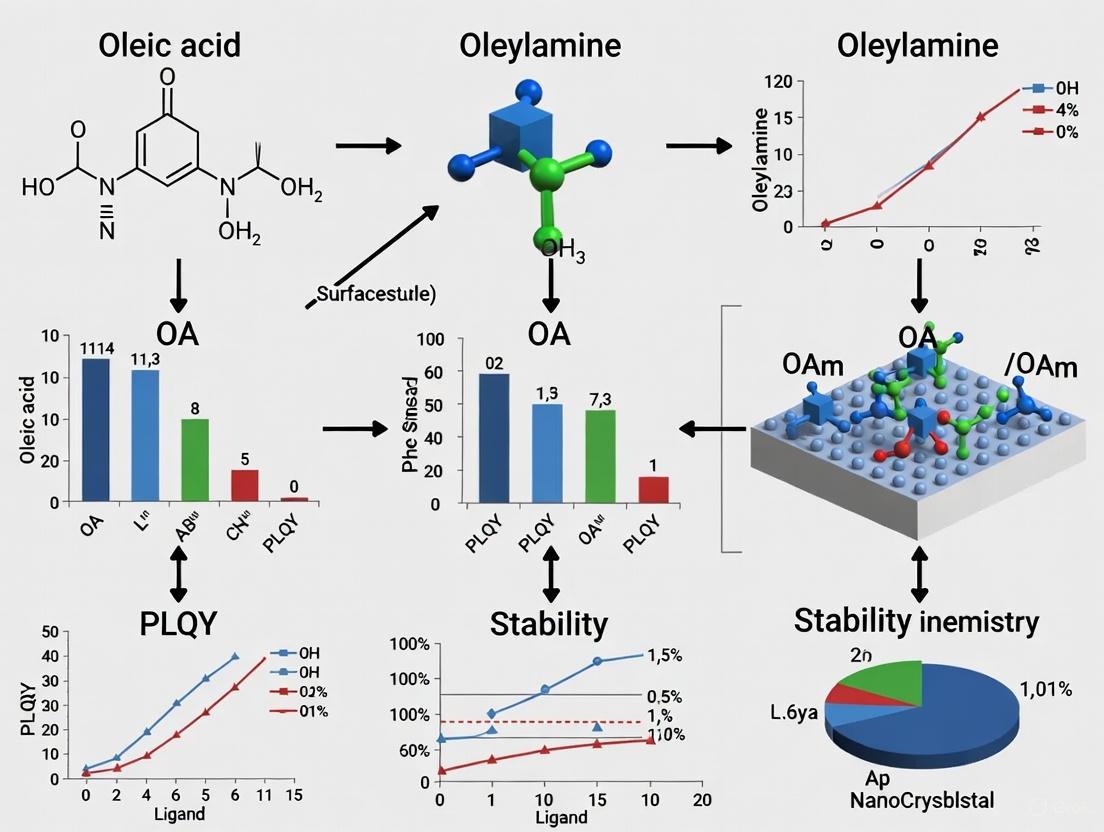
This article provides a systematic analysis of oleic acid (OA) and oleylamine (OAm) ligand engineering for enhancing the photoluminescence quantum yield (PLQY) and stability of metal halide perovskite nanocrystals (PNCs).
Optimizing OA/OAm Ligand Ratios for High PLQY and Stability in Perovskite Nanocrystals: A Comprehensive Guide
Abstract
This article provides a systematic analysis of oleic acid (OA) and oleylamine (OAm) ligand engineering for enhancing the photoluminescence quantum yield (PLQY) and stability of metal halide perovskite nanocrystals (PNCs). Targeting researchers and scientists, we explore the foundational role of conventional ligands, present advanced methodologies for ratio optimization and novel ligand systems, address critical troubleshooting for environmental stability, and validate performance through comparative analysis with emerging strategies. The synthesis of these core intents offers a definitive framework for developing highly efficient and stable PNCs for applications in LEDs, photovoltaics, and biomedical imaging.
Understanding OA/OAm Ligands: The Conventional Foundation of Perovskite Nanocrystals
The Dual Role of OA and OAm in Nanocrystal Synthesis and Stabilization
Troubleshooting Guides: Common OA/OAm-Related Experimental Challenges
This section addresses frequent issues encountered during the synthesis and purification of perovskite nanocrystals (PNCs) when using the oleic acid (OA) and oleylamine (OAm) ligand system.
Table 1: Troubleshooting Common OA/OAm-Related Issues
| Symptom & Problem Description | Underlying Cause | Recommended Solution | Preventive Measures |
|---|---|---|---|
| Low Photoluminescence Quantum Yield (PLQY) [1] [2] [3] | - Dynamic binding and detachment of OA/OAm ligands, creating surface defects and non-radiative recombination centers. [1] [3] | - Employ a hybrid ligand passivation strategy (e.g., DDAB/ZnBr2) to reconstruct the NC surface and supply halogens. [3] | - Precisely control the Cs/Pb ratio and use ternary ligand systems (e.g., adding DBSA) during initial synthesis for better defect passivation. [1] |
| Emission efficiency is significantly lower than expected after synthesis or purification. | - Proton exchange between OA and OAm leads to weakly bound free-OAm, resulting in surface vacancies. [4] | - For FAPbI3 QDs, use protonated-OAm (e.g., from oleylammonium iodide) during synthesis to suppress proton exchange. [4] | - Optimize the OA/OAm ratio and concentration to ensure sufficient surface coverage. [2] |
| Poor Colloidal & Environmental Stability [3] [5] [4] | - Ligands are easily desorbed from the NC surface due to ionic bonding and dynamic equilibrium, leading to aggregation. [5] | - Post-treat synthesized NCs with ligands of optimized chain length (e.g., DDAB) to enhance surface binding and hydrophobicity. [2] | - Replace the initial OA/OAm ligands with more strongly bound alternatives like DDAB or DBSA during the synthesis step. [1] [2] |
| NCs aggregate in solution or degrade quickly upon exposure to air, moisture, or UV light. | - The native OA/OAm ligand shell does not provide adequate protection against water and oxygen. [5] | - Grow an inert shell (e.g., YLF on Yb:YLF cores) to physically protect the core and isolate it from the environment. [6] | - Synthesize NCs in a halide-rich environment to minimize the formation of halide vacancies, which are initiation points for degradation. [4] |
| Uncontrolled Crystal Growth & Phase Instability [1] [4] | - Rapid and unpredictable nucleation/growth kinetics at room temperature with conventional methods. [1] | - Use strong complexing agents (e.g., DBSA) to 'lock' lead precursors and control reaction kinetics. [1] | - Decouple lead and halide precursors to allow precise control of the I/Pb ratio and create a halide-rich environment. [4] |
| Difficulty in obtaining uniform, phase-pure CsPbX3 NCs; unintended phase transformation (e.g., from 3D CsPbX3 to 0D Cs4PbX6). | - Fixed Pb:X ratio in conventional PbX2 precursors limits stoichiometric control. [1] | - Precisely tune the Cs/Pb molar ratio to selectively synthesize the desired phase, from 0D Cs4PbX6 to 3D CsPbX3 NCs. [1] | - Employ alternative halogen precursors like trimethylsilyl halides (TMSX) for more controlled anion release. [1] |
| Inefficient Charge Transport in Films [2] [4] | - Long-chain, insulating OA/OAm ligands create barriers between individual NCs, hindering charge transfer. [4] | - Perform ligand exchange to replace long-chain OA/OAm with shorter-chain ligands or ions (e.g., BF4-) to reduce inter-dot distance. [6] | - Implement an in-situ ligand management strategy that results in a reduced density of long-chain insulating ligands on the final NCs. [4] |
Frequently Asked Questions (FAQs)
FAQ 1: Why are OA and OAm used together in perovskite NC synthesis, and what is their fundamental dual role?
OA and OAm form a synergistic ligand pair that is crucial for both the synthesis and post-synthesis stabilization of PNCs. Their dual role can be broken down as follows:
- During Synthesis: They act as surface ligands that control the nucleation and growth kinetics of the nanocrystals. Their respective functional groups (-COOH in OA and -NH2 in OAm) coordinate with metal cations (e.g., Pb²⁺) and help passivate surface sites, preventing uncontrolled aggregation. [1] Furthermore, they solubilize precursors in non-polar solvents.
- During Stabilization: They passivate surface defects, particularly undercoordinated Pb²⁺ sites and halide vacancies, which is essential for achieving high PLQY. [1] [3] Their long hydrocarbon chains (C18) provide steric hindrance that prevents NC aggregation, enabling stable colloidal dispersions in non-polar solvents for months. [1]
FAQ 2: What is the "proton exchange" problem between OA and OAm, and how does it impact NC stability?
The proton exchange equilibrium refers to the dynamic process where protons can transfer between OA and OAm, creating a mixture of oleylammonium (protonated-OAm) and oleate (deprotonated-OA) ions. [4] The problem is that only the protonated-OAm (oleylammonium) forms strong ionic bonds with the NC surface, while free-OAm (non-protonated) is only weakly bound. [4] This weak binding causes free-OAm to easily detach from the NC surface during purification or upon exposure to polar solvents/moisture. This detachment leaves behind unpassivated surface defects, which act as non-radiative recombination centers (lowering PLQY) and initiate degradation, severely hampering the long-term stability of the NCs. [4]
FAQ 3: How does the carbon chain length of surface ligands influence the PLQY and stability of PNCs?
The chain length of the surface ligand is a critical parameter that affects the optoelectronic properties and stability through a balance of several factors. Research on quaternary ammonium bromide (QAB) ligands with double alkyl chains demonstrated that ligands with medium chain length (e.g., didodecyldimethylammonium bromide, DDAB, with double 12-carbon chains) outperform both shorter (double 8-carbon) and longer (double 16-carbon) chain ligands. [2]
- Shorter Chains: Provide less steric hindrance, offering poorer protection against aggregation.
- Longer Chains: Can create excessive steric bulk and are more hydrophobic, potentially hindering effective surface coverage and binding.
- Medium Chains (e.g., DDAB): Offer an optimal balance, enabling better binding to the NC surface for effective defect passivation, improved hydrophobicity for environmental stability, and a favorable balance between solubility and charge transport. [2] This results in a higher PLQY (increased from 61.3% to 90.4% in one study on blue-emitting NCs) and enhanced stability. [2]
FAQ 4: What are the best practices for measuring the PLQY of our synthesized NCs, especially when investigating OA/OAm optimization?
Photoluminescence Quantum Yield (PLQY) is the ratio of photons emitted to photons absorbed, and it is a key metric for evaluating the success of your ligand optimization. [7] [8] [9] For accurate and reliable PLQY measurements:
- Use the Absolute Method with an Integrating Sphere: This is the recommended approach. It directly measures the photons absorbed and emitted by the sample without needing a reference standard, making it suitable for solid films, opaque samples, and liquids. [8] The integrating sphere collects all scattered and emitted light, eliminating geometric errors associated with the directionality of emission. [8]
- Ensure Proper Calibration and Cleanliness: The integrating sphere must be well-calibrated to account for the wavelength-dependent sensitivity of the detector. Contamination inside the sphere can absorb or emit light, leading to highly inaccurate results. [8]
- Maintain Identical Parameters: Use the same excitation wavelength, intensity, and integration time for both the sample and the blank (e.g., pure solvent or substrate) measurement. [8]
- Beware of Reabsorption: For samples with a small Stokes shift (overlap between absorption and emission), emitted light can be reabsorbed by other NCs, leading to an underestimation of the true PLQY. Diluting the sample or applying a mathematical correction can mitigate this. [8]
Experimental Protocols for Key Cited Experiments
This protocol is adapted from the method described in the search results for synthesizing high-quality, stable CsPbX₃ NCs at room temperature.
Objective: To synthesize small CsPbX₃ (X = Cl, Br, I) NCs with high PLQY and enhanced stability by using a ternary ligand system comprising dodecylbenzenesulfonic acid (DBSA), oleic acid (OA), and oleylamine (OAm).
Key Materials:
- Cesium Source: Cesium acetate (C₂H₃CsO₂)
- Lead Source: Lead acetate (Pb(CH₃COO)₂·3H₂O)
- Halogen Source: Trimethylsilyl halides (TMS-X, where X = Cl, Br, I)
- Ligands: Dodecylbenzenesulfonic acid (DBSA), Oleic Acid (OA), Oleylamine (OAm)
- Solvent: Non-polar medium (e.g., 1,3,5-Trimethylbenzene)
Step-by-Step Workflow:
- Solution Preparation: Dissolve the cesium acetate and lead acetate precursors in the non-polar solvent containing the ternary ligand mixture (DBSA, OA, OAm).
- Precursor Injection: At room temperature and under constant stirring, inject trimethylsilyl halide (TMS-X) into the reaction mixture.
- Nucleation and Growth: Allow the reaction to proceed for a predetermined time. The gradual release of X⁻ anions from TMS-X enables controlled nucleation and growth.
- Phase Control: Precisely adjust the Cs/Pb molar ratio in the initial precursor mixture to selectively target the synthesis of zero-dimensional Cs₄PbX₆ NCs or three-dimensional CsPbX₃ NCs.
- Purification: Isolate the NCs by centrifugation and wash with an anti-solvent (e.g., ethyl acetate or methyl acetate) to remove excess ligands and unreacted precursors.
- Dispersion: Re-disperse the purified NC pellet in a non-polar solvent like toluene or n-hexane for storage and characterization.
The following workflow diagram summarizes this synthesis and optimization process:
This protocol describes a method to improve the PLQY and stability of pre-synthesized OA/OAm-capped NCs by post-treatment with Didodecyldimethylammonium bromide (DDAB).
Objective: To replace the dynamic OA/OAm ligands with DDAB to better passivate surface defects and improve the optical properties and stability of blue-emissive CsPbClₓBr₃₋ₓ NCs.
Key Materials:
- NCs: Pre-synthesized OA/OAm-capped CsPbClₓBr₃₋ₓ NCs.
- Ligand Solution: Didodecyldimethylammonium bromide (DDAB) dissolved in toluene.
Step-by-Step Workflow:
- Synthesize Base NCs: Prepare the original CsPbClₓBr₃₋ₓ NCs capped with OA/OAm ligands using a standard method (e.g., hot-injection or LARP).
- Purify NCs: Purify the base NCs by centrifugation to remove excess ligands and reaction by-products.
- Prepare DDAB Solution: Dissolve a calculated amount of DDAB in toluene. The concentration should be optimized for the specific NC system.
- Post-Treatment: Add the DDAB solution to the purified NC dispersion. Mix thoroughly and allow it to incubate for a specific duration to facilitate ligand exchange.
- Purification: Precipitate the DDAB-treated NCs by adding an anti-solvent (e.g., ethyl acetate) and recover them via centrifugation.
- Dispersion: Re-disperse the final NC pellet in toluene for further use. The resulting NCs should exhibit higher PLQY and improved stability compared to the original OA/OAm-capped ones.
The Scientist's Toolkit: Essential Research Reagent Solutions
Table 2: Key Reagents for OA/OAm Optimization and Advanced Ligand Engineering
| Reagent Name | Function & Role in Optimization | Key Experimental Consideration |
|---|---|---|
| Oleic Acid (OA) & Oleylamine (OAm) | The standard ligand pair for initial synthesis; provides steric stabilization and basic surface passivation. [1] | The ratio and absolute concentration are critical. Dynamic binding and proton exchange between them are a primary source of instability. [1] [4] |
| Didodecyldimethylammonium Bromide (DDAB) | A quaternary ammonium salt used for post-synthetic treatment; effective at passivating surface defects and enhancing PLQY and stability, especially for blue-emitting perovskites. [2] [3] | Features a double 12-carbon chain. Its medium chain length offers an optimal balance of strong surface binding, good passivation, and moderate steric hindrance. [2] |
| Dodecylbenzenesulfonic Acid (DBSA) | A component of advanced ternary ligand systems; the sulfonic acid group (-SO₃H) forms very stable coordination with Pb²⁺, dramatically reducing surface defects. [1] | Acts as a strong complexing agent that can 'lock' lead precursors, dominating reaction kinetics for more controlled growth. [1] |
| Oleylammonium Iodide (OLAI) | A source of both halide (I⁻) and protonated oleylamine (P-OAm); used in situ during synthesis to suppress the proton exchange problem and strengthen ligand binding. [4] | Direct use of protonated-OAm circumvents the formation of weakly bound free-OAm, leading to a more robust ligand shell and reduced defects. [4] |
| Zinc Bromide (ZnBr₂) | Used in hybrid ligand strategies (e.g., with DDAB); provides a halogen-rich environment to fill bromide vacancies, further suppressing non-radiative recombination. [3] | Often used in conjunction with ammonium-based ligands for a synergistic effect that maximizes PLQY and operational stability. [3] |
The following diagram illustrates the molecular mechanisms of different ligand strategies for surface passivation and stabilization:
FAQs: Understanding Dynamic Binding and Surface Defects
Q1: What is the fundamental cause of surface defects in perovskite quantum dots (QDs) capped with conventional OA/OAm ligands?
The fundamental cause is the dynamic binding equilibrium of the conventional oleic acid (OA) and oleylamine (OAm) ligand pair. These ligands are not firmly anchored to the QD surface. Instead, they exist in a dynamic equilibrium (OA⁻ + OAmH⁺ ⇌ OAm + OA), which leads to their desorption during purification or film formation. This desorption leaves behind unpassivated surface sites, specifically uncoordinated Pb²⁺ ions and A-site (Cs⁺) vacancies, which act as surface defects and non-radiative recombination centers, ultimately causing Photoluminescence Quantum Yield (PLQY) loss [10].
Q2: How do these surface defects directly lead to a reduction in PLQY?
Surface defects, such as uncoordinated Pb²⁺ and A-site vacancies, create energy states within the bandgap of the perovskite QD. When charge carriers (electrons and holes) recombine at these defect sites, the energy is dissipated non-radiatively as heat, rather than being emitted as light. This non-radiative recombination directly competes with the desired radiative recombination process, thereby reducing the overall efficiency of light emission, which is quantified as a lower PLQY [10].
Q3: What are the key experimental observations that indicate a problem with dynamic ligand binding?
Several key observations during experiments can signal dynamic binding issues:
- PLQY Drop After Purification: A significant decrease in the photoluminescence intensity and PLQY of the colloidal QDs after the purification process to remove excess ligands and precursors [10].
- Poor Environmental Stability: Rapid degradation of the QDs' photoluminescence when exposed to ambient conditions, such as moisture, oxygen, or heat, indicates poor surface protection [11] [10].
- Time-Dependent Spectral Shifts: Changes in the absorption or emission spectra of the QD solution over time can suggest ligand desorption and subsequent surface reconstruction [11].
Q4: Beyond OA/OAm, what alternative ligand strategies are emerging to combat dynamic binding?
Recent research has focused on developing more stable ligand systems to replace or supplement OA/OAm. Two promising strategies include:
- Zwitterionic Ligands: Molecules like betaine (BET), which possess both a positive quaternary ammonium group (-N(CH₃)₃⁺) and a negative carboxylate group (-COO⁻). These can simultaneously passivate both anionic and cationic surface sites, creating a firmer, chelate-like binding that resists desorption and significantly boosts PLQY and stability [10].
- All-Polymer Ligand Systems: Using polymers like Polyvinylpyrrolidone (PVP) and Polyethylene glycol (PEG) as primary ligands. These polymers provide a robust protective layer around the QDs, leading to enhanced stability against heat, UV light, and humidity, and high PLQY [11].
Troubleshooting Guide: Common Experimental Challenges
Symptom: Significant drop in PLQY after purifying QDs.
| Potential Cause | Recommended Action | Underlying Principle |
|---|---|---|
| Ligand Desorption | Implement a post-synthetic passivation step. Add zwitterionic ligands (e.g., betaine) to the purified QDs for ligand exchange. | Replaces dynamically bound OA/OAm with firmly anchored ligands that passivate newly exposed defects [10]. |
| Over-Purification | Optimize the purification protocol. Reduce the number of centrifugation cycles or use a gentler anti-solvent. | Minimizes the mechanical force and solvent exposure that accelerates ligand loss [10]. |
Symptom: Poor long-term stability of QD solutions or films.
| Potential Cause | Recommended Action | Underlying Principle |
|---|---|---|
| Incomplete Surface Passivation | Explore alternative ligand systems like all-polymer ligands (PVP/PEG) during synthesis. | Polymers form a denser, more protective capping layer that is less prone to desorption, improving environmental stability [11]. |
| Residual Unbound Ligands | Ensure thorough purification before film fabrication. Unbound ligands can act as insulators in solid films. | Removes excess insulating ligands that hinder charge transport, improving device performance [10]. |
Experimental Protocols for Mitigating Dynamic Binding
Protocol 1: Zwitterionic Ligand Exchange with Betaine (BET)
This protocol is adapted from a study that achieved a PLQY of up to 92% [10].
- Synthesis: Synthesize CsPbBr₃ QDs using the standard hot-injection method with OA/OAm ligands.
- Purification: Purify the crude QD solution by centrifugation using methyl acetate as an anti-solvent to obtain the pellet (OA/OAm-QDs).
- Ligand Exchange: Redisperse the purified QD pellet in toluene. Add a betaine (BET) solution in dimethylformamide (DMF) dropwise under stirring. The typical BET concentration is 10 mg/mL.
- Incubation: Stir the mixture for 10 minutes to allow the BET ligands to exchange with the dynamic OA/OAm ligands on the QD surface.
- Purification: Precipitate the resulting BET-capped QDs (BET-QDs) by adding methyl acetate and centrifuging. Redisperse the final pellet in a non-polar solvent like toluene for further use.
Protocol 2: One-Pot Synthesis with All-Polymer Ligands
This protocol uses PVP and PEG to create highly stable, green-emitting CsPbBr₃ PNCs [11].
- Precursor Preparation:
- Dissolve equimolar quantities of CsBr and PbBr₂ in a 1:1 volume mixture of DMF and DMSO. Vortex for 45 minutes to form a clear base precursor.
- Add 400 mg of PVP (K30) to the base precursor and vortex until a homogenized clear solution is obtained.
- For enhanced passivation, add Polyethylene Glycol (PEG) to the precursor solution at an optimized concentration of 20 mg/mL. This solution is labeled as the "precursor solution."
- Synthesis:
- Rapidly inject 0.1 mL of the precursor solution into 10 mL of toluene (containing 5% vol ethyl alcohol) vortexing at 3600 RPM.
- Luminescent colloids will form within seconds. The sample with 20 mg/mL PEG additive should exhibit pure green emission with high PL intensity.
Data Presentation: Quantitative Performance of Ligand Strategies
The following table summarizes quantitative data from recent studies on advanced ligand strategies, providing a benchmark for evaluating experimental outcomes in the context of OA/OAm optimization.
Table 1: Quantitative Comparison of Ligand Strategies for Perovskite QDs/NCs
| Ligand System | Reported PLQY | Key Stability Metrics | LED Device Performance (EQE) | Reference |
|---|---|---|---|---|
| Conventional OA/OAm | Baseline | Rapid degradation under ambient conditions | Low, with significant roll-off | [10] |
| Zwitterionic (Betaine) | 92% (boosted from ~76%) | Retained >96% PL after 50h at 80% RH & UV | 10.8% (3x improvement over control) | [10] |
| All-Polymer (PVP/PEG) | 76% | ~93% PL retention after 500h of LED operation; stable for 1 year | High luminous efficiency: 104.33 lm/W | [11] |
The Scientist's Toolkit: Essential Research Reagents
Table 2: Key Materials and Their Functions in Ligand Optimization Research
| Reagent / Material | Function in Experiment |
|---|---|
| Oleic Acid (OA) / Oleylamine (OAm) | Conventional ligand pair; provides baseline for comparison and understanding dynamic binding limitations. |
| Betaine (BET) | Zwitterionic ligand; used for post-synthetic exchange to passivate defects and stabilize the QD surface firmly. |
| Polyvinylpyrrolidone (PVP) | Polymer ligand; acts as a primary capping agent to protect the crystal lattice and suppress defect formation. |
| Polyethylene Glycol (PEG) | Polymer ligand additive; works synergistically with PVP to enhance passivation, PL intensity, and spectral purity. |
| Dimethylformamide (DMF) / Dimethyl Sulfoxide (DMSO) | Polar solvents used for dissolving precursor salts in synthesis. |
| Toluene | Non-polar solvent; commonly used as an anti-solvent for purification and as a medium for nanocrystal dispersion. |
| Methyl Acetate | Anti-solvent; used for purifying QDs by precipitating them out of solution. |
Visualization of Concepts and Workflows
The following diagram illustrates the core problem of dynamic binding and the mechanism of action for advanced ligand solutions.
Diagram 1: Mechanism of Ligand-Induced Defects and Solutions.
This workflow outlines the specific experimental steps for implementing two key ligand strategies discussed in this guide.
Diagram 2: Experimental Workflows for Advanced Ligand Strategies.
The Critical Link Between Ligand Detachment, Ion Migration, and Environmental Degradation
Troubleshooting Guides
Issue 1: Rapid Degradation and PLQY Drop in Blue-Emissive PeNCs
Problem: My blue-emissive mixed-halide perovskite nanocrystals (PeNCs) are experiencing a rapid drop in Photoluminescence Quantum Yield (PLQY) and show signs of degradation within days, despite using standard OA/OAm ligands.
Explanation: This is a classic symptom of unstable ligand binding. The inherent dynamic nature of long-chain OA/OAm ligands causes them to easily detach from the NC surface [2] [12]. This creates unprotected surface sites that act as defects, facilitating non-radiative recombination (lowering PLQY) and providing pathways for ion migration, especially in mixed-halide compositions [2]. This instability is exacerbated by environmental factors like moisture and oxygen [12].
Solution: Implement a post-synthesis ligand exchange with strongly-bound ligands.
- Recommended Reagent: Didodecyldimethylammonium bromide (DDAB). Research shows DDAB, with double 12-carbon chains, provides an optimal balance of effective surface passivation and material stability [2].
- Protocol:
- Synthesize your blue-emissive CsPbCl({0.9})Br({2.1}) PeNCs using your standard hot-injection method with OA/OAm [2].
- Purify the crude solution to remove excess precursors and solvents.
- Redisperse the PeNCs in toluene.
- Add a DDAB solution in toluene (concentration range of 0.2-0.8 M optimized for your NCs) and stir for 1-2 hours [2] [13].
- Purify the post-treated NCs to remove ligand debris and excess DDAB.
- Expected Outcome: This treatment can enhance PLQY from ~61% to over 90% and maintain ~90% of the initial PL intensity after 10 days in ambient conditions [2].
Issue 2: PL Fluctuations and Inconsistent Single-Particle Performance
Problem: During single-particle spectroscopy, my PeNCs exhibit severe intensity blinking or flickering, making data collection and interpretation difficult.
Explanation: At the single-particle level, PL fluctuations (blinking) are primarily caused by the charging and discharging of the NC. Detached OA/OAm ligands create surface trap states that capture charge carriers [12]. When a charge is trapped, a subsequent exciton can undergo non-radiative Auger recombination, leading to an "OFF" state with no emission [12]. The dynamic binding of OA/OAm makes this a continuous process.
Solution: Employ a dual-ligand passivation strategy to create a stable, defect-free surface.
- Recommended Reagents:
- 2-Naphthalene Sulfonic Acid (NSA): A strong-binding ligand to inhibit Ostwald ripening and passivate surface defects during synthesis [13].
- Ammonium Hexafluorophosphate (NH(4)PF(6)): An inorganic ligand for strong binding and defect passivation during the purification process, which also improves charge transport [13].
- Protocol:
- After the initial nucleation of CsPbI(_3) QDs, inject an NSA ligand solution (e.g., 0.6 M) to suppress post-nucleation growth and passivate surfaces [13].
- After the reaction is complete, during the purification step with an anti-solvent, introduce NH(4)PF(6) to exchange with any remaining weak ligands and lock in the surface structure [13].
- For long-term single-particle studies, disperse the final QDs in a protective polymer matrix like PMMA to shield them from oxygen and moisture [12].
- Expected Outcome: Significant suppression of PL blinking and flickering, achieving high QYs (e.g., 94%) and improved stability for reliable single-particle data acquisition [13] [12].
Issue 3: Poor Stability in Pure-Red PeNCs Due to Phase Transition
Problem: My pure-red CsPbI(_3) QDs are unstable and quickly transition from the desired black phase to a non-emissive yellow phase.
Explanation: Strongly confined CsPbI(_3) QDs (for pure-red emission) have high surface energy, making them prone to Ostwald ripening and phase instability. Standard OA/OAm ligands are insufficient to suppress this spontaneous growth and phase change [13].
Solution: Utilize strong-binding sulfonic acid ligands to inhibit Ostwald ripening at the synthesis stage.
- Recommended Reagent: 2-Naphthalene Sulfonic Acid (NSA) [13].
- Protocol:
- Follow your standard thermal injection synthesis for CsPbI(_3) QDs.
- Immediately after nucleation, introduce an NSA/toluene solution. The sulfonic acid group has a stronger binding energy with Pb atoms (1.45 eV) compared to OAm (1.23 eV), which helps stabilize the small, strongly-confined QDs [13].
- The naphthalene ring provides large steric hindrance, physically inhibiting the overgrowth of QDs.
- Expected Outcome: Successful synthesis of monodisperse, strong-confined CsPbI(_3) QDs with an emission peak at 623 nm and high PLQY (94%), stable against phase separation [13].
Frequently Asked Questions
Q1: What are the fundamental mechanisms by which ligand detachment leads to degradation? Ligand detachment initiates a cascade of problems:
- Surface Defects: Detachment exposes under-coordinated Pb(^{2+}) ions and halide vacancies, creating trap states for charge carriers. This increases non-radiative recombination, lowering PLQY [14] [12].
- Ion Migration: These surface vacancies act as starting points and pathways for ion migration within the ionic perovskite lattice. In mixed-halide perovskites, this leads to halide segregation, causing spectral shifts and instability [12].
- Environmental Degradation: The unpassivated surface is highly susceptible to attack by environmental factors like moisture and oxygen, leading to irreversible decomposition [12].
Q2: Besides chain length, what other ligand properties are critical for stability? While chain length (e.g., C8 vs C12 vs C16) affects hydrophobicity and steric effects [2], other properties are equally important:
- Binding Group Strength: Sulfonic acid groups (in NSA) bind more strongly to the Pb on the NC surface than common ammonium groups [13].
- Ligand Polarity: Moderate polarity in ligands like DDAB improves binding with the PeNC surface for more effective passivation [2].
- Steric Hindrance: Large aromatic groups (e.g., naphthalene in NSA) provide physical barriers to prevent NC fusion and ion migration [13].
Q3: My PLQY is high after synthesis but drops significantly after purification. Why? This is a common issue caused by the polar anti-solvents used in purification. These solvents can trigger a proton transfer process between the OA(^-) and OAmH(^+) ligands, causing them to desorb from the QD surface as neutral molecules (OA and OAm). This strips the surface protection, creating a high density of defects [13]. Solution: Introduce strong-binding ligands like NH(4)PF(6) during the purification process to replace the lost OA/OAm and passivate the surface against the anti-solvent effect [13].
Data Presentation
| Ligand (Chain Length) | Abbreviation | PLQY (%) | Stability (PL Intensity after 10 Days) | Key Findings |
|---|---|---|---|---|
| Oleic Acid/Oleylamine (Dynamic) | OA/OAm | 61.3% | Not Specified | Baseline; dynamic binding leads to defects. |
| Dimethyldioctylammonium Bromide (C8) | DOAB | Lower than DDAB | Lower than DDAB | Shorter chains may provide less effective passivation and hydrophobicity. |
| Didodecyldimethylammonium Bromide (C12) | DDAB | 90.4% | ~90% | Optimal balance; moderate polarity for strong binding and good hydrophobicity. |
| Dimethyldipalmitylammonium Bromide (C16) | DHAB | Lower than DDAB | Lower than DDAB | Longer chains may cause steric hindrance, reducing passivation density. |
| Ligand Strategy | Function | PLQY | Emission Peak | Key Outcome |
|---|---|---|---|---|
| Standard OA/OAm | Weak binding ligands for synthesis | Not specified for pure-red | ~635 nm (weak confinement) | Uncontrolled growth, low stability. |
| 2-Naphthalene Sulfonic Acid (NSA) | Inhibits Ostwald ripening, passivates defects | 89% (after synthesis) | 623 nm | Achieves strong quantum confinement for pure-red emission. |
| NSA + NH(4)PF(6) | Dual passivation during synthesis and purification | 94% (after purification) | 623 nm | Enables high-efficiency pure-red PeLEDs with EQE of 26.04%. |
Experimental Protocols
Objective: To replace dynamic OA/OAm ligands with DDAB to improve PLQY and stability of CsPbCl({0.9})Br({2.1}) NCs.
Materials:
- Synthesized and purified OA/OAm-capped CsPbCl({0.9})Br({2.1}) NCs in toluene.
- Didodecyldimethylammonium bromide (DDAB), ≥98%.
- Toluene, anhydrous.
- Anti-solvent (e.g., ethyl acetate, methanol).
Procedure:
- Ligand Solution Preparation: Prepare a DDAB solution in toluene. The concentration should be optimized, but a range of 0.2 M to 0.8 M is a good starting point [2] [13].
- Post-Treatment: Add the DDAB solution to the purified OA/OAm-CsPbCl({0.9})Br({2.1}) NC solution under stirring. The typical reaction time is 1-2 hours.
- Purification: Add an anti-solvent to the mixture to precipitate the DDAB-post-treated NCs.
- Centrifugation: Centrifuge the solution (e.g., 8000 rpm for 5 min) and discard the supernatant containing ligand debris and excess DDAB.
- Redispersion: Redisperse the final pellet in toluene or another desired solvent for characterization and storage.
Objective: To synthesize strongly-confined, stable pure-red CsPbI(3) QDs using NSA and NH(4)PF(_6) ligands.
Materials:
- Cs(2)CO(3), PbI(_2), 1-Octadecene (ODE), Oleic Acid (OA), Oleylamine (OAm).
- 2-Naphthalene sulfonic acid (NSA).
- Ammonium hexafluorophosphate (NH(4)PF(6)).
- Toluene, methyl acetate (as anti-solvent).
Procedure:
- Standard Nucleation: Synthesize CsPbI(_3) QDs using the standard hot-injection method with OA and OAm as ligands.
- NSA Injection: Immediately after the reaction mixture is cooled in an ice-water bath, inject a specific amount of NSA ligand solution (e.g., 0.6 M in toluene). This step suppresses Ostwald ripening.
- Purification with NH(4)PF(6):
- Precipitate the NSA-treated QDs by adding methyl acetate and centrifuge.
- Redisperse the pellet in toluene. Add an NH(4)PF(6)/toluene solution to the redispersed QDs and stir for 10-15 minutes.
- Precipitate the dual-passivated QDs again with methyl acetate and centrifuge.
- Final Redispersion: Redisperse the final QDs in toluene for film fabrication or further use.
Visualization Diagrams
Diagram 1: Ligand Detachment Triggers a Cascade of PeNC Degradation
Diagram 2: Advanced Ligand Passivation Strategy Workflow
The Scientist's Toolkit: Research Reagent Solutions
Table 3: Essential Ligands for Optimizing PeNC Performance
| Reagent | Function/Binding Mechanism | Primary Use Case |
|---|---|---|
| Didodecyldimethylammonium Bromide (DDAB) | Quaternary ammonium salt; replaces OA/OAm. Optimal C12 chain provides good passivation and hydrophobicity [2]. | General performance enhancement for mixed-halide (blue) PeNCs; improving PLQY and ambient stability. |
| 2-Naphthalene Sulfonic Acid (NSA) | Strong-binding ligand via sulfonic acid group; inhibits Ostwald ripening; large steric hindrance [13]. | Synthesizing small, strongly-confined QDs (e.g., pure-red CsPbI₃); stabilizing high-energy surfaces. |
| Ammonium Hexafluorophosphate (NH₄PF₆) | Inorganic ligand; strong ionic binding during purification; prevents ligand loss from anti-solvent [13]. | Purification step to maintain high PLQY and enhance charge transport in PeLED fabrication. |
| Oleic Acid (OA) / Oleylamine (OAm) | Common long-chain (C18) ligands for synthesis; dynamic binding leads to instability [2] [12]. | Standard ligands for initial nanocrystal growth and stabilization; require replacement for best performance. |
Frequently Asked Questions
What are the typical PLQY and stability ranges for OA/OAm-capped PNCs? Baseline performance for OA/OAm-capped PNCs shows Photoluminescence Quantum Yields (PLQY) typically ranging from 61% to 89% for various compositions. However, these materials suffer from poor stability, often exhibiting significant photoluminescence (PL) degradation within days or even hours under ambient conditions, thermal stress, or during purification processes [2] [15] [16].
Why do OA/OAm-capped PNCs have stability issues? The primary reason is the dynamic and weak ionic binding of oleic acid (OA) and oleylamine (OAm) ligands to the perovskite nanocrystal surface. These ligands are prone to detach or desorb during purification, storage, or when exposed to environmental factors, leaving behind surface defects that act as non-radiative recombination centers and lead to rapid degradation [2] [5] [16].
Why is ligand engineering a primary strategy for optimization? Replacing the conventional OA/OAm ligand pair with more robust alternatives directly addresses the root cause of instability. Strategies include using ligands with stronger binding energy (e.g., sulfonic acid groups), bidentate or multidentate ligands that bind at multiple sites, and ligands with optimized chain length or steric hindrance to enhance surface passivation and environmental resistance [2] [15] [16].
Troubleshooting Guide: Common Issues with OA/Oam-Capped PNCs
| Problem Observed | Underlying Cause | Recommended Solution |
|---|---|---|
| Low PLQY after synthesis | High density of surface defects due to incomplete passivation by OA/OAm [16] [17]. | Implement post-synthetic ligand exchange with strong-binding ligands like DDAB [2] or ammonium hexafluorophosphate (NH₄PF₆) [16]. |
| PL degradation during purification | Ligand detachment caused by proton transfer between OA/OAm and polar antisolvents [16]. | Introduce inorganic ligands (e.g., NH₄PF₆) before purification to shield the surface and prevent defecting [16]. |
| Poor thermal stability | Weak ligand shell fails to protect NCs from heat-induced degradation and aggregation [15]. | Employ polymer ligands (e.g., PVP/PEG mixture) to form a robust, protective matrix around the NCs [15]. |
| Rapid degradation in ambient air | Permeation of moisture and oxygen through the loose ligand layer [5]. | Apply a multifunctional etching ligand (e.g., Cycle Acid) to remove defective surface sites and passivate with a hydrophobic ligand [17]. |
Baseline Performance Data for OA/OAm-Capped PNCs
The following table summarizes the typical performance of OA/OAm-capped PNCs as reported in recent literature, providing a benchmark for optimization efforts.
| Perovskite Composition | Typical PLQY Range | Stability Performance | Key Findings & Context |
|---|---|---|---|
| CsPbCl₀.₉Br₂.₁ (Blue-emitting) | ~61.3% [2] | - | PLQY before enhancement with advanced ligands [2]. |
| CsPbBr₃ (Green-emitting) | 76% [17] | - | PLQY before treatment with multifunctional etching ligand [17]. |
| CsPbBr₃ (Green-emitting) | Not specified | < 10 days (Significant PL degradation under ambient conditions) [15]. | Stability compared to polymer-capped PNCs which lasted over one year [15]. |
| CsPbI₃ (Red-emitting) | ~89% (after NSA treatment) [16] | - | Achieved after replacing weak OA/OAm ligands with strong-binding 2-naphthalene sulfonic acid (NSA) [16]. |
| General CsPbX₃ | High (initially, but drops rapidly) [5] | Highly susceptible to moisture, oxygen, and light [5]. | Ligands are highly dynamic, leading to easy detachment during separation and purification [5]. |
Experimental Protocol: Standard Hot-Injection Synthesis for OA/OAm-Capped CsPbBr₃ NCs
This is a foundational method for synthesizing OA/OAm-capped PNCs, upon which most optimization studies are based [16] [17].
- Cs-oleate Precursor Preparation: Load 0.407 g of Cs₂CO₃ into a 50 mL flask with 1.25 mL OA and 15 mL 1-octadecene (ODE). Heat and stir under N₂ at 120-150 °C until all Cs₂CO₃ is dissolved [17].
- Pb-halide Precursor Preparation: In a separate flask, add 0.188 mmol of PbBr₂, 10 mL ODE, and stir under N₂. Heat to 120 °C until PbBr₂ dissolves.
- Add Ligands: To the clear PbBr₂ solution, add 1 mL each of dried OA and OAm [17].
- Nanocrystal Synthesis: Raise the temperature of the Pb-precursor to the reaction temperature (e.g., 150-180 °C). Rapidly inject the preheated Cs-oleate precursor (0.8-1.5 mL).
- Quench and Cool: After 5-10 seconds, cool the reaction flask in an ice-water bath to stop crystal growth.
- Purification: Centrifuge the cooled solution at high speed (e.g., 10,000 RPM for 10 minutes). Wash the pellet with a polar antisolvent (e.g., ethyl acetate or methyl acetate) and re-disperse in a non-polar solvent like toluene or hexane [16].
Research Reagent Solutions
| Reagent | Function in Experiment |
|---|---|
| Oleic Acid (OA) & Oleylamine (OAm) | Conventional X-type and L-type ligands for colloidal synthesis and surface passivation [2] [16]. |
| 1-Octadecene (ODE) | Non-polar, high-boiling-point solvent for the hot-injection synthesis method [16] [17]. |
| Didodecyldimethylammonium Bromide (DDAB) | Quaternary ammonium salt with double 12-carbon chains; used in post-synthetic treatment to enhance passivation, PLQY, and stability [2]. |
| 2-Naphthalene Sulfonic Acid (NSA) | Strong-binding ligand used to replace OA/OAm, suppress Ostwald ripening, and passivate surface defects [16]. |
| Ammonium Hexafluorophosphate (NH₄PF₆) | Inorganic ligand used during purification to exchange long-chain ligands, passivate defects, and improve charge transport [16]. |
| Cycle Acid (CA) | A multifunctional branched ligand that acts as both an etchant to remove defective surface sites and a passivator [17]. |
| Polyvinylpyrrolidone (PVP) & Polyethylene Glycol (PEG) | Polymer ligands used to create a highly stable protective matrix around NCs, replacing conventional ligands entirely [15]. |
Workflow: From Problem to Solution
The diagram below outlines the logical relationship between the inherent problems of OA/OAm-capped PNCs and the corresponding ligand engineering solutions.
Performance Comparison: Conventional vs. Optimized PNCs
This diagram provides a visual comparison of the stability performance between conventional OA/OAm-capped PNCs and those treated with advanced ligand strategies, based on data from the provided research.
Advanced Ligand Engineering: Strategies for Ratio Optimization and Ligand Replacement
Systematic Approaches for Determining the Optimal OA/OAm Molar Ratio
Frequently Asked Questions (FAQs)
FAQ 1: What are the distinct roles of OA and OAm in perovskite nanocrystal synthesis? OA (Oleic Acid) and OAm (Oleylamine) serve complementary but distinct functions. OAm is primarily responsible for binding to the quantum dot surface and passivating surface defects, which directly leads to an improvement in Photoluminescence Quantum Yield (PLQY) [18]. In contrast, OA is not directly bound to the surface but plays a critical role in stabilizing the colloidal solution, preventing the nanocrystals from aggregating and thus ensuring their long-term stability [18]. The synergistic effect of both ligands is essential for obtaining high-quality nanocrystals.
FAQ 2: I am getting low PLQY even after optimizing my synthesis. Could the purification process be at fault? Yes, the purification process is a common culprit for low PLQY. The anti-solvents used for washing can dynamically detach the OA and OAm ligands from the nanocrystal surface, creating defect states that quench luminescence [19]. To mitigate this, implement a ligand-assisted purification protocol: introduce a small, controlled amount of equimolar OA and OAm (e.g., 0.1 mL total) into your crude solution before adding the anti-solvent. This replenishes ligands lost during washing and helps maintain surface passivation, enabling recovery to a near-unity PLQY [19].
FAQ 3: Can I use ligands other than OA and OAm? Absolutely. While OA and OAm are the conventional choices, alternative ligand strategies are being actively researched. For instance, an all-polymer ligand system using a combination of Polyvinylpyrrolidone (PVP) and Polyethylene glycol (PEG) has been shown to produce CsPbBr3 nanocrystals with a high PLQY of 76% and exceptional long-term stability, overcoming the weak binding of traditional ligands [20].
FAQ 4: How does the OA/OAm ratio affect the morphology of the nanocrystals?
The ratio of these ligands is a powerful parameter for morphological control, especially for metal oxides. Research on TiO2 nanoparticles demonstrates that varying the molar ratio X = [OA]/([OA] + [OAm]) allows for the precise synthesis of different shapes, including spheres, rhombic particles, and nanorods [21]. This highlights the critical role of the ligand ratio in directing crystal growth.
Troubleshooting Guides
Issue 1: Consistently Low Photoluminescence Quantum Yield (PLQY)
| Potential Cause | Diagnostic Steps | Recommended Solution |
|---|---|---|
| Suboptimal OA/OAm Ratio | Systematically synthesize batches with [OA]/[OAm] ratios of 0.25, 0.5, 1, 2, and 4, then measure PLQY [18]. |
Identify the ratio that gives the highest PLQY. Studies on double perovskites show this is crucial for maximizing yield [18]. |
| Surface Defects from Ligand Loss | Use FTIR spectroscopy to confirm the presence of OA and OAm on purified NCs. A decrease in characteristic peaks indicates detachment [18]. | Employ the ligand-assisted purification protocol detailed in FAQ 2 [19]. |
| Insufficient Surface Passivation by OAm | Perform NMR analysis to confirm OAm binding to the NC surface [18]. | Ensure your precursor recipe includes sufficient OAm, as it is the primary ligand for defect passivation [18]. |
Issue 2: Poor Colloidal Stability (Aggregation/Precipitation)
| Potential Cause | Diagnostic Steps | Recommended Solution |
|---|---|---|
| Insufficient OA Concentration | Observe if aggregation occurs during synthesis or immediately after purification. | Increase the proportion of OA in your ligand mixture. OA is key for colloidal stability, even if it does not bind directly to the surface [18]. |
| Excessive Anti-Solvent Washing | Check if PLQY and stability decrease with each successive washing cycle. | Optimize the washing protocol by reducing the anti-solvent volume and adding supplemental ligands [19]. |
| Weak Binding of Conventional Ligands | Monitor stability over weeks; rapid degradation suggests ligand desorption. | Consider switching to a more robust ligand system, such as polymer ligands (e.g., PVP/PEG), for long-term applications [20]. |
Experimental Data and Protocols
| [OA]/[OAm] Ratio | PLQY Trend | Primary Influence |
|---|---|---|
| 0.25 | High | Enhanced defect passivation by OAm |
| 0.5 | High | Balanced passivation and stability |
| 1 | Moderate | Intermediate performance |
| 2 | Lower | Reduced passivation efficiency |
| 4 | Lowest | Dominance of OA, poor surface binding |
Table 2: Key Research Reagent Solutions
| Reagent | Function in Synthesis | Example Usage |
|---|---|---|
| Oleic Acid (OA) | Stabilizer; prevents aggregation and improves colloidal stability [18] [22]. | Used in synthesis of CsPbI3 nanosheets and double perovskite QDs [18] [22]. |
| Oleylamine (OAm) | Surface ligand; passivates defects to enhance PLQY [18] [22]. | Critical for achieving high PLQY in Cs2NaInCl6 QDs [18]. |
| 1-Octadecene (ODE) | High-boiling non-coordinating solvent for reaction medium [18] [19]. | Common solvent in hot-injection and heat-up methods [18]. |
| Polyvinylpyrrolidone (PVP) | Polymer ligand; provides a protective matrix for nanocrystals [20]. | Used as primary ligand in all-polymer strategy for CsPbBr3 NCs [20]. |
| Polyethylene Glycol (PEG) | Polymer ligand additive; enhances passivation and PLQY [20]. | Added to PVP to achieve pure green emission and 76% PLQY [20]. |
Detailed Experimental Protocol: Ligand Ratio Optimization
This protocol is adapted from the synthesis of Cs₂NaInCl₆ double-perovskite QDs [18].
Objective: To systematically determine the optimal OA/OAm molar ratio for maximizing PLQY and stability.
Materials:
- Cesium acetate (Cs(OAc)), Sodium acetate (Na(OAc)), Indium acetate (In(OAc)₃), Antimony acetate (Sb(OAc)₃)
- Oleic Acid (OA, 90%), Oleylamine (OAm, 70%)
- 1-Octadecene (ODE, 90%)
- Germanium(IV) chloride (GeCl₄)
- Hexane, Chlorobenzene
Methodology:
- Precursor Preparation: In a three-neck flask, combine Cs(OAc) (0.71 mmol), Na(OAc) (0.5 mmol), In(OAc)₃ (0.495 mmol), and Sb(OAc)₃ (0.055 mmol) in 9 mL of ODE.
- Ligand Addition: Add a total volume of 3.5 mL of OA and OAm to the flask, varying the
[OA]/[OAm]ratio across different batches (e.g., 4, 2, 1, 0.5, 0.25). - Reaction: Heat the mixture to 110 °C under vacuum and stir for 50 minutes. Then, under a nitrogen atmosphere, heat to 170 °C.
- Injection: Swiftly inject a GeCl₄ precursor solution (77 μL GeCl₄ per 1 mL ODE).
- Growth: Heat the reaction to 180 °C and maintain for 5 minutes.
- Quenching: Rapidly cool the reaction mixture in an ice-water bath.
- Purification: Centrifuge the mixture at 9500 rpm for 5 minutes. Collect the precipitate, disperse it in chlorobenzene, and centrifuge again. Dry the final precipitate and disperse in hexane for characterization.
- Characterization: Measure the PLQY, absorption, and PL spectra for each batch to identify the optimal ratio.
Workflow and Signaling Pathways
Experimental Workflow for OA/OAm Optimization
This flowchart outlines the iterative process for determining the optimal OA/OAm ratio, integrating key troubleshooting feedback loops. If characterization reveals low PLQY or poor stability, the process returns to the ratio selection step for further refinement [18] [19].
Ligand Function and Purification Strategy
This diagram illustrates the distinct roles of OA and OAm ligands in achieving high-performance nanocrystals, and how the ligand-assisted purification strategy counteracts the negative effects of standard purification [18] [19].
Troubleshooting Guide: Common Experimental Issues & Solutions
| Problem Category | Specific Symptom | Potential Cause | Recommended Solution |
|---|---|---|---|
| Optical Properties | Low Photoluminescence Quantum Yield (PLQY) after exchange | Incomplete passivation of surface defects; Non-radiative recombination sites [2] [23] | Optimize ligand concentration and chain length; Try DDAB for blue-emitting perovskites [2]. |
| Reduced charge transport in QD films | Excessive insulating ligand density hindering electronic coupling [23] [4] | Employ aromatic ammonium salts (e.g., PEABr) to improve inter-dot coupling [23]. | |
| Material Stability | Poor colloidal stability in solution | Weak binding of new ligands; Ligand desorption from QD surface [2] [23] | Use ligands with stronger binding affinity (e.g., quaternary ammonium salts); Ensure complete removal of original OA/OAm [24]. |
| Degradation of films under ambient conditions | Inadequate surface coverage; Hydrophilic surface defects [2] | Post-treat with ligands offering moderate hydrophobicity and good coverage (e.g., DDAB) [2]. | |
| Process & Morphology | Aggregation of Nanocrystals (NCs) during exchange | Poor solvent choice; Large conformational change in ligand shell during exchange [25] | Control solvent polarity; Introduce ligands gradually with stirring. |
| Difficulty removing original OA/OAm ligands | Dynamic equilibrium of OA/OAm on NC surface making full removal difficult [23] [4] | Implement multiple purification steps (precipitation/redispersion); Use protonated-OAm to suppress exchange [4]. |
Frequently Asked Questions (FAQs)
Pre-Exchange Considerations
Q1: Why should I replace the standard OA/OAm ligands with quaternary ammonium salts?
Replacing dynamic OA/OAm ligands with static quaternary ammonium salts (e.g., DDAB, PEABr) directly addresses key limitations in perovskite NC applications. This exchange enhances optoelectronic properties and stability by providing stronger, more stable binding to the NC surface, which effectively passivates surface defects (increasing PLQY) and reduces non-radiative recombination. Unlike OA/OAm, quaternary ammonium salts do not undergo proton exchange equilibria, leading to improved colloidal and structural integrity of NCs during purification and film formation [2] [23] [24].
Q2: How do I select the most effective quaternary ammonium salt?
The choice depends on the target property and application. Key factors to consider are the alkyl chain length and the polar head group.
- Chain Length: Medium-chain ligands (e.g., DDAB with C12 chains) often offer an optimal balance. They provide sufficient hydrophobicity for stability without excessively insulating the NCs, which is crucial for charge transport in devices like LEDs and solar cells [2]. Shorter chains may offer better conductivity but poorer stability, while longer chains can hinder electronic coupling [2].
- Head Group: Aromatic ammonium salts like PEABr can enhance electronic coupling between NCs in a film due to their π-conjugated system, which is beneficial for photovoltaic applications [23].
Exchange Process & Optimization
Q3: What is a typical protocol for post-synthetic ligand exchange with DDAB?
Below is a general methodology adapted from recent literature for treating CsPbX₃ NCs [2] [24]:
- Synthesis & Purification: Synthesize perovskite NCs (e.g., CsPbCl₀.₉Br₂.₁) using standard hot-injection methods with OA/OAm. Purify the crude solution once by precipitating with a anti-solvent (e.g., methyl acetate) and centrifuging. Discard the supernatant.
- Ligand Solution Preparation: Dissolve DDAB in a good solvent for the NCs, such as toluene or hexane. A range of concentrations (e.g., 1-10 mg/mL) should be tested to find the optimum.
- Post-treatment: Re-disperse the purified NC pellet in the DDAB solution. The volume should be chosen to achieve a desired final NC concentration.
- Incubation: Stir the mixture for a period (e.g., 10-30 minutes) to allow ligand exchange to occur.
- Purification: Precipitate the post-treated NCs by adding an anti-solvent (e.g., ethyl acetate) and centrifuge. Discard the supernatant containing displaced ligands and excess DDAB.
- Final Dispersion: Re-disperse the final NC pellet in an appropriate solvent for characterization or film fabrication.
Q4: How can I confirm that the ligand exchange has been successful?
Success can be confirmed through a combination of techniques:
- FTIR Spectroscopy: A significant reduction in the characteristic peaks of OA (e.g., C=O stretch) and OAm (N-H stretches) indicates their removal [26].
- Photoluminescence Quantum Yield (PLQY): A substantial increase in PLQY (e.g., from 61.3% to over 90.4% for CsPbCl₀.₉Br₂.₁ NCs) is a strong indicator of successful defect passivation [2].
- Thermal Gravimetric Analysis (TGA): Can show a change in the weight loss profile associated with the organic ligand shell, confirming the change in surface chemistry [26].
- Stability Tests: Improved resistance to degradation under ambient conditions, UV light, or in polar solvents suggests a more robust ligand coating [2] [4].
Post-Exchange Performance
Q5: The conductivity of my quantum dot film is poor after ligand exchange. What can I do?
This is a common trade-off, as long alkyl chains can act as insulators. To mitigate this:
- Ligand Engineering: Use ligands with shorter alkyl chains or aromatic groups (like PEABr) that promote better electronic coupling between adjacent NCs [23].
- Ligand Density Control: Optimize the ligand concentration during exchange to ensure sufficient passivation without creating an overly thick insulating layer. An in-situ regulation strategy that selectively introduces protonated-OAm can help modulate the final ligand density [4].
- Solid-state Ligand Exchange: In some cases, a second, shorter ligand can be exchanged onto the NC film after deposition to further improve conductivity.
Experimental Protocols & Data
Workflow: Post-Synthetic Ligand Exchange
Quantitative Performance of Different Ligands
The table below summarizes data from a study on blue-emissive CsPbCl₀.₉Br₂.₁ NCs, demonstrating the impact of ligand chain length [2].
| Ligand Abbreviation | Ligand Name | Alkyl Chain Length | Reported PLQY | Stability (PL Intensity after 10 days) |
|---|---|---|---|---|
| OA/OAm | Oleic Acid / Oleylamine | C18 (OA) / C18 (OAm) | 61.3% | Not Specified |
| DOAB | Dimethyldioctylammonium Bromide | Double C8 | Less than DDAB | Lower than DDAB |
| DDAB | Didodecyldimethylammonium Bromide | Double C12 | 90.4% | ~90% |
| DHAB | Dimethyldipalmitylammonium Bromide | Double C16 | Less than DDAB | Lower than DDAB |
The Scientist's Toolkit: Key Research Reagents
| Reagent | Function & Rationale |
|---|---|
| Didodecyldimethylammonium Bromide (DDAB) | A quaternary ammonium salt acting as a surface passivator and stabilizer. Its double C12 chains offer an optimal balance between defect passivation (high PLQY) and charge transport. The bromide ions can help passivate halide vacancies [2] [24]. |
| Phenethylammonium Bromide (PEABr) | An aromatic ammonium ligand. The phenyl ring enhances electronic coupling between adjacent NCs in a film, improving charge transport for solar cells and LEDs. Effective at passivating surface defects [23]. |
| Oleylammonium Iodide (OLAI) | A source of protonated-OAm. Used in synthesis or exchange to suppress the proton exchange equilibrium, leading to a more stable ligand binding and reduced defect formation [4]. |
| Toluene / Hexane | Common non-polar solvents used to dissolve quaternary ammonium salts and re-disperse perovskite NCs during the post-treatment process [2] [24]. |
| Methyl Acetate / Ethyl Acetate | Anti-solvents used to precipitate perovskite NCs from dispersion during purification steps, allowing for the removal of excess ligands and reaction by-products [2] [4]. |
Frequently Asked Questions (FAQs)
Q1: Our quantum dot (QD) photoluminescence quantum yield (PLQY) drops significantly after ligand exchange with shorter-chain ligands. What is the cause? A1: This is a common issue when replacing native long-chain ligands (like oleic acid/oleylamine) with shorter-chain alternatives (e.g., octanoic acid). The shorter carbon chains provide inferior steric hindrance, leading to surface atom exposure, increased non-radiative recombination pathways, and aggregation. This is particularly pronounced with double 8-carbon replacements. Optimizing the ratio of the new short-chain ligands is critical to minimize this loss.
Q2: How does ligand chain length affect the stability of our QD dispersions in polar solvents? A2: Chain length directly correlates with colloidal stability. Longer chains (e.g., 16-carbon) provide a thicker hydrophobic shell, better preventing QD aggregation in non-polar solvents. However, for applications requiring phase transfer to polar solvents, shorter chains (8- or 12-carbon) are necessary. The trade-off is that the shorter the chain, the lower the steric stabilization, making the dispersion more prone to precipitation over time. A double 12-carbon replacement often offers the best compromise.
Q3: Why is the OA/OAm ratio so important during the initial synthesis and subsequent ligand exchange? A3: The OA/OAm ratio determines the surface stoichiometry and passivation quality.
- Excess OAm can lead to loosely bound, dynamic ligands that easily desorb.
- Excess OA can create a negatively charged surface that may not bind certain metal precursors effectively. An optimal ratio (e.g., 1:1 OA:OAm in the native state) ensures a tightly packed, electrically neutral surface, which is the ideal starting point for a controlled ligand exchange to a new chain length.
Q4: We observe batch-to-batch variability in PLQY after ligand exchange. What are the key parameters to control? A4: Key parameters to standardize include:
- Precise Reaction Temperature: Dictates ligand binding kinetics and stability.
- Ligand Concentration & Ratio: Must be optimized for each chain length.
- Reaction Time: Over-exposure to short-chain ligands can etch the QD surface.
- Purification Protocol: The number of precipitation/redispersion cycles and the type of antisolvent must be consistent to prevent incomplete purification or accidental stripping of ligands.
Troubleshooting Guides
Problem: Poor Colloidal Stability Post-Exchange
- Symptom: Immediate or rapid precipitation of QDs after ligand exchange.
- Possible Cause 1: Incomplete ligand exchange leaving "bare" patches on the QD surface.
- Solution: Increase the concentration of the incoming ligand or extend the reaction time slightly. Confirm completion via FTIR (disappearance of OAm N-H stretch ~3300 cm⁻¹).
- Possible Cause 2: The new ligand shell (especially with C8) provides insufficient steric hindrance.
- Solution: Consider a mixed-ligand approach (e.g., a majority of C12 with a minority of C16) to enhance stability without drastically altering solubility properties.
Problem: Inconsistent Optical Properties Between Batches
- Symptom: Fluctuations in PLQY and FWHM (Full Width at Half Maximum) after the same ligand exchange procedure.
- Possible Cause 1: Inconsistent starting material. Native QDs with varying initial PLQY and surface quality will yield inconsistent results.
- Solution: Strictly characterize native QDs (PLQY, absorbance, size) and only proceed with batches meeting a predefined quality threshold.
- Possible Cause 2: Variations in purification efficiency.
- Solution: Standardize the purification workflow. Use a fixed volume ratio of antisolvent (e.g., methanol or acetone) to QD solution, consistent centrifugation speed/time, and a defined number of cycles.
Data Presentation
Table 1: Impact of Double Ligand Replacement on QD Properties
| Ligand Chain Length (Double Replacement) | Average Final PLQY (%) | Colloidal Stability (Days in Toluene) | Log P (Hydrophobicity Estimate) |
|---|---|---|---|
| C8 (Octanoic Acid/Amine) | 15 ± 5 | < 1 | ~2.9 |
| C12 (Lauric Acid/Amine) | 55 ± 7 | 7 | ~5.1 |
| C16 (Palmitic Acid/Amine) | 72 ± 4 | >30 | ~7.2 |
Table 2: Optimal OA/OAm Ratios for Maximum Initial PLQY Pre-Exchange
| QD Core Type | Optimal OA:OAm Ratio (v/v) | Resulting Initial PLQY (%) |
|---|---|---|
| CdSe | 1:1 | 95 ± 2 |
| PbS | 1:3 | 85 ± 3 |
| CsPbBr₃ | 1:2 | 90 ± 4 |
Experimental Protocols
Protocol 1: Standardized Double Ligand Exchange for CdSe/ZnS QDs
- Starting Solution: Take 1 mL of native CdSe/ZnS QDs (OD ~1.0 at first exciton) in hexane.
- Precipitation: Add 2 mL of methanol, centrifuge at 7500 rpm for 5 min, and discard the supernatant.
- Ligand Solution: Redisperse the pellet in 1 mL of a 50 mM solution of the new ligands (e.g., Lauric Acid and Laurylamine in a 1:1 molar ratio) in octane.
- Reaction: Stir the mixture at 60°C for 60 minutes under a nitrogen atmosphere.
- Purification: Precipitate with 2 mL of methanol, centrifuge, and redisperse in 1 mL of octane. Repeat this purification step twice.
- Storage: Store the final dispersion in an inert atmosphere at 4°C.
Protocol 2: PLQY Measurement via Integrating Sphere
- Calibration: Place the integrating sphere in the spectrometer. Record a baseline with nothing inside.
- Blank Measurement: Place a cuvette with the pure solvent (e.g., octane) in the sphere and record the emission spectrum (EmissionBlank).
- Sample Measurement: Replace the blank with the QD sample (OD < 0.1 at excitation wavelength) and record the emission spectrum (EmissionSample).
- Calculation: Calculate PLQY using the formula:
PLQY = (Integrated EmissionSample - Integrated EmissionBlank) / (Integrated ExcitationBlank - Integrated ExcitationSample)
Visualizations
Diagram Title: Ligand Chain Length Impact on QD Properties
Diagram Title: QD Ligand Exchange Experimental Workflow
The Scientist's Toolkit
Table 3: Essential Research Reagent Solutions
| Reagent/Material | Function/Explanation |
|---|---|
| Oleic Acid (OA) | Primary native ligand for QD synthesis; provides surface passivation and colloidal stability in non-polar solvents. |
| Oleylamine (OAm) | Co-ligand for synthesis; aids in precursor solubility and binds to metal sites on the QD surface. |
| CdSe/ZnS Core/Shell QDs | Model nanoparticle system with high initial PLQY, ideal for studying ligand exchange effects. |
| Short-Chain Ligands (C8, C12, C16 acids/amines) | Used in double replacement experiments to systematically study the impact of alkyl chain length on QD properties. |
| Anhydrous Solvents (e.g., Octane, Hexane) | Prevent QD surface oxidation and hydrolysis during synthesis and ligand exchange processes. |
| Integrating Sphere | Essential accessory for spectrophotometers to accurately measure absolute PLQY. |
| FTIR Spectrometer | Used to confirm the success of ligand exchange by identifying characteristic vibrational modes of new and old ligands. |
In the pursuit of high Photoluminescence Quantum Yield (PLQY) and stability in perovskite nanocrystals (PeNCs), particularly within mixed-halide blue-emitting systems, optimizing the ratio of conventional ligands oleic acid (OA) and oleylamine (OAm) has been a primary research focus. However, these standard ligands are prone to detach from the NC surface due to weak dynamic binding, leading to defect formation and rapid degradation of optical properties [2] [27] [28]. This instability represents a major bottleneck for the commercial application of perovskite materials in devices like LEDs and photodetectors.
To address these limitations, researchers are exploring robust all-polymer ligand systems. This approach replaces OA and OAm with polymers that possess stronger binding and superior passivation capabilities. Among the most promising alternatives is the combination of Polyvinylpyrrolidone (PVP) and Polyethylene Glycol (PEG), which forms a stable protective layer around the NCs, effectively suppressing non-radiative recombination and enhancing environmental resistance [15]. This guide provides troubleshooting and FAQs for researchers implementing this advanced passivation strategy.
Performance Advantages of PVP/PEG Ligand Systems
The table below summarizes the enhanced performance of CsPbBr₃ PeNCs passivated with a PVP/PEG system compared to those prepared with only PVP or conventional OA/OAm ligands [15].
| Performance Metric | PVP-Only Ligands | Conventional OA/OAm Ligands | PVP/PEG All-Polymer Ligands |
|---|---|---|---|
| PLQY | Weak, bluish-green emission [15] | Common but degrades with ligand loss [2] | 76% (at optimized PEG concentration) [15] |
| Emission Color | Bluish-green [15] | Pure green, but can shift [15] | Spectra-pure green [15] |
| Ambient Stability | - | Poor due to ligand detachment [2] | <10% PL degradation after one year [15] |
| Thermal Stability | - | Often low [28] | Retains 92.6% PL after 15 cycles (27°C 85°C) [15] |
| Stability under Humidity & UV | - | Highly susceptible [28] | Retains 96.81% PL after 50 h (80% RH, high-intensity UV) [15] |
| LED Device Performance | - | - | 104.33 lm/W luminous efficiency; 94% PL retention after 500 h [15] |
Troubleshooting Common Experimental Challenges
FAQ 1: Our synthesized PVP/PEG PeNCs show weak bluish-green photoluminescence (PL) instead of the expected bright green. What is the cause and solution?
- Cause: Weak, bluish-green emission is characteristic of PVP-only passivation. The suboptimal PL intensity and color indicate insufficient surface defect passivation [15].
- Solution:
- Introduce PEG Additive: The bluish-green emission confirms the need for PEG. Add PEG to your precursor solution [15].
- Optimize PEG Concentration: Systematically vary the concentration of PEG in your precursor solution (e.g., from 5 mg/mL to 25 mg/mL). The PL should intensify and shift to a pure green region with increasing PEG concentration up to an optimal point (reported at 20 mg/mL in some studies) [15]. An excess beyond this point may be detrimental.
FAQ 2: The PLQY of our samples is consistently lower than literature values, even with PEG added. How can we improve it?
- Cause: Low PLQY is directly linked to unpassivated surface defects, which act as centers for non-radiative recombination. This can be due to an incorrect polymer ratio, inefficient binding, or impurities.
- Solution:
- Verify PEG Concentration: Revisit the optimization of PEG concentration, as it is critical for achieving the highest PLQY. The goal is to find the concentration that yields peak PL intensity [15].
- Ensure Proper Purification: Avoid using highly polar antisolvents (like ethyl acetate) during purification, as they can strip ligands from the NC surface. Use less polar solvents like toluene or n-hexane to precipitate NCs [27].
- Confirm Precursor Purity: Use technical-grade or high-purity chemicals to prevent the introduction of quenching impurities [15].
FAQ 3: Our polymer-capped PeNC films or solutions lose their PL intensity rapidly under storage, heat, or UV light. How can we enhance stability?
- Cause: Rapid degradation under environmental stressors indicates inadequate surface coverage or the use of ligands with poor binding affinity.
- Solution:
- Leverage the Polymer Synergy: The PVP/PEG combination itself is a strategy for enhanced stability. PVP acts as the primary passivating ligand, while PEG further enhances passivation and provides a protective shield [15].
- Explore High-Binding-Ability Ligands: Consider using ligands with higher melting points, such as palmitic acid (PA), which have lower mobility and a stronger tendency to remain bound to the NC surface compared to OA, thus providing more durable protection [27].
Experimental Protocol: Synthesis of PVP/PEG-Capped CsPbBr₃ NCs
The following methodology is adapted from a published room-temperature synthesis for producing highly stable, green-emitting CsPbBr₃ NCs [15].
Materials and Reagents
| Research Reagent | Function in the Experiment |
|---|---|
| Cesium Bromide (CsBr) & Lead Bromide (PbBr₂) | Perovskite precursor salts [15]. |
| Dimethylformamide (DMF) & Dimethyl Sulfoxide (DMSO) | Solvents for the precursor salts [15]. |
| Polyvinylpyrrolidone (PVP, K30) | Primary polymer ligand for surface passivation [15]. |
| Polyethylene Glycol (PEG) | Co-polymer ligand additive that enhances passivation and PL [15]. |
| Toluene & Ethyl Alcohol | Act as the antisolvent for crystallization [15]. |
Step-by-Step Workflow
The diagram below illustrates the synthesis workflow for creating PVP/PEG-capped PeNCs.
Key Experimental Notes:
- Kinetics of Formation: The luminescent colloids form within 5 seconds of injection into the antisolvent, indicating rapid nucleation and growth [15].
- Optimization Requirement: The quantity of PEG added is a critical variable. A concentration gradient from 5 mg/mL to 25 mg/mL should be tested to identify the optimal value for your specific setup, which will yield the brightest pure-green PL [15].
- Purification: After synthesis, the NCs can be centrifuged (e.g., at 14,000 RPM) to collect the precipitate for further use or film fabrication [15].
The Science of Enhanced Passivation
The remarkable improvement in performance from the PVP/PEG system can be understood through its mechanism of action, which addresses the core instability of perovskites.
Mechanism of Polymer-Ligand Interaction
The following diagram illustrates how PVP and PEG work synergistically to passivate the perovskite NC surface.
- PVP's Role: PVP, with its pyrrolidone groups, acts as the primary surface-coordinating ligand. Its high binding ability helps it adhere firmly to the NC surface, forming a stable initial layer that protects the ionic crystal lattice [29] [15].
- PEG's Role: PEG acts as a co-passivator. The hydroxyl (-OH) groups in its structure interact with and passivate unsaturated lead atoms or other defect sites on the perovskite surface that PVP may not fully cover. This dual passivation dramatically reduces trap states, leading to a giant enhancement in PLQY and a shift toward pure-green emission [15].
This all-polymer ligand strategy provides a formidable barrier against environmental stressors like moisture, oxygen, and heat, enabling the long-term stability documented in the performance table [15]. By implementing these protocols and understanding the underlying mechanisms, researchers can effectively transition from conventional ligands to more robust polymer systems, accelerating the development of high-performance perovskite-based optoelectronics.
Troubleshooting Stability and Enhancing Performance in Demanding Environments
FAQs: OA/OAm Ligand Optimization for Stability
Q1: Why is optimizing the OA/OAm ligand ratio critical for improving the thermal stability of perovskite nanocrystals (PeNCs)? The dynamic binding of traditional OA/OAm ligands makes them prone to detach from the nanocrystal surface, especially at elevated temperatures. This detachment creates undercoordinated surface sites (defects) that act as centers for non-radiative recombination and initiate thermal degradation. Optimizing the ratio and exploring post-synthesis ligand exchange are crucial to form a stable, tightly bound ligand shell that passivates these surface defects and protects the NC core from heat-induced decomposition [2] [30].
Q2: What are the common signs of thermal degradation in my PeNC films, and how is it measured? Common signs include a drop in photoluminescence quantum yield (PLQY), a shift in the emission wavelength, and visual darkening or decomposition of the film. Researchers commonly use Thermogravimetric Analysis (TGA) to quantitatively measure thermal stability. TGA tracks the mass loss of a sample as temperature increases, identifying key metrics like the onset temperature of decomposition and the percentage of volatile components (like organic ligands) lost at specific temperatures [31] [32]. Coupling TGA with techniques like photoluminescence spectroscopy under heating provides a comprehensive view of optothermal stability.
Q3: My PeNCs lose luminescence after purification or during film formation. How can ligand engineering help? This is a classic symptom of ligand loss, which is exacerbated by the labile nature of long-chain OA/OAm. Ligand engineering strategies can mitigate this:
- Post-synthesis passivation: Replacing OA/OAm with more robust ligands like dodecyldimethylammonium bromide (DDAB) has been shown to enhance PLQY from 61.3% to 90.4% and maintain 90% of the initial PL intensity after 10 days in ambient conditions [2].
- Use of multidentate ligands: Ligands with multiple binding groups (e.g., dicarboxylic acids, zwitterions) interact more strongly with the NC surface, reducing the likelihood of detachment during purification and film processing [30].
Q4: Besides ligand exchange, what other synthesis strategies can enhance thermal stability?
- Precursor Stoichiometry: Employing metal-deficient precursors (e.g., Pb-deficient conditions) can slow down crystal growth kinetics, leading to more uniform and potentially more stable nanostructures like nanosheets [22].
- Dimensional Engineering: Incorporating 2D/3D mixed phases or forming Ruddlesden-Popper structures can introduce stable interfaces that suppress ion migration and improve thermal resilience [33].
Troubleshooting Guides
Table 1: Common Experimental Problems and Solutions
| Problem Symptom | Potential Root Cause | Recommended Solution |
|---|---|---|
| Low PLQY after synthesis | High density of surface defects from poor initial passivation by OA/OAm. | Perform post-synthesis ligand exchange with a robust ammonium salt like DDAB [2]. |
| PLQY drops significantly after purification | Labile OA/OAm ligands detach during the washing process. | Introduce a bidentate or zwitterionic ligand during the in-situ synthesis to strengthen surface binding [30]. |
| Emission redshift & film darkens upon heating | Thermal degradation; ligand shell is unstable, leading to NC aggregation/fusion. | Optimize the OA/OAm ratio and/or exchange with a ligand of appropriate chain length and binding strength to improve the thermal stability of the shell [2]. |
| Poor performance in LED devices | Charge imbalance and non-radiative losses at defects from unstable ligands. | Use ligands like DDAB that not only passivate defects but also improve charge carrier balance in the device [2]. |
Table 2: Quantitative Performance of Different Ligand Strategies
| Ligand Strategy | Key Ligand Example | Reported PLQY | Stability Performance | Best For |
|---|---|---|---|---|
| Long-chain (OA/OAm) | Oleic Acid / Oleylamine | 61.3% (Baseline) | Poor; rapid degradation under heat and environment. | Initial synthesis & growth control [2]. |
| Post-synthesis exchange | Dodecyldimethylammonium bromide (DDAB) | 90.4% | Maintains ~90% PL after 10 days; good thermal stability. | High-efficiency blue emitters for LEDs [2]. |
| Short-chain ligands | Not specified (8-carbon chains) | High film conductivity | Improved stability in perovskite QD films. | Conductive films for photovoltaics [2]. |
| Multidentate/Polymers | Zwitterionic compounds, Silanes | High (in dispersions) | Long-term stability; prevents ligand loss in films. | Stabilizing nanoplatelets (NPLs) with high surface area [30]. |
Detailed Experimental Protocols
Protocol 1: Post-Synthesis Ligand Exchange with DDAB for CsPbCl₀.₉Br₂.₁ NCs
Adapted from Tan et al. [2]
Objective: To replace native OA/OAm ligands with DDAB to enhance PLQY and thermal/environmental stability.
Materials:
- Primary Reagent: Didodecyldimethylammonium bromide (DDAB, 98%)
- Solvents: Toluene (99.5%), Methanol (99.5%), Ethyl acetate
- Sample: As-synthesized OA/OAm-capped CsPbCl₀.₉Br₂.¹ NCs in toluene.
Procedure:
- Preparation of DDAB Solution: Dissolve a calculated amount of DDAB in toluene to create a concentrated stock solution. The optimal concentration must be determined empirically but was critical in the cited study for achieving peak performance [2].
- Mixing: Add the DDAB solution dropwise to the purified PeNC solution under vigorous stirring. The typical reaction is performed at room temperature.
- Reaction: Continue stirring the mixture for a set period (e.g., 10-30 minutes) to allow complete ligand exchange.
- Purification: Precipitate the DDAB-capped NCs by adding a non-solvent (e.g., ethyl acetate or methanol). Centrifuge the mixture to obtain a pellet.
- Washing: Re-disperse the pellet in a small amount of toluene and re-precipitate with the non-solvent. Repeat this washing step 2-3 times to remove any free ligands and reaction byproducts.
- Final Dispersion: Re-disperse the final purified pellet in anhydrous toluene or another suitable solvent for characterization and film fabrication.
Validation: Measure the PLQY and record the photoluminescence (PL) spectrum before and after the exchange. A significant increase in PLQY (e.g., from ~60% to over 90%) indicates successful defect passivation [2]. Monitor the PL intensity over time under ambient conditions or with thermal stressing to confirm stability enhancement.
Protocol 2: In-situ Passivation During Nanocrystal Synthesis
Based on strategies reviewed by Pathipati et al. [30]
Objective: To incorporate stabilizing ligands during the synthesis itself to minimize initial defect formation.
Materials:
- Passivation Ligands: A choice of multidentate ligands, zwitterionic compounds, short-chain alkyl amines/acids, or silanes.
- Standard Synthesis Precursors: Cs-oleate, PbBr₂, etc.
Procedure:
- Ligand Addition: Introduce the selected passivation ligand into the reaction flask alongside or before the introduction of the perovskite precursors.
- Standard Synthesis: Proceed with the standard hot-injection or other synthesis methods for PeNCs.
- Purification and Testing: Purify the resulting NCs as usual. The incorporated ligands are designed to be more robust, leading to higher purity and less degradation during this process.
Key Insight: The choice of ligand depends on the target application. For example, zwitterionic ligands provide strong electrostatic binding to the NC surface, while silanes can form a protective silica-like network, offering exceptional long-term stability [30].
The Scientist's Toolkit: Essential Research Reagents
Table 3: Key Reagents for Ligand Optimization and Stability
| Reagent | Function in Experiment | Rationale |
|---|---|---|
| Didodecyldimethylammonium bromide (DDAB) | Post-synthesis ligand exchange agent. | Double 12-carbon chain provides optimal surface coverage & passivation; Br⁻ aids in halide balance. Boosts PLQY & stability [2]. |
| Oleic Acid (OA) & Oleylamine (OAm) | Standard surface capping ligands for initial NC synthesis. | Dynamic ligands that control growth but are labile, leading to defects. Their ratio is a primary optimization variable [2] [22]. |
| Zwitterionic Ligands | In-situ or post-synthesis passivation. | Contain both positive & negative charges; bind strongly to NC surfaces via electrostatic interactions, reducing ligand loss [30]. |
| Silane Compounds (e.g., (3-Aminopropyl)triethoxysilane) | Surface passivation and cross-linking. | Can form a protective inorganic shell around NCs, dramatically enhancing environmental and thermal stability [30]. |
| Lead Iodide (PbI₂) / Zinc Iodide (ZnI₂) | Metal and halide precursors for synthesis. | Using Pb-deficient conditions (with ZnI₂ as I-source) slows growth kinetics, enabling precise thickness control in 2D nanostructures [22]. |
Workflow and Strategy Visualization
The following diagram illustrates the logical decision-making process for selecting the appropriate stability-enhancement strategy based on your experimental observations and goals.
FAQs and Troubleshooting on Ligand Engineering for Perovskite Stability
This guide addresses common experimental challenges in optimizing perovskite nanocrystal (PNC) stability and photoluminescence quantum yield (PLQY) for applications in humid environments, framed within the context of OA/OAm ligand ratio research.
FAQ 1: Why does my perovskite film or colloidal solution lose its photoluminescence (PL) intensity so quickly when exposed to ambient air?
This is typically caused by ligand detachment. The dynamic binding of conventional OA/OAm ligands makes them prone to desorb from the PNC surface during purification, film processing, or upon exposure to moisture. This creates unsaturated "dangling bonds" on the surface, which act as non-radiative recombination centers, quenching PL and initiating degradation [2] [19]. The ionic nature of perovskites makes them highly susceptible to these effects.
- Troubleshooting Steps:
- Verify Ligand Binding Strength: Replace OA/OAm with ligands that have stronger anchoring groups. For example, sulfonic acid groups (e.g., 2-Naphthalenesulfonic acid, NSA) have a higher binding energy with lead atoms (1.45 eV) compared to OAm (1.23 eV), providing a more robust passivation layer [16].
- Reinforce During Purification: Implement a ligand-assisted purification protocol. Add a small, controlled amount of OA (0.1 mL) and OAm (0.1 mL) to the crude nanocrystal solution before adding the anti-solvent (e.g., tert-butanol). This replenishes ligands that would otherwise detach, helping to maintain a high PLQY [19].
- Analyze Surface Chemistry: Use Fourier-transform infrared (FTIR) spectroscopy and nuclear magnetic resonance (NMR) to confirm the presence and density of ligands on the purified PNCs [16] [19].
FAQ 2: How can I prevent the Ostwald ripening and size broadening of my quantum dots during synthesis, which hurts color purity?
Uncontrolled Ostwald ripening is fueled by weak surface passivation. The standard OA/OAm ligand pair creates an unstable surface with high ionic activity, where smaller dots dissolve and larger ones grow, leading to broad size distribution and a red-shifted, impure emission [16] [34].
- Troubleshooting Steps:
- Inject Strong-Capping Ligands Post-Nucleation: Introduce a strong-binding ligand like NSA immediately after the initial nucleation phase. Its high steric hindrance and strong binding energy inhibit the overgrowth of QDs, preserving a narrow size distribution [16].
- Use Short-Chain Acids/Amines for Synthesis: Replace OA/OAm with shorter-chain alternatives like octanoic acid (OTAc) and octylamine (OTAm) for the initial synthesis. These ligands have higher dissociation constants and form more stable salts, preventing the formation of
{OAmH+ · [PbBr3-]}_ncluster intermediates that lead to non-uniform nucleation and growth [34]. - Monitor Growth In-Situ: Employ in-situ PL spectroscopy during synthesis. A rapid blue-shift and stabilization of the PL peak after ligand injection indicates successful suppression of Ostwald ripening [16].
FAQ 3: My samples degrade under high humidity or UV stress. What ligand strategies can I use to improve robustness?
Conventional organic ligands offer limited protection against environmental stressors like water molecules and intense light. Enhancing stability requires strategies that create a hydrophobic barrier and deeply passivate surface defects.
- Troubleshooting Steps:
- Employ an All-Polymer Ligand System: Use a combination of polymers like Polyvinylpyrrolidone (PVP) and Polyethylene glycol (PEG) as the primary ligands. This strategy forsakes OA/OAm entirely, creating a protective matrix that shields PNCs from moisture. This approach has been shown to retain 96.81% of original PL after 50 hours under 80% relative humidity and high-intensity UV irradiation [15].
- Utilize Ligands with Double Alkyl Chains: Post-treat synthesized PNCs with ligands like didodecyldimethylammonium bromide (DDAB). The double 12-carbon chains provide enhanced hydrophobicity and better surface coverage. Research shows DDAB-treated CsPbCl₀.₉Br₂.₁ NCs maintained ~90% of their initial PL intensity after 10 days in ambient conditions [2].
- Perform Ligand Exchange with Inorganic Ions: After synthesis and purification, exchange long-chain organic ligands with inorganic ions like hexafluorophosphate (PF₆⁻). These inorganic ligands significantly improve the electrical conductivity of the QD film and enhance stability against moisture [16].
Quantitative Comparison of Ligand Strategies
The table below summarizes key performance data from recent studies for easy comparison.
Table 1: Performance of Different Ligand Engineering Strategies under Testing
| Ligand Strategy | Material System | Key Performance Metrics | Stability Outcomes |
|---|---|---|---|
| Double-Chain Ligand (DDAB) [2] | CsPbCl₀.₉Br₂.₁ NCs | PLQY: 90.4% | ∼90% PL retention after 10 days in ambient conditions |
| All-Polymer (PVP/PEG) [15] | CsPbBr₃ NCs | PLQY: 76% | 96.81% PL retention after 50 h at 80% RH & UV light |
| Strong-Binding (NSA & NH₄PF₆) [16] | CsPbI₃ QDs | PLQY: 94% | >80% PLQY retained after 50 days |
| Short-Chain (OTAc/OTAm) [34] | CsPbBr₃ NCs | Peak EQE: 24.13% (in device) | 90% PL retention after 16 h at 80% RH |
Detailed Experimental Protocols
This methodology describes the treatment of synthesized perovskite nanocrystals (PNCs) with DDAB to improve PLQY and environmental stability.
- Synthesis: First, synthesize blue-emissive CsPbCl₀.₉Br₂.₁ NCs (or other target composition) using the standard hot-injection method with OA and OAm as initial ligands.
- Post-treatment: Prepare a DDAB solution in toluene. Add this solution to the purified PNCs and stir for a specific duration (e.g., 5-10 minutes).
- Purification: Precipitate the DDAB-treated PNCs by adding an anti-solvent (e.g., ethyl acetate or methyl acetate) and centrifuging. Discard the supernatant.
- Re-dispersion: Re-disperse the final pellet in a non-polar solvent like toluene or hexane for further characterization or film fabrication.
- Critical Parameter: The concentration of DDAB and the treatment time must be optimized to achieve complete surface coverage without inducing aggregation.
This one-pot synthesis method uses polymers as primary ligands, bypassing OA/OAm entirely.
- Precursor Preparation: Dissolve equimolar CsBr and PbBr₂ in a mixture of DMF and DMSO (50% vol). To this base precursor, add 400 mg of PVP and vortex until a clear solution forms.
- PEG Addition: Add a specific quantity of PEG (e.g., 20 mg/mL) to the precursor solution and homogenize. This is the "PEG-added precursor."
- Nanocrystal Synthesis: Rapidly inject 0.1 mL of the precursor solution into 10 mL of toluene (the anti-solvent) containing 5% vol ethyl alcohol, under vigorous vortexing (e.g., 3600 RPM) at room temperature.
- Collection: Luminescent colloids form within seconds. The precipitates can be collected by centrifugation for film fabrication.
- Critical Parameter: The concentration of PEG is crucial. A systematic screening from 5 mg/mL to 25 mg/mL is necessary to find the optimal concentration for peak PL intensity and color purity.
This protocol minimizes ligand loss during the washing step, which is critical for maintaining high PLQY.
- Standard Synthesis: Synthesize mixed-halide CsPbBr₃₋ₓIₓ PNCs using the standard hot-injection method with OA/OAm.
- Ligand Supplementation: Prior to purification, add a controlled, equimolar amount of OA and OAm (e.g., 0.1 mL each) directly to the crude reaction solution.
- Precipitation: Add a reduced volume of anti-solvent (e.g., 3 mL of tert-butanol) to induce precipitation. The presence of extra ligands allows for effective precipitation with less anti-solvent, reducing ligand stripping.
- Centrifugation: Centrifuge the mixture at 15,000 rpm. Discard the supernatant and re-disperse the purified pellet in hexane.
- Critical Parameter: The amount of anti-solvent must be re-optimized when using this method, as excess anti-solvent will still strip the supplemented ligands.
Workflow Visualization
The diagram below illustrates the logical decision-making process for selecting a ligand engineering strategy based on specific experimental goals and challenges.
The Scientist's Toolkit: Key Research Reagents
This table lists essential reagents used in the ligand engineering strategies discussed, along with their primary functions.
Table 2: Essential Reagents for Ligand Engineering Experiments
| Reagent Name | Function / Rationale |
|---|---|
| Didodecyldimethylammonium bromide (DDAB) | A double-chain ammonium salt that provides superior surface passivation and hydrophobicity, enhancing both PLQY and ambient stability [2]. |
| 2-Naphthalenesulfonic Acid (NSA) | A strong-binding ligand with a sulfonic acid group that passivates surface defects more effectively than OAm and sterically inhibits Ostwald ripening [16]. |
| Ammonium Hexafluorophosphate (NH₄PF₆) | An inorganic ligand used for post-purification exchange to improve charge transport and environmental stability of QD films [16]. |
| Polyvinylpyrrolidone (PVP) & Polyethylene Glycol (PEG) | Polymer pair used as primary capping ligands to create a robust, hydrophobic shield around PNCs, offering exceptional resistance to moisture and UV light [15]. |
| Octanoic Acid (OTAc) & Octylamine (OTAm) | Short-chain acids/amines used to replace OA/OAm for more controlled synthesis, preventing cluster intermediates and ensuring uniform nucleation [34]. |
Addressing Phase Segregation and Halide Migration in Mixed-Halide Blue Emitters
Troubleshooting Guides and FAQs
Frequently Asked Questions
Q1: Why does my mixed-halide blue perovskite LED exhibit a red-shift in electroluminescence during operation? This is a classic symptom of light- and electric-field-induced phase segregation, often called the "Hoke effect" [35]. Under operational bias, halide ions (I⁻ and Br⁻) migrate, forming lower-bandgap iodine-rich domains that act as carrier traps and cause red-shifted emission [36] [37]. This occurs because the Pb-I bond is weaker and more easily broken than the Pb-Br bond, facilitating iodide migration under excitation [38].
Q2: Our CsPb(Br/Cl)₃ nanocrystals with OA/OAm ligands show poor stability. Is this related to the ligands? Yes, conventional OA and OAm ligands are a common instability source [39] [15]. Their bent molecular structure creates low packing density on the nanocrystal surface, leaving unprotected sites vulnerable to environmental degradation [39]. They also detach easily during purification processes, creating surface defects that accelerate degradation and reduce PLQY [39] [15].
Q3: Can phase segregation be reversed, and what factors affect the reversibility? Phase segregation is often partially reversible in the dark due to entropy-driven remixing [38] [35]. However, reversibility requires nearby halide reservoirs. Studies show isolated single nanocrystals exhibit irreversible blue-shifts, whereas high-density ensembles can partially revert as ions migrate back to original positions via concentration gradients [38]. Effective polymer passivation can block I₂ evaporation, shifting equilibrium toward remixing [35].
Q4: Besides ligand engineering, what other strategies can inhibit halide migration? Metal ion doping at the B-site effectively suppresses ion migration [36] [39]. For example, partial substitution of Pb²⁺ with Sr²⁺ increases formation energy, significantly inhibiting halide migration and improving spectral stability in blue PeLEDs [36]. This approach strengthens the crystal lattice by altering bond lengths and increasing migration activation energy.
Troubleshooting Common Experimental Issues
Problem: Rapid PLQY degradation during purification of OA/OAm-capped nanocrystals.
- Cause: Ligand detachment during polar solvent exposure creates surface defects [39].
- Solution: Implement post-synthesis passivation with strongly-coordinating ligands like 2-aminoethanethiol (AET), where thiolate groups form strong bonds with Pb²⁺ surfaces. This maintains >95% PL intensity after water/UV exposure versus unpassivated controls [39].
Problem: Inconsistent blue emission and phase segregation across different film batches.
- Cause: Uncontrolled halide migration due to low formation energy and defective surfaces.
- Solution: Adopt Sr²⁺ doping (5-15% of Pb²⁺ sites) combined with polymer passivation. This increases formation energy, suppressing EL red-shift under electrical bias and improving thermal stability up to 100°C [36].
Problem: Operational instability in blue PeLED devices.
- Cause: Current-induced ion migration and phase segregation in Br/Cl mixed-halide perovskites [36].
- Solution: Combine multiple stabilization strategies: (1) Sr²⁺ doping to increase lattice strength, (2) polymer blending (e.g., PEG) for improved morphology, and (3) optimized ligand ratios for maximal surface coverage [36] [15].
Table 1: Performance Comparison of Stabilization Strategies for Blue Mixed-Halide Perovskites
| Stabilization Method | System Tested | Key Performance Metrics | Stability Outcomes |
|---|---|---|---|
| Sr²⁺ Doping [36] | Quasi-2D CsPb(Br/Cl)₃ for blue PeLEDs | Max luminance: 1,439 cd/m²Peak EQE: 0.44% | Suppressed EL red-shift under biasEnhanced thermal stability (100°C) |
| All-Polymer Ligands (PVP/PEG) [15] | CsPbBr₃ PNCs | PLQY: 76%Luminous efficiency: 104.33 lm/W | 92.6% PL retention after 15 thermal cycles (27-85°C)96.81% PL retention after 50h UV/humidity94% PL retention after 500h LED operation |
| AET Ligand Exchange [39] | CsPbI₃ QDs | PLQY improvement: 22% → 51% | >95% PL retention after 60min water exposure>95% PL retention after 120min UV exposure |
| Polystyrene Passivation [35] | CH₃NH₃Pb(Br/I)₃ films | N/A | Enables observation of new reversible I-rich phaseBlocks I₂ evaporation, shifting segregation equilibrium |
Table 2: Halide Migration Characteristics and Control Parameters
| Parameter | Observation/Effect | Experimental Evidence |
|---|---|---|
| Bond Strength | Pb-Br stronger than Pb-I | Preferred iodide migration due to lower binding energy [38] |
| Reversibility Factors | Requires nearby ion reservoirs | Isolated NCs: irreversible; Dense films: reversible [38] |
| Segregation Dynamics | Iodide migrates to grain centers | Cryo-EM shows I migration from boundaries to centers [37] |
| Trigger Mechanisms | Electric field breaks ionic bonds | Blue-shift induced by electrical biasing without photoexcitation [38] |
| Thermal Influence | Heating promotes remixing | Photothermal effect at I-rich domains enables local remixing [35] |
Experimental Protocols
Materials: CsBr, PbBr₂, DMF, DMSO, toluene, ethyl alcohol, PVP (K30), PEG, UV curing resin CPS 1040.
Method:
- Prepare base precursor by dissolving equimolar CsBr and PbBr₂ in DMF/DMSO (50% vol).
- Add 400 mg PVP to base precursor and vortex until clear.
- Add PEG at optimized concentration (20 mg/ml) and homogenize.
- Quickly inject 0.1 ml precursor into 10 ml toluene with 5% vol ethyl alcohol while vortexing at 3600 RPM.
- Luminescent colloids form within 5 seconds under UV365.
- Centrifuge at 14,000 RPM and collect precipitates for device fabrication.
Key Parameters: Room temperature synthesis (30°C), precise PEG concentration optimization required, PVP acts as primary passivator with PEG enhancement.
Materials: CsBr, PEABr, PbBr₂, PbCl₂, SrCl₂, DMSO, PEG (Mw~6,000,000).
Method:
- Prepare precursor with 0.24 mmol CsBr, 0.075 mmol PEABr, and 0.20 mmol mixture of PbBr₂, PbCl₂, and SrCl₂ in 1 ml DMSO.
- Optimize SrCl₂ molar ratio over total metal salts (typically 5-15%).
- Add PEG solution (10 mg/ml in DMSO) and stir for morphology control.
- Process into compact, pinhole-free films using spin-coating.
- Anneal and characterize formation energy enhancement.
Key Parameters: Sr²⁺ substitution increases formation energy, suppressing halide migration under electrical bias. Optimal doping concentration balances stability and efficiency.
Research Reagent Solutions
Table 3: Essential Materials for Mixed-Halide Perovskite Research
| Reagent/Category | Specific Examples | Function/Purpose |
|---|---|---|
| Primary Precursors | CsBr, PbBr₂, PbCl₂, SrCl₂ | Crystal lattice formation; Sr²⁺ doping for stability [36] |
| Ligand Systems | OA, OAm, PVP, PEG, AET | Surface passivation; OA/OAM conventional but suboptimal; polymers and thiols offer superior stability [39] [15] |
| Solvents | DMF, DMSO, toluene | Precursor dissolution and antisolvent crystallization [15] |
| Passivation Materials | Polystyrene, PMMA, PVDF | Environmental protection; block I₂ evaporation; reduce phase segregation [35] |
| Additives | PEABr, crosslinkable ligands | Quasi-2D structure formation; enhanced ligand bonding [36] |
Mechanism and Workflow Diagrams
Halide Segregation Mechanism
Stabilization Strategy Flow
Optimizing Film Morphology and Charge Transport for Device Integration
Frequently Asked Questions (FAQs)
FAQ 1: What is the fundamental role of ligands like OA and OAm in nanocrystal synthesis?
Ligands such as Oleic Acid (OA) and Oleylamine (OAm) are crucial for colloidal synthesis. They primarily act as surface passivating agents, binding to the nanocrystal surface to terminate dangling bonds and suppress the formation of defect states that cause non-radiative recombination [15] [19]. Furthermore, they control crystal growth during synthesis, influence the final nanocrystal size and shape, and provide colloidal stability by preventing aggregation in solution [40]. The stability of the ligand shell is critical; weak binding can lead to detachment during purification or device operation, resulting in PLQY degradation and reduced stability [15].
FAQ 2: My perovskite nanocrystals suffer from low PLQY and instability after purification. What is going wrong?
This is a common issue often caused by the detachment of surface ligands (OA/OAm) during the anti-solvent washing step [19]. The ionic nature of perovskites makes them particularly vulnerable. When ligands detach, they leave behind unpassivated surface sites, creating trap states that enhance non-radiative recombination and lower PLQY [19]. A proven solution is the Ligand-Assisted Purification strategy. This involves adding a small, controlled amount of fresh OA and OAm to the crude nanocrystal solution before introducing the anti-solvent [19]. This supplementation competes with detachment, reinforces surface passivation, minimizes defect formation, and has been shown to achieve near-unity PLQY for both green- and red-emissive mixed-halide perovskites [19].
FAQ 3: How does the OA/OAm ratio affect the optical properties and stability of my nanocrystal film?
The ratio of OA to OAm is critical for balancing surface binding and charge stabilization. An improper ratio can lead to incomplete surface coverage, resulting in low PLQY and poor stability. Research on CsPbBr3 nanocrystals shows that an optimized ligand ratio is key to achieving high PLQY and exceptional stability. For instance, one study achieved a PLQY of 76% and outstanding thermal, UV, and operational stability in LEDs by using a carefully optimized all-polymer ligand system, highlighting the importance of robust passivation [15]. The table below summarizes the effects of common ligand-related issues.
| Issue | Common Symptoms | Probable Cause |
|---|---|---|
| Ligand Detachment during Purification | Drop in PLQY, spectral broadening, aggregation [19] | Anti-solvent stripping surface ligands [19] |
| Non-radiative Recombination | Low PLQY, reduced device efficiency [40] | Unpassivated surface defects from insufficient ligand coverage [40] |
| Poor Operational Stability | Rapid decay in LED performance [15] | Weak ligand binding and unstable crystal surface [15] |
FAQ 4: Beyond ligands, what other factors crucially impact charge transport in device films?
While ligands are essential for surface passivation, efficient charge transport in a solid film depends heavily on its morphological and structural features [41]. Key factors include:
- Crystallinity and Molecular Order: High internal order within crystalline regions, with extended intra-chain conjugation and ordered inter-chain stacking (such as J-aggregation), provides efficient pathways for charge carriers [41].
- Connectivity between Crystalline Regions: In polycrystalline films, charge transport is often limited by grain boundaries. Improving the connectivity between adjacent crystalline regions reduces charge trapping and enhances mobility [41].
- Film Morphology Control: Techniques like nano-patterning can guide crystal growth. Studies on pentacene have shown that confining growth to nano-scale regions can force a more favorable molecular orientation, significantly improving field-effect mobility compared to films on unpatterned substrates [42].
Troubleshooting Guides
Problem: Consistently Low Photoluminescence Quantum Yield (PLQY)
A low PLQY indicates a high rate of non-radiative recombination, typically from surface or internal defects.
- Step 1: Verify Synthesis Precursors
- Issue: Incomplete conversion or impurities in precursors can introduce defects. For example, the purity of the cesium precursor significantly impacts batch-to-batch reproducibility [40].
- Solution: Employ a high-purity cesium precursor recipe. Using a dual-functional acetate (AcO⁻) can improve precursor purity from ~70% to over 98%, leading to more homogeneous nanocrystals with higher PLQY and excellent reproducibility [40].
- Step 2: Optimize the Ligand Ratio and Purification
- Issue: Dynamic ligand binding leads to loss during processing [19].
- Solution: Implement the Ligand-Assisted Purification Protocol detailed below. Systematically vary the OA/OAm volume ratio (e.g., from 1:1 to 1:2) during the pre-wash supplementation step and track the PLQY to find the optimum for your specific system [19].
Problem: Poor Batch-to-Batch Reproducibility
Inconsistencies between synthesis batches are often tied to precursor quality and subtle variations in reaction conditions.
- Step 1: Standardize the Cesium Precursor
- Action: Use a cesium precursor recipe designed for high conversion and low by-product formation. This minimizes one major source of variance [40].
- Step 2: Control the Ligand Environment Precisely
- Action: Instead of relying on ligands in the crude mixture, adopt a consistent post-synthetic ligand addition strategy. Adding a fixed, optimized quantity of OA and OAm before every purification step ensures a consistent ligand environment across all batches [19].
Experimental Protocols
Protocol 1: Ligand-Assisted Purification for High PLQY
This protocol is adapted from strategies used to achieve near-unity PLQY in mixed-halide perovskite nanocrystals [19].
- Synthesis: Synthesize CsPbBr₃₋ₓIₓ nanocrystals using your standard hot-injection method.
- Ligand Supplementation: To the crude solution, add a controlled amount (e.g., 0.1 mL of an equimolar mixture) of fresh OA and OAm. Vortex to mix thoroughly.
- Precipitation: Add a reduced volume of anti-solvent (e.g., 3 mL of tert-butanol) to the supplemented crude solution. The reduced volume helps minimize ligand stripping.
- Centrifugation: Centrifuge the mixture at 15,000 rpm for 10 minutes. A tightly packed pellet should form.
- Re-dispersion: Carefully decant the supernatant and re-disperse the pellet in an appropriate non-polar solvent like hexane or toluene.
- Characterization: Measure the UV-Vis absorption, photoluminescence spectrum, and absolute PLQY to evaluate the improvement.
Protocol 2: Enhancing Morphology and Charge Transport via Nano-Confinement
This method, demonstrated for pentacene organic semiconductors, shows how physical confinement can optimize morphology for better charge transport [42].
- Substrate Patterning: Create nano- to micro-scale line patterns (e.g., with line spacing of 250 nm to 9 μm) on a SiO₂ dielectric substrate using photolithography and phase-shift soft lithography [42].
- Surface Treatment: Treat the patterned substrate with oxygen plasma to clean the surface, then spin-coat an ultrathin layer of poly(methyl methacrylate) (PMMA) to make the surface organo-compatible [42].
- Material Deposition: Deposit the semiconductor material (e.g., pentacene) via thermal evaporation or solution shearing onto the patterned substrate.
- Device Fabrication & Testing: Fabricate top-contact transistors with electrodes oriented parallel and perpendicular to the patterns. Electrical characterization will show enhanced field-effect mobility in the confined geometries, particularly at the smallest line spacings [42].
The following workflow diagram illustrates the key experimental decision points for optimizing film morphology and charge transport.
Experimental Workflow for Device Optimization
The Scientist's Toolkit: Research Reagent Solutions
The following table details key materials and their functions for experiments focused on optimizing OA/OAm ligand ratios and film morphology.
| Reagent / Material | Function in Research | Key Consideration |
|---|---|---|
| Oleic Acid (OA) | Surface passivating ligand; binds to metal cations on nanocrystal surface, suppressing defect states [19]. | Ratio with OAm is critical for balanced charge and stable passivation [19]. |
| Oleylamine (OAm) | Surface passivating ligand; binds to halide anions, assists in precursor solubility, and controls crystal growth [19]. | Excess can lead to overly dynamic binding and instability [40]. |
| Acetate (AcO⁻) | Dual-function ligand & precursor enhancer; passivates surface defects and improves cesium precursor purity [40]. | Significantly improves reproducibility and reduces Auger recombination [40]. |
| Polyvinylpyrrolidone (PVP) | Polymer ligand; provides robust surface passivation, enhancing environmental and thermal stability [15]. | Can be used in combination with other polymers (e.g., PEG) for superior stability [15]. |
| Polyethylene Glycol (PEG) | Polymer ligand additive; enhances photoluminescence intensity and shifts emission spectrum when combined with PVP [15]. | Concentration must be optimized for peak PL intensity [15]. |
| Anti-solvents (e.g., tert-Butanol) | Used in purification to precipitate nanocrystals from crude solution [19]. | Volume and type must be controlled to prevent excessive ligand stripping [19]. |
Performance Validation: Benchmarking OA/OAm Optimization Against Emerging Ligands
Troubleshooting Guides and FAQs
1. Why does my synthesis yield nanoparticles with low Photoluminescence Quantum Yield (PLQY)?
- Problem: Low PLQY is often a sign of a high density of surface defects that act as non-radiative recombination centers for excitons.
- Solution: The core issue frequently lies in the OA/OAm ligand ratio. An optimized ratio ensures effective surface passivation.
- Verify Ligand Ratio: Systematically vary the OA:OAm ratio around the commonly used 1:1 ratio. An excess of OAm can enhance passivation but may also slow growth kinetics, while an excess of OA can lead to etching and introduce new defects.
- Check Precursor Quality: Ensure your metal precursor (e.g., lead oleate) and chalcogenide precursor are fresh and accurately concentrated. Degraded precursors lead to non-stoichiometric reactions.
- Confirm Reaction Temperature: The temperature must be high enough to ensure proper crystal growth and ligand binding. Use a calibrated thermometer.
2. How can I improve the batch-to-batch reproducibility of my nanoparticle synthesis?
- Problem: Inconsistent optical properties and nanoparticle sizes between different synthesis batches.
- Solution: Reproducibility is highly sensitive to the purity and handling of ligands, as well as precise control over reaction conditions.
- Ligand Purity and Handling: OA and OAm are hygroscopic and can degrade over time. Use high-purity reagents, store them under an inert atmosphere (e.g., argon), and note the date of opening.
- Standardize Purification: Implement a strict and consistent post-synthesis purification protocol. This includes the choice of anti-solvent, centrifugation speed and duration, and redispersion solvent.
- Control Water/Oxygen: Perform the synthesis and purification steps in a strictly anhydrous and oxygen-free environment using a Schlenk line or glovebox. Even trace water can significantly alter the surface chemistry.
3. My nanoparticles aggregate or precipitate over time. How can I enhance their colloidal and operational stability?
- Problem: Loss of colloidal stability (aggregation) or a rapid decay in PLQY and EQE under device operating conditions.
- Solution: This indicates insufficient ligand coverage or ligand loss.
- Optimize Total Ligand Concentration: Besides the ratio, the total concentration of OA/OAm relative to the metal precursor is critical. An insufficient total amount will leave parts of the nanoparticle surface unprotected.
- Perform Ligand Exchange: The native OA/OAm ligand shell may not be robust for long-term stability. Consider a post-synthetic ligand exchange with longer-chain or bidentate ligands (e.g., didodecyl dimethyl ammonium bromide (DDAB) or oleylamine–cadmium oleate complexes for perovskite nanocrystals) to improve binding affinity and steric hindrance.
- Characterize the Ligand Shell: Use techniques like Nuclear Magnetic Resonance (NMR) spectroscopy to quantify ligand density and confirm successful exchange.
Experimental Protocols for Key Measurements
Protocol 1: Determination of PLQY using an Integrating Sphere
- Objective: To accurately measure the absolute PLQY of a nanocrystal solution, which is the ratio of photons emitted to photons absorbed.
- Materials: Spectrophotometer with integrating sphere attachment, nanocrystal solution in a transparent solvent (e.g., hexane, toluene), matched quartz cuvettes.
- Methodology:
- Setup: Calibrate the integrating sphere according to the manufacturer's instructions.
- Place Cuvette: Place a cuvette filled with pure solvent into the integrating sphere to establish a baseline.
- Measure Sample: Replace the solvent cuvette with the nanocrystal solution cuvette.
- Data Acquisition: Acquire the emission spectrum upon excitation at the desired wavelength (e.g., 400 nm). The instrument's software will calculate the PLQY based on the integrated intensities of the excitation and emission beams.
- Key Parameters: Use optically dilute samples (absorbance < 0.1 at the excitation wavelength) to minimize re-absorption effects. Perform measurements in triplicate.
Protocol 2: Time-Resolved Photoluminescence (TRPL) for Carrier Lifetime
- Objective: To characterize the excited-state carrier dynamics and quantify the photoluminescence lifetime, which is linked to defect density.
- Materials: Time-correlated single photon counting (TCSPC) system, pulsed laser source (e.g., ~400 nm, picosecond pulse width), nanocrystal solution or film.
- Methodology:
- Excitation: Excite the sample with a pulsed laser at a low repetition rate.
- Detection: Detect the single photons emitted from the sample using a fast-response photomultiplier tube or single-photon avalanche diode.
- Histogramming: Build a histogram of photon arrival times relative to the laser pulse.
- Fitting: Fit the resulting decay curve to a multi-exponential function:
I(t) = A + B1*exp(-t/τ1) + B2*exp(-t/τ2) + ...The average lifetime (τ_avg) can be calculated from the amplitude-weighted lifetimes.
- Key Parameters: A longer average lifetime often correlates with lower non-radiative recombination and higher PLQY.
The Scientist's Toolkit: Research Reagent Solutions
Table 1: Essential materials and their functions in OA/OAm-based nanocrystal synthesis.
| Reagent | Function | Key Considerations |
|---|---|---|
| Oleic Acid (OA) | Anionic ligand; passivates cationic surface sites (e.g., Pb²⁺, Cd²⁺). | Purity > 90%; store under inert gas; acts as a surface capping agent and reaction medium [43]. |
| Oleylamine (OAm) | Cationic ligand; passivates anionic surface sites (e.g., Se²⁻, S²⁻); can act as a reducing agent or co-solvent. | Purity > 90%; store under inert gas; its concentration can influence nanocrystal shape and growth kinetics. |
| Lead Oleate / Cadmium Oleate | Metal precursor. | Synthesized by reacting metal oxide/acetate with OA; consistency in preparation is vital for reproducibility. |
| Trioctylphosphine (TOP) | Solvent for chalcogen (S, Se) precursors; can also act as a ligand. | High purity is essential; used to prepare TOP-S, TOP-Se, etc. |
| 1-Octadecene (ODE) | Non-coordinating solvent; high boiling point allows high-temperature reactions. | Purity > 90%; often purified by passing through activated alumina to remove polar impurities. |
Experimental Workflow for Ligand Ratio Optimization
The following diagram illustrates the logical workflow for optimizing the OA/OAm ligand ratio to achieve high-performance nanoparticles, linking synthesis with characterization and analysis.
Diagram Title: Workflow for Optimizing Nanocrystal Ligand Ratios
Technical Support Center
This support center provides guidance for researchers replicating and optimizing perovskite nanocrystal (PNC) syntheses, specifically focusing on the ligand systems of Oleic Acid/Oleylamine (OA/OAm) and Didodecyldimethylammonium bromide (DDAB). The content is framed within our thesis that careful ligand management is paramount for achieving both high Photoluminescence Quantum Yield (PLQY) and operational stability.
Troubleshooting Guides
Issue 1: Low Photoluminescence Quantum Yield (PLQY)
Q: I am following a standard hot-injection synthesis with OA and OAm, but my PLQY is consistently below 70%. What could be wrong? A: Low PLQY is often a symptom of a high density of surface defects acting as non-radiative recombination centers. This is frequently due to an improper OA to OAm ratio or ligand loss during purification.
- Check 1: Ligand Ratio. The OA/OAm balance controls the protonation state of the precursor and the nanocrystal surface. An excess of either can lead to defective crystals.
- Action: Perform a ligand ratio screening experiment. Fix the total ligand quantity and systematically vary the OA:OAm molar ratio from 1:3 to 3:1. Monitor the PLQY and FWHM (Full Width at Half Maximum) of the first excitonic peak.
- Check 2: Purification-Induced Desorption. The standard antisolvent purification (e.g., using methyl acetate) can strip the dynamic OA/OAm ligand shell.
- Action: Reduce the number of purification cycles to the absolute minimum required to remove excess precursors. Alternatively, consider a ligand-assisted reprecipitation (LARP) purification method where a small amount of OA/OAm is added to the antisolvent to compete with desorption.
Q: When switching to a DDAB-based synthesis, my PLQY is high initially but drops significantly after purification. How can I prevent this? A: DDAB is a much shorter, quaternary ammonium ligand with a permanent positive charge. Its higher binding affinity is a double-edged sword; while it passivates well, it can also lead to aggregation and surface strain if the concentration is incorrect.
- Check 1: DDAB Concentration. Excess DDAB can cause uncontrolled aggregation, creating new non-radiative pathways.
- Action: Titrate the DDAB amount. Start with a DDAB:Pb molar ratio of 0.5:1 and increase in small increments (e.g., to 1:1, 1.5:1). Find the optimal point where PLQY is maximized post-purification.
- Check 2: Purification Solvent. The polarity of the antisolvent can be too high, causing DDAB-capped PNCs to destabilize.
- Action: Use a less polar antisolvent like diethyl ether or a 1:1 mixture of methyl acetate and toluene for a gentester precipitation process.
Issue 2: Poor Colloidal and Operational Stability
Q: My OA/OAm-capped PNCs aggregate and precipitate within days of synthesis. How can I improve shelf-life? A: The labile binding of OA/OAm makes the nanocrystals susceptible to ligand desorption, leading to fusion and aggregation.
- Check 1: Storage Conditions. Exposure to light, oxygen, and heat accelerates degradation.
- Action: Store the PNC dispersion in an inert atmosphere (e.g., Argon glovebox) in the dark at 4°C.
- Check 2: Ligand Shell Integrity. The initial ligand shell may be incomplete.
- Action: Introduce a post-synthetic "passivation" step. Add a small, controlled amount of a stock OA/OAm solution (e.g., 50 µL of a 0.1 M solution) to the purified PNCs to replenish any lost ligands.
Q: My DDAB-capped PNC films for LED devices show rapid luminescence quenching under electrical bias. What is the cause? A: While DDAB enhances colloidal stability, its short chain length provides poor dielectric screening between adjacent nanocrystals in a film. This facilitates charge injection imbalance and Auger-induced degradation.
- Check 1: Film Morphology. DDAB-capped PNCs can form densely packed but electrically "hard" films.
- Action: Blend DDAB-capped PNCs with a small fraction (1-5% by volume) of long-chain insulating polymers (e.g., PMMA) or a secondary organic ligand (e.g., a phenylethylammonium halide) to improve inter-particle spacing and charge balance.
- Check 2: Halide Vacancy Migration. The operational stability is often limited by ion migration.
- Action: Ensure your synthesis has a slight halide excess (e.g., a 10% molar excess of Br-) to suppress halide vacancy formation. Incorporating a small amount of a wider bandgap halide (e.g., Cl-) at the surface can also create an energy barrier to ion migration.
Frequently Asked Questions (FAQs)
Q: What is the fundamental difference between the OA/OAm and DDAB ligand systems? A: OA/OAm is a dynamic, neutral ligand pair that binds via an acid-base equilibrium. DDAB is a static, cationic ligand with a permanent positive charge that binds electrostatically. This leads to differences in binding strength, surface coverage, and inter-particle spacing.
Q: Can I use DDAB and OA/OAm together in a synthesis? A: Yes, this is a common advanced strategy. A typical approach is to use OA/OAm for the initial nucleation and growth phase to control crystal size, and then add DDAB as a post-synthetic passivator to bind to under-coordinated sites and improve the PLQY before purification.
Q: How many times should I purify my PNC samples? A: For OA/OAm-capped PNCs, 2 cycles are typically sufficient. For DDAB-capped PNCs, often 1 gentle cycle is enough. Over-purification is a major cause of ligand loss and performance degradation. Always monitor the PLQY after each cycle.
Q: What is the most reliable method for measuring PLQY? A: Use an integrating sphere coupled to a spectrophotometer. This is the gold-standard method for absolute PLQY measurement. The relative method using a dye standard can introduce significant errors.
Experimental Data & Protocols
Table 1: Comparison of Ligand Systems in CsPbBr₃ Nanocrystal Synthesis
| Parameter | OA/OAm System | DDAB System | Measurement Method |
|---|---|---|---|
| Typical PLQY (as-synthesized) | 70-85% | 85-95% | Integrating Sphere |
| Typical PLQY (post-purification) | 50-75% | 80-92% | Integrating Sphere |
| PL FWHM | 18-22 nm | 16-20 nm | Fluorescence Spectrometer |
| Colloidal Stability (in toluene) | Days to weeks | Weeks to months | Visual inspection & PLQY tracking |
| Film Stability (under constant illumination) | Moderate (T₅₀ ~10 hrs) | High (T₅₀ ~50 hrs) | PL decay under 1 Sun equivalent |
| LED Device LT₅₀ | Low ( < 1 hr) | High ( > 100 hrs) | Time for luminance to drop to 50% |
Protocol 1: Standard Hot-Injection Synthesis for OA/OAm-capped CsPbBr₃
- Precursor Solution: In a 25 mL flask, combine 0.2 mmol PbBr₂, 0.2 mmol CsBr, 5 mL ODE, 0.5 mL OA, and 0.5 mL OAm. Heat to 120°C under vacuum for 1 hour until fully dissolved.
- Reaction: Under a N₂ atmosphere, rapidly raise the temperature to 180°C.
- Injection: Immediately inject 0.4 mL of pre-warmed trimethylsilyl bromide (TMS-Br) and swiftly cool the reaction bath to 0°C after 10 seconds.
- Purification: Centrifuge the crude solution at 8000 rpm for 5 minutes with methyl acetate as the antisolvent. Re-disperse the pellet in 5 mL of hexane.
Protocol 2: DDAB-based Synthesis for CsPbBr₃
- Precursor Solution: In a 25 mL flask, combine 0.2 mmol PbBr₂, 0.22 mmol CsBr (10% excess), 5 mL ODE, and 0.2 mmol DDAB. Heat to 120°C under vacuum for 1 hour.
- Reaction & Injection: Under N₂, raise the temperature to 180°C. Inject 0.4 mL of TMS-Br.
- Quenching & Passivation: After 60 seconds, cool the reaction to 90°C. Add a solution of 0.05 mmol DDAB in 0.5 mL toluene and stir for 10 minutes.
- Purification: Cool to room temperature and add diethyl ether until the solution becomes turbid. Centrifuge at 5000 rpm for 3 minutes. Re-disperse the pellet in toluene.
Visualizations
Diagram Title: Ligand System Comparison & Optimization
Diagram Title: Exciton Recombination Pathways
The Scientist's Toolkit: Research Reagent Solutions
| Reagent | Function & Rationale |
|---|---|
| Didodecyldimethylammonium bromide (DDAB) | Short, bidentate cationic ligand. Provides strong electrostatic binding to nanocrystal surface, leading to excellent surface passivation and high PLQY. |
| Oleic Acid (OA) / Oleylamine (OAm) | The standard ligand pair. Acts as coordinating solvents and dynamic surface capping agents, controlling nucleation and growth. Their ratio is critical. |
| 1-Octadecene (ODE) | A non-coordinating, high-boiling-point solvent used as the primary reaction medium. |
| Trimethylsilyl Bromide (TMS-Br) | A highly reactive halide source used for the "hot-injection" step to initiate rapid nucleation. |
| Methyl Acetate / Diethyl Ether | Antisolvents used to precipitate and purify the nanocrystals from the crude reaction mixture. |
| Polymethyl Methacrylate (PMMA) | An insulating polymer used as an additive in PNC films to improve inter-particle spacing and device stability. |
| Lead Bromide (PbBr₂) | The source of Pb²⁺ and Br⁻ ions in the perovskite lattice. |
| Cesium Bromide (CsBr) | The source of Cs⁺ ions in the perovskite lattice. A slight excess is often used. |
Technical Performance Comparison
The choice between polymer and small-molecule ligand systems significantly impacts the photoluminescence quantum yield (PLQY) and stability of perovskite nanocrystals (PNCs). The following table summarizes the key performance metrics as reported in recent literature.
| Ligand System | Reported PLQY | Key Stability Metrics | Best For |
|---|---|---|---|
| Polymer Blend (PVP/PEG) [44] [11] | 76% (CsPbBr3, green) | ~1 year ambient storage 92.6% PL after 15 thermal cycles (27-85°C) 96.81% PL after 50h at 80% RH & UV 94% PL after 500h LED operation | Extreme environmental stability, thermal cycling, and long-term device operation. |
| Optimized Small-Molecule (DDAB) [2] | 90.4% (CsPbCl0.9Br2.1, blue) | ~90% PL after 10 days in ambient | High PLQY for blue-emitting PNCs and defect passivation. |
| Protonated-OAm (Small-Molecule) [4] | Record 13.8% PCE for FAPbI3 QD Solar Cells | 80% of initial PCE retained after 3000h in ambient | Photovoltaic performance and operational stability of solar cells. |
| Sulfonate/Sulfonic Acid Ligands [45] | 63% (CsPbBr1.5Cl1.5, blue) | ~80% PL after 10min at 60°C | Thermal stability of blue-emitting PNCs. |
Troubleshooting Guides & FAQs
Frequently Asked Questions
Q1: Why is my PLQY low even after switching to the PVP/PEG polymer ligand system?
- Possible Cause: The ratio of PVP to PEG is not optimized. The concentration of PEG directly influences defect passivation and the resulting PL emission profile [11].
- Solution: Titrate the PEG concentration in your precursor solution. One optimized protocol uses 20 mg of PEG per ml of precursor solution to achieve pure green emission and peak PL intensity [11].
Q2: My perovskite nanocrystals are unstable and aggregate during purification. How can I prevent this?
- Possible Cause: The dynamic binding of conventional OA/OAm ligands makes them prone to detachment during washing with polar antisolvents, leading to aggregation and defect formation [4] [28].
- Solution: Consider an in-situ ligand regulation strategy. Using pre-protonated oleylammonium iodide (OLAI) instead of free OAm during synthesis strengthens ligand binding, suppresses proton exchange, and reduces defect formation during subsequent purification steps [4].
Q3: For blue-emitting perovskites, what is the most critical factor in ligand design?
- Possible Cause: Mixed-halide blue perovskites (e.g., CsPbClxBr3-x) suffer from high defect densities due to halide vacancies and are prone to halide segregation [2] [45].
- Solution: Focus on ligands that effectively passivate these halide vacancies. Small-molecule ligands like DDAB (with double 12-carbon chains) have shown superior ability to passivate surface defects in blue-emitting CsPbCl0.9Br2.1 NCs, achieving a high PLQY of 90.4% [2]. Sulfonate/sulfonic acid ligands can also occupy halide vacancies via S=O groups [45].
Q4: I am getting poor charge transport in my device despite high PLQY. What could be wrong?
- Possible Cause: The presence of long-chain insulating ligands (like OA/OAm or polymers) creates a barrier that hinders charge injection into the perovskite core [4] [45].
- Solution: Implement a post-synthetic ligand exchange or washing step. Using a solvent mixture like hexane and ethyl acetate can remove excess insulating ligands and strike a balance between surface passivation and charge injection [45]. Alternatively, designing ligand systems with protonated-OAm dominance can inherently reduce the overall insulating ligand density [4].
Experimental Protocols
This protocol describes the room-temperature synthesis of CsPbBr3 NCs using an all-polymer ligand system.
Research Reagent Solutions & Materials
| Item | Function / Description |
|---|---|
| CsBr & PbBr2 | Precursor salts for the perovskite lattice. |
| DMF/DMSO (50% vol) | Solvent for the precursor salts. |
| Polyvinylpyrrolidone (PVP K30) | Primary polymer ligand for surface passivation. |
| Polyethylene Glycol (PEG) | Secondary polymer ligand; enhances PL and stability. |
| Toluene with 5% Ethyl Alcohol | Acts as an antisolvent for crystallization. |
Workflow:
- Precursor Preparation: Dissolve equimolar quantities of CsBr and PbBr2 in a mixture of DMF and DMSO (50% vol each). Vortex for 45 minutes to form a clear base precursor.
- Polymer Addition: Add 400 mg of PVP to the base precursor and vortex until a homogenized clear solution is obtained. This is the "precursor solution."
- PEG Optimization: Add a specific quantity of PEG to the precursor solution. For optimal results (Sample 4 in the original study [11]), a concentration of 20 mg/ml is used.
- Nanocrystal Synthesis: Inject 0.1 ml of the final precursor solution into 10 ml of toluene (with 5% vol ethanol) kept in a glass vial while vortexing at 3600 RPM.
- Result: Within 5 seconds, luminescent colloidal CsPbBr3 NCs will form.
This protocol is for post-treating pre-synthesized OA/OAm-capped CsPbCl0.9Br2.1 NCs with the small-molecule ligand DDAB to enhance their optical properties.
Workflow:
- Synthesize OA/OAm-Capped NCs: First, prepare the original blue-emissive CsPbCl0.9Br2.1 NCs capped with standard oleic acid (OA) and oleylamine (OAm) ligands.
- Prepare DDAB Solution: Dissolve DDAB in toluene to create a post-treatment solution.
- Ligand Exchange: Add the DDAB solution to the purified OA/OAm-capped NCs. The DDAB molecules, featuring double 12-carbon chains, will replace the original OA/OAm ligands on the NC surface.
- Purification: Centrifuge the mixture to obtain the DDAB-capped NCs, which will exhibit higher PLQY and improved stability compared to the original NCs.
The Scientist's Toolkit: Essential Research Reagents
This table details key materials used in the featured ligand optimization experiments.
| Research Reagent | Function / Explanation |
|---|---|
| Polyvinylpyrrolidone (PVP) | A water-soluble, non-ionic, and biocompatible polymer. It acts as a stabilizing agent by passivating the surface of nanocrystals, preventing aggregation [11] [29]. |
| Polyethylene Glycol (PEG) | A flexible polymer used to enhance the stability and photoluminescence of PNCs. In blends with PVP, it helps achieve a low glass-transition temperature, favoring high ionic conductivity and segmental motion for better performance [11] [46]. |
| Didodecyldimethylammonium Bromide (DDAB) | A quaternary ammonium salt with double 12-carbon chains. It is highly effective at passivating surface defects in perovskite NCs (especially blue-emissive ones) by binding more strongly than OA/OAm, leading to high PLQY [2]. |
| Oleylammonium Iodide (OLAI) | A pre-protonated form of the common OAm ligand. Its direct use in synthesis suppresses proton exchange with OA, leading to a more stable ligand binding motif and reduced defect formation during purification [4]. |
| Sulfonate/Sulfonic Acid Ligands | Ligands like sodium p-toluenesulfonate (SPTS) can passivate uncoordinated halide vacancies on the perovskite surface through their S=O groups, significantly enhancing PLQY and thermal stability [45]. |
Performance & Selection Strategy Diagram
The following diagram summarizes the decision-making pathway for selecting between polymer and small-molecule ligand systems based on the research goals.
FAQs on LED Failure Modes and Analysis
What are the most common catastrophic failures in LEDs and how can I diagnose them? Catastrophic failures, such as a sudden and complete loss of function, are often due to Electrical Overstress (EOS) or Electrostatic Discharge (ESD), which can cause severe damage to the delicate epitaxial layers of the semiconductor chip [47]. To diagnose this, Current-Voltage (I-V) characterization is a key method. A measured increase in leakage current in reverse bias is a typical sign of a severe disorder in the epitaxy, potentially caused by ESD [47].
Why does my LED prototype show a rapid decrease in efficiency (PLQY)? A rapid decline in efficiency is a form of accelerated ageing. This is frequently caused by the growth of defects in the active epitaxial layers, which increases non-radiative recombination [47]. This degradation is highly dependent on junction temperature (Tj) and drive current [47]. In the context of perovskite quantum dots (PQDs), this can be exacerbated by poor ligand packing density on the nanocrystal surface, allowing defects to form when exposed to environmental stimuli [39].
My white LED's color is shifting. What is the underlying mechanism? For white LEDs, color shift (such as yellowing) is often not due to the chip itself but to the degradation of the phosphor used for color conversion or the ageing of the encapsulation materials (like silicone or epoxy) under UV radiation [47]. This effect is typically more pronounced than the regular ageing of the semiconductor chip.
How does the interface between the chip and substrate affect LED lifetime? The interface is critical for thermal management. Delaminations or disruptions in this interface layer cause an increase in thermal resistance, leading to a higher chip temperature [47]. Since LED degradation rates are strongly temperature-dependent, this elevated temperature directly results in accelerated ageing and a shorter operational lifetime [47].
Troubleshooting Guide for Researchers
| Observed Issue | Potential Root Cause | Diagnostic Method | Corrective Action |
|---|---|---|---|
| Sudden Failure | ESD/EOS damage [47] | I-V curve measurement; Emission microscopy to detect leakage points [47] | Implement ESD protection protocols; Review electrical drive conditions. |
| Rapid PLQY Drop | High defect density in epitaxy; High junction temperature; Surface ligand detachment (for PQDs) [47] [39] | Thermal resistance measurement; Cathodoluminescence/EBIC to map defects [47] | Improve heat sinking; Optimize epitaxial growth quality; Apply surface ligand modification [39]. |
| Flickering/Unstable Output | Interruptions in current path; Unstable power supply [47] | X-ray microscopy (for bond wire inspection); Scanning Acoustic Microscopy (for delamination) [47] | Inspect and secure bond wires; Use a stable, LED-compatible driver. |
| Color Shift (White LEDs) | Phosphor degradation; Encapsulant yellowing [47] | Spectral analysis; Visual inspection with optical microscopy [47] | Source higher-quality phosphors; Use UV-stable encapsulation materials. |
| Overheating | Poor thermal contact to heat sink; Delamination of chip-substrate bond [47] | Scanning Acoustic Microscopy; Thermal imaging [47] | Reapply thermal interface material; Ensure proper assembly pressure and void-free bonding. |
Experimental Protocols for Validation
Protocol 1: I-V Characterization for Failure Analysis
- Objective: To identify failures in the semiconductor junction and current path.
- Methodology:
- Use a semiconductor parameter analyzer or precision source-measure unit.
- Sweep the voltage in both forward and reverse bias.
- In forward bias, an increased voltage can indicate a disturbance in the current path (e.g., wire bond issue) [47].
- In reverse bias, an increased leakage current is a sign of a severe disorder in the epitaxy layers, potentially from ESD [47].
Protocol 2: Ligand Exchange for Enhanced PQD Stability
- Objective: To improve the structural stability and PLQY of perovskite quantum dots by replacing weakly-bound native ligands.
- Methodology (as derived from recent research [39]):
- Synthesize CsPbX₃ PQDs using standard hot-injection or LARP methods with OA and OAm.
- Purify the PQDs to remove excess ligands and by-products.
- For post-synthesis ligand exchange, re-disperse the PQDs in a solvent and introduce the new ligand (e.g., 2-aminoethanethiol (AET) for its strong affinity to Pb²⁺).
- The thiolate groups in AET bind more strongly to the PQD surface, forming a dense passivation layer that inhibits defect formation and protects against moisture and UV light [39].
- Centrifuge and re-disperse the PQDs to remove unbound ligands.
The Scientist's Toolkit: Research Reagent Solutions
| Item | Function |
|---|---|
| Oleic Acid (OA) / Oleylamine (OAm) | Standard long-chain ligands used in the synthesis of PQDs to control growth and provide initial colloidal stability [39]. |
| 2-Aminoethanethiol (AET) | A short-chain ligand used in post-treatment to strongly bind to Pb²⁺ on the PQD surface, healing defects and improving stability against water and UV [39]. |
| Metal Salts (e.g., Cs₂CO₃, PbBr₂) | Precursor materials for the synthesis of the inorganic perovskite crystal lattice (e.g., CsPbBr₃) [39]. |
| Crosslinkable Ligands | Specialized ligands that can form a polymerized network around PQDs via light or heat, minimizing ligand detachment and aggregation [39]. |
| Dopant Metal Ions | Metal ions (e.g., doped at A- or B-sites of the ABX₃ structure) used to enhance intrinsic lattice stability by modifying bond lengths and increasing migration energy barriers [39]. |
LED Failure Analysis Workflow
PQD Stabilization Strategies
Conclusion
The strategic optimization of the OA/OAm ligand ratio, coupled with advanced ligand exchange and replacement strategies, is paramount for unlocking the full potential of perovskite nanocrystals. The transition from dynamic, long-chain OA/OAm to more robust, shorter-chain ligands like DDAB or all-polymer systems demonstrates a clear path toward achieving near-unity PLQY and exceptional thermal, environmental, and operational stability. These advancements are not merely academic; they directly enable the development of next-generation, high-performance optoelectronic devices. Future research must focus on the scalable synthesis of these optimized materials, deepen the understanding of ligand-nanocrystal interfacial chemistry, and explore their specific applicability in biomedical fields such as biosensing and high-resolution bioimaging, where stability and brightness are non-negotiable.
References
- 1. Enhanced stability and brightness for small CsPbX 3 ... [https://www.sciencedirect.com/science/article/abs/pii/S2542529325002330]
- 2. Regulating ligand length to improve the PL QY and stability ... [https://www.sciencedirect.com/science/article/abs/pii/S2468023024011283]
- 3. Surface Reconstruction of CsPbBr3 Nanocrystals by the ... [https://pubmed.ncbi.nlm.nih.gov/37079335/]
- 4. In Situ Bonding Regulation of Surface Ligands for Efficient ... [https://pmc.ncbi.nlm.nih.gov/articles/PMC9762318/]
- 5. Advancements in Perovskite Nanocrystal Stability Enhancement [https://pmc.ncbi.nlm.nih.gov/articles/PMC10254436/]
- 6. Understanding and Preventing Photoluminescence ... [https://pmc.ncbi.nlm.nih.gov/articles/PMC9869336/]
- 7. Applications of Photoluminescence Quantum Yield (PLQY) ... [https://enlitechnology.com/blog/plqy-01/]
- 8. Photoluminescence Quantum Yield in Emissive Materials [https://www.azom.com/article.aspx?ArticleID=24720]
- 9. What are Luminescence Quantum Yields? [https://www.horiba.com/usa/scientific/technologies/fluorescence-spectroscopy/what-are-luminescence-quantum-yields/]
- 10. Stabilizing dynamic surface of highly luminescent ... [https://www.sciencedirect.com/science/article/abs/pii/S138589472205389X]
- 11. polymer ligand strategy enables highly stable spectra-pure ... [https://pmc.ncbi.nlm.nih.gov/articles/PMC12379223/]
- 12. Photoluminescence fluctuations in single perovskite ... [https://pubs.rsc.org/zh-tw/content/articlehtml/2025/nr/d5nr01778e]
- 13. Stable and efficient CsPbI3 quantum-dot light-emitting ... [https://pmc.ncbi.nlm.nih.gov/articles/PMC11228028/]
- 14. Passivation strategies for mitigating defect challenges in ... [https://www.sciencedirect.com/science/article/pii/S2542435123000399]
- 15. polymer ligand strategy enables highly stable spectra-pure ... [https://www.nature.com/articles/s41598-025-17017-x]
- 16. Stable and efficient CsPbI3 quantum-dot light-emitting ... [https://www.nature.com/articles/s41467-024-50022-8]
- 17. Enhancement and recovery of photoluminescence ... [https://www.sciencedirect.com/science/article/abs/pii/S2095495622005198]
- 18. Classifying the Role of Surface Ligands on the Passivation and... [https://pmc.ncbi.nlm.nih.gov/articles/PMC10892567/]
- 19. Ligand-Assisted Purification of Mixed-Halide Perovskite ... [https://pmc.ncbi.nlm.nih.gov/articles/PMC12608481/]
- 20. All polymer ligand strategy enables highly stable spectra-pure... [https://www.nature.com/articles/s41598-025-17017-x?error=cookies_not_supported&code=13219b6c-7548-4af6-9fd2-3023f5348d28]
- 21. A more accurate estimation of the specific surface area ... [https://pmc.ncbi.nlm.nih.gov/articles/PMC12337766/]
- 22. Pb deficiency enables the synthesis of CsPbI 3 nanosheets ... [https://www.nature.com/articles/s41467-025-65050-1]
- 23. Aromatic ammonium salts ligand engineering-assisted ... [https://www.sciencedirect.com/science/article/abs/pii/S1566119923002380]
- 24. Direct Synthesis of Quaternary Alkylammonium-Capped ... [https://pmc.ncbi.nlm.nih.gov/articles/PMC6849336/]
- 25. The impact of ligands on the synthesis and application of ... [https://pubs.rsc.org/en/content/articlehtml/2021/ta/d1ta05242j]
- 26. Quats stabilized gold nanospheres for efficient ligand ... [https://www.sciencedirect.com/science/article/pii/S2590048X20300078]
- 27. High binding ability ligand controlled formation of CsPbX3 (X ... [https://pmc.ncbi.nlm.nih.gov/articles/PMC9088719/]
- 28. Enhancing the Intrinsic and Extrinsic Stability of Halide ... [https://pmc.ncbi.nlm.nih.gov/articles/PMC9353780/]
- 29. Pharmaceutical assessment of polyvinylpyrrolidone (PVP) [https://pmc.ncbi.nlm.nih.gov/articles/PMC7462970/]
- 30. Recent advances in the synthesis and passivation of pure ... [https://pubs.rsc.org/en/content/articlehtml/2025/nr/d5nr01215e]
- 31. Lifetime prediction of thermo-oxidative degradation of a ... [https://www.sciencedirect.com/science/article/pii/S0141391025005154]
- 32. Thermogravimetric Analysis (TGA) for Determining Material ... [https://www.labx.com/resources/thermogravimetric-analysis-tga-for-determining-material-stability-and-composition-in-bat/5462]
- 33. Atomically Precise Ruddlesden–Popper Faults Induced ... [https://pmc.ncbi.nlm.nih.gov/articles/PMC12574628/]
- 34. Stable Perovskite Quantum Dots Light‐Emitting Diodes ... [https://pmc.ncbi.nlm.nih.gov/articles/PMC10754115/]
- 35. Phase-Segregation and Photothermal Remixing of Mixed ... [https://pmc.ncbi.nlm.nih.gov/articles/PMC8409127/]
- 36. Spectrally stable blue electroluminescence of mixed-halide ... [https://www.sciencedirect.com/science/article/abs/pii/S1566119920303049]
- 37. Phase segregation dynamics in mixed-halide perovskites ... [https://www.sciencedirect.com/science/article/pii/S2666386425002528]
- 38. Phase segregation due to ion migration in all-inorganic ... [https://www.nature.com/articles/s41467-019-09047-7]
- 39. How to improve the structural stabilities of halide perovskite ... [https://pmc.ncbi.nlm.nih.gov/articles/PMC10821855/]
- 40. High-quality perovskite quantum dots with excellent ... [https://www.light-am.com/en/article/doi/10.37188/lam.2025.012]
- 41. Structure and Morphology Control in Thin Films of ... [https://www.mdpi.com/2073-4360/5/4/1272]
- 42. Charge transport and morphology of pentacene films ... [https://www.nature.com/articles/am20143]
- 43. Insights on Stability Constants and Structures of ... [https://pmc.ncbi.nlm.nih.gov/articles/PMC11085526/]
- 44. polymer ligand strategy enables highly stable spectra-pure ... [https://pubmed.ncbi.nlm.nih.gov/40854954/]
- 45. Enhancing Optical and Thermal Stability of Blue-Emitting ... [https://www.mdpi.com/2079-4991/14/12/1049]
- 46. PVP/PEG polymer blend based electrolytes for quasi-solid- ... [https://www.sciencedirect.com/science/article/abs/pii/S0378775323009448]
- 47. LED Failure Modes and Methods for Analysis [https://www.led-professional.com/resources-1/articles/led-failure-modes-and-methods-for-analysis]