Ligand-Assisted Reprecipitation for Perovskite Quantum Dots: Mechanism, Synthesis, and Biomedical Applications
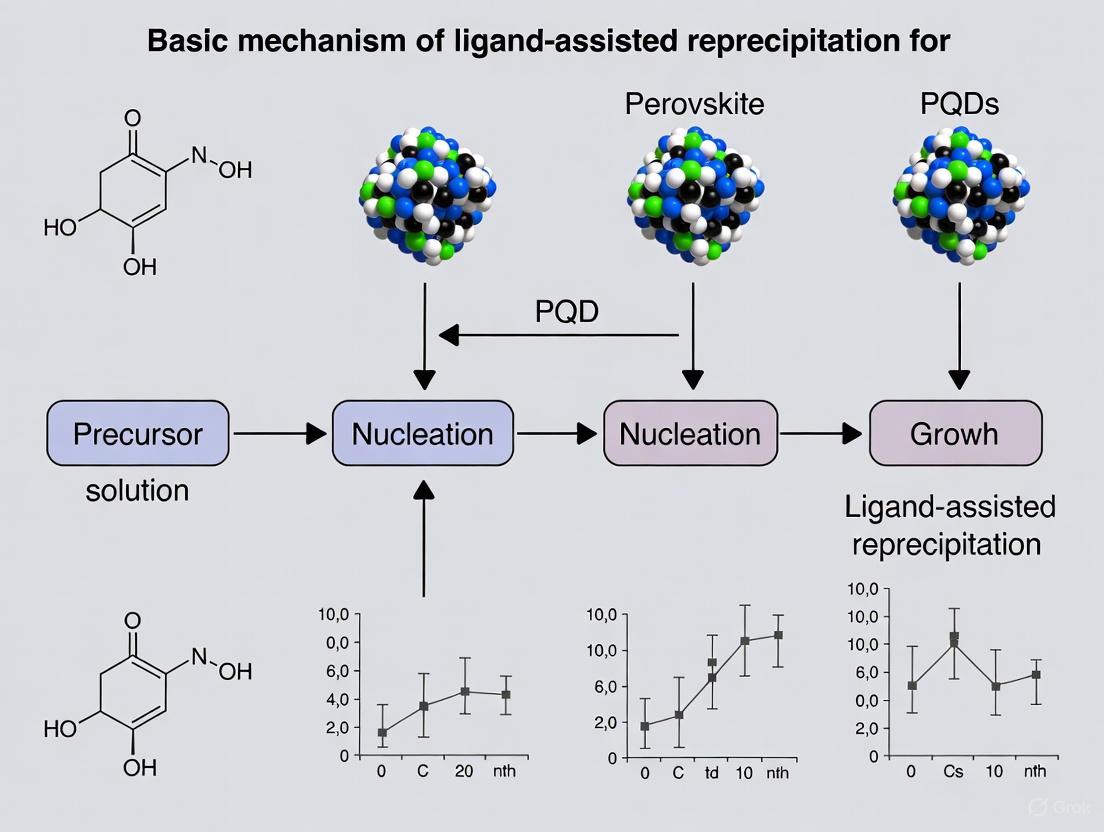
This article provides a comprehensive analysis of the Ligand-Assisted Reprecipitation (LARP) method for synthesizing perovskite quantum dots (PQDs), a promising class of nanomaterials for biomedical and clinical research.
Ligand-Assisted Reprecipitation for Perovskite Quantum Dots: Mechanism, Synthesis, and Biomedical Applications
Abstract
This article provides a comprehensive analysis of the Ligand-Assisted Reprecipitation (LARP) method for synthesizing perovskite quantum dots (PQDs), a promising class of nanomaterials for biomedical and clinical research. It covers the foundational principles of LARP, including the thermodynamic and kinetic mechanisms governing nanocrystal formation. The content details advanced methodological approaches and their applications in creating PQDs for biosensing and drug development. It further addresses critical challenges in stability and reproducibility, presenting ligand engineering and high-throughput optimization strategies. Finally, the article examines validation frameworks and compares LARP with other synthesis techniques, offering researchers a complete guide to harnessing PQDs for next-generation diagnostic and therapeutic applications.
Unraveling LARP: Core Principles and Mechanistic Insights into PQD Nucleation
Ligand-Assisted Reprecipitation (LARP) has emerged as a foundational synthetic method for producing perovskite nanocrystals (PNCs) and quantum dots (PQDs). This room-temperature technique distinguishes itself from traditional hot-injection methods by offering a simpler, scalable, and low-temperature approach that eliminates the need for high-temperature precursors and complex setups [1]. The core principle of LARP involves the controlled crystallization of perovskite precursors from a polar solvent into a non-polar anti-solvent, where ligands dynamically adsorb to the growing crystal surfaces to control nanocrystal size, stabilize the structure, and passivate surface defects. The significance of LARP extends across multiple application domains, enabling the synthesis of quantum dots for high-resolution micro-displays [2], biosensors for pathogen detection [3], fluorescent sensors for food safety monitoring [4], and lead-free alternatives for environmentally sustainable optoelectronics [5]. This technical guide delineates the fundamental mechanisms, experimental protocols, and parameter optimizations that define the LARP process within the broader context of PQD research.
Fundamental Mechanisms of LARP
The LARP process operates on the principle of supersaturation-driven crystallization mediated by molecular ligands. The transformation from a homogeneous precursor solution to discrete quantum dots involves a sequence of coordinated physicochemical events, which can be visualized in the following mechanistic diagram:
LARP Mechanistic Pathway to Quantum Dot Formation
This mechanistic pathway illustrates the sequential process from precursor preparation to final quantum dot formation. The initial stage involves dissolving perovskite precursors in a polar solvent such as dimethyl sulfoxide (DMSO) or acetonitrile (ACN), creating a homogeneous mixture of metal cations (e.g., Pb²⁺, Bi³⁺) and halide anions (e.g., Br⁻, I⁻) coordinated with ligand molecules [1] [5]. Upon injection into a non-polar anti-solvent (typically toluene or chloroform), the solubility of precursors dramatically decreases, creating a state of rapid supersaturation [6]. This instantaneous supersaturation triggers the spontaneous formation of critical nuclei, which quickly evolve into nanoclusters with nascent perovskite crystal structures.
The growth phase represents the most critical regulatory step, where ligand dynamics determine the final nanocrystal characteristics. Long-chain organic ligands, predominantly oleic acid (OA) and oleylamine (OAm) or octylamine (OctAm), diffuse through the solution and competitively adsorb to the surface of growing nanocrystals [6]. This ligand shell acts as a dynamic barrier that modulates crystal growth by controlling ion addition rates, ultimately determining the final particle size and size distribution. The ligands simultaneously passivate surface defects and coordinatively unsaturated sites, which is essential for achieving high photoluminescence quantum yields (PLQYs) reported up to 62% for Cs₃Bi₂Br₉ PNCs [5] and exceeding 90% for optimized CsPbBr₃ PQDs [2]. The diffusion kinetics of these ligands throughout the reaction system has been identified as a crucial factor determining the structural and functional properties of the resulting PNCs [6].
Experimental Protocols and Methodologies
Standardized LARP Synthesis Workflow
The following diagram outlines the generalized experimental workflow for LARP synthesis, integrating both material preparation and purification stages:
LARP Experimental Workflow
This workflow provides the structural framework for specific LARP protocols. The actual experimental execution varies based on the target perovskite composition, as detailed in the following section.
Detailed Protocol for CsPbBr₃ Nanocrystals
For the model system of all-inorganic CsPbBr₃ PNCs, the LARP protocol involves specific reagent combinations and processing conditions. In a typical synthesis, cesium precursors (Cs⁺ salts) and lead bromide (PbBr₂) are dissolved in a polar solvent such as DMF or DMSO, with precise stoichiometric ratios controlling the final composition [6]. The ligand system typically consists of oleic acid (OA) and oleylamine (OAm) in varying ratios, which critically influence nucleation and growth kinetics. This precursor solution is then rapidly injected into toluene under vigorous stirring, immediately producing a brightly luminescent colloidal suspension indicating PNC formation. The reaction mixture is often temperature-quenched in an ice-water bath to arrest growth and stabilize the desired size distribution. Subsequent purification involves centrifugation at 6000-9000 rpm for 10-15 minutes to remove aggregates and unreacted precursors, followed by redispersion in non-polar solvents such as hexane or chloroform [6] [2]. High-throughput robotic synthesis platforms have revealed that the delicate adjustment of ligand ratios and antisolvent selection is particularly crucial for controlling the growth behaviors and colloidal stability of LARP-synthesized PNCs [6].
Protocol for FAPbI₃ Colloidal Quantum Dots
The synthesis of formamidinium lead iodide (FAPbI₃) CQDs demonstrates the versatility of LARP for hybrid organic-inorganic perovskites. In a modified LARP approach, PbI₂ (0.1 mmol, 0.045 g) is dissolved in anhydrous acetonitrile (2 mL) with OA (200 μL) and OctAm (20 μL) under continuous stirring [1]. Separately, a formamidinium iodide (FAI) solution is prepared by mixing FAI (0.08 mmol, 0.0137 g) with OA (40 μL), OctAm (6 μL), and ACN (0.5 mL). The FAI solution is added dropwise to the PbI₂ solution, and the resulting mixture is injected into preheated toluene (10 mL, 70°C) under rapid stirring, followed immediately by quenching in an ice/water bath. The crude product is collected via ultracentrifugation at 9000 rpm for 15 minutes, then redispersed in hexane (1 mL) and centrifuged again at 6000 rpm for 10 minutes to remove agglomerated particles, yielding purified FAPbI₃ CQDs with average sizes of approximately 11 nm [1]. This protocol highlights the importance of precursor segregation and temperature control in achieving phase-pure FAPbI₃ quantum dots with optimal optical properties.
Protocol for Lead-Free Cs₃Bi₂Br₉ Nanocrystals
For environmentally sustainable alternatives, LARP effectively produces lead-free perovskite derivatives. Cs₃Bi₂Br₉ PNCs are synthesized using DMSO and chloroform as the solvent and anti-solvent pair, respectively [5]. Precursors including cesium salts and bismuth bromide are dissolved in DMSO with oleylamine and oleic acid as ligands. The concentration of oleic acid demonstrates significant influence over the crystal structure and bandgap energy, which can be tuned from 3.85 eV to 3.29 eV through ligand concentration variations [5]. Synthesis temperature represents another critical parameter that governs the direct and indirect bandgap nature of the resulting PNCs. After rapid injection into chloroform, the nanocrystals are purified through centrifugation and can achieve exceptional PLQYs up to 62% [5]. This protocol establishes LARP as a viable method for producing high-efficiency lead-free alternatives to conventional lead-halide perovskites.
Critical Parameter Optimization
The controlled synthesis of PNCs via LARP requires precise optimization of multiple interconnected parameters. The following table summarizes the key chemical variables and their impact on final product characteristics:
Table 1: Optimization of LARP Chemical Parameters
| Parameter | Impact on Synthesis | Effect on PNC Properties | Optimal Range |
|---|---|---|---|
| Ligand Type & Ratio | Controls nucleation rate & growth kinetics [6] | Determines size distribution, stability & PLQY [6] | OA:OAm (1:1 to 10:1) [6] |
| Anti-Solvent Selection | Affects supersaturation rate & nucleation density [7] | Influences crystal phase, emission wavelength [7] | Toluene, Chloroform [6] [5] |
| Precursor Concentration | Determines nucleation density & growth duration | Affects particle size, size distribution & yield | 0.05-0.2 M [1] |
| Temperature | Modulates reaction kinetics & diffusion rates [5] | Controls bandgap nature, PL intensity [5] | Room temp to 70°C [1] |
| Purification Method | Removes excess ligands & unreacted precursors [1] | Affects inter-dot spacing, charge transport [1] | MeOAc volume optimization [1] |
Beyond these chemical parameters, processing conditions significantly influence the structural and optical properties of LARP-synthesized PNCs. Injection rate determines the initial supersaturation level, with faster injection producing higher nucleation densities and consequently smaller nanocrystals. Stirring efficiency ensures homogeneous mixing during the critical nucleation phase, preventing localized aggregation and ensuring narrow size distributions. Post-synthesis processing, including purification with methyl acetate (MeOAc) and ligand exchange protocols, enables further optimization of surface chemistry and thin-film properties for specific applications [1]. For instance, sequential solid-state multiligand exchange using 3-mercaptopropionic acid (MPA) and formamidinium iodide (FAI) has been shown to significantly enhance the current density and power conversion efficiency of photovoltaic devices by approximately 28% by reducing inter-dot spacing and improving thin-film conductivity [1].
Advanced LARP Techniques and Modifications
High-Throughput Robotic Synthesis
The integration of high-throughput robotic synthesis platforms with machine learning algorithms represents a cutting-edge advancement in LARP methodology. This approach enables rapid exploration of the multidimensional synthesis space for complex compositions such as CsPb(BrₓI₁₋ₓ)₃ PNCs, where traditional one-variable-at-a-time optimization proves prohibitively time-consuming [7]. By systematically varying parameters including halide ratios, ligand concentrations, antisolvent compositions, and processing conditions, these platforms generate extensive datasets that machine learning algorithms, particularly SHAP analysis, process to identify critical parameter influences and predictive synthesis models [6]. This data-driven approach has revealed inherent disparities between the latent features in machine-learning-refined synthesis space and the manifested functionality space, highlighting how the colloidal nature in the precursor state governs both synthesizability and functionality control of LARP-PNCs [7]. Such advanced methodologies not only accelerate optimization but provide fundamental insights into the complex interparameter relationships that govern LARP synthesis outcomes.
Ligand Engineering and Exchange Strategies
Surface ligand management has emerged as a crucial aspect of advanced LARP protocols, directly impacting both synthetic control and application performance. Research has demonstrated that short-chain ligands cannot produce functional PNCs with desired sizes and shapes, whereas long-chain ligands provide homogeneous and stable PNCs with superior optical properties [6]. However, these insulating long-chain ligands hinder charge transport in electronic devices, necessitating sophisticated exchange strategies. Sequential solid-state multiligand exchange processes have been developed where solutions of short-chain ligands like 3-mercaptopropionic acid (MPA) and formamidinium iodide (FAI) in methyl acetate replace the original long-chain octylamine (OctAm) and oleic acid (OA) ligands [1]. This approach achieves approximately 85% ligand removal confirmed by ¹H NMR while effectively passivating surface defects, significantly enhancing charge transport in subsequent device applications [1]. Such ligand engineering strategies preserve the excellent optical properties of LARP-synthesized PNCs while enabling their integration into high-performance optoelectronic devices.
Research Reagent Solutions
Successful LARP synthesis requires precise selection and combination of specialized reagents, each fulfilling specific functions in the synthetic pathway:
Table 2: Essential Research Reagents for LARP Synthesis
| Reagent Category | Specific Examples | Function in LARP Process |
|---|---|---|
| Precursor Salts | PbI₂, PbBr₂, CsX, FAI, BiX₃ [1] [5] | Provides metal & halide ions for perovskite lattice formation |
| Polar Solvents | DMSO, DMF, ACN [1] [5] | Dissolves precursor salts to create homogeneous solution |
| Non-Polar Anti-Solvents | Toluene, Chloroform, Hexane [6] [1] [5] | Induces supersaturation & nucleation upon injection |
| Acidic Ligands | Oleic Acid (OA), Octanoic Acid [6] [1] | Binds to metal sites, controls growth, passivates surfaces |
| Basic Ligands | Oleylamine (OAm), Octylamine (OctAm) [6] [1] | Binds to halide sites, controls nucleation, stabilizes colloid |
| Purification Solvents | Methyl Acetate (MeOAc), Acetone [1] | Removes excess ligands & precursors during purification |
The Ligand-Assisted Reprecipitation method represents a versatile and robust platform for the synthesis of perovskite nanocrystals and quantum dots with tailored optoelectronic properties. Through precise control of chemical parameters—including ligand ratios, antisolvent selection, precursor concentration, and processing conditions—researchers can navigate the complex synthesis space to achieve target functionalities across diverse applications from photovoltaics to sensing. The mechanistic understanding of ligand-mediated nucleation and growth, coupled with advanced techniques such as high-throughput robotic synthesis and machine learning optimization, continues to expand the boundaries of LARP synthesis. Furthermore, the development of sophisticated ligand exchange protocols addresses critical challenges in charge transport, enabling the transition from colloidal stability to device functionality. As LARP methodologies evolve, particularly through the refinement of lead-free compositions and integration with patterning technologies for device fabrication, this synthetic approach promises to remain indispensable for advancing perovskite quantum dot research and applications.
In the synthesis of perovskite quantum dots (PQDs), ligands are not mere spectators but are fundamental directors of the nucleation and growth processes. The ligand-assisted reprecipitation (LARP) method has garnered significant attention as a feasible route for the mass production of these nanocrystals due to its relative simplicity and effectiveness [6]. At the heart of this method, and the broader field of PQD research, lies the critical partnership between oleic acid (OA) and oleylamine (OAm). These long-chain ligands are indispensable for controlling the crystallization kinetics, passivating surface defects, and determining the ultimate structural and optical properties of the resulting nanocrystals [8] [9]. This guide delves into the fundamental mechanisms by which OA and OAm operate, providing a detailed technical examination of their roles in stabilizing the delicate phases of PQD formation and maturation, thereby enabling the advancement of next-generation optoelectronic devices.
The Chemical Functions of OA and OAm Ligands
The synergistic interaction between OA and OAm forms the cornerstone of successful PQD synthesis. Their individual and cooperative chemical behaviors are crucial for guiding the entire lifecycle of the nanocrystals, from initial precursor dissolution to final surface passivation.
Acid-Base Synergy and Proton Transfer: In the colloidal synthesis environment, OA and OAm exist in a dynamic equilibrium. OA, a carboxylic acid, can deprotonate to form oleate (OA⁻), while OAm, an amine, can protonate to form oleylammonium (OAmH⁺). This pair engages in a continuous proton transfer process: OA⁻ + OAmH⁺ → OA + OAm [8]. This equilibrium is pivotal for the ligand binding dynamics on the perovskite surface and can be manipulated by the introduction of other acidic or basic components.
Surface Binding and Coordination: The ligands bind to the growing crystal surfaces in a complementary fashion. OA chelates with lead (Pb²⁺) atoms on the PQD surface, forming a coordinate covalent bond [9]. Conversely, OAm interacts with halide ions (e.g., I⁻, Br⁻) primarily through hydrogen bonding [9]. This dual passivation effectively neutralizes charged surface sites that would otherwise act as traps for charge carriers, thereby enhancing photoluminescence quantum yield (PLQY) and stability.
Steric Stabilization: The long hydrocarbon chains (C18) of both OA and OAm extend outward from the nanocrystal surface, creating a protective hydrophobic shell [6]. This shell physically impedes the close approach and aggregation of individual PQDs, maintaining their colloidal stability in non-polar solvents. The chain length is critical; short-chain ligands cannot provide sufficient steric hindrance to produce functional, stable PNCs with desired sizes and shapes [6].
Table 1: Primary Functions of OA and OAm Ligands in PQD Synthesis
| Ligand | Chemical Role | Binding Target | Impact on Synthesis |
|---|---|---|---|
| Oleic Acid (OA) | Carboxylic acid; Proton donor | Pb²⁺ ions on PQD surface [9] | Controls crystal growth; Passivates metal-site defects |
| Oleylamine (OAm) | Amine; Proton acceptor | Halide ions (I⁻, Br⁻) [9] | Promotes nucleation; Passivates halide-site defects |
| OA/OAm Pair | Acid-base equilibrium; Steric hindrance | Overall PQD surface | Provides colloidal stability; Determines final size & morphology [6] |
Quantitative Impact on PQD Properties and Stability
The precise ratios and concentrations of OA and OAm are not arbitrary; they are powerful levers that directly control the structural and optical characteristics of the resulting PQDs. High-throughput robotic synthesis studies have systematically explored these effects, revealing that the ligand ratio profoundly influences particle size, size distribution, and most critically, the colloidal and phase stability of the nanocrystals [6].
An imbalance in the OA/OAm system can be detrimental. Excessive amines or the use of polar antisolvents can trigger a phase transformation of the PQDs into a Cs-rich non-perovskite structure, which exhibits poorer emission functionalities and broader size distributions [6]. Furthermore, the dynamic binding nature of these traditional ligands means they can easily desorb from the surface, especially during purification with polar antisolvents. This ligand loss creates unsaturated "active sites" on the perovskite ionic lattice, accelerating detrimental processes like Ostwald ripening and ultimately leading to the degradation of optical properties [8] [9].
Table 2: Impact of Ligand Parameters on CsPbX3 PQD Characteristics
| Parameter | Optimal Range / Condition | Observed Effect on PQDs |
|---|---|---|
| Ligand Chain Length | Long-chain (e.g., C18) | Homogeneous, stable PNCs; short-chain ligands fail to produce functional PNCs [6] |
| OA/OAm Ratio | Balanced (varies by specific synthesis) | Controls crystal phase, size, and prevents transformation to non-perovskite structures [6] [9] |
| Ligand Binding Strength | Strong binding energy | Suppresses Ostwald ripening; enhances PLQY and environmental stability [8] |
| Ligand Stability | Resists polar antisolvents | Maintains passivation during purification; prevents defect formation and fusion [8] |
Advanced Ligand Engineering Strategies
Recognizing the inherent limitations of OA and OAm, particularly their dynamic binding and susceptibility to desorption, the field has advanced towards more robust ligand engineering strategies. These approaches aim to retain the beneficial roles of ligands while overcoming instability issues.
A prominent strategy is the post-synthesis ligand exchange, where weakly bound OA/OAm molecules are replaced with ligands that have stronger anchoring groups. For instance, the sulfonic acid group in 2-naphthalene sulfonic acid (NSA) has a calculated binding energy with Pb of 1.45 eV, which is stronger than that of OAm (1.23 eV) [8]. The naphthalene ring also provides large steric hindrance, collectively inhibiting overgrowth and stabilizing the nanocrystals. In a further step, inorganic ligands like ammonium hexafluorophosphate (NH₄PF₆) can be used. The PF₆⁻ anion exhibits an exceptionally high binding energy of 3.92 eV, which strongly passivates the surface and significantly improves the charge transport between QDs in a film [8].
Another innovative approach is the use of complementary dual-ligand systems. For example, a combination of trimethyloxonium tetrafluoroborate and phenylethyl ammonium iodide can form a hydrogen-bonded network on the PQD surface [10]. This system not only stabilizes the surface lattice but also improves electronic coupling between quantum dots in solid films, leading to record efficiencies in devices like quantum dot solar cells [10].
Experimental Protocols for Ligand-Assisted Synthesis
Standard LARP Synthesis with OA/OAm
A typical LARP synthesis of CsPbBr₃ nanocrystals involves creating a precursor solution in a polar solvent (like DMF or DMSO) containing Cs⁺, Pb²⁺, and Br⁻ ions. This solution is then rapidly injected into a poorly coordinating antisolvent (like toluene) under vigorous stirring. The antisolvent contains OA and OAm, which immediately act to control the crystallization process [6].
Key Protocol Steps:
- Precursor Preparation: Dissolve CsBr and PbBr₂ in DMF to form the perovskite precursor solution.
- Ligand Solution: Prepare the antisolvent (e.g., toluene) with specific volumes of OA and OAm. The ratio of OA to OAm is a critical parameter that requires optimization for the target nanocrystal size and phase [6] [9].
- Reprecipitation and Nucleation: Quickly inject the precursor solution into the antisolvent/ligand mixture. The sudden drop in solubility causes supersaturation, triggering rapid nucleation.
- Growth and Stabilization: The OA and OAM ligands immediately coordinate with the newly formed nuclei, limiting growth and preventing aggregation. The reaction mixture is typically centrifuged to isolate the synthesized PQDs.
Inhibition of Ostwald Ripening with NSA
To overcome the limitations of OA/OAm, an advanced protocol introduces a strong-binding ligand like 2-Naphthalene Sulfonic Acid (NSA) after the initial nucleation phase [8].
Detailed Methodology:
- Initial Synthesis: Begin with a standard hot-injection or LARP method using OA and OAm.
- Post-Nucleation Ligand Injection: After the initial nucleation of QDs, inject a solution of NSA (e.g., 0.6 M in toluene) into the reaction mixture.
- Reaction Mechanism: The NSA, being a stronger acid with a higher dissociation constant, pushes the proton transfer equilibrium (OA⁻ + OAmH⁺ → OA + OAm), facilitating the debonding of weak OA/OAm ligands from the QD surface [8].
- Surface Binding: The sulfonic acid group of NSA, with its higher binding energy to Pb (1.45 eV), replaces the original OAm ligands, passivating the surface more effectively and providing greater steric hindrance from its naphthalene ring.
- Purification Enhancement: Further stability during purification is achieved by adding ammonium hexafluorophosphate (NH₄PF₆), whose PF₆⁻ anion has a very high binding energy (3.92 eV), to the polar antisolvent used for washing, preventing ligand loss and defect formation [8].
Table 3: The Scientist's Toolkit - Essential Reagents for Ligand-Based PQD Synthesis
| Reagent / Material | Function in Synthesis | Technical Notes |
|---|---|---|
| Oleic Acid (OA) | Long-chain carboxylic acid; Binds to Pb²⁺ sites; Controls crystal growth [9] | Must be used with amine; Ratio to OAm is critical for phase stability [6] |
| Oleylamine (OAm) | Long-chain amine; Binds to halide sites; Promotes nucleation [9] | Dynamic binding can lead to desorption; source of instability [8] |
| 2-Naphthalene Sulfonic Acid (NSA) | Strong-binding ligand; Suppresses Ostwald ripening [8] | Higher Pb-binding energy (1.45 eV) than OAm; introduces steric hindrance [8] |
| Ammonium Hexafluorophosphate (NH₄PF₆) | Inorganic ligand for post-synthesis exchange; Enhances charge transport [8] | Very high binding energy (3.92 eV); improves stability during purification [8] |
| Polar Solvent (e.g., DMF) | Dissolves inorganic precursor salts for LARP [6] | Enables creation of high-concentration precursor solutions |
| Non-Polar Antisolvent (e.g., Toluene) | Triggers reprecipitation and nucleation in LARP [6] | Must be miscible with polar solvent; contains initial OA/OAm ligands |
OA and OAm serve as the foundational ligands in the synthesis of perovskite quantum dots, masterfully directing the processes of nucleation and growth through their synergistic acid-base chemistry and steric stabilization. However, their dynamic binding nature presents a significant limitation for long-term stability and device performance. The future of ligand engineering in PQD research lies in moving beyond this traditional pair towards sophisticated strategies employing strong-binding organic molecules, complementary dual-ligand systems, and robust inorganic ligands. These advanced approaches, built upon the fundamental understanding of OA and OAm mechanisms, are paving the way for the development of highly stable and efficient perovskite nanocrystals capable of meeting the rigorous demands of commercial optoelectronic applications.
Reprecipitation is a fundamental phase transformation process where a dissolved solute or a metastable solid phase dissolves and a more stable solid phase precipitates from the solution or via an intermediate state. This mechanism plays a crucial role across diverse scientific fields, from materials science to geochemistry and nanotechnology. Within the context of ligand-assisted reprecipitation for perovskite quantum dots (PQDs) research, understanding the thermodynamic and kinetic drivers is essential for controlling particle size, morphology, and functional properties. The reprecipitation process is governed by the intricate balance between the thermodynamic driving force for phase transformation and the kinetic pathways that determine the rate and mechanism of this transformation.
In materials science, reprecipitation reactions are widely employed to enhance materials performance by controlling the microstructure evolving during precipitation [11]. In the specific case of PQDs, the ligand-assisted reprecipitation (LARP) method provides a simple route for mass-production of high-quality nanocrystals, rendering promising performances in various optoelectronic applications [12]. The precise control of reaction kinetics allows researchers to tailor the microstructure and thus tune the material properties for specific applications.
Thermodynamic Fundamentals of Reprecipitation
Classical Nucleation Theory
The thermodynamic basis for reprecipitation begins with classical nucleation theory, which describes the formation of stable precipitate particles from a supersaturated matrix. The rate of nucleation (Ȧ) is dominated by an energy barrier ΔG* for the formation of a particle of critical size r* above which the particle becomes stable [11]. This relationship is expressed as:
Ȧ ∝ exp(-ΔG/kT)*
where k is the Boltzmann constant and T is the absolute temperature. For a precipitation reaction, both ΔG* and r* are functions of the change in chemical Gibbs energy Δg~c~(x~α,m~,x~β,p~) upon nucleation, where -Δg~c~(x~α,m~,x~β,p~) represents the chemical driving force for nucleation for given compositions of the α-phase matrix and the β-phase precipitate, and of the interface energy γ per unit area [11].
Competing Energy Contributions
The formation and stability of a precipitate-phase particle are defined by two counteracting thermodynamic factors [11]:
Energy release: The release of energy due to the decomposition of the supersaturated matrix phase into solute-depleted matrix phase and solute-rich precipitate phase. This energy release can be described as a difference of chemical Gibbs energies of the homogeneous phases, defined by their respective compositions.
Energy increase: The increase in energy due to the development of a particle-matrix interface.
These competing contributions are represented in rate equations for nucleation and growth through two key concepts: the energy barrier for nucleation and the Gibbs-Thomson effect that affects particle growth rate.
Gibbs-Thomson Effect
For small particles with a large ratio of interface area to particle volume, the equilibrium between the matrix and precipitate phases deviates significantly from the state of equilibrium between bulk phases. This Gibbs-Thomson effect can be expressed by composition functions that depend on particle size and interface energy [11]:
x~α,int~ = x~α,int~(r,γ) and x~β,int~ = x~β,int~(r,γ)
The Gibbs-Thomson effect in a binary system is often described by the equation:
x~α,int~(r) = x~α~(r→∞) exp(2γV~mol~^β^/RT × 1/r)
where x~α~(r→∞) is the solute concentration of the α phase in the reference state of equilibrium between the α phase and the β phase with r→∞, V~mol~^β^ is the mean molar volume of the β-phase, and R is the gas constant [11]. This equation highlights how interfacial energy becomes increasingly important at the nanoscale, which is particularly relevant for PQD synthesis where control of quantum dot size is critical for optoelectronic properties.
Kinetic Principles Governing Reprecipitation
Growth Kinetics
The growth rate of spherical particles in a binary system follows a diffusion-controlled kinetics model described by [11]:
dr/dt = (x~α,m~ - x~α,int~)/(k'x~β,int~ - x~α,int~) × D/r
where D is the diffusion coefficient of the solute component in the matrix, and x~α,m~, x~α,int~, and x~β,int~ are the atom fractions of solute in the α-phase matrix remote from the particle, in the α-phase matrix at the particle-matrix interface, and in the β-phase particle at the interface, respectively. The factor k' accounts for the difference in molar volume between the α phase and the β phase. When x~α,m~ > x~α,int~, the particle is stable and grows; when x~α,m~ < x~α,int~, the particle becomes unstable and shrinks [11].
Alternative Kinetic Pathways
Recent research has revealed that reprecipitation does not always follow classical dissolution-transport-precipitation pathways. In some systems, element transfer during mineral dissolution and reprecipitation can occur through an alkali-Al-Si-rich amorphous material that forms directly by depolymerization of the crystal lattice [13]. This amorphous material occupies large volumes in an interconnected porosity network, and precipitation of product minerals occurs directly by repolymerization of the amorphous material at the product surface. This mechanism allows for significantly higher element transport and mineral reaction rates than aqueous solutions, with major implications for reaction kinetics in various systems [13].
Johnson-Mehl-Avrami (JMA) Kinetics Model
For the analysis of precipitation kinetics, the Johnson-Mehl-Avrami (JMA) model provides a framework applicable to both isothermal and non-isothermal analysis [14]. The fraction of transformation, Y, is described by:
Y = 1 - exp(-kt^n^)
where n is the Avrami exponent that depends on precipitate growth modes, and k is the rate parameter. For non-isothermal transformations, the integrated form becomes [14]:
Y = 1 - exp[-(k~0~RT^2^/ϕQ)exp(-Q/RT)]^n^
where R is the gas constant, φ is the cooling rate, and Q is the activation energy of the reaction. The Avrami exponent typically falls in the range of 1.5-2.3 for spherical or irregular growth [14], which is relevant for understanding the kinetics of PQD formation via LARP processes.
Table 1: Key Kinetic Parameters in Reprecipitation Processes
| Parameter | Symbol | Typical Range | Significance |
|---|---|---|---|
| Avrami exponent | n | 1.5-2.3 [14] | Determines growth morphology (spherical/irregular) |
| Activation energy | Q | System-dependent | Temperature dependence of reaction rate |
| Rate coefficient | k(T) | k~0~exp(-Q/RT) [14] | Combined nucleation and growth rate parameter |
| Diffusion coefficient | D | Temperature-dependent | Controls solute transport to growing particles |
Ligand-Assisted Reprecipitation for Perovskite Quantum Dots
Fundamentals of LARP Synthesis
The ligand-assisted reprecipitation (LARP) method provides a simple synthetic route enabling mass-production of high-quality perovskite nanocrystals (PNCs) compared to complex hot-injection methods [12]. This technique is particularly valuable for inorganic cesium lead bromide (CsPbBr~3~) perovskite nanocrystals, which show promising performance in various optoelectronic applications. The LARP process involves controlled precipitation of nanocrystals from precursor solutions through the introduction of antisolvents, with ligands playing a critical role in directing nanocrystal growth and stabilization.
In LARP synthesis, ligands serve multiple functions: they control particle growth, prevent aggregation, passivate surface defects, and determine the colloidal stability of the resulting nanocrystals. The diffusion of ligands within the reaction system crucially determines the final structures and functionalities of the PNCs [12]. Understanding the thermodynamic and kinetic aspects of ligand interaction with growing crystal surfaces is essential for controlling the LARP process.
Ligand Selection and Optimization
Research using high-throughput automated experimental platforms has systematically explored the influence of ligands—including chain lengths, concentration, and ratios—on particle growth and consequent functionalities of PNCs [12]. Key findings include:
- Chain length effects: Short-chain ligands (e.g., octanoic acid-octylamine) generally cannot produce functional PNCs with desired sizes and shapes, whereas long-chain ligands (e.g., oleic acid-oleylamine) provide homogeneous and stable PNCs [12].
- Stoichiometric balance: Excessive amines or polar antisolvent can transform PNCs into a Cs-rich non-perovskite structure with poorer emission functionalities and larger size distributions [12].
- Acid-base pairs: The combination of carboxylic acids and amines as ligand pairs is crucial for controlling the surface chemistry and growth kinetics of PNCs.
Table 2: Ligand Systems in LARP Synthesis of Perovskite Nanocrystals
| Ligand Pair | Chain Length | PNC Characteristics | Functionality |
|---|---|---|---|
| Oleic acid-Oleylamine | Long (C18) | Homogeneous, stable PNCs [12] | Optimal size control, good emission properties |
| Octanoic acid-Octylamine | Short (C8) | Non-functional PNCs [12] | Poor size control, undesirable structures |
| Balanced ratio | - | Desired perovskite structure | Good optical properties, narrow size distribution |
| Excessive amine | - | Cs-rich non-perovskite structure [12] | Poorer emission, larger size distribution |
Experimental Methodologies for Studying Reprecipitation
Characterization Techniques
A comprehensive understanding of reprecipitation mechanisms requires the application of multiple characterization techniques:
- Thermal Analysis: Differential Thermal Analysis (DTA) can determine transformation temperatures and measure heat flow during reprecipitation reactions. The fraction of precipitation Y(T) at temperature T is given by Y(T) = A(T)/A(T~f~), where A(T) is the area under the DTA peak between the initial temperature T~i~ and temperature T, and A(T~f~) is the total peak area between T~i~ and the final temperature T~f~ [14].
- Electron Microscopy: Field Emission Gun Scanning Electron Microscopy (FEG-SEM) investigates evolution in morphology and distribution of reprecipitated particles [14]. High-resolution transmission electron microscopy (HR-TEM) combined with focused ion beam (FIB) sectioning can visualize reaction zones at near-atomic resolution [13].
- SIMS Mapping: Nano-secondary ion mass spectrometer (SIMS) mappings provide elemental distribution information across reaction interfaces [13].
High-Throughput Synthesis Approaches
For ligand-assisted reprecipitation studies, implementing high-throughput automated experimental platforms enables systematic exploration of synthesis parameter spaces [12]. This approach allows researchers to efficiently map the influence of multiple variables—including ligand concentrations, ratios, solvent compositions, and reaction conditions—on the resulting nanocrystal characteristics. The data generated from such high-throughput studies provides guidance for optimizing synthesis routes to achieve desired PNC properties.
Computational and Modeling Approaches
Kampmann-Wagner-Numerical (KWN) Modeling
The KWN-type modeling approach computes the evolution of particle size distribution through numerical integration of composition-dependent nucleation rates and size- and composition-dependent growth rates for discrete time steps and discrete particle-size classes [11]. This method requires numerous evaluations of thermodynamic relations, making computational efficiency a key consideration. A generally valid method for combined, inherently consistent, numerical evaluation of nucleation barrier and Gibbs-Thomson effect has been developed based on the Gibbsian treatment of nucleation and growth [11].
Phase Field Modeling
Phase field modeling visualizes microstructure development and quantifies physical phenomena such as impingement, particle coalescence, or splitting by solving nonlinear time-dependent phase field equations within the framework of irreversible thermodynamics [14]. While powerful, this approach requires extensive experimental work to set realistic values for boundary conditions and determine material parameters, making application to new alloys or materials challenging.
Challenges in Computational Modeling
Computational modeling of reprecipitation processes faces several challenges [14]:
- Computational expense: Full coupling with CALPHAD for calculation of nucleation driving force is computationally expensive.
- Parameter availability: Many physical constants (element diffusion coefficients, surface energies, interface kinetic coefficients, driving forces for phase transformations) are not always readily available for complex compositions.
- Application to new systems: For new alloys or materials, calibration and independent experimental measurements are needed to determine model parameters with high fidelity and minimum overfitting.
Visualization of Reprecipitation Mechanisms
Ligand-Assisted Reprecipitation Mechanism for PQDs
Experimental Workflow for LARP Synthesis Optimization
Research Reagent Solutions for LARP Experiments
Table 3: Essential Research Reagents for Ligand-Assisted Reprecipitation
| Reagent Category | Specific Examples | Function in LARP Process | Impact on PNC Properties |
|---|---|---|---|
| Precursor Salts | CsPbBr~3~ | Provides primary perovskite composition | Determines crystal structure and basic composition |
| Solvents | DMSO, DMF | Dissolves precursor salts | Affects precursor concentration and reaction kinetics |
| Antisolvents | Toluene, Chloroform | Induces supersaturation and nucleation | Controls nucleation rate and final particle size |
| Long-Chain Ligands | Oleic acid (OA), Oleylamine (OAm) [12] | Directs growth and stabilizes nanocrystals | Produces homogeneous, stable PNCs with desired optoelectronic properties |
| Short-Chain Ligands | Octanoic acid (OctA), Octylamine (OctAm) [12] | Alternative ligand system | Typically cannot produce functional PNCs with desired characteristics |
| Stoichiometry Modifiers | Excess CsBr or PbBr~2~ | Controls final composition | Can lead to non-perovskite structures if unbalanced [12] |
The reprecipitation mechanism is governed by the complex interplay between thermodynamic driving forces and kinetic pathways. In the specific case of ligand-assisted reprecipitation for perovskite quantum dots research, understanding these fundamental principles enables precise control over nanocrystal size, morphology, and functional properties. Thermodynamic factors—particularly the chemical driving force for nucleation and the interface energy governed by the Gibbs-Thomson effect—determine the feasibility and direction of reprecipitation processes. Meanwhile, kinetic factors—including diffusion rates, surface kinetics, and ligand exchange dynamics—control the rate and pathway of the transformation.
The ligand-assisted reprecipitation method represents a significant advancement in perovskite nanocrystal synthesis, offering a simpler route to mass-production compared to traditional hot-injection techniques. However, successful implementation requires careful optimization of ligand systems, with long-chain ligands such as oleic acid and oleylamine proving essential for producing functional nanocrystals with desired properties. The insights from fundamental studies of reprecipitation mechanisms across materials science and geochemistry provide valuable principles that can be applied to the continued development and optimization of PQD synthesis for advanced optoelectronic applications.
The ligand-assisted reprecipitation (LARP) method has emerged as a pivotal technique for the synthesis of perovskite quantum dots (PQDs), prized for its feasibility for mass production and room-temperature processing [6] [15] [16]. This method hinges on the precise control of a trifecta of parameters: solvents, antisolvents, and ligand ratios. These components collectively govern the supersaturation, nucleation, and growth stages of nanocrystal formation, thereby dictating the final crystal structure, dimensionality, and optoelectronic properties of the resulting PQDs [6] [17]. Understanding the fundamental mechanisms of LARP is essential for advancing PQD research, as the intrinsic ionic character and low formation energy of perovskites make their synthesis highly sensitive to the chemical environment [17] [18]. This guide provides an in-depth analysis of how these critical parameters control crystal structure, supported by quantitative data, detailed protocols, and mechanistic insights for researchers and scientists.
The Core Mechanism of Ligand-Assisted Reprecipitation (LARP)
The LARP synthesis of PQDs is a rapid process that can be conceptualized in three key stages, leading from precursor solutions to final nanocrystals.
Diagram 1: The synthetic pathway of anisotropic perovskite nanocrystals via the LARP method, showing the divergent pathways to 1D nanorods and 2D nanoplatelets [17].
The process begins when perovskite precursor salts (e.g., PbBr₂) and Cs-oleate are combined in a solvent containing organic ligands like oleic acid (OA) and oleylamine (OAm). This mixture instantly forms small, emissive crystalline nanoclusters approximately 5.1 nm in size [17]. The subsequent injection of an antisolvent triggers a critical supersaturation event, inducing a burst of nucleation. The fate of the synthesis then diverges based on antisolvent properties and precursor ratios. As revealed by in-situ studies, the formation of a dense hexagonal mesophase of intermediate nanoclusters leads to their fusion into 1D nanorods. In contrast, the absence of this mesophase results in the growth of freely dispersed 2D nanoplatelets, which can subsequently stack into lamellar superstructures [17]. Throughout this process, ligands dynamically control the reaction kinetics by modulating the diffusion of reactants and passivating the surface of the growing nanocrystals to determine their final size and shape [6] [17].
Governing Parameters and Their Impact on Crystal Structure
The Role of the Antisolvent
The antisolvent is not merely a precipitating agent but a primary structure-directing component. Its physicochemical properties, particularly dipole moment (μ) and Hansen hydrogen bonding parameter (δH), are decisive for the shape and monolayer thickness of anisotropic nanocrystals [17].
- Mechanism of Action: The antisolvent reduces the solubility of the perovskite precursors, driving the system into a supersaturated state that forces nucleation and growth. Its polarity and hydrogen-bonding capacity influence how it interacts with the organic ligands and precursor ions, thereby controlling the self-assembly of intermediate phases [17].
- Divergent Anisotropy: The formation of a dense, hexagonal mesophase of intermediate nanoclusters, induced by specific antisolvent properties, leads to their fusion into 1D nanorods. In the absence of this mesophase, the system follows a thermodynamically driven path to form 2D nanoplatelets [17].
- Solvent Polarity and Ligand Removal: The polarity of the antisolvent used in post-treatment steps critically affects the surface chemistry of PQD solid films. For instance, methyl acetate (MeOAc) has been identified as an effective antisolvent for FAPbI₃ PQDs, as it successfully removes long-chain surface ligands like oleic acid without destroying the underlying perovskite crystal structure [19]. Excessive amounts of polar antisolvents, however, can lead to the transformation of PQDs into non-perovskite structures with poorer optical properties and larger size distributions [6].
Table 1: Effect of Antisolvent Properties on Perovskite Nanocrystal Morphology
| Antisolvent | Key Properties | Impact on Crystal Structure | Typical Application/Note |
|---|---|---|---|
| Methyl Acetate (MeOAc) | Moderate polarity | Effectively removes ligands without destroying the FAPbI₃ crystal structure; enables good charge transport [19]. | Post-treatment of FAPbI₃ PQD films for solar cells. |
| Acetone | Moderate dipole moment and δH | Promotes formation of a hexagonal mesophase from intermediate nanoclusters, leading to fusion into 1D nanorods [17]. | Structure-directing agent for anisotropic growth. |
| Ethyl Acetate (EtOAc) | Polar antisolvent | Used in purification to control ligand density and QD size; excess can introduce impurities [20]. | Purification of CsPbI₂Br QDs; optimal n-hexane:EtOAc ratio is 1:5 for low ASE threshold. |
| Excessive Polar Antisolvents | High polarity, high δH | Can cause transformation to Cs-rich non-perovskite phases; degrades emission and increases size distribution [6]. | To be avoided for stable, functional PNCs. |
The Role of Ligands and Their Density
Ligands, typically long-chain organic molecules like OA and OAm, play a dual role: they control nanocrystal growth during synthesis and passivate the surface in the final product. The chain length and density of these ligands are critical parameters.
- Ligand Chain Length: Short-chain ligands often cannot facilitate the formation of functional PQDs with desired sizes and shapes, whereas long-chain ligands like OA and OAm provide homogeneous and stable PQDs by effectively stabilizing the colloidal suspension and crystal surfaces [6].
- Ligand Density and Purification: The density of surface ligands is directly tuned during the purification process, which involves cycles of precipitation using an antisolvent and re-dispersion in a solvent. The volume ratio of solvent to antisolvent in this step is a powerful handle for controlling ligand density and, consequently, the optoelectronic properties of the PQDs [20]. For example, a ratio of n-hexane to ethyl acetate of 1:5 was found to yield CsPbI₂Br QDs with an optimal size and the lowest amplified spontaneous emission (ASE) threshold of 0.301 mJ/cm² [20].
- Ligand Exchange for Surface Passivation: Engineering the ligand shell through post-synthetic exchange is a key strategy for improving performance. Replacing native long-chain ligands with shorter or more functional molecules can enhance the electronic coupling between PQDs. In FAPbI₃ PQDs, the use of benzamidine hydrochloride (PhFACl) as a short ligand effectively filled A-site (formamidinium) and X-site (iodide) vacancies, leading to improved optoelectronic properties and a significant boost in solar cell power conversion efficiency from 4.63% to 6.4% [19].
Table 2: Impact of Ligand Engineering on Perovskite Quantum Dot Properties
| Ligand Strategy | Chemical Example | Impact on Structure & Properties | Application Outcome |
|---|---|---|---|
| Long-Chain Ligands | Oleic Acid (OA), Oleylamine (OAm) | Provide colloidal stability and homogeneous nucleation; essential for basic synthesis [6]. | Enables synthesis of stable, monodisperse PQDs. |
| Short-Chain Ligand Exchange | Benzamidine Hydrochloride (PhFACl) | Fills A- and X-site vacancies on FAPbI₃ PQD surface; improves electronic coupling [19]. | Increases solar cell PCE from 4.63% to 6.4%. |
| Ligand Density Control | n-hexane:Ethyl Acetate (1:5 ratio) | Removes excess OA/OAm, increases QD size, reduces defects, and improves light scattering [20]. | Achieves lowest ASE threshold (0.301 mJ/cm²) for CsPbI₂Br QDs. |
| Excessive Ligand Removal | High antisolvent ratio | Can strip too many ligands, creating surface defects and degrading performance [19] [20]. | Leads to impurities and poor optoelectronic properties. |
The Role of Precursor and Solvent Ratios
The relative concentrations of precursors and the solvent environment establish the initial conditions for the reaction kinetics and thermodynamics.
- Precursor Stoichiometry: A stoichiometric deficiency of Cs⁺ ions (i.e., a non-equimolar Cs:Pb ratio) has been shown to promote the formation of anisotropic nanocrystals (nanorods and nanoplatelets) over zero-dimensional quantum dots [17]. Furthermore, the exact ratio of Cs-oleate to PbBr₂ precursor directly influences the monolayer thickness of the resulting nanoplatelets [17].
- Solvent-Antisolvent Ratio: As detailed in the purification process, the volume ratio of antisolvent to solvent is a direct experimental parameter for tuning ligand density and particle size. This ratio must be carefully optimized, as excess antisolvent, while removing insulating ligands, can also introduce defects and impurities if not properly controlled [20].
Experimental Protocols for Key Investigations
Protocol: Tuning Ligand Density via Purification for ASE
This protocol outlines the procedure for controlling the surface ligand density of CsPbI₂Br QDs to optimize their amplified spontaneous emission (ASE) properties [20].
- Synthesis: CsPbI₂Br QDs are synthesized via the standard hot-injection method. Precursors (Cs₂CO₃, PbI₂, PbBr₂) are combined with OA and OAm in 1-octadecene (ODE) at high temperature (e.g., 160-180 °C), followed by rapid cooling in an ice-water bath.
- Purification and Ligand Density Control:
- The crude QD solution is mixed with a solvent (n-hexane).
- An antisolvent (ethyl acetate, EtOAc) is added in a controlled volume ratio to precipitate the QDs. Ratios of n-hexane to EtOAc tested range from 1:3 to 1:9.
- The mixture is centrifuged (e.g., 8000 rpm for 5 min) to separate the precipitated QDs from the supernatant containing excess ligands and unreacted precursors.
- The pellet is re-dispersed in n-hexane or another non-polar solvent for characterization and film formation.
- Optimal Condition: A volume ratio of n-hexane to EtOAc of 1:5 was found to produce QDs with a larger average size and the lowest ASE threshold (0.301 mJ/cm²), attributed to increased light scattering and a reduced defect density [20].
Protocol: Antisolvent and Ligand Engineering for FAPbI₃ PQD Solar Cells
This protocol describes the post-treatment and passivation of FAPbI₃ PQD films for application in solar cells [19].
- PQD Synthesis and Film Deposition: FAPbI₃ PQDs are synthesized via a modified hot-injection method using a FA-oleate precursor. The purified QDs are spin-coated onto a compact TiO₂/FTO substrate. This spin-coating process is repeated 3-5 times to build the active layer thickness.
- Antisolvent Post-Treatment: After each layer deposition, an appropriate amount of antisolvent (optimized to be methyl acetate, MeOAc) is dynamically dropped onto the spinning film to remove the long-chain OA ligands and densify the film.
- Surface Passivation with Short Ligands: The MeOAc treatment is followed by the application of a solution of benzamidine hydrochloride (PhFACl) in isopropanol. The PhFACl solution is spin-coated onto the PQD film. The formamidinium group in PhFACl fills A-site vacancies, while the Cl⁻ ion fills X-site vacancies, effectively passivating the PQD surface.
- Device Fabrication: After the PQD film is built and treated, the hole transport layer (e.g., Spiro-OMeTAD) is deposited, followed by the evaporation of MoO₃/Ag electrodes. The PhFACl-based devices achieved a champion PCE of 6.4%, compared to 4.63% for conventional devices [19].
The Scientist's Toolkit: Essential Research Reagents
Table 3: Key Reagents for LARP Synthesis and Surface Engineering of PQDs
| Reagent Category & Name | Function in Synthesis/Processing |
|---|---|
| Precursors | |
| Lead Halides (PbX₂) | Source of Pb²⁺ and halide (X = I, Br, Cl) ions for the perovskite framework. |
| Cesium Carbonate (Cs₂CO₃) / Formamidinium Acetate (FAAc) | Source of A-site cations (Cs⁺, FA⁺) when reacted with acids to form oleate salts. |
| Solvents & Antisolvents | |
| Toluene, n-Hexane, Octane | Non-polar solvents for dispersing precursors and storing final PQDs. |
| Methyl Acetate (MeOAc) | Moderate polarity antisolvent for post-treatment; removes ligands without damaging crystals [19]. |
| Ethyl Acetate (EtOAc), Acetone | Polar antisolvents for purification and precipitation; controls ligand density and can direct anisotropic growth [17] [20]. |
| Ligands | |
| Oleic Acid (OA) | Long-chain carboxylic acid ligand; controls growth and provides colloidal stability [19] [6]. |
| Oleylamine (OAm) | Long-chain amine ligand; co-passivates the surface and influences crystal growth [19] [6]. |
| Benzamidine Hydrochloride (PhFACl) | Short, bifunctional ligand for surface passivation; fills A- and X-site vacancies [19]. |
The precise control of solvent, antisolvent, and ligand parameters is not merely a synthetic optimization but a fundamental requirement for mastering the crystal structure and properties of perovskite quantum dots. The antisolvent's physicochemical properties, particularly its dipole moment and hydrogen-bonding capacity, serve as critical levers for directing anisotropy, determining whether the synthesis yields 1D nanorods or 2D nanoplatelets [17]. Concurrently, the type and density of surface ligands govern defect passivation, electronic coupling, and ultimately, device performance, as demonstrated by significant efficiency gains in solar cells and reduced thresholds in lasers [19] [20]. The interplay of these parameters during the rapid LARP process underscores a complex but decipherable non-classical growth mechanism involving intermediate nanoclusters and mesophases [17]. Future research, aided by high-throughput experimentation and machine learning [6] [16], will continue to refine our understanding of these relationships, paving the way for the rational design of next-generation PQD-based optoelectronic devices.
The Diffusion-Limited Growth Model in Colloidal PQD Synthesis
Colloidal perovskite quantum dots (PQDs) represent a class of materials with exceptional optoelectronic properties, suitable for applications ranging from light-emitting devices to sensitive chemical sensors. Their synthesis via ligand-assisted reprecipitation (LARP) has garnered significant attention due to its feasibility for mass production at room temperature. However, the inherent instability and fast crystallization rates of perovskites have posed substantial challenges in achieving precise size and morphology control. This whitepaper examines the diffusion-limited growth model as a fundamental mechanism for controlling the synthesis of monodisperse PQDs within the broader context of LARP methodology, providing researchers with a theoretical framework and experimental protocols to overcome current synthetic limitations.
Theoretical Framework of Diffusion-Limited Growth
Fundamental Principles
The diffusion-limited growth model posits that the growth of colloidal nanocrystals is governed by the diffusion of monomers from the solution bulk to the particle surface, rather than by the reaction rate at the surface itself. This distinction is critical for achieving monodisperse particles, as diffusion-dependent growth promotes size focusing, whereas reaction-dependent growth often leads to broadening of size distributions [21]. In the LARP process, this model becomes particularly relevant due to the rapid crystallization characteristics of perovskite materials.
The diffusion dynamics can be mathematically described using a modified Fick's law approach, where the monomer flux (J) to the particle surface is proportional to the concentration gradient between the bulk solution (Cb) and the particle surface (Cs):
J = -D * (dC/dr)
Where D represents the diffusion coefficient. Maintaining this concentration gradient within an optimal window is essential for sustained diffusion-limited growth without secondary nucleation events [21].
Role in Ligand-Assisted Reprecipitation
In LARP synthesis, the diffusion-limited growth model explains how ligands influence particle size and morphology through their effect on monomer availability. Long-chain ligands such as oleylamine (OLA) and oleic acid (OA) moderate growth kinetics through several mechanisms: (1) forming coordination complexes with precursor components, (2) stabilizing nanocrystal surfaces to prevent aggregation, and (3) controlling the diffusion rate of monomers to growing crystal surfaces [6] [22].
The transition from nucleation to growth phases in LARP is exceptionally rapid for metal halide perovskites due to their low formation energy. The diffusion-limited model provides a framework for intervening in this process by manipulating precursor concentrations, ligand ratios, and solvent conditions to extend the growth phase while maintaining size uniformity [22].
Experimental Validation and Protocols
Precursor Injection Rate Studies
The critical relationship between precursor injection rate and nanocrystal growth has been systematically investigated through continuous injection syntheses of InAs quantum dots, which share analogous diffusion limitations with perovskite systems.
Table 1: Effect of Precursor Injection Rate on Nanocrystal Growth Characteristics
| Injection Rate (mL/h) | Final Size (nm) | 1Smax Peak (nm) | Size Distribution | Growth Behavior |
|---|---|---|---|---|
| 8 | <5.0 | 1060 | Broad (High HWHM) | Early growth saturation, secondary nucleation |
| 4 | ~6.0 | 1152 | Moderate | Partial growth suppression, inhomogeneous growth |
| 2 | ~7.0 | 1300 | Narrow (12.2% size distribution) | Sustained size-focusing until suppression point |
In a representative protocol, seeds with an initial radius of 1.4 nm were synthesized via hot-injection methods, followed by slow dropwise addition of cluster-based single-source precursor to the seed solution [21]. The injection rate (Rinj) was systematically varied while maintaining constant precursor concentration and reaction volume. At high injection rates (8 mL/h), growth saturation occurred prematurely with broadened size distribution, indicating that the monomer concentration exceeded the optimal window for diffusion-limited growth. Conversely, slower injection rates (2 mL/h) maintained the monomer concentration within the diffusion-limited regime, enabling extended size-focusing growth [21].
Ligand Concentration and Chain Length Studies
The critical role of ligand engineering in diffusion-mediated growth has been demonstrated through high-throughput robotic synthesis of CsPbBr3 perovskite nanocrystals [6]. This approach systematically evaluated how ligand properties influence the diffusion process and consequent nanocrystal characteristics.
Table 2: Impact of Ligand Characteristics on PNC Growth and Functionality
| Ligand Type | Chain Length | PNC Morphology | Stability | Optical Properties |
|---|---|---|---|---|
| Short-chain amines/acids | Short | Irregular shapes, broad size distribution | Low (rapid degradation) | Poor emission efficiency |
| Long-chain (OLA/OA) | Long | Homogeneous nanocubes | High (weeks to months) | Bright luminescence, narrow FWHM |
| Excess amines | Variable | Cs-rich non-perovskite structures | Moderate | Poor emission, broad size distribution |
Experimental protocols for CH3NH3PbBr3 NC synthesis illustrate the precise implementation of ligand control. In a standard procedure, 0.5 mL aliquots of DMF containing variable amounts of perovskite precursors (PbBr2 and CH3NH3Br) and fixed amounts of two ligands (5 μL OLA and 50 μL OA) were quickly injected into 5 mL of toluene under vigorous stirring [22]. When precursor concentration was maintained constant while ligand concentration was increased, the resulting NCs exhibited systematic blue-shifting of photoluminescence maxima from 513 nm to 452 nm, corresponding to a reduction in particle size from approximately 4.0 nm to 2.2 nm [22].
Quantitative Analysis of Growth Trajectories
Monitoring growth trajectories provides critical validation of the diffusion-limited model. In continuous injection synthesis, quantitative comparison between experimental results and ideal growth predictions reveals distinct deviation points where growth suppression occurs. By converting experimental optical absorption data to particle radii using the Brus equation, researchers have demonstrated that diffusion-limited growth follows the predicted trajectory until a critical particle size is reached, beyond which additional precursor injection fails to produce further growth [21].
This growth suppression phenomenon occurs despite complete precursor conversion to active species, as verified by optical density measurements at 450 nm, which show agreement between measured and predicted values throughout the synthesis process. This confirms that growth limitations originate from diffusion dynamics rather than precursor conversion efficiency [21].
Research Reagent Solutions
Table 3: Essential Materials for Diffusion-Controlled PQD Synthesis
| Reagent | Function | Role in Diffusion-Limited Growth |
|---|---|---|
| Oleylamine (OLA) | Coordinating ligand | Binds to crystal surfaces, moderating monomer addition rate; determines surface energy and growth kinetics |
| Oleic Acid (OA) | Stabilizing agent | Forms coordination complexes with metal precursors; influences monomer diffusion through solution viscosity |
| Lead Bromide (PbBr2) | Metal precursor | Source of Pb2+ ions; concentration controls monomer flux and supersaturation level |
| Cesium Carbonate (Cs2CO3) | Cesium source | Provides Cs+ ions for perovskite formation; injection rate controls nucleation burst |
| Methylammonium Bromide (CH3NH3Br) | Organic cation precursor | Determines A-site cation composition; concentration affects crystallization kinetics |
| N,N-Dimethylformamide (DMF) | Solvent | Dissolves precursor compounds; polarity affects ligand coordination and monomer diffusion |
| Toluene | Anti-solvent | Induces supersaturation through poor solvent environment; volume affects diffusion distance |
Diffusion Dynamics Control (DDC) Methodology
Fundamental Approach
The Diffusion Dynamics Control (DDC) methodology represents a strategic framework for overcoming the inherent size limitations in nanocrystal growth by systematically managing monomer flux through three primary parameters: reaction volume, precursor concentration, and injection rate [21]. Each parameter directly influences the concentration gradient that drives monomer diffusion to growing crystal surfaces.
The implementation of DDC has enabled the synthesis of exceptionally large InAs quantum dots with sizes exceeding 9.0 nm and absorption features reaching 1600 nm, while maintaining narrow size distribution of 12.2% [21]. Although demonstrated on III-V quantum dots, the principles of DDC are directly applicable to perovskite nanocrystal systems, where similar diffusion limitations constrain maximum achievable particle sizes.
Implementation Protocol
A standardized DDC protocol involves sequential optimization of each parameter:
Reaction Volume Optimization: Begin with systematic variation of reaction volume while maintaining constant precursor concentration and injection rate. Larger volumes typically extend the diffusion-limited growth regime by reducing the rate of concentration build-up.
Precursor Concentration Adjustment: Modify precursor concentration while monitoring for secondary nucleation events indicated by broadening of size distribution. Optimal concentration provides sufficient monomer flux without exceeding the critical supersaturation threshold.
Injection Rate Calibration: Fine-tune injection rate to match the consumption rate of monomers by growing nanocrystals. The optimal rate maintains monomer concentration between the critical levels for secondary nucleation and growth cessation.
The successful implementation of DDC requires real-time monitoring through optical spectroscopy, with particular attention to the evolution of excitonic features and absorption onset, which provide immediate feedback on size distribution and growth kinetics.
Advanced Applications and Detection Mechanisms
The enhanced control over PQD properties achieved through diffusion-limited growth principles enables sophisticated applications in sensing and detection. The synthesis of boric acid-functionalized bismuth-based non-toxic perovskite quantum dots (Cs3Bi2Br9-APBA) demonstrates this potential, where precise size control achieved through optimized LARP conditions enables highly sensitive detection of oxytetracycline with a detection limit of 0.0802 µM [23].
The detection mechanism relies on the inner filter effect (IFE), where the absorption spectrum of the target molecule (oxytetracycline) overlaps with the excitation and/or emission spectra of the PQDs, resulting in fluorescence quenching proportional to analyte concentration [23]. This application exemplifies how diffusion-controlled synthesis yields PQDs with tailored optical properties for specific sensing applications, addressing stability and toxicity concerns while maintaining exceptional detection sensitivity.
Workflow and Signaling Pathways
The following workflow diagram illustrates the experimental and mechanistic pathway for diffusion-limited synthesis of perovskite quantum dots:
Diffusion Limited PQD Synthesis Workflow
The diagram illustrates the sequential process of diffusion-limited PQD synthesis, highlighting how critical parameters influence each stage. The nucleation burst initiated by anti-solvent injection transitions to diffusion-limited growth, where parameters including monomer concentration and diffusion gradient determine the progression to size-focusing regime and ultimately stable PQD formation.
The diffusion-limited growth model provides a fundamental framework for understanding and controlling the synthesis of colloidal perovskite quantum dots via ligand-assisted reprecipitation. By recognizing the critical role of monomer diffusion dynamics in determining final particle characteristics, researchers can implement strategic approaches such as Diffusion Dynamics Control to overcome traditional size limitations and distribution broadening. The experimental protocols and reagent strategies outlined in this whitepaper offer a pathway to reproducible synthesis of monodisperse PQDs with tailored optoelectronic properties, advancing their application in sensing, photonics, and beyond. As research in this field progresses, further refinement of diffusion models through high-throughput experimentation and machine learning approaches promises to unlock new dimensions of control in perovskite nanocrystal synthesis.
Advanced LARP Protocols and Biomedical Application Strategies
Ligand-Assisted Reprecipitation (LARP) has emerged as a foundational synthesis technique for producing perovskite quantum dots (PQDs), particularly cesium lead bromide (CsPbBr3) nanocrystals (NCs). This method leverages the differential solubility of perovskite precursors in polar solvents and non-polar antisolvents to achieve rapid nucleation and growth of nanocrystals at room temperature under ambient atmosphere [6] [24]. Unlike the hot-injection method which requires inert conditions and high temperatures, LARP synthesis offers a more accessible and scalable approach for producing high-quality PQDs [24]. The fundamental mechanism involves dissolving perovskite precursor salts in a polar solvent such as N,N'-dimethylformamide (DMF), then swiftly injecting this solution into a vigorously stirring non-polar antisolvent (e.g., toluene) containing stabilizing ligands [6]. This sudden change in solvent environment causes supersaturation, initiating nucleation and subsequent growth of nanocrystals stabilized by surface-bound ligands.
The simplicity and efficacy of LARP synthesis have made it instrumental in advancing basic research on PQDs, enabling fundamental studies of crystallization kinetics, surface chemistry, and structure-property relationships [6]. The method's versatility allows for precise control over nanocrystal size, morphology, and composition through manipulation of reaction parameters including ligand chemistry, precursor ratios, and antisolvent selection [25]. This technical guide provides a comprehensive examination of LARP synthesis methodology, from fundamental CsPbBr3 NC preparation to advanced heterostructure formation, equipping researchers with the protocols necessary to exploit this technique for both fundamental investigation and applied technology development.
Experimental Protocols: Core Methodologies
Fundamental Synthesis of OA–OAm Capped CsPbBr3 NCs
The following protocol details the synthesis of standard oleic acid (OA) and oleylamine (OAm) capped CsPbBr3 NCs via the LARP method [24]:
Step 1: Precursor Solution Preparation Prepare separate precursor solutions by dissolving 0.16 mmol of each salt (CsBr, PbBr2, and ZnBr2 for doped NCs) in 2 mL of anhydrous DMF in individual glass vials. For pure CsPbBr3 NCs, omit ZnBr2. Add 0.16 mmol of n-octylammonium bromide (OCABr) to 2 mL DMF in a separate vial. Stir each solution vigorously until complete salt dissolution is achieved.
Step 2: Final Precursor Mixture Combine the following volumes in a new glass vial: 800 μL CsBr precursor, 200 μL OCABr precursor, 1 mL PbBr2 precursor, 100 μL OAm, and 200 μL OA. For Zn-doped NCs, include 400 μL ZnBr2 precursor at this stage. Mix thoroughly to obtain a clear, homogeneous final precursor solution.
Step 3: Nucleation and Growth Swiftly inject 1 mL of the final precursor solution into a round-bottom flask containing 20 mL of toluene under vigorous stirring (500-700 rpm). Continue stirring for 15 minutes to allow complete nanocrystal growth.
Step 4: Purification and Collection Transfer the colloidal NC solution to a centrifuge tube. Add 4 mL of acetonitrile (ACN) as a non-solvent to precipitate the NCs. Centrifuge at 6000 rpm for 10 minutes. Discard the supernatant and redisperse the pellet in fresh toluene for storage and characterization. The purified NCs are designated as CPB@OA NCs [24].
Advanced Coating and Functionalization Protocols
PVP Encapsulation of CsPbBr3 NCs [24]: Dissolve 20 mg of polyvinylpyrrolidone (PVP, MW ~40,000) in 500 μL of ethanol. Add this PVP solution to 20 mL of toluene in a round-bottom flask. Inject 1 mL of the final precursor solution (from Step 2 above) dropwise into the flask under vigorous stirring. Continue the reaction for 15 minutes. Purify following the standard centrifugation protocol (Step 4). The resulting PVP-coated NCs are designated as CPB@OA@PVP NCs.
Silica Coating of CsPbBr3 NCs [24]: Add 20 μL of (3-aminopropyl)trimethoxysilane (APTMS) directly to 1 mL of the final precursor solution (from Step 2) and mix thoroughly. Swiftly inject this mixture into 20 mL of toluene under vigorous stirring. React for 15 minutes before purification via standard centrifugation. This yields silica-coated Zn-doped CsPbBr3 NCs.
Methyl Acetate Purification for Enhanced Stability [26]: Substitute conventional non-solvents (methanol, acetone) with methyl acetate (MeOAc) during the purification step. Add 4-5 mL MeOAc to the NC solution after synthesis and centrifuge at 6000 rpm for 10 minutes. MeOAc undergoes hydrolysis in the presence of PQDs, generating acetate anions that partially replace original surface ligands without damaging the NC cores, resulting in enhanced stability and suppressed non-radiative recombination.
The emulsion LARP approach emphasizes critical balancing of OA and OLA (oleylamine) ligands:
- Prepare precursor solutions as in standard LARP
- Systematically vary the OA:OLA ratio between 1:1 and 1:2 while maintaining total ligand volume
- Optimize reaction temperature between 20-30°C
- Control injection rate to 1 mL/min for controlled emulsion formation
- Balance is achieved when sharp excitonic emission at ~510 nm with FWHM <25 nm is obtained
Table 1: Critical Synthesis Parameters and Their Impact on NC Properties
| Parameter | Typical Range | Impact on NC Properties | Optimal Value |
|---|---|---|---|
| OA:OAm Ratio | 1:1 to 1:2 | Defines surface passivation, optical properties [25] | ~1:1.5 (vol/vol) |
| Reaction Time | 5-30 min | Controls nucleation & growth completion [6] | 15 min |
| Precursor Concentration | 0.08-0.2 M | Determines NC size, size distribution [6] | 0.16 M |
| Antisolvent:Solvent Ratio | 15:1 to 25:1 | Affects supersaturation, nucleation rate [6] | 20:1 |
| Temperature | 20-30°C | Influences reaction kinetics, crystal quality [25] | 25°C |
The Scientist's Toolkit: Essential Research Reagents
Table 2: Essential Materials for LARP Synthesis and Their Functions
| Reagent Category | Specific Examples | Function in Synthesis |
|---|---|---|
| Precursor Salts | CsBr, PbBr₂, ZnBr₂ | Provides metal and halide ions for perovskite crystal formation [24] |
| Solvents | DMF, Toluene, Acetonitrile | DMF: Dissolves precursors; Toluene: Antisolvent for reprecipitation; ACN: Purification non-solvent [24] |
| Ligands | Oleic Acid (OA), Oleylamine (OAm), n-Octylammonium Bromide (OCABr) | Surface passivation, size control, colloidal stability [24] [25] |
| Coating Materials | PVP, APTMS (for silica) | Enhances stability, enables functionalization [24] |
| Alternative Non-solvents | Methyl Acetate (MeOAc) | Gentler purification, maintains structural integrity [26] |
Visualization of Synthesis Workflows and Mechanisms
LARP Synthesis Workflow
Diagram 1: LARP Synthesis Workflow
Ligand Function and Charge Transfer Mechanism
Diagram 2: Ligand Function Mechanism
Shell-Dependent Charge Transfer in Heterostructures
Diagram 3: Shell-Dependent Charge Transfer
Data Presentation: Quantitative Analysis of NC Properties
Table 3: Optical Properties and Performance Metrics of LARP-Synthesized NCs
| NC Type | PLQY (%) | PL Peak (nm) | FWHM (nm) | Stability | Charge Transfer Rate | Key Applications |
|---|---|---|---|---|---|---|
| CPB@OA NCs | >80 [24] | ~515 [24] | <25 [25] | Moderate [24] | Fast [24] | LEDs, Lasers [27] |
| CPB@OA@PVP NCs | >75 [24] | ~518 [24] | ~26 [24] | High [24] | Moderate [24] | Bio-imaging, Color-converted LEDs [24] |
| Silica-coated NCs | >70 [24] | ~520 [24] | ~28 [24] | Very High [24] | Slow [24] | harsh environment sensors [24] |
| MeOAc-washed MAPbBr3 | High maintenence [26] | ~525 [26] | ~25 [26] | Enhanced [26] | Not reported | Stretchable color filters [26] |
Advanced Applications and Heterostructure Engineering
The LARP-synthesized CsPbBr3 NCs serve as building blocks for advanced heterostructures with tailored charge transfer properties. Studies have demonstrated that combining CsPbBr3 NCs with nitrogen-doped carbon quantum dots (NCQDs) creates heterostructures where the charge transfer rate depends critically on shell thickness [24]. Thin-shelled NCs (OA/OAm capped only) facilitate faster charge transfer due to direct bonding between N-states of NCQDs and Pb-atoms in the CsPbBr3 structure [24]. Density functional theory (DFT) calculations reveal that electron acceptor states of N-atoms in NCQDs lie below the conduction band of perovskite NCs, enabling efficient charge separation [24].
These heterostructures enable various applications including:
- Photocatalysis and CO2 reduction: Enhanced charge separation improves catalytic efficiency [24]
- Solar cells: Type-II band alignment facilitates electron-hole pair separation [24]
- Bio-imaging: Thick-shelled NCs provide stability while maintaining luminescence [24]
- Color-converted LEDs: High PLQY and narrow FWHM enable precise color gamuts [26]
The LARP method's versatility extends to composition-tuning by adjusting halide ratios (Cl/Br/I) during precursor preparation, enabling bandgap engineering across the visible spectrum [27]. Similarly, lead-free alternatives incorporating tin (Sn) or other metals can be synthesized using the LARP approach with appropriate precursor modifications [28].
High-Throughput and Robotic Synthesis for Accelerated Parameter Mapping
The synthesis of perovskite nanocrystals (PNCs) via the ligand-assisted reprecipitation (LARP) method has garnered significant attention due to its feasibility for mass production. However, traditional LARP synthesis remains susceptible to instability, with poor understanding of how to control PNC growth and optical characteristics. High-throughput robotic synthesis addresses these challenges by implementing automated experimental workflows that systematically explore the effects of chemical and processing parameters on PNC functionalities [6]. This approach enables rapid mapping of synthesis parameters to material properties, dramatically accelerating the optimization of PNCs for optoelectronic applications.
The core challenge in LARP synthesis lies in its sensitivity to multiple interdependent variables—including ligand type and concentration, antisolvent selection, reaction temperature, and timing. Conventional one-variable-at-a-time optimization approaches are poorly suited to this multidimensional parameter space. High-throughput automated platforms overcome this limitation through parallel experimentation, generating comprehensive datasets that reveal complex parameter-property relationships [6]. When combined with machine learning analysis, this approach provides unprecedented insights into the fundamental mechanisms governing LARP synthesis.
Core Mechanisms of Ligand-Assisted Reprecipitation
Fundamental LARP Principles
Ligand-assisted reprecipitation (LARP) operates on the principle of utilizing organic ligands to control the crystallization process of perovskite nanocrystals. The method involves dissolving perovskite precursors in a solvent and then introducing this solution into an antisolvent, which triggers rapid crystallization. Organic ligands play a dual role in this process: they control crystal growth by binding to crystal surfaces, and they provide colloidal stability by preventing aggregation of the resulting nanocrystals [6]. The precise mechanisms by which ligands influence crystallization kinetics and final nanocrystal properties have remained poorly understood until recently.
The diffusion rate of ligands during the reprecipitation process has been identified as a crucial factor determining the structures and functionalities of the resulting PNCs [6]. Ligands with different chain lengths exhibit varying diffusion coefficients, which directly impact their ability to stabilize growing crystal surfaces. Short-chain ligands cannot form functional PNCs with desired sizes and shapes due to insufficient steric stabilization, whereas long-chain ligands provide homogeneous and stable PNCs with controlled optical properties [6]. This understanding has emerged primarily from high-throughput studies that systematically varied ligand structures while monitoring outcomes.
Critical Parameter Interactions
High-throughput investigation has revealed that excessive amines or polar antisolvents can trigger detrimental phase transformations in PNCs. Specifically, these conditions promote transformation into Cs-rich non-perovskite structures characterized by poorer emission functionalities and larger size distributions [6]. The acid-base pairs used in the ligand system fundamentally influence particle growth and final functionalities, with optimal ratios required for achieving stable perovskite phases with desirable optoelectronic properties.
The interaction between ligand chemistry and processing parameters creates a complex optimization landscape. Parameters including precursor concentrations, antisolvent properties, mixing dynamics, and temperature profiles collectively determine nucleation rates, growth kinetics, and final crystal quality [6]. Traditional optimization approaches struggle to capture these multidimensional interactions, necessitating the design-of-experiments methodologies enabled by robotic synthesis platforms.
High-Throughput Experimental Workflows
Robotic Synthesis Platform Configuration
Automated high-throughput synthesis employs specialized robotic systems capable of executing comprehensive experimental workflows without manual intervention. These systems typically incorporate liquid handling robotics for precise reagent dispensing, solid dispensing capabilities for powder precursors, temperature control modules for reaction management, and in-line analytical capabilities for immediate characterization [29]. The systems are often housed in inert purge boxes to maintain oxygen-free and moisture-free environments critical for air-sensitive perovskite chemistry [29].
A typical high-throughput workflow begins with experimental design, where parameter ranges are defined based on previous knowledge or literature values. The robotic system then prepares reaction mixtures across multi-well plates or parallel reaction vessels, systematically varying parameters according to the experimental design. After initiating reactions through antisolvent addition or other triggers, the platform monitors reaction progression and ultimately characterizes the resulting PNCs using optical spectroscopy and other techniques [6]. This generates comprehensive datasets linking synthesis parameters to material properties.
Automated Analysis and Machine Learning Integration
The massive datasets generated by high-throughput experimentation require sophisticated analysis approaches. SHAP (SHapley Additive exPlanations), a machine learning method, has been successfully applied to assess the impact of each synthesis parameter on PNC functionalities [6]. This interpretable machine learning approach quantifies the contribution of individual parameters to specific material properties, identifying critical factors and their optimal ranges.
Machine learning models trained on high-throughput data can predict PNC properties from synthesis parameters, enabling inverse design of materials with targeted characteristics. The integration of robotic experimentation with machine learning creates a closed-loop optimization system where each round of experiments improves model accuracy, and model predictions guide subsequent experimental designs [6]. This iterative approach dramatically accelerates the discovery and optimization of PNC synthesis protocols compared to traditional methods.
Quantitative Parameter Mapping
Ligand Structure and Concentration Effects
Table 1: Impact of Ligand Parameters on PNC Properties
| Ligand Type | Chain Length | Optimal Concentration Range | PNC Size (nm) | Photoluminescence Quantum Yield (%) | Stability (days) |
|---|---|---|---|---|---|
| Butylamine | Short (C4) | 5-10 mM | Uncontrolled growth | <5% | <1 |
| Hexylamine | Medium (C6) | 2-5 mM | 8-12 | 45-60 | 7-14 |
| Octylamine | Long (C8) | 1-3 mM | 6-9 | 70-85 | 28-35 |
| Oleylamine | Very Long (C18) | 0.5-2 mM | 4-7 | 80-95 | >60 |
Systematic investigation through high-throughput approaches has quantified the profound influence of ligand structure on PNC properties. Long-chain ligands like oleylamine produce smaller, more uniform PNCs with higher photoluminescence quantum yields and significantly enhanced stability [6]. The optimal concentration range decreases with increasing chain length, reflecting the greater surface coverage provided by each ligand molecule. Short-chain ligands fail to produce functional PNCs with desired sizes and shapes due to insufficient steric stabilization [6].
Processing Parameter Optimization
Table 2: Processing Parameter Effects on PNC Synthesis Outcomes
| Parameter | Tested Range | Optimal Value | Effect on Size | Effect on PLQY | Effect on Stability |
|---|---|---|---|---|---|
| Antisolvent Polarity | Low to High | Moderate | Strong inverse correlation | Bell-shaped response | Decreases with high polarity |
| Reaction Temperature | 0-80°C | 20-30°C | Moderate increase with temperature | Optimal at room temperature | Decreases at elevated temperatures |
| Precursor Concentration | 0.01-0.2 M | 0.05-0.1 M | Positive correlation | Optimal at medium concentrations | Minimal effect |
| Mixing Speed | 100-5000 RPM | 1000-2000 RPM | Weak inverse correlation | Minimal direct effect | Improves with thorough mixing |
Processing parameters significantly influence LARP outcomes, with complex interactions observed between variables. Excessive amines or polar antisolvents cause transformation to non-perovskite phases with poorer emission properties [6]. Temperature exhibits a moderate effect on size but a strong, non-linear influence on photoluminescence quantum yield (PLQY), with room temperature providing optimal results. The comprehensive parameter mapping enabled by high-throughput approaches reveals these complex relationships and enables identification of optimal processing windows.
Experimental Protocols and Methodologies
Standardized LARP Synthesis Procedure
The foundational LARP protocol for CsPbBr₃ PNCs involves dissolving cesium lead bromide precursors in a suitable solvent (typically N,N-dimethylformamide or dimethyl sulfoxide). This precursor solution is then rapidly injected into an antisolvent (typically toluene or chloroform) under vigorous stirring. The standard manual protocol includes the following steps:
- Prepare precursor solution: Dissolve CsBr (0.2 mmol) and PbBr₂ (0.2 mmol) in 5 mL DMF with stirring at 60°C until fully dissolved.
- Prepare ligand solution: Dissolve oleylamine (0.5-2 mM) and oleic acid (equimolar to amine) in 20 mL toluene.
- Injection: Rapidly inject 1 mL precursor solution into the ligand-containing antisolvent under vigorous stirring (1000-2000 RPM).
- Centrifugation: Centrifuge the resulting suspension at 8000 RPM for 5 minutes to remove large aggregates.
- Characterization: Analyze supernatant using UV-Vis spectroscopy, photoluminescence spectroscopy, and transmission electron microscopy.
This manual procedure serves as the baseline for high-throughput optimization, with robotic systems automating each step while systematically varying parameters.
High-Throughput Experimental Design
Robotic synthesis platforms enable execution of modified LARP protocols across hundreds of parallel reactions. The high-throughput experimental workflow involves:
- Parameter selection: Identify critical variables (ligand type, ligand concentration, precursor ratio, antisolvent composition, temperature, mixing speed).
- Design of experiments: Define parameter ranges and create experimental matrix using fractional factorial or response surface methodologies.
- Automated reagent dispensing: Robotic liquid handling systems precisely dispense reagents according to experimental design into multi-well plates or parallel reaction vessels.
- Reaction execution: Initiate reactions through controlled antisolvent addition with precise temperature and mixing control.
- In-line characterization: Monitor reaction progress through automated UV-Vis and fluorescence measurements.
- Data collection: Record synthesis parameters and corresponding material properties in structured database.
- Machine learning analysis: Apply SHAP and other interpretable ML methods to quantify parameter impacts [6].
This systematic approach generates comprehensive datasets mapping synthesis parameters to material properties, enabling identification of optimal conditions and revealing fundamental synthesis mechanisms.
Workflow Visualization
Diagram 1: High-throughput robotic synthesis workflow for accelerated parameter mapping in LARP-PNC synthesis.
Research Reagent Solutions
Table 3: Essential Materials for High-Throughput LARP Synthesis of PNCs
| Reagent/Material | Function | Specifications | Impact on PNC Properties |
|---|---|---|---|
| Cesium Lead Bromide (CsPbBr₃) Precursors | Provides perovskite crystal framework | High purity (>99.9%), anhydrous | Determines crystal structure and composition |
| Long-chain Alkylamines (Oleylamine) | Ligand for surface binding and stabilization | Technical grade (80-90%), oxygen-free | Controls nanocrystal size, morphology, and stability [6] |
| Carboxylic Acids (Oleic Acid) | Co-ligand for enhanced surface passivation | Freshly opened, stored under inert gas | Improves photoluminescence quantum yield and phase stability |
| Polar Solvents (DMF, DMSO) | Dissolves perovskite precursors | Anhydrous, with molecular sieves | Affects precursor solubility and reaction kinetics |
| Non-polar Antisolvents (Toluene) | Triggers nanocrystal precipitation | Anhydrous, degassed before use | Determines supersaturation level and nucleation rate [6] |
| Reaction Vessels (Multi-well Plates) | Platform for parallel reactions | Chemically resistant, with sealing | Enables high-throughput experimentation |
The selection and quality of research reagents critically influence LARP synthesis outcomes. Long-chain ligands like oleylamine are essential for producing homogeneous and stable PNCs, while short-chain alternatives fail to yield functional materials [6]. Solvent purity and water content significantly impact reaction reproducibility, necessitating strict anhydrous conditions. The high-throughput approach enables systematic evaluation of reagent quality across different suppliers and batches, identifying critical quality attributes for successful PNC synthesis.
High-throughput and robotic synthesis approaches have transformed parameter mapping for ligand-assisted reprecipitation of perovskite nanocrystals. By enabling systematic exploration of multidimensional parameter spaces, these methods have revealed fundamental insights into LARP mechanisms, particularly the crucial role of ligand diffusion in determining PNC structures and functionalities [6]. The integration of automated experimentation with machine learning analysis, especially SHAP methodology, provides interpretable models that quantify parameter impacts and guide optimization.
The future of high-throughput PNC synthesis lies in fully autonomous closed-loop systems that iteratively propose and execute experiments based on real-time analysis. Such self-driving laboratories promise to further accelerate materials discovery and optimization, potentially reducing development timelines from years to weeks. As these technologies mature, they will enable not only optimization of known materials but also discovery of entirely new PNC compositions with tailored properties for specific optoelectronic applications. The detailed guidance on synthesis routes provided by high-throughput exploration [6] establishes a foundation for this next generation of autonomous materials research.
Integrating LARP with Microfluidic Platforms for Continuous Manufacturing
Ligand-Assisted Reprecipitation (LARP) has emerged as a prominent, scalable method for synthesizing perovskite nanocrystals (PNCs), particularly inorganic cesium lead bromide (CsPbBr3) variants, which show exceptional promise for optoelectronic applications and biosensing [6] [3]. Unlike high-temperature hot-injection techniques, LARP operates under ambient conditions, utilizing ligands to control nanocrystal nucleation and growth during the reprecipitation process where a perovskite precursor solution is introduced into a poor solvent (antisolvent) [6] [9]. Despite its feasibility for mass production, conventional batch LARP synthesis is plagued by insufficient mixing and heat transfer, leading to issues with reproducibility, broad size distributions, and colloidal instability [6] [30]. These limitations stem from the intrinsic difficulty in controlling the diffusion of ligands and the precise timing of crystallization within macroscopic reactors [6].
Microfluidics, the science of manipulating fluids at the micron scale, presents a transformative solution to these challenges. By offering unparalleled control over fluid dynamics, mixing, and temperature in micro-scale channels, microfluidic platforms enable continuous, reproducible synthesis of nanoparticles with high homogeneity [30] [31]. The integration of LARP with microfluidics facilitates precise command over critical reaction parameters—including ligand ratios, antisolvent selection, and flow rates—paving the way for the continuous manufacture of PNCs with tailored sizes, shapes, and optical functionalities [30] [7]. This technical guide explores the fundamental mechanisms of LARP, details the design principles for microfluidic integration, and provides actionable protocols for developing continuous manufacturing systems aimed at producing high-quality PNCs for applications in biosensing and drug development [3] [30].
Fundamental Mechanisms of Ligand-Assisted Reprecipitation (LARP)
The Basic LARP Process and the Role of Ligands
The LARP mechanism initiates with the preparation of a perovskite precursor solution, typically comprising cesium (Cs⁺) and lead (Pb²⁺) salts dissolved in a polar solvent like dimethylformamide (DMF) or dimethyl sulfoxide (DMSO). This solution is then rapidly introduced into a vigorously stirring non-polar antisolvent, such as toluene or chloroform [6] [9]. The sudden shift to a supersaturated environment triggers the nucleation and growth of perovskite nanocrystals. Ligands are indispensable to this process, as they coordinate with the surface ions of the nascent nanocrystals, effectively passivating surface defects, suppressing uncontrolled growth and aggregation, and thereby dictating the final size, shape, and colloidal stability of the PNCs [9].
The most conventionally employed ligands are long-chain alkyl compounds, specifically oleic acid (OA) and oleylamine (OAm). Their cooperative interaction is crucial: OA chelates with surface lead atoms, while OAm binds to halide ions via hydrogen bonding [9]. The dynamic binding nature of these monodentate ligands, however, also renders them susceptible to detachment, which is a primary contributor to the structural and photoluminescence instability of the resulting PNCs [6] [9]. The diffusion rate and binding strength of these ligands during the critical reprecipitation phase are thus fundamental in determining the ultimate functionality of the PNCs [6].
Key Challenges in Batch LARP Synthesis
Traditional batch LARP synthesis in flask reactors faces several intrinsic limitations:
- Inhomogeneous Mixing: Macroscopic mixing leads to gradient zones of precursor concentration and varying supersaturation levels, causing broad size distributions and inconsistent crystal quality [30].
- Poor Thermal Management: The exothermic nature of crystallization makes temperature control difficult in bulk systems, impacting phase purity, as CsPbX3 PNCs are susceptible to temperature-induced phase transitions [9].
- Ligand Instability: The dynamic binding of standard ligands like OA and OAm results in their eventual detachment from the PNC surface when exposed to environmental factors like humidity, light, and polar solvents. This leads to aggregation and degradation of optical properties [9].
- Difficulty in Achieving Iodine-Rich Compositions: Synthesizing red-emitting, iodine-rich CsPb(BrₓI₁₋ₓ)₃ PNCs is particularly challenging via batch LARP, requiring delicate and dedicated adjustments to ligand ratios and antisolvent selection that are difficult to control reproducibly [7].
The following diagram illustrates the comparative workflows of conventional batch LARP versus an idealized microfluidic process, highlighting the critical control points.
Microfluidic Platform Design for Continuous LARP
Core Principles of Microfluidic Mixing and Control
Microfluidics capitalizes on unique physical phenomena at the micron scale to overcome the limitations of batch LARP. The defining characteristic of fluid flow in this regime is laminar flow, characterized by a low Reynolds number (Re << 2000), where viscous forces dominate over inertial forces [32] [31]. This results in smooth, predictable fluid streams without turbulence. While this makes mixing via convection challenging, it enables exquisite spatial control over the reaction environment. In microfluidic LARP, mixing occurs primarily through molecular diffusion, a highly controlled and uniform process at these scales [32] [31].
This controlled environment allows for precise manipulation of key synthesis parameters:
- Fluid Dynamics: The flow rates and ratios of the precursor and antisolvent streams directly control the supersaturation profile, the primary driver of nucleation and growth [30].
- Residence Time: The time PNCs spend within the microchannel network determines their growth period, enabling fine-tuning of final crystal size [30].
- Temperature Regulation: Integrated heating or cooling elements provide precise thermal management, crucial for maintaining the desired crystalline phase (e.g., the luminescent α-phase of CsPbBr3) [9].
Microfluidic Device Architectures and Materials
Selecting the appropriate device architecture and construction material is critical for successful continuous LARP synthesis.
Table 1: Comparison of Microfluidic Device Materials for LARP Synthesis
| Material | Key Advantages | Key Limitations | Suitability for LARP |
|---|---|---|---|
| Polydimethylsiloxane (PDMS) | High optical transparency, gas permeability, ease of prototyping, biocompatible [32] [33] | Swells with non-polar solvents (e.g., toluene), limited chemical resistance [32] | Moderate (Good for R&D, poor with common antisolvents) |
| Thermoset Polyester (TPE) | Resistant to solvent swelling, high transparency, fast and low-cost fabrication [32] | Not gas permeable, rigid material [32] | High (Excellent chemical compatibility) |
| Polycarbonate (PC)/PMMA | Rigid, good chemical resistance, high-pressure tolerance [32] | More complex bonding, lower optical clarity than PDMS [32] | High |
| Glass/Silicon | Superior chemical resistance, excellent pressure stability, well-known surface chemistry [32] | High cost, fragile, complex fabrication [32] | High (Ideal for harsh conditions) |
Several microfluidic architectures have been employed for nanoparticle synthesis:
- Continuous-Flow Micromixers: These devices focus on achieving rapid and homogeneous mixing of the precursor and antisolvent streams. Designs include T-junction mixers, Y-junction mixers, and herringbone micromixers that induce chaotic advection to enhance diffusion [30] [31].
- Droplet-Based Microfluidics: This approach encapsulates the LARP reaction within discrete, picoliter-volume droplets suspended in an immiscible carrier oil. Each droplet acts as a miniature microreactor, eliminating axial dispersion and enabling exceptionally uniform nucleation and growth conditions [31] [34].
The design and material selection directly influence the synthesizable PNCs. For instance, achieving iodine-rich compositions (CsPb(BrₓI₁₋ₓ)₃) requires precise control over halide incorporation, which is directly facilitated by the homogeneous mixing and consistent residence times in a microfluidic reactor [7].
Experimental Protocols for Microfluidic LARP
High-Throughput Exploration of Synthesis Space
The complex, multi-parameter nature of LARP synthesis makes it an ideal candidate for high-throughput (HT) robotic screening coupled with machine learning (ML) analysis [6] [7].
Protocol: HT-ML Assisted Parameter Optimization
- Automated Screening Setup: Utilize a robotic liquid handling system integrated with a microfluidic mixer chip (e.g., a TJE mixer fabricated from TPE or glass). The system should be capable of independently varying parameters like precursor concentration, Br/I ratio, OA/OAm ligand ratio, antisolvent type, and total flow rate (FR) [6].
- Continuous Flow Synthesis: Program the robotic platform to execute a sequence of experiments, with each unique parameter combination pumped through the microfluidic device. The output is collected in a well-plate for analysis [6].
- In-line Characterization: Employ in-line UV-Vis absorption and photoluminescence (PL) spectroscopy to monitor the optical properties of the effluent in real-time. This provides immediate data on emission wavelength, intensity, and full-width at half-maximum (FWHM) [6].
- ML-Driven Analysis: Apply machine learning algorithms, such as SHAP (SHapley Additive exPlanations), to the resulting dataset. SHAP analysis quantifies the impact of each input parameter (e.g., ligand ratio, flow rate) on the target output (e.g., PL intensity, stability), thereby identifying the most critical factors and refining the synthesis landscape for desired PNC functionalities [6] [7].
Protocol for Continuous Synthesis of CsPbBr₃ PNCs
This is a detailed methodology for the continuous synthesis of stable CsPbBr₃ PNCs using a pressure-driven syringe pump system.
Materials & Reagents:
- Precursor Salts: Cesium bromide (CsBr) and Lead(II) bromide (PbBr₂).
- Solvents: Anhydrous N,N-Dimethylformamide (DMF) or Dimethyl sulfoxide (DMSO).
- Antisolvent: Toluene or Chloroform.
- Ligands: Oleic Acid (OA) and Oleylamine (OAm).
- Equipment: Two high-precision syringe pumps, a micromixer chip (e.g., TPE-based herringbone mixer), PTFE tubing, and collection vial.
Procedure:
- Precursor Solution Preparation: Dissolve 0.2 mmol CsBr and 0.2 mmol PbBr₂ in 5 mL of DMF. Add 0.5 mL of OA and 0.5 mL of OAm to the solution. Stir vigorously until salts are completely dissolved. Filter through a 0.2 µm PTFE filter.
- Antisolvent Preparation: Mix 20 mL of toluene with 200 µL of OA and 200 µL of OAm.
- System Priming: Load the precursor and antisolvent into separate syringes. Mount the syringes on the pumps and connect them to the microfluidic chip via tubing. Prime the system at a high flow rate (e.g., 1000 µL/min) to remove air bubbles, then reduce to the target operating flow rate.
- Continuous Reaction: Initiate the flow of both streams simultaneously. A typical starting point is a 1:3 volumetric flow ratio (Precursor:Antisolvent) with a total flow rate of 500 µL/min. This creates a rapid mixing environment triggering PNC formation within the chip's channels.
- Collection and Post-Processing: Collect the effluent containing the synthesized CsPbBr₃ PNCs in a glass vial. The colloid can be used directly or may be centrifuged (e.g., at 5000 rpm for 5 minutes) to remove any large aggregates.
Table 2: Key Parameters and Their Impact on PNC Properties in Microfluidic LARP
| Synthesis Parameter | Typical Range | Primary Impact on PNCs | HT-ML Insight |
|---|---|---|---|
| OA to OAm Molar Ratio | 1:1 to 1:2 | Controls crystal phase, passivation, and stability [6] [9] | A dedicated, non-linear adjustment is critical for I-rich compositions [7] |
| Total Flow Rate (FR) | 100 - 2000 µL/min | Determines mixing efficiency & residence time; affects size distribution [30] | High impact on size homogeneity; optimal mid-range values often exist [6] |
| Precursor Concentration | 0.05 - 0.2 M | Influences nucleation density and final particle size [6] | Must be balanced with flow rate to avoid clogging [30] |
| Antisolvent Type | Toluene, Chloroform | Polarity affects reprecipitation kinetics and ligand binding [6] | Excessive polarity can induce non-perovskite phase [6] |
| Reaction Temperature | 20 - 60 °C | Affects crystal phase stability and growth kinetics [9] | Crucial for maintaining α-phase CsPbBr3 [9] |
The Scientist's Toolkit: Essential Research Reagents and Materials
Successful implementation of microfluidic LARP requires a carefully selected suite of reagents and equipment. The following table details the essential components for setting up a robust synthesis platform.
Table 3: Essential Research Reagent Solutions for Microfluidic LARP
| Item Category | Specific Examples | Function & Importance |
|---|---|---|
| Precursor Salts | CsBr, PbBr₂, PbI₂, CsI | Source of Cs⁺, Pb²⁺, and halide ions (Br⁻, I⁻) for the perovskite crystal lattice [6] [9]. |
| Solvents & Antisolvents | DMF, DMSO, Toluene, Chloroform | DMF/DMSO dissolve precursors; antisolvents (toluene) induce supersaturation and reprecipitation [6] [9]. |
| Standard Ligands | Oleic Acid (OA), Oleylamine (OAm) | Passivate surface defects, control growth, and provide colloidal stability via dynamic binding [6] [9]. |
| Advanced Ligands | Didodecyldimethylammonium bromide (DDAB), Zwitterionic polymers | Multidentate or strongly-bound ligands enhance stability and photoluminescence quantum yield (PLQY) [3] [9]. |
| Microfluidic Materials | TPE, Polycarbonate, Glass chips | Device substrate must be chemically compatible with solvents and allow for precise fluidic control [32] [30]. |
| Fabrication Equipment | 3D Printer, Hot embosser | For rapid, cleanroom-free prototyping or industrial-scale replication of microfluidic devices [31] [33]. |
Characterization and Performance Analysis
Evaluating PNC Output and Platform Performance
Rigorous characterization is vital for validating the success of the integrated microfluidic LARP process. Key performance metrics include:
- Optical Properties: Photoluminescence Quantum Yield (PLQY) should be measured using an integrating sphere. A high PLQY (>80%) indicates effective surface passivation by ligands. Emission wavelength and narrow Full-Width at Half-Maximum (FWHM) confirm precise composition and size control [6] [9].
- Structural Analysis: X-ray Diffraction (XRD) determines the crystal phase, confirming the formation of the desired perovskite phase (e.g., cubic α-phase for CsPbBr₃) and absence of non-perovskite phases [9].
- Morphological Assessment: Transmission Electron Microscopy (TEM) provides direct visualization of nanocrystal size, shape, and monodispersity. A continuous flow process should yield a narrow size distribution (standard deviation <5%) [30].
- Stability Testing: Colloidal stability is assessed by monitoring PL intensity and absorption over time in ambient conditions or under stress (e.g., UV light, heat). Ligand engineering via microfluidics can extend stability from days to weeks [3] [9].
The synergy between microfluidics and advanced data analysis is key to optimizing the system. The following diagram outlines the closed-loop feedback process that connects synthesis, characterization, and machine learning to iteratively improve PNC quality.
The integration of Ligand-Assisted Reprecipitation with microfluidic platforms marks a significant leap forward for the continuous and controlled manufacturing of perovskite nanocrystals. This paradigm shift from batch to continuous processing directly addresses the critical challenges of reproducibility, scalability, and instability that have hindered the broader application of PNCs [6] [30]. By leveraging the principles of laminar flow and diffusion-controlled mixing, microfluidics provides the precise environment needed to master the kinetics of LARP synthesis, including the delicate ligand dynamics and crystallization pathways [6] [7].
The future of this integrated technology is exceptionally promising and points toward several key developments:
- Lead-Free Compositions: Growing regulatory and toxicity concerns will drive the development of continuous microfluidic synthesis for lead-free PNCs (e.g., bismuth-based Cs₃Bi₂Br₉), which already meet current safety standards and show potential in biosensing [3].
- Advanced System Integration: Next-generation platforms will seamlessly combine synthesis, in-line characterization (e.g., UV-Vis, PL), and post-processing (e.g., purification, ligand exchange) into a single, automated system [30] [33].
- AI-Optimized Manufacturing: The use of high-throughput robotic synthesis coupled with machine learning will evolve from a research tool to a cornerstone of industrial manufacturing, enabling self-optimizing systems that can rapidly adapt to produce PNCs with bespoke functionalities for specific applications in drug development, diagnostics, and optoelectronics [6] [33] [7].
This technical guide establishes a foundation for researchers and engineers to harness the power of microfluidic LARP, paving the way for the reliable production of high-performance PNCs that will underpin future innovations in biotechnology and nanotechnology.
Halide perovskite quantum dots (PQDs) represent a transformative advancement in biosensing technologies, offering exceptional optical properties and tunable sensitivities for detecting pathogens and biomarkers. This technical guide systematically explores the intersection of PQD material engineering and biosensing applications, framing the discussion within the core thesis of ligand-assisted reprecipitation synthesis mechanisms. Key technical advances include dual-mode lateral-flow assays combining fluorescence and electrochemiluminescence for Salmonella detection in food samples, lead-free Cs₃Bi₂Br₉-based photoelectrochemical sensors achieving sub-femtomolar miRNA sensitivity, and machine-learning-assisted fluorescent arrays enabling complete discrimination of multiple bacterial species in tap water [3]. Despite remarkable progress, significant challenges persist in aqueous-phase stability, lead-related toxicity concerns, and regulatory barriers to clinical implementation. This whitepaper provides researchers and drug development professionals with comprehensive experimental protocols, quantitative performance data, and strategic frameworks for advancing PQD-based biosensing platforms toward practical point-of-care diagnostics.
Perovskite quantum dots (PQDs) are semiconductor nanoparticles typically under 10 nm in size, characterized by their unique crystal structure (ABX₃, where A is an organic or inorganic cation, B is a metal cation, and X is a halide anion) and exceptional photophysical properties [35]. Their adjustable redox characteristics, thermal and chemical durability, active electrical structure, electronic and ionic conduction, oxygen sorption capacity, and high oxygen mobility make them outstanding candidates for optical sensors to detect trace amounts of both organic and inorganic compounds, as well as biomolecules [35]. In biosensing applications, PQDs offer significant advantages over traditional quantum dots, including strong, stable, and tunable luminescent properties, wide absorption spectra, narrow and adjustable emission profiles, and strong resistance to photobleaching [35].
The fundamental biosensing mechanism of PQDs relies on their ability to transduce molecular recognition events into measurable optical or electrical signals. When functionalized with specific biorecognition elements (antibodies, aptamers, or DNA probes), PQDs can selectively bind to target pathogens or biomarkers, resulting in detectable changes in their photoluminescence intensity, electrochemical current, or energy transfer efficiency. For pathogen detection, PQDs have demonstrated remarkable sensitivity in identifying bacterial and viral pathogens in clinical, food, and environmental samples through various transduction mechanisms [3]. The integration of PQDs with nucleic-acid amplification techniques and microfluidic platforms further enhances their potential for practical point-of-care implementation, addressing critical needs in medical diagnostics, food safety, and environmental monitoring.
Fundamental Properties and Synthesis of PQDs
Structural and Optical Properties
PQDs exhibit quantum confinement effects that fundamentally differentiate them from bulk perovskite materials, resulting in discrete energy levels that can be precisely modulated by changing their size, composition, or through alloying their core [35]. This quantum confinement enables precise tuning of the bandgap, allowing researchers to engineer PQDs with specific absorption and emission characteristics optimal for particular biosensing applications. Halide perovskite quantum dots, particularly those based on cesium lead halide (CsPbX₃, where X = Cl, Br, I) compositions, demonstrate exceptional photoluminescence quantum yields (often exceeding 90% with proper surface engineering), narrow emission bandwidths, and broad absorption spectra that make them ideal donors in fluorescence resonance energy transfer (FRET)-based biosensing platforms [3] [35].
The crystal structure of PQDs directly influences their stability and performance in biosensing environments. Lead-based compositions like CsPbBr₃ offer outstanding optical properties but face significant challenges with aqueous-phase degradation and lead-related toxicity concerns [3]. Emerging lead-free alternatives, particularly bismuth-based PQDs such as Cs₃Bi₂Br₉, demonstrate improved biocompatibility and already meet current safety standards without additional coating, though they often exhibit reduced quantum yields compared to their lead-based counterparts [3]. The surface chemistry of PQDs plays a crucial role in determining their stability under physiological conditions, with proper ligand engineering enabling extended stability for weeks—a critical requirement for practical biosensing applications.
Ligand-Assisted Reprecipitation Synthesis
Ligand-assisted reprecipitation (LARP) represents a fundamental synthesis approach for PQDs, offering precise control over particle size, morphology, and optical properties. This method involves creating a supersaturated solution that triggers nucleation and growth of PQDs through careful manipulation of precursor concentration, temperature, and ligand chemistry.
Table 1: Key Parameters in Ligand-Assisted Reprecipitation Synthesis
| Parameter | Typical Range | Impact on PQD Properties | Optimization Considerations |
|---|---|---|---|
| Precursor concentration | 0.01-0.1 M | Determines nucleation density and final particle size | Higher concentrations increase nucleation sites but risk aggregation |
| Temperature | 25-80°C | Affects reaction kinetics and crystal growth | Lower temperatures favor smaller sizes; higher temperatures improve crystallinity |
| Ligand type (e.g., oleic acid, oleylamine) | 5-20% volume ratio | Controls surface passivation and stability | Balanced ratio prevents precipitation; affects quantum yield |
| Injection rate | Slow (dropwise) to rapid | Influences size distribution and uniformity | Slower injection promotes monodisperse populations |
| Reaction time | 10 s to 60 min | Determines crystal growth and maturation | Extended times can lead to Ostwald ripening |
The LARP mechanism begins with dissolving perovskite precursors in a good solvent (typically N,N-dimethylformamide or dimethyl sulfoxide) containing coordinating ligands. This precursor solution is then rapidly injected into a poor solvent (typically toluene or hexane) under vigorous stirring. The sudden change in solvent environment creates a supersaturated condition, triggering instantaneous nucleation and growth of PQDs. The coordinating ligands (typically long-chain alkyl amines and carboxylic acids) adsorb to the growing crystal surfaces, controlling particle growth and providing colloidal stability through steric hindrance. Recent advances in LARP synthesis have incorporated machine learning approaches to optimize multiple parameters simultaneously, including Pb:Cs molar ratio, reaction halogen ratio, reaction temperature, and flow rate, enabling precise prediction and control of emission wavelength and full width at half maximum (FWHM) of the photoluminescence spectrum [35].
Advanced Ligand Engineering Strategies
Surface ligand engineering has emerged as a critical strategy for enhancing the performance and stability of PQDs in biosensing applications. Recent innovations include the development of fluorophenethyl ammonium bromide (FPEABr) ligands to modify the surface of CsPbBr₃ PQDs, resulting in successful adsorption onto the QDs' surface and decreased bromine vacancy defects [35]. This approach achieved remarkable quantum yields exceeding 90% and significantly improved material stability, leading to enhanced performance in PQD-based light-emitting diodes and biosensing platforms [35]. Similarly, phenethylamine (PEA) has been utilized to modify InP QDs, where partial replacement of long-chain oleylamine ligands with short-chain PEA ligands resulted in higher quantum yield (increasing from 71.0% to 85.5%) and improved maximum external quantum efficiency (enhancing from 1.9% to 3.5%) [35].
The ligand selection directly influences PQD stability in aqueous environments—a critical consideration for biosensing applications. Proper surface passivation can extend PQD stability for weeks, though significant challenges remain in maintaining optical performance under physiological conditions [3]. Ligands bearing functional groups (carboxyl, amine, thiol) also provide anchoring sites for subsequent bioconjugation with antibodies, aptamers, or other biorecognition elements essential for specific pathogen and biomarker detection.
Biosensing Mechanisms and Transduction Principles
Fluorescence and Luminescence Sensing
Fluorescence-based sensing represents the most widely employed mechanism for PQD-based biosensors, leveraging the intense and stable luminescence of properly engineered PQDs. In these configurations, the presence of the target analyte induces measurable changes in the fluorescence intensity, lifetime, or spectral characteristics of the PQDs. For pathogen detection, this typically involves functionalizing the PQD surface with biorecognition elements that specifically bind to bacterial or viral targets, resulting in fluorescence quenching or enhancement through various mechanisms including electron transfer, energy transfer, or environmental polarity changes.
The exceptional brightness and photostability of PQDs enable detection of pathogens at extremely low concentrations, with reported limits of detection (LOD) reaching sub-femtomolar levels for miRNA biomarkers when using lead-free Cs₃Bi₂Br₉-based photoelectrochemical sensors [3]. Quantum dot-chemiluminescent-based sensors demonstrate particularly impressive sensitivity, achieving geometric mean LODs of 0.109 pM, significantly outperforming QD-fluorescent-based sensors (38 nM) and QD-phosphorescent-based sensors (26 nM) [35]. This exceptional sensitivity positions PQDs as leading nanomaterials for detecting low-abundance biomarkers and trace pathogen concentrations in complex clinical and environmental samples.
FRET-Based Biosensing Platforms
Förster resonance energy transfer (FRET) represents a particularly powerful biosensing mechanism for PQD-based platforms, enabling highly sensitive detection of biomolecular interactions through distance-dependent non-radiative energy transfer between a donor PQD and an acceptor fluorophore [36]. FRET is a photo-physio-chemical, quantum mechanical phenomenon where energy transfers from a photon-excited donor fluorophore to a suitable electron-acceptor fluorophore in ground state when both fluorophores are within 1-10 nm proximity [36]. This mechanism allows for specific and sensitive detection of biomolecules without direct labeling or modification of the target molecule, as the acceptor fluorescence is only activated when donor and acceptor are in close juxtaposition.
In FRET-based biosensing configurations, PQDs typically serve as exceptional donor materials due to their high quantum yields, broad absorption spectra, and tunable emission profiles. When functionalized with appropriate biorecognition elements, binding events with target pathogens or biomarkers alter the distance between PQD donors and acceptors, resulting in measurable changes in FRET efficiency. For nucleic acid detection, this principle has been successfully applied in real-time quantitative PCR assays, where PQD-labeled probes enable highly sensitive detection of viral sequences, including SARS-CoV-2, with limits of detection as low as 10 copies of viral RNA per reaction [36]. The non-radiative nature of FRET eliminates concerns about ionizing radiation, making FRET-based biosensors safer to handle than other biosensor types relying on radioactive components.
Electrochemical and Electroluminescent Sensing
Beyond optical detection methods, PQDs demonstrate exceptional capabilities in electrochemical and electroluminescent biosensing platforms. In electrochemical configurations, PQDs function as efficient electron mediators, enhancing charge transfer kinetics and catalytic activity in recognition events involving pathogens or biomarkers. The tunable redox characteristics and high oxygen mobility of perovskite materials contribute to their excellent performance in electrochemical sensing, particularly in lead-free compositions that address toxicity concerns for clinical applications [3].
Electrochemiluminescent (ECL) sensing represents another powerful modality leveraging the unique properties of PQDs. In ECL platforms, electrochemical reactions generate excited states that subsequently emit light, combining the advantages of electrochemical control with highly sensitive optical detection. PQDs integrated into ECL systems demonstrate remarkable sensitivity with low background signals, enabling detection of analytes at clinically relevant concentrations in complex biological matrices [35]. Recent advances include dual-mode lateral-flow assays combining fluorescence and electrochemiluminescence for enhanced Salmonella detection in milk and juice samples, demonstrating the practical implementation of PQD-based sensing in food safety applications [3].
Experimental Protocols for PQD Biosensor Development
Ligand-Assisted Reprecipitation Synthesis Protocol
Materials:
- Lead(II) bromide (PbBr₂, 99.99%)
- Cesium carbonate (Cs₂CO₃, 99.9%)
- Oleic acid (OA, 90%)
- Oleylamine (OAm, 90%)
- 1-Octadecene (ODE, 90%)
- N,N-Dimethylformamide (DMF, anhydrous)
- Toluene (anhydrous)
Procedure:
- Precursor Preparation: Dissolve 0.2 mmol PbBr₂ and 0.2 mmol Cs₂CO₃ in 10 mL DMF with 0.5 mL OA and 0.5 mL OAm in a 25 mL flask. Stir at 60°C for 30 minutes until completely dissolved.
Ligand Solution Preparation: Mix 20 mL ODE with 2 mL OA and 2 mL OAm in a 50 mL three-neck flask. Purge with nitrogen for 15 minutes while heating to 120°C under vigorous stirring.
Injection and Nucleation: Rapidly inject 2 mL of the precursor solution into the hot ligand solution. Immediately observe color development indicating PQD formation.
Growth and Crystallization: Maintain reaction at 120°C for 5-10 seconds, then immediately cool in an ice-water bath to terminate growth.
Purification: Add equal volume of ethyl acetate to precipitate PQDs. Centrifuge at 8000 rpm for 5 minutes. Redisperse precipitate in 5 mL toluene and centrifuge at 3000 rpm for 3 minutes to remove large aggregates.
Storage: Store purified PQDs in toluene at 4°C in airtight vials for further functionalization.
Quality Control: Characterize PQDs using UV-Vis spectroscopy (sharp absorption onset), photoluminescence spectroscopy (narrow emission FWHM < 30 nm), transmission electron microscopy (uniform cubic morphology, size distribution 8-12 nm), and X-ray diffraction (crystalline perovskite structure).
Surface Functionalization for Bioloconjugation
Materials:
- Synthesized CsPbBr₃ PQDs
- (3-Aminopropyl)triethoxysilane (APTES)
- N-Hydroxysuccinimide (NHS)
- 1-Ethyl-3-(3-dimethylaminopropyl)carbodiimide (EDC)
- Phosphate buffered saline (PBS, 0.01 M, pH 7.4)
- Target antibody or aptamer
Procedure:
- Ligand Exchange: Mix 5 mL PQD solution with 50 μL APTES in toluene. Stir gently for 2 hours at room temperature under nitrogen atmosphere.
Precipitation and Washing: Add 10 mL acetone to precipitate silane-functionalized PQDs. Centrifuge at 8000 rpm for 5 minutes. Redisperse in 2 mL DMF.
Activation: Add NHS (10 mM final concentration) and EDC (20 mM final concentration) to PQD solution. React for 30 minutes at room temperature with gentle stirring.
Bioconjugation: Add antibody or aptamer solution (100 μg/mL in PBS) to activated PQDs at 1:10 molar ratio. React for 2 hours at 4°C with continuous mixing.
Purification: Remove unbound biomolecules using size exclusion chromatography (Sephadex G-25) with PBS as eluent.
Characterization: Verify successful conjugation using Fourier-transform infrared spectroscopy (characteristic amide bonds), dynamic light scattering (hydrodynamic size increase), and fluorescence spectroscopy (maintained quantum yield).
Pathogen Detection Protocol Using FRET-Based PQD Biosensor
Materials:
- Functionalized PQD-biorecognition element conjugates
- Target pathogen samples (Salmonella spp., E. coli, etc.)
- Control samples (non-target pathogens)
- Black 96-well microplate
- Plate reader with fluorescence capability
- PBS buffer (0.01 M, pH 7.4)
Procedure:
- Sensor Preparation: Dilute PQD-bioconjugates in PBS to optimal concentration (typically 10-100 nM based on preliminary titration).
Sample Loading: Add 90 μL sensor solution to each well of black microplate. Add 10 μL of target pathogen samples (various concentrations) or controls to designated wells. Include blank wells with PBS only.
Incubation: Incubate plate at 37°C for 30 minutes protected from light to allow specific binding interactions.
FRET Measurement: Measure fluorescence emission at donor PQD wavelength (excitation: 400 nm, emission: 515 nm for CsPbBr₃ PQDs) and acceptor wavelength (emission specific to chosen acceptor dye).
Data Analysis: Calculate FRET efficiency using the formula: E = 1 - (FDA/FD) where FDA is donor fluorescence in presence of acceptor, and FD is donor fluorescence alone.
Calibration Curve: Plot FRET efficiency against pathogen concentration to generate standard curve for quantitative analysis.
Validation: Compare with standard culture methods or PCR for validation of detection sensitivity and specificity.
Table 2: Performance Comparison of PQD Biosensing Mechanisms
| Sensing Mechanism | Typical LOD | Dynamic Range | Key Applications | Advantages |
|---|---|---|---|---|
| Fluorescence Sensing | 38 nM (geometric mean) [35] | 3-4 orders of magnitude | Pathogen detection, ion sensing | Simple instrumentation, high sensitivity |
| FRET-Based Sensing | pM-fM range [36] | 2-3 orders of magnitude | Protein interactions, nucleic acid detection | High specificity, distance-dependent |
| Electrochemiluminescence | 0.109 pM (geometric mean) [35] | 4-5 orders of magnitude | Biomarker detection, clinical diagnostics | Ultra-sensitive, low background |
| Photoelectrochemical | Sub-femtomolar miRNA [3] | 3-4 orders of magnitude | miRNA profiling, early cancer detection | Excellent sensitivity, low cost |
Research Reagent Solutions for PQD Biosensing
Table 3: Essential Research Reagents for PQD Biosensor Development
| Reagent Category | Specific Examples | Function in PQD Biosensing | Optimal Concentration/Conditions |
|---|---|---|---|
| Perovskite Precursors | PbBr₂, Cs₂CO₃, CH₃NH₃Br | Forms PQD crystal structure | 0.01-0.1 M in DMF/DMSO |
| Surface Ligands | Oleic acid, Oleylamine, FPEABr [35] | Controls PQD growth and provides surface functionality | 5-20% volume ratio during synthesis |
| Solvents | DMF, DMSO, toluene, octadecene | Medium for synthesis and dispersion | Anhydrous conditions for synthesis |
| Bioconjugation Reagents | EDC, NHS, APTES, glutaraldehyde | Links PQDs to biorecognition elements | 10-20 mM in aqueous buffer |
| Biorecognition Elements | Antibodies, aptamers, DNA probes | Provides target specificity | 50-200 μg/mL for conjugation |
| Quenchers/Acceptors | Gold nanoparticles, organic dyes | FRET acceptors for signal transduction | 1:1-1:5 molar ratio with PQDs |
| Stabilizers | Trehalose, glycerol, BSA | Enhances PQD stability in aqueous media | 1-5% w/v in storage buffer |
Current Challenges and Future Perspectives
Despite the remarkable progress in PQD-based biosensing, several significant challenges remain to be addressed before widespread clinical implementation. A primary concern is the aqueous-phase instability of PQDs, particularly lead-based compositions like CsPbBr₃ that undergo rapid degradation in physiological conditions [3]. While surface passivation strategies can extend stability to several weeks, this remains insufficient for many diagnostic applications requiring long shelf lives. Lead-related toxicity presents another major barrier, with Pb²⁺ release from lead-based compositions typically exceeding permitted levels for parenteral administration [3]. Promisingly, bismuth-based PQDs such as Cs₃Bi₂Br₉ already meet current safety standards without additional coating and offer extended serum stability, positioning them as leading candidates for clinical translation [3].
Regulatory barriers represent additional hurdles for PQD biosensor commercialization, particularly regarding the on-site use of genetically modified organisms in some bioluminescence-based platforms and standardization of validation protocols across different sample matrices [3] [37]. The research community must establish standardized validation protocols and demonstrate consistent performance across diverse clinical, food, and environmental samples to gain regulatory approval.
Future advancements in PQD biosensing will likely focus on several key areas. Machine learning and artificial intelligence are playing increasingly important roles in optimizing PQD synthesis parameters and enhancing analytical performance through advanced pattern recognition [35] [37]. Integration with portable detection systems, particularly smartphone-based platforms with customized AI applications, enables accurate analyses even when using different smartphone models with varying camera resolutions [37]. The development of increasingly sophisticated lead-free formulations with improved quantum yields and stability will address toxicity concerns while maintaining exceptional sensing capabilities. Furthermore, multiplexed detection platforms capable of simultaneously identifying multiple pathogens or biomarkers will significantly enhance diagnostic efficiency and throughput, with machine-learning-assisted fluorescent arrays already demonstrating complete discrimination of multiple bacteria in tap water [3].
As research advances, PQD biosensors are poised to transform diagnostic paradigms through their exceptional sensitivity, tunable properties, and compatibility with emerging technologies. The ongoing refinement of ligand-assisted reprecipitation protocols will enable more precise control over PQD characteristics, while novel surface engineering strategies will enhance stability and bioconjugation efficiency. With continued interdisciplinary collaboration between materials scientists, engineers, and clinical researchers, PQD-based biosensing platforms will increasingly transition from laboratory demonstrations to practical tools addressing pressing needs in medical diagnostics, food safety, and environmental monitoring.
Lateral-flow assays (LFAs) represent one of the most successful and widely adopted point-of-care testing (POCT) platforms in modern healthcare and diagnostics. These paper-based devices centralize the aspect of self-evaluation, demonstrating promising potential for rapid management of public health in remote areas [38]. The global LFA industry reached approximately $6.0 billion in 2018 and was expected to grow to $8.7 billion by 2023, highlighting its significant commercial impact and adoption [39]. The success of LFAs stems from their ability to fulfill the World Health Organization's ASSURED criteria (Affordable, Sensitive, Specific, User-friendly, Rapid and robust, Equipment-free, and Deliverable to end-users) for ideal point-of-care tests [39].
The applicability of LFAs has expanded dramatically from initial clinical applications to diverse fields including veterinary medicine, food safety, environmental monitoring, and agricultural testing [40]. This expansion is largely driven by their cost-effectiveness, user-friendliness, and rapid operation [41]. The COVID-19 pandemic particularly highlighted the crucial importance of rapid, accessible testing, with LFAs playing a pivotal role in mass testing initiatives worldwide [38]. As diagnostic technologies evolve, LFAs continue to incorporate advanced materials and detection strategies to improve their sensitivity, specificity, and quantitative capabilities.
Fundamental Principles and Components of Lateral-Flow Assays
Working Mechanism and Core Architecture
The fundamental principle behind LFA technology is elegantly simple: a liquid sample containing the analyte of interest moves via capillary action without external forces through various zones of polymeric strips containing molecules that interact with the analyte [40]. A typical LFA device consists of overlapping membranes mounted on a backing card for stability, with each component serving a specific function in the assay process [40]. The sample migration follows a sequential path through these components, resulting in a visual or detectable signal that indicates the presence or absence of the target analyte.
The core architecture of a standard lateral flow test strip includes five essential components that work in concert. The sample pad receives the liquid sample and is often impregnated with buffer salts, proteins, surfactants, and other reagents to prepare the sample for optimal interaction with the detection system [40]. The conjugate pad contains detector particles (such as gold nanoparticles or latex microspheres) conjugated to specific recognition elements (antibodies or aptamers), which are released upon sample hydration [39]. The nitrocellulose membrane serves as the critical reaction zone, where capture molecules are immobilized in defined lines (test and control lines) to interact with the analyte-detector complex [39]. The absorbent pad acts as a waste reservoir at the end of the strip, wicking excess fluid and maintaining consistent capillary flow across the device [39]. Finally, the backing card provides structural support for all overlapping components, ensuring proper alignment and stability during operation and storage [40].
Assay Formats and Recognition Elements
LFAs primarily operate in two fundamental formats: direct (sandwich) assays and competitive assays. Direct/sandwich assays are typically used for larger analytes with multiple antigenic epitopes, such as proteins or whole cells [40]. In this format, the presence of the analyte generates a visible test line, with the control line serving as an internal validation of proper fluid flow and reagent functionality. The familiar pregnancy test detecting human chorionic gonadotropin (hCG) exemplifies this format [40]. In contrast, competitive assays are employed for small molecules with single antigenic determinants that cannot simultaneously bind two antibodies [40]. In this configuration, the analyte blocks binding sites on the test line antibodies, resulting in decreased signal intensity with increasing analyte concentration.
Traditional LFAs have predominantly relied on antibodies as recognition elements, but recent advancements have introduced aptamers as promising alternatives. Aptamers are short single-stranded DNA or RNA sequences that bind targets with high specificity and affinity due to their ability to adopt unique three-dimensional structures [39]. Compared to antibodies, aptamers offer significant advantages including low batch-to-batch variation, prolonged shelf-life, low immunogenicity, and greater flexibility for chemical modifications [39]. Additionally, aptamers can be developed for targets that are poorly immunogenic or toxic, expanding the range of detectable analytes [39].
The Ligand-Assisted Reprecipitation Method for Perovskite Quantum Dots
Fundamentals of LARP Synthesis
The ligand-assisted reprecipitation (LARP) method has emerged as a simpler approach for synthesizing high-quality perovskite nanocrystals (PNCs), particularly inorganic cesium lead bromide (CsPbBr3) variants, which have shown significant promise in optoelectronic applications [6]. This synthesis method has garnered substantial attention due to its feasibility for mass production compared to more complex hot-injection methods [6]. The LARP process fundamentally involves the controlled crystallization of perovskite precursors in the presence of coordinating ligands that dictate the growth, stability, and optical properties of the resulting nanocrystals.
The LARP synthesis begins with the dissolution of perovskite precursors (such as cesium and lead salts) along with organic ligands in a polar solvent, typically dimethylformamide (DMF) or dimethyl sulfoxide (DMSO) [6]. This precursor solution is then introduced into a non-solvent (typically toluene) under vigorous stirring. The dramatic change in solvent environment triggers rapid supersaturation and nucleation of perovskite nanocrystals, while the coordinating ligands control crystal growth, passivate surface defects, and provide colloidal stability [6]. The critical innovation in LARP is the strategic selection of ligands that balance binding affinity with structural dynamics to yield monodisperse nanocrystals with desired optoelectronic properties.
Ligand Selection and Optimization
Ligands play a determinative role in LARP synthesis, influencing nucleation kinetics, growth mechanisms, and ultimate functionality of the resulting PNCs. Research utilizing high-throughput automated experimental platforms has systematically revealed that long-chain ligands (such as oleic acid and oleylamine) provide homogeneous and stable PNCs with superior optical properties, while short-chain ligands generally cannot produce functional PNCs with desired sizes and shapes [6]. This distinction arises from the differential diffusion rates of ligands during the reprecipitation process, where longer chains provide more effective steric stabilization and surface passivation.
The acid-base pairing of ligands (typically carboxylic acids and amines) creates a dynamic equilibrium that controls precursor availability and crystal growth kinetics [6]. However, excessive amines or highly polar antisolvents can destabilize the perovskite structure, leading to transformation into non-perovskite phases with poorer emission properties and larger size distributions [6]. Machine learning approaches, specifically SHAP (SHapley Additive exPlanations), have been employed to assess the impact of various synthesis parameters on PNC functionalities, providing data-driven guidance for optimizing ligand combinations and processing conditions [6].
Table 1: Critical Parameters in LARP Synthesis of Perovskite Nanocrystals
| Parameter Category | Specific Parameters | Impact on PNC Properties |
|---|---|---|
| Ligand Properties | Chain length, Concentration, Acid-base ratio | Determines crystal growth, stability, optical properties |
| Processing Conditions | Antisolvent polarity, Injection rate, Temperature | Affects nucleation kinetics, size distribution, phase purity |
| Chemical Composition | Precursor concentration, Stoichiometry, Additives | Influences crystal structure, defect formation, quantum yield |
Integration of Perovskite Quantum Dots in Lateral-Flow Assays
Signal Transduction Mechanisms
The integration of perovskite quantum dots as signal transducers in LFAs represents a significant advancement beyond traditional gold nanoparticles or colored latex beads. PQDs offer exceptional optical properties including high photoluminescence quantum yield, narrow emission bandwidth, size-tunable emission wavelengths, and superior photostability compared to conventional fluorophores [38]. These characteristics make them ideal for enhancing detection sensitivity in LFAs, particularly for low-abundance biomarkers that challenge conventional colorimetric detection.
In a typical PQD-LFA configuration, the perovskite nanocrystals are surface-functionalized with appropriate recognition elements (antibodies or aptamers) and deposited on the conjugate pad [38]. When the liquid sample migrates through the strip, the PQD-bioconjugates interact with the target analyte, forming complexes that are captured at the test line. The intense fluorescence of PQDs enables highly sensitive detection, often with limits of detection significantly lower than colorimetric methods [38]. Furthermore, the narrow emission spectra of PQDs facilitate multiplexed detection by incorporating different PQD varieties with distinct emission wavelengths for simultaneous detection of multiple analytes on a single strip.
LARP-Optimized PQDs for Enhanced LFA Performance
The LARP synthesis method offers particular advantages for producing PQDs tailored for LFA applications. Through careful optimization of ligand chemistry, LARP-synthesized PQDs can be engineered with specific surface properties that facilitate efficient bioconjugation while maintaining colloidal stability in the complex matrix of lateral flow strips [6]. Long-chain ligands such as oleic acid and oleylamine not only control crystal growth during synthesis but also provide a hydrophobic barrier that protects the perovskite core from degradation in aqueous environments, addressing one of the key challenges in applying PQDs to bioassays [6].
The high-throughput robotic synthesis approach employed in LARP optimization enables systematic exploration of the relationship between synthesis parameters and PNC functionalities [6]. This data-driven methodology allows for precise tuning of PQD properties specifically for LFA requirements, including optimal emission wavelength, quantum yield, and stability under storage conditions. Machine learning assessment of synthesis parameters further enhances the ability to design PQD probes with predictable performance characteristics in diagnostic applications [6].
Table 2: Comparison of Signal Transducers in Lateral-Flow Assays
| Transducer Type | Detection Limit | Multiplexing Capability | Stability | Cost |
|---|---|---|---|---|
| Gold Nanoparticles | Moderate | Limited (color variation) | Excellent | Low |
| Colored Latex | Moderate | Good (multiple colors) | Excellent | Low |
| Quantum Dots | High | Excellent (narrow emission) | Good | Moderate |
| Perovskite QDs | Very High | Excellent (tunable emission) | Moderate | Moderate |
Advanced Methodologies and Experimental Protocols
High-Throughput Synthesis of LARP-PQDs
The implementation of high-throughput automated experimental workflows for LARP synthesis enables rapid optimization of PNCs for specific LFA applications [6]. This methodology employs robotic liquid handling systems to systematically vary synthesis parameters including ligand composition, precursor ratios, antisolvent composition, and injection conditions. The procedural workflow involves:
Precursor Preparation: Cesium halide (CsX) and lead halide (PbX₂) precursors are dissolved in polar solvents (DMF/DMSO) at controlled concentrations, with addition of ligand pairs (typically oleic acid and oleylamine) in varying ratios.
Automated Reprecipitation: The precursor solutions are systematically injected into antisolvents (toluene or hexane) under controlled stirring conditions using robotic liquid handlers, generating hundreds of distinct synthesis conditions in a single experimental run.
Property Characterization: The resulting PNC suspensions are automatically characterized for optical properties (absorption/emission spectra, quantum yield), structural features (size distribution, crystal phase), and colloidal stability.
Machine Learning Optimization: Data on synthesis parameters and resulting PNC properties are analyzed using SHAP machine learning methods to identify critical parameter interactions and predict optimal synthesis conditions for target PNC characteristics [6].
Conjugation of PQDs with Recognition Elements
The functionalization of LARP-synthesized PQDs with biological recognition elements requires careful surface chemistry to maintain both optical properties and binding functionality. A robust protocol for antibody conjugation involves:
Materials Required:
- LARP-synthesized CsPbBr₃ PQDs with oleic acid/oleylamine ligands
- Target-specific antibodies or aptamers
- Crosslinkers: EDC/NHS or sulfo-SMCC
- Purification columns: Size exclusion chromatography columns
- Stabilization buffer: PBS with 1% BSA and 2% sucrose
Procedure:
- Ligand Exchange: Partially replace native hydrophobic ligands with bifunctional ligands (such as mercaptopropionic acid) to render PQDs water-dispersible while providing functional groups for bioconjugation.
Activation: Activate carboxyl groups on PQD surface using EDC (1-ethyl-3-(3-dimethylaminopropyl)carbodiimide) and NHS (N-hydroxysuccinimide) in MES buffer (pH 6.0) for 15 minutes at room temperature.
Conjugation: Purify activated PQDs using size exclusion chromatography and immediately mix with antibodies (1-5 mg/mL) in phosphate buffer (pH 7.4) for 2 hours at 4°C with gentle agitation.
Stabilization: Block unreacted sites with blocking agents (BSA or casein) and add sucrose as a cryoprotectant for lyophilization.
Characterization: Validate conjugation efficiency using gel electrophoresis, dynamic light scattering, and ELISA to confirm maintained immunoreactivity.
LFA Assembly and Performance Evaluation
The integration of PQD-bioconjugates into functional lateral flow strips follows a systematic assembly and validation process:
Strip Assembly:
- Membrane Preparation: Nitrocellulose membranes are patterned with test and control lines using an automated dispenser. Capture antibodies (1-2 mg/mL) are dispensed at the test line, while species-specific anti-immunoglobulin antibodies are dispensed at the control line.
Conjugate Pad Preparation: PQD-bioconjugates are applied to glass fiber conjugate pads at optimized density (typically 5-10 μL/cm) using a precision dispenser and dried under controlled humidity (15-25%) for 12 hours.
Strip Assembly: Sample pad, conjugate pad, nitrocellulose membrane, and absorbent pad are laminated in an overlapping configuration on a backing card and cut to appropriate width (typically 4-6 mm) using an automated cutter.
Performance Evaluation:
- Analytical Sensitivity: Determine limit of detection (LoD) using serial dilutions of target analyte with statistical analysis (mean + 3SD of zero standard).
Specificity Assessment: Evaluate cross-reactivity with structurally similar compounds and potential interferents present in biological samples.
Stability Testing: Assess shelf-life under accelerated stability conditions (4°C, 25°C, 37°C) with periodic testing of performance characteristics.
Clinical Validation: Compare PQD-LFA performance with reference methods using clinical samples with appropriate statistical analysis of agreement (correlation coefficients, ROC analysis).
Emerging Innovations and Future Perspectives
Advanced Flow Control Technologies
Recent innovations in LFA technology focus on active flow control mechanisms to enhance sensitivity and reproducibility. Traditional LFAs rely solely on passive capillary flow, which limits incubation times and creates variability based on sample viscosity and environmental conditions [41]. The centrifugation-assisted LFA (CLFA) platform represents a significant advancement by applying centrifugal force to actively regulate fluid movement, optimizing incubation time at the reaction zone while maintaining compatibility with standard lateral flow strips [41].
The CLFA platform incorporates a motorized centrifugation system that rotates lateral flow strips at controlled speeds, generating centrifugal force that counteracts capillary flow to extend reagent interaction times [41]. This approach has demonstrated significantly improved sensitivity for biomarkers including human chorionic gonadotropin (hCG) and hemoglobin (Hb), achieving detection within 5 minutes while maintaining the simplicity and cost-effectiveness of conventional LFAs [41]. The platform integrates smartphone-based result quantification, enabling automated, standardized interpretation while supporting real-time data storage and remote consultation capabilities [41].
Materials and Formulation Advances
Beyond flow control, innovations in materials science continue to push the boundaries of LFA performance. Novel nanomaterials-based signal transducers, including advanced quantum dots, magnetic nanoparticles, and plasmonic nanomaterials, provide enhanced signal intensity and multiplexing capabilities [38]. Sample enrichment strategies employing innovative membranes and pre-concentration techniques further improve detection limits for low-abundance targets [38].
The convergence of LARP-synthesized PQDs with these advanced LFA platforms creates opportunities for next-generation diagnostics with laboratory-quality performance in point-of-care settings. The tunable optical properties of PQDs combined with active flow control technologies address key limitations of conventional LFAs, potentially enabling quantitative detection of multiple biomarkers at clinically relevant concentrations across diverse application scenarios from infectious disease diagnosis to chronic disease monitoring.
Diagram 1: Integration workflow of LARP-synthesized perovskite quantum dots in lateral flow assays, showing the sequential process from nanocrystal synthesis to final diagnostic readout.
Table 3: Essential Research Reagent Solutions for LARP-PQD LFA Development
| Reagent Category | Specific Examples | Function and Importance |
|---|---|---|
| Perovskite Precursors | Cesium bromide (CsBr), Lead bromide (PbBr₂), Dimethylformamide (DMF) | Forms the inorganic perovskite framework with desired composition and crystal structure |
| Ligands | Oleic acid, Oleylamine, Octanoic acid, Octylamine | Controls crystal growth, provides colloidal stability, determines surface functionality |
| Antisolvents | Toluene, Chloroform, Hexane, Ethyl acetate | Triggers reprecipitation and nucleation of nanocrystals from precursor solution |
| Bioconjugation Reagents | EDC, NHS, Sulfo-SMCC, Mercaptocarboxylic acids | Enables covalent attachment of recognition elements to PQD surface |
| Membrane Materials | Nitrocellulose, Glass fiber, Cellulose sample pads | Provides platform for capillary flow and immobilization of capture molecules |
| Recognition Elements | Monoclonal antibodies, Aptamers, Affibodies | Provides specific binding to target analytes for selective detection |
| Stabilization Additives | Sucrose, Trehalose, BSA, Casein, Surfactants | Maintains reagent stability during drying and storage |
The integration of ligand-assisted reprecipitation synthesized perovskite quantum dots into lateral flow assays represents a compelling convergence of materials science and diagnostic technology. The LARP method provides a feasible route for mass production of high-quality PQDs with tailored optical properties, while machine learning-guided optimization enables precise control over nanocrystal characteristics critical for diagnostic applications [6]. When incorporated into lateral flow platforms, either conventional or advanced systems with active flow control, these nanomaterials significantly enhance detection sensitivity and expand diagnostic capabilities [38] [41].
The continued evolution of LFA technology, driven by innovations in nanomaterials, flow control mechanisms, and recognition elements, positions these platforms as essential tools for addressing global health challenges. From pandemic response to chronic disease management in resource-limited settings, the enhanced performance of advanced LFAs promises to make high-quality diagnostics more accessible, affordable, and reliable. As research progresses, the synergy between LARP-optimized PQDs and innovative LFA architectures will undoubtedly yield increasingly sophisticated diagnostic solutions with transformative potential for global healthcare.
Solving LARP Challenges: Stability, Reproducibility, and Ligand Engineering
Ligand-Assisted Reprecipitation (LARP) has emerged as a prominent solution-based method for synthesizing perovskite nanocrystals (PNCs), particularly CsPbX₃ (X = Cl, Br, I) quantum dots. Unlike high-temperature hot-injection techniques, LARP operates at room temperature and demonstrates superior scalability potential, making it particularly attractive for commercial applications [6] [9]. The fundamental process involves dissolving perovskite precursors in a polar solvent and then injecting this solution into a non-solvent (antisolvent) under vigorous stirring. This creates a supersaturated environment that triggers the rapid nucleation and growth of nanocrystals, whose surfaces are simultaneously capped by coordinating ligand molecules [7] [6].
Despite its apparent simplicity and scalability, the LARP method presents several intricate technical challenges that can severely compromise the final quality and utility of the resulting PNCs. The ionic nature of perovskite crystals, combined with the dynamic binding of surface ligands, creates a system prone to defect formation, colloidal aggregation, and ion migration. These issues are often interconnected; for instance, ligand detachment can expose surface defects and simultaneously facilitate aggregation and halide ion diffusion [9]. This guide details these primary pitfalls within the context of LARP synthesis, providing a technical framework for understanding their fundamental mechanisms and outlining validated strategies for their mitigation, thereby enabling the reliable production of high-quality PNCs.
Pitfall 1: Defect Formation and Instability
Mechanisms and Origins of Defects
In LARP-synthesized PNCs, defects primarily originate from two sources: intrinsic crystal structure instability and imperfect surface passivation. The perovskite crystal structure, while tolerant of defects to a degree, is inherently ionic and possesses low formation energies for point defects such as halide vacancies. These vacancies are the most common defect species and act as non-radiative recombination centers, reducing photoluminescence quantum yield (PLQY) and facilitating ion migration [9] [42].
The role of ligands in defect passivation is critical. Traditional LARP syntheses rely on long-chain ligands like oleic acid (OA) and oleylamine (OAm). OA, an X-type ligand, binds to surface Pb atoms, while OAm, an L-type ligand, interacts with halide ions through hydrogen bonding. However, this binding is highly dynamic and reversible. Ligands can readily detach from the nanocrystal surface due to environmental factors like washing with polar solvents, exposure to heat, or light. This detachment leaves behind unpassivated surface sites—essentially, defects that degrade optical performance and structural integrity [9].
Experimental Assessment and Quantification
Identifying and quantifying defects is essential for optimizing synthesis protocols. The following table summarizes key characterization techniques used to probe defect states in PNCs.
Table 1: Key Experimental Techniques for Probing Defects in PNCs
| Technique | Measured Parameter | Information on Defects | Experimental Protocol Summary |
|---|---|---|---|
| Time-Resolved Photoluminescence (TRPL) | Photoluminescence decay lifetime | Density of trap states; non-radiative recombination rates | Measure fluorescence decay after pulsed laser excitation; multi-exponential fitting reveals trap-assisted recombination kinetics [43]. |
| Photoluminescence Quantum Yield (PLQY) | Efficiency of photon emission | Overall density of non-radiative recombination centers | Use an integrating sphere to measure total emitted photons versus absorbed photons; low PLQY indicates high defect density [9]. |
| X-ray Photoelectron Spectroscopy (XPS) | Surface elemental composition and chemical state | Surface stoichiometry, ligand binding, presence of unpassivated sites | Analyze core-level spectra (e.g., Pb 4f, I 3d, N 1s) to detect elemental ratios and chemical environments at the PNC surface [43]. |
Mitigation Strategies via Ligand Engineering
Advanced ligand engineering strategies offer solutions to the problem of unstable passivation.
- In Situ Ligand Engineering: This involves introducing alternative ligands during the synthesis itself. A powerful approach is the use of bidentate or multidentate ligands, such as dicarboxylic acids or amino acids, which can bind to the PNC surface with multiple anchor groups. This chelating effect significantly enhances binding affinity and reduces detachment, leading to more robust defect passivation [9].
- Post-Synthesis Ligand Exchange: In this method, weakly bound original ligands (OA/OAm) are replaced with more stable ones after PNC formation. For example, introducing zwitterionic polymers or siloxane-based ligands can create a cross-linked protective layer around the PNCs, dramatically improving stability against moisture, heat, and polar solvents [44] [9]. The use of polymerizable ligands, which can be cured by UV light, also enables the creation of highly stable, patterned PNC films for device integration [44].
Pitfall 2: Nanocrystal Aggregation
Understanding Aggregation Dynamics
Aggregation is the uncontrolled clustering of PNCs, leading to increased particle size distribution, precipitation, and quenching of luminescence. In the LARP process, aggregation is predominantly driven by the loss of colloidal stability. The ligands provide steric hindrance that prevents nanocrystals from approaching each other too closely. When the ligand shell is incomplete or destabilized—due to purification, dilution, or environmental changes—the van der Waals forces between the inorganic cores overcome the repulsive barriers, resulting in aggregation [6] [9]. Furthermore, the LARP synthesis space is multidimensional; the ratio of ligands (e.g., OA to OAm) and the choice of antisolvent dynamically interact with the halide composition, requiring delicate adjustments for different Br/I ratios to maintain stability [7].
High-Throughput Exploration of Synthesis Space
The complex interplay of parameters makes LARP optimization challenging. High-throughput robotic synthesis platforms have been employed to systematically explore this vast parameter space. These platforms can autonomously prepare hundreds of synthesis reactions with varying concentrations of precursors, ligand ratios, and antisolvent compositions [7] [6].
The data generated from such campaigns is often analyzed using machine learning (ML) algorithms like SHAP (Shapley Additive exPlanations). SHAP helps quantify the impact of each synthesis parameter (e.g., ligand concentration, antisolvent volume) on target outcomes such as particle size homogeneity and PLQY. This data-driven approach moves beyond trial-and-error, providing refined synthesis landscapes for achieving specific PNC functionalities and identifying optimal conditions to prevent aggregation [6].
Table 2: Key Reagents and Their Functions in LARP Synthesis
| Research Reagent | Function in LARP Synthesis | Impact on Aggregation & Defects |
|---|---|---|
| Oleic Acid (OA)/Oleate | X-type ligand; passivates Pb-rich surfaces | Prevents aggregation via steric hindrance; dynamic binding leads to instability [6] [9]. |
| Oleylamine (OAm)/Oleylammonium | L-type ligand; passivates halide-rich surfaces | Balances OA charge; controls crystal growth. Excess amounts can induce structural defects [6]. |
| Antisolvents (e.g., Toluene, Hexane) | Induces supersaturation and nucleation | Polarity and volume critically determine nucleation kinetics and final particle size distribution [7]. |
| Bidentate Ligands (e.g., Didodecyl dimethylammonium bromide) | Stronger chelating ligands | Enhances surface passivation and colloidal stability, reducing aggregation and defect density [9]. |
| Alkali Metal Salts (e.g., Rb⁺) | A-site cation additive | Incorporates into lattice, suppresses halide ion migration, and improves crystal stability [42]. |
Protocol: Optimizing Ligand Ratios to Prevent Aggregation
- Preparation: Using a robotic platform or manual pipetting, prepare a series of precursor solutions with a fixed concentration of Cs-oleate and PbBr₂ in DMF.
- Variation: Create a matrix of ligand conditions by varying the molar ratio of OA to OAm (e.g., from 0.5:1 to 3:1) while keeping the total ligand concentration constant.
- Synthesis: Reprecipitate each solution by rapid injection into a fixed volume of toluene under consistent stirring.
- Characterization: After purification, characterize each sample using:
- Dynamic Light Scattering (DLS): To measure hydrodynamic diameter and identify the presence of large aggregates.
- UV-Vis and PL Spectroscopy: To monitor the absorption onset and emission linewidth (FWHM), where a broader FWHM indicates increased size dispersion.
- Transmission Electron Microscopy (TEM): To visually confirm nanocrystal size, shape, and monodispersity.
- Analysis: The optimal OA:OAm ratio is identified as the condition that yields the smallest DLS size, narrowest PL FWHM, and highest PLQY, indicating minimal aggregation and optimal surface passivation [6].
Pitfall 3: Halide Ion Migration
The Mechanism and Impact of Halide Migration
Halide ion migration is a critical degradation pathway in mixed-halide PNCs and perovskite films, leading to phase segregation, spectral instability, and accelerated device failure. The phenomenon is driven by the low activation energy for ion movement within the crystal lattice and is accelerated by external stimuli like electric fields, light, and heat [43] [42]. In mixed-halide perovskites (e.g., CsPb(BrₓI₁₋ₓ)₃), under illumination or bias, halide ions (I⁻ and Br⁻) can migrate, leading to the formation of I-rich and Br-rich domains. This segregation causes changes in the local bandgap, manifesting as a redshift in the photoluminescence spectrum and a loss of color purity [43]. Furthermore, iodide ions can migrate out of the perovskite layer into charge transport layers, degrading their electronic properties and causing irreversible damage [43].
Quantitative Barrier Energy Measurement
Recent research has made significant strides in quantifying the barrier energy required to suppress iodide migration. One study established a method to determine this threshold by applying a reverse bias to a perovskite solar cell. The principle is to use the built-in electric field in the depletion region to counteract the diffusion of iodide ions out of the perovskite. When a specific reverse bias is applied, a dynamic equilibrium is established where the drift of ions balances their diffusion, effectively confining them [43].
For a FAPbI₃ film, applying a reverse bias of -0.8 V created a potential drop of 0.911 eV within the hole transport layer, which was sufficient to prevent iodide loss. This value represents the quantitative barrier energy threshold for that specific composition. The study further showed that with a preliminary HfO₂ scattering layer, this required energy could be reduced to below 0.6 eV, which could then be supplemented by a dipole monolayer to achieve full confinement [43]. This quantitative approach provides a concrete target for designing effective blocking layers.
Protocol: Characterizing Halide Ion Diffusion
- Sample Fabrication: Fabricate a stacked structure by depositing an APbI₃ perovskite film (e.g., CsMAFA) directly onto an APbBr₃ perovskite film with an identical A-site cation composition, creating a Glass/APbI₃/APbBr₃/Glass stack [42].
- Aging: Subject the stacked film to thermal aging (e.g., 85°C) or light soaking to provide the activation energy for halide inter-diffusion.
- Spatial Mapping: Use time-of-flight secondary ion mass spectrometry (TOF-SIMS) to create depth profiles and map the distribution of I⁻ and Br⁻ ions across the interface before and after aging.
- Optical Analysis: Characterize the film using photoluminescence (PL) imaging and X-ray diffraction (XRD). The diffusion of ions will be evident from a gradient in the PL emission color and shifts in XRD peak positions, indicating changes in the local composition and crystal structure [42].
- Ionic Conductivity Measurement: For a more direct electrical measurement, fabricate a symmetric device (e.g., Au/Perovskite/Au) and perform impedance spectroscopy. The ionic conductivity can be extracted from the resulting Nyquist plots, providing a quantitative measure of ion mobility [42].
Mitigation Strategies for Halide Migration
- Cation Doping: Incorporating small-radius alkali metal cations like Rubidium (Rb⁺) into the A-site of the perovskite lattice has proven highly effective. The Rb⁺ ions incorporate into the crystal lattice, reducing the concentration of mobile ions and suppressing the ionic conductivity. This approach has been shown to significantly reduce J-V hysteresis in solar cells and enhance thermal and light stability [42].
- Composite Blocking Layers: As guided by quantitative barrier energy measurements, a composite layer can be engineered atop the perovskite film. One demonstrated strategy uses a bilayer of:
- A thin (~1.5 nm) atomic-layer-deposited HfO₂ layer, which acts as a physical scattering barrier to ion movement.
- An ordered self-assembled dipole monolayer (e.g., from CF₃-PBAPy molecules) anchored to the HfO₂, which creates a uniform drift electric-field that repels approaching halide ions. This combined scattering and drift barrier can meet the quantified energy threshold, reducing iodide migration by 99.9% compared to control devices [43].
Managing the interconnected pitfalls of defects, aggregation, and halide migration in LARP-synthesized PNCs requires a holistic and data-driven approach. The key lies in rigorous ligand engineering, precise control over synthesis parameters, and the implementation of targeted ion-blocking strategies. The integration of high-throughput experimentation and machine learning provides a powerful pathway to navigate the complex synthesis space and establish robust protocols for producing PNCs with tailored functionalities and enhanced stability for optoelectronic applications.
Diagram: Integrated workflow for identifying and mitigating common LARP pitfalls, combining high-throughput experimentation with targeted strategies.
In Situ and Post-Synthesis Ligand Engineering for Enhanced Stability
Perovskite quantum dots (PQDs), particularly all-inorganic CsPbX₃ (X = Cl, Br, I) nanocrystals, represent a significant class of functional materials that have attracted extensive research interest for their exceptional optical properties, including high color purity, tunable bandgaps, narrow full-width at half-maximum (FWHM), and high photoluminescence quantum yield (PLQY) [9]. Despite their promising characteristics, the practical application of PQDs is substantially limited by their environmental sensitivity. The ionic crystal nature of PQDs makes them susceptible to degradation under external environmental conditions such as humidity, temperature fluctuations, light exposure, and polar solvents, leading to structural instability and diminished optical performance [9].
Ligand engineering has emerged as an indispensable strategy to bolster the photoluminescence stability of PQDs, which is pivotal for their integration into optoelectronic devices. This technical guide examines the fundamental mechanisms of ligand-assisted reprecipitation (LARP) for PQD research, with a focused analysis of both in situ and post-synthesis ligand engineering approaches. By understanding and manipulating the molecular interactions at the PQD surface, researchers can systematically enhance stability while maintaining optimal luminescent properties for applications ranging from light-emitting diodes and solar cells to advanced biosensing platforms [9] [3].
Basic Mechanisms of Ligand-Assisted Reprecipitation for PQDs
The ligand-assisted reprecipitation (LARP) method is a cornerstone technique for synthesizing perovskite quantum dots, particularly under ambient laboratory conditions. This solution-based synthesis approach involves dissolving perovskite precursors in a polar solvent followed by rapid injection into a non-polar solvent containing surface-active ligands [9] [45]. The sudden change in solvent environment drives the instantaneous nucleation and controlled growth of quantum dots, with ligands playing a dual role in facilitating the crystallization process and passivating the emerging nanocrystal surfaces.
In the LARP process, ligands serve as stabilizing agents that modulate nucleation kinetics and crystal growth through coordination bonding with surface atoms. Traditional ligands include long-chain alkyl-carboxylic acids (e.g., oleic acid (OA)) and alkyl-amines (e.g., oleylamine (OAm)), where OA chelates with lead atoms on the PQD surface, while OAm binds to halide ions through hydrogen bonding [9]. This coordination dynamic creates a protective barrier that inhibits quantum dot aggregation and mitigates environmental degradation. However, the dynamic binding of these conventional ligands inevitably leads to ligand detachment over time, resulting in PQD instability and compromised luminescent properties [9]. This fundamental limitation has motivated the development of advanced ligand engineering strategies to enhance binding affinity and structural resilience.
Table 1: Common Ligands Used in LARP Synthesis of PQDs
| Ligand Type | Specific Examples | Binding Mechanism | Impact on PQD Properties |
|---|---|---|---|
| X-type Ligands | Oleic Acid (OA) | Carboxylate group chelates with surface Pb²⁺ atoms | Controls nucleation, prevents aggregation, moderate passivation |
| L-type Ligands | Oleylamine (OAm) | Amino group binds to halide ions via hydrogen bonding | Modulates crystal growth, affects surface charge |
| Multidentate Ligands | Phospholene oxides (e.g., MPPO) | Multiple coordination sites with stronger metal binding | Enhanced stability, reduced ligand detachment, improved PLQY |
| Zwitterionic Polymers | Benzophenone-containing polymers | Combined ionic and coordination bonding | Enables photopatterning, significantly improved environmental stability |
In Situ Ligand Engineering Strategies
In situ ligand engineering involves the incorporation of functional ligands directly during the synthetic process, enabling precise control over nucleation, growth, and initial surface passivation. This proactive approach allows for the molecular-level design of the interface between the quantum dot core and its surrounding chemical environment, fundamentally determining the intrinsic stability and optoelectronic properties of the resulting PQDs.
Mechanism and Implementation
The primary objective of in situ engineering is to introduce ligands with enhanced binding capabilities during the initial formation of PQDs. Traditional monodentate ligands like OA and OAm exhibit dynamic binding behavior, leading to eventual detachment and surface defects. To address this limitation, multidentate ligands with multiple anchoring groups have been developed to strengthen the interaction with the perovskite crystal lattice [9]. For instance, ligands containing phospholene oxide groups (such as MPPO) demonstrate significantly improved coordination with metal centers (e.g., Pb²⁺ or Sn²⁺) through the formation of more stable, chelating complexes that resist displacement by environmental factors [46].
The implementation of in situ ligand engineering in LARP synthesis requires careful optimization of reaction parameters, including ligand concentration, solvent composition, injection temperature, and precursor-to-ligand ratios. For example, in the synthesis of tin-based halide perovskite nanocrystals (THP-NCs), which face particular challenges with Sn²⁺ oxidation, strategic ligand selection and reaction condition control are critical for maintaining stability [45]. Successful in situ passivation creates a robust protective shell that inherently resists degradation throughout the PQD lifecycle.
Advanced Material Systems
Recent advances in in situ ligand engineering have expanded beyond simple organic molecules to sophisticated polymeric systems. A prominent example includes the use of zwitterionic polymers that function as both ligands and matrices for CsPbBr₃ PQDs [9]. These multifunctional systems incorporate specific structural motifs, such as benzophenone groups in their side chains, which enable additional crosslinking capabilities through photolithographic patterning [9]. This innovative approach not only enhances stability through strong multipoint anchoring but also facilitates device integration—a crucial consideration for practical optoelectronic applications.
Table 2: Quantitative Performance Metrics of In Situ Ligand Engineering Approaches
| Ligand System | PQD Material | PLQY Improvement | Stability Enhancement | Key Findings |
|---|---|---|---|---|
| Zwitterionic Polymers | CsPbBr₃ | High (>80% reported) | Significant (enables photopatterning) | Films maintain performance under device operation conditions [9] |
| Multidentate Phospholene | Cu-based catalysts | N/A (catalytic activity) | Catalyst life >600 hours | Conversion rate of 96.11% with 99% selectivity [46] |
| Sn-rich reactions with surface ligands | Tin-based PNCs | From ~1% to 18.4% | Improved oxidation resistance | Reduction of Sn vacancies via surface passivation [45] |
| Mixed-ligand ZIF-67 | Co-based MOFs | N/A (electrocatalytic) | Order of magnitude stability improvement | Preserved framework structure during OER [47] |
Diagram 1: Ligand engineering workflow for PQDs.
Post-Synthesis Ligand Engineering Approaches
Post-synthesis ligand engineering addresses stability limitations in already-formed PQDs through deliberate chemical modification of their surface chemistry. This corrective approach enables researchers to overcome inherent weaknesses in initial ligand coverage, replace dynamically bound ligands with more robust alternatives, and introduce specialized functional groups for enhanced environmental resistance or device integration.
Exchange Methodologies and Techniques
The fundamental principle underlying post-synthesis engineering involves the ligand exchange process, where weakly bound original ligands (typically OA and OAm) are partially or completely replaced by molecules with stronger binding affinity or more favorable steric properties. This process is typically achieved through the controlled addition of competing ligands to PQD suspensions, followed by purification to remove displaced molecules and reaction byproducts [9].
Experimental protocols for effective ligand exchange require meticulous optimization:
- Solution Preparation: PQDs are dispersed in a non-polar solvent (e.g., hexane or toluene) at controlled concentrations (typically 1-5 mg/mL). The exchanging ligand is dissolved in a compatible solvent at predetermined molar ratios relative to the estimated surface metal sites.
- Reaction Conditions: The ligand solution is introduced to the PQD suspension under inert atmosphere with continuous stirring. Temperature (typically 40-80°C), reaction time (1-24 hours), and ligand excess are critical parameters that determine exchange efficiency and final PQD quality.
- Purification: Multiple precipitation-redispersion cycles using antisolvents (e.g., methyl acetate for CsPbX₃ PQDs) remove unbound ligands and exchange byproducts. Centrifugation parameters must be carefully controlled to prevent irreversible aggregation while ensuring effective purification.
Advanced Ligand Design Strategies
Beyond simple ligand substitution, advanced post-synthesis strategies employ sophisticated molecular designs to achieve exceptional stability enhancements:
Multidentate ligand systems represent a significant advancement over conventional monodentate ligands. These molecules feature multiple binding groups (e.g., carboxylates, phosphonates, or thiols) that can simultaneously coordinate with several surface atoms, dramatically increasing binding energy and reducing dissociation rates. The chelate effect in these systems provides a thermodynamic driving force for stable surface attachment, effectively creating a molecular "lock" on the PQD surface [9].
Crosslinkable ligands introduce another dimension of stability by enabling the formation of an interconnected network around PQDs after surface binding. Ligands incorporating polymerizable groups (e.g., vinyl, acrylate, or epoxide functionalities) can be induced to form covalent networks upon exposure to specific stimuli (light, heat, or chemical initiators) [9]. This approach creates a robust protective matrix that physically impedes ligand desorption and shields the perovskite core from environmental degradants, significantly extending operational lifetime in demanding applications.
The Scientist's Toolkit: Research Reagent Solutions
Table 3: Essential Materials for Ligand Engineering Experiments
| Reagent/Material | Function/Purpose | Technical Considerations |
|---|---|---|
| Oleic Acid (OA) | Primary X-type ligand for in situ synthesis | Must be freshly distilled; concentration critical for controlling nucleation |
| Oleylamine (OAm) | Primary L-type ligand for growth control | Ratio to OA affects crystal shape and size distribution |
| 1-Octadecene (ODE) | High-booint non-polar solvent | Requires degassing and purification before use |
| Multidentate Ligands (e.g., MPPO) | Enhanced surface passivation | Optimal binding at specific metal:ligand stoichiometries [46] |
| Zwitterionic Polymers | Combined ligand-matrix systems | Enable photopatterning for device integration [9] |
| Antioxidants (e.g., SnF₂) | Prevents oxidation of Sn²⁺ in THP-NCs | Critical for maintaining stoichiometry in tin-based systems [45] |
| Methyl Acetate / Ethyl Acetate | Antisolvent for purification | Must be anhydrous to prevent degradation during washing |
Quantitative Analysis and Performance Metrics
Rigorous quantification of ligand engineering outcomes is essential for evaluating efficacy and guiding further optimization. Key performance metrics encompass optical properties, structural stability, and application-specific functionality, providing a comprehensive assessment of ligand engineering strategies.
Photoluminescence Quantum Yield (PLQY) serves as a primary indicator of successful surface passivation, directly reflecting the reduction of non-radiative recombination centers at the PQD surface. Effective ligand engineering can elevate PLQY values from below 50% to over 90% for benchmark systems [9]. For challenging materials like tin-based perovskite nanocrystals, sophisticated ligand strategies have demonstrated remarkable improvements from approximately 1% to over 18% PLQY by mitigating tin vacancy formation [45].
Stability metrics under environmental stress provide critical validation of ligand engineering efficacy. Standardized testing protocols include:
- Thermal stability: Monitoring PLQY retention at elevated temperatures (60-85°C) over extended periods (100-1000 hours)
- Environmental stability: Tracking optical performance under controlled humidity (40-80% RH)
- Photostability: Assessing resistance to prolonged illumination under simulated operational conditions
- Chemical stability: Evaluating integrity in polar solvents or under electrochemical stress
Quantitative analysis reveals that ligand-engineered ZIF frameworks maintain structural integrity under electrocatalytic conditions, enhancing both activity and stability by an order of magnitude compared to conventional systems [47]. Similarly, Cu-ligand catalysts designed through descriptor-informed ligand selection demonstrate exceptional longevity with conversion efficiency maintained above 90% after 600 hours of continuous operation [46].
Table 4: Stability Performance of Ligand-Engineered Nanomaterials
| Material System | Engineering Strategy | Stability Metric | Performance Outcome |
|---|---|---|---|
| CsPbBr₃ PQDs | Zwitterionic polymer ligands | Photostability under device operation | Enabled photolithographic patterning [9] |
| Tin-based PNCs | Sn-rich synthesis with surface passivation | Resistance to Sn²⁺ oxidation | Reduced defect density, enhanced PLQY [45] |
| Cu-MPPO catalyst | Data-informed ligand selection | Operational lifetime at 180°C | >600 hours with >90% conversion [46] |
| LE-ZIFs | Mixed-ligand framework | Electrochemical stability in OER | Preserved framework structure, enhanced conductivity [47] |
Ligand engineering represents a powerful paradigm for addressing the fundamental stability challenges that have impeded the widespread application of perovskite quantum dots. Through both in situ and post-synthesis approaches, researchers can systematically manipulate the molecular interface between the inorganic crystal and its environment, achieving remarkable enhancements in both optoelectronic performance and environmental resilience.
The future trajectory of ligand engineering will likely embrace several advanced concepts:
- Multimodal ligand systems that combine various functional groups to address multiple degradation pathways simultaneously
- Stimuli-responsive ligands that adapt their configuration or properties under operational conditions
- Machine-learning guided ligand discovery leveraging quantitative structure-property relationships to accelerate the identification of optimal molecular structures [46]
- Lead-free perovskite systems where sophisticated ligand engineering is particularly critical for mitigating intrinsic stability issues, as demonstrated in tin-based perovskite research [45]
As these strategies mature, ligand engineering will continue to bridge the gap between fundamental material properties and practical application requirements, enabling the realization of robust, high-performance perovskite-based technologies across optoelectronics, catalysis, and sensing domains. The continued refinement of ligand design principles, informed by deeper understanding of surface chemistry and interface phenomena, promises to unlock the full potential of perovskite quantum dots for next-generation technological applications.
Employing Multidentate and Zwitterionic Ligands to Prevent Detachment
The stability and performance of perovskite quantum dots (PQDs) are critically dependent on the ligands that passivate their surface. Conventional monodentate ligands, such as oleic acid (OA) and oleylamine (OLA), exhibit dynamic binding behavior that leads to facile detachment from the nanocrystal surface, resulting in colloidal instability and degradation of optoelectronic properties. This whitepaper examines the fundamental mechanisms of multidentate and zwitterionic ligand systems that address this critical challenge. Framed within the context of ligand-assisted reprecipitation (LARP) synthesis methodologies, this technical guide provides researchers with experimental protocols, quantitative performance data, and mechanistic insights for implementing these advanced ligand architectures to produce stable, high-performance PQDs for applications ranging from bioimaging to optoelectronic devices.
Perovskite quantum dots (PQDs), particularly cesium lead halide (CsPbX3) variants, have emerged as exceptional semiconductor nanomaterials due to their outstanding optoelectronic properties, including high photoluminescence quantum yields (PLQYs), narrow emission linewidths, and readily tunable bandgaps. The ligand-assisted reprecipitation (LARP) method has become a prominent synthesis technique, utilizing polar solvents like dimethyl sulfoxide (DMSO) and anti-solvents to achieve high-quality PQDs at accessible temperatures [5]. However, the practical deployment of PQDs is severely hampered by their intrinsic instability, a problem directly linked to the labile binding of traditional surface ligands.
Standard monodentate ligands like OA and OLA coordinate to the perovskite crystal surface via single anchor points. This binding mode is inherently weak and reversible, leading to rapid ligand detachment under environmental stressors such as moisture, heat, radiation, or polar solvents. This detachment exposes the underlying ionic crystal structure to degradation, causing aggregation, loss of luminescence, and eventual decomposition. Furthermore, for advanced applications such as biosensing and bioimaging, this inherent instability prevents the formation of reliable bioconjugates. Overcoming the ligand detachment problem is therefore not merely an incremental improvement but a fundamental requirement for the technological maturation of PQDs.
Ligand Design Principles and Mechanisms of Action
The strategic design of next-generation ligands focuses on enhancing the binding affinity to the PQD surface through multiple, simultaneous coordination interactions. The two most promising approaches involve multidentate and zwitterionic ligand architectures.
Multidentate Ligands: The Chelate Effect
Multidentate ligands feature multiple coordinating groups within a single molecule that can bind simultaneously to surface metal ions (e.g., Pb²⁺). This exploits the "chelate effect," where the binding strength of a multidentate ligand is significantly greater than the sum of its parts. Even a simple bidentate ligand, such as succinic acid (SA), which contains two carboxylic acid groups, demonstrates this principle. Research shows that SA binds more strongly to CsPbBr3 PQD surfaces than OA, leading to notable improvements in photoluminescence intensity and initial water stability [48]. The binding can be further enhanced by creating true multidentate systems. For instance, treating SA-capped QDs with N-Hydroxysuccinimide (NHS) activates the carboxyl groups, enabling them to form a robust multidentate coordination system via donor atoms (N and O), drastically improving water stability and providing a handle for bioconjugation [48].
Zwitterionic Ligands: Compact Stability
Zwitterionic ligands incorporate both positive and negative charges within the same molecule, resulting in a net neutral charge. A prominent design, as demonstrated with bis(LA)-ZW ligands, combines multiple metal-coordinating anchors (like two lipoic acid groups) with a zwitterionic moiety. The multicoordinating anchor provides strong, stable attachment to the QD surface, while the zwitterionic group offers exceptional water compatibility without relying on long, insulating hydrocarbon chains. This results in a compact ligand shell that provides tremendous colloidal stability across a wide range of challenging conditions, including varying pH, high electrolyte concentrations, and the presence of growth media, all while preserving optical properties [49].
The diagram below illustrates the fundamental mechanisms by which these advanced ligands prevent detachment compared to traditional ligands.
Experimental Protocols for LARP Synthesis and Ligand Engineering
This section provides detailed methodologies for incorporating advanced ligands into PQDs via the LARP process, which is a common and accessible synthesis technique.
Standard LARP Synthesis of CsPbBr3 PQDs
The following protocol outlines the base synthesis procedure, which can be adapted for various ligand systems [5] [48].
- Materials:
- Precursors: Cesium carbonate (Cs2CO3), Lead bromide (PbBr2).
- Solvents: Dimethyl sulfoxide (DMSO), Chloroform, 1-Octadecene (ODE).
- Standard Ligands: Oleic Acid (OA), Oleylamine (OLA).
- Procedure:
- Cs-precursor Preparation: Dissolve 0.08 mmol Cs2CO3 in a mixture of 0.5 mL OA and 5 mL ODE. Dry and degas under vacuum at 120 °C for 1 hour.
- Pb-precursor Solution: Dissolve 0.08 mmol PbBr2 in 5 mL DMSO, adding OA and OLA as coordinating ligands (typical volumes: 0.5 mL each).
- Reprecipitation: Under vigorous stirring, rapidly inject 0.4 mL of the clear Cs-precursor solution into the Pb-precursor solution at a controlled temperature (e.g., 40-100 °C).
- Formation and Purification: The immediate formation of a brightly luminescent colloidal solution indicates PQD nucleation. After stirring for 30-60 seconds, add chloroform as an anti-solvent to quench the reaction and precipitate larger aggregates.
- Isolation: Centrifuge the solution (e.g., 5000 rpm for 5 min) to separate the PQDs. The supernatant containing the desired PQDs can be decanted and stored, while the pellet is discarded.
Post-Synthetic Ligand Exchange with Multidentate Ligands
This protocol details the exchange of native OA/OLA ligands for bidentate/multidentate alternatives, using succinic acid (SA) and NHS as a model system [48].
- Materials: Succinic Acid (SA), N-Hydroxysuccinimide (NHS), Toluene, Ethyl Acetate.
- Procedure:
- Ligand Solution: Prepare a 0.1 M solution of SA in ethyl acetate.
- Exchange Reaction: Add the SA solution dropwise to the purified CsPbBr3 PQD solution (in toluene) under stirring. A typical ligand:QD ratio is 1000:1.
- Purification: Precipitate the ligand-exchanged PQDs (now SA-PQDs) by adding excess ethyl acetate and centrifuging. Redisperse the pellet in a suitable solvent like water or DMSO.
- Multidentate Capping (NHS Activation): To form the final multidentate system, add a 10 mM NHS solution (in water) to the dispersed SA-PQDs. Stir for several hours to allow the formation of the NHS ester and subsequent multidentate coordination. Purify the resulting PQDs via centrifugation.
Photoligation with Zwitterionic Ligands
An alternative to chemical ligand exchange is photoligation, which uses optical means to promote ligand binding, as demonstrated with bis(LA)-ZW ligands [49].
- Materials: Custom-synthesized bis(lipoic acid)-zwitterion (bis(LA)-ZW) ligand.
- Procedure:
- Mixture Preparation: Combine the native OA/OLA-capped QDs with the bis(LA)-ZW ligands in an organic solvent.
- Optical Irradiation: Expose the mixture to light (e.g., UV or visible) for a defined period. This process facilitates the transfer of QDs to the new ligand shell without requiring chemical reduction of the lipoic acid anchors.
- Phase Transfer: Following irradiation, the QDs can be transferred directly into aqueous buffer solutions, where they exhibit exceptional stability.
Performance Data and Comparative Analysis
The efficacy of multidentate and zwitterionic ligands is quantitatively demonstrated by their impact on optical properties and colloidal stability.
Table 1: Quantitative Performance Comparison of Ligand Systems for CsPbBr₃ PQDs
| Ligand System | Ligand Type | Key Performance Metrics | Stability Assessment | Best For |
|---|---|---|---|---|
| Oleic Acid/Oleylamine [48] | Monodentate | PLQY: ~40-70% (in toluene); Decreases rapidly in water | Poor in water; aggregates within minutes | Basic synthesis in inert environments |
| Succinic Acid (SA) [48] | Bidentate | PLQY: Improved vs. OA; Stronger binding energy | Improved in water; stability for several hours | Preliminary aqueous compatibility |
| SA + NHS [48] | Multidentate | PLQY: High; Enables bioconjugation (BSA detection LOD: 51.47 nM) | High water stability; suitable for biosensing | Bioconjugation & sensing applications |
| bis(LA)-ZW [49] | Multidentate Zwitterionic | Preserves optical properties; Compatible with His-tag protein conjugation | Exceptional: stable from nM concentrations, wide pH, excess electrolytes, growth media | Demanding bio-appications (e.g., intracellular sensing) |
| Oleic Acid in LARP [5] | Monodentate (in synthesis) | PLQY: Up to 62% for Cs₃Bi₂Br₉; Bandgap tunable (3.29-3.85 eV) with concentration | Stability dependent on environment | High-yield synthesis of lead-free PNCs |
Table 2: Essential Research Reagent Solutions
| Reagent / Material | Function in Experiment | Specific Application & Rationale |
|---|---|---|
| Oleic Acid (OA) / Oleylamine (OLA) | Standard surface capping ligands | Synthesizing base PQDs via LARP; provides initial steric stabilization [5] [48]. |
| Succinic Acid (SA) | Bidentate ligand for exchange | Replaces OA/OLA; provides stronger chelating binding to Pb²⁺ sites [48]. |
| N-Hydroxysuccinimide (NHS) | Multidentate ligand activator | Reacts with SA to form a robust multidentate coating and active ester for bioconjugation [48]. |
| bis(LA)-ZW Ligand | Zwitterionic multidentate ligand | Provides ultra-stable, compact shell for bio-applications via photoligation [49]. |
| Dimethyl Sulfoxide (DMSO) | Polar solvent | Dissolves precursor salts in the LARP method [5]. |
| Chloroform | Anti-solvent | Induces reprecipitation and nucleation of PQDs in the LARP method [5]. |
The experimental workflow for developing these stable PQDs, from synthesis to application, is summarized below.
The strategic implementation of multidentate and zwitterionic ligands represents a paradigm shift in stabilizing perovskite quantum dots against detachment and degradation. Moving beyond the simplistic monodentate binding of oleic acid, these advanced ligand systems leverage the chelate effect and compact electrosteric stabilization to create a robust protective shell around the PQD core. As detailed in the experimental protocols, these ligands can be effectively integrated into standard synthesis workflows like LARP, either through post-synthetic exchange or direct photoligation.
The quantitative data unequivocally demonstrates that these ligands confer not only superior stability in harsh environments—including aqueous buffers, extreme pH, and high ionic strength—but also enhance or preserve optical properties and enable new functionalities like bioconjugation. For researchers and drug development professionals, this opens the door to previously unattainable applications, such as reliable in vitro biosensing, intracellular imaging, and the creation of stable protein-QD assemblies for diagnostic and therapeutic platforms. The continued refinement of these ligand architectures, particularly in tuning their interaction with specific biological targets while maintaining the exquisite optoelectronic properties of perovskites, will be a cornerstone of future PQD research and commercialization.
Machine-Learning-Assisted Optimization of Synthesis Parameters
The ligand-assisted reprecipitation (LARP) method has emerged as a prominent, scalable technique for synthesizing high-quality perovskite nanocrystals (PNCs) at room temperature, suitable for optoelectronic applications such as light-emitting diodes (LEDs) and displays [6] [15]. However, the method is susceptible to instability and inconsistent results due to its complex parameter space involving ligands, antisolvents, and precursor chemistry [6] [9]. Traditional one-variable-at-a-time experimentation struggles to navigate these multidimensional interactions efficiently.
The integration of machine learning (ML) with high-throughput automated synthesis presents a transformative approach to this challenge. By rapidly exploring vast synthesis landscapes and identifying complex, non-linear relationships between experimental parameters and material functionalities, ML enables the rational and accelerated optimization of LARP-synthesized PNCs [6] [50]. This technical guide details the mechanisms, methodologies, and protocols for implementing ML-assisted optimization, providing a foundational resource for researchers within the broader context of advancing PNC research.
Core Mechanisms of LARP and the Need for ML
Fundamentals of Ligand-Assisted Reprecipitation
In the LARP process, perovskite precursors and ligands are dissolved in a polar solvent, which is then rapidly injected into a non-solvent (antisolvent) under stirring. This sudden change in solvent environment induces supersaturation, leading to the nucleation and growth of nanocrystals [15]. The ligands, typically long-chain organic molecules like oleic acid (OA) and oleylamine (OAm), play a dual role: they control crystal growth by dynamically binding to the surface of nascent nuclei, and they passivate surface defects to enhance optical properties and colloidal stability [9].
A critical finding is that ligand diffusion during the reaction is a crucial determinant of the final structures and functionalities of the PNCs [6]. Short-chain ligands often fail to produce functional PNCs with desired sizes and shapes, whereas long-chain ligands facilitate homogeneous and stable PNCs [6] [51]. Furthermore, excessive amines or overly polar antisolvents can destabilize the perovskite lattice, causing a transformation into a Cs-rich non-perovskite structure with poorer emission properties and broader size distributions [6].
Key Synthesis Parameters and Their Impact
The table below summarizes the primary chemical and processing parameters in LARP and their quantified impact on PNC properties, as revealed by high-throughput and ML studies.
Table 1: Key LARP Synthesis Parameters and Their Impact on PNC Properties
| Parameter Category | Specific Parameter | Impact on PNC Functionality |
|---|---|---|
| Ligand Chemistry | Chain length (Short vs. Long) | Short-chain ligands cannot form functional PNCs; long-chain ligands (e.g., OA/OAm) yield homogeneous, stable PNCs [6]. |
| Acid-to-Amine Ratio | Dynamic binding affects surface passivation and defect tolerance; incorrect ratios lead to instability and poor photoluminescence quantum yield (PLQY) [9]. | |
| Antisolvent System | Polarity | Excessive polarity can cause phase transformation to non-perovskite structures, degrading emission functionality [6]. |
| Precursor Chemistry | Halide Composition (Br/I ratio) | Ligand ratios and antisolvent selection require delicate adjustment for I-rich compositions to achieve red emissions [50]. |
| Stoichiometry (CsX/PbX2 ratio) | Excess amines can lead to Cs-rich non-perovskite phases with larger size distributions [6]. |
The Rationale for Machine Learning Integration
The LARP synthesis space is highly multidimensional and non-linear. The influence of one parameter, such as ligand ratio, is often dependent on the state of others, such as halide composition or antisolvent choice [50]. This complexity creates a "synthesis space" that is difficult to map with low-throughput experiments. Machine learning, particularly when coupled with high-throughput robotic synthesis, can execute thousands of experiments, systematically varying parameters to build a rich dataset. ML models then learn the underlying relationships, allowing researchers to:
- Predict optimal synthesis conditions for a target PNC property (e.g., peak emission wavelength, PLQY).
- Identify key parameters and their interaction effects via feature importance analysis.
- Reverse-engineer synthesis pathways by navigating from a desired functionality back to the required parameters [6] [50].
Machine Learning Integration and Workflow
The successful application of ML to LARP optimization follows a structured, cyclic workflow that integrates physical experiments with computational analysis.
The High-Throughput Automated Experimental Platform
The foundation of this approach is a robotic synthesis platform that automates the dispensing of precursors, ligands, and antisolvents according to a predefined experimental design (e.g., a full factorial or Latin Hypercube Sampling plan). This platform can prepare hundreds to thousands of unique PNC samples in a single run, ensuring consistency and eliminating manual handling errors [6]. Following synthesis, the platform or a coupled automated system characterizes the key functionalities of each sample, such as:
- Photoluminescence Quantum Yield (PLQY)
- Emission Wavelength (and tunability across 409–523 nm for CH₃NH₃PbBr₃) [15]
- Full Width at Half Maximum (FWHM) (narrow linewidths of 14–36 nm indicate high color purity) [15]
- Particle Size and Size Distribution [6]
This high-throughput data generation creates the labeled dataset required for training supervised ML models.
Machine Learning Models and Analysis Techniques
Various ML algorithms can be applied to the generated dataset. A common and powerful approach is using tree-based models like Random Forest, which provide high accuracy and, crucially, interpretability [6] [52].
A key technique for interpretability is SHAP (SHapley Additive exPlanations), a ML method that quantifies the impact and directionality (positive or negative) of each synthesis parameter on the model's prediction for a given functionality [6]. For instance, a SHAP analysis can reveal that increasing the concentration of a specific long-chain ligand consistently has a strong positive impact on PLQY, while antisolvent polarity beyond a certain threshold has a sharply negative effect. This moves beyond correlation to actionable, causal insights.
The following diagram illustrates the integrated, cyclic workflow of high-throughput experimentation and machine learning for PNC optimization.
Experimental Protocols and Reagent Solutions
Detailed Protocol for ML-Driven High-Throughput LARP
This protocol is adapted from studies on CsPbBr₃ and CH₃NH₃PbBr₃ PNCs [6] [15].
Objective: To systematically explore the synthesis space of CsPbBr₃ PNCs and build a dataset for ML modeling. Materials: Refer to the "Research Reagent Solutions" table below.
Procedure:
- Precursor Solution Preparation: Prepare a polar solvent (e.g., DMF) containing 0.1 M CsBr and 0.1 M PbBr₂.
- Ligand Addition: To the precursor solution, add varying ratios of long-chain ligands, specifically oleic acid (OA) and oleylamine (OAm). The OA:OAm ratio should be varied systematically across the experimental design (e.g., from 1:1 to 1:3).
- Antisolvent Preparation: Dispense a non-polar antisolvent (e.g., toluene) into the wells of a multi-well plate using the robotic platform.
- Automated Reprecipitation: The robotic system injects a fixed, small volume (e.g., 100 µL) of the precursor-ligand solution into each well containing the antisolvent under continuous stirring.
- Automated Characterization:
- UV-Vis Spectroscopy: Measure the absorption onset to estimate the bandgap.
- Photoluminescence Spectroscopy: Record the emission peak wavelength and intensity. Calculate the FWHM.
- Quantum Yield Measurement: Use an integrating sphere to determine the absolute PLQY.
- Data Logging: The characterization data (emission wavelength, FWHM, PLQY) is automatically logged and linked to the specific synthesis parameters (precursor concentration, OA:OAm ratio, antisolvent type, etc.) for that sample, creating the final dataset.
Research Reagent Solutions
The following table details the essential materials and their functions in the LARP synthesis process.
Table 2: Essential Research Reagents for LARP Synthesis of PNCs
| Reagent | Function / Role in Synthesis | Technical Notes |
|---|---|---|
| Cesium Bromide (CsBr) | Inorganic 'A-site' precursor in ABX₃ perovskite structure [6]. | Provides Cs⁺ ions. Hygroscopic; requires anhydrous conditions. |
| Lead Bromide (PbBr₂) | Metal 'B-site' precursor; forms [PbBr₆]⁴⁻ octahedra [9]. | Source of Pb²⁺ ions. Toxicity requires careful handling. |
| Oleic Acid (OA) | L-type ligand; passivates surface defects by coordinating with Pb atoms [9]. | Dynamic binding; concentration and ratio to OAm are critical. |
| Oleylamine (OAm) | Co-ligand; binds to halide ions on the PNC surface via hydrogen bonding [9]. | Excess can induce phase transformation to non-perovskite structures [6]. |
| N,N-Dimethylformamide (DMF) | Polar solvent for dissolving perovskite precursors [6]. | Ensces complete dissolution of ionic salts before reprecipitation. |
| Toluene | Common non-polar antisolvent [6]. | Induces supersaturation upon precursor injection. Polarity is a key parameter. |
Data Analysis and Interpretation via ML
With the functional dataset compiled, the next phase involves training ML models to decode the complex relationships within the data.
Model Training and Feature Importance
A Random Forest model is well-suited for this task. The model is trained using the synthesis parameters (e.g., ligand concentrations, ratios, antisolvent volume) as input features and a target functionality (e.g., PLQY) as the output. After training, the model's performance is evaluated on a held-out test set.
The SHAP analysis is then performed on the best-performing model. The summary plot from SHAP provides a global view of feature importance, ranking parameters from most to least impactful for the predicted functionality. Furthermore, SHAP dependence plots can reveal how the model's output changes as a single parameter varies, highlighting potential interaction effects with a second parameter [6]. For example, the analysis might show that the positive effect of a high OA:OAm ratio is only pronounced when using a specific antisolvent like toluene, but not with a more polar one.
Navigating the Synthesis-Functionality Space
A significant insight from ML-driven studies is the potential existence of a disparity between the ML-refined synthesis space and the manifested functionality space [50]. This means that while the ML model can predict a region of parameter space that should yield optimal results, the colloidal nature of the precursor state (e.g., pre-nucleation clusters, ligand packing) may prevent the realization of the target PNCs. This underscores that ML guides and accelerates the search, but fundamental chemical and physical principles still govern the final outcome. The cyclic workflow, where ML predictions are experimentally validated and the data is used to refine the model, is essential for closing this gap.
The following diagram visualizes this iterative optimization cycle, from data to improved PNCs.
The integration of machine learning with high-throughput experimentation has fundamentally advanced the optimization of LARP-synthesized perovskite nanocrystals. This guide has detailed the core mechanisms, showing how ML deciphers the complex roles of ligands, antisolvents, and precursors to predict and control PNC growth, stability, and optical functionality. The provided protocols and workflows offer a practical roadmap for researchers to implement this powerful approach.
Future developments will likely involve more sophisticated reinforcement learning (RL) algorithms for fully autonomous, self-optimizing synthesis systems [53]. Furthermore, the application of graph neural networks (GNNs) to model atomic-level interactions and predict the efficacy of novel, multi-dentate ligands holds promise for overcoming persistent challenges in stability and defect passivation [9] [53]. By embracing these AI-driven methodologies, the research community can accelerate the development of high-performance, commercially viable PNCs for next-generation optoelectronic devices.
The exceptional optoelectronic properties of perovskite quantum dots (PQDs), particularly those synthesized via the ligand-assisted reprecipitation (LARP) method, are often overshadowed by their pronounced susceptibility to environmental factors. The intrinsic ionic crystal nature of materials like CsPbX3 (X = Cl, Br, I) makes them highly vulnerable to degradation upon exposure to humidity, temperature fluctuations, and light [9]. This sensitivity poses a significant barrier to their practical application in devices such as light-emitting diodes (LEDs), solar cells, and photodetectors. The LARP synthesis method, while advantageous for its simplicity and scalability at low temperatures, often yields PQDs with inherent instability due to the dynamic binding of traditional ligands and the presence of surface defects [6] [9]. This technical guide, framed within the context of a broader thesis on the LARP mechanism, delineates the fundamental degradation pathways and presents advanced, experimentally-validated strategies to bolster PQD resilience for research and development applications.
Basic Mechanisms of Instability in LARP-Synthesized PQDs
Understanding the degradation mechanisms is paramount for developing effective stabilization strategies. The susceptibility stems from a combination of intrinsic structural and extrinsic environmental factors.
Intrinsic Crystal Structure and Phase Instability
The stability of the perovskite crystal structure is governed by the Goldschmidt tolerance factor (t) and the octahedral factor (μ) [9]. For CsPbI3, these values (0.89 and 0.47, respectively) are at the edge of stability, leading to a tendency for the optically active black phase (α-, β-, or γ-phase) to transition into a non-perovskite, non-emissive yellow phase (δ-phase) at room temperature [9]. Similar phase transitions occur in CsPbBr3 and CsPbCl3 at specific temperatures, directly impacting their luminescent efficiency [9].
The Role of Ligands in LARP Stability
In the LARP process, ligands like oleic acid (OA) and oleylamine (OAm) are indispensable for facilitating reprecipitation, controlling crystal growth, and passivating surface defects [6] [9]. However, their binding to the PQD surface is dynamic and relatively weak. Ligand detachment during processing or under environmental stress exposes undercoordinated Pb²⁺ ions and creates halide vacancies, which act as non-radiative recombination centers, quenching photoluminescence and initiating degradation [9]. Furthermore, the use of polar solvents like dimethylformamide (DMF) in conventional LARP can leave residues that promote defect formation [54].
External Environmental Stressors
- Humidity: Water molecules readily penetrate the crystal lattice, disrupting ionic bonds and decomposing the perovskite structure into soluble lead halides and cesium halides [9].
- Temperature: Elevated temperatures accelerate ligand desorption, ion migration, and phase transitions. For example, CsPbI3 PQDs can undergo a structural phase transition at 180°C, leading to a pronounced decline in photoluminescence (PL) intensity [55].
- Light and Oxygen: Prolonged illumination, especially in the presence of oxygen, can cause photo-induced degradation and ion migration, further destabilizing the PQDs [9].
Stabilization Strategies and Experimental Protocols
Addressing environmental sensitivity requires a multi-faceted approach centered on robust surface ligand engineering and advanced material design.
Advanced Ligand Engineering
Ligand engineering is the most critical strategy for enhancing the stability of LARP-synthesized PQDs, aiming to replace weakly bound traditional ligands with molecules that offer stronger coordination and improved passivation.
Table 1: Ligand Engineering Strategies for Enhanced Stability
| Ligand Strategy | Specific Ligands Used | Key Findings & Performance Data | Mechanism of Action |
|---|---|---|---|
| Acid-Base Pair Selection (In-situ) | Long-chain alkyl-carboxylic acids & amines [6] | Homogeneous, stable CsPbBr3 PNCs; Excessive amines or polar antisolvents lead to non-perovskite structures [6]. | Controls nucleation/growth; long-chain ligands provide superior steric hindrance. |
| Post-Synthesis Passivation | Trioctylphosphine (TOP), Trioctylphosphine oxide (TOPO), L-Phenylalanine (L-PHE) [55] | PL enhancement of 3% (L-PHE), 16% (TOP), 18% (TOPO); L-PHE retained >70% initial PL after 20 days UV [55]. | Coordinates with undercoordinated Pb²⁺ ions; suppresses non-radiative recombination. |
| Sequential Solid-State Multiligand Exchange | 3-Mercaptopropionic acid (MPA) & Formamidinium Iodide (FAI) [1] | ~85% ligand removal; 28% improvement in solar cell PCE; reduced hysteresis [1]. | Replaces long-chain insulators (OA/OAm) with short, conductive ligands; reduces inter-dot spacing. |
| Alternative Ligand-Assisted Reprecipitation | Dodecyl benzene sulfonic acid (DBSA) [56] | Enhanced lattice stability for reversible sensing applications [56]. | SO3− groups form stable bonds with Pb²⁺; occupies Br vacancies. |
Experimental Protocol: Sequential Solid-State Multiligand Exchange for FAPbI3 PQDs [1]
- Synthesis: FAPbI3 PQDs are synthesized via a modified LARP method. PbI2 is dissolved in acetonitrile with OA and octylamine (OctAm). A separate FAI solution in acetonitrile with OA/OctAm is added dropwise. This mixture is injected into preheated toluene (70°C) and quenched in an ice bath.
- Purification: The colloidal solution is purified by adding methyl acetate (MeOAc) as an anti-solvent, followed by centrifugation. The sediment is redispersed in chloroform.
- Ligand Exchange: The purified PQD film is treated with a solution of MPA and FAI in MeOAc. This sequentially replaces the long-chain OA/OctAm ligands with short-chain MPA and FAI.
- Characterization: The process is confirmed via ( ^1 )H NMR, showing ~85% removal of original ligands. The enhanced film quality and optoelectronic properties are evaluated through photoluminescence spectroscopy, electrochemical impedance spectroscopy, and device performance testing.
Encapsulation and Shell Engineering
Creating a physical barrier around PQDs isolates them from detrimental environmental factors.
- Silica Coating: A highly effective method involves coating PQDs with silica. One protocol demonstrates a room-temperature, air-processed synthesis of silica-coated PQDs (SPQDs) achieving photoluminescence quantum yields (PLQYs) up to 95% for green-emitting dots. The SPQDs showed remarkably improved environmental and thermal stability compared to naked PQDs due to the effective barrier created by the silica shell [57].
- Polymer Encapsulation: Embedding PQDs in polymer matrices like polydimethylsiloxane (PDMS) provides robust protection. Inspired by neurons, core-shell CsPbBr3/PDMS nanospheres have been engineered for multi-dimensional sensing. The PDMS shell allows for reversible responses to humidity and temperature while protecting the core from irreversible quenching. The crosslinking density of the PDMS can be tailored to customize sensitivity [56].
Experimental Protocol: Preparation of CsPbBr3/PDMS Nanospheres [56]
- Step I - PQD Synthesis & Ligand Modification: CsPbBr3 PQDs are synthesized via the hot-injection method, using DBSA as a ligand instead of OA. DBSA provides a sulfonate group for stronger binding to the PQD surface and catalyzes the subsequent polymerization.
- Step II - Polymer Shell Formation: D4 (octamethylcyclotetrasiloxane) is introduced to the DBSA-CsPbBr3 solution. Ring-opening polymerization is conducted at temperatures between 25°C and 65°C to form PDMS shells with controlled crosslinking densities.
- Characterization: The nanospheres are characterized for their core-shell structure (HRTEM), optical properties (PL spectroscopy), and reversible response to humidity, temperature, and pressure.
Compositional and Synthesis Pathway Engineering
Adjusting the chemical composition and synthesis methodology can intrinsically improve stability.
- Ion Doping: Incorporating formamidinium (FA+) ions into CsPbBr3 to form Cs({1-x})FA(x)PbBr3 increases the Goldschmidt tolerance factor, stabilizing the perovskite phase at room temperature. One study achieved a PLQY of 99% and a narrow full-width at half-maximum (FWHM) of 20 nm with this approach [54].
- Novel Reprecipitation Techniques: The dual-solvent-assisted reprecipitation (DSAR) method replaces toxic DMF with safer solvents like octanoic acid (OTAC) and N-methyl-2-pyrrolidone (NMP). PQDs synthesized via DSAR showed superior stability, retaining 98% of initial PL intensity for 90 days in ambient conditions and 75% after 300 hours at 60°C and 90% relative humidity [54].
The following workflow synthesizes the key experimental and strategic considerations for developing stable PQDs via the LARP route.
The Scientist's Toolkit: Research Reagent Solutions
Table 2: Essential Materials for Stable LARP-Synthesized PQDs
| Reagent/Material | Function in Research | Specific Example & Rationale |
|---|---|---|
| Trioctylphosphine Oxide (TOPO) | Surface passivating ligand | Coordinates strongly with undercoordinated Pb²⁺; enhances PLQY and stability [55]. |
| L-Phenylalanine (L-PHE) | Bi-functional passivating ligand | Suppresses non-radiative recombination; provides superior photostability [55]. |
| 3-Mercaptopropionic Acid (MPA) | Short-chain conductive ligand | Replaces long-chain OA/OAm in solid-state exchange; improves charge transport in films [1]. |
| Dodecyl Benzene Sulfonic Acid (DBSA) | Catalytic & passivating ligand | Replaces OA; catalyzes PDMS polymerization and passivates Br vacancies for sensing PQDs [56]. |
| Formamidinium Iodide (FAI) | A-site cation precursor & ligand | Dopes CsPbBr3 to improve phase stability; used as a co-ligand to passivate surfaces [54] [1]. |
| Methyl Acetate (MeOAc) | Purification & ligand exchange solvent | Used for solid-state ligand exchange and purification; effectively removes excess ligands without damaging PQDs [1]. |
| Polydimethylsiloxane (PDMS) | Polymer matrix for encapsulation | Forms a protective, stimuli-permeable shell around PQDs, enabling reversible sensing applications [56]. |
| N-Methyl-2-pyrrolidone (NMP) | Green polar solvent | Safer alternative to DMF in DSAR synthesis; dissolves Cs⁺ precursors effectively [54]. |
The journey toward environmentally robust perovskite quantum dots synthesized via the ligand-assisted reprecipitation method is rooted in a deep understanding of their instability mechanisms. As outlined in this guide, strategic interventions—ranging from sophisticated ligand engineering and shell encapsulation to compositional tuning—provide a clear and effective pathway to mitigating sensitivity to humidity, temperature, and light. The experimental protocols and reagent toolkit presented herein offer researchers a foundational framework to advance the field. By implementing these strategies, the scientific community can unlock the full potential of PQDs, paving the way for their integration into durable, high-performance commercial optoelectronic devices.
Benchmarking LARP: Validation Frameworks and Comparative Analysis with Other Methods
The ligand-assisted reprecipitation (LARP) method has emerged as a prominent, scalable technique for synthesizing perovskite quantum dots (PQDs) at room temperature, offering significant advantages over traditional high-temperature methods like hot injection [1] [58]. This simple and low-temperature approach eliminates the need for high-temperature precursors and complex setups, making it particularly attractive for research and potential mass production [1]. The core of the LARP process involves dissolving perovskite precursor salts and organic ligands in a polar solvent, then injecting this mixture into a non-polar poor solvent, leading to the rapid crystallization of quantum dots [58].
The quality of the resulting PQDs is fundamentally governed by their surface chemistry and morphology, which are critically influenced by the ligand interactions during synthesis and post-processing. Accurate characterization of this quality is essential for correlating synthetic parameters with optoelectronic performance. Three key metrics provide a comprehensive assessment: Photoluminescence Quantum Yield (PLQY) quantifies emission efficiency, Full Width at Half Maximum (FWHM) indicates color purity, and Size Distribution Analysis reveals morphological uniformity. This guide details the experimental protocols and analytical frameworks for these characterizations within the context of LARP-synthesized PQDs.
Fundamental Optical Properties and Characterization Metrics
The exceptional optical properties of PQDs, including a wide excitation wavelength range, tunable emission, high PLQY, and narrow FWHM, make them highly suitable for display and lighting applications [58]. These characteristics are directly tied to the quality of the nanocrystals, which is in turn controlled by the ligand-mediated synthesis and passivation.
- High PLQY: PQDs can achieve near-unity PLQY, meaning almost every absorbed photon leads to an emitted photon. This high efficiency is a hallmark of excellent
surface passivation, where ligands effectively neutralizenon-radiative recombinationsites [58]. - Narrow FWHM: The narrow emission linewidth (often below 20-30 nm) is a signature of
monodisperse size distributionand highcrystallographic quality, resulting in pure and saturated colors [2] [58]. - Size Uniformity: A tight size distribution, typically analyzed through
Transmission Electron Microscopy (TEM), ensures uniform quantum confinement, leading to consistent optical properties across a sample [59].
Table 1: Key Optical Properties and Their Significance in PQDs for Displays
| Optical Property | Description | Impact on Display Performance | Typical Target Values for High-Quality PQDs |
|---|---|---|---|
| PLQY | The ratio of photons emitted to photons absorbed; measures emission efficiency. | Determines the brightness and power efficiency of the device. | > 90% [2] |
| FWHM | The width of the emission peak at half its maximum intensity; indicates color purity. | Enables a wider color gamut and more saturated colors. | < 20-30 nm [2] [58] |
| Emission Tunability | The ability to adjust the peak emission wavelength across the visible spectrum. | Allows for precise color matching and generation of red, green, and blue pixels. | Coverage of 410-700 nm [58] |
The Scientist's Toolkit: Essential Reagents and Materials
Successful LARP synthesis and subsequent characterization rely on a specific set of chemical reagents and materials. The choice of ligands is particularly critical, as they control nucleation, growth, and final surface passivation.
Table 2: Key Research Reagent Solutions for LARP Synthesis and Characterization
| Category/Item | Specific Examples | Function/Purpose |
|---|---|---|
| Precursors | Lead(II) Iodide (PbI₂), Formamidinium Iodide (FAI), Cesium Carbonate (Cs₂CO₃), Lead(II) Bromide (PbBr₂) | Provides the metal (Pb²⁺), halide (I⁻, Br⁻), and cation (Cs⁺, FA⁺) components for the perovskite crystal structure (ABX₃) [1] [59]. |
| Long-Chain Ligands | Oleic Acid (OA), Oleylamine (OLA), Octylamine (OctAm), Dodecylamine (DDA) | Acts as surface capping agents during synthesis to control growth, prevent aggregation, and provide initial surface passivation [1] [59]. |
| Short-Chain Ligands & Exchange Agents | 3-Mercaptopropionic Acid (MPA), Formamidinium Iodide (FAI) | Used in post-synthetic ligand exchange to replace long-chain insulating ligands, thereby reducing inter-dot spacing and improving charge transport in thin films [1]. |
| Solvents | Dimethylformamide (DMF), Dimethyl Sulfoxide (DMSO), Toluene, Chloroform, Hexane, Methyl Acetate (MeOAc) | DMF/DMSO act as polar solvents for precursors; Toluene is a common non-polar reprecipitation solvent; MeOAc is used for purification and ligand removal [1] [58]. |
| Substrates & Device Materials | Fluorine-doped Tin Oxide (FTO) glass, Silicon wafers | Used for depositing PQD thin films for characterization (e.g., XRD, SEM) or for fabricating prototype devices like solar cells [1]. |
Experimental Protocols for LARP Synthesis and Ligand Engineering
Base LARP Synthesis of FAPbI₃ PQDs
The following protocol, adapted from recent research, details the synthesis of formamidinium lead iodide (FAPbI₃) PQDs [1].
- Precursor Preparation:
- Dissolve 0.1 mmol (0.045 g) of PbI₂ in 2 mL of anhydrous acetonitrile (ACN), adding 200 µL of oleic acid (OA) and 20 µL of octylamine (OctAm) as ligands. Stir until completely dissolved.
- In a separate vial, prepare the formamidinium solution by mixing 0.08 mmol (0.0137 g) of FAI with 40 µL of OA, 6 µL of OctAm, and 0.5 mL of ACN.
- Reprecipitation and Nucleation:
- Add the FAI solution dropwise to the PbI₂ solution under continuous stirring.
- Pre-heat 10 mL of toluene to 70 °C in a separate flask. Swiftly inject the mixed precursor solution into the hot toluene under rapid stirring.
- Immediately quench the reaction by placing the flask in an ice-water bath after a few seconds to terminate nanocrystal growth.
- Initial Purification:
- Collect the crude PQDs by ultracentrifugation at 9000 rpm for 15 minutes. Discard the supernatant.
- Redisperse the pellet in 1 mL of hexane and centrifuge at 6000 rpm for 10 minutes to remove any large aggregates. The resulting supernatant contains the "unpurified" PQDs.
Ligand Exchange and Purification for Enhanced Performance
To improve charge transport, long-chain insulating ligands must be replaced with shorter ones. The following sequential solid-state multiligand exchange process has been shown to significantly enhance the performance of PQDs in photovoltaic devices [1].
- Liquid Purification (Ligand Removal):
- Add varying volumes of methyl acetate (MeOAc)—e.g., 1, 3, or 5 mL—to the colloidal PQD solution before the first centrifugation step. This step removes excess free ligands and detaches some bound long-chain ligands.
- Centrifuge the mixture at 6000 rpm for 15 minutes and discard the supernatant. Studies indicate this can remove approximately 85% of the original ligands, as confirmed by
1H NMRanalysis [1].
- Solid-State Ligand Exchange:
- Prepare a solution of short-chain ligands, such as 3-mercaptopropionic acid (MPA) and formamidinium iodide (FAI), in methyl acetate.
- Redisperse the purified PQD pellet in a minimal amount of chloroform and deposit it onto a substrate to form a solid film.
- Drop-cast the MPA/FAI solution directly onto the solid PQD film and incubate for a short period. This allows the short-chain ligands to replace the remaining long-chain ones (e.g., OctAm and OA) on the PQD surface.
- Spin-off the residual solution and gently wash the film to remove by-products.
Characterization Techniques and Data Interpretation
Photoluminescence Quantum Yield (PLQY) Measurement
Protocol: PLQY, the ratio of emitted to absorbed photons, is typically measured using an integrating sphere coupled to a spectrophotometer. The sample is excited at a specific wavelength, and the integrated intensities of the emitted and excitation light are compared to a reference standard.
Data Interpretation:
- A high PLQY (e.g., >90%) indicates excellent
surface passivationand lownon-radiative recombination[2] [58]. This is often a direct result of effective ligand engineering. - PLQY can decrease due to
surface defects(under-coordinated Pb²⁺ ions) orligand desorption. For instance, studies show that certain ligands like hexadecylamine (HDA) can detach during storage, leading to a drop in quantum yield [59]. - Impact of Ligands: Different ligands offer varying passivation stability. For example, dodecylamine (DDA) can initially increase relative quantum yield (RQY) to 126% during ambient storage, but its stability under UV light differs from oleylamine (OLA) [59].
Full Width at Half Maximum (FWHM) Analysis
Protocol: FWHM is determined directly from the photoluminescence (PL) emission spectrum. The spectrum is acquired, and the width of the emission peak is measured at half of its maximum intensity.
Data Interpretation:
- A narrow FWHM (e.g., < 20 nm) signifies a
monodisperse size distributionand highcrystallographic quality, leading to pure color emission [2]. - A broadened FWHM suggests a wide distribution of particle sizes or energy states, often resulting from inconsistent nucleation/growth during synthesis or
surface defect states[58]. - The LARP method has been shown to produce PQDs with very narrow FWHM, down to 18 nm for blue and 20 nm for green emission [58].
Size Distribution Analysis via Electron Microscopy
Protocol:
- Sample Preparation: A dilute colloidal solution of PQDs is drop-cast onto a TEM grid coated with an amorphous carbon film and allowed to dry [1] [59].
- Imaging:
High-Resolution TEM (HRTEM)is performed at high acceleration voltages (e.g., 200 kV) to resolve individual lattice fringes and particle boundaries [1]. - Analysis: Software like
ImageJis used to measure the diameters of several hundred particles from multiple images to generate a statistical size distribution histogram [1] [59].
Data Interpretation:
- A histogram with a sharp peak indicates a
monodispersesample, which is crucial for uniform optical properties. - TEM analysis can also track slight changes in average particle size. For example, one study observed an increase from 13±7 nm to 14±8 nm in OLA-capped PQDs after storage, attributed to a self-healing process [59].
- This technique directly visualizes the success of the synthesis in producing uniform nanocrystals.
Table 3: Quantitative Characterization Data from Recent PQD Studies
| PQD Material | Synthesis Method | Ligand Engineering | PLQY | FWHM | Average Size | Key Finding |
|---|---|---|---|---|---|---|
| Green-emitting PQDs [2] | Room-temperature LARP | Not specified | 93.6% | < 20 nm | Not specified | Demonstrates the potential of LARP to achieve near-unity PLQY and high color purity. |
| FAPbI₃ PQDs [1] | Modified LARP | Sequential MPA/FAI exchange | Not specified (Focus on PV efficiency) | Not specified | ~11 nm | Ligand exchange reduced inter-dot spacing, enhanced film conductivity, and boosted solar cell current density by ~2 mA cm⁻². |
| CsPbBr₃ PQDs [59] | Hot-injection | Capping with DDA, HDA, OLA | RQY up to 126% (DDA) | Not specified | 13±7 nm (OLA) | Ligand type critically influences stability; DDA offered better UV resistance than OLA. |
Advanced Analysis and Correlation
Beyond the core three metrics, a comprehensive quality assessment involves understanding their interrelationships and probing deeper into material properties.
Time-Resolved Photoluminescence (TRPL): TRPL measures the decay rate of photoluminescence after pulsed excitation. A bi-exponential decay is often observed [59]:
- A fast lifetime (τ₁) is typically associated with
non-radiative recombinationat surface traps. - A slow lifetime (τ₂) corresponds to
radiative recombinationof free excitons. - An increase in the average lifetime after a treatment (e.g., storage or ligand exchange) often indicates improved surface passivation and reduced trap-assisted recombination [59]. For example, OLA-capped PQDs showed an increase in τ₁ from 7.07 ns to 8.75 ns after storage, suggesting
defect passivation[59].
Structural and Compositional Analysis:
- X-ray Diffraction (XRD): Used to confirm the crystal phase and structure of the synthesized PQDs. It can detect unwanted crystalline phases or impurities [1].
- Nuclear Magnetic Resonance (NMR) Spectroscopy:
1H NMRis a powerful tool for quantitatively analyzing ligand binding and exchange efficiency, allowing researchers to confirm the removal of long-chain ligands and the attachment of new ones [1].
The ligand-assisted reprecipitation method provides a versatile and effective platform for synthesizing high-quality perovskite quantum dots. Through meticulous characterization of PLQY, FWHM, and size distribution, researchers can draw clear connections between synthetic parameters—especially ligand engineering—and the resulting optoelectronic properties. The protocols outlined in this guide, from the base LARP synthesis and advanced solid-state ligand exchange to the suite of characterization techniques, provide a comprehensive framework for optimizing PQD quality. This systematic approach to characterization is fundamental to advancing the performance and stability of PQDs for applications in next-generation displays, lighting, and photovoltaic devices.
The synthesis of high-quality perovskite nanocrystals (PNCs) is a cornerstone of modern optoelectronics research. Among the various techniques developed, Ligand-Assisted Reprecipitation (LARP) and Hot-Injection (HI) have emerged as two predominant colloidal synthesis methods. Whereas much literature discusses them in isolation, a direct comparison is essential for selecting the appropriate synthesis route based on the target application, particularly within a thesis investigating the fundamental mechanisms of LARP for perovskite quantum dots (PQDs). This guide provides a systematic, technical comparison of these methods, focusing on their scalability, control over nanocrystal properties, and underlying reaction mechanisms, to inform researchers and scientists in the field.
Core Mechanisms and Methodologies
Ligand-Assisted Reprecipitation (LARP)
The LARP technique is a solution-based synthesis performed at or near room temperature. Its fundamental mechanism involves creating a state of supersaturation that triggers the crystallization of nanocrystals.
- Mechanism: Precursor salts (e.g., PbBr₂ and Cs₂CO₃) are first dissolved in a polar solvent, typically dimethylformamide (DMF) or dimethyl sulfoxide (DMSO), in the presence of coordinating ligands [60]. This precursor solution is then injected into a miscible non-polar solvent (e.g., toluene), which acts as an antisolvent [60]. The sudden change in solvent environment drastically reduces the solubility of the precursors, creating a supersaturated state from which PNCs rapidly nucleate and grow. The ligands assist in this process by coordinating to the surface of the nascent crystals, controlling their final size and providing colloidal stability [61].
- Key Interactions: The selection of ligands, such as oleic acid (OA) and oleylamine (Olam), or more stable alternatives like didodecyl dimethylammonium bromide (DDAB), is critical. These ligands dynamically bind to the nanocrystal surface, and their diffusion rate during the reaction is a crucial factor determining the final structure and functionality of the PNCs [6]. Excessive amines or overly polar antisolvents can lead to phase instability, transforming PNCs into non-perovskite structures with poorer optical properties [6].
Hot-Injection (HI)
The Hot-Injection method relies on a rapid introduction of a precursor into a hot solvent to induce a single, short burst of nucleation, followed by controlled growth.
- Mechanism: Typically performed under an inert atmosphere using a Schlenk line, the process involves heating a high-boiling-point non-polar solvent (e.g., 1-octadecene) containing ligands and one precursor to a specific temperature (150-200°C) [60]. A second precursor, dissolved in a compatible solvent, is then swiftly injected into this hot solution. The injection causes a rapid temperature drop and a sudden increase in precursor concentration, triggering instantaneous nucleation. The subsequent growth of the nuclei is then controlled by temperature and time [60].
- Key Interactions: The HI method provides a more deterministic environment for diffusion-controlled growth [60]. The high temperature facilitates strong ligand binding and surface passivation. The nature of the ligand shell—whether using traditional Olam/OA pairs, DDAB, or phosphonic acids like octylphosphonic acid (OPA)—profoundly affects the reaction yield and the optical properties of the resulting nanocrystals, often by creating bromide-rich or bromide-deficient conditions at the surface [60].
The following diagram illustrates the core workflows and critical control points for each synthesis method.
Direct Comparison: Scalability and Control
The choice between LARP and HI involves significant trade-offs between scalability, economic feasibility, and the degree of control over nanocrystal characteristics. The table below provides a quantitative and qualitative comparison of these critical parameters.
Table 1: A direct comparison of LARP and Hot-Injection synthesis methods
| Parameter | Ligand-Assisted Reprecipitation (LARP) | Hot-Injection (HI) |
|---|---|---|
| Reaction Temperature | Room temperature or mild heating [60] | High temperature (150–200 °C) [60] |
| Atmosphere | Air (ambient conditions) [60] | Inert atmosphere (e.g., N₂, Schlenk line) [60] |
| Scalability Potential | Inherently higher – simpler setup, no heating/air sensitivity constraints [60]. Acid-mediated strategies enable synthesis of challenging compositions [62]. | Limited – complex setup, high-temperature control, and safety concerns hinder easy scale-up [62] [60]. |
| Reaction Yield & Cost | Lower reaction yield due to precipitate formation [60]. Lower cost and energy consumption [63]. | High reaction yield with diffusion-controlled growth [60]. Higher cost and energy intensity [63]. |
| Primary Control Mechanism | Supersaturation & ligand diffusion dynamics [6] | Diffusion-controlled growth & temperature [60] |
| Key Limitations | Susceptible to instability; low NP concentration; residual polar solvent [6] [60] | Stringent conditions; complex/expensive setup; less appealing for industry [62] [60] |
| Typical NP Size Control | Size is poorly affected by ligand nature [60] | Good size control via temperature, time, and ligands [60] |
| Optical Properties (PLQY) | Can achieve excellent emission properties due to bromide-rich conditions [60] | Good but often less striking emission, potentially due to bromide-deficient conditions [60] |
Scalability and Economic Perspective
From a scalability and industrial application standpoint, LARP holds distinct advantages. The synthesis is performed under ambient conditions, requiring only basic wet chemistry tools, which makes it far more appealing from a cost, energy, and complexity perspective [60]. Modified LARP approaches, such as the acid-mediated strategy for synthesizing Rb₃InCl₆:Sb nanocrystals, have been developed specifically to overcome the incompatibility of conventional LARP with certain crystal systems, highlighting its adaptability for scalable production [62]. Furthermore, green synthesis perspectives using LARP can reduce environmental impact by up to 50% in terms of hazardous solvent usage and waste generation [63].
In contrast, the Hot-Injection technique is slower, more complex, and requires high temperatures and an inert atmosphere, which hinders its efficient synthesis and scalability [62] [60]. While it offers high reaction yields, the process is inherently more costly and energy-intensive.
Control over Nanocrystal Properties
Despite its scalability advantages, LARP synthesis is more susceptible to instability and parameter sensitivity. Achieving fine control over the properties of PNCs, especially for iodine-rich compositions aiming for red emissions, requires delicate and dedicated adjustments of ligand ratios and antisolvent selection [50]. The diffusion of ligands in the reaction system is a crucial factor determining the final structures and functionalities of the PNCs [6].
The Hot-Injection method provides superior control over nucleation and growth stages, leading to a more diffusion-controlled size and high reaction yield [60]. However, this control can sometimes result in less striking emission properties, which are ascribed to bromide-deficient conditions on the NP surface [60].
Table 2: Impact of synthesis method and ligand chemistry on CsPbBr₃ nanoparticle properties [60]
| Synthesis & Ligand System | NP Size (nm) | Reaction Yield | Emission Properties | Key Findings |
|---|---|---|---|---|
| LARP (Olam/OA) | Poorly affected by ligands | Limited by bulk precipitate | Excellent | Bromide-rich solvation agents. |
| LARP (TOAB/NA) | Poorly affected by ligands | Limited by bulk precipitate | Excellent | Bromide-rich solvation agents. |
| HI (Olam/OA) | Diffusion-controlled | High | Moderate | Bromide-deficient condition. |
| HI (DDAB/OA) | Diffusion-controlled | High | Good | Improved surface passivation. |
| HI (OPA/DDAB) | Diffusion-controlled | High | Good | Phosphonic acids aid stabilization. |
Experimental Protocols
Detailed LARP Synthesis for CsPbBr₃ NPs
This protocol is adapted from polar solvent-free LARP methods for producing nanocubes with narrow size distribution and high emission properties [60].
- Primary Materials:
- Precursors: Lead(II) bromide (PbBr₂, 98%), Cesium carbonate (Cs₂CO₃, 99.9%)
- Ligands/Solvation Agents: Oleic Acid (OA, technical-grade, 90%), Oleylamine (Olam, technical-grade, 70%), Nonanoic acid (NA, 96%), Tetraoctyl ammonium bromide (TOAB)
- Solvents: Anhydrous Toluene (99.8%), Ethyl Acetate (EtAc, 99.8%)
- Procedure:
- Precursor Decomposition: In an air atmosphere, dissolve 0.075 mmol PbBr₂ and a suitable amount of Cs₂CO₃ in a mixture of ligands and a minimal volume of a polar solvent (if required) assisted by solvation agents (e.g., Olam/OA or TOAB/NA pairs) [60].
- Reprecipitation: Rapidly inject the clear precursor solution into a vial containing anhydrous toluene under vigorous stirring. The immediate formation of a greenish-yellow colloidal solution indicates CsPbBr₃ NP nucleation.
- Purification: Centrifuge the crude solution (e.g., at 6000 rpm for 10 minutes) to separate any bulk precipitate. Re-disperse the NP pellet in a non-polar solvent like hexane or toluene for further characterization and application.
Detailed Hot-Injection Synthesis for CsPbBr₃ NPs
This protocol is tailored for producing high-quality CsPbBr₃ NPs with optimized surface chemistry [60].
- Primary Materials:
- Precursors: Lead(II) bromide (PbBr₂, 98%), Cesium carbonate (Cs₂CO₃, 99.9%)
- Ligands: Oleic Acid (OA), Oleylamine (Olam), Didodecyl dimethylammonium bromide (DDAB, 98%), Octylphosphonic acid (OPA, 98%)
- Solvents: 1-Octadecene (ODE), anhydrous Toluene
- Procedure:
- Reactor Setup: Load a three-necked flask with 26 mg (0.075 mmol) of PbBr₂ and 2 mL of ODE. Add selected ligands (e.g., 0.25 mL OA and 0.25 mL Olam, or 0.25 mL OA and 0.15 mmol DDAB, or 0.1 mmol OPA with DDAB) [60].
- Degassing and Heating: Under an inert N₂ flow, degas the mixture at 100-120 °C for 30-60 minutes to remove water and oxygen. Then, heat to the target injection temperature (e.g., 150-180 °C).
- Cs-oleate Precursor: In a separate vial, dissolve Cs₂CO₃ in OA and ODE at 120 °C, ensuring a clear solution.
- Injection and Reaction: Swiftly inject 0.4 mL of the hot Cs-oleate solution into the reaction flask. Let the reaction proceed for 5-10 seconds before cooling the mixture in an ice-water bath.
- Purification: Centrifuge the crude solution to separate the NPs. Discard the supernatant and re-disperse the pellet in toluene for further use.
The Scientist's Toolkit: Essential Research Reagents
Successful synthesis hinges on the careful selection and use of specific reagents. The following table catalogs key materials and their functions in LARP and HI syntheses.
Table 3: Essential research reagents for LARP and Hot-Injection synthesis
| Reagent Category | Specific Examples | Function & Rationale |
|---|---|---|
| Precursor Salts | PbBr₂, Cs₂CO₃, Cs-oleate | Provides metal and halide ions for crystal lattice formation. Cs-oleate is a common Cs⁺ source in HI [60]. |
| Acidic Ligands (X-type) | Oleic Acid (OA), Nonanoic Acid (NA), Alkyl Phosphonic Acids (OPA) | Binds to surface Pb²⁺ sites; controls growth and provides steric repulsion [60] [61]. Phosphonic acids offer stronger coordination [60]. |
| Basic Ligands (L-type) | Oleylamine (Olam), Trioctylphosphine Oxide (TOPO) | Coordinates with surface atoms; integral in controlling crystallization; amines can form ammonium salts in situ [60] [61]. |
| Ionic Ligands | Didodecylammonium Bromide (DDAB), Tetraoctyl Ammonium Bromide (TOAB) | Provides halide ions and surface passivation simultaneously; more stable as they lack protons for exchange reactions (e.g., DDAB) [60]. |
| Polar Solvents | Dimethylformamide (DMF), Dimethyl Sulfoxide (DMSO) | Dissolves precursor salts in conventional LARP methods [60]. |
| Non-Polar Solvents / Antisolvents | Toluene, 1-Octadecene (ODE) | ODE is a high-boiling-point solvent for HI. Toluene acts as an antisolvent in LARP and a dispersion medium [60]. |
The comparative analysis of LARP and Hot-Injection methods reveals a clear trade-off: LARP offers superior scalability, cost-effectiveness, and a lower environmental footprint, making it the more industrially viable route. In contrast, Hot-Injection provides greater control over nucleation and growth, often yielding high-quality nanocrystals with a well-defined size distribution, albeit at the cost of complexity and scalability. The choice between them should be guided by the specific priorities of the research or production goals—whether they lean towards fundamental material studies requiring precise control (favoring HI) or towards the development of scalable, economically feasible optoelectronic applications (favoring LARP). Future work will likely focus on bridging this gap, using high-throughput and machine-learning-guided optimization to imbue LARP syntheses with the fine control currently exemplified by Hot-Injection [6] [50].
Assessing Long-Term Stability and Optical Performance under Physiological Conditions
The integration of perovskite quantum dots (PQDs) into biomedical applications, such as biosensing and bioimaging, represents a frontier in nanotechnology. Their exceptional optoelectronic properties—including high photoluminescence quantum yield (PLQY), size-tunable emission, and narrow emission bands—make them superior candidates for next-generation diagnostic tools and therapeutic agents [3] [9]. However, the primary barrier to their clinical translation is their notorious instability, particularly under physiological conditions characterized by aqueous environments, varying ionic strengths, and specific pH ranges. This in-depth technical guide frames the challenge of PQD stability within the broader thesis of ligand-assisted reprecipitation (LARP), a foundational synthesis method. The LARP process utilizes ligands not only to control nanocrystal nucleation and growth but also to form a protective organic shell that determines the PQD's final interfacial properties [63] [9]. Consequently, the long-term fate of PQDs in physiological milieus is fundamentally governed by the efficacy of this initial ligand engineering. This whitepaper provides researchers and drug development professionals with a detailed assessment framework, combining advanced characterization methodologies and targeted stabilization strategies to pave the way for robust PQD-based biomedical technologies.
Stability Challenges and Performance Metrics under Physiological Conditions
The journey of PQDs from a synthetic environment to a physiological one is fraught with destabilizing factors. Understanding these is crucial for developing effective countermeasures.
Key Destabilizing Factors
- Aqueous and Ionic Instability: The ionic crystal lattice of lead halide perovskites (e.g., CsPbX₃) is highly susceptible to hydrolysis. Water molecules rapidly degrade the structure, leading to the dissolution of lead and halide ions and the consequent quenching of photoluminescence [9]. Furthermore, ionic species present in biological buffers can accelerate this decomposition through ion exchange processes [3].
- Ligand Desorption and Dynamic Equilibrium: PQDs synthesized via LARP are typically capped with ligands like oleic acid (OA) and oleylamine (OAm). These ligands are in a dynamic binding equilibrium with the QD surface [64]. In a physiological environment, the high polarity and presence of competing molecules can shift this equilibrium, causing ligand desorption. This exposes the vulnerable inorganic core, leading to aggregation (Ostwald ripening), further degradation, and loss of optical function [64] [9].
- Phase Instability: Perovskite crystals, notably CsPbI₃, can undergo reversible phase transitions from photoactive black phases (cubic, α-) to non-perovskite yellow phases (orthorhombic, δ-) at room temperature. Exposure to moisture, heat, or light can catalyze this detrimental transition, which is often irreversible in a biological context [9].
Quantifying Optical Performance and Stability
To systematically assess stability, researchers must track specific optical and structural metrics over time under controlled stress conditions. The following table summarizes the key quantitative targets for high-performance PQDs.
Table 1: Key Performance Metrics for PQD Stability under Physiological Stress
| Metric | Target Performance | Relevant Experimental Conditions |
|---|---|---|
| Photoluminescence Quantum Yield (PLQY) Retention | > 95% after 30 days [63] | 60% Relative Humidity, Ambient Temperature [63] |
| Serum Stability | Extended stability (weeks) for lead-free compositions [3] | In serum or simulated physiological fluid [3] |
| Detection Sensitivity | Sub-femtomolar (fM) levels for pathogen or biomarker detection [3] | In complex matrices (e.g., milk, juice, serum) [3] |
| Phase Purity Retention | Maintained cubic (α-) phase [9] | Monitored via X-ray Diffraction (XRD) after environmental exposure [9] |
Experimental Methodologies for Assessment
A rigorous assessment protocol is essential for generating reliable and predictive data on PQD stability.
Forced Degradation Studies
Forced degradation studies are a cornerstone of the Analytical Quality by Design (AQbD) framework and are critical for rapidly evaluating PQD stability and developing stability-indicating analytical methods [65]. These studies expose PQDs to accelerated stress conditions to identify potential failure modes.
Table 2: Experimental Protocol for Forced Degradation Studies on PQDs
| Stress Condition | Protocol Parameters | Key Measurements & Observations |
|---|---|---|
| Hydrolytic Degradation (Acidic/Basic) | Incubate PQDs in buffers at pH 3.0 and pH 10.0, 37°C [65] | PL intensity decay kinetics, XRD phase change, precipitate formation [65] [9] |
| Oxidative Stress | Incubate with H₂O₂ (e.g., 0.1% - 3% v/v) at 25-37°C [65] | PLQY loss, colorimetric change, solution transparency [65] |
| Thermal Stress | Incubate at elevated temperatures (e.g., 40-60°C) in dry and humid environments [63] | Arrhenius modeling of degradation kinetics, PLQY retention, phase transition temperature analysis [63] [9] |
| Photostress | Continuous irradiation with UV lamp (e.g., 100 W cm⁻²) [63] | Time-resolved PL decay, PLQY retention, absorption spectrum shift [63] |
Advanced Characterization Techniques
To move beyond phenomenological observations and understand the fundamental mechanisms, advanced characterization is required.
- Multimodal NMR Spectroscopy: As detailed in studies on PbS QDs, Diffusion-Ordered Spectroscopy (DOSY) and dynamic NMR can quantify ligand population fractions (strongly bound, weakly bound, and free) and their exchange kinetics on the microsecond to millisecond timescale [64]. This is vital for understanding ligand shell integrity in physiological media. The identification of a third ligand state—weakly coordinated ligands on (100) facets—highlights the complexity beyond simple "bound/free" models [64].
- Surface and Structural Analysis: X-ray Photoelectron Spectroscopy (XPS) detects changes in surface composition and elemental states (e.g., lead leaching, halide loss). XRD is indispensable for monitoring crystal phase purity and transitions under stress [63] [9].
- Optical Spectroscopy: Time-resolved photoluminescence (TRPL) can distinguish between different quenching mechanisms (e.g., energy transfer vs. defect trapping), providing insights into the nature of surface defects created during degradation.
Diagram: Workflow for PQD Stability Assessment
The following diagram visualizes the integrated experimental workflow for a comprehensive stability assessment, from synthesis to data analysis.
Stabilization Strategies via Ligand Engineering
The LARP synthesis method provides a flexible platform for implementing ligand engineering strategies aimed at fortifying PQDs against physiological stressors.
In Situ vs. Post-Synthesis Ligand Engineering
- In Situ Ligand Engineering: This involves introducing stabilizing ligands directly during the LARP synthesis. This allows the ligands to be incorporated during the nucleation and growth phases, often leading to a more uniform and intimate surface coverage [9].
- Post-Synthesis Ligand Exchange: This strategy involves replacing the native ligands (OA/OAm) with more robust alternatives after the PQDs have been synthesized and purified. This is particularly useful for introducing ligands that are not compatible with the synthetic conditions of LARP [9].
Advanced Ligand Systems
- Multidentate Ligands: Ligands with multiple binding groups (e.g., dicarboxylic acids, phosphonic acids) dramatically enhance binding affinity and stability through the chelate effect. They form multiple coordinate bonds with surface Pb²⁺ ions, making desorption energetically unfavorable [9].
- Ligand Polymerization: Strategies that cross-link ligands on the PQD surface create a protective polymer network. This "locks" the ligands in place, preventing desorption and providing a physical barrier against water and ions [9].
- Lead-Free Compositions and Shelling: Developing bismuth-based PQDs (e.g., Cs₃Bi₂Br₉) addresses the dual concerns of lead toxicity and instability. These compositions inherently exhibit greater stability in aqueous media and their safety profile is more favorable for clinical applications [3]. Additionally, encapsulating PQDs in inert matrices like silica or metal-organic frameworks (MOFs) provides exceptional protection.
The Scientist's Toolkit: Essential Research Reagents
The following table catalogues critical reagents and materials required for research into stable PQDs for physiological applications.
Table 3: Essential Research Reagents for Ligand-Engineered PQDs
| Reagent/Material | Function & Rationale | Example Applications |
|---|---|---|
| Oleic Acid (OA) / Oleylamine (OAm) | Standard L-type & X-type ligands for basic LARP synthesis; control nucleation/growth [9] | Standard CsPbX₃ PQD synthesis via hot-injection or LARP [9] |
| Didodecyldimethylammonium bromide (DDAB) | X-type ligand; enhances phase stability and PLQY [9] | Stabilization of CsPbI₃ PQDs to inhibit transition to non-perovskite δ-phase [9] |
| Zwitterionic Polymers | Ligands and matrices; form strong electrostatic interfaces and enable photopatterning [9] | Creating stable, micro-patterned PQD films for integrated sensor devices [9] |
| Silane-based Ligands | Provide anchoring group for silica shell formation; enhances moisture resistance [9] | Matrix encapsulation for aqueous dispersion stability [9] |
| Ammonium Formate Buffer | Mobile phase component in HPLC for stability-indicating method development [65] | Forced degradation studies and separation of degradation products [65] |
| Deuterated Solvents (Toluene-d₈, Chloroform-d) | Solvent for multimodal NMR analysis of ligand dynamics [64] | Quantifying bound/free ligand populations and exchange kinetics [64] |
The path to clinically viable perovskite quantum dots hinges on a deep and mechanistic understanding of their long-term stability and optical performance under physiological conditions. This guide has established that the core of this challenge lies at the interface, a domain dictated by the ligand shell engineered during or after the LARP process. By adopting a rigorous, multi-faceted assessment framework that combines forced degradation studies, advanced NMR techniques, and precise optical characterization, researchers can move from observing instability to engineering against it. The future of PQDs in biomedicine depends on the continued innovation in ligand design—moving from dynamic, monodentate ligands to robust, multidentate, and polymerizable systems—coupled with the strategic development of inherently stable, lead-free compositions. Through this integrated approach, the immense potential of PQDs for sensitive biosensing, high-resolution bioimaging, and other diagnostic applications can be fully realized, translating laboratory breakthroughs into tangible clinical tools.
The integration of advanced nanomaterials, specifically perovskite quantum dots (PQDs), into biomedical applications such as sensing and imaging presents exceptional opportunities due to their superior optical properties. However, this integration necessitates rigorous validation of their performance and stability within complex biological matrices like serum. This whitepaper provides an in-depth technical guide on validating the serum stability and bioanalytical performance of ligand-assisted reprecipitation (LARP)-synthesized PQDs, framing these procedures within the fundamental mechanisms of the LARP process. For drug development professionals and researchers, establishing a science-based validation framework is critical for ensuring that analytical results accurately reflect analyte concentration at the time of collection, thereby guaranteeing reliability in diagnostic and therapeutic monitoring applications [66].
The LARP synthesis method, recognized for its feasibility in mass production, enables the creation of high-quality inorganic cesium lead halide (CsPbX3) PQDs [6] [9]. The core principle of LARP involves the supersaturation of perovskite precursors in a polar solvent (e.g., DMF, DMSO) upon injection into a non-solvent (e.g., toluene), triggering rapid nucleation and crystal growth. During this process, surface-capping ligands coordinate with the emerging nanocrystal surfaces, dictating final PQD functionality, size, and morphology [6] [67]. The validation of these PQDs in complex matrices is therefore inextricably linked to their synthesis rationale; the ligand shell not only determines optoelectronic properties but also critically influences the nanomaterial's stability, reactivity, and fate in biological environments [9].
Core Principles of Bioanalytical Validation
A robust bioanalytical method is foundational for generating reliable data in pharmaceutical development and clinical diagnostics. The core principles are guided by international standards, including the ICH M10 guideline, which emphasizes a holistic approach to assessing analyte stability from the moment of sample collection [66].
The Quality by Design (QbD) Framework
Adopting a Quality by Design (QbD) framework transitions quality assurance from a reactive, end-product testing model to a proactive, science-driven methodology. As per ICH Q8(R2), QbD is "a systematic approach to development that begins with predefined objectives and emphasizes product and process understanding and process control, based on sound science and quality risk management" [68]. This framework is highly applicable to validating PQD-based bioanalytical methods, where the "product" is the reliable measurement of an analyte.
The systematic implementation of QbD involves a series of structured stages, as detailed in the table below, which aligns with ICH Q8-Q11 guidelines [68].
Table 1: Stages in Implementing a QbD Framework for Bioanalytical Methods
| Stage | Description | Key Outputs | Application to PQD-Based Sensing |
|---|---|---|---|
| 1. Define QTPP | Establish a prospectively defined summary of the method's quality characteristics. | Quality Target Method Profile (QTMP) document. | Defines target attributes (e.g., detection limit for a biomarker, linear range, sample throughput). |
| 2. Identify CQAs | Link method quality attributes to safety/efficacy using risk assessment. | Prioritized Critical Quality Attributes (CQAs) list. | CQAs may include fluorescence intensity, PQD colloidal stability in serum, and sensor selectivity. |
| 3. Risk Assessment | Systematic evaluation of material and process parameters impacting CQAs. | Risk assessment report identifying Critical Process Parameters (CPPs). | Tools: Ishikawa diagrams, FMEA. Focuses on factors like ligand type, serum matrix effects, and incubation conditions. |
| 4. Design of Experiments (DoE) | Statistically optimize parameters through multivariate studies. | Predictive models and optimized ranges for CPPs. | Identifies interactions between variables (e.g., ligand chain length vs. serum protein adsorption). |
| 5. Establish Design Space | Define the multidimensional combination of input variables ensuring method quality. | Validated design space model with Proven Acceptable Ranges (PARs). | Regulatory flexibility: operating within this space does not require re-validation. |
| 6. Develop Control Strategy | Implement monitoring and control systems to ensure method robustness. | Control strategy document (e.g., SOPs, real-time monitoring). | Includes procedural controls and analytical tools to maintain PQD performance during analysis. |
| 7. Continuous Improvement | Monitor method performance and update strategies using lifecycle data. | Updated design space, refined control plans. | Uses statistical process control (SPC) to reduce variability and adapt to new matrices. |
The Critical Role of Stability Testing
Stability testing is a cornerstone of bioanalytical validation, ensuring that the measured concentration of an analyte in a stored sample accurately represents its concentration at the time of collection [66]. For PQDs used as fluorescent probes in serum, stability must be assessed on multiple fronts:
- Analyte Stability: The stability of the biomarker or drug molecule being measured in the biological matrix (e.g., serotonin in serum) [69].
- Reagent Stability: The stability of the PQD sensing probe itself in the storage buffer and upon introduction into the complex serum matrix. This is heavily influenced by the ligand engineering during LARP synthesis [9].
The European Bioanalysis Forum (EBF) highlights the importance of assessing stability throughout the sample's lifecycle, starting in whole blood immediately after collection [66]. Key considerations include defining "fresh blood" for experiments, appropriate equilibration times, and designing studies that adhere to the 3Rs principles (Replacement, Reduction, and Refinement).
LARP-Synthesized PQDs: Mechanism and Ligand Engineering
A deep understanding of the LARP mechanism and the role of ligand engineering is prerequisite to designing PQDs with inherent stability for bioanalytical applications.
The LARP Mechanism and Ligand Function
The LARP synthesis is a solution-based process where a perovskite precursor in a good solvent is rapidly injected into a poor solvent (antisolvent), leading to supersaturation and subsequent nucleation of PQDs [6]. The ligands present in the mixture immediately coordinate to the surface of the growing nanocrystals, controlling their final physical and optical properties.
Ligands are indispensable in this process. They facilitate nucleation and growth, passivate surface defects to enhance photoluminescence quantum yield (PLQY), and determine the PQDs' colloidal stability [9]. Traditionally, long-chain alkyl ligands like oleic acid (OA) and oleylamine (OAm) are used. OA chelates with surface lead atoms, while OAm binds to halide ions via hydrogen bonding [9]. The ratio of these ligands can be used to control the shape and size of the resulting nanocrystals [6].
Ligand Engineering for Enhanced Stability
The intrinsic instability of PQDs, stemming from their ionic crystal nature and the dynamic binding of traditional ligands, is a major hurdle for biomedical use. Ligand engineering strategies directly address this by strengthening the ligand-PQD bond and improving surface passivation.
- In Situ vs. Post-Synthesis Engineering: Ligand engineering can be performed in situ (during synthesis) or post-synthesis (via ligand exchange) [9].
- Ligand Types: The use of multidentate ligands (e.g., dicarboxylic acids, phosphonic acids) that have multiple anchoring points to the PQD surface can significantly enhance binding affinity and reduce ligand desorption compared to monodentate OA/OAm ligands [9].
- Functional Ligands: Ligands can be chosen specifically for bio-applications. For instance, glutathione (GSH) has been used to functionalize lead-free CsCuCl3 PQDs, rendering them water-dispersible and stable, which is a critical requirement for sensing in aqueous biological fluids [69].
The following diagram illustrates the logical workflow for developing stable PQD probes, connecting synthesis parameters to final bioanalytical performance.
Diagram 1: PQD Probe Development Workflow
Experimental Protocols for Serum Stability and Validation
This section provides detailed methodologies for key experiments to validate the stability and performance of LARP-synthesized PQDs in serum.
Protocol for Serum Stability Testing of PQD Probes
Objective: To evaluate the colloidal and optical stability of PQDs when introduced into human serum or plasma.
Materials:
- LARP-synthesized PQD stock solution (e.g., in toluene or after transfer to aqueous buffer).
- Pooled human serum (from commercial sources).
- Incubator or water bath maintained at 4°C, 25°C, and 37°C.
- Fluorescence spectrophotometer.
- Dynamic Light Scattering (DLS) instrument.
- Centrifuge.
Procedure:
- Sample Preparation: Dilute the PQD stock solution into the serum matrix to achieve a desired final concentration (e.g., 100 nM PQDs in 1 mL of 90% serum). Vortex gently to mix. Prepare aliquots for different time points and temperatures.
- Incubation: Incubate the PQD-serum mixtures at the specified temperatures (e.g., 4°C, 25°C, 37°C) for the duration of the stability study (e.g., 0, 2, 6, 24, 48 hours).
- Analysis:
- Fluorescence Intensity: At each time point, withdraw an aliquot, dilute if necessary in a compatible buffer, and measure the fluorescence emission intensity and peak wavelength. A significant drop in intensity or a shift in wavelength indicates degradation or aggregation.
- Colloidal Stability: Use DLS to measure the hydrodynamic diameter and polydispersity index (PDI) of the PQDs in serum. An increasing size or PDI suggests aggregation.
- Photoluminescence Quantum Yield (PLQY): Measure the absolute or relative PLQY over time to quantify the loss of emissive properties.
Data Interpretation: Stability is confirmed if fluorescence intensity, peak position, and particle size remain within pre-defined acceptance criteria (e.g., ≤15% change from baseline) over the intended sample processing and storage period.
Protocol for Whole Blood Stability of the Target Analyte
Objective: To demonstrate that the concentration of the target analyte (e.g., serotonin) in the collected blood sample remains stable until the point of analysis, as per ICH M10 and EBF recommendations [66].
Materials:
- Fresh whole blood from donors (or relevant animal species), treated with an appropriate anticoagulant.
- Stock solution of the target analyte.
- Equipment for processing and analyzing samples (e.g., LC-MS/MS, fluorescence plate reader with validated PQD-based assay).
Procedure:
- Spiking and Equilibration: Spike the analyte into fresh whole blood at low, mid, and high concentrations covering the expected calibration range. Gently mix and allow the spiked blood to equilibrate for a defined period (e.g., 30 minutes) at room temperature.
- Stability Conditions: Subject the spiked blood to conditions that mimic the real-world pre-processing environment.
- Benchtop Stability: Keep samples at room temperature for the maximum expected holding time (e.g., 0, 1, 2, 4 hours) before centrifugation.
- Processed Sample Stability: After centrifugation, store the generated plasma/serum at the intended storage temperature (e.g., -80°C) and analyze over a period representing the storage time.
- Analysis: At each time point, process the samples (including a baseline T=0 time point) and analyze them using the validated bioanalytical method (which may incorporate the PQD-based probe).
- Acceptance Criteria: The mean measured concentration at each stability time point should be within ±15% of the nominal concentration, confirming stability.
Data Presentation and Analysis
Structured data presentation is vital for clear communication of validation results. The following tables summarize key quantitative data and research reagents.
Table 2: Key Bioanalytical Performance Metrics of a Representative PQD-Based Sensor
This table is inspired by the performance of GSH-CsCuCl3 PQDs used for serotonin detection, demonstrating the potential of PQDs in bioanalysis [69].
| Performance Metric | Result | Validation Context |
|---|---|---|
| Target Analyte | Serotonin | A key neurotransmitter; relevant for neurological and cardiovascular disorders [69]. |
| Linear Range | 0.05 - 5 µM | Defines the working concentration range for the assay. |
| Limit of Detection (LOD) | 19.09 nM | Demonstrates high sensitivity, crucial for detecting low-abundance biomarkers. |
| Matrix | Urine & Serum | Proven performance in complex biological fluids. |
| Response Time | Rapid (seconds-minutes) | Supports high-throughput analysis and point-of-care applications. |
Table 3: Research Reagent Solutions for LARP Synthesis and Validation
| Reagent / Material | Function / Role | Technical Notes |
|---|---|---|
| Oleic Acid (OA) / Oleylamine (OAm) | Classic L-type & X-type ligands for LARP synthesis. | Control nucleation, growth, and passivate surface defects. Dynamic binding can lead to instability [9]. |
| Glutathione (GSH) | Multifunctional ligand for bio-applications. | Confers water dispersibility and stability to PQDs; used in lead-free CsCuCl3 PQDs for serotonin sensing [69]. |
| Dimethylformamide (DMF) | Polar solvent (good solvent) for perovskite precursors in LARP. | Facilitates dissolution of Cs, Pb, and halide salts before injection into antisolvent [6]. |
| Toluene / Octadecene (ODE) | Non-polar solvent (antisolvent) in LARP. | Triggers supersaturation and reprecipitation of PQDs upon precursor injection [6] [9]. |
| Pooled Human Serum | Complex biological matrix for validation. | Used to assess PQD stability and assay performance under biologically relevant conditions. |
The successful deployment of LARP-synthesized PQDs in bioanalytical science hinges on a rigorous, methodical approach to validation within complex matrices like serum. By integrating the principles of Quality by Design from the earliest stages of PQD synthesis—particularly through strategic ligand engineering—researchers can proactively build quality and stability into the nanomaterial probe itself. The experimental protocols for serum and whole blood stability, guided by international standards such as ICH M10, provide a critical framework for establishing the reliability of PQD-based assays. As the field advances, the synergy between robust LARP synthesis protocols, innovative ligand engineering, and comprehensive bioanalytical validation will be paramount in translating the exceptional optical properties of PQDs into clinically viable and trustworthy diagnostic tools.
The synthesis of Perovskite Quantum Dots (PQDs) represents a frontier in nanomaterials research, driven by their exceptional optoelectronic properties including size-tunable bandgaps, high photoluminescence quantum yields (PLQY), and superior charge carrier mobility [70] [16]. Within this domain, Ligand-Assisted Reprecipitation (LARP) has emerged as a pivotal synthetic technique, enabling room-temperature preparation of high-quality PQDs with precise control over size and composition through strategic ligand interactions [70]. Simultaneously, Artificial Intelligence (AI) and machine learning (ML) are revolutionizing materials science by introducing predictive modeling, automated optimization, and data-driven insights that transcend traditional trial-and-error approaches [16] [71]. This whitepaper examines the transformative integration of AI-guided manufacturing with foundational LARP methodologies, framing this synergy within the core mechanism of LARP for advancing PQD research and accelerating their application in photonics, electronics, and quantum computing [16].
Technical Foundation: Ligand-Assisted Reprecipitation (LARP) Mechanism
Core Principles of LARP Synthesis
Ligand-Assisted Reprecipitation is a solution-phase synthesis technique that operates at ambient temperatures, making it particularly accessible for laboratory research. The fundamental mechanism involves creating PQDs through a controlled crystallization process driven by solubility changes [70] [16]. The process begins with the preparation of a precursor solution containing perovskite constituents (typically metal halides like PbI₂ or PbBr₂ and organic ammonium salts) dissolved in a polar aprotic solvent such as dimethylformamide (DMF) or dimethyl sulfoxide (DMSO). This precursor solution is then rapidly introduced into a non-solvent (typically toluene or chlorobenzene) under vigorous stirring, creating a supersaturated environment that triggers immediate nucleation and growth of perovskite nanocrystals [70].
The unique role of ligands in this process cannot be overstated. Ligands including oleic acid (OA) and oleylamine (OAm) perform three critical functions during LARP synthesis. First, they passivate surface defects by coordinating with unsaturated lead atoms on the PQD surface, suppressing non-radiative recombination pathways and enhancing photoluminescence quantum yield [70] [16]. Second, ligands control crystal growth through steric hindrance, where the bulky hydrocarbon chains physically limit particle aggregation and Oswald ripening, enabling precise size regulation. Third, they improve colloidal stability by creating an electrostatic and steric barrier that prevents agglomeration, ensuring long-term dispersibility of the resulting PQDs in various solvents [70].
Critical Parameters in LARP Optimization
The quality of PQDs synthesized via LARP is governed by multiple interdependent parameters that must be carefully balanced. Reaction temperature significantly influences nucleation kinetics and growth rates, while solvent choice affects precursor solubility and supersaturation levels [16]. Precursor concentration and ratios directly impact final composition and optical properties, and ligand chemistry and concentration control surface passivation and stability [70] [16]. Antisolvent properties and addition rate determine the supersaturation level, which drives the nucleation burst. Precise manipulation of these parameters enables researchers to tune PQD characteristics including emission wavelength (400-700 nm), photoluminescence quantum yield (up to 90%), and particle size distribution (2-10 nm) [70] [16].
Table 1: Key Parameters in LARP Synthesis of Perovskite Quantum Dots
| Parameter Category | Specific Variables | Impact on PQD Properties |
|---|---|---|
| Chemical Composition | Precursor ratios (PbX₂:AX) | Bandgap, crystal structure, phase purity |
| Ligand type & concentration | Surface passivation, stability, dispersibility | |
| Physical Conditions | Reaction temperature | Nucleation rate, growth kinetics, size distribution |
| Stirring speed & efficiency | Mixing uniformity, aggregation control | |
| Solvent System | Solvent:antisolvent ratio | Supersaturation level, nucleation density |
| Polarity & viscosity | Diffusion rates, crystal growth kinetics | |
| Processing Timing | Aging duration | Crystal maturation, defect annealing |
| Ligand addition timing | Surface coverage, passivation efficacy |
AI Integration in PQD Synthesis and Manufacturing
Machine Learning for Synthesis Optimization
Machine learning algorithms are revolutionizing LARP optimization by establishing complex, non-linear relationships between synthetic parameters and resulting PQD properties. ML models can process high-dimensional experimental data to identify optimal synthesis conditions that would be impractical to discover through traditional one-variable-at-a-time approaches [16]. Supervised learning techniques, including random forests and gradient boosting algorithms, can predict multiple PQD characteristics simultaneously—including photoluminescence quantum yield, emission wavelength, and full-width at half-maximum—based on input parameters such as precursor ratios, ligand concentrations, and reaction temperatures [16].
The integration of ML in LARP optimization follows a structured workflow. First, researchers generate a comprehensive training dataset through designed experiments that systematically vary synthesis parameters. Advanced characterization techniques then quantify the resulting PQD properties, creating input-output pairs for model training [16]. The trained model can subsequently predict optimal synthesis conditions for target PQD characteristics, dramatically reducing the number of experimental iterations required. Reinforcement learning approaches further enhance this process by continuously incorporating new experimental results to refine predictions in an active learning cycle [16].
Generative AI for Molecular Design
Beyond process optimization, generative AI models are creating novel ligand structures and precursor combinations specifically tailored for LARP synthesis. Generative adversarial networks (GANs) and variational autoencoders (VAEs) can explore vast chemical spaces beyond human intuition to design custom ligands with optimized binding affinities, steric properties, and coordination capabilities [71]. These AI-generated ligand structures can address specific challenges in LARP synthesis, such as improving stability against moisture or enhancing charge transport properties [16] [71].
The application of generative AI in molecular design for LARP follows two primary approaches. Structure-based generation creates novel ligand architectures based on known successful templates, while property-based generation designs molecules to meet specific target characteristics such as improved hydrophobicity or stronger surface passivation [71]. These AI-designed ligands can then be synthesized and tested experimentally, with results fed back into the model to continuously improve design accuracy. This approach has particular promise for developing lead-free perovskite compositions, with bismuth-based PQDs already demonstrating enhanced safety profiles while maintaining performance characteristics [3].
Autonomous Laboratories and High-Throughput Synthesis
The integration of AI with robotic automation represents the ultimate convergence of computational prediction and experimental validation in LARP synthesis. Self-driving laboratories combine AI-guided experimental design with automated fluid handling systems to execute and characterize LARP reactions with minimal human intervention [72] [71]. These systems can operate continuously, rapidly exploring expansive parameter spaces that would be prohibitively time-consuming through manual approaches.
A typical autonomous workflow for LARP synthesis begins with an AI planning module that selects promising synthesis conditions based on previous results and model predictions [71]. Robotic fluid handling systems then precisely prepare precursor solutions with specified compositions and introduce them to antisolvent under controlled conditions. Integrated characterization instruments immediately analyze the resulting PQDs through optical spectroscopy and dynamic light scattering. The collected data is then fed back to the AI system to refine its model and plan subsequent experiments, creating a closed-loop optimization cycle [71]. This high-throughput approach can accelerate the discovery of optimal LARP conditions for new perovskite compositions or specialized applications by orders of magnitude compared to traditional methods.
Table 2: AI Applications in LARP Synthesis Optimization
| AI Technology | Specific Application in LARP | Impact on Synthesis Outcomes |
|---|---|---|
| Machine Learning (Regression Models) | Predicting optical properties from synthesis parameters | Reduces experimental iterations by >50% [16] |
| Neural Networks | Mapping multi-parameter relationships in complex LARP systems | Identifies non-intuitive parameter interactions |
| Generative AI | Designing novel ligand architectures for specific properties | Explores chemical spaces beyond human intuition [71] |
| Reinforcement Learning | Closed-loop optimization of synthesis protocols | Continuously improves yield and quality through iteration |
| Computer Vision | Automated analysis of TEM images for size/shape characterization | Provides rapid, quantitative structural feedback |
Experimental Protocols: Integrated AI-LARP Methodologies
Standard LARP Synthesis with AI-Optimized Parameters
Materials and Equipment:
- Lead(II) bromide (PbBr₂, 99.99%)
- Methylammonium bromide (MABr, 99.5%)
- Dimethylformamide (DMF, anhydrous)
- Toluene (anhydrous)
- Oleic acid (OA, 90%) and oleylamine (OAm, 90%)
- AI-optimized ligand: Tetraoctylammonium bromide (t-OABr) [73]
Synthesis Procedure:
- Prepare precursor solution by dissolving 0.16 mmol MABr and 0.2 mmol PbBr₂ in 5 mL DMF
- Add 50 μL OAm and 0.5 mL OA as coordinating ligands [73]
- Rapidly inject 250 μL precursor solution into 5 mL toluene under vigorous stirring (1000 rpm)
- Allow reaction to proceed for 5 minutes until characteristic emission color appears
- Purify PQDs by centrifugation at 6000 rpm for 10 minutes, collect supernatant
- Perform secondary centrifugation with isopropanol at 15,000 rpm for 10 minutes
- Redisperse precipitate in chlorobenzene for characterization and application [73]
AI Integration Points:
- Use ML-predicted optimal ligand ratio (OA:OAm at 10:1 v/v) [16]
- Implement AI-optimized precursor concentration (0.2 M PbBr₂)
- Apply predicted antisolvent:solvent ratio (20:1) for controlled supersaturation
- Utilize computer vision analysis of reaction flask to monitor nucleation kinetics
Core-Shell PQD Synthesis via Modified LARP
Advanced PQD architectures with core-shell structures can be achieved through sequential LARP processes, significantly enhancing stability and optical properties [73].
Shell Formation Protocol:
- Synthesize MAPbBr₃ core PQDs using standard LARP procedure above
- Prepare shell precursor solution: 0.16 mmol t-OABr in 5 mL DMF with 50 μL OAm and 0.5 mL OA [73]
- Heat core PQD solution to 60°C with continuous stirring
- Inject controlled amount of shell precursor (typically 100-500 μL) into core solution
- Maintain reaction at 60°C for 10-30 minutes to allow epitaxial shell growth
- Purify core-shell PQDs through centrifugation as described above
AI-Enhanced Optimization:
- ML models predict optimal shell thickness for target application (e.g., 1-2 monolayers for photovoltaics) [73]
- Neural networks optimize shell precursor injection rate to prevent secondary nucleation
- Reinforcement learning adjusts temperature profile to minimize lattice mismatch
- Generative AI designs custom shell ligands for specific stability requirements [16]
Visualization: AI-Enhanced LARP Workflows
Integrated AI-LARP Synthesis Optimization Cycle
AI-LARP Optimization Cycle
LARP Synthesis Mechanism with Critical Control Points
LARP Mechanism and Control Points
The Scientist's Toolkit: Essential Research Reagents and Materials
Table 3: Essential Reagents for AI-Enhanced LARP Research
| Reagent Category | Specific Examples | Function in LARP Synthesis |
|---|---|---|
| Metal Halide Precursors | PbI₂, PbBr₂, PbCl₂, BiI₃ | Provides metal component of perovskite lattice [70] [73] |
| Organic Ammonium Salts | MAI, MABr, FAI, Cs₂CO₃ | Forms organic/inorganic cation component [73] |
| Coordinating Solvents | DMF, DMSO, NMP | Dissolves precursors; affects crystallization kinetics [73] |
| Antisolvents | Toluene, chlorobenzene, ethyl acetate | Induces supersaturation and nucleation [70] |
| Surface Ligands | Oleic acid, oleylamine, t-OABr | Controls growth, passivates surfaces, enables dispersion [70] [73] |
| AI-Suggested Ligands | Custom amphiphilic molecules | Enhanced stability and specific functionality [16] |
| Purification Agents | Isopropanol, butanol, methyl acetate | Washes excess ligands and byproducts [73] |
The integration of AI-guided manufacturing with LARP synthesis represents a paradigm shift in perovskite quantum dot research, enabling unprecedented control over material properties while accelerating development cycles. This synergistic approach leverages the experimental accessibility of LARP with the predictive power of machine learning to navigate complex parameter spaces efficiently [16] [71]. As AI algorithms become more sophisticated and specialized for materials science applications, and as autonomous laboratory infrastructure becomes more accessible, this integrated framework will likely become the standard methodology for advanced PQD development.
Future advancements will focus on several key areas. Federated learning approaches will enable collaborative model training across multiple institutions while protecting intellectual property [72]. Explainable AI will provide deeper insights into the fundamental mechanisms governing LARP synthesis, moving beyond correlation to causation [16]. Integration with microfluidic platforms will enable continuous-flow LARP processes with real-time AI monitoring and control [70]. Ultimately, the convergence of AI and LARP will not only accelerate the optimization of existing PQD systems but will also enable the discovery of entirely new material compositions with tailored properties for specific applications in photonics, quantum computing, and biomedical sensing [3] [16].
Conclusion
The Ligand-Assisted Reprecipitation method stands as a versatile and powerful technique for synthesizing high-quality perovskite quantum dots, pivotal for advancing biomedical research. By mastering the foundational mechanisms, researchers can reliably produce PQDs with tailored optoelectronic properties. Methodological innovations, particularly high-throughput and AI-guided synthesis, are poised to overcome reproducibility challenges. Simultaneously, sophisticated ligand engineering and passivation strategies are effectively addressing the critical issue of environmental instability. When rigorously validated and benchmarked against traditional methods like hot-injection, LARP demonstrates superior potential for scalability and cost-effective manufacturing. The convergence of these advancements paves the way for the clinical translation of PQDs, promising the development of highly sensitive biosensors, efficient point-of-care diagnostics, and novel therapeutic agents. Future research must focus on standardizing protocols, ensuring biocompatibility, and navigating regulatory pathways to fully realize the potential of PQDs in medicine.
References
- 1. Sequential solid-state multiligand exchange of FAPbI 3 ... [https://pubs.rsc.org/en/content/articlehtml/2025/tc/d5tc00040h]
- 2. A universal high-resolution micro-patterning technique for ... [https://www.light-am.com/en/article/doi/10.37188/lam.2025.015]
- 3. Next-Generation Biosensing with Perovskite Quantum Dots [https://www.sciencedirect.com/science/article/pii/S1872204025001860]
- 4. Bromide Perovskite Quantum Dot Fluorescent Sensors for ... [https://www.sciencedirect.com/science/article/pii/S2666154325008488]
- 5. Controlled synthesis and photoluminescence study of blue ... [https://www.sciencedirect.com/science/article/pii/S002554082300140X]
- 6. Article Understanding the ligand-assisted reprecipitation of ... [https://www.sciencedirect.com/science/article/pii/S2590238523002412]
- 7. Understanding Synthesis Space in Ligand-Assisted ... [https://chemrxiv.org/engage/chemrxiv/article-details/6911c479ef936fb4a26a9f8d]
- 8. Stable and efficient CsPbI3 quantum-dot light-emitting ... [https://www.nature.com/articles/s41467-024-50022-8]
- 9. Ligand Engineering of Inorganic Lead Halide Perovskite ... [https://pmc.ncbi.nlm.nih.gov/articles/PMC11280295/]
- 10. Complementary Dual- Ligands Resurfacing CsPbI3 Perovskite... [https://pubmed.ncbi.nlm.nih.gov/40465317/]
- 11. Evaluation of the thermodynamics of nucleation and growth [https://www.sciencedirect.com/science/article/abs/pii/S0364591615002515]
- 12. Understanding the Ligand-Assisted Reprecipitation of ... [https://chemrxiv.org/engage/chemrxiv/article-details/63e3e02e805bad91da2673f0]
- 13. Mineral dissolution and reprecipitation mediated by an ... [https://pmc.ncbi.nlm.nih.gov/articles/PMC5915427/]
- 14. Kinetics and Mechanisms of γ′ Reprecipitation in a Ni- ... [https://www.nature.com/articles/srep28650]
- 15. Advanced CH 3 NH 3 PbBr 3 Perovskite Quantum Dots for ... [https://www.sciencedirect.com/science/article/abs/pii/S0022231325005046]
- 16. Luminescent perovskite quantum dots: Progress in fabrication, modelling and machine learning approaches for advanced photonic and quantum computing applications - ScienceDirect [https://www.sciencedirect.com/science/article/abs/pii/S0022231324004708]
- 17. Antisolvent controls the shape and size of anisotropic lead ... [https://www.nature.com/articles/s41467-024-53221-5]
- 18. Perovskite Quantum Dot - an overview | ScienceDirect Topics [https://www.sciencedirect.com/topics/chemistry/perovskite-quantum-dot]
- 19. Ligand exchange engineering of FAPbI3 perovskite quantum dots for solar cells | Frontiers of Optoelectronics [https://link.springer.com/article/10.1007/s12200-022-00038-z]
- 20. Effect of surface ligand density on the amplified spontaneous emission properties of CsPbI2Br quantum dots - ScienceDirect [https://www.sciencedirect.com/science/article/abs/pii/S0925346723000861]
- 21. Diffusion dynamics controlled colloidal synthesis of highly ... [https://www.nature.com/articles/s41467-021-23259-w]
- 22. Growth mechanism of strongly emitting CH 3 NH 3 PbBr ... [https://www.nature.com/articles/s41467-017-00929-2]
- 23. Green Synthesis of Boric Acid Modified Bismuth Based Non-Toxic Perovskite Quantum Dots for Highly Sensitive Detection of Oxytetracycline | Journal of Fluorescence [https://link.springer.com/article/10.1007/s10895-024-03933-0]
- 24. Understanding the charge transfer mechanism in CsPbBr3 ... [https://pmc.ncbi.nlm.nih.gov/articles/PMC10698637/]
- 25. Striking the balance between the capping ligands for ... [https://pubs.rsc.org/en/content/articlelanding/2025/cp/d5cp00853k]
- 26. Enhanced Stabilities and Production Yields of MAPbBr3 Quantum Dots... [https://pubmed.ncbi.nlm.nih.gov/33448782/]
- 27. Synthesis, optoelectronic properties and applications ... [https://pubs.rsc.org/en/content/articlelanding/2020/cs/c9cs00848a]
- 28. The synthesis of perovskites [https://www.nature.com/articles/s44160-025-00893-6]
- 29. High Throughput Synthesis and Catalysis Facility [https://mic.chem.ucla.edu/high-throughput-synthesis-and-catalysis-facility/]
- 30. Towards a microfluidics platform for the continuous ... [https://pubmed.ncbi.nlm.nih.gov/33932590/]
- 31. Microfluidics in 2025: Applications, Trends & How It Work [https://eden-microfluidics.com/news-events/microfluidics-overview/]
- 32. Microfluidics applications: A short review [https://elveflow.com/microfluidic-reviews/microfluidics-applications-a-short-review/]
- 33. Next-Generation Microfluidics for Biomedical Research and ... [https://pmc.ncbi.nlm.nih.gov/articles/PMC10683381/]
- 34. An Introduction to Microfluidics Applications: From Lab-on- ... [https://www.alineinc.com/microfluidics-applications/]
- 35. Quantum Dot-Based Luminescent Sensors - PubMed Central [https://pmc.ncbi.nlm.nih.gov/articles/PMC12294543/]
- 36. FRET Based Biosensor: Principle Applications Recent ... [https://pmc.ncbi.nlm.nih.gov/articles/PMC10136898/]
- 37. An All-in-One Sustainable Smartphone Paper Biosensor for ... [https://pmc.ncbi.nlm.nih.gov/articles/PMC12392259/]
- 38. Lateral flow assays: Progress and evolution of recent ... [https://www.sciencedirect.com/science/article/pii/S2590006424002497]
- 39. Development of nucleic acid aptamer-based lateral flow ... [https://pmc.ncbi.nlm.nih.gov/articles/PMC8039946/]
- 40. Lateral flow assays - PMC [https://pmc.ncbi.nlm.nih.gov/articles/PMC4986465/]
- 41. Centrifugation-assisted lateral flow assay platform [https://www.nature.com/articles/s41378-025-00923-5]
- 42. Suppression of halide ion diffusion in perovskite films [https://www.sciencedirect.com/science/article/abs/pii/S2468519424002738]
- 43. Confining iodide migration with quantified barrier for ... [https://www.nature.com/articles/s41467-025-64390-2]
- 44. Robust integration of polymerizable perovskite quantum ... [https://www.sciencedirect.com/science/article/pii/S2590238523000632]
- 45. Tin-based halide perovskite nanocrystals [https://www.frontiersin.org/journals/materials/articles/10.3389/fmats.2025.1627480/full]
- 46. Data-Informed Discovery of High-Performance Cu-Ligand ... [https://www.sciencedirect.com/science/article/abs/pii/S1385894723070559]
- 47. Ligand engineering enhances (photo) electrocatalytic ... [https://www.nature.com/articles/s41467-024-53385-0]
- 48. Multidentate ligand approach for conjugation of perovskite quantum dots to biomolecules - ScienceDirect [https://www.sciencedirect.com/science/article/abs/pii/S0021979721009620]
- 49. Multidentate zwitterionic ligands provide compact and highly biocompatible quantum dots - PubMed [https://pubmed.ncbi.nlm.nih.gov/24003892/]
- 50. Understanding Synthesis Space in Ligand-Assisted ... [https://chemrxiv.org/engage/chemrxiv/article-details/688c67a2fc5f0acb5239ac83]
- 51. Understanding the ligand-assisted reprecipitation of ... [https://yonsei.elsevierpure.com/en/publications/understanding-the-ligand-assisted-reprecipitation-of-cspbbrsub3su]
- 52. Comparison of advanced signal decomposition techniques ... [https://www.nature.com/articles/s41598-025-22128-6]
- 53. AI-Driven Quantum Dot Innovation: Advances in Synthesis, ... [https://www.linkedin.com/pulse/ai-driven-quantum-dot-innovation-advances-synthesis-ramachandran-kzire]
- 54. Reprecipitation synthesis and spectroscopic ... [https://www.sciencedirect.com/science/article/abs/pii/S0169433223022560]
- 55. Effect of Surface Ligand Modification on the Optical ... [https://www.sciencedirect.com/science/article/abs/pii/S2468023025023211]
- 56. Neuron-inspired CsPbBr3/PDMS nanospheres for multi ... [https://www.nature.com/articles/s41377-025-01742-z]
- 57. Toward Highly Luminescent and Stabilized Silica-Coated ... [https://hero.epa.gov/hero/index.cfm/reference/details/reference_id/5375359]
- 58. Perovskite Quantum Dots [https://encyclopedia.pub/entry/25114]
- 59. Effect of aging on perovskite quantum dots [https://www.spiedigitallibrary.org/conference-proceedings-of-spie/13582/135820C/Effect-of-aging-on-perovskite-quantum-dots--mechanistic-insights/10.1117/12.3064465.full]
- 60. Understanding the Effect of the Synthetic Method and ... [https://pmc.ncbi.nlm.nih.gov/articles/PMC10780980/]
- 61. The impact of ligands on the synthesis and application of ... [https://pubs.rsc.org/en/content/articlehtml/2021/ta/d1ta05242j]
- 62. Scalable synthesis of Sb-doped Rb3InCl6 nanocrystals for ... [https://www.sciencedirect.com/science/article/pii/S2666386425000268]
- 63. Advancing Inorganic Halide Perovskite Quantum Dots [https://www.sciencedirect.com/science/article/pii/S1872204025001884]
- 64. Ligand Exchange and Binding at the Surface of PbS ... [https://pmc.ncbi.nlm.nih.gov/articles/PMC12333426/]
- 65. Development and Validation of Quality by Design Stability ... [https://pubmed.ncbi.nlm.nih.gov/40482819/]
- 66. Whole blood stability in bioanalytical method validation [https://pubmed.ncbi.nlm.nih.gov/40537099/]
- 67. Ligand assisted reprecipitation of formamidinium ... [https://pubs.rsc.org/en/content/articlelanding/2025/nr/d5nr04638f]
- 68. Aspects and Implementation of Pharmaceutical Quality by ... [https://pmc.ncbi.nlm.nih.gov/articles/PMC12114689/]
- 69. A lead-free water dispersible GSH-CsCuCl 3 perovskite ... [https://www.sciencedirect.com/science/article/abs/pii/S0167732225019701]
- 70. Multifunctional Colloidal Quantum Dots-Based Light ... [https://pmc.ncbi.nlm.nih.gov/articles/PMC12472826/]
- 71. How AI is taking over every step of drug discovery - C&EN [https://cen.acs.org/physical-chemistry/computational-chemistry/AI-taking-over-step-drug/103/web/2025/10]
- 72. AI and the Future of Drug Development: What the White ... [https://www.acrohealth.org/informed-content-hub/ai-and-the-future-of-drug-development-what-the-white-house-action-plan-means-for-innovative-drug-development/]
- 73. In Situ Epitaxial Quantum Dot Passivation Enables Highly ... [https://www.mdpi.com/2079-4991/15/13/978]