Hydrophobic Ligand Engineering: Conquering Humidity Instability in CsPbI3 Perovskite Quantum Dots
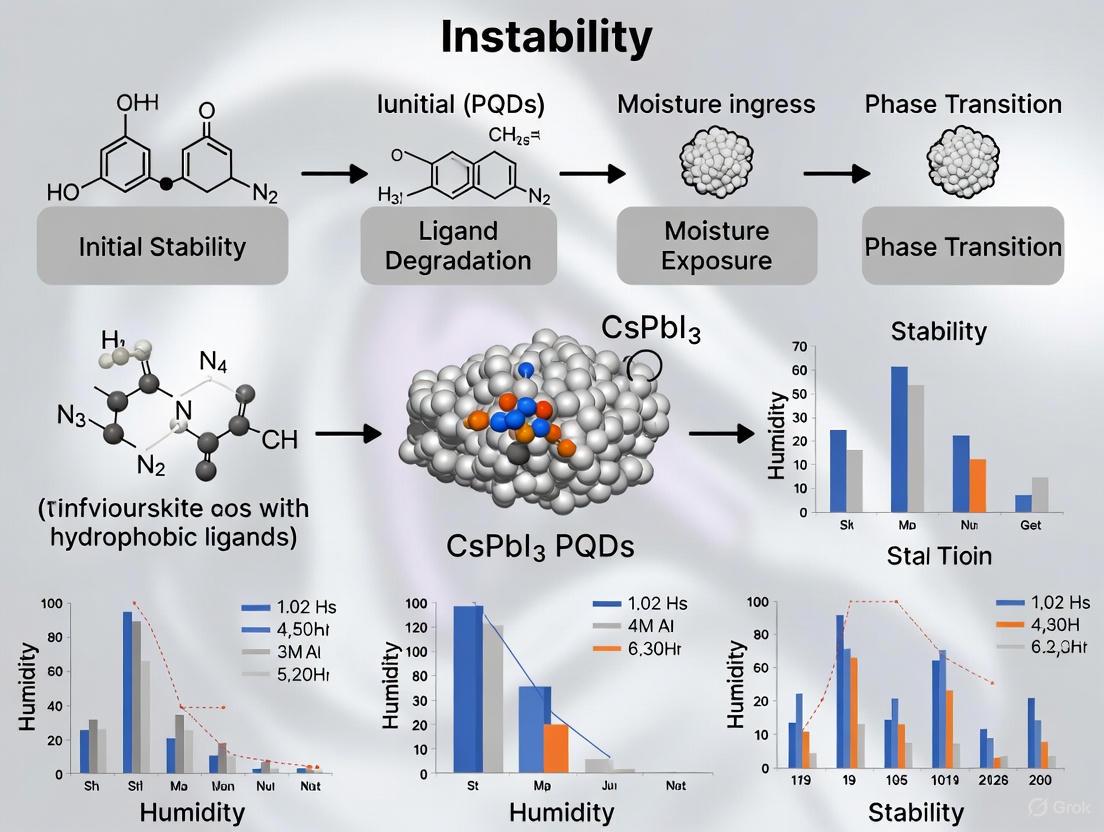
The humidity-induced degradation of cesium lead iodide perovskite quantum dots (CsPbI3 PQDs) poses a significant challenge to their practical application in optoelectronics and biomedicine.
Hydrophobic Ligand Engineering: Conquering Humidity Instability in CsPbI3 Perovskite Quantum Dots
Abstract
The humidity-induced degradation of cesium lead iodide perovskite quantum dots (CsPbI3 PQDs) poses a significant challenge to their practical application in optoelectronics and biomedicine. This article comprehensively explores the strategic use of hydrophobic ligands to enhance environmental stability. We first establish the fundamental instability mechanisms of the CsPbI3 crystal structure. The core of the discussion details various ligand engineering methodologies, including in-situ and post-synthesis treatments, showcasing effective ligands like phenethylammonium and star-shaped molecules. The article further provides troubleshooting guidelines for optimizing ligand exchange processes and validates these strategies through comparative analysis of performance metrics and long-term stability data. Finally, we synthesize key takeaways and project future research directions for deploying robust CsPbI3 PQDs in clinical and biomedical settings.
The Inherent Challenge: Understanding CsPbI3 PQD Instability and the Hydrophobic Defense Mechanism
FAQs: Understanding CsPbI3 Instability
Q1: What are the different crystal phases of CsPbI3, and why does the black phase degrade?
CsPbI3 exists in several crystal phases. The photoactive black phases (α, β, γ) have a perovskite structure suitable for optoelectronics, while the yellow δ-phase is a non-perovskite, photo-inactive structure [1]. The instability stems from the fact that the black phases are metastable at room temperature and spontaneously transform into the more stable δ-phase [1]. This transition is triggered by environmental factors like moisture and temperature, and is driven by the small ionic radius of the cesium ion, which leads to an unfavorable Goldschmidt's tolerance factor (t ≈ 0.8), making the perovskite structure inherently unstable [1].
Q2: What is the atomic-level pathway for the detrimental phase transition?
Research has clarified that the transition from the photoactive γ-phase to the non-perovskite δ-phase is not a single step. It is a multiple-step transition with three intermediate states [2]. The lowest-energy pathway is: γ (3D perovskite) → Pm (3D) → Cmcm (2D) → Pmcn (1D) → δ (1D non-perovskite) [2]. The first step (γ-to-Pm) is the performance-controlling step, with a surprisingly low energy barrier of only about 31 meV/atom, explaining why the transition occurs so readily [2].
Q3: How does humidity specifically accelerate the degradation of CsPbI3 films?
Humidity directly facilitates the transition to the δ-phase. Moisture reduces the energy barrier for the phase transition [3]. When CsPbI3 is exposed to prolonged moisture, water molecules interact with the crystal lattice, catalyzing the rearrangement from the 3D perovskite structure into the 1D chain structure of the δ-phase, which is more stable in the presence of water [3] [4]. This process is often observed as a color change from black to yellow in the film.
Q4: What are the most effective strategies to inhibit the phase transition and improve stability?
The primary strategies, often used in combination, include [1]:
- Ion Doping: Substituting Pb²⁺ with other divalent cations (e.g., via nickel acetate incorporation) can strain the lattice and increase the transition barrier [5] [2].
- Surface Ligand Engineering: Coating the CsPbI3 nanocrystals or films with hydrophobic ligands, polymers, or quantum dots (e.g., 1,8-diaminooctane or nitrogen-doped graphene quantum dots) creates a protective shield against moisture [3] [4].
- Strain Engineering: Applying compressive strain, particularly along the [010] crystal axis, has been predicted as an effective way to increase the transition barrier and stabilize the photoactive phase [2].
- Composite Formation: Forming heterostructures with materials like ZnO or TiO2 can enhance stability and provide synergistic effects [6] [4].
Troubleshooting Guides
Issue 1: Rapid Phase Degradation to Yellow δ-phase During Fabrication
Problem: The CsPbI3 film turns yellow during or immediately after the annealing process, indicating a transition to the non-perovskite δ-phase.
| Possible Cause | Diagnostic Steps | Solution |
|---|---|---|
| High Ambient Humidity [3] | Monitor relative humidity (RH) in the fabrication environment. XRD to confirm δ-phase peaks at ~10.27°, 13.43° [4]. | Control the annealing environment. Optimize annealing time for the specific RH; e.g., at RH 60%, a shorter annealing time (6 min) may be optimal [3]. |
| Insufficient or Inefficient Annealing [3] [5] | Use TGA to study additive volatilization. Check for residual DMAI or solvent via XRD/Fourier-transform infrared spectroscopy [3]. | Precisely optimize annealing temperature and duration. For DMAI-based recipes, ensure complete evaporation. Consider additives like Ni(AcO)₂ to drive crystallization at lower temperatures [5]. |
| Incorrect Stoichiometry or Precursor Composition | Perform EDS to check Cs:Pb:I ratio (target 1:1:3) [4]. | Ensure precise precursor weighing and fresh chemicals. Explore additive engineering (e.g., dimethylammonium iodide) to stabilize the intermediate phase [3]. |
Issue 2: Poor Long-Term Stability Under Ambient Conditions
Problem: Devices or films degrade over time (hours to days) when stored in ambient air.
| Possible Cause | Diagnostic Steps | Solution |
|---|---|---|
| Inadequate Surface Passivation [3] [4] | Perform SEM to examine film morphology and grain boundaries. XPS to detect unpassivated Pb²⁺ surface defects. | Implement post-synthesis passivation with long-chain alkyl ligands (e.g., 1,8-diaminooctane) or hydrophobic quantum dots (e.g., N-GQDs) to create a moisture-resistant layer [3] [4]. |
| Intrinsic Structural Instability | Conduct long-term XRD monitoring to track phase purity. | Employ ion doping (e.g., with Ni²⁺) to internally stabilize the perovskite lattice [5]. Use encapsulation strategies to shield the device from environmental factors [7]. |
| Weak Interfacial Contacts in Device Stack | Analyze J-V curves for increased series resistance or reduced shunt resistance. | Optimize charge transport layers (e.g., TiO₂, spiro-OMeTAD) to ensure efficient charge extraction and reduce interfacial recombination [8]. |
Experimental Protocols
Protocol 1: Hydrophobic Ligand Passivation with 1,8-Diaminooctane (DAO)
This protocol outlines the surface passivation of CsPbI3 films using DAO to enhance humidity stability [3].
Key Reagent Solutions:
- 1,8-Diaminooctane (DAO): A diamine with a long alkyl chain. Functions as a bidentate ligand that binds to undercoordinated Pb²⁺ on the CsPbI3 surface, reducing surface defects and providing a hydrophobic barrier.
- Dimethylammonium Iodide (DMAI): Additive used in the precursor to facilitate the formation of the black perovskite phase at lower temperatures.
- Anhydrous Solvents (e.g., Toluene, Isopropanol): Used for dissolving passivators to prevent premature degradation of the perovskite layer.
Step-by-Step Workflow:
- CsPbI3 Film Fabrication: Fabricate the CsPbI3 perovskite film on your substrate using your standard method (e.g., spin-coating from a precursor containing CsI, PbI₂, and DMAI).
- Annealing: Anneal the film at the optimized temperature and time for your specific humidity condition (e.g., 6 minutes at ~100°C for RH 60%) until a black film forms [3].
- DAO Solution Preparation: Prepare a passivation solution by dissolving DAO in an anhydrous solvent like toluene at a concentration of ~1 mg/mL.
- Passivation Treatment: While the film is still hot (approximately 100°C), spin-coat the DAO solution onto the film surface.
- Post-Treatment Annealing: Perform a brief secondary anneal (e.g., 5 minutes at 100°C) to ensure proper ligand binding and solvent removal.
- Characterization: Confirm successful passivation via Fourier-transform infrared spectroscopy (observe NH₂ stretching), water contact angle measurement (increased hydrophobicity), and XPS (reduction in uncoordinated Pb²⁺ signal).
The following workflow diagram illustrates the key steps in this passivation process.
Protocol 2: Stabilization via Nickel Acetate Additive Incorporation
This protocol describes a DMAI-free, green synthesis method to stabilize the γ-CsPbI3 phase using nickel acetate (Ni(AcO)₂) as a phase-directing additive [5].
Key Reagent Solutions:
- Nickel Acetate Tetrahydrate (Ni(AcO)₂·4H₂O): Serves as a crystallization agent and stabilizer. It helps form a γ-CsPbI3 nanocomposite, improving film crystallinity and phase stability without the need for volatile organic additives.
- DMSO Solvent: Used as a greener, alternative solvent to common toxic solvents like DMF.
Step-by-Step Workflow:
- Precursor Preparation: Dissolve CsI and PbI₂ in pure DMSO to create the CsPbI3 precursor solution.
- Additive Incorporation: Add Ni(AcO)₂·4H₂O to the precursor solution at an optimal concentration (e.g., 0.1 M, 7.1 mol%) and stir until fully dissolved.
- Film Deposition: Spin-coat the Ni(AcO)₂-containing precursor solution onto the substrate.
- Crystallization & Annealing: Anneal the film at a moderate temperature (e.g., ~180°C) to facilitate the formation of the black γ-CsPbI3 phase. The nickel acetate matrix aids in low-temperature crystallization.
- Characterization: Use XRD to confirm the formation of the γ-CsPbI3 phase and the absence of δ-phase or residual PbI₂ peaks. SEM can be used to observe the enlarged grain size and improved film morphology.
The following table summarizes key phase transition barriers and stability data from recent studies.
Table 1: Phase Transition Barriers and Stabilization Effects in CsPbI3
| Material/Intervention | Phase Transition Pathway | Energy Barrier / Key Metric | Impact on Stability | Citation |
|---|---|---|---|---|
| Undoped CsPbI3 | γ → δ | ~31 meV/atom (very low) | Explains spontaneous transition at room temperature [2]. | [2] |
| Ion Doping | γ → δ (with various dopants) | Volcano-shaped barriers | Barrier height depends on dopant ionic radius; optimal dopant size maximizes stability [2]. | [2] |
| Strain along [010] | γ → δ | Barrier increased with strain | Compressive strain is an effective method to raise the transition barrier [2]. | [2] |
| DAO Passivation | - | Retains 92.3% initial PCE after 1500 min at 30% RH | Significantly improves operational humidity stability without encapsulation [3]. | [3] |
| Ni(AcO)₂ Additive | - | >600 hours MPP stability (inert atm) | Stabilizes γ-phase, enables DMAI/HI-free green synthesis [5]. | [5] |
The Scientist's Toolkit: Research Reagent Solutions
Table 2: Essential Reagents for CsPbI3 Phase Stabilization
| Reagent | Function / Role in Stabilization | Key Property / Consideration |
|---|---|---|
| Dimethylammonium Iodide (DMAI) | Aids in forming black phase at low temperatures by creating an intermediate; volatilizes during annealing [3]. | Volatilization rate is humidity-dependent; requires precise annealing control [3]. |
| 1,8-Diaminooctane (DAO) | Hydrophobic surface passivator. Diamine groups chelate undercoordinated Pb²⁺, long alkyl chain repels water [3]. | Creates a hydrophobic, moisture-resistant film, enhancing operational stability [3]. |
| Nickel Acetate (Ni(AcO)₂) | Phase-directing additive. Promotes and stabilizes γ-CsPbI3 in a nanocomposite structure without organic cations [5]. | Enables a greener, DMSO-only synthesis; reduces global warming potential of fabrication [5]. |
| Nitrogen-Doped Graphene QDs (NGQDs) | Aqueous-stable passivator. Enables dispersion of δ-CsPbI3 in water for photocatalysis by surface coating [4]. | Can be used to stabilize the otherwise wasted δ-phase for applications in aqueous environments [4]. |
Phase Transition Pathway Visualization
The atomic-level pathway of the γ-to-δ phase transition is complex. The following diagram summarizes the multi-step process and key stabilization strategies that act upon it.
Core Concept: What is the Goldschmidt Tolerance Factor?
The Goldschmidt tolerance factor is a simple geometric parameter used to assess the stability and likely crystal structure of perovskite materials. It evaluates how well the constituent ions fit together in the ABX₃ perovskite structure, predicting structural distortions and phase stability based on ionic radii [9] [10].
The Mathematical Expression
The tolerance factor ((t)) is calculated using the ionic radii of the constituent ions [9] [11]:
(t = \frac{rA + rX}{\sqrt{2}(rB + rX)})
Where:
- (r_A) = radius of the A-site cation
- (r_B) = radius of the B-site cation
- (r_X) = radius of the anion (typically oxygen in oxides, or halogens like I⁻ in halide perovskites)
Interpretation of Tolerance Factor Values
The calculated value of t provides a direct indication of the expected perovskite structure and its stability [9] [11]:
Table 1: Goldschmidt Tolerance Factor and Corresponding Perovskite Structures
| Tolerance Factor (t) | Crystal Structure | Explanation | Examples |
|---|---|---|---|
| >1 | Hexagonal or Tetragonal | A ion too large or B ion too small | BaTiO₃ (t=1.061) [9] |
| 0.9 - 1.0 | Cubic | Ideal ion size matching | Ideal cubic perovskite [9] |
| 0.71 - 0.9 | Orthorhombic/Rhombohedral | A ions too small for B ion interstices | GdFeO₃, CaTiO₃ [9] |
| <0.71 | Different non-perovskite structures | A and B ions have similar ionic radii | Ilmenite structure (e.g., MgTiO₃) [11] |
For halide perovskites like CsPbI₃, the tolerance factor and octahedral factor (μ = rB / rX) together determine stability. CsPbI₃ has a tolerance factor of approximately 0.89 and an octahedral factor of 0.47, which places it within the stable perovskite region but close to instability boundaries, explaining its propensity for phase transitions [12].
Frequently Asked Questions (FAQs)
How do I calculate the tolerance factor for my specific perovskite composition?
To calculate the tolerance factor for your material, follow this detailed protocol:
- Determine Ionic Radii: Obtain the ionic radii for your A-site cation, B-site cation, and X-site anion. Use a consistent and reliable source, such as Shannon's ionic radii database, and pay close attention to the coordination number for each ion [11]. For halide perovskites, ensure you use radii appropriate for halide environments.
- Apply the Formula: Input these values into the standard tolerance factor formula: (t = \frac{rA + rX}{\sqrt{2}(rB + rX)}).
- Consider Coordination Numbers: For accurate calculations, the coordination numbers should be 12 for the A-site ion, 6 for the B-site ion, and 6 for the X-site ion in an ideal cubic structure [11].
- Interpret the Result: Refer to Table 1 to correlate the calculated
tvalue with the expected crystal structure and stability.
My calculated 't' is ideal (~1), but my CsPbI₃ film is still unstable. Why?
This is a common issue in halide perovskite research. An ideal tolerance factor is a necessary but not sufficient condition for stability, especially for CsPbI₃. Other critical factors include [13] [12] [14]:
- Entropic Factors: The stability of the black perovskite phase (α, β, γ) is temperature-dependent. At room temperature, the non-perovskite yellow δ-phase is often thermodynamically favored, leading to spontaneous phase transition even with a suitable
t[14]. - Surface Energy and Ligand Dynamics: The surface of perovskite crystals and quantum dots (PQDs) has a high surface energy. Traditional long-chain ligands (e.g., oleic acid, oleylamine) used in synthesis are dynamically bound and can detach, creating surface defects and under-coordinated Pb²⁺ sites that initiate degradation [12].
- Environmental Stressors: Humidity and polar solvents directly attack the ionic crystal lattice. Water molecules penetrate the structure, leading to hydration and eventual decomposition into CsI and PbI₂ [15].
Can the tolerance factor guide ligand selection for stabilizing CsPbI₃ PQDs?
While the classic tolerance factor applies to the bulk crystal, the principle of steric compatibility is central to ligand engineering. The goal of using hydrophobic ligands is to passivate the surface without straining the crystal lattice. Ligands must [16] [12]:
- Coordinate Strongly with surface sites (e.g., Pb²⁺ ions) to reduce defect density.
- Provide a Hydrophobic Barrier to shield the ionic core from water molecules.
- Maintain a Balance between improved stability and charge transport; overly bulky ligands can inhibit inter-dot conductivity.
Troubleshooting Guides
Problem: Rapid Phase Degradation of CsPbI₃ in Ambient Humidity
Possible Causes and Solutions:
Table 2: Troubleshooting Phase Degradation in CsPbI₃
| Problem Cause | Recommended Solution | Experimental Protocol |
|---|---|---|
| Weak/Detachable Surface Ligands | Implement post-synthesis ligand exchange with multidentate, hydrophobic ligands. | 1. Synthesize CsPbI₃ PQDs using standard hot-injection or LARP methods. 2. Prepare a solution of short, robust ligands (e.g., choline, diaminoligands like 1,8-diaminooctane (DAO)) in a tailored solvent like 2-pentanol. 3. Treat the PQD solid film with this solution to replace native insulating ligands [16] [3]. |
| Intrinsic Thermodynamic Instability | Apply external stimuli or incorporate additives to stabilize the metastable perovskite phase. | 1. High-Pressure Treatment: Subject the δ-phase CsPbI₃ to 0.1-0.6 GPa of pressure, heat to induce the α-phase, and rapidly cool to preserve the γ-phase at ambient conditions [14]. 2. Ionic Incorporation: Introduce minor dopants during synthesis to subtly adjust the average ionic radii and optimize the local tolerance factor without significantly altering the bandgap [13]. |
| High Defect Density at Grain Boundaries | Use surface passivation treatments to heal defects. | After film deposition, spin-coat a solution of a passivating agent (e.g., DAO). The diamine groups chelate under-coordinated Pb²⁺ defects, reducing non-radiative recombination sites and improving moisture resistance by forming a hydrophobic layer [3]. |
Problem: Poor Charge Transport in Ligand-Stabilized PQD Films
Possible Cause: The insulating nature of the long-chain or newly introduced ligands used for stabilization creates barriers between PQDs, hindering carrier transport.
Solutions:
- Ligand Exchange with Short Conductive Ligands: Replace native long-chain ligands (OA/OAm) with shorter, conjugated, or charged ligands that provide both stability and improved electronic coupling [16] [12].
- Solvent Engineering for Optimal Exchange: Use a tailored solvent system (e.g., protic 2-pentanol) that effectively removes insulating ligands without damaging the PQD surface or introducing halogen vacancies [16].
The Scientist's Toolkit: Key Research Reagent Solutions
Table 3: Essential Materials for Stabilizing CsPbI₃ Perovskite Quantum Dots
| Reagent / Material | Function / Role | Key Consideration |
|---|---|---|
| 1,8-Diaminooctane (DAO) | A diamine ligand for surface passivation. The amine groups chelate under-coordinated Pb²⁺ defects, while the long alkyl chain provides hydrophobicity [3]. | Effective in post-synthesis treatment of solid films to enhance moisture stability and boost PV performance [3]. |
| Choline Ligands | Short, conductive ligands used to replace insulating native ligands (e.g., oleylamine) [16]. | Improves charge carrier transport in PQD films for solar cells. Often applied using a tailored solvent. |
| 2-Pentanol | A protic solvent tailored for ligand exchange. Its appropriate dielectric constant and acidity maximize the removal of insulating ligands without creating halogen vacancies [16]. | Superior to other solvents for mediating effective ligand exchange while preserving the PQD structure. |
| Dimethylammonium Iodide (DMAI) | An additive used in precursor solutions to facilitate the formation of CsPbI₃ perovskite films, especially in ambient air [3]. | Its volatilization during annealing is humidity-dependent. Requires precise optimization of annealing time and temperature based on ambient RH [3]. |
Experimental Workflows and Pathways
The following diagram visualizes the decision-making process for diagnosing and addressing CsPbI₃ instability, integrating the use of the Goldschmidt Tolerance Factor with practical stabilization strategies.
Frequently Asked Questions (FAQs)
Q1: What is the fundamental cause of the black-to-yellow phase transition in CsPbI₃ PQDs? The transition is driven by the low thermodynamic stability of the photoactive black perovskite phases (cubic α-, tetragonal β-, or orthorhombic γ-phase) at room temperature. These phases are metastable and have a natural tendency to transition to the more thermodynamically stable, non-photoactive yellow orthorhombic (δ-) phase. This intrinsic instability is quantified by a critical Goldschmidt tolerance factor (t ≈ 0.8) and a high revised tolerance factor (τ ≈ 4.99), which fall outside the ideal range for stable perovskite structures [13] [1]. Moisture significantly accelerates this thermodynamically favored process.
Q2: How exactly does water molecules initiate the degradation of the perovskite structure? Water molecules attack the crystal surface, leading to a facet-dependent dissolution process. The polar crystal facets dissolve at a higher rate than the more stable (100) facets. This uneven degradation, driven by the solvation of ions (Cs⁺, Pb²⁺, I⁻) into the water, causes a morphological transformation from well-defined nanocubes to nanospheres and ultimately the collapse of the perovskite crystal structure [17]. This process is illustrated in the diagram below.
Q3: Why are long-chain ligands like Oleic Acid (OA) and Oleylamine (OAm) insufficient for preventing moisture-induced degradation? While OA and OAm are essential for synthesizing high-quality PQDs, they exhibit dynamic and weak binding to the PQD surface. This makes them prone to detach over time, leaving behind unpassivated surface defects [18]. Furthermore, these long-chain ligands are insulating, which impedes charge transport between neighboring QDs in a film, limiting device performance. Their inability to form a robust, hydrophobic shield makes them inadequate for long-term stability [19] [20].
Q4: What are the key characteristics of an effective hydrophobic ligand for stabilizing CsPbI₃ PQDs? Effective hydrophobic ligands typically possess the following characteristics:
- Strong Coordinating Groups: Functional groups like phosphonic acid (-PO(OH)₂) or multiple amine groups (-NH₂) that bind more strongly to the Pb ions on the PQD surface than OA/OAm [19] [3].
- Short or Rigid Chains: Shorter carbon chains or rigid aromatic structures that improve charge transport by reducing the inter-dot distance, unlike insulating long chains [19].
- Hydrophobic Moieties: Components like benzyl rings or long alkyl chains that create a water-repellent shell around the PQD, physically blocking moisture penetration [19] [20] [3].
Troubleshooting Guides
Problem 1: Rapid Phase Degradation During Film Storage in Ambient Conditions
Possible Cause: Inefficient surface passivation and lack of a hydrophobic barrier, allowing moisture to penetrate the film and trigger the phase transition.
Solution: Implement a Stepwise Ligand Exchange Protocol. This protocol involves introducing robust, short-chain ligands during both the synthesis and the film-forming process to ensure complete surface coverage and passivation [19].
- Step 1: Initial Ligand Exchange in Solution. To the crude CsPbI₃ PQD solution (synthesized via the standard hot-injection method), add a methyl acetate (MeOAc) washing solvent that contains your target short-chain ligand (e.g., Benzylphosphonic Acid - BPA). Centrifuge and redisperse the QDs [19].
- Step 2: Secondary Ligand Exchange During Film Formation. Employ a layer-by-layer spin-coating technique. After depositing each layer of PQDs, use a washing solvent (e.g., MeOAc) that contains the same short-chain ligand (BPA) to treat the film. This step ensures the replacement of any remaining long-chain ligands and completes the surface passivation directly on the substrate [19].
- Verification: Successful ligand management will result in films that maintain their black color and show no signs of yellowing (δ-phase) in XRD patterns after being stored in ambient air for hundreds of hours [19].
Problem 2: Poor Charge Transport in PQD Films Despite High Phase Stability
Possible Cause: The presence of residual long-chain, insulating ligands (OA/OAm) on the PQD surface, which creates energy barriers for charge carrier movement between adjacent QDs.
Solution: Employ Short-Chain Conductive Ligands or Molecular Bridges. Replace the insulating ligands with molecules that not only passivate the surface but also facilitate electronic coupling.
- Option A: Short-Chain Ligands like Acetate or Benzylphosphonic Acid. These ligands shorten the distance between QDs, enabling better wavefunction overlap and charge transport. For example, BPA-modified CsPbI₃ QD solar cells have shown significantly improved electrical transport properties [19].
- Option B: 3D Star-Shaped Conjugated Molecules. Molecules like Star-TrCN can bond robustly with the PQD surface, passivating defects while simultaneously creating a cascade energy band structure that improves charge extraction. This approach has boosted solar cell efficiency to 16.0% while enhancing moisture stability [20].
Problem 3: Inconsistent Film Formation and Phase Purity under High Humidity
Possible Cause: Uncontrolled volatilization of precursors (e.g., Dimethylammonium Iodide - DMAI) and sensitivity to ambient moisture during the annealing process, leading to mixed phases.
Solution: Precisely Control the Annealing Conditions Relative to Humidity. The annealing time and temperature must be optimized for the specific relative humidity (RH) of your fabrication environment.
- Guideline: The volatilization rate of common additives like DMAI is humidity-dependent. At higher RH, the evaporation occurs faster.
- Verification: Use UV-Vis spectroscopy to confirm the target bandgap (~1.7 eV for CsPbI₃) and XRD to check for the absence of the δ-phase peak at ~11.8° [3]. Over-annealing or under-annealing at a given humidity will result in incomplete conversion or the formation of the yellow phase.
Research Reagent Solutions
The following table lists key reagents used in advanced strategies for stabilizing CsPbI₃ PQDs against moisture.
Table 1: Key Reagents for Stabilizing CsPbI3 PQDs against Moisture
| Reagent Name | Function/Brief Explanation | Key Outcome/Performance |
|---|---|---|
| Benzylphosphonic Acid (BPA) | Short-chain ligand with strong P=O coordination group. Used in a stepwise process to replace OA/OAm, providing defect passivation and a hydrophobic barrier [19]. | PCE of 13.91% in solar cells; retains 91% initial efficiency after 800 h in atmosphere [19]. |
| Star-TrCN | 3D star-shaped organic semiconductor. Acts as a molecular bridge, passivating defects and creating a cascade energy band for improved charge extraction [20]. | PCE boosted to 16.0%; retains 72% initial PCE after 1000 h at 20-30% RH [20]. |
| 1,8-Diaminooctane (DAO) | Diamine passivator with a long alkyl chain. The two amine groups chelate with undercoordinated Pb²⁺ defects, while the alkyl chain provides hydrophobicity [3]. | PCE of 17.7%; retains 92.3% initial efficiency after 1500 min operational tracking at 30% RH [3]. |
| Didodecyldimethylammonium Bromide (DDAB) | Halide ion pair ligand. Provides effective edge passivation, altering degradation trajectories and preserving cubic morphology upon water exposure [17]. | Reduces overall degradation rate and maintains crystal shape in the initial stages of water attack [17]. |
| Dimethylammonium Iodide (DMAI) | Additive used in precursor solution. Facilitates the formation of a intermediate phase that converts to CsPbI₃ upon annealing, enabling fabrication under high humidity [3]. | Enables formation of high-quality CsPbI₃ films at up to 60% relative humidity [3]. |
Comparative Data of Stabilization Strategies
The table below summarizes quantitative data from recent studies on different CsPbI₃ PQD stabilization strategies, providing a benchmark for expected performance.
Table 2: Performance Comparison of CsPbI3 PQD Stabilization Strategies
| Stabilization Strategy | Device Type | Power Conversion Efficiency (PCE) | Stability Performance | Citation |
|---|---|---|---|---|
| Benzylphosphonic Acid (BPA) Ligand Exchange | QD Solar Cell | 13.91% | 91% of initial PCE after 800 h storage in atmosphere; 92% after 200 h continuous light exposure. | [19] |
| Star-TrCN Hybridization | QD Solar Cell | 16.0% | >72% of initial PCE retained after 1000 h at 20-30% relative humidity. | [20] |
| 1,8-Diaminooctane (DAO) Passivation | Perovskite Solar Cell | 17.7% | 92.3% of initial PCE retained after 1500 minutes of maximum power point tracking at 30% RH without encapsulation. | [3] |
| Moisture-Assisted Fabrication (DMAI) | Carbon-based Perovskite Solar Cell | 16.05% | A new record for inorganic carbon-based PSCs, demonstrating that controlled H₂O can be beneficial during fabrication. | [21] |
Frequently Asked Questions (FAQs)
FAQ 1: What is the fundamental conflict presented by native ligands on CsPbI₃ PQDs? Native long-chain ligands like oleic acid (OA) and oleylamine (OAm) are essential for synthesizing stable, colloidal CsPbI₃ PQDs and preventing their aggregation [12]. However, these same ligands are electrically insulating and create a barrier between quantum dots in a film, severely limiting charge transport and leading to poor performance in optoelectronic devices [22] [23].
FAQ 2: How does ligand engineering improve moisture stability? Ligand engineering replaces hygroscopic or dynamically detaching native ligands with more robust, hydrophobic alternatives. For instance, exchanging native ligands with aromatic ring-based phenethylammonium (PEA) cations creates a hydrophobic protective layer that shields the PQDs from moisture penetration, significantly enhancing stability under ambient conditions [22].
FAQ 3: What are the trade-offs between different ligand exchange strategies? Conventional ligand exchange often trades stability for performance. Replacing long-chain OLA with short-chain formamidinium (FA) improves charge transport but removes the hydrophobic layer, making the films susceptible to moisture [22]. Advanced strategies using ligands like PEA or diaminocarbon chains (e.g., 1,8-diaminooctane, DAO) aim to simultaneously enhance both charge transport and moisture resistance by providing short, conductive, and hydrophobic groups [22] [3].
FAQ 4: Why is CsPbI₃ particularly susceptible to humidity? CsPbI₃ is highly sensitive to moisture because humidity reduces the energy barrier for a phase transition, causing the photoactive black perovskite phase (α- or γ-phase) to degrade into a non-photoactive yellow orthorhombic phase (δ-phase) [3]. This process is accelerated by surface defects and the detachment of native ligands [12].
Troubleshooting Guides
Common Problem: Poor Charge Transport in PQD Films
Symptoms: Low device current density, low fill factor in solar cells, reduced electroluminescence efficiency in LEDs. Possible Causes and Solutions:
| Cause | Solution |
|---|---|
| Insulating Native Ligands: A dense layer of long-chain OA/OAm ligands acts as an insulating barrier [22] [12]. | Perform post-synthetic ligand exchange with short-chain ligands like acetate (Ac) or phenethylammonium iodide (PEAI) to improve dot-to-dot coupling [22]. |
| Ineffective Ligand Exchange: Incomplete replacement of native ligands leaves insulating residues. | Optimize the concentration and reaction time of the post-treatment solution. Use spectroscopic techniques (FT-IR, NMR) to confirm ligand exchange [22]. |
| Introduction of Hygroscopic Ligands: Using ligands like FA⁺ improves transport but harms moisture stability [22]. | Employ hydrophobic short-chain ligands (e.g., PEA⁺) that do not compromise moisture resistance while improving charge transport [22]. |
Common Problem: Rapid Degradation under Ambient Humidity
Symptoms: Phase transition from black to yellow δ-phase, decrease in photoluminescence quantum yield (PLQY), color fading in films. Possible Causes and Solutions:
| Cause | Solution |
|---|---|
| Ligand Detachment: Dynamic binding of OA/OAm ligands causes them to detach, exposing the PQD surface to moisture [12]. | Implement ligand engineering with multidentate or chelating ligands (e.g., dicarboxylic acids, diammonium chains) that bind more strongly to the PQD surface [12] [3]. |
| Lack of Hydrophobic Protection: Removal of native ligands during exchange without introducing a new hydrophobic layer [22]. | Anchor hydrophobic ligands such as PEA or DAO during the exchange process. These create a moisture-resistant shell around the PQDs [22] [3]. |
| Surface Defects: Undercoordinated Pb²⁺ sites on the PQD surface act as entry points for moisture and accelerate degradation [3]. | Apply a passivation layer with molecules that bond with these defects. For example, 1,8-diaminooctane (DAO) can coordinate with undercoordinated Pb, reducing defects and improving hydrophobicity [3]. |
Experimental Protocols for Enhanced Stability and Performance
Protocol 1: Post-Synthetic Ligand Exchange with Phenethylammonium Iodide (PEAI)
This protocol is adapted from research demonstrating simultaneous improvement in photovoltaic performance and moisture stability [22].
1. Materials and Reagents
- CsPbI₃ QD stock solution: Synthesized via hot-injection or LARP method.
- Solvents: Anhydrous n-hexane, anhydrous acetonitrile, chlorobenzene.
- Ligand Exchange Solution: 10 mM PEAI in anhydrous acetonitrile.
- Acetate Salt: Sodium acetate (NaAc) or ammonium acetate (NH₄Ac).
- Equipment: Centrifuge, vortex mixer, nitrogen glove box.
2. Step-by-Step Procedure 1. Initial Purification: Precipitate the native CsPbI₃ QDs from the stock solution by adding acetate salt (e.g., NaAc) as a polar antisolvent. Centrifuge to obtain a QD pellet. This step replaces anionic oleate ligands with shorter acetate groups [22]. 2. Redispersion: Redisperse the acetate-capped QD pellet in anhydrous n-hexane or n-octane. 3. Film Casting: Spin-coat the redispersed QD solution onto a substrate to form a thin film. 4. Cationic Ligand Exchange: While the film is still wet, drop-cast the 10 mM PEAI in acetonitrile solution onto the film. Allow it to react for 30-60 seconds. 5. Rinsing and Annealing: Spin-off the excess solution and rinse the film with anhydrous acetonitrile to remove byproducts and unbound ligands. Anneal the film on a hotplate at 70-90°C for 5-10 minutes.
3. Key Parameters for Success
- Timing: The PEAI post-treatment must be performed on a wet film to facilitate cation exchange.
- Concentration: Optimal PEAI concentration is critical; too high may cause dissolution, too low results in incomplete exchange.
- Solvent Choice: Acetonitrile is used as it is a polar solvent that does not redissolve the CsPbI₃ QD film.
Protocol 2: Surface Passivation with 1,8-Diaminooctane (DAO)
This protocol is for enhancing moisture stability and reducing surface defects, enabling fabrication under high humidity [3].
1. Materials and Reagents
- CsPbI₃ perovskite film: Fabricated using precursors like CsI, PbI₂, and dimethylammonium iodide (DMAI).
- Passivation Solution: 1 mg/mL 1,8-diaminooctane in anhydrous isopropanol.
- Equipment: Spin coater, hotplate.
2. Step-by-Step Procedure 1. Film Preparation: Fabricate a CsPbI₃ perovskite film using your standard method (e.g., one-step spin-coating with DMAI additive). 2. Annealing: Anneal the film to form the black perovskite phase. 3. Passivation: Immediately after annealing and while the film is still hot (e.g., 80-100°C), spin-coat the DAO solution in isopropanol onto the film at 4000-5000 rpm for 30 seconds. 4. Post-treatment Annealing: Anneal the film again at 70-80°C for 1-2 minutes to remove residual solvent and strengthen the interaction between DAO and the perovskite surface.
3. Key Parameters for Success
- Application on Hot Surface: Applying the DAO solution on a hot film improves the binding efficiency to undercoordinated Pb²⁺ defects.
- Solution Concentration: A low concentration (e.g., 1 mg/mL) is sufficient to form a monolayer and avoid insulating layer formation.
- Solvent: Isopropanol is chosen as it does not damage the perovskite film.
Workflow and Signaling Pathways
Ligand Exchange and Passivation Workflow
Mechanism of Hydrophobic Ligand Stabilization
Research Reagent Solutions
The following table details key reagents used in the featured ligand engineering protocols.
| Research Reagent | Function / Role in Experiment | Key Outcome / Rationale |
|---|---|---|
| Phenethylammonium Iodide (PEAI) | Short-chain, hydrophobic cationic ligand for post-synthetic exchange. Replaces insulating OLA [22]. | Simultaneously improves charge transport (short chain) and moisture resistance (hydrophobic aromatic ring). Preserves inorganic composition and bandgap [22]. |
| 1,8-Diaminooctane (DAO) | Bidentate ligand for surface passivation. Coordinates with undercoordinated Pb²⁺ defects [3]. | Creates a hydrophobic surface, reduces non-radiative recombination, and enhances operational stability under humidity [3]. |
| Acetate Salts (e.g., NaAc) | Anionic ligand source for initial purification and exchange. Replaces long-chain oleate ligands [22]. | Provides initial shortening of ligand shell, improving film conductivity and preparing QDs for subsequent cationic exchange [22]. |
| Dimethylammonium Iodide (DMAI) | Additive in CsPbI₃ film fabrication. Facilitates the formation of the perovskite phase at lower temperatures [3]. | Enables the formation of high-quality CsPbI₃ films, but can leave behind DMAI-rich surfaces with undercoordinated Pb defects [3]. |
CsPbI₃ Perovskite Quantum Dots (PQDs) possess exceptional optoelectronic properties, making them promising for solar cells and light-emitting devices. However, their commercial viability is severely limited by an intrinsic instability: high susceptibility to moisture, which causes degradation and a detrimental phase transition from a photoactive black phase to a non-photoactive yellow phase [7] [13] [24]. Within the broader context of research addressing the humidity instability of CsPbI₃ PQDs, the strategic use of hydrophobic ligands has emerged as a primary defense mechanism. These ligands function by creating a protective, moisture-resistant barrier around the quantum dots, physically shielding them from environmental water molecules and thereby enhancing their operational lifetime and performance [22] [24].
Experimental Protocols: Implementing Ligand Strategies
Protocol 1: Short-Chain Ligand Exchange with Phenethylammonium Iodide (PEAI)
This protocol replaces insulating long-chain ligands with shorter, hydrophobic aromatic ammonium cations to simultaneously improve charge transport and moisture resistance [22].
- Synthesis: Synthesize CsPbI₃ QDs using standard hot-injection methods with oleic acid (OA) and oleylamine (OAm) as native ligands.
- Initial Ligand Exchange: Perform a solid-state ligand exchange on the QD thin films to replace anionic oleate ligands with acetate (Ac) anions.
- Hydrophobic Cation Incorporation: Treat the Ac-exchanged CsPbI₃ QD thin films with a solution of Phenethylammonium Iodide (PEAI).
- Mechanism: The phenethylammonium (PEA) cations replace the remaining oleylammonium (OLA) ligands on the QD surface. The aromatic ring provides enhanced hydrophobicity, creating a stable moisture-resistant layer without altering the QD's inorganic composition or size [22].
- Validation: Characterize using Fourier-transform infrared (FT-IR) and H NMR spectroscopy to confirm successful ligand exchange.
Protocol 2: Stepwise Ligand Management with Benzylphosphonic Acid (BPA)
This two-step strategy uses a short-chain ligand with strong coordinating groups to achieve defect passivation and hydrophobicity during both QD preparation and film formation [19].
- Primary Passivation during Synthesis: Introduce Benzylphosphonic Acid (BPA) into the crude CsPbI₃ QD solution immediately after synthesis. The P=O group strongly coordinates to the QD surface, initiating the replacement of long-chain OA/OAm.
- Film Deposition and Secondary Treatment: Prepare QD films using a layer-by-layer spin-coating technique.
- Final Ligand Exchange: For each deposited layer, use a washing solvent of methyl acetate (MeOAc) incorporated with BPA. This step completely removes residual long-chain ligands and performs a final surface passivation.
- Mechanism: The strong coordination of BPA passivates surface defects and the short hydrocarbon chain improves inter-dot charge transport. The benzyl group enhances the overall hydrophobicity of the QD film [19].
Protocol 3: Surface Post-Processing with Cysteine (Cys)
This method employs a multi-functional biomolecule for effective surface defect passivation and stability enhancement [25].
- Solution Preparation: Dissolve cysteine in an ethyl acetate solution.
- Post-Processing: Add the synthesized CsPbI₃ QDs to the cysteine ligand solution and treat with ultrasound for several minutes.
- Purification: Centrifuge the mixture, discard the supernatant, and re-disperse the precipitate in hexane for further use.
- Mechanism: Cysteine acts as a tridentate ligand, coordinating to the QD surface through its carboxylate (–COO⁻), amino (–NH₂), and thiol (–SH) groups. This multi-dentate binding effectively suppresses surface defects and enhances the binding energy, leading to a more robust and photoluminescent QD [25].
Performance Data: Quantitative Comparison of Ligand Strategies
The effectiveness of various ligand strategies is quantified through key performance metrics in solar cells and light-emitting devices, as summarized in the tables below.
Table 1: Photovoltaic Performance and Stability of CsPbI₃ PQD Solar Cells with Different Ligand Treatments
| Ligand Strategy | Power Conversion Efficiency (PCE) | Stability Retention (Unencapsulated) | Key Improvement |
|---|---|---|---|
| Phenethylammonium (PEA) [22] | 14.1% | >90% after 15 days in ambient air | Simultaneous improvement in moisture stability and charge transport. |
| Benzylphosphonic Acid (BPA) [19] | 13.91% | 91% after 800 hours in atmosphere; 92% after 200 hours of continuous light. | 1.9x increase in hole mobility; 46% reduction in trap state density [19] [26]. |
| 1,8-Diaminooctane (DAO) [3] | 17.7% | 92.3% after 1500 minutes of operation at 30% relative humidity. | Effective passivation of undercoordinated Pb defects; enhanced humidity stability during fabrication. |
| Aluminum Isopropoxide (IPA-Al) [26] | N/A (For LED applications) | 2.15x enhancement in operational half-life for LEDs. | Forms a covalent Al-I bond and inert Al-O-Al layer, boosting conductivity and stability. |
Table 2: Optical Property Enhancement of CsPbI₃ PQDs from Ligand Passivation
| Ligand / Treatment | Photoluminescence Quantum Yield (PLQY) | Defect Reduction & Mechanism |
|---|---|---|
| Cysteine Post-Processing [25] | 70.77% (vs. 38.61% for pristine) | Fewer surface defects; tridentate binding (carboxyl, amino, thiol). |
| Benzylphosphonic Acid (BPA) [19] | Significant improvement reported | Passivates defects via P=O coordination; inhibits non-radiative recombination. |
| Standard Oleic Acid / Oleylamine | Low after purification | High defect density due to ligand loss during processing. |
Troubleshooting Guide: Common Experimental Issues
Problem: Reduced Charge Transport After Ligand Exchange
- Potential Cause: The new short-chain ligands, while improving conductivity, may still form an insulating layer if too densely packed or if they partially aggregate.
- Solution: Optimize the ligand concentration and reaction time. Consider ligands that form thinner, more conductive layers, such as organic covalent metal salts (e.g., IPA-Al) [26].
Problem: Quantum Dot Aggregation During Ligand Exchange
- Potential Cause: The use of short-chain ligands with poor solubility in non-polar solvents (like octane or toluene) used for QD dispersion can destabilize the colloid [26].
- Solution: Prioritize ligands with high solubility in non-polar solvents. Alternatively, employ a stepwise ligand exchange strategy where the initial exchange is performed in a crude solution before purification to minimize aggregation during film formation [19].
Problem: Incomplete Ligand Exchange or Passivation
- Potential Cause: The washing solvent (e.g., methyl acetate) may have insufficient polarity to fully remove long-chain native ligands or to introduce the new short-chain ligand effectively [19] [22].
- Solution: Increase the polarity of the washing solvent slightly or add the new ligand directly into the washing solution. Confirm exchange success with FT-IR or NMR spectroscopy [22].
Problem: Phase Instability Persists After Treatment
- Potential Cause: Surface iodide vacancies, which are not fully passivated by organic ligands, can act as nucleation sites for the non-perovskite δ-phase [27].
- Solution: Implement a dual passivation strategy. Combine your hydrophobic organic ligand with halide-rich salts like CsI or CdI₂ to fill the surface iodide vacancies and further slow the phase transition kinetics [27].
The Scientist's Toolkit: Essential Research Reagents
Table 3: Key Reagents for Hydrophobic Ligand Management in CsPbI₃ PQD Research
| Reagent / Material | Function / Role | Key Characteristic |
|---|---|---|
| Phenethylammonium Iodide (PEAI) | Hydrophobic cationic ligand for A-site surface exchange [22]. | Aromatic ring provides hydrophobicity; short chain aids charge transport. |
| Benzylphosphonic Acid (BPA) | Short-chain ligand for defect passivation and ligand exchange [19]. | Phosphonic acid group (P=O) has strong coordinating ability to the QD surface. |
| Cysteine | Multi-functional biomolecule for tridentate surface passivation [25]. | Provides carboxylate, amino, and thiol groups for strong coordination. |
| Aluminum Isopropoxide (IPA-Al) | Organic covalent metal salt ligand [26]. | Forms covalent Al-I bonds and an inert Al-O-Al layer; highly soluble in non-polar solvents. |
| Dimethylammonium Iodide (DMAI) | Additive for facilitating CsPbI3 film formation under humidity [3]. | Volatilizes during annealing, aiding in the crystallization of the perovskite phase. |
| Methyl Acetate (MeOAc) | Common washing solvent for layer-by-layer QD film deposition [19]. | Polarity is sufficient to remove some ligand byproducts without dissolving the QDs. |
Visualizing the Workflow and Mechanism
The following diagrams illustrate the general workflow for a stepwise ligand exchange and the molecular mechanism by which hydrophobic ligands protect the perovskite core.
Frequently Asked Questions (FAQs)
Q1: Why can't we just use the long-chain ligands from synthesis for moisture protection? While long-chain ligands like oleic acid provide initial colloidal stability, they are dynamically bound and easily detach during purification and film processing. This leaves behind surface defects and fails to provide a consistent hydrophobic barrier. Furthermore, these long-chain ligands are insulating, which severely limits charge transport between QDs in a film, hampering device performance [19] [7].
Q2: What is the key trade-off in hydrophobic ligand design? The primary trade-off is between hydrophobicity/stability and charge transport efficiency. Long, densely packed hydrocarbon chains offer excellent moisture resistance but are highly insulating. Short chains improve electrical conductivity but may offer less robust protection and can cause QD aggregation. Advanced ligand design focuses on molecules that are both hydrophobic and conductive, or that form thin, dense layers [26] [22].
Q3: How do iodide vacancies contribute to moisture-induced degradation? Surface iodide vacancies are critical nucleation sites for the phase transition to the non-perovskite δ-phase [27]. Water molecules strongly solvate these vacancy sites, accelerating the structural collapse. Therefore, an effective stability strategy must combine hydrophobic shielding with surface defect passivation, particularly of iodide vacancies, using halide-rich salts or ligands with strong coordinating atoms [27] [25].
Q4: Can these ligand strategies enable fabrication in ambient air? Yes, that is a key direction of recent research. By using advanced ligands and additives like DMAI or DAO, researchers have successfully fabricated CsPbI₃ solar cells under relatively high humidity (e.g., 45-60% RH) without a controlled inert atmosphere [3]. This demonstrates the potential for reducing manufacturing costs and scaling up production.
Ligand Engineering in Action: Synthesis, Exchange, and Application Strategies
In-Situ Ligand Engineering During Hot-Injection Synthesis
Troubleshooting Guides
Q1: Why are my CsPbI3 PQDs unstable and losing luminescence quickly after synthesis?
A: Rapid degradation is often caused by ligand detachment and Ostwald ripening. Traditional long-chain ligands like oleic acid (OA) and oleylamine (OAm) bind weakly to the QD surface, leading to detachment that exposes ionic sites and accelerates degradation [28]. This manifests as emission wavelength shifting from target pure-red (∼623 nm) to crimson (∼639 nm) and decreased photoluminescence quantum yield (PLQY) [28].
- Solution: Introduce strong-binding ligands during synthesis. 2-Naphthalene sulfonic acid (NSA) shows higher binding energy (1.45 eV) than OAm (1.23 eV) [28]. For CsPbBr₃ QDs, dodecylbenzenesulfonic acid (DBSA) controls nucleation and suppresses Ostwald ripening, maintaining 89% PL after six months [29].
Q2: How can I achieve pure-red emission (620-635 nm) from CsPbI3 PQDs?
A: Obtaining emission below 635 nm requires strong quantum confinement with QD radius less than 5 nm [28]. Uncontrolled Ostwald ripening during synthesis causes small QDs to dissolve and larger ones to grow, weakening quantum confinement.
- Solution: Inject NSA ligand after nucleation. With 0.6 M NSA, PL peak blue-shifts to 626 nm with 89% PLQY and narrow size distribution [28]. Post-synthesis ligand exchange with ammonium hexafluorophosphate (NH₄PF₆) further blue-shifts emission to 623 nm and boosts PLQY to 94% [28].
Q3: Why does my product have low photoluminescence quantum yield (PLQY)?
A: Low PLQY indicates surface defects acting as non-radiative recombination centers. Halide vacancies are common defects, and weak ligand binding fails to passivate them effectively [30].
- Solution: Create halide-rich environment and repair lattice vacancies. For CsPbI3 QDs, guanidinium iodide (GAI) additive repairs iodine vacancies and replaces surface Cs atoms, suppressing non-radiative Auger recombination to achieve 27.1% external quantum efficiency in LEDs [30]. For CsPbBr₃, ZnBr₂ passivates bromide vacancies and enhances DBSA adsorption, achieving 90.7% PLQY [29].
Q4: My PQDs aggregate during purification – how can I prevent this?
A: Aggregation occurs because polar anti-solvents used in purification trigger ligand loss through proton transfer between OA⁻ and OAmH⁺ [28].
- Solution: Incorporate strong-binding ligands before purification. NSA treatment promotes debonding of weak OA/OAm ligands and provides steric hindrance to inhibit fusion [28]. NH₄PF₆ exchange during purification provides strong binding (3.92 eV binding energy) to prevent aggregation and maintain dispersion [28].
Experimental Protocols
This protocol produces 4.3 nm CsPbI3 PQDs with 94% PLQY and 623 nm emission.
Materials: Lead iodide (PbI₂, 99.999%), cesium carbonate (Cs₂CO₃, 99.99%), 1-octadecene (ODE, 90%), oleic acid (OA, 90%), oleylamine (OAm, 90%), 2-naphthalene sulfonic acid (NSA), ammonium hexafluorophosphate (NH₄PF₆), hexane, methyl acetate.
Procedure:
- Standard CsPbI3 QD Synthesis: Use hot-injection method at 170-185°C with Cs-oleate precursor [28].
- NSA Treatment: Immediately after nucleation, inject 0.6 M NSA dissolved in toluene. NSA replaces weak OAm ligands and suppresses Ostwald ripening through stronger Pb binding and steric hindrance.
- Growth Monitoring: Monitor via in-situ PL spectroscopy. NSA-treated QDs show blue-shifted emission and enhanced intensity versus controls.
- Purification: Centrifuge crude solution and redisperse in hexane. Add NH₄PF₆ solution (10 mg/mL in methanol) during purification for ligand exchange.
- Washing: Precipitate with methyl acetate, centrifuge, and redisperse in hexane. Repeat twice.
- Storage: Store in anhydrous hexane at 4°C in inert atmosphere.
This protocol produces 2.6 nm CsPbBr₃ QDs with 90.7% PLQY and 461 nm emission.
Materials: PbBr₂ (99.9%), ZnBr₂ (99.9%), dodecylbenzenesulfonic acid (DBSA), standard CsPbBr₃ precursors.
Procedure:
- Precursor Preparation: Mix DBSA and ZnBr₂ with standard precursors in three-neck flask [29].
- Hot-Injection: Perform at 160°C under nitrogen. DBSA regulates nucleation rate while ZnBr₂ passivates bromide vacancies.
- Reaction Monitoring: DBSA suppresses Ostwald ripening, maintaining ultra-small QD size.
- Purification: Standard centrifugation with anti-solvent.
- Characterization: Confirm 2.6 nm size, 461 nm emission, and 90.7% PLQY.
Materials: Phenethylammonium iodide (PEAI), sodium acetate (NaAc), standard CsPbI3 QD precursors.
Procedure:
- Acetate Exchange: First replace native OLE ligands with acetate via solid-state ligand exchange [22].
- PEAI Treatment: Deposit PEAI solution (1.5 mg/mL in isopropanol) on Ac-exchanged CsPbI3-QD thin films via spin-coating.
- Annealing: Anneal at 70°C for 1 minute to incorporate PEA cations onto QD surfaces.
- Validation: Confirm PEA incorporation via FT-IR and H NMR. PEA-incorporated solar cells retain >90% initial PCE after 15 days ambient conditions [22].
Table 1: Ligand Performance Comparison for CsPbX3 PQDs
| Ligand System | QD Type | Emission (nm) | PLQY (%) | Stability Performance | Key Advantages |
|---|---|---|---|---|---|
| NSA + NH₄PF₆ [28] | CsPbI₃ | 623 | 94 | 80% PLQY after 50 days | Pure-red emission, high charge transport |
| DBSA + ZnBr₂ [29] | CsPbBr₃ | 461 | 90.7 | 89% PL after 6 months | Blue emission, superior photostability |
| PEA Incorporation [22] | CsPbI₃ | - | - | >90% PCE after 15 days | Enhanced moisture resistance |
| Guanidinium Iodide [30] | CsPbI₃ | - | - | T₅₀: 1001 min @ 100 cd/m² | Defect passivation, lattice repair |
| OA/OAm (Control) [28] | CsPbI₃ | 635-639 | <80 | Rapid degradation | Baseline reference |
Table 2: Stability Performance Under Different Conditions
| Ligand Strategy | Storage Stability | Thermal Stability | Moisture Resistance | Photostability |
|---|---|---|---|---|
| NSA + NH₄PF₆ [28] | 80% PLQY after 50 days | - | - | - |
| DBSA + ZnBr₂ [29] | 89% PL after 6 months | - | - | 65% intensity after 80 min UV |
| PEA [22] | - | - | >90% PCE after 15 days ambient | - |
| Siloxane Passivation [31] | Stable in nonpolar solvents | - | - | Enhanced PLQY |
Research Reagent Solutions
Table 3: Essential Reagents for In-Situ Ligand Engineering
| Reagent | Function | Key Properties | Application Note |
|---|---|---|---|
| 2-Naphthalene Sulfonic Acid (NSA) [28] | Strong-binding ligand, Ostwald ripening inhibitor | Binding energy: 1.45 eV; steric hindrance | Use at 0.6 M concentration post-nucleation |
| Ammonium Hexafluorophosphate (NH₄PF₆) [28] | Post-synthesis ligand exchange | Binding energy: 3.92 eV; enhances conductivity | Add during purification in methanol solution |
| Dodecylbenzenesulfonic Acid (DBSA) [29] | Nucleation control, size regulation | Suppresses Ostwald ripening; enables <3 nm QDs | Use synergistically with ZnBr₂ |
| Zinc Bromide (ZnBr₂) [29] | Halide vacancy passivation | Bifunctional agent; enhances ligand adsorption | Critical for bromide-rich environment |
| Phenethylammonium Iodide (PEAI) [22] | Hydrophobic stabilizer | Short-chain, hydrophobic cation | Incorporates without changing QD size/composition |
| Guanidinium Iodide (GAI) [30] | Lattice repair, surface passivation | Modifies tolerance factor; repairs iodine vacancies | Creates halide-rich environment |
Ligand exchange is a fundamental process in materials chemistry where the original organic ligands surrounding a nanocrystal are replaced with new ligands to alter the nanocrystal's properties. For CsPbI3 perovskite quantum dots (PQDs), this process is critical for enhancing environmental stability, particularly against humidity, and improving optoelectronic performance for device applications. This technical support center provides targeted guidance for researchers implementing these techniques.
Core Ligand Exchange Techniques
Solid-State Ligand Exchange
Solid-state ligand exchange is performed on quantum dot films after deposition. In this method, a film of QDs with original long-chain ligands is treated with a solution containing the desired replacement ligands.
Experimental Protocol for Solid-State Exchange on PbS QDs [32]:
- Film Preparation: Deposit a film of oleic acid (OA)-capped QDs onto a substrate via spin-coating or other methods.
- Ligand Solution Preparation: Dissolve tetrabutylammonium iodide (TBAI) in methanol at a typical concentration of 10 mg/mL.
- Treatment: Immerse the QD film in the TBAI solution for 20-30 seconds.
- Rinsing: Rinse the film thoroughly with fresh methanol to remove excess ligands and reaction by-products.
- Drying: Dry the film under a nitrogen stream. This process is typically repeated multiple times in a layer-by-layer (LBL) fashion to build up film thickness.
Key Considerations:
- Incomplete Exchange Challenge: A major limitation is that the exchange can be incomplete, leaving residual OA ligands that adversely affect charge transport. The efficiency depends on factors like film thickness, ligand concentration, and exchange time [32].
- Pre-Washing Optimization: Research shows that post-synthesis washing of QDs (e.g., with an ethanol-methanol mixture) prior to film formation can reduce the initial OA load, leading to more complete subsequent solid-state exchange and improved device performance [32].
Solution-Phase Ligand Exchange
Solution-phase exchange occurs in a biphasic mixture where QDs are transferred from a non-polar solvent to a polar solvent as ligands are replaced, enabling purification and processing directly from solution.
Experimental Protocol for Accelerated Solution-Phase Exchange [33]:
- Polar Phase Preparation: Dissolve lead halides (0.1 M PbI₂ and 0.02 M PbBr₂) and ammonium acetate (0.04 M) in dimethylformamide (DMF).
- QD Phase Preparation: Use a highly concentrated solution (~6 mg/mL) of oleate-capped PbS CQDs in octane.
- Mixing: Add the QD solution to the DMF solution and mix vigorously using a vortex mixer for a short duration (seconds).
- Phase Separation: Allow the mixture to separate. QDs with successfully exchanged ligands will transfer to the bottom DMF phase.
- Purification: Separate the DMF phase and precipitate the QDs by adding an anti-solvent (e.g., toluene or chloroform), then centrifuge.
Key Considerations:
- Exchange Rate: Using highly concentrated QD solutions accelerates the ligand exchange, minimizing surface exposure to the polar solvent and reducing the formation of trap states [33].
- Acid-Catalyzed Mechanism: For lead chalcogenide QDs, the exchange of carboxylate ligands (like oleate) with iodide is an acid-catalyzed reaction. The cation of the iodide salt (e.g., NH₄⁺, CH₃NH₃⁺) plays a role in the reaction efficiency, with acidic cations facilitating more complete ligand removal [34].
Technique Comparison and Selection Guide
Table 1: Comparison of Solid-State and Solution-Phase Ligand Exchange Techniques
| Feature | Solid-State Exchange | Solution-Phase Exchange |
|---|---|---|
| Process Workflow | Layer-by-layer deposition and treatment [35] | Single-step exchange and phase transfer before film formation [35] |
| Throughput | Time-consuming for thick films [35] | Reduces labor and time requirements [35] |
| Film Quality | Risk of incomplete exchange and cracking in thick films [32] | Improved homogeneity and reduced agglomeration [33] |
| Trap State Density | Higher risk of sub-bandgap trap states due to incomplete passivation [32] | Better passivation and minimized surface defects achievable [33] |
| Best Applications | Thin-film devices, research-scale prototyping | Thick-film devices, scalable processing, high-performance photovoltaics |
Quantitative Data on Ligand Performance
The choice of ligand directly impacts the optical properties and stability of the resulting quantum dot films.
Table 2: Impact of Different Ligands on CsPbI3 PQD Properties [36]
| Ligand | Photoluminescence (PL) Enhancement | Key Stability Performance | Primary Function |
|---|---|---|---|
| Trioctylphosphine Oxide (TOPO) | 18% | -- | Surface passivation of undercoordinated Pb²⁺ ions |
| Trioctylphosphine (TOP) | 16% | -- | Surface passivation of undercoordinated Pb²⁺ ions |
| l-Phenylalanine (L-PHE) | 3% | Retained >70% of initial PL after 20 days of UV exposure | Superior photostability and defect suppression |
The Scientist's Toolkit: Essential Research Reagents
Table 3: Key Reagents for Ligand Exchange Experiments
| Reagent / Material | Function / Application | Examples |
|---|---|---|
| Short-Chunk Inorganic Ligands | Provides n-type passivation, enhances charge transport, and improves air stability [32] [34] | Tetrabutylammonium iodide (TBAI), Ammonium Iodide (NH₄I), Methylammonium Iodide (MAI), Lead Iodide (PbI₂) |
| Polar Solvents | Medium for solid-state treatment or polar phase in solution exchange [32] [33] | Methanol (MeOH), Dimethylformamide (DMF) |
| Non-Polar Solvents | Dispersion medium for as-synthesized QDs with original ligands [33] | Octane, Hexane, Chloroform |
| Precipitation Anti-Solvents | Used to purify QDs after solution-phase exchange [32] [33] | Toluene, Acetone |
| Metal Salts & Additives | Source of metal-halide complexes; catalysts for exchange reaction [33] | Lead Bromide (PbBr₂), Ammonium Acetate (NH₄Ac) |
Workflow and Decision Diagrams
Troubleshooting Guides and FAQs
FAQ 1: Incomplete Ligand Exchange
Q: My solid-state ligand exchanged films show poor conductivity. I suspect incomplete exchange of the original oleic acid ligands. How can I improve this?
- Cause: The native oleic acid ligands are not fully removed and replaced by the target short-chain ligands, creating a barrier for charge transport [32].
- Solution:
- Pre-Wash QDs: Implement multiple post-synthesis washing cycles of the QDs using an ethanol-methanol mixture before film deposition. This reduces the initial ligand load, facilitating more complete subsequent exchange [32].
- Optimize Salt & Solvent: Use iodide salts with acidic cations (e.g., NH₄I or MAI instead of TBAI) in methanol, as the protonated environment catalyzes the removal of oleate [34].
- Adjust Processing: Increase the concentration of the ligand solution and/or the immersion time, though this must be balanced against the risk of film degradation [32].
FAQ 2: Trap State Formation
Q: After solution-phase exchange, my QD films exhibit high trap state density and low photoluminescence quantum yield (PLQY). What is the cause and how can it be mitigated?
- Cause: Slow exchange kinetics can expose the QD surface to the polar solvent for an extended period, leading to surface etching and the formation of unpassivated sites (dangling bonds) [33].
- Solution:
- Accelerate Exchange: Use a highly concentrated solution of the starting QDs. This maximizes the contact area between QD surfaces and incoming ligands, drastically reducing the exchange time from minutes to seconds and minimizing surface damage [33].
- Confirm Passivation: Use Fourier Transform Infrared Spectroscopy (FTIR) to verify the removal of OA and X-ray Photoelectron Spectroscopy (XPS) to confirm the successful binding of the new halide ligands to the QD surface [32].
FAQ 3: Film Cracking and Morphology
Q: My films crack during the solid-state ligand exchange process, leading to poor device performance. How can I achieve crack-free, thick films?
- Cause: Incomplete ligand removal can cause inconsistent spacing and clustering of QDs, building up stress that results in cracking [32].
- Solution:
- Ensure Complete Exchange: Follow the solutions for "Incomplete Ligand Exchange" above to remove the bulky OA ligands more thoroughly, allowing for a more uniform contraction of the film.
- Leverage Solution-Phase Exchange: Consider switching to solution-phase exchange, which allows for the formation of dense, crack-free thick films in a single deposition step, as the ligand shell is already optimized before film formation [35] [33].
FAQ 4: Choosing the Right Ligand
Q: For my CsPbI3 PQDs, which ligand should I use to maximize both stability and optoelectronic performance?
- Guidance: The optimal ligand depends on the primary property you wish to enhance. Refer to Table 2 for quantitative data [36].
- For maximum photoluminescence intensity, TOPO is the most effective.
- For superior long-term photostability, L-Phenylalanine (L-PHE) is the best choice, as it retains over 70% of its initial PL intensity after 20 days of UV exposure.
- For charge transport in electronic devices, short inorganic ligands like iodides (I⁻) are typically necessary to reduce inter-dot spacing and tunneling barriers [35] [32]. A combination of ligands may be required to balance these properties.
Phenethylammonium iodide (PEAI) is an aromatic ammonium salt with the chemical formula C8H12IN and a molecular weight of 249.09 g/mol [37]. It appears as a white crystalline powder with a melting point of 283°C [38] [39]. In perovskite research, particularly with fully inorganic CsPbI3 perovskite quantum dots (PQDs), PEAI serves a critical function as a short-chain, hydrophobic ligand that replaces native long-chain insulating ligands, thereby simultaneously enhancing charge transport and moisture stability [22].
The primary challenge in CsPbI3 PQD development involves the inherent trade-off between charge transport and environmental stability. Native long-chain ligands like oleic acid (OA) and oleylamine (OLA) provide colloidal stability and initial moisture resistance but severely hinder charge transport between quantum dots [22] [40]. PEAI addresses this dilemma by providing short-chain characteristics that improve electronic coupling while maintaining hydrophobic protection through its aromatic ring structure [22]. This unique combination makes it particularly valuable for improving the performance and durability of perovskite-based optoelectronic devices, including solar cells and light-emitting diodes (LEDs).
Experimental Protocols: Incorporating PEAI into CsPbI3 PQDs
Standard Ligand Exchange Procedure with PEAI
The incorporation of PEAI typically follows a two-step ligand exchange procedure on pre-synthesized OA/OLA-capped CsPbI3 PQDs:
Step 1: Anionic Ligand Exchange
- Prepare a solution of sodium acetate (NaOAc) in methyl acetate (MeOAc) [40].
- Treat the OA/OLA-capped CsPbI3 PQD thin films with the NaOAc solution to replace anionic OA ligands with acetate ions [40].
- Repeat this process in a layer-by-layer (LbL) assembly to achieve the desired film thickness [40].
Step 2: Cationic Ligand Exchange with PEAI
- Prepare a solution of PEAI in ethyl acetate (EtOAc) [40].
- Post-treat the acetate-exchanged CsPbI3 PQD solids with the PEAI solution to replace residual cationic OLA ligands with PEA cations [40].
- The treatment time and concentration must be optimized to ensure complete exchange without damaging the PQD structure [22].
Key Considerations:
- The polar solvents (MeOAc and EtOAc) are essential for dissolving ionic salts and removing long-chain ligands but may potentially remove surface components from PQDs if not properly controlled [40].
- Successful incorporation can be confirmed through Fourier-transform infrared (FT-IR) spectroscopy, which shows decreased IR peak intensities of oleyl groups and carboxylate groups, along with increased aromatic double bonding peaks [40].
Experimental Workflow
The following diagram illustrates the complete workflow for the PEAI ligand exchange process:
Performance Data and Comparative Analysis
Quantitative Performance Metrics of PEAI-Modified CsPbI3 PQDs
Table 1: Performance comparison of CsPbI3 PQD solar cells with different ligand treatments
| Ligand Treatment | PCE (%) | VOC (V) | Stability Retention | Stability Duration | Reference |
|---|---|---|---|---|---|
| PEAI incorporation | 14.1 | ~1.2 | >90% | 15 days (ambient) | [22] |
| PEAI stabilization | 17.0 | 1.33 | 94% | 2000+ hours (low humidity) | [41] |
| Conventional FA-based treatment | 13.4 | Lower than PEAI | Poor stability | N/A | [22] |
| PEAI with TPPO co-treatment | 15.4 | >1.2 | >90% | 18 days (ambient) | [40] |
Table 2: Moisture stability comparison of different CsPbI3 PQD formulations
| Stabilization Method | Humidity Condition | Performance Retention | Key Improvement |
|---|---|---|---|
| PEAI ligand exchange | Ambient conditions | >90% after 15 days | Simultaneous charge transport & stability [22] |
| PEAI + 2D perovskite formation | Low-humidity environment | 94% after 2000+ hours | Record VOC of 1.33V [41] |
| PEAI + TPPO in octane | Ambient conditions | >90% after 18 days | Reduced surface traps [40] |
| Conventional FA treatment | Ambient conditions | Poor stability | Improved charge transport only [22] |
Troubleshooting Guide and FAQs
Common Experimental Challenges and Solutions
Q1: Why does my PEAI-treated CsPbI3 PQD film show decreased photoluminescence (PL) intensity after ligand exchange?
- Cause: The conventional ligand exchange process using polar solvents can generate surface traps, particularly uncoordinated Pb2+ sites, which act as non-radiative recombination centers [40].
- Solution: Implement a secondary surface stabilization using covalent short-chain ligands like triphenylphosphine oxide (TPPO) dissolved in nonpolar solvents (e.g., octane). This approach passivates surface traps without further damaging the PQD surface [40].
Q2: How can I prevent phase transformation from black cubic-phase (γ-CsPbI3) to yellow orthorhombic-phase during PEAI treatment?
- Cause: Moisture penetration during processing accelerates phase transformation, especially when hydrophobic OLA ligands are removed [22].
- Solution:
Q3: Why is the open-circuit voltage (VOC) of my PEAI-incorporated CsPbI3 PQD solar cell lower than expected?
- Cause: Incomplete ligand exchange or hybridization of fully inorganic CsPbI3 with organic cations can reduce bandgap and consequently VOC [22].
- Solution:
- Optimize PEAI concentration and processing time to prevent excessive incorporation
- Verify preserved bandgap through UV-Vis spectroscopy
- Use complementary passivation strategies (e.g., 2D perovskite formation with lead acetate) to suppress charge recombination [41]
Q4: How can I verify successful PEA cation incorporation onto CsPbI3 PQD surfaces?
- Characterization Methods:
Advanced Optimization Strategies
Q5: What is the optimal method for combining PEAI with other ligands for enhanced performance?
- Strategy 1: Combine PEAI with TPPO dissolved in nonpolar solvents. TPPO strongly coordinates with uncoordinated Pb2+ sites while PEAI provides hydrophobic protection [40].
- Strategy 2: Use PEAI with 2D perovskite formation by controlling lead acetate ratio, creating a protective barrier that suppresses charge recombination [41].
- Strategy 3: Implement PEAI treatment after strong-binding NSA (2-naphthalene sulfonic acid) ligands to inhibit Ostwald ripening during synthesis [28].
Essential Research Reagent Solutions
Table 3: Key reagents for PEAI-based CsPbI3 PQD experiments
| Reagent | Function | Specifications | Supplier Examples |
|---|---|---|---|
| Phenethylammonium iodide (PEAI) | Short-chain hydrophobic ligand for cation exchange | Purity: ≥98%, White powder, CAS: 151059-43-7 [38] [37] | Greatcell Solar Materials, Sigma-Aldrich [38] [37] |
| Cesium carbonate (Cs2CO3) | Cesium source for PQD synthesis | Purity: 99.99% [22] [20] | Alfa Aesar [22] [20] |
| Lead iodide (PbI2) | Lead source for PQD synthesis | Purity: 99.999% [22] [20] | Alfa Aesar [22] |
| Oleic acid (OA) & Oleylamine (OLA) | Native long-chain ligands for initial PQD stabilization | OA: 90%, OLA: 70% [22] [20] | Sigma-Aldrich, Alfa Aesar [22] |
| Sodium acetate (NaOAc) | Short anionic ligand for initial ligand exchange | Purity: 99.995% [22] [20] | Sigma-Aldrich [22] |
| Triphenylphosphine oxide (TPPO) | Covalent short-chain ligand for surface stabilization | For surface trap passivation [40] | Sigma-Aldrich [40] |
| Methyl acetate & Ethyl acetate | Polar solvents for ligand exchange | Anhydrous, ≥99.8% [40] | Sigma-Aldrich [40] |
Technical Support Center
FAQs: Ligands and Perovskite Quantum Dot Stability
What are multidentate ligands and how do they improve stability?
Multidentate ligands are molecules that can attach to a central metal atom or ion at multiple points using two or more donor atoms [42] [43]. This multi-point binding creates a chelating effect, forming a ring structure [43]. The chelating effect describes the enhanced affinity these ligands have for a metal ion compared to a collection of similar monodentate (single-point) ligands. This stronger binding leads to significantly improved complex stability [43]. In the context of CsPbI3 Perovskite Quantum Dots (PQDs), using multidentate ligands reduces ligand detachment, which is a primary cause of structural degradation under environmental stress [12].
Why should I consider star-shaped ligands?
Star-shaped polymers are a subclass of branched polymers characterized by a single branch point from which three or more linear chains (arms) emanate [44]. The key advantage of this architecture is the presence of multiple functional end groups (like hydroxyls) that can serve as initiation sites for polymerization or as binding points. This multifunctionality can be exploited to create a dense or cross-linked ligand shell around a nanocrystal, enhancing its environmental stability and modifying its physical properties, such as reducing crystallinity and increasing viscosity compared to linear analogues [44].
How can ligand modification specifically address the humidity instability of CsPbI3 PQDs?
CsPbI3 PQDs are highly susceptible to degradation from environmental factors like humidity [12] [36]. Traditional long-chain ligands (e.g., oleic acid and oleylamine) provide initial stability but are dynamically bound and can detach, leaving the surface vulnerable [22] [12]. Ligand engineering tackles this by:
- Introducing Hydrophobicity: Exchanging native ligands with short-chain, hydrophobic molecules like phenethylammonium (PEA) creates a moisture-resistant shell without compromising charge transport. Research has shown that PEA-incorporated CsPbI3-QD solar cells retained over 90% of their initial performance after 15 days under ambient conditions [22].
- Enhancing Binding with Multidentate Ligands: Using ligands with multiple binding groups (e.g., L-Phenylalanine) strengthens the attachment to the PQD surface. This effective passivation of undercoordinated Pb²⁺ ions and surface defects suppresses non-radiative recombination and improves stability against moisture, oxygen, and light [36].
Troubleshooting Guide: Ligand Exchange and Stability
Problem: Rapid degradation of CsPbI3 PQD films under ambient humidity.
- Potential Cause 1: Weak binding of monodentate ligands.
- Solution: Replace monodentate ligands with multidentate alternatives. For example, use trioctylphosphine (TOP) or trioctylphosphine oxide (TOPO), which are L-type ligands that coordinate more strongly with undercoordinated Pb²⁺ ions on the PQD surface. One study showed TOP and TOPO passivation led to PL intensity enhancements of 16% and 18%, respectively [36].
- Potential Cause 2: Hydrophilic surface due to ligand choice.
- Solution: Perform a post-synthesis ligand exchange with a short-chain hydrophobic ligand. A proven protocol is the incorporation of phenethylammonium (PEA) cations. This replaces long-chain, insulating oleylammonium ligands with short-chain, hydrophobic PEA, simultaneously improving charge transport and forming a protective layer against moisture [22].
- Potential Cause 3: Incomplete surface coverage leading to defect sites.
- Solution: Implement a mixed-ligand system or use star-shaped macromolecules as co-initiators or ligands. The multiple arms of star-shaped polymers can provide a denser surface coverage, hindering water penetration and slowing degradation kinetics, as observed in star-shaped poly(L-lactide) systems [44].
Problem: Drop in Photoluminescence Quantum Yield (PLQY) after ligand treatment.
- Potential Cause: Inadequate passivation of surface defects or introduction of new quenching sites.
- Solution: Optimize the concentration and binding group of the ligand. For instance, when using amino-acid-based ligands like L-Phenylalanine (L-PHE), ensure the functional group (e.g., carboxylic acid) can effectively coordinate with surface Pb²⁺ ions. L-PHE-modified PQDs have demonstrated superior photostability, retaining over 70% of their initial PL intensity after 20 days of continuous UV exposure [36].
Experimental Protocols
Protocol 1: Post-Synthesis Ligand Exchange with Phenethylammonium (PEA) for CsPbI3 PQDs
This protocol is adapted from research demonstrating enhanced moisture resistance and photovoltaic performance [22].
- Synthesis of CsPbI3 PQDs: Synthesize CsPbI3 PQDs using a standard hot-injection method with oleic acid (OA) and oleylamine (OAm) as native ligands [22] [12].
- Solid-State Anionic Ligand Exchange: Purify the synthesized PQDs and perform an initial ligand exchange to replace anionic OLE ligands with acetate (Ac) anions. This is typically done by treating the PQD film with a solution of lead iodide (PbI₂) and sodium acetate (NaAc) in hexane/octane solvent [22].
- Cationic Ligand Exchange with PEAI:
- Reagent Preparation: Prepare a solution of Phenethylammonium Iodide (PEAI) in chlorobenzene (e.g., 10 mg/mL).
- Treatment: Spin-coat the PEAI solution directly onto the Ac-exchanged CsPbI3-QD thin film.
- Reaction: Allow the film to react for a controlled time (e.g., 1 minute) to incorporate PEA cations onto the QD surfaces by replacing residual OLA ligands.
- Washing: Remove excess reactants by washing with anhydrous chlorobenzene and acetonitrile [22].
- Validation: Confirm successful PEA incorporation and enhanced stability via Fourier-transform infrared (FT-IR) spectroscopy and by monitoring film stability and photovoltaic performance under ambient conditions.
Protocol 2: In-Situ Passivation with L-Type Ligands during CsPbI3 PQD Synthesis
This protocol outlines the integration of ligands like TOPO during the synthesis process [36].
- Precursor Preparation: Create a cesium precursor by dissolving Cs₂CO₃ in 1-octadecene (ODE) with OA. Prepare a lead precursor by dissolving PbI₂ in ODE with OA and OAm [36].
- Ligand Addition: Add the chosen ligand (e.g., TOPO, TOP, or L-PHE) to the lead precursor solution before the hot-injection step. The optimal mass ratio of ligand to PbI₂ has been reported at 1.78 [36].
- Hot-Injection Synthesis: Inject the cesium precursor into the vigorously stirring lead precursor solution at a high temperature (e.g., 170 °C) [36].
- Purification: Once the reaction is complete, cool the solution and purify the PQDs by centrifugation with anti-solvents like toluene/acetone [36].
- Characterization: Measure the photoluminescence (PL) intensity and PLQY to quantify the improvement in optical properties compared to PQDs synthesized without the additional ligand [36].
The Scientist's Toolkit: Research Reagent Solutions
| Reagent / Material | Function / Application |
|---|---|
| Phenethylammonium Iodide (PEAI) | A short-chain, hydrophobic cation used in post-synthesis exchange to replace long-chain OAm ligands, improving moisture stability and charge transport in CsPbI3 PQD films [22]. |
| L-Phenylalanine (L-PHE) | An amino acid used as a ligand for surface passivation. Its carboxylic acid group coordinates with undercoordinated Pb²⁺, suppressing non-radiative recombination and enhancing photostability [36]. |
| Trioctylphosphine Oxide (TOPO) | An L-type ligand that strongly coordinates with surface Pb²⁺ ions. Effective in passivating defects and enhancing PL intensity and environmental stability of PQDs [36]. |
| Multifunctional Alcohols (e.g., Pentaerythritol) | Core molecules for synthesizing star-shaped polymers (e.g., star-shaped poly(L-lactide)). The hydroxyl groups act as initiation sites, and the star-shaped structure can modify material properties like degradation rates and viscosity [44]. |
| Oleic Acid (OA) & Oleylamine (OAm) | The most common long-chain ligands used in the standard hot-injection synthesis of PQDs. They control growth and prevent aggregation but bind dynamically, leading to instability [22] [12]. |
Table 1: Performance of Different Ligands on CsPbI3 PQDs
| Ligand Type | Key Property | Effect on PLQY / PL Intensity | Stability Outcome (Ambient/Moisture) | Key Application Note |
|---|---|---|---|---|
| Phenethylammonium (PEA) [22] | Short-chain, Hydrophobic | Not specified | Retained >90% of initial solar cell PCE after 15 days | Used in post-synthesis exchange for photovoltaic devices. |
| L-Phenylalanine (L-PHE) [36] | Multidentate, Amino acid | 3% PL enhancement | Retained >70% initial PL after 20 days UV | In-situ passivation; improves photostability. |
| Trioctylphosphine (TOP) [36] | L-type, Phosphine | 16% PL enhancement | Not specified | Effective for defect passivation. |
| Trioctylphosphine Oxide (TOPO) [36] | L-type, Phosphine oxide | 18% PL enhancement | Not specified | Strong coordination with Pb²⁺. |
| Oleylammonium (OLA) - Native) [22] | Long-chain, Insulating | N/A (Baseline) | Poor; requires replacement for stability | Bulky, impedes charge transport. |
Table 2: Impact of Star-Shaped Polymer Architecture on Material Properties
| Polymer Architecture (vs. Linear) | Impact on Crystallinity | Impact on Hydrodynamic Volume / Viscosity | Impact on Degradation Kinetics |
|---|---|---|---|
| 3-, 4-, 6-arm Star-shaped PLLA [44] | Decreased | Smaller hydrodynamic volume in solution; Higher dynamic viscosity in concentrate | Slower |
Ligand Engineering Workflow for Stable CsPbI3 PQDs
The following diagram illustrates the strategic decision-making process for selecting and applying ligands to improve the humidity stability of CsPbI3 PQDs.
Multidentate vs. Monodentate Ligand Binding
This diagram provides a conceptual visualization of why multidentate ligands offer superior binding affinity compared to monodentate ligands.
CsPbI₃ perovskite quantum dots (PQDs) are promising photovoltaic materials due to their ideal bandgap and thermal stability. However, their high sensitivity to ambient moisture causes the photoactive cubic phase (α-CsPbI₃) to rapidly transition into a non-photoactive phase (δ-CsPbI₃), compromising device performance and longevity [3] [20]. This degradation is accelerated by surface defects, particularly undercoordinated Pb²⁺ ions, which act as entry points for moisture and centers for non-radiative charge recombination [45] [46]. A dual-strategy approach that simultaneously passivates these defects and imparts hydrophobicity is essential for advancing CsPbI₃ PQD applications.
FAQs & Troubleshooting Guides
FAQ 1: How does 1,8-Diaminooctane (DAO) function as a dual-action passivator?
DAO addresses the core instability issues of CsPbI₃ PQDs through two primary mechanisms:
- Defect Passivation: The two terminal primary amine groups (-NH₂) form coordinate bonds with undercoordinated Pb²⁺ ions on the PQD surface. This reduces surface trap states, suppresses non-radiative recombination, and enhances charge carrier transport [3].
- Hydrophobic Shielding: The long alkyl chain (eight carbon atoms) creates a hydrophobic barrier around the PQD. This shield physically impedes moisture penetration, significantly enhancing the material's stability under ambient humidity [3].
FAQ 2: What are the expected performance improvements after DAO passivation?
Implementing DAO passivation can lead to significant enhancements in both device performance and stability, as summarized below.
Table 1: Expected Performance Improvements with DAO Passivation
| Performance Metric | Typical Improvement with DAO Passivation | Key Experimental Evidence |
|---|---|---|
| Power Conversion Efficiency (PCE) | Increases to 17.7% in inverted solar cells [3]. | Higher PCE due to improved VOC and FF from reduced charge recombination [3]. |
| Open-Circuit Voltage (VOC) | Reaches 1.089 V [3]. | Direct result of effective trap state passivation [3]. |
| Operational Stability | Retains 92.3% of initial PCE after 1500 minutes of maximum power point tracking at 30% relative humidity without encapsulation [3]. | The hydrophobic alkyl chain provides sustained protection against moisture-induced degradation [3]. |
Troubleshooting Guide: Common Experimental Challenges
Table 2: Troubleshooting Common DAO Passivation Issues
| Problem | Potential Cause | Solution |
|---|---|---|
| Incomplete Passivation (Low VOC, high non-radiative losses) | - Incorrect DAO concentration.- Insufficient mixing or reaction time. | - Optimize DAO concentration (e.g., 0.5-2.0 mg/mL in toluene).- Ensure adequate stirring time during the passivation step. |
| Solution Aggregation | - DAO-induced flocculation of PQDs. | - Introduce DAO gradually with vigorous stirring.- Adjust solvent polarity to find a stable dispersion window. |
| Poor Film Morphology | - Incompatibility between DAO-passivated PQDs and the deposition solvent. | - Switch to a non-polar solvent like octane or chlorobenzene for film fabrication.- Optimize spin-coating parameters (speed, acceleration). |
| Low Stability Improvement | - Non-uniform DAO coverage. | - Ensure thorough purification of PQDs before passivation to remove native ligands that block DAO binding.- Implement a mild annealing step (e.g., 90°C for 2-5 min) to promote ligand rearrangement and binding [47]. |
Experimental Protocol: DAO Passivation of CsPbI₃ PQDs
Synthesis of CsPbI₃ PQDs (Hot-Injection Method)
This is a standard protocol for synthesizing high-quality CsPbI₃ PQDs [20] [47].
- Cesium-Oleate Precursor: Load 0.16 g Cs₂CO₃, 6 mL 1-Octadecene (ODE), and 0.5 mL Oleic Acid (OA) into a 50 mL three-neck flask. Dry and stir under vacuum at 120°C for 1 hour until the solution is clear [47].
- Lead Iodide Precursor: In a separate 100 mL three-neck flask, combine 0.3467 g PbI₂, 20 mL ODE, 3 mL OA, and 2 mL Oleylamine (OAM). Dry under vacuum at 120°C for 1 hour until PbI₂ is fully dissolved [47].
- Reaction: Raise the temperature of the PbI₂ solution to 170°C under N₂. Rapidly inject 2 mL of the preheated Cs-oleate solution. Let the reaction proceed for 5-10 seconds [47].
- Quenching: Immediately cool the reaction flask in an ice-water bath to terminate crystal growth [47].
Purification and Ligand Exchange with DAO
This critical step replaces native insulating ligands with DAO.
- Initial Purification: Transfer the crude solution to centrifuge tubes. Add methyl acetate (as an anti-solvent, ~1:1 v/v) and centrifuge at 8000 rpm for 5 minutes. Discard the supernatant [47].
- DAO Passivation:
- Re-disperse the PQD pellet in Toluene.
- Add a predetermined volume of DAO solution (e.g., in toluene or isopropanol) to achieve the target concentration.
- Stir this mixture for 10-15 minutes to allow complete ligand exchange [3].
- Final Purification: Precipitate the passivated PQDs by adding methyl acetate and centrifuge. Re-disperse the final pellet in a non-polar solvent like Octane or Chlorobenzene for film deposition [20] [48].
The following workflow diagram summarizes the key experimental stages.
The Scientist's Toolkit: Key Research Reagents
Table 3: Essential Materials for DAO-based PQD Passivation Experiments
| Reagent / Material | Function / Role | Key Consideration |
|---|---|---|
| 1,8-Diaminooctane (DAO) | Primary passivating ligand; provides defect termination and hydrophobicity [3]. | Use high-purity grade. Optimize concentration for full surface coverage without causing aggregation. |
| Cesium Carbonate (Cs₂CO₃) | Cesium precursor for Cs-oleate synthesis [47]. | Must be thoroughly reacted with OA to form a clear Cs-oleate solution. |
| Lead Iodide (PbI₂) | Lead and Iodide source for the perovskite structure [47]. | High purity (≥99.99%) is critical to minimize intrinsic defects. |
| Oleic Acid (OA) & Oleylamine (OAM) | Native surface ligands controlling NC growth and colloidal stability [45]. | Molar ratios affect PQD size and morphology. Are replaced by DAO in the final product. |
| 1-Octadecene (ODE) | Non-coordinating solvent for high-temperature synthesis [20] [47]. | Must be dried and purified to remove traces of water and other impurities. |
| Methyl Acetate | Anti-solvent for precipitating and purifying PQDs [47] [48]. | Preferred over methanol for being a "softer" anti-solvent, reducing lattice strain. |
| Octane / Chlorobenzene | Non-polar solvent for dispersing passivated PQDs for film deposition [20]. | Ensures stable ink and uniform film formation. |
CsPbI₃ Perovskite Quantum Dots (PQDs) are a leading material for next-generation optoelectronics, prized for their ideal bandgap, high photoluminescence quantum yield, and defect tolerance. [23] [49] However, their ionic crystal nature makes them highly sensitive to environmental factors like humidity, often leading to rapid degradation through phase transition from a photoactive black phase (α-CsPbI₃) to a non-photoactive yellow phase (δ-CsPbI₃). [12] [50] This guide outlines combined strategies of hydrophobic ligand engineering, ionic doping, and encapsulation to overcome these stability challenges, providing troubleshooting and protocols for researchers developing durable perovskite devices.
Core Strategy and Workflow
The following diagram illustrates how the three core strategies—ligand engineering, ionic doping, and encapsulation—work in concert to protect CsPbI₃ PQDs from humidity-induced degradation.
Troubleshooting Common Experimental Problems
Problem 1: Rapid PL Quenching and Phase Degradation in Humid Environments
- Potential Cause: Inadequate surface passivation and weak ligand binding allow water molecules to attack the PQD surface. [12] [51] [50]
- Solution:
- Implement Bidentate Ligands: Replace traditional oleic acid (OA) with ligands featuring multiple binding groups, such as 3,5-dicarboxyphenylboronic acid (3,5-DA). These create stronger chelating bonds with surface Pb²⁺ ions, reducing ligand detachment. [51]
- Combine with Cationic Ligands: Use Phenylethylammonium Bromide (PEABr) for post-synthetic ligand exchange. PEABr binds to halide ions, providing a hydrophobic barrier and passivating halide vacancies. [52]
Problem 2: Ligand Exchange Process Causes Aggregation or Precipitation
- Potential Cause: The dynamic binding equilibrium of ligands is disrupted during purification or exchange, leading to loss of colloidal stability. [12] [50]
- Solution:
- Optimize Solvent System: Ensure the anti-solvent used for purification (e.g., toluene, ethyl acetate) is miscible with the dispersion solvent but does not completely strip the native ligands before new ones can bind. [52]
- Employ In-Situ Modification: Partially replace OAm with PEABr during the synthesis of the precursor solution. This can lead to a more homogeneous ligand shell compared to post-synthetic exchange. [52]
Problem 3: Poor Charge Transport in PQD Films Despite High PLQY
- Potential Cause: The use of long-chain, insulating ligands (e.g., OA, OAm) creates barriers between individual QDs, impeding charge carrier transport in solid films. [23] [49]
- Solution:
- Use Short-Chain or Conductive Ligands: Replace a portion of OA with a shorter chain carboxylate like 2-hexyldecanoic acid (DA). [52]
- Apply Hybrid Passivation: Combine your ligand strategy with Mn²⁺ doping. Doping improves the intrinsic stability of the crystal lattice, allowing for more aggressive ligand shortening to improve conductivity without sacrificing structural integrity. [53] [52]
Detailed Experimental Protocols
This protocol enhances intrinsic phase stability and surface hydrophobicity simultaneously.
Research Reagent Solutions
| Reagent | Function in Experiment |
|---|---|
| Lead Bromide (PbBr₂) | Pb²⁺ source for perovskite B-site |
| Cesium Bromide (CsBr) | Cs⁺ source for perovskite A-site |
| Manganese Bromide (MnBr₂·2H₂O) | Mn²⁺ dopant source for B-site substitution |
| Phenylethylammonium Bromide (PEABr) | Hydrophobic ligand for surface passivation |
| Oleic Acid (OA) | Standard L-type ligand (carboxylic acid) |
| Oleylamine (OAm) | Standard L-type ligand (amine) |
| Dimethylformamide (DMF) | Solvent for precursor salts |
| Toluene | Non-solvent for reprecipitation |
Step-by-Step Method:
- Precursor Solution: Dissolve PbBr₂ (0.2 mmol), CsBr (0.2 mmol), and MnBr₂·2H₂O (12 mg, ~15 mol% relative to Pb) in 5 mL of DMF.
- Ligand Addition: Add OAm (0.25 mL) and OA (0.5 mL) to the precursor solution. Stir until clear.
- QD Synthesis: Rapidly inject 1 mL of this precursor solution into 10 mL of vigorously stirred toluene. The immediate formation of a bright green emission indicates CsPbBr₃ PQD formation.
- Post-Synthetic Ligand Exchange: Prepare a separate solution of PEABr (1.52 mg) and OA (50 μL) in 4 mL of ethyl acetate. Add this solution to the as-synthesized PQDs at a molar ratio of 50-75% relative to OAm for ligand exchange.
Expected Outcomes:
- Mn²⁺ Doping: Improves the formation energy of the perovskite lattice, enhancing intrinsic stability against phase transitions. [53]
- PEABr Ligand: Passivates surface halide vacancies and introduces a hydrophobic benzyl ring, shielding the PQD surface from moisture. [52]
This protocol strengthens surface binding and provides a robust external barrier.
Step-by-Step Method:
- Bidentate Ligand Passivation:
- Follow a standard hot-injection or LARP synthesis for CsPbI₃ PQDs. [12] [53]
- Introduce 3,5-dicarboxyphenylboronic acid (3,5-DA) as a co-ligand. The optimal amount found in studies is 0.28 mmol, which provides strong bidentate coordination to surface lead atoms, effectively passivating halide vacancies. [51]
- Polymer Matrix Encapsulation:
- Prepare a Polymethyl Methacrylate (PMMA) solution by dissolving 50 mg of PMMA in 1 mL of toluene with heating and stirring.
- After synthesizing and purifying the PQDs, mix the PQD solution with the PMMA solution at a volume ratio of 1:2 (QD:PMMA). [52]
- Deposit the mixture onto your substrate via spin-coating or drop-casting. The PMMA will form a transparent, hydrophobic matrix around the PQDs, preventing direct contact with ambient moisture.
Expected Outcomes:
- 3,5-DA Ligand: Significantly improves the photoluminescence quantum yield (PLQY) and extends the fluorescence lifetime by suppressing non-radiative recombination paths. [51]
- PMMA Encapsulation: Dramatically enhances stability against water and oxygen. Studies show PLQY can increase from 60.2% to 90.1% after optimal PMMA encapsulation, with excellent long-term retention of emission. [52]
The table below summarizes quantitative improvements achieved by individual and combined strategies, based on experimental data.
Table 1: Quantitative Performance of Stability Strategies for PQDs
| Strategy | Key Metric | Initial Value | After Treatment | Stability Improvement | Reference |
|---|---|---|---|---|---|
| 3,5-DA Ligand | Quantum Yield | 41% | 65% | - | [51] |
| (CsPb(Br/I)₃) | Fluorescence Lifetime | 48.36 ns | 110.83 ns | - | [51] |
| PMMA Encapsulation | PLQY | 60.2% | 90.1% | 88% PL intensity retained after 90 days | [52] |
| (CsPbBr₃, 2:1 ratio) | |||||
| Mn²⁺ Doping | - | - | - | Improved formation energy & lattice stability | [53] [52] |
| PEABr Ligand | - | - | - | Enhanced hydrophobicity & defect passivation | [52] |
Frequently Asked Questions (FAQs)
Q1: Can I completely replace OA and OAm with new ligands during synthesis? It is challenging to completely replace them in standard syntheses as they play a crucial role in controlling nucleation and growth. The most effective strategy is a partial replacement or post-synthetic exchange. Introducing new ligands like 3,5-DA or PEABr alongside OA/OAm allows for a mixed ligand shell that offers improved stability and functionality. [52] [51]
Q2: Why combine doping with ligand engineering? Couldn't one strategy suffice? Doping and ligand engineering address stability at different levels. Ionic doping (e.g., with Mn²⁺) stabilizes the bulk crystal lattice internally, making it more resistant to phase transitions. [53] Ligand engineering passivates the surface and protects against external threats like humidity. [12] Using both creates a synergistic "bulk and surface" defense, which is more robust than either approach alone.
Q3: My encapsulated films show reduced charge carrier mobility. How can I mitigate this? This is a common trade-off with polymer encapsulation. To mitigate it:
- Optimize the matrix ratio: Ensure the polymer is not overly thick. A QD:PMMA ratio of 2:1 has been shown to be effective. [52]
- Use conductive ligands: Prior to encapsulation, employ ligand engineering to shorten the ligand chain or use conductive moieties to improve the initial charge transport between QDs. [23]
- Explore alternative matrices: Investigate mesoporous oxide scaffolds (e.g., TiO₂, Al₂O₃) or metal-organic frameworks (MOFs) which may offer better charge transport while providing protection. [50]
Overcoming Practical Hurdles: Optimizing Ligand Performance and Process Parameters
Frequently Asked Questions (FAQs)
Q1: What is the fundamental challenge when replacing long-chain ligands with short-chain ligands on CsPbI3 PQDs? The core challenge is a trade-off. Long-chain insulating ligands (e.g., oleic acid, oleylamine) provide excellent colloidal stability and hydrophobicity but severely hinder charge transport between PQDs in a solid film. Replacing them with short-chain ligands improves electrical conductivity and device performance but often reduces the material's hydrophobicity, making the PQDs more susceptible to moisture-induced degradation, which is a critical issue for CsPbI3's stability [54] [55].
Q2: How can I improve charge transport without compromising the moisture stability of my PQD film? Several advanced ligand engineering strategies have been developed to tackle this exact problem, primarily by using short ligands with specific functional groups that enhance inter-dot coupling or provide a hydrophobic shield.
- Conjugated Short Ligands: Using short ligands with conjugated backbones (e.g., 3-phenyl-2-propen-1-amine bromide, PPABr) can enhance carrier mobility through π-π stacking between adjacent molecules, improving conductivity without sacrificing all hydrophobicity [56].
- Dual-Ligand Systems: Employing two complementary short ligands can simultaneously address surface defect passivation and enhance inter-dot electronic coupling. One ligand can stabilize the lattice, while the other facilitates charge transport [57].
- Aromatic Short Ligands: Ligands containing aromatic rings, such as phenethylammonium iodide (PEAI), offer a good balance. The short chain length promotes charge transport, while the aromatic ring provides enhanced hydrophobicity and better passivation of surface defects [54] [55].
Q3: My PQD films become unstable or aggregate during the ligand exchange process. What could be going wrong? This is a common issue often related to the ligand exchange methodology.
- Overly Harsh Solvents: Using polar solvents that are too strong can strip ligands too aggressively, damaging the perovskite crystal structure and causing aggregation or decomposition [16] [58].
- Inefficient Exchange: Conventional ester antisolvents like methyl acetate (MeOAc) may hydrolyze inefficiently, failing to adequately substitute the original insulating ligands. This leaves behind surface defects and destabilizes the PQDs, leading to aggregation during subsequent processing steps [59].
- Solution: Consider using a tailored solvent system. For example, 2-pentanol has been identified as an effective solvent for short ligands due to its appropriate dielectric constant and acidity, which maximizes the removal of insulating ligands without introducing halogen vacancies [16]. Furthermore, creating an alkaline environment during antisolvent rinsing can significantly promote the hydrolysis of esters into conductive ligands, leading to a more complete and stable exchange [59].
Q4: Are there any novel ligand exchange techniques that improve both conductivity and stability? Yes, recent research has moved beyond simple solvent rinsing.
- Proton-Prompted In-Situ Exchange: This strategy involves introducing a proton source (like hydroiodic acid, HI) during the synthesis cooling stage. This triggers the desorption of long-chain ligands and promotes the binding of designed short-chain ligands (e.g., 5-aminopentanoic acid, 5AVA), maintaining the QD's size and morphology while improving optical properties and film conductivity [58].
- Layer-by-Layer (LBL) Solid-State Exchange: Instead of a single post-treatment, this method involves applying the short ligand solution (e.g., PEAI) after the deposition of each PQD layer. This ensures more uniform and thorough passivation throughout the entire film thickness, improving both carrier transport and defect passivation [54].
- Alkali-Augmented Antisolvent Hydrolysis (AAAH): This approach involves adding an alkali (like potassium hydroxide, KOH) to the ester antisolvent. This makes the hydrolysis of the ester into conductive ligands thermodynamically spontaneous and much faster, resulting in a denser and more conductive capping on the PQD surface [59].
Troubleshooting Guides
Problem 1: Poor Charge Transport in PQD Film after Ligand Exchange
| Observation | Possible Cause | Solution |
|---|---|---|
| Low device current/power output. | Incomplete removal of long-chain insulating ligands (OA/OAm). | - Use a tailored antisolvent like 2-pentanol for post-treatment to improve ligand solubility and removal [16].- Implement an alkaline-augmented hydrolysis strategy with methyl benzoate (MeBz) and KOH to enhance the substitution of OA- ligands [59]. |
| High series resistance in device J-V measurements. | Short ligands do not facilitate strong electronic coupling between PQDs. | - Employ conjugated short ligands (e.g., PPABr derivatives) to leverage π-π stacking and improve inter-dot carrier transport [56].- Adopt a complementary dual-ligand approach to resurface the QDs and enhance electronic coupling [57]. |
| Decreased photoluminescence quantum yield (PLQY). | Ligand exchange introduced surface defects or halogen vacancies. | - Use a proton-prompted in-situ exchange method to ensure a more controlled ligand binding process, which can maintain or even improve PLQY [58].- Ensure the exchange solvent (e.g., 2-pentanol) has appropriate acidity to prevent the creation of halogen vacancies [16]. |
Problem 2: Rapid Degradation of PQD Film under Ambient Humidity
| Observation | Possible Cause | Solution |
|---|---|---|
| Phase transition (from black to yellow) in CsPbI3 PQDs. | The short-chain ligands used do not provide a sufficient hydrophobic barrier. | - Replace aliphatic short ligands with aromatic short ligands like PEAI or conjugated molecules. The aromatic rings enhance hydrophobicity [54] [55].- Perform surface modification with 1-octadecanethiol (ODT). The strong Pb-S bond and long carbon chain can improve stability against light and moisture [60]. |
| Film discoloration or appearance of PbI2 peaks in XRD. | Surface defects from inefficient ligand exchange act as moisture penetration pathways. | - Apply a layer-by-layer (LBL) ligand exchange strategy with PEAI to ensure more complete surface coverage and defect passivation throughout the film [54].- Incorporate a 3D star-shaped conjugated molecule (e.g., Star-TrCN) into the PQD film. This can passivate defects and provide a physical hydrophobic barrier [55]. |
| Aggregation of PQDs during film formation. | Loss of surface ligands during exchange destabilizes the colloidal nature of QDs. | - Optimize the concentration and processing time of the antisolvent/short ligand solution to avoid over-stripping [16] [59].- Use a dual-ligand system that helps maintain good dispersion and prevents aggregation in the solid state [57]. |
Experimental Protocols for Key Techniques
Protocol 1: Layer-by-Layer (LBL) Solid-State Ligand Exchange with PEAI
This protocol details the deposition of a stable and conductive CsPbI3 PQD film using phenethylammonium iodide (PEAI) as a short aromatic ligand [54].
Materials:
- CsPbI3 PQDs in n-hexane or n-octane (synthesized via hot-injection)
- Phenethylammonium Iodide (PEAI) ligand solution: Dissolve PEAI in ethyl acetate (EtOAc) at a typical concentration of 1-2 mg/mL.
- Methyl acetate (MeOAc)
- Anhydrous solvents: n-hexane, n-octane, ethyl acetate, chlorobenzene.
Procedure:
- Substrate Preparation: Clean the substrate (e.g., FTO, ITO, or glass) and mount it on a spin coater.
- First Layer Deposition: Spin-coat the CsPbI3 PQD solution onto the substrate at 2000-3000 rpm for 20-30 seconds.
- Initial Rinsing: During the spin-coating, drop-cast MeOAc onto the film to remove excess solvent and some of the original long-chain ligands.
- LBL Ligand Exchange: Immediately after the MeOAc rinsing, dynamically drop-cast the PEAI/EtOAc solution onto the spinning film. This allows the PEAI ligands to replace the remaining oleylammonium (OAm+) ligands on the PQD surface.
- Repeat: Repeat steps 2-4 for 3-5 cycles to build up the desired film thickness.
- Drying: Anneal the final film on a hotplate at 70-90 °C for 5-10 minutes to remove residual solvents.
Key Considerations:
- The concentration of PEAI and the number of layers must be optimized to find a balance between charge transport and hydrophobicity.
- This LBL method with PEAI has been shown to yield films with a champion power conversion efficiency (PCE) of 14.18% in solar cells while also exhibiting good electroluminescent properties [54].
Protocol 2: Proton-Prompted In-Situ Ligand Exchange with 5AVAI
This protocol describes a method to incorporate short-chain ligands during the synthesis cooling stage, yielding small-size, stable CsPbI3 QDs with improved film conductivity [58].
Materials:
- 5-Aminopentanoic Acid (5AVA) ligand solution: Dissolve 0.1-0.3 mmol of 5AVA in 1.5 equivalents of hydroiodic acid (HI, 55-58%). Add 1 mL of ethyl acetate and heat the mixture to 80°C until a clear solution forms. This creates the 5AVAI solution.
- CsPbI3 QD crude solution (freshly synthesized).
- Anti-solvents: ethyl acetate, methyl acetate.
- Solvents: n-hexane, n-octane.
Procedure:
- Synthesize CsPbI3 QDs: Prepare CsPbI3 QDs using the standard hot-injection method. Swiftly inject the Cs-oleate precursor into the PbI2 precursor solution at 150°C.
- Cooling and Triggering Exchange: After a reaction time of 5 seconds, immediately cool the reaction flask in a cold water bath to 100°C.
- In-Situ Exchange: Swiftly inject the pre-heated 5AVAI ligand solution into the reaction mixture.
- Final Cooling: Continue to cool the reaction mixture down to room temperature.
- Purification: Purify the QDs by centrifugation with anti-solvents (ethyl acetate and methyl acetate). Precipitate the QDs, discard the supernatant, and re-disperse the pellet in n-octane.
Key Considerations:
- The protons from HI prompt the desorption of oleylamine (OAm) ligands, while the amine group of 5AVA, now protonated, readily binds to the QD surface.
- This method maintains the quantum confinement of small CsPbI3 QDs and has been used to achieve red light-emitting diodes (LEDs) with a high external quantum efficiency (EQE) of 24.45% [58].
Table 1: Performance Metrics of Different Ligand Engineering Strategies for CsPbI3 PQDs
| Ligand Strategy | Key Material/Parameter | Performance Outcome | Reference |
|---|---|---|---|
| Thiol Surface Modification | 1-Octadecanethiol (ODT) | PL lifetime increased from 35.5 ns (unmodified) to 50.2 ns; Morphology stable after 72h light exposure. | [60] |
| Solvent-Mediated Exchange | Choline / 2-pentanol | Solar cell power conversion efficiency (PCE) of 16.53%. | [16] |
| Complementary Dual-Ligand | TMOBF₄ & PEAI | Solar cell PCE of 17.61%. | [57] |
| Proton-Prompted In-Situ Exchange | 5-Aminopentanoic Acid (5AVA) | LED external quantum efficiency (EQE) of 24.45%; Operational half-life increased 70-fold to 10.79 hours. | [58] |
| Layer-by-Layer (LBL) Exchange | Phenethylammonium Iodide (PEAI) | Solar cell PCE of 14.18% with a high open-circuit voltage of 1.23 V. | [54] |
| Conjugated Ligands | 4-CH3 PPABr | LED EQE of 18.67% (can be boosted to 23.88% with light extraction features). | [56] |
| Alkali-Augmented Hydrolysis | KOH + Methyl Benzoate | Certified solar cell PCE of 18.3% for hybrid A-site PQDs. | [59] |
Workflow Visualization
The Scientist's Toolkit: Research Reagent Solutions
Table 2: Essential Materials for Ligand Engineering on CsPbI3 PQDs
| Reagent / Material | Function / Application | Key Consideration |
|---|---|---|
| Phenethylammonium Iodide (PEAI) | A short aromatic ligand for LBL solid-state exchange; improves inter-dot coupling and hydrophobicity [54]. | The phenyl group enhances moisture resistance compared to purely aliphatic chains of similar length. |
| 1-Octadecanethiol (ODT) | A long-chain thiol for surface modification; provides strong binding to Pb²⁺ sites via -SH group, enhancing optical and environmental stability [60]. | The long chain maintains hydrophobicity while the thiol group offers robust surface anchoring. |
| 2-Pentanol | A protic solvent with tailored polarity and acidity for mediating ligand exchange; maximizes insulating ligand removal without causing defect formation [16]. | Its moderate polarity is key to efficient ligand exchange without damaging the perovskite crystal. |
| 5-Aminopentanoic Acid (5AVAI) | A short bifunctional ligand (amine and carboxylic acid) for in-situ proton-prompted exchange; improves conductivity and passivates defects [58]. | Requires protonation with HI for effective binding during the synthesis cooling stage. |
| Methyl Benzoate (MeBz) with KOH | An ester antisolvent used in an alkaline environment for interlayer rinsing; hydrolyzes to form conductive benzoate ligands that cap the PQD surface effectively [59]. | The alkaline environment (KOH) is crucial for spontaneous and complete hydrolysis of the ester. |
| Conjugated Ligands (e.g., PPABr) | Short ligands with conjugated backbones; enhance carrier transport in QD films via π-π stacking, addressing charge transport imbalance in devices [56]. | Substituents on the aromatic ring (e.g., -CH3, -F) can be used to fine-tune electronic properties. |
In the pursuit of solving humidity instability in CsPbI₃ Perovskite Quantum Dots (PQDs), surface ligand engineering has emerged as a pivotal strategy. The inherent ionic nature of CsPbI₃ PQDs makes them exceptionally susceptible to degradation from environmental factors like moisture, primarily due to the weak binding and subsequent detachment of traditional long-chain ligands used in their synthesis. This detachment creates unprotected surface defects, accelerates non-radiative recombination, and ultimately leads to phase transition from the photoactive black phase to a non-perovskite yellow phase. The scientific community has identified multidentate and zwitterionic ligands as superior alternatives, offering enhanced binding affinity and robust protection against humidity. This technical support center provides a practical guide for researchers navigating the experimental complexities of implementing these advanced ligand strategies.
Troubleshooting Guide: Common Experimental Challenges & Solutions
FAQ 1: Why does my CsPbI₃ PQD film exhibit poor charge transport properties despite high photoluminescence quantum yield (PLQY) in solution?
- Problem: This common issue arises from incomplete removal of original long-chain insulating ligands (e.g., oleic acid, oleylamine) and/or inadequate passivation by the new ligands. Even small amounts of residual insulating ligands create energy barriers that impede charge transport between QDs in the solid film.
- Solution: Implement a stepwise solvent-mediated ligand exchange process.
- Protocol: As demonstrated in [19], introduce your short-chain multidentate ligand (e.g., Benzylphosphonic acid, BPA) at two critical stages:
- During QD Post-treatment: Add the ligand to the methyl acetate washing solvent used during the initial purification of the synthesized QDs. This initiates the replacement of long-chain ligands.
- During Film Formation: Incorporate the same ligand into the washing solvent (e.g., methyl acetate) used in the layer-by-layer spin-coating process. This ensures complete ligand exchange and effective surface passivation in the final film.
- Rationale: This two-step approach maximizes the removal of insulating ligands and ensures the QD surface is adequately passivated, leading to improved charge transport and device performance [19].
- Protocol: As demonstrated in [19], introduce your short-chain multidentate ligand (e.g., Benzylphosphonic acid, BPA) at two critical stages:
FAQ 2: My ligand-exchanged PQDs are precipitating or aggregating during purification. What is going wrong?
- Problem: Aggregation during purification typically indicates that the new ligands are not providing sufficient steric hindrance or colloidal stability. This can occur if the binding affinity is too weak or the ligand solubility in the antisolvent is poor.
- Solution: Carefully tailor the solvent system for ligand exchange.
- Protocol: Follow the strategy from [16], which screened a range of solvents to identify 2-pentanol as optimal for ligand exchange with choline iodide. The key parameters for solvent selection are:
- Dielectric Constant: Influences the solubility of the insulating ligands you aim to remove.
- Acidity/Basicity: Affects the ligand binding dynamics without introducing halogen vacancy defects.
- Rationale: A protic solvent like 2-pentanol with appropriate properties can maximally remove pristine oleylamine ligands without damaging the PQD core, allowing short ligands to bind effectively and maintain colloidal stability [16].
- Protocol: Follow the strategy from [16], which screened a range of solvents to identify 2-pentanol as optimal for ligand exchange with choline iodide. The key parameters for solvent selection are:
FAQ 3: How can I improve the moisture resistance of my CsPbI₃ PQD films beyond what standard ligands offer?
- Problem: Standard monodentate ligands offer limited protection against high humidity, as water molecules can still penetrate the ligand shell and initiate degradation.
- Solution: Employ ligands with hydrophobic backbones in conjunction with strong multidentate binding groups.
- Protocol: Utilize a long-chain diamine like 1,8-diaminooctane (DAO) for surface passivation [3]. The dual amine groups act as a bidentate ligand, chelating to undercoordinated Pb²⁺ sites on the surface. Simultaneously, the long alkyl chain (eight carbons) creates a hydrophobic barrier, repelling moisture.
- Rationale: This multifunctional approach addresses both the root cause (surface defects) and the external stressor (humidity). The strong chelation reduces surface defects and suppresses non-radiative recombination, while the hydrophobic chain enhances the film's intrinsic moisture resistance [3].
Performance Data: Quantitative Comparison of Ligand Strategies
The following table summarizes the performance enhancements achieved by various advanced ligand strategies as reported in recent literature.
Table 1: Performance Comparison of CsPbI₃ PQDs and Solar Cells with Different Ligand Engineering Strategies
| Ligand Type & Name | Key Functional Group / Feature | Reported Performance Improvement | Stability Enhancement |
|---|---|---|---|
| Multidentate (TMTD) [61] | Sulfur-based multidentate coordination | Max. EQE of 20.65% in Red-LEDs | Operational half-lifetime of 128 min in LEDs |
| Zwitterionic (TDPS) [62] | Sulfonate & ammonium ions; strong affinity | PLQY of 86.5% for CsPbBr₃ QDs | ~68% initial PL after 120 min UV; ~103% after 48h heat |
| Short-chain (BPA) [19] | Phosphonate group (P=O); stepwise process | PCE of 13.91% (vs. 11.4% control) | 91% initial PCE after 800 h storage; 92% after 200 h light soaking |
| Solvent-Tailored (Choline/2-pentanol) [16] | Short ammonium salt; optimized solvent | PCE of 16.53% for PQD solar cells | Not specified in context |
| Hydrophobic Diamine (DAO) [3] | Dual amine groups; long alkyl chain | PCE of 17.7% for CsPbI₃ solar cell | >92% PCE after 1500 min MPPT tracking (30% RH, unencapsulated) |
The Scientist's Toolkit: Essential Reagents for Ligand Engineering
Table 2: Key Research Reagent Solutions for Advanced Ligand Passivation
| Reagent / Material | Function / Application in Experiment | Key Rationale |
|---|---|---|
| Benzylphosphonic Acid (BPA) [19] | Multidentate short-chain ligand for stepwise surface passivation of CsPbI₃ PQDs. | The phosphonate (P=O) group has strong coordination with Pb²⁺ ions, effectively passivating defects and improving charge transport. |
| Tetramethylthiuram Disulfide (TMTD) [61] | Multidentate short ligand for passivating CsPbI₃ nanocrystals in light-emitting diodes. | The sulfur-based groups provide strong multidentate binding, decreasing trap density and enhancing hole mobility in the film. |
| N-tetradecyl-N,N-dimethyl-3-ammonio-1-propanesulfonate (TDPS) [62] | Zwitterionic ligand for post-treatment of CsPbBr₃ QDs to enhance PLQY and stability. | Contains both positive (ammonium) and negative (sulfonate) charges, creating a strong electrostatic affinity to the ionic PQD surface, preventing detachment. |
| 1,8-Diaminooctane (DAO) [3] | Long-chain diamine used for surface passivation of CsPbI₃ films. | Acts as a bidentate ligand via its two amine groups, passivating undercoordinated Pb²⁺, while its long carbon chain provides hydrophobicity. |
| 2-Pentanol [16] | Protic solvent tailored for mediating ligand exchange on PQD solid films. | Its specific dielectric constant and acidity maximize the removal of insulating oleylamine ligands without introducing halogen vacancies. |
Experimental Protocols: Core Methodologies for Ligand Implementation
Protocol 1: Stepwise BPA Ligand Exchange for CsPbI₃ PQD Solar Cells
(Adapted from [19])
Objective: To replace native long-chain ligands with short-chain Benzylphosphonic Acid (BPA) during QD preparation and film formation to enhance conductivity and stability.
Materials: Synthesized CsPbI₃ QDs in octane, Methyl Acetate (MeOAc) anhydrous, Benzylphosphonic Acid (BPA), Toluene anhydrous.
Procedure:
- QD Crude Solution Treatment:
- To 6 mL of crude CsPbI₃ PQD solution, add 12 mL of methyl acetate containing a specified concentration of BPA (e.g., 0.5 mg/mL).
- Centrifuge the mixture at 8500 rpm for 5 minutes. Discard the supernatant and redisperse the precipitate in 2 mL of toluene.
- Layer-by-Layer Film Deposition with Ligand Exchange:
- Spin-coat the BPA-treated QD solution (85 mg/mL in octane) onto a substrate at 2000 rpm for 25 s.
- Critical Step: During the spin-coating process, dynamically dropwise add a washing solvent of pure MeOAc or MeOAc incorporated with additional BPA.
- Repeat this spin-coating and washing procedure 3-4 times to build the desired film thickness (~400 nm).
- Final Post-treatment:
- After the final layer is deposited, add a solution of MeOAc with BPA to the film, let it rest for 5 seconds, and then spin-dry at 2000 rpm for 30 s.
Key Insight: This two-step (solution + film) ligand administration ensures that the strong coordination of BPA passivates defects throughout the film and removes insulating barriers, boosting both PCE and operational stability [19].
Protocol 2: Zwitterionic Ligand Post-Treatment for Enhanced PLQY and Stability
(Adapted from [62])
Objective: To significantly improve the photoluminescence quantum yield (PLQY) and stability of CsPbBr₃ QDs via a simple post-treatment with a zwitterionic ligand.
Materials: Synthesized CsPbBr₃ QDs (OA-QDs), N-tetradecyl-N,N-dimethyl-3-ammonio-1-propanesulfonate (TDPS), Toluene.
Procedure:
- Ligand Solution Preparation: Dissolve TDPS powder in toluene to create a specific concentration stock solution.
- Post-treatment Process:
- Take a known volume (e.g., 1 mL) of the as-synthesized CsPbBr₃ QD crude solution.
- Add a calculated amount of the TDPS/toluene solution to the QD crude solution. The typical ratio is 30 μL of TDPS solution (20 mg/mL) per 1 mL of QD solution.
- Vortex the mixture thoroughly to ensure uniform interaction.
- Centrifuge the mixture to separate the QDs. The resulting precipitate is the TDPS-capped QDs (TDPS-QDs), which can be redispersed in a non-polar solvent like toluene for further use.
Key Insight: The zwitterionic nature of TDPS provides a much stronger affinity to the QD surface compared to oleic acid/oleylamine. This robust binding passivates surface traps and reduces non-radiative recombination, leading to higher PLQY. It also protects the QD core from polar solvents like water, dramatically improving environmental stability [62].
Conceptual Diagrams: Workflows and Ligand Binding Mechanisms
Diagram 1: Stepwise Ligand Management Workflow for PQD Films
Diagram Title: Stepwise Ligand Exchange Process
Diagram 2: Comparative Ligand Binding Modes on PQD Surface
Diagram Title: Ligand Binding Mechanism Comparison
This technical support center provides targeted guidance for researchers working to overcome the humidity instability of all-inorganic CsPbI3 perovskite quantum dots (PQDs) through hydrophobic ligand engineering. The ionic nature of CsPbI3 and the dynamic binding of traditional long-chain ligands make these materials particularly susceptible to moisture, leading to a rapid phase transition from a photoactive black phase (α, β, γ) to a non-photoactive yellow phase (δ-phase) [12] [63]. The following FAQs, troubleshooting guides, and experimental protocols synthesize recent advances in ligand management to stabilize optoelectronic properties under ambient conditions.
Frequently Asked Questions (FAQs)
1. Why is CsPbI3 perovskite so sensitive to ambient humidity? CsPbI3 is highly sensitive to humidity due to its intrinsic crystal structure. The photoactive black phases (α, β, γ) are stable at higher temperatures, but at room temperature, the non-perovskite yellow δ-phase is thermodynamically favored. Exposure to moisture significantly reduces the energy barrier for this phase transformation, accelerating the nucleation of the δ-phase and degrading the material's optoelectronic properties [12] [63].
2. What is the role of ligand engineering in improving stability? Ligands are molecules that coordinate with the surface ions of PQDs. Traditional ligands like oleic acid (OA) and oleylamine (OAm) provide initial stability during synthesis but are dynamically bound and can easily detach, leaving behind surface defects and making the PQDs vulnerable to humidity [12]. Ligand engineering replaces these with more robust alternatives that provide superior defect passivation, enhance inter-dot coupling for charge transport, and form a hydrophobic barrier against water molecules [54] [12].
3. Can I fabricate stable CsPbI3 devices outside a controlled glovebox environment? Yes, recent strategies have demonstrated fabrication under high-humidity conditions. Success relies on a combined approach: optimizing annealing parameters to control the volatilization of additives like dimethylammonium iodide (DMAI) and employing post-synthesis passivation with long-chain hydrophobic ligands like 1,8-diaminooctane (DAO) to protect the film [3].
Troubleshooting Guide: Common Experimental Challenges
Problem: Poor CsPbI3 PQD Film Morphology and Coverage
- Symptoms: Incomplete, pin-holed films after spin-coating; poor device performance.
- Potential Causes & Solutions:
- Cause 1: Incomplete ligand exchange leaving insulating long-chain ligands.
- Solution: Implement a layer-by-layer (LBL) solid-state ligand exchange strategy. After depositing each PQD layer, treat with a short-chain ligand solution (e.g., phenethylammonium iodide, PEAI) to thoroughly replace OA/OAm and enhance inter-dot coupling [54].
- Cause 2: Rapid crystallization induced by high humidity during annealing.
- Solution: Precisely control the annealing time and temperature relative to the ambient relative humidity (RH). For example, at RH 60%, a shorter annealing time (e.g., 6 minutes) is optimal, while at RH 0%, a longer time (e.g., 10 minutes) is required [3].
Problem: Rapid Phase Degradation in Humid Conditions
- Symptoms: Film color changes from dark black to yellow; loss of absorption and photoluminescence.
- Potential Causes & Solutions:
- Cause 1: Inadequate surface passivation, leaving undercoordinated Pb²⁺ defects that facilitate water ingress.
- Solution: Perform post-treatment passivation with bidentate ligands. For instance, use 1,8-diaminooctane (DAO), whose two amine groups can chelate with undercoordinated Pb²⁺, effectively neutralizing these defects and forming a hydrophobic shield [3].
- Cause 2: The overall phase transformation kinetics are nucleation-limited, and ambient moisture drastically increases the nucleation rate of the δ-phase [63].
- Solution: Incorporate conjugated hydrophobic ligands like phenethylammonium (PEA⁺). The phenyl group provides enhanced hydrophobicity, and the conjugated structure can improve electronic coupling [54].
Problem: Low Power Conversion Efficiency (PCE) in Solar Cells
- Symptoms: Low open-circuit voltage (VOC) and fill factor (FF).
- Potential Causes & Solutions:
- Cause: Poor charge transport due to insufficient ligand exchange or unbalanced charge injection.
- Solution: Employ the PEAI-LBL ligand exchange method. This approach has been shown to balance electron and hole transport within the film, yielding a high VOC of 1.23 V and a champion PCE of 14.18% in CsPbI3 PQD solar cells [54].
The following tables consolidate key experimental data from recent studies to guide the optimization of reaction conditions.
Table 1: Performance of CsPbI3 PQD Solar Cells with Different Ligand Strategies
| Ligand Strategy | Device Architecture | Champion PCE (%) | Open-Circuit Voltage (V) | Stability Performance | Citation |
|---|---|---|---|---|---|
| PEAI Layer-by-Layer (LBL) | n-i-p | 14.18 | 1.23 | Excellent stability in high-humidity (30-50% RH) | [54] |
| 1,8-Diaminooctane (DAO) Passivation | Inverted (p-i-n) | 17.7 | 1.089 | Retained 92.3% initial PCE after 1500 min MPPT at 30% RH | [3] |
Table 2: Optimized Annealing Conditions for CsPbI3 Film Fabrication at Different Humidity Levels
| Relative Humidity (RH) | Optimal Annealing Time | Observed Crystal Phase | Key Consideration | Citation |
|---|---|---|---|---|
| 0% (Glovebox) | 10 minutes | DMA-β-CsPbI3 | Requires longer time for complete DMAI evaporation | [3] |
| 45% (Ambient) | 8 minutes | Coexistence of DMA-β and γ-CsPbI3 | Precise timing critical to avoid δ-phase peak | [3] |
| 60% (Ambient) | 6 minutes | Coexistence of DMA-β and γ-CsPbI3 | Shorter time prevents moisture-induced degradation | [3] |
Detailed Experimental Protocols
This protocol is designed to create dense, conductive, and well-passivated CsPbI3 PQD films for efficient solar cells.
Research Reagent Solutions
| Reagent/Material | Function/Explanation |
|---|---|
| CsPbI3 PQDs in n-hexane | The core semiconductor material, synthesized via hot-injection. |
| Phenethylammonium Iodide (PEAI) | Short-chain ligand for exchange; passivates defects and enhances inter-dot coupling. |
| Methyl Acetate (MeOAc) | Anti-solvent for initial precipitation and removal of original ligands. |
| Ethyl Acetate (EtOAc) | Solvent for preparing the PEAI solution for treatment. |
| Dimethylformamide (DMF) | Polar solvent for precursor preparation in alternative methods. |
Methodology:
- Substrate Preparation: Clean the substrate (e.g., FTO/glass) and spin-coat a thin electron transport layer (e.g., SnO2) if required.
- PQD Layer Deposition: Spin-coat the CsPbI3 PQD dispersion in n-hexane onto the substrate at a specified speed (e.g., 2000 rpm for 30 seconds).
- Initial Washing: During the spin-coating process, gently drop-cast methyl acetate (MeOAc) onto the film to wash away residual solvent and some of the original long-chain ligands.
- Ligand Exchange Treatment: Immediately after the MeOAc wash, apply a solution of PEAI in ethyl acetate (EtOAc) onto the film for the solid-state ligand exchange.
- Thermal Annealing: Soft-bake the film on a hotplate at a mild temperature (e.g., 70°C for 5 minutes) to remove solvents and solidify the layer.
- Repetition: Repeat steps 2-5 for 3-5 cycles to build up the desired film thickness.
- Final Curing: Anneal the complete multi-layer film at a higher temperature (e.g., 100°C for 10 minutes) to ensure final solvent removal and film compactness.
This post-treatment protocol is highly effective for passivating defects and enhancing moisture resistance.
Methodology:
- Perovskite Film Fabrication: First, fabricate the CsPbI3 perovskite film using your standard method (e.g., one-step spin-coating or the LBL method above) and complete its thermal annealing.
- Passivation Solution Preparation: Dissolve 1,8-diaminooctane (DAO) in a mild solvent such as isopropanol at a specific concentration (e.g., 1 mg/mL).
- Application: Spin-coat the DAO solution directly onto the cooled CsPbI3 film.
- Reaction and Removal: Allow the film to sit for a short period (e.g., 1-2 minutes) to let the diamine groups coordinate with undercoordinated Pb²⁺ on the surface. Subsequently, spin the film again to remove any unbound excess ligand.
Experimental Workflows and Relationships
The following diagram illustrates the logical workflow for developing stable CsPbI3 PQDs, integrating both synthesis and stabilization pathways.
Diagram 1: A logical workflow for addressing CsPbI3 PQD instability through ligand engineering, outlining the connection between identified problems, strategic solutions, and desired outcomes.
Troubleshooting Guides
Addressing Rapid Performance Degradation in Humid Conditions
Problem: My CsPbI3 Perovskite Quantum Dot (PQD) solar cell devices show a rapid drop in power conversion efficiency (PCE) when exposed to ambient air.
Diagnosis: This is a classic symptom of moisture-induced degradation. The inherent ionic nature of perovskites makes them susceptible to water penetration. This issue is often exacerbated by hygroscopic dopants (like Li-TFSI) in the hole transport layer (HTL) and weakly bound surface ligands on the PQDs that detach, creating entry points for moisture [64] [65].
Solutions:
- For the HTL: Replace or modify the spiro-OMeTAD HTL to eliminate hygroscopic lithium salts. A metal-free doping strategy using Eu(TFSI)2 to generate superoxide radicals (•O2−) for oxidizing spiro-OMeTAD has been shown to significantly enhance moisture stability, maintaining over 90% of initial PCE after 1000 hours of operation [65].
- For the PQD Surface: Exchange the native long-chain, insulating ligands (e.g., oleylammonium - OLA) with shorter, hydrophobic ligands. Phenethylammonium (PEA) has been proven effective, creating a hydrophobic shield that retains over 90% of initial PCE after 15 days in ambient conditions [22].
Workflow for Stability Enhancement:
Solving Inefficient Charge Transport in PQD Films
Problem: After ligand exchange to improve stability, my device's current density (JSC) and fill factor (FF) decrease, indicating poor charge transport through the PQD film.
Diagnosis: This trade-off between stability and charge transport is common. While long alkyl-chain ligands like oleic acid (OA) and oleylamine (OAm) provide initial stability, they are insulating. Inefficient charge transport occurs if the new ligands are also insulating or if the exchange process creates a high density of surface traps [22] [64].
Solutions:
- Ligand Selection: Choose short-chain, conjugated ligands that improve electronic coupling between adjacent QDs. For example, replacing OLA with phenethylammonium (PEA) simultaneously enhances moisture resistance and photovoltaic performance by reducing inter-dot spacing and improving charge transport [22].
- Dual-Ligand Passivation: Implement a sequential ligand passivation strategy. First, use a strong-binding ligand like 2-naphthalene sulfonic acid (NSA) to suppress Ostwald ripening and passivate defects. Follow with a short inorganic ligand like ammonium hexafluorophosphate (NH4PF6) during purification to further enhance conductivity and defect passivation [28].
Managing Phase Instability of CsPbI3 PQDs
Problem: My CsPbI3 PQD film undergoes a transition from the black, photoactive cubic phase (α-phase) to a yellow, non-photoactive orthorhombic phase (δ-phase) during synthesis or film processing.
Diagnosis: The black perovskite phase of CsPbI3 is metastable at room temperature. This transition can be triggered by moisture, heat, or surface defects that lower the energy barrier for phase transformation [64] [3].
Solutions:
- A-Site Cation Doping: Incorporate ethylammonium (EA+) into the CsPbI3 lattice. The larger EA+ cation induces lattice distortion via octahedral tilting, which can increase the formation energy of the yellow phase and stabilize the black phase. This requires careful control of the acid-base equilibrium during synthesis to prevent thermal decomposition of the EA+ salt [66].
- Surface Passivation: Use diamine molecules like 1,8-diaminooctane (DAO) to passivate the CsPbI3 surface. The diamine groups strongly coordinate with undercoordinated Pb²⁺ defects, which are common initiation points for phase degradation, thereby forming a hydrophobic and stable film [3].
Frequently Asked Questions (FAQs)
Q1: Why are hydrophobic components so critical for improving the stability of CsPbI3 PQD devices? CsPbI3 is highly sensitive to moisture. Water molecules readily penetrate the perovskite structure, disrupting the ionic lattice and catalyzing the degradation from the black cubic phase to the yellow non-perovskite phase. Hydrophobic Hole Transport Layers (HTLs) and ligand shields act as a barrier, physically preventing water vapor from reaching the sensitive perovskite material, thereby significantly extending device lifetime [22] [3] [65].
Q2: What are the key considerations when choosing a ligand for surface passivation? An ideal ligand should have:
- Strong Binding Group: A functional group (e.g., sulfonic acid, thiol, ammonium) with high affinity for Pb²⁺ ions on the PQD surface to prevent detachment [28].
- Hydrophobic Moieties: Aromatic rings (e.g., in PEA, NSA) or long alkyl chains (e.g., in DAO) to repel water [22] [3].
- Conductive Backbone: Short chain length or conjugated structure to facilitate charge transport between QDs, avoiding the insulating nature of long-chain ligands like OA and OAm [22] [64].
Q3: My HTL requires dopants for good conductivity, but they attract water. What are my options? You can move away from conventional hygroscopic lithium salts (Li-TFSI). Effective alternatives include:
- Metal-Free Dopants: Use variant-valence metal salts like Eu(TFSI)2, which generate superoxide radicals to oxidize spiro-OMeTAD without requiring a lengthy air-exposure step, thereby eliminating hygroscopic Li⁺ ions [65].
- Molecular Additives: Incorporate planar macrocyclic molecules like phthalocyanine-based additives (e.g., TB-C8-Ni) into the spiro-OMeTAD layer. These molecules can improve hole transport, act as a barrier to ion migration, and enhance the layer's hydrophobicity [67].
Q4: How can I verify that my ligand exchange or passivation strategy has been successful? Several characterization techniques can confirm successful surface modification:
- Fourier-Transform Infrared (FTIR) Spectroscopy: Detects the presence of new functional groups and the removal of old ligand signatures [22] [67].
- Nuclear Magnetic Resonance (NMR) Spectroscopy: (¹H NMR) can quantify ligand binding and density on the PQD surface [22].
- X-ray Photoelectron Spectroscopy (XPS): Reveals changes in surface elemental composition and chemical states (e.g., a shift in Pb 4f binding energy indicates stronger ligand-Pb interaction) [28].
The following table consolidates key performance metrics from recent studies that successfully implemented hydrophobic stabilization strategies for CsPbI3 PQD devices.
Table 1: Performance Metrics of Stabilized CsPbI3 PQD Devices
| Stabilization Strategy | Device Type | Key Performance Metric | Stability Performance | Source |
|---|---|---|---|---|
| PEA Ligand Exchange | Solar Cell | 14.1% PCE | >90% initial PCE retained after 15 days in ambient conditions | [22] |
| TB-C8-Ni in HTL | Solar Cell | 22.34% PCE | 90% initial PCE retained after 2300 h in air | [67] |
| NSA & NH₄PF₆ Ligands | Light-Emitting Diode | 26.04% EQE | PLQY maintained >80% after 50 days; Operational half-lifetime (T50) of 729 min at 1000 cd m⁻² | [28] |
| DAO Surface Passivation | Solar Cell | 17.7% PCE | 92.3% initial efficiency retained after 1500 min MPPT at 30% RH (unencapsulated) | [3] |
| Metal-free spiro-OMeTAD | Solar Cell | 25.45% PCE | >90% initial efficiency retained after 1000 h MPPT; >90% after 80 light-thermal cycles | [65] |
Experimental Protocols
Protocol: Phenethylammonium (PEA) Ligand Exchange on CsPbI3 PQDs
This protocol is for the post-synthetic treatment of CsPbI3 QD thin films to replace insulating oleylammonium (OLA) ligands with hydrophobic PEA cations [22].
- Prerequisite: Synthesize CsPbI3 QDs via standard hot-injection method and deposit a thin film via spin-coating.
- Acetate Exchange: First, perform a solid-state ligand exchange by dynamically spin-coating a saturated solution of sodium acetate (NaAc) in methanol onto the QD film. This step replaces anionic oleate ligands.
- Cationic Exchange:
- Prepare a solution of phenethylammonium iodide (PEAI) in isopropanol (concentration: 5 mg/mL).
- Dynamically spin-coat the PEAI solution onto the acetate-treated CsPbI3 QD film.
- Anneal the film on a hotplate at 70°C for 5 minutes.
- Washing: Gently rinse the film with pure isopropanol to remove excess salts and by-products, then dry.
Protocol: Incorporating a Phthalocyanine-Based Additive (TB-C8-Ni) into spiro-OMeTAD HTL
This protocol describes the preparation of a hybrid HTL with enhanced hole transport and moisture resistance [67].
- Solution Preparation:
- Prepare the standard spiro-OMeTAD solution in chlorobenzene (e.g., 72.3 mg/mL).
- Add the conventional dopants: 4-tert-butylpyridine (tBP) and lithium bis(trifluoromethylsulfonyl)imide (Li-TFSI) in acetonitrile.
- Additive Incorporation:
- Add the TB-C8-Ni molecule to the above solution at a concentration of 2.5 mg/mL.
- Stir the mixture overnight in air to ensure complete dissolution and initial oxidation.
- Film Deposition: Spin-coat the hybrid HTL solution directly onto the perovskite layer at 4000 rpm for 30 seconds.
The Scientist's Toolkit: Research Reagent Solutions
Table 2: Essential Materials for Hydrophobic Stabilization of PQD Devices
| Reagent / Material | Function / Role | Key Property / Rationale |
|---|---|---|
| Phenethylammonium Iodide (PEAI) | Short-chain, hydrophobic ligand for PQD surface | Aromatic ring provides hydrophobicity; short chain improves charge transport; replaces insulating OLA [22] |
| 1,8-Diaminooctane (DAO) | Diamine passivator for perovskite surface | Two amine groups chelate undercoordinated Pb²⁺ defects; long alkyl chain confers hydrophobicity [3] |
| 2-Naphthalene Sulfonic Acid (NSA) | Strong-binding ligand for PQD synthesis | Sulfonic acid group has high binding energy with Pb; naphthalene ring provides steric hindrance to suppress Ostwald ripening [28] |
| Ammonium Hexafluorophosphate (NH₄PF₆) | Inorganic ligand for PQD purification | Provides strong surface binding and defect passivation; significantly improves film conductivity [28] |
| TB-C8-Ni | Phthalocyanine-based additive for HTL | Planar structure enhances hole transport; alkyl side chains improve solubility and film uniformity; immobilizes lithium ions [67] |
| Eu(TFSI)₂ | Metal-free oxidant/dopant for spiro-OMeTAD | Generates superoxide radicals for rapid, post-oxidation-free doping; eliminates hygroscopic Li⁺ ions [65] |
Schematic of a Stabilized Device Architecture:
The fabrication of CsPbI3 perovskite quantum dots (PQDs) has traditionally required a controlled, inert, and dry environment due to the material's susceptibility to moisture, which induces a detrimental phase transition from a photoactive black phase (α- or γ-CsPbI3) to a non-photoactive yellow phase (δ-CsPbI3) [12] [3]. However, the necessity for glove boxes and dry air boxes significantly increases operational costs and poses a barrier to cost-effective mass production [68]. Recent research has demonstrated that through precise annealing control and strategic surface passivation, it is not only possible to fabricate stable CsPbI3 films in ambient air but also to utilize humidity to beneficially influence crystal growth and passivation [69] [68]. This guide outlines the practical protocols and troubleshooting steps for successfully processing CsPbI3 PQDs under high-humidity conditions, directly supporting research on enhancing humidity instability with hydrophobic ligands.
FAQs & Troubleshooting Guide
Q1: What is the fundamental mechanism by which humidity degrades CsPbI3 PQDs?
Humidity-induced degradation is primarily a problem of phase instability. The intrinsic crystal structure of CsPbI3 is thermodynamically unstable at room temperature, readily transforming from the black cubic perovskite phase (α-CsPbI3) to a yellow, non-perovskite orthorhombic phase (δ-CsPbI3) [12] [3]. Moisture penetration through surface defects and grain boundaries facilitates this phase transition, leading to the decomposition of the photoactive material and a complete loss of its optoelectronic properties [20] [3].
Q2: How can high-humidity annealing possibly improve my CsPbI3 films?
Controlled humidity during annealing can actively enhance film quality through a dissolution-recrystallization mechanism [69]. A proposed model suggests:
- State 1: Water molecules condense at grain boundaries and void surfaces.
- State 2: A controlled amount of water decomposes a small fraction of the perovskite into PbI2 and other precursors at these locations.
- State 3: These nearby decomposition products then react to regenerate perovskite with larger crystals and improved crystallinity [69]. This process can lead to unidirectional grain growth, enlarged grains, reduced pinholes, and a lower amount of unreacted PbI2 secondary phase [69].
Q3: My CsPbI3 film turns yellow immediately during spin-coating in ambient air. What is going wrong?
This indicates an uncontrolled and excessive reaction with moisture, forcing a direct formation of the δ-phase. The key is not to avoid humidity entirely, but to manage its introduction.
- Solution A: Ensure your precursor solution includes an additive like dimethylammonium iodide (DMAI). DMAI is volatile, and its evaporation kinetics are humidity-dependent, which helps control the crystallization rate of the black phase even in moist air [3].
- Solution B: Optimize your annealing protocol. Do not anneal a wet film. One effective strategy is to first dry the deposited film at room temperature in a low-humidity environment (if possible) before transferring it to a humid environment for a short, optimized thermal annealing step [69].
Q4: After successful fabrication, my devices degrade quickly when operated in ambient conditions. How can I improve operational stability?
Successful fabrication is only the first step. Long-term operational stability requires effective surface passivation to create a hydrophobic barrier.
- Solution: Implement a post-synthesis ligand exchange or passivation step. Research shows that treating the CsPbI3 surface with long-chain alkylammonium salts like 1,8-diaminooctane (DAO) or aromatic-ring-based ammonium cations like phenethylammonium (PEA) can significantly enhance moisture resistance [22] [3]. These molecules passivate surface defects (reducing non-radiative recombination) and form a hydrophobic layer that prevents subsequent moisture penetration [22] [3].
Experimental Protocols for High-Humidity Fabrication
Protocol 1: Ambient Air Annealing with DMAI Additive
This protocol is adapted from recent studies that successfully fabricated high-efficiency CsPbI3 solar cells in ambient air [3] [68].
- Objective: To form a high-quality, pinhole-free black γ-CsPbI3 film under ambient humidity (45-60% RH).
- Materials: CsI, PbI2, Dimethylammonium Iodide (DMAI), Dimethylformamide (DMF), Dimethyl sulfoxide (DMSO).
- Procedure:
- Precursor Preparation: Prepare a precursor solution by dissolving CsI, PbI2, and DMAI in a mixture of DMF and DMSO.
- Film Deposition: Spin-coat the precursor solution onto your substrate in the ambient environment.
- Annealing: Immediately transfer the wet film to a hotplate for annealing. Critically, the annealing time must be optimized for your specific ambient humidity.
- Optimization: At ~60% RH, an annealing time of 6 minutes was found to be optimal. At ~45% RH, 8 minutes was best, and in a dry air box (0% RH), 10 minutes was required [3]. The film transitions from a light-yellow intermediate to a black perovskite phase; this transition occurs much faster in higher humidity.
The workflow below summarizes the humidity-dependent fabrication and stabilization process:
Protocol 2: Hydrophobic Surface Passivation with 1,8-Diaminooctane (DAO)
- Objective: To passivate surface defects and impart robust moisture resistance to the ambient-air-fabricated CsPbI3 film.
- Materials: 1,8-Diaminooctane (DAO), Isopropanol (IPA).
- Procedure:
- Solution Preparation: Dissolve DAO in IPA to create a passivation solution (concentration ~0.5-1.0 mg/mL).
- Application: After the CsPbI3 film has cooled to room temperature post-annealing, spin-coat the DAO solution directly onto the perovskite surface.
- Post-Treatment: Bake the film on a hotplate at ~70°C for 5-10 minutes to remove residual solvent and facilitate binding [3].
- Mechanism: The diamine groups of DAO strongly coordinate with undercoordinated Pb²⁺ ions on the CsPbI3 surface, effectively passivating these defect sites. The long alkyl chain (eight carbon atoms) creates a hydrophobic blanket, shielding the perovskite from ambient moisture [3].
Data Presentation: Annealing Parameters & Performance
Table 1: Optimization of Annealing Time for Different Humidity Levels
This table summarizes the critical finding that annealing time must be precisely tuned based on ambient relative humidity to achieve optimal crystal structure and avoid the non-photoactive δ-phase [3].
| Relative Humidity (RH) | Optimal Annealing Time | Resulting Crystal Phase | Key Observation |
|---|---|---|---|
| ~0% (Dry Air) | 10 minutes | DMA-β-CsPbI3 | Longer time needed for full DMAI evaporation and phase formation. |
| ~45% | 8 minutes | Coexistence of DMA-β and γ-CsPbI3 | The δ-phase appears if annealed too long due to humidity/temperature stress. |
| ~60% | 6 minutes | Coexistence of DMA-β and γ-CsPbI3 | Fastest phase transition; δ-phase forms if timing is incorrect. |
Table 2: Impact of Passivation Strategies on Moisture Stability
This table compares the effectiveness of different hydrophobic ligands in enhancing the stability of CsPbI3 PQDs and solar cells under ambient conditions.
| Passivation Reagent | Function & Mechanism | Stability Performance Improvement | Reference |
|---|---|---|---|
| 1,8-Diaminooctane (DAO) | Defect passivation of Pb²⁺ sites; hydrophobic alkyl chain barrier. | Retained 92.3% of initial PCE after 1500 min MPPT tracking at 30% RH without encapsulation. | [3] |
| Phenethylammonium (PEA) | Short-chain hydrophobic cation replaces insulating OLA ligands. | Retained >90% of initial PCE after 15 days under ambient conditions. | [22] |
| Star-TrCN Molecule | 3D star-shaped semiconductor passivates defects and prevents moisture penetration. | Retained 72% of initial PCE after 1000 h at 20-30% RH. | [20] |
The Scientist's Toolkit: Essential Research Reagents
Table 3: Key Reagents for High-Humidity CsPbI3 PQD Processing
| Reagent | Function | Role in High-Humidity Fabrication |
|---|---|---|
| Dimethylammonium Iodide (DMAI) | Volatile additive in precursor | Controls crystallization kinetics; evaporation rate is humidity-dependent, enabling black-phase formation in moist air. [3] [68] |
| 1,8-Diaminooctane (DAO) | Surface passivator | Coordinates with undercoordinated Pb²⁺ defects and provides a hydrophobic barrier with its long alkyl chain. [3] |
| Phenethylammonium Iodide (PEAI) | Ligand exchange agent | Replaces insulating oleylammonium ligands with short, hydrophobic aromatic cations, improving charge transport and moisture resistance. [22] [20] |
| n-Octylammonium Iodide (n-OAI) | 2D capping layer | Forms a stable 2D perovskite layer on the 3D CsPbI3 surface, enhancing overall device stability. [68] |
Proof of Concept: Validating Stability and Performance Gains
Performance Benchmark Tables
Performance Benchmarks of Ligand-Modified CsPbI3 PQD Solar Cells
The following table summarizes the key performance metrics reported in recent studies for ligand-modified CsPbI3 Perovskite Quantum Dot (PQD) solar cells.
Table 1: Performance metrics of CsPbI3 PQD solar cells using different ligand strategies.
| Ligand / Modification Strategy | Reported PCE (%) | Open-Circuit Voltage (VOC/V) | Fill Factor (FF/%) | Key Stability Findings |
|---|---|---|---|---|
| Phenethylammonium (PEA) [22] | 14.1 | Preserved (vs. control) | Enhanced | Retained >90% of initial PCE after 15 days under ambient conditions. |
| Star-TrCN Molecule [20] | 16.0 | - | - | Retained 72% of initial PCE after 1000 hours at 20-30% relative humidity. |
| 1,8-Diaminooctane (DAO) [3] | 17.7 | 1.089 | 83.99 | Retained 92.3% of initial efficiency after 1500 minutes of maximum power point tracking at 30% RH without encapsulation. |
Functional Comparison of Ligand Types
Different ligand classes function through distinct mechanisms to enhance performance and stability.
Table 2: Comparison of ligand functions and their impact on CsPbI3 PQDs.
| Ligand Type / Material | Primary Function | Impact on Performance & Stability |
|---|---|---|
| Short-Chain Aromatic (e.g., PEA) [22] | Replaces long-chain insulating ligands; provides hydrophobic protection. | Improves charge transport (↑ JSC, ↑ FF) and moisture stability without reducing VOC. |
| 3D Star-Shaped Conjugated Molecule (e.g., Star-TrCN) [20] | Passivates surface defects; creates a hydrophobic barrier and cascade energy band. | Boosts PCE via improved charge extraction and offers exceptional long-term humidity stability. |
| Long Alkyl Chain Diamine (e.g., DAO) [3] | Passivates undercoordinated Pb surface defects; forms a hydrophobic film. | Enhances VOC and FF, leading to high PCE; significantly improves operational stability under humidity. |
Experimental Protocols & Workflows
Ligand Exchange and Surface Passivation Workflow
Diagram Title: Ligand Exchange Workflow for PQD Films
Detailed Protocol: PEA Ligand Incorporation [22]
- Starting Material Synthesis: Synthesize monodisperse CsPbI3-QDs (~10 nm in size) stabilized in a non-polar solvent using native long-chain oleate (OLE) and oleylammonium (OLA) ligands.
- Initial Anionic Ligand Exchange: Perform a solid-state ligand exchange to replace the insulating anionic OLE ligands with short-chain acetate (Ac) anions. This step improves initial electronic coupling between QDs.
- Cationic Ligand Solution Preparation: Prepare a post-treatment solution of phenethylammonium iodide (PEAI) in a solvent such as chlorobenzene or acetonitrile.
- Post-Treatment Coating: Deposit the PEAI solution onto the Ac-exchanged CsPbI3-QD thin films via spin-coating.
- Annealing and Incorporation: Anneal the film to facilitate the cation-exchange process, where PEA cations replace the insulating OLA ligands on the QD surface. This step simultaneously enhances charge transport and introduces a hydrophobic barrier.
Troubleshooting Common Experimental Issues
Q1: My PQD solar cells show a significant drop in performance after just a few days in ambient air. What could be the cause? A: This is a classic symptom of insufficient moisture protection. The conventional ligand exchange using formamidinium iodide (FAI) removes the native hydrophobic OLA ligands, making the films susceptible to moisture penetration, which degrades the photoactive cubic phase [22]. Solution: Implement a hydrophobic ligand strategy, such as PEA or DAO passivation, which anchors moisture-resistant molecules to the QD surface without compromising charge transport [22] [3]. Ensure your fabrication environment has controlled humidity where required, and characterize your films with FT-IR to confirm successful ligand incorporation [22].
Q2: After ligand exchange, my film's VOC has decreased unexpectedly. How can I prevent this? A: A drop in VOC is often linked to a reduction in the material's band gap (Eg). This can occur if the ligand treatment, such as FAI, is too aggressive and incorporates organic cations not only on the surface but also into the QD core, effectively hybridizing and shrinking its band gap [22]. Solution: Optimize the concentration and reaction time of your post-treatment process. Using ligands like PEA, which are designed to incorporate only onto the QD surface without changing the core's inorganic composition or size, can help preserve the original VOC [22].
Q3: The efficiency of my devices is low, which seems to be due to a poor Fill Factor (FF). What should I investigate? A: A low FF typically indicates poor charge transport within the PQD film or imbalanced charge extraction. This is frequently caused by residual long-chain, insulating ligands that create barriers for charge carriers between QDs [22] [70]. Solution:
- Ensure the ligand exchange process is thorough and that short-chain ligands (like acetate for anions and PEA for cations) are effectively replacing the native OLE and OLA [22].
- Characterize the film's conductivity and trap states using techniques like space-charge-limited current (SCLC) measurements.
- Consider using conjugated organic semiconductors (e.g., Star-TrCN) that can simultaneously passivate defects and improve charge extraction via a cascade energy band structure [20].
The Scientist's Toolkit: Key Research Reagents
Table 3: Essential materials for ligand modification experiments on CsPbI3 PQDs.
| Reagent / Material | Function in Experiment | Key Rationale |
|---|---|---|
| Phenethylammonium Iodide (PEAI) [22] | Short-chain, hydrophobic cationic ligand for surface exchange. | Replaces insulating OLA, improving charge transport and moisture resistance without altering QD core properties. |
| 1,8-Diaminooctane (DAO) [3] | Long-chain diamine passivator for surface defects. | Its diamino groups chelate with undercoordinated Pb²⁺ on the surface, reducing charge recombination and providing hydrophobicity. |
| Star-TrCN [20] | 3D star-shaped organic semiconductor for hybrid films. | Passivates defects, prevents moisture penetration, and creates a cascade energy band for improved charge extraction. |
| Oleic Acid (OA) & Oleylamine (OLA) [22] [20] | Native long-chain ligands for colloidal QD synthesis. | Essential for synthesizing stable, high-quality CsPbI3 PQD dispersions but must be exchanged for device fabrication. |
| Dimethylammonium Iodide (DMAI) [3] | Additive for CsPbI3 film formation under ambient humidity. | Facilitates the formation of the black perovskite phase under high humidity, enabling ambient air fabrication. |
| Sodium Acetate (NaOAc) [22] | Source of short-chain acetate anions for initial ligand exchange. | Replaces long-chain oleate ligands, improving inter-dot coupling as a first step before cationic ligand exchange. |
Mechanism of Ligand-Mediated Stability and Performance
Diagram Title: Ligand Engineering Logic for PQD Solar Cells
Frequently Asked Questions (FAQs)
Q1: What are the most critical long-term stability metrics for CsPbI₃ PQDs in solar cells? The most critical metrics are the retention of Power Conversion Efficiency (PCE) and the preservation of the black cubic perovskite phase (α-phase) over time. Stability tests often report the percentage of initial PCE retained after a specific duration (e.g., hundreds or thousands of hours) under defined environmental conditions, such as ambient air with specific relative humidity (RH) and temperature. Similarly, phase purity is monitored to ensure the material does not revert to the non-photoactive yellow δ-phase [3] [49] [19].
Q2: Why does humidity specifically degrade CsPbI₃ PQD performance and phase stability? Humidity triggers the phase transition of the photoactive black α-CsPbI₃ to a non-perovskite yellow δ-phase, which has a wider bandgap and poor optoelectrical properties [3] [49]. Furthermore, water molecules can penetrate through surface defects and grain boundaries, leading to the decomposition of the perovskite material itself [3] [40].
Q3: How do hydrophobic ligands improve the long-term stability of CsPbI₃ PQDs? Hydrophobic ligands form a protective shell around the quantum dots. This shell acts as a physical barrier that repels water molecules, significantly slowing down moisture-induced degradation and phase transition [19] [40]. This strategy directly enhances both the retention of efficiency and phase purity under ambient conditions.
Q4: What is the trade-off between using long-chain and short-chain ligands? Long-chain ligands (e.g., oleic acid and oleylamine) are excellent for synthesizing high-quality, monodispersed PQDs but are insulating. This insulation hinders charge transport between quantum dots, limiting device efficiency [19] [40]. Short-chain ligands improve electrical conductivity but can compromise colloidal stability and require careful design to ensure they still provide adequate surface passivation and hydrophobicity [19].
Q5: Beyond ligand engineering, what other strategies can boost long-term stability? Other effective strategies include:
- Doping: Introducing smaller metal cations (e.g., Sr²⁺) at the Pb²⁺ site to stabilize the internal crystal lattice [25].
- Post-synthetic Surface Treatments: Using solutions of passivating molecules to repair surface defects after the quantum dots are synthesized [19] [25] [40].
- Device Encapsulation: Sealing the entire solar cell device to prevent exposure to environmental stressors [3].
Troubleshooting Guides
Issue 1: Rapid Efficiency Drop in Ambient Humidity
Problem: Your CsPbI₃ PQD solar cell device experiences a rapid decline in power conversion efficiency when operated or stored in humid conditions.
Possible Causes and Solutions:
- Cause: Inadequate Surface Passivation.
- Solution: Implement a post-processing ligand exchange with hydrophobic, short-chain ligands. For example, treat the PQD film with a solution of Benzylphosphonic acid (BPA) or Triphenylphosphine oxide (TPPO) dissolved in a non-polar solvent like octane. These ligands strongly bind to undercoordinated Pb²⁺ sites (reducing non-radiative recombination) and create a hydrophobic moisture barrier [19] [40].
- Cause: Residual Long-Chain Insulating Ligands.
- Solution: Optimize the layer-by-layer (LbL) solid-state ligand exchange process. Ensure the washing solvent (e.g., methyl acetate) is effectively removing the oleic acid and oleylamine. Consider adding the new short-chain ligand directly into the washing solvent for a more complete exchange [19] [40].
Issue 2: Phase Instability and Transition to Yellow δ-phase
Problem: Your CsPbI₃ PQD film changes color from dark black to yellow, indicating a phase transition that kills its photovoltaic activity.
Possible Causes and Solutions:
- Cause: High Surface Defect Density.
- Solution: Employ a dual-passivation strategy. Use ligands with multiple functional groups that can coordinatively bind to surface vacancies. Cysteine (Cys), for instance, has carboxyl, amino, and thiol groups that can effectively passivate surface defects, thereby suppressing the initiation of phase transition [25].
- Cause: Fabrication Process is Sensitive to Ambient Humidity.
- Solution: Adapt your fabrication protocol for higher humidity. Research shows that using additives like Dimethylammonium Iodide (DMAI) and carefully controlling the annealing time can enable the successful formation of the black CsPbI₃ phase even at 60% relative humidity [3].
Quantitative Stability Data from Recent Studies
The following table summarizes key long-term stability metrics achieved in recent studies utilizing hydrophobic ligand strategies.
Table 1: Long-Term Stability Performance of CsPbI₃ PQD Solar Cells
| Ligand Strategy | Key Metric | Initial PCE (%) | Stability Conditions | Final Performance | Reference |
|---|---|---|---|---|---|
| Benzylphosphonic Acid (BPA) | PCE Retention | 13.91% | Storage in atmosphere for 800 hours | 91% of initial PCE retained | [19] |
| PCE Retention | 13.91% | Continuous light exposure for 200 hours | 92% of initial PCE retained | [19] | |
| Triphenylphosphine Oxide (TPPO) in Octane | PCE Retention | 15.4% | Storage in ambient conditions for 18 days | >90% of initial PCE retained | [40] |
| 1,8-Diaminooctane (DAO) | PCE Retention | 17.7% | Maximum power point tracking at 30% RH for 1500 min (25 h) | 92.3% of initial PCE retained | [3] |
| Cysteine (Cys) Post-Processing | Phase/PL Stability | N/A | Storage in atmosphere for 20 days | >86% of initial PL intensity retained | [25] |
Detailed Experimental Protocols
This protocol involves a two-step process to manage ligands during QD preparation and film formation.
Workflow Diagram: BPA Ligand Exchange Process
Materials:
- Benzylphosphonic Acid (BPA): Short-chain ligand for defect passivation and long-chain replacement.
- Methyl Acetate (MeOAc): Polar washing solvent for ligand exchange.
- Octane: Non-polar solvent for final QD ink dispersion.
Step-by-Step Procedure:
- Synthesis: Synthesize CsPbI₃ PQDs using the standard hot-injection method with PbI₂, Cs-oleate, oleic acid (OA), and oleylamine (OAm).
- Initial BPA Passivation (in solution):
- Take 6 mL of the crude QD solution.
- Add 12 mL of methyl acetate that contains dissolved BPA.
- Centrifuge the mixture at 8500 rpm for 5 minutes.
- Collect the precipitate and redisperse it in 2 mL of toluene.
- Layer-by-Layer (LbL) Film Deposition:
- Spin-coat the BPA-treated QD solution (85 mg/mL in octane) onto a substrate at 2000 rpm for 25 s.
- During spinning, drip-wash the film with pure MeOAc for 3 seconds to remove residual long-chain ligands and by-products.
- Dry the film.
- Repeat this spin-coating and washing cycle 3-4 times to achieve the desired film thickness (~400 nm).
- Secondary Surface Modification (on film):
- After the final LbL cycle, treat the film with a washing solvent of MeOAc incorporated with additional BPA.
- Let it rest for 5 seconds, then spin at 2000 rpm for 30 s.
- Dry the film to obtain the final BPA-modified CsPbI₃ PQD film.
This protocol is a post-treatment for films that have already undergone a conventional ionic ligand exchange, aiming to passivate surface traps without damaging the QDs.
Workflow Diagram: TPPO Surface Stabilization Process
Materials:
- Triphenylphosphine Oxide (TPPO): Covalent short-chain ligand that acts as a Lewis base.
- Octane: Non-polar solvent to dissolve TPPO without damaging the PQD surface.
Step-by-Step Procedure:
- Fabricate Ligand-Exchanged PQD Film: First, prepare a conductive CsPbI₃ PQD solid film using the conventional two-step ligand exchange procedure. This typically involves:
- Replacing anionic OA ligands with acetate ions using a NaOAc solution in MeOAc via LbL assembly.
- Replacing cationic OAM ligands with phenethylammonium iodide (PEAI) using a PEAI solution in EtOAc.
- TPPO Treatment Solution Preparation: Dissolve the covalent TPPO ligand in a non-polar solvent, octane.
- Surface Stabilization: Treat the ligand-exchanged CsPbI₃ PQD film with the TPPO/octane solution. This can be done by dip-coating or simply dispensing the solution onto the film and spinning it off.
- Drying: Dry the treated film at room temperature. The TPPO ligands will coordinate with the uncoordinated Pb²⁺ sites, passivating surface traps and enhancing stability without introducing additional damage.
Research Reagent Solutions
Table 2: Essential Reagents for Hydrophobic Ligand Engineering in CsPbI₃ PQDs
| Reagent Name | Function / Role in Stability Enhancement | Key Feature |
|---|---|---|
| Benzylphosphonic Acid (BPA) | Short-chain ligand for defect passivation; replaces insulating long-chain ligands to improve charge transport and moisture resistance. | Strong coordinative P=O group; used in a two-step "preparation-film formation" process [19]. |
| Triphenylphosphine Oxide (TPPO) | Covalent short-chain ligand that strongly binds to uncoordinated Pb²⁺ sites via Lewis-base interaction. | Effective surface trap passivation when dissolved in non-polar solvents, preventing further PQD damage [40]. |
| 1,8-Diaminooctane (DAO) | Long alkyl chain diamine passivator; reduces Pb surface defects and forms a hydrophobic, moisture-resistant film. | Diamine groups provide effective bonding; long carbon chain enhances hydrophobicity [3]. |
| Cysteine (Cys) | Tridentate short-chain ligand for post-synthetic processing; passivates surface defects via carboxyl, amino, and thiol groups. | Amphoteric nature and multiple functional groups enable effective defect suppression and phase stabilization [25]. |
| Octane | Non-polar solvent for dissolving hydrophobic ligands like TPPO. | Prevents the loss of PQD surface components (e.g., metal cations, halides) during post-treatment, unlike polar solvents [40]. |
Frequently Asked Questions
Q1: Why is controlling humidity so critical in experiments with CsPbI₃ perovskite quantum dots (PQDs)?
CsPbI₃ is highly sensitive to moisture and spontaneously transforms from a photoactive black phase (α-phase or γ-phase) to a non-photoactive yellow phase (δ-phase) upon exposure to humidity, which severely degrades its photovoltaic performance. [3] [13] Controlled humidity stress tests are essential to evaluate the effectiveness of hydrophobic ligands in preventing this phase transition and to ensure the long-term stability of the material. Humidity influences not only phase stability but also the fundamental film formation process during fabrication. For instance, the volatilization rate of key additives like dimethylammonium iodide (DMAI) during CsPbI₃ annealing is highly humidity-dependent, affecting the final crystal structure and film quality. [3]
Q2: My CsPbI₃ PQD solar cell performance dropped after exposure to dry oxygen. Is the device permanently damaged?
Not necessarily. A 2025 study revealed a unique degradation recovery phenomenon where CsPbI₃ QD solar cells that suffered oxygen-induced performance loss in a dry environment could have their performance restored, even surpassing initial efficiency, upon subsequent exposure to humidity (e.g., 30% relative humidity). [71] The recovery is linked to the ligand shell and surface chemistry of the QDs. This highlights that the primary degradation driver in these systems is often oxygen interaction with surface ligands or residues, rather than bulk perovskite decomposition. If your device degrades in a dry, oxygen-rich environment, introducing controlled humidity could be a recovery step.
Q3: What is the function of a hydrophobic ligand in stabilizing CsPbI₃ PQDs?
Hydrophobic ligands serve as a protective molecular barrier on the surface of the PQDs. Their primary functions are:
- Moisture Resistance: Their long, water-repelling alkyl chains create a hydrophobic shell that impedes the penetration of water vapor, thereby protecting the moisture-sensitive perovskite crystal. [3] [23]
- Defect Passivation: Ligand functional groups (e.g., amine groups in diamines) can bond with undercoordinated lead atoms (Pb²⁺) on the PQD surface. This reduces surface defects that act as charge recombination centers, enhancing both performance and stability. [3]
- Phase Stabilization: By suppressing moisture-induced degradation, they help maintain the PQDs in the desired photoactive black phase. [13]
Troubleshooting Guides
Issue 1: Rapid Phase Degradation of CsPbI₃ PQD Films During Humidity Stress Testing
Problem: Your CsPbI₃ PQD film quickly turns from dark brown/black to yellow when exposed to moderate humidity levels, indicating a phase transition to the non-photoactive δ-phase.
Possible Causes and Solutions:
- Insufficient Ligand Coverage:
- Cause: The hydrophobic ligand exchange or surface treatment was incomplete, leaving parts of the perovskite crystal vulnerable to water molecules.
- Solution: Optimize your ligand exchange protocol. Ensure sufficient concentration and reaction time for the new ligands. For layer-by-layer deposited films, increase the number of dipping cycles in the ligand solution to ensure complete surface coverage. [71] Confirm successful exchange using Fourier-Transform Infrared Spectroscopy (FTIR) to track the characteristic peaks of the new ligands.
- Ineffective Ligand Choice:
- Cause: The selected ligand does not form a dense or robust enough hydrophobic barrier.
- Solution: Employ ligands with longer alkyl chains or multiple hydrophobic groups. For example, switch from a short-chain ligand to a long-chain diamine like 1,8-diaminooctane (DAO), which has been shown to form a highly hydrophobic and protective film. [3] Alternatively, consider phenylethylammonium-based ligands which also confer good moisture resistance. [23]
Issue 2: Inconsistent Film Morphology and Poor Coverage When Fabricating under Ambient Humidity
Problem: Films fabricated outside a controlled glovebox environment (e.g., in ambient air with >30% RH) show poor surface coverage, pinholes, or a mixture of perovskite phases.
Possible Causes and Solutions:
- Uncontrolled Annealing Process:
- Cause: The annealing schedule (time and temperature) is not optimized for the specific ambient humidity, leading to unstable intermediate phases and poor film formation.
- Solution: Calibrate the annealing time based on the relative humidity. Research shows that the optimal annealing time for CsPbI₃ with DMAI can be shorter in higher humidity. For instance, at 60% RH, a 6-minute anneal may be optimal, while 8-10 minutes is better at 45% RH. [3] Establish a calibration curve for your specific setup.
- Residual DMAI and Surface Defects:
- Cause: In high humidity, DMAI evaporates faster, but can leave behind a surface rich in undercoordinated Pb defects if not properly managed. [3]
- Solution: Implement a post-fabrication surface passivation step. After annealing and film formation, treat the film with a solution of a passivating ligand like DAO. This fills the vacancy defects and adds an extra hydrophobic layer.
Issue 3: Performance Hysteresis and Unstable Power Output During Device Operation
Problem: The photovoltaic parameters of your PQD solar cell, particularly the short-circuit current density and fill factor, are unstable during current-voltage measurement or maximum power point tracking.
Possible Causes and Solutions:
- Ionic Migration Activated by Humidity:
- Cause: Even with hydrophobic ligands, trace amounts of water vapor that penetrate the film can facilitate the migration of ions within the perovskite lattice, leading to field screening and hysteresis.
- Solution: Ensure your device is well-encapsulated to completely block moisture ingress during operational testing. Combine your hydrophobic PQD layer with equally stable and hydrophobic charge transport layers.
- Oxygen-Induced Degradation Masquerading as Humidity Instability:
- Cause: The performance loss you are observing might be primarily driven by oxygen, not humidity. As shown in recent studies, oxygen can cause a severe drop in Jsc and FF, which can be mistaken for humidity damage. [71]
- Solution: Conduct controlled stress tests to isolate the degradation factor. Test device stability in separate environments: dry air, dry oxygen, humid nitrogen, and humid air. This will help you identify the true enemy and tailor your stabilization strategy—for instance, by focusing on ligands that are resistant to both oxidation and moisture.
Table 1: Humidity Stability Performance of CsPbI₃ with Different Ligands/Passivators
| Ligand/Passivator | Function / Key Property | Humidity Condition (RH%) | Stability Duration (Key Finding) | PCE (%) | Reference / Key Result |
|---|---|---|---|---|---|
| 1,8-Diaminooctane (DAO) | Hydrophobic diamine passivator; reduces Pb defects. | Unspecified (Ambient air fabrication) | Retained 92.3% of initial PCE after 1500 min MPPT at 30% RH (unencapsulated). | 17.7 | [3] |
| Phenylethylammonium Iodide (PEAI) | Common surface ligand for QD passivation. | Controlled testing environment | Used in LbL method for high-performance, moisture-resilient QDSCs. | >16 | [71] |
| 2-Phenylethylammonium Iodide (PEAI) | Surface ligand to enhance phase stability. | 85% | Maintained perovskite phase for 24 hours. | N/R | [13] |
| Octylammonium Iodide | Hydrophobic alkylammonium ligand. | 65% | Stabilized CsPbI₃ films for 2 hours. | N/R | [13] |
| 1,2-di(thiophen-2-yl)ethane-1,2-dione | Passivator for phase stability. | 35% | Achieved 250 hours of phase stability. | N/R | [13] |
PCE: Power Conversion Efficiency; MPPT: Maximum Power Point Tracking; N/R: Not Reported in Sourced Excerpt; LbL: Layer-by-Layer.
Table 2: Key Research Reagent Solutions for Humidity Stability Experiments
| Reagent / Material | Function in Experiment | Key Consideration for Humidity Studies |
|---|---|---|
| Dimethylammonium Iodide (DMAI) | Additive for forming CsPbI₃ perovskite films. | Its volatilization rate during annealing is humidity-dependent. Requires optimization of annealing time for different RH levels. [3] |
| 1,8-Diaminooctane (DAO) | Hydrophobic surface passivator for CsPbI₃. | Its long alkyl chain provides hydrophobicity, while the diamine groups passivate undercoordinated Pb²⁺ surface defects. [3] |
| Oleic Acid / Oleylamine | Native long-chain ligands from QD synthesis. | Provide initial colloidal stability but are insulating. Must be exchanged for shorter or functional ligands to ensure charge transport in films. [71] |
| Periodic Acid (PA) | Hygroscopic coating for creating a triphase system (Air/Water/Photocatalyst). | While used here on WO₃, it demonstrates the principle of using hygroscopic materials to manage the local environment, a concept that could be explored for perovskites. [72] |
| Sodium Acetate | Short-chain ligand for QD ligand exchange. | Replaces long-chain insulating ligands, improving inter-dot coupling and charge transport in the film, which is crucial for final device performance. [71] |
Detailed Experimental Protocols
Protocol 1: In-Situ Humidity Stress Test for CsPbI₃ PQD Films and Solar Cells
Objective: To evaluate the phase and performance stability of ligand-passivated CsPbI₃ PQD films and devices under controlled humidity and illumination.
Materials and Equipment:
- Environmental chamber with precise control of temperature, relative humidity, and gas atmosphere (e.g., N₂, O₂, synthetic air). [71]
- Light source simulating solar spectrum (e.g., LED, halogen lamp).
- Source measurement unit for current-voltage characterization.
- In-situ or ex-situ characterization tools: X-ray Diffraction (XRD) for phase identification, UV-Vis spectroscopy for tracking absorption changes.
Methodology:
- Baseline Characterization: Measure the initial photovoltaic parameters (PCE, VOC, JSC, FF) of the sealed or unencapsulated solar cell. For films, record the initial XRD pattern and UV-Vis absorption spectrum.
- Stress Test Initiation: Place the sample inside the environmental chamber. Set the temperature to a standard test condition (e.g., 25-30°C). Introduce the desired humidity level (e.g., 30%, 60% RH) using a humidified gas stream. Activate the light source for illuminated aging.
- Periodic Monitoring:
- For devices: Periodically (e.g., every few hours) measure the J-V curves to track the evolution of performance parameters.
- For films: At designated time intervals, briefly remove a sample (or use in-situ XRD if available) to acquire XRD patterns to check for the appearance of the δ-phase peak (~11.8° 2θ). [3]
- Data Analysis: Plot normalized PCE or film phase purity (from XRD) versus time to determine the degradation kinetics and compare the efficacy of different ligands.
Protocol 2: Ligand Exchange and Surface Passivation for CsPbI₃ PQDs
Objective: To replace native long-chain ligands with functional hydrophobic/short-chain ligands to enhance stability and charge transport.
Materials:
- Colloidal solution of CsPbI₃ QDs in octane (capped with Oleic Acid/Oleylamine).
- Ligand solution: e.g., DAO in a suitable solvent like ethanol or isopropanol. [3]
- Purification solvents: Methyl acetate, hexane.
- Centrifuge.
Methodology (Layer-by-Layer for Films): [71]
- Substrate Preparation: Clean the substrate and deposit the electron transport layer if making a device.
- QD Deposition: Spin-coat a layer of the native QD solution onto the substrate.
- Ligand Exchange: While the film is still wet, drop-cast the ligand solution onto the film and spin immediately to replace the original ligands.
- Rinsing: Spin-rinse with a purification solvent to remove the reaction by-products and excess ligands.
- Repetition: Repeat steps 2-4 multiple times to build up the desired film thickness.
- Final Annealing: Anneal the final film at a mild temperature (e.g., 70-100°C) for a short duration to remove residual solvent and improve inter-dot contact.
Experimental Workflow and Degradation Pathways
The following diagram illustrates the core experimental workflow for preparing and testing ligand-passivated CsPbI₃ PQDs, and the degradation pathways investigated.
Diagram 1: Experimental workflow for ligand testing and degradation pathways. The diagram shows the two primary stress paths: dry oxygen exposure leading to a recoverable performance loss, and humid air exposure leading to a permanent phase transition.
FAQs: Core Principles and Application
Q1: Why is ligand exchange critical for CsPbI₃ Perovskite Quantum Dots (PQDs) in photovoltaic applications? Ligand exchange replaces the long-chain insulating ligands (like oleic acid and oleylamine) used in synthesis with shorter or more functional ligands. This process is vital for improving charge transport between PQDs in a solar cell film and enhancing their stability against humidity. Original long-chain ligands create large inter-dot distances and introduce numerous surface defects after purification, which hinder charge transport and allow moisture penetration, leading to degradation [20] [12]. Successful ligand exchange passivates these surface defects and can introduce hydrophobic groups, directly addressing the humidity instability of CsPbI₃ PQDs [28] [12].
Q2: How does FT-IR spectroscopy confirm a successful ligand exchange? FT-IR confirms ligand exchange by detecting changes in the vibrational fingerprints of functional groups. After exchange, the spectra should show a decrease in the intensity of characteristic peaks from the original ligands (e.g., C-H stretches from oleic acid) and the appearance of new peaks corresponding to the new ligand [28] [12]. For instance, the introduction of sulfonic acid groups from a new ligand would be indicated by the presence of S=O stretches [28].
Q3: What XRD changes indicate a successful and stable ligand exchange? A successful ligand exchange should preserve the crystal structure of the photoactive CsPbI₃ PQDs. The XRD pattern should maintain the characteristic peaks of the cubic perovskite phase (α-CsPbI₃). The primary indicator of success is the absence of a phase transition to the non-perovskite (δ-) phase, which has a distinctly different XRD pattern [20] [49]. Significant changes in peak broadening might indicate excessive particle aggregation or growth due to poor ligand coverage [73].
Q4: Can NMR be used for quantitative analysis of ligands on PQD surfaces? Yes, Solution-state NMR is a powerful tool for quantifying ligand density and assessing binding dynamics. By comparing the NMR signals of the free ligand with those bound to the PQD surface, researchers can calculate the amount of ligand present. It also reveals the dynamics of ligand binding; strongly bound ligands will show broadened signals, while weakly bound or free ligands exhibit sharp peaks [28] [73].
Troubleshooting Guides
Table 1: FT-IR Spectroscopy Troubleshooting
| Symptom | Possible Cause | Solution |
|---|---|---|
| No change in FT-IR spectra after exchange | New ligands not bound to QD surface; inefficient exchange reaction. | Optimize exchange protocol: adjust ligand concentration, solvent, reaction time/temperature [12]. |
| Negative peaks in absorbance spectrum | Dirty ATR crystal during background scan [74] [75]. | Clean ATR crystal thoroughly with appropriate solvent and collect a new background spectrum [75]. |
| Noisy, unreliable spectra | Instrument vibrations from nearby equipment [74] [75]. | Relocate spectrometer to stable bench, isolate from pumps/vibrations [75]. |
| Distorted baseline in diffuse reflection | Data processed in absorbance units [74] [75]. | Convert data to Kubelka-Munk units for accurate representation [75]. |
Table 2: NMR Spectroscopy Troubleshooting
| Symptom | Possible Cause | Solution |
|---|---|---|
| Broadened and weak signals | Strong binding of ligands slowing molecular tumbling [73]. | Use high-sensitivity probes; increase sample concentration or acquisition time. |
| Signals from free (unbound) ligands | Incomplete purification after exchange reaction [28]. | Add more antisolvent purification steps; use centrifugal filters. |
| No detectable signals | Low ligand concentration; low proton density in ligand. | Concentrate sample; use ligands with distinct proton-rich groups. |
Table 3: X-ray Diffraction (XRD) Troubleshooting
| Symptom | Possible Cause | Solution |
|---|---|---|
| Appearance of δ-phase peaks | Degradation of CsPbI₃ due to moisture/heat during exchange or film drying [20] [49]. | Conduct exchange in inert atmosphere; use hydrophobic ligands; optimize film annealing [20]. |
| Peak broadening | Reduced crystal size or introduction of microstrain from new ligands [73]. | Compare with pristine QDs; strain may not be detrimental if phase is stable. |
| Poor signal-to-noise ratio | Sample is too thin or poorly aligned. | Increase sample loading; ensure proper specimen preparation and instrument alignment. |
Experimental Protocols
Protocol 1: FT-IR Analysis of Ligands on CsPbI₃ PQDs
Objective: To characterize the surface chemistry and confirm ligand exchange on CsPbI₃ PQD films.
- Background Scan: Place a clean, empty ATR crystal in the FT-IR. Collect a background spectrum [75].
- Sample Preparation: Drop-cast a concentrated solution of ligand-exchanged CsPbI₃ PQDs onto the ATR crystal to form a thin, dry film.
- Data Acquisition: Place the sample in the instrument and collect the FT-IR spectrum in ATR mode over a range of 4000–400 cm⁻¹ [28].
- Data Analysis:
- Identify and compare the characteristic peaks of the new ligand (e.g., S=O stretches for sulfonic acid ligands) against a reference spectrum of the pure ligand [28].
- Look for the reduction or disappearance of peaks associated with the original ligands (e.g., C-H stretching vibrations from oleylamine) [12].
Protocol 2: Post-Exchange Purification for NMR Analysis
Objective: To prepare a clean sample of ligand-capped PQDs for quantitative NMR.
- Ligand Exchange: Perform the ligand exchange reaction on the CsPbI₃ PQD solution [28].
- Precipitation: Add a non-solvent (e.g., methyl acetate) to the reaction mixture to precipitate the PQDs [20].
- Centrifugation: Centrifuge the mixture to form a pellet of PQDs. Carefully decant the supernatant containing unbound ligands and reaction by-products.
- Washing: Re-disperse the pellet in a small amount of solvent (e.g., toluene or hexane) and repeat the precipitation/centrifugation steps at least twice [28].
- Final Dissolution: Dissolve the final purified pellet in a deuterated solvent (e.g., CDCl₃) for NMR analysis.
Workflow Visualization
Research Reagent Solutions
Table 4: Essential Materials for Ligand Exchange and Characterization
| Reagent / Material | Function in Experiment |
|---|---|
| CsPbI₃ PQDs (with OA/OAm ligands) | The core material whose surface needs modification for stability and performance [20] [12]. |
| Short-chain conductive ligands (e.g., acetate) | Improve electrical coupling between PQDs by reducing inter-dot distance [20]. |
| Multidentate / strong-binding ligands (e.g., NSA, NH₄PF₆) | Provide robust surface passivation and inhibit Ostwald ripening, enhancing stability [28] [12]. |
| Hydrophobic organic semiconductors (e.g., Star-TrCN) | Form a moisture-resistant barrier and improve charge extraction via cascade energy band structure [20]. |
| Deuterated Solvents (e.g., CDCl₃) | Required for NMR analysis to provide a locking signal without interfering with sample peaks [28]. |
FAQs & Troubleshooting Guide
Q1: What is the primary mechanism by which manganese stearate improves the phase stability of CsPbI3 PQDs?
A1: Manganese stearate (Mn[CH3(CH2)16COO]2) functions as a hydrophobic ligand and coating. Its long aliphatic hydrocarbon chains create a effective hydrophobic barrier around the perovskite quantum dots (PQDs) [76]. This barrier significantly reduces the penetration of atmospheric moisture (H2O) and oxygen (O2), which are known to trigger the degradation of the black perovskite phase to the non-functional yellow phase in CsPbI3 [1] [77]. Furthermore, the stearate moiety can assist in defect passivation at the Pb-rich surface of the nanocrystals, reducing surface trap states and enhancing both optical properties and structural integrity [77].
Q2: After applying the manganese stearate coating, my CsPbI3 film shows reduced photoluminescence quantum yield (PLQY). What could be the cause?
A2: A drop in PLQY often points to incomplete surface coverage or ligand exchange issues. We recommend troubleshooting the following steps:
- Confirm Solution Purity: Ensure your manganese stearate precursor is fresh and dissolved in a suitable anhydrous solvent (e.g., toluene or hexane) to prevent premature moisture exposure.
- Optimize Reaction Time: The duration of the ligand exchange reaction is critical. Too short a time leads to incomplete coverage, while too long can cause excessive stripping of original ligands, creating new surface defects.
- Verify Washing Protocol: When purifying the coated PQDs, use a minimal amount of anti-solvent (e.g., ethyl acetate) to precipitate them. Excessive or harsh washing can displace the newly bonded manganese stearate ligands.
Q3: The manganese stearate layer on my samples appears non-uniform. How can I improve the coating homogeneity?
A3: Non-uniform coatings often result from improper application techniques. For electrochemical deposition, ensure a constant, controlled potential is applied across a uniformly spaced electrode setup [76]. If using a solution-based method, ensure vigorous and consistent stirring during the ligand exchange process to guarantee all PQD surfaces are equally accessible for coating.
Experimental Protocol: Manganese Stearate Encapsulation of CsPbI3 PQDs
This protocol details the ligand-assisted surface coating method for applying a manganese stearate layer to CsPbI3 PQDs.
2.1 Materials and Reagents
| Research Reagent Solution | Function & Brief Explanation |
|---|---|
| Cesium Lead Iodide (CsPbI3) PQD Solution | The core material whose humidity instability is being addressed. Inherently unstable in ambient conditions [1]. |
Manganese Stearate (Mn[CH3(CH2)16COO]2) |
Hydrophobic Coating Agent. Its long hydrocarbon chains form a moisture-repelling barrier, and the metal center coordinates with the PQD surface [76]. |
| Anhydrous Toluene | Reaction Solvent. Its non-polar nature is suitable for dissolving manganese stearate and is compatible with PQD solutions. |
| Methyl Acetate | Anti-solvent. Used to precipitate and purify the coated PQDs after the reaction. |
| Nitrogen/Argon Glovebox | Controlled Atmosphere. Essential for performing all synthesis and coating steps in an inert, moisture- and oxygen-free environment to prevent initial degradation [77]. |
2.2 Step-by-Step Methodology
- Synthesis: Synthesize CsPbI3 PQDs using your standard hot-injection method inside a nitrogen-filled glovebox.
- Purification: Purify the synthesized PQDs by precipitating with methyl acetate and subsequent centrifugation. Re-disperse the purified PQD pellet in a small volume of anhydrous toluene to create a concentrated stock solution.
- Ligand Solution Preparation: In a separate vial, prepare a 10 mM solution of manganese stearate in anhydrous toluene. Gently heat and stir until fully dissolved.
- Coating Reaction: Under continuous stirring, slowly add the manganese stearate solution (in a 1:1 molar ratio relative to PQD surface sites) to the PQD stock solution.
- Incubation: Allow the reaction mixture to stir for 30-60 minutes at room temperature to facilitate complete ligand exchange and coating.
- Purification (Post-Coating): Precipitate the encapsulated PQDs by adding a calculated amount of methyl acetate. Centrifuge the mixture, then carefully decant the supernatant.
- Drying & Storage: Re-disperse the final pellet in an anhydrous solvent of choice. Store the solution in the glovebox, or prepare thin films by spin-coating for further testing.
Experimental Workflow
The following diagram visualizes the key stages of the encapsulation protocol.
Data Presentation: Stability Metrics
The following table summarizes key performance metrics targeted through successful manganese stearate encapsulation, based on accelerated aging tests. These values represent benchmarks for a successful experiment.
Table 1: Target Stability and Performance Metrics for Manganese Stearate-Encapsulated CsPbI3 PQDs
| Metric | Initial Value (Target) | Value After 180 Days (Target) | Measurement Conditions |
|---|---|---|---|
| Phase Purity (Black Phase) | >98% | >95% | X-Ray Diffraction (XRD) |
| Photoluminescence Quantum Yield (PLQY) | >80% | >75% | Integrating Sphere, Excitation @ 400 nm |
| Photoluminescence (PL) Peak Position | ~690 nm | ~690 nm (± 2 nm) | UV-Vis/NIR Spectroscopy |
| Hydrogen Evolution Rate (HER) | < 0.1 μL/cm²/day | < 0.15 μL/cm²/day | Gas Chromatography, in aqueous solution [76] |
Stability Mechanism Diagram
The diagram below illustrates the proposed mechanism by which the manganese stearate coating protects the CsPbI3 PQDs from degradation.
Troubleshooting Guides
Troubleshooting Humidity Instability in CsPbI3 PQD Devices
Problem: Rapid Performance Degradation in Humid Conditions
- Symptom: Reduced photoluminescence quantum yield (PLQY), red-shifted emission, or phase transition from black to yellow non-perovskite phase observed during optical testing.
- Investigation & Resolution:
- Check Ligand Coverage: Incomplete exchange of native oleic acid (OA) and oleylamine (OAm) ligands with hydrophobic ligands leaves hydrophilic surfaces vulnerable. Verify exchange via FT-IR spectroscopy (reduction of O-H stretching vibrations ~3300 cm⁻¹) and H NMR (disappearance of olefinic proton signals) [22] [12].
- Verify Surface Passivation: Undercoordinated Pb²⁺ defects on the PQD surface act as moisture penetration sites. Use X-ray photoelectron spectroscopy (XPS) to check for reduced Pb⁰ content after passivation with diamine ligands like 1,8-diaminooctane (DAO) [3].
- Control Fabrication Environment: Even with hydrophobic ligands, ambient humidity during film formation introduces defects. Ensure annealing is optimized for your specific humidity level. At 60% RH, the optimal annealing time for CsPbI3 can be as short as 6 minutes [3].
Problem: Inconsistent Device Performance (LED/Photonic Synapse)
- Symptom: High device-to-device variation in key metrics like efficiency (LED) or synaptic weight update linearity (synapse).
- Investigation & Resolution:
- Characterize Film Morphology: Inhomogeneous films with pinholes or crevices cause current leakage and non-uniform excitation. Use scanning electron microscopy (SEM) to confirm a compact, pinhole-free film morphology [78].
- Quantify Defect Density: Defects trap charge carriers, hindering transport and recombination. Perform photoluminescence (PL) lifetime measurements; a longer lifetime indicates reduced non-radiative recombination and lower defect density [79].
- Calibrate Optical Stimuli: In photonic synapses, the energy of light pulses directly controls the transition from short-term to long-term memory. Use a calibrated power meter to ensure consistent optical power density for each pulse, as the dynamic range of transmittance change is power-dependent [78].
Troubleshooting Charge Transport Issues
Problem: Low Current Density or Conductivity
- Symptom: Poor charge injection in LEDs or weak post-synaptic current in optoelectronic synapses.
- Investigation & Resolution:
- Analyze Ligand Chain Length: Long, insulating native ligands (e.g., OAm) create barriers to charge transport. Implement a solid-state ligand exchange to replace them with short-chain ligands like acetate (Ac) or phenethylammonium (PEA) [22] [79].
- Check Energy Level Alignment: Mismatched energy levels between the PQD active layer and charge transport layers create injection barriers. Use ultraviolet photoelectron spectroscopy (UPS) to determine the valence band maximum and ensure proper band alignment [79].
Frequently Asked Questions (FAQs)
Q1: Why are hydrophobic ligands so critical for CsPbI3 PQDs in optoelectronic applications beyond photovoltaics?
A1: Hydrophobic ligands serve a dual purpose. Primarily, they form a protective shell that repels water molecules, preventing the hydrolysis of the ionic perovskite crystal structure and the subsequent phase transition to a non-functional phase [22] [3]. Secondly, in devices like LEDs and photonic synapses that require efficient charge injection or precise conductivity modulation, replacing long, insulating native ligands with short, hydrophobic ones (like PEA) is essential for enhancing charge transport without compromising stability [22].
Q2: Our CsPbI3 PQD-based photonic synapse shows poor memory retention. How can we transition the device from short-term to long-term plasticity?
A2: The transition from short-term memory (STM) to long-term memory (LTM) is governed by the intensity and duration of the training stimulus. You can enhance memory retention by:
- Increasing Optical Pulse Energy: Using higher-power light pulses or shorter wavelengths (e.g., 365 nm vs. 470 nm) induces a greater structural disorder in the perovskite, leading to a larger and longer-lasting change in optical transmittance, which mimics LTM [78].
- Employing Paired-Pulse Facilitation (PPF) Training: Applying repeated, closely spaced optical pulses can facilitate the transition to LTM by cumulatively strengthening the synaptic weight [78] [80].
Q3: When evaluating our PQD-LEDs, we measure an external quantum efficiency (EQE) much greater than 100%. Is this a valid result?
A3: An EQE > 100% typically indicates the presence of photoconductive gain, not a violation of physical laws. This is common in devices with injecting contacts where a single photogenerated carrier circulates multiple times before recombining [81]. While this boosts responsivity, it often comes at the cost of slow response speed and can increase noise. For a complete assessment, report the gain-bandwidth product rather than focusing solely on high EQE, and ensure your characterization follows established guidelines to avoid misinterpretation [81].
Experimental Protocols & Data
Detailed Protocol: Hydrophobic Ligand Exchange with Phenethylammonium Iodide (PEAI)
This protocol describes the post-synthesis incorporation of PEA cations onto CsPbI₃-QD surfaces to enhance moisture stability and charge transport [22].
- Prerequisite: Synthesize CsPbI₃ QDs using a standard hot-injection method, stabilized by native OA and OAm ligands.
- Solid-State Anionic Ligand Exchange:
- Dissolve the cleaned QDs in hexane to create a concentrated solution.
- Spin-coat the QD solution onto your substrate.
- During spinning, dynamically drop-cast a saturated solution of sodium acetate (NaAc) in methanol. This replaces anionic oleate ligands with shorter acetate ions.
- Wash with pure methanol to remove byproducts and excess NaAc.
- Cationic Ligand Exchange:
- Prepare a solution of PEAI (e.g., 5 mg/mL) in isopropanol.
- Drop-cast the PEAI solution onto the Ac-exchanged QD film and let it sit for ~60 seconds.
- Spin the film dry to remove the solution and then anneal at ~70°C for 5-10 minutes.
- Validation:
- FT-IR: Confirm the reduction of O-H stretches from OA and successful incorporation of PEA by observing aromatic C-H stretches.
- H NMR: Use deuterated DMSO to dissolve the film and confirm the presence of PEA proton signals and the removal of OAm signals.
- Stability Test: Monitor the film's photoluminescence under ambient conditions (e.g., 30-40% RH). A PEA-incorporated film should retain >90% of its initial intensity after 15 days [22].
Table 1: Impact of Hydrophobic Ligands on CsPbI3 PQD Device Performance and Stability
| Ligand Strategy | Device Type | Key Performance Metric | Stability Performance | Citation |
|---|---|---|---|---|
| PEA Incorporation | Solar Cell | 14.1% PCE | >90% initial PCE retained after 15 days in ambient conditions | [22] |
| DAO Passivation | Solar Cell | 17.7% PCE | 92.3% initial efficiency after 1500 min MPPT at 30% RH (unencapsulated) | [3] |
| Photochromic CsPbIBr₂ | Photonic Synapse | N/A (Optical Memory) | Stable transmittance memory; material stable in air for one year at 25% RH | [78] |
Table 2: Characteristic Synaptic Behaviors in Optoelectronic/Photonic Devices
| Synaptic Behavior | Description | Measurement | Example System | Citation |
|---|---|---|---|---|
| Excitatory Post-Synaptic Current (EPSC) | Transient current increase after a single light pulse. | Current (A) vs. Time (s) | ZnO/PDMS flexible synapse | [80] |
| Paired-Pulse Facilitation (PPF) | Enhanced response to a second pulse shortly after the first. | PPF Index = (ΔR₂/ΔR₁)×100% | CsPbIBr₂ film (PPF index: 170% at 1s interval) | [78] |
| Short-to-Long-Term Memory (STM→LTM) | Persistent change in conductivity/transmittance after repeated training. | Normalized Response vs. Time | ZnO Nanowire/PDMS device | [80] |
The Scientist's Toolkit: Research Reagent Solutions
Table 3: Essential Materials for Enhancing CsPbI3 PQD Humidity Stability
| Reagent / Material | Function / Role | Key Consideration |
|---|---|---|
| Phenethylammonium Iodide (PEAI) | Short-chain, hydrophobic cation for ligand exchange. Improves charge transport and moisture resistance by replacing OAm [22]. | The aromatic ring contributes to enhanced moisture stability via strong van der Waals interactions. |
| 1,8-Diaminooctane (DAO) | Long-chain diamine passivator. Bonds with undercoordinated Pb²⁺ surface defects, creating a hydrophobic barrier [3]. | The two amine groups provide effective chelation with surface Pb defects. |
| Oleic Acid (OA) / Oleylamine (OAm) | Native long-chain ligands used in initial QD synthesis for size control and colloidal stability [12]. | Must be efficiently exchanged or removed post-synthesis to enable efficient charge transport. |
| Sodium Acetate (NaAc) | Short-chain anionic ligand used in intermediate solid-state ligand exchange to replace OA [22]. | This step is often prerequisite to subsequent cationic ligand exchange. |
| Dimethylammonium Iodide (DMAI) | Additive for facilitating the formation of high-quality CsPbI3 films under high humidity [3]. | Its volatilization rate is humidity-dependent; annealing time must be optimized for specific RH. |
Workflow and Pathway Visualizations
Diagram 1: Two-Step Ligand Exchange Workflow for Stable CsPbI3 PQDs
Diagram 2: Operating Logic of a PQD-Based Photonic Synapse
Conclusion
The strategic application of hydrophobic ligands has proven to be a profoundly effective method for addressing the critical humidity instability of CsPbI3 PQDs. This approach successfully tackles the issue on multiple fronts: it passivates surface defects that act as degradation initiation sites, enhances the thermodynamic stability of the desired perovskite phase, and erects a formidable hydrophobic barrier against ambient moisture. The successful development of ligands such as phenethylammonium, 1,8-diaminooctane, and star-shaped semiconductors, which enable high-performance devices to operate for hundreds or even thousands of hours in ambient conditions, marks a pivotal advancement. For future biomedical and clinical research, the next frontier involves engineering biocompatible and target-specific hydrophobic ligands. This will unlock the potential of stable CsPbI3 PQDs in advanced applications such as biosensing, bioimaging, and targeted drug delivery, where their exceptional optoelectronic properties can be harnessed reliably in physiological environments. Continued research into the synergistic effects of ligand engineering with other stabilization techniques will be crucial for achieving the long-term operational stability required for commercial and clinical translation.
References
- 1. Phase stabilization of cesium lead iodide perovskites for ... [https://www.nature.com/articles/s41427-024-00540-0]
- 2. Article Kinetic pathway of γ-to-δ phase transition in CsPbI 3 [https://www.sciencedirect.com/science/article/pii/S2451929422003850]
- 3. Inverted CsPbI 3 perovskite solar cells with all solution ... [https://www.nature.com/articles/s43246-025-00796-1]
- 4. Nitrogen-Doped Graphene Quantum Dot-Passivated δ ... [https://www.mdpi.com/1420-3049/28/21/7310]
- 5. Straightforward and green synthesis of all-inorganic CsPbI 3 ... [https://pubs.rsc.org/en/content/articlehtml/2025/el/d5el00064e]
- 6. Synthesis of cesium lead halide perovskite/zinc oxide ... [https://pmc.ncbi.nlm.nih.gov/articles/PMC9581217/]
- 7. Enhancing the stability of red-emitting CsPbI x Br 3−x QDs for ... [https://pubs.rsc.org/ko/content/articlehtml/2025/nr/d5nr03199k]
- 8. Multiphysics insights into CsPbI 3 perovskite photovoltaics ... [https://www.sciencedirect.com/science/article/abs/pii/S0960148125022359]
- 9. Goldschmidt tolerance factor [https://en.wikipedia.org/wiki/Goldschmidt_tolerance_factor]
- 10. Goldschmidt tolerance factor – Knowledge and References [https://taylorandfrancis.com/knowledge/Engineering_and_technology/Materials_science/Goldschmidt_tolerance_factor/]
- 11. Tolerance Factor - an overview [https://www.sciencedirect.com/topics/computer-science/tolerance-factor]
- 12. Ligand Engineering of Inorganic Lead Halide Perovskite ... [https://pmc.ncbi.nlm.nih.gov/articles/PMC11280295/]
- 13. Stabilizing CsPbI3 perovskite for photovoltaic applications [https://www.sciencedirect.com/science/article/pii/S2590238522007020]
- 14. Preserving a robust CsPbI3 perovskite phase via pressure- ... [https://pmc.ncbi.nlm.nih.gov/articles/PMC7815753/]
- 15. Recent advances in synthesis of water-stable metal halide ... [https://pubs.rsc.org/en/content/articlehtml/2023/ta/d3ta04994a]
- 16. Tailoring solvent-mediated ligand exchange for CsPbI3 ... [https://www.sciencedirect.com/science/article/pii/S2542435122002343]
- 17. Water-induced degradation mechanism of metal halide ... [https://www.sciencedirect.com/science/article/abs/pii/S2590238525001262]
- 18. Ligand Engineering of Inorganic Lead Halide Perovskite ... [https://www.mdpi.com/2079-4991/14/14/1201]
- 19. Stepwise−Process−Controlled Ligand Management ... [https://pmc.ncbi.nlm.nih.gov/articles/PMC10708130/]
- 20. High-Performance Perovskite Quantum Dot Solar Cells ... [https://pmc.ncbi.nlm.nih.gov/articles/PMC9576836/]
- 21. Article Moisture is not always bad: H 2 O accelerates the ... [https://www.sciencedirect.com/science/article/pii/S2667325822002941]
- 22. Hydrophobic stabilizer-anchored fully inorganic perovskite ... [https://www.sciencedirect.com/science/article/abs/pii/S2211285520305620]
- 23. CsPbI₃ Quantum Dots for Photovoltaic Applications ... [https://www.sciencedirect.com/science/article/abs/pii/S0925838825053897]
- 24. The impact of moisture on the stability and degradation of ... [https://pubs.rsc.org/en/content/articlehtml/2024/ma/d3ma00828b]
- 25. Enhancing Photoluminescence and Stability of CsPbI 3 ... [https://www.mdpi.com/2073-4352/13/1/45]
- 26. Balancing optical and electrical properties of CsPbl3 ... [https://www.sciencedirect.com/science/article/abs/pii/S1385894725067178]
- 27. Surface Iodide Defects Control the Kinetics of the CsPbI3 ... [https://pmc.ncbi.nlm.nih.gov/articles/PMC11406572/]
- 28. Stable and efficient CsPbI3 quantum-dot light-emitting ... [https://www.nature.com/articles/s41467-024-50022-8]
- 29. In situ synthesis of ultra-small CsPbBr 3 quantum dots ... [https://www.sciencedirect.com/science/article/abs/pii/S1385894725056177]
- 30. Highly Efficient and Stable CsPbI 3 Perovskite Quantum ... [https://pubmed.ncbi.nlm.nih.gov/39831832/]
- 31. In situ siloxane passivation of colloidal lead halide ... [https://opg.optica.org/abstract.cfm?uri=ol-47-3-593]
- 32. Novel post-synthesis purification strategies and the ligand ... [https://pmc.ncbi.nlm.nih.gov/articles/PMC9056350/]
- 33. Accelerated solution-phase exchanges minimize defects in ... [https://www.sciencedirect.com/science/article/abs/pii/S2211285519305762]
- 34. Counterion-Mediated Ligand Exchange for PbS Colloidal ... [https://pmc.ncbi.nlm.nih.gov/articles/PMC4690194/]
- 35. PbS Colloidal Quantum Dots: Ligand Exchange in Solution [https://www.mdpi.com/2079-6412/14/6/761]
- 36. Effect of Surface Ligand Modification on the Optical ... [https://www.sciencedirect.com/science/article/abs/pii/S2468023025023211]
- 37. Phenethylammonium iodide | CAS 151059-43-7 [https://www.greatcellsolarmaterials.com/phenethylammonium-iodide.html]
- 38. Phenethylammonium iodide [https://www.sigmaaldrich.com/US/en/product/aldrich/805904?srsltid=AfmBOopO-h4oOmgcFZPHDURMehKA6S50SPWKtKxRBwNo6eNyy8_TuE1V]
- 39. Phenethylammonium iodide [https://www.chemicalbook.com/ChemicalProductProperty_EN_CB93151322.htm]
- 40. Stabilized Perovskite Quantum Dot Solids via Nonpolar ... [https://pmc.ncbi.nlm.nih.gov/articles/PMC10427392/]
- 41. Stabilizing γ‑CsPbI3 Perovskite via Phenylethylammonium ... [https://ui.adsabs.harvard.edu/abs/2020Small..1605246Y/abstract]
- 42. Multidentate ligand | chemistry [https://www.britannica.com/science/multidentate-ligand]
- 43. Ligands [https://chem.libretexts.org/Bookshelves/Inorganic_Chemistry/Supplemental_Modules_and_Websites_(Inorganic_Chemistry)/Coordination_Chemistry/Structure_and_Nomenclature_of_Coordination_Compounds/Ligands]
- 44. Synthesis and characterization of well-defined star-shaped ... [https://www.sciencedirect.com/science/article/abs/pii/S0032386122010618]
- 45. Recent Advances in Ligand Design and Engineering in Lead ... [https://pmc.ncbi.nlm.nih.gov/articles/PMC8224438/]
- 46. Defect Passivation Scheme toward High-Performance ... [https://www.mdpi.com/2073-4360/15/9/2010]
- 47. Interfacial passivation of CsPbI 3 quantum dots improves ... [https://link.springer.com/article/10.1186/s11671-023-03793-w]
- 48. Efficiency and stability enhancement of perovskite solar ... [https://www.nature.com/articles/s41427-018-0055-0]
- 49. CsPbI 3 perovskite quantum dot solar cells - RSC Publishing [https://pubs.rsc.org/en/content/articlehtml/2022/ma/d1ma01075a]
- 50. Enhancing the Intrinsic and Extrinsic Stability of Halide ... [https://pmc.ncbi.nlm.nih.gov/articles/PMC9353780/]
- 51. Dual-Carboxylate ligand engineering of CsPb(Br/I)3 ... [https://www.sciencedirect.com/science/article/abs/pii/S092534672500607X]
- 52. Improvement of the Stability and Optical Properties of ... [https://www.mdpi.com/2079-4991/13/16/2372]
- 53. Strategies of Improving CsPbX 3 Perovskite Quantum Dots ... [https://www.frontiersin.org/journals/materials/articles/10.3389/fmats.2022.845977/full]
- 54. Modified surface ligand management of CsPbI 3 perovskite ... [https://www.sciencedirect.com/science/article/abs/pii/S1566119924000570]
- 55. High-Performance Perovskite Quantum Dot Solar Cells Enabled by... [https://link.springer.com/article/10.1007/s40820-022-00946-x]
- 56. Boosting carrier transport via functionalized short-chain ... [https://www.sciencedirect.com/science/article/abs/pii/S1385894724090879]
- 57. Complementary Dual- Ligands Resurfacing CsPbI Perovskite... 3 [https://pubmed.ncbi.nlm.nih.gov/40465317/]
- 58. Proton-Prompted Ligand Exchange to Achieve High- ... [https://pmc.ncbi.nlm.nih.gov/articles/PMC10834927/]
- 59. Enriching conductive capping by alkaline treatment of ... [https://pmc.ncbi.nlm.nih.gov/articles/PMC12480046/]
- 60. Aspect ratio tuning and surface modification for improved ... [https://www.sciencedirect.com/science/article/abs/pii/S0925838825005298]
- 61. -Passivated Multidentate Perovskite Nanocrystals for... Ligand CsPbI 3 [https://pubmed.ncbi.nlm.nih.gov/37462463/]
- 62. Enhancing the quantum yield and stability of CsPbBr3 ... [https://www.sciencedirect.com/science/article/abs/pii/S0022231323007287]
- 63. Article Kinetics of moisture-induced phase transformation ... [https://www.sciencedirect.com/science/article/pii/S2590238521002150]
- 64. How to improve the structural stabilities of halide perovskite ... [https://nanoconvergencejournal.springeropen.com/articles/10.1186/s40580-024-00412-x]
- 65. Superoxide radical derived metal-free spiro-OMeTAD for ... [https://www.nature.com/articles/s41467-024-52199-4]
- 66. Thermally stable ethylammonium doping strategy for pure ... [https://www.sciencedirect.com/science/article/abs/pii/S209592732500790X]
- 67. Two-dimensional phthalocyanine-based molecular ... [https://www.sciencedirect.com/science/article/abs/pii/S1385894724031693]
- 68. Unveiling the Potential of Ambient Air Annealing for Highly ... [https://pmc.ncbi.nlm.nih.gov/articles/PMC10885157/]
- 69. Annealing in an air stream with extreme moisture content ... [https://www.sciencedirect.com/science/article/abs/pii/S1369800125006328]
- 70. Surface-Ligand-Modified CdSe/CdS Nanorods for High ... [https://pmc.ncbi.nlm.nih.gov/articles/PMC9893313/]
- 71. Post‐Degradation Recovery of CsPbI3 Quantum Dot Solar ... [https://pmc.ncbi.nlm.nih.gov/articles/PMC11840470/]
- 72. Self-wetting triphase photocatalysis for effective and ... [https://pmc.ncbi.nlm.nih.gov/articles/PMC8556241/]
- 73. Understanding and tailoring ligand interactions in the self- ... [https://pmc.ncbi.nlm.nih.gov/articles/PMC5861251/]
- 74. FT-IR Troubleshooting Guide: How to Solve Common ... [https://www.spectroscopyonline.com/view/ftir-troubleshooting-guide-how-to-solve-common-problems-in-infrared-spectroscopy]
- 75. Common Problems with FT-IR Instruments and How to ... [https://www.spectroscopyonline.com/view/common-problems-with-ft-ir-instruments-and-how-to-avoid-them]
- 76. Chemical and electrochemical surface treatments to grow ... [https://www.sciencedirect.com/science/article/pii/S0013468625005213]
- 77. Zn-derived ligand engineering towards stable and bright ... [https://pubs.rsc.org/en/content/articlelanding/2022/tc/d2tc02995b]
- 78. All-photonic artificial synapses based on photochromic ... [https://www.nature.com/articles/s43246-024-00553-w]
- 79. Perovskite Quantum Dots in Solar Cells - PMC [https://pmc.ncbi.nlm.nih.gov/articles/PMC8895128/]
- 80. A Low-Cost Flexible Optoelectronic Synapse Based on ... [https://pmc.ncbi.nlm.nih.gov/articles/PMC11645050/]
- 81. Guidelines for accurate evaluation of photodetectors based ... [https://www.nature.com/articles/s41566-025-01759-1]