Hot-Injection Synthesis of Perovskite Quantum Dots: A Comprehensive Guide to Ligand Control for Advanced Optoelectronics
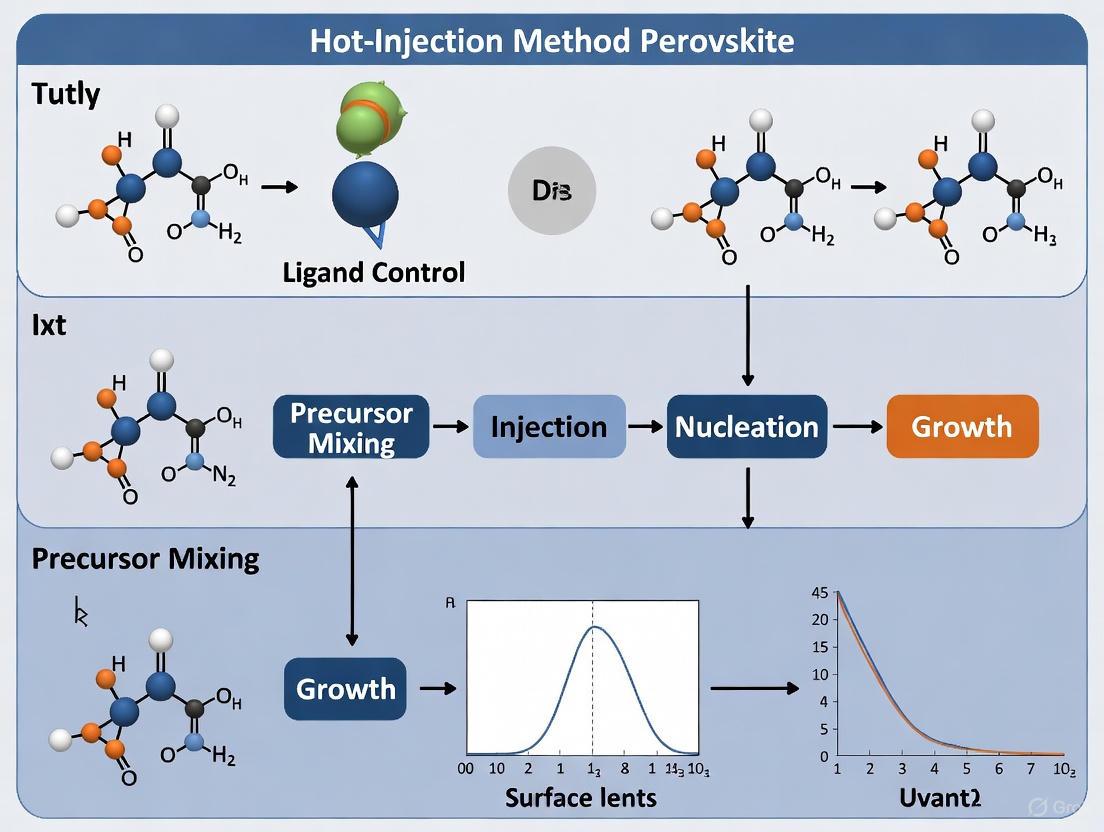
This article provides a comprehensive analysis of the hot-injection method for synthesizing high-quality inorganic perovskite quantum dots (PQDs), with a dedicated focus on ligand engineering as a critical control parameter.
Hot-Injection Synthesis of Perovskite Quantum Dots: A Comprehensive Guide to Ligand Control for Advanced Optoelectronics
Abstract
This article provides a comprehensive analysis of the hot-injection method for synthesizing high-quality inorganic perovskite quantum dots (PQDs), with a dedicated focus on ligand engineering as a critical control parameter. It covers the foundational principles of CsPbX3 QDs, detailing their defect-tolerant structures and quantum confinement effects. A step-by-step methodological guide for hot-injection synthesis is presented, including advanced ligand-assisted reprecipitation techniques and high-throughput robotic synthesis for reproducibility. The content addresses common challenges such as defect-mediated non-radiative recombination, Auger recombination, and environmental instability, offering proven optimization strategies including surface passivation, compositional engineering, and matrix encapsulation. A comparative analysis with alternative synthesis methods like LARP is provided, evaluating optical properties, blinking behaviors, and suitability for applications in LEDs, lasers, and biomedical sensing. This guide serves as an essential resource for researchers and scientists aiming to master PQD synthesis for next-generation optoelectronic and biomedical devices.
The Science Behind Perovskite Quantum Dots: Structure, Properties, and Ligand Roles
Crystal Structure and Composition of All-Inorganic Perovskites (CsPbX3)
All-inorganic halide perovskites with the chemical formula CsPbX3 (where X = Cl⁻, Br⁻, I⁻, or their mixtures) represent a prominent class of semiconductor materials characterized by their unique crystal structure and exceptional optoelectronic properties [1] [2]. These materials have garnered significant attention due to their high photoluminescence quantum yield (PLQY), narrow-band emission, and outstanding charge transport capabilities, making them ideal candidates for applications in light-emitting diodes (LEDs), solar cells, photodetectors, and lasers [3] [1]. The stability of these fully inorganic perovskites is notably superior to their organic-inorganic hybrid counterparts (which contain organic cations like MA⁺ or FA⁺), as they exhibit enhanced resistance to heat, moisture, and light-induced degradation [4] [2].
Crystal Structure and Phase Transitions
Fundamental Crystal Architecture
The crystal structure of CsPbX3 perovskites follows the ABX3 perovskite architecture [1] [2]. In this configuration:
- The A-site is occupied by a cesium ion (Cs⁺)
- The B-site contains a lead ion (Pb²⁺)
- The X-site is filled by halide ions (Cl⁻, Br⁻, I⁻, or mixtures thereof)
The Pb²⁺ cation is coordinated with six X⁻ anions to form corner-sharing [PbX6]⁴⁻ octahedra, which create a three-dimensional network. The Cs⁺ cations reside in the cuboctahedral cavities within this framework, contributing to the overall structural stability [1].
The stability of the perovskite structure is quantitatively assessed using the Goldschmidt tolerance factor (TF) [1]:
where rA, rPb, and r_X represent the ionic radii of the respective ions. For CsPbBr3 and CsPbI3, the calculated tolerance factors are approximately 0.9 and 0.89, respectively. While these values indicate some structural instability compared to an ideal close-packed structure (TF = 1), they nevertheless support the formation of functional perovskite phases [1].
Crystalline Phases and Stability
CsPbX3 perovskites can exist in several crystalline phases, including cubic, tetragonal, and orthorhombic structures [1]. The thermodynamic stability of these phases is strongly influenced by both temperature and the specific halide composition:
- Cubic Phase: This phase typically forms at higher temperatures (>130°C) and is characterized by its ideal perovskite structure with excellent optoelectronic properties [3] [1]
- Orthorhombic Phase: This non-perovskite phase (δ-phase) is thermodynamically favorable at room temperature for CsPbI3, featuring a wide bandgap of approximately 2.82 eV that is unsuitable for optoelectronic applications [4]
Table: Phase Stability and Bandgap Properties of CsPbX3 Perovskites
| Composition | Stable Phase at RT | Bandgap (eV) | Phase Stability Notes |
|---|---|---|---|
| CsPbI3 | Orthorhombic (δ-phase) | ~1.73 (cubic); ~2.82 (ortho) | Cubic phase metastable at RT; stabilizes at nanoscale or with Br⁻ incorporation [4] [1] |
| CsPbBr3 | Cubic/Tetragonal | ~2.37 | More stable than CsPbI3; maintains perovskite structure at RT [1] |
| CsPbCl3 | Cubic | ~2.95 | Highest stability among halides but limited light absorption [4] |
| CsPbI₂Br | Cubic | Intermediate | Enhanced stability compared to CsPbI3 [4] |
| CsPbIBr₂ | Cubic | Intermediate | Balanced efficiency and stability [4] |
The dimensional scale of the material significantly impacts phase stability. At the nanocrystal (NC) scale, increased surface energy and total Gibbs free energy make the non-perovskite orthorhombic phase less favorable, thereby stabilizing the metastable cubic and tetragonal phases that exhibit superior optoelectronic properties [1].
Synthesis Methods and Experimental Protocols
Hot-Injection Synthesis with Ligand Control
The hot-injection method represents the most widely utilized approach for synthesizing high-quality CsPbX3 nanocrystals (NCs) with precise control over size, morphology, and surface chemistry [3] [5] [2]. This section details a modified protocol that enables independent manipulation of precursor stoichiometries.
Hot-Injection Synthesis Workflow
Reagents and Materials
Table: Essential Reagents for Hot-Injection Synthesis
| Reagent | Function | Specific Examples | Role in Synthesis |
|---|---|---|---|
| Cesium Source | Provides Cs⁺ cations | Cs2CO3, Cs-oleate, CsTFA (cesium trifluoroacetate) [3] [6] | Forms A-site of perovskite structure; CsTFA can also act as surface ligand [6] |
| Lead Source | Provides Pb²⁺ cations | PbCl2, PbBr2, PbI2, Pb(CH3COO)2·3H2O [3] [2] | Forms B-site of perovskite structure; determines metal framework |
| Halide Source | Provides X⁻ anions | Benzoyl halides, PbX2 salts, alkyl halides [3] [2] | Determines bandgap and emission wavelength; enables anion exchange |
| Solvent | Reaction medium | 1-octadecene (ODE) [3] [5] [2] | High-booint solvent that dissolves precursors |
| Ligands | Surface capping agents | Oleic acid (OA), Oleylamine (OAm), 4-bromobutyric acid (BBA) [3] [5] [6] | Control NC growth, prevent aggregation, passivate surface defects |
| Alternative Ligands | Enhanced binding | Palmitic acid (PA), Stearic acid (SA), Tetradecanoic acid (TA) [5] | Higher melting point ligands with reduced dynamics for improved stability |
Detailed Step-by-Step Protocol
Preparation of Cs-oleate Precursor
- Combine Cs2CO3 (0.814 g), oleic acid (OA, 2.5 mL), and 1-octadecene (ODE, 30 mL) in a 100 mL flask [3]
- Heat at 120°C under nitrogen atmosphere with constant stirring until complete dissolution of Cs2CO3
- Maintain temperature above 100°C to prevent solidification before injection
Preparation of Lead Halide Precursor
- In a separate 50 mL four-neck flask, add ODE (5 mL), PbX2 (0.188 mmol for CsPbBr3), OA (1.5 mL), and oleylamine (OAm, 1.5 mL) [3] [5]
- For enhanced stability: Replace OA with palmitic acid (PA, 1.06 g) or stearic acid [5]
- Evacuate the system at 130°C for 1 hour to remove residual oxygen and moisture [2]
- Heat under N2 flow to the desired reaction temperature (160-200°C, depending on target composition)
Hot-Injection and Crystal Growth
- Rapidly inject the preheated Cs-oleate solution (0.4 mL) into the lead halide precursor with vigorous stirring [3]
- Allow the reaction to proceed for 5 seconds to several minutes, depending on the target NC size [3]
- Critical Parameters: Reaction temperature and time significantly influence crystal structure, particle size, and photoluminescence properties [3]
Reaction Quenching and Purification
- Quickly cool the reaction mixture using an ice-water bath to terminate crystal growth [5]
- Centrifuge the crude solution at 9000 rpm for 5-10 minutes to separate the nanocrystals [5]
- Discard the supernatant and redisperse the precipitate in a non-polar solvent (toluene, n-hexane)
- Repeat centrifugation to remove unreacted precursors and large aggregates
Effect of Synthesis Parameters on NC Properties
The hot-injection method enables precise control over CsPbX3 NC characteristics through manipulation of reaction conditions:
Reaction Temperature: Controls crystal phase formation and optical properties
Reaction Time: Influences NC size and size distribution
- Longer reaction times typically result in larger crystal sizes through Ostwald ripening [3]
Ligand Selection: Determines surface chemistry and stability
- Ligands with higher melting points (e.g., PA, SA) exhibit reduced dynamics and enhanced binding affinity, leading to improved NC stability [5]
- Nuclear Magnetic Resonance (1H NMR) studies confirm that palmitic acid remains more effectively on CsPbX3 NC surfaces after purification compared to oleic acid [5]
Optical Properties and Characterization
Tunable Emission and High Quantum Yield
CsPbX3 NCs exhibit exceptional optical properties that can be precisely tuned through composition and size control:
Composition-Dependent Bandgap: The photoluminescence emission can be systematically adjusted across the entire visible spectrum:
Mixed Halide Compositions: CsPbClxBr3-x and CsPbBrxI3-x systems enable continuous tuning of emission wavelengths between the endpoint halides [6]
Anion Exchange: Post-synthetic halide exchange provides a versatile route to fine-tune optical properties without nucleation of new NCs [2]
Table: Optical Performance of CsPbX3 Nanocrystals
| Composition | PL Emission Range (nm) | FWHM (nm) | Reported PLQY (%) | Stability Notes |
|---|---|---|---|---|
| CsPbCl3 | 400-420 | <20 | 47-92 [5] | Highest stability but widest bandgap [4] |
| CsPbBr3 | 510-520 | <20 | Up to 99.8 [3] | Balanced performance; most widely studied [3] |
| CsPbI3 | 680-700 | <35 | Up to 100 [2] | Phase instability challenge at RT [4] |
| CsPbClxBr3-x | 420-510 | <25 | Up to 90 in aqueous phase [6] | Tunable with Br⁻ content [6] |
| CsPbBrxI3-x | 520-700 | <35 | >90 | Compromise between efficiency and stability [4] |
Quantum Confinement Effects
When the physical dimensions of CsPbX3 NCs are reduced below the exciton Bohr radius (typically a few nanometers for these materials), pronounced quantum confinement effects emerge [1]. This phenomenon leads to:
- Size-Dependent Bandgap: The bandgap increases as NC size decreases
- Blue-Shifted Emission: For CsPbBr3 NCs, reducing size from 8.5 nm to 4.1 nm increases the bandgap from 2.37 eV to 2.5 eV, accompanied by observable blue shifts in photoluminescence spectra [1]
- Discrete Energy Levels: The continuous energy bands of bulk materials transition to discrete, atom-like states
The confinement energy (ΔE) can be estimated using the quantum confinement model [1]:
where ℏ is the reduced Planck constant, m* is the exciton reduced mass, and r is the particle radius.
Applications in Optoelectronic Devices
The exceptional properties of CsPbX3 perovskites have enabled their implementation in various high-performance optoelectronic devices:
Light-Emitting Diodes (LEDs) and Display Technology
- White LEDs: CsPbBr3 NCs combined with red-emitting K2SiF6:Mn4+ phosphors on blue InGaN LED chips achieve high-quality white light with CIE coordinates of (0.389, 0.376) and a wide color gamut covering 123% of the NTSC standard [3]
- Color Conversion Layers: Perovskite NCs serve as efficient color converters in liquid crystal display backlighting, offering superior color purity compared to traditional phosphors [3]
- Efficient Electroluminescence: External quantum efficiencies (EQE) approaching 20% have been demonstrated in perovskite LEDs, with theoretical predictions suggesting potential efficiencies up to 30% through optimized transition dipole moment orientation [3]
Photovoltaic Devices
- All-Inorganic Perovskite Solar Cells: CsPbI3-xBrx compositions offer enhanced thermal and moisture stability compared to organic-inorganic hybrid perovskites [4]
- Power Conversion Efficiency: Efficiencies have dramatically improved from 2.9% in 2015 to over 21.5% in recent years through interface engineering and compositional optimization [4]
- Tandem Solar Cells: Wide-bandgap CsPbI3-xBrx perovskites are promising for tandem solar cell applications due to their optimal bandgap and improved stability [4]
Emerging Electronic Applications
Beyond photonics and photovoltaics, CsPbX3 NCs are finding applications in:
- Transistor Technologies: Exploited as active layers or additives in high-performance transistors [1]
- Memory Devices: Implementation in next-generation memory technologies [1]
- Photoelectric Catalysis: Demonstration of potential in catalytic applications driven by light absorption [2]
Stability Considerations and Enhancement Strategies
Despite their exceptional optoelectronic properties, CsPbX3 perovskites face challenges regarding long-term structural stability:
Instability Mechanisms
- Phase Instability: The thermodynamically favored non-perovskite orthorhombic phase of CsPbI3 at room temperature limits applications [4] [1]
- Ionic Character: The strongly ionic nature of CsPbX3 leads to dynamic ligand binding and susceptibility to polar solvents [5] [1]
- Ligand Desorption: Organic capping ligands (OA, OAm) can readily desorb during purification or storage, leading to NC degradation and PLQY reduction [5]
- Halide Migration: Electric field or light-induced halide migration can cause phase segregation and optical degradation [1]
Stability Enhancement Strategies
- Ligand Engineering: Implementation of high-binding-affinity ligands like palmitic acid (PA) and stearic acid (SA) significantly improves stability while maintaining high PLQY (up to 92%) [5]
- Aqueous Phase Synthesis: Using CsTFA as both cesium source and surface ligand enables synthesis of stable CsPbClxBr3-x NCs in water with PLQY >90% and 90.3% PL intensity retention after 90 hours [6]
- Halide Composition Optimization: Bromide incorporation in CsPbI3-xBrx enhances phase stability while maintaining suitable bandgap for optoelectronic applications [4]
- Surface Passivation: Cooperative passivation using multiple ligands (e.g., TFA- with BBA and OLA) reduces surface defects and improves environmental stability [6]
Stability Challenges and Enhancement Strategies
The crystal structure and composition of all-inorganic CsPbX3 perovskites directly govern their exceptional optoelectronic properties and application potential. The hot-injection synthesis method, coupled with advanced ligand engineering strategies, enables precise control over NC size, morphology, and surface chemistry. Through systematic optimization of reaction parameters and implementation of high-binding-affinity ligands, researchers can overcome stability challenges while maintaining the outstanding quantum efficiency that makes these materials promising for next-generation optoelectronic devices. The continued development of synthesis protocols and stabilization approaches will further enhance the commercial viability of CsPbX3 perovskites across a broadening range of technological applications.
Quantum Confinement Effects and Tunable Optical Properties
Perovskite quantum dots (PeQDs) are zero-dimensional nanomaterials that exhibit distinct chemical, physical, electrical, and optical properties compared to their bulk counterparts, primarily due to quantum confinement effects [7]. When the physical size of the PeQD core shrinks below the material's excitonic Bohr radius, the motion of charge carriers is spatially confined, leading to quantization of energy levels and size-tunable optoelectronic properties [1]. This phenomenon forms the foundation for tailoring PeQDs for specific applications across solar cells, light-emitting diodes (LEDs), lasers, and quantum technologies [7] [1].
The electronic structure of metal halide perovskites with the general formula ABX₃ (where A = Cs⁺, MA⁺, or FA⁺; B = Pb²⁺ or Sn²⁺; and X = Cl⁻, Br⁻, I⁻ or their mixtures) enables exceptional defect tolerance and strong light-emitting characteristics [1] [8]. When constrained to nanoscale dimensions, these materials exhibit enhanced photoluminescence quantum yield (PLQY), narrow emission line widths, and composition-dependent bandgap engineering capabilities [8]. The quantum confinement effect in PeQDs is harnessed through precise synthesis control, particularly via the hot-injection method with careful ligand management, to produce materials with customized optical properties for advanced optoelectronic applications [1] [8].
Fundamental Principles of Quantum Confinement
The Quantum Confinement Mechanism
Quantum confinement occurs when the dimensions of a semiconductor nanocrystal become smaller than the Bohr exciton radius of the bulk material, leading to discrete energy levels and a size-dependent increase in bandgap energy [1]. The excitonic Bohr radius represents the average distance between the electron and hole in a bound exciton pair. In PeQDs, this spatial constraint causes the continuous energy bands of bulk semiconductors to break down into discrete, atomic-like energy states, dramatically altering their optical and electronic properties [1].
The confinement energy can be quantitatively described by the equation: ΔE = ℏ²π²/2mr², where ΔE represents the bandgap increase due to quantum confinement, ℏ is the reduced Planck constant, m is the exciton reduced mass, and r is the particle radius [1]. This relationship demonstrates the inverse square dependence between particle size and bandgap energy, enabling precise tuning of optical properties through dimensional control. The excitonic Bohr radii of inorganic halide perovskites are typically just a few nanometers, placing stringent requirements on synthesis precision to achieve quantum confinement [1].
Size-Dependent Optical Properties
The quantum confinement effect enables continuous tuning of PeQD emission wavelengths across the visible spectrum by controlling nanocrystal size [1] [8]. As PeQD dimensions decrease, the bandgap increases, resulting in blue-shifted photoluminescence and absorption profiles. Experimental studies on CsPbBr₃ QDs have demonstrated that when particle size decreases from approximately 8.5 nm to 4.1 nm, the bandgap increases from 2.37 eV to 2.5 eV, accompanied by significant blue shifts in photoluminescence spectra [1].
This size-tunability is complemented by exceptional optical characteristics including high photoluminescence quantum yield (PLQY), narrow full width at half maximum (FWHM) providing high color purity, large absorption coefficients, and high oscillator strengths [1] [8]. The defect-tolerant nature of perovskite structures further enhances their optical performance by minimizing non-radiative recombination centers, making PeQDs particularly suitable for light-emitting applications [8].
Table 1: Size-Dependent Optical Properties of CsPbBr₃ Quantum Dots
| Particle Size (nm) | Bandgap (eV) | Emission Wavelength (nm) | Photoluminescence Quantum Yield (%) |
|---|---|---|---|
| 4.1 | 2.50 | ~496 | >80 (typical) |
| 6.0 | 2.43 | ~510 | >80 (typical) |
| 8.5 | 2.37 | ~523 | >80 (typical) |
Experimental Protocols for Hot-Injection Synthesis with Ligand Control
Standard Hot-Injection Method for PeQD Synthesis
The hot-injection technique represents the most widely adopted approach for synthesizing high-quality PeQDs with precise size control and narrow size distribution [8]. This method enables exacting manipulation of reaction conditions to harness quantum confinement effects through dimensional control.
Materials and Equipment:
- Precursors: Cesium carbonate (Cs₂CO₃), lead halide salts (PbX₂, where X = Cl, Br, I), oleic acid (OA), oleylamine (OAm)
- Solvents: 1-octadecene (ODE)
- Equipment: Three-neck flask, Schlenk line, heating mantle, temperature controller, syringe pumps, inert gas supply
Step-by-Step Protocol:
Precursor Preparation:
- Cesium oleate precursor: Dissolve 0.4 g Cs₂CO₃ in 15 mL ODE with 1.25 mL OA in a 50 mL three-neck flask
- Dry and degas the mixture at 120°C under vacuum for 60 minutes
- Heat under inert atmosphere to 150°C until complete dissolution, then maintain at 100°C
- Lead halide precursor: Dissolve 0.3 g PbX₂ in 15 mL ODE in a separate 50 mL three-neck flask
- Add appropriate ratios of OA and OAm (typically 1.5 mL each for CsPbBr₃)
- Dry and degas at 120°C under vacuum for 60 minutes
Hot-Injection Reaction:
- Heat the lead halide precursor mixture to target reaction temperature (140-200°C) under N₂ atmosphere
- Rapidly inject 1.0-1.5 mL preheated cesium oleate precursor into the reaction flask
- Immediately cool the reaction bath to room temperature after 5-30 seconds to terminate growth
Purification and Isolation:
- Centrifuge the crude solution at 8000-12,000 rpm for 10 minutes
- Discard the supernatant and redisperse the pellet in anhydrous hexane or toluene
- Repeat centrifugation and redispersion cycle 2-3 times
- Filter through 0.22 μm PTFE syringe filter to remove aggregates
Ligand Engineering and Post-Synthesis Treatments
Ligands play a critical dual role in PeQD synthesis: they control nanocrystal growth during synthesis and passivate surface defects while determining charge transport properties in solid-state films [8]. Effective ligand management is essential for optimizing both optical properties and device performance.
Ligand Exchange Protocol:
Concentrated PeQD Ink Preparation:
- Adjust concentration of purified PeQDs to 25-50 mg/mL in anhydrous toluene
- Transfer to nitrogen-filled glovebox for subsequent processing
Solid-State Film Deposition and Ligand Exchange:
- Spin-coat PeQD ink onto substrate at 2000-3000 rpm for 30 seconds
- During spinning, rapidly drop-cast antisolvent (ethyl acetate or methyl acetate) to initiate ligand dissociation
- Repeat spin-coating and antisolvent treatment cycle 3-5 times to achieve 300-500 nm thickness
Post-Deposition Soaking Treatment:
- Prepare soaking solution: 5-10 mM short-chain ligands (butylamine, phenethylammonium) or metal halide salts (PbBr₂, ZnBr₂) in isopropanol or ethanol
- Apply soaking solution to PeQD film for 30-60 seconds, then spin-dry
- Anneal at 70-100°C for 5-10 minutes to enhance inter-dot electronic coupling
Critical Parameters for Ligand Control:
- Ligand Density Balance: Optimize between surface passivation and charge transport
- Chain Length Engineering: Replace long-chain oleate/oleylamine with short-chain ligands
- Binding Group Selection: Utilize carboxylates, ammonium, phosphonic acids for specific binding affinities
- Double-Ligand Systems: Combine charge-transport ligands with defect-passivating ligands
Table 2: Ligand Engineering Strategies for PeQDs
| Ligand Type | Chain Length | Function | Impact on Properties |
|---|---|---|---|
| Oleic Acid/Oleylamine | Long (C18) | Growth control, colloidal stability | Excellent dispersion, poor charge transport |
| Butylamine | Short (C4) | Surface passivation | Moderate stability, improved conductivity |
| Phenethylammonium | Aromatic | Defect passivation | Enhanced PLQY, stability |
| Mercaptopropionic acid | Short (C3) | Charge transport | Good conductivity, potential toxicity |
| Zwitterionic ligands | Variable | Bidentate binding | Superior stability, good transport |
Quantitative Analysis of Confinement Effects
Composition-Dependent Optical Tuning
While quantum confinement enables size-dependent bandgap tuning, compositional engineering through halide exchange provides an additional dimension for optical property control [8]. The bandgap energy of PeQDs follows the trend: CsPbCl₃ > CsPbBr₃ > CsPbI₃, enabling emission coverage across the entire visible spectrum.
Anion Exchange Protocol:
- Prepare precursor solution: 0.1 M PbX₂ (target halide) and alkylammonium halide in toluene
- Mix with purified PeQDs at room temperature with vigorous stirring
- Monitor reaction progress via UV-Vis and PL spectroscopy (typically 1-10 minutes)
- Purify exchanged PeQDs by centrifugation and redispersion
Table 3: Composition-Dependent Optical Properties of CsPbX₃ Quantum Dots
| Composition | Bandgap (eV) | Emission Range (nm) | FWHM (nm) | PLQY (%) |
|---|---|---|---|---|
| CsPbCl₃ | 2.95-3.05 | 410-430 | 10-15 | 50-80 |
| CsPbCl₂Br₁ | 2.65-2.80 | 440-470 | 15-20 | 70-90 |
| CsPbBr₃ | 2.35-2.50 | 490-530 | 18-25 | 80-95 |
| CsPbBr₁I₂ | 2.05-2.20 | 550-600 | 25-35 | 70-85 |
| CsPbI₃ | 1.70-1.80 | 680-710 | 35-45 | 50-80 |
Structural and Electronic Characterization Methods
Comprehensive characterization is essential for correlating synthetic parameters with quantum confinement effects and optical properties.
Essential Characterization Techniques:
UV-Visible Absorption Spectroscopy:
- Measure first excitonic peak position to determine bandgap
- Calculate bandgap using Tauc plot method for direct bandgap semiconductors
- Monitor absorption onset shifts during growth and exchange processes
Photoluminescence Spectroscopy:
- Record emission maxima, FWHM, and quantum yield
- Perform time-resolved PL for carrier lifetime analysis
- Map PL intensity versus excitation power for recombination mechanism insight
Transmission Electron Microscopy (TEM):
- Determine particle size, size distribution, and morphology
- Calculate average dimensions from population statistics (n>100)
- Correlate size with optical properties for confinement analysis
X-Ray Diffraction (XRD):
- Identify crystal structure and phase purity
- Detect lattice parameter changes during composition engineering
- Calculate crystallite size using Scherrer equation
Research Reagent Solutions and Essential Materials
Successful synthesis of PeQDs with controlled quantum confinement effects requires specific reagents and materials optimized for hot-injection methods and subsequent processing.
Table 4: Essential Research Reagents for PeQD Synthesis and Processing
| Reagent/Material | Function | Specifications | Alternative Options |
|---|---|---|---|
| Cesium carbonate (Cs₂CO₃) | Cesium precursor | 99.9% trace metals basis | Cesium acetate, cesium oleate |
| Lead(II) bromide (PbBr₂) | Lead and halide source | 99.999% purity, anhydrous | Lead chloride, lead iodide |
| 1-Octadecene (ODE) | High-boiling solvent | >90% technical grade, dried over molecular sieves | Diphenyl ether, squalene |
| Oleic acid (OA) | Ligand, surface stabilizer | >90% technical grade, purified before use | Other carboxylic acids (e.g., stearic acid) |
| Oleylamine (OAm) | Ligand, reducing agent | >98% purity, stored under inert atmosphere | Other primary amines (e.g., dodecylamine) |
| Butylamine | Short-chain ligand for exchange | >99.5% purity, anhydrous | Propylamine, pentylamine |
| Phenethylammonium bromide | Aromatic ligand for passivation | >99% purity, recrystallized before use | Other arylammonium halides |
| Anhydrous toluene | Purification solvent | 99.8%, water <10 ppm, stored over molecular sieves | Hexane, octane, chlorobenzene |
| Methyl acetate | Antisolvent for ligand exchange | >99.5% purity, anhydrous | Ethyl acetate, diethyl ether |
Advanced Applications and Performance Metrics
The tunable optical properties enabled by quantum confinement effects position PeQDs as versatile materials for advanced optoelectronic applications. Performance in these applications directly correlates with the precision of synthesis and ligand control protocols outlined in this document.
Photovoltaic Applications: Perovskite quantum dot solar cells (PeQDSCs) have achieved certified power conversion efficiencies of 18.1%, surpassing conventional colloidal quantum dot solar cells [8]. This performance stems from the quantum confinement-enhanced absorption coefficients and tunable bandgaps that enable optimized sunlight harvesting. The hot-injection method with precise ligand control enables the formation of conductive PeQD films with enhanced charge transport while maintaining quantum confinement benefits.
Light-Emitting Applications: PeQDs exhibit near-unity photoluminescence quantum yields and narrow emission profiles ideal for LED applications [1] [8]. Quantum confinement enables precise color tuning without compositional changes, while appropriate ligand engineering ensures efficient charge injection in electroluminescent devices. The defect-tolerant nature of perovskites further enhances performance in light-emitting applications.
Emerging Electronic Applications: Beyond optoelectronics, PeQDs are being exploited as active layers or additives in high-performance transistors and memory devices [1]. The quantum confinement effect modulates charge transport properties, while ligand engineering enables integration with various device architectures. These electronic applications represent the frontier of PeQD implementation beyond conventional optoelectronic uses.
Defect-Tolerant Nature and Its Impact on Photoluminescence Quantum Yield
The defect-tolerant nature of lead halide perovskite nanocrystals (NCs) is a critical property enabling their high performance in optoelectronic applications. This tolerance primarily refers to the ability of these materials to maintain excellent photoluminescence quantum yield (PLQY) and charge-carrier lifetimes despite the presence of crystal defects, which would typically cause significant non-radiative recombination in conventional semiconductors [9]. In CsPbX₃ (X = Cl, Br, I) NCs synthesized via hot-injection methods, this defect tolerance stems from their unique electronic structure, where the primary defect types (halide vacancies) form shallow traps that minimally impact optical properties [9]. The strategic control of surface ligands during synthesis plays a pivotal role in modulating this defect tolerance, directly influencing PLQY by determining surface passivation quality and defect density [10].
Quantitative Analysis of Defect Tolerance and PLQY
Impact of Defect Engineering on PLQY
Table 1: Effect of Purification-Induced Defects on PLQY in CsPbX₃ NCs [9]
| Perovskite Composition | Purification Steps | Trap Depth (eV from CBM) | PLQY Retention | Key Observation |
|---|---|---|---|---|
| CsPbBr₃ | 1x (Low defects) | 0.666 | High (~80-90%) | Minimal PLQY degradation with excitation energy |
| CsPbBr₃ | 2x (High defects) | 0.666 | Significant decrease | ~15% PLQY decrease with 1 eV excess energy |
| CsPbBrₓI₃₋ₓ | 1x (Low defects) | 0.513 | High | Bandgap widening observed after purification |
| CsPbBrₓI₃₋ₓ | 2x (High defects) | 0.513 | Moderate decrease | ~15% PLQY decrease with 1 eV excess energy |
| CsPbI₃ | 1x (Low defects) | 0.278 | High (>95%) | Excellent retention despite purification |
| CsPbI₃ | 2x (High defects) | 0.278 | High (>95%) | Minimal PLQY change, demonstrating defect tolerance |
Advanced Ligand Engineering for Enhanced Performance
Table 2: Ligand Tail Engineering Impact on Photostability and Blinking [10]
| Ligand Type | Ligand Tail Interaction | Surface Coverage | Single Dot Blinking | Photostability | PLQY Retention |
|---|---|---|---|---|---|
| DDABr (Bulky) | Steric repulsion | Incomplete (~7/8 sites) | Significant blinking | Limited | Degrades rapidly |
| PEA (π-π stacking) | Attractive π-π stacking | Near-epitaxial (full) | Nearly non-blinking | Extraordinary (12 hours) | >95% after 30 days |
| Traditional Long-chain | Adverse solubilization equilibrium | Poor in solid state | Severe blinking | Photodarkening | Poor in solid state |
Experimental Protocols
Chemicals: PbX₂ (X = Cl, Br, I, 99.99%), Cs₂CO₃ (99.9%), 1-octadecene (ODE, 90%), oleic acid (OA, 90%), oleylamine (OAm, 80-90%), methyl acetate (MeOAc).
Cs-oleate Precursor Preparation:
- Load Cs₂CO₃ (0.814 g), OA (2.5 mL), and ODE (40 mL) into a 100 mL 3-neck flask.
- Dry under vacuum for 1 hour at 120°C, then heat under N₂ to 150°C until complete dissolution.
- Maintain at 100°C under N₂ until injection to prevent solidification.
CsPbBr₃ NC Synthesis (Representative Example):
- Load PbBr₂ (0.069 g), ODE (5 mL), OA (0.5 mL), and OAm (0.5 mL) in a 50 mL 3-neck flask.
- Dry under vacuum for 1 hour at 120°C.
- Heat under N₂ to the desired reaction temperature (140-200°C).
- Rapidly inject Cs-oleate precursor (0.4 mL) preheated to 100°C.
- React for 5-30 seconds, then immediately cool in an ice-water bath.
Intentional Defect Introduction via Purification:
- Centrifuge the crude reaction mixture at 8000 rpm for 10 minutes.
- Discard the supernatant and redisperse the precipitate in toluene.
- Add methyl acetate (MeOAc) as an antisolvent in a 1:1 volume ratio and centrifuge.
- Repeat steps 2-3 for multiple purification cycles to systematically increase surface halide vacancy density [9].
Ligand Exchange for Non-Blinking QDs:
- Synthesize CsPbBr₃ NCs following the standard hot-injection protocol.
- Pre-treat NCs with n-butylammonium bromide (NBABr) to initial surface passivation.
- Immerse NBABr-treated QDs in saturated phenethylammonium bromide (PEABr) solution.
- Heat the mixture to 60-80°C for 30 minutes to promote ligand exchange.
- Purify via centrifugation and redispersion in toluene.
- The π-π stacking of PEA ligands forms a nearly epitaxial layer, drastically reducing surface energy and eliminating trap states.
Visualization of Defect Tolerance Mechanisms
Defect Tolerance in Perovskite Quantum Dots
Hot-Carrier Dynamics and Defect Interaction
The Scientist's Toolkit: Research Reagent Solutions
Table 3: Essential Materials for Defect-Controlled Perovskite QD Synthesis
| Reagent/Chemical | Function | Impact on Defect Tolerance | Optimal Purity |
|---|---|---|---|
| Lead Halides (PbX₂) | Perovskite precursor | Stoichiometry determines intrinsic defect density | ≥99.99% |
| Cesium Carbonate (Cs₂CO₃) | Cs precursor for Cs-oleate | Affects nucleation and growth kinetics | ≥99.9% |
| Oleic Acid (OA) | Surface ligand | Passivates surface sites, controls growth | 90% |
| Oleylamine (OAm) | Co-ligand | Synergistic passivation with OA | 80-90% |
| Phenethylammonium Bromide (PEABr) | Advanced ligand | π-π stacking enables epitaxial passivation [10] | ≥98% |
| n-Butylammonium Bromide (NBABr) | Pre-treatment ligand | Initial surface preparation for exchange [10] | ≥98% |
| Methyl Acetate (MeOAc) | Antisolvent purification | Controlled defect introduction [9] | Anhydrous |
| 1-Octadecene (ODE) | Non-coordinating solvent | Reaction medium for hot-injection | 90% |
Surface ligands are organic or inorganic molecules bound to the surface of perovskite quantum dots (PQDs) and play an indispensable role in determining their optoelectronic properties and environmental stability. These molecules form a dynamic shell around the nanocrystals, influencing nearly every aspect of PQD behavior from synthesis to device integration. For PQDs with the general formula ABX₃ (where A = Cs⁺, MA⁺, FA⁺; B = Pb²⁺; X = Cl⁻, Br⁻, I⁻), surface ligands primarily coordinate with unsaturated sites on the nanocrystal surface, typically uncoordinated lead atoms and halide vacancies [11]. The unique ionic character of perovskite materials creates a highly dynamic ligand system distinct from conventional semiconductor quantum dots, requiring specialized ligand design strategies to address challenges in defect passivation, phase stability, and charge transport [11].
The critical importance of surface ligands extends throughout the PQD lifecycle: they control nucleation and growth during synthesis, passivate surface defects that would otherwise cause non-radiative recombination, provide colloidal stability in solution, influence film formation and morphology during deposition, and mediate charge injection and transport in operational devices [11]. This application note examines the multifaceted roles of surface ligands in PQD systems synthesized via the hot-injection method, with particular emphasis on passivation mechanisms, stability enhancement, and charge transport optimization for advanced optoelectronic applications.
Quantitative Analysis of Ligand Impact on PQD Performance
Table 1: Performance Metrics of PQDs with Different Surface Ligand Strategies
| Ligand Strategy | Material System | PLQY (%) | Device EQE (%) | Stability Enhancement | Key Mechanism |
|---|---|---|---|---|---|
| HA & SBES co-passivation | CsPb(Br/I)₃ QDs | 71 | 10.13 (WLED) | Excellent stability at 80°C, 80% humidity, 90 days storage | Defect passivation & halide vacancy formation energy increase [12] |
| Bilateral TSPO1 passivation | CsPbBr₃ QLEDs | 43→79 (film) | 7.7→18.7 | Operational lifetime: 0.8→15.8 hours (20×) | Dual-interface defect passivation [13] |
| PZPY bidentate ligand | CsPbI₃ QDs | 94 | 26.0 | T₅₀: 10,587 hours; 21.7% EQE after 1-month storage | Ripening control & strong Pb²⁺ coordination [14] |
| AcO⁻ & 2-HA ligands | CsPbBr₃ QDs | 99 | N/A | Enhanced reproducibility | Complete precursor conversion & defect suppression [15] |
| OA/OAm ratio optimization | Cs₂NaInCl₆ QDs | Varies with Sb³⁺ doping | N/A | Stability dependent on OA presence | OAm: defect passivation; OA: colloidal stability [16] |
Table 2: Ligand Binding Properties and Coordination Mechanisms
| Ligand Type | Functional Group | Binding Energy (eV) | Coordination Mode | Impact on Surface Chemistry |
|---|---|---|---|---|
| Phosphine oxide (TSPO1) | P=O | -1.1 | Monodentate | Eliminates trap states, prevents ligand loss under electric field [13] |
| Carboxylic acids (OA) | -COOH | ~1.14 | Monodentate | Dynamic binding, easily displaced [12] |
| Bidentate carboxylic acids (IDA) | -COOH | ~1.40 | Bidentate | Enhanced chelation effect [12] |
| Sulfonic acid (DBSA) | -SO₃H | >conventional ligands | Ionic interaction | Modifies delocalized electron wavefunction [12] |
| Bidentate PZPY | N-donor | Strong | Bidentate | Flexible coordination to uncoordinated Pb²⁺ [14] |
Ligand Functions in Passivation, Stability, and Charge Transport
Surface Passivation Mechanisms
Surface ligands primarily passivate PQDs by coordinating with unsaturated surface atoms, particularly uncoordinated Pb²⁺ ions that form during synthesis and processing. The passivation effectiveness directly correlates with ligand binding strength and coordination geometry. Bidentate ligands such as homophthalic acid (HA) and 2-(1H-pyrazol-1-yl)pyridine (PZPY) demonstrate superior passivation compared to monodentate alternatives like oleic acid (OA) due to the chelation effect, where multiple binding points create more stable surface coordination [12] [14]. Density functional theory (DFT) calculations reveal that bidentate ligands exhibit higher binding energies (~1.4 eV) compared to monodentate carboxylic acids (~1.14 eV), explaining their enhanced effectiveness in suppressing non-radiative recombination pathways [12].
The halide equivalent ligand approach represents another sophisticated passivation strategy. Molecules like 2-bromoethanesulphonic acid sodium salt (SBES) simultaneously passivate uncoordinated Pb²⁺ through sulfonate groups while supplying bromine ions to fill halide vacancies, thereby addressing both cationic and anionic surface defects through a single molecular structure [12]. This dual functionality increases the formation energy of halide vacancies, substantially improving photoluminescence quantum yield (PLQY) to 71% for CsPb(Br/I)₃ QDs [12]. Similarly, strongly acidic ligands like 4-dodecylbenzenesulfonic acid (DBSA) modify the wave function of delocalized electrons near lead atoms, creating more robust surface passivation that maintains high PLQY (>90%) through multiple purification cycles [12].
Stability Enhancement Strategies
The dynamic nature of conventional OA/OAm ligand systems presents significant stability challenges for PQDs, as these ligands readily desorb during processing, storage, or device operation, exposing fresh surface defects and initiating degradation cascades. Ligand engineering addresses this instability through multiple mechanisms: enhancing binding strength, implementing bilateral passivation, and controlling ripening processes.
Bilateral interfacial passivation represents a paradigm shift in PQD film stabilization. By depositing phosphine oxide molecules (TSPO1) at both the top and bottom interfaces of PQD films within device architectures, researchers achieved a 20-fold enhancement in operational lifetime (from 0.8 to 15.8 hours) alongside a dramatic efficiency increase from 7.7% to 18.7% EQE [13]. This approach addresses defect regeneration at both charge injection interfaces, which are particularly vulnerable to non-radiative recombination and ion migration under operational bias.
Ripening control via bidentate ligand design offers another powerful stability mechanism. The small, flexible PZPY molecule coordinates strongly with surface Pb²⁺ sites, inhibiting Oswald ripening and secondary growth that normally occurs during purification, film formation, and storage [14]. This ripening suppression maintains monodisperse QD sizes and prevents the formation of interface fusion, low-angle boundaries, high-angle boundaries, antiphase boundaries, and dislocations—all defect structures that accelerate degradation [14]. The exceptional stability achieved through this approach enables devices fabricated from 3-month-old QD solutions to maintain EQEs exceeding 20.3% [14].
Charge Transport Optimization
The insulating nature of long-chain organic ligands presents a fundamental challenge for PQD optoelectronic devices, where efficient charge injection and transport are essential. Ligand engineering strategies address this trade-off by employing shorter ligand architectures or incorporating conductive moieties while maintaining passivation effectiveness.
Short-chain ligands like acetate (AcO⁻) and 2-hexyldecanoic acid (2-HA) enhance charge transport by reducing interdot separation in solid-state films [15]. This approach minimizes the tunneling barrier between adjacent QDs while still providing effective surface passivation, as demonstrated by the 70% reduction in amplified spontaneous emission threshold (from 1.8 μJ·cm⁻² to 0.54 μJ·cm⁻²) in CsPbBr₃ QDs [15]. The enhanced interdot coupling improves energy transfer and charge transport simultaneously, benefiting both optical and electronic applications.
The dual-purpose ligand strategy further optimizes this balance by employing molecules that simultaneously passivate surfaces and facilitate charge transport. Inorganic ligands and conjugated organic ligands provide specific examples where the ligand shell reduces trap-assisted recombination while creating preferential pathways for charge carrier movement between QDs [11]. This approach recognizes that the ligand sphere in PQD films should not be viewed merely as a necessary insulator but rather as a designable component that can actively participate in the device's electronic function.
Experimental Protocols
Hot-Injection Synthesis of CsPbBr₃ QDs with Ligand Engineering
Materials:
- Cesium carbonate (Cs₂CO₃, 99.9%)
- Lead bromide (PbBr₂, 99.99%)
- Oleic acid (OA, 90%)
- Oleylamine (OAm, 70%)
- 1-Octadecene (ODE, 90%)
- Alternative ligands: homophthalic acid (HA, 99%), 2-bromoethanesulphonic acid sodium salt (SBES, 99%), or specialized ligands
- Non-polar solvents: hexane, ethyl acetate
Cs-Oleate Precursor Preparation:
- Load Cs₂CO₃ (0.4 g), OA (5 mL), and ODE (15 mL) into a 50 mL three-neck flask
- Dry under vacuum for 1 hour at 120°C with constant stirring
- Heat under N₂ atmosphere to 140°C until complete dissolution of Cs₂CO₃
- Maintain at 120°C until injection [17]
QD Synthesis with Alternative Ligands:
- Combine ODE (10 mL), PbBr₂ (0.138 g), and alternative ligands in predetermined ratios in a 50 mL three-neck flask
- Dry under vacuum for 1 hour at 120°C
- Inject OAm (2 mL) and OA (2 mL) under N₂ atmosphere at 120°C
- Raise temperature to 150-180°C (depending on target QD size)
- Rapidly inject Cs-oleate precursor (0.8 mL) with vigorous stirring
- Quit reaction after 5-60 seconds using ice bath [12] [17]
Purification Protocol:
- Transfer crude solution to centrifuge tubes
- Add ethyl acetate or acetone as anti-solvent (1:1 volume ratio)
- Centrifuge at 9500 rpm for 5 minutes
- Discard supernatant and redisperse precipitate in hexane
- Repeat centrifugation at 4000 rpm for 3 minutes to remove aggregates
- Collect supernatant containing purified QDs [16]
Bilateral Interfacial Passivation for QLED Devices
Materials:
- Passivation molecules: TSPO1, PDEA, or similar phosphine oxide derivatives
- Anhydrous solvents for molecular dissolution
- Pre-fabricated QD films on electron transport layers
Procedure:
- Prepare QD film via spin-coating according to standard protocols
- Dissolve passivation molecule (0.5-2 mg/mL) in anhydrous solvent
- Deposit passivation layer using vacuum thermal evaporation:
- Chamber pressure: <10⁻⁶ Torr
- Deposition rate: 0.1-0.3 Å/s
- Final thickness: 1-3 nm
- Alternatively, apply via gentle spin-coating for lab-scale processing
- Repeat passivation at both QD/ETL and QD/HTL interfaces in device stack [13]
Quality Control Assessment:
- Measure PLQY of passivated films versus untreated control
- Characterize trap density via space-charge-limited current (SCLC) measurements
- Analyze surface morphology changes via AFM
- Confirm binding via FTIR spectroscopy (P=O peak shift to 1190 cm⁻¹) [13]
Postsynthetic Ligand Treatment for Ripening Control
Materials:
- Bidentate ligands: PZPY, IDA, or similar compounds
- Polar solvents for ligand dissolution
- Pre-synthesized and purified PQDs
Procedure:
- Prepare purified PQD solution in hexane (5-10 mg/mL)
- Dissolve bidentate ligand (molar ratio 1:1 to 1:10 relative to Pb) in minimal compatible solvent
- Slowly add ligand solution to QD solution with vigorous stirring
- Stir mixture for 2-12 hours at room temperature
- Precipitate with ethyl acetate and centrifuge at 8000 rpm for 5 minutes
- Redisperse in non-polar solvent for storage or immediate use [14]
Characterization:
- Monitor PLQY improvement (typically 10-30% absolute increase)
- Analyze size distribution via TEM before and after treatment
- Assess stability via PL retention after 7-30 days storage
- Evaluate ripening inhibition by comparing size changes after heating cycles [14]
The Scientist's Toolkit: Essential Research Reagents
Table 3: Key Reagent Solutions for PQD Ligand Engineering Research
| Reagent Category | Specific Examples | Function & Mechanism | Application Notes |
|---|---|---|---|
| Conventional Ligands | Oleic acid (OA), Oleylamine (OAm) | Baseline ligands for synthesis, colloidal stability | Dynamic binding limits stability; essential for comparison studies [16] |
| Bidentate Carboxylic Acids | Homophthalic acid (HA), Iminodibenzoic acid (IDA) | Strong chelation to surface Pb²⁺ | Enhance formation energy of halide vacancies; improve PLQY [12] |
| Halide Equivalent Ligands | 2-Bromoethanesulphonic acid sodium salt (SBES) | Simultaneous passivation and halide vacancy filling | Dual functionality addresses multiple defect types [12] |
| Phosphine Oxide Passivators | TSPO1, PDEA | Strong P=O coordination to Pb²⁺ | Ideal for bilateral interface passivation in devices [13] |
| Nitrogen Donor Ligands | 2-(1H-pyrazol-1-yl)pyridine (PZPY) | Flexible bidentate coordination | Inhibit Ostwald ripening; enhance storage stability [14] |
| Short-Chain Ligands | Acetate (AcO⁻), 2-Hexyldecanoic acid (2-HA) | Reduced interdot distance | Improve charge transport while maintaining passivation [15] |
| Inorganic Ligands | Metal halide salts (ZnBr₂) | Halide-rich environment for synthesis | Control nucleation/growth; size tuning via concentration [17] |
Ligand Engineering Workflow and Structure-Function Relationships
Diagram 1: Ligand selection workflow for targeted PQD properties
The strategic selection of surface ligands follows a structured approach based on application requirements. For optoelectronic devices like QLEDs and solar cells, charge transport optimization becomes paramount, directing selection toward short-chain ligands and bilateral passivation strategies [13]. Sensing applications prioritize specific surface interactions and defect control, making halide-equivalent and bidentate ligands particularly effective [18]. For stability-critical applications requiring extended operational lifetimes or storage, bidentate ligands and bilateral passivation provide the most robust solutions [14].
Diagram 2: Ligand structure-function relationships in PQDs
The molecular structure of surface ligands directly determines their functional impact on PQD systems. Bidentate ligands establish multiple coordination bonds with surface atoms, creating enhanced stability and ripening control compared to monodentate alternatives [12] [14]. Short-chain ligands reduce interdot insulation but may sacrifice some colloidal stability. Halide-equivalent ligands address both cationic and anionic defects simultaneously, providing comprehensive passivation [12]. Understanding these structure-function relationships enables rational ligand selection for specific application requirements.
Surface ligand engineering represents a cornerstone of perovskite quantum dot research, enabling precise control over optoelectronic properties, environmental stability, and device performance. The development of advanced ligand strategies—including bidentate coordination, bilateral passivation, halide-equivalent functionality, and ripening control—has driven remarkable progress in PQD applications. As research continues, the integration of computational design with experimental validation will further refine our understanding of ligand-PQD interactions, enabling next-generation materials with precisely tailored properties for specific technological applications. The protocols and analyses presented herein provide a foundation for systematic investigation of surface ligands in hot-injection synthesized PQDs, facilitating continued innovation in this critical research domain.
In the synthesis of perovskite quantum dots (QDs) via the hot-injection method, ligand systems play a pivotal role in determining the nucleation, growth, stability, and ultimate optoelectronic properties of the resulting nanocrystals. Ligands dynamically coordinate to the surface of QDs, stabilizing their high-energy surfaces and preventing uncontrolled aggregation or ripening. The selection and control of ligands is, therefore, not merely a synthetic detail but a fundamental aspect of materials design. This document details the application and protocols for three critical ligand categories: the classical organic acid-amine pair of oleic acid (OA) and oleylamine (OAm), and the emerging class of advanced silanes. The content is framed within the context of advanced ligand control research aimed at achieving high-performance, stable perovskite QDs for applications in light-emitting diodes (LEDs) and other optoelectronic devices.
Research Reagent Solutions
The table below catalogues the essential reagents, their functions, and considerations for their use in hot-injection synthesis of perovskite QDs.
Table 1: Key Research Reagents for Perovskite Quantum Dot Synthesis
| Reagent Name | Function/Role | Key Properties & Considerations |
|---|---|---|
| Oleic Acid (OA) | Ligand; coordinating agent (via COO⁻ group); surface passivation [19]. | Dynamic binding to QD surface; high acidity can influence precursor equilibrium; often used in conjunction with OAm [19]. |
| Oleylamine (OAm) | Ligand; coordinating agent (via NH₂ group); surface passivation [19]. | Can influence crystal growth kinetics [19]; ratio to OA is critical for controlling morphology and yield [19]. |
| 2-(1H-pyrazol-1-yl)pyridine (PZPY) | Advanced bidentate ligand; ripening control agent [14]. | Strong chelating interaction with Pb²⁺; small size and molecular flexibility reduce steric hindrance; inhibits Ostwald ripening [14]. |
| Castor Oil | Green solvent & multi-functional ligand source [20]. | Renewable; contains ricinoleic, oleic, and linoleic acids which act as native ligands; provides a protective coating [20]. |
| Octylamine | Co-ligand / Catalyst | Used in conjunction with castor oil to facilitate the dissolution of metal halide precursors (e.g., CsBr, BiBr₃) [20]. |
| Cesium Lead Bromide (CsPbI₃) | Model perovskite system | Commonly used for developing and testing new ligand systems and synthesis protocols [14]. |
| Cesium Bismuth Bromide (Cs₃Bi₂Br₉) | Lead-free perovskite system | An eco-friendly alternative to lead-based perovskites; subject of research using green solvents like castor oil [20]. |
Ligand Systems: Functions, Data, and Protocols
The Oleic Acid and Oleylamine System
This pair represents one of the most traditional and widely used ligand systems in colloidal nanocrystal synthesis. They act as surfactants, with their polar head groups (carboxylate and amine) coordinating to the metal ions on the QD surface and their long hydrocarbon tails (C18 chain) providing colloidal stability in non-polar solvents.
3.1.1. Quantitative Performance Data
Table 2: Influence of OA and OAm on CH₃NH₃PbBr₃ NCs Synthesis
| Synthesis Parameter | Variation | Observed Effect on NCs | Reported Outcome |
|---|---|---|---|
| Ligand Concentration | Increased from 2.5/25 μL to 10/100 μL (OLA/OA) with fixed precursors [19]. | Size decrease. | PL emission blue-shifted from 513 nm to 452 nm. |
| Precursor Concentration | Increased from 0.33× to 2× with fixed ligands (5 μL OLA, 50 μL OA) [19]. | Size increase. | PL emission red-shifted from 455 nm to 516 nm; Average NC size increased from 2.2 nm to 3.7 nm. |
| General Function | — | Surface passivation; size and morphology control. | Enables bandgap tunability via quantum confinement [19]. |
3.1.2. Detailed Protocol: Ligand-Assisted Reprecipitation (LARP) with OA/OAm
This protocol is adapted for the synthesis of CH₃NH₃PbBr₃ NCs at room temperature and elevated temperature [19].
- Preparation of Precursor Solution:
- Dissolve variable amounts of PbBr₂ and CH₃NH₃Br in 0.5 mL of N,N-Dimethylformamide (DMF). A standard concentration (1×) is defined as 0.02 mmol PbBr₂ and 0.016 mmol CH₃NH₃Br.
- Add a fixed amount of ligands to the precursor solution. A standard amount is 5 μL of oleylamine (OLA) and 50 μL of oleic acid (OA).
- Injection and Nucleation:
- Quickly inject the 0.5 mL DMF aliquot into 5 mL of toluene (the poor solvent) under vigorous stirring.
- The toluene can be kept at room temperature (20°C) or pre-heated to 60°C in an oil bath. The temperature affects the reaction kinetics and final size.
- An immediate color change to yellow-green indicates the formation of perovskite NCs.
- Purification:
- Allow larger agglomerates to precipitate naturally, or separate them by centrifugation.
- The clear supernatant contains the desired NCs and can be used for further characterization or device fabrication.
Advanced Bidentate Ligands (PZPY)
The inherent labile nature of traditional ligands like OA and OAm leads to their detachment during purification and processing, causing surface defects and QD ripening. Advanced molecules like PZPY are engineered to address this instability.
3.2.1. Quantitative Performance Data
Table 3: Performance of PZPY-Treated CsPbI₃ QDs vs. Pristine QDs
| Performance Metric | Pristine QDs (OA/OAm) | PZPY-Treated QDs |
|---|---|---|
| Photoluminescence Quantum Yield (PLQY) | — | 94% [14] |
| External Quantum Efficiency (EQE) of QLED | — | 26.0% (peak) [14] |
| Operating Half-life (T₅₀) | — | 10,587 hours (initial radiance of 190 mW sr⁻¹ m⁻²) [14] |
| Storability (EQE after storage) | — | 21.7% after 1 month; 20.3% after 3 months [14] |
| Microstructure (STEM) | Adhesion between QDs; boundary ambiguity after air exposure; various defects (interface fusion, dislocations) [14]. | Stable cubic morphology; maintained initial morphology and crystallinity after 3 days in air [14]. |
3.2.2. Detailed Protocol: Molecule-Induced Ripening Control with PZPY
This protocol describes the post-synthetic treatment of CsPbI₃ QDs with PZPY to enhance stability and performance [14].
- Synthesis of Pristine QDs:
- Synthesize CsPbI₃ QDs capped with oleylamine (OAm) and oleic acid (OA) ligands using the standard hot-injection method.
- PZPY Treatment:
- Directly add the PZPY molecules to the colloidal QD solution.
- The strong chelating effect of the bidentate PZPY molecule coordinates with uncoordinated Pb²⁺ ions on the QD surface. Its small size and molecular flexibility allow it to attach without significant steric hindrance.
- Mechanism and Outcome:
- The strong interaction passivates surface defects and, crucially, reduces the surface energy of the QDs.
- This energy reduction discontinues undesirable Ostwald ripening and secondary growth, yielding QDs with better morphology, enhanced PLQY, and extended lifetime in devices.
Eco-friendly Ligand Systems (Castor Oil)
Amid growing environmental concerns, research into non-toxic, renewable solvents and ligands has gained momentum. Castor oil serves as a multifunctional, eco-friendly alternative.
3.3.1. Quantitative Performance Data
Table 4: Synthesis of Lead-Free Cs₃Bi₂Br₉ PQDs using Castor Oil
| Parameter | Value / Outcome |
|---|---|
| Emission Wavelength | 430 nm (vivid blue emission) [20] |
| Photoluminescence Quantum Yield (PLQY) | 21.2% (overall); Up to 53% when using purified linoleic acid component [20] |
| Fluorescence Stability | Retained 97.3% of intensity after 72 hours of environmental exposure [20] |
| Key Components | Ricinoleic acid, oleic acid, linoleic acid (from castor oil) [20] |
| Application Demonstrated | Anti-counterfeiting patterns on leather via layer-by-layer self-assembly [20] |
3.3.2. Detailed Protocol: Eco-Friendly Synthesis of Cs₃Bi₂Br₉ PQDs using Castor Oil
This protocol outlines a novel, organic solvent-free synthesis for lead-free perovskite QDs [20].
- Preparation:
- Dissolve 0.0426 g of CsBr and 0.0601 g of BiBr₃ directly in castor oil.
- Add 50 μL of octylamine to facilitate the dissolution of the metal halide precursors.
- Stir the mixture at 25°C until the salts are fully dissolved.
- Synthesis and Passivation:
- The free fatty acids in castor oil (ricinoleic, oleic, and linoleic acid) spontaneously act as ligands, coordinating to the growing crystal surfaces and passivating defects.
- The large molecular chains of the triglycerides in the oil further coat the QDs, providing a protective barrier against environmental factors like oxygen and moisture.
- Application:
- The resulting CO-Cs₃Bi₂Br₉ QD solution can be introduced into a substrate (e.g., leather) using a layer-by-layer self-assembly method to create fluorescent patterns for anti-counterfeiting.
Experimental Workflows and Signaling Pathways
Mastering Hot-Injection Synthesis: Protocols, Ligand Engineering, and Scale-Up
The hot-injection method is a cornerstone technique for the synthesis of high-quality, monodisperse colloidal quantum dots (CQDs), particularly perovskite quantum dots (PQDs) like CsPbX₃ (X = Cl, Br, I) [21] [22]. This protocol is central to research on hot-injection methods for perovskite quantum dot synthesis with ligand control, as it provides exceptional control over particle size and size distribution by separating the nucleation and growth stages [21]. The rapid injection of cold precursors into a hot coordinating solvent creates a sudden supersaturation, leading to an instantaneous burst of homogeneous nucleation. Subsequent diffusion-controlled growth and ligand dynamics allow for the precise tuning of nanocrystal properties [21] [22].
Research Reagent Solutions
The following table details the essential materials and their functions for a standard CsPbX₃ PQD synthesis via the hot-injection method.
Table 1: Key Research Reagents and Their Functions in CsPbX₃ QD Synthesis
| Reagent Name | Function/Role in Synthesis | Common Examples |
|---|---|---|
| Cesium Precursor | Provides the cesium (A-site) cation for the ABX₃ perovskite structure. | Cesium oleate [21] [23] |
| Lead Halide Precursor | Provides lead (B-site) and halide (X-site) components. | Pb(II)-halide salts (e.g., PbBr₂) [21] |
| Solvent | High-booint solvent serving as the reaction medium. | 1-Octadecene (ODE) [21] [22] |
| Ligands / Surfactants | Control nucleation & growth; passivate surface defects; prevent aggregation. | Oleic Acid (OA), Oleylamine (OAm) [21] [22] |
| Inert Gas | Creates an oxygen- and moisture-free atmosphere to prevent degradation. | Nitrogen (N₂), Argon [21] [22] |
Quantitative Synthesis Parameters
The successful execution of the hot-injection protocol relies on precise control over reaction conditions. The following table summarizes the critical quantitative parameters for synthesizing CsPbX₃ quantum dots.
Table 2: Key Quantitative Parameters for Hot-Injection Synthesis of CsPbX₃ QDs
| Parameter | Typical Range / Value | Impact / Note |
|---|---|---|
| Reaction Temperature | 140 °C - 200 °C [21] | Temperature controls size tuning for CsPbX₃ nanocrystals [21]. |
| Cs-oleate Injection Temp. | 120 °C [21] | Temperature for PbX₂ solution before cesium precursor injection. |
| Growth Time | 1 - 3 seconds [21] | Extremely fast growth kinetics for CsPbX₃ nanocrystals. |
| Atmosphere | Inert (N₂ or Argon) [21] [22] | Essential to prevent oxidation and degradation of precursors and QDs. |
| Ligand Ratio (OA:OAm) | 1:1 [21] | Used to solubilize Pb(II)-halide and stabilize obtained nanocrystals. |
| Photoluminescence Quantum Yield (PLQY) | 50% - 90% [21] | Can reach up to 99% with optimized precursor recipes [23]. |
| Emission Line Width (FWHM) | 12 - 42 nm [21] | Indicator of high size uniformity; can be as narrow as 22 nm [23]. |
Experimental Workflow
The following diagram illustrates the sequential steps and critical decision points in the standard hot-injection protocol for synthesizing perovskite quantum dots.
Detailed Methodology
Precursor Preparation
- Cesium-Oleate Precursor: This is typically prepared by reacting cesium carbonate (Cs₂CO₃) with oleic acid in 1-octadecene. The mixture is heated under vacuum to dissolve and react the Cs₂CO₃, then stored under an inert atmosphere. The purity of the cesium precursor is critical; recent research involves dual-functional acetate (AcO⁻) and 2-hexyldecanoic acid (2-HA) to improve conversion degree and purity from 70.26% to 98.59% [23].
- Lead Halide Precursor Solution: PbX₂ (e.g., PbBr₂) is loaded into a three-neck flask with 1-octadecene. The flask is heated under vacuum to remove water and oxygen, then placed under an inert nitrogen atmosphere [21] [22].
Reaction and Nucleation Control
- Ligand Addition: Once the PbX₂ solution is stabilized at 120 °C under N₂, a 1:1 molar ratio of oleic acid (OA) and oleylamine (OAm) is added. These ligands act as surfactants, coordinating with the metal and halide ions to control crystal growth and stabilize the resulting nanocrystals [21] [22].
- Temperature Ramp: The reaction mixture is then heated rapidly to the target reaction temperature, which is typically between 140 °C and 200 °C for CsPbX₃ QDs. This temperature is a key parameter for size tuning [21].
- Hot-Injection: Upon reaching the target temperature, the prepared Cs-oleate precursor solution is swiftly injected into the vigorously stirring reaction mixture. This rapid introduction of the cesium precursor causes an instantaneous supersaturation, triggering a burst of homogeneous nucleation. The reaction proceeds with extremely fast growth kinetics, often completing within 1-3 seconds for CsPbX₃ nanocrystals [21].
Post-Injection Processing and Purification
- Reaction Quenching: Immediately after the designated short reaction time (or upon observing the first signs of color change due to nucleation), the reaction flask is removed from the heat source and plunged into an ice-water bath to halt further growth [21].
- Purification: The crude solution containing the QDs is transferred to centrifuge tubes. An anti-solvent (such as acetone or methyl acetate) is added to precipitate the QDs. The mixture is then centrifuged, the supernatant is discarded, and the pellet is re-dispersed in a non-polar solvent like hexane or toluene. This process may be repeated to remove excess ligands and unreacted precursors [22].
Ligand Engineering and Advanced Controls
Ligand engineering is an indispensable strategy to boost the photoluminescence stability of PQDs [22]. Traditional ligands like OA and OAm provide dynamic binding but are prone to detachment, leading to instability. Advanced strategies include:
- In-situ Ligand Engineering: Modifying the ligand shell during synthesis by using alternative ligands or mixtures. For instance, using short-branched-chain ligands like 2-hexyldecanoic acid (2-HA) can exhibit a stronger binding affinity toward the QDs, further passivating surface defects and effectively suppressing non-radiative recombination [23].
- Post-Synthesis Ligand Exchange: Replacing the original ligands after synthesis with more robust ones, such as multidentate ligands, which strengthen the binding with the PQD surface and improve stability against environmental factors like humidity, temperature, and light exposure [22].
The hot-injection protocol, when executed with precise control over precursors, temperature, and atmosphere as outlined, enables the reproducible synthesis of high-quality perovskite QDs with narrow size distributions and exceptional optical properties, forming a solid foundation for advanced ligand control research.
Step-by-Step Synthesis of CsPbBr3 QDs with OA/OAm Ligands
Colloidal all-inorganic cesium lead bromide (CsPbBr3) perovskite quantum dots (QDs) have emerged as a prominent class of semiconductor nanomaterials due to their exceptional optoelectronic properties, including high photoluminescence quantum yield (PLQY), narrow emission bandwidth, and easily tunable band gaps [1]. These characteristics make them highly promising for applications in light-emitting diodes (LEDs), photodetectors, lasers, and bio-imaging [24] [1]. The hot-injection method is a widely recognized technique for synthesizing high-quality CsPbBr3 QDs with excellent size uniformity and crystallinity. This protocol details the synthesis of CsPbBr3 QDs using oleic acid (OA) and oleylamine (OAm) as capping ligands, framed within broader research on ligand control for optimizing QD properties such as stability, dispersibility, and charge transport [25] [17]. Precise ligand engineering is critical, as the dynamic instability of traditional OA/OAm ligands can lead to surface defects and compromised optoelectronic performance [25].
Research Reagent Solutions
The following table lists the essential materials and their functions for the synthesis of CsPbBr3 QDs.
Table 1: Essential Reagents for CsPbBr3 QD Synthesis via Hot-Injection
| Reagent Name | Purity / Grade | Function / Role in Synthesis |
|---|---|---|
| Cesium Carbonate (Cs2CO3) | 99.9% | Cesium (Cs) precursor for forming Cs-oleate [17]. |
| Lead Bromide (PbBr2) | 99.99% | Lead (Pb) and Bromine (Br) source [17]. |
| Oleic Acid (OA) | Analytical Reagent (AR) | Ligand; coordinates with Pb²⁺, controls growth, and passivates surface defects [17]. |
| Oleylamine (OAm) | 80-90% | Ligand; assists in PbBr2 dissolution, controls growth, and passivates surface defects [17]. |
| 1-Octadecene (ODE) | >90% | Non-coordinating solvent providing a high-temperature reaction medium [17]. |
| Zinc Bromide (ZnBr2) | 99% | Additive; creates a Br⁻ ion-rich environment to control nucleation and growth [17]. |
| n-Hexane | >99% | Non-solvent for purification and precipitation of QDs [17]. |
| Acetone | >99% | Anti-solvent for washing and purifying QDs [17]. |
Synthesis Workflow and Ligand Interactions
The synthesis of CsPbBr3 QDs via the hot-injection method is a sequential process involving precursor preparation, nucleation, growth, and purification. Ligand dynamics play a critical role throughout these stages. The following diagram illustrates the complete experimental workflow and the functional role of OA/OAm ligands at each key step.
Experimental Protocols
Precursor Preparation
4.1.1 Cesium Oleate (Cs-OA) Precursor
- Load a mixture of Cs2CO3 (0.4 g, 1.23 mmol), OA (5 mL), and 1-Octadecene (ODE, 15 mL) into a 50 mL three-neck round-bottom flask [17].
- Dry the mixture under vacuum for 1 hour at 120 °C to remove residual water and oxygen [17].
- Switch to a N2 atmosphere and heat the solution to 140 °C with continuous stirring until all Cs2CO3 particles are completely dissolved, resulting in a clear Cs-oleate solution [17].
- Maintain the Cs-oleate precursor at 120 °C until the moment of injection to prevent solidification [17].
4.1.2 Lead Bromide (PbBr2) Precursor
- In a separate 50 mL three-neck flask, add ODE (10 mL), PbBr2 (0.138 g, 0.376 mmol), and optional additives like ZnBr2 (e.g., 0.1-0.2 mmol) to create a Br-rich environment [17].
- Dry the mixture under vacuum for 1 hour at 120 °C [17].
- Under a N2 atmosphere, quickly inject OA (2 mL) and OAm (2 mL) into the hot flask.
- Continue heating and stirring until the PbBr2 is completely dissolved, forming a clear solution. The PbBr2 precursor is typically used at a temperature between 140 °C and 180 °C, depending on the desired QD size [17].
Hot-Injection Synthesis and Purification
4.2.1 QD Nucleation and Growth
- Stabilize the PbBr2 precursor solution at the target reaction temperature (e.g., 140-180 °C) under vigorous stirring in a N2 atmosphere [17].
- Rapidly inject the preheated (120 °C) Cs-oleate precursor (1.0-1.5 mL) into the reaction flask. The immediate formation of a green-yellow emitting colloidal solution indicates CsPbBr3 QD nucleation.
- Allow the QDs to grow for 5-10 seconds after injection.
- Immediately cool the reaction flask using an ice-water bath to quench the growth process [17].
4.2.2 QD Purification
- Transfer the crude solution to centrifuge tubes and add anhydrous n-hexane.
- Centrifuge the mixture at 4000-8000 rpm for 5-10 minutes. Carefully decant the supernatant containing unreacted precursors and excess ligands.
- Re-disperse the QD pellet in a small volume of n-hexane.
- Add acetone as an anti-solvent to precipitate the QDs again, followed by centrifugation. This washing step is repeated 1-2 times to remove residual impurities [17].
- Finally, disperse the purified CsPbBr3 QDs in a non-polar solvent like n-hexane or toluene for further characterization and storage [17].
Key Synthesis Parameters for Size and Emission Tuning
The size and photoluminescence (PL) emission of CsPbBr3 QDs can be precisely controlled by adjusting key reaction parameters, leveraging the quantum confinement effect. The following table summarizes the influence of these parameters based on LaMer nucleation theory [17].
Table 2: Key Parameters for Controlling CsPbBr3 QD Size and Emission
| Parameter | Effect on QD Synthesis | Influence on PL Emission | Typical Range / Example |
|---|---|---|---|
| Reaction Temperature | Higher temperatures accelerate reaction kinetics, leading to faster growth and larger QDs [17]. | Higher temperatures cause a red-shift (longer wavelength); lower temperatures cause a blue-shift (shorter wavelength) [17]. | 140 °C (~463 nm, blue) to 180 °C (~472 nm, blue-green) [26] [17]. |
| Br⁻ Ion Concentration | Increased [Br⁻] (e.g., via ZnBr2) enhances monomer formation rate, promoting uniform nucleation and smaller QDs [17]. | Higher [Br⁻] induces a blue-shift in emission due to stronger quantum confinement in smaller QDs [17]. | Varies with ZnBr2 amount; enables pure blue emission (<470 nm) without Cl-doping [17]. |
| Cs/Pb Molar Ratio | A balanced ratio is critical. Low ratios hinder nucleation; high ratios cause uncontrolled growth and large nanoplatelets [24]. | An optimal ratio is required for the target emission. An incorrect ratio leads to broadened emission or phase impurity. | Precisely controlled via precursor injection volume and concentration [24]. |
| Ligand Ratio (OA:OAm) | The balance affects solubility, growth rate, and final surface defect density. Dynamic ligand binding controls crystal faceting [25]. | Influences PLQY and stability. An improper ratio results in low PLQY due to poor surface passivation and defect states [25]. | Typically used in a 1:1 volume ratio (e.g., 2 mL OA : 2 mL OAm) during synthesis [17]. |
This application note provides a detailed, actionable protocol for the synthesis of CsPbBr3 QDs using the hot-injection method with OA and OAm ligands. The procedures outlined—from precursor preparation and parameter optimization to purification—enable researchers to produce QDs with tailored sizes and pure blue to green emissions. The insights into ligand roles and parameter effects form a critical foundation for advancing ligand control research, which is essential for developing next-generation, high-performance perovskite-based optoelectronic devices.
In the synthesis of perovskite quantum dots (QDs) via the hot-injection method, surface defect control remains a critical challenge for achieving high optoelectronic performance. Intrinsic defects, particularly halogen and cesium vacancies, form on the QD surface due to the highly dynamic nature of conventional oleic acid (OA) and oleylamine (OAm) ligands, leading to undesirable non-radiative recombination and limited photoluminescence quantum yield (PLQY). This application note details the integration of 3-aminopropyltrimethoxysilane (APTMS) as a multifunctional ligand to directly address these limitations. APTMS application, via a post-synthetic ligand exchange process, effectively repairs surface vacancies and enhances the incorporation of dopant ions such as neodymium (Nd³⁺) into the perovskite lattice, significantly boosting the performance and stability of all-inorganic perovskite QDs for advanced display applications [27].
Key Research Reagent Solutions
The following table catalogues the essential reagents required for the synthesis of CsPbBr₃ QDs and the subsequent APTMS ligand engineering process.
Table 1: Essential Research Reagents and Their Functions
| Reagent | Function/Application | Key Property |
|---|---|---|
| Cesium Carbonate (Cs₂CO₃) | Precursor for cesium-oleate synthesis | Provides Cs⁺ ions for perovskite crystal formation [27] [25] |
| Lead Bromide (PbBr₂) | Lead and halide source for CsPbBr₃ QDs | Provides Pb²⁺ and Br⁻ ions; core component of the ABX₃ structure [27] [25] |
| Oleic Acid (OA) / Oleylamine (OAm) | Primary capping ligands during initial synthesis | Stabilizes QD colloids and controls growth; dynamic binding leads to vacancies [27] [25] |
| 3-Aminopropyltrimethoxysilane (APTMS) | Multifunctional ligand for surface repair | Repairs Cs⁺ and Br⁻ vacancies; enhances Nd³⁺ doping efficiency; improves photostability [27] |
| Neodymium Chloride (NdCl₃) | Source for neodymium doping | Trivalent ion for B-site substitution; induces lattice strain and blueshift in emission [27] |
| 1-Octadecene (ODE) | Non-coordinating solvent | High-boiling point solvent for hot-injection synthesis [27] [25] |
| Methyl Acetate | Anti-solvent for purification | Precipitates QDs for washing and centrifugation [27] [25] |
Quantitative Performance Data
The implementation of APTMS ligand engineering yields significant, quantifiable improvements in the optical properties and stability of perovskite QDs, as summarized below.
Table 2: Quantitative Performance Enhancement via APTMS Ligand Engineering
| Performance Parameter | Conventional OA/OAm Ligands | APTMS-Modified QDs | Enhancement Context |
|---|---|---|---|
| Photoluminescence Quantum Yield (PLQY) | Low in 460–470 nm range [27] | 94% at 466 nm [27] | Defect repair via vacancy passivation |
| Color Gamut (NTSC) | Not explicitly stated | 124% [27] | Achieved using UV LED backlight with RGB QDs |
| Photostability | Degrades under light exposure [27] | Significantly Enhanced [27] | As color conversion layer under Blue-LED excitation |
| Nd Doping Efficiency | Limited without passivation [27] | Promoted [27] | Facilitated by repaired surface lattice sites |
Experimental Protocol: APTMS Ligand Exchange on CsPbBr₃ QDs
Synthesis of CsPbBr₃ Quantum Dots (Hot-Injection Method)
- Preparation of Cs-oleate Precursor: Load 0.407 g of Cs₂CO₃ into a 50 mL three-neck flask with 20 mL of 1-Octadecene (ODE) and 1.25 mL of Oleic Acid (OA). Dry the mixture under vacuum for 1 hour at 120°C. Then, under a N₂ atmosphere, heat to 150°C until all Cs₂CO₃ has reacted. Maintain the solution at 120°C until use to prevent solidification [27].
- Reaction Setup: In a separate 50 mL three-neck flask, mix 0.2 g of PbBr₂ with 20 mL of ODE. Dry under vacuum for 1 hour at 120°C [27].
- Ligand Introduction and QD Formation: Switch to a N₂ atmosphere at 120°C. Sequentially inject 2 mL of pre-dried OAm and 2 mL of OA into the flask. After 10 minutes, raise the temperature to 165°C and maintain for 5 minutes. Rapidly inject 2 mL of the warm Cs-oleate precursor. After 5 seconds, immediately cool the reaction flask in an ice-water bath to terminate the reaction [27].
- Purification: Isolate the crude QDs by centrifugation. Wash the pellet with methyl acetate (1:2 volume ratio to crude solution) and re-disperse in 10 mL of n-hexane. Centrifuge at 5000 rpm for 3 minutes and collect the supernatant containing purified CsPbBr₃ QDs. Adjust the concentration to 10 mg/mL for subsequent steps [27].
APTMS Ligand Exchange and Nd Doping
- APTMS Treatment: To 5 mL of purified CsPbBr₃ QDs (10 mg/mL in n-hexane), add APTMS dropwise under continuous stirring. The typical concentration range for APTMS is 0.5-2% (v/v), which should be optimized empirically. Stir the mixture for 30 minutes at room temperature to allow for complete ligand exchange and surface binding [27].
- Purification of APTMS-Modified QDs: Add methyl acetate (at a 2:1 volume ratio to the QD dispersion) to precipitate the QDs. Centrifuge the mixture at 8000 rpm for 3 minutes. Discard the supernatant and re-disperse the pellet in n-hexane. The final product is designated ExAP-CsPbBr₃ NCs [27].
- Neodymium Doping: Combine the ExAP-CsPbBr₃ NCs with pre-synthesized Cs₃NdCl₆ nanocrystals in a controlled ratio at room temperature. The APTMS-repaired surface facilitates the incorporation of Nd³⁺ ions into the perovskite lattice, resulting in the formation of blue-emitting Nd-CsPb(Cl/Br)₃ QDs [27].
Mechanism of Action: APTMS in Vacancy Repair and Doping Enhancement
The efficacy of APTMS stems from its molecular structure, which features an amine group (-NH₂) on one end and hydrolysable trimethoxysilane groups (-Si(OCH₃)₃) on the other. This structure enables a dual mechanism for surface stabilization and enhanced functionality.
The workflow and mechanism diagrams illustrate the process and multi-step action of APTMS. The amine group coordinates with surface atoms, directly repairing bromine and cesium vacancies, which are primary sources of non-radiative recombination [27]. Concurrently, the silane moiety undergoes hydrolysis and condensation reactions, forming a robust cross-linked network around the QD. This network acts as a stable protective layer, mitigating ligand loss and shielding the QD from environmental factors like oxygen and moisture [27] [28]. This combined action results in a surface with reduced defect density and enhanced lattice order, which in turn promotes the efficient incorporation of neodymium ions during the doping step. The successful Nd doping is critical for achieving the desired blueshift in emission and for suppressing non-radiative energy transfer (FRET) in solid films [27].
The integration of APTMS ligand exchange into the hot-injection synthesis of perovskite QDs presents a robust and effective strategy for advanced materials engineering. This protocol enables the precise repair of intrinsic surface vacancies and enhances the doping efficiency of trivalent metal ions, directly addressing key challenges in the field. The resultant QDs exhibit exceptional optical properties, including near-unity PLQY for pure blue emission and significantly improved operational stability. These characteristics make APTMS-engineered QDs highly suitable for demanding optoelectronic applications, particularly as color conversion layers in next-generation wide-gamut displays. This approach provides researchers with a reliable toolkit for pushing the performance boundaries of perovskite nanocrystals.
High-Throughput Robotic Synthesis for Parameter Optimization and Reproducibility
The discovery and optimization of advanced nanomaterials, such as perovskite quantum dots (PQDs), are fundamentally constrained by traditional manual research methods. These conventional approaches typically explore only a narrow slice of the vast compositional and synthetic parameter space through inefficient one-parameter-at-a-time experimentation, suffering from characteristically low throughput and problematic batch-to-batch variations [29]. High-throughput robotic synthesis platforms have emerged as a transformative solution to these limitations, enabling researchers to systematically navigate complex multidimensional parameter spaces with unprecedented reproducibility and efficiency [30]. These automated systems are particularly valuable for perovskite quantum dot synthesis, where precise control over reaction parameters and ligand environments is crucial for achieving desired optical and electronic properties.
The integration of artificial intelligence with laboratory robotics has given rise to self-driving laboratories (SDLs) that accelerate both fundamental understanding and applied materials discovery. These systems can achieve 10× to 100× acceleration in the discovery of novel materials and synthesis strategies compared to traditional experimental approaches [29]. By leveraging automated platforms, researchers can perform essential repetitions to assess reproducibility and derive statistical uncertainties, which are rarely reported in manual studies due to time and resource constraints [31]. This capability is especially critical for perovskite quantum dots, whose performance sensitively depends on their operating history and synthesis conditions.
Robotic Platform Architectures for Nanocrystal Synthesis
Platform Design Considerations
Modern high-throughput robotic systems for nanocrystal synthesis share several critical design requirements that ensure their effectiveness in materials research. These platforms must operate reliably in diverse chemical environments, ranging from highly alkaline to acidic conditions at elevated temperatures, to evaluate catalyst activity and stability in realistic environments [31]. Modularity represents another essential characteristic, allowing individual processing stations to be reconfigured, expanded, or swapped out to accommodate different (electro)catalytic applications or characterization needs [31]. This flexibility enables researchers to adapt the platform to evolving experimental workflows without requiring complete system redesigns.
Sample handlers and reagent volumes must be carefully balanced to optimize measurement precision while ensuring efficient use of chemicals and materials, thereby minimizing waste while maintaining data quality [31]. Most platforms incorporate custom liquid distribution systems with precise volume control (typically microliter resolution) for precursor delivery, combined with sophisticated waste management systems to handle spent liquids following experiments or cleaning cycles [31]. The choice between batch reactors and flow reactors represents another key design consideration, with each offering distinct advantages. While flow reactors provide continuous control of reaction conditions with enhanced heat and mass transfer, batch reactors excel at handling discrete parameters and can be more readily scaled up, facilitating direct knowledge transfer from small-scale optimization to larger production [29].
Representative System Architectures
Table 1: Comparison of High-Throughput Robotic Platforms for Nanomaterial Synthesis
| Platform Name | Synthesis Method | Throughput | Key Features | Demonstrated Applications |
|---|---|---|---|---|
| Multi-robot platform (Rainbow) [29] | Ligand-assisted reprecipitation, room temperature | Parallelized miniaturized batch reactors | AI-driven decision-making, real-time UV-Vis and PL characterization | CsPbX₃ NC optimization: PLQY, FWHM, emission energy |
| Automated platform [30] | Hot-injection, thermal decomposition | Array of batch reactors | Precise temperature control, automated sampling | CdSe, CdTe, NaYF₄ nanocrystals |
| CatBot [31] | Electrodeposition | Up to 100 catalysts/day | Roll-to-roll transfer, harsh condition tolerance (up to 100°C, acidic/alkaline) | HER, OER electrocatalysts |
| Self-driving laboratories [29] | Various colloidal syntheses | 10×-100× acceleration vs. manual | Closed-loop experimentation, multi-objective optimization | Gold nanoparticles, organic hole transport materials |
Several innovative platform architectures have been developed to address the specific challenges of nanomaterial synthesis. The "Rainbow" system represents a cutting-edge multi-robot approach that integrates a liquid handling robot for precursor preparation and multi-step nanocrystal synthesis, a characterization robot for acquiring UV-Vis absorption and emission spectra, a robotic plate feeder for labware replenishment, and a robotic arm for transferring samples and labware between stations [29]. This comprehensive integration enables fully autonomous operation from precursor preparation through synthesis and characterization, dramatically reducing human intervention and associated variability.
An alternative architecture exemplified by the CatBot system employs a streamlined roll-to-roll transfer mechanism that moves a continuous substrate through sequential processing stations—including pre-treatment, cleaning, synthesis, and electrochemical testing—without robotic arms [31]. This approach enables continuous operation rather than traditional batch-based workflows, particularly beneficial for electrocatalyst development where strong bonding between catalytic layers and substrates is essential. The system maintains electrical connection between the potentiostat and substrate using a metal brush mounted on a servo motor, which rotates to ensure stable contact during operation [31].
Experimental Protocols for High-Throughput Perovskite Quantum Dot Synthesis
Automated Hot-Injection Synthesis with Ligand Control
The following protocol describes the automated synthesis of cesium lead halide (CsPbX₃, X=Cl, Br, I) perovskite quantum dots using a high-throughput robotic platform with precise ligand control, based on established methodologies from recent literature [29]:
Precursor Solution Preparation:
- Prepare cesium precursor (0.1 M cesium oleate in octadecene) and lead halide precursors (0.05 M PbX₂ in octadecene with oleic acid and oleylamine ligands) using the liquid handling robot.
- Dispense precise volumes (typically 2-5 mL) into designated vials on the reactor rack.
- The robotic system should include syringe pumps with three-way valves actuated by servo motors, enabling automatic switching between aspiration and dispensing modes with a resolution of 30 µL [31].
Reactor Initialization and Atmosphere Control:
- Transfer reaction vessels to the heating stations using the robotic arm.
- Purge each reactor with inert gas (N₂ or Ar) for 15 minutes at room temperature.
- Heat reactors to the target temperature (140-180°C for CsPbBr₃) with continuous stirring at 500-800 rpm.
Automated Hot-Injection and Reaction Quenching:
- Rapidly inject cesium precursor solution (0.5-1.0 mL) into the vigorously stirring lead halide solution using the liquid handling robot.
- Maintain temperature for precisely controlled reaction times (5 seconds to 10 minutes) depending on the target nanocrystal size.
- Quench reactions by rapidly cooling to room temperature using integrated Peltier coolers or by transferring reaction vessels to cooling stations.
Post-Synthesis Processing:
- Centrifuge samples at 8000-10000 rpm for 5-10 minutes to precipitate the nanocrystals.
- Discard supernatant and redisperse pellets in appropriate non-polar solvents (toluene, hexane, or chloroform).
- Repeat purification steps (1-3 times) based on the target purity and application requirements.
Real-Time Optical Characterization and Analysis
Integrated characterization is essential for closed-loop optimization in high-throughput systems. The following protocol enables real-time quality assessment of synthesized perovskite quantum dots:
Automated Sampling and Dilution:
- Withdraw aliquots (50-100 µL) from reaction vessels at predetermined time points using the liquid handling robot.
- Dilute samples with appropriate solvent (typically 1:50 to 1:100 dilution factor) to ensure optimal absorbance values (<0.1) for accurate spectroscopic measurements.
Spectroscopic Characterization:
- Transfer diluted samples to quartz cuvettes or multi-well plates for UV-Vis absorption and photoluminescence measurements.
- Acquire absorption spectra from 300-800 nm with 1 nm resolution.
- Measure emission spectra using appropriate excitation wavelengths (typically 350-400 nm for CsPbX₃ NCs) with integration times adjusted to achieve optimal signal-to-noise ratio.
Data Processing and Quality Metrics Extraction:
- Calculate photoluminescence quantum yield (PLQY) using integrating sphere measurements or relative methods with appropriate standards.
- Determine emission peak position (wavelength or energy) and full-width-at-half-maximum (FWHM) through Gaussian fitting of emission spectra.
- Extract absorption onset and first excitonic peak position from absorption spectra.
AI-Driven Experimental Optimization Loop
Closed-loop optimization represents the most advanced application of high-throughput robotic systems, combining automated experimentation with artificial intelligence to efficiently navigate complex parameter spaces:
Objective Definition:
- Define multi-objective targets, typically maximizing PLQY while minimizing FWHM at specific emission energies [29].
- Set constraints and boundaries for experimental parameters (temperature, precursor ratios, ligand concentrations, reaction times).
Initial Design of Experiments (DoE):
- Execute space-filling experimental designs (Latin Hypercube Sampling, Sobol sequences) to establish baseline structure-property relationships.
- Typically perform 20-50 initial experiments covering the defined parameter space.
Machine Learning Model Training:
- Train Bayesian optimization models or other surrogate models on collected data.
- Incorporate both continuous (temperature, concentration, time) and discrete (ligand type, halide ratio) parameters.
Iterative Experimental Proposal and Execution:
- Use acquisition functions (Expected Improvement, Probability of Improvement) to propose the most informative next experiments.
- Execute proposed experiments using the robotic platform.
- Update models with new results and repeat until target performance is achieved or resources are exhausted.
Data Management and Analysis in High-Throughput Experimentation
Quantitative Data Representation and Analysis
High-throughput robotic systems generate substantial datasets that require careful management and analysis. The reproducible synthesis of CdSe nanocrystals with only 0.2% coefficient of variation in mean diameters across batch reactors and multiple runs demonstrates the exceptional precision achievable with automated platforms [30]. This level of reproducibility enables meaningful statistical analysis and reliable modeling of structure-property relationships.
Table 2: Key Performance Metrics for High-Throughput Optimization of Perovskite Quantum Dots [29]
| Optimization Target | Initial Performance | Optimized Performance | Improvement Factor | Key Parameters Optimized |
|---|---|---|---|---|
| Photoluminescence Quantum Yield (PLQY) | 45-65% | >95% | 1.5-2.1× | Ligand structure, precursor ratios, reaction time |
| Emission Linewidth (FWHM) | 25-35 nm | 18-22 nm | 1.3-1.6× | Temperature, purification cycles, ligand chain length |
| Emission Energy Targeting | ±50 meV error | ±10 meV error | 5× precision | Halide ratio, reaction quenching time |
| Batch-to-Batch Reproducibility | 15-20% CV | 2-5% CV | 4-7× improvement | Automated timing, precise temperature control |
Effective data visualization is essential for interpreting high-dimensional datasets generated by robotic platforms. Histograms represent the most appropriate graphical representation for quantitative data such as nanocrystal size distributions or PLQY values across multiple experimental batches [32]. These visualizations enable researchers to quickly assess distributions, identify outliers, and evaluate the central tendency of key performance metrics. For comparative analyses, frequency polygons or comparative bar charts effectively illustrate differences between experimental groups, such as reaction times for different target sizes or performance metrics across different ligand structures [32].
Research Reagent Solutions and Essential Materials
Table 3: Essential Research Reagents for Robotic Perovskite Quantum Dot Synthesis
| Reagent Category | Specific Examples | Function | Concentration Range | Storage Requirements |
|---|---|---|---|---|
| Cesium Precursors | Cesium carbonate, cesium oleate | Cesium cation source for perovskite structure | 0.05-0.2 M in ODE | Moisture-free, inert atmosphere |
| Lead Halide Precursors | PbBr₂, PbCl₂, PbI₂ | Lead and halide source for perovskite framework | 0.03-0.1 M in ODE | Dark, moisture-free environment |
| Organic Acids | Oleic acid, hexanoic acid, butyric acid | Surface binding for growth control and stabilization | 0.5-5% v/v | Room temperature, inert atmosphere |
| Organic Amines | Oleylamine, octylamine | Surface ligand, coordination with metal precursors | 0.5-5% v/v | Room temperature, inert atmosphere |
| Solvents | Octadecene (ODE), toluene, hexane | Reaction medium, dispersion solvent | N/A | Anhydrous, oxygen-free |
| Purification Agents | Ethyl acetate, methyl acetate, butanol | Anti-solvent for nanocrystal precipitation | N/A | Anhydrous |
Applications to Perovskite Quantum Dot Synthesis with Ligand Control
High-throughput robotic systems have demonstrated exceptional capability in elucidating structure-property relationships in perovskite quantum dots, particularly regarding ligand effects on optical properties and stability. The ligand structure plays a pivotal role in controlling the PLQY, FWHM, and peak emission energy of metal halide perovskite nanocrystals via acid-base equilibrium reactions at the nanocrystal surface [29]. Through systematic exploration of varying ligand structures and precursor conditions, autonomous platforms like Rainbow can identify scalable Pareto-optimal formulations for targeted spectral outputs [29].
Recent breakthroughs in sustainable synthesis, including ligand-assisted reprecipitation and aqueous methods, have reduced environmental impact by up to 50% in terms of hazardous solvent usage and waste generation based on life-cycle assessments comparing toxic organic solvents to greener alternatives [33]. Advanced stabilization strategies—including compositional engineering, surface passivation, and matrix encapsulation—enhance resilience against moisture, light, and heat, achieving photoluminescence quantum yield retention above 95% after 30 days under stress conditions of 60% relative humidity, 100 W cm⁻² UV light, and ambient temperature [33]. These developments highlight how high-throughput approaches accelerate both performance optimization and sustainability improvements in perovskite quantum dot technologies.
The implementation of high-throughput robotic synthesis for perovskite quantum dots with precise ligand control represents a paradigm shift in nanomaterials research. By enabling comprehensive exploration of multidimensional parameter spaces with exceptional reproducibility, these systems accelerate the discovery and optimization of next-generation materials for photonic, electronic, and energy applications. The integration of automated synthesis, real-time characterization, and AI-driven decision-making creates a powerful framework for addressing complex materials challenges that have previously resisted systematic investigation through traditional research methodologies.
Application Notes
The integration of perovskite quantum dots (PeQDs) and quantum cascade lasers (QCLs) into optoelectronic devices represents a significant advancement in display and laser technologies. These materials leverage quantum confinement effects and sophisticated fabrication methodologies to achieve high performance in microdisplays and infrared laser systems.
High-Resolution Quantum Dot Light-Emitting Diodes (QLEDs)
QLEDs are emerging as a leading technology for next-generation microdisplays, particularly for augmented and virtual reality (AR/VR) applications, due to their high brightness, color purity, and solution-processability. Recent breakthroughs in photolithographic patterning have enabled the fabrication of full-color microdisplay panels with ultra-high pixel densities [34].
A key development is the color-converted Micro-QLED, which combines a blue Micro-QLED electroluminescence (EL) device with red-green quantum dot color converter (QDCC) arrays. This architecture achieves an ultra-high resolution of up to 6350 pixels per inch (ppi) for the monochrome blue panel and 1184 ppi for the full-color prototype. The blue Micro-QLED devices demonstrate a peak external quantum efficiency (EQE) of 7.8% and a maximum brightness of 39,472 cd m⁻², while the red devices reach a remarkable peak EQE of 18% and a maximum brightness of 103,022 cd m⁻² [34].
A critical challenge in patterning QDs has been the degradation of their luminescent properties during conventional high-UV photolithography. A novel direct photolithography approach using rigid crosslinkers has been developed to overcome this. This method suppresses QD degradation and enhances electron confinement within the QDs, enabling the production of high-resolution RGB (red, green, blue) arrays with pixel sizes as small as 1 μm [35]. This non-destructive strategy successfully preserves the photoluminescent quantum yield (PLQY) and facilitates the fabrication of high-performance patterned red QLEDs [35].
Table 1: Performance Metrics of Recent High-Resolution Micro-QLED Devices
| Device Type | Peak EQE (%) | Maximum Brightness (cd m⁻²) | Pixel Size Range | Maximum Resolution (ppi) |
|---|---|---|---|---|
| Blue Micro-QLED | 7.8 | 39,472 | 2 μm × 2 μm to 20 μm × 20 μm | 6350 [34] |
| Red Micro-QLED | 18.0 | 103,022 | 2 μm × 2 μm to 12 μm × 12 μm | 6350 [34] |
| Full-color Micro-QLED (Color-converted) | 4.8 | 10,065 | 8 μm × 8 μm sub-pixel | 1184 [34] |
| Patterned Red QLED (Direct Photolithography) | Data not specified | Data not specified | Down to 1 μm | Data not specified [35] |
Quantum Dot Lasers and Quantum Cascade Lasers
Perovskite QDs show immense promise for laser applications due to their tunable bandgap and high gain. Optimizing the cesium precursor for CsPbBr₃ QD synthesis has led to a dramatic 70% reduction in the amplified spontaneous emission (ASE) threshold, from 1.8 μJ·cm⁻² to 0.54 μJ·cm⁻². The optimized QDs also exhibit a near-unity PLQY of 99% and a narrow emission linewidth of 22 nm, which are critical metrics for achieving low-threshold lasing [15].
In the mid-infrared domain, quantum cascade lasers (QCLs) are unparalleled. Performance is heavily dependent on precise epitaxial growth. For QCLs emitting at 9.4 μm, a performance improvement was achieved by adjusting the aluminum content in the InAlAs barrier layers during metal-organic chemical vapor deposition (MOCVD) to compensate for growth discrepancies. This Al compensation strategy resulted in a QCL with a maximum continuous-wave (CW) optical power of 1.26 W and a wall-plug efficiency (WPE) of 7.4%. In pulsed mode, the performance increased to 2.08 W and 10.1% WPE [36].
QCLs are finding use in diverse real-world applications, including [37]:
- Environmental Monitoring and Gas Detection: Detecting pollutants and greenhouse gases with high sensitivity.
- Medical Diagnostics and Imaging: Enabling non-invasive tissue and breath analysis for disease detection.
- Industrial Process Control: Providing real-time quality control in chemical and pharmaceutical manufacturing.
- Defense and Security: Facilitating threat detection through chemical signature identification.
Table 2: Performance of Quantum Dot-based Lasers and Quantum Cascade Lasers
| Laser Type / Material | Emission Wavelength | Key Performance Metric | Value |
|---|---|---|---|
| CsPbBr₃ QDs (Optimized) | 512 nm (Green) | ASE Threshold | 0.54 μJ·cm⁻² [15] |
| CsPbBr₃ QDs (Optimized) | 512 nm (Green) | Photoluminescence Quantum Yield (PLQY) | 99% [15] |
| Quantum Cascade Laser (with Al compensation) | 9.4 μm | Maximum Continuous-Wave Power / WPE | 1.26 W / 7.4% [36] |
| Quantum Cascade Laser (with Al compensation) | 9.4 μm | Maximum Pulsed Power / WPE | 2.08 W / 10.1% [36] |
Experimental Protocols
Protocol 1: Photolithographic Fabrication of a Full-Color Micro-QLED Panel
This protocol details the fabrication of a high-resolution, full-color Micro-QLED display using a photolithography-based process, adapted from recent research [34].
Workflow
Materials and Equipment
- Substrate: ITO-coated glass.
- Photoresist (e.g., AZ 5214E or equivalent).
- QLED Functional Layer Materials: PEDOT:PSS (HIL), TFB (HTL), Blue QDs, ZnMgO (ETL).
- QDCC Materials: Red and green quantum dot photoresist.
- Metal Electrode: Aluminum (Al).
- Equipment: Spin coater, UV exposure system, photolithography developer, thermal evaporator.
Step-by-Step Procedure
Pre-patterned Template Fabrication:
- Spin-coat a layer of photoresist onto a cleaned ITO substrate.
- Expose the photoresist to UV light through a photomask defining the desired pixel pattern (e.g., 2 μm × 2 μm to 20 μm × 2 μm).
- Develop the photoresist to reveal the pre-patterned template with a depth of approximately 300 nm [34].
Blue Micro-QLED Device Fabrication:
- Sequentially spin-coat the functional layers (PEDOT:PSS, TFB, blue QDs, ZnMgO) onto the pre-patterned template. The template guides the formation of spatially isolated pixels.
- Thermally evaporate an aluminum top electrode through a shadow mask.
Quantum Dot Color Converter (QDCC) Patterning:
- Prepare a photoresist containing red and green QDs.
- Use direct photolithography to pattern the red and green QDCC arrays onto a separate substrate.
- The pixel size for the full-color display is an 8 μm × 8 μm sub-pixel [34].
Device Integration:
- Integrate the dual-color red and green QDCC arrays onto the top of the completed blue Micro-QLED panel. The blue pixels from the Micro-QLED excite the red and green QDCCs to generate full-color emission.
Performance Validation
- Measure the current density (J)-voltage (V)-luminance (L) characteristics using a source meter and a calibrated photodiode.
- Record the Electroluminescence (EL) spectra using a spectrometer.
- Calculate the External Quantum Efficiency (EQE) using standard formulas. The target for the blue device is a peak EQE of 7.8% [34].
Protocol 2: Direct Photolithography of QDs Using Rigid Crosslinkers
This protocol describes a non-destructive method for patterning QDs with high resolution, preserving their optical properties [35].
Workflow
Materials
- QD Ink: Colloidal solution of QDs (e.g., CdSe/ZnS core-shell, InP, or Perovskite QDs).
- Rigid Crosslinker: A multifunctional molecule designed to form robust bonds between QDs upon UV exposure (e.g., specific carbene-based ligands or custom crosslinkers from commercial suppliers) [35].
- Solvent: Toluene or hexane.
- Substrate: Glass or silicon wafer.
- Developer Solution: Appropriate solvent for dissolving unexposed regions.
Step-by-Step Procedure
- Ink Preparation: Mix the QD colloidal solution with the rigid crosslinker material. The crosslinker is engineered to passivate surface defects and facilitate ligand crosslinking upon exposure.
- Film Deposition: Spin-coat the QD-crosslinker ink onto a substrate to form a uniform thin film.
- Pattern Exposure: Expose the film to UV light through a high-resolution photomask. In the exposed areas, the rigid crosslinker undergoes a photochemical reaction, creating a robust, insoluble network of QDs.
- Development: Immerse the substrate in a developer solution to wash away the unexposed, non-crosslinked QDs, leaving behind the desired high-resolution pattern.
- Device Fabrication: Integrate the patterned QD layer into a standard QLED device architecture (e.g., ITO/HIL/HTL/Patterned-QDs/ETL/Cathode).
Performance Validation
- Characterize the patterned film using photoluminescence (PL) microscopy to confirm pattern fidelity and uniformity.
- Measure the PLQY of the patterned film to ensure no significant degradation compared to the original QD solution. The method aims to maintain a high PLQY [35].
- Fabricate and test patterned red QLEDs to evaluate electroluminescence performance.
Protocol 3: Synthesis of High-Quality CsPbBr₃ QDs for Low-Threshold Lasing
This protocol focuses on synthesizing high-quality CsPbBr₃ QDs with excellent reproducibility and low ASE threshold, crucial for laser applications [15].
Workflow
Materials
- Cesium Carbonate (Cs₂CO₃).
- Lead Bromide (PbBr₂).
- Octadecene (ODE).
- Oleic Acid (OA).
- Oleylamine (OAm).
- New Ligands: Acetate (AcO⁻) and 2-Hexyldecanoic Acid (2-HA) [15].
Step-by-Step Procedure
Cesium Precursor Synthesis:
- Prepare a novel cesium precursor by combining Cs₂CO₃ with acetate (AcO⁻) and 2-hexyldecanoic acid (2-HA). The AcO⁻ acts as a dual-functional agent, improving precursor purity to 98.59% and passivating surface defects [15].
- The 2-HA, a short-branched-chain ligand, provides stronger binding to the QD surface compared to oleic acid, further suppressing non-radiative recombination.
Hot-Injection Synthesis of CsPbBr₃ QDs:
- Heat a mixture of PbBr₂, ODE, and ligands (OA, OAm) in a flask under inert atmosphere to 150-180 °C.
- Rapidly inject the pre-synthesized cesium precursor solution into the hot lead precursor solution.
- Quit the reaction after 5-10 seconds by cooling the flask in an ice-water bath.
Purification:
- Add an anti-solvent (e.g., methyl acetate) to the crude solution to precipitate the QDs.
- Centrifuge the mixture to obtain a QD pellet. Decant the supernatant containing unreacted precursors and excess ligands.
- Re-disperse the pellet in an appropriate solvent (e.g., toluene or hexane). Repeat this purification cycle 2-3 times.
Performance Validation
- Optical Characterization: Measure the photoluminescence (PL) spectrum to confirm a green emission peak at 512 nm with a narrow full-width at half-maximum (FWHM) of 22 nm [15].
- Quantum Yield: Use an integrating sphere to measure the PLQY. The target is a PLQY of 99% [15].
- ASE Measurement: Deposit a dense, solid film of the QDs. Measure the ASE threshold using a pulsed laser excitation source. The target is an ASE threshold of 0.54 μJ·cm⁻² [15].
The Scientist's Toolkit: Research Reagent Solutions
Table 3: Essential Materials for High-Performance QLED and Laser Fabrication
| Reagent/Material | Function/Application | Key characteristic/Benefit |
|---|---|---|
| Rigid Crosslinkers | Direct photolithography of QDs [35] | Suppresses QD degradation during UV exposure; enables high-resolution patterning down to 1 μm. |
| Acetate (AcO⁻) & 2-Hexyldecanoic Acid (2-HA) | CsPbBr₃ QD synthesis for lasers [15] | Enhances precursor purity and passivates surface defects; reduces ASE threshold by 70%. |
| Pre-patterned Photolithography Templates | Micro-QLED pixel definition [34] | Enables ultra-high resolution up to 6350 PPI; guides functional layer deposition. |
| Red/Green Quantum Dot Photoresist | Quantum dot color converter (QDCC) for full-color displays [34] | Allows direct patterning of color conversion layers on blue Micro-QLED backplanes. |
| InAlAs/InGaAs Epitaxial Layers | Quantum cascade laser active region [36] | MOCVD-grown superlattices for mid-infrared light emission; precise composition is critical. |
| Short-chain Conductive Ligands | Fabrication of perovskite quantum dot solar cells (PeQDSCs) [8] | Replaces insulating native ligands in solid-state QD films to enhance charge transport. |
Solving Common Synthesis Challenges: Defect Passivation and Stability Enhancement
Inorganic halide perovskite quantum dots (IHPQDs), particularly cesium lead halide (CsPbX₃, X = Cl, Br, I) nanocrystals, have emerged as pivotal materials for next-generation optoelectronic technologies due to their tunable band gaps, high photoluminescence quantum yields (PLQY), and defect-tolerant structures [33] [1]. Despite their promising characteristics, these nanomaterials suffer from instability issues originating primarily from surface defects. Halide and cesium vacancies constitute two predominant surface defects that significantly impact optical properties and device performance [38] [1]. These defects act as non-radiative recombination centers, reducing PLQY and facilitating ion migration that leads to phase segregation under operational stresses [38].
Understanding and mitigating these vacancies is particularly crucial within the context of hot-injection synthesis with ligand control, as synthesis parameters and surface ligand chemistry directly influence defect formation and passivation. This application note provides a comprehensive framework for identifying and mitigating these critical defects through advanced characterization and tailored synthesis protocols.
Defect Characterization and Quantitative Analysis
Accurate identification and quantification of surface defects are essential for developing effective mitigation strategies. The following table summarizes the key characteristics, detection methods, and impacts of halide and cesium vacancies.
Table 1: Characteristics and Identification of Key Surface Defects
| Defect Type | Crystal Location | Formation Energy | Primary Characterization Techniques | Impact on Optoelectronic Properties |
|---|---|---|---|---|
| Halide Vacancy (Vₓ) | X-site in [PbX₆]⁴⁻ octahedron | Low | X-ray Photoelectron Spectroscopy (XPS), Photoluminescence Quantum Yield (PLQY) measurement [38] | Non-radiative recombination, reduced PLQY, halide segregation under bias [38] |
| Cesium Vacancy (Vₜₛ) | A-site in ABX₃ structure | Moderate | X-ray Diffraction (XRD) for phase stability, TEM for morphology [1] | Lattice distortion, facilitation of non-perovskite phase transition, reduced charge transport [1] |
The presence of halide vacancies is directly linked to a reduction in PLQY. Studies have demonstrated that effective passivation can increase PLQY significantly over prolonged reactions, with one study reporting gradual PLQY increases due to halide vacancy passivation when ZnBr₂ was used as an additive [38]. Furthermore, cesium vacancies destabilize the perovskite lattice, reducing the formation energy for phase transitions from photoactive cubic or tetragonal phases to non-perovskite orthorhombic phases, which are detrimental to optoelectronic performance [1].
Mitigation Strategies and Performance Outcomes
Defect mitigation strategies for IHPQDs primarily involve compositional engineering, advanced ligand systems, and optimized synthesis protocols. The following table compares the efficacy of different approaches for mitigating halide and cesium vacancies.
Table 2: Defect Mitigation Strategies and Efficacy
| Mitigation Strategy | Target Defect | Mechanism of Action | Reported Performance Improvement |
|---|---|---|---|
| ZnBr₂ Additive | Halide Vacancy (Vₓ) | Provides halide ions to fill vacancies, suppresses ion migration [38] | Increased PLQY, enhanced air/thermal stability, suppressed phase segregation in LEDs [38] |
| Mixed Halide Composition | Halide Vacancy (Vₓ) | Alters local chemical environment and defect formation energy [38] | Improved operational stability in blue light-emitting diodes [38] |
| Ligand Engineering (OA/OAm) | Cesium & Halide Vacancies | Surface passivation, steric stabilization, controls nanocrystal growth [39] [40] | Retention of >95% PLQY after 30 days at 60% RH [33] |
| Carbon Film Encapsulation | Surface Recession | Physical barrier against environmental degradation [39] | Protected perovskite layer under STEM irradiation [39] |
The strategic use of impurity metal halides like ZnBr₂ has proven particularly effective. Research shows that the reaction can be prolonged for over 90 minutes at elevated temperatures when ZnBr₂ is added as a bromine source, whereas the addition of PbBr₂ fails to extend the reaction, highlighting its unique role in defect passivation rather than mere crystal growth [38]. Furthermore, advanced stabilization strategies incorporating ligand engineering and matrix encapsulation have demonstrated remarkable resilience, achieving PLQY retention above 95% after 30 days under stress conditions of 60% relative humidity and 100 W cm⁻² UV light [33].
Experimental Protocols
Hot-Injection Synthesis of CsPbBr₃ QDs with Defect Control
Principle: This protocol outlines the synthesis of CsPbBr₃ QDs via the hot-injection method, with specific parameters aimed at minimizing the formation of cesium and halide vacancies through precursor engineering and ligand control [39] [40].
Materials:
- Cs₂CO₃ (Cesium carbonate, 99.9%): Cs-precursor.
- PbBr₂ (Lead bromide, 99.999%): Pb- and Br-precursor.
- ZnBr₂ (Zinc bromide, 99.999%): Halide vacancy passivation additive [38].
- OA (Oleic Acid, 85-90%): Ligand for surface passivation.
- OAm (Oleylamine, 80-90%): Ligand for surface passivation and coordination.
- ODE (1-Octadecene, 90%): Non-coordinating solvent.
- n-Hexane (97.0%): Purification solvent.
- Methyl Acetate (99%): Anti-solvent for purification.
Equipment:
- Three-neck flask (50 mL)
- Schlenk line or vacuum/inert gas manifold
- Heating mantle with temperature control
- Injector syringes
- Centrifuge
Procedure:
- Cs-Oleate Precursor Preparation:
- Load 0.20 g Cs₂CO₃, 10 mL ODE, and 1.0 mL OA into a 50 mL three-neck flask.
- Evacuate the flask at room temperature for 15 min, then heat to 120 °C under vacuum for 15 min to remove trace water and oxygen.
- Switch the atmosphere to inert gas (N₂ or Ar) and maintain at 90 °C until use. The solution should be clear [39].
Reaction Mixture Preparation and Injection:
- In a separate 50 mL three-neck flask, add 102.7 mg PbBr₂, 7.5 mL ODE, 1.0 mL OA, and 1.0 mL OAm.
- For halide vacancy passivation, include 10 mol% ZnBr₂ relative to PbBr₂ at this stage [38].
- Evacuate the flask at room temperature for 15 min, then heat to 120 °C under vacuum for an additional 15 min.
- Under inert atmosphere, raise the temperature to 160 °C until stable.
- Rapidly inject 0.8 mL of the preheated Cs-oleate precursor into the reaction flask. The solution should turn yellow within 10 seconds, indicating QD formation.
Reaction Quenching and Purification:
- After 5-10 seconds of reaction time, cool the flask in an ice-water bath to terminate crystal growth.
- Transfer the crude solution to centrifuge tubes and add methyl acetate as an anti-solvent.
- Centrifuge at 9500 rpm for 5 min. Discard the supernatant.
- Re-disperse the pellet in 10 mL n-hexane and centrifuge at 9500 rpm for 5 min to remove large aggregates.
- Collect the supernatant containing the purified CsPbBr₃ QDs for characterization [39].
Protocol for Halide Vacancy Passivation with ZnBr₂ Additive
Principle: This supplemental protocol details the use of ZnBr₂ as a halide source to passivate Vₓ sites during synthesis, enhancing the optical properties and stability of mixed-halide perovskite QDs [38].
Procedure:
- Follow the main hot-injection synthesis protocol above.
- Add ZnBr₂ (10 mol% relative to PbBr₂) to the reaction mixture containing PbBr₂, ODE, OA, and OAm before heating to 160 °C [38].
- After Cs-precursor injection, maintain the reaction at an elevated temperature (e.g., 150-160 °C) for an extended period of up to 90 minutes. The prolonged reaction is feasible with ZnBr₂ addition, allowing for ongoing defect passivation.
- Monitor the reaction by measuring PLQY at intervals; a gradual increase indicates effective halide vacancy passivation over time.
- Quench and purify as described in the main protocol.
Characterization Workflow for Defect Analysis
Principle: A multi-technique approach is required to comprehensively identify and quantify surface defects in the synthesized QDs.
Procedure:
- UV-vis Absorption Spectroscopy: Measure the absorption spectrum to determine the band gap and monitor the presence of excitonic peaks.
- Photoluminescence (PL) Spectroscopy: Record the emission spectrum and Full Width at Half Maximum (FWHM). Calculate the PLQY to assess defect density.
- X-ray Diffraction (XRD): Analyze the crystal structure and phase purity. Shifts in peak positions can indicate strain or incorporation of additives.
- Transmission Electron Microscopy (TEM):
- Use a JEM-F200 microscope with a 200 kV electron beam.
- For high-resolution imaging, be aware that high-power electron beam irradiation can cause morphological changes and even peel [PbBr₆]⁴⁻ octahedra from the QD surface over time, which can itself be used as a diagnostic for surface instability [39].
- X-ray Photoelectron Spectroscopy (XPS): Quantify elemental composition and chemical states at the surface, directly identifying halide-deficient regions [38].
Diagram 1: Hot-injection synthesis and characterization workflow.
The Scientist's Toolkit: Essential Research Reagents
The following table lists critical reagents and their specific functions in the synthesis and defect mitigation of perovskite QDs.
Table 3: Essential Research Reagents for Defect-Controlled Perovskite QD Synthesis
| Reagent | Function/Role in Defect Control | Key Considerations |
|---|---|---|
| ZnBr₂ | Halide vacancy passivation; provides halide ions to fill vacancies without promoting crystal growth [38] | Enables prolonged reaction times (>90 min) for enhanced passivation. Superior to PbBr₂ for this purpose. |
| Oleic Acid (OA) | Surface ligand; passivates lead and cesium sites, controls growth kinetics [39] [40] | Concentration ratio with OAm critical for morphology and defect passivation. |
| Oleylamine (OAm) | Surface ligand; coordinates with lead and halide ions, affects crystal faceting [39] [40] | Can exist as oleylammonium ions, influencing surface charge and halide vacancy formation. |
| Cs₂CO₃ | Cesium precursor for Cs-oleate synthesis [39] | High purity (99.9%) essential to minimize impurity-based defects. |
| PbBr₂ | Lead and bromide precursor [39] | Stoichiometric balance with Cs-precursor is key to minimizing lead or cesium vacancies. |
| 1-Octadecene (ODE) | High-booint, non-coordinating solvent [39] [40] | Enables high-temperature reactions; must be purified and dried to prevent oxidation. |
Diagram 2: Defect mitigation strategies and their functional outcomes.
Effective management of halide and cesium vacancies is fundamental to advancing the performance and commercial viability of perovskite QDs synthesized via the hot-injection method. The integration of strategic additive engineering (e.g., ZnBr₂), precise ligand control (OA/OAm), and robust encapsulation strategies provides a comprehensive pathway to suppress these defects. The protocols and characterization methods outlined herein offer a reproducible framework for researchers to synthesize high-quality, stable perovskite QDs with superior optoelectronic properties, thereby supporting their broader adoption in applications ranging from light-emitting diodes to photoelectrocatalysis.
Ligand Exchange Strategies to Suppress Non-Radiative Recombination and Blinking
The hot-injection method for synthesizing perovskite quantum dots (QDs), particularly all-inorganic CsPbX3 (X = Cl, Br, I) nanocrystals, has catalyzed significant advancements in optoelectronic applications due to their exceptional photoluminescence quantum yield (PLQY), narrow emission linewidths, and size-tunable bandgaps [1] [11]. However, the practical deployment of these materials in devices such as light-emitting diodes (LEDs) and quantum light sources is substantially hampered by two intertwined phenomena: photoluminescence (PL) blinking and non-radiative recombination [10]. These detrimental processes are primarily governed by surface defect states, which act as traps for charge carriers [10] [11].
The inherent ionic character of lead halide perovskite (LHP) QDs results in a highly dynamic and labile ligand shell, traditionally composed of long-chain alkylamines and alkyl carboxylic acids like oleylamine (OAm) and oleic acid (OA) [11]. This dynamic instability leads to incomplete surface passivation, resulting in surface defects—most notably halide vacancies that create uncoordinated Pb2+ ions. These defects promote non-radiative Auger recombination and charge trapping, manifesting as PL blinking and diminished PLQY at both ensemble and single-dot levels [10] [25]. Consequently, sophisticated ligand exchange and surface engineering strategies are indispensable for suppressing these effects and unlocking the full potential of perovskite QDs.
This application note details advanced ligand exchange strategies, framed within a thesis on hot-injection synthesis, designed to achieve nearly non-blinking, photostable QDs with suppressed non-radiative pathways. We provide quantitative comparisons, detailed protocols, and essential resource guides for researchers.
Ligand Design Principles and Quantitative Outcomes
The strategic design of ligand shells aims to enhance binding affinity, improve surface coverage, and introduce attractive inter-ligand interactions. The following table summarizes the performance of key ligand systems designed to suppress non-radiative recombination and blinking.
Table 1: Quantitative Performance of Ligand Engineering Strategies for CsPbBr3 QDs
| Ligand Strategy | Key Mechanism of Action | PLQY (%) | Blinking Behavior | Photostability | Key Metrics |
|---|---|---|---|---|---|
| Phenethylammonium (PEA) with π-π Stacking [10] | Near-epitaxial coverage driven by attractive π-π interactions between ligand tails; significantly reduces surface energy. | High (Precise value not stated) | Nearly non-blinking single-photon emission with ~98% purity | Extraordinary; stable under 12 hours continuous laser operation and saturated excitations | Allows determination of size-dependent exciton radiative rates and emission linewidths at single-particle level. |
| Dual-Function Ligand (DDA-MeS) [25] | SO32− and quaternary ammonium groups provide stable chelation on QD surface; passivates uncoordinated Pb2+ and halide vacancies. | 80.5% | Implied suppression via reduced defect density | High stability in solid-state films | LED Performance: EQE of 10.18%, Luminance of 8025 cd/m², Turn-on voltage of 2.5 V |
| Zwitterionic Ligands [11] | Enhanced surface affinity through charge-neutral molecules; mitigates ionic metathesis during QD processing. | High (Precise value not stated) | Suppressed trion-induced blinking | Improved compared to traditional OA/OAm ligands | Enhances colloidal stability and defect passivation. |
| DDAB (Didodecyldimethylammonium Bromide) [10] [25] | Supplies halides to repair surface halide vacancies; passivates exposed Pb cations. | Improved over base synthesis | Partial reduction | Moderate | A well-established ligand for improving PLQY. |
The core principle uniting these successful strategies is the transition from bulky, entropically destabilizing ligands (e.g., DDA with two long chains) to compact, strongly interacting ligands that promote a stable and complete surface passivation layer [10]. Density functional theory (DFT) calculations confirm that ligands like PEA, which feature attractive intermolecular π-π stacking, achieve the lowest surface energy at full coverage, making complete passivation energetically favorable [10].
Experimental Protocols
Protocol 1: Post-Synthetic Ligand Exchange with Phenethylammonium Bromide (PEABr) for Non-Blinking QDs
This protocol is adapted from a study demonstrating nearly non-blinking and highly photostable CsPbBr3 QDs, enabling single-particle spectroscopy studies [10].
Principle: Replacing native bulky ligands with compact PEA ligands promotes the formation of a nearly epitaxial ligand layer via π-π stacking, drastically reducing surface energy and associated defects.
Materials:
- Purified CsPbBr3 QDs: Synthesized via standard hot-injection method [17], suspended in non-polar solvent (e.g., hexane or toluene).
- Phenethylammonium Bromide (PEABr): > 98% purity.
- Solvents: Anhydrous N,N-Dimethylformamide (DMF), Methyl Acetate (MeOAc), n-Hexane.
- Labware: Centrifuge tubes, microcentrifuge, vortex mixer, heating block.
Procedure:
- Pre-treatment (Optional but Recommended): To pre-passivate surface defects, treat the purified CsPbBr3 QDs with a solution of n-butylammonium bromide (NBABr) following established procedures [10].
- Preparation of PEABr Solution: Dissolve PEABr in anhydrous DMF to prepare a saturated solution (concentration ~50-100 mg/mL).
- Ligand Exchange Reaction: a. Transfer 1 mL of purified CsPbBr3 QD solution (optical density ~0.1-0.5 at first excitonic peak) to a centrifuge tube. b. Add 100 µL of the saturated PEABr/DMF solution to the QD solution. c. Vortex the mixture vigorously for 30-60 seconds. The QDs may transfer into the DMF phase. d. Heat the mixture at 60-80 °C for 10-30 minutes with occasional agitation to facilitate complete ligand exchange and surface reconstruction.
- Purification: a. Cool the reaction mixture to room temperature. b. Add a excess of methyl acetate (typically 2-3 times the total volume) to precipitate the PEA-capped QDs. c. Centrifuge the mixture at 10,000 rpm for 5 minutes to form a pellet. Discard the supernatant. d. Re-disperse the pellet in a minimal amount of DMF (~0.5 mL). e. Re-precipitate the QDs by adding a 1:1 mixture of hexane and methyl acetate. f. Centrifuge again, discard the supernatant, and briefly dry the pellet under a gentle nitrogen stream.
- Storage: Re-disperse the final PEA-capped CsPbBr3 QDs in an appropriate anhydrous solvent (e.g., DMF, or a mixture of hexane and a small amount of OAm/OA for film processing) for subsequent use. Store in the dark under inert atmosphere.
Protocol 2: Dual-Function Ligand (DDA-MeS) Passivation for High-Performance LEDs
This protocol outlines the use of a short-chain zwitterionic ligand to simultaneously passivate defects and enhance charge transport in LED devices [25].
Principle: The dual-function ligand DDA-MeS, containing SO32− and quaternary ammonium groups, chelates strongly to the QD surface. The SO32− group passivates uncoordinated Pb2+ ions, while the quaternary ammonium group helps maintain surface stoichiometry, leading to reduced trap density and improved carrier mobility.
Materials:
- Purified CsPbBr3 QDs: Synthesized via hot-injection method.
- DDA-MeS Ligand: Didecyldimethylammonium methanesulfonate.
- Solvents: n-Hexane, Methyl Acetate (MeOAc).
- Labware: Centrifuge tubes, centrifuge, vortex mixer.
Procedure:
- Ligand Solution Preparation: Dissolve DDA-MeS in hexane at a concentration of 5-10 mg/mL.
- Purification and Ligand Exchange: a. Precipitate 2 mL of as-synthesized CsPbBr3 QD solution by adding 2 mL of methyl acetate. b. Centrifuge at 8000 rpm for 5 minutes and discard the supernatant. c. Re-disperse the QD pellet in 4 mL of the DDA-MeS/hexane ligand solution. d. Vortex thoroughly until the pellet is completely dispersed. e. Let the mixture incubate for 10-15 minutes at room temperature to allow ligand binding.
- Purification of DDA-MeS-capped QDs: a. Precipitate the QDs by adding 4 mL of methyl acetate. b. Centrifuge at 8000 rpm for 5 minutes and discard the supernatant. c. Re-disperse the final pellet in 2-4 mL of n-octane or n-hexane for film fabrication.
Critical Note for Device Fabrication: The introduction of short-chain DDA-MeS ligands reduces the inter-dot distance and insulating barrier in solid-state films, which significantly enhances charge carrier mobility compared to long-chain OA/OAm-capped QDs, leading to superior LED performance [25].
Workflow and Molecular Interaction Diagrams
Experimental Workflow for Ligand Exchange
The following diagram illustrates the general workflow for post-synthetic ligand exchange and purification of perovskite quantum dots.
Molecular Mechanisms of Ligand Surface Interactions
This diagram conceptualizes how different ligand functional groups interact with the surface of a perovskite quantum dot to suppress defect states.
The Scientist's Toolkit: Essential Research Reagents
Table 2: Key Reagents for Ligand Exchange Experiments
| Reagent / Material | Function / Role | Example Application / Note |
|---|---|---|
| Phenethylammonium Bromide (PEABr) | Compact ligand enabling π-π stacking for near-epitaxial surface coverage and ultra-stable, non-blinking QDs [10]. | Single-photon sources, fundamental single-dot spectroscopy studies. |
| Didecyldimethylammonium Methanesulfonate (DDA-MeS) | Dual-function ligand providing defect passivation and enhanced charge transport [25]. | Ideal for electroluminescence devices like LEDs where high current and brightness are required. |
| Didodecyldimethylammonium Bromide (DDAB) | Common halide-source ligand for repairing surface halide vacancies and improving PLQY [10] [25]. | A standard reagent for initial surface treatment and PLQY enhancement. |
| n-Butylammonium Bromide (NBABr) | Small-sized ligand used for initial surface defect passivation prior to final ligand engineering [10]. | Often used as a pre-treatment step in multi-stage ligand exchange processes. |
| Methyl Acetate | Anti-solvent for precipitating and purifying perovskite QDs; less polar than acetone, gentler on the nanocrystals. | Standard purification solvent for CsPbBr3 QDs to remove excess ligands and by-products. |
| Anhydrous DMF | Polar aprotic solvent used for dissolving ionic ligands and for ligand exchange reactions. | Essential for dissolving ammonium salt ligands like PEABr for effective exchange. |
1. Introduction Auger recombination is a critical non-radiative loss pathway in perovskite quantum dots (PQDs) that impedes their performance in optoelectronic devices. Within the broader research on the hot-injection synthesis of PQDs, ligand engineering presents a powerful strategy to suppress this phenomenon. These application notes detail the use of short-chain, strong-binding ligands to passivate surface defects and enhance material properties, based on a recent breakthrough in CsPbBr₃ QD synthesis [23].
2. Key Research Findings & Data Summary The strategic use of acetate (AcO⁻) as a dual-functional agent and 2-hexyldecanoic acid (2-HA) as a short-branched-chain ligand has been shown to significantly improve CsPbBr₃ QD performance by tackling Auger recombination at its source [23]. The quantitative outcomes of this approach are summarized in the table below.
Table 1: Quantitative Performance Summary of Ligand-Engineered CsPbBr₃ QDs [23]
| Performance Metric | Standard Method | With AcO⁻ & 2-HA | Improvement / Outcome |
|---|---|---|---|
| Cesium Precursor Purity | 70.26% | 98.59% | Enhanced reaction homogeneity and reproducibility |
| Photoluminescence Quantum Yield (PLQY) | Data not specified in source | 99% | Near-unity radiative efficiency |
| Emission Linewidth (FWHM) | Data not specified in source | 22 nm | Narrow distribution, indicating high size uniformity |
| Amplified Spontaneous Emission (ASE) Threshold | 1.8 μJ·cm⁻² | 0.54 μJ·cm⁻² | 70% reduction, indicating strong suppression of Auger recombination |
| Size Distribution (Relative Standard Deviation) | 9.02% | 0.82% | Excellent batch-to-batch reproducibility |
3. Experimental Protocol: Synthesis of Optimized CsPbBr₃ QDs This protocol is adapted from the synthesis methods reported in the research [23].
3.1. Primary Workflow The following diagram outlines the core synthesis and purification process.
3.2. Detailed Procedural Steps
Cesium Precursor Preparation:
- Combine cesium acetate (CsOAc) and the short-branched-chain ligand, 2-hexyldecanoic acid (2-HA), in 1-octadecene (ODE).
- Heat the mixture to 120 °C under a nitrogen (N₂) atmosphere with constant stirring.
- Maintain the temperature until the solution becomes clear, indicating complete conversion and dissolution, achieving a precursor purity of up to 98.59% [23].
Lead Bromide Precursor Preparation:
- In a separate flask, mix lead bromide (PbBr₂) with standard ligands—oleic acid (OA) and oleylamine (OAm)—in ODE.
- Heat the mixture to 150 °C under a nitrogen (N₂) atmosphere with vigorous stirring until a clear solution is obtained.
Hot-Injection Synthesis & Purification:
- Rapidly inject the prepared cesium precursor solution into the hot lead bromide precursor.
- Allow the reaction to proceed for 5-10 seconds.
- Immediately quench the reaction by placing the flask into an ice-water bath.
- Centrifuge the crude solution (e.g., at 8000 rpm for 10 minutes) to separate the QDs. Discard the supernatant.
- Re-disperse the pellet in a non-polar solvent like toluene or hexane.
- Repeat the centrifugation and re-dispersion steps as needed to remove excess ligands and reaction by-products.
4. The Scientist's Toolkit: Essential Research Reagents
Table 2: Key Reagents for Ligand-Controlled Perovskite QD Synthesis
| Reagent / Material | Function / Role | Key Benefit in this Context |
|---|---|---|
| Cesium Acetate (CsOAc) | Cesium precursor | Acetate ion (AcO⁻) acts as a dual-functional agent, improving precursor purity and passivating surface defects [23]. |
| 2-Hexyldecanoic Acid (2-HA) | Short-branched-chain ligand | Stronger binding affinity to QD surface compared to OA, effectively suppresses Auger recombination [23]. |
| Oleic Acid (OA) | Standard surface ligand | Provides initial surface stabilization but can be partially replaced by stronger-binding ligands for enhanced performance. |
| Oleylamine (OAm) | Co-ligand | Works synergistically with OA to control growth and passivate surface sites during synthesis. |
| 1-Octadecene (ODE) | Non-coordinating solvent | High-booint solvent suitable for hot-injection synthesis. |
| Lead Bromide (PbBr₂) | Lead and halide source | Reacts with cesium precursor to form the CsPbBr₃ crystal lattice. |
5. Mechanism of Action: Ligand Function The following diagram illustrates how the engineered ligands function at the molecular level to suppress Auger recombination.
The hot-injection method is a cornerstone for synthesizing high-quality, colloidal inorganic halide perovskite quantum dots (IHPQDs), such as CsPbX₃ (X = Cl, Br, I), granting exceptional control over size, crystallinity, and surface chemistry [18] [1] [41]. This method, which involves the rapid injection of a precursor into a hot coordinating solvent, facilitates the separation of nucleation and growth stages, yielding nanocrystals with narrow size distributions and high photoluminescence quantum yields (PLQYs) often exceeding 90% [41] [42]. The coordinating solvent system, typically featuring ligands like oleic acid (OA) and oleylamine (OAm), is crucial for passivating surface defects and stabilizing the resulting QDs [43] [41]. However, the intrinsic ionic nature of perovskites and the dynamic binding of traditional ligands render the QDs susceptible to degradation from moisture, heat, light, and polar solvents, posing a significant challenge for their commercial application [1] [44] [43]. Within this research context, advanced stabilization strategies—notably compositional doping and matrix encapsulation—have emerged as indispensable tools to enhance the structural integrity and optoelectronic performance of IHPQDs synthesized via hot-injection, enabling their deployment in next-generation optoelectronic devices [33] [45].
Compositional Doping for Intrinsic Stability
Compositional doping involves the partial substitution of cations or anions within the perovskite lattice (ABX₃) to improve its inherent thermodynamic stability and optical properties. This strategy enhances the formation energy of the perovskite lattice, suppresses ion migration, and can reduce toxicity [42].
Cation Doping at A- and B-Sites
Doping at the A-site aims to optimize the Goldschmidt tolerance factor, a key metric for predicting perovskite phase stability [44] [43]. For instance, incorporating formamidinium (FA+) into CsPbBr₃ QDs can adjust the tolerance factor closer to the ideal value of 1, stabilizing the desired cubic phase at room temperature [42].
B-site doping, often involving the partial replacement of Pb²⁺, is extensively explored to enhance stability and mitigate lead toxicity. Doping with divalent metal ions such as Sn²⁺, Mn²⁺, Zn²⁺, and Cd²⁺ can significantly improve the formation energy of the lattice [42]. Tin (Sn²⁺) is a particularly promising candidate due to its similar ionic radius to Pb²⁺, but its tendency to oxidize to Sn⁴⁺ requires careful control of synthesis conditions, such as employing Sn-rich reactions and antioxidants [46]. Isovalent B-site doping strengthens the [BX₆]⁴⁻ octahedral framework, suppressing halide ion migration and subsequent phase segregation, a major degradation pathway in mixed-halide perovskites [44].
Table 1: Key Cation Dopants for CsPbX₃ Quantum Dots
| Dopant Ion | Site | Key Effects on Properties | Impact on Stability |
|---|---|---|---|
| Sn²⁺ | B-site | Reduces toxicity; enables near-infrared emissions [46]. | Prone to oxidation (Sn²⁺ to Sn⁴⁺); requires strict synthesis control [46]. |
| Mn²⁺ | B-site | Introduces new orange-red emission via energy transfer; enhances PLQY [42]. | Improves formation energy of the perovskite lattice [42]. |
| Zn²⁺ / Cd²⁺ | B-site | Modifies bandgap; enhances PLQY and color purity [42]. | Improves thermal and environmental stability by strengthening the lattice [42]. |
| FA⁺ / MA⁺ | A-site | Fine-tunes tolerance factor; adjusts crystal phase [42]. | Stabilizes the perovskite phase at room temperature [42]. |
Anion Doping and Halide Mixing
While halide mixing (Cl, Br, I) is the primary method for tuning the bandgap and emission wavelength across the visible spectrum, it can introduce compositional instability due to the low activation energy for halide ion migration [44]. Anion doping with alternative anions is less common but can influence the electronic structure and defect chemistry. The key challenge lies in managing phase segregation in mixed-halide systems, which can be mitigated through B-site doping or surface passivation to reduce halide mobility [44] [42].
Matrix Encapsulation for Extrinsic Protection
Matrix encapsulation involves incorporating IHPQDs into a protective host material, creating a physical barrier that isolates them from degrading environmental factors such as oxygen, moisture, and heat [45].
Inorganic Matrices
Inorganic matrices like silica (SiO₂) and metal-oxides offer excellent impermeability to gases and high thermal stability. A common approach is a modulated sol-gel process using precursors such as tetraethyl orthosilicate (TEOS) or tetramethoxysilane (TMOS) to form a dense silica shell around individual QDs or to embed QDs within a mesoporous silica (meso-SiO₂) scaffold [45]. This strategy has been shown to preserve over 95% of the initial PLQY after 30 days under stress conditions of 60% relative humidity [33]. Similarly, titanium dioxide (TiO₂) and alumina (Al₂O₃) can serve as effective encapsulation materials, providing robust protection while sometimes facilitating charge transport in electronic devices [45].
Organic and Metal-Organic Frameworks
Polymer matrices, including poly(methyl methacrylate) (PMMA), polystyrene (PS), and polyvinylpyrrolidone (PVP), are widely used for their flexibility, ease of processing, and ability to form coherent barrier layers around QDs [45] [46]. These polymers can be integrated during or after synthesis, forming composite films that shield QDs from polar solvents and mechanical stress [45] [41].
Metal-Organic Frameworks (MOFs) represent an advanced class of encapsulation matrices. Their porous crystalline structure can act as a template for the confined growth of perovskite QDs, resulting in superior chemical stability and selectivity. PQD@MOF composites are particularly effective for sensing applications, such as heavy metal ion detection, as they enhance selectivity in complex matrices [18].
Table 2: Comparison of Matrix Encapsulation Strategies
| Matrix Type | Examples | Key Advantages | Limitations / Trade-offs |
|---|---|---|---|
| Inorganic Oxides | SiO₂, TiO₂, Al₂O₃ [45] | Excellent barrier properties; high thermal/chemical stability [45]. | Can increase device resistance; may require complex synthesis (e.g., water-free sol-gel) [45]. |
| Polymers | PMMA, PVP, PS [45] [46] | High flexibility; simple processing; good optical quality [45] [46]. | May allow slight gas permeability over time; can limit charge transport [46]. |
| Metal-Organic Frameworks (MOFs) | ZIF-8, UiO-66 [18] | High porosity and selectivity; excellent chemical stability for sensing [18]. | Requires sophisticated synthesis and integration methods [18]. |
| Core-Shell Structures | CsPbBr₃@SiO₂ [45] | Provides individual particle-level protection; prevents aggregation [45]. | Precise control over shell thickness and uniformity is challenging [45]. |
Experimental Protocols
Protocol: Mn²⁺ Doping of CsPbBr₃ QDs via Hot-Injection
This protocol details the synthesis of manganese-doped cesium lead bromide QDs to enhance stability and introduce new emission characteristics [42].
Research Reagent Solutions:
- Cesium carbonate (Cs₂CO₃): Source of Cs⁺ cations.
- Lead bromide (PbBr₂): Primary B-site precursor.
- Manganese bromide (MnBr₂): Dopant source for B-site substitution.
- 1-Octadecene (ODE): Non-coordinating solvent for high-temperature reactions.
- Oleic Acid (OA) and Oleylamine (OAm): Surface ligands to control growth and passivate surface defects.
Procedure:
- Cs-oleate Precursor: Load 0.4 mmol Cs₂CO₃, 1.25 mL OA, and 15 mL ODE into a 50 mL flask. Dry and degas under vacuum at 120 °C for 1 hour. Then, heat under N₂ atmosphere to 150 °C until all Cs₂CO₃ reacts, forming a clear solution. Maintain at 100 °C for use.
- Pb-Mn Precursor Solution: In a 25 mL three-neck flask, combine 0.188 mmol PbBr₂, 0.012 mmol MnBr₂ (5% nominal doping), 1.5 mL OA, 1.5 mL OAm, and 15 mL ODE. Dry and degas under vacuum at 120 °C for 30 minutes.
- Hot-Injection and Nucleation: Under a nitrogen atmosphere, rapidly raise the temperature of the Pb-Mn precursor solution to 180 °C. Quickly inject 1.5 mL of the preheated Cs-oleate solution and stir vigorously.
- Reaction Quenching: After 5 seconds of reaction, cool the flask immediately using an ice-water bath to terminate QD growth.
- Purification: Centrifuge the crude solution at 12,000 rpm for 10 minutes. Discard the supernatant and re-disperse the precipitated QDs in 5-10 mL of hexane or toluene. Repeat centrifugation and re-dispersion once or twice to remove unreacted precursors and excess ligands.
- Storage: Store the purified Mn:CsPbBr₃ QDs in a sealed vial under an inert atmosphere at 4 °C.
Protocol: SiO₂ Matrix Encapsulation via Ligand-Guided Sol-Gel
This protocol describes embedding CsPbBr₃ QDs within a silica matrix using a water-free sol-gel method, significantly enhancing their stability against moisture [45].
Research Reagent Solutions:
- Pre-synthesized CsPbBr₃ QDs: Sourced from the hot-injection method with OA/OAm ligands.
- Tetramethoxysilane (TMOS): Silica precursor for the sol-gel reaction.
- 2-Methoxyethanol: Solvent that assists hydrolysis in a water-less system.
- Anhydrous Toluene: Non-polar solvent for the reaction mixture.
Procedure:
- QD Solution Preparation: Disperse 1 mL of purified CsPbBr₃ QDs (in hexane, ~10 mg/mL) in 9 mL of anhydrous toluene in a 25 mL flask.
- TMOS Addition: Add 100 µL of TMOS to the QD solution under stirring.
- Controlled Hydrolysis: Slowly add 20 µL of 2-methoxyethanol to the mixture. The functional –OH group of 2-methoxyethanol facilitates the hydrolysis of TMOS, initiating the formation of a silica network around the QDs.
- Reaction and Aging: Stir the reaction mixture at room temperature for 4-6 hours. The solution will gradually become more translucent as the silica matrix forms.
- Isolation of Composite: Precipitate the SiO₂-encapsulated QDs by adding excess ethyl acetate and centrifuging at 10,000 rpm for 5 minutes.
- Drying and Film Formation: Re-disperse the final composite in a suitable solvent like toluene for film casting, or dry it under vacuum to obtain a powder for further use.
Stabilization Workflow and Material Design
The following diagrams illustrate the logical workflow for stabilizing QDs and the architecture of a core-shell encapsulated QD.
QD Stabilization Strategy Selection
Diagram 1: A flowchart for selecting quantum dot stabilization strategies based on intrinsic or extrinsic instability factors.
Core-Shell QD Architecture
Diagram 2: The layered architecture of a core-shell quantum dot, showing the perovskite core, surface ligand layer, and protective encapsulation shell.
The Scientist's Toolkit: Essential Research Reagents
Table 3: Key Reagents for Hot-Injection Synthesis and Stabilization
| Reagent / Material | Function / Role | Application Notes |
|---|---|---|
| Cesium Carbonate (Cs₂CO₃) | Precursor for Cs-oleate synthesis, providing the A-site cation [41] [42]. | Must be thoroughly dried and degassed to prevent hydrolysis [41]. |
| Lead Halides (PbX₂) | Primary B-site cation and halide source for the perovskite lattice [41] [42]. | High-purity grades recommended to minimize unintended doping. |
| Metal Halide Salts (e.g., MnBr₂, ZnBr₂) | Dopant precursors for B-site compositional engineering [42]. | Concentration must be optimized to avoid secondary phase formation. |
| 1-Octadecene (ODE) | High-boiling-point, non-coordinating solvent for hot-injection synthesis [41] [42]. | Requires purification to remove peroxides and other impurities. |
| Oleic Acid (OA) / Oleylamine (OAm) | Surface ligands for in situ passivation; control nucleation and growth [43] [41]. | Ratio and purity are critical for controlling QD size and morphology [43]. |
| Tetramethoxysilane (TMOS) | Reactive precursor for forming a protective silica (SiO₂) matrix via sol-gel processes [45]. | Hydrolyzes faster than TEOS; reactions require strict anhydrous conditions [45]. |
| Polymer Matrices (e.g., PMMA) | Form a flexible, coherent barrier layer for extrinsic protection [45] [46]. | Can be added post-synthesis or incorporated during film formation. |
Strategies for Improving Batch-to-Batch Reproducibility and Scalability
The hot-injection method is a cornerstone technique for synthesizing high-quality perovskite quantum dots (PQDs) with precise size control and exceptional optoelectronic properties. However, its widespread adoption in research and industrial applications is often hampered by significant challenges in achieving consistent batch-to-batch reproducibility and scalable production. Inconsistencies in precursor conversion, ligand dynamics, and reaction parameter sensitivity frequently lead to variations in PQD characteristics, including photoluminescence quantum yield (PLQY), emission linewidth, and size distribution. This application note details targeted strategies, grounded in recent scientific advances, to overcome these limitations through refined precursor design, sophisticated ligand engineering, and optimized reaction parameter control. By implementing these protocols, researchers can significantly enhance the reproducibility and scalability of CsPbX3 PQD synthesis, thereby accelerating the development of reliable PQD-based devices.
Precursor Engineering for Enhanced Reproducibility
The purity and chemical nature of precursors are critical factors governing the nucleation and growth dynamics of PQDs. Conventional cesium precursors often suffer from incomplete conversion and the formation of side products, leading to significant batch-to-batch variations.
Protocol: Synthesis of High-Purity Cesium Precursor with Acetate and 2-Hexyldecanoic Acid
This protocol describes the preparation of a novel cesium precursor recipe that significantly improves conversion completeness and minimizes by-product formation [15].
- Reagents: Cesium carbonate (Cs2CO3, 99.9%), Oleic Acid (OA, 90%), 2-Hexyldecanoic Acid (2-HA, >90%), 1-Octadecene (ODE, 90%).
- Equipment: Three-neck round-bottom flask, Schlenk line with vacuum and inert gas (N2) supply, heating mantle with magnetic stirrer, temperature controller, syringe.
Procedure:
- Load 0.10 g of Cs2CO3 and 10 mL of oleic acid (OA) into a 50 mL three-neck flask [47].
- Degas and dry the mixture under vacuum at 115 °C for 2 hours with constant stirring to remove residual water and oxygen.
- Switch to a nitrogen atmosphere and heat the mixture to 150 °C until the cesium carbonate is completely reacted, yielding a clear Cs-oleate solution (concentration ~0.031 M).
- To this Cs-oleate solution, add a stoichiometric amount of 2-Hexyldecanoic Acid (2-HA). The 2-HA acts as a short-branched-chain ligand that exhibits a stronger binding affinity to the QD surface compared to OA.
- The resulting precursor mixture, now containing AcO− from the Cs-oleate and 2-HA, should be used immediately for the hot-injection synthesis.
Key Considerations: The dual-functional acetate (AcO−) significantly enhances the completeness of the cesium salt conversion, raising precursor purity from ~70% to over 98%. This directly translates to improved homogeneity and a lower relative standard deviation in both size distribution (9.02%) and PLQY (0.82%) across batches [15].
Ligand Control and Surface Passivation Strategies
Ligands play a multifaceted role in PQD synthesis, acting as surface stabilizers, passivating agents, and morphology directors. Precise ligand engineering is paramount for achieving high reproducibility and optoelectronic performance.
Protocol: Surface Passivation of CsPbI3 PQDs with Phosphine and Amino Acid Ligands
This protocol outlines a post-synthetic ligand exchange process to enhance the optical properties and environmental stability of CsPbI3 PQDs [48].
- Reagents: Synthesized CsPbI3 PQDs, Trioctylphosphine (TOP, 99%), Trioctylphosphine oxide (TOPO, 99%), L-Phenylalanine (L-PHE, 98%), n-Hexane, Ethyl Acetate.
- Equipment: Centrifuge, centrifuge tubes, ultrasonic bath, vortex mixer.
Procedure:
- Synthesize CsPbI3 PQDs using the standard hot-injection method at an optimal temperature of 170 °C and a precursor hot-injection volume of 1.5 mL [48].
- Purify the crude PQD solution by centrifugation and redisperse the pellet in a minimal amount of n-hexane.
- Prepare separate 0.1 M solutions of the passivating ligands (TOP, TOPO, and L-PHE) in a solvent such as hexane or toluene.
- Add the ligand solution to the purified PQD dispersion at a volumetric ratio of 1:5 (ligand solution to PQDs). Vortex the mixture vigorously for 1 minute and then incubate at 40 °C for 30 minutes to facilitate ligand binding.
- Precipitate the surface-modified PQDs by adding an anti-solvent (ethyl acetate) and collect them via centrifugation (10,000 rpm for 10 minutes).
- Redisperse the final product in an appropriate solvent for characterization or device fabrication.
Key Considerations: This ligand passivation effectively coordinates with undercoordinated Pb²⁺ ions, suppressing non-radiative recombination. TOPO and TOP provide the highest PL enhancement (16% and 18%, respectively), while L-PHE offers superior photostability, retaining over 70% of initial PL intensity after 20 days of UV exposure [48].
Table 1: Comparative Analysis of Passivating Ligands for CsPbI3 PQDs
| Ligand | Chemical Type | PL Enhancement | Key Stability Outcome | Proposed Mechanism |
|---|---|---|---|---|
| L-Phenylalanine (L-PHE) | Amino Acid | +3% | >70% PL retention after 20 days UV | Chelation with surface defects |
| Trioctylphosphine (TOP) | Phosphine | +16% | Improved crystallinity | Coordination with Pb²⁺ sites |
| Trioctylphosphine Oxide (TOPO) | Phosphine Oxide | +18% | Enhanced thermal stability | Strong Lewis base interaction |
Protocol: In-Situ Ligand Engineering for Controlled Nanosheet Growth
This protocol utilizes a blend of ligands during synthesis to control the morphology and self-assembly of CsPbBr3 nanosheets, demonstrating the power of in-situ ligand mediation for precise nanostructure control [47].
- Reagents: Lead Bromide (PbBr2, 99.999%), Cs-oleate precursor (0.031 M), Oleylamine (OAm, 80-90%), Oleic Acid (OA, 90%), Octylamine (OctAm, 99%), Octanoic Acid (OctAc, 99%), 1-Octadecene (ODE, 90%).
- Equipment: Three-neck round-bottom flask, Schlenk line, temperature controller, syringe, ice-water bath.
Procedure:
- Load 0.15 g of PbBr2 and 1 mL of oleic acid into a 50 mL three-neck flask. Heat to 115 °C under N₂.
- Prepare the ligand mixture by combining 10 mL ODE, 0.25 mL OAm, 0.75 mL OctAm, and 0.75 mL OctAc. Inject this mixture into the flask at 115 °C.
- Degas the resulting solution under vacuum at 115 °C for 10 minutes.
- Under a nitrogen atmosphere, heat the reaction mixture to a target temperature between 130 °C and 150 °C.
- Swiftly inject 0.50 mL of the pre-prepared Cs-oleate precursor into the reaction mixture. The reaction is indicated by an immediate color change and bright photoluminescence under UV light.
- After 30 seconds, quench the reaction rapidly by immersing the flask in an ice-water bath.
- Isolate and purify the nanosheets by adding n-hexane and centrifuging at 10,000 rpm for 10 minutes.
Key Considerations: The ratio of short-chain (OctAm, OctAc) to long-chain (OAm, OA) ligands directs two-dimensional growth. Adjusting the reaction temperature between 130-150 °C allows for precise thickness control, yielding nanosheets with well-defined thicknesses (e.g., 3.35 nm at 130 °C and 4.05 nm at 140 °C) and enabling the formation of ordered superlattices [47].
Optimization of Critical Synthesis Parameters
Fine-tuning reaction parameters is essential for converting a working synthesis into a reproducible and scalable one. The following table consolidates optimal values for key parameters based on recent studies.
Table 2: Optimal Reaction Parameters for Reproducible PQD Synthesis
| Synthesis Parameter | Material System | Optimal Value | Impact on PQD Properties | Citation |
|---|---|---|---|---|
| Reaction Temperature | CsPbI₃ PQDs | 170 °C | Maximizes PL intensity, narrows FWHM (24-28 nm) | [48] |
| Hot-Injection Volume | CsPbI₃ PQDs | 1.5 mL | Enhances PL intensity, maintains narrow FWHM | [48] |
| CsPbBr₃ NSs Thickness | CsPbBr₃ Nanosheets | 130-150 °C | Controls thickness (3.35-4.05 nm) & PL emission (462-513 nm) | [47] |
| Oleylamine Concentration | CsPbBr₃ NCs (Post-synthesis) | 1.6 mL | Maximizes PLQY (91.3%), extends lifetime (84.02 ns) | [49] |
Workflow and Logic Visualization
The following diagrams summarize the integrated strategies for improving reproducibility and the decision-making process for ligand selection.
The Scientist's Toolkit: Essential Research Reagents
The following table lists key reagents and their functions for implementing the described reproducibility strategies.
Table 3: Key Reagent Solutions for Reproducible PQD Synthesis
| Reagent / Material | Function / Role | Example Application / Outcome |
|---|---|---|
| 2-Hexyldecanoic Acid (2-HA) | Short-branched-chain surface ligand | Stronger binding to QD surface; suppresses Auger recombination; reduces ASE threshold by 70% [15]. |
| Acetate (AcO−) ions | Dual-functional precursor additive | Improves cesium precursor purity to 98.59%; acts as surface passivant [15]. |
| Trioctylphosphine Oxide (TOPO) | Lewis base surface passivator | Coordinates with undercoordinated Pb²⁺; provides 18% PL enhancement in CsPbI₃ PQDs [48]. |
| L-Phenylalanine (L-PHE) | Amino acid chelating ligand | Enhances photostability; retains >70% initial PL after prolonged UV exposure [48]. |
| Oleylamine (OAm) / Octylamine (OctAm) | Co-ligands for morphology control | Controls growth kinetics & dimensionality; enables synthesis of nanosheets with precise thickness [47]. |
| Cesium Carbonate (Cs₂CO₃) | Cesium precursor | Reacts with fatty acids to form Cs-oleate; foundational for CsPbX₃ QD synthesis [15] [47]. |
| Lead Bromide (PbBr₂) | Lead and halide precursor | High purity (99.999%) essential for minimizing defect-related recombination [47]. |
Hot-Injection vs. LARP: A Comparative Analysis of Performance and Applications
The exceptional optical properties of perovskite quantum dots (PQDs), particularly their high photoluminescence quantum yield (PLQY), narrow full width at half maximum (FWHM), and superior color purity, make them a cornerstone for next-generation optoelectronic applications. These properties are highly dependent on synthesis parameters, post-synthesis treatments, and compositional engineering. This Application Note provides a structured, quantitative comparison of these critical optical metrics for PQDs synthesized via the hot-injection method, with a specific focus on the impact of ligand control strategies. The data and protocols herein are designed to serve as a practical reference for researchers aiming to synthesize PQDs with tailored optical characteristics for devices such as light-emitting diodes (PeQLEDs), lasers, and displays.
Quantitative Comparison of Key Optical Properties
The optical performance of PQDs is quantified by several key metrics. PLQY measures the efficiency of photon conversion, directly impacting device brightness and efficiency. The FWHM of the emission spectrum dictates color saturation and purity, with narrower values enabling wider color gamuts. Color purity is consequently a derived benefit of a high PLQY and a narrow FWHM [50].
Table 1: Comparative Optical Properties of Selected CsPbX3 PQD Compositions
| Perovskite Composition | PLQY (%) | FWHM (nm) | Emission Peak (nm) | Key Ligand/Modification Strategy | Primary Application Reference |
|---|---|---|---|---|---|
| CsPbBr3 | ~93 - 99 | 22 | 512 | Ag-TOP bilateral ligand exchange [51]; AcO−/2-HA cesium precursor [15] | High-efficiency PeQLEDs [51] |
| CsPb(Br/I)3 (Red) | >90 | <25 | ~620 - 650 | Surface cleaning-induced ligand exchange [15] | Pure-red PeQLEDs [15] |
| CsPbI3 | >90 | ~20 | ~700 | Strongly electrostatic potential solvent & sequential ligand post-treatment [15] | Pure-red PeQLEDs [15] |
| CsPbCl3 (Blue) | Varies with synthesis | ~20 | ~400 - 470 | Precise control via hot-injection parameters [52] [53] | Blue emitters for displays [52] |
| CsPbBr3 (Film for ASE) | High (implied) | Not Specified | 512 | AcO− as surface ligand & 2-HA for defect passivation [15] | Lasers (ASE threshold: 0.54 μJ·cm⁻²) [15] |
The data demonstrates that optimized CsPbBr3 QDs can achieve near-unity PLQY and very narrow FWHM, making them exceptional green emitters. The superior performance is frequently linked to advanced ligand engineering strategies that effectively passivate surface defects [15] [51]. The ability to maintain high PLQY and narrow FWHM across the visible spectrum, from blue-emitting CsPbCl3 to red-emitting CsPbI3, underscores the versatility of PQDs [52] [53] [15].
Experimental Protocols for Hot-Injection Synthesis and Ligand Control
Standard Hot-Injection Method for CsPbBr3 QDs
The hot-injection method is a cornerstone technique for producing high-quality, monodisperse PQDs [45] [53]. The following protocol outlines the synthesis of benchmark CsPbBr3 QDs.
Materials:
- Cesium Precursor: Cesium carbonate (Cs₂CO₃, 99.99%)
- Lead Precursor: Lead bromide (PbBr₂, 99.99%)
- Solvents: 1-Octadecene (ODE, 90%)
- Ligands: Oleic acid (OA, 90%) and Oleylamine (OAM, 90%)
- Protective Atmosphere: Nitrogen or Argon gas
Procedure:
- Cesium Oleate Preparation: Load 0.4 g of Cs₂CO₃, 1.25 mL of OA, and 15 mL of ODE into a 50 mL 3-neck flask. Dry and degas the mixture under vacuum for 1 hour at 120°C. Then, under a N₂ atmosphere, heat the solution to 150°C under stirring until all Cs₂CO₃ has reacted, forming a clear solution. Maintain at 150°C until injection [53].
- PbBr2 Precursor Preparation: In a separate 100 mL 3-neck flask, load 0.138 g of PbBr₂, 1.0 mL of OA, 1.0 mL of OAM, and 10 mL of ODE. Dry and degas the mixture under vacuum for 1 hour at 120°C. Then, under a N₂ atmosphere, heat the solution to the target injection temperature (typically 140-180°C) [53].
- QD Synthesis and Purification: Once the PbBr₂ solution is stable at the desired temperature, swiftly inject 0.4 mL of the preheated Cs-oleate solution. The reaction mixture will turn bright yellow/green immediately, indicating nanocrystal formation. Quench the reaction after 5-10 seconds by immersing the flask in an ice-water bath.
- Washing and Isolation: Cool the crude solution to room temperature. Add an anti-solvent (typically ethyl acetate or methyl acetate) and centrifuge the mixture at high speed (e.g., 12,000 rpm for 10 minutes). Discard the supernatant and re-disperse the pellet in a non-polar solvent like hexane or toluene. Repeat the centrifugation steps to remove excess ligands and by-products. Finally, disperse the purified QDs in toluene for storage and characterization [51].
Advanced Ligand Engineering Protocol: Bilateral Ag-TOP Exchange
Conventional long-chain ligands (OA/OAM) are insulating and dynamically bound, hindering charge transport and compromising stability. This protocol details a multi-step ligand exchange to overcome these limitations [51].
- Objective: To replace native insulating ligands with short, conductive ligands that provide bilateral passivation for enhanced PLQY and stability.
- Additional Materials: Silver nitrate (AgNO₃, ≥99.0%), Trioctylphosphine (TOP, >90%), Didodecyldimethylammonium bromide (DDAB, >98%), and Ethyl acetate (AcOEt).
- Procedure:
- Purification of Native QDs: Synthesize CsPbBr3 QDs as in Protocol 3.1. Mix the crude solution with AcOEt and centrifuge to remove unstable QDs, impurities, and excess ligands. Re-disperse the pellet in hexane with OA and DDAB to form a stable QD solution (D@QD).
- Ag-TOP Complex Formation: Dissolve AgNO₃ in TOP to form a Ag-TOP complex.
- Ligand Exchange Reaction: Add the Ag-TOP complex to the D@QD solution. The Ag⁺ ions interact with bromide sites on the QD surface, while the TOP coordinates with undercoordinated Pb²⁺ sites. The short alkyl chains of the Ag-TOP complex replace the native long-chain ligands.
- Final Purification: Precipitate the ligand-exchanged QDs (Ag@QD) with AcOEt, centrifuge, and disperse the final product in non-polar solvent. The resulting QDs exhibit a PLQY of up to 93.7% and significantly improved ambient stability [51].
Diagram Title: Hot-Injection Synthesis and Ligand Exchange Workflow
The Scientist's Toolkit: Essential Research Reagents
The synthesis and optimization of PQDs require a specific set of chemical reagents, each playing a critical role in determining the final optical and structural properties of the nanocrystals.
Table 2: Essential Reagents for Hot-Injection Synthesis of PQDs
| Reagent Category | Specific Examples | Function | Impact on Optical Properties |
|---|---|---|---|
| Cesium Precursors | Cs₂CO₃, Cs-oleate | Source of 'A'-site cation (Cs⁺). Purity and conversion are critical for reproducibility and high PLQY [15]. | High-purity precursors reduce defect states, directly increasing PLQY and batch-to-batch reproducibility. |
| Lead Halide Precursors | PbBr₂, PbI₂, PbCl₂ | Source of 'B'-site metal cation (Pb²⁺) and halide anions (X⁻). Determines the base composition [53]. | The halide type (Cl, Br, I) primarily governs the bandgap and emission wavelength. Stoichiometry affects crystal quality. |
| Solvents | 1-Octadecene (ODE) | High-boiling-point, non-coordinating solvent that provides a medium for the high-temperature reaction [53]. | Its inert nature allows for controlled nucleation and growth, influencing QD size distribution and FWHM. |
| Primary Ligands | Oleic Acid (OA), Oleylamine (OAM) | Long-chain surfactants that control nucleation, growth, and steric stabilization during synthesis [45] [53]. | Prevent aggregation and passivate surfaces initially. Their dynamic binding can lead to instability and insulating films. |
| Short / Functional Ligands | DDAB, TOP, Ag-TOP complex | Used in post-synthetic ligand exchange to replace native OA/OAM [51]. | Short ligands improve charge transport. Bifunctional ligands (Ag-TOP) enhance defect passivation, boosting PLQY and stability [51]. |
| Anti-Solvents | Ethyl Acetate, Methyl Acetate | Used to precipitate and purify QDs from the crude reaction mixture [51]. | Efficient removal of excess ligands and by-products is crucial for obtaining clean QDs with optimal performance. |
Correlation of Optical Properties with Device Performance
The ultimate test of PQD optical quality is their performance in functional devices. The metrics of PLQY, FWHM, and stability directly translate to key device parameters.
- Light-Emitting Diodes (PeQLEDs): A high PLQY in the film state is a prerequisite for achieving high external quantum efficiency (EQE). For instance, QDs treated with bilateral Ag-TOP ligands (PLQY ~93%) enabled PeQLEDs with an EQE of 9.43% and a luminance of 3820 cd/cm² [51]. A narrow FWHM directly correlates with high color purity, which is essential for wide-color-gamut displays. PQDs typically exhibit FWHM values of 20-30 nm, significantly narrower than phosphors and organic emitters [50].
- Lasers and Amplified Spontaneous Emission (ASE): The threshold for ASE is highly sensitive to non-radiative recombination losses. Optimized CsPbBr3 QDs with a PLQY of 99% and effective defect passivation demonstrated a 70% reduction in ASE threshold, from 1.8 μJ·cm⁻² to 0.54 μJ·cm⁻² [15]. This underscores the critical link between high PLQY, low defect density, and gain performance.
Diagram Title: Optical Properties to Device Performance
Analysis of Blinking Behaviors and Non-Radiative Center Formation
Photoluminescence (PL) blinking—the random intermittency in light emission from single quantum dots (QDs)—and the formation of non-radiative centers represent significant challenges in the application of perovskite quantum dots (PQDs) for quantum light sources and optoelectronic devices [10] [54]. These phenomena are primarily governed by surface defect dynamics that facilitate non-radiative recombination pathways, ultimately degrading optical performance and limiting operational stability [10] [55].
In the context of hot-injection synthesis with ligand control research, understanding and mitigating these processes is paramount. Surface defect-induced blinking and photodarkening are particularly ubiquitous in lead halide PQDs, where labile surface lattices and strong quantum confinement exacerbate sensitivity to surface imperfections [10]. Existing surface defects create centers for non-radiative recombination or trap photogenerated charge carriers, leading to charged QDs where subsequently generated excitons form trions that undergo fast non-radiative Auger recombination, turning off PL emission [10]. The following diagram illustrates the primary mechanisms driving blinking behavior in perovskite quantum dots:
Quantitative Analysis of Blinking Behaviors
Key Performance Metrics Across Synthesis Methods
Table 1: Comparative Analysis of Blinking and Photostability Performance Metrics
| Material System | Synthesis Method | Ligand Strategy | PLQY (%) | Blinking Behavior | Photostability | Single Photon Purity |
|---|---|---|---|---|---|---|
| CsPbBr₃ QDs [10] | Hot-injection | π-π stacked PEA | ~98% | Nearly non-blinking | 12 hours continuous operation | ~98% |
| CsPbBr₃ QDs [15] | Hot-injection | Acetate + 2-hexyldecanoic acid | 99% | Not specified | Enhanced ASE stability | Not specified |
| CsPbI₃ QDs [56] | Modified hot-injection | Lattice-matched TMeOPPO-p | 97% | Not specified | Operational half-life >23,000 hours | Not specified |
| CsPbBr₃ NCs [55] | Hot-injection | Conventional oleylamine/oleic acid | Moderate | Blinking-down/up observed | Limited | Not specified |
| CsPbBr₃ NCs [55] | LARP | Conventional oleylamine/oleic acid | Moderate | Distinct blinking patterns | Limited | Not specified |
Non-Radiative Center Formation Metrics
Table 2: Defect Dynamics and Non-Radiative Recombination Parameters
| Parameter | Impact on Blinking | Characterization Methods | Control Strategies |
|---|---|---|---|
| Surface halide vacancies [10] | Primary non-radiative centers | Single QD PL spectroscopy | Excess ammonium bromides |
| Uncoordinated Pb²⁺ sites [56] | Trap states leading to PL quenching | XPS, FTIR, DFT calculations | Multi-site anchoring molecules |
| Interfacial trap states [15] | Auger recombination centers | Transient absorption spectroscopy | Short-branched-chain ligands |
| Ligand detachment [10] | Creates additional defect states | Low-frequency Raman spectroscopy | Attractive inter-ligand interactions |
| Synthetic method variations [55] | Different blinking patterns | Monte Carlo simulations | Method-specific defect control |
Experimental Protocols for Blinking Analysis
Hot-Injection Synthesis with Ligand Control for Non-Blinking QDs
Principle: The hot-injection method enables precise nucleation and growth of monodisperse QDs through rapid injection of precursors into high-temperature reaction media [57]. Ligand engineering during this process determines surface defect density and subsequent blinking behavior [10].
Materials:
- Cesium oleate precursor: Cs₂CO₃ in 1-octadecene (ODE) with oleic acid [57]
- Lead halide precursor: PbX₂ (X = Br, I, Cl) in ODE with oleylamine and oleic acid [57]
- Ligand solutions: Phenethylammonium bromide (PEABr), n-butylammonium bromide (NBABr) [10]
- Solvents: 1-octadecene (ODE), toluene, ethyl acetate [57]
Procedure:
- Precursor Preparation:
Nucleation and Growth:
Ligand Exchange for Blinking Suppression:
Purification:
Quality Control:
- Monitor absorption and emission spectra after each purification step.
- Measure PLQY using integrating sphere with calibrated reference standard.
- Confirm ligand exchange efficiency through FTIR spectroscopy and NMR [56].
Single Quantum Dot Blinking Spectroscopy
Principle: Single particle spectroscopy enables direct observation of blinking dynamics by isolating individual QDs and monitoring their emission trajectories over time [10] [55].
Materials:
- Microscope setup: Inverted microscope with high NA objective (>1.2) [10]
- Excitation source: Pulsed or continuous wave laser (405-488 nm) [10]
- Detection: High-sensitivity EMCCD or avalanche photodiode [10]
- Sample preparation: Spin-coated dilute QD solution on clean coverslips [10]
Procedure:
- Sample Preparation:
- Dilute QD solution to nanomolar concentration in anhydrous toluene.
- Spin-coat at 2000-4000 rpm onto clean glass coverslips to achieve isolated QDs.
- Transfer to microscope stage under inert atmosphere if necessary.
Data Acquisition:
- Focus laser excitation to diffraction-limited spot (~300 nm diameter).
- Set laser power density to 100-500 W/cm² for continuous wave measurement.
- Acquire emission time traces with 10-100 ms integration time per frame for 5-60 minutes.
- Record at least 30 individual QDs per sample for statistical significance.
Blinking Analysis:
- Calculate intensity thresholds for "ON" and "OFF" states using change-point detection algorithms.
- Compute probability density functions of ON and OFF times.
- Determine correlation between emission intensity and lifetime using time-tagged single-photon counting.
Advanced Characterization:
- Perform intensity-lifetime analysis to identify non-radiative pathways [55].
- Implement Monte Carlo simulations to model blinking statistics [55].
- Conduct power-dependent studies to distinguish Auger-based blinking mechanisms [10].
Ligand Engineering Solutions for Blinking Suppression
The following workflow illustrates the strategic approach to ligand engineering for suppressing blinking in perovskite quantum dots:
Research Reagent Solutions for Ligand Control
Table 3: Essential Reagents for Blinking Suppression in Perovskite QDs
| Reagent Category | Specific Compounds | Function in Blinking Control | Mechanism of Action |
|---|---|---|---|
| Aromatic Ammonium Salts [10] | Phenethylammonium bromide (PEABr) | Promotes π-π stacking between ligand tails | Reduces surface energy through attractive intermolecular interactions |
| Short-Chain Ligands [10] | n-Butylammonium bromide (NBABr) | Initial surface treatment | Repairs halide vacancies before final ligand engineering |
| Multi-site Anchoring Molecules [56] | Tris(4-methoxyphenyl) phosphine oxide (TMeOPPO-p) | Lattice-matched defect passivation | Simultaneously coordinates multiple uncoordinated Pb²⁺ sites |
| Short-Branched Ligands [15] | 2-hexyldecanoic acid (2-HA) | Enhanced binding affinity | Suppresses biexciton Auger recombination |
| Acetate Additives [15] | Acetate anions (AcO⁻) | Dual-function precursor improvement | Passivates dangling surface bonds and improves conversion purity |
Mechanistic Insights into Blinking Control
Surface Energy Reduction Through Ligand Tail Engineering
Density functional theory (DFT) calculations reveal that attractive intermolecular interactions between low-steric ligand tails significantly reduce QD surface energy in the solid state [10]. While traditional bulky ligands like DDA (didodecyldimethylammonium) create steric repulsion that prevents complete surface coverage, small ligands like PEA (phenethylammonium) with π-π stacking capability enable near-epitaxial ligand layers [10]. The differential surface free energy calculations demonstrate that increasing PEA coverage is always energetically favored, unlike DDA where complete passivation is forbidden due to steric destabilization [10].
Synthetic Method Influence on Non-Radiative Centers
Comparative studies of hot-injection and ligand-assisted reprecipitation (LARP) methods reveal that different synthetic strategies produce QDs with similar crystal structures but distinct surface quenchers with varying energy levels [55]. These differences significantly affect photo-induced blinking behaviors, with each method creating characteristic defect profiles that dictate blinking statistics and dynamics [55]. Monte Carlo simulations of blinking trajectories provide insights into the nature and distribution of these non-radiative centers, enabling method-specific optimization for blinking suppression [55].
Lattice-Matched Multi-site Anchoring
Advanced ligand design focusing on lattice-matched molecular anchors enables multi-site defect passivation that conventional mono-dentate ligands cannot achieve [56]. Molecules like TMeOPPO-p with precisely spaced binding groups (6.5 Å interatomic distance matching the QD lattice spacing) provide strong multi-site interactions with uncoordinated Pb²⁺, eliminating trap states that conventional passivation cannot address [56]. Projected density of states calculations confirm complete elimination of trap states when lattice-matched multi-site anchoring is achieved, compared to partial passivation with single-site anchors [56].
The strategic control of blinking behaviors and non-radiative center formation through ligand engineering in hot-injection synthesized perovskite QDs enables unprecedented photostability and emission purity. The implementation of π-π stacked ligand architectures and lattice-matched multi-site anchors represents a paradigm shift from traditional ligand design, focusing on intermolecular interactions and precise geometric matching to perovskite surfaces. These advances facilitate the development of high-fidelity quantum light sources with nearly non-blinking emission characteristics [10], high-efficiency light-emitting diodes with operational stability exceeding 23,000 hours [56], and reproducible amplified spontaneous emission with significantly reduced thresholds [15]. For researchers pursuing hot-injection synthesis with ligand control, these protocols provide validated pathways to suppress blinking through rational surface chemistry design rather than empirical optimization.
The integration of perovskite quantum dots (PQDs), particularly those synthesized via the hot-injection method with precise ligand control, into optoelectronic devices has revealed exceptional performance metrics in both light-emitting diodes (LEDs) and lasers [58] [1]. Their defect-tolerant nature, high photoluminescence quantum yield (PLQY), and tunable bandgap make them ideal candidates for these applications [59] [1]. This document provides detailed application notes and experimental protocols for evaluating the LED efficiency and lasing thresholds of PQDs, contextualized within research on hot-injection synthesis and ligand engineering. The data and methods outlined are essential for researchers and scientists focused on advancing optoelectronic materials and device development.
The performance of PQDs in devices is quantified through key metrics. For LEDs, efficiency is characterized by external quantum efficiency (EQE) and luminance. For lasing, the threshold energy density is the critical parameter.
Table 1: Performance Metrics of Perovskite QDs in LED Applications
| Perovskite Composition | Synthesis Method | Ligand System | PLQY (%) | EQE (%) | Luminance (cd/m²) | Stability (T₅₀) | Reference |
|---|---|---|---|---|---|---|---|
| CsPbBr₃ | Hot-injection | Oleic Acid / Oleylamine | ~90 | ~6 | >10,000 | Not Specified | [58] [1] |
| CsPb(Br/I)₃ | Hot-injection | Oleic Acid / Oleylamine | >80 | ~4.5 | Not Specified | Not Specified | [58] |
| CH₃NH₃PbBr₃ | LARP | n-octylamine / Oleic Acid | ~87 | ~3 | Not Specified | Not Specified | [58] |
| Lead-Free (e.g., Cs₃Bi₂Br₉) | Hot-injection / LARP | Varies | Up to ~60 | <1 | Not Specified | Under Investigation | [59] |
Table 2: Performance Metrics of Perovskite QDs in Lasing Applications
| Perovskite Composition | Nanocrystal Morphology | Lasing Threshold (μJ/cm²) | Emission Wavelength (nm) | QD Size (nm) | Reference |
|---|---|---|---|---|---|
| CsPbBr₃ | Quantum Dot | 20 - 50 | ~520 | 4 - 10 | [59] [1] |
| CsPbI₃ | Quantum Dot | 5 - 20 | ~690 | 4 - 10 | [59] |
| CsPb(Br/Cl)₃ | Quantum Dot | 10 - 30 | ~460 | 4 - 10 | [59] |
| CH₃NH₃PbBr₃ | Nanoplatellet | ~30 | ~540 | N/A | [59] |
Experimental Protocols
Protocol: Hot-Injection Synthesis of CsPbX₃ QDs
This protocol is adapted for the synthesis of all-inorganic CsPbX₃ QDs with high PLQY, a prerequisite for high-performance devices [58] [1].
- Objective: To synthesize high-quality CsPbX₃ (X = Cl, Br, I) QDs with controlled size and high luminescence.
- Materials:
- Precursors: Cesium carbonate (Cs₂CO₃), Lead(II) bromide (PbBr₂), Lead(II) iodide (PbI₂), Oleic Acid (OA), Oleylamine (OLA).
- Solvents: 1-Octadecene (ODE).
- Atmosphere: Inert gas (Nitrogen or Argon).
- Equipment: Three-neck flask, Schlenk line, Syringes, Heating mantle, Thermostat.
- Procedure:
- Cs-oleate Precursor: Load 0.2 g of Cs₂CO₃, 1.25 mL of OA, and 10 mL of ODE into a 50 mL three-neck flask. Dry and degas under vacuum at 120 °C for 1 hour. Heat to 150 °C under N₂ until all Cs₂CO₃ reacts, forming a clear solution. Maintain at 100 °C.
- PbX₂ Precursor: In a separate 50 mL three-neck flask, load 0.138 g of PbBr₂, 1.25 mL of ODE, 1.25 mL of OA, and 1.25 mL of OLA. Dry and degas under vacuum at 120 °C for 30 minutes until a clear solution forms.
- QDs Synthesis: Under N₂ flow, heat the PbX₂ precursor to a target temperature (140-200 °C). Rapidly inject 1 mL of the pre-heated Cs-oleate solution into the reaction flask and stir vigorously.
- Reaction Quenching: After 5-10 seconds, cool the reaction mixture using an ice-water bath to terminate growth.
- Purification: Centrifuge the crude solution at high speed (e.g., 12,000 rpm for 10 minutes). Discard the supernatant and re-disperse the pellet in a non-polar solvent like toluene or hexane. Repeat centrifugation to remove unreacted precursors and large aggregates.
- Safety Notes: All procedures must be conducted in a fume hood. Use personal protective equipment including heat-resistant gloves and safety glasses.
Protocol: Measuring Electroluminescence in PQD-LEDs
This protocol describes the fabrication and testing of a simple LED device to evaluate PQD performance.
- Objective: To fabricate a PQD-LED and characterize its efficiency and luminance.
- Device Structure: ITO (Anode) / PEDOT:PSS (Hole Injection Layer) / Poly-TPD (Hole Transport Layer) / PQD Layer (Emissive Layer) / TPBi (Electron Transport Layer) / LiF / Al (Cathode).
- Procedure:
- Substrate Preparation: Clean patterned ITO glass substrates with solvents and oxygen plasma treatment.
- HTL Deposition: Spin-coat PEDOT:PSS layer and anneal. Subsequently, spin-coat the Poly-TPD layer.
- PQD Layer Deposition: Spin-coat the purified PQD solution (in toluene) inside a nitrogen-filled glovebox to form a thin, uniform film.
- ETL and Cathode Deposition: Thermally evaporate the TPBi, followed by a thin LiF layer and an aluminum cathode through a shadow mask under high vacuum.
- Encapsulation: Seal the device with a glass lid using UV-curable epoxy to prevent degradation.
- Characterization: Use a source measure unit and a calibrated photodiode/spectrometer in an integrating sphere to measure current-voltage-luminance (J-V-L) characteristics and electroluminescence spectra. Calculate EQE using standard formulas.
Protocol: Measuring Amplified Spontaneous Emission (ASE) and Lasing Threshold
This protocol outlines the optical pumping method to determine the lasing threshold of PQD films.
- Objective: To determine the threshold energy density for ASE and lasing in PQD films.
- Materials: PQD film on a quartz substrate, typically prepared by spin-coating.
- Equipment: Femtosecond or nanosecond pulsed laser (e.g., 355 nm wavelength), Variable neutral density filter set, Optical lens, Integrating sphere, Fiber-optic spectrometer.
- Procedure:
- Setup: Focus the pulsed laser beam into a stripe on the PQD film using a cylindrical lens to create optical gain.
- Excitation: Systematically increase the pump fluence using the neutral density filters.
- Emission Collection: Collect the edge-emitted light from the film and direct it into the spectrometer.
- Data Analysis: Plot the integrated output intensity versus the pump fluence. The lasing threshold is identified as the point where a sharp, non-linear increase in the output intensity occurs, accompanied by spectral narrowing. This is the energy density where optical gain surpasses optical loss.
The Scientist's Toolkit: Research Reagent Solutions
Table 3: Essential Materials for Hot-Injection Synthesis and Device Fabrication
| Item | Function/Description | Application Note |
|---|---|---|
| Oleic Acid (OA) | Surface ligand; binds to QD surface, controlling growth and providing colloidal stability. | Must be purified; concentration affects QD size and stability [58] [1]. |
| Oleylamine (OLA) | Co-ligand; assists in solubilizing precursors and passivates surface defects. | Ratio of OA:OLA is critical for achieving high PLQY and stability [58]. |
| 1-Octadecene (ODE) | Non-coordinating solvent; provides a high-temperature medium for QD growth. | Acts as the primary solvent in the hot-injection method [58]. |
| Cs₂CO₃ & PbX₂ | Precursors for the A-site (Cs⁺) and B-/X-site (Pb²⁺, X⁻) of the perovskite lattice. | High purity is essential to avoid unintended doping and non-radiative recombination [58] [1]. |
| Mesoporous SiO₂ / Polymer Matrix | Encapsulation matrix; protects PQDs from environmental degradation (moisture, oxygen, heat). | Used in composite films to enhance operational stability for LEDs and backlights [58] [33]. |
Ligand Control and Performance Relationship
The following diagram illustrates the logical pathway through which synthesis parameters, specifically ligand engineering in the hot-injection method, dictate the ultimate performance of PQDs in LEDs and lasers.
Evaluating Environmental Stability Under Moisture, Heat, and Light Stress
Inorganic halide perovskite quantum dots (IHPQDs), particularly CsPbX₃ (X = Cl, Br, I), have emerged as pivotal materials for next-generation optoelectronic and photocatalytic technologies due to their exceptional optical properties, including high photoluminescence quantum yield (PLQY), tunable emission wavelengths, and defect-tolerant structures. [33] [1] However, their widespread commercial application is severely hindered by an inherent susceptibility to environmental degradation factors such as moisture, heat, and light. [60] This application note provides a comprehensive framework for evaluating the environmental stability of IHPQDs synthesized via the hot-injection method with precise ligand control, detailing standardized testing protocols, quantitative assessment methodologies, and advanced stabilization strategies to enhance material resilience for research and development applications.
Background and Significance
The structural integrity and optoelectronic performance of IHPQDs are critically compromised under environmental stressors. Moisture induces decomposition of the perovskite crystal lattice, while heat and light exposure accelerate ionic migration and surface defect formation. [60] [1] Ligand engineering plays a crucial role in mitigating these degradation pathways by providing a robust protective shell around the quantum dots. The hot-injection synthesis method allows for precise control over nanocrystal size and surface chemistry, making it particularly suitable for producing QDs with tailored stability properties. [1] Research indicates that advanced stabilization strategies—including compositional engineering, surface passivation, and matrix encapsulation—can enhance resilience against moisture, heat, and light, achieving PLQY retention above 95% after 30 days under stress conditions of 60% relative humidity, 100 W cm⁻² UV light, and ambient temperature. [33]
Quantitative Stability Assessment Data
The following tables summarize key stability metrics and experimental parameters for evaluating IHPQD performance under various environmental stress conditions.
Table 1: Stability Performance of IHPQDs with Different Stabilization Strategies
| Stabilization Approach | Stress Conditions | Initial PLQY (%) | PLQY Retention (%) | Duration | Key Metrics |
|---|---|---|---|---|---|
| Advanced Stabilization Strategies [33] | 60% RH, 100 W cm⁻² UV, Ambient T | >95 (initial) | >95 | 30 days | Defect-tolerant structures, lattice stability |
| CsPbBr₃@UiO-66 Encapsulation [60] | Ambient conditions | N/R | Significant luminescence | 30 months | Long-term ambient stability |
| CsPbBr₃@UiO-66 Encapsulation [60] | Water immersion | N/R | Strong luminescence | >180 minutes | Short-term water stability |
| Ligand Engineering (AcO⁻/2-HA) [15] | N/R | 99 | N/R | N/R | Low Auger recombination, uniform size distribution |
Table 2: Standardized Environmental Stress Test Parameters
| Stress Factor | Standard Test Levels | Controlled Parameters | Key Measurements |
|---|---|---|---|
| Moisture [33] | 60% relative humidity | Temperature, exposure duration | PLQY, spectral shift, phase stability |
| Light [33] | 100 W cm⁻² UV illumination | Intensity, wavelength, cycle | PLQY retention, color coordinates |
| Heat | Ambient to elevated temperatures | Heating rate, atmosphere | PL intensity, FWHM, structural integrity |
| Combined Stress [33] | Multiple factors simultaneously | Sequential vs. concurrent exposure | Acceleration factors, failure modes |
Experimental Protocols
Stability Testing Methodologies
Moisture Stability Assessment
Principle: Determine IHPQD resilience to hydrolytic degradation by monitoring optical and structural changes under controlled humidity. [33] [60]
Materials:
- Environmental chamber with humidity control
- Quartz cuvettes or sealed optical cells
- CsPbX₃ QD films or solutions
- Nitrogen or argon glove box for reference samples
Procedure:
- Sample Preparation: Deposit IHPQD thin films via spin-coating (2000-4000 rpm, 30-60 seconds) on clean substrates or prepare standard solutions in anhydrous solvents.
- Baseline Characterization: Measure initial PLQY, absorption spectrum, and record XRD pattern before stress exposure.
- Humidity Exposure: Place samples in environmental chamber maintained at 60% relative humidity and 25°C. [33]
- Time-point Monitoring: Extract samples at predetermined intervals (0, 24, 48, 96, 168 hours) for spectroscopic and structural analysis.
- Data Analysis: Calculate normalized PLQY retention and identify structural changes through XRD peak broadening or shift.
Acceptance Criteria: High-stability samples should maintain >90% initial PLQY after 168 hours at 60% RH.
Photostability Testing
Principle: Evaluate resistance to photodegradation under intense illumination, simulating operational conditions in optoelectronic devices.
Materials:
- High-power UV light source (100 W cm⁻²) [33]
- Temperature-controlled sample stage
- Neutral density filters for intensity modulation
- Spectrometer for in-situ monitoring
Procedure:
- Calibration: Measure and calibrate light intensity at sample plane using a photodiode power meter.
- Initial Characterization: Record reference PL spectrum, PLQY, and absorption profile.
- Stress Application: Excite samples with 100 W cm⁻² UV light at controlled temperature (25°C). [33]
- Real-time Monitoring: Track PL intensity decay using fiber-coupled spectrometer with 5-minute intervals.
- Post-stress Analysis: Perform full spectroscopic characterization and compare with pre-stress data.
Acceptance Criteria: Photostable samples should maintain >80% initial PL intensity after 8 hours of continuous illumination.
Thermal Stability Protocol
Principle: Assess thermodynamic stability and phase transition behavior under elevated temperatures.
Materials:
- Temperature-controlled hot stage or oven
- In-situ optical access for monitoring
- Inert atmosphere capability
Procedure:
- Sample Loading: Place IHPQD films in temperature-controlled chamber under nitrogen atmosphere.
- Ramp Procedure: Increase temperature from 25°C to 100°C at 5°C/minute increments.
- Isothermal Holds: Maintain target temperatures (40, 60, 80, 100°C) for 60 minutes each.
- Data Collection: Record PL spectra and intensity at each temperature plateau.
- Cooling Cycle: Monitor property recovery during cooling to ambient temperature.
Acceptance Criteria: Thermally stable QDs should exhibit reversible PL changes without irreversible quenching or phase transition.
Advanced Stabilization Techniques
MOF Encapsulation Protocol
Principle: Utilize metal-organic frameworks (MOFs) as protective matrices to spatially isolate QDs from environmental factors. [60]
The following diagram illustrates the CsPbBr₃@UiO-66 composite formation process:
Materials:
- UiO-66 powder with missing-linker defects
- Lead acetate (Pb(CH₃COO)₂)
- Cesium bromide (CsBr)
- N,N-dimethylformamide (DMF)
Procedure:
- MOF Preparation: Synthesize UiO-66 with controlled defect density according to reported procedures. [60]
- Lead Incorporation: Apply self-limiting solvothermal deposition to coordinate Pb²⁺ ions on hexa-zirconium nodes of UiO-66, forming Pb-UiO-66 powder. [60]
- Perovskite Formation: Add CsBr precursor solution (0.1M in DMF) to Pb-UiO-66 powder with thorough mixing.
- Crystallization: Allow CsPbBr₃ crystallization within MOF pores for 24 hours at room temperature.
- Purification: Remove excess precursors by centrifugation and washing with anhydrous toluene.
- Validation: Confirm successful encapsulation through TEM, XRD, and BET surface area analysis (expect reduction from 1510 m²/g to 320 m²/g). [60]
Ligand Engineering for Enhanced Stability
Principle: Employ strategic ligand combinations to passivate surface defects and improve environmental resilience. [15]
Materials:
- Dual-functional acetate (AcO⁻) ligands
- 2-Hexyldecanoic acid (2-HA) as short-branched-chain ligand
- Oleic acid (comparative control)
- Cesium carbonate (Cs₂CO₃) or cesium oleate
Procedure:
- Precursor Optimization: Design cesium precursor recipe combining AcO⁻ and 2-HA to improve conversion purity from 70.26% to 98.59%. [15]
- Hot-injection Synthesis: Perform standard hot-injection method (150-200°C under inert atmosphere) with optimized ligand mixture.
- Surface Passivation: Leverage AcO⁻ as surface ligand to passivate dangling bonds and 2-HA for stronger binding affinity compared to oleic acid. [15]
- Purification: Precipitate QDs using antisolvent centrifugation with controlled ligand excess.
- Characterization: Verify uniform size distribution, high PLQY (up to 99%), and narrow emission linewidth (22 nm). [15]
The Scientist's Toolkit: Research Reagent Solutions
Table 3: Essential Research Reagents for IHPQD Synthesis and Stabilization
| Reagent/Chemical | Function | Application Notes | Impact on Stability |
|---|---|---|---|
| Acetate (AcO⁻) ligands [15] | Dual-functional: improves precursor conversion & surface passivation | Enhances cesium precursor purity to 98.59%; reduces by-products | Improves reproducibility and reduces non-radiative recombination |
| 2-Hexyldecanoic acid (2-HA) [15] | Short-branched-chain ligand with strong binding affinity | Replaces oleic acid for better surface coverage | Suppresses biexciton Auger recombination; enhances ASE performance |
| UiO-66 MOF [60] | Microporous encapsulation matrix | Provides spatial confinement (pore size ~1-2 nm); maintains structural integrity | Enables long-term stability (30+ months); water resistance (>3 hours) |
| Oleic Acid/Oleylamine [1] | Traditional surface ligands for colloidal stability | Standard capping ligands in hot-injection synthesis; requires careful balance | Basic protection but limited long-term stability; susceptible to desorption |
| CsPbX₃ precursors [1] [15] | Quantum dot core formation | Stoichiometric control critical for defect minimization | Determines intrinsic stability of perovskite lattice |
| Green solvent alternatives [33] | Reduced environmental impact synthesis | Up to 50% reduction in hazardous solvent usage | Maintains performance while improving sustainability profile |
Data Interpretation and Analysis
Stability Assessment Workflow
The following diagram outlines the complete stability evaluation process:
Key Performance Indicators
When evaluating environmental stability, researchers should monitor these critical parameters:
- PLQY Retention: The most sensitive indicator of optical integrity, with >95% retention after 30 days under stress conditions representing state-of-the-art performance. [33]
- Spectral Stability: Maintained emission wavelength (no shifting >5 nm) indicates structural preservation.
- Phase Purity: XRD patterns should show maintained perovskite phase without emergence of non-perovskite phases.
- Morphological Stability: TEM imaging should confirm maintained nanocrystal size and shape without aggregation or Ostwald ripening.
- Surface Chemistry Preservation: XPS analysis verifies maintained ligand coverage and absence of elemental composition changes.
Robust evaluation of environmental stability under moisture, heat, and light stress is essential for advancing IHPQD applications. The protocols outlined herein provide standardized methodologies for assessing and improving stability, with particular emphasis on integration with hot-injection synthesis and ligand control strategies. Implementation of advanced stabilization approaches such as MOF encapsulation and novel ligand engineering can significantly enhance material resilience, enabling the development of IHPQD-based technologies capable of meeting industrial durability requirements. Future directions should focus on correlating accelerated aging tests with real-world operational lifetimes and developing high-throughput stability screening platforms.
Techno-Economic and Life-Cycle Assessment for Sustainable Commercialization
The translation of laboratory-scale breakthroughs in perovskite quantum dot (QD) technology into commercially viable products is critically dependent on addressing twin pillars of sustainability: economic feasibility and environmental impact. Inorganic halide perovskite quantum dots (IHPQDs), such as CsPbX₃ (X = Cl, Br, I), exhibit exceptional optoelectronic properties including tunable bandgaps, high photoluminescence quantum yields (PLQYs), and defect-tolerant structures [33] [1]. However, their path to market integration faces significant challenges related to synthesis costs, material stability, and environmental compliance [61] [62]. This Application Note provides a structured framework for evaluating the techno-economic and life-cycle dimensions of IHPQD commercialization, with specific focus on hot-injection synthesis methodologies with advanced ligand control. We present quantitative assessment tools, detailed experimental protocols, and sustainability-oriented strategies to guide research and development toward economically viable and environmentally responsible implementation.
Techno-Economic Analysis of QD Synthesis
Cost Modeling and Benchmarking
Comprehensive cost assessment reveals that quantum dot synthesis represents a substantial portion of total module costs for QD-based technologies. Monte Carlo modeling approaches, which account for parameter uncertainties, provide robust economic analysis for large-scale production planning [61].
Table 1: Cost Analysis of Quantum Dot Synthesis Methods for Photovoltaics
| Material/Method | Median Synthesis Cost ($/g) | Cost Contribution to PV Module ($/W) | Key Cost Drivers |
|---|---|---|---|
| CsPbI₃ QDs (Hot-injection) | 73 [61] | 0.74 [61] | Precursors, inert atmosphere, reaction control |
| PbS QDs (Various methods) | 11-59 [61] | 0.15-0.84 [61] | Precursor chemistry, ligand usage |
| QD Ink Preparation | 6.3 [61] | 0.09 [61] | Ligand exchange, purification |
| Green Synthesis Alternatives | Up to 50% reduction in hazardous solvent usage [33] | Not quantified | Solvent recovery, waste management |
Economic analysis indicates that present QD synthesis costs are prohibitively high for many applications, with materials contributing up to 55% of the total module cost for quantum dot photovoltaics [61]. This makes even roll-to-roll processed QD PV modules significantly more expensive than established silicon PV technology. Achieving commercial viability requires targeting synthesis costs below $5 per gram through development of low-cost synthetic methods and process optimization [61].
Sustainable Synthesis Economics
Green synthesis approaches can substantially reduce environmental impact and associated costs. Life-cycle assessments comparing traditional toxic organic solvents to greener alternatives demonstrate reductions of up to 50% in hazardous solvent usage and waste generation [33]. These approaches include:
- Ligand-assisted reprecipitation methods
- Aqueous synthesis pathways
- Solvent recovery and recycling systems
- Waste stream minimization through process optimization
Life-Cycle Assessment and Environmental Compliance
Regulatory Frameworks and Material Restrictions
The global regulatory landscape increasingly restricts heavy metals in electronic materials, driving innovation in environmentally benign alternatives [62].
Table 2: Environmental Compliance Framework for Quantum Dot Materials
| Regulatory Dimension | Key Requirements | Impact on QD Development |
|---|---|---|
| International Conventions (Basel, Rotterdam, Stockholm, Minamata) | Heavy metal restrictions, transboundary movement controls [62] | Limits use of Cd, Pb, Hg-based QDs in international markets |
| Hazardous Waste Management | Proper disposal protocols, recycling requirements [62] | Increases end-of-life processing costs for toxic QDs |
| Production Restrictions | Phase-out timelines for restricted substances [62] | Drives research into alternative materials (InP, CuInS₂, graphene QDs) |
| Emissions Control | Manufacturing emission limits [62] | Requires closed-loop synthesis systems |
| Occupational Safety | Worker protection standards [62] | Mandates engineering controls for synthesis facilities |
The precautionary principle in international environmental law necessitates proactive development of non-toxic alternatives, even amid scientific uncertainty about exact environmental impacts [62]. This legal landscape has accelerated research into heavy-metal-free QDs including indium phosphide (InP), copper indium sulfide (CuInS₂), and graphene quantum dots [62].
Stability and Lifetime Considerations
Material stability directly influences life-cycle impacts by determining device longevity and replacement frequency. Advanced stabilization strategies for IHPQDs include:
- Compositional engineering to enhance intrinsic stability
- Surface passivation to reduce defect-mediated degradation
- Matrix encapsulation to protect against environmental factors
Recent breakthroughs have demonstrated photoluminescence quantum yield retention above 95% after 30 days under stress conditions (60% relative humidity, 100 W cm⁻² UV light, ambient temperature) [33]. Such extended operational lifetimes significantly improve the life-cycle profile of QD-based products by reducing material throughput over product lifecycles.
Experimental Protocols
Hot-Injection Synthesis of CsPbI₃ QDs with Lattice-Matched Ligand Engineering
This protocol details the synthesis of stable inorganic perovskite QDs using hot-injection method with advanced ligand design to enhance optoelectronic properties and stability.
Materials and Reagents
- Cesium carbonate (Cs₂CO₃) - precursor for cesium ions [61]
- Lead iodide (PbI₂) - precursor for lead and iodide ions [61] [56]
- 1-Octadecene - non-coordinating solvent
- Oleic acid - surface ligand for coordination [56]
- Oleylamine - surface ligand for coordination [56]
- Tris(4-methoxyphenyl)phosphine oxide (TMeOPPO-p) - lattice-matched anchoring molecule [56]
- Ethyl acetate - purification solvent [56]
Procedure
Cesium Oleate Preparation:
- Load 0.4 g Cs₂CO₃, 1.25 mL oleic acid, and 15 mL 1-octadecene into a 50 mL 3-neck flask.
- Dry under vacuum at 120°C for 1 hour with stirring.
- Heat under nitrogen to 150°C until complete dissolution, maintaining inert atmosphere throughout.
Perovskite QD Synthesis:
- Charge 0.34 g PbI₂, 15 mL 1-octadecene, 1.5 mL oleic acid, and 1.5 mL oleylamine into a separate 50 mL 3-neck flask.
- Dry under vacuum at 120°C for 1 hour with vigorous stirring.
- Under nitrogen atmosphere, rapidly inject preheated (100°C) cesium oleate solution (0.8 mL).
- Immediately cool reaction mixture in ice-water bath after 5-10 seconds to terminate growth.
Purification and Ligand Engineering:
- Centrifuge crude solution at 8000 rpm for 5 minutes, discard supernatant.
- Redisperse precipitate in 5-10 mL hexane and centrifuge at 5000 rpm for 3 minutes.
- Precipitate QDs by adding ethyl acetate (2:1 v/v ratio to hexane solution), centrifuge.
- Redisperse purified QDs in hexane or toluene for storage.
- For TMeOPPO-p treatment, add 5 mg mL⁻¹ TMeOPPO-p in ethyl acetate during purification step [56].
Quality Control
- Photoluminescence Quantum Yield: Target >95% using integrating sphere measurement [56]
- Absorption Spectroscopy: Characterize excitonic peaks for size uniformity
- X-ray Diffraction: Confirm cubic perovskite phase structure [56]
- Transmission Electron Microscopy: Verify size distribution and morphology [56]
Life-Cycle Assessment Protocol for QD Synthesis
This protocol provides a standardized approach for evaluating the environmental impact of QD synthesis methods, enabling comparative assessment of sustainability metrics.
System Boundaries and Functional Unit
- Define functional unit as 1 gram of purified QDs with specified optical properties (PLQY >90%, FWHM <30 nm)
- Include cradle-to-gate boundaries: raw material extraction, precursor synthesis, QD manufacturing, purification
- Exclude device fabrication and end-of-life processing for material-level assessments
Inventory Analysis
- Quantify material inputs: precursors, solvents, ligands
- Measure energy consumption: heating, cooling, stirring, purification processes
- Track output streams: product yield, waste solvents, byproducts
- Document hazardous material usage: lead content, toxic solvents
Impact Assessment Metrics
- Global warming potential (kg CO₂-equivalent per g QD)
- Cumulative energy demand (MJ per g QD)
- Toxicity potential (based on heavy metal content and solvent toxicity)
- Resource depletion (for critical elements like indium, cesium)
Research Reagent Solutions
Table 3: Essential Materials for Perovskite QD Research and Development
| Reagent Category | Specific Examples | Function/Purpose |
|---|---|---|
| Precursor Materials | Cs₂CO₃, PbI₂, PbBr₂, PbCl₂ [61] [56] | Source of perovskite constituent elements |
| Surface Ligands | Oleic acid, Oleylamine [56] | Colloidal stabilization, size control |
| Lattice-Matched Anchors | TMeOPPO-p, TPPO derivatives [56] | Multi-site defect passivation, stability enhancement |
| Solvents | 1-Octadecene, hexane, toluene, ethyl acetate [56] | Reaction medium, purification |
| Green Alternatives | Water, ethanol, less hazardous solvents [33] | Reducing environmental impact |
Visualization of Synthesis and Assessment Workflows
Hot-Injection Synthesis with Integrated Techno-Economic Assessment
Hot-Injection QD Synthesis and Assessment Workflow
Sustainability Assessment Framework
Multi-Dimensional Sustainability Assessment Framework
The sustainable commercialization of perovskite quantum dots necessitates rigorous techno-economic analysis and life-cycle assessment integrated throughout the research and development process. Current economic modeling reveals that synthesis costs must be reduced below $5 per gram to achieve commercial viability in energy applications [61]. Environmental compliance demands are driving innovation in green synthesis methods that reduce hazardous solvent usage by up to 50% and development of heavy-metal-free alternatives [33] [62].
Future advancements should focus on:
- AI-driven synthesis optimization to accelerate process development and reduce optimization costs [63]
- Advanced ligand engineering with lattice-matched designs like TMeOPPO-p to achieve near-unity PLQYs and extended operating lifetimes exceeding 23,000 hours [56]
- Circular economy approaches for precursor recycling and waste minimization
- Hybrid assessment frameworks that integrate technical performance, economic viability, and environmental impact
By embedding these techno-economic and sustainability perspectives throughout the development pipeline, researchers can effectively guide perovskite QD technologies from laboratory breakthroughs to scalable, commercially viable, and environmentally responsible applications.
Conclusion
The hot-injection method, when coupled with sophisticated ligand control, remains a powerful technique for producing high-quality inorganic perovskite quantum dots with exceptional optoelectronic properties. Key takeaways include the critical role of ligands like APTMS in repairing surface vacancies and enhancing doping efficiency, the importance of high-throughput methodologies for improving reproducibility, and the effectiveness of composite strategies for achieving unparalleled stability. Future directions should focus on the development of more environmentally benign synthesis routes with reduced hazardous solvent usage, the creation of lead-free perovskite alternatives for reduced toxicity, and the translation of these optimized materials into novel biomedical applications such as targeted biosensing, bioimaging, and therapeutic agent delivery. The continuous refinement of ligand engineering and synthesis control will be paramount in unlocking the full potential of perovskite QDs for both commercial optoelectronics and emerging clinical technologies.
References
- 1. Inorganic Halide Perovskite Quantum Dots: A Versatile ... [https://pmc.ncbi.nlm.nih.gov/articles/PMC9800676/]
- 2. Synthesis of All-Inorganic Halide Perovskite Nanocrystals ... [https://www.mdpi.com/2073-4344/13/7/1041]
- 3. Controllable synthesis of all inorganic lead halide ... [https://www.sciencedirect.com/science/article/abs/pii/S002223131932424X]
- 4. Comprehensive assessment of all-inorganic CsPbI3–xBrx ... [https://www.sciencedirect.com/science/article/abs/pii/S0010854524003035]
- 5. High binding ability ligand controlled formation of CsPbX3 (X ... [https://pmc.ncbi.nlm.nih.gov/articles/PMC9088719/]
- 6. Aqueous phase synthesis of all-inorganic halide perovskite ... [https://www.sciencedirect.com/science/article/pii/S2949822824002193]
- 7. Review article Perovskite quantum dots: What's next? [https://www.sciencedirect.com/science/article/pii/S2949821X24000577]
- 8. Advancing the synthesis strategy and interface modification for ... [https://pubs.rsc.org/he/content/articlehtml/2025/ta/d5ta03996g?page=search]
- 9. Extending the defect tolerance of halide perovskite ... [https://www.nature.com/articles/s41467-024-52377-4]
- 10. Towards non-blinking and photostable perovskite quantum ... [https://www.nature.com/articles/s41467-024-55619-7]
- 11. Recent Advances in Ligand Design and Engineering in Lead ... [https://pmc.ncbi.nlm.nih.gov/articles/PMC8224438/]
- 12. Synergistic passivation of high stability CsPb(Br/I)3 ... [https://www.sciencedirect.com/science/article/abs/pii/S0022231323004416]
- 13. A bilateral interfacial passivation strategy promoting ... [https://www.nature.com/articles/s41467-020-17633-3]
- 14. Molecule-induced ripening control in perovskite quantum ... [https://pmc.ncbi.nlm.nih.gov/articles/PMC11908481/]
- 15. High-quality perovskite quantum dots with excellent ... [https://www.light-am.com/article/doi/10.37188/lam.2025.012]
- 16. Classifying the Role of Surface Ligands on the Passivation ... [https://www.mdpi.com/2079-4991/14/4/376]
- 17. Synthesis of Size-Adjustable CsPbBr3 Perovskite Quantum ... [https://pmc.ncbi.nlm.nih.gov/articles/PMC11012633/]
- 18. Pioneering perovskite quantum dot nanosensors for heavy ... [https://pubs.rsc.org/en/content/articlehtml/2025/ra/d5ra06200d?page=search]
- 19. Growth mechanism of strongly emitting CH 3 NH 3 PbBr ... [https://www.nature.com/articles/s41467-017-00929-2]
- 20. Eco-friendly synthesis of Cs 3 Bi 2 Br 9 perovskite quantum ... [https://www.sciencedirect.com/science/article/abs/pii/S0013935125002816]
- 21. The Five Methods for Synthesizing Colloidal Quantum Dots [https://www.azonano.com/article.aspx?ArticleID=6646]
- 22. Ligand Engineering of Inorganic Lead Halide Perovskite ... [https://pmc.ncbi.nlm.nih.gov/articles/PMC11280295/]
- 23. High-quality perovskite quantum dots with excellent ... [https://www.light-am.com/en/article/doi/10.37188/lam.2025.012]
- 24. Spatially confined synthesis of CsPbBr3 quantum dots for ... [https://www.sciencedirect.com/science/article/abs/pii/S259023852500459X]
- 25. Dual-function ligand surface control to achieve high ... [https://www.sciencedirect.com/science/article/abs/pii/S0042207X23003627]
- 26. Microfluidic synthesis of monodispersed sharp emitting ... [https://pubs.rsc.org/en/content/articlelanding/2025/tc/d4tc04104f]
- 27. Ligand-Enhanced Neodymium Doping of Perovskite ... [https://pmc.ncbi.nlm.nih.gov/articles/PMC10744661/]
- 28. One-step formation of core/shell structure based on ... [https://www.sciencedirect.com/science/article/abs/pii/S0925838821027560]
- 29. Autonomous multi- robot and synthesis of metal halide... optimization [https://www.nature.com/articles/s41467-025-63209-4?error=cookies_not_supported&code=87f251ce-629f-4c61-ac5a-1101744a6041]
- 30. , Reproducible - high of colloidal nanocrystals... throughput synthesis [https://pubmed.ncbi.nlm.nih.gov/20387807/]
- 31. CatBot – a high - throughput catalyst synthesis and testing system... [https://pubs.rsc.org/en/content/articlehtml/2025/dd/d5dd00403a]
- 32. Presenting Quantitative Data Graphically [https://courses.lumenlearning.com/waymakermath4libarts/chapter/presenting-quantitative-data-graphically/]
- 33. Advancing Inorganic Halide Perovskite Quantum Dots [https://www.sciencedirect.com/science/article/pii/S1872204025001884]
- 34. Photolithographic fabrication of high-resolution Micro ... [https://www.nature.com/articles/s41377-025-02000-y]
- 35. High-resolution, nondestructive patterning of quantum dots ... [https://www.light-am.com/article/doi/10.37188/lam.2025.081]
- 36. 9.4 μm emitting quantum cascade lasers grown by MOCVD [https://www.sciencedirect.com/science/article/abs/pii/S0030401824010332]
- 37. High Power Quantum Cascade Laser in the Real World [https://www.linkedin.com/pulse/high-power-quantum-cascade-laser-real-world-5-uses-681jf/]
- 38. Halide vacancy passivation in cesium lead halide perovskite ... [https://pubs.rsc.org/en/content/articlehtml/2025/ta/d5ta01550b]
- 39. Transmission Electron Microscopy Peeled Surface Defect ... [https://pmc.ncbi.nlm.nih.gov/articles/PMC10489022/]
- 40. Hot-Injection Synthesis of Cesium Lead Halide Perovskite ... [https://www.mdpi.com/1996-1944/17/10/2173]
- 41. Perovskite Quantum Dots Synthesis [https://www.sigmaaldrich.com/US/en/technical-documents/technical-article/materials-science-and-engineering/nanoparticle-and-microparticle-synthesis/synthesis-halide-perovskite-quantum-dots-display-applications?srsltid=AfmBOorKAm9AkUdgXyki6s7iwm49lXmNPa6Snnh2_unYRj6ermIt0HY7]
- 42. Strategies of Improving CsPbX 3 Perovskite Quantum Dots ... [https://www.frontiersin.org/journals/materials/articles/10.3389/fmats.2022.845977/full]
- 43. Ligand Engineering of Inorganic Lead Halide Perovskite ... [https://www.mdpi.com/2079-4991/14/14/1201]
- 44. Photoluminescence Enhancement in Perovskite ... [https://www.mdpi.com/1996-1944/18/17/4195]
- 45. Recent advances in synthesis and application of perovskite ... [https://pmc.ncbi.nlm.nih.gov/articles/PMC7269082/]
- 46. Tin-based halide perovskite nanocrystals [https://www.frontiersin.org/journals/materials/articles/10.3389/fmats.2025.1627480/full]
- 47. Ligand-Mediated, Temperature-Tuned Synthesis of ... [https://pmc.ncbi.nlm.nih.gov/articles/PMC12608936/]
- 48. Effect of Surface Ligand Modification on the Optical ... [https://www.sciencedirect.com/science/article/abs/pii/S2468023025023211]
- 49. Scalable synthesis and optical tuning of CsPbBr3 ... [https://pmc.ncbi.nlm.nih.gov/articles/PMC12418248/]
- 50. Perovskite Quantum Dots for Emerging Displays [https://pmc.ncbi.nlm.nih.gov/articles/PMC9268187/]
- 51. High luminescence and external quantum efficiency in ... [https://www.sciencedirect.com/science/article/abs/pii/S1385894721004605]
- 52. Machine learning models for accurately predicting ... [https://www.nature.com/articles/s41598-025-08110-2]
- 53. Recent trends in synthesis, properties, and applications of ... [https://www.sciencedirect.com/science/article/abs/pii/S0022231324000267]
- 54. Single photon generation from quantum dots: recent advances ... [https://pubs.rsc.org/en/content/articlehtml/2025/nr/d5nr00091b]
- 55. Unveiling non-radiative center control in CsPbBr 3 ... [https://www.sciopen.com/article/10.1007/s12274-023-6326-2]
- 56. Lattice-matched molecular-anchor design for high- ... [https://www.nature.com/articles/s41467-025-63684-9]
- 57. Perovskite Quantum Dots Synthesis [https://www.sigmaaldrich.com/US/en/technical-documents/technical-article/materials-science-and-engineering/nanoparticle-and-microparticle-synthesis/synthesis-halide-perovskite-quantum-dots-display-applications?srsltid=AfmBOopFpQ1YZy6yhUmgSo08dh-s8MLJtk5RHogGHrKi3BRGX93nGI_E]
- 58. Perovskite Quantum Dots Synthesis [https://www.sigmaaldrich.com/US/en/technical-documents/technical-article/materials-science-and-engineering/nanoparticle-and-microparticle-synthesis/synthesis-halide-perovskite-quantum-dots-display-applications?srsltid=AfmBOoqqJo8EE1_K8JDz9xrKOyUeWtF7POjkjqDcGRAVLnsgAHQsjNJI]
- 59. Lead-Free Perovskites for Lighting and Lasing Applications [https://pmc.ncbi.nlm.nih.gov/articles/PMC6926615/]
- 60. Achieving long-term water stability and strong exciton–ph... [https://www.degruyterbrill.com/document/doi/10.1515/nanoph-2025-0059/html?lang=en&srsltid=AfmBOopoPQSsVaz9qj18h2MDmOlVuUjhhC94AdOzKLdZgR4nIaxBd4B2]
- 61. Synthesis cost dictates the commercial viability of lead sulfide ... [https://pubs.rsc.org/en/content/articlehtml/2018/ee/c8ee01348a]
- 62. Environmentally friendly synthesis of quantum dots and their ... [https://pmc.ncbi.nlm.nih.gov/articles/PMC12334784/]
- 63. Accelerating colloidal quantum dot innovation with algorithms ... [https://pubs.rsc.org/en/content/articlehtml/2022/ma/d2ma00468b]