Defect Tolerance Showdown: Evaluating Surface Stability in Perovskite Quantum Dots vs. Traditional Semiconductors
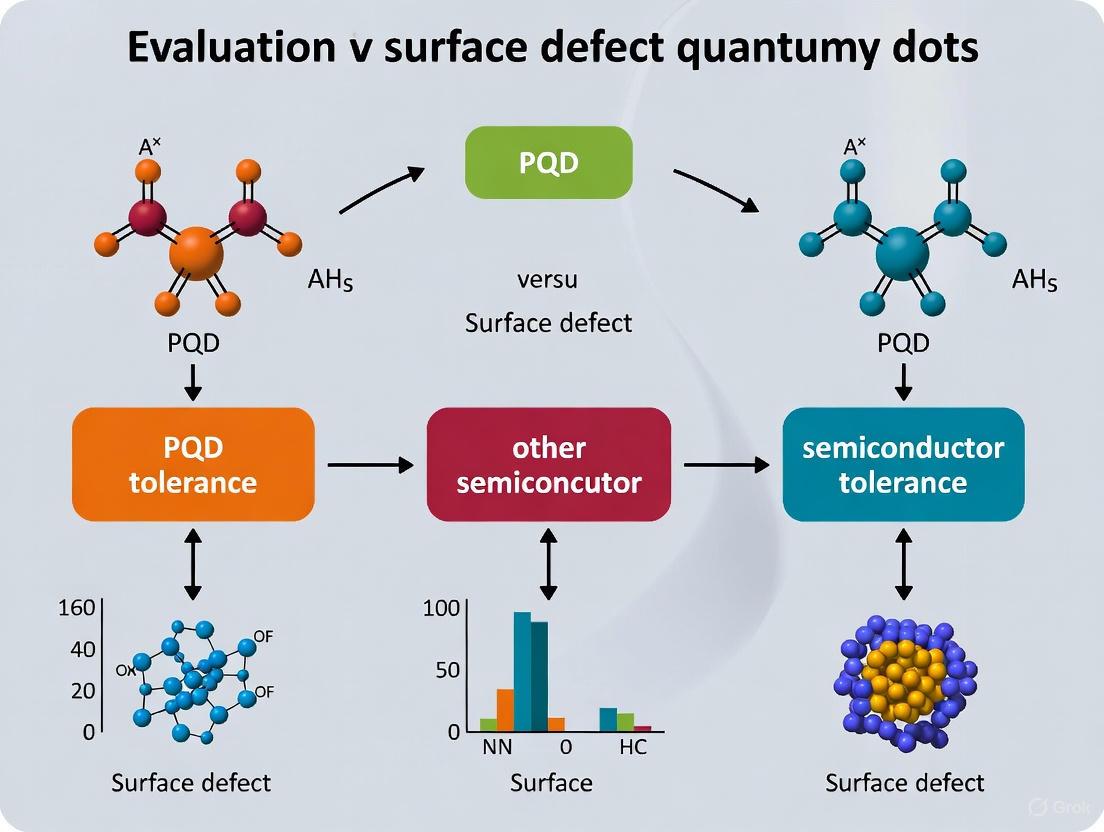
Surface defect tolerance is a pivotal property that critically influences the performance and commercial viability of quantum dots (QDs) in optoelectronics and emerging biomedical applications.
Defect Tolerance Showdown: Evaluating Surface Stability in Perovskite Quantum Dots vs. Traditional Semiconductors
Abstract
Surface defect tolerance is a pivotal property that critically influences the performance and commercial viability of quantum dots (QDs) in optoelectronics and emerging biomedical applications. This article provides a comprehensive evaluation of defect tolerance mechanisms in metal halide Perovskite Quantum Dots (PQDs) compared to other prominent semiconductor QDs, including CdSe, PbS, InSb, and Zintl-phase materials. We explore the fundamental chemical origins of surface defects, analyze advanced passivation and suppression strategies, and present a direct comparative assessment of stability and performance metrics. Tailored for researchers and scientists, this review synthesizes recent advancements to guide the selection and optimization of QD materials for high-performance devices, highlighting both the inherent advantages and persistent challenges across different material systems.
The Fundamental Chemistry of Surface Defects in Quantum Dots
The performance and stability of semiconductor quantum dots (QDs) are profoundly influenced by their surface atomic structure. Atomic undercoordination—where surface atoms possess fewer chemical bonds than their bulk counterparts—is a primary origin of electronic trap states. These mid-gap states can capture charge carriers (electrons and holes), leading to non-radiative recombination that diminishes luminescence efficiency (photoluminescence quantum yield) and degrades charge transport in optoelectronic devices [1] [2]. The high surface-to-volume ratio of QDs makes them particularly susceptible to these surface-mediated phenomena. Different classes of QDs exhibit varying degrees of defect tolerance, which is a material's inherent ability to maintain performance despite the presence of defects. Understanding the atomic-scale mechanisms of trap formation and the strategies for their passivation is therefore fundamental to advancing QD technologies for applications in photovoltaics, light-emitting diodes (LEDs), lasers, and quantum information processing [1] [3].
Fundamental Mechanisms of Trap State Formation
Atomic Undercordination as a Primary Defect Source
At the core of trap state formation are undercoordinated surface atoms. In a perfect bulk crystal, atoms are fully coordinated, satisfying their bonding requirements. However, at the surface, this periodicity is broken, leaving "dangling bonds" that create electronic states within the forbidden band gap [4].
- The Role of Undercoordinated Atoms: Density Functional Theory (DFT) calculations reveal that three-coordinate species often dominate trapping in III-V QDs. For example, in core-only InP and GaP QDs, three-coordinate indium/gallium and phosphorus atoms are significant sources of trap states. The character and depth of these traps are influenced by the local chemical environment and the extent of surface reconstruction [2].
- Comparison with Other Defect Types: While other defects like substitutional impurities or interstitials can occur, undercoordination is a universal and dominant issue in nanoscale materials. Research on amorphous silicon nitride (SiN₄) further corroborates that over- and under-coordinated atoms are intrinsic charge trapping sites, with holes localizing near two-fold coordinated nitrogen or five-fold coordinated silicon, and electrons localizing near three-fold coordinated silicon or four-fold coordinated nitrogen [4].³
Material-Specific Trap State Characteristics
The manifestation of trap states varies significantly across different QD material systems, which is a key differentiator in their defect tolerance.
- Lead Halide Perovskite QDs (PQDs): These materials are often described as defect-tolerant because certain point defects do not necessarily create deep traps within the band gap. However, their performance is still heavily limited by surface defects arising from dynamic instabilities and incomplete surface passivation. The high surface-area-to-volume ratio of PQDs means grain boundaries and unpassivated surfaces are major sites for non-radiative recombination [1] [5].
- III-V QDs (e.g., InP, GaP): These cadmium-free alternatives are plagued by a high density of trap states, leading to historically lower quantum yields and broader emission profiles compared to their cadmium-based counterparts. DFT studies show a complex landscape where both three-coordinate group III (In, Ga) and group V (P) atoms can act as traps, with stark differences in surface reconstruction behavior between materials like InP and GaP [2].
- I-III-VI QDs (e.g., CuInS₂): CIS QDs possess a different defect chemistry, where intrinsic defects like copper vacancies can form and often give rise to broad, tunable emission spectra. While some defects are beneficial for emission, others still act as detrimental traps, necessitating advanced passivation strategies using heterostructures (core/shell) [3].
- Transition Metal Dichalcogenide (TMD) QDs: In materials like MoS₂, defects can be deliberately engineered. The quantum confinement effect in TMD QDs with small lateral sizes (e.g., ~3.9 nm) creates a widened bandgap and discrete absorption bands. Defects in these structures, such as sulfur vacancies, can be tuned to enhance specific properties like photodynamic activity for biomedical applications [6].
Table 1: Comparison of Trap State Characteristics in Different Quantum Dot Materials
| Material Class | Primary Trap Sources | Impact on Performance | Defect Tolerance |
|---|---|---|---|
| Perovskite (PQDs) | Undercoordinated Pb²⁺ and halide ions; Unpassivated grain boundaries [1] [5] | Reduced PLQY; Imbalanced charge transport; Limited PCE in solar cells [1] | Moderate (shallow defects are benign, but surface defects are detrimental) |
| III-V (InP, GaP) | Three-coordinate In/Ga and P atoms [2] | Low quantum yield; Broad emission linewidth; Electron and hole trapping [2] | Low |
| I-III-VI (CuInS₂) | Copper vacancies, indium-copper antisites [3] | Can enable broad emission but may also cause non-radiative recombination [3] | High (some defects are radiative) |
| 2D TMDs (MoS₂) | Chalcogen vacancies (e.g., sulfur); Undercoordinated Mo [6] | Tune optical bandgap; Can enhance oxidative stress generation [6] | Tunable (defects can be functional) |
Comparative Experimental Analysis of Trap States
Quantitative Data from DFT and Experimental Studies
Advanced computational and experimental methods provide quantitative insights into trap state formation energies, charge transition levels, and their direct impact on device metrics.
- DFT Studies on III-V QDs: Large-scale DFT calculations using hybrid functionals (e.g., PBE0) are essential for accurately describing the electronic structure of defects. For instance, orbital localization techniques applied to InP and GaP QDs reveal a dense manifold of shallow trap states near the band edges, obfuscating the true conduction band minimum (CBM) and valence band maximum (VBM). The depth and character of these traps are sensitive to the local geometry and charge environment [2].
- Thermal Stability in PQDs: In situ studies on CsxFA1-xPbI3 PQDs show that thermal degradation pathways are linked to surface composition and ligand binding energy. Cs-rich PQDs undergo a phase transition, while FA-rich PQDs with stronger ligand binding decompose directly into PbI2 at higher temperatures. This underscores the role of surface chemistry in stabilizing the core structure against defect formation [7].
- Defect Engineering in TMD QDs: Bottom-up synthesis allows for controlled introduction of sulfur defects in MoS2 QDs. A deviation from stoichiometric precursor ratios enables defect engineering, which quantitatively enhances properties like photodynamic oxidative stress generation, demonstrating a direct structure-property relationship [6].
Table 2: Experimental and Computational Data on Trap State Impact
| Material | Analysis Method | Key Finding | Numerical Result / Correlation |
|---|---|---|---|
| InP/GaP QDs [2] | Density Functional Theory (PBE0) | Three-coordinate species dominate trapping; Surface reconstruction passivates some traps. | A dense quasi-continuum of trap states found at band edges. |
| a-Si₃N₄ [4] | DFT with hybrid functional | Over/under-coordinated atoms create charge trapping sites after structural relaxation. | Calculated relaxation energies and charge transition levels explain charge capture barriers. |
| CsxFA1-xPbI3 PQDs [7] | In situ XRD & TGA | Thermal degradation mechanism (phase transition vs. decomposition) depends on A-site composition and ligand binding. | FA-rich QDs show higher ligand binding energy, correlating with altered degradation pathway. |
| MoS₂ QDs [6] | Bottom-up synthesis & XPS | Defect concentration tuned via precursor stoichiometry. | Increased sulfur defects enhanced photodynamic oxidative stress in cancer cells. |
| Pe-CQDs [5] | Surface ligand engineering | Incomplete surface passivation limits solar cell performance. | Record PCE for Pe-CQD solar cells (18.1%) lags behind bulk perovskite cells (26.1%). |
Detailed Experimental Protocols
To ensure reproducibility and provide a clear framework for researchers, detailed methodologies for key experiments are outlined below.
Protocol 1: Density Functional Theory (DFT) Analysis of Trap States in III-V QDs [2]
- QD Model Construction: Create a diverse set of core-only QD models (e.g., for InP and GaP) by carving structures from the bulk crystal, representing different synthetically realizable shapes and facets (diameters ~2-2.5 nm).
- Surface Passivation: Passivate all surface dangling bonds with X-type fluoride (F⁻) ligands, representative of a common HF treatment used in experiments.
- Defect Introduction: Systematically create defective QDs by considering all symmetry-unique removals of a single F⁻, P³⁻, InFx, or an entire InP unit to study various defect types.
- Electronic Structure Calculation: Perform ground-state electronic structure calculations using a hybrid functional (e.g., PBE0) to accurately reproduce band gaps. Employ a large basis set and converge total energy to a tight threshold (e.g., 2.7 µeV).
- Trap State Identification:
- Calculate the Projected Density of States (PDOS) to visualize contributions from different atomic species.
- Compute the Participation Ratio (PR) to measure the localization of each electronic state.
- Apply orbital localization methods (e.g., Pipek-Mezey) to the band edges to deconvolute the dense manifold of states and allow for precise assignment of surface traps.
Protocol 2: Surface Manipulation and Passivation of Perovskite CQDs [5]
- Synthesis: Synthesize Pb-halide Pe-CQDs via hot-injection or ligand-assisted re-precipitation (LARP) methods using long-chain organic ligands like oleic acid (OA) and oleylamine (OLA).
- Ligand Exchange: Conduct solid-state ligand exchange on the QD film. This involves depositing the QD film and then treating it with a solution containing the desired short-chain ligand (e.g., formamidinium iodide, phenylalkylammonium iodide) to replace the original long-chain ligands, thereby improving charge transport.
- Defect Passivation: Introduce additional passivating agents (e.g., lead-containing salts like Pb(NO₃)₂, or Lewis base molecules) during or after the ligand exchange process. These agents selectively bind to uncoordinated Pb²⁺ sites on the QD surface, suppressing trap states.
- Characterization:
- Optical: Measure photoluminescence quantum yield (PLQY) and time-resolved PL (TRPL) to assess reduction in non-radiative recombination.
- Structural: Use techniques like X-ray diffraction (XRD) and nuclear magnetic resonance (NMR) to confirm ligand binding and phase stability.
- Electrical: Fabricate solar cell devices to evaluate power conversion efficiency (PCE) and open-circuit voltage deficit.
Research Reagents and Materials Toolkit
Table 3: Essential Reagents and Materials for QD Surface Defect Studies
| Reagent/Material | Function/Application | Specific Examples |
|---|---|---|
| Surface Ligands (Passivation) | Bind to undercoordinated surface atoms to satisfy bonds and remove trap states. | Oleic acid/Oleate (OA), Oleylamine (OAm) [7] [5]; Short-chain ligands (e.g., formamidinium iodide) [5]; Halides (e.g., F⁻ for InP) [2] |
| Metal Salts (Precursors) | Source for metal ions in QD core; Used for surface treatment to fill vacancies. | MoCl₅, MoO₃ (for MoS₂ QDs) [6]; PbI₂, PbBr₂ (for PQDs); Pb(NO₃)₂ (for post-synthetic passivation) [5] |
| Chalcogen/Pnicogen Precursors | Source for anionic components in QD core. | Na₂S (for MoS₂, CIS) [6]; Trialkylphosphines (e.g., for InP); S/Se/Te powders |
| Computational Software | Atomic-scale modeling of QD structures, electronic properties, and defect energetics. | DFT codes (CP2K [4], others); Gaussian plane-wave methods; PBE0 hybrid functional [2] [4] |
| Solvents | Medium for synthesis, purification, and ligand exchange processes. | Octadecene (ODE), Toluene, Hexane, Acetone (for precipitation) |
The systematic investigation of surface states reveals that atomic undercoordination is a universal challenge across all classes of quantum dots, though its specific impact and mitigation strategies vary. While perovskite QDs exhibit a degree of intrinsic defect tolerance, their performance is ultimately limited by surface traps. In contrast, III-V QDs suffer from a high density of traps that require sophisticated core/shell structures and surface passivation to achieve high performance [1] [2]. The future of high-performance QD technologies lies in the rational design of surfaces. This includes:
- Developing multi-modal passivation strategies that simultaneously address anionic and cationic surface sites [5].
- Employing advanced computational screening using high-throughput DFT and machine-learned force fields to predict effective passivants before synthesis [4] [8].
- Exploring defect engineering in certain material systems, where specific defects can be harnessed to tune functionality for applications beyond optoelectronics, such as catalysis and biomedicine [6].
A fundamental understanding of the relationship between atomic-scale surface structure, trap states, and macroscopic device performance will continue to drive innovations in this rapidly evolving field.
Defect tolerance is a critical concept in semiconductor physics, referring to a material's ability to maintain its optimal electronic and optical properties despite the presence of inherent crystallographic defects, surface imperfections, or impurities. In conventional semiconductors like silicon or gallium arsenide, even minor defects create mid-gap trap states that severely degrade performance by capturing charge carriers and promoting non-radiative recombination. This phenomenon significantly reduces photoluminescence quantum yield (PLQY) and charge carrier mobility, ultimately diminishing device efficiency [9].
Perovskite quantum dots (PQDs), particularly lead-halide variants with the general formula ABX₃ (where A = Cs⁺, MA⁺, FA⁺; B = Pb²⁺; X = Cl⁻, Br⁻, I⁻), exhibit remarkable defect tolerance compared to many established semiconductor QDs. This exceptional property originates from their unique electronic band structure, which differs fundamentally from traditional semiconductors. The defect tolerance in PQDs stems primarily from the specific composition of their valence and conduction bands, where both band edges are derived from similar atomic orbitals (Pb 6p and 6s), resulting in a low density of mid-gap states when defects form [10] [11]. This electronic configuration means that most naturally occurring defects create shallow energy levels that do not act efficient traps for charge carriers, allowing PQDs to maintain high PLQY and excellent charge transport properties even without sophisticated surface passivation techniques required for conventional QDs [12].
This review provides a comprehensive comparative analysis of the inherent defect tolerance in PQDs against other prominent semiconductor QD systems, focusing on the fundamental role of electronic band structure. We examine quantitative performance metrics, delineate key experimental methodologies for probing defect properties, and identify essential research tools driving advancements in this rapidly evolving field.
Electronic Origins of Defect Tolerance in PQDs
The exceptional defect tolerance of PQDs is not merely a fortunate material property but arises directly from fundamental quantum mechanical principles governing their electronic structure. In traditional II-VI (e.g., CdSe) and III-V (e.g., InP) semiconductor QDs, the valence band maximum consists primarily of anion p-orbitals, while the conduction band minimum derives from cation s-orbitals. This orbital disparity creates an electronic asymmetry where defects, particularly surface vacancies or dangling bonds, readily introduce deep trap states within the bandgap. These mid-gap states act as efficient centers for non-radiative recombination, significantly compromising optical properties and charge transport [11].
In contrast, the electronic band structure of lead-halide PQDs exhibits a fundamentally different character. Both the conduction band minimum (CBM) and valence band maximum (VBM) in prototypical CsPbBr₃ QDs primarily originate from the same Pb²⁺ cation: the CBM is dominated by Pb 6p orbitals, while the VBM consists primarily of Pb 6s orbitals hybridized with halogen p-orbitals [10]. This unique orbital constitution means that most intrinsic defects, such as halide vacancies, form shallow energy levels rather than deep traps. Since these shallow defects do not create states near the middle of the bandgap, they are less effective at capturing charge carriers and promoting non-radiative recombination. Consequently, PQDs can maintain high PLQY (>80%) and excellent charge transport characteristics even in the presence of substantial defect densities that would render conventional QDs optically inactive [9].
The defect tolerance is further enhanced by the strong ionic character and high dielectric constant of perovskite materials, which effectively screen charged defects and reduce their capture cross-sections for free carriers. This combination of favorable band edge orbital composition and efficient dielectric screening underpins the remarkable performance of PQDs in various optoelectronic applications, despite their relatively simple synthesis and processing conditions that would typically be insufficient for high-quality traditional semiconductor QDs [11].
Table 1: Electronic Structure Comparison Between PQDs and Conventional Semiconductor QDs
| Characteristic | Perovskite QDs (CsPbX₃) | Conventional II-VI/III-V QDs (CdSe/InP) |
|---|---|---|
| Band Edge Orbital Composition | CBM: Pb 6p orbitals; VBM: Pb 6s & Halogen p orbitals | CBM: Cation s-orbitals; VBM: Anion p-orbitals |
| Common Defect Types | Halide vacancies, Lead vacancies, Surface under-coordination | Surface dangling bonds, Cation/anion vacancies |
| Defect Energy Levels | Primarily shallow levels | Often deep-level traps |
| Dielectric Constant | High (~6-10) | Moderate (~4-6) |
| Typical PLQY Without Advanced Passivation | 50-90% [10] | <10% without sophisticated shelling |
Comparative Analysis: PQDs vs. Alternative Quantum Dot Systems
When evaluating the defect tolerance across different quantum dot material systems, distinct patterns emerge that highlight the unique position of PQDs. The following comparative analysis examines key performance metrics and material properties that directly reflect inherent defect tolerance.
Traditional semiconductor QDs like CdSe and InP require meticulous surface engineering through core-shell structures (e.g., CdSe/ZnS) to achieve high PLQY. Without such passivation, their native surface defects create abundant trap states that quench photoluminescence. In contrast, all-inorganic CsPbX₃ PQDs consistently achieve high PLQY (50-90%) with simple organic ligand passivation (oleic acid/oleylamine), directly evidencing their inherent defect tolerance [10]. This performance is particularly notable given their relatively simple synthesis protocols conducted at moderate temperatures.
Emerging quantum dot systems present a varied landscape. Zintl-phase BaCd₂P₂ QDs, composed of earth-abundant elements, demonstrate a promising defect-tolerant nature, achieving 21% PLQY in their initial synthesis without optimization or specific passivation treatments [12]. This suggests favorable electronic properties, though not yet matching the exceptional performance of lead-halide PQDs. Similarly, indium antimonide (InSb) CQDs, valuable for infrared detection, suffer from significant performance degradation due to surface defects and structural imperfections, necessitating sophisticated defect suppression strategies like surface passivation and core-shell engineering to become viable for optoelectronic applications [13].
The starkest contrast emerges in the context of charge transport. In PV devices, ligand-engineered FAPbI₃ PQD solar cells achieve impressive power conversion efficiencies exceeding 15%, benefiting from the defect-tolerant nature that reduces non-radiative recombination losses [14]. Conventional QD photovoltaics often struggle with charge extraction due to trap-mediated recombination at surface defects, despite extensive surface management.
Table 2: Quantitative Performance Comparison of Quantum Dot Systems
| Quantum Dot System | Typical PLQY Range (%) | Defect Tolerance Evidence | Common Stability Challenges |
|---|---|---|---|
| Perovskite QDs (CsPbBr₃) | 50-90% [10] | High efficiency with simple ligand passivation | Ionic lattice vulnerability to moisture, heat, light [9] |
| Zintl-Phase QDs (BaCd₂P₂) | ~21% (unoptimized) [12] | Good initial performance without passivation | Early-stage material development |
| InSb CQDs | Low without passivation | Requires complex defect modulation [13] | Surface defects degrade IR performance |
| CdSe/ZnS Core/Shell | >80% (with shell) | Requires sophisticated core-shell structure | Limited elemental abundance |
| InP/ZnS Core/Shell | >80% (with shell) | Requires sophisticated core-shell structure | Heavy metal concerns |
Experimental Protocols for Probing Defect Tolerance
Research into defect tolerance mechanisms relies on sophisticated experimental methodologies that probe both the electronic structure and dynamic processes within quantum dots. Standardized protocols have emerged to enable meaningful cross-comparison between different material systems.
Spectroscopic Characterization of Defect States
Photoluminescence (PL) spectroscopy serves as a primary tool for assessing defect tolerance. Time-resolved PL measurements quantitatively track carrier recombination dynamics, where longer radiative lifetimes and higher PLQY values indicate reduced non-radiative recombination via defects. For PQDs, measurement typically involves exciting colloidal solutions or thin films with a 400 nm wavelength source and detecting emission spectra and decay kinetics [14]. The comparison between traditional semiconductor QDs and PQDs reveals stark differences: while CdSe QDs exhibit multi-exponential decays with fast components indicating trap-assisted recombination, high-quality PQDs often show predominantly single-exponential decay, confirming fewer active trap states.
Complementary ultraviolet-visible (UV-Vis) absorption spectroscopy provides additional insights, particularly through the identification of excitonic absorption peaks and Urbach energy calculations. The Urbach energy, derived from the logarithmic absorption tail, quantifies structural disorder and defect density, with lower values (<20 meV for high-quality PQDs) indicating superior structural perfection and defect tolerance [11]. For consistent measurements, samples should be prepared as thin films via spin-coating onto optically transparent substrates, with spectra collected at room temperature.
Structural and Compositional Analysis
High-resolution transmission electron microscopy (HRTEM) enables direct visualization of crystal structure and defect identification at atomic resolution. For PQD analysis, samples are prepared by dropping diluted colloidal solutions onto carbon-coated copper grids, with imaging conducted at acceleration voltages of 200 kV [14]. This technique reveals crystallographic imperfections, grain boundaries, and surface reconstructions that correlate with electronic defects.
X-ray diffraction (XRD) provides complementary information about crystal phase purity and strain. For nanocrystal films drop-cast on substrates, XRD patterns collected with Cu-Kα radiation can identify secondary phases and quantify structural distortions through Rietveld refinement [14]. The presence of phase impurities often correlates with increased defect densities and reduced optoelectronic performance across all QD material systems.
Device-Level Performance Validation
The ultimate validation of defect tolerance comes from incorporating QDs into functional devices. For photovoltaic validation, n-i-p structured solar cells with configuration FTO/SnO₂/PQD layer/Spiro-OMeTAD/Au are fabricated [14]. Current-density-voltage (J-V) measurements under AM 1.5G illumination quantify power conversion efficiency, with the open-circuit voltage (VOC) being particularly sensitive to defect-mediated recombination. Electrochemical impedance spectroscopy (EIS) applied to these devices can further quantify recombination resistance and charge carrier lifetimes, providing direct evidence of defect tolerance at the device level.
For light-emitting applications, LED devices with structure ITO/PEDOT:PSS/QD layer/TPBi/LiF/Al are constructed, with electroluminescence efficiency and operational stability serving as key metrics of defect influence [9]. The external quantum efficiency (EQE) of these devices directly reflects the effectiveness of charge injection and recombination, with higher values indicating superior defect management.
The Scientist's Toolkit: Essential Research Reagents and Materials
Advancing research in PQD defect tolerance requires specific materials and analytical capabilities. The following table catalogs essential research reagents and their functions in synthesizing and characterizing defect-tolerant quantum dots.
Table 3: Essential Research Reagents and Materials for PQD Defect Studies
| Category | Specific Reagents/Materials | Research Function | Role in Defect Studies |
|---|---|---|---|
| Precursor Materials | Lead(II) iodide (PbI₂), Cesium carbonate (Cs₂CO₃), Formamidinium iodide (FAI) [14] | ABX₃ perovskite structure formation | Source of primary lattice components; purity critical for minimizing intrinsic defects |
| Surface Ligands | Oleic Acid (OA), Oleylamine (OAm), Octylamine (OctAm) [14] [9] | Colloidal stability & surface passivation | Passivate surface dangling bonds; reduce surface defect states |
| Ligand Exchange Agents | 3-Mercaptopropionic acid (MPA), 2-Aminoethanethiol (AET) [14] [9] | Post-synthetic surface engineering | Replace long-chain ligands with shorter/bifunctional ones; improve charge transport while maintaining passivation |
| Purification Solvents | Methyl acetate (MeOAc), Toluene, Hexane [14] | Remove excess precursors & ligands | Control final ligand density and identify ligand binding strength |
| Spectroscopic Standards | Reference QDs with known quantum yield | Instrument calibration | Quantify absolute PLQY for defect assessment |
| Substrate Materials | FTO/ITO-coated glass, Silicon wafers with oxide layer | Device fabrication & characterization | Platform for thin-film electrical and optical measurements |
The exceptional defect tolerance of perovskite quantum dots, rooted in their unique electronic band structure, represents a fundamental advancement in semiconductor nanomaterials. This inherent property distinguishes PQDs from conventional II-VI and III-V quantum dots that require sophisticated core-shell architectures to achieve comparable performance. The evidence from comparative analysis reveals that while emerging material systems like Zintl-phase QDs show promising defect-tolerant characteristics, lead-halide PQDs currently offer an unparalleled combination of high performance and synthetic accessibility.
Future research directions should focus on extending the fundamental understanding of defect tolerance mechanisms to lead-free perovskite alternatives, developing more robust stabilization strategies that preserve inherent defect tolerance under operational conditions, and exploiting machine learning approaches to accelerate the discovery of new defect-tolerant materials [15]. As the field progresses, the principles learned from PQDs will undoubtedly inform the design of next-generation quantum-confined systems that combine exceptional optoelectronic performance with enhanced stability and reduced environmental impact.
The emergence of perovskite quantum dots (PQDs) has fundamentally reshaped the landscape of semiconductor nanocrystal research, primarily due to a property known as defect tolerance. This characteristic is not merely an incremental improvement but represents a paradigm shift from the behavior of traditional chalcogenide quantum dots (QDs) like CdSe and PbS. Understanding the mechanistic origins of this divergence is crucial for guiding material selection for applications ranging from photovoltaics and LEDs to biomedical imaging and sensing. This analysis contrasts the defect-sensitive nature of traditional chalcogenide QDs with the defect-resistant character of metal halide PQDs, examining the fundamental electronic structures, experimental manifestations, and practical implications that distinguish these material families. The core distinction lies in how each system handles inevitable crystallographic imperfections: while defects in chalcogenides create mid-gap states that quench luminescence and degrade performance, defects in perovskites tend to form benign shallow levels or reside within the conduction and valence bands, thereby preserving their optoelectronic quality [5] [16].
Fundamental Mechanisms: Electronic Structure and Defect Physics
The differing defect sensitivity arises from intrinsic differences in chemical bonding and electronic structure.
Traditional Chalcogenides (CdSe, PbS): Covalent Bonding and Mid-Gap Traps Traditional II-VI (e.g., CdSe) and IV-VI (e.g., PbS) QDs are characterized by highly covalent chemical bonds. In such covalent semiconductors, the creation of a vacancy (e.g., a missing cadmium atom) or a dangling bond (e.g., an unsaturated selenium atom) introduces electronic states with highly localized wavefunctions. These states typically reside deep within the bandgap, acting as efficient traps for charge carriers (electrons and holes). Once trapped, these carriers can undergo non-radiative recombination, a process that releases energy as heat instead of light. This phenomenon is the primary cause of reduced photoluminescence quantum yield (PLQY) and photoluminescence (PL) blinking in individual CdSe QDs [17] [18]. Consequently, achieving high performance in CdSe QDs is contingent upon meticulous surface passivation, often through the growth of a wider-bandgap inorganic shell (e.g., ZnS) to eliminate these surface dangling bonds [19].
Metal Halide Perovskites (CsPbBr₃, etc.): Ionic Bonding and Defect Tolerance In contrast, metal halide perovskites (e.g., CsPbBr₃) feature more ionic chemical bonds and a specific electronic structure characterized by:
- Band Edges from Atomic s- and p-Orbitals: The valence band maximum in lead halide perovskites is derived primarily from the antibonding coupling of Pb 6s and I 5p (or Br 4p) orbitals, while the conduction band minimum is predominantly Pb 6p in character. This specific orbital composition means that defects like vacancies or interstitials, which might introduce deep traps in other materials, tend to create shallow defect levels or their wavefunctions are resonantly incorporated into the band edges.
- Dielectric Confinement: The high dielectric constant of perovskite materials screens the potential of charged defects, further reducing their ability to trap charge carriers effectively [5] [16]. This combination of factors results in a material where the creation of electron-hole pairs (excitons) and their radiative recombination can proceed efficiently, even in the presence of a significant density of defects, leading to high PLQY without the need for complex core-shell structures [20].
Table 1: Fundamental Contrasts in Defect Physics between QD Families
| Characteristic | Traditional Chalcogenide QDs (CdSe) | Metal Halide Perovskite QDs (CsPbX₃) |
|---|---|---|
| Primary Bonding | Covalent | Ionic |
| Defect State Energy | Deep within bandgap (mid-gap traps) | Shallow levels or within bands |
| Charge Carrier Trapping | Efficient and prevalent | Inefficient and suppressed |
| Impact on PLQY | Significantly reduces without passivation | Can remain high even with native defects |
| PL Blinking | Pronounced at single-particle level | Can be suppressed with advanced passivation [16] |
| Requirement for Shelling | Essential for high performance | Not strictly necessary for high PLQY |
Experimental Manifestations and Diagnostic Methodologies
The theoretical differences in defect physics translate into distinct experimental signatures that can be probed through various spectroscopic techniques.
Defect-State Emission in CdSe Quantum Dots
A key experimental fingerprint of defects in traditional chalcogenides is the appearance of a broad, low-energy emission peak alongside the characteristic narrow band-edge emission.
- Experimental Protocol: CdSe QDs with pronounced defect emission can be synthesized via a modified two-phase method.
- Precursor Preparation: Cadmium myristate (CdMA) is synthesized by reacting cadmium oxide (CdO) with myristic acid at 210°C under a nitrogen atmosphere. Sodium hydrogen selenide (NaHSe) is prepared by reacting selenium powder with sodium borohydride (NaBH₄) in ultrapure water at 60°C.
- QD Synthesis: CdMA and trioctylphosphine oxide (TOPO) are dissolved in toluene at 80°C. Ultrapure water is added to create a two-phase system. The reaction temperature is raised to 100°C, and the NaHSe solution is injected swiftly. Aliquots are taken to monitor growth, and the reaction is typically stopped after 3 hours by cooling. QDs are purified by precipitation with methanol [17].
- Spectroscopic Analysis: Photoluminescence (PL) spectroscopy of QDs synthesized via this route reveals a dual-emission profile. A narrow peak corresponds to the band-edge transition, while a broad, red-shifted peak (e.g., around 580 nm) is attributed to defect-state emission. This defect emission is directly linked to the QD surface, as exciting the surfactant (TOPO) can also trigger it. Crucially, growing a CdS shell to create core-shell CdSxSe1-x QDs quenches this defect emission, confirming its surface origin [17].
Surface Passivation Strategies for CdSe QDs
Mitigating defect effects is a central research theme for chalcogenide QDs, leading to developed passivation protocols.
- Experimental Protocol: Shell Growth in Glass Matrix
- Glass Preparation: Silicate glasses with compositions including ZnSe and CdO are prepared via the melt-quenching method (1350°C for 40 minutes).
- Thermal Treatment: The as-prepared glasses are heat-treated (e.g., at 530°C for 10 hours) to precipitate CdSe QDs within the glass matrix.
- Surface Passivation: An excess of Se and the incorporation of Zn are critical. During heat treatment, Zn ions incorporate into the CdSe QDs, forming a CdSe/Cd1-xZnxSe graded core/shell structure. This shell passivates surface dangling bonds, which is evidenced by the quenching of the broad defect emission and the emergence of a strong, narrow intrinsic excitonic emission [18].
Advanced Ligand Engineering for Perovskite QDs
While inherently defect-tolerant, PQDs still benefit from surface management to achieve ultimate photostability, demonstrated by advanced ligand engineering.
- Experimental Protocol: Achieving Non-Blinking PQDs
- Ligand Exchange: Strongly confined CsPbBr₃ QDs are synthesized and subjected to a solution-phase ligand exchange. Traditional long-chain ligands like oleic acid/oleylamine are replaced with small, aromatic ligands such as phenethylammonium bromide (PEABr).
- Promoting Inter-Ligand Stacking: The key innovation is using ligands with tails that feature attractive intermolecular interactions (e.g., π-π stacking between phenyl rings of PEA). Density functional theory (DFT) calculations show this stacking drives the formation of a nearly epitaxial ligand layer, drastically reducing surface energy and stabilizing the surface lattice against photo-induced degradation [16].
- Single-Dot Spectroscopy Analysis: When single PQDs treated with stacked PEA ligands are studied under continuous laser excitation, they exhibit near-non-blinking PL emission and extraordinary photostability, maintaining their emission for over 12 hours. This level of stability is exceptionally difficult to achieve with traditional chalcogenide QDs and highlights the synergistic effect of defect-tolerant cores and advanced surface science [16].
The following diagram summarizes the core mechanisms and experimental outcomes of defect behavior in the two QD families.
The Scientist's Toolkit: Essential Reagents and Materials
Table 2: Key Research Reagents for Defect Studies in QD Synthesis
| Reagent / Material | Function in Research | Application Context |
|---|---|---|
| Trioctylphosphine Oxide (TOPO) | Surfactant and coordinating solvent; its binding to the QD surface is directly linked to defect-state emission. | Synthesis and surface study of CdSe QDs [17] |
| Cadmium Myristate (CdMA) | Cadmium precursor providing a controlled source of Cd²⁺ ions for nanocrystal growth. | Two-phase synthesis of CdSe QDs [17] |
| Phenethylammonium Bromide (PEABr) | Small, aromatic ligand for surface passivation. Promotes π-π stacking for a stable ligand layer. | Achieving non-blinking, photostable CsPbBr₃ PQDs [16] |
| Zinc Selenide (ZnSe) | Source of Zn²⁺ for forming a passivating Cd₁₋ₓZnₓSe shell within a glass matrix. | Post-synthesis passivation of CdSe QDs in glass [18] |
| Sodium Hydrogen Selenide (NaHSe) | Reactive selenium precursor for controlled nucleation and growth of selenide-based QDs. | Synthesis of CdSe QDs [17] |
The contrast between traditional chalcogenide and perovskite QDs is unequivocal. CdSe and PbS QDs require deliberate and often complex defect management engineering—such as core-shell heterostructuring and careful surface ligand choices—to overcome the performance limitations imposed by their defect-sensitive covalent nature. In contrast, metal halide perovskites benefit from an inherent defect tolerance rooted in their ionic electronic structure, which allows them to demonstrate high performance even as "bare" nanocrystals. This fundamental understanding is vital for directing future research. For chalcogenides, the pursuit of novel ligand chemistries and more perfect shell growth remains a priority. For perovskites, the challenge shifts towards enhancing long-term structural and chemical stability under operational conditions, leveraging their innate defect tolerance to create a new generation of robust, high-performance optoelectronic and biomedical devices.
The pursuit of advanced quantum dot (QD) technologies has brought the intrinsic defect properties of materials to the forefront of research. While perovskite quantum dots (PQDs) have garnered significant attention for their defect tolerance, two other material systems—Zintl-phase QDs and copper indium sulfide (CuInS₂) QDs—demonstrate equally intriguing defect characteristics that merit detailed examination. This comparison guide objectively analyzes the defect properties of these emerging QD systems, focusing specifically on how their unique defect chemistries influence optoelectronic performance. Understanding the defect dynamics in these materials is crucial for directing future research efforts and selecting appropriate QD systems for specific applications, from photovoltaics to light-emitting devices.
The following sections provide a comprehensive comparison based on recent experimental findings, with structured data presentation and detailed methodologies to facilitate direct comparison between these material systems.
Material Systems and Defect Characteristics
Zintl-Phase Quantum Dots
Zintl-phase compounds represent an emerging class of semiconducting materials with promising defect properties. Recent research has focused particularly on BaCd₂P₂ and Eu₂ZnSb₂ QDs, which exhibit native defect structures that can be leveraged for optimal performance.
BaCd₂P₂ QDs demonstrate exceptional optoelectronic quality despite the absence of complex surface passivation strategies. These QDs show size-tunable bandgaps ranging from 1.47 to 1.81 eV, corresponding to sizes between 3-9 nm. They exhibit bright red visible emission with approximately 21% photoluminescence quantum yield (PLQY) and long-lived photoexcited carriers with weighted averages around 160 ns [21]. These properties persist without sophisticated surface engineering, suggesting intrinsic defect tolerance.
Eu₂ZnSb₂ QDs exhibit different defect characteristics, with theoretical calculations revealing that Zn vacancies (VZn) serve as the dominant p-type defect with a formation energy of approximately 0.14 eV in the -2 charge state [22]. These vacancies behave as isolated point defects, primarily affecting only their immediate atomic environment without significantly disrupting the overall electronic structure of the host material. This isolated point defect behavior contributes to favorable carrier transport properties despite the presence of intrinsic vacancies.
Copper Indium Sulfide (CuInS₂) Quantum Dots
CuInS₂ QDs represent a greener alternative to cadmium-containing QDs and exhibit composition-dependent defect properties that can be strategically engineered for specific applications.
Research demonstrates that Cu-deficient CuInS₂ QDs achieve remarkable performance in sensitized solar cells, with power conversion efficiencies (PCE) reaching 5.71% [23]. The intentional introduction of Cu-deficiency creates beneficial defects that broaden the optoelectronic response range to approximately 950 nm and facilitate fast electron injection. The rate constants of electron transfer (kₑₜ) from CuInS₂ QDs to TiO₂ vary from 0.09 to 1.48 × 10¹⁰ s⁻¹, depending on the specific composition of the QDs [23].
The defect structure in CuInS₂ QDs is dominated by donor and acceptor sub-bandgap states originating from copper and indium vacancies (VCu and VIn) along with replacing defects (CuIn and InCu) [23]. These defects contribute to the tunable photoluminescence with long lifetime, primarily attributed to donor-acceptor pair (DAP) recombination, which accounts for up to 79% of the total emission profiles in optimized compositions [23].
Recent investigations into Zn incorporation in CuInS₂ QDs reveal complex defect modification mechanisms. X-ray absorption spectroscopy studies show that Zn can form a passivating ZnS shell on the QD surface, incorporate as a substituent in the crystal lattice, or occupy interstitial positions [24]. Each incorporation mode differentially affects the defect landscape and resulting optoelectronic properties.
Comparative Performance Analysis
Table 1: Comparative Defect and Performance Properties of Quantum Dot Systems
| Property | Zintl-Phase BaCd₂P₂ QDs | Zintl-Phase Eu₂ZnSb₂ QDs | CuInS₂ QDs |
|---|---|---|---|
| Bandgap Range (eV) | 1.47 - 1.81 [21] | Not specified | ~1.0 - 1.5 (estimated from response to 950 nm) [23] |
| Dominant Defect Type | Not specified | Zn vacancies (VZn) [22] | Cu/In vacancies (VCu, VIn) [23] |
| Defect Formation Energy | Not specified | ~0.14 eV for VZn [22] | Composition-dependent |
| Photoluminescence Quantum Yield | ~21% (without passivation) [21] | Not specified | Tunable via composition |
| Carrier Lifetime | ~160 ns (weighted average) [21] | Not specified | Long lifetime, composition-dependent [23] |
| Electron Transfer Constant (kₑₜ) | Not specified | Not specified | 0.09 - 1.48 × 10¹⁰ s⁻¹ [23] |
| Application Performance | Thin-film fabrication demonstrated [21] | Thermoelectric applications [22] | 5.71% PCE in QDSCs [23] |
Table 2: Defect Engineering Strategies Across QD Systems
| Strategy | Zintl-Phase QDs | CuInS₂ QDs |
|---|---|---|
| Compositional Tuning | Native 50% Zn vacancy in Eu₂ZnSb₂ [22] | Controlled Cu-deficiency [23] |
| Doping/Alloying | Not reported | Zn incorporation (shell formation, substitution, interstitial) [24] |
| Surface Passivation | Solid-state ligand exchange [21] | ZnS shell formation [24] |
| Defect Isolation | Isolated point defect behavior [22] | Donor-acceptor pair recombination engineering [23] |
Experimental Methodologies and Protocols
Synthesis Approaches
Zintl-Phase BaCd₂P₂ QD Synthesis: The synthesis employs a hot injection method where a phosphorus precursor is injected into a solution containing solubilized Ba and Cd precursors at elevated temperatures [21]. This approach enables precise size control from 3 to 9 nm by varying the growth temperature, with smaller QDs obtained at lower temperatures and larger QDs at higher temperatures. The resulting QDs crystallize in the P3̅m1 space group, matching the bulk material structure, as confirmed by selected area electron diffraction, powder X-ray diffraction, and Raman spectroscopy [21].
CuInS₂ QD Synthesis: The organometallic high-temperature method decomposes mixed diethyldithiocarbamate precursors in air circumstance using oleylamine as solvent, capping agent, and activation agent [23]. This approach deliberately introduces Cu-deficiency by controlling the copper and indium precursor ratios. The synthesis avoids the need for Schlenk technique or inert atmosphere protection, enhancing reproducibility and reducing costs [23]. Post-synthesis, ligand exchange with mercaptopropionic acid renders the QDs water-soluble for sensitization applications.
Defect Characterization Techniques
X-ray Absorption Spectroscopy (XAS): For CuInS₂ QDs, XAS in both X-ray absorption near-edge structure (XANES) and extended X-ray absorption fine structure (EXAFS) spectral ranges provides element-specific precision for detecting Zn incorporation [24]. This approach distinguishes between Zn substituents, interstitial defects, and ZnS surface shells.
Time-Resolved Optical Spectroscopy: Both material systems utilize time-resolved photoluminescence spectroscopy to quantify carrier lifetimes and recombination dynamics. For CuInS₂ QDs, this technique reveals the donor-acceptor pair recombination mechanism with analysis of electron transfer rates to metal oxide substrates [23] [24].
Theoretical Calculations: Density functional theory (DFT) calculations determine defect formation energies and electronic structures. For Eu₂ZnSb₂, DFT reveals Zn vacancy formation energies and their charge states [22], while for CuInS₂, DFT helps interpret the nature of defect states originating from Cu and In vacancies [23].
Defect-Mediated Processes and Experimental Workflows
The Scientist's Toolkit: Essential Research Reagents and Materials
Table 3: Key Research Reagents for QD Defect Engineering
| Reagent/Material | Function | Application Examples |
|---|---|---|
| Diethyldithiocarbamate Precursors | Metal-complexed precursors providing sulfur source | CuInS₂ QD synthesis [23] |
| Oleylamine | Solvent, capping agent, and activation agent | CuInS₂ QD synthesis, surface passivation [23] |
| Mercaptopropionic Acid (MPA) | Ligand for water solubility and TiO₂ tethering | CuInS₂ QD sensitization [23] |
| Phosphorus Precursors | Anion source for Zintl-phase QDs | BaCd₂P₂ QD synthesis via hot injection [21] |
| Metal Salts (Ba, Cd, Eu, Zn salts) | Cation sources for QD synthesis | Zintl-phase and CuInS₂ QD preparation [23] [21] |
| TiO₂ Mesoporous Films | Electron acceptor and charge transport medium | QD-sensitized solar cell fabrication [23] |
Zintl-phase and CuInS₂ QDs demonstrate distinct yet equally valuable approaches to defect engineering in semiconductor nanomaterials. Zintl-phase QDs exhibit inherent structural vacancies that can be harnessed for optimal electronic properties, while CuInS₂ QDs enable precise tuning of defect populations through compositional control. Both systems offer valuable alternatives to PQDs, with Zintl-phase materials showing particular promise in thermoelectrics and CuInS₂ excelling in photovoltaic applications.
Future research directions should focus on deepening the understanding of defect dynamics in both material systems, developing more precise defect characterization techniques, and exploring hybrid approaches that combine the favorable defect properties of these different material classes. The strategic engineering of defect properties will continue to drive performance enhancements in QD-based devices, making defect understanding not just a materials challenge but a central pathway to technological advancement.
The Critical Role of Surface Ligands and Stoichiometry in Stability
The pursuit of advanced quantum dot (QD) technologies for applications in solar cells, light-emitting diodes (LEDs), and bio-imaging is fundamentally linked to solving the challenge of stability. For researchers and scientists developing these materials, two factors emerge as critical: the precise engineering of surface ligands and the control of chemical stoichiometry. Surface ligands are organic or inorganic molecules that passivate the QD surface, while stoichiometry refers to the exact elemental composition, particularly at the A-site in perovskite structures. These elements directly govern defect tolerance—the material's ability to maintain performance despite surface imperfections—by determining the density of surface trap states and the strength of chemical bonds within the crystal lattice.
This guide provides a comparative analysis of stability mechanisms across leading QD systems, including metal halide Perovskite QDs (PQDs), lead sulfide (PbS) CQDs, and cadmium selenide (CdSe) QDs. By synthesizing recent experimental data and theoretical insights, we offer a structured evaluation of how strategic ligand selection and stoichiometric control can mitigate degradation pathways, providing a practical resource for directing future research and development efforts.
Comparative Analysis of QD Stability Performance
The table below summarizes key stability parameters and performance metrics for different quantum dot systems, highlighting the role of surface ligands and stoichiometry.
Table 1: Comparative Stability Performance of Quantum Dot Systems
| Quantum Dot System | Key Ligands / Stoichiometry | Primary Stability Challenge | Performance Metric | Reported Value | Key Mechanism |
|---|---|---|---|---|---|
| CsPbI₃ PQDs [25] | Oleylamine (OAm), Oleic Acid (OA); Cs-rich γ-phase | Phase transition (black γ → yellow δ) | Phase Transition Temperature | Detailed in Table 2 | Weaker ligand binding energy; Phase instability |
| FAPbI₃ PQDs [25] | Oleylamine (OAm), Oleic Acid (OA); FA-rich α-phase | Direct decomposition to PbI₂ | Decomposition Onset Temperature | Detailed in Table 2 | Stronger ligand binding energy; Thermal decomposition |
| Cs₂NaInCl₆:Sb³⁺ Double PQDs [26] | OAm (bound), OA (unbound); 10% Sb³⁺ doping | Defect-induced non-radiative recombination | Photoluminescence Quantum Yield (PLQY) | Up to ~90% [26] | OAm passivates surface defects; Sb³⁺ doping enables bright STE* |
| PbS CQDs [27] | Organic (e.g., MPA), Inorganic (e.g., S²⁻), Cation Exchange | Surface trap states from dangling bonds | Solar Cell Power Conversion Efficiency (PCE) | >10% reported [27] | Ligand exchange reduces trap density, improves charge transport |
| CdSe QDs & Clusters [28] | Benzoate, N-butylamine, Oleic Acid | Surface heterogeneity and ligand packing | Structural Stability & Growth Control | N/A | Ligand distribution stabilized by inter-ligand hydrogen bonds |
*STE: Self-Trapped Exciton
The thermal degradation behavior of mixed A-site perovskites (CsₓFA₁₋ₓPbI₃) reveals a direct link between composition and stability, as quantified by in-situ measurements.
Table 2: Thermal Stability of CsₓFA₁₋ₓPbI₃ Perovskite Quantum Dots [25]
| A-Site Composition (x in CsₓFA₁₋ₓPbI₃) | Primary Degradation Pathway | Onset Temperature of Major Degradation | Ligand Binding Energy (DFT Calculation) |
|---|---|---|---|
| Cs-rich (x > 0.5) | Phase transition (γ-phase → δ-phase) | Lower | Weaker |
| FA-rich (x < 0.5) | Direct decomposition to PbI₂ | ~150 °C | Stronger |
| Equimolar (x = 0.5) | Mixed degradation pathways | Intermediate | Intermediate |
Experimental Protocols for Stability and Surface Analysis
In-Situ Thermal Degradation Analysis of PQDs
Objective: To directly observe the structural and optical changes in CsₓFA₁₋ₓPbI₃ PQDs during heating and correlate degradation pathways with A-site composition [25].
Synthesis: CsₓFA₁₋ₓPbI₃ PQDs across the entire compositional range (x = 0 to 1) are synthesized via a hot-injection method. Typical precursors include Cs₂CO₃ or Cs-oleate, FAI (formamidinium iodide), PbI₂, in solvents like 1-octadecene (ODE). The surface is capped with a mixture of oleylamine (OAm) and oleic acid (OA) [25].
In-Situ XRD:
- Protocol: A thin film of PQDs is deposited on a substrate and placed in a heating stage inside an X-ray diffractometer. The temperature is ramped from 30°C to 500°C under an inert argon flow while XRD patterns are continuously collected.
- Data Analysis: The appearance, intensification, or shift of diffraction peaks is monitored. Key indicators include the emergence of PbI₂ peaks (at 25.2°, 29.0°, 41.2°) for decomposition or δ-phase peaks (e.g., at 25.4°, 25.8°) for phase transitions [25].
In-Situ Photoluminescence (PL):
- Protocol: Simultaneously with XRD, PL spectra are collected as temperature increases. The intensity, peak position, and full-width-at-half-maximum (FWHM) of the emission are tracked.
- Data Analysis: A rapid quenching of PL intensity marks the onset of degradation. Changes in the electron-LO phonon coupling strength with composition can also be extracted from the PL line shape [25].
Thermogravimetric Analysis (TGA): The sample weight loss is monitored under controlled heating to determine the volatility of organic components and ligands [25].
Surface Ligand Role Analysis in Double Perovskites
Objective: To determine the specific roles of OA and OAm ligands in the surface passivation and colloidal stability of lead-free Cs₂NaInCl₆:Sb³⁺ double perovskite QDs [26].
Controlled Synthesis: A series of Cs₂NaInCl₆ QDs doped with 10% Sb³⁺ (optimal PLQY) are synthesized with varying [OA]/[OAm] volume ratios (e.g., 4, 2, 1, 0.5, 0.25) while keeping the total ligand volume constant [26].
Ligand Binding Characterization:
- Fourier-Transform Infrared Spectroscopy (FTIR): Used to identify the chemical bonding of ligands to the QD surface. The presence of carboxylate (R-COO⁻) stretching vibrations indicates OA binding, while ammonium (R-NH₃⁺) vibrations indicate OAm binding.
- Nuclear Magnetic Resonance (NMR): ¹H NMR spectroscopy is performed on purified QD samples to quantify the presence and state of ligands. This can reveal if ligands are strongly bound or loosely associated [26].
Performance & Stability Evaluation:
- Photoluminescence Quantum Yield (PLQY): Measured using an integrating sphere to determine the efficiency of light emission. Correlated with the ligand ratio to identify passivation efficacy.
- Stability Testing: QD solutions are stored under ambient conditions or controlled stress (e.g., heat, light). Their optical properties (PL intensity, absorbance) and colloidal state (precipitation) are monitored over time to assess the role of each ligand in longevity [26].
Advanced NMR for Surface Structure Elucidation
Objective: To achieve atomic-level understanding of ligand distribution and local cadmium environments on CdSe QD and cluster surfaces using Dynamic Nuclear Polarization (DNP) enhanced NMR [28].
DNP Sample Preparation (Optimized Protocol):
- A homogeneous "solution-like" mixture is prepared by incrementally adding the CdSe sample (e.g., CdSe350nm cluster, CdSe408nm cluster, or oleic acid-capped CdSe QDs) to a solution of the polarizing agent (AMUPol) in a 1:9 protonated/deuterated toluene mixture. This ensures uniform radical distribution for maximum signal enhancement [28].
DNP Solid-State NMR Spectroscopy:
- Data Acquisition: ¹¹³Cd DNP SSNMR spectra are acquired at low temperatures (~100 K) under microwave irradiation. The significant signal enhancement (hundreds of fold) enables the detection of naturally abundant ¹¹³Cd nuclei even in small clusters and surface sites.
- Data Interpretation: The measured ¹¹³Cd chemical shifts are compared with reference data and quantum mechanical calculations. This allows for the decoding of specific local environments, such as distinguishing core Cd atoms (coordinated to 4 Se) from surface Cd atoms bound to different types of ligands (e.g., in CdSe₂O₂, CdSe₃O, or CdSeO₃ configurations for carboxylates) [28].
Correlation with Stability: The precise mapping of ligand binding modes helps rationalize the stability of different CdSe structures against aggregation and growth, as stability is influenced by ligand packing efficiency and inter-ligand interactions like hydrogen bonding [28].
Signaling Pathways and Workflows
The following diagram illustrates the conceptual framework for ligand-mediated stability in quantum dots, integrating the key relationships and degradation pathways.
Diagram 1: Ligand & Stoichiometry Pathways to QD Stability. This map shows how A-site composition and ligand choice converge on defect passivation, leading to distinct thermal degradation behaviors for different QD types [26] [25].
The experimental workflow for preparing and analyzing quantum dots for stability studies, particularly using advanced techniques like DNP NMR, involves critical preparation steps.
Diagram 2: Experimental Workflow for QD Stability Analysis. The workflow outlines the path from synthesis to stability assessment, highlighting the optimized sample preparation protocol crucial for successful DNP NMR studies [26] [28] [25].
The Scientist's Toolkit: Essential Research Reagents & Materials
Table 3: Key Reagents and Materials for QD Stability Research
| Reagent/Material | Function/Application | Examples & Notes |
|---|---|---|
| Precursors | Provides metal and halide/chalcogenide components for QD synthesis | Cs₂CO₃, CsOAc (Cs source); FAI (FA source); PbI₂, PbO; CdO, Cd(OAc)₂; NaOAc, In(OAc)₃, Sb(OAc)₃; GeCl₄, (TMS)₂S, Se powder. Purity >99.99% is often required. |
| Surface Ligands | Passivates surface defects, controls growth, provides colloidal stability | Oleylamine (OAm): Common Lewis base ligand; passivates surface metal sites [26] [25].Oleic Acid (OA): Common Lewis acid ligand; passivates anionic sites [26] [25].Other Ligands: MPA (3-mercaptopropionic acid), halides (I⁻, Br⁻), sulfides (S²⁻) for inorganic passivation [27]. |
| Solvents | Medium for synthesis, purification, and processing | 1-Octadecene (ODE): High-boiling solvent for hot-injection synthesis.Toluene, Hexane, Chlorobenzene: Used for purification, dispersion, and washing. Deuterated toluene is essential for DNP NMR [26] [28]. |
| Polarizing Agents | Enables signal enhancement for DNP SSNMR | AMUPol: A common nitroxide biradical. Must be homogeneously mixed with the QD sample in a frozen glassy matrix for effective polarization transfer [28]. |
| Substrates & Encapsulants | Supports thin films for characterization and protects from environment | Silicon wafers, glass slides, ITO, FTO for XRD, PL. Encapsulation resins (e.g., epoxy) for stability testing under ambient conditions. |
Advanced Strategies for Defect Suppression and Material Engineering
Surface passivation stands as a cornerstone of modern semiconductor technology, critically influencing the performance and stability of quantum-scale materials [29]. This process minimizes the detrimental influence of electrically active defects at semiconductor surfaces, particularly crucial for quantum dots (QDs) where high surface-to-volume ratios make them exceptionally vulnerable to surface states [29] [30]. For quantum dot technologies – including perovskite quantum dots (PQDs) for photovoltaics and light-emitting diodes (LEDs), indium antimonide (InSb) CQDs for infrared photodetection, and near-surface semiconductor QDs for quantum light sources – uncontrolled surface defects lead to significant performance degradation through enhanced non-radiative recombination, charge trapping, and accelerated material decomposition [1] [13] [30]. Within this landscape, sulfur-based passivation and optimized chemical treatments have emerged as powerful strategies to mitigate these challenges. This guide provides a comparative evaluation of these passivation approaches, framing their effectiveness within the broader context of defect tolerance across different QD material systems.
Fundamental Passivation Mechanisms
Surface passivation functions through two primary mechanisms that suppress the recombination of charge carriers (electrons and holes) at the semiconductor surface [29].
- Chemical Passivation: This approach reduces the density of electronic defect sites by saturating "dangling bonds" – unsatisfied chemical bonds at the terminated crystal lattice. Passivants form stable chemical bonds with surface atoms, lowering the interface defect density (D_it) and eliminating sites where recombination can occur [29].
- Field-Effect Passivation: This method reduces the probability of recombination by diminishing the concentration of one charge carrier type near the surface using an electric field. This can be achieved by applying a thin film containing fixed charges (Q_f) or with a work function that creates an energy barrier, effectively repelling one carrier type from the defect-rich surface region [29].
An optimal passivation scheme often combines both mechanisms, simultaneously reducing defect density and modulating the carrier population at the surface [29].
Sulfur-Based Passivation
Methodology and Experimental Protocols
A highly optimized sulfur passivation protocol for near-surface semiconductor quantum dots involves a two-step process utilizing a customized integrated system [30].
- Surface Preparation: The sample (e.g., GaAs with embedded InAs QDs) is first etched to achieve the desired dot-to-surface distance (<40 nm for optical studies).
- Filtered Sulfur Treatment: Inside an inert atmosphere glove box (H₂O and O₂ < 1 ppm), an ammonium sulfide ((NH₄)₂S) aqueous solution is filtered through 0.02-μm syringe filters to remove polysulfide particles. The sample is immersed in 20% (NH₄)₂S solution for 10 minutes [30].
- Protective Capping: The sample is transferred under inert atmosphere to an atomic layer deposition (ALD) load-lock chamber. A 10-nm-thick Al₂O₃ capping layer is deposited at 150°C to protect the sulfur-passivated surface from re-oxidation and degradation [30].
For crystalline silicon solar cells, a related but simpler sulfurization strategy exists: treating p-type silicon wafers with (NH₄)₂S solution to introduce sulfur atoms that passivate dangling bonds by forming Si–S bonds [31].
Performance and Experimental Data
Sulfur-based passivation demonstrates significant performance improvements across various semiconductor devices, as shown in the quantitative data below.
Table 1: Performance Outcomes of Sulfur-Based Passivation
| Material / Device Type | Passivation Treatment | Key Performance Metrics | Reference |
|---|---|---|---|
| InAs/GaAs Quantum Dots | (NH₄)₂S + ALD Al₂O₃ | ✓ 39.9% reduction in non-resonant PL linewidth✓ 46.8% reduction in resonance fluorescence (RF) linewidth✓ Revival of previously vanished pulsed-RF signals✓ Reduced noise level (42.3% variance reduction) | [30] |
| c-Si Solar Cells (MoOx-based) | (NH₄)₂S solution | ✓ 22.01% cell efficiency✓ Enhanced open-circuit voltage (V_oc)✓ Improved hole selectivity | [31] |
The effectiveness of this optimized sulfur treatment is attributed to a measurable reduction in surface state density and the associated electric field fluctuations, as confirmed by X-ray Photoelectron Spectroscopy (XPS) and Raman spectroscopy [30].
Optimized Chemical Passivation for Perovskite Quantum Dots
Methodology and the Role of Surface Ligands
Unlike the inorganic sulfur-based approaches, passivation for metal halide perovskite quantum dots (PQDs) heavily relies on organic surface ligands [25]. These ligands, such as oleylamine and oleic acid, serve a dual purpose: they control QD growth during synthesis and provide ongoing surface passivation.
The thermal stability and defect tolerance of PQDs are profoundly influenced by the binding strength of these ligands to the QD surface. Density Functional Theory (DFT) calculations reveal that the binding energy of ligands is stronger for formamidinium (FA)-rich PQDs (e.g., FAPbI₃) compared to cesium (Cs)-rich PQDs (e.g., CsPbI₃) [25]. This stronger binding directly correlates with the observed thermal degradation pathways.
Table 2: Passivation and Thermal Stability of CsxFA1-xPbI₃ PQDs
| PQD Composition | Ligand Binding Energy | Primary Thermal Degradation Pathway | Phase Transition Before Decomposition? |
|---|---|---|---|
| FA-rich (e.g., FAPbI₃) | Higher | Direct decomposition into PbI₂ | No |
| Cs-rich (e.g., CsPbI₃) | Lower | Phase transition from black γ-phase to yellow δ-phase | Yes |
The experimental protocol for studying and applying this ligand-based passivation involves:
- Synthesis: CsₓFA₁₋ₓPbI₃ PQDs are synthesized via hot-injection methods, producing cubic-shaped QDs with tunable composition [25].
- Ligand Exchange/Treatment: Surface ligands are manipulated by post-synthetic treatment with different coordinating solvents or ligands to optimize surface coverage [1] [25].
- In Situ Characterization: Thermal behavior is analyzed through in-situ techniques like X-ray Diffraction (XRD) and Photoluminescence (PL) spectroscopy while heating the sample from 30°C to 500°C under controlled atmosphere [25].
Comparative Analysis: Defect Tolerance Across QD Materials
A central thesis in QD research is the variable "defect tolerance" across material systems. Defect tolerance refers to a material's ability to maintain good electronic and optical properties despite the presence of defects or imperfections. Passivation strategies must be tailored to the specific vulnerabilities of each QD type.
Table 3: Defect Profiles and Passivation Strategies Across Quantum Dot Materials
| Quantum Dot Material | Primary Defect Challenge | Key Passivation Strategies | Efficacy & Notes |
|---|---|---|---|
| Perovskite QDs (PQDs) [1] [25] | Surface ionic defects, lead dangling bonds, organic cation volatility. | Organic ligands (Oleylamine, Oleic Acid), ALD oxide capping. | High intrinsic defect tolerance, but surface defects dominate. Ligand binding energy is critical for thermal stability. |
| Indium Antimonide QDs (InSb CQDs) [13] | Surface defects & structural imperfections causing carrier recombination. | Surface passivation, core-shell engineering, synthesis optimization. | Defects significantly degrade IR photodetector performance (dark current, noise). Requires multi-faceted suppression. |
| Near-Surface III-V QDs (e.g., InAs/GaAs) [30] | Surface dangling bonds causing charge noise, spectral diffusion, and linewidth broadening. | Sulfur-based passivation ((NH₄)₂S), ALD Al₂O₃ capping. | Optimized sulfur treatment directly revives quantum optical properties (RF), critical for quantum light sources. |
The following diagram illustrates the logical relationship between the type of quantum dot, its primary defect challenge, and the corresponding passivation strategy, highlighting the comparative context.
Diagram: Defect-Passivation Relationships in QDs. Passivation strategies are directly determined by the specific defect challenges of each quantum dot material.
The Scientist's Toolkit: Essential Reagents and Materials
Table 4: Key Research Reagent Solutions for Surface Passivation
| Reagent / Material | Function in Passivation | Example Application / Note |
|---|---|---|
| Ammonium Sulfide ((NH₄)₂S) | Sulfur source for saturating dangling bonds on III-V & group IV surfaces. | Used in solution for passivating InAs QDs [30] and c-Si [31]. Requires careful handling in inert atmosphere. |
| Atomic Layer Deposition (ALD) Al₂O₃ | Provides conformal, protective capping layer; induces field-effect passivation via fixed charges. | Critical for stabilizing the sulfur-passivated surface against re-oxidation [30]; also used directly on Si solar cells [29]. |
| Oleylamine & Oleic Acid | Common organic ligands for coordinating to Pb²⁺ sites on PQD surfaces, suppressing ionic defects. | Binding energy is composition-dependent (stronger on FA-rich PQDs), directly impacting thermal stability [25]. |
| Inert Atmosphere Glove Box | Provides oxygen- and water-free environment (<1 ppm) for processing air-sensitive surfaces. | Essential for preventing re-oxidation before ALD capping in the optimized sulfur passivation process [30]. |
| Nitric Acid / Citric Acid | Traditional chemical oxidants for passivating stainless steel; removes free iron and forms inert oxide layer. | Industry-standard (e.g., ASTM A967) for corrosion resistance of stainless steel components [32]. Not typically for semiconductor QDs. |
Sulfur-based and ligand-based chemical passivation are highly effective, yet distinct, techniques tailored to address the specific defect tolerance profiles of different quantum dot materials. The optimized sulfur passivation, particularly when combined with ALD capping, offers a robust solution for inorganic semiconductors like InAs/GaAs QDs and silicon, significantly improving their electronic and optical properties for applications in photovoltaics and quantum photonics. In contrast, the stability and performance of perovskite QDs are governed by the complex chemistry of organic surface ligands, where the binding energy is a decisive factor for thermal stability. The choice of passivation strategy is therefore not one-size-fits-all but must be intelligently selected based on the fundamental material properties and the dominant defect types in the specific quantum dot system under investigation. Future research directions include developing novel passivation stacks enabled by ALD, exploring synergistic combinations of chemical and field-effect passivation, and engineering ligands with stronger binding energies for next-generation stable QD devices [1] [29].
Core-shell engineering represents a transformative approach in quantum dot (QD) design, enabling precise control over electronic, optical, and structural properties through nanoscale interface manipulation. This architecture involves fabricating semiconductor nanocrystals with a core material surrounded by a shell of a different semiconductor, creating confined heterostructures that can be tailored for specific applications. The strategic combination of core and shell materials allows researchers to address fundamental challenges in QD technology, including quantum yield limitations, environmental instability, and charge transport inefficiencies. Within the broader context of surface defect tolerance research, core-shell structures provide a critical platform for comparing how different semiconductor families—particularly perovskite quantum dots (PQDs) versus traditional II-VI and III-V QDs—manage interfacial strain, carrier localization, and ultimately, operational performance.
The core-shell configuration enables enhanced defect tolerance through several mechanisms: surface passivation that reduces non-radiative recombination sites, strain engineering that modulates band structures, and energy landscape tailoring that controls carrier localization. As research advances toward commercial applications in lighting, bioimaging, photovoltaics, and memory devices, understanding how to balance the competing factors of strain, localization, and performance becomes paramount. This comparison guide systematically evaluates core-shell engineering strategies across major QD material systems, providing researchers with quantitative performance data and methodological frameworks for advancing defect-tolerant QD designs.
Fundamental Mechanisms: Strain, Localization, and Defect Tolerance
Interface Strain Engineering
Strain emerges at core-shell interfaces due to lattice mismatch between materials, creating both challenges and opportunities for property engineering. Theoretical modeling using the second nearest neighbour (2NN) sp3s* tight binding model and k.p effective mass approximation reveals how strain systematically affects electronic and optical properties in core-shell QDs. In spherical CdSe/ZnSe-based core/shell quantum dots, strain manifests differently depending on the material pairing: when the shell diameter increases linearly with a constant core diameter, core bandgaps increase parabolically in ZnSe/ZnS and CdSe/Cd(Zn)S QDs but decrease parabolically in ZnSe/CdS QDs [33]. This differential response highlights the critical importance of material selection in strain engineering.
The interface strain directly influences defect formation energy and carrier trapping probability. Compressive strain typically increases bandgaps while tensile strain reduces them, with the strain distribution affected by core/shell thickness ratios. These strain-modified band structures subsequently affect how charge carriers interact with surface defects, either enhancing or diminishing defect tolerance depending on the specific material system and interface quality. Precise strain control enables the creation of "soft" confinement potentials that minimize lattice distortion while maintaining quantum confinement benefits.
Carrier Localization Strategies
Core-shell structures enable sophisticated carrier localization strategies through band alignment engineering. Type-I alignments confine both electrons and holes to the core, enhancing radiative recombination but potentially increasing Auger recombination rates. Type-II arrangements separate electrons and holes between core and shell, reducing recombination rates but enabling charge extraction for photovoltaic and photocatalytic applications. Quasi-Type-II systems, where one carrier is delocalized throughout the entire structure while the other is confined, offer intermediate characteristics valuable for specific applications.
The localization depth and profile directly impact defect tolerance by determining how strongly carriers interact with surface states. Strong localization protects carriers from surface traps but may reduce charge transport efficiency, while weak localization enables better transport but increases surface recombination susceptibility. Advanced core-shell designs now incorporate gradient shells and alloyed interfaces to create customized localization profiles that balance these competing factors, with the optimal approach varying significantly between material systems [34].
Defect Tolerance Mechanisms
Defect tolerance in core-shell QDs operates through multiple complementary mechanisms: (1) physical separation of carriers from surface states, (2) strain-modified defect formation energies, (3) surface passivation that electronically isolates traps, and (4) band structure engineering that creates energy barriers to carrier trapping. The effectiveness of these mechanisms varies substantially between PQDs and conventional semiconductor QDs due to fundamental differences in their electronic structure and chemical bonding.
Perovskite QDs exhibit intrinsic defect tolerance due to their antibonding character at the valence band maximum, which raises the energy of hole traps, and weak bonding-antibonding interactions that lower the energy of electron traps. This creates a scenario where many native defects form shallow levels or reside within bands. Traditional II-VI and III-V QDs lack this intrinsic protection, making core-shell engineering essential for achieving comparable defect tolerance through extrinsic means [25]. The challenge for PQDs lies in their ionic character and low formation energies, which make them susceptible to chemical degradation despite their electronic defect tolerance.
Comparative Analysis: Core-Shell Strategies Across Quantum Dot Systems
Perovskite Quantum Dots (PQDs)
Table 1: Core-Shell Engineering in Perovskite Quantum Dots
| Material System | Shell Function | Performance Enhancement | Strain Management | Defect Tolerance |
|---|---|---|---|---|
| CsPbBr₃@SiO₂ | Environmental protection | Improved moisture resistance >100h; PLQY stabilization ~80% | Low strain due to amorphous shell | Moderate; reduces surface halide vacancies |
| FAPbI₃@oleic acid/oleylamine | Surface passivation | PLQY 50-90%; narrow FWHM 12-40nm [35] | Ligand-dependent compressive strain | High; organic cation reduces deep traps |
| CsPbI₃@higher-bandgap perovskite | Carrier confinement | Thermal stability to ~150°C; reduced non-radiative recombination [25] | Lattice-matched to minimize strain | High; maintains intrinsic defect tolerance |
| CsₓFA₁₋ₓPbI₃@ligand engineering | A-site cation stabilization | Phase stability >300°C; LO phonon coupling modulation [25] | Composition-dependent strain tuning | Moderate; varies with A-site composition |
Perovskite QDs benefit from intrinsic defect tolerance but suffer from environmental instability and ion migration. Core-shell strategies for PQDs focus primarily on environmental protection while preserving their inherent favorable electronic properties. The thermal degradation mechanism depends critically on A-site composition and surface ligand binding energy [25]. Cs-rich PQDs undergo phase transitions under thermal stress (black γ-phase to yellow δ-phase), while FA-rich PQDs with higher ligand binding energy directly decompose into PbI₂. This fundamental difference dictates distinct core-shell approaches: for Cs-rich PQDs, strategies focus on phase stabilization, while for FA-rich PQDs, the emphasis is on decomposition pathway interruption.
Advanced PQD core-shell designs now incorporate metal-organic frameworks (MOFs) and inorganic shells to address stability limitations while maintaining exceptional optical properties. CsPbX₃ QDs embedded in MOF matrices demonstrate significantly enhanced aqueous stability while preserving high photoluminescence quantum yields (PLQY 50-90%) and narrow emission spectra (FWHM 12-40 nm) [35]. These architectures enable practical applications in sensing and bioimaging where traditional PQDs would rapidly degrade. The ligand binding energy strongly correlates with stability, with FA-rich PQDs exhibiting stronger ligand bonding than Cs-rich variants, explaining their marginally better thermal stability despite containing organic cations [25].
Traditional Semiconductor Quantum Dots
Table 2: Core-Shell Engineering in Traditional Semiconductor QDs
| Material System | Shell Function | Performance Enhancement | Strain Management | Defect Tolerance |
|---|---|---|---|---|
| InP/ZnSe@ZnMgO/WO₃ | Charge transport enhancement | EQE ~16%; radiance 62 W sr⁻¹ m⁻² [36] | Cu-doping creates intra-gap states | High; suppressed non-radiative pathways |
| CdSe@ZnS | Surface passivation | PLQY >90%; environmental stability | Lattice mismatch ~4%; compressive strain | Moderate; Type-I confinement |
| Cu:InP/ZnSe | Carrier localization tuning | NIR emission at 924nm; FWHM 81nm [36] | Dopant-mediated strain relaxation | High; intra-gap states enhance radiative recombination |
| CdSe@CdS | Quasi-Type-II structure | Enhanced absorption; polarized emission | Minimal lattice mismatch ~4% | Lower; carriers exposed to surface |
Traditional semiconductor QDs rely more heavily on core-shell engineering for defect tolerance as they lack the intrinsic protection of perovskites. The well-established chemistry of II-VI and III-V semiconductors enables sophisticated multilayer shells that precisely control strain and carrier localization. Copper-doped InP/ZnSe QDs demonstrate how strategic doping can create localized intra-gap states that enhance carrier trapping and radiative recombination while suppressing non-radiative pathways [36]. This approach achieves unprecedented NIR peak emission at 924 nm with a narrow FWHM of 81 nm, enabling advanced bioimaging applications with deep tissue penetration and minimal autofluorescence.
For CdSe-based systems, the classic CdSe@ZnS structure remains the benchmark, providing effective surface passivation through a wider bandgap shell that confines carriers to the core while protecting them from surface traps. However, the significant lattice mismatch (~4%) introduces interfacial strain that must be carefully managed through graded shells or interface alloying. Recent advances have explored inverted structures (e.g., CdS@CdSe) and complex architectures like quantum dot quantum wells (QDQWs) that provide additional degrees of freedom for property engineering. These traditional QD systems generally offer superior chemical and thermal stability compared to perovskites but require more complex synthesis to achieve comparable optical properties [36] [33].
Rare Earth-Doped Nanoparticles (RENPs)
Table 3: Core-Shell Engineering in Rare Earth-Doped Nanoparticles
| Material System | Shell Function | Performance Enhancement | Strain Management | Defect Tolerance |
|---|---|---|---|---|
| NaYF₄:Yb,Er@NaYF₄ | Surface passivation | Enhanced upconversion efficiency >10x | Lattice-matched shell | High; isolation of emitters |
| NaYF₄:Yb,Er@NaYF₄:Nd | Spectral conversion | NIR-II imaging enhancement 4.3x [34] | Cation intermixing control | Moderate; depends on interface clarity |
| Core@shell@shell multilayers | Energy transfer control | ROS generation 2.1x enhancement [34] | Interface engineering | High; suppressed cross-relaxation |
Rare earth-doped nanoparticles represent a special class of core-shell materials where the primary function shifts from direct carrier confinement to controlled energy transfer between lanthanide ions. The synthesis strategy profoundly impacts interfacial cation mixing and subsequent energy transfer efficiency. The seed-assisted (SA) growth method produces RENPs with distinct interfaces in elemental distribution, while the one-pot successive layer-by-layer (LBL) method results in interfacial element mixing [34]. This distinction critically affects performance: distinct interfaces prevent unnecessary energy loss between different shell layers containing non-identical rare earth elements, while interfacial mixing enhances detrimental energy exchange.
The structural design of RENPs directly impacts their performance in biomedical applications. Core-shell-shell structured Ce-RENPs synthesized via the SA strategy demonstrate a 4.3-fold enhancement in NIR-II in vivo imaging and a 2.1-fold increase in reactive oxygen species (ROS)-related photodynamic therapy (PDT) efficiency compared to designs with interfacial mixing [34]. This performance enhancement stems from controlled energy transfer pathways that minimize non-radiative losses. The precision offered by advanced core-shell synthesis enables the development of orthogonal biomedical probes where multiple functions can be independently addressed through different excitation wavelengths.
Experimental Protocols and Methodologies
Synthesis Techniques for Core-Shell Quantum Dots
Seed-Assisted (SA) Growth Method: This two-step approach involves separate synthesis of core nanoparticles followed by shell precursor introduction. For rare earth-doped nanoparticles, the SA method incorporates pre-synthesized RENP cores into the reaction medium as seed nuclei prior to shell precursor nucleation or incubation [34]. This method produces distinct core-shell interfaces with minimal cation mixing, preventing unwanted energy transfer between layers. The protocol typically involves: (1) core synthesis at elevated temperatures (280-320°C) in high-boiling solvents like 1-octadecene with oleic acid/oleate ligands; (2) purification and isolation of cores; (3) shell growth by slow addition of shell precursors to core dispersion at controlled temperatures. The SA approach enables precise interface control but requires careful handling of air-sensitive cores.
One-Pot Successive Layer-by-Layer (LBL) Method: This sequential approach grows shells by alternately injecting shell precursor solutions into the reaction mixture containing cores at high temperatures [34]. The method offers advantages for coating multiple shells with accurate thickness control without intermediate purification steps. However, it typically results in interfacial cation mixing due to partial dissolution of the core followed by recrystallization in the presence of shell precursors. The standard protocol involves: (1) core synthesis; (2) sequential addition of shell precursors with heating intervals between additions; (3) final purification after complete shell growth. The LBL method provides better scalability but offers less interface precision.
Hot-Injection Method: Particularly valuable for perovskite QDs, this method involves rapid injection of precursors into hot solvent to achieve instantaneous nucleation followed by controlled growth. For core-shell structures, the shell precursors are injected after core formation, often at slightly modified temperatures to control shell growth kinetics. This approach enables excellent size and shape control but requires precise timing and temperature control.
Hantzsch Ester Reduction: A novel selective reduction method for metal shell deposition using diethyl 1,4-dihydro-2,6-dimethyl-3,5-pyridinedicarboxylate as a reducing agent. This approach enables exclusive deposition of shell material on cores without independent nucleation, as demonstrated for Pd3Cu1@Pt/C systems [37]. The Hantzsch ester functions as a mild reducing agent that preferentially reduces shell precursors on catalytic core surfaces while avoiding reduction on support materials.
Structural and Optical Characterization Techniques
X-ray Diffraction (XRD): In situ temperature-dependent XRD provides insights into phase transitions and degradation pathways under thermal stress. For CsₓFA₁₋ₓPbI₃ PQDs, in situ XRD reveals distinct degradation mechanisms: Cs-rich PQDs undergo phase transitions (black γ-phase to yellow δ-phase), while FA-rich PQDs directly decompose to PbI₂ [25]. XRD also measures strain through lattice parameter changes and identifies interfacial alloying in core-shell structures.
Transmission Electron Microscopy (TEM) and HRTEM: High-resolution imaging reveals core-shell morphology, layer thickness, and structural uniformity. Line-profile analysis using aberration-corrected STEM/energy dispersive spectrometry (EDS) verifies elemental distribution across core-shell interfaces [37]. For RENPs, TEM clearly shows increased particle size after shell growth while maintaining monodispersity.
Photoluminescence Spectroscopy: Temperature-dependent PL measurements reveal electron-phonon coupling and thermal quenching behavior. For CsₓFA₁₋ₓPbI₃ PQDs, PL studies show that FA-rich QDs possess stronger electron-longitudinal optical phonon coupling, suggesting higher probability for photogenerated exciton dissociation by phonon scattering [25]. Time-resolved PL provides carrier lifetime information that reflects defect density and passivation efficiency.
Extended X-ray Absorption Fine Structure (EXAFS): This technique provides local structural information about core-shell structures, including coordination numbers and bond distances. For Pd3Cu1@Pt/C, EXAFS analysis at the Pt LIII edge reveals lower Pt-Pt coordination numbers compared to bulk Pt, confirming shell-like structures with surface truncation effects [37].
Visualization: Core-Shell Structures and Energy Transfer
Synthesis Strategies and Energy Transfer Pathways in Core-Shell Nanoparticles
Strain Engineering in Core/Shell Quantum Dot Systems
The Scientist's Toolkit: Essential Research Reagents and Materials
Table 4: Essential Research Reagents for Core-Shell Quantum Dot Synthesis
| Reagent Category | Specific Examples | Function | Application Notes |
|---|---|---|---|
| Solvents | 1-octadecene (ODE), benzyl ether, octadecene | High-boiling non-coordinating solvents | ODE provides thermal stability >300°C; benzyl ether offers weak coordination for controlled growth [37] |
| Ligands | Oleic acid (OA), oleylamine (OAm), alkyl phosphines | Surface stabilization, size control | OA/OAm ratio affects growth kinetics; phosphines provide stronger binding for challenging materials |
| Metal Precursors | Metal chlorides (YCl₃, YbCl₃, ErCl₃), metal acetates, metal carbonyls | Source of metallic components | Chlorides common for rare earth NPs; carbonyls for thermal decomposition synthesis |
| Anion Sources | Ammonium fluoride (NH₄F), metal-free silyl precursors | Anion provision for crystal formation | NH₄F enables low-temperature fluoride source; silyl precursors reduce metal contamination |
| Reducing Agents | Hantzsch ester, borane tert-butylamine complex, superhydride | Controlled reduction of shell precursors | Hantzsch ester enables selective shell deposition [37] |
| Core Seeds | Pre-synthesized CdSe, CsPbBr₃, NaYF₄:Yb,Er nanoparticles | Templates for shell growth | Monodisperse cores essential for uniform shell thickness |
| Dopants | Copper(I) iodide, erbium(III) chloride, neodymium(III) chloride | Electronic structure modification | Cu-doping creates intra-gap states in InP/ZnSe QDs [36] |
Performance Comparison and Application-Specific Optimization
Optoelectronic Applications
For light-emitting applications, core-shell engineering balances confinement strength, charge injection, and optical efficiency. Copper-doped InP/ZnSe QDs with optimized ZnMgO and WO₃ transport layers achieve exceptional performance in near-infrared devices, reaching 16% external quantum efficiency with radiance of 62 W sr⁻¹ m⁻² at high current density (250 mA cm⁻²) [36]. The Cu-doping creates localized intra-gap states that enhance radiative recombination while suppressing non-radiative pathways, demonstrating how strategic impurity incorporation can complement core-shell design. The large-area fabrication (35 mm × 35 mm) using all-solution processing further highlights the scalability of optimized core-shell architectures [36].
For display applications requiring specific color emission, perovskite QDs offer exceptional color purity with FWHM values of 12-40 nm, outperforming most traditional QDs [35]. However, their stability limitations necessitate protective shells that must carefully balance passivation effectiveness with charge transport properties. Core-shell PbS@CdS QDs provide excellent NIR emission for telecommunications applications, while CdSe@ZnS remains the workhorse for visible emission in commercial displays.
Biomedical Applications
Bioimaging applications demand narrow emission bands, minimal autofluorescence, and biocompatibility. Core-shell engineering addresses these requirements through strategic material selection and surface functionalization. Rare earth-doped core-shell nanoparticles excel in NIR-II imaging (1000-1700 nm) where tissue penetration is maximized and scattering minimized. The seed-assisted synthesis strategy for Ce-RENPs with distinct interfaces demonstrates a 4.3-fold enhancement in NIR-II imaging intensity compared to designs with interfacial mixing [34]. This improvement stems from controlled energy transfer that minimizes non-radiative losses.
For photodynamic therapy, precise energy transfer control enables efficient reactive oxygen species generation. Core-shell-shell structured Ce-RENPs with optimized interfaces show 2.1-fold enhancement in ROS generation compared to suboptimal designs [34]. The spatial separation of sensitizer and activator ions in discrete layers prevents cross-relaxation while enabling efficient energy migration, highlighting how sophisticated core-shell architectures can tune photophysical properties for specific therapeutic applications.
Memory and Electronic Applications
Quantum dot-based non-volatile memories leverage the discrete charge storage capability of QDs to overcome scaling limitations of conventional flash memory. Core-shell engineering enhances key memory parameters including ON/OFF ratio, retention time, and programming speed. Germanium oxide-cladded Ge QDs demonstrate exceptional retention with negligible threshold voltage shift over one year, attributed to the protective shell that prevents lateral dot-to-dot conduction and reduces charge leakage [38].
The quantum confinement in core-shell QDs enables multi-level storage through size-dependent charging energies, significantly increasing storage density. Core-shell architectures also reduce operating voltages through quantized energy levels that allow more precise charge control, decreasing power consumption compared to bulk materials [38]. The scalability of QD-based memories benefits from the size-dependent electronic properties that maintain performance at reduced dimensions where conventional floating-gate structures fail.
The comparative analysis of core-shell strategies across quantum dot systems reveals several overarching principles for balancing strain, localization, and performance. First, interface quality fundamentally determines energy transfer efficiency, with distinct interfaces (achieved through seed-assisted growth) generally superior for applications requiring controlled excitation migration. Second, strain management must be application-specific, with compressive strain often beneficial for emission efficiency but detrimental for charge extraction. Third, the optimal core-shell architecture depends critically on the intrinsic properties of the material system, with perovskite QDs requiring different approaches than traditional semiconductors due to their distinct defect physics.
For researchers designing defect-tolerant quantum dots, the strategic selection of core-shell parameters should consider: (1) lattice mismatch and associated strain (<5% generally manageable, >7% problematic), (2) band alignment type matched to application requirements, (3) interface sharpness controlled through synthesis method, and (4) shell thickness optimized for both protection and charge transport. Perovskite QDs generally offer superior initial optical properties but require more extensive shell protection for operational stability, while traditional semiconductor QDs provide robust platforms for sophisticated shell engineering but with more complex synthesis requirements.
As core-shell engineering advances, emerging directions include gradient alloy shells for strain transition management, multishell architectures with specialized layer functions, and hybrid organic-inorganic shells that combine the passivation effectiveness of organic ligands with the stability of inorganic materials. The continued refinement of synthetic methodologies, particularly seed-assisted growth and selective reduction techniques, will enable increasingly sophisticated heterostructures that push the performance boundaries of quantum dot technologies across electronics, photonics, and biomedicine.
Ligand Engineering and Pseudohalogen Strategies for Enhanced Binding
The quest for high-performance optoelectronic devices has propelled research into semiconductor quantum dots (QDs), with a particular focus on understanding and engineering their surface defect tolerance. Unlike traditional semiconductor QDs (e.g., CdSe, InSb) where surface defects often act as non-radiative recombination centers that severely quench photoluminescence (PL), metal halide perovskite quantum dots (PQDs) exhibit a notable degree of innate defect tolerance [39] [40]. This characteristic is attributed to the unique electronic structure of perovskites, where the valence and conduction bands are primarily derived from antibonding Pb(s) and I(p)/Br(p) orbitals, leading to a higher energy barrier for defect formation and making it less likely for charge carriers to be trapped at surface sites [40]. However, this intrinsic tolerance is insufficient for commercial applications, as dynamic surface ligand binding and environmental sensitivity remain critical bottlenecks [1] [41]. Ligand engineering and emerging pseudohalogen strategies present the most promising avenues for enhancing binding affinity and passivation efficacy, directly addressing the instability stemming from defect sites. This guide objectively compares the performance enhancements achieved through these strategies against other common QD systems, providing a framework for evaluating their potential in next-generation optoelectronics.
Comparative Analysis of Defect Tolerance and Ligand Binding
Fundamental Defect Tolerance Mechanisms
The table below compares the fundamental characteristics of defect tolerance between PQDs and other common semiconductor QDs.
Table 1: Defect Tolerance Comparison: PQDs vs. Other Semiconductor QDs
| Characteristic | Perovskite QDs (CsPbX₃) | Traditional Semiconductor QDs (e.g., CdSe, InSb) | Implications for Performance |
|---|---|---|---|
| Innate Defect Tolerance | High; defect states often reside within the band edges or are shallow [40]. | Low; surface defects create deep-level traps [13]. | PQDs can maintain high PLQY even with synthetic imperfections [40]. |
| Primary Degradation Pathway | Ligand detachment, phase transition, ion migration [41] [40]. | Surface oxidation, Ostwald ripening [13]. | PQD instability is often linked to ionic character and dynamic ligand binding [7]. |
| Impact of Surface Defects | Can still exhibit >50% PLQY with some defects; non-radiative recombination is suppressed [40]. | Severe PL quenching; deep traps dramatically reduce PLQY and charge transport [13] [42]. | Less stringent need for perfect surface passivation in PQDs for light emission. |
| Role of Ligands | Stabilization against environmental factors, suppression of ion migration, phase stabilization [40] [7]. | Primarily for passivating dangling bonds to prevent non-radiative recombination [13] [42]. | Ligand engineering for PQDs focuses on stability as much as on optical performance. |
Ligand Engineering Strategies and Performance Outcomes
Ligands play a multifaceted role in QDs, affecting everything from synthesis and dispersion to passivation and ultimate device performance. The following table compares ligand engineering strategies and their effectiveness.
Table 2: Performance Comparison of Ligand Engineering Strategies
| Ligand Strategy | QD System | Key Experimental Findings | Reported Performance Enhancement |
|---|---|---|---|
| Traditional Long-Chain (OA/OAm) | CsPbBr₃ PQDs | Dynamic binding leads to easy detachment; variable PLQY [40]. | PLQY: ~50-80%; Limited stability under heat/light [40]. |
| Multidentate/Bidentate Ligands | CsPbX₃ PQDs | Bidentate ligand (2-bromohexadecanoic acid) enhanced passivation [39]. | PLQY up to 97% maintained after 48h UV light [39]. |
| Polyzwitterionic Ligands | CsPbBr₃ PQDs | Multi-coordinating electrostatic interactions impart robust stability [43]. | Enhanced colloidal & photophysical stability across solvents and in powder form [43]. |
| Amino Acid Ligands | FAPbBr₃ QDs | Rational design to passivate surface defects and improve charge balance in LEDs [43]. | Highly efficient and cost-effective Light-Emitting Diodes (LEDs) [43]. |
| L-type Ligands (e.g., Thiophenes) | CsPbX₃ PQDs | Strong coordination to Pb²⁺ sites, reducing halide vacancies [40]. | Improved thermal and environmental stability; reduced hysteresis in solar cells [40]. |
| Surface Passivation Ligands | InSb CQDs | Suppression of surface defects and oxidation to enhance IR photodetector performance [13]. | Improved carrier recombination lifetime and charge transport in photodetectors [13]. |
Experimental Protocols for Ligand and Pseudohalogen Studies
Protocol: Hot-Injection Synthesis with In Situ Ligand Engineering
This is a standard method for synthesizing high-quality PQDs, allowing for precise control over ligand composition during crystal formation [39] [40].
- Precursor Preparation: In a typical synthesis of CsPbBr₃ QDs, prepare the Cs-oleate precursor by loading Cs₂CO₃ into a flask with octadecene (ODE) and oleic acid (OA). The Pb precursor is prepared by combining PbBr₂, ODE, and ligands—typically oleylamine (OAm) and OA [40].
- Reaction and Injection: Heat both precursors separately under an inert atmosphere (N₂). Once the Pb precursor solution reaches a specific injection temperature (typically 150-180 °C), swiftly inject the Cs-oleate precursor solution.
- In Situ Ligand Engineering: To implement in situ engineering, introduce additional or alternative ligands (e.g., multidentate ligands, amino acids) directly into the Pb precursor mixture before injection. This allows the ligands to be incorporated during the nucleation and growth phase.
- Cessation and Purification: After a few seconds of reaction, cool the mixture rapidly using an ice bath to terminate growth. Purify the QDs by adding a polar anti-solvent (like methyl acetate) and centrifuging to obtain a pellet. The supernatant containing excess ligands and reaction byproducts is discarded.
- Redispersion: The final QD pellet is redispersed in a non-polar solvent (e.g., hexane, toluene) for further characterization and use.
Protocol: Post-Synthetic Ligand Exchange
This protocol is used to replace native ligands (OA/OAm) with more robust alternatives after synthesis.
- Purified QD Stock: Start with a purified stock of PQDs (e.g., CsPbI₃) in hexane.
- Ligand Exchange Solution: Prepare a solution containing the new ligand (e.g., a short-chain pseudohalogen salt like Pb(SCN)₂, or a bidentate organic molecule) in a solvent that can facilitate the exchange, often a mixture of polar and non-polar solvents.
- Mixing and Incubation: Add the ligand exchange solution to the QD stock and vortex or stir vigorously for a predetermined period (seconds to minutes). The process must be optimized to maximize exchange without inducing QD degradation or aggregation.
- Purification: Isolate the ligand-exchanged QDs by adding an anti-solvent and centrifuging. This step removes the displaced original ligands and excess new ligands.
- Final Dispersion: Redisperse the QDs in an appropriate solvent for film formation or device integration. Post-synthetic treatment with iodide ions (e.g., from hydroiodic acid) has been shown to effectively passivate surface defects and improve the performance of PQD solar cells [43].
Key Research Reagent Solutions
Table 3: Essential Reagents for Ligand Engineering Studies
| Reagent / Material | Function in Experiment | Example Use Case |
|---|---|---|
| Oleic Acid (OA) | X-type ligand; passivates surface by coordinating with Pb²⁺ ions [40]. | Standard long-chain ligand in hot-injection synthesis [40]. |
| Oleylamine (OAm) | L-type ligand; binds to surface halide anions via hydrogen bonding [40]. | Standard long-chain ligand; controls crystal growth and morphology [40]. |
| 1-Octadecene (ODE) | Non-coordinating solvent; serves as a high-booint reaction medium [40]. | Primary solvent in hot-injection synthesis [15]. |
| Lead Bromide (PbBr₂) | Source of Pb²⁺ and Br⁻ ions for the perovskite crystal lattice [40]. | Metal and halide precursor in synthesis of CsPbBr₃ QDs [40]. |
| Cesium Carbonate (Cs₂CO₃) | Source of Cs⁺ ions for the perovskite A-site [40]. | Used to synthesize Cs-oleate precursor [40]. |
| Didodecyl dimethyl ammonium bromide (DDAB) | Halide-rich ligand; provides strong surface passivation and charge balance [43]. | Post-synthetic ligand exchange to enhance PLQY and stability [43]. |
| Ammonium Thiocyanate (NH₄SCN) | Pseudohalogen source; SCN⁻ anion can substitute for I⁻/Br⁻ and passivate surface vacancies [43]. | Incorporated during synthesis or post-treatment to enhance phase stability [43]. |
Visualization of Concepts and Workflows
The following diagrams illustrate the core concepts and experimental workflows discussed in this guide.
Diagram 1: Ligand Binding & Defect Impact. This diagram contrasts the stronger, more stable ligand binding sought in PQDs with the weaker binding in traditional QDs like InSb, where defects cause performance-degrading deep traps [40] [13].
Diagram 2: Ligand Engineering Workflow. The flowchart outlines the primary experimental pathways for incorporating functional ligands into QDs, either during synthesis (in situ) or after (post-synthetic), leading to enhanced material properties [39] [40] [43].
Direct comparison of experimental data confirms that ligand engineering and pseudohalogen strategies are pivotal in enhancing the binding and stability of PQDs, effectively leveraging their innate defect tolerance. While traditional QDs like InSb require defect suppression primarily to mitigate deep-level traps, the focus in PQDs shifts towards stabilizing the crystal lattice and suppressing ion migration. The integration of machine learning for predicting optimal synthesis parameters and ligand combinations, as demonstrated in studies on CsPbCl₃ PQDs, represents a powerful future direction for accelerating the discovery of novel passivation molecules [15]. The ongoing development of multidentate ligands, zwitterionic polymers, and pseudohalogen incorporations is poised to bridge the gap between the exceptional optoelectronic properties of PQDs and the stringent durability requirements of commercial optoelectronic devices, from LEDs and lasers to photodetectors and solar cells [1] [39] [44].
The pursuit of minimal defect formation during quantum dot (QD) synthesis represents a critical frontier in nanomaterials research, with significant implications for optoelectronic performance and device stability. The surface defect tolerance of semiconductor QDs varies substantially across material systems, influencing charge carrier recombination, photoluminescence quantum yield (PLQY), and environmental stability. Perovskite quantum dots (PQDs), particularly lead-halide variants such as CsPbX₃ (where X = Cl, Br, I), exhibit a notable degree of defect tolerance due to their unique electronic structure, where certain point defects form shallow trap states that minimally impact non-radiative recombination compared to deep traps in conventional semiconductors [1]. This characteristic contrasts sharply with other widely studied QD systems, including cadmium-based chalcogenides (CdSe, CdS) and indium-based semiconductors (InP, InAs), where surface defects typically create deep trap states that significantly degrade optical properties and charge transport efficiency [45] [46].
The ionic character and bonding nature of the crystal lattice fundamentally influence defect formation dynamics. PQDs feature a highly ionic lattice with dynamic, weakly bound surface ligands, facilitating defect migration and self-healing properties but also introducing instability under environmental stressors [1] [10]. In contrast, covalent III-V QDs like InP and InAs exhibit stronger bonding networks but suffer from more challenging surface passivation requirements due to their stoichiometric complexity [46]. Lead chalcogenide QDs (PbS, PbSe) demonstrate intermediate characteristics, with reasonable defect tolerance but susceptibility to oxidation-induced defect formation [47]. Understanding these fundamental differences provides the foundation for developing material-specific synthesis protocols aimed at minimizing defect densities across diverse QD systems.
Comparative Analysis of Defect Formation Mechanisms
Table 1: Defect Formation Mechanisms Across Major Quantum Dot Systems
| Quantum Dot System | Predominant Defect Types | Primary Formation Conditions | Impact on Optoelectronic Properties |
|---|---|---|---|
| Perovskite QDs (CsPbX₃) | Halide vacancies, Lead clusters, Surface under-coordination | Oxygen/moisture exposure, stoichiometric imbalance, rapid crystal growth | Non-radiative recombination, ion migration, spectral instability [1] [10] |
| Indium Phosphide (InP) QDs | Phosphorus vacancies, Surface dangling bonds, Oxidized species | High-temperature synthesis, phosphorus precursor deficiency, air exposure | Broad emission spectra, reduced PLQY (<50% without shells), charge trapping [45] [46] |
| Indium Antimonide (InSb) QDs | Antimony vacancies, Structural imperfections, Surface disorders | Unoptimized synthesis conditions, inadequate precursor reactivity | Degraded IR photodetection performance, increased dark current [13] |
| Lead Sulfide (PbS) QDs | Sulfur vacancies, Lead-rich surfaces, Oxide states | Ligand desorption, non-stoichiometric precursor ratios, oxidative environments | Fermi-level pinning, reduced carrier mobility, photobrightening/bleaching [47] |
| Cadmium Selenide (CdSe) QDs | Selenium vacancies, Cadmium dangling bonds, Surface traps | High surface-to-volume ratio, imperfect shell growth, ligand instability | Blinking behavior, reduced PLQY, limited charge extraction [45] |
The defect formation mechanisms vary significantly across QD material systems, necessitating tailored optimization approaches. In PQDs, the high ionic mobility and relatively low formation energy of defects, particularly halide vacancies, facilitate rapid degradation pathways but also enable post-synthetic defect repair mechanisms [10]. For covalent semiconductor QDs like InP and InSb, defect formation is more intrinsically linked to precursor chemistry and reaction kinetics, with vacancy formation strongly influenced by precursor reactivity and stoichiometry [13] [46]. The surface chemistry and ligand binding dynamics further differentiate defect formation pathways, with organic ligands playing dual roles in both passivating surface states and potentially introducing new defect sites through unstable binding configurations [48].
Synthesis Optimization Strategies for Defect Minimization
Advanced Ligand Engineering Approaches
Ligand engineering represents a powerful strategy for mitigating surface defects across all QD systems. Recent innovations have demonstrated that conjugated polymer ligands with ethylene glycol side chains can simultaneously address multiple defect-related challenges in PQDs by providing robust surface passivation while enhancing charge transport through improved inter-dot coupling [48]. These sophisticated ligand systems exhibit strong interactions with PQD surfaces through functional groups such as -CN and -EG, effectively reducing defect density and improving crystallinity as confirmed through FTIR and XPS analysis [48]. The strategic design of bidentate ligands with appropriate binding groups has similarly advanced defect control in InP QDs, where judicious ligand selection significantly enhances PLQY and photostability [46].
Table 2: Optimization Strategies for Defect Minimization in Quantum Dot Synthesis
| Optimization Parameter | Perovskite QDs | Indium Phosphide QDs | Lead Sulfide QDs |
|---|---|---|---|
| Temperature Control | 140-180°C (hot-injection); Room temperature (LARP) | 250-300°C (core growth); 180-220°C (shell growth) | 120-150°C (size-focused growth) |
| Precursor Stoichiometry | Slight PbX₂ excess (1.05:1 PbX₂:Cs-oleate) | In:P 1:1.2 to 1:1.5 (In-rich reduces P vacancies) | Pb:S 1.5:1 to 2:1 (Pb-rich enhances PL) |
| Ligand Chemistry | Oleic acid/oleylamine (5:1 to 10:1 ratio); Conjugated polymers | Fatty acids/alkylphosphines (ZnS shell: 3-5 monolayers) | Oleic acid primary ligand; Halide post-treatment |
| Reaction Atmosphere | Inert N₂ glovebox (<0.1 ppm O₂/H₂O) | Oxygen-free Schlenk line | Nitrogen environment with O₂ scavengers |
| Post-Synthetic Treatments | Halide salt washing; Conjugated polymer passivation [48] | HF etching; ZnS/ZnSe shelling [46] | Metal halide treatments; Solid-state ligand exchange |
| Achievable PLQY | 50-90% (CsPbBr₃); 70-95% (core/shell) [10] | 60-85% (core/shell InP/ZnS/ZnSe) [46] | 40-60% (PbS CQDs) |
Controlled Crystallization Techniques
The nucleation and growth kinetics during QD synthesis fundamentally influence defect formation, with rapid crystallization typically yielding higher defect densities. For PQDs, ligand-assisted reprecipitation (LARP) at room temperature enables reasonable size distribution control while minimizing thermal decomposition pathways that introduce defects [10]. In contrast, hot-injection methods provide superior temporal separation of nucleation and growth stages, allowing for more uniform crystal growth and reduced defect incorporation [1]. For III-V QDs like InP and InAs, the two-step surface modification approach has demonstrated remarkable effectiveness in defect control, wherein native ligands and surface oxides are first removed followed by reconstruction with compact inorganic or short organic ligands [47] [46].
Advanced crystallization control through anti-solvent techniques has emerged as a powerful tool for regulating crystal growth kinetics across multiple QD systems. The addition of anti-solvents modifies saturation conditions and diffusion rates, enabling slower, more controlled crystal growth that minimizes defect incorporation [49]. This approach has proven particularly valuable in pharmaceutical crystallization but shows significant promise for QD systems where precise control over crystallization dynamics is equally critical. The polarity and functional groups of the anti-solvent directly influence crystal habit and defect distribution, providing an additional parameter for synthetic control [49].
Experimental Protocols for Defect Characterization and Optimization
Two-Step Surface Modification for InAs QDs
Objective: Achieve air-stable n-type InAs CQD films with minimal surface defects through controlled ligand exchange and oxide removal [47].
Materials: Oleate-capped InAs CQDs, nitrosyl tetrafluoroborate (NOBF₄), toluene, N,N-dimethylformamide (DMF), incoming ligands (Br⁻, Cl⁻, I⁻, MPA, EDT).
Procedure:
- NLs and Oxide Removal: Dissolve 10 mg oleate-InAs CQDs in 5 mL toluene. Add 0.5 mL NOBF₄ solution (10 mg/mL in acetonitrile) dropwise under stirring. Stir for 30 minutes until complete phase transfer occurs.
- Purification: Centrifuge the mixture at 4500 rpm for 5 minutes. Discard the supernatant and resuspend the pellet in DMF.
- Surface Reconstruction: Add specific incoming ligands (0.1 M in DMF) to the naked InAs CQD solution at 1:10 molar ratio (QD:ligand). Stir for 2 hours.
- Film Fabrication: Purify reconstructed CQDs with toluene and redisperse in formamide. Layer-by-layer deposition on substrates via spin-coating (1000-2000 rpm, 30 s).
Characterization: UV-vis-NIR spectroscopy (blue shift confirmation), XPS (As₂O₃ removal verification), FTIR (ligand binding confirmation), TEM (size distribution analysis).
Conjugated Polymer Passivation for PQDs
Objective: Enhance PQD stability and reduce surface defects using conjugated polymer ligands with ethylene glycol side chains [48].
Materials: CsPbI₃ PQDs, methyl acetate, conjugated polymers (Th-BDT or O-BDT), hexane, ethyl acetate.
Procedure:
- Ligand Exchange: Synthesize CsPbI₃ PQDs following standard hot-injection method. Purify PQDs with methyl acetate via centrifugation (8000 rpm, 5 min).
- Polymer Solution Preparation: Dissolve Th-BDT or O-BDT conjugated polymers in chloroform (1 mg/mL).
- Passivation Layer Deposition: Deposit PQD colloidal solutions layer-by-layer via spin-coating to achieve ~300 nm thickness. Apply conjugated polymer solution via spin-coating (3000 rpm, 30 s) atop PQD films.
- Annealing: Thermally anneal the films at 70°C for 10 minutes to enhance polymer-PQD interactions.
Characterization: FTIR spectroscopy (PbI₂-polymer interaction at 2224 cm⁻¹), XPS (peak shifts in Pb 4f and Cs 3d spectra), UV-vis absorption and PL spectroscopy (optical properties), efficiency measurements (device performance).
Core/Shell Architecture for InP QDs
Objective: Suppress surface defects and enhance photostability through ZnS/ZnSe shell growth on InP cores [46].
Materials: InP core QDs, zinc stearate, hexamethyldisilathiane, trioctylphosphine, oleic acid, 1-octadecene.
Procedure:
- InP Core Synthesis: Heat indium myristate and P(TMS)₃ in 1-octadecene at 270°C under nitrogen atmosphere.
- ZnS Shell Growth: Purify InP cores and redisperse in octadecene. Heat to 180°C. Separately prepare zinc stearate and sulfur precursors in trioctylphosphine.
- Layer-by-Layer Shell Deposition: Alternately inject zinc and sulfur precursor solutions in small aliquots (5-10% monolayer coverage per injection) with 15-minute intervals between injections.
- Annealing: After complete shell deposition (3-5 monolayers), anneal at 220°C for 30 minutes to improve crystallinity.
Characterization: PLQY measurements (comparison before/after shelling), TEM (shell uniformity), XRD (strain analysis), absorption spectroscopy (band alignment confirmation).
The Scientist's Toolkit: Essential Research Reagents
Table 3: Key Research Reagents for Quantum Dot Synthesis and Defect Passivation
| Reagent Category | Specific Examples | Function in Defect Control | Compatible QD Systems |
|---|---|---|---|
| Precursor Compounds | Cs-oleate, PbX₂, In(MA)₃, P(TMS)₃, Zn stearate | Source of core elements with controlled reactivity | All QD systems |
| Surface Ligands | Oleic acid, oleylamine, MPA, EDT, conjugated polymers | Passivate surface dangling bonds, control crystal growth | PQDs, Metal Chalcogenides |
| Anti-Solvents | Methyl acetate, ethyl acetate, acetone, alcohols | Control supersaturation, crystallization kinetics | PQDs, InP QDs [49] |
| Shell Precursors | Zinc stearate, sulfur in ODE, Cd oleate, Se-TOP | Grow protective shells, reduce surface defect density | InP, CdSe, PbS QDs |
| Surface Modifiers | NOBF₄, halogen salts, FAI, MAI | Remove oxides, reconstruct surfaces, enhance stability | InAs QDs, PQDs [47] |
| Solvents | Octadecene, toluene, DMF, formamide | Reaction medium, dispersion stability | All colloidal QD systems |
Performance Metrics and Comparative Data
Table 4: Quantitative Performance Comparison of Optimized Quantum Dot Systems
| QD System | Optimization Strategy | Achieved PLQY (%) | FWHM (nm) | Stability (Retained Efficiency) | Defect Density Reduction |
|---|---|---|---|---|---|
| CsPbI₃ PQDs | Conjugated polymer ligands [48] | >85% | 35 | >85% after 850 h | 5-7x trap density reduction |
| InP/ZnS/ZnSe QDs | Multi-shell architecture [46] | 60-85% | 40-45 | >80% after 1000 h | Near-complete surface passivation |
| InAs CQDs | Two-step surface modification [47] | 40-60% | 80-100 | Air-stable for weeks | Removal of As₂O₃ surface layer |
| InSb CQDs | Defect modulation strategies [13] | 25-40% | 100-120 | Limited data | Improved carrier recombination |
| PbS CQDs | Halide passivation [47] | 40-60% | 80-100 | >70% after 500 h | Reduced non-radiative recombination |
The systematic optimization of synthesis conditions for minimal defect formation reveals material-specific pathways toward high-quality quantum dots with enhanced performance characteristics. The comparative analysis presented herein demonstrates that while perovskite QDs offer exceptional defect tolerance and facile defect mitigation through advanced ligand strategies, covalent III-V QDs require more sophisticated surface engineering approaches to achieve comparable performance. The ongoing development of eco-friendly alternatives to heavy-metal containing QDs further emphasizes the importance of defect control strategies that accommodate the distinct chemical properties of emerging materials such as InP, InSb, and graphene QDs [45] [46].
Future research directions will likely focus on machine-learning optimized synthesis parameters, atomic-layer encapsulation techniques, and microfluidic production systems that enable superior reproducibility and scalability while minimizing defect incorporation [45]. The integration of in situ characterization techniques during QD synthesis will provide unprecedented insights into defect formation dynamics, enabling real-time process adjustments for optimal material quality. As these advanced optimization strategies mature, the performance gap between laboratory-scale demonstrations and commercially viable quantum dot technologies will continue to narrow, accelerating the adoption of these remarkable materials across optoelectronics, sensing, and energy applications.
Visual Synthesis: Experimental Workflows and Defect Passivation Mechanisms
Diagram 1: Comparative Quantum Dot Synthesis Optimization Workflows
Diagram 2: Quantum Dot Defect Passivation Mechanism Classification
The exploitation of quantum confinement effects in semiconductor nanocrystals, or quantum dots (QDs), has ushered in a new era for optoelectronic and biomedical technologies [50]. Among their most critical characteristics is surface defect tolerance—the material's ability to maintain high quantum yield and functional integrity despite inevitable surface imperfections and dangling bonds introduced during nanoscale synthesis. This attribute varies dramatically across different QD compositions, directly determining their suitability for commercial and research applications. Perovskite quantum dots (PQDs), particularly lead halide perovskites (CsPbX₃, FAPbX₃), have emerged as remarkable materials for their exceptional defect tolerance, high photoluminescence quantum yield (PLQY), and easily tunable bandgaps [1] [7]. However, their commercial translation faces challenges from environmental and thermal instability [7]. This review provides a systematic comparison of defect management strategies across prominent QD families—perovskites, traditional semiconductors (CdSe, InP), graphene QDs (GQDs), and transition metal dichalcogenide QDs (TMD QDs)—evaluating their performance in LEDs, photodetectors, and bioimaging applications through the lens of surface defect engineering.
Comparative Analysis of Quantum Dot Systems
The following table summarizes key performance metrics and defect-related characteristics of major quantum dot families across the targeted applications.
Table 1: Defect-Managed QD Performance Comparison Across Applications
| QD Material | Typical PLQY (%) | Defect Tolerance | LED Performance (EQE%) | Photodetector Responsivity (A/W) | Bioimaging Applicability | Key Defect Management Strategy |
|---|---|---|---|---|---|---|
| Perovskite (CsPbBr₃) | 90 [7] | High | >20 [7] | Data Incomplete | Low (Potential Pb toxicity) | Surface ligand passivation (Oleic acid/Oleylamine) [7] |
| Perovskite (CsₓFA₁₋ₓPbI₃) | Tunable [7] | Composition-dependent | Data Incomplete | Data Incomplete | Low (Potential Pb toxicity) | A-site cation alloying [7] |
| InP | Data Incomplete | Moderate | Commercialized [51] | Data Incomplete | Moderate | Acylphosphine precursors, shelling [51] |
| GQDs | Lower than semiconductors [52] | Moderate (Edge defects) | Data Incomplete | Data Incomplete | High (Biocompatibility) [52] | Heteroatom doping (N, S) [52] |
| TMD (MoS₂) | Data Incomplete | Defect-engineered | Data Incomplete | Data Incomplete | High (Biocompatibility) [53] | Stoichiometric deviation for controlled defects [53] |
| CdSe/ZnS (Core/Shell) | 50-90 [54] | Low (Improved by shelling) | Data Incomplete | Data Incomplete | Moderate (Cd toxicity concerns) | Inorganic shell passivation (ZnS) [54] |
Defect Management in Light-Emitting Diodes (LEDs)
Performance Metrics and Experimental Data
Light-emitting diodes require QDs with high radiative recombination efficiency, directly linked to superior defect tolerance. Performance is quantified by external quantum efficiency (EQE), photoluminescence quantum yield (PLQY), and operational stability.
Table 2: LED Performance Metrics for Defect-Managed QDs
| QD Material | Reported EQE (%) | Color Tunability | Stability Challenge | Key Defect Study Finding |
|---|---|---|---|---|
| CsPbBr₃ PQDs | >20 [7] | Full visible spectrum [1] | Thermal degradation [7] | Ligand binding energy crucial for thermal stability; FA-rich PQDs show higher ligand binding than Cs-rich [7] |
| InP QDs | Commercialized in displays [51] | Visible range | Requires precise synthesis | New acylphosphine precursors provide more robust synthesis, improving surface quality [51] |
| Perovskitoid-Perovskite Heterostructures | Data Incomplete | Tunable via dimensionality | Improved vs. 3D perovskites | Reduced ion migration and improved exciton confinement suppress non-radiative pathways [51] |
Experimental Protocols for LED Characterization
Protocol 1: In-situ Temperature-Dependent XRD for Thermal Stability Assessment
- Objective: To determine the thermal degradation mechanism of PQDs, specifically the role of A-site composition and ligand binding.
- Methodology: CsₓFA₁₋ₓPbI₃ PQD films with varying Cs/FA ratios are heated from 30°C to 500°C under argon flow while collecting XRD patterns at regular temperature intervals [7].
- Key Measurements: Phase transition temperatures (black γ-phase to yellow δ-phase for Cs-rich PQDs) or direct decomposition to PbI₂ (for FA-rich PQDs) are identified. Grain growth is monitored via peak sharpening.
- Defect Correlation: Ligand binding energy calculations via DFT correlate with observed degradation temperatures, showing FA-rich PQDs with higher ligand binding exhibit slightly better thermal stability [7].
Protocol 2: EQE Measurement for QD-LED Devices
- Objective: Quantify the efficiency of light emission from QD-based LED devices.
- Methodology: QDs are deposited as an emissive layer between hole and electron transport layers in a device structure. A calibrated integrating sphere measures the total light output under precise current injection.
- Calculation: EQE = (Number of photons emitted / Number of electrons injected) × 100%. High EQE indicates effective charge injection and radiative recombination, implying successful defect management [7].
Defect-Engineered QDs for Photodetection
Performance Requirements and Material Considerations
Photodetectors convert light into electrical signals, requiring QDs with high carrier mobility, efficient charge separation, and minimal trap-assisted recombination. Defect management is crucial as surface states act as trapping centers, reducing responsivity and response speed.
Key Performance Metrics:
- Responsivity: Electrical output per unit of optical input power (A/W)
- Detectivity: Ability to detect weak signals
- Response Time: Speed of signal generation after illumination
- Gain: Number of charge carriers collected per absorbed photon
Defect Management Strategies for Enhanced Photodetection
Perovskite QDs: Mixed A-site cations (CsₓFA₁₋ₓPbI₃) enable phase stabilization at room temperature through ligand-induced lattice strain [7]. In-situ PL studies show FA-rich QDs possess stronger electron-longitudinal optical (LO) phonon coupling, suggesting easier exciton dissociation by phonon scattering—beneficial for charge extraction in photodetectors but potentially increasing non-radiative pathways [7].
TMD QDs: Defect engineering in TMD QDs (MoS₂, WS₂) is achieved through controlled stoichiometric deviations during bottom-up synthesis [53]. Unlike other QD systems where defects are minimized, TMD QDs can be deliberately synthesized with specific defect concentrations to tune electronic properties. These defects create active sites that enhance light-matter interaction and charge transfer.
GQDs and Carbon QDs: Their intrinsic carbon-based structure provides natural tolerance to oxidation and environmental degradation [52]. Heteroatom doping (N, S, B) introduces controlled defects that modify electronic band structure, enhancing charge separation and transport properties for photodetection [52].
Defect-Managed QDs for Bioimaging Applications
Performance Requirements and Biocompatibility Considerations
Bioimaging applications demand QDs with bright, stable fluorescence, minimal toxicity, and functionalizable surfaces. Defect management directly impacts quantum yield, photostability, and biological interactions.
Table 3: Bioimaging Performance of Defect-Managed QDs
| QD Material | Toxicity Profile | Biocompatibility Enhancement | Key Advantage for Bioimaging | Defect-Limitation Strategy |
|---|---|---|---|---|
| GQDs | Low [52] | Innate due to carbon composition [52] | Excellent aqueous solubility, functionalizable surface groups [52] | Heteroatom doping to improve QY and fluorescence lifetime [52] |
| TMD QDs (MoS₂) | Low (Biocompatible) [53] | BSA surfactant template in synthesis [53] | Defects can be tuned for photodynamic therapy [53] | Bottom-up stoichiometry control for defect engineering [53] |
| CdSe/ZnS | High (Cd toxicity) [54] | Polymer encapsulation, ligand exchange | High QY (50-90%), narrow emission [54] | ZnS shelling to passivate surface defects [54] |
| PQDs | High (Pb leakage) [1] | Research stage: encapsulation | High QY, tunable emission | Surface ligand engineering [1] |
Composite Strategies for Biomedical Application
QDs@MOFs Composites: Integrating QDs within metal-organic frameworks (MOFs) represents a cutting-edge approach to addressing QD limitations in biomedicine [55]. MOFs inhibit QD aggregation, reduce toxicity by containing heavy metal leakage, enhance fluorescence imaging sensitivity in deep tissues, and provide high drug-loading capacity for theranostic applications [55].
Synthesis Approaches for QDs@MOFs:
- Ship in the Bottle: QDs formed within MOF pores
- Bottle around the Ship: MOFs crystallized around pre-formed QDs
- Physical Mixing: Simple combination of pre-formed QDs and MOFs
- Photochemical/Electrochemical Deposition: Controlled deposition within MOF matrices [55]
Experimental Protocols for Bioimaging Assessment
Protocol 3: Defect-Dependent Photodynamic Effect Evaluation
- Objective: To correlate defect density in TMD QDs with photodynamic therapeutic efficacy.
- Methodology: MoS₂ QDs with varying sulfur defects are synthesized by deviating precursor stoichiometries from fixed molecular ratios (Mo:S ≠ 1:2) [53]. These QDs are incubated with cancer cells and exposed to light.
- Measurements: Reactive oxygen species (ROS) generation is quantified using fluorescent probes (e.g., DCFH-DA). Cell viability is assessed via MTT assay.
- Defect Correlation: QDs with higher sulfur defect densities demonstrate enhanced ROS generation and cancer cell killing, proving defect concentration can be tuned for therapeutic applications [53].
Protocol 4: In-vivo Deep-Tissue Imaging with QDs@MOFs
- Objective: Evaluate the enhancement of fluorescence imaging sensitivity in deep biological tissues using QD-MOF composites.
- Methodology: QDs are encapsulated in stimulus-responsive MOFs (e.g., ZIF-8) and administered to animal models. Fluorescence signal intensity and penetration depth are compared against bare QDs.
- Key Findings: Energy transfer between MOFs and QDs significantly improves imaging sensitivity of deep tissues, as demonstrated by enhanced signal-to-noise ratios in deep-tissue imaging [55].
The Scientist's Toolkit: Research Reagent Solutions
Table 4: Essential Reagents for Defect Management in QD Research
| Reagent/Chemical | Function in Defect Management | Application Context |
|---|---|---|
| Oleic Acid/Oleylamine | Surface ligands for passivating undercoordinated Pb atoms in PQDs [7] | PQD synthesis for LEDs and photodetectors |
| Acylphosphines | Non-pyrophoric phosphorus precursors for improved surface quality of InP QDs [51] | Green synthesis of InP QDs for displays |
| Heteroatom Dopants (N, S, P) | Modify electronic structure of GQDs to enhance QY and fluorescence properties [52] | GQD synthesis for bioimaging |
| BSA (Bovine Serum Albumin) | Biocompatible surfactant template for controlled TMD QD synthesis with minimal defects [53] | Biomedical applications of TMD QDs |
| ZIF-8 MOF Matrix | Porous framework to encapsulate QDs, preventing aggregation and reducing toxicity [55] | QDs@MOFs composites for biomedicine |
| Trioctylphosphine Oxide (TOPO) | Traditional coordinating solvent for CdSe QD synthesis, controls growth and passivates surfaces | Conventional II-VI QD synthesis |
The strategic management of defects in quantum dots has evolved from a materials challenge to a powerful design parameter across optoelectronic and biomedical applications. Our comparative analysis reveals that while perovskite QDs offer exceptional defect tolerance and high performance in LEDs, their thermal instability and potential toxicity require ongoing surface engineering. GQDs and TMD QDs present compelling advantages for biomedical applications through their biocompatibility and tunable defect structures, with TMD QDs uniquely enabling defect-concentration-dependent therapeutic effects. The emerging paradigm of QDs@MOFs composites represents a sophisticated approach to transcending traditional limitations, offering enhanced functionality while mitigating toxicity and instability concerns. As defect engineering progresses from passive mitigation to active utilization, researchers are equipped with an expanding toolkit of synthetic strategies, characterization protocols, and composite approaches to tailor quantum dot performance across the increasingly diverse landscape of technological applications.
Overcoming Instability: Tackling Thermal and Environmental Degradation
Analyzing Thermal Degradation Pathways in CsxFA1-xPbI3 PQDs
Perovskite quantum dots (PQDs), particularly mixed-cation CsxFA1-xPbI3, have emerged as promising materials for next-generation optoelectronic devices due to their exceptional properties, including band gap tunability, high defect tolerance, and strong optical absorption and emission [25]. Despite their considerable advantages, the commercial application of these materials is significantly hampered by their susceptibility to degradation under thermal stress, which is an inevitable factor during device processing and operation [25]. Understanding the thermal degradation pathways of CsxFA1-xPbI3 PQDs is therefore fundamental to improving their structural robustness and operational lifetime. This analysis systematically compares the thermal degradation mechanisms across the A-site compositional range of CsxFA1-xPbI3 PQDs, providing structured experimental data and methodologies relevant for researchers focused on surface and defect engineering in semiconductor nanocrystals.
Comparative Analysis of Thermal Degradation Pathways
The thermal degradation behavior of CsxFA1-xPbI3 PQDs is not uniform; it critically depends on the A-site cation composition (Cs/FA ratio) and the nature of the surface ligand environment [56] [25]. The table below summarizes the primary degradation pathways and associated characteristics for Cs-rich and FA-rich compositions.
Table 1: Thermal Degradation Pathways of CsxFA1-xPbI3 PQDs
| Composition Type | Primary Degradation Mechanism | Degradation Onset & Structural Changes | Key Influencing Factors | Electron-Phonon Coupling |
|---|---|---|---|---|
| Cs-Rich (High x) | Phase transition from black γ-phase to yellow, non-perovskite δ-phase [56] [25]. | Phase transition occurs prior to final decomposition; quantum dot growth observed at elevated temperatures [25]. | Lower ligand binding energy; exact chemical composition (x) [56] [25]. | Weaker electron-longitudinal optical (LO) phonon coupling [25]. |
| FA-Rich (Low x) | Direct decomposition into lead iodide (PbI2) and gaseous products [25]. | Direct decomposition begins ~150°C; concurrent grain growth of remaining perovskite phase up to ~300°C [25]. | Higher ligand binding energy; stronger correlation with ligand bond strength [25]. | Stronger electron-LO phonon coupling, facilitating exciton dissociation via phonon scattering [25]. |
A crucial and counter-intuitive finding is that hybrid organic-inorganic FA-rich PQDs can exhibit slightly better thermal stability than all-inorganic CsPbI3 PQDs [25]. This enhanced stability is strongly correlated with higher ligand binding energy, as confirmed by first-principle density functional theory (DFT) calculations [25]. Furthermore, grain growth to form large, bulk-sized grains is a common phenomenon observed for all CsxFA1-xPbI3 PQDs at elevated temperatures, irrespective of the A-site composition [56] [25].
Experimental Protocols for Investigating Thermal Degradation
A multi-faceted, in-situ characterization approach is essential for constructing a detailed picture of the temperature-dependent behavior of PQDs. The following section outlines key experimental methodologies cited in the literature.
In Situ Structural and Optical Characterization
1. In Situ X-ray Diffraction (XRD)
- Objective: To monitor crystal structure changes, phase transitions, and decomposition product formation in real-time as a function of temperature.
- Protocol: PQD films are deposited on a substrate and heated from 30 °C to 500 °C under an inert atmosphere (e.g., argon flow). XRD profiles are continuously recorded to track the appearance, disappearance, and shifting of diffraction peaks corresponding to the perovskite black phase (γ-phase or α-phase), yellow phase (δ-phase), and PbI2 [25].
- Data Analysis: Identification of the temperature at which new phases (e.g., PbI2 peaks at 25.2°, 29.0°, and 41.2°) emerge and the temperature at which the perovskite phase completely vanishes [25].
2. In Situ Photoluminescence (PL) Spectroscopy
- Objective: To investigate the evolution of optoelectronic properties and electron-phonon interactions under thermal stress.
- Protocol: PQD samples are excited with a laser (e.g., 400 nm wavelength) while being subjected to a controlled temperature ramp. The PL intensity, peak position, and linewidth are measured as functions of temperature [25].
- Data Analysis: The strength of electron-longitudinal optical (LO) phonon coupling can be deduced from the analysis of PL spectra, providing insight into the probability of exciton dissociation by phonon scattering [25].
3. Thermogravimetric Analysis (TGA)
- Objective: To assess the thermal stability and weight loss of PQD powders, which can indicate ligand desorption or material decomposition.
- Protocol: A small amount of PQD powder is heated in a controlled atmosphere, and its mass is precisely measured as the temperature increases.
- Context: This method has been used in prior studies on related materials like CsPbBr3 PQDs to complement XRD data [25].
Surface and Compositional Analysis
1. Nuclear Magnetic Resonance (NMR) Spectroscopy
- Objective: To quantitatively analyze the surface ligand population and confirm successful ligand exchange or removal.
- Protocol: 1H NMR is performed on purified PQD samples. The integral areas of characteristic proton signals (e.g., C-H and N-H from formamidinium cations, or protons from organic ligands) are used to track compositional changes and ligand density [25] [14]. For example, a study on FAPbI3 PQDs used 1H NMR to confirm ~85% removal of long-chain ligands after purification with methyl acetate [14].
2. Sequential Solid-State Ligand Exchange
- Objective: To replace long, insulating surface ligands with shorter ones to enhance inter-dot charge transport while maintaining or improving stability.
- Protocol: A representative protocol involves:
- Synthesis: Synthesize FAPbI3 PQDs using a ligand-assisted reprecipitation (LARP) method with octylamine (OctAm) and oleic acid (OA) [14].
- Liquid Purification: Add an anti-solvent (e.g., methyl acetate, MeOAc) to the colloidal solution and centrifuge to remove excess free ligands and by-products [14].
- Solid-State Exchange: Dissolve short-chain ligands (e.g., 3-mercaptopropionic acid, MPA, and formamidinium iodide, FAI) in MeOAc. This solution is used to treat spin-coated films of PQDs, facilitating the replacement of remaining long-chain ligands [14].
- Validation: Use 1H NMR and FTIR to confirm ligand passivation, and XRD to ensure the crystal structure is preserved [14].
Essential Research Reagents and Materials
The following table catalogues key chemicals and materials essential for the synthesis, purification, and thermal stability testing of CsxFA1-xPbI3 PQDs.
Table 2: Research Reagent Solutions for PQD Synthesis and Analysis
| Reagent/Material | Function/Application | Specific Examples |
|---|---|---|
| Precursors | Provides Pb and A-site cations for the perovskite crystal structure. | Lead(II) Iodide (PbI2), Cesium Precursors, Formamidinium Iodide (FAI) [14]. |
| Long-Chain Ligands | Cap the quantum dots during synthesis to control growth and prevent aggregation. | Oleic Acid (OA), Oleylamine (OLA), Octylamine (OctAm) [25] [14]. |
| Short-Chain Ligands | Replace long-chain ligands in solid-state films to enhance charge transport. | 3-Mercaptopropionic Acid (MPA), Acetate salts (e.g., in methyl acetate) [14]. |
| Solvents | Used for synthesis, purification, ligand exchange, and film processing. | Acetonitrile (ACN), Toluene, Hexane, Chloroform, Methyl Acetate (MeOAc), Chlorobenzene (CB) [14]. |
| Substrates | Support for depositing PQD films for in-situ characterization (e.g., XRD) and device fabrication. | Fluorine-doped Tin Oxide (FTO), Pt substrate [25] [14]. |
Schematic Visualization of Degradation Pathways and Experimental Workflow
The following diagrams illustrate the core concepts and experimental workflows discussed in this guide.
Figure 1: Composition-Dependent Thermal Degradation Pathways of CsxFA1-xPbI3 PQDs.
Figure 2: Experimental Workflow for Synthesis and Thermal Analysis of PQDs.
The pursuit of high-performance quantum dots (QDs) for optoelectronic applications consistently encounters the fundamental challenge of balancing exceptional performance with long-term structural stability. Among the most promising candidates, metal halide perovskite quantum dots (PQDs) demonstrate unparalleled optoelectronic properties, including high photoluminescence quantum yield (PLQY of 50–90%), narrow emission spectra, and tunable bandgaps [1] [10]. However, their commercial viability is often limited by susceptibility to degradation under operational stresses such as heat, light, and environmental exposure [1] [7]. The stability of PQDs is not governed by a single factor but is deeply rooted in a complex interplay between their internal crystalline composition and external surface chemistry. This review objectively examines the critical, and often deterministic, roles of A-site cation selection and ligand binding energy on the resilience of PQDs, drawing direct comparisons with traditional semiconductor QDs like CdSe to contextualize their stability profile within the broader field of nanocrystal research. By synthesizing experimental data and theoretical insights, we establish a definitive link between compositional design, surface management, and operational stability, providing a framework for the rational design of robust quantum-confined materials [7] [57].
Fundamental Mechanisms of Stability in Quantum Dots
The Unique Surface Chemistry of Perovskite Quantum Dots
Perovskite QDs, characterized by the general formula ABX₃ (where A is a monovalent cation, B is a divalent metal cation, and X is a halide anion), possess a highly ionic and dynamic surface [10]. This ionic lattice differentiates them profoundly from covalently bonded QDs like CdSe. The surface of a PQD is a high-energy interface saturated with ionic species that readily coordinate with organic ligands to lower the system's energy. This surface is not static; ligand binding and desorption are dynamic processes influenced by temperature, the surrounding medium, and the electronic state of the QD itself [57]. The inherent "softness" of the ionic lattice makes PQDs particularly prone to phase transitions and decomposition when surface ligands are lost or displaced, as the lattice lacks the covalent backbone to maintain its structural integrity [7].
A-site Cations as Internal Stabilizing Agents
The A-site cation, while not directly part of the electronic band structure, plays a pivotal role in stabilizing the internal [BX₆]⁴⁻ octahedral framework. Its primary function is steric: to occupy the cuboctahedral cavity and support the three-dimensional network of corner-sharing octahedra. The size and chemical nature of the A-cation directly influence the Goldschmidt tolerance factor, which dictates the stability of the perovskite crystal structure. More significantly, the choice of A-cation (e.g., Cs⁺, formamidinium (FA⁺), or methylammonium (MA⁺)) governs the strength of the hydrogen bonding and electrostatic interactions with the halide lattice, which in turn impacts the formation energy of defects and the overall thermodynamic stability of the structure against decomposition into phases like PbI₂ or unwanted non-perovskite polymorphs [58] [7].
Ligand Binding Energy as an External Stabilizing Factor
Ligands are the first line of defense for a QD, passivating surface dangling bonds and preventing aggregation. The concept of Ligand Binding Energy (LBE) is crucial for understanding QD stability. LBE quantifies the strength with which a ligand molecule is anchored to the QD surface. A higher LBE implies a more robust and durable passivation layer that is less likely to desorb under thermal stress or during processing. Density functional theory (DFT) calculations reveal that LBE is highly specific, depending on the ligand's chemical head group (e.g., carboxylic acids, amines, phosphines), the specific crystal facet it binds to, and crucially, the composition of the QD surface itself [57]. For example, the binding strength of common ligands like oleylamine and oleic acid is calculated to be stronger on FA-rich PQD surfaces compared to Cs-rich ones, directly correlating with observed thermal stability [7].
Comparative Analysis: PQDs vs. Traditional Semiconductor QDs
The stability challenges of PQDs and traditional QDs like CdSe originate from different material properties, leading to distinct failure modes and stabilization strategies. The table below provides a direct comparison based on key stability parameters.
Table 1: Stability Comparison Between Perovskite and CdSe Quantum Dots
| Stability Parameter | Perovskite QDs (e.g., CsPbBr₃, FAPbI₃) | Traditional Semiconductor QDs (e.g., CdSe) |
|---|---|---|
| Chemical Bonding | Ionic (ABX₃ structure) | Covalent |
| Primary Degradation Triggers | Moisture, oxygen, heat, light, ligand loss [7] | Photo-oxidation, surface defect formation [57] |
| Role of A-site Cation | Critical; size/polarizability dictate phase stability (e.g., γ-phase vs. δ-phase) [7] | Not applicable |
| Ligand Binding | Dynamic, medium-to-weak LBE; prone to desorption [7] | Strong, stable LBE; more permanent passivation [57] |
| Charging Stability | Ionic lattice can be disrupted by excess charge | Can undergo surface reduction (e.g., Cd²⁺ to Cd⁰) upon electron charging [57] |
| Defect Tolerance | High; benign defects not leading to deep traps [10] | Low; surface defects often create mid-gap trap states [57] |
Analysis of Comparative Stability Profiles
The data reveals a fundamental trade-off between defect tolerance and environmental resilience. PQDs are inherently more defect-tolerant, meaning that even with a high density of surface imperfections, they can maintain high PLQY because these defects do not typically create non-radiative recombination centers [10]. However, this advantage is counterbalanced by a highly labile surface chemistry. The ionic lattice and dynamic ligand binding make them susceptible to attacks from polar molecules like water and prone to degradation initiated by ligand loss [1] [7].
In contrast, CdSe QDs benefit from a robust covalent lattice that is less susceptible to dissolution in polar solvents. Their primary stability challenge lies in controlling surface defects (dangling bonds) that create deep traps, severely impacting photoluminescence efficiency and charge transport [57]. Furthermore, when CdSe QDs are charged with electrons, they face the risk of permanent damage through electrochemical reduction of surface Cd²⁺ ions to Cd⁰, a failure mode less common in PQDs [57]. This comparison underscores that while PQDs offer superior initial optoelectronic performance and defect tolerance, achieving the operational longevity of traditional QDs requires meticulous compositional and surface engineering.
Experimental Data on A-site and Ligand Effects in PQDs
Direct experimental evidence underscores the profound impact of A-site composition and ligand chemistry on PQD stability. The following table synthesizes quantitative data from in-situ spectroscopic and structural studies, providing a clear comparison of stability metrics across different PQD formulations.
Table 2: Experimental Stability Data for CsₓFA₁₋ₓPbI₃ PQDs with Different A-site Compositions [7]
| PQD Composition (CsₓFA₁₋ₓPbI₃) | Thermal Degradation Onset | Primary Degradation Pathway | Ligand Binding Energy (DFT Calculation) | Phase Stability |
|---|---|---|---|---|
| FA-rich (x ~ 0) | ~150 °C | Direct decomposition to PbI₂ [7] | Higher | Stabilizes black α-phase at room temp [7] |
| Mixed (x = 0.5) | Intermediate (~175 °C) | Mixed mode degradation | Intermediate | Stabilizes black α-phase at room temp [7] |
| Cs-rich (x ~ 1) | ~100-150 °C | Phase transition from black γ-phase to yellow δ-phase [7] | Lower | δ-phase transition at lower temps [7] |
Key Insights from Experimental Data
The data in Table 2 reveals several critical trends. First, FA-rich PQDs exhibit superior thermal stability compared to their all-inorganic Cs-rich counterparts, a finding that initially appears counter-intuitive. This enhanced stability is directly correlated with higher calculated ligand binding energies [7]. The organic FA⁺ cation forms stronger interactions with surface-bound ligand molecules (e.g., oleylamine and oleic acid), creating a more robust protective shell that delays the onset of thermal decomposition.
Second, the degradation mechanism is composition-dependent. Cs-rich PQDs undergo a crystallographic phase transition from a photoactive "black" phase (γ-phase) to an inactive "yellow" phase (δ-phase) as the primary failure mode. In contrast, FA-rich PQDs, which have a higher intrinsic phase stability, bypass this transition and decompose directly into PbI₂ at higher temperatures [7]. This implies that stabilization strategies must be tailored to the composition: Cs-rich PQDs require phase-stabilizing additives, whereas FA-rich systems need enhanced surface passivation to shield against direct decomposition.
Essential Experimental Protocols for Stability Assessment
To generate the comparative data presented in this guide, a set of standardized experimental protocols is employed. These methodologies allow for the systematic quantification of stability in relation to A-site composition and ligand engineering.
In-situ Temperature-Dependent X-ray Diffraction (XRD)
Objective: To monitor real-time crystallographic changes (e.g., phase transitions, decomposition) in PQD films under thermal stress [7].
Protocol:
- Sample Preparation: Drop-cast a concentrated solution of PQDs onto a single-crystal silicon wafer or a heated Pt substrate to form a thin, uniform film.
- Experimental Setup: Load the sample into a high-temperature X-ray diffraction chamber with an inert atmosphere (e.g., argon flow) to prevent oxidative degradation.
- Data Acquisition: Heat the sample from room temperature to 500 °C at a controlled ramp rate (e.g., 5-10 °C/min). Continuously collect XRD patterns (e.g., 2θ range of 10° to 50°) at fixed temperature intervals.
- Data Analysis: Identify the appearance, disappearance, or shift of diffraction peaks. Key indicators include:
Ligand Binding Energy Calculation via DFT
Objective: To computationally determine the binding strength of ligand molecules to different PQD surfaces and compositions [7] [57].
Protocol:
- Model Construction: Create atomistic models of the PQD surface, such as a slab model representing a dominant crystal facet (e.g., (100) for cubic perovskites). Model different A-site compositions (e.g., Cs-terminated vs. FA-terminated surfaces).
- Ligand Placement: Position the ligand molecule (e.g., oleylamine, oleic acid) at its most probable binding site on the surface.
- Geometry Optimization: Perform a full geometry optimization using DFT (e.g., with PBE functional) to find the most stable configuration of the ligand-surface complex.
- Energy Calculation: Calculate the ligand binding energy (E_bind) using the formula:
- Ebind = E(total) - E(surface) - E(ligand)
- where E(total) is the energy of the optimized ligand-surface complex, E(surface) is the energy of the bare surface, and E(ligand) is the energy of the isolated ligand molecule. A more negative Ebind indicates a stronger, more favorable interaction.
Photoluminescence Quantum Yield (PLQY) Stability Tracking
Objective: To quantify the optical stability of PQDs under continuous illumination or environmental exposure.
Protocol:
- Baseline Measurement: Place a solid film or stable dispersion of PQDs in an integrating sphere coupled to a spectrophotometer. Measure the absolute PLQY at time zero.
- Stress Application: Subject the sample to a constant stressor, such as:
- Thermal Aging: Place in a dark oven at a fixed temperature (e.g., 80-100 °C).
- Light Soaking: Expose to a calibrated light source (e.g., blue LED) at a specific intensity.
- Ambient Aging: Store in a controlled atmosphere with defined relative humidity.
- Periodic Measurement: At regular intervals, remove the sample and remeasure its PLQY.
- Data Analysis: Plot PLQY versus time to determine the half-life of the optical performance, providing a direct metric of functional stability.
Visualization of Relationships and Workflows
The complex interplay of factors affecting PQD stability can be effectively summarized through the following diagram, which outlines the logical sequence from material design to final performance and failure.
Diagram 1: The stability-composition-ligand relationship in PQDs, linking material design choices to performance outcomes and specific failure modes.
The experimental workflow for systematically assessing these relationships is standardized, as illustrated below.
Diagram 2: A standardized workflow for investigating the stability of PQDs, combining synthesis, characterization, stress testing, and computational modeling.
The Scientist's Toolkit: Essential Research Reagents and Materials
The following table details key materials and reagents essential for experiments focused on the stability and surface engineering of PQDs.
Table 3: Essential Reagents for PQD Stability and Surface Research
| Reagent/Material | Function/Application | Significance in Stability Research |
|---|---|---|
| Cesium Carbonate (Cs₂CO₃) | Cesium (Cs⁺) precursor for all-inorganic CsPbX₃ PQDs [7]. | Enables study of Cs-rich A-site composition and its impact on phase stability versus organic cations. |
| Formamidinium Iodide (FAI) | Formamidinium (FA⁺) precursor for hybrid organic-inorganic FAPbX₃ PQDs [7]. | Allows investigation of FA⁺ cations, which confer higher ligand binding energy and modified thermal stability. |
| Oleic Acid (OA) | X-type ligand (carboxylic acid); primary surface passivant [7]. | A standard ligand for PQD synthesis; its dynamic binding/desorption is a critical factor in colloidal and thermal stability. |
| Oleylamine (OAm) | L-type ligand (amine); co-passivant and reaction catalyst [7]. | Works synergistically with OA. Its binding strength varies with A-site composition, directly influencing surface integrity. |
| Lead Iodide (PbI₂) | Lead (Pb²⁺) and iodide (I⁻) precursor for the BX₃ framework. | The source of the octahedral network; its formation is a signature of PQD decomposition [7]. |
| Metal-Organic Frameworks (e.g., ZIF-8) | Porous matrix for PQD encapsulation [10]. | Used in composite strategies (PQD@MOF) to enhance aqueous and chemical stability for sensing applications. |
| Solvents (Octane, Toluene) | Non-polar solvents for dispersion and processing of PQDs. | Maintaining PQDs in a non-polar medium prevents ligand displacement by polar solvents, preserving the surface passivation layer. |
The journey towards commercially viable perovskite quantum dots is inextricably linked to solving their stability challenges. The experimental data and comparative analysis presented in this guide unequivocally demonstrate that stability is not a singular property but a direct consequence of the intricate and powerful "Stability-Composition Link." The selection of the A-site cation dictates the internal thermodynamic stability of the perovskite lattice and profoundly influences the binding energy of surface ligands. Simultaneously, the strength and durability of the ligand shell are paramount in protecting the ionic lattice from external stressors. While PQDs offer a formidable advantage in defect tolerance over traditional QDs like CdSe, their labile surface chemistry presents a distinct set of challenges. Future research must continue to leverage the insights from in-situ characterization and computational modeling to design next-generation PQDs with optimized A-site alloys and advanced ligand systems that combine high binding energy with efficient charge transport. This rational design paradigm, which treats internal composition and external surface as an integrated system, is the most promising path to unlocking the full potential of perovskite quantum dots in optoelectronics and beyond.
Addressing Phase Instability and Halide Migration in Mixed-Halide PQDs
Metal halide perovskite quantum dots (PQDs) demonstrate exceptional optoelectronic properties, including band gap tunability, high defect tolerance, and strong optical absorption, making them promising for next-generation light-emitting diodes (LEDs), lasers, and solar cells [1] [25]. Despite their superior structural integrity and higher defect tolerance compared to other semiconductor quantum dots like PbS, their commercialization is critically hindered by pervasive instability issues [14] [59]. Among the most significant challenges are phase instability and halide migration, particularly in mixed-halide perovskites utilized for precise bandgap tuning, such as in blue-emitting LEDs [60]. These phenomena lead to operational degradation, including spectral shifts and phase segregation, which undermine device performance and longevity [60] [59]. This review objectively compares recent strategies to suppress these instabilities, framing the analysis within the broader context of surface defect tolerance in PQDs compared to other semiconductor QDs.
Fundamental Instability Mechanisms in Mixed-Halide PQDs
The degradation of mixed-halide PQDs is driven by intrinsic material properties and amplified by external stressors.
Halide Migration and Phase Segregation
In mixed-halide perovskites (e.g., CsPb(Cl/Br)₃ or CsPb(Br/I)₃), the different activation energies for halide anions (0.08–0.58 eV) make them susceptible to migration under operational electric bias, light, or thermal stress [59]. This migration causes reversible phase segregation, forming halide-rich (e.g., Iodine-rich) and halide-poor domains with different bandgaps. This leads to inconsistent electroluminescence (EL) peaks and a loss of color purity, a critical issue for blue LEDs [60] [59]. Halide vacancies, which surge with chlorine incorporation, act as primary pathways for this migration [60] [61].
Thermal and Phase Degradation Pathways
The thermal degradation mechanism is strongly influenced by the A-site cation.
- Cs-rich PQDs (e.g., CsPbI₃) undergo a phase transition from a black γ-phase to a yellow, non-perovskite δ-phase at elevated temperatures [25].
- FA-rich PQDs (e.g., FAPbI₃) directly decompose into PbI₂ upon heating [25].
The higher ligand binding energy in FA-rich PQDs can sometimes grant them slightly better thermal stability compared to all-inorganic CsPbI₃ PQDs, highlighting the complex role of surface chemistry [25].
Comparative Analysis of Stabilization Strategies
Research has focused on material engineering at the lattice, surface, and film levels to suppress these instabilities. The following table compares the core mechanisms, key findings, and resultant device performance for four prominent strategies.
Table 1: Comparative Analysis of Stabilization Strategies for Mixed-Halide PQDs
| Strategy | Core Mechanism | Key Experimental Findings | Resultant Device Performance/Stability |
|---|---|---|---|
| Tin-Lead Alloying [62] | • Lattice tightening via small Sn²⁺ cations.• Enhanced Pb/Sn-X ionic bonds.• Reduction of halide anti-site defects (e.g., ICs, IPb). | • TOF-SIMS & galvanostatic measurements showed suppressed ion migration.• Reduced deep-level defect density. | • Reduced J-V hysteresis in solar cells.• Improved operational stability. |
| Sequential Multiligand Exchange [14] | • Replacing long-chain ligands (OLA/OA) with short-chain hybrids (MPA/FAI).• Reduced inter-dot spacing & improved film conductivity.• Passivation of surface defects. | • ( ^1 )H NMR confirmed ~85% ligand removal & successful exchange.• EIS & PL showed enhanced conductivity & reduced defects. | • Jₛc increased by ~2 mA cm⁻².• PCE improved by 28%.• Reduced hysteresis & enhanced stability. |
| Homogeneous Mono-Layer QD Films [60] | • Improved uniformity of a mono-layer QD film.• Suppression of halide migration pathways under electric bias. | • Stable EL peak under continuous driving vs. inhomogeneous films.• Factors like Cl content, driving bias, and current density also affect stability. | • Efficient, spectrally stable blue QLEDs.• Stable performance after 1-year storage.• Low efficiency roll-off. |
| A-site Cation & Ligand Engineering [25] | • Tuning A-site cation (Cs/FA) ratio.• Stronger ligand binding energy in FA-rich QDs improves thermal resilience. | • In-situ XRD/TGA: Cs-rich QDs transition to δ-phase; FA-rich decompose to PbI₂.• DFT calculations quantified higher ligand binding energy for FA-rich surfaces. | • FA-rich QDs show slightly better thermal stability.• Stronger electron-LO phonon coupling in FA-rich QDs affects exciton dissociation. |
Experimental Protocols for Key Stabilization Strategies
This protocol details the replacement of long-chain insulating ligands with short, conductive ones to enhance charge transport and passivate surfaces.
Detailed Methodology:
- Synthesis: FAPbI₃ PQDs are synthesized via a modified ligand-assisted reprecipitation (LARP) method. Precursors (PbI₂ and FAI) are dissolved in acetonitrile with octylamine (OctAm) and oleic acid (OA) ligands.
- Precipitation & Purification: The mixture is injected into preheated toluene (70 °C) under stirring, then quenched in an ice/water bath. The precipitate is collected via centrifugation (9000 rpm, 15 min). Liquid purification is performed by adding methyl acetate (MeOAc) before centrifugation to remove excess ligands.
- Solid-State Ligand Exchange: The purified PQD film is treated with a solution of 3-mercaptopropionic acid (MPA) and formamidinium iodide (FAI) in MeOAc. This solution is dynamically spin-coated onto the film, facilitating the exchange of long-chain OA/OctAm with short-chain MPA/FAI.
- Characterization: Success is confirmed by ( ^1 )H NMR showing ~85% ligand removal and replacement. Photoluminescence (PL) and electrochemical impedance spectroscopy (EIS) reveal improved film conductivity and reduced defect density.
This protocol ensures a uniform QD layer to suppress halide migration under continuous electrical driving.
Detailed Methodology:
- QD Synthesis & Passivation: Mixed-halide blue-emitting PQDs (e.g., CsPb(Cl, Br)₃) are synthesized. The QDs are passivated with pseudohalide ligands like dodecylammonium thiocyanate (DDASCN) to fix halide vacancies without introducing anion exchange.
- Film Fabrication: The QD solution is spin-coated onto a prepared substrate (e.g., PEDOT:PSS). The concentration and spin speed are meticulously optimized to form a dense, homogeneous mono-layer without stacking or aggregation.
- Device Completion: Subsequent charge transport layers (e.g., TPBi) and metal electrodes are deposited via thermal evaporation to complete the QLED structure.
- Characterization: EL spectral stability is tested under continuous driving at a constant current density. A homogeneous film is crucial for maintaining a stable EL peak position, unlike inhomogeneous films which show red-shifts.
The following workflow diagram illustrates the sequential solid-state multiligand exchange process.
The Scientist's Toolkit: Essential Research Reagents
Critical reagents and materials for designing stable mixed-halide PQDs, based on the cited research, are listed below.
Table 2: Key Research Reagents for Enhancing PQD Stability
| Reagent/Material | Function in Research | Key Outcome / Rationale |
|---|---|---|
| Tin Iodide (SnI₂) [62] | A-site alloying agent for all-inorganic perovskites. | Tightens lattice structure, enhances ionic bonds, reduces halide anti-site defects, thereby suppressing ion migration. |
| 3-Mercaptopropionic Acid (MPA) [14] | Short-chain ligand for solid-state exchange. | Replaces long-chain OA, reduces inter-dot spacing, improves film conductivity, and passivates surface defects via thiol group. |
| Formamidinium Iodide (FAI) [14] | A-site precursor and short-chain ligand. | Used in hybrid passivation with MPA; helps maintain perovskite stoichiometry and further reduces surface defects during exchange. |
| Dodecylammonium Thiocyanate (DDASCN) [60] | Pseudohalide surface passivator for blue-emitting PQDs. | Passivates halide vacancies (e.g., Cl⁻ vacancies) without causing anion exchange, improving PLQY and spectral stability under bias. |
| Methyl Acetate (MeOAc) [14] | Solvent for purification and ligand exchange. | Effectively removes long-chain ligands during purification without dissolving the PQDs; used as a vehicle for ligand exchange solutions. |
The journey toward commercially viable mixed-halide PQD devices hinges on overcoming phase instability and halide migration. Strategies such as tin-lead alloying, sequential multiligand exchange, and the fabrication of homogeneous mono-layer films have demonstrated significant promise by directly targeting the root causes: ionic defect mobility and inadequate surface passivation [62] [60] [14]. When evaluated within the context of defect tolerance, these approaches collectively enhance the inherent strength of PQDs by engineering a more robust and conductive surface, mitigating the vulnerabilities that lead to degradation. Future research must continue to refine these strategies, focusing on their synergy and scalability to unlock the full potential of perovskite quantum dots in optoelectronic applications.
Mitigating Oxidation and Moisture-Induced Degradation
Quantum dots (QDs) are engineered semiconductor nanocrystals with unique fluorescent, quantum confinement, and quantum yield properties that make them invaluable across display, lighting, and emerging biomedical applications [63]. Among these, perovskite quantum dots (PQDs) have garnered significant research attention due to their exceptional optoelectronic characteristics, including high photoluminescence quantum yield (PLQY 50-90%), narrow emission spectra, and defect-tolerant properties [64]. However, their commercial viability faces substantial challenges from environmental instability, particularly oxidation and moisture-induced degradation [1] [9].
The inherent ionic nature of PQDs makes them susceptible to structural degradation when exposed to environmental stressors such as oxygen, moisture, and heat [9]. This vulnerability stems from two primary mechanisms: defect formation on PQD surfaces through ligand dissociation, and vacancy formation via halide migration within the crystal lattice due to low ionic migration energy barriers [9]. Understanding these degradation pathways and developing effective mitigation strategies is crucial for advancing PQD applications, particularly when compared to more established semiconductor QDs like CdSe and ZnS.
This review objectively compares the degradation behaviors and protective strategies across different QD systems, with a specific focus on how surface defect tolerance influences degradation kinetics and mitigation efficacy. By examining experimental data across multiple QD platforms, we provide researchers with a comprehensive framework for selecting appropriate stabilization approaches based on application requirements and environmental exposure profiles.
Comparative Degradation Mechanisms Across QD Systems
Perovskite Quantum Dot Degradation Pathways
PQDs exhibit distinct degradation mechanisms when exposed to environmental stressors. Under thermal stress, composition plays a critical role in determining degradation pathways. Cs-rich PQDs typically undergo a phase transition from black γ-phase to yellow δ-phase, while FA-rich PQDs with higher ligand binding energy directly decompose into PbI2 [7]. This decomposition initiates at approximately 150°C for FAPbI3 PQDs, with complete degradation to PbI2 occurring around 350°C [7].
Under operational conditions in optoelectronic devices, PQDs exhibit complex degradation dynamics. In white LED applications, Zn-doped CdS/ZnS QDs demonstrate three-stage degradation: initial enhancement (0-18 h) with light intensity increase due to oxygen adsorption suppressing surface defects, followed by rapid degradation (18-220 h) from photo-oxidation, and finally slower degradation (220-900 h) where intensity drops to 80% of initial values [65]. This degradation involves chemical transformation from CdS to CdO and ultimately to CdSO4 through intermediate processes [65].
Moisture-induced degradation follows different pathways, primarily initiated by ligand detachment from PQD surfaces. The weakly bound ligands such as oleic acid (OA) and oleylamine (OAm) dissociate, creating surface defects that facilitate water penetration and crystal decomposition [9]. The ionic character of PQDs makes them particularly vulnerable to polar molecules like water, leading to rapid dissolution of the crystal structure.
Comparative Analysis with Traditional Semiconductor QDs
Traditional semiconductor QDs like CdSe and CdTe exhibit different degradation behaviors compared to PQDs. Cd-based QDs are often capped with protective shells to minimize metal ion release and reduce degradation [63]. While pristine Cd-based QDs demonstrate relatively high stability, weathered nanoparticles show increased toxicity due to metal ion release [63].
The oxidative degradation of Cd-based QDs typically initiates at surface defect sites, with sulfur vacancies in CdS QDs serving as primary oxidation sites [65]. This process is accelerated by blue light exposure and oxygen presence, leading to core structure degradation even with protective ZnS coatings [65].
Table 1: Comparative Degradation Profiles of Quantum Dot Systems
| Quantum Dot Type | Primary Degradation Triggers | Key Degradation Products | Typical Degradation Onset | Influence of Surface Defects |
|---|---|---|---|---|
| CsPbBr₃ PQDs | Moisture, Oxygen, Heat | PbBr₂, CsBr | Immediate upon moisture exposure | High - surface defects accelerate ion migration |
| CsPbI₃ PQDs | Phase transition, Light, Oxygen | PbI₂, CsI (δ-phase) | Hours to days at room temperature | Moderate - defects facilitate phase transition |
| CdSe/ZnS Core/Shell | Blue light, Oxygen, Heat | CdO, CdSO₄, SeO₂ | Hundreds of hours under operation | Medium - defects initiate oxidation |
| Zn-doped CdS/ZnS | Blue light, Oxygen | CdO, CdSO₄ | 18-220 hours in LED operation | High - sulfur vacancies initiate degradation |
| Carbon QDs | Strong oxidizers, UV light | CO₂, oxidized carbon compounds | Extended exposure required | Low - carbon core resistant to degradation |
| InP/ZnS | Moisture, UV light | InPO₄, P₂O₅ | Superior to PQDs, inferior to CdSe | Medium - defects facilitate hydrolysis |
The surface defect tolerance varies significantly across QD systems. PQDs exhibit defect-tolerant electronic structures but are highly susceptible to defect-induced chemical degradation [64]. In contrast, traditional semiconductor QDs like CdSe have less defect-tolerant optoelectronic properties but demonstrate better resistance to chemical degradation through appropriate shelling strategies [63].
Experimental Approaches for Assessing QD Degradation
Accelerated Aging Methodologies
Standardized testing protocols are essential for comparative evaluation of QD stability under environmental stressors. For thermal stability assessment, in situ techniques combining X-ray diffraction (XRD), photoluminescence (PL) spectroscopy, and thermogravimetric analysis (TGA) provide comprehensive insights into degradation pathways [7]. Typical protocols involve heating samples from 30°C to 500°C under controlled atmosphere while monitoring structural and optical changes [7].
For moisture stability testing, controlled humidity chambers with relative humidity levels between 40-80% are employed alongside PLQY measurements to quantify degradation rates [9]. The water stability of PQDs can be significantly improved through encapsulation strategies, with some studies demonstrating maintained PL intensity above 95% after 60 minutes of water exposure when proper surface passivation is applied [9].
Photostability testing typically involves continuous illumination under controlled intensity (often using blue light at 450 nm for LED applications) with periodic measurement of emission intensity, peak wavelength, and full width at half maximum (FWHM) [65]. For PQDs, the photo-oxidation degradation rate is two orders of magnitude slower compared to their thin-film or bulk counterparts due to unique surface chemistries [7].
Analytical Techniques for Degradation Mechanism Elucidation
Comprehensive degradation analysis employs multiple characterization techniques. Raman spectroscopy provides valuable insights into chemical transformations during degradation, with hypotheses confirmed by density functional theory (DFT) simulations [65]. Energy dispersive spectroscopy (EDS) mapping monitors elemental composition changes and ratio variations during degradation processes [65].
Time-resolved photoluminescence (TRPL) reveals charge carrier dynamics and defect formation, with FA-rich PQDs generally exhibiting longer TRPL lifetimes compared to Cs-rich variants [7]. XRD tracking of phase transitions and decomposition products provides structural degradation information, particularly important for phase-unstable PQDs like CsPbI₃ [7].
Table 2: Experimental Data from Degradation Studies of Different QD Systems
| QD Material | Testing Conditions | Stability Metric | Performance Retention | Key Degradation Mechanisms Identified |
|---|---|---|---|---|
| CsPbBr₃ PQDs | Ambient, 30 days | PLQY | 20-40% (untreated) | Ligand detachment, halide migration |
| CsPbBr₃ @MOF | Ambient, 30 days | PLQY | >90% | Suppressed ion migration, physical barrier |
| CdS/ZnS (Zn-doped) | LED operation, 900 h | Lumen intensity | ~80% | Sulfur vacancy oxidation, CdO formation |
| CsPbI₃ with AET | Water exposure, 60 min | PL intensity | >95% | Strong Pb-thiolate binding |
| CsPbI₃ with OA/OAm | Water exposure, 60 min | PL intensity | <20% | Ligand dissociation, surface defect formation |
| FAPbI₃ PQDs | Thermal, 150°C | Phase stability | Decomposed to PbI₂ | Direct decomposition, no phase transition |
| CsPbI₃ PQDs | Thermal, 150°C | Phase stability | γ to δ phase transition | Phase transition precedes decomposition |
Mitigation Strategies: Comparative Efficacy Across QD Systems
Surface Engineering and Ligand Modification
Surface ligand engineering represents a fundamental approach to enhancing QD stability. For PQDs, replacing conventional OA and OAm ligands with shorter, strongly-binding alternatives significantly improves stability. 2-aminoethanethiol (AET) demonstrates exceptional passivation capabilities through strong Pb²⁺-thiolate coordination, maintaining >95% PL intensity after 60 minutes of water exposure compared to <20% for OA/OAm-capped PQDs [9]. This approach simultaneously improves PLQY from 22% to 51% by effectively passivating surface defects [9].
Ligand crosslinking provides another effective strategy, where crosslinkable ligands form interconnected networks around PQDs, preventing ligand dissociation and creating physical barriers against moisture and oxygen penetration [9]. This approach addresses the intrinsic weakness of dynamic ligand binding in PQDs, significantly extending operational lifetime under environmental stressors.
For traditional semiconductor QDs, ligand strategies focus more on enhancing shell integrity and preventing oxidative attack. The effectiveness of surface engineering varies significantly between QD types, with PQDs showing more dramatic improvements due to their higher initial sensitivity to surface defects.
Core-Shell Structures and Encapsulation
Core-shell architectures represent the most established stabilization approach for traditional QDs. ZnS shells on CdSe cores effectively reduce cadmium leaching and slow oxidation processes [63]. However, imperfect shell coverage leaves vulnerability points, particularly at sulfur vacancies where oxidation initiates even through protective layers [65].
For PQDs, shelling strategies face greater challenges due to the ionic nature and lattice flexibility. Advanced encapsulation approaches using metal-organic frameworks (MOFs) or oxides have shown promising results, creating physical barriers while maintaining optoelectronic performance [64]. PQD@MOF composites demonstrate exceptional stability for sensing applications in aqueous environments, achieving limits of detection as low as 0.1 nM for heavy metal ions [64].
Table 3: Comparison of Mitigation Strategy Effectiveness Across QD Types
| Mitigation Strategy | Mechanism of Action | Efficacy for PQDs | Efficacy for Traditional QDs | Key Limitations |
|---|---|---|---|---|
| Ligand Exchange | Stronger surface binding, reduced steric hindrance | High (PLQY increase >100% possible) | Moderate | May affect charge transport, processing complexity |
| Core-Shell Structure | Physical barrier, reduced surface defects | Moderate (challenging synthesis) | High (well-established) | Lattice mismatch, interface defects |
| Ion Doping | Enhanced lattice stability, modified bond strength | High (improves thermal stability) | Moderate | Limited dopant options, may alter optoelectronic properties |
| Crosslinking | Prevents ligand dissociation, creates barrier | High (significant stability improvement) | Low to Moderate | May increase brittleness, processing challenges |
| Matrix Encapsulation | Complete environmental isolation | High (enables aqueous applications) | High | May hinder charge transport, additive complexity |
Compositional Engineering and Ion Doping
Compositional tuning offers a materials-centric approach to enhancing intrinsic stability. For PQDs, mixed A-site compositions (CsₓFA₁₋ₓPbI₃) enable tuning of thermal stability and ligand binding energy [7]. FA-rich PQDs demonstrate stronger ligand binding and slightly better thermal stability compared to all-inorganic CsPbI₃ PQDs, contrary to expectations based on bulk perovskite behavior [7].
Metal ion doping at B-sites represents another powerful strategy. Doping with elements like Zn²⁺, Mn²⁺, or Bi³⁺ can strengthen the [BX₆]⁴⁻ octahedral framework, increase formation energy for halide vacancies, and reduce ion migration rates [9]. The doping efficacy depends critically on maintaining appropriate Goldschmidt tolerance and octahedral factors to preserve the perovskite structure while enhancing stability.
For traditional QDs, doping primarily focuses on reducing toxic element content and enhancing oxidative resistance. Zn-doping in CdS QDs modifies defect structures and introduces more stable bonding configurations, though it cannot completely prevent oxidation under operational conditions [65].
The Scientist's Toolkit: Essential Research Reagents and Materials
Table 4: Key Research Reagent Solutions for QD Stability Studies
| Reagent/Material | Function in Stability Research | Application Examples | Considerations for Use |
|---|---|---|---|
| 2-aminoethanethiol (AET) | Strong-binding passivation ligand | PQD surface defect passivation | Significantly improves aqueous stability, may affect charge transport |
| Oleic Acid/Oleylamine | Standard capping ligands | Baseline PQD synthesis, control experiments | Dynamic binding limits stability, steric hindrance issues |
| Metal-Organic Frameworks (MOFs) | Encapsulation matrix | PQD@MOF composites for sensing | Provides exceptional isolation, may complicate charge extraction |
| Methyl acetate/Butanol | Purification solvents | PQD cleaning, ligand removal | Can cause ligand stripping, degradation if not controlled |
| Oleylamine-Oleic Acid Mix | Standard surface ligands | Reference point for stability studies | Suboptimal packing density, moderate stability |
| Crosslinkable ligands | Formation of protective networks | Enhanced environmental stability | Requires optimization of crosslinking conditions |
| ZnS precursor compounds | Shell formation | Core-shell QD fabrication | Requires careful control of shell thickness and coverage |
The comparative analysis of oxidation and moisture-induced degradation across QD systems reveals both universal principles and material-specific considerations. PQDs, while exhibiting superior defect-tolerant optoelectronic properties, face greater environmental stability challenges compared to traditional semiconductor QDs. Their ionic nature and dynamic surface chemistry require multi-faceted stabilization approaches that address both intrinsic and extrinsic degradation pathways.
The most effective mitigation strategies combine surface passivation to address defect sites, compositional engineering to enhance intrinsic stability, and physical encapsulation to exclude environmental stressors. For PQDs, ligand exchange with strongly-coordinating molecules like AET provides dramatic improvements, while for traditional QDs, optimized core-shell structures remain the gold standard.
Future research should focus on developing accelerated testing protocols that better correlate with real-world operational lifetimes, understanding nanoscale degradation initiation sites through advanced characterization, and designing multi-functional stabilization systems that address multiple degradation pathways simultaneously. As QD technologies continue advancing toward commercial applications, comprehensive stability assessment and mitigation will remain critical research priorities across both academic and industrial settings.
Experimental Protocols and Methodologies
Standardized Stability Testing Workflow
Degradation Pathways in Quantum Dot Systems
Strategies for Reducing Toxicity and Sourcing Earth-Abundant Materials
The unique optical and electronic properties of semiconductor quantum dots (QDs) have positioned them as transformative materials across optoelectronics, biomedicine, and energy applications [45] [66]. However, the most extensively studied QDs frequently incorporate toxic heavy metals like cadmium (Cd) and lead (Pb), raising significant environmental and biological concerns [45]. International regulatory frameworks, including the Basel, Rotterdam, and Stockholm conventions, have established targeted governance for toxic substance phase-outs, directly driving the need for safer alternatives [45]. Concurrently, the imperative for sustainable technology demands a shift toward earth-abundant materials. This review objectively compares the strategies employed for perovskite quantum dots (PQDs) and other semiconductor QDs to reduce toxicity and utilize abundant elements, framed within the critical context of surface defect tolerance—a key determinant of optical performance and environmental stability.
Comparative Analysis of QD Systems: Properties and Toxicity
The quest for high-performance, low-toxicity QDs has led to the development of several material systems. The following table summarizes the key characteristics, advantages, and limitations of prominent QD types.
Table 1: Comparison of Quantum Dot Systems: Composition, Properties, and Toxicity Challenges
| Quantum Dot Type | Typical Composition | Key Advantages | Toxicity & Sourcing Concerns | Inherent Surface Defect Tolerance |
|---|---|---|---|---|
| Traditional Metal Chalcogenides | CdSe, CdS, PbS, PbSe | Excellent optical properties; well-understood synthesis [45] | High toxicity of Cd and Pb; restricted by global regulations [45] | Low; requires elaborate core-shell structures (e.g., CdSe/ZnS) for passivation [45] |
| Perovskite QDs (PQDs) | CsPbX₃ (X=Cl, Br, I), FAPbI₃ | High defect tolerance; near-unity photoluminescence quantum yield (PLQY); facile tuning [66] | Pb toxicity is a major barrier for biomedical and commercial use [67] | High; unusual property of bulk metal halide perovskites retained in QD form [66] |
| Indium Phosphide (InP) | InP/ZnS | Considered a green alternative to Cd-based QDs; good color purity [45] [68] | Indium is a less abundant element; sourcing can be a concern [45] | Moderate; requires thick ZnS shells to achieve high performance and stability [68] |
| Copper Indium Sulfide (CuInS₂) | CuInS₂ | Lower toxicity; composition-tunable emission [45] | Relies on indium; not fully earth-abundant [45] | Moderate; broad emission spectrum often indicates significant disorder/defects [45] |
| Graphene QDs (GQDs) | Carbon-based | High biocompatibility; low cost; chemical stability [45] | Carbon is highly abundant and non-toxic | Low; often exhibit broad emission peaks due to defective luminescence [45] |
Toxicity Reduction Strategies and Material Sourcing
Lead-Free and Heavy-Metal-Free Compositions
A primary strategy for reducing toxicity involves completely replacing toxic elements with safer ones in the QD lattice.
- Lead-Free Perovskite QDs: A significant research focus is on substituting Pb in PQDs with less toxic metals. Promising candidates include tin (Sn), bismuth (Bi), and antimony (Sb) [69]. For instance, bismuth-based Cs₃Bi₂Br₉ PQDs have been developed for biosensing applications, already meeting current safety standards without additional coating [67]. However, these lead-free alternatives often face challenges related to lower efficiency and inferior optoelectronic properties compared to their Pb-based counterparts [67].
- Heavy-Metal-Free QDs: Beyond perovskites, systems like graphene QDs (GQDs) represent a fully non-toxic pathway [45] [70]. GQDs offer high biocompatibility, making them particularly attractive for biomedical imaging and diagnostics [70]. Their synthesis can utilize a variety of carbon sources, including waste products, aligning with principles of green chemistry and sustainable sourcing [45].
Core-Shell Architectures and Surface Engineering
For QD systems where complete elemental replacement is not yet viable, engineering the surface provides a robust method to suppress toxicity and enhance performance.
- Inorganic Shell Encapsulation: Growing a protective inorganic shell around the QD core is a proven strategy. This shell physically isolates the toxic core from the environment, preventing leaching of ions. Examples include InP/ZnS and InP/ZnSe/ZnS core-shell QDs, where the shell significantly enhances quantum yield and stability while reducing toxicity [68]. This approach is also used for Pb-based PQDs, though the long-term stability of such shells under operational stress remains a key challenge [67].
- Surface Ligand Engineering: The organic ligand coat surrounding QDs is crucial for colloidal stability and passivating surface defects. The binding energy of ligands like oleic acid and oleylamine directly influences the thermal stability of PQDs [7]. Research shows that FA-rich PQDs (e.g., FAPbI₃) possess stronger ligand binding energy than CsPbI₃ QDs, correlating with their slightly better thermal stability [7]. Functionalizing surfaces with small organic molecules (e.g., alcohols, amines) can also effectively modulate fluorescence properties and improve quantum yield, as demonstrated with graphene QDs [45].
Sourcing Earth-Abundant Materials
The shift towards earth-abundant elements is critical for the scalable and sustainable production of QDs. This involves moving away from elements like indium (In) and tellurium (Te) toward more plentiful ones.
- Copper-Based QDs: Ternary QDs like CuInS₂ represent a step toward reduced toxicity, but their reliance on indium is a limitation. A more sustainable path is the development of QDs based on copper and zinc, which are highly abundant and low-toxicity. For example, ZnSe and similar compositions are being explored as sustainable alternatives [68].
- Carbon and Silicon: Graphene QDs and silicon QDs are at the forefront of earth-abundant QD research, as they are composed of extremely common elements and exhibit minimal toxicity [45] [70].
Experimental Protocols for Property Evaluation
To objectively compare the performance and stability of different QD systems, standardized experimental protocols are essential. The following workflows and methodologies are commonly cited in the literature.
Hot-Injection Synthesis of Perovskite QDs
The hot-injection method is a standard colloidal synthesis technique for producing high-quality, monodisperse PQDs [15] [7].
Diagram: Experimental Workflow for Hot-Injection Synthesis of PQDs
Detailed Protocol:
- Precursor Preparation: Cesium carbonate (Cs₂CO₃) is reacted with oleic acid (OA) in 1-octadecene (ODE) at ~150 °C under nitrogen to form Cs-oleate. Lead halide (PbX₂, where X=Br, I, Cl) is dissolved in ODE with OA and oleylamine (OLA) [15].
- Reaction Initiation: The PbX₂ solution is heated to a specific injection temperature (e.g., 140-180 °C). The Cs-oleate precursor is swiftly injected into this vigorously stirred solution [15].
- Reaction Quenching: The reaction is quenched after a few seconds by cooling the flask in an ice-water bath.
- Purification: The crude solution is centrifuged at high speed (e.g., 8000-12000 rpm) to precipitate the PQDs. The supernatant is discarded, and the pellet is redispersed in an anhydrous non-polar solvent like toluene or hexane [7].
Quantifying Defect Tolerance and Stability
The "defect tolerance" of a material is inferred from its ability to maintain high optical efficiency despite the presence of inherent or surface defects. This is evaluated through several key measurements.
Diagram: Pathway for Evaluating QD Defect Tolerance and Stability
Detailed Methodologies:
- Photoluminescence Quantum Yield (PLQY): This is the standard metric for quantifying luminescence efficiency. It is defined as the ratio of photons emitted to photons absorbed. A near-unity PLQY (>90%), as reported for high-quality CsPbX₃ PQDs, is direct evidence of high defect tolerance, indicating that most carrier recombination is radiative despite the presence of defects [66]. PLQY is typically measured using an integrating sphere.
- Time-Resolved Photoluminescence (TRPL): This technique measures the fluorescence lifetime of the QDs. A longer average lifetime suggests a lower density of non-radiative recombination centers (i.e., defects that trap charge carriers). FA-rich PQDs have been shown to exhibit longer TRPL lifetimes than Cs-rich PQDs, indicating more effective passivation of surface defects [7].
- Thermal Stability Assessment: The thermal degradation of QDs is studied using in situ techniques like X-ray Diffraction (XRD) and Photoluminescence (PL) spectroscopy while heating the sample. For example, in situ XRD reveals that Cs-rich CsₓFA₁₋ₓPbI₃ PQDs degrade via a phase transition, while FA-rich PQDs directly decompose into PbI₂, with ligand binding energy playing a critical role [7].
- Evaluation of Lead Leaching: For lead-based QDs intended for biomedical use, quantifying lead ion (Pb²⁺) release is critical. This is done by incubating QDs in simulated physiological buffers (e.g., at pH 7.4) and using techniques like Inductively Coupled Plasma Mass Spectrometry (ICP-MS) to measure Pb²⁺ concentration in the supernatant over time. Studies note that Pb²⁺ release from lead-based compositions often exceeds permitted levels for clinical use [67].
Performance Data: Efficiency and Stability Metrics
The success of toxicity reduction and material sourcing strategies is ultimately quantified by the performance of the resulting QDs in devices and under stress. The table below summarizes experimental data for different QD systems.
Table 2: Experimental Performance Metrics of Eco-Friendly and Pb-Based QDs
| Quantum Dot System | Application | Key Performance Metric | Reported Value | Stability Observation |
|---|---|---|---|---|
| InP/ZnSe/ZnS [68] | LED | External Quantum Efficiency (EQE) | > 21% | Good operational stability |
| CsPbBr₃ PQDs [66] | LED | EQE | > 20% | Degrades under heat, light, air |
| CsPbI₃ PQDs [7] | Photovoltaics | Power Conversion Efficiency (PCE) | High (specific values in ref [66]) | Poor thermal stability; phase transition at ~350°C |
| Cs₃Bi₂Br₉ PQDs [67] | Photoelectrochemical Sensor | Serum Stability | Extended stability | Meets safety standards; good for biosensing |
| Lead-free QDSSCs (Sn, Bi-based) [69] | Solar Cells | Power Conversion Efficiency (PCE) | > 13% (lab scale) | Improved environmental safety |
| QDSSCs (Tandem) [69] | Solar Cells | Power Conversion Efficiency (PCE) | > 30% (tandem architectures) | - |
The Scientist's Toolkit: Essential Research Reagents
Advancing the field of eco-friendly QDs requires a standard set of laboratory materials and reagents. The following table details key items used in the synthesis and characterization processes described in the literature.
Table 3: Research Reagent Solutions for QD Synthesis and Analysis
| Reagent / Material | Typical Function | Example Use Case |
|---|---|---|
| Cesium Carbonate (Cs₂CO₃) | Cesium (Cs) precursor for inorganic PQDs | Synthesis of CsPbBr₃, CsPbI₃ QDs [15] |
| Lead Bromide (PbBr₂) | Lead and halide precursor | Synthesis of bromine-based PQDs [15] |
| Indium(III) acetate | Indium (In) precursor | Synthesis of InP QD cores [68] |
| Tris(trimethylsilyl)phosphine | Phosphorus (P) precursor | Formation of InP nanocrystals [68] |
| Zinc Stearate | Zinc (Zn) source for shell growth | Formation of ZnS shells on InP or CdSe cores [45] [68] |
| 1-Octadecene (ODE) | High-boiling non-coordinating solvent | Reaction medium for hot-injection synthesis [15] |
| Oleic Acid (OA) & Oleylamine (OLA) | Surface ligands / capping agents | Passivate QD surfaces; control growth; provide colloidal stability [15] [7] |
| Trioctylphosphine (TOP) | Coordinating solvent / Reaction agent | Used as a ligand and for dissolving chalcogen precursors |
| Integrating Sphere Spectrometer | Instrument for PLQY measurement | Quantifying absolute fluorescence quantum yield [66] |
| Transmission Electron Microscope (TEM) | Instrument for structural analysis | Determining QD size, shape, and size distribution [7] |
The strategic reduction of toxicity and the adoption of earth-abundant materials are inextricably linked to the fundamental property of surface defect tolerance in quantum dots. While lead-based perovskite QDs exhibit exceptional innate defect tolerance and ease of synthesis, their toxicity presents a major barrier to commercialization and clinical application [67] [66]. Current research focuses on lead replacement with elements like bismuth and tin, though these alternatives currently trade off some performance [67] [69]. Meanwhile, heavy-metal-free systems like InP and graphene QDs have made significant progress, with InP-based QDs now rivaling the performance of Cd-based QDs in displays [45] [68]. The future of sustainable QDs lies in the continued development of robust core-shell structures, advanced surface chemistry to enhance stability, and the exploration of novel compositions based on truly abundant and benign elements. The integration of advanced tools like machine learning for optimizing synthesis parameters is poised to accelerate this discovery process, enabling the prediction of new formulations that balance performance, stability, and environmental safety [15].
A Comparative Performance Analysis: PQDs vs. Alternative QD Platforms
Benchmarking Photoluminescence Quantum Yield (PLQY) and Emission Linewidth
The evaluation of surface defect tolerance is a pivotal thesis in semiconductor quantum dot (QD) research. Defect tolerance refers to a material's ability to maintain its functional optoelectronic properties despite the presence of crystallographic defects or surface imperfections that would typically degrade performance in conventional semiconductors [71]. This property is critically assessed through two key experimental benchmarks: Photoluminescence Quantum Yield (PLQY) and emission linewidth. PLQY, defined as the ratio of emitted photons to absorbed photons, directly quantifies how efficiently a material converts excitation energy into light, with non-radiative recombination at defect sites being a primary loss mechanism [72] [73]. Simultaneously, emission linewidth, representing the spectral width of the emitted light, serves as a sensitive probe of structural homogeneity, where broadening often indicates variable local environments caused by defects or size dispersion [74].
This guide provides a structured framework for benchmarking these essential parameters in Perovskite Quantum Dots (PQDs) against traditional II-VI semiconductor QDs (e.g., CdSe). We present standardized experimental protocols, comparative performance data, and a detailed analysis situating these metrics within the broader context of defect-tolerant material behavior, offering a resource for researchers and scientists engaged in material selection and development for optoelectronic applications.
Experimental Protocols for Accurate Measurement
Absolute Method for PLQY Determination
The absolute method using an integrating sphere is the gold standard for direct PLQY measurement and is strongly recommended for reliable benchmarking [72] [73]. The following protocol ensures accurate and statistically robust results:
- Setup Configuration: An excitation source (laser or LED) with photon energy greater than the QD's bandgap is directed into an integrating sphere. The sample, typically in solution or solid-film form, is placed inside. The sphere's interior is coated with a diffuse, highly reflective material (e.g., Spectralon) to ensure isotropic light distribution. All reflected, transmitted, and emitted light is collected by a fiber-coupled spectrometer [72].
- Three-Stage Measurement Sequence:
- Measurement A (Empty Sphere): The excitation light is directed into the empty integrating sphere to quantify the baseline photon flux, ( X_A ) [73].
- Measurement B (Sample, Indirect Excitation): The sample is placed inside the sphere but out of the direct path of the excitation beam. This measures the light, ( EB ), diffusely reflected from the sphere's walls that is absorbed and re-emitted by the sample, as well as the residual excitation light, ( XB ), when the sample is present but not directly illuminated [73].
- Measurement C (Sample, Direct Excitation): The sample is placed directly in the excitation beam path. This measures the total signal, which includes the residual excitation light, ( XC ), and the total emitted light, ( EC ), from the directly excited sample [73].
- Data Calculation:
- Statistical Treatment: To account for random uncertainties (e.g., source intensity fluctuations, detector noise), each measurement (A, B, C) should be repeated multiple times (e.g., n=10). This yields n³ PLQY values, from which a weighted mean and standard deviation can be calculated, providing a robust measure of statistical uncertainty [73].
Emission Linewidth Measurement via Spectroscopy
Emission linewidth, reported as the Full Width at Half Maximum (FWHM) of the photoluminescence (PL) emission peak, is measured using a photoluminescent spectrometer [72]. The standard protocol is as follows:
- Setup Configuration: A monochromatic light source excites the sample. The emitted light is collected and dispersed by a high-resolution spectrometer (e.g., a grating monochromator) and detected by a sensitive array detector (e.g., a CCD) [72]. The system must be calibrated for wavelength response.
- Measurement Procedure:
- The sample is excited at a wavelength sufficiently shorter than the expected emission peak to ensure complete absorption.
- The PL spectrum is recorded with a high signal-to-noise ratio.
- The background signal from the solvent or substrate is measured and subtracted.
- Data Analysis: The FWHM is determined by identifying the peak maximum intensity of the PL spectrum, finding the two wavelengths (or energies) on either side of the peak where the intensity drops to half of the maximum, and calculating the difference between these two wavelengths (in nanometers) or energies (in millielectronvolts).
Performance Benchmarking: PQDs vs. Traditional Semiconductor QDs
The following tables synthesize quantitative data on PLQY and emission linewidth for state-of-the-art QD systems, highlighting performance differences rooted in their material properties.
Table 1: Benchmarking Photoluminescence Quantum Yield (PLQY)
| QD Material System | Typical PLQY Range | Reported High PLQY | Key Conditions / Passivation Strategy | Implication for Defect Tolerance |
|---|---|---|---|---|
| CsPbBr₃ (Blue) | Varies, often lower | 97.9% [75] | Lewis base trioctylphosphine (TOP) passivation of ultra-small (<5 nm) QDs. | Effective surface defect passivation is critical, especially for small, strongly-confined QDs. |
| CsPbBr₃ (Green) | High | >90% [25] [76] | Standard oleic acid/oleylamine ligands; high defect tolerance. | Inherently low non-radiative recombination despite surface defects. |
| CsPbI₃ (Red) | High | >90% [25] | Surface ligand engineering to stabilize black perovskite phase. | Ligands induce tensile strain, stabilizing structure and enhancing defect tolerance [25]. |
| CsₓFA₁₋ₓPbI₃ | FA-rich > Cs-rich [25] | FA-rich: Higher PLQY [25] | FA-rich QDs possess stronger ligand binding energy. | Stronger ligand binding reduces surface defect formation, enhancing stability and efficiency [25]. |
| CdSe/ZnS Core/Shell | High | ~80-90% (for green/red) | Inorganic shell (ZnS) passivates surface non-radiative sites. | Defect tolerance is not inherent; requires sophisticated core/shell engineering. |
Table 2: Benchmarking Emission Linewidth (FWHM)
| QD Material System | Typical FWHM at Room Temperature | Key Factors Influencing Linewidth | Implication for Defect Tolerance & Homogeneity |
|---|---|---|---|
| CsPbX₃ (PQDs) | < 20 nm [76] (Green/Red), Broader for Blue | Low energetic disorder due to intrinsic defect tolerance; size distribution. | Narrow FWHM suggests high compositional and structural homogeneity, consistent with benign defect states [71]. |
| CdSe-based QDs | ~25-35 nm (for similar size range) | Homogeneous/Inhomogeneous broadening; phonon interactions. | Broader FWHM compared to PQDs can indicate higher sensitivity to defects and surface states. |
Analysis: Relating Optical Performance to Defect Tolerance Mechanisms
The benchmarking data reveals a clear trend: high-performance PQDs consistently achieve high PLQY and narrow emission linewidths, which are direct experimental manifestations of their superior defect tolerance compared to traditional QDs.
The Origin of Defect Tolerance in Perovskites: The exceptional defect tolerance of metal halide perovskites like CsPbX₃ stems from their unique electronic structure. Defects that form primarily create energy levels within the conduction and valence bands, rather than deep, mid-gap trap states that act as strong non-radiative recombination centers [71]. This means that even with a non-zero defect density, the electronic properties remain robust, leading to high PLQY [71].
Surface Defects and the Role of Ligand Engineering: While perovskites are intrinsically defect-tolerant, their high surface-to-volume ratio as QDs makes them susceptible to surface defects that can still quench luminescence. The data shows that PLQY can be pushed to near-unity values (e.g., 97.9% for blue-emitting CsPbBr₃) through advanced ligand passivation strategies [75]. Ligands like trioctylphosphine (TOP) effectively coordinate with unsaturated Pb²⁺ sites, healing surface traps and preventing non-radiative recombination [75] [76]. Furthermore, the strength of the ligand binding itself is composition-dependent, with FA-rich PQDs exhibiting higher ligand binding energy than Cs-rich ones, correlating with their improved thermal stability and higher PLQY [25].
Linewidth as a Proxy for Homogeneity: The narrow emission linewidth of PQDs indicates a high degree of size and compositional uniformity. This homogeneity is easier to achieve in perovskites because their defect-tolerant nature makes the optical properties less sensitive to minor variations in surface structure or local stoichiometry that would cause significant spectral broadening in more defect-sensitive materials like CdSe.
The Scientist's Toolkit: Essential Research Reagents and Materials
Table 3: Key Reagent Solutions for Perovskite Quantum Dot Research
| Item | Function / Explanation | Example in Context |
|---|---|---|
| Lead Halide Salts (e.g., PbBr₂) | Precursor for the B-site cation and halide anion in the ABX₃ perovskite structure. | High-purity (>99.998%) salts are used in hot-injection synthesis of CsPbBr₃ QDs [75]. |
| Cesium Precursor (e.g., Cs₂CO₃) | Source of the A-site cation (Cs⁺). | Reacted with oleic acid to form cesium oleate for precursor injection [75]. |
| Oleic Acid (OA) & Oleylamine (OAm) | Standard surface ligands that control QD growth and provide colloidal stability. | Dynamic binding to QD surface during synthesis; their dissociation can create defects [25] [76]. |
| Trioctylphosphine (TOP) | Lewis base ligand for enhanced surface passivation. | Post-synthetic treatment passivates Pb²⁺ sites on CsPbBr₃ QDs, boosting PLQY to 97.9% [75]. |
| 1-Octadecene (ODE) | Non-coordinating solvent for high-temperature reactions. | Serves as the primary solvent in the hot-injection synthesis method [75]. |
| Zinc Bromide (ZnBr₂) | Halide source for surface enrichment and defect suppression. | Added during synthesis to brominate the surface of CsPbBr₃ QDs, improving stability [75]. |
| Methyl Acetate | Polar solvent for purification. | Used as an anti-solvent to precipitate QDs and remove excess ligands and by-products [75]. |
Visualizing Workflows and Mechanisms
PLQY Measurement Workflow
The following diagram illustrates the sequential steps of the absolute PLQY measurement method using an integrating sphere.
Defect Tolerance Mechanism in Perovskites
This diagram contrasts the defect physics in traditional semiconductors versus defect-tolerant perovskites, explaining the observed differences in PLQY.
Comparative Analysis of Charge Transport and Recombination Dynamics
The investigation of charge transport and recombination dynamics is fundamental to advancing quantum dot (QD)-based optoelectronic technologies. These dynamics critically determine the performance and efficiency of devices such as solar cells and light-emitting diodes (LEDs). Perovskite quantum dots (PQDs) have emerged as particularly promising materials, challenging traditional semiconductors like chalcogenide quantum dots (CQDs) and indium antimonide (InSb) CQDs due to their superior defect tolerance and tunable optoelectronic properties [77] [5]. This tolerance means that surface defects, which are inevitable in nanoscale materials, are less likely to trap charge carriers and cause non-radiative recombination, thereby preserving charge mobility and device performance [5].
The performance of any QD-based device is intrinsically governed by the balance between charge carrier extraction and their loss through recombination pathways. In photovoltaic devices, efficient charge transport to the electrodes is essential for generating high photocurrent, while suppressed recombination is necessary to achieve high photovoltage. Similarly, in LEDs, controlled recombination within the QDs is vital for efficient light emission [78]. However, the high surface-to-volume ratio of QDs means that surface chemistry, including the type and binding of organic ligand species, plays an outsized role in these processes [79] [5]. This review provides a comparative analysis of these critical dynamics across different QD systems, with a specific focus on how intrinsic defect tolerance and extrinsic surface manipulation strategies influence ultimate device performance.
Comparative Analysis of Quantum Dot Systems
The distinct chemical nature of different QD families leads to significant variations in their charge carrier dynamics. The following table summarizes key characteristics and performance metrics.
Table 1: Comparative Analysis of Charge Transport and Recombination in Quantum Dot Systems
| Quantum Dot Type | Key Strengths | Charge Transport Characteristics | Recombination Dynamics | Representative Performance Metrics |
|---|---|---|---|---|
| Perovskite QDs (e.g., CsPbI₃, FAPbI₃) | High defect tolerance; long exciton lifetimes; tunable bandgap [77] [5]. | Balanced ambipolar transport; long diffusion lengths; highly dependent on surface ligand engineering [5]. | Suppressed non-radiative recombination at defects; radiative recombination can be ultrafast [79] [80]. | Certified PCE up to 18.1%-19.1% in solar cells [77] [81] [5]; PLQYs can approach 100% with passivation [79]. |
| Chalcogenide QDs (e.g., PbS) | Broad IR tunability; well-studied synthesis [77]. | Can be efficient but often requires careful junction design. | Susceptible to trap-assisted recombination at surface defects. | PCEs typically lower than PQDs in solar cells [77]. |
| Indium Antimonide (InSb) CQDs | Tunable infrared bandgap; high carrier mobility [13]. | Performance heavily degraded by surface defects and structural imperfections without passivation [13]. | Significant non-radiative recombination due to surface traps, affecting photodetector performance [13]. | Performance in photodetectors is highly dependent on defect suppression strategies [13]. |
A more detailed comparison of quantitative experimental data reveals the profound impact of specific material engineering strategies on charge dynamics, as shown in the table below.
Table 2: Experimental Data on Charge Transport and Recombination Dynamics
| QD Material & Modification | Experimental Technique | Key Quantitative Finding | Impact on Dynamics | Source |
|---|---|---|---|---|
| CsPb(Br₀.₈I₀.₂)₃ with DDAB passivation | Time-Resolved PL (TRPL), PL Quenching | Two-fold increase in apparent association constant (Kₐₚₚ) with quinones; prolonged exciton lifetime [79]. | Enhanced photoinduced electron transfer (PET); suppressed non-radiative recombination [79]. | [79] |
| CsPbBr₃ with Sb³⁺ doping | Single-Particle PL Spectroscopy | Lower charge carrier trapping rate; higher detrapping rate [80]. | Diminished non-radiative recombination; enhanced PL intensity and lifetime [80]. | [80] |
| FAPbI₃ with MPA/FAI ligand exchange | Photoluminescence (PL), Electrochemical Impedance Spectroscopy | ~28% improvement in power conversion efficiency (PCE); reduced hysteresis [14]. | Improved thin-film conductivity; mitigated vacancy-assisted ion migration [14]. | [14] |
| FA₀.₄₇Cs₀.₅₃PbI₃ with Alkaline Antisolvent | Device Performance, Charge Carrier Dynamics | Certified PCE of 18.3%; assembly of films with fewer trap-states [81]. | Suppressed trap-assisted recombination; facilitated charge extraction [81]. | [81] |
| RbCl-doped FAPbI₃ with Binary Post-Treatment | Grazing-Incidence X-ray Diffraction (GIXRD), Device Performance | Certified PCE of 26.0%; enhanced crystallinity and molecular packing [82]. | Improved hole extraction and transfer; superior defect passivation [82]. | [82] |
Experimental Protocols for Probing Dynamics
Understanding charge transport and recombination requires a suite of sophisticated characterization techniques. The following workflows and protocols outline standard methodologies used in the field.
Protocol for Time-Resolved Photoluminescence (TRPL) Spectroscopy
Objective: To quantify the lifetime of photo-generated excitons and distinguish between radiative and non-radiative recombination pathways.
- Sample Preparation: Deposit a thin, uniform film of the QDs onto a suitable substrate (e.g., glass or quartz).
- Excitation: Use a pulsed laser source (e.g., a femtosecond laser at 400 nm) to excite the sample, generating excitons.
- Detection: Monitor the temporal decay of the photoluminescence (PL) emission using a time-correlated single-photon counting (TCSPC) system.
- Data Analysis: Fit the decay curve to a multi-exponential model. The average lifetime (τₐᵥ) is calculated, where a longer lifetime typically indicates reduced non-radiative recombination, often due to successful defect passivation [79] [80]. A decrease in lifetime in the presence of an electron acceptor indicates efficient charge transfer [79].
Protocol for Photoinduced Electron Transfer (PET) Quenching Studies
Objective: To evaluate the efficiency of charge transfer from photoexcited QDs to a molecular acceptor.
- Baseline Measurement: Acquire the steady-state PL spectrum of the pure QD solution.
- Titration: Incrementally add small volumes of a concentrated solution of an electron acceptor (e.g., anthraquinone or benzoquinone) to the QD solution.
- Monitoring: Record the PL intensity after each addition.
- Quantification: Plot the quenching efficiency (I₀/I) against the quencher concentration. The data can be analyzed using the Benesi-Hildebrand method to determine the apparent association constant (Kₐₚₚ), where a higher Kₐₚₚ signifies a stronger QD-acceptor interaction and more efficient charge transfer [79].
Protocol for Electrochemical Impedance Spectroscopy (EIS)
Objective: To characterize charge transport resistance and recombination within a working device.
- Device Fabrication: Complete the fabrication of a full device (e.g., a solar cell).
- Measurement: Apply a small AC voltage bias (typically 10-20 mV) over a range of frequencies (e.g., 1 MHz to 0.1 Hz) under illumination or at the maximum power point.
- Analysis: Fit the resulting Nyquist plot to an equivalent circuit model. The charge transfer resistance (Rₑₜ) and recombination resistance (Rᵣₑ꜀) can be extracted, providing insight into the efficiency of charge extraction and the extent of recombination losses [14].
Visualization of Dynamics and Mechanisms
The interplay between surface chemistry, defect states, and charge carrier dynamics can be effectively visualized through the following mechanism diagrams.
Charge Dynamics and Defect-Mediated Recombination in QDs
This diagram illustrates the competition between desired charge extraction and undesired trapping/recombination at surface defects.
Surface Engineering for Enhanced Charge Transport
This diagram contrasts the charge transport limitations of long-chain insulating ligands with the improved pathways enabled by modern surface engineering strategies.
The Scientist's Toolkit: Key Research Reagents and Materials
The following table catalogues essential reagents and materials used in the synthesis, passivation, and characterization of high-performance QDs, as featured in the cited research.
Table 3: Essential Research Reagents and Materials for QD Studies
| Reagent/Material | Function in Research | Specific Example from Literature |
|---|---|---|
| Didodecyldimethylammonium Bromide (DDAB) | Surface passivator to suppress defects and enhance charge transfer in mixed-halide PQDs [79]. | Suppressed non-radiative recombination and doubled PET efficiency to anthraquinone/benzoquinone in CsPb(Br₀.₈I₀.₂)₃ QDs [79]. |
| Short-Chain Ligands (MPA, FAI, Acetate) | Replace long-chain insulating ligands (OA, OAm) to reduce inter-dot spacing and improve film conductivity [14] [81]. | Sequential solid-state exchange with MPA/FAI boosted PCE by 28% in FAPbI₃ PQD solar cells [14]. Alkaline-hydrolyzed acetate from methyl benzoate enhanced conductive capping [81]. |
| Ion Dopants (Sb³⁺) | Heterovalent dopant to modify crystal structure, suppress charge trap formation, and alter recombination dynamics [80]. | Doping CsPbBr₃ with Sb³⁺ reduced charge carrier trapping rate and increased detrapping rate, enhancing PL intensity and lifetime [80]. |
| Conjugated Polymers (e.g., Th-BDT, O-BDT) | Multifunctional ligands that provide surface passivation and facilitate inter-dot charge transport via π-π stacking [48]. | Served as a passivation layer on CsPbI₃ PQDs, improving inter-dot coupling and achieving PCE >15% in solar cells [48]. |
| Binary Passivation Salts (tBBAI, PPAI) | Mixed organic halide salts for synergistic surface treatment, improving passivation layer crystallinity and hole transfer [82]. | Binary post-treatment on RbCl-doped FAPbI3 film enhanced molecular packing and energy band alignment, enabling a certified 26.0% PCE in a solar cell [82]. |
| Alkaline Esters (e.g., Methyl Benzoate with KOH) | Antisolvent for interlayer rinsing; alkaline environment (KOH) promotes ester hydrolysis, enhancing ligand exchange efficiency [81]. | The AAAH strategy doubled the conventional amount of conductive ligands on the PQD surface, leading to a certified 18.3% efficiency PQD solar cell [81]. |
The evaluation of nanomaterial performance under stress is a critical step in transitioning from laboratory research to commercial applications. For quantum dots (QDs), understanding their behavior under thermal, operational, and environmental stress is particularly important for device integration and longevity. This review objectively compares the stress tolerance of perovskite quantum dots (PQDs) against other established semiconductor QDs, with a specific focus on how surface defect tolerance influences degradation pathways. As PQDs represent a rapidly advancing class of materials with exceptional optoelectronic properties, their instability under various stress conditions remains a primary bottleneck for commercialization. By framing this analysis within the broader context of surface defect engineering, this guide provides researchers with a systematic comparison of performance metrics under controlled stress conditions, supported by experimental data and methodologies from recent studies.
Comparative Analysis of Quantum Dot Stress Tolerance
Thermal Stability and Degradation Mechanisms
Table 1: Comparative Thermal Degradation Thresholds of Quantum Dots
| Quantum Dot Type | Composition | Degradation Onset Temperature | Primary Degradation Mechanism | Phase Transition Observed | Key Characterization Techniques |
|---|---|---|---|---|---|
| Perovskite QDs | CsPbI₃ | ~150 °C | Phase transition (γ-phase to δ-phase) | Yes | In situ XRD, TGA, PL [25] |
| Perovskite QDs | FAPbI₃ | ~150 °C | Direct decomposition to PbI₂ | No | In situ XRD, TGA, PL [25] |
| Perovskite QDs | CsₓFA₁₋ₓPbI₃ | 150-200 °C | Composition-dependent: phase transition or direct decomposition | Varies with Cs/FA ratio | In situ XRD, TGA, PL [25] |
| Cadmium-based QDs | ZnCdSe/ZnSe/ZnSeS/ZnS | Stable up to 85 °C (operational) | Minimal efficiency loss at high temperature | Not observed | Temperature-dependent EL, PL [83] |
| Cadmium-free QDs | InP | Generally higher than PQDs | Shell degradation, core oxidation | Not typically observed | PL decay, XRD [63] |
Thermal stress induces distinct degradation pathways across QD compositions. For perovskite QDs, degradation mechanisms strongly depend on A-site cation composition. Cs-rich PQDs undergo a crystallographic phase transition from black γ-phase to yellow δ-phase, while FA-rich PQDs directly decompose into PbI₂ without phase transition [25]. Interestingly, hybrid organic-inorganic FA-rich PQDs demonstrate slightly better thermal stability than all-inorganic CsPbI₃ QDs, contrary to expectations, due to stronger ligand binding energies in FA-rich compositions [25].
The thermal degradation process for all CsₓFA₁₋ₓPbI₃ PQDs involves quantum dot growth and merging at elevated temperatures, forming large bulk-size grains that fundamentally alter their quantum-confined properties [25]. This phenomenon is observed across the compositional range and represents a unique degradation pathway not typically seen in conventional semiconductor QDs.
For cadmium-based QDs, such as the ZnCdSe/ZnSe/ZnSeS/ZnS graded multi-shell structures, exceptional thermal stability is demonstrated with minimal efficiency loss when operated at temperatures up to 85°C [83]. These QDs maintain performance through multiple cooling/heating cycles, with efficiency parameters recovering to initial values upon returning to room temperature [83]. This robust thermal recovery highlights the effectiveness of advanced shell engineering in traditional II-VI QDs.
Figure 1: Thermal Degradation Pathways of PQDs vs. Traditional QDs. The diagram illustrates composition-dependent degradation mechanisms in PQDs compared to the more uniform shell-protected degradation resistance in traditional QDs.
Operational Stability in Device Environments
Table 2: Operational Performance of QDs Under Stress Conditions
| Device Application | QD Type | Key Performance Metrics | Stress Conditions | Performance Retention | Reference |
|---|---|---|---|---|---|
| Amber QLED | ZnCdSe/ZnSe/ZnSeS/ZnS | EQE: >14%, Brightness: >600,000 cd/m² | Temperature cycling (-10°C to 85°C) | >90% efficiency recovery after cycling | [83] |
| Solar Cell | Lead iodide PQDs (MA/FA) | PCE: 18.3% (certified) | Continuous illumination, ambient conditions | High retention with alkali-augmented treatment | [84] |
| Micro-LED Display | FAPbBr₃ with Al₂O₃ passivation | PLQY: High, Data rate: 1 Gbit/s | Long-term aging, temperature/humidity (60°/90%) | Excellent wavelength stability | [85] |
| Biosensing | Cs₃Bi₂Br₉ (lead-free PQDs) | miRNA detection: sub-femtomolar sensitivity | Serum environment | Extended serum stability weeks | [67] |
Operational stability under harsh environmental conditions is crucial for practical QD applications. QLED devices based on cadmium QDs with sophisticated graded multi-shell architectures demonstrate exceptional operational stability, with minimal efficiency roll-off (droop) at high brightness levels exceeding 600,000 cd/m² [83]. These devices withstand temperature cycling between -10°C and 85°C with minimal standard deviation in performance parameters and complete recovery upon returning to room temperature [83]. The variation in performance at temperature extremes correlates with modified charge transport characteristics and altered radiative/non-radiative exciton relaxation dynamics.
For PQD-based photovoltaics, operational stability has seen significant improvements through surface engineering strategies. The alkali-augmented antisolvent hydrolysis (AAAH) approach using methyl benzoate (MeBz) as an antisolvent creates more stable conductive capping on lead iodide PQDs, enabling certified power conversion efficiencies of 18.3% with improved operational stability [84]. This strategy minimizes surface vacancy defects that typically accelerate degradation under operational stress.
In display applications, Al₂O₃ passivation of FAPbBr₃ PQDs using atomic layer deposition (ALD) significantly enhances operational stability, maintaining excellent wavelength stability and reliability during current variation tests, long-term light aging tests, and temperature/humidity tests (60°/90%) [85]. This passivation layer effectively protects PQDs from moisture infiltration, oxidation, and high-temperature damage while preserving material characteristics.
Environmental Aging and Biological Effects
Table 3: Environmental Fate and Toxicity Profile of Quantum Dots
| QD Category | Representative Composition | Environmental Persistence | Ecotoxicological Effects | Human Health Concerns | Regulatory Status |
|---|---|---|---|---|---|
| Lead-based PQDs | CsPbBr₃ | Moderate; degrades releasing Pb²⁺ | Oxidative stress in organisms | Lead toxicity; exceeds permitted levels for parenteral administration | Regulatory barriers to clinical use [67] |
| Lead-free PQDs | Cs₃Bi₂Br₉ | Lower persistence than Pb-PQDs | Reduced toxicity profile | Meets current safety standards without additional coating | More favorable regulatory pathway [67] |
| Cadmium-based QDs | CdSe, CdTe | High; can persist and bioaccumulate | DNA damage, reduced growth, impaired reproduction | Kidney accumulation, carcinogenicity | Restricted under RoHS with exemptions [63] [86] |
| Cadmium-free QDs | InP, ZnSe, CIGS | Varies with composition | Generally lower than Cd-based QDs | Indium toxicity concerns under investigation | Preferred for consumer applications [63] |
Environmental aging of QDs involves complex interactions between the nanoparticles and their surroundings. For perovskite QDs, the primary environmental concern revolves around lead leaching from lead-based compositions, with Pb²⁺ release typically exceeding permitted levels for clinical applications [67]. Lead-free alternatives such as bismuth-based Cs₃Bi₂Br₉ PQDs already meet current safety standards without additional coating, presenting a more environmentally sustainable pathway [67].
The environmental fate of QDs is controlled by water chemistry, light intensity, and QD physicochemical properties [63]. In natural waters, transformation and dissolution processes can liberate toxic metal ions, with the rate and extent dependent on surface coatings and core composition. Research on ecological effects primarily focuses on sublethal endpoints rather than acute toxicity, with significant differences observed between pristine and weathered nanoparticles [63].
A proposed oxidative stress adverse outcome pathway framework demonstrates similarities among metallic and carbon-based QDs, where reactive oxygen species formation leads to DNA damage, reduced growth, and impaired reproduction in several organisms [63]. This common mechanism underscores the importance of surface chemistry in modulating environmental impact.
For biological applications, PQDs face challenges with aqueous-phase degradation, though surface passivation can extend stability for weeks [67]. The integration of PQDs with portable detection systems, nucleic-acid amplification techniques, and microfluidic platforms is essential for practical point-of-care implementation where environmental stressors are prevalent.
Experimental Protocols for Stress Testing
Thermal Stress Testing Methodology
In situ XRD Thermal Degradation Analysis: This protocol characterizes phase transitions and decomposition pathways in PQDs under thermal stress. CsₓFA₁₋ₓPbI₃ PQDs with full compositional range (x = 0 to 1) are deposited on substrates and heated from 30°C to 500°C under argon flow using a heating stage integrated with an X-ray diffractometer [25]. XRD patterns are collected continuously at 5-10°C intervals, focusing on the appearance of PbI₂ peaks (25.2°, 29.0°, 41.2°) and phase transition peaks (25.4°, 25.8°, 30.7° for δ-phase). Complementary thermogravimetric analysis (TGA) tracks mass loss, while photoluminescence (PL) spectroscopy monitors emission changes concurrently.
Temperature-Cycling QLED Testing: This protocol evaluates the thermal operational stability of QLED devices. Devices are placed in an environmental chamber with temperature control from -10°C to 85°C [83]. A 5-step thermal cycle is implemented: starting at RT1, cooling to -10°C, returning to RT2, heating to 85°C, and finally returning to RT3. At each temperature plateau, current density-voltage-luminance (J-V-L) characteristics are measured, and external quantum efficiency (EQE) is calculated. Electroluminescence spectra are captured to monitor spectral shifts. The entire cycle is repeated multiple times to assess reproducibility and degradation.
Environmental Stability Assessment
Aqueous Stability Testing for Biosensing Applications: PQD stability in biologically relevant environments is critical for diagnostic applications. Cs₃Bi₂Br₉ PQDs are dispersed in serum-containing buffers at various concentrations (0.1-1 mg/mL) and incubated at 37°C [67]. Aliquots are taken at defined time points (24h, 48h, 1 week, 2 weeks) and centrifuged to remove aggregates. The supernatant is analyzed for photoluminescence quantum yield (PLQY) retention, absorbance spectrum shifts, and structural integrity via TEM. Metal ion release is quantified using ICP-MS, with lead-based PQDs serving as positive controls for degradation.
Accelerated Aging for Display Applications: To predict long-term stability in display devices, PQD-polymer composites are subjected to accelerated aging conditions. FAPbBr₃ PQDs embedded in polymer matrices are exposed to combined stress factors: elevated temperature (60°C), high humidity (90% RH), and continuous blue light irradiation (450 nm, 100 mW/cm²) [85]. Samples are periodically removed to measure PLQY, emission peak position, full width at half maximum (FWHM), and color coordinates (CIE 1931). The failure criterion is typically defined as >20% reduction in initial PLQY or >5 nm spectral shift.
Figure 2: Experimental Workflow for QD Stress Testing. The diagram outlines the three primary methodological pathways for evaluating thermal, environmental, and accelerated aging performance of quantum dots.
The Scientist's Toolkit: Essential Research Reagents and Materials
Table 4: Key Research Reagents and Materials for PQD Stress Evaluation
| Category | Reagent/Material | Function in Stress Testing | Application Examples | Considerations |
|---|---|---|---|---|
| Passivation Agents | Al₂O₃ (ALD coating) | Moisture and oxygen barrier; enhances thermal stability | FAPbBr₃ PQD passivation for micro-LED displays [85] | Insulating nature may hinder charge transport if too thick |
| Ligand Engineering | Oleic acid/Oleylamine | Surface binding; affects thermal degradation onset | CsₓFA₁₋ₓPbI₃ PQD synthesis [25] | Binding energy varies with A-site cation composition |
| Lead-Free Alternatives | Cs₃Bi₂Br₉ | Environmentally benign composition; reduced toxicity | Biosensing with extended serum stability [67] | Meets safety standards without additional coating |
| Polymer Matrices | PMMA, PET, PS, PVDF, PP | Encapsulation for environmental protection | QD-polymer composites for backlight displays [87] | Varied oxygen/moisture barrier properties |
| Antisolvents | Methyl benzoate (MeBz) | Ligand exchange without perovskite core damage | Alkali-augmented antisolvent hydrolysis for solar cells [84] | Alternative to conventional ester antisolvents |
| Characterization Tools | In situ XRD stage | Real-time structural analysis during thermal stress | Phase transition monitoring in CsPbI₃ PQDs [25] | Requires specialized heating stage compatible with XRD |
| Stability Enhancers | Alkali metal salts | Surface defect passivation; improved operational stability | AAAH strategy for PQD solar cells [84] | Concentration-dependent effectiveness |
The evaluation of performance under stress conditions reveals fundamental differences in how perovskite quantum dots and traditional semiconductor QDs respond to thermal, operational, and environmental challenges. While PQDs offer exceptional optical properties and ease of synthesis, their susceptibility to thermal degradation and environmental decomposition remains a significant concern. The surface defect tolerance that makes PQDs excellent emitters also contributes to their instability, as dynamic surface chemistry facilitates degradation pathways not observed in conventional QDs with covalent bonding.
Traditional cadmium-based QDs with sophisticated shell architectures demonstrate superior thermal and operational stability, maintaining performance under harsh conditions and recovering after stress exposure. However, the environmental and toxicity concerns associated with heavy metals present different challenges for commercial applications.
The development of advanced passivation strategies, lead-free compositions, and robust encapsulation methods is progressively addressing these stability concerns in PQDs. As research advances, the gap in stress tolerance between PQDs and traditional QDs is narrowing, particularly through surface engineering approaches that leverage the inherent defect tolerance of perovskite materials while mitigating their instability. Future research directions should focus on standardizing stress testing protocols, understanding nanoscale degradation mechanisms, and developing accelerated aging models that accurately predict long-term performance under real-world conditions.
Surface defects on quantum dots (QDs) are a critical bottleneck in solid-state quantum photonics, acting as non-radiative recombination centers that degrade optical performance [88]. These defects cause charge trapping and spectral diffusion, leading to diminished resonance fluorescence (RF) signals, which are essential for on-demand single-photon sources in quantum information technologies [30] [89]. Surface passivation techniques are, therefore, pivotal for mitigating these detrimental effects and reviving the quantum optical properties of QDs.
This case study objectively evaluates the efficacy of optimized surface passivation protocols in reviving and improving the RF signals of individual near-surface semiconductor QDs. We situate our analysis within the broader thesis of evaluating surface defect tolerance in perovskite quantum dots (PQDs) versus other semiconductor QDs, providing a comparative guide based on quantitative experimental data. The findings offer critical insights for researchers and engineers developing high-performance quantum light sources.
Passivation Mechanisms and Defect Tolerance in Different QD Classes
The susceptibility of QDs to surface defects and their response to passivation are largely governed by their material composition and surface chemistry. A comparative overview reveals distinct behaviors.
Table 1: Defect Tolerance and Passivation Response Across QD Types
| QD Class / Material | Common Passivation Strategy | Key Passivation Effect | Defect Tolerance |
|---|---|---|---|
| III-V Semiconductor (InAs/GaAs) | Sulfur-based ((NH4)2S) + Al2O3 encapsulation [30] | Reduces surface state density and electric field fluctuation [30] [90] | Moderate; requires precise, multi-step passivation [30] |
| Perovskite (CsPbBr3, Cs3Bi2Br9) | Organic Ligands (e.g., DDAB) + Inorganic Shell (e.g., SiO2) [91] | Passivates halide vacancies, enhances environmental stability [91] | Varies; lead-based PQDs are inherently less stable than III-V QDs [91] |
| Lead-Free Perovskite (Cs3Bi2Br9) | Organic/Inorganic hybrid (DDAB/SiO2) [91] | Synergistically passivates defects, improves stability over Pb-based PQDs [91] | High for a perovskite; more eco-friendly but can have lower initial PLQY [91] |
| II-VI Colloidal (CdTe) | Z-type ligands (e.g., CdCl2, InCl3) [88] | Lewis acid ligands bind to surface, removing electron traps [88] | High; ligand chemistry is well-understood for effective trap passivation [88] |
III-V Semiconductor QDs, such as InAs/GaAs, are highly susceptible to surface states that cause spectral broadening and charge noise [30] [90]. Their passivation often requires sophisticated, multi-component approaches. For instance, a highly optimized technique using sulfur passivation with (NH4)2S followed by atomic layer deposition (ALD) of Al2O3 has proven effective. This method reduces surface state density and stabilizes the surface against rebonding, directly leading to a reduction in the electric field fluctuations that cause spectral diffusion [30] [90].
Perovskite QDs (PQDs) exhibit a different set of challenges. While they possess excellent optoelectronic properties, their structural instability—driven by ion migration and facile ligand detachment—is a major concern [91]. Lead-based PQDs are particularly prone to degradation under environmental stimuli. A hybrid passivation strategy combining organic ligands like didodecyldimethylammonium bromide (DDAB) to passivate surface defects, with an inorganic SiO2 shell to form a protective barrier, has been shown to synergistically enhance their stability [91].
Lead-free PQDs, such as Cs3Bi2Br9, offer a more environmentally benign alternative. They demonstrate superior inherent stability compared to their lead-based counterparts [91]. However, they often suffer from lower initial photoluminescence quantum yield (PLQY). The same organic-inorganic hybrid passivation strategy can effectively address this, improving both PLQY and stability, making them promising for applications where toxicity is a concern [91].
II-VI Colloidal QDs (e.g., CdTe) benefit from a more established understanding of surface ligand chemistry. Systematic studies have shown that passivation with Z-type ligands (Lewis acids like CdCl2 and InCl3) effectively removes electron trap states, leading to dramatic increases in PLQY and lifetime [88]. The compact size of chloride-based ligands allows for better surface coverage and more effective passivation compared to bulkier alternatives [88].
Experimental Protocols for Passivation and RF Measurement
Sample Preparation and Passivation Methodology
The revival of RF signals was demonstrated using a robust experimental protocol on near-surface InAs/GaAs QDs.
- Sample Structure: The QDs were embedded in a hybrid distributed Bragg reflector-circular Bragg grating (DBR-CBG) structure. This design was crucial for enhancing photon collection efficiency (approximately 8.81-fold increase to 16.28%), making the acquisition of weak RF signals feasible [30]. The QD layer was positioned less than 40 nm from the surface to intentionally amplify surface effects [30].
- Optimized Sulfur Passivation Process: The passivation was performed in a customized system consisting of a glove box connected to an ALD system to prevent re-oxidation [30]. The specific steps were:
- Filtering: The (NH4)2S aqueous solution was filtered through 0.02-μm syringe filters inside the glove box to remove polysulfide particles [30].
- Immersion: The sample was immersed in a 20% (NH4)2S solution for 10 minutes to eliminate surface dangling bonds [30].
- Encapsulation: The sample was transferred under an inert atmosphere to the ALD load-lock chamber, where a 10-nm-thick Al2O3 layer was deposited at 150°C. This layer acted as a permanent encapsulation to protect the passivated surface [30].
Optical Characterization and RF Measurement
The efficacy of passivation was assessed through resonant and non-resonant optical spectroscopy.
- Non-Resonant Photoluminescence (PL): This was used for initial qualitative assessment. The linewidth of the QD ensemble was measured before and after passivation, showing an average reduction from 21.32 ± 5.48 GHz to 16.49 ± 2.03 GHz [30].
- Pulsed Resonance Fluorescence (RF): This was the key quantitative measurement for evaluating on-demand single-photon emission [30]. The experimental workflow for this critical characterization is detailed below.
Diagram 1: RF measurement workflow for evaluating passivation efficacy.
- Dot-to-Dot Comparison: To ensure statistical significance, RF measurements were performed on the same individual QDs before and after the passivation treatment [30].
- High-Resolution Spectroscopy: A Fabry–Pérot interferometer was used to measure the RF linewidth with high resolution [30].
- Coherent Manipulation: Rabi oscillation measurements were performed on revived QDs to confirm the successful coherent manipulation of the QD's two-level system [30].
Quantitative Comparison of Passivation Efficacy
The optimized passivation protocol yielded significant, measurable improvements in the optical properties of near-surface QDs. The following table summarizes the key quantitative findings from the study.
Table 2: Quantitative Improvement of QD Optical Properties after Passivation
| Performance Metric | Before Passivation | After Passivation | Relative Improvement | Notes / QD Example |
|---|---|---|---|---|
| Avg. Non-Resonant PL Linewidth | 21.32 ± 5.48 GHz [30] | 16.49 ± 2.03 GHz [30] | ~22.7% reduction | Qualitative improvement, consistent with prior work [30] |
| Avg. RF Linewidth | 43.23 ± 22.53 GHz [30] | 19.68 ± 6.48 GHz [30] | ~54.5% reduction | Statistical data from 9 randomly selected QDs [30] |
| Pulsed-RF Linewidth (Dot-to-Dot) | 14.23 ± 2.34 GHz (QD2) [30] | 7.84 ± 0.48 GHz (QD2) [30] | ~44.9% reduction | High-resolution measurement with Fabry–Pérot cavity [30] |
| Noise Level (Photon Number Fluctuation) | Variance = 0.2749 (QD2) [30] | Variance = 0.1587 (QD2) [30] | ~42.3% reduction | Indicates greater emission stability [30] |
| RF Signal Revival | No RF signal detected [30] | Bright, sharp RF line observed [30] | Signal revived from null | Observation for specific QDs (e.g., QD-A); proof of passivation efficacy [30] |
The data unequivocally demonstrates that the passivation treatment deterministically enhances RF performance. The reduction in linewidth is a direct consequence of suppressed spectral diffusion, resulting from the mitigation of charge noise due to a lower density of surface states [30] [89]. Furthermore, the ability to revive completely extinguished RF signals in some QDs underscores the profound impact of surface states on the quantum emitter's functionality and the power of passivation to recover it.
The Scientist's Toolkit: Essential Research Reagents and Materials
The following table lists key reagents and materials used in the featured passivation experiments, which are essential for replicating this research.
Table 3: Key Research Reagent Solutions for QD Passivation Experiments
| Reagent / Material | Function in Experiment | Specific Example / Note |
|---|---|---|
| Ammonium Sulfide ((NH₄)₂S) | Sulfur-based passivator for III-V QDs; eliminates surface dangling bonds [30]. | Used as a 20% aqueous solution, filtered to 0.02-μm [30]. |
| Atomic Layer Deposition (ALD) System | Deposits a uniform, pinhole-free encapsulation layer to protect the passivated surface [30]. | Used to deposit 10 nm of Al2O3 at 150°C [30]. |
| Didodecyldimethylammonium Bromide (DDAB) | Organic passivator for PQDs; binds to halide anions to reduce surface defects [91]. | Shown to increase PLQY and water stability in CsPbBr3 and Cs3Bi2Br9 PQDs [91]. |
| Tetraethyl Orthosilicate (TEOS) | Precursor for forming an inorganic SiO2 shell around PQDs, providing a dense protective barrier [91]. | Used to create a core-shell structure enhancing thermal and environmental stability [91]. |
| Z-Type Ligands (e.g., CdCl₂, InCl₃) | Lewis acids that bind to the QD surface, effectively passivating electron traps in II-VI QDs [88]. | CdCl2 treatment increased PLQY of CdTe QDs from 8% to 73% [88]. |
| Inert Atmosphere Glove Box | Provides a controlled environment (H₂O and O₂ < 1 ppm) to prevent re-oxidation before encapsulation [30]. | Critical for ensuring robust and reproducible passivation results [30]. |
This case study provides compelling evidence that optimized surface passivation is a deterministic and powerful method for reviving and enhancing the resonance fluorescence of near-surface quantum dots. The quantitative data confirms substantial reductions in emission linewidth and noise, alongside the remarkable revival of previously extinguished RF signals. The comparative analysis highlights that while different QD classes require tailored passivation strategies—sulfur-based for III-V QDs and organic-inorganic hybrids for perovskites—the underlying principle remains the same: mitigating surface defects is paramount to unlocking superior quantum optical performance.
These findings significantly advance the thesis on surface defect tolerance, demonstrating that traditional III-V QDs, when treated with sophisticated passivation schemes, can achieve a high degree of stability and optical coherence. The methodologies and datasets presented serve as a critical guide for researchers and drug development professionals in selecting and optimizing QD platforms for applications ranging from quantum light sources to advanced biosensing and bio-imaging.
Synthesis Complexity, Scalability, and Commercial Potential Assessment
The development of next-generation semiconductor quantum dots (QDs) is fundamentally guided by their surface defect tolerance—the material's ability to maintain optimal electronic and optical properties despite inherent surface imperfections. Defect-tolerant QDs minimize non-radiative recombination, leading to higher photoluminescence quantum yields (PLQY) and enhanced performance in optoelectronic devices. This review provides a comparative assessment of Perovskite Quantum Dots (PQDs) against other prominent semiconductor QDs, evaluating their synthesis complexity, scalability, and commercial potential through the critical lens of defect tolerance. As emerging materials progress from laboratory research to industrial commercialization, understanding these parameters becomes essential for guiding strategic research investments and technology development.
Fundamental Properties and Defect Tolerance Mechanisms
Structural Foundations of Defect Tolerance
Quantum dots exhibit markedly different defect tolerance properties based on their structural and compositional characteristics. Perovskite quantum dots (PQDs), particularly lead-halide variants (CsPbX₃), demonstrate exceptional defect tolerance due to their unique electronic structure. The primary mechanism involves the conduction band minimum and valence band maximum both deriving from Pb 6p and halide p orbitals, creating a symmetric electronic distribution that minimizes the energy gain from defect formation [10]. This intrinsic property enables PQDs to achieve high PLQY (50-90%) even without complex surface passivation strategies [1] [10].
In contrast, conventional II-VI QDs (e.g., CdSe, ZnS) exhibit high sensitivity to surface defects due to unsaturated dangling bonds that create mid-gap states acting as traps for charge carriers. These materials require sophisticated core-shell structures (e.g., CdSe/ZnS) to achieve comparable performance, adding significant synthesis complexity [45]. Emerging alternative QDs including indium phosphide (InP), copper indium sulfide (CuInS₂), and Zintl-phase materials (e.g., BaCd₂P₂) occupy an intermediate position, showing improved but not exceptional defect tolerance [12] [45].
Table 1: Fundamental Defect Tolerance Properties of Quantum Dot Materials
| Material System | Primary Defect Tolerance Mechanism | Typical PLQY Range (%) | Surface Passivation Requirement |
|---|---|---|---|
| Perovskite QDs (CsPbX₃) | Symmetric band edge from Pb/p orbitals | 50-90 [10] | Low (intrinsically tolerant) |
| InP QDs | Weaker quantum confinement | 50-80 (with shelling) [45] | High (requires shelling) |
| ZnS QDs | Sulfur vacancy electron trapping | 20-60 (after modification) [92] | Moderate to high |
| Zintl-Phase (BaCd₂P₂) | Optimal bandgap & carrier lifetime | ~21 (unoptimized) [12] | Low (intrinsically tolerant) |
| Carbon/Graphene QDs | sp² carbon network stability | 10-50 (varies widely) [45] | Low to moderate |
Defect Tolerance Implications for Optical Properties
The defect tolerance of PQDs directly enables their exceptional optical performance, including narrow emission spectra (FWHM 12-40 nm) and broad spectral tunability across the visible spectrum [10]. These properties make PQDs particularly suitable for applications requiring color purity, such as displays and lighting technologies. The non-radiative recombination suppression in defect-tolerant PQDs also contributes to their high absorption coefficients (10⁵ to 10⁶ cm⁻¹) and fast radiative recombination rates, which are beneficial for light-emitting and laser applications [10].
Less defect-tolerant materials require significant engineering to approach similar performance levels. For instance, InP QDs achieve commercial viability for displays only through sophisticated core-shell structures and careful surface chemistry control, adding complexity to their manufacturing process [45]. ZnS QDs exhibit wide bandgaps (~3.7 eV) that limit visible light utilization without deliberate defect engineering through doping or heterostructure formation [92].
Synthesis Complexity and Scalability Analysis
Synthesis Methodologies and Their Technical Challenges
The synthesis complexity of quantum dots varies significantly across material systems, with substantial implications for their commercial scalability and production costs.
Perovskite QDs benefit from relatively straightforward synthesis pathways. The most common methods include:
- Hot-injection technique: Provides excellent size control but requires precise temperature management and inert atmospheres [10].
- Ligand-assisted reprecipitation (LARP): A lower-temperature alternative enabling ambient atmosphere processing with reasonable size distribution control [10].
- Microwave-assisted synthesis: Offers rapid heating and improved uniformity, potentially addressing scalability challenges [10].
The ionic nature of PQDs facilitates rapid crystallization at moderate temperatures, significantly reducing energy input requirements compared to covalently-bonded QDs. However, PQD synthesis faces challenges in controlling the dynamic ligand binding and preventing aggregation during processing [1].
Traditional and emerging QDs typically require more demanding synthesis conditions:
- InP QDs: Synthesis involves highly pyrophoric precursors (e.g., tris(trimethylsilyl)phosphine) requiring strict oxygen-free environments and precise stoichiometric control to achieve optimal optical properties [45].
- ZnS QDs: Can be synthesized through various methods including solid-phase, gas-phase, and liquid-phase approaches, but often require post-synthetic modifications to address inherent limitations [92].
- PbS QDs for IR applications: Recent advances enable direct synthesis of short-wavelength infrared PbS QD inks using low-temperature nucleation and high-temperature growth strategies, achieving yields exceeding 10g per batch with nearly 3x yield improvement and 7x cost reduction compared to traditional ligand exchange methods [93].
- Zintl-Phase BaCd₂P₂ QDs: Employ a colloidal synthesis approach with injection of phosphorus precursor into heated ligand-solubilized barium and cadmium mixtures, demonstrating promising initial photoluminescence with 21% quantum yield without optimization [12].
Table 2: Synthesis Complexity Comparison of Quantum Dot Materials
| Material System | Typical Synthesis Methods | Key Technical Challenges | Batch Scalability | Environmental & Safety Concerns |
|---|---|---|---|---|
| Perovskite QDs | Hot-injection, LARP, Microwave-assisted | Surface ligand dynamics, aggregation control | Moderate to high | Lead toxicity (for Pb-based) |
| InP QDs | Hot injection, Solvothermal | Pyrophoric precursors, oxygen sensitivity | Moderate | Heavy metal content (In) |
| ZnS QDs | Solid-phase, Liquid-phase | Wide bandgap limitation, photocorrosion | High | Low toxicity |
| PbS QDs | Direct synthesis in polar phases | Agglomeration control, size distribution | High (10g+/batch) [93] | Lead toxicity |
| Zintl-Phase QDs | Colloidal synthesis with precursor injection | First-of-its-kind synthesis, optimization needed | Moderate (demonstrated) | Earth-abundant materials [12] |
Scalability and Manufacturing Considerations
The commercial potential of quantum dot technologies heavily depends on scalable manufacturing capabilities. PQDs show significant promise for scalable production due to their low-temperature processing and solution-phase synthesis compatibility. Recent advances in direct synthesis approaches eliminate the need for complex ligand exchange steps, potentially reducing production costs and enabling large-area deposition techniques such as spin-coating and inkjet printing [93].
However, PQD scalability faces challenges related to lead content regulations and environmental stability. The translation of PQDs into commercially viable products is hindered by insufficient understanding of formation mechanisms, complex surface chemistry, and dynamic instabilities at the PQD surface [1]. Lead-free alternatives (e.g., Cs₃Bi₂X₉, CsSnX₃) offer more environmentally compliant pathways but currently lag in performance metrics [10].
For non-perovskite QD systems, scalability varies considerably:
- InP QDs have achieved commercial-scale production for display applications but require sophisticated manufacturing environments with strict oxygen and moisture control.
- ZnS QDs benefit from aqueous-phase synthesis routes that simplify scaling and reduce costs, though their wide bandgap limits application breadth [92].
- Emerging Zintl-phase QDs demonstrate promising initial scalability using earth-abundant materials, potentially easing supply chain constraints [12].
The chart below illustrates the comparative relationship between defect tolerance and synthesis complexity for major QD material systems:
QD Material Positioning by Synthesis and Defect Tolerance
Experimental Assessment Protocols
Standardized Evaluation of Defect Tolerance
To objectively compare defect tolerance across QD material systems, researchers employ standardized experimental protocols focusing on optical and electronic characterization:
Photoluminescence Quantum Yield (PLQY) Measurement
- Protocol: Use integrating sphere with calibrated spectrometer system. Excitate samples at standardized absorption wavelengths (typically 350-400 nm). Measure total emitted photons versus absorbed photons using absolute quantification method.
- Calculation: PLQY = (number of photons emitted) / (number of photons absorbed)
- Significance: Direct indicator of defect tolerance; higher values indicate fewer non-radiative recombination centers.
Time-Resolved Photoluminescence (TRPL) Decay Analysis
- Protocol: Employ time-correlated single photon counting (TCSPC) with pulsed laser excitation (typically ~400 nm). Measure fluorescence decay kinetics from nanoseconds to microseconds.
- Analysis: Fit decay curves to multi-exponential models. Extract amplitude-weighted lifetime (τ_avg).
- Significance: Longer lifetimes indicate reduced trap-state density and improved defect tolerance.
X-ray Photoelectron Spectroscopy (XPS) Surface Analysis
- Protocol: Analyze core-level spectra under ultra-high vacuum conditions. Use monochromatic Al Kα X-ray source. Focus on elemental composition and chemical states at QD surface.
- Significance: Identifies surface defects, stoichiometric imbalances, and effectiveness of passivation strategies [30].
Quantitative Performance Comparison
Experimental data from recent literature enables direct comparison of key performance metrics across QD material systems:
Table 3: Experimental Performance Metrics for Quantum Dot Materials
| Material System | PLQY (%) | FWHM (nm) | Lifetime (ns) | Stability (Days) | Best-Performing Application |
|---|---|---|---|---|---|
| CsPbBr₃ PQDs | 50-90 [10] | 12-40 [10] | 1-20 | 7-30 (aqueous) [67] | LEDs, displays |
| Cs₃Bi₂Br₉ PQDs | 20-40 [67] | 40-60 [10] | 5-50 | >60 (aqueous) [67] | Photoelectrochemical sensors |
| InP/ZnS QDs | 50-80 [45] | 35-50 | 20-60 | >180 | Displays, bioimaging |
| ZnS QDs | 20-60 [92] | 15-25 | 1-10 | >365 | UV photocatalysis |
| BaCd₂P₂ Zintl QDs | ~21 (unoptimized) [12] | N/R | N/R | N/R | Thin-film optoelectronics |
| PbS QD Inks | N/R | N/R | N/R | N/R | SWIR photodetectors (9% PCE in solar cells) [93] |
Commercial Potential and Application Analysis
Market-Ready Applications
The commercial potential of quantum dot technologies varies significantly across application domains, with defect tolerance playing a decisive role in real-world performance:
Display Technologies
- PQDs: Face significant commercialization barriers due to lead content regulations and environmental instability, despite superior optical properties [1] [45]. Lead-free alternatives (Cs₃Bi₂X₉) show promise but require performance improvements.
- InP QDs: Currently lead the QD display market with established manufacturing pipelines and regulatory compliance. Samsung's QD-OLED technology demonstrates commercial viability with excellent color gamut and stability.
- Comparative Advantage: InP QDs currently dominate due to better stability and regulatory positioning, though PQDs offer potential performance benefits if stability and toxicity concerns are addressed.
Sensing and Detection
- PQDs: Demonstrate exceptional performance in heavy metal ion detection with limits of detection as low as 0.1 nM and rapid response times (<10 s) [10]. Their high sensitivity and specificity enable applications in environmental monitoring, industrial wastewater remediation, and lubricant quality control.
- Biosensing: PQDs enable sensitive detection of bacterial and viral pathogens in clinical, food, and environmental samples. Advanced implementations include dual-mode lateral-flow assays combining fluorescence and electrochemiluminescence for Salmonella detection [67].
- Competitive Positioning: PQDs surpass carbon quantum dots and traditional semiconductor QDs in sensitivity and versatility for sensing applications [10].
Energy Technologies
- PQD Photovoltaics: Show promising efficiency but face stability challenges in solar cell applications. Recent PbS QD ink developments achieve 9% power conversion efficiency with scalable, low-cost production methods [93].
- ZnS QD Photocatalysis: Demonstrate excellent performance in H₂ evolution, CO₂ reduction, and antimicrobial applications due to strong redox potential and wide bandgap [92].
Regulatory and Environmental Considerations
Commercial implementation of QD technologies is increasingly governed by environmental regulations and material restrictions:
Global Regulatory Landscape
- Restricted Substances: Cd, Pb, and Hg-based QDs face increasing restrictions under international conventions including Basel, Rotterdam, Stockholm, Bamako, and Minamata treaties [45].
- Compliance Requirements: Manufacturers must address hazardous waste management, production/usage restrictions, emission controls, occupational safety, and public right-to-know obligations.
- Commercial Implications: These regulations directly drive development of eco-friendly QD alternatives such as InP, CuInS₂, graphene QDs, and lead-free perovskites [45].
Environmental Impact Assessment
- Pb-based PQDs: Face significant regulatory hurdles due to lead toxicity concerns, particularly in consumer electronics and biomedical applications [10] [45].
- Eco-Friendly Alternatives: InP QDs, while containing indium (moderate concern), currently represent the most viable commercial alternative to Cd-based QDs for displays. ZnS QDs offer low-toxicity profiles but with performance limitations [92] [45].
- Emerging Solutions: Zintl-phase BaCd₂P₂ QDs utilize earth-abundant materials with reduced toxicity concerns, potentially easing supply chain constraints [12].
The Research Toolkit: Essential Materials and Methods
Successful research and development in quantum dot technologies requires specific reagents and methodologies tailored to each material system:
Table 4: Essential Research Reagents and Their Functions
| Reagent/Material | Primary Function | Application Examples | Safety Considerations |
|---|---|---|---|
| Cesium carbonate (Cs₂CO₃) | Cesium source for inorganic PQDs | CsPbX₃ QD synthesis | Moisture-sensitive |
| Lead bromide (PbBr₂) | Lead and halide source for PQDs | CsPbBr₃ synthesis | Toxic (lead compound) |
| Oleic acid/Oleylamine | Surface ligands for colloidal stability | Most QD synthesis routes | Combustible |
| Tris(trimethylsilyl)phosphine | Phosphorus precursor for InP QDs | InP QD core synthesis | Pyrophoric, air-sensitive |
| Zinc stearate | Zinc source for shell growth | ZnS shell on various QD cores | Combustible at high temperature |
| Ammonium sulfide ((NH₄)₂S) | Sulfur precursor and passivation agent | Surface passivation of near-surface QDs [30] | Toxic, releases H₂S |
| 1-Octadecene | Non-coordinating solvent | Reaction medium for hot-injection | High flash point |
| Methyl acetate | Polar antisolvent for purification | PQD precipitation and cleaning | Flammable |
The comparative assessment of PQDs against alternative quantum dot materials reveals a complex landscape where defect tolerance directly influences synthesis complexity, scalability, and ultimate commercial potential. PQDs demonstrate exceptional optical properties and relatively straightforward synthesis but face significant challenges in stability and regulatory compliance due to lead content. Traditional and emerging QDs (InP, ZnS, Zintl-phase) offer more stable and compliant alternatives but often require more complex synthesis or show lower performance metrics.
Future research should prioritize several key areas:
- Lead-free perovskite formulations with improved defect tolerance and stability
- Advanced encapsulation techniques to enable commercial deployment of sensitive but high-performance materials
- Scalable synthesis methodologies that reduce costs while maintaining quality
- Standardized testing protocols for objective comparison across material systems
- Hybrid material approaches that combine advantages of multiple QD systems
The following workflow outlines the critical development pathway from material synthesis to commercial deployment:
QD Technology Development Workflow
As the quantum dot field continues to evolve, materials with intrinsic defect tolerance and simplified synthesis pathways will likely dominate future commercial markets, provided their stability and regulatory compliance can be adequately addressed. The optimal material choice remains application-dependent, with different QD systems offering distinct advantages for specific use cases across the display, sensing, energy, and biomedical sectors.
Conclusion
The evaluation conclusively demonstrates that Perovskite Quantum Dots possess a remarkable inherent defect tolerance, primarily due to their unique electronic structure that often places defect states within the conduction or valence bands, thereby mitigating non-radiative recombination. However, this tolerance is not immunity, and PQDs face significant challenges in thermal and environmental stability compared to some more mature, passivated traditional QD systems. The future of QD technology lies in hybrid strategies: leveraging the superior intrinsic properties of PQDs while integrating the robust passivation and shell-growth techniques honed on chalcogenide QDs. Promising research directions include the development of novel Zintl-phase and heavy-metal-free QDs, advanced multi-ligand passivation schemes, and atomic-level defect modulation. For biomedical and clinical research, these advancements promise a new generation of highly stable, bright, and biocompatible probes for advanced imaging, sensing, and therapeutic applications, contingent on overcoming long-term stability and toxicity hurdles.
References
- 1. Review article Perovskite quantum dots: What's next? [https://www.sciencedirect.com/science/article/pii/S2949821X24000577]
- 2. Understanding Trap States in InP and GaP Quantum Dots ... [https://arxiv.org/html/2403.00703v2]
- 3. Copper indium sulfide colloidal quantum dots: Advances in ... [https://www.sciencedirect.com/science/article/pii/S2772834X25000193]
- 4. Over- and Undercoordinated Atoms as a Source of ... [https://pmc.ncbi.nlm.nih.gov/articles/PMC10460034/]
- 5. Surface manipulation and engineering strategies for high ... [https://www.sciencedirect.com/science/article/abs/pii/S1385894724071651]
- 6. Defect engineered bioactive transition metals ... [https://pmc.ncbi.nlm.nih.gov/articles/PMC6318297/]
- 7. Thermal tolerance of perovskite quantum dots dependent ... [https://pmc.ncbi.nlm.nih.gov/articles/PMC10113222/]
- 8. Quantum point defects in 2D materials - the QPOD database [https://www.nature.com/articles/s41524-022-00730-w]
- 9. How to improve the structural stabilities of halide perovskite ... [https://nanoconvergencejournal.springeropen.com/articles/10.1186/s40580-024-00412-x]
- 10. Pioneering perovskite quantum dot nanosensors for heavy ... [https://pubs.rsc.org/en/content/articlehtml/2025/ra/d5ra06200d?page=search]
- 11. Recent Advancements and Perspectives of Low- ... [https://link.springer.com/article/10.1007/s40820-025-01823-z]
- 12. Built for Brilliance: Zintl-Phase Quantum Dots Illuminate ... [https://www.nrel.gov/news/detail/program/2025/built-for-brilliance-zintl-phase-quantum-dots-illuminate-new-opportunities-for-optoelectronics]
- 13. Advances in defect modulation strategies of indium ... [https://pubs.rsc.org/en/content/articlehtml/2025/ta/d4ta08486a]
- 14. Sequential solid-state multiligand exchange of FAPbI 3 ... [https://pubs.rsc.org/en/content/articlehtml/2025/tc/d5tc00040h]
- 15. Machine learning models for accurately predicting ... [https://www.nature.com/articles/s41598-025-08110-2]
- 16. Towards non-blinking and photostable perovskite quantum ... [https://www.nature.com/articles/s41467-024-55619-7]
- 17. Spectroscopic investigation of defect-state emission in ... [https://pmc.ncbi.nlm.nih.gov/articles/PMC8326488/]
- 18. RETRACTED ARTICLE: Surface Passivation of CdSe Quantum Dots... [https://www.nature.com/articles/srep42359?error=cookies_not_supported&code=28385b94-fe73-4be0-a012-ad767b5cae5f]
- 19. Advancing CdSe quantum dots for batteries and supercapacitors... [https://pubs.rsc.org/en/content/articlehtml/2025/ra/d5ra02414e]
- 20. Femtosecond laser processing for the perovskite quantum ... [https://www.sciencedirect.com/science/article/abs/pii/S2352940725003506]
- 21. Synthesis and Characterization of Zintl-Phase BaCd 2 P ... [https://pubmed.ncbi.nlm.nih.gov/40126939/]
- 22. First principle study of intrinsic point defects in Zintl-phase ... [https://www.sciencedirect.com/science/article/abs/pii/S0925838820323458]
- 23. Tailoring defects of CuInS 2 quantum dots for sensitized ... [https://www.sciencedirect.com/science/article/abs/pii/S0925838817315554]
- 24. Unveiling Zn incorporation in CuInS$_2$ quantum dots: X- ... [https://arxiv.org/abs/2507.11338]
- 25. Thermal tolerance of perovskite quantum dots dependent ... [https://www.nature.com/articles/s41467-023-37943-6]
- 26. Classifying the Role of Surface Ligands on the Passivation ... [https://pmc.ncbi.nlm.nih.gov/articles/PMC10892567/]
- 27. The effects of PbS quantum dot surface contributing to their ... [https://www.sciencedirect.com/science/article/abs/pii/S1385894724085723]
- 28. Decoding structural transitions from CdSe nanoclusters to ... [https://www.nature.com/articles/s41467-025-62724-8]
- 29. Surface passivation as a cornerstone of modern ... [https://www.atomiclimits.com/2025/01/07/surface-passivation-as-a-cornerstone-of-modern-semiconductor-technology-highlighting-a-comprehensive-review-paper-on-surface-passivation-for-silicon-germanium-and-iii-v-materials/]
- 30. Deterministic resonance fluorescence improvement of ... [https://www.nature.com/articles/s41377-025-01838-6]
- 31. Sulfur-enhanced surface passivation for hole-selective ... [https://www.sciencedirect.com/science/article/pii/S2666386424004892]
- 32. The Pros and Cons of Passivation [https://www.performancecoating.com/the-pros-and-cons-of-passivation/]
- 33. Modelling of strain effects in core/shell QDs with tight ... [https://ui.adsabs.harvard.edu/abs/2025JPhCS3027a2044M/abstract]
- 34. Core–Shell Interface Engineering Strategies for Modulating ... [https://pmc.ncbi.nlm.nih.gov/articles/PMC11357452/]
- 35. Pioneering perovskite quantum dot nanosensors for heavy ... [https://pubs.rsc.org/en/content/articlelanding/2025/ra/d5ra06200d]
- 36. Highly efficient large-area quantum dot near-infrared light ... [https://www.sciencedirect.com/science/article/pii/S2211285525006755]
- 37. Supported Core@Shell Electrocatalysts for Fuel Cells [https://www.nature.com/articles/srep01309]
- 38. Quantum dot-based non-volatile memory - RSC Publishing [https://pubs.rsc.org/en/content/articlehtml/2025/ra/d4ra08307e]
- 39. Halide Perovskite Nanostructures: Processing Methods ... [https://www.nature.com/articles/s44310-025-00090-5]
- 40. Ligand Engineering of Inorganic Lead Halide Perovskite ... [https://www.mdpi.com/2079-4991/14/14/1201]
- 41. Recent advances in stability enhancement of metal halide ... [https://pubs.rsc.org/en/content/articlehtml/2025/cc/d5cc05017k]
- 42. Surface ligands engineering of semiconductor quantum ... [https://www.sciencedirect.com/science/article/pii/S1369702116303510]
- 43. Ligand Engineering of Inorganic Lead Halide Perovskite ... [https://www.semanticscholar.org/paper/Ligand-Engineering-of-Inorganic-Lead-Halide-Quantum-Deng-Huang/3c47bc6bcd3bc2ab27438b7efa23f1a5192e40ee]
- 44. Review Multi-color perovskite light-emitting diode via ... [https://www.sciencedirect.com/science/article/pii/S2590238525004606]
- 45. Environmentally friendly synthesis of quantum dots and their ... [https://pmc.ncbi.nlm.nih.gov/articles/PMC12334784/]
- 46. Indium phosphide quantum dots as green nanosystems for ... [https://pubs.rsc.org/en/content/articlehtml/2025/va/d5va00156k]
- 47. Energy level tuned indium arsenide colloidal quantum dot ... [https://www.nature.com/articles/s41467-018-06399-4]
- 48. Conjugated Polymer‐Driven Compact Crystal Packing and ... [https://pmc.ncbi.nlm.nih.gov/articles/PMC12490187/]
- 49. Anti-Solvent Crystallization [https://www.mdpi.com/2073-4352/10/9/748]
- 50. Quantum dot nanomaterials: Empowering advances in ... [https://www.sciencedirect.com/science/article/pii/S2666821125000018]
- 51. EMLEM25 - Program [https://www.nanoge.org/EMLEM25/program/program]
- 52. Recent Advancements in Graphene Quantum Dot‐Based ... [https://pmc.ncbi.nlm.nih.gov/articles/PMC12457731/]
- 53. Defect engineered bioactive transition metals ... [https://www.nature.com/articles/s41467-018-07835-1]
- 54. Quantum dot-infused nanocomposites - RSC Publishing [https://pubs.rsc.org/en/content/articlehtml/2025/nr/d5nr00440c?page=search]
- 55. The role of QDs@MOFs composites in overcoming QDs ... [https://www.sciencedirect.com/science/article/abs/pii/S0010854525008057]
- 56. Thermal Tolerance of Perovskite Quantum Dots Dependent on A ... [https://research-hub.nrel.gov/en/publications/thermal-tolerance-of-perovskite-quantum-dots-dependent-on-a-site--2/]
- 57. Effect of Ligands and Solvents on the Stability of Electron ... [https://pmc.ncbi.nlm.nih.gov/articles/PMC8573769/]
- 58. A-site phase segregation in mixed cation perovskite [https://www.sciencedirect.com/science/article/pii/S266693582100104X]
- 59. Understanding the Long-Term Instability in Perovskite ... [https://www.mdpi.com/2079-9292/14/22/4428]
- 60. Homogeneous mono-layer mixed-halide perovskite ... [https://www.sciencedirect.com/science/article/abs/pii/S1385894724019223]
- 61. Defect sensitivity and fatigue design: Deterministic ... [https://www.sciencedirect.com/science/article/abs/pii/S0079642524000598]
- 62. Understanding ion migration suppression in all-inorganic ... [https://www.sciopen.com/article/10.26599/NRE.2025.9120166]
- 63. Assessing the Environmental Effects Related to Quantum Dot Structure... [https://pmc.ncbi.nlm.nih.gov/articles/PMC8992011/]
- 64. Pioneering perovskite quantum dot nanosensors for heavy metal ion... [https://pubs.rsc.org/en/content/articlehtml/2025/ra/d5ra06200d]
- 65. dynamics of quantum dots in white LED applications Degradation [https://www.nature.com/articles/s41598-021-02714-0?error=cookies_not_supported]
- 66. Advantageous properties of halide perovskite quantum ... [https://www.sciencedirect.com/science/article/pii/S2468025723000559]
- 67. Next-Generation Biosensing with Perovskite Quantum Dots [https://www.sciencedirect.com/science/article/pii/S1872204025001860]
- 68. Synthesis Strategies and Applications of Non-toxic ... [https://link.springer.com/article/10.1007/s11814-024-00279-y]
- 69. Quantum dot-sensitized solar cells: broader implications for ... [https://www.sciencedirect.com/science/article/abs/pii/S0020169325003482]
- 70. Recent progress on eco-friendly quantum dots for ... [https://www.sciopen.com/article/10.1007/s12274-024-6926-5]
- 71. Defect Tolerance - an overview [https://www.sciencedirect.com/topics/engineering/defect-tolerance]
- 72. An Introduction to Photoluminescence Quantum Yield (PLQY) [https://www.ossila.com/pages/plqy]
- 73. Statistical treatment of Photoluminescence Quantum Yield ... [https://www.nature.com/articles/s41598-019-51718-4]
- 74. Advances in Laser Linewidth Measurement Techniques [https://www.mdpi.com/2072-666X/16/9/990]
- 75. Near unity quantum yield of strongly-confined blue-emitting ... [https://www.sciencedirect.com/science/article/abs/pii/S0925838825032347]
- 76. How to improve the structural stabilities of halide perovskite ... [https://pmc.ncbi.nlm.nih.gov/articles/PMC10821855/]
- 77. CsPbI₃ Quantum Dots for Photovoltaic Applications ... [https://www.sciencedirect.com/science/article/abs/pii/S0925838825053897]
- 78. Charge transport dynamics and emission response in ... [https://www.sciencedirect.com/science/article/pii/S2542529324001688]
- 79. Unveiling DDAB-driven surface passivation and charge ... [https://www.sciencedirect.com/science/article/abs/pii/S1369800125006389]
- 80. Impact of trivalent Sb3+-ion doping on charge carrier ... [https://pubs.rsc.org/en/content/articlelanding/2025/nr/d5nr02338f]
- 81. Enriching conductive capping by alkaline treatment of ... [https://www.nature.com/articles/s41467-025-63618-5]
- 82. Enhanced charge carrier transport and defects mitigation of ... [https://www.nature.com/articles/s41467-024-52925-y]
- 83. An investigation on the cyclic temperature-dependent ... [https://www.nature.com/articles/s41598-023-39952-3]
- 84. Perovskite quantum dot solar cell achieves record ... [https://www.pv-magazine.com/2025/10/08/perovskite-quantum-dot-solar-cell-achieves-record-breaking-efficiency-of-18-3/]
- 85. High-Reliability Perovskite Quantum Dots Using Atomic ... [https://pmc.ncbi.nlm.nih.gov/articles/PMC9736641/]
- 86. An update on the biological effects of quantum dots [https://www.sciencedirect.com/science/article/abs/pii/S0048969723017850]
- 87. Research Progress on Quantum Dot-Embedded Polymer ... [https://www.mdpi.com/2073-4360/17/2/233]
- 88. Quantum Dots | Enhancing PLQY through Surface ... [https://www.edinst.com/blog/colloidal-quantum-dots/]
- 89. Enhanced Quantum Dot Fluorescence via Optimized ... [https://bioengineer.org/enhanced-quantum-dot-fluorescence-via-optimized-passivation/]
- 90. Surface passivation and oxide encapsulation to improve ... [https://www.sciencedirect.com/science/article/pii/S0169433220321176]
- 91. Synergistic defect passivation in lead-free perovskite ... [https://www.sciencedirect.com/science/article/abs/pii/S1010603025006598]
- 92. Engineering ZnS quantum dots for photocatalysis [https://www.sciencedirect.com/science/article/pii/S1389556725000346]
- 93. Balancing monomer and ionic ligand supply for scalable ... [https://www.sciopen.com/article/10.26599/NR.2025.94907504]