Charge Transport Mechanisms in Organic-Inorganic vs. All-Inorganic Perovskite Quantum Dots: A Comprehensive Analysis for Advanced Optoelectronics
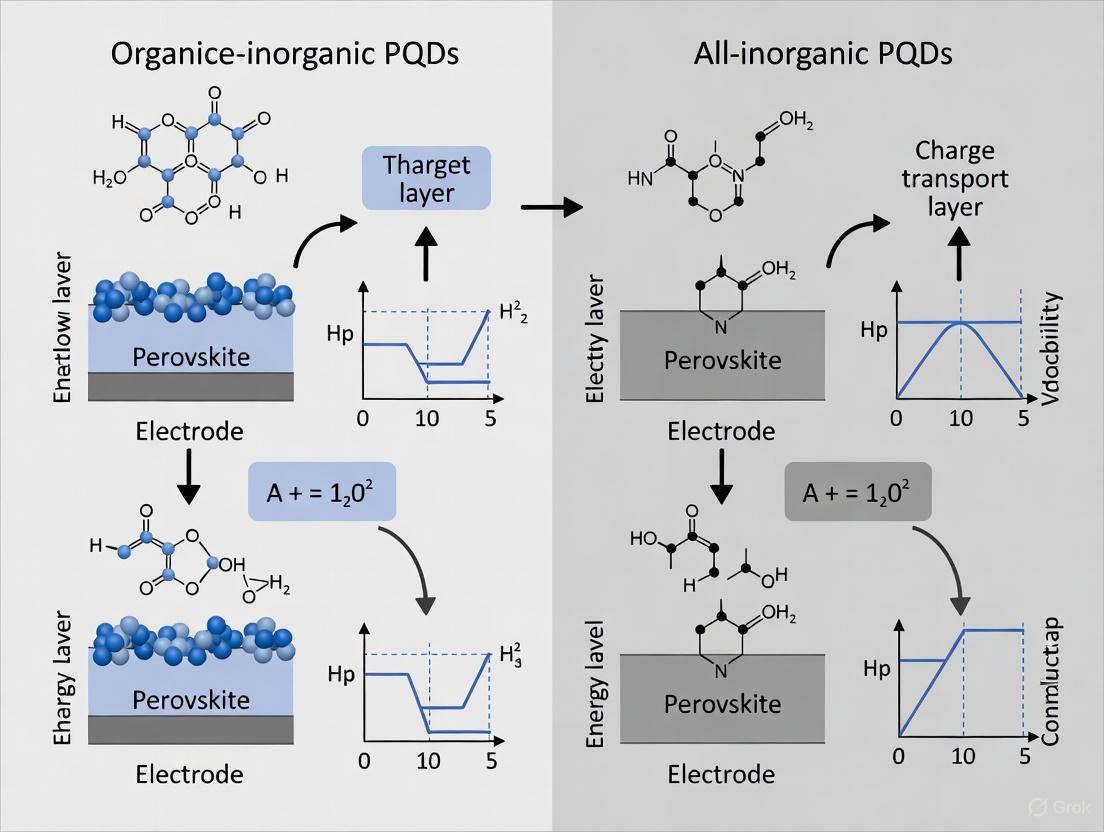
This article provides a systematic comparison of charge transport mechanisms in organic-inorganic hybrid and all-inorganic perovskite quantum dots (PQDs), addressing critical needs for researchers and scientists developing next-generation optoelectronic devices.
Charge Transport Mechanisms in Organic-Inorganic vs. All-Inorganic Perovskite Quantum Dots: A Comprehensive Analysis for Advanced Optoelectronics
Abstract
This article provides a systematic comparison of charge transport mechanisms in organic-inorganic hybrid and all-inorganic perovskite quantum dots (PQDs), addressing critical needs for researchers and scientists developing next-generation optoelectronic devices. We explore fundamental material properties, synthesis methodologies, and interfacial dynamics that govern carrier mobility and extraction efficiency. The analysis covers advanced optimization strategies including ligand engineering, defect passivation, and dimensional control to enhance performance and stability. Through direct comparison of transport characteristics, device integration challenges, and operational reliability, this work establishes clear guidelines for material selection and interface design in photovoltaic, LED, and specialized electronic applications requiring precise charge management.
Fundamental Charge Transport Properties and Material Architectures in Hybrid and All-Inorganic PQDs
Crystal Structures and Quantum Confinement Effects in PQD Systems
Perovskite quantum dots (PQDs) have emerged as a revolutionary class of materials in optoelectronics, distinguished by their exceptional photoluminescence quantum yield, tunable bandgaps, and solution processability. The fundamental distinction within this material family lies in their chemical composition: organic-inorganic hybrid PQDs (e.g., MAPbI₃, FAPbI₃) incorporate organic cations such as methylammonium (MA⁺) or formamidinium (FA⁺), while all-inorganic PQDs (e.g., CsPbX₃, where X = Cl, Br, I) utilize cesium (Cs⁺) as the sole A-site cation [1] [2] [3]. This compositional difference profoundly influences their structural integrity, charge transport mechanisms, and quantum confinement effects. Organic-inorganic hybrids initially garnered attention for their record-breaking photovoltaic efficiencies, but their susceptibility to thermal degradation—where organic components volatilize under heat—has driven the accelerated development of all-inorganic alternatives [1]. All-inorganic perovskites demonstrate superior thermal stability and comparable optoelectronic properties, making them particularly promising for tandem solar cells with crystalline silicon and other demanding optoelectronic applications [1] [4]. The investigation into how quantum confinement manifests differently in these two material systems, governed by their distinct crystal structures, provides critical insights for designing next-generation PQD devices with enhanced performance and operational longevity.
Crystal Structures and Structural Stability
Fundamental Crystal Architecture
At the atomic level, both hybrid and all-inorganic PQDs share the classic ABX₃ perovskite crystal structure. This framework consists of a network of corner-sharing BX₆ octahedra, where the 'B' site is typically a divalent metal cation (Pb²⁺, Sn²⁺) and the 'X' site is a halide anion (I⁻, Br⁻, Cl⁻). The 'A' cation occupies the cuboctahedral cavities formed within this octahedral network [2] [5]. The critical distinction arises from the nature of this 'A' site occupant. In all-inorganic CsPbX₃ PQDs, the small, spherical Cs⁺ ion creates a stable, inorganic framework throughout the crystal lattice. In contrast, hybrid organic-inorganic PQDs feature molecular cations like MA⁺ (CH₃NH₃⁺) or FA⁺ (HC(NH₂)₂⁺), which introduce dipole moments and weaker hydrogen bonding interactions with the inorganic cage [1] [3].
The Goldschmidt tolerance factor provides a quantitative measure of the structural stability of this architecture, predicting the formation of a stable perovskite phase based on the ionic radii of the constituent ions. The replacement of organic cations with Cs⁺ significantly alters this factor, often leading to different phase stability behavior, particularly for the photoactive black phase of CsPbI₃ [3].
Comparative Analysis of Structural Stability
The divergence in crystal composition directly translates to markedly different stability profiles, which are crucial for practical applications.
Table 1: Comparative Structural Stability of Organic-Inorganic Hybrid vs. All-Inorganic PQDs
| Property | Organic-Inorganic Hybrid PQDs (e.g., MAPbI₃) | All-Inorganic PQDs (e.g., CsPbX₃) |
|---|---|---|
| Thermal Stability | Poor; organic cations decompose at elevated temperatures (e.g., >85°C) [1] [2]. | Excellent; stable at high temperatures due to inorganic framework [1] [2]. |
| Phase Stability | Generally good for α-phase, but susceptible to hydration [3]. | CsPbI₃ has metastable α-phase at room temperature; CsPbBr₃ is highly stable [2] [3]. |
| Moisture Stability | Low; highly susceptible to degradation in humid environments [2]. | Moderate to high; CsPbBr₃ shows superior moisture resistance [6] [2]. |
| Dominant Degradation Mechanism | Volatilization of organic cations and hydration of crystal lattice [1]. | Phase transition (e.g., CsPbI₃ from α to δ) and surface ligand detachment [6] [3]. |
The following diagram illustrates the structural and stability differences between these two material classes:
Figure 1: Structural Composition and Resulting Stability Profiles of Hybrid and All-Inorganic PQDs. The A-site cation type fundamentally determines the thermal and environmental stability of the material.
Quantum Confinement Effects in PQD Systems
Fundamentals of Quantum Confinement
Quantum confinement is a phenomenon that arises when the physical size of a material, such as a quantum dot, is reduced to a scale comparable to the Bohr exciton radius of the bulk material. Under these conditions, the charge carriers (electrons and holes) experience spatial confinement, leading to discrete electronic energy levels instead of the continuous bands found in bulk semiconductors. This results in a size-dependent widening of the bandgap [6]. For both hybrid and all-inorganic PQDs, this effect provides a powerful tool for precise bandgap tuning by simply controlling the nanocrystal size during synthesis. The larger the dot, the smaller the bandgap and the more red-shifted the photoluminescence; conversely, smaller dots exhibit larger bandgaps and blue-shifted emission.
Material-Specific Confinement Behavior
The manifestation of quantum confinement is intimately linked to the electronic structure and dielectric properties of the material, which differ between hybrid and all-inorganic perovskites.
Table 2: Quantum Confinement Properties in Different PQD Systems
| Property | Organic-Inorganic Hybrid PQDs | All-Inorganic CsPbX₃ PQDs | Lead-Free All-Inorganic PQDs (e.g., Cs₃Bi₂Br₉) |
|---|---|---|---|
| Bohr Exciton Radius | ~2-5 nm (for MAPbI₃) [5] | ~3-7 nm (for CsPbBr₃) [6] | Typically smaller than lead-based counterparts [6]. |
| Photoluminescence Quantum Yield (PLQY) | High (can exceed 80%) | Very High (can approach 90-100%) | Moderate; often lower due to different recombination dynamics [6]. |
| Bandgap Tunability Range | Tunable across visible spectrum | Highly tunable (410-700 nm) via halide exchange and size [6]. | Wider bandgaps; often in blue/UV region [6]. |
| Emission Linewidth | Moderate | Very narrow (~20 nm FWHM), beneficial for pure color emission [6]. | Varies with synthesis and passivation. |
In lead-based PQDs (both hybrid and all-inorganic), the confinement is influenced by strong spin-orbit coupling and the ionic nature of the lattice, which leads to the formation of large polarons. This effect can shield charge carriers and reduce scattering, contributing to the high charge carrier mobilities observed even in quantum-confined systems [5]. For all-inorganic CsPbX₃ QDs, the dielectric constant is generally higher than in their hybrid counterparts, which influences the strength of the electron-hole interaction (Coulomb interaction) within the confined system. In bismuth-based lead-free PQDs like Cs₃Bi₂Br₉, the electronic structure and excitonic properties differ, often resulting in weaker quantum confinement effects and broader emission profiles, which can be mitigated through sophisticated core-shell designs [6].
Charge Transport Mechanisms: A Comparative Analysis
Charge Transport Physics
Charge transport in PQDs is a complex process governed by both intra-dot and inter-dot mechanisms. Within a single dot, carrier mobility is high due to the excellent intrinsic properties of the perovskite lattice. However, in PQD films, transport occurs primarily via carrier hopping between neighboring dots, a process highly dependent on surface chemistry, inter-dot distance, and energetic disorder [4]. The inorganic framework in CsPbX₃ PQDs often leads to higher electronic dimensionality and better orbital overlap between adjacent dots compared to hybrid PQDs, where the organic cations can sometimes act as insulating barriers, especially if dynamically disordered.
Quantitative Comparison of Transport Properties
The charge transport capabilities of a material are quantified by parameters such as carrier mobility and diffusion length, which are critical for device performance.
Table 3: Experimental Charge Transport Data for PQD Systems
| Material System | Charge Carrier Mobility (cm²/V·s) | Diffusion Length (nm) | Dominant Scattering Mechanism |
|---|---|---|---|
| Organic-Inorganic Hybrid (MAPbI₃) | ~10-50 (thin film) [5] | >1000 (in single crystal) | Acoustic phonon scattering, ionized impurity scattering [5]. |
| All-Inorganic CsPbBr₃ | Device-dependent, can be comparable to hybrids [7] | Data from search results is insufficient for this cell. | Optical phonon scattering [5]. |
| Mixed Sn-Pb Alloyed Perovskites | 23-89 (theoretical and experimental) [5] | Data from search results is insufficient for this cell. | LO phonon scattering; ionized impurity scattering in Sn-rich perovskites [5]. |
For mixed Sn-Pb systems, theoretical calculations based on density functional theory (DFT) combined with transport models reveal that carrier mobility is highly composition-dependent. As the Pb content increases beyond 50%, the effective mass of charge carriers increases, leading to a corresponding decrease in mobility [5]. In pure Sn-based perovskites, the oxidation of Sn²⁺ to Sn⁴⁺ creates ionized impurities that strongly scatter charge carriers, significantly reducing mobility compared to Pb-based counterparts [5].
Experimental Protocols for PQD Synthesis and Characterization
Synthesis of Lead-Free All-Inorganic PQDs with Surface Passivation
The following protocol details the synthesis of stable, lead-free Cs₃Bi₂Br₉ PQDs, incorporating a hybrid organic-inorganic passivation strategy as reported in the literature [6].
- Precursor Preparation: In a nitrogen-filled glovebox, dissolve CsBr (0.2 mmol, 0.0426 g) and BiBr₃ (0.2 mmol, 0.0894 g) in 10 mL of dimethyl sulfoxide (DMSO) to form the perovskite precursor solution.
- Ligand-Assisted Reprecipitation (Synthesis): Quickly inject 1 mL of the precursor solution into 20 mL of vigorously stirring toluene (the antisolvent). This induces instantaneous nucleation and the formation of PQDs.
- Surface Passivation: Add the organic passivator didodecyldimethylammonium bromide (DDAB) to the crude PQD solution. DDAB, with its shorter alkyl chains and strong affinity for halide anions, effectively binds to the PQD surface, passivating bromine vacancy defects and improving the photoluminescence quantum yield (PLQY).
- Inorganic Encapsulation: To the DDAB-passivated PQD solution, add tetraethyl orthosilicate (TEOS). Subsequently, introduce a catalyst to hydrolyze TEOS, leading to the formation of a dense, amorphous SiO₂ shell around the Cs₃Bi₂Br₉/DDAB core. This inorganic shell provides a robust physical barrier against environmental factors like moisture and oxygen.
- Purification and Storage: Centrifuge the final Cs₃Bi₂Br₉/DDAB/SiO₂ PQD solution to remove large aggregates. Re-disperse the purified PQDs in an anhydrous solvent (e.g., hexane or toluene) for storage and further characterization.
The workflow of this synthesis and passivation strategy is summarized below:
Figure 2: Experimental Workflow for Synthesizing Passivated Lead-Free All-Inorganic PQDs. This protocol combines organic ligand passivation and inorganic oxide encapsulation for enhanced stability.
Characterization of Structural and Optoelectronic Properties
To validate the success of the synthesis and compare different PQD systems, a suite of characterization techniques is employed:
- Structural and Morphological Analysis:
- Transmission Electron Microscopy (TEM): Used to determine the size, size distribution, and morphology of the PQDs. The protocol in [6] confirmed uniform quasispherical Cs₃Bi₂Br₉ nanoparticles of ~12 nm.
- X-ray Diffraction (XRD): Analyzes the crystal structure and phase purity of the perovskite material. It can detect changes in crystallinity upon the incorporation of additives like AgI in CsPbIBr₂ films [2].
- Optical and Electronic Property Analysis:
- UV-Vis Absorption Spectroscopy: Measures the bandgap and monitors the absorption profile, which is directly influenced by quantum confinement.
- Photoluminescence (PL) Spectroscopy: Assesses the emission wavelength, full width at half maximum (FWHM, related to color purity), and PL quantum yield (PLQY). Temperature-dependent PL can probe exciton-phonon interactions and recombination mechanisms [6].
- X-ray Photoelectron Spectroscopy (XPS): Confirms the elemental composition and chemical states at the surface, and can verify successful doping or passivation, as demonstrated with AgI-modified CsPbIBr₂ [2].
- Current Density-Voltage (J-V) Measurements: The core method for evaluating the performance of solar cell devices, providing key parameters such as power conversion efficiency (PCE), fill factor (FF), short-circuit current density (Jₛc), and open-circuit voltage (Vₒc) [2] [7].
The Scientist's Toolkit: Essential Research Reagents and Materials
Table 4: Key Reagents and Materials for PQD Research
| Reagent/Material | Function in Research | Example Application |
|---|---|---|
| Cesium Salts (CsBr, CsI) | A-site precursor for all-inorganic PQDs | Synthesis of CsPbX₃ and Cs₃Bi₂Br₉ QDs [6] [2]. |
| Lead Salts (PbBr₂, PbI₂) | B-site precursor for lead-based PQDs | Formation of the [PbX₆]⁴⁻ octahedra in the perovskite lattice [2]. |
| Bismuth Salts (BiBr₃) | Non-toxic B-site precursor | Synthesis of lead-free Cs₃Bi₂Br₉ PQDs [6]. |
| Silver Iodide (AgI) | Additive and nucleation promoter | Modifying CsPbIBr₂ to improve crystallinity, grain size, and reduce defects [2]. |
| Didodecyldimethylammonium Bromide (DDAB) | Organic surface passivator | Passivating surface defects on PQDs to enhance PLQY and stability [6]. |
| Tetraethyl Orthosilicate (TEOS) | Inorganic shell precursor | Forming a protective SiO₂ layer around PQDs for enhanced environmental stability [6]. |
| Dimethyl Sulfoxide (DMSO) | Polar aprotic solvent | Dissolving perovskite precursors for solution-processing [6] [2]. |
| Toluene | Antisolvent | Inducing supersaturation and nucleation during PQD synthesis [6]. |
| Nickel Oxide (NiOₓ) | Inorganic p-type charge transport layer | Used as a hole transport layer in p-i-n structured solar cells [4] [8] [7]. |
| Zinc Oxide (ZnO) | Inorganic n-type charge transport layer | Used as an electron transport layer in perovskite solar cells [4] [7]. |
The comparative analysis of crystal structures and quantum confinement effects reveals a clear trade-off between the exceptional optoelectronic performance of organic-inorganic hybrid PQDs and the superior thermal and structural stability of all-inorganic PQDs. The organic cations in hybrids, while enabling high efficiencies, introduce a fundamental vulnerability to heat. In contrast, the robust inorganic lattice of CsPbX₃ QDs offers a path toward durable optoelectronic devices. Quantum confinement provides a universal tool for bandgap engineering across both material classes, but its effectiveness is modulated by the specific composition and electronic structure of the PQD. The development of sophisticated passivation strategies, such as hybrid organic-inorganic coating for lead-free Cs₃Bi₂Br₉ PQDs, highlights the ongoing efforts to overcome the inherent limitations of each system [6]. Future research will likely focus on further stabilizing the crystal structure of all-inorganic PQDs (especially CsPbI₃), mitigating toxic lead content through alternative metals like bismuth, and engineering interfaces and charge transport layers to minimize non-radiative recombination losses. This relentless optimization, grounded in a deep understanding of structure-property relationships, is paving the way for the commercialization of high-performance, long-lasting PQD-based technologies in photovoltaics, light-emitting diodes, and photodetection.
Electronic Band Structure Alignment and Energy Level Considerations
In the pursuit of high-performance optoelectronic devices based on perovskite semiconductors, the strategic selection of charge transport layers (CTLs) is paramount. These layers, which include hole transport layers (HTLs) and electron transport layers (ETLs), serve as critical interfaces that facilitate the efficient extraction and transport of photogenerated charge carriers while minimizing parasitic recombination losses. The current research landscape primarily features two distinct material paradigms for these functions: organic charge transport materials, celebrated for their tunable energy levels and processing versatility, and inorganic charge transport materials, which offer superior intrinsic stability and charge carrier mobility [8] [4]. The electronic band structure alignment between the perovskite active layer and these adjacent CTLs directly governs key photovoltaic parameters, including open-circuit voltage (VOC), short-circuit current density (JSC), and fill factor (FF), ultimately determining power conversion efficiency (PCE) and operational stability [9].
This guide provides an objective comparison of organic and inorganic charge transport layers, with a specific focus on their energy level alignment with perovskite quantum dot (PQD) active layers. We synthesize experimental data and methodologies to empower researchers in making informed material selections grounded in fundamental electronic properties and performance metrics.
Fundamental Principles of Energy-Level Alignment
The performance of any perovskite optoelectronic device is heavily dictated by the energy-level alignment at the interfaces between the photoactive perovskite layer and its neighboring charge transport layers [9]. The core principle involves minimizing the energy barrier for charge extraction—specifically, aligning the highest occupied molecular orbital (HOMO) level of the HTL with the valence band (VB) of the perovskite, and aligning the lowest unoccupied molecular orbital (LUMO) level of the ETL with the conduction band (CB) of the perovskite [4] [9].
When a semiconductor material is deposited onto a substrate or another material, the electronic energy levels of the system adjust to reach thermodynamic equilibrium. This process establishes an interface dipole and results in the pinning of energy levels at the interface [9]. The resulting energy level alignment can be categorized into different types, with the vacuum level alignment (Schottky–Mott limit) and Fermi level pinning being two primary models. In organic-inorganic hybrid interfaces, the situation is often complex, with factors such as orbital hybridization, molecular polarization, and charge redistribution playing significant roles in the final alignment [10]. Advanced computational approaches, including full-potential all-electron density-functional theory and many-body perturbation theory (e.g., GW approximation), are often required to accurately predict these alignments, as simple models based on the electronic structure of individual components frequently prove inadequate [10].
Figure 1: Ideal energy level alignment at perovskite/charge transport layer interfaces. Favorable hole transfer requires minimal offset between the perovskite valence band and HTL HOMO level. Favorable electron transfer requires minimal offset between the perovskite conduction band and ETL LUMO level.
Comparative Analysis of Organic and Inorganic Charge Transport Layers
Material Properties and Electronic Characteristics
Organic charge transport materials, such as Spiro-OMeTAD, PTAA, and PEDOT:PSS, are widely used in high-efficiency perovskite solar cells (PSCs). These materials typically exhibit a Gaussian density of states (DOS) with significant energetic disorder due to variable molecular packing environments and conformational variances in these "soft" materials [9]. This disorder leads to charge transport characterized by carrier hopping between localized states with relatively low effective mobilities (typically 10-5 to 10-4 cm² V⁻¹ s⁻¹) [11]. The primary advantage of organic CTLs lies in their tunable energy levels through molecular design and functionalization, allowing for precise alignment with perovskite layers.
Inorganic charge transport materials, including metal oxides such as NiOₓ, Cu₂O, TiO₂, SnO₂, and ZnO, possess more rigid crystalline structures that support band-like transport with significantly higher charge carrier mobilities (0.1–10 cm² V⁻¹ s⁻¹) [4] [11]. These materials exhibit reduced energetic disorder and stronger electronic coupling, facilitating more efficient charge transport. Inorganic CTLs also demonstrate superior thermal stability and environmental resilience compared to their organic counterparts, but they often require high-temperature processing and may introduce interfacial defects that promote recombination [8].
Table 1: Comparative Electronic Properties of Representative Charge Transport Materials
| Material | Type | HOMO/VB (eV) | LUMO/CB (eV) | Mobility (cm²/V·s) | Dielectric Constant |
|---|---|---|---|---|---|
| Spiro-OMeTAD | Organic HTL | -5.2 | -2.2 | 10⁻⁵ - 10⁻⁴ | 2-4 |
| PEDOT:PSS | Organic HTL | -5.0 | -2.2 | 10⁻⁵ - 10⁻³ | 3-4 |
| PTAA | Organic HTL | -5.1 | -2.3 | 10⁻⁴ - 10⁻³ | 2-3 |
| NiOₓ | Inorganic HTL | -5.3 | -1.8 | 0.1-1 | 10-12 |
| Cu₂O | Inorganic HTL | -5.4 | -2.9 | 1-10 | 7-10 |
| TiO₂ | Inorganic ETL | -7.4 | -4.2 | 0.1-1 | 30-80 |
| SnO₂ | Inorganic ETL | -8.1 | -4.5 | 1-10 | 10-14 |
| ZnO | Inorganic ETL | -7.6 | -4.2 | 1-100 | 8-10 |
Performance Metrics in Perovskite Solar Cells
The impact of CTL selection on device performance is substantial. In direct comparisons, inorganic CTLs often enable higher operational stability, while organic CTLs currently achieve marginally higher peak efficiencies in optimized laboratory devices.
A recent computational study comparing organic (PEDOT:PSS) and inorganic (Cu₂O) HTLs in double perovskite solar cells with La₂NiMnO₆ (LNMO) as the absorber layer revealed remarkably similar theoretical performance ceilings. The inorganic Cu₂O-based device achieved a PCE of 27.84% (VOC = 1.27 V, JSC = 28.60 mA/cm², FF = 76.31%), while the organic PEDOT:PSS-based device reached 27.38% (VOC = 1.22 V, JSC = 28.91 mA/cm², FF = 77.15%) [12]. This narrow performance gap highlights the maturity of both material systems, with the choice between them increasingly dependent on specific application requirements rather than fundamental performance limitations.
Table 2: Experimental Performance Comparison of Organic and Inorganic CTLs in Perovskite Solar Cells
| Device Architecture | CTL Type | PCE (%) | VOC (V) | JSC (mA/cm²) | FF (%) | Stability (T80) | Reference |
|---|---|---|---|---|---|---|---|
| FTO/WS₂/LNMO/Cu₂O/Au | Inorganic HTL | 27.84 | 1.27 | 28.60 | 76.31 | >1000 h | [12] |
| FTO/WS₂/LNMO/PEDOT:PSS/Au | Organic HTL | 27.38 | 1.22 | 28.91 | 77.15 | ~800 h | [12] |
| p-i-n PSC (Organic CTLs) | Organic | >27 | ~1.18 | ~25-27 | ~80-82 | Weeks | [8] |
| p-i-n PSC (Inorganic CTLs) | Inorganic | ~22-25 | ~1.12-1.18 | ~24-26 | ~75-80 | Months | [8] |
Experimental Protocols for Characterizing Energy-Level Alignment
Ultraviolet Photoelectron Spectroscopy (UPS) Protocol
Purpose: To determine the ionization energy (IE), work function (Φ), and valence band maximum (VBM) of charge transport materials and perovskites.
Materials and Equipment: UPS spectrometer with He I (21.22 eV) or He II (40.8 eV) ultraviolet source, sample holder, electrical bias supply (-5 to +5 V), argon ion gun for surface cleaning (optional).
Procedure:
- Prepare thin films (20-50 nm) of the material on conducting substrates (e.g., ITO, FTO) using the intended deposition method (spin-coating, evaporation, etc.).
- Transfer samples to the UPS analysis chamber with a base pressure ≤ 2×10⁻¹⁰ mbar.
- Apply a small negative bias (-3 to -5 V) to the sample to overcome the work function difference between sample and spectrometer.
- Acquire UPS spectra in two regions:
- Secondary electron cutoff (SEC) region: Use low pass energy (2-5 eV) with sample bias to determine the work function: Φ = hν - (ESEC - EF)
- Valence band region: Use higher pass energy (5-10 eV) to measure the valence band onset relative to EF
- Calculate ionization energy: IE = hν - (Ecutoff - EVB) [9]
Data Interpretation: The VB onset is determined by linear extrapolation of the leading edge to the baseline. For organic materials, this corresponds approximately to the HOMO level; for inorganic materials, to the VBM.
Cyclic Voltammetry (CV) Protocol for Energy Level Estimation
Purpose: To estimate HOMO and LUMO energy levels of organic charge transport materials through electrochemical oxidation and reduction potentials.
Materials and Equipment: Three-electrode electrochemical cell (working electrode: glassy carbon or Pt; counter electrode: Pt wire; reference electrode: Ag/Ag⁺), potentiostat, degassed anhydrous solvent (acetonitrile or dichloromethane), supporting electrolyte (0.1 M tetrabutylammonium hexafluorophosphate, TBAPF₆), ferrocene/ferrocenium (Fc/Fc⁺) internal standard.
Procedure:
- Prepare 0.5-1.0 mM solution of the organic semiconductor in degassed solvent with 0.1 M TBAPF₆.
- Record cyclic voltammograms at scan rates of 50-100 mV/s under inert atmosphere.
- Determine the oxidation potential (Eox) and reduction potential (Ered) relative to the Fc/Fc⁺ couple.
- Calculate HOMO and LUMO energies using the conversion:
- HOMO (eV) = -[Eox vs. Fc/Fc⁺ + 4.8] eV
- LUMO (eV) = -[Ered vs. Fc/Fc⁺ + 4.8] eV [4]
Limitations: CV provides solution-phase energetics that may differ from solid-state thin films due to dielectric environment and molecular packing effects.
Advanced Alignment Strategies and Interface Engineering
Passivation and Doping Approaches
Defect passivation and strategic doping represent powerful approaches to optimize energy level alignment and interfacial charge transport. For inorganic CTLs like NiOₓ, introduction of cation dopants (e.g., Li⁺, Cu²⁺, Mg²⁺) can modify the work function and increase electrical conductivity, thereby improving hole extraction [4]. Similarly, for inorganic ETLs like TiO₂ and SnO₂, elemental doping (e.g., Li⁺, Nb⁵⁺) can passivate oxygen vacancies and tune the conduction band position.
Molecular passivation is particularly effective for mitigating interfacial recombination. Strategies include employing halide ammonium salts (e.g., phenethylammonium iodide) or fullerene derivatives at perovskite/ETL interfaces, which can passivate dangling bonds and reduce interface trap states [4]. These passivation layers often function as dipole layers that modify the effective work function of the adjacent layer, thereby optimizing energy level alignment without changing the bulk composition of the CTL.
Figure 2: Interface engineering strategies for optimizing energy level alignment at perovskite/charge transport layer interfaces.
Hybrid Organic-Inorganic Transport Layers
Emerging research explores hybrid organic-inorganic transport layers that combine the advantages of both material systems. These hybrids leverage the tunable surface properties and processing benefits of organic materials with the excellent charge transport and stability of inorganic materials [13]. For example, incorporating inorganic nanoparticles (e.g., ZnO, TiO₂) into organic charge transport matrices can enhance electron mobility while maintaining solution processability [4] [13]. Similarly, organic-inorganic metal-organic frameworks (MOFs) with halide-bridged structures have demonstrated exceptional carrier transport properties derived from lead perovskites while maintaining the porosity and moisture stability of MOFs [14].
The Scientist's Toolkit: Essential Research Reagents and Materials
Table 3: Key Research Reagents for Charge Transport Layer Research
| Material/Reagent | Function | Application Note |
|---|---|---|
| Spiro-OMeTAD | Benchmark organic HTL | Requires oxidation with Li-TFSI and tBP additives for optimal conductivity |
| PTAA | High-performance polymeric HTL | Superior wettability for perovskite deposition; requires surface treatment |
| PEDOT:PSS | Conducting polymer HTL | Typically used in p-i-n architecture; acidic nature may impact stability |
| NiOₓ Nanoparticles | Inorganic HTL precursor | Solution-processable; requires high-temperature annealing (>300°C) |
| CuSCN | Low-cost inorganic HTL | Solution-processable from diethyl sulfide; stability challenges |
| TiO₂ Paste | Mesoporous ETL | Requires high-temperature sintering; enables >20% PCE |
| SnO₂ Colloid | Low-temperature ETL | Processable below 150°C; compatible with flexible substrates |
| PCBM | Fullerene-based ETL | Excellent perovskite surface coverage; prone to aggregation |
| PEAI (Phenethylammonium Iodide) | Passivation agent | Reduces interface recombination; forms 2D/3D heterostructure |
| Li-TFSI | p-Dopant for HTLs | Enhances Spiro-OMeTAD conductivity; hygroscopic nature impacts stability |
The strategic selection and engineering of charge transport layers based on electronic band structure alignment remains a critical determinant of performance in perovskite optoelectronics. While organic CTLs currently achieve marginally higher efficiencies in laboratory settings, inorganic CTLs offer compelling advantages in operational stability, thermal resilience, and potential for scalable manufacturing [8] [12].
Future research directions will likely focus on interface dipole engineering through molecular monolayers, development of low-temperature processed inorganic CTLs compatible with flexible substrates, and creation of multi-functional hybrid transport layers that combine the merits of both material systems [4] [13]. Additionally, advanced characterization techniques enabling in-situ monitoring of energy level alignment during device operation will provide deeper insights into interface dynamics under realistic working conditions.
The ongoing refinement of CTLs, guided by fundamental principles of electronic band alignment, will continue to drive performance improvements in perovskite photovoltaics and accelerate their commercialization journey.
Intrinsic Charge Carrier Mobility and Recombination Dynamics
The exploration of charge carrier dynamics forms the cornerstone of developing advanced optoelectronic devices. Within the field of perovskite quantum dots (PQDs), a fundamental division exists between organic-inorganic hybrids and all-inorganic structures, each exhibiting distinct photophysical behaviors. This comparison guide objectively analyzes the intrinsic charge carrier mobility and recombination dynamics that define the performance boundaries of these material classes. Understanding these core parameters—encompussing free carrier generation, trap-assisted recombination, ion migration, and exciton dynamics—provides critical insights for applications ranging from photovoltaics to light-emitting diodes (LEDs). The following sections synthesize experimental data and methodologies to delineate the inherent advantages and limitations of each material system, offering researchers a foundation for material selection and device engineering.
Comparative Performance Data: Organic-Inorganic vs. All-Inorganic PQDs
The performance of perovskite quantum dots is governed by their charge transport and recombination characteristics, which differ significantly between organic-inorganic and all-inorganic structures. The table below summarizes key quantitative parameters that define their optoelectronic performance.
Table 1: Comparative Charge Carrier Dynamics in Perovskite Quantum Dots
| Parameter | Organic-Inorganic PQDs | All-Inorganic PQDs | Measurement Technique | Impact on Device Performance |
|---|---|---|---|---|
| In-plane Charge Carrier Mobility (φμi) | 0.45–1.49 cm² V⁻¹ s⁻¹ (Highly dependent on organic cation conformation) [15] | Generally higher; tunable via quantum confinement and composition [16] | Optical-pump terahertz-probe spectroscopy (OPTPS) [15] | Higher mobility reduces resistive losses, improves charge extraction, and enhances fill factor in solar cells [4] [15] |
| Out-of-plane Charge Carrier Mobility (μo) | ~10⁻⁴ cm² V⁻¹ s⁻¹ (Four orders lower than in-plane) [15] | Data insufficient in search results | Mott-Gurney (M-G) analysis of I-V curves [15] | Anisotropic transport critical for device architecture design; low μo can limit device current [15] |
| Dominant Recombination Process | Free carriers → Free excitons → Self-trapped states (leading to broadband emission) [15] | Non-radiative recombination at surface defects (especially in mixed halide blue emitters) [16] | Time-resolved photoluminescence (TRPL), transient spectroscopy [17] [16] | Defect-assisted recombination reduces photoluminescence quantum yield (PLQY) and opens-circuit voltage (VOC) [17] [16] |
| Characteristic Ion Transport Time | Seconds scale (A significant factor in operational instability) [17] | More suppressed ion migration (improved operational stability) [18] | Impedance spectroscopy, transient current analysis [17] | Slow ion dynamics linked to current-voltage hysteresis and device degradation [17] |
| Photoluminescence Quantum Yield (PLQY) | Can exhibit high PLQY, but conformational disorder of cations can reduce it [15] | Can exceed 80-90% for green/red emitters; lower for blue (e.g., 84% reported for core-shell CsPbBr₃) [16] | Absolute PLQY measurement using integrating sphere [16] | Directly correlates to the maximum external quantum efficiency (EQE) of LEDs [16] |
| Key Stability Challenge | Conformational disorder of organic cations under thermal stress [15] | Phase instability and spectral shift, especially in blue-emitting mixed-halide QDs [16] | Operational lifetime testing (e.g., T50), shelf-life testing [16] [19] | Determines commercial viability; inorganic HTLs can enhance stability (11x longer lifetime reported) [19] |
Experimental Protocols for Key Measurements
Protocol 1: Measuring In-Plane Charge Carrier Mobility via Optical-Pump Terahertz-Probe Spectroscopy (OPTPS)
OPTPS is a non-contact technique ideal for quantifying the in-plane charge carrier mobility in perovskite thin films, as it is sensitive only to free charges and not trapped carriers or excitons [15].
1. Sample Preparation: Thin films of the perovskite QDs are deposited on a suitable substrate (e.g., fused silica) to form a smooth, pinhole-free layer. The organic-inorganic films (e.g., [CH₃(CH₂)ₙ₋₁NH₃]₂PbI₄) and all-inorganic CsPbX₃ films are prepared using standardized spin-coating procedures [15].
2. Experimental Setup: A femtosecond amplifier laser system generates two beams. The "pump" beam (e.g., 400 nm wavelength) is used to photoexcite the sample. The "probe" is a broadband terahertz (THz) pulse that interacts with the photoexcited sample [15].
3. Data Acquisition: The change in the transmitted THz electric field amplitude (ΔT/T) is measured as a function of the time delay between the pump and probe pulses. This is done at various pump fluences, ensuring measurements are in the linear regime (e.g., below 45 μJ cm⁻²) to avoid multi-photon absorption effects [15].
4. Data Analysis: The maximum |ΔT/T| is proportional to the product of the photon-to-charge branching ratio (φ) and the in-plane mobility (φμi). The effective mobility is extracted by fitting the data to the Drude model for conductivity. For comparative studies, φ is often assumed constant across a series of similar materials, as with 2D OIHPs where exciton binding energy is independent of alkyl chain length [15].
Protocol 2: Quantifying Recombination Dynamics with Time-Resolved Photoluminescence (TRPL)
TRPL measures the lifetime of photogenerated carriers, providing direct insight into recombination pathways.
1. Sample Preparation: Films are prepared identically to those used in OPTPS or device fabrication to ensure consistency.
2. Excitation and Detection: A pulsed laser (e.g., a picosecond diode laser) excites the sample. The resulting photoluminescence is collected and focused onto a fast detector, such as a streak camera or a photomultiplier tube connected to a time-correlated single-photon counting (TCSPC) system.
3. Data Fitting: The photoluminescence decay curve is recorded and fitted with exponential models. A bi-exponential or tri-exponential fit is common:
- Fast Component (τ₁): Typically attributed to trap-assisted non-radiative recombination. A high amplitude of this component indicates a large density of defects [16].
- Slow Component (τ₂): Attributed to radiative recombination of free charges. A longer τ₂ is desirable for light-emitting applications and indicates reduced non-radiative losses [17].
4. Interpretation: The average lifetime (τavg) is calculated. A longer τavg generally signifies superior material quality with fewer defects. Comparing TRPL dynamics between organic-inorganic and all-inorganic PQDs reveals the efficacy of defect passivation strategies [16] [18].
Visualization of Structure-Property Relationships
The charge transport properties in these materials are intrinsically linked to their structural composition. The following diagram illustrates the causal relationships between material structure, intrinsic dynamics, and ultimate device performance.
The Scientist's Toolkit: Essential Research Reagents and Materials
The experimental study of charge carrier dynamics relies on specific materials and reagents. The table below details key components used in the synthesis and fabrication processes cited in the referenced research.
Table 2: Key Research Reagents and Materials for PQD Charge Transport Studies
| Material/Reagent | Function | Example Role in Charge Transport Studies |
|---|---|---|
| Cesium carbonate (Cs₂CO₃) | Cesium precursor | Forms Cs-oleate for synthesis of all-inorganic CsPbX₃ QDs, determining the cation site in the perovskite lattice [16]. |
| Lead(II) bromide (PbBr₂) | Lead and halide precursor | The core component of the inorganic framework in both hybrid and all-inorganic PQDs; its concentration and reaction kinetics control QD size and defect density [16]. |
| Oleic Acid (OA) & Oleylamine (OAm) | Surface ligands & capping agents | Passivate surface states during synthesis to suppress trap-mediated recombination; their concentration and ratio influence QD growth, stability, and final charge mobility [16]. |
| Hafnium(IV) chloride (HfCl₄) | Inorganic hole transport layer (HTL) precursor | Forms HfOx HTL; annealing controls oxygen vacancy density, creating defect states for hole injection in all-inorganic QLEDs, directly affecting device efficiency and stability [19]. |
| ZnMgO nanoparticles | Electron transport layer (ETL) | Serves as an efficient ETL in QLEDs; its energy levels and mobility are engineered to balance electron and hole injection, mitigating excessive recombination and improving efficiency [19]. |
| PEDOT:PSS | Organic polymer HTL | A common organic HTL for comparison against inorganic HTLs like NiO or HfOx; its hygroscopicity and lower stability often benchmark the stability advantage of inorganic alternatives [12] [19]. |
| Alkylammonium Halides (e.g., CH₃(CH₂)ₙNH₃I) | Organic cations for 2D perovskites | Spacer cations in organic-inorganic hybrids; their chain length and conformational order (e.g., gauche defects) directly govern charge carrier mobility and broadband emission properties [15]. |
The comparative analysis of intrinsic charge carrier mobility and recombination dynamics reveals a clear performance-sustainability trade-off between organic-inorganic and all-inorganic perovskite quantum dots. Organic-inorganic hybrids exhibit tunable properties but suffer from intrinsic conformational disorder and ion migration that limit operational stability. All-inorganic PQDs demonstrate superior thermal stability and high performance in the red and green spectral regions, yet face challenges in phase stability and defect management for blue emission. Future research directions should prioritize the development of lead-free compositions, advanced surface passivation protocols to minimize non-radiative recombination, and innovative ligand engineering strategies to enhance charge transport. Bridging the gap between fundamental charge dynamics and scalable device fabrication will be pivotal in transitioning these promising materials from laboratory research to commercial optoelectronic technologies.
Comparative Analysis of Organic-Inorganic Hybrid vs. All-Inorganic PQD Cores
Perovskite quantum dots (PQDs) have emerged as a prominent class of materials in optoelectronics, distinguished by their exceptional properties such as high photoluminescence quantum yield (PLQY), facile bandgap tunability, and narrow emission spectra. [20] A central classification within this family separates materials based on their A-site cation, leading to two primary categories: organic-inorganic hybrid PQDs (e.g., containing methylammonium (MA+) or formamidinium (FA+)) and all-inorganic PQDs (e.g., containing cesium (Cs+)). The composition of the PQD core fundamentally dictates its intrinsic charge transport mechanisms, environmental stability, and ultimate performance in devices like photovoltaics and light-emitting diodes (LEDs). This guide provides a objective, data-driven comparison of these two material systems, focusing on their charge transport characteristics for a research-oriented audience.
Core Composition and Key Differentiators
The defining difference between these PQD types lies in their A-site occupant within the ABX3 perovskite crystal structure.
- Organic-Inorganic Hybrid PQDs feature a monovalent organic cation, such as CH3NH3+ (MA+) or CH(NH2)2+ (FA+), in the A-site. The organic component influences the crystal structure, dielectric constant, and the nature of charge carrier interactions.
- All-Inorganic PQDs utilize a cesium (Cs+) ion in the A-site. The purely inorganic lattice results in a different set of electronic and structural properties, most notably enhanced thermal stability.
The following table summarizes the fundamental distinctions derived from recent research.
Table 1: Fundamental Characteristics of PQD Cores
| Characteristic | Organic-Inorganic Hybrid PQDs | All-Inorganic PQDs |
|---|---|---|
| Core Composition | A-site: MA+, FA+B-site: Pb2+, Sn2+X-site: I-, Br-, Cl- | A-site: Cs+B-site: Pb2+, Sn2+X-site: I-, Br-, Cl- |
| Example Formulation | CH3NH3PbBr3 (MAPbBr3) [20] | CsPbIxBr3-x (e.g., CsPbIBr2) [2] |
| Typical Bandgap Range | Easily tunable across visible spectrum | Tunable, but often wider for phase stability |
| Inherent Thermal Stability | Moderate to Low; organic cations decompose at elevated temperatures. [2] | High; inorganic structure withstands higher thermal stress. [2] |
Comparative Analysis of Charge Transport and Performance
Charge transport in PQDs is critically influenced by scattering mechanisms, surface ligand chemistry, and defect states. Experimental data reveals a performance trade-off between charge transport efficiency and environmental stability.
Charge Transport Mechanisms and Mobility
In hybrid Sn-Pb alloyed perovskites, theoretical and experimental analyses indicate that charge transport is governed by a combination of mechanisms. Density functional theory (DFT) calculations show that in mixed Sn-Pb systems, large polaron transport mediated by longitudinal optical (LO) phonon scattering is dominant. However, in pure-Sn hybrid perovskites, ionized impurity scattering becomes significant due to the oxidation of Sn2+ to Sn4+. Experimental charge-carrier mobilities for these hybrid systems have been recorded between 23 and 89 cm² V⁻¹ s⁻¹ at room temperature. [5]
For all-inorganic PQDs, the charge transport within the core is often more efficient due to a more rigid, inorganic lattice. However, a universal challenge for all PQD systems is the restriction of inter-dot charge transport by the insulating organic ligands (e.g., oleic acid, oleylamine) capping their surfaces. This highlights that while the intrinsic core mobility might be high, the effective device mobility is heavily dictated by surface chemistry and post-synthesis treatments. [21]
Performance in Optoelectronic Devices
The performance of both PQD types in devices like photovoltaics under indoor lighting highlights their potential and limitations.
Table 2: Performance Comparison in Photovoltaic Devices
| Parameter | Organic-Inorganic Hybrid PQDs | All-Inorganic PQDs |
|---|---|---|
| Carrier Lifetime | Subject to instability-induced recombination. | Can be significantly improved (e.g., 35% increase) with surface passivation. [21] |
| Power Conversion Efficiency (PCE) | High efficiencies reported, but can degrade. | PCE of 7.2% achieved in CsPbIBr2 solar cells with AgI additive; PCE of 41.1% demonstrated for indoor PQD photovoltaics with passivation. [2] [21] |
| Open-Circuit Voltage (VOC) & Fill Factor (FF) | Can be high but are not always stable. | Significantly improved through defect passivation strategies, leading to high VOC and FF in indoor devices. [21] |
| Stability (Moisture/Thermal) | Poor; organic cations are hygroscopic and thermally unstable. [2] | Superior; CsPbIBr2 shows balanced phase stability. Devices retain >80% initial PCE after 500h in ambient. [2] [21] |
The data shows that while hybrid PQDs can exhibit excellent initial charge transport, all-inorganic counterparts, especially when engineered with strategic passivation, offer a more robust platform for stable, high-performance devices.
Experimental Protocols and Methodologies
To ensure reproducibility, this section outlines standard protocols for PQD synthesis, film fabrication, and key characterization from the cited literature.
Synthesis and Film Fabrication
- Synthesis of CsPbI₃ PQDs: A standard hot-injection method is used. A cesium precursor (e.g., Cs₂CO₃) is reacted with a lead source (e.g., PbI₂) in a high-temperature solvent (1-octadecene) in the presence of organic ligands (oleic acid, oleylamine). The PQDs are purified by centrifugation with an anti-solvent like methyl acetate. [21]
- Layer-by-Layer (LBL) Film Deposition: For device fabrication, PQD films are built up using the LBL method. This involves sequentially spin-coating a layer of PQDs, followed by a treatment step (e.g., with methyl acetate or a passivating ligand solution), and repeating the process to achieve the desired film thickness. This method allows for control over film morphology and ligand exchange. [21]
- Ligand Passivation Engineering: A critical step for enhancing performance. After LBL deposition, a solution of a passivating molecule (e.g., 2PACz) is spin-coated onto the PQD film. This molecule fills A- and X-site vacancies on the PQD surface, reducing trap states and improving charge transport. [21]
- AgI Additive Engineering for All-Inorganic Films: To improve the quality of all-inorganic CsPbIBr2 films, AgI is incorporated directly into the perovskite precursor solution (e.g., CsI and PbBr2 in DMSO). The solution is then spin-coated and annealed at high temperatures (e.g., ~280 °C) to form a high-quality film with larger grains and fewer defects. [2]
Key Characterization Techniques
- Ultrafast Transient Absorption (TA) Spectroscopy: Used to directly measure the charge carrier lifetime in the PQD films, quantifying the effect of passivation strategies. [21]
- Current Density-Voltage (J-V) Measurements: Performed under standard illumination (e.g., AM 1.5G for outdoor, fluorescent lamp for indoor) to determine key photovoltaic parameters like PCE, VOC, JSC, and FF. [2] [21]
- Scanning Electron Microscopy (SEM): Employed to analyze the surface morphology, grain size, and coverage of the perovskite films. [2]
- X-ray Diffraction (XRD): Used to determine the crystalline structure and phase purity of the perovskite materials. [2]
Charge Transport Pathways and Engineering Strategies
The following diagram illustrates the charge transport pathway within a PQD-based device and highlights the critical role of surface engineering in mitigating losses.
Diagram 1: Charge transport pathway and the impact of surface passivation in a PQD device. The pathway shows how charges generated in the core must navigate to the surface for extraction. A defective surface (red) leads to recombination losses, while a passivated surface (blue) enables efficient charge extraction and higher device performance.
The Scientist's Toolkit: Essential Research Reagents
This section details crucial materials and their functions for researchers working in the PQD field, based on the methodologies cited.
Table 3: Key Research Reagents for PQD Synthesis and Device Fabrication
| Research Reagent | Function / Role | Application Context |
|---|---|---|
| Cesium Carbonate (Cs₂CO₃) | Cesium precursor for synthesizing all-inorganic Cs-PQDs. [21] | All-inorganic PQD synthesis |
| Methylammonium Bromide (MABr) | Organic cation precursor for synthesizing hybrid MAPbBr3 PQDs. [20] | Hybrid PQD synthesis |
| Lead Bromide (PbBr₂) | Lead and halide source for the perovskite crystal structure. [20] [2] | Universal PQD synthesis |
| Oleic Acid (OA) / Oleylamine (OAm) | Long-chain organic ligands that cap the PQD surfaces during synthesis to control growth and prevent aggregation. [21] [20] | Universal PQD synthesis & stabilization |
| 2PACz | A short-chain passivating ligand. Used in post-synthesis treatment to replace long insulating ligands, reduce surface defects, and enhance hole transport. [21] | PQD surface passivation |
| Silver Iodide (AgI) | A functional additive. Incorporated into the precursor solution to promote nucleation, enlarge grain size, and reduce defect density in all-inorganic perovskite films. [2] | All-inorganic film quality control |
| Dimethyl Sulfoxide (DMSO) | A polar aprotic solvent used to prepare perovskite precursor solutions. [2] | Precursor solution formulation |
| Spiro-OMeTAD | A widely used small-molecule hole transport material (HTM) in device stacks to efficiently extract holes from the perovskite layer. [2] | Device fabrication (HTL) |
Surface Chemistry and Ligand Effects on Fundamental Transport Properties
The surface chemistry of perovskite quantum dots (PQDs) plays a pivotal role in determining their fundamental charge transport properties, which ultimately govern performance in optoelectronic devices. Ligands bound to the PQD surface serve a dual function: they passivate surface defects to enhance photoluminescence while simultaneously influencing charge carrier mobility between adjacent quantum dots. This creates a fundamental trade-off where long-chain insulating ligands provide excellent colloidal stability but impede inter-dot charge transport, whereas short-chain ligands facilitate carrier transport while potentially compromising stability. Within the broader context of comparing charge transport in organic-inorganic hybrid versus all-inorganic PQDs, understanding these ligand effects becomes crucial for designing next-generation optoelectronic materials. This review systematically examines how surface chemistry manipulation through ligand engineering directly impacts the fundamental transport properties in both classes of perovskite quantum dots, providing researchers with comparative insights for material selection and device optimization.
Ligand Chemistry and Binding Mechanisms
Ligand Classification and Coordination
Ligands employed in PQD synthesis and processing can be categorized according to their binding geometry and electronic properties. The most fundamental classification distinguishes between L-type ligands (neutral electron-pair donors, such as alkyl amines and phosphines) and X-type ligands (anionic species, typically carboxylates, that form covalent bonds with surface metal atoms) [22]. These conventional ligands dynamically bind and detach from the PQD surface, creating a equilibrium that affects both stability and electronic coupling.
Conjugated organic ligands represent an advanced category where delocalized π-electron systems enable enhanced inter-dot electronic coupling while maintaining passivation efficacy. Studies demonstrate that short-chain conjugated ligands like 3-phenyl-2-propen-1-amine (PPA) facilitate carrier transport through π-π stacking between adjacent QDs, effectively creating pathways for charge delocalization across the film [23]. The electronic properties of these conjugated ligands can be further modulated through strategic substituents, with electron-donating groups (e.g., -CH₃) enhancing hole transport and electron-withdrawing groups (e.g., -F) improving electron transport characteristics [23].
Dye-functionalized ligands constitute a specialized class that combines surface passivation with additional functionality. For instance, BODIPY-OH molecules employed as short-chain ligands in MAPbBr₃ QDs not only passivate surface defects but also participate in the photogenerated carrier transfer process, enhancing singlet oxygen generation for photocatalytic applications [24]. This approach demonstrates how ligand selection can introduce entirely new functionalities beyond mere stabilization and charge transport modulation.
Binding Dynamics and Surface Interactions
The binding strength and stability of ligand-PQD interactions fundamentally impact both material stability and charge transport properties. Traditional long-chain ligands like oleic acid (OA) and oleylamine (OAm) exhibit dynamic binding characterized by reversible protonation and deprotonation processes, making them prone to detachment from the PQD surface [23]. This instability leads to increased surface defects over time and inconsistent electronic coupling between QDs in solid films.
Multidentate ligands offer enhanced binding stability through chelation effects, where multiple binding groups interact with the perovskite surface simultaneously. This strengthened interaction reduces ligand desorption rates and improves material stability under environmental stressors such as moisture, heat, and light exposure [22]. The trade-off, however, involves potentially more complex synthesis procedures and the need for precise stoichiometric control during surface treatment.
Table: Ligand Classification and Properties in Perovskite Quantum Dots
| Ligand Category | Representative Examples | Binding Mechanism | Impact on Transport Properties |
|---|---|---|---|
| Long-chain alkyl | Oleic acid (OA), Oleylamine (OAm) | Dynamic ionic/ hydrogen bonding | Poor charge transport due to insulating barriers |
| Short-chain conjugated | PPABr derivatives, BODIPY-OH | Coordinate covalent with π-delocalization | Enhanced carrier mobility via π-π stacking |
| Halide-based | Phenethylammonium iodide (PEAI) | Ionic interaction with surface halides | Improved charge injection and balanced transport |
| Multidentate | Dicarboxylic acids, bifunctional amines | Chelation effect with multiple binding sites | Moderate transport with enhanced stability |
Charge Transport Mechanisms in PQD Solids
Fundamental Transport Physics
In solid films of perovskite quantum dots, charge transport occurs primarily through inter-dot carrier hopping, a process strongly influenced by the inter-dot distance and potential barriers presented by surface ligands [22]. The quantum confinement effect in PQDs creates discrete electronic energy levels, while surface ligands determine the height and width of potential barriers between adjacent dots. Long-chain insulating ligands (e.g., OA/OAm) create significant tunnel barriers that exponentially suppress carrier mobility according to the relationship: μ ∝ exp(-βd), where μ represents mobility, d is the inter-dot distance, and β is a decay constant [23].
The replacement of long-chain ligands with shorter conjugated alternatives reduces the inter-dot spacing and lowers the potential barrier height through delocalized molecular orbitals. Experimental evidence demonstrates that conjugated ligands like PPABr enhance carrier mobility in CsPbBr₃ QD films by facilitating wavefunction overlap between adjacent dots, effectively creating more continuous transport pathways through the film [23]. This approach has yielded external quantum efficiency (EQE) improvements of up to 1.67-fold in QLED devices with only a marginal increase in photoluminescence quantum yield (PLQY), highlighting the dominant role of transport enhancement rather than improved emission efficiency [23].
Comparative Transport in Hybrid vs. All-Inorganic PQDs
The choice between organic-inorganic hybrid (e.g., MAPbBr₃) and all-inorganic (e.g., CsPbX₃) perovskite frameworks introduces distinct considerations for charge transport. Hybrid organic-inorganic PQDs benefit from the dielectric screening provided by organic cations, which reduces exciton binding energies and facilitates charge separation [24]. However, these materials often exhibit inferior thermal stability compared to their all-inorganic counterparts, with ligand binding more susceptible to thermal degradation.
All-inorganic CsPbX₃ PQDs demonstrate enhanced phase stability and more robust ligand interactions, particularly under thermal stress [16]. The absence of organic cations in the crystal structure simplifies the surface chemistry, allowing for more predictable ligand binding and potentially higher charge carrier mobility. Advanced ligand engineering strategies in all-inorganic systems, such as the layer-by-layer (LBL) solid-state exchange with phenethylammonium iodide (PEAI), have demonstrated balanced electron and hole transport with champion solar cell efficiency of 14.18% and impressive electroluminescent performance in the same device [25].
Table: Comparative Charge Transport Properties in PQD Systems
| PQD System | Typical Ligands | Carrier Mobility (cm²/V·s) | Dominant Transport Mechanism | Device Performance Metrics |
|---|---|---|---|---|
| MAPbBr₃ QDs | BODIPY-OH, short-chain dyes | Moderate (10⁻³-10⁻²) | Polaronic hopping with dielectric screening | Photocatalytic antibacterial efficiency [24] |
| CsPbI₃ QDs | PEAI, FAI, short-chain ammonium | High (10⁻²-10⁻¹) | Band-like transport with minimal hopping | PCE: 14.18%, VOC: 1.23 V in solar cells [25] |
| CsPbBr₃ QDs | PPABr derivatives, DDAB | High (10⁻²-10⁻¹) | π-π assisted hopping | EQE: 23.88% in LEDs [23] |
| CsPbI₂Br QDs | Mixed halide, polymer ligands | Moderate-high (10⁻²) | Composition-tuned band transport | PCE: 19.4% in OPV blends [26] |
Experimental Methodologies for Transport Characterization
Synthesis and Ligand Exchange Protocols
Hot-Injection Method: A widely employed approach for high-quality all-inorganic PQDs, typically conducted under inert atmosphere. In a standard synthesis of CsPbBr₃ QDs, Cs₂CO₃ is dissolved in 1-octadecene (ODE) with oleic acid at 150°C to form Cs-oleate precursor. Separately, PbBr₂ is dissolved in ODE with OA and OAm. The Cs-oleate is swiftly injected into the PbBr₂ solution, resulting in rapid nucleation and growth. The reaction is terminated after 5-10 seconds using an ice bath, followed by centrifugation and purification [16] [23].
Ligand-Assisted Reprecipitation (LARP): This room-temperature method suitable for both hybrid and all-inorganic PQDs involves dissolving perovskite precursors (e.g., MAX, PbX₂) in polar solvents like DMF or DMSO with ligands. The precursor solution is then injected into a nonpolar solvent (e.g., toluene) under vigorous stirring, inducing rapid supersaturation and crystallization. The LARP technique enables large-scale production but typically yields QDs with broader size distribution compared to hot-injection [24] [16].
Solid-State Ligand Exchange: A post-synthetic approach where purified PQDs with native long-chain ligands are deposited as films and treated with solutions containing short-chain ligands. For example, CsPbI₃ QD films can be treated with phenethylammonium iodide (PEAI) solutions in ethyl acetate using a layer-by-layer (LBL) process, where each deposition cycle includes spinning, PEAI treatment, and rinsing steps to progressively replace OA/OAm ligands [25]. This method effectively enhances inter-dot electronic coupling while maintaining quantum confinement.
Characterization Techniques
Field-Effect Transistor Measurements: PQDs are deposited onto FET structures with predefined source-drain electrodes and gate dielectrics. Transfer characteristics (Id-Vg) are measured to extract field-effect mobility using the gradual channel approximation. This technique provides direct quantification of charge carrier mobility but requires high-quality films with uniform coverage [23].
Space-Charge-Limited Current (SCLC) Method: PQD films are sandwiched between charge-selective electrodes (e.g., electron-only devices using ZnO/PDOT/PE). The current-voltage characteristics in the SCLC regime are analyzed using the Mott-Gurney law to extract carrier mobility and trap density. This approach provides insights into both intrinsic mobility and defect states influencing transport [25].
Time-Resolved Microwave Conductivity (TRMC): A contactless technique that measures photoconductivity decay following pulsed laser excitation. TRMC enables mobility quantification without electrode effects or film quality requirements of device-based methods, providing fundamental insights into intrinsic charge transport properties [26].
Electrochemical Impedance Spectroscopy (EIS): Used to characterize charge transport resistance and recombination dynamics in operational devices. Mott-Schottky analysis of capacitance-voltage measurements provides information on charge carrier density and depletion width, particularly useful for understanding transport in PQD-based solar cells [26].
Comparative Performance in Optoelectronic Devices
Light-Emitting Diodes
The impact of ligand engineering on charge transport directly manifests in the performance of perovskite QLEDs. Devices employing CsPbBr₃ QDs modified with conjugated 4-CH₃ PPABr ligands demonstrated a remarkable external quantum efficiency (EQE) of 18.67%, which could be further enhanced to 23.88% with optimized light extraction structures [23]. This represents approximately a 1.67-fold improvement compared to control devices with conventional ligands, primarily attributed to enhanced carrier mobility and more balanced charge injection.
In blue-emitting PeQLEDs, where development has lagged behind green and red counterparts, ligand engineering plays a particularly crucial role. The mixed halide compositions (Br/Cl) required for blue emission suffer from halide segregation under electrical bias. Appropriate ligand selection, including the use of didodecyldimethylammonium bromide (DDAB) and conjugated molecules, has demonstrated improved operational stability and efficiency for blue devices, though their performance still trails green and red emissions with EQEs below 10% for pure-blue and 5% for deep-blue devices [16].
Photovoltaic Devices
Ligand-mediated charge transport profoundly influences photovoltaic performance in PQD solar cells. The layer-by-layer solid-state ligand exchange strategy using PEAI with CsPbI₃ QDs has yielded champion power conversion efficiency of 14.18% with high open-circuit voltage of 1.23 V [25]. The enhanced performance stems from improved inter-dot coupling and balanced electron-hole transport, enabling the same device to also function as an efficient electroluminescent source.
For organic-inorganic hybrid perovskite QDs, integration into organic photovoltaic devices demonstrates the role of PQDs in enhancing charge transport in hybrid systems. Incorporating CsPbI₂Br QDs into PM6:L8-BO organic solar cells improved power conversion efficiency from 18.8% to 19.4% (maximum 20.2%) through enhanced current extraction and reduced recombination, attributed to improved charge transport pathways and interfacial interactions between PQDs and the fullerene acceptor [26].
Photocatalytic and Sensing Applications
Charge transport efficiency directly influences the performance of PQDs in photocatalytic applications. MAPbBr₃ QDs surface-modified with BODIPY-OH short-chain ligands demonstrated enhanced singlet oxygen generation through improved carrier separation and transport, enabling effective photocatalytic antibacterial activity against E. coli [24]. The ligand-mediated carrier transport facilitated efficient energy transfer between the perovskite core and organic dye molecules, highlighting the importance of surface chemistry in determining not just charge mobility but also energy transfer processes.
In photodetector applications, CsPbI₂Br QDs integrated into organic photodetectors reduced dark current from 1.5×10⁻⁵ to 9.6×10⁻⁷ mA cm⁻² at -0.1 V, translating to superior detectivity of 6.5×10¹² Jones at 770 nm [26]. This enhancement stems from improved charge transport and collection efficiency mediated by appropriate surface ligand engineering.
Table: Performance Comparison of Ligand-Engineered PQDs in Optoelectronic Devices
| Device Type | PQD Material | Ligand Strategy | Key Performance Metrics | Transport-Limited Parameter |
|---|---|---|---|---|
| QLED | CsPbBr₃ | 4-CH₃ PPABr conjugated ligands | EQE: 23.88% (with lens) [23] | Carrier injection balance, mobility |
| Solar Cell | CsPbI₃ | PEAI LBL exchange | PCE: 14.18%, VOC: 1.23 V [25] | Charge extraction, recombination |
| Photodetector | CsPbI₂Br | Blend optimization with organics | Detectivity: 6.5×10¹² Jones [26] | Dark current, carrier collection |
| Photocatalytic | MAPbBr₃ | BODIPY-OH short-chain ligands | Antibacterial efficiency [24] | Charge separation, energy transfer |
The Scientist's Toolkit: Essential Research Reagents
Table: Key Research Reagents for PQD Surface Chemistry and Transport Studies
| Reagent/Chemical | Function in Research | Representative Application |
|---|---|---|
| Oleic Acid (OA) | Long-chain X-type ligand, surface passivation | Standard ligand in synthesis, colloidal stability [22] |
| Oleylamine (OAm) | L-type ligand, coordination with surface atoms | Size and shape control in hot-injection [16] |
| Phenethylammonium Iodide (PEAI) | Short-chain halide salt, ligand exchange | Surface defect passivation, transport enhancement [25] |
| DDAB | Didodecyldimethylammonium bromide, bilayer ligand | Size control in LARP, blue emission stabilization [16] |
| BODIPY-OH | Functional dye ligand, energy transfer mediator | Carrier separation, photocatalytic applications [24] |
| PPABr derivatives | Conjugated short-chain ligands, charge transport modulators | Enhanced mobility via π-π stacking in QLEDs [23] |
| Formamidinium Iodide (FAI) | Halide source, post-synthetic treatment | Surface defect healing, lattice integration [25] |
Surface chemistry and ligand engineering represent powerful strategies for controlling the fundamental charge transport properties of both organic-inorganic hybrid and all-inorganic perovskite quantum dots. The comparative analysis presented in this review demonstrates that while all-inorganic PQDs generally offer superior stability and more predictable ligand interactions, hybrid organic-inorganic systems provide unique opportunities for dielectric screening and polaronic transport effects. The emerging paradigm of conjugated short-chain ligands successfully addresses the traditional trade-off between stability and charge transport, enabling record-performing devices across multiple optoelectronic applications.
Future research directions should focus on developing multifunctional ligand systems that combine enhanced charge transport with specific additional properties such as environmental stability, spectral tuning, or targeted energy transfer. The integration of machine learning approaches for ligand design and the development of in situ characterization techniques to monitor ligand behavior under operational conditions will further advance our understanding of surface chemistry-transport property relationships. As the field progresses, standardized protocols for transport measurement and reporting will enable more direct comparison between different PQD systems and accelerate the development of next-generation perovskite-based optoelectronics.
Synthesis Strategies and Device Integration for Optimized Charge Transport
The exploitation of halide perovskite quantum dots (PQDs) in optoelectronics and beyond is heavily reliant on advanced fabrication techniques that enable precise control over their size, shape, and surface chemistry. These fabrication methods directly influence the charge transport properties, which form a critical differentiating factor between organic-inorganic hybrid and all-inorganic perovskite quantum dots. Charge transport—the movement of electrons and holes through a material—is fundamentally affected by the quantum confinement effects, surface ligand density, and crystal quality achieved during synthesis. [27] [28] This guide provides a comprehensive comparison of three pivotal fabrication techniques—Hot-Injection, Ligand-Assisted Reprecipitation (LARP), and Nano-patterning—with a specific focus on their implications for charge transport in different perovskite systems.
The distinction between organic-inorganic (e.g., MAPbX₃, FAPbX₃) and all-inorganic (e.g., CsPbX₃) PQDs is not merely compositional. It extends to their inherent stability, charge carrier mobility, and defect tolerance, all of which are dictated by the chosen fabrication route. [28] [29] As we explore these techniques, we will contextualize their impact on the performance of devices such as light-emitting diodes (LEDs), solar cells, and photodetectors, where efficient charge transport is paramount.
Fabrication Techniques: Mechanisms and Protocols
Hot-Injection Method
The hot-injection technique is a cornerstone of colloidal nanocrystal synthesis, renowned for producing high-quality, monodisperse all-inorganic PQDs with excellent crystallinity and optical properties.
Experimental Protocol for CsPbX₃ PQDs: [28] [29]
- Preparation: A lead halide precursor (e.g., PbBr₂) is combined with oleic acid (OA) and oleylamine (OAm) in a high-boiling solvent (1-octadecene, ODE) in a three-neck flask.
- Dehydration & Atmosphere: The mixture is dried under vacuum at 100-120°C for 20-60 minutes to remove residual water and oxygen, then placed under an inert atmosphere (e.g., N₂ or Ar).
- Temperature Stabilization: The reaction temperature is raised to a high range of 140-200°C.
- Injection: A precursor solution containing the A-site cation (e.g., Cs-oleate in ODE) is swiftly injected into the vigorously stirred reaction flask.
- Crystallization: The reaction proceeds for 5-30 seconds, during which PQDs nucleate and grow.
- Quenching: The reaction is rapidly cooled using an ice bath to terminate crystal growth.
- Purification: The resulting nanocrystals are purified via centrifugation with anti-solvents (e.g., acetone or methyl acetate) to remove unreacted precursors and excess ligands.
Critical Parameters: Precise control over temperature (±5°C), precursor concentration, and ligand ratios (OA:OAm) is crucial for achieving narrow size distribution and high photoluminescence quantum yield (PLQY). The swift injection and nucleation are key to separating the nucleation and growth stages.
Ligand-Assisted Reprecipitation (LARP)
LARP is a room-temperature, solution-based method that simplifies the synthesis of both organic-inorganic and all-inorganic PQDs, making it accessible for labs without specialized high-temperature equipment.
Experimental Protocol for MAPbBr₃ or CsPbBr₃ PQDs: [28] [29]
- Precursor Solution: The perovskite precursors (e.g., MABr/CsBr and PbBr₂) are dissolved in a polar, aprotic solvent (e.g., N,N-Dimethylformamide, DMSO).
- Ligand Addition: Ligands like OA and OAm are added to this solution to coordinate with precursors and cap the resulting nanocrystals.
- Precipitation: The precursor solution is added dropwise into a vigorously stirring poor solvent (e.g., toluene), which is non-polar.
- Nucleation & Growth: The sudden change in solvent polarity triggers supersaturation, leading to the instantaneous nucleation and growth of PQDs.
- Stabilization: Ligands present in the solution adsorb onto the nascent nanocrystal surfaces, controlling growth and preventing aggregation.
- Purification: The colloidal solution is centrifuged at low speeds to remove large aggregates, and the supernatant containing the PQDs is recovered.
Critical Parameters: The choice of solvents, their volume ratio, and the injection speed are vital for controlling crystal size and stability. While convenient, LARP-synthesized PQDs may have a broader size distribution and higher defect density compared to hot-injection samples.
Nano-patterning Methods
Nano-patterning encompasses techniques for arranging PQDs into ordered arrays or integrating them into solid-state matrices for device fabrication. A prominent example is photolithographic patterning.
Experimental Protocol for Photolithographic Patterning: [29]
- PQD-Polymer Composite: PQDs are incorporated into a polymer matrix (e.g., a zwitterionic polymer with a benzophenone structure).
- Film Formation: The PQD-polymer composite is spin-coated onto a substrate to form a thin, uniform film.
- UV Exposure through a Mask: The film is exposed to UV light through a photomask. The UV radiation crosslinks the polymer in the exposed areas, rendering them insoluble.
- Development: The film is rinsed with a developer solvent (e.g., anisole), which dissolves the unexposed, non-crosslinked regions, leaving behind a precise, high-resolution pattern of PQDs.
- Post-processing: The patterned film may undergo thermal or chemical treatment to enhance its stability and optoelectronic properties.
Critical Parameters: The compatibility of PQDs with the polymer matrix and the developer solvent is essential to prevent luminescence quenching or degradation during processing. This method is critical for creating pixelated arrays in displays and integrated circuits.
The following diagram illustrates the workflow for these three core fabrication techniques.
Comparative Analysis of Fabrication Techniques
A direct comparison of these techniques reveals significant trade-offs in terms of the properties of the resulting PQDs, which directly influence their performance in optoelectronic devices. The data below are synthesized from multiple experimental reports. [27] [28] [29]
Table 1: Comparative Analysis of Hot-Injection, LARP, and Nano-patterning Techniques
| Parameter | Hot-Injection | LARP | Nano-patterning |
|---|---|---|---|
| Synthesis Temperature | High (140–200 °C) | Room Temperature | Low/Medium (Post-processing) |
| Atmosphere Requirement | Inert (N₂/Ar) required | Can be performed in air | Can be performed in air |
| Typical PLQY | Very High (Up to 90-100%) | High (70–90%) | Moderate (50–80%, depends on matrix) |
| Size Distribution (FWHM) | Narrow (< 20 nm) | Moderate to Broad (20–40 nm) | Defined by pattern |
| Crystallinity | Excellent | Good | Good/Composite-dependent |
| Scalability | Moderate (Batch process) | Good | Excellent (Wafer-scale) |
| Primary Cost Driver | High-temperature equipment, inert gas | Solvents, precursors | Lithography tools, polymers |
| Key Advantage | Superior optoelectronic properties, narrow emission | Simplicity, low cost, ambient conditions | Direct device integration, spatial control |
| Key Limitation | Complex process, requires inert atmosphere | Broader size distribution, solvent compatibility | Potential quenching from polymer matrix |
| Best Suited For | High-performance LEDs, Lasers, Fundamental studies | Rapid prototyping, Sensitizers, Low-cost sensors | Display pixelation, Photonic circuits, Integrated sensors |
Impact on Charge Transport in Organic-Inorganic vs. All-Inorganic PQDs
The choice of fabrication technique profoundly affects the charge transport properties of PQDs, and these effects manifest differently in organic-inorganic versus all-inorganic systems.
Charge Transport Fundamentals in PQDs
Charge transport in PQD films occurs via a hopping mechanism between individual dots, heavily influenced by inter-dot distance, surface chemistry, and intrinsic material properties. [30] Efficient transport requires high charge carrier mobility and minimized trapping at surface defects. The defect-tolerant nature of lead halide perovskites, where certain defect states reside within the bands rather than in the gap, contributes to their high performance. [28] However, this tolerance is compromised by poorly controlled surfaces and aggressive synthetic conditions.
Technique-Dependent Charge Transport Properties
Hot-Injection and Charge Transport: This method typically yields PQDs with the lowest surface defect density and highest crystallinity, leading to superior charge carrier mobility. For all-inorganic CsPbX₃ PQDs, this results in excellent performance in devices requiring balanced charge transport, such as solar cells and LEDs. [28] The high temperature, however, can be detrimental to organic-inorganic hybrids (e.g., MAPbX₃), potentially decomposing the organic cation and creating charge traps. [29]
LARP and Charge Transport: The room-temperature nature of LARP is gentler on organic cations, making it suitable for organic-inorganic hybrids. However, the faster nucleation often leads to a higher density of surface defects and a broader size distribution. This increases charge carrier scattering and trapping, generally resulting in lower mobility compared to hot-injection samples. [28] [29] The dynamic binding of traditional ligands (OA/OAm) can also lead to ligand loss, increasing inter-dot distance and impairing charge transport.
Nano-patterning and Charge Transport: In patterned films, charge transport becomes highly anisotropic and is governed by the composite nature of the material. The polymer matrix can act as a physical barrier, significantly reducing mobility by increasing the hopping distance between PQDs. [29] This is a critical consideration for both hybrid and all-inorganic systems in device design. The primary goal of patterning is spatial control for pixelation in displays or waveguide definition in photonics, often at the expense of optimal charge transport.
Table 2: Charge Transport and Stability Comparison of Organic-Inorganic vs. All-Inorganic PQDs
| Characteristic | Organic-Inorganic PQDs (e.g., MAPbX₃) | All-Inorganic PQDs (e.g., CsPbX₃) |
|---|---|---|
| Typical Fabrication Method | LARP (to preserve cations) | Hot-Injection, LARP |
| Thermal Stability | Low (Organic cation decomposition) | High |
| Ambient Stability | Low (Hygroscopic organic cations) | Moderate (Phase instability for CsPbI₃) |
| Intrinsic Charge Carrier Mobility | High (in single crystals) | High |
| Impact of Hot-Injection | Often negative (Decomposition) | Highly positive (High crystallinity) |
| Impact of LARP | Positive (Compatible with cations) | Moderate (Good performance) |
| Dominant Recombination Loss | Defect-assisted (in poor-quality films) | Auger recombination (at high carriers) [30] |
| Primary Charge Transport Challenge | Instability-induced trap formation | Phase stability and ligand management |
The diagram below conceptualizes the charge transport pathways and key challenges in a PQD-based device, such as a light-emitting diode (QLED).
The Scientist's Toolkit: Essential Research Reagents
The following table lists key reagents and materials essential for working with PQD fabrication techniques, along with their primary functions. [28] [29]
Table 3: Essential Reagents for Perovskite Quantum Dot Research
| Reagent/Material | Function/Application | Examples |
|---|---|---|
| Lead Halide (PbX₂) | B-site cation and halide source for the perovskite structure. | PbI₂, PbBr₂, PbCl₂ |
| Cesium Carbonate (Cs₂CO₃) | Precursor for the A-site cation in all-inorganic PQDs. | Cs-oleate synthesis |
| Methylammonium Halide (MAX) | A-site cation and halide source for hybrid organic-inorganic PQDs. | CH₃NH₃Br (MABr) |
| Oleic Acid (OA) | X-type ligand; passivates surface defects, controls growth. | Co-ligand in Hot-Injection & LARP |
| Oleylamine (OAm) | L-type ligand; aids precursor solubility, passivates surfaces. | Co-ligand in Hot-Injection & LARP |
| 1-Octadecene (ODE) | Non-coordinating high-boiling solvent for Hot-Injection. | Reaction medium |
| N,N-Dimethylformamide (DMF) | Polar aprotic solvent for dissolving precursors in LARP. | Precursor solvent |
| Toluene | Non-polar solvent; acts as a poor solvent in LARP. | Precipitation medium, dispersion |
| Zwitterionic Polymers | Polymer matrix for nano-patterning; enhances stability. | Used in photolithography |
The selection of a fabrication technique for perovskite quantum dots is a fundamental decision that directly dictates their structural, optical, and, most critically, their charge transport properties. Hot-injection remains the benchmark for producing all-inorganic PQDs with exceptional quality for high-performance optoelectronics, while LARP offers a versatile and accessible route, particularly suitable for hybrid PQDs and prototyping. Nano-patterning techniques are indispensable for the integration of PQDs into real-world devices that require precise spatial control, even if charge transport is compromised.
The broader thesis on charge transport is clearly illustrated: all-inorganic PQDs fabricated via hot-injection generally provide a more robust platform for devices demanding high and stable charge carrier mobility, whereas organic-inorganic hybrids synthesized via LARP, while initially promising, face greater challenges from environmental degradation that undermine their long-term transport characteristics. Future advancements will likely focus on hybrid approaches, such as combining the superior quality of hot-injection PQDs with more stable ligand systems and innovative patterning techniques to simultaneously achieve high mobility, environmental stability, and device-level integration.
Core-Shell Architectures and Multi-layered Heterostructure Design
Core-shell architectures represent a sophisticated nano-engineering approach where a core nanoparticle is encapsulated within a protective shell, creating heterostructures with enhanced optoelectronic properties and environmental stability. In perovskite quantum dot (PQD) research, these designs are pivotal for mitigating intrinsic limitations of bare perovskite materials, including rapid degradation under environmental stressors and high defect densities at surface sites. The strategic combination of organic-inorganic hybrid perovskites (such as CH₃NH₃PbBr₃) with all-inorganic counterparts (like CsPbBr₃) or other functional materials enables precise control over charge carrier dynamics, recombination processes, and ion migration phenomena [31] [32].
The fundamental appeal of core-shell heterostructures lies in their ability to synergize the advantageous properties of distinct materials systems. Organic-inorganic hybrid perovskites offer exceptional solution processability, facile ligand integration, and superior photoluminescence quantum yields (PLQYs), while all-inorganic perovskites provide enhanced thermal stability and robust structural integrity [31]. When configured in core-shell arrangements, these materials create energy level alignments and interfacial interactions that profoundly influence charge transport mechanisms, a critical consideration for developing next-generation optoelectronic devices including light-emitting diodes (LEDs), solar cells, and detectors [4] [32].
Structural Analysis and Charge Transport Mechanisms
Fundamental Architecture of Core-Shell PQDs
Core-shell PQDs feature a layered structure with a crystalline core surrounded by an epitaxial shell, creating distinct interfaces that govern charge carrier behavior. In organic-inorganic hybrid systems, the typical configuration involves a methylammonium lead bromide (CH₃NH₃PbBr₃) core encapsulated within shells composed of materials like tetraoctylammonium lead bromide (tetra-OAPbBr₃) or all-inorganic perovskites [32]. This architecture creates a confinement potential that directs charge carriers toward the core region, reducing surface recombination and enhancing radiative efficiency.
The structural integrity of these heterostructures relies on epitaxial compatibility between core and shell materials, where lattice matching minimizes interfacial defects that could trap charge carriers. Advanced characterization techniques reveal that optimally engineered core-shell interfaces exhibit coherent crystallographic alignment, facilitating smooth charge transport across the boundary [32]. In contrast, poorly matched interfaces introduce strain-induced defects that act as non-radiative recombination centers, degrading device performance.
Charge Transport Dynamics in Organic-Inorganic vs. All-Inorganic Systems
Charge transport in core-shell PQDs manifests through fundamentally different mechanisms in organic-inorganic versus all-inorganic systems, with significant implications for device applications:
Organic-Inorganic Hybrid PQDs: The organic cations (e.g., CH₃NH₃⁺) in the crystal structure create a dynamic dielectric environment that screens charge carriers, leading to large polaronic effects and reduced charge carrier mobility (∼1-10 cm² V⁻¹ s⁻¹) [31]. The organic components facilitate strong quantum confinement effects, enabling precise size-dependent emission tunability across 409-523 nm wavelengths [31]. However, the vibrational modes of organic molecules introduce additional scattering mechanisms that limit high-field transport.
All-Inorganic PQDs: Systems like CsPbBr₃ exhibit stronger ionic bonding character, resulting in higher charge carrier mobility and superior electronic transport properties [31]. The absence of organic components reduces polaronic effects and creates more rigid crystal structures with enhanced electronic band dispersion. This translates to improved charge injection capabilities in LED structures and reduced series resistance in photovoltaic devices [31].
Table 1: Fundamental Charge Transport Properties in Core-Shell PQDs
| Property | Organic-Inorganic Hybrid PQDs | All-Inorganic PQDs |
|---|---|---|
| Charge Carrier Mobility | ∼1-10 cm² V⁻¹ s⁻¹ | Higher than hybrid counterparts |
| Confinement Effects | Strong quantum confinement | Moderate quantum confinement |
| Polaronic Effects | Significant | Reduced |
| Interface Stability | Moderate | Excellent |
| Defect Tolerance | High | Moderate |
Performance Comparison and Experimental Data
Optoelectronic Performance Metrics
Quantitative analysis reveals distinct performance advantages for both material systems across different operational parameters. Organic-inorganic core-shell PQDs consistently achieve exceptional photoluminescence quantum yields (PLQYs >96%) with narrow spectral linewidths (14-36 nm), making them ideal for display applications requiring color purity [31]. All-inorganic variants demonstrate superior thermal stability, maintaining >80% PL retention after 100 hours at 85% relative humidity, significantly outperforming hybrid systems under accelerated aging conditions [31].
In device configurations, these intrinsic material properties translate directly to operational benchmarks. LEDs based on organic-inorganic core-shell PQDs achieve broad color gamut coverage exceeding 127% of the NTSC standard, while all-inorganic implementations demonstrate longer operational lifetimes under continuous driving conditions [31]. The enhanced charge transport characteristics of all-inorganic systems enable higher current densities without efficiency droop, a critical advantage for high-brightness lighting applications.
Table 2: Experimental Performance Comparison of Core-Shell PQD Architectures
| Performance Metric | Organic-Inorganic Core-Shell | All-Inorganic Core-Shell |
|---|---|---|
| PLQY (%) | >96% [31] | 80-92% [31] |
| FWHM (nm) | 14-36 [31] | 20-40 [31] |
| Emission Tunability (nm) | 409-523 [31] | 450-520 [31] |
| Thermal Stability | Moderate | Decomposition >300°C [31] |
| Ambient Stability (PL retention) | Limited | >80% after 100h [31] |
| LED Efficacy (lm/W) | Up to 121.57 [31] | Slightly lower |
| Color Gamut Coverage | >127% NTSC [31] | Standard |
Stability and Environmental Performance
The operational lifetime of PQD-based devices hinges critically on structural integrity under environmental stressors, an area where core-shell architectures demonstrate dramatic improvements over bare nanoparticles. All-inorganic core-shell systems exhibit exceptional resilience to thermal degradation, maintaining crystallinity up to 300°C, while organic-inorganic hybrids begin decomposing at lower temperatures due to organic cation volatility [31].
Under humid conditions, the protective function of the shell becomes particularly evident. Encapsulation strategies employing metal-organic frameworks (MOFs) or ZrO₂ matrices enable both systems to retain >80% of initial performance metrics after extended environmental exposure [31]. However, fundamental differences in degradation mechanisms persist: hybrid systems suffer from organic component loss, while all-inorganic variants primarily experience halide migration and surface oxidation.
Experimental Protocols and Methodologies
Synthesis Techniques for Core-Shell PQDs
Ligand-Assisted Reprecipitation (LARP) for Organic-Inorganic PQDs
The LARP method enables room-temperature synthesis of organic-inorganic core-shell PQDs with precise size control and high chemical yields exceeding 70% [31]. A standardized protocol involves:
Precursor Preparation: Dissolve 0.16 mmol methylammonium bromide (MABr) and 0.2 mmol lead(II) bromide (PbBr₂) in 5 mL dimethylformamide (DMF) with continuous stirring. Add 50 µL oleylamine and 0.5 mL oleic acid to form the core precursor solution [32].
Shell Precursor Formulation: Prepare separate tetraoctylammonium bromide (t-OABr, 20 wt%) solution using identical solvent ratios for shell growth [32].
Nanocrystal Formation: Rapidly inject 250 µL core precursor into 5 mL toluene heated to 60°C under continuous stirring, initiating MAPbBr₃ nanoparticle formation [32].
Shell Growth: Inject controlled amounts of t-OABr-PbBr₃ precursor solution into the reaction mixture, facilitating core-shell architecture development indicated by green emission.
Purification: Centrifuge at 6000 rpm for 10 minutes, discard precipitate, and collect supernatant. Perform secondary centrifugation with isopropanol at 15,000 rpm for 10 minutes [32].
Storage: Redisperse final precipitate in chlorobenzene for long-term stability.
Hot-Injection Method for All-Inorganic PQDs
The hot-injection technique provides superior crystallinity control for all-inorganic core-shell PQDs:
Reactant Preparation: Combine cesium carbonate (Cs₂CO₃) with oleic acid in octadecene at 150°C under inert atmosphere to form cesium oleate precursor [31].
Core Formation: Inject lead bromide (PbBr₂) solution into hot coordinating solvents (170-190°C) to initiate CsPbBr₃ core nucleation [31].
Shell Growth: Precisely control temperature (±2°C) during successive shell precursor additions to ensure monolayer-by-monolayer growth.
Annealing: Implement post-synthetic annealing at 80-100°C to enhance crystallinity and reduce interfacial defects [31].
Characterization Methodologies
Comprehensive characterization of core-shell architectures requires multi-technique approaches:
Structural Analysis:
- High-resolution TEM imaging reveals lattice fringes and interface coherence
- XRD patterns identify phase purity and heterostrain
- XPS analysis determines surface chemistry and elemental composition [33]
Optoelectronic Assessment:
- Photoluminescence quantum yield (PLQY) measurements using integrating sphere
- Time-resolved fluorescence spectroscopy for carrier lifetime determination
- Ultraviolet photoelectron spectroscopy (UPS) for energy level alignment [31]
Stability Testing:
- Thermal gravimetric analysis (TGA) for decomposition profiling
- Accelerated aging under controlled humidity/temperature
- Operational lifetime testing under continuous illumination [31]
Synthesis Workflows for Core-Shell PQD Architectures
The Scientist's Toolkit: Essential Research Reagents and Materials
Successful implementation of core-shell PQD research requires carefully selected materials and reagents optimized for specific synthetic pathways and device integration strategies. The following toolkit compiles critical components for experimental work in this domain:
Table 3: Essential Research Reagents for Core-Shell PQD Development
| Reagent/Material | Function | Application Specificity |
|---|---|---|
| Methylammonium Bromide (MABr) | Organic cation source for hybrid perovskites | Organic-inorganic core synthesis [32] |
| Cesium Carbonate (Cs₂CO₃) | Inorganic cation precursor | All-inorganic PQD core formation [31] |
| Lead Bromide (PbBr₂) | Metal halide framework component | Both system types [31] [32] |
| Tetraoctylammonium Bromide (t-OABr) | Shell-forming ammonium salt | Organic-inorganic shell growth [32] |
| Oleic Acid | Surface ligand for colloidal stability | Both system types [31] [32] |
| Oleylamine | Coordinating ligand for size control | Both system types [31] [32] |
| Dimethylformamide (DMF) | Polar solvent for precursor dissolution | Primary solvent for hybrid systems [32] |
| Toluene | Non-polar solvent for reprecipitation | Anti-solvent for nanocrystal formation [32] |
| Chlorobenzene | Dispersion medium for device integration | Both system types [32] |
| ZrO₂ Nanoparticles | Encapsulation matrix for enhanced stability | Stability enhancement [31] |
Core-shell architectures in perovskite quantum dots represent a transformative approach to overcoming fundamental limitations in both organic-inorganic hybrid and all-inorganic material systems. The experimental data clearly demonstrates complementary advantages: organic-inorganic hybrids deliver superior luminescence efficiency and color purity, while all-inorganic systems provide enhanced thermal and environmental stability. These characteristics directly correlate with their distinct charge transport mechanisms, with hybrid systems exhibiting polaronic transport phenomena and all-inorganic variants demonstrating more conventional semiconductor behavior.
Future research directions should focus on hybridizing the beneficial aspects of both material classes through advanced heterostructure designs, including graded composition shells and multidimensional architectures. Additionally, addressing the toxicity concerns associated with lead content remains a critical challenge, with promising approaches including partial substitution with elements like manganese to maintain performance while reducing environmental impact [31]. As synthesis methodologies evolve toward greater precision and reproducibility, core-shell PQDs are poised to enable new generations of optoelectronic devices that combine high efficiency, exceptional stability, and commercial viability.
The performance and stability of perovskite quantum dot (PQD)-based optoelectronic devices are critically dependent on the efficient extraction and transport of photogenerated charge carriers. Charge transport layers (CTLs) form the essential interfaces with the photoactive PQD layer, governing key device parameters such as open-circuit voltage, fill factor, and overall power conversion efficiency. Within the broader research context comparing charge transport in organic-inorganic versus all-inorganic PQDs, the selection of appropriate CTLs—whether organic polymers or inorganic metal oxides—presents a fundamental trade-off between performance potential and operational stability. This guide provides an objective comparison of three predominant inorganic charge transport materials—NiOx, CuSCN, and other metal oxides—focusing on their integration pathways, functional properties, and resultant device performance. The inorganic nature of these materials offers distinct advantages for all-inorganic PQD systems, including enhanced thermal resilience and mitigation of ion migration issues that often plague hybrid organic-inorganic counterparts.
Performance Comparison of Inorganic Charge Transport Materials
The selection of an appropriate charge transport material requires careful consideration of multiple performance metrics. The following table summarizes key properties and device performance data for the predominant inorganic CTLs investigated in perovskite research.
Table 1: Performance Comparison of Key Inorganic Charge Transport Materials
| Material | Function | Band Gap (eV) | Hole Mobility (cm²/Vs) | Best PCE in PSCs (%) | Key Advantages | Stability Issues |
|---|---|---|---|---|---|---|
| NiOx | HTL | 3.6 - 4.0 [34] | ~10⁻³ - 10⁻¹ [4] [35] | >25% (simulated) [36] | Excellent chemical stability, high transparency, deep valence band [34] [35] | High calcination temp. causes agglomeration [34] |
| CuSCN | HTL | N/A | N/A | N/A | Low-temperature processing, high hole mobility, thermal stability [37] | N/A |
| TiO₂ | ETL | 3.2 - 3.3 [38] | N/A | 24.64% [35] | Wide bandgap, suitable energy level alignment [38] | Low electron mobility, UV instability [38] |
| SnO₂ | ETL | N/A | N/A | 21.6% [35] | High electron mobility, low-temperature processing, UV stability [38] [35] | N/A |
Table 2: Summary of Synthesis Methods and Experimental Results for Featured HTLs
| Material | Synthesis Method | Key Experimental Findings | Optimal Processing Conditions | Impact on Perovskite Layer |
|---|---|---|---|---|
| NiOx | Co-precipitation [34] | Cubic NiO phase formation, band gap narrowing with increased crystallinity [34] | Calcination at 300°C [34] | Improved interfacial quality and hole extraction [34] |
| NiOx | Reactive e-beam evaporation [36] | Production of dense, homogeneous films free from cracks and pinholes [36] | Thermal annealing at 200°C [36] | N/A |
| CuSCN | Solution-based processing [37] | Ultrafast hole injection (<168 fs) confirmed by femtosecond mid-IR spectroscopy [37] | Low-temperature processing [37] | Coherent hole transfer regime at interface [37] |
Experimental Protocols for Charge Transport Layer Integration
NiOx Hole Transport Layer via Co-precipitation
Methodology Overview: This solution-based synthesis produces NiOx nanoparticles for use as a hole transport layer, with properties optimized through controlled calcination [34].
Detailed Protocol:
- Precursor Preparation: Dissolve 0.5 M Ni(NO₃)₂·6H₂O in deionized water. Separately, prepare a 1 M aqueous NaOH solution.
- Precipitation: Add the NaOH solution dropwise to the nickel nitrate solution under continuous stirring at room temperature until the pH reaches approximately 10. The formation of a green Ni(OH)₂ precipitate will be observed.
- Aging and Washing: Continue stirring the mixture for 1 hour. Then, collect the precipitate and wash it repeatedly with double-distilled water and ethanol to remove impurities.
- Drying: Dry the washed Ni(OH)₂ precipitate at 80°C overnight.
- Calcination: Calcinate the dried powder at different temperatures (e.g., 200°C, 250°C, 300°C, 350°C, 400°C) for 2 hours to transform Ni(OH)₂ into black NiOx powder. Critical Step: Thermal analysis indicates that 300°C is optimal for complete transformation while maintaining material quality [34].
- Ink Preparation: Disperse 1.5 wt% of the resulting NiOx powder in deionized water and ultrasonicate for 30 minutes to achieve a uniform dispersion.
- Film Deposition: Filter the dispersion through a 0.45 μm nylon syringe filter. Spin-coat the filtered ink onto pre-cleaned FTO/glass substrates at 3000 rpm.
Characterization Methods:
- Structural Analysis: Use X-ray diffraction (XRD) to confirm the formation of cubic NiO phase and monitor increases in crystallinity at higher calcination temperatures [34].
- Morphological Analysis: Employ Field Emission Scanning Electron Microscopy (FESEM) to assess film uniformity, grain structure, and the increased roughness and coarsening that occurs at temperatures like 400°C [34].
- Optoelectronic Analysis: Utilize UV-Vis spectroscopy to track variations in optical absorption and band gap narrowing with increasing crystallinity [34].
CuSCN Hole Transport Layer and Ultrafast Dynamics
Methodology Overview: This protocol focuses on verifying the ultrafast hole injection capability of CuSCN at the interface with a photoabsorber using femtosecond mid-infrared spectroscopy [37].
Detailed Protocol:
- Film Deposition: Deposit CuSCN films via solution-based processing (specific precursor details not provided in search results). Prepare bilayer samples by depositing the polymer photoabsorber PM6 on top of the CuSCN layer to form a PM6/CuSCN heterojunction [37].
- Steady-State Characterization:
- Record Fourier-Transform Infrared (FTIR) spectroscopy of the CuSCN film alone, confirming the characteristic intense peak of the asymmetric CN stretch at 2173 cm⁻¹ [37].
- Record FTIR spectroscopy of the PM6/CuSCN bilayer, noting the blue shift of the CN stretching vibration to 2180 cm⁻¹, which provides initial evidence of interaction at the interface [37].
- Ultrafast Spectroscopy:
- Excitation: Selectively excite the PM6 layer in the PM6/CuSCN heterojunction at 600 nm using a femtosecond laser pump pulse [37].
- Probing: Simultaneously probe the CN stretching vibration of CuSCN in the mid-IR region (around 2180 cm⁻¹) [37].
- Kinetic Analysis: Monitor the rapid formation and spectral shift of the CN stretching vibration. The observed kinetics with a time constant of 168 fs confirm ultrafast hole injection from PM6 into CuSCN [37].
Key Experimental Insight: The large separation (>600 cm⁻¹) between the CN stretch of CuSCN and the carbonyl peak of the polymer PM6 allows for selective probing, making femtosecond mid-IR spectroscopy a powerful tool for directly tracking hole injection dynamics at this organic-inorganic interface [37].
Visualization of Material Selection and Integration Logic
The following diagram illustrates the logical decision-making process for selecting and integrating inorganic charge transport layers based on their properties and the requirements of the perovskite active layer.
Diagram Title: CTL Selection Logic for PQD Systems
The Scientist's Toolkit: Essential Research Reagents and Materials
Table 3: Key Research Reagent Solutions for Inorganic Charge Transport Layer Research
| Reagent/Material | Function in Research | Application Context |
|---|---|---|
| Nickel Nitrate Hexahydrate (Ni(NO₃)₂·6H₂O) | Precursor for NiOx nanoparticle synthesis via co-precipitation [34] | Forms nickel hydroxide intermediate, which converts to NiOx upon calcination [34] |
| Sodium Hydroxide (NaOH) | Precipitating agent in NiOx synthesis [34] | Increases pH to ~10, facilitating formation of Ni(OH)₂ precipitate [34] |
| Copper Thiocyanate (CuSCN) | Precursor for hole transport layer deposition [37] | Forms efficient HTL with ultrafast hole injection capability; suitable for solution processing [37] |
| Polyethyleneimine (PEI) | Interfacial modification agent [39] | Modifies work function of FTO substrates in charge-transport-layer-free architectures [39] |
| SnO₂ Colloidal Dispersion | Ready-made electron transport layer ink [38] [35] | Enables low-temperature processing of high-efficiency ETLs for flexible and tandem devices [38] |
| TiO₂ Nanoparticles | Electron transport material for mesoporous scaffolds [38] | Forms mesoporous layers that support perovskite infiltration in n-i-p device architectures [38] |
The integration of NiOx, CuSCN, and other metal oxides as charge transport layers presents a compelling pathway toward achieving high-performance and stable perovskite quantum dot devices. NiOx stands out for its excellent stability and tunable optoelectronic properties via controlled calcination, while CuSCN exhibits remarkable ultrafast hole injection capabilities. When compared to organic alternatives, these inorganic CTLs offer superior thermal stability and potential for enhanced device longevity, particularly in all-inorganic PQD systems. The choice between these materials ultimately depends on specific research goals, whether prioritizing processing temperature, ultrafast dynamics, or ultimate stability. Future research directions will likely focus on further optimizing interfacial properties, developing low-temperature synthesis routes compatible with flexible substrates, and engineering composite transport layers that harness the complementary advantages of multiple inorganic materials.
The optimization of device architecture is a critical pathway to enhancing the performance and stability of perovskite quantum dot (PQD) solar cells. Among the fundamental design choices, the selection between n-i-p (regular) and p-i-n (inverted) configurations profoundly influences charge transport, extraction efficiency, and overall device longevity. This guide provides an objective comparison of these architectures, framing the analysis within the broader research context of charge transport in organic-inorganic versus all-inorganic PQDs. The comparison is grounded in experimental data, detailing methodologies to ensure reproducibility for researchers and scientists in the field.
The n-i-p and p-i-n configurations define the sequence in which charge-selective contacts are deposited, thereby dictating the direction of charge flow through the device.
In an n-i-p (regular) structure, the substrate is first coated with an electron transport layer (ETL), followed by the perovskite intrinsic (i) absorber, and finally a hole transport layer (HTL). This arrangement means that light enters through the ETL side. Common ETLs include TiO₂ and SnO₂, while Spiro-OMeTAD is a frequently used HTL [40]. The n-i-p architecture was dominant in early high-efficiency perovskite solar cells.
Conversely, the p-i-n (inverted) structure reverses this order. It begins with a hole transport layer on the substrate, followed by the perovskite layer, and concludes with an electron transport layer. In this case, light enters through the HTL side. This configuration is noted for its reduced hysteresis, simplified low-temperature processing, and excellent compatibility with monolithic tandem solar cell architectures [8].
The following diagram illustrates the layer-by-layer structure and the corresponding charge carrier pathways in these two configurations.
Performance Comparison: Quantitative Data Analysis
The choice between n-i-p and p-i-p architectures involves a trade-off between peak performance and other desirable device characteristics, such as hysteresis and process compatibility. The table below summarizes key performance metrics and attributes based on experimental findings.
Table 1: Comparative performance metrics of n-i-p and p-i-n architectures in perovskite solar cells.
| Performance Parameter | n-i-p Architecture | p-i-n Architecture | Experimental Context & Notes |
|---|---|---|---|
| Champion Power Conversion Efficiency (PCE) | 20.0% [41] | 16.5% [41] | Fully vacuum-deposited MAPbI₃ devices [41]. |
| Hysteresis Behavior | Pronounced in some configurations | Reduced hysteresis [8] | Inverted structure is noted for low hysteresis. |
| Processing Temperature | Often high (e.g., for mesoporous TiO₂) | Simplified low-temperature processing [8] | p-i-n is advantageous for flexible substrates & tandems. |
| Stability (General Trend) | Varies with transport layers | Good operational stability [8] | Highly dependent on specific material choices. |
| Tandem Solar Cell Compatibility | Less straightforward | Excellent compatibility [8] | p-i-n is the preferred architecture for monolithic perovskite-Si tandems. |
A large-scale statistical analysis of perovskite solar cell ageing data suggests a positive correlation between high efficiency and stability, indicating that architectural optimization that boosts PCE may also benefit longevity [42].
Experimental Protocols for Device Fabrication
To ensure the reproducibility of the compared data, this section outlines detailed methodologies for fabricating optimized n-i-p and p-i-p PQD solar cells, drawing from cited experimental procedures.
Fabrication of High-Efficiency n-i-p Solar Cells
The following protocol is adapted from the work on vacuum-deposited devices achieving 20% efficiency [41].
- Substrate Pre-treatment: Clean the transparent conductive oxide (TCO) substrate (e.g., ITO glass) with sequential sonication in detergent, deionized water, acetone, and isopropanol for 15 minutes each, followed by oxygen plasma treatment for 15 minutes.
- Electron Transport Layer (ETL) Deposition: Deposit a compact layer of TiO₂ via spray pyrolysis or spin-coating onto the TCO substrate. Anneal at 500°C for 30 minutes in air. For vacuum-deposited devices, the ETL may consist of doped organic molecules [41].
- Perovskite Active Layer Deposition:
- For Vacuum Deposition: Co-evaporate methylammonium lead iodide (MAPbI₃) precursors in a high-vacuum chamber (<10⁻⁶ mbar) onto the ETL. Carefully control the evaporation rates of PbI₂ and MAI sources to achieve the desired stoichiometric film [41].
- For Solution-Processing (Alternative): Spin-coat the perovskite precursor solution (e.g., CsₓMAᵧFAzPbIₘBrₙ for triple cation) in a nitrogen-filled glovebox. Use an antisolvent dripping technique (e.g., chlorobenzene) during spin-coating to induce rapid crystallization. Anneal the film on a hotplate at 100°C for 60 minutes.
- Hole Transport Layer (HTL) Deposition: Spin-coat the HTL solution (e.g., Spiro-OMeTAD doped with Li-TFSI and tBP) onto the perovskite layer in a glovebox.
- Back Contact Evaporation: Transfer the sample to a thermal evaporation chamber to deposit a thin layer of gold (Au) or silver (Ag) as the back electrode through a shadow mask, defining the active area of the solar cell.
Fabrication of Inverted p-i-n Solar Cells
This protocol is aligned with approaches for creating efficient and stable inverted architectures [41] [8].
- Substrate Pre-treatment: Identical to the n-i-p process.
- Hole Transport Layer (HTL) Deposition: Spin-coat the HTL onto the pre-cleaned TCO substrate. For organic HTLs like MeO-2PACz or PTAA, spin-coating is followed by a low-temperature anneal (~100°C). For inorganic HTLs like NiOₓ, the film may be deposited by sputtering or spin-coating and require a higher temperature anneal.
- Perovskite Quantum Dot Layer Deposition: This is a critical step for PQD solar cells.
- PQD Synthesis: Synthesize PQDs (e.g., CsPbI₃) via the hot-injection method or ligand-assisted reprecipitation (LARP).
- Ligand Engineering & Passivation: Implement an alkali-augmented antisolvent hydrolysis (AAAH) strategy. For the record-breaking PQD cell, methyl benzoate (MeBz) was used as an antisolvent to achieve effective ligand exchange without damaging the perovskite core, suppressing trap-assisted recombination [43].
- Film Formation: Use a layer-by-layer (LbL) spin-coating method. For each layer, deposit the PQD solution, then rinse with the optimized antisolvent (e.g., MeBz) to remove excess ligands and form a solid, compact film. Repeat this process 4-6 times to achieve the desired film thickness.
- Electron Transport Layer (ETL) Deposition: Deposit the ETL on top of the PQD film. For p-i-n cells, C₆₀/BCP or SnO₂ nanoparticles are commonly used, often via thermal evaporation (for C₆₀) or low-temperature spin-coating.
- Back Contact Evaporation: Identical to the n-i-p process, evaporating a metal electrode such as Ag or Cu.
The workflow below summarizes the key fabrication steps for both architectures, highlighting the reversed deposition sequence.
The Scientist's Toolkit: Key Research Reagents and Materials
The performance of both n-i-p and p-i-p architectures is highly dependent on the quality and properties of the materials used. The table below catalogues essential reagents and their functions in PQD solar cell research.
Table 2: Essential research reagents and materials for PQD solar cell fabrication.
| Material Category | Example Compounds | Function in Device | Key Characteristics & Research Notes |
|---|---|---|---|
| Perovskite Absorbers | MAPbI₃, FAPbI₃, CsPbI₃, CsₓFA₁₋ₓPb(I₁₋ᵧBrᵧ)₃ [42] [44] | Light absorption, exciton generation, and charge transport. | CsPbI₃ suffers from phase instability but offers enhanced thermal stability [44]. Mixed cations/anions improve performance and phase stability. |
| Lead-Free Perovskites | Cs₃Bi₂Br₉ PQDs [6] | Eco-friendly alternative light absorber. | Lower toxicity, but typically exhibits lower PCE. Stability can be enhanced via hybrid organic-inorganic coating (e.g., DDAB/SiO₂) [6]. |
| Electron Transport Layers (ETLs) | TiO₂, SnO₂, C₆₀, PCBM [40] [8] | Selective extraction and transport of electrons. | SnO₂ and C₆₀ enable low-temperature processing, crucial for p-i-n cells and flexible substrates. Inorganic ETLs (e.g., SnO₂) offer superior stability [8]. |
| Hole Transport Layers (HTLs) | Spiro-OMeTAD, PTAA, MeO-2PACz, NiOₓ [42] [8] | Selective extraction and transport of holes. | Organic HTLs (e.g., Spiro-OMeTAD) often require hygroscopic dopants, harming stability. Inorganic HTLs (e.g., NiOₓ) provide enhanced thermal/chemical stability [8]. |
| Ligands & Passivators | Oleic Acid (OA), Oleylamine (OAm), Didodecyldimethylammonium bromide (DDAB) [6] | Capping PQD surfaces to control growth, stabilize colloids, and passivate defects. | DDAB, with its shorter alkyl chain, provides stronger binding and higher surface coverage, improving PQD photoluminescence and stability [6]. |
| Antisolvents | Chlorobenzene, Toluene, Methyl Benzoate (MeBz) [43] | Used during perovskite/PQD film deposition to control crystallization by rapidly removing solvent. | MeBz was identified as an antisolvent that enables effective ligand exchange without damaging the PQD core, crucial for high-efficiency (>18%) PQD solar cells [43]. |
| Interface Passivators | 2,3,4,5,6-pentafluorobenzylphosphonic acid (pFBPA) [45] | Added to the perovskite precursor or applied at interfaces to suppress non-radiative recombination. | pFBPA effectively passivates defects at the perovskite/C₆₀ interface in tandem cells, significantly boosting voltage and efficiency [45]. |
The decision between n-i-p and p-i-n configurations for PQD solar cells is multifaceted. The n-i-p architecture has demonstrated the capability for marginally higher peak efficiencies in single-junction devices. In contrast, the p-i-n architecture presents compelling advantages, including significantly reduced current-voltage hysteresis, compatibility with low-temperature processing suitable for flexible electronics, and a natural fit for the rapidly progressing field of monolithic tandem solar cells, where it has enabled certified efficiencies exceeding 30% [45] [8].
A pivotal trend in the field is the shift from organic charge transport materials towards all-inorganic transport layers (e.g., NiOₓ for HTLs and SnO₂ for ETLs). This transition is driven by the superior thermal and chemical stability of inorganic materials, which is essential for commercial viability [8]. Concurrently, research into all-inorganic perovskites like CsPbI₃ seeks to replace organic cations with inorganic cesium (Cs⁺) to enhance intrinsic stability, though challenges with phase purity remain [44]. Therefore, the future of device architecture optimization is inextricably linked to material-level innovations, where the synergy between robust, inorganic charge transport layers and stable perovskite absorbers—whether organic-inorganic hybrids or all-inorganic compositions—will pave the way for high-performance, durable photovoltaic devices.
Perovskite quantum dots (PQDs) have emerged as a transformative class of materials at the forefront of optoelectronic research, combining the exceptional properties of perovskites with the quantum confinement effects of nanoscale materials. Their composition—categorized as either organic-inorganic hybrid (e.g., FAPbBr₃) or all-inorganic (e.g., CsPbX₃)—directly dictates their charge transport mechanisms and ultimate application performance. This guide provides an objective comparison of these two material classes, focusing on their application-specific design for photovoltaics, light-emitting diodes (LEDs), and quantum dot solids. By synthesizing current research data, we aim to equip researchers and scientists with the insights needed to select and optimize PQDs for their specific technological goals, framed within the broader context of comparing charge transport in organic-inorganic versus all-inorganic PQDs.
Performance Comparison: Organic-Inorganic vs. All-Inorganic PQDs
The choice between organic-inorganic and all-inorganic PQDs involves fundamental trade-offs between charge transport efficiency, environmental stability, and application-specific performance. The tables below summarize key quantitative comparisons and application benchmarks.
Table 1: Fundamental Properties and Charge Transport Comparison
| Property | Organic-Inorganic PQDs (e.g., FAPbBr₃) | All-Inorganic PQDs (e.g., CsPbI₃, CsPbBr₃) | Remarks / Experimental Conditions |
|---|---|---|---|
| Typical A-Site Cation | Formamidinium (FA⁺), Methylammonium (MA⁺) | Cesium (Cs⁺) | A-site cation influences lattice stability and tolerance factor [46] [47]. |
| Band Gap Tunability | High (via halide composition) | High (via halide composition & quantum confinement) | Both allow emission/absorption from blue to red [48] [46]. |
| Photoluminescence Quantum Yield (PLQY) | High (up to nearly unity) | High (up to 90%) | Intrinsic defect tolerance in both systems [49]. |
| Charge Carrier Lifetime | 22.86 ns (undoped FAPbBr₃), decreases with Nd³⁺ doping to 15.46 ns [46] | Long diffusion lengths, enhanced by ligand engineering [50] | Doping can modify recombination dynamics. |
| Thermal Stability | Moderate; organic cations can be volatile [47] | High; intrinsic stability against thermal degradation [47] | All-inorganic preferred for high-temperature operations. |
| Ambient (Moisture) Stability | Low to Moderate | Low (bare QDs), but can be significantly enhanced via encapsulation (e.g., PDMS) [51] or doping [48] | Encapsulated CsPbBr₃ films retain 99.8% PL after 2h water immersion [51]. |
Table 2: Application Performance Benchmarks
| Application | PQD Type | Key Performance Metric | Value | Design Strategy / Notes |
|---|---|---|---|---|
| Photovoltaics | All-inorganic CsPbI₃ | Power Conversion Efficiency (PCE) | 16.0% [50] | Hybridization with 3D star-shaped organic semiconductor (Star-TrCN) for passivation and stability. |
| Photovoltaics | All-inorganic La₂NiMnO₆ (Double Perovskite) | Simulated PCE | 27.84% (with Cu₂O HTL) [12] | Lead-free double perovskite in simulated planar device structures. |
| LEDs | All-inorganic CsPbI₃ | External Quantum Efficiency (EQE) | Nearly two-fold enhancement vs. undoped [48] | Zinc (Zn) doping to improve charge transport and film quality. |
| LEDs | Organic-Inorganic FAPbBr₃ | Emission Wavelength | Tunable from 529 nm (green) to 438 nm (deep blue) [46] | B-site doping with rare-earth Nd³⁺ ions. |
| LEDs | Organic-Inorganic FAPbBr₃ | White LED Color Coordinate | (0.33, 0.36) [46] | Combination of blue-emitting Nd³⁺-doped, green-emitting undoped, and red QDs. |
| Optical Sensing | All-inorganic CsPbBr₃ | Amplified Spontaneous Emission (ASE) Threshold | 1.72 μJ cm⁻² [51] | Encapsulation in polydimethylsiloxane (PDMS) to achieve water resistance and high gain. |
Experimental Protocols and Methodologies
Synthesis Protocols
1. Ligand-Assisted Reprecipitation (LARP) for Organic-Inorganic PQDs This room-temperature method is common for synthesizing hybrid PQDs like FAPbBr₃ and their doped variants [46].
- Procedure: Lead bromide (PbBr₂), formamidinium bromide (FABr), and the dopant precursor (e.g., NdBr₃·6H₂O) are dissolved in a polar solvent (e.g., N,N-Dimethylformamide, DMF) to create a precursor solution. Oleic acid (OA) and oleylamine (OLAm) are added as ligands to stabilize the QDs. This precursor solution is then swiftly injected into a vigorously stirring non-solvent (e.g., toluene), leading to instantaneous supersaturation and the formation of colloidal QDs [46].
- Key Parameters: The concentration of the dopant precursor directly controls the final properties, such as the blue-shift in emission wavelength [46].
2. Hot-Injection for All-Inorganic PQDs This high-temperature method is standard for high-quality all-inorganic PQDs like CsPbX₃ [48] [50].
- Procedure: A cesium precursor (e.g., Cs-oleate) is prepared separately. In a multi-neck flask, a lead halide (e.g., PbI₂) is dissolved in 1-octadecene (ODE) with OA and OLA as ligands at elevated temperatures (e.g., 120 °C) under vacuum. The environment is switched to inert gas (N₂), and the temperature is raised further (e.g., 180 °C). The cesium precursor is then rapidly injected, triggering nucleation and growth of CsPbI₃ QDs [50].
- Key Parameters: Reaction temperature, time, and ligand ratios critically determine the QD size, size distribution, and phase purity [50].
3. Doping and Post-Synthetic Modification
- Zinc Doping in CsPbX₃: ZnCl₂ is introduced during the hot-injection synthesis. First-principle calculations indicate that Zn doping creates an indirect band gap and increases the structure's dielectric constant, which contributes to enhanced stability [48].
- Rare-Earth Doping in FAPbBr₃: NdBr₃·6H₂O is added to the precursor solution in the LARP method, enabling B-site replacement of Pb²⁺ with Nd³⁺ and consequent bandgap modulation [46].
Stability and Performance Testing Protocols
1. Photoluminescence (PL) Stability Test
- Procedure: QD films or solutions are placed under constant illumination from a UV lamp or exposed to ambient conditions over time. A spectrometer is used to track the evolution of the PL intensity at regular intervals [48].
- Application: Zn-doped CsPb(Cl/Br)₃ PQDs demonstrated significantly increased durability against both time and UV light exposure compared to undoped samples [48].
2. Water Resistance Test
- Procedure: A PQD film is immersed in deionized water. Its PL intensity is measured before immersion and after specific time intervals while submerged.
- Application: PDMS-encapsulated CsPbBr₃ QD films maintained 99.8% of their initial PL intensity after 2 hours of water immersion, a critical advancement for aqueous environment applications [51].
3. Solar Cell Device Fabrication and Measurement
- Procedure: PQD solar cells are typically fabricated in a planar structure (e.g., FTO/ETL/PQD-Absorber/HTL/Au). The current-density vs. voltage (J-V) characteristics are measured under standard simulated AM 1.5G solar illumination (1000 W/m²) to determine PCE, open-circuit voltage (VOC), short-circuit current density (JSC), and fill factor (FF) [12] [50].
- Application: The efficiency of CsPbI₃-PQD solar cells was boosted to 16.0% by incorporating a star-shaped organic semiconductor (Star-TrCN) as an interlayer, which passivates surface defects and improves charge extraction [50].
Charge Transport and Stability Pathways
The performance and stability of PQD-based devices are governed by fundamental processes at the nanoscale. The following diagrams illustrate key pathways and strategies for performance enhancement.
Stability Enhancement Pathway in PQDs
This diagram visualizes the primary degradation pathways for PQDs and the corresponding stabilization strategies implemented through material design.
Charge Transfer in PQD-Organic Heterostructures
This diagram depicts the enhanced charge transfer mechanism in a hybrid organic-inorganic system, a key concept for improving charge transport in devices.
The Scientist's Toolkit: Essential Research Reagents and Materials
Table 3: Key Research Reagent Solutions for PQD Development
| Reagent/Material | Function | Application Context |
|---|---|---|
| Oleic Acid (OA) & Oleylamine (OLA) | Long-chain surface ligands; stabilize colloidal QDs during synthesis. | Fundamental for both hot-injection [50] and LARP [46] methods. |
| Cesium Carbonate (Cs₂CO₃) | Cesium precursor for synthesizing all-inorganic CsPbX₃ QDs. | Reacted in 1-Octadecene with OA to form Cs-oleate [50]. |
| Lead Halides (PbI₂, PbBr₂) | Lead and halide source for the perovskite BX₃ framework. | Core component in both hybrid and all-inorganic PQD synthesis [46] [50]. |
| Formamidinium Bromide (FABr) | Organic A-site cation and halide source for hybrid PQDs. | Used in LARP synthesis of FAPbBr₃ QDs [46]. |
| Neodymium Bromide (NdBr₃) | Rare-earth dopant precursor for B-site doping. | Enables emission tuning from green to blue in FAPbBr₃ QDs [46]. |
| Zinc Chloride (ZnCl₂) | Transition metal dopant precursor. | Enhances PL stability and optoelectronic properties of CsPbX₃ QDs [48]. |
| Polydimethylsiloxane (PDMS) | Encapsulating polymer matrix. | Provides a hydrophobic, waterproof barrier for CsPbBr₃ QDs, enabling use in aqueous sensing [51]. |
| Star-TrCN | 3D star-shaped organic semiconductor. | Passivates CsPbI₃ PQD surface defects and improves charge extraction in solar cells, boosting PCE and stability [50]. |
The strategic selection between organic-inorganic and all-inorganic PQDs is pivotal for application-specific design. All-inorganic PQDs (e.g., CsPbI₃), particularly when enhanced through doping [48] or organic semiconductor hybridization [50], currently lead in photovoltaic performance due to superior stability and impressive charge transport. In contrast, organic-inorganic PQDs (e.g., FAPbBr₃) offer a powerful platform for precise emission tuning in LEDs via B-site doping with elements like Nd³⁺ [46]. For both material classes, overcoming inherent instability remains a central research focus, with encapsulation [51] and advanced passivation [50] emerging as highly effective strategies. Future developments will likely focus on refining these stabilization techniques, exploring new lead-free compositions [12], and further engineering the interface between PQDs and charge transport layers to push the boundaries of efficiency and device longevity.
Overcoming Charge Transport Barriers: Defect Mitigation and Stability Enhancement
Interfacial Defect Passivation Strategies for Reduced Charge Recombination
Perovskite quantum dots (PQDs) have emerged as revolutionary materials in optoelectronics, demonstrating exceptional power conversion efficiencies (PCE) exceeding 26.95% in solar cells and remarkable performance in light-emitting applications. [4] However, their widespread commercialization is hampered by intrinsic structural instability and surface defects that serve as centers for non-radiative charge recombination, significantly limiting device performance and operational lifetime. [6] [52] The high surface-to-volume ratio of quantum dots exacerbates these challenges, as surface defects become increasingly dominant with reduced crystal size. [53] These defects primarily originate from undercoordinated ions, halide vacancies, and ligand detachment during synthesis and processing, creating electronic trap states within the bandgap that capture charge carriers and convert their energy to heat rather than electricity or light. [6]
Interfacial defect passivation has consequently become a pivotal research focus, with strategies evolving toward sophisticated multi-functional approaches that simultaneously address defect mitigation, environmental protection, and charge transport optimization. This review comprehensively compares defect passivation methodologies across organic-inorganic hybrid and all-inorganic perovskite quantum dot systems, analyzing their relative impacts on charge recombination reduction and device performance enhancement. By examining quantitative performance data, detailed experimental protocols, and underlying mechanisms, we provide researchers with critical insights for selecting and optimizing passivation strategies tailored to specific material systems and application requirements.
Comparative Analysis of Defect Passivation Approaches
The pursuit of reduced charge recombination in perovskite quantum dots has yielded diverse passivation strategies that can be broadly categorized into organic ligand engineering, inorganic coating, multifunctional molecular passivation, and quantum dot self-passivation. Each approach presents distinct advantages and limitations for organic-inorganic hybrid versus all-inorganic PQD systems, with varying impacts on defect suppression, charge transport, and environmental stability.
Table 1: Comparative Performance of Defect Passivation Strategies in Perovskite Quantum Dots
| Passivation Strategy | Material System | PCE Improvement | Stability Enhancement | Key Mechanism | Charge Recombination Reduction |
|---|---|---|---|---|---|
| Organic-Inorganic Hybrid Coating [6] | Cs₃Bi₂Br₉ PQDs | N/A (PV: 14.48%→14.85%) | >90% efficiency after 8 hours | Surface defect passivation + SiO₂ encapsulation | Enhanced PL intensity and lifetime |
| 3D Star-Shaped Molecule [53] | CsPbI₃ PQDs | 16.0% champion PCE | 72% initial PCE after 1000h at 20-30% RH | Defect passivation + hydrophobic barrier | Improved charge extraction via cascade energy band |
| Core-Shell PQD Passivation [54] | MAPbBr₃@tetra-OAPbBr₃ | 19.2%→22.85% | >92% PCE after 900h | Epitaxial defect passivation at grain boundaries | Increased Voc from 1.120V to 1.137V |
| Fullerene Derivative Interlayer [55] | CsPbI₂.₂₅Br₀.₇₅ | 15.44%→17.04% | ~80% PCE after 600h at 85°C | Synchronous passivation of ETL and perovskite defects | Reduced non-radiative recombination |
| Cooperative Additives [56] | MAPbI₃ | 17.42% champion PCE | 84.35% PCE after 17 days | Dual-site passivation + self-healing capability | Suppressed ion migration |
Organic-Inorganic Hybrid Passivation Systems
The combination of organic ligands and inorganic coatings represents a powerful synergistic approach for achieving comprehensive defect passivation in lead-free perovskite quantum dots. This methodology leverages the complementary strengths of both material classes: organic components provide selective bonding with undercoordinated surface ions, while inorganic coatings establish robust physical barriers against environmental degradants. [6]
Research on Cs₃Bi₂Br₉ PQDs demonstrates this strategy effectively, where didodecyldimethylammonium bromide (DDAB) first passivates surface defects through strong affinity for bromide anions, followed by silicon dioxide (SiO₂) encapsulation derived from tetraethyl orthosilicate (TEOS) to form a dense protective layer. [6] This hybrid approach yielded a modest PCE improvement from 14.48% to 14.85% when implemented in silicon-based solar cells as a down-conversion layer, but more notably enabled retention of over 90% of initial efficiency after 8 hours of operation. [6] The mechanism was confirmed through photoluminescence spectroscopy, which showed enhanced emission intensity and extended carrier lifetime, both indicators of reduced non-radiative recombination pathways.
Figure 1: Hybrid passivation workflow combining organic ligands and inorganic coatings
3D Star-Shaped Semiconductor Passivation
Molecular dimensionality presents a critical design parameter for organic passivators, with three-dimensional architectures offering superior compatibility with PQD surfaces compared to conventional one- or two-dimensional structures. The star-shaped conjugated molecule Star-TrCN exemplifies this approach, engineered specifically to address the limitations of linear organic semiconductors that tend toward excessive self-aggregation and poor interaction with quantum dots. [53]
The truxene-core structure of Star-TrCN features multiple functional groups (–CO, –Cl, and –CN) that coordinate with undercoordinated Pb²⁺ ions on the CsPbI₃ PQD surface, effectively reducing trap state density. [53] This passivation effect, combined with the molecule's inherent hydrophobicity, establishes a dual defense mechanism against both intrinsic defects and environmental moisture. Devices incorporating Star-TrCN achieved a remarkable PCE of 16.0% and retained 72% of initial performance after 1000 hours at 20-30% relative humidity. [53] The star-shaped design enables isotropic charge transfer and creates a cascade energy band structure between the PQD and hole transport layer, facilitating improved charge extraction while simultaneously suppressing recombination.
In Situ Epitaxial Quantum Dot Passivation
Core-shell quantum dot architectures implement a sophisticated "self-passivation" approach where specially engineered PQDs integrate directly into the perovskite film during crystallization. In this methodology, MAPbBr₃ quantum dots with tetraoctylammonium lead bromide (tetra-OAPbBr₃) shells incorporate into the perovskite layer during the antisolvent-assisted crystallization step, leveraging epitaxial compatibility with the host matrix. [54]
This strategy enables targeted passivation of grain boundaries and surface defects where recombination typically predominates. The mechanism functions through lattice matching and strong interfacial bonding between the quantum dots and perovskite matrix, effectively suppressing non-radiative recombination pathways. [54] Implementation at optimal concentration (15 mg/mL) boosted PCE from 19.2% to 22.85%, with notable improvements in all photovoltaic parameters: Voc increased from 1.120V to 1.137V, Jsc rose from 24.5 mA/cm² to 26.1 mA/cm², and fill factor improved from 70.1% to 77%. [54] The approach also enhanced operational stability, with passivated devices retaining >92% of initial PCE after 900 hours under ambient conditions compared to ~80% for control devices. [54]
Fullerene-Based Interfacial Passivation
Fullerene derivatives offer unique advantages for interfacial passivation through their high electron affinity and excellent charge transport capabilities. Research on all-inorganic CsPbI₂.₂₅Br₀.₇₅ PSCs demonstrates how a bis-dimethylamino-functionalized fullerene derivative (PCBDMAM) enables synchronous defect passivation of both the ZnO electron transport layer and the perovskite layer when incorporated as an interlayer. [55]
This synchronous action represents a significant advancement over conventional univocal passivation approaches. On the ZnO surface, PCBDMAM passivates oxygen vacancies through formation of Zn-N ionic bonds, while within the perovskite layer, it coordinates with Pb²⁺ to passivate PbI and IPb antisite defects. [55] The resulting devices achieved a champion PCE of 17.04%, surpassing the control device's 15.44%, while thermal stability dramatically improved with ~80% of initial PCE maintained after 600 hours at 85°C compared to rapid degradation to ~62% after 460 hours for the control. [55] This approach highlights the importance of addressing defects across multiple interfaces in layered device architectures.
Cooperative Additive Systems with Self-Healing Capabilities
Multifunctional cooperative additive systems represent the cutting edge of passivation strategy evolution, incorporating dynamic bonding capability that enables novel self-healing behavior. The DL-thioctic acid (TA)/4-bromophenol (PB) system exemplifies this approach, where TA undergoes in situ ring-opening polymerization during perovskite annealing to form poly-DL-thioctic acid (PTA), which then assembles with PB via hydrogen bonding to create a supramolecular network. [56]
This system establishes dual-site passivation: carbonyl groups of PTA coordinate with uncoordinated Pb²⁺, while bromine and hydroxyl groups of PB anchor MA⁺ and I⁻ vacancies. [56] The π-π stacking capability of PB simultaneously enhances charge transport, while dynamic disulfide bonds in PTA enable 80°C-activated defect repair. [56] Carbon-based PSCs processed in air with these additives achieved a notable PCE of 17.41% and recovered 89.96% of initial performance after thermal healing, demonstrating the potential for significantly extended device lifetimes through reversible passivation. [56]
Table 2: Passivation Mechanisms and Target Defects Across Different Strategies
| Passivation Strategy | Chemical Interactions | Primary Target Defects | Additional Benefits |
|---|---|---|---|
| Organic-Inorganic Hybrid [6] | Ionic bonding (DDAB-Br⁻), SiO₂ encapsulation | Bromide vacancies, surface defects | Environmental protection, thermal stability |
| 3D Star-Shaped Molecule [53] | Coordination bonding (C=O, -CN with Pb²⁺) | Undercoordinated Pb²⁺, surface traps | Hydrophobicity, cascade energy alignment |
| Core-Shell PQD [54] | Epitaxial lattice matching | Grain boundary defects, surface traps | Improved crystallization, strain relaxation |
| Fullerene Derivative [55] | Zn-N bonding, Pb²⁺ coordination | Oxygen vacancies (ZnO), PbI/IPb antisites | Synchronous ETL/perovskite passivation |
| Cooperative Additives [56] | Coordination bonding, hydrogen bonding | Uncoordinated Pb²⁺, MA⁺/I⁻ vacancies | Self-healing, π-π stacking for charge transport |
Experimental Protocols and Methodologies
Synthesis of Passivated Lead-Free Perovskite Quantum Dots
The preparation of DDAB/SiO₂-passivated Cs₃Bi₂Br₉ PQDs follows a systematic protocol [6]:
- Precursor Preparation: Dissolve CsBr (0.2 mmol, 0.042562 g) and BiBr₃ (0.2 mmol, 0.088768 g) in 2 mL dimethyl sulfoxide (DMSO) with 100 µL oleic acid and 100 µL oleylamine as coordinating ligands.
- Quantum Dot Synthesis: Rapidly inject the precursor solution into 10 mL antisolvent (toluene) under vigorous stirring, leading to immediate nanoparticle formation.
- Organic Passivation: Add didodecyldimethylammonium bromide (DDAB) at varying concentrations (1-10 mg) to passivate surface defects.
- Inorganic Encapsulation: Introduce tetraethyl orthosilicate (TEOS, 2.4 mL) to initiate hydrolysis and form protective SiO₂ coating.
- Purification: Centrifuge the resulting PQDs at 6000 rpm for 10 minutes, discard supernatant, and redisperse in toluene for further characterization.
This method produces stable, quasispherical nanoparticles approximately 12 nm in diameter with significantly enhanced environmental stability compared to unpassivated controls. [6]
Fabrication of Quantum Dot-Passivated Perovskite Solar Cells
The integration of core-shell PQDs for epitaxial passivation follows a multi-step device fabrication process [54]:
- Substrate Preparation: Clean FTO glass sequentially in soap solution, distilled water, ethanol, and acetone via ultrasonication, followed by UV-ozone treatment for 15 minutes.
- Electron Transport Layer Deposition:
- Deposit compact TiO₂ layer via spray pyrolysis at 450°C.
- Spin-coat mesoporous TiO₂ layer (TiO₂ paste in ethanol, 1:6 ratio) at 4000 rpm for 30s, then anneal at 450°C for 30 minutes.
- Perovskite Film Formation with PQDs:
- Prepare perovskite precursor solution (1.6 M PbI₂, 1.51 M FAI, 0.04 M PbBr₂, 0.33 M MACl, 0.04 M MABr in DMF:DMSO, 8:1 v/v).
- Employ two-step spin-coating: 2000 rpm for 10s followed by 6000 rpm for 30s.
- During final 18s of second step, introduce 200 µL of MAPbBr₃@tetra-OAPbBr₃ PQDs (15 mg/mL in chlorobenzene) as antisolvent.
- Anneal sequentially at 100°C for 10 minutes and 150°C for 10 minutes in dry air.
- Hole Transport Layer and Electrode Deposition:
- Spin-coat Spiro-OMeTAD solution as hole transport layer.
- Evaporate gold or silver electrodes under high vacuum.
This protocol yields PSCs with significantly enhanced performance and operational stability. [54]
Figure 2: Device fabrication workflow with integrated passivation steps
Characterization Techniques for Evaluating Passivation Efficacy
Robust characterization of passivation effectiveness employs multiple complementary techniques to quantify reductions in charge recombination:
- Photoluminescence (PL) Spectroscopy: Measures emission intensity and stability to assess trap state density reduction.
- Time-Resolved Photoluminescence (TRPL): Quantifies carrier lifetime to evaluate non-radiative recombination suppression.
- Temperature-Dependent PL Analysis: Probes exciton-phonon interactions and carrier dynamics across operational temperatures.
- Electrochemical Impedance Spectroscopy (EIS): Characterizes charge transfer resistance and recombination kinetics in completed devices.
- Incident Photon-to-Current Efficiency (IPCE): Maps spectral response to identify passivation-induced improvements across wavelengths.
Together, these techniques provide comprehensive insight into how passivation strategies influence electronic properties and device performance. [6] [53] [54]
The Scientist's Toolkit: Essential Research Reagents
Table 3: Key Reagents for Defect Passivation Research
| Reagent/Chemical | Function in Passivation | Application Notes | Representative Examples |
|---|---|---|---|
| Didodecyldimethylammonium bromide (DDAB) | Organic surface passivator | Strong affinity for halide anions | Cs₃Bi₂Br₉ PQD passivation [6] |
| Tetraethyl orthosilicate (TEOS) | Inorganic coating precursor | Forms protective SiO₂ layer | Hybrid organic-inorganic passivation [6] |
| Star-TrCN | 3D molecular passivator | Multiple functional groups, minimal aggregation | CsPbI₃ PQD solar cells [53] |
| Tetraoctylammonium bromide (t-OABr) | Shell precursor for core-shell PQDs | Creates higher-bandgap protective shell | MAPbBr₃@tetra-OAPbBr₃ core-shell PQDs [54] |
| PCBDMAM fullerene derivative | Interfacial passivator | Synchronous ETL and perovskite defect passivation | CsPbI₂.₂₅Br₀.₇₅ PSCs [55] |
| DL-thioctic acid (TA) | Polymerizable passivator | Forms dynamic network with self-healing capability | Cooperative additive systems [56] |
| 4-Bromophenol (PB) | Small molecule co-passivator | Hydrogen bonding, halogen passivation | Dual-site passivation with TA [56] |
The comprehensive comparison of interfacial defect passivation strategies reveals a clear evolution toward multifunctional, synergistic approaches that simultaneously address multiple degradation pathways while enhancing charge transport. The quantitative data demonstrates that while all effective passivation strategies reduce non-radiative recombination, the most significant performance gains emerge from methodologies that integrate complementary mechanisms—such as the organic-inorganic hybrid coating or cooperative additive systems.
For researchers selecting passivation strategies, key considerations include:
- Material System Compatibility: All-inorganic perovskites benefit significantly from fullerene-derived interlayers, while organic-inorganic hybrids respond well to molecular and polymeric passivators.
- Application Requirements: High-temperature operational environments necessitate thermally robust passivation like SiO₂ coatings, while fluctuating thermal conditions merit self-healing systems.
- Scalability Considerations: Solution-processable passivators like Star-TrCN and DDAB/SiO₂ offer advantages for large-area manufacturing over more complex methodologies.
Future research directions will likely focus on intelligent passivation design that adapts to defect evolution during operation, possibly through advanced dynamic bonding systems or stimuli-responsive materials. Additionally, machine learning approaches show promise for predicting optimal passivator compositions and configurations, potentially accelerating the development of next-generation passivation strategies that further suppress charge recombination while enhancing device longevity. [52] As these technologies mature, interfacial defect passivation will continue to play a decisive role in enabling the commercial viability of perovskite quantum dot optoelectronics.
Ligand Engineering for Enhanced Inter-dot Coupling and Charge Mobility
Ligand engineering has emerged as a critical strategy for optimizing the optoelectronic properties of perovskite quantum dots (PQDs), directly addressing the fundamental challenge of balancing colloidal stability with efficient charge transport. Ligands—molecules bound to the QD surface—serve a dual purpose: they stabilize nanocrystals during synthesis and prevent aggregation, but their insulating nature often hinders inter-dot charge carrier mobility. This comparative analysis examines ligand engineering strategies across organic-inorganic hybrid and all-inorganic perovskite quantum dots, highlighting how tailored ligand approaches can enhance inter-dot coupling and charge transport while maintaining structural stability.
The core challenge lies in the inherent trade-off: long-chain insulating ligands (e.g., oleic acid, oleylamine) provide excellent colloidal stability but create significant barriers to charge transfer between QDs, limiting performance in optoelectronic devices. Advanced ligand strategies—including post-synthetic exchange processes, direct synthesis with short ligands, and innovative passivation techniques—aim to overcome this limitation by optimizing the ligand shell for both stability and charge transport. This review systematically compares these approaches through quantitative performance data and detailed experimental methodologies, providing researchers with insights for selecting appropriate ligand engineering strategies for specific application requirements.
Comparative Analysis of Ligand Engineering Strategies
Table 1: Performance comparison of major ligand engineering strategies for perovskite quantum dots
| Ligand Strategy | Perovskite System | Charge Mobility (cm² V⁻¹ s⁻¹) | PLQY (%) | Key Improvement | Limitations |
|---|---|---|---|---|---|
| Solid-State Ligand Exchange (PLEP) | Organic-Inorganic Hybrid | 6.2 × 10⁻³ (hole mobility) | High (enhanced) | 2.5× higher current efficiency in QD-LEDs; Order of magnitude mobility increase [57] | Requires additional processing step; Potential film damage |
| Direct Iodide Passivation (ICDS) | PbS QDs (Inorganic) | Enhanced electronic coupling | Efficient radiative recombination | Specific detectivity: 1.63 × 10¹¹ Jones; Fast response (10-15 μs) [58] [59] | Narrower size distribution challenging |
| Dipole Molecular Attachment | FAPbI₃ QDs (Organic-Inorganic) | Enhanced hole mobility | Not specified | PCE: 14.11%; Improved hydrophobicity and stability [60] | Complex molecular design required |
| Green Synthesis & Passivation | CsPbX₃ (All-Inorganic) | Not specified | >95% retention after 30 days | 50% reduction in hazardous solvent use [61] | Performance metrics less emphasized |
Table 2: Applications and device performance of engineered PQDs
| Ligand Strategy | Device Application | Performance Metrics | Stability Assessment | Reference |
|---|---|---|---|---|
| Solid-State Ligand Exchange | Perovskite QD-LEDs | 2.5× higher current efficiency vs. pristine device | Not specified | [57] |
| Direct Iodide Passivation | NIR Photodetectors | Specific detectivity: 1.63 × 10¹¹ Jones (photo-FETs); Rise/decay: 10/15 μs (photodiodes) | Not specified | [58] [59] |
| Dipole Molecular Attachment | Quantum Dot Solar Cells | PCE: 14.11%; Enhanced charge separation | Exceptional long-term stability in ambient | [60] |
| Green Synthesis & Stabilization | General Optoelectronics | >95% PLQY retention after 30 days (60% RH, UV light) | Enhanced resilience to moisture, light, heat | [61] |
Experimental Protocols and Methodologies
Solid-State Ligand Exchange (PLEP) for Organic-Inorganic Hybrid PQDs
The post-ligand exchange process (PLEP) represents a sophisticated approach to enhance the properties of already-synthesized quantum dots. The methodology begins with the synthesis of pristine PQDs using conventional hot-injection methods, typically employing long-chain organic ligands like oleic acid and oleylamine for initial stabilization. The exchange process involves depositing these QDs as solid films and subsequently treating them with solutions containing short-chain ligands (e.g., hexylamine) in suitable solvents [57].
The critical optimization parameters include ligand concentration (typically 0.01-0.1 M in methanol or ethanol), exposure time (seconds to minutes), and processing temperature (room temperature to 70°C). The mechanism involves the displacement of long-chain insulating ligands with shorter alternatives, thereby reducing interparticle spacing from over 2nm to approximately 1nm or less. This reduction directly enhances electronic coupling between adjacent QDs, facilitating improved charge transport while maintaining adequate passivation of surface defects [57]. Successfully treated films demonstrate improved packing density and structural integrity, essential for device fabrication. The complete experimental workflow for this process is visualized in Figure 1.
Iodine-Complex Directed Synthesis (ICDS) for All-Inorganic QDs
The ICDS method enables direct synthesis of iodide-passivated PbS QDs, bypassing conventional ligand exchange steps. This approach utilizes polar solvents (e.g., dimethylformamide) with reactive iodine-coordinated lead complexes (PbI₂ + diphenylthiourea derivatives) to facilitate nucleation at controlled temperatures [58] [59].
The synthesis mechanism relies on iodine-complex equilibria, where PbI₂ and I⁻ form [PbI₃]⁻ and [PbI₄]²⁻ complexes that modulate the availability of free Pb²⁺ ions. A [PbI₃]⁻-rich environment promotes faster nucleation with higher nucleus density, while [PbI₄]²⁻-rich conditions stabilize Pb(II), delaying nucleation for controlled growth [59]. This controlled nucleation and growth mechanism is illustrated in Figure 2.
The process enables in situ iodide passivation, where iodide ions directly coordinate to the QD surface during synthesis, creating compact and ordered QD assemblies with significantly reduced interparticle spacing compared to conventional OA-capped QDs. The resulting PbS-I QDs demonstrate enhanced electronic coupling and efficient radiative recombination, with photoluminescence emission peaks around 1,060 nm, making them particularly suitable for near-infrared photodetection applications [58] [59].
Dipole Molecular Attachment for Surface Restructuring
This innovative approach employs donor-acceptor dipole molecules (e.g., 3-fluoro-4-iodopyridine) to modify the QD surface electronic structure. The process involves treating pre-synthesized FAPbI₃ QDs with solutions containing these dipole molecules, which attach to the QD surface through coordination bonds [60].
The mechanism functions through two complementary effects: the dipole molecules fill surface iodine vacancies (VI⁻), reducing non-radiative recombination centers, while simultaneously creating an internal electric field that promotes rapid separation of photoexcited charge carriers. The strong electronegative effects of fluorine and iodine in the dipole molecule enhance both hole mobility and hydrophobicity, contributing to improved device performance and stability [60].
Experimental optimization focuses on dipole molecule concentration, processing temperature, and incubation time to achieve monolayer coverage without excessive aggregation. Theoretical calculations guide the selection of dipole molecules with appropriate energy levels and high dipole moments to maximize the electronic restructuring effect at the QD interface [60].
Key Signaling Pathways and Experimental Workflows
Figure 1: Experimental workflows for major ligand engineering strategies in PQDs. The diagram illustrates three distinct approaches for enhancing inter-dot coupling and charge mobility in perovskite quantum dots, showing the sequential steps for each methodology and their ultimate outcomes.
Figure 2: Nucleation control mechanism in ICDS for all-inorganic QDs. The diagram illustrates how iodine-complex equilibria control nucleation kinetics in direct synthesis approaches, enabling precise size control and in situ passivation.
The Scientist's Toolkit: Essential Research Reagents
Table 3: Key reagents and materials for ligand engineering experiments
| Reagent/Material | Function in Ligand Engineering | Application Context | Significance |
|---|---|---|---|
| Short-Chain Alkyl Amines (e.g., Hexylamine) | Ligand exchange agent | Solid-state ligand exchange for hybrid PQDs | Reduces interparticle distance; enhances charge mobility [57] |
| Iodoplumbate Complexes ([PbI₃]⁻, [PbI₄]²⁻) | Precursor and passivator | Direct synthesis of inorganic QDs | Enables controlled nucleation and in situ iodide passivation [58] [59] |
| Donor-Acceptor Dipole Molecules (e.g., 3-fluoro-4-iodopyridine) | Surface modifier | Interface engineering for FAPbI₃ QDs | Fills iodine vacancies; creates internal electric field [60] |
| Polar Solvents (DMF, DMSO) | Reaction medium | Direct synthesis in polar environments | Facilitates iodine-complex equilibria; replaces nonpolar solvents [58] [59] |
| Oleic Acid / Oleylamine | Traditional long-chain ligands | Conventional QD synthesis and stabilization | Provides initial colloidal stability; requires subsequent exchange [57] [58] |
Ligand engineering strategies demonstrate distinct pathways for enhancing inter-dot coupling and charge mobility in perovskite quantum dots, with each approach offering unique advantages for specific material systems and applications. Solid-state ligand exchange processes provide remarkable improvements in charge carrier mobility (up to 6.2 × 10⁻³ cm² V⁻¹ s⁻¹ for organic-inorganic hybrids) through precise control of interparticle spacing [57]. Direct synthesis methods like ICDS enable simplified fabrication of all-inorganic QDs with enhanced electronic coupling, particularly valuable for photodetection applications requiring fast response times [58] [59]. Meanwhile, dipole molecular attachment strategies offer sophisticated surface restructuring for simultaneous improvement of charge separation and environmental stability [60].
Future research directions should focus on developing ligand engineering protocols that further bridge the gap between organic-inorganic and all-inorganic perovskite systems. Promising avenues include hybrid ligand systems combining the stability of inorganic passivation with the tunability of organic components, advanced computational screening for ideal ligand molecules, and scalable processing techniques compatible with industrial manufacturing. The integration of green chemistry principles—as demonstrated by aqueous synthesis methods and reduced hazardous solvent usage—will be crucial for sustainable commercialization of PQD technologies [61]. As ligand engineering strategies continue to evolve, they will undoubtedly unlock new performance frontiers in perovskite quantum dot optoelectronics, enabling more efficient, stable, and commercially viable devices.
Doping and Compositional Engineering to Modify Transport Properties
The pursuit of high-performance optoelectronic devices has positioned metal halide perovskite quantum dots (PQDs) at the forefront of materials research. Their exceptional properties—including high photoluminescence quantum yield (PLQY), tunable bandgaps, and extended carrier diffusion lengths—make them promising candidates for solar cells, light-emitting diodes (LEDs), and other photovoltaic applications [62] [63]. However, the practical deployment of these materials is critically dependent on their charge transport properties, which govern the efficient extraction and movement of photogenerated carriers. Within this context, a fundamental division exists between organic-inorganic hybrid perovskites and all-inorganic perovskites, each with distinct trade-offs between performance, stability, and charge transport characteristics.
Organic-inorganic hybrid perovskites, incorporating organic cations like methylammonium (MA+) or formamidinium (FA+), initially demonstrated remarkable power conversion efficiencies (PCEs) in solar cells, now exceeding 26.95% [4]. However, their commercial viability is severely hampered by intrinsic instability issues. The organic components are susceptible to degradation under heat and humidity, leading to rapid performance decline [4] [18]. In contrast, all-inorganic perovskites (e.g., CsPbX3) offer superior thermal stability and reduced sensitivity to environmental stressors, making them more suitable for long-term operation [18]. This stability advantage, however, has often come at the cost of more challenging charge transport management, including higher defect densities and suboptimal band alignment.
This comparison guide focuses on doping and compositional engineering as two powerful strategies to modify and enhance the transport properties of both material classes. These techniques allow researchers to precisely tailor the atomic and electronic structures of perovskites, thereby addressing core challenges in charge carrier mobility, recombination losses, and environmental resilience [64]. The following sections provide a detailed comparison of these approaches, complete with experimental data, methodologies, and visual guides to the underlying mechanisms.
Comparative Analysis of Doping and Compositional Engineering Strategies
Doping and compositional engineering serve as complementary approaches for modifying the transport properties of perovskite quantum dots. The table below summarizes their distinct characteristics, applications, and impacts on device performance.
Table 1: Comparison of Doping and Compositional Engineering Strategies
| Feature | Doping | Compositional Engineering |
|---|---|---|
| Primary Objective | Modify electronic structure, introduce charge carriers, passivate defects [64] | Stabilize crystalline phase, tune bandgap, improve environmental resilience [18] [65] |
| Typical Approaches | Heterovalent/Isoelectronic substitution at A, B, or X sites [64] | Halide alloying (e.g., Br/Cl mixing), cation substitution (e.g., Rb+, Sn2+) [18] [65] |
| Key Transport Effects | Alters charge carrier density, mobility, and defect-assisted recombination [64] | Influences band alignment with charge transport layers, carrier diffusion lengths [4] [65] |
| Impact on Stability | Can enhance entropic stability and passivate ion migration pathways [64] | Primarily improves phase stability and suppresses oxidation (e.g., of Sn2+) [18] [65] |
| Representative Example | Ni2+ doping at B-site (Pb2+) to enhance PLQY and reduce non-radiative recombination [64] | CsSnI2Br absorber with Cu2O HTL achieves simulated PCE of 27.84% [12] |
Impact on All-Inorganic vs. Organic-Inorganic Perovskites
The application and effectiveness of these strategies differ significantly between all-inorganic and organic-inorganic PQDs:
All-Inorganic Perovskites (e.g., CsPbX3): Doping is often critical for improving charge transport in these materials. For instance, B-site doping in CsPbBr3 directly influences the valence and conduction bands, allowing for significant tuning of electronic properties and defect passivation [64]. Compositional engineering, such as halide alloying, is essential for achieving blue emission in PeQLEDs, though it introduces challenges like halide segregation which impair charge transport and spectral stability [63].
Organic-Inorganic Hybrid Perovskites: Compositional engineering, particularly through cation mixing (e.g., triple-cations), has been highly successful in enhancing phase stability and optimizing bandgap for better charge extraction [12]. Doping in these systems often targets the organic charge transport layers to improve their inherently low conductivity and stability, rather than the perovskite layer itself [4].
Experimental Protocols and Performance Data
This section details specific experimental methodologies for implementing doping and compositional engineering, accompanied by quantitative performance results.
Experimental Protocol: B-Site Doping in CsPbBr3 PQDs
The doping of all-inorganic PQDs via a hot-injection method is a common and effective synthetic route [62] [63].
- Precursor Preparation: Cesium oleate is prepared by dissolving Cs₂CO₃ in 1-octadecene (ODE) with oleic acid (OA) as a ligand at 150°C under an inert atmosphere [63]. Simultaneously, a lead halide precursor (e.g., PbBr₂) is dissolved in ODE with OA and oleylamine (OAm).
- Incorporation of Dopant: The chosen dopant precursor (e.g., Nickel iodide for Ni²⁺ doping) is added to the lead halide solution at a specific molar percentage (e.g., 1-10%) [64].
- Hot-Injection Reaction: The cesium oleate precursor is swiftly injected into the stirred lead halide/dopant solution maintained at a high temperature (typically 120-180°C) [63].
- Purification and Isolation: The reaction is quenched after 5-60 seconds using an ice-water bath. The resulting doped PQDs are purified by centrifugation with anti-solvents like toluene and ethyl acetate, then redispersed for further use [62].
Table 2: Performance Impact of Specific Doping and Compositional Engineering Strategies
| Material System | Strategy | Experimental Details | Key Performance Outcome | Reference |
|---|---|---|---|---|
| CsPbBr3 PQDs | Ligand Engineering (Short-chain n-Amylamine vs. Oleylamine) | Modified hot-injection method; ALA used as a short-chain surface ligand [62]. | PLQY increased from 70.42% to 91.3%; Enhanced air/thermal stability [62]. | [62] |
| CsPbBr3 Perovskite | B-site Doping (Ni2+ doping) | First-principles calculations; 12.5% doping in 2x2x2 supercell [64]. | Enhanced PLQY; Passivation of pre-existing defects; Reduced non-radiative recombination [64]. | [64] |
| All-inorganic CsSnI2Br PSC | Transport Layer Engineering (IGZO ETL / CZTSe HTL) | SCAPS-1D numerical simulation of device architecture [65]. | Simulated PCE of 22.76%; ( V{oc} ): 0.91 V, ( J{sc} ): 29.17 mA/cm² [65]. | [65] |
| La2NiMnO6 DPSC | Inorganic HTL vs. Organic HTL (Cu2O vs. PEDOT:PSS) | SCAPS-1D simulation of device structure FTO/WS2/LNMO/HTL/Au [12]. | PCE: 27.84% (Cu2O) vs. 27.38% (PEDOT:PSS); Superior stability with inorganic HTL [12]. | [12] |
Experimental Protocol: Compositional Engineering for Blue-Emitting PQDs
Achieving stable blue emission in all-inorganic PeQLEDs often requires precise compositional engineering via a ligand-assisted reprecipitation (LARP) method [63].
- Precursor Solution Preparation: Cesium halide (CsX) and lead halide (PbX₂) are dissolved in a polar solvent like dimethylformamide (DMF) or dimethyl sulfoxide (DMSO). To achieve the target blue emission, a mixed-halide composition (e.g., high Br/Cl ratio) is used.
- Ligand Addition: OA and OAm are added to the precursor solution to act as capping ligands, controlling crystal growth and preventing aggregation.
- Reprecipitation and Crystallization: The precursor solution is rapidly injected into a vigorously stirred poor solvent (e.g., toluene). The sharp change in solvent environment induces instantaneous supersaturation and nucleation of mixed-halide PQDs.
- Post-Synthesis Treatment: Additives like didodecyl dimethyl ammonium bromide (DDAB) may be introduced to the toluene to improve nucleation control and achieve deep-blue emission [63].
The Scientist's Toolkit: Essential Research Reagents and Materials
The experimental workflows rely on a set of critical reagents, each serving a specific function in the synthesis and processing of engineered perovskites.
Table 3: Key Research Reagents for Perovskite Quantum Dot Engineering
| Reagent / Material | Function in Research | Example Application |
|---|---|---|
| Cesium Carbonate (Cs₂CO₃) | Cesium precursor for all-inorganic perovskite synthesis [62] [63]. | Formation of Cs-oleate for hot-injection synthesis of CsPbX₃ PQDs [63]. |
| Lead Bromide (PbBr₂) | Lead and halide source for the perovskite crystal lattice [62]. | Primary precursor for forming the CsPbBr₃ framework; can be partially replaced by dopant salts [64]. |
| Oleic Acid (OA) / Oleylamine (OAm) | Long-chain surface ligands to control crystal growth and stabilize colloidal QDs [62] [63]. | Capping agents in both hot-injection and LARP methods; dynamic binding can lead to surface defects [62]. |
| n-Amylamine (ALA) | Short-chain surface ligand for enhanced charge transport and defect passivation [62]. | Replaces OLA to synthesize CsPbBr₃ PQDs with higher PLQY (91.3%) and stability [62]. |
| Nickel Iodide (NiI₂) | Dopant precursor for B-site substitution to modify electronic structure [64]. | Introduces Ni²⁺ into the Pb²+ lattice site, passivating defects and altering recombination dynamics [64]. |
| Copper(I) Iodide (CuI) | Inorganic hole-transport material (HTM) [66]. | Serves as a stable, low-cost HTL in n-i-p structured PSCs, though can cause interfacial recombination [66]. |
| Nickel Oxide (NiOx) | Wide-bandgap inorganic hole-transport material [4] [66]. | Used as a stable HTL in inverted (p-i-n) PSCs; offers high transparency and good band alignment [4] [66]. |
Visualization of Workflows and Logical Relationships
The following diagram illustrates the sequential decision-making process and experimental pathways for modifying the transport properties of perovskite quantum dots through doping and compositional engineering.
The strategic modification of transport properties through doping and compositional engineering is pivotal for advancing both organic-inorganic and all-inorganic perovskite quantum dots. Doping excels in precisely tailoring the electronic structure and passivating intrinsic defects, directly boosting luminescent efficiency and charge carrier mobility. Compositional engineering is indispensable for stabilizing desired crystalline phases and tuning bandgaps for specific applications, such as blue-emitting LEDs or lead-free photovoltaics.
The choice between these strategies—or their synergistic combination—depends heavily on the target material system and the specific performance bottleneck. For all-inorganic perovskites, B-site doping and sophisticated ligand engineering have demonstrated remarkable improvements in PLQY and thermal stability. For device integration, the use of inorganic charge transport layers like NiOx and Cu2O consistently enhances operational stability compared to organic alternatives. Future research will likely focus on multi-factorial optimization, combining atomic-level doping with interfacial and compositional engineering to further close the efficiency-stability gap, pushing perovskite-based devices toward widespread commercial viability.
Phase Stabilization Techniques for All-Inorganic CsPbI3 PQDs
All-inorganic cesium lead iodide (CsPbI3) perovskite quantum dots (PQDs) have emerged as a promising semiconductor material for next-generation optoelectronic devices, notably for photovoltaics and pure-red light-emitting diodes (LEDs). Their appeal lies in their ideal bandgap (~1.73 eV), high defect tolerance, and superior thermal stability compared to their organic-inorganic hybrid counterparts [67] [68]. However, a significant challenge hindering their commercialization is an inherent phase instability; the photoactive black perovskite phases (α, β, or γ) are metastable at room temperature and readily transition to a non-perovskite, optically inactive yellow phase (δ-CsPbI3) with a wide bandgap of ~2.82 eV [67] [68]. This transition devastatingly degrades the material's optoelectronic properties.
This instability is fundamentally rooted in the crystal structure. The Goldschmidt tolerance factor (t) for CsPbI3 is approximately 0.8, which falls outside the ideal range of 0.9–1.0 for a stable cubic perovskite structure [67]. A more accurate revised tolerance factor (τ) further confirms this instability, with CsPbI3 having a τ of 4.99, above the stable threshold of 4.18 [67]. Within the broader thesis of comparing organic-inorganic and all-inorganic perovskites, it is crucial to note that while all-inorganic variants like CsPbI3 offer better chemical and thermal stability, they suffer from this distinct structural phase instability, which requires specific nanoscale engineering to overcome [67]. This guide objectively compares the leading strategies developed to stabilize the black phase of CsPbI3 PQDs, providing a detailed comparison of their performance outcomes and the experimental protocols behind them.
Fundamental Stabilization Mechanisms
The phase instability of bulk CsPbI3 is primarily thermodynamic. At room temperature, the non-perovskite δ-phase is energetically favored. The primary strategies for stabilization leverage nanoscale effects and surface chemistry to alter this energy balance, as illustrated in the diagram below.
Comparison of Stabilization Techniques and Performance
Researchers have developed multiple techniques to operationalize the mechanisms shown above. The following table provides a direct, objective comparison of the leading CsPbI3 PQD phase stabilization methods, summarizing their key features, advantages, and documented device performance.
Table 1: Comprehensive Comparison of CsPbI3 PQD Phase Stabilization Techniques
| Stabilization Technique | Key Reagent/ Method | Mechanism of Action | Reported Performance Metrics | Key Advantages | Potential Limitations |
|---|---|---|---|---|---|
| Quantum Confinement | Hot-Injection (HI) Synthesis [16] [69] | Reduced QD size (< 5 nm) increases surface energy, stabilizing the black phase thermodynamically. | Solar Cell PCE: 10.77% (initial demonstration) [69] | Intrinsic stabilization without foreign ions. | Small QDs are thermodynamically metastable and prone to growth (Ostwald ripening). |
| Strong Ligand Engineering | 2-Naphthalene Sulfonic Acid (NSA) & NH₄PF₆ [70] | NSA suppresses Ostwald ripening via strong Pb-binding; NH₄PF₆ passivates defects during purification. | PLQY: 94%LED EQE: 26.04% (Pure-red, 628 nm) [70] | Exceptional optoelectronic properties and operational stability for LEDs. | Multi-step ligand exchange process required. |
| A-site Cation Halide (AX) Treatment | Formamidinium Iodide (FAI) Post-treatment [71] | Coats QD surfaces, improving electronic coupling and charge transport between QDs. | Solar Cell PCE: 13.43% (certified)Jsc: 14.37 mA/cm² [71] | Simple post-synthesis treatment; significantly boosts solar cell photocurrent. | May introduce organic cations at the surface, with potential long-term stability questions. |
| Zwitterion Additive | Sulfobetaine Zwitterions [72] | Impedes crystallization during film formation, resulting in small-grained films with high surface energy. | Solar Cell PCE: 11.4% [72] | Effective for one-step spin-coated films, compatible with simple fabrication. | Integrated into the precursor solution, offering less independent control over QD growth. |
The data in Table 1 demonstrates that ligand engineering currently yields the highest efficiency for light-emitting applications [70], whereas AX post-treatment holds the record for photovoltaic conversion efficiency in QD solar cells [71]. The choice of technique thus depends heavily on the target application.
Detailed Experimental Protocols
To enable replication and further research, this section elaborates on the core experimental workflows for the most effective stabilization techniques.
Protocol 1: Ligand Engineering for Ultra-Stable Pure-Red PQDs
This protocol, which achieved a 94% PLQY and 26.04% LED EQE, focuses on inhibiting Ostwald ripening during synthesis and preserving surface integrity during purification [70].
Key Steps:
- Synthesis & NSA Injection: CsPbI3 QDs are synthesized via the standard hot-injection method. After nucleation, a solution of 2-Naphthalene Sulfonic Acid (NSA) (e.g., 0.6 M) in toluene is injected. The sulfonic acid group has a stronger binding energy with surface Pb atoms (1.45 eV) than the native oleylamine (OAm) ligand (1.23 eV), which helps to suppress the overgrowth of QDs [70].
- Ligand Exchange with NH₄PF₆: The synthesized QDs are purified using a solution of Ammonium Hexafluorophosphate (NH₄PF₆) in methyl acetate instead of a standard polar antisolvent. The PF₆⁻ anion has an extremely high binding energy (3.92 eV), which strongly passivates the QD surface and prevents ligand loss and defect formation during the critical purification step [70].
- Result: This two-step strong ligand strategy produces monodisperse, ~4.3 nm QDs with a high PLQY of 94% and excellent phase stability, maintaining over 80% of their initial PLQY after 50 days [70].
Protocol 2: A-site Halide (AX) Treatment for High-Efficiency Photovoltaics
This protocol describes a post-synthetic film treatment that enhances charge transport, leading to a certified 13.43% solar cell efficiency [71].
Key Steps:
- Film Assembly: CsPbI3 QDs are deposited onto a substrate via layer-by-layer spin-coating. After each layer, the film is immersed in a saturated Lead Nitrate (Pb(NO₃)₂) solution in methyl acetate to partially remove the native long-chain insulating ligands (oleic acid and oleylamine) [71].
- AX Post-Treatment: After building the desired film thickness (e.g., 3-4 layers, 200-400 nm), the entire film is immersed in a saturated solution of an A-site cation halide salt, such as Formamidinium Iodide (FAI) in ethyl acetate, for approximately 10 seconds [71].
- Effect: The AX treatment, particularly with FAI, does not induce significant grain growth but coats the QDs and dramatically improves the electronic coupling at the QD-QD junctions. This doubles the film's charge carrier mobility, leading to a ~60% increase in short-circuit current density (Jsc) and a record efficiency for QD solar cells [71].
The Scientist's Toolkit: Essential Research Reagents
The following table catalogs the key chemical reagents essential for implementing the phase stabilization techniques discussed in this guide.
Table 2: Essential Reagent Solutions for CsPbI3 PQD Phase Stabilization Research
| Reagent Name | Chemical Function | Role in Phase Stabilization | Example Application |
|---|---|---|---|
| 2-Naphthalene Sulfonic Acid (NSA) | Strongly binding ligand (sulfonic acid group). | Suppresses Ostwald ripening during QD growth by strongly coordinating to Pb on the surface, enabling small, uniform QDs [70]. | Synthesis of strongly confined, pure-red emitting QDs for high-efficiency LEDs [70]. |
| Ammonium Hexafluorophosphate (NH₄PF₆) | Inorganic ligand source (PF₆⁻ anion). | Passivates surface defects and replaces weak organic ligands during purification, enhancing stability and conductivity [70]. | Post-synthesis ligand exchange to boost PLQY and operational stability of QD films [70]. |
| Formamidinium Iodide (FAI) | A-site cation halide salt. | Coats QD surfaces in a solid-state film, improving inter-dot electronic coupling and charge transport [71]. | Post-deposition treatment of QD films to enhance photovoltaic current and efficiency [71]. |
| Sulfobetaine Zwitterions | Molecular additive with both positive and negative charges. | Modifies crystallization kinetics in one-step deposition, leading to small-grained films that stabilize the black phase via surface energy [72]. | Additive in precursor solutions for spin-coated CsPbI3 perovskite films [72]. |
| Lead Nitrate (Pb(NO₃)₂) | Metal salt, source of Pb²⁺ ions. | Used in a solution to remove native long-chain insulating ligands from QD films, facilitating denser packing [71]. | Solid-state ligand exchange during layer-by-layer film fabrication [71]. |
The quest for stable, black-phase CsPbI3 PQDs has driven significant innovation in nanomaterial engineering. As objectively compared in this guide, the most successful strategies directly address the root causes of phase instability. Quantum confinement provides the foundational thermodynamic drive for stabilization at the nanoscale. Ligand engineering, particularly using strong-binding molecules like NSA and NH₄PF₆, delivers unparalleled optoelectronic quality and stability for light-emitting applications. For photovoltaics, A-site cation halide (AX) post-treatment is a simple yet powerfully effective method to overcome the typical charge transport limitations of QD films, resulting in record solar cell efficiencies.
The choice of technique is therefore application-dependent. Researchers pursuing high-performance LEDs should prioritize sophisticated ligand engineering protocols, while those focused on photovoltaics will find AX treatments highly effective. The continued development and potential combination of these strategies, supported by the detailed protocols and reagent toolkit provided, pave the way for CsPbI3 PQDs to make a substantial impact in commercial optoelectronics.
Mitigating Conductance Noise and Stochastic Transport in QD Solids
Quantum dot (QD) solids, assemblies of nanoscale semiconductor crystals, enable the bottom-up creation of materials with designer electronic and optical properties. While their tunable optical properties have been successfully leveraged in LED displays and bioimaging, applications dependent on electrical characteristics—such as solar cells, photodetectors, transistors, and quantum simulators—have fallen short of their potential due to poorly controlled electrical properties [73]. A significant barrier to progress has been the lack of clarity surrounding charge transport mechanisms, exacerbated by numerous sources of disorder present in these materials [73].
The central challenge for electronic applications is conductance noise and stochastic transport, where electrical current fluctuates significantly over time rather than remaining stable. These fluctuations often exceed the average current, with experiments recording noise levels surpassing 100% of the average current [73] [74]. Such instability originates from various disorders, including structural defects (cracking, clustering, grain boundaries), variations in tunnel barriers between nanocrystals, disorder in site energy, and unpassivated charge traps [73]. This noise obscures the underlying periodic potential of QD solids and complicates the development of coherent transport models, presenting a critical challenge that must be mitigated for reliable device operation.
This guide compares charge transport in organic-inorganic versus all-inorganic perovskite QDs (PQDs), examining the distinct noise characteristics and mitigation strategies for each material system. We present experimental data and methodologies to objectively evaluate performance across different QD solid platforms.
Comparative Analysis of Conductance Noise Mitigation Strategies
Table 1: Comparison of Conductance Noise Mitigation Approaches in QD Solids
| Mitigation Strategy | QD Material System | Noise Reduction Achieved | Key Performance Metrics | Limitations |
|---|---|---|---|---|
| Nano-patterning for Structural Ordering | PbS nanocrystals (All-inorganic) | Conductance noise reduced by isolating individual channels; Conductivity increased 190x [73] | 70-nm wide patterns; Random telegraph noise observed; Colored noise spectrum (power law ω⁻⁰·⁶⁸) [73] | Doesn't eliminate energetic disorder; Complex fabrication; Limited to small areas |
| Industrial CMOS Fabrication | Silicon MOS QDs (All-inorganic) | Record-low average charge noise: 0.61 μeV/Hz⁰·⁵ at 1Hz [75] | High uniformity across 300mm wafers; Noise describable by two-level fluctuator model [75] | Requires specialized gate stack optimization; Limited material flexibility |
| Ligand Exchange & Surface Passivation | n-butylamine-capped PbS (All-inorganic) | Conductivity increased by ~180x compared to drop-cast films [73] | Ligand length reduced from 1.8nm (oleic acid) to 0.6nm (n-butylamine) [73] | Incomplete trap passivation; Potential introduction of new disorders |
| Charge Balance Engineering in QD-LEDs | Cadmium-based & Cadmium-free QDs (Organic-inorganic hybrid) | Reduced emission spikes and drops through injection balancing [76] | Enhanced switching speeds; Suppressed Auger recombination [76] | Requires precise energy level alignment; Complex device optimization |
Table 2: Quantitative Performance Metrics Across QD Solid Platforms
| Parameter | Nano-patterned PbS QD Solids [73] | Industrial CMOS Si QDs [75] | QD-LEDs (Organic-inorganic) [76] | Perovskite Solar Cells (Inorganic CTMs) [4] |
|---|---|---|---|---|
| Conductance Noise Level | >100% of average current [73] | 0.61 μeV/Hz⁰·⁵ at 1Hz [75] | Emission spikes/drops during voltage pulses [76] | Not quantitatively specified for noise |
| Charge Transport Mechanism | Phonon-assisted tunneling; Stochastic percolation paths [73] | Gate-defined quantum dots [75] | Combinatorial carrier injection & recombination [76] | Band transport with suppressed recombination [4] |
| Key Structural Features | 70-nm wide arrays; Rhombohedral close-packed; 10×4 nanocrystal arrays [73] | Si/SiO₂ interface; Polysilicon gates; Overlapping gate structure[ccitation:4] | Balanced electron/hole injection; Space-charge modulation [76] | NiOₓ, Cu₂O, SnO₂ transport layers [4] [12] |
| Primary Applications | Fundamental transport studies; Quantum simulators [73] | Spin qubits; Quantum computation [75] | High-speed displays; Lighting [76] | Photovoltaics; Solar cells [4] |
Experimental Protocols for Characterizing Transport and Noise
Nano-patterning and Structural Defect Elimination
The fabrication of structurally ordered QD solids begins with synthesizing PbS nanocrystals of precise diameter (4.5±0.2 nm) through high-temperature pyrolysis of Pb and S precursors [73]. Ligand exchange is performed in solution, replacing the native oleic-acid ligand (∼1.8-nm long) with n-butylamine (∼0.6-nm long) to reduce tunneling barriers while avoiding crack formation that occurs with solid-state exchange [73]. The critical nano-patterning employs electron-beam lithography to create nanoscale trenches in PMMA, followed by nanocrystal deposition and lift-off [73]. To eliminate grain boundaries, array width is reduced to 70 nm, below the typical grain size (100-200 nm), creating structures approximately 10 nanocrystals wide and 4 nanocrystals thick [73].
Time-resolved current measurements are performed with bandwidths from 0.0002-1 Hz to 10 kHz, with current histograms fitted to Gaussian distributions to extract average current and noise [73]. The noise spectrum is obtained via Fourier transform, revealing power-law dependencies that distinguish the noise from white or 1/f noise [73]. For interpretation, researchers model the system as N conducting channels (N∼40) where a stationary stochastic process generates conductance fluctuations, with disorder causing exponential variations in hopping rates between nanocrystals [73].
Industrial CMOS QD Fabrication and Noise Characterization
Industrial CMOS fabrication of silicon QDs employs a 300 mm wafer process customized for qubit structures [75]. The process begins with a 12 nm thermally grown oxide that defines the high-quality Si/SiO₂ interface for quantum dot confinement [75]. Polysilicon gates (rather than metal) reduce interface strain at cryogenic temperatures [75]. Overlapping gates are achieved through multiple deposition and patterning steps with 7-8 nm of ALD SiO₂ as interlayer dielectric [75]. Subtractive patterning with dry etching replaces academic-style lift-off processes, with careful optimization to minimize damage to dielectric and interface quality [75].
Interface characterization includes cryogenic Hall mobility measurements, showing peak mobility of 30×10³ cm²V⁻¹s⁻¹ at a charge density of 4×10¹¹ cm⁻² [75]. Quantum transport measurements at temperatures below 10 mK assess single-electron transistor operation through Coulomb oscillation measurements and charge stability maps [75]. Charge noise spectroscopy is performed by measuring the energy level fluctuations of quantum dots, with analysis of the noise power spectral density to extract metrics in μeV/Hz⁰·⁵ [75]. Statistical analysis across multiple devices and operating conditions confirms the noise follows a two-level fluctuator model with a random distribution of TLFs generating the characteristic 1/f noise spectrum [75].
QD-LED Transient Response Measurement
For QD-LED characterization, the time-resolved electroluminescence measurement method analyzes the transient emission response under square pulse voltage excitation [76]. Both cadmium-based and cadmium-free red, green, and blue QD-LEDs are evaluated to assess universal behavior [76]. The experimental setup applies voltage pulses while monitoring emission intensity with high temporal resolution to capture on/off switching dynamics and emission drops during pulse operation [76].
The key analytical tool is a QD-specialized computational charge transport model that simulates carrier injection, transport, and recombination dynamics [76]. This model quantitatively analyzes the combined effects of electron-hole injection imbalance and various recombination mechanisms, including Auger recombination [76]. The simulation calculates space-charge accumulation and its relationship to device degradation, providing insights into balancing injection to minimize emission spikes and drops [76].
The Scientist's Toolkit: Essential Research Reagents and Materials
Table 3: Key Research Reagents and Materials for QD Solid Transport Studies
| Material/Reagent | Function | Application Context | Performance Considerations |
|---|---|---|---|
| PbS Nanocrystals | Active QD material for conduction studies | Fundamental charge transport research in all-inorganic QD solids [73] | 4.5±0.2 nm diameter; n-butylamine capped for reduced tunneling barrier [73] |
| n-butylamine Ligands | Short-chain surface ligand | Replaces native oleic acid to enhance inter-dot coupling [73] | 0.6-nm length vs 1.8-nm for oleic acid; increases conductivity 180x [73] |
| PMMA Resist | Electron-beam lithography patterning | Creating nanoscale templates for QD assembly [73] | Enables fabrication of 70-nm wide QD arrays free of clusters and grain boundaries [73] |
| Polysilicon Gates | Gate electrode material for CMOS QDs | Industrial fabrication of silicon quantum dots [75] | Reduces interface strain at cryogenic temperatures vs metal gates [75] |
| NiOₓ and Cu₂O | Inorganic hole transport materials | Perovskite solar cells; charge transport layers [4] [12] | Superior thermal stability; high carrier mobility; low-cost alternatives to organic HTMs [4] |
| Spiro-OMeTAD | Organic hole transport material | Reference standard for perovskite solar cells [77] | High performance but costly; requires additional doping; stability concerns [77] |
The comparative analysis of organic-inorganic versus all-inorganic QD solids reveals distinct pathways for mitigating conductance noise and stochastic transport. All-inorganic systems benefit substantially from structural optimization through nano-patterning and industrial fabrication techniques, which directly address morphological disorder. The demonstrated 190-fold conductivity increase in nano-patterned PbS QD solids and record-low charge noise in CMOS silicon QDs highlight the potential of these approaches [73] [75]. Conversely, organic-inorganic hybrid systems excel when interface and charge balance engineering are prioritized, as evidenced by improved transient response in QD-LEDs through injection balancing [76].
Future research should focus on integrating the most effective strategies across material platforms: combining the structural control of all-inorganic systems with the sophisticated interface engineering developed for hybrids. Promising directions include developing hybrid passivation strategies that address both internal and surface disorders, implementing advanced in-situ characterization to correlate specific defects with noise signatures, and creating multi-scale modeling frameworks that bridge atomic-scale defects with macroscopic transport properties. Such integrated approaches will ultimately enable the rational design of QD solids with electrical properties that reflect their underlying tunable, periodic potential, unlocking their promise for advanced electronics, quantum simulation, and energy conversion applications.
Performance Benchmarking and Transport Characterization in PQD Systems
Comparative Analysis of Charge Extraction Efficiency and Transport Metrics
The performance of optoelectronic devices based on perovskite quantum dots (PQDs) is fundamentally governed by the efficiency with which photogenerated charges can be extracted and transported through the material system. Charge extraction efficiency and charge transport metrics are critical parameters that determine the ultimate functionality of PQDs in applications ranging from photovoltaics to light-emitting diodes and photodetectors. These parameters vary significantly between organic-inorganic hybrid PQDs and all-inorganic PQDs, as their distinct chemical compositions and structural properties dictate carrier dynamics. This review provides a systematic comparison of these two material classes, synthesizing quantitative experimental data to elucidate their performance differences and underlying mechanisms. By examining recent advances in material engineering strategies, we aim to provide researchers with a comprehensive framework for selecting and optimizing PQD systems for specific optoelectronic applications.
Fundamental Properties of Organic-Inorganic Hybrid and All-Inorganic PQDs
Organic-inorganic hybrid PQDs incorporate organic cations such as methylammonium (MA+) or formamidinium (FA+) within the perovskite crystal structure (ABX3), where the A-site is occupied by the organic cation, B-site by a metal ion (typically Pb2+), and X-site by halide ions. These materials benefit from the flexible tunability afforded by organic components but often face challenges in thermal stability due to the volatile nature of organic cations. In contrast, all-inorganic PQDs utilize cesium (Cs+) as the A-site cation, forming CsPbX3 structures that exhibit enhanced thermal stability but can suffer from phase instability at room temperature, particularly for certain halide compositions [78].
The electronic structure of both systems is dominated by the [PbX6]4- octahedral framework, which creates a defect-tolerant band structure with high charge carrier mobility. However, key differences emerge in their lattice dynamics and electron-phonon coupling. All-inorganic CsPbI3 PQDs exhibit strong electron-longitudinal optical (LO) phonon coupling, which influences charge carrier relaxation pathways [78]. Hybrid organic-inorganic FAPbI3 PQDs demonstrate even stronger LO phonon coupling, suggesting that photogenerated excitons have a higher probability of dissociation via phonon scattering compared to their Cs-rich counterparts [78].
Table 1: Fundamental Properties of Organic-Inorganic Hybrid and All-Inorganic PQDs
| Property | Organic-Inorganic Hybrid PQDs | All-Inorganic PQDs |
|---|---|---|
| Representative Composition | FAPbI3, MAPbI3 | CsPbI3, CsPbBr3 |
| A-site Cation | Formamidinium (FA+), Methylammonium (MA+) | Cesium (Cs+) |
| Typical PLQY Range | 70-90% [57] | 70-90% (up to 95% with passivation) [61] |
| Thermal Degradation Pathway | Direct decomposition to PbI2 [78] | Phase transition from black γ-phase to yellow δ-phase before decomposition [78] |
| Electron-LO Phonon Coupling | Stronger | Weaker |
| Ligand Binding Energy | Higher [78] | Lower [78] |
Charge Transport Metrics and Performance Comparison
Charge transport metrics provide quantitative measures of how efficiently charge carriers move through PQD materials and interfaces. These parameters include charge carrier mobility, charge extraction efficiency, recombination kinetics, and conductivity. For both hybrid and all-inorganic PQDs, these metrics are strongly influenced by surface chemistry, inter-dot spacing, and crystallinity.
The charge carrier mobility in PQD films is fundamentally limited by inter-dot hopping, where electrons or holes must traverse through potential barriers between adjacent quantum dots. Engineering strategies that reduce inter-dot distance have demonstrated significant improvements in transport properties. Solid-state ligand exchange processes have proven particularly effective, with hybrid PQDs treated with short-chain alkyl ligands (e.g., hexyl ligands) achieving hole mobility of up to 6.2 × 10⁻³ cm² V⁻¹ s⁻¹, representing an order of magnitude improvement over pristine QDs with long-chain ligands [57].
Table 2: Charge Transport Metrics for Organic-Inorganic Hybrid and All-Inorganic PQDs
| Parameter | Organic-Inorganic Hybrid PQDs | All-Inorganic PQDs | Measurement Method |
|---|---|---|---|
| Hole Mobility | Up to 6.2 × 10⁻³ cm² V⁻¹ s⁻¹ (with ligand engineering) [57] | Typically 10⁻⁴-10⁻³ cm² V⁻¹ s⁻¹ | Field-effect transistor |
| Electron Mobility | Similar to hole mobility (ambipolar transport) | Similar to hole mobility (ambipolar transport) | Field-effect transistor |
| Charge Extraction Efficiency | Moderate to high (dependent on interface engineering) | High in optimized systems | Time-resolved spectroscopy |
| Iphoto/Idark Ratio | ~10⁴-10⁵ (in hybrid phototransistors) [79] | 8.1 × 10⁴ (in all-inorganic phototransistors) [79] | Phototransistor characterization |
| Non-Radiative Recombination | Can be minimized with surface passivation | Significant without passivation, improvable with engineering | Time-resolved PL measurement |
For all-inorganic PQDs, charge transport can be enhanced through hybridization strategies where CsPbX3 QDs are integrated with organic semiconductors. This approach leverages the high absorption coefficient of the perovskite component and the superior charge transport of the organic semiconductor matrix. Such hybrid systems have demonstrated exceptional performance in phototransistors, with photoresponsivity reaching 1.7 × 10⁴ A W⁻¹ and detectivity of 2.0 × 10¹⁴ Jones [79].
Charge Extraction Efficiency in Device Architectures
Charge extraction efficiency refers to the effectiveness with which photogenerated electrons and holes are separated and collected at their respective electrodes. This parameter is critically dependent on the energy level alignment at interfaces between the PQD layer and charge transport materials. In device architectures, both planar heterojunctions and bulk heterojunctions have been employed to optimize charge extraction.
In organic-inorganic hybrid perovskite quantum dot solar cells, the charge extraction efficiency is strongly influenced by the perovskite composition and interface engineering. Devices utilizing mixed A-site cations (e.g., CsxFA1-xPbI3) have demonstrated improved charge extraction compared to single-cation formulations, attributable to reduced charge recombination losses and better energy level matching with charge transport layers [78].
For all-inorganic PQD solar cells, the most significant advances have come from surface ligand engineering and dimensional control. The use of short-chain ligands such as didodecyl dimethyl ammonium bromide (DDAB) has enabled improved charge transport between quantum dots while maintaining quantum confinement, resulting in enhanced charge extraction efficiencies [63]. Additionally, core-shell structures like CsPbBr3@amorphous CsPbBrx have demonstrated significantly higher photoluminescence quantum yield (PLQY) of 84% compared to 54% for unpassivated CsPbBr3 QDs, indicating reduced non-radiative recombination losses and improved charge confinement [63].
In light-emitting diode applications, charge injection engineering at organic/inorganic heterointerfaces has proven crucial for achieving balanced charge injection. The incorporation of a self-assembled monolayer of [2-(9H-carbazol-9-yl)ethyl]phosphonic acid between NiOx and poly(9-vinylcarbazole) layers has demonstrated remarkable improvements in charge injection efficiency, enabling blue and green PeLEDs with external quantum efficiencies of 14.5% and 26.0%, respectively [80]. This approach reduces interfacial trap states and improves energy level alignment, addressing the typical charge imbalance where hole injection is less efficient than electron injection in conventional p-i-n structures.
Experimental Protocols for Measuring Charge Transport Properties
Time-Resolved Photoluminescence (TRPL) Spectroscopy
Time-resolved photoluminescence measurements provide critical information about charge carrier recombination kinetics and charge extraction efficiency in PQD films and devices.
Sample Preparation: PQD solutions are prepared using either the hot-injection method or ligand-assisted reprecipitation technique. For film formation, the PQD solution is spin-coated onto pre-cleaned glass or substrate at 2000-3000 rpm for 30-60 seconds. For device measurements, films are deposited onto the complete device stack to account for interfacial effects [78] [63].
Measurement Procedure: The sample is excited with a pulsed laser source (typically 400-500 nm wavelength). The photoluminescence decay is monitored at the peak emission wavelength using a time-correlated single photon counting system. Measurements should be performed under inert atmosphere to prevent degradation during testing [78].
Data Analysis: The decay curves are fitted with multi-exponential functions to extract recombination lifetimes (τ1, τ2, τ3). The fast component (τ1) typically represents trap-assisted recombination, while the slow component (τ2) relates to radiative recombination. The average lifetime (τavg) is calculated and used to compare different material systems [57].
Space-Charge-Limited Current (SCLC) Measurements
Space-charge-limited current measurements are used to determine charge carrier mobility and defect densities in PQD films.
Device Fabrication: Electron-only or hole-only devices are fabricated with structures of ITO/SnO2/PQD film/PCBM/Ag for electron transport and ITO/PEDOT:PSS/PQD film/MoO3/Ag for hole transport. The PQD active layer thickness is typically 100-300 nm [57].
Measurement Setup: Current-density-voltage (J-V) characteristics are measured using a semiconductor parameter analyzer in a dark environment. Voltage is swept from 0 to a predetermined maximum (typically 6-10V) while measuring current.
Data Interpretation: The J-V curve exhibits three regions: ohmic region (J∝V) at low bias, trap-filled limit region where current increases sharply, and Child's region (J∝V²) at high bias. The charge carrier mobility is calculated from the Child's region using the Mott-Gurney law, while the trap density is determined from the voltage at the trap-filled limit [57].
Diagram 1: Experimental workflow for characterizing charge transport properties in perovskite quantum dots, showing the relationship between measurement techniques and extracted parameters.
Material Engineering Strategies for Enhanced Charge Transport
Surface Ligand Engineering
Surface ligand engineering represents one of the most effective approaches to improve charge transport in both organic-inorganic hybrid and all-inorganic PQDs. The native long-chain insulating ligands (e.g., oleic acid, oleylamine) used in PQD synthesis create significant potential barriers for inter-dot charge transport. Solid-state ligand exchange processes replace these long-chain ligands with shorter counterparts, dramatically enhancing carrier mobility [57].
In organic-inorganic hybrid PQDs, the post-ligand exchange process with hexyl ligands has demonstrated a remarkable increase in hole mobility to 6.2 × 10⁻³ cm² V⁻¹ s⁻¹, approximately one order of magnitude higher than pristine QDs with native ligands. This enhancement directly translates to improved device performance, with LED current efficiency increasing by 2.5 times compared to pristine devices [57].
For all-inorganic PQDs, didodecyl dimethyl ammonium bromide has emerged as an effective ligand for creating dense QD films with enhanced charge transport properties. The compact nature of DDAB molecules reduces inter-dot spacing while maintaining colloidal stability, facilitating improved charge transport between adjacent QDs [63].
Hybrid Organic-Inorganic Systems
Hybrid organic-inorganic systems combine the advantageous properties of both material classes by integrating PQDs with organic semiconductors. This approach creates composite materials where the high absorption coefficient and tunable emission of PQDs are combined with the superior charge transport of organic semiconductors [79].
In one demonstrated configuration, all-inorganic CsPbX3 QDs were hybridized with organic semiconductors to create high-performance phototransistors. The organic semiconductor layer facilitates efficient transport of photoexcited charges, while the gate effect in the transistor structure enhances photoresponsivity. These hybrid devices achieved outstanding performance parameters, including photoresponsivity of 1.7 × 10⁴ A W⁻¹, detectivity of 2.0 × 10¹⁴ Jones, and excellent stability over 100 days in air [79].
Interface Engineering for Balanced Charge Injection
Interface engineering addresses the critical challenge of balanced charge injection in PQD devices, where mismatched injection rates for electrons and holes lead to non-radiative recombination and efficiency losses. The incorporation of self-assembled monolayers at organic/inorganic heterointerfaces has emerged as a powerful strategy to optimize charge injection [80].
In perovskite LEDs employing the common NiOx/PVK hole injection structure, the insertion of a [2-(9H-carbazol-9-yl)ethyl]phosphonic acid SAM between NiOx and PVK layers creates a more robust interface with improved energy level alignment. This approach simultaneously enhances hole injection efficiency and device stability, enabling blue and green PeLEDs with external quantum efficiencies of 14.5% and 26.0%, respectively [80]. The SAM modification also reduces interfacial capacitance and resistance, resulting in devices with faster response speeds suitable for optical communication applications.
The Scientist's Toolkit: Essential Research Reagents and Materials
Table 3: Essential Research Reagents and Materials for PQD Charge Transport Studies
| Reagent/Material | Function | Application Examples |
|---|---|---|
| Oleic Acid (OA) | Surface ligand for PQD synthesis | Colloidal stabilization during synthesis of both hybrid and all-inorganic PQDs [63] |
| Oleylamine (OAm) | Co-ligand for PQD synthesis | Surface passivation and size control in hot-injection and LARP methods [63] |
| Didodecyl dimethyl ammonium bromide (DDAB) | Short-chain ligand for solid-state exchange | Enhanced charge transport in all-inorganic PQD films [63] |
| Lead(II) iodide (PbI₂) | Lead precursor | Essential component for perovskite crystal structure [63] |
| Cesium carbonate (Cs₂CO₃) | Cesium source | Synthesis of all-inorganic CsPbX₃ PQDs [63] |
| Formamidinium iodide (FAI) | Organic cation source | Synthesis of organic-inorganic hybrid FAPbI₃ PQDs [78] |
| [2-(9H-carbazol-9-yl)ethyl] phosphonic acid | Self-assembled monolayer material | Interface engineering in PeLEDs for improved charge injection [80] |
| Poly(9-vinylcarbazole) (PVK) | Hole transport material | Hole injection layer in PeLEDs [80] |
This comparative analysis reveals that both organic-inorganic hybrid PQDs and all-inorganic PQDs offer distinct advantages and challenges for charge extraction and transport applications. Hybrid systems benefit from more flexible composition tuning and generally exhibit stronger ligand binding, contributing to enhanced stability against thermal degradation. All-inorganic counterparts demonstrate superior thermal stability but require careful engineering to overcome phase instability issues, particularly for iodide-based compositions.
The most significant advances in both material systems have emerged from surface and interface engineering strategies. Ligand exchange processes that reduce inter-dot spacing have dramatically improved charge carrier mobility, while hybrid approaches that combine PQDs with organic semiconductors have leveraged the complementary strengths of both material classes. Particularly promising is the use of self-assembled monolayers at critical interfaces, which simultaneously address challenges of energy level alignment, interfacial traps, and charge injection efficiency.
For researchers targeting specific applications, organic-inorganic hybrid PQDs currently present advantages for light-emitting applications where precise color tuning is required, while all-inorganic PQDs show promise for applications demanding enhanced thermal stability, such as in photovoltaics and photodetectors. Future research directions should focus on developing more robust ligand systems that combine excellent charge transport with environmental stability, and exploring innovative device architectures that maximize the extraction efficiency of photogenerated charges.
The field of perovskite photovoltaics has witnessed unprecedented growth, with power conversion efficiencies (PCEs) now exceeding 26.95% [4]. Central to this performance is the effective extraction and transport of photogenerated charges, a process governed by the charge transport layers (CTLs) adjacent to the light-absorbing perovskite material. Researchers currently face a critical choice between two material paradigms: organic-inorganic hybrid charge transport layers, known for their excellent compatibility and processability, and all-inorganic charge transport layers, which offer superior stability and often lower production costs [8] [4] [77]. While numerous studies have explored these systems individually, direct comparisons of their fundamental performance parameters—PCE, external quantum efficiency (EQE), and charge carrier mobility—remain limited in the literature.
This guide provides a systematic, data-driven comparison of these competing approaches, presenting consolidated experimental data and methodologies to inform material selection for next-generation perovskite quantum dot (PQD) devices. By quantifying the trade-offs between efficiency, stability, and processability, we aim to equip researchers with the analytical framework needed to optimize charge transport systems for specific application requirements.
Performance Parameter Comparison
Quantitative Performance Metrics
Table 1: Direct comparison of key performance parameters between organic-inorganic and all-inorganic charge transport layers.
| Parameter | Organic-Inorganic Hybrid CTLs | All-Inorganic CTLs | Measurement Conditions |
|---|---|---|---|
| Best Reported PCE | ~27% (with organic CTLs) [8] | 28.23% (Cs4CuSb2Cl12 with MZO/MWCNTs) [81] | Simulated AM 1.5G illumination, 100 mW/cm² [81] |
| Typical PCE Range | 21-27% [4] [82] | 23-29% (for lead-free Cs4CuSb2Cl12) [81] | Varies with device architecture |
| Open-Circuit Voltage (Voc) | Up to 1.249 V [81] | Up to 1.25 V [81] | - |
| Short-Circuit Current Density (Jsc) | Up to 25.11 mA/cm² [81] | Up to 25.11 mA/cm² [81] | - |
| Fill Factor (FF) | Up to 90.1% [81] | Up to 90.01% [81] | - |
| EQE Enhancement | Significant improvement in visible range (400-700 nm) with interfacial layers [83] | High, achieved through nanocrystal engineering and passivation [4] [84] | - |
| Charge Carrier Mobility | Improved electron transport with reduced contact resistance [83] | High carrier mobility due to excellent crystallinity [4] | - |
| Stability | Limited intrinsic stability [8] | Superior thermal and chemical stability [8] [4] | - |
Comparative Analysis of Performance Trade-offs
The data reveals that all-inorganic charge transport layers have demonstrated superior maximum PCE values in simulated devices, reaching up to 28.23% with specific architectures like MZO/MWCNTs [81]. This performance stems from their high crystallinity and excellent charge carrier mobility, which facilitate efficient charge extraction [4]. Furthermore, inorganic CTLs exhibit markedly superior thermal and chemical stability, addressing a critical limitation of organic-based alternatives [8].
Conversely, organic-inorganic hybrid systems excel in processability and interface engineering. The use of organic interfacial layers, such as DBBT-mTPA-DBT, has been shown to significantly reduce contact resistance—from 6.5×10⁻¹ Ω·cm² to 3.5×10⁻² Ω·cm² in one study—directly enhancing electron transport efficiency [83]. These materials also demonstrate a remarkable ability to improve EQE in the visible spectrum, a key advantage for maximizing light harvesting [83].
Experimental Protocols for Performance Characterization
Device Fabrication Methodologies
Fabrication of Inorganic CTL-based PSCs
For all-inorganic architectures, the process often involves depositing metal oxides via techniques that ensure high crystallinity and low defect density. The SCAPS-1D simulator has been extensively used to model and optimize these structures [81]. A typical optimized structure is Al/FTO/MZO/Cs4CuSb2Cl12/MWCNTs/Au, where:
- The MZO (Mg-doped ZnO) electron transport layer is deposited via sputtering or chemical vapor deposition.
- The Cs4CuSb2Cl12 perovskite absorber is applied using solution processing with nanocrystal engineering to achieve optimal band alignment [81].
- The MWCNTs (Multi-Walled Carbon Nanotubes) hole transport layer is deposited via spin-coating or spray coating, leveraging their high conductivity and stability [81].
Key optimization parameters include: ETL thickness (~50-100 nm), absorber thickness (~300-600 nm), and donor density in the ETL layer (>1×10¹⁸ cm⁻³) [81].
Fabrication of Organic-Inorganic Hybrid CTL-based PSCs
The hybrid approach focuses on interface engineering to improve charge extraction. A representative protocol for Si/PEDOT:PSS hybrid solar cells with an organic interfacial layer involves [83]:
- Substrate Preparation: Clean patterned ITO/glass substrates with sequential ultrasonic treatment in detergent, deionized water, acetone, and isopropanol.
- Hole Transport Layer Deposition: Spin-coat PEDOT:PSS at 4000-5000 rpm for 30-60 seconds, followed by thermal annealing at 120-150°C for 15-20 minutes.
- Interfacial Layer Application: Deposit an ultra-thin DBBT-mTPA-DBT layer (10-30 nm) via spin-coating from a chlorobenzene solution.
- Electrode Evaporation: Thermally evaporate aluminum electrodes under high vacuum (<5×10⁻⁶ Torr).
Critical to this process is the precise control of the organic interfacial layer thickness to balance contact resistance reduction and series resistance introduction [83].
Characterization Techniques and Protocols
Table 2: Standardized experimental protocols for key characterization methods.
| Characterization Method | Key Measurement Parameters | Application in CTL Evaluation |
|---|---|---|
| Current-Voltage (J-V) Measurement | AM 1.5G illumination, 100 mW/cm², voltage sweep from -0.5 to 1.2 V [81] | Determines PCE, Voc, Jsc, and FF under standardized test conditions. |
| External Quantum Efficiency (EQE) | Monochromatic light scan from 300-900 nm with calibrated silicon reference cell [83] | Measures wavelength-dependent photon-to-electron conversion efficiency; identifies spectral response improvements from LDS layers [84]. |
| Impedance Spectroscopy | Frequency range: 1 Hz to 1 MHz, amplitude: 10-20 mV, bias voltage near Voc [85] | Analyzes charge transport properties, recombination resistance, and interfacial defects via Nyquist plot fitting. |
| Time-Resolved Photoluminescence (TRPL) | Excitation wavelength: 400-500 nm, detection at PL peak, time resolution: <100 ps [86] | Quantifies charge carrier lifetime and recombination dynamics; assesses extraction efficiency at interfaces. |
| UV-Vis Spectroscopy | Wavelength range: 300-1100 nm, integrating sphere for diffuse reflectance [85] | Determines optical bandgap via Tauc plot analysis; measures absorption coefficients of CTLs and perovskite layers. |
| X-ray Diffraction (XRD) | Cu Kα radiation (λ=1.5406 Å), 2θ range: 10-60°, step size: 0.02° [85] | Characterizes crystal structure, phase purity, and crystallite size of CTLs and perovskite materials. |
Charge Transport Pathways and Experimental Workflows
Charge Transport Mechanisms
The fundamental difference in charge transport mechanisms between organic-inorganic and all-inorganic systems dictates their performance characteristics. The following diagram illustrates these distinct pathways:
In organic-inorganic hybrid systems, charge transport occurs primarily through interface-dominated mechanisms, where molecular-level interactions at the perovskite/CTL interface govern extraction efficiency [83] [87]. The strategic introduction of organic interfacial layers reduces contact resistance significantly, creating favorable energy alignments that enhance charge collection.
In contrast, all-inorganic systems rely on bulk material properties, where intrinsic high carrier mobility and crystalline structure enable efficient transport [4]. These materials benefit from robust chemical bonds that provide exceptional thermal stability but often require high-temperature processing that can introduce defects if not carefully controlled [8].
Standardized Testing Workflow
To ensure consistent and comparable results across different CTL platforms, researchers should follow a standardized testing protocol:
This comprehensive workflow ensures that performance comparisons between different CTL systems are conducted under identical conditions, minimizing experimental variability and enabling direct parameter comparisons.
Essential Research Reagents and Materials
Table 3: Key research reagents and materials for charge transport layer research.
| Material Category | Specific Examples | Function in Device | Key Characteristics |
|---|---|---|---|
| Inorganic p-Type HTLs | NiO, Cu₂O, CuO, CuI, CuSCN, CuGaO₂, MoOₓ [4] [77] | Hole transport from perovskite to anode | High thermal stability, excellent chemical stability, high hole mobility [4] [77] |
| Inorganic n-Type ETLs | TiO₂, SnO₂, ZnO, WO₃, MZO (Mg-doped ZnO), STO [8] [4] [81] | Electron transport from perovskite to cathode | High electron mobility, high transparency, suitable conduction band alignment [8] [4] |
| Organic HTLs | Spiro-OMeTAD, PTAA, P3HT, PEDOT:PSS [4] [77] [86] | Hole transport layer | Good compatibility with perovskites, ease of processing, tunable energy levels [4] |
| Organic Interfacial Materials | DBBT-mTPA-DBT [83] | Interface modification layer | Reduces contact resistance, improves charge collection, enhances mechanical properties [83] |
| Carbonaceous HTLs | MWCNTs, Graphene, Carbon black [81] [77] | Hole transport and electrode material | Excellent stability, suitable work function, low cost [81] [77] |
| Perovskite Absorbers | Cs₄CuSb₂Cl₁₂, CsPbBr₃, FAPbI₃, MAPbI₃ [81] [86] | Light absorption and charge generation | High absorption coefficient, tunable bandgap, ambipolar charge transport [81] |
| Passivation Agents | Various molecular passivators [4] | Defect passivation at interfaces | Reduces non-radiative recombination, improves stability, enhances VOC [4] |
This direct performance comparison reveals that the choice between organic-inorganic and all-inorganic charge transport layers involves fundamental trade-offs between efficiency, stability, and processability. All-inorganic CTLs currently demonstrate superior maximum PCE values and exceptional thermal/chemical stability, making them ideal for applications requiring long-term operational reliability [8] [81]. Conversely, organic-inorganic hybrid systems offer superior interface engineering capabilities, significantly reducing contact resistance and enhancing EQE in the visible spectrum through strategic molecular design [83].
Future research should focus on hybrid approaches that combine the strengths of both material systems. The emerging "dual-component synergy" strategy, which integrates organic and inorganic materials to achieve functional complementarity, represents a promising direction [82]. Such approaches could potentially overcome individual material limitations while preserving beneficial characteristics, ultimately accelerating the commercialization of high-performance perovskite photovoltaics.
For researchers designing next-generation devices, the selection criteria should be application-specific: inorganic-dominant architectures for stability-critical applications, and organic-inorganic hybrids where interface optimization and processability are paramount.
Operational Stability Assessment Under Thermal and Environmental Stress
The operational stability of perovskite quantum dots (PQDs) under thermal and environmental stress is a critical determinant of their viability in optoelectronic devices, such as solar cells and light-emitting diodes (LEDs). The inherent instability of these materials, particularly when exposed to heat, moisture, and light, presents a significant challenge for their commercialization. This guide objectively compares the stability performance of organic-inorganic hybrid PQDs (e.g., formamidinium lead iodide, FAPbI₃) and all-inorganic PQDs (e.g., cesium lead bromide, CsPbBr₃) under stressful conditions. Framed within the broader thesis of comparing charge transport in these material classes, this analysis provides researchers and scientists with experimental data and methodologies to inform material selection and device design. Supporting data are synthesized from recent experimental studies, with quantitative results summarized in comparative tables for clarity.
Thermal Stress Response: A Comparative Analysis
The degradation pathways of PQDs under thermal stress are fundamentally influenced by their A-site cation composition and surface chemistry. In-situ studies, such as X-ray diffraction (XRD) and thermogravimetric analysis (TGA), reveal distinct thermal degradation mechanisms.
Degradation Pathways and Temperature Thresholds
Table 1: Comparative Thermal Degradation Pathways of PQDs
| PQD Composition | Primary Degradation Pathway | Onset Temperature (Approx.) | Key Observations | Ligand Binding Energy Influence |
|---|---|---|---|---|
| Cs-rich (e.g., CsPbI₃) | Phase transition from black γ-phase to yellow δ-phase [78] | ~150 °C [78] | Phase transition precedes decomposition; grain growth at elevated temperatures [78] | Lower ligand binding energy, contributing to phase instability [78] |
| FA-rich (e.g., FAPbI₃) | Direct decomposition into PbI₂ [78] | ~150 °C [78] | No observable phase transition; concurrent grain growth during decomposition [78] | Higher ligand binding energy enhances stability against phase transition [78] |
| All-inorganic CsPbBr₃ | Varies with halide composition; often direct decomposition | Annealing up to 225 °C for device processing [7] | Used in solar cells with optimized annealing; stability is halide-dependent [7] | Traditional ligands (OA/OAm) are dynamically bound and prone to detachment [22] |
The data indicate that FA-rich PQDs, contrary to expectations, can exhibit slightly better thermal stability than all-inorganic CsPbI₃ PQDs due to their stronger ligand binding energy, which counteracts the phase transition [78]. However, all compositions undergo irreversible grain growth and eventual decomposition at sufficiently high temperatures.
Impact on Optoelectronic Properties
Thermal stress also profoundly affects the photophysical properties of PQDs. In-situ photoluminescence (PL) studies show that FA-rich PQDs possess stronger electron-longitudinal optical (LO) phonon coupling compared to Cs-rich PQDs [78]. This suggests that photogenerated excitons in FA-rich PQDs have a higher probability of dissociating through phonon scattering, which can influence charge carrier transport and recombination dynamics in devices operating at elevated temperatures [78].
Environmental Stress Factors and Stability
Beyond thermal stress, environmental factors like humidity, light, and oxygen are critical accelerants of PQD degradation.
- Humidity and Polar Solvents: The ionic crystal structure of PQDs makes them highly susceptible to moisture. Furthermore, polar solvents used in some synthesis and processing methods, such as the Ligand-Assisted Reprecipitation (LARP) technique, can infiltrate and degrade the PQD structure [16] [22].
- Light and Oxygen Exposure: Photo-oxidation is a key degradation pathway. CsPbI₃ PQDs exhibit slower photo-oxidation degradation compared to their bulk counterparts, attributed to their unique surface chemistries [78]. The presence of oxygen and light can generate reactive oxygen species that attack the perovskite lattice [78].
Experimental Protocols for Stability Assessment
To ensure reproducibility, this section outlines standard protocols for synthesizing PQDs and assessing their stability, as cited in the comparative data.
Synthesis of Perovskite Quantum Dots
1. Hot-Injection (HI) Method for All-Inorganic PQDs [16] [22] - Procedure: A Cs-oleate precursor is prepared by dissolving Cs₂CO₃ in 1-octadecene (ODE) with oleic acid (OA) under an inert atmosphere. This precursor is swiftly injected into a hot (120–300 °C) solution of PbX₂ (X = Cl, Br, I) in ODE with ligands like OA and oleylamine (OAm). The reaction is quenched after a few seconds using an ice-water bath. - Key Consideration: This method requires high temperatures and an inert gas environment but typically produces monodisperse PQDs with high crystallinity [16].
2. Ligand-Assisted Reprecipitation (LARP) at Room Temperature [16] [22] - Procedure: Precursors (CsX and PbX₂) are dissolved in a polar solvent (e.g., DMF, DMSO) with OA and OAm ligands. This solution is then rapidly injected into a poor solvent (e.g., toluene), triggering instantaneous supersaturation and recrystallization of PQDs. - Key Consideration: While facile and operable in air, the PQDs may have inferior uniformity, and the polar solvents can compromise stability [16].
Key Stability Assessment Methodologies
1. In-situ Variable-Temperature X-ray Diffraction (XRD) - Purpose: To monitor crystal structure changes, such as phase transitions or decomposition, in real-time as temperature increases [78]. - Protocol: PQD films are heated from room temperature to ~500 °C under a controlled atmosphere (e.g., argon flow). Diffraction patterns are continuously recorded to identify the emergence of new phases (e.g., PbI₂ or δ-phase) [78].
2. Photoluminescence Quantum Yield (PLQY) and Lifetime Measurement - Purpose: To quantify the efficiency and dynamics of light emission, which degrades with material instability. - Protocol: PLQY is measured using an integrating sphere. Time-resolved PL (TRPL) is used to track the lifetime of photogenerated excitons, with shorter lifetimes often indicating higher defect densities or stronger phonon coupling [78].
3. Thermal Annealing for Device Optimization - Purpose: To optimize the crystallinity and performance of PQDs in solid-state devices. - Protocol: As used in all-inorganic CsPbBr₃ solar cells, PQD films are annealed at specific temperatures (e.g., 225 °C) for set durations (e.g., 2 hours) to enhance power conversion efficiency [7].
The Scientist's Toolkit: Essential Research Reagents
Table 2: Key Reagents for PQD Synthesis and Stability Research
| Reagent | Function in Research | Examples/Specifications |
|---|---|---|
| Cesium Carbonate (Cs₂CO₃) | Cesium precursor for all-inorganic PQDs [16] | High-purity (≥99.9%) for optimal reproducibility. |
| Lead Halides (PbX₂) | Lead and halide source for the perovskite lattice [16] | PbI₂, PbBr₂, PbCl₂; purity critical for defect control. |
| Formamidinium Iodide (FAI) | Organic cation precursor for hybrid PQDs [78] | Must be stored in a controlled, dry environment. |
| Oleic Acid (OA) & Oleylamine (OAm) | Standard surface ligands for nucleation control and passivation [78] [16] [22] | Dynamic binding; prone to detachment, affecting stability. |
| 1-Octadecene (ODE) | High-boiling, non-polar solvent for the HI method [16] | Requires purification to remove peroxides. |
| Dimethylformamide (DMF) | Polar solvent for precursor dissolution in LARP [16] | Degrades PQDs; must be removed/purified for stability. |
| Toluene | Non-polar "poor solvent" for reprecipitation in LARP [16] | Anhydrous grade recommended to prevent moisture ingress. |
Charge Transport and Stability Interrelationships
The stability of PQDs under stress is intrinsically linked to their charge transport properties, a key point of differentiation between organic-inorganic and all-inorganic variants.
Diagram Title: Charge Transport and Stability Relationships in PQDs
The diagram illustrates how A-site composition dictates the stability pathway under stress, which in turn directly influences charge transport mechanisms. All-inorganic Cs-rich PQDs suffer from phase transitions that disrupt the band structure, while organic-inorganic FA-rich PQDs maintain phase integrity but exhibit stronger exciton-phonon coupling that promotes charge dissociation [78].
This comparison guide demonstrates that the operational stability of perovskite quantum dots under thermal and environmental stress is a complex function of composition, surface ligand engineering, and the inherent properties of the constituent ions. All-inorganic PQDs (e.g., CsPbBr₃) are processable at high temperatures but can be susceptible to destabilizing phase transitions. In contrast, organic-inorganic hybrid PQDs (e.g., FAPbI₃) benefit from stronger ligand binding that suppresses phase changes, though they ultimately decompose directly at high temperatures and exhibit charge transport properties influenced by strong electron-phonon interactions. The choice between these materials for a specific application must therefore involve a careful trade-off between thermal resilience, environmental stability, and the requisite charge transport dynamics for the intended device operation.
Advanced characterization techniques are indispensable for unraveling the complex charge transport and electronic properties of novel materials, including organic-inorganic and all-inorganic perovskite quantum dots (PQDs). Understanding these properties is crucial for developing next-generation optoelectronic devices. This guide provides a comparative analysis of three powerful techniques: Transient Absorption (TA) spectroscopy, Noise Spectroscopy, and Kelvin Probe Force Microscopy (KPFM). Each method offers unique insights into dynamic processes, noise environments, and surface potentials, enabling researchers to make informed decisions about material selection and device optimization.
The table below summarizes the core principles, applications, and key differentiators of each characterization technique.
Table 1: Comparison of Characterization Techniques
| Technique | Primary Physical Principle | Key Measured Parameters | Main Applications in PQD Research | Temporal/Spatial Resolution |
|---|---|---|---|---|
| Transient Absorption (TA) | Pump-probe spectroscopy to track excited-state dynamics [88] [89] [90] | Excited-state lifetimes, carrier relaxation pathways, recombination kinetics [88] [91] | Charge carrier dynamics, exciton dissociation, energy transfer processes [88] [91] | Temporal: Femtoseconds to nanoseconds [88] |
| Noise Spectroscopy | Analysis of qubit decoherence under environmental noise [92] [93] [94] | Noise Power Spectral Density (PSD), coherence time (T₂), spectral components of noise [92] [94] | Spectral characterization of charge noise and fluctuations causing decoherence [92] [93] | Spectral: Resolves noise frequencies [93] |
| Kelvin Probe Force Microscopy (KPFM) | Measurement of contact potential difference via electrostatic force [95] | Surface potential, work function, contact potential difference (VCPD) [95] | Work function mapping, corrosion studies, surface potential at grain boundaries [95] | Spatial: Atomic or molecular scales [95] |
Experimental Protocols and Data Interpretation
Transient Absorption Spectroscopy
Objective: To track the evolution of photo-induced excited states, including charge generation, separation, and recombination in PQDs [90] [91].
Detailed Workflow:
- Pump Excitation: A high-intensity, femtosecond laser pulse ("pump") excites the sample, promoting a significant population of molecules to a higher energy state and creating a non-equilibrium population difference [88].
- Probe Measurement: A delayed, broad-bandwidth "probe" pulse (often a white-light supercontinuum) passes through the excited sample. The system measures changes in the probe's absorption (ΔA) compared to when the pump is absent [88] [89].
- Delay Variation: The temporal delay between the pump and probe pulses is systematically varied using a mechanical delay stage.
- Signal Detection: A high-speed spectrometer (e.g., with a CMOS detector) measures the differential absorption (ΔA) of the probe pulse as a function of both wavelength and delay time. A chopper and lock-in amplifier are typically used to improve the signal-to-noise ratio [88].
- Data Processing: The raw data is processed to correct for instrumental artifacts. The resulting dataset is a 2D map of ΔA versus wavelength and time [90].
Interpretation: The differential absorption signals can indicate ground-state bleaching (GB), stimulated emission (SE), and excited-state absorption (ESA). Kinetics at specific wavelengths or a Global Lifetime Analysis are used to extract time constants for various photophysical processes [90].
Figure 1: Transient Absorption Experimental Workflow
Fourier Transform Noise Spectroscopy
Objective: To characterize the spectral density of noise (e.g., charge noise) in a quantum system, such as a qubit, which causes decoherence and is critical for developing robust quantum technologies [92] [94].
Detailed Workflow:
- Qubit Preparation: Initialize the qubit (e.g., a single spin) into a superposition state. This is often done with a π/2 pulse in a free induction decay (FID) or spin echo sequence [92].
- Free Evolution: Let the qubit evolve freely for a time, t, without applying complex pulse sequences. During this time, environmental noise causes dephasing, reducing the qubit's coherence.
- Measurement: Measure the qubit's coherence function, C(t), which is the absolute value of the off-diagonal element of the density matrix, |⟨ρ₀₁(t)⟩|. This is often obtained via Ramsey or spin echo experiments [92] [94].
- Fourier Transform: The core of the FTNS method is the analytical relationship between the coherence function and the noise power spectrum, S(ω). The spectrum is recovered by applying a Fourier transform to the measured C(t), significantly reducing the need for many π-pulses required in traditional dynamical decoupling noise spectroscopy [92] [94].
- Reconstruction: The output is the reconstructed noise power spectral density, revealing the intensity of noise as a function of frequency.
Interpretation: The obtained spectrum S(ω) identifies dominant noise sources (e.g., 1/f noise) at specific frequencies. This information is used to design tailored decoherence mitigation strategies [92] [94].
Kelvin Probe Force Microscopy
Objective: To measure the local work function and surface potential of a material with high spatial resolution [95].
Detailed Workflow:
- Setup: A conductive AFM cantilever and the sample form a capacitor. The two materials typically have different work functions [95].
- Vibration and AC Bias: The cantilever is vibrated at its resonant frequency, ω₀. An AC bias voltage, VAC sin(ω₀t), is applied between the tip and the sample [95].
- Electrostatic Force Detection: The total potential difference (VDC - VCPD) + VAC sin(ω₀t) causes an electrostatic force. This force has a component at the frequency ω₀ given by Fω = (dC/dz)[VDC - VCPD]VAC sin(ω₀t), where VCPD is the contact potential difference [95].
- Nulling Feedback: A lock-in amplifier detects the cantilever oscillation at ω₀. A feedback loop automatically adjusts the DC bias voltage, VDC, until the amplitude at ω₀ is zero. At this null point, VDC = VCPD [95].
- Imaging: While raster-scanning the tip over the surface, the VDC value required to null the signal at every point is recorded, generating a high-resolution map of the surface potential or work function [95].
Interpretation: Variations in the measured VCPD across the surface correspond to variations in local work function, revealing information about composition, doping, charge trapping, or corrosion at the nanoscale [95].
Figure 2: KPFM Operational Principle and Feedback Loop
Application in Charge Transport Research: Organic-Inorganic vs. All-Inorganic PQDs
The comparative study of charge transport in different perovskite classes relies on data from these complementary techniques.
Table 2: Technique Application in PQD Charge Transport Studies
| Research Aspect | Role of Transient Absorption | Role of Noise Spectroscopy | Role of KPFM |
|---|---|---|---|
| Charge Separation & Recombination | Quantifies bimolecular and trap-assisted recombination rates; differences in exciton binding energy affect initial charge generation [91]. | Not directly applicable. | Not directly applicable. |
| Interfacial Charge Transfer | Tracks electron and hole injection rates from PQDs into charge transport layers (e.g., organic vs. inorganic HTLs) [91]. | Not directly applicable. | Maps potential drops at heterojunctions, revealing band alignment and charge extraction efficiency [95]. |
| Material/Interface Homogeneity | Provides ensemble-averaged kinetics; less sensitive to spatial heterogeneity. | Probes homogeneity of noise environment; spectral features indicate dominant noise type and distribution. | Directly images spatial variations in work function at grain boundaries and interfaces, correlating structure with electronic properties [95]. |
| Electronic Stability | Monitors evolution of trap states over time via changes in decay kinetics. | Identifies spectral features of charge noise, a key metric for electronic stability and decoherence in quantum applications [92] [93]. | Assesses environmental stability by measuring work function changes under stress (e.g., heat, light, air). |
Essential Research Reagent Solutions
The table below lists key materials and instruments essential for implementing these characterization techniques.
Table 3: Essential Research Reagents and Tools
| Category | Specific Item | Function/Role |
|---|---|---|
| Transient Absorption | Ultrafast Mode-Locked Laser | Primary excitation source for pump and probe pulses [88]. |
| White-Light Supercontinuum Probe | Broad-bandwidth probe to measure full absorption spectrum simultaneously [88]. | |
| High-Speed CMOS Spectrometer | Fast detection of differential absorption signals; requires high dynamic range [88]. | |
| Noise Spectroscopy | Qubit Platform (e.g., NV center, superconducting qubit) | Serves as the sensitive noise probe [92] [93]. |
| Arbitrary Waveform Generator | Generates precise control pulses for qubit manipulation [93]. | |
| Lock-in Amplifier / Quantum Analyzer | Provides high-fidelity measurement of qubit coherence [92]. | |
| KPFM | Conductive AFM Probes (Pt/Ir or Au coating) | Acts as the scanning reference electrode for potential measurement [95]. |
| Lock-in Amplifier | Demodulates the cantilever oscillation signal at frequency ω to extract the VCPD [95]. | |
| Vibration Isolation System | Essential for maintaining consistent tip-sample distance and high-resolution imaging [95]. |
Transient Absorption, Noise Spectroscopy, and KPFM provide distinct and non-overlapping insights into material properties. TA is unparalleled for mapping ultrafast charge carrier dynamics, Noise Spectroscopy is essential for quantifying the stability and coherence of quantum systems, and KPFM is unique for nanoscale mapping of electronic potentials. The choice of technique depends critically on the specific research question, whether it involves the dynamics of light-induced processes, the spectral character of disruptive noise, or the nanoscale electronic landscape of a material. Used in concert, they offer a powerful, multi-faceted toolkit for advancing materials science, particularly in the development and optimization of perovskite-based optoelectronic and quantum devices.
Perovskite quantum dots (PQDs) have emerged as a revolutionary class of materials in the field of optoelectronics, combining the superior optical properties of perovskites with the quantum confinement effects of nanoscale materials. Within this domain, a fundamental distinction exists between organic-inorganic hybrid PQDs and all-inorganic PQDs, each exhibiting distinct charge transport mechanisms and environmental stability profiles. The device-level validation of these materials provides critical insights into their long-term performance and ultimate commercial viability. This comparison guide objectively evaluates the performance of organic-inorganic and all-inorganic PQDs, with a specific focus on charge transport properties, operational stability, and performance metrics in photovoltaic devices. Framed within a broader thesis on comparing charge transport mechanisms, this analysis synthesizes experimental data to illuminate the strengths and limitations of each material system for researchers and scientists engaged in materials development for energy applications.
Comparative Performance Analysis of Organic-Inorganic vs. All-Inorganic PQDs
Table 1: Performance and Stability Comparison of PQD Solar Cells
| Parameter | Organic-Inorganic PQDs | All-Inorganic CsPbI₃ PQDs | Measurement Conditions |
|---|---|---|---|
| Certified PCE (%) | Up to 26.1% (Bulk Perovskite) [96] | 18.1% (Certified) [96] | Standard illumination (e.g., AM 1.5G) |
| Theoretical PCE (%) | >26% (Demonstrated) | 16.0% (Hybrid Star-TrCN Device) [53] | |
| Bandgap (eV) | Tunable (~1.5-1.6 eV for high efficiency) | ~1.73 eV (CsPbI₃) [96] | |
| Long-Term Stability | Sensitive to moisture, heat, and light [96] | >1000 hours (72% initial PCE retained) [53] | Ambient conditions (20-30% RH) |
| Phase Stability | Good for optimized compositions | Poor for bulk films; Enhanced for QDs [96] | Ambient temperature |
| Charge Transport | High charge-carrier mobility [96] | Inefficient without ligand engineering [53] | |
| Defect Tolerance | High [96] | High, but surface defects are problematic [96] |
Table 2: Key Challenges and Mitigation Strategies for PQD Types
| Aspect | Organic-Inorganic PQDs | All-Inorganic CsPbI₃ PQDs |
|---|---|---|
| Primary Challenges | - Volatility of organic cations (e.g., MA, FA) [96]- Degradation under environmental stressors [96] | - Phase instability (black α-phase to yellow δ-phase) [96]- Surface defects from ligand exchange [96] [53] |
| Material-Level Solutions | - Mixed-cation engineering (e.g., Cs⁺, Rb⁺) [96]- 2D/Quasi-2D structuring [96] | - Quantum dot structuring to enhance phase stability [96]- Doping and ligand engineering [96] |
| Device-Level Solutions | - Interface engineering [96]- Encapsulation | - Hybridization with 3D star-shaped molecules (e.g., Star-TrCN) [53]- Optimized charge transport layers [96] |
The experimental data summarized in Table 1 reveals a critical performance-stability trade-off. While organic-inorganic perovskite structures have achieved remarkable power conversion efficiencies (PCEs) exceeding 26% in bulk film solar cells [96], their commercial deployment is hampered by intrinsic instability. The organic cations, such as methylammonium (MA) and formamidinium (FA), are volatile and highly sensitive to environmental factors like moisture and heat, leading to rapid device degradation [96].
In contrast, all-inorganic CsPbI₃ PQDs offer a pathway to enhanced stability. Replacing organic cations with inorganic cesium (Cs⁺) improves thermal resilience [96]. Furthermore, the quantum dot configuration itself inherently stabilizes the photoactive black α-phase against transformation to a non-perovskite yellow δ-phase, a major instability pathway in bulk all-inorganic films [96]. However, this comes at the cost of reduced PCE in single-junction devices, which currently trail behind their hybrid and silicon counterparts with a certified record of 18.1% [96]. A primary reason for this efficiency gap is the challenge of charge transport in PQD films. The synthesis of PQDs requires long-chain, insulating ligands like oleic acid and oleylamine to ensure colloidal stability [53]. While a ligand exchange process to shorter chains is employed to enhance electronic coupling between QDs, it often incompletely passivates surface sites, creating trap states that impede charge transport and can act as entry points for moisture, further degrading performance [96] [53].
Experimental Protocols for Device Fabrication and Validation
Synthesis of All-Inorganic CsPbI₃ Perovskite Quantum Dots
The synthesis of high-quality CsPbI₃ PQDs is typically achieved via the Hot-Injection (HI) method, which allows for precise control over size and crystallinity [96] [53].
- Procedure: In a standard synthesis, a Cs-oleate precursor is prepared by dissolving Cs₂CO₃ in 1-octadecene (ODE) with oleic acid (OA) at 120 °C under an inert atmosphere [53]. Separately, PbI₂ is dissolved in ODE with OA and oleylamine (OAm). The Cs-oleate precursor is swiftly injected into this PbI₂ solution at a elevated temperature (e.g., 150-180 °C). The reaction proceeds for 5-10 seconds before being rapidly cooled in an ice-water bath to terminate crystal growth [96]. The resulting PQDs are then purified by centrifugation with anti-solvents like methyl acetate to remove unreacted precursors and excess ligands [53].
- Alternative Method: The Ligand-Assisted Reprecipitation (LARP) technique is a room-temperature alternative. Precursors (CsX and PbX₂) are dissolved in a polar solvent (e.g., DMF, DMSO) with ligands and then rapidly injected into a non-polar solvent (e.g., toluene), triggering instantaneous recrystallization of PQDs [63]. While simpler, this method can sometimes yield PQDs with inferior uniformity compared to the HI method.
Fabrication of High-Stability Hybrid PQD Solar Cells
Recent research focuses on hybrid systems that marry the stability of all-inorganic PQDs with enhanced charge transport. The following protocol, derived from a study achieving 16.0% PCE and 1000-hour stability, details this approach [53]:
- Substrate Preparation: Clean glass substrates coated with a transparent conductive oxide (e.g., ITO or FTO).
- Electron Transport Layer (ETL) Deposition: Deposit a compact layer of TiO₂ via spray pyrolysis or spin-coating, followed by sintering.
- PQD Thin Film Formation: Purified CsPbI₃ PQD ink is spin-coated onto the ETL. A solid-state ligand exchange is performed by dripping a solution of short-chain ligands (e.g., sodium acetate, NaOAc) in methyl acetate during spinning to replace the native long-chain ligands and create a conductive solid film [53].
- Hybrid Interlayer Formation: A solution of the star-shaped organic semiconductor (Star-TrCN) in chlorobenzene is spin-coated directly onto the PQD film. This crucial step forms a hybrid active layer where Star-TrCN passivates surface defects and bonds chemically with the PQDs.
- Hole Transport Layer (HTL) Deposition: The doped hole transport material (e.g., spiro-OMeTAD with Li-TFSI and tBP) is spin-coated on top of the Star-TrCN/PQD hybrid layer.
- Top Electrode Evaporation: A gold (Au) top electrode is thermally evaporated under high vacuum to complete the device.
Key Characterization and Validation Experiments
- Stability Testing: Devices are operated under constant illumination at maximum power point in a controlled environment (e.g., 20-30% relative humidity, ambient temperature). Normalized PCE is tracked over time, with a key benchmark being retention of >70% initial efficiency after 1000 hours [53].
- Charge Transport Analysis: Time-Resolved Photoluminescence (TRPL) measures charge carrier lifetimes. Effective passivation, as seen with Star-TrCN or specific alkylamines like oleylamine (OLA), leads to a single-exponential decay, indicating suppressed non-radiative recombination. In contrast, incomplete passivation (e.g., with dodecylamine, DDA) shows a bi-exponential decay with a long-lived component, revealing persistent trap states [97].
- Structural and Phase Analysis: X-ray diffraction (XRD) is used to monitor the crystal structure and confirm the stability of the photoactive cubic (α) phase of CsPbI₃ over time and under stress, ensuring the material does not revert to the non-perovskite (δ) phase [96] [53].
The Scientist's Toolkit: Essential Research Reagents and Materials
Table 3: Essential Research Reagents for PQD Synthesis and Device Fabrication
| Reagent/Material | Function | Application Example |
|---|---|---|
| Cesium Carbonate (Cs₂CO₃) | Cesium (Cs⁺) precursor for all-inorganic PQDs [53] | Synthesis of CsPbI₃ PQDs via the hot-injection method [53]. |
| Lead Iodide (PbI₂) | Lead (Pb²⁺) and iodide (I⁻) precursor [53] | Synthesis of CsPbI₃ PQDs [53]. |
| Oleic Acid (OA) | Long-chain ligand; binds to PQD surface for colloidal stability [96] [53] | Capping ligand during synthesis; prevents aggregation of PQDs [96]. |
| Oleylamine (OAm) | Long-chain ligand; co-passivates surface defects and aids solubility [96] [53] | Used alongside OA in standard HI and LARP syntheses [96]. |
| 1-Octadecene (ODE) | Non-coordinating solvent for high-temperature reactions [53] | Serves as the primary solvent in the hot-injection synthesis method [53]. |
| Sodium Acetate (NaOAc) | Short-chain ligand for solid-state ligand exchange [53] | Replaces native long-chain ligands (OA/OAm) to improve inter-dot charge transport in PQD films [53]. |
| Star-TrCN | 3D star-shaped organic semiconductor for hybrid devices [53] | Forms a hybrid layer with PQDs, passivating defects, improving moisture resistance, and enhancing charge extraction [53]. |
| Spiro-OMeTAD | Hole transport material (HTM) [53] | Transports holes from the perovskite active layer to the electrode in solar cell devices [53]. |
Visualizing Experimental Workflows and Material Strategies
The following diagrams illustrate the key experimental and conceptual frameworks discussed in this guide.
Diagram 1: Hot-Injection Synthesis of PQDs. This workflow outlines the standard procedure for synthesizing high-quality all-inorganic perovskite quantum dots, highlighting the critical rapid injection and quenching steps that control crystal size [96] [53].
Diagram 2: Hybrid PQD Solar Cell Fabrication. This sequence details the device fabrication process that integrates a hybrid organic-inorganic interlayer to simultaneously address challenges of charge transport and environmental stability [53].
The device-level validation of organic-inorganic and all-inorganic PQDs clearly delineates a performance-stability trade-off. Organic-inorganic hybrids lead in peak efficiency but face significant hurdles in operational longevity due to their inherent material volatility. All-inorganic CsPbI₃ PQDs present a more robust alternative, with their stability further enhanced through quantum confinement and strategic material engineering. The development of hybrid systems, which incorporate tailored organic molecules like Star-TrCN into all-inorganic PQD matrices, represents a promising path forward. This approach successfully mitigates key issues of charge transport and phase instability, as evidenced by devices demonstrating good efficiency (16.0%) coupled with exceptional long-term stability (>1000 hours). For commercial viability, future research must continue to bridge the efficiency gap with silicon and bulk perovskites while further extending operational lifetimes, with a focus on scalable synthesis, advanced ligand engineering, and optimized device architectures.
Conclusion
This comprehensive analysis demonstrates that both organic-inorganic hybrid and all-inorganic PQDs offer distinct advantages for charge transport applications, with selection criteria dependent on specific performance requirements. All-inorganic PQDs, particularly CsPbI3-based systems, provide superior thermal stability and phase integrity but require sophisticated surface engineering to mitigate trap states and enhance inter-dot coupling. Organic-inorganic hybrids benefit from solution processability and tunable energetics but face challenges in operational stability. Future research should focus on developing unified theoretical models that accurately describe charge transport across diverse PQD architectures, advanced ligand chemistry for optimal balance between stability and mobility, and innovative heterostructure designs that leverage the complementary strengths of both material systems. The integration of machine learning for predictive material design and the development of standardized characterization protocols will accelerate the translation of these promising materials into commercially viable optoelectronic devices, potentially extending their application into emerging fields including neuromorphic computing and quantum information processing.
References
- 1. Review of all-inorganic perovskites and their tandem solar ... [https://www.sciopen.com/article/10.26599/EMD.2024.9370045]
- 2. Inorganic cesium lead mixed halide based perovskite solar ... [https://www.nature.com/articles/s41598-022-11729-0]
- 3. recent advances in all-inorganic perovskite solar cells [https://pubs.rsc.org/en/content/articlelanding/2020/se/d0se00214c]
- 4. Recent research trends in inorganic charge transport ... [https://www.sciencedirect.com/science/article/abs/pii/S1364032125005088]
- 5. Electronic structures and charge transport mobilities in ... [https://pubs.rsc.org/en/content/articlelanding/2025/nr/d4nr02037e]
- 6. Synergistic defect passivation in lead-free perovskite ... [https://www.sciencedirect.com/science/article/abs/pii/S1010603025006598]
- 7. Efficiency optimization of All-Inorganic perovskite solar cell ... [https://www.sciencedirect.com/science/article/pii/S0038092X24005875]
- 8. Inorganic Charge Transport Layers for High-Performance ... [https://pubmed.ncbi.nlm.nih.gov/41243419/]
- 9. Energy‐Level Alignment and Charge Transport - PMC [https://pmc.ncbi.nlm.nih.gov/articles/PMC11935847/]
- 10. Energy-level alignment at organic/inorganic interfaces from ... [https://arxiv.org/abs/1908.07293]
- 11. A Comparison of Charge Carrier Dynamics in Organic and ... [https://pmc.ncbi.nlm.nih.gov/articles/PMC11469080/]
- 12. Comparison of organic and inorganic hole transport layers ... [https://www.beilstein-journals.org/bjnano/articles/16/11]
- 13. Organic-inorganic hybrid materials and architectures in ... [https://www.sciencedirect.com/science/article/pii/S2772571524000172]
- 14. Bromo- and iodo-bridged building units in metal-organic ... [https://www.nature.com/articles/s41467-022-32367-0]
- 15. Conformational disorder of organic cations tunes the ... [https://www.nature.com/articles/s41467-020-19330-7]
- 16. All–Inorganic Perovskite Quantum Dot–Based Blue Light ... [https://pmc.ncbi.nlm.nih.gov/articles/PMC9781770/]
- 17. Charge-Carrier Dynamics of Perovskite Solar Cells [https://www.sciencedirect.com/science/article/pii/S2542435118301703]
- 18. Engineering inorganic perovskite solar cells [https://www.sciencedirect.com/science/article/pii/S2772834X25000909]
- 19. Improvement of the Stability of Quantum-Dot Light Emitting ... [https://pmc.ncbi.nlm.nih.gov/articles/PMC11477746/]
- 20. Organic–inorganic hybrid perovskite quantum dot light ... [https://pmc.ncbi.nlm.nih.gov/articles/PMC9065760/]
- 21. Ultrahigh-performance indoor perovskite quantum dot ... [https://www.sciencedirect.com/science/article/abs/pii/S138589472402641X]
- 22. Ligand Engineering of Inorganic Lead Halide Perovskite ... [https://www.mdpi.com/2079-4991/14/14/1201]
- 23. Boosting carrier transport via functionalized short-chain ... [https://www.sciencedirect.com/science/article/abs/pii/S1385894724090879]
- 24. In situ ligand passivated organic–inorganic hybrid ... [https://www.sciencedirect.com/science/article/abs/pii/S0021979725005314]
- 25. Modified surface ligand management of CsPbI 3 perovskite ... [https://www.sciencedirect.com/science/article/abs/pii/S1566119924000570]
- 26. CsPbI 2 Br quantum dots integration for high performance ... [https://pubs.rsc.org/en/content/articlelanding/2025/ee/d5ee00233h]
- 27. Recent progress and future prospects on halide perovskite ... [https://www.sciencedirect.com/science/article/pii/S2589004222016431]
- 28. Metal Halide Perovskite Nanocrystals: Synthesis, Post- ... [https://pmc.ncbi.nlm.nih.gov/articles/PMC6418875/]
- 29. Ligand Engineering of Inorganic Lead Halide Perovskite ... [https://pmc.ncbi.nlm.nih.gov/articles/PMC11280295/]
- 30. Modelling charge transport and electro-optical ... [https://www.nature.com/articles/s41524-021-00591-9]
- 31. Advanced CH 3 NH 3 PbBr 3 Perovskite Quantum Dots for ... [https://www.sciencedirect.com/science/article/abs/pii/S0022231325005046]
- 32. In Situ Epitaxial Quantum Dot Passivation Enables Highly ... [https://www.mdpi.com/2079-4991/15/13/978]
- 33. Core–Shell CoS2@MoS2 with Hollow Heterostructure as ... [https://www.mdpi.com/1420-3049/29/8/1695]
- 34. Structural and optoelectronic properties of NiOx thin films ... [https://www.nature.com/articles/s41598-025-18509-6]
- 35. Perspective on Predominant Metal Oxide Charge ... [https://www.frontiersin.org/journals/materials/articles/10.3389/fmats.2021.655207/full]
- 36. Advancing MoOx and NiOx as hole transport layers for ... [https://www.sciencedirect.com/science/article/pii/S2949821X25002261]
- 37. Ultrafast Coherent Hole Injection at the Interface between ... [https://pmc.ncbi.nlm.nih.gov/articles/PMC11956001/]
- 38. Progress of solution-processed metal oxides as charge ... [https://www.sciencedirect.com/science/article/abs/pii/S2588842022000803]
- 39. Charge-Transporting-Layer-Free, Vacuum-Free, All ... [https://pmc.ncbi.nlm.nih.gov/articles/PMC7407222/]
- 40. Nanostructured Perovskite Solar Cells - PMC [https://pmc.ncbi.nlm.nih.gov/articles/PMC6835749/]
- 41. Efficient vacuum deposited p-i-n and n-i-p perovskite solar ... [https://pubs.rsc.org/en/content/articlelanding/2016/ee/c6ee02100j]
- 42. Stability follows efficiency based on the analysis of a large ... [https://www.nature.com/articles/s41467-023-40585-3]
- 43. Perovskite quantum dot solar cell achieves record ... [https://www.pv-magazine.com/2025/10/08/perovskite-quantum-dot-solar-cell-achieves-record-breaking-efficiency-of-18-3/]
- 44. Toward durable all-inorganic perovskite solar cells [https://pubs.rsc.org/en/content/articlelanding/2024/cc/d4cc04000g]
- 45. efficient perovskite-Si tandem solar cells [https://www.sciencedirect.com/science/article/pii/S2542435124001995]
- 46. doped organic-inorganic hybrid perovskite quantum dots ... [https://www.sciencedirect.com/science/article/abs/pii/S002223132400440X]
- 47. Recent advancements and challenges in highly stable all ... [https://www.sciencedirect.com/science/article/pii/S2772949424000391]
- 48. Enhanced photoluminescence stability in mixed halide ... [https://www.sciencedirect.com/science/article/abs/pii/S0925838825004694]
- 49. Pioneering perovskite quantum dot nanosensors for heavy ... [https://pubs.rsc.org/en/content/articlehtml/2025/ra/d5ra06200d?page=search]
- 50. High-Performance Perovskite Quantum Dot Solar Cells ... [https://link.springer.com/article/10.1007/s40820-022-00946-x]
- 51. Polydimethylsiloxane encapsulated CsPbBr 3 quantum dots ... [https://pubs.rsc.org/en/content/articlehtml/2025/an/d5an00719d?page=search]
- 52. Strategies for performance and stability advancement in ... [https://pubs.rsc.org/en/content/articlehtml/2025/ta/d5ta04375a]
- 53. High-Performance Perovskite Quantum Dot Solar Cells ... [https://pmc.ncbi.nlm.nih.gov/articles/PMC9576836/]
- 54. In Situ Epitaxial Quantum Dot Passivation Enables Highly ... [https://pmc.ncbi.nlm.nih.gov/articles/PMC12250851/]
- 55. Synchronous defect passivation of all-inorganic perovskite ... [https://www.sciopen.com/article/10.26599/NRE.2023.9120073]
- 56. Cooperative additives enable robust defects passivation ... [https://www.sciencedirect.com/science/article/abs/pii/S2468519425006962]
- 57. Organic–inorganic hybrid perovskite quantum dots with ... [https://pubs.rsc.org/en/content/articlelanding/2018/nr/c8nr00806j]
- 58. Iodine-complex directed synthesis of PbS quantum dots ... [https://www.frontiersin.org/journals/chemistry/articles/10.3389/fchem.2025.1677906/full]
- 59. Iodine-complex directed synthesis of PbS quantum dots ... [https://pmc.ncbi.nlm.nih.gov/articles/PMC12568700/]
- 60. Electrostatic Harmonization for Superior Charge Extraction ... [https://pubmed.ncbi.nlm.nih.gov/39757727/]
- 61. Advancing Inorganic Halide Perovskite Quantum Dots [https://www.sciencedirect.com/science/article/pii/S1872204025001884]
- 62. CsPbBr3 perovskite quantum dots with enhanced stability ... [https://www.sciencedirect.com/science/article/abs/pii/S0022231325003734]
- 63. All–Inorganic Perovskite Quantum Dot–Based Blue Light– ... [https://www.mdpi.com/2079-4991/12/24/4372]
- 64. Atomic and Electronic Properties of Doped CsPbBr3 ... [https://pmc.ncbi.nlm.nih.gov/articles/PMC12612917/]
- 65. Tailoring transporters for all-inorganic tin-based perovskite ... [https://www.sciencedirect.com/science/article/abs/pii/S138770032500824X]
- 66. Advancements in Inorganic Hole-Transport Materials for ... [https://www.mdpi.com/1996-1073/18/9/2374]
- 67. Phase stabilization of cesium lead iodide perovskites for ... [https://www.nature.com/articles/s41427-024-00540-0]
- 68. CsPbI 3 perovskite quantum dot solar cells - RSC Publishing [https://pubs.rsc.org/en/content/articlehtml/2022/ma/d1ma01075a]
- 69. Quantum Dot-Induced Phase Stabilization of ..alpha..-CsPbI3 ... [https://research-hub.nrel.gov/en/publications/quantum-dot-induced-phase-stabilization-of-alpha-cspbi3-perovskit]
- 70. Stable and efficient CsPbI3 quantum-dot light-emitting ... [https://www.nature.com/articles/s41467-024-50022-8]
- 71. Enhanced mobility CsPbI3 quantum dot arrays for record ... [https://pmc.ncbi.nlm.nih.gov/articles/PMC5659658/]
- 72. Article Stabilizing the α-Phase of CsPbI 3 Perovskite by ... [https://www.sciencedirect.com/science/article/pii/S2542435117300247]
- 73. Charge dynamics of individual conductance channels ... [https://arxiv.org/html/2510.01162v1]
- 74. Charge dynamics of individual conductance channels ... [https://arxiv.org/abs/2510.01162]
- 75. Low charge noise quantum dots with industrial CMOS ... [https://www.nature.com/articles/s41534-024-00864-3]
- 76. Charge transport dynamics and emission response in ... [https://www.sciencedirect.com/science/article/pii/S2542529324001688]
- 77. A review on the classification of organic/inorganic ... [https://arabjchem.org/a-review-on-the-classification-of-organic-inorganic-carbonaceous-hole-transporting-materials-for-perovskite-solar-cell-application/]
- 78. Thermal tolerance of perovskite quantum dots dependent ... [https://pmc.ncbi.nlm.nih.gov/articles/PMC10113222/]
- 79. High-Performance Inorganic Perovskite Quantum Dot ... [https://pubmed.ncbi.nlm.nih.gov/29027731/]
- 80. Charge injection engineering at organic/inorganic ... [https://www.nature.com/articles/s41467-023-41929-9]
- 81. Exploration and optimization of different charge transport ... [https://www.nature.com/articles/s41598-025-10731-6]
- 82. Chinese Scientists Develop New Material for Organic Solar ... [https://english.cas.cn/newsroom/cas_media/202508/t20250805_1049179.shtml]
- 83. Design and Development of D-A-D Organic Material for ... [https://www.mdpi.com/1420-3049/29/22/5369]
- 84. Recent Advances in Colloidal Quantum Dots or Perovskite ... [https://pmc.ncbi.nlm.nih.gov/articles/PMC8954604/]
- 85. PMC Search Update - PubMed Central [https://pmc.ncbi.nlm.nih.gov/articles/PMC12029157/]
- 86. Dual-function perovskite light-emitting/sensing devices for ... [https://www.nature.com/articles/s41377-022-01036-8]
- 87. Synthesis of organic–inorganic hybrids based on the ... [https://www.sciencedirect.com/science/article/pii/S1387181122004735]
- 88. Introduction to Transient Absorption Spectroscopy [https://www.avantes.com/applications/cases/introduction-to-transient-absorption-spectroscopy/]
- 89. Transient Absorption Microscopy [https://lightcon.com/applications/transient-absorption-microscopy/]
- 90. An Introduction to Processing, Fitting, and Interpreting ... [https://pubmed.ncbi.nlm.nih.gov/38436362/]
- 91. A Comparison of Charge Carrier Dynamics in Organic and ... [https://pubmed.ncbi.nlm.nih.gov/34773315/]
- 92. Fourier transform noise spectroscopy [https://www.nature.com/articles/s41534-024-00841-w]
- 93. How to perform noise spectroscopy on arbitrary ... [https://docs.q-ctrl.com/boulder-opal/user-guides/how-to-perform-noise-spectroscopy-on-arbitrary-noise-channels]
- 94. [2210.00386] Fourier Transform Noise Spectroscopy [https://arxiv.org/abs/2210.00386]
- 95. Kelvin probe force microscope [https://en.wikipedia.org/wiki/Kelvin_probe_force_microscope]
- 96. CsPbI₃ Quantum Dots for Photovoltaic Applications ... [https://www.sciencedirect.com/science/article/abs/pii/S0925838825053897]
- 97. Effect of aging on perovskite quantum dots [https://www.spiedigitallibrary.org/conference-proceedings-of-spie/13582/135820C/Effect-of-aging-on-perovskite-quantum-dots--mechanistic-insights/10.1117/12.3064465.full]