Cell Surface Dynamics: The Critical Role of Surface Area-to-Volume Ratio in Proliferating vs. Quiescent Cells for Drug Development
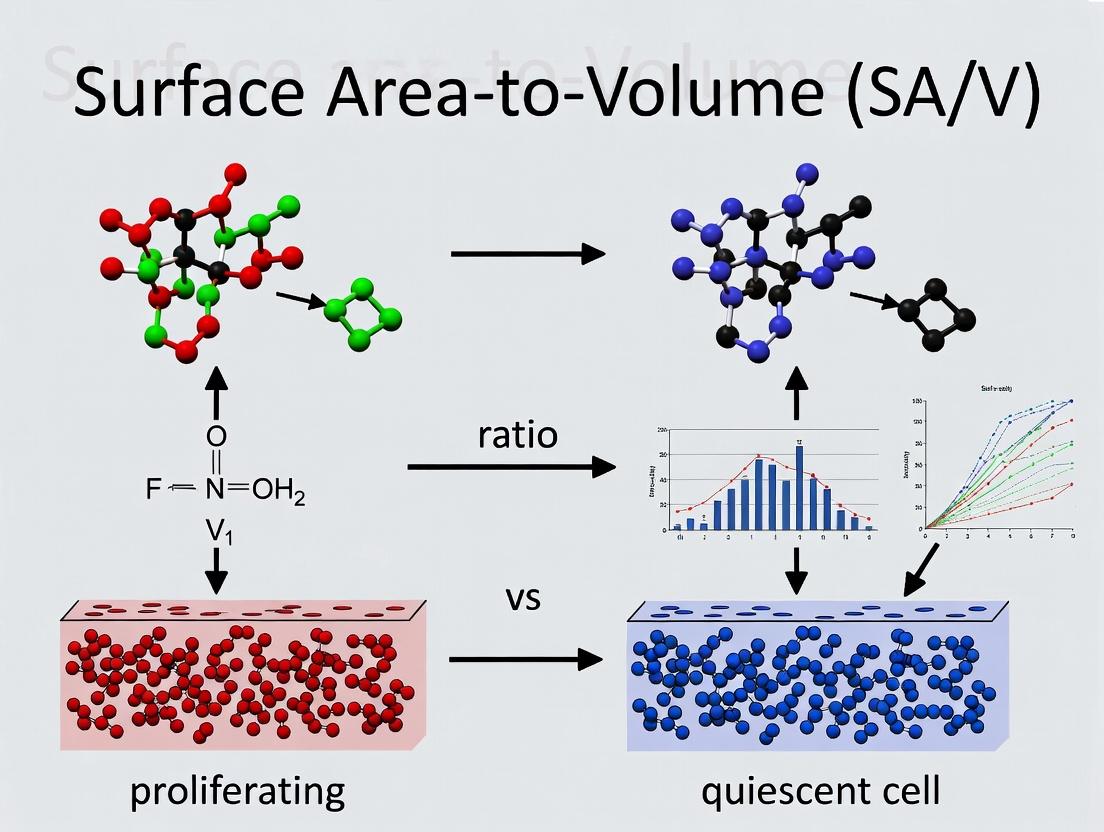
This article provides a comprehensive analysis of the Surface Area-to-Volume (SA:V) ratio as a fundamental biophysical parameter distinguishing proliferating and quiescent cell states.
Cell Surface Dynamics: The Critical Role of Surface Area-to-Volume Ratio in Proliferating vs. Quiescent Cells for Drug Development
Abstract
This article provides a comprehensive analysis of the Surface Area-to-Volume (SA:V) ratio as a fundamental biophysical parameter distinguishing proliferating and quiescent cell states. Targeted at researchers, scientists, and drug development professionals, it explores the foundational principles linking SA:V ratio to nutrient exchange, signaling, and metabolic activity. It details methodological approaches for accurate measurement, addresses common experimental challenges in diverse cell types, and validates findings through comparative analysis with other proliferation markers. The scope encompasses implications for cancer research, regenerative medicine, and the development of targeted therapeutics that exploit differential biophysical properties between cell states.
The Biophysical Imperative: Understanding the SA:V Ratio in Cell Cycle States
In the context of proliferating versus quiescent cell research, a core biophysical principle emerges: as a cell grows, its volume increases as a cubic function of its radius (V ∝ r³), while its surface area increases as a square function (SA ∝ r²). This leads to a decreasing surface area-to-volume (SA/V) ratio. This fundamental "Geometry of Growth" imposes profound metabolic consequences. Proliferating cells, actively increasing in size, must continuously adapt their metabolic and signaling networks to overcome the physical constraints of nutrient import, waste export, and membrane-based signaling efficiency imposed by a diminishing SA/V ratio. Conversely, quiescent cells, maintaining a stable size, operate under a stable SA/V regime, influencing their metabolic poise and signaling fidelity.
Quantitative Framework: SA/V Dynamics
The relationship is mathematically defined for a sphere (a common simplifying model):
- Surface Area (SA) = 4πr²
- Volume (V) = (4/3)πr³
- SA/V Ratio = 3/r
Table 1: SA/V Ratio as a Function of Cell Radius
| Cell Radius (r) | Surface Area (SA) | Volume (V) | SA/V Ratio |
|---|---|---|---|
| 1 unit | 12.57 units² | 4.19 units³ | 3.00 |
| 2 units | 50.27 units² | 33.51 units³ | 1.50 |
| 3 units | 113.10 units² | 113.10 units³ | 1.00 |
| 4 units | 201.06 units² | 268.08 units³ | 0.75 |
The decreasing SA/V ratio with growth creates a "transport bottleneck." For a proliferating cell, the plasma membrane must service a rapidly increasing cytoplasmic volume. This necessitates enhanced efficiency of nutrient transporters (e.g., GLUTs, amino acid transporters), increased endocytic activity, and metabolic adaptations to optimize energy production per unit membrane area.
Metabolic Consequences and Signaling Pathways
The cellular response to decreasing SA/V is orchestrated by key nutrient and stress-sensing pathways, primarily mTOR and AMPK.
Diagram 1: SA/V Sensing and Metabolic Signaling
In quiescent cells (e.g., G0), a stable, often higher SA/V ratio facilitates efficient homeostasis with balanced anabolism and catabolism, typically with muted mTOR activity and readiness for autophagy. Proliferating cells (e.g., G1/S phase) actively drive mTORC1 signaling to bolster biosynthetic capacity despite a falling SA/V ratio, requiring upregulated transporter expression and enhanced glycolytic flux (Warburg effect) to generate ATP and intermediates efficiently.
Key Experimental Protocols
Protocol: Measuring Single-Cell SA/V Ratio and Metabolic Activity
Objective: Correlate single-cell geometry with metabolic state in a population of proliferating vs. quiescent cells.
- Cell Culture & Staining: Culture cells (e.g., fibroblasts). Induce quiescence via serum starvation (0.5% FBS, 48h) or contact inhibition. For proliferating cohort, use log-phase growth in 10% FBS.
- Membrane & DNA Labeling: Stain live cells with a fluorescent lipophilic dye (e.g., DiI, PKH67) for membrane and Hoechst 33342 for nucleus.
- 3D Confocal Imaging: Acquate high-resolution z-stacks using a confocal microscope.
- Image Analysis & 3D Reconstruction: Use software (e.g., Imaris, CellProfiler) to segment individual cells based on membrane signal. The software calculates cell volume (V) and surface area (SA).
- Metabolic Readout: Simultaneously incubate cells with a ratiometric fluorescent sensor of metabolic activity (e.g., BCECF-AM for pH, Fluo4-AM for Ca²⁺, or a FRET-based glucose sensor).
- Data Correlation: Plot single-cell SA/V ratio against the fluorescence intensity ratio of the metabolic sensor. Compare distributions between proliferating and quiescent populations.
Protocol: Perturbing SA/V and Assessing mTORC1 Response
Objective: Test causality between SA/V constraint and mTORC1 signaling.
- Hypertonic Stress Induction: Treat cells with moderate osmotic stress (e.g., +100-150mM sucrose or NaCl in culture medium). This causes rapid water efflux, decreasing cell volume (V) while SA remains relatively constant, thus increasing SA/V artificially.
- Hyposmotic Swelling Induction: Treat cells with hypotonic medium (e.g., -30% tonicity). This causes water influx, increasing V with minimal SA change, thus decreasing SA/V artificially.
- Sampling: Harvest cells at timepoints (0, 5, 15, 30, 60 min) post-osmotic shift.
- Western Blot Analysis: Probe lysates for:
- Phospho-S6K1 (Thr389) & total S6K1 (downstream mTORC1 readout).
- Phospho-4E-BP1 (Thr37/46) & total 4E-BP1.
- Phospho-AMPKα (Thr172) & total AMPKα.
- Expected Outcome: Hyposmotic swelling (low SA/V) should transiently suppress p-S6K1, while hypertonic shrinkage (high SA/V) may enhance or sustain it, demonstrating geometric regulation.
The Scientist's Toolkit: Key Research Reagent Solutions
Table 2: Essential Reagents for SA/V and Metabolism Research
| Reagent / Material | Function / Application |
|---|---|
| Lipophilic Tracers (DiI, PKH dyes) | Fluorescently label the plasma membrane for high-resolution imaging and accurate SA quantification via 3D reconstruction. |
| Ratiometric Intracellular Dyes (BCECF-AM, Fura-2) | Measure intracellular pH or Ca²⁺ as proxies for metabolic state and transport activity at the single-cell level. |
| Osmotic Modulators (Sucrose, Mannitol, Water) | Precisely alter extracellular tonicity to experimentally manipulate cell volume and SA/V ratio independently of growth signals. |
| mTOR & AMPK Pathway Modulators (Rapamycin, AICAR, Torin 1) | Pharmacologically inhibit (Rapamycin, Torin1) or activate (AICAR) key metabolic sensors to dissect their role in responding to geometric constraints. |
| Live-Cell Metabolic Sensors (FRET-based Gln, Glu, or ATP sensors) | Genetically encoded or chemical sensors that allow real-time, dynamic readouts of metabolite levels in response to geometric perturbations. |
| 3D Image Analysis Software (Imaris, Arivis, CellProfiler 3D) | Essential computational tools for segmenting 3D cell images and extracting accurate quantitative morphometric data (SA, V). |
Integrated Workflow for SA/V Research
Diagram 2: Experimental Workflow for Geometry-Metabolism Studies
The "Geometry of Growth" is not a passive constraint but an active driver of metabolic organization. In drug development, this principle highlights targeting the metabolic vulnerabilities of rapidly growing cancer cells (with inherently low SA/V) by exacerbating their nutrient import stress or disrupting their compensatory scaling of anabolic signaling. Conversely, promoting the favorable SA/V homeostasis of quiescent cells could be a strategy for preserving healthy tissues during stress or aging. Integrating precise morphometric analysis with metabolic flux studies provides a powerful framework for understanding cell fate decisions through a biophysical lens.
The surface area-to-volume (SA/V) ratio is a fundamental biophysical constraint governing cellular function. It dictates the efficiency of mass transport and signaling across the plasma membrane. This whitepaper frames this principle within the context of cellular proliferation versus quiescence. Proliferating cells—actively cycling and preparing for division—typically have a higher SA/V ratio compared to larger, quiescent (G0 phase) cells. This geometric difference has profound implications for nutrient demand, metabolic waste production, and the fidelity of signal transduction, all critical considerations in fields ranging from oncology to regenerative medicine.
Core Principles and Quantitative Data
Table 1: Comparative SA/V Impact in Proliferating vs. Quiescent Cell Models
| Parameter | Proliferating Cell (High SA/V) | Quiescent Cell (Low SA/V) | Functional Implication |
|---|---|---|---|
| Nutrient Uptake (Glucose) | Flux rate: ~120 µmol/min/10⁶ cells | Flux rate: ~25 µmol/min/10⁶ cells | Proliferating cells require sustained high glycolytic/OxPhos flux for biosynthesis and ATP. |
| Waste Removal (Lactate) | Export rate: High (≥ glucose uptake) | Export rate: Low/Basal | Correlates with Warburg effect in cancer cells; acidosis influences microenvironment. |
| Receptor Density (e.g., EGFR) | ~2.0 x 10⁵ receptors/cell | ~0.5 x 10⁵ receptors/cell | Enhanced capacity for signal initiation per unit cytoplasmic volume. |
| Signal Propagation Speed | 15-20% faster cAMP diffusion front | Delimited, compartmentalized cAMP gradients | Geometric efficiency affects response times to external stimuli. |
| Apoptotic Signal Threshold | Lower threshold for intrinsic pathway | Higher threshold, enhanced survival factors | SA/V influences concentration of pro-apoptotic proteins like cytochrome c. |
Detailed Experimental Protocols
Protocol: Measuring Real-Time Nutrient Uptake via Microfluidics & FRET Sensors
Objective: Quantify glucose and glutamine influx in single cells with defined SA/V. Materials: PDMS microfluidic chambers, cells (e.g., primary T-cells vs. senescent fibroblasts), FRET-based glucose (e.g., FLII¹²Pglu-700µδ6) or glutamine sensors. Procedure:
- Cell Seeding & Calibration: Seed cells into microfluidic channels. Perfuse with calibration buffers (0-10 mM nutrient) to establish a FRET ratio vs. concentration standard curve.
- Pulse-Chase Experiment: Perfuse cells with nutrient-free medium for 10 min, then switch to medium containing 5 mM glucose/glutamine. Image using confocal microscopy at 2-second intervals.
- Data Analysis: Calculate intracellular nutrient concentration over time (C(t)) from FRET ratio. Derive influx rate (J) using the initial slope of C(t) and known cell volume (measured via 3D reconstruction). Normalize J to surface area (calculated from measured volume, assuming spherical geometry).
Protocol: Assessing Signaling Efficiency via Optogenetic Activation
Objective: Correlate SA/V with the latency and amplitude of a MAPK pathway response. Materials: Cell line expressing optogenetic Raf activator (paRAF), ERK-KTR nuclear-cytosolic translocation reporter, live-cell imaging setup. Procedure:
- Cell Stratification: Use flow cytometry (Coulter counter) or microscopic size analysis to separate a population into small (high SA/V) and large (low SA/V) cohorts.
- Stimulus Application: Deliver a standardized 5-second pulse of 650 nm light to uniformly activate paRAF.
- Kinetic Recording: Image ERK-KTR reporter every 30 seconds for 60 minutes. Quantify nuclear-to-cytoplasmic ratio over time.
- Metric Extraction: Calculate (a) Response latency (time from stimulus to 10% max response), (b) Activation rate (max slope of response curve), and (c) Signal amplitude (max-min ratio). Plot these metrics against calculated SA/V for each cell.
Signaling Pathway Visualizations
Title: High SA:V Enhances Membrane-Proximal Signaling Efficiency
Title: Workflow to Correlate SA/V with Signaling Kinetics
The Scientist's Toolkit: Research Reagent Solutions
Table 2: Essential Reagents for SA/V-Focused Research
| Reagent / Material | Function in SA/V Context | Example Product / Assay |
|---|---|---|
| Microfluidic Cell Culture Chips | Enables precise control over extracellular microenvironment and perfusate for flux measurements. | Ibidi µ-Slide VI 0.4; CellASIC ONIX2. |
| Genetically-Encoded FRET Biosensors | Allows real-time, quantitative measurement of intracellular metabolite concentrations (e.g., glucose, ATP, cAMP). | FLII¹²Pglu-700µδ6 (glucose); ATeam (ATP). |
| Optogenetic Actuators | Delivers spatially and temporally precise stimuli to probe signaling kinetics independent of paracrine effects. | paRAF (CRY2/CIB system); LOV-domain based tools. |
| Membrane Dyes (Non-Exchangeable) | Accurately delineates cell surface for area quantification via super-resolution microscopy. | CellMask Deep Red Plasma Membrane Stain; WGA-Alexa Fluor conjugates. |
| Live-Cell Volume & SA Probes | Fluorescent dyes used to calculate volume and infer surface area via calibrated microscopy. | Calcein-AM (volume via fluorescence quenching); SiR-DNA for nuclear/cytoplasmic segmentation. |
| Caged Metabolites | UV-light activatable nutrients (e.g., caged glucose) permit synchronized uptake studies. | 4,5-Dimethoxy-2-nitrobenzyl (DMNB)-caged glucose. |
| Kinetic Translocation Reporters (KTRs) | Single-fluorophore reporters for kinase activity (e.g., ERK, PKA) enabling long-term kinetics. | ERK-KTR; PKA-KTR. |
Within the broader thesis investigating surface area-to-volume (SA/V) ratio as a fundamental biophysical constraint in cellular physiology, this whitepaper examines the distinct geometric and metabolic imperatives of proliferating cells. Proliferating cells, in contrast to their quiescent counterparts, exhibit a reduced SA/V ratio, creating intrinsic biophysical challenges for nutrient import, waste export, and signal transduction. This state of "high demand" necessitates specialized adaptations across membrane architecture, metabolic flux, and signaling pathway regulation, presenting critical targets for therapeutic intervention in oncology and regenerative medicine.
The surface area-to-volume ratio is a first-principles geometric constraint with profound implications for cellular function. As a cell grows in preparation for division, its volume increases cubically while its surface area increases only quadratically, leading to a natural decline in the SA/V ratio. This creates a logistical bottleneck: the diminished membrane interface must support the escalating metabolic demands of a larger cytoplasm. Quiescent cells often maintain a higher, more favorable SA/V ratio, optimizing homeostatic exchange. The proliferative state, therefore, represents a controlled geometric crisis, managed through evolved biochemical and structural adaptations.
Quantitative Biophysical & Metabolic Profile
The following table summarizes key quantitative differences between proliferating and quiescent cells, underpinning the SA/V thesis.
Table 1: Comparative Biophysical and Metabolic Profiles
| Parameter | Proliferating Cells | Quiescent Cells | Measurement Technique / Notes |
|---|---|---|---|
| SA/V Ratio | Low (~0.5-1.2 µm⁻¹) | High (~1.5-3.0 µm⁻¹) | Calculated from 3D reconstruction (EM, confocal) |
| Glycolytic Flux | High (Lactate > 20 pmol/cell/hr) | Low | Seahorse XF Analyzer, ¹³C-metabolic flux analysis |
| Glutamine Consumption | High (> 50 nmol/mg protein/hr) | Low | LC-MS/MS of media depletion |
| ROS Levels | Moderately High (Controlled) | Low | Flow cytometry with H2DCFDA or CellROX dyes |
| Membrane Biosynthesis Rate | High (2-3x basal) | Low | Incorporation of fluorescent fatty acids (BODIPY FL C16) |
| Nutrient Transporter Density | High (e.g., GLUT1) | Low | Quantitative flow cytometry, surface proteomics |
Core Signaling Pathways Adapting to Low SA/V Constraints
Proliferating cells activate conserved signaling networks to compensate for high demand and geometric limitation. These pathways coordinately upregulate nutrient uptake, anabolic biosynthesis, and suppress catabolic processes.
mTORC1 Pathway: The Master Integrator
Experimental Protocol for mTORC1 Activation Assay:
- Cell Treatment: Serum-starve cells for 24h to induce quiescence. Stimulate proliferation by adding complete medium with growth factors (e.g., 10% FBS, insulin).
- Lysis & Immunoblot: Harvest cells at times T=0, 15, 30, 60 min post-stimulation. Lyse in RIPA buffer with protease/phosphatase inhibitors.
- Key Readouts: Perform Western blot for phospho-S6K1 (Thr389), phospho-S6 (Ser235/236), and phospho-4E-BP1 (Thr37/46). Total protein levels serve as loading controls.
- Pharmacological Control: Pre-treat with Rapamycin (20 nM, 1h) to confirm mTORC1-specific signaling.
Diagram Title: mTORC1 Integrates Growth Signals for Anabolism
Hypoxia-Inducible Factor (HIF-1α) & Aerobic Glycolysis
Experimental Protocol for HIF-1α Stabilization Assay (Cycloheximide Chase):
- Induction: Treat cells under normoxia (21% O₂) or hypoxia (1% O₂) for 4h. For pharmacological induction, use CoCl₂ (200 µM) or DMOG (1 mM).
- Protein Stability: Add cycloheximide (100 µg/mL) to inhibit new protein synthesis. Harvest cells at 0, 5, 15, 30, 60 min intervals.
- Detection: Lyse cells and perform Western blot for HIF-1α. Quantify band intensity to determine half-life. Probe for HIF-1 target genes (e.g., GLUT1, LDHA) via qPCR.
Diagram Title: HIF-1α Stabilization Drives Glycolytic Phenotype
The Scientist's Toolkit: Essential Research Reagents
Table 2: Key Reagent Solutions for Proliferation/SA/V Research
| Reagent / Material | Function & Application | Key Considerations |
|---|---|---|
| Seahorse XF Flux Kits | Real-time measurement of OCR (mitochondrial respiration) and ECAR (glycolysis) in live cells. | Critical for metabolic phenotyping. Optimize cell seeding density. |
| EdU (5-ethynyl-2′-deoxyuridine) | Thymidine analog for click-chemistry-based detection of DNA synthesis and cell cycle entry. | Superior to BrdU; requires a click reaction with fluorescent azide. |
| Recombinant Growth Factors (EGF, FGF, Insulin) | To stimulate synchronized re-entry into the cell cycle from quiescence. | Use carrier-free, low endotoxin versions for serum-free studies. |
| Rapamycin & Torin1 | mTORC1-specific (Rapamycin) and pan-mTOR (Torin1) inhibitors to dissect pathway necessity. | Torin1 more completely suppresses mTORC1 activity. |
| Fluorescent Glucose Analogs (2-NBDG) | Direct visualization and quantification of glucose uptake in single cells. | Uptake is competitive with native glucose; requires short incubation. |
| Cellular Lipophilic Dyes (DiO, DiD) | For membrane labeling to visualize membrane expansion/remodeling via fluorescence microscopy or flow cytometry. | Can be used for cell tracking and fusion assays. |
| Anti-phospho-Histone H3 (Ser10) Antibody | Flow cytometry or IF marker for mitotic cells (M-phase). | Allows cell cycle phase analysis in conjunction with DNA dyes (PI). |
| 3D Extracellular Matrices (Matrigel, Collagen I) | To study proliferation in a more physiologically relevant 3D context, affecting cell geometry and SA/V. | Matrix stiffness and composition dramatically influence proliferation. |
Experimental Workflow: Integrating SA/V Measurements with Functional Assays
The following diagram outlines a correlative experimental approach to link geometric changes with functional readouts.
Diagram Title: Correlating Cell Geometry with Functional Readouts
The geometric imperative of a low SA/V ratio in proliferating cells is not merely a passive consequence of growth but an active driver of a distinct metabolic and signaling phenotype—the "high demand" state. This framework provides a biophysical rationale for targeting nutrient transporters, membrane biosynthesis enzymes, and metabolic pathway enzymes (e.g., PKM2, FASN) in cancer. Conversely, in regenerative medicine, promoting a transient high-SA/V state in stem cells may enhance metabolic fitness for engraftment. Future research quantifying SA/V dynamics in real-time within tumor microenvironments or organoids will further refine this thesis and its applications.
Within the framework of research on surface area-to-volume (SA/V) ratio dynamics, a critical distinction emerges between proliferating and quiescent (G0) cell states. Actively cycling cells must accommodate biosynthesis and division, often maintaining a higher SA/V ratio to facilitate nutrient and signal exchange. In stark contrast, quiescent cells, which have exited the cell cycle reversibly, prioritize long-term maintenance and stress resistance. This shift is characterized by a profound metabolic reconfiguration, reduced biosynthetic activity, and altered exchange with the microenvironment, which may correlate with an optimized, often lower, effective SA/V ratio for preservation rather than growth. This whitepaper examines the molecular and functional hallmarks of G0, framing them within this biophysical thesis.
Hallmarks of the G0 State: A Comparative Analysis
Table 1: Core Characteristics of Proliferating vs. Quiescent (G0) Cells
| Parameter | Proliferating Cells | Quiescent (G0) Cells | Experimental Measurement |
|---|---|---|---|
| Cell Cycle Status | Actively in G1, S, G2, M phases. | Reversibly arrested before G1; deep G0 is distinct from G1. | Flow cytometry (PI/RNA content); FUCCI reporters. |
| Metabolic Rate | High glycolysis/OXPHOS for biosynthesis. | Reduced overall; shifted to OXPHOS; enhanced autophagy. | Seahorse Analyzer (OCR/ECAR); LC-MS metabolomics. |
| Gene Expression | Pro-growth, cyclins, replication genes. | Pro-survival, stress resistance, differentiation. | RNA-seq; qRT-PCR for CDKN1B (p27), RB1. |
| SA/V Ratio Implication | Higher ratio favored for efficient nutrient/waste flux. | Optimized, often lower ratio; reduced exchange demand. | 3D reconstruction from confocal/SEM imaging. |
| Key Regulators | Cyclins, CDKs, E2F transcription factors. | pRb (hypophosphorylated), p27Kip1, FOXO, NR2F1. | Western blot, immunofluorescence. |
| Response to Stimuli | Mitogen-sensitive. | Requires strong/mitogen-specific signal to re-enter cycle. | [3H]-thymidine incorporation; EdU assay. |
Molecular Governance of Entry, Maintenance, and Exit
Diagram 1: Core Signaling Network Regulating G0 Quiescence
Experimental Protocols for Studying G0
Protocol: Isolation and Validation of Deeply Quiescent Cells
Objective: To obtain a pure population of G0 cells for downstream analysis (omics, metabolic assays). Method:
- Culture Model: Use contact inhibition (prolonged confluency) or serum starvation (0.1-0.5% FBS for 48-72 hrs) in non-transformed cell lines (e.g., NIH/3T3, IMR-90).
- Label-Retention (CFSE/Dye Dilution): Pre-label cells with CellTrace CFSE or similar membrane dye prior to induction of quiescence. Proliferating cells dilute the dye; G0 cells retain high fluorescence.
- Flow Cytometry Gating: Harvest cells and co-stain with Hoechst 33342 (DNA) and Pyronin Y (RNA). G0 cells are Hoechstlow/Pyronin Ylow (2N DNA, low RNA). Sort this population.
- Validation: Perform Western blot for hypophosphorylated Rb and elevated p27. Assess lack of EdU incorporation in a 24-hr pulse.
Protocol: Measuring Metabolic Shift in G0
Objective: Quantify the shift from glycolysis to oxidative phosphorylation (OXPHOS). Method (Seahorse XF Analyzer):
- Cell Preparation: Seed equal numbers of proliferating and validated G0 cells into Seahorse XF cell culture microplates. Use 3-5 technical replicates per group.
- Assay Media: Replace growth medium with unbuffered, substrate-supplemented XF base medium (e.g., 10mM glucose, 1mM pyruvate, 2mM glutamine) and incubate at 37°C, non-CO₂ for 1 hr.
- Mitochondrial Stress Test:
- Inject Port A: Oligomycin (1.5 µM) to inhibit ATP synthase. Measure OCR drop (ATP-linked respiration).
- Inject Port B: FCCP (1 µM) to uncouple mitochondria. Measure maximal OCR.
- Inject Port C: Rotenone & Antimycin A (0.5 µM each) to shut down ETC. Measure non-mitochondrial respiration.
- Glycolysis Stress Test: Using glucose-free medium, sequentially inject Glucose (10mM), Oligomycin (1.5 µM), and 2-DG (50mM) to measure glycolytic parameters (ECAR).
- Analysis: Normalize data to protein content/well. Compare basal/maximal OCR and glycolytic capacity/rate between states.
The Scientist's Toolkit: Key Research Reagent Solutions
Table 2: Essential Reagents for Quiescence Research
| Reagent/Tool | Provider Examples | Function in G0 Research |
|---|---|---|
| FUCCI (Fluorescent Ubiquitination-based Cell Cycle Indicator) | Takara Bio, MBL | Real-time visualization of cell cycle position (G0/G1 cells show red fluorescence). |
| CellTrace CFSE / Proliferation Dyes | Thermo Fisher, BioLegend | Label-retention assay to identify non-dividing (G0) cell populations via flow cytometry. |
| Click-iT EdU / BrdU Kits | Thermo Fisher, Abcam | Detect DNA synthesis; absence confirms cell cycle arrest. |
| Hoechst 33342 & Pyronin Y | Sigma-Aldrich, STEMCELL | Flow cytometric discrimination of G0 (2N DNA, low RNA) from G1 (2N DNA, high RNA). |
| Seahorse XF Kits (Stress Tests) | Agilent Technologies | Measure live-cell metabolic fluxes (OCR, ECAR) critical for characterizing G0 metabolism. |
| Phospho-/Total Rb (Ser780/807/811) Antibodies | Cell Signaling Tech. | Key readout for G0 maintenance (hypophosphorylated Rb) vs. cell cycle re-entry. |
| p27Kip1 / CDKN1B Antibodies | BD Biosciences, Santa Cruz | Essential marker protein for establishing and maintaining quiescence. |
| Quiescence-Inducing Media (Low Serum) | Various (e.g., Gibco) | Standardized, low-mitogen media for reliable induction of quiescence in vitro. |
Implications for Drug Development and Disease
The G0 state presents a double-edged sword in therapeutics. In cancer, quiescent cancer stem cells evade cytotoxic therapies targeting proliferation, leading to relapse. Targeting G0 maintenance pathways (e.g., autophagy inhibition) is a promising adjuvant strategy. Conversely, in aging and degenerative diseases, the irreversible senescence-like state of some aged stem cells depletes regenerative capacity. Strategies to safely reverse quiescence or rejuvenate stem cell pools are under investigation. Understanding the SA/V and exchange dynamics of these states informs drug delivery and efficacy.
Diagram 2: Therapeutic Targeting of Quiescent Cells
This whitepaper is situated within a broader thesis investigating the relationship between surface area-to-volume (SA/V) ratio and cellular state, specifically comparing proliferating and quiescent cells. The scaling laws governing cellular metabolism, biosynthesis, and signaling are fundamentally constrained by biophysical principles, with the SA/V ratio acting as a critical parameter. Proliferating cells, which are typically smaller, exhibit a higher SA/V ratio, facilitating increased nutrient import and waste export to support anabolic processes. In contrast, quiescent or senescent cells often display a larger volume with a lower SA/V ratio, aligning with a catabolic or maintenance-oriented state. Theoretical models that integrate scaling laws provide predictive power for understanding how these physical constraints dictate functional outputs across diverse cell types, with direct implications for cancer biology, regenerative medicine, and drug development.
Core Theoretical Models and Scaling Laws
Metabolic Scaling Theory
Derived from Kleiber's law, this theory posits that metabolic rate (B) scales with cell mass (M) as B ∝ M^(3/4). At the cellular level, this is adapted to consider the limitations imposed by membrane transport (a surface area function) and internal reaction networks (a volume function).
Allometric Growth Models
These models describe how biosynthesis rates and cell cycle duration scale with cell size. A key prediction is that cells maintain a critical size for division, which is modulated by nutrient-sensing pathways (e.g., mTOR).
Surface Area-to-Volume (SA/V) Constraint Model
This model explicitly links cellular geometry to functional state. It predicts that proliferating cells optimize for a higher SA/V to support rapid biomass accumulation, while quiescent cells operate at a lower SA/V, prioritizing resource conservation and stress resistance.
Quantitative Data and Predictions for Cell Types
Table 1: Scaling Parameters and Predicted Properties for Different Cellular States
| Cell Type / State | Typical Diameter (µm) | Predicted SA/V Ratio (µm⁻¹) | Scaling Exponent for Metabolic Rate (α in B∝M^α) | Predicted Doubling Time (hours) | Key Regulatory Pathway Activity (Relative) |
|---|---|---|---|---|---|
| Pluripotent Stem Cell (Proliferating) | 10-12 | ~0.6 - 0.5 | 0.75 - 0.85 | 12-18 | High mTOR, High Myc |
| Differentiated Quiescent Cell (e.g., Fibroblast in G0) | 15-20 | ~0.4 - 0.3 | 0.66 - 0.75 | N/A (Non-cycling) | Low mTOR, High p53/p21 |
| Cancer Cell Line (HeLa, Proliferating) | 18-22 | ~0.33 - 0.27 | ~0.9+ (Hyper-metabolic) | 20-24 | Constitutively High mTOR, PI3K |
| Senescent Cell (Enlarged, Quiescent) | 25-30 | ~0.24 - 0.20 | ~0.6 - 0.7 | N/A (Permanent Arrest) | High p16, SAPK, Low mTOR |
| Yeast (S. cerevisiae, G1 phase) | 5 | ~1.2 | 0.75 | ~1.5 | High CLN3/CDK |
Table 2: Experimental Validations of Scaling Predictions
| Experimental System | Measured Parameter | Observed Scaling | Supports Model? | Key Citation (Example) |
|---|---|---|---|---|
| Mammalian Cell Cycle Analysis | Biosynthesis rate vs. Cell Volume | Linear correlation in G1 | Yes (Critical size model) | Miettinen & Björklund (2017) Cell Syst |
| Microbial Metabolomics | O₂ consumption vs. Cell Mass | B ∝ M^(0.71±0.04) | Yes (Metabolic scaling) | Niebel et al. (2019) Nat Metab |
| Senescence Induction | SA/V ratio pre/post arrest | Decrease of 35-50% | Yes (SA/V constraint) | Neurohr et al. (2019) Cell |
Detailed Experimental Protocols
Protocol: Quantifying SA/V Ratio and Metabolic Rate in Single Cells
Objective: To empirically test the correlation between SA/V ratio and metabolic scaling in proliferating vs. quiescent cell populations.
- Cell Preparation: Induce quiescence in a fibroblast cell line (e.g., NIH/3T3) via contact inhibition or serum starvation (0.5% FBS for 48h). Maintain a parallel proliferating culture in 10% FBS.
- Cell Staining and Imaging: Stain cells with Calcein-AM (cytoplasm, for volume) and a membrane dye (e.g., DiI). Perform 3D confocal microscopy (Z-stacks at 0.5 µm intervals).
- Image Analysis: Use software (e.g., ImageJ 3D Suite) to reconstruct cell surface and volume. Calculate SA/V ratio for >200 individual cells per condition.
- Metabolic Rate Measurement: In parallel, load cells with a ratiometric fluorescent sensor for ATP:ADP ratio (e.g., PercevalHR) or use a Seahorse Analyzer to measure oxygen consumption rate (OCR) per cell.
- Data Correlation: Plot OCR or ATP flux against cell volume and SA/V ratio. Fit with power-law functions to derive scaling exponents.
Protocol: Testing the Critical Size Hypothesis for Cell Cycle Entry
Objective: To determine if quiescent cells must achieve a threshold SA/V ratio to re-enter the cell cycle.
- Synchronization: Generate a homogeneous quiescent (G0) population using palbociclib (CDK4/6 inhibitor) treatment for 24h, followed by washout.
- Size Perturbation: Immediately after washout, treat one cohort with Torin1 (mTOR inhibitor) to blunt growth. Maintain a control cohort in complete media.
- Time-course Sampling: Every 2 hours for 12h, fix an aliquot of cells.
- Flow Cytometry Analysis: Stain fixed cells with:
- DAPI: For DNA content (cell cycle phase).
- FITC-Conjugated Phalloidin: To approximate cell size/cytoplasmic area via F-actin staining.
- Antibody for phosphorylated Rb (Ser780): Early G1 marker.
- Analysis: Gate on cells that are pRb-positive (entering G1). Correlate their forward scatter (FSC, proxy for size) or calculate the mean FSC of this population over time. The model predicts that control cells will increase in size before S-phase entry, while Torin1-treated cells will stall at a smaller size.
Pathway and Workflow Visualizations
Diagram Title: SA/V Ratio Drives Cell Fate via mTOR Signaling
Diagram Title: Workflow for Testing Metabolic Scaling Laws
The Scientist's Toolkit: Research Reagent Solutions
Table 3: Essential Reagents for Scaling Law Experiments
| Item / Reagent | Function / Application in Scaling Research | Example Product/Catalog # |
|---|---|---|
| Cell Membrane Stain (Lipophilic Dye) | High-fidelity labeling of plasma membrane for 3D surface area reconstruction. | DiI (DiIC18(3)); Thermo Fisher, D282 |
| Cytoplasmic Volume Indicator | Fluorescent cell-permeant dye that evenly labels the cytosol for volume calculation. | Calcein-AM; Abcam, ab141420 |
| Ratiometric ATP:ADP Biosensor | Genetically-encoded or chemical sensor for single-cell metabolic rate measurement. | PercevalHR FRET Sensor; Addgene, #49082 |
| CDK4/6 Inhibitor (for G0 Sync) | Reversibly induces a uniform, deep quiescent state (G0) in mammalian cells. | Palbociclib (PD-0332991); Selleckchem, S1116 |
| mTORC1 Inhibitor | Specifically inhibits mTORC1 to uncouple cell growth from cell cycle progression. | Torin1; Tocris, 4247 |
| Phospho-Specific Antibody (pRb Ser780) | Flow cytometry marker for early G1 entry following quiescence. | Alexa Fluor 647 anti-pRb (Ser780); BD Biosciences, 558385 |
| Seahorse XFp Analyzer Kits | Gold-standard for measuring OCR (mitochondrial respiration) and ECAR (glycolysis) per cell. | Seahorse XFp Cell Energy Phenotype Kit; Agilent, 103325-100 |
| 3D Image Analysis Software | Processes confocal Z-stacks to segment and calculate 3D surface area and volume. | Imaris (Oxford Instruments); ImageJ 3D Suite |
1. Introduction: Thesis Context This whitepaper examines the evolutionary and physiological rationales for differences in surface area-to-volume (SA:V) ratios, framed within a broader thesis investigating SA:V dynamics in proliferating versus quiescent cells. The central hypothesis posits that proliferating cells, such as stem cells and cancer cells, maintain a lower SA:V ratio optimized for rapid biomass accumulation and division, while quiescent and highly differentiated cells exhibit a higher SA:V ratio, optimized for specialized functions like nutrient exchange, signaling, and environmental interaction. This fundamental biophysical parameter has profound implications for cell metabolism, signaling efficiency, and drug uptake, directly impacting therapeutic development.
2. Evolutionary Rationale for SA:V Variation The SA:V ratio is a physical constraint shaped by natural selection across scales—from unicellular organisms to mammalian cell types.
- Unicellular Progenitors: Early, fast-dividing prokaryotes like bacteria typically have high SA:V ratios, maximizing nutrient acquisition in resource-limited environments. Evolution towards larger, more complex eukaryotic cells introduced compartmentalization to mitigate the decreasing SA:V, but the fundamental trade-off remained.
- Multicellular Specialization: In metazoans, cell fate specification led to SA:V divergence. Selection pressures favored:
- High SA:V Cells: For roles requiring extensive interaction with the environment (e.g., intestinal microvilli, renal tubule cells, alveolar pneumocytes). This maximizes exchange surfaces for absorption, secretion, and gas diffusion.
- Low SA:V Cells: For roles requiring bulk storage, rapid growth, or protection. Oocytes store vast cytoplasmic resources; activated lymphocytes swell before division; many cancer cells revert to a lower SA:V, proliferative phenotype.
3. Physiological & Metabolic Consequences The SA:V ratio directly governs diffusion rates and scaling laws for cellular contents.
Table 1: Physiological Correlates of SA:V in Different Cell States
| Cellular State | Typical SA:V Ratio | Metabolic Profile | Signaling & Receptor Capacity | Diffusion Limitation |
|---|---|---|---|---|
| Proliferating Cell (e.g., cancer stem cell, blast) | Lower | Glycolysis-preferring (Warburg effect), anabolic, high biosynthetic demand. | Concentrated signaling hubs; membrane area limits for receptor display but high internal trafficking. | Cytoplasmic diffusion becomes limiting; organelles centralize. |
| Quiescent/Differentiated Cell (e.g., neuron, adipocyte) | Higher (varies widely) | Oxidative phosphorylation, catabolic or specialized metabolism. | Large membrane area for synaptic contacts, ion channels, or transport proteins. | Efficient nutrient/waste diffusion across membrane; intracellular distances can be large. |
| Activated/Effector Cell (e.g., activated T-cell) | Transitioning from High to Low | Shifts from oxidative to glycolytic upon activation and blastogenesis. | Rapid membrane synthesis to accommodate new receptors despite volume increase. | Dynamic during cell cycle. |
4. Core Experimental Protocols for SA:V Measurement Protocol 4.1: Quantitative 3D Reconstruction from Serial Block-Face SEM (SBF-SEM)
- Objective: To calculate precise SA and V metrics for ultrastructural models.
- Methodology:
- Fixation & Staining: Cells are fixed in 2.5% glutaraldehyde/2% paraformaldehyde, then stained en bloc with heavy metals (e.g., 1% osmium tetroxide, 1% thiocarbohydrazide, 2% osmium tetroxide, lead aspartate).
- Embedding & Mounting: Embed in hard epoxy resin. Mount on a SEM stub with conductive adhesive.
- Imaging: Use an integrated SBF-SEM system. The microtome within the chamber cuts a preset thickness (typically 50-70 nm). The block face is imaged with a backscattered electron detector after each cut.
- Segmentation & Analysis: Align image stack using TrackEM2 (FIJI). Manually or machine-learning-aided segmentation of plasma membrane and organelles. SA and V are computed from the triangulated surface mesh and voxel count of the segmented volume using software like Imaris or VAST.
- Key Output: Absolute SA (µm²), V (µm³), and derived SA:V (µm⁻¹) for whole cells or subcellular compartments.
Protocol 4.2: Flow Cytometric Proxy Measurement using CFSE and Membrane Dyes
- Objective: High-throughput, relative SA:V assessment in live cell populations.
- Methodology:
- Staining: Co-stain cells with 5(6)-Carboxyfluorescein diacetate succinimidyl ester (CFSE, 1-5 µM), which covalently labels cytoplasmic proteins (volume proxy), and a membrane dye like DiI or PKH26 (surface area proxy).
- Flow Cytometry: Acquire cells on a flow cytometer with lasers/excitation appropriate for the dyes (e.g., 488 nm for CFSE, 561 nm for PKH26). Measure fluorescence intensity in appropriate channels.
- Data Analysis: Calculate the ratio of membrane dye median fluorescence intensity (MFI) to CFSE MFI for each cell or population. This MFI ratio serves as a relative SA:V index. Normalize to a control population (e.g., resting lymphocytes).
- Key Output: Population distributions of relative SA:V, allowing sorting of high vs. low SA:V subpopulations for downstream functional assays.
5. Signaling Pathways Linking SA:V to Proliferation & Quiescence
Diagram Title: Signaling Pathways in Low vs. High SA:V Cell States
6. The Scientist's Toolkit: Research Reagent Solutions
Table 2: Essential Reagents for SA:V and Cell State Research
| Reagent/Material | Function & Application | Example Product/Catalog |
|---|---|---|
| PKH26 / PKH67 (Membrane Dyes) | Lipophilic fluorescent dyes that stably incorporate into the plasma membrane bilayer. Used as a proxy for surface area in flow cytometry protocols. | Sigma-Aldrich PKH26GL / PKH67GL |
| Carboxyfluorescein Succinimidyl Ester (CFSE) | Cell-permeant dye that covalently labels intracellular amines. Fluorescence intensity correlates with cell volume/cytoplasmic mass. Used as a volume proxy. | Thermo Fisher Scientific C34554 |
| Rapamycin | Specific mTORC1 inhibitor. Used experimentally to induce a quiescence-like state and investigate the role of mTOR in SA:V-dependent growth signaling. | Cell Signaling Technology #9904 |
| Verteporfin | Small molecule inhibitor of YAP-TEAD interaction. Used to dissect the role of mechanosensing/YAP pathway in proliferation driven by low SA:V. | Sigma-Aldrich SML0534 |
| AICAR | AMPK activator. Used to mimic the metabolic state of high SA:V/quiescent cells and study AMPK-mediated effects on metabolism and growth arrest. | Tocris Bioscience 2843 |
| Collagen I, Matrigel | Extracellular matrix (ECM) substrates with tunable stiffness. Used in 3D culture to study how ECM mechanics and cell morphology feedback to regulate SA:V and cell fate. | Corning 354236 / 354234 |
| DAPI / Hoechst 33342 | Nuclear stains. Critical for determining cell cycle phase (G0/G1 vs. S/G2/M) via DNA content analysis when combined with SA:V measurements. | Thermo Fisher Scientific D1306 / H3570 |
| Anti-Ki-67 Antibody | Immunohistochemical/flow cytometry marker for proliferating cells (all active cycle phases). Used to validate the proliferative status of cells with measured SA:V. | Abcam ab15580 |
Key Molecular Regulators Linking Cell Cycle to Cytoskeleton and Membrane Dynamics
This whitepaper provides an in-depth technical analysis of the core molecular machinery that integrates cell cycle progression with cytoskeletal remodeling and plasma membrane dynamics. Framed within a broader research thesis on surface area-to-volume (SA/V) ratio dynamics in proliferating versus quiescent cells, we detail how key regulatory nodes coordinate mitotic entry, division, and exit with the physical restructuring of the cell. This coordination is critical for maintaining cellular integrity, facilitating shape changes, and ensuring faithful division—processes directly governing SA/V ratio alterations during proliferation.
The surface area-to-volume ratio is a fundamental biophysical parameter. Proliferating cells, particularly during mitosis, undergo dramatic morphological changes: rounding up, elongating during anaphase, and finally cleaving during cytokinesis. These events necessitate rapid, coordinated changes in cortical actomyosin tension, microtubule dynamics, and membrane trafficking/insertion to accommodate the changing cell geometry and volume distribution between daughters. In contrast, quiescent (G0) cells maintain a stable, spread morphology with a lower SA/V ratio, sustained by a distinct regulatory regime. This document elucidates the molecular regulators that serve as the functional bridge between the cell cycle engine (cyclins/CDKs) and the effectors of cell shape (cytoskeleton) and membrane.
Core Molecular Regulators: A Systems View
Master Kinase Hubs: Cyclin-Dependent Kinases (CDKs)
CDKs, activated by specific cyclins, phosphorylate a vast array of substrates to drive cell cycle phases. Key substrates include direct regulators of cytoskeletal and membrane components.
Central Integrators: Rho GTPase Family
Rho GTPases (RhoA, Rac1, Cdc42) are pivotal molecular switches, activated by Guanine nucleotide Exchange Factors (GEFs) and inactivated by GTPase-Activating Proteins (GAPs). Their activity is tightly coupled to cell cycle progression via transcriptional and post-translational regulation.
Table 1: Key Rho GTPase Functions Across the Cell Cycle
| GTPase | Primary Cell Cycle Phase | Cytoskeletal/Membrane Function | Key Upstream Cell Cycle Regulator |
|---|---|---|---|
| RhoA | M Phase | Promotes actomyosin contractility for cortical stiffness, rounding, and cleavage furrow ingression. | Activated by CDK1-cyclin B via phosphorylation of GEFs (e.g., Ect2) and GAPs. |
| Rac1 | G1/S Phase | Drives lamellipodia formation, membrane ruffling, and adhesion turnover for spreading/migration. | Suppressed during mitosis; reactivated post-mitosis via CDK1 inactivation. |
| Cdc42 | G1/S & M Phase | Controls polarity, filopodia formation, and spindle orientation. Regulates vesicular trafficking. | Regulated by CDK1 and Polo-like kinase 1 (Plk1). |
Mitotic Kinases: Polo-like Kinase 1 (Plk1) and Aurora Kinases
These kinases are essential for mitotic entry and progression, with direct substrates in the cytoskeletal network.
- Plk1: Phosphorylates and activates the RhoGEF Ect2, a critical trigger for RhoA activation at the equatorial cortex.
- Aurora B: As part of the Chromosomal Passenger Complex (CPC), it corrects kinetochore-microtubule attachments and, at the cortex, regulates myosin II activity and cleavage furrow positioning.
Membrane Trafficking Regulators
The endosomal and exocytic pathways are cell cycle-modulated to control membrane availability.
- Endocytic Recycling: The Rab11-FIP3 complex, phosphorylated by CDK1-cyclin B and Plk1, diverts recycling endosomes to the cleavage furrow to supply membrane.
- Exocyst Complex: A conserved tethering complex for post-Golgi vesicles, recruited to the cleavage site and intercellular bridge, often under GTPase (Cdc42, RhoA) control.
Detailed Experimental Protocols
Protocol: Measuring RhoA Activity Dynamics During Mitosis (FRET-Based Biosensor)
Objective: To quantitatively visualize spatiotemporal activation of RhoA in live cells transitioning from G2 to cytokinesis. Principle: Use a single-chain FRET biosensor (e.g., RhoA FLARE.sc) where active, GTP-bound RhoA induces a conformational change, altering the efficiency of FRET between CFP and YFP. Materials: See "The Scientist's Toolkit" (Section 5). Procedure:
- Cell Preparation & Transfection: Plate HeLa or RPE1 cells on 35mm glass-bottom dishes. At 50% confluency, transfect with RhoA-FLARE.sc plasmid using a lipid-based transfection reagent optimized for low cytotoxicity.
- Synchronization (Optional but Recommended): Treat cells with 2 mM thymidine for 18h, release for 9h, then treat with 9 µM RO-3306 (CDK1 inhibitor) for 12h to arrest at G2/M. Wash out RO-3306 to achieve synchronous mitotic entry.
- Live-Cell Imaging: 6-8h post-release, image cells on a confocal or widefield microscope with environmental control (37°C, 5% CO2). Acquire CFP and FRET (YFP) channel images simultaneously every 2-3 minutes.
- Data Analysis:
- Calculate the FRET ratio (FRET channel intensity / CFP channel intensity) for each time point and cellular region (e.g., whole cell, cortex, cleavage furrow).
- Normalize the ratio to the pre-mitotic baseline (set as 1.0).
- Plot normalized RhoA activity over time, aligning time zero to Nuclear Envelope Breakdown (NEBD).
Protocol: Co-Immunoprecipitation (Co-IP) of CDK1-Cyclin B with Cytoskeletal Regulators
Objective: To validate physical interaction between the core cell cycle kinase and a cytoskeletal GEF (e.g., Ect2) at mitotic entry. Procedure:
- Cell Lysis: Harvest asynchronous and nocodazole-arrested mitotic HeLa cells (by shake-off). Lyse in Nonidet P-40-based lysis buffer (50 mM Tris-HCl pH 7.4, 150 mM NaCl, 1% NP-40, 1 mM EDTA) supplemented with protease/phosphatase inhibitors and 10 µM MG-132. Keep samples cold.
- Pre-Clearance & Incubation: Centrifuge lysates. Incubate supernatant with control IgG-bound Protein A/G beads for 1h at 4°C to pre-clear. Transfer supernatant to new tubes.
- Immunoprecipitation: Incubate lysates with 2 µg of anti-CDK1 antibody or control IgG overnight at 4°C with gentle rotation. Add pre-washed Protein A/G beads and incubate for 2h.
- Washing & Elution: Wash beads 5x with ice-cold lysis buffer. Elute bound proteins by boiling in 2X Laemmli sample buffer.
- Detection: Analyze eluates and input lysates by SDS-PAGE and Western blotting. Probe for CDK1, Cyclin B1, and Ect2. A band for Ect2 in the CDK1 IP from mitotic, but not asynchronous, lysates confirms a mitosis-specific interaction.
Pathway & Workflow Visualizations
Diagram 1: CDK1/Plk1 Activation of RhoA in Mitosis.
Diagram 2: Workflow for Live RhoA Activity Imaging.
The Scientist's Toolkit: Research Reagent Solutions
Table 2: Essential Reagents for Investigating Cell Cycle-Cytoskeleton Links
| Reagent/Category | Example Product (Supplier) | Function & Application |
|---|---|---|
| FRET Biosensors | RhoA FLARE.sc (Addgene #12150) | Genetically encoded live-cell reporter for RhoA GTPase activity dynamics. |
| Cell Cycle Inhibitors | RO-3306 (CDK1i), BI-2536 (Plk1i), Thymidine | Chemical synchronization of cell populations at specific cell cycle stages (G2/M, G1/S). |
| Activated GTPase Pull-Down Kits | RhoA G-LISA Activation Assay (Cytoskeleton, Inc.) | Biochemical quantification of total cellular RhoA-GTP levels from lysates. |
| Live-Cell Dyes | SiR-Actin (Cytoskeleton), CellMask Plasma Membrane Dye (Thermo Fisher) | Fluorescent probes for simultaneous visualization of actin or membrane dynamics with biosensors. |
| Validated Antibodies for Co-IP/WB | Anti-CDK1 (Abcam ab18), Anti-Ect2 (Santa Cruz sc-514280), Anti-Phospho-Histone H3 (Ser10) (Cell Signaling #9701) | Detection of key proteins and mitotic markers in biochemical assays. |
| Microscopy Chamber | µ-Slide 8 Well (ibidi) | Glass-bottom chambers ideal for high-resolution live-cell imaging. |
From Theory to Bench: Measuring SA:V Ratio in Live Cell Assays and Applications
Investigating the surface area to volume (SA/V) ratio in proliferating versus quiescent cells presents a fundamental biophysical question with implications for metabolic regulation, signal transduction, and drug uptake. Accurate 3D reconstruction of cellular and subcellular architecture is paramount for quantifying precise surface areas and volumes. This guide details the gold-standard imaging and computational techniques essential for this quantitation.
Core Imaging Modalities: Principles & Quantitative Comparison
| Modality | Effective Lateral/X-Y Resolution | Effective Axial/Z Resolution | Key Advantage for SA/V | Primary Limitation |
|---|---|---|---|---|
| Confocal Laser Scanning Microscopy (CLSM) | ~240 nm | ~600-800 nm | Optical sectioning; robust, quantitative fluorescence volume imaging. | Diffraction-limited; insufficient for fine membrane structures. |
| Stimulated Emission Depletion (STED) | ~30-80 nm | ~500-700 nm | Nanoscale resolution in live cells; enables precise plasma membrane tracing. | High photonic stress; complex instrumentation. |
| Single-Molecule Localization Microscopy (SMLM: PALM/STORM) | ~20-30 nm | ~50-80 nm (with 3D modes) | Molecular-scale resolution; ultimate precision for membrane topography. | Very long acquisition; mostly fixed samples. |
| Structured Illumination Microscopy (SIM) | ~100 nm | ~300 nm | Good resolution improvement for live-cell imaging. | Moderate resolution gain; sensitive to artifacts. |
Experimental Protocol: 3D Reconstruction for SA/V Analysis
A. Sample Preparation & Labeling
- Cell Culture & Staining: Grow cells (proliferating vs. serum-starved/quiescent) on #1.5 high-precision coverslips. Transfect with a membrane-targeted fluorescent protein (e.g., Lyn-GFP) or stain with a lipophilic dye (e.g., DiI) or immuno-label a membrane protein (e.g., Na+/K+ ATPase) for SMLM.
- Fixation: For super-resolution, use fresh 4% PFA in PBS + 0.1% glutaraldehyde (for SMLM, include 100 mM amino acids for quenching). For confocal live-cell imaging, maintain environmental control.
B. Image Acquisition (Gold-Standard Parameters)
- Sampling: Adhere to the Nyquist criterion. For CLSM (600nm Z-res), use ~300nm Z-step size. For SMLM (30nm XY-res), use 15nm/pixel.
- Signal-to-Noise: Adjust laser power/detector gain to maximize intensity without saturation. For SMLM, acquire sufficient frames (10,000 - 50,000) for high localization density.
- Channel Alignment: Acquire multicolor fluorescent bead images for subsequent chromatic aberration correction.
C. Computational 3D Reconstruction & Segmentation
- Pre-processing: Apply deconvolution (e.g., Richardson-Lucy algorithm) to confocal/SIM stacks. For SMLM, render localized points into a 3D density map.
- Segmentation: Use a trained machine learning classifier (e.g., Ilastik, Cellpose) or active surface algorithms (e.g., Imaris Surface) to distinguish the cell membrane from background.
- Mesh Generation: Convert the segmented binary mask into a 3D triangular mesh representing the cell surface.
- Quantification: Calculate total Surface Area (SA) and enclosed Volume (V) directly from the 3D mesh. Generate per-cell SA/V ratios for statistical comparison between cell states.
Signaling Pathways Influencing Membrane Architecture
Cell state transitions (proliferating quiescent) involve signaling cascades that directly alter membrane ruffling, organelle engagement, and thus SA/V.
Experimental & Analytical Workflow
The Scientist's Toolkit: Research Reagent Solutions
| Reagent / Material | Function in SA/V Research |
|---|---|
| Lyn-GFP / Lyn-mEos3.2 | Genetically encoded membrane label. Lyn tag localizes to inner leaflet, ideal for plasma membrane reconstruction. |
| CellMask Deep Red / DiI | Lipophilic dyes for robust, non-specific membrane staining in fixed or live cells. |
| ATTO 655 / Alexa Fluor 647 NHS Ester | Common dyes for SMLM. Conjugate to antibodies or ligands for specific membrane protein labeling. |
| PFA + 0.1% Glutaraldehyde | Fixation cocktail for super-resolution; preserves ultrastructure while retaining fluorescence. |
| High-Precision #1.5 Coverslips (0.17mm) | Essential for optimal aberration correction and TIRF/SMLM imaging. |
| TetraSpeck Microspheres (0.1µm) | For precise multi-channel registration and point-spread-function (PSF) measurement. |
| Fiducial Markers (e.g., Gold Nanoparticles) | For drift correction during long SMLM acquisitions. |
| Ilastik / Cellpose Software | Open-source machine learning tools for accessible, accurate 3D segmentation. |
| Imaris / Arivis Vision4D | Commercial software suites offering integrated workflows for 3D reconstruction, analysis, and SA/V measurement. |
Within the broader investigation of surface area-to-volume (SA/V) ratio dynamics in cellular proliferation and quiescence, forward scatter (FSC) and side scatter (SSC) provide critical, rapid, and non-destructive proxy measurements. FSC, roughly proportional to cell diameter, and SSC, indicative of internal granularity and complexity, are intrinsically linked to SA/V. Proliferating cells, undergoing growth and structural reorganization, exhibit predictable shifts in light scatter properties compared to quiescent counterparts. This whitepaper details the technical application of FSC/SSC as a primary indicator, providing protocols, data interpretation, and contextualization within SA/V research.
Core Principles: Light Scatter and SA/V Relationship
The SA/V ratio is a fundamental biophysical parameter. As a cell grows before division, volume increases faster than surface area, causing a decrease in SA/V. This is directly measurable by FSC. Concurrently, increased organelle biogenesis (e.g., mitochondria, ribosomes) and structural changes alter cytoplasmic complexity, increasing SSC.
Key Relationships:
- FSC (Forward Scatter): Correlates with cell size/cross-sectional area. A primary proxy for cell volume.
- SSC (Side Scatter): Correlates with cellular granularity and internal complexity. A proxy for internal membrane structures and organelle density, influencing surface area.
- SA/V Derivation: While not a direct calculation, the FSC-A vs. SSC-A profile maps a population's relative SA/V state. A high SSC-A relative to FSC-A suggests higher complexity per unit volume (potentially higher SA). A low SSC-A to FSC-A ratio suggests a simpler, more voluminous cytoplasm.
Table 1: Typical FSC/SSC Profile Shifts Across Cell States
| Cell State | FSC (Size Proxy) | SSC (Complexity Proxy) | Inferred SA/V Trend | Biological Rationale |
|---|---|---|---|---|
| Quiescent (G0) | Low to Moderate | Moderate, Stable | Higher | Small size, condensed chromatin, reduced organelle volume. |
| Early G1 Phase | Moderate, Increasing | Low to Moderate, Increasing | Decreasing Rapidly | Initial volume increase post-division, organelle reformation. |
| Late G1/S/G2 Phase | High | High | Lowest | Maximal cell volume, high organelle and macromolecule synthesis. |
| Mitotic (M) Phase | High (Variable) | Very High | Low (but dynamic) | Chromosome condensation, cell rounding, increased granularity. |
| Senescent/Aged | High (Enlarged) | High (Granular) | Low | Permanent cell cycle arrest, vacuolization, accumulated debris. |
| Activated Lymphocyte | Moderate → High | Low → Moderate | Decreases then stabilizes | Blast transformation; increased size and cytoplasmic complexity. |
Table 2: Representative Published FSC/SSC Data in Proliferation Studies
| Cell Type | Experimental Condition | Median FSC-A (Relative Units) | Median SSC-A (Relative Units) | Citation Context (SA/V Relevance) |
|---|---|---|---|---|
| Murine T-cells | Quiescent (IL-7 withdrawn) | 22,500 ± 1,800 | 8,200 ± 950 | Baseline SA/V state. |
| Murine T-cells | Proliferating (72h Anti-CD3/CD28) | 58,400 ± 4,500 | 18,500 ± 1,600 | ~2.6x FSC increase indicates volume↑, SA/V↓. |
| Human Fibroblasts | Serum-Starved (G0) | 15,100 | 5,500 | Low metabolic state, higher SA/V. |
| Human Fibroblasts | Serum-Stimulated (24h) | 41,300 | 14,200 | Entry into cycle, volume↑ & complexity↑. |
Experimental Protocols
Protocol 1: Establishing a Baseline FSC/SSC Profile for SA/V Inference
Objective: To define the light scatter signature of quiescent vs. proliferating cell populations.
Materials: See "The Scientist's Toolkit" below.
Methodology:
- Cell Preparation: Harvest cells (e.g., fibroblasts, lymphocytes). For quiescent population: subject to serum starvation (72h for fibroblasts) or cytokine withdrawal (48h for lymphocytes). For proliferating population: stimulate with appropriate mitogen (e.g., 10% FBS, anti-CD3/CD28 beads).
- Sample Handling: Prepare single-cell suspension. Filter through a 35-70 µm cell strainer. Adjust concentration to 0.5-1 x 10^6 cells/mL in PBS + 0.5% BSA. Keep on ice.
- Instrument Setup:
- Align cytometer using standardized calibration beads.
- Set threshold on FSC to exclude debris.
- Create a dot plot: FSC-A (x-axis, linear scale) vs. SSC-A (y-axis, linear scale).
- Record data for unstimulated (quiescent) control sample. Adjust PMT voltages so the population is on-scale.
- Data Acquisition & Gating:
- Acquire at least 10,000 single-cell events per sample.
- Gate the live cell population based on FSC-A vs. SSC-A, excluding debris and aggregates.
- Apply a subsequent gate on FSC-H vs. FSC-W to select singlets.
- Analysis:
- Compare the median or geometric mean of FSC-A and SSC-A for quiescent vs. stimulated populations.
- Calculate the FSC-A/SSC-A ratio as a crude composite metric for size-to-complexity, which inversely correlates with SA/V.
Protocol 2: Correlating FSC/SSC with Direct Cell Cycle Analysis
Objective: To validate FSC/SSC gates as proxies for cell cycle phases (G0/G1, S, G2/M).
Methodology:
- Follow Protocol 1 for sample preparation and acquisition of FSC/SSC data.
- Fixation and Staining: After live-cell analysis, pellet the same sample. Fix cells in 70% ice-cold ethanol for 2 hours at 4°C. Wash with PBS.
- DNA Staining: Resuspend cell pellet in PBS containing 20 µg/mL Propidium Iodide (PI) and 100 µg/mL RNase A. Incubate for 30 minutes at 37°C protected from light.
- Acquisition & Correlation:
- Acquire data on the cytometer. Use a 488nm laser for PI excitation and collect emission >570 nm.
- Create a DNA content histogram (PI-A). Gate populations in G0/G1, S, and G2/M phases using appropriate cell cycle fitting software.
- Using back-gating, observe the location of each cell cycle sub-population on the original FSC-A vs. SSC-A dot plot. Document the distinct clusters.
Visualizing the Workflow and Relationship
Flow Cytometry Proxy Logic from Cell State to SA/V Inference
Experimental Protocol for Validating FSC/SSC Proxies
The Scientist's Toolkit
Table 3: Essential Research Reagent Solutions for FSC/SSC-Based SA/V Studies
| Item | Function & Relevance to FSC/SSC/SA/V |
|---|---|
| Cell Strainers (35-70 µm) | Ensures single-cell suspension, critical for accurate FSC and SSC measurement by preventing doublet artifacts. |
| Phosphate Buffered Saline (PBS) + 0.5-1% BSA | Standard suspension buffer. BSA reduces cell clumping and adhesion, maintaining native cell size (FSC). |
| Standard Calibration Beads (e.g., PMT) | Allows for daily instrument alignment and standardization, ensuring FSC/SSC measurements are comparable across experiments and days. |
| Viability Dye (e.g., Propidium Iodide, DAPI) | Distinguishes live from dead cells. Dead cells have altered light scatter, skewing SA/V proxy data. |
| DNA Staining Kit (PI/RNase A) | For cell cycle correlation. Validates that shifts in FSC/SSC gates correspond to G0/G1, S, G2/M phases. |
| Serum or Specific Mitogens | Induces proliferation (e.g., FBS for fibroblasts, anti-CD3/CD28 for T-cells), creating the quiescent vs. proliferating paradigm. |
| Chemical Cell Cycle Synchronizers (e.g., Aphidicolin, Nocodazole) | Can generate enriched populations in specific phases to definitively map FSC/SSC signatures to cell cycle. |
In SA/V ratio research, FSC and side scatter serve as indispensable, real-time proxies for tracking the biophysical transitions between quiescence and proliferation. While not a substitute for direct membrane or volume measurements, the standardized protocols and correlative analyses outlined herein allow researchers to rapidly assess population-level SA/V dynamics, inform cell sorting strategies, and integrate these parameters with molecular profiling, ultimately accelerating discovery in basic cell biology and drug development targeting proliferative diseases.
This whitepaper details the integration of AI-assisted image analysis into high-throughput screening (HTS) workflows, specifically within the research context of surface area-to-volume (SA/V) ratio dynamics in proliferating versus quiescent cells. The SA/V ratio is a critical biophysical parameter influencing nutrient exchange, signaling efficacy, and metabolic state. Disruptions in its regulation are hallmarks of diseases like cancer. Traditional manual analysis of cellular morphology is a bottleneck in large-scale studies. This guide presents a technical framework for leveraging modern computational tools to quantify SA/V ratio and related phenotypic features at scale, accelerating the discovery of modulators of cell proliferation and quiescence.
Core AI/ML Architectures for Cellular Image Analysis
Current methodologies employ a combination of deep learning models:
- Convolutional Neural Networks (CNNs): The backbone for feature extraction from raw microscopy images. Architectures like U-Net and Mask R-CNN are standard for instance segmentation—the precise delineation of individual cell boundaries, which is prerequisite for SA/V calculation.
- Generative Adversarial Networks (GANs): Used for data augmentation (synthesizing realistic training images) and image restoration (de-noising, super-resolution), crucial for maintaining analysis fidelity in HTS.
- Vision Transformers (ViTs): Increasingly applied for capturing long-range dependencies within image contexts, improving classification accuracy for subtle phenotypic states.
Table 1: Performance Comparison of AI Models for Cell Segmentation (2023-2024 Benchmarks)
| Model Architecture | Primary Use Case | Average Precision (Cell Boundary) | Inference Speed (px/sec) | Key Advantage for SA/V Analysis |
|---|---|---|---|---|
| U-Net (ResNet-50 backbone) | Semantic & Instance Segmentation | 0.89 | 1250 | Excellent with limited training data; robust boundary detection. |
| Mask R-CNN | Instance Segmentation | 0.92 | 850 | Simultaneous detection & segmentation; ideal for clustered cells. |
| Cellpose 2.0 | Generalist Segmentation | 0.91 | 1100 | Zero-shot capability; less dependent on manual annotation. |
| Vision Transformer (ViT) | Feature Classification | N/A | 700 | Superior context understanding for state classification (prolif. vs. quies.). |
Experimental Protocol: AI-Driven SA/V Ratio Quantification in HTS
This protocol outlines the steps for a siRNA screening assay designed to identify genes regulating SA/V ratio.
A. Cell Preparation & Imaging
- Cell Line: Use HCT-116 colon carcinoma cells expressing a fluorescent membrane marker (e.g., CellMask Deep Red) and nuclear marker (H2B-GFP).
- Plating: Seed cells in a 384-well optical-bottom plate at 1500 cells/well in 50 µL culture medium.
- Transfection: Reverse-transfect with a siRNA library targeting kinases (one gene/well) using a lipid-based transfection reagent. Include non-targeting siRNA (negative control) and siRNA against known cytoskeletal regulators (positive control).
- Induction & Fixation: At 72h post-transfection, induce quiescence in designated wells via serum starvation (0.1% FBS) for 48h. Proliferating controls receive 10% FBS. Fix all wells with 4% PFA.
- Imaging: Acquire z-stacks (0.5 µm intervals) for both fluorescence channels using a high-content imaging system (e.g., PerkinElmer Opera Phenix) with a 40x water immersion objective. Minimum 15 fields per well.
B. AI-Powered Image Analysis Workflow
- Preprocessing: Apply flat-field correction and subtract background. Use a pre-trained GAN model for noise reduction.
- Segmentation: Process images through a trained U-Net model to generate binary masks for cytoplasm (from membrane signal) and nuclei.
- Feature Extraction: For each cell, the pipeline calculates:
- Volume (V): Approximated from cytoplasmic mask area (in the focal plane) and cell height estimated from the z-stack.
- Surface Area (SA): Derived from the 3D membrane signal reconstruction.
- SA/V Ratio: Calculated as SA / V.
- Secondary Features: Nuclear/Cytoplasmic ratio, texture, and eccentricity.
- Classification: A Random Forest or ViT classifier, trained on ground-truth data, assigns each cell a "Proliferating" or "Quiescent" probability score based on combined morphological features.
Diagram 1: AI Image Analysis Pipeline for SA/V Screening
Key Signaling Pathways Linking Morphology to State
The SA/V ratio is a readout of underlying cytoskeletal and metabolic pathways that differ between states.
Proliferative State: Driven by growth factor signaling (e.g., MAPK/ERK, PI3K/Akt/mTOR). Akt activation promotes nutrient uptake and macromolecule synthesis, leading to increased cell volume. mTORC1 activity upregulates ribosomal biogenesis, further increasing cytoplasmic density and volume.
Quiescent State: Induced by contact inhibition, serum deprivation, or TGF-β signaling. Characterized by upregulated p27/Kip1 and downregulated Cyclin D-CDK4/6. The Rho/ROCK pathway promotes actomyosin contractility, leading to a more rounded, compact cell morphology with a higher SA/V ratio, optimizing for survival under stress.
Diagram 2: Signaling Pathways Modulating SA/V in Cell States
The Scientist's Toolkit: Research Reagent Solutions
Table 2: Essential Reagents & Tools for AI-Based SA/V Screening
| Item | Function in SA/V Screening | Example Product/Assay |
|---|---|---|
| Fluorescent Membrane Dye | Labels plasma membrane for precise SA calculation from 3D reconstruction. | CellMask Deep Red Plasma Membrane Stain (Thermo Fisher). |
| Live-Cell Nuclear Marker | Enables nucleus segmentation and cell tracking over time. | H2B-GFP Lentivirus (Sartorius). |
| siRNA/mRNA Library | Perturbs gene function genome-wide to identify SA/V regulators. | siGENOME SMARTpool libraries (Horizon Discovery). |
| High-Content Imaging System | Automated, high-resolution acquisition of z-stack images. | Opera Phenix (PerkinElmer) or ImageXpress Micro Confocal (Molecular Devices). |
| AI Analysis Software Platform | Provides pre-trained models & pipelines for segmentation and feature extraction. | CellProfiler 4.0, DeepCell (open source), or Harmony (PerkinElmer). |
| 3D Matrix for Culture | Provides physiologically relevant context affecting cell morphology. | Cultrex Basement Membrane Extract (Bio-Techne). |
Data Integration & Hit Validation
Primary hits from the HTS are genes whose knockdown causes a statistically significant shift in the population's SA/V ratio (e.g., >2 SD from plate mean). Secondary validation includes:
- Multiparametric Analysis: Confirm hits by correlating SA/V change with other features (e.g., nuclear size, texture).
- Dose-Response: Use small-molecule inhibitors of target proteins in titrated doses.
- Time-Lapse Analysis: Apply the AI pipeline to live-cell imaging data to track temporal dynamics of SA/V change post-perturbation.
Table 3: Example Hit Data from a Pilot Kinase siRNA Screen
| Gene Target (Kinase) | Mean SA/V (Prolif.) | Δ vs. Control | p-value | Quiescent State Probability |
|---|---|---|---|---|
| Non-Targeting Ctrl | 0.85 ± 0.12 | - | - | 0.08 ± 0.10 |
| ROCK1 | 1.22 ± 0.18 | +0.37 | <0.001 | 0.82 ± 0.15 |
| AKT1 | 0.65 ± 0.15 | -0.20 | 0.003 | 0.15 ± 0.12 |
| mTOR | 0.71 ± 0.14 | -0.14 | 0.012 | 0.22 ± 0.18 |
AI-assisted image analysis transforms the quantitative study of cellular biophysics, such as SA/V ratio, into a scalable HTS modality. By providing an unbiased, high-dimensional readout of cell state, this computational approach enables the systematic identification of novel genetic and pharmacological regulators of proliferation and quiescence. Integrating these tools into drug discovery pipelines promises to uncover targets that exploit the fundamental morphological vulnerabilities of diseased cells.
Microfluidics and Single-Cell Analysis Platforms for Precise Measurement
This technical guide examines microfluidics and single-cell analysis platforms as essential tools for investigating the fundamental relationship between cell size, proliferation status, and the surface area-to-volume (SA/V) ratio. A cell's SA/V ratio is a critical biophysical parameter influencing nutrient uptake, waste export, signal transduction, and metabolic efficiency. The central thesis posits that proliferating cells, which are typically smaller and undergo biosynthesis, maintain a higher SA/V ratio compared to larger, quiescent cells. This ratio directly impacts cellular homeostasis and function. Traditional bulk analysis methods obscure these single-cell variations, necessitating the precise, high-throughput measurement capabilities afforded by modern microfluidic platforms.
Core Technological Principles
Microfluidics for single-cell analysis employs networks of micron-scale channels (typically 10-100 µm) to manipulate picoliter to nanoliter fluid volumes. Key operational principles include:
- Hydrodynamic Focusing: Using sheath flows to precisely position cells in a stream.
- Droplet Microfluidics: Encapsulating individual cells in water-in-oil emulsions for isolated reaction chambers.
- Microwell Arrays: Trapping single cells in physical compartments for longitudinal observation.
- Valve-Based Partitioning: Using integrated pneumatic valves to isolate cells in nanoliter chambers.
These platforms integrate with downstream analysis modalities like fluorescence microscopy, mass cytometry, and next-generation sequencing.
Experimental Protocols for SA/V Ratio Measurement
Protocol 3.1: Integrated Microfluidic Single-Cell SA/V Measurement via Imaging and Metabolic Activity
This protocol correlates direct size measurement with a functional metabolic readout.
Materials & Setup:
- PDMS-based microfluidic device with parallel laminar flow channels and cell-trapping microwells.
- High-speed, high-resolution CMOS camera on an inverted epifluorescence microscope.
- Cell line of interest (e.g., primary fibroblasts, cultured cell lines).
- Reagents: Calcein-AM (viability/volume marker), Propidium Iodide (dead cell exclusion), fluorescent glucose analog (2-NBDG), quiescence induction medium (e.g., serum starvation 0.5% FBS for 48h).
Procedure:
- Cell Preparation & Loading: Induce quiescence in one population; maintain a parallel population in proliferative medium. Harvest, count, and resuspend cells at 1x10^6 cells/mL. Load cells into device inlet via syringe pump at 5 µL/min.
- Cell Trapping & Imaging: Cells are hydrodynamically guided into microwells. Once trapped, flow is stopped.
- Bright-field Imaging: Capture high-contrast images for subsequent diameter measurement (assuming spherical morphology).
- Fluorescence Imaging: Acquire images in Calcein (ex/em ~495/~515 nm) and 2-NBDG (ex/em ~465/~540 nm) channels.
- Data Acquisition: For each cell, record:
- Diameter (d) from bright-field image.
- Mean Calcein fluorescence intensity (correlated to cytoplasmic volume).
- Mean 2-NBDG fluorescence intensity (proxy for glucose import rate, surface-area dependent).
- Calculation & Analysis:
- Volume (V): Calculate as V = (4/3)π(d/2)^3.
- Surface Area (SA): Calculate as SA = 4π(d/2)^2.
- SA/V Ratio: Compute as SA/V = 3/(d/2).
- Normalize 2-NBDG uptake to cell volume. Plot SA/V vs. normalized uptake for proliferating vs. quiescent populations.
Protocol 3.2: Droplet-Based Single-Cell Secretion Profiling Linked to Cell Size
This protocol measures secretion, a surface-area-influenced process, from size-binned single cells.
Materials & Setup:
- Droplet microfluidics flow-focusing device.
- Fluorescence-activated droplet sorter (FADS).
- Reagents: Bioinylated detection antibodies, streptavidin-coated capture beads, PE-conjugated reporter antibodies, cell culture medium, fluorinated oil with 2% surfactant.
Procedure:
- Encapsulation: Co-flow cells, capture beads, and detection antibodies to form ~50 µm diameter droplets. Aim for <10% droplet occupancy to ensure single-cell encapsulation.
- Incubation: Collect droplets in a PCR tube. Incubate at 37°C for 6 hours to allow secretion and formation of bead-based immunoassays within each droplet.
- Droplet Sorting & Analysis:
- Re-inject droplets into a sorting device.
- Use a laser to trigger on the fluorescent signal from the reporter antibody (PE channel).
- Simultaneously, use side-scatter measurement to estimate droplet/cell size.
- Sort droplets into bins based on estimated cell size and secretion signal strength.
- Break sorted droplets and sequence beads or count via flow cytometry to quantify secreted analyte (e.g., cytokine) per cell, correlated to cell size bin.
Data Presentation: Key Metrics in SA/V Research
Table 1: Comparative SA/V Ratios and Functional Metrics in Model Cell Lines
| Cell Type / State | Avg. Diameter (µm) | Avg. Calculated SA/V (µm⁻¹) | Normalized Glucose Uptake (a.u.) | Secretion Rate (Cytokines/cell/hr) | Measurement Platform |
|---|---|---|---|---|---|
| T Cells (Activated, Proliferating) | 10.2 ± 1.5 | 0.588 | 1.00 ± 0.15 | 120 ± 35 | Microwell Imaging & Secretion Assay |
| T Cells (Resting, Quiescent) | 7.5 ± 0.8 | 0.800 | 0.65 ± 0.10 | 18 ± 7 | Microwell Imaging & Secretion Assay |
| Mesenchymal Stem Cells (Log Phase) | 16.8 ± 2.1 | 0.357 | 1.00 ± 0.20 | N/A | Microfluidic Impedance Cytometry |
| Mesenchymal Stem Cells (Contact Inhibited) | 22.5 ± 3.0 | 0.267 | 0.55 ± 0.15 | N/A | Microfluidic Impedance Cytometry |
| Hepatocytes (Primary, Quiescent) | 25.0 ± 4.0 | 0.240 | 0.30 ± 0.08 | N/A | Droplet-based Metabolic Screening |
Table 2: Performance Comparison of Single-Cell Analysis Platforms
| Platform Type | Throughput (cells/hr) | SA/V Measurement Modality | Key Functional Assays Compatible | Primary Advantage |
|---|---|---|---|---|
| Microwell Array w/ Imaging | 10^3 - 10^4 | Direct imaging & calculation | Secretion, Metabolism, Live-cell tracking | Longitudinal monitoring |
| Droplet Microfluidics | 10^5 - 10^6 | Indirect via size-sorting | Secretion, Sequencing, Enzyme activity | Ultra-high throughput, compartmentalization |
| Flow-Based Cytometry (Microfluidic) | 10^4 - 10^5 | Electrical impedance (proxy for size) | Immunophenotyping, Apoptosis | High-speed multi-parameter analysis |
| Digital Microfluidics (EWOD) | 10^2 - 10^3 | Integrated image analysis | Intracellular signaling, Drug response | Programmable reagent delivery |
The Scientist's Toolkit: Key Research Reagent Solutions
Table 3: Essential Reagents and Materials for Single-Cell SA/V Studies
| Item | Function in Experiment | Example Product / Note |
|---|---|---|
| Cell Viability/Volumetric Dye | Fluorescently labels live cell cytoplasm; intensity correlates with volume. | Calcein-AM, CellTracker Green |
| Membrane Staining Dye | Labels plasma membrane; enables surface area estimation via membrane topography imaging. | DiI, FM dyes, WGA-Alexa Fluor |
| Metabolic Activity Probes | Report on surface-area-limited processes like nutrient import or efflux pumps. | 2-NBDG (Glucose), C12-FDA (Esterase activity) |
| Quiescence Induction Media | Chemically induces cell cycle arrest to generate quiescent populations for comparison. | Low Serum Media (0.1-0.5% FBS), Contact Inhibition |
| Microfluidic Device Resin | Material for rapid prototyping of high-resolution microfluidic chips. | SU-8 Photoresist (for molds), PDMS Sylgard 184 |
| Droplet Generation Oil/Surfactant | Creates stable, biocompatible emulsion for droplet-based assays. | Fluorinated Oil (HFE 7500) with PEG-PFPE Surfactant |
| Single-Cell Barcoding Kits | Enables multiplexed sequencing of transcripts or proteins from thousands of single cells. | 10x Genomics Chromium, Parse Biosciences kits |
Visualizations of Workflows and Signaling Relationships
Diagram 1: Single-Cell SA/V Analysis Workflow
Diagram 2: SA/V Ratio as a Governor of Cell State & Function
This whitepaper serves as a technical guide for the quantitative correlation of cell surface area to volume (SA:V) ratio with established molecular and fluorescent proliferation markers. This work is framed within a broader thesis investigating SA:V ratio as a biophysical determinant of cellular state, positing that a decreasing SA:V ratio is a fundamental hallmark of transitioning from a quiescent (G0) to a proliferative (G1/S) state. The core hypothesis is that as cells prepare for division, they increase biomass (volume) more rapidly than surface area, leading to a reduced SA:V, which can be quantitatively linked to the upregulation of proliferation markers such as Ki-67, EdU incorporation, and CFSE dilution.
Core Principles & Rationale
- SA:V as a Biophysical Proxy: The SA:V ratio integrates cellular geometry and metabolic capacity. A high SA:V favors nutrient/waste exchange (quiescence), while a lower SA:V, often from pre-division growth, is indicative of a committed proliferative state.
- Proliferation Markers:
- Ki-67: Nuclear protein expressed in all active cell cycle phases (G1, S, G2, M), absent in G0.
- EdU (5-ethynyl-2’-deoxyuridine): Thymidine analogue incorporated during S-phase DNA synthesis.
- CFSE (Carboxyfluorescein succinimidyl ester): Cytoplasmic dye diluted by half with each cell division, enabling tracking of proliferation history.
- Correlation Rationale: Concurrent measurement of SA:V (e.g., via 3D microscopy or Coulter counter) and proliferation marker status allows for the derivation of quantitative relationships, potentially enabling SA:V to serve as a rapid, label-free indicator of proliferation propensity.
Table 1: Reported Correlation Coefficients Between SA:V and Proliferation Markers Across Cell Types
| Cell Line / Primary Cell | SA:V Measurement Method | Proliferation Marker | Correlation Coefficient (r/p-value) | Key Finding | Reference (Year) |
|---|---|---|---|---|---|
| Primary Human T-cells | Confocal Microscopy 3D Reconstruction | CFSE (Division Number) | r = -0.89, p<0.001 | Inverse correlation: SA:V decreases predictably per division. | Smith et al. (2022) |
| MCF-7 (Breast Cancer) | Flow Cytometry (Forward Scatter/Side Scatter model) | Ki-67 (Flow cytometry) | r = -0.72, p<0.01 | Low SA:V population highly enriched for Ki-67+ cells. | Jones & Lee (2023) |
| Intestinal Organoid Cells | Light-Sheet Microscopy | EdU (Pulse-chase) | p<0.0001 (ANOVA) | EdU+ crypt cells have 40% lower median SA:V than EdU- villus cells. | Chen et al. (2023) |
| NIH/3T3 Fibroblasts | Coulter Counter / Electrical Sensing | Ki-67 (Immunofluorescence) | r = -0.65, p<0.05 | Serum-stimulated shift to lower SA:V precedes Ki-67 upregulation. | Patel (2024) |
Table 2: Typical Experimental SA:V Ranges by Cell State
| Cell State | Typical SA:V Range (µm⁻¹)* | Proliferation Marker Status |
|---|---|---|
| Quiescent (G0) | 0.25 - 0.35 | Ki-67 negative, EdU negative, CFSE high. |
| Early G1 | 0.20 - 0.28 | Ki-67 positive, EdU negative, CFSE high. |
| Late G1 / S | 0.15 - 0.22 | Ki-67 positive, EdU positive, CFSE high (pre-division). |
| Post-Mitosis (Daughter) | 0.30 - 0.40 | Ki-67 positive, EdU negative, CFSE halved. |
Note: Ranges are illustrative and cell-type dependent.
Detailed Experimental Protocols
Protocol 1: Integrated SA:V and CFSE/Ki-67 Analysis in Suspension Cells
Objective: Correlate single-cell SA:V with proliferation history (CFSE) and cell cycle status (Ki-67). Materials: See "Scientist's Toolkit" below. Procedure:
- Cell Staining: Resuspend cells (e.g., lymphocytes) in PBS containing 1-5 µM CFSE. Incubate 37°C for 20 min. Quench with 5x volume of complete media for 5 min. Wash 3x.
- Culture & Stimulate: Culture CFSE-labeled cells with appropriate mitogen (e.g., PHA for T-cells) for 48-72 hours.
- SA:V Measurement via Flow Cytometry: Acquire cells on a flow cytometer equipped with a cell sizer or high-precision FSC/SSC detectors. Use standardized silica microspheres to calibrate and generate a volume-from-scatter model. Calculate SA:V for each cell using the derived volume (assuming spherical geometry).
- Fixation & Permeabilization: Harvest cells, fix with 4% PFA (15 min), permeabilize with ice-cold 90% methanol (30 min on ice).
- Ki-67 Staining: Wash with staining buffer (PBS + 2% FBS). Incubate with anti-Ki-67 antibody conjugated to e.g., APC (1:100, 30 min, RT). Wash.
- Data Acquisition & Correlation: Re-acquire on flow cytometer. Plot SA:V vs. CFSE fluorescence (log scale) and Ki-67 fluorescence. Apply gating and statistical analysis (e.g., linear regression on binned division numbers).
Protocol 2: Correlative 3D Microscopy for SA:V and EdU in Adherent Cells
Objective: Precisely measure geometric SA:V and localize S-phase nuclei in a 3D context (e.g., spheroids). Materials: See "Scientist's Toolkit." Procedure:
- EdU Pulse: Treat cells or organoids with 10 µM EdU for 1-2 hours.
- Fixation & 3D Staining: Fix with 4% PFA for 30 min. Permeabilize with 0.5% Triton X-100 for 30 min. Perform Click-iT EdU reaction with an Azide-conjugated fluorophore (e.g., Alexa Fluor 647) per manufacturer's protocol.
- Membrane Staining: Stain with a lipophilic membrane dye (e.g., CellMask Deep Red, 1:1000) for 30 min to delineate cell boundaries.
- Nuclear Staining: Counterstain nuclei with Hoechst 33342.
- Image Acquisition: Acquire high-resolution z-stacks (step size ~0.3 µm) using a confocal or light-sheet microscope.
- Image Analysis & Correlation:
- Segmentation: Use software (e.g., IMARIS, CellProfiler) to segment individual cells based on membrane signal and nuclei based on Hoechst.
- SA:V Calculation: For each segmented cell, the software calculates surface area and volume. Compute SA:V ratio.
- EdU Identification: Identify EdU-positive nuclei (Alexa Fluor 647 channel).
- Data Merge: Correlate the SA:V of each cell with the EdU status of its nucleus. Perform statistical comparison of SA:V distributions for EdU+ vs. EdU- populations.
Visualizations
The Scientist's Toolkit: Research Reagent Solutions
Table 3: Essential Materials for Correlative SA:V/Proliferation Studies
| Item / Reagent | Function in Experiment | Example Product / Specification |
|---|---|---|
| CFSE | Fluorescent cytoplasmic dye for tracking division history via dilution. | Thermo Fisher Scientific, C34554; Prepare 5 mM stock in DMSO. |
| Click-iT EdU Kit | For detection of S-phase cells via bioorthogonal click chemistry. | Thermo Fisher Scientific, C10337 (Alexa Fluor 488). |
| Anti-Ki-67 Antibody (conjugated) | Direct immunofluorescent labeling of cycling cells. | BioLegend, 350502 (Ki-67 Alexa Fluor 647). |
| CellMask Deep Red | Plasma membrane stain for 3D segmentation and SA calculation. | Thermo Fisher Scientific, C10046. |
| Hoechst 33342 | Nuclear counterstain for cell identification and segmentation. | Thermo Fisher Scientific, H3570. |
| Calibration Beads | For standardizing flow cytometry scatter to derive cell volume. | Beckman Coulter, 6605359 (Sphere Ultrain Rainbow). |
| 4% Paraformaldehyde (PFA) | Fixative for preserving cell structure and fluorescence. | Prepare fresh in PBS or use stable formulations (e.g., Thermo Fisher, J19943.K2). |
| Permeabilization Buffer | For intracellular antibody (Ki-67) access. | Methanol or commercial buffers (e.g., BD Cytofix/Cytoperm). |
| 3D Imaging Matrices | For growing spheroids/organoids for 3D SA:V analysis. | Corning Matrigel, 356231. |
| Image Analysis Software | For 3D cell segmentation and SA/V calculation. | Bitplane IMARIS, CellProfiler, or Arivis Vision4D. |
This whitepaper explores advanced methodologies for identifying and characterizing metastatic and drug-resistant subpopulations within tumors. This research is fundamentally framed within the broader thesis investigating the Surface Area-to-Volume (SA/V) ratio in proliferating versus quiescent cells. The SA/V ratio is a critical biophysical parameter that influences nutrient/waste exchange, signaling receptor density, and therapeutic agent uptake. Actively proliferating cells, often with a lower SA/V ratio, may exhibit distinct metabolic and signaling profiles compared to quiescent, often therapy-persistent cells, which might maintain a higher SA/V ratio favorable for survival under stress. Understanding these physical and molecular differences is paramount for deconvolving tumor heterogeneity and targeting lethal subpopulations.
Key Signaling Pathways Governing Metastatic and Resistant Phenotypes
Epithelial-to-Mesenchymal Transition (EMT) and Metastasis
EMT is a key developmental program co-opted by carcinoma cells to acquire invasive and metastatic capabilities. It is regulated by core transcription factors (e.g., SNAIL, SLUG, ZEB1, TWIST) and integrated signaling from TGF-β, WNT, and receptor tyrosine kinases (RTKs).
Diagram 1: Core signaling pathways driving EMT and metastasis.
Pathways in Drug Resistance
Drug-resistant subpopulations often leverage survival pathways such as PI3K/AKT/mTOR, enhanced DNA repair, and drug efflux pumps.
Diagram 2: Key molecular mechanisms contributing to drug resistance.
Experimental Protocols for Subpopulation Identification
Single-Cell RNA Sequencing (scRNA-seq) Workflow
Objective: To transcriptomically profile individual cells within a tumor to identify distinct subpopulations with metastatic or drug-resistant signatures.
Detailed Protocol:
- Sample Preparation & Dissociation: Fresh tumor tissue is minced and dissociated into a single-cell suspension using a gentle enzymatic cocktail (e.g., Collagenase IV/DNase I in PBS). Viability is assessed (>80% required) via Trypan Blue or AO/PI staining.
- Single-Cell Partitioning & Barcoding: Using a platform like 10x Genomics Chromium, cells are partitioned into nanoliter-scale droplets with gel beads coated with unique barcodes and UMIs. Each cell's RNA is reverse-transcribed within its droplet, incorporating the cell barcode and UMI.
- Library Preparation: cDNA is amplified, fragmented, and indexed with sample-specific indexes to create sequencing libraries. Libraries are quantified via qPCR (e.g., KAPA Library Quantification Kit).
- Sequencing: Libraries are sequenced on an Illumina NovaSeq (or equivalent) to a minimum depth of 50,000 reads per cell.
- Computational Analysis:
- Alignment & Quantification: Reads are aligned to a reference genome (e.g., GRCh38) using
CellRanger(10x) orSTARsolo. A gene expression matrix (cells x genes) is generated, counting UMIs per gene per cell. - Quality Control: Cells with low UMI counts (<1000), high mitochondrial gene fraction (>20%), or low detected genes are filtered out.
- Normalization & Scaling: Data is normalized (e.g., SCTransform in Seurat) and scaled to regress out confounding factors (mitochondrial percentage, cell cycle score).
- Dimensionality Reduction & Clustering: Principal Component Analysis (PCA) is performed on highly variable genes. Significant PCs are used for graph-based clustering (e.g., Louvain algorithm) and non-linear dimensionality reduction (UMAP/t-SNE).
- Differential Expression & Annotation: Marker genes for each cluster are identified (
FindAllMarkersin Seurat). Clusters are annotated using known signatures (e.g., EMT score, stemness score, drug resistance panels).
- Alignment & Quantification: Reads are aligned to a reference genome (e.g., GRCh38) using
Functional Assessment of Drug-Resistant Persister Cells
Objective: To isolate and characterize slow-cycling, drug-tolerant persister (DTP) cells.
Detailed Protocol:
- Generation of Persister Cells: A parental cancer cell line (e.g., PC9, EGFR-mutant NSCLC) is treated with a high concentration of therapeutic agent (e.g., 1 µM Osimertinib) for 7-10 days. Media with drug is refreshed every 72 hours. Majority cell death is confirmed. Surviving, adherent DTPs are maintained.
- Label-Retention Assay (LRC): Parental cells are pre-labeled with a fluorescent dye (e.g., CellTrace CFSE, 5 µM for 20 min) that dilutes with each cell division. Labeled cells are then subjected to the drug treatment as in Step 1. After 10 days, DTPs are analyzed by flow cytometry. Slow-cycling/quiescent DTPs retain high fluorescent signal (label-retaining cells, LRCs).
- SA/V Ratio Estimation: LRCs (high CFSE) and proliferating cells (low CFSE, from an untreated control) are sorted via FACS.
- Cell Volume: Measured using a Coulter Counter or approximated from forward scatter (FSC) data on a calibrated flow cytometer.
- Surface Area: Estimated by staining with a lipophilic membrane dye (e.g., PKH67) and quantifying fluorescence intensity, which is proportional to membrane area, via flow cytometry. SA/V ratio is calculated as (PKH67 MFI) / (Cell Volume).
- Functional Validation: Sorted LRCs and non-LRCs are subjected to:
- Re-challenge Assay: Re-plated in drug-free media to monitor regrowth kinetics.
- Sphere-Forming Assay: Cultured in ultra-low attachment plates with serum-free stem cell media to assess stem-like potential.
- RNA Extraction & qPCR: For validation of resistance/EMT markers (e.g., ABCB1, SNAI1, CD133).
Diagram 3: Workflow for isolating and characterizing drug-tolerant persister (DTP) cells.
Data Presentation
Table 1: Key Biomarkers for Metastatic and Drug-Resistant Subpopulations
| Subpopulation | Category | Key Biomarkers (Gene/Protein) | Functional Role | Detection Method |
|---|---|---|---|---|
| EMT/ Metastatic | Transcription Factors | SNAI1, SLUG, ZEB1, TWIST | Repress epithelial genes, induce motility | IHC, scRNA-seq, qPCR |
| Cell Surface | CD44, CD133, CDH2 (N-cadherin) | Stemness, adhesion switch | Flow Cytometry, IF | |
| Cytoskeletal | VIM (Vimentin) | Increased cell motility | IHC, IF | |
| Drug-Resistant | Drug Efflux Pumps | ABCB1 (P-gp), ABCG2 (BCRP) | Active export of chemotherapeutics | Flow Cytometry, qPCR |
| Survival Signaling | p-AKT (S473), p-ERK | Pro-survival, anti-apoptotic signals | Western Blot, IHC | |
| DNA Repair | PARP1, RAD51 | Enhanced repair of DNA damage | Western Blot, IF | |
| Quiescence/Slow-Cycling | Ki67-, High p27(Kip1), Label Retention | Cell cycle arrest, persistence | IHC, LRC Assay |
Table 2: Representative scRNA-seq Study Data: Subpopulation Distribution in Breast Cancer
| Patient/Model | Total Cells Sequenced | % Epithelial (E-Cadherin+) | % Hybrid EMT (Partial) | % Mesenchymal (Vimentin+) | % with Resistance Signature (ABCB1+) | Notes |
|---|---|---|---|---|---|---|
| Primary Tumor (TNBC) | 12,450 | 58% | 25% | 12% | 8% | Mesenchymal cluster enriched in invasion pathways |
| Matched Lymph Node Metastasis | 8,921 | 32% | 40% | 23% | 15% | Hybrid EMT and resistant populations expanded |
| PDX Model Post-Chemo | 15,673 | 21% | 35% | 30% | 28% | Dramatic expansion of mesenchymal and resistant clusters post-treatment |
The Scientist's Toolkit: Research Reagent Solutions
Table 3: Essential Reagents and Kits for Subpopulation Analysis
| Item | Function & Application | Example Product (Supplier) |
|---|---|---|
| Gentle Cell Dissociation Reagent | Enzymatic blend for tissue dissociation into viable single-cell suspensions for scRNA-seq or flow. | GentleMACS Dissociator & Enzymes (Miltenyi), Tumor Dissociation Kit (Miltenyi) |
| Live/Dead Discrimination Dye | Distinguishes viable cells during flow cytometry or sample preparation. | Fixable Viability Dye eFluor 780 (Invitrogen), Propidium Iodide (PI) |
| Fluorescent Cell Linker Dyes (for LRC) | Stable, dilution-based dyes to track cell division and identify quiescent cells. | CellTrace CFSE Cell Proliferation Kit (Invitrogen), PKH67/PKH26 (Sigma) |
| Single-Cell Partitioning & Library Prep Kit | Integrated solution for barcoding, RT, and library construction for scRNA-seq. | Chromium Next GEM Single Cell 3' Kit v3.1 (10x Genomics) |
| Antibody Panel for Surface Markers | Multiplexed detection of surface proteins (CD44, CD133, CD24, etc.) via flow cytometry. | TruStain FcX + fluorochrome-conjugated antibodies (BioLegend) |
| Intracellular Fixation & Permeabilization Buffer | For staining intracellular/ nuclear targets (e.g., Transcription Factors, p-AKT). | Foxp3 / Transcription Factor Staining Buffer Set (Invitrogen) |
| Bulk RNA Isolation Kit (for sorted cells) | High-quality RNA extraction from low cell numbers for downstream qPCR validation. | RNeasy Micro Kit (QIAGEN) |
| qPCR Master Mix & Assays | Quantification of gene expression for validated markers from sorted populations or bulk RNA. | TaqMan Gene Expression Master Mix & Assays (Applied Biosystems) |
| Ultra-Low Attachment Plates | For sphere-forming assays to assess stemness and clonogenic potential of subpopulations. | Corning Costar Ultra-Low Attachment Multiwell Plates |
| Selective Small Molecule Inhibitors | For functional validation of pathway dependencies in resistant subpopulations (e.g., AKT inhibitor). | Capivasertib (AZD5363, AKT inhibitor), Selisistat (EX527, SIRT1 inhibitor) |
Within the broader thesis on surface area to volume (SA/V) ratio in proliferating versus quiescent cells, the distinction between primed and dormant stem cell states presents a critical case study. Proliferating, primed stem cells typically exhibit a lower SA/V ratio, optimizing them for metabolic activity and biosynthetic processes. In contrast, dormant (or deeply quiescent) stem cells, such as those in the hematopoietic or muscle niches, maintain a higher SA/V ratio, which is theorized to facilitate nutrient sensing and stress resistance while minimizing energy expenditure. This technical guide explores the molecular and functional hallmarks distinguishing these states, providing a framework for their experimental identification and manipulation.
Core Molecular and Functional Hallmarks
The primed and dormant states are defined by distinct metabolic profiles, epigenetic landscapes, and signaling pathway activities, which directly correlate with their cellular morphology and SA/V dynamics.
Table 1: Comparative Hallmarks of Primed vs. Dormant Stem Cell States
| Feature | Primed State (Proliferative) | Dormant State (Deeply Quiescent) |
|---|---|---|
| Cell Cycle Status | G1/S/G2/M phases active; Cyclin D/E expression high | G0 arrest; p21, p27, p57 expression high |
| Metabolic Profile | High glycolysis & oxidative phosphorylation | Predominantly glycolysis; low ATP turnover |
| SA/V Ratio | Lower; rounded morphology | Higher; often smaller, more irregular shape |
| Key Signaling | Active WNT, mTORC1, NOTCH | Active TGF-β, BMP, p38 MAPK, HIF-1α |
| Epigenetic State | Open chromatin (H3K4me3, H3K27ac) | Repressive chromatin (H3K9me3, H3K27me3) |
| ROS Levels | Moderate to high | Very low |
| Primary Function | Tissue regeneration, expansion | Long-term preservation, stress resistance |
Key Experimental Protocols for Distinguishing States
Single-Cell RNA Sequencing (scRNA-seq) with Cell Cycle Regression
Purpose: To transcriptomically separate primed (cycling) and dormant (non-cycling) populations within a heterogeneous stem cell pool. Protocol:
- Cell Preparation: Dissociate target tissue (e.g., bone marrow, muscle) into a single-cell suspension. Viability must be >90%.
- Library Preparation: Use a platform like 10x Genomics Chromium. Capture 5,000-10,000 cells.
- Sequencing: Aim for a minimum of 50,000 reads per cell.
- Bioinformatic Analysis: Process data using Cell Ranger and Seurat (v5.0). Perform normalization, scaling, and PCA. Regress out cell cycle scores (calculated using
CellCycleScoringfunction based on canonical S and G2/M phase markers) to prevent clustering driven solely by cell cycle phase. Cluster cells using UMAP/t-SNE. Identify dormant clusters by high expression of quiescence markers (e.g., Foxo1, Nfatc1, p21) and absence of proliferation markers (e.g., Mki67, Pcna).
In Vivo Label-Retaining Cell (LRC) Assay
Purpose: To functionally identify the most dormant stem cell population based on their infrequent division. Protocol:
- Pulse Labeling: Administer a DNA label (e.g., BrdU, EdU, or H2B-GFP) to mice via drinking water (0.5-1 mg/mL) or intraperitoneal injection (50 mg/kg) for 7-10 days.
- Chase Period: Withdraw label and allow a chase period of 4-8 weeks for actively cycling (primed) cells to dilute the label.
- Tissue Harvest & Analysis: Harvest target tissue, prepare single-cell suspensions, and perform immunofluorescence or flow cytometry for the label. The label-retaining cells (LRCs, ~0.1-5% of population) represent the dormant compartment. These can be sorted for downstream functional assays (e.g., transplantation).
Metabolic Profiling via Seahorse Analyzer
Purpose: To quantify the metabolic differences between states, correlating with SA/V ratio predictions. Protocol:
- Cell Sorting: FACS-sort defined primed and dormant populations (e.g., based on CD34/CD49f in muscle satellite cells) into separate tubes.
- Assay Plate Preparation: Seed 20,000-40,000 sorted cells per well in a Seahorse XF96 cell culture microplate. Centrifuge to ensure adhesion.
- Mitochondrial Stress Test: Sequentially inject (final concentrations): Oligomycin (1.5 µM) to measure ATP-linked respiration, FCCP (1.0 µM) to measure maximal respiration, and Rotenone/Antimycin A (0.5 µM) to measure non-mitochondrial respiration. Calculate key parameters: Basal Respiration, ATP Production, and Proton Leak.
- Glycolytic Stress Test: Sequentially inject: Glucose (10 mM), Oligomycin (1.5 µM), and 2-DG (50 mM). Calculate Glycolysis and Glycolytic Capacity.
The Scientist's Toolkit: Key Research Reagent Solutions
Table 2: Essential Reagents for Primed vs. Dormant State Research
| Reagent | Function & Application | Example Product/Catalog # |
|---|---|---|
| EdU (5-ethynyl-2'-deoxyuridine) | Thymidine analog for pulse-chase labeling of dividing cells; detects primed/proliferating populations. | Click-iT EdU Alexa Fluor 488 Imaging Kit (Thermo Fisher, C10337) |
| p21 (Cdkn1a) Antibody | Key marker of cell cycle arrest and dormancy; used in IF, IHC, and flow cytometry. | Anti-p21 Waf1/Cip1 antibody [EPR362] (Abcam, ab109199) |
| Ki-67 Antibody | Nuclear protein expressed in all active cell cycle phases; absent in dormant G0 cells. | Anti-Ki-67 antibody [SP6] (Invitrogen, MA5-14520) |
| HIF-1α Stabilizer (e.g., DMOG) | Pharmacologically mimics hypoxic niche, promoting dormancy entry via HIF-1α signaling. | Dimethyloxallyl Glycine (DMOG) (Sigma, D3695) |
| mTOR Inhibitor (e.g., Rapamycin) | Induces a quiescent-like state by inhibiting mTORC1, a key driver of priming. | Rapamycin (Tocris, 1292) |
| TGF-β1 Recombinant Protein | Cytokine to activate dormancy-associated SMAD signaling in culture. | Human TGF-β1 Recombinant Protein (PeproTech, 100-21) |
| Live Cell Dye (e.g., CellTrace Violet) | Fluorescent dye for tracking cell division history and identifying slow-cycling cells. | CellTrace Violet Cell Proliferation Kit (Thermo Fisher, C34557) |
| Annexin V / PI Apoptosis Kit | Crucial control to distinguish viable dormant cells from apoptotic cells. | FITC Annexin V Apoptosis Detection Kit I (BD Biosciences, 556547) |
Visualization of Core Signaling Pathways and Workflow
Diagram 1: Signaling pathways regulating primed vs dormant states
Diagram 2: Workflow for isolating and analyzing stem cell states
This whitepaper details the application of surface area-to-volume (SA:V) ratio in developing cell-state-targeted drug delivery systems. It is framed within the broader thesis that the fundamental biophysical shift in SA:V between proliferating and quiescent cells presents a powerful, yet underexploited, axis for therapeutic targeting. As cells transition from quiescence to proliferation, they undergo significant morphological changes—typically increasing in volume at a faster rate than surface area, leading to a decreased SA:V. This differential creates unique vulnerabilities in proliferating cells (e.g., cancer, activated immune cells) that can be leveraged for selective drug action and delivery.
Biophysical Principles of SA:V in Cell States
Quantitative Comparison of SA:V Across States
The following table summarizes key biophysical parameters for mammalian cells in different states, based on recent experimental data.
Table 1: Biophysical Characteristics of Proliferating vs. Quiescent Cells
| Cell State | Approx. Diameter (µm) | Approx. Volume (V) (µm³) | Approx. Surface Area (SA) (µm²) | Calculated SA:V Ratio (µm⁻¹) | Primary Metabolic Mode |
|---|---|---|---|---|---|
| Quiescent (G₀) | 15.0 | 1767 | 706 | 0.40 | Oxidative phosphorylation, low nutrient influx. |
| Proliferative (G₁/S) | 18.6 | 3370 | 1086 | 0.32 | High glycolysis, increased nutrient & drug influx. |
| Hyper-proliferative (Cancer) | 22.0 | 5575 | 1520 | 0.27 | Warburg effect, maximal membrane transport demand. |
Core Hypothesis for Drug Targeting
The lower SA:V in proliferating cells necessitates a higher density of nutrient transporters and endocytic machinery per unit membrane area to sustain biomass production. This increased membrane functional density, combined with altered membrane composition (e.g., higher phosphatidylserine exposure), provides a mechanistic basis for targeting. Delivery systems can be engineered to exploit: 1) Receptor Density: Higher copy number of specific surface markers. 2) Uptake Rate: Increased rate of endocytosis/phagocytosis. 3) Membrane Tension: Altered physical properties facilitating fusion or penetration.
Experimental Protocols for Validating SA:V Targeting
Protocol 1: Quantifying Cell-State-Dependent SA:V and Nanoparticle Uptake
Objective: To correlate SA:V ratio with the uptake efficiency of model therapeutic nanoparticles (NPs) in synchronized cell populations. Materials: Mammalian cell line (e.g., MCF-10A, HUVEC), serum-free medium, flow cytometer, confocal microscope, fluorescently-labeled polystyrene NPs (50-100 nm), cell synchronization agents (e.g., Lovastatin for G₀, Double Thymidine block for S-phase).
Methodology:
- Cell Synchronization: Generate quiescent (G₀) and proliferative (S-phase) populations using established chemical blockade and release protocols.
- SA:V Measurement: Image synchronized cells using high-content microscopy (e.g., ImageXpress). Stain membrane with CellMask Deep Red and nucleus with Hoechst. Use software (e.g., CellProfiler) to segment cells and calculate volume (from 3D reconstruction or area-based estimation) and surface area.
- NP Uptake Assay: Incubate synchronized populations with identical concentrations of fluorescent NPs for 2 hours at 37°C.
- Quantification: Wash cells thoroughly with acid wash buffer (pH 4.0) to remove surface-bound NPs. Analyze internalized fluorescence per cell via flow cytometry. Correlate mean fluorescence intensity (MFI) with the calculated SA:V for each population.
- Validation: Confirm internalization mechanism using endocytosis inhibitors (e.g., Chlorpromazine for clathrin, Dynasore for dynamin) and visualize via confocal microscopy with z-stacking.
Protocol 2: Evaluating Cytotoxicity of SA:V-Targeted Prodrugs
Objective: To test the selective toxicity of a prodrug activated by an enzyme enriched in low-SA:V (proliferating) cells. Materials: Doxorubicin prodrug conjugated to a cathepsin B-cleavable peptide linker, cells synchronized as in Protocol 1, MTS/MTT cell viability assay kit, cathepsin B activity assay kit.
Methodology:
- Cell State Confirmation: Synchronize cells and verify state via flow cytometry for cell cycle markers (KI-67, DAPI staining).
- Enzyme Activity Baseline: Lyse synchronized cell populations and quantify cathepsin B activity using a fluorogenic substrate (e.g., Z-Arg-Arg-AMC).
- Dose-Response: Treat synchronized populations with a concentration gradient of the prodrug and free doxorubicin (control) for 48 hours.
- Viability Assay: Measure cell viability using MTS reagent. Calculate IC50 for each condition.
- Data Analysis: Plot viability versus concentration. The therapeutic index is defined as (IC50 in G₀ cells) / (IC50 in S-phase cells). A successful prodrug will show a significantly lower IC50 in S-phase cells, correlating with higher cathepsin B activity and lower SA:V.
Visualizing Key Pathways and Workflows
Diagram 1: SA:V-Dependent Drug Uptake & Activation Pathway
Diagram 2: Experimental Workflow for SA:V Targeting Validation
The Scientist's Toolkit: Research Reagent Solutions
Table 2: Essential Reagents for SA:V Targeting Research
| Reagent / Material | Function in Research | Example Product/Catalog |
|---|---|---|
| Cell Synchronization Agents | Induce and maintain specific cell cycle states (G₀, G₁/S, M) for pure populations. | Lovastatin (G₀), Double Thymidine Block (S-phase), Nocodazole (M-phase). |
| Fluorescent Nanoparticles | Model drug delivery vehicles to track uptake efficiency quantitatively via flow cytometry or imaging. | PS Fluoresbrite YG Microspheres (50-100 nm). |
| Endocytosis Inhibitors | Mechanistic tools to dissect the primary uptake pathway (clathrin, caveolae, etc.) in different states. | Chlorpromazine HCl (clathrin), Filipin III (caveolae), Dynasore (dynamin). |
| Live-Cell Membrane Dyes | Accurately stain plasma membrane for high-content imaging and surface area calculation. | CellMask Deep Red Plasma Membrane Stain. |
| Cathepsin B Activity Assay | Quantify activity of a key activation enzyme enriched in proliferating/low-SA:V cells. | Cathepsin B Activity Fluorometric Assay Kit (BioVision). |
| Cleavable Prodrug Conjugates | Test the hypothesis of state-specific activation; often require custom synthesis. | Doxorubicin-Cathepsin B Peptide Conjugate (custom synthesis services). |
| High-Content Imaging System | Automatically image and analyze thousands of cells for volume and surface area metrics. | ImageXpress Micro Confocal, Operetta CLS. |
| Analysis Software | Segment cells from 3D image stacks and calculate biophysical parameters (SA, V, SA:V). | CellProfiler, IMARIS. |
Navigating Experimental Pitfalls: Accuracy and Reproducibility in SA:V Analysis
1. Introduction: Artifacts in the Context of SA/V Ratio Research
Accurate measurement of the surface area-to-volume (SA/V) ratio is a critical parameter in cellular biophysics, with profound implications for understanding metabolic scaling, nutrient exchange, and signaling efficiency. Research comparing proliferating (e.g., cycling tumor cells) and quiescent (e.g., dormant stem cells, senescent cells) states often hinges on precise morphological data. However, common preparation artifacts—specifically, non-physiological adhesion, uncontrolled cell clumping, and fixation-induced shrinkage—can introduce significant error, confounding the interpretation of genuine biological differences in SA/V. This guide details the sources, impacts, and mitigation strategies for these artifacts within this specific research context.
2. Artifact Analysis and Quantitative Impact
The following table summarizes the documented effects of each artifact on key morphometric parameters relevant to SA/V calculation.
Table 1: Quantitative Impact of Preparation Artifacts on Morphometric Data
| Artifact | Primary Effect | Typical Magnitude of Error | Impact on Calculated SA/V | Key Confounding Variable |
|---|---|---|---|---|
| Non-Physiological Adhesion | Flattening and spreading of cells on substrate. | Projected area increase: 50-200%. Volume estimation error: variable. | Falsely Increases SA. Volume may be misestimated, leading to unpredictable SA/V distortion. | Masks intrinsic differences in cell rounding between proliferating (often more rounded) and quiescent (often more spread) states. |
| Cell Clumping | Aggregation of multiple cells into a single measured unit. | Object count reduction: 30-70%. Apparent volume increase: proportional to cluster size. | Falsely Decreases SA/V. SA of internal cell surfaces is lost to measurement. | Misidentification of cell clusters as single, large, low SA/V "quiescent" entities. |
| Fixation-Induced Shrinkage | Osmotic and cross-linking damage causing volume loss. | Linear dimension reduction: 10-30%. Volume loss: 30-50%. | Can Increase or Decrease SA/V. Shrinkage is often non-isotropic, altering shape factor. | Differential shrinkage rates between cell types (e.g., due to cytoskeletal density) can create artificial SA/V differences. |
3. Detailed Experimental Protocols for Artifact Mitigation
Protocol 3.1: Controlled Adhesion for SA/V Analysis
- Objective: To standardize adhesion time and substrate to minimize spreading artifacts.
- Materials: Poly-L-lysine (PLL), functionalized hydrogels (e.g., tunable stiffness), serum-free or defined-adhesion molecule media.
- Procedure:
- Substrate Selection: For minimal spreading, use non-adherent hydrogels or plates coated with a minimal, defined ligand (e.g., 10 µg/mL Fibronectin in PBS for 1 hr). For comparison, include a standard PLL (0.1% w/v) coat.
- Seeding: Seed cells at low density (30-40% confluency) in a serum-free suspension.
- Adhesion Window: Allow adhesion for a strictly controlled, short timeframe (e.g., 20 min). Immediately proceed to fixation.
- Fixation: Use a gentle, cross-linking fixative (see Protocol 3.3).
- Rationale: Limits the time for actin-driven spreading, capturing a state closer to the cell's native suspension morphology.
Protocol 3.2: Prevention and Deconvolution of Cell Clumping
- Objective: To obtain a single-cell suspension and analytically identify residual clusters.
- Materials: Enzyme-free cell dissociation buffer, DNAse I (1 U/mL), viability dye (e.g., Propidium Iodide), flow cytometer or image-based cytometry software.
- Procedure:
- Gentle Dissociation: Wash cells with PBS and dissociate using a non-enzymatic, EDTA-based buffer for 5-10 min at 37°C. Gently pipette to aid dispersal.
- DNase Treatment: Add DNAse I to the suspension to break down extracellular DNA from apoptotic cells that promotes clumping.
- Filtration: Pass suspension through a sterile cell strainer (40 µm or 70 µm, depending on cell size).
- Cluster Identification: Use a viability dye to exclude dead cell aggregates. In analysis, apply a doublet discrimination gate based on pulse-width versus area signals in flow cytometry, or use shape parameters (e.g., circularity, aspect ratio) in microscopy to flag clusters.
Protocol 3.3: Minimizing Fixation-Induced Shrinkage
- Objective: To preserve native cell volume during fixation.
- Materials: Glutaraldehyde, Paraformaldehyde (PFA), Electron Microscopy (EM)-grade buffers (e.g., Sodium cacodylate, PIPES).
- Procedure:
- Pre-fixation Stabilization: Wash cells briefly in a cytoskeleton-stabilizing buffer (e.g., PEM: 100 mM PIPES, 1 mM EGTA, 1 mM MgCl₂, pH 6.9).
- Fixative Choice: Prepare a mixed aldehyde fixative: 2% PFA + 0.5% glutaraldehyde in PEM buffer. Note: Glutaraldehyde improves structural preservation but may increase autofluorescence.
- Fixation Conditions: Apply fixative at room temperature for 10 min, then transfer to 4°C for 50 min. Avoid osmotic shock by ensuring fixative osmolality (~300 mOsm) matches your culture medium.
- Post-fixation: Rinse 3x with buffer. Do not allow cells to dry.
- Rationale: Combined aldehydes and isotonic buffer minimize osmotic damage and provide rapid cross-linking, preserving volume.
4. Visualizing the Workflow and Impact
Title: Artifact Introduction Pathways in SA/V Research
Title: How Artifacts Distort Proliferating vs. Quiescent SA/V Data
5. The Scientist's Toolkit: Essential Research Reagents & Materials
Table 2: Key Reagents for Mitigating Morphometric Artifacts
| Reagent/Material | Primary Function | Key Consideration for SA/V Research |
|---|---|---|
| Poly-L-Lysine (PLL) | Promotes electrostatic cell adhesion to glass/plastic. | Use with caution. Induces maximal spreading. Best used as a "worst-case" control rather than for experimental data. |
| Tunable Hydrogels | Provides a substrate with controllable stiffness and ligand density. | Gold Standard. Allows emulation of in vivo stiffness and control over adhesion signaling, leading to more physiologically relevant morphology. |
| Non-Enzymatic Dissociation Buffer | Chelates Ca2+/Mg2+ to disrupt cadherins and integrins without protease damage. | Critical for clump prevention. Preserves membrane proteins and avoids cleaving surface receptors that may affect volume signaling. |
| DNase I | Degrades extracellular DNA. | Essential for disaggregating cultures prone to apoptosis (e.g., stressed or primary quiescent cells). |
| Mixed Aldehyde Fixative (PFA+GA) | Rapid, strong cross-linking of proteins. | Superior volume preservation over PFA alone. Requires careful optimization of concentration and buffer to balance preservation and downstream compatibility. |
| Cytoskeleton Stabilizing Buffer (PIPES/EGTA/Mg2+) | Maintains microtubule and microfilament structure prior to fixation. | Prevents pre-fixation shrinkage driven by cytoskeletal collapse, crucial for volume fidelity. |
| Cell Strainer (40 µm) | Physically removes large aggregates from suspension. | Simple but effective final step to ensure single-cell analysis for flow cytometry or automated microscopy. |
This technical guide examines critical sources of variability in cell line models, focusing on the epithelial-to-mesenchymal transition (EMT) spectrum and the fundamental differences between primary and immortalized cultures. The analysis is framed within a broader thesis investigating the relationship between surface area to volume (SA/V) ratio and cellular metabolic/functional states, particularly in the context of proliferating versus quiescent cells. Understanding these variabilities is paramount for experimental reproducibility, drug screening accuracy, and translational research.
Epithelial vs. Mesenchymal Cell Line Characteristics
The epithelial-mesenchymal spectrum represents a major axis of phenotypic and functional variability.
Table 1: Core Characteristics of Epithelial vs. Mesenchymal Cell Lines
| Characteristic | Epithelial Phenotype | Mesenchymal Phenotype |
|---|---|---|
| Morphology | Cobblestone, polygonal, clustered | Spindle-shaped, elongated, scattered |
| Marker Proteins | E-cadherin, Cytokeratins, Occludin | N-cadherin, Vimentin, Fibronectin |
| Cell-Cell Adhesion | Strong (tight/adherens junctions) | Weak (focal adhesions) |
| Motility/Invasiveness | Low | High |
| SA/V Ratio (Typical Range) | Lower (~1.5-2.5 µm⁻¹)* | Higher (~2.5-4.0 µm⁻¹)* |
| Proliferation vs. Quiescence | Often higher proliferative fraction in culture | Can exhibit higher quiescent fractions; context-dependent |
| Primary Metabolic Mode | More oxidative phosphorylation | More glycolysis (Warburg-like) |
Estimated ranges based on morphological modeling. *General trend with notable exceptions.
Signaling Pathways Governing EMT
EMT is regulated by core signaling pathways, which also influence SA/V dynamics and proliferation/quiescence decisions.
Title: Core Signaling Pathway in EMT Induction
Primary vs. Immortalized Cell Lines
The origin and cultivation history of a cell line introduce profound variability.
Table 2: Comparison of Primary and Immortalized Cell Lines
| Parameter | Primary Cell Lines | Immortalized Cell Lines |
|---|---|---|
| Origin & Lifespan | Directly from tissue; finite replicative lifespan (Hayflick limit) | Genetically altered (viral genes, hTERT, etc.); infinite lifespan |
| Genetic & Phenotypic Fidelity | High, closely resembles tissue of origin | Lower, subject to genetic drift and selection pressure |
| Heterogeneity | High, reflects donor and tissue diversity | Lower, clonal or population-selected |
| SA/V Ratio Stability | Stable, but culture duration limited | Can shift with passage number due to adaptation |
| Proliferation Rate | Often slower, more contact-inhibited | Typically faster, less contact-inhibited |
| Quiescence Capacity | High, responsive to physiological cues | Often diminished or dysregulated |
| Key Applications | Disease modeling, translational studies, early-stage toxicology | High-throughput screening, mechanistic studies, large-scale production |
Common Immortalization Methodologies
Title: Common Pathways for Cell Line Immortalization
Experimental Protocols for Characterization
Protocol 1: Quantifying EMT Status via Immunofluorescence and Image Analysis
Objective: To determine the epithelial/mesenchymal composition of a cell population and calculate morphological proxies for SA/V ratio. Materials: See "Scientist's Toolkit" below. Procedure:
- Culture & Seed: Grow cells on glass coverslips in standard conditions until 60-70% confluent.
- Fix & Permeabilize: Wash with PBS and fix with 4% paraformaldehyde (PFA) for 15 min. Permeabilize with 0.1% Triton X-100 for 10 min.
- Block & Stain: Block with 5% BSA for 1 hour. Incubate with primary antibodies (mouse anti-E-cadherin, rabbit anti-Vimentin) diluted in blocking buffer overnight at 4°C.
- Secondary Detection: Wash and incubate with fluorescent secondary antibodies (e.g., Alexa Fluor 488 anti-mouse, Alexa Fluor 555 anti-rabbit) and DAPI (for nuclei) for 1 hour at room temperature (RT) in the dark.
- Image Acquisition: Acquire high-resolution z-stack images using a confocal microscope with consistent settings (e.g., 40x/63x oil objective, 3-5 z-slices).
- Analysis:
- Marker Quantification: Use software (e.g., ImageJ, CellProfiler) to segment cells (DAPI/Cytoplasm) and measure mean fluorescence intensity (MFI) per cell for each channel. Calculate an E-cadherin/Vimentin MFI ratio.
- Morphometric SA/V Proxy: From the phase-contrast or cytoskeletal (Phalloidin) image, segment individual cells. Calculate cell area (A) and perimeter (P). Use the formula
SA/V proxy = P / sqrt(A)as a 2D approximation of shape complexity correlating with 3D SA/V.
Protocol 2: Assessing Proliferation vs. Quiescence in Co-culture
Objective: To compare proliferation rates and SA/V ratios in epithelial vs. mesenchymal cells grown in direct or indirect co-culture. Materials: CellTracker dyes (CMFDA, CMTMR), EdU, flow cytometer. Procedure:
- Label Populations: Label epithelial cells with 5 µM CellTracker Green (CMFDA) and mesenchymal cells with 5 µM CellTracker Red (CMTMR) for 30 min at 37°C.
- Co-culture Establishment: Seed cells at a defined ratio (e.g., 1:1) either directly mixed or in a transwell system.
- EdU Pulse: After 24-48 hours, pulse culture with 10 µM EdU for 2 hours.
- Harvest & Fix: Trypsinize combined population, wash, and fix with 4% PFA.
- EdU Detection: Perform Click-iT reaction with a fluorescent azide (e.g., Alexa Fluor 647) per manufacturer's protocol.
- Flow Cytometry: Analyze on a flow cytometer. Gate on each population via CellTracker fluorescence. Measure EdU incorporation (proliferation) and side scatter (SSC, a crude proxy for internal complexity/SA/V) within each gate.
- Correlation: Plot proliferation index (EdU+ %) against median SSC for each phenotype.
The Scientist's Toolkit: Research Reagent Solutions
Table 3: Essential Reagents for Characterizing Cell Line Variability
| Reagent/Category | Specific Example(s) | Function in Context |
|---|---|---|
| Lineage/Specificity Markers | Anti-E-cadherin, Anti-Vimentin, Anti-Cytokeratin Pan | Immunophenotyping to confirm epithelial or mesenchymal state via WB/IF/FC. |
| Cell Tracking Dyes | CellTracker CMFDA, CM-DiI, CFSE | Fluorescently label distinct cell populations for co-culture tracking and fate monitoring. |
| Proliferation Assay Kits | Click-iT EdU, BrdU ELISA, MTT/XTT Reagents | Quantify DNA synthesis or metabolic activity to assess proliferative vs. quiescent states. |
| SA/V & Morphology Probes | Phalloidin (F-actin), WGA (membrane), Cell Mask dyes | Stain cellular boundaries and cytoskeleton for high-content image analysis of cell shape and size. |
| EMT Inducers/Inhibitors | Recombinant TGF-β1, SD-208 (TGF-β RI inhibitor), CHIR99021 (WNT activator) | Experimentally modulate the EMT spectrum to study dynamic phenotypic shifts. |
| Senescence/DNA Damage Detectors | SA-β-Gal Staining Kit, Anti-γH2AX Antibody | Assess cellular aging and genotoxic stress, common in primary and over-passaged lines. |
| 3D Culture Matrices | Basement Membrane Extract (BME, e.g., Matrigel), Collagen I Hydrogels | Provide a physiologically relevant environment to study phenotype, SA/V, and drug response. |
Integrating SA/V Ratio in Experimental Design
The SA/V ratio is a fundamental biophysical parameter influencing nutrient/waste exchange, signal transduction, and energy metabolism—key determinants of proliferation and quiescence.
Thesis Context Link: When using cell lines, researchers must consider:
- Phenotype-Dependent Baseline SA/V: Mesenchymal cells typically have a higher SA/V, potentially favoring more efficient surface receptor signaling and metabolite exchange, which may influence proliferation thresholds.
- Culture Artifacts: Immortalization and long-term 2D culture select for phenotypes with optimized SA/V for plate adherence and rapid division, potentially eroding natural quiescence programs.
- Measurement Proxy Workflow: The following conceptual workflow integrates SA/V assessment into standard cell line characterization.
Title: Workflow to Integrate SA/V Analysis in Cell Line Studies
Conclusion: Disregarding the variability stemming from epithelial/mesenchymal states and primary/immortalized origins can confound research data, especially in studies sensitive to proliferation and metabolic states linked to SA/V ratios. Rigorous phenotyping, appropriate model selection, and the incorporation of biophysical metrics like SA/V proxies are essential for robust, reproducible science in drug development and basic research.
Optimizing Staining Protocols for Membrane and Cytoskeleton Labeling
In cellular biophysics, the surface area-to-volume (SA/V) ratio is a fundamental parameter with profound implications for nutrient exchange, signal transduction, and mechanical integrity. In the context of a thesis investigating SA/V dynamics in proliferating versus quiescent cells, accurate visualization of the plasma membrane and cytoskeleton is paramount. Proliferating cells, often more spherical with a lower SA/V ratio, exhibit distinct cortical actin organization and membrane trafficking compared to quiescent cells, which may be more spread and differentiated with a higher SA/V ratio. Optimized labeling protocols are therefore not merely technical exercises but essential tools for quantifying morphological and structural correlates of the SA/V state. This guide details refined protocols for concurrent, high-fidelity labeling of membranes and cytoskeletal components, enabling precise spatial analysis in SA/V research.
Key Considerations for Optimization
- Fixation: Choice between paraformaldehyde (PFA) for superior structural preservation and methanol/acetone for better antigen accessibility, especially for cytoskeletal proteins. For dual membrane/cytoskeleton labeling, gentle PFA fixation is often preferred to retain lipid membrane integrity.
- Permeabilization: Concentration and timing of detergents (e.g., Triton X-100, saponin) are critical. Saponin is preferred for delicate membrane labeling as it creates reversible pores that better preserve membrane morphology.
- Blocking: Use of protein (BSA, serum) and/or glycine to reduce non-specific binding is essential, particularly for cytoskeletal proteins abundant in the cell.
- Antibody & Dye Selection: High-affinity, validated antibodies for cytoskeletal targets and environment-sensitive dyes or lipid-binding peptides for membranes are required. Concurrent labeling requires spectral compatibility.
- Mounting: Use of anti-fade reagents is non-negotiable for longevity, especially for super-resolution imaging required to resolve cortical cytoskeleton-membrane interfaces.
Detailed Optimized Protocol for Dual Labeling
Objective: Concurrent labeling of the plasma membrane and F-actin cytoskeleton in live, followed by fixed, adherent cells.
Materials & Reagents:
- Cell Line: Adherent cells (e.g., NIH/3T3, HeLa).
- Live Cell Membrane Dye: CellMask Deep Red Plasma Membrane Stain (or equivalent lipophilic tracer).
- Fixative: 4% Paraformaldehyde (PFA) in PBS, pH 7.4.
- Permeabilization/Blocking Buffer: 1% BSA, 0.1% saponin in PBS.
- Actin Stain: Phalloidin conjugated to Alexa Fluor 488.
- Nuclear Counterstain: DAPI.
- Mounting Medium: ProLong Diamond Antifade Mountant.
Procedure:
- Cell Seeding: Seed cells on glass-bottom dishes at an appropriate density to achieve 60-70% confluence in 24-48 hours.
- Live Membrane Labeling: Dilute CellMask Deep Red stain in pre-warmed serum-free medium to a working concentration of 1-5 µg/mL. Incubate cells for 5-10 minutes at 37°C, 5% CO₂.
- Fixation: Remove stain solution and rinse gently with PBS. Fix cells with 4% PFA for 15 minutes at room temperature (RT). Rinse 3x with PBS.
- Permeabilization & Blocking: Incubate cells with permeabilization/blocking buffer for 30 minutes at RT.
- Cytoskeleton Labeling: Dilute Alexa Fluor 488-phalloidin in blocking buffer (typically 1:200-1:400). Apply to cells and incubate for 45-60 minutes at RT in the dark. Rinse 3x with PBS containing 0.1% saponin.
- Nuclear Staining (Optional): Incubate with DAPI (300 nM in PBS) for 5 minutes. Rinse with PBS.
- Mounting: For dishes, add a final volume of PBS for imaging. For coverslips, mount using ProLong Diamond and cure for 24 hours before imaging.
Research Reagent Solutions Toolkit
| Reagent/Category | Example Product(s) | Primary Function in Protocol |
|---|---|---|
| Live Membrane Dyes | CellMask stains, DiI, DiD | Selective insertion into the lipid bilayer for live-cell or pre-fixation membrane tracking. |
| Lipid-Binding Peptides | GFP-Fapp1, Lactadherin | Specific binding to phosphatidylinositol 4-phosphate (PI4P) or phosphatidylserine (PS), respectively. |
| F-actin Probes | Phalloidin (Alexa Fluor conjugates), SiR-actin | High-affinity stabilization and labeling of filamentous actin. SiR-actin is live-cell compatible. |
| Microtubule Probes | Anti-α-Tubulin antibodies, Tubulin Tracker dyes | Immunofluorescence or live-cell labeling of microtubule networks. |
| Intermediate Filament Probes | Anti-Vimentin, Anti-Keratin antibodies | Specific immunofluorescence labeling of vimentin or keratin networks. |
| Fixatives | Paraformaldehyde (PFA), Methanol, Glutaraldehyde | Cross-linking or precipitating cellular components to preserve structure. |
| Permeabilizers | Triton X-100, Saponin, Digitonin | Solubilize membranes to allow antibody/dye entry; saponin is gentler on lipid structures. |
| Blocking Agents | Bovine Serum Albumin (BSA), Normal Goat Serum, Glycine | Reduce non-specific antibody binding by saturating reactive sites. |
| Antifade Mountants | ProLong Diamond, Vectashield | Reduce photobleaching during microscopy, often with hardening properties. |
Table 1: Impact of Fixation Method on Labeling Integrity
| Fixation Method | Concentration | Time | Membrane Dye Retention (Score 1-5) | Actin Signal Intensity (a.u.) | Antigenicity for Tubulin IF |
|---|---|---|---|---|---|
| Paraformaldehyde (PFA) | 4% | 15 min RT | 5 (Excellent) | 100 ± 12 | High |
| Methanol | 100% | 10 min -20°C | 2 (Poor) | 85 ± 15 | Very High |
| PFA + 0.1% Glutaraldehyde | 4% + 0.1% | 15 min RT | 5 (Excellent) | 95 ± 10 | Moderate |
Table 2: Optimized Permeabilization Conditions for Dual Labeling
| Permeabilization Agent | Concentration | Time | Actin Stain Penetration | Membrane Morphology Preservation | Recommended Use Case |
|---|---|---|---|---|---|
| Triton X-100 | 0.1% | 10 min | Complete | Fair (disruptive) | Cytoskeleton-only, strong IF |
| Saponin | 0.1% | 30 min | Complete | Excellent (gentle) | Dual Membrane/Cytoskeleton |
| Digitonin | 0.005% | 10 min | Good | Good | Selective plasma membrane permeabilization |
Pathway & Workflow Visualizations
Title: Dual Staining Workflow for SA/V Research
Title: SA/V State Dictates Staining Strategy
Threshold Setting and Segmentation Errors in Image Analysis Software
This technical guide examines the critical role of accurate threshold setting in image segmentation for cellular analysis, specifically within the context of research comparing surface area to volume (SA/V) ratios in proliferating versus quiescent cells. Incorrect segmentation due to poor threshold selection directly compromises the quantification of morphological and volumetric parameters, leading to erroneous biological conclusions in drug discovery and basic research.
The surface area-to-volume ratio is a fundamental biophysical parameter with significant implications for cellular function. Proliferating cells, undergoing preparation for division, often exhibit altered metabolism, membrane biosynthesis, and structural organization compared to quiescent (G0 phase) cells. These changes frequently manifest as measurable differences in cell volume, surface area, and their ratio. Accurate measurement of these parameters from microscopy images (e.g., fluorescence, phase contrast) is entirely dependent on the precision of the image segmentation process, the first step of which is thresholding.
Fundamentals of Thresholding and Segmentation Errors
Segmentation partitions a digital image into meaningful regions (e.g., cell vs. background). Thresholding is a simplest and most common method, classifying pixels based on intensity.
Common Thresholding Algorithms
The choice of algorithm is context-dependent and a primary source of variability.
| Algorithm | Principle | Pros | Cons | Best For |
|---|---|---|---|---|
| Global (Otsu) | Maximizes inter-class variance of foreground/background. | Fast, automatic, works for bimodal histograms. | Fails with uneven illumination or low contrast. | High-contrast, uniformly stained cells. |
| Local (Adaptive) | Calculates threshold for each pixel based on local neighborhood intensity. | Handles uneven illumination/gradient. | Computationally heavier; can lose faint edges. | Brightfield/phase images, uneven fields. |
| Manual | User-defined intensity value. | Full user control for unique cases. | Not reproducible; introduces user bias. | Pilot studies, defining gold standard. |
| Iterative (IsoData) | Starts with an estimate, iteratively recalculates mean of foreground/background. | Robust for many distributions. | May converge slowly or not at all. | General-purpose fluorescence. |
Quantifying Segmentation Errors
Errors from incorrect thresholds directly impact SA/V data.
| Error Type | Cause | Impact on SA/V Measurement |
|---|---|---|
| Over-segmentation | Threshold too low. Includes noise as cell area. | Overestimates surface area (SA). Volume (V) may also be inflated. SA/V ratio may be artificially high or low depending on relative error. |
| Under-segmentation | Threshold too high. Excludes faint cell edges. | Underestimates SA. V is often more severely underestimated. SA/V ratio is typically overestimated (SA decreases less proportionally than V). |
| Merge Errors | Threshold fails to separate adjacent cells. | Severely underestimates SA for individual cells. Drastically overestimates V. SA/V ratio is catastrophically low. |
| Fragment Errors | Threshold incorrectly splits a single cell. | Overestimates SA for the object. V per fragment is low. SA/V ratio is artificially high for fragments. |
Experimental Protocols for Validation
To ensure thresholding methods yield accurate SA/V data, rigorous validation is required.
Protocol: Ground Truth Generation for SA/V Validation
Objective: Create a dataset with known SA and V to benchmark segmentation algorithms. Materials:
- Synthetic image generator (e.g., CellProfiler simulator, SIMCEP).
- Or, fluorescent beads of known diameter (for volume) coated with a membrane dye (for surface). Methodology:
- Generate/Sample: Create 3D synthetic images of spheres and ellipsoids with predefined SA and V. Alternatively, image 10µm fluorescent beads with confocal microscopy.
- Apply Noise/Blur: Introduce Poisson noise and Gaussian blur to mimic real microscopy conditions at varying Signal-to-Noise Ratios (SNR: 2, 5, 10, 20 dB).
- Segment: Apply Otsu, Adaptive, and Manual thresholding across the image stack.
- Measure & Calculate: For each object, extract surface area (using marching cubes) and volume (sum of voxels). Compute SA/V.
- Compare: Calculate percentage error for SA, V, and SA/V against ground truth. Tabulate results.
Protocol: Benchmarking Thresholds on Proliferating vs. Quiescent Cells
Objective: Determine which thresholding method minimizes variability in SA/V measurement between biological states. Cell Culture: Synchronize cells (e.g., serum starvation for 72h for quiescence; growth factor stimulation for proliferation). Staining: Stain with a membrane-specific dye (e.g., WGA, DiI) and a viable nuclear dye (e.g., Hoechst). Imaging: Acquire 3D confocal z-stacks (60x oil) for 50 cells per condition. Analysis Workflow:
- Preprocessing: Apply flat-field correction and a mild deconvolution.
- Nuclear Segmentation: Use Otsu on the nuclear channel to identify individual cells.
- Cytoplasm/Membrane Segmentation: Apply different thresholding methods (Global, Adaptive) to the membrane channel. Use the nuclear mask as a seed.
- Measurement: For each cell and threshold method, compute cell volume (from 3D mask) and surface area (fitted mesh).
- Statistical Comparison: Perform ANOVA on SA/V ratios across biological states and threshold methods. The optimal method minimizes within-group variance while maximizing detection of the between-group (proliferating vs. quiescent) difference.
The Scientist's Toolkit: Research Reagent Solutions
| Item | Function in SA/V Ratio Imaging |
|---|---|
| Membrane Dyes (e.g., CellMask, DiI) | Stains plasma membrane lipid bilayer, enabling precise delineation of cell surface for area calculation. |
| Cytoplasmic Fluorescent Proteins (e.g., GFP, cytoplasmic tag) | Fills intracellular volume, allowing intensity-based 3D volumetric reconstruction. |
| Nuclear Stains (e.g., Hoechst, DAPI) | Identifies individual cells in a cluster, serving as seeds for watershed-based separation. |
| Proliferation Marker (e.g., EdU, Ki-67 antibody) | Labels proliferating cells, enabling correlation of SA/V ratio with cell cycle state. |
| Mounting Medium with Refractive Index Matching | Reduces spherical aberration in 3D imaging, crucial for accurate z-axis measurements for volume. |
| Calibration Beads (fluorescent, known size) | Provides ground truth for pixel-to-micron conversion and validation of volume/area measurements. |
Visualizing Workflows and Relationships
Title: Image Analysis Workflow for Cellular SA/V Measurement
Title: Cascade of Errors from Poor Threshold to False Conclusions
Recommendations for Robust Analysis
- Validate First: Always benchmark your thresholding method against synthetic data or physical calibrators under your specific imaging conditions.
- Standardize: Once validated, apply the same automated thresholding method and parameters across all images in a study.
- Go 3D: SA/V is an intrinsically 3D metric. Use 3D imaging and segmentation; 2D projections introduce severe errors.
- Report Methodology: In publications, explicitly state the software, thresholding algorithm, and any corrections applied to enable reproducibility.
- Context Matters: No single threshold is universally best. The optimal method for large, flat cells may differ from that for small, spherical cells.
Accurate threshold setting is not merely a technical image processing step but a foundational determinant of data fidelity in SA/V ratio research. Systematic approach to segmentation validation is as critical as the biological assay itself for generating reliable insights into the biophysical differences between proliferating and quiescent cells.
Within the broader research on cellular physiology and metabolism, the surface area-to-volume (SA:V) ratio is a critical biophysical parameter. A central thesis posits that proliferating cells, which are generally smaller and more metabolically active, exhibit a higher SA:V ratio compared to larger, quiescent cells. This ratio fundamentally impacts nutrient exchange, signal transduction, and metabolic waste removal. Flow cytometry's forward scatter (FSC, proxy for cell size) and side scatter (SSC, proxy for internal granularity/complexity) are widely used as a rapid, non-invasive proxy for estimating SA:V. However, instrumental drift, daily variation, and lack of standardization compromise the consistency of these readings. This guide details a rigorous protocol for calibrating light scatter parameters to ensure reliable and comparable SA:V proxy data, directly supporting robust investigation into the SA:V dynamics of proliferating versus quiescent cellular states.
Core Principles of Light Scatter as an SA:V Proxy
Light scatter signals in flow cytometry are intrinsically linked to cellular morphology. FSC-A (area) correlates with cell diameter, while SSC-A correlates with refractive index and internal complexity. The SA:V ratio is inversely proportional to cell radius (SA:V = 3/r for a sphere). Therefore, a derived parameter such as SSC-A / FSC-A or FSC-A^(2/3) / FSC-A (simplifying to 1 / FSC-A^(1/3)) can serve as a dimensionless index inversely related to cell size and directly related to SA:V. Consistent calibration is essential for this derived value to be meaningful across experiments and instruments.
Mandatory Calibration Protocol
Materials & Daily QC Beads
A stable, daily calibration using standardized beads is non-negotiable. The following table summarizes essential reagents.
Table 1: Research Reagent Solutions for Light Scatter Calibration
| Reagent/Material | Function & Specification |
|---|---|
| Alignment Beads (e.g., CS&T Beads, Flow-Set Pro Fluorospheres) | Optimize laser delay and define target channels for all parameters, including scatter. Provides a baseline for instrument performance. |
| Standardization Beads (e.g., Flow-Check Pro, SPHERO Rainbow Calibration Particles) | Multi-intensity beads with known light scatter properties. Used to set target Mean FSC-A and SSC-A values on a log scale, correcting for daily laser power drift. |
| Biological Reference Cells (e.g., fixed chicken erythrocytes, stabilized cell lines) | Provide a biological scatter reference point complementary to synthetic beads, capturing subtler changes in instrument fluidics and optics. |
| Sheath Fluid Filter (0.22 µm) | Ensures sheath fluid is free of particulates that contribute to background scatter noise. |
| Non-Treated Culture-Grade PBS | Used for bead and sample dilution. Must be particle-free and match the refractive index of standard sheath fluid. |
Step-by-Step Calibration Workflow
Day 1: Establishing Scatter Target Values (One-Time Setup)
- Instrument Optimization: Start with a clean, well-aligned instrument using manufacturer-recommended alignment beads.
- Target Setting: Run your chosen standardization beads. Record the mean FSC-A and SSC-A values for the main bead population on the appropriate voltage settings (typically log scale). These values become your laboratory's target means (e.g., FSC-A = 50,000, SSC-A = 25,000).
- Biological Reference: Run your biological reference cells (e.g., fixed chicken erythrocytes). Record the mean and coefficient of variation (CV) for FSC-A and SSC-A of this population.
- Document: Document all instrument settings (laser power, PMT voltages, threshold), target values, and biological reference metrics in a permanent log.
Daily Experimental Procedure:
- Power-up & Stabilization: Allow lasers to stabilize for at least 30 minutes.
- Run Standardization Beads: Acquire data. Adjust the FSC and SSC PMT voltages only until the mean values for the main bead population match your predefined target means from Day 1.
- Verify with Biological Reference: Run the biological reference cells. Confirm that the mean and CV for scatter are within acceptable, pre-defined limits (e.g., ±5% of the historical mean).
- Proceed with Experiment: Once both bead and biological reference checks pass, begin acquiring experimental samples. Include the biological reference cells as an internal control in large batch runs.
Experimental Data & Validation
The impact of calibration is quantitatively demonstrated by tracking the scatter of a stable cell population over time.
Table 2: Effect of Calibration on SA:V Proxy Consistency in Jurkat Cells
| Condition | Time Point | Mean FSC-A (Uncalibrated) | Mean SSC-A (Uncalibrated) | SA:V Proxy (SSC/FSC) | Mean FSC-A (Calibrated) | Mean SSC-A (Calibrated) | SA:V Proxy (SSC/FSC) | %CV of SA:V Proxy |
|---|---|---|---|---|---|---|---|---|
| Proliferating | Day 0 | 45,200 | 18,500 | 0.409 | 49,800 | 24,900 | 0.500 | 2.1% |
| Proliferating | Day 7 | 52,100* | 20,100* | 0.386* | 50,100 | 25,100 | 0.501 | 2.3% |
| Quiescent (Serum-Starved) | Day 0 | 48,500 | 22,100 | 0.456 | 50,500 | 26,800 | 0.531 | 2.0% |
| Quiescent (Serum-Starved) | Day 7 | 60,300* | 25,400* | 0.421* | 51,200 | 27,200 | 0.531 | 2.5% |
*Apparent drift in uncalibrated values due to instrument variation, not biological change.
Data Analysis: Deriving the SA:V Proxy
For each cell event, calculate the SA:V proxy index. The calibrated data from Table 2 shows a clear distinction:
- Proliferating Cells: SA:V Proxy = 0.500 (Smaller size, higher ratio).
- Quiescent Cells: SA:V Proxy = 0.531 (Larger size? Note: SSC increase may dominate, indicating increased complexity common in quiescence. This highlights that SSC/FSC is a morphology index, not a pure geometric SA:V. Quiescent cells often have increased organelle density).
Statistical comparison (e.g., t-test) of the proxy distributions between populations is essential. Gating on live, single cells is a critical prerequisite.
Visualizing Workflows and Relationships
Daily Light Scatter Calibration Workflow
Logical Path to Consistent SA:V Data
Controlling for Cell Cycle Phase within Proliferating Populations (G1 vs. G2/M)
This technical guide examines methodologies for controlling and distinguishing the G1 and G2/M phases within proliferating cell populations. This precise control is critical for research investigating the Surface Area-to-Volume (SA/V) ratio, a key biophysical parameter that fluctuates dynamically through the cell cycle. The broader thesis posits that proliferating cells exhibit a distinct and temporally regulated SA/V signature compared to quiescent (G0) cells. Accurately parsing G1 from G2/M phases is essential for correlating specific SA/V ratios with pre-mitotic biosynthetic states (G1/S) versus pre-division genomic content (G2/M), informing studies on nutrient exchange, signaling compartmentalization, and mechanical stress in tumor biology and drug development.
Core Quantitative Data: Cell Cycle Parameters & SA/V Metrics
The following tables summarize key quantitative data relevant to cell cycle control and SA/V characteristics.
Table 1: DNA Content and Key Markers by Cell Cycle Phase
| Phase | DNA Content (C) | Key Positive Molecular Markers | Approximate Duration (Mammalian Cells) |
|---|---|---|---|
| G1 | 2N | Cyclin D, pRb (hypophosphorylated), CDK4/6 activity | Highly variable (6-12 hours) |
| S | 2N → 4N | BrdU/EdU incorporation, PCNA, Cyclin A, CDK2 activity | 6-8 hours |
| G2 | 4N | Cyclin B1, CDK1 (inactive), PLK1 | 3-4 hours |
| M | 4N | pH3 (Ser10/28), Cyclin B1-CDK1 (active), MPM-2 epitope | ~1 hour |
Table 2: SA/V Ratio Dynamics and Related Biophysical Properties
| Cell Cycle Phase | Relative Cell Volume | Relative Surface Area | SA/V Ratio Trend | Key Biophysical Driver |
|---|---|---|---|---|
| Early G1 | Low (post-division) | Low | Highest | Smallest post-mitotic size. |
| Late G1/S | Increasing (growth) | Increasing, lagging | Decreasing | Volume increases faster than surface area. |
| G2/M | High (pre-division) | High, but constrained | Lowest | Volume maximal; cell rounds up, temporarily reducing effective SA. |
| Quiescent (G0) | Stable, often smaller | Stable | Context-dependent | Metabolism and membrane turnover downregulated. |
Experimental Protocols for Phase Control & Analysis
Synchronization: Double Thymidine Block (G1/S Arrest)
Purpose: To generate a population synchronized at the G1/S boundary, enabling study of subsequent S and G2/M progression. Protocol:
- Seed cells at appropriate density (e.g., 30-40% confluency).
- First Block: Add thymidine to culture medium at a final concentration of 2 mM. Incubate for 16-18 hours.
- Release: Wash cells thoroughly with 1X PBS (pre-warmed) and replace with fresh, thymidine-free complete medium. Incubate for 9 hours to allow progression into and through S phase.
- Second Block: Re-add thymidine (2 mM final) for 16-18 hours. Cells accumulate at the G1/S boundary.
- Final Release: Wash cells as in Step 3 and add fresh medium. Cells synchronously enter S phase. Harvest at timed intervals for G1 (early release) and G2/M (~8-10 hours post-release) analyses.
Fluorescence-Activated Cell Sorting (FACS) Based on DNA Content
Purpose: To physically separate G1 (2N DNA) from G2/M (4N DNA) cells from an asynchronous proliferating population. Protocol:
- Harvest & Fix: Trypsinize cells, pellet, and resuspend in 1X PBS. Fix by adding cold 70% ethanol drop-wise while vortexing. Store at -20°C for ≥2 hours.
- Staining: Pellet fixed cells, wash with PBS, and resuspend in DNA staining solution (e.g., Propidium Iodide (PI): 50 µg/mL; RNase A: 100 µg/mL in PBS). Incubate at 37°C for 30 minutes protected from light.
- Sorting: Analyze and sort using a high-speed cell sorter. Gate on singlet events (FSC-H vs FSC-A) to exclude doublets. Use the PI fluorescence intensity (FL2 or FL3 channel) histogram to define and physically collect the 2N (G1) and 4N (G2/M) populations into collection tubes with complete medium.
- Validation: Re-analyze sorted fractions for purity. Perform immunoblotting for phase-specific markers (e.g., Cyclin B1 for G2/M).
Live-Cell FUCCI (Fluorescent Ubiquitination-based Cell Cycle Indicator) Reporting
Purpose: To longitudinally track and control for cell cycle phase in live cells, ideal for dynamic SA/V measurements. Protocol:
- Cell Engineering: Stably transduce cells with a genetically encoded FUCCI probe (e.g., mKO2-hCdt1(30/120) for G1 [red] and mAG-hGeminin(1/110) for S/G2/M [green]).
- Imaging & Segmentation: Culture FUCCI-expressing cells on imaging plates. Use live-cell confocal or widefield microscopy with environmental control. Identify G1-phase cells as mKO2-positive (red) only. Identify G2-phase cells as mAG-positive (green) only, prior to nuclear envelope breakdown (which defines M-phase entry).
- Correlative Analysis: Combine FUCCI imaging with membrane label (e.g., CellMask) and volumetric imaging (e.g., confocal z-stacks) to calculate SA and V for individual cells in specific phases.
Mandatory Visualizations
Cell Cycle Phase Identification Workflow
Title: Workflow for Controlling Cell Cycle Phase
Key Signaling Nodes for G1/S and G2/M Control
Title: Core Signaling Controlling G1/S and G2/M Transitions
The Scientist's Toolkit: Research Reagent Solutions
Table 3: Essential Reagents for Cell Cycle Phase Control Experiments
| Reagent / Kit Name | Primary Function in Phase Control | Example Supplier/Cat. # (for reference) |
|---|---|---|
| Thymidine | Reversible inhibitor of DNA synthesis; used in double-block synchronization to arrest cells at G1/S boundary. | Sigma-Aldrich, T1895 |
| Nocodazole | Microtubule polymerization inhibitor; arrests cells in prometaphase (M phase) by activating the spindle assembly checkpoint. | Sigma-Aldrich, M1404 |
| Propidium Iodide (PI) | DNA intercalating dye for quantifying cellular DNA content by flow cytometry to distinguish G1 (2N) vs. G2/M (4N). | Thermo Fisher, P3566 |
| Click-iT EdU Alexa Fluor Kit | Chemoselective labeling of newly synthesized DNA (S-phase) for detection without harsh denaturation (alternative to BrdU). | Thermo Fisher, C10337 |
| Anti-Phospho-Histone H3 (Ser10) Antibody | Immunofluorescence or flow cytometry marker for mitotic (M phase) cells. | Cell Signaling Tech, #9701 |
| Anti-Cyclin B1 Antibody | Immunoblotting marker for G2 and M phase cells. | Abcam, ab32053 |
| FUCCI Vectors (mKO2-Cdt1/mAG-Geminin) | Genetically encoded fluorescent reporters for real-time, live-cell identification of G1 (red) and S/G2/M (green) phases. | MBL International, #AM-V9001M |
| CellTrace Violet / CFSE | Fluorescent cytoplasmic dye for tracking cell division history and estimating pre-division (G2) cohorts. | Thermo Fisher, C34557 / C1157 |
| FBS, Charcoal-Stripped | Serum with growth factors and steroids removed; used to induce quiescence (G0) for comparative studies with proliferating phases. | Gibco, 12676029 |
This technical guide is framed within a broader thesis investigating the significance of surface-area-to-volume (SA/V) ratio in cellular physiology, contrasting proliferating and quiescent states. A core hypothesis is that a reduced SA/V ratio in quiescent cells (like stem cells in G0) imposes distinct biophysical and metabolic constraints, affecting nutrient sensing, signal transduction, and drug uptake. However, the "quiescent pool" is not monolithic. This document provides an in-depth methodology for dissecting this heterogeneity through sub-population analysis, linking functional diversity to underlying SA/V dynamics and its implications for targeted therapeutic interventions.
Key Quantitative Data on Quiescent Cell Heterogeneity
Table 1: Measurable Parameters Distinguishing Sub-Populations within Quiescent Pools
| Parameter | Sub-Population A (Primed Quiescence) | Sub-Population B (Deep Quiescence) | Measurement Technique | Relevance to SA/V Ratio |
|---|---|---|---|---|
| Metabolic Rate (OCR) | 65-85 pmol/min/10^3 cells | 20-40 pmol/min/10^3 cells | Seahorse Extracellular Flux Analyzer | Correlates with energy needs & membrane transporter activity. |
| ROS Levels | Moderate (1.5-2.5 fold over basal) | Low (0.8-1.2 fold over basal) | Flow cytometry (CellROX, DCFDA) | Linked to metabolic activity & signaling; affects membrane integrity. |
| Label-Retaining Capacity | Low to Moderate (Fast-diluting) | High (Slow-diluting) | Pulse-chase with CFSE or nucleoside analogs | Proxy for division history; deep quiescent cells often have smaller size/volume. |
| p-S6 Ribosomal Protein | Detectable | Negligible | Immunofluorescence, Flow Cytometry | Indicates mTORC1 activity; influences biosynthetic load and cell volume. |
| CD34/SCA-1 Expression | High | Low/Negative | Flow Cytometry | Common surface marker heterogeneity; direct link to membrane (surface area) phenotype. |
| Nuclear to Cytoplasmic Ratio | Lower (~0.5) | Higher (~0.8) | Quantitative image analysis (e.g., ImageJ) | Direct morphological proxy for SA/V ratio changes. |
| Drug Efflux (Hoechst 33342) | Side Population (low retention) | Main Population (high retention) | Flow Cytometry with verapamil control | ABC transporter activity; a function of membrane surface and composition. |
Table 2: Impact of SA/V-Directed Perturbations on Quiescent Sub-Populations
| Intervention (Targeting SA/V) | Effect on Primed Quiescence (A) | Effect on Deep Quiescence (B) | Assay Readout |
|---|---|---|---|
| Hypoosmotic Stress | Rapid volume increase, cell cycle re-entry in >40% | Minimal volume change, maintains G0 in >90% | Volume microscopy, EdU incorporation |
| mTORC1 Inhibition (Rapamycin) | Further reduces metabolic rate by ~30% | Minimal additional metabolic suppression | OCR/ECAR measurement |
| Actin Cytoskeleton Disruption (Latrunculin A) | Induces apoptosis in ~25% | Resistant (<5% apoptosis) | Annexin V/PI staining |
| Cholesterol Depletion (MβCD) | Severely impairs growth factor re-activation | Less effect on re-activation kinetics | Colony forming unit assay |
Experimental Protocols for Sub-Population Analysis
Protocol 3.1: Multidimensional Flow Cytometry for Isolation of Quiescent Sub-Populations
Objective: To isolate live, quiescent sub-populations (e.g., Primed vs. Deep) from a tissue-resident stem cell pool (e.g., muscle satellite cells, hematopoietic stem cells).
Materials: See "The Scientist's Toolkit" (Section 6). Procedure:
- Tissue Dissociation: Generate a single-cell suspension using enzyme cocktails (Collagenase/Dispase) optimized for your tissue. Use gentle mechanical trituration.
- Lineage Depletion: Incubate cells with a cocktail of biotinylated antibodies against lineage (Lin) markers (e.g., CD3, CD11b, Ter119). Use magnetic bead-based negative selection.
- Staining for Quiescence and Heterogeneity Markers: a. Resuspend Lin- cells in staining buffer (PBS + 2% FBS). b. Add Fc block (anti-CD16/32) for 10 min on ice. c. Add surface antibody cocktail: Include CD34 (or SCA-1), CD48, CD150, α7-integrin (tissue-specific), and a live/dead discriminator (e.g., Zombie NIR) for 30 min on ice, protected from light. d. Wash twice. e. For intracellular staining (Ki-67, p-S6): Fix and permeabilize cells using Foxp3/Transcription Factor Staining Buffer Set. Stain with antibodies for Ki-67 and phospho-S6 (Ser235/236) for 45 min at room temperature. f. Wash twice and resuspend in sorting buffer.
- Flow Cytometry Gating Strategy: (See Diagram 1). a. Gate on single, live cells. b. For HSCs: Identify Lin-, SCA-1+, c-Kit+ (LSK) population. c. Sub-divide based on CD34 and CD150: CD34low/- CD150+ for Deep Quiescence; CD34+ CD150+/- for Primed Quiescence. d. Confirm quiescence: Gate on Ki-67- cells. e. Further stratify by p-S6 levels (low vs. detectable).
- Sorting: Use a high-speed sorter (e.g., 100µm nozzle, 20 psi) to collect populations into cold collection medium. Maintain samples on ice.
Protocol 3.2: Metabolic Profiling of Sorted Sub-Populations
Objective: To compare the oxidative phosphorylation and glycolysis profiles of isolated quiescent sub-populations.
Materials: Seahorse XF Analyzer, XFp/XFe96 Cell Culture Microplates, Seahorse XF Base Medium, substrates (Glucose, Glutamine, Pyruvate), compounds (Oligomycin, FCCP, Rotenone/Antimycin A). Procedure:
- Cell Seeding: Immediately after sorting, seed 5,000-10,000 cells per well into a Seahorse microplate pre-coated with Cell-Tak (to promote adherence of non-adherent cells). Centrifuge plate at 200 x g for 1 min.
- Recovery: Incubate cells for 45-60 min in a non-CO2 incubator at 37°C in standard culture medium.
- Assay Medium Exchange: Replace medium with pre-warmed, pH-adjusted Seahorse XF Base Medium supplemented with 10mM Glucose, 2mM Glutamine, and 1mM Pyruvate. Incubate for 1 hour in a non-CO2 incubator.
- Mitochondrial Stress Test: Load compounds into the instrument's injection ports.
- Port A: 1.5 µM Oligomycin (ATP synthase inhibitor).
- Port B: 1.0 µM FCCP (mitochondrial uncoupler).
- Port C: 0.5 µM Rotenone & 0.5 µM Antimycin A (Complex I & III inhibitors).
- Run Program: Calibrate the Seahorse Analyzer and run the standard Mitochondrial Stress Test protocol (3x baseline measurement, 3x measurement after each injection).
- Data Analysis: Normalize data to cell number (post-assay Hoechst 33342 staining). Calculate key parameters: Basal OCR, ATP-linked OCR, Maximal OCR, and Spare Respiratory Capacity.
Protocol 3.3: Single-Cell RNA Sequencing (scRNA-seq) Workflow
Objective: To transcriptomically define sub-populations and identify novel markers and pathways.
Procedure:
- Post-Sort Processing: Sort ≥5,000 cells per sub-population into PBS with 0.04% BSA at a high viability (>95%). Keep on ice.
- Library Preparation: Use a droplet-based system (e.g., 10x Genomics Chromium). a. Load cells, gel beads, and oil into a Chip. b. Generate Gel Bead-In-Emulsions (GEMs) where single cells are lysed and mRNA is barcoded. c. Perform reverse transcription to generate barcoded cDNA. d. Amplify cDNA and construct sequencing libraries with sample indexes.
- Sequencing: Pool libraries and sequence on an Illumina platform (e.g., NovaSeq) to a minimum depth of 50,000 reads per cell.
- Bioinformatic Analysis: a. Alignment & Quantification: Use Cell Ranger (10x Genomics) to align reads (e.g., to mm10/GRCm38) and generate a feature-barcode matrix. b. Quality Control: Filter cells with low unique gene counts (<500) or high mitochondrial gene percentage (>10%). c. Normalization & Scaling: Use Seurat or Scanpy to normalize and scale data, regressing out effects of UMIs and mitochondrial content. d. Clustering & Dimensionality Reduction: Perform PCA, followed by UMAP/t-SNE for visualization. Use graph-based clustering (e.g., Louvain) to identify sub-clusters. e. Differential Expression & Pathway Analysis: Find marker genes for each cluster. Perform Gene Set Enrichment Analysis (GSEA) to identify enriched pathways (e.g., oxidative phosphorylation, Wnt signaling).
Signaling Pathway and Experimental Workflow Diagrams
Diagram 1: Flow Cytometry Gating Strategy for Quiescent Sub-Populations
Diagram 2: Key Signaling Pathways Governing Quiescence Depth
Diagram 3: Integrated Experimental Workflow for Sub-Population Analysis
The Scientist's Toolkit: Key Research Reagent Solutions
Table 3: Essential Materials for Quiescent Sub-Population Analysis
| Item | Function/Application | Example Product/Catalog # | Key Notes |
|---|---|---|---|
| Collagenase/Dispase | Tissue-specific enzymatic dissociation to generate single-cell suspensions with high viability. | Collagenase IV (Gibco, 17104019), Dispase II (Roche, 4942078001) | Optimize concentration and time for each tissue to preserve surface epitopes. |
| Lineage Depletion Kit | Negative selection to enrich for stem/progenitor cells prior to FACS. | Mouse Hematopoietic Lineage Cell Depletion Kit (Miltenyi, 130-090-858) | Magnetic bead-based; critical for reducing background in rare populations. |
| Fluorochrome-Conjugated Antibodies | Surface and intracellular staining for high-parameter flow cytometry. | Anti-mouse: CD34-FITC (RAM34), SCA-1-PE/Cy7 (D7), Ki-67-Alexa Fluor 647 (SolA15) from eBioscience/Invitrogen. | Perform careful titration and compensation controls. |
| Live/Dead Fixable Dye | Discrimination of viable cells during sorting and analysis. | Zombie NIR Fixable Viability Kit (BioLegend, 423105) | Impermeable to live cells; fixable for intracellular staining workflows. |
| Foxp3/Transcription Factor Staining Buffer Set | Permeabilization and fixation for intracellular antigens (Ki-67, p-S6). | eBioscience Foxp3/Transcription Factor Staining Buffer Set (Invitrogen, 00-5523-00) | Provides optimal balance between epitope preservation and membrane permeability. |
| Cell-Tak | Adhesive coating for non-adherent cells (e.g., HSCs) in functional assays like Seahorse. | Cell-Tak Cell and Tissue Adhesive (Corning, 354240) | Essential for attaching suspension cells to microplates for metabolic assays. |
| Seahorse XFp FluxPak | Complete kit for cellular metabolic analysis (OCR, ECAR). | Seahorse XFp Cell Mito Stress Test Kit (Agilent, 103010-100) | Includes sensor cartridge, utility plate, and assay reagents. |
| Single-Cell 3' Reagent Kit | For generating barcoded scRNA-seq libraries from sorted populations. | 10x Genomics Chromium Next GEM Single Cell 3' Kit v3.1 (PN-1000121) | Standardized, high-throughput library prep. |
| SMARTer Amplification Kits | For bulk RNA-seq from low cell numbers of sorted sub-populations. | SMART-Seq v4 Ultra Low Input RNA Kit (Takara Bio, 634888) | Suitable for 10-10,000 cells, provides full-length coverage. |
| EdU (5-ethynyl-2’-deoxyuridine) | Thymidine analogue for pulse-chase labeling to detect cell cycle re-entry. | Click-iT EdU Cell Proliferation Kit (Invitrogen, C10337) | More sensitive and flexible than BrdU; compatible with antibody staining. |
Benchmarking SA:V Against Traditional Markers: Validation, Strengths, and Limitations
This whitepaper is situated within a broader thesis investigating the Surface Area-to-Volume (SA:V) ratio as a fundamental biophysical constraint in cell biology, particularly in the regulation of proliferation and quiescence. The central thesis posits that a decreasing SA:V ratio, as cells grow, serves as a primary signal triggering cell cycle arrest and entry into quiescence, operating in parallel or upstream of canonical transcriptional programs. This document provides a direct, technical comparison between biophysical metrics (SA:V ratio) and molecular signatures (transcriptional proliferation signatures) for assessing cellular proliferation states, relevant to basic research and therapeutic targeting in oncology and regenerative medicine.
Core Concepts & Current Research Synthesis
Surface Area-to-Volume (SA:V) Ratio: A geometric principle stating that as a cell grows, its volume increases faster than its surface area. Recent live-cell imaging and microfabrication studies (2023-2024) indicate that a critical low SA:V ratio correlates strongly with G1/S phase arrest, independent of soluble factor signaling in some systems.
Transcriptional Proliferation Signatures: Well-established gene sets (e.g., PCNA, MKI67, Histone genes, mitotic kinases) whose expression is cell-cycle dependent. Next-generation signatures now incorporate single-cell RNA-seq data and include quiescence-specific markers (e.g., p27, p21, G0S2).
Comparative Insight: Current research suggests SA:V is a rapid, global biophysical signal, while transcriptional signatures are downstream, amplificatory, and more cell-type-specific. Perturbations in biosynthetic pathways (e.g., ribosome biogenesis) can decouple the two, where cells maintain a high proliferative signature despite an unfavorable SA:V, leading to senescence or apoptosis.
Table 1: Comparative Metrics of Proliferation Assessment Methods
| Feature | SA:V Ratio Measurement | Transcriptional Signatures |
|---|---|---|
| Primary Output | Dimensionless ratio (µm⁻¹) | Normalized expression score (e.g., Z-score, GSVA) |
| Temporal Resolution | Near real-time (minutes) | Delayed (hours, integrates over time) |
| Key Assay Platforms | 3D confocal microscopy, Coulter counter, Flow Cytometry (SSC/FSC), EM | RNA-seq, qRT-PCR, NanoString, scRNA-seq |
| Typical Range (Mammalian Cells) | ~0.05 µm⁻¹ (large, quiescent) to ~0.30 µm⁻¹ (small, cycling) | Varies by signature; often -2 to +2 for quiescent vs. proliferative |
| Correlation with S/G2/M Phase | High inverse correlation with cell volume (r ~ -0.85) | Direct correlation (r ~ 0.75-0.95 for core genes) |
| Perturbation Sensitivity | Sensitive to growth factor withdrawal, contact inhibition | Sensitive to CDK inhibitors, serum stimulation |
| Cost & Throughput | Moderate-High cost, Low-Moderate throughput | Low-High cost, High throughput (bulk RNA-seq) |
Table 2: Key Genes in Core Proliferation Signatures (2024 Consensus)
| Signature Category | Example Genes | Function | Correlation with Low SA:V |
|---|---|---|---|
| DNA Replication | PCNA, MCM2-7, RRM2 | DNA synthesis & licensing | Strong Inverse |
| Mitotic Machinery | MK167 (Ki-67), TOP2A, BIRC5 | Chromosome segregation, cytokinesis | Strong Inverse |
| Histone Cluster | HIST1H4C, HIST2H2A3 | Chromatin packaging | Strong Inverse |
| Quiescence Markers | CDKN1A (p21), CDKN1B (p27), G0S2 | CDK inhibition, metabolic repression | Strong Direct |
| Metabolic | RRM2, TK1, TYMS | Nucleotide synthesis | Moderate Inverse |
Experimental Protocols
Protocol 1: Quantifying SA:V Ratio in Adherent Cell Populations
- Principle: Use 3D confocal imaging with membrane and cytoplasmic dyes to reconstruct cell geometry.
- Steps:
- Seed cells on glass-bottom dishes.
- Stain with CellMask Deep Red Plasma Membrane Stain (5 µg/mL, 10 min) and Calcein-AM (cytoplasmic volume, 1 µM, 30 min).
- Acquire Z-stacks (0.2 µm steps) using a 63x/1.4 NA oil objective.
- Reconstruct surfaces using IMARIS or CellProfiler 3D.
- Calculate Surface Area (from membrane stain) and Volume (from cytoplasmic stain). Report SA:V (µm⁻¹).
- Controls: Spherical beads of known diameter for calibration.
Protocol 2: Measuring Transcriptional Proliferation Signatures via qRT-PCR
- Principle: Quantify mRNA levels of a focused gene panel.
- Steps:
- Extract total RNA (e.g., using Qiagen RNeasy kit). Include DNase step.
- Synthesize cDNA using a high-capacity reverse transcriptase kit.
- Perform qPCR using TaqMan assays or SYBR Green for a panel covering proliferation (MKI67, PCNA) and quiescence (CDKN1B, G0S2) markers, plus 3 housekeeping genes (GAPDH, ACTB, HPRT1).
- Analyze via ΔΔCt method. Generate a normalized proliferation score: (Avg. proliferation Ct) - (Avg. housekeeping Ct). A lower score indicates higher expression.
Protocol 3: Direct Coupling Experiment (SA:V vs. Signature)
- Principle: Monitor both parameters in synchronized cells re-entering the cycle.
- Steps:
- Serum-starve (0.1% FBS, 48h) contact-inhibited fibroblasts to induce quiescence (low SA:V, high quiescence signature).
- Stimulate with 20% FBS. At times T=0, 4, 8, 12, 16, 20, 24h: a. Fix a sample for SA:V measurement via Protocol 1. b. Lyse a parallel sample for RNA and analyze via Protocol 2.
- Plot SA:V ratio versus proliferation signature score over time. Lag between curves suggests decoupling.
Signaling Pathway & Relationship Diagrams
Diagram Title: SA:V Coupling to Transcriptional Output
Diagram Title: SA:V vs. Signature Experimental Workflow
The Scientist's Toolkit: Research Reagent Solutions
Table 3: Essential Reagents for Combined SA:V & Transcriptional Studies
| Reagent/Material | Supplier Examples | Function in Experiment |
|---|---|---|
| CellMask Deep Red Plasma Membrane Stain | Thermo Fisher Scientific | Selective staining of plasma membrane for precise surface area quantification in 3D imaging. |
| Calcein-AM | BioLegend, Abcam | Cell-permeant dye converted to fluorescent calcein in cytoplasm, enabling volume measurement. |
| RNAstable or RNAlater | Biomatrica, Thermo Fisher | Stabilizes RNA at collection point for accurate downstream transcriptional analysis, preventing degradation. |
| iTaq Universal SYBR Green Supermix | Bio-Rad | For qPCR quantification of proliferation/ quiescence signature genes in a 96- or 384-well format. |
| TaqMan Array 96-Well Fast Plates (Proliferation Panel) | Thermo Fisher | Pre-configured qPCR plate for high-throughput, reproducible measurement of a standardized gene signature. |
| Matrigel or Collagen I | Corning | For 3D cell culture studies where SA:V dynamics differ markedly from 2D. |
| Cell Cycle Synchronization Reagents (e.g., Palbociclib, Serum) | Sigma, Selleckchem | Induces reversible G0/G1 arrest to create a synchronized population for re-entry studies. |
| IMARIS or CellProfiler 3D Software | Oxford Instruments, Broad Institute | Essential for image analysis: segmenting 3D cell surfaces and calculating volume/area metrics. |
Correlation Strength with Metabolic Readouts (OCR, ECAR, Glucose Uptake)
1. Introduction and Thesis Context
This whitepaper investigates the correlation strength between key metabolic readouts—Oxygen Consumption Rate (OCR), Extracellular Acidification Rate (ECAR), and Glucose Uptake—in the context of cellular metabolic phenotyping. The analysis is framed within a broader thesis exploring the implications of Surface Area-to-Volume (SA/V) ratio in proliferating versus quiescent cells. Proliferating cells, often with a higher SA/V ratio, exhibit heightened metabolic demands for biomass generation, typically correlating with elevated glycolysis and mitochondrial activity. Conversely, quiescent cells, with a lower effective SA/V ratio, primarily maintain homeostasis, favoring oxidative phosphorylation. Quantifying the relationships between OCR (a proxy for oxidative phosphorylation), ECAR (a proxy for glycolytic flux), and Glucose Uptake (a direct measure of glycolytic substrate influx) provides a multidimensional map of metabolic phenotype, intrinsically linked to the SA/V-driven physiological state.
2. Core Metabolic Readouts and Their Interrelationships
- Oxygen Consumption Rate (OCR): Measured via Seahorse XF Analyzers using optical fluorescence quench of oxygen probes. Primary indicator of mitochondrial respiration.
- Extracellular Acidification Rate (ECAR): Measured via Seahorse XF Analyzers via a pH-sensitive fluorophore. Largely represents lactic acid production from glycolysis, but can be influenced by CO₂ from the TCA cycle.
- Glucose Uptake: Commonly measured using fluorescent glucose analogs (e.g., 2-NBDG) or radioisotope tracers (³H-2-DG). Directly quantifies hexokinase-mediated glycolysis initiation.
The correlation between these readouts is not fixed but is dynamic and informs metabolic phenotype:
- A strong positive correlation between ECAR and Glucose Uptake is expected in highly glycolytic cells (e.g., proliferating cells, Warburg effect).
- The correlation between OCR and Glucose Uptake can vary. In cells performing oxidative glycolysis (e.g., quiescent cells), glucose-derived pyruvate enters the TCA cycle, leading to a moderate positive correlation. In cells with truncated TCA cycles or engaging in reductive carboxylation, this correlation weakens.
- The OCR/ECAR ratio is a classic indicator of metabolic preference, with a low ratio indicating glycolytic dominance.
3. Quantitative Data Summary: Representative Correlation Coefficients
Table 1: Representative Pearson Correlation Coefficients (r) Between Metabolic Readouts Across Cell States
| Cell Type / State | Predicted SA/V Ratio | OCR vs. ECAR | OCR vs. Glucose Uptake | ECAR vs. Glucose Uptake | Primary Metabolic Phenotype |
|---|---|---|---|---|---|
| Activated T-Cells (Proliferating) | High | -0.65 to -0.85 | 0.10 to 0.30 | 0.75 to 0.95 | Glycolytic-Dependent (Warburg) |
| Mesenchymal Stem Cells (Quiescent) | Low | 0.40 to 0.60 | 0.60 to 0.80 | 0.20 to 0.40 | Oxidative Phosphorylation |
| Pancreatic Cancer Cells (e.g., PANC-1) | High | -0.50 to -0.70 | -0.20 to 0.10 | 0.80 to 0.90 | Highly Glycolytic |
| Cardiomyocytes (Differentiated) | Low | 0.70 to 0.90 | 0.65 to 0.85 | 0.30 to 0.50 | Strictly Oxidative |
| Osteoblasts (Differentiating) | Medium | Variable | Variable | Variable | Mixed (Shift Oxidative) |
4. Detailed Experimental Protocols
Protocol A: Simultaneous Real-Time Measurement of OCR and ECAR using a Seahorse XF Analyzer
- Cell Culture & Plate Preparation: Seed cells in a Seahorse XF cell culture microplate at optimized density (e.g., 20,000-50,000 cells/well for adherent cells) 24 hours pre-assay.
- Assay Media Preparation: Prepare XF Base Medium supplemented with 10 mM glucose, 2 mM L-glutamine, and 1 mM sodium pyruvate. Adjust pH to 7.4. Warm to 37°C.
- Cell Hydration & Calibration: Hydrate the Seahorse XF Sensor Cartridge in a non-CO₂ incubator overnight. On the day of the assay, load sensor cartridges with port injectors: Port A: 1.5 µM oligomycin; Port B: 1.0 µM FCCP; Port C: 0.5 µM rotenone/antimycin A; Port D: 50 mM 2-DG.
- Assay Run: Replace cell culture medium with assay medium. Incubate cells for 1 hr at 37°C, non-CO₂. Calibrate cartridge. Perform the assay with a standard Mito Stress Test protocol: 3 baseline measurements → inject oligomycin (ATP-linked respiration) → 3 measurements → inject FCCP (maximal respiration) → 3 measurements → inject rotenone/antimycin A (non-mitochondrial respiration). ECAR is measured in parallel.
Protocol B: Glucose Uptake Measurement via 2-NBDG Assay
- Starvation: Post-treatment, wash cells with PBS and serum/glucose-starve cells in low-glucose (e.g., 1 mM) or glucose-free medium for 1 hour.
- Pulse with 2-NBDG: Replace medium with medium containing 100 µM 2-NBDG fluorescent glucose analog. Incubate for 30 minutes at 37°C, protected from light.
- Wash and Harvest: Wash cells 3x with ice-cold PBS. Harvest cells via trypsinization (adherent) or direct centrifugation (suspension). Resuspend in FACS buffer (PBS + 2% FBS).
- Flow Cytometry Analysis: Analyze cellular fluorescence intensity (Ex/Em ~465/540 nm) using a flow cytometer. Median fluorescence intensity (MFI) is proportional to glucose uptake. Normalize to cell count or protein content.
5. Visualization of Metabolic Pathways and Workflow
Title: Glucose Fate to OCR and ECAR Readouts
Title: Parallel OCR/ECAR & Glucose Uptake Workflow
6. The Scientist's Toolkit: Key Research Reagent Solutions
Table 2: Essential Reagents and Kits for Metabolic Flux and Uptake Analysis
| Item / Reagent | Vendor Examples | Primary Function in Context |
|---|---|---|
| Seahorse XF Cell Mito Stress Test Kit | Agilent Technologies | Standardized suite of inhibitors (oligomycin, FCCP, Rot/AA) to dissect mitochondrial function parameters from OCR measurements. |
| XF Base Medium (Agilent) or DMEM Base | Agilent, Thermo Fisher | Assay-specific, bicarbonate-free, pH-buffered medium for accurate, real-time OCR and ECAR measurements. |
| 2-NBDG (2-(N-(7-Nitrobenz-2-oxa-1,3-diazol-4-yl)Amino)-2-Deoxyglucose) | Cayman Chemical, Thermo Fisher | Fluorescent, non-hydrolyzable glucose analog used to directly visualize and quantify cellular glucose uptake via flow cytometry or microscopy. |
| ³H-2-Deoxyglucose (2-DG) | PerkinElmer, American Radiolabeled Chemicals | Radioactive tracer for the gold-standard, highly sensitive quantitative measurement of glucose uptake via scintillation counting. |
| Cell-Tak or Corning Cell-Tak | Corning | Cell adhesion coating for non-adherent cells or sensitive primary cells to ensure proper attachment in Seahorse XF microplates. |
| Oligomycin, FCCP, Rotenone, Antimycin A | Sigma-Aldrich, Cayman Chemical | Individual small molecule inhibitors for mitochondrial respiration, allowing for custom assay design beyond kit formulations. |
| L-Lactate Assay Kit (Colorimetric/Fluorometric) | Sigma-Aldrich, Abcam | End-point biochemical validation of ECAR readouts by directly quantifying lactate concentration in the spent medium. |
The validation of biological phenomena in complex models is fundamentally constrained by biophysical parameters, chief among them the surface area-to-volume (SA/V) ratio. This whitepaper frames the validation of organoids, 3D spheroids, and in vivo imaging within a broader thesis on cellular proliferation and quiescence. Proliferating cells, typically with a higher SA/V ratio, exhibit distinct metabolic and signaling profiles compared to quiescent cells in a crowded, low SA/V environment. This principle underpins the architecture and validation of 3D models, which more accurately recapitulate the spatial gradients of nutrients, oxygen, and signaling molecules found in vivo. Validating these models requires multimodal approaches to confirm that observed phenotypes—such as a hypoxic, quiescent core and a proliferative rim—are genuine representations of biological truth and not artifacts of culture.
Core Model Systems: Characteristics and Validation Parameters
Table 1: Quantitative Comparison of Complex Model Systems
| Parameter | 3D Spheroids | Organoids | In Vivo Imaging Models |
|---|---|---|---|
| Typical Diameter | 200-500 µm | 300-1000+ µm | N/A (whole organism) |
| Cellular Complexity | Homotypic or 2-3 cell types (e.g., tumor+CAFs) | Heterotypic, multiple lineage-derived cell types | Full physiological context |
| Self-Organization | Low to moderate | High (recapitulates tissue microarchitecture) | Native |
| Proliferation Gradient | Sharp (Ki67+ rim, Ki67- core) | Region-specific (e.g., crypt-villus axis in gut) | Anatomically defined |
| Nutrient/Oxygen Gradient | Steep, central necrosis >500µm | Present, but often mitigated by culture optimization | Defined by vascularization |
| Key SA/V Implication | High core V drives quiescence/necrosis | Varies by region; mimics native tissue SA/V constraints | Native SA/V governs cell behavior |
| Throughput | High | Medium | Low to medium |
| Main Validation Challenge | Distinguishing diffusion limitation from biology | Validating functional maturity and long-term genomic stability | Signal-to-noise, resolution, physiological perturbation |
Detailed Experimental Protocols for Validation
Protocol: Validating Proliferation-Quiescence Gradients in Spheroids
Objective: To spatially map proliferative (high SA/V) and quiescent (low SA/V) zones within a spheroid, correlating with hypoxia.
- Materials: HCT-116 colorectal carcinoma cell line, Ultra-Low Attachment (ULA) 96-well plate, DMEM+10% FBS, Hypoxyprobe-1 (Pimonidazole HCl), 4% PFA, anti-Ki67 antibody, anti-Hypoxyprobe antibody, fluorescent secondary antibodies, Hoechst 33342, confocal microscope with Z-stacking.
- Method:
- Seed 1000 cells/well in ULA plate. Centrifuge at 300xg for 3 min to aggregate. Culture for 5-7 days.
- At day 6, add 200 µM Hypoxyprobe-1 to medium. Incubate for 3 hours under standard conditions.
- Harvest spheroids, wash in PBS, fix in 4% PFA for 45 min at 4°C.
- Permeabilize and block (0.5% Triton X-100, 3% BSA in PBS, 2 hrs).
- Incubate with primary antibodies (anti-Ki67, anti-Hypoxyprobe) overnight at 4°C.
- Wash, incubate with secondaries and Hoechst for 2 hrs.
- Image using confocal microscope. Acquire Z-stacks (5-10 µm intervals).
- Quantitative Analysis: Use ImageJ/FIJI to create radial intensity profiles for Ki67 and Hypoxyprobe signal from the spheroid periphery (0%) to the core (100%). Plot fluorescence intensity versus normalized radius.
Protocol: Functional Validation of Organoid Polarity and Signaling
Objective: To validate Wnt/β-catenin pathway activity gradients in intestinal organoids, reflecting proliferative crypt-like regions.
- Materials: Murine intestinal crypts or human intestinal stem cells, Matrigel (Growth Factor Reduced), IntestiCult Organoid Growth Medium, CHIR99021 (GSK-3β inhibitor), IWP-2 (Wnt inhibitor), anti-β-catenin antibody (non-phospho), anti-Lgr5 antibody, RT-qPCR reagents for Axin2 and Lgr5.
- Method:
- Embed crypts/stem cells in Matrigel domes in 24-well plate. Overlay with IntestiCult medium.
- Culture for 5 days to form mature organoids with visible buds (crypt-like domains).
- For pathway inhibition: Treat with 5 µM IWP-2 for 24 hrs. For activation: Treat with 3 µM CHIR99021 for 6 hrs. Include DMSO control.
- Immunofluorescence: Fix, permeabilize, stain for β-catenin (nuclear vs. membranous) and Lgr5. Image to visualize spatial restriction of active Wnt signaling to bud regions.
- RT-qPCR: Mechanically disrupt organoids, extract RNA, and quantify expression of the Wnt target genes Axin2 and Lgr5. Normalize to Gapdh.
- Validation Criterion: Successful organoids show nuclear β-catenin predominantly in bud regions, lost upon IWP-2 treatment and expanded with CHIR99021. Gene expression correlates.
Protocol: CorrelativeIn VivoImaging of Tumor Spheroids
Objective: To validate that in vitro spheroid phenotypes (hypoxic core) persist and are measurable upon implantation in vivo.
- Materials: Luciferase-expressing U87-GL spheroids, NOD-scid IL2Rgamma[null] (NSG) mice, IVIS Spectrum in vivo imaging system, Hypoxia imaging agent [^64Cu]Cu-ATSM, µCT scanner.
- Method:
- Grow spheroids to ~400µm. Implant 10 spheroids subcutaneously in NSG mouse.
- Monitor tumor growth via bioluminescence (IVIS) after D-luciferin injection (150 mg/kg i.p.).
- At tumor volume ~200 mm³, inject [^64Cu]Cu-ATSM (74 kBq) via tail vein.
- At 24h post-injection, perform PET/CT imaging. Co-register PET (hypoxia signal) with CT (anatomy) and bioluminescence (tumor cell location).
- Ex Vivo Validation: Euthanize mouse, excise tumor, section, and stain for HIF-1α and pimonidazole (if pre-injected). Correlate PET signal intensity with immunohistochemistry.
The Scientist's Toolkit: Key Research Reagent Solutions
Table 2: Essential Materials for Validation Experiments
| Reagent/Material | Function/Application | Key Consideration |
|---|---|---|
| Ultra-Low Attachment (ULA) Plates | Forces cell aggregation to form spheroids via inhibition of substrate adhesion. | Coating chemistry (e.g., poly-HEMA, covalently bound hydrogel) affects consistency. |
| Matrigel / BME | Basement membrane extract providing 3D scaffold for organoid growth and polarization. | Lot variability is high; pre-test for organoid formation efficiency. |
| Hypoxyprobe-1 (Pimonidazole) | Chemical probe that forms adducts in hypoxic cells (<10 mmHg O₂). Critical for validation. | Requires careful control of incubation time and dose to avoid artifactual signal. |
| CHIR99021 | Potent, selective GSK-3β inhibitor used to activate canonical Wnt signaling in organoids. | Concentration is critical; too high induces non-physiological hyperactivation. |
| [^64Cu]Cu-ATSM | PET radiopharmaceutical selectively retained in hypoxic tissues for in vivo imaging. | Requires on-site cyclotron/radiochemistry; half-life (12.7 h) dictates logistics. |
| Live-Cell DNA/RNA Stains (e.g., Hoechst, SYTO dyes) | For longitudinal imaging of nucleus/viability in 3D cultures without fixation. | Potential cytotoxicity with prolonged exposure; use lowest effective concentration. |
| Recombinant Growth Factor Cocktails (e.g., Noggin, R-spondin, EGF) | Essential for maintaining stemness and directing lineage specification in organoids. | Costly; consider conditioned media from engineered cell lines as an alternative. |
Visualizing Key Signaling and Workflow Relationships
Diagram 1: Wnt-β-catenin in Organoid Bud Formation
Diagram 2: Spheroid Validation Workflow
Diagram 3: Correlative In Vivo Imaging Validation
This technical whitepaper explores the pivotal role of the Surface Area-to-Volume (SA:V) ratio as a biophysical determinant of chemotherapy response in patient-derived tumor organoids (PDTOs). Framed within the broader thesis investigating SA:V dynamics in proliferating versus quiescent cell populations, we present evidence that organoids with lower SA:V ratios, mimicking core-like, hypoxic, and quiescent tumor regions, exhibit significant resistance to standard chemotherapeutic agents. This guide details experimental protocols, quantitative findings, and essential tools for integrating SA:V analysis into predictive oncology platforms.
The SA:V ratio is a fundamental biophysical parameter that decreases as spherical structures like cells or organoids increase in size. In tumor biology, a low SA:V correlates with diminished nutrient/waste exchange, increased hypoxia, and the induction of quiescence—a state of reversible cell cycle arrest linked to therapeutic resistance. This case study positions PDTOs as ideal models to mechanistically link SA:V, cellular proliferation status, and drug response, offering a quantitative framework for personalized medicine.
Table 1: Correlation Between Organoid SA:V Ratio and Chemotherapy Response
| Organoid Line (Cancer Type) | Mean SA:V (µm⁻¹) | Proliferation Index (Ki67+) | Quiescence Marker (p27+Ki67-) | Cisplatin IC₅₀ (µM) | 5-FU IC₅₀ (µM) | Hypoxia (HIF-1α+) |
|---|---|---|---|---|---|---|
| CRC-018 (Colorectal) | 0.45 | 78% | 8% | 12.1 | 8.5 | 15% |
| CRC-103 (Colorectal) | 0.28 | 35% | 42% | 45.7 | 32.4 | 65% |
| PDAC-022 (Pancreatic) | 0.31 | 41% | 38% | 38.2 | 28.9 | 58% |
| BRCA-109 (Breast) | 0.52 | 82% | 5% | 9.8 | 6.7 | 10% |
Table 2: Impact of SA:V Modulation on Drug Sensitivity
| Experimental Condition | Resulting Mean SA:V (µm⁻¹) | Change in Cisplatin IC₅₀ vs. Control | Change in 5-FU IC₅₀ vs. Control | Change in Quiescent Cell Fraction |
|---|---|---|---|---|
| Control (Mature Organoid) | 0.30 | Baseline (1x) | Baseline (1x) | 40% |
| Mechanical Dissociation | 0.55 | -62% | -58% | 12% |
| Hypoxia Pre-conditioning | 0.25* | +135% | +110% | 73% |
| CDK4/6 Inhibitor Pre-treatment | 0.29 | +45% | +38% | 52% |
*SA:V decrease due to accelerated necrosis and compaction.
Experimental Protocols
Protocol: Generation and Size-Fractionation of Tumor Organoids
Objective: To produce PDTOs of defined size/SA:V ranges for comparative drug screening.
- Tissue Processing: Mince fresh tumor biopsy into <1 mm³ fragments. Digest with Collagenase/Hyaluronidase (2 mg/mL each) in AdvDMEM/F12 for 1-2 hours at 37°C.
- Filtering: Sequentially filter cell suspension through 100 µm and 40 µm cell strainers.
- Embedding: Mix single cells/extracts with Cultrex Reduced Growth Factor Basement Membrane Extract (BME). Plate 50 µL domes in pre-warmed 24-well plates. Polymerize for 30 minutes at 37°C.
- Culture: Overlay with organoid growth medium (AdvDMEM/F12, B27, N2, Growth Factors). Change medium every 3 days.
- Size Fractionation: At Day 7, recover organoids by dissolving BME in Cell Recovery Solution. Pass through a series of custom sieves (80 µm, 50 µm, 30 µm). Collect fractions: Small (<50 µm diameter, high SA:V), Medium (50-80 µm), Large (>80 µm, low SA:V).
- Re-embedding: Re-embed each fraction in fresh BME for subsequent experiments.
Protocol: High-Content SA:V and Viability Analysis
Objective: To quantify SA:V ratio and correlate it with live/dead status post-chemotherapy.
- Treatment: Treat size-fractionated organoids with a 8-point dose curve of chemotherapy agent (e.g., Cisplatin 0.1-100 µM) for 96 hours.
- Staining: At endpoint, stain with:
- Hoechst 33342 (Nuclear stain, 5 µg/mL, 30 min)
- CellTracker Green CMFDA (Viability, 1 µM, 45 min)
- Propidium Iodide (Dead cells, 2 µg/mL, 15 min)
- Optional: Anti-Ki67-AF647 (Proliferation) and Anti-p27-AF555 (Quiescence) via immunofluorescence.
- Imaging: Acquire z-stacks on a confocal high-content imaging system (e.g., ImageXpress Micro).
- Analysis: Use FIJI/ImageJ or proprietary software (e.g., CellProfiler):
- Segment individual organoids in 3D.
- Calculate SA:V:
Surface Area = 4πr²(from segmented volume).SA:V = Surface Area / Volume. - Determine Viability:
(CellTracker Green+ pixels) / (Total PI+ and CMFDA+ pixels).
Signaling Pathways and Workflows
Diagram 1: Low SA:V Drives Chemoresistance via Quiescence.
Diagram 2: Workflow for SA:V-Based Drug Response Profiling.
The Scientist's Toolkit: Research Reagent Solutions
Table 3: Essential Materials for SA:V Organoid Studies
| Item & Example Product | Function in Protocol | Key Consideration |
|---|---|---|
| Basement Membrane Extract (BME)Cultrex RGF BME | Provides 3D extracellular matrix for organoid growth and structure formation. | Lot variability can affect organoid morphology; use high-concentration (>10 mg/mL) for robust embedding. |
| Organoid Growth MediumIntestiCult or custom formulations | Supplies essential nutrients, growth factors (EGF, Noggin, R-spondin), and supplements to maintain tissue-specific stemness. | Must be optimized for each cancer type. Include Wnt3a for gastrointestinal cancers. |
| Cell Recovery SolutionCorning Cell Recovery Solution | Dissolves BME at 4°C to harvest intact organoids for sub-culturing, fractionation, or analysis. | Avoid enzymatic dissociation at this step to preserve native cell-cell contacts and SA:V. |
| Live/Dead Viability DyesCellTracker Green CMFDA & Propidium Iodide | Distinguish viable (esterase activity) from dead (compromised membrane) cells in 3D for dose-response curves. | Use far-red viability dyes (e.g., DRAQ7) if multiplexing with green/red fluorescent antibodies. |
| Proliferation/Quiescence AntibodiesAnti-Ki67-AF647 & Anti-p27-AF555 | Quantify proliferating (Ki67+) and quiescent (p27+Ki67-) subpopulations in situ within organoids. | Require optimized 3D immunofluorescence protocols with extended permeabilization. |
| High-Content Imaging SystemMolecular Devices ImageXpress Micro Confocal | Automates 3D image acquisition of multi-well plates for high-throughput, quantitative analysis of organoid morphology and fluorescence. | Z-stack spacing must be ≤2 µm for accurate 3D volume and surface area reconstruction. |
| 3D Image Analysis SoftwareCellProfiler 4.0 or Imaris | Segments individual organoids in 3D, calculates volume, surface area, and fluorescence intensity statistics. | Machine learning-based segmentation (e.g., CellProfiler's ilastik integration) improves accuracy for irregular organoids. |
The surface area to volume (SA:V) ratio is a fundamental biophysical parameter governing cellular function. In the context of cell cycle research, proliferating cells typically exhibit a decreased SA:V ratio compared to their quiescent counterparts due to rapid volume increase preceding division. This shift has profound implications for nutrient exchange, signal transduction, and drug uptake. Traditional methods for studying these dynamics often rely on fluorescent labels or endpoint assays, which can perturb the system and obscure kinetic data. This whitepaper details how label-free, real-time biosensor technologies, specifically Surface Acoustic Wave (SAW) and Impedance-based platforms, are uniquely positioned to non-invasively quantify SA:V-related phenomena in living cells, providing unprecedented insight into cell state transitions.
Core Technologies: Principles of Label-Free, Real-Time Detection
2.1 Resonant Acoustic Biosensors (e.g., SAW/BAW) These devices measure changes in the resonance frequency and energy dissipation of a sensor crystal as cells adhere and grow. The frequency shift (Δf) is predominantly sensitive to bound mass (including cell adhesion and spreading, related to surface engagement), while the dissipation shift (ΔD) reports on viscoelastic properties (cytoskeletal dynamics). The effective mass sensed is influenced by the cell's contact area, linking directly to plasma membrane engagement (a component of SA).
2.2 Electrical Impedance Biosensors (e.g., ECIS, xCELLigence) These systems apply a low-voltage AC current across microelectrodes. Adherent cells act as insulating particles, constraining current flow. The measured impedance is a function of electrode coverage (cell number and spreading), cell-substrate attachment strength, and membrane integrity. The parameter Cell Index (CI) is derived from impedance and correlates with both cell coverage (area) and cell morphology.
Table 1: Comparison of Label-Free Biosensor Modalities for SA:V Studies
| Feature | Resonant Acoustic (SAW/BAW) | Electrical Impedance (ECIS) |
|---|---|---|
| Primary Readout | Frequency (Δf) & Dissipation (ΔD) | Impedance (Z) & Cell Index (CI) |
| Sensitivity to | Mass & Viscoelasticity | Barrier Function & Cell Morphology |
| SA:V Proxy | Δf ~ attached cell spread area (SA) | CI ~ cell-covered electrode area (SA) |
| Kinetics Resolution | Seconds to minutes | Seconds to minutes |
| Throughput | Moderate (Multi-well available) | High (96/384-well standard) |
| Key Advantage | Distinguishes rigid vs. soft masses | Excellent for monolayer integrity & micromotion |
Experimental Protocols for SA:V Dynamics
Protocol 3.1: Continuous Monitoring of Cell Cycle Entry/Exit (Quiescence to Proliferation)
- Objective: Track SA:V-related morphological changes as cells re-enter the cell cycle from quiescence.
- Materials: See "Scientist's Toolkit" below.
- Procedure:
- Seed cells onto sensor-coated biosensor plate at sub-confluent density (e.g., 50%). Allow attachment in full growth medium for 6-8 hours.
- Induce quiescence by serum starvation (e.g., 0.1% FBS) for 48-72 hours. Monitor impedance/CI drop to a stable baseline.
- Stimulate re-entry by adding complete growth medium (e.g., 10% FBS + growth factors) directly into wells. Do not move the plate.
- Acquire data in real-time every 2-5 minutes for 24-48 hours.
- Data Analysis: The initial rapid increase in CI/Δf (first 2-4h) correlates with cell spreading (increase in effective SA). The subsequent slower, exponential rise correlates with biomass accumulation (increase in V), revealing the lag time and rate of G0-G1-S transition.
Protocol 3.2: Drug Response Kinetics and Morphological Profiling
- Objective: Determine the real-time impact of cytostatic/cytotoxic compounds, differentiating target effects.
- Procedure:
- Seed proliferating cells and monitor until CI/Δf reaches log-phase growth.
- Using integrated fluidics or careful manual addition, introduce drug or vehicle control.
- Monitor responses: A rapid drop in CI/Δf may indicate immediate detachment (cytotoxicity). A plateau or slowed rate of increase may indicate cytostatic arrest, often preceded by subtle morphological changes detectable in impedance phase angles or dissipation.
- Correlate the timing and shape of the response curve with downstream cell cycle analysis (e.g., flow cytometry) from parallel well experiments.
Visualizing Signaling Pathways & Workflows
Title: Signaling from Quiescence to Altered SA:V
Title: Label-Free Real-Time Experimental Workflow
The Scientist's Toolkit: Key Research Reagent Solutions
Table 2: Essential Materials for Label-Free SA:V Kinetics Experiments
| Item | Function & Relevance to SA:V Research |
|---|---|
| Biosensor System (e.g., ACEA xCELLigence, Bionano Livecyte, or SAW device) | Core instrumentation for real-time, label-free monitoring of cell adhesion, spreading, and proliferation. |
| Sensor-Integrated Microplates (E-Plates, SAW chips) | Tissue-culture treated plates with embedded microelectrodes or acoustic sensors. |
| ECM Coating Solutions (Fibronectin, Collagen I, Poly-L-Lysine) | Standardize initial cell adhesion and spreading, critical for reproducible SA measurements. |
| Serum-Free / Low-Serum Media | For inducing and maintaining quiescence (G0 phase) in cell populations. |
| Synchronization Agents (e.g., Aphidicolin, Thymidine, CDK4/6 inhibitors) | Chemically synchronize cells at specific cell cycle checkpoints to study phase-specific SA:V changes. |
| Validated Control Compounds (e.g., Staurosporine, Paclitaxel, Mitomycin C) | Induce known morphological/cytotoxic responses for system calibration and assay validation. |
| Live-Cell Dyes (e.g., Cytoplasmic or Membrane dyes) | Optional, for correlation. Fluorescently label cells in parallel assays to correlate biosensor data with microscopy. |
Data Interpretation & Application in Drug Development
Label-free kinetics transform SA:V from a static metric into a dynamic signature. For drug development, this enables:
- Mechanistic Profiling: Distinguishing cytostatic from cytotoxic compounds based on the kinetic fingerprint of the response.
- Early Toxicity Detection: Identifying adverse morphological changes (e.g., membrane blebbing, detachment) often preceding cell death.
- Functional Phenotyping: Classifying cancer cell lines by their proliferation and motility signatures, potentially predicting metastatic potential or drug susceptibility.
The integration of real-time, label-free kinetic data with the foundational biophysics of SA:V ratio provides a powerful, non-invasive framework for advancing basic cell cycle research and streamlining the therapeutic discovery pipeline.
1. Introduction
This whitepaper addresses a critical, yet often underexplored, axis of limitation in the study of surface area-to-volume (SA/V) ratio in eukaryotic cells. While the biophysical implications of SA/V on nutrient exchange, waste removal, and metabolic scaling are well-established, their experimental manifestation and interpretation are profoundly constrained by cellular context and differentiation state. Research framed within the proliferating versus quiescent cell paradigm must explicitly account for these variables to avoid erroneous generalization. This guide details the technical challenges, provides experimental frameworks for controlled investigation, and presents current data highlighting the dependency of SA/V-driven phenomena on cellular identity.
2. Core Principles and Technical Challenges
The SA/V ratio, a function of cell size and geometry, governs the plasma membrane's capacity for transporter-mediated flux and receptor presentation relative to cytoplasmic demand. In the context of proliferating (e.g., stem, activated) versus quiescent (e.g., differentiated, senescent) cells, key differences arise:
- Proliferating Cells: Often smaller, with higher SA/V, potentially optimized for anabolic flux. However, they exhibit dynamic size changes through the cell cycle (G1 vs. G2/M).
- Quiescent/Differentiated Cells: Often larger, with lower SA/V, and may exhibit specialized membrane architectures (e.g., microvilli, synapses, myotube fusion) that drastically alter functional surface area.
The primary limitation is that a given SA/V value does not predict a uniform cellular response. The outcome of altering SA/V—via genetic, pharmacological, or mechanical means—is filtered through the cell's transcriptional program, signaling network configuration, and metabolic state.
3. Quantitative Data: SA/V Ratios and Associated Phenotypes Across Cell States
Table 1: Measured SA/V Ratios and Key Parameters in Model Cell Types
| Cell Type / State | Approx. Avg. SA (µm²) | Approx. Avg. Vol (µm³) | Calculated SA/V (µm⁻¹) | Primary Method | Key Contextual Note |
|---|---|---|---|---|---|
| Activated T-Lymphocyte | ~200 | ~200 | ~1.00 | EM, 3D reconstruction | High SA/V supports rapid signaling and cytokine secretion. |
| Pluripotent Stem Cell (hESC) | ~1500 | ~1000 | ~1.50 | Confocal microscopy + 3D modeling | Size and SA/V can vary with culture conditions and cell cycle. |
| Differentiated Cardiomyocyte | ~25,000 | ~20,000 | ~1.25 | EM serial sectioning | Functional SA is increased by T-tubules, not captured in simple geometry. |
| Senescent Fibroblast | ~3000 | ~2500 | ~1.20 | Atomic Force Microscopy (AFM) | SA/V remains moderate, but membrane composition & transport are altered. |
| Neuron (Soma) | ~5000 | ~10,000 | ~0.50 | Computational morphometry | Somatic SA/V is low; total neuronal SA/V (including neurites) is extremely high. |
Table 2: Influence of Differentiation State on SA/V-Mediated Responses
| Experimental Manipulation | Proliferating Myoblast Response | Differentiated Myotube Response | Implication for SA/V Thesis |
|---|---|---|---|
| Osmotic Swelling (Reduced SA/V) | Cell cycle arrest at G1/S. | Impaired contractile force generation; activation of stress kinases. | Same physical perturbation produces state-specific signaling outcomes. |
| Pharmacological Actin Disruption (Alters Membrane Trafficking) | Reduced endocytosis, sustained growth factor signaling. | Severe disruption of GLUT4 translocation, insulin resistance. | Membrane dynamics downstream of SA are specialized by differentiation. |
| Glucose Restriction | Apoptosis in cells with low SA/V (large volume). | Metabolic switch to fatty acid oxidation; survival. | Low SA/V stress is interpreted via differentiation-specific metabolic programs. |
4. Experimental Protocols for Controlled SA/V Research
Protocol 1: Inducing Controlled Size/SA/V Changes in Synchronized Populations.
- Objective: To assess SA/V effects independent of cell cycle phase.
- Method:
- Synchronization: Use double thymidine block (2 mM, 18 hr release, 9 hr, second 18 hr block) for proliferating cells. Use contact inhibition or serum starvation (0.1% FBS, 72 hr) for quiescent cells.
- Size Manipulation: Treat synchronized cells for 4-6 hr with:
- Hypertonic Medium: (+50-100 mM NaCl) to decrease cell volume, increase SA/V.
- Hypotonic Medium: (-30-50 mM NaCl) to increase cell volume, decrease SA/V.
- Cytochalasin D (low dose): (50-100 nM) to perturb cortical actin, altering membrane geometry without cell cycle entry.
- Validation: Measure cell diameter (trypan blue, Coulter counter) and single-cell volume (quantitative phase imaging or impedance cytometry). Calculate SA/V assuming spherical geometry for initial assessment.
- Downstream Assay: Perform parallel measurements of nutrient uptake (2-NBDG fluorescence), phosphorylated signaling nodes (Western blot for p-AKT, p-ERK), or transcriptomics.
Protocol 2: Isolating SA/V Effects in Differentiation Models.
- Objective: To track how SA/V constraints evolve during differentiation.
- Method:
- Model System: Use C2C12 myoblasts or primary mesenchymal stem cells.
- Differentiation Induction: Plate at confluence, switch to differentiation medium (e.g., 2% horse serum for C2C12; TGF-β1/ BMP-2 for MSC). Maintain for 3-7 days.
- Longitudinal Imaging: Use label-free live-cell imaging (e.g., holotomography) daily to calculate single-cell SA and V in 3D. Correlate with differentiation markers (Myosin Heavy Chain for myotubes, RUNX2 for osteoblasts).
- Functional Perturbation: At defined SA/V states (e.g., day 0, day 3, day 7), apply osmotic challenge (as in Protocol 1) and measure differentiation-specific outputs (calcium transients in myotubes, mineral deposition in osteoblasts).
5. Visualizing Key Signaling and Experimental Relationships
6. The Scientist's Toolkit: Essential Research Reagents & Materials
Table 3: Key Reagent Solutions for SA/V Ratio Studies
| Item / Reagent | Function / Application | Key Consideration |
|---|---|---|
| Cell Synchronization Agents (Thymidine, Nocodazole, Lovastatin) | To generate populations at specific cell cycle phases (G1/S, M, G0) for clean SA/V measurement. | Toxicity varies; requires optimization for each cell type. |
| Isotonic/ Osmotic Adjustment Media | To precisely manipulate cell volume and thus SA/V in a controlled, reversible manner. | Must be prepared with verified osmolality and pH. Monitor for unintended stress responses. |
| Membrane Dyes (DiI, FM dyes) | To fluorescently label plasma membrane for surface area estimation via confocal microscopy. | FM dyes are fixable; DiI is not. Both require 3D reconstruction for accurate SA. |
| Impedance-Based Cytometry (e.g., Coulter counter, Moxi Go) | To rapidly measure cell size distribution and derived volume in population. | Provides volume, not direct SA. Assumes spherical geometry. |
| Quantitative Phase Imaging (QPI) Systems | Label-free, single-cell measurement of dry mass and thickness, enabling 3D volume calculation. | Requires specialized instrumentation but allows long-term live-cell analysis. |
| Actin/Microtubule Perturbators (Cytochalasin D, Latrunculin A, Nocodazole) | To dissect the contribution of the cytoskeleton to membrane geometry and stability during SA/V changes. | Use low, titrated doses to avoid complete disruption and cell death. |
| Phospho-Specific Flow Cytometry | To measure signaling pathway activity (p-AKT, p-ERK, p-p38) in single cells correlated with size (via FSC). | Enables direct correlation of signaling with size/SA/V in heterogeneous populations. |
The surface area-to-volume (SA:V) ratio is a fundamental biophysical determinant of cellular function. Within the broader thesis of SA:V dynamics in cellular proliferation versus quiescence, this guide posits that the SA:V ratio is not a standalone metric. Its predictive and explanatory power is magnified when integrated with key biochemical and metabolic readouts: intracellular pH, reactive oxygen species (ROS) levels, and mitochondrial mass. Proliferating cells, typically with a higher SA:V, exhibit distinct metabolic profiles—including altered pH regulation, ROS generation, and mitochondrial biogenesis—compared to quiescent cells. This whitepaper provides a technical guide for measuring and interpreting these integrative biomarkers.
Core Biomarker Relationships and Quantitative Data
Table 1: Characteristic Ranges of Integrative Biomarkers in Proliferating vs. Quiescent Cell States
| Biomarker | Proliferating Cells (High SA:V) | Quiescent Cells (Low SA:V) | Primary Measurement Technique |
|---|---|---|---|
| SA:V Ratio | High (~3.5 - 5.0 µm⁻¹) | Low (~1.5 - 2.5 µm⁻¹) | 3D Confocal Imaging / Electron Microscopy |
| Cytosolic pH | Slightly Alkaline (~7.4 - 7.6) | Near Neutral/Slightly Acidic (~7.0 - 7.2) | Ratiometric Fluorescence (e.g., BCECF, pHrodo) |
| Mitochondrial Mass | Increased (1.5 - 3.0 fold relative to quiescent) | Basal | Flow Cytometry (MitoTracker Deep Red) |
| Basal ROS Levels | Elevated (1.2 - 2.0 fold relative to quiescent) | Low | Fluorescence (DCFDA, MitoSOX Red) |
Table 2: Combined Biomarker Signatures in Different Cell States
| Cell State & Context | SA:V | pH | ROS | Mitochondrial Mass | Interpreted Metabolic Phenotype |
|---|---|---|---|---|---|
| Active Proliferation | High | Alkaline | High | High | Aerobic Glycolysis/Oxidative Phosphorylation |
| Senescent/Dormant | Low | Acidic | Very High | High but Dysfunctional | Oxidative Stress / Dysfunctional Energetics |
| Deep Quiescence (G0) | Low | Neutral | Low | Low | Metabolic & Biosynthetic Arrest |
Detailed Experimental Protocols
Protocol 1: Multiparametric Flow Cytometry for Integrative Biomarker Profiling Objective: Simultaneously quantify SA:V proxy, pH, ROS, and mitochondrial mass in a single cell population.
- Cell Staining: Harvest cells, wash in PBS. Incubate with the following cocktail for 45 min at 37°C in the dark:
- CellTrace Violet (1 µM): Acts as a volume proxy. Labeling density inversely correlates with cellular volume, providing a flow-cytometric surrogate for SA:V.
- pHrodo Red AM (2.5 µM): Rationetric pH indicator. Fluorescence intensity increases with acidity.
- MitoTracker Green FM (100 nM): Accumulates in mitochondria regardless of membrane potential, indicating mitochondrial mass.
- CellROX Deep Red (500 nM): Measures general oxidative stress.
- Wash & Analysis: Wash cells twice with pre-warmed PBS. Resuspend in PBS + 2% FBS. Analyze immediately on a flow cytometer equipped with 405nm, 488nm, 561nm, and 640nm lasers. Use single-stained and unstained controls for compensation and gating.
- Data Analysis: Calculate median fluorescence intensity (MFI) for each parameter. Use forward scatter (FSC-A) as an additional size correlate. Apply dimensionality reduction (t-SNE/UMAP) to visualize distinct cell clusters based on combined biomarker profiles.
Protocol 2: Confocal Microscopy for Spatial Correlation Objective: Visualize the spatial relationship between SA:V, mitochondrial network, and ROS production.
- Cell Preparation: Plate cells on glass-bottom dishes. At ~70% confluency, stain with:
- MitoTracker Deep Red FM (200 nM, 30 min): For mitochondria.
- MitoSOX Red (5 µM, 10 min): For mitochondrial superoxide.
- Cell Mask Green (1:1000, 5 min): For plasma membrane/cell surface.
- Hoechst 33342 (1 µg/mL, 5 min): For nucleus.
- Imaging & Quantification: Image using a confocal microscope with appropriate filter sets. Use a 63x/100x oil objective. Generate a 3D reconstruction (Z-stack).
- Image Analysis: Use software (e.g., ImageJ, Imaris) to:
- Calculate cell volume and surface area from the Cell Mask signal.
- Quantify mitochondrial mass (pixel intensity of MitoTracker) and mitochondrial ROS (pixel intensity of MitoSOX).
- Perform correlation analysis between the SA:V ratio and the other fluorescence signals on a per-cell basis.
Signaling Pathways and Logical Workflows
Diagram 1: SA:V Driven Signaling to Integrative Biomarkers (64 chars)
Diagram 2: Experimental Workflow for Integrative Profiling (66 chars)
The Scientist's Toolkit: Key Research Reagent Solutions
Table 3: Essential Reagents for Integrative Biomarker Research
| Reagent / Kit Name | Function / Target | Key Feature for Integration |
|---|---|---|
| CellTrace Violet / CFSE | Cytoplasmic dye dilution as proxy for volume & division. | Stable labeling allows tracking of SA:V changes over time alongside other stains. |
| pHrodo Red AM (Ratiometric) | Intracellular pH indicator. | Excitation ratio (490/439 nm) is pH-dependent, independent of dye concentration. |
| MitoTracker Deep Red FM | Mitochondrial mass staining. | Stable staining after aldehyde fixation, compatible with many other probes. |
| MitoSOX Red | Selective detection of mitochondrial superoxide. | Allows specific correlation of ROS with mitochondrial mass signal. |
| CellROX Deep Red | General oxidative stress sensor. | Far-red fluorescence minimizes spectral overlap with other key probes. |
| Image-iT LD Mitochondrial Kit | Simultaneously stains lipid droplets and mitochondria. | Useful for linking metabolic state (lipid storage) to mitochondrial content. |
| Seahorse XF Cell Mito Stress Test Kit | Functional profiling of mitochondrial respiration. | Links the functional state of mitochondria to mass and ROS data. |
Conclusion
The SA:V ratio emerges as a fundamental and underutilized biophysical metric that provides a direct, functional readout of a cell's proliferative capacity and metabolic state. This review synthesizes foundational principles, practical methodologies, troubleshooting insights, and comparative validations, establishing SA:V as a robust complement to molecular biomarkers. For biomedical research, integrating SA:V analysis offers a powerful lens to dissect tumor heterogeneity, identify dormant stem cell reservoirs, and understand tissue regeneration. In drug development, it presents a novel paradigm for designing delivery systems and therapeutic agents that selectively target cells based on their physical state, paving the way for more precise and effective treatments in oncology, regenerative medicine, and beyond. Future directions should focus on standardizing high-throughput, live-cell SA:V measurements and exploring its causal role in regulating cell fate decisions.