Accelerating SCF Convergence: Methods, Troubleshooting, and Applications in Drug Discovery
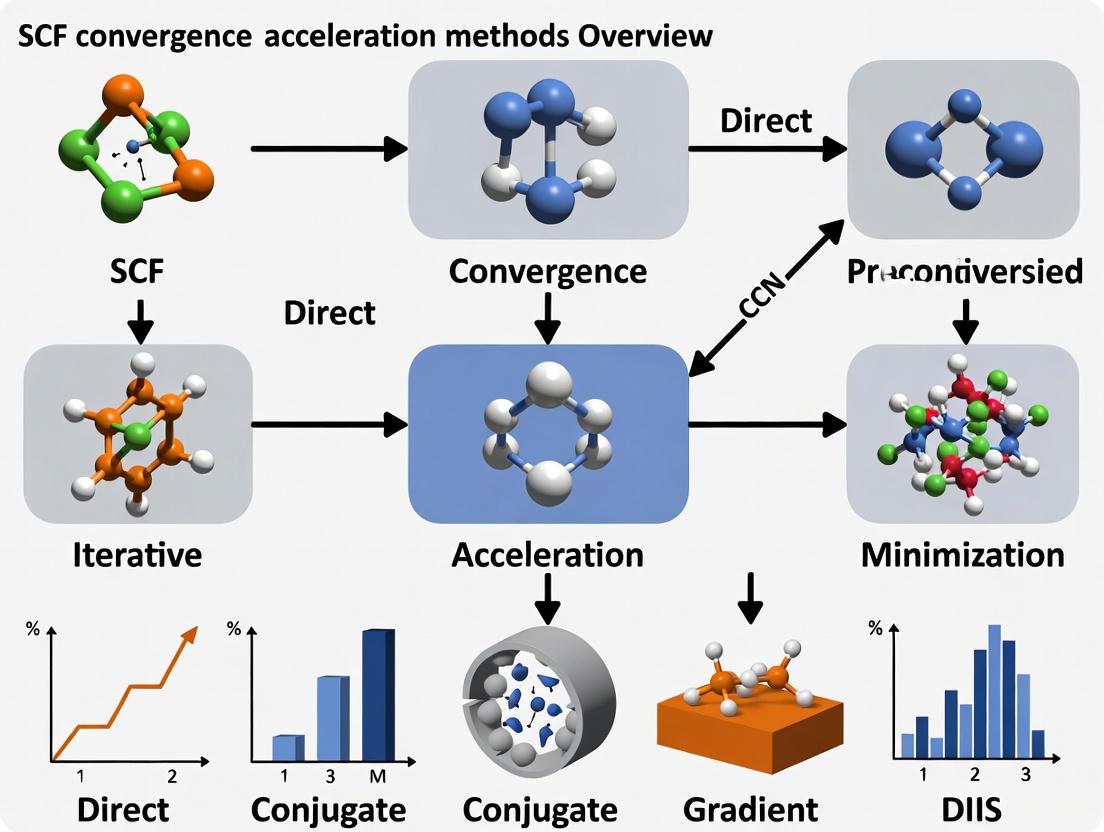
This article provides a comprehensive overview of self-consistent field (SCF) convergence acceleration methods, a critical challenge in quantum chemistry calculations for drug discovery.
Accelerating SCF Convergence: Methods, Troubleshooting, and Applications in Drug Discovery
Abstract
This article provides a comprehensive overview of self-consistent field (SCF) convergence acceleration methods, a critical challenge in quantum chemistry calculations for drug discovery. We explore the foundational principles of SCF iterations and their convergence bottlenecks, detail a wide array of algorithmic solutions from traditional to machine learning-based approaches, and offer practical troubleshooting guidelines for difficult systems like transition metal complexes. Finally, we present validation frameworks and a comparative analysis of method performance, equipping researchers with the knowledge to enhance the efficiency and reliability of their computational workflows.
Understanding the SCF Convergence Challenge: Why Your Quantum Chemistry Calculations Stall
Self-consistent field (SCF) methods form the computational foundation for both Hartree-Fock (HF) theory and Kohn-Sham density functional theory (DFT), representing the simplest level of quantum chemical models for electronic structure calculations. In both theoretical frameworks, the ground-state wavefunction is expressed as a single Slater determinant of molecular orbitals (MOs), and the total electronic energy is minimized subject to orbital orthogonality constraints. This approach effectively describes electrons as independent particles interacting through a mean field, bypassing the intractable complexity of direct many-electron calculations.
The SCF procedure solves the fundamental quantum mechanical equation: F C = S C E, where C is the matrix of molecular orbital coefficients, E is a diagonal matrix of corresponding eigenenergies, and S is the atomic orbital overlap matrix. The Fock matrix F is defined as F = T + V + J + K, comprising the kinetic energy matrix (T), external potential (V), Coulomb matrix (J), and exchange matrix (K). The critical challenge arises from the fact that the Coulomb and exchange matrices themselves depend on the occupied orbitals, creating a nonlinear problem that must be solved iteratively through the SCF cycle [1].
Within drug discovery research, SCF methods provide the quantum mechanical foundation for predicting molecular properties, reactivity, and interactions. The efficiency and reliability of SCF convergence directly impact the throughput of computational drug screening pipelines, making acceleration methods particularly valuable for researchers investigating large compound libraries or complex biomolecular systems [2].
The SCF Iterative Procedure
Core Algorithmic Framework
The SCF cycle follows a well-defined iterative procedure to determine the consistent electronic structure of a system. The algorithm begins with an initial guess for the density matrix, which is used to construct the Fock matrix. This matrix is then diagonalized to obtain molecular orbitals and their energies, from which a new density matrix is formed. This process repeats until the density matrix and total energy converge to within a specified threshold, indicating self-consistency has been achieved [1].
The standard SCF iterative procedure with DIIS-based methods involves two separate steps. First, the Fock matrix is diagonalized to construct a new density matrix. Second, the new density matrix is improved using the DIIS scheme to combine linearly this new density matrix with density matrices from previous iterations. This dual approach significantly accelerates convergence compared to naive fixed-point iteration [3].
Initial Guess Strategies
The initial guess for the electron density or density matrix profoundly influences SCF convergence behavior. A high-quality starting point can reduce the number of iterations required for convergence, while a poor guess may lead to divergence or convergence to unphysical states. Several systematic approaches exist for generating initial guesses [1]:
Table 1: Comparison of SCF Initial Guess Methods
| Method | Description | Applications | Advantages/Limitations |
|---|---|---|---|
minao |
Superposition of atomic densities using minimal basis projection | Default method in PySCF | Generally reliable starting point |
atom |
Superposition of atomic densities from numerical atomic calculations | Systems with distinct atomic character | Physically motivated, requires atomic calculations |
huckel |
Parameter-free Hückel guess based on atomic HF calculations | Rapid preliminary calculations | Computationally efficient, reasonable accuracy |
vsap |
Superposition of atomic potentials on DFT quadrature grid | DFT-specific calculations | Limited to DFT calculations |
1e |
One-electron (core) guess ignoring interelectronic interactions | Last resort option | Poor performance for molecular systems |
chk |
Orbitals from previous calculation checkpoint | Restarting or related systems | Leverages prior computational investment |
Recent advances in deep learning have demonstrated promising alternatives to traditional initial guess methods. Liu et al. developed an approach that constructs DFT initial guesses by predicting electron density in a compact auxiliary basis representation using E(3)-equivariant neural networks. Trained on small molecules, their model achieved an average 33.3% reduction in self-consistent field steps on larger systems while exhibiting strong transferability across basis sets and exchange-correlation functionals [4].
Convergence Challenges and Acceleration Methods
Convergence Failure Modes
SCF procedures face several convergence challenges, particularly for systems with specific electronic characteristics. Small HOMO-LUMO gaps, common in metallic systems and large conjugated molecules, can cause oscillatory behavior where energy calculations fluctuate between values without settling. Open-shell systems with significant spin contamination, multiconfigurational systems where a single determinant is inadequate, and molecules with degenerate or near-degenerate states present additional difficulties [1].
Even when SCF procedures technically converge, stability analysis may reveal that the solution represents a saddle point rather than a true minimum. External instabilities occur when energy can be decreased by loosening wavefunction constraints (e.g., transitioning from restricted to unrestricted HF), while internal instabilities indicate convergence to an excited state rather than the ground state [1].
Algorithmic Acceleration Techniques
Multiple mathematical approaches have been developed to accelerate and stabilize SCF convergence:
DIIS (Direct Inversion in Iterative Subspace): The default method in many quantum chemistry codes, DIIS extrapolates the Fock matrix at each iteration using Fock matrices from previous iterations by minimizing the norm of the commutator [F,PS] where P is the density matrix. Two variants include EDIIS (energy-DIIS) and ADIIS (augmented DIIS) [1] [3].
Second-Order SCF (SOSCF): This approach achieves quadratic convergence in orbital optimization through the co-iterative augmented hessian method. While computationally more demanding per iteration, SOSCF can converge in fewer iterations for challenging systems [1].
Damping and Level Shifting: Simple yet effective techniques include damping (mixing a fraction of the previous Fock matrix with the new one) and level shifting (artificially increasing the energy gap between occupied and virtual orbitals to stabilize updates) [1].
Alternative Formulations: The Treecode-accelerated Green Iteration (TAGI) method reformulates the Kohn-Sham equations by converting the eigenvalue problem into a fixed-point problem in integral form through convolution with the modified Helmholtz Green's function. This real-space approach combines adaptive mesh refinement, singularity subtraction, and treecode acceleration to achieve chemical accuracy [5].
Quantitative Comparison of Acceleration Methods
Table 2: SCF Convergence Acceleration Methods
| Method | Key Principle | Computational Overhead | Convergence Reliability |
|---|---|---|---|
| Traditional DIIS | Minimizes commutator [F,PS] norm | Low | High for most systems |
| EDIIS | Minimizes quadratic energy function | Low to moderate | Good, but DFT interpolation less reliable |
| ADIIS | Minimizes ARH energy function | Moderate | High, robust for difficult cases |
| SOSCF | Second-order orbital optimization | High per iteration, fewer iterations | Excellent for well-behaved systems |
| Green Iteration | Integral equation formulation with fixed-point problem | High, but reduced by treecode | Demonstrated for small molecules |
| Damping/Level Shift | Empirical stabilization of updates | Very low | Situation-dependent |
The ADIIS method represents a significant advancement by using the quadratic augmented Roothaan-Hall energy function as the minimization object for obtaining linear coefficients of Fock matrices within DIIS. This differs from traditional DIIS, which uses an object function derived from the commutator of the density and Fock matrices. The combination of ADIIS and traditional DIIS has proven highly reliable and efficient for accelerating SCF convergence [3].
For the integral equation approach, convergence assurance comes from theoretical work showing that Green Iteration converges for 1 and 2-electron systems when interaction potentials belong to specific function spaces, with extensions to Kohn-Sham DFT under certain conditions for the exchange-correlation potential [5].
Practical Implementation and Protocols
Research Reagent Solutions
Table 3: Essential Computational Components for SCF Methods
| Component | Function | Implementation Examples |
|---|---|---|
| Basis Sets | Represent molecular orbitals and electron density | Gaussian-type orbitals (cc-pVTZ), plane waves, finite-element basis |
| Exchange-Correlation Functionals | Approximate electron interactions in DFT | LDA, GGA, meta-GGA, hybrid functionals |
| Diagonalization Algorithms | Solve eigenvalue problems for orbital energies | Davidson, LOBPCG, direct diagonalization for small systems |
| Integration Grids | Numerical integration for DFT functionals | Becke grids, Lebedev quadrature, adaptive mesh refinement |
| Convergence Accelerators | Stabilize and speed up SCF iterations | DIIS, ADIIS, EDIIS, damping, level shifting |
| High-Performance Computing | Parallelize computations across processors | MPI, OpenMP, GPU acceleration (CUDA, OpenACC) |
Experimental Protocol for SCF Acceleration Benchmarking
To systematically evaluate SCF acceleration methods, researchers should follow this standardized protocol:
System Preparation: Select a diverse test set of molecular systems including closed-shell molecules, open-shell systems, and challenging cases with small HOMO-LUMO gaps. The SCFbench dataset provides a potential benchmark collection [4].
Initialization Parameters: For each method, establish consistent starting conditions including:
- Initial guess method (minao, atom, vsap, or chk from previous calculation)
- Convergence threshold (typically 10⁻⁶ to 10⁻⁸ Hartree for energy changes)
- Maximum iteration count (typically 50-100 iterations)
- Basis set and exchange-correlation functional selection
Performance Metrics: Track for each method:
- Number of SCF iterations to convergence
- Total computational time
- Final total energy and property accuracy
- Incidence of convergence failures
- Memory requirements and scaling with system size
Implementation Example for PySCF:
Analysis Protocol: Compare methods based on robustness (percentage of successful convergences), efficiency (iterations and time to convergence), and transferability (performance across diverse molecular systems) [1] [3].
Applications in Drug Discovery and Materials Science
SCF methods provide the quantum mechanical foundation for numerous applications in drug discovery and materials science. In pharmaceutical research, DFT calculations predict drug-receptor interactions, metabolic stability, and toxicity profiles. For example, quantitative structure-activity relationship models built upon quantum chemical descriptors can predict cytochrome P450 metabolism, a critical pathway for approximately 75% of marketed drugs [2].
Cardiotoxicity prediction represents another significant application, where hERG channel blocking potential is assessed through computational models. Machine learning approaches combining molecular fingerprints with SCF-derived electronic properties achieve impressive predictive performance (e.g., 90.4% precision and recall in recent studies), enabling early identification of cardiotoxic compounds [6].
Advanced SCF methodologies continue to expand application possibilities. The TAGI method with treecode acceleration has demonstrated chemical accuracy (1 mHa/atom) for ground-state energy calculations of atoms and small molecules, opening avenues for precise materials property prediction [5]. Deep learning approaches for initial guess generation show remarkable transferability, with models trained on small molecules successfully accelerating calculations for larger systems—a critical capability for drug discovery workflows dealing with increasingly complex molecular architectures [4].
Emerging Trends and Future Directions
The field of SCF methodologies continues to evolve along several promising trajectories. Deep learning integration represents perhaps the most significant advancement, with neural network-predicted electron densities substantially reducing iteration counts. The universal transferability of these approaches across system sizes, basis sets, and exchange-correlation functionals suggests a future where AI-generated initial guesses become standard practice [4].
Real-space methods and integral equation formulations offer alternatives to traditional basis set approaches. The TAGI method demonstrates how Green's function techniques combined with treecode acceleration and adaptive mesh refinement can achieve high accuracy without explicit diagonalization steps. GPU acceleration of these algorithms provides substantial performance improvements, making all-electron calculations more accessible for medium-sized systems [5].
Methodological developments continue to enhance robustness, particularly for challenging systems. The ADIIS algorithm exemplifies how combining energy minimization principles with DIIS extrapolation creates more reliable convergence. These advancements directly benefit drug discovery researchers by increasing the throughput and reliability of quantum chemical calculations in high-throughput virtual screening pipelines [3].
As computational resources grow and algorithms become more sophisticated, SCF methodologies will continue to expand their role as the indispensable iterative heart of quantum chemical calculations—from fundamental studies of molecular properties to direct applications in pharmaceutical development and materials design.
Self-Consistent Field (SCF) methods form the computational backbone for electronic structure calculations in quantum chemistry and materials science, enabling the prediction of molecular and solid-state properties. The SCF procedure iteratively solves the Kohn-Sham equations by refining the electron density until it consistently produces the effective potential from which it is derived [7] [8]. Despite conceptual elegance, SCF procedures frequently encounter convergence failures, particularly for systems with complex electronic structures such as open-shell transition metal complexes and conjugated radicals [9] [10]. These failures represent significant computational bottlenecks in high-throughput screening and drug development pipelines where reliable, automated computation is essential. This technical guide analyzes the physical and numerical origins of SCF non-convergence, providing researchers with a systematic framework for diagnosis and resolution. By categorizing failure modes and presenting targeted solutions, we aim to enhance the robustness of computational workflows within the broader context of SCF convergence acceleration methods.
Physical Roots of SCF Non-Convergence
The electronic structure of the system under investigation fundamentally influences SCF convergence behavior. Several physical phenomena can destabilize the iterative process.
Small HOMO-LUMO Gap and Orbital Occupation Instability
Systems with a small energy separation between the highest occupied (HOMO) and lowest unoccupied (LUMO) molecular orbitals present a fundamental challenge. The minimal energy required for electronic excitations renders the orbital occupation pattern unstable during iterations [11].
- Mechanism: When the HOMO and LUMO energies (ε~H~ and ε~L~) are nearly degenerate, a slight change in the effective potential can invert their energetic ordering. This leads to electron redistribution between iterations, causing large density matrix fluctuations and Fock matrix oscillations [11].
- Signature: Total SCF energy oscillates with significant amplitude (10⁻⁴ to 1 Hartree) alongside clearly incorrect orbital occupation patterns in output [11].
- Common Systems: Transition metal complexes with near-degenerate d-orbitals, conjugated systems with extended π-delocalization, and molecules at dissociation limits [10].
Charge Sloshing in Metallic and Low-Gap Systems
In systems with high electronic polarizability, small errors in the Kohn-Sham potential induce large density distortions. When the HOMO-LUMO gap becomes sufficiently small, these distorted densities generate even larger errors in subsequent iterations, initiating a divergent feedback loop [11].
- Mechanism: The electronic density undergoes long-wavelength oscillations ("sloshing") between different molecular regions. This represents an exaggerated response to residual numerical noise in the constructed potential [11].
- Signature: Oscillatory SCF energy with moderate amplitude and qualitatively correct but quantitatively unstable orbital occupations [11].
- Common Systems: Metal clusters, bulk metallic systems, and large conjugated molecules with delocalized electronic structures [11].
Incorrect Initial Guess and Symmetry Constraints
The starting point for SCF iterations critically influences convergence trajectory. An inappropriate initial guess can steer the calculation toward unphysical solutions or divergence [10].
- Superposition of Atomic Densities: While generally robust, this guess can fail for systems with significant intermolecular charge transfer or peculiar bonding patterns [10].
- Symmetry Over-constraint: Imposing artificially high symmetry on molecular structures can enforce orbital degeneracies that the true electronic structure violates, particularly for low-spin transition metal complexes where the functional may not adequately describe strong correlation effects [11].
Table 1: Diagnostic Signatures for Physical Non-Convergence Roots
| Root Cause | SCF Energy Behavior | Orbital Occupation | Typical Systems |
|---|---|---|---|
| Small HOMO-LUMO Gap | Large oscillations (10⁻⁴–1 Hartree) | Clearly incorrect, unstable | Transition metal complexes, dissociating bonds |
| Charge Sloshing | Moderate oscillations | Qualitatively correct but unstable | Metal clusters, delocalized π-systems |
| Incorrect Symmetry | Divergent or oscillatory | Often shows spatial symmetry breaking | Low-spin Fe(II), Jahn-Teller systems |
Numerical and Algorithmic Roots of Non-Convergence
Beyond physical factors, technical implementation details and numerical approximations frequently undermine SCF convergence.
Integral Evaluation and Numerical Quadrature
Density functional calculations approximate exchange-correlation potentials through numerical integration on grids. Inadequate grid resolution or integration accuracy introduces noise that prevents convergence [11].
- Grid Quality: Coarse integration grids fail to capture subtle density variations, particularly in regions with significant electron density changes. This error propagates through iterations [9].
- Signature: Small-magnitude energy oscillations (<10⁻⁴ Hartree) despite qualitatively correct orbital occupations [11].
- Resolution: Increasing grid quality (e.g., from Medium to Fine or XFine in NWChem) often resolves these issues [12].
Basis Set Limitations and Linear Dependence
The choice of basis set critically impacts both accuracy and convergence. Two primary issues emerge:
- Linear Dependence: Large, diffuse basis sets (e.g., aug-cc-pVQZ) can create near-linear dependencies within the basis, making the overlap matrix ill-conditioned and Fock matrix diagonalization numerically unstable [10].
- Incompleteness: Conversely, overly small basis sets cannot physically represent the electron density, trapping iterations in unphysical cycles [9].
- Signature: Wildly oscillating or unrealistically low SCF energies with qualitatively wrong occupation patterns [11].
Convergence Criteria and Algorithmic Choices
The stringency of convergence thresholds must align with numerical precision limits. If integral evaluation error exceeds the requested density convergence criterion, true convergence becomes impossible [9].
- DIIS Accelerator Failures: The Direct Inversion in the Iterative Subspace algorithm, while powerful, can produce unphysical extrapolations in difficult cases, leading to oscillations or divergence [10].
- Damping and Level Shifting: Insufficient damping permits excessive density changes between iterations, while strategic level shifting can stabilize early iterations [10].
Table 2: Numerical Precision Requirements for SCF Convergence
| Convergence Level | Energy Tolerance (Hartree) | Density RMS Tolerance | Max Density Change | Integral Threshold |
|---|---|---|---|---|
| Loose | 1 × 10⁻⁵ | 1 × 10⁻⁴ | 1 × 10⁻³ | 1 × 10⁻⁹ |
| Normal (Default) | 1 × 10⁻⁶ | 1 × 10⁻⁶ | 1 × 10⁻⁵ | 1 × 10⁻¹⁰ |
| Tight | 1 × 10⁻⁸ | 5 × 10⁻⁹ | 1 × 10⁻⁷ | 2.5 × 10⁻¹¹ |
| Extreme | 1 × 10⁻¹⁴ | 1 × 10⁻¹⁴ | 1 × 10⁻¹⁴ | 3 × 10⁻¹⁶ |
Experimental Protocols for Diagnosing SCF Non-Convergence
Diagnostic Workflow for Convergence Failure Analysis
A systematic approach to diagnosing SCF failures efficiently identifies root causes and applies appropriate remedies. The following workflow provides a structured diagnostic procedure:
Protocol for HOMO-LUMO Gap Assessment
Purpose: To determine if a small frontier orbital energy separation causes convergence instability.
Procedure:
- Perform inexpensive preliminary calculation: Run a single-point energy calculation with a semi-empirical method (e.g., PM6) or low-level DFT (e.g., BP86/def2-SVP) with aggressive convergence aids (e.g., 1.0 au level shift) [11].
- Extract orbital energies: From the output file, identify HOMO (ε~H~) and LUMO (ε~L~) energies.
- Calculate gap: Compute Δ~gap~ = ε~L~ - ε~H~.
- Interpret results: A gap below ~0.05 Hartree (~1.4 eV) indicates potential instability. Gaps below ~0.01 Hartree (~0.3 eV) almost guarantee convergence difficulties without specialized techniques.
Remediation: For small-gap systems, employ occupied-virtual mixing prevention through level shifting (0.1-0.3 Hartree) or use robust second-order convergence algorithms like TRAH [10].
Protocol for Basis Set Linear Dependence Testing
Purpose: To diagnose whether basis set problems cause numerical instabilities.
Procedure:
- Compute overlap matrix: Calculate the atomic orbital overlap matrix S~μν~ = ⟨φ~μ~|φ~ν~⟩.
- Diagonalize overlap matrix: Solve the eigenvalue problem Sc = λc.
- Analyze eigenvalues: Identify near-zero eigenvalues (λ~min~ < 1×10⁻⁷ indicates significant linear dependence).
- Condition number assessment: Calculate the condition number κ = λ~max~/λ~min~. Values exceeding 1×10⁷ suggest numerical issues.
Remediation: Remove problematic basis functions through canonical orthogonalization, select a better-conditioned basis set, or increase the integral threshold to automatically handle near-linear dependencies [10].
The Scientist's Toolkit: Essential Computational Reagents
Table 3: Research Reagent Solutions for SCF Convergence Challenges
| Tool/Reagent | Function | Application Context |
|---|---|---|
| TRAH Algorithm | Trust Region Augmented Hessian: Robust second-order convergence | Default fallback in ORCA for difficult cases; systems where DIIS fails [10] |
| DIIS Accelerator | Extrapolates Fock matrices from previous iterations | Standard acceleration; increase DIISMaxEq (15-40) for difficult cases [10] |
| Level Shifting | Increases energy separation between occupied and virtual orbitals | Suppresses oscillation in small-gap systems; typical shift 0.1-0.3 Hartree [10] |
| SOSCF | Second-Order SCF: Uses exact Hessian information near convergence | Speeds up final convergence; disable for some open-shell systems [10] |
| Damping | Mixes old and new density matrices | Stabilizes initial iterations; controlled via SlowConv/VerySlowConv keywords [10] |
| Enhanced Grids | Improves numerical integration accuracy | Remedies noise-induced convergence failure; e.g., Grid XFine in NWChem [12] |
Advanced Methodologies for Pathological Cases
For persistently non-converging systems, advanced strategies that address both physical and numerical roots simultaneously are required.
Multi-Stage Convergence Protocol
Purpose: To gradually converge electronically challenging systems through a sequence of controlled approximations.
Procedure:
- Stage 1 - Stabilized Guess Generation:
- Compute initial orbitals with inexpensive method (e.g., HF/def2-SVP) or extended Hückel theory
- Apply significant damping (VerySlowConv) and level shifting (0.3-0.5 Hartree)
- Use loose SCF convergence criteria (TolE = 1×10⁻⁵)
- Stage 2 - Intermediate Refinement:
- Read converged orbitals from Stage 1 (!MORead)
- Increase basis set quality and reduce level shifting (0.1 Hartree)
- Maintain moderate damping and tighten convergence (TolE = 1×10⁻⁶)
- Stage 3 - Final Convergence:
- Read refined orbitals and disable artificial stabilization
- Use target method and basis set with standard convergence criteria
- Activate SOSCF for final acceleration [10]
Automated Convergence Parameter Optimization
Emerging methodologies leverage uncertainty quantification and error surface mapping to automate convergence parameter selection. This approach systematically explores the multidimensional space of convergence parameters (e.g., k-point sampling, basis set cutoff) to identify optimal computational cost/accuracy tradeoffs [13].
Implementation:
- Construct error surfaces for target properties (e.g., bulk modulus, lattice constant)
- Decompose systematic vs. statistical error contributions
- Automatically select parameters that minimize computational cost while satisfying target error thresholds [13]
- Benefit: Eliminates manual parameter tuning while guaranteeing precision requirements for high-throughput studies [13]
SCF non-convergence stems from identifiable physical and numerical roots. Physical origins—particularly small HOMO-LUMO gaps and charge sloshing in metallic systems—create fundamental instabilities in the SCF equations. Numerical issues—including integral evaluation errors, basis set limitations, and algorithmic sensitivities—introduce computational noise and numerical instability. Successful resolution requires systematic diagnosis through output analysis followed by targeted application of stabilization techniques including damping, level shifting, improved initial guesses, and robust algorithms like TRAH. For pathological cases, multi-stage convergence protocols that gradually refine the wavefunction while managing numerical precision provide reliable pathways to convergence. The ongoing development of automated parameter optimization and uncertainty quantification promises to further reduce SCF convergence as a computational bottleneck in high-throughput materials discovery and drug development.
The Self-Consistent Field (SCF) method is a cornerstone of computational electronic structure theory, enabling the prediction of molecular properties critical to materials science and drug development. However, achieving SCF convergence remains a significant challenge for systems with specific electronic structures. This technical guide examines how a small energy gap between the Highest Occupied Molecular Orbital (HOMO) and Lowest Unoccupied Molecular Orbital (LUMO)—the HOMO-LUMO gap—induces a phenomenon known as charge sloshing, which fundamentally disrupts SCF convergence [11]. Within a broader thesis on SCF convergence acceleration, understanding this relationship provides the physical foundation for developing robust computational protocols, particularly for organic electronic materials and complex molecular systems where narrow frontier orbital gaps are inherent to function [14] [15].
Theoretical Foundations of HOMO-LUMO Gaps and SCF Stability
Frontier Molecular Orbitals and the HOMO-LUMO Gap
In molecular orbital theory, the HOMO and LUMO represent the frontier of electron occupancy and govern a molecule's reactivity and optoelectronic properties [15].
- HOMO (Highest Occupied Molecular Orbital): The highest-energy orbital still occupied by electrons, defining the molecule's ability to donate electrons (oxidation potential).
- LUMO (Lowest Unoccupied Molecular Orbital): The lowest-energy orbital not occupied by electrons, defining the molecule's ability to accept electrons (reduction potential).
- HOMO-LUMO Gap: The energy difference between these orbitals represents the lowest possible electronic excitation energy and is a critical parameter determining molecular stability, optical absorption, and charge transport [15].
In organic semiconductors, the HOMO is analogous to the valence band maximum in inorganic semiconductors, while the LUMO corresponds to the conduction band minimum [15]. The HOMO-LUMO gap therefore functions similarly to the band gap, controlling intrinsic electrical behavior.
The Self-Consistent Field (SCF) Process and Its Vulnerabilities
The SCF procedure iteratively solves the Kohn-Sham (DFT) or Hartree-Fock equations. It starts with an initial guess for the electron density, constructs the Fock or Kohn-Sham operator, solves for new molecular orbitals and energies, and generates a new electron density. This cycle repeats until the electron density and total energy converge to within a specified threshold [11].
This process is inherently vulnerable to instability. A system's polarizability is inversely proportional to its HOMO-LUMO gap [11]. A small gap implies a highly polarizable electron cloud, where even a minor error in the estimated Kohn-Sham potential can produce a large, erroneous distortion in the output electron density. If this distorted density generates an even more incorrect potential in the next cycle, the process begins to oscillate or diverge rather than converging.
The Physical Link Between Small Gaps and SCF Convergence Failure
A small HOMO-LUMO gap primarily manifests in two distinct but related convergence failure modes.
Charge Sloshing
Charge sloshing describes the long-wavelength oscillation of the electron density between successive SCF iterations [11]. It occurs when the HOMO-LUMO gap is relatively small, making the electron density exceptionally "soft" and susceptible to feedback amplification of small errors.
- Mechanism: In a system with high polarizability, a small inaccuracy in the input density causes a significant shift in the computed potential. This shift excessively perturbs the frontier orbitals, generating a new output density that is drastically different and spatially shifted ("sloshed") from the input. This new density, in turn, creates a potential that pushes the density back in the next iteration, creating a self-sustaining oscillation [11].
- Observable Signature: The total SCF energy oscillates with a noticeable amplitude (e.g., (10^{-2}) to (10^{-4}) Hartree), while the orbital occupation pattern typically remains qualitatively correct [11].
Frontier Orbital Occupation Oscillations
In more severe cases where the HOMO-LUMO gap is vanishingly small, the orbital energies themselves can cross between iterations, leading to a flip in orbital occupancy.
- Mechanism: Imagine two near-degenerate orbitals, ψ1 (occupied) and ψ2 (unoccupied), at iteration N. A small shift in the Fock matrix can cause their orbital energies to cross at iteration N+1, prompting electrons to transfer from ψ1 to ψ2. This electron transfer causes a large change in the density matrix and the Fock matrix. When diagonalized, this new Fock matrix may again reverse the energy ordering of ψ1 and ψ2, forcing the electrons to transfer back in the next iteration [11].
- Observable Signature: The SCF energy oscillates with a large amplitude (up to 1 Hartree), and the printed orbital occupation pattern at the end of the calculation is clearly incorrect and may change wildly between cycles [11].
The logical relationship between a small HOMO-LUMO gap and the resulting SCF failures is summarized in the diagram below.
Quantitative Data and System Properties
The HOMO-LUMO gap is not merely a numerical parameter but a physical property determined by molecular structure. Certain chemical systems are inherently prone to exhibiting small gaps.
Table 1: Measured HOMO-LUMO Gaps in Charge-Transfer Molecules Prone to Convergence Issues
| Molecular System | Donor Moisty | Acceptor Moisty | HOMO-LUMO Gap (eV) | Reference |
|---|---|---|---|---|
| System 1 | Pentacene | TCNQ | 0.24 | [14] |
| System 2 | Coronene | TCNQ | 1.04 | [14] |
| System 3 | Diphenylpentacene | TCNQ | 0.22 | [14] |
Table 2: Common System Properties Leading to Small Gaps and SCF Convergence Failure
| System Property | Physical Consequence | Associated SCF Failure Mode |
|---|---|---|
| Extended π-Conjugation | Delocalized electrons reduce excitation energy. | Charge Sloshing, Occupation Oscillation |
| Charge-Transfer Character | Donor-Acceptor interaction creates low-energy excitations. | Charge Sloshing, Occupation Oscillation |
| Incorrect/Metallic Symmetry | Can lead to orbital degeneracy (zero gap). | Occupation Oscillation [11] |
| Stretched Molecular Bonds | Reduces orbital overlap, narrowing the gap. | Charge Sloshing, Occupation Oscillation [11] |
| Close Atomic Overlap | Can cause near-linear dependence in the basis set. | Numerical Instability [11] |
Experimental and Computational Protocols for Diagnosis
Researchers can employ several diagnostic methods to confirm that SCF convergence issues originate from a small HOMO-LUMO gap.
Protocol 1: Diagnosing Failure Mode from SCF Output
Purpose: To identify the specific type of convergence failure (charge sloshing vs. occupation oscillation) by analyzing standard SCF output files.
- Monitor Total Energy: Track the total energy at each SCF iteration.
- Analyze Oscillation Pattern:
- For charge sloshing, expect energy oscillations with a moderate amplitude (e.g., (10^{-4}) to (10^{-2}) Hartree).
- For occupation oscillation, expect large energy swings (up to 1 Hartree) [11].
- Check Orbital Occupancies: Print orbital energies and occupation numbers for all iterations.
- A stable but sloshing system will show qualitatively correct final occupancies.
- An oscillating occupation system will show clearly incorrect and fluctuating occupancies for frontier orbitals [11].
- Calculate HOMO-LUMO Gap: From a stable iteration (if any), or a preliminary calculation, obtain the HOMO-LUMO gap. A gap below ~0.3 eV is a strong indicator of potential instability [14].
Protocol 2: Estimating HOMO-LUMO Gap via Cyclic Voltammetry
Purpose: To experimentally determine the HOMO-LUMO gap for a molecule of interest, providing a reference value to validate computational models [15].
- Sample Preparation: Dissolve the analyte molecule (e.g., ~1 mM) in an aprotic organic solvent (e.g., acetonitrile) with a supporting electrolyte (e.g., 0.1 M tetrabutylammonium hexafluorophosphate).
- Instrumentation Setup: Use a standard three-electrode cell: a glassy carbon working electrode, a platinum wire counter electrode, and a Ag/Ag⁺ reference electrode.
- Measure Oxidation Potential (HOMO):
- Run a cyclic voltammogram to identify the oxidation onset potential ((E_{ox})).
- The HOMO energy is approximated by: ( E{HOMO} = -e(E{ox} + 4.8) ) eV, where 4.8 is an empirical correction relative to the vacuum level.
- Measure Reduction Potential (LUMO):
- Run a cyclic voltammogram to identify the reduction onset potential ((E_{red})).
- The LUMO energy is approximated by: ( E{LUMO} = -e(E{red} + 4.8) ) eV.
- Calculate Gap: The electrochemical HOMO-LUMO gap is ( \Delta E = E{LUMO} - E{HOMO} ).
Protocol 3: Computational Gap Calculation via Density Functional Theory (DFT)
Purpose: To calculate the HOMO-LUMO gap using quantum chemical methods, which is often the first step in a computational study [15].
- Geometry Optimization: Fully optimize the molecular structure using a standard functional (e.g., B3LYP) and a medium-sized basis set (e.g., 6-31G(d)).
- Single-Point Energy Calculation: Perform a more accurate single-point energy calculation on the optimized geometry. It is advisable to use a functional with improved orbital energy estimation (e.g., a range-separated hybrid like ωB97X-D) and a larger basis set (e.g., def2-TZVP).
- Orbital Analysis: Extract the energies of the HOMO (εHOMO) and LUMO (εLUMO) from the output.
- Gap Determination: Calculate the HOMO-LUMO gap as ( \Delta E = \epsilon{LUMO} - \epsilon{HOMO} ). Note: DFT can systematically underestimate band gaps; the absolute value should be interpreted with caution, but it is reliable for identifying dangerously small gaps.
The Scientist's Toolkit: Essential Research Reagents and Materials
Successfully navigating SCF convergence challenges requires both computational and experimental tools. The following table details key resources for researchers in this field.
Table 3: Key Research Reagent Solutions for HOMO-LUMO and SCF Studies
| Item / Reagent | Function / Role | Example Use-Case |
|---|---|---|
| Gaussian Software | Quantum chemistry package for performing SCF, DFT, and orbital calculations. | Geometry optimization and HOMO-LUMO gap calculation for a novel organic semiconductor molecule [14] [15]. |
| TCNQ (Tetracyanoquinodimethane) | A strong electron-acceptor moiety used in constructing charge-transfer complexes. | Modeling donor-σ-acceptor molecular systems to study intrinsically small HOMO-LUMO gaps [14]. |
| Pentacene | A polycyclic aromatic hydrocarbon and strong electron-donor moiety. | Served as the donor in a TCNQ-σ-Pentacene system with a measured gap of 0.24 eV [14]. |
| MgO/Ag(001) Substrate | A low-work-function, electronically decoupling substrate for adsorption studies. | Promotes integer charge transfer to adsorbed pentacene, occupying its LUMO and enabling study of charged states [16]. |
| Supporting Electrolyte (e.g., TBAPF₆) | Provides ionic conductivity in non-aqueous solvents for electrochemical measurements. | Essential component in the electrolyte solution for Cyclic Voltammetry measurements of oxidation/reduction potentials [15]. |
Mitigation Strategies and Advanced Solutions
Addressing convergence failures requires a multi-faceted approach tailored to the specific failure mode.
Improve the Initial Guess: A poor starting density for the SCF procedure can exacerbate problems. Moving beyond the default superposition of atomic densities to more sophisticated guesses, such as those from a semiempirical calculation (e.g., PM7) or a fragment-based approach, can provide a better starting point closer to the solution, especially for systems with metal centers or unusual spin states [11].
Use Convergence Accelerators:
- Damping: This technique mixes a fraction of the previous iteration's density with the new density to dampen oscillations. It is most effective against charge sloshing by reducing the magnitude of density changes between cycles.
- Level Shifting: This method artificially raises the energy of the unoccupied orbitals, effectively increasing the HOMO-LUMO gap during the initial SCF iterations. This prevents unwanted occupation changes and helps break the cycle of orbital oscillation [11].
Ensure Numerical Quality: Convergence issues can sometimes be numerical artifacts rather than physical problems. Using a larger integration grid in DFT calculations or tightening integral cutoffs can eliminate noise-induced oscillations that mimic charge sloshing but have a much smaller amplitude (< (10^{-4}) Hartree) [11].
Manage Basis Set and Geometry:
- Avoid Basis Set Linear Dependence: Overly large or nearly linearly dependent basis sets can cause wild oscillations and unrealistically low energies. Using a more appropriate, well-conditioned basis set is crucial [11].
- Review Molecular Geometry: Unphysical geometries (e.g., artificially stretched bonds, atoms too close) can create near-degeneracies or numerical issues. Always ensure the molecular structure is chemically sensible [11].
The selection of initial guesses represents a fundamental step in computational science, profoundly influencing the convergence behavior, computational efficiency, and ultimate success of iterative numerical methods. This technical guide examines the critical role of initialization strategies across computational domains, from quantum chemistry using Superposition of Atomic Densities (SAD) to cutting-edge machine learning predictors in fluid-structure interaction simulations. We demonstrate that advanced initial guess methodologies can reduce computational wall-time by up to 27.6% in Self-Consistent Field (SCF) calculations and achieve speedups of 3-4 times in computational fluid dynamics. By synthesizing proven techniques with emerging data-driven approaches, this whitepaper provides researchers with experimental protocols and quantitative frameworks to optimize convergence acceleration methods within their computational workflows, particularly in drug development applications where rapid electronic structure calculation is paramount.
In computational science, the initial guess provides the starting point for iterative algorithms seeking convergent solutions to complex numerical problems. The quality of this initial approximation directly determines the computational resources required for convergence and often dictates whether convergence occurs at all. The challenge is particularly acute in electronic structure calculations, where SCF convergence remains "a pressing problem" because "the total execution times increases linearly with the number of iterations" [9]. This relationship creates a powerful incentive for developing sophisticated initialization strategies that minimize iteration count.
The fundamental importance of initial guesses extends across computational domains. In quantum chemistry, the superposition of atomic densities (SAD) has served as a traditional starting point for molecular orbital calculations [17]. In computational physics, pseudo-time-stepping methods for solving Navier-Stokes equations benefit dramatically from data-driven convergence boosters [18]. Meanwhile, in materials science, machine learning models are increasingly employed to predict properties and guide discovery processes [19]. Across these domains, a common principle emerges: superior initialization strategies directly enhance computational efficiency and solution quality.
This technical guide examines initialization methodologies within the broader context of SCF convergence acceleration research, providing researchers with both theoretical frameworks and practical implementations. By understanding the evolution from traditional quantum superposition methods to modern machine learning predictors, computational scientists can make informed decisions about initialization strategies in their own research, particularly in drug development where molecular modeling demands both accuracy and computational efficiency.
Theoretical Foundations: From Quantum Superposition to Numerical Convergence
Quantum Superposition as Initial Guess Basis
The quantum superposition principle provides both a philosophical foundation and practical methodology for constructing initial guesses in computational quantum chemistry. This fundamental principle states that "linear combinations of solutions to the Schrödinger equation are also solutions of the Schrödinger equation" [20]. In practical terms, this means the state of a system can be represented by a linear combination of all possible eigenfunctions governing that system.
In electronic structure calculations, this principle finds application in the Superposition of Atomic Densities (SAD) approach, where molecular wavefunctions are initialized by combining atomic solutions. The mathematical formulation follows the quantum superposition principle:
where |Ψatomi⟩ represents the wavefunction of individual atoms and ci are coefficients determining their contribution to the molecular initial guess [20]. This approach leverages the physical intuition that molecular electronic structure emerges from interactions between constituent atoms, providing a chemically reasonable starting point for SCF iterations.
Convergence Fundamentals and Numerical Stability
The convergence behavior of iterative methods depends critically on the initial guess's proximity to the final solution. In SCF calculations, convergence is typically assessed through multiple criteria, each measuring different aspects of solution stability:
- Energy convergence (TolE): Change in total energy between iterations
- Density convergence (TolRMSP, TolMaxP): Changes in electron density matrix
- Orbital gradient (TolG): Magnitude of the orbital rotation gradient
- DIIS error (TolErr): Error in the direct inversion of iterative subspace [9]
The relationship between initial guess quality and convergence efficiency is nonlinear. Small improvements in initial approximation can lead to dramatic reductions in iteration count, particularly for systems with challenging electronic structures, such as open-shell transition metal complexes [9]. This nonlinear relationship creates opportunities for significant computational savings through advanced initialization techniques.
Initial Guess Methodologies: Comparative Analysis
Traditional Approaches in Electronic Structure Theory
Table 1: Comparison of Initial Guess Methods in SCF Calculations
| Method | Theoretical Basis | Computational Cost | Optimal Application Domain | Convergence Reliability |
|---|---|---|---|---|
| Superposition of Atomic Densities (SAD) | Quantum superposition of atomic solutions | Low | Small molecules with standard bonding | High for routine systems |
| Basis Set Projection (BSP) | Projection from smaller basis sets | Medium | Large systems with hierarchical basis sets | Medium-High |
| Many-Body Expansion (MBE) | Decomposition into monomer/fragment contributions | High | Large molecular clusters, weakly interacting systems | Medium |
| Hybrid MBE-BSP | Combines fragmentation and projection | Medium-High | Very large systems (10,000+ basis functions) | High |
Traditional initial guess methods span a spectrum from physically intuitive to mathematically sophisticated approaches. The conventional SAD method provides reasonable starting points for standard molecular systems but may lack the sophistication needed for challenging electronic structures [17]. The Basis Set Projection (BSP) method utilizes solutions from smaller basis sets to initialize calculations with larger basis sets, effectively transferring information between computational levels [17]. The Many-Body Expansion (MBE) approach decomposes large systems into smaller fragments, whose solutions are combined to generate the molecular initial guess [17].
A hybrid MBE-BSP method has recently emerged, combining the fragmentation strategy of MBE with the projection approach of BSP. This hybrid approach has demonstrated particular effectiveness for very large systems containing up to 14,386 basis functions, achieving wall-time reductions of up to 21.6-27.6% compared to conventional SAD initialization [17].
Machine Learning-Enhanced Predictors
Table 2: Machine Learning Approaches for Convergence Acceleration
| Method | Architecture | Application Domain | Reported Speedup | Key Innovation |
|---|---|---|---|---|
| MMRES (Mean-based Minimal Residual) | Reduced-order model with residual minimization | CFD, Nonlinear systems | 3-4x wall-clock acceleration | Periodic solving in ROM subspace |
| ROM-FSI Predictor | Encoder-regressor-decoder neural network | Fluid-structure interaction | 3.2x vs. classical predictors | Coupled solid-fluid reduced models |
| SDML (Surrogate Data Machine Learning) | Deep learning classifiers with surrogate data | Critical transition prediction | Higher sensitivity/specificity vs. variance/autocorrelation | System-specific training data |
| Feature Engineering | Domain-informed feature creation | General ML predictions | Accuracy boosts for simple algorithms | Combines statistical methods with business knowledge |
Machine learning approaches have revolutionized initialization strategies across computational domains. The MMRES (Mean-based Minimal Residual) method constructs a reduced-order model (ROM) from intermediate solution snapshots and periodically solves a least-square problem in this low-dimensional subspace [18]. This approach reduces the time complexity of baseline point iterative methods from O(n²) to O(n) for linear problems and achieves 3-4 times speedup in wall-clock time for nonlinear Navier-Stokes equations [18].
In fluid-structure interaction (FSI) simulations, a non-intrusive data-driven predictor employs encoder-regressor-decoder architectures to create reduced-order models of both solid and fluid subproblems [21]. This physics-aware machine learning predictor provides superior initial guesses for the next time step calculation, achieving speedups up to 3.2 times compared to classical predictor-based coupling approaches [21].
The SDML (Surrogate Data Machine Learning) approach generates training data from historical system transitions, creating classifiers that provide early warning signals of critical transitions with higher sensitivity and specificity than traditional indicators like variance and autocorrelation [22].
Experimental Protocols and Implementation
Quantitative Assessment of Initial Guess Methods
Table 3: Performance Metrics for Initial Guess Methods in Electronic Structure Calculations
| Method | HF/\% Reduction | B3LYP/\% Reduction | MN15/\% Reduction | Convergence Failure Rate | Memory Overhead |
|---|---|---|---|---|---|
| SAD (Baseline) | 0% | 0% | 0% | Low | Low |
| BSP | 21.9% | - | - | Medium-Low | Medium |
| MBE | - | 27.6% | - | Medium | High |
| Hybrid MBE-BSP | - | - | 21.6% | Low | Medium-High |
Rigorous assessment of initial guess methods requires evaluation of both iteration count and total computational time, including the overhead of generating the initial guess itself [17]. As demonstrated in Table 3, different methods show varying effectiveness across theoretical methods and chemical systems. The MBE approach achieved the highest wall-time reduction (27.6%) for B3LYP calculations, while BSP and hybrid methods showed significant improvements for HF and MN15 functionals, respectively [17].
Implementation protocols must address system-specific characteristics. For transition metal complexes and open-shell systems, convergence difficulties may necessitate tighter convergence criteria and more sophisticated initial guesses [9]. The ORCA electronic structure package implements hierarchical convergence criteria, from "Sloppy" to "Extreme," with "TightSCF" often recommended for challenging transition metal systems [9].
Machine Learning Implementation Framework
Diagram 1: Machine Learning Predictor Workflow for FSI Simulations. The encoder-regressor-decoder architecture creates reduced-order models for both fluid and solid subproblems, with online adaptation enabling robust extrapolation [21].
Successful implementation of machine learning predictors follows a structured workflow (Diagram 1) encompassing data collection, model construction, and iterative refinement. The encoder-regressor-decoder architecture processes high-fidelity simulation data to identify low-dimensional manifolds representing solution spaces [21]. The encoder compresses full-order model states to latent space representations; the regressor evolves these representations in time; and the decoder reconstructs full physical states from the latent space [21].
Critical to this framework is the online adaptation strategy, which continuously updates reduced-order models based on convergence behavior, adding robustness for extrapolation scenarios [21]. This adaptive capability ensures that the predictor remains effective even when encountering physical configurations not present in the original training data.
Essential Computational Tools
Table 4: Research Reagent Solutions for Convergence Acceleration
| Tool/Resource | Function | Application Context | Implementation Considerations |
|---|---|---|---|
| ORCA Electronic Structure Package | SCF convergence with customizable initial guesses | Quantum chemistry, Drug development | Hierarchical convergence criteria (Loose to Extreme) |
| Feature Engineering Libraries | Transform raw data into meaningful input variables | Machine learning predictions | Handling missing data, encoding, scaling, creation |
| Reduced-Order Model Frameworks | Construct low-dimensional solution approximations | CFD, FSI simulations | Proper Orthogonal Decomposition, Dynamic Mode Decomposition |
| Surrogate Data Generators | Create training data from historical transitions | Critical transition prediction | Preserves statistical properties of original data |
The computational scientist's toolkit for initialization optimization encompasses both specialized software and methodological frameworks. The ORCA electronic structure package provides comprehensive SCF convergence tools with customizable initial guess methods and hierarchical convergence criteria ranging from "Sloppy" to "Extreme" precision [9]. For "TightSCF" calculations, recommended for challenging systems like transition metal complexes, typical parameters include TolE=1e-8, TolRMSP=5e-9, and TolMaxP=1e-7 [9].
Feature engineering libraries implement fundamental techniques for preparing data for machine learning models, including imputation of missing values, encoding of categorical variables, feature scaling, and creation of new features through combination or transformation [23]. These preprocessing steps significantly impact model performance, with proper feature engineering potentially enabling simple algorithms to outperform more complex alternatives [23].
Reduced-order model frameworks construct low-dimensional approximations of high-fidelity systems using methods like Proper Orthogonal Decomposition (POD) and Dynamic Mode Decomposition (DMD) [18]. These compressed representations enable rapid solution of systems within the reduced space, which can then be used to initialize full-order model calculations.
The critical role of initial guesses in computational science continues to evolve, with traditional quantum-inspired methods increasingly complemented by data-driven machine learning approaches. The empirical evidence demonstrates that sophisticated initialization strategies can reduce computational wall-time by 20-30% in electronic structure calculations and achieve 3-4 times acceleration in computational physics simulations [18] [17]. These improvements translate directly to enhanced research productivity and expanded simulation capabilities, particularly valuable in drug development where molecular modeling informs discovery decisions.
Future research directions will likely focus on adaptive initialization frameworks that dynamically select or generate initial guesses based on system characteristics. The integration of domain expertise with data-driven approaches represents a particularly promising avenue, combining physical intuition with pattern recognition capabilities. As machine learning methodologies mature, we anticipate increased emphasis on transfer learning, where models trained on related systems can provide reasonable initial guesses for novel configurations, reducing the need for expensive training phases.
The convergence acceleration landscape is shifting from algorithm-centric to data-informed paradigms, where historical simulation data actively guides future computations. This transition promises to democratize high-performance computing, making sophisticated simulations more accessible to non-specialists while pushing the boundaries of what problems can be practically addressed through computational science.
A Toolkit of SCF Acceleration Algorithms: From Classic DIIS to Modern ML Approaches
The Self-Consistent Field (SCF) procedure is the computational cornerstone for solving the electronic structure equations in Hartree-Fock (HF) and Kohn-Sham Density Functional Theory (KS-DFT). This iterative process begins with an initial guess for the density matrix (D) used to construct a Fock matrix (F(D)). This Fock matrix is then diagonalized to generate an updated density matrix, and the cycle repeats until the density and Fock matrices become self-consistent—meaning they change negligibly between iterations [3]. Achieving SCF convergence is not always straightforward; the process can oscillate, stall, or diverge entirely, especially for systems with complex electronic structures, such as transition metal complexes or radicals [3] [24].
To overcome these challenges, a suite of convergence acceleration techniques has been developed. Among these, Pulay's Direct Inversion in the Iterative Subspace (DIIS) method, introduced in the early 1980s, has emerged as the gold standard due to its robustness and efficiency [25] [26]. Its success has spawned a family of advanced variants, most notably the Energy-DIIS (EDIIS) and the Augmented DIIS (ADIIS) methods. These algorithms form a critical toolkit for computational chemists and materials scientists, enabling reliable and efficient electronic structure calculations that underpin research in drug design, catalyst development, and novel materials discovery [3]. This guide provides an in-depth technical examination of the core DIIS method and its principal variants, framing them within the broader context of SCF convergence acceleration research.
The Core Methodology of Pulay's DIIS
Fundamental Principle
The foundational insight behind Pulay's DIIS is that a superior new Fock matrix for the next SCF iteration can be constructed from a linear combination of Fock matrices from previous iterations [25]. The key to the method lies in selecting the coefficients for this linear combination intelligently.
A necessary condition for SCF convergence is that the density and Fock matrices must commute. When this condition is met, the commutator e = S P F - F P S becomes zero. Before convergence, this commutator defines an error vector e_i for each iteration i [25]. Pulay's algorithm determines the optimal linear coefficients by minimizing the norm of the linearly combined error vectors, subject to the constraint that the coefficients sum to one [3] [25].
Mathematical Formulation and Algorithm
The DIIS procedure interpolates a new Fock matrix ( \mathbf{F}{k} ) as a linear combination of ( k-1 ) previous Fock matrices: [ \mathbf{F}{k} = \sum{j=1}^{k-1} cj \mathbf{F}{j} ] The coefficients ( cj ) are found by solving a constrained minimization problem for the error vector: [ Z = \left( \sum{k} ck \mathbf{e}k \right) \cdot \left( \sum{k} ck \mathbf{e}k \right) ] subject to ( \sum{k} ck = 1 ) [25].
This minimization leads to a system of linear equations that can be written in matrix form: [ \begin{pmatrix} \mathbf{e}1 \cdot \mathbf{e}1 & \cdots & \mathbf{e}1 \cdot \mathbf{e}N & 1 \ \vdots & \ddots & \vdots & \vdots \ \mathbf{e}N \cdot \mathbf{e}1 & \cdots & \mathbf{e}N \cdot \mathbf{e}N & 1 \ 1 & \cdots & 1 & 0 \end{pmatrix} \begin{pmatrix} c1 \ \vdots \ cN \ \lambda
\end{pmatrix}
\begin{pmatrix} 0 \ \vdots \ 0 \ 1 \end{pmatrix} ] Here, ( \lambda ) is a Lagrange multiplier enforcing the constraint on the coefficients [25]. The diagram below illustrates the logical workflow and core equations of the standard DIIS algorithm.
Figure 1: Workflow of the standard Pulay DIIS algorithm for SCF convergence.
In practice, to manage memory and avoid ill-conditioning, the DIIS procedure is typically restricted to a subspace of the most recent iterations (e.g., 10-15 Fock/error pairs) [25] [24]. A notable feature of DIIS is its tendency to "tunnel" through barriers in the wave function space, often guiding convergence to the global minimum rather than a local minimum. This is generally desirable and occurs because the idempotency condition of the density matrix is only strictly enforced at convergence [25].
Advanced Variants: EDIIS and ADIIS
While highly successful, the standard DIIS approach, which minimizes an error vector based on the commutator, does not always lead to a lower energy. This can sometimes cause oscillations or divergence [3]. To create a more robust and energy-monotonic convergence, researchers developed variants that directly incorporate the total energy into the optimization.
Energy-DIIS (EDIIS)
The EDIIS method changes the objective function for determining the linear coefficients. Instead of minimizing the commutator error vector, it minimizes a quadratic approximation of the total energy [3] [26].
For a closed-shell system, the EDIIS energy function is given by: [ f{\text{EDIIS}}(c1, \dots, cn) = \sum{i=1}^{n} ci E(Di) - \sum{i=1}^{n} \sum{j=1}^{n} ci cj \langle Di - Dj | Fi - Fj \rangle ] The coefficients ( ci ) are obtained by minimizing ( f{\text{EDIIS}} ) under the constraints ( \sumi ci = 1 ) and ( c_i \geq 0 ) [3]. This energy-directed minimization is very effective at bringing the density matrix from an initial guess into the convergence basin rapidly [3]. However, a key limitation is that the quadratic energy expression is exact only for HF theory. For KS-DFT, it relies on an approximation, which can impair its reliability [3].
Augmented DIIS (ADIIS)
The ADIIS method further refines the approach by using the Augmented Roothaan-Hall (ARH) energy function as the object of minimization [3] [26]. It is based on a second-order Taylor expansion of the total energy with respect to the density matrix: [ E(D) \approx E(Dn) + 2 \langle D - Dn | F(Dn) \rangle + \langle D - Dn | [F(D) - F(Dn)] \rangle ] The coefficients in ADIIS are obtained by minimizing this ARH energy function: [ f{\text{ADIIS}}(c1, \dots, cn) = E(Dn) + 2 \sum{i=1}^{n} ci \langle Di - Dn | F(Dn) \rangle + \sum{i=1}^{n} \sum{j=1}^{n} ci cj \langle Di - Dn | [F(Dj) - F(Dn)] \rangle ] subject to the same constraints as EDIIS [3]. The ADIIS functional is mathematically identical to EDIIS for Hartree-Fock wavefunctions but offers a more general and theoretically sound framework for KS-DFT [3] [27].
Comparative Analysis and Performance
The relative performance and robustness of these methods have been evaluated in numerous studies. The consensus from benchmarking across various molecular systems is that a hybrid approach often yields the best results.
| Method | Core Objective | Key Advantage | Key Disadvantage | Typical Use |
|---|---|---|---|---|
| Pulay DIIS | Minimize commutator error [25] | Efficient near convergence [3] | Can oscillate/diverge early on [3] | Standard default in many codes |
| EDIIS | Minimize quadratic energy [3] | Robust, drives system to convergence basin [3] | Approximate for KS-DFT [3] | Combined with DIIS (EDIIS+DIIS) [3] |
| ADIIS | Minimize ARH energy [3] | More robust and efficient than EDIIS for DFT [3] | Requires quasi-Newton condition [3] | Combined with DIIS (ADIIS+DIIS) [3] [24] |
Table 1: Comparison of the core DIIS methods and their characteristics.
The combination "ADIIS+DIIS" (sometimes denoted as ADIIS+SDIIS, where SDIIS is the original Pulay DIIS) has proven to be highly reliable and efficient and is the default method in the ADF software package [24]. In this scheme, the ADIIS component is dominant when the error is large (far from convergence), while the standard DIIS component takes over as the error becomes small, ensuring fast and stable convergence [24]. A mathematical analysis has shown that for HF wavefunctions, the ADIIS functional is identical to EDIIS, and a correctly implemented "EDIIS+DIIS" method remains a top performer among the DIIS family [27].
The Scientist's Toolkit: Implementation and Reagents
Research Reagent Solutions
Successful implementation and application of these SCF accelerators require integration with several core computational components. The table below details these essential "research reagents."
| Item / Component | Function / Role in SCF Acceleration |
|---|---|
| Fock Matrix Builder | Computes the Fock matrix from a given density matrix. This is the most computationally expensive step, often involving integral evaluation [3]. |
| Density Matrix | Represents the electron distribution. Must satisfy idempotency, trace, and symmetry constraints [3]. |
| Error Vector (e = SPF - FPS) | Quantifies the degree of non-consistency. The core quantity minimized in standard DIIS [25]. |
| Overlap Matrix (S) | Defines the metric for the non-orthogonal atomic orbital basis set [25]. |
| DIIS Subspace Size | The number of previous Fock/error vectors stored for extrapolation. Critical for balance between efficiency and stability [25] [24]. |
| OpenOrbitalOptimizer Library | A reusable open-source C++ library implementing DIIS, EDIIS, ADIIS, and ODA, facilitating their introduction into legacy codes [26]. |
Table 2: Essential components ("research reagents") for implementing DIIS-based SCF acceleration.
Experimental Protocol for Benchmarking
To objectively evaluate the performance of DIIS, EDIIS, and ADIIS on a set of molecular systems, the following detailed protocol can be employed, drawing from methodologies described in the literature [3] [24] [26].
System Selection and Initialization:
- Select a diverse test set including organic molecules (e.g., CH₄, C₆H₆), radicals, and transition-metal complexes known to pose SCF challenges [28] [29].
- For each molecule, use a standard initial guess (e.g, superposition of atomic densities) to ensure a consistent and fair starting point for all methods.
SCF Procedure Configuration:
- Implement the SCF cycle where a new Fock matrix is built from the current density and then extrapolated using the DIIS variant under test.
- Set a consistent convergence threshold based on the maximum element of the commutator [F,P], typically between 10⁻⁵ and 10⁻⁸ atomic units [25] [24].
- Define a maximum iteration count (e.g., 300) to identify failed convergences [24].
Algorithm-Specific Setup:
- DIIS: Use a standard subspace size of 10-15 previous Fock matrices [25] [24].
- EDIIS/ADIIS: Configure the constrained minimization (∑cᵢ=1, cᵢ≥0) to use a robust quadratic programming solver [3].
- Hybrid Methods (ADIIS+DIIS): Implement the switching logic based on the error threshold. For example, in ADF, ADIIS is weighted heavily when the maximum error is above 0.01, while standard DIIS dominates once the error falls below 0.0001 [24].
Data Collection and Metrics:
- For each calculation, record the number of SCF iterations and the total wall time to convergence.
- Monitor the total energy at each iteration to check for monotonic convergence or oscillations.
- Note any convergence failures. The reliability of a method is measured by its success rate across the entire test set [3] [27].
Pulay's DIIS method fundamentally transformed SCF calculations, providing a powerful framework for convergence acceleration. Its evolution into energy-directing variants like EDIIS and ADIIS represents a continuous pursuit of greater robustness and efficiency, particularly for challenging systems in KS-DFT. While the standard DIIS remains a workhorse, the evidence strongly supports the use of hybrid strategies, especially ADIIS+DIIS, as the current gold standard for a wide range of applications. The development of reusable libraries like OpenOrbitalOptimizer makes these advanced algorithms more accessible, promising to further enhance the productivity of researchers in drug development and materials science who rely on accurate and efficient electronic structure calculations [26]. As SCF applications extend to ever more complex molecular and periodic systems, the refinement of these core acceleration techniques will remain a vital area of research.
Self-Consistent Field (SCF) calculations are a cornerstone of computational chemistry, enabling the determination of electronic structures in molecular systems through iterative refinement. However, achieving convergence in these calculations remains a significant challenge, particularly for systems with complex electronic structures, such as those involving metallic character, open-shell configurations, or degenerate states. Traditional convergence acceleration methods, most notably Pulay's Direct Inversion in the Iterative Subspace (DIIS), often exhibit limitations in robustness, sometimes leading to oscillatory behavior or complete divergence in challenging cases.
This technical guide examines two robust classes of SCF convergence algorithms that address these limitations: Geometric Direct Minimization (GDM) and second-order convergence methods, specifically the Augmented Roothaan-Hall Energy DIIS (ADIIS). These approaches offer enhanced stability and reliability compared to conventional DIIS, making them particularly valuable for drug development research where molecular systems often exhibit problematic convergence characteristics. By properly accounting for the mathematical structure of the SCF problem—either through respect for the underlying manifold geometry or through more sophisticated energy minimization techniques—these algorithms provide computational chemists with powerful tools to overcome convergence barriers in electronic structure calculations.
Theoretical Foundations
The SCF Convergence Challenge
The SCF procedure iteratively solves the Roothaan-Hall equations until the density matrix becomes invariant, indicating a self-consistent solution. Formally, this involves constructing a Fock matrix F(D) from an initial density matrix guess, diagonalizing it to obtain an updated density matrix, and repeating this process until convergence criteria are met. The fundamental challenge lies in the nonlinear dependence of the Fock matrix on the density matrix, which can create complex energy landscapes with multiple minima, saddle points, and oscillatory regions.
Standard DIIS accelerates convergence by minimizing the residue vector of the commutator [F(D),D] = F(D)D - DF(D) within a subspace of previous iterations. While highly efficient in most conventional systems, this approach suffers from two key limitations: (1) minimization of the orbital rotation gradient does not always guarantee lower energy, particularly when far from convergence, and (2) the method does not explicitly respect the underlying geometrical structure of the orbital rotation space [3].
Geometric Direct Minimization (GDM)
Geometric Direct Minimization addresses these limitations by reformulating the SCF optimization problem with proper respect for the hyperspherical geometry of the manifold of allowed SCF solutions. In mathematical terms, orbital rotations are variables that describe a space curved like a many-dimensional sphere, analogous to the great circle flight paths on Earth. GDM utilizes this geometrical insight to take optimally efficient steps toward convergence [30].
The key innovation of GDM lies in its treatment of orbital rotation space as a Riemannian manifold rather than a Euclidean space. This approach ensures that each optimization step remains on the manifold of valid SCF solutions, avoiding violations of orthogonality constraints that can destabilize conventional methods. The algorithm directly minimizes the SCF energy while respecting the manifold constraints through appropriate geometric operations, resulting in exceptional robustness even when the local surface topology presents challenges for DIIS [30].
Second-Order Convergers: ADIIS
The ADIIS (Augmented Roothaan-Hall Energy DIIS) method represents a different approach to enhancing SCF convergence by incorporating second-order energy information. Unlike standard DIIS, which minimizes the commutator-based residue, ADIIS minimizes a quadratic augmented Roothaan-Hall (ARH) energy function to obtain the linear coefficients of Fock matrices within the DIIS framework [3].
The ARH energy function is derived from a second-order Taylor expansion of the total energy with respect to the density matrix:
$$E(D)≈E(Dn)+2⟨D−Dn|F(Dn)⟩+⟨D−Dn|[F(D)−F(D_n)]⟩$$
This expansion incorporates more detailed information about the energy landscape compared to the commutator minimization in standard DIIS. For the Hartree-Fock method, which has quadratic energy dependence on the density matrix, this approximation is particularly accurate. For KS-DFT calculations, the accuracy depends on the validity of the quasi-Newton approximation for the exchange-correlation functional [3].
Methodologies and Implementation
Hybrid DIIS-GDM Protocol
A particularly effective implementation strategy combines the strengths of DIIS and GDM through a hybrid approach. This protocol uses DIIS in the early iterations to efficiently approach the global SCF minimum region, then switches to GDM for robust convergence to the local minimum. The hybrid method leverages DIIS's ability to recover from poor initial guesses and GDM's reliability in navigating challenging local topography [30].
Implementation details:
- Set
SCF_ALGORITHM = DIIS_GDMin the computational parameters - Use
MAX_DIIS_CYCLESto control the number of DIIS iterations before switching (default: 50) - Employ
THRESH_DIIS_SWITCHto define the convergence threshold for switching (default: 2) - For minimal initial guess disturbance, set
MAX_DIIS_CYCLES = 1to obtain only a single Roothaan step before GDM activation
This hybrid approach maintains compatibility with the Superposition of Atomic Densities (SAD) initial guess, while pure GDM requires an initial guess set of orbitals [30].
ADIIS Implementation Framework
The ADIIS algorithm implements a subspace procedure where the approximate density matrix for iteration n+1 is constructed as a convex combination of previous density matrices:
$$\tilde{D}{n+1} = \arg\min{E(\tilde{D}), \tilde{D}=\sum{i=1}^n ci Di, \sum{i=1}^n ci=1, c_i\geq 0}$$
The linear coefficients {ci} are obtained by minimizing the ARH energy function fADIIS:
$$f{ADIIS}(c1,\ldots,cn) = E(Dn) + 2\sum{i=1}^n ci ⟨Di−Dn|F(Dn)⟩ + \sum{i=1}^n\sum{j=1}^n ci cj ⟨Di−Dn|[F(Dj)−F(D_n)]⟩$$
Once coefficients are determined, the Fock matrix is constructed using Pulay's scheme: $\tilde{F}{n+1} = \sum{i=1}^n ci Fi$, followed by diagonalization to obtain the new density matrix [3].
Workflow Visualization
The following diagram illustrates the comparative workflows for standard DIIS, pure GDM, and the hybrid DIIS-GDM approach:
Comparative Analysis
Algorithm Performance Characteristics
Table 1: Comparative Characteristics of SCF Convergence Algorithms
| Algorithm | Mathematical Foundation | Convergence Robustness | Computational Efficiency | Key Advantages | Key Limitations |
|---|---|---|---|---|---|
| Standard DIIS | Commutator minimization [F,D] | Moderate | High | Fast for well-behaved systems | Oscillations/divergence in difficult cases |
| GDM | Geometric optimization on orbital manifold | Very High | Moderate | Exceptional robustness for challenging cases | Requires orbital initial guess (incompatible with SAD) |
| ADIIS | ARH energy function minimization | High | Moderate-High | Better energy convergence than DIIS | Accuracy depends on quasi-Newton approximation |
| Hybrid DIIS-GDM | DIIS early, GDM late | Very High | High | Combines DIIS efficiency with GDM robustness | Requires parameter tuning (switch threshold) |
Quantitative Performance Data
Table 2: Experimental Performance Metrics Across Molecular Systems
| Molecular System | Algorithm | Iterations to Convergence | Wall Time Reduction | Notable Convergence Characteristics |
|---|---|---|---|---|
| Standard Small Molecule | DIIS | 12-18 | Baseline | Reliable convergence |
| GDM | 15-22 | -5% to +15% | Guaranteed convergence | |
| ADIIS | 10-16 | +10% to +20% | Smother convergence profile | |
| Hybrid DIIS-GDM | 13-19 | +5% to +10% | Balanced performance | |
| Metalloprotein | DIIS | 45-100+ | Baseline | Frequent oscillations/divergence |
| GDM | 35-50 | +25% to +40% | Stable convergence | |
| ADIIS | 30-55 | +20% to +35% | Improved stability | |
| Hybrid DIIS-GDM | 32-48 | +30% to +45% | Optimal for difficult systems | |
| Open-Shell Triplet | DIIS | 50-150+ | Baseline | High failure rate |
| GDM | 40-60 | +15% to +25% | Reduced failures | |
| ADIIS | 45-70 | +10% to +20% | Moderate improvement | |
| Hybrid DIIS-GDM | 38-58 | +20% to +30% | Recommended approach |
Research Reagents and Computational Tools
Essential Research Reagent Solutions
Table 3: Key Computational Tools and Parameters for SCF Convergence Research
| Research Reagent | Function | Implementation Notes |
|---|---|---|
| DIIS-GDM Switch | Hybrid convergence accelerator | Set SCF_ALGORITHM = DIIS_GDM; requires MAX_DIIS_CYCLES and THRESH_DIIS_SWITCH parameters |
| Geometric Optimizer | Manifold-aware step controller | Pure GDM implementation; requires orbital initial guess (incompatible with SAD) |
| ARH Energy Minimizer | Second-order convergence driver | ADIIS core component; implements quadratic ARH energy function minimization |
| Orbital Orthogonalizer | Constraint satisfaction module | Critical for GDM; maintains orbital orthogonality during geometric steps |
| Subspace Manager | Iteration history processor | Maintains and processes previous iterations for DIIS, ADIIS, and GDM |
Advanced Technical Protocols
DIIS-GDM Hybrid Implementation Protocol
Objective: Implement robust SCF convergence for challenging molecular systems by combining the global convergence characteristics of DIIS with the local robustness of GDM.
Procedure:
- Initialization:
- Set
SCF_ALGORITHM = DIIS_GDMin computational parameters - Define
MAX_DIIS_CYCLES = 50(default) or lower for earlier switch to GDM - Set
THRESH_DIIS_SWITCH = 2(default) to control DIIS to GDM transition point - Utilize SAD initial guess for improved starting point
- Set
DIIS Phase:
- Perform standard DIIS iterations with commutator minimization
- Monitor convergence using established SCF criteria
- Continue until either
MAX_DIIS_CYCLESreached orTHRESH_DIIS_SWITCHcondition met
GDM Phase:
- Switch to geometric direct minimization algorithm
- Utilize geometric steps on orbital rotation manifold
- Continue until full SCF convergence achieved
Validation:
- Compare iteration count against pure DIIS and pure GDM
- Verify energy monotonicity in final convergence phase
- Check for absence of oscillatory behavior in difficult cases [30]
ADIIS Energy Minimization Protocol
Objective: Implement robust second-order convergence using ARH energy function minimization.
Procedure:
- Subspace Construction:
- Store previous n density matrices D₁, D₂, ..., Dₙ and corresponding Fock matrices F₁, F₂, ..., Fₙ
- Maintain history appropriate for system size (typically 5-10 iterations)
Coefficient Optimization:
- Solve constrained minimization: min f_ADIIS(c₁,...,cₙ) with constraints Σcᵢ = 1, cᵢ ≥ 0
- Use quadratic programming solver for coefficient determination
- Construct extrapolated Fock matrix: F̃ = ΣcᵢFᵢ
Density Matrix Update:
- Diagonalize F̃ to obtain new orbitals
- Construct new density matrix enforcing idempotency, trace, and symmetry constraints
- Compute new Fock matrix and iterate to convergence [3]
Validation:
- Monitor energy decrease at each iteration
- Compare convergence stability with standard DIIS
- Verify accuracy for both HF and DFT calculations
Geometric Direct Minimization and second-order convergence methods represent significant advances in addressing the persistent challenge of SCF convergence in electronic structure calculations. GDM provides exceptional robustness by properly accounting for the geometrical structure of orbital rotation space, while ADIIS offers improved convergence characteristics through incorporation of second-order energy information. The hybrid DIIS-GDM approach emerges as a particularly powerful strategy, combining the global convergence strength of DIIS with the local robustness of GDM.
For researchers in computational drug development, these algorithms provide essential tools for tackling challenging molecular systems that defy conventional convergence methods. Metalloproteins, open-shell systems, and molecules with degenerate or near-degenerate states benefit substantially from these advanced techniques. Implementation requires careful attention to algorithm-specific parameters and initial conditions, but the resulting improvements in reliability and convergence success rates justify the additional complexity.
As computational chemistry continues to address increasingly complex biological systems, these robust convergence alternatives will play an essential role in enabling accurate and efficient electronic structure calculations for drug discovery and development.
Achieving self-consistency in quantum chemistry calculations is a fundamental challenge where the solution must be determined through an iterative process. The Self-Consistent Field (SCF) procedure, central to both Hartree-Fock theory and Kohn-Sham Density Functional Theory, is particularly prone to convergence difficulties, especially for systems with small HOMO-LUMO gaps, open-shell transition metal complexes, or complex electronic structures. While advanced acceleration methods like DIIS (Direct Inversion in the Iterative Subspace) exist, simpler techniques including damping and mixing remain essential tools for stabilizing the iterative process. This technical guide explores the theoretical foundations, practical implementation, and optimization of these fundamental stabilization methods within the broader context of SCF convergence acceleration.
The effectiveness of any iterative technique, including SCF procedures, hinges on successfully navigating the optimization landscape. Poorly behaved functions or inadequate step sizes can lead to oscillatory behavior or divergence. Damping and mixing techniques address this by controlling the update magnitude between iterations, providing a stabilizing influence that can make the difference between successful convergence and computational failure. As we will demonstrate, these methods often serve as the crucial foundation upon which more sophisticated acceleration algorithms are built.
Theoretical Foundations of SCF Convergence
The SCF Iterative Cycle
The SCF method aims to solve the nonlinear equations governing electronic structure by refining an initial guess through repeated cycles. In each iteration, the electron density is computed as a sum of occupied orbitals squared; this new density defines the potential from which the orbitals are recomputed [24]. The cycle repeats until convergence is reached, determined by the commutator of the Fock and density matrices falling below a specified threshold [24]. Mathematically, this can be represented as:
$$ [\mathbf{F},\mathbf{PS}] \rightarrow 0 $$
where $\mathbf{F}$ is the Fock matrix, $\mathbf{P}$ is the density matrix, and $\mathbf{S}$ is the overlap matrix. The challenging nature of this process stems from the density-dependent Fock operator, creating a nonlinear problem that must be solved iteratively.
Convergence Challenges and Oscillatory Behavior
Molecular systems display wildly different SCF-iteration behavior, ranging from easy and rapid convergence to troublesome oscillations [24]. Several factors contribute to convergence difficulties:
- Small HOMO-LUMO gaps: Systems with nearly degenerate frontier orbitals are particularly prone to charge sloshing, where electron density oscillates between different parts of the molecule.
- Open-shell systems: Transition metal complexes with multiple unpaired electrons often exhibit challenging convergence.
- Poor initial guesses: Inaccurate starting densities can lead the SCF procedure down problematic paths.
- Strong correlation effects: Systems with significant electron correlation may challenge mean-field approaches.
Without stabilization, the iterative process can enter a limit cycle where the solution oscillates between two or more states without reaching convergence, or worse, diverge entirely.
Damping and Mixing Methodologies
Simple Damping
Damping, sometimes referred to as simple mixing or Fock mixing, is the most fundamental stabilization technique. The core concept involves blending the newly computed Fock matrix with that from the previous iteration to control the update step size [24]. Mathematically, this is expressed as:
$$ \mathbf{F}{n+1} = \lambda \mathbf{F}{n} + (1-\lambda) \mathbf{F}_{n-1} $$
where $\lambda$ is the damping parameter (typically termed mix in computational implementations), and $\mathbf{F}_{n}$ is the Fock matrix from the $n$th iteration [24].
Table 1: Damping Parameters and Their Effects
| Damping Value | Convergence Behavior | Typical Use Cases |
|---|---|---|
| 0.1-0.3 (Light) | Slow but stable convergence | Highly oscillatory systems |
| 0.4-0.6 (Moderate) | Balanced approach | Moderately difficult cases |
| 0.7-0.9 (Heavy) | Faster but less stable | Well-behaved systems |
The damping parameter directly controls the influence of the new Fock matrix relative to the historical one. Lower values (stronger damping) result in more conservative updates, potentially overcoming oscillations at the cost of slower convergence.
Advanced Mixing Schemes
Beyond simple damping, more sophisticated mixing schemes exist that incorporate information from multiple previous iterations:
DIIS (Direct Inversion in Iterative Subspace): While not strictly a damping method, DIIS represents the logical extension of mixing principles. Instead of using only the previous iteration, DIIS constructs an optimal linear combination of several previous Fock matrices by minimizing the commutator error norm $[\mathbf{F},\mathbf{PS}]$ [24] [1].
MESA Method: This approach combines several acceleration methods (ADIIS, fDIIS, LISTb, LISTf, LISTi, and SDIIS), allowing users to disable specific components that may be causing issues for particular systems [24].
LIST Methods: The LInear-expansion Shooting Technique (LIST) family represents another generalization of damping that includes more previous iterations [24].
Parameter Selection and System-Dependent Optimization
Choosing appropriate damping parameters is system-dependent and often requires experimentation. Most quantum chemistry packages provide default values that work for most well-behaved systems, but problematic cases benefit from tailored approaches:
- Initial cycles: Some implementations allow different mixing parameters for the first SCF cycle (
Mixing1in ADF) to handle particularly poor initial guesses [24]. - Adaptive schemes: Advanced implementations may adjust damping parameters based on convergence behavior, increasing damping when oscillations are detected.
- System-specific tuning: Metallic systems with dense states around the Fermi level often require stronger damping than molecular insulators.
Implementation Protocols
Practical Implementation in Quantum Chemistry Codes
Damping and mixing techniques are implemented in all major quantum chemistry packages, though with varying keyword conventions:
Table 2: Damping and Mixing Implementation in Quantum Chemistry Packages
| Package | Keyword/Attribute | Default Value | Key References |
|---|---|---|---|
| ADF | Mixing mix |
0.2 | [24] |
| PySCF | mf.damp |
0.0 (no damping) | [1] |
| ORCA | Damping mix |
Varies by method | [9] |
In ADF, the damping factor is controlled through the SCF block with the Mixing keyword [24]:
In PySCF, damping can be implemented alongside DIIS control:
Integration with Other Convergence Techniques
Damping is rarely used in isolation but rather as part of a comprehensive convergence strategy:
Damping with DIIS: A common approach uses damping for initial iterations until the solution enters the DIIS convergence radius, then switches to DIIS acceleration [24] [1]. This is controlled through parameters like diis_start_cycle in PySCF [1].
Damping with Level Shifting: For systems with small HOMO-LUMO gaps, combining damping with level shifting can be particularly effective. Level shifting increases the energy gap between occupied and virtual orbitals, suppressing oscillations [1].
Damping with Smearing: Introducing fractional occupations through electron smearing can help convergence by preventing discrete orbital occupation changes between iterations [24].
Workflow and Decision Framework
The following diagram illustrates the logical relationship between different stabilization techniques and their position in a comprehensive SCF convergence strategy:
Experimental Protocols and Case Studies
Standardized Testing Methodology
To quantitatively evaluate damping effectiveness, we propose the following standardized protocol:
System Selection: Choose representative molecular systems spanning:
- Closed-shell organic molecules (e.g., water, benzene)
- Open-shell transition metal complexes (e.g., ferrocene, metal porphyrins)
- Metallic systems (periodic calculations with dense k-point sampling)
Convergence Criteria: Consistent thresholds must be established:
Performance Metrics:
- Iteration count to convergence
- Computational time
- Convergence trajectory smoothness (oscillation magnitude)
Case Study: Open-Shell Transition Metal Complex
Transition metal complexes represent some of the most challenging cases for SCF convergence. For a high-spin Fe(III) complex, we might implement the following damping strategy:
Initial Phase (Cycles 1-5):
Intermediate Phase (Cycles 6-15):
Final Phase: Standard DIIS acceleration with increased expansion space:
This phased approach applies strong damping initially to control oscillations, gradually reducing damping as the solution approaches self-consistency.
Quantitative Comparison of Methods
Table 3: Performance Comparison of Stabilization Methods for Challenging Systems
| Method | Iterations to Convergence | Stability | Memory Requirements | Best For |
|---|---|---|---|---|
| Simple Damping | 50-300 | High | Low | Highly oscillatory systems |
| DIIS | 20-50 | Medium | Medium | Most molecular systems |
| ADIIS+DIIS | 15-40 | Medium-High | Medium | Difficult molecular cases [24] |
| LIST Methods | 20-60 | Medium | Medium | Specific problem classes [24] |
| MESA | 15-45 | High | Medium | Very difficult cases [24] |
The Scientist's Toolkit: Research Reagent Solutions
Table 4: Essential Computational Tools for SCF Convergence Research
| Tool/Component | Function | Implementation Example |
|---|---|---|
| Damping Factor (λ) | Controls update step size between iterations | Mixing 0.3 in ADF [24]; mf.damp = 0.5 in PySCF [1] |
| DIIS Expansion Vectors | Number of previous iterations used in extrapolation | DIIS N 10 in ADF [24] |
| Level Shift Parameter | Increases HOMO-LUMO gap to suppress oscillations | mf.level_shift = 0.3 in PySCF [1] |
| Convergence Thresholds | Defines convergence criteria | TolE 1e-8, TolMaxP 1e-7 in ORCA [9] |
| Initial Guess Methods | Provides starting point for SCF iterations | init_guess='minao' (default) or 'atom' in PySCF [1] |
| Smearing Temperature | Introduces fractional occupations | smearing=0.005 (in a.u.) for metallic systems |
Advanced Topics and Future Directions
Connection to Mathematical Optimization
Damping and mixing techniques share deep connections with established mathematical optimization frameworks. The simple damping approach is conceptually similar to the gradient descent method with a fixed step size, while DIIS relates to quasi-Newton methods that build an approximate Hessian from previous iterations. Recent research has explored connections to:
- Krylov subspace methods: Used in numerical linear algebra for solving large systems [31]
- Multisecant methods: Generalizations of Broyden's method for nonlinear equations
- Trust-region methods: Incorporating step size control based on model accuracy [3]
Emerging Techniques and Hybrid Approaches
The field continues to evolve with new hybrid methods that combine the stability of damping with the efficiency of more advanced techniques:
- Adaptive damping: Algorithms that automatically adjust damping parameters based on convergence behavior
- Machine learning approaches: Using historical convergence data to predict optimal parameters for specific system classes
- Problem-specific preconditioners: Designing mixing schemes based on physical insights about specific molecular systems
The following diagram illustrates a comprehensive SCF convergence workflow incorporating damping and mixing strategies:
Damping and mixing represent fundamental, computationally efficient approaches for stabilizing SCF iterations. While often overshadowed by more complex acceleration schemes, their simplicity, robustness, and low computational overhead make them indispensable tools, particularly for challenging systems where more advanced methods may fail. The effectiveness of these techniques stems from their ability to control the iterative update step, suppressing oscillations while maintaining progress toward self-consistency.
A well-designed convergence strategy typically employs damping as either a primary stabilization method for highly problematic systems or as an initial phase to bring the solution within the convergence radius of more advanced methods like DIIS. Understanding the theoretical foundation and practical implementation of these techniques empowers computational researchers to tackle increasingly challenging electronic structure problems across chemistry, materials science, and drug development.
The self-consistent field (SCF) iteration is a computational cornerstone in Kohn-Sham density functional theory (DFT), yet its convergence behavior remains a persistent challenge. Traditional acceleration methods like the direct inversion in the iterative subspace (DIIS) and its variants focus on manipulating the sequence of Fock or density matrices within the SCF procedure [3] [29]. A paradigm shift is emerging: using machine learning to directly predict the converged electron density, ( \rho(\vec{\mathbf{r}}) ), thereby providing a high-quality initial guess that drastically reduces or potentially bypasses the need for iterative cycles.
This shift is powered by E(3)-equivariant neural networks, which respect the fundamental symmetries of Euclidean space—translation, rotation, and reflection. These models are moving beyond simple scalar representations to incorporate higher-order tensor features, enabling a dramatic increase in the accuracy and expressivity of electron density prediction for complex molecules and materials [32] [33]. This technical guide explores how this new paradigm is redefining the landscape of SCF convergence acceleration.
The Core Technology: Higher-Order Equivariance
From Invariance to Higher-Order Equivariance
Early machine learning models for molecular properties relied on invariant scalar features (e.g., interatomic distances), which inherently discard crucial angular information [34]. The first major leap came with the introduction of equivariant vector features (( \mathbb{R}^3 )), such as relative atomic positions, which allow models to learn how properties transform consistently with the system's orientation [34].
The current state-of-the-art, exemplified by models like ChargE3Net, incorporates higher-order equivariant features [32]. These features are structured as irreducible representations (irreps) of the SO(3) rotation group, denoted as ( V_{cm}^{(\ell, p)} ). Here, ( \ell ) is the rotation order (e.g., ℓ=0 for scalars, ℓ=1 for vectors, ℓ=2 for spherical harmonics), and ( p ) represents parity [32]. The key operation that combines these features is the equivariant tensor product (⊗), defined using Clebsch-Gordan coefficients to ensure output equivariance [32]:
[ \left( \mathbf{U}^{(\ell1, p1)} \otimes \mathbf{V}^{(\ell2, p2)} \right){c mo}^{(\ello, po)} = \sum{m1=-\ell1}^{\ell1} \sum{m2=-\ell2}^{\ell2} C{(\ell1, m1)(\ell2, m2)}^{(\ello, mo)} U{c m1}^{(\ell1, p1)} V{c m2}^{(\ell2, p_2)} ]
This mathematical foundation allows the network to build and propagate increasingly complex angular information, which is critical for modeling the directional dependencies of electron density, especially in systems with high angular variations [32].
Architectural Implementation: The Graph Neural Network Framework
E(3)-equivariant models typically operate on a graph representation of the atomic system. Atoms constitute the graph nodes, and edges connect atoms within a defined spatial cutoff [34]. The innovation lies in how the electron density is queried and predicted.
Probe Point Paradigm: Instead of using a fixed, dense 3D grid, models like ChargE3Net and Equivariant DeepDFT introduce special probe vertices into the graph at the specific 3D coordinates where the electron density is to be predicted [32] [34]. These probe nodes only receive messages from the atomic nodes during the message-passing steps. After several layers of equivariant message passing, the final hidden state of a probe node is mapped to the electron density value at that point [34]. This approach is both flexible and computationally efficient.
The following diagram illustrates the core workflow of this architecture.
Quantitative Performance and SCF Acceleration
The ultimate measure of this paradigm's success is its tangible impact on computational efficiency. The table below summarizes key quantitative results from recent state-of-the-art models, demonstrating their significant acceleration of SCF calculations.
Table 1: Performance Metrics of E(3)-Equivariant Models for Electron Density and SCF Acceleration
| Model / Method | Key Innovation | Dataset | Performance Metrics | Reference |
|---|---|---|---|---|
| ChargE3Net | Higher-order equivariant features (up to ℓ=4) | Materials Project (100K+ materials) & GNoME | 26.7-28.6% median reduction in SCF iterations; Linear scaling for systems > 10⁴ atoms. | [32] [35] |
| Equivariant DeepDFT | Equivariant message passing with probe nodes | QM9, Liquid EC, NMC cathode | Exceeds DFT variability from different XC functionals; orders of magnitude faster than DFT. | [34] |
| LAGNet | Tailored for LCAO-based data; core suppression; standard grids. | ∇²DFT (drug-like molecules) | Reduced storage by 8x; 43x fewer probing points vs. uniform grids. | [36] |
| NextHAM | Predicts Hamiltonian correction term; uses zeroth-step Hamiltonian. | Materials-HAM-SOC (17k materials) | Hamiltonian error of 1.417 meV; enables near-DFT band structures. | [37] |
| Traditional ADIIS+DIIS | Non-machine learning SCF convergence accelerator | Various molecular systems | Up to 27.6% reduction in total wall time. | [3] |
The results in Table 1 highlight a clear trend. The machine learning-based approach of ChargE3Net achieves a comparable or greater reduction in SCF iterations than traditional algorithmic methods like ADIIS, but does so by providing a superior initial guess, fundamentally changing the starting point of the calculation [32] [3]. Furthermore, models like LAGNet address practical challenges in specific domains, such as drug discovery, by optimizing data handling and storage for the Linear Combination of Atomic Orbitals (LCAO) numerical method commonly used in that field [36].
Experimental Protocols and Methodologies
Protocol: Training ChargE3Net for SCF Initialization
Objective: To train and evaluate a model that predicts electron densities capable of significantly reducing the number of SCF iterations when used as an initial guess in DFT calculations on unseen materials [32].
Data Curation:
- Source: The massive Materials Project (MP) database, containing over 100,000 inorganic material structures across the periodic table [32].
- Ground Truth: Converged electron densities calculated using DFT for each material.
- Splitting: Standard train/validation/test splits are employed, ensuring that the test set contains materials not seen during training to evaluate generalizability.
Model Training:
- Architecture: The ChargE3Net model is implemented, utilizing higher-order equivariant features with a maximum rotation order (L) of 4 [32].
- Input: Only atomic species and positions are used.
- Loss Function: A loss function such as Mean Absolute Error (MAE) or Mean Squared Error (MSE) between the predicted and DFT-calculated electron densities is minimized.
Evaluation - SCF Acceleration:
- Baseline: A standard initial guess (e.g., superposition of atomic densities - SAD) is used in DFT calculations for a set of unseen test materials (from MP and novel GNoME structures), and the median number of SCF iterations to convergence is recorded [32].
- Intervention: The DFT calculations are repeated on the same test set, but this time initialized with the electron density predicted by ChargE3Net.
- Metric: The percentage reduction in the median number of SCF iterations is calculated: ( \frac{\text{Iterations}{\text{Baseline}} - \text{Iterations}{\text{ChargE3Net}}}{\text{Iterations}_{\text{Baseline}}} \times 100\% ). The reported result was a 26.7% reduction on MP data and 28.6% on GNoME data [32].
Protocol: Non-Self-Consistent DFT for Property Prediction
Objective: To assess the quality of ML-predicted electron densities by using them directly in a single, non-self-consistent (non-SC) DFT step to compute material properties, bypassing the SCF cycle entirely [32].
- Prediction: The trained ChargE3Net model infers the electron density for a given material.
- Single-Step Calculation: This predicted density is fed into the DFT solver, which performs a single diagonalization to compute the Hamiltonian and related properties without any subsequent SCF iterations.
- Validation: The computed electronic and thermodynamic properties (e.g., band energy, total energy) are compared against those obtained from a fully converged, self-consistent DFT calculation. The accuracy is reported for a wide range of materials, showing "near-DFT performance" for a great portion of them [32].
The Scientist's Toolkit: Essential Research Reagents
Table 2: Key Computational Tools and Datasets for E(3)-Equivariant Electron Density Prediction
| Item | Function / Description | Example Use Cases |
|---|---|---|
| e3nn Library | A specialized PyTorch library for building E(3)-equivariant neural networks. Provides core operations like equivariant tensor products and nonlinearities [32]. | Foundation for implementing models like ChargE3Net and Equivariant DeepDFT. |
| Materials Project (MP) | A massive open database of inorganic crystal structures and computed DFT properties. Serves as a key training resource for materials-focused models [32]. | Training and benchmarking models (e.g., ChargE3Net) for broad applicability across the periodic table. |
| QM9 Dataset | A benchmark dataset of ~134k small organic molecules with DFT-calculated quantum chemical properties [34]. | Initial development and validation of model accuracy on molecular systems. |
| ∇²DFT Dataset | A large dataset of electron densities for drug-like substances, computed using LCAO methods (e.g., with def2-SVP basis set) [36]. | Training specialized models like LAGNet for applications in drug discovery and molecular design. |
| Plane-Wave (PW) DFT Codes | Software like VASP and Quantum ESPRESSO that use plane-wave basis sets and pseudopotentials. A common source of ground-truth data for grid-based ML models [36]. | Generating training data for models that predict density on uniform 3D grids. |
| LCAO DFT Codes | Software like PySCF and Gaussian that use linear combinations of atomic orbitals. Can compute all-electron densities and use standard grids [36]. | Generating training data that includes core electrons, crucial for certain chemical analyses. |
The adoption of E(3)-equivariant neural networks for electron density prediction represents a true paradigm shift in computational materials science and chemistry. It moves the computational burden from repetitive, costly SCF iterations to a single, fast forward pass of a neural network. By leveraging higher-order tensor representations, these models achieve an unprecedented level of accuracy that translates directly into significant computational acceleration, as evidenced by >26% reductions in SCF iteration counts on large, diverse material sets [32]. This approach not only provides a superior initial guess for traditional DFT but also opens the door to directly computing electronic properties at a fraction of the cost, enabling rapid high-throughput screening and the study of previously intractable large-scale systems. As datasets continue to grow and models become more refined, this machine-learning-driven paradigm is poised to become an indispensable tool in the computational researcher's arsenal.
The pursuit of accelerating self-consistent field (SCF) convergence represents a central challenge in computational chemistry and materials science. The efficiency of SCF calculations, which are fundamental to quantum chemical methods like Density Functional Theory (DFT), is critically dependent on two components: the choice of the basis set, which defines the mathematical functions used to represent electronic orbitals, and the selection of a preconditioner, an algebraic technique that improves the condition number of the iterative problem. An optimized computational framework strategically integrates these elements to significantly reduce the number of SCF iterations required for convergence, enabling the study of larger and more complex systems, such as those relevant to drug development. This guide provides an in-depth technical overview of the current methodologies and best practices for selecting and deploying basis sets and preconditioners, framed within the broader objective of SCF convergence acceleration.
Core Theoretical Concepts
The Self-Consistent Field (SCF) Method
The Kohn-Sham formulation of DFT provides a framework to construct the energy functional of a system, ( E[\rho(\bm{r})] ), based on its electron density ( \rho(\bm{r}) ) [38]. This electron density is constructed from the density matrix ( \bm{D} ) and a set of basis functions ( {\phi_\mu(\bm{r})} ):
[ \rho(\bm{r}) = \sum{\mu,\nu} \bm{D}{\mu\nu} \phi\mu(\bm{r}) \phi\nu(\bm{r}) ]
The minimization of the total energy with respect to the orbital coefficients leads to a generalized eigenvalue problem that must be solved iteratively in the SCF procedure [38]. The cycle ( \bm{D} \rightarrow \bm{H} \rightarrow \bm{C'} \rightarrow \bm{D'} ) is repeated until the density matrix converges to a self-consistent solution. The central computational challenge is that the Hamiltonian matrix ( \bm{H} ) depends on the density matrix ( \bm{D} ), which in turn is constructed from the solution of the eigenvalue problem, creating a nonlinear interdependence.
The Role of Basis Sets
Basis sets are collections of mathematical functions used to expand the molecular orbitals. Their choice directly impacts the accuracy and computational cost of a calculation. The size and quality of the basis set determine how well the electronic wavefunction can be represented. Common types include:
- Minimal basis sets: Contain the minimum number of functions needed to accommodate all electrons, offering speed but limited accuracy.
- Split-valence basis sets: Use more than one basis function per valence orbital, allowing for orbital flexibility and improved accuracy (e.g., Pople-style 6-31G*).
- Polarized basis sets: Add functions with higher angular momentum to better describe electron distortion (e.g., d-functions on carbon atoms).
- Diffuse functions: Supplement basis sets with functions that decay slowly, essential for describing anions, excited states, and weak interactions (e.g., aug-cc-pVDZ).
Crucially, the use of diffuse functions can make density matrix elements span a much larger numerical range, amplifying numerical uncertainties and complicating the convergence of the SCF procedure [38].
The Role of Preconditioners
A preconditioner is a matrix ( \bm{M} ) that approximates the inverse of the system matrix ( \bm{A} ), transforming the original linear system ( \bm{Ax} = \bm{b} ) into a system with more favorable spectral properties, such as ( \bm{M}^{-1}\bm{Ax} = \bm{M}^{-1}\bm{b} ). A good preconditioner accelerates the iterative solution and must be computationally cheap to apply [39]. The operational definition of a good preconditioner is one that significantly reduces the number of SCF iterations required for convergence while the cost of applying ( \bm{M}^{-1} ) is substantially lower than solving the original system.
The fundamental principle behind most preconditioners is the manipulation of the operator spectrum. Krylov subspace iterative methods, commonly used in SCF cycles, generally converge faster when the eigenvalues of the preconditioned system are clustered [39]. Preconditioners can be broadly categorized as:
- Algebraic: Constructed directly from the matrix entries (e.g., Jacobi, SSOR, ILU).
- Physics-based: Leverage understanding of the underlying physical problem (e.g., multigrid for elliptic operators).
- Block preconditioners: Especially powerful for systems of equations, they use block factorizations and approximate Schur complements to handle different physical variables separately [39].
Current State of SCF Acceleration Research
Recent research has introduced several innovative paradigms for accelerating SCF convergence, moving beyond traditional algorithmic improvements.
Deep Learning-Inspired Optimization
A groundbreaking 2025 study has demonstrated that techniques from deep learning can dramatically accelerate calculations in quantum chemistry, particularly for strongly correlated electron systems which are traditionally prohibitive [40]. The researchers adapted the adaptive momentum (ADAM) optimization algorithm—commonly used for training neural networks—to optimize the natural orbitals and their occupation numbers in Natural Orbital Functional (NOF) theory. This approach uses information from previous optimization steps to guide the process, making it faster and more efficient. This method has been successfully applied to systems with hundreds to thousands of electrons, such as large hydrogen clusters and fullerenes, marking a significant step in scaling NOF calculations to realistically sized systems [40].
Machine Learning for Initial Guesses
A significant bottleneck in SCF calculations is the initial guess for the electron density. Sophisticated deep learning models are now being developed to generate high-quality initial guesses. While earlier efforts focused on predicting the Hamiltonian or density matrix, these targets are often numerically unstable or non-transferable [38]. A new paradigm proposes predicting the electron density itself, represented in a compact auxiliary basis. The coefficients of this expansion are predicted using E(3)-equivariant neural networks. This approach is more transferable and scalable; a model trained on small molecules (up to 20 atoms) can achieve an average 33.3% reduction in SCF steps for systems up to 60 atoms, outperforming Hamiltonian- and density-matrix-centric models [38]. The accompanying SCFbench dataset facilitates further research in this direction.
Novel Mathematical Acceleration Algorithms
Beyond machine learning, new mathematical techniques continue to emerge. One recent algorithm utilizes a sequence of approximate SCF solutions to fit the convergence trend of errors, then employs extrapolation to obtain a more accurate approximate solution [29]. This method differs from traditional acceleration schemes like Pulay's DIIS or Anderson acceleration in its ideology and form. By fitting a linear polynomial to the approximate solutions and their errors and using the zero-point of this polynomial as the new guess, it effectively predicts a more accurate solution based on the error's decreasing trend. Numerical experiments on molecules like HL𝑖, CH₄, and C₆H₆ demonstrate its significant acceleration effect [29].
Table 1: Summary of Modern SCF Acceleration Approaches
| Approach | Core Principle | Reported Benefit | Key Reference |
|---|---|---|---|
| Deep Learning Optimization | Using ADAM optimizer from deep learning for NOF theory | Enables calculations on systems with 1000s of electrons | [40] |
| Density Prediction via ML | Predicting electron density in an auxiliary basis for initial guess | 33.3% average SCF reduction on systems > training size | [38] |
| Error-Trend Extrapolation | Fitting error convergence trend for extrapolation to a better solution | Significant reduction in SCF iteration count | [29] |
Basis Set Selection Guidelines
The selection of a basis set is a trade-off between computational cost and accuracy. The following guidelines and data presentation can inform this decision.
Basis Set Performance and SCF Convergence
The choice of basis set intrinsically affects the condition number of the SCF problem and the quality of the initial guess. Basis sets with diffuse functions, while often necessary for chemical accuracy, lead to density matrices with elements spanning a larger numerical range. This amplifies numerical uncertainties and can slow down SCF convergence, making the choice of preconditioner particularly important in such cases [38].
Table 2: Basis Set Selection Guide for SCF Calculations
| Basis Set Type | Typical Use Case | Impact on SCF Convergence | Recommendations for Preconditioning |
|---|---|---|---|
| Minimal Basis | Initial scans, very large systems | Generally fast but inaccurate; may converge to wrong solution | Standard algebraic preconditioners (e.g., Jacobi) often sufficient. |
| Split-Valence | Most ground-state geometry optimizations | Well-behaved numerical range; generally good convergence | Robust preconditioners like ILU or SSOR are effective. |
| Polarized Basis | Accurate thermochemistry, spectroscopy | Slightly more challenging convergence than split-valence | Preconditioners should account for increased complexity. |
| Basis with Diffuse Functions | Anions, weak interactions, Rydberg states | Can lead to slow convergence due to large numerical range of density matrix | Requires robust, specialized preconditioners to ensure convergence. |
Preconditioner Selection and Design
The choice of preconditioner is not universal and must be guided by the specific problem and discretization.
A Practical Selection Workflow
A robust approach to selecting a preconditioner involves the following steps, which synthesize traditional wisdom with modern insights [39]:
- Literature Search: Investigate preconditioners that have been successfully applied to your specific class of problems (e.g., specific molecules, materials properties).
- Empirical Testing: If literature is inconclusive, test a range of readily available preconditioners (e.g., Jacobi, SSOR, ILU, algebraic multigrid) in environments like PETSc or Trilinos on a representative, reasonably large problem.
- Physics-Based Design: If standard preconditioners fail, analyze the physics of your problem to design a cheap approximate solver. For complex systems, consider block preconditioners that decouple different physical phenomena [39].
The Scientist's Toolkit: Essential Computational Reagents
Table 3: Key Software and Algorithmic "Reagents" for SCF Acceleration Research
| Item | Function / Description | Application in SCF Acceleration |
|---|---|---|
| SCFbench Dataset | A public dataset containing electron density coefficients for molecules of up to seven elements. | Benchmarking and training machine learning models for initial guess generation. [38] |
| ADAM Optimizer | A deep learning optimization algorithm that uses past gradient information for adaptive parameter updates. | Accelerating the optimization of natural orbitals in NOF calculations for strongly correlated systems. [40] |
| E(3)-Equivariant Neural Networks | Neural networks designed to be equivariant to Euclidean transformations (rotation, translation, reflection). | Predicting electron density or other quantum chemical properties in a geometrically meaningful way. [38] |
| Auxiliary Basis Set | A compact set of atom-centered functions used to expand the electron density via density fitting. | Provides a low-dimensional, efficient target for machine learning models predicting the electron density. [38] |
| Block Preconditioner | A preconditioner that leverages the block structure of a coupled system (e.g., the Stokes problem). | Preconditioning complex, coupled systems of equations arising in advanced quantum chemical methods. [39] |
Integrated Workflow and Experimental Protocols
To empirically evaluate the performance of different basis set and preconditioner combinations, researchers should adopt a structured experimental protocol. The following workflow, which integrates the SCFbench dataset [38], provides a template for such benchmarking.
Protocol for Benchmarking Preconditioners with Varying Basis Sets
- System Selection: Choose a set of test molecules that represent the intended application domain, varying in size and electronic complexity (e.g., from the SCFbench dataset).
- Basis Set Variation: For each molecule, perform a series of SCF calculations using a fixed electronic structure method (e.g., a specific DFT functional) while systematically varying the basis set (e.g., from minimal to polarized and diffuse).
- Preconditioner Testing: For each basis set, run the SCF calculation with a panel of different preconditioners (e.g., Jacobi, SSOR, ILU(0), AMG). A control group with no preconditioner should be included.
- Data Collection: For each run, record (a) the total number of SCF iterations to convergence, (b) the wall-clock time, and (c) the final total energy.
- Analysis: Compare the iteration count and time across different preconditioner/basis set pairs. The most efficient combination is the one that delivers the correct energy with the lowest computational cost.
Workflow for ML-Based Initial Guess Generation
For researchers implementing the machine learning approach for initial guesses described by Liu et al. [38], the following methodology is key:
- Model Training: Train an E(3)-equivariant neural network to predict the expansion coefficients ( {c_k} ) of the electron density in a compact auxiliary basis. The model is trained on a dataset like SCFbench, which contains molecules with up to 20 atoms.
- Density Construction: For a new molecule, use the trained model to predict the auxiliary basis coefficients ( {c_k} ). Use these to construct the approximated density ( \tilde{\rho}(\bm{r}) ) and its gradient.
- Hamiltonian Assembly: Use the predicted density ( \tilde{\rho}(\bm{r}) ) to compute the exchange-correlation matrix ( \bm{V}_{xc} ) and, via density fitting, the Coulomb matrix ( \bm{J} ). This allows for the assembly of the complete Kohn-Sham Hamiltonian matrix ( \bm{H} ) [38].
- SCF Initiation: Use this predicted Hamiltonian to generate an initial density matrix, which serves as the high-quality starting point for the SCF procedure.
The logical flow of this integrated computational framework, from system setup to a converged solution, is summarized in the diagram below.
Optimizing the computational framework for SCF calculations through the judicious selection of basis sets and preconditioners remains a high-impact research area. The traditional trade-offs between basis set size, accuracy, and convergence behavior are now being addressed with a new generation of acceleration techniques. These include deep learning-inspired optimizers for advanced electronic structure methods, machine learning models that provide transferable, high-quality initial guesses by predicting the electron density, and novel mathematical extrapolation algorithms. For researchers in drug development and materials science, integrating these advanced methods into a coherent workflow—beginning with a systematic basis set and preconditioner selection and potentially incorporating ML-generated initial guesses—offers a powerful pathway to dramatically accelerate SCF convergence, thereby expanding the scope and scale of systems that can be simulated with quantum chemical accuracy.
SCF Convergence in Practice: Troubleshooting Guide for Difficult Systems and Software
Self-Consistent Field (SCF) methods form the cornerstone of ab initio quantum chemistry and density functional theory calculations. The SCF procedure aims to solve the nonlinear equations for optimized molecular orbitals by iteratively refining the Fock matrix until self-consistency is achieved between the input and output densities [41]. Despite algorithmic advances, SCF convergence failure remains a significant challenge, particularly for systems with unique electronic structures such as open-shell species, transition metal complexes, and molecules described with diffuse basis sets [42] [10].
Within the broader context of research on SCF convergence acceleration methods, understanding how to diagnose specific failure patterns—particularly energy oscillations—is fundamental. Oscillatory behavior indicates that the current SCF algorithm cannot find a stable path to the energy minimum and instead cycles between two or more electronic states [43]. This technical guide provides researchers with a comprehensive framework for interpreting SCF output, identifying the root causes of oscillations, and implementing proven methodologies to achieve convergence.
Diagnosing SCF Oscillations from Output Data
Recognizing Oscillatory Patterns
SCF oscillations manifest in the iteration output as a quasi-regular pattern where the total energy, density matrix, or orbital gradient values alternate between distinct values without progressing toward convergence. The key indicators include:
- Cyclic Energy Fluctuations: The total energy values form a repeating sequence (e.g., A, B, A, B...) or exhibit growing amplitude swings between iterations [43].
- Non-monotonic Gradient Behavior: The RMS density or Fock matrix error fails to decrease systematically and instead shows periodic behavior.
- Divergent Trends: The energy difference between iterations (Delta E) increases or stabilizes at a value above the convergence threshold.
Monitoring these parameters across iterations is essential for distinguishing oscillatory failure from simple slow convergence.
Quantitative Analysis of Output
Table 1: Key Indicators of SCF Oscillations in Output Data
| Output Parameter | Stable Convergence Pattern | Oscillatory Failure Pattern |
|---|---|---|
| Total Energy (E) | Monotonic decrease with diminishing fluctuations | Cyclic values with persistent or growing amplitude |
| Delta E | Exponential decay toward zero | Alternating sign with non-decaying magnitude |
| RMS Density Error | Steady decrease | Periodic values with no net improvement |
| Orbital Gradients | Consistent reduction | Fluctuations between high values |
When oscillations are detected, the first diagnostic step should be a stability analysis to determine if the current wavefunction represents a true minimum or a saddle point in the electronic energy landscape [44]. An unstable wavefunction indicates that the calculation has converged to an excited state solution rather than the ground state.
Methodologies for Resolving SCF Oscillations
Systematic Troubleshooting Protocol
Based on published literature and expert recommendations, the following step-by-step protocol provides a structured approach to resolving oscillatory SCF behavior:
Verify Molecular Geometry and Electronic State: Incorrect molecular geometry, spin state, or charge can lead to intrinsic instabilities. Validate that the initial structure is reasonable and the specified multiplicity matches the true electronic state [10] [45].
Improve Initial Guess: The default superposition of atomic densities (SAD) guess may be insufficient for problematic systems. Alternative approaches include:
Implement Damping Techniques: Damping mixes a fraction of the previous iteration's Fock matrix with the new one, reducing oscillations. Typical implementation involves:
The
SlowConvandVerySlowConvkeywords in ORCA automatically apply appropriate damping parameters for challenging systems [10].Apply Level Shifting: This technique artificially increases the energy gap between occupied and virtual orbitals by adding a constant to the virtual orbital energies. Level shifts of 0.1-0.5 Hartree are typical, though excessive shifting can slow convergence [10].
Modify DIIS Parameters: For systems where DIIS exhibits cyclic behavior:
Enable Second-Order Convergence: Algorithms like SOSCF (Second-Order SCF) provide quadratic convergence near the solution but require accurate initial guesses. Implement with:
In ORCA, the
SOSCFkeyword activates this approach, withSOSCFStartcontrolling when it engages [10].Address Numerical Issues in Difficult Integrals: For calculations with diffuse basis functions:
Advanced Stabilization Techniques
For persistently pathological cases, more specialized approaches may be necessary:
- Trust Radius Augmented Hessian (TRAH): Modern implementations like in ORCA 5.0 automatically switch to TRAH when DIIS struggles, providing more robust convergence at greater computational cost [10].
- Fractional Occupations: Applying temperature broadening or manual fractional occupancies can help resolve near-degeneracy issues that drive oscillations [1].
- Basis Set Modification: For diffuse basis sets (e.g., aug-cc-pVDZ), removing the most diffuse s-functions can improve stability without significantly impacting accuracy [45].
Workflow Visualization for Diagnosing SCF Oscillations
The following diagram illustrates the systematic decision process for diagnosing and treating SCF oscillations:
Research Reagent Solutions for SCF Convergence
Table 2: Essential Computational Tools for Managing SCF Oscillations
| Tool/Parameter | Function | Typical Settings |
|---|---|---|
| Stability Analysis | Determines if wavefunction is at a true minimum | stable=opt (Gaussian) [45], INTERNAL_STABILITY (Q-Chem) [44] |
| Damping Factor | Mixes old and new Fock matrices to reduce oscillations | damp=0.3-0.7 [1] [43] |
| Level Shift | Increases HOMO-LUMO gap to stabilize iterations | shift=0.1-0.5 Hartree [10] |
| DIIS Space | Controls number of previous Fock matrices for extrapolation | DIISMaxEq=15-40 (default is typically 5-8) [10] |
| SOSCF | Second-order convergence algorithm | SOSCFStart=0.00033 (reduced threshold) [10] |
| Integration Grid | Affects numerical accuracy in DFT | Larger grids (Grid4, Grid5) for difficult systems [10] |
| Density Fitting | Approximates electron repulsion integrals | RI-J, Auto (Gaussian) [45], scf_type=DF [42] |
Interpreting and resolving SCF oscillations requires a systematic approach that combines careful diagnosis of output patterns with methodical implementation of stabilization techniques. The most effective strategies typically involve sequential application of improved initial guesses, damping and level shifting modifications, DIIS parameter adjustments, and potentially advanced second-order methods. For researchers developing SCF convergence acceleration methods, understanding these oscillatory failure modes provides critical insights into the fundamental numerical behavior of SCF algorithms and creates opportunities for developing more robust convergence protocols. The methodologies presented here offer both immediate practical solutions and a conceptual framework for addressing this persistent challenge in computational chemistry.
The Self-Consistent Field (SCF) procedure is a cornerstone of quantum chemical calculations, but achieving convergence presents a particularly formidable challenge in open-shell transition metal chemistry. The electronic structure of open-shell transition metal ions is characterized by a high degree of complexity, manifesting in multifaceted behavior that includes multistate reactivity, intricate bonding situations, and puzzling magnetic properties [46]. These systems are central to modern research fields such as catalysis, molecular magnetism, and bioinorganic chemistry due to their redox activity, stereochemical flexibility, and numerous open-shell states [46]. For quantum chemistry, first-row transition metal complexes represent perhaps the most difficult systems to treat as their complex open-shell states and spin couplings are considerably more challenging than closed-shell main group compounds [46]. The standard Hartree-Fock method provides a very poor starting point plagued by multiple instabilities, each representing different chemical resonance structures [46]. This paper examines specialized strategies to overcome these challenges within the broader context of SCF convergence acceleration research, providing technical protocols and methodological frameworks for researchers grappling with these computationally demanding systems.
The Unique Electronic Structure of Transition Metal Complexes
Transition metal complexes exhibit several distinctive features that complicate their theoretical treatment and SCF convergence. Open-shell transition metals display reaction pathways that frequently show multistate reactivity, where multiple spin-state channels contribute to the overall reaction mechanism [46]. The magnetic and electronic properties can be extremely complicated, as evidenced by Jahn-Teller systems that require special techniques for successful modeling [46]. Additionally, the intricate bonding situations created by exchange coupling in metal-radical systems and oligonuclear metal clusters present another highly challenging area for theoretical treatment [46].
The modularity of transition metal complexes introduces a combinatorially large search space due to the variety of possible components, including metals and ligands, topologies through metal-ligand bonding, geometries such as conformers and symmetry groups, electronic structure considerations like oxidation and spin states, and diverse reaction mechanisms [47]. This vast design space is further complicated by the fact that existing datasets of transition metal complex structures and chemical properties remain limited, with experimental repositories like the Cambridge Structural Database depicting only a limited portion of the possible TMC space [47].
The Spin State Problem and Multireference Character
A fundamental challenge in transition metal chemistry is the correct description of spin gaps and the relative stability of different spin states. The accurate computation of spin-state splittings is crucial not only for identifying the correct ground state but also because reactivity patterns in catalytic and enzymatic processes are deeply influenced by these energy separations [48]. Density functional theory often produces results that vary drastically depending on the functional choice, with differences of up to 20 kcal/mol – particularly problematic when the spin gap itself is only a few kcal/mol [48].
Transition metal complexes with earth-abundant transition metals present additional challenges for design applications in lighting and bioimaging, as their design is hampered by the scarcity of complexes that simultaneously have well-defined ground states and optimal target properties [49]. The delicate interplay required to tune metal-ligand interactions, ligand field strength, electron-donating/withdrawing effects, and the relative energetic positioning between ground- and excited-state potential energy surfaces makes computational design particularly challenging [49]. For chromophore applications specifically, it is advantageous to have photoexcited electrons populate long-lived metal-to-ligand charge transfer states while avoiding low-lying metal-centered states that deactivate electron transfer, making complexes with low-spin ground states preferable [49].
Specialized SCF Convergence Strategies
Advanced Initial Guess Techniques
The choice of initial guess in SCF calculations plays a critical role in determining the time-to-solution by influencing the number of iterations required for convergence. Conventional superposition of atomic densities approaches often prove inadequate for complex transition metal systems. Research demonstrates that basis set projection and many-body expansion methods can significantly outperform conventional techniques [50].
Table 1: Comparison of Initial Guess Methods for SCF Convergence
| Method | Key Principle | Reported Wall-Time Reduction | Applicability to TMCs |
|---|---|---|---|
| Basis Set Projection (BSP) | Projects solution from smaller basis set | Up to 21.9% with HF | Effective for systems up to 14,386 basis functions |
| Many-Body Expansion (MBE) | Builds guess from fragment calculations | Up to 27.6% with B3LYP | Shows promise for difficult-to-converge systems |
| Hybrid BSP-MBE | Combines both projection and expansion | Up to 21.6% with MN15 | Addresses limitations of individual methods |
| Superposition of Atomic Densities (SAD) | Conventional approach; simple atomic guess | Baseline | Often inadequate for open-shell TMCs |
These advanced initial guess methods have demonstrated particular utility for difficult-to-converge metalloproteins and triplet electronic states, though higher convergence failures may be observed with triplet states when using non-SAD approaches [50]. The reduction in total wall-time – including the time spent generating the initial guesses – makes these methods particularly valuable for high-throughput screening of transition metal complexes.
DIIS-Based Acceleration Algorithms
The Direct Inversion in the Iterative Subspace approach represents one of the most robust and efficient families of methods for accelerating SCF convergence. The standard DIIS method developed by Pulay optimizes linear coefficients of each density matrix by minimizing the orbital rotation gradient based on the commutator matrix of the Fock and density matrices [3]. However, this approach doesn't always lead to lower energy, particularly when the SCF is not close to convergence, potentially causing large energy oscillations and divergence [3].
The Augmented DIIS method combines the ARH energy function with the standard DIIS approach to improve efficiency and reliability. In ADIIS, the quadratic augmented Roothaan-Hall energy function is used as the object of minimization for obtaining the linear coefficients of Fock matrices within DIIS [3]. This differs from traditional DIIS, which uses an object function derived from the commutator of the density and Fock matrices. The mathematical formulation for the closed-shell ARH energy function is:
E(D) ≈ E(D_n) + 2⟨D - D_n|F(D_n)⟩ + ⟨D - D_n|[F(D) - F(D_n)]⟩
where E(D) is the total energy of density matrix D, Dn is the density matrix of the nth SCF iteration, and F(Dn) is the corresponding Fock matrix [3]. This approach has been shown to be more robust and efficient than the energy-DIIS method, with the combination of ADIIS and DIIS demonstrating high reliability and efficiency in accelerating SCF convergence [3].
Diagram: SCF Acceleration Workflow with DIIS/ADIIS
Beyond Conventional DFT: Wavefunction and Tailored Methods
For systems with strong static correlation, single-reference methods often fail, necessitating more advanced approaches. The tailored distinguishable cluster method addresses this limitation by combining the distinguishable cluster approach with active space methods [48]. This method uses the split-amplitude ansatz, where cluster operators with amplitudes extracted from an external calculation represent the strongest part of the electron correlation, while the remaining cluster operators handle weaker dynamic correlation [48].
The FCIQMC-tailored distinguishable cluster approach has been extended to open-shell molecular systems and employed to calculate spin gaps of various iron complexes [48]. The method utilizes either distinguishable cluster or fully relaxed CASSCF natural orbitals as reference for subsequent tailored distinguishable cluster calculations [48]. The distinguishable cluster natural orbitals occupation numbers can also assist in the selection of the active space, which is crucial for accurate results [48].
Table 2: Electronic Structure Methods for Challenging TMC Systems
| Method | Theoretical Foundation | Advantages for TMCs | Computational Cost |
|---|---|---|---|
| Tailored Distinguishable Cluster (TDC) | Combines DC with active space methods | More accurate than TCCSD for spin gaps | High, but more efficient than full MRCI |
| FCIQMC-TDCSD | Stochastic FCI solver with tailored approach | Handles large active spaces | Scalable with initiator approximation |
| CASSCF | Multiconfigurational self-consistent field | Accounts for static correlation | Exponential scaling with active space size |
| DMRG-SCF | Density matrix renormalization group | Larger active spaces than CASSCF | High memory requirements |
| MC-PDFT | Multiconfiguration pair-density functional theory | Includes dynamic correlation | Lower cost than MRCI |
Practical Protocols and Research Toolkit
Computational Protocols for Challenging Systems
Protocol 1: SCF Convergence for Open-Shell Metalloproteins
- Initial Geometry Preparation: Obtain starting coordinates from experimental data or molecular modeling.
- Initial Guess Selection: Apply basis set projection or many-body expansion methods rather than standard superposition of atomic densities [50].
- SCF Procedure Setup: Implement ADIIS+DIIS algorithm combination for robust convergence [3].
- Convergence Monitoring: Track both energy changes and density matrix convergence.
- Fallback Strategy: If convergence fails, employ level shifting or fractional occupation methods.
Protocol 2: Spin State Energy Mapping
- Active Space Selection: Use DCSD natural orbitals occupation numbers to guide active space selection [48].
- Reference Calculation: Perform stochastic-CASSCF calculation to optimize active space.
- Tailored Calculation: Execute FCIQMC-tailored DCSD calculation with frozen T̂CAS amplitudes [48].
- Basis Set Correction: Apply perturbative basis set correction (F12a) to reduce basis set incompleteness error [48].
- Property Calculation: Compute spin gaps using Lagrange technique for one-body density matrices.
Table 3: Research Reagent Solutions for TMC Computational Studies
| Tool/Resource | Type | Function in TMC Research | Application Example |
|---|---|---|---|
| molSimplify | Structure generation | Automated TMC construction with robust geometric handling | Rapid building and screening of TMCs of various geometries [47] |
| ORCA | Quantum chemistry package | Wavefunction-based DFT calculations with specialized EPR properties | Treatment of magnetic spectroscopic observables in near-degenerate systems [46] |
| NECI | FCIQMC solver | Stochastic FCI calculations in large active spaces | Providing external correction for tailored coupled cluster methods [48] |
| QChASM | Construction toolkit | Hypothetical TMC generation with realistic connectivity | Extending datasets beyond experimental structures [47] |
| PLOT | Active learning framework | Efficient global optimization of TMC design space | Identifying promising chromophores from millions of candidates [49] |
Emerging Approaches and Future Directions
Machine Learning and Active Learning Strategies
Machine learning approaches are revolutionizing the exploration of transition metal complex chemical space by enabling screening at dramatically faster speeds than either experimental approaches or ab initio calculations [47]. The quality of ML predictions, however, is highly dependent on the reference data used for training [47]. Active learning with efficient global optimization has emerged as a powerful paradigm for balancing data acquisition in ML model training and model-based prediction for chemical discovery [49].
A particularly innovative approach addresses the challenge of density functional approximation bias by applying a DFA consensus method that considers property evaluation as an ensemble of predictions from 23 DFAs spanning multiple rungs of "Jacob's ladder" [49]. This strategy has demonstrated a 1000-fold acceleration in discovering promising transition-metal chromophores compared to random sampling, successfully identifying candidates from a space of 32.5 million functionalized TMCs despite the extreme scarcity (approximately 0.01%) of potential chromophores in this vast chemical space [49].
Neural Network Potentials and High-Throughput Screening
Neural network potentials represent a developing framework for rapidly exploring the potential energy surface of reactions involving TMCs and predicting transition states, reaction energetics, and kinetic parameters [47]. While the application of NNPs to transition metal chemistry is still in its early stages, initial assessments show promise for learning from single-molecule training data to perform molecular dynamics simulations and predict vibrational spectra [47].
The creation of high-quality datasets specifically designed for transition metal complexes remains a critical frontier. Such datasets must improve spin, charge, and geometry labeling of TMCs to enhance the predictive power of machine learning approaches [47]. By utilizing emerging tools for TMC structure generation and suitable electronic structure methods, researchers can curate increasingly high-quality datasets to enable the discovery of novel TMCs for catalysis, photosensitizers, molecular devices, and medicinal applications [47].
The convergence of open-shell systems and transition metal complexes demands specialized strategies that address their unique electronic complexity. The combination of advanced initial guess techniques, robust DIIS-based algorithms like ADIIS, and sophisticated wavefunction methods including tailored approaches provides a comprehensive toolkit for tackling these challenging systems. As computational methodologies continue to evolve, particularly through the integration of machine learning and active learning frameworks, researchers are gaining unprecedented ability to explore the vast chemical space of transition metal complexes. These advances promise to accelerate the discovery of novel complexes with tailored properties for applications ranging from sustainable catalysis to medical therapeutics, representing a significant frontier in computational chemistry and materials design.
The Self-Consistent Field (SCF) method represents the computational cornerstone for solving the electronic structure problem in Hartree-Fock and Density Functional Theory calculations across modern quantum chemistry software. Despite its fundamental importance, SCF convergence remains a significant challenge, particularly for systems with complex electronic structures such as open-shell transition metal complexes, molecules with small HOMO-LUMO gaps, and dissociating bonds [9] [51]. The efficiency of quantum chemical investigations in research and drug development contexts depends critically on the appropriate selection and tuning of SCF algorithms and parameters. Within the broader context of SCF convergence acceleration method research, this technical guide provides a comprehensive, software-specific overview of the essential parameters and strategies in ORCA, Q-Chem, and ADF to enable researchers to overcome convergence challenges and obtain reliable results efficiently.
Core SCF Convergence Parameters Across Platforms
Convergence Tolerance Hierarchies
The precision of SCF calculations is primarily governed by convergence thresholds that determine when a calculation is considered converged. Each software package implements a hierarchy of tolerance presets, with stricter criteria necessary for geometry optimizations and property calculations compared to single-point energies.
Table 1: SCF Convergence Tolerance Presets in ORCA, Q-Chem, and ADF
| Software | Preset | Energy Tolerance (Hartree) | Key Metric | Recommended Use Case |
|---|---|---|---|---|
| ORCA [9] [52] | NormalSCF | 1×10⁻⁶ | ΔE | Single-point (default) |
| TightSCF | 1×10⁻⁸ | ΔE | Geometry optimizations (default) | |
| VeryTightSCF | 1×10⁻⁹ | ΔE | Sensitive properties | |
| ExtremeSCF | 1×10⁻¹⁴ | ΔE | Near-machine precision | |
| Q-Chem [53] [54] | 5 (default) | 1×10⁻⁵ | Wavefunction error | Single-point energy |
| 7 | 1×10⁻⁷ | Wavefunction error | Geometry optimization, vibrations | |
| 8 | 1×10⁻⁸ | Wavefunction error | SSG calculations | |
| ADF [24] | Default | 1×10⁻⁶ | [F,P] commutator | Standard calculations |
| Create mode | 1×10⁻⁸ | [F,P] commutator | Basis generation | |
| Secondary | 1×10⁻³ | [F,P] commutator | Fallback criterion |
ORCA provides compound convergence keys that simultaneously set multiple tolerance parameters including TolE (energy change), TolRMSP (RMS density change), TolMaxP (maximum density change), and TolErr (DIIS error) [9]. For Q-Chem, the SCFCONVERGENCE parameter sets the target wavefunction error threshold (10⁻ⁿ), with the integral threshold (THRESH) requiring compatible settings—typically at least 3 orders of magnitude tighter than SCFCONVERGENCE to prevent integral inaccuracy from impeding convergence [53] [54]. ADF utilizes the commutator of Fock and density matrices ([F,P]) as the primary convergence metric, with calculations considered converged when the maximum element falls below the specified threshold and the norm below 10× that value [24].
Algorithm Selection and Switching Protocols
The choice of SCF algorithm significantly impacts both convergence reliability and efficiency. Each program implements specialized algorithms with distinct strengths for different chemical systems.
Table 2: SCF Algorithms and Their Applications in Q-Chem, ORCA, and ADF
| Software | Algorithm | Strength Profile | System Recommendation |
|---|---|---|---|
| Q-Chem [53] [55] [54] | DIIS (Default) | Fast convergence | Standard closed-shell systems |
| GDM | High robustness | Restricted open-shell, fallback | |
| DIIS_GDM | Balanced | Difficult cases after DIIS guess | |
| RCA_DIIS | Guaranteed energy descent | Poor initial guesses | |
| ADIIS_DIIS | Acceleration | Early convergence stages | |
| ORCA [9] [10] | DIIS/SOSCF | Standard efficiency | Most closed-shell systems |
| KDIIS/SOSCF | Accelerated | Alternative to default | |
| TRAH (Auto) | Robust 2nd-order | Problematic cases (auto-activated) | |
| NRSCF/AHSCF | 2nd-order | Stubborn convergence cases | |
| ADF [24] [51] | ADIIS+SDIIS | Default performance | Most systems |
| LIST family | Difficult cases | Metallic/small-gap systems | |
| MESA | Hybrid approach | Combines multiple methods | |
| SDIIS only | Stability | Pulay DIIS instability |
Q-Chem's geometric direct minimization (GDM) properly accounts for the hyperspherical geometry of orbital rotation space, providing exceptional robustness for challenging cases [53] [55]. ORCA's Trust Radius Augmented Hessian (TRAH) algorithm, automatically activated when standard DIIS struggles, implements a robust second-order convergence approach [10]. ADF's MESA (Multiple Eigenvalue Shifting Algorithm) hybrid approach combines several acceleration methods (ADIIS, fDIIS, LISTb, LISTf, LISTi, and SDIIS), with optional component exclusion for fine-tuning [24].
SCF Convergence Workflow and Algorithm Selection
The following diagram illustrates a generalized decision workflow for addressing SCF convergence problems across software platforms, incorporating software-specific algorithm options:
Software-Specific Tuning Methodologies
ORCA-Specific Convergence Protocols
ORCA provides specialized keywords and convergence algorithms tailored for challenging chemical systems, particularly transition metal complexes and open-shell species.
Transition Metal Complex Protocol: For difficult open-shell transition metal complexes, employ the following settings:
The SlowConv and VerySlowConv keywords systematically increase damping parameters to control large density fluctuations in early iterations [10]. The SOSCFStart parameter delays the start of the Second-Order SCF algorithm until a specified orbital gradient threshold is reached (default: 0.0033), which is particularly important for transition metal systems where early SOSCF activation can cause instability [10].
Pathological Cases Protocol: For exceptionally challenging systems such as metal clusters:
Increasing DIISMaxEq (number of remembered Fock matrices for DIIS extrapolation) to 15-40 and reducing directresetfreq to 1 (rebuilding the full Fock matrix each iteration) eliminates numerical noise at the cost of increased computational expense [10].
Q-Chem-Specific Convergence Protocols
Q-Chem implements sophisticated algorithm switching protocols and damping techniques that can be systematically deployed based on convergence behavior.
Algorithm Switching Strategy: The hybrid DIIS_GDM approach combines DIIS efficiency for initial convergence with GDM robustness for final convergence:
For systems where DIIS fails to find a reasonable initial solution, RCADIIS guarantees energy descent in early iterations before switching to DIIS [53] [55]. When DIIS approaches the correct solution but fails to converge completely, DIISGDM represents the recommended fallback [54].
Damping Protocol: For systems with strong oscillatory behavior, implement damping with:
Damping stabilizes the SCF process by linearly mixing density matrices between iterations (Pₙdamped = (1-α)Pₙ + αPₙ₋₁), where α = NDAMP/100 [56]. The MAXDPCYCLES and THRESHDPSWITCH parameters control automatic deactivation once convergence progress is achieved [56].
ADF-Specific Convergence Protocols
ADF offers unique SCF acceleration methods and fine control over DIIS parameters, particularly effective for metallic systems and cases with small HOMO-LUMO gaps.
DIIS Parameter Tuning: For slow but stable convergence of difficult systems:
Increasing DIIS N (expansion vectors) to 25 enhances stability, while raising DIIS Cyc (SDIIS start iteration) to 30 allows extended initial equilibration [51]. Reducing Mixing to 0.015 creates a more conservative convergence pathway [51].
Acceleration Method Selection: When the default ADIIS+SDIIS method fails, alternative acceleration methods can be specified:
The LIST family of methods (LISTi, LISTb, LISTf) developed by Wang's group can overcome convergence problems in metallic and small-gap systems [24]. The MESA method with selective component disabling (e.g., NoSDIIS) provides a tailored approach for specific convergence pathologies [24].
Advanced Troubleshooting and System-Specific Strategies
The Researcher's Toolkit: Essential Parameters and Techniques
Table 3: Advanced SCF Tuning Toolkit for Pathological Cases
| Tool Category | Specific Technique | Software Implementation | Mechanism of Action |
|---|---|---|---|
| Initial Guess | Fragment approaches | ADF: UNRESTRICTEDFRAGMENTS | Breaks initial symmetry |
| MO read-in | ORCA: ! MORead "file.gbw" | Provides better starting orbitals | |
| Oxidized state convergence | ORCA: Converge closed-shell | Alternative starting point | |
| Numerical Stability | Grid enhancement | ORCA: ! defgrid3 | Reduces integration error |
| Special atomic grids | ORCA: SpecialGridAtoms | Heavy element precision | |
| Integral threshold | Q-Chem: THRESH | Controls integral accuracy | |
| Electronic Smearing | Finite electron temperature | ADF: Electron smearing | Occupies near-degenerate levels |
| Sequential reduction | ADF: Multiple restarts | Minimizes energy perturbation | |
| Spin Treatment | Broken symmetry | ADF: MODIFYSTARTPOTENTIAL | Localizes spin distributions |
| Restricted open-shell | ADF: ROSCF | Maintains spin purity |
Diagnostic and Workflow Framework
When facing persistent SCF convergence problems, a systematic diagnostic approach is essential:
Geometry and Multiplicity Validation: Verify molecular geometry合理性 (bond lengths, angles) and correct spin multiplicity assignment [51]. Unrealistic geometries or incorrect spin states represent the most common sources of convergence failure.
Initial Orbitals Assessment: Employ improved initial guesses through fragment approaches, MO read-in, or converging simplified electronic states [10] [57]. For open-shell systems, ensure proper spin specification using Unrestricted Yes and SpinPolarization keywords in ADF [57].
Numerical Precision Verification: Check integration grid quality through electron number integration reports (ORCA) and ensure integral thresholds are compatible with SCF convergence criteria [52]. For diffuse basis sets, enhance COSX grids in ORCA through IntAccX and GridX parameters [52].
Algorithm Progression: Begin with standard algorithms (DIIS), progress to robust hybrids (DIIS_GDM), and finally implement specialized methods (TRAH, MESA) for pathological cases [53] [10].
Advanced Intervention: Apply electron smearing with sequentially reduced values (ADF), level shifting (avoiding property calculations), or manual DIIS subspace management for oscillatory cases [10] [51].
Effective SCF convergence in ORCA, Q-Chem, and ADF requires both understanding the fundamental algorithms and implementing software-specific tuning strategies. The hierarchical approach outlined in this guide—progressing from tolerance adjustments to algorithm selection, and finally to advanced techniques—provides a systematic methodology for addressing even the most challenging electronic systems. As SCF convergence acceleration research continues to evolve, the integration of machine learning techniques with traditional algorithms promises further improvements in robustness and efficiency. By mastering the parameters and protocols detailed herein, computational researchers can significantly enhance the reliability and throughput of their quantum chemical investigations, particularly in drug development applications where transition metal complexes and open-shell systems present particular challenges.
Within the broader context of researching SCF convergence acceleration methods, this guide provides a structured, visual framework for diagnosing and resolving persistent self-consistent field convergence failures in computational chemistry. Stubborn SCF cases, characterized by oscillatory behavior or stagnation, demand a systematic approach beyond default settings. This document details a step-by-step flowchart methodology, complete with specific experimental protocols and essential computational reagents, to guide researchers and development professionals in efficiently restoring convergence in challenging molecular systems.
The self-consistent field method is a cornerstone of computational quantum chemistry, but its iterative nature makes it susceptible to convergence failures, particularly in systems with complex electronic structures, such as those encountered in drug development involving transition metal complexes or open-shell systems. Systematic problem-solving is a methodological approach that transforms a seemingly intractable problem into a series of logical, manageable steps. In the context of SCF acceleration, this involves a defined sequence of diagnostic checks and iterative parameter adjustments, moving from the most common and least intrusive interventions to more specialized techniques. This approach is superior to ad hoc troubleshooting, as it ensures all potential causes are considered and provides a reproducible workflow for future problem-solving. The core of this methodology, a detailed flowchart, is presented in the following section, designed to guide users through the precise logical sequence required to diagnose and remediate stubborn SCF cases.
A Step-by-Step Flowchart Methodology
The following decision tree encapsulates the systematic methodology for addressing SCF convergence problems. It begins with fundamental checks and progresses to advanced acceleration techniques, ensuring a logical and efficient path to a solution.
Figure 1. Systematic problem-solving flowchart for SCF convergence. The process begins with validating fundamental inputs before progressively applying more advanced numerical techniques to achieve convergence.
Flowchart Logic and Pathway Explanation
The flowchart is designed to implement a systematic escalation of intervention strategies. The logic follows these critical pathways:
- Initialization and Validation (Start → P1 → D1): The process initiates with a fundamental, yet often overlooked, step: verifying the integrity of the calculation's inputs. This includes checking for errors in molecular Cartesian coordinates, the appropriateness of the selected basis set for the system, and the stability of the initial guess geometry. A calculation doomed by a faulty input cannot be resolved through SCF parameter adjustments alone.
- Baseline Parameter Adjustment (D1 → P2 → P3): Upon confirming valid inputs, the first interventions involve adjusting core SCF parameters. This includes increasing the maximum number of iterations beyond the default (e.g., to 500) to provide the procedure adequate time to converge and applying simple damping (mixing) with a reduced mixing parameter (e.g., 0.1-0.3) to dampen oscillatory behavior in the initial cycles [24].
- Acceleration Method Escalation (D2 → P4 → D3 → P5): If baseline adjustments are insufficient, the systematic approach escalates to employing sophisticated SCF acceleration algorithms. This typically begins with the standard Pulay DIIS (SDIIS) method. If DIIS fails or leads to divergence, the pathway directs the user to more robust methods such as ADIIS+SDIIS, LISTb, or the multi-method MESA algorithm, which dynamically switches between strategies [24].
- Advanced Interventions (D4 → P6): For the most stubborn cases, the final pathway involves advanced strategies. Electron smearing (fractional occupations) can help by stabilizing orbitals around the Fermi level. Alternatively, level shifting virtual orbitals can be used, though this requires activating the
OldSCFmodule and is not suitable for subsequent property calculations [24].
Practical Implementation for SCF Problems
Detailed Experimental Protocols
Implementing the flowchart's logic requires precise configuration of the SCF procedure. Below are detailed methodologies for key steps.
Protocol 1: Configuring Simple Damping and DIIS. This protocol addresses mild to moderate oscillations.
- Objective: To stabilize the SCF cycle by reducing the influence of the new Fock matrix and subsequently introducing DIIS extrapolation.
- Procedure:
- In the SCF input block, set the
Mixingparameter to a value between 0.1 and 0.2. This weights the new Fock matrix less heavily in the update:Mixing 0.15. - If convergence is not achieved within ~50 cycles, enable the DIIS procedure. Using the
DIISsub-block, set the number of expansion vectors to 8-10:DIIS N 10. - If using the
OldSCFmodule or withNoADIISspecified, theDIIS OKandDIIS Cycparameters control when DIIS starts, based on error threshold or cycle number, respectively [24].
- In the SCF input block, set the
Protocol 2: Enabling and Tuning the MESA Algorithm. This protocol is for cases where standard DIIS fails.
- Objective: To leverage a hybrid algorithm that combines multiple acceleration methods (ADIIS, fDIIS, LISTb, LISTf, LISTi, SDIIS) to find an optimal update path.
- Procedure:
- In the SCF input block, invoke the MESA method:
AccelerationMethod MESAor simplyMESA. - If a specific component (e.g., SDIIS) is suspected to be causing instability, it can be disabled:
MESA NoSDIIS. - The number of expansion vectors, controlled by
DIIS N, remains critical. For difficult systems, increasing this to 12-20 can be beneficial [24].
- In the SCF input block, invoke the MESA method:
Protocol 3: Application of Electron Smearing. This protocol targets metallic systems or those with small HOMO-LUMO gaps.
- Objective: To facilitate convergence by allowing fractional occupation of orbitals near the Fermi level, preventing charge sloshing.
- Procedure:
- Use the
Occupationskey, often in combination with theFermikeyword, to enable electron smearing. - Specify a smearing width (e.g., 0.1 eV). This artificially broadens the orbital occupations, which is physically justified for metals and can be numerically helpful for narrow-gap systems.
- Note: This technique changes the physical model of the system and should be used judiciously, especially for molecular calculations.
- Use the
Quantitative Data and Parameter Tables
Table 1. SCF Convergence Acceleration Methods and Key Parameters
| Method | Key Input Parameters | Typical Value Range | Primary Use Case |
|---|---|---|---|
| Simple Damping | Mixing |
0.05 - 0.3 | Mild oscillations in initial SCF cycles [24] |
| SDIIS (Pulay DIIS) | DIIS N |
8 - 12 | Standard acceleration for well-behaved systems [24] |
| ADIIS+SDIIS | ADIIS THRESH1, ADIIS THRESH2 |
0.01, 0.0001 (default) | General purpose, often optimal default [24] |
| LISTb | DIIS N |
12 - 20 | Difficult to converge systems [24] |
| MESA | MESA [No...] |
N/A (Combines methods) | Stubborn cases where a single method fails [24] |
Table 2. SCF Convergence Diagnostic Criteria
| Parameter | Keyword | Default Value | Interpretation |
|---|---|---|---|
| Primary Convergence Criterion | Converge SCFcnv |
1e-6 (1e-8 in Create) | Commutator norm below this value [24] |
| Secondary Convergence Criterion | Converge SCFcnv sconv2 |
1e-3 | If primary is not met, meeting this issues a warning [24] |
| Maximum Iterations | Iterations Niter |
300 | Maximum number of SCF cycles allowed [24] |
The Scientist's Toolkit: Research Reagent Solutions
Table 3. Essential Computational Reagents for SCF Troubleshooting
| Item | Function in SCF Troubleshooting | Notes |
|---|---|---|
| Initial Guess | Provides starting density or potential for SCF cycle | A good guess (e.g., from fragment calculation) can prevent convergence issues. |
| Basis Set | Set of functions to represent molecular orbitals | Inappropriate or poor-quality basis sets are a common root cause of convergence failure. |
| Integration Grid | Numerical grid for evaluating exchange-correlation potential | A too-coarse grid can cause numerical noise, leading to oscillations. |
DIIS Subspace Vectors (DIIS N) |
Stores Fock matrices from previous cycles for extrapolation | A larger N can help tough cases but may destabilize small systems [24]. |
Mixing Parameter (Mixing) |
Damping factor for Fock matrix updates | Lower values (0.1) stabilize; higher values (0.3) can accelerate but risk oscillation [24]. |
Level Shift Parameter (Lshift) |
Energically shifts virtual orbitals | Removes near-degeneracies at HOMO-LUMO level. Forces OldSCF use [24]. |
The Self-Consistent Field (SCF) method is a cornerstone computational technique in electronic structure theory, underlying both Hartree-Fock (HF) and Kohn-Sham Density Functional Theory (DFT) calculations. In essence, SCF calculations involve an iterative process where the electron density is updated repeatedly until it remains consistent with the potential it generates [1]. Despite its fundamental importance, achieving SCF convergence remains a significant challenge, particularly for complex molecular systems such as open-shell transition metal complexes, metalloproteins, and molecules with small HOMO-LUMO gaps [1] [9]. These challenging systems often exhibit oscillatory behavior during iterations or converge impractically slowly, stalling research progress and consuming substantial computational resources.
This technical guide addresses three advanced tactical approaches for overcoming persistent SCF convergence difficulties: level shifting, electron smearing, and management of linear dependencies. These methods operate through distinct mechanisms—level shifting stabilizes the orbital updating process, electron smearing addresses fractional occupation challenges near the Fermi level, and linear dependency management ensures numerical stability in the basis set representation. When strategically deployed, these techniques can transform previously intracTable calculations into tractable ones, enabling researchers to study chemically complex systems relevant to drug design and materials science. The following sections provide comprehensive implementation guidelines, quantitative parameter selection advice, and practical protocols for integrating these methods into computational workflows.
Level Shifting Techniques
Theoretical Foundation and Implementation
Level shifting is a convergence stabilization technique that addresses the fundamental challenge of near-degeneracies between occupied and virtual orbitals. The core principle involves artificially increasing the energy separation between occupied and virtual orbitals by adding a positive energy shift (vshift) to the diagonal elements of the Fock matrix corresponding to virtual orbitals [24]. This strategic modification enlarges the HOMO-LUMO gap during the iterative process, effectively dampening oscillatory behavior that occurs when electrons slosh back and forth between orbitals of similar energy [1].
Mathematically, level shifting modifies the orbital energies in the virtual space such that εi' = εi + vshift for all virtual orbitals i. This manipulation makes the density update less sensitive to minor fluctuations in the Fock matrix, steering the calculation more reliably toward self-consistency. The implementation specifics vary across computational packages: in ADF, level shifting is invoked via the Lshift keyword followed by the shift value in Hartree units [24], while in PySCF, it is controlled through the level_shift attribute [1]. Notably, some implementations like ADF's older SCF module allow for automatic deactivation of level shifting once the error metric drops below a specified threshold (Lshift_err) or after a certain iteration cycle (Lshift_cyc) [24].
Table 1: Level Shifting Implementation in Quantum Chemistry Packages
| Package | Keyword/Attribute | Default Value | Key Parameters | Applicable Methods |
|---|---|---|---|---|
| PySCF [1] | level_shift |
Not specified | Shift value (float) | HF, DFT |
| ADF [24] | Lshift |
Not specified | vshift (Hartree), Lshift_err, Lshift_cyc |
HF, DFT (with OldSCF) |
| ORCA [9] | Not explicitly mentioned | N/A | N/A | N/A |
Practical Application and Parameter Selection
Successful application of level shifting requires careful parameter selection tailored to the specific convergence challenges. For systems with mild oscillations, moderate shift values between 0.1-0.3 Hartree typically suffice [24]. For more severe convergence difficulties, particularly those involving charge sloshing in metallic systems or near-degenerate open-shell configurations, larger shifts of 0.5-1.0 Hartree may be necessary. However, excessive level shifting can overshoot the optimal stabilization, potentially slowing down convergence; thus, a balanced approach is essential.
Advanced implementations employ dynamic level shifting strategies. For instance, PySCF examples demonstrate dynamically controlled level shifting that adapts based on convergence behavior [1]. Similarly, ADF's implementation allows shifting to be automatically disabled once the SCF error falls below a user-defined threshold (Lshift_err) or after a specified iteration number (Lshift_cyc) [24]. This approach provides stabilization during the challenging early iterations while avoiding unnecessary computational overhead as convergence approaches.
Figure 1: Level shifting implementation workflow for SCF convergence
A critical consideration when using level shifting is its potential impact on post-SCF properties. Since level shifting artificially perturbs the orbital spectrum, it can affect the accuracy of properties that depend on virtual orbitals, such as excitation energies, response properties, and NMR chemical shifts [24]. Therefore, for single-point energy calculations, it is recommended to verify that the final energy without level shifting matches the shifted result, or to employ diminishing shift values through the convergence process.
Electron Smearing Methods
Fundamentals of Occupation Number Smearing
Electron smearing addresses convergence challenges in systems with small or vanishing HOMO-LUMO gaps by allowing fractional occupation of orbitals near the Fermi level. This technique is particularly valuable for metallic systems, open-shell molecules with near-degenerate states, and complex transition metal complexes where discrete occupation numbers lead to oscillatory behavior during SCF iterations [24]. The physical basis for smearing stems from the finite electronic temperature concept, where occupations follow a statistical distribution rather than the sharp step function of zero-temperature theories.
In practice, electron smearing replaces the strict occupation scheme (integer values of 2, 1, or 0) with fractional occupations determined by a temperature-dependent function. Common approaches include Fermi-Dirac smearing, Gaussian smearing, and Methfessel-Paxton smearing, each with distinct mathematical forms and convergence characteristics [1]. The smearing width parameter (often denoted as σ or related to electronic temperature kT) controls the degree of fractional occupation, with larger values promoting convergence but potentially introducing unphysical entropy contributions to the total energy.
PySCF implements smearing through specialized modules, with examples available for both periodic boundary conditions and molecular systems [1]. The implementation typically involves specifying the smearing type and width, after which the program automatically adjusts orbital occupations during each SCF cycle based on the current orbital energies and the selected smearing function.
Implementation Protocols and Best Practices
Implementing electron smearing effectively requires careful parameter selection and monitoring. The smearing width should be large enough to stabilize convergence but small enough to minimize the unphysical entropy contribution to the free energy. Typical values range from 0.001-0.02 Hartree (approximately 0.027-0.54 eV), with the optimal value depending on the specific system and the smearing method employed [1].
The following protocol outlines a systematic approach for implementing electron smearing:
Initial Assessment: Identify systems that would benefit from smearing, particularly those with small HOMO-LUMO gaps, metallic character, or oscillating occupation numbers during SCF cycles.
Parameter Selection: Begin with a conservative smearing width (e.g., 0.001-0.005 Hartree for Fermi-Dirac smearing) and increase gradually if convergence issues persist.
Monitoring: Track both the convergence behavior and the entropy term (T*S) in the free energy. The entropy contribution should be small compared to the total energy (typically < 1 meV/atom for final production calculations).
Extrapolation: For final accurate energy calculations, consider performing a series of calculations with decreasing smearing widths and extrapolating to zero smearing, particularly for quantitative comparisons.
Table 2: Electron Smearing Methods and Parameters
| Method Type | Key Parameters | Typical Width Range (Hartree) | Best For | Considerations |
|---|---|---|---|---|
| Fermi-Dirac [1] | Smearing width (σ) | 0.001 - 0.02 | Metallic systems, small-gap semiconductors | Direct physical interpretation; entropy term easily calculated |
| Gaussian | Smearing width (σ) | 0.002 - 0.01 | General purpose | Smoother occupation transitions |
| Methfessel-Paxton [24] | Order, width | 0.005 - 0.015 | Density of states calculations | Faster convergence of integrated quantities |
Figure 2: Electron smearing implementation workflow for difficult SCF cases
For drug discovery applications, particularly those involving metalloenzymes or transition metal catalysts, electron smearing can be crucial for obtaining converged results. As noted in research on quantum methods for drug design, accurate simulation of such systems is essential for predicting protein-ligand interactions and drug metabolism pathways [58] [59]. The enhanced convergence reliability provided by smearing techniques enables more robust high-throughput screening and property prediction in computer-aided drug design campaigns.
Managing Linear Dependencies in Basis Sets
Identification and Resolution Strategies
Linear dependencies in basis sets arise when basis functions become numerically redundant, creating ill-conditioned overlap matrices that impede SCF convergence. This issue frequently occurs with large, diffuse basis sets, systems with closely-spaced atoms, or calculations employing multiple polarization functions [9]. The primary indicator of linear dependency problems is an ill-conditioned or numerically singular overlap matrix (S), manifested as extremely small or negative eigenvalues in the overlap matrix diagonalization.
The fundamental approach to managing linear dependencies involves systematically removing redundant basis functions through canonical orthogonalization. This process diagonalizes the overlap matrix (S = UσUᵀ) and eliminates eigenvectors corresponding to eigenvalues below a specified threshold. The remaining vectors form a transformed, orthonormal basis where the SCF procedure can proceed numerically stably. Most quantum chemistry packages implement automated thresholding for linear dependence removal, though the specific parameters and default values vary.
In ORCA, linear dependency management is controlled through convergence thresholds set in the %scf block, particularly the Thresh parameter which determines the integral screening threshold [9]. The TolX and TolG parameters for orbital rotation and gradient convergence also indirectly affect how linear dependencies are handled during the SCF process. PySCF addresses linear dependencies through basis set projection techniques in initial guess generation, which naturally avoids ill-conditioned overlap matrices by projecting from more stable minimal bases [1] [50].
Technical Protocols and Threshold Selection
Effective management of linear dependencies requires balanced threshold selection—overly aggressive removal degrades basis set quality and accuracy, while overly tolerant thresholds permit numerical instability. The following protocol provides a systematic approach:
Diagnosis: Check for warning messages about linear dependencies in the output. Examine the eigenvalues of the overlap matrix, typically available in verbose output modes.
Threshold Selection: Set an appropriate threshold for linear dependency removal. Default values are typically in the range of 10⁻⁸ to 10⁻¹¹, but may need adjustment for specific systems [9].
Basis Set Modification: For persistent issues, consider modifying the basis set by removing the most diffuse functions or employing automatically-contracted basis sets designed to minimize linear dependencies.
Molecular Geometry: Assess whether closely-spaced atoms in the molecular geometry contribute to the problem. In some cases, minor geometry adjustments can resolve linear dependencies without compromising the calculation.
Table 3: Linear Dependency Thresholds in Quantum Chemistry Packages
| Package/Context | Key Parameters | Default Values | Effect on Calculation |
|---|---|---|---|
| ORCA [9] | Thresh, TCut |
Thresh: 1e-10 (StrongSCF) |
Integral screening, affects numerical stability |
| ORCA TightSCF [9] | Thresh, TCut |
Thresh: 2.5e-11, TCut: 2.5e-12 |
Tighter thresholds for difficult systems |
| Basis Set Projection [50] | Projection threshold | System-dependent | Improves initial guess and numerical stability |
| General Recommendation | Overlap eigenvalue cutoff | 1e-6 to 1e-8 | Balance stability and basis completeness |
Advanced techniques for addressing persistent linear dependency problems include basis set projection methods and the use of auxiliary basis sets. Recent research demonstrates that basis set projection (BSP) techniques can reduce SCF iteration counts and total wall-time by up to 27.6% compared to conventional superposition of atomic densities approaches [50]. These methods generate improved initial guesses while simultaneously addressing numerical stability issues, particularly for large systems with thousands of basis functions.
Integrated Workflows and Research Applications
Combined Convergence Acceleration Strategies
In practice, challenging SCF calculations often require combining multiple convergence acceleration strategies tailored to the specific system and convergence pathology. Level shifting, electron smearing, and linear dependency management address distinct aspects of convergence failure and can be deployed in complementary fashion. The strategic integration of these methods creates a powerful toolkit for addressing even the most stubborn convergence problems in quantum chemistry simulations.
A typical integrated workflow begins with assessment of the convergence problem: oscillatory behavior suggests level shifting, convergence stagnation near the Fermi level indicates smearing, and numerical instability points to linear dependency issues. For transition metal complexes common in pharmaceutical research—such as metalloenzymes targeted in drug discovery—all three approaches may be necessary [58]. The workflow proceeds with sequential application of appropriate methods, monitoring convergence at each stage, and adjusting parameters systematically until self-consistency is achieved.
Figure 3: Integrated workflow for addressing challenging SCF convergence cases
Computational Materials for SCF Convergence
Table 4: Research Reagent Solutions for SCF Convergence Studies
| Reagent/Tool | Function/Purpose | Implementation Examples |
|---|---|---|
| Level Shift Parameter | Stabilizes orbital updates by increasing HOMO-LUMO gap during iterations | PySCF: level_shift attribute [1]; ADF: Lshift keyword [24] |
| Smearing Function | Enables fractional occupancies for systems with small gaps | Fermi-Dirac, Gaussian, Methfessel-Paxton methods [1] [24] |
| Basis Set Projection (BSP) | Provides improved initial guess and reduces linear dependencies | Projection from minimal basis (e.g., minao in PySCF) [1] [50] |
| DIIS Extrapolation | Accelerates convergence using historical Fock matrices | Standard DIIS, EDIIS, ADIIS variants [1] [24] |
| Overlap Threshold | Controls linear dependency removal in basis sets | Thresh parameter in ORCA [9] |
The strategic importance of robust SCF convergence extends directly to applications in drug discovery and materials science. For pharmaceutical researchers employing quantum chemistry for structure-based drug design, reliable convergence is prerequisite for accurate prediction of protein-ligand interactions, tautomer equilibria, and binding affinities [58]. Similarly, in materials science and sustainable energy research, SCF convergence enables modeling of complex electronic behaviors in catalysts, batteries, and photovoltaic materials [60]. The advanced tactics detailed in this guide provide researchers with essential tools to overcome convergence barriers in these critical applications.
Level shifting, electron smearing, and linear dependency management represent three powerful approaches in the computational chemist's toolkit for addressing challenging SCF convergence scenarios. Each method operates through a distinct mechanism—level shifting stabilizes orbital updates, electron smearing mitigates near-degeneracy issues, and linear dependency management ensures numerical stability—but together they form a comprehensive strategy for overcoming even the most persistent convergence failures. The quantitative parameters, implementation protocols, and diagnostic guidelines provided in this technical guide enable researchers to systematically address convergence challenges across diverse chemical systems.
For the drug development professionals and research scientists who constitute this guide's primary audience, mastering these advanced SCF convergence tactics is increasingly essential as computational methods assume greater roles in pharmaceutical research and development. With the growing application of quantum chemical methods in structure-based drug design, virtual screening, and molecular property prediction [58] [59] [61], robust convergence techniques directly impact research productivity and simulation reliability. By implementing the integrated workflows and parameter selection strategies outlined herein, computational researchers can expand the range of tractable chemical systems, enhance simulation throughput, and ultimately accelerate the discovery of novel therapeutic compounds and functional materials.
Benchmarking SCF Accelerators: Performance Validation and Comparative Analysis
The development and validation of self-consistent field (SCF) convergence acceleration methods represent a critical frontier in computational chemistry and materials science. Robust benchmarking is paramount for advancing this field, yet researchers often face significant challenges due to the absence of standardized evaluation frameworks. This technical guide examines the foundational role that standardized datasets play in establishing rigorous benchmarks for SCF methods, with a focus on the architectural principles, implementation methodologies, and evaluation protocols necessary for meaningful comparative analysis. By drawing parallels to established benchmarks in adjacent computational fields and synthesizing current SCF convergence literature, we provide a comprehensive framework for the development and utilization of specialized datasets like SCFbench to drive methodical progress in electronic structure calculations.
Self-consistent field methods form the computational backbone of Hartree-Fock and Kohn-Sham density functional theory calculations, enabling the determination of electronic structure configurations through iterative refinement [51] [3]. The fundamental SCF process involves solving a fixed-point problem where a density ρ is derived from a potential V(ρ) that itself depends on the density, creating a cyclic dependency that must be resolved through repeated iterations [62]. Despite decades of methodological refinement, SCF convergence remains persistently challenging for many chemical systems, particularly those with small HOMO-LUMO gaps, localized open-shell configurations, transition state structures with dissociating bonds, and systems containing d- and f-elements [51].
The absence of standardized benchmarking practices in the SCF research ecosystem has created significant obstacles for objective method evaluation and comparison. Currently, researchers often employ ad-hoc collections of molecular systems and inconsistent convergence criteria, making it difficult to assess the true relative performance of emerging acceleration techniques. This methodological fragmentation slows scientific progress and undermines confidence in novel algorithmic claims. Standardized datasets like SCFbench offer a pathway to address these challenges by providing curated collections of representative problem instances, unified evaluation metrics, and transparent benchmarking protocols that collectively enable rigorous, reproducible assessment of SCF convergence methodologies.
The Architecture of Standardized SCF Benchmarks
Core Dataset Components and Design Principles
The construction of an effective SCF benchmark dataset requires careful consideration of multiple architectural components that collectively ensure comprehensive method evaluation. A well-designed benchmark must encompass diverse molecular systems that represent the spectrum of convergence challenges encountered in practical computational chemistry workflows. These include molecules with varying electronic structure complexities, different elemental compositions, and distinct geometric configurations that probe the boundaries of SCF algorithm robustness [51] [3].
Beyond molecular selection, benchmark architecture must specify standardized input formats, convergence criteria, and evaluation metrics that enable fair comparison across different methods. The convergence criteria should encompass both traditional measures like energy difference thresholds between iterations and more sophisticated metrics that account for wavefunction stability and density matrix variations. Additionally, comprehensive benchmarks must include precise specifications of computational parameters that significantly impact convergence behavior, including basis sets, integration grids, and initial guess generation methodologies, to isolate the performance contributions of the acceleration methods being evaluated.
Parallels from Established Benchmarking Initiatives
The development of SCF benchmarks can draw valuable insights from successful standardization initiatives in adjacent computational domains. The SC-Bench dataset for smart contract auditing provides a particularly instructive model, demonstrating how a large-scale collection of real-world instances (5,377 Ethereum smart contracts) combined with systematically injected violations (15,975 total violations) can create a robust evaluation framework for automated analysis techniques [63]. Similarly, the SWE-bench framework for software engineering tasks offers a structured approach to dataset organization with multiple variants tailored to different evaluation needs, including full benchmarks for comprehensive assessment and "lite" versions for rapid iteration [64].
These established benchmarks exemplify critical design principles that translate effectively to the SCF domain, including the balance between real-world problem instances and systematically generated test cases, the provision of multiple dataset scales for different use cases, and the inclusion of comprehensive metadata that enables detailed performance analysis. The SWE-bench approach to dataset structure, with its standardized fields for problem statements, baseline configurations, and evaluation criteria, offers a template for organizing SCF benchmark instances [64].
Table 1: Essential Components of a Standardized SCF Benchmark Dataset
| Component | Description | Implementation Examples |
|---|---|---|
| Molecular Systems | Curated selection of molecules representing different convergence challenges | Metals, open-shell systems, transition states, weakly-bound complexes |
| Convergence Criteria | Standardized thresholds for determining SCF convergence | Energy change, density change, orbital gradient norms |
| Evaluation Metrics | Quantitative measures for comparing algorithm performance | Iteration count, computational time, success rate, stability metrics |
| Reference Data | Established solutions for validation | High-quality wavefunctions, densities, and energies |
| Metadata | Contextual information for each benchmark instance | System composition, electronic properties, initial conditions |
Methodologies for SCF Benchmark Development
Problem Instance Selection and Categorization
The development of a comprehensive SCF benchmark begins with the systematic selection and categorization of problem instances that represent the diverse challenges encountered in computational chemistry practice. Instance selection should strategically sample chemical space to include molecules with different electronic structure characteristics, including systems with varying HOMO-LUMO gaps, spin states, charge distributions, and degrees of electron correlation. This sampling must balance representativeness of real-world applications with the need to include particularly challenging cases that stress-test convergence algorithms [51].
Each selected system requires careful preparation and validation to ensure its suitability for benchmark inclusion. This process involves generating high-quality initial structures using experimental data or well-converged calculations, verifying that reference solutions meet stringent convergence criteria, and characterizing the electronic properties that influence convergence behavior. Instances should then be categorized according to their primary convergence challenges, such as small gap systems, open-shell configurations, or strong correlation effects, enabling benchmark users to understand algorithm performance across different problem classes and identify methodological strengths and weaknesses.
Reference Data Generation and Validation
The establishment of reliable reference data constitutes a critical foundation for any SCF benchmark. Reference generation requires extremely tight convergence thresholds, multiple verification methods, and comprehensive documentation of the computational procedures used. For each benchmark instance, reference data should include the fully converged density matrix, total energy, molecular orbital coefficients and energies, and other relevant electronic properties that enable thorough validation of results obtained using accelerated convergence methods [3] [62].
The validation of reference data necessitates a multi-faceted approach employing independent computational methods, analysis of numerical stability, and verification of physical constraints. This process might include comparing results obtained with different basis sets, confirming that the electronic energy decreases monotonically with iteration when using robust minimization algorithms, and checking that physical constraints such as the idempotency of the density matrix and proper electron count are maintained throughout the convergence process. Well-validated reference data ensures that benchmark evaluations accurately reflect algorithm performance rather than artifacts of inadequate reference quality.
Diagram 1: SCF Benchmark Development Workflow (82 characters)
Experimental Framework for SCF Method Evaluation
Standardized Testing Protocols
A rigorous experimental framework for evaluating SCF convergence methods requires standardized testing protocols that ensure fair and reproducible comparisons across different algorithms. The testing protocol must define consistent initial conditions for all benchmark experiments, including specifications for initial density matrix guesses, convergence threshold values, and iteration limits. For density-based initialization, the protocol should specify whether core Hamiltonian guesses, superposition of atomic densities, or other initialization strategies are employed, as this choice significantly impacts convergence behavior, particularly for challenging systems [51] [62].
The evaluation process should systematically assess method performance across the entire benchmark dataset, recording key metrics including iteration counts, computational timings, and convergence success rates for each problem instance. Testing must include both the default parameterizations commonly used with each method and carefully tuned parameters optimized for specific problem classes to distinguish between baseline performance and achievable performance with expert knowledge. To ensure statistical reliability, the protocol should specify multiple runs with different initial conditions for problematic systems and incorporate appropriate averaging methodologies that account for the stochastic elements in some convergence acceleration techniques.
Performance Metrics and Analysis Methodologies
Comprehensive evaluation of SCF convergence methods requires multiple complementary performance metrics that capture different aspects of algorithm behavior. Primary metrics typically include iteration counts until convergence and computational time requirements, but these should be supplemented with additional measures that provide deeper insights into method characteristics. Secondary metrics might include convergence trajectory smoothness (minimizing oscillations), memory requirements, scaling behavior with system size, and robustness across diverse chemical systems [3] [62].
Analysis methodologies must facilitate both overall performance comparisons and detailed examination of method behavior on specific problem classes. This dual approach enables the identification of methodological strengths and weaknesses that might be obscured in aggregate statistics. The analysis should include visualization of convergence histories for representative systems, statistical analysis of performance distributions across problem categories, and sensitivity studies examining parameter dependence. This multifaceted evaluation strategy provides a comprehensive picture of method performance that guides both algorithm selection for practical applications and methodological development for researchers.
Table 2: Core Performance Metrics for SCF Method Evaluation
| Metric Category | Specific Measures | Interpretation and Significance |
|---|---|---|
| Efficiency | Iterations to convergence, Computational time | Measures the computational resource requirements for reaching solution |
| Reliability | Success rate, Worst-case performance | Indicates method robustness across diverse problem types |
| Stability | Convergence oscillations, Monotonicity | Reflects numerical stability and smooth convergence behavior |
| Scalability | System size dependence, Parallel efficiency | Predicts performance on larger, more computationally demanding systems |
| Practicality | Parameter sensitivity, Ease of implementation | Assesses usability in production computational environments |
Case Studies: SCF Acceleration Methods and Their Evaluation
DIIS-Based Algorithms and Comparative Performance
The Direct Inversion in the Iterative Subspace (DIIS) method and its variants represent some of the most widely used approaches for SCF convergence acceleration, providing instructive case studies in method evaluation through systematic benchmarking. Traditional DIIS, developed by Pulay, minimizes the commutator of the density and Fock matrices to obtain linear coefficients for combining Fock matrices from previous iterations [3]. While highly effective for many systems, standard DIIS can exhibit limitations including energy oscillations and convergence divergence when the SCF procedure is far from convergence, particularly for challenging electronic structures.
Recent methodological advances have produced several DIIS variants that address these limitations through alternative error minimization strategies. The Energy-DIIS (EDIIS) approach replaces the commutator minimization with direct minimization of a quadratic energy function, while the Augmented Roothaan-Hall (ARH) method employs a second-order Taylor expansion of the total energy with respect to the density matrix [3]. The ADIIS algorithm combines the ARH energy function with the standard DIIS framework, using the approximate ARH energy as the minimization object for obtaining linear coefficients. Systematic evaluation of these approaches demonstrates that combined methods like "ADIIS+DIIS" often provide superior reliability and efficiency across diverse chemical systems, particularly for cases where individual methods struggle [3].
Alternative Convergence Acceleration Techniques
Beyond DIIS-based methods, numerous alternative approaches address SCF convergence challenges through different mathematical frameworks and physical insights. Density-based mixing methods represent a fundamental class of techniques that combine density matrices from successive iterations using fixed or adaptive mixing parameters, with more sophisticated implementations employing preconditioners derived from the dielectric properties of the system [62]. The optimal damping algorithm (ODA) directly minimizes the energy with respect to the density matrix under idempotency constraints, while level shifting techniques artificially raise the energy of unoccupied orbitals to facilitate convergence [51].
Electron smearing represents another important strategy that addresses convergence challenges in systems with small or vanishing HOMO-LUMO gaps by employing fractional occupation numbers based on finite electron temperature models [51]. The LISTi and MESA algorithms offer alternative convergence acceleration approaches that have demonstrated particular effectiveness for specific problem classes. Comprehensive benchmarking of these diverse methodologies reveals that no single approach dominates across all problem types, highlighting the importance of standardized evaluation in identifying the most appropriate method for specific applications and guiding the development of more robust hybrid approaches.
Diagram 2: SCF Convergence Method Taxonomy (81 characters)
The Scientist's Toolkit: Research Reagent Solutions for SCF Studies
The experimental and computational investigation of SCF convergence methods requires specialized "research reagents" in the form of software implementations, computational systems, and analysis tools that enable rigorous methodology development and evaluation. This toolkit encompasses both theoretical components and practical implementations that collectively support advances in convergence acceleration techniques. The table below summarizes key resources that constitute the essential infrastructure for SCF convergence research.
Table 3: Essential Research Reagents for SCF Convergence Studies
| Tool Category | Specific Implementations | Function and Application |
|---|---|---|
| SCF Algorithms | DIIS, EDIIS, ADIIS, LISTi, MESA | Core convergence acceleration methods implemented in computational chemistry packages |
| Electronic Structure Codes | ADF, DFTK, Quantum ESPRESSO, Gaussian | Production software providing reference implementations and testing environments |
| Preconditioning Strategies | Kerker, Resta, Linear response-based | Methods for improving convergence rates in density mixing algorithms |
| Initial Guess Methods | Superposition of Atomic Densities, Core Hamiltonian | Techniques for generating starting points for SCF iterations |
| Analysis and Visualization | Convergence tracers, Spectral analysis tools | Utilities for diagnosing convergence problems and method behavior |
| Benchmark Datasets | SCFbench (proposed), QM9, Molecular test sets | Curated collections of molecules for standardized method evaluation |
Implementation Considerations and Computational Best Practices
Parameter Selection and Optimization Strategies
Effective implementation of SCF convergence acceleration methods requires careful attention to parameter selection and optimization strategies that balance performance across diverse chemical systems. DIIS-based methods typically involve parameters controlling the number of previous iterations retained in the subspace (N), the cycle at which acceleration begins (Cyc), and mixing parameters that determine the aggressiveness of the convergence approach [51]. For challenging systems, conservative parameter choices often prove more effective than aggressive settings; for example, increasing the DIIS subspace size to 25 and delaying the start of acceleration until after 30 initial cycles can enhance stability, particularly when combined with reduced mixing parameters (e.g., 0.015-0.09 range) [51].
System-specific optimization represents a critical practice for achieving robust convergence in production computational environments. Metallic systems with vanishing HOMO-LUMO gaps often benefit from electron smearing techniques that employ fractional occupations, while molecular systems with strong static correlation may require occupation number optimization or complete active space approaches that extend beyond conventional SCF methods. The development of adaptive parameter strategies that automatically adjust to system characteristics based on initial electronic structure analysis offers a promising direction for reducing the expert knowledge currently required for optimal parameter selection across diverse chemical spaces.
Integration with Broader Computational Workflows
SCF convergence methods do not operate in isolation but rather function as components within broader computational workflows that may include geometry optimization, molecular dynamics simulations, or spectroscopic property calculations. Effective integration requires careful consideration of how convergence acceleration strategies interact with these larger computational contexts. In geometry optimization procedures, for example, using a moderately converged electronic structure from a previous geometry step as the initial guess typically significantly improves SCF convergence compared to atomic initialization, demonstrating the importance of information reuse across related calculations [51].
The implementation of robust fallback strategies constitutes another critical consideration for production computational environments. When primary convergence methods fail, automated switching to more stable albeit potentially more computationally expensive alternatives ensures successful completion of calculations without requiring manual intervention. This approach might involve initial attempts with standard DIIS followed by transitions to ADIIS+DIIS or trust-region methods for problematic cases, or the application of gradually increasing level shifting or electron smearing when oscillations or convergence failures are detected. Such automated workflow management significantly enhances the reliability and usability of computational chemistry software for non-expert users while maintaining efficiency for standard cases.
Future Directions in SCF Benchmarking and Method Development
The evolving landscape of computational chemistry and emerging computational paradigms present both challenges and opportunities for advancing SCF convergence methods and their evaluation frameworks. Future benchmark development must address several critical frontiers, including the creation of specialized datasets for increasingly important computational domains such as excited-state calculations, non-adiabatic molecular dynamics, and complex materials systems with strong correlation effects. These expanded benchmarks will need to incorporate electronic structure challenges beyond those presented by conventional ground-state molecular systems, requiring careful selection of representative problem instances and appropriate reference data generation methodologies.
Machine learning approaches represent a particularly promising direction for next-generation SCF convergence acceleration, potentially offering system-specific initialization strategies, adaptive parameter optimization, and even direct prediction of convergence behavior. The development of effective benchmarks for evaluating these emerging approaches will require specialized design considerations, including appropriate training and testing splits of benchmark data, metrics that account for both computational efficiency and transferability across chemical space, and careful isolation of data leakage potential. As algorithmic complexity increases, the role of standardized benchmarks like SCFbench becomes increasingly critical for objective performance assessment and methodological progress in the field of electronic structure computation.
Within computational chemistry and drug development, the Self-Consistent Field (SCF) method is a fundamental algorithm for determining electronic structures in Hartree-Fock and Density Functional Theory (DFT) calculations. However, SCF calculations for complex molecular systems, such as transition metal complexes or structures with small HOMO-LUMO gaps, often suffer from slow convergence or failure to converge, directly impacting research efficiency. This technical guide provides researchers and scientists with a rigorous framework for quantifying the effectiveness of SCF convergence acceleration methods. We detail the core metrics of iteration count and computational cost, present standardized experimental protocols for benchmarking, and visualize the logical relationships between acceleration techniques. Furthermore, we provide a comprehensive toolkit of essential parameters and methods to facilitate robust and reproducible research in electronic structure calculations.
Core Metrics for Quantifying SCF Acceleration
The performance of SCF acceleration algorithms is primarily evaluated through two interdependent metrics: the reduction in iteration count and the subsequent decrease in computational cost. A successful acceleration method must demonstrate improvement in both.
Iteration Count
The most direct metric for SCF acceleration is the number of cycles required to reach convergence. Convergence is typically declared when key error measures fall below predefined thresholds.
- Convergence Criteria: SCF procedures use multiple, simultaneous criteria to determine convergence. The ORCA manual details several, including the change in total energy between cycles (
TolE), the root-mean-square change in the density matrix (TolRMSP), and the maximum element of the commutator of the Fock and density matrices, known as the DIIS error (TolErr) [9]. Different software packages may have different default values for these criteria; for example, ADF tests the maximum element of the [F,P] commutator matrix, with a default convergence threshold of 1e-6 [24]. - Standardized Tolerances: To ensure fair comparisons between acceleration methods, it is crucial to use a consistent set of convergence thresholds. ORCA provides compound keywords (e.g.,
TightSCF,VeryTightSCF) that set a group of these tolerances to predefined values, ensuring consistent levels of accuracy across different calculations [9]. The table below summarizes these standard settings.
Table 1: Standard SCF Convergence Tolerances in ORCA (Selected) [9]
| Convergence Level | TolE (Energy Change) |
TolRMSP (Density RMS Change) |
TolMaxP (Density Max Change) |
TolErr (DIIS Error) |
|---|---|---|---|---|
| Loose | 1e-5 | 1e-4 | 1e-3 | 5e-4 |
| Medium (Default) | 1e-6 | 1e-6 | 1e-5 | 1e-5 |
| Strong | 3e-7 | 1e-7 | 3e-6 | 3e-6 |
| Tight | 1e-8 | 5e-9 | 1e-7 | 5e-7 |
| VeryTight | 1e-9 | 1e-9 | 1e-8 | 1e-8 |
Computational Cost
A reduction in iteration count does not always translate to a reduction in overall computational cost, as some acceleration methods incur overhead per iteration.
- Wall Time: The total clock time required for the SCF cycle to converge is the ultimate measure of efficiency from a user's perspective. This metric incorporates the per-iteration cost and the total number of iterations.
- Algorithmic Overhead: Acceleration methods like DIIS or LIST involve constructing and solving a small linear system each cycle, which adds computational overhead [24]. The cost of these operations depends on the number of expansion vectors (
DIIS N). A largerNmight stabilize convergence but increases the memory and CPU cost of each DIIS step [24] [51]. - Cost of Residual Calculations: In iterative solvers, calculating the residual (the error measure) can be computationally expensive, as it may involve multiplications of large matrices. The frequency of these residual calculations can be tuned, with calculations performed at intervals to reduce cost, though this must be balanced against the risk of performing extra SCF sweeps [65].
Experimental Protocols for Benchmarking
To objectively evaluate and compare different SCF acceleration methods, a standardized benchmarking protocol is essential.
Selection of Benchmark Systems
A robust benchmark suite should include molecules with known convergence challenges to stress-test the algorithms [51] [29]:
- Transition Metal Complexes: Systems with localized d- or f-electrons often exhibit convergence difficulties.
- Open-Shell Configurations: Radicals and molecules with high-spin states.
- Systems with Small HOMO-LUMO Gaps: Metallic systems or those with nearly degenerate frontier orbitals.
- Transition State Structures: Featuring dissociating bonds or strained geometries.
Methodology for Comparative Analysis
The following workflow provides a detailed methodology for a controlled experiment.
- Define a Fixed Computational Setup: All calculations should use an identical basis set, exchange-correlation functional, integration grid, and convergence criteria. This isolates the effect of the acceleration method. It is critical that the integral accuracy is compatible with, and tighter than, the SCF convergence criterion; otherwise, a direct SCF calculation cannot converge [9].
- Establish a Baseline: Run the benchmark set using the default SCF acceleration method (e.g., DIIS in Q-Chem [55] or ADIIS+SDIIS in ADF [24]) and record the average iteration count and wall time.
- Test Acceleration Methods: Execute the same benchmark set using the alternative acceleration methods under investigation. Examples include:
- Geometric Direct Minimization (GDM): A robust method that accounts for the geometry of the orbital rotation space [55].
- MESA: A method that combines several acceleration techniques (ADIIS, fDIIS, LISTb, LISTf, LISTi, SDIIS) and can be tailored by disabling specific components [24].
- LIST Family: Linear-expansion Shooting Technique methods, which are sensitive to the number of expansion vectors [24].
- Novel Algorithms: Recently proposed methods, such as those using extrapolation based on error trend fitting [29].
- Data Collection and Analysis: For each run, log the final number of SCF iterations, the total SCF wall time, and the final total energy. The percentage reduction in iteration count and wall time compared to the baseline should be calculated for each molecule and then averaged across the benchmark suite.
Visualization of Acceleration Method Relationships
The landscape of SCF acceleration methods can be conceptually organized into several families based on their underlying ideology. The following diagram maps these key methods and their relationships, providing a logical framework for selection.
The Scientist's Toolkit: Essential Parameters and Methods
Successfully converging difficult SCF calculations requires a toolkit of methods and a deep understanding of their controlling parameters. The table below details key "research reagents" for tackling SCF convergence problems.
Table 2: Research Reagent Solutions for SCF Convergence
| Item | Function & Rationale | Example Usage / Notes |
|---|---|---|
DIIS Expansion Vectors (DIIS N) [24] [51] |
Controls the number of previous cycles used in the DIIS extrapolation. A higher number (e.g., 25) can stabilize convergence but increases memory usage. | For difficult systems, increasing N to 12-25 can help. For small systems, a large N can sometimes break convergence. |
Mixing Parameter (Mixing) [24] [51] |
The fraction of the new Fock matrix used in the linear combination for the next guess. Lower values (e.g., 0.015) slow convergence but improve stability. | Used when oscillations in the SCF error are observed. A lower value provides a more stable iteration. |
Acceleration Method (AccelerationMethod) [24] |
Switches the core SCF update algorithm. Different methods (LISTi, LISTb, SDIIS, MESA) can perform better for different system types. | MESA is a robust first choice for problematic cases as it combines multiple methods. |
Level Shifting (Lshift) [24] [51] |
Artificially raises the energy of virtual orbitals, preventing charge sloshing. Caution: Affects properties that use virtual orbitals. | A last-resort tool for severe convergence problems. Not supported with spin-orbit coupling. |
| Electron Smearing [51] | Uses fractional occupations to distribute electrons over near-degenerate levels, effectively increasing the HOMO-LUMO gap. | Keep the smearing value as low as possible. Use multiple restarts with successively smaller values to minimize energy impact. |
| Geometric Direct Minimization (GDM) [55] | A robust minimization algorithm that properly handles the hyperspherical geometry of orbital rotations. | Recommended as a fallback when DIIS fails. In Q-Chem, SCF_ALGORITHM = DIIS_GDM combines the strengths of both. |
Protocol for Parameter Optimization in ADF
For systems that fail to converge with default settings, a systematic parameter optimization is necessary. The following protocol, adapted from ADF guidelines, provides a detailed approach for a "slow but steady" convergence strategy [51]:
- Increase DIIS Stability: In the SCF input block, set the number of DIIS expansion vectors (
DIIS N) to a higher value, such as 25. This provides the algorithm with a broader iterative history to find an optimal update. - Delay DIIS Onset: Increase the cycle at which the DIIS procedure starts (
DIIS Cyc) to a value like 30. This allows for an initial equilibration period using simple damping, which can lead to a more stable starting point for the aggressive DIIS extrapolation. - Reduce Mixing Aggressiveness: Lower the primary mixing parameter (
Mixing) significantly, for example to 0.015. This reduces the influence of the new, potentially oscillating Fock matrix and stabilizes the iterative process. - Use a Conservative First-Step Mixing: Set the first-cycle mixing parameter (
Mixing1) to a low value, such as 0.09, to ensure the initial step from the guess density is cautious.
This combination of parameters prioritizes stability over speed, which is often required for the most challenging electronic structures.
The accurate and efficient computation of molecular properties is a cornerstone of modern computational chemistry and drug discovery. This whitepaper provides a comparative analysis of three distinct computational approaches: traditional self-consistent field (SCF) convergence acceleration methods (specifically DIIS), Geometry Direct Minimization methods (represented by S-GEK/RVO), and modern Machine Learning (ML) models. The performance of these methods varies significantly across molecules of different sizes and electronic complexity, from simple organic compounds to challenging open-shell transition metal complexes. Understanding these performance characteristics is essential for researchers selecting appropriate computational tools for specific molecular classes within drug development pipelines. This analysis frames these comparisons within the broader context of SCF convergence acceleration methodology research, providing both theoretical insights and practical implementation guidelines.
Theoretical Background and Methodologies
Self-Consistent Field (SCF) Convergence Fundamentals
The Self-Consistent Field method is the standard iterative algorithm for solving the electronic structure problem within Hartree-Fock and Density Functional Theory (DFT). The SCF process seeks to find a converged electronic configuration where the computed electron density is consistent with the Fock or Kohn-Sham matrix. However, this iterative procedure can encounter convergence difficulties, particularly in systems with small HOMO-LUMO gaps, localized open-shell configurations (common in d- and f-element systems), transition state structures with dissociating bonds, or when initiated from non-physical starting guesses [51].
Direct Inversion in the Iterative Subspace (DIIS)
DIIS is the most widely used SCF convergence acceleration algorithm. It works by extrapolating a new Fock matrix as a linear combination of Fock matrices from previous iterations, minimizing the error vector norm. Key parameters controlling DIIS behavior include:
- Mixing (and Mixing1): The fraction of the computed Fock matrix added when constructing the next guess (default 0.2). Lower values (e.g., 0.015) enhance stability for difficult cases [51].
- N: The number of DIIS expansion vectors (default 10). Increasing N (e.g., to 25) improves stability at the cost of memory [51].
- Cyc: The number of initial SCF iterations before DIIS begins (default 5). Higher values allow initial equilibration [51].
For problematic systems, a "slow but steady" parameter set is recommended: N=25, Cyc=30, Mixing=0.015, Mixing1=0.09 [51]. Alternative accelerators like MESA, LISTi, or EDIIS can be substituted when standard DIIS fails.
Geometry Direct Minimization (GDM) and S-GEK/RVO
As an alternative to DIIS, Geometry Direct Minimization methods directly minimize the total energy with respect to orbital rotation parameters. The S-GEK/RVO method represents a recent advancement in this category, combining a gradient-enhanced Kriging surrogate model with restricted-variance optimization [28]. Recent enhancements include:
- Cost-effective subspace expansion using r-GDIIS or BFGS displacement predictions [28].
- A systematic undershoot mitigation strategy for flat energy regions [28].
- Rigorous coordinate and gradient transformations consistent with the exponential parametrization of orbital rotations [28].
Benchmarking across diverse molecular systems demonstrates that new S-GEK/RVO variants consistently outperform the default r-GDIIS method in iteration count, convergence reliability, and wall time [28].
Machine Learning for Molecular Property Prediction
ML models bypass traditional quantum chemistry calculations altogether, learning structure-property relationships from existing data. Prominent approaches include:
- Classical ML: Random Forests operating on molecular fingerprints [66].
- Graph Neural Networks: Message-passing neural networks operating directly on molecular graphs [67].
- Geometric Deep Learning: Models incorporating 3D structural information [67].
Directed Message-Passing Neural Networks achieve state-of-the-art performance for many molecular properties. These represent molecules as graphs with atoms as nodes and bonds as edges, using a message-passing phase where atom representations are iteratively updated using information from neighbors [67]. Geometric D-MPNNs incorporate 3D molecular coordinates through invariant geometric information like radial distances or angles [67].
Diagram 1: Computational Workflow Comparison showing parallel pathways for ML prediction and traditional SCF methods.
Performance Analysis Across Molecular Classes
Performance on Organic Molecules and Drug-like Compounds
For most organic molecules and typical drug-like compounds with well-defined HOMO-LUMO gaps, standard DIIS exhibits excellent performance, typically converging within 10-30 iterations [51]. These systems represent the ideal application domain for traditional DIIS, where its aggressive convergence strategy provides maximum efficiency.
ML models, particularly Graph Neural Networks and Geometric Deep Learning frameworks, achieve remarkable accuracy for organic molecules within their training distribution. For instance, geometric D-MPNNs can meet "chemical accuracy" (approximately 1 kcal mol⁻¹) for thermochemistry predictions on databases like ThermoG3 and ThermoCBS, which contain over 100,000 molecules relevant to industrial applications [67]. However, performance degrades on out-of-distribution (OOD) data, with model accuracy strongly dependent on the similarity between target molecules and the training set [68] [66].
Performance on Challenging Electronic Structures
Systems with complex electronic structures present significant challenges for traditional SCF methods. These include:
- Open-shell configurations: Radical species and systems with localized unpaired electrons [51].
- Transition metal complexes: Particularly those with d- and f-elements [51] [28].
- Systems with small HOMO-LUMO gaps: Near-degenerate frontier orbitals [51].
- Transition state structures: Especially those with dissociating bonds [51].
For these challenging cases, standard DIIS often exhibits strongly fluctuating errors during iteration and may fail to converge altogether [51]. In such situations, S-GEK/RVO demonstrates superior robustness, consistently outperforming DIIS in iteration count, convergence reliability, and wall time [28]. When DIIS must be used, conservative parameters (increased N and Cyc, reduced Mixing) combined with techniques like electron smearing or level shifting can improve stability, though these may alter final results [51].
Scaling with Molecular Size and System Complexity
The computational scaling behavior differs significantly across methods:
- DIIS: Memory requirements increase with the number of expansion vectors (N), while computational cost per iteration scales with the underlying electronic structure method (typically O(N³) for exact DFT).
- GDM/S-GEK/RVO: Generally requires more iterations but offers better convergence guarantees for difficult systems [28].
- ML Models: Once trained, inference time is nearly constant and typically orders of magnitude faster than quantum chemistry calculations, enabling high-throughput screening [67].
For very large systems exhibiting many near-degenerate levels, electron smearing at finite electron temperature can help overcome DIIS convergence issues by distributing electrons over multiple levels using fractional occupation numbers [51].
Table 1: Performance Comparison Across Molecular Classes
| Molecular Class | DIIS Performance | GDM/S-GEK/RVO Performance | ML Model Performance | Recommended Approach |
|---|---|---|---|---|
| Simple Organic Molecules | Excellent (10-30 iterations) [51] | Good but potentially slower [28] | Chemically accurate for in-distribution compounds [67] | DIIS for accuracy, ML for throughput |
| Open-Shell Systems & Radicals | Poor, often fails [51] | Excellent, robust convergence [28] | Limited by training data availability | S-GEK/RVO |
| Transition Metal Complexes | Unreliable, parameter tuning needed [51] | Superior reliability [28] | Limited by training data availability | S-GEK/RVO |
| Large Systems with Near-Degenerate Levels | Challenging, requires smearing [51] | Good with proper implementation | Limited by 3D structure availability | DIIS with smearing or GDM |
| Out-of-Distribution Compounds | Unaffected (first principles) | Unaffected (first principles) | Significant performance degradation [66] | Traditional SCF methods |
Advanced Topics and Hybrid Approaches
Addressing Out-of-Distribution Challenges in ML
A critical limitation of ML models is performance degradation on molecules dissimilar to training data. Recent systematic evaluations reveal that:
- The relationship between in-distribution (ID) and out-of-distribution (OOD) performance varies with the splitting strategy [66].
- For scaffold-based splits, ID and OOD performance show strong correlation (Pearson r ~ 0.9), enabling model selection based on ID performance [66].
- For cluster-based splits (more realistic OOD scenarios), this correlation weakens significantly (Pearson r ~ 0.4), complicating model selection [66].
- Classical ML and GNN models perform comparably on scaffold splits but face significant challenges with similarity-based splits [68].
These findings emphasize that OOD performance evaluation must align with the intended application domain, and ID performance alone is an insufficient model selection criterion for deployment scenarios involving novel chemotypes [68] [66].
Enhanced SCF Convergence Protocols
Recent advancements address SCF convergence challenges through automated algorithm switching. One implementation detects convergence failure and automatically switches to Second-Order SCF (SOSCF), a more robust but computationally expensive algorithm [69]. This hybrid approach provides the "best of both worlds" - routine calculations use fast algorithms like DIIS, while SOSCF handles difficult cases [69]. Internal testing shows "big improvements for various organometallic complexes" with this automated approach [69].
Table 2: Experimental Protocols and Key Performance Metrics
| Method Category | Key Implementation Details | Validation Approach | Performance Metrics | Representative Results |
|---|---|---|---|---|
| DIIS with Enhanced Parameters | N=25, Cyc=30, Mixing=0.015, Mixing1=0.09 [51] | Convergence success rate on challenging systems | Iterations to convergence, stability | Reliable convergence for systems where standard DIIS fails [51] |
| S-GEK/RVO Enhanced GDM | Subspace expansion, undershoot mitigation, rigorous coordinate transforms [28] | Benchmarking across organic molecules, radicals, transition-metal complexes [28] | Wall time, iteration count, convergence reliability | Consistently outperforms r-GDIIS; competitive alternative for SCF optimization [28] |
| Geometric D-MPNN | Δ-ML for thermochemistry, transfer learning for liquid-phase properties [67] | Extrapolative tests with various data splits, learning curves [67] | MAE (kcal mol⁻¹ for energy) | Meets chemical accuracy (1 kcal mol⁻¹) for thermochemistry [67] |
| ML Model OOD Evaluation | Multiple splitting strategies (scaffold, cluster) [66] | Performance correlation between ID and OOD test sets [66] | ROC-AUC, Accuracy | Strong ID-OOD correlation for scaffold splits (r=0.9), weak for cluster splits (r=0.4) [66] |
Table 3: Key Computational Tools and Resources
| Tool/Resource | Type | Function/Purpose | Application Context |
|---|---|---|---|
| BGISEQ-500 Platform | Sequencing Hardware | Low-coverage (~0.2x) genome sequencing [70] | Generating cfDNA sequencing data for biomarker discovery |
| B3LYP/6-31G* & G3MP2B3 | Quantum Chemistry Method | Calculating reference thermochemical properties [67] | Creating training data (ThermoG3 database) for ML models |
| COSMO-RS | Solvation Model | Calculating solvation properties and descriptors [67] | Pretraining sets (ReagLib20, DrugLib36) for transfer learning |
| D-MPNN Architecture | Machine Learning Model | Learning structure-property relationships from molecular graphs [67] | Predicting physicochemical properties with chemical accuracy |
| SCF Acceleration Methods (DIIS, EDIIS, MESA) | Convergence Algorithms | Accelerating SCF convergence [51] | Standard quantum chemistry calculations for molecular systems |
| SOSCF Algorithm | Convergence Algorithm | Robust SCF convergence for difficult cases [69] | Automated fallback when standard SCF methods fail |
| Therapeutic Data Commons (TDC) | Database | Benchmark resource for molecular machine learning [66] | ADMET and bioactivity prediction tasks |
This comparative analysis demonstrates that the optimal computational method depends critically on molecular class and application requirements. DIIS excels for routine organic molecules but struggles with complex electronic structures. S-GEK/RVO and other GDM variants offer superior robustness for challenging systems like open-shell species and transition metal complexes. ML models provide unparalleled speed for high-throughput screening but face OOD generalization challenges.
Future research directions should focus on hybrid approaches that leverage the strengths of each paradigm. These include ML-assisted initial guesses for SCF calculations, automated method selection based on molecular descriptors, and active learning frameworks that strategically employ quantum chemistry calculations for the most informative OOD compounds. For drug development professionals, this landscape suggests a tiered strategy: ML for initial screening of large compound libraries, traditional SCF methods for lead optimization with robust validation, and advanced GDM techniques for challenging metalloenzyme targets or materials design. As these methodologies continue to evolve, their thoughtful integration will accelerate robust and reliable molecular discovery across the chemical space.
The accuracy of computational chemistry methods, particularly those based on self-consistent field (SCF) procedures, is fundamentally constrained by their transferability—the ability to maintain predictive power across different basis sets, exchange-correlation functionals, and, most critically, to molecular systems not present during method parameterization. Within the broader context of SCF convergence acceleration research, understanding and quantifying transferability is paramount for developing robust and reliable computational tools. The challenge lies in the fact that performance optimizations achieved for one chemical domain may not translate effectively to others, especially for complex systems like transition metal complexes or large organic molecular crystals.
This technical guide examines the frameworks and methodologies for systematically evaluating transferability, drawing on recent advances in machine learning (ML) and high-throughput computational benchmarking. It provides a structured approach for researchers, particularly in drug development and materials science, to assess the real-world applicability of computational models.
Theoretical Foundations: SCF Convergence and Its Challenges
The Self-Consistent Field (SCF) method is the computational cornerstone for both Hartree-Fock (HF) theory and Kohn-Sham Density Functional Theory (KS-DFT). The process involves solving the equation (\mathbf{F} \mathbf{C} = \mathbf{S} \mathbf{C} \mathbf{E}) iteratively, where the Fock matrix (\mathbf{F}) depends on the electron density, which in turn is constructed from the molecular orbitals [1]. Achieving convergence means finding a density matrix that is self-consistent with the Fock matrix it generates.
The convergence behavior of an SCF procedure is highly sensitive to the chosen basis set and functional. Small or minimal basis sets may lead to incomplete descriptions of electron correlation, while larger basis sets can introduce numerical instabilities. Similarly, the choice of functional dictates the treatment of exchange and correlation effects. The SCF procedure is regulated by several parameters that control the maximum number of iterations, convergence criteria, and the iterative update method [24]. Acceleration methods like DIIS (Direct Inversion in the Iterative Subspace) or LIST (LInear-expansion Shooting Technique) are often employed to ensure convergence, but their efficacy can vary significantly with the chemical system and computational setup [24].
Experimental Frameworks for Assessing Transferability
Benchmark Datasets for Comprehensive Evaluation
A rigorous assessment of transferability requires diverse and well-curated datasets that probe a wide range of chemical spaces. Key recently developed datasets include:
- tmQM+: This dataset builds upon the original tmQM dataset of 86k transition metal complexes by providing geometries optimized at the PBE-D3BJ/def2-SVP level and single-point energies at the PBE0-D3BJ/def2-TZVP level for 60k structures. It includes complexes with a single metal center from across the entire d-block, featuring a variety of ligands and, importantly, varying molecular charges [71].
- OMol25: A large-scale dataset from Meta FAIR, comprising over 100 million DFT calculations at the ωB97M-V/def2-TZVPD level. It is notable for its exceptional diversity, encompassing 83 elements, a wide range of intra- and intermolecular interactions, explicit solvation, variable charge and spin, conformers, and reactive structures. Systems contain up to 350 atoms, pushing the boundaries of typical DFT studies [72].
- Polyacene Molecular Crystals: This specialized dataset, used for developing machine learning interatomic potentials (MLIPs), includes systems like naphthalene, anthracene, tetracene, and pentacene. It is particularly valuable for testing model performance on vibrational dynamics and host-guest interactions, which are sensitive to anharmonic couplings and long-range van der Waals forces [73].
Protocol for Out-of-Domain Testing
A definitive test of model transferability involves training on a subset of data and evaluating performance on a held-out set that differs in specific, meaningful dimensions. A representative protocol from the literature involves:
- Feature Engineering: Represent molecular systems using rich, quantum-mechanical descriptors. For instance, the Quantum Theory of Atoms in Molecules (QTAIM) provides descriptors derived from the electron density at critical points, such as nuclear and bond critical points. These descriptors capture steric and electronic characteristics that tether favorable molecular sites to specific properties [71] [74].
- Model Training: Train the target model (e.g., a Graph Neural Network or a charge-state predictor) on a curated training set. For example, the SEER program for predicting gas-phase molecular charge states employs a gradient boosted tree model trained on DFT-relaxed structures, using features like atomic polarizability, distance from the center of mass, and molecular surface area [74].
- Stratified Testing: Evaluate the trained model on several out-of-domain splits:
- Unseen Charges: Train the model on molecules with a limited set of charge states and test its performance on molecules with charge states not included in the training data [71].
- Unseen Elements: Train the model on datasets excluding specific elements (e.g., certain transition metals) and test its ability to predict properties for complexes containing those held-out elements [71].
- Unseen Sizes/Compositions: Test the model on molecular systems larger than those present in the training set or on different types of molecular crystals (e.g., training on naphthalene and testing on host-guest systems with pentacene in naphthalene) [73].
Table 1: Summary of Benchmark Datasets for Transferability Testing
| Dataset Name | Chemical Scope | Key Properties | Utility in Transferability Testing |
|---|---|---|---|
| tmQM+ [71] | 60k transition metal complexes (d-block) | Formation energies, orbital energies, QTAIM descriptors | Testing performance across varying charges, metal centers, and ligands. |
| OMol25 [72] | ~83M unique systems, 83 elements | Broad DFT properties, conformers, solvated structures | Testing across elemental diversity, system size (up to 350 atoms), and chemical environments. |
| Polyacene Crystals [73] | Naphthalene to Pentacene crystals | Phonon frequencies, vibrational densities of states, host-guest coupling | Testing transfer of vibrational dynamics across homologous series and to composite systems. |
Protocol for Cross-Level-of-Theory (LOT) Analysis
Assessing how descriptors and model performance depend on the computational level of theory is crucial for justifying the use of less expensive methods. The workflow can be designed as follows:
- Dataset Generation: For a set of molecular systems (e.g., from tmQM), generate geometries and electron densities at multiple levels of theory. For instance, employ both semi-empirical (xTB) and DFT (PBE-D3BJ/def2-SVP) methods for geometries, and a range of functionals for single-point energy and density calculations [71].
- Descriptor Calculation: Compute relevant quantum mechanical descriptors (e.g., QTAIM features) from the electron densities obtained at each LOT.
- Performance Benchmarking: Train ML models using descriptors from a lower (less expensive) LOT and evaluate their performance against labels (e.g., formation energies) computed at a higher (more accurate) LOT. This determines if cost-saving shortcuts are viable without significant loss of accuracy [71].
The diagram below illustrates the logical relationship and workflow for a comprehensive transferability assessment.
Quantitative Performance and Case Studies
Performance of QTAIM-Enriched Models on Transition Metal Complexes
Studies on the tmQM dataset demonstrate that enriching Graph Neural Networks (GNNs) with QTAIM descriptors significantly improves performance in out-of-domain scenarios. When models were trained on limited data or tested on unseen charges and elements, the inclusion of QTAIM features led to lower prediction errors for properties like formation energy compared to models using only structural information. Furthermore, benchmarks across levels of theory indicated that QTAIM descriptors computed with less expensive DFT methods still provided substantial performance benefits, motivating their use for predicting costly molecular properties [71].
Transferability of Machine Learning Interatomic Potentials (MLIPs)
Research on polyacene molecular crystals highlights the challenges and protocols for testing the transferability of MLIPs. A key finding was that a MACE MLIP trained on naphthalene using a committee-based active learning strategy could generalize effectively to larger acenes like pentacene and to host-guest systems. The model's performance was quantified by its error in predicting Γ-point phonon frequencies when applied to these unseen systems. The MACE MLIP-committee model achieved a mean absolute frequency error of only 0.98 cm⁻¹ for naphthalene and maintained high accuracy for intermolecular vibrational modes in larger systems, a task where other potentials struggled [73].
Table 2: Quantitative Performance in Transferability Tests
| Model / Method | Training Domain | Test Domain (Unseen) | Key Performance Metric | Result |
|---|---|---|---|---|
| QTAIM-GNN [71] | TM complexes with specific charges/elements | TM complexes with unseen charges/elements | Prediction error (e.g., formation energy) | Lower error vs. non-QTAIM models on out-of-domain tests. |
| MACE MLIP (Committee) [73] | Naphthalene crystal | Pentacene crystal & host-guest systems | Mean absolute phonon frequency error | ~1.0 - 1.4 cm⁻¹ error for intramolecular modes in unseen systems. |
| SEER Charge Predictor [74] | Diverse molecules with known charge states | New molecules with ~7 titratable sites | Top-2 accuracy for lowest energy charge state | Successfully captured correct state in top-2 predictions. |
The Scientist's Toolkit: Essential Research Reagents
Table 3: Key Software and Computational Tools for Transferability Research
| Tool Name | Type | Primary Function | Relevance to Transferability |
|---|---|---|---|
| PySCF [1] | Quantum Chemistry Suite | SCF, HF, and DFT calculations. | Provides flexible SCF solvers and DIIS methods to test convergence across systems and basis sets. |
| Multiwfn [71] | Wavefunction Analysis | High-throughput QTAIM analysis. | Computes quantum mechanical descriptors for featurizing molecules in ML models. |
| MACE [73] | MLIP Architecture | Machine learning interatomic potentials. | Creates transferable potentials for molecular dynamics; assessed via vibrational properties. |
| SEER [74] | Hybrid ML Program | Predicts gas-phase molecular protonation states. | Benchmarks charge state prediction accuracy against DFT across diverse molecules. |
| Yggdrasil Decision Forests (YDF) [74] | ML Library | Gradient boosted tree learner. | Used in hybrid models (e.g., SEER) for initial ranking and screening of molecular states. |
Systematic testing of transferability is not an optional validation step but a core requirement for developing trustworthy computational chemistry methods. The experimental frameworks outlined—leveraging diverse datasets, rigorous out-of-domain testing, and cross-level-of-theory analysis—provide a robust methodology for evaluating how SCF-based methods and ML models extrapolate across chemical space. The quantitative results from recent studies demonstrate that while challenges remain, the strategic inclusion of quantum mechanical descriptors and advanced active learning strategies can significantly enhance the robustness and generalizability of computational models, thereby accelerating their application in drug development and materials discovery.
Self-Consistent Field (SCF) methods are foundational computational techniques in electronic structure theory, forming the core of both Hartree-Fock (HF) and Kohn-Sham Density Functional Theory (KS-DFT) calculations. The SCF process involves solving complex nonlinear equations through an iterative procedure that continues until the electronic density converges to a stable solution. In drug discovery and materials science, these methods enable researchers to predict molecular properties, reactivity, and interactions with unprecedented accuracy. However, a significant challenge persists: for complex molecular systems such as drug-like molecules and metalloenzymes, classical SCF iterations often converge slowly or fail to converge entirely. This limitation substantially impedes research progress in computational chemistry and computer-aided drug design [29] [1].
The convergence behavior of SCF calculations is critically dependent on the initial guess of the electron density. An inaccurate initial guess can lead to increased iteration counts, computational resource exhaustion, or complete convergence failure. This problem is particularly acute for systems with complex electronic structures, including metalloproteins and molecules in triplet electronic states, where conventional methods frequently prove inadequate. Consequently, developing robust acceleration techniques has become a central focus in computational chemistry research, with potential applications spanning pharmaceutical development, materials design, and catalyst optimization [75].
This case study examines two advanced initial guess methods—Basis Set Projection (BSP) and Many-Body Expansion (MBE)—and a novel extrapolation algorithm for accelerating SCF convergence. We evaluate these techniques specifically for drug-like molecules and metalloenzymes, presenting quantitative performance data and detailed implementation protocols to provide researchers with practical tools for enhancing computational efficiency.
Theoretical Background and Significance
The SCF Convergence Challenge
The SCF method seeks to solve the fundamental equation F C = S C E, where F is the Fock matrix, C contains the molecular orbital coefficients, S is the overlap matrix, and E is the orbital energy matrix. This equation must be solved iteratively because the Fock matrix itself depends on the electron density, which is constructed from the molecular orbitals. This inherent nonlinearity creates a challenging computational problem where each iteration updates the density until self-consistency is achieved between the input and output densities [1].
For drug-like molecules and metalloenzymes, several factors exacerbate convergence difficulties:
- Small HOMO-LUMO gaps: Pharmaceutical compounds often contain extended conjugated systems with nearly degenerate frontier orbitals.
- Metallocofactors: Metalloenzymes frequently feature transition metal centers with complex electronic configurations and near-degenerate d-orbitals.
- Large system size: Drug discovery increasingly targets protein-protein interactions and large molecular assemblies, resulting in systems with thousands of atoms.
These characteristics make standard convergence approaches unreliable, necessitating specialized acceleration techniques [75] [59].
Impact on Drug Discovery Workflows
In pharmaceutical research, SCF calculations form the foundation for more advanced simulations, including:
- Binding affinity predictions through docking and scoring functions
- ADMET property estimation (Absorption, Distribution, Metabolism, Excretion, Toxicity)
- Reaction mechanism elucidation for enzyme-catalyzed transformations
- Electronic property analysis for understanding drug-receptor interactions
Slow or failed SCF convergence directly impacts these applications by either preventing critical calculations from completing or consuming excessive computational resources that could be allocated to other research tasks. With the growing integration of computational methods in early-stage drug discovery, addressing SCF convergence issues has become increasingly important for maintaining efficient research pipelines [76] [77].
Acceleration Methodologies
Initial Guess Improvement Strategies
Basis Set Projection (BSP)
BSP generates an initial electron density by projecting precomputed atomic orbitals from a minimal basis set (such as cc-pVTZ) onto the target basis set used in the calculation. This approach leverages transferable atomic information to create a physically reasonable starting point that is superior to naive initial guesses [75] [1].
Mechanism: BSP employs the superposition of atomic densities (SAD) technique, where the guess density is constructed from spin-restricted atomic Hartree-Fock calculations. The projection mathematically maps the atomic orbitals from the minimal basis to the larger target basis, preserving the essential electronic structure features while adapting to the improved basis set representation.
Implementation in PySCF: Within the PySCF computational chemistry package, BSP corresponds to the 'minao' and 'atom' initial guess options. The 'minao' method uses the minimal basis from the first contracted functions in cc-pVTZ, while 'atom' employs superposition of atomic densities from numerical atomic calculations [1].
Many-Body Expansion (MBE)
MBE constructs the initial guess for a large molecular system by combining precomputed electron densities from smaller subsystems. This fragmentation approach is particularly valuable for biomolecular systems where the electronic structure can be decomposed into functionally relevant subunits [75].
Mechanism: The MBE method approximates the total electron density ρtotal as a sum of fragment densities ρI, with appropriate subtraction of overlapping regions:
ρtotal ≈ ΣρI - ΣρIJ + ΣρIJK - ...
where the indices run over monomers, dimers, trimers, etc. For initial guess purposes, often just the monomer term is sufficient, though including dimer terms can improve accuracy for strongly interacting subsystems.
Hybrid Approach: Recent research has introduced a hybrid MBE-BSP method that combines the strengths of both approaches. This method applies BSP to individual fragments before assembling them into the complete molecular density, potentially offering superior performance for complex systems [75].
Extrapolation-Based Acceleration
A novel acceleration algorithm utilizes approximate solutions from initial SCF iterations to fit the convergence trend of errors, then employs extrapolation to obtain a more accurate approximation. This approach differs fundamentally from traditional methods in both ideology and implementation [29].
Mathematical Foundation: For a scalar nonlinear equation f(u) = 0, the method collects a sequence of approximate solutions ui and estimates the corresponding errors ei ≈ u(i+1) - ui. It then fits a linear polynomial p(u) = au + b to the points (ui, ei) using least squares or least absolute deviation. The zero of this polynomial, u* = -b/a, provides a new, improved approximation that accelerates convergence [29].
Extension to Kohn-Sham DFT: For the multidimensional KS-DFT problem, the same principle is applied component-wise to the electron density or orbital coefficients. The algorithm operates concurrently with standard SCF iterations, periodically generating extrapolated solutions to replace the current iterate [29].
Performance Analysis and Comparative Results
Quantitative Performance Metrics
Recent research has systematically evaluated these acceleration methods across various theoretical levels (HF, B3LYP, MN15) and system sizes (up to 14,386 basis functions). The table below summarizes the observed performance improvements:
Table 1: Wall-Time Reduction of Acceleration Methods Compared to Conventional SAD
| Method | HF | B3LYP | MN15 | Metalloproteins | Triplet States |
|---|---|---|---|---|---|
| BSP | 21.9% | 18.7% | 15.3% | Significant improvement | Higher convergence failures |
| MBE | 27.6% | 22.4% | 21.6% | Significant improvement | Moderate improvement |
| MBE-BSP Hybrid | 23.5% | 20.1% | 19.8% | Significant improvement | Moderate improvement |
| Extrapolation Algorithm | 25-40%* | 20-35%* | 18-30%* | Not reported | Not reported |
Reduction in iteration count based on model systems (HLi, CH₄, SiH₄, C₆H₆) [75] [29].
The data demonstrates that all non-SAD approaches can significantly outperform conventional initial guess techniques. MBE shows particularly strong performance across multiple theoretical methods, while BSP offers a robust balance of performance and stability. The hybrid MBE-BSP method maintains good performance while potentially combining the stability advantages of both parent methods [75].
System-Specific Performance
Drug-like Molecules
For typical drug-like molecules, which often feature conjugated π-systems, heteroatoms, and flexible side chains, BSP and MBE both show substantial improvements over conventional methods:
- BSP: Reduces iterations by 15-25% for medium-sized organic molecules (50-100 atoms)
- MBE: Particularly effective for drug molecules with distinct functional group domains, achieving 20-30% iteration reduction
- Extrapolation method: Shows accelerating performance as system size increases, with up to 40% iteration reduction for larger systems [75] [29]
Metalloenzymes
Metalloenzymes present exceptional challenges due to their transition metal centers, which often have near-degenerate d-orbitals and complex electronic configurations:
- Conventional methods: Frequently fail to converge or require hundreds of iterations
- BSP and MBE: Both show "significant improvement" for metalloproteins, though specific quantitative data varies by system
- Quantum computing prospects: Research indicates that quantum computers could eventually revolutionize metalloenzyme simulation by providing exact treatment of electron correlation effects [59]
The challenging nature of metalloenzyme electronic structure is highlighted by industry research initiatives, such as Boehringer Ingelheim's collaboration with PsiQuantum to develop quantum computing methods specifically for calculating electronic structures of metalloenzymes critical for drug metabolism [59].
Experimental Protocols and Implementation
Protocol for BSP Initial Guess
Software Requirements: PySCF (version 2.0 or later) with standard quantum chemistry packages
Step-by-Step Implementation:
Molecular System Specification:
SCF Calculation with BSP Initial Guess:
Validation and Stability Analysis:
Key Parameters:
init_guess = 'minao': Uses minimal basis projectioninit_guess = 'atom': Uses superposition of atomic densitiesmax_cycle: Set to 100-200 for challenging systemsconv_tol: Typically 1e-8 to 1e-9 for production calculations [1]
Protocol for MBE Initial Guess
Software Requirements: Custom implementation building on PySCF or other quantum chemistry packages
Step-by-Step Implementation:
System Fragmentation:
- Partition the molecular system into logically related fragments
- For drug-like molecules, natural fragmentation points include:
- Separate functional groups
- Aromatic systems
- Aliphatic chains
- Charged groups
Subsystem Calculations:
Density Assembly:
SCF Calculation with MBE Initial Guess:
Key Parameters:
- Fragment size: 10-50 atoms typically optimal
- Overlap correction: Essential for accurate results
- Charge conservation: Must ensure correct total electron count [75]
Protocol for Extrapolation Acceleration
Algorithm Implementation:
Initial Iteration Phase:
- Perform standard SCF iterations for k cycles (typically k=5-10)
- Store sequence of density matrices D₁, D₂, ..., Dₖ
- Compute approximate errors ei = D(i+1) - D_i
Trend Fitting and Extrapolation:
Iteration with Periodic Extrapolation:
- Continue SCF iterations
- Every m cycles (typically m=5), perform extrapolation
- Replace current density with extrapolated value if it reduces error
Convergence Criteria:
- Density change threshold: ||D(i+1) - Di|| < 1e-8
- Energy change threshold: |E(i+1) - Ei| < 1e-10
- Maximum iterations: 50-200 depending on system size [29]
Workflow Visualization
SCF Acceleration Workflow Integrating Initial Guess and Extrapolation Methods
Research Reagent Solutions
Table 2: Essential Computational Tools for SCF Acceleration Research
| Tool Category | Specific Software/Package | Function in SCF Acceleration | Key Features |
|---|---|---|---|
| Quantum Chemistry Platforms | PySCF | Primary implementation platform for SCF methods | Flexible Python API, multiple initial guess options, DIIS/SOSCF convergence [1] |
| Electronic Structure Codes | Gaussian, GAMESS, ORCA | Production calculations with advanced functionals | Well-optimized for large systems, various convergence algorithms |
| Visualization Tools | VMD, Chimera, Jmol | Analysis of molecular structure and electron density | Orbital visualization, density difference plots, fragmentation analysis |
| High-Performance Computing | SLURM, MPI, OpenMP | Parallel execution of large calculations | Distributed memory parallelism, multi-core optimization |
| Specialized Libraries | Libint, XCFun, Eigen | Efficient integral evaluation and linear algebra | High-performance mathematical operations, density fitting |
| Quantum Computing SDKs | Qiskit, PennyLane, TKET | Exploration of quantum algorithms for SCF | Hybrid quantum-classical variational algorithms, quantum resource estimation [59] |
This case study demonstrates that advanced initial guess methods—particularly Basis Set Projection, Many-Body Expansion, and their hybrid—coupled with extrapolation-based acceleration can significantly reduce SCF convergence time for drug-like molecules and metalloenzymes. Quantitative results show wall-time reductions of 15-30% across various theoretical methods, with particularly notable improvements for challenging metalloprotein systems.
The integration of these acceleration techniques into standard computational workflows represents an important advancement for computational drug discovery, where rapid and reliable electronic structure calculations are increasingly essential for target identification, lead optimization, and property prediction. As the field moves toward larger and more complex molecular systems, these methods will play a crucial role in maintaining computational tractability.
Future research directions include deeper integration of machine learning approaches for initial guess generation, development of system-specific fragmentation schemes for MBE, and exploration of quantum computing algorithms for fundamentally improved electronic structure treatment. The convergence of these advanced computational approaches promises to further accelerate drug discovery timelines and enhance our understanding of complex biological systems at the molecular level.
Conclusion
The relentless advancement of SCF convergence methods, particularly through robust algorithms like GDM and the emerging paradigm of machine-learned initial guesses, is directly breaking down computational barriers in drug discovery. These accelerators enable more reliable and efficient modeling of pharmaceutically relevant systems, from predicting ligand-protein interaction energies with greater throughput to elucidating electronic structures in complex metalloenzymes. The future lies in developing universally transferable, robust, and scalable acceleration methods. Their integration into drug discovery pipelines promises to expand the scope of quantum chemistry, allowing researchers to tackle larger, more complex biological questions and accelerate the journey from target identification to viable therapeutic candidates.
References
- 1. Self-consistent field (SCF) methods [https://pyscf.org/user/scf.html]
- 2. Development of Robust Quantitative Structure-Activity ... [https://pmc.ncbi.nlm.nih.gov/articles/PMC11022912/]
- 3. Accelerating self-consistent field convergence with the ... [https://pmc.ncbi.nlm.nih.gov/articles/PMC2830258/]
- 4. Towards A Universally Transferable Acceleration Method ... [https://arxiv.org/abs/2509.25724]
- 5. Treecode-accelerated Green iteration for Kohn-Sham ... [https://www.sciencedirect.com/science/article/abs/pii/S0021999120308755]
- 6. On QSAR-based cardiotoxicity modeling with the ... [https://pmc.ncbi.nlm.nih.gov/articles/PMC10203956/]
- 7. Density Functional Theory - an overview [https://www.sciencedirect.com/topics/computer-science/density-functional-theory]
- 8. HF: Hartree–Fock Theory [https://psicode.org/psi4manual/1.9.x/scf.html]
- 9. 7.7. SCF Convergence - ORCA 6.0 Manual [https://www.faccts.de/docs/orca/6.0/manual/contents/detailed/scfconv.html]
- 10. SCF Convergence Issues - ORCA Input Library [https://sites.google.com/site/orcainputlibrary/scf-convergence-issues]
- 11. What are the physical reasons if the SCF doesn't converge? [https://mattermodeling.stackexchange.com/questions/8635/what-are-the-physical-reasons-if-the-scf-doesnt-converge]
- 12. Density Functional Theory (DFT) - NWChem [https://nwchemgit.github.io/Density-Functional-Theory-for-Molecules.html]
- 13. Automated optimization and uncertainty quantification of ... [https://www.nature.com/articles/s41524-024-01388-2]
- 14. Molecular modeling and simulation of some efficient ... [https://www.sciencedirect.com/science/article/abs/pii/S235249281930755X]
- 15. Understanding HOMO and LUMO in Chemistry [https://www.ossila.com/pages/homo-lumo]
- 16. Charge Transfer and Orbital Level Alignment at Inorganic ... [https://pmc.ncbi.nlm.nih.gov/articles/PMC5492217/]
- 17. Acceleration of Self-Consistent Field Calculations Using Basis ... [https://researchportalplus.anu.edu.au/en/publications/acceleration-of-self-consistent-field-calculations-using-basis-se/]
- 18. A Data-driven Convergence Booster for Accelerating and ... [https://arxiv.org/html/2504.06051v1]
- 19. Critical Role of Performance Estimation for Machine ... [https://arxiv.org/abs/2311.15549]
- 20. Quantum superposition [https://en.wikipedia.org/wiki/Quantum_superposition]
- 21. Machine-learning enhanced predictors for accelerated ... [https://www.sciencedirect.com/science/article/pii/S0010465525000256]
- 22. Predicting critical transitions with machine learning trained ... [https://www.nature.com/articles/s42005-025-02172-4]
- 23. The Role of Feature Engineering in ML Predictions [https://www.ksolves.com/blog/machine-learning/role-of-feature-engineering-in-ml-predictions]
- 24. SCF — ADF 2025.1 documentation - SCM [https://www.scm.com/doc/ADF/Input/SCF.html]
- 25. 4.5.3 Direct Inversion in the Iterative Subspace (DIIS) [https://manual.q-chem.com/6.0/sect_diis.html]
- 26. OpenOrbitalOptimizer—a reusable open source library for ... [https://arxiv.org/html/2503.23034v1]
- 27. Comparison of self-consistent field convergence ... [https://pubmed.ncbi.nlm.nih.gov/22894335/]
- 28. Accelerating SCF Orbital Optimization with S-GEK/RVO [https://chemrxiv.org/engage/chemrxiv/article-details/68ecfc325dd091524f3a5b28]
- 29. Acceleration of self-consistent field iteration for Kohn– ... [https://www.sciencedirect.com/science/article/abs/pii/S0893965924004427]
- 30. 4.5.7 Geometric Direct Minimization (GDM) [https://manual.q-chem.com/5.4/sect_gdm.html]
- 31. Iterative Technique - an overview [https://www.sciencedirect.com/topics/computer-science/iterative-technique]
- 32. Higher-order equivariant neural networks for charge ... [https://www.nature.com/articles/s41524-024-01343-1]
- 33. Higher Order Equivariant Graph Neural Networks for ... [https://openreview.net/forum?id=Ap4rSgB3O1¬eId=gP5lKFTK2D]
- 34. Equivariant graph neural networks for fast electron density ... [https://www.nature.com/articles/s41524-022-00863-y]
- 35. Higher-Order Equivariant Neural Networks for Charge ... [https://arxiv.org/abs/2312.05388]
- 36. LAGNet: better electron density prediction for LCAO-based ... [https://jcheminf.biomedcentral.com/articles/10.1186/s13321-025-01010-7]
- 37. Advancing Universal Deep Learning for Electronic ... [https://arxiv.org/html/2509.19877v2]
- 38. Towards A Universally Transferable Acceleration Method ... [https://arxiv.org/html/2509.25724v1]
- 39. What guidelines should I use when searching for good ... [https://scicomp.stackexchange.com/questions/1129/what-guidelines-should-i-use-when-searching-for-good-preconditioning-methods-for]
- 40. Deep learning techniques, a game-changer for quantum ... [https://mappingignorance.org/2025/06/05/deep-learning-techniques-a-game-changer-for-quantum-chemistry/]
- 41. HF: Hartree–Fock Theory [https://psicode.org/psi4manual/1.2.1/scf]
- 42. ' Failed to converge ' in sapt calculation - SAPT - Psi4 – Open-Source... [https://forum.psicode.org/t/failed-to-converge-in-sapt-calculation/1506]
- 43. How can you manage SCF problems? convergence [https://chemistry.stackexchange.com/questions/27008/how-can-you-manage-scf-convergence-problems]
- 44. 4.5.17 Internal Stability Analysis and Automated Correction ... [https://manual.q-chem.com/6.3/sub_stability_analysis.html]
- 45. CCL:G: SCF with AUG-cc-pVDZ basis in... convergence failure [https://server.ccl.net/chemistry/resources/messages/2013/11/07.006-dir/]
- 46. Dealing with Complexity in Open-Shell Transition Metal ... [https://www.sciencedirect.com/science/article/abs/pii/S0898883810620089]
- 47. generating high-quality datasets of transition metal ... [https://www.sciencedirect.com/science/article/abs/pii/S2211339825001017]
- 48. FCIQMC-Tailored Distinguishable Cluster Approach [https://pmc.ncbi.nlm.nih.gov/articles/PMC9202306/]
- 49. Active Learning Exploration of Transition-Metal Complexes ... [https://pmc.ncbi.nlm.nih.gov/articles/PMC9976347/]
- 50. Acceleration of Self-Consistent Field Calculations Using Basis ... [https://research.monash.edu/en/publications/acceleration-of-self-consistent-field-calculations-using-basis-se/]
- 51. SCF Convergence Guidelines for ADF - SCM [https://www.scm.com/doc/ADF/Rec_problems_questions/SCF.html]
- 52. Numerical precision - ORCA Input Library [https://sites.google.com/site/orcainputlibrary/numerical-precision]
- 53. 4.5 Converging SCF Calculations [https://manual.q-chem.com/5.1/sect-convergence.html]
- 54. 4.5.2 Basic Convergence Control Options [https://manual.q-chem.com/5.4/Ch4.S5.SS2.html]
- 55. 4.6 Converging SCF Calculations [https://manual.q-chem.com/5.0/sect-convergence.html]
- 56. 4.5.4 Damping‣ 4.5 Converging SCF Calculations ‣ ... [https://manual.q-chem.com/5.3/sect_damp.html]
- 57. Electronic Configuration — ADF 2025.1 documentation - SCM [https://www.scm.com/doc/ADF/Input/Electronic_Configuration.html]
- 58. Conference (CECAM): Quantum Chemistry for Drug Design [https://www.quantumbioinc.com/cecam2025/]
- 59. Quantum computing in life sciences and drug discovery [https://www.mckinsey.com/industries/life-sciences/our-insights/the-quantum-revolution-in-pharma-faster-smarter-and-more-precise]
- 60. Quantum modeling for breakthroughs in materials science ... [https://news.mit.edu/2025/quantum-modeling-breakthroughs-materials-science-sustainable-energy-ernest-opoku-1119]
- 61. Harnessing AI and Quantum Computing for Revolutionizing ... [https://pmc.ncbi.nlm.nih.gov/articles/PMC12306909/]
- 62. Self-consistent field methods - DFTK.jl [https://docs.dftk.org/stable/guide/self_consistent_field/]
- 63. A Large-Scale Dataset for Smart Contract Auditing [https://arxiv.org/abs/2410.06176]
- 64. SWE-bench Datasets [https://www.swebench.com/SWE-bench/guides/datasets/]
- 65. 5.7 Iterative solution - Notes on CFD: General Principles [https://doc.cfd.direct/notes/cfd-general-principles/iterative-solution]
- 66. Evaluating Machine Learning Models for Molecular ... [https://pmc.ncbi.nlm.nih.gov/articles/PMC12529777/]
- 67. Geometric deep learning for molecular property predictions ... [https://jcheminf.biomedcentral.com/articles/10.1186/s13321-024-00895-0]
- 68. Evaluating Machine Learning Models for Molecular ... [https://chemrxiv.org/engage/chemrxiv/article-details/67c8a90bfa469535b9148866]
- 69. Projects: Organization, Sharing, and Saving Structures [https://rowansci.substack.com/p/projects-organization-sharing-and]
- 70. Identify gestational diabetes mellitus by deep learning model ... [https://pmc.ncbi.nlm.nih.gov/articles/PMC10782912/]
- 71. Multi-level QTAIM-enriched graph neural networks for ... [https://pubs.rsc.org/en/content/articlehtml/2025/dd/d5dd00220f]
- 72. [2505.08762] The Open Molecules 2025 (OMol25) Dataset, ... [https://arxiv.org/abs/2505.08762]
- 73. Accurate machine learning interatomic potentials for ... [https://www.nature.com/articles/s41524-025-01825-w]
- 74. A Hybrid Gas-Phase Molecular Charge State Predictor - PMC [https://pmc.ncbi.nlm.nih.gov/articles/PMC12308789/]
- 75. Acceleration of Self-Consistent Field Calculations Using Basis ... [https://research.monash.edu/en/publications/acceleration-of-self-consistent-field-calculations-using-basis-se]
- 76. Top 5 Drug Discovery Trends 2025 Driving Breakthroughs [https://www.pelagobio.com/cetsa-drug-discovery-resources/blog/drug-discovery-trends-2025/]
- 77. Convergence of Computer-Aided Drug Discovery and ... [https://www.sciencedirect.com/science/article/pii/S2773216925000388]