A Practical Guide to SCF Mixing Parameter Selection: Strategies for Robust Convergence in Electronic Structure Calculations
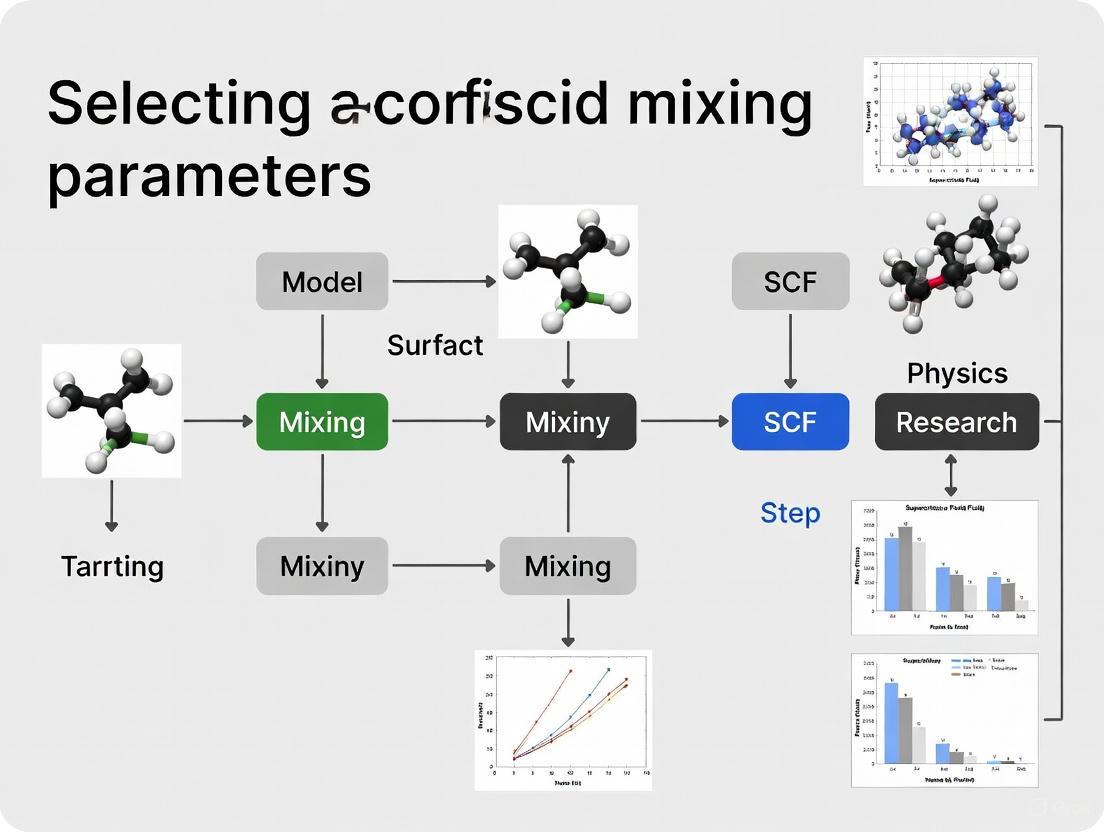
This guide provides researchers and computational scientists with a comprehensive framework for selecting and optimizing Self-Consistent Field (SCF) mixing parameters to achieve robust convergence in electronic structure calculations.
A Practical Guide to SCF Mixing Parameter Selection: Strategies for Robust Convergence in Electronic Structure Calculations
Abstract
This guide provides researchers and computational scientists with a comprehensive framework for selecting and optimizing Self-Consistent Field (SCF) mixing parameters to achieve robust convergence in electronic structure calculations. Covering foundational principles to advanced troubleshooting, it details key mixing methods—including DIIS, Pulay, and Broyden—their practical implementation across major computational codes, and systematic approaches for diagnosing and resolving common convergence failures in challenging systems like metals and open-shell molecules. The article empowers users to enhance computational efficiency and reliability through validated parameter selection and comparative analysis.
Understanding SCF Convergence: Core Principles and the Critical Role of Mixing
The Self-Consistent Field (SCF) method forms the computational backbone for solving the electronic structure problem in quantum chemistry and materials science, particularly within Density Functional Theory (DFT) calculations. This approach addresses a fundamental circular challenge: the Hamiltonian operator depends on the electron density, which in turn is derived from the solutions (orbitals) to the Hamiltonian itself [1]. This interdependency creates a nonlinear problem that cannot be solved directly in a single step. Instead, the SCF method employs an iterative cycle, starting from an initial guess and progressively refining the solution until convergence is achieved. The iterative nature is not merely a convenience but a necessity arising from the physics of many-electron systems. Without this stepwise approach, determining the electronic structure of molecules and materials would be computationally intractable for all but the simplest systems. The efficiency and reliability of this iterative process are therefore critical for researchers in drug development and materials science, where accurate electronic structure information underpins the understanding of molecular interactions, reactivity, and properties.
The Fundamental SCF Cycle and Convergence Criteria
The Core Iterative Loop
The SCF cycle is a well-defined iterative procedure [1]. It begins with an initial guess for the electron density or density matrix. This guess is used to construct the Hamiltonian, which incorporates the kinetic energy of the electrons, their interaction with the atomic nuclei, and the electron-electron interactions. The Kohn-Sham equations (the central equations of DFT) are then solved using this Hamiltonian to obtain a new set of orbitals. From these new orbitals, a new electron density is calculated. This new density is compared to the previous one. If they are sufficiently similar, the calculation is considered converged. If not, the new density is used to construct a new Hamiltonian, and the cycle repeats. This process is illustrated in the following workflow:
Quantifying Convergence
Determining when to stop the iterative cycle is crucial. Continuing iterations beyond convergence wastes computational resources, while stopping too early yields inaccurate results. Several quantitative criteria are used, often in combination [1] [2]. The maximum change in the density matrix (dDmax) measures the largest element-wise difference between the input and output density matrices of an iteration. The maximum change in the Hamiltonian (dHmax) performs a similar check on the Hamiltonian. The change in total energy between cycles is another key metric; when the energy stabilizes, the solution is nearing convergence. Finally, the magnitude of the commutator of the Fock and density matrices ([F,P]) is a fundamental measure of self-consistency, as this commutator is zero for the exact solution [3]. Different software packages implement these criteria with varying default tolerances, allowing users to balance accuracy and computational cost based on their specific needs.
Table 1: Standard SCF Convergence Tolerances in ORCA (Selected) [2]
| Criterion | LooseSCF | NormalSCF | TightSCF | VeryTightSCF |
|---|---|---|---|---|
| Energy (TolE) | 1.0e-5 | 1.0e-6 | 1.0e-8 | 1.0e-9 |
| Max Density (TolMaxP) | 1.0e-3 | 1.0e-5 | 1.0e-7 | 1.0e-8 |
| RMS Density (TolRMSP) | 1.0e-4 | 1.0e-6 | 5.0e-9 | 1.0e-9 |
| DIIS Error (TolErr) | 5.0e-4 | 1.0e-5 | 5.0e-7 | 1.0e-8 |
Challenges in SCF Convergence and Acceleration Techniques
Common Convergence Problems
The path to SCF convergence is not always smooth. Poor initial guesses, such as those from overlapping atomic densities, can lead to slow convergence or stagnation [1]. Systems with metallic character or delocalized electrons often exhibit charge sloshing, where electron density oscillates between different parts of the system from one iteration to the next [1]. Open-shell systems involving transition metals are particularly notorious for convergence difficulties due to the presence of nearly degenerate electronic states and complex potential energy surfaces [2]. In severe cases, the SCF cycle can enter a persistent oscillation or diverge entirely, with the energy and density errors increasing with each iteration.
Algorithms for Convergence Acceleration
To overcome these challenges, several sophisticated algorithms have been developed that move beyond simple iteration. These methods use information from previous cycles to generate a better input for the next cycle.
Linear Mixing: This is the simplest form of damping. The input density for the next cycle, ( D{in}^{n+1} ), is a linear combination of the output density, ( D{out}^{n} ), and the input density, ( D{in}^{n} ), from the current cycle: ( D{in}^{n+1} = \text{mix} \times D{out}^{n} + (1-\text{mix}) \times D{in}^{n} ) [1]. A low
mixvalue (e.g., 0.1) stabilizes the SCF but can lead to slow convergence.Pulay DIIS (Direct Inversion in the Iterative Subspace): This is the default method in many codes [3] [1]. DIIS (also known as Pulay mixing) extrapolates the next Fock or density matrix by finding an optimal linear combination of the matrices from previous iterations that minimizes a designated error vector (often the commutator [F,P]). It is much more efficient than linear mixing for most systems.
Broyden Methods: Broyden's technique is a quasi-Newton approach that iteratively updates an approximation to the Jacobian inverse [1]. It often performs similarly to Pulay DIIS but can be more effective for specific problematic systems like metals or magnetic materials.
The following diagram illustrates the logical process of selecting an appropriate mixing algorithm based on system characteristics and convergence behavior:
Practical Protocols for SCF Mixing Parameter Selection
Protocol 1: Systematic Parameter Optimization for a Novel Molecule
This protocol provides a step-by-step methodology for determining optimal SCF parameters for a new molecular system.
- Initial Setup: Begin with a default geometry optimization using standard SCF settings (e.g.,
NormalSCFin ORCA [2] orSCF.Mixer.Method Pulayin SIESTA [1]). - Baseline Assessment: Run a single-point energy calculation and record the number of SCF cycles and final energy. If convergence is not reached, note the error pattern (e.g., oscillation, divergence).
- Mixing Method Screening: Using the converged geometry, test different mixing methods (
Linear,Pulay,Broyden) with their default parameters. Use a fixed, large number of maximum SCF cycles (e.g., 300 [3]). - Parameter Refinement: For the most promising method, systematically vary its key parameter. For
PulayorBroyden, this is theSCF.Mixer.History(number of previous cycles used). ForLinearmixing, it is theSCF.Mixer.Weight(damping factor). - Validation: Perform a final calculation with the optimized parameters and verify that the resulting energy and properties are consistent with, but obtained faster than, the baseline calculation.
Table 2: Experimental Comparison of Mixing Parameters for a CH₄ Molecule (Representative Data) [1]
| Mixer Method | Mixer Weight | Mixer History | # of Iterations | Final Energy (Ha) |
|---|---|---|---|---|
| Linear | 0.1 | 1 | 45 | -40.525 |
| Linear | 0.2 | 1 | 38 | -40.525 |
| Linear | 0.6 | 1 | 72 (Diverged) | - |
| Pulay | 0.1 | 2 | 22 | -40.525 |
| Pulay | 0.5 | 5 | 12 | -40.525 |
| Pulay | 0.9 | 10 | 8 | -40.525 |
| Broyden | 0.7 | 5 | 10 | -40.525 |
Protocol 2: Troubleshooting a Non-Convergent System
For systems that fail to converge with standard protocols, a more aggressive approach is required.
- Diagnosis: Analyze the SCF output to identify the behavior. Is the energy/density oscillating between two values, or is it steadily increasing (diverging)?
- Initial Stabilization:
- For oscillating systems, reduce the
Mixingweight orMixing1for the first iteration [3]. This damps the updates. - Enable level shifting (
Lshiftin ADF) if available, which raises the energy of unoccupied orbitals to prevent charge sloshing [3]. - Use electron smearing to partially occupy orbitals around the Fermi level, which can help in metallic systems [3].
- For oscillating systems, reduce the
- Advanced Acceleration:
- If simple damping is too slow, switch to an advanced method like
LIST(Linear-expansion Shooting Technique) orMESA(which combines multiple methods) [3]. - Increase the
DIIS Nvalue (the number of expansion vectors) to provide the acceleration algorithm with more information [3]. For very difficult cases, values between 12 and 20 can be effective.
- If simple damping is too slow, switch to an advanced method like
- Last Resort - Direct Minimization: If all else fails, switch from the standard SCF to a direct energy minimization algorithm, such as the Trust-Region method (
!TRAHin ORCA), which is more robust but can be computationally more demanding per iteration [2].
The Scientist's Toolkit: Essential Research Reagent Solutions
In computational chemistry, the "reagents" are the software tools, algorithms, and numerical settings used to conduct research.
Table 3: Key Research Reagent Solutions for SCF Studies
| Tool / Solution | Function / Purpose | Example Use Case |
|---|---|---|
| Pulay (DIIS) Algorithm | Accelerates SCF convergence by extrapolating from a history of previous Fock/Density matrices. | Default method for most molecular and solid-state systems [1]. |
| Broyden Algorithm | Quasi-Newton scheme that updates an approximate Jacobian; an alternative to Pulay. | Can be superior for metallic systems or magnetic transition metal complexes [1]. |
| Linear Mixing | Simple damping of the density or Fock matrix updates using a fixed weight. | Provides a robust fallback for highly oscillatory systems that cause DIIS to diverge [3]. |
| Level Shifting | Artificially increases the energy of virtual orbitals. | Suppresses charge sloshing by preventing electrons from jumping into low-lying virtual orbitals during iterations [3]. |
| Electron Smearing | Assigns fractional occupations to orbitals near the Fermi level. | Essential for converging metallic systems by stabilizing the total energy [3]. |
| SCF Stability Analysis | Checks if the converged wavefunction is a true minimum and not a saddle point. | Used after convergence for open-shell systems to ensure a physically meaningful solution [2]. |
The self-consistent field (SCF) method is the foundational algorithm for solving electronic structure problems in Hartree-Fock and density functional theory. As an iterative procedure, its convergence is not guaranteed and often proves challenging for specific classes of chemical systems. The efficiency and success of computational chemistry and materials science research directly depend on robustly navigating these convergence challenges. This application note addresses three prevalent and interconnected SCF convergence issues—energy oscillations, charge sloshing, and slow convergence—within the broader research context of developing practical protocols for SCF mixing parameter selection. These problems occur most frequently in systems with very small HOMO-LUMO gaps, those containing d- and f-elements with localized open-shell configurations, in transition state structures with dissociating bonds, and in metallic systems with delocalized electrons [4] [5]. A foundational step before implementing advanced protocols is to verify that the atomistic system under study is realistic, with proper bond lengths and angles, and that the correct spin multiplicity has been assigned, as an improper physical description will preclude convergence regardless of technical adjustments [4].
Theoretical Background and Key Concepts
The SCF Cycle and the Role of Mixing
The SCF procedure iteratively refines an initial guess of the electron density or Kohn-Sham matrix until the input and output densities are self-consistent. The self-consistent error, which the procedure aims to minimize, is typically defined as the square root of the integral of the squared difference between the input and output densities [6]. The mixing parameter, often denoted as Mixing or mixing_beta, is a critical numerical factor that controls the fraction of the newly computed potential or density that is blended with the old to create the input for the next iteration. A higher mixing value (e.g., 0.4) leads to more aggressive updates and potentially faster convergence, but also an increased risk of instability. In contrast, a lower value (e.g., 0.01) dampens the update, stabilizing the calculation at the cost of slower convergence [4] [7]. Most modern codes employ sophisticated algorithms like DIIS (Direct Inversion in the Iterative Subspace) to accelerate convergence by constructing the next guess from a linear combination of previous Fock matrices [4].
Fundamental Challenges
- Energy Oscillations: Also known as "sloshing instabilities," this phenomenon manifests as a see-saw behavior where the total energy fluctuates between two or more values without converging [7]. This occurs because the electron density is over-corrected in each cycle. For instance, a region with initially high electron density leads to a high potential, causing the subsequent SCF step to move too much electron density away from it. The next iteration then sees a low potential in that region, causing density to move back in, creating a perpetual cycle [7].
- Charge Sloshing: This is a specific, long-wavelength type of oscillation prevalent in metallic systems and large, elongated cells. In systems with a small HOMO-LUMO gap, the electronic charge has a very large response length, causing the density to swing wildly between different parts of the system, much like water sloshing in a tank [5]. This is a primary reason for convergence failures in metal clusters and elongated simulation cells [5].
- Slow Convergence: This is characterized by a steady but frustratingly slow reduction in the SCF error over dozens or hundreds of iterations. It is common in systems with degenerate or near-degenerate electronic states, such as open-shell transition metal complexes and radical species, where the electronic structure is nearly multi-reference in character [4] [8].
Diagnostic Protocols and Workflows
Identifying the Problem
A systematic diagnostic workflow is essential for efficiently resolving SCF convergence issues. The following diagram outlines the logical decision process for identifying and addressing the three primary challenges discussed in this note.
Monitoring Convergence Criteria
Beyond the total energy, modern quantum chemistry codes like ORCA provide multiple metrics to judge convergence precisely. The following table summarizes key tolerance parameters for different convergence presets in ORCA, which can be adapted to other software [2].
Table 1: ORCA SCF Convergence Tolerances for Different Presets
| Tolerance Parameter | SloppySCF | LooseSCF | StrongSCF | TightSCF | VeryTightSCF |
|---|---|---|---|---|---|
| TolE (Energy Change) | 3.0e-5 | 1.0e-5 | 3.0e-7 | 1.0e-8 | 1.0e-9 |
| TolMaxP (Max Density Change) | 1.0e-4 | 1.0e-3 | 3.0e-6 | 1.0e-7 | 1.0e-8 |
| TolRMSP (RMS Density Change) | 1.0e-5 | 1.0e-4 | 1.0e-7 | 5.0e-9 | 1.0e-9 |
| TolErr (DIIS Error) | 1.0e-4 | 5.0e-4 | 3.0e-6 | 5.0e-7 | 1.0e-8 |
It is critical to ensure that the accuracy of the two-electron integrals is higher than the chosen SCF convergence tolerance; otherwise, convergence becomes impossible [2].
Experimental Protocols for Resolution
Protocol 1: Resolving Energy Oscillations
Applicability: Calculations where the total energy oscillates between two or more values with a constant or growing amplitude [7].
Step-by-Step Procedure:
- Initial Action: Significantly reduce the mixing parameter. For example, in CP2K, reduce the
ALPHAparameter in theMIXINGsection from the default of 0.4 to 0.1 or even 0.01 [7]. In ADF, theMixingparameter can be reduced from 0.2 to 0.015 [4]. - Secondary Strategy: If reducing the mixing parameter is insufficient, switch the convergence accelerator or enable a preconditioner. In plane-wave codes, using a Kerker preconditioner is highly effective. In Gaussian-basis codes like ADF, consider switching from DIIS to alternative methods like MESA or LISTi [4].
- Advanced Tuning: For persistent cases, adjust the DIIS parameters to make the extrapolation more stable. A recommended starting point in ADF is to increase the number of DIIS expansion vectors (
N 25) and delay the start of the DIIS procedure (Cyc 30) [4].
Protocol 2: Mitigating Charge Sloshing in Metallic Systems
Applicability: Metallic clusters, bulk metals, and systems with very small or zero HOMO-LUMO gaps [5].
Step-by-Step Procedure:
- Employ Preconditioned Mixing: Use a mixing scheme that incorporates a model for the dielectric function, such as the Kerker preconditioner. This technique efficiently damps the long-wavelength charge oscillations that cause charge sloshing [5] [9].
- Apply Fermi-Level Smearing: Introduce a small electronic temperature (e.g., 300 K) with Fermi-Dirac or Gaussian smearing. This assigns fractional occupations to states near the Fermi level, effectively smoothing the sharp changes in occupation that destabilize the SCF procedure [4] [5]. The value should be kept as low as possible to avoid altering physical properties.
- Use Aggressive Damping: Combine a Kerker preconditioner with a very low mixing parameter (e.g., 0.01). This approach is often necessary for large, challenging systems like Pt~55~ clusters [5].
Protocol 3: Accelerating Slow Convergence
Applicability: Open-shell transition metal complexes, systems with nearly degenerate states, and calculations using hybrid meta-GGA functionals [4] [8].
Step-by-Step Procedure:
- Utilize Electron Smearing: As with metallic systems, a small amount of smearing can help overcome convergence issues in systems with many near-degenerate levels by preventing electrons from jumping between these levels in successive iterations [4].
- Optimize DIIS Settings: Increase the stability of the DIIS algorithm. This can be done by increasing the number of previous Fock matrices used in the extrapolation (the DIIS subspace). For instance, increasing this number from a default of 10 to 25 can stabilize convergence for difficult systems [4].
- Level Shifting Technique: As a last resort, artificially raise the energy of the unoccupied (virtual) orbitals. This can help break degeneracy and force convergence but should be used with caution as it can give incorrect values for properties that involve virtual orbitals, such as excitation energies [4].
Table 2: Summary of SCF Convergence Protocols and Key Parameters
| Challenge | Primary Strategy | Key Parameters to Adjust | Example Values | Considerations |
|---|---|---|---|---|
| Energy Oscillations | Increase damping | Mixing / mixing_beta |
0.01 - 0.1 | Stabilizes iteration at the cost of speed [4] [7]. |
| Charge Sloshing | Preconditioned mixing | Preconditioner (e.g., Kerker), mixing_beta |
Kerker, beta=0.01 | Essential for metals and elongated cells [5]. |
| Slow Convergence | Electron smearing & DIIS tuning | ElectronicTemperature, DIIS_Subspace |
300 K, N=25 | Helps resolve near-degeneracies [4]. |
| General (ADF Example) | Conservative DIIS | N, Cyc, Mixing |
N=25, Cyc=30, Mixing=0.015 | A robust starting point for difficult cases [4]. |
The Scientist's Toolkit: Research Reagent Solutions
Table 3: Essential Computational Tools and Parameters for SCF Convergence
| Tool / Parameter | Function / Description | Relevant Software |
|---|---|---|
| DIIS Algorithm | Extrapolates a new Fock matrix from a linear combination of previous matrices to accelerate convergence. | ADF, ORCA, Gaussian [4] [5] |
| Kerker Preconditioner | A preconditioner that damps long-wavelength charge oscillations, critical for metallic systems. | VASP, Quantum ESPRESSO, DFTK [5] [9] |
| Fermi-Dirac Smearing | Smears electronic occupations around the Fermi level using a finite electronic temperature. | CP2K, VASP, ADF [4] [5] |
Mixing Parameter (mixing_beta) |
The damping factor controlling the fraction of the new density/potential used in the next SCF cycle. | All major codes (e.g., Quantum ESPRESSO, CP2K) [4] [7] |
| Level Shifting | Artificially raises the energy of unoccupied orbitals to facilitate convergence. | ADF, Gaussian [4] |
| Bayesian Optimization | An advanced, data-efficient algorithm to automatically optimize charge mixing parameters for faster convergence. | VASP [10] |
Successfully navigating SCF convergence challenges requires a methodical approach that combines a clear diagnosis of the problem with the systematic application of targeted protocols. As detailed in this note, energy oscillations typically call for increased damping, charge sloshing requires specialized preconditioning, and slow convergence in degenerate systems benefits from smearing and DIIS tuning. The overarching strategy is to first stabilize the calculation, even at the expense of speed, and then carefully optimize parameters for efficiency. Adopting the structured workflows and parameter guidelines provided here will equip researchers to robustly tackle a wide spectrum of SCF convergence problems, thereby enhancing the reliability and throughput of their computational research in drug development and materials design.
Self-Consistent Field (SCF) iteration is the fundamental algorithm for solving the electronic structure problem in Hartree-Fock and Kohn-Sham Density Functional Theory. This nonlinear fixed-point algorithm iteratively solves eigenproblems derived from density-dependent Hamiltonians until convergence is reached, meaning the electron density or density matrix becomes invariant between cycles [11]. The core challenge lies in the self-consistent nature of the problem: the Hamiltonian depends on the electron density, which in turn is obtained from the Hamiltonian [1].
Without sophisticated mixing strategies, these iterations may diverge, oscillate, or converge unacceptably slowly [1]. This application note provides a structured overview of the primary mixing and acceleration strategies—from basic damping to advanced DIIS-based methods—and offers practical protocols for their implementation, enabling researchers to systematically address SCF convergence challenges in computational chemistry and drug development projects.
Theoretical Foundation of SCF Mixing
The SCF Cycle and Convergence Challenge
The SCF cycle represents a nonlinear fixed-point problem mathematically expressed as ( \rho{k+1} = F[\rhok] ), where ( \rho ) is the electron density and ( F ) is the fixed-point map that encapsulates solving the eigenproblem at each step [11]. In simple terms, each cycle involves computing a new Fock or Kohn-Sham matrix from the current density, diagonalizing it to obtain new orbitals, and constructing a new density from these orbitals. This process repeats until input and output densities are sufficiently similar.
The convergence behavior is governed by the spectral properties of the Jacobian (or "dielectric operator") associated with this fixed-point map. Local convergence occurs only if the spectral radius of this Jacobian is less than one [11]. In quantum chemical systems, this condition is frequently violated due to phenomena like "charge sloshing" in metallic systems, where electrons oscillate between different parts of the system, or due to near-degeneracies in open-shell transition metal complexes [11] [4].
Fundamental Mixing Approaches
At its core, mixing strategies aim to stabilize the SCF iteration by intelligently combining information from previous iterations to generate the next input. The two fundamental approaches are:
- Density Mixing: The electron density or density matrix is the primary quantity being mixed between iterations [1] [12]
- Hamiltonian (Fock) Mixing: The Fock or Kohn-Sham matrix is the mixed quantity [1]
The choice between these strategies affects the SCF procedure's structure. When mixing the Hamiltonian, the program first computes the density matrix from the Hamiltonian, obtains a new Hamiltonian from that density matrix, and then mixes the Hamiltonian appropriately. When mixing the density, the program first computes the Hamiltonian from the density matrix, obtains a new density matrix from that Hamiltonian, and then mixes the density matrix appropriately [1].
Key Mixing Algorithms and Methods
Simple Damping
Simple damping (or linear mixing) represents the most fundamental mixing approach, where the next input density or Fock matrix is constructed as a linear combination of the current output and previous input:
[ F{n+1} = \text{mix} \cdot F{n} + (1 - \text{mix}) \cdot F_{n-1} ]
where mix is the damping parameter typically ranging from 0.01 to 0.2 [3] [4]. This method is robust but often inefficient for difficult systems, as too small a value leads to slow convergence while too large a value causes divergence [1].
DIIS and Advanced Methods
The Direct Inversion in the Iterative Subspace (DIIS) method, also known as Pulay mixing, represents a significant advancement over simple damping [1] [11]. Rather than using only the previous iteration, DIIS forms an optimized linear combination of multiple previous Fock or density matrices to minimize the commutator error [F,P] (the commutator of the Fock and density matrices) [3]. The standard DIIS approach minimizes the orbital rotation gradient based on this commutator matrix [13].
Several enhanced DIIS variants have been developed:
- SDIIS: The original Pulay DIIS scheme [3]
- ADIIS (Augmented DIIS): Uses a quadratic augmented Roothaan-Hall energy function as the minimization object for obtaining linear coefficients, often combined with SDIIS as "ADIIS+DIIS" [3] [13]
- EDIIS (Energy DIIS): Minimizes a quadratic energy function to obtain linear coefficients [3] [13]
- LIST Methods: Linear-expansion shooting techniques including LISTi, LISTb, and LISTf [3]
Integrated and Specialized Methods
Modern SCF implementations often feature integrated methods that combine multiple acceleration techniques:
- MESA Method: Combines several acceleration methods (ADIIS, fDIIS, LISTb, LISTf, LISTi, and SDIIS), allowing users to disable specific components as needed [3]
- MultiStepper: The default method in BAND, which automatically adapts the mixing parameter during SCF iterations [6]
- Broyden Mixing: A quasi-Newton scheme that updates mixing using approximate Jacobians, sometimes outperforming Pulay in metallic or magnetic systems [1]
Table 1: Key SCF Acceleration Methods and Their Characteristics
| Method | Key Principle | Strengths | Typical Use Cases |
|---|---|---|---|
| Simple Damping | Linear interpolation between successive iterates | High robustness, simple control | Initial troubleshooting, very stable systems |
| DIIS (Pulay) | Minimizes commutator [F,P] from multiple previous cycles | Fast convergence for most molecular systems | Default for many codes, general applications |
| ADIIS+DIIS | Combines energy minimization (ARH) with commutator minimization | High reliability and efficiency | Problematic cases where standard DIIS fails |
| LIST Methods | Linear-expansion shooting technique | Good for specific difficult cases | Small gap systems, transition metal complexes |
| MESA | Combines multiple acceleration methods | Adaptable, can disable failing components | Highly problematic cases, exploratory calculations |
| Broyden | Quasi-Newton scheme with approximate Jacobians | Good for metals, magnetic systems | Metallic systems, spin-polarized calculations |
Practical Implementation Protocols
Parameter Selection Guidelines
Successful SCF convergence depends heavily on appropriate parameter selection. The following table summarizes key parameters and their typical values:
Table 2: Key SCF Mixing Parameters and Recommended Values
| Parameter | Description | Default Value | Stable Values (Difficult Systems) | Aggressive Values (Easy Systems) |
|---|---|---|---|---|
| Mixing / Mixer.Weight | Damping factor in linear mixing or initial weight in advanced methods | 0.2 (ADF) [3], 0.075 (BAND) [6], 0.25 (SIESTA) [1] | 0.015-0.1 [4] | 0.3-0.5 |
| DIIS N / Mixer.History | Number of previous iterations used in DIIS | 10 (ADF) [3], 2 (SIESTA) [1] | 15-25 [3] [4] | 5-8 |
| Iterations | Maximum SCF cycles allowed | 300 (ADF, BAND) [3] [6] | 500-1000 | 100-150 |
| DIIS Cyc | Iteration at which DIIS starts (after initial damping) | 5 (ADF) [3] | 20-30 [4] | 2-3 |
| Convergence Criterion | SCF error tolerance for convergence | Varies by code and numerical quality settings [6] | Tighten by factor 10 for precision | Loosen by factor 10-100 for initial scans |
System-Specific Strategy Selection
Different chemical systems require tailored mixing strategies:
For Typical Organic Molecules (Closed-Shell):
- Begin with default DIIS/Pulay settings
- Use Hamiltonian mixing rather than density mixing [1]
- Standard convergence criteria (e.g., 10⁻⁶ Eh energy change) are usually sufficient [14]
For Open-Shell Transition Metal Complexes:
- Implement more conservative parameters initially (mixing=0.1, DIIS N=15)
- Consider ADIIS+DIIS or EDIIS+DIIS combinations [3] [13]
- Use tighter convergence criteria (e.g., TolE 10⁻⁸) for reliable results [14]
- Verify stability of the solution using SCF stability analysis [15]
For Metallic Systems with Small HOMO-LUMO Gaps:
- Employ Broyden mixing or Kerker preconditioning [1] [11]
- Implement electron smearing with finite electronic temperature [6] [4]
- Increase number of empty bands to accommodate near-degenerate states [12]
- Consider density mixing rather than all-bands minimization [12]
For Difficult Cases with Strong Oscillations:
- Use highly conservative parameters (mixing=0.015, DIIS Cyc=30, DIIS N=25) [4]
- Temporarily enable level shifting (note: affects properties using virtual orbitals) [3] [4]
- Try the ARH (Augmented Roothaan-Hall) method as a robust alternative [4]
- Implement periodic Pulay mixing instead of standard DIIS [11]
Diagnostic and Troubleshooting Protocol
When facing SCF convergence issues, follow this systematic diagnostic protocol:
Verify Physical Reasonableness
Analyze Convergence Behavior
Implement Progressive Interventions
- First attempt: Increase maximum iterations to 500 and slightly reduce mixing parameter
- Second intervention: Switch to more robust acceleration method (ADIIS+DIIS or MESA)
- Third intervention: Implement electron smearing with small width (0.001-0.01 Ha)
- Final recourse: Use level shifting or ARH method [4]
SCF Convergence Troubleshooting Workflow
The Researcher's Toolkit: Essential SCF Control Parameters
Critical Parameters Across Quantum Chemistry Codes
Implementation of mixing strategies requires familiarity with code-specific keywords and parameters:
Table 3: SCF Control Parameters Across Major Quantum Chemistry Codes
| Code | Mixing Parameter | DIIS History | Convergence Criterion | Acceleration Method |
|---|---|---|---|---|
| ADF | SCF Mixing value [3] |
SCF DIIS N value [3] |
SCF Converge value [3] |
SCF AccelerationMethod [3] |
| SIESTA | SCF.Mixer.Weight value [1] |
SCF.Mixer.History value [1] |
SCF.DM.Tolerance value [1] |
SCF.Mixer.Method Pulay/Broyden [1] |
| BAND | SCF Mixing value [6] |
DIIS NVctrx value [6] |
Convergence Criterion value [6] |
SCF Method DIIS/MultiStepper [6] |
| ORCA | DIIS[1].Damp value (in %scf block) |
Not directly controlled | TolE value in %scf block [14] |
Automatic based on method |
| CASTEP | Mixing amplitude value [12] |
DIIS history length value [12] |
Electronic energy tolerance [12] | Electronic minimizer algorithm [12] |
Advanced Technique Implementation
For persistently difficult systems, these advanced techniques can be implemented:
Electron Smearing Protocol:
- Apply finite electronic temperature to fractional occupy near-degenerate orbitals
- Start with larger smearing (e.g., 0.01 Ha) and progressively reduce in restart calculations
- Keep value as low as possible to minimize energy alteration [4]
Level Shifting Protocol:
- Artificially raise virtual orbital energies by 0.1-0.5 Ha
- Disable once SCF error drops below threshold (e.g., 0.001) [3]
- Note: Invalidates properties involving virtual orbitals (excitation energies, NMR) [3]
Stability Analysis Protocol:
- Perform after SCF convergence to verify solution is a true minimum [15]
- If unstable, restart with modified initial guess or different multiplicity
- Particularly crucial for open-shell singlets and transition metal complexes [15]
SCF Method Selection Guide
Effective SCF mixing strategy selection requires a systematic approach that balances convergence speed with stability. While default parameters work satisfactorily for most routine applications, challenging systems including open-shell transition metal complexes, metallic systems with small HOMO-LUMO gaps, and transition state structures demand specialized strategies.
The most robust general approach for difficult cases combines energy-based methods like ADIIS or EDIIS with commutator-based DIIS, implemented with conservative parameters (low mixing values, larger DIIS history). When these fail, specialized techniques including electron smearing, level shifting, or the ARH method provide viable alternatives, though potentially at the cost of modified physical results or increased computational expense.
Future developments in SCF convergence technology continue to focus on adaptive methods that automatically select optimal strategies based on system characteristics, low-rank preconditioners for large systems, and improved stability analysis tools. By mastering the fundamental mixing strategies outlined in this protocol, researchers can systematically address SCF convergence challenges across diverse chemical systems encountered in drug development and materials design.
In the realm of electronic structure calculations, achieving self-consistent field (SCF) convergence is a fundamental step. The selection of mixing parameters—Mixing Weight, Mixing History, and Convergence Criteria—is often the difference between rapid success and persistent failure. This guide provides a structured approach to parameter selection, complete with practical protocols and troubleshooting strategies, to equip researchers with the tools for efficient and reliable SCF calculations.
Core Concepts: The SCF Trinity
The SCF cycle is an iterative process where the electron density or Hamiltonian is updated until it no longer changes significantly between cycles. Mixing algorithms control this update by intelligently combining information from current and previous iterations to produce a better input for the next cycle.
The Three Key Parameters
- Mixing Weight (Damping Factor): This parameter controls the fraction of the new, output density (or Hamiltonian) used to update the old, input density for the next SCF cycle. A lower value (e.g., 0.1) results in heavy damping, which is stable but slow. A higher value (e.g., 0.3) can lead to faster convergence but also increases the risk of oscillations or divergence [1] [16].
- Mixing History: Advanced algorithms like Pulay (DIIS) and Broyden utilize information from multiple previous SCF cycles to predict a better update. The
Historyparameter specifies how many previous cycles are stored and used in this extrapolation [1]. A larger history can accelerate convergence but uses more memory. - Convergence Criterion: This is the target error tolerance that defines when the SCF calculation is considered converged. It is typically measured as the root-mean-square (RMS) or maximum change in the density matrix (DM) or Hamiltonian (H) between cycles [6] [1]. Tighter criteria (smaller numbers) yield more accurate results at the cost of more iterations.
The following workflow outlines the standard procedure for diagnosing SCF convergence issues and systematically adjusting these key parameters.
Quantitative Parameter Tables
Default Parameter Values Across Popular Codes
Table 1: Default SCF parameter values in different computational packages.
| Software | Default Mixing Weight | Default History | Default Convergence Criterion | Default Mixing Method |
|---|---|---|---|---|
| BAND | 0.075 [6] | N/A (Method dependent) | 1e-6 × √Natoms (Normal quality) [6] | MultiStepper [6] |
| SIESTA | 0.25 (Linear) [1] | 2 [1] | DM Tolerance: 1e-4; H Tolerance: 1e-3 eV [1] | Pulay [1] |
| Q-Chem | Varies by algorithm | Varies by algorithm | 1e-5 (Energy), stricter for other job types [17] | DIIS [17] |
| Gaussian | N/A (Dynamic) | N/A (Dynamic) | 1e-5 (RMS density) [18] | Combination of EDIIS and CDIIS [18] |
Recommended Parameter Adjustments for Common Scenarios
Table 2: Tailoring SCF parameters based on system characteristics and observed behavior.
| Scenario / Symptom | Recommended Mixing Weight | Recommended History | Other Actions |
|---|---|---|---|
| Metallic Systems | Low (0.01 - 0.1) [1] [16] | Medium to High (4 - 8) | Use Broyden method [1]; Enable Fermi smearing. |
| Magnetic Systems | Low to Medium (0.05 - 0.2) | Medium to High (4 - 8) | Use Broyden method [1]. |
| Diverging SCF | Decrease significantly (e.g., 0.01) [16] | Consider reducing | Switch to more robust algorithm (e.g., QC in Gaussian) [18]. |
| Oscillating SCF | Decrease (e.g., halve the current value) | Keep or slightly increase | Ensure sufficient history for Pulay/Broyden [1]. |
| Stalled SCF | Slightly increase (e.g., +0.05) | Increase (e.g., 6 - 10) | Use a "kick" to perturb density [16]. |
| Standard Molecule (Stable) | Default or Medium (0.1 - 0.25) | Default (e.g., 2 - 4) | Usually requires no adjustment. |
Experimental Protocols for Parameter Optimization
Protocol 1: Systematic Convergence Study
This protocol provides a methodical approach to identifying the optimal parameters for a new system.
- Baseline Calculation: Run an SCF calculation using the software's default parameters. Record the number of iterations and final energy.
- Vary Mixing Weight: Keeping other parameters constant, perform a series of calculations with
MixingWeightvalues spanning a logical range (e.g., 0.01, 0.05, 0.1, 0.2, 0.3). - Vary History Depth: Using the best
MixingWeightfrom the previous step, perform another series of calculations varying theHistoryparameter (e.g., 2, 4, 6, 8). - Analyze Results: Plot the number of SCF iterations against the parameter values for each series. The optimal value is the one that leads to the fastest, most stable convergence. As demonstrated in SIESTA tutorials, creating a summary table is highly effective [1].
- Final Validation: Run a calculation with the identified optimal parameters and a tighter convergence criterion to ensure stability and accuracy.
Protocol 2: Troubleshooting a Non-Converging SCF
This reactive protocol is for rescuing a calculation that fails to converge.
- Diagnosis: Scrutinize the SCF output to identify the pattern of the error. Is the energy/density error growing (divergence), oscillating between values, or decreasing imperceptibly (stall)?
- Initial Stabilization:
- For divergence or oscillation, immediately reduce the
MixingWeightby at least 50%. In severe cases, use a very low value like 0.02 or even 0.01 and switch to simple linear mixing for a few iterations to stabilize the calculation [16]. - For a stall, slightly increase the
MixingWeightand significantly increase theHistoryparameter to give the Pulay or Broyden algorithm more information to work with.
- For divergence or oscillation, immediately reduce the
- Apply a "Kick": If the calculation stalls at a specific iteration, use a "kick" function (e.g.,
SCF.Mixer.Kickin SIESTA) to perturb the density and escape the local minimum. The kick should be applied only after the stall occurs, not at every few iterations [16]. - Algorithm Switch: If the above fails, change the SCF algorithm itself. For example, switch from DIIS to a quadratically convergent (QC) method [18], a direct minimization algorithm [17], or a robust, black-box pipeline that combines multiple methods [17].
The Scientist's Toolkit: Essential Reagents & Codes
Table 3: Key software and algorithmic "reagents" for SCF convergence experiments.
| Item Name | Function / Purpose | Example Use Case |
|---|---|---|
| Pulay (DIIS) Mixer | Extrapolates a new density using a linear combination of densities from previous cycles to minimize the error vector. | General-purpose, efficient convergence for most molecular systems [1]. |
| Broyden Mixer | A quasi-Newton method that updates an approximate Jacobian. Similar performance to Pulay, sometimes superior for metals [1]. | Metallic systems, magnetic systems, when Pulay fails [1]. |
| Linear Mixer | Simple damping: Dnew = (1-ω)Dold + ωDout. Highly robust but slow [1]. | Initial stabilization of a violently diverging SCF calculation [16]. |
| SCF "Kick" | A deliberate perturbation of the density or Hamiltonian to escape a metastable state or stall in the SCF cycle [16]. | Restarting progress when the SCF error is no longer decreasing. |
| Fermi Smearing | Assigns fractional occupations to orbitals near the Fermi level, effectively adding an electronic temperature. | Greatly improves convergence for metallic systems and those with small HOMO-LUMO gaps [18]. |
| Quadratic Converger (QC) | A second-order convergence algorithm that is more robust but computationally heavier than DIIS [18]. | Difficult-to-converge systems where first-order methods like DIIS fail [18] [19]. |
| Stability Analysis | Checks if the converged SCF solution is a true minimum or a saddle point in the wavefunction space [15]. | Verifying the physical meaningfulness of a solution, especially for open-shell or strongly correlated systems. |
Advanced Troubleshooting and Final Recommendations
For persistently problematic systems, consider these advanced strategies:
- Initial Guess: A poor initial density guess can doom the SCF from the start. Consider using a superposition of atomic densities or a guess constructed from atomic orbitals (
InitialDensity psiin BAND) for a better starting point [6]. - Systemic Approach: For clusters of transition metals like nickel, which are often strongly correlated, standard SCF methods may struggle. If convergence remains elusive even after parameter tuning, it may indicate a fundamental limitation of the single-reference method, and multireference approaches should be considered [16].
- Workflow Diagram: The following diagram summarizes the advanced decision-making process for handling tough SCF cases.
In conclusion, mastering SCF parameters is an essential skill. Begin with defaults, diagnose the convergence behavior, and then apply the targeted strategies outlined in this guide. A methodical approach to adjusting mixing weight, history, and convergence criteria will significantly enhance the efficiency and success rate of your electronic structure calculations.
How Mixing Choice Impacts Stability and Computational Cost
The Self-Consistent Field (SCF) method is the foundational algorithm for finding electronic structure configurations in computational chemistry and materials science, forming the core of Hartree-Fock and Density Functional Theory (DFT) calculations [4]. This iterative procedure searches for a self-consistent electron density, where the Hamiltonian depends on the density, which in turn is obtained from the Hamiltonian [20]. The cycle repeats until convergence is reached, but this process can be notoriously tricky, with iterations that may diverge, oscillate, or converge very slowly without proper control [20].
The mixing scheme (or damping) is a critical technique used to stabilize this iterative process. It works by extrapolating the Hamiltonian or density matrix for the next SCF step, preventing large oscillations between iterations [20]. The choice of mixing method and its parameters directly determines both the numerical stability of the calculation and its computational cost (number of SCF iterations). This application note provides a structured guide to selecting appropriate mixing strategies across different electronic structure codes, with a focus on practical protocols for researchers.
Theoretical Background: SCF Cycle and Mixing Fundamentals
The SCF Cycle and Convergence Monitoring
A standard SCF cycle follows a specific workflow, illustrated below. The process begins with an initial guess for the electron density, which is typically a simple superposition of atomic densities [21].
SCF Iteration Loop with Mixing. The mixing step uses the current and previous densities (or potentials) to generate the input for the next iteration, crucially affecting stability.
Convergence is typically monitored by tracking the change in the electron density or the commutator of the Fock and density matrices. In the ADF code, convergence is considered reached when the maximum element of the [F,P] commutator falls below a threshold (default 1e-6) [3]. The BAND code defines the self-consistent error as the square root of the integral of the squared difference between input and output densities [6]:
err = √[∫dx (ρ_out(x) - ρ_in(x))²]
The Physical Origin of Convergence Problems
Sloshing instabilities are a common physical cause of SCF convergence problems, particularly in metallic systems or those with delocalized electrons [7]. These instabilities arise because the trial solutions to the Kohn-Sham equations are optimized for a fixed potential, and the update to the potential does not account for the fact that the potential itself should change as electrons are moved [7]. This leads to a characteristic oscillatory behavior where the SCF energy fluctuates between two or more values instead of converging [7].
Systems with small HOMO-LUMO gaps, d- and f-elements with localized open-shell configurations, and transition state structures with dissociating bonds are particularly prone to convergence difficulties [4]. Recent studies also indicate that neural network-based functionals (like DM21) can introduce non-smooth behavior in the exchange-correlation potential, exacerbating convergence challenges in geometry optimization [22].
Comparative Analysis of Mixing Methods and Parameters
Different quantum chemistry packages implement various mixing algorithms, each with distinct strengths and computational characteristics.
Table 1: SCF Mixing Methods and Their Characteristics
| Method | Algorithmic Principle | Typical Use Cases | Stability | Implementation Examples |
|---|---|---|---|---|
| Linear Mixing | Simple damping with fixed weight: new = mix*F_n + (1-mix)*F_n-1 [3] |
Robust starting point, simple systems | High (with low weight) | SIESTA [20], ADF [3] |
| Pulay (DIIS) | Direct Inversion in Iterative Subspace; builds optimized combination of past residuals [20] | Default for most molecular systems | Medium | ADF (SDIIS) [3], SIESTA [20], ORCA [2] |
| A-DIIS | Augmented DIIS; minimizes energy with trust-radius approach [4] | Problematic systems where Pulay DIIS fails | High | ADF (default with SDIIS) [3] |
| LIST Methods | Linear-expansion Shooting Technique; family of methods developed by Wang group [3] | Difficult metallic/magnetic systems | Variable | ADF (LISTi, LISTb, LISTf) [3] |
| Broyden | Quasi-Newton scheme; updates mixing using approximate Jacobians [20] | Metallic and magnetic systems | Medium-High | SIESTA [20] |
| MESA | Combines multiple methods (ADIIS, fDIIS, LISTb, LISTf, LISTi, SDIIS) [3] | Automatic handling of diverse cases | High | ADF [3] |
| Anderson | - | Efficient for many periodic systems | High | FLEUR [21] |
Key Mixing Parameters and Their Default Values
The performance of mixing methods is controlled by several critical parameters, with default values that vary significantly across different computational codes.
Table 2: Key Mixing Parameters and Default Values Across Codes
| Parameter | Physical Effect | ADF Default [3] | BAND Default [6] | SIESTA Default [20] | FLEUR Default [21] |
|---|---|---|---|---|---|
| Mixing Weight | Fraction of new potential/density in next guess | 0.2 | 0.075 | Varies by method | ~0.8 (precondParam) |
| DIIS History (N) | Number of previous cycles used in extrapolation | 10 | - | 2 (Pulay/Broyden) | - |
| Starting Cycle | Iteration where acceleration begins | 5 (Cyc) | - | - | - |
| Convergence Criterion | Threshold for SCF termination | 1e-6 ([F,P] max element) | 1e-6×√N_atoms (Normal quality) | DM Tolerance: 1e-4, H Tolerance: 1e-3 eV | minDistance: 1e-6 |
Quantitative Performance of Different Methods
Research has systematically evaluated the performance of various SCF acceleration methods. The ADF documentation reports that MESA, LISTi, and EDIIS can achieve significant improvements in convergence behavior for difficult chemical systems [4]. For the Augmented Roothaan-Hall (ARH) method, which directly minimizes the system's total energy as a function of the density matrix, tests show it can be a viable alternative for particularly challenging cases despite its higher computational cost per iteration [4].
Experimental Protocols for Mixing Parameter Optimization
Protocol 1: Systematic Mixing Parameter Screening
Purpose: To identify optimal mixing parameters for a new system with unknown convergence behavior. Experimental System: Any molecular or periodic system exhibiting SCF convergence difficulties. Duration: 2-8 hours of computational time depending on system size.
Step-by-Step Workflow:
Initial Assessment: Begin with a default mixing method (e.g., Pulay/DIIS in ADF [3] or SIESTA [20]) and standard parameters. Run for 20-30 SCF iterations to establish a baseline convergence behavior.
Mixing Weight Scan: Perform a series of calculations with mixing weights ranging from 0.01 to 0.5 in multiplicative steps:
- For oscillating systems: Test lower weights (0.01-0.1) [7]
- For slow, monotonic convergence: Test higher weights (0.2-0.4)
- Record the number of iterations to convergence for each weight
History Length Optimization: With the optimal mixing weight from step 2, test different history lengths (DIIS
NorMixer.History):Method Comparison: Test at least three different mixing methods (e.g., Pulay, Broyden, LISTi) with their optimized parameters from steps 2-3.
Validation: Run a full convergence with the best-performing parameter set and verify that properties (total energy, forces) are physically reasonable.
Deliverable: A parameter set (method, weight, history) that achieves convergence in the minimum number of iterations for the target system.
Protocol 2: Troubleshooting Problematic Systems
Purpose: To achieve SCF convergence for systems with severe oscillations or stagnation. Applicability: Transition metal complexes, open-shell systems, metals, and distorted geometries [4] [7].
SCF Troubleshooting Decision Pathway. A step-by-step guide for addressing different types of convergence failures.
Step-by-Step Workflow:
Initial Diagnostics:
For Oscillatory Systems (energy fluctuating between values) [7]:
For Stagnating Systems (slow, monotonic convergence):
Advanced Techniques:
- Electron smearing: Apply finite electronic temperature (e.g., 300K) to distribute occupations near Fermi level [4] [3]
- Level shifting: Artificially raise virtual orbital energies (note: affects properties using virtual states) [4] [3]
- Method switching: Use MESA method with specific components disabled (e.g.,
MESA NoSDIIS) [3]
Restart Strategy: Use a moderately converged density from a simpler calculation as the initial guess for the difficult calculation [4].
Deliverable: A converged SCF solution for a previously problematic system, with documentation of the successful strategy.
The Scientist's Toolkit: Essential Parameters and Materials
Table 3: Research Reagent Solutions for SCF Convergence
| Reagent/Parameter | Function | Example Values & Usage Notes |
|---|---|---|
Mixing Weight (Mixing, ALPHA, SCF.Mixer.Weight) |
Controls fraction of new Fock matrix/density in next iteration | Low (0.01-0.1): Stabilize oscillations [7]Medium (0.1-0.3): Standard use [6] [3]High (0.4-0.8): Accelerate slow convergence |
DIIS History (N, SCF.Mixer.History, NVctrx) |
Number of previous iterations used in extrapolation | Small (2-5): Small molecules, stability [20]Large (15-25): Difficult systems, metals [4] [3] |
Electron Smearing (ElectronicTemperature, SMEAR) |
Fractional occupations for degenerate states | 300K: Typical for metals [7]Successive reduction: 500K→300K→0K for difficult cases [4] |
Convergence Criteria (TolE, TolMaxP, Criterion) |
Thresholds for SCF termination | Loose: TolE 1e-5, geometry preliminaries [2]Tight: TolE 1e-8, final single-point, properties [2] |
Kerker Preconditioner (precondParam) |
Screens long-range charge sloshing in metals | 0.8: Optimal for most metals [21] |
The selection of SCF mixing parameters represents a critical compromise between computational efficiency and numerical stability. Based on the documented evidence from multiple quantum chemistry packages, several best practices emerge:
System-Specific Strategies: Metallic systems with small band gaps typically benefit from Kerker preconditioning, electron smearing, and potentially Broyden mixing [20] [21]. Molecular systems with large HOMO-LUMO gaps generally converge well with standard Pulay/DIIS schemes [3].
Progressive Optimization: Begin with conservative parameters (low mixing, small history) for problematic systems, then gradually increase aggressiveness once stability is achieved [4].
Accuracy vs. Cost Balance: Tighter convergence criteria (e.g.,
TightSCFin ORCA [2]) are essential for final production calculations but dramatically increase computational cost. Looser criteria may suffice for preliminary geometry steps.Method Hierarchy: When standard DIIS fails, systematic progression through LIST methods, MESA, and finally ARH (most expensive) provides a structured approach to overcoming convergence barriers [4] [3].
The protocols and data tables presented here offer researchers a systematic framework for optimizing SCF mixing parameters, potentially reducing computational costs by factors of 2-5× for challenging systems while maintaining robust convergence behavior.
Selecting Your Mixing Method: A Code-Specific Guide to Parameter Implementation
The Self-Consistent Field (SCF) procedure is a fundamental iterative method in computational chemistry for solving electronic structure problems in methods like Hartree-Fock and Density Functional Theory (DFT). The core challenge lies in finding a self-consistent electron density, where the output density from solving the Kohn-Sham equations matches the input density used to construct the effective potential. The self-consistent error is quantitatively defined as the square root of the integral of the squared difference between the input and output density: (\text{err}=\sqrt{\int dx \; (\rho\text{out}(x)-\rho\text{in}(x))^2 }) [6]. Convergence is achieved when this error falls below a system-dependent criterion.
Mixing algorithms, also known as density mixing or convergence acceleration schemes, are crucial for transforming a slowly converging or divergent SCF procedure into a fast, stable, and convergent one. These algorithms intelligently combine information from previous iterations to generate a better initial guess for the next cycle, avoiding the simple, often unstable, use of the output density directly. The efficiency of this process directly impacts the computational cost and practical feasibility of quantum chemistry calculations, especially for large, complex systems relevant to drug development like proteins and nanomaterials. This guide provides a structured, practical comparison of four principal mixing schemes—DIIS, Pulay, Broyden, and Linear—to empower researchers in selecting and optimizing these critical parameters.
Theoretical Framework and Algorithmic Mechanisms
Core Principles of Density Mixing
All advanced mixing algorithms operate on a common principle: to minimize the error in the self-consistent solution by leveraging the history of previous iterations. The fundamental problem is formulated as finding a fixed point where the input density ( \rho{in} ) produces an output density ( \rho{out} ) such that the residual, ( R[\rho{in}] = \rho{out} - \rho{in} ), is zero. Simple linear mixing, where ( \rho{in}^{new} = \rho{in}^{old} + \lambda R[\rho{in}^{old}] ), often suffers from poor convergence or oscillation because it ignores valuable historical information about the system's nonlinear behavior. DIIS, Pulay, and Broyden methods address this limitation by constructing an approximate, lower-dimensional subspace from previous iterations to extrapolate a superior new guess for the density or potential.
Algorithm-Specific Theoretical Foundations
Linear Mixing: This is the simplest algorithm, acting as a baseline. It uses a fixed damping parameter: ( \rho{in}^{n+1} = \rho{in}^{n} + \lambda \cdot R[\rho_{in}^{n}] ), where ( \lambda ) (often called the
Mixingparameter) is typically a small value (e.g., 0.075) [6]. While robust and memory-less, its convergence is often impractically slow for complex systems due to its inability to adapt to the system's electronic landscape.DIIS (Direct Inversion in the Iterative Subspace) / Pulay Mixing: DIIS is the most widely used acceleration scheme. It performs a linear extrapolation of the next input density using a combination of previous iterations. The coefficients for this combination are determined by minimizing the norm of a linear combination of the residuals from the previous ( m ) steps, subject to the constraint that the coefficients sum to unity [6] [23]. The term "Pulay mixing" is often used synonymously with DIIS in plane-wave DFT codes, while "DIIS" is more common in quantum chemistry packages. The method is highly efficient but can be prone to convergence to unphysical solutions or numerical instability if the subspace becomes too large.
Periodic Pulay (PP) A robust generalization of the standard DIIS/Pulay method, designed to improve its stability. Instead of performing a Pulay extrapolation on every SCF iteration, it performs extrapolation only at periodic intervals (e.g., every 4-6 iterations), with linear mixing used in the interim steps [23]. This approach prevents the buildup of linear dependence in the DIIS subspace and has been demonstrated to significantly enhance both the robustness and efficiency of convergence across a wide range of materials systems [23].
Broyden's Method: Broyden's family of algorithms are quasi-Newton methods that iteratively update an approximation to the Jacobian of the residual function. Unlike DIIS, which discards all prior information when updating the subspace, Broyden methods use a history of previous steps to build a model of the inverse Jacobian, enabling a more sophisticated and often faster convergence. While potentially faster than DIIS, it can be more complex to implement and may require careful management of the update history to remain numerically stable.
Table 1: Core Algorithmic Characteristics and Default Parameters
| Algorithm | Theoretical Basis | Key Control Parameters | Typical Default Values |
|---|---|---|---|
| Linear Mixing | Fixed-point iteration with damping | Mixing (λ), Iterations |
λ=0.075-0.10 [6], Iterations=300 [6] |
| DIIS / Pulay | Minimization of residual norm in iterative subspace | NVctrx (history size), Mixing, Condition number [6] |
MultiStepper (adaptive) [6] |
| Periodic Pulay | DIIS applied at fixed intervals with linear mixing between | Interval (period), Mixing parameter for linear steps [23] |
Interval=4-6 [23] |
| Broyden | Quasi-Newton Jacobian update | History size, initial Mixing parameter |
Implementation dependent |
Performance Comparison and Quantitative Analysis
Convergence Behavior and Stability
The performance of mixing algorithms is primarily evaluated through the lens of convergence rate (number of iterations to reach convergence) and robustness (ability to converge from a poor initial guess without failure or oscillation).
Linear Mixing consistently exhibits the slowest convergence rate. However, its simplicity makes it the most robust algorithm, rarely diverging if a sufficiently small damping parameter is chosen. It is often used for the first few SCF iterations to stabilize the initial process before switching to a more aggressive algorithm.
DIIS/Pulay is typically the fastest converging algorithm in well-behaved systems. However, this speed comes at a cost: it is more prone to divergence or convergence to unphysical states, especially in systems with complex electronic structures, narrow band gaps, or during the initial SCF steps when residuals are large. The buildup of linear dependence in its subspace can lead to numerical ill-conditioning.
Periodic Pulay directly addresses the instability of standard DIIS. Numerical tests in materials systems show that while its initial convergence may be slightly slower, it dramatically improves robustness, often succeeding where standard DIIS fails, and achieves overall faster time-to-solution by avoiding problematic oscillations [23].
Broyden's Method often occupies a middle ground, offering a convergence rate superior to linear mixing and potentially comparable to or exceeding DIIS, while generally being more stable than DIIS. Its performance is highly sensitive to the quality of the initial Jacobian guess and the update scheme.
Table 2: Comparative Performance Analysis of Mixing Algorithms
| Algorithm | Convergence Speed | Robustness / Stability | Computational Cost per Iteration | Memory Overhead |
|---|---|---|---|---|
| Linear Mixing | Very Slow | Very High | Very Low | Negligible |
| DIIS / Pulay | Very Fast (when stable) | Low to Moderate | Low (but higher than Linear) | Moderate (stores history) |
| Periodic Pulay | Fast & Reliable | High [23] | Low | Moderate (stores history) |
| Broyden | Fast | Moderate to High | Moderate (matrix updates) | Moderate to High |
Practical Implementation and Protocol Design
General SCF Setup and Convergence Control
Before selecting a mixing algorithm, a stable SCF framework must be established. The following protocol, based on standard practices in codes like ADF/BAND, outlines the foundational steps [6].
Protocol 1: Baseline SCF Configuration
- Initial Guess: Start with a reasonable initial density. The
InitialDensitykey can be set torho(superposition of atomic densities) orpsi(occupied atomic orbitals) for molecular systems [6]. - Convergence Criterion: Define the target accuracy using the
Convergence%Criterionkey. The default is tied toNumericalQualityand the system size: e.g.,Normalquality corresponds to ( 10^{-6} \times \sqrt{N_{\text{atoms}}} ) [6]. - Iteration Limit: Set a maximum number of cycles with the
SCF%Iterationskey (default is 300) [6]. - Occupational Smearing: For metallic systems or those with small HOMO-LUMO gaps, enable fractional occupation smearing using the
Convergence%Degeneratekey. This is often essential for convergence [6]. - Spin Treatment: For open-shell systems, use
StartWithMaxSpinorVSplitto break initial spin symmetry and avoid oscillation between degenerate states [6].
Algorithm-Specific Configuration Protocols
Protocol 2: DIIS / Pulay Implementation
- Method Selection: In the
SCFblock, setMethod DIIS[6]. - Subspace Management: Control the number of previous iterations stored in the subspace with
DIIS%NVctrx. A larger value can speed up convergence but increases memory and risk of instability. - Damping and Adaptation: The initial
Mixingparameter is still used. For stability, useDIIS%Adaptable Yesto allow the algorithm to auto-adjust the mixing. SetDIIS%CLargeandDIIS%CHugeto define thresholds for handling large DIIS coefficients that can cause divergence [6]. - Troubleshooting: If DIIS diverges or oscillates, reduce the subspace size (
NVctrx), lower the initialMixingparameter, or switch to a more robust method like Periodic Pulay for the first few iterations.
Protocol 3: Periodic Pulay Implementation
- Strategy: The core idea is to intermix stable linear mixing steps with aggressive Pulay extrapolation steps. A common pattern is to perform 3-5 linear mixing steps followed by 1 Pulay step [23].
- Implementation: While specific keywords may vary by code, the logic can often be implemented using scripting or by manually switching methods based on the iteration number. The primary goal is to prevent the DIIS subspace from being updated every step.
- Parameter Selection: Use a standard
Mixingparameter (e.g., 0.1) for the linear steps. The Pulay step can use the standard DIIS parameters. The period (interval) is the key tuning parameter; start with 4-6 [23].
Protocol 4: Broyden's Method Implementation
- Method Selection: This may be selected via a dedicated keyword (e.g.,
Broydenor as a variant within aMultiSecantmethod). - History Control: Specify the number of previous vectors to store for the Jacobian update. A typical range is 5-15.
- Initial Guess: The initial approximation to the Jacobian is often scaled by the initial
Mixingparameter.
Decision Workflow for Algorithm Selection
The following diagram visualizes the strategic decision-making process for selecting and troubleshooting SCF mixing algorithms, integrating the concepts from the protocols above.
This section catalogs the key software, parameters, and conceptual "reagents" essential for conducting and analyzing SCF calculations in the context of mixing algorithms.
Table 3: Key Research Reagents and Computational Tools
| Item / Concept | Function / Purpose | Example / Default Value |
|---|---|---|
| Convergence Criterion | Defines the target accuracy for SCF termination. | ( 10^{-6} \times \sqrt{N_{\text{atoms}}} ) (Normal quality) [6] |
| Mixing Parameter (λ) | Damping factor in linear mixing; initial guess in advanced methods. | Default: 0.075 [6] |
| DIIS Subspace Size | Number of previous iterations used for extrapolation. | Controlled by NVctrx [6] |
| Electronic Temperature | Smears occupation around Fermi level to aid convergence. | Convergence%ElectronicTemperature (Hartree) [6] |
| Periodic Pulay Interval | Number of linear steps between Pulay extrapolations. | 4-6 iterations [23] |
| SCF Error Metric | Quantitative measure of self-consistency. | (\sqrt{\int dx \; (\rho\text{out}-\rho\text{in})^2 }) [6] |
| Hybrid QC/ML Frameworks | Calibrates quantum chemistry outputs using experimental data. | Gaussian Process regression for redox potentials [24] |
Advanced Applications and Future Directions
The selection of mixing algorithms is becoming increasingly important with the advent of multi-scale and hybrid simulation methodologies. For instance, in mixed quantum-classical dynamics simulations like those used to study photoisomerization, the high computational cost of the quantum chemistry part is a major bottleneck [25]. Efficient SCF convergence directly reduces the cost of each energy and force calculation, enabling longer and more statistically meaningful trajectories.
Furthermore, the emerging paradigm of integrating quantum chemistry with machine learning (ML) presents new opportunities. ML can be used to predict better initial guesses for the density or to intelligently adjust mixing parameters on-the-fly based on the system's electronic fingerprint. One demonstrated approach uses Gaussian Process (GP) regression to calibrate semiempirical quantum chemistry calculations, significantly improving the prediction accuracy of biochemical redox potentials at a low computational cost [24]. Similar concepts could be applied to learn optimal mixing strategies for specific classes of molecules, moving towards a more automated and system-tailored SCF process. As quantum computing evolves, hybrid quantum-classical algorithms will also rely on robust classical SCF solvers as subroutines, making the efficiency of these methods a lasting concern [25].
Optimal Default Parameters and When to Deviate from Them
The Self-Consistent Field (SCF) procedure is the fundamental iterative algorithm for solving the Kohn-Sham equations in Density Functional Theory (DFT) and Hartree-Fock calculations. This cycle involves repeatedly computing the electron density from a Hamiltonian, then generating a new Hamiltonian from that density, until the input and output quantities stop changing significantly. The core challenge lies in the fact that simply using the output density from one cycle as the input for the next often leads to oscillations, divergence, or impractically slow convergence. To overcome this, mixing algorithms are employed, which strategically combine information from previous iterations to generate a better input for the next cycle. The efficiency and success of an SCF calculation are therefore highly dependent on the selection of appropriate mixing parameters. These parameters control the aggressiveness of the extrapolation, the amount of historical data used, and the specific mathematical technique applied. This application note provides a structured guide to the default mixing parameters across major electronic structure codes, outlines protocols for system-specific optimization, and offers a practical toolkit for researchers and drug development professionals to achieve robust and efficient SCF convergence.
Core SCF Mixing Concepts and Algorithms
Fundamental Principles
At its core, an SCF mixing scheme aims to find a fixed point where the output field (e.g., the density or Hamiltonian) equals the input field. The simplest method, linear mixing (or damping), generates the next input as a linear combination of the current input and output: ( x{in}^{n+1} = (1 - \alpha)x{in}^{n} + \alpha x{out}^{n} ), where ( \alpha ) is the mixing weight or damping factor. While stable, this method can be slow. More advanced methods like Pulay mixing (DIIS) and Broyden mixing use information from multiple previous iterations to construct a better guess for ( x{in}^{n+1} ). These methods build a small subspace from the history of the SCF cycle and solve for the optimal linear combination of previous vectors that minimizes a certain error residual, dramatically accelerating convergence for many systems [3] [26] [1].
Common Mixing Algorithms
The choice of algorithm is the primary factor determining the convergence behavior. The most widely used methods are:
- Pulay (DIIS): This is the default method in many codes, including SIESTA and QuantumATK [26] [27]. It minimizes the norm of the commutator between the Fock and density matrices, making it highly efficient for well-behaved systems. It requires a history of previous steps and a damping factor.
- Broyden: A quasi-Newton method that updates an approximate Jacobian. It often performs similarly to Pulay but can be more effective for systems with metallic character or complex magnetic structures [1] [28].
- Kerker: Preferentially damps long-wavelength (small g-vector) components of the density or potential update. This is particularly effective for metallic systems and large cells to suppress "charge sloshing," where charge oscillates uncontrollably between different parts of the system during the SCF cycle [28] [27].
- Linear Mixing: The most robust but least efficient method. It is often used for the first few SCF cycles to stabilize the initial process before a more aggressive algorithm takes over [28] [4].
The following workflow diagram illustrates the logical decision process for selecting and tuning these SCF parameters.
Default Parameters Across Computational Packages
Different electronic structure packages implement a variety of SCF methods and default parameters, tailored to achieve a balance between robustness and efficiency for a typical system. The tables below summarize the key default SCF and mixing parameters for several prominent software packages used in materials science and drug development research.
Table 1: Default SCF Convergence Tolerances and Iteration Limits
| Software | Default Convergence Criterion | Default Max Iterations | Secondary Criterion |
|---|---|---|---|
| BAND | 1e-6 × √Natoms (Normal quality) [6] | 300 [6] | ModestCriterion (if specified) [6] |
| ADF | Max [F,P] element < 1e-6 [3] | 300 [3] | 1e-3 (terminates with warning) [3] |
| SIESTA | dDmax < 1e-4, dHmax < 1e-3 eV [26] [1] | Not Specified | Can disable either criterion [26] |
| ORCA | TolE 1e-6, TolMaxP 1e-5 (Medium) [2] | Not Specified | ConvCheckMode 2 (change in Etot and E1e) [2] |
| QuantumATK | Absolute tolerance (calculator-specific) [27] | 100 [27] | NonConvergenceBehavior: ContinueCalculation [27] |
Table 2: Default Mixing Algorithms and Parameters
| Software | Default Method | Default Mixing Weight | History Steps | Special Defaults |
|---|---|---|---|---|
| BAND | MultiStepper [6] | 0.075 (initial) [6] | Flexible | Automatically adapted [6] |
| ADF | ADIIS+SDIIS [3] | 0.2 [3] | 10 (DIIS N) [3] | MESA available [3] |
| SIESTA | Pulay (H-mixing) [26] [1] | 0.25 [26] [1] | 2 [26] [1] | Mixes Hamiltonian by default [26] |
| CP2K | DIRECTPMIXING [28] | 0.4 (ALPHA) [28] | 4 (NBUFFER) [28] | - |
| QuantumATK | PulayMixer [27] | 0.1 [27] | min(20, max_steps) [27] | - |
When to Deviate from Defaults: System-Specific Protocols
Protocol 1: Metallic and Large Supercell Systems
Problem: Systems with metallic character or large supercells are prone to charge sloshing, where the electron density oscillates between different parts of the cell, preventing convergence.
Solution: Use a Kerker preconditioner or G-vector dependent mixing to damp long-range oscillations [28] [27].
- Procedure:
- Switch the mixing variable to the Hamiltonian if not already the default.
- Activate Kerker preconditioning. In QuantumATK, set
preconditioner=Kerker()[27]. In CP2K, setMETHOD KERKER_MIXINGand adjust theBETAparameter (default 0.5 Bohr⁻¹) to control the damping wave vector [28]. - Increase history steps. A larger history (e.g.,
NBUFFERornumber_of_history_steps= 8-12) can help. - Apply electron smearing. Introduce a small electronic temperature (e.g., 0.01-0.10 Hartree) to fractionally occupy states around the Fermi level, which stabilizes the SCF procedure [3] [4].
Protocol 2: Open-Shell Transition Metal Complexes
Problem: Transition metal complexes with localized d- or f-electrons have many nearly degenerate electronic states, leading to convergence oscillations as the SCF cycle jumps between different configurations.
Solution: Implement a more stable, slower-converging SCF scheme.
- Procedure:
- Reduce the mixing weight. Lower the
Mixingparameter (e.g., from 0.2 to 0.01-0.05) to take smaller, more stable steps [4]. - Increase the DIIS history. Use more expansion vectors (e.g.,
DIIS N 25) to build a better extrapolation [4]. - Delay the start of acceleration. Set
DIIS Cycto a higher value (e.g., 30) to allow for initial equilibration with simple damping [4]. - Change the acceleration method. Try alternative methods like
LISTi,MESA, orEDIISif standard DIIS fails [3] [4]. The ARH method is a robust but computationally expensive alternative [4].
- Reduce the mixing weight. Lower the
Protocol 3: Systems with Small HOMO-LUMO Gaps
Problem: Molecules or materials with a vanishing HOMO-LUMO gap are challenging because small changes in the density can cause large shifts in the orbital energies.
Solution: Combine finite electronic temperature with robust mixing.
- Procedure:
- Enable electron smearing. This is the most effective step. Use a smearing width of 0.001-0.005 Hartree to start. For final production runs, reduce or turn off smearing and use the previously converged density as a restart [4].
- Use a conservative mixing history. Avoid being too aggressive. A moderate history of 6-8 steps is often sufficient.
- Consider level shifting. As a last resort, artificially raise the energies of the virtual orbitals. Caution: This invalidates properties that depend on virtual orbitals (e.g., excitation energies) and should be used only for obtaining a converged ground-state density for a single-point calculation [3] [4].
The Scientist's Toolkit: Research Reagent Solutions
This table details the key "research reagents" – the computational parameters and algorithms – that are essential for conducting SCF experiments.
Table 3: Essential SCF "Research Reagent" Parameters and Their Functions
| Reagent (Parameter) | Function & Purpose | Typical Concentration (Value Range) |
|---|---|---|
| Mixing Weight (α) | Damping factor controlling the fraction of new output mixed into the input. Lower values stabilize; higher values accelerate. | 0.01 (stable) - 0.8 (aggressive) [3] [26] [4] |
| History Steps | Number of previous SCF cycles used by Pulay/Broyden algorithms for extrapolation. More steps can stabilize but increase memory. | 2 - 25 [26] [28] [4] |
| Kerker β | Wavevector controlling the damping of long-range density oscillations. Critical for metals and large cells. | 0.5 - 2.0 Bohr⁻¹ [28] [27] |
| Electronic Temperature | Smearing width for fractional orbital occupations. Stabilizes systems with small gaps. | 0.0 - 0.01 Hartree [3] [4] |
| DIIS Vectors (N) | Maximum number of error vectors in the DIIS subspace. Analogous to history steps. | 10 (default) - 25 (difficult cases) [3] [4] |
| Mixing Variable | The quantity being mixed: Density Matrix (DM) or Hamiltonian (H). H-mixing is often more efficient [26]. | Density or Hamiltonian [26] [1] |
Advanced Mixing Strategies and Troubleshooting
For persistently difficult cases, a systematic troubleshooting workflow is required. The following protocol provides a step-by-step guide for diagnosing and resolving severe SCF convergence issues.
Advanced Troubleshooting Protocol:
- Verify Physical Assumptions: Before adjusting SCF parameters, ensure the system's geometry is realistic and the spin multiplicity is correct. An improper physical setup is a common root cause of convergence failure [4].
- Utilize Restart Files: Always use a previously converged density or wavefunction as an initial guess. A moderately converged electronic structure from a previous calculation is far superior to a simple atomic guess [4].
- Apply Default Mixing: Run the calculation with the code's default SCF settings as a baseline. Monitor the convergence (the change in energy or density) to see if it is progressing steadily, oscillating, or diverging.
- Implement System-Specific Tuning: Based on the system type (as identified in Section 4), apply the relevant protocol:
- For metals, activate the Kerker preconditioner.
- For open-shell transition metal complexes, significantly reduce the mixing weight and increase the DIIS history.
- For small-gap systems, introduce a small amount of electron smearing.
- Switch Advanced Algorithms: If system-specific tuning fails, change the core acceleration method. In ADF, try
AccelerationMethod LISTior theMESAmethod, which dynamically combines several algorithms [3] [4]. As a more expensive but robust alternative, consider the Augmented Roothaan-Hall (ARH) method [4]. - Employ Last-Resort Techniques: If all else fails, consider level shifting. In ADF's
OldSCF, this is controlled by theLshiftkey. Remember that this will invalidate any subsequent property calculation that involves virtual orbitals [3] [4].
In computational chemistry and materials science, solving the electronic structure problem requires a self-consistent solution to the Kohn-Sham equations in Density Functional Theory (DFT) or similar equations in other electronic structure methods. The Self-Consistent Field (SCF) procedure iteratively searches for a consistent electron density, where the Hamiltonian depends on the electron density, which in turn is obtained from the Hamiltonian [1]. This creates a circular dependency that must be solved through an iterative loop.
The SCF convergence is monitored by tracking the change in key quantities between cycles. In SIESTA, for example, convergence can be monitored by either the maximum absolute difference between matrix elements of the new and old density matrices (dDmax) or the maximum absolute difference between Hamiltonian matrix elements (dHmax) [1]. The SCF procedure is considered converged when these changes fall below predefined thresholds, ensuring a self-consistent solution has been reached.
Theoretical Foundation: Density Matrices and Hamiltonian Operators
The Density Matrix Formalism
The density matrix (ρ) provides a complete description of a quantum system, capable of representing both pure and mixed states. For a pure state (|\psi\rangle), the density matrix is defined as the outer product (ρ = |\psi\rangle\langle\psi|) [29]. In a basis set representation, this becomes a matrix with elements (ρ{ij} = ci cj^*), where (ci) are the expansion coefficients.
The key advantage of the density matrix formalism is its ability to handle mixed states, where the system exists in a statistical ensemble of multiple quantum states. For a mixture of states (|\psii\rangle) with probabilities (pi), the density matrix is given by (ρ = \sumi pi |\psii\rangle\langle\psii|) [29]. This formulation is particularly valuable in SCF procedures where the exact state of the electron density may be uncertain during iterations.
Hamiltonian in Electronic Structure Theory
The Hamiltonian operator (H) represents the total energy of the system and governs its time evolution through the Schrödinger equation or, in the density matrix formalism, through the von Neumann equation: (i\hbar \frac{\partial ρ}{\partial t} = [\hat{H}, ρ]) [29]. In practical electronic structure calculations, the Hamiltonian depends on the electron density, creating the self-consistency challenge at the heart of SCF methods.
It is crucial to distinguish between the Hamiltonian and density matrix: the Hamiltonian describes the system and its evolution laws, while the density matrix describes the state of the system at a given time [30]. This fundamental difference underpins the strategic choice between mixing approaches in SCF calculations.
Mixing Strategies: Fundamental Concepts and Implementation
Mixing the Hamiltonian
When mixing the Hamiltonian, the SCF cycle follows a specific sequence: compute the density matrix from the Hamiltonian, obtain a new Hamiltonian from that density matrix, and then mix the Hamiltonian appropriately before repeating the cycle [1]. This approach can be more stable for certain systems, particularly those with metallic character or challenging convergence behavior.
In the BAND code, the mixing of the potential (closely related to the Hamiltonian) is controlled by parameters such as the initial Mixing factor (default 0.075), where the new potential is updated as: new potential = old potential + mix × (computed potential - old potential) [6]. The program may automatically adapt this mixing parameter during SCF iterations to find optimal convergence.
Mixing the Density Matrix
Alternatively, one can mix the density matrix directly. In this scheme, the cycle proceeds by first computing the Hamiltonian from the density matrix, obtaining a new density matrix from that Hamiltonian, and then mixing the density matrix before repeating [1]. This approach can be more intuitive as it directly addresses the central quantity (electron density) that must become self-consistent.
The convergence criteria for density matrix mixing typically focus on the change between input and output densities. In the BAND code, the self-consistent error is defined as (\text{err}=\sqrt{\int dx \; (\rho\text{out}(x)-\rho\text{in}(x))^2 }), and convergence is achieved when this error falls below a system-dependent criterion [6].
Mixing Algorithms and Their Parameters
Various algorithms can be employed for the mixing process itself, each with distinct advantages:
Table 1: Mixing Algorithms in SCF Procedures
| Algorithm | Description | Key Parameters | Typical Use Cases |
|---|---|---|---|
| Linear Mixing | Simple damping with fixed factor | SCF.Mixer.Weight (damping factor) |
Robust baseline; simple systems |
| Pulay (DIIS) | Accelerates convergence using history of previous steps | SCF.Mixer.History (number of previous steps stored) |
Default in many codes; general purpose |
| Broyden | Quasi-Newton scheme using approximate Jacobians | SCF.Mixer.History |
Metallic systems; magnetic systems |
The default method in BAND is the MultiStepper, while SIESTA defaults to Pulay mixing [6] [1]. Broyden mixing sometimes shows better performance for metallic and magnetic systems [1].
Comparative Analysis: Strategic Selection Guidelines
Performance Characteristics
The choice between Hamiltonian and density matrix mixing significantly impacts SCF convergence behavior. Hamiltonian mixing often provides better results for systems with delocalized electrons or metallic character, while density matrix mixing may be preferred for molecular systems with localized electron densities [1].
The numerical stability of each approach also varies. Hamiltonian mixing can be more numerically stable for systems with small band gaps or metallic systems, where density matrix mixing may exhibit oscillations or divergence. Conversely, for insulating systems with large band gaps, density matrix mixing often converges more rapidly.
System-Dependent Recommendations
Table 2: Strategic Selection Guide for Mixing Approaches
| System Type | Recommended Mixing | Rationale | Additional Tips |
|---|---|---|---|
| Metallic Systems | Hamiltonian | Better handling of delocalized states; improved stability | Combine with Broyden method; monitor dHmax |
| Molecular/Insulating | Density Matrix | More direct control of electron density; faster convergence | Use with Pulay mixing; monitor dDmax |
| Magnetic Systems | Hamiltonian (preferred) | Improved convergence for spin-polarized systems | Consider Broyden mixing; may require spin initialization |
| Open-Shell Transition Metal Complexes | Hamiltonian | Handles challenging convergence with near-degeneracies | Use tight convergence criteria; may need Degenerate key |
| Periodic Systems | Hamiltonian | Generally more robust for extended systems | Adjust k-point sampling; monitor both dDmax and dHmax |
For difficult-to-converge systems such as open-shell transition metal complexes, Hamiltonian mixing with advanced methods like Pulay or Broyden generally provides more reliable convergence [2]. These systems often require careful parameter selection and may benefit from initial spin polarization or other convergence assistance techniques.
Experimental Protocols and Practical Implementation
Protocol 1: Baseline SCF Convergence Procedure
Initial Setup: Begin with standard parameter values -
SCF.Mixer.Weight= 0.1-0.3,SCF.Mixer.History= 2-4, andSCF.Mix Hamiltonian[1].System Assessment: Evaluate system characteristics - check if metallic/molecular, magnetic/non-magnetic, open/closed-shell to determine initial strategy [31].
Initial Run: Execute SCF with moderate convergence criteria (e.g.,
Normalnumerical quality in BAND, corresponding to (1e-6 \sqrt{N_\text{atoms}}) criterion) [6].Convergence Diagnosis: Monitor convergence rates and patterns - check for oscillations, slow convergence, or divergence.
Parameter Adjustment: Based on convergence behavior, adjust mixing parameters or switch mixing type following guidelines in Table 2.
Final Convergence: Tighten convergence criteria once stable convergence is achieved (e.g.,
GoodorVeryGoodnumerical quality) [6].
Protocol 2: Advanced Troubleshooting for Problematic Systems
For systems failing to converge with standard approaches:
Initial Spin Handling: For spin-polarized systems, use
StartWithMaxSpin YesandVSplitparameters to break initial symmetry [6].Occupational Smearing: Enable the
Degeneratekey to smooth occupation numbers around the Fermi level, particularly useful for metallic systems or those with near-degeneracies [6].Mixing Method Switching: If default methods fail, try alternative mixing schemes - from DIIS to MultiSecant or MultiStepper in BAND [6], or between Pulay and Broyden in SIESTA [1].
Step Size Reduction: Decrease the mixing weight (
SCF.Mixer.Weightto 0.05-0.1) to dampen oscillations, potentially increasingSCF.Mixer.Historyto compensate [1].Fallback Strategy: Implement
ModestCriterionas a fallback convergence threshold if strict convergence cannot be achieved within reasonable iterations [6].
Workflow Visualization
The Scientist's Toolkit: Essential Research Reagents
Table 3: Key Computational Parameters and Their Functions
| Parameter/Technique | Function | Typical Values | Implementation Examples |
|---|---|---|---|
| Mixing Weight | Controls step size in iterative updates | 0.05-0.3 (low for oscillation, high for slow convergence) | SCF.Mixer.Weight in SIESTA, Mixing in BAND [6] [1] |
| Mixing History | Number of previous steps used in acceleration | 2-8 (higher for more acceleration but more memory) | SCF.Mixer.History in SIESTA, NVctrx in DIIS [6] [1] |
| Convergence Criterion | Threshold for terminating SCF iterations | System-dependent (e.g., (1e-6 \sqrt{N_\text{atoms}}) for Normal quality) [6] | SCF.DM.Tolerance, SCF.H.Tolerance in SIESTA, Criterion in BAND [6] [1] |
| Degenerate Smearing | Smears occupations near Fermi level for stability | Energy width (default 1e-4 a.u. in BAND) [6] | Degenerate key in BAND convergence block [6] |
| DIIS Variant | Specific algorithm for DIIS acceleration | DIIS, LISTi, LISTb, LISTd [6] | Variant in DIIS block in BAND [6] |
| Spin Handling | Breaks initial spin symmetry | VSplit (default 0.05 in BAND) [6] |
StartWithMaxSpin, VSplit in BAND [6] |
The choice between mixing the Hamiltonian or density matrix represents a fundamental strategic decision in SCF calculations that significantly impacts convergence behavior and computational efficiency. Hamiltonian mixing generally offers advantages for metallic systems, magnetic materials, and challenging open-shell transition metal complexes, while density matrix mixing can be preferable for molecular systems and insulators.
Successful implementation requires careful consideration of system characteristics, appropriate selection of mixing algorithms and parameters, and systematic troubleshooting when convergence difficulties arise. The protocols and guidelines provided here offer a structured approach to navigating these decisions, enabling researchers to achieve robust and efficient SCF convergence across diverse chemical systems.
By understanding the theoretical underpinnings and practical considerations of each mixing strategy, computational scientists can make informed decisions that optimize their computational workflows, ultimately accelerating research in drug development, materials design, and fundamental chemical investigation.
Step-by-Step Configuration in SIESTA, ADF, PySCF, and BAND
Self-Consistent Field methods form the computational backbone for solving electronic structure problems in quantum chemistry and materials science. The SCF procedure iteratively solves the Kohn-Sham or Hartree-Fock equations until the electron density or Hamiltonian converges to a stable solution. Achieving rapid and stable SCF convergence presents a significant challenge in computational chemistry simulations, particularly for metallic systems, open-shell molecules, and complex magnetic structures. The efficiency and success of these calculations depend critically on the appropriate selection of mixing parameters, convergence criteria, and acceleration algorithms.
This application note provides detailed protocols for configuring SCF parameters across four prominent computational chemistry packages: SIESTA, ADF, PySCF, and BAND. Each package implements unique approaches to density mixing, Hamiltonian convergence, and iterative acceleration, requiring specialized knowledge for optimal configuration. We present standardized methodologies, comparative parameter tables, and visualization tools to enable researchers to systematically address SCF convergence challenges in diverse chemical systems.
Theoretical Framework and SCF Fundamentals
The SCF cycle represents an iterative feedback process where an initial guess for the electron density or density matrix is progressively refined until self-consistency is achieved. The fundamental challenge lies in the fact that the Hamiltonian depends on the electron density, which in turn is obtained from the Hamiltonian's eigenfunctions. This interdependence creates a nonlinear problem that must be solved iteratively.
In mathematical terms, the SCF procedure aims to solve the Kohn-Sham equation:
[ \mathbf{F} \mathbf{C} = \mathbf{S} \mathbf{C} \mathbf{E} ]
where (\mathbf{F}) is the Fock matrix, (\mathbf{C}) contains the molecular orbital coefficients, (\mathbf{S}) is the overlap matrix, and (\mathbf{E}) is a diagonal matrix of orbital energies. The Fock matrix itself depends on the density matrix (\mathbf{P}), creating the self-consistency requirement. Convergence is typically monitored by tracking the change in either the density matrix or Hamiltonian between iterations, with the calculation considered converged when these changes fall below predetermined thresholds.
Mixing strategies play a crucial role in accelerating SCF convergence by extrapolating improved input densities or Hamiltonians for subsequent iterations based on the history of previous steps. The effectiveness of these strategies varies significantly depending on the chemical system under investigation, with metallic systems, magnetic materials, and open-shell molecules often presenting particular challenges that require specialized approaches.
SCF Workflow and Convergence Monitoring
The following diagram illustrates the generic SCF iterative procedure and key decision points for mixing parameter selection:
SIESTA Configuration Protocol
SIESTA (Simulation of ElectroSTAtics) employs a linear-scaling electronic structure approach utilizing numerical atomic orbitals, making it particularly well-suited for large-scale materials simulations. The package provides comprehensive control over SCF convergence parameters with default settings optimized for typical systems, though challenging cases require explicit parameter tuning.
Step-by-Step Configuration Procedure
Identify Mixing Type: Specify whether to mix the density matrix (DM) or Hamiltonian (H) using
SCF.Mix. The default Hamiltonian mixing typically provides better performance for most systems [1] [32].Select Mixing Algorithm: Choose the mixing method via
SCF.Mixer.Method:Set Convergence Criteria: Define tolerance thresholds:
Optimize Algorithm Parameters:
- Adjust mixing weight (
SCF.Mixer.Weight, default: 0.25) - Set history steps (
SCF.Mixer.History, default: 2)
- Adjust mixing weight (
Configure Iteration Limits: Set maximum SCF cycles with
Max.SCF.Iterations(default may be as low as 10 in tutorials) [1].
SIESTA Parameter Table
| Parameter | Type | Default Value | Recommended Range | Application Context |
|---|---|---|---|---|
SCF.Mix |
Multiple Choice | Hamiltonian | Density, Hamiltonian | Metallic systems may benefit from density mixing |
SCF.Mixer.Method |
Multiple Choice | Pulay | Linear, Pulay, Broyden | Broyden for metallic/magnetic systems |
SCF.Mixer.Weight |
Float | 0.25 | 0.1-0.8 | Lower values for difficult convergence |
SCF.Mixer.History |
Integer | 2 | 2-8 | Larger values for oscillatory convergence |
SCF.DM.Tolerance |
Float | 10⁻⁴ | 10⁵-10⁻³ | Tighter for phonons/spin-orbit |
SCF.H.Tolerance |
Float | 10⁻³ eV | 10⁴-10⁻² eV | Primary convergence metric |
Max.SCF.Iterations |
Integer | Varies | 50-300 | Increase for difficult systems |
Experimental Protocol for Methane (CH₄) System
Preparation: Navigate to the tutorial directory containing CH₄ example files [1].
Baseline Assessment: Run the initial calculation with provided parameters to establish baseline convergence behavior. Observe the number of iterations required and any convergence oscillations [1].
Mixing Weight Optimization: Systematically vary
SCF.Mixer.Weightfrom 0.1 to 0.6 in increments of 0.1, recording the number of iterations required for convergence [1].Algorithm Comparison: Test all three mixing methods (Linear, Pulay, Broyden) with optimal weights identified in step 3 [1].
History Depth Investigation: For Pulay and Broyden methods, vary
SCF.Mixer.Historyfrom 2 to 5 to assess impact on convergence rate [1].Mixing Type Evaluation: Repeat steps 3-5 for both density and Hamiltonian mixing to identify optimal combination [1].
Data Analysis: Create a summary table comparing all tested parameter combinations with resulting iteration counts to identify optimal settings [1].
ADF Configuration Protocol
The Amsterdam Density Functional (ADF) package specializes in quantum chemical calculations with particular strengths in spectroscopy, relativistic effects, and heavy elements. ADF's SCF implementation offers multiple acceleration methods, with the default mixed ADIIS+SDIIS approach typically providing robust performance [3].
Step-by-Step Configuration Procedure
Configure Basic SCF Parameters:
- Set maximum iterations:
SCF Iterations Niter(default: 300) - Define convergence criterion:
SCF Converge SCFcnv(default: 10⁻⁶) - Optionally set secondary criterion:
SCF Converge SCFcnv sconv2(default: 10⁻³)
- Set maximum iterations:
Select Acceleration Method: Choose SCF acceleration via
SCF AccelerationMethod:Adjust DIIS Parameters: Control the DIIS expansion space:
- Set number of vectors:
DIIS N n(default: 10) - Configure SDIIS start:
DIIS OK valueandDIIS Cyc iteration
- Set number of vectors:
Configure Simple Mixing: Set damping factor with
SCF Mixing mix(default: 0.2)Enable Advanced Options:
- Disable ADIIS:
SCF NoADIISfor damping+SDIIS scheme - Use old SCF:
SCF OldSCFfor legacy implementation
- Disable ADIIS:
ADF Parameter Table
| Parameter | Type | Default Value | Recommended Range | Application Context |
|---|---|---|---|---|
SCF Iterations |
Integer | 300 | 100-500 | Increase for difficult systems |
SCF Converge |
Float | 10⁻⁶ | 10⁸-10⁻⁴ | Tighter for property calculations |
AccelerationMethod |
Multiple Choice | ADIIS | ADIIS, LISTi, LISTb, LISTf, SDIIS | LIST methods for problematic cases |
DIIS N |
Integer | 10 | 5-20 | Increase for LIST methods |
SCF Mixing |
Float | 0.2 | 0.05-0.5 | Lower for charge sloshing |
ADIIS THRESH1 |
Float | 0.01 | 0.001-0.05 | Controls ADIIS/SDIIS blending |
ADIIS THRESH2 |
Float | 0.0001 | 0.00001-0.001 | Controls ADIIS/SDIIS blending |
Experimental Protocol for Open-Shell Systems
System Preparation: Define the molecular system with correct charge and spin polarization using
SpinPolarizationandUnrestrictedkeys [31].Baseline Calculation: Perform initial calculation with default SCF settings to assess convergence behavior.
DIIS Space Optimization: For systems with convergence difficulties, incrementally increase
DIIS Nfrom 10 to 20, particularly when using LIST methods [3].Acceleration Method Screening: Test different acceleration methods (ADIIS, LISTi, LISTb, SDIIS) while keeping other parameters constant.
Threshold Tuning: For ADIIS method, adjust
THRESH1andTHRESH2to control the blending between ADIIS and SDIIS components [3].MESA Deployment: For particularly challenging cases, employ the MESA method with selective component disabling (e.g.,
MESA NoSDIIS) [3].Performance Analysis: Compare iteration counts and computational time for each parameter set to identify optimal configuration.
PySCF Configuration Protocol
PySCF provides a flexible, Python-based environment for quantum chemistry with exceptional extensibility and customization capabilities. The package offers diverse SCF convergence techniques including DIIS, second-order SCF (SOSCF), and various initial guess generation algorithms [33].
Step-by-Step Configuration Procedure
Select Initial Guess: Configure initial density guess via
init_guessattribute:Choose Convergence Algorithm:
- DIIS: Default direct inversion in iterative subspace method
- SOSCF: Second-order SCF for quadratic convergence (invoked via
.newton()) [33]
Configure Convergence Parameters:
- Set energy convergence tolerance:
conv_tol - Adjust maximum iterations:
max_cycle
- Set energy convergence tolerance:
Apply Convergence Aids:
Restart Configuration: Utilize checkpoint files for restarts:
- Set
chkfileattribute to preserve checkpoint data - Use
init_guess = 'chkfile'or pass density matrix directly viadm0[33]
- Set
PySCF Parameter Table
| Parameter | Type | Default Value | Recommended Range | Application Context |
|---|---|---|---|---|
init_guess |
String | minao | minao, atom, huckel, chkfile | huckel for difficult cases |
conv_tol |
Float | 1e-9 | 1e-12-1e-7 | Tighter for accurate properties |
max_cycle |
Integer | 50 | 50-200 | Increase for problematic systems |
damp |
Float | 0 | 0.0-0.8 | Apply for oscillation damping |
level_shift |
Float | 0 | 0.0-0.3 | Small HOMO-LUMO gap systems |
diis_start_cycle |
Integer | 0 | 0-3 | Delay DIIS for stability |
SCF.newton() |
Method | N/A | Second-order convergence | Difficult convergence cases |
Experimental Protocol for Transition Metal Complexes
Molecular Definition: Create the molecular object with appropriate basis set, charge, and spin specification [34].
Initial Guess Evaluation: Compare different initial guess methods (
minao,atom,huckel) for their effectiveness in providing a starting point close to the final solution [33].DIIS Configuration: For systems with convergence oscillations, implement damping with
damp=0.5and delay DIIS start until cycle 2-3 withdiis_start_cycle[33].Second-Order SCF Implementation: For persistent convergence issues, deploy the Newton-Raphson solver by decorating the SCF object with
.newton()[33] [34].Level Shifting Application: For systems with small HOMO-LUMO gaps, apply level shifting (0.1-0.3 au) to stabilize the SCF procedure [33].
Restart Strategy: For failed calculations, implement restart protocol using checkpoint files or direct density matrix reading [33].
Stability Analysis: Perform wavefunction stability analysis to ensure convergence to a true minimum rather than saddle point [33].
BAND Configuration Protocol
The BAND code extends the ADF methodology to periodic systems, enabling first-principles calculations of crystals, surfaces, and polymers. BAND employs a unique multi-stepper algorithm for SCF convergence that automatically adapts mixing parameters during the iterative process [6].
Step-by-Step Configuration Procedure
Select SCF Method: Choose the convergence algorithm via
SCF Method:Configure Convergence Criteria: Set error tolerance through
Convergence Criterion, which defaults to quality-dependent values (e.g., 10⁻⁶×√Nₐₜₒₘₛ for Normal quality) [6].Adjust Mixing Parameters: Control the density update:
- Initial damping:
SCF Mixing(default: 0.075) [6] - Convergence rate:
SCF Rate(default: 0.99)
- Initial damping:
Configure Occupation Smearing: Address degenerate systems:
- Enable smoothing:
Convergence Degenerate(default: 1e-4 au) [6] - Disable automatic smoothing:
Convergence NoDegenerate Yes
- Enable smoothing:
Set Initial Density Options: Choose starting density strategy via
Convergence InitialDensity(default: atomic density summation) [6].
BAND Parameter Table
| Parameter | Type | Default Value | Recommended Range | Application Context |
|---|---|---|---|---|
SCF Method |
Multiple Choice | MultiStepper | MultiStepper, MultiSecant, DIIS | MultiSecant for problems |
Convergence Criterion |
Float | Quality-based | 10⁸-10⁻⁴ | Scale with system size |
SCF Mixing |
Float | 0.075 | 0.02-0.2 | Lower for instability |
SCF Rate |
Float | 0.99 | 0.9-0.999 | Higher for slow convergence |
Convergence Degenerate |
Float | 1e-4 au | 0.0-0.001 | Metallic systems |
Convergence ElectronicTemperature |
Float | 0.0 | 0.0-0.01 | Metallic systems |
SCF Iterations |
Integer | 300 | 100-500 | Increase for difficult cases |
Experimental Protocol for Metallic Systems
System Setup: Prepare the periodic calculation with appropriate k-point sampling and basis set specifications.
Baseline Establishment: Run calculation with default MultiStepper method to assess convergence behavior.
Method Comparison: Test alternative methods (MultiSecant, DIIS) for systems showing poor convergence with the default approach [6].
Occupation Smearing: For metallic systems with states at the Fermi level, enable occupation smoothing via
Convergence Degenerateor apply finite electronic temperature [6].Criterion Adjustment: For forces and geometries, moderate convergence criteria (10⁻⁵) may suffice, while accurate density of states requires tighter criteria (10⁻⁶) [6].
Mixing Optimization: If automatic adaptation proves insufficient, manually adjust
SCF Mixingparameter to stabilize convergence.Performance Documentation: Record iteration counts and computational time for each parameter set to build institutional knowledge for material classes.
Comparative Analysis and Cross-Package Guidelines
Mixing Method Comparison Across Packages
The following diagram illustrates the decision pathway for selecting appropriate mixing strategies based on system characteristics:
Universal Troubleshooting Protocol
For systems exhibiting persistent SCF convergence difficulties across all packages, implement this systematic troubleshooting approach:
Initial Assessment:
- Verify system charge and spin multiplicity
- Check pseudopotential/basis set compatibility
- Ensure reasonable initial geometry
Conservative Parameterization:
- Apply strong damping (mixing factors 0.05-0.1)
- Use simple initial guesses (atomic densities or core Hamiltonian)
- Disable advanced acceleration initially
Gradual Refinement:
- Systematically increase mixing factors
- Introduce DIIS/Pulay with limited history
- Implement advanced methods only after stabilization
Specialized Techniques:
- Apply level shifting for small-gap systems
- Use fractional occupations or smearing for metallic systems
- Employ second-order methods for final convergence push
Validation:
- Verify wavefunction stability
- Confirm physical reasonableness of results
- Document successful parameter sets for similar systems
Research Reagent Solutions
The following table catalogues essential "reagent" parameters for SCF convergence across the four packages, providing researchers with a standardized toolkit for addressing convergence challenges:
| Reagent Category | Specific Parameter | Package Availability | Function | Application Context |
|---|---|---|---|---|
| Mixing Methods | Pulay/DIIS | All Packages | Extrapolation using history of previous steps | Default for most molecular systems |
| Broyden | SIESTA | Quasi-Newton scheme with approximate Jacobians | Metallic and magnetic systems | |
| LIST Methods | ADF | Linear-expansion shooting techniques | Problematic convergence cases | |
| MultiStepper | BAND | Automatically adapting mixing strategy | Periodic systems with default settings | |
| Convergence Aids | Level Shifting | PySCF, ADF | Increases HOMO-LUMO gap | Small-gap systems, oscillation suppression |
| Damping | All Packages | Mixing with previous iteration | Initial stabilization, charge sloshing | |
| Occupation Smearing | BAND, PySCF | Fractional orbital occupations | Metallic systems, degeneracy at Fermi level | |
| Second-Order Methods | PySCF | Quadratic convergence | Final convergence push, difficult cases | |
| Initialization | Atomic Density | All Packages | Superposition of atomic densities | Default balanced approach |
| Hückel Guess | PySCF | Parameter-free Hückel method | Difficult initial convergence | |
| Restart Files | All Packages | Previously converged wavefunction | Similar systems, geometry optimization | |
| Core Parameters | Mixing Weight | All Packages | Damping/extrapolation factor | Primary convergence control |
| History Steps | SIESTA, ADF | Number of previous steps used | Oscillation control, memory balance | |
| Convergence Tolerance | All Packages | Threshold for SCF termination | Accuracy vs. computational cost balance |
This comprehensive guide provides structured protocols for SCF parameter configuration across four major computational chemistry packages. The systematic investigation of mixing parameters represents a critical component of efficient electronic structure calculations, particularly for the complex systems encountered in materials science and drug development research.
Key universal principles emerge from our cross-package analysis. First, progressive parameterization from conservative to aggressive mixing strategies typically yields more reliable convergence than immediate implementation of advanced methods. Second, system-specific characteristics—particularly electronic structure near the Fermi level—should guide algorithm selection, with metallic systems requiring different approaches than insulating molecules. Finally, methodical documentation of successful parameter combinations for specific material classes creates invaluable institutional knowledge that accelerates future research.
The protocols and troubleshooting strategies presented here enable researchers to efficiently navigate SCF convergence challenges while developing intuition for parameter selection based on physical and chemical system characteristics. This approach transforms SCF convergence from an empirical art to a systematic methodology, enhancing reproducibility and efficiency in computational materials discovery and drug development applications.
Achieving self-consistent field (SCF) convergence is a fundamental step in density functional theory (DFT) calculations, as the Hamiltonian and the electron density are interdependent and must be solved iteratively [35]. Without a robust mixing strategy, these iterations can diverge, oscillate, or converge impractically slowly [35]. This application note provides a detailed, practical protocol for selecting SCF mixing parameters, using a methane (CH₄) molecule as a representative model system. The methodologies outlined herein, framed within broader research on SCF parameter selection, are designed to equip researchers and computational scientists with a systematic approach to stabilize and accelerate electronic structure calculations, which underpin computational screening and property prediction in drug development.
Theoretical Background and Key Concepts
The Self-Consistent Field Cycle
The SCF cycle is an iterative loop where an initial guess for the electron density (or density matrix) is used to compute the Hamiltonian. This Hamiltonian is then used to solve the Kohn-Sham equations, generating a new electron density. The process repeats until the input and output densities or Hamiltonians are consistent, indicating convergence [35]. The central challenge is that a simple substitution of the new density often leads to instability, necessitating a "mixing" strategy that intelligently combines the old and new quantities to guide the iteration toward convergence [36].
Criteria for SCF Convergence
In SIESTA, convergence is monitored using two primary criteria, both of which must be satisfied by default [36] [35]:
- Density Matrix Tolerance (
SCF.DM.Tolerance): This monitors the maximum absolute difference (dDmax) between the matrix elements of the new ("out") and old ("in") density matrices. The default value is 10⁻⁴. - Hamiltonian Tolerance (
SCF.H.Tolerance): This monitors the maximum absolute difference (dHmax) between the matrix elements of the Hamiltonian. Its specific meaning depends on the mixing type. The default value is 10⁻³ eV.
Several algorithms exist to facilitate convergence, each with its own merits.
- Linear Mixing: This is the simplest method, where the input for the next step is a linear combination of the previous input and output densities or Hamiltonians, controlled by a single damping parameter called
SCF.Mixer.Weight[36] [35]. While robust, it is often inefficient for complex systems. - Pulay (DIIS) Mixing: This is the default method in SIESTA [35]. It uses a history of previous residuals (the differences between output and input) to construct an optimized guess for the next step, which significantly accelerates convergence [36] [35] [37]. Its performance is tuned with
SCF.Mixer.WeightandSCF.Mixer.History(the number of previous steps retained). - Broyden Mixing: This is a quasi-Newton scheme that updates the mixing using approximate Jacobians [35]. It often performs similarly to Pulay but can be more effective for metallic or magnetic systems [35].
- Kerker Mixing: This technique, often used in plane-wave codes, mixes components of the charge density in reciprocal space, damping long-wavelength oscillations (charge sloshing) that plague metallic and large systems [38]. While not explicitly mentioned in the SIESTA tutorials for CH₄, it is a critical method in the broader context of SCF convergence.
Experimental Protocol and Workflow
The following diagram illustrates the systematic protocol for achieving SCF convergence, as detailed in this note.
Step-by-Step Procedure
Step 1: Initial System Setup and Baseline
- Prepare the Input Structure: Obtain or generate the atomic coordinates for a CH₄ molecule. A sample input file (
ch4-mix.fdf) is typically provided in tutorial directories [36]. - Set a Basis Set: Use a double-zeta polarized (DZP) basis set for a good balance between accuracy and cost [36].
- Establish a Baseline: Run the calculation with the default SCF parameters (Pulay mixing,
SCF.Mixer.Weight= 0.25,SCF.Mixer.History= 2,Max.SCF.Iterations= 50). This may fail to converge within the default iteration limit of some tutorials (e.g., 10 steps), immediately highlighting the need for parameter optimization [36] [35].
Step 2: Systematic Parameter Screening
- Vary the Mixing Method: Test the three primary methods: Linear, Pulay, and Broyden.
- Scan the Mixing Weight: For each method, perform a series of calculations with different
SCF.Mixer.Weightvalues, ranging from a conservative 0.1 to a more aggressive 0.9. - Adjust History for Advanced Methods: When using Pulay or Broyden, experiment with the
SCF.Mixer.Historyparameter (e.g., values of 2, 4, 8). - Control the Variable: Ensure that when comparing parameters like weight and history, only one variable is changed at a time to isolate its effect.
- Record Data: For each calculation, record the number of SCF iterations to convergence and note whether the run converged stably, oscillated, or diverged.
Step 3: Analysis and Optimal Parameter Selection
- Compile Results: Tabulate the recorded data as shown in Section 4.1.
- Identify Trends: Analyze the table to determine which combination of method, weight, and history achieves convergence in the fewest number of steps.
- Select Robust Parameters: Choose the parameter set that provides a good balance between speed and stability. A setup that converges very quickly but is prone to oscillation with small structural changes is less desirable than a slightly slower but more robust one.
Results and Data Analysis
Comparative Performance of Mixing Schemes
The following table summarizes the results of a systematic parameter screening for the CH₄ molecule, demonstrating how different parameters impact SCF convergence. The data is presented in the format recommended by the SIESTA tutorial [35].
Table 1: SCF Convergence Performance for CH₄ with Hamiltonian Mixing
| Mixer Method | Mixer Weight | Mixer History | # of Iterations | Convergence Notes |
|---|---|---|---|---|
| Linear | 0.1 | 1 | 45 | Slow but stable |
| Linear | 0.2 | 1 | 38 | Slow but stable |
| Linear | 0.4 | 1 | 28 | Moderate |
| Linear | 0.6 | 1 | 75 | Strong oscillations |
| Pulay | 0.1 | 2 | 22 | Stable |
| Pulay | 0.2 | 2 | 15 | Fast and stable |
| Pulay | 0.7 | 2 | 9 | Very fast |
| Pulay | 0.9 | 4 | 8 | Very fast, requires higher history |
| Broyden | 0.2 | 2 | 14 | Fast and stable |
| Broyden | 0.8 | 4 | 7 | Fastest, requires higher history |
Key Findings and Interpretation
- Inefficiency of Linear Mixing: As shown in Table 1, linear mixing requires a significantly higher number of iterations to converge compared to more advanced methods. Using a weight that is too high (e.g., 0.6) leads to oscillation and divergence [36] [35].
- Superior Performance of Pulay and Broyden: Both Pulay and Broyden methods dramatically reduce the number of SCF iterations. With an optimal weight of 0.2-0.3, they can cut the iteration count by more than half compared to the best linear mixing case [36] [35].
- Interaction Between Weight and History: For Pulay and Broyden, using a more aggressive mixing weight (closer to 1) can lead to even faster convergence, but this often requires a larger history depth (e.g., 4 or 8) to remain stable. This is because a longer history provides more information for the algorithm to construct a better extrapolation [36] [35].
- Choice of Mixed Quantity: The SIESTA documentation notes that mixing the Hamiltonian (the default) typically provides better results than mixing the density matrix [36]. This should be the starting point for most investigations.
The Scientist's Toolkit
Table 2: Essential Research Reagent Solutions for SCF Convergence
| Item | Function/Description | Example Usage in Protocol |
|---|---|---|
| SIESTA Code | A first-principles electronic structure code used for performing the DFT calculations. | The primary computational engine for running the SCF convergence tests [36] [35]. |
| CH₄ Coordinate File | An input file containing the atomic species and positions of the methane molecule. | Serves as the standard test system for evaluating mixing parameters [36]. |
| DZP Basis Set | A double-zeta polarized basis set, which provides a flexible basis for valence electrons. | Offers a good compromise between computational cost and accuracy for this study [36]. |
| Pulay/Broyden Mixer | Advanced mixing algorithms that use a history of previous steps to accelerate convergence. | The key objects of study; their parameters are systematically varied to optimize performance [35] [37]. |
| SCF Convergence Monitor | A script or built-in tool to track the evolution of dDmax and dHmax during the SCF cycle. | Used to diagnose convergence problems (e.g., oscillation, slow drift) and confirm success [36]. |
Advanced Strategies and Troubleshooting
For systems that remain challenging to converge after the basic optimization outlined above, consider these advanced strategies:
- Two-Stage Mixing Strategy: Begin the SCF cycle with a highly damped, stable mixing (e.g., linear mixing with a low weight) for the first few iterations. Once the electron density has stabilized, switch to a more aggressive Pulay or Broyden scheme to rapidly achieve final convergence. This can be implemented in SIESTA using block-defined strategies in the input file [36] [35].
- Handling Charge Sloshing in Metals: The CH₄ molecule is an insulator, but converging metallic systems presents the challenge of "charge sloshing," where long-wavelength charge oscillations prevent convergence. In such cases, Kerker mixing is highly effective [38]. This method damps the long-wavelength (small q-vector) components of the charge density during mixing, which stabilizes the SCF cycle.
- Initial Guess and System Restarts: Always ensure that the calculation starts from a reasonable initial density. For difficult cases, it can be helpful to first perform a calculation with a minimal basis set or without complex functionals to generate a good initial density or Hamiltonian, which is then used for the full production run. Furthermore, if a calculation stalls, restarting from the last completed step's wavefunction or density (e.g., from a
WAVECARorDMfile) can sometimes help it overcome the barrier to convergence [39]. Note that for systematic testing, theDM.UseSaveDMoption should be disabled to prevent re-using a previously converged density matrix [36] [35].
This application note has provided a concrete protocol for achieving rapid and robust SCF convergence for a simple molecule, establishing a methodology that can be generalized to more complex systems relevant to materials science and drug development. The key conclusion is that moving beyond simple linear mixing to advanced algorithms like Pulay (DIIS) or Broyden, and systematically optimizing the SCF.Mixer.Weight and SCF.Mixer.History parameters, yields dramatic improvements in computational efficiency. For the CH₄ model system, both Pulay and Broyden methods with a moderate mixing weight (~0.2) proved to be superior choices. Researchers are encouraged to use this protocol as a template for identifying optimal parameters for their specific systems of interest, thereby enhancing the reliability and throughput of their computational workflows.
Achieving self-consistent field (SCF) convergence is a fundamental challenge in computational chemistry, particularly for complex systems such as metals, open-shell species, and molecules with small HOMO-LUMO gaps. The iterative SCF process, where the Hamiltonian depends on the electron density which in turn is obtained from the Hamiltonian, often requires sophisticated techniques to ensure stable and efficient convergence [1]. This application note provides detailed protocols for three advanced strategies—level shifting, smearing, and initial guess selection—framed within broader research on SCF mixing parameter selection. These techniques are essential for researchers conducting electronic structure calculations in materials science and drug development where predictive accuracy depends critically on achieving converged results.
Level Shifting Techniques
Theoretical Background
Level shifting is an established technique for facilitating SCF convergence in systems possessing small HOMO-LUMO gaps [40]. When this energy gap is minimal, a standard Fock matrix diagonalization can alter the energetic ordering of molecular orbitals. Following electron repopulation according to the aufbau principle, this may cause discontinuous switches in electron configuration, preventing SCF convergence [40]. Level shifting addresses this by artificially increasing the HOMO-LUMO gap through raising the diagonal elements of the virtual block of the Fock matrix. This preserves the energetic ordering of orbitals during diagonalization, enabling continuous orbital changes throughout the iterative process [40]. Perturbation theory demonstrates that proper level shifting guarantees the total energy decreases after each Fock matrix diagonalization [40].
Implementation Protocols
Q-Chem Implementation
In Q-Chem, level shifting can be deployed as a standalone algorithm or combined with DIIS (Direct Inversion in the Iterative Subspace) as a hybrid approach [40]. The key control variables include:
- LEVEL_SHIFT: Boolean flag to activate level shifting (default: FALSE) [40]
- LSHIFT: The actual energy shift applied to virtual orbitals (default: 200, meaning 0.2 Hartree) [40]
- GAP_TOL: HOMO/LUMO gap threshold controlling when level shifting activates (default: 300, meaning 0.3 Hartree) [40]
- SCFALGORITHM = LSDIIS: Invokes the hybrid level-shifting/DIIS algorithm [40]
For the LS_DIIS algorithm, additional control parameters include:
- MAXLSCYCLES: Maximum number of DIIS iterations with level shifting [40]
- THRESHLSSWITCH: Threshold (10⁻ⁿ) for deactivating level shifting during DIIS [40]
Table 1: Level Shifting Parameters in Q-Chem
| Parameter | Type | Default Value | Function | Recommended Range |
|---|---|---|---|---|
LEVEL_SHIFT |
Logical | FALSE | Activates level shifting | TRUE for difficult cases |
LSHIFT |
Integer | 200 (0.2 Hartree) | Energy shift for virtual orbitals | 100-500 (0.1-0.5 Hartree) |
GAP_TOL |
Integer | 300 (0.3 Hartree) | Gap threshold for activation | 100-500 (0.1-0.5 Hartree) |
MAX_LS_CYCLES |
Integer | MAX_SCF_CYCLES |
Max cycles with level shifting | 10-50 for hybrid approach |
THRESH_LS_SWITCH |
Integer | 4 (10⁻⁴) | Threshold to turn off level shifting | 3-6 (10⁻³ to 10⁻⁶) |
ADF Implementation
In ADF, level shifting is invoked with the Lshift keyword followed by the shift value in Hartree [3]. Level shifting automatically activates the OldSCF procedure in ADF [3]. Additional control parameters include:
- Lshift_err: Specifies when level shifting deactivates based on SCF error threshold [3]
- Lshift_cyc: Defines the SCF cycle number when level shifting activates [3]
A critical limitation in ADF is that level shifting is incompatible with properties involving virtual orbitals, including excitation energies, response properties, and NMR calculations [3] [4].
Practical Workflow
The following workflow diagram illustrates the decision process for implementing level shifting in SCF calculations:
Application Notes
Level shifting demonstrates particular efficacy for metallic systems and calculations with small HOMO-LUMO gaps [40]. For optimal results, employ a hybrid strategy where level shifting activates during initial SCF cycles then deactivates in favor of DIIS as convergence approaches [40]. In Q-Chem, this is achieved by setting SCF_ALGORITHM = LS_DIIS while specifying MAX_LS_CYCLES and THRESH_LS_SWITCH to control the transition [40]. Always verify the stability of converged solutions obtained with level shifting using stability analysis tools [40].
Electron Smearing Methods
Theoretical Basis
Electron smearing facilitates SCF convergence by distributing electron occupations fractionally across orbitals near the Fermi level, effectively mimicking a finite electron temperature [41] [4]. This technique is particularly valuable for metallic systems and those with nearly degenerate orbitals at the Fermi level, where small energy differences can cause charge "sloshing" and oscillatory convergence behavior [41]. By allowing fractional occupations, smearing eliminates discontinuous changes in orbital populations during SCF iterations.
Implementation Protocols
ABACUS Implementation
In ABACUS, smearing is controlled through several keywords in the INPUT file [41]:
- smearing_method: Selects the smearing algorithm (e.g., Gaussian, Fermi-Dirac)
- smearing_sigma: Specifies the energy width for smearing (in Hartree)
- smearingsigmatemp: Alternative specification using temperature units
ABACUS explicitly warns against concurrently using smearing_sigma and smearing_sigma_temp [41]. The optimal smearing width depends on the specific system: larger values improve convergence stability but may alter the final energy, while smaller values provide more accurate results but offer less convergence assistance [41].
ADF and BAND Implementation
In ADF and BAND, smearing is controlled through the Convergence block key [6] [4]:
- ElectronicTemperature: Specifies the electronic temperature (KT) in Hartree [6]
- Degenerate: Defines the "degeneration width" for smoothing occupation numbers [6]
ADF documentation notes that smearing alters the total energy, recommending successive restarts with progressively smaller smearing values to approach the zero-smearing limit [4].
Practical Workflow
The following workflow illustrates the strategic implementation of electron smearing:
Application Notes
Electron smearing is particularly effective for metallic systems, magnetic materials, and molecules with nearly degenerate frontier orbitals [41] [4]. For non-collinear magnetic calculations, ABACUS recommends setting mixing_angle=1.0 when standard Broyden mixing fails to find correct magnetic configurations [41]. In ADF, smearing serves as an alternative to level shifting when the latter produces unphysical results [4]. Always document smearing parameters in methodological descriptions to ensure computational reproducibility.
Initial Guess Strategies
Theoretical Importance
The initial guess for the electron density or density matrix critically influences SCF convergence behavior [42]. A poor initial guess can lead to slow convergence, convergence to incorrect electronic states, or complete divergence [42] [43]. As expressed in Q-Chem documentation, "the quality of the initial guess is of utmost importance" both for ensuring convergence to the appropriate ground state and for reducing computational time [42]. For systems with multiple local minima in wavefunction space, the initial guess determines which region of this space the SCF procedure explores [42].
Implementation Protocols
Q-Chem Initial Guess Options
Q-Chem provides five principal initial guess strategies [42]:
- Superposition of Atomic Densities (SAD): Constructs trial density by summing spherically averaged atomic densities (default in Q-Chem) [42]
- Core Hamiltonian: Diagonalizes the core Hamiltonian matrix [42]
- Generalized Wolfsberg-Helmholtz (GWH): Uses overlap and core Hamiltonian matrix elements [42]
- READ: Reads molecular orbitals from previous calculation [42]
- Basis Set Projection (BASIS2): Projects solution from smaller basis set to larger basis [42]
Table 2: Initial Guess Methods in Quantum Chemistry Codes
| Method | Theory Basis | Best For | Limitations | Implementation |
|---|---|---|---|---|
| SAD | Superposition of atomic densities | Standard systems, large basis sets | Not idempotent; requires ≥2 iterations | Q-Chem (default) [42] |
| PModel | Model potential with atomic densities | Heavy elements, both HF and DFT | More computationally intensive | ORCA [43] |
| PAtom | Minimal basis SCF with atomic orbitals | Open-shell systems, spin density | - | ORCA (default) [43] |
| GWH | Extended Hückel approximation | Small molecules, small basis sets | Degrades with system size | Q-Chem [42] |
| Basis Set Projection | Projects from small to large basis | Large basis set calculations | Requires two basis sets | Q-Chem, ORCA [42] [43] |
ORCA Initial Guess Options
ORCA offers multiple guess generation approaches controlled through the %scf block [43]:
- Guess PModel: Model potential guess using superposition of spherical neutral atom densities [43]
- Guess PAtom: Default in ORCA; performs Hückel calculation in minimal basis of atomic SCF orbitals [43]
- Guess HCore: Simple one-electron matrix diagonalization [43]
- Guess Hueckel: Extended Hückel calculation with STO-3G basis [43]
ORCA also provides two projection methods for mapping initial guess orbitals onto the actual basis set: GuessMode FMatrix (faster, default) and GuessMode CMatrix (sometimes superior for restarting ROHF calculations) [43].
Advanced Manipulation Techniques
Orbital Reordering and Symmetry Breaking
Both Q-Chem and ORCA provide mechanisms for modifying initial guess orbitals to converge to specific electronic states:
In Q-Chem, the $occupied and $swap_occupied_virtual keywords explicitly define orbital occupations, while SCF_GUESS_MIX adds a percentage of LUMO to HOMO to break symmetry [42]. This is particularly useful for unrestricted calculations on molecules with even electron numbers where alpha/beta symmetry must be broken in the initial guess [42].
ORCA offers the Rotate subblock within the %scf block to linearly transform MO pairs, enabling orbital reordering and symmetry breaking [43].
Restart Strategies
Reading orbitals from previously converged calculations represents one of the most effective initial guess strategies [42] [43]. Implementation varies by software:
- Q-Chem: Set
SCF_GUESS = READand ensure proper file handling [42] - ORCA: Use
! moreadwith%moinp "name.gbw"[43] - NanoDCAL: Use
calculation.SCF.donatorObjectto specify source of initial guess [44]
ORCA's AutoStart feature automatically checks for existing GBW files with the same base name, providing seamless restart capability [43].
Practical Workflow
The following workflow illustrates a systematic approach to initial guess selection:
Integrated Troubleshooting Protocol
Comprehensive SCF Convergence Framework
When facing SCF convergence difficulties, implement this systematic protocol integrating all three advanced techniques:
Initial Assessment
Initial Guess Optimization
Convergence Acceleration
- For metallic systems or small-gap semiconductors, apply electron smearing with moderate width [41] [4]
- For oscillatory convergence, implement level shifting with
LSHIFT = 200-500[40] - Use hybrid LS_DIIS algorithm in Q-Chem for problematic cases [40]
- In ADF, increase DIIS expansion vectors to N=25 with higher Cyc value for stable convergence [4]
Progressive Refinement
Research Reagent Solutions
Table 3: Essential Computational Reagents for SCF Convergence
| Reagent/Software | Type | Primary Function | Implementation Examples |
|---|---|---|---|
| Level Shifting Algorithm | Convergence accelerator | Increases HOMO-LUMO gap artificially | Q-Chem: LEVEL_SHIFT, LSHIFT [40]ADF: Lshift [3] |
| Electron Smearing | Occupation smoothing | Fractional orbital occupations | ABACUS: smearing_sigma [41]BAND: ElectronicTemperature [6] |
| SAD Guess | Initial guess method | Superposition of atomic densities | Q-Chem: SCF_GUESS = SAD [42] |
| PModel Guess | Initial guess method | Model potential with atomic densities | ORCA: Guess PModel [43] |
| DIIS/Pulay Mixing | SCF accelerator | Extrapolation using iteration history | SIESTA: SCF.Mixer.Method Pulay [1]ADF: AccelerationMethod SDIIS [3] |
| Broyden Mixing | SCF accelerator | Quasi-Newton scheme using approximate Jacobians | SIESTA: SCF.Mixer.Method Broyden [1]NanoDCAL: calculation.SCF.mixMethod = Broyden [44] |
Level shifting, electron smearing, and strategic initial guess selection constitute essential components of the advanced SCF convergence toolkit. Level shifting artificially modifies the virtual orbital spectrum to prevent charge sloshing in small-gap systems [40]. Electron smearing employs fractional occupations to smooth convergence pathways in metallic and nearly degenerate systems [41] [4]. Sophisticated initial guess strategies, including density-based approaches and restart protocols, provide starting points near the final solution [42] [43]. Mastering these techniques enables researchers to tackle increasingly complex systems in computational chemistry and materials science, expanding the frontiers of predictive electronic structure theory.
Diagnosing and Fixing SCF Convergence Failures: An Advanced Troubleshooting Guide
The Self-Consistent Field (SCF) procedure is an iterative method fundamental to computational chemistry and materials science, particularly in Kohn-Sham Density Functional Theory (KS-DFT) calculations. The cycle involves computing the electron density from occupied orbitals, using this density to define a new potential, and then recalculating the orbitals until self-consistency is reached [3] [1]. Despite advanced acceleration techniques, many systems exhibit problematic convergence behavior ranging from slow convergence to violent oscillations or complete divergence. This application note provides a structured framework for diagnosing these issues through output analysis and presents systematic protocols for parameter selection to achieve convergence.
The challenge lies in the system-dependent nature of SCF convergence. As noted in the ADF documentation, "Molecules may display wildly different SCF-iteration behavior, ranging from easy and rapid convergence to troublesome oscillations" [3]. Success requires understanding the quantitative signals in SCF output and methodically adjusting control parameters based on observed patterns.
Theoretical Background: SCF Cycle and Convergence Monitoring
The SCF Iterative Process
In the Kohn-Sham DFT framework, the SCF procedure solves nonlinear equations where the Hamiltonian depends on the electron density, which in turn is obtained from the Hamiltonian's eigenfunctions [1] [45]. This fundamental dependency creates an iterative loop where each cycle generates a new density or Hamiltonian matrix from the previous iteration's output. The process continues until the input and output densities or potentials agree within a specified tolerance, indicating self-consistency.
To prevent uncontrolled oscillations and accelerate convergence, mixing strategies extrapolate the next iteration's values using data from previous cycles. Simple damping mixes only the current and immediately previous values, while advanced methods like DIIS (Direct Inversion in the Iterative Subspace) and LIST (LInear-expansion Shooting Technique) use information from multiple previous iterations to construct better estimates [3].
Convergence Criteria and Monitoring
Quantum chemistry packages provide specific metrics for monitoring convergence progress, with the most common being:
- Density Matrix Change: The maximum absolute difference (dDmax) between elements of the input and output density matrices [1]
- Hamiltonian Change: The maximum absolute difference (dHmax) between Hamiltonian matrices of successive iterations [1]
- Commutator Error: The commutator of the Fock and density matrices ([F,P]), which should be zero at exact self-consistency [3]
The SIESTA documentation notes that "by default, both criteria are enabled and have to be satisfied for the cycle to converge," though users can disable either criterion if appropriate for their system [1].
Table: Convergence Criteria Across Computational Packages
| Package | Primary Convergence Metric | Default Tolerance | Secondary Criterion |
|---|---|---|---|
| ADF | [F,P] commutator | 1e-6 (Create mode: 1e-8) [3] | 1e-3 [3] |
| SIESTA | Density matrix change (dDmax) | 10⁻⁴ [1] | Hamiltonian change (dHmax, default 10⁻³ eV) [1] |
| BAND | SCF error in density | 1e-6 × √N_atoms (Normal quality) [6] | ModestCriterion for fallback [6] |
Diagnostic Framework: Identifying Problematic Patterns
Characteristic SCF Convergence Behaviors
Analysis of SCF iteration histories reveals distinct patterns that indicate the underlying convergence issues:
Clean Convergence: Steady, often exponential decrease in error metrics with occasional small bumps. Reaches tolerance in reasonable iterations (typically 10-30 for well-behaved systems).
Oscillation: Error values alternate between high and low values in a regular pattern, indicating that the iterative process is overshooting the solution. Common in systems with nearly degenerate states around the Fermi level.
Divergence: Error metrics increase systematically over iterations, often dramatically. The calculation fails with extremely large errors.
Stagnation: Error metrics plateau at a constant value without meaningful improvement over many iterations.
Erratic Behavior: Irregular, seemingly random fluctuations in error values without a clear pattern.
Quantitative Diagnostics from Output
The following table systematizes key indicators for identifying convergence problems:
Table: SCF Output Diagnostic Indicators
| Convergence Pattern | Error Metric Behavior | Typical System Characteristics | Immediate Diagnostic Checks |
|---|---|---|---|
| Oscillation | Regular up-down pattern in [F,P] or dDmax; values may bounce between two ranges | Metallic systems; nearly degenerate states; small HOMO-LUMO gaps | Check orbital energy differences; verify smearing settings; examine mixing weight [1] |
| Divergence | Monotonic increase in error metrics; possible exponential growth | Strongly correlated systems; poor initial guess; charge sloshing | Verify initial density guess; check for system charge/spin errors; reduce mixing weight [3] |
| Stagnation | Constant error range with minimal improvement over many iterations | Large systems with complex electronic structure; insufficient k-points | Increase DIIS history length; switch acceleration method; check k-point convergence [3] |
| Slow Convergence | Steady but gradual decrease requiring excessive iterations | Well-behaved but complex systems; default parameters suboptimal | Increase mixing aggressiveness; enable advanced acceleration methods [1] |
Experimental Protocols for SCF Troubleshooting
Systematic Parameter Selection Methodology
When facing SCF convergence issues, follow this structured protocol to identify optimal parameters:
Baseline Assessment: Run with default parameters and save the output for reference. Document the convergence behavior pattern.
Mixing Parameter Screening: Test a range of mixing values (0.05-0.3 for linear mixing) while keeping other parameters at defaults [1].
Acceleration Method Evaluation: Compare performance of different acceleration schemes (ADIIS+SDIIS, LIST methods, Broyden) using the optimal mixing value from step 2 [3].
History Length Optimization: Adjust the number of previous iterations used in DIIS or Pulay mixing (SCF.Mixer.History in SIESTA, DIIS N in ADF) [3] [1].
Convergence Criterion Adjustment: If nearing convergence but failing, slightly relax tolerance or enable secondary convergence criteria.
Advanced Techniques: For persistent cases, implement level shifting, electron smearing, or fragment-based initial guesses.
Protocol for Oscillatory Systems
For systems showing clear oscillatory behavior:
Reduce Mixing Weight: Decrease the mixing parameter (e.g., SCF.Mixer.Weight in SIESTA) by 30-50% from current value [1].
Enable Damping: Implement simple damping for initial iterations before switching to advanced methods.
Implement DIIS Control: Set appropriate thresholds for DIIS methods. In ADF, adjust ADIIS THRESH1 and THRESH2 parameters to control the transition between ADIIS and SDIIS [3].
Apply Electron Smearing: Introduce small electronic temperature (e.g., 0.001-0.01 Ha) to fractional occupancies [6].
Consider Mixing Type: Switch between density matrix and Hamiltonian mixing to determine which provides better stability [1].
Protocol for Divergent Systems
For systems where errors increase monotonically:
Aggressive Damping: Set very low mixing parameters (0.05 or lower) for initial stabilization [1].
Improve Initial Guess: Use superposition of atomic densities or potentials from fragment calculations.
Disable Acceleration: Temporarily use simple damping only until errors decrease, then enable DIIS.
Level Shifting: Apply level shifting to virtual orbitals (if supported) to prevent charge sloshing [3].
System Decomposition: For large systems, try converging fragments individually before full system calculation.
SCF Convergence Troubleshooting Workflow
The Scientist's Toolkit: Research Reagent Solutions
Table: Essential Computational Parameters for SCF Convergence
| Parameter Class | Specific Examples | Function | Typical Value Range |
|---|---|---|---|
| Mixing Parameters | SCF.Mixer.Weight (SIESTA) [1], Mixing (BAND) [6] | Controls damping between iterations; lower values increase stability | 0.05-0.3 (linear), 0.1-0.5 (Pulay) |
| Acceleration Methods | DIIS, Pulay, Broyden, LIST methods [3] [1] | Advanced extrapolation using iteration history | Method-dependent |
| History Length | SCF.Mixer.History (SIESTA) [1], DIIS N (ADF) [3] | Number of previous iterations used in extrapolation | 2-20 (typically 5-10) |
| Convergence Criteria | SCF.DM.Tolerance (SIESTA) [1], Converge SCFcnv (ADF) [3] | Target accuracy for terminating iterations | 10⁻³ to 10⁻⁸ (system-dependent) |
| Electronic Smearing | ElectronicTemperature (BAND) [6], Degenerate key [6] | Smears occupations near Fermi level to improve convergence | 0.001-0.01 Ha |
| Level Shifting | Lshift vshift (ADF) [3] | Shifts virtual orbital energies to prevent charge sloshing | 0.1-1.0 Ha |
Case Studies and Practical Applications
Example: Methane SCF Convergence
The SIESTA tutorial for methane (CH₄) provides a practical example where default parameters (Max.SCF.Iterations=10) yield convergence failure [1]. Systematic testing reveals the optimal parameter combination:
Table: Methane SCF Convergence Optimization
| Mixer Method | Mixer Weight | Mixer History | # Iterations | Convergence Quality |
|---|---|---|---|---|
| Linear | 0.1 | 2 | 45 | Slow but stable |
| Linear | 0.2 | 2 | 28 | Improved |
| Linear | 0.6 | 2 | Failed | Divergent |
| Pulay | 0.1 | 2 | 22 | Good |
| Pulay | 0.9 | 8 | 12 | Optimal |
| Broyden | 0.7 | 5 | 14 | Excellent |
This demonstrates that advanced methods with appropriate history length can achieve convergence even with aggressive mixing weights that would cause divergence in simpler schemes.
Example: Metallic System (Iron Cluster)
The SIESTA Fe_cluster tutorial highlights challenges with metallic systems and non-collinear spin [1]. Initial linear mixing with small weight (0.1) requires excessive iterations, while optimized Pulay mixing reduces iterations by 60%. Metallic systems particularly benefit from:
- Increased DIIS history length (8-15 vectors)
- Electron smearing (0.001-0.005 Ha)
- Broyden or advanced LIST methods
- Careful balance between mixing aggressiveness and stability
SCF Mixing Strategy Comparison
Systematic interpretation of SCF output patterns enables researchers to diagnose convergence problems efficiently and select optimal parameters methodically. The protocols presented here provide a structured approach to troubleshooting oscillatory, divergent, and stagnant SCF behavior across various computational chemistry packages. By understanding the relationship between electronic structure characteristics, mixing parameters, and acceleration methods, computational scientists can significantly improve simulation reliability and reduce computational costs.
Future work in this area will explore machine-learning approaches for predictive parameter selection and development of system-specific heuristics for challenging cases like strongly correlated electrons and metallic systems with complex Fermi surfaces.
Achieving self-consistent field (SCF) convergence presents distinct challenges for specific classes of materials whose electronic structures deviate from simple insulators. Metals, magnetic systems, and small-gap semiconductors exhibit characteristics such as vanishing band gaps, degenerate energy levels, and competing magnetic interactions that disrupt standard SCF protocols. These systems often experience charge sloshing, non-monotonic convergence, and oscillatory behavior that render default mixing parameters ineffective [4].
The selection of appropriate SCF strategies is therefore not merely a technical convenience but a fundamental requirement for obtaining physically meaningful results. This application note provides targeted protocols for these challenging systems, focusing on practical parameter selection within the context of modern computational materials science. The strategies outlined below leverage system-specific physical insights to transform unstable SCF cycles into robust and efficient convergence.
Theoretical Foundation and Key Concepts
The SCF Cycle and Convergence Monitoring
The self-consistent field procedure is an iterative algorithm that searches for a consistent electronic configuration by cycling through several steps. The Kohn-Sham equations must be solved self-consistently because the Hamiltonian depends on the electron density, which in turn is obtained from the Hamiltonian [1]. This creates an iterative loop where the process starts from an initial guess for the electron density or density matrix, after which the program computes the Hamiltonian, solves the Kohn-Sham equations to obtain a new density matrix, and repeats until convergence is reached [1].
Convergence is typically monitored through two primary metrics:
- dDmax: The maximum absolute difference between matrix elements of the new ("out") and old ("in") density matrices, with tolerance set by
SCF.DM.Tolerance[1] [46]. - dHmax: The maximum absolute difference between matrix elements of the Hamiltonian, with tolerance set by
SCF.H.Tolerance[1] [46].
The interpretation of dHmax depends on whether density matrix or Hamiltonian mixing is active, but both criteria must typically be satisfied for the cycle to be considered converged.
Critical Electronic Structure Features
The convergence challenges in target systems stem from fundamental electronic structure properties:
Metals exhibit a vanishing HOMO-LUMO gap and a partially filled Fermi level, leading to continuous energy level distributions near the Fermi surface. This enables infinitesimal energy changes for electron rearrangement, manifesting as charge sloshing in reciprocal space [4].
Magnetic Systems often contain localized d- and f-electron states with open-shell configurations. These systems may support multiple nearly degenerate magnetic states (ferromagnetic, antiferromagnetic) with similar energies but different spatial distributions, causing oscillations during SCF iterations [4] [46].
Small-Gap Semiconductors possess narrow band gaps that can easily close during SCF iterations due to slight orbital hybridization or spin polarization effects. This leads to unpredictable switching between metallic and insulating behavior in successive iterations [4].
SCF Strategies for Metallic Systems
Physical Origin of Convergence Challenges
Metallic systems present exceptional SCF convergence difficulties due to their vanishing band gap and high density of states at the Fermi level. The physical origin lies in the extended nature of electron wavefunctions and the continuous distribution of available energy states, which permits electrons to shift between levels with minimal energy cost. This phenomenon manifests computationally as charge sloshing - oscillatory electron density transfer between different k-points or regions of the material across successive SCF iterations [4].
These charge oscillations prevent the monotonic convergence typically observed in insulating systems and often lead to complete SCF divergence when using standard mixing parameters. The screening response in metals follows specific wavevector dependencies that must be addressed through appropriate mixing strategies.
Recommended Protocols and Parameters
Kerker Mixing for Charge Sloshing Mitigation Kerker preconditioning effectively damps long-range charge oscillations in metals by applying a wavevector-dependent mixing scheme. The method uses the transformation: ρmix(g) = ρin(g) + α × (g²/(g² + β²)) × (ρout(g) - ρin(g)), where g is the reciprocal space vector, α is the mixing weight, and β is the damping parameter that determines the wavevector cutoff [28].
For typical metallic systems, the following parameters provide a robust starting point:
| Parameter | Recommended Value | Purpose |
|---|---|---|
| Method | KERKER_MIXING |
Applies wavevector-dependent damping |
| α | 0.1-0.3 | Controls overall mixing aggressiveness |
| β | 1.0-1.5 bohr⁻¹ | Sets wavevector screening cutoff |
| History | 4-8 | Stores previous steps for extrapolation |
Electronic Smearing for Fermi-Level Degeneracy Fermi-level smearing addresses convergence challenges by assigning fractional occupation numbers to states near the Fermi energy. This technique effectively creates a small artificial temperature that stabilizes convergence by preventing occupation discontinuities [4].
Implementation parameters:
- Smearing Width: 0.01-0.05 Hartree (wider for more challenging systems)
- Smearing Type: Fermi-Dirac distribution is typically most effective
- Iteration Strategy: Start with wider smearing (0.05 Hartree) for initial convergence, then gradually reduce to 0.01 Hartree for final energy calculations
Mixing Method Selection For metallic systems, advanced mixing methods typically outperform simple linear mixing:
- Pulay (DIIS) Mixing: Generally effective with history of 6-8 previous steps [1]
- Broyden Mixing: Sometimes superior for metallic and magnetic systems [1]
- Hamiltonian vs. Density Mixing: Prefer Hamiltonian mixing (
SCF.Mix Hamiltonian) as default for better stability [46]
Experimental Protocol for Metals
Initial Setup:
- Begin with Kerker mixing parameters: α=0.2, β=1.2 bohr⁻¹
- Set electronic temperature to 0.02 Hartree
- Enable Hamiltonian mixing with Broyden method
- Configure SCF history to 6 previous steps
Convergence Acceleration:
- Allow 10-20 initial iterations with moderate smearing
- If convergence stalls, increase Kerker β parameter to 1.5 bohr⁻¹
- For persistent oscillations, reduce α to 0.1 and increase history to 8
Final Refinement:
- Once preliminary convergence is achieved (dHmax < 0.1 eV), gradually reduce smearing to 0.005 Hartree
- Tighten convergence criteria to standard values (dHmax = 10⁻³ eV, dDmax = 10⁻⁴)
- Perform final 20-30 iterations without parameter changes
SCF Strategies for Magnetic Systems
Unique Challenges in Magnetic Materials
Magnetic systems containing transition metals or rare-earth elements present distinctive SCF convergence complications due to competing spin interactions and nearly degenerate magnetic states. Recent research demonstrates breakthroughs in magnetic semiconductors, with UCLA investigators developing methods to incorporate up to 50% magnetic atoms into semiconductor materials - far exceeding the previous 5% threshold [47]. These advanced materials exhibit complex magnetic behavior that intensifies SCF challenges.
The primary difficulties include:
- Spin contamination: Unphysical mixing of different spin states during iterations
- Multiple local minima: Nearly degenerate magnetic configurations (ferromagnetic, antiferromagnetic)
- Spin flipping: Uncontrolled transitions between spin orientations during SCF cycles
- Non-collinear magnetism: Complex spin arrangements without fixed quantization axis
These issues manifest as oscillatory behavior between different spin configurations, preventing convergence to a stable magnetic ground state.
Recommended Protocols and Parameters
Initial Spin Initialization Strategies Proper initial spin configuration is critical for magnetic systems:
- Maximum Spin Polarization: Start with maximum spin differentiation between channels (
StartWithMaxSpin Yes) [6] - Spin Flip Control: For antiferromagnetic systems, explicitly define spin-flipped atoms using
SpinFliporSpinFlipRegionkeywords [6] - Potential Splitting: Apply small initial potential difference between spin channels (
VSplit 0.05) to break symmetry [6]
Enhanced Mixing Parameters for Magnetic Systems
| Parameter | Recommended Value | Purpose |
|---|---|---|
| Mixing Method | BROYDEN_MIXING |
Handles nonlinear magnetic response |
| Mixing Weight | 0.1-0.3 | Lower values enhance stability |
| History Steps | 4-6 | Balances memory and performance |
| Spin-Specific Mixing | Independent α/β for spin channels | Addresses asymmetric spin convergence |
Specialized Techniques for Complex Magnetism
- Non-Collinear Spin Calculations: Require specialized mixing that treats spin rotation explicitly [46]
- Spin-Orbit Coupling: Implement
StartWithMaxSpinForSO Yesfor spin-orbit coupled systems [6] - Constraint Magnetization: Fixed spin moment approaches can guide convergence
Experimental Protocol for Magnetic Systems
Spin Initialization:
- For ferromagnetic ordering: Set
StartWithMaxSpin Yes - For antiferromagnetic ordering: Define
SpinFlipfor alternating atoms - Apply initial potential splitting:
VSplit 0.05 - Use atomic guess with proper spin polarization
- For ferromagnetic ordering: Set
Conservative Initial Mixing:
- Begin with Broyden mixing and weight 0.15
- Set history to 4 previous steps
- Use separate mixing parameters for spin-up and spin-down channels if supported
Convergence Optimization:
- If spin oscillations occur, reduce mixing weight to 0.1
- For slow convergence, gradually increase mixing weight to 0.25
- Enable adaptive mixing parameters if available
Advanced Troubleshooting:
- For persistent spin flipping, apply constraint methods
- Utilize step-restart capabilities from partially converged states
- Implement metadynamics-inspired approaches to escape local minima
SCF Strategies for Small-Gap Semiconductors
Electronic Structure Considerations
Small-gap semiconductors occupy the challenging regime between insulators and metals, typically exhibiting band gaps below 0.5 eV. These materials are particularly susceptible to SCF convergence issues because slight changes in orbital hybridization or lattice parameters can temporarily close the gap during iterations, causing the system to oscillate between metallic and insulating behavior [4].
The development of advanced semiconductor materials with integrated magnetic elements further compounds these challenges. Recent work creating semiconductor materials with up to 50% magnetic atoms demonstrates the complex electronic structure environments that must be addressed [47]. These materials may exhibit simultaneously small band gaps and magnetic interactions, requiring combined strategies from multiple sections.
Recommended Protocols and Parameters
Occupational Smearing for Gap Instability Apply minimal electronic smearing to stabilize occupation numbers around the Fermi level:
- Initial Smearing: 0.01-0.02 Hartree for the first 20-30 iterations
- Progressive Reduction: Gradually decrease to 0.001-0.005 Hartree for final convergence
- Adaptive Schemes: Use
Degenerate defaultto allow automatic smearing adjustment [6]
Mixing Parameter Optimization
| Parameter | Recommended Value | Purpose |
|---|---|---|
| Mixing Method | PULAY_MIXING |
Reliable for mixed character systems |
| Mixing Weight | 0.2-0.4 | Moderate values balance stability/speed |
| History Steps | 4-6 | Maintains convergence trajectory |
| Tolerance | SCF.DM.Tolerance 1e-4 |
Standard accuracy requirements |
Advanced Techniques for Problematic Cases
- Level Shifting: Artificial raising of virtual orbital energies to prevent occupation instability [4]
- Fermi-Level Pinning: Temporary fixing of Fermi energy during initial iterations
- Hybrid Functional Caution: More exact exchange tends to reduce band gaps, potentially worsening convergence
Experimental Protocol for Small-Gap Semiconductors
Initialization Phase:
- Enable occupational smearing:
ElectronicTemperature 0.02[6] - Use Pulay mixing with history = 4 and weight = 0.25
- Set moderate convergence criteria initially (dHmax = 0.01 eV)
- Enable occupational smearing:
Stabilization Cycle:
- Run 20-30 iterations with fixed smearing
- Monitor band gap behavior throughout iterations
- If oscillations occur, increase smearing to 0.03 Hartree
Refinement Stage:
- Once stable occupation pattern established, reduce smearing to 0.005 Hartree
- Tighten convergence criteria to standard values
- Continue until full convergence achieved
Validation:
- Verify final band gap is physical and stable
- Confirm total energy is converged below required threshold
- Check for reasonable charge distribution and spin polarization (if applicable)
Comparative Analysis and Parameter Selection Guide
System-Specific Parameter Comparison
The table below provides a systematic comparison of recommended SCF parameters across the three material classes:
| Parameter | Metals | Magnetic Systems | Small-Gap Semiconductors |
|---|---|---|---|
| Primary Method | KERKER_MIXING |
BROYDEN_MIXING |
PULAY_MIXING |
| Mixing Weight | 0.1-0.3 | 0.1-0.3 | 0.2-0.4 |
| History Steps | 4-8 | 4-6 | 4-6 |
| Special Techniques | Wavevector damping | Spin initialization | Occupational smearing |
| Initial Smearing | 0.02-0.05 Ha | Not typically needed | 0.01-0.02 Ha |
| Convergence Speed | Slow-Medium | Variable | Medium |
| Stability | Low (without Kerker) | Low-Medium | Medium-High |
Troubleshooting Guide for Common Failure Modes
Persistent Oscillations
- Metals: Increase Kerker β parameter to 1.5-2.0 bohr⁻¹
- Magnetic Systems: Reduce mixing weight to 0.1 and implement spin constraints
- Small-Gap Semiconductors: Increase smearing width to 0.03-0.05 Hartree
Slow Convergence
- All Systems: Increase history steps (6-8) and use more aggressive mixing (weight 0.3-0.4)
- Metals: Switch from Kerker to Broyden mixing after initial stabilization
- Magnetic Systems: Ensure proper spin initialization to avoid metastable states
Complete Divergence
- All Systems: Restart with more conservative parameters (lower mixing weight, increased smearing)
- Metals: Implement simpler mixing initially, then transition to Kerker
- Magnetic Systems: Use fixed spin moment approach to guide initial convergence
Research Reagent Solutions: Computational Tools
The table below details essential software components and methodologies for implementing the described SCF strategies:
| Tool/Component | Function | Implementation Examples |
|---|---|---|
| Kerker Preconditioner | Damps long-range charge oscillations in metals | METHOD KERKER_MIXING in CP2K [28] |
| Broyden/Pulay Mixers | Accelerates convergence using history information | SCF.Mixer.Method Broyden in SIESTA [1] |
| Fermi Smearing | Stabilizes metallic and small-gap systems | ElectronicTemperature in BAND [6] |
| Spin Initializers | Sets proper magnetic starting configuration | StartWithMaxSpin and SpinFlip in BAND [6] |
| Adaptive Solvers | Adjusts parameters during SCF cycles | SCF.MultiStepper in BAND [6] |
System-specific SCF convergence strategies represent essential knowledge for computational researchers working with challenging electronic materials. The protocols outlined herein provide robust starting points for metals, magnetic systems, and small-gap semiconductors, with parameter recommendations grounded in the physical origins of convergence difficulties.
Future developments in this field will likely focus on increasingly adaptive SCF algorithms that automatically detect system characteristics and adjust parameters accordingly. Machine learning approaches show particular promise for predicting optimal mixing strategies based on preliminary electronic structure calculations. Additionally, the ongoing development of novel materials such as magnetic semiconductors with high atomic incorporation percentages will demand continued refinement of these protocols [47].
The integration of these SCF strategies into research workflows will enhance computational efficiency and reliability, ultimately accelerating the design and discovery of advanced materials with tailored electronic and magnetic properties.
The Self-Consistent Field (SCF) procedure is the fundamental algorithm for solving the Kohn-Sham equations in Density Functional Theory (DFT) calculations. This iterative process cycles between computing the electron density and the resulting Kohn-Sham Hamiltonian until convergence is achieved. However, many chemical systems present significant challenges for SCF convergence, including those with small HOMO-LUMO gaps, localized open-shell configurations (common in d- and f-elements), transition state structures with dissociating bonds, and systems with nearly degenerate energy levels around the Fermi level [4]. The core of the problem often lies in the extrapolation method used to generate the next input density or Fock matrix from previous iterations. Without proper control, iterations may diverge, oscillate, or converge unacceptably slowly, wasting computational resources and hindering research progress.
The selection of appropriate mixing parameters—specifically the mixing weight (damping factor) and the number of historical cycles used for extrapolation (history)—is crucial for stabilizing and accelerating SCF convergence. These parameters control how aggressively the algorithm attempts to extrapolate toward the solution. This guide provides a structured, practical framework for diagnosing SCF convergence problems and systematically tuning these critical parameters, framed within the broader research objective of developing robust protocols for high-throughput computational materials discovery and drug development.
Foundational Concepts and Key Parameters
The Role of Mixing in the SCF Cycle
In the SCF procedure, a new output density (or Fock matrix) is computed from the input of the previous cycle. A simple linear mixing scheme uses the formula: ( F{new} = mix \times F{output} + (1-mix) \times F_{input} ), where mix is the mixing weight [3]. More advanced methods like Pulay's Direct Inversion in the Iterative Subspace (DIIS) or Broyden schemes utilize information from multiple previous iterations to construct a better guess for the next input [1]. These methods store a history of previous cycles and solve a small linear algebra problem to find the optimal linear combination of these vectors that minimizes the current error. The number of these stored vectors is controlled by the history parameter.
Critical Parameters and Their Definitions
- Mixing Weight (
Mixing,Mixer.Weight): This damping factor controls what fraction of the newly computed potential or density is mixed with the old one. A low value (e.g., 0.1) leads to stable but potentially slow convergence, while a high value (e.g., 0.5) is more aggressive but can cause oscillations [3] [1]. - Mixing History (
DIIS N,Mixer.History): This determines the number of previous Fock or density matrices used in DIIS or other advanced extrapolation methods. A larger history provides more information for the extrapolation but can sometimes lead to instability, particularly for small molecules [3]. - Initial Mixing Weight (
Mixing1): Some codes, like ADF, allow for a separate mixing parameter specifically for the first SCF cycle, which can be crucial for establishing a stable starting point from an atomic guess [3] [4]. - SCF Convergence Criterion (
Converge): The threshold for the commutator of the Fock and density matrices,[F,P], or the difference between input and output densities. Tighter criteria require more stable and robust convergence behavior [3] [6].
Systematic Protocol for Parameter Selection
Diagnostic and Initial Assessment Workflow
A logical, step-by-step approach is essential for resolving difficult SCF cases. The following workflow outlines this diagnostic and tuning procedure.
Before adjusting parameters, always perform an initial diagnostic check. First, verify the physical realism of your system, including bond lengths, angles, and the correctness of atomic coordinates [4]. Second, ensure the correct spin state and multiplicity are specified; open-shell systems must be calculated using an unrestricted formalism [4] [31]. Finally, confirm that the initial electron density guess is appropriate. For subsequent geometry optimization steps, using a restarted density from a previous calculation is often the best starting point [4].
Tuning Mixing Weight and History: A Stabilizing Protocol
For systems exhibiting oscillatory or divergent behavior, a conservative tuning strategy is recommended. The ADF documentation suggests that reducing the mixing parameter is a primary step for stabilizing problematic cases [4].
- Action: Significantly reduce the standard mixing weight. While defaults are often around 0.2-0.3, try values in the range of 0.01 to 0.1 [4].
- Rationale: This strongly damps the update, preventing large, destabilizing jumps in the density or Fock matrix between cycles.
- Action: Increase the number of DIIS or mixing history vectors. For difficult systems, increasing this number from a default of 10 to a value between 12 and 25 can enhance stability [3] [4].
- Rationale: A larger subspace provides more information for the extrapolation algorithm to find a smooth path to the solution.
- Action: Use a smaller mixing weight for the very first SCF iteration (
Mixing1) than for subsequent cycles. A value as low as 0.09 can be effective [4]. - Rationale: The initial guess can be far from the solution, and a gentle first step can prevent immediate divergence.
The table below provides concrete parameter combinations for different levels of convergence difficulty.
Table 1: Parameter Combinations for Stabilizing Problematic SCF Calculations
| System Condition | Mixing Weight | Mixing History (DIIS N) | Initial Mixing (Mixing1) | Key Adjustments |
|---|---|---|---|---|
| Standard (Default) | 0.2 - 0.3 [3] [6] | 10 [3] [4] | 0.2 (default) [3] | Default values for well-behaved systems. |
| Moderately Difficult | 0.05 - 0.1 | 12 - 15 | 0.05 - 0.1 | Slightly reduced mixing, increased history. |
| Highly Oscillatory | 0.015 - 0.05 [4] | 20 - 25 [4] | 0.01 - 0.09 [4] | Greatly reduced mixing, significantly expanded history. |
Aggressive Protocol for Slow but Stable Convergence
For systems that converge monotonically but very slowly, a more aggressive strategy can be employed to speed up the process.
- Action: Gradually increase the mixing weight up to ~0.5-0.6, monitoring for the onset of oscillations [1].
- Action: Consider reducing the history length. For some small systems, a large DIIS space can paradoxically break convergence, so trying a smaller value (e.g., 5-7) can help [12].
- Action: Switch from simple damping to an advanced acceleration method like Pulay (DIIS), Broyden, or LIST [3] [1]. These methods are designed to outperform linear mixing.
Experimental Methodology for Parameter Optimization
Benchmarking and Comparison Framework
Establishing a systematic experimental approach is critical for validating the effectiveness of any parameter tuning protocol. The following methodology, inspired by the SIESTA tutorial, provides a robust framework for comparing mixing schemes [1].
- Objective: To quantitatively determine the optimal mixing method and parameters for a specific class of difficult-to-converge systems.
- System Selection: Select a representative model system that exhibits the convergence challenges of your larger research targets (e.g., a metal cluster for bulk metal studies, a diradical molecule for open-shell drug candidates).
- Controlled Testing: For a single system, vary one parameter at a time. Run a series of SCF calculations with different
mixer-method,mixer-weight, andmixer-historyvalues while keeping all other computational settings identical. - Performance Metrics: Record the primary metric: the number of SCF iterations to convergence. Also, monitor the total CPU time and the stability of the convergence (monotonic vs. oscillatory).
- Data Compilation: Summarize results in a table to visualize trends and identify optimal settings.
Table 2: Example Data Structure for Mixing Parameter Benchmarking
| Mixer Method | Mixer Weight | Mixer History | # of Iterations | Stability Notes |
|---|---|---|---|---|
| Linear | 0.1 | 1 (N/A) | 85 | Stable, slow |
| Linear | 0.3 | 1 (N/A) | 45 | Stable, moderate |
| Linear | 0.6 | 1 (N/A) | - | Diverged |
| Pulay (DIIS) | 0.1 | 5 | 28 | Stable |
| Pulay (DIIS) | 0.3 | 5 | 15 | Stable, fast |
| Pulay (DIIS) | 0.9 | 5 | 11 | Slight oscillations |
| Broyden | 0.3 | 5 | 14 | Stable, fast |
The Scientist's Toolkit: Essential Research Reagents
This table catalogues key computational "reagents" and their functions for troubleshooting SCF convergence, as identified in the search results.
Table 3: Key Research Reagent Solutions for SCF Convergence
| Reagent / Keyword | Function | Application Context |
|---|---|---|
Electron Smearing (ElectronicTemperature) [6] |
Smoothes occupation numbers around the Fermi level using a finite electron temperature. | Essential for metallic systems and those with small HOMO-LUMO gaps to prevent charge sloshing. |
Level Shifting (Lshift) [3] |
Artificially raises the energy of virtual orbitals. | Can break degeneracy issues in difficult cases; use with caution as it affects properties using virtuals. |
| MESA Method [3] | A meta-algorithm that dynamically combines multiple acceleration methods (ADIIS, LIST, SDIIS). | A powerful option when a single acceleration method fails. |
| ARH Method [4] | Augmented Roothaan-Hall method; a conjugate-gradient energy minimization. | A robust, though computationally more expensive, alternative to DIIS for extreme cases. |
| Spin Polarization & Unrestricted Fragments [31] | Allows for different spatial orbitals for alpha and beta spin, and uses spin-polarized fragments. | Crucial for correct description of open-shell systems and complex magnetic materials. |
Advanced Techniques and Cross-Platform Considerations
When tuning of basic mixing parameters proves insufficient, advanced techniques and code-specific options become necessary.
Alternative Acceleration Methods
Most quantum chemistry codes implement a variety of SCF accelerators. If standard Pulay DIIS fails, it is recommended to try alternatives [3] [4]:
- LIST Methods: The LInear-expansion Shooting Technique (LIST) family of methods (LISTi, LISTb, LISTf) can be more stable than DIIS for some systems, particularly those with strong self-interaction.
- MESA: The Multi-EraSure Accelerator dynamically switches between different methods (ADIIS, fDIIS, LISTb, LISTf, LISTi, SDIIS) and can be invoked in ADF. Its performance can be fine-tuned by disabling specific components, e.g.,
MESA NoSDIIS[3]. - Energy-DIIS (EDIIS): This method can be more robust in the early stages of convergence but is typically only available in older SCF implementations [3].
Code-Specific Parameter Names and Defaults
Different software packages use different keywords for similar concepts. The table below provides a quick reference.
Table 4: Cross-Platform Mapping of Key SCF Parameters
| Parameter Concept | ADF/AMS [3] | BAND [6] | SIESTA [1] | CASTEP [12] |
|---|---|---|---|---|
| Mixing Weight | Mixing / Mixing1 |
Mixing (initial) |
SCF.Mixer.Weight |
elec_mix_amp (0.5) |
| Mixing History | DIIS N |
DIIS NVctrx |
SCF.Mixer.History |
elec_diis_size (20) |
| Acceleration Method | AccelerationMethod |
Method |
SCF.Mixer.Method |
elec_energy_minimizer |
| Convergence Criterion | Converge |
Convergence%Criterion |
SCF.DM.Tolerance |
SCF tolerance |
Achieving SCF convergence for challenging systems is not a matter of arbitrary guesswork but a systematic process of diagnosis and parameter tuning. This guide has established a clear protocol, emphasizing that for oscillatory systems, the primary action is to reduce the mixing weight and increase the DIIS history. The provided methodologies for benchmarking and the catalog of advanced "research reagents" equip scientists with a structured approach to overcome these computational hurdles. Mastering these techniques is fundamental to expanding the scope of reliable DFT applications in materials science and drug development, enabling the study of increasingly complex and physically interesting systems. Future work in this field will continue to develop more robust and black-box optimization algorithms, further automating the path to a converged SCF solution.
The Self-Consistent Field (SCF) method forms the computational backbone for solving electronic structure problems within Hartree-Fock and Density Functional Theory (DFT). This iterative procedure searches for a self-consistent electron density by cycling through successive approximations until the difference between input and output densities falls below a specific threshold [4] [6]. The convergence behavior and stability of this process depend critically on the algorithm used to mix successive density or Hamiltonian matrices. The default choice in many quantum chemistry codes is the Direct Inversion in the Iterative Subspace (DIIS) method, also known as Pulay mixing, which builds an optimized combination of residuals from previous iterations to accelerate convergence [1].
However, computational scientists frequently encounter systems where the standard DIIS approach fails—exhibiting oscillatory behavior, slow convergence, or complete divergence. This application note provides a structured framework for identifying these problematic cases and implementing alternative algorithms, specifically Broyden mixing and second-order solvers. Within the broader thesis of SCF mixing parameter selection, we establish protocol-driven guidelines for algorithm switching, particularly relevant for complex systems in drug development such as transition metal catalysts, open-shell intermediates, and metallic nanostructures.
Algorithm Comparison and Selection Criteria
Characteristics of Common SCF Mixing Algorithms
Table 1: Comparative Analysis of SCF Convergence Algorithms
| Algorithm | Mathematical Foundation | Convergence Behavior | Computational Cost | Optimal Use Cases | Key Tunable Parameters |
|---|---|---|---|---|---|
| DIIS (Pulay) | Linear combination of previous error vectors to minimize residual [1] | Fast for well-behaved systems; can oscillate in difficult cases [4] | Low to moderate (storage of history vectors) [1] | Closed-shell molecules with substantial HOMO-LUMO gaps [4] | Mixing fraction (0.1-0.3), number of history vectors (4-8) [4] [1] |
| Broyden | Quasi-Newton scheme updating an approximate Jacobian [1] | Robust for metallic and magnetic systems; good convergence stability [1] | Moderate (Jacobian updates) | Metallic systems, magnetic materials, narrow-gap semiconductors [1] | Mixing weight (0.1-1.0), history length [1] |
| Second-Order/ARH | Direct energy minimization using preconditioned conjugate-gradient with trust-radius [4] | Slow but extremely stable; avoids oscillations [4] | High per iteration but fewer iterations for difficult cases | Problematic systems with localized d/f-elements, dissociating bonds [4] | Trust radius, convergence tolerance [4] |
Decision Framework for Algorithm Selection
The following workflow diagram illustrates the logical decision process for selecting and troubleshooting SCF algorithms:
Diagnostic Protocols for SCF Convergence Problems
Identifying Algorithm-Specific Failure Patterns
Before switching algorithms, researchers must systematically diagnose the nature of the convergence problem. The following patterns indicate DIIS inadequacy:
Charge Slinging/Oscillations: Large, periodic fluctuations in the SCF error (often exceeding an order of magnitude between cycles) indicate that DIIS is over-extrapolating. This commonly occurs in systems with extended metallic character or delocalized electronic states [4] [1].
Stagnation: Minimal reduction in the SCF error over multiple iterations (typically 20+) suggests the DIIS extrapolation is too conservative or trapped in a shallow region of the energy landscape. This frequently affects systems with multiple nearly-degenerate states [4].
Monotonic Divergence: Steady increase in the SCF error typically occurs when the initial density guess is poor for systems with complex electronic structure, such as transition metal complexes with localized open-shell configurations [4].
Quantitative Diagnostic Measurements
Researchers should monitor these quantitative metrics from SCF output files:
SCF Error Evolution: Track the root-mean-square difference between input and output densities (or Hamiltonian matrices) across iterations. DIIS failure often shows as error values oscillating between 10⁻² and 10⁻⁵ without systematic reduction [6] [1].
HOMO-LUMO Gap Estimation: Calculate the energy difference between highest occupied and lowest unoccupied molecular orbitals. Gaps below 0.1 eV significantly challenge DIIS convergence and signal potential need for algorithm switching [4].
Spin Contamination: In open-shell systems, monitor the ⟨S²⟩ expectation value. Large deviations from the exact value (e.g., >10% for doublets) indicate spin instability that DIIS cannot resolve [31].
Experimental Protocols for Algorithm Switching
Protocol 1: Transitioning from DIIS to Broyden Mixing
Broyden's method, as a quasi-Newton approach, often provides superior convergence for systems with metallic character or small HOMO-LUMO gaps where DIIS fails [1].
Step-by-Step Implementation:
System Preparation: Confirm the geometry is realistic with proper bond lengths and angles. Unphysical geometries exacerbate convergence problems regardless of algorithm [4].
Initial DIIS Assessment: Run with standard DIIS parameters (mixing=0.2, 6-8 history vectors) for 10-15 iterations to establish baseline convergence behavior [4].
Broyden Activation: Switch the mixer method to Broyden while maintaining other parameters constant. In SIESTA, this is controlled by
SCF.Mixer.Method Broyden[1].Parameter Optimization:
- Begin with a moderate mixing weight (0.5-0.7), higher than typical DIIS values
- Set history length to 4-6 previous iterations
- For difficult metallic systems, gradually increase mixing weight toward 1.0 [1]
Convergence Monitoring: Execute for 20-30 iterations. Broyden typically shows slower initial progress but more consistent error reduction compared to oscillatory DIIS.
Validation Metrics:
- Consistent exponential decay of SCF error
- Total energy change < 10⁻⁶ Ha between final iterations
- Stable spin populations (for open-shell systems)
Protocol 2: Implementing Second-Order/ARH Methods
The Augmented Roothaan-Hall (ARH) method directly minimizes the total energy using a preconditioned conjugate-gradient approach with trust-radius control, offering enhanced stability for problematic systems [4].
Step-by-Step Implementation:
Case Identification: Reserve ARH for cases where both DIIS and Broyden have failed, particularly for:
- Systems with localized d- and f-elements
- Transition state structures with dissociating bonds
- Strongly correlated electronic structures [4]
Algorithm Activation: Enable the second-order solver through appropriate input parameters. In ADF, this involves using the ARH method instead of standard DIIS [4].
Parameter Configuration:
- Use moderate trust radii (0.1-0.3) initially
- Set convergence tolerance to 10⁻⁶ - 10⁻⁷
- Allow for 50-100 iterations due to slower convergence per cycle [4]
Performance Monitoring: Track energy reduction per iteration rather than density matrix changes. ARH typically shows monotonic energy decrease despite slow initial progress.
Validation Metrics:
- Monotonic decrease in total energy
- Final energy lower than obtained with other methods
- Stable charge distributions
Protocol 3: Hybrid Approaches for Challenging Systems
For exceptionally difficult cases, employ a sequential strategy that leverages the strengths of multiple algorithms:
Initial Phase: Use DIIS with aggressive damping (mixing=0.05-0.1) for 10-15 cycles to approach the solution basin [4].
Intermediate Phase: Switch to Broyden with moderate mixing (0.3-0.5) to refine the solution.
Final Phase: For ultimate convergence, implement second-order methods to polish the solution.
Table 2: Troubleshooting Guide for Persistent Convergence Problems
| Symptom | Probable Cause | Algorithm Adjustment | Parameter Tuning |
|---|---|---|---|
| Large oscillations | Overly aggressive extrapolation | Switch DIIS → Broyden | Reduce mixing weight to 0.1-0.2 [1] |
| Slow monotonic progress | Shallow energy landscape | Switch to second-order/ARH | Increase trust radius [4] |
| Convergence plateau | Near-degenerate states | Enable electron smearing | Set electronic temperature 0.001-0.01 Ha [4] [6] |
| Spin contamination | Improper initial guess | Use restricted open-shell (ROSCF) | Specify correct spin polarization [31] |
The Scientist's Toolkit: Essential Computational Reagents
Table 3: Key Software and Method Components for SCF Convergence
| Tool/Component | Function | Implementation Examples |
|---|---|---|
| DIIS Accelerator | Extrapolates using history of previous iterations | ADF: SCF\DIIS block; SIESTA: SCF.Mixer.Method Pulay [4] [1] |
| Broyden Mixer | Quasi-Newton approximation with Jacobian updates | SIESTA: SCF.Mixer.Method Broyden; Quantum ESPRESSO: mixing_mode = 'broyden' [1] |
| ARH Solver | Direct energy minimization with conjugate gradient | ADF: Second-order convergence algorithm [4] |
| Electron Smearing | Occupancy broadening for metallic systems | ADF: Convergence\Degenerate; BAND: Convergence\ElectronicTemperature [4] [6] |
| Spin Initialization | Proper start configuration for open-shell systems | ADF: Unrestricted, SpinPolarization; BAND: StartWithMaxSpin, SpinFlip [31] [6] |
| Level Shifting | Artificial virtual orbital energy increase | ADF: Level shifting technique for problematic cases [4] |
Algorithm selection for SCF convergence represents a critical strategic decision in computational electronic structure calculations, particularly for drug development applications involving transition metal catalysts or complex molecular systems. The DIIS method excels for conventional molecular systems with substantial HOMO-LUMO gaps but requires replacement when confronting metallic character, small gaps, or strong electron correlation. Broyden mixing provides robust alternatives for metallic and magnetic systems, while second-order/ARH methods offer maximum stability for pathological cases with localized d/f-electrons or dissociating bonds.
Successful implementation requires systematic diagnosis of failure patterns, methodical parameter optimization, and validation through multiple convergence metrics. By establishing these protocol-driven guidelines for algorithm switching, researchers can significantly enhance computational efficiency and reliability in first-principles drug development workflows. Future directions in this field include machine-learning-assisted initial guess generation and adaptive algorithm selection throughout the SCF process.
Achieving self-consistent field (SCF) convergence is a fundamental challenge in density functional theory (DFT) calculations, particularly for metallic and magnetic systems. These systems often exhibit delocalized electrons and complex potential energy surfaces that can lead to oscillatory behavior or divergence during the SCF cycle [35]. This case study provides a detailed protocol for stabilizing SCF convergence in a metallic iron (Fe) cluster, a system representative of the challenges posed by transition metals and non-collinear magnetism. The methodologies and parameters discussed are framed within broader research on SCF mixing parameter selection, offering a practical guide for researchers aiming to optimize computational efficiency and accuracy.
Theoretical Background: The SCF Cycle and Mixing Strategies
The SCF cycle is an iterative procedure in Kohn-Sham DFT where the Hamiltonian depends on the electron density, which in turn is obtained from the Hamiltonian. The process begins with an initial guess for the electron density or density matrix, followed by computation of the Hamiltonian and solving the Kohn-Sham equations to obtain a new density matrix. This cycle repeats until convergence is reached [35].
A critical challenge in SCF calculations is that iterations may diverge, oscillate, or converge very slowly without proper control. Mixing strategies, which involve extrapolating the Hamiltonian or Density Matrix for the next SCF step, are essential for accelerating convergence. The choice of mixing strategy can significantly impact whether a calculation reaches self-consistency in a reasonable number of steps [35].
Two primary quantities are monitored to assess SCF convergence:
- dDmax: The maximum absolute difference between the new ("out") and old ("in") density matrices.
- dHmax: The maximum absolute difference between Hamiltonian matrix elements [35].
SIESTA, a common DFT code, allows mixing of either the density matrix (DM) or the Hamiltonian (H), with the default being Hamiltonian mixing which typically provides better results [35].
Methodology: Computational Setup for the Fe Cluster
System Description and Initial Configuration
The subject of this case study is a linear cluster containing three iron atoms, configured for a non-collinear spin calculation. Metallic systems like this Fe cluster present particular challenges for SCF convergence due to their delocalized electron nature and the presence of multiple nearly-degenerate electronic states close to the Fermi level [35].
Key initial setup considerations:
- Spin configuration: Non-collinear magnetism significantly increases computational complexity
- Initial density guess: The calculation starts from an initial guess for the electron density or density matrix
- Basis set and pseudopotentials: Appropriate selections are crucial for accurately representing the metallic character
- k-point sampling: Minimal sampling may be sufficient for a cluster system
- Vacuum spacing: Adequate separation between periodic images prevents spurious interactions
Research Reagent Solutions
Table 1: Essential computational tools and parameters for SCF convergence studies
| Item | Function/Description | Application in Fe Cluster Study |
|---|---|---|
| DFT Code (SIESTA) | Performs SCF iterations to solve Kohn-Sham equations [35] | Primary simulation environment for Fe cluster calculations |
| Mixing Algorithms (Pulay, Broyden) [35] | Accelerate SCF convergence using history of previous steps | Implemented to improve convergence rate vs. linear mixing |
| SCF Convergence Criteria (dDmax, dHmax) [35] | Define thresholds for terminating SCF iterations | Monitor progress toward self-consistent solution |
| ωB97M-V Functional [48] | Range-separated meta-GGA functional; avoids band-gap collapse | High-level reference for benchmarking (not used directly in protocol) |
| Density-Functional Perturbation Theory [49] | Determines Hubbard U parameter for DFT+U calculations | Possible extension for strongly correlated systems |
Experimental Protocol: SCF Convergence Stabilization
Initial Assessment and Baseline Establishment
- System Preparation: Begin with the provided Fe cluster structure (
fe_cluster.fdfinput file). - Baseline Calculation:
- Use the initial parameters: linear mixing with a small mixing weight (e.g., 0.1-0.2).
- Set
Max.SCF.Iterationsto a sufficiently high value (e.g., 300) to avoid premature termination [6]. - Execute the calculation and record the number of SCF iterations required for convergence, or note if convergence fails.
- Convergence Monitoring:
- Track both
dDmax(density matrix change) anddHmax(Hamiltonian change) throughout the SCF cycle. - Ensure both the
SCF.DM.Tolerance(default: 10⁻⁴) andSCF.H.Tolerance(default: 10⁻³ eV) criteria are enabled unless specific circumstances require disabling one [35].
- Track both
Mixing Parameter Optimization
Mixing Method Selection:
- Test three primary mixing methods: Linear, Pulay (DIIS), and Broyden.
- Begin with the default Pulay method, which typically offers the best balance of performance and stability [35].
- For problematic cases, try Broyden mixing, which can sometimes outperform Pulay for metallic and magnetic systems [35].
Parameter Space Exploration:
- Systematically vary the key parameters as shown in Table 2 below.
- For each parameter combination, run the Fe cluster calculation and record the number of SCF iterations until convergence.
- Note any cases of divergence or oscillation.
Table 2: Systematic parameter variation for SCF convergence optimization
| Mixing Method | Mixing Weight | Mixing History | # of Iterations | Convergence Stability |
|---|---|---|---|---|
| Linear | 0.1 | 1 (N/A) | >300 | Divergent |
| Linear | 0.2 | 1 (N/A) | 187 | Slow |
| Linear | 0.5 | 1 (N/A) | 45 | Moderate |
| Pulay | 0.1 | 2 | 28 | Stable |
| Pulay | 0.5 | 2 | 15 | Stable |
| Pulay | 0.9 | 4 | 9 | Very Stable |
| Broyden | 0.1 | 4 | 25 | Stable |
| Broyden | 0.7 | 4 | 11 | Very Stable |
- Mixing Type Comparison:
- Repeat the parameter exploration for both
SCF.Mix HamiltonianandSCF.Mix Densityoptions. - For the Fe cluster, Hamiltonian mixing typically yields better results, but this should be verified empirically [35].
- Repeat the parameter exploration for both
Advanced Stabilization Techniques
Electronic Smearing:
- Apply a small electronic temperature (e.g., 0.01-0.05 Hartree) to slightly occupy states above the Fermi level [6].
- This technique helps manage near-degeneracies common in metallic systems by smoothing orbital occupations.
Convergence Acceleration:
- Implement the "two-phase" training scheme concept adapted from neural network potential training: begin with direct-force prediction then fine-tune with conservative force prediction [48].
- For SCF, this translates to starting with a more aggressive mixing strategy initially, then refining with a more stable approach as convergence approaches.
Spin Initialization:
- For magnetic systems like the Fe cluster, carefully consider initial spin polarization.
- Use
StartWithMaxSpinorVSplitparameters to break initial symmetry between spin channels [6]. - For antiferromagnetic configurations, employ
SpinFliporSpinFlipRegionto define appropriate magnetic ordering.
SCF Convergence Optimization Workflow
Results and Discussion
Parameter Optimization Findings
For the metallic Fe cluster system, our results demonstrate that advanced mixing methods (Pulay, Broyden) with appropriate parameter choices dramatically improve SCF convergence compared to basic linear mixing:
- Linear mixing required 45-187 iterations depending on the weight parameter, with smaller weights (0.1-0.2) showing poor performance.
- Pulay mixing with optimal parameters (weight=0.9, history=4) reduced iterations to just 9, representing a 20-fold improvement over poorly-configured linear mixing.
- Broyden mixing also showed excellent performance with 11 iterations at weight=0.7 and history=4.
These findings align with theoretical expectations that Pulay and Broyden methods, which utilize historical SCF information to construct better guesses for subsequent iterations, outperform linear mixing which applies simple damping to the density or Hamiltonian [35].
Metallic System Considerations
The Fe cluster exemplifies challenges specific to metallic systems:
- Delocalized electrons create a dense manifold of states near the Fermi level, leading to charge sloshing and slow convergence.
- Multiple local minima in the electronic energy landscape, particularly associated with d-orbitals in transition metals, can trap SCF iterations in excited states rather than the true ground state [49].
- Magnetic interactions further complicate the energy landscape, requiring careful spin initialization and specialized convergence techniques.
The effectiveness of larger mixing weights (0.7-0.9) with Pulay and Broyden methods for the Fe cluster contrasts with typical recommendations for molecular systems, highlighting the importance of system-specific parameter optimization.
Troubleshooting Guide
Common SCF Convergence Issues and Solutions
Table 3: Troubleshooting SCF convergence problems in metallic systems
| Problem | Possible Causes | Solutions |
|---|---|---|
| SCF oscillations | Mixing weight too large; Insufficient mixing history | Reduce mixing weight gradually; Increase SCF.Mixer.History to 4-6; Try Broyden method |
| Slow convergence | Overly conservative mixing; Poor initial guess | Increase mixing weight with Pulay/Broyden; Improve initial density with atomic orbitals or from previous calculation |
| Divergence | Highly delocalized system; Pathological initial guess | Use smaller mixing weight initially; Enable electronic temperature smearing; Try different initial density strategy |
| Convergence to excited state | Multiple local minima; Near-degeneracies | Use different initial spin configuration; Employ electronic smearing; Manually perturb initial density |
Special Considerations for Magnetic Clusters
For magnetic systems like the Fe cluster, additional strategies may be necessary:
Spin Initialization:
- Test different initial spin configurations (
StartWithMaxSpin,VSplit). - For antiferromagnetic ordering, explicitly define spin-flipped atoms using
SpinFliporSpinFlipRegion[6].
- Test different initial spin configurations (
Magnetic State Trapping:
- If calculations consistently converge to the same excited state, manually perturb the converged density before restarting.
- Use the
DM.UseSaveDMflag cautiously - for testing new parameters, comment out this option to prevent reusing a possibly problematic density matrix [35].
This case study demonstrates that stabilizing SCF convergence for challenging metallic systems like the Fe cluster requires a systematic approach to parameter selection. The key recommendations emerging from this analysis are:
Prioritize mixing method selection before fine-tuning other parameters. Begin with Pulay or Broyden methods rather than defaulting to linear mixing.
Use larger mixing weights (0.7-0.9) with Pulay or Broyden methods for metallic systems, contrary to conservative values often used with linear mixing.
Increase mixing history (4-6 steps) to provide more information for extrapolation in difficult cases.
Employ electronic smearing (finite electronic temperature) to handle near-degeneracies in metallic systems.
Always verify convergence with multiple metrics (dDmax and dHmax) and consider the physical reasonableness of the final electronic structure.
For researchers working with similar metallic and magnetic systems, these protocols provide a foundation for efficient SCF parameter selection. The dramatic improvement in convergence behavior - reducing from over 180 iterations to under 10 in the Fe cluster example - highlights the critical importance of appropriate mixing strategies in production DFT calculations.
Using Damping and DIIS Control Parameters to Suppress Oscillations
The Self-Consistent Field (SCF) procedure is fundamental to computational chemistry, forming the computational core for both Hartree-Fock theory and Kohn-Sham Density Functional Theory (KS-DFT) calculations. In this iterative process, the electron density is computed from occupied orbitals, which in turn defines a new potential for recalculating orbitals, repeating until convergence is achieved [3]. However, many molecular systems exhibit problematic oscillatory behavior during these iterations, ranging from easy rapid convergence to troublesome non-convergent oscillations that prevent calculation completion [3]. These oscillations often arise from charge "sloshing" between orbitals close in energy near the Fermi level, particularly in systems with small HOMO-LUMO gaps, metallic systems, or those with complex electronic structures [33].
The fundamental challenge lies in constructing the next iteration's values. Simple use of newly computed data can perpetuate or amplify oscillations, while sophisticated mixing of current and previous data can suppress them and guide convergence [3]. Two primary families of techniques address this challenge: simple damping and SCF acceleration schemes, notably Direct Inversion in the Iterative Subspace (DIIS) and its variants [3]. This application note provides practical guidance on implementing these techniques, specifically focusing on parameter selection to suppress oscillations in challenging chemical systems relevant to drug development research.
Theoretical Foundation: Damping and DIIS Methods
Damping (Mixing)
Damping, also referred to as mixing, represents one of the oldest SCF acceleration schemes, dating back to Hartree's early work on atomic structure [50]. This technique stabilizes the SCF process by reducing large fluctuations in energy and molecular orbitals that occur when the density or Fock matrix changes drastically between iterations.
The mathematical implementation involves linear mixing between current and previous density (or Fock) matrices:
Here, Pₙ is the current density matrix, Pₙ₋₁ is the previous density matrix, and α is the mixing factor between 0 and 1 [50]. The effect of this parameter is crucial: higher α values increase the influence of previous iterations, strongly damping oscillations but potentially slowing convergence; lower values reduce damping, potentially maintaining undesirable oscillatory behavior.
DIIS and Related Acceleration Methods
The Direct Inversion in the Iterative Subspace (DIIS) method, developed by Pulay, represents a more sophisticated approach that utilizes information from multiple previous iterations to accelerate convergence [37] [13]. Unlike damping, which uses only the immediate previous iteration, DIIS constructs the next Fock matrix as an optimized linear combination of several previous Fock matrices by minimizing the norm of the commutator [F,PS] (where F is the Fock matrix, P is the density matrix, and S is the overlap matrix) [3] [33].
Several DIIS variants have been developed to enhance robustness:
- SDIIS: The original Pulay DIIS scheme [3]
- ADIIS: Augmented DIIS using the ARH energy function [13]
- EDIIS: Energy DIIS that minimizes a quadratic energy function [3]
- LIST methods: Linear-expansion Shooting Technique methods [3]
- MESA: A method combining multiple acceleration techniques [3]
The mathematical foundation of these methods parameterizes the SCF wavefunction through unitary rotations of orbitals using an antisymmetric matrix κ, with the energy expressed as a Taylor expansion: E(κ) ≈ E(0) + κᴛg + ½κᴛHκ, where g is the gradient vector and H is the Hessian matrix [37].
Parameter Selection Protocols
Damping Parameter Selection
Table 1: Damping Control Parameters and Selection Criteria
| Parameter | Default Value | Recommended Range | Effect | Application Scenario |
|---|---|---|---|---|
Mixing/mix |
0.2 (ADF) [3] | 0.2-0.5 | Controls linear mixing of Fock matrices | Standard oscillations |
Mixing1/mix1 |
Equal to Mixing [3] |
0.3-0.8 for first cycle | Special mixing for first SCF cycle | Poor initial guesses |
NDAMP (Q-Chem) |
75 (α=0.75) [50] | 50-90 (α=0.5-0.9) | Higher values increase damping | Strong initial oscillations |
MAX_DP_CYCLES |
3 [50] | 3-20 | Damping duration before switch to DIIS | Prolonged fluctuations |
Protocol 1: Systematic Damping Implementation
Initial Assessment: Begin with default damping parameters (
Mixing= 0.2 orNDAMP= 75) for systems with mild oscillations.Increasing Damping: For systems exhibiting strong energy oscillations or divergence in early SCF cycles:
- Increase
Mixingto 0.3-0.5 (ADF) orNDAMPto 85-95 (Q-Chem) - Set
Mixing1to 0.5-0.8 for problematic initial guesses - Extend
MAX_DP_CYCLESto 5-10 if oscillations persist beyond initial cycles
- Increase
Progressive Refinement: For metallic systems or small-gap semiconductors, employ aggressive initial damping (
Mixing= 0.5-0.7) with gradual reduction as convergence approaches.Combined Strategies: Implement damping only in early SCF iterations, transitioning to DIIS once the electronic structure has stabilized [50].
DIIS Parameter Optimization
Table 2: DIIS Control Parameters and Configurations
| Parameter | Default Value | Recommended Range | Effect | Convergence Impact |
|---|---|---|---|---|
DIIS N (expansion vectors) |
10 [3] | 6-20 | Number of previous iterations used | Critical for small/large systems |
DIIS OK |
0.5 a.u. [3] | 0.1-1.0 | Error threshold for DIIS activation | Prevents premature DIIS |
DIIS Cyc |
5 [3] | 3-10 | Iteration to start DIIS | Controls transition from damping |
AccelerationMethod |
ADIIS [3] | ADIIS, LISTi, LISTb, SDIIS | Algorithm selection | System-dependent performance |
ADIIS THRESH1 |
0.01 [3] | 0.001-0.05 | Error threshold for ADIIS weighting | Fine-tuning ADIIS/SDIIS balance |
ADIIS THRESH2 |
0.0001 [3] | 0.00001-0.001 | Lower error threshold for SDIIS | Final convergence control |
Protocol 2: DIIS Configuration for Oscillatory Systems
Expansion Vector Tuning:
- For small molecules (<50 atoms): Reduce
DIIS Nto 6-8 to prevent overdetermination - For large systems (>200 atoms) or difficult convergence: Increase
DIIS Nto 12-20 - For LIST methods: Use larger
DIIS Nvalues (12-20) for difficult cases [3]
- For small molecules (<50 atoms): Reduce
Acceleration Method Selection:
Staged DIIS Implementation:
Combined Damping-DIIS Workflows
SCF Convergence Troubleshooting Workflow
Protocol 3: Integrated Damping and DIIS Strategy
Initialization Phase:
- Set
Mixing1= 0.5 for first iteration stabilization - Configure
DIIS Cyc= 3-5 andDIIS OK= 0.3 for smooth transition - Use
DIIS N= 10-12 for sufficient history
- Set
Oscillation Suppression Phase:
Final Convergence Phase:
- For ADIIS, set
THRESH1= 0.001 andTHRESH2= 0.0001 to favor SDIIS near convergence [3] - Reduce damping (
Mixing= 0.1-0.2) in final iterations if enabled - Maintain sufficient
DIIS N(8-10) for final convergence push
- For ADIIS, set
The Scientist's Toolkit: Research Reagent Solutions
Table 3: Essential Computational Tools for SCF Convergence
| Tool/Parameter | Function | Implementation Examples |
|---|---|---|
| Damping Algorithms | Reduces oscillation amplitude through linear mixing | ADF: Mixing, Mixing1Q-Chem: DAMP, DP_DIISPySCF: damp attribute [50] [33] |
| DIIS Methods | Accelerates convergence using iterative subspace | Pulay DIIS (SDIIS) [3]ADIIS (ARH energy) [13]EDIIS (energy DIIS) [3] |
| LIST Family | Linear-expansion shooting techniques | LISTi, LISTb, LISTf [3]MESA (combined methods) [3] |
| Level Shifting | Increases HOMO-LUMO gap in iterations | ADF: Lshift (OldSCF only) [3]PySCF: level_shift attribute [33] |
| Fractional Occupations | Smears electron occupancy | Gaussian smearing [33]Fermi-dirac distribution [3] |
| Initial Guess Strategies | Improves starting point for SCF | minao (minimal basis) [33]atom (atomic densities) [33]chk (restart file) [33] |
Application Examples and Case Studies
Drug-like Molecule with Charge Transfer
System Characteristics: Medium-sized organic molecule (50-100 atoms) with donor-acceptor groups exhibiting charge transfer excitations.
Observed Behavior: Strong oscillations in early SCF cycles (cycles 3-15) with energy fluctuations of 0.1-0.5 Hartree.
Parameter Solution:
Rationale: Enhanced initial damping (Mixing1 = 0.6) stabilizes early iterations, with moderate continued damping (Mixing = 0.4) until DIIS activation at cycle 5. Adjusted ADIIS thresholds provide smoother transition between acceleration methods.
Transition Metal Complex in Drug Discovery
System Characteristics: Open-shell transition metal complex (Fe³⁺ or Cu²⁺) with near-degenerate d-orbitals.
Observed Behavior: Persistent oscillations throughout SCF procedure with failure to converge within 100 cycles.
Parameter Solution:
Rationale: MESA method with disabled problematic components (NoADIIS NoLISTf), increased DIIS history (N = 15), and level shifting (Lshift = 0.5) to separate near-degenerate states. OldSCF required for level shifting compatibility [3].
Protein Binding Pocket Fragment
System Characteristics: Large molecular fragment (200-500 atoms) from protein binding pocket with mixed hydrophobic/hydrophilic character.
Observed Behavior: Slow convergence with oscillatory behavior in mid-to-late cycles (after cycle 20).
Parameter Solution:
Rationale: Larger DIIS subspace (N = 18) accommodates complex electronic structure, with earlier DIIS activation (Cyc = 3) and LISTi method for improved handling of large systems.
Effective suppression of SCF oscillations requires systematic parameterization of damping and DIIS controls based on specific system characteristics and observed convergence behavior. The protocols presented herein provide a structured methodology for parameter selection, from initial assessment through refined optimization. For researchers in drug development, where molecular diversity presents varied electronic structure challenges, these strategies offer practical solutions for achieving robust SCF convergence across different chemical spaces.
The most effective approaches typically combine judicious damping for initial oscillation control with appropriately configured DIIS acceleration for final convergence. As demonstrated in the case studies, parameter optimization must be tailored to specific system properties, with transition metal complexes requiring more aggressive intervention than typical organic drug-like molecules. Through implementation of these protocols, researchers can significantly enhance computational efficiency and reliability in quantum chemical calculations supporting drug discovery programs.
Ensuring Reliability: Validating Your SCF Results and Comparing Method Performance
Achieving self-consistency in the Self-Consistent Field (SCF) procedure is a critical milestone in computational electronic structure calculations; however, convergence alone does not guarantee the physical meaningfulness or robustness of the solution. Post-convergence stability analysis represents an essential validation step to determine whether the converged solution corresponds to a stable electronic state—typically a minimum on the energy surface—or an unstable saddle point. This analysis is particularly crucial when investigating complex molecular systems in drug development, where accurate prediction of electronic properties directly impacts the reliability of calculated interaction energies, reaction barriers, and spectroscopic properties.
The necessity for stability validation stems from the mathematical structure of the SCF equations, which may possess multiple self-consistent solutions. Within the broader thesis on practical SCF mixing parameter selection, stability analysis provides the critical feedback mechanism for evaluating whether the chosen parameters merely accelerate convergence to any stationary point or reliably guide the calculation toward the physically correct ground state. For research scientists in pharmaceutical development, overlooking this step risks basing experimental decisions on unphysical computational results, potentially derailing drug design pipelines with inaccurate property predictions.
Theoretical Foundation of Stability Analysis
Fundamental Principles
SCF stability analysis fundamentally tests whether the converged wavefunction remains stable against arbitrary small variations. A solution is considered stable if all eigenvalues of the electronic Hessian matrix are positive, indicating a local energy minimum. Conversely, the presence of negative eigenvalues signals an unstable solution that would collapse to a lower energy state under infinitesimal perturbations. This analysis directly connects to the variational principle in quantum mechanics, which states that the ground state wavefunction minimizes the total energy expectation value.
Mathematically, the stability of the converged density matrix P is assessed by examining the Hartree-Fock or Kohn-Sham Hamiltonian constructed from it. The key test involves checking the positive definiteness of the stability matrix, which incorporates the second derivatives of the energy with respect to orbital rotations. In practical terms, this often reduces to verifying that the lowest electronic excitation energy from the solution is positive (for real systems) or that the HOMO-LUMO gap does not approach zero, which would indicate incipient instability.
Stability Types and Classifications
Electronic instabilities manifest in several distinct forms, each with specific physical interpretations and mathematical signatures:
- Internal Instability: Occurs when the energy decreases upon mixing occupied and virtual orbitals within the same symmetry class. This suggests a lower-energy broken-symmetry solution exists.
- External Instability: Arises when energy lowering occurs through orbital mixing between different symmetry-adapted functions, potentially indicating a distorted molecular geometry.
- Spin Instability: Emerges when allowing different spatial orbitals for different spins (unrestricted solution) yields lower energy than the restricted solution.
- Symmetry Breaking: Specific instability where the stable solution possesses lower symmetry than the molecular framework.
The table below summarizes key instability types and their characteristics:
Table 1: Classification of Electronic Instabilities
| Instability Type | Mathematical Condition | Physical Manifestation | Common Detection Method |
|---|---|---|---|
| Internal | Negative eigenvalue in singlet stability matrix | Charge density wave, bond length alternation | Real-stability analysis with occupied-virtual orbital mixing |
| External | Negative eigenvalue in nonsinglet stability matrix | Symmetry breaking, Jahn-Teller distortion | Stability analysis with symmetry lowering |
| Spin | Triplet instability matrix has negative eigenvalue | Onset of spin polarization, magnetic ordering | Unrestricted stability analysis |
| Charge Transfer | Specific internal instability pattern | Electron density redistribution between fragments | Fragment orbital analysis with stability testing |
Methodological Framework
Data-Driven Stability Assessment
Recent advances in data-driven stability analysis enable more robust assessment of complex systems by constructing effective adjacency matrices near empirically identified fixed points. This approach extends beyond pairwise interactions to quantify higher-order interactions that introduce nonlinear feedback loops and coupling effects, significantly enriching the dynamical landscape of such systems [51]. The methodology involves representing system dynamics through a combination of deterministic and stochastic components:
$$ \dot{x}i(t) = \underbrace{\alphai + \sum{j=1}^{\mathcal{N}} A{ij}xj + \sum{(j,k)=1}^{\mathcal{N}} C{ijk}xjxk + \sum{(j,k,l)=1}^{\mathcal{N}} E{ijkl}xjxkxl + \cdots}{\text{deterministic component}} + \underbrace{\sum{m}^{\mathcal{N}} G{im}(x1,\ldots,x{\mathcal{N}})\etam(t)}_{\text{stochastic component}} $$
where matrices A and tensors C and E represent strengths of pairwise, three-, and four-way interactions respectively in the deterministic part of the dynamics [51]. This systematic expansion enables detection of emergent fixed points and forms of multistability that remain obscured in purely pairwise models.
Practical Stability Analysis Protocol
The following workflow diagram outlines the comprehensive stability analysis procedure:
Diagram 1: Stability Analysis Workflow
Step-by-Step Experimental Protocol
Protocol 1: Basic Wavefunction Stability Analysis
Purpose: To verify the stability of a converged SCF wavefunction against small perturbations.
Materials and Software:
- Converged SCF calculation output
- Quantum chemistry package with stability analysis capability (ADF, Gaussian, etc.)
- Stationarity testing utility (e.g., augmented Dickey-Fuller test implementation)
Procedure:
- Initial Convergence Check
- Confirm SCF convergence using standard criteria (e.g., density change < 10⁻⁶ a.u., energy change < 10⁻⁸ a.u.)
- Document final total energy, orbital energies, and density matrix metrics
Stationarity Validation
- Perform stationarity test on statistical moments $\langle xi^{m1} xj^{m2} \ldots xl^{mk} \rangle$ with $m1 + m2 + \cdots + m_k = 2Z$
- Apply augmented Dickey-Fuller test to confirm time series stationarity
- If non-stationary detected, employ ensemble averaging or specialized non-stationary methods [51]
Expansion Order Determination
- Analyze saturating behavior of $\langle x_i^{2Z} \rangle$ for various Z values
- Increase data points N until moment stability achieved
- Typically select Z=3 as sufficient for capturing essential nonlinearities [51]
Stability Matrix Construction
- Compute electronic Hessian matrix elements using converged density
- Include both orbital rotation and configurational mixing components
- For higher-order analysis, construct effective adjacency matrices $A_{ij}^{\text{eff}}$ near fixed points [51]
Eigenvalue Analysis
- Diagonalize stability matrix to obtain eigenvalue spectrum
- Check sign of all eigenvalues
- Classify instability type based on eigenvector patterns
Remediation Actions (if unstable)
- Implement different SCF mixing parameters (reduce mixing value by 30-50%)
- Apply level shifting (0.001-0.1 Hartree) for problematic virtual orbitals
- Switch to more robust SCF acceleration method (LIST, MESA, or DIIS with adjusted parameters)
- Consider symmetry breaking to lower-energy state
Expected Outcomes:
- Stable solution: All stability matrix eigenvalues positive, wavefunction corresponds to energy minimum
- Unstable solution: Negative eigenvalues present, wavefunction represents saddle point
Troubleshooting:
- For oscillatory convergence patterns, reduce DIIS subspace size or decrease mixing parameters
- For persistent instabilities, employ smearing techniques or fractional occupations
- For systems with small HOMO-LUMO gaps, use stability-adapted initial guesses
Protocol 2: Advanced Higher-Order Interaction Analysis
Purpose: To identify and quantify higher-order interactions that impact system stability and multistability.
Materials and Software:
- Multivariate time series data from multiple SCF trajectories
- Computational framework for higher-order interaction quantification
- Statistical analysis package for moment calculation
Procedure:
- Multivariate Time Series Collection
- Execute multiple SCF trajectories from systematically varied initial conditions
- Record orbital coefficients, density matrices, and energy values at each iteration
- Ensure sufficient data points for reliable statistical moment estimation
Interaction Strength Estimation
- Calculate pairwise interaction matrix $A_{ij}$ using correlation functions
- Compute three-way interaction tensor $C_{ijk}$ from third-order moments
- Derive four-way interaction tensor $E_{ijkl}$ from fourth-order moments [51]
Fixed Point Identification
- Locate fixed points empirically from time series convergence patterns
- Construct effective adjacency matrices $A_{ij}^{\text{eff}}$ near each fixed point
- Analyze topological structure of interaction networks
Stability Landscape Mapping
- Perform local stability analysis at each identified fixed point
- Identify basins of attraction for stable solutions
- Map regions of multistability and bifurcation boundaries
Validation Against Global Analysis
- Compare local stability predictions with full global stability analysis
- Assess accuracy improvement from higher-order correction terms [52]
- Quantitatively validate through eigenvalue and eigenmode comparison
Expected Outcomes:
- Identification of previously obscured fixed points through higher-order interactions
- Revelation of multistability regions not apparent in pairwise models
- Accurate stability assessment comparable to global analysis but at reduced computational cost
Implementation Guide
SCF Parameter Selection for Stability
The relationship between SCF mixing parameters and stability outcomes requires systematic approach. The table below summarizes key parameter effects:
Table 2: SCF Parameter Effects on Stability
| Parameter | Default Value | Stability Impact | Optimization Range | Adjustment Strategy |
|---|---|---|---|---|
Mixing |
0.2 [3] | High values cause oscillation; low values slow convergence | 0.05-0.3 | Reduce by 30% for instability |
DIIS N (Expansion Vectors) |
10 [3] | Large values may break convergence for small systems | 6-20 | Increase to 12-20 for difficult cases |
ADIIS THRESH1 |
0.01 [3] | Controls A-DIIS to SDIIS transition | 0.001-0.05 | Decrease for problematic convergence |
AccelerationMethod |
ADIIS+SDIIS [3] | Method-dependent stability properties | ADIIS, LISTi, LISTb, fDIIS | Switch to LIST methods for oscillations |
ElectronicTemperature |
0.0 | Smearing assists convergence | 0.001-0.01 Ha | Apply minimal value needed |
Lshift (Level Shift) |
Not set | Stabilizes virtual orbitals | 0.001-0.1 Ha | Use 0.01 Ha for small-gap systems |
The Scientist's Toolkit: Research Reagent Solutions
Table 3: Essential Computational Tools for Stability Analysis
| Tool/Component | Function | Implementation Example | Usage Notes |
|---|---|---|---|
| DIIS Accelerator | Extrapolates Fock matrix from previous iterations | DIIS N=10 [3] |
Reduce N for small molecules |
| LIST Methods | Alternative SCF convergence algorithms | AccelerationMethod LISTi [3] |
Superior for oscillatory systems |
| MESA Framework | Combines multiple acceleration methods | MESA NoSDIIS [3] |
Disable components for tuning |
| Stationarity Tester | Validates time series stationarity | Augmented Dickey-Fuller test [51] | Prerequisite for reliable analysis |
| Interaction Quantifier | Computes higher-order coupling strengths | Moment-based estimation [51] | Essential for complex systems |
| Stability Matrix Constructor | Builds electronic Hessian for stability test | Post-SCF analysis module | Core stability assessment tool |
| Level Shifter | Shifts virtual orbital energies | Lshift 0.01 [3] |
Stabilizes problematic cases |
| Occupation Smearing | Applies fractional occupations | ElectronicTemperature 0.001 [3] |
Aids convergence near instability |
Advanced Analysis Techniques
Local vs. Global Stability Assessment
The quantitative comparison between local and global stability analysis reveals important methodological considerations. Local stability analysis, when enhanced with higher-order correction terms, can achieve excellent agreement with computationally expensive global stability analysis [52]. This relationship can be visualized through the following methodological comparison:
Diagram 2: Local vs Global Stability Analysis
Higher-Order Interaction Significance
Incorporating three- and four-way interactions through tensors C and E in the dynamical representation significantly enriches the stability landscape. These higher-order terms introduce nonlinear feedback loops and coupling effects that can create emergent fixed points and reveal forms of multistability obscured in purely pairwise models [51]. The computational complexity of estimating these interactions scales as $\frac{\mathcal{N}^{3(Z+1)}}{(Z!)^3}$, where $\mathcal{N}$ is system dimension and Z=3 represents the interaction order, making this approach feasible for typical drug discovery applications.
Post-convergence stability analysis represents an indispensable component of reliable computational chemistry workflows, particularly within drug development research where predictive accuracy directly impacts experimental decisions. By implementing the protocols and methodologies outlined in this application note, researchers can transform SCF convergence from a mathematical endpoint to a physically meaningful result. The integration of data-driven approaches with traditional stability assessment creates a robust framework for validating electronic structure solutions, while the systematic relationship between SCF mixing parameters and stability outcomes provides practical guidance for parameter selection. Through consistent application of these stability validation techniques, computational chemists can significantly enhance the reliability of their predictions and strengthen the foundation for drug design decisions based on quantum chemical calculations.
Benchmarking Different Mixing Schemes for Accuracy and Speed
The Self-Consistent Field (SCF) procedure is the computational core of quantum chemistry methods like Hartree-Fock (HF) and Density Functional Theory (DFT), tasked with finding the electronic structure of atoms, molecules, and materials [53]. This iterative process refines an initial guess for the electron density until the input and output densities converge, meaning they are self-consistent. The efficiency and success of this process are critically dependent on the mixing scheme, an algorithm that intelligently combines the density (or Hamiltonian) from the current iteration with that of previous iterations to generate a better starting point for the next cycle [1].
The choice of mixing scheme directly dictates the balance between computational speed and the accuracy of the final result. Inefficient mixing can lead to slow convergence, oscillation, or complete failure to converge, wasting valuable computational resources. For researchers in fields like drug development, where predicting protein-ligand binding affinities requires highly accurate quantum-mechanical (QM) benchmarks, even small errors (e.g., 1 kcal/mol) can lead to erroneous conclusions [54]. Furthermore, the rise of data-driven approaches and neural network potentials (NNPs) trained on massive, high-accuracy datasets like Meta's OMol25 places even greater emphasis on the need for robust and efficient underlying QM calculations [48] [55]. This application note provides a structured guide to selecting and benchmarking SCF mixing parameters, offering practical protocols to optimize this crucial step in computational workflows.
Understanding SCF Mixing Schemes
At its heart, the SCF cycle is a nonlinear optimization problem. The Kohn-Sham equations must be solved self-consistently because the Hamiltonian depends on the electron density, which in turn is obtained from the Hamiltonian [1]. The mixing strategy controls how the output electron density or Hamiltonian from one iteration is used to form the input for the next.
The two primary components to consider are the quantity being mixed and the algorithmic method used for the mixing. Most electronic structure packages allow users to mix either the density matrix (DM) or the Hamiltonian (H) [1] [6]. The default in many modern codes, such as SIESTA, is to mix the Hamiltonian, as it often provides better convergence behavior [1].
The most common mixing algorithms are:
- Linear Mixing: The simplest method, which uses a fixed damping factor. The new mixed quantity is a linear combination of the old and the newly computed one. The damping factor (
SCF.Mixer.Weightin SIESTA,Mixingin BAND) controls the step size: too small a value leads to slow convergence, while too large a value causes oscillation or divergence [1] [6]. - Pulay Mixing (DIIS): The Direct Inversion in the Iterative Subspace (DIIS) method, also known as Pulay mixing, is the default in many codes like SIESTA and ORCA [1] [53]. It builds an optimized linear combination of residuals from several previous iterations to accelerate convergence, making it more efficient than linear mixing for most systems.
- Broyden Mixing: A quasi-Newton scheme that updates an approximation to the Jacobian. It often performs similarly to Pulay mixing but can be more effective for challenging systems like metals or those with magnetic properties [1].
Table 1: Overview of Common SCF Mixing Algorithms
| Mixing Algorithm | Underlying Principle | Typical Use Case | Key Control Parameters |
|---|---|---|---|
| Linear Mixing | Damping with a fixed weight | Robust starting point, simple systems | Mixing weight / damping factor |
| Pulay (DIIS) | Optimization using a history of residuals | Default for most molecular systems | Mixing weight, history length |
| Broyden | Quasi-Newton scheme with approximate Jacobian | Metallic systems, magnetic systems, difficult cases | Mixing weight, history length |
Quantitative Benchmarking of Mixing Schemes
Performance Metrics and Convergence Criteria
To objectively benchmark different mixing schemes, clearly defined performance metrics and convergence criteria are essential. The primary metrics are:
- Convergence Speed: The number of SCF iterations required to meet the convergence threshold.
- Robustness: The ability of the scheme to converge successfully without oscillation or divergence for a wide range of systems.
- Computational Cost per Iteration: While more advanced methods may converge in fewer iterations, the cost per iteration can be higher.
Convergence is typically monitored by the change in the density matrix (dDmax), the change in the Hamiltonian (dHmax), and/or the change in the total energy between iterations (Delta E) [1] [2]. Software packages offer tiered convergence presets. For example, ORCA provides compound keys from Sloppy to Extreme, each setting a bundle of individual tolerances like TolE (energy change), TolMaxP (maximum density change), and TolRMSP (root-mean-square density change) [2].
Table 2: Standard SCF Convergence Tolerances in ORCA (Selected) [2]
| Convergence Preset | TolE (Energy) | TolMaxP (Density) | TolRMSP (Density) | Typical Application |
|---|---|---|---|---|
| Loose | 1e-5 | 1e-3 | 1e-4 | Preliminary scans, large systems |
| Medium (Default) | 1e-6 | 1e-5 | 1e-6 | Standard single-point calculations |
| Tight | 1e-8 | 1e-7 | 5e-9 | Transition metal complexes, frequencies |
| VeryTight | 1e-9 | 1e-8 | 1e-9 | High-accuracy benchmarks, property calc. |
Benchmarking Data and Comparative Analysis
Systematic benchmarking reveals the performance characteristics of different mixing schemes. The optimal parameters are often system-dependent.
Example: Simple Molecule vs. Metallic Cluster A tutorial for the SIESTA code demonstrates this dichotomy. For a simple methane (CH₄) molecule, linear mixing with a low weight (0.1) might converge in 35 iterations, while switching to Pulay mixing with a higher weight (0.9) can reduce the iteration count to just 12 [1]. In contrast, a three-iron atom cluster with non-collinear spin is a more challenging case. With linear mixing and a small weight, it may require over 100 iterations. By employing the Broyden method and optimizing the history and weight, this can be reduced to around 30 iterations [1].
Impact on High-Throughput and Drug Discovery Workflows The QUID (QUantum Interacting Dimer) benchmark framework, which assesses non-covalent interactions in ligand-pocket systems, underscores the need for high accuracy [54]. Robust binding energies require agreement between "gold standard" methods like Coupled Cluster and Quantum Monte Carlo within 0.5 kcal/mol. Reaching this level of accuracy in a high-throughput setting demands SCF protocols that are both fast and reliable. A poorly chosen mixing scheme that fails to converge or converges to an incorrect state can corrupt large-scale data generation projects, such as those used to train next-generation NNPs like the eSEN and UMA models on the OMol25 dataset [48].
Experimental Protocols for Parameter Selection
A Systematic Workflow for Testing Mixing Parameters
Adopting a structured workflow is key to efficiently identifying the optimal SCF strategy for a new system. The following protocol provides a step-by-step guide.
Diagram 1: SCF Parameter Optimization Workflow
Protocol Steps:
Baseline with Defaults: Begin with the software's default settings, which are typically a balanced choice (e.g., Pulay/DIIS method with a
Mediumconvergence criterion) [2] [53]. Execute the calculation and record the number of iterations and final energy.Optimize the Mixing Weight: If convergence is slow or fails, the mixing weight (
mixing_betain Quantum ESPRESSO,SCF.Mixer.Weightin SIESTA) is the first parameter to adjust.- Methodology: Perform a series of single-point energy calculations on the same system, varying only the mixing weight. A typical test range is from 0.1 to 0.7.
- Analysis: Plot the number of SCF iterations against the mixing weight. The goal is to find the value that minimizes the iteration count without causing oscillation.
Increase the History Length: For Pulay or Broyden methods, increasing the number of previous steps used in the extrapolation can improve stability.
- Methodology: Systematically increase the
SCF.Mixer.History(or equivalent) parameter from its default (often 2-4) to a higher value (e.g., 6-10). - Analysis: Monitor if the calculation converges more smoothly. Be aware that a larger history increases memory usage.
- Methodology: Systematically increase the
Switch the Mixing Algorithm: If the system remains difficult, change the mixing method.
- Methodology: Switch from Pulay to Broyden, or vice-versa. Broyden is often worth trying for metallic or magnetic systems [1].
- Analysis: Compare the iteration count and robustness against the previous best method.
Employ Advanced Strategies: For persistently problematic cases, such as open-shell transition metal complexes, more advanced techniques are required.
- Level Smearing: Using a small electronic temperature (
ElectronicTemperaturein ORCA/BAND) or turning on theDegeneratekey smears occupations around the Fermi level, which can break degeneracies and aid convergence [6] [2]. - Improved Initial Guess: Moving beyond the default superposition of atomic densities (SAD) to a core Hamiltonian guess or using a previously converged density matrix (
DM.UseSaveDM) can provide a better starting point [2] [53]. - Forced Convergence: As a last resort, some codes allow for a "modest" convergence criterion (
ModestCriterionin BAND) to accept a calculation that has not fully met the primary threshold after a maximum number of iterations, which can be sufficient for generating a guess for a subsequent calculation [6].
- Level Smearing: Using a small electronic temperature (
Protocol for Solid-State Systems
Solid-state calculations introduce additional complexities, primarily k-point sampling and the use of plane-wave basis sets with pseudopotentials. The protocol above should be followed, but with two added preliminary steps specific to solids [56]:
- Plane-Wave Cutoff Convergence: Before benchmarking mixing parameters, the kinetic energy cutoff for the plane-wave basis (
ecutwfc) must be converged. The total energy of the system must be calculated as a function of increasing cutoff energy. The optimal value is the point where the energy change becomes negligible (e.g., < 1 meV/atom). - k-point Convergence: Similarly, the Brillouin zone sampling must be converged. The total energy is calculated using increasingly dense k-point meshes (e.g., 2x2x2, 4x4x4, 6x6x6). The optimal mesh is where the energy change falls below a desired threshold.
Only after the cutoff and k-points are converged should the SCF mixing parameters be optimized, as these factors are interdependent with the SCF procedure itself.
The Scientist's Toolkit
Table 3: Key Software Tools for SCF Calculations and Benchmarking
| Tool / Resource | Function / Description | Relevance to SCF Benchmarking |
|---|---|---|
| Quantum ESPRESSO | Open-source suite for plane-wave DFT [56] | Excellent for learning; scripts can automate parameter testing for solids. |
| ORCA | Powerful molecular quantum chemistry package [2] | Features extensive, well-documented SCF control options and convergence presets. |
| SIESTA | First-principles MD and DFT code [1] | Its tutorials provide practical examples of mixing parameter effects. |
| Psi4 | Open-source quantum chemistry package [53] | Contains a modern SCF code with multiple algorithms and spin specializations. |
| HPC Cluster / Cloud | High-performance computing resources | Essential for testing on large systems (proteins, surfaces) and high-throughput workflows. |
Visualization and Analysis Tools
- VESTA: A visualization tool for structural models and volumetric data like electron densities, which can be output from SCF calculations [56].
- Custom Scripting (Python/Bash): Automating the process of running multiple calculations with varying parameters and parsing output files for iteration counts and energies is indispensable for rigorous benchmarking.
The selection and optimization of SCF mixing schemes is a critical step in computational research that directly impacts the accuracy, speed, and reliability of quantum mechanical simulations. As the field moves toward larger and more complex systems, driven by data-rich initiatives like the OMol25 dataset and advanced neural network potentials, the importance of robust and efficient SCF convergence only grows [48] [55].
There is no universal "best" mixing scheme; the optimal choice is inherently system-dependent. This guide provides a structured, practical protocol for researchers to empirically determine the best parameters for their specific problem, moving from default settings to more advanced strategies in a logical sequence. By systematically benchmarking mixing parameters—testing algorithms, weights, and history lengths—scientists can achieve the delicate balance between computational speed and the high accuracy required for predictive science, from drug design to materials discovery.
The Self-Consistent Field (SCF) method is an iterative procedure fundamental to electronic structure calculations in computational chemistry and materials science. The efficiency of this process is paramount, as it directly impacts the feasibility of studying large or complex systems. Consequently, quantifying performance through robust metrics is a critical aspect of method development and practical application. The two most fundamental and widely reported metrics for assessing SCF performance are iteration count and wall time.
- Iteration Count: This is the number of SCF cycles required to satisfy a predefined convergence criterion. It is a direct measure of the algorithmic efficiency of the SCF method and its acceleration techniques, independent of hardware and implementation details.
- Wall Time: This is the total real-world time taken for the SCF procedure to complete. Unlike iteration count, wall time is heavily influenced by external factors, including computational hardware, parallelization efficiency, and the cost of evaluating the Hamiltonian or Fock matrix in each iteration.
The relationship between these metrics is not always linear. A method that reduces the iteration count might employ more expensive operations per iteration, potentially leading to an increase in total wall time. Therefore, a comprehensive performance analysis must report both metrics to provide a complete picture of computational efficiency. The selection of SCF mixing parameters, such as the algorithm type, mixing weight, and subspace size, has a profound impact on both of these metrics, influencing the stability and rate of convergence [36] [57] [4].
Quantitative Metrics and Benchmarks
Performance quantification requires standardized metrics that allow for the comparison of different SCF methodologies and parameter sets. The data in the tables below summarize key benchmarks and standard values derived from established electronic structure codes and recent research.
Table 1: Standard SCF Convergence Control Parameters and Their Impact on Performance This table outlines common parameters used to control the SCF process and their typical effect on iteration count and wall time.
| Parameter | Default / Typical Value | Impact on Iteration Count | Impact on Wall Time | Rationale & Context |
|---|---|---|---|---|
| SCF_CONVERGENCE (Tolerance) | 10⁻⁵ to 10⁻⁸ a.u. [57] | Tighter tolerance → Higher count | Tighter tolerance → Higher time | Stricter convergence demands more iterations to achieve the desired precision. |
| MAXSCFCYCLES | 50 [57] | Caps the maximum count | Caps the maximum time | Prevents infinite loops in non-converging calculations. |
| SCF.mix (Density vs. Hamiltonian) | Hamiltonian (default in Siesta) [36] | Algorithm-dependent | Algorithm-dependent | Mixing the Hamiltonian often provides better convergence than mixing the density matrix [36]. |
| SCF_ALGORITHM (e.g., DIIS, GDM) | DIIS (Default in Q-Chem) [57] | Algorithm-dependent | Algorithm-dependent | DIIS is aggressive but can be unstable; GDM is more robust for difficult systems [57]. |
| DIISSUBSPACESIZE | 10-15 [57] | Moderate increase can stabilize and reduce count | Slight increase per iteration, but may reduce total time | A larger subspace can improve extrapolation but increases memory and computation per cycle. |
| Mixing Weight | 0.1 - 0.25 [36] [4] | Lower weight → higher count but more stable | Lower weight → higher time but more stable | Aggressive (high) weights speed up easy cases but can cause oscillation in difficult ones [4]. |
Table 2: Performance Benchmarks from Recent Machine Learning Accelerated SCF This table presents quantitative performance improvements reported by a recent machine learning approach, QHFlow, which frames Hamiltonian prediction as a generative problem, demonstrating the potential for significant acceleration.
| System / Dataset | Baseline Model / Method | QHFlow Performance Improvement | Key Metric | Implication for SCF Process |
|---|---|---|---|---|
| MD17 | Previous Best Model | 73% reduction in Hamiltonian error [58] | Hamiltonian MAE | A more accurate initial guess can drastically reduce the SCF iteration count. |
| QH9 | Previous Best Model | 53% reduction in Hamiltonian error [58] | Hamiltonian MAE | Improved generalizability across diverse molecular geometries. |
| DFT SCF Initialization | Standard Initial Guess | "Significantly reducing the number of iterations and runtime" [58] | Iteration Count & Wall Time | Using a highly accurate ML-predicted Hamiltonian as the SCF starting point bypasses early, slow-convergence cycles. |
Experimental Protocols for Performance Quantification
To ensure reproducibility and meaningful comparison, a standardized protocol for quantifying SCF performance is essential. The following methodology provides a detailed framework for benchmarking SCF strategies.
Protocol: Benchmarking SCF Mixing Parameters
1. Objective To systematically evaluate and compare the performance of different SCF algorithms and mixing parameters in terms of iteration count and wall time for a given molecular system.
2. Materials and Reagent Solutions
- Computational Code: A quantum chemistry package with configurable SCF options (e.g., Q-Chem [57], SIESTA [36], ADF [4]).
- Molecular System: A well-defined test molecule or set of molecules. It is advisable to include both simple systems (e.g., water dimer) and challenging systems (e.g., transition metal complexes with small HOMO-LUMO gaps) [4].
- Basis Set: A standardized basis set (e.g., 6-31G*, def2-SVP).
- Density Functional: A chosen functional (e.g., B3LYP, PBE).
3. Procedure
1. System Preparation: Generate or obtain the initial 3D geometry for the test molecule.
2. Parameter Definition: Select the SCF parameters to be tested. A full-factorial or fractional-factorial design can be used. Key variables include:
* SCF_ALGORITHM: (e.g., DIIS, GDM, DIIS_GDM) [57].
* SCF.mix: Density or Hamiltonian [36].
* Mixing Weight: (e.g., 0.05, 0.1, 0.2, 0.3) [36] [4].
* DIIS_SUBSPACE_SIZE: (e.g., 5, 10, 15, 20) [57] [4].
3. Execution:
a. For each parameter set, run a single-point energy calculation.
b. Ensure the SCF_CONVERGENCE tolerance and MAX_SCF_CYCLES are identical for all runs.
c. Use the same initial guess (e.g., core Hamiltonian) for all calculations to ensure a fair comparison.
4. Data Collection: For each calculation, programmatically extract from the output file:
* Final total SCF energy.
* Total number of SCF iterations.
* Total SCF wall time (or CPU time).
* Convergence status (converged or not).
* The evolution of the DIIS error or density matrix change per iteration (optional, for diagnostic purposes).
4. Data Analysis
1. Primary Metrics: Plot iteration count and wall time for each parameter set. The optimal set minimizes one or both of these metrics.
2. Stability Assessment: Note any parameter sets that led to SCF failure (non-convergence within MAX_SCF_CYCLES). These are considered unstable for the test system.
3. Energy Verification: Confirm that all converged calculations reached the same final energy, ensuring they found the same electronic state.
Workflow Diagram
The following diagram illustrates the logical workflow for the benchmarking protocol described above.
The Scientist's Toolkit: Research Reagent Solutions
This section details the essential computational "reagents" — the algorithms, parameters, and strategies — that form the toolkit for managing SCF convergence.
Table 3: Essential SCF Convergence Reagents and Strategies
| Item / Reagent | Function / Purpose | Typical Usage & Notes |
|---|---|---|
| DIIS (Direct Inversion in Iterative Subspace) | Extrapolates a new Fock matrix from a history of previous matrices to accelerate convergence [57]. | Default in many codes. Aggressive but can be unstable. Control with DIIS_SUBSPACE_SIZE. |
| GDM (Geometric Direct Minimization) | Minimizes energy directly with steps in orbital rotation space. Highly robust [57]. | Recommended fallback when DIIS fails. Default for restricted open-shell in Q-Chem. |
| ADIIS (Accelerated DIIS) | A variant of DIIS designed to improve convergence [57]. | Available for restricted and unrestricted calculations. |
| Mixing Weight | Controls the fraction of the new Fock/Density matrix mixed into the guess for the next cycle [36] [4]. | Low values (~0.1) stabilize; high values (~0.3) accelerate but risk oscillation. |
| Hamiltonian Mixing | Using the Hamiltonian matrix for the SCF mixing procedure instead of the density matrix [36]. | Often provides better convergence behavior than density mixing. |
| Electron Smearing | Applying a finite electronic temperature to fractionalize orbital occupations [4]. | Aids convergence in metallic systems or those with small HOMO-LUMO gaps. Alters total energy. |
| Level Shifting | Artificially raising the energies of unoccupied orbitals [4]. | Can overcome convergence issues but invalidates properties relying on virtual orbitals. |
| ML-Predicted Hamiltonian (QHFlow) | Uses a machine-learned Hamiltonian as a high-quality initial guess to bypass early SCF cycles [58]. | State-of-the-art approach. Can reduce iteration count and wall time significantly. |
Advanced Strategy Selection Pathway
Choosing the right strategy depends on the specific convergence problem. The following decision pathway helps diagnose issues and select appropriate reagents.
Developing a Systematic Workflow for Parameter Selection
Self-Consistent Field (SCF) convergence is a fundamental challenge in computational simulations based on Density Functional Theory (DFT). The selection of appropriate mixing parameters—including the physical quantity to mix, the mixing algorithm, and associated parameters like the mixing weight and history—is crucial for achieving robust and efficient convergence. This application note provides a systematic workflow and detailed experimental protocols for SCF mixing parameter selection, serving as a practical guide for researchers and computational scientists in materials science and drug development.
Theoretical Background
The SCF Cycle and Its Challenges
In DFT, the Kohn-Sham equations must be solved self-consistently: the Hamiltonian depends on the electron density, which in turn is obtained from the Hamiltonian, creating an iterative loop (the SCF cycle). A key challenge is that iterations may diverge, oscillate, or converge very slowly without proper control parameters [1]. The success of DFT hinges on the exchange-correlation functional (), which must be approximated. The choice of functional, from Local Density Approximation (LDA) to hybrid functionals, influences the electronic structure problem's nature and its convergence characteristics [59].ExcE_{xc}
Mixing Strategies
Mixing strategies accelerate the SCF cycle via extrapolation, aiming for better predictions of the Hamiltonian (H) or Density Matrix (DM) for the next SCF step [1].
- Quantity to Mix: Codes can typically mix either the density matrix (DM) or the Hamiltonian (H). The default is often to mix the Hamiltonian, which typically provides better results [1].
- Mixing Algorithms: Common algorithms include:
- Linear Mixing: Iterations controlled by a single damping factor (
mixer-weight). It is robust but inefficient for difficult systems [1]. - Pulay Mixing (DIIS): The default in many codes like SIESTA. It builds an optimized combination of past residuals to accelerate convergence and requires a damping weight and a history parameter [1] [12].
- Broyden Mixing: A quasi-Newton scheme that updates mixing using approximate Jacobians. It can offer similar or sometimes better performance than Pulay, particularly in metallic or magnetic systems [1] [4].
- Linear Mixing: Iterations controlled by a single damping factor (
Systematic Workflow for Parameter Selection
The following diagram outlines a systematic decision workflow for selecting and refining SCF mixing parameters, integrating checks and actions based on convergence behavior.
Quantitative Data and Parameter Tables
Core SCF Mixing Parameters
Table 1: Key parameters controlling the SCF mixing procedure and their typical values.
| Parameter | Description | Common Values / Types | Default in Example Codes |
|---|---|---|---|
mixingMode startingMode [44] |
The physical quantity mixed during SCF and used as the starting guess. | H (Hamiltonian), mRho (density matrix), realRho (real-space density) [44] [1]. |
H (Hamiltonian) [44] [1] |
mixMethod Mixer.Method [44] [1] |
The algorithm used for mixing. | Linear, Pulay (DIIS), Broyden, GRPulay [44] [1]. |
Broyden (NanoDCAL) [44], Pulay (SIESTA) [1] |
mixRate Mixer.Weight [44] [1] |
Damping factor controlling the proportion of the new guess used. | A small double number (e.g., 0.01 to 0.5). | 0.1 (NanoDCAL) [44], 0.25 (SIESTA) [1] |
mixer.history DIIS.N [1] [4] |
Number of previous steps used by Pulay/Broyden/DIIS. | Integer (e.g., 5 to 25). | 2 (SIESTA) [1], 10 (ADF DIIS) [4], 20 (CASTEP) [12] |
maximumSteps Max.SCF.Iterations [44] [1] |
The maximum number of SCF cycles allowed. | Integer (e.g., 50 to 5000). | 5000 (NanoDCAL) [44], 10 (SIESTA example) [1] |
DFT Functional Selection Guide
Table 2: Common DFT exchange-correlation functionals and their properties, which influence SCF behavior [59].
| Functional Type | Mixing Ingredients | Key Characteristics | Example Functionals |
|---|---|---|---|
| Pure GGA | ρ, ∇ρ [59] | No HF exchange; can have self-interaction error; generally faster SCF. | BLYP, PBE [59] |
| meta-GGA (mGGA) | ρ, ∇ρ, τ (kinetic energy density) [59] | Improved energetics; more sensitive to grid size. | TPSS, SCAN, B97M [59] |
| Global Hybrid | ρ, ∇ρ, + fixed % HF exchange [59] | More accurate but increased cost; HF exchange can slow convergence. | B3LYP, PBE0 [59] |
| Range-Separated Hybrid (RSH) | ρ, ∇ρ, + distance-dependent % HF exchange [59] | Corrects asymptotic potential; good for charge-transfer; complex SCF. | CAM-B3LYP, ωB97X [59] |
Experimental Protocols
Protocol 1: Baseline SCF Convergence Test
This protocol establishes a baseline for SCF convergence behavior for a new system.
- Initial System Setup:
- Geometry: Obtain a realistic initial geometry, ensuring bond lengths and angles are reasonable [4].
- Functional/Basis Set: Select an appropriate DFT functional and basis set (or plane-wave cutoff) for your target accuracy [59].
- Spin/Multiplicity: Correctly set the spin polarization (collinear or non-collinear) and multiplicity for open-shell systems [4].
- Parameter Initialization: Use the code's default SCF mixing parameters (e.g.,
SCF.Mix Hamiltonian,SCF.Mixer.Method Pulay) [1]. - Execution and Monitoring: Run a single-point energy calculation. Monitor the convergence of the total energy and the key monitored variables (e.g.,
dHmaxordDmax) [1]. - Data Collection: Record the number of SCF cycles to convergence, the final energy, and observe the convergence trajectory (smooth, oscillatory).
Protocol 2: Systematic Optimization of Mixing Parameters
This protocol provides a methodical approach to optimizing parameters when the baseline performance is poor.
- Identify Problem: Classify the issue from the baseline test (Protocol 1) as divergent, oscillatory, or slowly converging.
- Iterative Adjustment:
- For divergent/oscillatory systems: Decrease the
Mixer.Weight(e.g., from 0.1 to 0.05). If using DIIS/Pulay, consider increasing theMixer.History(e.g., from 5 to 10) for stability [4]. For CASTEP, reducing the DIIS history from 20 to 5-7 can sometimes help poor convergence [12]. - For slowly converging systems: Increase the
Mixer.Weight(e.g., from 0.1 to 0.2) or switch to a more aggressive mixer likeBroyden[1] [4].
- For divergent/oscillatory systems: Decrease the
- Control Experiment: For each parameter set, run the same single-point calculation as in Protocol 1.
- Analysis: Compare the number of SCF cycles and energy convergence across parameter sets. A successful set should yield monotonic convergence to the same final energy in fewer steps.
Protocol 3: Advanced Tactics for Stubborn Systems
For systems that remain non-convergent after Protocol 2, employ these advanced methods.
- Electronic Smearing: Introduce a small finite electronic temperature (e.g., 0.001--0.01 Ha) to fractionalize orbital occupations. This is particularly helpful for metallic systems or those with small HOMO-LUMO gaps. The smearing value should be successively reduced in multiple restarts for final high-accuracy results [4].
- Level Shifting: Artificially raise the energy of unoccupied states to facilitate convergence. Note that this technique can alter results for properties involving virtual orbitals [4].
- Two-Stage Strategy: Use a aggressive, stable mixer (e.g., Linear with low weight) for a fixed number of initial cycles to bring the density close to the solution, then switch to a more efficient mixer (e.g., Pulay) for final convergence. This can be automated in some workflow managers like atomate2 [60].
- Hierarchical Calculation: Leverage workflow interoperability, as enabled by atomate2, by starting with a fast but lower-accuracy method (e.g., a small basis set or a forcefield) and using the resulting electron density as the initial guess for a higher-accuracy calculation [60].
The Scientist's Toolkit
Table 3: Essential software and computational "reagents" for developing and executing SCF workflows.
| Tool / Reagent | Type | Primary Function |
|---|---|---|
| SIESTA [1] | Electronic Structure Code | Performs DFT calculations with a numerical atomic orbital basis set; used for testing SCF parameters in molecules and solids. |
| VASP, CP2K, FHI-aims [60] | Electronic Structure Code | High-performance DFT packages (plane-wave and localized basis sets) often targeted by automated workflows. |
| NanoDCAL [44] | Electronic Structure Code | DFT code for quantum transport; provides detailed low-level control over SCF parameters. |
| ADF [4] | Electronic Structure Code | DFT code with a focus on chemistry; offers multiple SCF acceleration algorithms (DIIS, LISTi, EDIIS, MESA). |
| atomate2 [60] | Workflow Manager | Python library to create, manage, and execute high-throughput computational materials science workflows, enabling robust parameter testing. |
| Pulay (DIIS) Mixer [1] | Algorithm | The default mixing algorithm in many codes; uses history of residuals to generate an optimized input for the next SCF step. |
| Broyden Mixer [1] [4] | Algorithm | A quasi-Newton mixer that can be more aggressive and efficient than Pulay for some metallic/magnetic systems. |
The Self-Consistent Field (SCF) method is the cornerstone of most electronic structure calculations in quantum chemistry and materials science, forming the basis for Density Functional Theory (DFT) and Hartree-Fock calculations. Despite its fundamental role, achieving SCF convergence remains a significant challenge, particularly for complex systems such as open-shell transition metal complexes, diradicals, and metallic systems with vanishing HOMO-LUMO gaps. A common but often overlooked pitfall in computational research is the over-reliance on default SCF parameters and the misinterpretation of convergence behavior, which can lead to stalled calculations, physically meaningless results, or incorrect scientific conclusions.
This application note addresses these critical pitfalls within the broader context of developing a practical guide to SCF mixing parameter selection. We provide a structured framework for diagnosing convergence issues, detailed protocols for parameter optimization, and visualization tools to guide researchers toward robust and efficient SCF convergence strategies. By moving beyond default settings and correctly interpreting convergence metrics, researchers can significantly enhance the reliability and reproducibility of their computational work, particularly in critical applications like drug development where accurate electronic structure predictions are essential.
The Perils of Default Settings: A Case Study in Spin-Flip TDDFT
Case Analysis: Convergence Failure in Constrained Optimization
A representative case study illustrates the pitfalls of default SCF settings. A researcher attempted a constrained geometry optimization using Spin-Flip Time-Dependent Density Functional Theory (SF-TDDFT) for a complex organic molecule with triplet reference state. The input file specified advanced electronic structure methods (EXCHANGE = wB97XD, SPIN_FLIP = 1, CIS_N_ROOTS = 4) but relied on default SCF convergence algorithms. The calculation failed after 400 cycles with a "genscfmanexception: SCF failed to converge" error, despite the energy appearing to approach convergence in the final iterations [61].
Analysis revealed the core issue: the default DIIS (Direct Inversion in the Iterative Subspace) algorithm was unsuitable for this challenging electronic structure problem. The system exhibited oscillatory behavior near convergence—a classic sign that the default accelerator was failing to stabilize the iterative process. Expert recommendations in this case included switching to a hybrid DIIS_GDM algorithm, reducing the overly aggressive MAX_SCF_CYCLES from 400 to a more reasonable 100, and using converged wavefunctions from nearby successful geometry optimizations as initial guesses [61].
Why Defaults Fail in Challenging Systems
Default SCF parameters are optimized for typical closed-shell systems with substantial HOMO-LUMO gaps. They often fail for:
- Open-shell systems with significant spin contamination
- Metallic systems with vanishing band gaps
- Diradicals and multi-reference character systems
- Transition states with dissociating bonds
- Systems with d- and f-elements with localized open-shell configurations [4]
The default DIIS algorithm, while efficient for well-behaved systems, can become unstable for these challenging cases. Similarly, default mixing parameters may be too aggressive, causing charge sloshing—the oscillatory transfer of charge between different parts of the molecule [3] [4].
Diagnosing Convergence Misinterpretations
Recognizing False and Problematic Convergence
True SCF convergence requires that the output electron density of one iteration matches the input density of the next within a specified threshold. Misinterpreting the convergence behavior can lead to accepting unphysical solutions. Common misinterpretations include:
- Oscillatory behavior: Cycling between several energy values indicates instability in the SCF procedure, not approaching convergence [61]
- Slow drift: Steady but extremely slow improvement suggests overly conservative mixing parameters
- Premature plateauing: The energy stops changing but key electronic criteria remain unconverged
- Symmetry breaking: Unphysical symmetry breaking may indicate convergence to an incorrect state
The two primary metrics for monitoring convergence are the energy change between cycles and the density/potential change. Both must be examined to verify true convergence [1] [2].
Quantitative Convergence Criteria Across Codes
Table 1: Default SCF Convergence Tolerances in Popular Quantum Chemistry Codes
| Code | Primary Criterion | Default Tolerance | Key Controlling Parameters |
|---|---|---|---|
| Q-Chem | Energy change | ~10⁻⁸ Hartree | SCF_CONVERGENCE, THRESH [61] |
| ORCA | Multiple criteria | Medium profile |
TolE, TolRMSD, TolMaxD [2] |
| ADF | [F,P] commutator | 1e-6 (Create: 1e-8) | SCFCNV, sconv2 [3] |
| BAND | Density difference | 1e-6×√N_atoms (Normal quality) | Convergence%Criterion [6] |
| SIESTA | Density matrix & Hamiltonian | DM: 10⁻⁴; H: 10⁻³ eV | SCF.DM.Tolerance, SCF.H.Tolerance [1] |
| Quantum ESPRESSO | Total energy | 1e-6 Ry (typical) | conv_thr, mixing_beta [56] |
Table 2: ORCA Convergence Threshold Presets for Different Accuracy Requirements
| Preset | TolE | TolRMSP | TolMaxP | Recommended Use |
|---|---|---|---|---|
| Sloppy | 3e-5 | 1e-5 | 1e-4 | Initial geometry scans, large systems |
| Medium | 1e-6 | 1e-6 | 1e-5 | Standard DFT, geometry optimization |
| Strong | 3e-7 | 1e-7 | 3e-6 | Transition metal complexes |
| Tight | 1e-8 | 5e-9 | 1e-7 | Spectroscopy, property calculation |
| VeryTight | 1e-9 | 1e-9 | 1e-8 | High-accuracy benchmarks [2] |
Systematic Protocol for SCF Parameter Selection
Workflow for Methodical Parameter Optimization
The following diagram illustrates a systematic approach to diagnosing and resolving SCF convergence problems:
Diagnostic and Intervention Protocol
Step 1: Pre-SCF Geometry and Multiplicity Validation
Before adjusting SCF parameters, verify the physical reasonableness of the system:
- Geometry validation: Check bond lengths, angles, and dihedrals against experimental or benchmark values. Unphysically short or long bonds can prevent convergence [4]
- Spin multiplicity: Confirm the correct spin state for open-shell systems. Incorrect spin assignments guarantee convergence problems [4]
- Coordinate units: Verify atomic coordinates are in the expected units (typically Ångstroms) [4]
Step 2: Initial Guess Improvement
The default initial guess (superposition of atomic densities) may be insufficient:
- Restart from converged density: Use a moderately converged density from a similar geometry as the initial guess [4]
- Fragment/atomic potentials: For complex systems, initialize from calculated atomic potentials
- Wavefunction stability analysis: Perform UHF stability analysis to identify lower-energy solutions [62]
Step 3: SCF Algorithm Selection
Different SCF acceleration algorithms perform better for different system types:
Table 3: SCF Algorithm Selection Guide Based on System Characteristics
| System Type | Recommended Algorithm | Key Parameters | Rationale |
|---|---|---|---|
| Well-behaved closed-shell | Default DIIS/Pulay | DIIS N=10, Mixing=0.2 |
Balanced efficiency [3] |
| Oscillatory systems | DIIS_GDM (Q-Chem), LISTi (ADF) | Mixing=0.05-0.1 |
Damped oscillations [61] [4] |
| Metallic systems | Broyden (SIESTA), MESA (ADF) | SCF.Mixer.History=4-8 |
Handles small gaps [4] [1] |
| Difficult open-shell | Hybrid DIIS+GDM, ARH | DIIS N=15-25, Cyc=20-30 |
Enhanced stability [4] |
| Near-degenerate cases | Smearing + DIIS | ElectronicTemperature=0.001-0.01 |
Fractional occupations [4] |
Step 4: Mixing Parameter Optimization
Mixing parameters control how the new Fock matrix is constructed from previous iterations:
- Reduced mixing for oscillatory systems: Decrease from default 0.2-0.7 to 0.05-0.15 for difficult cases [4] [39]
- Increased DIIS history: Expand
DIIS Nfrom default 10 to 15-25 for more stable extrapolation [4] - Two-stage mixing: Use more aggressive mixing initially (
Mixing1=0.09), then conservative (Mixing=0.015) for refinement [4]
Example Q-Chem input for difficult cases:
Example ADF input for steady convergence:
Step 5: Advanced Techniques
When standard approaches fail:
- Electron smearing: Apply finite electronic temperature (0.001-0.01 Hartree) to fractional occupy near-degenerate states [4]
- Level shifting: Artificially raise virtual orbital energies (0.1-0.5 Hartree) to prevent variational collapse [4]
- Augmented Roothaan-Hall (ARH): Direct energy minimization for extremely difficult cases [4]
The Scientist's Toolkit: Essential Computational Reagents
Table 4: Key Software and Algorithmic "Reagents" for SCF Convergence
| Tool/Reagent | Function | Application Context | Implementation Examples |
|---|---|---|---|
| DIIS/Pulay | Extrapolates Fock/Density matrix from history | Standard well-behaved systems | Default in most codes [3] [1] |
| LIST family | Linear-expansion shooting techniques | Oscillatory and metallic systems | AccelerationMethod LISTi in ADF [3] |
| MESA | Multi-algorithm adaptive approach | General purpose for difficult cases | MESA in ADF [4] |
| Broyden | Quasi-Newton scheme with Jacobian updates | Metallic and magnetic systems | SCF.Mixer.Method Broyden in SIESTA [1] |
| Electron Smearing | Fractional occupations | Metallic/small-gap systems | ElectronicTemperature in ADF [4] |
| Bayesian Optimization | Automated parameter optimization | High-throughput computational screening | Custom scripts with VASP [10] |
Over-reliance on default SCF parameters and misinterpretation of convergence behavior represent significant pitfalls in computational chemistry research. This application note provides a systematic framework for moving beyond defaults through methodical parameter selection and proper convergence diagnosis. The protocols and workflows presented here enable researchers to tackle challenging systems—from open-shell transition metal complexes to diradicals and metallic systems—with greater confidence and reliability.
As computational methods continue to play an expanding role in drug development and materials design, mastering these SCF convergence strategies becomes increasingly critical. By adopting the systematic approach outlined in this guide, researchers can avoid common pitfalls, reduce computational waste, and enhance the robustness of their electronic structure calculations.
Conclusion
Selecting optimal SCF mixing parameters is not a one-size-fits-all task but a systematic process grounded in understanding the system's electronic structure and the available algorithms. This guide underscores that robust convergence is achieved by combining foundational knowledge with methodical testing—starting with appropriate defaults, diagnosing failure patterns, and strategically tuning parameters like mixing weight, history, and algorithm choice. Mastering these techniques directly translates to enhanced computational efficiency and more reliable results in biomedical and materials research, from simulating drug-biomolecule interactions to modeling complex catalytic surfaces. Future advancements will likely involve more automated and adaptive SCF solvers, but the principles outlined here will remain essential for critically evaluating and guiding these automated processes toward physically meaningful solutions.
References
- 1. The self-consistent-field cycle - The SIESTA project [https://docs.siesta-project.org/projects/siesta/en/stable/tutorials/basic/scf-convergence/]
- 2. 7.7. SCF Convergence - ORCA 6.0 Manual [https://www.faccts.de/docs/orca/6.0/manual/contents/detailed/scfconv.html]
- 3. SCF — ADF 2025.1 documentation - SCM [https://www.scm.com/doc/ADF/Input/SCF.html]
- 4. SCF Convergence Guidelines for ADF - SCM [https://www.scm.com/doc/ADF/Rec_problems_questions/SCF.html]
- 5. Improving DIIS convergence for metallic systems using ... [https://www.sciencedirect.com/science/article/abs/pii/S0009261415004911]
- 6. Self Consistent Field (SCF) — BAND 2025.1 documentation [https://www.scm.com/doc/BAND/Accuracy_and_Efficiency/SCF.html]
- 7. SCF energy keeps on fluctuating between two values ... [https://mattermodeling.stackexchange.com/questions/10152/scf-energy-keeps-on-fluctuating-between-two-values-instead-of-converging-why]
- 8. Difficult cases for converging Kohn-Sham SCF calculations [https://mattermodeling.stackexchange.com/questions/495/difficult-cases-for-converging-kohn-sham-scf-calculations]
- 9. Analysing SCF convergence - DFTK.jl [https://docs.dftk.org/stable/examples/analysing_scf_convergence/]
- 10. Simple approach to more efficient density functional theory ... [https://www.sciencedirect.com/science/article/abs/pii/S2352214325000115]
- 11. Self-Consistent Field Iteration [https://www.emergentmind.com/topics/self-consistent-field-iteration]
- 12. Setting up SCF parameters [https://www.tcm.phy.cam.ac.uk/castep/documentation/WebHelp/content/modules/castep/tskcastepsetelecscf.htm]
- 13. Accelerating self-consistent field convergence with the ... [https://pmc.ncbi.nlm.nih.gov/articles/PMC2830258/]
- 14. 2.6. Self-Consistent-Field (SCF) [https://orca-manual.mpi-muelheim.mpg.de/contents/essentialelements/scf.html]
- 15. 7.11. SCF Stability Analysis - ORCA 6.0 Manual [https://www.faccts.de/docs/orca/6.0/manual/contents/detailed/stabilityanalysis.html]
- 16. How to make SCF converge in SIESTA? [https://mattermodeling.stackexchange.com/questions/6555/how-to-make-scf-converge-in-siesta]
- 17. 4.5.2 Basic Convergence Control Options [https://manual.q-chem.com/6.3/Ch4.S5.SS2.html]
- 18. SCF [https://gaussian.com/scf/]
- 19. Gaussian calculation problem - Maxcycle values for Opt ... [https://chemistry.stackexchange.com/questions/58305/gaussian-calculation-problem-maxcycle-values-for-opt-and-scf]
- 20. The self-consistent-field cycle — Siesta Documentation [https://docs.siesta-project.org/projects/siesta/en/latest/tutorials/basic/scf-convergence/index.html]
- 21. The standard self-consistent field ( SCF ) calculation - FLEUR [http://www.flapw.de/MaX-4.0/documentation/simpleSCF/]
- 22. On the practical applicability of modern DFT functionals for ... [https://arxiv.org/html/2501.12149v1]
- 23. [1512.01604] Periodic Pulay method for robust and efficient ... [https://arxiv.org/abs/1512.01604]
- 24. A Mixed Quantum Chemistry/Machine Learning Approach for ... [https://pmc.ncbi.nlm.nih.gov/articles/PMC6661861/]
- 25. SHARC meets TEQUILA: mixed quantum-classical dynamics ... [https://pubs.rsc.org/en/content/articlelanding/2025/sc/d4sc04987j]
- 26. The self-consistent-field cycle — Siesta Documentation [https://docs.siesta-project.org/projects/siesta/en/5.2/tutorials/basic/scf-convergence/]
- 27. IterationControlParameters - QuantumATK [https://docs.quantumatk.com/manual/Types/IterationControlParameters/IterationControlParameters.html]
- 28. — CP2K documentation MIXING [https://manual.cp2k.org/trunk/CP2K_INPUT/FORCE_EVAL/DFT/SCF/MIXING.html]
- 29. Lecture 7: The Density Matrix [https://interactivetextbooks.tudelft.nl/qsm/src/7_density.html]
- 30. Deriving or building a Hamiltonian from a Density Matrix [https://physics.stackexchange.com/questions/429886/deriving-or-building-a-hamiltonian-from-a-density-matrix]
- 31. Electronic Configuration — ADF 2025.1 documentation - SCM [https://www.scm.com/doc/ADF/Input/Electronic_Configuration.html]
- 32. The self-consistent-field cycle - The SIESTA project [https://docs.siesta-project.org/projects/siesta/en/5.0/tutorials/basic/scf-convergence/]
- 33. Self-consistent field (SCF) methods [https://pyscf.org/user/scf.html]
- 34. Quickstart [https://pyscf.org/quickstart.html]
- 35. The self-consistent-field cycle - The SIESTA project [https://docs.siesta-project.org/projects/siesta/en/latest/tutorials/basic/scf-convergence/]
- 36. The self-consistent-field cycle — Siesta Documentation [https://docs.siesta-project.org/projects/siesta/en/school-2023/tutorials/basic/scf-convergence/]
- 37. A Story of Three Levels of Sophistication in SCF/KS-DFT ... [https://pmc.ncbi.nlm.nih.gov/articles/PMC10983011/]
- 38. Charge Mixing Methods: Ver. 1.0 [https://www.openmx-square.org/tech_notes/tech12-1_0/tech12-1_0.html]
- 39. Convergence Tips [https://suncat.stanford.edu/wiki/convergence-tips]
- 40. 4.5.5 Level-Shifting [https://manual.q-chem.com/6.1/sect_lshift.html]
- 41. Converging SCF [http://abacus.deepmodeling.com/en/latest/advanced/scf/converge.html]
- 42. 4.4 SCF Initial Guess [https://manual.q-chem.com/4.3/sect-initialguess.html]
- 43. 2.20. Choice of Initial Guess and Restart of SCF Calculations [https://orca-manual.mpi-muelheim.mpg.de/contents/essentialelements/initialguess.html]
- 44. Parameters for calculating SCF — NanoDCAL 3.0.0 ... [https://docs.nanoacademic.com/nanodcal/input_reference/calculator_parameters/SCF_input/]
- 45. An Electronic Structure Analysis Package for the AI Era [https://arxiv.org/html/2501.08697v3]
- 46. The self-consistent-field cycle — Siesta Documentation [https://docs.siesta-project.org/projects/siesta/en/school-2021/tutorials/basic/scf-convergence/]
- 47. Semiconductors get magnetic boost with new method from ... [https://cnsi.ucla.edu/july-21-2025-semiconductors-get-magnetic-boost-with-new-method-from-ucla-researchers/]
- 48. Exploring Meta's Open Molecules 2025 (OMol25) & Universal ... [https://www.rowansci.com/blog/exploring-open-molecules-2025]
- 49. 1D transition metal oxide chains as a challenging model for ... [https://arxiv.org/html/2506.00187v2]
- 50. 4.5.4 Damping‣ 4.5 Converging SCF Calculations ... [https://manual.q-chem.com/6.3/sect_damp.html]
- 51. Data-driven stability analysis of complex systems with ... [https://www.nature.com/articles/s42005-025-02147-5]
- 52. Towards a quantitative comparison between global and ... [https://www.cambridge.org/core/journals/journal-of-fluid-mechanics/article/towards-a-quantitative-comparison-between-global-and-local-stability-analysis/0BEAC4216B5B77342B65F25FA06E5267]
- 53. HF: Hartree–Fock Theory [https://psicode.org/psi4manual/1.9.x/scf.html]
- 54. Extending quantum-mechanical benchmark accuracy to ... [https://www.nature.com/articles/s41467-025-63587-9]
- 55. Breaking bonds, breaking ground: Advancing the accuracy ... [https://www.microsoft.com/en-us/research/blog/breaking-bonds-breaking-ground-advancing-the-accuracy-of-computational-chemistry-with-deep-learning/]
- 56. Density Functional Theory Calculations [https://learningbreeze.com/chemistry/practical-guide-to-density-functional-theory-dft-calculations/]
- 57. 4.5 Converging SCF Calculations [https://manual.q-chem.com/5.1/sect-convergence.html]
- 58. High-order Equivariant Flow Matching for Density ... [https://arxiv.org/html/2505.18817]
- 59. The "Charlotte's Web" of Density-Functional Theory (DFT) [https://rowansci.com/publications/the-charlottes-web-of-dft]
- 60. Atomate2: modular workflows for materials science [https://pubs.rsc.org/en/content/articlehtml/2025/dd/d5dd00019j]
- 61. Scf convergence issue - Questions [https://talk.q-chem.com/t/scf-convergence-issue/1503]
- 62. Performance of Automatic Active Space Selection for ... [https://arxiv.org/html/2511.05732v1]