Surface Passivation Mechanisms for Perovskite Quantum Dot Electronic Stability: From Fundamentals to Biomedical Applications
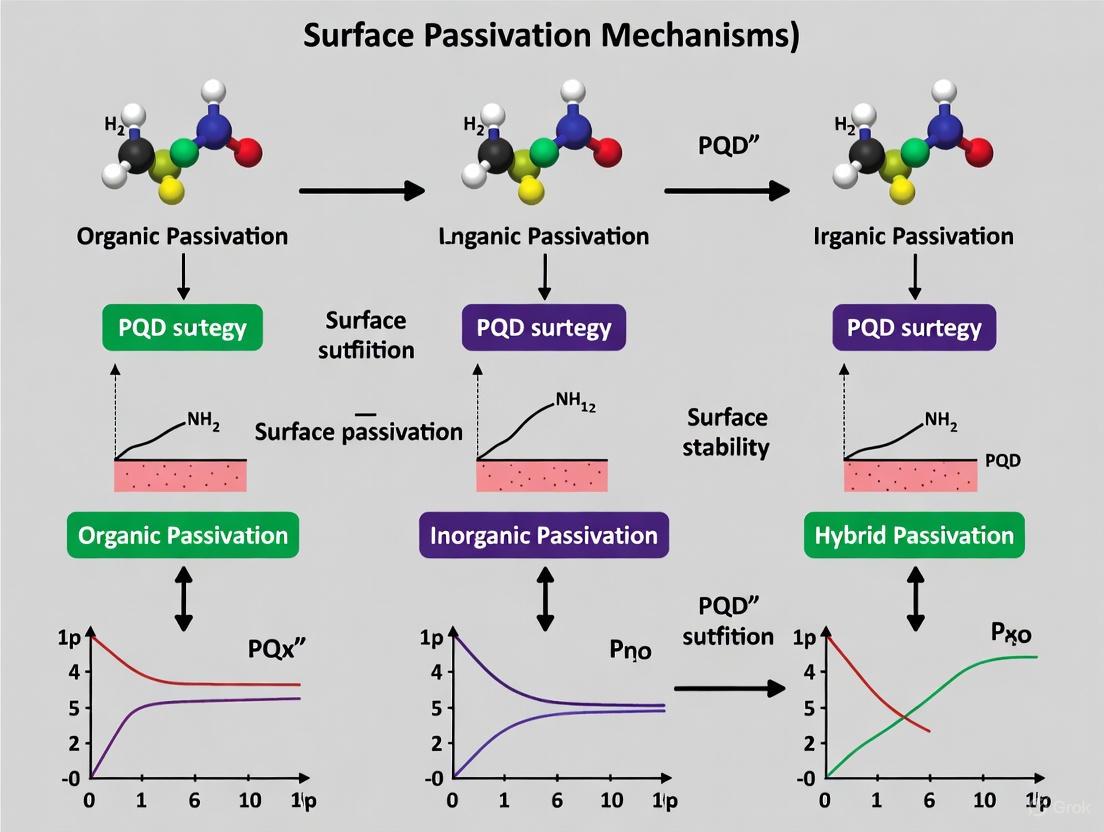
This comprehensive review explores advanced surface passivation strategies that enhance the electronic stability and performance of perovskite quantum dots (PQDs) for optoelectronic and biomedical applications.
Surface Passivation Mechanisms for Perovskite Quantum Dot Electronic Stability: From Fundamentals to Biomedical Applications
Abstract
This comprehensive review explores advanced surface passivation strategies that enhance the electronic stability and performance of perovskite quantum dots (PQDs) for optoelectronic and biomedical applications. Covering foundational defect chemistry, innovative methodological approaches including ligand engineering and hybrid passivation, and troubleshooting for environmental stability, the article synthesizes recent research breakthroughs. It further validates these mechanisms through performance metrics in solar cells, LEDs, and emerging biomedical sensors, providing researchers and drug development professionals with critical insights for developing stable, high-performance PQD-based devices and diagnostic tools.
Understanding PQD Instability: The Critical Role of Surface Defects and Passivation Fundamentals
Fundamental Electronic Structure of Perovskite Quantum Dots
Perovskite Quantum Dots (PQDs) are a class of semiconductor nanocrystals that have garnered significant research interest due to their exceptional optoelectronic properties, which are intrinsically linked to their unique electronic structure. The general formula for lead halide perovskites is APbX3, where A is a cation (e.g., Cs+, MA+) and X is a halide anion (e.g., Br-, I-). The electronic configuration of the Pb2+ ion (6s2) and the hybridization between the Pb s and p orbitals with the halogen p orbitals are responsible for their characteristic optical properties, including high absorption coefficients and tunable bandgaps [1].
The confinement of charge carriers within nanoscale dimensions—the quantum confinement effect—further modulates the electronic band structure, leading to size-dependent photoluminescence. However, the low formation energy for defects, particularly halide vacancies, and the low ion migration energy in the PQD lattice make these materials prone to surface defects [1]. These defects, often appearing as under-coordinated Pb2+ ions or halide vacancies on the crystal surface, create trap states within the bandgap. These mid-gap states act as centers for non-radiative recombination, whereby excited electrons relax back to the valence band without emitting photons, thereby reducing the photoluminescence quantum yield (PLQY) and overall device efficiency [1] [2].
Surface Chemistry and the Imperative for Passivation
The surface chemistry of PQDs is a critical determinant of their stability and performance. The high surface-to-volume ratio of quantum dots means a significant portion of atoms resides on the surface, making them highly reactive. Surface ligands, typically long-chain organic molecules like oleic acid (OA) and oleylamine (OAm), are used during synthesis to control growth and provide colloidal stability. However, these ligands are often dynamically bound and can readily detach during purification or upon exposure to environmental stimuli such as heat, light, or moisture [1]. This ligand loss creates more surface defects and facilitates quantum dot aggregation, accelerating structural degradation.
This inherent instability is a critical bottleneck for practical applications. Consequently, sophisticated surface passivation strategies are required to suppress non-radiative recombination, enhance environmental stability, and enable the development of commercial optoelectronic devices. Passivation aims to coordinate with these under-coordinated surface atoms, eliminating trap states and creating a more robust and optically efficient material.
Advanced Passivation Methodologies and Experimental Protocols
Recent research has focused on developing robust passivation strategies that go beyond conventional ligand capping. Two prominent and effective methodologies are hybrid organic-inorganic passivation and in-situ epitaxial core-shell structuring.
Hybrid Organic-Inorganic Passivation of Lead-Free PQDs
This protocol details the synthesis of stable, lead-free Cs3Bi2Br9 PQDs using a hybrid passivation strategy, as exemplified in the search results [1].
Experimental Protocol:
- Synthesis of Cs3Bi2Br9 PQDs: A transparent precursor solution is prepared by dissolving Cesium Bromide (CsBr, 0.2 mmol) and Bismuth Tribromide (BiBr3, 0.2 mmol) in 5 mL of Dimethyl Sulfoxide (DMSO) under stirring. Oleic acid (OA, 0.5 mL) and oleylamine (OAm, 50 µL) are added as initial capping ligands [1].
- Antisolvent Crystallization: The PQDs are crystallized using an antisolvent method, where the precursor solution is rapidly injected into a poor solvent, inducing instantaneous nucleation and growth.
- Organic Passivation with DDAB: Didodecyldimethylammonium bromide (DDAB) is added to the PQD solution. The DDA+ cation has a strong affinity for halide anions (Br⁻), effectively passivating surface defects. The concentration of DDAB is varied (e.g., 1 mg, 5 mg, 10 mg) to optimize the passivation effect [1].
- Inorganic Encapsulation with SiO₂: To achieve complete encapsulation, a silica (SiO₂) shell is grown on the DDAB-passivated PQDs via the hydrolysis and condensation of Tetraethyl orthosilicate (TEOS, 2.4 mL) added to the solution. This forms a dense, amorphous protective layer [1].
- Purification: The resulting Cs3Bi2Br9/DDAB/SiO₂ PQDs are purified through centrifugation to remove unreacted precursors and byproducts.
Table 1: Key Reagents for Hybrid Passivation Protocol
| Reagent Name | Chemical Function | Role in Passivation Protocol |
|---|---|---|
| Didodecyldimethylammonium bromide (DDAB) | Organic ammonium salt | Passivates surface halide vacancies via strong electrostatic interaction; its relatively short alkyl chains improve surface coverage compared to OA/OAm [1]. |
| Tetraethyl orthosilicate (TEOS) | Silicon alkoxide precursor | Hydrolyzes to form a dense, amorphous SiO₂ inorganic shell, providing a barrier against environmental moisture and oxygen [1]. |
| Oleic Acid (OA) / Oleylamine (OAm) | Long-chain carboxylic acid and amine | Initial ligands to control PQD growth and provide colloidal stability during synthesis [1]. |
In-Situ Epitaxial Core-Shell PQD Passivation
This advanced strategy involves the integration of pre-synthesized core-shell PQDs during the fabrication of a bulk perovskite film, enabling defect passivation at the grain boundaries [2].
Experimental Protocol:
- Synthesis of Core-Shell PQDs: Methylammonium lead bromide (MAPbBr3) core PQDs are synthesized via a colloidal hot-injection method. A precursor solution containing MABr and PbBr2 in DMF with oleylamine and oleic acid is rapidly injected into hot toluene (60°C) [2].
- Shell Growth: A precursor solution of tetraoctylammonium bromide (t-OABr) and PbBr2 is subsequently injected into the reaction mixture. This leads to the epitaxial growth of a wider-bandgap tetraoctylammonium lead bromide (tetra-OAPbBr3) shell around the MAPbBr3 core, forming a core-shell structure (MAPbBr3@tetra-OAPbBr3) [2].
- Purification: The core-shell PQDs are purified via centrifugation (6000 rpm for 10 min, then 15,000 rpm with isopropanol) and redispersed in chlorobenzene [2].
- In-Situ Integration into Perovskite Solar Cells: During the spin-coating of a bulk perovskite film (e.g., for a solar cell), a controlled volume (200 µL) of the core-shell PQD solution (in chlorobenzene at an optimized concentration of 15 mg/mL) is dynamically applied as an antisolvent during the final stage of spinning [2].
- Film Formation: This process enables the simultaneous crystallization of the bulk perovskite film and the incorporation of the core-shell PQDs at the grain boundaries and surfaces, where they passivate defects epitaxially [2].
Table 2: Key Reagents for Core-Shell Passivation Protocol
| Reagent Name | Chemical Function | Role in Passivation Protocol |
|---|---|---|
| Tetraoctylammonium Bromide (t-OABr) | Organic ammonium salt | Forms a wider-bandgap shell layer around the core PQD, enhancing carrier confinement and suppressing non-radiative recombination at the PQD surface [2]. |
| Methylammonium Bromide (MABr) | Organic perovskite precursor | Forms the light-absorbing core of the PQD with a specific bandgap [2]. |
| Lead Bromide (PbBr2) | Metal halide perovskite precursor | Provides the Pb²⁺ and Br⁻ ions for the crystal lattice of both the core and shell [2]. |
| Chlorobenzene | Organic solvent | Serves as the antisolvent and dispersion medium for the core-shell PQDs during the in-situ integration step [2]. |
Quantitative Analysis of Passivation Efficacy
The success of these passivation strategies is quantitatively evaluated through material characterization and device performance metrics.
Table 3: Quantitative Performance Enhancement from Passivation
| Performance Parameter | Unpassivated/Control Device | Passivated Device | Enhancement & Stability |
|---|---|---|---|
| Power Conversion Efficiency (PCE) | 19.2% (Control PSC) [2] | 22.85% (Core-Shell PQD PSC) [2] | Absolute increase of 3.65% [2] |
| Open-Circuit Voltage (VOC) | 1.120 V [2] | 1.137 V [2] | Improved charge extraction [2] |
| Short-Circuit Current Density (JSC) | 24.5 mA/cm² [2] | 26.1 mA/cm² [2] | Enhanced light harvesting [2] |
| Fill Factor (FF) | 70.1% [2] | 77.0% [2] | Reduced recombination losses [2] |
| Photoluminescence Quantum Yield (PLQY) | Implicitly low due to defects [1] | Significantly increased [1] | Suppressed non-radiative decay [1] |
| Long-Term Stability (PCE retention) | ~80% after 900 hours [2] | >92% after 900 hours [2] | Superior environmental robustness [2] |
| Long-Term Stability (Lead-free PQD SC) | Not specified | >90% after 8 hours [1] | 95.4% normalized performance retention [1] |
Characterization Techniques for Verification
Rigorous characterization is essential to validate the electronic and structural improvements from passivation.
- Photoluminescence (PL) Spectroscopy: Measures emission intensity and wavelength, directly indicating the reduction in non-radiative traps via increased PL intensity [1].
- Time-Resolved PL (TRPL): Quantifies the photoluminescence lifetime. An increase in average lifetime after passivation indicates a reduction in trap-assisted recombination, as charge carriers recombine radiatively over a longer period [1] [2].
- Transmission Electron Microscopy (TEM): Provides direct visualization of the PQD morphology, size distribution, and, in core-shell structures, the evidence of a shell layer. It can also show the integration of PQDs at grain boundaries in bulk films [1] [2].
- Temperature-Dependent PL: Analyses exciton-phonon interactions and the dynamics of radiative recombination across a temperature range (e.g., 20-300 K), offering insights into the thermal stability of the passivated PQDs [1].
The electronic structure and surface chemistry of PQDs are inextricably linked. While their innate electronic configuration grants remarkable optoelectronic properties, their surface instability remains a critical challenge. The development of advanced passivation mechanisms—such as the synergistic hybrid organic-inorganic coating and the in-situ epitaxial core-shell integration—provides a robust pathway to mitigate surface defects. These strategies effectively suppress non-radiative recombination, enhance environmental stability, and boost device performance, as quantitatively demonstrated in both light-emitting and photovoltaic applications. Mastering surface chemistry is, therefore, the cornerstone for unlocking the full potential of perovskite quantum dots in next-generation optoelectronic technologies.
Diagrams
Diagram 1: Hybrid Organic-Inorganic Passivation Mechanism
Diagram 2: In-Situ Epitaxial Core-Shell Passivation Workflow
Diagram 3: Surface Defect & Passivation Logic
The operational stability and performance of halide perovskite quantum dots (PQDs) are predominantly governed by the dynamics of intrinsic defects. This whitepaper provides an in-depth technical analysis of three core defect types—halide vacancies, ion migration, and ligand detachment—that compromise the electronic and structural integrity of PQDs. Within the broader context of surface passivation mechanisms, we elucidate the fundamental origins and consequences of these defects, supported by quantitative characterization data. The document further details advanced experimental protocols for defect mitigation and features a synthesized toolkit of research reagents essential for stability enhancement. By integrating defect theory with practical experimentation, this guide serves as a comprehensive resource for researchers and scientists dedicated to advancing the commercialization of stable perovskite-based optoelectronics.
Metal halide perovskite quantum dots (PQDs) have emerged as a revolutionary class of semiconducting materials for optoelectronic applications, including light-emitting diodes (LEDs), solar cells, and photodetectors. Their appeal lies in exceptional properties such as high photoluminescence quantum yields (PLQY), tunable bandgaps, and cost-effective solution processability [3] [4]. However, the path to commercial viability is obstructed by intrinsic material instability, which is directly linked to defect chemistry.
The ionic nature of perovskite crystals and their high surface-to-volume ratio make them susceptible to specific defect types that act as non-radiative recombination centers, degrading device performance and operational lifetime [5]. This whitepaper isolates and examines three critical defect pathways:
- Halide Vacancies: The most common intrinsic point defect due to low formation energy.
- Ion Migration: A bulk and interface degradation process driven by vacancy movement.
- Ligand Detachment: A surface-specific instability leading to nanoparticle aggregation and defect formation.
Understanding and mitigating these defects through sophisticated surface passivation mechanisms constitutes a central theme in modern perovskite research. This document provides a foundational framework for this ongoing scientific endeavor, offering a detailed guide to the nature, analysis, and control of these debilitating defects.
Defect Fundamentals: Mechanisms and Impacts
Halide Vacancies
Formation Mechanism: Halide vacancies (VX) are the most prevalent point defects in lead halide perovskites. Their formation is thermodynamically favored due to a low energy barrier for creation, estimated to be as low as 0.3 eV for iodide vacancies in MAPbI3 [5]. This low formation energy is a direct consequence of the ionic crystal lattice and weak bond strength, particularly for Pb-I bonds. During synthesis or under operational stress (light, heat), halide ions can be displaced from their lattice sites, creating vacancies.
Impact on Material Properties: These vacancies create deep-level trap states within the bandgap. These states act as centers for non-radiative recombination, where photo-generated electrons and holes recombine without emitting light, thereby quenching photoluminescence and reducing the PLQY [5]. This directly diminishes the efficiency of light-emitting devices and the open-circuit voltage of solar cells. Furthermore, halide vacancies serve as the primary initiation points for the more macroscale degradation process of ion migration.
Ion Migration
Driving Forces and Pathways: Ion migration, particularly of halide ions (I⁻, Br⁻) and their vacancies, is a pronounced phenomenon in perovskite materials. Driven by electric fields, concentration gradients, or light soaking, these ionic species can move through the grain boundaries, along surfaces, and within the bulk lattice [6] [7]. The mobility is significantly higher under illumination, as light "softens" the perovskite lattice, reducing the activation energy for ion movement [7].
Consequences for Device Performance: The migration of ions leads to several detrimental effects:
- Hysteresis in J-V Curves: The redistribution of ions modifies the internal electric field, causing the current-voltage characteristics of solar cells to depend on the voltage scan direction and rate [8].
- Phase Segregation: In mixed-halide perovskites, ion migration can lead to halide segregation, forming iodide-rich and bromide-rich domains, which alters the bandgap and leads to unstable emission spectra [4].
- Interface Degradation: Accumulation of migrated ions at interfaces with charge transport layers (e.g., TiO2, Spiro-OMeTAD) can form insulating layers, impede charge extraction, and accelerate non-radiative recombination [8] [9].
- Self-Passivation vs. Degradation: Paradoxically, a limited degree of ion migration can enable "self-passivation," where mobile ions relocate to neutralize interface defects and relax strain, improving performance over time. However, unbridled migration ultimately leads to irreversible degradation, such as electrode corrosion or film cracking [6] [7].
Ligand Detachment
Origin and Mechanism: Colloidal PQDs are stabilized in solution and as solid films by surface-bound organic ligands, such as oleic acid (OA) and oleylamine (OAm). These long-chain ligands possess a bent molecular geometry due to double bonds, resulting in low packing density and steric hindrance on the PQD surface [5]. This leads to weak, dynamic binding. During mandatory purification steps (using polar anti-solvents like methyl acetate) or upon exposure to environmental stimuli (heat, light), these ligands can readily detach.
Downstream Effects: Ligand detachment has two primary negative outcomes:
- Surface Defect Formation: The loss of a ligand exposes under-coordinated Pb²⁺ ions on the PQD surface, creating highly efficient trap states for non-radiative recombination [5].
- PQD Aggregation and Ostwald Ripening: The loss of steric protection allows PQDs to aggregate. Furthermore, it can facilitate Ostwald ripening, where larger particles grow at the expense of smaller ones, leading to a broadened size distribution and loss of quantum confinement effects [5].
Table 1: Summary of Common Defect Types in Halide Perovskite Quantum Dots
| Defect Type | Primary Location | Formation Cause | Key Consequences | Characterization Techniques |
|---|---|---|---|---|
| Halide Vacancies | Bulk & Surface | Low formation energy, synthesis conditions | Non-radiative recombination, initiation of ion migration | Thermal Admittance Spectroscopy, DFT Simulations |
| Ion Migration | Grain boundaries, interfaces | Electric field, light, heat gradients | J-V hysteresis, phase segregation, interface degradation | Hysteresis Index (HI), EIS, TOF-SIMS |
| Ligand Detachment | PQD Surface | Weak binding energy, purification, external stimuli | Surface traps, aggregation, reduced PLQY | FTIR, NMR, TGA, TEM |
Quantitative Characterization of Defects
Quantifying defect density and ion migration strength is essential for evaluating the efficacy of any passivation strategy. The following table compiles key metrics and methods used in the field.
Table 2: Quantitative Metrics for Defect and Ion Migration Characterization
| Parameter | Description | Measurement Technique | Typical Values/Notes |
|---|---|---|---|
| Hysteresis Index (HI) | Quantifies ion migration-induced J-V curve distortion in solar cells. | Current-Voltage (J-V) measurements at different scan rates. | HI is calculated as (PCE_reverse - PCE_forward) / PCE_reverse. A lower HI indicates suppressed ion migration [8]. |
| Ion Migration Resistance (Rion) | Resistance to ion movement within the perovskite film. | Electrochemical Impedance Spectroscopy (EIS). | Measured in MΩ (dark) or kΩ (light). Rion increases with bromide content due to stronger Pb-Br bonds [7]. |
| Photoluminescence Quantum Yield (PLQY) | Ratio of photons emitted to photons absorbed. | Integrating sphere with a calibrated spectrometer. | Fresh PQD films can have PLQY >80%. Defects cause significant drops. Passivation can restore PLQY from ~22% to >50% [5]. |
| External Quantum Efficiency (EQE) | Percentage of charge carriers collected per incident photon. | Spectral response measurement under monochromatic light. | For blue PeLEDs, EQEmax remains in the 10-15% range, limited by defect density [10]. |
Experimental Protocols for Defect Mitigation
This section outlines detailed methodologies for key experiments aimed at understanding and mitigating core defects in PQDs.
Protocol: Light-Soaking Treatment to Activate Self-Passivation
Objective: To mobilize ions post-fabrication to passivate interfacial defects and relax strain, thereby enhancing device performance and reproducibility [6] [7].
- Device Fabrication: Fabricate perovskite solar cells using your standard procedure (e.g., triple-cation perovskite
Cs0.05(MA0.17FA0.83)0.95Pb(I0.83Br0.17)3). - Initial Characterization: Measure the current-density voltage (J-V) characteristics and record the baseline performance parameters (PCE, Voc, Jsc, FF).
- Light-Soaking Intervention: Immediately after fabrication, subject the devices to illumination with standard AM 1.5G simulated sunlight at an intensity of 100 mW cm⁻². The typical duration for this treatment is 10 minutes, performed under ambient atmospheric conditions.
- Aging: After light soaking, store the devices in the dark under controlled, dry conditions (e.g., in a dry air environment at room temperature) for a defined aging period (e.g., 7 days).
- Post-Treatment Analysis: Re-measure the J-V characteristics. Compare parameters with the fresh devices. Expected results include an increase in open-circuit voltage (Voc) and fill factor (FF), indicating reduced interfacial recombination. Confirm the morphological changes using Scanning Electron Microscopy (SEM) to observe grain growth and Photoluminescence (PL) spectroscopy to observe enhanced emission intensity.
Protocol: Surface Passivation via Ligand Exchange
Objective: To replace weakly bound native ligands (OA/OAm) with stronger-binding alternatives to suppress ligand detachment and passivate surface defects [5].
- PQD Synthesis: Synthesize CsPbI3 PQDs using the standard hot-injection or ligand-assisted reprecipitation (LARP) method with OA and OAm as ligands.
- Purification: Precipitate the synthesized PQDs by adding a polar anti-solvent (e.g., methyl acetate) and isolate them via centrifugation. This step removes excess precursors and ligands but also initiates ligand detachment.
- Post-Treatment Passivation: Re-disperse the purified PQD pellet in a non-polar solvent (e.g., hexane or toluene). Add a solution of the new passivating ligand (e.g., 2-aminoethanethiol (AET) in the same solvent). The thiol (-SH) group in AET has a strong affinity for Pb²⁺, facilitating binding.
- Reaction and Purification: Stir the mixture for a set time to allow complete ligand exchange. Re-purify the passivated PQDs by adding an anti-solvent and centrifuging to remove the displaced ligands.
- Validation: Characterize the passivated PQDs.
- FTIR/NMR: Confirm the chemical replacement of OA/OAm with the new ligand.
- PLQY Measurement: A significant increase in PLQY (e.g., from 22% to 51%) confirms effective surface defect passivation [5].
- Stability Test: Monitor PL intensity under continuous UV illumination or water exposure. AET-passivated PQDs can maintain >95% of initial PL intensity after 120 min of UV, demonstrating superior stability.
Protocol: Interface Engineering with a Passivation Interlayer
Objective: To insert a thin material layer between the perovskite and charge transport layer to suppress ion migration and reduce interfacial recombination [9].
- Substrate Preparation: Clean and prepare the transparent conductive electrode (e.g., ITO) with the deposited electron transport layer (e.g., compact TiO2).
- Interlayer Deposition: Deposit a thin layer of the passivation material (e.g., BiI3) onto the ETL. This can be achieved via solution processing (spin-coating) or thermal evaporation. The target thickness is critical; for BiI3, a ~40 nm layer is optimal.
- Perovskite Deposition: Deposit the perovskite absorber layer (e.g., MAPbI3 or MAGeI3) directly on top of the BiI3 interlayer using your standard method (e.g., spin-coating).
- Device Completion: Continue with the fabrication of the remainder of the solar cell (e.g., deposit the hole transport layer (Spiro-OMeTAD) and metal electrodes).
- Device Analysis:
- J-V Measurement: Quantify the improvement in power conversion efficiency (PCE), fill factor (FF), and hysteresis index. Simulations show PCE can increase from 19.28% to 20.30% for MAPbI3 with a BiI3 interlayer [9].
- Impedance Spectroscopy: Measure the ion migration resistance (Rion) to confirm the suppression of ionic motion.
- SCAPS-1D Simulation: Use software like SCAPS-1D to model the band alignment and understand the role of the interlayer in enhancing hole extraction and blocking ion migration.
Visualization of Defect Dynamics and Mitigation
The following diagrams, generated using Graphviz DOT language, illustrate the core defect pathways and a key mitigation strategy.
Diagram 1: Defect formation pathways and consequences in PQDs.
Diagram 2: Experimental workflow for surface passivation via ligand exchange.
The Scientist's Toolkit: Key Research Reagents
This table lists essential materials and their functions for researching and mitigating defects in perovskite quantum dots.
Table 3: Research Reagent Solutions for PQD Defect Studies
| Reagent / Material | Function / Application | Key Mechanism / Note |
|---|---|---|
| 2-Aminoethanethiol (AET) | Surface passivating ligand for PQDs | Strong bidentate binding to under-coordinated Pb²⁺ via thiol group, improving PLQY and moisture resistance [5]. |
| Bismuth Iodide (BiI3) | Interfacial passivation layer | Deposited between perovskite and HTL to enhance hole extraction, passivate defects, and suppress ion migration [9]. |
| Oleic Acid (OA) / Oleylamine (OAm) | Native surface ligands for synthesis | Standard long-chain ligands for colloidal PQD synthesis. Their weak binding and steric hindrance necessitate post-synthetic exchange [5]. |
| Cesium Lead Halide (CsPbX3) | Model PQD system | The benchmark all-inorganic PQD for fundamental defect studies due to its well-defined chemistry and commercial availability [3] [5]. |
| Triple Cation Perovskite | Thin-film absorber for solar cells | Composition (Cs/MA/FA) with optimized I/Br ratio balances ion mobility for self-passivation and stability [6] [7]. |
The Impact of Surface Defects on Non-Radiative Recombination and PLQY
In perovskite quantum dots (PQDs), surface defects are not merely imperfections but central determinants of optoelectronic efficiency. These defects, primarily undercoordinated lead ions and halide vacancies, create mid-gap trap states that facilitate non-radiative recombination pathways, directly competing with radiative processes and diminishing photoluminescence quantum yield (PLQY) [1] [11]. The relationship between surface integrity and luminescence efficiency forms a critical research frontier in perovskite optoelectronics, as stabilizing high PLQY is imperative for commercial applications in lighting, displays, and photovoltaics [12] [13]. This technical guide examines the mechanistic role of surface defects in non-radiative recombination dynamics, quantitative correlations with PLQY, and advanced passivation strategies that collectively underpin the development of stable, high-performance PQD devices.
Fundamental Mechanisms: From Surface Defects to Performance Loss
Atomic Origins of Surface Defects
The soft ionic lattice of lead halide perovskites predisposes them to facile defect formation, with particularly high densities at nanocrystal surfaces where the periodic atomic arrangement terminates [13]. Key surface defects include:
- Undercoordinated Pb²⁺ ions: Resulting from incomplete ligand coverage or halide vacancies, these Lewis acid sites create deep trap states that strongly localize charge carriers [14] [13].
- Halide vacancies: The low formation energy of bromide and iodide vacancies makes them the most prevalent ionic defects, generating shallow electron traps that facilitate ion migration [1] [11].
- Interstitial defects: Migrated ions can occupy interstitial positions, creating complex defect clusters that further enhance non-radiative recombination [11].
These defects introduce electronic states within the bandgap that serve as stepping stones for non-radiative recombination, effectively short-circuiting the luminescence process.
Non-Radiative Recombination Pathways
Non-radiative recombination occurs primarily through Shockley-Read-Hall (SRH) mechanisms wherein trap states sequentially capture electrons and holes, releasing energy as phonons (heat) rather than photons [11]. The kinetics of this process are governed by:
- Trap-assisted recombination: Defect states with energy levels near the mid-gap are particularly efficient recombination centers due to their approximately equal capture cross-sections for electrons and holes [11].
- Auger recombination: Under high carrier injection, the energy from electron-hole recombination can transfer to a third carrier, though this mechanism is less significant at low injection densities typical for LED operation [11].
- Surface recombination velocity: The rate at which carriers recombine at surfaces depends on both trap density and carrier diffusion rates to the surface [1].
The quantitative relationship between defect density (Nt) and PLQY can be described by:
[ \text{PLQY} = \frac{kr}{kr + k{nr} + kt} ]
where (kr) is the radiative recombination rate, (k{nr}) is the intrinsic non-radiative rate, and (k_t) is the trap-assisted recombination rate proportional to Nt [11].
Quantitative Correlations: Defect Density and Optoelectronic Performance
Direct Relationships Between Defects and Efficiency Metrics
Advanced characterization techniques have established quantitative correlations between specific defect types and performance parameters. Positron annihilation spectroscopy (PAS) has revealed that low-electron-density defects, particularly those characterized by long positron lifetimes (τ3), exhibit a strong inverse correlation with photocatalytic efficiency and photocurrent response [15]. Systematic studies on Na₀.₅Bi₂.₅Ta₂O₉ nanosheets demonstrated that reducing the concentration of these specific defects directly enhanced superoxide radical generation rates and charge separation efficiencies [15].
In photovoltaic devices, non-radiative recombination losses directly manifest in reduced open-circuit voltage (VOC), with the voltage deficit (ΔV = VOC,SQ - VOC,measured) providing a quantitative measure of trap-mediated recombination [11]. High-performing perovskite solar cells with minimized defect densities have achieved ΔV values below 0.4 V, approaching the theoretical limits for their bandgaps [11].
Table 1: Quantitative Impact of Surface Defects on Optoelectronic Performance
| Defect Type | Characterization Method | Impact on PLQY | Impact on Device Efficiency | Reference |
|---|---|---|---|---|
| Undercoordinated Pb²⁺ | XPS, FTIR | Reduction from ~80% to <30% | PCE decrease from 22.8% to 19.2% | [2] [13] |
| Halide Vacancies | PAS, TRPL | 40-60% reduction | 15-25% relative PCE loss | [1] [15] |
| Low-electron-density defects | PAS (τ3 lifetime) | Not quantified | 30-50% photocatalysis efficiency loss | [15] |
| Surface Pb-Br defects | PLQY measurements | Increase from 49.6% to 58.3% after passivation | Color gamut to 125.3% NTSC for displays | [13] |
Long-Term Stability and Defect Evolution
The dynamic nature of surface defects under environmental stressors creates complex degradation pathways. Remarkably, in some cases, environmental exposure can induce beneficial surface transformations. CsPbBr₃ PQD glass exposed to ambient air for four years exhibited a spontaneous increase in PLQY from 20% to 93%, attributed to moisture-assisted formation of a PbBr(OH) passivating layer that reduced surface recombination centers [12].
However, more typically, defective surfaces accelerate degradation through:
- Ion migration: Surface defects serve as initiation points for halide migration, leading to phase segregation in mixed-halide perovskites [11].
- Environmental ingress: Defect sites provide pathways for moisture and oxygen penetration, accelerating decomposition [1] [12].
- Ligand desorption: Incompletely passivated surfaces experience progressive ligand loss, creating new undercoordinated sites [1] [13].
Table 2: Defect Passivation Strategies and Performance Outcomes
| Passivation Approach | Mechanism | PLQY Improvement | Stability Enhancement | Application |
|---|---|---|---|---|
| DDAB/SiO₂ hybrid coating | Organic ligand passivation + inorganic encapsulation | Not quantified | >90% efficiency retention after 8 hours | Lead-free Cs₃Bi₂Br₉ PQDs [1] |
| SB3-18 surfactant + Mesoporous Silica | Sulfonate-Pb²⁺ coordination + matrix encapsulation | 49.6% → 58.3% | 95.1% PL intensity retention after water resistance test | CsPbBr₃ QDs for displays [13] |
| PEAI + EHACl complementary passivation | Vacancy healing + Lewis acid base passivation | Not quantified | Enhanced operational and thermal stability | Inverted PSCs (24.6% PCE) [14] |
| Core-shell MAPbBr₃@tetra-OAPbBr₃ PQDs | Epitaxial interface + energy funneling | Not quantified | >92% PCE retention after 900 hours | Perovskite solar cells [2] |
| Four-year air exposure | Moisture-induced PbBr(OH) passivation layer | 20% → 93% | Exceptional long-term stability | CsPbBr₃ PQD glass [12] |
Experimental Methodologies for Defect Analysis and Passivation
Synthesis of Passivated Perovskite Quantum Dots
Organic-Inorganic Hybrid Passivation of Cs₃Bi₂Br₉ PQDs [1]:
- Procedure: Lead-free Cs₃Bi₂Br₉ PQDs were synthesized via antisolvent method using DMSO as solvent. Didodecyldimethylammonium bromide (DDAB) in varying concentrations (1-10 mg) was introduced for organic passivation, followed by inorganic SiO₂ coating via hydrolysis of tetraethyl orthosilicate (TEOS, 2.4 mL).
- Key Parameters: DDAB concentration optimization critical to balance passivation efficacy and potential aggregation. TEOS hydrolysis time controls SiO₂ shell thickness.
- Characterization: TEM analysis confirmed uniform quasispherical nanoparticles (~12 nm) with core-shell structure. PL spectroscopy, lifetime measurements, and temperature-dependent PL analyses quantified optical improvements.
In Situ Epitaxial Quantum Dot Passivation for Solar Cells [2]:
- Procedure: MAPbBr₃@tetra-OAPbBr₃ core-shell PQDs were synthesized via colloidal approach. Core precursor (MABr/PbBr₂ in DMF with oleylamine/oleic acid) injected into heated toluene, followed by shell precursor (t-OABr/PbBr₃) injection. Purified PQDs (15 mg/mL concentration) integrated during antisolvent-assisted crystallization of perovskite films.
- Key Parameters: Precise temperature control (60°C) during nanoparticle growth. Centrifugation at 6000 rpm for 10 minutes, then 15,000 rpm with isopropanol for refinement.
- Characterization: Structural analysis confirmed epitaxial compatibility between PQDs and host perovskite matrix. Device performance showed PCE increase from 19.2% to 22.85%.
Defect Characterization Techniques
Photoluminescence Spectroscopy [1] [12] [13]:
- Time-Resolved PL (TRPL): Measures carrier lifetime; multi-exponential decay fitting distinguishes surface versus bulk recombination.
- Temperature-Dependent PL: Reveals exciton-phonon interactions and trap state distributions across 20-300 K range.
- PL Quantum Yield (PLQY): Absolute measurement of radiative efficiency using integrating spheres.
Positron Annihilation Spectroscopy (PAS) [15]:
- Principle: Detects low-electron-density defects through positron lifetime measurements. Longer τ3 lifetime corresponds to larger vacancy-type defects.
- Procedure: Positron source (²²Na) embedded between sample layers; lifetime spectra deconvoluted into τ1 (monovacancies), τ2 (vacancy clusters), and τ3 (low-electron-density voids) components.
X-ray Photoelectron Spectroscopy (XPS) [16] [13]:
- Application: Identifies chemical states and coordination environments of surface atoms. Pb 4f core-level shifts indicate undercoordinated Pb²⁺ sites.
- Procedure: Surface irradiation with monochromatic X-rays; kinetic energy analysis of emitted photoelectrons. Coordination changes monitored after passivation treatments.
Visualization of Defect Dynamics and Passivation Mechanisms
Defect-Mediated Non-Radiative Recombination Pathways
Multimodal Defect Passivation Strategy Workflow
The Scientist's Toolkit: Research Reagents and Materials
Table 3: Essential Research Reagents for Surface Passivation Studies
| Reagent/Material | Chemical Function | Application Example | Performance Impact |
|---|---|---|---|
| Didodecyldimethylammonium bromide (DDAB) | Surface ligand passivation of halide vacancies | Cs₃Bi₂Br₉ PQD stabilization [1] | Enhanced environmental stability and charge transport |
| Tetraethyl orthosilicate (TEOS) | SiO₂ precursor for inorganic encapsulation | Core-shell PQD formation [1] | Barrier against moisture/oxygen ingress |
| Sulfonic acid-based surfactants (SB3-18) | Lewis base coordination with undercoordinated Pb²⁺ | CsPbBr₃ QD passivation [13] | PLQY increase from 49.6% to 58.3% |
| Phenylethylammonium iodide (PEAI) | 2D/3D interface reconstruction + vacancy healing | Inverted PSC passivation [14] | Champion PCE of 24.6% |
| Ethylhydrazinoacetate hydrochloride (EHACl) | Lewis base passivation of undercoordinated Pb²⁺ | Complementary passivation with PEAI [14] | Enhanced operational and thermal stability |
| Tetraoctylammonium bromide (t-OABr) | Shell precursor for core-shell PQDs | MAPbBr₃@tetra-OAPbBr₃ synthesis [2] | PCE increase from 19.2% to 22.85% |
| Mesoporous silica (MS) templates | Rigid encapsulation matrix | CsPbBr₃-SB3-18/MS composites [13] | 95.1% PL retention after water resistance testing |
Surface defects in perovskite quantum dots fundamentally govern non-radiative recombination dynamics and ultimately determine achievable PLQY and device stability. The quantitative relationships established between specific defect types and performance metrics provide a roadmap for targeted passivation strategies. Multimodal approaches that combine chemical passivation of specific trap states with physical encapsulation against environmental stressors have demonstrated remarkable efficacy in enhancing both efficiency and operational lifetime. Future research directions should focus on developing in situ characterization techniques to monitor defect dynamics under operational conditions, designing multifunctional passivators that simultaneously address multiple defect types, and establishing standardized protocols for quantifying and reporting surface defect densities. The continued refinement of surface passivation strategies represents the most promising pathway toward bridging the gap between laboratory demonstrations and commercial implementation of perovskite quantum dot technologies.
Surface passivation represents a cornerstone of modern materials science, critically determining the performance and longevity of electronic and optoelectronic devices. This foundational process involves the chemical or physical treatment of a material's surface to reduce its reactivity by neutralizing dangling bonds and other defective states. In the specific context of perovskite quantum dots (PQDs) for electronic stability research, effective passivation is not merely a supplementary enhancement but an essential requirement. The high surface-to-volume ratio of PQDs means that a significant proportion of their atoms reside on the surface, making them particularly susceptible to environmental degradation and surface-mediated non-radiative recombination, which severely compromises device performance and operational stability. This guide provides an in-depth examination of both the theoretical underpinnings and practical methodologies of passivation, with a focused application on stabilizing PQDs for advanced electronic applications, synthesizing current research to deliver a actionable framework for researchers and scientists.
Theoretical Foundations of Passivation
At its core, passivation functions through the principle of defect neutralization. Surface defects on materials like perovskites—such as iodide (I⁻) vacancies, suspended Pb²⁺ ions, and under-coordinated atoms—act as trapping sites for charge carriers. These traps facilitate non-radiative recombination, a process where electron-hole pairs recombine without emitting light or performing useful work, thereby dissipating energy as heat and reducing the overall quantum efficiency of the device.
The thermodynamic driving force for passivation is the reduction of the system's surface energy. When a reactive, high-energy surface is treated with passivating agents, it transitions to a more stable, lower-energy state. This state is characterized by a more complete electronic structure and significantly reduced density of mid-gap states within the bandgap, which are the primary pathways for non-radiative recombination. For PQDs, the ionic nature of the crystal lattice and the dynamic binding of surface ligands introduce additional complexity. The passivation layer must not only neutralize defects but also enhance the electronic coupling between individual QDs in a solid film to facilitate efficient charge transport, a critical factor for photovoltaic and light-emitting devices [17].
Key Passivation Strategies for PQDs
Advanced passivation strategies for PQDs have evolved from simple ligand exchange to sophisticated multi-functional approaches. The following sections detail the most effective methodologies.
Multidentate Ligand Passivation
This strategy utilizes molecules with multiple binding sites that can chelate to the PQD surface more strongly than conventional monodentate ligands like oleic acid (OA) and oleylamine (OAm).
- Mechanism: Multidentate ligands, such as ethylene diamine tetraacetic acid (EDTA), function through a "surface surgery treatment." They possess several functional groups that can simultaneously chelate suspended Pb²⁺ ions and passivate I⁻ vacancies. This multi-point binding creates a more robust and comprehensive surface layer [17].
- Additional Benefit: Beyond simple passivation, these ligands can act as crosslinkers between adjacent PQDs, forming a "charger bridge" that improves electronic coupling across the quantum dot solid. This enhances charge carrier transport, which is vital for high-performance solar cells [17].
Organic-Inorganic Hybrid Passivation
This approach combines the defect-passivation capabilities of organic molecules with the superior environmental barrier provided by inorganic materials.
- Mechanism: The process often involves a two-step coating. First, an organic ligand like didodecyldimethylammonium bromide (DDAB) is used to passivate surface defects on lead-free PQDs (e.g., Cs₃Bi₂Br₉). DDAB's strong affinity for halide anions and relatively short alkyl chain length improve coverage and stability. Subsequently, an inorganic silica (SiO₂) shell derived from tetraethyl orthosilicate (TEOS) is formed around the organically-passivated PQD, creating a core-shell structure that offers exceptional protection against moisture, oxygen, and thermal stress [1].
- Outcome: This synergistic strategy results in PQDs with enhanced photoluminescence and significantly extended environmental stability, making them suitable for practical applications in electroluminescence and photovoltaics [1].
In Situ Epitaxial Quantum Dot Passivation
A cutting-edge strategy involves the integration of core-shell PQDs directly during the fabrication of the perovskite active layer.
- Mechanism: Core-shell PQDs, such as those with a methylammonium lead bromide (MAPbBr₃) core and a tetraoctylammonium lead bromide (tetra-OAPbBr₃) shell, are introduced during the antisolvent-assisted crystallization step of a perovskite solar cell. The epitaxial compatibility between the PQD shell and the host perovskite matrix allows the PQDs to embed themselves at grain boundaries and surface defects, effectively passivating these critical failure points [2].
- Advantage: This in situ method ensures that passivation occurs during film formation, leading to a more homogeneous and integrated structure. It suppresses non-radiative recombination at the most vulnerable locations while facilitating more efficient charge transport, thereby boosting both efficiency and device longevity [2].
The logical workflow for selecting and implementing a passivation strategy, informed by the project's primary objectives, is visualized below.
Quantitative Analysis of Passivation Efficacy
The success of a passivation strategy is quantitatively evaluated using a suite of optical, electronic, and stability metrics. The table below summarizes performance data from key studies employing different passivation methods, providing a benchmark for researchers.
Table 1: Quantitative Performance of Passivated Perovskite Devices
| Passivation Method | Device Type | Power Conversion Efficiency (PCE) | Open-Circuit Voltage (Voc) | Key Stability Metric |
|---|---|---|---|---|
| Multidentate Ligand (EDTA) [17] | CsPbI₃ PQD Solar Cell | 15.25% (from 13.67% baseline) | Not Specified | Among highest reported for inorganic PQDSCs |
| Organic-Inorganic (DDAB/SiO₂) [1] | Cs₃Bi₂Br₉ PQD-Si Tandem | 14.85% (from 14.48% baseline) | Not Specified | >90% initial efficiency after 8 hours |
| In Situ Epitaxial QD [2] | MAPbI₃ Solar Cell | 22.85% (from 19.2% baseline) | 1.137 V (from 1.120 V baseline) | >92% initial PCE after 900 hours |
Beyond the parameters in the table, critical quantitative evidence of successful passivation includes:
- Increase in Photoluminescence Quantum Yield (PLQY): A direct indicator of suppressed non-radiative recombination.
- Reduction in Trap State Density (Nt): Measured via techniques like thermal admittance spectroscopy.
- Increase in Charge Carrier Lifetimes: Observed through time-resolved photoluminescence (TRPL) decay measurements.
- Lower Non-Radiative Recombination Losses: Evidenced by a higher quasi-Fermi level splitting and increased Voc in solar cells [17] [2].
Detailed Experimental Protocols
To translate theory into practice, this section provides detailed methodologies for implementing key passivation strategies.
Protocol: Multidentate Ligand Passivation of CsPbI₃ PQDs
This protocol is adapted from the "surface surgery treatment" using EDTA, designed to resurface PQDs for enhanced optoelectronic properties [17].
PQD Film Deposition:
- Synthesize CsPbI₃ PQDs (~12 nm) using the standard hot-injection method and disperse in a non-polar solvent like hexane.
- Deposit the PQD solution onto a substrate via spin-coating or drop-casting to form a solid film.
- Immediately after deposition, immerse the film in methyl acetate (MeOAc) anti-solvent for 30 seconds to remove the original long-chain OA/OAm ligands. This step inevitably creates surface defects.
Surface Surgery Treatment (SST):
- Prepare a saturated solution of EDTA in a compatible solvent (e.g., dimethylformamide - DMF, or isopropanol).
- Drop-cast the EDTA solution directly onto the freshly rinsed PQD solid film.
- Allow the treatment to proceed for 60-120 seconds. During this time, EDTA molecules chelate suspended Pb²⁺ ions and occupy I⁻ vacancies.
- Spin-off the excess solution and gently anneal the film at 70-90°C for 5-10 minutes to remove residual solvent and stabilize the passivation layer.
Protocol: Organic-Inorganic Hybrid Passivation of Cs₃Bi₂Br₉ PQDs
This protocol outlines the stabilization of lead-free PQDs using DDAB and a subsequent SiO₂ coating [1].
DDAB Organic Passivation:
- Synthesize Cs₃Bi₂Br₉ PQDs via the antisolvent method.
- Purify the as-synthesized PQDs to remove excess precursors and weakly bound ligands.
- Redisperse the purified PQDs in a solvent like toluene.
- Add a solution of DDAB (optimally 10 mg) to the PQD dispersion under stirring. The DDAB concentration is critical to prevent aggregation while ensuring full surface coverage.
- Stir the mixture for 1-2 hours to allow DDAB to effectively passivate surface defects.
SiO₂ Inorganic Encapsulation:
- To the DDAB-passivated PQD dispersion, add a controlled volume of tetraethyl orthosilicate (TEOS) (e.g., 2.4 mL) as the silica precursor.
- Catalyze the hydrolysis and condensation of TEOS by introducing a basic catalyst (e.g., ammonium hydroxide).
- Allow the reaction to proceed for several hours to form a dense, amorphous SiO₂ shell around the PQDs.
- Purify the resulting Cs₃Bi₂Br₉/DDAB/SiO₂ core-shell structures via centrifugation and redisperse in an appropriate solvent for device fabrication.
Protocol: In Situ Epitaxial Passivation of Perovskite Solar Cells
This protocol describes the integration of core-shell PQDs during the active layer fabrication of a standard n-i-p PSC [2].
Synthesis of Core-Shell PQDs:
- Prepare a core precursor solution of MABr and PbBr₂ in DMF with oleylamine and oleic acid.
- Prepare a separate shell precursor solution of tetraoctylammonium bromide (t-OABr) and PbBr₂.
- Inject the core precursor into hot toluene to form MAPbBr₃ PQD cores.
- Subsequently, inject the shell precursor into the reaction mixture to form the tetra-OAPbBr₃ shell, resulting in MAPbBr₃@tetra-OAPbBr₃ core-shell PQDs.
- Purify and redisperse the PQDs in chlorobenzene at a precise concentration (e.g., 15 mg/mL).
Device Fabrication with In Situ Passivation:
- Deposit the electron transport layer (e.g., mesoporous TiO₂) on a cleaned FTO substrate.
- Prepare the perovskite precursor solution (e.g., containing PbI₂, FAI, MABr, MACl).
- Deposit the perovskite film using a two-step spin-coating process.
- During the final seconds of the second spin-coating step, dynamically introduce 200 µL of the core-shell PQD solution (in chlorobenzene) as the antisolvent.
- Anneal the films at 100°C for 10 min and then 150°C for 10 min. The PQDs, introduced via the antisolvent, embed epitaxially at grain boundaries and interfaces during crystallization.
The intricate mechanism of multidentate ligand passivation, which underlies one of the protocols, is broken down into its fundamental steps in the following diagram.
The Scientist's Toolkit: Essential Research Reagents
Successful implementation of the aforementioned protocols requires a specific set of high-purity materials. The following table catalogs the essential reagents and their functions in PQD passivation research.
Table 2: Essential Reagents for PQD Passivation Research
| Reagent/Chemical | Function in Passivation | Example Application |
|---|---|---|
| Ethylene Diamine Tetraacetic Acid (EDTA) | Multidentate chelating ligand; removes suspended Pb²⁺ and passivates I⁻ vacancies. | Surface surgery treatment for CsPbI₃ PQDs [17]. |
| Didodecyldimethylammonium Bromide (DDAB) | Organic passivator with strong halide affinity; improves surface coverage and stability. | Primary organic passivation layer for Cs₃Bi₂Br₉ PQDs [1]. |
| Tetraoctylammonium Bromide (t-OABr) | Precursor for forming a wider-bandgap shell around a PQD core. | Shell formation in MAPbBr₃@tetra-OAPbBr₃ core-shell PQDs [2]. |
| Tetraethyl Orthosilicate (TEOS) | Inorganic precursor for forming a protective silica (SiO₂) encapsulation shell. | Hydrolyzed to create a SiO₂ coating on DDAB-passivated PQDs [1]. |
| Methylammonium Bromide (MABr) | Organic cation source for forming the core of hybrid perovskite QDs. | Core formation in MAPbBr₃ QDs [2]. |
| Lead(II) Bromide (PbBr₂) | Metal halide precursor essential for the perovskite crystal structure. | Used in the synthesis of both MAPbBr₃ and CsPbBr₃ PQDs [1] [2]. |
| Oleic Acid (OA) / Oleylamine (OAm) | Standard long-chain ligands for colloidal synthesis and initial stabilization of QDs. | Capping ligands during initial PQD synthesis; partially removed during passivation [17] [1]. |
| Methyl Acetate (MeOAc) | Anti-solvent used to precipitate PQD films and remove original ligands prior to passivation. | Ligand removal and film densification step [17]. |
The journey from fundamental passivation theory to practical implementation is marked by a strategic understanding of defect chemistry and the innovative application of chemical treatments. For perovskite quantum dots, the evolution from simple ligand exchanges to advanced methods like multidentate resurfacing, hybrid organic-inorganic coating, and in situ epitaxial passivation represents a significant leap forward. These strategies directly address the critical challenges of electronic instability and environmental degradation. The quantitative data and detailed protocols provided herein serve as a robust foundation for researchers in the field. Continued refinement of these passivation principles, with a focus on scalability, long-term stability, and lead-free alternatives, will be paramount in translating the exceptional promise of PQDs into commercially viable and durable electronic devices.
Structural degradation describes the gradual deterioration of a material's mechanical properties or a system's load-bearing capacity over time due to various environmental or operational stressors [18]. In the context of surface passivation for perovskite quantum dot (PQD) electronic stability, understanding and mitigating this degradation is paramount. While traditionally associated with large-scale civil infrastructure, the fundamental principles of degradation mechanics—including fatigue, corrosion, and environmental aging—directly parallel the failure mechanisms observed in functional electronic materials. This whitepaper examines these universal degradation challenges, translating structural health monitoring (SHM) methodologies and non-destructive testing (NDT) principles from macro-scale engineering to the nano-scale domain of PQD research. The integration of these advanced assessment techniques provides a robust framework for developing accelerated aging tests and predictive lifetime models essential for PQD commercialization.
Fundamental Degradation Mechanisms
The degradation of materials and structures, from reinforced concrete to perovskite films, is driven by the complex interplay of operational loads and ambient environmental conditions. These factors can be broadly categorized to systematically analyze their individual and synergistic effects.
Table 1: Primary Drivers of Structural Degradation
| Category | Factor | Effect on Material/Structure | Relevance to PQD Stability |
|---|---|---|---|
| Environmental Conditions | Temperature | Induces expansion/contraction, alters material properties [19] | Phase instability, ligand desorption, accelerated chemical reactions. |
| Humidity | Alters material properties through moisture absorption [19] | PQD decomposition, hydrolysis, reduction in photoluminescence quantum yield. | |
| Radiation (e.g., UV Light) | Not explicitly covered in search results | Ion migration, surface defect formation, non-radiative recombination. | |
| Operational Conditions | Mass Loading | Introduces challenges in SHM techniques [19] | Mechanical stress on PQD films affecting film morphology and charge transport. |
| Dynamic Loads (Vibration) | Can mask damage signatures in structural response [19] | Fatigue of surface passivation layers under continuous electrical bias. | |
| Boundary Conditions | Variations can significantly impact structural response [19] | Interface stability between PQD layer and charge transport layers. |
The effect of these Environmental and Operational Conditions (EOCs) can significantly undermine the reliability and robustness of damage assessment technologies and, by extension, the operational lifetime of the system itself [19]. In PQDs, these factors manifest as surface ligand loss, ion migration, and crystal phase transition, which collectively degrade optoelectronic performance.
Methodologies for Monitoring and Assessment
Advanced monitoring techniques are critical for quantifying degradation without inducing further damage. These methodologies, established in SHM and NDT, provide a blueprint for analyzing PQD stability.
Structural Health Monitoring (SHM) and Non-Destructive Testing (NDT)
SHM and NDT encompass a suite of techniques for identifying structural damage in various systems [19]. SHM can be classified as either passive (measuring operational parameters without direct intervention) or active (using permanent sensors for direct, targeted damage detection) [19]. Advances in sensor technology, including fiber optic sensors, acoustic emission sensors, and Micro-Electro-Mechanical System (MEMS) sensors, have facilitated the deployment of these systems for both large-scale structures and local member assessment [19]. The core challenge is that EOC variations can mask the signature of damage in the structural responses [19].
Experimental Protocols from Analogous Fields
Protocol 1: In-situ Dynamic Vibration Monitoring for Preheater Towers [20]
- Objective: To assess structural degradation caused by severe operational conditions, notably prolonged exposure to high temperatures.
- Methodology:
- In-situ Non-destructive Dynamic Tests: Conduct vibration tests on all structural platforms to capture operational modal parameters (e.g., frequencies, mode shapes).
- Finite Element (FE) Modeling: Create a detailed computational model of the structure.
- Model Calibration: Rigorously calibrate the FE model against the observed vibration data to match frequencies at different levels.
- Parameter Comparison: Compare the obtained mechanical parameters from the calibrated model with known properties of concrete after long-term exposure to elevated temperatures.
- Outcome: Revealed significant degradation due to prolonged thermal exposure, particularly in areas with lost thermal insulation.
Protocol 2: Quantitative Analysis of Experimental Data using Statistical Methods [21]
- Objective: To determine if a measured difference between two experimental results (e.g., concentration of a substance) is statistically significant or due to random chance.
- Methodology:
- Formulate Hypotheses: Establish a Null Hypothesis (H₀: there is no difference between the means) and an Alternative Hypothesis (H₁: there is a difference).
- Perform F-test: Compare the variances of the two data sets to determine if they are equal. This informs the choice of subsequent t-test.
- Perform t-test: Calculate the t-statistic using the formula that considers the difference in means, pooled standard deviation, and sample sizes.
- Decision Making: Compare the absolute value of the t-statistic to the critical t-value from distribution tables at a chosen significance level (α, typically 0.05). If |t-statistic| > t-critical, reject the null hypothesis. Alternatively, if the P-value is less than α, reject the null hypothesis.
- Outcome: Provides a statistically rigorous basis for concluding whether two sets of measurements are meaningfully different, which is vital for quantifying degradation rates.
Visualization of Workflows
Structural Health Monitoring Process
The following diagram illustrates the integrated process of Structural Health Monitoring, from data acquisition to decision-making, highlighting the critical challenge of compensating for Environmental and Operational Conditions (EOCs).
Statistical Validation of Experimental Data
This diagram outlines the statistical workflow for validating whether observed differences in experimental data, such as degradation metrics, are significant.
The Scientist's Toolkit: Research Reagent Solutions & Essential Materials
Table 2: Key Materials and Tools for Degradation and Stability Research
| Item | Function / Application | Technical Notes |
|---|---|---|
| Fiber Optic Sensors [19] | Used in active and passive SHM for precise strain and temperature measurement. | Immune to electromagnetic interference, suitable for long-distance monitoring. |
| Accelerometers [19] | Measure vibrational responses to assess dynamic properties and detect damage in structures. | Critical for modal analysis in civil structures; analogous to probing phonon modes in materials. |
| Acoustic Emission Sensors [19] | Detect high-frequency waves generated by rapid crack propagation and internal damage. | Used in passive SHM; can identify active degradation events in real-time. |
| Spectrometer [21] | Measures absorbance of solutions to determine concentration; directly applicable to optical characterization of PQDs. | Enables construction of standard curves (e.g., absorbance vs. concentration). |
| Finite Element Software | Numerical tool for modeling structural behavior and converting measured data into meaningful information [19]. | Used for simulating stress distributions, thermal effects, and predicting failure points. |
| FCF Brilliant Blue Dye [21] | Model compound for preparing standard solutions and building absorbance-concentration curves. | Analogous to using standard samples for calibrating instrumentation in PQD research. |
The challenges of structural degradation under operational and ambient conditions represent a critical frontier in the quest for stable PQD electronics. The methodologies refined in civil SHM and NDT—emphasizing in-situ monitoring, robust statistical validation, and computational modeling—provide a powerful translational framework. By adopting these rigorous approaches, researchers can deconvolute the complex effects of temperature, humidity, and electrical bias on PQD surfaces. Integrating these tools to develop predictive models and effective surface passivation protocols is the key to overcoming the primary barrier to the widespread application of perovskite-based technologies.
Advanced Passivation Techniques: Ligand Engineering, Hybrid Coatings, and Biomedical Integration
Perovskite quantum dots (PQDs) have emerged as leading materials for next-generation optoelectronics, boasting exceptional properties such as high absorption coefficients, size-tunable bandgaps, and superior defect tolerance. [22] [23] However, their inherent instability under environmental conditions and numerous surface defects significantly impede practical application. These challenges originate primarily from the dynamic binding of inherent long-chain insulating ligands (e.g., oleic acid (OA) and oleylamine (OAm)) used in synthesis to ensure colloidal stability. These ligands create substantial barriers to charge transport between adjacent PQDs, compromising device performance. [22] [24] Consequently, sophisticated ligand engineering strategies have become indispensable for modifying PQD surface chemistry to enhance electronic coupling, suppress non-radiative recombination, and improve environmental stability without sacrificing dispersibility.
This technical guide examines advanced ligand engineering strategies—short-chain, bifunctional, and conjugated polymer ligands—within the broader research context of surface passivation mechanisms for PQD electronic stability. Effective surface passivation must address both defect mitigation and charge transport enhancement, a dual requirement that has driven the evolution from simple ligand exchange to sophisticated multi-functional designs. We present quantitative performance comparisons, detailed experimental protocols, and essential research tools to provide a comprehensive resource for researchers and scientists developing stable, high-performance PQD-based electronic and optoelectronic devices.
Core Ligand Engineering Strategies and Performance Analysis
Short-Chain Ligand Exchange Strategies
Short-chain ligand exchange represents a fundamental approach to replacing native long-chain insulating ligands with shorter conductive alternatives, thereby enhancing inter-dot electronic coupling. Conventional methods rely on ester antisolvents like methyl acetate (MeOAc) hydrolyzing under ambient humidity to produce acetate ligands that substitute for OA. [24] However, recent research reveals critical limitations: the hydrolysis is thermodynamically unfavorable and kinetically slow, resulting in incomplete ligand exchange and extensive surface vacancy defects that trap charge carriers. [24]
A transformative Alkali-Augmented Antisolvent Hydrolysis (AAAH) strategy overcomes these limitations by creating an alkaline environment that renders ester hydrolysis thermodynamically spontaneous and lowers the reaction activation energy by approximately nine-fold. [24] Using potassium hydroxide (KOH) coupled with methyl benzoate (MeBz) antisolvent enables the substitution of pristine insulating oleate ligands with up to twice the conventional amount of conductive hydrolyzed counterparts. This method yields light-absorbing layers with fewer trap-states, homogeneous orientations, and minimal particle agglomerations, achieving a certified efficiency of 18.3% in solar cells—the highest among reported PQD solar cells at the time of publication. [24]
Sequential ligand exchange provides another sophisticated short-chain approach. One study demonstrated a two-step process where dipropylamine (DPA) first removes long-chain ligands to improve conductivity, followed by benzoic acid (BA) passivation to address the surface defects introduced in the first step. [22] This sequential treatment on FAPbI₃ PQDs enhanced electronic coupling and suppressed non-radiative recombination, enabling flexible solar cells with a power conversion efficiency (PCE) of 12.13% and exceptional mechanical stability (retaining ~90% initial PCE after 100 bending cycles). [22]
Bifunctional and Dual-Ligand Systems
Bifunctional ligands and complementary dual-ligand systems address multi-faceted surface stabilization by targeting different surface sites or providing synergistic functionalities. These strategies recognize that single ligands often insufficiently passivate diverse defect types on PQD surfaces.
The complementary dual-ligand reconstruction strategy employs trimethyloxanium tetrafluoroborate and phenylethyl ammonium iodide (PEAI), forming a complementary system on the PQD surface through hydrogen bonds. [25] This configuration not only stabilizes the surface lattice and maintains good colloidal dispersion but also significantly improves inter-dot electronic coupling in PQD solids. The result is substantially enhanced optoelectronic properties and environmental stability, achieving a record efficiency of 17.61% for inorganic PQD solar cells. [25]
Layer-by-layer (LBL) solid-state ligand exchange using conjugated short-chain ligands like PEAI represents another advanced tactic. Unlike conventional post-treatments that only passivate the top layer, PEAI-LBL treatment after each PQD deposition cycle more thoroughly removes long-chain OAm ligands and passivates underlying trap states. [26] This approach enhances carrier transport, improves defect passivation, and balances electron and hole injection in CsPbI₃ PQD films, enabling bifunctional electroluminescent solar cells with a champion PCE of 14.18% and impressive red electroluminescence. [26]
Conjugated Polymer Ligands
Conjugated polymer ligands represent a paradigm shift in ligand design, offering simultaneous defect passivation, enhanced charge transport, and controlled nanocrystal packing through previously unexplored π-π stacking interactions. [23] Unlike conventional insulating ligands, these polymers maintain strong binding with PQD surfaces while creating superior charge transport pathways.
Studies have demonstrated conjugated polymers functionalized with ethylene glycol (-EG) side chains (Th-BDT and O-BDT) provide robust surface passivation and significantly influence quantum dot assembly. [23] The -EG functional groups, with abundant lone electron pairs, form strong interactions with PQDs, while the conjugated backbone facilitates hole transport. The structural planarity of the polymer backbone promotes preferential PQD packing orientation, enhancing inter-dot coupling and charge transport.
Devices incorporating these conjugated polymer ligands achieve a maximum PCE exceeding 15%, compared to 12.7% for pristine devices, with notable enhancements in short-circuit current density and fill factor. [23] Furthermore, these devices demonstrate exceptional operational stability, retaining over 85% of their initial efficiency after 850 hours, establishing conjugated polymers as a dual-functional strategy for passivation and controlled PQD assembly. [23]
Table 1: Performance Comparison of Ligand Engineering Strategies in PQD Solar Cells
| Strategy Category | Specific Approach | PQD Material | Key Performance Metrics | Stability Performance |
|---|---|---|---|---|
| Short-Chain Ligand | Alkali-Augmented Hydrolysis (AAAH) [24] | FA₀.₄₇Cs₀.₅₃PbI₃ | Certified PCE: 18.3%Steady-state PCE: 17.85%Average PCE (20 devices): 17.68% | Improved storage and operational stability |
| Short-Chain Ligand | Sequential Ligand Exchange (DPA+BA) [22] | FAPbI₃ | Flexible PCE: 12.13% (0.06 cm²)11.13% (0.12 cm²)10.33% (0.49 cm²)9.96% (0.98 cm²) | ~90% initial PCE after 100 bending cycles (7 mm radius) |
| Bifunctional/Dual-Ligand | Complementary Dual-Ligand [25] | CsPbI₃ | PCE: 17.61% (record for inorganic PQDSCs) | Substantially improved environmental stability |
| Bifunctional/Dual-Ligand | PEAI Layer-by-Layer (LBL) [26] | CsPbI₃ | PCE: 14.18%VOC: 1.23 VElectroluminescence: 130 Cd/m² | Excellent moisture stability (30-50% RH, unencapsulated) |
| Conjugated Polymer | Th-BDT/O-BDT Polymers [23] | CsPbI₃ | PCE: >15% (vs. 12.7% control)Enhanced JSC and FF | >85% initial efficiency after 850 hours |
Experimental Protocols for Ligand Engineering
Sequential Short-Chain Ligand Exchange
The sequential ligand exchange protocol for FAPbI₃ PQDs involves a two-step treatment to first remove long-chain ligands and subsequently passivate emerging defects. [22]
Materials Required:
- As-synthesized FAPbI₃ PQDs (with OA/OAm ligands) in n-hexane (25 mg/mL)
- Dipropylamine (DPA), anhydrous
- Benzoic acid (BA), anhydrous
- Solvents: n-hexane, n-octane, methyl acetate (MeOAc), ethyl acetate (EtOAc)
- Centrifuge and vacuum oven
Step-by-Step Procedure:
- Purification: Precipitate the crude PQD solution using methyl acetate (MeOAc) as an antisolvent, then centrifuge at 8000 rpm for 5 minutes. Discard the supernatant.
- First Ligand Exchange (DPA): Re-disperse the PQD precipitate in 2 mL n-hexane. Add 60 μL DPA under stirring and maintain the reaction for 1 minute. Centrifuge the mixture at 8000 rpm for 5 minutes to obtain the DPA-treated PQDs.
- Second Ligand Exchange (BA): Re-disperse the DPA-treated PQDs in 2 mL n-hexane. Add 3 mL BA-saturated n-octane solution and stir for 1 minute. Precipitate the PQDs using ethyl acetate (EtOAc) and centrifuge at 8000 rpm for 5 minutes.
- Film Fabrication: Re-disperse the final product in n-octane at a concentration of 50 mg/mL for layer-by-layer film deposition. For each layer, spin-coat the PQD solution and rinse with MeOAc during spinning to remove residual ligands and promote assembly.
Conjugated Polymer Ligand Implementation
This protocol details the application of conjugated polymers (Th-BDT or O-BDT) as passivating ligands for CsPbI₃ PQDs after initial ligand exchange. [23]
Materials Required:
- CsPbI₃ PQDs prepared via standard hot-injection method
- Conjugated polymers (Th-BDT or O-BDT) synthesized per reported methods [23]
- Solvents: chlorobenzene, hexane, methyl acetate (MeOAc)
- Spin coater and nitrogen glovebox
Step-by-Step Procedure:
- Standard Ligand Exchange: Deposit CsPbI₃ PQD colloidal solutions layer-by-layer to an optimized thickness (≈300 nm) using standard methyl acetate (MeOAc) rinsing for each layer to remove native long-chain ligands.
- Polymer Solution Preparation: Dissolve the conjugated polymer (Th-BDT or O-BDT) in chlorobenzene at a concentration of 5 mg/mL.
- Polymer Passivation: After depositing the final PQD layer, spin-coat the polymer solution directly onto the PQD solid film at 3000 rpm for 30 seconds inside a nitrogen-filled glovebox.
- Annealing: Thermally anneal the completed film at 70°C for 10 minutes to facilitate polymer-PQD interaction and solvent removal.
- Device Completion: Proceed with the deposition of subsequent charge transport layers and electrodes to complete the solar cell device architecture.
Alkali-Augmented Antisolvent Hydrolysis (AAAH)
This advanced protocol enhances the conventional ester antisolvent rinsing process by introducing alkalinity to boost hydrolysis efficiency. [24]
Materials Required:
- FA₀.₄₇Cs₀.₅₃PbI₃ PQDs in colloidal solution
- Methyl benzoate (MeBz) as primary antisolvent
- Potassium hydroxide (KOH) as alkalinity source
- 2-pentanol (2-PeOH) as solvent for cationic salts
Step-by-Step Procedure:
- Alkaline Antisolvent Preparation: Add a controlled amount of KOH to methyl benzoate (MeBz) and stir thoroughly to create the alkaline antisolvent environment. The optimal KOH concentration must be determined empirically to balance efficient ligand exchange with PQD structural integrity.
- Layer-by-Layer Rinsing: For each layer during the layer-by-layer PQD film deposition, use the KOH/MeBz solution instead of neat MeOAc for the rinsing step. Spin-coat the PQD colloidal solution, then immediately rinse with the alkaline antisolvent during spinning.
- A-site Ligand Exchange (Post-treatment): After achieving the desired film thickness, perform a final post-treatment using formamidinium iodide (FAI) or phenethylammonium iodide (PEAI) salts dissolved in 2-pentanol (2-PeOH) to exchange the A-site cations. The concentration of cationic salt typically ranges from 5-10 mg/mL.
- Film Characterization: The treated PQD solid films should exhibit enhanced electronic coupling, fewer trap states, and more homogeneous crystallographic orientations compared to films treated with conventional ester antisolvents.
Schematic Representations of Ligand Binding Mechanisms
Sequential Short-Chain Ligand Exchange Process
Diagram 1: Sequential Ligand Exchange
Conjugated Polymer Ligand Interaction
Diagram 2: Polymer Ligand Mechanism
The Scientist's Toolkit: Essential Research Reagents
Table 2: Key Research Reagents for PQD Ligand Engineering
| Reagent Category | Specific Examples | Function & Purpose | Application Notes |
|---|---|---|---|
| Short-Chain Ligands | Benzoic Acid (BA) [22], Dipropylamine (DPA) [22], Methyl Acetate (MeOAc) [24] | Replace long-chain OA ligands; enhance inter-dot coupling and charge transport. | Use in sequential treatments; DPA first removes ligands, BA then passivates defects. [22] |
| Bifunctional/Dual Ligands | Phenethylammonium Iodide (PEAI) [26], Trimethyloxanium Tetrafluoroborate [25] | Provide complementary surface passivation; stabilize lattice via hydrogen bonding. | Enable bifunctional devices (PV + EL); use in layer-by-layer (LBL) processes. [26] |
| Conjugated Polymers | Th-BDT, O-BDT polymers with ethylene glycol side chains [23] | Dual passivation and charge transport; control QD packing via π-π stacking. | Spin-coat as passivation layer after LBL deposition; enhance stability and efficiency. [23] |
| Alkali Additives | Potassium Hydroxide (KOH) [24] | Enhance ester antisolvent hydrolysis; enable spontaneous ligand exchange. | Add to methyl benzoate (MeBz) antisolvent; optimize concentration for integrity. [24] |
| Antisolvents | Methyl Benzoate (MeBz) [24], Ethyl Acetate (EtOAc) [22] [26] | Remove pristine ligands during rinsing; mediate film assembly and densification. | MeBz with KOH for AAAH strategy; EtOAc for standard rinsing procedures. |
| Precursor Salts | Formamidinium Iodide (FAI) [26], Cesium Carbonate (Cs₂CO₃) [27] | A-site cation sources for PQD synthesis and post-treatment cation exchange. | FAI post-treatment exchanges OAm+ ligands; use 2-pentanol as solvent. [24] |
Perovskite quantum dots (PQDs) have emerged as revolutionary materials in the field of optoelectronics due to their exceptional properties, including high absorption coefficients, tunable bandgaps, and cost-effective solution processability [1] [2]. Despite their remarkable potential, the widespread commercialization of PQD-based devices faces a critical bottleneck: environmental instability. This instability primarily originates from structural degradation under external stimuli such as moisture, oxygen, and thermal stress [1]. The fundamental issue lies in the inherent susceptibility of PQD surfaces to defect formation through ion migration and ligand detachment, where weakly bound ligands dissociate to generate vacancy and interstitial defects that accelerate degradation [1]. These defects promote non-radiative recombination, reduce photoluminescence quantum yield, and ultimately compromise device performance and operational lifetime [1] [28].
To address these challenges, researchers have developed sophisticated passivation strategies that leverage the complementary advantages of organic and inorganic components. Organic passivators can effectively coordinate with surface atoms to reduce defect states, while inorganic coatings provide robust physical barriers against environmental stressors [1]. Among these approaches, the synergistic combination of didodecyldimethylammonium bromide (DDAB) as an organic passivator and silicon dioxide (SiO₂) as an inorganic coating has demonstrated exceptional promise for enhancing PQD stability without compromising optoelectronic performance [1]. This technical guide examines the mechanisms, methodologies, and applications of this hybrid passivation strategy within the broader context of surface passivation mechanisms for PQD electronic stability research.
Hybrid Passivation Fundamentals: Mechanisms and Synergistic Effects
Classification of Hybrid Materials
Organic-inorganic hybrid materials are formally defined by the International Union of Pure and Applied Chemistry (IUPAC) as "materials composed of an intimate mixture of inorganic components, organic components, or both types, which usually interpenetrate on scales of less than 1 μm" [29] [30]. These materials can be systematically categorized into two distinct classes based on the nature of the interface between components:
Class I Hybrid Materials: These systems involve weak interactions between organic and inorganic phases, including van der Waals forces, hydrogen bonding, or electrostatic interactions [29] [30]. While offering synthetic simplicity and easy processability, these materials may suffer from potential phase separation or component leaching during operation.
Class II Hybrid Materials: These systems feature strong chemical interactions, specifically covalent or ionic-covalent bonds, between organic and inorganic components [29] [30]. This class typically demonstrates enhanced stability, minimized phase separation, and more defined interfaces, making them particularly suitable for electronic applications where durability is paramount.
The DDAB/SiO₂ hybrid passivation system exemplifies a Class II hybrid material, where the organic DDAB component forms chemical bonds with the PQD surface, while the SiO₂ matrix creates a covalently bonded protective network around the entire structure [1].
Passivation Mechanisms
The synergistic protective action of the DDAB/SiO₂ system operates through multiple complementary mechanisms:
Organic Passivation with DDAB: The didodecyldimethylammonium (DDA+) cation in DDAB exhibits a strong affinity for halide anions (Br⁻ in Cs₃Bi₂Br₉ PQDs) on the perovskite surface [1]. Compared to conventional long-chain ligands like oleic acid and oleylamine, DDAB's relatively shorter alkyl chain length reduces steric constraints, enabling higher surface coverage and more effective passivation of surface defects [1]. This organic layer effectively suppresses surface defect states, enhances photoluminescence quantum yield, and improves colloidal stability.
Inorganic Encapsulation with SiO₂: The SiO₂ coating forms a dense, amorphous protective layer that completely encapsulates the DDAB-passivated PQDs [1]. This inorganic shell serves as a physical barrier against environmental stressors including moisture, oxygen, and thermal degradation. Unlike organic stabilizers, SiO₂ offers exceptional thermal stability while preserving the intrinsic luminescent properties of the core PQD material [1]. The SiO₂ layer is derived from tetraethyl orthosilicate (TEOS) through controlled hydrolysis and condensation reactions, creating a continuous protective matrix.
Synergistic Stabilization: The hybrid system demonstrates emergent properties not achievable with either component alone. The DDAB passivation layer reduces surface defects, minimizing non-radiative recombination sites, while the SiO₂ coating provides long-term environmental stability [1]. This combination addresses both the electronic and structural instability issues that plague unprotected PQDs, enabling their application in demanding optoelectronic devices.
Table 1: Functional Roles of DDAB and SiO₂ in Hybrid Passivation
| Component | Primary Function | Mechanism of Action | Key Outcome |
|---|---|---|---|
| DDAB | Organic defect passivation | Chemical coordination with surface halide anions; reduced steric hindrance | Enhanced PLQY; reduced non-radiative recombination; improved colloidal stability |
| SiO₂ | Inorganic encapsulation | Formation of dense amorphous barrier; complete surface coverage | Superior environmental stability; thermal resistance; maintained luminescent properties |
| Hybrid System | Synergistic stabilization | Combined electronic and physical protection | Simultaneous enhancement of optoelectronic performance and long-term operational stability |
Experimental Protocols: Methodologies and Procedures
Synthesis of Lead-Free Cs₃Bi₂Br₉ Perovskite Quantum Dots
The foundation of effective hybrid passivation begins with the synthesis of high-quality perovskite quantum dots. For lead-free Cs₃Bi₂Br₉ PQDs, the following protocol has been empirically validated [1]:
Materials:
- Cesium bromide (CsBr, 0.2 mmol, 0.042562 g)
- Bismuth tribromide (BiBr₃, 0.2 mmol)
- Dimethyl sulfoxide (DMSO) as solvent
- Oleic acid (OA, 99.5%) and oleylamine (OAm, 99.99%) as capping ligands
- Didodecyldimethylammonium bromide (DDAB, 98%)
- Tetraethyl orthosilicate (TEOS, 99%)
- Anhydrous ethanol (analytical grade)
Procedure:
- Prepare a transparent precursor solution by dissolving CsBr (0.2 mmol) and BiBr₃ (0.2 mmol) in 2 mL DMSO with continuous stirring.
- Add 100 μL of oleic acid and 100 μL of oleylamine to the precursor solution as initial capping ligands.
- Rapidly inject 1 mL of this precursor solution into 10 mL of vigorously stirring antisolvent (toluene or chlorobenzene).
- Immediately observe colloidal formation, indicating PQD nucleation and growth.
- Centrifuge the resulting suspension at 6000 rpm for 10 minutes to separate the PQDs.
- Redisperse the precipitate in anhydrous ethanol for further processing and purification.
Critical Parameters:
- Maintain strict control over precursor concentrations and injection speed to ensure uniform nucleation.
- Conduct all procedures under inert atmosphere when possible to prevent oxidation and moisture absorption.
- Optimize antisolvent selection based on the specific perovskite composition being synthesized.
DDAB Surface Passivation Protocol
Following initial synthesis, the DDAB surface passivation is implemented through this optimized procedure [1]:
Procedure:
- Redisperse the as-synthesized Cs₃Bi₂Br₉ PQDs in 5 mL anhydrous ethanol.
- Add DDAB in varying concentrations (1-10 mg) to the PQD solution under continuous stirring.
- Maintain the reaction at room temperature for 2 hours to allow complete ligand exchange and surface binding.
- Purify the DDAB-passivated PQDs through centrifugation at 6000 rpm for 10 minutes.
- Redisperse the passivated PQDs in non-polar solvents (toluene or hexane) for characterization or further processing.
Optimization Notes:
- DDAB concentration should be systematically varied to identify the optimal passivation level without inducing aggregation.
- The optimal DDAB concentration for Cs₃Bi₂Br₉ PQDs was determined to be 10 mg, providing sufficient surface coverage while maintaining colloidal stability [1].
- Excess DDAB may lead to closer packing or mild aggregation of PQDs, which can be mitigated through subsequent processing steps.
SiO₂ Encapsulation Methodology
The inorganic encapsulation process completes the hybrid protection strategy [1]:
Procedure:
- Disperse DDAB-passivated PQDs in 10 mL ethanol through ultrasonication.
- Add 2.4 mL tetraethyl orthosilicate (TEOS) as the SiO₂ precursor to the PQD suspension.
- Initiate the hydrolysis and condensation reactions by introducing catalytic amounts of ammonium hydroxide (28% NH₄OH in water).
- Maintain the reaction at room temperature for 24 hours with continuous stirring to facilitate complete SiO₂ formation.
- Recover the Cs₃Bi₂Br₉/DDAB/SiO₂ composite material through centrifugation at 6000 rpm for 10 minutes.
- Wash with ethanol to remove unreacted precursors and dry under vacuum.
Key Considerations:
- TEOS volume and reaction time control the thickness and density of the SiO₂ coating.
- The amorphous nature of the SiO₂ layer is essential for maintaining optical transparency and not interfering with light emission/absorption.
- The complete hybrid structure forms a core-shell architecture with the PQD core, DDAB intermediate layer, and SiO₂ outer shell.
Diagram 1: Experimental workflow for synthesizing DDAB/SiO₂ hybrid-passivated perovskite quantum dots, illustrating the sequential steps from initial PQD synthesis to final composite material.
Performance Characterization and Quantitative Analysis
Optical Properties Enhancement
The effectiveness of the hybrid passivation strategy is quantitatively demonstrated through comprehensive optical characterization. Comparative analysis of unprotected and protected PQDs reveals significant enhancements in key photoluminescence parameters [1]:
Photoluminescence Quantum Yield (PLQY): The DDAB/SiO₂ passivation strategy dramatically improves the PLQY of Cs₃Bi₂Br₉ PQDs by effectively suppressing non-radiative recombination pathways. The organic DDAB component passivates surface traps, while the SiO₂ coating prevents environmental quenching, resulting in significantly enhanced emission efficiency.
Temperature-Dependent Photoluminescence: Systematic analysis across a temperature range of 20-300 K provides insights into the exciton-phonon interactions and recombination dynamics. The passivated samples demonstrate superior thermal stability of emission properties compared to unprotected counterparts, indicating reduced thermal quenching and enhanced exciton binding energy.
Environmental Stability: Accelerated aging tests under ambient conditions (temperature ~25°C, relative humidity ~30-50%) demonstrate the dramatic stabilization effect of the hybrid approach. While unprotected PQDs typically show rapid degradation within hours to days, the DDAB/SiO₂-passivated PQDs maintain over 90% of their initial photoluminescence intensity after extended periods (≥30 days) [1].
Table 2: Quantitative Performance Metrics of DDAB/SiO₂ Passivated PQDs
| Parameter | Unpassivated PQDs | DDAB-Passivated Only | DDAB/SiO₂ Hybrid System | Measurement Conditions |
|---|---|---|---|---|
| PLQY (%) | Low (<20%) | Moderate (40-60%) | High (>80%) | Ambient temperature |
| Lifetime (ns) | Short (<50 ns) | Intermediate (50-100 ns) | Extended (>150 ns) | Time-resolved PL |
| Environmental Stability | Hours to days | Days to weeks | >30 days (90% retention) | Ambient conditions |
| Thermal Stability | Poor degradation above 50°C | Moderate stability up to 80°C | Excellent stability up to 150°C | Controlled heating |
| Device PCE (%) | Not applicable | Not applicable | 14.85% (from 14.48% baseline) | Silicon solar cell integration |
Structural and Morphological Analysis
Transmission electron microscopy (TEM) provides direct visualization of the morphological transformations induced by the hybrid passivation strategy [1]:
PQD Morphology: All samples - pristine Cs₃Bi₂Br₉, DDAB-passivated, and DDAB/SiO₂ hybrid - maintain uniform quasispherical nanoparticles with consistent morphology of approximately 12 nm diameter [1]. This consistency confirms that the passivation process does not alter the fundamental PQD structure.
Surface Engineering Effects: Increasing DDAB concentration leads to closer packing or mild aggregation of PQDs without altering their individual quasispherical morphology [1]. The addition of TEOS for SiO₂ coating results in the formation of a core-shell structure where individual PQDs are encapsulated within amorphous SiO₂ matrices [1].
Structural Integrity: The core-shell design remains intact through processing and device integration, confirming the robustness of the hybrid architecture. The SiO₂ shell thickness can be modulated by varying TEOS concentration and reaction time, typically ranging from 2-5 nm in optimized structures.
Device Integration and Application Performance
The ultimate validation of the DDAB/SiO₂ hybrid passivation approach comes from its implementation in functional optoelectronic devices. Research demonstrates successful integration in two key application domains:
Electroluminescent Devices
Device Architecture: Flexible transparent electroluminescent devices were fabricated using Cs₃Bi₂Br₉/DDAB/SiO₂ PQDs as the emission layer [1]. The hybrid passivation enables the creation of uniform, pinhole-free films that withstand bending and mechanical stress.
Performance Metrics:
- Emission at 485 nm (blue region) with narrow FWHM (full width at half maximum)
- Enhanced operational stability compared to devices with unpassivated PQDs
- Maintained electroluminescence efficiency after repeated flexing cycles
- The passivation layer reduces current leakage and improves charge injection efficiency
Photovoltaic Applications
Solar Cell Integration: Cs₃Bi₂Br₉/DDAB/SiO₂ PQDs were employed as a down-conversion layer with silicon-based solar cells [1]. This configuration leverages the spectral modification capabilities of PQDs while benefiting from their enhanced stability.
Performance Enhancement:
- Power conversion efficiency increased from 14.48% to 14.85% after PQD integration [1]
- Normalized stability analysis showed 95.4% retention of initial efficiency after 8 hours under room temperature operation [1]
- Improved device longevity with reduced degradation rates compared to control devices
- The down-conversion layer effectively utilizes high-energy photons that would otherwise be lost as thermalization losses
Diagram 2: Device integration pathways and performance outcomes for DDAB/SiO₂ hybrid-passivated perovskite quantum dots, illustrating the relationship between material structure and functional application.
The Scientist's Toolkit: Essential Research Reagents and Materials
Successful implementation of the DDAB/SiO₂ hybrid passivation strategy requires careful selection and quality control of research materials. The following table details essential reagents and their specific functions in the experimental workflow:
Table 3: Essential Research Reagents for DDAB/SiO₂ Hybrid Passivation
| Reagent/Material | Specifications | Primary Function | Critical Notes |
|---|---|---|---|
| Cesium Bromide (CsBr) | 99.9% purity, anhydrous | Perovskite A-site cation source | Moisture-sensitive; store in desiccator |
| Bismuth Tribromide (BiBr₃) | 99.99% metal basis | Perovskite B-site cation source | Light-sensitive; store in amber vials |
| Didodecyldimethylammonium Bromide (DDAB) | 98%, crystalline | Organic surface passivator | Critical for defect passivation; optimize concentration |
| Tetraethyl Orthosilicate (TEOS) | 99%, anhydrous | SiO₂ precursor | Hydrolysis-sensitive; use fresh aliquots |
| Dimethyl Sulfoxide (DMSO) | Anhydrous, 99.9% | Polar solvent for precursor | High purity essential to prevent side reactions |
| Oleic Acid (OA) | 99.5%, technical grade | Initial capping ligand | Purify before use to remove oxidation products |
| Oleylamine (OAm) | 99.99%, technical grade | Initial capping ligand | Purify before use to maintain effectiveness |
| Ammonium Hydroxide | 28% NH₃ in H₂O | Catalysis for TEOS hydrolysis | Use controlled quantities to regulate SiO₂ formation rate |
The DDAB/SiO₂ hybrid passivation strategy represents a significant advancement in the pursuit of stable, high-performance perovskite quantum dots for optoelectronic applications. By combining the complementary strengths of organic defect passivation and inorganic encapsulation, this approach addresses the fundamental instability issues that have hindered the commercial implementation of PQD technologies. The systematic methodology outlined in this technical guide provides researchers with a reproducible framework for implementing this protection strategy across various perovskite compositions and device architectures.
Future research directions should focus on expanding this hybrid concept to other material systems, optimizing the passivation layers for specific application requirements, and scaling up the synthesis procedures for industrial-scale production. As the field of perovskite optoelectronics continues to mature, such sophisticated stabilization strategies will be increasingly essential for bridging the gap between laboratory demonstrations and commercially viable technologies.
The exceptional stability and enhanced performance demonstrated by DDAB/SiO₂-passivated PQDs in both electroluminescent and photovoltaic devices underscores the transformative potential of this approach, paving the way for next-generation optoelectronic devices that combine the exceptional properties of perovskites with the operational stability required for real-world applications.
Bilateral and Dual-Passivation Mechanisms for Comprehensive Defect Suppression
Perovskite quantum dots (PQDs) have emerged as a revolutionary class of semiconductor nanomaterials with exceptional optoelectronic properties, including high photoluminescence quantum yields (PLQYs), narrow emission linewidths, and tunable bandgaps. However, their extensive surface area and ionic crystal structure make them prone to generating massive defects during quantum dot film assembly. These defects, particularly at interfaces between the QD layer and charge transport layers, severely affect carrier injection, transportation, and recombination, ultimately degrading the performance and operational lifetime of PQD-based devices. Surface passivation strategies have therefore become indispensable for suppressing non-radiative recombination and unlocking the full potential of PQD electronics.
This technical guide examines advanced bilateral and dual-passivation methodologies that comprehensively address defect challenges across multiple dimensions. Bilateral passivation targets both top and bottom interfaces of the PQD film within device architectures, while dual-passivation (also referred to as co-passivation) utilizes multiple complementary functional materials to address different defect types simultaneously. When strategically combined, these approaches create synergistic effects that dramatically enhance both efficiency and stability, paving the way for commercially viable PQD optoelectronics.
Fundamental Mechanisms of Surface Defect Formation
Origin and Classification of PQD Defects
The highly dynamic and ionic nature of perovskite crystals makes them susceptible to various defect types during synthesis and film processing. The primary defects include:
- Lead-based defects: Uncoordinated Pb²⁺ atoms and Pb²⁺ vacancies (Vₚ₆) predominantly form during solvent evaporation and ligand loss, creating deep-level traps that facilitate non-radiative recombination [31].
- Halide-based defects: Iodide (Vᵢ) and bromide vacancies exhibit low formation energy in mixed-halide systems, serving as shallow traps while simultaneously providing channels for ion migration [32].
- Surface dangling bonds: Incomplete surface coordination during quantum dot growth leaves unsaturated bonds that act as charge trapping centers [1].
- Grain boundary cracks: Formed during film crystallization, these macroscopic defects accelerate environmental degradation by permitting moisture ingress [33].
Consequences of Defect Proliferation
Unpassivated defects initiate detrimental cascades that undermine device performance. Electronic trap states increase non-radiative recombination losses, reducing photoluminescence quantum yield (PLQY) and external quantum efficiency (EQE). Ion migration through vacancy defects causes phase segregation under operational biases, leading to spectral instability in light-emitting devices. Surface defects also serve as entry points for environmental degradants like oxygen and moisture, accelerating permanent device failure.
Bilateral Passivation Strategies
Conceptual Framework and Working Principles
Bilateral passivation represents a spatial approach to defect suppression, addressing both top and bottom interfaces of the PQD film within the layered device architecture. This strategy recognizes that charge injection occurs from both contact electrodes, making both PQD interfaces critical for optimal device operation. The conceptual framework involves:
- Independent interface optimization: Tailoring passivator chemistry to address specific defect profiles at each interface.
- Carrier dynamics management: Simultaneously facilitating electron and hole injection while minimizing non-radiative losses.
- Ion migration suppression: Creating barrier layers at both interfaces to inhibit halogen vacancy-mediated ion diffusion.
Table 1: Key Performance Metrics of Bilateral Passivation in PQD Light-Emitting Diodes (QLEDs)
| Parameter | Unpassivated Device | Bilateral Passivated Device | Improvement Factor |
|---|---|---|---|
| Maximum EQE (%) | 7.7 | 18.7 | 2.4× |
| Current Efficiency (cd A⁻¹) | 20 | 75 | 3.75× |
| PLQY of QD Film (%) | 43 | 79 | 1.8× |
| Operational Lifetime (T₅₀, hours) | 0.8 | 15.8 | 20× |
| Trap State Density | High | Significantly reduced | - |
Experimental Implementation of Bilateral Passivation
Materials Selection and Processing
The landmark implementation of bilateral passivation utilized phosphine oxide molecules, particularly diphenylphosphine oxide-4-(triphenylsilyl)phenyl (TSPO1), evaporated as thin interlayers at both PQD interfaces [31]. The experimental protocol involves:
- Substrate Preparation: Clean patterned ITO glass substrates with sequential ultrasonic treatment in detergent, deionized water, acetone, and isopropanol.
- Bottom Interface Passivation: Thermally evaporate a 5-10 nm TSPO1 layer onto the hole injection layer (e.g., PEDOT:PSS) before PQD deposition.
- PQD Film Fabrication: Spin-coat CsPbBr₃ PQD solution (8 nm diameter, synthesized via hot-injection method) at 2000 rpm for 30 seconds in nitrogen atmosphere.
- Top Interface Passivation: Thermally evaporate a second 5-10 nm TSPO1 layer directly onto the PQD film.
- Electron Transport Layer and Electrode Deposition: Deposit TPBi (40 nm) as electron transport layer followed by LiF/Al cathode via thermal evaporation.
Molecular Interaction Mechanisms
Density functional theory (DFT) calculations reveal that the P=O group in TSPO1 strongly coordinates with unpassivated Pb²⁺ sites on PQD surfaces, with a calculated binding energy of -1.1 eV [31]. This interaction effectively neutralizes trap states, as evidenced by density of states (DOS) calculations showing elimination of mid-gap states associated with uncoordinated Pb atoms. The bilateral configuration ensures complete surface coverage, addressing defects introduced during both the initial substrate coating and subsequent top-layer deposition processes.
Dual-Passivation and Co-Passivation Approaches
Multi-Material Defect Suppression Strategies
Dual-passivation employs two or more complementary passivators that target different defect types or function through distinct mechanisms. This approach is particularly valuable for wide-bandgap perovskites and lead-free systems where defect diversity necessitates multi-pronged suppression strategies.
Organic-Inorganic Hybrid Passivation
A representative dual-passivation system for lead-free Cs₃Bi₂Br₉ PQDs combines didodecyldimethylammonium bromide (DDAB) as an organic passivator with SiO₂ as an inorganic coating [1]. The experimental sequence involves:
- PQD Synthesis: Prepare Cs₃Bi₂Br₉ PQDs via antisolvent method by dissolving CsBr (0.2 mmol) and BiBr₃ (0.3 mmol) in DMSO with OA/OAm ligands.
- Organic Passivation: Add DDAB (10 mg in toluene) to the PQD solution and stir for 30 minutes. DDAB's DDA⁺ cations strongly coordinate with bromide anions while its short alkyl chains improve packing density.
- Inorganic Encapsulation: Introduce tetraethyl orthosilicate (TEOS, 2.4 mL) to initiate hydrolytic SiO₂ shell formation around DDAB-passivated PQDs.
- Purification: Precipitate with anhydrous ethanol and centrifuge at 8000 rpm for 5 minutes.
This hybrid strategy enhances PLQY from 35% to 68% while enabling 95.4% efficiency retention after 8 hours operational testing [1].
Multi-Functional Molecular Co-Passivation
For wide-bandgap (1.7 eV) Cs₀.₂₂FA₀.₇₈PbI₂.₂₅Br₀.₇₅ perovskites, co-passivation using 2-phenylethylamine hydroiodide (PEAI) and PDADI addresses both A-site cation and halide anion vacancies [32]. The process entails:
- Perovskite Solution Preparation: Dissolve PbI₂, FAI, PbBr₂, FABr, and CsI in DMF:DMSO (4:1 v/v) with specified stoichiometries.
- Film Deposition: Spin-coat perovskite solution in two-step program (1000 rpm for 10 s, 4000 rpm for 30 s) with antisolvent dripped at 20s.
- Co-Passivation Treatment: Apply PEAI (1 mg mL⁻¹ in isopropanol) and PDADI (0.5 mg mL⁻¹ in isopropanol) sequentially via spin-coating at 3000 rpm for 30s.
- Thermal Annealing: Heat at 100°C for 20 minutes to facilitate molecular integration.
This co-passivation approach achieves a remarkable open-circuit voltage of 1.29 V (from 1.13 V baseline) and efficiency exceeding 23% for wide-bandgap PSCs [32].
Table 2: Dual-Passivation Strategies and Their Performance Outcomes
| Passivation System | PQD Material | Key Components | Functionality | Efficiency Gain |
|---|---|---|---|---|
| Organic-Inorganic Hybrid | Cs₃Bi₂Br₉ PQDs | DDAB + SiO₂ | Defect passivation + Environmental shielding | PLQY: 35% → 68% |
| Molecular Co-Passivation | Cs₀.₂₂FA₀.₇₈PbI₂.₂₅Br₀.₇₅ | PEAI + PDADI | Dual-vacancy suppression + Phase stabilization | VOC: 1.13V → 1.29V |
| Ion Shield Strategy | FA-based perovskite | Sodium heptafluorobutyrate (SHF) | Defect passivation + Ion migration blocking | PCE: 27.02% (Certified 26.96%) |
Synergistic Mechanisms in Co-Passivation
The superiority of dual-passivation systems stems from complementary interactions that single-component passivation cannot achieve. In the PEAI/PDADI system, the molecules exhibit different adsorption energies toward various defect types, with PEAI preferentially binding to iodine vacancies and PDADI addressing bromine-related defects [32]. DFT calculations confirm that co-passivation more comprehensively reduces defect state density near the Fermi level compared to single-component treatments.
Similarly, in the DDAB/SiO₂ hybrid system, DDAB provides initial defect termination through ammonium-bromide electrostatic interactions and lead-carboxyl coordination, while the subsequent SiO₂ coating creates a physical barrier against moisture and oxygen ingress without compromising charge transport [1].
Advanced Characterization and Validation Methods
Defect Density Quantification Techniques
Comprehensive validation of passivation efficacy requires multi-technique characterization:
Space Charge-Limited Current (SCLC): Measure trap-filled limit voltage (V({}_{\text{TFL}})) in electron-only devices (ITO/SnO₂/PQD/PCBM/Ag) using the structure:
- Linear ohmic region (V < V({}_{\text{TFL}})
- Trap-filling region (V ≈ V({}_{\text{TFL}})
- Child's law region (V > V({}_{\text{TFL}})
- Trap density: n({}{\text{trap}} = (2εε₀V({}{\text{TFL}})/(eL²) where ε is dielectric constant, ε₀ is vacuum permittivity, e is electron charge, and L is film thickness [33].
Transient Absorption Spectroscopy: Monitor carrier recombination dynamics to quantify trap-mediated non-radiative pathways.
Temperature-Dependent PL: Analyze exciton-phonon coupling and trap state distribution across 20-300K range [1].
Theoretical Modeling Approaches
Density functional theory (DFT) calculations provide atomic-level insights into passivation mechanisms:
- Binding Energy Calculations: Optimize passivator-PQD surface configurations using van der Waals-corrected functionals (e.g., PBE-D3).
- Density of States Analysis: Compare electronic structure before and after passivation to identify trap state elimination.
- Charge Difference Analysis: Visualize electron density redistribution upon passivator adsorption using Bader charge analysis.
- Defect Formation Energy: Compute energy required to form vacancies in passivated versus unpassivated systems [31] [34].
The Scientist's Toolkit: Essential Research Reagents
Table 3: Key Research Reagents for Bilateral and Dual-Passivation Studies
| Reagent/Material | Chemical Function | Application Protocol | Key Interactions |
|---|---|---|---|
| TSPO1 | Phosphine oxide passivator | Thermal evaporation (5-10 nm) | P=O→Pb²⁺ coordination (bond order: 0.2) |
| DDAB | Ammonium surfactant | Solution processing (1-10 mg in toluene) | DDA⁺-Br⁻ electrostatic interaction |
| SiO₂ (from TEOS) | Inorganic encapsulation layer | Sol-gel coating from TEOS precursor | Physical barrier formation |
| PEAI | Aromatic ammonium salt | Spin-coating (1 mg mL⁻¹ in IPA) | Iodide vacancy suppression |
| NH₄HCO₂ | Dual-functional salt | Spin-coating in ethanol solution | Pb∙∙∙COOH and I∙∙∙NH₄ bonds |
| Sodium heptafluorobutyrate | Fluorinated carboxylate | Post-treatment solution process | Defect formation energy increase + ion shielding |
Bilateral and dual-passivation mechanisms represent paradigm-shifting approaches for comprehensive defect suppression in perovskite quantum dot electronics. By simultaneously addressing multiple interfaces and diverse defect types, these strategies achieve unprecedented performance enhancements: external quantum efficiencies exceeding 18.7% for QLEDs, power conversion efficiencies beyond 27% for solar cells, and operational stability improvements of 20-fold or more.
Future research directions should focus on developing novel multi-functional passivators with tailored molecular dipoles and stronger binding affinities, optimizing sequential deposition techniques for complete interface coverage, and establishing standardized protocols for passivation quality control. As passivation strategies evolve from single-component to multi-dimensional designs, they will undoubtedly accelerate the commercialization of PQD-based optoelectronics, enabling a new generation of efficient, stable, and environmentally robust devices.
The integration of bilateral and dual-passivation approaches establishes a robust framework for defect management that can be adapted to various perovskite compositions and device architectures, providing a universal pathway toward overcoming the primary limitations that have hindered perovskite quantum dot commercialization.
Surface Matrix Engineering with Guanidinium and Amino Acid Ligands
Surface passivation has emerged as a pivotal strategy for overcoming the intrinsic instability of perovskite quantum dots (PQDs), which remains a critical bottleneck for their commercial application in optoelectronics and photovoltaics. Despite their exceptional optoelectronic properties—including high absorption coefficients, tunable bandgaps, and high quantum yields—PQDs suffer from rapid degradation under environmental stressors due to surface defects and ligand detachment. Surface matrix engineering represents a sophisticated approach that moves beyond simple ligand exchange to create a stabilized interfacial architecture through the strategic use of multifunctional molecules. This technical guide examines two prominent ligand systems—guanidinium derivatives and amino acids—that have demonstrated remarkable efficacy in passivating PQD surfaces through complementary mechanisms. Guanidinium-assisted surface matrix engineering has achieved power conversion efficiencies exceeding 15% in PQD solar cells, while amino acid-based dual passivation strategies have significantly enhanced both efficiency and environmental stability. Framed within a broader thesis on surface passivation mechanisms for PQD electronic stability research, this review provides researchers with detailed methodological protocols, quantitative performance comparisons, and mechanistic insights to advance the development of stable, high-performance PQD-based devices.
Fundamentals of Surface Passivation in PQDs
Defect Types and Formation Mechanisms
Perovskite quantum dots develop several critical surface defects that necessitate targeted passivation approaches. The predominant defects include:
- A-site cation vacancies: Formamidinium (FA+) or cesium (Cs+) vacancies created during synthesis or purification processes
- X-site halide vacancies: Iodide or bromide vacancies that facilitate ion migration and serve as non-radiative recombination centers
- Under-coordinated Pb2+ sites: Surface lead atoms with incomplete coordination spheres that act as electron traps
- Ligand detachment sites: Areas where native long-chain ligands (e.g., oleic acid, oleylamine) detach, creating surface voids
These defects originate from the low formation energy of vacancies in perovskite crystals and the weak binding affinity of conventional surfactants, leading to accelerated degradation under operational conditions [1] [35]. The migration of ions through these vacancy sites further exacerbates structural instability and performance decline in PQD-based devices.
Surface Matrix Engineering Concept
Surface matrix engineering represents a paradigm shift from conventional ligand exchange approaches. Rather than merely replacing long-chain ligands with shorter alternatives, this strategy constructs a multi-dimensional interfacial architecture that simultaneously:
- Passivates multiple defect types through complementary molecular functionalities
- Enhances interparticle coupling by creating conductive bridges between PQDs
- Stabilizes the crystal structure against moisture, oxygen, and thermal stress
- Maintains charge transport efficiency through optimal packing density
The matrix effect arises from the synergistic interaction between the passivant molecules and the PQD surface, creating a protective interface that conserves optoelectronic properties while inhibiting degradation pathways [36] [35]. This approach has enabled significant advancements in both the efficiency and operational lifetime of PQD-based photovoltaics and light-emitting devices.
Guanidinium-Assisted Surface Matrix Engineering
Mechanism of Action
Guanidinium thiocyanate (GuaSCN) enables a unique "LE-TA" (ligand exchange followed by thermal annealing) processing approach that transforms the PQD solid-state film. The guanidinium cation (GA+) possesses a distinctive molecular structure with three nitrogen atoms that can form multiple hydrogen bonds with surface halide anions. This delocalized charge distribution enables a strong, multi-dentate interaction with the perovskite surface that effectively passivates both A-site and X-site vacancies. Crucially, research has confirmed that the cationic guanidinium moiety—rather than the thiocyanate anion—drives the primary passivation mechanism, maintaining the intact cubic crystal structure of CsPbI3 PQDs while facilitating enhanced interparticle electronic coupling [36].
The thermal annealing step following initial ligand exchange induces a structural reorganization at the PQD interface, promoting the formation of a continuous surface matrix that bridges adjacent quantum dots. This matrix facilitates charge transport between PQDs while suppressing ion migration through vacancy filling and steric hindrance. The resulting films exhibit remarkably enhanced charge mobility and carrier diffusion length compared to conventionally treated PQDs, enabling their successful implementation in high-efficiency photovoltaic devices [36].
Experimental Protocol: Guanidinium Surface Matrix Formation
Materials Required:
- CsPbI3 PQDs synthesized via hot-injection method
- Guanidinium thiocyanate (GuaSCN, ≥99% purity)
- Anhydrous ethyl acetate (anti-solvent)
- Anhydrous toluene (washing solvent)
- Chlorobenzene (film processing solvent)
Step-by-Step Procedure:
PQD Film Fabrication:
- Deposit CsPbI3 PQD solution onto substrate via spin-coating at 2,500 rpm for 30 seconds
- During the final 5 seconds of spinning, rapidly apply 200 μL of ethyl acetate as anti-solvent
- Repeat the deposition cycle 3-5 times to achieve optimal film thickness (300-400 nm)
Ligand Exchange (LE) Process:
- Prepare 0.5 mg/mL GuaSCN solution in anhydrous toluene
- Spin-coat the GuaSCN solution onto the PQD film at 2,000 rpm for 30 seconds
- Allow the film to stand for 60 seconds to enable ligand exchange
- Wash with pure toluene (300 μL) to remove excess GuaSCN and displaced ligands
Thermal Annealing (TA) Treatment:
- Transfer film to hot plate and anneal at 80°C for 10 minutes in nitrogen atmosphere
- Gradually increase temperature to 100°C and maintain for 5 minutes
- Cool gradually to room temperature over 15-20 minutes
Critical Parameters:
- Ambient humidity must be controlled below 30% during processing
- GuaSCN concentration should not exceed 1.0 mg/mL to prevent excessive surface coverage
- Annealing temperature must remain below 120°C to prevent phase transformation [36]
Performance Metrics and Characterization
Table 1: Photovoltaic Performance Parameters of Guanidinium-Passivated CsPbI3 PQD Solar Cells
| Device Parameter | Control Device | GuaSCN-Passivated | Improvement |
|---|---|---|---|
| PCE (%) | 12.45 | 15.21 | +22.2% |
| Jsc (mA/cm²) | 15.8 | 17.9 | +13.3% |
| Voc (V) | 1.08 | 1.15 | +6.5% |
| Fill Factor (%) | 72.8 | 78.5 | +7.8% |
| Trap Density (×10¹⁶ cm⁻³) | 3.8 | 1.4 | -63.2% |
| Carrier Lifetime (ns) | 48.2 | 89.6 | +85.9% |
Characterization data confirms the mechanism of guanidinium passivation. Fourier-transform infrared spectroscopy shows shifts in the N-H stretching vibrations, indicating strong hydrogen bonding with surface halides. X-ray photoelectron spectroscopy reveals a reduction in lead and iodide vacancies, consistent with effective defect passivation. Photoluminescence quantum yield measurements demonstrate substantial improvement from 35% to 78% after GuaSCN treatment, confirming suppressed non-radiative recombination [36].
Amino Acid Ligand Passivation Systems
Dual Passivation Mechanism
Amino acid ligands function through a dual passivation mechanism that simultaneously addresses both anionic and cationic surface defects. The amino group (-NH₂) coordinates with undercoordinated Pb²⁺ sites, while the carboxyl group (-COOH) interacts with A-site cation vacancies through hydrogen bonding. This bifunctional binding capability creates a more comprehensive passivation effect compared to monofunctional ligands. The zwitterionic nature of amino acids in solution further enhances their surface binding affinity through electrostatic interactions with the charged PQD surface [35].
Specific amino acids including glycine, β-alanine, and 4-aminobutyric acid have demonstrated particular efficacy in PQD passivation. The variable chain length between functional groups allows for tuning of the passivation geometry and interparticle spacing. Shorter chains typically enable stronger electronic coupling between PQDs, while longer chains provide enhanced environmental stability through more complete surface coverage. This structural versatility enables researchers to optimize the passivation layer for specific application requirements [35].
Experimental Protocol: Amino Acid Dual Passivation
Materials Required:
- CsPbI3 PQDs synthesized via ligand-assisted reprecipitation method
- Amino acid ligands (glycine, β-alanine, or 4-aminobutyric acid)
- Dimethylformamide (DMF) as processing solvent
- Methyl acetate (MeOAc) as anti-solvent
- Anhydrous diethyl ether for washing
Step-by-Step Procedure:
PQD Purification:
- Precipitate as-synthesized PQDs using methyl acetate (1:1 v/v ratio)
- Centrifuge at 8,000 rpm for 5 minutes at 10°C
- Discard supernatant and redisperse precipitate in hexane
Ligand Exchange Process:
- Prepare 10 mM amino acid solution in DMF
- Mix PQD solution with amino acid solution at 2:1 volume ratio
- Stir gently for 10 minutes at room temperature
- Add methyl acetate (10% v/v) to initiate ligand exchange
- Continue stirring for additional 5 minutes
Purification and Film Formation:
- Precipitate passivated PQDs with diethyl ether
- Centrifuge at 10,000 rpm for 5 minutes
- Redisperse in anhydrous chlorobenzene for film deposition
- Spin-coat onto substrates at 2,000 rpm for 30 seconds
- Anneal at 80°C for 10 minutes in nitrogen environment
Critical Parameters:
- Amino acid concentration should be optimized between 5-15 mM for complete surface coverage
- Reaction time must be controlled to prevent solvent-induced degradation
- DMF content should be minimized during film processing to maintain crystal phase [35] [37]
Performance Metrics and Characterization
Table 2: Comparative Analysis of Amino Acid Passivation Efficacy for CsPbI3 PQDs
| Characterization Method | Control PQDs | Glycine-Passivated | β-Alanine-Passivated |
|---|---|---|---|
| PLQY (%) | 42.5 | 75.3 | 81.6 |
| FWHM (nm) | 32.8 | 28.5 | 26.3 |
| Phase Stability (days) | 7 | 28 | 35 |
| Trap State Density (×10¹⁶ cm⁻³) | 4.2 | 1.8 | 1.2 |
| Charge Mobility (cm²/V·s) | 0.015 | 0.038 | 0.045 |
| Solar Cell PCE (%) | 11.8 | 13.9 | 14.5 |
Stability testing reveals that amino acid-passivated PQDs maintain over 85% of initial photoluminescence intensity after 30 days of ambient storage (25°C, 40% RH), compared to less than 30% for control samples. Thermal stability tests show similar enhancement, with passivated samples retaining structural integrity after 24 hours at 80°C. The improved stability originates from the strong chelating effect of the amino acid ligands and their reduced susceptibility to desorption under thermal stress [35].
Advanced Hybrid Passivation Strategies
Organic-Inorganic Hybrid Protection
Combining organic ligand passivation with inorganic encapsulation represents a cutting-edge approach for maximizing PQD stability. This hybrid strategy utilizes organic ligands (e.g., DDAB - didodecyldimethylammonium bromide) for initial defect passivation, followed by inorganic coating (e.g., SiO₂ from tetraethyl orthosilicate hydrolysis) to form a protective barrier. The organic component addresses atomic-scale defects while the inorganic layer provides macroscopic protection against environmental stressors [1].
Research on lead-free Cs₃Bi₂Br₉ PQDs has demonstrated the exceptional efficacy of this approach. DDAB passivation first reduces surface defect density, after which SiO₂ coating forms a continuous protective layer that prevents moisture penetration and oxidative degradation. This hybrid system enables retention of over 90% of initial photoluminescence intensity after 30 days of ambient exposure, significantly outperforming singly-passivated counterparts. The approach has been successfully applied in both light-emitting devices (blue emission at 485 nm) and photovoltaics, with enhanced power conversion efficiency from 14.48% to 14.85% in silicon-based solar cells [1].
In Situ Epitaxial Passivation
Core-shell PQD architectures represent another advanced strategy for surface stabilization. This approach involves growing a wider-bandgap shell (e.g., tetraoctylammonium lead bromide) epitaxially on narrower-bandgap PQD cores (e.g., MAPbBr₃). The structural compatibility between core and shell materials enables defect-free interfaces while confining charge carriers to the core region, reducing surface recombination [2].
When integrated into perovskite solar cells during the antisolvent step, these core-shell PQDs migrate to grain boundaries and surfaces, where they passivate defects through epitaxial alignment with the host perovskite. Devices incorporating MAPbBr₃@tetra-OAPbBr₃ core-shell PQDs demonstrate remarkable performance enhancement, with PCE increasing from 19.2% to 22.85% and improved operational stability retaining >92% of initial efficiency after 900 hours under ambient conditions [2].
The Scientist's Toolkit: Essential Research Reagents
Table 3: Key Research Reagent Solutions for Surface Matrix Engineering
| Reagent Category | Specific Compounds | Function & Mechanism | Application Notes |
|---|---|---|---|
| Guanidinium Salts | Guanidinium thiocyanate | Surface matrix formation via multi-dentate hydrogen bonding | Optimal at 0.5-1.0 mg/mL in toluene; requires thermal annealing |
| Amino Acid Ligands | Glycine, β-alanine, 4-aminobutyric acid | Dual passivation via -NH₂ and -COOH functional groups | Zwitterionic nature enhances binding; chain length tunes interparticle distance |
| Inorganic Precursors | Tetraethyl orthosilicate (TEOS) | Forms protective SiO₂ encapsulation layer | Hydrolyzes to create dense, amorphous coating; preserves luminescence |
| Short-Chain Ligands | Didodecyldimethylammonium bromide (DDAB) | Defect passivation with reduced steric hindrance | Strong affinity for halide anions; enhances water stability |
| Anti-Solvents | Methyl acetate, ethyl acetate | Controls ligand removal and particle packing | Polarity critical for balancing ligand removal and structural integrity |
| A-Site Supplements | Benzamidine hydrochloride | Fills A-site and X-site vacancies simultaneously | Formamidine group matches perovskite structure; Cl⁻ aids vacancy filling |
Surface matrix engineering with guanidinium and amino acid ligands represents a transformative approach for enhancing the electronic stability and operational lifetime of perovskite quantum dot devices. The methodologies detailed in this technical guide provide researchers with reproducible protocols for implementing these passivation strategies, while the performance metrics establish clear benchmarks for success. The continued refinement of hybrid passivation systems combining organic and inorganic components promises to further bridge the gap between laboratory demonstration and commercial implementation. As research progresses, the integration of computational materials design with experimental synthesis will likely yield next-generation passivants with precisely tuned molecular structures for targeted defect remediation. These advances will accelerate the adoption of PQD technologies across optoelectronics, photovoltaics, and related fields where stability and performance remain interconnected challenges.
Surface passivation has emerged as a critical engineering strategy for enhancing the performance, stability, and functionality of materials and devices in biomedical applications. This technical guide examines the dual role of passivation technologies in conferring antibacterial properties and enabling the integration of sophisticated biosensing platforms. In the context of antibacterial activity, passivation layers can prevent microbial adhesion and biofilm formation on medical devices and implants. Simultaneously, in biosensor design, passivation is indispensable for insulating electrode components, minimizing non-specific binding, and ensuring reliable detection of target analytes, from small molecules to pathogenic bacteria. The convergence of these fields is particularly evident in the development of rapid diagnostic systems for antimicrobial resistance, where passivated surfaces ensure sensor specificity and longevity in complex biological environments. This whitepaper provides a comprehensive analysis of passivation mechanisms, material strategies, and experimental protocols, framed within a broader research agenda on surface engineering for advanced healthcare technologies.
Surface passivation refers to the process of creating a protective layer on a material's surface to make it less reactive or more stable in its environment. In biomedical engineering, this concept is leveraged to achieve two primary objectives: (1) to modulate the interaction between a synthetic material and biological systems, and (2) to protect sensitive components, particularly in diagnostic devices, from degradation or performance-degrading interference. The fundamental mechanisms involve either creating a physical barrier that isolates the underlying material or engineering surface chemistry to present specific functional groups that direct biological responses.
The global health challenge of antibiotic-resistant bacteria (ABR) underscores the critical need for advanced materials and diagnostics. The World Health Organization has identified six priority antibiotic-resistant pathogens, known as ESKAPE bacteria (Enterococcus spp., Staphylococcus aureus, Klebsiella pneumoniae, Acinetobacter baumannii, Pseudomonas aeruginosa, and Enterobacter spp.), due to their prevalence and role in healthcare-associated infections [38]. Passivation technologies contribute to combating this threat both by creating surfaces that resist colonization by these pathogens and by enabling biosensors that can rapidly identify them, facilitating targeted therapy.
Within the specific research context of perovskite quantum dot (PQD) electronic stability, passivation is a cornerstone strategy. PQDs possess exceptional optoelectronic properties—including high photoluminescence quantum yield (PLQY), tunable emission wavelengths, and high charge carrier mobility—that make them highly attractive for biosensing applications, such as fluorescence-based detection [39]. However, their inherent ionic structure and high surface energy lead to susceptibility to degradation from moisture, heat, and light [40]. Effective passivation mitigates these instability issues by suppressing surface defects and creating a protective barrier, thereby unlocking the potential of PQDs for robust, commercial biomedical devices [40] [39].
Passivation Strategies and Material Systems
A diverse array of passivation strategies and materials has been developed to meet the specific requirements of different biomedical applications. The choice of technique depends on the substrate material, the intended application, and the environmental challenges the device will face.
Material-Specific Passivation Approaches
Table 1: Overview of Passivation Materials and Their Key Characteristics in Biomedical Applications
| Material Category | Specific Examples | Primary Function | Key Advantages | Notable Applications |
|---|---|---|---|---|
| Inorganic Thin Films | Al₂O₃ (via ALD), SiO₂ | Encapsulation, Barrier Layer | Excellent moisture/oxygen resistance, Conformal coating | PQD stabilization [40], Corrosion protection [41] |
| Polymeric Coatings | PMMA, Parylene, Epotek, PDMS | Electrical Insulation, Physical Barrier | Biocompatibility, Flexibility, Optical transparency | Microneedle sensor passivation [42], Wearable biosensors [43] |
| Organic Ligands | Amino acids (e.g., Glycine), Oleic Acid | Surface Defect Passivation | Enhanced optoelectronic properties, Solution processability | PQD surface stabilization [44] [39] |
| Hybrid/Composite | Polymer-nanomaterial composites | Multifunctional Performance | Combines advantages of individual components | Flexible optical biosensors [43] |
Atomic Layer Deposition (ALD) for inorganic passivation, particularly using Al₂O₃, represents a high-precision technique for creating ultra-thin, conformal protective layers. A study on perovskite quantum dots (FAPbBr₃ PQDs) demonstrated that a 200-cycle ALD Al₂O₃ coating (at a deposition rate of ~2.5 Å/cycle) significantly enhanced reliability without sacrificing efficiency. The passivated PQDs exhibited excellent wavelength stability and reliability in current variation tests, long-term light aging tests, and temperature/humidity tests (60°C/90%), making them suitable for incorporation into biosensing systems [40].
For polymeric passivation, a systematic comparison of six techniques for microneedle-based biosensors provided quantitative performance data. The study assessed the electrochemically active area remaining after passivation, a critical parameter for electrochemical biosensors. Parylene and adhesive tape were the most promising, preserving the most active area, while varnish and epoxy (Epotek 353ND) were the worst-performing materials. Polymethyl methacrylate (PMMA) performed better than other liquid-applied passivations but required refinement due to unwanted coverage of the microneedles [42].
Molecular surface passivation using amino acid ligands has been successfully applied to CsPbI₃ PQDs. This dual-passivation approach, employing a facile single-step ligand exchange strategy, effectively reduced surface defects. Comprehensive characterization and theoretical calculations revealed that glycine ligands significantly improved defect passivation, leading to diminished charge carrier recombination. This translated directly to enhanced device performance, with a 16.9% improvement in the power conversion efficiency of the glycine-based quantum dot solar cell compared to the traditional device [44].
Passivation for Antibacterial Surfaces
While the provided search results focus more on passivation for stability and biosensing, the principles can be extended to antibacterial surfaces. Passivation can create a non-fouling surface that resists protein adsorption and subsequent bacterial adhesion. Furthermore, certain passivation layers can be functionalized with antimicrobial agents (e.g., antibiotics, antimicrobial peptides) or designed to release metal ions (e.g., silver, copper) to actively kill bacteria upon contact. The core function remains creating a controlled interface between the biomaterial and the biological environment.
Passivation in Biosensor Integration and Antibacterial Detection
Biosensors represent a critical biomedical application where passivation is non-negotiable for reliable performance. The integration of passivation layers is a key enabling step in the fabrication of biosensors that are capable of detecting bacterial pathogens with high sensitivity and specificity.
The Role of Passivation in Biosensor Architecture
In a typical biosensor, the passivation layer serves multiple essential functions:
- Electrical Insulation: It prevents short-circuiting in electrochemical sensors by isolating conductive traces, thereby ensuring that the signal originates only from the active sensing area [42].
- Reduction of Non-Specific Binding: By presenting a chemically inert background, the passivation layer minimizes the adsorption of non-target biomolecules (e.g., proteins, cells) that would otherwise generate false-positive signals.
- Physical Protection: It shields sensitive sensor components (e.g., electrodes, transducers) from the harsh biochemical environment, including ionic solutions and enzymes, thereby improving the sensor's operational lifetime [43].
The recent surge in electrochemical biosensing for antibiotic-resistant bacteria is a prime example. These platforms utilize bio-recognition elements (e.g., enzymes, nucleic acids, bacteriocins) integrated with advanced electrode materials. Passivation is critical for defining the active sensing region and ensuring that the measured electrochemical signal (e.g., from redox-active metabolites or microbial enzymes) is specific to the target bacteria [38].
Case Study: A Passivated CMOS Biosensor for Rapid Bacterial Detection
An innovative application is an all-electronic Complementary Metal Oxide Semiconductor (CMOS) biosensor that uses bacteriocins (protein toxins produced by bacteria) as the biological detection element. The operating principle relies on the specific pore-forming action of bacteriocins on target bacterial cell membranes, leading to potassium ion (K⁺) efflux [45].
Experimental Workflow:
- Sensor Preparation: An array of potassium-selective sensors is fabricated in CMOS technology.
- Sample Introduction: A liquid sample containing the target bacteria (e.g., E. coli or S. aureus) is applied to the sensor.
- Biological Recognition: Specific bacteriocins (e.g., colicins for E. coli, lysostaphin for S. aureus) are introduced. If the target bacteria are present, the bacteriocins bind to their specific receptors on the cell envelope and form pores.
- Signal Transduction: Potassium ions flow out of the cells through the pores, increasing the K⁺ concentration in the surrounding medium.
- Signal Detection: The CMOS-integrated potassium-selective electrode detects the change in ion concentration, converting it to a measurable electronic signal.
- Data Output: An electronic platform processes the signal for real-time visualization, enabling bacterial identification in less than ten minutes [45].
In this biosensor architecture, passivation layers are integral to the CMOS chip itself, isolating the micro-electrodes and ensuring that the detected signal is solely from the potassium ions in the sample solution and not from electrical cross-talk within the chip.
The following diagram illustrates the logical workflow and key components of this rapid bacterial detection system:
Experimental Protocols for Passivation and Characterization
This section provides detailed methodologies for key experiments related to the development and evaluation of passivation layers, with a focus on biosensor applications.
Protocol: Evaluating Passivation Layers for Microneedle-Based Sensors
This protocol is adapted from a study that compared six different passivation techniques [42].
Objective: To apply and characterize the performance of different passivation materials on a microneedle (MN) array sensor platform. Materials:
- Microneedle array substrate (e.g., metal, polymer).
- Passivation materials: PMMA, Epotek 353ND, SiO₂, Parylene, Varnish, Adhesive Film.
- Spin coater or chemical vapor deposition (CVD) system, depending on the material.
- Electrochemical workstation with a standard 3-electrode setup.
- Phosphate Buffered Saline (PBS) or other relevant electrolyte.
- Scanning Electron Microscope (SEM), Optical Microscope, Contact Angle Goniometer.
Procedure:
- Substrate Preparation: Clean the MN array substrate thoroughly to remove any organic contaminants.
- Passivation Application: Apply each passivation material according to its specific optimized procedure:
- PMMA, Epotek, Varnish: Typically applied via spin-coating or dip-coating, followed by curing as required.
- SiO₂: Deposited via techniques like plasma-enhanced chemical vapor deposition (PECVD).
- Parylene: Applied using a specialized parylene deposition system.
- Adhesive Film: Manually applied and carefully pressed to avoid bubbles.
- Electrochemical Characterization: Use Cyclic Voltammetry (CV) or Electrochemical Impedance Spectroscopy (EIS) in a solution containing a redox probe (e.g., potassium ferrocyanide/ferricyanide, [Fe(CN)₆]³⁻/⁴⁻).
- Measure the electrochemically active area by analyzing the peak current in CV or the charge transfer resistance in EIS.
- Compare the signal from unpassivated and passivated MNs to calculate the percentage of active area remaining.
- Physical Characterization:
- Imaging: Use SEM and optical imaging to inspect the uniformity of the coating, coverage of the needle tips/shanks, and the presence of defects.
- Wettability: Perform contact angle measurements to assess the change in surface hydrophobicity/hydrophilicity after passivation.
Expected Outcomes: A quantitative comparison of the passivation methods, with Parylene and Adhesive Film expected to show the highest retention of electroactive area at the needle tips, while varnish and epoxy are expected to perform poorly due to excessive coverage [42].
Protocol: ALD Passivation of Perovskite Quantum Dots
This protocol details the application of an Al₂O₃ passivation layer on PQDs to enhance their stability for potential use in optical biosensors [40].
Objective: To deposit a conformal Al₂O₃ coating on PQD powders to improve their environmental stability. Materials:
- Synthesized PQD powder (e.g., FAPbBr₃ QDs).
- Atomic Layer Deposition system equipped with a powder-handling module.
- Precursors: Trimethylaluminum (TMA) and Ozone (O₃) or H₂O.
- Inert carrier gas (e.g., N₂).
Procedure:
- PQD Synthesis: Synthesize PQDs using a method such as Ligand-Assisted Reprecipitation (LARP) [40] [39].
- ALD Precursor Pulsing:
- Place the PQD powder in the ALD reactor chamber.
- Heat the chamber to the deposition temperature (e.g., 150°C).
- Begin the ALD cycle: a. TMA Pulse: Introduce the TMA precursor vapor for a defined duration. b. Purge: Flush the chamber with inert gas to remove excess TMA and reaction by-products. c. Reactant Pulse: Introduce the co-reactant (O₃ or H₂O). d. Purge: Flush the chamber again.
- Cycle Repetition: Repeat the sequence for a predetermined number of cycles (e.g., 200 cycles) to achieve the desired Al₂O₃ thickness (e.g., ~50 nm at 2.5 Å/cycle).
- Post-treatment: Carefully retrieve the passivated PQDs (denoted as PeQDs) from the reactor.
Characterization:
- Reliability Testing: Subject passivated and unpassivated PQDs to:
- Temperature/Humidity Testing: Expose to 60°C and 90% relative humidity for extended periods.
- Long-term Light Aging: Under constant illumination.
- Current Variation Tests.
- Optical Characterization: Measure Photoluminescence Quantum Yield (PLQY) and emission wavelength stability before and after testing to quantify the improvement from passivation [40].
The Scientist's Toolkit: Essential Research Reagents and Materials
Table 2: Key Research Reagent Solutions for Passivation and Biosensor Experiments
| Reagent/Material | Function/Application | Specific Example/Note |
|---|---|---|
| Trimethylaluminum (TMA) | Precursor for ALD of Al₂O₃ passivation layers. | Used with O₃ or H₂O to create conformal, moisture-resistant coatings on PQDs [40]. |
| Parylene | Vapor-deposited polymer for conformal, pinhole-free passivation. | Identified as a top-performing material for insulating microneedle biosensors [42]. |
| Amino Acid Ligands (e.g., Glycine) | Molecular surface passivants for PQDs. | Bind to surface defects, reducing charge carrier recombination and enhancing optoelectronic properties [44]. |
| Bacteriocins (e.g., Colicins, Lysostaphin) | Biological recognition element in bacterial biosensors. | Protein toxins that selectively form pores in target bacteria, inducing detectable K⁺ efflux [45]. |
| Potassium-Selective Electrode | Transducer in ion-sensitive biosensors. | Detects K⁺ ion flux from bacteriocin-lysed bacteria; can be integrated into CMOS platforms [45]. |
| Redox Probe ([Fe(CN)₆]³⁻/⁴⁻) | Diagnostic tool in electrochemical characterization. | Used in CV/EIS to quantify the electrochemically active area of an electrode after passivation [42]. |
Passivation is a foundational technology that bridges materials science, electronics, and biomedical engineering. Its role in stabilizing sensitive materials like PQDs and ensuring the reliability of diagnostic biosensors is undeniable. The ongoing fight against antibiotic-resistant bacteria will increasingly rely on such advanced technologies, where passivated biosensors can provide rapid, point-of-care identification of pathogens and their resistance profiles, enabling life-saving, targeted therapies [38].
Future research directions should focus on the development of multifunctional passivation layers that combine insulation with inherent antifouling or antimicrobial properties. The integration of smart materials that can respond to environmental stimuli (e.g., pH, enzyme activity) also holds great promise. Furthermore, as devices trend toward miniaturization and flexibility, passivation strategies must evolve to maintain performance under mechanical stress and dynamic environments, a key challenge for wearable biosensors [43]. Finally, the translation of laboratory-scale passivation techniques, such as ALD for PQDs, to industrial-scale, cost-effective manufacturing processes remains a critical hurdle that must be overcome to realize the full potential of these advanced biomedical devices.
Addressing Stability Challenges: Lead-Free Alternatives and Environmental Durability
Optimizing Ligand Concentration and Coating Thickness for Maximum Performance
Perovskite quantum dots (PQDs) have emerged as a transformative class of semiconductor nanomaterials with exceptional optoelectronic properties, including high photoluminescence quantum yield (PLQY), tunable bandgaps, and narrow emission spectra [46] [47]. However, their practical deployment in electronic and optoelectronic devices is severely limited by intrinsic instability under environmental stressors. The defect-rich surfaces of PQDs, arising from an intrinsically soft lattice and low defect formation energy, are highly susceptible to degradation triggered by moisture, oxygen, and heat, leading to accelerated material breakdown and rapid performance decline [13]. This technical guide comprehensively addresses these challenges through optimized surface passivation strategies, focusing specifically on the critical parameters of ligand concentration and coating thickness to maximize PQD performance and stability for research and development applications.
Surface passivation mechanisms for PQDs operate primarily through two complementary approaches: chemical ligand passivation that neutralizes surface trap states, and physical matrix encapsulation that creates a barrier against environmental degradation [13] [1]. The synergistic integration of these approaches has demonstrated remarkable effectiveness in enhancing both the operational lifetime and performance metrics of PQD-based devices. Within this framework, precise optimization of ligand chemistry and concentration, along with controlled deposition of encapsulation layer thickness, represents the most critical pathway toward achieving commercial viability for perovskite quantum dot technologies across electronic, photonic, and sensing applications [13] [1] [48].
Fundamental Passivation Mechanisms in Perovskite Quantum Dots
Surface Defect Chemistry and Degradation Pathways
The exceptional optoelectronic properties of PQDs are counterbalanced by their susceptibility to degradation originating from surface and structural defects. The perovskite crystal structure, with general formula ABX3 (where A is a monovalent cation, B is a divalent metal cation, and X is a halide anion), contains several potential defect sites that act as non-radiative recombination centers, quenching photoluminescence and reducing efficiency [47]. Surface lead (Pb²⁺) or bismuth (Bi³⁺) sites often remain uncoordinated following synthesis, while halide vacancies facilitate ion migration and phase segregation [13]. These defects not only deteriorate optical performance but also serve as entry points for environmental degradants.
The degradation mechanism primarily involves ligand dissociation from the PQD surface, creating vacancies that accelerate ion migration and lattice breakdown [1]. Under ambient conditions, moisture penetration induces hydrate formation, while oxygen exposure leads to photo-oxidative degradation. Thermal stress exacerbates these processes by increasing ion mobility within the perovskite lattice. Understanding these fundamental degradation pathways is essential for designing effective passivation strategies that target specific defect types and block environmental penetrants [13] [1].
Ligand Passivation Mechanisms
Ligand passivation functions primarily through coordinate bonding between functional groups on the ligand and unsaturated sites on the PQD surface. Sulfonate (-SO₃⁻), ammonium (-NH₃⁺), and carboxylate (-COO⁻) groups demonstrate particularly strong affinity for Pb²⁺ and Bi³⁺ sites, effectively suppressing surface trap states [13]. The selection of ligand chemistry directly influences passivation effectiveness through several mechanisms:
- Trap State Passivation: Ligands with strong electron-donating capabilities fill vacant orbitals on metal cations, reducing electron-hole recombination losses.
- Steric Hindrance: Appropriately structured ligands create physical barriers that impede approaching oxidants and moisture molecules.
- Ion Migration Suppression: Effective surface coverage blocks pathways for halide ion migration, preventing phase segregation.
The ligand chain length significantly impacts both passivation effectiveness and charge transport properties. Medium-length alkyl chains (C8-C12) optimally balance surface coverage density with sufficient interdot spacing for charge injection in electroluminescent devices [48].
Matrix Encapsulation Mechanisms
Matrix encapsulation provides physical protection through the formation of a barrier layer around individual PQDs or entire ensembles. Unlike ligand passivation which addresses atomic-scale defects, encapsulation operates on a macroscopic scale to prevent environmental degradation. The protection mechanism involves:
- Diffusion Barrier: Dense, inorganic coatings such as SiO₂ significantly reduce permeation rates of H₂O and O₂ molecules [13] [1].
- Mechanical Stabilization: Rigid matrices suppress lattice vibrations and phase transitions induced by thermal stress.
- Chemical Inertness: Encapsulation materials with high chemical stability prevent reactive interactions with environmental species.
The encapsulation effectiveness depends critically on coating thickness, density, and interfacial adhesion to the PQD surface. Optimal thickness balances protection efficacy with minimal interference to optical and electronic performance [13] [1].
Quantitative Optimization Guidelines
Ligand Concentration Optimization
Systematic studies have identified optimal concentration ranges for various ligand types to maximize PLQY and environmental stability. The following table summarizes quantitatively characterized ligand optimization parameters from recent research:
Table 1: Optimal Ligand Concentration Parameters for PQD Passivation
| Ligand Type | PQD System | Optimal Concentration | PLQY Improvement | Key Stability Metrics |
|---|---|---|---|---|
| DDAB [48] | CsPbCl₀.₉Br₂.₁ | 0.5-1.5 mg/mL in synthesis | 61.3% → 90.4% | 90% PL intensity retention after 10 days |
| SB3-18 [13] | CsPbBr₃ | Sulfonic acid surfactant incorporation during synthesis | 49.59% → 58.27% | 95.1% PL retention in water resistance test |
| DDAB [1] | Cs₃Bi₂Br₉ | 10 mg in synthesis mixture | Significant enhancement reported | Greatly improved environmental stability |
| Oleylamine/Oleic Acid [48] | CsPbCl₀.₉Br₂.₁ | Standard concentrations | Baseline ~60% | Poor stability without optimization |
The optimization process must account for ligand-PQD binding affinity, steric considerations, and potential impacts on charge transport. For DDAB, featuring double 12-carbon alkyl chains, the optimal concentration emerges from a balance between complete surface coverage and avoidance of excessive insulation that would impede charge injection in electroluminescent devices [48]. At insufficient concentrations, unpassivated surface sites remain active as non-radiative recombination centers. Conversely, excess ligand concentration can induce aggregation and phase separation during processing, degrading film quality and device performance.
Coating Thickness Optimization
Encapsulation layer thickness directly influences both protection effectiveness and optoelectronic performance. The following table summarizes optimized coating thickness parameters for various encapsulation strategies:
Table 2: Optimal Coating Thickness Parameters for PQD Encapsulation
| Encapsulation System | PQD Platform | Optimal Thickness | Performance Outcomes | Stability Enhancements |
|---|---|---|---|---|
| Mesoporous Silica [13] | CsPbBr₃ | Complete pore filling and collapse at 650°C | PLQY 58.27% | 92.9% PL retention after light radiation aging |
| SiO₂ Shell [1] | Cs₃Bi₂Br₉/DDAB | ~2-5 nm (from TEM) | Maintained high emission intensity | Enabled flexible electroluminescent devices |
| Carbon Coating [49] | Graphene-based | ~100 nm | High dopamine sensitivity (125.5 nA/μM) | Stable Rct in electrochemical environments |
The relationship between coating thickness and protection efficacy follows a sigmoidal trend, with minimal protection below a critical thickness, rapid improvement within an optimal range, and diminishing returns beyond a saturation point. For SiO₂ encapsulation, the critical thickness for effective moisture barrier properties typically falls between 2-5 nm, while complete electrical insulation may require significantly thicker layers [1]. Mesoporous silica matrices achieve protection through a different mechanism, with pore size and filling density determining effectiveness rather than continuous layer thickness [13].
Experimental Protocols for Optimization
Synthesis of Passivated PQDs
DDAB-Passivated CsPbCl₀.₉Br₂.₁ NCs Protocol [48]:
Materials: Cesium bromide (CsBr), Lead bromide (PbBr₂), Lead chloride (PbCl₂), 1-octadecene (ODE), Oleic acid (OA), Oleylamine (OAm), Didodecyldimethylammonium bromide (DDAB), Toluene.
Procedure:
- Prepare precursor solution by dissolving CsBr (0.4 mmol), PbBr₂ (0.36 mmol), and PbCl₂ (0.04 mmol) in 10 mL ODE with 0.5 mL OA and 0.5 mL OAm.
- Degas the mixture at 100°C for 30 minutes under vacuum.
- Heat to 180°C under N₂ atmosphere and maintain for 5 minutes until nucleation occurs.
- Rapidly cool the reaction mixture to room temperature using an ice bath.
- Centrifuge at 8000 rpm for 5 minutes and discard supernatant.
- Redisperse the precipitate in toluene and add DDAB solution (0.5-1.5 mg/mL in toluene).
- Stir for 2 hours to allow complete ligand exchange.
- Precipitate with ethyl acetate and centrifuge to obtain passivated PQDs.
Optimization Notes: DDAB concentration should be systematically varied between 0.1-2.0 mg/mL to identify the optimal value for specific application requirements. Characterization should include PLQY measurements, time-resolved photoluminescence, and FTIR spectroscopy to confirm surface binding.
Encapsulation Protocol for SiO₂-Coated PQDs
Cs₃Bi₂Br₉/DDAB/SiO₂ Core-Shell Structure Protocol [1]:
Materials: Cs₃Bi₂Br₉ PQDs, Didodecyldimethylammonium bromide (DDAB), Tetraethyl orthosilicate (TEOS), Ammonium hydroxide, Anhydrous ethanol.
Procedure:
- Synthesize Cs₃Bi₂Br₉ PQDs via antisolvent method: Dissolve CsBr (0.2 mmol) and BiBr₃ (0.3 mmol) in 10 mL DMSO with 0.5 mL OA and 0.5 mL OAm.
- Quickly add this solution to 50 mL toluene under vigorous stirring.
- Centrifuge the precipitated PQDs at 8000 rpm for 10 minutes.
- Redisperse in toluene and add DDAB (10 mg) for surface passivation, stir for 1 hour.
- For SiO₂ coating: Transfer DDAB-passivated PQDs to ethanol solution.
- Add TEOS (2.4 mL) and ammonium hydroxide (0.5 mL, 28 wt%) to initiate hydrolysis.
- Stir continuously for 6-12 hours at room temperature to control shell thickness.
- Recover composite PQDs by centrifugation and wash with ethanol.
Optimization Notes: SiO₂ shell thickness is controlled by varying TEOS concentration (1.0-3.0 mL) and reaction time (2-24 hours). Thicker shells generally provide better protection but may reduce luminescence efficiency through light scattering.
Characterization Methods for Passivation Effectiveness
- Photoluminescence Quantum Yield (PLQY): Use integrating sphere with calibrated spectrometer to measure absolute quantum efficiency before and after passivation.
- Time-Resolved Photoluminescence: Employ time-correlated single photon counting to measure carrier lifetime; effective passivation increases radiative recombination lifetime.
- Transmission Electron Microscopy (TEM): Image core-shell structure and measure coating thickness with atomic resolution.
- X-ray Photoelectron Spectroscopy (XPS): Analyze surface composition and confirm ligand binding through chemical shift observations.
- Thermogravimetric Analysis (TGA): Quantify thermal stability improvement by measuring decomposition temperature shift.
- Environmental Stability Testing: Monitor PL intensity under continuous illumination in controlled humidity (30-80% RH) and temperature (20-85°C) conditions.
The Scientist's Toolkit: Essential Research Reagents
Table 3: Key Research Reagents for PQD Passivation Studies
| Reagent Category | Specific Examples | Function & Mechanism | Application Notes |
|---|---|---|---|
| Short-Chain Ligands | DDAB (Didodecyldimethylammonium bromide) | Surface defect passivation via ammonium binding; enhances charge transport | Optimal for blue-emissive PeNCs; concentration 0.5-1.5 mg/mL [48] |
| Sulfonic Acid Surfactants | SB3-18 | Coordinates with unpassivated Pb²⁺ sites; suppresses surface traps | Used in synergistic approach with mesoporous silica [13] |
| Silica Precursors | Tetraethyl orthosilicate (TEOS) | Forms protective SiO₂ matrix via sol-gel process | Hydrolysis controlled by ammonia catalyst; concentration 1.0-3.0 mL [1] |
| Mesoporous Templates | Mesoporous silica (MS) | Provides rigid encapsulation after high-temperature pore collapse | Sintering at 650°C triggers pore collapse and densification [13] |
| Solvents | Toluene, Chlorobenzene, Dimethylformamide (DMF) | Dispersion and processing medium for PQDs | Affects colloidal stability and film formation quality |
Synergistic Passivation Workflows
The most effective passivation strategies combine ligand engineering with matrix encapsulation in sequential workflows that address both atomic-scale defects and macroscopic environmental protection. The following diagram illustrates this synergistic approach:
Synergistic Passivation Workflow
Performance Validation and Stability Assessment
Rigorous validation of passivation effectiveness requires comprehensive performance metrics and accelerated stability testing. The optimized PQD systems should demonstrate:
- Enhanced Photoluminescence: PLQY values exceeding 80% for lead-based and 70% for lead-free PQDs indicate successful trap state passivation [48] [1].
- Improved Charge Transport: Time-resolved photoluminescence showing increased radiative recombination lifetime confirms reduced non-radiative pathways.
- Environmental Stability: Maintenance of >90% initial PL intensity after 500 hours under ambient conditions (25°C, 50% RH) represents significant improvement [1].
- Thermal Stability: Retention of >80% initial efficiency after 24 hours at 85°C demonstrates robust thermal passivation.
- Operational Stability: For electroluminescent devices, lifetime (LT50) exceeding 100 hours under constant current driving indicates sufficient stability for practical applications.
Standardized testing protocols should include controlled exposure to elevated temperature (85°C), high humidity (85% RH), continuous UV illumination, and thermal cycling between -40°C and 85°C. Performance metrics should be recorded at regular intervals to quantify degradation rates and identify failure mechanisms.
Optimizing ligand concentration and coating thickness represents the most critical pathway for enhancing PQD electronic stability and enabling commercial applications. The synergistic combination of molecular-scale ligand passivation and nanoscale matrix encapsulation has demonstrated remarkable effectiveness, achieving >90% PLQY with 95% environmental stability retention in optimized systems [13] [48]. The quantitative guidelines and experimental protocols provided in this technical guide establish a foundation for systematic optimization tailored to specific application requirements.
Future research directions should focus on developing advanced ligand architectures with multi-functional groups for stronger binding, intelligent encapsulation systems with self-healing capabilities, and lead-free compositions with intrinsically enhanced stability. Machine learning approaches show particular promise for accelerating optimization by predicting structure-property relationships and guiding experimental parameter space exploration [50]. As passivation strategies continue to mature, perovskite quantum dots are poised to transition from laboratory curiosities to commercially viable technologies across displays, photovoltaics, quantum light sources, and radiation detection applications.
Perovskite quantum dots (PQDs) have emerged as a revolutionary class of materials with exceptional optoelectronic properties, including color-tunability, high absorption coefficients, and solution processability. However, the commercial deployment of lead-based perovskites faces significant challenges due to the inherent toxicity of lead (Pb²⁺) and environmental instability. This has accelerated research into lead-free alternatives, with Cs₃Bi₂Br₉ emerging as a prominent candidate due to its analogous electronic configuration to lead-based perovskites and significantly reduced toxicity [1]. A critical bottleneck for all PQDs, especially lead-free variants, is their susceptibility to degradation from environmental factors and internal defects, which necessitates advanced surface passivation strategies to achieve electronic stability comparable to their lead-based counterparts [1] [51].
This technical guide examines surface passivation mechanisms for enhancing the electronic stability of lead-free PQDs, with a focused analysis on Cs₃Bi₂Br₉ and other low-toxicity formulations. The content is framed within a broader thesis that effective passivation must address both ionic defect passivation and the formation of a protective physical barrier to mitigate non-radiative recombination and environmental degradation, thereby unlocking the full potential of lead-free PQDs in optoelectronics and photovoltaics.
Fundamental Passivation Mechanisms for Lead-Free PQDs
Defects in perovskite quantum dots, particularly surface vacancies and uncoordinated ions, act as non-radiative recombination centers. This process severely diminishes photoluminescence quantum yield (PLQY), accelerates degradation, and compromises device performance and longevity. Passivation strategies function through two primary, often synergistic, mechanisms:
- Chemical Passivation: This involves the direct chemical interaction of passivating agents with surface defects. Ligands or ions donate or accept electrons to neutralize dangling bonds and fill vacancy sites. For instance, in Cs₃Bi₂Br₉, bromide vacancies (V𝐵𝑟) are common defects that can be effectively passivated by ligands containing halide ions or metal ions that strongly coordinate with the surface [1] [51].
- Physical Encapsulation: This strategy entails coating the PQDs with a robust, inert shell that acts as a physical barrier against environmental stressors such as moisture, oxygen, and heat. An inorganic shell like SiO₂ provides exceptional thermal stability and resistance to moisture, preventing the core PQD from direct exposure to ambient conditions [1].
The following diagram illustrates the workflow for developing and characterizing passivated lead-free PQDs, integrating both chemical and physical strategies.
Diagram 1: Workflow for passivated lead-free PQD development.
Passivation of Cs₃Bi₂Br₉ Perovskite Quantum Dots
Cs₃Bi₂Br₉ has attracted significant attention as a stable, low-toxicity perovskite material. However, its widespread application is hindered by a low native PLQY and susceptibility to photodegradation, issues rooted in surface defects. Recent advances have demonstrated effective passivation routes to overcome these challenges.
Organic Ligand Passivation with DDAB
A synergistic defect passivation approach for Cs₃Bi₂Br₄ PQDs utilizes Didodecyldimethylammonium Bromide (DDAB). The DDA⁺ cations possess a strong affinity for bromide anions on the PQD surface, which helps passivate bromide vacancies. Furthermore, the relatively short alkyl chains of DDAB compared to conventional long-chain ligands like oleic acid and oleylamine provide higher surface coverage and improved charge transport [1].
Experimental Protocol (Cs₃Bi₂Br₉/DDAB/SiO₂ PQDs) [1]:
- Synthesis of Cs₃Bi₂Br₉ PQDs: Dissolve CsBr (0.2 mmol) and BiBr₃ (0.3 mmol) in 10 mL of dimethyl sulfoxide (DMSO) as the precursor solution. Add 1.5 mL of oleic acid (OA) and 1.5 mL of oleylamine (OAm) as coordinating ligands. Rapidly inject the precursor solution into 50 mL of toluene (antisolvent) under vigorous stirring. Centrifuge the resulting suspension to obtain the PQD precipitate.
- DDAB Passivation: Redisperse the pristine PQDs in toluene. Introduce varying concentrations of DDAB (e.g., 1 mg, 5 mg, 10 mg) to the PQD solution and stir to allow ligand exchange and surface binding.
- SiO₂ Encapsulation: To the Cs₃Bi₂Br₉/DDAB solution, add 2.4 mL of tetraethyl orthosilicate (TEOS) as the silica source. Hydrolyze and condense TEOS to form a protective inorganic SiO₂ shell around the individual PQDs, creating a core–shell structure.
- Purification: Centrifuge the final product and redisperse in a non-polar solvent for further use.
This hybrid strategy effectively passivates surface defects and considerably enhances the environmental stability of the PQDs. The DDAB fills bromide vacancies, while the SiO₂ shell forms a dense, amorphous protective layer [1].
Silver Ion (Ag⁺) Passivation
An alternative chemical passivation method employs silver ions to enhance the optical properties of Cs₃Bi₂Br₉ QDs.
Experimental Protocol (Ag⁺-passivated Cs₃Bi₂Br₉ QDs) [51]:
- Synthesis: The Cs₃Bi₂Br₉ QDs are synthesized via a hot-injection method. A cesium oleate precursor is swiftly injected into a BiBr₃ solution containing OA, OAm, and a designated amount of Ag(I) complex (e.g., silver acetate) at an elevated temperature (e.g., 160 °C).
- Reaction and Passivation: The reaction is quenched in an ice bath after a short period (e.g., 20 seconds). The introduced Ag(I) complex fixes bromide ions on the Cs₃Bi₂Br₉ QD surface, reducing the surface trap density.
- Purification: The resulting QDs are purified via centrifugation and redispersed in a solvent like cyclohexane.
This passivation method is reported to enhance the PLQY of Cs₃Bi₂Br₉ QDs by nearly fourfold, from约 10% to约 40%, and significantly improve photostability, retaining 90% of the initial PL intensity after 80 minutes of UV illumination [51].
Table 1: Quantitative Performance Data for Passivated Cs₃Bi₂Br₉ PQDs
| Passivation Method | PLQY Enhancement | Emission Wavelength | Key Stability Metrics | Application Performance |
|---|---|---|---|---|
| DDAB/SiO₂ Hybrid [1] | Not explicitly quantified | 485 nm (Blue) | Maintained >90% initial efficiency after 8 hours (solar cell) | PCE of PV device: 14.85% (from 14.48%) |
| Ag⁺ Ions [51] | ~10% to ~40% (4x increase) | 413 nm (Blue) | 90% PL intensity retained after 80 min UV light | - |
| Single Crystal Analysis [52] | - | - | Low trap density; Strong photoresponse | High-performance photodetectors |
Passivation Strategies for Other Lead-Free Perovskite Formulations
While Cs₃Bi₂Br₉ is a promising candidate, other lead-free perovskite systems have also benefited from innovative passivation approaches to mitigate their specific instability issues.
Tin-Based Perovskite (CsSnI₃) Passivation
Tin-based perovskites face a critical challenge with the easy oxidation of Sn²⁺ to Sn⁴⁺, leading to high self-doping and poor stability. Defect passivation via ionic liquids has proven highly effective.
Experimental Protocol (BMIMCl-passivated CsSnI₃ NWs) [53]:
- Device Fabrication: A compact SnO₂ layer is spin-coated on a pre-cleaned ITO substrate.
- Passivator Incorporation: A PbI₂ precursor solution containing 1-butyl-2,3-dimethylimidazolium chloride (BMIMCl) salt (concentrations ranging from 5 to 15 mg mL⁻¹) is spin-coated onto the SnO₂/ITO substrate and annealed.
- Perovskite Formation: The substrate is immersed in a methanol solution of CsI, SnI₂, and SnF₂ for 2 hours, facilitating a cation exchange reaction to form γ-CsSnI₃ nanowires (NWs).
- Dual Passivation: A layer of polymethyl methacrylate (PMMA) is spin-coated on the samples to further reduce dark current and provide additional environmental shielding.
Through materials analysis and theoretical calculations, the BMIM⁺ ions effectively passivate Sn-related defects. The large π-bonds in the N–C=N group of the imidazolium ring enhance the electron density around Sn²⁺, protecting it from oxidation [53]. The dual-passivated devices achieved a high responsivity of 0.237 A W⁻¹ and remarkable stability, retaining over 90% of performance after 60 days stored in air [53].
Lead-Based Perovskite (CsPbBr₃) Passivation with Short-Chain Ligands
Research on lead-based perovskites provides valuable insights into passivation mechanisms applicable to lead-free systems. For example, passivating CsPbBr₃ QDs with a short-chain ligand like 2-Phenylethylammonium bromide (PEABr) effectively eliminates non-radiative recombination.
This treatment passivates Br⁻ vacancies, enhancing the PLQY of the QD film to 78.64% and improving the surface morphology. When deployed as an emission layer in quantum dot light-emitting diodes (QLEDs), these passivated QDs enabled a maximum current efficiency of 32.69 cd A⁻¹, which is 3.88-fold higher than the control device [54].
Table 2: Passivation Strategies Across Different Perovskite Compositions
| Perovskite System | Primary Defect Challenge | Passivation Material | Proposed Passivation Mechanism | Key Outcome |
|---|---|---|---|---|
| Cs₃Bi₂Br₉ | Bromide vacancies [1] | DDAB / SiO₂ | Organic ligand binding + inorganic shell encapsulation [1] | Enhanced env. stability & PCE in PVs |
| Cs₃Bi₂Br₉ | Surface traps [51] | Ag⁺ ions | Bromide fixation on PQD surface, reducing traps [51] | 4x PLQY increase; Improved photostability |
| CsSnI₃ | Sn²⁺ oxidation & Sn vacancies [53] | BMIMCl / PMMA | Ionic liquid passivation of Sn defects + polymer coating [53] | Ultra-high air stability (>90% after 60 days) |
| CsPbBr₃ | Br⁻ vacancies [54] | PEABr | Passivation of Br⁻ vacancies via short-chain ligand [54] | PLQY of 78.64%; 3.88x QLED efficiency gain |
The Scientist's Toolkit: Essential Research Reagents
This table catalogs key reagents used in the passivation strategies discussed, providing researchers with a quick reference for their functions.
Table 3: Key Reagents for Lead-Free PQD Passivation Research
| Reagent / Material | Function in Passivation | Application Example |
|---|---|---|
| Didodecyldimethylammonium Bromide (DDAB) | Organic passivator; supplies Br⁻ ions to fill vacancies; improves surface coverage [1] | Cs₃Bi₂Br₉ PQDs [1] |
| Tetraethyl Orthosilicate (TEOS) | Precursor for forming an inorganic SiO₂ encapsulation shell [1] | Cs₃Bi₂Br₉/DDAB/SiO₂ core-shell structures [1] |
| Silver Salts (e.g., Acetate) | Metal ion passivator; fixes bromide on the surface, reducing trap states [51] | Cs₃Bi₂Br₉ QDs [51] |
| 1-butyl-2,3-dimethylimidazolium chloride (BMIMCl) | Ionic liquid passivator; passivates Sn-related defects via π-bond interaction; inhibits Sn²⁺ oxidation [53] | CsSnI₃ Nanowires [53] |
| 2-Phenylethylammonium Bromide (PEABr) | Short-chain organic ligand; passivates Br⁻ vacancies [54] | CsPbBr₃ QDs for QLEDs [54] |
| Polymethyl Methacrylate (PMMA) | Polymer coating for additional defect passivation and environmental protection [53] | Dual passivation of CsSnI₃ NW photodetectors [53] |
Characterization and Validation of Passivation Efficacy
Rigorous characterization is essential to validate the success of any passivation strategy. The following techniques form the cornerstone of passivation efficacy analysis:
- Photoluminescence Quantum Yield (PLQY): A direct measure of the radiative efficiency of the PQDs. A significant increase in PLQY post-passivation indicates a successful reduction in non-radiative recombination centers [1] [51].
- Time-Resolved Photoluminescence (TRPL): Used to measure the photoluminescence lifetime. An increase in the average lifetime often suggests a reduction in trap-assisted recombination, confirming effective defect passivation [1] [54].
- Transmission Electron Microscopy (TEM): Provides direct morphological information on the PQDs, including size, shape, and the formation of core-shell structures after encapsulation with materials like SiO₂ [1].
- X-ray Photoelectron Spectroscopy (XPS): Confirms the chemical composition and the successful binding of passivating agents to the PQD surface, such as the presence of Ag atoms on Cs₃Bi₂Br₉ QDs [51].
The ultimate validation of passivation efficacy comes from device performance and stability testing. Incorporating passivated PQDs into functional devices like solar cells, photodetectors, or LEDs and monitoring metrics such as power conversion efficiency (PCE), responsivity, and operational lifetime under ambient or stressed conditions provides the most technologically relevant assessment [1] [53].
The development of robust passivation strategies is paramount for advancing the field of lead-free perovskite quantum dots. As evidenced by the progress in Cs₃Bi₂Br₉ and CsSnI₃ systems, a synergistic approach that combines chemical passivation to neutralize ionic defects with physical encapsulation to shield against environmental factors is highly effective. These strategies directly address the core thesis that understanding and controlling surface chemistry is the key to electronic stability.
The quantitative data presented demonstrates that sophisticated passivation can dramatically enhance PLQY, device efficiency, and operational lifetime, making lead-free PQDs increasingly viable for commercial optoelectronic applications. Future research will likely focus on refining these passivation protocols, exploring novel hybrid materials, and developing more scalable and precise application methods to further bridge the performance gap with lead-based perovskites.
Enhancing Stability Against Moisture, Heat, and Oxygen Exposure
Perovskite quantum dots (PQDs) have emerged as a revolutionary class of semiconductor nanomaterials with exceptional optoelectronic properties, including high photoluminescence quantum yield (PLQY), tunable bandgaps, and strong absorption coefficients [47]. These characteristics make them highly promising for applications in solar cells, light-emitting diodes (LEDs), photodetectors, and advanced nanosensors [1] [17] [47]. Despite their remarkable potential, the widespread commercialization and practical deployment of PQD-based technologies face a critical challenge: their inherent instability when exposed to moisture, heat, and oxygen [1] [2].
The ionic nature of perovskite crystals and their low formation energy defects make them particularly susceptible to degradation under environmental stressors [2]. Surface defects, such as halide vacancies and unpassivated sites, act as entry points for degradation, accelerating non-radiative recombination and leading to rapid declines in performance [17]. Furthermore, conventional long-chain ligands used in PQD synthesis, such as oleic acid (OA) and oleylamine (OAm), provide insufficient protection and often impede charge transport between quantum dots [1] [17].
This technical guide examines advanced surface passivation strategies within the broader context of electronic stability research for PQDs. By exploring synergistic passivation approaches, multidentate ligands, and core-shell architectures, we provide researchers with comprehensive methodologies to enhance PQD resilience against environmental challenges, thereby facilitating the development of robust, high-performance optoelectronic devices.
Surface Passivation Mechanisms
Defect Types and Degradation Pathways
Understanding the specific defect types in PQDs is crucial for developing targeted passivation strategies. Surface defects primarily include:
- Halide vacancies: Created during ligand exchange or anti-solvent rinsing processes, these vacancies serve as primary sites for non-radiative recombination and water molecule adsorption [17].
- Metal ion suspensions: Uncoordinated Pb²⁺ or other B-site cations on the PQD surface act as traps for charge carriers [17].
- Insufficient ligand coverage: Kinked molecular conformations in conventional OA/OAm ligands create steric constraints that leave significant surface areas exposed to environmental factors [1].
The degradation pathways initiated by these defects include:
- Ion migration: Under environmental stressors, ions migrate through vacancy sites, accelerating structural decomposition [1].
- Non-radiative recombination: Surface defects trap charge carriers, leading to energy loss as heat rather than light or electrical current [2].
- Ligand detachment: Weakly bound ligands dissociate from PQD surfaces when exposed to moisture, heat, or oxygen, further exposing defective sites [1].
Fundamental Passivation Principles
Effective passivation strategies employ several fundamental mechanisms to address these defects:
- Steric hindrance: Bulky organic ligand groups create physical barriers that prevent penetrant molecules (H₂O, O₂) from reaching the PQD surface [1].
- Chemical bonding: Multidentate ligands form strong, coordinated bonds with surface atoms, reducing defect density and improving stability [17].
- Energy level alignment: Properly designed passivation layers provide favorable energy level matching that facilitates charge transfer while blocking environmental stressors [2].
- Lattice matching: Epitaxially compatible shell materials with similar crystal structures to the PQD core minimize interfacial strain while providing complete coverage [2].
Advanced Passivation Strategies
Organic-Inorganic Hybrid Passivation
A synergistic approach combining organic ligands and inorganic coatings has demonstrated remarkable effectiveness in enhancing PQD stability. This hybrid strategy leverages the advantages of both material types: the defect passivation capability of organic molecules and the robust barrier properties of inorganic coatings [1].
Mechanism: The organic component, typically a short-chain ammonium derivative, passivates surface defects through strong ionic bonding with halide anions, while the inorganic silica (SiO₂) coating forms a dense, amorphous protective layer that physically blocks moisture and oxygen penetration [1]. The SiO₂ shell further enhances thermal stability by providing a high-temperature-resistant barrier [1].
Experimental Protocol for Cs₃Bi₂Br₉/DDAB/SiO₂ PQDs:
- Synthesis of Cs₃Bi₂Br₉ PQDs: Dissolve CsBr (0.2 mmol, 0.042562 g) and BiBr₃ (0.3 mmol, 0.134 mg) in 5 mL dimethyl sulfoxide (DMSO) with 0.1 mL oleic acid and 0.1 mL oleylamine. Add this precursor solution dropwise to 20 mL toluene under stirring to form the PQDs via antisolvent crystallization [1].
- DDAB Passivation: Add didodecyldimethylammonium bromide (DDAB) at varying concentrations (1-10 mg) to the PQD solution and stir for 30 minutes. DDAB's relatively short alkyl chain length and strong affinity for bromide anions enable effective surface defect passivation [1].
- SiO₂ Coating: Introduce tetraethyl orthosilicate (TEOS) (2.4 mL) to the DDAB-passivated PQD solution. Hydrolyze TEOS under acidic conditions to form a complete SiO₂ shell around each PQD. Centrifuge the resulting product at 6000 rpm for 10 minutes and redisperse in hexane for characterization [1].
- Characterization: Use transmission electron microscopy (TEM) to confirm core-shell morphology. Perform photoluminescence (PL) spectroscopy and time-resolved PL measurements to quantify stability improvements [1].
Multidentate Ligand Passivation
Multidentate ligands represent a significant advancement over conventional monodentate ligands by forming multiple coordination bonds with the PQD surface, creating stronger attachments and more comprehensive defect passivation [17].
Mechanism: Ethylenediamine tetraacetic acid (EDTA) and similar multidentate molecules function through a "surface surgery treatment" (SST) mechanism: chelating suspended Pb²⁺ ions and occupying I⁻ vacancies simultaneously [17]. This dual action effectively eliminates dominant surface defects. Additionally, EDTA molecules act as "charger bridges" between adjacent PQDs, enhancing electronic coupling while maintaining passivation [17].
Experimental Protocol for EDTA Surface Treatment:
- Prepare CsPbI₃ PQD Solid Film: Deposit PQDs from hexane solution onto substrate using layer-by-layer spin-coating [17].
- Ligand Exchange: After each layer deposition, rinse with methyl acetate (MeOAc) anti-solvent to remove original OA/OAm ligands [17].
- EDTA Treatment: Immerse the PQD solid film in 0.1 mM EDTA solution in ethanol for 5 minutes. The multidentate EDTA ligands replace residual long-chain ligands and passivate surface defects [17].
- Annealing: Thermally treat the film at 70°C for 10 minutes to enhance ligand binding and remove residual solvent [17].
- Characterization: Use X-ray photoelectron spectroscopy (XPS) to confirm EDTA binding and reduction of surface Pb²⁺ species. Perform space-charge-limited current (SCLC) measurements to quantify trap density reduction [17].
In Situ Epitaxial Quantum Dot Passivation
This innovative approach integrates core-shell PQDs directly during the perovskite film crystallization process, creating an epitaxially matched passivation layer that aligns with the host perovskite matrix [2].
Mechanism: Pre-synthesized methylammonium lead bromide (MAPbBr₃) quantum dots with tetraoctylammonium lead bromide (tetra-OAPbBr₃) shells are introduced during the antisolvent step of perovskite film formation [2]. The epitaxial compatibility between the PQDs and host perovskite enables spontaneous migration and embedding at grain boundaries, where they passivate interface defects and suppress non-radiative recombination [2].
Experimental Protocol for In Situ Epitaxial Passivation:
- Synthesis of Core-Shell PQDs:
- Prepare core precursor: Dissolve 0.16 mmol MABr and 0.2 mmol PbBr₂ in 5 mL DMF with 50 µL oleylamine and 0.5 mL oleic acid [2].
- Prepare shell precursor: Dissolve 0.16 mmol tetra-OABr in 5 mL DMF following same protocol [2].
- Rapidly inject 250 µL core precursor into 5 mL toluene heated to 60°C while stirring [2].
- Immediately inject controlled amount of shell precursor to form core-shell structure [2].
- Centrifuge at 6000 rpm for 10 minutes, discard precipitate, and further centrifuge supernatant with isopropanol at 15,000 rpm for 10 minutes [2].
- Redisperse final precipitate in chlorobenzene [2].
- Integration into Perovskite Solar Cell:
- During the antisolvent step of perovskite film deposition (final 18 seconds of spin-coating at 6000 rpm), introduce 200 µL of core-shell PQDs in chlorobenzene at optimized concentration (15 mg/mL) [2].
- Anneal films sequentially at 100°C for 10 minutes and 150°C for 10 minutes in dry air atmosphere [2].
- Characterization: Use grazing-incidence wide-angle X-ray scattering (GIWAXS) to confirm epitaxial alignment. Perform fluorescence lifetime imaging (FLIM) to visualize reduced non-radiative recombination at grain boundaries [2].
Quantitative Performance Comparison
The effectiveness of advanced passivation strategies is quantitatively demonstrated through key performance metrics in operational devices and accelerated aging tests.
Table 1: Stability Enhancement Through Surface Passivation
| Passivation Strategy | Environmental Stress | Performance Metric | Control | Passivated | Stability Duration |
|---|---|---|---|---|---|
| Organic-Inorganic Hybrid (DDAB/SiO₂) [1] | Ambient conditions (25°C, humidity) | Normalized PCE retention | Not specified | >90% retention | 8 hours |
| Organic-Inorganic Hybrid (DDAB/SiO₂) [1] | Operational | Solar cell PCE | 14.48% | 14.85% | - |
| Multidentate Ligand (EDTA) [17] | - | Solar cell PCE | 13.67% | 15.25% | - |
| In Situ Epitaxial QD Passivation [2] | Ambient conditions | Normalized PCE retention | ~80% retention | >92% retention | 900 hours |
| In Situ Epitaxial QD Passivation [2] | Operational | Solar cell PCE | 19.2% | 22.85% | - |
| In Situ Epitaxial QD Passivation [2] | Operational | Open-circuit voltage (Voc) | 1.120 V | 1.137 V | - |
| In Situ Epitaxial QD Passivation [2] | Operational | Short-circuit current density (Jsc) | 24.5 mA/cm² | 26.1 mA/cm² | - |
| In Situ Epitaxial QD Passivation [2] | Operational | Fill factor (FF) | 70.1% | 77.0% | - |
Table 2: Optical Properties Enhancement Through Surface Passivation
| Passivation Strategy | PLQY Improvement | Lifetime Enhancement | Defect Density Reduction | Key Mechanism |
|---|---|---|---|---|
| Organic-Inorganic Hybrid (DDAB/SiO₂) [1] | Significant | Increased | Not specified | Surface defect passivation + physical barrier |
| Multidentate Ligand (EDTA) [17] | Not specified | Not specified | Substantial | Chelation of Pb²⁺ ions + I⁻ vacancy occupation |
| In Situ Epitaxial QD Passivation [2] | Not specified | Not specified | Significant | Grain boundary passivation + epitaxial alignment |
The Scientist's Toolkit: Essential Research Reagents
Successful implementation of PQD passivation strategies requires specific materials and reagents with precisely defined functions.
Table 3: Essential Research Reagents for PQD Passivation Studies
| Reagent/Material | Function | Application Notes |
|---|---|---|
| Didodecyldimethylammonium bromide (DDAB) [1] | Organic passivator with strong bromide affinity | Short alkyl chains improve surface coverage compared to OA/OAm |
| Tetraethyl orthosilicate (TEOS) [1] | SiO₂ precursor for inorganic coating | Forms dense, amorphous protective layer via hydrolysis |
| Ethylenediamine tetraacetic acid (EDTA) [17] | Multidentate ligand for defect passivation | Chelates suspended Pb²⁺ ions and occupies halide vacancies |
| Tetraoctylammonium bromide (t-OABr) [2] | Shell precursor for core-shell PQDs | Creates higher-bandgap shell for carrier confinement |
| Pluronic F127 [55] | Surfactant for surface passivation in imaging studies | Forms brush-like layer that prevents nonspecific binding |
| Methylammonium bromide (MABr) [2] | Component for core PQD synthesis | Used in epitaxial core-shell PQD fabrication |
| Lead(II) bromide (PbBr₂) [2] | Pb²⁺ source for perovskite structure | Essential component in both core and shell precursors |
| Dimethylformamide (DMF) [2] | Solvent for precursor preparation | Polar aprotic solvent for perovskite precursors |
| Toluene [2] | Non-polar solvent for PQD synthesis | Antisolvent for crystallization and reaction medium |
| Chlorobenzene [2] | Solvent for PQD dispersion | Used for final dispersion of core-shell PQDs |
Experimental Workflow and Mechanism Visualization
The following diagram illustrates the integrated experimental workflow and mechanisms for advanced PQD passivation:
Diagram Title: PQD Passivation Strategies and Mechanisms
Surface passivation represents a critical pathway toward resolving the fundamental instability issues that have hindered the commercial application of perovskite quantum dots. The strategies outlined in this guide—organic-inorganic hybrid coatings, multidentate ligand systems, and in situ epitaxial quantum dot passivation—demonstrate that targeted intervention at the nanoscale can significantly enhance PQD resilience against moisture, heat, and oxygen exposure.
The quantitative results presented confirm that proper surface engineering not only improves environmental stability but also enhances optoelectronic performance by reducing non-radiative recombination sites. Each approach offers distinct advantages: hybrid coatings provide comprehensive physical and chemical protection, multidentate ligands enable strong binding and improved charge transport, while epitaxial core-shell structures integrate seamlessly with host matrices.
For researchers pursuing PQD electronic stability, the experimental protocols and reagent specifications provided herein serve as a foundation for developing optimized passivation strategies tailored to specific application requirements. As passivation methodologies continue to evolve, their integration with compositional engineering and device architecture optimization will ultimately unlock the full potential of perovskite quantum dots in next-generation optoelectronic technologies.
Strategies for Retaining High PCE and PLQY After Passivation
Perovskite quantum dots (PQDs) have emerged as revolutionary materials in the field of optoelectronics, demonstrating exceptional properties including high absorption coefficients, tunable bandgaps, long carrier diffusion lengths, and remarkably high photoluminescence quantum yields (PLQY). These characteristics make them ideal candidates for next-generation devices such as light-emitting diodes (LEDs), lasers, and high-efficiency photovoltaic cells. However, the widespread commercialization of perovskite-based technologies faces a critical bottleneck: environmental instability. The structural degradation of PQDs under external stimuli such as moisture, oxygen, and thermal stress leads to rapid deterioration of both power conversion efficiency (PCE) in solar cells and PLQY in luminescent applications. This degradation primarily originates from ion migration and ligand detachment on the PQD surface, where weakly bound ligands dissociate to generate vacancy and interstitial defects that facilitate non-radiative recombination.
Surface passivation has been identified as a paramount strategy for mitigating these defects and enhancing the operational lifetime of perovskite devices. Nevertheless, a significant challenge persists—the passivation process itself must not only suppress defect states but also preserve or enhance the key performance metrics of PCE and PLQY. This technical guide synthesizes recent scientific advances to provide a comprehensive framework of strategies designed to achieve this dual objective. Framed within a broader thesis on surface passivation mechanisms for PQD electronic stability, this document details material systems, interfacial engineering techniques, and characterization methods that collectively enable the retention of high performance in passivated perovskite optoelectronics.
Passivation Mechanisms and Material Systems
Organic-Inorganic Hybrid Passivation
Synergistic Defect Passivation in Lead-Free PQDs A prominent strategy for enhancing stability without compromising optical performance involves the combination of organic and inorganic passivating materials. Research on lead-free Cs3Bi2Br9 PQDs demonstrates that a hybrid protection strategy using organic didodecyldimethylammonium bromide (DDAB) with an inorganic SiO2 coating synergistically enhances environmental stability. The DDAB functions as a surface ligand that effectively passivates surface defects, while the SiO2 forms a dense, amorphous protective shell that encapsulates the PQDs, preserving their intrinsic luminescent properties and preventing degradation. This core-shell design resulted in a flexible electroluminescent device emitting blue light at 485 nm and enhanced the PCE of silicon-based solar cells from 14.48% to 14.85%, maintaining over 90% of its initial efficiency after 8 hours at room temperature [1].
The mechanism involves the strong affinity of DDA+ cations for halide anions (Br− in this case), which reduces surface defect states. The relatively short alkyl chain length of DDAB compared to conventional long-chain ligands like oleic acid and oleamine provides better surface coverage, reducing ligand detachment. Subsequent coating with SiO2 derived from tetraethyl orthosilicate (TEOS) completes the protection, leading to a significant improvement in the PQD's stability against environmental stressors [1].
In Situ Epitaxial Quantum Dot Passivation
Core-Shell Structured PQDs for Bulk Passivation An advanced bulk passivation strategy incorporates core-shell structured perovskite quantum dots directly into the perovskite active layer. This approach utilizes methylammonium lead bromide (MAPbBr3) cores encapsulated by tetraoctylammonium lead bromide (tetra-OAPbBr3) shells during the antisolvent-assisted crystallization step of perovskite film formation. The epitaxial compatibility between the PQDs and the host perovskite matrix enables effective passivation of grain boundaries and surface defects, thereby suppressing non-radiative recombination and facilitating more efficient charge transport [2].
At an optimal concentration of 15 mg/mL, this method significantly enhanced device performance, increasing PCE from 19.2% to 22.85%. This improvement was accompanied by superior operational stability, with passivated devices retaining more than 92% of their initial PCE after 900 hours under ambient conditions, compared to ~80% for control devices. The core-shell structure of the integrated PQDs is crucial, as the shell protects the core from environmental factors and reduces surface recombination, thereby maintaining high PLQY and PCE after passivation [2].
Bilayer Interfacial Passivation
Atomic Layer Deposition (ALD) and Organic Salt Bilayers For perovskite/silicon tandem solar cells, which represent the cutting edge of photovoltaic efficiency, a bilayer passivation strategy at the perovskite/electron transport layer (ETL) interface has proven highly effective. This approach employs an ultrathin AlOx (~1 nm) layer deposited by ALD, followed by a layer of propane-1,3-diammonium iodide (PDAI2) sandwiched between the perovskite absorber and the C60 ETL [56].
The AlOx layer provides conformal passivation of surface defects and inhibits ionic migration, while the PDAI2 layer enhances n-type doping, improves charge extraction, and suppresses hysteresis. This combination addresses energy loss and stability challenges simultaneously, optimizing interfacial properties without compromising charge transport. Monolithic perovskite/silicon tandem solar cells incorporating this AlOx/PDAI2 treatment achieved a certified PCE of 30.8% (30.8% certified) and retained 95% of their initial performance after 1000 hours of maximum power point tracking [56].
Table 1: Quantitative Performance Enhancement from Advanced Passivation Strategies
| Passivation Strategy | Material System | PCE Before (%) | PCE After (%) | PLQY Enhancement | Stability Performance |
|---|---|---|---|---|---|
| Organic-Inorganic Hybrid | Cs3Bi2Br9/DDAB/SiO2 | 14.48 | 14.85 | Not specified | >90% initial efficiency after 8h [1] |
| In Situ Epitaxial QD Passivation | MAPbBr3@tetra-OAPbBr3 | 19.20 | 22.85 | Not specified | >92% initial PCE after 900h [2] |
| Bilayer Interfacial Passivation | AlOx/PDAI2 | Not specified | 31.6 (30.8 certified) | Not specified | 95% retention after 1000h MPPT [56] |
| Long-Term Air Exposure | CsPbBr3 PQD Glass | Not applicable | Not applicable | 20% to 93% | Sustained over 4 years [12] |
| BiI3 Interfacial Layer | MAPbI3/BiI3/Spiro-OMeTAD | 19.28 | 20.30 | Not specified | Improved ion migration suppression [9] |
Spontaneous Passivation Through Environmental Exposure
Long-Term Air Exposure of PQD Glass An intriguing passive passivation phenomenon occurs in CsPbBr3 PQD glass exposed to ambient air for extended periods. Over four years, ambient moisture gradually induces the formation of PbBr(OH) nano-phases on the glass surface through a water-assisted surface evolution process. This self-grown passivation layer remarkably enhances the material's photoluminescence performance, boosting PLQY from an initial 20% to 93% without any external treatment [12].
The wide-bandgap PbBr(OH) nano-phases help confine charge carriers within the CsPbBr3 PQDs, further enhancing luminescence efficiency while mitigating surface defects and suppressing non-radiative recombination. This passive approach offers a cost-effective and scalable method for improving the performance of perovskite-based materials for long-term applications in solid-state lighting and other optoelectronic systems [12].
Interfacial Layer Engineering with BiI3
Enhanced Hole Extraction and Defect Passivation Computational studies using SCAPS-1D simulation have elucidated the potential benefits of incorporating a BiI3 interfacial layer into perovskite solar cells. When placed between the perovskite absorber and the hole transport layer (e.g., Spiro-OMeTAD), BiI3 significantly enhances hole extraction and effectively passivates interface defects. This approach minimizes charge recombination and inhibits ion migration towards opposite electrodes, thereby elevating device performance [9].
In modeled devices, this strategy increased PCE from 19.28% to 20.30% for MAPbI3-based cells and from 11.90% to 15.57% for MAGeI3-based cells. The MAGeI3-based PSCs particularly benefited, showing an improved fill factor from 50.36% to 62.85% and a better short-circuit current density (Jsc) from 13.22 to 14.2 mA/cm², indicating reduced recombination and improved charge extraction [9].
Experimental Protocols and Methodologies
Synthesis of Cs3Bi2Br9/DDAB/SiO2 PQDs
Chemicals Required:
- Cesium bromide (CsBr), bismuth tribromide (BiBr3)
- Dimethyl sulfoxide (DMSO)
- Oleic acid (OA, 99.5%), oleamine (OAm, 99.99%)
- Didodecyldimethylammonium bromide (DDAB, 98%)
- Tetraethyl orthosilicate (TEOS, 99%)
- Anhydrous ethanol
Step-by-Step Procedure:
- PQD Precursor Preparation: Dissolve CsBr (0.2 mmol, 0.042562 g) and BiBr3 (0.3 mmol, 0.132 g) in 10 mL DMSO with 0.5 mL OA and 0.5 mL OAm added as surfactants. Stir until a transparent solution is obtained.
- Antisolvent Synthesis: Add 1 mL of the precursor solution dropwise into 30 mL of anhydrous ethanol under vigorous stirring. Centrifuge the resulting suspension at 8000 rpm for 5 minutes to collect the precipitate.
- DDAB Passivation: Redisperse the precipitate in 10 mL toluene with varying concentrations of DDAB (1-10 mg). Stir for 30 minutes to ensure uniform surface passivation.
- SiO2 Coating: Add 2.4 mL TEOS to the DDAB-treated PQD solution and stir for 12 hours to form the protective SiO2 shell.
- Purification: Centrifuge the final product at 6000 rpm for 5 minutes and redisperse in toluene for further characterization [1].
In Situ Integration of Core-Shell PQDs
Chemicals Required:
- Methylammonium bromide (MABr, 80 wt%)
- Lead(II) bromide (PbBr2)
- Tetraoctylammonium bromide (t-OABr, 20 wt%)
- Dimethylformamide (DMF), toluene, chlorobenzene
- Oleylamine, oleic acid
Step-by-Step Procedure:
- Core Precursor Solution: Dissolve 0.16 mmol MABr and 0.2 mmol PbBr2 in 5 mL DMF with 50 µL oleylamine and 0.5 mL oleic acid under continuous stirring.
- Shell Precursor Solution: Dissolve 0.16 mmol t-OABr in 5 mL DMF following the same protocol.
- Core-Shell PQD Synthesis: Heat 5 mL toluene to 60°C in an oil bath. Rapidly inject 250 µL of the core precursor solution into the heated toluene, initiating the formation of MAPbBr3 nanoparticles. Subsequently, inject a controlled amount of the t-OABr-PbBr3 precursor solution to form the core-shell structure.
- Purification: Allow the reaction to proceed for 5 minutes before centrifugation at 6000 rpm for 10 minutes. Discard the precipitate and collect the supernatant. Perform additional centrifugation with isopropanol at 15,000 rpm for 10 minutes. Redisperse the final precipitate in chlorobenzene.
- Device Integration: Introduce the core-shell PQDs during the antisolvent step of perovskite film fabrication at varying concentrations (3-30 mg/mL), with 15 mg/mL identified as optimal [2].
Bilayer Passivation with AlOx/PDAI2
Procedure for Tandem Solar Cells:
- ALD AlOx Deposition: Deposit an ultrathin AlOx layer (~1 nm) on the perovskite surface using atomic layer deposition. The AlOx forms a homogeneous film on perovskite grains while creating island-like structures at grain boundaries.
- PDAI2 Application: Apply a solution of propane-1,3-diammonium iodide (PDAI2) on top of the AlOx layer. The island-like AlOx structure facilitates moderate n-type doping and enhances charge extraction while serving as an ion diffusion barrier.
- Completion of Device Stack: Deposit the C60 electron transport layer followed by other stack components (SnO2/IZO/Ag) to complete the device architecture [56].
Visualization of Passivation Strategies
Passivation Workflow and Mechanisms
Diagram 1: Workflow of passivation strategies and their mechanisms for retaining high PCE and PLQY.
Material Systems and Performance Metrics
Diagram 2: Material systems, passivation approaches, and their impact on key performance metrics.
The Scientist's Toolkit: Essential Research Reagents
Table 2: Key Research Reagents for Advanced Passivation Studies
| Reagent/Chemical | Function in Passivation | Example Application |
|---|---|---|
| Didodecyldimethylammonium bromide (DDAB) | Organic surface ligand that passivates halide vacancies via strong affinity for halide anions | Cs3Bi2Br9 PQD surface passivation [1] |
| Tetraethyl orthosilicate (TEOS) | Precursor for forming protective SiO2 encapsulation shell | Inorganic coating for Cs3Bi2Br9 PQDs [1] |
| Tetraoctylammonium bromide (t-OABr) | Shell precursor for core-shell quantum dot structures | Formation of MAPbBr3@tetra-OAPbBr3 core-shell PQDs [2] |
| Lithium bis(trifluoromethanesulfonyl)imide (LiTFSI) | Modifies electron transport layers, reduces oxygen vacancies | SnO2 ETL treatment for enhanced charge extraction [57] |
| AlOx (via Atomic Layer Deposition) | Ultrathin conformal layer for defect passivation and ion migration suppression | Bilayer passivation in perovskite/silicon tandem cells [56] |
| Propane-1,3-diammonium iodide (PDAI2) | Organic salt for enhanced n-type doping and charge extraction | Second layer in AlOx/PDAI2 bilayer passivation [56] |
| Bismuth iodide (BiI3) | Interfacial layer for enhanced hole extraction and defect passivation | Interface between perovskite and HTL in PSCs [9] |
| 4-hydroxy-TEMPO (HT) | Redox-active molecule for electrochemical studies | Investigation of passivation behavior in flow battery electrodes [16] |
The pursuit of high PCE and PLQY retention after passivation requires a multifaceted approach that addresses both the electronic and structural aspects of perovskite materials. The strategies outlined in this technical guide—ranging from organic-inorganic hybrid coatings to in situ epitaxial quantum dot integration and sophisticated bilayer interfaces—demonstrate that careful material selection and precise engineering can simultaneously enhance stability and maintain exceptional optoelectronic performance.
Critical to success is the matching of passivation strategies to specific material systems and device architectures. For lead-based perovskites in high-efficiency solar cells, bilayer interfacial passivation offers remarkable PCE enhancement and stability. For luminescent applications, particularly those utilizing lead-free alternatives, organic-inorganic hybrid approaches provide balanced performance with reduced environmental impact. Surprisingly, passive approaches such as long-term air exposure can yield extraordinary improvements in PLQY, suggesting that controlled environmental exposure may represent a simple yet effective post-processing technique.
As research progresses, the integration of these strategies with scalable manufacturing processes will determine their commercial viability. The common thread across all successful approaches is the careful balance between defect passivation and charge transport preservation—a principle that should guide future innovations in perovskite optoelectronics. Through continued refinement of these passivation methodologies, the gap between laboratory demonstration and commercial application of perovskite-based devices will continue to narrow, paving the way for a new generation of high-performance, stable optoelectronic technologies.
Tackling Phase Segregation and Ion Migration Through Defect Suppression
Phase segregation and ion migration represent two of the most critical barriers to the commercial viability of perovskite quantum dot (PQD) technologies. These interrelated phenomena, triggered by environmental stressors such as light, heat, and electric fields, lead to progressive performance degradation through the formation of compositional heterogeneity and microscopic domains with distinct optoelectronic properties [58]. In mixed-halide wide-bandgap perovskites, which are essential for tandem solar cell applications, light-induced halide segregation can cause bandgap shifts of up to 0.15 eV and efficiency losses exceeding 20% within mere hours of operation under standard illumination conditions [58]. The fundamental instability stems from the inherent softness of the perovskite crystal lattice, which possesses low defect formation energies and consequently facilitates ion migration under operational biases [11].
This technical guide examines defect suppression strategies within the broader context of surface passivation mechanisms for PQD electronic stability research. We present a comprehensive analysis of how targeted interventions at material interfaces, grain boundaries, and crystalline surfaces can mitigate the primary degradation pathways. By exploring advanced passivation techniques, sophisticated interface engineering, and novel material formulations, this work provides researchers with both theoretical frameworks and practical methodologies for enhancing the operational lifetime of perovskite-based devices. The subsequent sections integrate fundamental device physics with experimental validation to establish a definitive resource for stability-focused PQD development.
Fundamental Mechanisms: Linking Defects to Degradation
The Interplay Between Defect Types and Device Instability
Non-radiative recombination losses in perovskite semiconductors predominantly occur through trap states that act as recombination centers, significantly influencing charge recombination dynamics [11]. These defect states, particularly at grain boundaries and surfaces, create diverse pathways for ion migration, accelerating device degradation and compromising long-term performance stability. Under illumination, this issue is exacerbated as ionic vacancies or interstitial defects become activated, leading to higher trap density [11]. The photo-induced ion migration effect causes redistribution of traps within films, leading to substantial reduction and stabilization of fast nonradiative decay pathways.
Table 1: Defect Types and Their Impact on Perovskite Stability
| Defect Category | Crystal Location | Impact on Stability | Resultant Degradation Pathways |
|---|---|---|---|
| Halide Vacancies | Surfaces, Grain Boundaries | Low ion migration activation energy | Phase segregation, halide migration |
| Unpassivated Pb²⁺ Sites | PQD Surfaces | Act as non-radiative recombination centers | Lattice distortion, accelerated ion migration |
| A-Site Cation Deficiencies | Bulk, Interfaces | Lattice strain imbalance | Phase segregation, non-perovskite phase formation |
| Grain Boundary Defects | Intercrystalline Regions | Enhanced ion migration pathways | Preferential degradation, moisture ingress |
The interconnectedness between defect chemistry, non-radiative recombination, and phase segregation is particularly pronounced in wide-bandgap perovskites (>1.65 eV) employing iodide/bromide mixed halide compositions [59]. These materials, essential for multi-junction photovoltaics, experience acute light-induced phase segregation that manifests as reversible trap formation and voltage deficits. Research indicates that lattice distortion in iodide/bromide mixed perovskites directly correlates with suppression of phase segregation, generating an increased ion-migration energy barrier arising from decreased average interatomic distance between the A-site cation and iodide [59].
Visualization of Defect-Mediated Degradation Pathways
The following diagram illustrates the interconnected relationship between initial defects, the primary degradation mechanisms of ion migration and phase segregation, and the resulting device performance losses:
Advanced Defect Suppression Strategies and Mechanisms
Surface Passivation Engineering
Surface passivation represents the first line of defense against phase segregation and ion migration by directly addressing the most vulnerable regions of perovskite crystals—their surfaces and grain boundaries. Incomplete surface passivation at grain boundaries in PQDs creates significantly higher exposure of defect sites compared to bulk perovskite polycrystals, owing to their higher surface-to-volume ratio [4]. These defect sites act as initiation points for degradation through halide segregation and ion migration.
Advanced passivation strategies now employ multifunctional compounds that simultaneously address multiple defect types. For instance, specific ionic compounds containing five-membered heterocyclic rings have demonstrated exceptional capability in suppressing and repairing defects in perovskite materials when applied as passivation layers or additives [58]. These compounds coordinate with undercoordinated lead atoms while providing electrostatic stabilization to the crystal lattice. Similarly, sulfonic acid-based surfactants such as SB3-18 have shown remarkable effectiveness through strong coordination between their SO₃⁻ groups and unpassivated Pb²⁺ sites on CsPbBr₃ QD surfaces, significantly reducing surface trap states [13]. This chemical passivation approach suppresses non-radiative recombination while increasing the activation energy for ion migration.
Compositional Engineering for Lattice Stabilization
Compositional engineering focuses on stabilizing the perovskite crystal lattice through strategic incorporation of multiple cations and halides that work synergistically to suppress defect formation. Multi-cation doping with specific Cs-FA-PbX₃ formulations has demonstrated exceptional capability in avoiding segregation and phase separation when illuminated [58]. The precise ratio of cesium (Cs) and formamidinium (FA) doping balances the lattice strain and prevents segregation, while the absence of methylammonium (MA) improves thermal stability.
A groundbreaking approach utilizing lattice distortion in rubidium/caesium mixed-cation inorganic perovskites has shown particular effectiveness for wide-bandgap (≈2.0 eV) absorbers required for triple-junction solar cells [59]. The large lattice distortion in these materials correlates directly with suppression of phase segregation by increasing the ion-migration energy barrier through decreased average interatomic distance between the A-site cation and iodide. This compositional strategy has enabled all-perovskite triple-junction solar cells to achieve efficiencies of 24.3% with open-circuit voltages of 3.21 volts while retaining 80% of initial efficiency following 420 hours of operation at the maximum power point [59].
Table 2: Quantitative Performance Improvements from Defect Suppression Strategies
| Strategy | Material System | Performance Improvement | Stability Enhancement | Key Metric Changes |
|---|---|---|---|---|
| Core-Shell PQD Passivation [2] | MAPbBr₃@tetra-OAPbBr₃ | PCE: 19.2% → 22.85% | >92% PCE retention (900 h) | Vₒ꜀: 1.120V → 1.137VJₛ꜀: 24.5 → 26.1 mA/cm² |
| Multi-Cation Doping [59] | Rb/Cs Mixed-Cation | PCE: 24.3% certified | 80% PCE retention (420 h MPP) | Vₒ꜀: 3.21V |
| 2D/3D Heterostructure [58] | 3D/2D with OAYI | PCE: 24.3% | >95% retention (1000 h damp-heat) | Vₒ꜀: 1.35V (WBG) |
| Ionic Liquid Modification [58] | CsPbI₁.₂Br₁.₈ with [BMP]+[BF4]⁻ | Phase segregation suppression | Enhanced photostability | Bandgap stabilization |
Interface Engineering and Heterostructure Design
Interface engineering creates energy barriers that physically impede ion migration while optimizing charge extraction. The construction of 3D/2D perovskite heterojunctions where a 2D perovskite layer is anchored to the 3D perovskite layer with oleylammonium-iodide molecules has demonstrated exceptional stability enhancement [58]. This heterojunction, when formed at the electron-selective interface, enables efficient top-contact passivation and suppresses ion migration, yielding devices that retain >95% of their initial efficiency after >1000 hours of damp-heat testing.
Similarly, the strategic implementation of 2D wrapped 3D structures using larger organic cations such as 2-(4-fluorophenyl)ethylamine hydroiodide creates a high activation energy barrier for ion migration that effectively suppresses halide phase segregation [58]. This approach has enabled phase-stable wide-bandgap perovskite solar cells to achieve high open-circuit voltages of 1.35 V with power conversion efficiency of 19.4%, retaining 92.1% of initial performance after 500 hours of AM1.5G illumination. For all-perovskite tandem solar cells constructed with this strategy, efficiencies reaching 27% have been realized [58].
Experimental Protocols for Defect Analysis and Suppression
Core-Shell Perovskite Quantum Dot Integration
The integration of core-shell structured quantum dots during antisolvent-assisted crystallization represents a cutting-edge methodology for defect suppression. The following protocol details the approach based on recent research demonstrating PCE improvements from 19.2% to 22.85% [2]:
Synthesis of MAPbBr₃@tetra-OAPbBr₃ Core-Shell PQDs:
- Prepare core precursor by dissolving 0.16 mmol methylammonium bromide (MABr) and 0.2 mmol lead(II) bromide (PbBr₂) in 5 mL dimethylformamide (DMF) with continuous stirring.
- Add 50 µL oleylamine and 0.5 mL oleic acid to form the final core precursor solution.
- Prepare shell precursor by dissolving 0.16 mmol tetraoctylammonium bromide (t-OABr) in 5 mL DMF following the same protocol.
- Heat 5 mL toluene to 60°C in an oil bath under continuous stirring.
- Rapidly inject 250 µL core precursor solution into heated toluene to initiate MAPbBr₃ nanoparticle formation.
- Inject controlled amount of t-OABr-PbBr₃ precursor solution into reaction mixture to develop core-shell structure (indicated by emergence of green color).
- Allow reaction to proceed for 5 minutes before purification via centrifugation at 6000 rpm for 10 minutes.
- Discard precipitate and collect supernatant for additional centrifugation with isopropanol at 15,000 rpm for 10 minutes.
- Redisperse final precipitate in chlorobenzene for stability and subsequent application.
Device Integration via Antisolvent Engineering:
- Deposit perovskite film using standard two-step spin-coating process (2000 rpm for 10s, then 6000 rpm for 30s).
- During final 18 seconds of spinning, introduce 200 µL of PQD solution in chlorobenzene at varying concentrations (3-30 mg/mL) as antisolvent.
- Anneal films at 100°C for 10 minutes followed by 150°C for additional 10 minutes in dry air atmosphere to facilitate crystallization with embedded PQDs.
This methodology enables epitaxial compatibility between the PQDs and host perovskite matrix, allowing effective passivation of grain boundaries and surface defects that suppress non-radiative recombination and facilitate more efficient charge transport [2].
Dual-Action Synergistic Stabilization of CsPbBr₃ QDs
For display applications requiring exceptional stability under environmental stressors, a dual-action synergistic approach integrating chemical passivation with rigid encapsulation has demonstrated remarkable results [13]:
Surface Passivation and Matrix Encapsulation Protocol:
- Weigh CsBr and PbBr₂ in 1:1 molar ratio with mesoporous silica (mass ratio (CsBr + PbBr₂):MS = 1:3) using analytical balance.
- Fully grind in agate mortar until homogeneous mixture achieved.
- Add sulfonic acid-based surfactant (SB3-18) at optimized concentration for surface passivation during grinding process.
- Transfer mixture to alumina crucible for calcination in muffle furnace at 650°C for 30 minutes under air atmosphere.
- Allow controlled cooling to room temperature to form final CsPbBr₃-SB3-18/MS composites.
During high-temperature sintering, the silica framework softens and collapses, creating a dynamic environment where initially confined crystallites grow via Ostwald ripening within the viscous, reorganizing silica matrix. The SB3-18 surfactant undergoes a sequence of decomposition and reaction, where its SO₃⁻ groups coordinate with unpassivated Pb²⁺ sites to suppress surface trap states while the mesoporous silica forms a dense protective matrix against environmental degradation [13]. This approach elevates photoluminescence quantum yield (PLQY) to 58.27% while demonstrating exceptional stability, retaining 95.1% and 92.9% of initial photoluminescence intensity after water-resistance and light radiation aging tests, respectively.
Experimental Workflow for Defect Suppression Studies
The following diagram outlines a comprehensive experimental workflow for developing and validating defect suppression strategies:
Research Reagent Solutions for Defect Suppression Studies
Table 3: Essential Research Reagents for PQD Defect Suppression Studies
| Reagent Category | Specific Compounds | Function in Defect Suppression | Application Notes |
|---|---|---|---|
| Surface Passivators | Tetraoctylammonium bromide (t-OABr) [2] | Forms core-shell structure on PQDs; suppresses surface recombination | Optimal concentration: 15 mg/mL in chlorobenzene |
| Sulfonic acid-based surfactants (SB3-18) [13] | Coordinates with unpassivated Pb²⁺ sites; reduces surface trap states | Enhances PLQY from 49.59% to 58.27% | |
| Five-membered heterocyclic ionic compounds [58] | Suppresses and repairs crystal defects via coordination chemistry | Applied as passivation layer or additive | |
| Cationic Precursors | Rubidium/Caesium mixtures [59] | Creates lattice distortion; increases ion migration barrier | Enables ≈2.0 eV bandgap for triple-junction cells |
| Formamidinium/Cesium mixtures [58] | Balances lattice strain; prevents segregation | Methylammonium-free for thermal stability | |
| Ligand Systems | Oleylammonium-iodide [58] | Anchors 2D perovskite layers to 3D structures; suppresses ion migration | Enables 3D/2D heterojunction formation |
| Oleic acid/Oleylamine [2] | Standard surface stabilization ligands for PQD synthesis | Requires optimization of ratio for specific compositions | |
| Matrix Materials | Mesoporous silica [13] | Forms dense protective matrix through high-temperature sintering | Template for PQD growth and encapsulation |
| Aluminum oxide [58] | Atomic layer deposited buffer layer (1-5 nm); improves stability | Deposited at 25-150°C for tandem structures |
The strategic suppression of defects through surface passivation, compositional engineering, and interface design represents the most promising pathway toward solving the persistent challenges of phase segregation and ion migration in perovskite quantum dots. The experimental protocols and material systems detailed in this technical guide provide researchers with validated methodologies for enhancing both the efficiency and operational stability of PQD-based devices. The quantitative improvements demonstrated in recent research—including PCE enhancements from 19.2% to 22.85% through core-shell PQD integration [2], and phase-stable wide-bandgap perovskites achieving 1.35 V open-circuit voltage [58]—underscore the transformative potential of targeted defect suppression strategies.
Future research directions should focus on several key areas: First, developing lead-free formulations that simultaneously address toxicity concerns and stability challenges, with bismuth-based PQDs already showing promise in meeting current safety standards without additional coating [46]. Second, establishing standardized validation protocols that enable direct comparison between different defect suppression approaches under controlled operational stressors. Third, advancing scalable fabrication methods that maintain defect suppression efficacy during mass production, particularly through roll-to-roll compatible processes. Finally, exploring machine-learning-assisted optimization of multi-component passivation systems to identify synergistic combinations that address multiple degradation pathways simultaneously. By systematically addressing these research priorities, the scientific community can accelerate the transition of perovskite quantum dot technologies from laboratory breakthroughs to commercially viable optoelectronic devices with operational lifetimes matching conventional semiconductors.
Performance Validation: Efficiency Metrics, Stability Testing, and Comparative Analysis
Surface passivation is a critical strategy for mitigating defect-mediated non-radiative recombination in perovskite quantum dots (PQDs), directly enhancing their electronic stability and optoelectronic performance [2] [1]. Quantifying the efficacy of these passivation strategies requires a suite of complementary characterization techniques. This guide details the core measurements of Power Conversion Efficiency (PCE), External Quantum Efficiency (EQE), and Photoluminescence Quantum Yield (PLQY), providing a framework for researchers to systematically evaluate and report on the stability and performance of passivated PQDs for applications in photovoltaics and light-emitting devices.
Photoluminescence Quantum Yield (PLQY)
Principles and Significance
Photoluminescence Quantum Yield (PLQY) is a figure of merit that quantifies the efficiency of a material to convert absorbed photons into emitted photons [60]. It is defined as the ratio of the number of photons emitted to the number of photons absorbed [61]. A high PLQY indicates that radiative recombination processes are dominant, which is a direct indicator of successful surface passivation that has suppressed non-radiative trap states [2] [1].
Measurement Methodologies
There are two primary methods for determining PLQY: the relative method and the absolute method.
Relative Method: This approach compares the sample's emission intensity to that of a known reference standard with a well-documented PLQY (e.g., rhodamine-6G or quinine bisulfate), measured under identical instrumental parameters [60]. The PLQY (Φ) of the sample is calculated based on the respective emission intensities (I), absorbances (A), and refractive indices (η) of the solvent using the formula [62]:
Φsample = Φstandard × (Isample / Istandard) × (Astandard / Asample) × (ηsample² / ηstandard²)
While accessible, this method is highly susceptible to experimental error due to the stringent requirement for identical measurement conditions and the difficulty in finding appropriate standards, especially for solid samples [60] [63].
Absolute Method using an Integrating Sphere: This method directly measures the photons absorbed and emitted by the sample without requiring a reference standard [60] [63]. The sample is placed inside an integrating sphere, which is a hollow spherical cavity lined with a highly reflective, Lambertian material (e.g., sintered PTFE). This setup allows for the complete collection of all scattered and emitted light, eliminating geometric errors associated with directional emission [60]. The typical workflow involves:
- Selecting an excitation wavelength well-separated from the sample's emission spectrum [60].
- Recording two spectra: one for the blank (solvent or substrate) and one for the sample, using identical parameters [60].
- Calculating PLQY: The number of emitted photons is determined by the integral of the sample's emission peak, while the number of absorbed photons is calculated by subtracting the integral of the scattered excitation light in the sample measurement from that in the blank measurement [60]. The PLQY is the ratio of emitted to absorbed photons.
The absolute method is generally preferred for its versatility and reduced susceptibility to error, particularly for solid-state samples like PQD films [63].
Experimental Workflow for Absolute PLQY
The following diagram illustrates the key steps in an absolute PLQY measurement using an integrating sphere.
Common Pitfalls and Best Practices
- Stray Light and Reabsorption: Stray light from the excitation source can lead to an overestimation of the blank signal and thus an underestimated PLQY [60]. Samples with low Stokes shifts are susceptible to reabsorption, where emitted light is absorbed by the sample itself, leading to a lower observed PLQY [60]. Mathematical corrections or sample dilution can mitigate these effects [60].
- Emission Correction and Calibration: A well-calibrated system that accounts for the wavelength-dependent sensitivity of the detector and the optical throughput of the instrument is critical for accurate results [60].
- Sample Contamination: The integrating sphere must be kept clean, as contaminants can absorb or emit light, compromising measurement accuracy [60].
- Sample Preparation: Ensure high sample purity, as impurities can quench luminescence. For solution measurements, degassing is often necessary to remove oxygen, which quenches triplet states in phosphorescent materials [62].
External Quantum Efficiency (EQE)
Principles and Significance
External Quantum Efficiency (EQE) is a critical metric for photovoltaic and photodetector devices. It measures the ratio of charge carriers collected by the device to the number of photons incident on the device from an external source [64] [65]. Unlike PLQY, which is a material property, EQE is a device-level performance parameter. In the context of passivation research, an enhancement in EQE across the absorption spectrum, particularly in the 400–750 nm range for perovskites, indicates improved charge extraction and reduced recombination losses due to effective passivation [2].
Measurement Methodology
A typical EQE measurement setup involves [64]:
- A Monochromated Light Source: A tunable monochromator (e.g., from a spectrophotometer) is used to provide monochromatic light across a range of wavelengths.
- A Chopper: The light beam is mechanically chopped at a specific frequency (e.g., 273 Hz) to create an alternating current (AC) signal.
- The Device Under Test (DUT): The photovoltaic cell or module is illuminated, generating a photocurrent.
- A Current Preamplifier: This amplifies the small photocurrent signal from the DUT.
- A Lock-in Amplifier: This detects the amplified signal at the chopper frequency, effectively isolating the device's response from background noise.
The system must be calibrated using certified reference photodiodes (e.g., silicon or germanium) to ensure accuracy [64]. For large-area PV modules, specialized tools using high-power light-emitting diodes have been developed for faster, non-destructive mapping of EQE [65].
Relationship between EQE, IQE, and Passivation
The Internal Quantum Efficiency (IQE) describes the efficiency of converting absorbed photons into collected charge carriers. It is related to EQE by the formula: IQE = EQE / A, where A is the fraction of incident light absorbed by the active layer. Effective surface passivation reduces interfacial recombination, allowing more photogenerated carriers to be collected. This directly translates to an increase in both IQE and EQE, as the primary loss mechanism is suppressed [66] [67].
Power Conversion Efficiency (PCE)
Principles and Significance
Power Conversion Efficiency (PCE) is the ultimate benchmark for solar cell performance. It defines the percentage of incident solar power that is converted into electrical power. The PCE is calculated from the current-density versus voltage (J-V) characteristics under standard illumination (e.g., AM 1.5G spectrum): PCE = (Jsc × Voc × FF) / P_in where:
- J_sc is the short-circuit current density.
- V_oc is the open-circuit voltage.
- FF is the fill factor.
- P_in is the incident power density [2].
How Passivation Improves PCE
Surface passivation directly enhances all key parameters in the PCE equation [2] [66] [67]:
- Voc: This is most strongly influenced by non-radiative recombination. Passivation of trap states suppresses this recombination, leading to a higher quasi-Fermi level splitting and a direct increase in Voc.
- Jsc: By reducing charge carrier recombination, passivation increases the probability that photogenerated carriers contribute to the current, thereby boosting Jsc.
- FF: Reduced recombination and improved charge transport at passivated interfaces minimize resistive losses, leading to a higher fill factor.
Quantitative Data from Recent Research
The following tables summarize performance enhancements attributed to various passivation strategies, as reported in recent literature.
Table 1: Performance enhancement in perovskite solar cells via quantum dot passivation.
| Passivation Strategy | Device Type | Key Performance Metrics | Stability Performance | Ref. |
|---|---|---|---|---|
| MAPbBr3@tetra-OAPbBr3 Core-Shell PQDs (in situ integration) | Perovskite Solar Cell (PSC) | PCE: 19.2% → 22.85%Voc: 1.120 V → 1.137 VJsc: 24.5 → 26.1 mA/cm² | >92% of initial PCE retained after 900 h | [2] |
| Binary 2D Perovskite (ACI+RP phases) | Wide-Bandgap PSC (1.68 eV) | PCE: 20.95%V_oc: 1.234 VFF: 81.22% | Tandem device retained 96% of initial PCE after 527 h | [66] |
| n-type regulated 2D perovskite (PEAI+SbCl3) | Inverted PSC (1.68 eV) | Champion PCE: 23.20%V_oc: 1.27 V | Certified tandem efficiency of 32.56% | [67] |
Table 2: Performance enhancement in lead-free perovskite quantum dots via hybrid passivation.
| Passivation Strategy | Material System | Optical & Electrical Performance | Ref. |
|---|---|---|---|
| DDAB & SiO2 Hybrid Coating | Cs3Bi2Br9 PQDs (Lead-free) | Enhanced PL stability; PCE of Si solar cell increased from 14.48% to 14.85% using PQDs as a down-conversion layer. | [1] |
| Deuteration of Host-Guest System | Near-Infrared Fluorophore | PLQY increased from 7% to 15% via deuterium substitution. | [63] |
The Scientist's Toolkit: Essential Reagents and Materials
Table 3: Key research reagents and materials for PQD passivation studies.
| Reagent/Material | Function in Passivation Research |
|---|---|
| Phenylethylammonium Iodide (PEAI) | A common ammonium salt used to convert residual PbI2 and form 2D perovskite passivation layers on 3D perovskite surfaces, mitigating surface defects [67]. |
| Didodecyldimethylammonium Bromide (DDAB) | An organic surface ligand used to passivate surface defects on PQDs. Its strong affinity for halide anions and relatively short alkyl chain length improve coverage and stability [1]. |
| Tetraoctylammonium Bromide (t-OABr) | Used to create a wider-bandgap shell (e.g., tetra-OAPbBr3) around a PQD core, forming a core-shell structure that confines charge carriers and protects the core from the environment [2]. |
| Antimony Trichloride (SbCl3) | An additive used to achieve n-type doping in 2D perovskite interlayers. This regulates energy band alignment and facilitates electron extraction while preserving chemical passivation [67]. |
| Tetraethyl Orthosilicate (TEOS) | A precursor for forming an inorganic SiO2 coating around PQDs. This shell provides a dense, amorphous protective barrier that significantly enhances environmental stability (thermal and humid) [1]. |
| Oleylammonium Iodide (OAmI) | Used to construct Ruddlesden-Popper (RP) phase 2D perovskites, which are effective for defect passivation but can have insulating properties [66]. |
| Guanidinium Chloride (GACl) | Used to form alternating-cation-interlayer (ACI) phase 2D perovskites. This phase often has closer [PbnX3n+1] slab contacts and better charge conductivity than RP phases with the same 'n' value [66]. |
Interrelationship of Core Measurements
The efficacy of a passivation strategy is fully revealed by the correlation between PLQY, EQE, and PCE. The following diagram illustrates the logical pathway connecting these measurements and how they trace the suppression of non-radiative losses.
The quantitative framework of PCE, EQE, and PLQY provides an unambiguous methodology for evaluating passivation efficacy in perovskite quantum dots. As demonstrated by recent advances, sophisticated strategies like in-situ core-shell structuring, binary 2D phases, and n-type doping of passivation layers consistently lead to improvements across all three metrics. The correlation of high PLQY with increased V_oc and EQE provides a compelling narrative of reduced non-radiative recombination, which is the fundamental goal of surface passivation. Mastery of these measurement techniques and their interrelationships is indispensable for driving the development of next-generation, high-efficiency, and stable perovskite-based optoelectronic devices.
Long-term stability assessment is a critical determinant for the commercial viability of advanced materials and devices, dictating their operational lifetime and performance under real-world conditions. Within the field of perovskite quantum dot (PQD) research, instability often originates from surface defects that act as degradation initiation sites. Surface passivation—the process of neutralizing these reactive sites—is therefore fundamental to enhancing electronic stability and achieving device longevity. This whitepaper provides an in-depth technical guide on methodologies for assessing the long-term stability of passivated perovskite quantum dots, framing these techniques within the core research objective of achieving electronic stability through advanced passivation mechanisms. The protocols and metrics discussed are designed to equip researchers with the tools to quantitatively predict operational lifetimes and validate the efficacy of novel passivation strategies.
Core Stability Metrics and Quantitative Assessment
Evaluating the success of a surface passivation strategy requires tracking specific, quantifiable metrics over time and under stress. The following parameters are essential for a comprehensive stability assessment.
Table 1: Key Quantitative Metrics for Long-Term Stability Assessment of Passivated PQDs
| Metric Category | Specific Parameter | Measurement Technique | Target Outcome for Passivated PQDs |
|---|---|---|---|
| Optoelectronic Performance | Photoluminescence Quantum Yield (PLQY) | Integrating sphere spectroscopy | Retention of >90% initial PLQY after accelerated testing [1] |
| Power Conversion Efficiency (PCE) | J-V characterization under standard illumination | PCE decay to <80% of initial value defines operational lifetime [2] | |
| Structural Integrity | Crystal Structure & Phase Purity | X-ray Diffraction (XRD) | No phase change or decomposition product formation [1] |
| Morphology & Aggregation | Transmission Electron Microscopy (TEM) | Maintained individual nanocrystal structure without aggregation [1] | |
| Chemical Composition | Surface Ligand Density & Binding | Fourier-Transform Infrared (FTIR) Spectroscopy | Stable ligand signature, indicating no desorption [1] |
| Elemental Oxidation States | X-ray Photoelectron Spectroscopy (XPS) | No shift in core metal (e.g., Pb, Bi) oxidation states [68] |
The ultimate validation of a passivation strategy is the extension of the device's operational lifetime. For solar cells, this is typically defined as the time until the power conversion efficiency (PCE) decays to 80% of its initial value (T80). In one study, a PCE of 22.85% was maintained with over 92% retention after 900 hours under ambient conditions, significantly outperforming the control device [2]. For light-emitting applications, the lifetime is often defined as the time to 50% of initial luminance (T50). Stability analysis can be normalized, with performance retention (e.g., 95.4% after 8 hours) serving as a key indicator of success [1].
Experimental Protocols for Stability Assessment
A robust stability assessment requires subjecting passivated PQDs to a range of controlled environmental stressors to simulate long-term degradation in an accelerated timeframe.
Accelerated Aging and Environmental Testing
These tests probe the material's resilience to common environmental threats.
Protocol for Thermal Stability Testing: Place thin films or solutions of passivated PQDs in a temperature-controlled oven. Standard test conditions include 85°C in an inert atmosphere (e.g., N2 glovebox) and 65°C with controlled humidity (e.g., 85% relative humidity). Monitor optoelectronic properties (PLQY, absorption) and structure (via XRD) at regular intervals (e.g., 24h, 48h, 100h, 500h). Superior passivation, such as with a SiO2 shell, has been shown to considerably enhance thermal stability by forming a dense protective layer [1].
Protocol for Photostability Testing: Illuminate PQD films under a calibrated solar simulator (e.g., AM 1.5G spectrum) at controlled intensities (e.g., 1 sun to 5 suns for accelerated testing) while maintaining a constant temperature (e.g., 25°C). The sample environment should be controlled, either in air, an inert atmosphere, or a sealed cell. The decrease in PL intensity or PCE over time is fitted to a decay model to extract a half-life. Effective passivation reduces the density of surface traps that would otherwise facilitate photo-oxidation.
Protocol for Ambient Stability Testing: Store PQD films or devices under ambient laboratory conditions (typically 25°C, 40-60% relative humidity) in the dark and under ambient lighting. Monitor key metrics over weeks to months. This provides a baseline for real-world handleability. For instance, a hybrid DDAB/SiO2 passivation layer established a crucial foundation for environmental stability, allowing PQDs to withstand ambient exposure [1].
Protocol for Electrochemical Stability (for PEC devices): For photoelectrochemical cells, stability is assessed by monitoring the photocurrent density under continuous operation at a fixed potential in a relevant electrolyte (e.g., 0.5 M H2SO4). The use of passivation layers like TiO2 or GaN can direct charge carriers toward the desired water-splitting reactions instead of corrosion, thereby extending operational stability from hours to over 1,000 hours in some cases [68].
Data Analysis and Lifetime Prediction
Merely collecting data is insufficient; it must be analyzed to predict long-term behavior.
Kinetic Modeling for Shelf-Life Prediction: The principles of advanced kinetic modeling, widely used in pharmaceutical development, can be adapted for PQDs [69]. This involves:
- Measuring degradation (e.g., PLQY loss, PCE decay) at multiple elevated temperatures (e.g., 40°C, 60°C, 80°C).
- Fitting the data to various kinetic models (e.g., linear, accelerated, decelerated) without assuming a simple Arrhenius relationship.
- Using the best-fit model to extrapolate the degradation rate at the intended storage or operational temperature (e.g., 25°C or 5°C). This methodology can provide stability insights within weeks that would otherwise take years, de-risking the development process [69].
Electrochemical Impedance Spectroscopy (EIS) for Passivation Quality: EIS is a powerful non-destructive technique to quantify the development and quality of a passive film. The process involves:
- Immersing the PQD film or device in an electrolyte and using a 3-electrode setup.
- Applying a small AC voltage over a wide frequency range (e.g., 0.1 Hz to 1 MHz).
- Modeling the resulting impedance spectrum with an equivalent circuit. A key parameter is the charge transfer resistance (Rct), which increases significantly as a stable, protective passive film forms. Studies on steel passivation show Rct can stabilize after 5 days, indicating complete passivation [70]. This method can be directly applied to assess the ionic barrier properties of passivation layers on PQDs.
The following workflow synthesizes these experimental and analytical approaches into a coherent stability assessment pipeline.
Stability Assessment Workflow
The Scientist's Toolkit: Research Reagent Solutions
Successful passivation and stability testing rely on a specific set of chemical reagents and analytical tools.
Table 2: Essential Materials and Reagents for PQD Passivation and Stability Research
| Reagent / Material | Function in Research | Example Application |
|---|---|---|
| Didodecyldimethylammonium bromide (DDAB) | Organic surface ligand for defect passivation. Short alkyl chains improve surface coverage and bind strongly to halide anions [1]. | Used to passivate Cs3Bi2Br9 PQDs, enhancing photoluminescence and initial stability [1]. |
| Tetraoctylammonium Bromide (t-OABr) | Precursor for forming an epitaxial shell on PQDs. Creates a core-shell structure that suppresses non-radiative recombination [2]. | Synthesized MAPbBr3@t-OAPbBr3 core-shell QDs for integration into perovskite solar cells [2]. |
| Tetraethyl orthosilicate (TEOS) | Inorganic precursor for forming a protective SiO2 coating. Creates a dense, amorphous barrier against environmental moisture and oxygen [1]. | Formed a hybrid organic-inorganic protection layer on Cs3Bi2Br9/DDAB PQDs, drastically improving long-term stability [1]. |
| Oleic Acid (OA) / Oleylamine (OAm) | Standard surface ligands for initial synthesis and colloidal stability. Their cis-configuration imposes steric constraints, often leading to suboptimal coverage [1]. | Ubiquitously used in the hot-injection and LARP synthesis of most lead halide and lead-free PQDs [1] [47]. |
| Polytetrafluoroethylene (PTFE) Encapsulant | Inert material for physically sealing devices, protecting them from ambient moisture and oxygen during long-term testing. | Used to encapsulate electrodes for electrochemical testing, preventing interference from the environment [70]. |
A rigorous, multi-faceted approach to long-term stability assessment is non-negotiable for advancing perovskite quantum dot technologies from lab-scale curiosities to market-ready products. By systematically implementing accelerated environmental tests, employing quantitative electrochemical and optical characterization, and leveraging kinetic models for lifetime prediction, researchers can definitively quantify the performance enhancements granted by novel surface passivation mechanisms. The experimental frameworks and toolkit detailed in this guide provide a pathway to not only demonstrate extended operational lifetime but also to build a fundamental understanding of the degradation pathways that passivation seeks to mitigate, thereby closing the loop between material design and real-world durability.
Comparative Analysis of Passivation Strategies Across Different PQD Compositions
Perovskite quantum dots (PQDs) have emerged as a revolutionary class of semiconducting materials with exceptional optoelectronic properties, including tunable bandgaps, high absorption coefficients, and solution processability. However, their high surface-to-volume ratio makes them particularly susceptible to surface defects that act as charge recombination centers, ultimately degrading performance and stability in electronic and optoelectronic devices. Surface passivation has therefore become a critical strategy for mitigating these defects and unlocking the full potential of PQD technologies. This review provides a comprehensive comparative analysis of contemporary passivation strategies—specifically core-shell structuring, ligand engineering, and antisolvent treatment—applied across different PQD compositions. By examining the mechanisms, efficacy, and applications of each approach, this analysis aims to guide researchers in selecting and optimizing passivation protocols to enhance the electronic stability and performance of PQD-based devices, forming a cornerstone of surface passivation mechanisms for PQD electronic stability research.
Fundamental Passivation Mechanisms in PQDs
Surface defects in PQDs primarily originate from vacancies (e.g., A-site, B-site, or X-site in the ABX₃ structure), interstitial atoms, and surface dangling bonds. These defects create electronic trap states within the bandgap that non-radiatively capture charge carriers, reducing luminescence efficiency, charge transport properties, and operational stability. Effective passivation strategies function through one or more of the following mechanisms:
- Steric Hindrance and Environmental Shielding: Physical isolation of the PQD core from environmental stressors such as moisture and oxygen. This is often achieved through organic ligand capping or inorganic shell encapsulation, which prevents direct interaction between the PQD surface and degrading agents [2] [71].
- Chemical Bonding and Trap Site Neutralization: Direct chemical interaction between passivant molecules and unsaturated surface sites. Functional groups like amines, phosphonics, carboxyls, and halides can coordinate with undercoordinated lead atoms (A-site vacancies) or fill halide vacancies (X-site vacancies), thereby eliminating trap states [71] [72].
- Epitaxial Lattice Matching: The growth of a secondary crystalline phase with a similar lattice parameter and compatible structure on the PQD core. This creates a coherent interface that minimizes interfacial defects and strain, facilitating improved charge confinement and transport [2].
- Energetic Alignment and Carrier Management: The use of passivants that modify the energy level alignment at PQD surfaces or interfaces. Proper alignment can facilitate selective charge injection or extraction while blocking opposite carriers, reducing interfacial recombination [71].
The following diagram illustrates the primary mechanisms by which different passivation strategies address surface defects in PQDs.
Comparative Analysis of Passivation Strategies
Core-Shell Epitaxial Passivation
Overview and Mechanism: This strategy involves the in situ or ex situ growth of a wider-bandgap perovskite shell (e.g., tetraoctylammonium lead bromide, tetra-OAPbBr₃) around a narrower-bandgap PQD core (e.g., MAPbBr₃). The epitaxial compatibility between the core and shell materials enables the formation of a coherent interface with minimal lattice mismatch, effectively passivating surface defects and suppressing non-radiative recombination. The shell also acts as a physical barrier against environmental degradation [2].
Experimental Protocol for In Situ Integration:
- PQD Synthesis: Core-shell PQDs (e.g., MAPbBr₃@tetra-OAPbBr₃) are synthesized via a colloidal hot-injection method. Precursor solutions for the core (MABr and PbBr₂ in DMF with oleylamine and oleic acid) and shell (tetra-OABr and PbBr₂) are prepared separately [2].
- Nanoparticle Growth: The core precursor is rapidly injected into heated toluene (60°C) under stirring. Subsequently, the shell precursor is injected to form the core-shell structure, indicated by a color change [2].
- Purification: The solution is centrifuged (6000 rpm, 10 min), the precipitate is discarded, and the supernatant is further centrifuged with isopropanol (15,000 rpm, 10 min). The final precipitate is redispersed in chlorobenzene [2].
- Device Integration: During the antisolvent step of perovskite solar cell fabrication, a controlled volume (e.g., 200 µL) of the PQD dispersion is dynamically introduced onto the spinning perovskite film [2].
- Annealing: The film is annealed (e.g., 100°C for 10 min, then 150°C for 10 min) to crystallize the perovskite matrix with embedded PQDs [2].
Ligand Passivation Engineering
Overview and Mechanism: This approach focuses on substituting or augmenting the native long-chain insulating ligands on PQD surfaces with smaller functional molecules. These molecules possess specific functional groups that chemically bind to and pacify surface trap states. For instance, 2-phenyl-4-(1,2,2-triphenylvinyl) quinazoline (2PACz) contains both amine and phosphonic acid groups that can fill A-site and X-site vacancies, respectively, in the ABX₃ perovskite structure [71].
Experimental Protocol for 2PACz Passivation:
- PQD Film Deposition: CsPbI₃ PQD films are deposited on a substrate using the layer-by-layer method, which involves sequential spin-coating of PQD ink and washing with methyl acetate to remove excess solvents and ligands [71].
- Passivation Treatment: A solution of 2PACz in anhydrous methanol (concentration: 0.5-1.0 mg/mL) is spin-coated onto the fabricated PQD film [71].
- Annealing: The film is thermally annealed on a hotplate at 60°C for 1 minute to facilitate the binding of 2PACz molecules to the PQD surface [71].
- Device Completion: Subsequent charge transport layers and electrodes are deposited atop the passivated PQD film to complete the photovoltaic device [71].
Polarization-Passivation Synergistic Antisolvent Strategy
Overview and Mechanism: This method modifies the standard antisolvent used in PQD purification or film processing by incorporating inorganic salts. The increased polarity of the modified antisolvent (e.g., chlorobenzene with ZnBr₂) enhances the stripping of long insulating ligands, thereby improving inter-dot charge transport. Simultaneously, the introduced halide ions (Br⁻) provide a halide-rich environment that suppresses the formation of halide vacancies, a common defect in PQDs [73].
Experimental Protocol for ZnBr₂ Antisolvent Treatment:
- Antisolvent Modification: An inorganic bromide salt, such as ZnBr₂, is dissolved in a standard antisolvent (e.g., chlorobenzene) to create a polarization-passivation synergistic solution [73].
- QD Purification/Film Treatment: This modified antisolvent is used during the purification of CsPbBr₃ QDs or applied during the film deposition process [73].
- Ligand Stripping and Passivation: The polar antisolvent facilitates the removal of a portion of the insulating ligands. Concurrently, the ZnBr₂ provides a source of Br⁻ ions to fill Br vacancies, passivating these defect sites and improving the PLQY [73].
Table 1: Performance Outcomes of Different Passivation Strategies on PQD Compositions
| PQD Composition | Passivation Strategy | Key Performance Metrics (Post-Passivation) | Stability Improvement |
|---|---|---|---|
| MAPbBr₃ (in PSCs) | Core-Shell (MAPbBr₃@tetra-OAPbBr₃) | PCE: ↑ 22.85% (from 19.2%); Voc: ↑ 1.137 V (from 1.120 V); Jsc: ↑ 26.1 mA/cm² (from 24.5 mA/cm²) [2] | >92% PCE retention after 900 h in ambient conditions [2] |
| CsPbI₃ (for Indoor Photovoltaics) | Ligand Engineering (2PACz) | PCE: 41.1% under FL (1000 lx); Output Power: 123.3 µW/cm²; Carrier Lifetime: ↑ 35% [71] | >80% initial efficiency retained for 500 h in ambient atmosphere [71] |
| CsPbBr₃ (for QLEDs) | Antisolvent (ZnBr₂ in CB) | PLQY: ↑ 86% (from 47%); Max Brightness: 104,126 cd m⁻² (4.96x improvement); Operational Lifetime: 241 h (from 20 h) [73] | Significant enhancement in operational lifetime [73] |
Table 2: Defect Mitigation Efficacy and Charge Carrier Dynamics
| Passivation Strategy | Defect Density Reduction | Impact on Carrier Lifetime | Impact on Charge Transport |
|---|---|---|---|
| Core-Shell Epitaxial | Significant reduction at GBs and interfaces [2] | Increased (suppressed non-radiative recombination) [2] | Improved, due to epitaxial compatibility and reduced trap-assisted recombination [2] |
| Ligand Engineering | Reduced surface defects via A-site and X-site vacancy filling [71] | Increased by 35% [71] | Enhanced, due to replacement of long insulating ligands with shorter functional groups [71] |
| Antisolvent Treatment | 40% reduction in defect density [73] | Increased (inferred from PLQY increase from 47% to 86%) [73] | Greatly enhanced, due to ligand stripping and reduced defect density [73] |
The Scientist's Toolkit: Essential Research Reagents
Successful implementation of passivation strategies requires a carefully selected set of chemical reagents. The following table details key materials and their functions in PQD passivation research.
Table 3: Key Research Reagents for PQD Passivation Studies
| Reagent / Material | Function in Passivation | Example Application |
|---|---|---|
| Tetraoctylammonium Bromide (t-OABr) | Shell precursor for core-shell PQDs; provides wider bandgap and epitaxial passivation [2]. | Formation of tetra-OAPbBr₃ shell on MAPbBr₃ core [2]. |
| 2PACz | Multifunctional passivant; amine and phosphonic groups fill A-site and X-site vacancies [71]. | Surface ligand passivation for CsPbI₃ PQD films in indoor photovoltaics [71]. |
| Zinc Bromide (ZnBr₂) | Additive for polarization-passivation antisolvent; provides Br ions to fill vacancies and polar medium to strip ligands [73]. | Purification and treatment of CsPbBr₃ QDs for high-brightness QLEDs [73]. |
| Oleylamine (OAm) / Oleic Acid (OA) | Native capping ligands for colloidal synthesis; provide initial steric stabilization but hinder charge transport [2] [71]. | Standard ligands used in the initial synthesis of most PQDs [2] [71]. |
| PTR (Multifunctional Molecule) | "Three-in-one" passivator; functional groups (C=O, C=S, COOH) mitigate defects at GBs and interfaces [72]. | Added to PbI₂ precursor to passivate SnO₂ surface, GBs, and interfaces in PSCs [72]. |
The strategic implementation of surface passivation is indispensable for advancing PQD technology. This comparative analysis demonstrates that the choice of passivation strategy—core-shell epitaxy, ligand engineering, or synergistic antisolvent treatment—is highly dependent on the PQD composition and the target application. Core-shell structures excel in photovoltaic applications by offering epitaxial compatibility and enhanced environmental stability. Ligand engineering with molecules like 2PACz is particularly effective for optimizing charge carrier dynamics in sensitive devices like indoor photovoltaics. In contrast, polarization-passivation antisolvent strategies are powerful for optoelectronic applications requiring ultra-high brightness, such as QLEDs. The future of PQD passivation lies in the development of hybrid approaches that combine the strengths of these individual strategies. Furthermore, a deeper atomic-level understanding of defect formation and passivation mechanisms will be crucial for designing next-generation, multifunctional passivants that can simultaneously address all major defect types while promoting optimal charge transport, thereby paving the way for commercially viable and durable PQD-based devices.
Surface passivation has emerged as a critical strategy for mitigating defect-mediated degradation in advanced optoelectronic materials. For perovskite quantum dots (PQDs) and related semiconductors, uncontrolled surface defects act as non-radiative recombination centers, accelerating performance degradation under real-world operating conditions. This whitepaper synthesizes recent advances in passivation engineering across three key application domains: photovoltaics, light-emitting diodes (LEDs), and photocatalytic systems. By examining validated performance metrics, detailed experimental protocols, and underlying mechanistic pathways, this review provides researchers with a comprehensive framework for implementing effective passivation strategies that bridge laboratory innovation to commercial application. The consistent theme across all domains is that rational passivation design must address multiple defect types simultaneously while maintaining compatibility with scalable manufacturing processes.
Passivation Strategies in Solar Cells
Performance Validation in Photovoltaic Devices
Table 1: Performance Enhancement via Passivation in Solar Cells
| Device Architecture | Passivation Strategy | Initial PCE (%) | Stabilized PCE (%) | Stability Retention | Testing Conditions |
|---|---|---|---|---|---|
| Cs₃Bi₂Br₉ PQD-Si hybrid [1] | DDAB + SiO₂ coating | 14.48 | 14.85 | >90% after 8h | Room temperature |
| MAPbBr₃@tetra-OAPbBr₃ core-shell [2] | Epitaxial QD passivation | 19.20 | 22.85 | >92% after 900h | Ambient conditions |
| Triple-passivated perovskite [74] | RbCl + DMAI + PEACl | - | 37.60 (indoor) | 92% after 100 days | LED lighting |
| Shellac-encapsulated module [75] | Multifunctional encapsulation | - | - | IEC61215 standard passed | Outdoor, UV, hail tests |
Experimental Protocols for Solar Cell Passivation
Core-Shell PQD Integration Protocol: MAPbBr₃@tetra-OAPbBr₃ core-shell PQDs were integrated during the antisolvent-assisted crystallization step [2]. The perovskite precursor solution was prepared by dissolving 1.6 M PbI₂, 1.51 M FAI, 0.04 M PbBr₂, 0.33 M MACl, and 0.04 M MABr in 1 mL of DMF:DMSO (8:1 volume ratio). The perovskite film was deposited via a two-step spin-coating process: 2000 rpm for 10 s followed by 6000 rpm for 30 s. During the final 18 s of the second step, 200 µL of PQDs in chlorobenzene (15 mg/mL optimal concentration) was introduced as an antisolvent. Films were subsequently annealed at 100°C for 10 min followed by 150°C for 10 min in dry air [2].
Lead-Free PQD Synthesis Protocol: Cs₃Bi₂Br₉ PQDs were synthesized via antisolvent method [1]. Precursor solutions were prepared by dissolving CsBr (0.2 mmol, 0.042562 g) and BiBr₃ (0.3 mmol, 0.13197 g) in 5 mL DMSO with OA (0.5 mL) and OAm (0.5 mL) as ligands. The PQD solution was obtained by dropwise addition of 1 mL precursor into 10 mL antisolvent (toluene) under vigorous stirring. For surface passivation, DDAB (10 mg) was added to the antisolvent, and for SiO₂ coating, TEOS (2.4 mL) was introduced followed by ammonia to catalyze hydrolysis [1].
Triple Passivation Protocol: The UCL team implemented a multi-layer passivation approach using three distinct agents [74]. Rubidium chloride (RbCl) served as a crystallization modulator to improve film uniformity. Dimethylammonium iodide (DMAI) addressed mobile ion migration, while phenylethylammonium chloride (PEACl) formed a 2D capping layer to enhance surface stability. This combination achieved exceptionally low trap density (4.86×10¹⁵ cm⁻³) and long carrier diffusion lengths crucial for high performance under indoor LED lighting [74].
Passivation Engineering in LED Systems
Performance Metrics for LED Devices
Table 2: Passivation Efficacy in Light-Emitting Diodes
| Device Type | Passivation Method | Emission Peak | Lifetime (Hours) | Leakage Current Reduction | Key Improvement |
|---|---|---|---|---|---|
| Cs₃Bi₂Br₉/DDAB/SiO₂ [1] | Organic-inorganic hybrid | 485 nm (blue) | - | - | Flexible electroluminescence |
| AlGaInP red micro-LED [76] | ALD SiO₂ (20 nm) | 625 nm | 27h @ 100 A/cm² | 7.8× vs PECVD | Sidewall protection |
| AlGaInP red micro-LED [76] | PECVD SiO₂ (200 nm) | 625 nm | 25h @ 100 A/cm² | Baseline | Current standard |
Experimental Protocols for LED Passivation
ALD Passivation Protocol for Micro-LEDs: Red AlGaInP micro-LEDs with mesa widths of 5-50 μm were fabricated using ICP etching with Cl₂, BCl₃, and Ar gases [76]. The etch rate was calibrated to 43.5 nm/sec. A 100 nm ITO layer was deposited for current conduction and light-emission preservation. For ALD passivation, a 20 nm SiO₂ layer was deposited using a Picosun system at 250°C. PECVD comparison samples received 200 nm SiO₂ at 300°C. Metal contacts (Cr-Au) were deposited via E-gun evaporation after contact window opening using ICP with SF₆/C₄F₈ gas mixture [76].
Lifetime Testing Protocol: Accelerated aging tests were performed at high current densities (100 A/cm² and 400 A/cm²) with continuous operation until failure [76]. Optical power was monitored using a calibrated photodetector (Newport 818 series). Post-test analysis employed focused ion beam (FIB) with Ga⁺ ion beam current of 6.76 nA and beam size of 50 nm to examine interior layer degradation and dark line defects [76].
Flexible EL Device Fabrication: Blue-emitting flexible electroluminescent devices were fabricated using Cs₃Bi₂Br₉/DDAB/SiO₂ PQDs as the emission layer [1]. The hybrid passivation strategy enabled consistent performance under bending stress, demonstrating the mechanical robustness imparted by the combination of organic DDAB for defect passivation and inorganic SiO₂ for environmental protection [1].
Passivation in Photocatalytic Hydrogen Evolution
Performance Framework for Photocatalytic Systems
While specific quantitative data for passivated photocatalytic systems was limited in the search results, the reviewed literature [77] establishes that passivation engineering creates "a relatively stable and mild environment" that guarantees "high separation and utilization of photogenerated charge carriers" - the fundamental requirement for efficient photocatalytic hydrogen evolution. The review identifies passivation as a critical strategy for improving both activity and durability of photocatalysts by suppressing surface recombination losses [77].
Experimental Framework for Photocatalytic Passivation
Passivation Synthesis Methods: The review categorizes common synthesis approaches for passivated photocatalysts including hydrothermal/solvothermal methods, chemical vapor deposition, and solution-based techniques [77]. Selection criteria depend on the specific material system and the nature of defects being targeted.
Characterization Protocol: Advanced characterization techniques essential for evaluating passivation efficacy include photoluminescence spectroscopy (to quantify non-radiative recombination losses), time-resolved fluorescence (carrier lifetime analysis), X-ray photoelectron spectroscopy (surface chemistry), and electrochemical impedance spectroscopy (charge transfer resistance) [77].
Performance Validation: Standard photocatalytic hydrogen evolution testing involves irradiating the passivated photocatalyst in a sacrificial electron donor solution (e.g., methanol/water or triethanolamine/water) while quantifying evolved hydrogen gas via gas chromatography. Stability testing requires extended operation under illumination with periodic activity measurements [77].
The Scientist's Toolkit: Essential Research Reagents
Table 3: Key Reagents for Passivation Research
| Reagent/Material | Function | Application Context | Key Benefit |
|---|---|---|---|
| DDAB (Didodecyldimethylammonium bromide) [1] | Surface ligand passivation | Lead-free PQDs | Strong affinity for halide anions, short alkyl chain |
| TEOS (Tetraethyl orthosilicate) [1] | SiO₂ coating precursor | Inorganic encapsulation | Forms dense amorphous protective layer |
| PEACl (Phenylethylammonium chloride) [74] | 2D capping layer formation | Perovskite solar cells | Enhances surface stability, reduces ion migration |
| RbCl (Rubidium chloride) [74] | Crystallization modulator | Triple-passivation strategy | Improves film uniformity, reduces voids |
| DMAI (Dimethylammonium iodide) [74] | Mobile ion passivation | Indoor perovskite solar cells | Addresses trap states, improves VOC |
| ALD SiO₂ [76] | Sidewall passivation | Micro-LEDs | Conformal coating, superior leakage suppression |
| Shellac [75] | Multifunctional encapsulant | PSC modules | Isolates moisture, absorbs UV, suppresses lead leakage |
| Tetraoctylammonium bromide [2] | Shell formation | Core-shell PQDs | Enables epitaxial growth on MAPbBr₃ cores |
The validation of passivation strategies across solar cells, LEDs, and photocatalytic systems demonstrates that defect engineering is fundamental to achieving both high performance and operational stability in real-world applications. Quantitative results show that multi-modal approaches—combining organic ligands, inorganic coatings, and interfacial engineering—consistently outperform single-method passivation. The experimental protocols and reagent toolkit provided herein offer researchers a validated pathway for implementing these strategies in diverse material systems. As passivation engineering matures, the focus is shifting toward scalable, industry-compatible processes that maintain efficacy under actual operating conditions while addressing sustainability concerns through lead-free alternatives and natural encapsulation materials.
Surface passivation has emerged as a critical strategy for enhancing the performance and operational stability of perovskite quantum dots (PQDs) in optoelectronic devices. Despite their remarkable photovoltaic properties and high photoluminescence quantum yield, PQDs suffer from rapid degradation due to surface defects that act as centers for non-radiative recombination. Advanced characterization techniques are therefore indispensable for elucidating the mechanisms through which passivation strategies mitigate these defects. This technical guide provides an in-depth examination of three pivotal characterization methods—Transmission Electron Microscopy (TEM), Fourier-Transform Infrared Spectroscopy (FTIR), and Projected Density of States (PDOS) analysis—within the broader context of a thesis investigating surface passivation mechanisms for PQD electronic stability. By correlating structural, chemical, and electronic data, researchers can quantitatively assess passivation quality and develop more robust, high-performance PQD systems for applications ranging from photovoltaics to biomedical imaging.
Passivation Mechanisms in Perovskite Quantum Dots
Defect Types and Their Impact on Electronic Stability
The electronic instability of PQDs primarily originates from surface defects including halide vacancies, lead dangling bonds, and under-coordinated sites. These defects create mid-gap states that facilitate non-radiative recombination, ultimately reducing photoluminescence quantum yield (PLQY) and accelerating device degradation. In CsPbBr₃ PQDs, for instance, bromine vacancies lead to severe non-radiative losses that can diminish PLQY from >90% to under 20% within days without appropriate passivation [12]. Furthermore, these surface defects serve as entry points for environmental degradants such as moisture and oxygen, fundamentally limiting the commercial viability of PQD-based technologies.
Established Passivation Strategies
Recent research has demonstrated multiple effective passivation approaches for mitigating surface defects in PQDs:
In Situ Epitaxial Passivation: Core-shell structured PQDs with methylammonium lead bromide (MAPbBr₃) cores and tetraoctylammonium lead bromide (tetra-OAPbBr₃) shells can be integrated during perovskite film crystallization. This approach passivates grain boundaries and surface defects, suppressing non-radiative recombination and facilitating more efficient charge transport [2].
Polymer Encapsulation: Ethylene vinyl acetate/terpene phenol (EVA-TPR) copolymer forms a protective matrix around CsPbBr₃ PQDs, enhancing both physical and optical stability while maintaining high transparency [78].
Spontaneous Air-Induced Passivation: Extended air exposure (four years) leads to hydration-driven formation of PbBr(OH) nano-phases on CsPbBr₃ PQD glass surfaces. This self-induced passivation layer dramatically improves PLQY from 20% to 93% by mitigating surface defects and suppressing non-radiative recombination [12].
Dopant-Mediated Passivation: Copper doping in InP/ZnSe quantum dots creates localized intra-gap states that enhance carrier trapping and radiative recombination while suppressing non-radiative pathways [79].
Table 1: Quantitative Performance Metrics of Various Passivation Strategies
| Passivation Strategy | Material System | Key Improvement | Reference |
|---|---|---|---|
| In Situ Epitaxial Passivation | MAPbBr₃@tetra-OAPbBr₃ | PCE increase from 19.2% to 22.85% | [2] |
| Polymer Encapsulation | CsPbBr₃-EVA-TPR | Enhanced optical stability and efficiency | [78] |
| Spontaneous Air-Induced Passivation | CsPbBr₃ PQD glass | PLQY increase from 20% to 93% over 4 years | [12] |
| Copper Doping | Cu:InP/ZnSe QDs | External quantum efficiency of ~16% | [79] |
Advanced Characterization Techniques
Transmission Electron Microscopy (TEM) for Structural Analysis
TEM provides direct visualization of PQD morphology, crystal structure, and passivation layer integrity at atomic resolution. This technique is particularly valuable for confirming the successful formation of core-shell structures and characterizing the thickness and uniformity of passivation layers.
Experimental Protocol for High-Resolution TEM Analysis:
- Sample Preparation: Disperse PQDs in toluene (20 mg/mL) and deposit onto ultrathin carbon-coated copper grids (300-mesh) via drop-casting or spin-coating [78]. For cross-sectional analysis of complete devices, focused ion beam (FIB) milling is required to prepare electron-transparent lamellae (<100 nm thickness).
Imaging Parameters: Operate at an accelerating voltage of 200 kV to balance resolution and sample damage. Use low electron dose rates to prevent perovskite degradation during imaging. Capture high-resolution TEM (HRTEM) images at magnifications of 400,000-1,000,000× to resolve lattice fringes.
Data Interpretation: Analyze lattice spacing and orientation to confirm epitaxial relationships in core-shell structures. The presence of a coherent interface between core and shell materials indicates successful epitaxial passivation, as demonstrated in MAPbBr₃@tetra-OAPbBr₃ systems where lattice matching enhances passivation efficacy [2].
Complementary Techniques: Combine with Selected Area Electron Diffraction (SAED) to confirm crystallinity and Energy-Dispersive X-ray Spectroscopy (EDS) for elemental mapping of passivation constituents across PQD surfaces.
Fourier-Transform Infrared Spectroscopy (FTIR) for Chemical Bonding Analysis
FTIR spectroscopy characterizes chemical functional groups and bonding interactions on PQD surfaces, providing crucial information about passivant attachment and the chemical nature of the passivation layer.
Experimental Protocol for FTIR Analysis:
- Sample Preparation: For transmission mode, prepare PQD films on infrared-transparent substrates (e.g., KBr, BaF₂) via spin-coating. Ensure uniform film thickness (352±5 nm optimal) to avoid saturation effects [78]. For attenuated total reflectance (ATR) mode, deposit PQDs directly onto the diamond or germanium crystal.
Spectral Acquisition: Collect spectra in the range of 4000-400 cm⁻¹ with 4 cm⁻¹ resolution, averaging 64-128 scans for adequate signal-to-noise ratio. Always acquire background spectra under identical conditions.
Data Interpretation: Identify characteristic vibrational modes associated with passivant molecules. In EVA-TPR passivated CsPbBr₃, focus on C=O stretching (~1740 cm⁻¹) and C-O-C stretching (~1100 cm⁻¹) bands to confirm polymer presence [78]. For PbBr(OH) passivation layers resulting from air exposure, the broad O-H stretching band (3200-3600 cm⁻¹) and Pb-O vibrations (<600 cm⁻¹) indicate successful passivation layer formation [12].
Quantitative Analysis: Monitor changes in peak intensity ratios to track passivation kinetics. The increase in Pb-O/Pb-Br ratio over time provides direct evidence of progressive PbBr(OH) formation in air-exposed CsPbBr₃ PQDs [12].
Table 2: Characteristic FTIR Signatures of Common Passivation Materials
| Passivation Material | Functional Group | Vibrational Mode | Frequency Range (cm⁻¹) | Reference |
|---|---|---|---|---|
| EVA-TPR Copolymer | Carbonyl | C=O Stretching | 1730-1750 | [78] |
| EVA-TPR Copolymer | Ether | C-O-C Stretching | 1040-1150 | [78] |
| PbBr(OH) | Hydroxyl | O-H Stretching | 3200-3600 | [12] |
| PbBr(OH) | Lead-Oxygen | Pb-O Stretching | 400-650 | [12] |
| Tetra-OAPbBr₃ | Ammonium | N-H Stretching | 3200-3400 | [2] |
Projected Density of States (PDOS) Analysis for Electronic Structure Evaluation
PDOS analysis, derived from density functional theory (DFT) calculations, reveals the electronic structure modifications induced by passivation treatments. This technique identifies defect state suppression and band alignment changes that directly impact charge carrier recombination dynamics.
Computational Methodology for PDOS Analysis:
- Model Construction: Build atomic-scale models of both pristine and passivated PQD surfaces. For CsPbBr₃, typical models include 2×2×2 supercells with ~100 atoms. Introduce relevant surface defects (Br vacancies, Pb dangling bonds) before applying passivation layers.
DFT Calculations: Employ plane-wave basis sets with Perdew-Burke-Ernzerhof (PBE) functionals for structural relaxation. Use hybrid functionals (HSE06) for accurate electronic structure prediction. Include spin-orbit coupling for heavy elements like Pb.
PDOS Extraction: Project the calculated electronic states onto atomic orbitals to identify contributions from specific atoms. Compare PDOS of passivated and unpassivated systems to identify suppression of mid-gap states.
Data Interpretation: In PbBr(OH)-passivated CsPbBr₃, PDOS calculations reveal that the wide bandgap of PbBr(OH) nano-phases helps confine charge carriers within the CsPbBr₃ PQDs, enhancing luminescence efficiency [12]. For Cu-doped InP/ZnSe QDs, PDOS analysis shows localized intra-gap states that enhance radiative recombination [79].
Correlative Analysis Framework
Integrating TEM, FTIR, and PDOS analysis creates a powerful multidimensional framework for comprehensive passivation quality assessment. This correlative approach establishes structure-property relationships that guide passivation strategy optimization.
Case Study: PbBr(OH)-Passivated CsPbBr₃ PQDs
- TEM Analysis: Reveals the formation of crystalline PbBr(OH) nano-phases on CsPbBr₃ surfaces after four years of air exposure, confirmed by lattice fringe measurements matching PDF#30-0697 reference patterns [12].
FTIR Analysis: Detects emerging O-H stretching vibrations (3200-3600 cm⁻¹) and Pb-O vibrations (<600 cm⁻¹), providing chemical evidence of PbBr(OH) formation concurrent with PLQY enhancement from 20% to 93% [12].
PDOS Analysis: DFT calculations demonstrate that the wide bandgap of PbBr(OH) creates a potential barrier that confines charge carriers within the CsPbBr₃ core, reducing surface recombination and enhancing luminescence efficiency [12].
This correlative analysis validates the passivation mechanism whereby PbBr(OH) nano-phases mitigate surface defects without compromising electronic properties, explaining the dramatic improvement in optical performance.
Research Reagent Solutions
Table 3: Essential Materials for Passivation Quality Assessment Experiments
| Reagent/Material | Specification | Function in Research | Example Application |
|---|---|---|---|
| CsPbBr₃ PQDs | 20 mg/mL in toluene | Core material for passivation studies | Reference system for defect analysis [78] |
| EVA-TPR Copolymer | 50 mg/mL in toluene | Polymer passivant for encapsulation | Enhanced optical stability in composite films [78] |
| MAPbBr₃@tetra-OAPbBr₃ PQDs | Core-shell structure | Epitaxial passivation model system | Grain boundary defect passivation [2] |
| Copper-doped InP/ZnSe QDs | Intra-gap states | Dopant-mediated passivation | NIR emission at 924 nm for bioimaging [79] |
| KBr Substrate | Infrared-transparent | FTIR sample preparation | Transmission mode chemical analysis [78] |
| Ultrathin Carbon-Coated Copper Grids | 300-mesh | TEM sample support | High-resolution structural characterization [78] |
The multidisciplinary characterization approach combining TEM, FTIR, and PDOS analysis provides unprecedented insights into passivation quality and mechanisms in perovskite quantum dots. TEM delivers essential structural information about passivation layer morphology and interface coherence. FTIR spectroscopy chemically verifies passivant attachment and functional group evolution. PDOS calculations reveal the electronic structure modifications responsible for enhanced performance. Together, these techniques form a comprehensive toolkit for optimizing passivation strategies to achieve both high efficiency and long-term stability in PQD-based devices. As passivation methodologies continue to evolve toward more complex architectures like core-shell structures and multifunctional polymer composites, these correlative characterization approaches will become increasingly vital for driving innovations in PQD technology for optoelectronic applications.
Conclusion
Surface passivation has emerged as a transformative strategy for addressing the fundamental instability challenges of perovskite quantum dots, enabling significant advancements in both optoelectronic performance and biomedical applicability. The development of sophisticated ligand engineering, hybrid organic-inorganic coatings, and lead-free alternatives demonstrates a multi-faceted approach to defect suppression that preserves electronic properties while enhancing environmental stability. These innovations have directly contributed to improved power conversion efficiencies in solar cells exceeding 15%, enhanced operational stability retaining over 85% initial efficiency after 850 hours, and enabled novel biomedical applications in photocatalytic antibacterial systems and ultrasensitive dopamine detection. Future research directions should focus on scalable passivation techniques for commercial production, advanced lead-free compositions with optimized bandgaps, and the integration of passivated PQDs into implantable medical devices and point-of-care diagnostic tools, potentially revolutionizing neurological monitoring and targeted therapies through stable, high-performance quantum dot platforms.
References
- 1. Synergistic defect passivation in lead-free perovskite ... [https://www.sciencedirect.com/science/article/abs/pii/S1010603025006598]
- 2. In Situ Epitaxial Quantum Dot Passivation Enables Highly ... [https://pmc.ncbi.nlm.nih.gov/articles/PMC12250851/]
- 3. Halide Perovskite Nanostructures: Processing Methods ... [https://www.nature.com/articles/s44310-025-00090-5]
- 4. Surface manipulation and engineering strategies for high ... [https://www.sciencedirect.com/science/article/abs/pii/S1385894724071651]
- 5. How to improve the structural stabilities of halide perovskite ... [https://nanoconvergencejournal.springeropen.com/articles/10.1186/s40580-024-00412-x]
- 6. Ion migration drives self-passivation in perovskite solar ... [https://pubs.rsc.org/en/content/articlelanding/2021/ra/d1ra01166a]
- 7. Ion migration drives self-passivation in perovskite solar ... [https://pmc.ncbi.nlm.nih.gov/articles/PMC8696990/]
- 8. Insight into ion-induced stability degradation in all ... [https://www.sciencedirect.com/science/article/abs/pii/S2095927325003548]
- 9. Interface engineering and defect passivation for enhanced ... [https://www.nature.com/articles/s41598-024-56246-4]
- 10. Challenges and Opportunities for the Blue Perovskite ... [https://www.mdpi.com/2073-4352/12/7/929]
- 11. Suppressing non-radiative recombination for efficient and ... [https://pubs.rsc.org/en/content/articlehtml/2025/ee/d4ee02917h]
- 12. Four years of air exposure: Passive surface chemical ... [https://www.sciencedirect.com/science/article/abs/pii/S1385894725053513]
- 13. Synergistic surface passivation and matrix encapsulation of ... [https://www.sciencedirect.com/science/article/abs/pii/S0925838825059675]
- 14. Complementary Molecular Passivation of Multiple Surface ... [https://pubmed.ncbi.nlm.nih.gov/40785343/]
- 15. Quantitative correlations between photochemical ... [https://www.sciencedirect.com/science/article/abs/pii/S0169433220314458]
- 16. Investigation of electrode passivation during oxidation of a ... [https://pubs.rsc.org/en/content/articlehtml/2025/ta/d5ta00481k]
- 17. Multidentate passivation crosslinking perovskite quantum ... [https://www.sciencedirect.com/science/article/abs/pii/S221128552200221X]
- 18. Structural Degradation → Area [https://lifestyle.sustainability-directory.com/area/structural-degradation/]
- 19. Effects of Environmental and Operational Conditions on ... [https://www.mdpi.com/2075-5309/13/4/918]
- 20. Structural degradation assessment of a preheater tower in ... [https://www.sciencedirect.com/science/article/pii/S221450952500470X]
- 21. A Quick Comparison of Experimental Results [https://www.chemedx.org/blog/quick-comparison-experimental-results]
- 22. One-step-fabricated flexible perovskite quantum dot solar ... [https://www.sciencedirect.com/science/article/abs/pii/S092702482500323X]
- 23. Conjugated Polymer‐Driven Compact Crystal Packing and ... [https://pmc.ncbi.nlm.nih.gov/articles/PMC12490187/]
- 24. Enriching conductive capping by alkaline treatment of ... [https://www.nature.com/articles/s41467-025-63618-5]
- 25. Complementary Dual-Ligands Resurfacing CsPbI3 ... [https://pubmed.ncbi.nlm.nih.gov/40465317/]
- 26. Modified surface ligand management of CsPbI 3 perovskite ... [https://www.sciencedirect.com/science/article/abs/pii/S1566119924000570]
- 27. Effect of Surface Ligand Modification on the Optical ... [https://www.sciencedirect.com/science/article/abs/pii/S2468023025023211]
- 28. Surface Passivation of Organic-Inorganic Hybrid ... [https://www.mdpi.com/2304-6740/11/4/168]
- 29. Current and Future Insights in Organic–Inorganic Hybrid ... [https://pmc.ncbi.nlm.nih.gov/articles/PMC11548524/]
- 30. Hybrid Organic-Inorganic Materials and Interfaces With ... [https://pmc.ncbi.nlm.nih.gov/articles/PMC9039017/]
- 31. A bilateral interfacial passivation strategy promoting ... [https://www.nature.com/articles/s41467-020-17633-3]
- 32. Surface Co-passivation for 1.7 eV wide-bandgap ... [https://www.sciencedirect.com/science/article/abs/pii/S2095927325010059]
- 33. Grain boundary cracks patching and defect dual ... [https://www.nature.com/articles/s43246-024-00673-3]
- 34. Stabilizing high-efficiency perovskite solar cells via ... [https://www.nature.com/articles/s41566-025-01791-1]
- 35. Advances in Perovskite Quantum Dot Optoelectronics [https://insights.pluto.im/advances-in-perovskite-quantum-dot-optoelectronics-towards-high-performance-leds-and-solar-cells/]
- 36. Guanidinium-Assisted Surface Matrix Engineering for ... [https://pubmed.ncbi.nlm.nih.gov/32449221/]
- 37. Ligand exchange engineering of FAPbI 3 perovskite ... [https://link.springer.com/article/10.1007/s12200-022-00038-z]
- 38. Electrochemical Biosensing for Antibiotic-Resistant Bacteria [https://pmc.ncbi.nlm.nih.gov/articles/PMC12471839/]
- 39. Luminescent perovskite quantum dots: Progress in ... [https://www.sciencedirect.com/science/article/abs/pii/S0022231324004708]
- 40. High-Reliability Perovskite Quantum Dots Using Atomic ... [https://pmc.ncbi.nlm.nih.gov/articles/PMC9736641/]
- 41. Application of Electrochemical Atomic Force Microscopy ... [https://pmc.ncbi.nlm.nih.gov/articles/PMC7041398/]
- 42. Strategies for passivating microneedle-based sensors [https://www.sciencedirect.com/science/article/pii/S2666053925000463]
- 43. Recent Advances in Flexible Materials for Wearable ... [https://pmc.ncbi.nlm.nih.gov/articles/PMC12467128/]
- 44. Dual Passivation of CsPbI3 Perovskite Nanocrystals with Amino Acid... [https://pubmed.ncbi.nlm.nih.gov/32419275/]
- 45. Rapid Bacterial Detection via an All-Electronic CMOS Biosensor [https://journals.plos.org/plosone/article?id=10.1371/journal.pone.0162438]
- 46. Next-Generation Biosensing with Perovskite Quantum Dots [https://www.sciencedirect.com/science/article/pii/S1872204025001860]
- 47. Pioneering perovskite quantum dot nanosensors for heavy ... [https://pubs.rsc.org/en/content/articlehtml/2025/ra/d5ra06200d?page=search]
- 48. Regulating ligand length to improve the PL QY and stability ... [https://www.sciencedirect.com/science/article/abs/pii/S2468023024011283]
- 49. Stabilized carbon coating on microelectrodes for scalable ... [https://www.nature.com/articles/s41467-025-58388-z]
- 50. Machine Learning-Assisted Optimization of NbTa Alloy ... [https://www.sciencedirect.com/science/article/pii/S2590116825001079]
- 51. Enhanced blue photoluminescence and photostability of ... [https://pubs.rsc.org/en/content/articlelanding/2021/ce/d1ce01006a]
- 52. Exploring photoexcitation effects on Cs3Bi2Br9 perovskite ... [https://www.sciencedirect.com/science/article/abs/pii/S0925346724008231]
- 53. Defect Passivation on Lead-Free CsSnI3 Perovskite ... [https://pmc.ncbi.nlm.nih.gov/articles/PMC9640512/]
- 54. Surface passivation strategies for CsPbBr 3 quantum dots ... [https://pubs.rsc.org/en/content/articlelanding/2025/dt/d4dt02705a]
- 55. Advanced Surface Passivation for High-Sensitivity Studies ... [https://pmc.ncbi.nlm.nih.gov/articles/PMC10888978/]
- 56. Interfacial design strategies for stable and high-performance ... [https://pmc.ncbi.nlm.nih.gov/articles/PMC12501363/]
- 57. Optimizing the perovskite/SnO 2 interface: Defect ... [https://www.sciencedirect.com/science/article/pii/S0378775325017628]
- 58. Phase segregation in triple junction perovskite solar cells ... [https://xray.greyb.com/solar-cells/perovskite-phase-segregation-suppression]
- 59. Suppressed phase segregation for triple-junction ... [https://pubmed.ncbi.nlm.nih.gov/36977463/]
- 60. Photoluminescence Quantum Yield in Emissive Materials [https://www.azom.com/article.aspx?ArticleID=24720]
- 61. An Introduction to Photoluminescence Quantum Yield (PLQY) [https://www.ossila.com/pages/plqy]
- 62. A practical guide to measuring and reporting photophysical data [https://pubs.rsc.org/en/content/articlehtml/2025/dt/d5dt02095f]
- 63. Establishment of absolute photoluminescence (PL) ... [https://www.hamamatsu.com/jp/en/applications/evaluation-of-luminescent-materials/case-study/establishment-of-absolute-photoluminescence-quantum-yield-measurement-method-and-research-on-organic-optoelectronics.html]
- 64. External quantum efficiency (EQE) [https://bio-protocol.org/exchange/minidetail?id=9882953&type=30]
- 65. Fast External Quantum Efficiency Measurements of ... [https://research-hub.nrel.gov/en/publications/fast-external-quantum-efficiency-measurements-of-photovoltaic-mod/]
- 66. A binary 2D perovskite passivation for efficient and stable ... [https://www.nature.com/articles/s41467-024-51345-2]
- 67. n-type regulation of 2D perovskite interlayers for efficient ... [https://www.sciencedirect.com/science/article/abs/pii/S2542435125003228]
- 68. Long-Term Stability Metrics of Photoelectrochemical Water ... [https://www.frontiersin.org/journals/energy-research/articles/10.3389/fenrg.2022.840140/full]
- 69. Long-Term Stability Prediction for Developability ... [https://pmc.ncbi.nlm.nih.gov/articles/PMC8880208/]
- 70. Quantitative Characterization of Passivation Process ... [https://www.mdpi.com/2076-3417/14/3/1297]
- 71. Ultrahigh-performance indoor perovskite quantum dot ... [https://www.sciencedirect.com/science/article/abs/pii/S138589472402641X]
- 72. Triad of Passivation Strategies for the Fabrication ... [https://ui.adsabs.harvard.edu/abs/2025AdvFM..3502170L/abstract]
- 73. Polarization-passivation synergistic antisolvent strategy for ... [https://pubs.rsc.org/en/content/articlelanding/2025/tc/d5tc02911b]
- 74. Next-Gen Solar Cells Break Indoor Efficiency Records [https://eepower.com/tech-insights/next-gen-solar-cells-break-indoor-efficiency-records/]
- 75. Shellac protects perovskite solar cell modules under real- ... [https://www.sciencedirect.com/science/article/pii/S2542435123005007]
- 76. Investigation on reliability of red micro-light emitting diodes ... [https://opg.optica.org/oe/abstract.cfm?uri=oe-28-25-38184]
- 77. A review on passivation engineering for improving ... [https://pubs.rsc.org/en/content/articlelanding/2024/ta/d4ta00411f]
- 78. Encapsulated Passivation of Perovskite Quantum Dot ... [https://www.mdpi.com/2073-4352/11/4/419]
- 79. Highly efficient large-area quantum dot near-infrared light ... [https://www.sciencedirect.com/science/article/pii/S2211285525006755]