Electrospinning Synthesis of Stable Perovskite Quantum Dot Composites: Strategies for Biomedical and Drug Delivery Applications
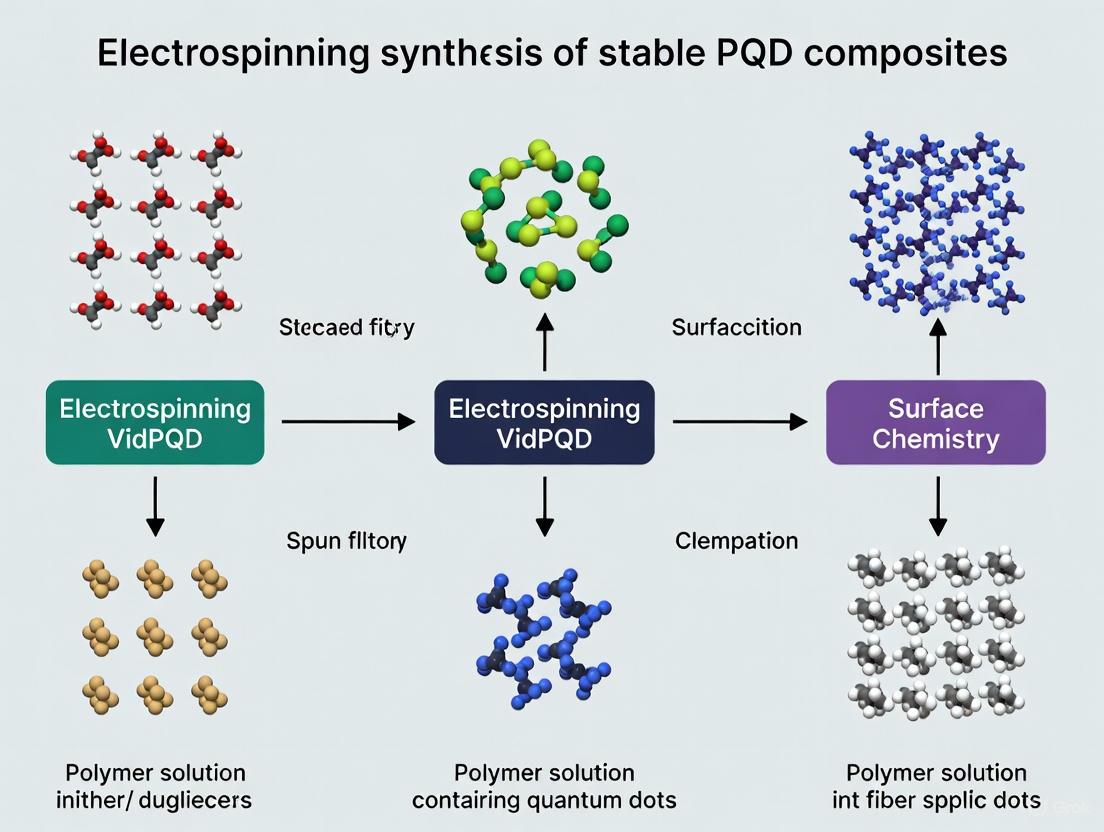
This article comprehensively explores the synthesis of stable perovskite quantum dot (PQD) composites via electrospinning, a versatile technique for creating nanofibrous scaffolds.
Electrospinning Synthesis of Stable Perovskite Quantum Dot Composites: Strategies for Biomedical and Drug Delivery Applications
Abstract
This article comprehensively explores the synthesis of stable perovskite quantum dot (PQD) composites via electrospinning, a versatile technique for creating nanofibrous scaffolds. Tailored for researchers and drug development professionals, it covers the foundational principles of PQDs and electrospinning, detailing methodologies for composite fabrication and integration. The content addresses critical challenges in PQD stability and offers troubleshooting and optimization strategies. Finally, it examines the validation of composite performance and compares different material systems for advanced applications in drug delivery, biosensing, and tissue engineering, providing a roadmap for developing next-generation biomedical devices.
Understanding the Building Blocks: Principles of Electrospinning and Perovskite Quantum Dots
Electrospinning is a versatile and efficient technique for the fabrication of micro- and nanoscale fibers, distinguished by its ability to produce structures with high surface area, interconnected porosity, and tunable morphology [1] [2]. Since its initial development in the 1930s and resurgence in the late 20th century, electrospinning has garnered significant interest in fields ranging from biomedical engineering to advanced materials science [1] [3]. Its capacity to create fiber architectures that mimic the natural extracellular matrix (ECM) makes it particularly valuable for developing biomimetic materials [2] [4].
This protocol outlines the fundamental principles and practical methodologies for electrospinning, with specific emphasis on the synthesis of stable perovskite quantum dot (PQD) composites. The integration of PQDs into electrospun nanofibers represents a promising strategy to enhance PQD stability while maintaining their exceptional optical properties, enabling applications in advanced anti-counterfeiting, LED devices, and biomedical imaging [5] [6].
Theoretical Foundations
The Electrospinning Process: Core Principles
Electrospinning operates on the principle of electrostatic force overcoming surface tension to create ultrafine fibers. The standard apparatus consists of four primary components: a high-voltage power supply, a solution storage unit (typically a syringe), an ejection device (needle), and a collection device [1] [2] [7].
The process initiates when a high voltage (typically several thousand to tens of thousands of volts) is applied to the polymer solution, creating a voltage differential between the needle and collector. This induces charge accumulation within the solution, forming a Taylor cone—a conical meniscus at the needle tip where electrostatic repulsion counteracts surface tension [1] [2]. Once the critical voltage is exceeded, a charged polymer jet is ejected from the Taylor cone apex and undergoes rapid, unstable whipping motions en route to the collector. This stretching and thinning action, coupled with solvent evaporation, produces solid micro- or nanoscale fibers that accumulate on the collector as a non-woven mat [1] [7].
Mechanism Visualization
The following diagram illustrates the fundamental electrospinning process and the in-situ synthesis mechanism for PQD composites:
Factors Influencing Electrospinning
Electrospinning outcomes are governed by multiple interdependent parameters which can be categorized into solution properties, process parameters, and environmental conditions [1] [3] [2]. Understanding and optimizing these factors is crucial for producing fibers with desired characteristics for PQD encapsulation.
Key Processing Parameters
Table 1: Critical Electrospinning Parameters and Their Effects on Fiber Morphology
| Parameter Category | Specific Parameter | Impact on Fiber Formation | Typical Range for PQD Composites |
|---|---|---|---|
| Solution Properties | Polymer Concentration | Determines spinnability; affects fiber diameter and morphology [3] | Varies by polymer (e.g., 10-20% PAN) [6] |
| Viscosity | Influences jet stability and fiber diameter; too low causes bead formation, too high inhibits flow [3] | 1-20 Poise (dependent on polymer) [3] | |
| Conductivity | Affects jet elongation and fiber diameter; higher conductivity produces thinner fibers [1] | Adjust with salts or ionic additives | |
| Solvent Volatility | Impacts drying rate and fiber morphology; controls PQD crystallization [6] | DMF, DMF/DMSO mixtures [6] | |
| Process Parameters | Applied Voltage | Controls jet initiation and stretching force; affects fiber diameter [1] [2] | 10-25 kV [6] |
| Collection Distance | Influences solvent evaporation and fiber deposition; shorter distances may yield wet fibers [1] | 10-20 cm [6] | |
| Flow Rate | Determines solution feed rate; affects fiber diameter and morphology [2] | 0.5-3 mL/h [6] | |
| Collector Type | Controls fiber alignment and mat structure [1] [2] | Static plate, rotating drum | |
| Environmental Conditions | Temperature | Affects solvent evaporation rate and solution viscosity [2] | 20-30°C |
| Humidity | Influences solvent evaporation and fiber morphology; high humidity may cause pore formation [2] | 30-50% |
Experimental Protocols
Standard Electrospinning Protocol for PQD/PAN Composite Fibers
Based on: In Situ Synthesis of CsPbX₃/Polyacrylonitrile Nanofibers [6]
Materials Preparation
- Precursor Solution: Dissolve 0.5 mmol PbX₂ and 0.5 mmol CsX (X = Cl, Br, I) in 10 mL DMF
- Polymer Addition: Add 1.0 g polyacrylonitrile (PAN, Mw ≈ 150,000) to the precursor solution under continuous stirring
- Solvent Adjustment: For chloride-containing precursors, use 5 mL DMSO with 5 mL DMF to enhance solubility
- Mixing Protocol: Stir the mixture for 6-12 hours at room temperature until a homogeneous, viscous solution forms
Electrospinning Procedure
Setup Configuration:
- Load the prepared solution into a syringe with a 20G stainless steel needle (0.51 mm diameter)
- Set needle-to-collector distance to 15 cm
- Use aluminum foil or rotating drum as collector
Process Execution:
- Apply fixed voltage of 15 kV to the needle
- Set solution flow rate to 2 mL/h using a syringe pump
- Maintain electrospinning duration for 2.5 hours to achieve uniform fiber mat
Post-Processing:
- Dry collected fibers in an oven at 60°C for 1 hour to remove residual solvents
- For enhanced PQD crystallization, additional heat treatment may be applied (80-100°C)
Advanced Protocol: Triple-Strand Conjugate Electrospinning for Multifunctional Composites
Based on: Fluorescent-Magnetic-Conductive Tri-Functional Nanofibrous Yarns [5]
This advanced technique enables integration of multiple functionalities while preventing detrimental interactions between different components:
Separate Solution Preparation:
- Fluorescent Strand: CsPbBr₃ PQDs/PAN solution (as in protocol 4.1)
- Magnetic Strand: CoFe₂O₄ nanoparticles (5-15% w/w) in PAN solution
- Conductive Strand: Polyaniline (PANI, 3-8% w/w) in PAN solution
Multi-Spinneret Configuration:
- Arrange three separate syringes in triangular configuration
- Apply synchronized voltage (12-18 kV) to all spinnerets
- Maintain individual flow control (1-3 mL/h per syringe)
Yarn Collection:
- Use rotating mandrel collector with controlled rotation speed (100-500 rpm)
- Apply slight twisting during collection to integrate three fiber types into unified yarn
- Adjust collector distance to 15-20 cm based on solvent system
Research Reagent Solutions
Essential materials for electrospinning PQD composite fibers:
Table 2: Key Research Reagents for Electrospinning PQD Composites
| Reagent Category | Specific Examples | Function/Purpose | Application Notes |
|---|---|---|---|
| Polymer Matrices | Polyacrylonitrile (PAN) | Primary fiber matrix; provides water stability and processability [6] | Excellent UV/weather resistance; Mw ≈ 150,000 recommended [6] |
| Poly(vinyl alcohol) (PVA) | Water-soluble polymer for biomedical applications [7] | 8-16 wt% in aqueous solutions [7] | |
| Poly(lactic-co-glycolic acid) (PLGA) | Biodegradable polymer for drug delivery [8] [7] | 4 wt% in appropriate solvents [7] | |
| PQD Precursors | Cesium Halides (CsBr, CsI, CsCl) | Cesium source for perovskite formation [6] | 0.5 mmol in 10 mL solvent typical [6] |
| Lead Halides (PbBr₂, PbI₂, PbCl₂) | Lead source for perovskite crystal structure [6] | Maintain 1:1 ratio with cesium precursors [6] | |
| Solvents | N,N-Dimethylformamide (DMF) | Primary solvent for precursor dissolution [6] | High boiling point (153°C) allows controlled crystallization |
| Dimethyl Sulfoxide (DMSO) | Co-solvent for enhanced halide solubility [6] | Particularly useful for chloride-containing perovskites | |
| Functional Additives | CoFe₂O₄ Nanoparticles | Magnetic functionality [5] | 5-15% w/w in polymer solution [5] |
| Polyaniline (PANI) | Conductive functionality [5] | 3-8% w/w in polymer solution [5] | |
| Oleic Acid/Oleylamine | Surface ligands for PQD stabilization [5] | Added during precursor preparation [5] |
Characterization and Performance Metrics
Structural and Optical Properties of PQD Composite Fibers
Table 3: Performance Characteristics of Electrospun PQD Composites
| Characterization Method | Key Findings | Performance Significance |
|---|---|---|
| X-ray Diffraction (XRD) | Distinct peaks matching CsPbBr₃ crystal structure (PDF#18-0364) [6] | Confirms successful PQD formation within fiber matrix |
| SEM/TEM Analysis | Uniform fiber morphology with diameter 746.56±13.12 nm [5] | Demonstrates process control and fiber uniformity |
| Photoluminescence (PL) | Strong green emission (520 nm) under UV excitation; 33× higher intensity than blended composites [5] | Validates spatial separation strategy for enhanced fluorescence |
| Water Stability Test | Retention of ~93.5% PL intensity after 100 days in water [6] | Critical for practical applications; demonstrates superior encapsulation |
| Lifetime Measurement | Tunable decay lifetimes dependent on halide composition [6] | Reflects PQD quality and environmental protection |
| Conductivity | Two orders of magnitude higher than blended composites [5] | Maintained conductive pathways through spatial separation of functions |
Troubleshooting and Optimization
Common Experimental Challenges
The following workflow outlines systematic troubleshooting for typical electrospinning issues:
Optimization Strategies for PQD Composites
- Enhancing PQD Crystallinity: Optimize precursor concentration and thermal treatment conditions (60-100°C) to promote nanocrystal growth while maintaining spatial confinement [6]
- Improving Fiber Uniformity: Control environmental conditions (humidity 30-50%, temperature 20-30°C) to ensure consistent solvent evaporation rates [2]
- Increasing Production Yield: Scale-up using multi-needle configurations or free-surface electrospinning while maintaining fiber quality [1] [2]
- Enhancing Composite Stability: Employ core-shell designs or cross-linking strategies to improve mechanical integrity and environmental resistance [5] [6]
Applications and Future Directions
Electrospun PQD composite fibers demonstrate exceptional potential in multiple advanced applications. In lighting technology, CsPbBr₃/PAN composite films combined with K₂SiF₆:Mn⁴⁺ on blue LED chips produce stable white LEDs with color temperatures around 6000K and CIE coordinates of (0.318, 0.322) [6]. For anti-counterfeiting, the color-tunable luminescence across visible spectra enables sophisticated security patterns [6]. Advanced biomedical applications include multifunctional systems integrating fluorescence, magnetism, and conductivity for imaging and drug delivery [5].
Future developments will likely focus on intelligent processing techniques that combine electrospinning with 3D printing and microfluidics for precise spatial control [1] [2]. Green electrospinning approaches using benign solvents and melt processes address toxicity concerns while improving scalability [1] [2]. Multifunctional integration strategies, such as the triple-strand conjugate method, enable complex material systems with spatially separated functionalities for advanced optoelectronic and biomedical applications [5].
Perovskite quantum dots (PQDs), particularly lead halide perovskites with the general formula APbX₃ (where A = Cs⁺, MA⁺, FA⁺ and X = Cl⁻, Br⁻, I⁻), represent an emerging class of semiconductor nanomaterials that have revolutionized optoelectronics and biomedical research [9] [10]. These materials exhibit exceptional photophysical properties, including high photoluminescence quantum yield (PLQY) approaching 99% in optimized samples, narrow emission linewidths (as low as 16-27 nm), and widely tunable emission spectra across the entire visible range (450-688 nm) through quantum confinement effects and compositional engineering [11] [12] [13]. Their unique crystal structure combines organic and inorganic components in a three-dimensional framework, enabling remarkable charge carrier mobility and optical absorption coefficients [9].
Despite their exceptional properties, PQDs face significant challenges in practical applications due to inherent structural instability under environmental stressors such as moisture, oxygen, heat, and UV irradiation [11]. This instability has prompted extensive research into encapsulation strategies, with electrospinning emerging as a powerful technique for creating stable PQD-polymer composites [14] [12] [15]. The integration of PQDs within electrospun polymer fibers not only shields them from environmental degradation but also enables the fabrication of flexible, lightweight, and functional materials for advanced optoelectronic and biomedical applications [13] [15].
Optoelectronic Properties and Tunability
The exceptional optoelectronic properties of PQDs stem from their unique electronic band structure and quantum confinement effects. The table below summarizes key optoelectronic parameters reported for various PQD systems:
Table 1: Optoelectronic Properties of Perovskite Quantum Dots
| PQD Composition | Emission Range | FWHM | PLQY | Stability Features | Reference |
|---|---|---|---|---|---|
| CsPbBr₃ | 507-517 nm | 16-27 nm | Up to 99% | Stable luminescence for 2.5 years | [15] [16] |
| CsPbX₃ (X=Cl,Br,I) | 450-688 nm | 22-27 nm | 53.8-82.3% | >90 days in water; UV, thermal stable | [11] [13] |
| FAPbX₃ (X=Cl,Br,I) | 450-625 nm | Narrow | Up to 82.3% | Improved stability in core-shell fibers | [11] |
| MAPbI₃ | ~780 nm | - | - | Thermal instability issues | [14] |
Bandgap engineering in PQDs is achieved through two primary approaches: compositional modulation (halide mixing, A-site cation substitution) and quantum confinement (size control) [9] [10]. Compositional tuning of the X-site halides (Cl⁻, Br⁻, I⁻) enables precise adjustment of the bandgap across the entire visible spectrum, with chloride-rich compositions emitting in the blue region and iodide-rich compositions emitting in the red and near-infrared [11] [13]. Simultaneously, varying the A-site cation (Cs⁺, MA⁺, FA⁺) influences the crystal stability and tolerance factor, with all-inorganic CsPbX₃ demonstrating superior thermal stability compared to hybrid organic-inorganic counterparts [14] [10].
Quantum confinement effects become prominent when the PQD size falls below the Bohr exciton diameter (approximately 7-12 nm for lead halide perovskites) [10]. This enables continuous tuning of the emission wavelength while maintaining narrow emission profiles, which is crucial for high-color-purity displays and lighting applications [13] [16]. Recent advances in synthesis have yielded CsPbBr₃ QDs with near-unity PLQY (99%) and extremely narrow FWHM (22 nm), representing state-of-the-art performance for green-emitting nanomaterials [16].
Electrospinning Synthesis of Stable PQD Composites
Electrospinning Methodology for PQD Encapsulation
Electrospinning has emerged as a versatile and scalable technique for encapsulating PQDs within polymer matrices to enhance their environmental stability while maintaining their exceptional optoelectronic properties [14] [12] [15]. This process utilizes high-voltage electrostatic fields to create fine fibers from polymer solutions containing PQD precursors or pre-synthesized PQDs [14]. The rapid solvent evaporation during fiber formation facilitates in situ crystallization of PQDs within the polymer matrix, effectively isolating them from environmental degradants [11] [15].
Table 2: Electrospinning Configurations for PQD-Polymer Composites
| Electrospinning Method | Polymer Matrix | PQD System | Key Advantages | Applications | |
|---|---|---|---|---|---|
| Single-nozzle | PVP, PAN, PS | CsPbBr₃, MAPbI₃ | Simple setup, rapid fabrication | Fluorescent sensors, membranes | [14] [12] |
| Microfluidic core-shell | PS/PMMA | FAPbX₃ | Enhanced stability, tunable emission | Display technology, light conversion | [11] |
| Two-nozzle conjugate | PAN | CsPbX₃ | Continuous filament production | Weavable textiles, wearable devices | [13] |
| Triple-strand conjugate | PAN | CsPbBr₃/CoFe₂O₄/PANI | Multifunctional partitions | EMI shielding, smart textiles | [5] |
The electrospinning process involves several critical parameters that influence the resulting fiber morphology and PQD properties. Electrical voltage (typically 10-25 kV) determines the jet formation and fiber stretching, with higher voltages producing smaller fiber diameters but potentially increasing bead formation [14]. Collector type (planar vs. rotary) and rotation speed (500-750 rpm optimal for mechanical properties) control fiber alignment and orientation [14]. Solution parameters including polymer concentration (8-15%), viscosity, and solvent volatility significantly impact fiber morphology and PQD distribution within the fibers [14] [13].
Electrospinning Workflow for PQD-Polymer Composite Fibers
Protocol: Microfluidic Electrospinning of Core-Shell PQD Fibers
Objective: To fabricate stable, color-tunable FAPbX₃ (X = Cl, Br, I) PQDs embedded in polystyrene (core)-poly(methyl methacrylate) (shell) nanofibers with high quantum yield and environmental stability [11].
Materials:
- Precursor salts: Formamidinium halides (FACl, FABr, FAI), Lead halides (PbCl₂, PbBr₂, PbI₂)
- Polymers: Polystyrene (PS, Mw ~200,000), Poly(methyl methacrylate) (PMMA, Mw ~120,000)
- Solvents: N,N-Dimethylformamide (DMF, anhydrous), Tetrahydrofuran (THF)
- Ligands: Oleic acid (OA), Oleylamine (OAm)
- Equipment: Microfluidic electrospinning setup, Syringe pumps (2), High-voltage power supply, Collector plate
Procedure:
- Core Solution Preparation: Dissolve PS (15% w/v) in DMF:THF (3:1 v/v) mixture. Add stoichiometric ratios of FABr (0.2 M) and PbBr₂ (0.2 M) to the polymer solution. Add OA (100 μL) and OAm (50 μL) as stabilizers. Stir vigorously for 4 hours at 60°C until fully dissolved.
- Shell Solution Preparation: Dissolve PMMA (12% w/v) in DMF alone to create a higher surface tension solution.
- Microfluidic Electrospinning Setup: Load core and shell solutions into separate syringes mounted on syringe pumps. Connect syringes to coaxial spinneret with core solution through inner needle (22G) and shell solution through outer needle (18G).
- Electrospinning Parameters: Set flow rates: core solution at 0.8 mL/h, shell solution at 1.2 mL/h. Apply voltage of 18 kV with working distance of 15 cm between spinneret and collector. Maintain temperature at 25°C and relative humidity below 30%.
- Fiber Collection: Collect fibers on aluminum foil-covered rotating mandrel (200 rpm). Anneal fibers at 80°C for 30 minutes to complete in situ crystallization of FAPbBr₃ PQDs at the core-shell interface.
- Characterization: Verify PQD formation by photoluminescence spectroscopy (emission ~520 nm for FAPbBr₃). Measure PLQY using integrating sphere (typically 70-82%).
Troubleshooting Tips:
- If bead formation occurs: Increase polymer concentration or reduce flow rate.
- If PQDs show broad emission: Optimize annealing temperature and precursor ratios.
- If fibers exhibit poor mechanical properties: Adjust core-to-shell flow rate ratio or increase molecular weight of polymer.
The Scientist's Toolkit: Essential Research Reagents and Materials
Table 3: Essential Research Reagents for PQD Electrospinning Research
| Category | Specific Reagents | Function/Purpose | Considerations |
|---|---|---|---|
| Perovskite Precursors | CsX (X=Cl, Br, I), PbX₂, MAX, FAX | Forms perovskite crystal structure | High purity (>99.9%) essential for optimal performance |
| Polymer Matrices | PVP, PAN, PS, PMMA, PVA | Encapsulates and stabilizes PQDs | Must be soluble in polar solvents; affects mechanical properties |
| Solvents | DMF, DMSO, THF, Toluene | Dissolves precursors and polymers | Anhydrous conditions critical for controlling crystallization |
| Ligands | Oleic Acid, Oleylamine, 2-Hexyldecanoic acid | Controls PQD growth and passivates surface | Affects PQD size, stability, and quantum yield |
| Additives | Acetate salts, n-Octylamine | Enhances precursor conversion, passivates defects | Improves reproducibility and optoelectronic properties |
Optoelectronic Applications
Light-Emitting Devices and Displays
PQD-embedded electrospun fibers have demonstrated exceptional potential for light-emitting applications, particularly in displays and solid-state lighting [11] [13]. The core-shell fiber architecture enables precise color tuning from blue to red emission (450-625 nm) with narrow FWHM (16-27 nm), achieving wide color gamuts exceeding 125% of NTSC standards [11]. The encapsulation of PQDs within polymer fibers significantly enhances operational stability, with PS/FAPbBr₃/PMMA core-shell nanofibers maintaining >79% fluorescence retention after 60 hours of continuous UV illumination and demonstrating excellent water resistance [11].
Recent advances in two-nozzle electrospinning have enabled the continuous production of CsPbX₃@PAN luminescent filaments suitable for weaving and knitting operations [13]. These filaments exhibit high PLQY (53.8%), exceptional stability in water (>90 days), and mechanical robustness (tensile strength up to 14.37 N after twisting), making them ideal for wearable displays and smart textiles [13]. The enhanced stability stems from the complete isolation of PQDs from environmental oxygen and moisture through the polymer matrix, effectively suppressing non-radiative recombination pathways [13] [15].
Photonic Memory and Neuromorphic Computing
PQDs have emerged as promising materials for next-generation memory technologies, including memristors and photonic memory devices [10]. The resistive switching behavior in PQD-based memory devices originates from ionic migration and charge trapping phenomena within the perovskite crystal structure [10]. When configured in cross-point arrays, these devices can simulate synaptic functions, implementing neuromorphic computing principles that transcend conventional von Neumann architecture limitations [10].
The quantum confinement effect in PQDs enables precise bandgap engineering, allowing optimization of the ON/OFF ratio in memristive devices [10]. Devices utilizing 2D perovskite (C₄H₉NH₃)₂PbI₄ with a larger bandgap (2.43 eV) demonstrated significantly higher ON/OFF ratios (10⁷) compared to 3D MAPbI₃ (10²) due to enhanced Schottky barrier formation [10]. Electrospun PQD-polymer composites offer additional advantages for flexible memory devices, combining the switching characteristics of perovskites with the mechanical flexibility and environmental stability of polymer matrices [10].
Biomedical Applications and Protocols
Fluorescent Sensors and Biosensing
Electrospun PQD composite fibers have demonstrated remarkable capabilities as fluorescent sensors for biomedical detection applications [12]. The high quantum yield (~91%), narrow emission linewidth (~16 nm), and excellent photostability of these materials enable ultrasensitive detection based on fluorescence resonance energy transfer (FRET) mechanisms [12].
Protocol: FRET-based Biosensor Using CPBQDs/PS Fiber Membrane
Objective: To fabricate an ultrasensitive fluorescent sensor for detection of biomolecules using CsPbBr₃ QDs encapsulated in polystyrene (PS) fiber membranes [12].
Materials and Equipment:
- Electrospinning apparatus with high-voltage power supply
- Polystyrene (Mw ~350,000)
- CsPbBr₃ precursor solution (CsBr, PbBr₂ in DMF)
- Aluminum foil collector
- Target analyte solutions (e.g., Rhodamine 6G, protein conjugates)
Procedure:
- Electrospinning Solution: Dissolve PS (20% w/v) in anhydrous DMF. Add CsBr (0.15 M) and PbBr₂ (0.15 M) to the polymer solution. Add 100 μL oleic acid and 50 μL oleylamine as stabilizers. Stir for 6 hours at 50°C until a homogeneous solution is obtained.
- Fiber Fabrication: Load solution into 5 mL syringe with 21G stainless steel needle. Set flow rate to 1.0 mL/h and apply voltage of 20 kV. Maintain working distance of 15 cm between needle and collector. Collect fibers on aluminum foil at ambient conditions (25°C, 30% RH).
- Post-treatment: Anneal fibers at 100°C for 10 minutes to complete CsPbBr₃ crystallization. Verify green emission under UV lamp (365 nm).
- Sensor Implementation: Cut fiber membrane into 1×1 cm pieces. Immerse in analyte solutions of varying concentrations. Measure fluorescence intensity changes using spectrofluorometer with 365 nm excitation.
- FRET Efficiency Calculation: Calculate FRET efficiency using the formula: E = 1 - (F_DA/F_D), where F_DA is donor fluorescence in presence of acceptor and F_D is donor fluorescence alone.
Performance Metrics: The CPBQDs/PS fiber membrane sensor demonstrated an ultralow detection limit of 0.01 ppm for Rhodamine 6G with FRET efficiency of 18.80% in 1 ppm R6G solution [12]. The sensor maintained 79.80% fluorescence retention after 60 hours of UV illumination and nearly 100% retention after 10 days in water [12].
FRET-based Sensing Mechanism in PQD-Composite Fibers
Photodynamic Therapy and Drug Delivery
The integration of PQDs within electrospun fibers has shown significant promise for photodynamic therapy (PDT) applications, leveraging their excellent light-harvesting capabilities and reactive oxygen species (ROS) generation efficiency [17]. While most research has focused on porphyrin-based photosensitizers, preliminary studies indicate that perovskite materials exhibit similar potential for ROS generation upon light activation [17].
Protocol: PQD-Embedded Fibers for Potential Photodynamic Therapy
Objective: To develop PQD-incorporated core-shell fibers for localized ROS generation and drug delivery in biomedical applications [17].
Materials:
- Biocompatible polymers: PVA, Gelatin, PLGA
- CsPbBr₃ PQD solution (pre-synthesized)
- Model therapeutic agents (e.g., doxorubicin, curcumin)
- Phosphate buffered saline (PBS, pH 7.4)
- ROS detection reagents (e.g., Singlet Oxygen Sensor Green)
Procedure:
- Core Solution: Dissolve PVA (10% w/v) in deionized water at 80°C. Add pre-synthesized CsPbBr₃ PQDs (5 mg/mL) and therapeutic agent (1 mg/mL). Stir until homogeneous.
- Shell Solution: Dissolve gelatin (15% w/v) in acetic acid/water (80:20 v/v) mixture.
- Coaxial Electrospinning: Use coaxial spinneret with core flow rate 0.5 mL/h and shell flow rate 1.0 mL/h. Apply voltage 15 kV with collection distance 12 cm.
- Cross-linking: Expose fibers to glutaraldehyde vapor for 12 hours to cross-link gelatin shell.
- ROS Generation Testing: Immerse fibers in PBS containing Singlet Oxygen Sensor Green (5 μM). Irradiate with blue light (450 nm, 100 mW/cm²) for varying durations. Measure fluorescence intensity at 525 nm (excitation 480 nm).
- Drug Release Profiling: Place fibers in PBS at 37°C with gentle shaking. Collect aliquots at predetermined time points and analyze drug concentration via HPLC.
Expected Outcomes: The core-shell structure provides sustained release of therapeutic agents while maintaining PQD stability and ROS generation capability. The system enables localized treatment with higher efficacy and reduced systemic toxicity compared to conventional administration [17].
The integration of perovskite quantum dots within electrospun polymer matrices represents a powerful strategy for overcoming the stability limitations of PQDs while leveraging their exceptional optoelectronic properties. The protocols and applications outlined in this document demonstrate the tremendous potential of these composite materials across optoelectronic and biomedical domains. Current research continues to address challenges in scalability, lead toxicity, and long-term stability under operational conditions. Future developments will likely focus on lead-free perovskite alternatives, advanced polymer matrices with enhanced barrier properties, and multifunctional systems combining sensing, therapy, and imaging capabilities within a single platform. As electrospinning methodologies advance toward continuous production and greater precision in fiber architecture, PQD-embedded composites are poised to enable transformative technologies in wearable optoelectronics, point-of-care diagnostics, and targeted therapeutic interventions.
Perovskite quantum dots (PQDs), particularly halide perovskite variants such as CsPbBr₃, have emerged as a revolutionary class of semiconducting nanomaterials with exceptional optoelectronic properties. Their high photoluminescence quantum yield, tunable emission wavelengths, and superior charge transport characteristics make them ideal for advanced applications in biosensing, light-emitting devices, and energy harvesting [18]. The stability challenge forms the central paradox of PQD technology: these materials exhibit phenomenal performance in controlled environments yet remain notoriously vulnerable to degradation under operational conditions.
The core instability issues stem from their inherent ionic crystal structure and high surface energy. PQDs are particularly susceptible to moisture, oxygen, light, and heat, which can rapidly degrade their crystalline structure and quench their optical properties [18]. Furthermore, lead-based PQDs face additional complications due to potential lead ion (Pb²⁺) leakage, raising significant toxicity concerns that create regulatory barriers for clinical applications, particularly in biomedical settings such as drug development or in vivo diagnostics [18]. These vulnerabilities necessitate the development of robust protective matrices that can shield PQDs from environmental stressors while maintaining their exceptional functionality, forming the critical research focus this application note addresses.
The Stability Challenge: A Systematic Analysis
The degradation pathways of PQDs are multifaceted and interconnected. Understanding these mechanisms is prerequisite to designing effective protective strategies.
Primary Degradation Pathways
- Aqueous-Phase Degradation: The ionic nature of perovskite crystals makes them highly susceptible to hydrolysis. Water molecules rapidly penetrate the crystal lattice, displacing halide anions and organic cations, leading to complete crystal dissolution over time [18]. Even brief exposure to ambient humidity can initiate this irreversible process.
- Photo-oxidation and Thermal Degradation: Under illumination, especially in the presence of oxygen, PQDs undergo a photo-catalyzed oxidation process that creates surface defects acting as non-radiative recombination centers [18]. Thermal stress similarly accelerates ion migration within the crystal lattice, destabilizing the quantum-confined structure.
- Ion Leaching and Toxicity: For lead-based PQDs like CsPbBr₃, the release of toxic Pb²⁺ ions presents a dual problem: it degrades the material's optical properties and creates environmental and health hazards [18]. This leaching phenomenon occurs particularly in aqueous environments and acidic conditions, severely limiting biomedical applications.
Quantifying the Stability Deficit
Table 1: Key Stability Limitations of Unprotected PQDs
| Stability Parameter | Typical Performance | Impact on Applications |
|---|---|---|
| Aqueous Stability | Degradation within hours to days [18] | Limits biomedical, environmental sensing |
| Lead Leaching | Typically exceeds permitted levels for parenteral administration [18] | Barriers to clinical translation, toxicity concerns |
| Thermal Stability | Degradation above 60-80°C | Restricts processing conditions, device operation |
| Ambient Light Stability | Significant decay over days to weeks | Shortens device lifespan, reduces reliability |
The Electrospinning Solution: Encapsulation Strategies for PQDs
Electrospinning has emerged as a powerful and versatile technique for creating advanced composite materials that directly address PQD stability challenges. This electrohydrodynamic process creates continuous polymer fibers with diameters ranging from nanometers to micrometers, forming an ideal scaffold for PQD encapsulation [19] [20] [21].
Electrospinning Fundamentals for PQD Encapsulation
The basic electrospinning apparatus consists of high-voltage power supply, syringe pump with spinneret, and grounded collector [20] [21]. When a high voltage (typically 5-60 kV) is applied to the polymer solution containing dispersed PQDs, the electrostatic forces overcome surface tension to form a "Taylor cone" from which a charged jet is ejected. This jet undergoes stretching and whipping motions before solidifying into continuous fibers that deposit on the collector [21].
The core advantage for PQD protection lies in the complete encapsulation within the polymer matrix, creating a physical barrier that shields the quantum dots from environmental stressors while potentially allowing functional interaction with the environment through controlled porosity [19] [20].
Table 2: Electrospinning Parameters for Optimizing PQD-Polymer Composites
| Parameter Category | Key Variables | Influence on PQD Composite Properties |
|---|---|---|
| Solution Parameters | Polymer concentration, viscosity, conductivity, PQD loading ratio [20] [22] | Determines fiber morphology, PQD distribution, and encapsulation efficiency |
| Process Parameters | Applied voltage, flow rate, needle-to-collector distance [21] [22] | Affects fiber diameter, alignment, and PQD degradation during processing |
| Environmental Parameters | Temperature, humidity [20] | Influences solvent evaporation rate and fiber solidification |
| Collector Design | Stationary plate, rotating drum [21] | Controls fiber alignment and mat morphology |
Material Selection for Protective Matrices
The choice of polymer matrix significantly influences both the protective capability and application functionality:
- Polyurethane (PU): Offers excellent flexibility, tear resistance, and biocompatibility, making it suitable for wearable sensors and biomedical applications [19].
- Polycaprolactone (PCL): A biodegradable polyester with good processability and biocompatibility, ideal for implantable devices and environmentally benign applications [23].
- Polyvinyl Alcohol (PVA): Water-soluble, biodegradable polymer with high tensile strength, often blended with other polymers to modify properties [22].
- Lead-Free Alternatives: Bismuth-based PQDs (e.g., Cs₃Bi₂Br₉) demonstrate superior compatibility with biological systems and already meet current safety standards without additional coating requirements [18].
Experimental Protocols: Fabrication and Characterization of PQD-Composite Nanofibers
Protocol 1: Electrospinning of PQD-Polymer Composite Nanofibers
This protocol describes the fabrication of CsPbBr₃ PQD-polyurethane composite nanofibers for biosensing applications, adapted from established methodologies with PQD-specific modifications [19] [20].
Research Reagent Solutions:
- Perovskite Quantum Dots: CsPbBr₃ PQDs synthesized via hot-injection method (10 mg/mL in toluene)
- Polymer Matrix: Polyurethane (PU) pellets (10% w/v in DMF/THF mixture)
- Solvent System: N,N-Dimethylformamide (DMF) and tetrahydrofuran (THF) (7:3 v/v)
- Stabilization Additive: Oleic acid (0.1% v/v) and oleylamine (0.1% v/v) for surface passivation
Procedure:
- PQD Surface Functionalization: Pre-treat CsPbBr₃ PQDs with oleic acid and oleylamine (1:1 ratio) to enhance compatibility with the polymer matrix. Centrifuge at 8000 rpm for 5 minutes and redisperse in minimal THF.
- Polymer Solution Preparation: Dissolve PU pellets in DMF/THF solvent system to achieve 10% w/v concentration. Stir continuously at 50°C for 6 hours until complete dissolution.
- Composite Solution Formulation: Slowly add functionalized PQD dispersion (final concentration: 2% w/w relative to polymer) to the polymer solution under gentle stirring. Maintain stirring for 2 hours at room temperature to achieve homogeneous dispersion.
- Electrospinning Parameters:
- Voltage: 15-18 kV
- Flow rate: 1.0 mL/h
- Needle-to-collector distance: 15-20 cm
- Collector: Rotating drum (2000 rpm)
- Ambient conditions: 25°C, 40-50% relative humidity
- Fiber Collection: Collect composite nanofibers on aluminum foil-covered drum. Maintain electrospinning for 4-6 hours to achieve sufficient mat thickness (50-100 µm).
Troubleshooting Notes:
- If bead formation occurs, increase polymer concentration or reduce flow rate.
- If PQD aggregation is observed, enhance surface functionalization or reduce PQD loading.
- If fiber diameter is inconsistent, optimize humidity control and ensure stable temperature.
Protocol 2: Stability Assessment of PQD-Composite Nanofibers
This protocol provides standardized methods for evaluating the protective efficacy of electrospun matrices against environmental stressors [18].
Accelerated Aging Tests:
- Thermal Stability Assessment:
- Place composite samples in oven at 60°C, 80°C, and 100°C
- Measure photoluminescence (PL) intensity and full-width half-maximum (FWHM) at 24-hour intervals
- Compare with unprotected PQDs under identical conditions
Aqueous Stability Testing:
- Immerse composite mats in phosphate-buffered saline (PBS, pH 7.4) at 37°C
- Measure PL quantum yield (PLQY) daily using integrating sphere
- Analyze supernatant for lead ion concentration via ICP-MS (for lead-based PQDs)
Photostability Evaluation:
- Subject samples to continuous illumination (450 nm, 100 mW/cm²)
- Monitor PL decay and color coordinate shifts over time
- Compare half-lives of protected versus unprotected PQDs
Characterization Techniques:
- SEM/TEM Imaging: Assess fiber morphology, diameter distribution, and PQD dispersion within fibers [24] [23]
- XRD Analysis: Monitor crystal structure changes before and after stress tests
- FTIR Spectroscopy: Detect chemical degradation or surface ligand displacement
- Fluorescence Spectroscopy: Quantify optical performance retention under various stressors
Application Performance and Validation
The practical efficacy of electrospun protective matrices is demonstrated through enhanced performance in real-world applications, particularly in biosensing and detection platforms.
Table 3: Performance Comparison of Protected vs. Unprotected PQDs
| Application Context | Unprotected PQDs | Electrospun Matrix-Protected PQDs |
|---|---|---|
| Biosensing in Serum | Rapid degradation within hours [18] | Stable performance for weeks with appropriate polymer matrix [18] |
| Lead Leaching (CsPbBr₃) | Exceeds permitted levels for clinical use [18] | Below detection limits in PCL/PU matrices [18] [23] |
| Photoelectrochemical Sensing | Signal decay >80% in 24 hours | Maintains >90% initial sensitivity after 1 week [18] |
| Mechanical Flexibility | Brittle, prone to cracking | Excellent flexibility and durability in PU composites [19] |
Advanced material engineering has yielded particularly promising results:
- Dual-Mode Detection Systems: Electrospun composites incorporating PQDs have enabled lateral-flow assays combining fluorescence and electrochemiluminescence for sensitive Salmonella detection in food samples [18].
- Lead-Free Formulations: Bismuth-based PQDs (Cs₃Bi₂Br₉) incorporated in electrospun fibers demonstrate sub-femtomolar sensitivity for miRNA detection with extended serum stability, addressing both performance and toxicity concerns [18].
- Multiplexed Detection Platforms: Machine-learning-assisted fluorescent arrays using stabilized PQD-polymer composites achieve complete discrimination of multiple bacterial pathogens in complex matrices like tap water [18].
The Scientist's Toolkit: Essential Research Reagents
Table 4: Key Research Reagent Solutions for PQD-Composite Development
| Reagent/Category | Representative Examples | Function in PQD-Composite Development |
|---|---|---|
| Polymer Matrices | Polyurethane (PU), Polycaprolactone (PCL), Polyvinyl Alcohol (PVA) [19] [23] [22] | Provides structural backbone, encapsulation, and mechanical properties |
| Solvent Systems | DMF, THF, Chloroform, DMAc [24] [23] | Dissolves polymer, enables PQD dispersion, controls evaporation rate |
| PQD Systems | CsPbBr₃, Cs₃Bi₂Br₉, MAPbI₃ [18] | Functional component providing optical/electronic properties |
| Surface Ligands | Oleic acid, Oleylamine, Polyacrylic acid [18] | Enhances PQD-polymer compatibility, reduces aggregation |
| Stabilization Additives | Silica precursors, Crosslinkers, Antioxidants | Improves environmental resilience, mechanical integrity |
| Conductive Fillers | Carbon nanotubes, Graphene, Metallic nanoparticles [19] [24] | Enhances electrical conductivity for sensing applications |
The integration of PQDs within electrospun polymer matrices represents a paradigm shift in addressing the fundamental stability challenges that have hindered the practical deployment of these exceptional nanomaterials. By creating tailored microenvironments that shield PQDs from environmental stressors while permitting functional interactions with target analytes, electrospun composites successfully balance the seemingly contradictory requirements of stability and functionality.
Future research directions should focus on several key areas:
- Advanced Material Systems: Development of multi-functional polymers that actively contribute to sensing mechanisms while providing protection.
- Scalable Manufacturing: Optimization of electrospinning parameters for industrial-scale production of PQD-composite materials.
- Accelerated Validation: Establishment of standardized testing protocols for rapid assessment of long-term stability under application-relevant conditions.
- Bio-Integration: Enhanced compatibility with biological systems through sophisticated surface engineering and biodegradable matrix materials.
As these developments progress, electrospun PQD composites are poised to enable a new generation of robust, sensitive, and reliable detection platforms that fully leverage the extraordinary optoelectronic properties of perovskite quantum dots while overcoming their historical limitations.
PQD Stabilization via Electrospinning
Perovskite Quantum Dots (PQDs), particularly cesium lead halide perovskites (CsPbX₃), have emerged as exceptional luminescent materials with superior optoelectronic properties, including high photoluminescence quantum yield (PLQY), narrow emission spectra, and tunable bandgaps [25] [26]. However, their widespread commercial application is severely hampered by intrinsic instability under environmental stressors such as moisture, heat, and oxygen. The susceptibility of PQDs to degradation leads to rapid fluorescence quenching, limiting their practical implementation in sensing, displays, and lighting technologies.
Electrospinning technology presents a sophisticated solution to this stability challenge through the encapsulation of PQDs within a protective polymer fiber matrix. This technique utilizes high-voltage electrostatic forces to draw polymer solutions into continuous micro- to nanoscale fibers, creating a three-dimensional porous network with high surface area [27] [1] [3]. When PQDs are incorporated into these fibers, the polymer matrix acts as a physical barrier, shielding the quantum dots from environmental degradation while preserving their exceptional optical properties. The synergistic combination of PQDs and electrospun fibers yields composite materials with enhanced environmental stability, mechanical integrity, and functionality for advanced applications in sensing, energy harvesting, and wearable technologies [28] [26].
Mechanisms of Stabilization and Encapsulation
The stabilization of PQDs within electrospun fibers occurs through multiple synergistic mechanisms that collectively preserve their optical functionality and structural integrity. The encapsulation process begins with the strategic integration of PQDs into the polymer solution prior to electrospinning. As the polymer jet travels toward the collector under high voltage (typically 10-30 kV), rapid solvent evaporation occurs, leading to the formation of solid fibers with PQDs uniformly distributed and securely embedded within the polymer matrix [26]. This physical confinement is crucial as it isolates individual PQDs, preventing aggregation and creating a barrier against penetrating moisture and oxygen molecules.
A critical advancement in PQD encapsulation involves surface ligand engineering to enhance compatibility between the quantum dots and the polymer matrix. Research demonstrates that exchanging native oleic acid ligands with methacrylic acid (MAA) significantly improves the dispersion stability of CdSe QDs in styrene-methyl methacrylate co-polymer systems [26]. The methacrylic acid ligands facilitate stronger interfacial interactions with the polymer chains and can potentially participate in polymerization reactions, leading to covalent anchoring of PQDs within the fiber matrix. This robust integration prevents PQD leaching and enhances overall composite stability.
The electrospinning process itself contributes to stabilization through the formation of a dense polymer skin around PQDs during fiber solidification. The rapid solvent evaporation and polymer chain alignment under electrostatic stretching create a compact microstructure with reduced permeability to environmental gases and vapors. This protective function is evidenced by the exceptional stability of CdSe@P(S+MMA) hybrid fibers, which maintain their photoluminescence output below 120°C and demonstrate excellent moisture and salt resistance [26]. The polymer matrix not only acts as a physical barrier but also reduces the mobility of PQD surfaces, effectively suppressing surface ion migration and associated degradation pathways.
Table 1: Stabilization Mechanisms of PQDs in Electrospun Fibers
| Mechanism | Process Description | Stabilization Effect |
|---|---|---|
| Physical Encapsulation | Embedding PQDs within polymer fiber matrix during electrospinning | Creates barrier against moisture, oxygen, and thermal degradation |
| Ligand Engineering | Exchanging native ligands with polymer-compatible functional groups | Enhances dispersion and interfacial adhesion; prevents aggregation |
| Matrix Restriction | Polymer chains limiting PQD surface mobility and ion migration | Suppresses non-radiative recombination pathways; reduces PL quenching |
| Architectural Design | Engineering fiber porosity, diameter, and packing density | Controls analyte diffusion for sensing; balances protection and accessibility |
Quantitative Analysis of Stability Enhancement
Rigorous experimental investigations have quantified the stability enhancements achieved through electrospinning encapsulation. Comparative studies between bare PQDs and their electrospun composites reveal dramatic improvements in environmental resilience across multiple stress conditions.
Under thermal stress, CdSe@P(S+MMA) hybrid fibers maintain 79% of their initial photoluminescence intensity at 120°C, a temperature that would completely quench most unprotected PQDs [26]. While fluorescence signals decrease to 40%, 28%, 20%, and 13% at 140°C, 160°C, 180°C, and 200°C respectively due to chemical degradation of CdSe QDs, these values still represent significant protection compared to unencapsulated counterparts. The thermal protection mechanism arises from the high glass transition temperature of polymers like P(S+MMA) which form a rigid matrix that suppresses PQD decomposition pathways.
In humid environments, electrospun fibers provide exceptional moisture barrier properties. Research on CdSe QDs encapsulated in styrene-co-methyl methacrylate fibers demonstrated maintained luminescence and structural integrity even under high humidity conditions, a notable achievement given the extreme susceptibility of perovskite materials to hydrolysis [26]. The hydrophobic nature of many electrospinning polymers (e.g., PVDF, polystyrene, PMMA) creates a non-polar environment that repels water molecules and prevents hydration of the PQD crystal structure.
Chemical stability is similarly enhanced, with electrospun PQD composites showing resistance to salt solutions and other ionic environments that would typically degrade unprotected quantum dots [26]. The polymer matrix acts as an ion diffusion barrier, preventing corrosive species from reaching the encapsulated PQDs. This is particularly valuable for biomedical and environmental sensing applications where complex chemical environments are encountered.
Table 2: Quantitative Stability Performance of Electrospun PQD Composites
| Stress Condition | Performance Metric | Electrospun Composite | Unprotected PQDs |
|---|---|---|---|
| Thermal (120°C) | PL Intensity Retention | 79% [26] | Near complete quenching |
| Thermal (200°C) | PL Intensity Retention | 13% [26] | Complete degradation |
| Moisture Resistance | Structural integrity in humidity | Maintained [26] | Rapid decomposition |
| Chemical Stability | Resistance to salt solutions | Excellent [26] | Variable to poor |
| Operational Lifetime | Duration of functional performance | Weeks to months [26] | Hours to days |
Experimental Protocols for PQD Encapsulation
PQD Synthesis and Ligand Exchange Protocol
Materials Required:
- Cadmium oxide (CdO, 99.99%) and Selenium powder (Se, 99.99%)
- Oleic acid (OA, 90%) and Oleylamine (OAm, 80-90%)
- 1-octadecene (1-ODE, 90%) and Trioctylphosphine (TOP)
- Methacrylic acid (MAA) for ligand exchange
Synthesis Procedure:
- Cadmium Precursor Preparation: Dissolve 2.4 mmol CdO in 2.5 mL 1-ODE and 2.5 mL OA in a three-neck flask. Heat to 100°C under vacuum for 20 minutes, then increase temperature to 250°C under nitrogen atmosphere for 5 minutes to obtain cadmium oleate [26].
Selenium Precursor Preparation: Dissolve 1.2 mmol Se powder in 1 mL TOP under ultrasonic treatment at room temperature under inert atmosphere [26].
QD Synthesis: In a separate three-neck flask, combine 0.4 mL TOP-Se solution, 0.6 mL TOP, and 9 mL OAm. Degas under vacuum at 100°C for 20 minutes with stirring. When temperature reaches 275°C, rapidly inject 1 mL cadmium oleate solution under N₂ atmosphere. Stir for 4 minutes then cool immediately to room temperature [26].
Purification: Precipitate obtained CdSe QDs with methanol, centrifuge at 8000 rpm for 5 minutes, and dry under inert atmosphere [26].
Ligand Exchange: Dissolve 6.65 mmol dry CdSe QDs in 20 mL monomer mixture (e.g., styrene:methyl methacrylate). Add 70 μL methacrylic acid and maintain for 12 hours to complete oleic to methacrylic acid ligand exchange [26].
Diagram 1: PQD Synthesis and Functionalization Workflow
Electrospinning Encapsulation Protocol
Polymer Solution Preparation:
- Monomer Selection: Prepare a mixture of styrene and methyl methacrylate with varying volume ratios (10:0, 9:1, 8:2, 7:3, 6:4) to optimize polymer matrix properties [26].
In-situ Polymerization: Add 0.055 mmol AIBN initiator and 10 mL methyl acetate as solvent to the functionalized PQD-monomer solution. Heat on oil bath at 100°C for 2 hours for pre-polymerization, followed by 12 hours at 130°C to complete polymerization [26].
Solution Optimization: Adjust polymer concentration to achieve viscosity between 300-700 mPa·s, which is critical for successful electrospinning and optimal fiber morphology [27].
Electrospinning Parameters:
- Equipment Setup: Utilize a standard electrospinning apparatus with high-voltage power supply (0-30 kV), syringe pump, and grounded collector [1] [3].
Process Conditions:
Fiber Collection: Use aluminum foil as collector for random fiber orientation, or rotating drum for aligned fibers [1].
Diagram 2: Electrospinning Setup and Fiber Formation Process
Characterization and Validation Methods
Morphological Analysis:
- SEM Imaging: Characterize fiber diameter, surface morphology, and PQD distribution using scanning electron microscopy [26].
- TEM Analysis: Examine internal structure and PQD localization within fibers using transmission electron microscopy [26].
- Elemental Mapping: Confirm uniform PQD distribution using STEM-EDS elemental mapping [26].
Optical Performance:
- Photoluminescence Spectroscopy: Measure emission spectra, quantum yield, and stability under environmental stress [26].
- UV-Vis Absorption: Record absorption characteristics of PQD solutions and composite fibers [26].
- Fluorescence Microscopy: Visualize spatial distribution of luminescence within fiber mats [26].
Stability Assessment:
- Thermal Testing: Monitor PL intensity retention at elevated temperatures (25-200°C) over time [26].
- Environmental Testing: Evaluate performance under controlled humidity (20-90% RH) and salt exposure [26].
- Long-term Stability: Measure optical properties over 30+ days under ambient and stressed conditions [25].
The Scientist's Toolkit: Essential Research Reagents and Materials
Table 3: Essential Research Reagents for PQD Electrospinning
| Material/Reagent | Specification | Function | Example Sources |
|---|---|---|---|
| Cadmium Oxide (CdO) | 99.99%, trace metals basis | PQD precursor for high-quality crystallization | Sigma-Aldrich [26] |
| Cesium Bromide (CsBr) | 99.9%, anhydrous | Perovskite component for CsPbBr₃ synthesis | Sigma-Aldrich [25] |
| Oleic Acid (OA) | Technical grade, 90% | Native surface ligand for PQD stabilization | Aladdin [26] |
| Oleylamine (OAm) | 80-90% | Co-ligand for PQD synthesis and stabilization | Aladdin [26] |
| Methacrylic Acid (MAA) | 99% with stabilizer | Ligand exchange for polymer compatibility | Aladdin [26] |
| Polyacrylonitrile (PAN) | Mw = 150,000 g/mol | Polymer matrix for carbon nanofiber conversion | Merck [25] |
| Styrene (St) | Distilled under reduced pressure | Polymer matrix component | Aladdin [26] |
| Methyl Methacrylate (MMA) | 99% | Polymer matrix co-monomer | Aladdin [26] |
| Azodiisobutyronitrile (AIBN) | 98% | Radical initiator for polymerization | Sinopharm [26] |
| N,N-Dimethylformamide (DMF) | Anhydrous, 99.8% | Solvent for electrospinning solutions | Sigma-Aldrich [25] |
Application Perspectives in Advanced Sensing Technologies
The enhanced stability of electrospun PQD composites enables their implementation in sophisticated sensing platforms across multiple domains. In healthcare monitoring, the exceptional luminescence properties of stabilized PQDs facilitate the development of highly sensitive biosensors. Research demonstrates that PQD-integrated composites can achieve detection limits as low as 0.03 fg mL⁻¹ for target analytes, showcasing their potential for diagnostic applications requiring extreme sensitivity [28] [25]. The porous fibrous architecture enhances analyte accessibility while maintaining protection of the sensing elements.
For environmental and wearable sensing, electrospun PQD composites offer mechanical flexibility alongside environmental resilience. The incorporation of CdSe QDs in styrene-methyl methacrylate co-polymer fibers has yielded materials with excellent moisture, heat, and salt resistance, enabling their use in protective clothing with sensing capabilities [26]. The thermal-induced photoluminescence quenching of these composites provides a measurable response to environmental changes, creating opportunities for smart textile applications.
In advanced analytical systems, the combination of electrospun PQD composites with electrochemical detection methods creates multimodal sensing platforms. The integration of PQDs with covalent organic frameworks (COFs) in nanofibrous structures enables both fluorescence and electrochemical impedance spectroscopy (EIS) detection, significantly enhancing measurement reliability and reducing false positives [25]. This approach has demonstrated femtogram-level sensitivity for neurotransmitter detection in complex biological matrices like human serum, highlighting the translational potential of stabilized PQD composites in clinical diagnostics.
Electrospinning technology provides a robust and versatile platform for encapsulating and stabilizing Perovskite Quantum Dots, effectively addressing their primary limitation of environmental sensitivity. Through multiple synergistic mechanisms—including physical confinement, ligand engineering, and matrix restriction—electrospun polymer fibers preserve the exceptional optical properties of PQDs while imparting remarkable resistance to thermal, moisture, and chemical degradation. The standardized protocols presented herein enable reproducible fabrication of PQD-composite fibers with quantum yields up to 27% and operational stability under demanding conditions.
Future research should focus on expanding the library of compatible polymer matrices, developing scaled-up manufacturing processes, and exploring novel application paradigms in energy harvesting, advanced diagnostics, and smart materials. The continued refinement of interfacial engineering strategies and the integration of electrospinning with complementary nanofabrication techniques will further enhance performance and open new frontiers for PQD-based technologies in both academic research and industrial applications.
Electrospinning has emerged as a versatile and efficient technique for fabricating polymer nanofibers with diameters ranging from nanometers to several micrometers. These nanofibers exhibit remarkable characteristics, including very large surface area-to-volume ratios, flexibility in surface functionalities, and superior mechanical performance compared to other material forms [29]. When integrated with functional nanoparticles such as perovskite quantum dots (PQDs), these composite materials unlock transformative potential for advanced applications in drug delivery, sensing, and energy technologies. The electrospinning process utilizes a high-voltage electric field to draw charged threads from polymer solutions or melts, producing continuous fibers with tunable morphology, porosity, and composition [30] [2]. This application note provides a comprehensive framework for material selection and experimental protocols for developing electrospun polymer-PQD composites, specifically contextualized within thesis research on synthesizing stable PQD composites.
The convergence of polymer science and quantum dot technology through electrospinning enables the creation of multifunctional materials with tailored optical, electronic, and biological properties. PQDs offer exceptional photoluminescence quantum yields, size-tunable emission wavelengths, and narrow emission bands, making them ideal for photonic applications. However, PQDs face challenges with environmental stability and aggregation that can be mitigated through proper encapsulation within polymer nanofibers. This document establishes standardized protocols for selecting appropriate polymer matrices, incorporating PQDs, and characterizing the resulting composites to achieve enhanced stability and performance for drug development and biomedical applications.
Polymer Selection for Electrospun Composites
Polymer Classification and Properties
The selection of an appropriate polymer matrix is fundamental to the successful fabrication of electrospun PQD composites. Polymers serve as the structural scaffold that determines the mechanical integrity, degradation profile, and processing parameters of the final composite material. Based on their origin and behavior, polymers for electrospinning can be categorized into natural, synthetic, and biodegradable classes, each offering distinct advantages for specific applications [2].
Natural polymers such as collagen, chitosan, and gelatin provide inherent biocompatibility and bioactive cues that support cellular interactions, making them ideal for tissue engineering and drug delivery applications. However, they often exhibit batch-to-batch variability and limited mechanical strength. Synthetic polymers including polyvinylidene fluoride (PVDF), polyacrylonitrile (PAN), polycaprolactone (PCL), and polyamide (PA) offer superior mechanical properties, tunable degradation rates, and reproducible manufacturing characteristics. Biodegradable polymers like polylactic acid (PLA), polyglycolic acid (PGA), and their copolymers (PLGA) provide temporary support with controlled resorption profiles, making them suitable for implantable drug delivery systems [30] [2].
The polymer selection must align with the intended application of the PQD composite. For drug delivery systems, polymers with tunable erosion rates and compatibility with therapeutic payloads are essential. For sensing applications, polymers with appropriate conductivity, optical properties, and stability under operating conditions are critical. The molecular weight of the polymer significantly influences solution viscosity and spinnability, with optimal concentrations typically yielding solutions with viscosities between 1-20 Pa·s for successful fiber formation [29] [2].
Table 1: Classification of Polymers for Electrospun Composites
| Polymer Category | Examples | Key Properties | Applications | Limitations |
|---|---|---|---|---|
| Natural Polymers | Collagen, Chitosan, Gelatin, Silk Fibroin | Excellent biocompatibility, biodegradability, cellular recognition sites | Tissue engineering, wound healing, drug delivery | Batch variability, limited mechanical strength, complex processing |
| Synthetic Non-degradable | PVDF, PAN, Polyamide (PA), Polystyrene (PS) | Superior mechanical strength, chemical resistance, reproducible properties | Filtration, protective textiles, sensors, reinforcement | Non-degradable, potential chronic inflammation if implanted |
| Synthetic Biodegradable | PCL, PLA, PGA, PLGA | Tunable degradation rates, good mechanical properties, FDA approval for some formulations | Controlled drug delivery, temporary implants, tissue scaffolds | Acidic degradation products (for some), limited functional groups |
| Stimuli-Responsive | Poly(N-isopropylacrylamide), Chitosan derivatives | Response to pH, temperature, light, or magnetic fields | Smart drug delivery, sensors, actuators | Complex synthesis, potential toxicity of responsive units |
Quantitative Polymer Selection Guidelines
Selecting the optimal polymer for electrospinning requires careful consideration of multiple parameters that influence fiber morphology, composite performance, and processing feasibility. The following table provides quantitative data on key polymers used in electrospinning composites, particularly focusing on properties relevant to PQD incorporation and stability.
Table 2: Electrospinning Parameters and Performance of Selected Polymers
| Polymer | Typical Solvent System | Concentration Range (wt%) | Fiber Diameter Range (nm) | Tensile Strength (MPa) | Degradation Time | Compatability with PQDs |
|---|---|---|---|---|---|---|
| PCL | Chloroform/DMF (3:1) | 10-15 | 100-800 | 20-35 | 2-3 years | High - hydrophobic protection |
| PLA | Chloroform/DMF (4:1) | 8-12 | 200-1000 | 50-70 | 12-24 months | Medium - may cause quenching |
| PLGA | Chloroform/DMF (3:1) | 10-15 | 150-900 | 30-50 | 1-6 months (ratio dependent) | High - tunable compatibility |
| PAN | DMF | 8-12 | 150-600 | 100-250 | Non-degradable | Excellent - precursor for carbonization |
| PVDF | DMF/Acetone (3:2) | 15-20 | 200-1000 | 90-150 | Non-degradable | Medium - requires surface modification |
| Polyamide-6 | Formic Acid/Acetic Acid (1:1) | 18-22 | 100-500 | 200-400 | Non-degradable | High - good mechanical stability |
| Chitosan | Aqueous acetic acid (1-5%) | 2-7 | 80-400 | 50-100 | 1-3 months | Low - hydrophilic, may degrade PQDs |
When selecting polymers for PQD composites, consider the compatibility between the polymer's solubility and the PQD surface ligands. Polymers processed in non-polar solvents often provide better compatibility with oleic acid/oleylamine-capped PQDs, while hydrophilic polymers may require ligand exchange or surface modification of PQDs. Additionally, the polymer's optical properties should be considered—UV-absorbing polymers may interfere with PQD photoluminescence, while transparent polymers allow optimal light emission.
Perovskite Quantum Dot (PQD) Integration Strategies
PQD Selection and Stabilization
Perovskite quantum dots, particularly lead halide perovskites (CsPbX₃, where X = Cl, Br, I), offer exceptional optical properties including high photoluminescence quantum yield (PLQY), narrow emission bandwidth, and easily tunable emission wavelengths across the visible spectrum. However, their susceptibility to moisture, oxygen, and heat presents significant challenges for practical applications. Successful integration into electrospun composites requires careful PQD selection and stabilization strategies.
The stability of PQDs can be enhanced through several approaches prior to electrospinning: (1) Surface ligand engineering using longer-chain ligands or mixed ligand systems to enhance binding affinity; (2) Ion doping with elements such as Mn²⁺, Zn²⁺, or Cu²⁺ to improve crystallinity and environmental stability; (3) Surface encapsulation with oxides (SiO₂, Al₂O₃) or polymers to create protective barriers; and (4) Compositional engineering using mixed halide or cation systems to achieve phase stability [31].
For biomedical applications, particularly drug delivery, additional considerations include reducing potential lead leakage through lead-free alternatives (such as CsSnX₃, Cs₂AgBiX₆ double perovskites) or implementing encapsulation strategies that completely isolate PQDs from the biological environment. The emission characteristics should be selected based on the application requirements—blue-emitting PQDs for optogenetics, green-red emitting for imaging, and near-infrared for deep tissue penetration.
PQD-Polymer Composite Fabrication Methods
Several electrospinning techniques can be employed to create polymer-PQD composites, each offering distinct advantages for different application requirements:
Blend Electrospinning: PQDs are uniformly dispersed in the polymer solution before electrospinning. This method offers simplicity and high loading capacity but may expose PQDs to solvent interactions and result in heterogeneous distribution. Optimal dispersion is achieved through probe sonication (30-60 seconds at 20-30% amplitude) followed by magnetic stirring (2-4 hours). Solvent selection is critical—non-polar solvents like toluene or hexane may be required for PQD stability, though they limit polymer choices.
Coaxial Electrospinning: Utilizes a specialized spinneret with concentric nozzles to create core-shell fibers where PQDs can be localized in either the core or shell layer [30]. This technique provides superior protection for PQDs, especially when encapsulated in the core, and enables controlled release kinetics for drug delivery applications. Core-shell fibers typically require precise control of flow rates (core: 0.1-0.5 mL/h, shell: 0.5-1.5 mL/h) and voltage parameters (15-25 kV).
Emulsion Electrospinning: PQDs are suspended in an immiscible polymer solution to create an emulsion that is subsequently electrospun [30]. This method is particularly useful for hydrophilic PQDs in hydrophobic polymer matrices and can enhance the distribution control of multiple components (drugs, imaging agents).
Post-processing Integration: PQDs are incorporated into pre-formed electrospun fibers through infiltration, dip-coating, or in-situ growth. This approach completely avoids exposing PQDs to harsh processing solvents but may result in surface-loaded composites with potential leaching issues.
Table 3: Comparison of PQD Incorporation Methods in Electrospun Composites
| Method | PQD Loading Efficiency | Distribution Control | PQD Protection | Process Complexity | Best For |
|---|---|---|---|---|---|
| Blend Electrospinning | High (70-90%) | Limited - random dispersion | Moderate - solvent exposure | Low | Rapid screening, high throughput |
| Coaxial Electrospinning | Medium (50-80%) | High - precise compartmentalization | Excellent - complete encapsulation | High | Biomedical applications, controlled release |
| Emulsion Electrospinning | Medium-High (60-85%) | Medium - domain-specific localization | Good - limited solvent contact | Medium | Multi-functional composites |
| Post-processing Integration | Low-Medium (30-70%) | Low - surface accumulation | Poor - surface exposure | Low-Medium | Heat-sensitive PQDs |
Experimental Protocols
Protocol 1: Blend Electrospinning of PLGA-PQD Composite Fibers for Drug Delivery
This protocol describes the preparation of composite fibers containing poly(lactic-co-glycolic acid) (PLGA) and perovskite quantum dots for theranostic applications (combined therapy and imaging).
Materials:
- PLGA (50:50 LA:GA ratio, MW 50,000-75,000)
- CsPbBr₃ PQDs (10 mg/mL in toluene)
- Chloroform (anhydrous, ≥99%)
- N,N-Dimethylformamide (DMF, anhydrous)
- Model drug compound (e.g., doxorubicin hydrochloride)
- Deionized water
Equipment:
- Electrospinning apparatus with high-voltage power supply (0-30 kV)
- Syringe pump
- Stainless steel spinneret (21-25 gauge)
- Grounded collector (stationary or rotating)
- Environmental control chamber (optional)
- Ultrasonic processor
Procedure:
Polymer Solution Preparation
- Dissolve PLGA in chloroform:DMF (3:1 v/v) at 12% w/v concentration
- Stir magnetically at 400 rpm for 4-6 hours until complete dissolution
- For drug-loaded fibers, add model drug (5-10% w/w relative to polymer) and stir for additional 2 hours
PQD Incorporation
- Add PQD solution (0.5-2% w/w relative to polymer) to the polymer solution
- Use probe sonication at 25% amplitude for 30 seconds to disperse PQDs
- Continue magnetic stirring at 300 rpm for 2 hours in dark conditions
Electrospinning Parameters
- Load solution into syringe with metallic needle (21G)
- Set flow rate: 0.8-1.2 mL/h
- Apply voltage: 15-20 kV
- Collection distance: 12-18 cm
- Use rotating mandrel (500-1000 rpm) for aligned fibers or static collector for random orientation
- Maintain environmental conditions at 25±2°C and 40±5% relative humidity
Fiber Collection and Storage
- Carefully peel fibers from collector
- Store in desiccator under nitrogen atmosphere at 4°C
- Shield from light to prevent PQD degradation
Troubleshooting:
- Bead formation: Increase polymer concentration or reduce flow rate
- PQD aggregation: Reduce PQD concentration or increase sonication time
- Inconsistent fiber diameter: Maintain stable temperature and humidity
Protocol 2: Coaxial Electrospinning for Core-Shell PQD Composites
This protocol enables the fabrication of core-shell fibers with PQDs localized in the core region, providing enhanced protection against environmental degradation.
Materials:
- Core polymer: PCL (MW 70,000-90,000)
- Shell polymer: PVDF (MW 275,000)
- PQDs (CsPbI₃ or mixed halide for tunable emission)
- Solvent systems: DMF/acetone for shell, chloroform for core
Equipment:
- Coaxial electrospinning setup with specialized spinneret
- Dual-channel syringe pump
- Humidity and temperature control system
Procedure:
Solution Preparation
- Shell solution: Dissolve PVDF (17.5% w/v) in DMF:acetone (3:2) with 0.01% LiCl
- Core solution: Dissolve PCL (10% w/v) in chloroform with dispersed PQDs (1-3% w/w)
Coaxial Electrospinning
- Load core and shell solutions into separate syringes
- Set core flow rate: 0.3 mL/h
- Set shell flow rate: 1.0 mL/h
- Apply voltage: 20-25 kV
- Collection distance: 15-20 cm
- Use rotating collector (200-500 rpm)
Characterization
- Confirm core-shell structure using TEM
- Evaluate PQD distribution using confocal microscopy
- Test encapsulation efficiency through leaching studies
Diagram 1: Coaxial Electrospinning Workflow for Core-Shell PQD Composites
Characterization Methods for Polymer-PQD Composites
Structural and Morphological Characterization
Comprehensive characterization is essential to validate the successful integration of PQDs within polymer nanofibers and to assess composite properties. The following table outlines key characterization techniques and their applications for polymer-PQD composites.
Table 4: Characterization Techniques for Polymer-PQD Composites
| Technique | Information Obtained | Sample Preparation | Typical Parameters |
|---|---|---|---|
| Scanning Electron Microscopy (SEM) | Fiber morphology, diameter, surface texture, bead formation | Sputter coating with Au/Pd (5-10 nm) | Acceleration voltage: 5-15 kV, working distance: 5-10 mm |
| Transmission Electron Microscopy (TEM) | PQD distribution, localization, core-shell structure, particle size | Ultramicrotomy (50-100 nm sections) or direct deposition on grid | Acceleration voltage: 80-200 kV, STEM mode for elemental mapping |
| Atomic Force Microscopy (AFM) | Surface roughness, mechanical properties, fiber topography | None required | Tapping mode, scan rate: 0.5-1 Hz, silicon cantilevers |
| X-ray Photoelectron Spectroscopy (XPS) | Surface composition, chemical states, PQD encapsulation efficiency | None required | Monochromatic Al Kα source, spot size: 200-500 μm, charge neutralization |
| Fourier Transform Infrared Spectroscopy (FTIR) | Chemical interactions, functional groups, polymer-PQD interfaces | KBr pellet or ATR attachment | Resolution: 4 cm⁻¹, scans: 32-64, range: 4000-400 cm⁻¹ |
Optical and Functional Characterization
The optical properties of PQDs within the composite fibers must be carefully evaluated to ensure retention of functionality after the electrospinning process.
Photoluminescence Spectroscopy:
- Measure emission spectra, quantum yield, and lifetime
- Compare free PQDs versus incorporated PQDs to assess matrix effects
- Evaluate photostability under continuous illumination
- Map distribution using confocal laser scanning microscopy
Stability Assessment:
- Environmental testing: expose to controlled humidity (40-90% RH) and temperature (25-60°C)
- Accelerated aging studies to predict long-term performance
- Leaching tests: immerse in aqueous solutions and measure PQD release over time
- Mechanical stability: evaluate optical properties under strain
Drug Release Profiling (for therapeutic applications):
- Use UV-Vis spectroscopy or HPLC to quantify drug release
- Evaluate release kinetics under physiological conditions
- Correlate release profiles with composite morphology
The Scientist's Toolkit: Essential Research Reagents and Materials
Table 5: Essential Research Reagents for Electrospun PQD Composites
| Category | Item | Specification | Function | Supplier Examples |
|---|---|---|---|---|
| Polymers | PLGA | 50:50 or 75:25 LA:GA ratio, MW 50,000-100,000 | Biodegradable matrix for drug delivery | Sigma-Aldrich, Lactel, Corbion |
| PCL | MW 70,000-90,000 | Flexible, slow-degrading core polymer | Sigma-Aldrich, Perstorp | |
| PVDF | MW ~275,000 | Piezoelectric shell polymer | Sigma-Aldrich, Arkema | |
| Solvents | DMF | Anhydrous, 99.8% | Polar aprotic solvent for electrospinning | Sigma-Aldrich, Fisher Scientific |
| Chloroform | Anhydrous, ≥99% | Non-polar solvent for PQD dispersion | Sigma-Aldrich, Merck | |
| DCM | Anhydrous, ≥99.8% | Volatile solvent for rapid drying | Sigma-Aldrich, TCI | |
| PQD Precursors | Cs₂CO₃ | 99.9% trace metals basis | Cesium source for PQD synthesis | Sigma-Aldrich, Strem Chemicals |
| PbBr₂ | 99.999% trace metals basis | Lead source for PQD synthesis | Sigma-Aldrich, Alfa Aesar | |
| Oleic Acid | Technical grade, 90% | Surface ligand for PQD stabilization | Sigma-Aldrich, TCI | |
| Stabilizers | LiCl | Anhydrous, 99% | Solution conductivity enhancer | Sigma-Aldrich, Fisher Scientific |
| FAS | 1H,1H,2H,2H-Perfluorodecyltriethoxysilane, 97% | Hydrophobicity enhancer | Sigma-Aldrich, Gelest | |
| Characterization | TEM Grids | Copper, 300 mesh | Sample support for electron microscopy | Ted Pella, Electron Microscopy Sciences |
| ATR Crystals | Diamond, single bounce | FTIR sample platform | Pike Technologies, Specac |
Diagram 2: Logical Flow for Polymer-PQD Composite Development
The strategic integration of perovskite quantum dots within electrospun polymer fibers represents a promising approach to overcome PQD stability limitations while creating multifunctional composites for advanced applications. The material selection guidelines and experimental protocols provided in this document establish a foundation for developing stable, functional PQD composites with tailored properties for specific research objectives.
For drug development professionals, these composites offer unique opportunities for theranostic applications where the PQDs provide imaging capabilities while the polymer matrix controls drug release kinetics. The combination of real-time monitoring through PQD photoluminescence with controlled therapeutic agent delivery enables innovative treatment approaches with potential for personalized medicine.
Future developments in this field will likely focus on increasing complexity and functionality, including multi-responsive systems that react to biological stimuli, multi-drug delivery platforms with temporal control, and optimized composites for clinical translation. As electrospinning technology advances toward greater precision and scalability, and as PQD stability continues to improve, these hybrid materials are poised to make significant contributions to biomedical science and technology.
Fabrication Techniques and Emerging Biomedical Applications
The integration of perovskite quantum dots (PQDs) into polymeric nanofibers via electrospinning presents a promising route for creating advanced functional composites. This protocol outlines a standardized procedure for preparing polymer-PQD electrospinning ink, a critical step in synthesizing stable PQD composite fibers. The methodology focuses on achieving optimal solution properties to facilitate the electrospinning of uniform, bead-free fibers while maintaining the photoluminescent properties of the PQDs. Proper ink formulation is paramount, as the solution parameters directly influence jet formation, fiber morphology, and ultimately, the functional performance of the resulting composite mats [32] [33].
The Scientist's Toolkit: Essential Research Reagents and Materials
The following table details the key materials required for the preparation of polymer-PQD electrospinning ink.
Table 1: Essential Research Reagents and Materials for Polymer-PQD Electrospinning Ink Preparation
| Material Category | Specific Examples | Function/Purpose |
|---|---|---|
| Polymer Matrix | Polyvinylpyrrolidone (PVP), Polyethylene Oxide (PEO), Polyvinyl Alcohol (PVA) | Provides the backbone for fiber formation; dictates solution viscosity and viscoelasticity necessary for chain entanglement and stable jet formation [32] [34]. |
| Solvent System | Dimethylformamide (DMF), Ethanol, Deionized (DI) Water, Mixtures (e.g., Ethanol/Water) | Dissolves the polymer and disperses PQDs; volatility affects solvent evaporation rate during fiber solidification [32] [34]. |
| Perovskite Quantum Dots (PQDs) | Organic-inorganic lead halide (e.g., MAPbI₃, CsPbBr₃) or lead-free variants | Functional filler providing unique optoelectronic properties (e.g., photoluminescence); the core component to be encapsulated [35]. |
| Stabilization Additives | Specific ligands (e.g., Oleic Acid, Oleylamine), Halide Salts (e.g., PbBr₂) | Enhance the dispersion stability of PQDs in the polymer solution and protect against degradation during processing [35]. |
| Crosslinking Agents | Glutaraldehyde, Genipin | Optional post-treatment agents to insolubilize and improve the mechanical strength and environmental stability of the final fiber mat [36]. |
Quantitative Electrospinning Parameter Optimization
Successful electrospinning is governed by a complex interplay of solution properties and process parameters. The tables below summarize key quantitative parameters that require optimization for a stable electrospinning jet and desired fiber morphology.
Table 2: Critical Solution Parameters for Polymer-PQD Ink Formulation
| Parameter | Target Range | Impact on Fiber Morphology |
|---|---|---|
| Polymer Concentration | 5 - 15 wt% (varies by polymer and Mw) | Determines viscosity and chain entanglement. Too low: bead formation; Too high: difficulty in jet ejection or micro-ribbon formation [32] [33]. |
| Solution Viscosity | ~1000 - 5000 cP (high-viscosity ink) | Governed by polymer concentration and molecular weight. Critical for suppressing Rayleigh instability and achieving continuous, bead-free fibers [32] [34]. |
| Solution Conductivity | Manipulated via solvent type or salt additives | Higher conductivity increases jet whipping, leading to thinner fibers, but must be balanced to avoid instability [33]. |
Table 3: Key Processing Parameters for Electrospinning Polymer-PQD Ink
| Parameter | Typical Range | Impact on Fiber Morphology |
|---|---|---|
| Applied Voltage | 15 - 30 kV | Provides the electrostatic force for jet initiation. Too low: unable to form Taylor cone; Too high: increased bead defects and jet instability [32] [33]. |
| Flow Rate | 0.1 - 2.0 mL/h | Controls the volume of solution supplied. Must be balanced with voltage to maintain a stable Taylor cone without dripping [32] [34]. |
| Tip-to-Collector Distance | 12 - 20 cm | Allows sufficient time for solvent evaporation. Too short: wet fibers; Too long: increased fiber whipping and thinning [32] [7]. |
| Needle Gauge (Inner Diameter) | 22G (0.413 mm) - 27G (0.210 mm) | Affects droplet size, Taylor cone formation, and fiber diameter. Smaller gauges can reduce clogging risk with composite inks [32] [34]. |
Experimental Protocol for Ink Preparation and Electrospinning
The diagram below illustrates the logical workflow for preparing and electrospinning the polymer-PQD ink.
Detailed Step-by-Step Methodology
Step 1: Polymer Solution Preparation
- Weighing: Accurately weigh the polymer (e.g., PVP, Mw ~55,000 g/mol) using an analytical balance to achieve the target concentration (e.g., 8-10 wt%) [32].
- Dissolution: Add the polymer gradually to the primary solvent (e.g., Ethanol or DMF) in a sealed vial to prevent solvent evaporation.
- Mixing: Stir the mixture using a magnetic stirrer at room temperature for 3-5 hours until a clear, homogeneous, and viscous solution is obtained. Ensure the solution is free of any undissolved particles or gels [32].
Step 2: PQD Dispersion Preparation
- Dispersion: Weigh the desired mass of PQD powder (e.g., CsPbBr₃) and disperse it in a minimal volume of a compatible solvent (e.g., Toluene or n-Hexane). The solvent should be miscible with the polymer solution's primary solvent.
- Stabilization: Add necessary stabilization ligands (e.g., Oleic acid) to the dispersion to prevent aggregation.
- Homogenization: Subject the PQD dispersion to mild ultrasonication in a bath sonicator for 10-20 minutes to break up large aggregates and create a uniform dispersion. Avoid prolonged or high-power sonication to prevent degradation of the PQDs.
Step 3: Master Ink Formulation
- Blending: Slowly add the prepared PQD dispersion to the polymer solution under vigorous vortex mixing. A typical mass ratio for polymer to PQDs can start at 100:1 and be adjusted based on the target loading.
- Mixing: Continue vortex mixing for 10-30 minutes to ensure a homogenous distribution of PQDs throughout the polymer solution without inducing aggregation. The final ink should appear uniform and may exhibit the characteristic color of the PQDs.
Step 4: Ink Characterization and Degassing
- Viscosity Check: Measure the apparent viscosity of the final ink using a rheometer (e.g., Brookfield rheometer) to ensure it falls within the target range of ~1000-5000 cP [34].
- Degassing: Centrifuge the ink at low speed (e.g., 2000-3000 rpm) for 5 minutes or let it stand to remove any air bubbles introduced during mixing, which can cause jet instability during electrospinning.
Step 5: Electrospinning Setup Configuration
- Syringe Loading: Load the degassed ink into a standard plastic syringe (e.g., 5-10 mL capacity).
- Nozzle Attachment: Attach a metallic needle (e.g., 23G with inner diameter ~0.337 mm) to the syringe [32] [34].
- Instrument Setup: Secure the syringe onto the syringe pump. Connect the high-voltage DC power supply's positive electrode to the needle tip. Set the grounded collector (e.g., aluminum foil on a flat plate or rotating drum) at a fixed distance of 12-16 cm [32].
Step 6: Electrospinning Execution and Optimization
- Parameter Initialization: Set an initial flow rate of 0.5 mL/h and an applied voltage of 20 kV [32].
- Process Initiation: Start the syringe pump and then gradually increase the applied voltage until a stable Taylor cone is observed at the needle tip and a continuous jet is ejected towards the collector.
- Optimization: Systematically vary the key parameters (voltage, flow rate, distance) as outlined in Table 3 to optimize for bead-free, uniform fiber morphology. Monitor the process for stability.
- Collection: Allow the electrospinning process to continue for the desired duration to achieve a fiber mat of sufficient thickness. The resulting composite nanofiber mat can then be carefully peeled off from the collector for further characterization and application.
Post-Spinning Treatment and Crosslinking
To enhance the stability of the PQD-polymer composite fibers, especially for applications in humid environments, a post-spinning crosslinking step is recommended.
- Agent Selection: Glutaraldehyde (GTA) vapor is a common chemical crosslinker for polymers like PVA. For biological or less harsh applications, genipin can be used as a biocompatible alternative [36].
- Procedure: Place the electrospun fiber mat in a sealed desiccator alongside a small open container of the crosslinking agent (e.g., 2 mL of 25% GTA aqueous solution). Expose the mat to the crosslinker vapor for 6-24 hours at room temperature [36].
- Result: This treatment forms covalent bonds between polymer chains, significantly improving the mechanical integrity and water resistance of the fiber mat, thereby protecting the encapsulated PQDs from moisture-induced degradation [36].
Advanced Electrospinning Setups: Coaxial and Emulsion Electrospinning for Core-Sheath Structures represent pivotal technologies in the synthesis of sophisticated nanofiber materials. These techniques enable the fabrication of fibers with core-sheath architectures, which are integral to the development of stable perovskite quantum dot (PQD) composites and advanced drug delivery systems. Unlike conventional electrospinning that produces monolithic fibers, coaxial and emulsion electrospinning provide precise control over the spatial distribution of active compounds, protecting sensitive materials like PQDs and biopharmaceuticals within the fiber core while utilizing the sheath as a functional barrier. This capability is critical for enhancing the stability, controlled release, and functional performance of composite materials across photovoltaic, biomedical, and sensing applications [37] [38].
The growing interest in these methods is reflected in the scientific literature, with a significant increase in publications on electrospinning over the past decade [39]. This review provides a detailed examination of the design principles, optimization parameters, and experimental protocols for coaxial and emulsion electrospinning, with specific application notes for PQD composite synthesis and biopharmaceutical delivery.
Fundamental Principles and Setups
Coaxial electrospinning utilizes a specialized spinneret with concentric nozzles that allow simultaneous extrusion of core and shell solutions. As these solutions exit the nozzle, electrostatic forces draw them into a compound jet that undergoes stretching and whipping motions, ultimately solidifying into core-shell fibers with distinct compartmentalization. This setup enables the encapsulation of delicate active compounds, such as nerve growth factor or PQDs, within a protective polymeric sheath, preserving their functionality and enabling controlled release kinetics [40] [37].
Emulsion electrospinning employs a single-nozzle system where an oil-in-water (O/W) or water-in-oil (W/O) emulsion serves as the spinning solution. During the electrospinning process, the dispersed phase aligns along the center of the elongating jet, forming a core-shell structure as the solvent evaporates. This method is particularly advantageous for encapsulating hydrophobic or hydrophilic compounds without requiring complex multi-channel equipment [30] [38].
Table 1: Comparative Analysis of Coaxial and Emulsion Electrospinning Techniques
| Parameter | Coaxial Electrospinning | Emulsion Electrospinning |
|---|---|---|
| Setup Configuration | Dual concentric nozzles for separate core/shell solutions | Single nozzle with pre-formed emulsion |
| Structural Control | Precise core-shell architecture with defined interfaces | Less precise core formation, depends on emulsion stability |
| Material Compatibility | Broad, allows incompatible polymers via separate channels | Limited to emulsion-compatible polymer systems |
| Encapsulation Efficiency | High, direct loading into core section | Variable, depends on emulsion stability and processing |
| Process Complexity | High, requires optimization of multiple flow rates | Moderate, requires emulsion formulation expertise |
| Scalability | Moderate, complex nozzle design challenges scale-up | Higher, compatible with conventional single-nozzle systems |
| Typical Applications | Drug delivery, sensors, solar cells, PQD composites | Drug delivery, active packaging, wound dressings |
Key Processing Parameters and Optimization
The morphology and performance of core-sheath fibers are governed by numerous processing parameters that require systematic optimization. Research by Hariprasad et al. demonstrates the application of design-of-experiment approaches, specifically Box-Behnken Design, to identify optimal parameter levels for minimizing fiber diameter and size distribution [40].
Table 2: Key Processing Parameters and Their Influence on Fiber Morphology
| Parameter Category | Specific Parameter | Influence on Fiber Morphology | Optimal Range (Coaxial) | Optimal Range (Emulsion) |
|---|---|---|---|---|
| Solution Parameters | Polymer Concentration | Directly affects fiber diameter; higher concentration increases diameter and reduces bead formation | Core: 5-15%, Shell: 8-20% (varies by polymer) | 8-25% total polymer content |
| Solution Viscosity | Determines jet stability; too low causes bead formation, too high inhibits jet formation | 100-2000 cP | 500-3000 cP | |
| Solution Conductivity | Affects jet stretching; higher conductivity produces smaller diameters | Adjust with ionic additives | Adjust with surfactants | |
| Process Parameters | Voltage | Controls jet initiation and stretching; optimal range prevents instability | 10-25 kV | 12-30 kV |
| Flow Rate | Affects jet velocity and fiber diameter; lower rates produce smaller diameters | Core: 0.1-0.5 mL/h, Shell: 0.5-2 mL/h | 0.5-3 mL/h | |
| Collector Distance | Allows solvent evaporation; shorter distance may yield wet fibers, longer may cause instability | 10-20 cm | 12-25 cm | |
| Collector Type & Speed | Controls fiber alignment; rotating mandrel enhances alignment | 500-5000 rpm for aligned fibers | 500-3000 rpm | |
| Environmental Parameters | Temperature | Affects solvent evaporation rate and solution viscosity | 20-30°C | 20-30°C |
| Humidity | Influences solvent evaporation and fiber morphology; too high causes pores, too low causes premature drying | 40-60% | 30-50% |
Statistical analysis revealed that parameters such as inner flow rate, collector distance, and voltage significantly impact nanofiber diameter, while collector speed is a key factor for controlling fiber size distribution [40]. For instance, optimal core-shell nanofibers with minimized fiber diameter (323 nm) and narrow size distribution (2.37%) were achieved with specific parameters: inner flow rate of 0.33 mL h⁻¹, outer flow rate of 2 mL h⁻¹, collector speed of 500 rpm, applied voltage of 17 kV, and needle-to-collector distance of 10 cm [40].
Experimental Protocols
Coaxial Electrospinning Protocol for PQD Composite Fibers
Objective: Fabricate aligned core-shell poly(ethylene oxide)-poly(l-lactide-co-glycolide) (PEO-PLGA) nanofibers encapsulating perovskite quantum dots for enhanced stability in photovoltaic applications.
Materials:
- Core Solution: PEO (3-5% w/v) in deionized water with dispersed PQDs (2-5 mg/mL)
- Shell Solution: PLGA (8-12% w/v) in hexafluoroisopropanol (HFIP) or DCM:DMF mixture (7:3 ratio)
- Equipment: Coaxial electrospinning apparatus with high-voltage power supply (0-30 kV), dual syringe pumps, coaxial spinneret (inner diameter: 0.5-0.8 mm, outer diameter: 1.5-2.0 mm), and rotating mandrel collector
Procedure:
- Solution Preparation:
- Dissolve PEO in deionized water under magnetic stirring for 4-6 hours at room temperature
- Disperse PQDs in the PEO solution using probe sonication (30-60 seconds at 20% amplitude) followed by gentle stirring for 1 hour
- Dissolve PLGA in organic solvent mixture with stirring for 8-12 hours until complete dissolution
- Filter both solutions through 0.45 μm syringe filters to remove particulate matter
Equipment Setup:
- Mount core and shell syringes on independent syringe pumps
- Connect coaxial spinneret ensuring concentric alignment of inner and outer capillaries
- Position rotating mandrel collector at fixed distance (10-15 cm) from spinneret tip
- Connect high-voltage supply to the coaxial spinneret
Electrospinning Parameters:
- Set core flow rate: 0.3-0.5 mL/h
- Set shell flow rate: 1.0-2.0 mL/h
- Apply voltage: 15-20 kV
- Set mandrel rotation speed: 500-1500 rpm
- Maintain environmental conditions: 22±2°C, 45±5% RH
Fiber Collection:
- Conduct electrospinning for 2-4 hours to obtain fibrous mat of sufficient thickness
- Vacuum-dry collected fibers for 24 hours at room temperature to remove residual solvents
Figure 1: Coaxial Electrospinning Experimental Workflow for PQD Composite Fibers
Emulsion Electrospinning Protocol for Biopharmaceutical Delivery
Objective: Fabricate core-sheath fibers for controlled delivery of protein-based biopharmaceuticals using emulsion electrospinning.
Materials:
- Aqueous Phase: PVA (8-12% w/v) in deionized water containing the therapeutic protein (e.g., nerve growth factor, antibodies)
- Oil Phase: PCL (10-15% w/v) in chloroform:methanol (3:1 ratio)
- Surfactant: Span-80 or Tween-80 (0.5-2% w/v)
- Equipment: Single-nozzle electrospinning apparatus, high-voltage power supply, syringe pump, static or rotating collector
Procedure:
- Emulsion Preparation:
- Dissolve PVA in deionized water with gentle stirring at 4°C to prevent protein denaturation
- Add therapeutic protein to PVA solution with minimal agitation
- Dissolve PCL in organic solvent mixture
- Prepare W/O emulsion by slowly adding aqueous phase to oil phase (1:3 ratio) under high-shear homogenization (10,000-15,000 rpm for 5-10 minutes)
- Add surfactant to stabilize the emulsion
- Characterize emulsion stability and droplet size distribution
Electrospinning Parameters:
- Set flow rate: 1.0-2.0 mL/h
- Apply voltage: 15-25 kV
- Set collector distance: 12-20 cm
- Use aluminum foil-covered static collector or rotating mandrel (200-1000 rpm)
Fiber Collection and Post-Treatment:
- Collect fibers for predetermined time based on target mat thickness
- Vacuum-dry collected fibers at room temperature for 24-48 hours
- Crosslink if necessary using glutaraldehyde vapor for 6-12 hours to enhance structural stability
Characterization Techniques
Comprehensive characterization of core-sheath fibers is essential for quality control and performance evaluation. The following table summarizes key characterization methods and their specific applications in analyzing electrospun fibers.
Table 3: Characterization Techniques for Core-Sheath Electrospun Fibers
| Characterization Technique | Information Obtained | Application Notes |
|---|---|---|
| Scanning Electron Microscopy (SEM) | Surface morphology, fiber diameter, alignment, bead formation | Gold/palladium sputtering required for non-conductive samples; measure 100+ fibers for statistical diameter distribution |
| Transmission Electron Microscopy (TEM) | Core-shell structure confirmation, interface quality, internal morphology | Requires ultrathin fiber sections or direct deposition on grids; staining may enhance contrast |
| Fourier-Transform Infrared Spectroscopy (FTIR) | Chemical composition, polymer integrity, polymer-drug interactions | ATR mode for direct fiber analysis; mapping mode for composition distribution |
| X-ray Diffraction (XRD) | Crystallinity of polymer matrix and encapsulated actives | Particularly important for PQD composites to monitor crystal structure stability |
| Differential Scanning Calorimetry (DSC) | Thermal properties, glass transition temperature, melting behavior, stability | Heating rate 10°C/min under nitrogen atmosphere; identifies polymer-drug compatibility |
| In Vitro Release Studies | Drug release kinetics, mechanism of release | Sink conditions; appropriate release medium; HPLC/UV-Vis analysis of released compound |
| Mechanical Testing | Tensile strength, elongation at break, modulus | Use standardized specimen dimensions; crosshead speed 1-10 mm/min |
For PQD-containing fibers, additional specialized characterization includes photoluminescence spectroscopy to evaluate quantum efficiency, time-resolved fluorescence to assess carrier dynamics, and X-ray photoelectron spectroscopy (XPS) to analyze surface composition and potential degradation [37].
Applications in PQD Composites and Drug Delivery
PQD Composite Stabilization for Photovoltaic Applications
Core-sheath electrospun fibers offer exceptional capabilities for stabilizing sensitive perovskite quantum dots against environmental degradation while maintaining their optoelectronic properties. The sheath layer acts as a protective barrier against moisture, oxygen, and thermal stress - primary factors in PQD degradation. Research demonstrates that coaxial electrospinning enables precise engineering of the shell thickness and composition to optimize both protection and photon/charge management [37].
In solar cell applications, coaxially electrospun PQD composites contribute to enhanced charge transport properties, optimized light absorption, and advanced electrode architectures. The fibrous mats provide high surface area for efficient light harvesting while the core-shell structure facilitates directed charge transport, reducing recombination losses. Recent studies have explored flexible PET/(PET-TiO₂) core/shell nanofibrous mats as potential photoanode layers for dye-sensitized solar cells, demonstrating highly porous, flexible structures with improved photovoltaic performance [37].
Controlled Drug Delivery Systems
The encapsulation of biopharmaceuticals within core-sheath fibers enables sophisticated release profiles that are critical for therapeutic efficacy. The release kinetics typically follow a biphasic pattern characterized by an initial burst release followed by sustained, near zero-order release. For instance, nerve growth factor (NGF) encapsulated in coaxial PEO-PLGA fibers demonstrated approximately 81% release within the first 8 hours, followed by sustained release of approximately 13% over two weeks [40].
The release mechanisms are governed by complex processes including core dissolution, polymer degradation, and diffusion. Studies have shown that Michaelis-Menten kinetics often provide the best fit for these release profiles, suggesting that PEO core dissolution followed by PLGA degradation governs the biphasic release behavior [40]. This controlled release capability is particularly valuable for protein therapeutics, vaccines, and other biopharmaceuticals requiring sustained bioavailability.
The Scientist's Toolkit: Research Reagent Solutions
Table 4: Essential Materials for Core-Sheath Electrospinning
| Material Category | Specific Examples | Function/Application | Notes & Considerations |
|---|---|---|---|
| Core Polymers | PEO, PVA, Gelatin | Hydrophilic core for biomolecule/PQD encapsulation | Molecular weight affects viscosity and fiber morphology; PEO: 100-600 kDa; PVA: 31-146 kDa |
| Shell Polymers | PLGA, PCL, PLA, PVDF-HFP | Protective sheath, controls degradation & release | PLGA lactide:glycolide ratio (50:50, 75:25, 85:15) affects degradation rate; MW: 50-150 kDa |
| Solvents | HFIP, DCM, DMF, Chloroform, Water | Dissolves polymers for electrospinning | Solvent volatility affects fiber formation; HFIP excellent for proteins but expensive; DCM:DMF mixtures common for PLGA |
| Surfactants | Span-80, Tween-80, SDS | Stabilizes emulsions for emulsion electrospinning | HLB value determines O/W or W/O emulsion type; concentration critical for emulsion stability |
| Crosslinkers | Glutaraldehyde, Genipin | Enhances mechanical stability of hydrogel fibers | Glutaraldehyde vapor crosslinking common for protein-containing fibers; genipin offers lower cytotoxicity |
| Active Compounds | PQDs, NGF, Antibodies, Vaccines | Functional payload encapsulated in core | Sensitivity to processing conditions (temp, solvent, shear) dictates encapsulation method |
Figure 2: Material Selection Strategy for Core-Sheath Fiber Applications
Troubleshooting and Optimization Guidelines
Common challenges in coaxial and emulsion electrospinning include inconsistent core-shell formation, bead defects, and poor encapsulation efficiency. The following guidelines address these issues:
- Incomplete Core-Sheath Structure: Adjust flow rate ratio of core to shell solutions; ensure sufficient viscosity difference between solutions (core viscosity typically lower than shell); verify concentric alignment of coaxial nozzle
- Bead Formation: Increase polymer concentration or solution viscosity; optimize voltage to flow rate ratio; reduce surface tension with appropriate additives
- Poor Encapsulation Efficiency: For emulsion electrospinning, improve emulsion stability with optimized surfactant type and concentration; for coaxial, ensure core solution is completely encapsulated by verifying Taylor cone stability
- Fiber Alignment Issues: Increase rotational speed of collector; optimize collector distance to minimize whipping instability; consider auxiliary electrodes for better field control
Systematic optimization using design-of-experiment approaches, particularly response surface methodology, has proven effective for identifying significant parameter interactions and determining optimal processing windows [40].
The convergence of electrospinning and 3D printing represents a transformative approach in advanced scaffold fabrication, effectively bridging the critical gap between nanoscale fiber deposition and macroscale structural control. While electrospinning excels at producing nanofibrous scaffolds that closely mimic the native extracellular matrix (ECM), it often results in structures with limited pore sizes and insufficient depth for complete cell infiltration [41]. Conversely, 3D printing provides unparalleled control over the macroscopic architecture and geometric complexity of scaffolds but typically struggles to replicate the ultrafine topographic features of natural ECM [42]. Hybrid manufacturing strategies leverage the complementary strengths of both technologies to create hierarchical scaffolds that exhibit enhanced biofunctionality across multiple scales, offering new possibilities for regenerating complex tissues such as bone, cartilage, and vascularized structures [42] [43]. This protocol outlines standardized methodologies for integrating these technologies, with particular emphasis on applications relevant to the development of stable perovskite quantum dot (PQD) composites for diagnostic and therapeutic functions.
Hybrid Fabrication Methodologies and Workflows
Sequential Fabrication: 3D-Printed Framework with Electrospun Mat Integration
The sequential method involves first creating a macroporous 3D-printed structure, which subsequently serves as a supportive framework for integrating electrospun nanofibers. This approach is particularly advantageous for creating scaffolds with graded mechanical properties and hierarchical porosity [42].
Experimental Protocol:
- 3D Printing of Macroporous Scaffold:
- Material Preparation: Prepare a polycaprolactone (PCL)-based filament or ink. For enhanced bioactivity, incorporate hydroxyapatite (HA) and graphene oxide (GO) as detailed in Table 1 [44] [43].
- Printing Parameters: Utilize a material extrusion (e.g., Fused Filament Fabrication) system. Set the nozzle temperature to 70-100°C (depending on PCL molecular weight), with a printing speed of 2.0-5.0 mm/s and an extrusion rate calibrated to achieve strand diameters of 200-400 μm [44] [45].
- Design: Fabricate a scaffold with a controlled, interconnected pore network (e.g., 0/90° laydown pattern) with pore sizes ranging from 300-500 μm to facilitate cell migration and vascularization.
- Electrospinning onto the 3D Scaffold:
- Solution Preparation: Dissolve PCL (Mn 80,000) in a 7:3 v/v mixture of chloroform and dimethylformamide (DMF) to achieve a 10-15% w/v concentration. For conductive properties, add 0.5% w/w graphene oxide to the solution and ensure homogeneous dispersion via ultrasonication [44] [46].
- Electrospinning Parameters: Use a far-field electrospinning setup. Load the polymer solution into a syringe with a 21-gauge blunt needle. Set the flow rate to 1.0 mL/h, applied voltage to 15-20 kV, and the tip-to-collector distance to 15-20 cm [47] [46].
- Integration: Mount the 3D-printed scaffold onto the grounded collector (mandrel type recommended). Perform electrospinning for a predetermined duration (e.g., 30-60 minutes) to deposit a conformal nanofibrous mesh within the pores of the 3D-printed structure without completely occluding them [42].
Concurrent Fabrication: In-Situ Integration of Technologies
Concurrent fabrication involves the direct deposition of electrospun fibers onto a growing 3D-printed structure during the printing process. This method allows for interlayer reinforcement and the creation of complex multi-material constructs at the point of fabrication [42].
Experimental Protocol:
- System Setup: Configure a hybrid manufacturing station where the electrospinning nozzle and 3D printing extruder operate in the same build envelope, controlled by a unified software platform for coordinated movement.
- Sequential Material Deposition:
- Step 1: Print a foundational layer of the PCL/HA/GO composite ink using the parameters described in Section 2.1.
- Step 2: Pause the printing process at designated layers. Immediately, use the electrospinning nozzle to deposit a dense nanofibrous network directly onto the freshly printed, slightly softened PCL surface to promote strong interfacial adhesion.
- Step 3: Resume the 3D printing process to deposit the next structural layer, effectively embedding the electrospun mat within the scaffold. This cycle repeats until the construct is complete [42].
- Process Control: Maintain environmental conditions at 22-25°C and 30-40% relative humidity to ensure consistent electrospinning jet stability and 3D printing extrusion quality [47].
Post-processing and Functionalization for PQD Composites
For scaffolds intended to integrate stable PQDs, post-processing is critical. A key strategy involves coating the hybrid scaffold with a biopolymer transition layer to improve interfacial bonding for subsequent functionalization.
Experimental Protocol: Polydopamine (PDA)/Polyvinyl Alcohol (PVA)/GO Transition Layer
- Solution Preparation: Prepare a mixed solution containing Dopamine HCl (2 g/L), PVA (10 g/L), and GO (1 g/L) in deionized water. Adjust the pH to 8.5 using dilute ammonia to initiate dopamine polymerization [48].
- Coating Process: Immerse the fabricated hybrid scaffold (from Sections 2.1 or 2.2) in the prepared solution for 72 hours at room temperature, refreshing the solution every 24 hours.
- Curing: Remove the scaffold, rinse gently with deionized water to remove unbound particles, and dry in an oven at 120°C for 2 hours to crosslink the PVA and stabilize the coating [48].
- PQD Integration: The resulting PDA-PVA-GO transition layer provides a surface rich in catechol and oxygen-containing functional groups, which can strongly coordinate with PQDs or other bioactive molecules, enhancing the scaffold's stability and diagnostic functionality [48] [49].
Performance Data of Hybrid Scaffolds
The following tables summarize quantitative data comparing the mechanical, physical, and biological properties of hybrid scaffolds against those fabricated by individual techniques.
Table 1: Comparative Mechanical and Physical Properties of Bone Scaffolds
| Material Composition | Fabrication Technique | Young's Modulus (MPa) | Compressive Strength (MPa) | Porosity (%) | Reference |
|---|---|---|---|---|---|
| PCL/HA | 3D Printing | 9.2 ± 1.0 | 2.6 ± 0.9 | ~70 | [44] |
| PCL/HA/GO (0.5% w/w) | 3D Printing | 28.5 ± 0.5 | 10.6 ± 0.4 | ~85* | [44] |
| PCL/GO (Fibers only) | Electrospinning | 15 - 150 | N/A | ~90 (micro) | [41] [46] |
| PCL/HA + PCL/GO Nanofibers | Hybrid (3D Print + Electrospin) | 35 - 100 | 12 - 15 (est.) | ~75 (macro) + ~90 (micro) | [44] [42] |
Porosity enhanced by salt-leaching technique. *Highly dependent on fiber alignment and density. N/A: Not applicable for 2D membranes under compression.
Table 2: Biological Performance of Hybrid and Composite Scaffolds
| Scaffold Type | Cell Viability (%) | Alkaline Phosphatase (ALP) Activity (IU/mg) | Critical Bonding Load (N) | Reference |
|---|---|---|---|---|
| PCL/HA (3D Printed) | >95 | 0.49 (Day 14) | N/A | [44] |
| PCL/HA/GO 0.5% (3D Printed) | 98 | 0.57 (Day 14) | N/A | [44] |
| HA with PDA-PVA-GO transition layer | Enhanced compared to HA alone | Significantly increased in rBMSCs | 51.5 | [48] |
| Hybrid Scaffold (Projected) | >98 (est.) | >0.60 (est.) | >45 (est.) | [48] [44] [42] |
N/A: Not available or not tested in the provided context. rBMSCs: rat Bone Marrow Mesenchymal Stem Cells.
The Scientist's Toolkit: Essential Research Reagents and Materials
Table 3: Key Reagent Solutions for Hybrid Scaffold Fabrication
| Reagent/Material | Function/Application | Key Characteristics |
|---|---|---|
| Polycaprolactone (PCL) | Primary biodegradable polymer for 3D printing and electrospinning [43]. | Biocompatible, slow degradation rate (2-3 years), high strength and flexibility [43]. |
| Graphene Oxide (GO) | Nanomaterial additive to enhance mechanical strength and electrical conductivity [44]. | High specific surface area, oxygen-containing functional groups improve hydrophilicity and bioactivity [48] [44]. |
| Hydroxyapatite (HA) | Ceramic component to improve osteoconductivity and bioactivity [44]. | Mimics native bone mineral composition, promotes osteogenic differentiation [48] [43]. |
| Polydopamine (PDA) | Bio-adhesive polymer for surface modification and functionalization [48]. | Mimics mussel adhesion, provides universal coating for strong interfacial bonding and PQD attachment [48] [49]. |
| Chloroform/DMF Solvent | Common solvent system for preparing PCL electrospinning solutions [46]. | Volatile mixture that facilitates fiber formation and drying during electrospinning. |
Experimental Workflow and Decision Pathway
The following diagram illustrates the logical workflow for selecting and executing the appropriate hybrid fabrication strategy based on research objectives.
Diagram 1: Hybrid scaffold fabrication workflow. This diagram outlines the decision pathway and experimental steps for creating integrated 3D-printed and electrospun scaffolds, culminating in functionalization for applications such as PQD integration.
The structured integration of 3D printing and electrospinning, as detailed in these protocols, provides a robust and versatile platform for engineering complex, multi-scale scaffolds. The synergistic combination of architectural precision and nanofibrous biomimicry results in constructs with superior mechanical integrity, hierarchical mass transport properties, and enhanced bioactivity. The inclusion of a functional polydopamine-based transition layer further extends the potential of these hybrid systems, creating a stable interface for the incorporation of advanced materials like perovskite quantum dots. This enables the development of theranostic platforms capable of supporting tissue regeneration while simultaneously enabling monitoring and diagnostic functions. As these hybrid technologies mature, they hold significant promise for addressing some of the most challenging problems in regenerative medicine, personalized implants, and advanced in vitro tissue models.
The integration of Perovskite Quantum Dots (PQDs) into polymeric nanofibers via electrospinning represents a frontier in the development of advanced targeted drug delivery systems (DDS). PQDs, particularly inorganic cesium lead halide (CsPbX₃, X = Cl, Br, I) variants, offer exceptional optical properties, including high photoluminescent quantum yield (PLQY) and color-tunable luminescence, which are beneficial for bio-imaging and traceable drug delivery [6]. However, their inherent instability under environmental conditions poses a significant challenge for biomedical applications. Electrospinning, a versatile electrohydrodynamic technique, provides a robust platform for encapsulating PQDs within a polymer matrix, thereby enhancing their stability and enabling the controlled release of therapeutic agents [6] [50]. This synthesis method allows for the fabrication of nanofibers that mimic the native extracellular matrix (ECM), offering a high surface-area-to-volume ratio and tunable porosity ideal for drug delivery applications [4] [51]. Within the broader context of electrospinning synthesis for stable PQD composites, this protocol details the methodologies for creating and characterizing PQD-loaded nanofibers, specifically for controlled drug release in targeted DDS.
Experimental Protocols
In Situ Synthesis of CsPbX₃/PAN Composite Nanofibers
This protocol describes the one-step uniaxial electrospinning process for synthesizing stable CsPbX₃ PQDs within a polyacrylonitrile (PAN) matrix, adapted from established procedures [6]. PAN is selected for its excellent water resistance, thermal stability, and UV stability, which are crucial for protecting the encapsulated PQDs.
Materials and Reagents:
- Precursors: Lead(II) bromide (PbBr₂, ≥99.0%), Cesium bromide (CsBr, ≥99.5%). (Note: Halides can be substituted with Cl or I salts for color-tuning).
- Polymer: Polyacrylonitrile (PAN, Mw ≈ 150,000).
- Solvents: N,N-Dimethylformamide (DMF, ≥99.9%), Dimethyl sulfoxide (DMSO, ≥99.8%).
- Equipment: Standard electrospinning apparatus with a high-voltage DC power supply, syringe pump, and a stationary flat collector.
Procedure:
- Precursor Solution Preparation: Dissolve 0.5 mmol of PbX₂ and 0.5 mmol of CsX in 10 mL of DMF. For CsCl and PbCl₂, use a 1:1 mixture of DMSO and DMF (5 mL each) to ensure complete dissolution.
- Polymer Solution Preparation: Add 1.0 g of PAN to the precursor solution under continuous stirring until a homogeneous mixture is achieved.
- Electrospinning Setup:
- Load the precursor/polymer solution into a syringe fitted with a 20-gauge (0.51 mm diameter) stainless-steel needle.
- Set the syringe pump flow rate to 2 mL/h.
- Apply a fixed voltage of 15 kV to the needle.
- Set the distance between the needle tip and the grounded collector to 15 cm.
- Fiber Collection: Conduct electrospinning for approximately 2.5 hours to form a freestanding nanofiber mat.
- Post-processing: Dry the collected CsPbX₃/PAN composite nanofibers in an oven at 60 °C for 1 hour to remove residual solvents.
Key Optimization Parameters: The rapid solidification of PAN during electrospinning provides a spatially confined effect, effectively limiting PQD growth and aggregations and yielding composite fibers with enhanced water stability [6].
Drug Loading and Release Kinetics Assessment
The encapsulation of therapeutic agents within PQD-loaded nanofibers can be achieved via single-fluid or multi-fluid electrospinning techniques [52]. This protocol outlines a single-fluid method for hydrophilic drugs and a coaxial method for dual-drug loading.
Materials and Reagents:
- Drugs: Model chemotherapeutic agents (e.g., Doxorubicin, Paclitaxel).
- Polymers: PAN, Polycaprolactone (PCL), Polyvinylpyrrolidone (PVP).
- Solvents: DMF, DCM, as appropriate for the polymer and drug.
Procedure for Single-Fluid Electrospinning (Hydrophilic Drug):
- Prepare the polymer solution as in Section 2.1.
- Dissolve the hydrophilic drug directly into the polymer/precursor spinning solution at the desired concentration.
- Execute electrospinning under optimized parameters. The drug molecules will be homogeneously dispersed within the resulting nanofibers.
Procedure for Coaxial Electrospinning (Dual-Drug Loading):
- Sheath Solution: Load one drug dispersed in a spinnable polymer solution (e.g., PCL in DCM) into the outer syringe.
- Core Solution: Load a second drug, along with the PQD precursor, into the inner syringe. The core fluid can be spinnable or non-spinnable [52].
- Use a coaxial spinneret and independently control the flow rates of the core and sheath fluids.
- Electrospin to produce core-sheath structured nanofibers, where the sheath layer can act as a diffusion barrier to modulate the release kinetics of the drug from the core [52].
Drug Release Kinetics Assay:
- Immerse a weighed section of the drug-loaded nanofiber mat in a phosphate-buffered saline (PBS) solution at pH 7.4 and 37 °C under gentle agitation.
- At predetermined time intervals, withdraw aliquots from the release medium and replace with fresh PBS to maintain sink conditions.
- Analyze the drug concentration in the aliquots using UV-Vis spectroscopy or HPLC.
- Model the release data against kinetic models (e.g., Korsmeyer-Peppas, Higuchi) to determine the release mechanism.
Table 1: Key Process Parameters for Electrospinning PQD-Drug Composites
| Parameter Category | Specific Parameter | Typical Range / Value | Impact on Fiber Morphology & Drug Release |
|---|---|---|---|
| Solution Parameters | Polymer Concentration | 8-15% (w/v) | Determines fiber diameter; affects entanglement and drug encapsulation efficiency [53] |
| Solution Viscosity | 500-2500 cP | Higher viscosity leads to larger fiber diameters; prevents bead formation [50] | |
| Solvent Volatility | Medium-High | Influences fiber solidification rate and surface morphology [53] | |
| Process Parameters | Applied Voltage | 10-20 kV | Increases electrostatic stretching, typically reducing fiber diameter [50] |
| Flow Rate | 0.5-3 mL/h | Higher rates can lead to larger diameters and bead defects [53] | |
| Collector Distance | 10-20 cm | Longer distance allows for more solvent evaporation, producing drier fibers [53] | |
| Environmental Parameters | Temperature | 20-30 °C | Affects solvent evaporation rate [53] |
| Relative Humidity | 30-50% | High humidity can cause pore formation on fiber surfaces [53] |
The Scientist's Toolkit: Essential Research Reagents
Table 2: Key Reagent Solutions for Electrospinning PQD-Loaded Nanofibers
| Reagent / Material | Function / Role | Example & Notes |
|---|---|---|
| Lead Halide Salts | PQD Precursor | PbBr₂, PbI₂. Source of lead and halide ions in the perovskite crystal lattice [6]. |
| Cesium Halide Salts | PQD Precursor | CsBr, CsI. Source of cesium ions to form the CsPbX₃ structure [6]. |
| Polyacrylonitrile (PAN) | Polymer Matrix | Provides physical encapsulation, water stability, and a scaffold for PQDs and drugs. Chosen for its high stability [6]. |
| Polycaprolactone (PCL) | Polymer Matrix | A biodegradable, biocompatible polyester often used in drug delivery; suitable for coaxial electrospinning [54] [52]. |
| N,N-Dimethylformamide (DMF) | Solvent | A high-boiling-point, polar aprotic solvent capable of dissolving perovskite salts and various polymers [6]. |
| Dimethyl Sulfoxide (DMSO) | Co-solvent | Aided in dissolving chloride-based perovskite precursors [6]. |
| Chemotherapeutic Agents | Active Pharmaceutical Ingredient (API) | Doxorubicin, Paclitaxel. Model drugs for testing controlled release profiles in cancer therapy applications [52]. |
Workflow and Structural Relationships
The following diagram illustrates the experimental workflow for the synthesis of drug-loaded PQD nanofibers and their mechanism of action in targeted drug delivery.
Synthesis and Application Workflow
The workflow encompasses material synthesis, characterization, and the functional application of the final composite, highlighting the synergistic relationship between the polymer matrix, PQDs, and the therapeutic agent.
The protocols outlined herein provide a robust framework for synthesizing stable, functional PQD-loaded nanofibers for targeted drug delivery. The in situ electrospinning technique is pivotal for achieving a homogeneous distribution of PQDs within the polymer matrix, conferring exceptional water stability—a critical advancement for biomedical applications. The flexibility of electrospinning, through single-fluid or multi-fluid approaches, allows for precise modulation of drug loading and release kinetics. By integrating the optical properties of PQDs for tracking and the tunable release profiles afforded by the nanofiber architecture, this platform holds significant promise for developing next-generation theranostic DDS. Future work should focus on in vivo validation and refining the stimuli-responsive nature of these composites for on-demand drug release.
The integration of Perovskite Quantum Dot (PQD) fluorescence with electrospun nanofiber platforms represents a transformative approach in the development of next-generation biosensing and diagnostic tools. Electrospinning technology enables the fabrication of nanofibrous membranes with exceptional properties, including a high surface-to-volume ratio, tunable porosity, and versatile functionalization capabilities [55] [56]. These characteristics make electrospun fibers ideal scaffolds for immobilizing delicate biorecognition elements such as enzymes, antibodies, and aptamers, while preserving their bioactivity and enhancing stability under operational conditions [57] [55].
Simultaneously, PQDs, particularly bromide-based perovskites (Br-PQDs) like CsPbBr₃, have garnered significant attention for sensing applications due to their exceptional optoelectronic properties, including high photoluminescence quantum yield (PLQY of 50–90%), narrow emission spectra, and widely tunable bandgaps [58] [59]. Their high sensitivity to surface interactions and the local environment makes them superb transducers for fluorescence-based detection mechanisms. The synergy created by incorporating PQDs into electrospun nanofiber matrices yields composite materials that offer superior signal transduction, enhanced sensitivity, and improved stability for detecting a wide range of analytes, from heavy metal ions and food contaminants to disease-specific biomarkers [58] [57] [59].
This protocol details the methodologies for fabricating these advanced composite platforms, specifically framed within the context of a broader thesis focused on the electrospinning synthesis of stable PQD composites. It provides application notes for their use in biosensing and diagnostics, targeting an audience of researchers, scientists, and drug development professionals.
Theoretical Foundations and Sensing Mechanisms
Properties of Electrospun Nanofiber Platforms
Electrospinning is a versatile and scalable technique for producing continuous polymer nanofibers with diameters typically ranging from tens of nanometers to several micrometers [1] [2]. The process involves applying a high-voltage electric field to a polymer solution or melt, which overcomes surface tension and creates a charged jet that is drawn toward a grounded collector, solidifying into fine fibers along the way [60] [2]. The resulting non-woven mats possess several critical attributes for biosensing:
- High Surface Area-to-Volume Ratio: Maximizes the area available for immobilizing PQDs and biorecognition elements, leading to higher loading capacity and increased interaction with target analytes [55] [56].
- Tunable Porosity and Morphology: Fiber diameter, alignment, and mat porosity can be precisely controlled by adjusting electrospinning parameters (e.g., voltage, flow rate, collector distance) and solution properties (e.g., viscosity, conductivity) [60] [1]. Specialized fiber morphologies such as core-shell, porous, or ribbon structures can be engineered for specific functions [60].
- Versatile Functionalization: Electrospun fibers can be fabricated from a wide range of natural and synthetic polymers (e.g., PAN, PVA, PLGA, chitosan) and readily modified post-fabrication via surface grafting or in situ incorporation of functional materials [55] [56].
Optical Properties and Functionalization of PQDs
Perovskite Quantum Dots, with the general formula ABX₃ (where A is a monovalent cation like Cs⁺, B is a divalent metal cation like Pb²⁺, and X is a halide anion like Br⁻), are renowned for their defect-tolerant optoelectronic properties [59]. Br-PQDs, such as CsPbBr₃, are particularly notable for their high PLQY and narrow emission bandwidth [58]. Their fluorescence emission can be precisely tuned across the visible spectrum by varying halide composition (e.g., Cl⁻, Br⁻, I⁻) or through quantum confinement effects by controlling their size [59]. For biosensing applications, PQDs are often functionalized with specific ligands or encapsulated within stable matrices to enhance their aqueous stability and selectivity toward target analytes [58] [59].
Key Fluorescence Sensing Mechanisms
The detection of analytes using PQD-incorporated electrospun fibers primarily relies on monitoring changes in the fluorescence signal of the PQDs upon interaction with the target. The primary mechanisms include:
- Förster Resonance Energy Transfer (FRET): This mechanism involves the non-radiative transfer of energy from the PQD (donor) to an acceptor molecule when the PQD's emission spectrum overlaps with the acceptor's absorption spectrum. Binding events that bring the acceptor closer to the PQD surface lead to fluorescence quenching or a shift in emission, which can be quantitatively measured [58] [59].
- Photoinduced Electron Transfer (PET): Target analytes can act as electron donors or acceptors, facilitating electron transfer to or from the PQD upon photoexcitation. This electron transfer process quenches the PQD's fluorescence, providing a highly sensitive detection signal [58].
- Inner Filter Effect (IFE): In this mechanism, the absorption spectrum of the analyte overlaps with the excitation or emission spectrum of the PQD. The analyte's absorption directly reduces the intensity of light reaching the PQD or the fluorescence signal detected, causing an apparent quenching effect [58].
- Cation Exchange: Particularly relevant for heavy metal ion detection, this mechanism involves the direct replacement of the B-site cation (e.g., Pb²⁺) in the PQD crystal lattice by a target cation (e.g., Hg²⁺ or Cu²⁺), leading to a change or quenching of fluorescence due to alterations in the crystal structure and optoelectronic properties [59].
The following diagram illustrates the primary sensing mechanisms.
Experimental Protocols
Protocol 1: Synthesis of CsPbBr₃ PQDs via Ligand-Assisted Reprecipitation
This protocol describes the synthesis of stable, high-quantum-yield CsPbBr₃ PQDs suitable for integration into polymer nanofibers [58] [59].
Research Reagent Solutions: Table 1: Key Reagents for CsPbBr₃ PQD Synthesis
| Reagent | Function | Specifications/Notes |
|---|---|---|
| Cesium Bromide (CsBr) | Provides Cs⁺ and Br⁻ ions for crystal lattice | Anhydrous, 99.9% purity |
| Lead Bromide (PbBr₂) | Provides Pb²⁺ and Br⁻ ions for crystal lattice | Anhydrous, 99.99% purity |
| Oleylamine (OAm) | Ligand and co-solvent | Technical grade, 70%; passivates surface defects |
| Oleic Acid (OA) | Ligand and co-solvent | Technical grade, 90%; stabilizes PQD dispersion |
| 1-Octadecene (ODE) | Non-coordinating solvent | Technical grade, 90% |
| Dimethylformamide (DMF) | Polar solvent for precursor salts | Anhydrous, 99.8% |
| Toluene | Non-polar solvent for reprecipitation | Anhydrous, 99.8% |
Detailed Procedure:
- Precursor Solution Preparation: In a 20 mL vial, dissolve 0.2 mmol CsBr (42.6 mg) and 0.2 mmol PbBr₂ (73.4 mg) in 5 mL of DMF. Add 0.5 mL of OA and 0.5 mL of OAm. Stir the mixture at 60°C for 30 minutes until a clear solution is obtained.
- Poor Solvent Preparation: Add 20 mL of toluene to a 50 mL centrifuge tube.
- PQD Crystallization: Rapidly inject 1 mL of the clear precursor solution into the toluene under vigorous stirring. The solution will immediately turn green, indicating the formation of CsPbBr₃ PQDs.
- Purification: Allow the mixture to stir for 5 minutes. Then, centrifuge the dispersion at 8000 rpm for 10 minutes. Discard the supernatant and re-disperse the PQD pellet in 5 mL of hexane. Re-precipitate by adding 10 mL of ethyl acetate and centrifuge again. Finally, disperse the purified PQD pellet in 2 mL of hexane for storage and further use.
- Characterization: Measure the UV-Vis absorption and photoluminescence spectra. The PQDs should exhibit a narrow emission peak around 515 nm with a FWHM typically <25 nm. Determine the PLQY using an integrating sphere with a reference dye.
Protocol 2: Coaxial Electrospinning of PQD-Integrated Core-Shell Nanofibers
This protocol outlines the fabrication of core-shell fibers where PQDs are encapsulated in the core, protecting them from the environment while enabling signal transduction [60] [55] [1].
Research Reagent Solutions: Table 2: Key Materials for Coaxial Electrospinning
| Material | Function | Specifications/Notes |
|---|---|---|
| Polyacrylonitrile (PAN) | Shell polymer matrix | Mw ~150,000; dissolved in DMF (10% w/v) |
| Polylactic-co-glycolic acid (PLGA) | Core polymer matrix | Resomer RG 503H; dissolved in DMF (15% w/v) |
| CsPbBr₃ PQD dispersion | Fluorescent sensing element | In hexane, from Protocol 1; concentration ~10 mg/mL |
| N,N-Dimethylformamide (DMF) | Solvent for polymers | Anhydrous |
| Hexane | Solvent for PQD dispersion | Anhydrous |
Detailed Procedure:
- Solution Preparation:
- Shell Solution: Dissolve 1.0 g of PAN in 10 mL of DMF by stirring at 50°C for 4 hours.
- Core Solution: Mix 0.5 mL of the purified PQD dispersion (in hexane) with 1.5 mL of a 15% w/v PLGA/DMF solution. Stir gently to avoid PQD aggregation.
- Coaxial Electrospinning Setup:
- Load the core and shell solutions into separate syringes.
- Use a coaxial spinneret with inner (core) and outer (shell) needle diameters of 0.4 mm and 0.8 mm, respectively.
- Connect the syringes to independent syringe pumps to control flow rates separately.
- Electrospinning Parameters:
- Set the flow rates: Core solution at 0.2 mL/h, Shell solution at 0.8 mL/h.
- Apply a high voltage of 15-18 kV between the spinneret and the collector.
- Maintain a tip-to-collector distance of 15 cm.
- Use a rotating drum collector (speed ~1000 rpm) to collect aligned fibers.
- Perform spinning in a controlled environment (Temperature: 23±2°C, Relative Humidity: 40±5%).
- Fiber Mat Collection and Curing: Collect the fibrous mat on an aluminum foil covering the drum. Allow the mat to dry under vacuum overnight at room temperature to remove residual solvents.
The following workflow summarizes the key stages of composite fabrication and sensing.
Protocol 3: Biosensing Application for Heavy Metal Ion Detection
This application note details the use of the PQD-nanofiber composite for detecting Cu²⁺ in an aqueous buffer, demonstrating a practical sensing workflow [59] [56].
Research Reagent Solutions: Table 3: Reagents for Heavy Metal Ion Sensing
| Reagent | Function | Specifications/Notes |
|---|---|---|
| PQD-Nanofiber Mat | Fluorescent sensing platform | From Protocol 2, cut into 1 cm x 1 cm squares |
| Copper(II) Chloride | Target analyte (Cu²⁺) | Dissolved in deionized water for stock solution |
| Tris-HCl Buffer | Provides stable pH environment | 10 mM, pH 7.4 |
| Deionized Water | Solvent for analyte dilution | Resistivity >18 MΩ·cm |
Detailed Procedure:
- Sensor Calibration:
- Prepare a series of Cu²⁺ standard solutions in Tris-HCl buffer with concentrations of 0, 0.1 µM, 1 µM, 10 µM, and 100 µM.
- Immerse a PQD-nanofiber mat sample into each standard solution and incubate for 5 minutes with gentle agitation.
- Remove the mat from the solution, rinse gently with DI water, and blot dry.
- Measure the photoluminescence intensity (λex = 365 nm, λem = 515 nm) for each sample.
- Plot the relative fluorescence intensity (F/F₀, where F₀ is the intensity at 0 µM Cu²⁺) against the logarithm of Cu²⁺ concentration to generate a calibration curve.
- Sample Measurement:
- Treat the unknown sample identically to the calibration standards.
- Measure the fluorescence intensity and use the calibration curve to determine the Cu²⁺ concentration.
- Interference Study (Optional):
- To assess selectivity, repeat the measurement with solutions containing potentially interfering ions (e.g., Na⁺, K⁺, Ca²⁺, Mg²⁺, Zn²⁺) at the same concentration as the target Cu²⁺.
- Compare the fluorescence response to that of Cu²⁺ to confirm specificity.
Performance Metrics and Data Analysis
The performance of the PQD-electrospun fiber biosensor is quantified through several key parameters. The data presented below are representative of results achievable with optimized protocols.
Table 4: Performance Metrics for PQD-Nanofiber Biosensors Against Various Analytes
| Target Analyte | Sensing Mechanism | Linear Range | Limit of Detection (LOD) | Response Time | Key Advantages |
|---|---|---|---|---|---|
| Cu²⁺ (Heavy Metal) | Cation Exchange / PET | 0.1 - 100 µM | 0.05 µM (3.2 ppb) | < 10 s | High selectivity over alkali ions |
| Hg²⁺ (Heavy Metal) | Cation Exchange | 1 nM - 10 µM | 0.1 nM (0.02 ppb) | < 10 s | Ultra-trace detection capability |
| Patulin (Mycotoxin) | FRET / IFE | 0.5 - 100 µg/L | 0.1 µg/L | ~ 5 min | Effective in complex food matrices [58] |
| Biogenic Amines | PET | 10 µM - 10 mM | 5 µM | < 30 s | Meat spoilage indicator [56] |
| Glucose | Enzymatic (GOx) + PET | 0.01 - 20 mM | 5 µM | ~ 1 min | High stability of immobilized enzyme [55] |
Data Analysis Notes:
- Limit of Detection (LOD): Calculated using the formula 3σ/S, where σ is the standard deviation of the blank signal and S is the slope of the calibration curve.
- Selectivity: The sensor demonstrates high selectivity for specific metal ions like Hg²⁺ and Cu²⁺ due to the cation exchange mechanism and favorable thermodynamic parameters. For other analytes, selectivity is conferred by functionalizing the PQD surface with specific recognition elements (e.g., aptamers, molecularly imprinted polymers) [58] [59].
- Stability: The coaxial fiber design significantly enhances the operational stability of the encapsulated PQDs. The composite mat typically retains >90% of its initial fluorescence intensity after 30 days of storage in ambient conditions and can withstand at least 5 measurement cycles with minimal signal degradation [60] [1].
Troubleshooting and Optimization Guidelines
- Low PQD Photoluminescence Quantum Yield: Ensure the use of high-purity, anhydrous precursors and solvents. Optimize the ligand (OA/OAm) ratio during synthesis to effectively passivate surface traps [59].
- PQD Aggregation in Polymer Solution: Prior to electrospinning, briefly sonicate the PQD/polymer mixture. Ensure the PQD dispersion solvent (e.g., hexane) is miscible with the polymer solvent (e.g., DMF). Consider using a compatibilizing surfactant [55].
- Fiber Morphology Irregularities (Beading): Increase polymer solution concentration to enhance viscosity. Adjust the applied voltage and tip-to-collector distance. Ensure optimal environmental humidity (30-50%) to facilitate proper solvent evaporation [60] [1].
- Poor Sensor Sensitivity or Slow Response: Increase the porosity of the nanofiber mat by adjusting electrospinning parameters or using porogens. Ensure the PQDs are located near the fiber surface or in a porous shell layer for better analyte accessibility. Functionalize the PQD surface with specific receptor molecules to improve binding affinity [57] [56].
The detailed protocols and application notes provided herein establish a robust framework for the fabrication and application of PQD-functionalized electrospun nanofiber platforms in biosensing and diagnostics. This synergistic combination leverages the exceptional optical properties of PQDs and the superior structural and immobilization capabilities of electrospun nanofibers. The core-shell coaxial electrospinning strategy is particularly effective for enhancing PQD stability within the composite without compromising their sensing functionality.
These advanced material platforms show significant promise for the development of rapid, sensitive, and portable sensors for a wide array of applications, including environmental monitoring of heavy metals, food safety control of contaminants, and point-of-care medical diagnostics. Future work in this area, as will be explored in subsequent chapters of the thesis, will focus on further improving long-term stability in aqueous environments, developing lead-free PQD composites to mitigate toxicity concerns, and integrating these sensor platforms with portable readout devices and IoT networks for real-time, on-site analysis [58] [1] [59].
The regeneration of nerve and muscle tissues following injury or disease represents a significant challenge in clinical practice. Autografts, the current gold standard, are limited by donor site morbidity and availability. Tissue engineering has emerged as a promising alternative, focusing on the development of advanced scaffolds that mimic the native extracellular matrix (ECM) to support cell growth and guide tissue regeneration [61] [62]. Electrospinning has become a cornerstone technique for fabricating such scaffolds, enabling the production of polymeric nanofibers that closely resemble the structural dimensions of natural ECM [61] [63]. These nanofiber matrices are characterized by ultrafine continuous fibers, high surface-to-volume ratios, high porosities, and variable pore-size distributions, which are critical for cellular infiltration and integration [61].
Recent advances have expanded the functionality of these scaffolds beyond mere structural support. The integration of bioactive molecules and electroactive components has created a new generation of "smart" scaffolds that provide biochemical and biophysical cues to enhance regeneration [64] [65]. For nerve regeneration, this includes the delivery of neurotrophic factors and the application of electrical stimulation to guide axonal growth [66] [65]. For muscle repair, the emphasis is on creating aligned fiber architectures that promote myoblast alignment and differentiation [67]. Furthermore, the incorporation of perovskite quantum dots (PQDs) into electrospun fibers presents a novel strategy for developing stable, functional composites with unique optical and electrical properties suitable for advanced therapeutic applications [6].
This application note provides detailed protocols for the synthesis, characterization, and evaluation of bioactive and electroactive scaffolds designed for nerve and muscle regeneration, framed within broader research on electrospinning synthesis of stable PQD composites.
Application Notes
Key Design Principles for Regenerative Scaffolds
The design of effective scaffolds for tissue engineering requires careful consideration of multiple physicochemical and biological parameters to successfully mimic the native tissue microenvironment.
Table 1: Critical Scaffold Design Parameters for Nerve and Muscle Regeneration
| Parameter | Nerve Regeneration | Muscle Regeneration | Influence on Cell Behavior |
|---|---|---|---|
| Fiber Alignment | Aligned fibers are critical for directed axonal outgrowth [63] | Aligned fibers essential for myoblast alignment and myotube formation [67] | Provides contact guidance for cell migration and organization [63] [67] |
| Stiffness/Elastic Modulus | Soft substrates (~0.1-1 kPa) preferred for neural differentiation [64] | Substrates mimicking native muscle stiffness (≈12 kPa) [64] | Regulates stem cell differentiation lineage (neural vs. osteogenic) [64] |
| Surface Topography | Nanofibrous structure mimics endoneurial tubes [63] | Micro/nano hierarchical structures enhance differentiation [67] | Influences protein adsorption, cell adhesion, and differentiation [64] |
| Electrical Properties | Conductive materials support electrical stimulation [65] | Conductive substrates facilitate myotube maturation [65] | Enhances excitability and functional maturation of electroactive tissues [65] |
| Bioactive Cues | Incorporation of neurotrophic factors (e.g., NGF, BDNF) [66] | Delivery of myogenic factors (e.g., IGF-1) [67] | Directs cell differentiation and promotes functional tissue formation [66] [67] |
Electroactive Scaffolds for Nerve Regeneration
Peripheral nerve injuries, particularly large-gap defects, remain a significant clinical challenge. Electroactive scaffolds offer a promising solution by combining topographical guidance with electrical stimulation (ES), which activates pro-regenerative molecular pathways.
Mechanisms of Action: Electrical stimulation exerts its effects through multiple mechanisms. In vitro, combined ES and 4-aminopyridine (4-AP) treatment synergistically enhances Schwann cell adhesion, proliferation, and secretion of neurotrophic factors like Brain-Derived Neurotrophic Factor (BDNF) and Nerve Growth Factor (NGF) [65]. This leads to improved axonal growth and neurite extension. The underlying molecular mechanisms involve the upregulation of Tropomyosin receptor kinase (Trk) receptors and activation of the PI3K/Akt and MAPK/ERK signaling pathways, which are crucial for neuronal survival, growth, and synaptic plasticity [66] [65].
In Vivo Performance: Preclinical studies demonstrate that implanting ionically conductive nerve guidance conduits (NGCs) that provide sustained 4-AP release and transcutaneous ES significantly improves functional recovery in critical-sized sciatic nerve defects (2 cm and 4 cm in animal models) [65]. Key outcomes include enhanced myelination, increased neurotrophin levels, improved electrophysiological recovery, higher muscle weight retention, and reduced fibrosis [65].
Diagram Title: ES & Scaffold Synergy in Nerve Repair
Aligned Scaffolds for Muscle Regeneration
Skeletal muscle possesses a highly aligned, anisotropic structure that is crucial for its contractile function. Replicating this architecture in vitro is essential for engineering functional muscle tissue.
Scaffold Design and Performance: A hybrid scaffold combining aligned electrospun polycaprolactone (PCL) fibers with a gelatin methacryloyl (GelMA) hydrogel integrates topographical guidance with a biologically supportive 3D matrix [67]. The aligned PCL fibers provide contact guidance for myoblasts, directing their alignment and fusion into multinucleated myotubes, while the GelMA hydrogel offers cell-adhesive motifs and a hydrated environment that supports cell viability and proliferation.
Quantitative Outcomes: The reinforcement of GelMA with aligned PCL fibers results in a significant enhancement of mechanical properties. The composite scaffold demonstrates a five-fold increase in tensile strength and a six-fold increase in Young's modulus compared to scaffolds with random fiber orientation [67]. Furthermore, the storage modulus (G') increases by 45-fold compared to GelMA hydrogel alone [67]. Biologically, these scaffolds support robust myogenic differentiation, evidenced by high expression of myosin heavy chain 2 (MYH2) and a fusion index of up to 34.3%, indicating effective formation of mature myotubes [67].
Table 2: Performance Metrics of PCL/GelMA Composite Scaffolds for Muscle Regeneration
| Property | Random PCL/GelMA | Aligned PCL/GelMA | Measurement Method |
|---|---|---|---|
| Tensile Strength | 1X (Baseline) | 5X Increase [67] | Tensile Testing |
| Young's Modulus | 1X (Baseline) | 6X Increase [67] | Tensile Testing |
| Storage Modulus (G') | 1X (Baseline GelMA) | 45X Increase [67] | Rheometry |
| Cell Alignment | Low | High (along fiber axis) [67] | F-actin staining |
| Fusion Index | Lower | Up to 34.3% [67] | MYH2 immunofluorescence |
Experimental Protocols
Protocol 1: In Situ Synthesis of CsPbX₃/PAN Nanofibers via Electrospinning
This protocol details the incorporation of perovskite quantum dots (PQDs) into polymer nanofibers to create stable, functional composites for potential use in electroactive scaffolds and anti-counterfeiting labels [6].
Materials:
- Precursors: PbX₂, CsX (X = Cl, Br, I) (e.g., Aladdin)
- Polymer: Polyacrylonitrile (PAN), Mw ≈ 150,000 (e.g., Aladdin)
- Solvents: N,N-Dimethylformamide (DMF), Dimethyl sulfoxide (DMSO)
- Equipment: Programmable syringe pump, High-voltage power supply, Stainless-steel needle (20 G), Grounded collector
Procedure:
- Precursor Solution Preparation: Dissolve 0.5 mmol of PbX₂ and 0.5 mmol of CsX in 10 mL of DMF. For chloride-containing precursors, use a 1:1 mixture of DMSO and DMF (total 10 mL) to ensure complete dissolution.
- Polymer Addition: Add 1.0 g of PAN to the precursor solution under constant stirring until a homogeneous spinning solution is formed.
- Electrospinning Setup:
- Load the solution into a syringe fitted with a 20 G needle.
- Set the flow rate to 2 mL/h using a syringe pump.
- Apply a voltage of 15 kV between the needle and the collector.
- Maintain a fixed distance of 15 cm between the needle tip and the collector.
- Fiber Collection: Conduct electrospinning for a duration of 2.5 hours to form a non-woven nanofiber mat.
- Post-processing: Dry the collected CsPbX₃/PAN composite nanofibers in an oven at 60 °C for 1 hour to remove residual solvents.
Characterization:
- Morphology: Analyze fiber morphology and diameter using Scanning Electron Microscopy (SEM).
- Optical Properties: Measure photoluminescence (PL) spectra and UV-vis absorption.
- Stability: Monitor PL intensity over time while immersing the fibers in water to assess water stability.
Protocol 2: Fabrication of Ionically Conductive NGCs for Combined ES and Drug Delivery
This protocol describes the creation of multifunctional nerve guidance conduits (NGCs) that provide a sustained release of a therapeutic agent (4-AP) and enable transcutaneous electrical stimulation [65].
Materials:
- Polymer: Chitosan
- Nanocarrier: Halloysite nanotubes (HNTs)
- Bioactive Agent: 4-Aminopyridine (4-AP)
- Equipment: Molding apparatus, Transcutaneous electrical stimulator
Procedure:
- Drug Loading: Load 4-AP into halloysite nanotubes (HNTs) to create a sustained-release drug depot.
- Scaffold Fabrication: Incorporate the 4-AP-loaded HNTs into a chitosan-based matrix and fabricate ionically conductive nerve guidance conduits (NGCs) using a molding technique.
- In Vitro Evaluation:
- Cell Seeding: Seed Schwann cells onto the scaffolds.
- Electrical Stimulation: Apply transcutaneous electrical stimulation (ES) to the scaffolds.
- Assessment: Evaluate Schwann cell proliferation, adhesion, and secretion of neurotrophic factors (e.g., BDNF, NGF). Quantify neurite extension and axonal growth in dorsal root ganglion (DRG) co-cultures.
- In Vivo Evaluation:
- Surgery: Implant the NGCs into a critical-sized sciatic nerve defect model (e.g., 2 cm or 4 cm gap in a rat).
- Stimulation: Apply periodic transcutaneous ES post-implantation.
- Analysis: Assess functional recovery (e.g., gait analysis, electrophysiology), histology (myelination, angiogenesis), and molecular biology (pathway analysis) after several weeks.
Protocol 3: Fabrication of Aligned PCL/GelMA Hybrid Muscle Scaffolds
This protocol outlines the creation of a composite scaffold that provides topographical guidance for muscle cells through aligned electrospun fibers embedded within a bioactive hydrogel [67].
Materials:
- Polymer: Polycaprolactone (PCL)
- Hydrogel: Gelatin methacryloyl (GelMA)
- Photoinitiator: (e.g., Irgacure 2959)
- Equipment: Electrospinning setup with rotating mandrel, Plasma treatment system, UV crosslinking chamber
Procedure:
- Electrospin Aligned PCL Fibers:
- Prepare a PCL solution in an appropriate solvent (e.g., chloroform/ethanol).
- Electrospin onto a high-speed rotating mandrel to collect aligned fibers.
- Treat fibers with oxygen plasma to enhance surface hydrophilicity and subsequent hydrogel integration.
- Incorporate PCL Fibers into GelMA:
- Prepare a GelMA solution containing a photoinitiator.
- Place the aligned PCL fiber mat in a mold and infiltrate with the GelMA solution.
- Crosslink the GelMA hydrogel by exposure to UV light (e.g., 365 nm) for a defined duration.
- Cell Seeding and Culture:
- Seed myoblasts (e.g., C2C12 cell line or primary myoblasts) onto the composite scaffold.
- Culture cells in growth medium until confluence, then switch to differentiation medium to induce myotube formation.
- Assessment:
- Viability: Use live/dead and metabolic assays (e.g., AlamarBlue) to monitor cell viability and proliferation.
- Morphology: Stain for F-actin to visualize cell alignment and morphology.
- Differentiation: Perform immunofluorescence staining for myogenic markers such as Myosin Heavy Chain 2 (MYH2) and calculate the fusion index.
The Scientist's Toolkit
Table 3: Essential Research Reagent Solutions for Scaffold Development
| Reagent/Material | Function/Application | Example Use Case |
|---|---|---|
| Polycaprolactone (PCL) | Synthetic polymer for electrospinning; provides tunable mechanical strength and slow degradation [63] [67]. | Core material for aligned fibrous scaffolds in muscle regeneration [67]. |
| Chitosan | Natural polymer for conduit fabrication; provides ionically conductive properties and biocompatibility [68] [65]. | Base material for nerve guidance conduits enabling transcutaneous electrical stimulation [65]. |
| Gelatin Methacryloyl (GelMA) | Photocrosslinkable hydrogel; provides a bioactive, cell-adhesive 3D matrix [67]. | Hydrated matrix in composite muscle scaffolds to support cell encapsulation and viability [67]. |
| Halloysite Nanotubes (HNTs) | Natural nanoclay used as a drug delivery vehicle; enables sustained release of bioactive molecules [65]. | Carrier for 4-aminopyridine (4-AP) in nerve guidance conduits for prolonged therapeutic effect [65]. |
| 4-Aminopyridine (4-AP) | Potassium channel blocker; promotes neurotransmitter release and enhances nerve signaling [65]. | Bioactive molecule released from NGCs to synergize with electrical stimulation [65]. |
| CsPbX₃ (X=Cl, Br, I) Precursors | Inorganic salts used to form perovskite quantum dots (PQDs) with tunable optoelectronic properties [6]. | In situ synthesis of PQDs within electrospun PAN fibers for stable composite materials [6]. |
| Polyacrylonitrile (PAN) | Synthetic polymer with excellent weather and UV resistance; used as a stable fiber matrix [6]. | Protective polymer matrix for encapsulating and stabilizing PQDs against water degradation [6]. |
Solving Stability and Scalability Challenges in Composite Fabrication
Perovskite quantum dots (PQDs) have emerged as a promising class of materials for advanced optoelectronic applications, including displays, solar cells, and sensors. However, their commercial viability is significantly hampered by susceptibility to environmental degradation factors, primarily moisture, oxygen, and light. This application note outlines targeted strategies and detailed protocols for mitigating PQD degradation, framed within electrospinning synthesis of stable polymer-PQD composites. The integration of PQDs into polymer matrices via electrospinning offers a robust platform for enhancing stability while maintaining functional performance, crucial for applications in drug development and biomedical sensing.
Electrospinning Synthesis of Polymer-PQD Composites
Electrospinning provides a versatile, one-step technique for fabricating polymeric nanofibers with diameters ranging from nanometers to micrometers [35] [69]. This process is ideal for creating composite materials where PQDs are embedded within a protective polymer matrix, shielding them from environmental factors while potentially adding new functionalities.
2.1 Fundamental Electrospinning Setup and Process The electrospinning apparatus consists of three primary components: a high-voltage power supply (typically 5-20 kV), a solution container (syringe with a needle or needle-less system), and a conductive collector [69]. The process involves:
- Polymer Solution Preparation: A polymer solution suitable for electrospinning is prepared by dissolving the polymer in an appropriate solvent. Solution parameters such as viscosity, molecular weight, and surface tension are critical for fiber formation [69].
- Electric Field Application: A high voltage is applied between the needle and the collector, creating a strong electric field that deforms the polymer droplet into a Taylor cone and ejects a charged jet toward the collector [69].
- Fiber Formation and Collection: The jet undergoes stretching and thinning through whipping instabilities, during which the solvent evaporates, solidifying into continuous nanofibers collected on the substrate [69].
2.2 Incorporating PQDs into Electrospun Fibers PQDs can be integrated into electrospun fibers via two primary approaches:
- Direct Blending: PQDs are dispersed directly into the polymer solution prior to electrospinning, resulting in fibers with PQDs embedded throughout the structure.
- Coaxial Electrospinning: A specialized setup where a core solution containing PQDs is surrounded by a shell polymer solution, creating a core-shell fiber structure that offers enhanced protection to the PQDs.
Degradation Mechanisms and Stabilization Strategies
Understanding the specific degradation pathways is essential for developing effective stabilization strategies for PQDs.
3.1 Moisture-Induced Degradation Moisture triggers the hydrolysis of the perovskite crystal structure, leading to the dissolution of PQDs and loss of luminescent properties [70] [71]. This is particularly critical for methylammonium-based perovskites where the MA anion is hygroscopic [71].
Table 1: Strategies for Mitigating Moisture-Induced Degradation
| Strategy | Mechanism | Reported Efficacy | Applicable PQD System |
|---|---|---|---|
| Thiourea Surface Modification | Forms protective layer isolating [MnF6]2- group from water [70] | Emission intensity remains at 93.5% after 168h water immersion vs. 41.1% for untreated [70] | K2SiF6:Mn4+ phosphors |
| Ligand Engineering & Cross-linking | Uses long-chain insulating ligands to enhance stability [72] | Improved aging resistance; specific quantitative data not provided [72] | CsPbX3 PQD scintillators |
| Core-Shell Structure | Constructs inorganic or polymeric shell as physical barrier [70] | Significant improvement in moisture resistance; specific quantitative data not provided [70] | Various Mn4+ doped fluoride phosphors |
| Rapid Thermal Annealing (RTA) | Reduces oxygen content and inhibits defect formation in films [71] | Optimal at 120°C; higher temperatures (>140°C) cause severe degradation [71] | CsPbI3-doped MAPbI3 PQD films |
3.2 Oxygen-Induced Degradation Oxygen, particularly under illumination, leads to photo-oxidation of the perovskite structure, resulting in the formation of quenching centers and the decomposition of the PQDs [71]. Incorporating PQDs into polymer matrices with high oxygen barrier properties can significantly mitigate this degradation pathway.
Table 2: Strategies for Mitigating Oxygen-Induced Degradation
| Strategy | Mechanism | Reported Efficacy | Applicable PQD System |
|---|---|---|---|
| Polymer Nanocomposite Encapsulation | Utilizes polymer matrices with high oxygen barrier properties [73] | 99.8% enhancement in oxygen barrier properties with 1% PET-derived CQDs in PVA [73] | General PQD systems within PVA/CQD films |
| Rapid Thermal Annealing in Inert Gas | Processed in argon to minimize oxygen incorporation and defect formation [71] | Lowest oxygen atom content (31.4%) and C-O-C bonding (20.1%) at 120°C [71] | CsPbI3-doped MAPbI3 PQD films |
| Multi-layer Barrier Films | Alternating layers of aliphatic polyester and vinyl alcohol copolymer [74] | Achieves oxygen transmission rates below 10 cc/m²/day [74] | PQD-based packaging materials |
3.3 Light-Induced Degradation Prolonged exposure to light, especially ultraviolet (UV) radiation, can cause photo-degradation of both PQDs and the polymer matrix, leading to fading, discoloration, and loss of functionality [75]. The use of UV-stable pigments and protective coatings is crucial for enhancing light fastness.
Table 3: Strategies for Mitigating Light-Induced Degradation
| Strategy | Mechanism | Reported Efficacy | Applicable PQD System |
|---|---|---|---|
| UV-Protective Coatings | Varnishes containing UV-absorbing additives shield underlying layers [75] | Effective at layer thickness of 50-100 μm [75] | Printed PQD films and inks |
| Ligand Exchange with UV-Stable Ligands | Replacement of native ligands with more robust, UV-resistant alternatives [72] | Improved aging resistance under irradiation; specific quantitative data not provided [72] | CsPbX3 PQD scintillators |
| Pigment Selection (Blue Wool Scale) | Using pigments with high lightfastness ratings (BW6-BW8) [75] | Blue pigments most resistant; yellows/reds less so [75] | PQD-based inks and coatings |
Experimental Protocols
4.1 Protocol: Electrospinning of PVA/PQD Nanocomposite Fibers This protocol details the synthesis of polyvinyl alcohol (PVA) fibers containing PQDs, based on the synthesis of PVA films with carbon quantum dots [73].
Materials:
- Polymer: Polyvinyl Alcohol (PVA) (e.g., degree of hydrolysis: 98.0–99.5%; molecular weight: ~75,000 g/mol) [73].
- PQD Dispersion: Synthesized PQDs (e.g., CsPbI3) dispersed in a solvent compatible with the polymer solution (e.g., hexane, toluene) [71].
- Solvent: Deionized water [73].
- Equipment: Electrospinning setup (syringe pump, high-voltage power supply, grounded collector).
Procedure:
- Prepare a 10% (w/v) PVA solution by dissolving PVA granules in deionized water at 80°C under constant stirring for 3 hours until a clear solution is obtained [73].
- Cool the PVA solution to room temperature.
- Slowly add the PQD dispersion to the PVA solution under vigorous stirring to achieve a homogeneous dispersion. Typical PQD loadings are in the range of 0.1-1.0 wt% [73].
- Transfer the PVA/PQD solution to a syringe equipped with a metallic needle (e.g., 21-gauge).
- Set the electrospinning parameters:
- Initiate the electrospinning process. Collect the fibers for a predetermined time to achieve the desired mat thickness.
- Store the collected fiber mats in a desiccator until further use.
4.2 Protocol: Thiourea Surface Modification for Enhanced Moisture Resistance This protocol, adapted from the modification of K2SiF6:Mn4+ phosphors, describes a simple method to improve PQD water resistance [70].
Materials:
- As-synthesized PQDs.
- Thiourea (CH4N2S).
- Anhydrous ethanol (C2H5OH).
Procedure:
- Dissolve thiourea in anhydrous ethanol to create a saturated solution under stirring.
- Add the prepared PQDs to the thiourea-ethanol solution.
- Stir the mixture for 30 minutes at room temperature.
- Evaporate the ethanol at an elevated temperature (e.g., 60°C) for a short duration to obtain the thiourea-treated PQDs (T-PQDs) [70].
- Wash the T-PQDs with fresh ethanol and centrifuge to remove excess thiourea.
- Dry the final product under vacuum at 60°C for 2 hours before use or incorporation into composites.
4.3 Protocol: Rapid Thermal Annealing (RTA) of PQD Films RTA can improve the crystallinity and reduce the defect density of PQD films, thereby enhancing their stability [71].
Materials:
- Spin-coated PQD films on substrates.
- Inert gas (e.g., Argon, 99.95% purity).
Procedure:
- Place the PQD film inside the RTA chamber.
- Purge the chamber with argon gas for 5 minutes to create an inert atmosphere.
- Set the RTA process parameters:
- Execute the RTA cycle.
- Allow the sample to cool naturally within the chamber under argon flow before removal.
The Scientist's Toolkit: Research Reagent Solutions
Table 4: Essential Materials for Stable PQD Composite Research
| Reagent/Material | Function/Application | Key Characteristics & Notes |
|---|---|---|
| Polyvinyl Alcohol (PVA) | Polymer matrix for electrospinning composite fibers [73] | Biodegradable, good film-forming ability, high oxygen barrier when composited [73] |
| Thiourea | Surface modifying agent for moisture resistance [70] | Forms protective layer on PQD surface, simple evaporation process [70] |
| Aliphatic-Aromatic Polyesters (e.g., PBAT) | Component in biodegradable barrier films for encapsulation [74] | Enhances gas barrier performance and composability [74] |
| Poly(glycolic Acid) (PGA) | High gas barrier layer in multilayer films [74] | Used in layers (40-60% by volume) for excellent barrier properties [74] |
| Oleic Acid / Oleylamine | Common ligands for PQD synthesis and stabilization [71] | Provides colloidal stability; can be exchanged for more robust ligands [72] |
| Butenediol Vinyl Alcohol (BVOH) Copolymer | Oxygen barrier layer in multilayer films [74] | Alternated with polyester layers for high transparency and oxygen barrier [74] |
| CsI, PbI2, CH3NH3I | Precursors for inorganic and organic-inorganic PQD synthesis [71] | High purity (>99.99%) recommended for optimal device performance [71] |
Workflow and Strategic Pathway Visualization
The following diagram illustrates the integrated strategic workflow for developing stable PQD composites, from synthesis to application, incorporating the key mitigation strategies discussed.
Stable PQD Composite Development Workflow
The degradation of PQDs by moisture, oxygen, and light presents a significant challenge that can be effectively mitigated through a multi-faceted approach. Strategies such as surface ligand engineering, thiourea modification, rapid thermal annealing, and encapsulation within engineered polymer matrices via electrospinning offer promising pathways to enhance PQD stability. The protocols and data summarized in this application note provide a foundation for researchers and drug development professionals to design and synthesize robust PQD-polymer composites, enabling the realization of their full potential in sensitive and demanding applications, including biomedical sensing and imaging.
Electrospinning is a versatile technique for producing polymer nanofibers with significant potential for advanced material applications, including the synthesis of stable perovskite quantum dot (PQD) composites. The process uses electrostatic forces to draw charged polymer jets into fine fibers, but achieving defect-free, consistent morphology requires precise control over key parameters [47] [76]. This protocol details optimized methodologies for controlling voltage, flow rate, and humidity to produce high-quality nanofibers, with specific considerations for PQD-polymer composite systems. These parameters critically influence fiber diameter, uniformity, bead formation, and ultimately the functional properties of the resulting nanofibrous membranes [77] [78].
Effects of Key Parameters on Fiber Morphology
The following table summarizes the individual and interactive effects of critical electrospinning parameters on final fiber characteristics, synthesizing data from multiple systematic studies.
Table 1: Effects of Electrospinning Parameters on Fiber Morphology
| Parameter | Typical Range | Effect on Fiber Diameter | Effect on Morphology & Defects | Key Considerations |
|---|---|---|---|---|
| Applied Voltage [76] | 10 - 25 kV | Complex Effect: Diameter may decrease with higher voltage due to greater jet stretching, but can increase if higher flow is induced. | Very high voltage can cause jet instability, bead formation, and broader diameter distribution [76]. | A critical voltage must be exceeded to form a Taylor cone. Optimal voltage is system-dependent. |
| Flow Rate [78] | 0.01 - 1.0 mL/h | Direct Effect: Increasing flow rate generally increases fiber diameter due to greater volume of polymer solution delivered. | Excessively high flow rate can lead to incomplete solvent evaporation, resulting in flat, ribbon-like fibers or bead defects [76]. | Identified as one of the most influential parameters for fiber uniformity [78]. |
| Needle-to-Collector Distance [76] | 10 - 25 cm | Inverse Effect: Increasing distance typically decreases fiber diameter, allowing more time for jet stretching and solvent evaporation. | Insufficient distance prevents proper solvent evaporation, causing fibers to fuse. Excessive distance can lead to bead formation due to jet instability [76]. | Must be balanced with applied voltage to maintain a stable electric field. |
| Polymer Concentration [76] | Variable (e.g., 8-20% w/v for PCL [77]) | Direct Effect: Higher concentration increases viscosity and fiber diameter. Too low concentration promotes bead formation instead of fibers. | Optimal concentration yields uniform, bead-free fibers. Low viscosity solutions cause electrospraying; high viscosity solutions can cause needle clogging [76]. | Molecular weight of the polymer also significantly affects solution viscosity and spinnability. |
| Environmental Humidity | Not specified in results | Significant Effect: Uncontrolled high humidity can prevent proper solvent evaporation, leading to wet, fused fibers. Very low humidity may cause premature solvent evaporation and needle clogging. | Critical for controlling fiber surface porosity and preventing defects from solvent condensation. | Control is essential for reproducible results. Optimal range is polymer and solvent-dependent. |
The interplay between these parameters is complex. For instance, increasing the flow rate may require an adjustment in the applied voltage or needle-to-collector distance to maintain a stable Taylor cone and ensure proper solvent evaporation [76]. Systematic optimization is, therefore, essential.
Experimental Protocols for Parameter Optimization
Taguchi Design of Experiments (DoE) for Systematic Optimization
The Taguchi method provides a structured approach to optimize multiple parameters with a minimal number of experimental trials [78].
- Objective: To identify the optimal combination of electrospinning parameters (voltage, flow rate, distance) for producing poly(lactic acid)/poly(vinyl alcohol) (PLA/PVA) nanofibers with the smallest and most uniform diameter.
- Materials: PLA, PVA, and a suitable mutual solvent system.
- Protocol:
- Select Parameters and Levels: Choose three key parameters (e.g., applied voltage, flow rate, needle-to-collector distance) and define three levels for each (e.g., Low, Medium, High).
- Utilize Orthogonal Array: Select an appropriate L9 orthogonal array, which allows for the testing of three parameters at three levels in only nine experiments.
- Conduct Electrospinning: Perform electrospinning experiments according to the combinations specified by the orthogonal array.
- Characterize Fibers: Analyze the resulting fiber mats using Scanning Electron Microscopy (SEM). Measure the average fiber diameter and standard deviation for each sample.
- Data Analysis: Use the signal-to-noise (S/N) ratio analysis, targeting "smaller-is-better" for fiber diameter, to determine the parameter level that minimizes diameter and variation.
- Outcome: One study identified the flow rate as the most influential parameter, with an optimal combination of: needle-to-collector distance of 18 cm, flow rate of 0.6 mL/h, and voltage of 18 kV [78].
Artificial Intelligence (AI) and Hybrid Modeling
For more complex systems, AI models can map the non-linear relationships between process parameters and fiber properties.
- Objective: To model and optimize electrospinning parameters for polyurethane (PU) nanofibrous membranes used in air filtration [79].
- Materials: PU granules, Dimethylformamide (DMF) solvent.
- Protocol:
- Data Collection: Systematically collect experimental data where control parameters (polymer concentration, flow rate, nozzle-to-collector distance, electrospinning time) are varied, and response variables (fiber diameter, layer thickness, basis weight) are measured.
- Model Development: Train an Artificial Neural Network (ANN) to establish predictive relationships between the input parameters and the resulting morphological properties of the nanofibers.
- Optimization: Couple the trained ANN with a Genetic Algorithm (GA). The GA is used to search for the input parameter set that minimizes or maximizes a desired objective function (e.g., maximizing filtration efficiency while minimizing pressure drop).
- Experimental Validation: Fabricate nanofibers using the AI-predicted optimal parameters and validate their performance against model predictions.
- Outcome: This hybrid ANN-GA approach has been successfully demonstrated to outperform traditional optimization methods, yielding nanofiber membranes with precisely tuned properties for enhanced performance [79].
Protocol for Humidity Control
While less frequently quantified, humidity control is critical for reproducible fiber morphology.
- Objective: To maintain a constant environmental humidity during electrospinning to prevent fiber defects.
- Materials: Environmental chamber or enclosure for the electrospinning setup, hygrometer, humidity control unit (desiccant and/or vaporizer).
- Protocol:
- Enclosure: Place the entire electrospinning setup (syringe pump, spinneret, and collector) within an environmental chamber.
- Monitoring: Use a calibrated hygrometer to monitor the relative humidity (RH) inside the chamber in real-time.
- Control:
- To decrease humidity, use a desiccant (e.g., silica gel) or a dry air/gas purge system.
- To increase humidity, use a humidifier or a saturated salt solution within the chamber.
- Stabilization: Allow the system to stabilize at the target humidity for at least 30 minutes before initiating the electrospinning process.
- Documentation: Record the stable RH value for each experiment as a key process parameter.
The logical workflow for optimizing electrospinning parameters, integrating both experimental and computational approaches, is summarized below.
The Scientist's Toolkit: Research Reagent Solutions
Table 2: Essential Materials for Electrospinning Experiments
| Material | Function & Rationale | Example Applications |
|---|---|---|
| Polycaprolactone (PCL) [77] | A biodegradable, biocompatible polyester with excellent spinnability. Often used as a model polymer for protocol development. | Tissue engineering scaffolds, drug delivery systems. |
| Polyvinyl Alcohol (PVA) [80] | A water-soluble, biocompatible polymer. Ideal for aqueous processing and often blended to improve electrospinning of other materials. | Biomedical scaffolds, wound dressings, as a carrier for composite fibers. |
| Polylactic Acid (PLA) [78] [81] | A biodegradable thermoplastic polyester derived from renewable resources. | Green packaging, biodegradable membranes, biomedical applications. |
| N,N-Dimethylformamide (DMF) [79] | A common, high-boiling-point organic solvent with good conductivity, which aids in fiber formation and reduction of beads. | Solvent for polymers like polyurethane and polyacrylonitrile. |
| Hexafluoroisopropanol (HFIP) [81] | A volatile, highly fluorinated solvent effective for dissolving challenging polymers like chitosan and PLA. | Processing of biopolymers for specialized nanofiber applications. |
| Polyethylene Oxide (PEO) [80] | A water-soluble polymer used as a process aid to improve solution spinnability, reduce bead defects, and control fiber size. | Added to polymer blends (e.g., with PVA) to enhance electrospinning process stability. |
| Conductive Additives (e.g., PEDOT:PSS) [80] | Conductive polymers incorporated to create electroactive nanofibers for applications requiring electrical stimulation. | Nerve tissue regeneration, muscle tissue engineering, sensors. |
Advanced Optimization and Concluding Remarks
For highly specialized applications like synthesizing stable PQD composites, moving beyond one-factor-at-a-time experiments is advantageous. The integration of 3D printing with electrospinning is an emerging strategy to create scaffolds that combine nanoscale fiber morphology with controlled, mechanically robust macro-architectures [76]. This hybrid approach can be particularly useful for creating structured supports for PQD composites.
Furthermore, the AI-driven optimization framework described in Protocol 3.2 represents the cutting edge for navigating complex parameter spaces [79]. By modeling the non-linear interactions between voltage, flow rate, distance, polymer concentration, and environmental conditions, researchers can efficiently converge on parameter sets that yield defect-free fibers with tailored properties for specific PQD-polymer composite applications.
In conclusion, achieving defect-free electrospun fibers requires a methodical approach to parameter control. This document provides a foundation of proven protocols, from structured experimental designs to advanced computational models, to guide the reliable fabrication of high-quality nanofibers.
The electrospinning synthesis of stable perovskite quantum dot (PQD) composites is significantly hampered by the pervasive use of traditional, toxic organic solvents. Solvents such as dimethylformamide (DMF), dichloromethane (DCM), and chloroform, while effective for polymer dissolution, raise serious concerns for human health and the environment. Their toxicity poses substantial barriers to the clinical translation and scalable manufacturing of electrospun products, including PQD composites [82] [83]. Furthermore, trace solvent residues entrapped within fibers can compromise the stability and performance of sensitive materials like perovskites [84]. This application note details two primary strategies to overcome these challenges: the adoption of green solvent systems and the implementation of solvent-free melt electrospinning. We provide a quantitative comparison of solvent properties and step-by-step experimental protocols designed for researchers developing stable PQD composite fibers.
Green Solvent Systems for Electrospinning
Green solvents are characterized by their lower toxicity, better biodegradability, and reduced environmental impact compared to conventional solvents. The U.S. Food and Drug Administration (FDA) provides a classification system for solvents, with Class 3 solvents being the most benign and suitable for pharmaceutical applications [82].
Candidate Solvents and Their Properties
The table below summarizes key properties of traditional and green solvents, highlighting their environmental impact and viability for electrospinning.
Table 1: Comparison of Traditional and Green Solvents for Electrospinning
| Solvent | FDA Class | Manufacturing Impact (mPts/L) | Boiling Point (°C) | Key Electrospinning Considerations |
|---|---|---|---|---|
| Trifluoroethanol (TFE) | Prohibited | 5.18 [82] | 77 [82] | Traditional standard; high ecological damage [82] |
| Dimethylformamide (DMF) | 2 | 0.80 [82] | 153 [82] | Toxic, potentially carcinogenic; restricted by REACH [82] [83] |
| Dichloromethane (DCM) | 2 | 0.32 [82] | 40 [82] | Toxic, potentially carcinogenic; restricted by REACH [82] [83] |
| Acetic Acid | 3 | 0.12 [82] | 118 [82] | Low toxicity; successfully spins PLGA, PCL, collagen [82] |
| Acetone/Ethanol | 3 | - | 56/78 [85] | Low toxicity; effective for PCL and PLA; versatile via mixtures [86] |
| Dimethyl Sulfoxide (DMSO) | 3 | - | 189 [85] | Low toxicity; high dipole moment beneficial for piezoelectric polymers like PVDF [85] |
Experimental Protocol: Green Electrospinning of Synthetic Polymers
This protocol outlines the use of acetic acid for electrospinning common biomedical polymers, a method directly applicable to creating polymer matrices for PQD composites.
2.2.1 Research Reagent Solutions
Table 2: Essential Materials for Green Electrospinning
| Item | Function/Note | Example |
|---|---|---|
| Polymer | Synthetic (e.g., PLGA, PCL) or natural (e.g., gelatin) polymer to form fibers. | Polycaprolactone (PCL) [82] |
| Green Solvent | Dissolves polymer with low ecological impact. | Acetic Acid (≥99.5%) [82] [80] |
| Syringe Pump | Provides a constant and controlled flow rate. | - |
| High-Voltage Power Supply | Generates the electrostatic field (typical range: 5-30 kV). | - |
| Grounded Collector | Collects the formed fibers (can be flat or rotating). | - |
2.2.2 Step-by-Step Procedure
- Solution Preparation: Dissolve the polymer (e.g., PCL) in acetic acid at a concentration of 10-20% (w/v). Stir the mixture magnetically until a homogeneous, clear solution is obtained. Optimize concentration to achieve suitable viscosity for spinnability.
- Equipment Setup: Load the prepared solution into a standard syringe. Attach the syringe to a syringe pump and connect a metallic needle (e.g., 21-25 gauge). Set the needle at a fixed distance (e.g., 10-20 cm) from a grounded collector (e.g., a flat aluminum foil). Ensure all connections are secure.
- Parameter Optimization & Electrospinning:
- Set a controlled flow rate (e.g., 0.5-2.0 mL/h) [32].
- Apply a high voltage (e.g., 10-25 kV) to the needle.
- Observe the formation of a stable Taylor cone. Adjust the voltage and flow rate iteratively until a stable jet is established, and uniform fibers are deposited on the collector.
- Note: Ambient conditions (temperature: 20-25°C, humidity: 30-50%) can significantly influence solvent evaporation and fiber morphology and should be monitored [84].
2.2.3 Workflow Visualization
The following diagram illustrates the logical workflow and key parameter optimizations for the green electrospinning process.
Solvent-Free Alternative: Melt Electrospinning
Melt electrospinning completely eliminates the need for solvents, thereby removing all associated toxicity and residue concerns. This makes it an exceptionally attractive method for synthesizing composites where the integrity of the embedded material, such as PQDs, is paramount.
Principle and Advantages
Melt electrospinning uses heat to melt a thermoplastic polymer, which is then electrospun using a setup similar to solution electrospinning. The primary difference is that the solidification mechanism is thermal quenching (cooling) rather than solvent evaporation [87]. Key advantages include:
- Solvent-Free: No toxic solvents required, ensuring no solvent residues and a safer manufacturing process [87].
- High Throughput: More viable for industrial-scale production and clinical translation [87].
- Material Compatibility: Suitable for a wide range of thermoplastics that are difficult to dissolve in benign solvents.
A challenge has been producing ultrafine nanofibers, as melt electrospun fibers are often in the micrometer range. However, this is being addressed through the use of additives and process optimization [87].
Experimental Protocol: Basic Melt Electrospinning
3.2.1 Research Reagent Solutions
Table 3: Essential Materials for Melt Electrospinning
| Item | Function/Note |
|---|---|
| Thermoplastic Polymer | Must be stable at its melting temperature (e.g., PCL, PLA, PP). |
| Melt Electrospinning Setup | Includes a temperature-controlled syringe/heating jacket. |
| High-Temperature Syringe Pump | Must function reliably while in contact with heated components. |
| High-Voltage Power Supply | Standard equipment for electrospinning. |
| Grounded Collector | Standard equipment for electrospinning. |
3.2.2 Step-by-Step Procedure
- Polymer Preparation: Place the solid thermoplastic polymer (e.g., PCL pellets) into a temperature-controlled syringe barrel. Ensure the polymer is free of moisture to prevent degradation.
- Melting and System Setup: Heat the polymer in the syringe to a temperature 10-40°C above its melting point until it is completely molten. The entire fluid path, including the needle, must be maintained at this temperature to prevent solidification and clogging.
- Parameter Optimization & Electrospinning:
- Set a low flow rate (e.g., 0.1-0.5 mL/h) to account for the higher viscosity of the melt compared to a solution.
- Apply a high voltage (typically 15-30 kV). The distance between the needle tip and the collector is often shorter than in solution electrospinning due to the faster solidification of the melt [87].
- Initiate the process. The drawn fiber jet will solidify primarily through cooling before reaching the collector.
- Fiber Collection: Collect the solid fibers on a grounded collector. The fibers will be solvent-free and ready for use or post-processing.
3.2.3 Workflow Visualization
The following diagram illustrates the specific workflow for the melt electrospinning process, highlighting its unique, solvent-free nature.
The transition to sustainable electrospinning practices is both a necessity and an opportunity for the field of PQD composite synthesis. Green solvent systems, such as acetic acid and acetone/ethanol mixtures, offer an immediate pathway to reduce ecological damage and health risks while maintaining high-quality fiber morphology [82] [86]. For applications where even trace solvents are unacceptable, melt electrospinning provides a robust, solvent-free alternative that is highly amenable to scale-up [87]. The choice between these strategies depends on the specific polymer, the sensitivity of the PQD, and the intended application. By adopting these protocols, researchers can pioneer safer and more sustainable fabrication methods for advanced electrospun materials.
The integration of perovskite quantum dots (PQDs) into polymer matrices via electrospinning presents a promising route for developing advanced optoelectronic and biomedical devices. However, the inherent structural instability of inorganic CsPbX₃ PQDs and their poor compatibility with hydrophobic polymer matrices significantly hinder their practical application. This document details application notes and protocols for two principal strategies—surface ligand engineering and reactive polymer blending—to overcome these challenges. Surface ligand engineering focuses on modifying PQD surfaces to enhance their dispersion and stability within polymer nanofibers. Reactive polymer blending employs in-situ compatibilization to strengthen the interface between immiscible polymer phases, creating a stable environment for PQD incorporation. Framed within broader thesis research on electrospinning synthesis, these methodologies aim to yield composite nanofibers with enhanced optical properties, superior mechanical integrity, and prolonged stability for applications in drug delivery, anti-counterfeiting, and wearable sensing.
Surface Ligand Engineering for PQD Stabilization
Surface ligand engineering is critical for mitigating the instability of CsPbX₃ PQDs, which stems from their ionic crystal structure and low formation energy. This protocol describes an in-situ electrospinning method to encapsulate and stabilize PQDs within polyacrylonitrile (PAN) nanofibers.
Experimental Protocol: In-Situ Electrospinning of CsPbX₃/PAN Nanofibers
Primary Objective: To synthesize color-tunable, water-stable CsPbX₃/PAN composite nanofibers for applications in anti-counterfeiting and LED devices [6].
Materials and Reagents:
- Precursors: Lead bromide (PbBr₂, ≥99.0%), Cesium bromide (CsBr, ≥99.5%), and analogous chloride/iodide salts.
- Polymer: Polyacrylonitrile (PAN, Mᵥ ≈ 150,000).
- Solvents: N,N-Dimethylformamide (DMF, ≥99.9%), Dimethyl sulfoxide (DMSO, ≥99.8%).
- Equipment: Standard uniaxial electrospinning apparatus with a high-voltage power supply, syringe pump, and grounded collector.
Step-by-Step Procedure:
- Precursor Solution Preparation: Dissolve 0.5 mmol of PbX₂ and 0.5 mmol of CsX (X = Cl, Br, I, or their mixtures for halide tuning) in 10 mL of DMF. For chloride salts, use a 1:1 v/v mixture of DMSO and DMF to ensure complete dissolution.
- Polymer Solution Mixing: Add 1.0 g of PAN to the precursor solution. Stir the mixture vigorously for at least 6 hours at room temperature until a homogeneous, clear spinning solution is obtained.
- Electrospinning Setup: Load the solution into a syringe fitted with a 20-gauge stainless-steel needle. Set the syringe pump flow rate to 2 mL/h. Apply a voltage of 15 kV to the needle and position the collector 15 cm away.
- Fiber Collection and Drying: Conduct electrospinning for a desired duration (e.g., 2.5 hours) to form a non-woven nanofiber mat. Transfer the mat to an oven and dry at 60°C for 1 hour to remove residual solvents.
Key Processing Parameters and Outcomes: The table below summarizes the optimized parameters and the resultant properties of the composite nanofibers.
Table 1: Key Processing Parameters and Outcomes for CsPbX₃/PAN Nanofibers
| Parameter | Optimized Condition | Effect/Outcome |
|---|---|---|
| Halide Ratio (X) | Adjust Cl, Br, I ratios | Color-tunable luminescence across visible spectrum (blue to red) [6]. |
| Applied Voltage | 15 kV | Stable Taylor cone formation; consistent fiber morphology [6]. |
| Heat Treatment | 60°C for 1 h | Removes solvent without degrading PQDs [6]. |
| PAN Matrix | Mᵥ ≈ 150,000 | Provides physical confinement and water stability (>93.5% PL intensity after 100 days in water) [6]. |
Workflow Visualization: In-Situ Electrospinning of PQD/PAN Nanofibers
The following diagram illustrates the procedural workflow and the stabilizing mechanism of the in-situ electrospinning process.
Reactive Polymer Blending for Interfacial Compatibilization
Polymer blending is a versatile method to create matrices with tailored properties. A major challenge is the immiscibility of different polymers, leading to weak interfaces and poor performance. Reactive compatibilization creates chemical bridges at the interface, stabilizing the blend morphology.
Experimental Protocol: Reactive Compatibilization of PLA/PBAT Blends
Primary Objective: To enhance the interfacial adhesion between brittle polylactic acid (PLA) and flexible poly(butylene adipate-co-terephthalate) (PBAT) using poly(propylene glycol) diglycidyl ether (PPGDGE) as a reactive compatibilizer, creating a tough, biodegradable blend [88].
Materials and Reagents:
- Polymers: Poly(lactic acid) (PLA, Ingeo 4032D), Poly(butylene adipate-co-terephthalate) (PBAT, BASF C1200).
- Reactive Compatibilizer: Poly(propylene glycol) diglycidyl ether (PPGDGE, Mₙ = 300–500, Epoxy value = 0.30–0.40 mL/100 g).
- Equipment: Twin-screw melt blender (e.g., Haake Minilab), Injection molding machine.
Step-by-Step Procedure:
- Drying: Dry PLA and PBAT pellets in a vacuum oven at 80°C for 12 hours to remove moisture.
- Melt Blending: Pre-mix PLA, PBAT, and PPGDGE at a mass ratio of 70:30:5 (PLA:PBAT:PPGDGE). Feed the mixture into a twin-screw extruder or melt blender. Process at a temperature range of 170–190°C with a screw speed of 60 rpm for 5 minutes.
- In-Situ Reaction: During melt blending, the epoxy groups of PPGDGE undergo ring-opening reactions with the terminal carboxyl (–COOH) and hydroxyl (–OH) groups of PLA and PBAT, forming PLA-graft-PBAT copolymers at the interface.
- Injection Molding: Immediately transfer the compatibilized blend to an injection molder to form standard test specimens for mechanical and thermal characterization.
Key Characterization Data: The efficacy of the compatibilization process is demonstrated by the significant enhancement in material properties, as summarized below.
Table 2: Property Enhancement in Reactively Compatibilized PLA/PBAT Blends
| Property | Uncompatibilized Blend (70/30 PLA/PBAT) | With 5 phr PPGDGE | Change |
|---|---|---|---|
| Elongation at Break (%) | ~120 | 480.07 | +400% [88] |
| Notched Impact Strength (J/m²) | ~4,100 | 14,370.34 | +350% [88] |
| Vicat Softening Temp. (°C) | 82.6 | 88.8 | +6.2 °C [88] |
| Light Transmittance (%) | 76.8 | 90.0 | +13.2% [88] |
| Glass Transition Temp. Difference (ΔTg) | Large | Minimal | Improved Miscibility [88] |
| PBAT Dispersed Phase Size | Large, irregular | Small, uniform | Superior Morphology Control [88] |
Workflow Visualization: Reactive Compatibilization Mechanism
The following diagram illustrates the chemical mechanism and morphological outcome of the reactive compatibilization process.
The Scientist's Toolkit: Essential Reagent Solutions
This section catalogs key reagents and their functions for implementing the described protocols in interfacial engineering for electrospun composites.
Table 3: Essential Research Reagents for Interfacial Compatibility
| Reagent / Material | Function / Role | Application Context |
|---|---|---|
| Polyacrylonitrile (PAN) | Polymer matrix providing physical confinement and excellent water/thermal stability for encapsulated PQDs. | Surface Ligand Engineering, PQD Stabilization [6]. |
| Poly(propylene glycol) diglycidyl ether (PPGDGE) | Reactive compatibilizer; epoxy groups undergo ring-opening with terminal –COOH/–OH of polyesters, forming graft copolymers at the interface. | Reactive Polymer Blending [88]. |
| Polylactic Acid (PLA) | Bio-based, biodegradable thermoplastic matrix polymer; provides rigidity but requires toughening. | Polymer Blending Matrix [88]. |
| Poly(butylene adipate-co-terephthalate) (PBAT) | Bio-based, biodegradable thermoplastic; imparts flexibility and toughness to blends. | Polymer Blending Dispersed Phase [88]. |
| Polystyrene--maleic anhydride (PS--MA) | Reactive compatibilizer; maleic anhydride groups react with amine groups (e.g., in polyamide) to form imide linkages at the interface. | Reactive Compatibilization for other blend systems (e.g., PS/PA) [89]. |
| CsPbX₃ Precursor Salts | Source of cesium, lead, and halide ions for the in-situ synthesis of perovskite quantum dots. | Surface Ligand Engineering, PQD Synthesis [6]. |
The transition from laboratory-scale electrospinning to industrial-scale production represents a critical pathway for transforming research innovations into commercially viable products, particularly in the field of perovskite quantum dot (PQD) composites. Electrospinning has emerged as a versatile technique for fabricating polymeric nanofibers with diameters ranging from nanometers to micrometers, finding applications across tissue engineering, sensors, drug delivery, and functional composites [35] [7]. While conventional needle-based electrospinning suffices for research purposes, its limited production throughput (typically 0.01-1 g/h) fails to meet industrial requirements [90]. This application note examines the scalability and reproducibility challenges associated with advancing from lab-scale needle to needleless electrospinning systems, with specific consideration for manufacturing stable PQD composite nanofibers. We provide detailed protocols, quantitative comparisons, and implementation frameworks to guide researchers and development professionals in selecting appropriate scale-up strategies for electrospun functional materials.
Electrospinning Fundamentals and Scale-up Principles
Electrospinning Background
Electrospinning employs electrostatic forces to draw charged polymer solutions or melts into fine fibers. In basic configuration, the process involves a high-voltage power source, metallic needle (spinneret), syringe pump, and grounded collector [7]. When applied voltage overcomes solution surface tension, a Taylor cone forms and ejects a jet that undergoes whipping instability, stretching and thinning before depositing as solid fibers upon solvent evaporation [90]. This versatile process can utilize natural and synthetic polymers, ceramics, metals, and composite systems to produce fibers with tailored properties [7].
The interest in electrospinning has grown substantially due to unique fiber characteristics including high surface area-to-volume ratio, tunable porosity, and excellent mechanical properties [7]. For PQD composites specifically, electrospinning offers effective encapsulation and protection of quantum dots within polymer matrices, significantly enhancing their environmental stability while maintaining optical properties [6].
Scale-up Challenges and Solutions
Scaling electrospinning presents multiple technical challenges summarized below:
- Throughput Limitations: Single-needle systems typically produce 0.01-2 g/h, insufficient for industrial applications [90]
- Process Interference: Multi-needle systems experience electrostatic field interactions causing uneven fiber deposition [90]
- Clogging Issues: Needle-based systems frequently encounter orifice blockage, especially with high-viscosity solutions or particle-loaded systems [91]
- Solvent Evaporation Control: Rapid solvent evaporation in needleless systems alters solution concentration, affecting reproducibility [90]
- Material Compatibility: Natural polymers and bioactive compounds require specific processing conditions to maintain functionality [90] [92]
Two primary scale-up approaches have emerged: multi-needle electrospinning and needleless electrospinning. Multi-needle systems arrange numerous needles in linear or two-dimensional configurations (elliptical, circular, triangular, square, hexagonal) to multiply jet numbers [90]. Needleless systems generate jets from open surfaces through wires, balls, rotating cylinders, or stationary grooved spinnerets [90] [91].
Technical Comparison: Needle vs. Needleless Electrospinning
Quantitative Performance Analysis
Table 1: Direct comparison of needle-based and needleless electrospinning systems for various polymers
| Polymer | System Type | Max Flow Rate (mL/h) | Applied Voltage (kV) | Production Ratio (NL/NB) | Fiber Diameter Uniformity |
|---|---|---|---|---|---|
| PVA | Needle-based | 10 | 50-60 | 15.0 | High |
| Needle-less | 150 | 90-100 | Moderate | ||
| PVDF | Needle-based | 25 | 50-60 | 2.4 | High |
| Needle-less | 60 | 90-100 | Moderate | ||
| TPU | Needle-based | 20 | 50-60 | 5.0 | High |
| Needle-less | 100 | 90-100 | Moderate | ||
| PA 6 | Needle-based | 30 | 50-60 | 4.3 | High |
| Needle-less | 130 | 90-100 | Moderate | ||
| PHB | Needle-based | 15 | 50-60 | 6.0 | High |
| Needle-less | 90 | 90-100 | Moderate |
Data adapted from large-scale comparison studies [91]
System Selection Guidelines
Table 2: Decision matrix for selecting appropriate electrospinning scale-up approach
| Parameter | Needle-Based Multi-Needle | Needle-Less Open Surface |
|---|---|---|
| Production Rate | Moderate (2-5x single needle) | High (2-15x needle systems) |
| Fiber Uniformity | High | Moderate to High |
| Voltage Requirements | Moderate (50-70 kV) | High (80-100 kV) |
| Clogging Risk | High | Low |
| PQD Composite Suitability | Moderate (clogging concerns) | High (effective encapsulation) |
| System Complexity | High (multiple fluid paths) | Moderate (single solution reservoir) |
| Process Control | Individual needle adjustment | Bulk solution management |
| Optimal Application | High-value specialty materials | Commodity-scale production |
Experimental Protocols
Needle-Based Multi-Needle Electrospinning for PQD Composites
Principle: Simultaneous fiber jet generation from multiple needles to increase production throughput while maintaining fiber quality [90].
Materials:
- Polymer: Polyacrylonitrile (PAN, Mw ≈ 150,000) [6]
- Solvent: N,N-Dimethylformamide (DMF, ≥99.9%) [6]
- Perovskite precursors: PbBr₂ (≥99.0%), CsBr (≥99.5%) [6]
- Equipment: Multi-needle electrospinning system (e.g., Inovenso PE 550 with 56 needles) [91]
Procedure:
- Solution Preparation: Dissolve 0.5 mmol PbBr₂ and 0.5 mmol CsBr in 10 mL DMF. Add 1.0 g PAN and stir continuously until complete dissolution (approximately 4-6 hours) [6].
- System Setup: Arrange needles in linear or elliptical configuration to minimize electrostatic interference. Maintain needle-to-collector distance of 15 cm [90] [91].
- Process Parameters: Set applied voltage to 50-60 kV, solution flow rate to 0.5-1.0 mL/h per needle, and chamber environmental conditions to 25°C with 40% relative humidity [91].
- Fiber Collection: Operate for predetermined duration (typically 2-4 hours) using aluminum foil-covered rotating drum collector.
- Post-Processing: Dry collected fibers at 60°C for 1 hour to remove residual solvent [6].
Troubleshooting:
- Needle Clogging: Implement periodic cleaning cycles or use larger gauge needles (e.g., 0.8 mm inner diameter) [91]
- Field Interference: Optimize needle arrangement (elliptical or circular patterns reduce edge effects) [90]
- Fiber Beading: Increase polymer concentration or adjust voltage to maintain stable Taylor cone [93]
Needleless Electrospinning for PQD Composites
Principle: Jet initiation from open solution surface through application of high electric field, enabling high-throughput fiber production [91].
Materials:
- Polymer: Polyacrylonitrile (PAN, Mw ≈ 150,000) [6]
- Solvent: DMF/DMSO mixture (1:1 ratio) for enhanced precursor dissolution [6]
- Perovskite precursors: PbBr₂, CsBr, and halide substitutes for color tuning [6]
- Equipment: Needleless electrospinning system (e.g., Inovenso Stream-Spinner 550 with slot-based spinneret) [91]
Procedure:
- Solution Preparation: Dissolve 0.5 mmol PbX₂ and 0.5 mmol CsX (X = Br, I, Cl or mixtures) in 10 mL DMF with 5 mL DMSO for chloride salts. Add 1.0 g PAN and stir until completely dissolved [6].
- System Setup: Load solution into open reservoir with U-shaped groove spinneret (2mm width × 4mm depth). Position collector 15-20 cm from spinneret surface [91].
- Process Parameters: Apply high voltage (90-100 kV) to overcome solution surface tension. Set solution flow rate to maintain thin film on spinneret surface (typically 60-150 mL/h depending on polymer) [91].
- Fiber Collection: Operate process for 2.5 hours using stationary or rotating collector based on desired fiber orientation.
- Post-Processing: Thermally treat fibers at 60°C for 1 hour to eliminate solvent residues and enhance PQD crystallization [6].
Troubleshooting:
- Inconsistent Jet Formation: Increase applied voltage or adjust solution viscosity to promote stable jet initiation [91]
- Solvent Evaporation: Implement solvent saturation in processing environment or use mixed solvent systems with varying volatility [90]
- Fiber Diameter Variability: Optimize solution concentration and electrical conductivity for more consistent fiber formation [91]
Electrospinning Scale-up Workflow Selection: A decision pathway for selecting between multi-needle and needleless approaches based on production requirements and material considerations.
The Scientist's Toolkit: Research Reagent Solutions
Table 3: Essential materials for electrospinning stable PQD composites
| Material Category | Specific Examples | Function | Application Notes |
|---|---|---|---|
| Polymer Matrices | Polyacrylonitrile (PAN) | Provides mechanical stability, protects PQDs from environment | Excellent UV/water/thermal stability [6] |
| Poly(vinyl alcohol) (PVA) | Water-soluble carrier for bioactive compounds | Crosslink post-spinning for water stability [94] | |
| Polyvinyl acetate (PVAc) | Model polymer for parameter optimization | Available in various molecular weights [93] | |
| PQD Precursors | CsPbX₃ (X=Cl, Br, I) | Creates perovskite quantum dots with tunable emission | Halide ratio controls emission color [6] |
| Solvents | N,N-Dimethylformamide (DMF) | Dissolves polymers and perovskite precursors | Common for PAN and PQD systems [6] |
| Dimethyl sulfoxide (DMSO) | Co-solvent for chloride-containing precursors | Enhances precursor dissolution [6] | |
| Ethanol | Green solvent for various polymers | Suitable for PVAc and PVA [93] | |
| Stability Enhancers | Hexamethylene diisocyanate (HMDI) | Crosslinking agent for water insolubilization | Post-spinning treatment [94] |
| Sodium hydrogen sulfite (NaHSO₃) | Prevents gelation in aldehyde-containing systems | Forms bisulfite adducts [94] |
Quality Assessment and Reproducibility Framework
Critical Quality Attributes
For electrospun PQD composites, several quality attributes must be monitored to ensure batch-to-batch reproducibility:
- Fiber Morphology: Diameter distribution, surface texture, and absence of beads assessed via scanning electron microscopy [6] [91]
- Optical Properties: Photoluminescence intensity, emission wavelength, and quantum yield for PQD functionality [6]
- Structural Integrity: Mechanical strength and thermal stability for intended application [35]
- Environmental Stability: Retention of properties under operational conditions (moisture, temperature, radiation) [6]
Process Analytical Technology
Implement monitoring strategies to maintain reproducibility during scale-up:
- Solution Properties: Regular viscosity, conductivity, and surface tension measurements [93]
- Process Parameters: Real-time monitoring of voltage, flow rate, and environmental conditions [93] [91]
- Fiber Formation: High-speed imaging to observe jet stability and behavior [90]
Quality Assurance Framework for Electrospinning: Monitoring and control strategy for maintaining reproducibility across production scales.
Environmental and Sustainability Considerations
Scale-up decisions must account for environmental impacts associated with electrospinning processes:
- Solvent Selection: Prioritize green solvents (e.g., ethanol, water) where possible to reduce environmental footprint [93]
- Energy Consumption: Needleless systems typically require higher voltage (90-100 kV vs. 50-60 kV) but may offer better overall energy efficiency due to higher throughput [91]
- Life Cycle Assessment: Simplified LCA studies indicate global warming potential is significantly influenced by energy consumption during electrospinning [93]
Environmental impact assessments should consider both production efficiency and downstream implications, particularly for biomedical applications where biocompatibility and degradation products are crucial factors [93].
The transition from lab-scale needle to industrial-scale needleless electrospinning requires careful consideration of multiple technical parameters to maintain product quality while increasing throughput. For PQD composite applications, needleless systems offer superior scalability with production rates 2-15 times higher than needle-based systems, albeit with requirements for higher operating voltages and accepting moderately broader fiber diameter distributions. Successful scale-up implementation necessitates robust process monitoring, controlled raw material quality, and systematic quality assessment to ensure batch-to-batch reproducibility. The protocols and frameworks presented herein provide researchers and development professionals with practical guidance for advancing electrospun PQD composites from research curiosities to commercially viable functional materials.
Performance Analysis and Comparative Evaluation of PQD Composites
The integration of perovskite quantum dots (PQDs) into electrospun polymer matrices has emerged as a promising strategy for developing advanced functional materials for applications in photonics, sensing, and drug delivery. However, the successful synthesis of stable PQD-composite nanofibers is contingent upon rigorous material validation to ensure structural integrity, compositional accuracy, and functional performance. This application note provides detailed protocols for three fundamental characterization techniques—Scanning Electron Microscopy (SEM), Fourier-Transform Infrared (FTIR) Spectroscopy, and Fluorescence Spectroscopy—within the context of electrospinning stable PQD composites. By establishing standardized methodologies for material analysis, researchers can reliably correlate synthetic parameters with material properties, accelerating the development of robust PQD-based technologies.
Experimental Protocols
Scanning Electron Microscopy (SEM) for Morphological Analysis
Principle: SEM utilizes a focused electron beam to scan the surface of a sample, generating high-resolution images that reveal surface topography, fiber diameter, porosity, and distribution of PQDs within the polymer matrix [95] [96].
Sample Preparation Protocol:
- Mounting: Securely mount the electrospun nanofiber mat on a standard aluminum stub using double-sided conductive carbon tape. Ensure the mat is flat and taut to avoid charging artifacts.
- Drying: Desiccate the mounted sample overnight in a vacuum desiccator to remove residual moisture or solvent.
- Sputter-Coating: Transfer the sample to a sputter coater. Deposit a thin layer (typically 5-10 nm) of gold or platinum under an inert argon atmosphere to render the sample conductive. This step is crucial for preventing charge accumulation on non-conductive polymer surfaces [96].
Instrumentation and Data Acquisition:
- Instrument: Field Emission Scanning Electron Microscope (FE-SEM), e.g., ZEISS EVO-18 or JSM-6010LA [95] [96].
- Accelerating Voltage: Set between 5-15 kV to optimize between surface detail resolution and minimizing sample damage.
- Working Distance: Maintain a distance of 5-10 mm between the final lens and the sample surface.
- Imaging: Capture micrographs at various magnifications (e.g., 5,000x, 20,000x, 50,000x) to assess both the overall mat structure and fine surface details. Obtain images from multiple random locations to ensure a representative analysis.
Data Interpretation:
- Analyze micrographs using image analysis software (e.g., ImageJ) to determine average fiber diameter, diameter distribution, and surface roughness.
- Inspect for the presence of bead defects, PQD agglomeration, or phase separation. A uniform fiber morphology with well-dispersed PQDs indicates successful electrospinning.
Table 1: Key Parameters for SEM Analysis of Electrospun PQD Composites
| Parameter | Typical Setting/Value | Function/Rationale |
|---|---|---|
| Conductive Coating | 5-10 nm Au/Pt | Prevents charging of non-conductive polymer samples |
| Accelerating Voltage | 5-15 kV | Balances resolution with sample damage |
| Working Distance | 5-10 mm | Optimizes focus and signal detection |
| Magnification | 1,000x - 50,000x | Enables visualization from mat structure to surface details |
Fourier-Transform Infrared (FTIR) Spectroscopy for Chemical Validation
Principle: FTIR spectroscopy identifies chemical functional groups and confirms successful composite formation by detecting the absorption of infrared radiation at specific wavelengths, corresponding to molecular vibrations [96] [97].
Sample Preparation Protocol:
- Transmission Mode: Mix 1-2 mg of finely cut electrospun nanofiber mat with 100-200 mg of desiccated potassium bromide (KBr). Grind the mixture in an agate mortar to a fine, homogeneous powder and compress into a transparent pellet using a hydraulic press.
- Attenuated Total Reflectance (ATR) Mode: This method is often preferred for fibrous mats. Simply place a small, flat section of the electrospun mat directly onto the diamond or crystal ATR element. Apply consistent pressure to ensure good contact [96].
Instrumentation and Data Acquisition:
- Instrument: FTIR Spectrometer (e.g., Perkin Elmer FT/IR-6600 or JASCO FT/IR-6600) [95] [96].
- Spectral Range: Set to 4000 - 400 cm⁻¹.
- Resolution: 4 cm⁻¹.
- Number of Scans: 32-64 scans per spectrum to achieve a high signal-to-noise ratio.
- Background: Collect a background spectrum (ambient air for ATR or a pure KBr pellet for transmission) before acquiring the sample spectrum.
Data Interpretation:
- Identify characteristic absorption bands of the polymer (e.g., C=O stretch, C-H bending) and PQDs (e.g., metal-halide vibrations).
- Look for peak shifts, broadening, or the appearance/disappearance of bands compared to the spectra of pure polymer and PQDs. These changes indicate chemical interactions, such as hydrogen bonding or covalent linkage, between the PQDs and the polymer matrix, which are critical for stability [95] [97].
FTIR Analysis Workflow
Fluorescence Spectroscopy for Optical Property Assessment
Principle: Fluorescence spectroscopy characterizes the optical properties of PQD-composites by measuring the emission of light following photoexcitation. It is essential for validating the retention of PQD luminescence after electrospinning and assessing quantum yield and stability [95] [98].
Sample Preparation Protocol:
- Solid-State Measurement: For direct analysis of the electrospun mat, mount a small section (approx. 1 cm x 1 cm) in a standard solid-sample holder. Ensure the mat is flat and oriented at the correct angle (typically 30° or 90°) relative to the excitation beam.
- Solution-Based Measurement (Optional): If quantifying free PQDs, dissolve them in a suitable solvent to prepare a dilute solution (absorbance < 0.1 at excitation wavelength) in a quartz cuvette.
Instrumentation and Data Acquisition:
- Instrument: Fluorescence Spectrophotometer (e.g., JASCO or PerkinElmer models).
- Excitation Wavelength: Set according to the absorption maximum of the PQDs (e.g., 350-500 nm).
- Emission Scan: Scan the emission from a wavelength slightly above the excitation to 800 nm (or the instrument's limit).
- Slit Widths: Adjust both excitation and emission slit widths (e.g., 5 nm) to balance signal intensity and resolution.
- Scan Speed: Use a moderate scan speed (e.g., 100-200 nm/min).
Data Interpretation:
- Identify the photoluminescence (PL) emission maximum and full width at half maximum (FWHM). A narrow FWHM indicates monodisperse PQDs.
- Compare the PL intensity and position with that of pristine PQDs. A maintained or enhanced intensity suggests successful integration and passivation, while a blue or red shift can indicate changes in PQD size or composition.
- For stability tests, track the PL intensity over time under constant illumination or in different environmental conditions.
Table 2: Key Parameters for Fluorescence Spectroscopy of PQD Composites
| Parameter | Typical Setting/Value | Function/Rationale |
|---|---|---|
| Excitation Wavelength | PQD-specific (e.g., 450 nm) | Matches the absorption peak for efficient excitation |
| Emission Scan Range | (\lambda_{ex}) + 10 nm to 800 nm | Captures the entire emission profile |
| Slit Width | 2-10 nm | Controls signal intensity and spectral resolution |
| Quantum Yield | Comparative method | Quantifies emission efficiency; critical for app validation |
The Scientist's Toolkit: Research Reagent Solutions
Table 3: Essential Materials for Electrospinning and Characterizing PQD Composites
| Material/Reagent | Function/Purpose | Example from Literature |
|---|---|---|
| Conductive Metals (Au, Pt) | Sputter-coating for SEM sample preparation; prevents charging on insulating polymer surfaces. | Used for FE-SEM analysis of PVDF/CB nanofibers [96]. |
| Potassium Bromide (KBr) | Infrared-transparent matrix for preparing samples for FTIR analysis in transmission mode. | Standard material for creating pellets for FTIR spectroscopy [96]. |
| Silk Fibroin (SF) | A natural polymer used as a biocompatible matrix in electrospinning for biomedical applications. | SF-MXene composite fibers were fabricated via electrospinning for tissue engineering [97]. |
| Polyvinylidene Fluoride (PVDF) | A synthetic polymer used in electrospinning for its excellent chemical resistance and piezoelectric properties. | PVDF/CB nanofiber composites were produced for flexible electronics [96]. |
| Molecularly Imprinted Polymers (MIPs) | Synthetic polymers with specific recognition sites, used as recognition elements in composite sensors. | An electrospinning membrane containing MIPs was used to create a test strip for pesticide detection [98]. |
| Cadmium Telluride Quantum Dots (CdTe QDs) | Model semiconductor quantum dots integrated into composites for photoelectrochemical and sensing applications. | A PEC sensor was fabricated using a TGA-CdTe@NiTAPc-Gr composite for curcumin detection [95]. |
| Time-Resolved Fluorescence Microspheres (Eu) | Fluorescent labels with long decay times, used in immunoassays to reduce background interference and increase sensitivity. | Combined with an electrospinning MIP membrane for a highly sensitive test strip [98]. |
Multi-Technique Validation Logic
The synergistic application of SEM, FTIR, and Fluorescence Spectroscopy provides a robust analytical framework for the comprehensive validation of electrospun PQD-composite materials. The protocols detailed in this note enable researchers to rigorously characterize the critical attributes of their composites—from morphology and chemical structure to functional optical properties. Adherence to these standardized methodologies ensures the generation of reliable, reproducible data, which is foundational for optimizing synthesis parameters and advancing the development of stable, high-performance PQD-based materials for targeted applications in sensing and drug delivery.
Within the broader research on the electrospinning synthesis of stable perovskite quantum dot (PQD) composites, understanding the drug release kinetics and degradation profiles of the resulting fibrous scaffolds is paramount. These electrospun composites are designed as advanced drug delivery systems (DDS) for applications in areas such as cancer therapy and regenerative medicine. This document provides detailed application notes and protocols for quantifying the in vitro stability and drug release profiles of such systems, enabling researchers to accurately characterize their performance [99] [100].
The core principle involves immersing the electrospun composite in a release medium under physiologically relevant conditions. The subsequent drug release typically follows a biphasic pattern: an initial burst release due to the rapid elution of drug molecules near the fiber surface, followed by a sustained, prolonged release phase governed by a combination of drug diffusion and polymer matrix degradation [101] [102]. Monitoring this process and analyzing the data using mathematical models allows for the prediction of long-term release behavior and scaffold stability.
Experimental Protocols
Standard In Vitro Drug Release Study
This protocol describes the methodology for assessing the drug release profile from electrospun PQD composite fibers in a phosphate-buffered saline (PBS) medium.
Research Reagent Solutions
- Release Medium: Phosphate-buffered saline (PBS, 0.01 M, pH 7.4). To simulate certain pathological environments, such as tumor microenvironments, an acidic buffer (e.g., acetate buffer, pH 5.5) may also be employed [103].
- Standard Solution: A solution of the pure drug (e.g., Levofloxacin, Doxorubicin, Paclitaxel) in PBS for constructing a calibration curve.
- Enzymatic Solution (Optional): For polymers susceptible to enzymatic degradation, lipase may be added to the PBS to accelerate hydrolysis, as demonstrated in polycaprolactone (PCL) degradation studies [104].
Procedure
- Sample Preparation: Precisely cut the electrospun PQD composite mat into standardized discs (e.g., 1 cm diameter) and accurately weigh each sample.
- Immersion: Place each sample disc into a separate vial containing a predetermined volume of pre-warmed release medium (e.g., 10-20 mL). The volume must be sufficient to maintain sink conditions.
- Incubation: Place the vials in an incubator shaker set to 37°C and a constant, gentle agitation speed (e.g., 50-100 rpm).
- Sampling: At predetermined time intervals (e.g., 1, 2, 4, 8, 24, 48 hours, then daily up to several weeks), withdraw a small aliquot (e.g., 1 mL) from the release medium of each vial.
- Replenishment: Immediately replace each aliquot with an equal volume of fresh, pre-warmed release medium to maintain a constant total volume.
- Analysis: Analyze the drug concentration in the withdrawn aliquots using a validated analytical technique, such as UV-Vis spectroscopy or high-performance liquid chromatography (HPLC) [105] [103] [102].
- Data Processing: Calculate the cumulative drug release as a percentage of the total drug loading at each time point.
Data Interpretation The resulting release profile is typically plotted as cumulative release (%) versus time. The data can be fitted to various mathematical models (e.g., Higuchi, Korsmeyer-Peppas) to determine the underlying release mechanism [99].
In Vitro Degradation Study of Electrospun Fibers
This protocol outlines the method for monitoring the mass loss and morphological changes of electrospun fibers, which directly influence long-term drug release kinetics.
Research Reagent Solutions
- Degradation Medium: PBS (0.01 M, pH 7.4).
- Fixation Solutions: For morphological analysis, glutaraldehyde solution (e.g., 2.5%) and ethanol gradients (e.g., 50%, 70%, 90%, 100%) may be required for sample preparation for scanning electron microscopy (SEM).
Procedure
- Baseline Measurement: Precisely weigh the initial mass of the electrospun sample (Wi) and document its initial morphology via SEM.
- Immersion and Incubation: Immerse the sample in the degradation medium and incubate at 37°C.
- Monitoring: At regular intervals (e.g., weekly or monthly), remove samples from the incubation medium.
- Rinsing and Drying: Gently rinse the retrieved samples with deionized water and dry them to a constant mass in a vacuum oven.
- Mass Measurement: Accurately weigh the dried sample (Wd).
- Morphological Analysis: Image the dried samples using SEM to observe changes in fiber morphology, diameter, and surface porosity over time [104].
Data Interpretation The mass loss percentage is calculated as follows: Mass Loss (%) = [(Wi - Wd) / Wi] × 100. A plot of mass loss over time provides the degradation profile. SEM images will reveal surface erosion, bulk degradation, or fiber fragmentation.
Quantified Data and Analysis
Exemplary Drug Release and Degradation Data
The following table compiles quantitative data from analogous electrospun drug delivery systems, illustrating typical release and degradation behaviors.
Table 1: Quantified Drug Release and Degradation Profiles from Electrospun Polymer Systems
| Polymer System | Drug Loaded | Release Duration | Cumulative Release (%) | Key Findings | Source |
|---|---|---|---|---|---|
| Poly(3-hydroxybutyrate) (PHB) | Levofloxacin | 24 hours | ~14-20% (Burst Release) | Morphology of electrospun meshes (porous, beaded, fibrous) influenced the initial burst release. | [105] |
| 13 days | ~32.4% | After 13 days, the total drug release was similar across all morphological variants. | [105] | ||
| PLA/PCL Blend | Venlafaxine | 0.5 hours | ~30% (Burst Release) | Exhibited a biphasic release profile with a clear initial burst. | [102] |
| 96 hours | ~80% | Showed a prolonged, sustained release phase over 4 days. | [102] | ||
| Polydioxanone (PDS) | Paclitaxel | ~4 weeks | N/S | Reservoir-type capsules showed zero-order kinetics; matrix-type electrospun membranes displayed biphasic kinetics. | [101] |
| Polycaprolactone (PCL) | (Degradation Study) | 90 days | N/S | In vitro enzymatic degradation (with lipase) led to ~97% mesh degradation. In vivo degradation was slower but well-tolerated. | [104] |
Abbreviation: N/S - Not Specified
The Scientist's Toolkit: Essential Research Reagents
Table 2: Key Reagent Solutions for Release and Degradation Studies
| Reagent / Material | Function / Explanation |
|---|---|
| Phosphate-Buffered Saline (PBS), pH 7.4 | Standard physiological medium for simulating body fluid conditions for release and hydrolytic degradation studies. |
| Acetate Buffer, pH 5.5 | Acidic release medium used to mimic the microenvironment of pathological tissues, such as tumors or sites of inflammation. |
| Lipase Enzyme | Used to introduce enzymatic degradation for polymers like PCL and PHB, accelerating hydrolysis and providing insight into biodegradation rates. |
| Tris-HCl Buffer | A common alkaline buffer (typically pH ~8.5) used for the oxidative self-polymerization of dopamine to form polydopamine (PDA) coatings on fibers. |
| Dopamine Hydrochloride | Monomer precursor for creating PDA coatings, which can impart pH-responsive and near-infrared (NIR)-responsive drug release properties to fibers. |
Workflow and Conceptual Diagrams
Experimental Workflow for Release and Degradation Studies
The diagram below outlines the logical sequence and parallel pathways for conducting integrated drug release and degradation studies.
Mechanisms of Drug Release from Electrospun Fibers
This diagram illustrates the primary mechanisms governing drug release from electrospun fiber matrices, which often operate concurrently.
Application Notes
The integration of perovskite quantum dots (PQDs) into polymer matrices via electrospinning is a promising strategy for producing stable, functional composite nanofibers. The choice of polymer matrix is critical, as it directly influences the composite's morphological properties, stability, and final application performance. This document provides a comparative analysis of commonly used polymers—Polyvinyl Alcohol (PVA), Poly(lactic-co-glycolic acid) (PLGA), and Polyacrylonitrile (PAN)—focusing on their suitability for PQD integration and electrospinning processing.
The electrospinning technique utilizes a high-voltage electric field to draw charged polymer solutions into continuous fibers with diameters ranging from nanometers to microns [106]. The core principle involves the formation of a Taylor cone from which a polymer jet is ejected and stretched towards a grounded collector, resulting in solid nanofibers [107]. The table below summarizes the key characteristics of the evaluated polymer matrices.
Table 1: Comparative Analysis of Polymer Matrices for Electrospinning and PQD Integration
| Polymer Matrix | Key Properties & Solvents | Electrospinning & Composite Performance | Morphological & Mechanical Outcomes | Potential Application Fit for PQDs |
|---|---|---|---|---|
| PVA (Polyvinyl Alcohol) |
|
|||
| PLGA (Poly(lactic-co-glycolic acid)) |
|
|||
| PAN (Polyacrylonitrile) |
|
Key Recommendations for Matrix Selection
- PQD Stability and Compatibility: For hydrophilic PQDs, PVA is an excellent candidate due to its water-solubility and strong interactive properties. For hydrophobic PQDs, PLGA's solvent system and hydrophobic nature provide a more compatible environment [107] [108].
- Structural Design for Protection: To maximize PQD stability against environmental factors like oxygen and moisture, a core-shell structure is highly advisable. PLGA serves as an effective shell material, while PVA can act as a core for hydrophilic PQDs [52] [107].
- Targeted Application:
- Biomedical Delivery Systems: PLGA is the premier choice due to its proven biodegradability and controlled release capabilities [52] [107].
- Robust Functional Textiles/Sensors: PAN's high mechanical strength and stability make it ideal for these applications [108] [110].
- Flexible or Bio-active Composites: PVA's flexibility and high biocompatibility are key advantages [107] [108].
Experimental Protocols
Protocol 1: Coaxial Electrospinning for PQD Integration in PLGA/PVA Core-Shell Fibers
This protocol details the synthesis of core-shell fibers, an optimal structure for protecting PQDs, using PLGA and PVA [107].
Solution Preparation
- PVA Core Solution:
- Dissolve PVA powder (Mw = 30,000–70,000) in distilled water at a concentration of 15% w/v [107].
- Heat the solution to 80 °C with magnetic stirring for 3 hours until fully dissolved [107].
- (For PQD Integration): Disperse the hydrophilic PQDs in the distilled water before adding PVA. Use tip sonication to achieve a homogeneous dispersion.
- PLGA Shell Solution:
- Dissolve PLGA (e.g., LA:GA 85:15) in a mixed solvent of Chloroform:DMF (4:1 v/v) at a concentration of 3% w/v [107].
- Stir at room temperature for 24 hours to form a homogeneous, viscous solution [107].
- (For PQD Integration): Disperse hydrophobic PQDs in the organic solvent mixture using magnetic stirring and/or sonication.
Electrospinning Setup and Parameters
- Apparatus Setup:
- Critical Processing Parameters [107]:
- Applied Voltage: 12.5 - 20 kV
- Tip-to-Collector Distance (TCD): 12.5 - 20 cm
- Flow Rates:
- Core (PVA/PQD) solution: 0.16 mL/h
- Shell (PLGA/PQD) solution: 0.5 mL/h
- Ambient Conditions: Maintain temperature at 22 ± 2 °C and relative humidity at 50 ± 5% for consistent solvent evaporation.
The following workflow diagram illustrates the experimental setup and process.
Protocol 2: Single-Fluid Electrospinning of PAN/PQD Composite Nanofibers
This protocol is for creating composite fibers where PQDs are uniformly dispersed within a single polymer matrix, suitable for sensory or catalytic applications [108] [110].
Solution Preparation
- Dissolve PAN polymer in Dimethylformamide (DMF) at a typical concentration range of 7-12% w/v [109].
- Disperse the PQDs in DMF using a magnetic stirrer for 1 hour.
- Add the PAN polymer to the PQD/DMF dispersion.
- Stir the mixture for 12 hours at room temperature to ensure complete polymer dissolution and homogeneous PQD distribution.
- Optionally, use a tip ultrasonic probe to further disperse the PQDs, applying 400 W power for 5 minutes [109].
Electrospinning Setup and Parameters
- Apparatus Setup: Use a standard single-fluid electrospinning setup with a single needle spinneret [52].
- Critical Processing Parameters (General guidelines, to be optimized) [106] [111]:
- Applied Voltage: 15 - 25 kV
- Tip-to-Collector Distance: 10 - 20 cm
- Flow Rate: 0.5 - 2.0 mL/h
- Collector Type: Stationary aluminum plate or rotating drum for aligned fibers.
The Scientist's Toolkit: Essential Research Reagent Solutions
Table 2: Key Materials and Reagents for Electrospinning PQD Composites
| Reagent Solution | Function/Explanation | Example Use Case |
|---|---|---|
| PLGA (Poly(lactic-co-glycolic acid)) | Biodegradable Matrix: A hydrophobic, biocompatible copolymer providing controlled degradation kinetics for sustained release applications [107]. | Shell material in core-shell fibers for protecting PQDs and controlling their release profile [107]. |
| PVA (Polyvinyl Alcohol)) | Hydrophilic Carrier: A water-soluble, biocompatible polymer enabling strong molecular interactions with additives and encapsulation of hydrophilic species [107] [108]. | Core material in core-shell fibers for carrying and stabilizing hydrophilic PQDs [107]. |
| PAN (Polyacrylonitrile)) | High-Strength Polymer: Provides excellent mechanical properties and thermal stability, often used as a precursor for carbon nanofibers [108] [110]. | Matrix for creating robust, freestanding PQD composite mats for sensory or catalytic applications [110]. |
| Coaxial Spinneret | Core-Shell Fiber Fabrication: A concentric needle setup allowing for simultaneous electrospinning of two different polymer solutions to form fibers with a core-shell structure [52] [107]. | Essential for creating fibers where PQDs are encapsulated in the core, shielded from the environment by a polymer shell [52]. |
| DMF (Dimethylformamide) | Versatile Organic Solvent: A high-boiling-point, polar aprotic solvent commonly used to dissolve various polymers like PLGA and PAN [109] [107]. | Solvent for preparing PLGA shell solutions and PAN polymer solutions for electrospinning [109] [107]. |
| Chloroform | Organic Solvent: Used in combination with DMF to dissolve certain polymers like PLGA, aiding in solvent evaporation during fiber formation [107]. | Component of the mixed solvent system (CHCl₃:DMF 4:1) for PLGA shell solution [107]. |
The encapsulation of perovskite quantum dots (PQDs) is a critical technological challenge, essential for shielding these highly efficient luminescent materials from environmental degradation while facilitating their integration into solid-state devices. Electrospinning has emerged as a powerful and versatile technique for fabricating polymer-based composite fibers, offering a unique one-step route to create robust, functional matrices for nanocrystal encapsulation [35]. This Application Note provides a systematic benchmark of electrospun PQD composites against conventional encapsulation methods, supported by quantitative performance data and detailed experimental protocols tailored for researchers and scientists in drug development and materials science.
Performance Benchmarking: Electrospinning vs. Alternative Methods
The following tables summarize critical performance metrics of electrospun composites compared to other standard encapsulation techniques, based on published data for various quantum dots and nanocrystals.
Table 1: Comparative Analysis of Encapsulation Methods for Quantum Dots
| Encapsulation Method | PLQY Retention | Environmental Stability (Heat/Moisture) | Process Scalability | Key Advantages | Major Limitations |
|---|---|---|---|---|---|
| Electrospun Composite Fibers | >95% [112] | High enhancement [36] [112] | High-speed, roll-to-roll possible [60] | Prevents aggregation-induced quenching; tunable release [113] [112] | Potential solvent incompatibility [114] |
| * Thin Film/Matrix* | Often <80% due to aggregation [112] | Moderate | Well-established | Simple fabrication [112] | Aggregation causes luminescence quenching [112] |
| * Sol-Gel Glass* | Moderate to High | Very High | Moderate | Excellent barrier properties; rigid protection | High-temperature processing; brittle matrix |
| * Polymer Resin Dispersion* | Variable (aggregation-dependent) | Moderate | High | Low cost; easy molding | Uneven distribution; potential phase separation |
Table 2: Quantitative Performance Metrics of Electrospun PQD Composites
| Performance Parameter | Electrospun Fiber Performance | Context & Comparison |
|---|---|---|
| Photoluminescence (PL) Lifetime | ~3.95 ns (in fibers) [112] | Longer than ~3.20 ns in thin film matrix, indicating reduced concentration quenching [112]. |
| Fiber Diameter | Nanoscale (e.g., 100 nm - several μm) [115] [116] | High surface-area-to-volume ratio enhances composite interactions and release kinetics [113]. |
| Mechanical Properties | Enhanced elastic modulus and tensile strength [35] | Improvement due to dispersion and orientation of nanocarbon fillers within the polymer matrix [35]. |
| Controlled Release Profile | Sustained release from hours to weeks [113] | Achievable through core-shell designs and polymer selection, superior to burst release from simple dispersions [113]. |
Detailed Experimental Protocols
Protocol 1: Fabrication of PQD-Polymer Composite Fibers via Far-Field Electrospinning
This protocol describes the standard preparation of luminescent composite fibers using a common single-fluid blending electrospinning process, ideal for producing large-area nanofibrous mats [60].
Research Reagent Solutions:
| Item | Function/Description |
|---|---|
| Perovskite Quantum Dot (PQD) Dispersion | The core functional material providing luminescent properties. |
| Carrier Polymer (e.g., PVP, PVA, PEO) | Dissolved in solvent to form the spinnable matrix; determines fiber mechanical properties and degradation. |
| Anhydrous Solvents (e.g., DMF, Toluene) | To dissolve the polymer and maintain PQD stability without degradation. |
| Syringe Pump | Provides a constant and controlled flow rate of the polymer solution. |
| High-Voltage Power Supply | Generates the electrostatic field (typically 10-20 kV) necessary for fiber elongation. |
| Grounded Collector (e.g., rotating drum, flat plate) | Collects the formed fibers; a rotating drum can produce aligned fibers. |
Procedure:
- Polymer Solution Preparation: Dissolve the selected carrier polymer (e.g., 10% w/v Polyvinylpyrrolidone, PVP) in an anhydrous, appropriate solvent (e.g., Dimethylformamide, DMF) under constant magnetic stirring for 12 hours to ensure complete dissolution and a homogeneous solution.
- PQD Incorporation: Under dim light to prevent PQD degradation, slowly add a concentrated PQD dispersion (e.g., in toluene) to the polymer solution at a typical mass ratio of 1:10 (PQD:Polymer). Stir gently for 1 hour to achieve a homogenous blend without forming bubbles.
- Electrospinning Setup:
- Load the final PQD-polymer solution into a glass syringe fitted with a metallic needle (gauge 20-23).
- Mount the syringe onto the syringe pump.
- Connect the positive lead of the high-voltage power supply to the needle.
- Set the grounded collector (e.g., a flat aluminum foil) at a fixed distance (typically 15-20 cm) from the needle tip.
- Fiber Fabrication:
- Start the syringe pump at a set flow rate (e.g., 1.0 mL/h).
- Apply a high voltage (e.g., 15 kV) to the needle.
- Observe the formation of a stable "Taylor cone" and a single, continuous jet. The jet will thin and solidify as the solvent evaporates, forming dry fibers that deposit on the collector.
- Allow the process to continue until the desired mat thickness is achieved.
- Post-processing: Carefully peel the fibrous mat from the collector. For added stability, a post-crosslinking step using vapor exposure (e.g., glutaraldehyde) can be employed based on the polymer used [36].
Protocol 2: Fabrication of Core-Shell Fibers via Coaxial Electrospinning
This advanced protocol enables the production of fibers with a core-shell structure, where PQDs are isolated in the core layer. This architecture is optimal for protecting sensitive PQDs from the environment and achieving sustained or delayed release profiles [113] [115].
Procedure:
- Core and Shell Solution Preparation:
- Core Solution: Prepare a low-viscosity solution containing the PQDs in a suitable solvent.
- Shell Solution: Prepare a spinnable polymer solution (e.g., 12% w/v Polycaprolactone, PCL, in a DCM/DMF mixture) that is immiscible with the core solution.
- Coaxial Electrospinning Setup:
- Use a specialized coaxial spinneret that consists of two concentric capillaries for independent delivery of the core and shell solutions.
- Load the core and shell solutions into two separate syringes, each connected to its own syringe pump.
- Connect the high-voltage power supply to the outer capillary of the coaxial needle.
- Fiber Fabrication:
- Start both syringe pumps, optimizing the flow rates (e.g., shell: 2.0 mL/h, core: 0.5 mL/h) to establish a stable core-shell jet.
- Apply the high voltage (e.g., 18 kV). A stable compound Taylor cone should form, indicating successful coaxial jet initiation.
- Collect the resulting core-shell fibers on the grounded collector.
- Characterization: Confirm the core-shell morphology using Scanning Electron Microscopy (SEM) and Transmission Electron Microscopy (TEM) of fiber cross-sections.
The following workflow diagram illustrates the key decision points in the fabrication of electrospun PQD composites:
Application-Specific Performance and Analysis
The superior performance of electrospun composites is evident in specific applications. For instance, in solid-state lighting, a white LED was demonstrated using an orange QD-embedded electrospun fiber-based phosphor layer excited by a blue LED, achieving a broad spectrum with CIE coordinates of (0.367, 0.367) [112]. The key advantage was the significant reduction in aggregation-induced luminescence concentration quenching, a common issue in thin-film matrices [112].
The enhanced performance stems from the structural advantages of the electrospun fiber matrix. The nanofibrous network effectively isolates individual QDs, preventing energy transfer and non-radiative recombination pathways that cause quenching. Furthermore, the high porosity and large surface area facilitate efficient light extraction and gas exchange, which is crucial for stability and for applications like wound dressing where moisture management is key [4] [60]. The core-shell fiber design, achievable through coaxial electrospinning, offers the highest level of protection for PQDs by completely isolating them within the fiber core, shielding them from moisture and oxygen [113].
Electrospun PQD composites present a compelling encapsulation strategy, benchmarked favorably against traditional methods. The technology offers a unique combination of high luminescence efficiency retention, significantly enhanced environmental stability, and versatile release kinetics control through tunable fiber morphology. The provided protocols and benchmarking data offer a foundation for researchers to deploy and further develop these advanced functional materials in applications ranging from solid-state lighting and flexible sensors to targeted drug delivery systems.
The integration of electrospun stable perovskite quantum dot (PQD) composites into biomedical applications necessitates rigorous biological validation to ensure both biocompatibility and functional efficacy. Cell culture models provide a controlled, reproducible environment for the initial assessment of these novel materials, allowing researchers to systematically evaluate cell-material interactions before advancing to complex in vivo studies. This application note provides detailed protocols for the quantitative assessment of electrospun PQD composite scaffolds, focusing on key endpoints of biocompatibility and biological performance.
Key Biocompatibility and Efficacy Assays
A tiered testing strategy is recommended to comprehensively evaluate electrospun PQD composites. The table below summarizes the core assays essential for initial biological validation.
Table 1: Core Assays for Biocompatibility and Efficacy Assessment
| Assessment Category | Assay Name | Key Measured Endpoints | Typical Experimental Timeline |
|---|---|---|---|
| Biocompatibility | MTT Assay [117] | Cell viability (% relative to control), metabolic activity | 3-6 days [117] |
| Biocompatibility | DAPI Staining [117] | Nuclear morphology, cell count, adhesion, and distribution | 24-72 hours [117] |
| Efficacy/Functionality | Gene Expression Analysis (qRT-PCR) [117] | Expression levels of tissue-specific markers (e.g., Col1a1, Col3a1, Scx) | Varies with cell differentiation stage |
| Efficacy/Functionality | Fluorescence-Based Intracellular Sensing [118] | Intracellular ion concentrations (e.g., Na⁺), cell membrane integrity | 30 minutes to 24 hours |
| Material-Cell Interaction | Scanning Electron Microscopy (SEM) [119] [117] | Cell adhesion, morphology, and integration with scaffold fibers | After 1-7 days of culture |
Detailed Experimental Protocols
MTT Assay for Cytocompatibility and Cell Viability
The MTT (3-(4,5-dimethylthiazol-2-yl)-2,5-diphenyltetrazolium bromide) assay is a standard colorimetric method for assessing cell metabolic activity as an indicator of viability and cytocompatibility [117].
Procedure:
- Cell Seeding: Seed cells onto the electrospun PQD composite scaffolds or in wells containing material extracts at a standard density (e.g., 5,000 cells/well in a 24-well plate) [117].
- Incubation: Culture the cells for predetermined time points (e.g., 3 and 6 days) under standard conditions (37°C, 5% CO₂).
- MTT Application: On the day of analysis, carefully rinse the scaffolds/cells with phosphate-buffered saline (PBS). Add MTT solution prepared in culture medium at a final concentration of 0.5 mg/mL.
- Incubation and Formazan Formation: Incubate the plate for 4 hours at 37°C. During this time, metabolically active cells reduce the yellow MTT dye to purple, water-insoluble formazan crystals.
- Solubilization: Remove the MTT solution and add a solubilization agent, such as dimethyl sulfoxide (DMSO), to dissolve the formazan crystals.
- Absorbance Measurement: Transfer the solution to a 96-well plate and measure the absorbance at a wavelength of 590 nm using a spectrophotometer [117].
- Data Analysis: Calculate cell viability as a percentage relative to the negative control group (cells cultured without material).
DAPI Staining for Cell Morphology and Adhesion
DAPI (4',6-diamidino-2-phenylindole) staining allows for the visualization of cell nuclei, enabling assessment of cell adhesion, distribution, and nuclear integrity on the scaffold.
Procedure:
- Fixation: After the desired culture period (e.g., 72 hours), carefully rinse the cell-scaffold constructs with PBS. Add 4% paraformaldehyde to fix the cells and incubate at room temperature for 30 minutes [117].
- Permeabilization (Optional): For enhanced staining, permeabilize the cells with a mild detergent solution (e.g., 0.1% Triton X-100 in PBS) for 10-15 minutes.
- Staining: Apply DAPI staining solution (at a recommended working concentration) to the fixed scaffolds and incubate for 5-10 minutes in the dark.
- Washing: Rinse the scaffolds thoroughly with PBS to remove any unbound dye.
- Visualization: Observe the stained cell-scaffold constructs under a fluorescence microscope equipped with a DAPI filter. Capture images to analyze cell density, nuclear morphology (indicative of apoptosis or health), and spatial distribution across the scaffold architecture.
Gene Expression Analysis via Quantitative Real-Time PCR (qRT-PCR)
This protocol assesses the efficacy of electrospun PQD composites in supporting or inducing desired cellular functions, such as differentiation, by measuring the expression of tissue-specific genes.
Procedure:
- RNA Extraction: After the culture period, lyse the cells on the scaffold using an appropriate lysis buffer. Isolate total RNA using a commercial kit, ensuring genomic DNA is removed.
- cDNA Synthesis: Reverse transcribe equal amounts of purified RNA (e.g., 1 µg) into complementary DNA (cDNA) using a reverse transcriptase enzyme and oligo(dT) or random hexamer primers.
- qRT-PCR Reaction: Prepare the PCR reaction mix containing the cDNA template, gene-specific forward and reverse primers, and a fluorescent DNA-binding dye (e.g., SYBR Green). The table below provides examples of target genes relevant to tendon regeneration, as cited in the literature [117].
Table 2: Example Target Genes for Functional Efficacy Assessment
| Gene Symbol | Gene Name | Functional Role in Tissue Regeneration |
|---|---|---|
| Col1a1 [117] | Collagen, Type I, Alpha 1 | Major structural component of mature extracellular matrix (ECM) |
| Col3a1 [117] | Collagen, Type III, Alpha 1 | Important for early ECM formation and scaffold flexibility |
| bFGF [117] | Basic Fibroblast Growth Factor | Promotes cell proliferation and angiogenesis |
| Scx [117] | Scleraxis | Key transcription factor for tendon-specific differentiation |
| Tenomodulin [117] | Tenomodulin | Mature tendon cell marker and regulator of angiogenesis |
- Amplification and Quantification: Run the samples in a real-time PCR instrument. The cycle threshold (Ct) value for each sample is determined.
- Data Analysis: Normalize the Ct values of the target genes to a stable housekeeping gene (e.g., GAPDH, β-actin). Calculate the relative gene expression using the 2^(-ΔΔCt) method to compare between experimental groups.
The Scientist's Toolkit: Research Reagent Solutions
The following table lists essential materials and reagents required for executing the protocols described in this application note.
Table 3: Essential Research Reagents for Biocompatibility Assessment
| Reagent/Material | Function/Application | Example Protocol Usage |
|---|---|---|
| Electrospun PQD Composite Scaffold [119] | Material under test; provides the 3D substrate for cell growth. | The core material evaluated in all assays for cytocompatibility. |
| MTT Reagent [117] | Yellow tetrazolium dye reduced to purple formazan by mitochondrial reductase in living cells. | Added to culture medium at 0.5 mg/mL to assess cell viability. |
| DAPI (4',6-diamidino-2-phenylindole) [117] | Fluorescent dye that binds strongly to adenine-thymine regions in DNA. | Used at working concentration to stain cell nuclei for imaging. |
| Paraformaldehyde (4%) [117] | Cross-linking fixative agent that preserves cellular morphology. | Used to fix cells on scaffolds prior to DAPI staining. |
| Dimethyl Sulfoxide (DMSO) [117] | Polar organic solvent; dissolves water-insoluble formazan crystals. | Added after MTT incubation to solubilize formazan for absorbance reading. |
| Cell Culture Medium [118] | Nutrient-rich solution supporting cell survival and proliferation. | Environment for maintaining cells during all in vitro assays. |
| Lysis Buffer & RNA Extraction Kit | Chemical solution and tools for breaking open cells and purifying RNA. | Essential first step for downstream gene expression analysis (qRT-PCR). |
| Reverse Transcriptase & qPCR Master Mix [117] | Enzymes and optimized mix for converting RNA to cDNA and amplifying DNA. | Core reagents for performing the quantitative real-time PCR protocol. |
Conclusion
The electrospinning synthesis of stable PQD composites represents a significant advancement at the intersection of materials science and biomedical engineering. This convergence creates multifunctional platforms that combine the exceptional optoelectronic properties of PQDs with the structural biomimicry and high surface area of electrospun nanofibers. Success hinges on meticulous optimization of fabrication parameters and strategic material selection to overcome inherent PQD instability. Future efforts should focus on developing universally applicable green solvent systems, advancing scalable manufacturing techniques like needleless electrospinning, and conducting rigorous in vivo validation to fully unlock the potential of these composites for intelligent drug delivery, highly sensitive diagnostics, and responsive tissue engineering scaffolds, ultimately paving the way for their clinical translation.
References
- 1. Recent Progress in the Application of Electrospinning ... [https://pmc.ncbi.nlm.nih.gov/articles/PMC12295322/]
- 2. Recent Progress in the Application of Electrospinning ... [https://www.mdpi.com/2079-4983/16/7/266]
- 3. Electrospun nanofibers and their application as sensors for ... [https://www.frontiersin.org/journals/bioengineering-and-biotechnology/articles/10.3389/fbioe.2025.1533367/full]
- 4. Recent advances in structural and functional design of ... [https://pubs.rsc.org/en/content/articlehtml/2025/tb/d4tb02718c]
- 5. Electrospinning of fluorescent-magnetic-conductive tri- ... [https://www.sciencedirect.com/science/article/abs/pii/S2468023024008277]
- 6. In Situ Synthesis of CsPbX 3 /Polyacrylonitrile Nanofibers ... [https://www.mdpi.com/2073-4360/16/11/1568]
- 7. Fabrication of Electrospun Polymer Nanofibers with Diverse ... [https://pmc.ncbi.nlm.nih.gov/articles/PMC6429487/]
- 8. Electrospinning for drug delivery applications: A review [https://www.sciencedirect.com/science/article/pii/S0168365921001449]
- 9. Engineering the electronic and optical properties of ... [https://www.sciencedirect.com/science/article/abs/pii/S1369800125009898]
- 10. Perovskite Quantum Dot-Based Memory Technologies [https://pmc.ncbi.nlm.nih.gov/articles/PMC12157782/]
- 11. In-situ synthesis of stable perovskite quantum dots in core- ... [https://www.sciencedirect.com/science/article/abs/pii/S1001841722003242]
- 12. CsPbBr 3 Perovskite Quantum Dots-Based Monolithic ... [https://pubmed.ncbi.nlm.nih.gov/27734662/]
- 13. Large-scale and continuous production of perovskite ... [https://www.sciencedirect.com/science/article/abs/pii/S1385894724096827]
- 14. Influence of Electrospinning Setup Parameters on ... [https://pmc.ncbi.nlm.nih.gov/articles/PMC9920078/]
- 15. In situ synthesis and stabilization of perovskite quantum dots ... [https://www.jos.ac.cn/en/article/doi/10.1088/1674-4926/25060014]
- 16. High-quality perovskite quantum dots with excellent ... [https://www.light-am.com/article/doi/10.37188/lam.2025.012]
- 17. Porphyrin-based electrospun nanomaterials for life science ... [https://pmc.ncbi.nlm.nih.gov/articles/PMC12056381/]
- 18. Next-Generation Biosensing with Perovskite Quantum Dots [https://www.sciencedirect.com/science/article/pii/S1872204025001860]
- 19. Application Progress of Multi-Functional Polymer ... [https://www.mdpi.com/2073-4360/16/17/2459]
- 20. Preparation Methods and Multifunctional Applications of ... [https://pmc.ncbi.nlm.nih.gov/articles/PMC12196090/]
- 21. Electrospinning: The Technique and Applications [https://www.intechopen.com/chapters/83223]
- 22. An investigation of factors affecting the electrospinning ... [https://pmc.ncbi.nlm.nih.gov/articles/PMC7958938/]
- 23. Advanced Electrospun Composites Based on ... [https://pmc.ncbi.nlm.nih.gov/articles/PMC11435529/]
- 24. Carbonized electrospun cellulose composite nanofibres ... [https://www.sciencedirect.com/science/article/pii/S1359835X19301630]
- 25. Ultrasensitive dopamine detection using CsPbBr 3 -PQD-COF ... [https://pubs.rsc.org/en/content/articlehtml/2025/ra/d5ra02376a?page=search]
- 26. High-Luminescence Electrospun Polymeric Microfibers In ... [https://www.mdpi.com/2079-4991/12/13/2288]
- 27. Electrospun nanofibers and their application as sensors for ... [https://pmc.ncbi.nlm.nih.gov/articles/PMC11965663/]
- 28. Electrospinning ZnS:Ni quantum dots into carbon ... [https://www.sciencedirect.com/science/article/pii/S2666053924000882]
- 29. A review on polymer nanofibers by electrospinning and ... [https://www.sciencedirect.com/science/article/abs/pii/S0266353803001787]
- 30. Recent update on electrospinning and electrospun ... [https://pmc.ncbi.nlm.nih.gov/articles/PMC9396637/]
- 31. Polymer–iron oxide nanofiber composites for lead removal ... [https://pubs.rsc.org/en/content/articlelanding/2025/en/d4en00902a]
- 32. Optimization of Electrospinning Parameters for Lower ... [https://pmc.ncbi.nlm.nih.gov/articles/PMC11085657/]
- 33. A comprehensive review summarizing the effect of ... [https://arabjchem.org/a-comprehensive-review-summarizing-the-effect-of-electrospinning-parameters-and-potential-applications-of-nanofibers-in-biomedical-and-biotechnology/]
- 34. Fine conductive line printing of high viscosity CuO ink ... [https://www.nature.com/articles/s41598-023-45083-6]
- 35. Polymer-based composites by electrospinning: Preparation ... [https://www.sciencedirect.com/science/article/abs/pii/S0079670018301205]
- 36. Advances and applications of crosslinked electrospun ... [https://www.sciencedirect.com/science/article/abs/pii/S0141813024035487]
- 37. Review Coaxial electrospinning: Design, characterization, ... [https://www.sciencedirect.com/science/article/abs/pii/S2211285524009558]
- 38. Electrospinning technologies for the delivery of ... [https://www.sciencedirect.com/science/article/pii/S0378517323010633]
- 39. Electrospinning: A Game-Changer in Fiber Production and ... [https://link.springer.com/article/10.1007/s12221-025-01105-w]
- 40. A process optimization and release modeling of coaxial ... [https://pubmed.ncbi.nlm.nih.gov/40909164/]
- 41. Soft tissue scaffold fabrication based on electrospinning [https://www.sciencedirect.com/science/article/abs/pii/S0001868625002714]
- 42. Advancing Electrospun Nanofiber Scaffolds for Next- ... [https://pubs.rsc.org/en/content/articlelanding/2025/mh/d5mh01483b]
- 43. Polycaprolactone for Hard Tissue Regeneration: Scaffold ... [https://www.mdpi.com/2306-5354/12/1/46]
- 44. hydroxyapatite/ graphene oxide scaffold: 3D printing [https://www.sciencedirect.com/science/article/pii/S2238785425012177]
- 45. Advances in 3D-Printed Drug Delivery and Screening ... [https://pmc.ncbi.nlm.nih.gov/articles/PMC12655624/]
- 46. Recent Progress of Electrospun Nanofiber-Based ... [https://link.springer.com/article/10.1007/s40820-025-01804-2]
- 47. Influence of electrospinning parameters on the ... [https://www.sciencedirect.com/science/article/pii/S2949829525001640]
- 48. Polydopamine/polyvinyl alcohol/graphene oxide transition ... [https://pmc.ncbi.nlm.nih.gov/articles/PMC12367833/]
- 49. Recent progress in ZIF–polymer composites for advanced ... [https://pubs.rsc.org/en/content/articlehtml/2025/tb/d5tb00147a]
- 50. Electro Fluid Dynamics: A Route to Design Polymers and ... [https://pmc.ncbi.nlm.nih.gov/articles/PMC9572386/]
- 51. Polymeric Nanofibers for Drug Delivery Applications [https://pmc.ncbi.nlm.nih.gov/articles/PMC9719450/]
- 52. Application of Electrospun Drug-Loaded Nanofibers in ... [https://www.mdpi.com/2073-4360/16/4/504]
- 53. Electrospun 3D nanofibrous materials and their ... [https://link.springer.com/article/10.1007/s42114-024-01120-0]
- 54. Electrospun nanofibers of polycaprolactone loaded with ... [https://www.sciencedirect.com/science/article/abs/pii/S0141813025032325]
- 55. Recent Advances in Electrospun Nanofiber Interfaces for ... [https://pmc.ncbi.nlm.nih.gov/articles/PMC5579928/]
- 56. Electrospun Nanofiber Platforms for Advanced Sensors in ... [https://www.mdpi.com/1424-8220/25/22/6947]
- 57. Electrospun biosensors for biomarker detection [https://www.sciencedirect.com/science/article/pii/S2215038224000025]
- 58. Bromide Perovskite Quantum Dot Fluorescent Sensors for ... [https://www.sciencedirect.com/science/article/pii/S2666154325008488]
- 59. Pioneering perovskite quantum dot nanosensors for heavy ... [https://pubs.rsc.org/en/content/articlehtml/2025/ra/d5ra06200d?page=search]
- 60. Recent Progress of Electrospun Nanofiber-Based ... [https://pmc.ncbi.nlm.nih.gov/articles/PMC12177129/]
- 61. Nanofiber Electrospun and Their Hydrogel Scaffolds for... Composites [https://pubmed.ncbi.nlm.nih.gov/28238143/]
- 62. Advances in biomaterial-based tissue engineering for ... [https://www.sciencedirect.com/science/article/pii/S2452199X24005346]
- 63. Electrospun Bio-Scaffolds for Mesenchymal Stem Cell ... [https://pmc.ncbi.nlm.nih.gov/articles/PMC12524630/]
- 64. Multifunctional Scaffolds and Synergistic Strategies in Tissue ... [https://pmc.ncbi.nlm.nih.gov/articles/PMC8230126/]
- 65. Synergistic effects of electrical and chemical cues with ... [https://www.sciencedirect.com/science/article/pii/S2452199X25001276]
- 66. Unlocking nerve regeneration: electrical stimulation and ... [https://pmc.ncbi.nlm.nih.gov/articles/PMC12122537/]
- 67. Fabrication and Characterization of Electrospun PCL/GelMA... [https://link.springer.com/article/10.1007/s13770-025-00750-9]
- 68. Electrospun polyvinyl alcohol/chitosan nanofibers ... [https://www.sciencedirect.com/science/article/abs/pii/S0308814623002698]
- 69. New Insights to Design Electrospun Fibers with Tunable ... [https://pmc.ncbi.nlm.nih.gov/articles/PMC9919353/]
- 70. A novel thiourea loading strategy for improving the ... [https://www.sciencedirect.com/science/article/abs/pii/S0025540823000703]
- 71. Inhibited Degradation of Organic–Inorganic Perovskite ... [https://www.mdpi.com/2073-4352/13/3/452]
- 72. Highly stable PQD scintillator and preparation method thereof [https://patents.google.com/patent/CN115685304B/en]
- 73. Enhancing physical properties of polyvinyl alcohol film ... [https://www.sciencedirect.com/science/article/abs/pii/S2468519425002642]
- 74. Oxygen Resistant Biodegradable Packaging - XRAY [https://xray.greyb.com/packaging/oxygen-resistant-biodegradable]
- 75. Factors influencing light and weather resistance of pad ... [https://www.printinginternational.com/zonder-categorie/weather-resistance-of-pad-printing-inks/]
- 76. Converging Electrospinning and 3D-Printing Technologies [https://www.mdpi.com/2079-6439/13/6/83]
- 77. Effect of electrospinning parameters on the nanofiber ... [https://pmc.ncbi.nlm.nih.gov/articles/PMC3065832/]
- 78. Characterization and Optimization of Electrospun PVA/PLA ... [https://www.sciencedirect.com/science/article/pii/S0304388625000075]
- 79. Hybrid modeling for optimizing electrospun polyurethane ... [https://www.nature.com/articles/s41598-025-13159-0]
- 80. Optimization of Polyvinyl Alcohol-Based Electrospun Fibers ... [https://www.mdpi.com/2079-6439/11/10/85]
- 81. Electrostatic spinning construction of GA/HP-β-CD ... [https://www.sciencedirect.com/science/article/abs/pii/S2214289425000651]
- 82. Green electrospinning for biomaterials and biofabrication [https://pmc.ncbi.nlm.nih.gov/articles/PMC8344371/]
- 83. Electrospinning based on benign solvents [https://pubs.rsc.org/en/content/articlelanding/2022/gc/d1gc04252a]
- 84. Electro Fluid Dynamics: A Route to Design Polymers and ... [https://www.mdpi.com/2073-4360/14/19/4249]
- 85. Effects of Solvent and Electrospinning Parameters on the ... [https://pmc.ncbi.nlm.nih.gov/articles/PMC8954422/]
- 86. Electrospinning with green solvents [https://sciforum.net/paper/view/27134]
- 87. Melt Electrospinning of Polymers: Blends, Nanocomposites ... [https://www.mdpi.com/2076-3417/11/4/1808]
- 88. poly(butylene adipate-co-terephthalate) blends via ... [https://www.sciencedirect.com/science/article/abs/pii/S0141813025061586]
- 89. Interface Strengthening of PS/aPA Polymer Blend Nanocomposites via In Situ Compatibilization: Enhancement of Electrical and Rheological Properties - PMC [https://pmc.ncbi.nlm.nih.gov/articles/PMC8432491/]
- 90. Scale-up of Electrospinning: Market Overview of Products ... [https://pmc.ncbi.nlm.nih.gov/articles/PMC7927019/]
- 91. A NOVEL APPROACH TO UP-SCALED OPEN-SURFACE ... [https://www.inovenso.com/a-novel-approach-to-up-scaled-open-surface-electrospinning/]
- 92. Encapsulation of Natural Bioactive Compounds by ... [https://www.mdpi.com/2073-4360/13/21/3771]
- 93. Environmental concerns on the use of the electrospinning ... [https://www.nature.com/articles/s41598-024-58936-5]
- 94. A General Protocol for Electrospun Non-Woven Fabrics of ... [https://pmc.ncbi.nlm.nih.gov/articles/PMC7221936/]
- 95. Photoelectrochemical sensor based on composite of CdTe ... [https://www.sciencedirect.com/science/article/abs/pii/S092540051930749X]
- 96. Preparation and Characterization of Polymer-Based ... [https://www.mdpi.com/2079-6412/14/1/35]
- 97. Synthesis and characterization of silk fibroin-MXene ... [https://www.frontiersin.org/journals/chemistry/articles/10.3389/fchem.2024.1471148/full]
- 98. Development of a time-resolved fluorescence microsphere Eu ... [https://pmc.ncbi.nlm.nih.gov/articles/PMC9531596/]
- 99. Progress of Electrospun Nanofibrous Carriers for ... - PMC - NIH [https://pmc.ncbi.nlm.nih.gov/articles/PMC9787859/]
- 100. Electrospun Nanofibers: Recent Applications in Drug ... [https://www.mdpi.com/2079-4991/9/4/656]
- 101. Differential Drug Release Kinetics from Paclitaxel-Loaded Polydioxanone Membranes and Capsules - PubMed [https://pubmed.ncbi.nlm.nih.gov/35796448/]
- 102. Fabrication and characterization of electrospun nanofibers ... [https://www.nature.com/articles/s41598-022-22878-7]
- 103. Polydopamine-based Implantable Multifunctional ... [https://www.nature.com/articles/s41598-019-39457-y]
- 104. Electrospun Polycaprolactone (PCL) Degradation: An In Vitro and In Vivo Study - PubMed [https://pubmed.ncbi.nlm.nih.gov/36015652/]
- 105. Drug Release Kinetics of Electrospun PHB Meshes - PMC [https://pmc.ncbi.nlm.nih.gov/articles/PMC6631252/]
- 106. Fabrication of Electrospun Polymer Nanofibers with ... [https://www.mdpi.com/1420-3049/24/5/834]
- 107. Effect of Processing on the Morphology and Structure ... [https://www.mdpi.com/2227-9717/13/6/1837]
- 108. Physiochemical performance of electrospun PLA-lignin and ... [https://jmsg.springeropen.com/articles/10.1186/s40712-025-00218-7]
- 109. Comparative Analysis of Aligned Conductive Electrospun ... [https://pmc.ncbi.nlm.nih.gov/articles/PMC12163655/]
- 110. Advances in electrospinning techniques for ... [https://synsint.com/index.php/synsint/article/view/226]
- 111. Electrospun nanofibers: Exploring process parameters, ... [https://www.sciencedirect.com/science/article/pii/S1773224723010080]
- 112. Electrospun polymer/quantum dot composite fibers as ... [https://pubs.rsc.org/en/content/articlelanding/2014/ra/c3ra46809g]
- 113. Electrospun Nanofibers Revisited: An Update on the ... [https://pmc.ncbi.nlm.nih.gov/articles/PMC8911671/]
- 114. Electrospinning meets food packaging: A promising ... [https://www.sciencedirect.com/science/article/abs/pii/S2214289423002119]
- 115. Recent Progress of Electrospun Herbal Medicine Nanofibers [https://www.mdpi.com/2218-273X/13/1/184]
- 116. Recent Development of Electrospinning for Drug Delivery [https://pmc.ncbi.nlm.nih.gov/articles/PMC7022792/]
- 117. In-vitro and in-vivo assessment of biocompatibility ... [https://www.nature.com/articles/s41598-025-85131-x]
- 118. Membrane-targeted DNA frameworks with biodegradability ... [https://www.sciencedirect.com/science/article/abs/pii/S0167779925003130]
- 119. Synergistic fabrication via covalent micro/nano ... [https://www.sciencedirect.com/science/article/abs/pii/S2213343725026612]