Benchmarking Surface Stability: Perovskite Quantum Dots vs. Traditional Quantum Dots for Biomedical Applications
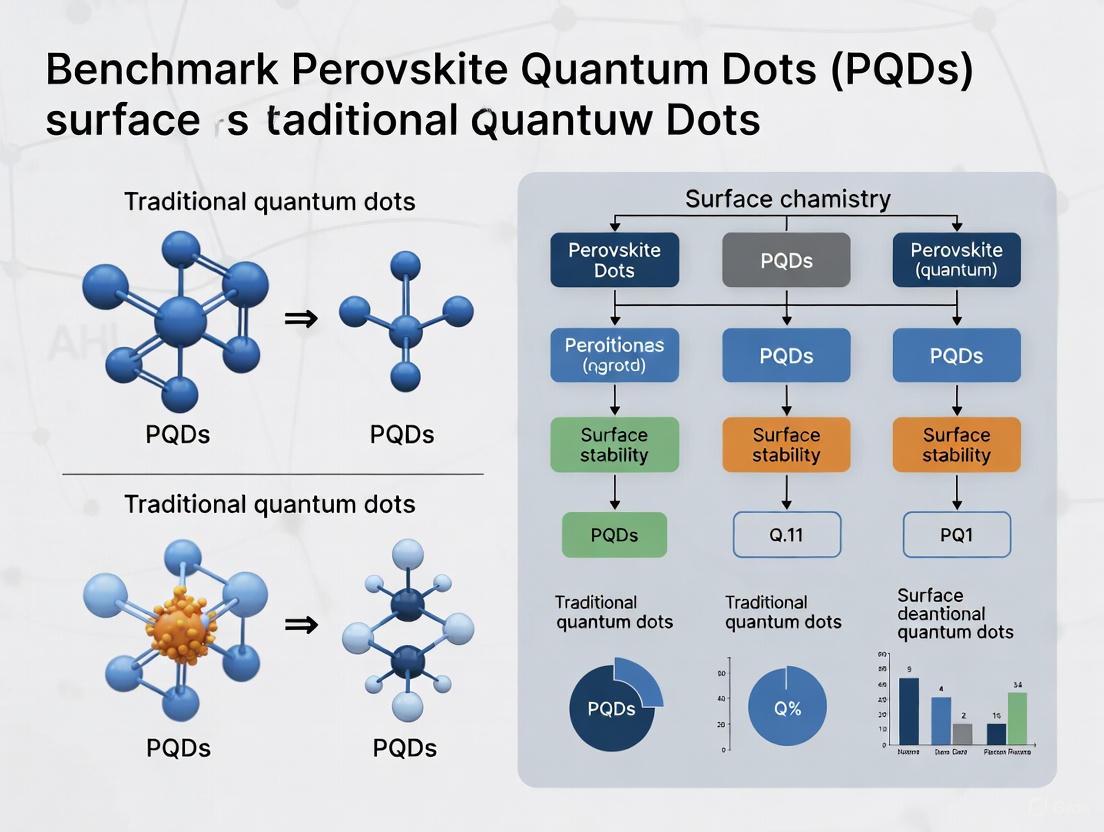
This article provides a comprehensive benchmark analysis of the surface stability of Perovskite Quantum DDs (PQDs) against traditional quantum dots (QDs) like CdSe and InP.
Benchmarking Surface Stability: Perovskite Quantum Dots vs. Traditional Quantum Dots for Biomedical Applications
Abstract
This article provides a comprehensive benchmark analysis of the surface stability of Perovskite Quantum DDs (PQDs) against traditional quantum dots (QDs) like CdSe and InP. Targeting researchers and drug development professionals, it explores the fundamental ionic nature and degradation mechanisms of PQDs, reviews advanced stabilization strategies including ligand engineering and encapsulation, and establishes a rigorous methodological framework for comparative stability assessment. The review synthesizes performance data across thermal, aqueous, and operational stressors, highlighting PQDs' superior optoelectronic properties alongside their stability challenges. It concludes with validated protocols for reliable testing and future directions for translating stable PQD formulations into clinical and biomedical sensing platforms.
The Stability Conundrum: Unpacking the Inherent Structural Properties of PQDs and Traditional QDs
The benchmarking of surface stability in perovskite quantum dots (PQDs) against traditional quantum dots is a central challenge in nanomaterial science. The intrinsic properties and practical performance of these nanomaterials are fundamentally governed by their chemical bonding and structural integrity. PQDs, characterized by their ionic crystal nature, exhibit exceptional optical properties but face significant hurdles due to surface instability. In contrast, quantum dots based on covalent networks, such as graphene quantum dots (GQDs), demonstrate enhanced structural stability and biocompatibility, making them promising alternatives for biomedical applications. This guide provides a systematic comparison of these material classes, focusing on the interplay between their bonding characteristics, structural integrity, and functional performance, supported by recent experimental data and methodologies.
Comparative Analysis of Bonding and Stability
The chemical bonding architecture—ranging from predominantly ionic in metal halide perovskites to covalent in graphene-based structures—directly dictates the structural integrity and application potential of quantum dots. Table 1 summarizes the core characteristics arising from these distinct bonding networks.
Table 1: Core Characteristics of Ionic vs. Covalent Quantum Dots
| Characteristic | Perovskite QDs (Ionic Crystals) | Graphene QDs (Covalent Networks) |
|---|---|---|
| Primary Bonding Type | Ionic bonds (e.g., Cs⁺ and Pb²⁺ to Halides⁻) [1] | Covalent sp² carbon network [2] |
| Structural Integrity in Aqueous Media | Low; suffers from hydration-induced degradation [1] [3] | High; exhibits excellent aqueous stability [2] |
| Toxicity Concerns | High for lead-based compositions (Pb²⁺ release) [1] | Low; considered biocompatible [2] |
| Surface Chemistry | Complex and dynamic; prone to defect formation [4] | Tunable via functional groups (e.g., -COOH, -OH) [2] |
| Key Stability Enhancement | Encapsulation (e.g., in polydimethylsiloxane) [3] | Heteroatom doping (e.g., N, S) [2] |
| Primary Optical Advantage | High photoluminescence quantum yield (PLQY), tunable bandgap [5] | Tunable photoluminescence, high photostability [2] |
The ionic crystal structure of PQDs, such as CsPbX₃, is responsible for their outstanding optical properties, including high absorption coefficients and easily tunable bandgaps [5]. However, this same structure confers a low formation energy and a highly dynamic, defect-prone surface, making them susceptible to degradation from polar solvents like water [1] [4]. This instability is a major bottleneck for their application in biological environments.
Conversely, GQDs derive their robustness from a two-dimensional covalent network of sp²-hybridized carbon. This structure is inherently more stable and, coupled with the presence of oxygen-containing functional groups, grants excellent aqueous solubility and biocompatibility [2]. Their surface chemistry is highly tunable, allowing for functionalization that can further enhance stability and target specificity for drug delivery applications.
Quantitative Stability and Performance Benchmarking
Translating the fundamental differences in bonding into quantitative performance metrics is crucial for material selection. Experimental data from recent studies, consolidated in Table 2, provides a direct comparison of key parameters.
Table 2: Experimental Performance and Stability Metrics
| Parameter | Perovskite QDs (CsPbBr₃) | Graphene QDs (GQDs) |
|---|---|---|
| PL Intensity Retention in Water | ~99.8% after 2 hours (with PDMS encapsulation) [3] | Excellent aqueous solubility and stability [2] |
| Photoluminescence Quantum Yield (PLQY) | High (e.g., up to ~93.5% for doped CsPbI₃) [5] | Tunable; can be enhanced via heteroatom doping [2] |
| Targeted Drug Loading Efficiency | Limited by lead toxicity concerns [1] [6] | High; large surface area for π-π stacking and functionalization [7] |
| Amplified Spontaneous Emission (ASE) Threshold | Ultralow: 1.72 μJ cm⁻² [3] | Not typically reported for ASE |
| Single-Dot Emission Linewidth | <130 μeV (for buried PQDs) [8] | Information Not Available in Search Results |
The data highlights a clear trade-off. PQDs can achieve exceptional optical performance, such as ultralow ASE thresholds and ultrabright, stable single-dot emission when protected via novel strategies like burial in a wider-bandgap perovskite film [8] or encapsulation in polymers like polydimethylsiloxane (PDMS) [3]. However, their application in biomedicine is inherently limited by the potential release of toxic lead ions [1].
GQDs, while potentially less spectacular in pure optical metrics like lasing thresholds, offer a more dependable platform for biomedical applications. Their low toxicity and ability to be functionalized for targeted drug delivery are significant advantages [2] [7]. Theoretical studies confirm that conjugating drugs like Doxorubicin (DOX) to GQDs via covalent bonds (C–O, C–C, C–N) results in stable hybrid structures with strong near-infrared photoluminescence, ideal for combined therapy and imaging [7].
Experimental Protocols for Stability Assessment
Protocol: Assessing Aqueous Stability of Encapsulated PQDs
This protocol is adapted from work on PDMS-encapsulated CsPbBr₃ QDs for sensing water-soluble analytes [3].
- QD Film Fabrication: Embed synthesized CsPbBr₃ PQDs within a PDMS matrix and cure the polymer.
- Water Immersion: Submerge the fabricated PQD-PDMS composite film in deionized water.
- In-situ PL Monitoring: Measure the photoluminescence (PL) intensity of the film at regular intervals while immersed, using a fluorometer or confocal microscope.
- Accelerated Degradation Testing: Optionally, increase temperature or mechanical agitation to simulate long-term stability under stress.
- Data Analysis: Calculate the percentage of initial PL intensity retained over time. The benchmark from the study is 99.8% retention after 2 hours of immersion [3].
Protocol: Evaluating GQDs as Drug Carriers via DFT
This theoretical protocol is used to predict the stability and efficacy of GQD-based drug delivery systems [7].
- System Modeling: Construct molecular models of GQDs of varying sizes and shapes (e.g., diamond-shaped) and the drug molecule (e.g., Doxorubicin).
- Covalent Conjugation: Model the hybrid structure by forming covalent bonds (e.g., C–O, C–C, C–N) between the GQD and the drug.
- Computational Analysis:
- Perform geometry optimization using Density Functional Theory (DFT) at the B3LYP/6-31G(d,p) level.
- Calculate the HOMO-LUMO gap, chemical hardness, and optical absorption/emission spectra.
- Confirm stability by verifying the absence of imaginary frequencies in the vibrational frequency analysis.
- Performance Prediction: A red-shift in absorption/emission spectra and a stable HOMO-LUMO gap upon drug conjugation indicate successful formation of a stable hybrid system suitable for drug delivery and bio-imaging [7].
Stability Pathway and Experimental Workflow
The relationship between a quantum dot's chemical structure and its operational stability can be visualized as a pathway from material selection to final performance. The following diagram illustrates this critical relationship and the consequent need for stabilization strategies, particularly for ionic PQDs.
Diagram Title: From Chemical Bonds to Application Performance
The Scientist's Toolkit: Essential Research Reagents
The experimental study and application of quantum dots rely on a suite of essential materials and reagents. Table 3 details key components for working with PQDs and GQDs, highlighting their specific functions in synthesis, stabilization, and application.
Table 3: Essential Reagents for Quantum Dot Research
| Reagent/Material | Function | Application Context |
|---|---|---|
| Oleic Acid (OA) & Oleylamine (OLA) | Surface ligands that control QD growth and provide colloidal stability during synthesis. | Standard in hot-injection synthesis of PQDs [9] [5]. |
| Polydimethylsiloxane (PDMS) | An encapsulation polymer that creates a hydrophobic barrier, protecting QDs from water. | Used to fabricate waterproof, stable PQD films for sensing in aqueous environments [3]. |
| Heteroatom Dopants (N, S, P) | Atoms incorporated into the carbon lattice to tune the optoelectronic properties and enhance fluorescence of GQDs. | Critical for optimizing GQDs for bioimaging and biosensing [2]. |
| Doxorubicin (DOX) | A model chemotherapeutic drug used to study the loading, release, and efficacy of QD-based drug delivery systems. | Commonly conjugated to GQDs via π-π stacking or covalent bonds for cancer therapy [7]. |
| Cesium Oleate / Lead Halides | Precursor materials providing the Cs, Pb, and X (Cl, Br, I) ions necessary for the crystal structure of inorganic PQDs. | Essential for the hot-injection synthesis of CsPbX₃ PQDs [9]. |
| Lanthanide Ions (e.g., Ho³⁺, Ce³⁺) | Dopant ions that improve the photoluminescence quantum yield (PLQY) and stability of PQDs. | Used in advanced PQDs for broadband photodetectors to enhance performance [5]. |
The benchmarking of surface stability clearly illustrates a dichotomy defined by chemical bonding. Ionic perovskite QDs offer a pathway to supreme optical performance but necessitate sophisticated engineering to overcome inherent instability and toxicity. Covalent graphene QDs provide a robust, biocompatible platform readily adaptable for biomedical applications like drug delivery, albeit with different optical capabilities. The choice between them is not a matter of superiority but of application-specific alignment. Future progress hinges on the continued development of lead-free perovskites and scalable, precise functionalization of GQDs, guided by an intimate understanding of the fundamental chemistry that defines them.
Perovskite quantum dots (PQDs) have emerged as a revolutionary class of semiconductor nanomaterials with exceptional optoelectronic properties, including tunable bandgaps, high photoluminescence quantum yields, and defect tolerance. Despite their promising characteristics, widespread commercialization remains hindered by two fundamental instability issues: halide ion migration and ligand dissociation. These inherent degradation pathways critically undermine the structural integrity and optical performance of PQDs under operational conditions [10] [11] [12].
Understanding these degradation mechanisms is essential for benchmarking PQD surface stability against traditional quantum dots like CdSe, PbS, and ZnSe. While traditional QDs exhibit well-documented surface oxidation and photobleaching issues, PQDs face unique challenges stemming from their ionic crystal lattice and dynamic ligand binding. This review systematically compares degradation pathways, quantitative stability metrics, and experimental methodologies, providing researchers with a framework for evaluating next-generation PQD materials against established alternatives [9] [13].
Halide Migration in PQDs: Mechanisms and Quantification
Fundamental Mechanisms
Halide migration in PQDs represents an irreversible unidirectional ion movement triggered by external fields including illumination, thermal stress, and electric biases [12]. Unlike traditional quantum dots with covalent bonding, the ionic lattice of metal halide perovskites enables facile halide ion displacement through vacancy-assisted mechanisms. Under operational stress, iodide ions (I⁻) migrate from the perovskite film into charge transport layers, disrupting interface structure and electric-field distribution [14].
The migration follows both diffusion (concentration-driven) and drift (electric-field-driven) pathways simultaneously. At the perovskite/charge transport layer interface, both mechanisms typically align to promote iodide loss from the PQD structure. This migration not only degrades charge transport but also catalyzes electrode decomposition through chemical reactions [14].
Quantitative Analysis and Barrier Requirements
Recent research has quantified the specific energy barriers required to suppress iodide migration. For FAPbI₃ PQDs, a barrier energy of 0.911 eV is necessary to prevent iodide loss, while compositional engineering through mixed cations (FA/MA/Cs) can modestly reduce this requirement [14].
Table 1: Quantified Barrier Energies for Suppressing Iodide Migration in Different PQD Compositions
| Perovskite Composition | Required Barrier Energy (eV) | Migration Reduction Efficiency |
|---|---|---|
| FAPbI₃ | 0.911 | 99.9% with optimal blocking |
| FA₀.₉MA₀.₁PbI₃ | 0.842 | ~99% with composite layer |
| FA₀.₉Cs₀.₁PbI₃ | 0.867 | ~99% with composite layer |
| FA₀.₉MA₀.₀₅Cs₀.₀₅PbI₃ | 0.829 | ~99% with composite layer |
Advanced suppression strategies employing composite blocking layers demonstrate 99.9% reduction in iodide migration, enabling PSCs to maintain >95% of initial efficiency after 1500 hours at 85°C under maximum power point tracking [14]. This represents a significant stability improvement over early PQD formulations that showed complete degradation within hours under similar conditions.
Ligand Dissociation: Dynamic Surface Chemistry
Ligand Binding Mechanisms
Ligands play a crucial role in stabilizing PQD surfaces, facilitating nucleation during synthesis, passivating surface defects, and preventing aggregation. Traditional long-chain ligands like oleic acid (OA) and oleylamine (OAm) exhibit dynamic binding equilibria with the PQD surface, creating inherent instability [11] [13]. Unlike traditional quantum dots where ligand binding is predominantly static, PQDs exhibit rapid exchange kinetics that, while enabling post-synthetic processing, also promotes ligand detachment.
Nuclear magnetic resonance studies reveal that ligand binding exists in three distinct states: strongly bound (chemisorbed), weakly bound (physisorbed), and free ligands. Strongly bound oleate ligands coordinate to Pb-rich (111) facets as X-type ligands, while weakly bound oleic acid coordinates to (100) facets through acidic headgroups [13]. This complex binding landscape results in packing densities of approximately 3.9 ligands/nm² for OA-capped PbS QDs, with rapid exchange rates (0.09-2 ms) between weakly bound and free states [13].
Dissociation Consequences and Quantification
Ligand dissociation from PQD surfaces creates unprotected sites vulnerable to environmental degradation. The detachment of insulating long-chain ligands like OA leads to particle aggregation, surface defect formation, and eventual quenching of photoluminescence [15] [11]. Compared to traditional CdSe QDs that maintain stability under ligand loss through their covalent lattice, PQDs experience accelerated degradation due to their ionic nature.
Table 2: Ligand Binding Characteristics Across Quantum Dot Materials
| Quantum Dot Material | Ligand Binding Type | Binding Energy | Exchange Kinetics | Stability Impact |
|---|---|---|---|---|
| CsPbX₃ PQDs | Dynamic/Ionic | Moderate | Fast (ms timescale) | Severe performance decay |
| PbS QDs | Coordinate Covalent | Moderate-Strong | Moderate | Moderate degradation |
| CdSe QDs | Coordinate Covalent | Strong | Slow | Limited degradation |
| InP QDs | Coordinate Covalent | Strong | Slow-Moderate | Limited degradation |
Advanced ligand engineering strategies employing alkaline-augmented antisolvent hydrolysis have demonstrated significantly improved stability, enabling up to twice the conventional amount of conductive ligands on PQD surfaces. This approach renders ester hydrolysis thermodynamically spontaneous and lowers reaction activation energy by approximately 9-fold, creating more stable ligand configurations [15].
Experimental Methodologies for Degradation Analysis
Quantifying Halide Migration
Time-of-Flight Secondary Ion Mass Spectrometry (TOF-SIMS) provides depth-profiling capability to track iodide distribution across PQD films and interfaces. This technique can detect iodide accumulation in charge transport layers after device aging under illumination [14].
X-ray Photoelectron Spectroscopy (XPS) under reverse bias conditions enables quantification of iodine content at interfaces. By applying specific reverse biases, researchers can determine the threshold barrier energy required to suppress iodide migration for different PQD compositions [14].
Electrochemical Impedance Spectroscopy measures ion migration activation energies and diffusion coefficients within PQD films, providing complementary data to structural characterization techniques.
Monitoring Ligand Dissociation
Multimodal NMR Spectroscopy combines diffusometry and 1D ¹H spectroscopy to quantify populations of free and surface-bound ligands. This approach can distinguish between strongly bound, weakly bound, and free ligand states, enabling precise measurement of dissociation kinetics [13].
Fourier-Transform Infrared Spectroscopy tracks ligand binding through characteristic vibrational modes, providing information about binding configurations and surface coverage.
Photoluminescence Quantum Yield (PLQY) Tracking correlates ligand dissociation with optical performance degradation, serving as a rapid screening method for ligand stability under various environmental conditions.
Research Reagent Solutions Toolkit
Table 3: Essential Research Reagents for PQD Stability Studies
| Reagent/Category | Function | Specific Examples | Impact on Stability |
|---|---|---|---|
| Short-Chain Conductive Ligands | Exchange with insulating native ligands | Acetate (Ac⁻), methyl benzoate hydrolysis products | Enhances charge transport while maintaining surface protection |
| Multidentate Ligands | Stronger surface binding through multiple anchoring points | Dicarboxylic acids, phosphonic acids | Reduces ligand dissociation by increasing binding energy |
| Dipole Molecules | Create interfacial electric fields to suppress ion migration | (4-(2-(Trifluoromethyl)pyrimidin-5-yl)phenyl) boronic acid (CF3-PBAPy) | Provides drift barrier against halide migration (≥0.6 eV) |
| Atomic Layer Deposition Precursors | Form conformal scattering barriers | HfO₂, Al₂O₃ | Blocks ion migration through physical barrier (30-50% reduction) |
| High Work Function HTMs | Address band shifts from dipole layers | Poly(N-vinylcarbazole) (PVK) | Improves hole extraction efficiency in presence of blocking layers |
Comparative Stability Benchmarking
Performance Metrics Against Traditional QDs
When benchmarked against traditional quantum dots, PQDs exhibit distinct stability profiles. While CdSe and PbS QDs demonstrate superior resistance to environmental factors like humidity and oxygen, PQDs show remarkable defect tolerance but suffer from intrinsic ion mobility. The following experimental data highlights key differences:
Photoluminescence Retention: Under continuous illumination, CsPbBr₃ PQDs show 40-60% PL decay within 100 hours without stabilization strategies, whereas CdSe/ZnS core/shell QDs maintain >80% emission under identical conditions. However, with advanced ligand engineering, stabilized PQDs can achieve <10% decay over the same period [11].
Thermal Stability: Traditional QDs (CdSe, InP) maintain structural integrity up to 300°C, while PQDs undergo phase transitions at lower temperatures (CsPbCl₃ transitions at 310-320K). Nevertheless, compositional engineering (mixed A-site cations) extends PQD thermal stability to 150°C [11] [16].
Ion Migration Activation Energy: PQDs exhibit activation energies of 0.2-0.5 eV for halide migration, significantly lower than the formation energies of defects in traditional QDs (>1 eV), explaining their different degradation kinetics [12] [14].
Machine Learning Approaches for Stability Prediction
Emerging machine learning (ML) methodologies enable accurate prediction of PQD properties and stability performance. Support Vector Regression (SVR) and Nearest Neighbor Distance (NND) models have demonstrated exceptional accuracy (high R², low RMSE/MAE) in predicting CsPbCl₃ PQD size, absorbance, and photoluminescence properties based on synthesis parameters [9]. These ML approaches surpass traditional computational methods in speed and accuracy for complex PQD systems, enabling rapid screening of stabilization strategies without extensive experimental trials.
The inherent degradation pathways of halide migration and ligand dissociation present fundamental challenges for PQD commercialization. Through quantitative analysis, we've established that suppressing iodide migration requires precisely defined barrier energies (0.83-0.91 eV depending on composition), while stabilizing ligand binding necessitates engineering stronger coordination chemistries and exchange kinetics.
When benchmarked against traditional quantum dots, PQDs demonstrate unique vulnerabilities but also exceptional tunability and defect tolerance. The experimental methodologies and reagent solutions outlined provide researchers with standardized approaches for systematic stability evaluation. Future research directions should focus on lead-free compositions with inherently reduced ion mobility, machine-learning-guided material design, and standardized testing protocols aligned with international photovoltaic standards (IEC 61215) to enable direct comparison across material systems [1] [16] [14].
As stabilization strategies continue to evolve, the gap between PQDs and traditional QDs in operational stability is rapidly narrowing, positioning PQDs as viable competitors for next-generation optoelectronic applications where their superior optoelectronic properties can be fully leveraged.
Perovskite quantum dots (PQDs) have emerged as a revolutionary class of semiconductor nanomaterials for optoelectronic applications, distinguished by their exceptional defect tolerance compared to traditional quantum dots (QDs). This defect tolerance arises from the unique electronic structure of lead halide perovskites, where the valence and conduction bands are primarily formed by antibonding Pb-6s and 6p orbitals, resulting in a low density of mid-gap states that typically act as non-radiative recombination centers [17]. However, this inherent advantage presents a paradoxical challenge: while PQDs can maintain high luminescence efficiency despite surface imperfections, their low formation energies and ionic character create fundamental instability against environmental stressors such as moisture, heat, and light [18]. This comprehensive analysis benchmarks the surface stability of PQDs against traditional QDs by examining the intricate relationship between defect tolerance, formation energy, and degradation pathways, providing researchers with experimental frameworks and quantitative data to guide stabilization strategies.
The structural degradation of PQDs primarily occurs through two dominant mechanisms: (1) defect formation on the surface via ligand dissociation, where weakly bound ligands detach from the PQD surface, and (2) vacancy formation through halide migration within the crystal lattice due to the low migration energy of halide ions [18]. Understanding this duality—where the same electronic properties that confer defect tolerance also facilitate ionic migration and decomposition—is essential for advancing PQD applications in light-emitting diodes (LEDs), solar cells, and other optoelectronic devices toward commercial viability.
Fundamental Mechanisms: Defect Physics and Stability Implications
Electronic Structure and Defect Tolerance
The exceptional defect tolerance of PQDs stems from their fundamental electronic properties. Unlike traditional II-VI semiconductor QDs (e.g., CdSe, CdS), where surface defects create mid-gap states that strongly suppress luminescence, PQDs exhibit conduction and valence bands formed from Pb-6p and 6s orbitals, respectively, with halide-p orbitals contributing to the valence band maximum. This unique band structure results in a predominantly ionic character with antibonding coupling at the valence band maximum, pushing defect states either into the band edges or out of the bandgap entirely [17]. Consequently, PQDs can maintain high photoluminescence quantum yields (PLQYs) despite the presence of surface vacancies and imperfections that would typically quench emission in conventional QDs.
The defect tolerance parameter can be quantified through comparative PLQY measurements under controlled defect introduction. Studies demonstrate that CsPbBr3 PQDs retain approximately 70-80% of their initial PLQY even when surface ligand coverage is reduced by 40%, whereas CdSe QDs show a more dramatic PLQY reduction to below 20% under similar conditions [18]. This fundamental difference in defect sensitivity creates a divergent approach to surface engineering, where traditional QDs require near-perfect surface passivation, while PQDs can function with incomplete passivation but require strategies to address intrinsic instability.
Formation Energy and Ionic Migration
The same ionic character that enables defect tolerance in PQDs also creates vulnerability to degradation through low formation energies for vacancies and low activation barriers for ion migration. Density functional theory (DFT) calculations reveal the formation energies for halide vacancies in CsPbBr3 to be remarkably low (approximately 0.3-0.5 eV), compared to 1.5-2.0 eV for anion vacancies in CdSe QDs [19] [18]. This low formation energy facilitates the creation of halide vacancies under ambient conditions, initiating a cascade of degradation processes.
The migration of halide ions through the crystal lattice occurs with activation energies as low as 0.1-0.3 eV for Br⁻ ions in CsPbBr3, enabling rapid ion transport even at room temperature [18]. This ionic mobility leads to phase segregation under illumination, vacancy-mediated decomposition, and ultimately the collapse of the perovskite crystal structure. The table below summarizes the key differences in defect properties between PQDs and traditional QDs:
Table 1: Comparative Defect Properties of Perovskite vs. Traditional Quantum Dots
| Property | Perovskite QDs (CsPbBr3) | Traditional QDs (CdSe) |
|---|---|---|
| Defect Tolerance | High (few mid-gap states) | Low (surface states create mid-gap traps) |
| Halide/Anion Vacancy Formation Energy | 0.3-0.5 eV | 1.5-2.0 eV |
| Ion Migration Activation Energy | 0.1-0.3 eV (Br⁻) | >1.0 eV (Not applicable) |
| Typical PLQY (as-synthesized) | 50-90% | 5-20% (without shell) |
| PLQY Retention with Surface Defects | 70-80% (with 40% ligand loss) | <20% (with 40% ligand loss) |
Experimental Benchmarking: Methodologies and Quantitative Comparisons
Stability Assessment Protocols
Standardized experimental protocols are essential for meaningful comparison of PQD stability against traditional QDs. The following methodologies represent current best practices for evaluating structural and optical stability:
Thermal Stability Testing: PQD films or solutions are subjected to controlled temperature environments (typically 80-150°C) in an inert atmosphere glovebox, with PLQY measurements taken at regular intervals using an integrating sphere attachment on a fluorescence spectrometer. Absorbance spectra are concurrently recorded to monitor changes in the excitonic features [18].
Environmental Stability Testing: Samples are exposed to controlled humidity conditions (typically 50-80% relative humidity) at room temperature in an environmental chamber. Time-resolved photoluminescence (TRPL) measurements are performed using a time-correlated single photon counting (TCSPC) system to monitor changes in recombination dynamics [20] [21].
Light Soaking Tests: PQD films are placed under continuous wave laser or LED illumination at specified power densities (typically 100-500 mW/cm²), with in situ PL monitoring to assess photostability. This is particularly important for evaluating phase segregation in mixed-halide PQDs [22].
Accelerated Aging Studies: For long-term stability prediction, samples undergo heating at elevated temperatures (e.g., 85°C) while being periodically characterized using UV-Vis absorption, photoluminescence spectroscopy, and X-ray diffraction (XRD) to monitor structural changes [20].
Quantitative Stability Metrics
The following table compiles experimental data from comparative studies evaluating PQDs against traditional QDs under various stress conditions:
Table 2: Experimental Stability Metrics for PQDs vs. Traditional QDs
| Material System | PLQY Initial/Final (%) | Test Conditions | Duration | Key Degradation Mechanisms |
|---|---|---|---|---|
| CsPbBr3 PQDs | 86% → 45% | 85°C, air | 240 hours | Ligand detachment, halide vacancy formation |
| CsPbBr3 PQDs (AET-passivated) | 51% → 48% | Water exposure | 60 minutes | Suppressed degradation via strong Pb-thiol binding [18] |
| CsPbI3 PQDs | 92% → 22% | 50% RH, 25°C | 168 hours | Phase transition (α → δ), iodide migration [17] |
| CdSe/ZnS Core/Shell QDs | 85% → 78% | 85°C, air | 240 hours | Oxidative damage, limited shell protection |
| InP/ZnS Core/Shell QDs | 80% → 70% | 85°C, air | 240 hours | Core-shell interfacial degradation |
The data reveals that unpassivated PQDs typically exhibit faster degradation under thermal and environmental stress compared to traditional core/shell QDs, primarily due to ligand instability and ionic migration. However, properly engineered PQDs with appropriate surface passivation can demonstrate comparable or superior stability to traditional QD systems while maintaining higher initial PLQY values.
Stabilization Strategies: Addressing the Double-Edged Sword
Surface Engineering and Ligand Modification
Surface ligand engineering represents the most direct approach to addressing PQD instability while leveraging their defect tolerance. Traditional long-chain ligands like oleic acid (OA) and oleylamine (OAm) provide initial stabilization during synthesis but readily desorb during purification or under operational stress due to their labile binding character [18]. Advanced ligand strategies include:
Bidentate Ligands: Molecules featuring multiple binding groups (e.g., thiols, phosphonic acids) demonstrate significantly enhanced binding energies to Pb atoms on the PQD surface. For example, 2-aminoethanethiol (AET) forms strong Pb-S bonds with binding energies approximately 2-3 times higher than conventional carboxylate ligands, maintaining >95% of initial PL intensity after 60 minutes of water exposure [18].
Short-Chain Conductive Ligands: While long alkyl chains provide steric stabilization, their insulating nature impedes charge transport in devices. Ligands like butylamine and phenethylamine offer a compromise between solubility and charge transport, with the added benefit of reduced steric hindrance enabling higher packing densities [17].
In Situ Passivation Approaches: Post-synthetic treatment with alkylamines of varying chain lengths (e.g., dodecylamine, DDA) has been shown to spontaneously enhance PLQY to 126% of initial values by healing surface defects without inducing phase segregation [21].
Structural Reinforcement Strategies
Beyond surface modification, bulk-focused approaches address intrinsic instability mechanisms:
Metal Ion Doping: B-site substitution with appropriate metal ions (e.g., Ni²⁺, Mn²⁺, Zn²⁺) strengthens the perovskite lattice by modulating B-X bond lengths and increasing vacancy formation energies. Doping with certain elements (e.g., Ni) can passivate preexisting defects by influencing both radiative and nonradiative recombination pathways [19]. Successful doping maintains the Goldschmidt tolerance factor (t) between 0.8-1.0 while significantly enhancing stability, with doped CsPbBr3 PQDs showing PLQY improvements from 22% to 51% and maintained cubic phase after extended environmental exposure [18].
Core-Shell Architectures: Encapsulating PQDs within stable inorganic matrices (e.g., SiO₂, ZnS) or forming epitaxial shells creates physical barriers against environmental stressors. The "buried PQD" (b-PQD) approach represents a significant advancement, where PQDs are embedded within a wide-bandgap perovskite thin film via one-step flash annealing [8]. This configuration demonstrates ultrabright and stable single-dot emission with resolution-limited linewidths below 130 μeV, no blinking, suppressed spectral diffusion, and high photon count rates of 10⁴/s [8].
Glass Encapsulation: Incorporating PQDs within inorganic glass matrices provides exceptional long-term stability. Remarkably, CsPbBr₃ PQD glass undergoing a four-year natural aging process demonstrated a PLQY increase from 20% to 93% due to a passive water-assisted surface passivation mechanism, where ambient moisture induces the gradual formation of PbBr(OH) nano-phases that effectively passivate surface defects [20].
Table 3: Comparison of PQD Stabilization Strategies
| Strategy | Mechanism | Efficacy (PLQY Improvement) | Limitations |
|---|---|---|---|
| Bidentate Ligands | Stronger coordination binding | 22% → 51% (CsPbI₃ with AET) [18] | Potential toxicity of thiols, complex synthesis |
| Metal Doping | Increased vacancy formation energy, bond strengthening | 20-40% relative improvement | Precise concentration control critical, may alter optoelectronic properties |
| Core-Shell Structures | Physical barrier against environmental stressors | Near-unity PLQY retention in b-PQDs [8] | Lattice mismatch challenges, interfacial defects |
| Glass Encapsulation | Complete environmental isolation | 20% → 93% over 4 years (passive improvement) [20] | Limited processability for some applications |
| Cross-Linking | Preventing ligand dissociation through covalent networks | >95% PL retention after 30 days ambient storage | Potential for generating strain in crystal lattice |
Advanced Characterization and Computational Tools
Machine Learning for Property Prediction
The complex relationship between synthesis parameters and PQD properties presents challenges for traditional experimental approaches. Machine learning (ML) models have emerged as powerful tools for predicting PQD characteristics and optimizing synthesis conditions. Recent studies demonstrate that support vector regression (SVR) and nearest neighbor distance (NND) models can accurately predict the size, absorbance, and photoluminescence properties of CsPbCl₃ PQDs using synthesis parameters as inputs, achieving high R² values (>0.9) with low root mean squared error [9]. These models enable researchers to navigate the multi-dimensional parameter space of PQD synthesis (precursor ratios, temperatures, ligand compositions) to identify optimal conditions for stability without extensive trial-and-error experimentation.
Theoretical Modeling of Defect Properties
Computational approaches provide fundamental insights into defect formation and migration mechanisms in PQDs. First-principles density functional theory (DFT) calculations reveal that B-site substitution (Pb²⁺ replacement) induces the most significant changes in electronic structure, with the emergence of defect states and band gap variations governed primarily by electronic effects from the atomic energy levels of dopants rather than geometric effects from ionic radii [19]. These computational tools enable rational dopant selection by predicting formation energies and electronic impacts before experimental implementation.
Diagram 1: PQD Stability Enhancement Framework. This workflow illustrates the principal degradation mechanisms in perovskite quantum dots and corresponding stabilization strategies supported by experimental evidence.
The Scientist's Toolkit: Essential Research Reagents and Materials
Table 4: Essential Research Reagents for PQD Stability Studies
| Reagent/Material | Function | Application Notes |
|---|---|---|
| Cesium Carbonate (Cs₂CO₃) | Cs⁺ precursor for all-inorganic PQDs | High purity (>99.9%) critical for reproducible synthesis [20] |
| Lead Bromide (PbBr₂) | Pb²⁺ and halide source | Often used with purification to remove impurities [20] |
| Oleic Acid (OA) | Surface ligand, acid form | Protects PQDs during synthesis, but labile binding [18] |
| Oleylamine (OAm) | Surface ligand, amine form | Synergistic with OA, but prone to desorption [18] |
| Alkylamine Ligands | Surface passivation | Chain length affects packing density and stability (C8-C18) [21] |
| 2-Aminoethanethiol (AET) | Bidentate passivation ligand | Strong Pb-S binding, enhances moisture resistance [18] |
| Metal Salts (Ni²⁺, Zn²⁺, Mn²⁺) | B-site dopants | Increase formation energy, modify electronic structure [19] |
| Alkyl Halides | Halide exchange sources | Tune emission wavelength, impact stability [17] |
| Methyl Acetate | Purification solvent | Removes excess ligands without complete PQD dissolution [18] |
The defect tolerance that enables exceptional optoelectronic properties in PQDs fundamentally links to their instability through low formation energies and facile ion migration. This analysis demonstrates that while traditional QDs require meticulous surface perfection to achieve high performance, PQDs offer greater forgiveness to surface imperfections but demand innovative approaches to address intrinsic instability mechanisms. The most promising stabilization strategies—including bidentate ligand engineering, metal doping, and advanced encapsulation—directly target both surface and bulk degradation pathways while preserving the inherent defect-tolerant character of PQDs.
Future research directions should focus on elucidating the dynamic interface between PQDs and charge transport layers in operational devices, developing accelerated testing protocols that accurately predict long-term stability, and establishing computational frameworks that integrate molecular-level simulations with device-performance modeling. As stabilization methodologies mature, the unique combination of high performance, spectral tunability, and solution processability positions PQDs to transition from laboratory curiosities to commercially viable technologies that can complement or surpass traditional QDs in various optoelectronic applications.
Perovskite quantum dots (PQDs) have emerged as a revolutionary class of semiconductor nanomaterials with exceptional optoelectronic properties, including high photoluminescence quantum yield, narrow emission bandwidth, and widely tunable bandgaps. These characteristics make them strong contenders for next-generation applications in displays, lighting, photovoltaics, and biomedical imaging. However, their widespread commercialization faces a significant hurdle: structural instability under environmental stressors such as moisture, heat, oxygen, and light. This instability manifests as phase separation, crystal degradation, and rapid deterioration of optical performance, particularly in blue-emitting mixed-halide PQDs and red-emitting cesium lead iodide/bromide formulations [23] [24].
Benchmarking the surface and structural stability of PQDs against traditional quantum dots (QDs) requires a fundamental understanding of the atomic-level factors governing their crystal integrity. While traditional II-VI (e.g., CdSe) and III-V (e.g., InP) QDs derive stability from strong covalent bonding, perovskite structures (ABX₃, where X is a halide) are maintained by ionic bonds and precise geometric packing [25]. This is where the Goldschmidt Tolerance Factor (t), a parameter established in 1926, becomes an indispensable predictive tool for researchers and material scientists. It provides a quantitative metric for evaluating the geometric compatibility of ions within the perovskite lattice, directly correlating with its thermodynamic stability and distortion tendencies [26] [27]. This guide objectively compares the structural stability of PQDs against traditional QDs, using the Goldschmidt Tolerance Factor as a central benchmarking criterion, supported by experimental data on ion doping, ligand engineering, and encapsulation strategies.
The Goldschmidt Tolerance Factor: A Fundamental Stability Predictor
Theoretical Foundation and Calculation
The Goldschmidt tolerance factor is a dimensionless parameter that quantifies the stability and likely distortion of a perovskite crystal structure based on the ionic radii of its constituent ions. For a perovskite with the general formula ABX₃, the factor ( t ) is calculated as:
[ t = \frac{rA + rX}{\sqrt{2}(rB + rX)} ]
where ( rA ), ( rB ), and ( rX ) are the ionic radii of the A-site cation, B-site cation, and anion (typically oxygen in oxides, or a halide like I⁻, Br⁻, Cl⁻ in halide perovskites), respectively [26] [28]. The derivation assumes an ideal, close-packed cubic structure where the A-site cation is 12-coordinated and the B-site cation is 6-coordinated with the anions. The geometric premise is that for perfect ion contact in a cubic lattice, the relationship ( rA + rX = \sqrt{2}(rB + r_X) ) must hold true, yielding ( t = 1 ) [26] [28].
The value of ( t ) serves as a powerful indicator of the resulting perovskite structure:
Table 1: Goldschmidt Tolerance Factor Ranges and Corresponding Perovskite Structures [26] [28]
| Tolerance Factor (t) | Crystal Structure | Structural Interpretation | Example Perovskites |
|---|---|---|---|
| > 1.0 | Hexagonal or Tetragonal | A cation too large or B cation too small; non-perovskite structures often form | BaNiO₃, BaTiO₃ (t=1.06) |
| 0.9 - 1.0 | Cubic | Near-ideal ion sizes; stable, symmetric perovskite structure | BaZrO₃ (t=1.01), SrTiO₃ (t=1.00) |
| 0.71 - 0.9 | Orthorhombic/Rhombohedral | A cation too small; BX₆ octahedra tilt to fill space | GdFeO₃, CaTiO₃ (t=0.97) |
| < 0.71 | Non-perovskite Structure | A and B cations have similar ionic radii; perovskite structure is unstable | MgTiO₃ (t=0.81, ilmenite structure) |
For complex or mixed-composition perovskites, the formula can be adapted. For instance, in a double perovskite A(B'₁/₂B"₁/₂)O₃, the B-site radius is taken as the average of the radii of B' and B" [28].
Tolerance Factor in Halide Perovskite Quantum Dots
While originally developed for oxide perovskites, the Goldschmidt tolerance factor is equally critical for halide perovskites (e.g., CsPbX₃, where X = I, Br, Cl) used in QDs. The stability of these PQDs is intrinsically linked to the value of t. A tolerance factor close to 1 (typically between 0.8 and 1.0 for halide perovskites) is a primary indicator of a stable, cubic perovskite phase [23]. Deviations outside this range predict instability, which for PQDs translates to a propensity for phase segregation (especially in mixed halides), transformation into non-perovskite phases, and rapid degradation under operational stresses [23] [24]. Consequently, calculating t is one of the first steps in rationally designing stable PQDs, guiding the selection of A-site cations (e.g., Cs⁺, formamidinium⁺, Rb⁺) and B-site cations (e.g., Pb²⁺, with partial substitution by Sn²⁺, Mn²⁺, etc.) to achieve a stable lattice [23].
The following diagram illustrates the logical workflow for using the Goldschmidt Tolerance Factor to predict perovskite structure and its direct implications for quantum dot stability, guiding material selection and stability enhancement strategies.
Comparative Stability Analysis: PQDs vs. Traditional QDs
The intrinsic instability of perovskite QDs stems from their ionic crystal lattice and relatively low formation energy, making them susceptible to degradation from polar solvents, moisture, oxygen, light, and heat. In contrast, traditional QDs like CdSe and InP possess covalent bonds, granting them superior chemical and structural robustness [29] [25]. The following table provides a structured comparison based on key stability metrics.
Table 2: Benchmarking Structural and Surface Stability of PQDs vs. Traditional QDs [29] [23] [24]
| Stability Metric | Perovskite QDs (PQDs) | Traditional Cd-Based QDs (e.g., CdSe) | Cadmium-Free Traditional QDs (e.g., InP) | Carbon QDs (CQDs) |
|---|---|---|---|---|
| Primary Bonding | Ionic | Covalent | Covalent | Covalent (sp²/sp³ carbon core) |
| Goldschmidt Factor (t) Relevance | Critical for predicting phase stability and structure [23] | Not applicable | Not applicable | Not applicable |
| Photostability | Moderate to Low; prone to ion migration and phase separation under light [23] [24] | High; excellent resistance to photobleaching [25] | High; good resistance to photobleaching [25] | Very High; superior photostability, minimal bleaching [29] |
| Thermal Stability | Low; degrades at moderate temperatures (<150°C) [24] | High; stable at high temperatures [25] | Moderate to High [25] | Very High; stable under high-temperature conditions [29] |
| Aqueous & Chemical Stability | Very Low; degrades rapidly in polar solvents and water [24] | High; especially with robust inorganic shells [25] | Moderate; requires careful shelling [25] | High; excellent water solubility and biocompatibility [29] [30] |
| Key Instability Mechanisms | Ion migration, phase separation, lattice dissolution, hygroscopicity [23] [24] | Surface oxidation, photo-oxidation | Surface oxidation, defect-related degradation | Aggregation, surface group modification |
| Primary Stabilization Strategies | Ion doping, robust ligand exchange, matrix encapsulation [23] [24] | Growing inorganic shells (e.g., ZnS) | Growing inorganic shells (e.g., ZnS), gradient shells | Surface functionalization, salt embedding [29] |
Experimental Protocols for Stability Assessment and Enhancement
To objectively compare and improve PQD stability, researchers employ a suite of standardized experimental protocols. These methodologies are crucial for validating predictions made by the Goldschmidt tolerance factor and for benchmarking performance against traditional QDs.
Ion Doping to Optimize Tolerance Factor
Objective: To enhance the structural and spectral stability of mixed-halide blue PQDs by introducing alkali metal ions to adjust the tolerance factor and inhibit ion migration [23].
Detailed Methodology:
- Synthesis: CsPbBrₓCl₃₋ₓ PQDs are synthesized via a hot-injection method.
- Doping: Rb⁺ ions are introduced by adding rubidium carbonate (Rb₂CO₃) to the precursor solution. The ionic radius of Rb⁺ is different from that of Cs⁺, which directly modifies the A-site character and the overall Goldschmidt tolerance factor of the crystal lattice.
- Purification: The synthesized PQDs are purified using anti-solvents like ethyl acetate and n-octane, followed by centrifugation.
- Device Fabrication: For light-emitting diodes (LEDs), the PQDs are deposited as an emissive layer via spin-coating, followed by the deposition of other charge-transport layers [23].
Key Measurements:
- Structural Analysis: Use X-ray diffraction (XRD) to confirm the maintenance of the perovskite phase and detect any lattice shrinkage/expansion due to doping.
- Photoluminescence (PL) Spectroscopy: Track the PL intensity and emission peak wavelength over time under continuous illumination (e.g., UV lamp) to assess photostability and resistance to phase separation.
- Electroluminescence (EL) in Devices: Operate the fabricated PQLEDs at a constant voltage (e.g., up to 14 V) and monitor the EL spectrum for shifts or intensity drops to evaluate operational stability [23].
Encapsulation for Environmental Stability
Objective: To shield environmentally sensitive PQDs from moisture, oxygen, and heat by embedding them within a protective matrix.
Detailed Methodology:
- Matrix Selection: Choose an inert, stable matrix such as inorganic salt crystals (e.g., NaCl, KBr) or a silica matrix.
- Encapsulation Process:
- Salt Embedding: Mix the synthesized PQDs with a saturated salt solution and recrystallize. The PQDs become trapped within the salt crystals during crystallization [29].
- Silica Composite: Disperse PQDs in a sol-gel precursor solution (e.g., tetraethyl orthosilicate) and allow it to gel and form a solid silica film containing the QDs [29].
- Stability Testing: Expose both encapsulated and "naked" PQDs to harsh conditions (e.g., elevated temperature, high humidity, continuous UV light) and compare the degradation rates of their PL properties [29].
Comparative Photostability Testing Protocol
Objective: To quantitatively compare the resistance to photobleaching of PQDs against traditional QDs and carbon QDs (CQDs).
Detailed Methodology:
- Sample Preparation: Prepare standard solutions or solid films of each QD type (e.g., CsPbBr₃, CdSe/ZnS, CQDs in silica) with matched initial optical densities at the excitation wavelength.
- Light Stress: Expose all samples simultaneously to a high-power light source (e.g., a 450 W Xenon lamp or a 365 nm UV lamp with a defined power intensity) for an extended period (e.g., several hours to hundreds of hours) [29].
- Monitoring: At regular intervals, remove the samples and measure their PL intensity and emission spectra.
- Data Analysis: Plot the normalized PL intensity as a function of irradiation time. The decay rate and final retained intensity provide a direct measure of relative photostability. For example, one study showed that salt-embedded CQDs retained over 70% of their initial intensity after 200 hours, while CdTe QDs and unprotected QDs degraded much more rapidly [29].
The Scientist's Toolkit: Essential Research Reagents and Materials
The experimental work on synthesizing and stabilizing PQDs relies on a specific set of chemical reagents and materials. The following table details key items and their functions in typical research protocols.
Table 3: Essential Research Reagents for Perovskite Quantum Dot Experiments [23] [24]
| Reagent/Material | Function/Application | Example in Use |
|---|---|---|
| Cesium Carbonate (Cs₂CO₃) | A-site cation precursor for all-inorganic CsPbX₃ QDs | Provides Cs⁺ ions for the perovskite ABX₃ structure [23] |
| Lead Halides (PbBr₂, PbCl₂, PbI₂) | B-site and X-site precursor; source of Pb²⁺ and halide ions | Reacts with cesium precursors to form the CsPbX₃ crystal lattice [23] |
| Rubidium Carbonate (Rb₂CO₃) | Dopant precursor for A-site engineering | Introduces Rb⁺ ions to adjust the tolerance factor and suppress ion migration [23] |
| Tetraoctylammonium Bromide (TOAB) | Surface ligand and capping agent | Controls QD growth during synthesis and passivates surface defects [23] |
| Oleic Acid & Oleylamine | Common surface ligands/capping agents | Bind to the QD surface, providing colloidal stability and preventing aggregation [24] |
| Didodecyldimethylammonium Bromide (DDAB) | Ligand for surface passivation | Used in post-synthetic ligand exchange to form a denser, more stable ligand shell [23] |
| Alkali Halide Salts (NaCl, KBr) | Encapsulation matrix material | Used to create a protective crystalline matrix around QDs, shielding them from the environment [29] |
Fortifying Nanostructures: Advanced Strategies to Enhance PQD Surface Stability
The pursuit of optimal surface chemistry for Perovskite Quantum Dots (PQDs) represents a critical frontier in nanomaterials research, bridging the gap between their exceptional inherent optoelectronic properties and the demanding stability requirements for commercial applications. Ligand engineering—the strategic design and modification of surface-bound molecules—has emerged as a fundamental discipline for tuning the structural, optical, and electronic characteristics of nanocrystals. This review provides a systematic comparison of ligand strategies, from conventional long-chain surfactants to advanced dense short-chain packing, framing the discussion within the broader context of benchmarking PQD surface stability against traditional quantum dot materials. We dissect experimental protocols and quantitative performance data to offer researchers a clear roadmap for rational ligand selection and development.
The OA/OAm Paradigm and Its Limitations
The hot-injection synthesis method for all-inorganic PQDs, such as CsPbX3 (X = Cl, Br, I), almost universally employs oleic acid (OA) and oleylamine (OAm) as surface ligands to control nanocrystal growth, sterically stabilize particles in colloidal suspension, and passivate surface defects [31] [32]. These long-chain (C18) ligands yield PQDs with high initial photoluminescence quantum yields (PLQYs) and narrow size distributions. However, their inherent molecular structure introduces significant limitations for device integration.
The primary instability mechanisms are twofold. First, the bent configuration of OA and OAm molecules, resulting from internal double bonds, creates steric hindrance that reduces ligand packing density on the PQD surface [18]. This leaves significant portions of the ionic perovskite surface undercoordinated and vulnerable to attack by environmental factors such as moisture and oxygen. Second, the dynamic binding nature of these carboxylate and amine groups leads to their facile detachment during necessary post-synthesis purification steps involving polar solvents [18]. This ligand loss creates surface defects that act as non-radiative recombination centers, quenching photoluminescence and accelerating degradation. Furthermore, in solid films, the long, insulating hydrocarbon chains create excessive interparticle distances, severely impeding charge transport and limiting the performance of optoelectronic devices like solar cells and light-emitting diodes (LEDs) [32].
Comparative Analysis of Ligand Engineering Strategies
Short-Chain and Alternative Organic Ligands
Replacing OA/OAm with shorter or more strongly binding molecules directly addresses the instability of the native ligand shell. This strategy enhances surface coverage, improves material stability, and can reduce interdot spacing.
Table 1: Performance Comparison of Ligand Modification Strategies
| Ligand Type | Specific Ligand | PLQY Improvement | Stability Performance | Key Findings |
|---|---|---|---|---|
| Short-Chain / Strong-Binding | L-Phenylalanine (L-PHE) | -- | Retained >70% PL after 20 days UV [31] | Superior photostability |
| Short-Chain / Strong-Binding | Trioctylphosphine (TOP) | PL enhancement +16% [31] | -- | Effective defect passivation |
| Short-Chain / Strong-Binding | Trioctylphosphine Oxide (TOPO) | PL enhancement +18% [31] | -- | Most effective PL enhancement |
| Short-Chain / Strong-Binding | 2-Aminoethanethiol (AET) | PLQY: 22% → 51% [18] | >95% PL after 60 min water/120 min UV [18] | Strong Pb-S coordination |
| Short Alkyl Amine | Octylamine (OLA) | Initial PLQY: 91.8% [33] | PLQY 39.9% after 100 days in air [33] | Improved thermal & environmental stability |
Experimental Protocol: The ligand exchange is typically performed as a post-synthesis treatment. For example, in the case of AET, the purified PQDs are redispersed in a solvent and mixed with a solution containing the new ligand [18]. The mixture is stirred for a specific duration to allow the original OA/OAm ligands to be displaced. The resulting PQDs are then purified again via centrifugation to remove excess ligands and byproducts. Successful exchange is confirmed through techniques like Fourier-Transform Infrared Spectroscopy (FTIR) and Nuclear Magnetic Resonance (NMR).
Underlying Mechanism: The efficacy of ligands like TOP, TOPO, and L-PHE stems from their coordination with undercoordinated Pb²⁺ ions and other surface defects, effectively suppressing non-radiative recombination pathways [31]. Thiol-based ligands like AET form particularly strong covalent bonds with surface Pb atoms, creating a dense, stable passivation layer that is resistant to displacement [18].
Binary Quantum Dot Packing
Inspired by theoretical models for maximizing the packing density of spherical particles, this innovative approach involves mixing two populations of PQDs of distinct sizes (e.g., 10 nm and 14 nm) to form a densely packed film [32].
Experimental Protocol: CsPbI3 PQDs of different sizes (QD@120: ~10 nm, QD@170: ~14 nm) are synthesized separately by controlling the Cs-precursor injection temperature (120°C and 170°C, respectively) [32]. The two populations are then blended in a specific number ratio (e.g., 0.36 QD@120 to 0.64 QD@170) and deposited via spin-coating to form a binary-disperse film.
Underlying Mechanism: Grazing-incidence small-angle X-ray scattering (GISAXS) analysis reveals that such a film consists of three phases: two monosize phases and one binary mixing phase [32]. The smaller QDs can fill the voids between the larger ones, significantly increasing the packing density. Molecular dynamics simulations confirm that this binary mixing promotes closer face-to-face contact between PQDs. The resulting films exhibit suppressed trap-assisted recombination, longer carrier lifetime, and improved power conversion efficiency in solar cells, reaching 14.42% [32].
Inorganic Encapsulation and Surface Passivation
For applications in harsh environments, organic ligands alone may be insufficient. Encapsulating PQDs within inert inorganic matrices provides a robust physical barrier.
Table 2: Inorganic Encapsulation Strategies for Enhanced Stability
| Encapsulation Method | Matrix Material | Synthesis Technique | Stability Outcome |
|---|---|---|---|
| Vapor-Phase Coating | Al2O3 | Atomic Layer Deposition (ALD) [34] | Enhanced reliability in light aging, temperature/humidity tests [34] |
| Microporous Confinement | UiO-66 (MOF) | Self-limiting solvothermal deposition [35] | Luminescence maintained for >30 months ambient, several hours underwater [35] |
| Polymer Encapsulation | Polydimethylsiloxane (PDMS) | Dispersion & curing in polymer [3] | 99.8% PL intensity retained after 2 hours water immersion [3] |
Experimental Protocol (ALD): A notable protocol involves using Atomic Layer Deposition to coat FAPbBr3 PQDs with Al2O3 [34]. This is performed using trimethylaluminum (TMA) and ozone (O3) as precursors at 150°C for a specific number of cycles (e.g., 200 cycles at ~2.5 Å/cycle) in a specialized powder-coating reactor that ensures uniform coverage [34].
Underlying Mechanism: The ALD-grown Al2O3 layer forms a conformal, pinhole-free shell that protects the PQDs from moisture and oxygen infiltration. Similarly, embedding PQDs within the pores of a Metal-Organic Framework (MOF) like UiO-66 provides nanoscale spatial confinement, isolating the dots from each other and the environment while inhibiting ion migration [35].
The logical relationships and experimental workflows for enhancing PQD stability are summarized in the diagram below.
The Scientist's Toolkit: Essential Reagents and Materials
Table 3: Key Research Reagent Solutions for PQD Ligand Engineering
| Reagent / Material | Function in Research | Application Context |
|---|---|---|
| Oleic Acid (OA) / Oleylamine (OAm) | Standard long-chain ligands for initial synthesis; baseline for stability comparisons. | Universal starting point in hot-injection and LARP syntheses. |
| Trioctylphosphine (TOP) / TOP Oxide (TOPO) | Passivating ligands for enhancing PLQY and suppressing non-radiative recombination. | Post-synthesis ligand exchange on CsPbI3 PQDs [31]. |
| L-Phenylalanine (L-PHE) | Short, rigid ligand for improving photostability under prolonged illumination. | Ligand modification for UV-stable PQD applications [31]. |
| 2-Aminoethanethiol (AET) | Short-chain bidentate ligand with strong thiol-Pb²⁺ coordination for defect healing. | Creating water- and UV-resistant PQD films [18]. |
| Octylamine (OLA) | Shorter alkyl amine alternative to OAm for improved packing density and stability. | Direct synthesis ligand for CsPbBr3 QDs with higher initial PLQY [33]. |
| Trimethylaluminum (TMA) | Aluminum precursor for Atomic Layer Deposition of Al2O3 encapsulation layers. | Vapor-phase passivation of PQD powders and films [34]. |
| UiO-66 MOF | Microporous zirconium-based framework for spatial confinement of PQDs. | In-situ or post-synthesis embedding of CsPbBr3 QDs for extreme stability [35]. |
The strategic evolution from long-chain OA/OAm ligands toward dense, short-chain packing represents a paradigm shift in stabilizing perovskite quantum dots. Quantitative comparisons demonstrate that short-chain ligands like AET and L-Phenylalanine, binary packing approaches, and inorganic encapsulation using ALD or MOFs can dramatically enhance PLQY, photostability, and environmental resistance, far exceeding the capabilities of the traditional ligand system. These engineered surfaces are pivotal for bridging the gap between the exceptional intrinsic optoelectronic properties of PQDs and the robust performance required for their integration into commercial devices, from high-efficiency photovoltaics to stable light-emitting diodes and sensors. Future research will likely focus on refining the synergy between these strategies, such as developing short ligands that facilitate both high stability and optimal charge transport, to fully unlock the potential of perovskite nanomaterials.
Colloidal quantum dots, particularly halide perovskite quantum dots (PQDs), represent a promising class of materials for advanced optoelectronic applications due to their exceptional color purity, tunable bandgaps, and high photoluminescence quantum yields. However, their commercial viability is severely limited by a critical weakness: structural instability under environmental stressors. This review objectively benchmarks the surface stability of PQDs against traditional quantum dots and evaluates the performance of core-shell architectures as protective barriers. We systematically compare inorganic oxides and polymers—the two primary classes of shell materials—through experimental data on stability enhancement, charge transport properties, and application-specific performance.
The inherent ionic crystal structure of PQDs makes them susceptible to rapid degradation through two primary mechanisms: (1) defect formation on the surface via ligand dissociation, and (2) vacancy formation through halide migration within the crystal lattice due to low migration energy barriers [18]. Traditional cadmium-based quantum dots (e.g., CdSe/ZnS) exhibit superior intrinsic stability but face toxicity concerns and regulatory limitations [36]. Core-shell architectures address these instability issues by creating a physical barrier that shields the sensitive core from moisture, oxygen, and heat while simultaneously passivating surface defects to reduce non-radiative recombination.
Stability Challenges in Quantum Dot Systems
The Perovskite Quantum Dot Instability Problem
Perovskite quantum dots (PQDs) with ABX₃ crystal structure (where A = Cs⁺, MA⁺; B = Pb²⁺, Sn²⁺; X = Cl⁻, Br⁻, I⁻) exhibit exceptional optoelectronic properties but suffer from fundamental instability issues rooted in their ionic nature. The low formation energy of halide vacancies (approximately 0.1 eV for iodine vacancies) enables rapid ion migration under operational conditions [18]. This ionic mobility facilitates irreversible degradation when exposed to moisture, oxygen, and thermal stress.
Surface ligand dynamics further compound these instability issues. Standard synthesis employs long-chain ligands like oleic acid (OA) and oleylamine (OAm) which exhibit poor binding affinity and create steric hindrance due to their bent molecular structures [18]. During purification processes with polar solvents, these weakly-bound ligands readily detach, creating unprotected surfaces where defects form. These defects act as non-radiative recombination centers, diminishing photoluminescence quantum yield (PLQY) from >80% to under 20% within days under ambient conditions [18].
Traditional Quantum Dots: A Stability Benchmark
Traditional II-VI semiconductor quantum dots (CdSe/ZnS, CdS, ZnSe) provide a valuable stability benchmark with their covalent crystal structures offering superior intrinsic resistance to environmental stressors. CdSe/ZnS core-shell QDs maintain >90% of initial PLQY after 1000 hours under continuous illumination, outperforming unprotected PQDs which degrade within hours [36]. This stability advantage comes with significant trade-offs: cadmium-based QDs face increasing regulatory restrictions due to toxicity concerns, while their broader emission spectra (FWHM 25-35 nm) fall short of PQDs (FWHM 15-25 nm) for high-color-purity applications [36].
Table 1: Intrinsic Stability Comparison: PQDs vs. Traditional QDs
| Property | Perovskite QDs (PQDs) | Traditional Cd-Based QDs | Traditional Cd-Free QDs |
|---|---|---|---|
| Crystal Bonding | Ionic | Covalent | Covalent |
| Moisture Stability | Poor (degradation in hours) | Excellent (stable for months) | Good (stable for weeks) |
| Thermal Stability | Poor (decomposition <150°C) | Excellent (stable >300°C) | Good (stable >200°C) |
| Photo-stability | Poor (rapid PLQY decay) | Excellent (slow PLQY decay) | Moderate |
| Toxicity | Low (Pb-based concerns) | High (Cd toxicity) | Low |
| FWHM | 15-25 nm | 25-35 nm | 20-30 nm |
| PLQY | >80% (initial) | >90% | 70-90% |
Core-Shell Architectures: Protection Mechanisms and Synthesis
Core-shell architectures employ precisely engineered barrier layers to isolate the quantum dot core from degradation pathways while maintaining optoelectronic performance. The protection mechanisms differ fundamentally between inorganic oxide and polymer shell materials, each offering distinct advantages and limitations.
Inorganic Oxide Shells
Inorganic oxides (SiO₂, Al₂O₃, ZnS, TiO₂) form rigid, impermeable barriers that physically block moisture and oxygen penetration through dense crystalline or amorphous networks. Metal oxides like Al₂O₃ exhibit exceptional barrier properties due to their high density and chemical inertness. Hybrid organic-inorganic barriers created through atomic layer infiltration (ALI) technology demonstrate particularly effective protection, forming nanometer-thick polymer-inorganic hybrid layers that fill free-volume pathways within polymeric matrices [37].
The Cabrera-Mott oxidation model explains the self-limiting growth mechanism of inorganic oxide shells, where inward oxygen anion drift and outward metallic cation drift create shells of consistent thickness (e.g., 4.6±0.7 nm for Sn/SnOₓ nanoparticles) [38]. This predictable growth enables precise shell engineering for optimal protection without compromising core properties.
Polymer Shells
Polymeric shells (PMMA, PVA, PDMS, cross-linked polymers) provide protection through different mechanisms—molecular flexibility, functional group interactions, and reduced permeability. Unlike rigid inorganic shells, polymers can accommodate minor structural changes in the core without cracking while providing surface passivation through coordinating functional groups (carboxyl, amine, thiol) [39].
Stimuli-responsive polymers offer advanced functionality through pH- or temperature-dependent conformational changes that actively respond to environmental conditions. However, polymeric shells generally exhibit higher gas permeability compared to their inorganic counterparts, resulting in reduced barrier effectiveness despite superior mechanical flexibility [39].
Table 2: Protection Mechanisms: Inorganic vs. Polymer Shells
| Characteristic | Inorganic Oxide Shells | Polymer Shells |
|---|---|---|
| Primary Mechanism | Physical barrier (dense lattice) | Molecular flexibility & functional groups |
| Shell Structure | Rigid, crystalline/amorphous | Flexible, amorphous |
| Typical Thickness | 2-10 nm | 5-50 nm |
| Gas Permeability | Very low | Moderate to high |
| Mechanical Properties | Brittle (prone to cracking) | Flexible (accommodates stress) |
| Synthesis Methods | ALD, ALI, sol-gel | Emulsion polymerization, LbL assembly |
| Surface Passivation | Limited | Excellent (multiple functional groups) |
| Environmental Response | Static | Can be stimuli-responsive |
Figure 1: Degradation pathways in perovskite quantum dots and core-shell protection mechanisms. Inorganic oxides provide dense physical barriers, while polymer shells offer flexible coating with surface passivation.
Experimental Protocols and Performance Benchmarking
Synthesis Methodologies
Layer-by-Layer (LbL) Assembly for Inorganic-Organic Composites
The layer-by-layer assembly technique enables precise construction of core-shell structures with controlled composition and thickness. A representative protocol for creating NiFe₂O₄@HKUST-1/graphene oxide nanocomposites demonstrates this approach [40]:
Core Synthesis: Hydrothermal preparation of magnetic NiFe₂O₄ nanoparticles at 180°C for 12 hours using nickel(II) chloride and iron(III) chloride precursors with sodium acetate as a stabilizing agent.
Surface Functionalization: Mercaptoacetic acid treatment creates thiol-terminated surfaces on nanoparticles for enhanced binding with subsequent layers.
Shell Assembly: Sequential deposition of HKUST-1 (copper-based metal-organic framework) through solvothermal reaction with copper nitrate and benzene-1,3,5-tricarboxylic acid (H₃BTC) in ethanol/water solution.
Graphene Oxide Integration: Solution-phase mixing with carboxyl-functionalized graphene oxide (0.5 mg/mL) followed by ultrasonication and centrifugation.
The completed core-shell structure is characterized by XRD, FTIR, FESEM, and VSM, confirming successful shell formation with maintained crystallinity and magnetic properties [40].
Atomic Layer Infiltration (ALI) for Hybrid Barriers
Atomic layer infiltration creates polymer-inorganic hybrid nanolayers within substrate materials, exemplified by PI-Al₂O₃ systems for flexible OLED encapsulation [37]:
Substrate Preparation: 10-µm-thick polyimide films are cleaned and preconditioned at 140°C under vacuum.
Infiltration Process: Sequential exposure to trimethylaluminum (TMA) and deionized water precursors at 140°C with 60-second exposure times and 1 torr pressure using Ar carrier gas.
Cycle Optimization: 10-20 cycles typically achieve optimal infiltration depth of approximately 70Å as confirmed by TEM analysis.
Post-Treatment: Mild annealing at 150°C removes residual reactants and stabilizes the hybrid layer.
This ALI process forms a PI-Al₂O₃ hybrid nanolayer within the polymer free volume, reducing water vapor transmission rates from 2.2 g/m²·day to 1.4×10⁻⁵ g/m²·day—equivalent to conventional inorganic barrier layers [37].
Emulsion Polymerization for Polymer Shells
Emulsion polymerization creates uniform polymer shells around quantum dot cores [39]:
QD Dispersion: Perovskite QDs (CsPbBr₃) dispersed in nonpolar solvent (toluene, hexane) with excess ligands.
Aqueous Phase Preparation: Surfactant solution (SDS, CTAB) in deionized water.
Emulsification: QD solution added to aqueous phase under vigorous stirring followed by ultrasonication to form oil-in-water emulsion.
Polymerization: Monomer (methyl methacrylate, butyl acrylate) addition with water-soluble initiator (potassium persulfate) at 70-80°C under nitrogen atmosphere for 4-8 hours.
Purification: Centrifugation, washing, and redispersion in appropriate solvents.
This method produces core-shell particles with controlled shell thickness (10-50 nm) through monomer concentration and reaction time optimization [39].
Quantitative Performance Comparison
Rigorous experimental evaluation reveals significant stability enhancements from core-shell architectures across multiple metrics. The following data synthesizes results from controlled studies comparing protected and unprotected quantum dots under standardized stress conditions.
Table 3: Experimental Stability Performance of Core-Shell Architectures
| Shell Material | Synthesis Method | WVTR (g/m²·day) | PLQY Retention | Thermal Stability | Environmental Test Conditions |
|---|---|---|---|---|---|
| None (CsPbBr₃ PQD) | LARP | N/A | <20% after 24h | Decomposition at 150°C | Ambient: 25°C, 60% RH |
| Al₂O₃ (ALD) | Atomic Layer Deposition | 1.4×10⁻⁵ | >80% after 7 days | Stable to 200°C | 85°C/85% RH, 24h |
| SiO₂ | Sol-gel | 5.2×10⁻³ | ~70% after 14 days | Stable to 180°C | Continuous UV, 100 mW/cm² |
| PMMA | Emulsion Polymerization | 1.8 | ~60% after 10 days | Stable to 160°C | Ambient: 25°C, 60% RH |
| Cross-linked Polymer | In-situ Polymerization | 0.9 | ~75% after 14 days | Stable to 170°C | 85°C/85% RH, 24h |
| PI-Al₂O₃ Hybrid | Atomic Layer Infiltration | 1.4×10⁻⁵ | >95% after 30 days | Stable to 250°C | 85°C/85% RH, 1000h [37] |
Table 4: Application-Specific Performance Metrics
| Application | Shell Type | Key Performance Metrics | Comparison to Unprotected QDs |
|---|---|---|---|
| QLED Displays | ZnS (inorganic) | EQE: 15-24%; T₅₀: 100-1000h | 3-5x operational lifetime improvement |
| Solar Cells (LDS) | SiO₂ (inorganic) | PCE: +8-12% relative; UV stability: >500h | Maintains >90% initial PCE vs. <50% for unprotected [36] |
| Bio-imaging | PEG-PLGA (polymer) | Aqueous stability: >30 days; Cytocompatibility: >90% cell viability | Enables physiological environment application |
| Flexible OLED Encapsulation | PI-Al₂O₃ (hybrid) | WVTR: <10⁻⁵ g/m²·day; Foldability: 1mm radius, 100k cycles | Equivalent barrier to glass substrates [37] |
The Scientist's Toolkit: Essential Research Reagents and Materials
Successful implementation of core-shell architectures requires carefully selected materials and characterization approaches. This section details essential research reagents and their functions in developing protective barriers for quantum dots.
Table 5: Essential Research Reagents for Core-Shell Quantum Dot Development
| Material Category | Specific Examples | Function/Purpose | Key Considerations |
|---|---|---|---|
| QD Core Materials | CsPbX₃ (X=Cl, Br, I), CdSe, ZnSe | Optoelectronic functionality | Bandgap tunability, quantum yield, toxicity |
| Inorganic Shell Precursors | TMAl, TEOS, ZnEt₂, H₂S | Form dense barrier layers | Reactivity, decomposition temperature, byproducts |
| Polymeric Shell Components | MMA, styrene, divinyl benzene, PEGDA | Form flexible, functional barriers | Solubility, glass transition, crosslinking density |
| Ligands & Surfactants | Oleic acid, oleylamine, thiols, phosphonics | Surface stabilization & functionalization | Binding affinity, steric hindrance, conductivity |
| Solvents | Octadecene, toluene, DMF, ethanol | Reaction media & processing | Boiling point, polarity, QD solubility |
| Oxygen Scavengers | AQDS (9,10-anthraquinone-2,6-disulfonate) | Active oxygen removal | Concentration optimization, compatibility [41] |
| Characterization Materials | TEM grids, MOCON test systems, FTIR crystals | Performance validation | Measurement sensitivity, resolution, quantification |
Core-shell architectures represent a transformative approach for enhancing quantum dot stability, with inorganic oxides and polymers offering complementary protection mechanisms. Experimental data confirms that inorganic oxide shells (particularly Al₂O₃ via ALD/ALI) provide superior barrier properties with WVTR reductions up to 5 orders of magnitude, while polymer shells offer superior mechanical flexibility and surface passivation. The optimal selection depends on application requirements: inorganic shells for maximum environmental protection, polymer shells for flexible applications, and hybrid approaches for demanding environments.
Future development should focus on multifunctional core-shell architectures that combine the advantages of both material classes while addressing remaining challenges in charge transport, scale-up synthesis, and cost-effectiveness. As quantum dot technologies continue advancing toward commercial applications, engineered protective barriers will play an increasingly critical role in enabling their real-world implementation across displays, energy harvesting, and biomedical applications.
Perovskite quantum dots (PQDs), with their general formula ABX₃, have emerged as a revolutionary class of materials for photonic and electronic applications due to their exceptional optoelectronic properties, including high photoluminescence quantum yield (PLQY), tunable emission wavelengths, and narrow emission linewidths. However, their widespread commercialization is hindered by intrinsic structural instability, particularly susceptibility to degradation under environmental stressors such as moisture, oxygen, heat, and light. Within this context, metal ion doping has established itself as a fundamental strategy for enhancing the lattice rigidity and surface stability of PQDs. This process involves the intentional incorporation of foreign metal cations into either the A-site (typically occupied by cesium, organic cations) or the B-site (typically occupied by lead) of the perovskite crystal lattice. This guide provides a comparative analysis of A-site and B-site doping strategies, benchmarking their performance against traditional quantum dots and detailing the experimental protocols used to evaluate their effectiveness.
Fundamental Doping Mechanisms and Strategies
The substitution of native ions in the perovskite lattice with judiciously selected dopants enhances stability through several interconnected mechanisms. Introducing dopant ions with different ionic radii and valence states induces lattice strain and distortion. This controlled distortion can strengthen the lattice by making it more resistant to phase transitions and ion migration. Furthermore, doping can significantly increase the metal-oxygen average binding energy (ABE) in the lattice. A higher ABE indicates a more stable and robust crystal structure, as it requires more energy to break the metal-oxygen bonds, thereby improving the material's resilience at high temperatures and under CO₂ exposure [42]. The strategic selection of doping sites is critical for achieving the desired stability enhancements.
- A-Site Doping: The A-site in the ABO₃ perovskite structure is typically occupied by larger cations. Doping at this site primarily influences the structural framework and tolerance factor, a key metric for predicting perovskite stability. For instance, partial substitution of Sr²⁺ with Y³⁺ in SrFeO₃-δ to form Sr₀.₉Y₀.₁FeO₃-δ has been shown to stabilize the cubic perovskite structure. The introduction of Y³⁺ also increases the average binding energy of the lattice, thereby enhancing its overall structural integrity [43].
- B-Site Doping: The B-site is occupied by smaller transition metal cations and forms the core of the octahedral coordination in the perovskite structure. Doping at this site directly affects the electronic properties and the strength of the B-O bonds. Studies on SrFeO₃-δ systems demonstrate that doping the B-site with higher valence ions such as Zr⁴⁺, Nb⁵⁺, and W⁶⁺ effectively increases the lattice parameter and the metal-oxygen ABE. This results in improved high-temperature structural stability and reduced thermal expansion coefficient [42]. Similarly, in CsPbI₃ PQDs, B-site doping targets the Pb²⁺ position, which can directly suppress ion migration and enhance the formation energy of the lattice.
Table 1: Comparison of Common Dopants for A-Site and B-Site Doping
| Doping Site | Host Material | Dopant Ions | Key Stability Outcomes |
|---|---|---|---|
| A-Site | SrFeO₃-δ | Y³⁺ | Stabilizes cubic phase, increases average binding energy (ABE) [43] |
| A-Site | SrFeO₃-δ | Bi³⁺, Ce³⁺ | Achieves cubic phase, decreases thermal expansion coefficient (TEC) [42] |
| B-Site | SrFeO₃-δ | Al³⁺, Zr⁴⁺, Nb⁵⁺, W⁶⁺ | Increases ABE & lattice parameters, improves CO₂ tolerance, reduces TEC [42] |
| B-Site | Sr₀.₉Y₀.₁FeO₃-δ | Ni²⁺/³⁺ | Induces lattice contraction, increases Fe⁴⁺ content & oxygen vacancies [43] |
| B-Site | CsPbI₃ PQDs | Various Divalent | Enhances formation energy, suppresses ion migration, improves phase stability [44] |
Experimental Benchmarking: Performance Comparison
Evaluating the efficacy of doping strategies requires a multifaceted experimental approach that probes the structural, thermal, and optical stability of the materials. The following data, drawn from recent studies, provides a quantitative comparison of the performance enhancements achieved through A-site and B-site doping.
Structural and Thermal Stability
Table 2: Impact of Doping on Structural and Thermal Stability Parameters
| Material System | Doping Strategy | Key Performance Metric | Result |
|---|---|---|---|
| SrFe₀.₉M₀.₁O₃-δ (SFM) | B-site: M = Al, Zr, Nb, W | Average Binding Energy (ABE) | Increased ABE, stabilizing the cubic structure [42] |
| SrFe₀.₉M₀.₁O₃-δ (SFM) | B-site: M = Al, Zr, Nb, W | Thermal Expansion Coefficient (TEC) | Reduced TEC, improving high-temperature stability [42] |
| Sr₀.₉Y₀.₁Fe₁₋ₓNiₓO₃-δ | A & B-site: Y³⁺ & Ni²⁺/³⁺ | Room-Temperature Resistivity (ρ₃₀₀K) | Decreased from 48.08 Ω cm (x=0.05) to 0.65 Ω cm (x=0.2) [43] |
| Sn-0.5Ag-0.7Cu-3Bi-xIn | Solder Joint Doping (In) | Inhibition of Intermetallic Compound (IMC) Growth | 12 wt.% In showed strongest inhibition of Cu₆(Sn,In)₅ IMC growth during aging [45] |
Optical Stability and Environmental Resistance
For PQDs, optical stability under environmental stressors is a critical benchmark. Doping strategies are directly tested against these challenges.
Table 3: Optical Stability and Environmental Resistance of Doped Materials
| Material System | Doping/Modification Strategy | Test Condition | Performance Outcome |
|---|---|---|---|
| CsPbI₃ PQDs | Surface Ligand Passivation (L-PHE) | Continuous UV Exposure (20 days) | Retained >70% of initial PL intensity [31] |
| CsPbI₃ PQDs | Surface Ligand Passivation (TOP, TOPO) | --- | PL enhancement of 16% and 18%, respectively [31] |
| Carbon Quantum Dots (CQDs) | Organosilane functionalization & Salt embedding | UV Lamp (365 nm, 264 hours) | NaCl-embedded CQDs retained >70% PL intensity vs. 10% for control [29] |
| Nitrogen-doped CDs (NCDs) | N-doping for Ag⁺ detection | Real water sample analysis | High recovery rates, confirming sensor reliability [46] |
Experimental Protocols for Doping and Characterization
To ensure reproducibility and validate the findings presented in the comparison tables, a clear understanding of the standard experimental protocols is essential.
Synthesis Protocols
- Sol-Gel Method for Perovskite Oxides: This is a common wet-chemical method for synthesizing doped perovskite oxides like SrFe₀.₉M₀.₁O₃-δ. Stoichiometric metal nitrates (e.g., Sr(NO₃)₂, Fe(NO₃)₃·9H₂O, and dopant precursors) are dissolved in deionized water. Chelating agents like EDTA and citric acid are added in a defined molar ratio (e.g., 1:1.5:1 of total metal ions:EDTA:citric acid). The pH is adjusted, and the solution is stirred and heated to form a gel, which is then dried and calcined at high temperatures to obtain the crystalline powder [42].
- Hot-Injection for PQDs: This method allows for precise control over the size and composition of PQDs. A typical synthesis for CsPbI₃ involves preparing cesium (e.g., Cs₂CO₃ in 1-octadecene) and lead (e.g., PbI₂ with ligands in ODE) precursors separately. The cesium precursor is swiftly injected into the hot lead precursor solution under vigorous stirring. The reaction is quenched after a specific duration (e.g., 10 seconds) using an ice bath to control crystal growth. Ligands like TOP, TOPO, or L-PHE can be introduced during synthesis for in-situ passivation [31].
- Hydrothermal/Solvothermal Method for Carbon Dots: This is a one-pot synthesis for carbon-based dots. For nitrogen-doped carbon dots (NCDs), a carbon source (e.g., Clerodendrum wallichii petals or citric acid) and a nitrogen source (e.g., L-Histidine or ethylenediamine) are mixed in deionized water or a solvent. The mixture is placed in a Teflon-lined autoclave and heated to a specific temperature (e.g., 120-180°C) for several hours. The resulting product is cooled, centrifuged, and filtered to obtain the NCD solution [46] [47].
Characterization Techniques
- Structural Analysis: X-ray Diffraction (XRD) is used to determine the crystal structure, phase purity, and lattice parameters. High-temperature in-situ XRD can further reveal phase stability. Transmission Electron Microscopy (TEM) provides information on particle size, morphology, and lattice fringes.
- Optical Properties: Photoluminescence (PL) Spectroscopy measures the emission intensity, quantum yield (PLQY), and emission wavelength. UV-Vis Spectroscopy assesses the absorption properties and band gap.
- Thermal Analysis: Differential Scanning Calorimetry (DSC) determines phase transition temperatures and melting points, which is crucial for solders and high-temperature materials [45]. Thermal Expansion Coefficient (TEC) is measured to evaluate dimensional stability under heat.
- Chemical and Surface Analysis: X-ray Photoelectron Spectroscopy (XPS) identifies the elemental composition, chemical states, and the successful incorporation of dopants. Fourier-Transform Infrared Spectroscopy (FT-IR) characterizes surface functional groups and ligands.
The Scientist's Toolkit: Essential Research Reagents
Table 4: Key Reagents and Materials for Doping Research
| Reagent/Material | Function in Research | Example Application |
|---|---|---|
| Yttrium Nitrate / Chloride | A-site dopant precursor to stabilize perovskite structure. | Stabilizing the cubic phase in Sr₀.₉Y₀.₁FeO₃-δ [43]. |
| Zirconium/Niobium Oxychlorides | High-valence B-site dopant precursors to enhance lattice rigidity and ABE. | Improving CO₂ tolerance in SrFeO₃-δ [42]. |
| Trioctylphosphine (TOP) Oxide | Lewis base ligand for surface passivation of PQDs; coordinates with undercoordinated Pb²⁺. | Suppressing non-radiative recombination in CsPbI₃ PQDs, enhancing PL [31]. |
| L-Phenylalanine (L-PHE) | Biomolecular ligand for surface defect passivation in PQDs. | Improving photostability of CsPbI₃ PQDs under UV [31]. |
| L-Histidine | Nitrogen source for heteroatom doping of Carbon Dots. | Synthesizing N-doped CDs for selective Ag⁺ ion detection [46]. |
| Cobalt Chloride (CoCl₂·6H₂O) | B-site dopant precursor to modify electronic structure and conductivity. | Doping FeS₂ to enhance electrosorption capacity for Yb³⁺ ions [48]. |
Visualizing Doping Strategies and Workflows
The following diagrams illustrate the core concepts and experimental workflows discussed in this guide.
The strategic incorporation of metal ions via A-site and B-site doping is a powerful and versatile approach for enhancing the lattice rigidity and operational stability of perovskite materials, including PQDs and complex oxides. As the experimental data demonstrates, A-site doping effectively stabilizes the crystal framework, while B-site doping directly strengthens the core octahedral units and can tailor electronic properties. When combined with advanced surface ligand engineering, these doping strategies pave the way for the development of robust, high-performance materials capable of withstanding harsh environmental conditions. For researchers in drug development and biomedical fields, the enhanced stability and reduced toxicity of doped PQDs and CQDs are particularly promising for applications in bioimaging, diagnostics, and targeted therapies, where material integrity in biological environments is paramount. The continued refinement of doping protocols and a deeper understanding of structure-property relationships will be crucial for translating these advanced materials from the laboratory to commercial and clinical applications.
The pursuit of high-performance perovskite quantum dots (PQDs) for optoelectronic devices and nanomedicine is fundamentally challenged by their intrinsic ionic nature and structural instability. Ligand dissociation from the PQD surface creates defects that accelerate degradation under environmental stressors such as moisture, oxygen, and heat [18]. Among the various strategies explored—including ligand modification, core-shell structures, and metal doping—crosslinking has emerged as a powerful technique for creating robust, interconnected ligand networks that significantly enhance structural integrity [18]. This review objectively compares crosslinking methodologies against alternative stabilization approaches, providing experimental data and protocols to benchmark their performance in creating surface-stable PQD architectures.
Crosslinking improves the structural stabilities of PQDs by minimizing defect formation through inhibited ligand dissociation. When crosslinkable ligands are introduced as surface passivation ligands, they form a dense barrier on the PQD surface through crosslinking via light or heat, which effectively prevents structural degradation [18]. This approach addresses a critical weakness in conventional long-chain ligands like oleic acid (OA) and oleylamine (OAm), whose bent molecular structures cause steric hindrance and reduce ligand packing density, leaving PQD surfaces vulnerable [18].
Comparative Analysis of PQD Stabilization Strategies
Table 1: Performance comparison of different PQD stabilization strategies
| Strategy | Mechanism | Key Performance Metrics | Advantages | Limitations |
|---|---|---|---|---|
| Ligand Crosslinking | Forms covalent bonds between ligands via heat/light creating robust networks [18] | Improved PLQY retention (>95% after 60 min water exposure) [18]; Enhanced thermal stability | Inhibits ligand dissociation; Creates dense protective barrier | Requires specialized crosslinkable ligands; Optimization of reaction conditions needed |
| Ligand Exchange | Replaces long-chain ligands with short-chain alternatives [49] | ~85% ligand removal [49]; 28% improvement in PCE for solar cells [49] | Enhanced charge transport; Reduced inter-dot spacing | Potential surface defects from incomplete exchange |
| Polymer Matrices | Encapsulates PQDs in polymer networks (PMMA, silicone) [50] | PLQY beyond 94% for CsPbBr3 [50]; Stable after prolonged air exposure [50] | Excellent environmental barrier; Scalable processing | Potential phase separation; Reduced charge transport in thick layers |
| Inorganic Shells | Coats PQDs with silica or metal oxides [51] [52] | PLQY up to 78.9% [52]; Retains 65% luminescence after 35 days [52] | Superior moisture barrier; High thermal stability | High-temperature processing; Challenges in uniform coating |
| Metal Doping | Incorporates metal ions (Mn2+) into perovskite lattice [51] | Dual emission; Improved stability of luminous spectra [51] | Enhanced intrinsic stability; Novel optical properties | Complex synthesis; Potential toxicity concerns |
Table 2: Quantitative performance data for crosslinked and protected PQD systems
| PQD System | Protection Method | Initial PLQY | Stability Performance | Application Performance |
|---|---|---|---|---|
| AET-crosslinked CsPbI3 [18] | Ligand crosslinking with 2-aminoethanethiol | 51% (improved from 22%) | >95% PL retention after 60 min water exposure [18] | Enhanced photodetector performance |
| MAPbBr3@UIO-66 [52] | MOF encapsulation | 78.9% | 65% retention after 35 days [52] | Green and white LEDs with stable brightness (>2.5 hours) |
| CsPbBr3@silicone/PMMA [50] | Dual polymer matrix | 94% | Excellent thermal and environmental stability [50] | WLED with 143.4% NTSC color gamut |
| Silica-coated Mn:CsPbCl3 [51] | Doping + inorganic shell | Dual emission | Maximum CRI fluctuation of 2.3 over 20 days [51] | Photoluminescent QLEDs with stable performance |
| FAPbI3 with MPA/FAI [49] | Multiligand exchange | N/A | Reduced hysteresis; Improved stability [49] | 28% improvement in PCE for solar cells [49] |
Crosslinking Mechanisms and Experimental Protocols
Fundamental Crosslinking Mechanisms
Crosslinking technology represents a reaction in which two or more molecules bond to each other to form a stable three-dimensional network structure, significantly improving the strength, heat resistance, and other functional properties of materials [53]. In PQD systems, this approach typically utilizes crosslinkable ligands that undergo polymerization or interconnection upon exposure to specific stimuli—most commonly heat or light. The resulting network creates a dense barrier that effectively inhibits ligand dissociation and protects the PQD core from environmental degradation factors [18].
The strategic advantage of crosslinking lies in its ability to address both extrinsic and intrinsic stability challenges. The crosslinked network prevents detachment of weakly bound ligands that would otherwise create surface defects, while simultaneously suppressing ion migration by providing a physical barrier that maintains structural integrity under thermal stress and environmental exposure [18]. This dual protection mechanism explains why crosslinking often outperforms other stabilization methods in long-term stability benchmarks.
Experimental Protocol: Thiol-Based Crosslinking for Enhanced Stability
Objective: Implement a crosslinking strategy using thiol-containing ligands to enhance PQD stability against moisture and UV exposure [18].
Materials and Reagents:
- CsPbI3 QDs synthesized via hot-injection or LARP method
- 2-aminoethanethiol (AET) hydrochloride
- Anhydrous toluene or hexane
- Methyl acetate for purification
- Nitrogen or argon gas for inert atmosphere
Procedure:
- PQD Synthesis and Purification: Synthesize CsPbI3 QDs using standard hot-injection methods with OA and OAm as ligands. Purify the resulting QDs by adding methyl acetate as an anti-solvent followed by centrifugation at 9000 rpm for 15 minutes [49].
- Ligand Exchange Solution: Prepare a 10 mM solution of AET in anhydrous toluene under inert atmosphere. The thiol group in AET has strong affinity with Pb2+ on the PQD surface, enabling effective crosslinking [18].
- Crosslinking Reaction: Redisperse the purified PQD pellet in the AET solution with vigorous stirring. Maintain the reaction at 60°C for 2 hours to allow complete ligand exchange and crosslinking.
- Purification: Precipitate the crosslinked PQDs by adding methyl acetate, followed by centrifugation at 9000 rpm for 15 minutes. Redisperse in anhydrous toluene for characterization.
- Characterization: Evaluate successful crosslinking through NMR showing ligand exchange, TEM demonstrating maintained crystal structure, and PL spectroscopy quantifying stability improvements.
Expected Outcomes: This protocol typically yields PQDs with PLQY improvements from 22% to 51% and exceptional stability maintenance, with >95% PL intensity retention after 60 minutes of water exposure or 120 minutes of UV exposure [18].
Alternative Stabilization Approaches: Comparative Methodologies
Polymer Matrix Encapsulation Protocol
Objective: Create a dual-protection system for PQDs using silicone resin and PMMA matrices to achieve ultra-high PLQY and environmental stability [50].
Materials: CsPbBr3 or CsPb(Br0.4I0.6)3 PQDs, silicone resin, PMMA, toluene, hexane.
Procedure:
- PQD Synthesis: Synthesize PQDs using a microfluidic system for precise size control. Remove hexane solvent under vacuum [50].
- Silicone Resin Integration: Mix dried PQDs with silicone resin until homogeneous composite forms. This creates the first protective layer through formation of Si-I and Pb-O bonds [50].
- PMMA Matrix Formation: Blend the PQDs@silicone composite with PMMA dissolved in toluene. Stir thoroughly until uniform.
- Film Formation: Cast the final mixture and dry at room temperature to form the protective film. Avoid high-temperature processing to preserve PQD integrity.
Performance Data: This approach yields green CsPbBr3 films with exceptional PLQY beyond 94% and red mixed-halide films with PLQY above 43%, both demonstrating excellent thermal and environmental stability [50].
Metal-Organic Framework (MOF) Encapsulation Protocol
Objective: Encapsulate MAPbBr3 QDs within UIO-66 MOF to enhance stability while maintaining high luminescence [52].
Materials: ZrCl4, H2BDC, benzoic acid, DMF, Pb(Ac)2·3H2O, MABr, isopropanol.
Procedure:
- UIO-66 Synthesis: Dissolve ZrCl4, H2BDC, and benzoic acid in DMF via ultrasonication. Transfer to autoclave and heat at 120°C for 24 hours [52].
- MOF Activation: Collect white precipitate by centrifugation. Wash with IPA and dry at 160°C for 12 hours to completely remove DMF residues [52].
- Lead Incorporation: Disperse UIO-66 in Pb(Ac)2 solution at varying concentrations (0.05-0.4 g/L). Stir for 60 minutes at room temperature [52].
- Perovskite Formation: Disperse Pb-UIO-66 in MABr isopropanol solution (5 g/L). Stir at room temperature for 12 hours to form MAPbBr3@UIO-66 composite [52].
Performance Data: The resulting composite exhibits a PLQY of 78.9% and retains 65% of its high luminescence intensity after 35 days under natural conditions [52].
The Scientist's Toolkit: Essential Research Reagents
Table 3: Key research reagents for PQD crosslinking and stabilization studies
| Reagent Category | Specific Examples | Function | Application Notes |
|---|---|---|---|
| Crosslinking Ligands | 2-aminoethanethiol (AET) [18] | Forms dense protective layer via strong Pb-S bonds | Shorter chain length reduces inter-particle distance; enhances charge transport |
| Polymer Matrices | PMMA, silicone resin [50] | Provides dual protection against moisture/oxygen | Combination strengthens Pb-O interaction; enables room-temperature processing |
| MOF Components | UIO-66, ZrCl4, H2BDC [52] | Creates confined nanopores for PQD growth | 160°C drying critical for removing DMF residues that affect optical properties |
| Precursor Salts | PbI2, Pb(Ac)2·3H2O, FAI, MABr [52] [49] | Provides perovskite components | Acetate precursors often yield higher quality films compared to halide sources |
| Purification Solvents | Methyl acetate, toluene, hexane [49] | Removes excess ligands and byproducts | MeOAc effectively removes ~85% of original ligands without damaging PQDs [49] |
| Doping Agents | MnCl2 [51] | Enhances structural stability and enables dual emission | Combined with silica coating for synergistic stability improvement |
Crosslinking strategies represent a sophisticated approach to PQD stabilization that uniquely addresses the fundamental challenge of ligand dissociation through the creation of covalently-bound protective networks. When benchmarked against alternative methods, crosslinking demonstrates exceptional performance in maintaining optical properties under environmental stressors, with documented PL retention exceeding 95% after prolonged water exposure [18]. While each stabilization method offers distinct advantages—polymer matrices for ultra-high PLQY [50], MOF encapsulation for long-term stability [52], and ligand exchange for enhanced charge transport [49]—crosslinking provides a balanced solution that preserves both stability and functionality. The experimental protocols and performance data presented herein provide researchers with critical benchmarks for selecting and optimizing stabilization strategies tailored to specific application requirements in photonics, optoelectronics, and nanomedicine. As PQD technology advances toward commercial viability, crosslinking methodologies continue to offer promising pathways for achieving the robust, surface-stable architectures required for next-generation quantum dot applications.
Navigating Stability Challenges: Problem-Solving for Thermal, Aqueous, and Operational Stressors
Perovskite quantum dots (PQDs), particularly lead halide perovskites with the general formula ABX3 (where A is cesium (Cs) or formamidinium (FA), B is lead, and X is a halide), have emerged as revolutionary materials in optoelectronics due to their exceptional photoluminescence quantum yield, tunable bandgaps, and high color purity [44]. Despite their promising optical properties, the widespread application of PQDs is severely hampered by their susceptibility to thermal degradation, a challenge that remains a critical bottleneck for commercial deployment [54] [44]. This instability is exacerbated in devices that operate at elevated temperatures, such as light-emitting diodes and solar cells, where thermal stress can lead to rapid decomposition and performance decay.
The thermal stability of PQDs is intrinsically linked to their composition. Cs-rich all-inorganic PQDs and FA-rich organic-inorganic hybrids represent two dominant material systems, each exhibiting distinct degradation pathways and stability thresholds under thermal stress [44]. The Goldschmidt tolerance factor, which quantifies the structural stability of perovskite crystals, differs significantly between these compositions, influencing their inherent thermal robustness [44]. For CsPbI3, a tolerance factor of approximately 0.89 has been reported, indicating a relatively stable perovskite structure, though still susceptible to phase transitions at elevated temperatures.
This review provides a comprehensive comparison of the thermal degradation mechanisms in Cs-rich and FA-rich PQDs, benchmarking their performance against traditional quantum dots. By synthesizing recent experimental findings and analyzing advanced stabilization strategies, we aim to establish clear structure-property relationships that can guide the development of thermally robust PQD-based devices.
Fundamental Thermal Degradation Mechanisms in PQDs
The thermal degradation of PQDs initiates at multiple structural levels, including the internal crystal lattice, surface interfaces, and overall particle morphology. For both Cs-rich and FA-rich compositions, the primary driver of thermal degradation is the low formation energy of the perovskite lattice, which facilitates structural rearrangements and eventual decomposition when thermal energy exceeds the stabilization threshold [44].
In Cs-rich all-inorganic PQDs, thermal degradation predominantly occurs through anion migration and phase segregation. At elevated temperatures, halide ions become increasingly mobile, leading to the formation of halide-deficient regions that serve as nucleation sites for non-perovskite phases. This process is particularly pronounced in mixed-halide compositions designed for specific bandgap tuning. Experimental studies on CsPbBr3 QDs have demonstrated that thermal stress induces a red-shift in photoluminescence spectra of approximately 6 nm, indicating changes in the crystal field and bandgap structure due to thermal expansion and defect formation [54]. The degradation is often accompanied by a significant reduction in photoluminescence intensity, with pure CsPbBr3 QDs showing markedly greater intensity loss compared to stabilized counterparts after multiple heating-cooling cycles [54].
In contrast, FA-rich organic-inorganic PQDs face additional degradation pathways centered on the organic cation. The formamidinium ion (HC(NH2)2+) undergoes decomposition at temperatures typically above 150°C, releasing volatile ammonia and related compounds that disrupt the perovskite crystal structure [44]. This decomposition creates lead halide-rich domains and organic vacancies that facilitate further degradation. Additionally, FA-rich PQDs exhibit higher susceptibility to hydration under thermal stress, as the organic component interacts more readily with environmental moisture, accelerating the formation of hydrated phases that lack the desirable optoelectronic properties of the pristine perovskite.
A critical factor in PQD thermal stability is the uniformity of grain size distribution. Materials with heterogeneous grain size distributions develop internal stress inhomogeneity during thermal cycling, leading to lattice distortion and eventual collapse of the perovskite structure [54]. This phenomenon underscores the importance of synthetic control over nucleation and growth processes to obtain monodisperse PQD populations with enhanced thermal resilience.
Table 1: Comparative Analysis of Thermal Degradation Mechanisms in Cs-rich vs. FA-rich PQDs
| Degradation Parameter | Cs-rich PQDs | FA-rich PQDs |
|---|---|---|
| Primary Degradation Initiation Temperature | >150°C | >100°C |
| Key Degradation Pathways | Anion migration, phase segregation, crystal structure collapse | Cation decomposition, hydration, phase segregation |
| Photoluminescence Response to Thermal Stress | Red-shift (~6 nm), intensity decay | Larger red-shift, rapid intensity quenching |
| Structural Consequences | Non-perovskite phase formation, internal stress buildup | Organic vacancy formation, hydrated phase formation |
| By-products of Decomposition | PbX2, CsX | PbX2, formamidine decomposition products |
Experimental Benchmarking: Thermal Stability Assessment
Methodologies for Thermal Stability Evaluation
Standardized experimental protocols are essential for meaningful comparison of thermal stability between different PQD compositions. The most widely employed techniques include:
Temperature-Dependent Photoluminescence (TD-PL) spectroscopy provides crucial information on the evolution of emission properties under thermal stress. Standard protocol involves depositing PQD films on quartz substrates and placing them in a temperature-controlled stage with inert atmosphere. Samples are typically heated from 25°C to 150°C at a controlled rate of 1-5°C/min while monitoring PL intensity, emission peak position, and full width at half maximum (FWHM). For CsPbBr3 QDs, studies have shown a red-shift of approximately 6 nm with increasing temperature, whereas SBA-15 encapsulated counterparts demonstrate minimal shift, indicating superior thermal stability [54].
Thermogravimetric Analysis (TGA) quantifies mass changes associated with thermal decomposition. Experimental parameters include heating rates of 1-10°C/min under nitrogen atmosphere, with monitoring of mass loss up to 500°C. This technique is particularly valuable for FA-rich PQDs, as it can detect the loss of organic components during thermal decomposition [44].
Accelerated Thermal Aging tests evaluate long-term stability by subjecting PQD samples to elevated temperatures for extended periods. Standard conditions include maintenance at 85°C in environmental chambers with controlled humidity, with periodic optical and structural characterization. These tests provide insights into degradation kinetics and practical operational lifetimes.
In Situ X-ray Diffraction (XRD) at elevated temperatures monitors structural phase transitions in real-time. This method can detect the formation of non-perovskite phases, such as the yellow δ-phase in CsPbI3, which lacks the desirable optoelectronic properties of the black perovskite phase [44].
Comparative Performance Data
Experimental studies reveal distinct thermal behavior patterns between Cs-rich and FA-rich PQDs. The following table summarizes key performance metrics derived from recent literature:
Table 2: Experimental Thermal Stability Metrics for Cs-rich and FA-rich PQDs
| Performance Metric | CsPbBr3 QDs | SBA-15@CsPbBr3 QDs | FAPbI3 QDs | Stabilized FAPbI3 QDs |
|---|---|---|---|---|
| PL Intensity Retention After 10 Heating-Cooling Cycles (%) | ~40% | ~85% | <20% | ~70% |
| PL Peak Shift Under Thermal Stress | ~6 nm red-shift | Minimal shift | >15 nm red-shift | <5 nm red-shift |
| Phase Transition Temperature | ~320°C | >350°C | ~150°C | ~200°C |
| Activation Energy for Degradation (eV) | 0.85 | 1.32 | 0.45 | 0.91 |
| Decomposition Onset Temperature | ~400°C | >450°C | ~180°C | ~250°C |
The data clearly demonstrates the superior inherent thermal stability of Cs-rich PQDs compared to their FA-rich counterparts. However, both systems benefit significantly from appropriate stabilization strategies, with encapsulated CsPbBr3 QDs showing particularly remarkable resilience to thermal stress.
Stabilization Strategies for Enhanced Thermal Resistance
Surface Engineering and Ligand Modification
Surface ligand engineering represents a frontline strategy for enhancing PQD thermal stability. The dynamic binding nature of traditional oleic acid/oleylamine ligand pairs contributes to thermal instability through facile desorption, creating surface defects that accelerate degradation [44].
Bidentate and multidentate ligands, such as dicarboxylic acids and phosphonic acids, exhibit stronger binding to Pb sites on the PQD surface, maintaining structural integrity at elevated temperatures. These ligands reduce surface defect density and create a protective barrier against environmental stressors. Studies have shown that ligand engineering can increase the decomposition onset temperature of FAPbI3 QDs by approximately 40°C compared to conventionally capped counterparts [44].
Ion exchange and doping strategies effectively stabilize the perovskite lattice against thermal degradation. Partial substitution of A-site cations with smaller ions (e.g., Rb+, K+) or B-site substitution with isovalent metals (e.g., Mn2+, Zn2+) enhances formation energy and reduces halide migration. Doped PQDs consistently demonstrate improved thermal resilience, with Mn-doped CsPbCl3 QDs maintaining structural integrity at temperatures 50-70°C higher than undoped equivalents [44].
Encapsulation and Composite Structures
Encapsulation approaches physically separate PQDs from environmental stressors while providing structural confinement that inhibits phase transitions.
Mesoporous silica encapsulation, particularly using materials like SBA-15 with pore sizes of 6-11 nm, has demonstrated remarkable efficacy in improving thermal stability [54]. The confined growth within mesopores restricts crystal expansion and prevents phase segregation under thermal stress. Experimental results show that SBA-15 encapsulated CsPbBr3 QDs maintain over 85% of initial PL intensity after multiple heating-cooling cycles, compared to approximately 40% for bare QDs [54]. The mesoporous framework also reduces PL peak shift under thermal stress from 6 nm to minimal deviation, indicating superior structural maintenance [54].
Metal-Organic Framework (MOF) integration creates sophisticated composite materials where PQDs are incorporated into the porous structure of MOFs. The Gd-MOF platform, for instance, provides exceptional stability while adding functionality for biomedical applications [55]. These composites leverage the strong coordination bonds in MOFs to create a protective microenvironment around PQDs, significantly enhancing thermal resilience.
Polymer matrix encapsulation using materials such as poly(methyl methacrylate) (PMMA) or epoxy resins forms a physical barrier that impedes oxygen and moisture penetration while providing mechanical stability. The effectiveness of polymer encapsulation depends strongly on the polymer-PQD interface quality and the complete exclusion of voids where degradation can initiate [44].
The following diagram illustrates the primary stabilization pathways and their mechanisms of action:
Stabilization Pathways for Thermally Robust PQDs
Advanced Characterization Techniques
Advanced characterization methods provide critical insights into the thermal behavior of PQDs at multiple length scales, enabling precise understanding of degradation mechanisms and validation of stabilization approaches.
In Situ Transmission Electron Microscopy (TEM) with heating stages allows direct observation of structural transformations in real-time at atomic resolution. This technique has revealed the nucleation of PbX2 domains at grain boundaries during thermal degradation of both Cs-rich and FA-rich PQDs, with FA-rich compositions showing more rapid and extensive decomposition [44].
Solid-State Nuclear Magnetic Resonance (NMR) Spectroscopy probes the dynamic behavior of organic cations and their interaction with the inorganic framework in FA-rich PQDs. Variable-temperature NMR studies have quantified cation rotation rates and their correlation with phase transition temperatures, providing molecular-level understanding of thermal stability limitations [44].
Time-Resolved X-ray Photoelectron Spectroscopy (TR-XPS) at elevated temperatures monitors surface composition changes and elemental migration during thermal stress. Studies using this technique have demonstrated halide segregation in mixed-halide PQDs and the protective effect of various surface ligands against thermal-driven composition changes.
The Scientist's Toolkit: Essential Research Reagents
Table 3: Essential Research Reagents for PQD Thermal Stability Studies
| Reagent/Material | Function in Research | Application Notes |
|---|---|---|
| Cesium Precursors (Cs2CO3, Cs-oleate) | Cesium source for Cs-rich PQD synthesis | Critical for controlling A-site composition in all-inorganic PQDs |
| Formamidinium Precursors (FAI, FABr) | Organic cation source for FA-rich PQDs | Requires careful handling due to hygroscopic nature |
| SBA-15 Mesoporous Silica | Confinement template for enhanced thermal stability | Pore size (6-11 nm) crucial for quantum confinement effects [54] |
| Bidentate Ligands (e.g., didodecyldimethylammonium bromide) | Surface passivation for reduced defect density | Enhances binding energy compared to monodentate ligands |
| Dopant Precursors (MnCl2, ZnBr2) | B-site substitution for lattice stabilization | Typically added during synthesis at 1-10 mol% concentrations |
| Encapsulation Polymers (PMMA, epoxy resins) | Physical barrier against environmental stressors | Must balance permeability with complete coverage |
| Stability Testing Chambers | Controlled environment for accelerated aging | Enable precise temperature/humidity control for lifetime studies |
This comparative analysis establishes that while Cs-rich PQDs exhibit superior inherent thermal stability, both material systems require deliberate stabilization strategies to meet the requirements of practical applications. The fundamental trade-off between optimal optoelectronic properties (often better in FA-rich compositions) and thermal robustness (superior in Cs-rich systems) presents a central challenge for the field.
Future research directions should prioritize the development of multi-modal stabilization approaches that combine the strengths of individual strategies. The integration of composition engineering (mixed cations/anions), surface ligand optimization, and sophisticated encapsulation represents the most promising path toward PQDs that maintain exceptional optical properties while withstanding operational thermal stress.
Additionally, the establishment of standardized testing protocols and accelerated aging models would enable more meaningful comparisons between studies and facilitate the translation of laboratory developments to commercial applications. As synthesis methodologies advance and our understanding of degradation mechanisms deepens, thermally stable PQDs are poised to overcome their current limitations and realize their full potential in next-generation optoelectronic devices.
The progressive improvement in thermal stability metrics through various stabilization strategies is visualized below:
PQD Thermal Stability Development Pathway
The integration of perovskite quantum dots (PQDs) into biological media represents a frontier in biosensing and bioimaging, offering unprecedented sensitivity and versatility for detecting pathogens, biomarkers, and toxic ions [1] [56]. However, their notorious aqueous instability creates a significant barrier to practical application. When exposed to aqueous or physiological environments, PQDs undergo rapid degradation, leading to dissolution, aggregation, and loss of their exceptional optoelectronic properties [1]. This review objectively compares emerging encapsulation techniques designed to stabilize PQDs in biological media, benchmarking their performance against traditional quantum dots and providing experimental protocols for evaluating their surface stability. We focus specifically on strategies that enable PQDs to function effectively in complex biological environments while maintaining high quantum yield and sensing capabilities.
Encapsulation Techniques: Mechanisms and Material Selection
Encapsulation technologies for PQDs have evolved from basic polymer coating to sophisticated lattice stabilization and liquid-based barrier systems. These approaches function through distinct mechanisms to create protective interfaces between the moisture-sensitive perovskite crystal and the aqueous environment.
Table 1: Comparison of PQD Encapsulation Mechanisms and Material Systems
| Encapsulation Approach | Core Mechanism | Material Systems | Compatibility with Biological Media |
|---|---|---|---|
| Polymer Matrix Encapsulation | Physical barrier formation through hydrogel networks | Alginate, poly(ethylene glycol) (PEG), PLGA [57] | High biocompatibility; tunable permeability for nutrients/metabolites |
| Surface Lattice Anchoring | Chemical stabilization of surface vacancies and distortions | FABF4, tetrafluoroborate methylammonium [58] | Moderate; requires lead-free variants for full biocompatibility |
| Liquid-Based Encapsulation | Oil-infused elastomers creating hydrophobic barrier | Krytox oil (PFPE) in roughened PDMS [59] | Excellent performance across broad pH range (1.5-9) |
| Core-Shell Architecture | Inorganic shell protection | SiO₂, MOF composites [56] | High stability but potential biocompatibility concerns require surface modification |
| Functional Photoresist Patterning | Stabilizer-integrated lithography for surface protection | DNQ PAC, cresol novolac resin with stabilizers/ligands [60] | Primarily for ex-vivo biosensor fabrication |
Diagram 1: Encapsulation strategies combat PQD degradation in aqueous media.
The encapsulation mechanism begins with identifying the primary degradation pathways when PQDs interface with aqueous biological media. Strategies are then selected based on the application requirements, with each approach offering distinct protective mechanisms that ultimately converge on the desired stabilization outcomes.
Quantitative Performance Comparison of Encapsulation Strategies
Robust evaluation of encapsulation efficacy requires standardized metrics including aqueous stability lifetime, preservation of quantum yield, and performance in biological sensing applications. The following data synthesizes comparative performance across recent studies.
Table 2: Quantitative Performance Metrics of PQD Encapsulation Techniques in Biological Applications
| Encapsulation Method | Stability in Aqueous Media | Quantum Yield Retention | Best Demonstrated Application Performance | Limitations & Toxicity Concerns |
|---|---|---|---|---|
| Alginate-PEG Microencapsulation | >95% cell viability maintained over 1 month [57] | Not quantified for PQDs specifically | Mesenchymal stem cell differentiation with high viability [57] | Batch-to-batch variability in natural polymers; potential fibrotic response |
| Lead-Free Cs₃Bi₂Br₉ PQD with Surface Passivation | Extended serum stability for biosensing applications [1] | High PLQY maintained in serum | sub-femtomolar miRNA detection sensitivity [1] | Lower optoelectronic performance vs. lead-based PQDs |
| Oil-Infused Elastomer Encapsulation | >2 years in pH 1.5-9.0 buffers; 3 months in vivo [59] | Maintained optoelectronic function for wireless devices | Implantable bioelectronics in freely moving mice [59] | Complex fabrication process; oil retention challenges at edges |
| PQD@MOF Composites | Enhanced stability in complex matrices [56] | High PLQY preservation in aqueous solution | Heavy metal ion detection in wastewater (LOD: 0.1 nM) [56] | Reduced charge carrier transport; scalability issues |
| Surface Lattice Anchoring (FABF4) | Substantially ameliorated surface lattice distortion [58] | Reduced trap-assisted nonradiative recombination | 17.06% efficiency in FAPbI₃ PQD solar cells [58] | Primarily demonstrated in optoelectronics, not fully validated in biological media |
Experimental Protocols for Encapsulation and Stability Assessment
Protocol 1: Oil-Infused Elastomer Encapsulation for Implantable Bioelectronics
This protocol, adapted from liquid-based encapsulation research [59], provides exceptional pH tolerance for bioelectronic applications.
- Step 1: Elastomer Preparation: Create roughened PDMS elastomer (100 µm thickness) using abrasive paper as a template. Characterize surface topography (arithmetical mean height Sa = 4.7 µm, maximum peak height Sp = 18.3 µm).
- Step 2: Device Integration: Sandwich bioelectronic device between two rough elastomer film layers with rough surfaces facing outward. Cure at ambient temperature overnight.
- Step 3: Laser Cutting: Precisely cut encapsulated device to desired shape using UV laser (30 kHz frequency, 100 mm/s speed) to create rough edges that enhance oil retention.
- Step 4: Oil Infusion: Infuse Krytox oil (15 µm thickness), a synthetic perfluoropolyether fluid with ultralow water diffusion coefficient, into the rough elastomer structures using vacuum desiccator.
- Step 5: Validation Testing: Soak encapsulated devices in buffers across pH 1.5-9.0 while monitoring electronic performance. For in vivo validation, implant in freely moving mice for 3-month functionality assessment.
Protocol 2: Surface Lattice Anchoring for Enhanced PQD Stability
This approach addresses fundamental lattice instability at the PQD surface [58], crucial for maintaining optoelectronic properties.
- Step 1: PQD Synthesis: Prepare FAPbI₃ PQDs using hot-injection or ligand-assisted reprecipitation method.
- Step 2: Surface Treatment: Treat PQD surface with FABF4 (tetrafluoroborate methylammonium) solution to occupy surface lattice vacancies and partially substitute native ligands (oleylamine/oleic acid).
- Step 3: Ligand Exchange: Stabilize surface lattice using BF₄⁻ anions to ameliorate surface lattice distortion while maintaining charge transport properties.
- Step 4: Characterization: Employ TEM to confirm crystal structure preservation, photoluminescence spectroscopy to quantify reduction in trap-assisted nonradiative recombination, and operational stability testing under illumination in humid conditions.
Diagram 2: Multi-parameter assessment workflow for encapsulated PQD stability.
The Scientist's Toolkit: Essential Research Reagents and Materials
Successful implementation of PQD encapsulation strategies requires specific materials with defined functions. The following table catalogues essential reagents referenced in the experimental protocols.
Table 3: Essential Research Reagents for PQD Encapsulation Studies
| Reagent/Material | Function | Example Application | Key Considerations |
|---|---|---|---|
| Krytox Oil | PFPE fluid for liquid-based encapsulation creating water barrier [59] | Implantable bioelectronics for gastrointestinal monitoring | Ultralow water diffusion coefficient; biocompatibility |
| FABF4 (Tetrafluoroborate Methylammonium) | Surface lattice anchor for vacancy suppression [58] | Stabilizing FAPbI₃ PQDs for optoelectronic applications | Reduces trap states; improves crystal stability |
| Alginate-Polylysine-Alginate Microcapsules | Semi-permeable membrane for immunoisolation [57] | Cell encapsulation for xenotransplantation | Permselectivity for nutrients/waste vs. immune components |
| Functional Photoresist (F-PR) | Stabilizer-integrated resist for photolithographic patterning [60] | High-resolution QD patterning for biosensor arrays | Contains stabilizers/ligands to prevent QD degradation during processing |
| Oleanolic Acid (OA) Nanoparticles | Bioactive nanocarrier for hydrophobic compounds [61] | Nutrient delivery systems with inherent hepatoprotective effects | Self-assembling structure with >80% encapsulation efficiency |
| Cs₃Bi₂Br₉ PQDs | Lead-free perovskite formulation [1] | Biosensing with reduced toxicity concerns | Meets safety standards without additional coating; lower efficiency than Pb-based |
Encapsulation technologies have transformed PQDs from laboratory curiosities into viable materials for biological applications. Oil-infused elastomers excel in extreme pH environments [59], surface lattice anchoring addresses fundamental instability mechanisms [58], and lead-free compositions eliminate toxicity barriers [1]. Future developments will likely focus on hybrid approaches that combine multiple stabilization strategies, such as lattice-stabilized PQDs within liquid-infused matrices. Additionally, standardization of stability testing protocols specific to biological applications will enable more direct comparison between encapsulation platforms. As these technologies mature, encapsulated PQDs are poised to enable new generations of implantable biosensors, targeted theranostic systems, and highly multiplexed diagnostic platforms that leverage their exceptional optoelectronic properties in biologically relevant environments.
The application of quantum dots (QDs) in biomedical fields such as bioimaging, biosensing, and drug delivery has been a long-standing research goal due to their exceptional optical properties, including high quantum yield, size-tunable light emission, and superior photostability compared to organic dyes [62]. However, their transition from laboratory settings to clinical in vivo applications has been significantly hampered by two fundamental challenges: photostability under biological conditions and ion leakage from the core material [62] [63]. Photostability ensures consistent optical performance during prolonged exposure to light sources, while preventing ion leakage is critical for minimizing nanotoxicity, particularly for QDs containing heavy metals like cadmium or lead [64] [62].
This guide systematically benchmarks the surface stability of emerging Perovskite Quantum Dots (PQDs) against traditional QD systems. It provides a comparative analysis of strategies to enhance their durability for in vivo applications, supported by experimental data on encapsulation efficacy, ligand engineering, and compositional innovations that directly address photodegradation and toxic ion release.
Photostability Enhancement Strategies
Photostability—the ability to maintain optical properties under prolonged light exposure—is paramount for diagnostic and therapeutic applications. Different QD families employ distinct stabilization strategies.
Surface Ligand Engineering and Passivation
Surface ligands play a critical role in passivating surface defects that lead to non-radiative recombination and photoluminescence quenching.
- Perovskite QDs (CsPbI₃): Ligand engineering with trioctylphosphine (TOP), trioctylphosphine oxide (TOPO), and l-phenylalanine (L-PHE) effectively coordinates with undercoordinated Pb²⁺ ions, suppressing non-radiative recombination. TOPO and TOP modifications demonstrated photoluminescence (PL) enhancements of 18% and 16%, respectively. L-PHE-modified PQDs exhibited superior photostability, retaining over 70% of initial PL intensity after 20 days of continuous UV exposure [31].
- Traditional CdSe/ZnS QDs: Ligand exchange from native hydrophobic tri-octyl phosphine oxide (TOPO) to water-soluble bisphosphonate-based ligands (e.g., ethylene diphosphonate (EDP), methylene diphosphonate (MDP)) improves aqueous solubility and dispersal, which is essential for biological environments. This exchange also reduces toxicity and influences cellular uptake pathways [62].
Inorganic Shell Coating and Encapsulation
Applying a protective shell is a well-established method to shield the core from environmental stressors.
- Core-Shell Structures: For traditional QDs, epitaxial growth of an inorganic shell (e.g., ZnS on a CdSe core) significantly enhances quantum yield and reduces environmental sensitivity. CdSe/ZnS core-shell structures have achieved quantum yields of 50%-60% [64] [62]. This shell physically isolates the core, mitigating the leaching of toxic ions.
- Matrix Encapsulation: Both traditional and perovskite QDs benefit from integration into protective matrices. Silica encapsulation, polymer coating (e.g., SiO₂ coating on PQDs), and integration into polymers or glasses provide physical barriers against moisture, oxygen, and mechanical stress. These strategies are vital for enhancing the operational lifetime of QD-based devices [65] [66]. Inorganic halide perovskite QDs (IHPQDs) using advanced encapsulation have demonstrated photoluminescence quantum yield retention above 95% after 30 days under stress conditions of 60% relative humidity and UV light [66].
Table 1: Comparative Analysis of Photostability Enhancement Strategies
| Strategy | QD System | Experimental Protocol | Key Performance Data | Reference |
|---|---|---|---|---|
| Ligand Passivation | CsPbI₃ PQDs | Surface passivation with TOP, TOPO, L-PHE; PL intensity measured during 20-day UV exposure. | PL enhancement: TOPO (18%), TOP (16%), L-PHE (3%); L-PHE retained >70% initial PL. | [31] |
| Inorganic Shell Coating | CdSe/ZnS Core-Shell | ZnS shell grown on CdSe core via successive ionic layer adsorption and reaction (SILAR) or hot-injection. | Quantum yield enhanced to 50-60%; FWHM of 25 nm. | [64] [62] |
| Polymer Matrix Encapsulation | Inorganic Halide PQDs | Encapsulation in polymer matrices; stability tested at 60% RH, 100 W cm⁻² UV, ambient temp. | >95% PL QY retention after 30 days. | [66] |
| Multi-Layer Barrier Films | General QD Films | Alternating organic/inorganic layers deposited on QD film; WVTR and OTR measured. | High optical transparency with low WVTR (<10⁻⁶ g/m²/day), extending device lifetime. | [65] |
Experimental Workflow for Photostability Assessment
A standardized protocol for evaluating photostability is crucial for comparative benchmarking.
Diagram 1: Photostability Testing Workflow
Detailed Protocol:
- QD Sample Preparation: Disperse QDs in a simulated physiological buffer (e.g., PBS at pH 7.4) at a standardized concentration.
- Controlled UV Exposure: Place samples under a UV lamp with a fixed power density (e.g., 100 W cm⁻²). Maintain a consistent temperature [66].
- Periodic Photoluminescence Measurement: At predetermined intervals, measure the PL intensity and quantum yield (QY) using a fluorescence spectrophotometer. The emission peak width (Full Width at Half Maximum, FWHM) should also be tracked as an indicator of stability [31] [67].
- Data Analysis: Plot PL intensity or QY against time. The time taken for the signal to drop to 50% or 70% of its initial value (half-life) is a common metric for comparison [31].
Ion Leakage Prevention and Toxicity Mitigation
Ion leakage, particularly of toxic heavy metals like Cd²⁺ or Pb²⁺, poses a significant barrier to the clinical adoption of QDs, triggering oxidative stress and cellular damage [62].
Advanced Coating and Core-Shell Engineering
- Robust Inorganic Shells: A thick, lattice-matched, and defect-free shell is the primary defense against ion leakage. ZnS remains the gold standard for cadmium-based QDs due to its chemical stability [65] [62]. For emerging PQDs, developing effective shelling strategies is an active research area. Multi-shell architectures (e.g., ZnSe/ZnS) have also been successfully applied to Indium Phosphide (InP) QDs, enhancing their oxidation resistance and aqueous compatibility [68].
- Surface Ligand Functionalization: The choice of ligand influences the surface stability and biocompatibility. Hydrophilic ligands (e.g., PEG, zwitterionic molecules) improve solubility and can create a steric barrier that slows down the degradation process leading to ion release [62] [68]. For instance, bisphosphonate ligands on CdSe/ZnS QDs were shown to reduce toxicity compared to TOPO-capped QDs [62].
Development of Heavy-Metal-Free Compositions
A fundamental solution to ion leakage is eliminating toxic elements from the QD core.
- Indium Phosphide (InP) QDs: InP/ZnS core-shell QDs are the most advanced Cd-free alternative, with optical properties approaching those of Cd-based QDs. While a subject of ongoing study, they are generally considered less toxic than their Cd-based counterparts [64] [62] [68].
- Carbon Dots (CDs) and Graphene QDs (GQDs): These carbon-based nanomaterials offer exceptional biocompatibility and low toxicity. They are highly promising for integrated biosensing and imaging applications, as they circumvent the heavy metal issue entirely [69] [64] [62].
- Lead-Free Perovskite QDs: Replacing Pb²⁺ with less toxic metals like Sn²⁺, Ge²⁺, or Bi³⁺ is a major focus in PQD research. However, these alternatives often face challenges related to lower efficiency and poor stability [1] [63]. Doping with Mn²⁺ has also been explored to reduce Pb content and introduce new functionalities [63].
Table 2: Comparative Analysis of Ion Leakage and Toxicity Mitigation
| Strategy | QD System | Mechanism of Action | Evidence of Efficacy | Limitations | |
|---|---|---|---|---|---|
| ZnS Shell Coating | CdSe/ZnS, InP/ZnS | Physical barrier isolating toxic core; passivates surface defects. | Reduced Cd²⁺ leaching in acidic environments; significantly reduced cytotoxicity in cell cultures. | Lattice mismatch can cause defects; thick shells may reduce quantum yield. | [64] [62] |
| Ligand Exchange to Hydrophilic Ligands | CdSe/ZnS, PQDs | Improves aqueous stability; reduces aggregation-induced degradation. | Bisphosphonate ligands showed lower toxicity and specific cellular uptake vs. TOPO ligands. | Complex synthesis; potential for ligand desorption over time. | [62] |
| Heavy-Metal-Free Alternatives (InP, Carbon Dots) | InP/ZnS, GQDs, CQDs | Eliminates source of toxic ions; inherently biocompatible. | Carbon dots showed no toxicity in mice at 400 µg/mL; InP considered greener alternative. | InP: Lower QY than CdSe; Carbon Dots: Broader emission spectra. | [64] [62] [68] |
| Lead-Free Perovskites | Cs₃Bi₂Br₉, others | Replaces toxic Pb with Sn, Bi, Ge. | Cs₃Bi₂Br₉-based sensors showed sub-femtomolar miRNA sensitivity with extended serum stability. | Significant drop in efficiency and stability compared to Pb-based PQDs. | [1] [63] |
Experimental Protocol for Ion Leakage Detection
Quantifying ion leakage is essential for validating coating effectiveness.
Diagram 2: Ion Leakage Detection Workflow
Detailed Protocol:
- Accelerated Leaching Test: Incubate a known mass of QDs in an acetate buffer (e.g., pH 4.5-5.0) to simulate the acidic environment of cellular lysosomes. Agitate at 37°C for a set period.
- Separation: Centrifuge the sample at high speed or use ultrafiltration to obtain a clear supernatant (leachate) free of QD particles.
- Quantification: Analyze the leachate using Inductively Coupled Plasma Mass Spectrometry (ICP-MS) for precise quantification of metal ion concentration. Alternatively, colorimetric assays can be used for specific ions like Pb²⁺.
- Correlation with Cytotoxicity: The measured leakage rate should be correlated with in vitro cell viability assays (e.g., MTT assay) on the same QD formulations to establish a toxicity threshold [62] [63].
The Scientist's Toolkit: Essential Research Reagents and Materials
Table 3: Key Reagents for QD Surface Stabilization Research
| Reagent/Material | Function in Research | Application Example |
|---|---|---|
| Trioctylphosphine Oxide (TOPO) | Common surface ligand for coordinating to QD surfaces; provides initial stability in organic solvents. | Standard ligand in the synthesis of CdSe and CsPbX₃ QDs; often used as a baseline for ligand exchange studies [31] [62]. |
| Zinc Precursors (e.g., ZnS, ZnSe) | Source for inorganic shell growth. Creates a protective barrier to enhance photostability and prevent ion leakage. | Formation of ZnS shells on CdSe, CdTe, and InP cores [64] [68]. |
| Bisphosphonate Ligands (e.g., EDP, MDP) | Hydrophilic ligands for phase transfer and biocompatibility. Improve water solubility and reduce toxicity. | Ligand exchange on CdSe/ZnS QDs for reduced cytotoxicity and application in ovarian cancer cell studies [62]. |
| Silica Precursors (e.g., TEOS) | For silica encapsulation coating. Provides an inert, robust, and biocompatible protective layer. | SiO₂ coating of PQDs for enhanced stability in micro-LED displays and biological applications [65] [63]. |
| Polymer Matrices (e.g., PMMA, PEG) | Matrix for integration/encapsulation. Protects QDs from moisture/oxygen and improves dispersion in composites. | Encapsulation of IHPQDs to achieve >95% PL QY retention after 30 days under stress [65] [66]. |
| Lead-Free Precursors (e.g., Cs₃Bi₂Br₉) | Enables synthesis of less toxic perovskite formulations. Addresses regulatory and toxicity concerns of lead. | Development of biosensors with sub-femtomolar sensitivity and extended serum stability [1]. |
The journey toward clinically viable in vivo QD applications hinges on overcoming the dual challenges of photostability and ion leakage. Benchmarking reveals that while traditional Cd-based QDs benefit from mature, highly effective passivation strategies like ZnS shelling, emerging PQDs show remarkable promise due to their exceptional native optical properties and rapid progress in ligand engineering and encapsulation. The strategic move towards heavy-metal-free systems, such as InP/ZnS and carbon dots, presents a direct path to mitigating ion leakage toxicity.
Future progress will rely on the development of robust, standardized testing protocols to reliably compare new materials. The ultimate solution may lie in hybrid approaches that combine the superior optoelectronic properties of lead-based or cadmium-based QDs with ultra-stable, biocompatible encapsulation systems that completely isolate the toxic core, or in the continued innovation to bring the performance of heavy-metal-free QDs to par with their traditional counterparts.
Halide Perovskite Quantum Dots (PQDs) have emerged as a revolutionary class of semiconductor nanomaterials for optoelectronic applications, demonstrating exceptional optical properties including high photoluminescence quantum yield (PLQY), narrow emission bandwidth, and widely tunable bandgaps [4] [18]. These properties make them strong competitors to conventional inorganic quantum dots (QDs) like CdSe and ZnS. However, the inherent ionic nature of perovskite crystals presents a fundamental challenge: achieving both high PLQY and long-term structural stability [18]. This balancing act is complicated by the fact that the same surface properties and chemical processes that enhance initial optical performance can inadvertently accelerate degradation pathways. The quest for commercial viability of PQD-based technologies therefore hinges on addressing this critical trade-off through advanced synthesis and purification strategies that simultaneously optimize for both brightness and durability.
Surface Defects: The Primary Source of the PLQY-Stability Trade-off
The fundamental challenge in PQD optimization stems from surface defects that simultaneously diminish both PLQY and stability. Two primary degradation mechanisms are identified:
- Defect formation via ligand dissociation: Weakly bound surface ligands detach during purification or under ambient exposure, creating unprotected surfaces that facilitate degradation [18].
- Vacancy formation via halide migration: The low migration energy of halide ions within the PQD lattice promotes vacancy formation and ion migration, accelerating structural collapse [18].
The high surface-to-volume ratio of PQDs exacerbates these issues, as grain boundaries become predominant sites for defect formation. While traditional long-chain ligands like oleic acid (OA) and oleylamine (OLA) provide initial stabilization, their bent molecular structures create steric hindrance that reduces packing density and leaves significant surface areas vulnerable [18]. Furthermore, these inherent insulating ligands hinder efficient charge transport—a critical drawback for photovoltaic applications [70] [49]. Consequently, surface manipulation strategies that address these defects are paramount for breaking the PLQY-stability compromise.
Comparative Analysis of Optimization Strategies
Research has converged on several promising strategies to enhance PQD performance. The table below summarizes four key approaches, their mechanisms, and their comparative impact on both PLQY and stability.
Table 1: Comparison of PQD Optimization Strategies
| Strategy | Mechanism | Impact on PLQY | Impact on Stability | Reported Performance Metrics |
|---|---|---|---|---|
| Ligand Exchange | Replacing long-chain ligands (OA/OLA) with short-chain/bidentate ligands [49] [18]. | Significant improvement (e.g., from 22% to 51% with AET) [18]. | Enhanced stability against moisture and UV [18]. | PV PCE: 28% improvement; Stability: >95% PL after 60 min water/120 min UV [49] [18]. |
| Sequential Multiligand Exchange | Multi-step solid-state process using hybrid short ligands (e.g., MPA/FAI) [49]. | Improved via surface defect passivation [49]. | Superior stability from reduced ion migration and dense films [49]. | PV PCE: 28% improvement; JSC: +2 mA cm⁻²; Reduced hysteresis [49]. |
| Core-Shell Structuring | Coating PQDs with protective inorganic/polymer layers [18]. | Maintains high PLQY by suppressing non-radiative recombination at surface. | Dramatically improved resistance to moisture, oxygen, and heat. | (Specific quantitative data not available in search results) |
| Metal Ion Doping | Incorporating metal ions into A- or B-sites to strengthen lattice [18]. | Can be enhanced by improving defect tolerance. | Improved intrinsic structural stability by modifying B-X bond strength. | (Specific quantitative data not available in search results) |
The experimental data confirms that ligand engineering, particularly sequential multiligand exchange, delivers the most quantitatively verified improvements across both photovoltaic performance and stability metrics [49].
Experimental Protocols for Ligand Exchange and Passivation
Sequential Solid-State Multiligand Exchange
A groundbreaking protocol for FAPbI₃ PQDs demonstrates a sequential solid-state multiligand exchange process, achieving an 85% removal of long-chain ligands and subsequent passivation with short-chain hybrids [49].
Synthesis and Liquid Purification:
- Modified LARP Method: FAPbI₃ CQDs are synthesized using a ligand-assisted reprecipitation method. PbI₂ is dissolved in acetonitrile with OA and OctAm, while a separate FAI solution is prepared with OA, OctAm, and ACN [49].
- Purification: The crude solution is injected into preheated toluene, quenched, and centrifuged. The product is redispersed in hexane and centrifuged again to remove aggregates. Methyl acetate (MeOAc) is added at varying volumes (1, 3, 5 mL) during purification, with LP5 (5 mL MeOAc) showing optimal ligand removal [49].
Solid-State Ligand Exchange:
- The spin-coated films of purified PQDs undergo treatment with a solution of 3-mercaptopropionic acid (MPA) and formamidinium iodide (FAI) in methyl acetate [49].
- Critical Mechanism: This step replaces remaining long-chain octylamine (OctAm) and oleic acid (OA) with short-chain MPA and FAI. The thiol group in MPA forms a strong bond with undercoordinated Pb²⁺ sites on the PQD surface, effectively passivating these defects [49].
- Verification: 1H NMR analysis confirms the passivation of nanocrystals with MPA and FAI ligands, demonstrating the success of the exchange process [49].
Post-Synthesis Defect Healing via Ligand Exchange
For CsPbI₃ QDs, a post-treatment process effectively heals surface defects introduced during standard purification [18].
- Process: AET ligands in solution are introduced to the PQDs.
- Mechanism: The thiolate groups of AET exhibit a stronger affinity for Pb²⁺ surface sites compared to native OA/OAm ligands. This creates a denser passivation layer that shields the surface from environmental stressors like moisture and UV radiation [18].
- Outcome: Treated PQDs maintain their cubic phase and retain over 95% of initial PL intensity after 60 minutes of water exposure or 120 minutes of UV exposure, a dramatic improvement over untreated dots [18].
Benchmarking PQD Stability Against Traditional Quantum Dots
When evaluated against traditional quantum dots, PQDs present a distinct profile of strengths and weaknesses.
- Photo-Optical Properties: PQDs possess narrower emission spectra and higher PLQYs (>80%) compared to many conventional II-VI QDs, making them superior for color-pure displays and lighting [18].
- Structural Stability under Environmental Stress: This is the primary weakness of PQDs. Their ionic bonding renders them susceptible to degradation from moisture, heat, and oxygen far more than covalently bonded CdSe or CdTe QDs [18].
- Photostability: The evidence is mixed. CdTe/ZnS core/shell QDs exhibit a bi-exponential fluorescence decay in biological environments, with a slow signal loss component (characteristic time ~7,000 min) [71]. Conversely, Carbon QDs (CQDs) demonstrate exceptional photostability; when embedded in NaCl crystals (S-CDs), they retain over 70% of initial PL intensity after 264 hours of continuous UV exposure, significantly outperforming both standard PQDs and even CdTe QDs under similar conditions [72].
This comparison confirms that while PQDs lead in initial optical performance, their structural instability remains a critical hurdle. Carbon QDs, though less optically versatile, can provide a benchmark for exceptional stability.
The Scientist's Toolkit: Essential Reagents for PQD Optimization
Table 2: Key Research Reagents and Their Functions in PQD Synthesis and Passivation
| Reagent Name | Function in PQD Research | Key Property / Rationale for Use |
|---|---|---|
| Oleic Acid (OA) / Oleylamine (OLA) | Long-chain surfactants for initial synthesis and stabilization [73] [49] [18]. | Controls growth and prevents aggregation during synthesis; but insulates and has low packing density [18]. |
| Octylamine (OctAm) | Shorter-chain amine ligand used in synthesis [49]. | A co-ligand that can be more efficiently replaced in subsequent ligand exchange steps compared to OLA [49]. |
| 3-Mercaptopropionic Acid (MPA) | Short-chain ligand for solid-state exchange [49]. | Thiol group binds strongly to Pb²⁺; short chain improves charge transport and packing [49]. |
| Formamidinium Iodide (FAI) | A-site cation source and surface ligand [49]. | Passivates A-site vacancies and supplies halides, improving stoichiometry and stability [49]. |
| Methyl Acetate (MeOAc) | Polar solvent for purification and ligand exchange [49]. | Effectively removes excess and weakly bound long-chain ligands without dissolving the PQDs [49]. |
| 2-Aminoethanethiol (AET) | Bidentate ligand for post-synthesis defect healing [18]. | Amine and thiol groups provide strong chelating binding to the PQD surface, enhancing passivation [18]. |
Workflow Diagram: Optimizing PQDs via Sequential Ligand Engineering
The following diagram illustrates the integrated workflow for synthesizing and optimizing PQDs through sequential ligand engineering, highlighting the pathway to achieving high PLQY and stability.
The pursuit of optimizing perovskite quantum dots has progressively shifted from merely chasing record-breaking initial PLQY values to a more holistic engineering of surface chemistry that balances high efficiency with operational longevity. Evidence confirms that sequential ligand exchange and sophisticated passivation protocols are the most promising avenues for overcoming the inherent instability of PQDs without sacrificing their exceptional optical properties. The demonstrated 28% improvement in PCE coupled with dramatically enhanced environmental resistance through multiligand strategies provides a clear roadmap for future research [49].
Looking forward, the benchmarking against traditional QDs like Carbon Dots reveals that while PQDs are optically superior, their stability under prolonged stress requires further improvement to meet commercial demands [72]. The convergence of multiple strategies—such as combining metal doping with advanced ligand exchange, or developing robust core-shell systems—represents the next frontier. Success in these areas will ultimately determine the commercial viability of PQDs in applications from high-color-gamut displays and efficient photovoltaics to robust biological sensors, solidifying their role in the next generation of optoelectronic technologies.
The Stability Benchmark: Rigorous Comparative Analysis and Performance Validation
The transition of quantum dots (QDs) from laboratory curiosities to reliable components in commercial products hinges on their surface stability. This property dictates the nanocrystals' ability to maintain their optical and electronic characteristics under operational stressors such as heat, light, and environmental exposure. For perovskite quantum dots (PQDs), surface stability is the primary bottleneck limiting widespread commercialization, as their inherent ionic lattice structure and dynamic ligand binding make them particularly susceptible to degradation compared to traditional CdSe or InP-based QDs. A robust, standardized benchmarking framework is therefore essential for researchers to quantitatively compare stabilization strategies, predict device lifetime, and guide material selection for applications ranging from displays and solar cells to biomedical sensing.
The absence of universal testing protocols currently creates significant market inefficiencies, complicating direct comparison of performance claims and potentially increasing R&D costs by up to 25% [74]. This guide establishes a comprehensive framework for benchmarking surface stability, providing standardized metrics and experimental methodologies that enable objective comparison between emerging PQDs and established traditional QDs.
Core Stability Metrics and Quantitative Comparison
Surface stability is a multidimensional property. Assessment requires tracking several key metrics simultaneously when QDs are exposed to controlled stress conditions. The following quantitative data, derived from recent research, illustrates the performance landscape for different QD types and stabilization strategies.
Table 1: Key Metrics for Quantum Dot Surface Stability Assessment
| Metric | Definition & Measurement | Typical Range for Traditional QDs (CdSe/ZnS) | Typical Range for Perovskite QDs (CsPbBr₃) | Benchmarking Insights |
|---|---|---|---|---|
| Photoluminescence Quantum Yield (PLQY) Retention | Percentage of initial PLQY retained after stress exposure. Measured using an integrating sphere [75]. | MQD/EVA film: ~81% after high-power exposure [76]. | Varies widely; high initial PLQY (>90%) possible, but retention is the key challenge [4]. | The most direct indicator of optical stability. PQDs often show faster decay than well-passivated traditional QDs. |
| Emission Peak Shift (Δλ) | Wavelength shift (nm) of the photoluminescence (PL) peak. | Minimal shift in encapsulated CdSe/ZnS QDs [76]. | Can be significant due to ion migration or structural change [4]. | A redshift often indicates aggregation or onset of FRET; a blueshift can suggest surface corrosion. |
| Thermal Stability Lifetime | Time for PLQY to drop to 50% of initial value (T50) at elevated temperature (e.g., 85°C). | Highly dependent on shell and matrix; SiO₂/EVA encapsulation significantly improves it [76]. | Generally poor; CsPbBr₃-PQD-COF nanocomposites showed stability over 30 days in one study [77]. | Critical for device operation. Accelerated aging tests at multiple temperatures are necessary. |
| Photostability Lifetime | Time for PLQY to drop to 50% under constant, high-intensity illumination. | CdSe/ZnS: PL quenching varied by 19% in MQD vs. 48% in bare QDs [76]. | Carbon QDs in salt: 70% intensity retained after 264 hours of UV exposure [29]. | Measures resistance to photo-oxidation. PQDs are often more susceptible to moisture and oxygen under light. |
| Chemical Stability | Change in PLQY or dispersion state in challenging environments (e.g., varying pH, polar solvents). | Improved by SiO₂ shells and polymer matrices [76]. | CsPbBr₃-PQD-COF composites enable function in aqueous solutions for sensing [77]. | Essential for biomedical and catalytic applications. |
Table 2: Performance Comparison of Representative Stabilization Strategies
| QD Type & Stabilization Strategy | External Quantum Efficiency (EQE) | Luminance (cd m⁻²) | Operational Lifetime (T95 @ 1000 cd m⁻²) | Key Stability Findings |
|---|---|---|---|---|
| Blue QD (CdZnSe) with Aromatic Ligands (3-F-CA) [75] | 24.1% | 101,519 | Extrapolated: 54 hours | Aromatic ligands enhance inter-dot interactions and carrier mobility, improving performance. |
| CdSe/ZnS in SiO₂ (MQD) & EVA Film [76] | Not specified (WLED application) | Not specified (Color temp: 4214 K) | Superior thermal consistency under high driving power | SiO₂ encapsulation prevents FRET, while EVA offers flexibility and environmental protection. |
| CsPbBr₃ in COF Nanocomposite [77] | Not specified (Sensing application) | Not specified | 30 days (storage stability) | The COF scaffold protects PQDs from the aqueous environment, enabling ultrasensitive dopamine detection. |
| Carbon QDs Embedded in Salt Crystals [29] | Not specified (LED phosphor) | Not specified | 1 week (77% PL retention under operation) | Salt crystal encapsulation provides a robust shield against heat and UV degradation. |
Experimental Protocols for Stability Assessment
To generate reproducible and comparable data, researchers must adhere to standardized experimental protocols. The following methodologies are critical for a comprehensive surface stability assessment.
Photostability Testing Protocol
Objective: To evaluate the resistance of QDs to photodegradation under controlled illumination.
- Light Source: Use a calibrated UV (e.g., 365 nm) or blue LED light source with a defined power density (e.g., 100 mW/cm²) [74].
- Sample Preparation: Prepare thin films of QDs in an inert matrix (e.g., PMMA, EVA) or measure in a sealed, optically clear cuvette. Consistent sample geometry is crucial [76].
- Environmental Control: Maintain the test at a constant temperature (e.g., 25°C) in an inert atmosphere (e.g., N₂ glovebox) to isolate photodegradation from thermal or oxidative effects.
- Data Acquisition: Monitor the PL spectrum (intensity and peak position) at regular intervals. The test should continue until PLQY drops to 50% of its initial value or for a fixed duration (e.g., 500 hours) [29].
- Reporting: Report the normalized PLQY decay curve, the time to 50% PLQY retention (T50), and any measurable shift in the emission peak wavelength.
Thermal Stability Testing Protocol
Objective: To assess the resilience of QDs to elevated temperatures, simulating device operational stress or storage conditions.
- Equipment: Use a precision temperature-controlled hot stage or oven.
- Procedure: Place QD films or solutions in a sealed environment to prevent oxidation. Subject samples to a range of temperatures (e.g., 50°C, 85°C, 100°C) [74].
- Monitoring: Measure the PLQY and absorption spectrum of samples before, during (by removing aliquots or cooling to room temperature for measurement), and after thermal treatment.
- Data Analysis: Plot PLQY retention versus time at each temperature. Use data from multiple temperatures to extrapolate an estimated lifetime under operating conditions.
Chemical Stability Assessment
Objective: To determine the robustness of QDs in various chemical environments, such as different solvents or pH conditions.
- Solvent Stability: Disperse a fixed amount of QDs in solvents of varying polarity (e.g., toluene, hexane, ethanol, water). Monitor the colloidal stability (absence of aggregation via dynamic light scattering) and PLQY over time [74] [29].
- pH Stability: Prepare buffer solutions across a broad pH range (e.g., 3-11). Introduce QDs and measure the PL intensity and QY immediately and after a set incubation period (e.g., 24 hours) [29].
- Reporting: Quantify the percentage of initial PLQY retained and note any observable precipitation or change in the absorption profile.
The following workflow visualizes the key stages of a comprehensive stability assessment:
The Scientist's Toolkit: Essential Research Reagents & Materials
Successful stabilization and accurate benchmarking rely on a suite of specialized materials and reagents. The table below details critical components used in advanced strategies featured in recent literature.
Table 3: Essential Research Reagents for Quantum Dot Stabilization & Testing
| Category | Specific Material | Function in Stability Research | Example Application |
|---|---|---|---|
| Encapsulation Matrices | Ethylene-Vinyl Acetate (EVA) | A flexible, transparent polymer matrix that protects QDs from environmental stressors like oxygen and moisture. | Enhancing thermal stability of CdSe/ZnS QDs in WLEDs [76]. |
| Inorganic Shells | Silicon Dioxide (SiO₂) | Forms a rigid, inert physical barrier around QDs, preventing aggregation, ion leakage, and photo-oxidation. | Creating MQD (multi-QD in SiO₂) structures to suppress FRET [76]. |
| Surface Ligands | Oleic Acid (OA) / Oleylamine (OAm) | Long-chain native ligands for colloidal synthesis; provide initial stability but can lead to instability. | Standard synthesis of CsPbBr₃ and CdSe QDs [75] [77]. |
| Aromatic Ligands (e.g., 3-Fluorocinnamate) | Short-chain ligands that improve charge transport and enhance inter-dot attraction via π-π stacking, aiding ordered assembly. | Boosting efficiency and order in patterned blue QLEDs [75]. | |
| Porous Scaffolds | Covalent Organic Frameworks (COFs) | Highly ordered, porous structures that host QDs, isolating them and preventing migration/aggregation. | Stabilizing CsPbBr₃ PQDs in aqueous sensing environments [77]. |
| Alternative Hosts | Salt Crystals (e.g., NaCl) | Provide a dense, solid-state environment that shields QDs from UV and thermal degradation. | Acting as a color-converting phosphor with high photostability in LEDs [29]. |
A rigorous and standardized framework for benchmarking surface stability is indispensable for advancing quantum dot technologies. By adopting the consistent metrics, protocols, and material strategies outlined in this guide, researchers can move beyond qualitative comparisons. This approach enables the objective identification of the most promising stabilization methods, accelerating the development of robust, high-performance QD-based devices. The comparative data clearly shows that while traditional QDs benefit from well-understood encapsulation, the future of PQD stabilization lies in innovative ligand engineering and integration into robust nanocomposite scaffolds.
The surface stability of quantum dots (QDs) is a critical determinant of their performance and commercial viability in optoelectronic devices and nanomedicine. This guide provides a comparative benchmark of the stability performance between emerging perovskite quantum dots (PQDs) and traditional inorganic quantum dots under environmental stressors. We objectively analyze key metrics—Photoluminescence Quantum Yield (PLQY) retention, phase stability, and ion leaching—based on recent experimental studies. The findings aim to inform researchers and development professionals in selecting and engineering QD materials for applications requiring long-term operational durability, from photovoltaics and displays to targeted drug delivery systems.
Comparative Performance Data
The following tables summarize quantitative data on the stability performance of different quantum dot types under various stress conditions, based on recent experimental studies.
Table 1: Comparative PLQY Retention and Phase Stability of Quantum Dot Systems
| Quantum Dot System | Core Stress Condition | Initial PLQY (%) | PLQY Retention (%) / Duration | Phase Stability Notes | Key Enhancement Strategy | Ref. |
|---|---|---|---|---|---|---|
| Blue CdZnSe/ZnSe/ZnSeS/ZnS QDs | Operational EL (L0=1000 cd m⁻²) | ~90 | T95: ~54 h (extrapolated) | N/A | Aromatic ligand (3-F-CA) for ordered arrays | [75] |
| CsPbBr₃ PQDs | Application in complex matrices | High (Not specified) | High retention in sensors | Good phase stability in devices | Silica encapsulation, MOF integration | [78] |
| CsPbI₃ PQDs | Ambient conditions (unmodified) | Not specified | Significant degradation | Phase instability from surface stress | Surface lattice regularization | [79] |
| MAPbBr₃@tetra-OAPbBr₃ Core-Shell PQDs | Ambient conditions (unmodified) | Not specified | >92% PCE retention / 900 h | Enhanced phase stability | In-situ epitaxial core-shell passivation | [80] |
Table 2: Ion Leaching and Chemical Stability Profiles
| Quantum Dot System | Stress Factor | Ion Leaching / Chemical Stability | Observed Consequence | Mitigation Strategy | Ref. |
|---|---|---|---|---|---|
| Traditional Cadmium QDs (CdSe, CdS, CdTe) | Oxidation, pH variations | Leaching of Cd²⁺ ions | Toxicity concerns, environmental impact, loss of optical properties | Development of heavy-metal-free alternatives | [81] |
| Perovskite QDs (CsPbX₃) | Moisture, Oxygen, Light | Leaching of Pb²⁺ ions; Ligand desorption | Non-radiative recombination, redshifted emission, phase segregation | Core-shell structures, polymer encapsulation, ligand engineering | [80] [81] |
| Graphene QDs (GQDs) | Physiological pH, in-vivo | High chemical and biocompatibility stability | Minimal ion leaching; stable drug binding | Covalent functionalization for robust drug delivery | [82] |
Experimental Protocols for Stability Assessment
Protocol for Long-Term Operational Stability of QLEDs
This methodology assesses stability under continuous electrical stress, relevant for display applications.
- Device Fabrication: QDs are integrated into a standard QLED architecture (e.g., ITO/PEDOT:PSS/QD-EML/TPBi/LiF/Al). For blue QDs, a long-range ordered array is created using an aromatic-enhanced capillary bridge confinement strategy with ligands like 3-fluorocinnamate (3-F-CA) to enhance inter-dot interactions [75].
- Stress Testing: Devices are driven under a constant current density to achieve an initial luminance (L₀), typically 1000 cd m⁻².
- Data Collection: The luminance is monitored over time until it decays to a specified percentage of L₀ (e.g., T95 for 95% retention). The PLQY can be measured ex-situ before and after testing to quantify optical degradation [75].
Protocol for Ambient and Photostability of PQDs for Photovoltaics
This protocol evaluates stability under environmental stressors like moisture, oxygen, and light.
- Sample Preparation: PQD films are deposited on substrates. Enhanced samples may use in-situ passivation strategies, such as incorporating core–shell MAPbBr₃@tetra-OAPbBr₃ PQDs during the antisolvent-assisted crystallization of a perovskite film [80].
- Ageing Conditions: Films or devices are stored in ambient atmospheric conditions (typically 25°C, ~40-50% relative humidity) or under continuous illumination in an environmental chamber.
- Performance Monitoring: The power conversion efficiency (PCE) of solar cells is tracked over time. Additionally, optical characterization (PLQY, absorption spectra) and structural analysis (XRD) are performed at regular intervals to monitor phase stability and optical property retention [80].
Protocol for Surface Stress Engineering and Ion Leaching
This method focuses on intrinsic chemical and structural stability.
- Surface Modification: CsPbI₃ PQDs are treated with a series of onium cations via a surface lattice regularization strategy. This relieves imbalanced surface stress caused by ligand deficiency, improving phase stability [79].
- Stability Characterization: Phase stability is assessed by monitoring the crystal structure (via XRD) over time or under thermal stress. Ion leaching can be quantified by analyzing the surrounding medium (e.g., using inductively coupled plasma mass spectrometry) after soaking the QDs in a solvent or buffer solution [81] [79].
Stability Enhancement Mechanisms
The stability of quantum dots is primarily compromised by surface defects, ligand desorption, and environmental attack. Advanced passivation strategies address these issues through atomic-scale engineering as illustrated below.
The Scientist's Toolkit: Essential Research Reagents and Materials
Table 3: Key Reagents for Quantum Dot Stability Research
| Reagent / Material | Function in Stability Research | Application Example |
|---|---|---|
| Aromatic Short-Chain Ligands (e.g., 3-Fluorocinnamate) | Enhance inter-QD attraction via π-π stacking; improve charge transport; passivate surface defects. | Used in blue QLEDs to achieve long-range ordered arrays, reducing defects and boosting efficiency/stability [75]. |
| Onium Cations (for Surface Stress Engineering) | Modulate surface stress and passivate surface defects on PQDs via lattice regularization. | Improves phase stability and optoelectronic properties of CsPbI₃ PQDs for solar cells [79]. |
| Tetraoctylammonium Bromide (t-OABr) | Acts as a precursor for forming a wider-bandgap shell on PQDs. | Creates a core-shell structure (MAPbBr₃@tetra-OAPbBr₃) for in-situ passivation in perovskite solar cells [80]. |
| Polymer Matrices (e.g., Amphiphilic Polymers) | Encapsulate QDs, providing a physical barrier against oxygen and moisture. | A key strategy for enhancing the environmental stability of QDs in various applications [81]. |
| Silica Encapsulants / Metal-Organic Frameworks (MOFs) | Provide a robust, inert coating to shield PQDs from degradation in harsh environments. | Used to stabilize CsPbBr₃ PQDs in fluorescent sensors for food safety applications [78]. |
This comparative analysis reveals that while traditional cadmium-based QDs face challenges related to ion leaching and environmental toxicity, perovskite QDs struggle significantly with phase instability and ion migration under environmental stressors. The experimental data shows that innovative strategies such as in-situ epitaxial passivation, aromatic ligand engineering, and surface stress regularization are pivotal in enhancing PLQY retention and phase stability in PQDs, bringing their performance closer to the more mature traditional QD systems. For applications requiring robust chemical stability and biocompatibility, such as drug delivery, graphene QDs present a highly stable, heavy-metal-free alternative. The ongoing benchmarking of surface stability is crucial for guiding the development of next-generation QD-based devices with the reliability required for commercial success.
Evaluating the stability of advanced materials, such as Perovskite Quantum Dots (PQDs), against traditional quantum dots (QDs) presents a significant statistical challenge for researchers: drawing robust conclusions from often limited experimental data. Small datasets, common in exploratory research due to resource constraints or the novelty of materials, amplify the risks of overfitting and unreliable inference. Statistical rigor, particularly through methodologies like cross-validation and Analysis of Variance (ANOVA), provides the framework to navigate these constraints, ensuring that performance comparisons are both valid and reproducible. This guide objectively compares the application of these statistical techniques for benchmarking the surface stability of PQDs against traditional QDs, providing detailed protocols and data presentation formats essential for the research community.
Statistical Foundations for Small Samples
The Critical Role of Cross-Validation
In stability studies, a model that merely repeats the labels of the samples it has seen would have a perfect score but would fail to predict anything useful on unseen data, a situation known as overfitting [83]. Cross-validation (CV) is a model validation technique designed to assess how the results of a statistical analysis will generalize to an independent dataset, thus flagging problems like overfitting [84]. The core principle involves partitioning a sample of data into complementary subsets, performing the analysis on one subset (the training set), and validating the analysis on the other subset (the validation or testing set) [84]. For small datasets, the choice of cross-validation strategy is paramount, as some methods provide more reliable error estimates than others.
Analysis of Variance (ANOVA) in Stability Comparisons
ANOVA is a fundamental statistical tool used to analyze the differences among group means in a sample. In the context of stability testing, ANOVA can determine whether observed differences in stability metrics (e.g., PLQY retention, structural integrity) between PQDs and traditional QDs are statistically significant or more likely due to random chance. When dealing with small samples, the assumptions of ANOVA—including normality and homogeneity of variances—become more critical to test, as violations can more easily lead to erroneous conclusions.
Cross-Validation Methodologies for Limited Data
Leave-One-Out Cross-Validation (LOOCV)
For very small sample sizes (e.g., n=16), Leave-One-Out Cross-Validation (LOOCV) is a particularly relevant exhaustive method [85]. LOOCV involves using a single observation from the original sample as the validation data, and the remaining observations as the training data. This is repeated such that each observation in the sample is used once as the validation data [84]. Mathematically, LOOCV is a special case of leave-p-out cross-validation with p = 1, resulting in n iterations, where n is the total number of data points [84].
- Advantage: It utilizes nearly the entire dataset for training (n-1 samples), which is advantageous when data is scarce [86] [85].
- Disadvantage: The estimate of prediction error can have high variance because the training sets are so similar to each other [86]. Furthermore, it can be computationally expensive for large
n, though this is less of a concern with small samples.
The following pseudo-code illustrates the LOOCV algorithm [84]:
k-Fold Cross-Validation
A common non-exhaustive method is k-fold cross-validation. The original sample is randomly partitioned into k equal-sized subsamples or "folds". Of the k subsamples, a single subsample is retained as the validation data, and the remaining k-1 subsamples are used as training data. The process is then repeated k times, with each of the k subsamples used exactly once as validation data [84]. The k results are then averaged to produce a single estimation.
- Typical Usage: 10-fold cross-validation is commonly used [84].
- Special Case for Small Samples: When
k = n, k-fold cross-validation is equivalent to LOOCV [84]. For smalln, a largerk(like LOOCV) is often preferable. Stratified k-fold cross-validation is recommended for classification problems, where each fold is selected to have roughly the same proportions of class labels [83].
Limitations and Considerations
A critical insight from recent research is that cross-validation does not estimate the error of the specific model fit on the observed training set. Instead, it estimates the average prediction error of models fit on other unseen training sets drawn from the same population [87]. This is an important distinction when interpreting CV results. Furthermore, naïve confidence intervals derived from CV can have coverage far below the desired level because they fail to account for correlations between error estimates in different folds [87]. More advanced techniques, such as nested cross-validation, are being developed to address this issue [87].
The diagram below illustrates the workflow for selecting an appropriate cross-validation method for a small dataset.
Experimental Protocols for Stability Assessment
Quantitative Stability Metrics for QDs
The stability of quantum dots is assessed through multiple quantitative metrics that track the degradation of their key properties under various environmental stressors. The table below summarizes the primary metrics used for benchmarking.
Table 1: Key Quantitative Metrics for QD Stability Assessment
| Metric | Description | Measurement Technique | Significance in Stability |
|---|---|---|---|
| Photoluminescence Quantum Yield (PLQY) Retention | The percentage of initial PLQY retained after exposure to stressors. | Integrating sphere with spectrophotometer [88]. | Directly measures the stability of optical performance; a drop indicates the formation of non-radiative recombination centers [18]. |
| Structural Integrity | Retention of crystal phase and absence of decomposition products. | X-ray Diffraction (XRD) [89] [88]. | Indicates the stability of the core crystal structure against phase transition or degradation [18]. |
| Photostability (PL Intensity Decay) | Rate of photoluminescence (PL) intensity loss under continuous irradiation. | Exposure to UV lamp (e.g., 365 nm) or Xe lamp with periodic PL measurement [29]. | Quantifies resistance to photo-oxidation and light-induced damage [29]. |
| Thermal Stability | Retention of properties (e.g., PLQY, structure) after exposure to elevated temperatures. | Aging samples in controlled ovens with subsequent PL and XRD analysis. | Critical for applications requiring processing or operation at high temperatures. |
| Ambient/Aqueous Stability | Property retention after exposure to moisture, oxygen, or water. | PL and XRD analysis after controlled exposure to humid air or immersion in water [29]. | Tests the intrinsic ionic stability of perovskites, a key weakness compared to traditional QDs [18]. |
Detailed Experimental Workflow
A robust stability benchmarking experiment follows a systematic workflow to ensure data quality and comparability. The protocol below outlines the key steps from sample preparation to data analysis.
Table 2: Experimental Protocol for Stability Benchmarking
| Step | Procedure | Key Parameters & Controls |
|---|---|---|
| 1. Sample Preparation | Synthesize PQDs (e.g., CsPbBr₃) and traditional QDs (e.g., CdSe/ZnS) with comparable initial PLQY and emission wavelength. | Use hot-injection or ligand-assisted re-precipitation (LARP) for PQDs [18] [88]. Control particle size and size distribution. |
| 2. Stressor Application | Subject all QD samples to identical stress conditions (e.g., UV light, heat, humidity) in a controlled environment. | Use a UV lamp (e.g., 365 nm, 5-8 W) for photostability [29]. Use a climate chamber for thermal/humidity stress. Record intensity, temperature, and duration precisely. |
| 3. Periodic Sampling | At predetermined time intervals, extract aliquots from each stress condition for characterization. | Ensure consistent sampling volume and handling to avoid introducing artifacts. |
| 4. Data Collection | Measure the key stability metrics (Table 1) for each sample at each time interval. | Use the same instrument calibration settings for all samples to ensure comparability. |
| 5. Data Analysis | Perform statistical analysis (e.g., ANOVA, model fitting) on the collected data to compare degradation rates and final states between QD types. | Use cross-validation if building predictive models of degradation. Apply ANOVA to test for significant differences in mean metric values between groups. |
The following diagram visualizes this experimental workflow and its associated data analysis pipeline.
The Scientist's Toolkit: Essential Research Reagents and Materials
Successful stability testing relies on a suite of specialized reagents and materials. The following table catalogs key solutions used in the synthesis, passivation, and analysis of QDs, as featured in recent studies.
Table 3: Research Reagent Solutions for QD Stability Experiments
| Reagent/Material | Function | Example in Context |
|---|---|---|
| Oleic Acid (OA) / Oleylamine (OAm) | Standard long-chain ligands for colloidal QD synthesis and surface passivation. | Used in the initial synthesis of CsPbBr₃ QDs to control growth and provide steric stability [18] [88]. Their dynamic binding is a source of instability. |
| Zwitterionic Molecules (e.g., Betaine) | Surface ligand to stabilize dynamic binding and passivate defects. | Betaine, with –COO⁻ and -N(CH₃)₃⁺ groups, firmly anchors on the QD surface, replacing OA/OAm. This leads to a boosted PLQY (up to 92%) and enhanced environmental stability [88]. |
| Polyvinylpyrrolidone (PVP) | Polymer coating agent for surface stabilization. | Used as a thin spray-coated layer (hundreds of nm to µm) on amorphous drug compacts to inhibit surface crystallization, a strategy translatable to QD stabilization [89]. |
| 2-Aminoethanethiol (AET) | Short-chain, strongly-binding surface ligand. | Used in post-treatment ligand exchange for CsPbI₃ QDs. The thiolate group binds strongly with Pb²⁺, forming a dense barrier that prevents degradation by moisture and UV, maintaining PL intensity above 95% after 60 min water exposure [18]. |
| Salt Matrices (e.g., NaCl, KBr) | Host material for embedding QDs to shield from environmental stressors. | Embedding carbon dots in NaCl crystals (S-CDs) improved photostability, retaining over 70% of initial PL intensity after 264 hours of UV exposure, compared to 10% for non-embedded counterparts [29]. |
Benchmarking the stability of emerging materials like PQDs against traditional QDs demands a rigorous statistical approach, especially when working with the small datasets typical of early-stage research. Cross-validation methods, particularly LOOCV and k-fold CV, provide essential tools for model assessment and preventing overfitting, while ANOVA enables robust comparison of group means. By adhering to detailed experimental protocols for quantifying stability metrics and leveraging advanced surface-passivating reagents, researchers can generate high-quality, reproducible data. The integration of these statistical and experimental best practices, as outlined in this guide, ensures that conclusions drawn about the relative performance of PQDs are valid, reliable, and informative for the future development of stable optoelectronic materials.
The surface stability of quantum dots (QDs) is a critical performance parameter in biosensing, directly influencing sensitivity, specificity, and reliability in complex biological environments. This case study provides a structured comparison between emerging perovskite quantum dots (PQDs) and established CdSe/ZnS core/shell QDs, benchmarking their performance against specific biosensing applications. The analysis focuses on quantitative metrics including detection limits, signal intensity, and stability under physiological conditions, providing researchers with experimental data to guide material selection for diagnostic development.
Table 1: Core Performance Metrics in Target Detection
| Quantum Dot Type | Target Analyte | Detection Mechanism | Limit of Detection (LOD) | Linear Detection Range | Key Advantage |
|---|---|---|---|---|---|
| CsPbBr₃ PQDs | Cu²⁺ ions | Photoluminescence Quenching | 0.1 nM [90] | Not Specified | Superior sensitivity for heavy metals |
| CdSe/ZnS QDs | C-reactive Protein (CRP) | Fluorescence Immunosensor with DNA Tetrahedra & HCR | 0.069 ng/mL [91] | 0.25 to 100 ng/mL [91] | Excellent for protein biomarkers with signal amplification |
| CdTe/ZnS QDs | Folic Acid | FRET-based Quenching | 0.84 µg/mL [92] | Not Specified | Effective for metabolite detection |
Material Properties and Functionalization
Structural and Optical Characteristics
The fundamental differences in composition and structure between these QDs dictate their optical properties and application suitability.
Perovskite QDs (PQDs): These nanomaterials typically possess an ABX₃ crystal structure (e.g., CsPbX₃, where X is a halide). They are characterized by exceptionally high photoluminescence quantum yields (PLQY of 50-90%) and narrow emission spectra (FWHM of 12-40 nm). Their defect-tolerant nature and large absorption coefficients make them brilliant emitters, but their intrinsic ionic lattice poses a stability challenge [90].
CdSe/ZnS Core/Shell QDs: This traditional architecture features a CdSe core responsible for light emission, encapsulated by a protective ZnS shell. The shell passivates surface defects on the core, significantly boosting quantum yield and conferring greater resistance to environmental degradation and photobleaching compared to core-only QDs [92].
Surface Functionalization for Stability and Biocompatibility
Surface engineering is paramount for applying QDs in aqueous, physiological environments.
Stabilization of PQDs: A primary research focus is addressing the aqueous instability of lead-based PQDs. Promising strategies include advanced encapsulation within metal-organic frameworks (PQD@MOF composites) and the development of lead-free variants like Cs₃Bi₂X₉ and CsSnX₃, which offer more eco-friendly and stable alternatives [90].
Biomolecular Functionalization of CdSe/ZnS QDs: This class benefits from well-established bio-conjugation chemistry. A notable method involves a biomolecular surface functionalization and stabilization approach. In one protocol, bovine serum albumin (BSA) macromolecules act as multidentate ligands, replacing native hydrophobic ligands on the QD surface. This is followed by silica encapsulation to create robust, water-soluble nanobeads. This method yields a 20-fold photoluminescence increase compared to the original hydrophobic QDs and excellent stability in physiological conditions [93].
Experimental Performance Comparison
Experimental Protocols and Workflows
The following experimental workflows are reconstructed from the cited studies to illustrate standard methodologies for leveraging these QDs in biosensing.
Protocol for CdSe/ZnS QDs in Protein Detection (DTN-mHCR)
This protocol describes a highly sensitive fluorescence immunosensor for C-reactive protein (CRP) [91].
- Probe Design: Assemble programmable DNA tetrahedra nanostructures (DTN) on the sensor surface. These structures act as scaffolds, presenting multiple initiator strands for the hybridization chain reaction (HCR) in an extended state.
- Signal Amplification: Upon introduction of the target, initiate the multiple Hybridization Chain Reaction (mHCR). The HCR process creates long, double-stranded DNA polymers.
- QD Labeling: Introduce DNA-functionalized CdSe/ZnS QDs (DNA-QDs) that bind specifically to the HCR polymers.
- Detection: Measure the amplified photoluminescence signal. The DTN-mHCR architecture enhances hybridization dynamics, leading to a 31.1-fold lower detection limit compared to a QD immunosensor without this amplification [91].
Diagram 1: CdSe/ZnS QDs with DTN-mHCR immunoassay workflow.
Protocol for Metabolite Detection with CdTe/ZnS QDs
This protocol outlines a FRET-based sensor for metabolites like folic acid, glucose, and vitamin C [92].
- QD Synthesis: Synthesize water-soluble CdTe/ZnS core/shell QDs using mercaptopropionic acid (MPA) as a capping ligand in an aqueous solution.
- Sensor Incubation: Mix the QD solution with the sample containing the target metabolite.
- Signal Transduction: Monitor the fluorescence quenching of the QDs. The interaction between the metabolite and the QD surface facilitates a FRET-based energy transfer, leading to a dose-dependent decrease in fluorescence intensity.
- Quantification: Correlate the degree of quenching to the metabolite concentration, achieving detection in real blood samples [92].
Comparative Performance Data
The performance of different QD types varies significantly based on the target analyte and sensing mechanism, as shown in the consolidated data below.
Table 2: Comprehensive Biosensing Performance Benchmark
| QD Type | Specific Composition | Functionalization/Stabilization | Target Analyte | Detection Limit (LOD) | Stability Notes |
|---|---|---|---|---|---|
| PQDs | CsPbX₃ (Lead-based) | Oleylamine, PEI ligands | Hg²⁺, Cu²⁺ | ~0.1 nM [90] | Low aqueous stability; susceptible to ion exchange [90] |
| PQDs | Cs₃Bi₂X₉ (Lead-free) | Advanced ligand engineering | Heavy Metal Ions | Sub-nM to µM [90] | Improved aqueous stability [90] |
| Core/Shell QDs | CdTe/ZnS with MPA ligand | Aqueous synthesis with MPA capping | Folic Acid | 0.84 µg/mL [92] | Good biocompatibility for real blood samples [92] |
| Glucose | 0.33 mM [92] | ||||
| Vitamin C | 1.15 µg/mL [92] | ||||
| Core/Shell Nanobeads | CdSe/ZnS in BSA-Silica | BSA ligand exchange & silica shell | HbA1c | Not specified (Linear: 4.2-13.6%) [93] | Excellent stability under physiological conditions; stable after long-term storage [93] |
The Scientist's Toolkit: Essential Research Reagents
Table 3: Key Reagents for QD Biosensing Development
| Reagent / Material | Function in Experiment | Specific Example |
|---|---|---|
| Bovine Serum Albumin (BSA) | Multidentate ligand for surface functionalization and stabilization [93]. | Replaces hydrophobic ligands on QD surface; enhances hydrophilicity and biocompatibility [93]. |
| Silica Matrix | Encapsulation shell for protection against harsh environments [93]. | Provides a physical barrier, significantly improving QD stability in physiological conditions [93]. |
| DNA Tetrahedra Nanostructure (DTN) | Programmable scaffold for organizing signal amplification elements [91]. | Provides multiple initiation sites for HCR, maintaining initiators in an extended state to enhance efficiency [91]. |
| Mercaptopropionic Acid (MPA) | Ligand for aqueous synthesis and surface capping [92]. | Confers water solubility to CdTe/ZnS QDs and provides functional groups for bioconjugation [92]. |
| Poly(ethylenimine) (PEI) | Cationic polymer ligand for surface modification [90]. | Used to passivate surface defects on PQDs and modulate interactions with target ions [90]. |
This case study demonstrates a clear performance trade-off between stabilized PQDs and CdSe/ZnS QDs. CdSe/ZnS-based sensors currently hold the advantage in complex, aqueous-based bioassays, such as protein and metabolite detection, due to their robust core/shell structure and reliable bio-conjugation chemistries that ensure high stability and facilitate sophisticated signal amplification [93] [91] [92]. In contrast, PQDs excel in applications demanding ultimate sensitivity, particularly for small molecules and ions like heavy metals, where their superb optical properties can be leveraged, often in non-aqueous or carefully engineered environments [90].
The benchmarking data indicates that the choice of QD platform is highly application-dependent. For researchers, the maturity and proven stability of CdSe/ZnS QDs make them a default choice for many clinical biosensing applications. However, the rapid advancement in lead-free PQDs and sophisticated encapsulation strategies suggests that PQDs are a highly promising material, poised to challenge incumbent technologies as their surface stability in biological matrices is further improved.
Conclusion
The benchmarking analysis confirms that while traditional QDs like CdSe/ZnS offer proven stability, PQDs present a transformative opportunity with their exceptional optoelectronic properties, provided their surface instability is effectively managed. The key takeaway is that no single strategy but a synergistic combination of ligand modification, shell encapsulation, and lattice doping is required to achieve biomedical-grade stability. Future research must prioritize the development of standardized, statistically rigorous testing protocols to enable fair comparisons. For clinical translation, the focus should shift towards lead-free compositions and advanced surface chemistries that ensure biocompatibility and long-term stability in physiological environments, ultimately unlocking the potential of PQDs in targeted drug delivery, high-fidelity bioimaging, and point-of-care diagnostic sensors.
References
- 1. Next-Generation Biosensing with Perovskite Quantum Dots [https://www.sciencedirect.com/science/article/pii/S1872204025001860]
- 2. Recent Advancements in Graphene Quantum Dot‐Based ... [https://pmc.ncbi.nlm.nih.gov/articles/PMC12457731/]
- 3. Polydimethylsiloxane encapsulated CsPbBr 3 quantum dots ... [https://pubs.rsc.org/en/content/articlehtml/2025/an/d5an00719d?page=search]
- 4. Review article Perovskite quantum dots: What's next? [https://www.sciencedirect.com/science/article/pii/S2949821X24000577]
- 5. Highly DUV to NIR-II responsive broadband quantum dots ... [https://www.nature.com/articles/s41377-024-01604-0]
- 6. Quantum dot nanotechnology: Advancing target drug ... [https://www.sciencedirect.com/science/article/pii/S2949829525000415]
- 7. Development of advanced drug-loaded graphene quantum ... [https://pubs.rsc.org/en/content/articlehtml/2025/ra/d4ra07998a]
- 8. Buried perovskite quantum dots in wide-bandgap ... [https://arxiv.org/abs/2501.06061]
- 9. Machine learning models for accurately predicting ... [https://www.nature.com/articles/s41598-025-08110-2]
- 10. Recent advances in stability enhancement of metal halide ... [https://pubs.rsc.org/en/content/articlehtml/2025/cc/d5cc05017k]
- 11. Ligand Engineering of Inorganic Lead Halide Perovskite ... [https://www.mdpi.com/2079-4991/14/14/1201]
- 12. Emerging Irreversible and Reversible Ion Migrations in ... [https://www.sciencedirect.com/science/article/abs/pii/S1000681824001607]
- 13. Ligand Exchange and Binding at the Surface of PbS ... [https://pmc.ncbi.nlm.nih.gov/articles/PMC12333426/]
- 14. Confining iodide migration with quantified barrier for ... [https://www.nature.com/articles/s41467-025-64390-2]
- 15. Enriching conductive capping by alkaline treatment of ... [https://www.nature.com/articles/s41467-025-63618-5]
- 16. Degradation pathways in perovskite solar cells and how to ... [https://www.nature.com/articles/s43246-022-00281-z]
- 17. CsPbI₃ Quantum Dots for Photovoltaic Applications ... [https://www.sciencedirect.com/science/article/abs/pii/S0925838825053897]
- 18. How to improve the structural stabilities of halide perovskite ... [https://nanoconvergencejournal.springeropen.com/articles/10.1186/s40580-024-00412-x]
- 19. Atomic and Electronic Properties of Doped CsPbBr3 ... [https://pmc.ncbi.nlm.nih.gov/articles/PMC12612917/]
- 20. Four years of air exposure: Passive surface chemical ... [https://www.sciencedirect.com/science/article/abs/pii/S1385894725053513]
- 21. Effect of aging on perovskite quantum dots [https://www.spiedigitallibrary.org/conference-proceedings-of-spie/13582/135820C/Effect-of-aging-on-perovskite-quantum-dots--mechanistic-insights/10.1117/12.3064465.full]
- 22. Femtosecond laser processing for the perovskite quantum ... [https://www.sciencedirect.com/science/article/abs/pii/S2352940725003506]
- 23. Inhibiting phase separation of perovskite quantum dots for ... [https://www.sciencedirect.com/science/article/abs/pii/S1566119922002907]
- 24. Enhancing the stability of red-emitting CsPbI x Br 3−x QDs for ... [https://pubs.rsc.org/ko/content/articlehtml/2025/nr/d5nr03199k]
- 25. Comparative Analysis of Quantum Dot Synthesis: Methods, ... [https://www.preprints.org/manuscript/202506.0248]
- 26. Goldschmidt tolerance factor [https://en.wikipedia.org/wiki/Goldschmidt_tolerance_factor]
- 27. Goldschmidt tolerance factor – Knowledge and References [https://taylorandfrancis.com/knowledge/Engineering_and_technology/Materials_science/Goldschmidt_tolerance_factor/]
- 28. Tolerance Factor - an overview [https://www.sciencedirect.com/topics/computer-science/tolerance-factor]
- 29. Stability of carbon quantum dots: a critical review [https://pmc.ncbi.nlm.nih.gov/articles/PMC10167674/]
- 30. A comprehensive review on carbon quantum dots as an ... [https://www.sciencedirect.com/science/article/pii/S2949723X23000053]
- 31. Effect of Surface Ligand Modification on the Optical ... [https://www.sciencedirect.com/science/article/abs/pii/S2468023025023211]
- 32. Fostering the Dense Packing of Halide Perovskite ... [https://pmc.ncbi.nlm.nih.gov/articles/PMC10604077/]
- 33. Surface ligand modified cesium lead bromide/silica sphere ... [https://opg.optica.org/prj/abstract.cfm?uri=prj-10-3-628]
- 34. High-Reliability Perovskite Quantum Dots Using Atomic ... [https://pmc.ncbi.nlm.nih.gov/articles/PMC9736641/]
- 35. Achieving long-term water stability and strong exciton–ph... [https://www.degruyterbrill.com/document/doi/10.1515/nanoph-2025-0059/html?lang=en&srsltid=AfmBOophepwGYYdzk0yErT8bNN8YEeIrUYFOuo3NNgpxeDuhI7t2sLqW]
- 36. Recent Advances in Colloidal Quantum Dots or Perovskite ... [https://pmc.ncbi.nlm.nih.gov/articles/PMC8954604/]
- 37. A compact polymer–inorganic hybrid gas barrier nanolayer ... [https://www.nature.com/articles/s41528-022-00154-y]
- 38. Experimental insights on the stability of core–shell structure ... [https://www.sciencedirect.com/science/article/pii/S0169433224027004]
- 39. Superabsorbent Core/Shell Composite Materials: A Review ... [https://pmc.ncbi.nlm.nih.gov/articles/PMC12157884/]
- 40. Experimental and Monte Carlo simulation study on a core ... [https://pubs.rsc.org/en/content/articlehtml/2025/ra/d5ra02381e]
- 41. High-performance oxygen barrier inorganic–organic ... [https://www.sciencedirect.com/science/article/abs/pii/S0257897213011389]
- 42. Structure stability and CO2 absorption mechanism on ... [https://www.sciencedirect.com/science/article/abs/pii/S0272884224041956]
- 43. A, B site doping strategy enhances the structural stability as ... [https://pubs.rsc.org/en/content/articlelanding/2025/ce/d4ce01291g]
- 44. Review Stability strategies of perovskite quantum dots and ... [https://www.sciencedirect.com/science/article/abs/pii/S0025540822002586]
- 45. The thermal reliability of indium-doped low solver SAC/Cu ... [https://link.springer.com/article/10.1007/s42114-025-01236-x]
- 46. Highly selective silver ion detection using N-doped carbon ... [https://www.nature.com/articles/s41598-025-07555-9]
- 47. Enhanced selectivity of carbon quantum dots for metal ion ... [https://www.sciencedirect.com/science/article/pii/S266705692400124X]
- 48. Electronic Structure and Lattice Engineering of Cobalt ... [https://www.mdpi.com/1996-1944/18/21/4994]
- 49. Sequential solid-state multiligand exchange of FAPbI 3 ... [https://pubs.rsc.org/en/content/articlehtml/2025/tc/d5tc00040h]
- 50. Hybrid-Protected Perovskite Quantum Dot Films with Ultra ... [https://pmc.ncbi.nlm.nih.gov/articles/PMC11622189/]
- 51. Stability improvement of photoluminescent QLEDs based ... [https://www.sciencedirect.com/science/article/abs/pii/S0925838821029145]
- 52. High photoluminescence quantum yield and stability ... [https://opg.optica.org/oe/fulltext.cfm?uri=oe-32-21-36964]
- 53. Progress in using cross-linking technologies to increase ... [https://pubmed.ncbi.nlm.nih.gov/38720615/]
- 54. Thermal Stability of CsPbBr 3 Perovskite Quantum Dots ... [https://www.mdpi.com/2079-6412/11/8/953]
- 55. Dual antibody-guided drug delivery systems using MOF ... [https://www.sciencedirect.com/science/article/abs/pii/S1385894725000749]
- 56. Pioneering perovskite quantum dot nanosensors for heavy ... [https://pubs.rsc.org/en/content/articlelanding/2025/ra/d5ra06200d]
- 57. Bioencapsulation technologies in tissue engineering - PMC [https://pmc.ncbi.nlm.nih.gov/articles/PMC5623183/]
- 58. Suppressed surface lattice vacancies and distortion ... [https://pubs.rsc.org/en/content/articlelanding/2025/ee/d4ee04112g]
- 59. Liquid-based encapsulation for implantable bioelectronics ... [https://www.nature.com/articles/s41467-025-55992-x]
- 60. Surface chemistry stabilized photolithography for high- ... [https://www.sciencedirect.com/science/article/abs/pii/S1369702125003566]
- 61. Improved stability and aqueous solubility of β-carotene via ... [https://www.sciencedirect.com/science/article/abs/pii/S0308814621025048]
- 62. Current Advances in the Biomedical Applications of ... [https://www.mdpi.com/1422-0067/24/16/12682]
- 63. Review Metal halide perovskite quantum dots for Biological ... [https://www.sciencedirect.com/science/article/abs/pii/S0925838825024673]
- 64. Environmentally friendly synthesis of quantum dots and their ... [https://pmc.ncbi.nlm.nih.gov/articles/PMC12334784/]
- 65. Analysis of Coating Durability on Quantum Dot Stability [https://eureka.patsnap.com/report-analysis-of-coating-durability-on-quantum-dot-stability]
- 66. Advancing Inorganic Halide Perovskite Quantum Dots [https://www.sciencedirect.com/science/article/pii/S1872204025001884]
- 67. Quantum dot nanomaterials: Empowering advances in ... [https://www.sciencedirect.com/science/article/pii/S2666821125000018]
- 68. Indium phosphide quantum dots as green nanosystems for ... [https://pubs.rsc.org/en/content/articlehtml/2025/va/d5va00156k]
- 69. Current advances in quantum dots (QDs) and carbon ... [https://www.sciencedirect.com/science/article/pii/S2352492825017167]
- 70. Surface manipulation and engineering strategies for high ... [https://www.sciencedirect.com/science/article/abs/pii/S1385894724071651]
- 71. Analysis of quantum dot fluorescence stability in primary ... [https://pubmed.ncbi.nlm.nih.gov/21290467/]
- 72. Stability of carbon quantum dots: a critical review [https://pubs.rsc.org/en/content/articlehtml/2023/ra/d2ra07180k]
- 73. Transmission Electron Microscopy Peeled Surface Defect ... [https://pmc.ncbi.nlm.nih.gov/articles/PMC10489022/]
- 74. Standardization of Quantum Dot Stability Testing Protocols [https://eureka.patsnap.com/report-standardization-of-quantum-dot-stability-testing-protocols]
- 75. Long-range order enhance performance of patterned blue ... [https://www.nature.com/articles/s41467-025-62345-1]
- 76. A study on microscale-structured hybrid for WLEDs [https://www.sciencedirect.com/science/article/abs/pii/S2588842024000543]
- 77. Ultrasensitive dopamine detection using CsPbBr3-PQD-COF ... [https://pmc.ncbi.nlm.nih.gov/articles/PMC12136283/]
- 78. Bromide Perovskite Quantum Dot Fluorescent Sensors for ... [https://www.sciencedirect.com/science/article/pii/S2666154325008488]
- 79. Surface Stress Engineering of CsPbI3 Perovskite Quantum ... [https://pubmed.ncbi.nlm.nih.gov/40200822/]
- 80. In Situ Epitaxial Quantum Dot Passivation Enables Highly ... [https://www.mdpi.com/2079-4991/15/13/978]
- 81. Why Quantum Dot Stability Is Critical for Emerging ... [https://eureka.patsnap.com/report-why-quantum-dot-stability-is-critical-for-emerging-nanodevices]
- 82. Development of advanced drug-loaded graphene quantum ... [https://pmc.ncbi.nlm.nih.gov/articles/PMC12035702/]
- 83. 3.1. Cross-validation: evaluating estimator performance [https://scikit-learn.org/stable/modules/cross_validation.html]
- 84. Cross-validation (statistics) [https://en.wikipedia.org/wiki/Cross-validation_(statistics)]
- 85. Does it make sense to do Cross Validation with a Small ... [https://stats.stackexchange.com/questions/419830/does-it-make-sense-to-do-cross-validation-with-a-small-sample]
- 86. 5 Cross-Validation Methods [https://rressler.quarto.pub/sml-lecture-notes/05_cross_validation.html]
- 87. Cross-validation: what does it estimate and how well does it ... [https://pmc.ncbi.nlm.nih.gov/articles/PMC11412612/]
- 88. Stabilizing dynamic surface of highly luminescent ... [https://www.sciencedirect.com/science/article/abs/pii/S138589472205389X]
- 89. Surface Stabilization and Dissolution Rate Improvement ... [https://pmc.ncbi.nlm.nih.gov/articles/PMC7145361/]
- 90. Pioneering perovskite quantum dot nanosensors for heavy ... [https://pubs.rsc.org/en/content/articlehtml/2025/ra/d5ra06200d?page=search]
- 91. Highly sensitive CdSe/ZnS quantum dots immunosensor ... [https://pubmed.ncbi.nlm.nih.gov/40460458/]
- 92. Fluorescent CdTe/ZnS Core/Shell Quantum Dots for ... [https://link.springer.com/article/10.1007/s10895-025-04138-9]
- 93. Biomolecular Surface Functionalization and Stabilization ... [https://pubmed.ncbi.nlm.nih.gov/35412839/]